EP1413489A1 - Antitheft device suitable for blocking one or more hydraulic controls - Google Patents
Antitheft device suitable for blocking one or more hydraulic controls Download PDFInfo
- Publication number
- EP1413489A1 EP1413489A1 EP20030021152 EP03021152A EP1413489A1 EP 1413489 A1 EP1413489 A1 EP 1413489A1 EP 20030021152 EP20030021152 EP 20030021152 EP 03021152 A EP03021152 A EP 03021152A EP 1413489 A1 EP1413489 A1 EP 1413489A1
- Authority
- EP
- European Patent Office
- Prior art keywords
- hydraulic
- fluid
- rod
- cylindrical rod
- oleodynamic
- Prior art date
- Legal status (The legal status is an assumption and is not a legal conclusion. Google has not performed a legal analysis and makes no representation as to the accuracy of the status listed.)
- Granted
Links
- 230000000903 blocking effect Effects 0.000 title claims description 5
- 239000012530 fluid Substances 0.000 claims abstract description 26
- 230000007935 neutral effect Effects 0.000 claims abstract description 5
- 230000008878 coupling Effects 0.000 description 4
- 238000010168 coupling process Methods 0.000 description 4
- 238000005859 coupling reaction Methods 0.000 description 4
- 238000007789 sealing Methods 0.000 description 4
- 239000000463 material Substances 0.000 description 3
- 238000003780 insertion Methods 0.000 description 2
- 230000037431 insertion Effects 0.000 description 2
- 230000001788 irregular Effects 0.000 description 1
- 238000000034 method Methods 0.000 description 1
- 125000006850 spacer group Chemical group 0.000 description 1
- 239000000126 substance Substances 0.000 description 1
Images

Classifications
-
- B—PERFORMING OPERATIONS; TRANSPORTING
- B60—VEHICLES IN GENERAL
- B60R—VEHICLES, VEHICLE FITTINGS, OR VEHICLE PARTS, NOT OTHERWISE PROVIDED FOR
- B60R25/00—Fittings or systems for preventing or indicating unauthorised use or theft of vehicles
- B60R25/01—Fittings or systems for preventing or indicating unauthorised use or theft of vehicles operating on vehicle systems or fittings, e.g. on doors, seats or windscreens
- B60R25/08—Fittings or systems for preventing or indicating unauthorised use or theft of vehicles operating on vehicle systems or fittings, e.g. on doors, seats or windscreens operating on brakes or brake systems
Definitions
- This invention solves the problems exposed above by means of a hydraulic device suitable for preventing the functioning of hydraulic control devices in motor vehicles such as, for example, the clutch or the brakes; this device being inserted between a pressure generator, for example a pump connected with the clutch or the brake pedal, and the cylinders controlling respectively the clutch or the brakes.
- a pressure generator for example a pump connected with the clutch or the brake pedal
- the device of invention when it acts as antitheft, allows the passage of the oleodynamic fluid only in one direction. In this way it actuates the clutch, that is to say disengaging it, or the brakes, that is to say blocking them, and, since it prevents the downflow of the oil when the pedal is released, it also prevents their functioning. If the device is connected to the clutch it will be impossible to transmit the movement from the engine to the wheels; if the device is connected to the circuit of the brakes, they will be bound preventing the wheel movement.
- the device of the invention comprises a cylindrical housing (1) in which a cylindrical rod S is inserted, having proximal (2) and distal (3) parts, connected by a central rod (12) of shorter diameter.
- a thinner cylindrical rod S coaxial with cylindrical rod S, is connected and integral with the cylindrical part (2).
- This housing (1) has an axial through hole comprising a first part (28), which allows a sliding coupling with part (2) of rod S, and a second part (28a) of larger diamenter.
- this cylindrical housing On the side wall of this cylindrical housing (1) a threaded hole (11) is provided, which connects this cavity (28a) with a second part (not shown) of the hydraulic circuit on which the device of the invention must be inserted.
- a bush (9) Inside the cavity (28a) and coaxial with it, it is inserted a bush (9) having an axial through hole (15) which allows a sliding seal coupling with the second part (3) of the rod S.
- the sealing between the cylindrical cavity (15) and the second part (3) of rod S can be obtained, for example, by means of a lip-gasket (10).
- the insertion of the bush (9) splits the cavity (28a) in two parts which are put in connection by one or more channels (17) (fig. 2) provided on the outer surface of bush (9).
- This bush (9) is kept in position inside the cavity (28a) by means of suitable well-known blocking means such as, for example (fig. 3), some teeth (9a), integral with the bush, that snap fit in suitable housings (31) provided on the internal surface of the cavity (28a).
- suitable well-known blocking means such as, for example (fig. 3), some teeth (9a), integral with the bush, that snap fit in suitable housings (31) provided on the internal surface of the cavity (28a).
- An element (32) is placed between a shoulder (30) provided inside the cavity (28a) and the bush (9), preferably with the interposition of a spacer (8), said element (32) consisting, if necessary, of many elements coupled one another.
- the element (32) has a cylindrical inner shape so as to obtain a tight connection with the inner wall of the cavity (28a) and a seal engagement with part (2) of rod S rod, when this latter leads its proximal part (2) inside this component (32), by sliding along its axis.
- the aforesaid seal engagement between the cylindrical part (2) and the component (32) is of a particular kind and it will be described afterwards.
- this component (32) comprises a bush (5), with a housing for a seal ring (6) in its outer surface, said bush (5), coupling with a gasket (7) made of deformable material, which realizes the sealing with the cylindrical part (2) of S the piston-rod.
- the coupling between the bush (5) and the gasket (7) can be obtained, for example, by means of a groove (19) in the gasket (7), in which a collar (21) of the bush (5) is inserted (see fig. 3).
- this lip (20) is inclined, when the pressure is higher from the part of the bush (5), it is such to enlarge the lip (20) which will assume the shape (20a) (fig. 4), allowing the oleodynamic fluid to flow between the gasket (7) and the cylindrical part (2), assisted by the cone-shaped surface (25) of the bush (5); on the other hand when the pressure is higher from the opposite part, that is to say from the part of the bush (9), it will mostly shut the lip (20) on the cylindrical part (2) so preventing the backward flow of the oleodynamic fluid.
- rod S is not influenced by the presence or by the absence of oleodynamic fluid in pressure, as its axial thrusts, acting on the ring surfaces (12A), counterbalance if the cylindrical parts (2) and (3) of rod S have the same diameter, while the presence of the duct (14) inside the rod S allows the evacuation of the air from the cavity (15) of the bush (9), when the rod S is shifted ahead inside the bush (9).
- the device of the invention operates as follows.
- the invention is inserted in series with the hydraulic circuit so that the oleodynamic fluid coming out from the pump enters the housing (1) through the opening (11) and, through the cavity (28a), gets into a pipe leading to the device that must be blocked, for example the clutch or the brakes.
- the S piston-rod When the device is in neutral position, that is to say it is not acting as antitheft, the S piston-rod is in the position shown in fig. 1. In this position the fluid can freely circulate inside the cavity (28a) since the lip (20) of the gasket (7) is in corrispondence of the small diameter part (12) of rod S, and does not perform any sealing with rod S.
- the device of the invention can be easily actuated by means of the rod (S), integral with the rod S, which can be easily controlled with a key.
- the invention will have the dimensions of the internal passages, that do not induce extreme loss of load when it is in neutral position, for not affecting the working of the hydraulic device of the vehicle, but one will have to take care that, during the movement of the S piston-rod, axial thrusts do not occur on the piston-rod itself so to prevent an irregular working of it. It is evident that the invention is able to block one or more oleodynamic controls of a motor vehicle. Further example, the brakes: if we put the invention between the pump of the brakes and its small cylinders the process would be the same, that is to say we would inhibit the use of the brakes.
Landscapes
- Engineering & Computer Science (AREA)
- Mechanical Engineering (AREA)
- Actuator (AREA)
- Fluid-Pressure Circuits (AREA)
- Steroid Compounds (AREA)
- Regulating Braking Force (AREA)
- Burglar Alarm Systems (AREA)
Abstract
Description
- At present there are many antithefts for motor vehicles and they differ in substance for the desired needs.
- On this subject it is useful to remember that the most part of motor vehicle thief-proof devices are electrical or electronic and usually of difficult application.
- The mechanical ones, on the countrary, are generally simpler but too often they can easily be removed by experienced burglars. In order to describe better the present situation we have to remember that, up to and including today, most motor vehicle makers merely assemble in mass-production the usual steering lock leaving every strategies to private initiatives. It is also important, just for better facing the theme described above, to underline that one of the most relevant characteristics of a good antitheft is represented by the ability of being effective and reliable in case of attempted theft and, at the same time, simple, practical and versatile for those who use it.
- For this reason it can be deduced that motor vehicle firms, both for commercial and internal reasons, do not seem to be particularly awakened to the problem explained above. But motor vehicle users have different opinion expecially if they have bought articulated vehicles, because of the very high costs: infact they are very careful in finding any sort of trick to discourage ill-intentioned people.
- This invention solves the problems exposed above by means of a hydraulic device suitable for preventing the functioning of hydraulic control devices in motor vehicles such as, for example, the clutch or the brakes; this device being inserted between a pressure generator, for example a pump connected with the clutch or the brake pedal, and the cylinders controlling respectively the clutch or the brakes.
- In practice the device of invention, when it acts as antitheft, allows the passage of the oleodynamic fluid only in one direction. In this way it actuates the clutch, that is to say disengaging it, or the brakes, that is to say blocking them, and, since it prevents the downflow of the oil when the pedal is released, it also prevents their functioning. If the device is connected to the clutch it will be impossible to transmit the movement from the engine to the wheels; if the device is connected to the circuit of the brakes, they will be bound preventing the wheel movement.
- In the following description, which refers to a preferred embodiment of the invention, that is provided by way of example, it will be clear that the invention is extremely simple and easy to be used. As a consequence it has low cost and a high reliability of functioning.
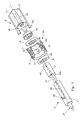
- The invention will be now described referring to the enclosed figures in which:
- Fig. 1 represents the device in longitudinal section and in neutral position;
- Fig. 2 is a side view showing some passages for the oleodynamic fluid;
- Fig. 3 shows in exploded view the inner components of the invention;
- Fig. 4 shows a sectional view of the invention in a particular position occurring during its working;
- Fig. 5 shows the device in longitudinal section in working position.
- Referring to the enclosed figures the device of the invention comprises a cylindrical housing (1) in which a cylindrical rod S is inserted, having proximal (2) and distal (3) parts, connected by a central rod (12) of shorter diameter.
- A thinner cylindrical rod S", coaxial with cylindrical rod S, is connected and integral with the cylindrical part (2).
- Moreover inside this cylindrical rod S there is a duct (14) connecting a point (14') on the basis of the cylindrical part (3) with a hole (26) on the side wall of the cylindrical part (2).
- This housing (1) has an axial through hole comprising a first part (28), which allows a sliding coupling with part (2) of rod S, and a second part (28a) of larger diamenter.
- At the end of this second part (28a) there is a thread, for connection with the hydraulic circuit on which the device of the invention must be inserted (not shown).
- On the side wall of this cylindrical housing (1) a threaded hole (11) is provided, which connects this cavity (28a) with a second part (not shown) of the hydraulic circuit on which the device of the invention must be inserted.
- Inside the cavity (28a) and coaxial with it, it is inserted a bush (9) having an axial through hole (15) which allows a sliding seal coupling with the second part (3) of the rod S. The sealing between the cylindrical cavity (15) and the second part (3) of rod S can be obtained, for example, by means of a lip-gasket (10). The insertion of the bush (9) splits the cavity (28a) in two parts which are put in connection by one or more channels (17) (fig. 2) provided on the outer surface of bush (9).
- In this way the insertion of the bush (9) does not prevent the free circulation of the oleodynamic fluid in the cavity (28a).
- This bush (9) is kept in position inside the cavity (28a) by means of suitable well-known blocking means such as, for example (fig. 3), some teeth (9a), integral with the bush, that snap fit in suitable housings (31) provided on the internal surface of the cavity (28a).
- An element (32) is placed between a shoulder (30) provided inside the cavity (28a) and the bush (9), preferably with the interposition of a spacer (8), said element (32) consisting, if necessary, of many elements coupled one another. The element (32) has a cylindrical inner shape so as to obtain a tight connection with the inner wall of the cavity (28a) and a seal engagement with part (2) of rod S rod, when this latter leads its proximal part (2) inside this component (32), by sliding along its axis. The aforesaid seal engagement between the cylindrical part (2) and the component (32) is of a particular kind and it will be described afterwards.
- According to a preferred embodiment, this component (32) comprises a bush (5), with a housing for a seal ring (6) in its outer surface, said bush (5), coupling with a gasket (7) made of deformable material, which realizes the sealing with the cylindrical part (2) of S the piston-rod.
- The coupling between the bush (5) and the gasket (7) can be obtained, for example, by means of a groove (19) in the gasket (7), in which a collar (21) of the bush (5) is inserted (see fig. 3).
- The sealing between the gasket (7) and the cylindrical part (2), when this last is inserted inside the gasket (7), is realized by a flexible lip (20) which resiliently shuts the surface of the cylindrical part (2).
- Since this lip (20) is inclined, when the pressure is higher from the part of the bush (5), it is such to enlarge the lip (20) which will assume the shape (20a) (fig. 4), allowing the oleodynamic fluid to flow between the gasket (7) and the cylindrical part (2), assisted by the cone-shaped surface (25) of the bush (5); on the other hand when the pressure is higher from the opposite part, that is to say from the part of the bush (9), it will mostly shut the lip (20) on the cylindrical part (2) so preventing the backward flow of the oleodynamic fluid.
- About the movement of rod S, it must be observed that it is not influenced by the presence or by the absence of oleodynamic fluid in pressure, as its axial thrusts, acting on the ring surfaces (12A), counterbalance if the cylindrical parts (2) and (3) of rod S have the same diameter, while the presence of the duct (14) inside the rod S allows the evacuation of the air from the cavity (15) of the bush (9), when the rod S is shifted ahead inside the bush (9).
- The device of the invention operates as follows.
- The invention is inserted in series with the hydraulic circuit so that the oleodynamic fluid coming out from the pump enters the housing (1) through the opening (11) and, through the cavity (28a), gets into a pipe leading to the device that must be blocked, for example the clutch or the brakes.
- When the device is in neutral position, that is to say it is not acting as antitheft, the S piston-rod is in the position shown in fig. 1. In this position the fluid can freely circulate inside the cavity (28a) since the lip (20) of the gasket (7) is in corrispondence of the small diameter part (12) of rod S, and does not perform any sealing with rod S.
- In such a situation the invention does not influence the functioning of the hydraulic device of the car that must be blocked.
- Making the rod S axially slide, so that it reaches the position shown in fig. 5, the surface of the cylindric part (2) of the piston-rod is inserted inside the gasket (7) so that the lip (20) can tight shut the part (2) of rod S.
- In this situation, if the pump which raises pressure of the oleodynamic fluid is operated, the fluid can flow under the lip (20) raising it and, therefore, it can actuate the hydraulic device it is connected with.
- If this hydraulic device is in the clutch, this last will be disengaged, while if the hydraulic device is in the brakes, they will be blocked.
- On the contrary, when the pressure is higher from the part of the bush (9), since the lip (20) does not raise, it shuts more and more on the surface of the cylindrical part (2), so that the lip (20) tight closes the passage around rod S, obstructing the downflow of the oleodynamic fluid and preventing the reconnection of the clutch and/or the release of the brakes.
- It is obvious that in such a situation it is impossible to move the vehicle.
- The device of the invention can be easily actuated by means of the rod (S"), integral with the rod S, which can be easily controlled with a key.
- Finally the invention will have the dimensions of the internal passages, that do not induce extreme loss of load when it is in neutral position, for not affecting the working of the hydraulic device of the vehicle, but one will have to take care that, during the movement of the S piston-rod, axial thrusts do not occur on the piston-rod itself so to prevent an irregular working of it. It is evident that the invention is able to block one or more oleodynamic controls of a motor vehicle. Further example, the brakes: if we put the invention between the pump of the brakes and its small cylinders the process would be the same, that is to say we would inhibit the use of the brakes.
- The mechanism which controls the rod S has not been described, since there are several known solutions to control the forward and back movements of the rod S.
- For example a normal key-lock or a more sophisticated radio-controlled system or any other instrument can be suggested.
- Therefore we can conclude saying that the materials used for the realization of the "antitheft device suitable for blocking one or more oleodynamic controls" according to the invention, are easily available on the market.
- To conclude, we will say that all the details can be replaced by technically equivalent elements: the employed materials can differ according to the needs, provided that they are compatible with this use and with the contingent dimensions and shapes.
Claims (8)
- Hydraulic antitheft device for motor vehicles suitable for preventing the functioning of at least an hydraulic device in the aforesaid motor vehicles, characterized by the fact of providing for means to be inserted in the circuit of said hydraulic device of the vehicle, said means being apt to be led from a configuration which allows the flow of the oleodynamic fluid in both directions to a configuration which allows the flow of the oleodynamic fluid in one direction only, in such a way that this hydraulic device of the vehicle can be started but it cannot be disengaged.
- Hydraulic antitheft device, according to claim 1, characterized by the fact that the said means suitable for allowing the passage of the oleodynamic fluid only in one direction include a gasket (7) provided with a flexible lip (20) apt to tight shut on the surface of a cylindrical rod (S), said cylindrical rod (S) being movable from a neutral position in which it does not interfere with the hydraulic fluid, to a position in which it penetrates into the lip (20), said lip (20) being inclined in such a way that the pressure of the oleodynamic fluid raises it, moving it away from the surface of the cylindrical rod (S), when the pressure increases in the hydraulic circuit of the device that has to be blocked, at and it is able to shut it on the surface of the cylindrical rod (S), so preventing the downflow, when the oleodynamic fluid tends to flow down.
- Hydraulic antitheft device, according to claim 1, characterized by the fact that said cylindrical rod (S) has a first part (2) and a second part (3) connected by a central rod (12) having a smaller diameter, said cylindrical rod (S) being movable between a position in which the smaller diameter rod (12) is in correspondence with said gasket (7) having said flexible lip (12) and a position in which one of said first (2) and second (3) parts interacts with said flexible lip (20), preventing the return of the fluid and blocking the chosen control.
- Hydraulic antitheft device, according to claim 3, characterized in that said gasket (7) is fastened to a bush (5) said bush (5) having an O-Ring seal on its outer wall, and a cone-shapes inner wall with the purpose of conveying the fluid towards the internal side of the gasket, causing in that area an increase of the fluid speed and the raising of the flexible lip (20).
- Hydraulic antitheft device, according to claim 4, characterized by the fact that the rod (S) is dimensioned so that it can always balance the pressures that can be created inside the device in case of attempted theft of the motor vehicle.
- Hydraulic antitheft device, according to claim 4, characterized by the fact that, in the rod (S) a hole (14) is provided, communicating with the external part of the device so as to allow the air passage necessary for its longitudinal movement.
- Hydraulic antitheft device, according to claim 7, characterized by the fact that the inner parts of it are in practice unapproachable if not by lock-picking.
- Hydraulic antitheft device, including one or more characteristics described and/or illustrated.
Applications Claiming Priority (2)
| Application Number | Priority Date | Filing Date | Title |
|---|---|---|---|
| IT000025A ITPC20020025A1 (en) | 2002-09-30 | 2002-09-30 | CONFERENCE USED AS AN INTIFURT ACTING TO INHIBIT ONE OR MORE HYDRAULIC COMMANDS |
| ITPC20020025 | 2002-09-30 |
Publications (2)
| Publication Number | Publication Date |
|---|---|
| EP1413489A1 true EP1413489A1 (en) | 2004-04-28 |
| EP1413489B1 EP1413489B1 (en) | 2005-11-16 |
Family
ID=32051241
Family Applications (1)
| Application Number | Title | Priority Date | Filing Date |
|---|---|---|---|
| EP03021152A Expired - Lifetime EP1413489B1 (en) | 2002-09-30 | 2003-09-23 | Antitheft device suitable for blocking one or more hydraulic controls |
Country Status (4)
| Country | Link |
|---|---|
| EP (1) | EP1413489B1 (en) |
| AT (1) | ATE309933T1 (en) |
| DE (1) | DE60302314T2 (en) |
| IT (1) | ITPC20020025A1 (en) |
Citations (3)
| Publication number | Priority date | Publication date | Assignee | Title |
|---|---|---|---|---|
| US4579202A (en) * | 1984-03-12 | 1986-04-01 | Borg-Warner Corporation | Brake holding apparatus |
| EP0371174A1 (en) * | 1987-05-27 | 1990-06-06 | Robert Conway | Anti-theft device for motor vehicles |
| EP0572258A2 (en) * | 1992-05-27 | 1993-12-01 | Ben-Asher Eldad | Brake release lock |
-
2002
- 2002-09-30 IT IT000025A patent/ITPC20020025A1/en unknown
-
2003
- 2003-09-23 DE DE60302314T patent/DE60302314T2/en not_active Expired - Fee Related
- 2003-09-23 AT AT03021152T patent/ATE309933T1/en not_active IP Right Cessation
- 2003-09-23 EP EP03021152A patent/EP1413489B1/en not_active Expired - Lifetime
Patent Citations (3)
| Publication number | Priority date | Publication date | Assignee | Title |
|---|---|---|---|---|
| US4579202A (en) * | 1984-03-12 | 1986-04-01 | Borg-Warner Corporation | Brake holding apparatus |
| EP0371174A1 (en) * | 1987-05-27 | 1990-06-06 | Robert Conway | Anti-theft device for motor vehicles |
| EP0572258A2 (en) * | 1992-05-27 | 1993-12-01 | Ben-Asher Eldad | Brake release lock |
Also Published As
| Publication number | Publication date |
|---|---|
| ATE309933T1 (en) | 2005-12-15 |
| ITPC20020025A1 (en) | 2004-04-01 |
| DE60302314T2 (en) | 2006-07-20 |
| DE60302314D1 (en) | 2005-12-22 |
| EP1413489B1 (en) | 2005-11-16 |
Similar Documents
| Publication | Publication Date | Title |
|---|---|---|
| US6607060B2 (en) | Clutch operating system and a hydraulic mechanism used in the same | |
| KR910006096A (en) | Telescopically adjustable steering axis | |
| WO1997010456A3 (en) | Motor vehicle with a device for actuating the torque-transmission system and the gearbox | |
| US6585088B1 (en) | Braking system for braking a rotor relative to a stator | |
| US7331894B2 (en) | Dog clutch and method for overdrive | |
| DE102009049245A1 (en) | Check-valve device for clutch pedal force support device in motor vehicle, has sealing element that is implemented as O-ring which is arranged such that sealing element releases or locks pressure-dependent passage channels between chambers | |
| KR100962274B1 (en) | Hydraulic drive system | |
| KR20160117495A (en) | A hydraulic system for a vehicle | |
| US6886672B2 (en) | Power transmitting apparatus for a working vehicle | |
| US4773277A (en) | Self-contained power take-off | |
| WO2003052292A3 (en) | Rear drive module for all-wheel drive vehicle | |
| JP2001082515A (en) | Brake assembly | |
| US5261456A (en) | Transmission engagement override valve | |
| US20110226578A1 (en) | Hydraulic coupling having improved hydraulic porting path design | |
| US8371552B2 (en) | Shift actuator valve having a pressure dead band | |
| EP1413489A1 (en) | Antitheft device suitable for blocking one or more hydraulic controls | |
| JPS60159463A (en) | Power extractor | |
| US11543028B2 (en) | Transmission for a vehicle | |
| JPS6262084A (en) | Intensifying joint | |
| US8661925B2 (en) | Hydraulically operated shifter for power take-off | |
| US7017326B1 (en) | Transmission rotation sensor switch | |
| ITTO960306A1 (en) | ELECTRO-HYDRAULIC DEVICE FOR THE CONTROL OF A SERVOCOMAN- DATED TRANSMISSION. | |
| US7438542B2 (en) | Fluid pump assembly | |
| EP1048870A2 (en) | Hydrostatic coupling | |
| JPS6357646B2 (en) |
Legal Events
| Date | Code | Title | Description |
|---|---|---|---|
| PUAI | Public reference made under article 153(3) epc to a published international application that has entered the european phase |
Free format text: ORIGINAL CODE: 0009012 |
|
| AK | Designated contracting states |
Kind code of ref document: A1 Designated state(s): AT BE BG CH CY CZ DE DK EE ES FI FR GB GR HU IE IT LI LU MC NL PT RO SE SI SK TR |
|
| AX | Request for extension of the european patent |
Extension state: AL LT LV MK |
|
| 17P | Request for examination filed |
Effective date: 20040601 |
|
| 17Q | First examination report despatched |
Effective date: 20040906 |
|
| AKX | Designation fees paid |
Designated state(s): AT BE BG CH CY CZ DE DK EE ES FI FR GB GR HU IE IT LI LU MC NL PT RO SE SI SK TR |
|
| GRAP | Despatch of communication of intention to grant a patent |
Free format text: ORIGINAL CODE: EPIDOSNIGR1 |
|
| GRAS | Grant fee paid |
Free format text: ORIGINAL CODE: EPIDOSNIGR3 |
|
| GRAA | (expected) grant |
Free format text: ORIGINAL CODE: 0009210 |
|
| AK | Designated contracting states |
Kind code of ref document: B1 Designated state(s): AT BE BG CH CY CZ DE DK EE ES FI FR GB GR HU IE IT LI LU MC NL PT RO SE SI SK TR |
|
| PG25 | Lapsed in a contracting state [announced via postgrant information from national office to epo] |
Ref country code: IT Free format text: LAPSE BECAUSE OF FAILURE TO SUBMIT A TRANSLATION OF THE DESCRIPTION OR TO PAY THE FEE WITHIN THE PRESCRIBED TIME-LIMIT;WARNING: LAPSES OF ITALIAN PATENTS WITH EFFECTIVE DATE BEFORE 2007 MAY HAVE OCCURRED AT ANY TIME BEFORE 2007. THE CORRECT EFFECTIVE DATE MAY BE DIFFERENT FROM THE ONE RECORDED. Effective date: 20051116 Ref country code: LI Free format text: LAPSE BECAUSE OF FAILURE TO SUBMIT A TRANSLATION OF THE DESCRIPTION OR TO PAY THE FEE WITHIN THE PRESCRIBED TIME-LIMIT Effective date: 20051116 Ref country code: FI Free format text: LAPSE BECAUSE OF FAILURE TO SUBMIT A TRANSLATION OF THE DESCRIPTION OR TO PAY THE FEE WITHIN THE PRESCRIBED TIME-LIMIT Effective date: 20051116 Ref country code: BE Free format text: LAPSE BECAUSE OF FAILURE TO SUBMIT A TRANSLATION OF THE DESCRIPTION OR TO PAY THE FEE WITHIN THE PRESCRIBED TIME-LIMIT Effective date: 20051116 Ref country code: CH Free format text: LAPSE BECAUSE OF FAILURE TO SUBMIT A TRANSLATION OF THE DESCRIPTION OR TO PAY THE FEE WITHIN THE PRESCRIBED TIME-LIMIT Effective date: 20051116 Ref country code: NL Free format text: LAPSE BECAUSE OF FAILURE TO SUBMIT A TRANSLATION OF THE DESCRIPTION OR TO PAY THE FEE WITHIN THE PRESCRIBED TIME-LIMIT Effective date: 20051116 Ref country code: AT Free format text: LAPSE BECAUSE OF FAILURE TO SUBMIT A TRANSLATION OF THE DESCRIPTION OR TO PAY THE FEE WITHIN THE PRESCRIBED TIME-LIMIT Effective date: 20051116 Ref country code: SK Free format text: LAPSE BECAUSE OF FAILURE TO SUBMIT A TRANSLATION OF THE DESCRIPTION OR TO PAY THE FEE WITHIN THE PRESCRIBED TIME-LIMIT Effective date: 20051116 Ref country code: CZ Free format text: LAPSE BECAUSE OF FAILURE TO SUBMIT A TRANSLATION OF THE DESCRIPTION OR TO PAY THE FEE WITHIN THE PRESCRIBED TIME-LIMIT Effective date: 20051116 Ref country code: RO Free format text: LAPSE BECAUSE OF FAILURE TO SUBMIT A TRANSLATION OF THE DESCRIPTION OR TO PAY THE FEE WITHIN THE PRESCRIBED TIME-LIMIT Effective date: 20051116 Ref country code: SI Free format text: LAPSE BECAUSE OF FAILURE TO SUBMIT A TRANSLATION OF THE DESCRIPTION OR TO PAY THE FEE WITHIN THE PRESCRIBED TIME-LIMIT Effective date: 20051116 |
|
| REG | Reference to a national code |
Ref country code: GB Ref legal event code: FG4D |
|
| REG | Reference to a national code |
Ref country code: CH Ref legal event code: EP |
|
| REF | Corresponds to: |
Ref document number: 60302314 Country of ref document: DE Date of ref document: 20051222 Kind code of ref document: P |
|
| REG | Reference to a national code |
Ref country code: IE Ref legal event code: FG4D |
|
| PG25 | Lapsed in a contracting state [announced via postgrant information from national office to epo] |
Ref country code: SE Free format text: LAPSE BECAUSE OF FAILURE TO SUBMIT A TRANSLATION OF THE DESCRIPTION OR TO PAY THE FEE WITHIN THE PRESCRIBED TIME-LIMIT Effective date: 20060216 Ref country code: GR Free format text: LAPSE BECAUSE OF FAILURE TO SUBMIT A TRANSLATION OF THE DESCRIPTION OR TO PAY THE FEE WITHIN THE PRESCRIBED TIME-LIMIT Effective date: 20060216 Ref country code: BG Free format text: LAPSE BECAUSE OF FAILURE TO SUBMIT A TRANSLATION OF THE DESCRIPTION OR TO PAY THE FEE WITHIN THE PRESCRIBED TIME-LIMIT Effective date: 20060216 Ref country code: DK Free format text: LAPSE BECAUSE OF FAILURE TO SUBMIT A TRANSLATION OF THE DESCRIPTION OR TO PAY THE FEE WITHIN THE PRESCRIBED TIME-LIMIT Effective date: 20060216 |
|
| PG25 | Lapsed in a contracting state [announced via postgrant information from national office to epo] |
Ref country code: ES Free format text: LAPSE BECAUSE OF FAILURE TO SUBMIT A TRANSLATION OF THE DESCRIPTION OR TO PAY THE FEE WITHIN THE PRESCRIBED TIME-LIMIT Effective date: 20060227 |
|
| PG25 | Lapsed in a contracting state [announced via postgrant information from national office to epo] |
Ref country code: PT Free format text: LAPSE BECAUSE OF FAILURE TO SUBMIT A TRANSLATION OF THE DESCRIPTION OR TO PAY THE FEE WITHIN THE PRESCRIBED TIME-LIMIT Effective date: 20060417 |
|
| NLV1 | Nl: lapsed or annulled due to failure to fulfill the requirements of art. 29p and 29m of the patents act | ||
| PG25 | Lapsed in a contracting state [announced via postgrant information from national office to epo] |
Ref country code: HU Free format text: LAPSE BECAUSE OF FAILURE TO SUBMIT A TRANSLATION OF THE DESCRIPTION OR TO PAY THE FEE WITHIN THE PRESCRIBED TIME-LIMIT Effective date: 20060517 |
|
| REG | Reference to a national code |
Ref country code: CH Ref legal event code: PL |
|
| ET | Fr: translation filed | ||
| PLBE | No opposition filed within time limit |
Free format text: ORIGINAL CODE: 0009261 |
|
| STAA | Information on the status of an ep patent application or granted ep patent |
Free format text: STATUS: NO OPPOSITION FILED WITHIN TIME LIMIT |
|
| PG25 | Lapsed in a contracting state [announced via postgrant information from national office to epo] |
Ref country code: IE Free format text: LAPSE BECAUSE OF NON-PAYMENT OF DUE FEES Effective date: 20060925 |
|
| PG25 | Lapsed in a contracting state [announced via postgrant information from national office to epo] |
Ref country code: MC Free format text: LAPSE BECAUSE OF NON-PAYMENT OF DUE FEES Effective date: 20060930 |
|
| 26N | No opposition filed |
Effective date: 20060817 |
|
| REG | Reference to a national code |
Ref country code: IE Ref legal event code: MM4A |
|
| PG25 | Lapsed in a contracting state [announced via postgrant information from national office to epo] |
Ref country code: EE Free format text: LAPSE BECAUSE OF FAILURE TO SUBMIT A TRANSLATION OF THE DESCRIPTION OR TO PAY THE FEE WITHIN THE PRESCRIBED TIME-LIMIT Effective date: 20051116 |
|
| PG25 | Lapsed in a contracting state [announced via postgrant information from national office to epo] |
Ref country code: TR Free format text: LAPSE BECAUSE OF FAILURE TO SUBMIT A TRANSLATION OF THE DESCRIPTION OR TO PAY THE FEE WITHIN THE PRESCRIBED TIME-LIMIT Effective date: 20051116 Ref country code: LU Free format text: LAPSE BECAUSE OF NON-PAYMENT OF DUE FEES Effective date: 20060923 |
|
| PG25 | Lapsed in a contracting state [announced via postgrant information from national office to epo] |
Ref country code: CY Free format text: LAPSE BECAUSE OF FAILURE TO SUBMIT A TRANSLATION OF THE DESCRIPTION OR TO PAY THE FEE WITHIN THE PRESCRIBED TIME-LIMIT Effective date: 20051116 |
|
| PGFP | Annual fee paid to national office [announced via postgrant information from national office to epo] |
Ref country code: FR Payment date: 20080822 Year of fee payment: 6 |
|
| PGFP | Annual fee paid to national office [announced via postgrant information from national office to epo] |
Ref country code: GB Payment date: 20080701 Year of fee payment: 6 |
|
| PGFP | Annual fee paid to national office [announced via postgrant information from national office to epo] |
Ref country code: DE Payment date: 20080702 Year of fee payment: 6 |
|
| GBPC | Gb: european patent ceased through non-payment of renewal fee |
Effective date: 20090923 |
|
| REG | Reference to a national code |
Ref country code: FR Ref legal event code: ST Effective date: 20100531 |
|
| PG25 | Lapsed in a contracting state [announced via postgrant information from national office to epo] |
Ref country code: DE Free format text: LAPSE BECAUSE OF NON-PAYMENT OF DUE FEES Effective date: 20100401 Ref country code: FR Free format text: LAPSE BECAUSE OF NON-PAYMENT OF DUE FEES Effective date: 20090930 |
|
| PG25 | Lapsed in a contracting state [announced via postgrant information from national office to epo] |
Ref country code: GB Free format text: LAPSE BECAUSE OF NON-PAYMENT OF DUE FEES Effective date: 20090923 |