EP1413272A1 - Interlabial pad individual packaging vessel - Google Patents
Interlabial pad individual packaging vessel Download PDFInfo
- Publication number
- EP1413272A1 EP1413272A1 EP02771743A EP02771743A EP1413272A1 EP 1413272 A1 EP1413272 A1 EP 1413272A1 EP 02771743 A EP02771743 A EP 02771743A EP 02771743 A EP02771743 A EP 02771743A EP 1413272 A1 EP1413272 A1 EP 1413272A1
- Authority
- EP
- European Patent Office
- Prior art keywords
- wrapping
- interlabial pad
- wrapping container
- container
- individually
- Prior art date
- Legal status (The legal status is an assumption and is not a legal conclusion. Google has not performed a legal analysis and makes no representation as to the accuracy of the status listed.)
- Granted
Links
- 238000004806 packaging method and process Methods 0.000 title description 24
- 238000003780 insertion Methods 0.000 claims abstract description 141
- 230000037431 insertion Effects 0.000 claims abstract description 141
- 238000000926 separation method Methods 0.000 claims abstract description 84
- 241001313288 Labia Species 0.000 claims abstract description 83
- 239000000463 material Substances 0.000 claims description 39
- XLYOFNOQVPJJNP-UHFFFAOYSA-N water Substances O XLYOFNOQVPJJNP-UHFFFAOYSA-N 0.000 claims description 19
- 239000002648 laminated material Substances 0.000 claims description 8
- 239000000835 fiber Substances 0.000 claims description 7
- 239000002195 soluble material Substances 0.000 claims description 6
- 235000010627 Phaseolus vulgaris Nutrition 0.000 claims description 2
- 244000046052 Phaseolus vulgaris Species 0.000 claims description 2
- 238000000034 method Methods 0.000 description 83
- 238000007789 sealing Methods 0.000 description 30
- 239000008280 blood Substances 0.000 description 26
- 210000004369 blood Anatomy 0.000 description 26
- 230000002175 menstrual effect Effects 0.000 description 26
- 239000000853 adhesive Substances 0.000 description 24
- 230000001070 adhesive effect Effects 0.000 description 24
- 238000005304 joining Methods 0.000 description 13
- 239000004745 nonwoven fabric Substances 0.000 description 12
- 239000011347 resin Substances 0.000 description 11
- 229920005989 resin Polymers 0.000 description 11
- 230000000694 effects Effects 0.000 description 9
- 239000000049 pigment Substances 0.000 description 9
- -1 polypropylene Polymers 0.000 description 9
- 238000011282 treatment Methods 0.000 description 8
- 239000000123 paper Substances 0.000 description 7
- 239000004372 Polyvinyl alcohol Substances 0.000 description 6
- 206010040844 Skin exfoliation Diseases 0.000 description 6
- 230000002745 absorbent Effects 0.000 description 6
- 239000002250 absorbent Substances 0.000 description 6
- 238000004049 embossing Methods 0.000 description 6
- 229920001684 low density polyethylene Polymers 0.000 description 6
- 239000004702 low-density polyethylene Substances 0.000 description 6
- 229920002451 polyvinyl alcohol Polymers 0.000 description 6
- 235000019422 polyvinyl alcohol Nutrition 0.000 description 6
- 238000007639 printing Methods 0.000 description 6
- 210000001519 tissue Anatomy 0.000 description 6
- 239000002131 composite material Substances 0.000 description 5
- 238000010030 laminating Methods 0.000 description 5
- 238000004519 manufacturing process Methods 0.000 description 5
- 229940068984 polyvinyl alcohol Drugs 0.000 description 5
- 239000000126 substance Substances 0.000 description 5
- 241000894006 Bacteria Species 0.000 description 4
- 239000012943 hotmelt Substances 0.000 description 4
- 210000001215 vagina Anatomy 0.000 description 4
- 238000005406 washing Methods 0.000 description 4
- 239000004698 Polyethylene Substances 0.000 description 3
- 230000000903 blocking effect Effects 0.000 description 3
- 239000011248 coating agent Substances 0.000 description 3
- 238000000576 coating method Methods 0.000 description 3
- 238000004040 coloring Methods 0.000 description 3
- 239000007788 liquid Substances 0.000 description 3
- 229920000573 polyethylene Polymers 0.000 description 3
- 239000004626 polylactic acid Substances 0.000 description 3
- 239000002699 waste material Substances 0.000 description 3
- VTYYLEPIZMXCLO-UHFFFAOYSA-L Calcium carbonate Chemical compound [Ca+2].[O-]C([O-])=O VTYYLEPIZMXCLO-UHFFFAOYSA-L 0.000 description 2
- CURLTUGMZLYLDI-UHFFFAOYSA-N Carbon dioxide Chemical compound O=C=O CURLTUGMZLYLDI-UHFFFAOYSA-N 0.000 description 2
- 229920000742 Cotton Polymers 0.000 description 2
- 239000004831 Hot glue Substances 0.000 description 2
- 239000004743 Polypropylene Substances 0.000 description 2
- 230000001154 acute effect Effects 0.000 description 2
- 238000005452 bending Methods 0.000 description 2
- 238000005520 cutting process Methods 0.000 description 2
- 230000007423 decrease Effects 0.000 description 2
- 239000000428 dust Substances 0.000 description 2
- 230000001939 inductive effect Effects 0.000 description 2
- VNWKTOKETHGBQD-UHFFFAOYSA-N methane Chemical compound C VNWKTOKETHGBQD-UHFFFAOYSA-N 0.000 description 2
- 239000000203 mixture Substances 0.000 description 2
- 230000000149 penetrating effect Effects 0.000 description 2
- 229920001155 polypropylene Polymers 0.000 description 2
- 239000002994 raw material Substances 0.000 description 2
- 229920002725 thermoplastic elastomer Polymers 0.000 description 2
- AZXGXVQWEUFULR-UHFFFAOYSA-N 2',4',5',7'-tetrabromofluorescein Chemical compound OC(=O)C1=CC=CC=C1C1=C2C=C(Br)C(=O)C(Br)=C2OC2=C(Br)C(O)=C(Br)C=C21 AZXGXVQWEUFULR-UHFFFAOYSA-N 0.000 description 1
- AVERNFJXXRIVQN-XSDYUOFFSA-N 5-[(4-ethoxyphenyl)diazenyl]-2-[(e)-2-[4-[(4-ethoxyphenyl)diazenyl]-2-sulfophenyl]ethenyl]benzenesulfonic acid Chemical compound C1=CC(OCC)=CC=C1N=NC(C=C1S(O)(=O)=O)=CC=C1\C=C\C1=CC=C(N=NC=2C=CC(OCC)=CC=2)C=C1S(O)(=O)=O AVERNFJXXRIVQN-XSDYUOFFSA-N 0.000 description 1
- 239000002028 Biomass Substances 0.000 description 1
- 206010016322 Feeling abnormal Diseases 0.000 description 1
- 241000233866 Fungi Species 0.000 description 1
- QQILFGKZUJYXGS-UHFFFAOYSA-N Indigo dye Chemical compound C1=CC=C2C(=O)C(C3=C(C4=CC=CC=C4N3)O)=NC2=C1 QQILFGKZUJYXGS-UHFFFAOYSA-N 0.000 description 1
- SJEYSFABYSGQBG-UHFFFAOYSA-M Patent blue Chemical compound [Na+].C1=CC(N(CC)CC)=CC=C1C(C=1C(=CC(=CC=1)S([O-])(=O)=O)S([O-])(=O)=O)=C1C=CC(=[N+](CC)CC)C=C1 SJEYSFABYSGQBG-UHFFFAOYSA-M 0.000 description 1
- 229920000297 Rayon Polymers 0.000 description 1
- 229920002472 Starch Polymers 0.000 description 1
- GWEVSGVZZGPLCZ-UHFFFAOYSA-N Titan oxide Chemical compound O=[Ti]=O GWEVSGVZZGPLCZ-UHFFFAOYSA-N 0.000 description 1
- RTAQQCXQSZGOHL-UHFFFAOYSA-N Titanium Chemical compound [Ti] RTAQQCXQSZGOHL-UHFFFAOYSA-N 0.000 description 1
- 206010046543 Urinary incontinence Diseases 0.000 description 1
- 239000000980 acid dye Substances 0.000 description 1
- 239000002390 adhesive tape Substances 0.000 description 1
- 230000000844 anti-bacterial effect Effects 0.000 description 1
- IRERQBUNZFJFGC-UHFFFAOYSA-L azure blue Chemical compound [Na+].[Na+].[Na+].[Na+].[Na+].[Na+].[Na+].[Na+].[Al+3].[Al+3].[Al+3].[Al+3].[Al+3].[Al+3].[S-]S[S-].[O-][Si]([O-])([O-])[O-].[O-][Si]([O-])([O-])[O-].[O-][Si]([O-])([O-])[O-].[O-][Si]([O-])([O-])[O-].[O-][Si]([O-])([O-])[O-].[O-][Si]([O-])([O-])[O-] IRERQBUNZFJFGC-UHFFFAOYSA-L 0.000 description 1
- 239000000981 basic dye Substances 0.000 description 1
- 210000001124 body fluid Anatomy 0.000 description 1
- 239000010839 body fluid Substances 0.000 description 1
- 235000012745 brilliant blue FCF Nutrition 0.000 description 1
- 229910000019 calcium carbonate Inorganic materials 0.000 description 1
- 239000006229 carbon black Substances 0.000 description 1
- 239000001569 carbon dioxide Substances 0.000 description 1
- 229910002092 carbon dioxide Inorganic materials 0.000 description 1
- 210000003756 cervix mucus Anatomy 0.000 description 1
- ICIJDHUPWYQXGB-UHFFFAOYSA-N chembl1092740 Chemical compound C1=CC(NC(=O)C)=CC=C1N=NC(C(=CC1=C2)S(O)(=O)=O)=C(O)C1=CC=C2NC(=O)NC1=CC=C(C(O)=C(N=NC=2C=CC=CC=2)C(=C2)S(O)(=O)=O)C2=C1 ICIJDHUPWYQXGB-UHFFFAOYSA-N 0.000 description 1
- XRCOXKGRXOPBFA-UHFFFAOYSA-N chembl1093991 Chemical compound CC=1C=C(N=NC=2C(=CC3=CC(NC=4C=CC=CC=4)=CC=C3C=2O)S(O)(=O)=O)C(OC)=CC=1N=NC1=C(C)C=C(C)C=C1S(O)(=O)=O XRCOXKGRXOPBFA-UHFFFAOYSA-N 0.000 description 1
- HFIYIRIMGZMCPC-UHFFFAOYSA-J chembl1326377 Chemical compound [Na+].[Na+].[Na+].[Na+].[O-]S(=O)(=O)C1=CC2=CC(S([O-])(=O)=O)=C(N=NC=3C=CC(=CC=3)S(=O)(=O)CCOS([O-])(=O)=O)C(O)=C2C(N)=C1N=NC1=CC=C(S(=O)(=O)CCOS([O-])(=O)=O)C=C1 HFIYIRIMGZMCPC-UHFFFAOYSA-J 0.000 description 1
- BPHHNXJPFPEJOF-UHFFFAOYSA-J chembl296966 Chemical compound [Na+].[Na+].[Na+].[Na+].[O-]S(=O)(=O)C1=CC(S([O-])(=O)=O)=C(N)C2=C(O)C(N=NC3=CC=C(C=C3OC)C=3C=C(C(=CC=3)N=NC=3C(=C4C(N)=C(C=C(C4=CC=3)S([O-])(=O)=O)S([O-])(=O)=O)O)OC)=CC=C21 BPHHNXJPFPEJOF-UHFFFAOYSA-J 0.000 description 1
- 239000004035 construction material Substances 0.000 description 1
- ZXJXZNDDNMQXFV-UHFFFAOYSA-M crystal violet Chemical compound [Cl-].C1=CC(N(C)C)=CC=C1[C+](C=1C=CC(=CC=1)N(C)C)C1=CC=C(N(C)C)C=C1 ZXJXZNDDNMQXFV-UHFFFAOYSA-M 0.000 description 1
- 238000011161 development Methods 0.000 description 1
- 230000018109 developmental process Effects 0.000 description 1
- 239000000982 direct dye Substances 0.000 description 1
- DSARWKALPGYFTA-UHFFFAOYSA-L disodium 4-hydroxy-7-[(5-hydroxy-6-phenyldiazenyl-7-sulfonatonaphthalen-2-yl)carbamoylamino]-3-phenyldiazenylnaphthalene-2-sulfonate Chemical compound [Na+].[Na+].[O-]S(=O)(=O)C1=CC2=CC(NC(=O)NC=3C=C4C=C(C(N=NC=5C=CC=CC=5)=C(O)C4=CC=3)S([O-])(=O)=O)=CC=C2C(O)=C1N=NC1=CC=CC=C1 DSARWKALPGYFTA-UHFFFAOYSA-L 0.000 description 1
- RAGZEDHHTPQLAI-UHFFFAOYSA-L disodium;2',4',5',7'-tetraiodo-3-oxospiro[2-benzofuran-1,9'-xanthene]-3',6'-diolate Chemical compound [Na+].[Na+].O1C(=O)C2=CC=CC=C2C21C1=CC(I)=C([O-])C(I)=C1OC1=C(I)C([O-])=C(I)C=C21 RAGZEDHHTPQLAI-UHFFFAOYSA-L 0.000 description 1
- 238000009826 distribution Methods 0.000 description 1
- BXKDSDJJOVIHMX-UHFFFAOYSA-N edrophonium chloride Chemical compound [Cl-].CC[N+](C)(C)C1=CC=CC(O)=C1 BXKDSDJJOVIHMX-UHFFFAOYSA-N 0.000 description 1
- 239000013013 elastic material Substances 0.000 description 1
- 229920001971 elastomer Polymers 0.000 description 1
- 230000029142 excretion Effects 0.000 description 1
- 238000004299 exfoliation Methods 0.000 description 1
- 239000004744 fabric Substances 0.000 description 1
- 239000007789 gas Substances 0.000 description 1
- 230000002070 germicidal effect Effects 0.000 description 1
- 230000002401 inhibitory effect Effects 0.000 description 1
- 230000005764 inhibitory process Effects 0.000 description 1
- 239000001023 inorganic pigment Substances 0.000 description 1
- 238000003475 lamination Methods 0.000 description 1
- 238000012423 maintenance Methods 0.000 description 1
- 239000004750 melt-blown nonwoven Substances 0.000 description 1
- 244000005700 microbiome Species 0.000 description 1
- 230000027939 micturition Effects 0.000 description 1
- 210000004400 mucous membrane Anatomy 0.000 description 1
- 239000012860 organic pigment Substances 0.000 description 1
- 239000005022 packaging material Substances 0.000 description 1
- 230000035515 penetration Effects 0.000 description 1
- 230000002093 peripheral effect Effects 0.000 description 1
- 239000002985 plastic film Substances 0.000 description 1
- 229920002961 polybutylene succinate Polymers 0.000 description 1
- 239000004631 polybutylene succinate Substances 0.000 description 1
- 229920000728 polyester Polymers 0.000 description 1
- 239000005056 polyisocyanate Substances 0.000 description 1
- 229920001228 polyisocyanate Polymers 0.000 description 1
- 229920001296 polysiloxane Polymers 0.000 description 1
- 238000004321 preservation Methods 0.000 description 1
- 238000000275 quality assurance Methods 0.000 description 1
- 239000002964 rayon Substances 0.000 description 1
- WXQMFIJLJLLQIS-UHFFFAOYSA-N reactive blue 21 Chemical compound [Cu+2].C1=CC(S(=O)(=O)CCO)=CC=C1NS(=O)(=O)C1=CC=C2C([N-]3)=NC(C=4C5=CC=C(C=4)S(O)(=O)=O)=NC5=NC(C=4C5=CC=C(C=4)S(O)(=O)=O)=NC5=NC([N-]4)=C(C=C(C=C5)S(O)(=O)=O)C5=C4N=C3C2=C1 WXQMFIJLJLLQIS-UHFFFAOYSA-N 0.000 description 1
- 239000000985 reactive dye Substances 0.000 description 1
- DHHGSXPASZBLGC-VPMNAVQSSA-L remazole orange-3R Chemical compound [Na+].[Na+].OC=1C2=CC(NC(=O)C)=CC=C2C=C(S([O-])(=O)=O)C=1\N=N\C1=CC=C(S(=O)(=O)CCOS([O-])(=O)=O)C=C1 DHHGSXPASZBLGC-VPMNAVQSSA-L 0.000 description 1
- 239000005060 rubber Substances 0.000 description 1
- 239000002904 solvent Substances 0.000 description 1
- 239000008107 starch Substances 0.000 description 1
- 235000019698 starch Nutrition 0.000 description 1
- 230000001954 sterilising effect Effects 0.000 description 1
- 230000000638 stimulation Effects 0.000 description 1
- 229920001059 synthetic polymer Polymers 0.000 description 1
- 229920003002 synthetic resin Polymers 0.000 description 1
- 239000000057 synthetic resin Substances 0.000 description 1
- 229920005992 thermoplastic resin Polymers 0.000 description 1
- 229910052719 titanium Inorganic materials 0.000 description 1
- 239000010936 titanium Substances 0.000 description 1
- OGIDPMRJRNCKJF-UHFFFAOYSA-N titanium oxide Inorganic materials [Ti]=O OGIDPMRJRNCKJF-UHFFFAOYSA-N 0.000 description 1
- 235000013799 ultramarine blue Nutrition 0.000 description 1
- 210000000689 upper leg Anatomy 0.000 description 1
- 210000002700 urine Anatomy 0.000 description 1
- 206010046901 vaginal discharge Diseases 0.000 description 1
- 239000000984 vat dye Substances 0.000 description 1
- 210000003905 vulva Anatomy 0.000 description 1
Images














Classifications
-
- A—HUMAN NECESSITIES
- A61—MEDICAL OR VETERINARY SCIENCE; HYGIENE
- A61F—FILTERS IMPLANTABLE INTO BLOOD VESSELS; PROSTHESES; DEVICES PROVIDING PATENCY TO, OR PREVENTING COLLAPSING OF, TUBULAR STRUCTURES OF THE BODY, e.g. STENTS; ORTHOPAEDIC, NURSING OR CONTRACEPTIVE DEVICES; FOMENTATION; TREATMENT OR PROTECTION OF EYES OR EARS; BANDAGES, DRESSINGS OR ABSORBENT PADS; FIRST-AID KITS
- A61F13/00—Bandages or dressings; Absorbent pads
- A61F13/15—Absorbent pads, e.g. sanitary towels, swabs or tampons for external or internal application to the body; Supporting or fastening means therefor; Tampon applicators
- A61F13/84—Accessories, not otherwise provided for, for absorbent pads
-
- A—HUMAN NECESSITIES
- A61—MEDICAL OR VETERINARY SCIENCE; HYGIENE
- A61F—FILTERS IMPLANTABLE INTO BLOOD VESSELS; PROSTHESES; DEVICES PROVIDING PATENCY TO, OR PREVENTING COLLAPSING OF, TUBULAR STRUCTURES OF THE BODY, e.g. STENTS; ORTHOPAEDIC, NURSING OR CONTRACEPTIVE DEVICES; FOMENTATION; TREATMENT OR PROTECTION OF EYES OR EARS; BANDAGES, DRESSINGS OR ABSORBENT PADS; FIRST-AID KITS
- A61F13/00—Bandages or dressings; Absorbent pads
- A61F13/15—Absorbent pads, e.g. sanitary towels, swabs or tampons for external or internal application to the body; Supporting or fastening means therefor; Tampon applicators
- A61F13/551—Packaging before or after use
- A61F13/5519—Packaging before or after use packages containing more than one kind of item, e.g. tampon and napkin, or diaper and an exchangeable insert
-
- A—HUMAN NECESSITIES
- A61—MEDICAL OR VETERINARY SCIENCE; HYGIENE
- A61F—FILTERS IMPLANTABLE INTO BLOOD VESSELS; PROSTHESES; DEVICES PROVIDING PATENCY TO, OR PREVENTING COLLAPSING OF, TUBULAR STRUCTURES OF THE BODY, e.g. STENTS; ORTHOPAEDIC, NURSING OR CONTRACEPTIVE DEVICES; FOMENTATION; TREATMENT OR PROTECTION OF EYES OR EARS; BANDAGES, DRESSINGS OR ABSORBENT PADS; FIRST-AID KITS
- A61F13/00—Bandages or dressings; Absorbent pads
- A61F13/15—Absorbent pads, e.g. sanitary towels, swabs or tampons for external or internal application to the body; Supporting or fastening means therefor; Tampon applicators
- A61F13/551—Packaging before or after use
- A61F13/5516—Packaging before or after use packaging of interlabial absorbing articles
- A61F13/55165—Packaging before or after use packaging of interlabial absorbing articles before use
-
- A—HUMAN NECESSITIES
- A61—MEDICAL OR VETERINARY SCIENCE; HYGIENE
- A61F—FILTERS IMPLANTABLE INTO BLOOD VESSELS; PROSTHESES; DEVICES PROVIDING PATENCY TO, OR PREVENTING COLLAPSING OF, TUBULAR STRUCTURES OF THE BODY, e.g. STENTS; ORTHOPAEDIC, NURSING OR CONTRACEPTIVE DEVICES; FOMENTATION; TREATMENT OR PROTECTION OF EYES OR EARS; BANDAGES, DRESSINGS OR ABSORBENT PADS; FIRST-AID KITS
- A61F13/00—Bandages or dressings; Absorbent pads
- A61F13/15—Absorbent pads, e.g. sanitary towels, swabs or tampons for external or internal application to the body; Supporting or fastening means therefor; Tampon applicators
- A61F13/551—Packaging before or after use
- A61F13/5516—Packaging before or after use packaging of interlabial absorbing articles
- A61F13/5517—Packaging before or after use packaging of interlabial absorbing articles after use
-
- A—HUMAN NECESSITIES
- A61—MEDICAL OR VETERINARY SCIENCE; HYGIENE
- A61F—FILTERS IMPLANTABLE INTO BLOOD VESSELS; PROSTHESES; DEVICES PROVIDING PATENCY TO, OR PREVENTING COLLAPSING OF, TUBULAR STRUCTURES OF THE BODY, e.g. STENTS; ORTHOPAEDIC, NURSING OR CONTRACEPTIVE DEVICES; FOMENTATION; TREATMENT OR PROTECTION OF EYES OR EARS; BANDAGES, DRESSINGS OR ABSORBENT PADS; FIRST-AID KITS
- A61F13/00—Bandages or dressings; Absorbent pads
- A61F13/15—Absorbent pads, e.g. sanitary towels, swabs or tampons for external or internal application to the body; Supporting or fastening means therefor; Tampon applicators
- A61F13/15203—Properties of the article, e.g. stiffness or absorbency
- A61F13/15252—Properties of the article, e.g. stiffness or absorbency compostable or biodegradable
-
- A—HUMAN NECESSITIES
- A61—MEDICAL OR VETERINARY SCIENCE; HYGIENE
- A61F—FILTERS IMPLANTABLE INTO BLOOD VESSELS; PROSTHESES; DEVICES PROVIDING PATENCY TO, OR PREVENTING COLLAPSING OF, TUBULAR STRUCTURES OF THE BODY, e.g. STENTS; ORTHOPAEDIC, NURSING OR CONTRACEPTIVE DEVICES; FOMENTATION; TREATMENT OR PROTECTION OF EYES OR EARS; BANDAGES, DRESSINGS OR ABSORBENT PADS; FIRST-AID KITS
- A61F13/00—Bandages or dressings; Absorbent pads
- A61F13/15—Absorbent pads, e.g. sanitary towels, swabs or tampons for external or internal application to the body; Supporting or fastening means therefor; Tampon applicators
- A61F13/45—Absorbent pads, e.g. sanitary towels, swabs or tampons for external or internal application to the body; Supporting or fastening means therefor; Tampon applicators characterised by the shape
- A61F13/47—Sanitary towels, incontinence pads or napkins
- A61F13/4702—Sanitary towels, incontinence pads or napkins having a reinforcing member
-
- A—HUMAN NECESSITIES
- A61—MEDICAL OR VETERINARY SCIENCE; HYGIENE
- A61F—FILTERS IMPLANTABLE INTO BLOOD VESSELS; PROSTHESES; DEVICES PROVIDING PATENCY TO, OR PREVENTING COLLAPSING OF, TUBULAR STRUCTURES OF THE BODY, e.g. STENTS; ORTHOPAEDIC, NURSING OR CONTRACEPTIVE DEVICES; FOMENTATION; TREATMENT OR PROTECTION OF EYES OR EARS; BANDAGES, DRESSINGS OR ABSORBENT PADS; FIRST-AID KITS
- A61F13/00—Bandages or dressings; Absorbent pads
- A61F13/15—Absorbent pads, e.g. sanitary towels, swabs or tampons for external or internal application to the body; Supporting or fastening means therefor; Tampon applicators
- A61F13/45—Absorbent pads, e.g. sanitary towels, swabs or tampons for external or internal application to the body; Supporting or fastening means therefor; Tampon applicators characterised by the shape
- A61F13/47—Sanitary towels, incontinence pads or napkins
- A61F13/4704—Sanitary towels, incontinence pads or napkins having preferential bending zones, e.g. fold lines or grooves
-
- A—HUMAN NECESSITIES
- A61—MEDICAL OR VETERINARY SCIENCE; HYGIENE
- A61F—FILTERS IMPLANTABLE INTO BLOOD VESSELS; PROSTHESES; DEVICES PROVIDING PATENCY TO, OR PREVENTING COLLAPSING OF, TUBULAR STRUCTURES OF THE BODY, e.g. STENTS; ORTHOPAEDIC, NURSING OR CONTRACEPTIVE DEVICES; FOMENTATION; TREATMENT OR PROTECTION OF EYES OR EARS; BANDAGES, DRESSINGS OR ABSORBENT PADS; FIRST-AID KITS
- A61F13/00—Bandages or dressings; Absorbent pads
- A61F13/15—Absorbent pads, e.g. sanitary towels, swabs or tampons for external or internal application to the body; Supporting or fastening means therefor; Tampon applicators
- A61F13/15203—Properties of the article, e.g. stiffness or absorbency
- A61F13/15211—Properties of the article, e.g. stiffness or absorbency soluble or disintegratable in liquid
- A61F2013/15235—Properties of the article, e.g. stiffness or absorbency soluble or disintegratable in liquid by its solubility in water
-
- A—HUMAN NECESSITIES
- A61—MEDICAL OR VETERINARY SCIENCE; HYGIENE
- A61F—FILTERS IMPLANTABLE INTO BLOOD VESSELS; PROSTHESES; DEVICES PROVIDING PATENCY TO, OR PREVENTING COLLAPSING OF, TUBULAR STRUCTURES OF THE BODY, e.g. STENTS; ORTHOPAEDIC, NURSING OR CONTRACEPTIVE DEVICES; FOMENTATION; TREATMENT OR PROTECTION OF EYES OR EARS; BANDAGES, DRESSINGS OR ABSORBENT PADS; FIRST-AID KITS
- A61F13/00—Bandages or dressings; Absorbent pads
- A61F13/15—Absorbent pads, e.g. sanitary towels, swabs or tampons for external or internal application to the body; Supporting or fastening means therefor; Tampon applicators
- A61F13/15203—Properties of the article, e.g. stiffness or absorbency
- A61F2013/15284—Properties of the article, e.g. stiffness or absorbency characterized by quantifiable properties
- A61F2013/15357—Stiffness, e.g. Taber rigidity
-
- A—HUMAN NECESSITIES
- A61—MEDICAL OR VETERINARY SCIENCE; HYGIENE
- A61F—FILTERS IMPLANTABLE INTO BLOOD VESSELS; PROSTHESES; DEVICES PROVIDING PATENCY TO, OR PREVENTING COLLAPSING OF, TUBULAR STRUCTURES OF THE BODY, e.g. STENTS; ORTHOPAEDIC, NURSING OR CONTRACEPTIVE DEVICES; FOMENTATION; TREATMENT OR PROTECTION OF EYES OR EARS; BANDAGES, DRESSINGS OR ABSORBENT PADS; FIRST-AID KITS
- A61F13/00—Bandages or dressings; Absorbent pads
- A61F13/15—Absorbent pads, e.g. sanitary towels, swabs or tampons for external or internal application to the body; Supporting or fastening means therefor; Tampon applicators
- A61F13/53—Absorbent pads, e.g. sanitary towels, swabs or tampons for external or internal application to the body; Supporting or fastening means therefor; Tampon applicators characterised by the absorbing medium
- A61F13/534—Absorbent pads, e.g. sanitary towels, swabs or tampons for external or internal application to the body; Supporting or fastening means therefor; Tampon applicators characterised by the absorbing medium having an inhomogeneous composition through the thickness of the pad
- A61F2013/53445—Absorbent pads, e.g. sanitary towels, swabs or tampons for external or internal application to the body; Supporting or fastening means therefor; Tampon applicators characterised by the absorbing medium having an inhomogeneous composition through the thickness of the pad from several sheets
-
- A—HUMAN NECESSITIES
- A61—MEDICAL OR VETERINARY SCIENCE; HYGIENE
- A61F—FILTERS IMPLANTABLE INTO BLOOD VESSELS; PROSTHESES; DEVICES PROVIDING PATENCY TO, OR PREVENTING COLLAPSING OF, TUBULAR STRUCTURES OF THE BODY, e.g. STENTS; ORTHOPAEDIC, NURSING OR CONTRACEPTIVE DEVICES; FOMENTATION; TREATMENT OR PROTECTION OF EYES OR EARS; BANDAGES, DRESSINGS OR ABSORBENT PADS; FIRST-AID KITS
- A61F13/00—Bandages or dressings; Absorbent pads
- A61F13/15—Absorbent pads, e.g. sanitary towels, swabs or tampons for external or internal application to the body; Supporting or fastening means therefor; Tampon applicators
- A61F13/84—Accessories, not otherwise provided for, for absorbent pads
- A61F2013/8497—Accessories, not otherwise provided for, for absorbent pads having decorations or indicia means
Definitions
- the present invention relates to a wrapping container for individually wrapping an interlabial pad of such a structure as facilitates surely and sanitarily fixing and unfixing the interlabial pad between the labia, and an individual wrapping body of the interlabial pad.
- a sanitary napkin and a tampon are used generally as female sanitary products.
- the tampon there have been great efforts for relieving the foreign feeling and the discomfort when wearing the sanitary products and intervaginal wearing trouble due to the nature of those products.
- the interlabial pad is fixed by inserting it between the labia, having characteristics that it is difficult to cause the leak of menstrual blood because of higher adhesion to the body than that of the sanitary napkin and psychological resistance thereof on wearing is lower than that of the tampon which is inserted into the vagina.
- the present invention has been made considering the problems as the above, and the purpose is to provide a preferred wrapping container for wrapping the interlabial pad as a preferred handling member of the interlabial pad.
- Another purpose is to provide a wrapping container which can smoothly be held on a fingertip at the time of opening the wrapping container of the interlabial pad having a finger insertion opening.
- the interlabial pad wrapping container is characterized in that it not only serves as a finger cot when the interlabial pad is fixed in, but also permits an wrapping container opening action and a finger cot fixing action at the same time.
- the wrapping container is also characterized in that to the interlabial pad provided with a finger insertion opening for being fixed on the tip of a finger, the wrapping container opening action is an action itself to smoothly insert a finger into the finger insertion opening as it is.
- a wrapping container for individually wrapping an interlabial pad comprising a separation portion for separating the wrapping container into two separated sections, wherein: each separated section after the separation turns up to be an operation member for wearing or removing said interlabial pad.
- the wrapping container of the interlabial pad is made multi-functional only by arranging a separation part for separating the wrapping container into suitable sizes and shapes.
- the separation part is arranged on the wrapping container so that the wrapping container is suitable as an auxiliary member for fixing/unfixing the interlabial pad in/from labia.
- a separation ratio etc. of the wrapping container separated by the separation part are determined so as to be suitable for such a separation part to exert its effect.
- the individual wrapping container possesses not only its original function that it permits to singly, sanitarily, and easily carry only the interlabial pad to be used, but also the function that it can be used for fixing and unfixing the interlabial pad, and it permits to perform sanitarily fixing and unfixing the interlabial pad without such trouble as putting another finger cot on the finger.
- the wrapping container for individually packaging an interlabial pad (hereafter, simply called a wrapping container) relating to the present invention
- the wrapping container is provided with a separation part for dividing the wrapping container itself in two there, and finger insertion parts permitting to insert fingers therein in each part divided by the separation part. Therefore, a wearer can easily separate the wrapping container into two pieces by firstly inserting two fingers (for example, an index finger and a middle finger) into such insertion parts, respectively, and then opening the two fingers to the left and right, and also in this separated state, the pieces of the separated wrapping container are fixed on the tips of the fingers as a result. And, by maintaining this state, it becomes possible to fix and unfix the interlabial pad using the sections of the divided and separated wrapping container.
- two fingers for example, an index finger and a middle finger
- the labia differ in form among individuals, fixing procedures are sometimes different when the interlabial pad is fixed.
- she can directly fix the interlabial pad in the labia by bending the posture.
- the inside of the labia is sometimes hard to be exposed only by bending the posture, and in such a case, she has to fix the interlabial pad therein while forcibly keeping the labia open using fingers of another hand which is not holding the interlabial pad.
- the Japanese Utility Model Provisional Publication 61-232845(232845/1986) discloses a finger cot peelably adhered on a mount as a usable one when a tampon is inserted in a vagina.
- the fingers of the wearer are prevented from coming into direct contact with the labia by fixing the interlabial pad by putting on such finger cots on the fingers, the labia part can be kept sanitary.
- the finger cots are wrapped so as to be put on fingers without direct contact with the fingers, they have also an effect of remarkably reducing a risk that the dirt on the fingers adheres to the labia.
- the Japanese Utility Model Provisional Publication 62-9450(9450/1987) discloses such a finger cot as is provided with a grip part for preventing the finger cot from coming off a finger. It has been considered that non-contact between the labia and fingers may be more secured when such finger cots are used, because the finger cots fixed on the fingertips at the time of fixing an interlabial pad are prevented from coming off the fingers of the wearer.
- menstrual blood may drop from inside of labia and adheres to an underwear and a toilet bowl or the periphery thereof, to make wearer feel uncomfortable for the treatments.
- the fixing action can be aided through the use of the sections of the torn wrapping container, moreover, when using such pieces, they are already held on the fingertips when the wrapping container is separated, therefore, the work process for purposely fixing them on the fingertips is unnecessary. Further, when separating the wrapping container, the wrapping container can easily be torn only by inserting two fingers of a non-dominant hand in the finger insertion parts and then opening them to the right and left, therefore, the fixing work can be speeded up.
- an interlabial pad when unfixing an used interlabial pad from labia, it is possible to unfix it through the use of an interlabial pad to be newly used in order to prevent menstrual blood from adhering to fingers or prevent the fingers from contacting the labia.
- a "separation part" in this specification means what is specified in some form as a separated place of the wrapping container, and as a structure, perforations or the like which are an alternate arrangement of torn parts and untorn parts, or something to start tearing the wrapping container by making a cut part at the beginning of the separation part can be mentioned.
- a slit part is preferred to be 0.5-5mm long and 3mm wide at the maximum, and an unslit part is preferred to be 0.5-5mm long.
- the starting point of the separation part formed of perforations is started from one end edge of the wrapping container prepared at least for finger insertion, it does not matter even if the starting point is connected up to another end edge or it is arranged only up to an intermediate position from the one end edge.
- the breaking strength of the perforations is preferably 0.2-3.0N/25mm, more preferably 0.3-1.5N/25mm, under the pulling conditions of a 25mm width and 100mm/min when the perforations are pulled in the direction orthogonal to the perforations with the perforations positioned in the center.
- said finger insertion portion is composed of a mini sheet piece for a wrapping container attached so that an opening for inserting a finger be formed, with, two or more bonding portions to the wrapping container, and one or more non-bonding portions; and said mini sheet piece for wrapping container is attached in a state striding across said separation portion in said wrapping container, or attached respectively to both sides of said separation portion.
- the finger insertion part is formed by attaching the finger insertion opening part and the following finger insertion space part to the wrapping container in a state unconnected to the wrapping container surface. Therefore, a wearer can insert a finger from the opening of the finger insertion opening and fix the wrapping container on the fingertip (refer to Fig. 7).
- the belt-like piece is to be attached to the wrapping container in the state striding over the separation part (refer to Fig. 5).
- the separation part is arranged in the state penetrating both the wrapping container and the mini-sheet piece for the wrapping container in the direction of thickness, therefore, it is necessary to take care so as not to damage the mini-sheet piece for the wrapping container.
- a plurality of the mini-sheet pieces for the wrapping container can be arranged on both sides bordered by the separation part (refer to Fig. 6).
- the separation part is not arranged on the mini-sheet pieces for the wrapping container.
- the mini-sheet pieces for the wrapping container and the adhesion part do not exist on the separation part, so the breaking strength of the whole separation part can be made almost constant at the time of slitting and dividing the separation part. Therefore, the wrapping container can stably be separated compared with the case in which a piece of belt-like mini-sheet for the wrapping container is attached striding over the separation part.
- the mini-sheet pieces for the wrapping container can be joined to the wrapping container not only with an adhesive, but also by means of heat-sealing, ultrasonic sealing, an adhesive tape, or the like.
- the mini-sheet pieces for the wrapping container are adjusted so as to have a different tone and pattern or chromaticity from those of the wrapping container by means of coloring or printing a pattern or the like.
- the wrapping container for individually packaging interlabial pad (hereafter, simply called a wrapping container) related to the present invention
- the wrapping container is provided with the mini-sheet pieces on the outer surface or the inner surface, or on both of the outer and inner surfaces.
- the wrapping container comes into contact with the labia on the inside surface. Therefore, in order to realize fixing or unfixing of a sanitary interlabial pad by reducing adhesion of dirt and dust to labia, it is especially more preferable to arrange the mini-sheet pieces for the wrapping container on the outside than on the inside.
- the wrapping container for individually wrapping an interlabial pad of any of the aforementioned (2) to (4) wherein: said wrapping container for individually wrapping an interlabial pad is a wrapping container for individually wrapping an interlabial pad for wrapping an interlabial pad having a finger insertion opening; and the wrapping container for individually wrapping an interlabial pad is provided with a pre-unwrapped opening that allows the finger insertion opening of the interlabial pad contained therein to be exposed naturally at the beginning of unwrapping of the wrapping container for individually wrapping an interlabial pad, in addition to said separation section.
- the wrapping container for individually packaging the interlabial pad (hereafter, simply called a wrapping container) related to the present invention
- the wrapping container is provided with a "pre-unwrapped opening" separately from the separation part for slitting up the wrapping container. Since the finger insertion opening provided on the enclosed interlabial pad is exposed by opening such a pre-unwrapped opening, the finger insertion opening is brought into the state in which a wearer can watch it. Thus, the wearer is then able to insert a finger in the finger insertion opening immediately after the wearer has opened the wrapping container.
- the "pre-unwrapped opening” means what forms an unwrapped opening permitting to insert a finger in the finger insertion opening of the interlabial pad through there.
- the size of this "pre-unwrapped opening” is sufficient as long as the wearer can watch the finger insertion opening of the interlabial pad through the pre-unwrapped opening by unsealing it and she can insert her finger in the finger insertion opening, but as a size permitting to unfixing the interlabial pad, the pre-unwrapped opening may be sized for permitting to unfix the interlabial pad through there.
- the wrapping container for individually wrapping an interlabial pad of the aforementioned (5) composed of a series of wrapping sheet wound in a way to form a overlapping part where a part thereof is folded, or of a series of wrapping sheet wound in a way to form a overlapping part where both ends thereof are superposed each other, wherein:
- the wrapping container for individually wrapping the interlabial pad (hereafter, simply called a wrapping container) related to the present invention is formed by folding a wrapping sheet. And, a pre-unwrapped opening for opening the wrapping container is formed from the overlapping part of both side parts of the folded wrapping sheet. Therefore, a wearer is easily able to open the wrapping container by opening the overlapping part of the wrapping sheet.
- the wrapping sheet folded in three where the interlabial pad is placed approximately in the middle of the wrapping sheet and the wrapping sheet is folded inside from both side parts thereof (refer to Fig. 1), and the wrapping sheet is folded in half holding the interlabial pad in between (refer to Fig. 9).
- the overlapping part where the side parts of the folded wrapping sheet are layered, serves as the pre-unwrapped opening, and is stuck by heat-sealing or the like so as to be peelable.
- the overlapping part of the wrapping sheet in the case of the three-folded one, can be provided with a stop tape with dry edges thereon, and in the case of the double-folded one, the overlapping part can be provided with a tab thereon.
- the pre-unwrapped opening for forming an unwrapped opening is opened by tearing a part of the wrapping container along a broken line and pulling down the torn part.
- the "broken line” is formed in an inner side than the joining part for sealing the wrapping container in the overlapping part of the wrapping sheet, and the composition thereof is the same as the separation part described in the item (2).
- the pre-opening part is comprised of the broken line
- the three edges except the folded part are joined by heat-sealing or the like.
- the pre-unwrapped opening and the separation part are arranged in the opposite positions to each other.
- the finger insertion part with the finger insertion openings is arranged in the neighborhood of the separation part, this allows a wearer to open the pre-unwrapped opening and insert fingers of her dominant hand therefrom into the finger insertion openings of the interlabial pad, while this also allows her to insert fingers of another hand into the finger insertion opening of the wrapping container.
- the interlabial pad can be taken out of the wrapping container by using both hands, therefore, such an unfixing action is made efficient and smooth.
- said wrapping container for individually wrapping an interlabial pad of the aforementioned (1) wherein: said wrapping container for individually wrapping an interlabial pad is a wrapping container for individually wrapping an interlabial pad for wrapping an interlabial pad having a finger insertion opening; said wrapping container is provided with a pre-unwrapped opening that allows the finger insertion opening of the interlabial pad contained therein to be exposed naturally at the beginning of unwrapping of the wrapping container, and a separation edge turning to be said separation portion; said wrapping container has a bean sheath shape, provided with said pre-unwrapping edge along one edge thereof and, at the same time, said separation edge is provided along the other edge continuous to this pre-unwrapping edge, and a finger cot where a finger can be inserted is formed right and left respective sides face becoming respectively an separated section after the separation of the wrapping container along said separation edge; and in a state where said wrapping container is separated into respective piece, the finger is inserted in said finger cot section portion in respective piece which turns up to be an
- the wrapping container for individually wrapping interlabial pad (hereafter, simply called a wrapping container) related to the present invention
- the pad when the interlabial pad is folded with the approximate center area in the longitudinal direction used as an axis and enclosed therein, the pad is shaped to be easy to fit. Therefore, this makes it possible to eliminate unnecessary gaps in the wrapping container, and also make it compact.
- the wrapping container related to the present invention is provided with two finger cots on the side for inserting fingers therein. Therefore, a wearer inserts two fingers (for example, an index finger and a middle finger) in each finger cot, respectively, and then opens the fingers to both sides, and can thereby easily slit the wrapping container into two pieces. As a result of this, the slit pieces are firmly held on respective fingers, therefore, this state allows the wearer to fix or unfix the interlabial pad. Thus, even when the wearer performs an action of opening the labia or the like, she can prevent the labia from touching the fingers.
- two fingers for example, an index finger and a middle finger
- a broken line is formed on a pre-unwrapped edge. Therefore, the wearer tears a part of the wrapping container along this broken line, and thereby she can open the pre-unwrapped edge, which is one edge part of the wrapping container, to make the finger insertion openings of the enclosed interlabial pad to be exposed, and can insert the fingers in such finger insertion openings.
- the wrapping container for individually wrapping an interlabial pad of the aforementioned (1) wherein: said wrapping container composes a flat cylindrical shape longer than is wide where both ends are closed; in a state where said wrapping container is separated into respective separated section at said separation portion, the wrapped interlabial pad is exposed and, at the same time, the separation portion of the separated respective piece becomes an opening where a finger can be inserted, and, with a finger is inserted from the opening, the separated section turns up to be an operation member for wearing or removing said interlabial pad.
- the two split pieces themselves serve as the finger cots for the interlabial pad handling members. Therefore, as described in the aforementioned (2), this arrangement eliminates the need for such a manufacturing process as attaching a mini-sheet piece separately, and permits to simplify the manufacturing process.
- the length from the inside of the joint part of both closed edges up to the separation part is an insertion length of a single finger, the dimension needs to be such a length as each section does not easily slip off the fingers inserted from the opening, namely, the separation part, before, during, and after the action for fixing and unfixing the interlabial pad.
- the length from the inside of the joined part of one edge end up to the inside of the other edge end needs to have a dimension permitting to enclose the interlabial pad. From these, the length is preferable to be at least 40mm, more preferably, it is in a range of 60-90mm to avoid causing a feeling of too much s!ack.
- the length from the end of the wrapping container toward the separation part is arranged within a range of 2-5mm.
- the width is preferred to be 20mm or wider considering fixation of the enclosed interlabial pad to the wrapping container, finger insertion, and holding ability of the inserted state, more preferably, the width is to be arranged within a range of 25-40mm.
- the tear strength of the broken line is at least 1N/25mm or more, preferably, it is within a range of 0.2-3.0N/25mm, considering that the break of the wrapping container should be guided along the broken line; the packaging material should not be damaged; and it should have a preservation capability.
- the numerical value is defined as a reading of the maximum load when measuring the tear strength at a speed 100mm/min by holding respective edge ends with the upper and lower chucks using a tensilon tensile tester and then partly cutting the tip of the broken line with scissors.
- the separation part is arranged so as to start from one edge end of said wrapping container and not to be extended up to the other edge end, but to end in the neighborhood thereof.
- the separation part is started from the edge end which is one side part in the longitudinal direction, and ended so as not to reach the other side part opposite thereto (refer to Fig. 19). Therefore, the wrapping container is not completely separated into two before it has been fixed or unfixed, but is maintained as it is, in the connected state in the part where the separation part does not exists.
- the two fingers can be inserted in the respective sections at the same time, and moreover, one of the sections is prevented from being lost, therefore, handling is simplified and also speeded up.
- the interlabial pad when an interlabial pad with finger insertion openings is enclosed, the interlabial pad is enclosed so that such finger insertion openings are directed to the edge end side where the separation part is started, and thereby a wearer can watch the finger insertion openings immediately after opening the wrapping container.
- the range where the separation part is not provided is preferred to be about 2-1 0mm from one edge end.
- a wrapping container for individually wrapping an interlabial pad comprising a containment container for wrapping directly an interlabial, and an outer wrapping container for wrapping an inner wrapping body containing the interlabial pad in said inner wrapping container, wherein: said inner wrapping container composes a flat cylindrical shape longer than is wide where both ends are closed; said inner wrapping container is provided with a separation portion for separating said wrapping container into two small pieces; and in a state where said wrapping container is separated into respective separated section at said separation portion, the separation portion of respective piece becomes an opening where a finger can be inserted, and by inserting the finger from the opening, turns up to be an operation member for wearing or removing said interlabial pad.
- the wrapping container for individually packaging interlabial pad (hereafter, simply called a wrapping container) related to the present invention
- the wrapping container is double-structured consisting of an inner wrapping container and an outer wrapping container, and the inner wrapping container of them is a member for aiding the fixing and unfixing actions of the wrapping container. Therefore, they can also be properly used; for example, the inner wrapping container is used for fixing and unfixing the interlabial pad, and the outer wrapping container is used for enclosing the used interlabial pad, so menstrual blood having adhered to the wrapping container can be prevented from further adhering to the fingers.
- a wrapping container for individually wrapping an interlabial pad having a finger insertion opening wherein: said wrapping container is made of a wrapping sheet having a pocket portion capable of an interlabial pad of a size and shape allowing to hold by pinching between the labia, in a state where the interlabial pad is folded half longitudinally taking the longitudinal direction of interlabial pad as an axis.
- a pocket portion is formed on the wrapping container beforehand. Therefore, by enclosing an unused interlabial pad in this pocket portion beforehand, the interlabial pad is prevented from falling out when a wearer opens the wrapping container to take out the interlabial pad. Moreover, by directing the finger insertion openings of the interlabial pad toward the opening of this pocket portion, the fingers can be inserted in the finger insertion openings making good use of the state in which the interlabial pad is enclosed in the pocket portion (refer to Fig. 30).
- the menstrual blood absorbed in the interlabial pad sometimes contacts with the pocket portion in the neighborhood of its opening and adheres thereto. Therefore, the menstrual blood is prevented from adhering to a wearer's hand by covering the opening of the pocket portion by the part other than the pocket portion in the wrapping sheet, and this ensures a sanitary treatment.
- the wrapping container is preferred to be provided with a sealing means such as a stop tape on the part covering the pocket portion.
- a sealing means such as a stop tape
- the pocket portion is formed by folding a part of a series of wrapping sheets. Therefore, the pocket portion communicates with the other parts of the wrapping container, and a holding capability of the pocket portion to the wrapping container is secured.
- Such a wrapping container forms the pocket portion, for example, by folding one lengthwise end part of a series of portrait form wrapping sheets toward the surface (inside) where the interlabial pad is to be placed, and joining both side edges or one side edge where the wrapping sheets overlap each other on each side.
- the joined part of the wrapping container is surely maintained at the time of re-housing the used interlabial pad.
- the wrapping sheets can be folded toward the pocket portion in other part where the pocket portion is formed, and it becomes possible to cover the menstrual blood adhering to the pocket portion in the neighborhood of its opening when re-housing the used interlabial pad in the pocket portion, and a risk that menstrual blood may adhere to fingers is reduced.
- a wrapping container for individual wrapping of an interlabial pad provided with a mini sheet piece of interlabial pad forming a finger insertion opening, and with the vertical direction, wherein: a vertical direction means is provided for indicating the vertical direction related to the pre-unwrapping portion for unwrapping said wrapping container.
- a top and a bottom cf the wrapping container are indicated. Therefore, a wearer can easily grasp the position of the pre-opening part as the place to be unsealed.
- an vertical direction indication means in the present invention, for example, the following means can be mentioned such as a visually checkable means by printing a pattern or characters, etc. on the wrapping container and a finger-touch comprehensible means by arranging ruggedness on the wrapping container by tooling or the like.
- a visually checkable means by printing a pattern or characters, etc. on the wrapping container
- a finger-touch comprehensible means by arranging ruggedness on the wrapping container by tooling or the like.
- the wrapping container can also be provided with the effects of advertisement and quality assurance in addition to the above effect (the upper and lower indication of the product).
- the vertical direction related to the pre-opening part means such a state as the suggestion of the vertical direction seems to indicate the position of the pre-opening part as it is, when there is something like a kind of tendency (for example, the upper part is opened more often or the lower part is opened more often) concerning the place where the upper and lower directional wrapping container is to be opened.
- a wrapping container for individual wrapping of an interlabial pad having different finger insertion point according to the personal equation wherein: a pre-unwrapping portion is provided for unwrapping said individual wrapping container, said pre-unwrapping portion is disposed in plurality according to the finger insertion point based on the personal equation of said individually wrapped interlabial and, moreover, said wrapping container is provided with an unwrapping position guide means for guiding the kind of said finger insertion position.
- the wrapping container for individually packaging interlabial pad (hereafter, simply called a wrapping container) related to the present invention
- the wrapping container when a plurality of finger insertion openings are arranged for holding the interlabial pad on fingertips, the wrapping container is also provided with plural pre-opening parts corresponding thereto, and a wearer is instructed which pre-opening part to open. Therefore, before opening the wrapping container, the wearer can easily know from the appearance of the wrapping container which pre-opening part should be opened to immediately insert finger in the fingers insertion holes suitable for herself.
- an "opening position instruction means" in the present invention may only be such a means as the wearer can grasp the optimal pre-opening part, and for example, printing and coloring of characters and patterns or the like, ruggedness by tooling or the like, etc. arranged in the periphery of said pre-opening part or all the pre-opening parts can be mentioned.
- a wrapping container for individually wrapping an interlabial pad having a mini-sheet piece to form finger insertion openings wherein: the pre-unwrapping portion for unwrapping said wrapping container is unwrapped by tearing off a part of said wrapping container along a broken line introducing the position of said pre-unwrapping portion; and the interlabial pad is enclosed so that said finger insertion opening is exposed first, in a state where said pre-unwrapping portion is unwrapped.
- the pre-opening parts are formed of broken lines. Namely, such broken lines are provided on the side inner than the part joined for forming the wrapping container, therefore, a wearer does not peel the joined part of the wrapping container but tear a part of the wrapping container along said broken lines, and can thereby unseal such pre-opening part(s) to take out the interlabial pad.
- broken lines have only to show the tearing position and direction to the wearer, and as to the structure, an alternate sequence of slits and non-slits like perforations can be mentioned.
- the broken lines of such a structure are preferred to have 0.5 - 5mm long slit parts, a 3mm maximum width, and 0.5 - 3mm long non-slit parts.
- Such arrangements can not only guide the direction torn by the wearer not to deviate from the broken lines but can prevent dirt and dust from entering through the broken lines.
- such broken lines have only to be arranged within the range to form a frontage only permitting to take out the interlabial pad at least.
- the breaking strength of the broken line is preferred to be 0.2 - 3.0N/25mm when the broken line is arranged in the center and is pulled in the directions orthogonal to the broken line under the tensile conditions of 25mm width and 100mm/min, and more preferably, it is 0.3 - 1.5N/25mm.
- a starting point of the broken line can be provided with a printed arrow or a section in the neighborhood of the starting point different from that for the end part (for example, the end part is rounded etc.).
- the wrapping container gradually wider in the direction of the starting point of the broken line and narrower in the opposite direction on the other hand, it is also possible to attach the mini-sheet piece for the wrapping container so that the finger insertion opening(s) is positioned in the direction opposite to the direction in which the wrapping container is formed wider.
- the wearer when a wearer handles the wrapping container enclosing the interlabial pad therein, it is possible to induce the wearer to take the narrower-formed side of the wrapping container by the hand, therefore, the wearer is able to insert her fingers in the finger insertion opening(s) provided in the wrapping body without changing the direction of the wrapping container.
- the wearer can smoothly insert her finger(s) in the finger insertion opening(s) without changing the direction of the interlabial pad as well as the wrapping container by arranging the finger insertion opening(s) also to be faced in the same direction as the finger insertion opening(s) of the wrapping container.
- the joined part of the wrapping container positioned outside of the broken lines is preferred to be increased in joining strength beforehand.
- the wrapping container for individually packaging interlabial pad (hereafter, simply called a wrapping container) related to the present invention
- the wrapping container is constituted of the laminated materials of a fiber sheet for the inside surface side and a film sheet for the outside surface side. Therefore, the wrapping container can be made excellent in wiping property and anti-liquid property.
- wet spun lace nonwoven fabric which is a mixture of crepe tissue of 15 - 50g/m 2 and cotton and pulp and is obtained in the range of 15 - 70g/m 2 by adjusting the cotton at 10%wt at least
- spun lace nonwoven fabric obtained in the range of 20 - 70g/m 2 by adjusting rayon fiber at 30%wt at least
- melt blown nonwoven fabric composed of polypropylene obtained in the range of 20 - 50g/m 2
- the materials for said inside surface side and outside surface side are laminated by means of known techniques such as hot melt adhesive, heat embossing, and ultrasonic sealing.
- a coating quantity is made within a range of 3 - 10g/m 2 and the laminating is performed within a 5 - 40% coating area in a spiral or striped form arrangement in the case of a hot melt adhesive, and that the laminating is performed within a 5 - 20% sealing area in an arrangement in dotted, linear, crossover line form, etc. in the case of heat or ultrasonic sealing.
- the composition materials are a biodegradable material and/or a water-soluble material and/or a water-dispersible material. Therefore, when the wrapping container is made of the water-soluble material or the water-dispersible material, a wearer can throw it into the toilet bowl, therefore, the wearer is relieved from the trouble of the disposal, and also it is possible to reduce rubbish in the toilette.
- a composite material laminating tissue adjusted to a 15 - 40g/m 2 specific weight per unit area and polyvinyl alcohol of a 20 - 50 g/ m 2 specific weight per unit area and coated with silicone within a range of 0.5 - 1 ⁇ m on the side of polyvinyl alcohol, spun bond nonwoven fabric of poly-lactic fiber as a main substance adjusted to a 15 - 40g/m 2 specific weight per unit area, etc. can be mentioned.
- the interlabial pad enclosed in such a wrapping container is preferred to be biodegradable, water-soluble, and water-dispersible.
- Such arrangements make it possible to throw away an used interlabial pad into the toilet bowl, therefore, the used interlabial pad can easily and sanitarily be disposed. And, since the interlabial pad can be thrown away into the toilet bowl together with the wrapping container, the arrangement have another effect of further reducing rubbish in the toilet.
- biodegradability means that a substance is degraded into gases like carbon dioxide, methane, etc., water, and biomass according to the process of the nature under the existence of bacteria starting with ray fungi and other microorganisms under an anaerobic or aerobic condition, and that the biodegradability (biodegradable rate, biodegradable degree, etc.) of said substance compares with a naturally produced material like fallen leaves or the like or synthetic polymer generally recognized as biodegradable in the same environment.
- the "water dispersibility” means as same as water degradability, meaning such a property as a substance is not influenced by a limited quantity of water (menstrual blood) when used but the fibers are easily dispersed into small pieces to such a limit as they do not cause clogging ordinary toilet wiping with themselves at least in a large quantity of water or water current.
- the "water solubility” means such a property as the substance is not influenced by a limited quantity of water (menstrual blood) when used but dissolved in a large quantity of water or water current.
- a wrapping body comprising an interlabial pad provided with a mini sheet piece for interlabial pad forming a finger insertion opening where an opening of fingerbreadth is secured and a finger insertion space following the same, and a wrapping container for individually wrapping an interlabial pad for individually wrapping said interlabial pad, wherein: said interlabial pad is enclosed as folded so that said finger insertion opening opens when the pre-unwrapping portion is opened in order to open said wrapping container.
- the interlabial pad is folded so that the finger insertion opening(s) provided with the interlabial pad are opened, and enclosed in the wrapping container for individually wrapping interlabial pad (hereafter, simply called wrapping container).
- a sheet-like sanitary product such as a napkin generally encloses the content folded therein for making the wrapping body compact
- the folded interlabial pad is opened as the wrapping container for individual interlabial pad is opened, and this makes a gap between the mini-sheet piece and the back sheet of the interlabial pad and the wrapping container will thus have an another effect of naturally forming the finger insertion opening(s) in addition to such compact-making.
- the interlabial pad is folded along the approximately longitudinal center line of the interlabial pad with the surface with the mini-sheet piece of said interlabial pad faced inside.
- the meaning of "so as to be folded toward opposite side to the body side” includes not only the case that it is completely folded to be convex toward opposite side to the body side but also the case that it is curved to be convex toward opposite side to the body side.
- a wrapping body comprising: an interlabial pad provided with a mini sheet piece for interlabial pad forming a finger insertion opening where an opening of fingerbreadth is secured and a finger insertion space following the same, and a wrapping container for individually wrapping an interlabial pad for individually wrapping said interlabial pad, wherein: said interlabial pad is contained in a direction orthogonal to said wrapping container for individually wrapping an interlabial pad.
- the opening direction and the finger insertion direction can be made the same to a wearer by wrapping the interlabial pad provided with anisotropy to the wrapping container, the arrangement makes easier for the wearer to insert her fingers therein.
- the interlabial pad can be packaged, for example, with the mini-sheet piece faced to the outside and along the longitudinal center part folded almost in half (refer to Fig. 39(A)).
- a wrapping body comprising: an interlabial pad provided with a mini sheet piece for interlabial pad forming a finger insertion opening where an opening of fingerbreadth is secured and a finger insertion space following the same, and a wrapping container for individually wrapping an interlabial pad for individually wrapping said interlabial pad, wherein: said interlabial pad is contained so that said finger insertion opening in said interlabial pad to be contained is positioned near the pre-unwrapping portion for unwrapping said wrapping container for individually wrapping an interlabial pad.
- the interlabial pad is placed so that the mini sheet piece for said interlabial pad can be positioned in the neighborhood of the pre-opening part of said wrapping container.
- the finger insertion opening(s) of the interlabial pad is positioned in the neighborhood of the pre-opening part, and after opening the pre-opening part, the fingers can promptly be inserted in the finger insertion openings to hold the interlabial pad by the fingertips, therefore, it is possible to further reduce time to fix the interlabial pad.
- a wrapping container for individual wrapping of sanitary napkin wherein: said wrapping container is provided with a pocket portion for enclosing interlabial pad in order to enclose a used interlabial pad.
- the interlabial pad when the interlabial pad is constituted of a degradable material, a water-soluble material, or a water-dispersible material, the interlabial pad can be disposed into the toilet bowl together with the wrapping container by constituting also the materials forming the wrapping container the wrapping sheet and the pocket portion from the degradable material and/or the water-soluble material and/or the water-dispersible material, therefore, the handiness of disposal is improved.
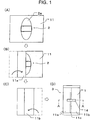
- FIG. 1 is a process drawing showing a process for forming a wrapping body 3 by folding the wrapping body 11 for the wrapping container 1 while enclosing the interlabial pad 2 therein;
- Fig. 2 is a sectional view taken along the arrow line A-A of Fig. 1 (D);
- Fig. 3 is a process drawing showing a method for opening the wrapping container;
- Fig. 4 is a drawing showing a state in which an index finger is inserted in a belt body 22 which is a mini-sheet piece for the interlabial pad.
- the interlabial pad 2 is firstly placed with the opposite side face to body side face 2a.
- one side part 11a of the wrapping sheet 11 is folded inside along the longitudinal side edge part of the interlabial pad 2, and further, as shown in (C) of the same figure, the other end part 11b of the wrapping sheet 11 is also folded inside.
- an overlapping part 11c of the side part 11a and the side part 11b is formed, and this overlapping part becomes the pre-unwrapped opening.
- This overlapping part 11c is sealed with a peelable stop tape 14.
- the interlabial pad 2 is enclosed so as not to fall out and thus the wrapping body 3 is formed.
- the belt body 22 fixed on the interlabial pad 2 is positioned directly under the overlapping part 11c formed by the overlap of the side parts 11a, 11b of the wrapping sheet 11. Therefore, a wearer can immediately find the belt body 22 by opening the overlapping part 11 c and can insert a finger in the finger insertion opening 23.
- the stop tape 14 is firstly picked up and pulled in the direction of A.
- the side part 11b of the wrapping sheet 11 is opened outward as shown in (C) of the same figure.
- the other side part 11 a of the wrapping sheet 11 is also opened outward, and thereby the belt body 22 fixed on the interlabial pad 2 can be exposed. Therefore, a wearer can easily find the belt body 22 without turning over the interlabial pad 2.
- the wearer inserts the index finger or middle finger of her dominant hand (usually right hand) in the finger insertion opening 23 formed from the exposed belt body 22 so that the ball of the finger comes in contact with the opposite side face to body side face 2a of the interlabial pad 2, to hold the interlabial pad 2 on the fingertip.
- her dominant hand usually right hand
- FIG. 5 shows the rear face of Fig. 3, and shows the views of the wrapping container 1 provided with a broken line 15 and a section part 17 which are the separation part for separating the belt body 12, which is the mini-sheet piece for the wrapping container, from the wrapping container 1, and
- Fig. 6 is a drawing showing another mode of the belt body 12, and
- Fig. 7 is a process drawing for showing a process of taking out the interlabial pad 2 by separating the wrapping pad 1 therefrom.
- the wrapping container 1 is provided with the broken line 15 in the center.
- the belt body 12, which is the mini-sheet piece for the wrapping container, is fixed thereon striding over this broken line 15.
- (B) of Fig. 5 a sectional view taken along the arrow line B-B of Fig. 5 (A)
- the joining of this belt body 12 is performed with an adhesive 16 applied to the three points in total, which are both right and left side parts of the belt body 12 and the part along the broken line 15.
- the belt body 12 fixed in such a manner forms finger insertion parts 13A and 13B, and a wearer inserts two fingers of her non-dominant hand (usually left hand) in these finger insertion openings 13A and 13B, and can thereby hold the wrapping container 1 on the fingertips.
- the broken line 15 makes the separation parts in this embodiment, however, as shown in Fig. 5 (C), the wrapping container 1 can be separated by providing the wrapping container 1 with a section part 17 on the upper part thereof for starting the separation with this. Moreover, as shown in Fig. 5 (D), both of the broken line 15 and the section part 17 may be arranged.
- two pieces of belt bodies 12 can symmetrically be arranged holding the broken line 15 in-between. Since the belt body 12 does not exist on the broken line 15 in such a manner, the breaking strength can be made almost constant at the time of separating the wrapping container 1 by tearing the broken line 15. Therefore, the wrapping container 1 shown in Fig. 6 (A) can be divided more stably than the wrapping container 1 shown in Fig. 5 (A).
- Both of the belt bodies 12 are arranged to be of the same dimensions as shown in Fig. 6 (A), but can be arranged to be of different dimensions as shown in (C) of the same figure.
- (D) of the same figure it is possible to induce a wearer to insert her middle finger in the finger insertion opening 13A, and her index finger in the finger insertion opening 13B by making the longitudinal lengths different from each other.
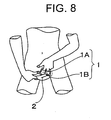
- Fig. 7 To divide the wrapping container 1, as shown in Fig. 7 (A), firstly, two fingers, the index finger and middle finger of the left hand, are inserted in the finger insertion openings 13A and 13B formed holding the broken line 15 in-between, respectively. Next, as shown in (B) of the same figure, the two fingers are opened to the left and right. The wrapping container 1 is then torn along the broken line 15 to the left and right by this release force and the sections 1A and 1B are separated. And, the wearer can take out the interlabial pad 2 from the wrapping container 1 by moving the right hand holding the interlabial pad 2.
- the dimensions of the interlabial pad 2 are such as can put into the labia without difficulty and can also be held by fastening force of the labia themselves, and further, the blocking property of the labia is also considered.
- the longitudinal dimension is 60 - 150mm
- the outward widthwise length of the interlabial pad is preferred to be 10 - 60mm, more preferably, it is recommended to be in a range of 20 - 40mm.
- the region capable of lying between the labia decreases and a touch area with the inner face of the labia decreases, and the interlabial pad is apt to fall out.
- the above-mentioned "outward" means that the length is the shortest distance between the two points corresponding to V in Fig. 58). This is carefully defined because the way tracing the convex and concave form between the two points, namely, the distance between the two points in the state in which the convex and concave form is developed and flattened is sometimes treated as an actual distance (corresponding to W in Fig. 58) associated with the manufacturing process.
- the thickness dimension is arranged in a range of 2 - 10mm considering a comfort feeling without extremely damaging the feeling of wearing.
- the lengthwise dimension is in a range of 80 - 170mm and the widthwise dimension is in a range of 60 - 90mm.
- the widthwise dimension of the belt bodies 12 are arranged so as not stick out of the width of such a wrapping container 1, and have a 25mm width at least so that the width permits to insert two fingers in the two finger insertion openings 23A and 23B.
- the width is preferred to be in a range of 25 - 80mm.
- the lengthwise dimension of the belt body 12 may be at least 30mm or longer, and it may be elongated up to the end of the wrapping container 1 unless it is in a range of sticking out of the wrapping container 1.
- FIG. 9 is a process drawing illustrating the processes for forming the wrapping body 33 by containing the interlabial pad 2 in the wrapping container 31;
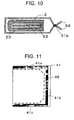
- Fig. 10 is a sectional view taken along the arrow line D-D of Fig. 9 (C);
- Fig. 11 illustrates the wrapping container 41 on which the pre-unwrapped opening is formed from the broken line 45;
- Fig. 12 illustrates a wrapping container 51 formed by sticking two wrapping sheets 51A and 51B together;
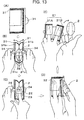
- Fig 13 is a process drawing illustrating a method for opening the wrapping container 31 and taking out the interlabial pad 2, and also separating the wrapping container 31 into two sections 31A and 31B.
- the interlabial pad 2 is folded along the vertical axis so that the left and right side edges overlap each other.
- the interlabial pad is folded with the opposite side face to body side face 2a inside, where the belt body 22, the mini-sheet piece for the interlabial pad, is fixed.
- the folded interlabial pad 2 is placed on the right side of the wrapping sheet 31, and then the wrapping sheet 30 is folded in half centering the vertical axis of the wrapping sheet 30, to cover the interlabial pad 2.
- joining parts 31a, 31b, 31c are arranged on the overlapping part for forming the pre-opening part, to make the wrapping body 33 by joining each of them.
- the tab 34 is not joined in this case.
- the belt body 32 which is the mini-sheet piece for the wrapping container, is to be placed on the surface of the wrapping body 33.
- the belt body 22 is positioned opposite to the joining part 31b. Therefore, peeling this joining part 31b to open the wrapping body, a wearer can immediately recognize the belt body 22.
- the pre-unwrapped opening of the wrapping container 31 is formed from the joining parts 31a, 31b and 31c joined by heat-sealing permitting re-peeling thereof, however, the pre-unwrapped opening can also be formed from the broken line 45 arranged inside the joining parts 41a, 41b, 41c as that on the wrapping container 41 shown in Fig. 11. It is possible to form an unwrapped opening by opening the pre-unwrapped opening by cutting out the end part of the wrapping container 41 along this broken line 45.
- the interlabial pad 2 is covered by a single wrapping sheet, however, as the wrapping container 51 shown in Fig. 12(A), two wrapping sheets 51A and 51B are used, and the interlabial pad 2 is placed in-between, and then both of the wrapping sheets 51A and 51B are stuck together by joining the four joining part 51a, 51b, 51c and 51d.
- the broken line 55 is inside the joining parts 51a, 51b and 51c.
- the wrapping container 31 in this embodiment has two tabs 34 as shown in Fig. 13 (A). Therefore, as shown in (B) of the same figure, a wearer can open the wrapping container sequentially from the joining part 31b to the joining parts 31a, 31c by pulling the tabs 34 to the left and right, and can expose the belt body 22 attached to the interlabial pad 2. Next, as shown in (C) of the same figure, the index finger of the right hand is inserted in the finger insertion opening 23 formed from the body 22. Then, as shown in (D) of the same figure, the index finger and middle finger of the left hand are inserted into the belt body 32 of the wrapping container, to fix the wrapping container on the left hand.
- the wearer can take out the interlabial pad 2 from the wrapping container 31 by raising the right hand to the upper right.
- the wrapping container 31 can be separated in to the sections 31A and 31B by opening the index finger and the middle finger to the left and right.
- the wearer is opening the labia using the sections 31A and 31B held on the fingers of the left hand, she can fix the interlabial pad 2 held on the right hand at an appropriate position in the labia.
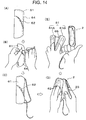
- FIG. 14 is a process drawing showing a method for opening a pod-like wrapping container 61, taking out the interlabial pad 2, and separating said wrapping container 61 into two sections 61A and 61B at the same time.
- the wrapping container 61 is provided with a broken line 64 for forming a pre-unwrapped opening. Therefore, as shown in (B) of the same figure, a wearer opens the wrapping container 61 by tearing off a part of the wrapping container 61 along the broken line 64 as shown in (C) of the same figure. Following this, as shown in (D) of the same figure, the wearer inserts her index finger and middle finger of the left hand in the two respective finger cot parts provided on both side faces of the wrapping container 61, while she inserts her index finger of the right hand in the finger insertion opening 23 of the interlabial pad 2. In this state, she can take out the interlabial pad 2 from the wrapping container 61 by moving the right hand.
- the wearer can separate the wrapping container 61 into the sections 61A and 61B apart along the separation edge 65 by opening the index finger and the middle finger of the left hand to the left and right. While opening the labia using these sections 61A and 61B, the wearer can put the interlabial pad fixed on the right hand at an appropriate position in the labia.
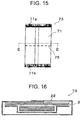
- FIG. 15 is a drawing for illustrating the wrapping container 71 provided with a broken line 75 about in the longitudinal middle area;
- Fig. 16 is a sectional view taken along the arrow line E-E of Fig. 15;
- Fig 17 is a process drawing illustrating the state of fixing the sections 71A, 71B on the fingertips formed by separating the wrapping container 71 by opening it;
- Fig. 18 is a longitudinal sectional view of the wrapping body 73 containing the interlabial pad 2 in folded state; Fig.
- FIG. 19 is a drawing for showing the wrapping body 73 in which the broken line 75 staring from one side part 71c of the wrapping container 71 is not extended up to the other side part 71d; and Fig. 20 illustrates the state in which the wrapping container of Fig.19 is separated from the broken line 75 and is fixed on the fingertips.
- the wrapping body 73 shown in Fig. 15 is constructed by covering the interlabial pad 2 (not illustrated) provided with the belt body 22, making both longitudinal end parts of the rectangular wrapping sheet overlap each other to form it into a cylindrical form, joining the overlapping parts of this wrapping body 71 and the upper and lower edge ends, respectively, and enclosing the interlabial pad 2 therein. And, the wrapping container 71 is provided with a broken line 75 so as to be separated into two in the widthwise direction about in the lengthwise central region.
- the overlapping parts of the wrapping sheet are joined with a hot melt type adhesive, hot air sealing, etc., and the top and bottom end edges are joined by heat-sealing, ultrasonic sealing or a combination of heat-sealing and hot melt type adhesive, etc.
- the wrapping body 73 is formed by wrapping the belt body 22 with the interlabial pad 2 in the wrapping sheet in the lengthwise direction. Moreover, the overlapping parts of the wrapping sheet is positioned on the opposite side to the body side on which the belt body 22 is fixed in this embodiment, but may be positioned on the body side.
- both of the fore and aft end edges of the wrapping container 71 are roundly edged and not acute. If both of the fore and aft end edges are acute, the labia may be harmed, however, the form as mentioned above reduces stimulation to labia at the time of opening the labia using the wrapping container 71.
- the wrapping container 71 is firstly separated into the sections 71A and 71B along the broken line 75.
- the wrapping container 71 is opened, and the interlabial pad 2 is exposed. Therefore, as shown in Fig 17 (C), it is possible to hold the interlabial pad 2 on the fingertip by inserting the index finger of the right hand in the finger insertion opening 23.
- the top and bottom parts 71a and 71b thereof are kept joined, therefore, the sections 71A and 71B are of a sack form.
- the sections 71A and 71B can be fixed on the fingertips like finger cots by inserting the fingers in the openings broken along the broken line 75, and when the interlabial pad 2 is fixed in the labia, the labia and the fingers are prevented from touching each other by opening the labia by the fingertips in such a state.
- the wrapping container 71 is used at the time of fixing the interlabial pad 2, therefore, the fixing action is performed sanitarily and smoothly without so much waste thrown away as in the case of putting on finger cots separately.
- the interlabial pad 2 can be enclosed also in a folded state.
- the interlabial pad 2 is preferred to be folded so that a half of the opposite side face to body side face, where the belt body 22 is attached approximately along the center line of the longitudinal axis, is faced to the other half thereof.
- the broken line 75 to be provided on the wrapping container 71 is arranged from one side part 71c toward the other side part 71d approximately in the longitudinal center of the wrapping container 71, however, as shown in Fig. 19, the broken line 75 starting from one edge part 71c may be so arranged that it is not extended up to the other edge part 71d but ends in the neighborhood of the edge part 71d.
- the break according to the broken line 75 is interrupted at the end point of the broken line 75, and as shown in Fig. 20, the wrapping container 71 is not completely separated until the wrapping container 71 has been put on the fingers.
- the interlabial pad 2 (not illustrated) enclosed in the wrapping container is folded to be enclosed with the belt body 22 directed toward the end edge at the starting position of the broken line 75.
- the belt body 22 is automatically oriented in the direction visible to the wearer.
- Fig. 21 illustrates a state in which the inner wrapping body 83A is enwrapped in a series of wrapping sheets 80 to form the outer wrapping body 83B
- Fig. 22 illustrates an outer wrapping container 81B with a pocket portion 88
- Fig. 23 is a drawing illustrating a double-structured wrapping body in which the inner wrapping container 83A is enclosed in a pocket portion 88 arranged in the outer wrapping container 81B to form an outer wrapping body 83B;
- Fig. 21 illustrates a state in which the inner wrapping body 83A is enwrapped in a series of wrapping sheets 80 to form the outer wrapping body 83B
- Fig. 22 illustrates an outer wrapping container 81B with a pocket portion 88
- Fig. 23 is a drawing illustrating a double-structured wrapping body in which the inner wrapping container 83A is enclosed in a pocket portion 88 arranged in the outer wrapping container 81B to form an outer wrapping body 83B
- Fig. 21 illustrates a state
- Fig 24 illustrates a double-structured wrapping body in which the inner wrapping body 83A is arranged on the pocket portion 88 arranged in the outer wrapping container 81B to form the outer wrapping body 83B; and Fig 25 shows a process drawing for illustrating a method for taking out the interlabial pad 2 enclosed in the double-structured wrapping container and putting it on a finger.
- the inner wrapping body 83A directly enclosing the interlabial pad (not illustrated) is provided with a broken line 85 in the lateral direction, and the inner wrapping container 81A can be opened along this broken line 85.
- This inner wrapping body 83A (not illustrated) is arranged on the wrapping sheet 80, and as shown in (B) of the same figure, this inner wrapping body 83A is enwrapped in the wrapping sheet 80 in the lateral direction, and the overlapping parts of the wrapping sheet 80 and both of top and bottom end edges are joined to be peelable again. In this case, both of the top and bottom end edges are joined so as not to be on the end edges of the inner wrapping body 83A (not illustrated).
- the overlapping parts of the wrapping sheet 80 is sealed with a stop tape 84 provided on the wrapping sheet 80.
- This top tape 84 maintains the sealing state of the outer wrapping body 83B and also it is picked up at the time of unsealing it.
- the stop tape can be used as a means for re-sealing the used interlabial pad 2 when re-packaging it in the wrapping sheet 80.
- the outer wrapping container 81B can be provided with a pocket portion 88. More specifically, as shown in Fig 22, the pocket portion 88 is formed by folding the wrapping sheet 80 inside, and joining only one side part 80d or both side parts of 80c and 80d in the end part opposite to the end part where the stop tape 84 of the wrapping sheet 80 is fixed.
- the outer wrapping container 83B By forming the outer wrapping container 83B by thus folding the wrapping sheet 80, it becomes possible to enclose a used interlabial pad 2 (not illustrated) and an inner wrapping container 81A (not illustrated) used as a finger cot in the pocket portion 88 arranged in the outer wrapping container 81B beforehand, and this improves convenience for waste disposal more.
- the inner wrapping body 83A When enclosing the inner wrapping body 83A in the outer wrapping container 81B having such a pocket portion 88, as shown in Fig. 23 (A), the inner wrapping body 83A is enclosed in the pocket portion 88 to form the outer wrapping body 83B by sealing the outer wrapping container 81B with the stop tape 84, but the inner wrapping body 83A may be arranged on the pocket portion 88 as shown in Fig. 24 (A).
- the pocket portion 88 When the inner wrapping body 83A is enclosed in the pocket portion 88, as shown in Fig. 23 (B), the pocket portion 88 is positioned so as to envelope the interlabial pad 2 inside the outer wrapping body 83B, and when the inner wrapping body 83A is arranged on the pocket portion 88, as shown in Fig. 24 (B), the pocket portion 88 is positioned under the lower side of the inner wrapping body 83A inside of the outer wrapping body 83B.
- FIG. 26 illustrates the external of a wrapping body 93 enclosing the interlabial pad 2 in a wrapping container 91 having a pocket portion 98 for enclosing the interlabial pad 2;
- Fig. 27 is a sectional view taken along the arrowed line F-F of Fig. 26;
- Fig. 28 is a sectional view take along the arrowed line G-G of Fig. 26,
- Fig. 29 is a sectional view illustrating the unsealed state of the wrapping container 91; Fig.
- Fig. 31 is a process drawing illustrating the process of unfixing a used interlabial pad 2 by using the wrapping container 91 with the pocket portion 98.
- the interlabial pad 2 folded along the longitudinal center line is enclosed in the pocket portion 98 formed by partly folding one end part of the wrapping sheet in the wrapping container 91 formed from a series of wrapping sheets. And further, the other end part is folded so as to overlap with the pocket portion 98, and the overlapping pat is joined to be peelable by a known technique such as connection by heat-embossing pressure, male-female embossing, etc., to form a pre-opening part 96 for unsealing the wrapping container 91.
- top and bottom end edges 91a, 91b are also joined to be peelable so as not to overlap with the enclosed interlabial pad 2.
- an adhesive can be used together. Specifically, as shown in Fig. 28, an adhesive is applied beforehand to the wrapping sheet in the neighborhood of the overlapping pre-opening part 96.
- the adhesive can be selected from hot-melt type adhesives without restriction, and is applied in a known application pattern in a form of plane, stripes, spiral, ⁇ , etc.
- the interlabial pad 2 is folded so that its rear face sheet faces each other, therefore, the belt body 22 is positioned on the innermost plane. Moreover, since the folded part of the interlabial pad 2 is formed almost along the longitudinal center line, the finger is inserted in the interlabial pad 2 in the same direction as its crease, the wearer can easily hold the interlabial pad 2 on the fingertip at the time of wearing it.
- the wearer can observe the belt body 22 at the same time as she opens it, and as shown in Fig. 30, she can insert her finger in the finger insertion opening in that state and can hold the interlabial pad 2 on the finger.
- the interlabial pad 2 is taken from between the labia firstly by, as shown in Fig. 31 (A), inserting the finger in the finger insertion opening of the interlabial pad 2 and holding it on the fingertip.
- a wearer inserts a finger holding the interlabial pad in the pocket portion 98 of the wrapping container 91, and pinches the interlabial pad 2 from outside of the wrapping container 91 by the opposite hand.
- the wearer draws her right hand from the finger insertion opening 23, and as shown in (D) of the same figure, she folds the wrapping sheet 90 and holds it on the pocket portion 98 with a stop tape 94 for sealing it.
- This stop tape 94 prevents the wrapping body 93 from being unsealed when it is thrown away.
- Sealing means other than using the stop tape are; application of an adhesive to the overlapping part, sticking a magic tape (a registered trade mark), a chuck arrangement for engaging the male and female parts with each other, etc.
- the belt body 22 when a wearer takes out the interlabial pad from the labia, she can remove it also by pinching the belt body 22. Since the belt body 22 is positioned on opposite side face to body side face, the belt body 22 never comes into contact with absorbed menstrual blood, and the menstrual blood does not adhere to the finger of the wearer also at the time of removing the interlabial pad 2 from the labia.
- FIG. 32 illustrates a wrapping container 101 enclosing an interlabial pad 210 having two finger insertion openings 213A and 213B.
- the interlabial pad 210 is provided with two finger insertion openings 213A and 213B to be chosen according to depths of labia of wearers (cf. Fig. 47).
- the wrapping container 101 is provided with two pre-opening parts 106A and 106B corresponding to the two finger insertion openings of this interlabial pad 210.
- the characters of "shallow” and “deep” are added to the respective pre-opening parts as the marks for indicating which finger insertion opening is positioned therefore. Therefore, as shown in Fig. 32 (A), a wearer having a shallow depth of labia can select the pre-opening part 106A with the character "shallow" to open, and as shown in Fig.
- a wearer having a deep depth of labia can select the pre-opening part 106B with the character "deep" to open.
- a wearer it is possible for a wearer to judge which pre-opening part to open even from the outward looking of the wrapping container101.
- Fig. 33 illustrates the wrapping container 111 provided with a pattern 117.
- the wrapping container 111 can be provided with a pattern 117 having the top and bottom. In such a manner, not only fashionability is added to the wrapping container 111, but a wearer can understand the upper part at a glance where the pre-opening part 116 as an opening position is positioned.
- Fig. 34 is a drawing for illustrating a wrapping sheet 120 with a pocket portion 128 for enclosing a sanitary napkin therein;
- Fig. 35 is a process drawing illustrating a method for enclosing the sanitary napkin 129 in a wrapping container 121 formed from a wrapping -sheet 120 to form a wrapping body 123;
- Fig. 36 is a section view taken along the arrowed line H-H of Fig. 35 (D); and
- Fig. 37 illustrates the wrapping sheet 120 after the wrapping container 121 has been opened and the sanitary napkin 129 has been taken out.
- the pocket portion 128 is formed by folding one end part thereof, and joining both lengthwise overlapping edge parts of this folded part of the wrapping sheet 120 by heat-sealing etc.
- the pocket portion 128 can also be formed by using another material, and joining this on a part of the wrapping sheet 120.
- heat-sealing, ultrasonic sealing, hot-melt type adhesive, etc. can be used for the joining, and as for the material, a film, paper, non-woven fabric, etc. can be used singly or compositely.
- the wrapping sheet 120 is firstly placed with the pocket portion 128 up, and secondly, as shown in (B) of the same figure, the sanitary napkin 129 is placed thereon with its body side face faced to the sheet.
- the end part 12a of the wrapping sheet 120 with the pocket portion 128 is folded inside together with the end part 129a of the sanitary napkin 129.
- the other end part 120b of the wrapping sheet 120 and the other end part 129b of the sanitary napkin 129 are also folded inside.
- a part 126 of the overlapping part where the edge parts 120a and 120b of the wrapping sheet 120 overlap with each other, is temporarily tacked so as to be re-opened and sealed with a stop tape 124.
- the edge parts 120c and 120d of the wrapping sheet 120 as the top and bottom of the wrapping container 121 are also temporarily tacked by heat-sealing, ultrasonic sealing, etc. so as to be re-opened.
- the wrapping body 123 is formed.
- the part in which only the wrapping sheet 120 is wrapped up is formed inside of the wrapping body 123.
- this part is the pocket portion 128 which was already formed in the wrapping sheet 120 before enclosing the sanitary napkin 129, and as shown in Fig. 37, it is possible to put the used interlabial pad 2 in this pocket 128 after the wrapping container 121 is opened.
- the sanitary napkin 129 can be taken out of the wrapping body 123 by picking up the stop tape 124 first, pulling it to open one edge part 120b of the wrapping sheet 120 outside, opening the temporarily tacked overlapping part 126, and then opening also the other edge part 120a of the wrapping sheet 120 outside.
- the wrapping container 121 is completely opened.
- the direction in which the end part 120b of the wrapping container 120 is pulled is opposite to the direction in which the pocket portion 128 is formed. Therefore, the pulling action for opening the overlapping part 126 has no influence on the pocket portion 128, and the pocket portion 128 is reduced in receiving damage.
- the opposite side face to body side face of the sanitary napkin 129 is coated with an adhesive for being attached to an underwear. Therefore, the wrapping sheet 120 is provided with a peeling part on the part corresponding to the region coated with this adhesive, so that such an adhesive can be protected to be peelable.
- a peeling part may be formed by separately applying a removable material thereto such as removable paper and separate film, and the wrapping sheet itself may be provided with peeling treatment.
- this material is preferred to be adhered to the wrapping sheet with an adhesive in advance. In such a manner, it becomes possible to prevent extra waste from being thrown away during the fixing action of the sanitary napkin 129 as in the case that the removable material separate from the wrapping sheet is stuck on an adhesive, and this improves the convenience of the action.
- the sanitary napkin which can be used in this embodiment is not to be restricted to a specific type but various types such as a type with wing and a type without wing and the likes can be applied.
- Fig 38 illustrates a wrapping body 133 in which the interlabial pad 2 in accordance with this embodiment is enclosed in the wrapping container 131 as it is, without being folded;
- Fig. 39 illustrates a wrapping body 143 enclosing the interlabial pad 2 folded with the belt body 22 shaped like a chevron;
- Fig. 40 illustrates a wrapping body 153 in which the interlabial pad 2 is folded and enclosed in a wrapping container 151 to be opened in a double-door form;
- Fig. 41 illustrates a wrapping body enclosing the interlabial pad 2 folded centering the lateral line, and a wrapping body enclosing the interlabial pad 2 with only a part of both sides folded.
- the interlabial pad 2 when the interlabial pad 2 is enclosed in such a wrapping container 131 as is opened by stripping the upper side 131a upward from the lower side 131b, the interlabial pad 2 is placed and enclosed therein with the belt body faced upward.
- a wearer is able to hold the interlabial pad 2 on the fingertip by inserting the finger in the finger insertion opening 23 immediately after the wrapping container 131 is opened.
- a marking 134 or the like is provided on the upper side 131a in order to clearly show the direction of stripping.
- the interlabial pad 2 is enclosed in the wrapping container 131 as it is, without being folded, however, it is also preferred to be folded for being enclosed so that the finger insertion opening 23 is naturally opened when the wrapping container is unsealed.
- the interlabial pad 2 is folded, for example, as shown in Fig. 39 (A), the interlabial pad 2 can be enclosed in the wrapping container 141 with the whole pad folded in a chevron shape.
- the folding mode of the interlabial pad 2 can be changed appropriately according to the wrapping containers, and it does not matter whether the interlabial pad 2 is folded in half in the vertical direction as shown in Fig. 41 (A) or only both side edge parts of the interlabial pad 2 are folded as shown in Fig. 41 (B).
- Fig. 42 is a schematic drawing of the body side of the interlabial pad 2
- Fig. 43 is a cross sectional view of the interlabial pad 2.
- the interlabial pad 2 can be used for absorbing excretions (vaginal discharge) other than menstrual blood discharged from a ostium vaginae, and can also be used for absorbing urine discharged from an urethral opening, namely, it can be used against incontinence of urine.
- the interlabial pad 2 in this embodiment is substantially an oblong form with a lateral dimension and a longitudinal dimension.
- the outline form is elliptic, but as long as it has such a shape as can preferably be held, and it can arbitrarily be selected from a rectangle, an oblong ellipse, a sandglass type, etc.
- the interlabial pad is comprised of a body side surface in direct contact with the inside of labia and an opposite side face to body side face which is faced to the opposite side to the body side of a wearer and is not in direct contact with the inside of labia.
- the absorbent body 26 is placed between a water permeable surface sheet 24 positioned on the body side and a water impermeable underside sheet 25 positioned on the opposite side face to body side face, and the surface sheet 24 and the underside sheet 25 are joined to each other in the periphery of the absorbent body 26.
- a belt body 22 a mini-sheet piece for the interlabial pad, is attached on the side part of the opposite side face to body side face of the underside sheet 25 so as to traverse the interlabial pad 2 in the widthwise direction.
- a finger insertion opening 23 into which the finger can be inserted is formed between this belt body 22 and the underside sheet 25.
- the belt body 22 In order for a wearer to easily discriminate the belt body 22, it can also be adjusted so as to differ in a color tone, a pattern, or chromaticity from the underside sheet of the interlabial pad by means of coloring, printing, etc.
- Fig. 44 illustrates an interlabial pad 20 of a mid-upheaval structure in which the mid-area of the absorbent body 26 is upheaved
- Fig. 45 illustrates an interlabial pad 200 made by putting two sheets together differing in the widthwise length
- Fig. 46 illustrates an interlabial pad 210 consisting of two layers of a main sheet body 210A which can be fitted deep in the labia and a sub-sheet 210B
- Fig. 47 illustrates a state in which the interlabial pad 210 is held on the finger.
- the absorbent body 26 is partly upheaved in the widthwise center to increase adherence of the interlabial pad 20 in the labia of a wearer. Therefore, it is possible to prevent menstrual blood from leaking outside.
- the auxiliary sheet body 201 having a shorter widthwise length is laid on the body side surface of the ordinary interlabial pad 202, and both are joined together at the front and rear with an adhesive or heat-sealing, ultrasonic sealing, etc., or the overlapping part is joined to each other with an adhesive, or both joining methods are used together.
- This auxiliary sheet body 201 improves a body fluid absorbing ability of the interlabial pad, and thereby improves the effect of preventing menstrual blood from leaking.
- the interlabial pad 210 shown in Fig. 46 is comprised of a main sheet body 210A and a sub-sheet body 210B, and both are joined together at each lengthwise edge part, and both are apart inside thereof, and further, in the widthwise direction, at least one of both sleeve parts is not joined. Therefore, a wearer can insert a finger into the two holes which are the first finger insertion opening 213A between the main sheet body 210A and the-sub sheet body 210B, and the second finger insertion opening 213B between the mini-sheet body 212 for the interlabial pad and the sub-sheet body 210B.
- the wearer is able to choose either of them according to her own depth of labia, and for example, a wearer with a shallow depth of labia inserts her finger from the first finger insertion opening 213A as shown in Fig. 47 (A), while a wearer with a deep depth of labia inserts her finger from the second finger insertion opening 213B as shown in Fig. 47 (B).
- the wrapping container for enclosing such an interlabial pad 210 is preferred to be provided with the pre-opening parts at two places as the wrapping container 101 shown in Fig. 32.
- the finger insertion opening 213A is positioned to the pre-opening part 106A with the character "shallow"
- the finger insertion opening 213B is positioned in the periphery of the pre-opening part 106B with the character "deep”.
- LDPE low density polyethylene
- a laminated material of which the outside surface is composed of a film of non-woven fabric or paper can be used considering wiping property, liquid blocking property, etc.
- a composite material can be used, on which a film consisting essentially of the LDPE resin adjusted 5 - 20g/m 2 specific weight per unit area is laminated on one side of the composite non-woven fabric consisting of spun bond, melt blown, spun bond of 6 -10gsm, 5 - 20gsm, 6 - 10gsm by weight.
- non-woven fabric such as polybutylene-succinate, poly-lactic acid, polyisocyanate, starch
- non-woven fabric such as polybutylene-succinate, poly-lactic acid, polyisocyanate, starch
- a film consisting essentially of polyvinyl-alcohol can be used, and use of toilet paper is also possible.
- a laminated material of a polyvinyl-alcohol film adjusted to 5 - 10g/m 2 specific weight per unit area and water soluble paper adjusted to 15 - 30g/m 2 can be mentioned.
- the wrapping sheet can be used also for wrapping a used interlabial pad and disposing of it when the interlabial pad is disposed of after use.
- menstrual blood adhering to the interlabial pad or absorbed into it is prevented from oozing from the wrapping sheet, namely, it is preferable that the menstrual blood is prevented from adhering to the finger when a wearer picks up the wrapping sheet wrapping the used interlabial pad. Therefore, a material rich in liquid blocking property, for example, a film consisting of about 15 - 60 ⁇ m thick polyethylene, polypropylene, etc., or a laminated material obtained by laminating the raw materials for said film is recommended for the use.
- the wrapping sheet is able to shield the color of the menstrual blood adhering to or absorbed in the interlabial pad.
- the wrapping sheet is photogravured with an ink consisting of a 5 - 40wt% pigment, a 10 - 20 wt% resin, and a 40 - 85wt% solvent, or a sheet material opaqued by mixing a 0.2 - 10wt% pigment in the raw material resin of the wrapping sheet is recommended for the use.
- the wrapping sheet may be dyed.
- the pigment for the use may be white or colored, for example, the following pigments can be used singly or in combination: C.I. basic violet 3, etc. as basic dyes; C.I. vat blue 1 etc. as vat dyes; blue 1, blue 2, C.I. acid red 51, etc. as acid dyes; C.I.
- the pre-opening part and the overlapping part of the wrapping sheet forming the unsealing part are made to be repealable and to prevent foreign matters from being mixed there.
- Such measures can be achieved by such known techniques as not only an arrangement of a stop tape to cover the overlapping part of the wrapping sheet, but also coating of a small quantity of an adhesive along the overlapping direction, joining by embossing, perforations provided inside of the area joined by embossing, etc.
- a material used for the mini-sheet piece used for the wrapping container is preferred to be selected considering that the material has strength to be kept undamaged when a finger is inserted therein, and the material can be selected singly from among non-woven fabric, elastic nonwoven fabric film, foamed film, elastic film, foamed sheet, tissue paper, etc. or lamination of these.
- Preferred breaking strength of the material is at least 0.6N/inch lateral, and when considering the toughness, it is to be selected from a range of 0.6 - 2.5N/inch.
- the material used is a film consisting essentially of an LDPE resin having a density of 0.915 adjusted to 15 - 30 ⁇ m in thickness, and a foamed film can be mentioned as an especially preferable material which facilitates drawing a finger from the mini-sheet piece for the wrapping container, and consists essentially of an LDPE resin having capillaries, a density of 0.920, a volume of 0.3 - 1.0 mm, a 15 - 60% rate of hole area, and a 0.3 - 1.5 mm hole diameter.
- the synthetic resin composing said structure is replaced with biodegradable or water-soluble resin such as poly-lactic acid, polybutyl-succinate, PVA resin, etc. Further, a laminated material of tissue and said biodegradable or water-soluble resin can be used.
- tensible spun bond non-woven fabric In order to provide the mini-sheet piece for the wrapping container with elasticity, tensible spun bond non-woven fabric can be used, which has stress of 0.1 - 0.5N/25mm at the time of 5% elongation when it is elongated with a 100 mm knob distance, and a 100 mm/min constant stretching speed.
- elastic materials such as a fibrous sheet and film sheet using thermoplastic elastomer resin, thermoplastic elastomer resin itself, and crude rubber may singly be used or these may be combined with an inelastic material for the use.
- the film consisting essentially of said LDPE can also be corrugated.
- stop tape known materials such as a film layer coated with an adhesive on one side, or tissue coated with an adhesive on one side when considering water washing capability, etc. can be used, and are not to be restricted.
- a treatment for suppressing the number of living bacteria sterilizing treatment or germicidal treatment during production, use of antibacterial material for the individual wrapping container, etc. can be mentioned.
- the above usage is to induce the correct using methods for fixing the interlabial pad enclosed in the wrapping container between labia, and it is not to be restricted whether the interlabial pad is singly used or it is used together with a sheet-like absorbent article such as a sanitary napkin and a panty liner, and also with a tampon, a pants-formed sanitary napkin, etc.
- a sheet-like absorbent article such as a sanitary napkin and a panty liner
- a tampon a pants-formed sanitary napkin, etc.
- the interlabial pad is used together with another sanitary article such as a sanitary napkin and tampon, such actions as fixing the sanitary napkin to the underwear, inserting the tampon in the ostium of vagina, etc. are performed before entering the above using methods.
- the interlabial pad individual wrapping container is used as the member for the actions in the above [2] or [4], or in both.
- the interlabial pad is tried to be fixed laterally to the vulva slit; the interlabial pad is tried to be vertically inserted into the ostium of vagina like a tampon; the interlabial pad is fixed with the inside turned out when; and the interlabial pad is not fitted inside of the labia but is placed as if it were put on the surface of the sanitary napkin used together.
- the interlabial pad is tried to be fixed laterally to the vulva slit; the interlabial pad is tried to be vertically inserted into the ostium of vagina like a tampon; the interlabial pad is fixed with the inside turned out when; and the interlabial pad is not fitted inside of the labia but is placed as if it were put on the surface of the sanitary napkin used together.
- the interlabial pad and the wrapping container related to the present invention in order to prevent such wrong fixing, it is preferable that a wearer is correctly notified of the correct use procedures of the interlabial pad for its sufficient effect, and moreover, the wearer is clearly notified of the fixing method for being enabled to smoothly perform the wearing action.
- the following methods can be mentioned, namely: the explanation of the usage is arranged in the individual wrapping container together with the interlabial pad; the usage is printed on the surface and inner wall of the individual wrapping container;
- Preferable methods among such ones are those which can be confirmed by wearers every time they use it, namely: an individual wrapping container is provided with the description of the usage therein together with the interlabial pad, and the usage is printed on the outer and inner surfaces of the individual wrapping container, and more preferable method is to enclose the description attached to the interlabial pads in the outer package of them.
- a method for providing the individual wrapping container with the description of the usage is, for example, as shown in Fig. 48, through placing the description 168 inside of the wrapping sheet 160, and folding the description 168 together with the wrapping sheet 160 at the time of enclosing the interlabial pad therein, to form them into the wrapping body 163.
- the description 168 when the wrapping container 161 is unsealed, the description 168 is exposed immediately, therefore, the description 168 surely attracts wearers' notice when they use the interlabial pads.
- a method for printing the usage on the individual wrapping container it is preferable to print it in the neighborhood of the pre-opening part for unsealing the individual wrapping container in order to prevent wearers from overlooking said printed part.
- numbers and symbols are used for inducing a sight line of a wearer so that the wearer is able to sequentially follow the usage according to the actions in which the wearer unfolds the folded wrapping sheet 190 and unseals the wrapping container 191.
- the usage can be printed using pictures and sentences according to such numbers and symbols, however, only patterns may be used for the printing.
- a box type outer package formed from a carton or a thermoplastic resin is provided with an entrance on the top for taking out the interlabial pad so that the description can be taken out immediately when such an entrance is opened.
- an outer package various shapes can be adopted from the view points such as wearers' preference and ease of use, easiness for the manufacturing process, and superiority and inferiority of the distribution.
- the individual wrapping containers can be enclosed therein.
- the wearer when a wearer fixes or unfixes the interlabial pad, the wearer can makes use of the interlabial wrapping container, Therefore, it is possible for the wearer to perform such actions while preventing her fingers from coming in contact with the labia, without complicating the fixing and unfixing actions.
- the interlabial pad is enclosed in the interlabial pad individual wrapping container so that a finger can be inserted in the finger insertion opening of the interlabial pad immediately after the interlabial pad individual wrapping container is unsealed, the interlabial pad can be held on the fingertip quickly and smoothly, and the fixing and unfixing actions of the interlabial pad can also be performed quicker.
Landscapes
- Health & Medical Sciences (AREA)
- Epidemiology (AREA)
- Engineering & Computer Science (AREA)
- Biomedical Technology (AREA)
- Heart & Thoracic Surgery (AREA)
- Vascular Medicine (AREA)
- Life Sciences & Earth Sciences (AREA)
- Animal Behavior & Ethology (AREA)
- General Health & Medical Sciences (AREA)
- Public Health (AREA)
- Veterinary Medicine (AREA)
- Absorbent Articles And Supports Therefor (AREA)
- Packages (AREA)
- Apparatus For Radiation Diagnosis (AREA)
- Auxiliary Devices For And Details Of Packaging Control (AREA)
- Details Of Garments (AREA)
- Wrappers (AREA)
- Glass Compositions (AREA)
Abstract
Description
- The present invention relates to a wrapping container for individually wrapping an interlabial pad of such a structure as facilitates surely and sanitarily fixing and unfixing the interlabial pad between the labia, and an individual wrapping body of the interlabial pad.
- Conventionally, a sanitary napkin and a tampon are used generally as female sanitary products. Here, there have been great efforts to prevent the leak of menstrual blood from gap caused by poor adhesion near the ostium vaginae as for the sanitary napkin. Moreover, as for the tampon, there have been great efforts for relieving the foreign feeling and the discomfort when wearing the sanitary products and intervaginal wearing trouble due to the nature of those products.
- Under such situation, sanitary products of the interlabial pad have attracted people as a sanitary product positioned between the sanitary napkin and the tampon in recent years.
- The interlabial pad is fixed by inserting it between the labia, having characteristics that it is difficult to cause the leak of menstrual blood because of higher adhesion to the body than that of the sanitary napkin and psychological resistance thereof on wearing is lower than that of the tampon which is inserted into the vagina.
- Here, as to such an interlabial pad, developments and arrangements concerning the materials therefore and their peripheral members are insufficient.
- The present invention has been made considering the problems as the above, and the purpose is to provide a preferred wrapping container for wrapping the interlabial pad as a preferred handling member of the interlabial pad.
- Moreover, another purpose is to provide a wrapping container which can smoothly be held on a fingertip at the time of opening the wrapping container of the interlabial pad having a finger insertion opening.
- In order to solve the problems as mentioned above, according to the present invention, the interlabial pad wrapping container is characterized in that it not only serves as a finger cot when the interlabial pad is fixed in, but also permits an wrapping container opening action and a finger cot fixing action at the same time.
- Moreover, the wrapping container is also characterized in that to the interlabial pad provided with a finger insertion opening for being fixed on the tip of a finger, the wrapping container opening action is an action itself to smoothly insert a finger into the finger insertion opening as it is.
- To be more concrete, the following arrangement is provided according to the present invention.
- (1) A wrapping container for individually wrapping an interlabial pad, comprising a separation portion for separating the wrapping container into two separated sections, wherein: each separated section after the separation turns up to be an operation member for wearing or removing said interlabial pad.
- According to the wrapping container for individually wrapping the interlabial pad (hereafter, simply called the wrapping container) relating to the present invention, the wrapping container of the interlabial pad is made multi-functional only by arranging a separation part for separating the wrapping container into suitable sizes and shapes. Namely, the separation part is arranged on the wrapping container so that the wrapping container is suitable as an auxiliary member for fixing/unfixing the interlabial pad in/from labia. For example, a separation ratio etc. of the wrapping container separated by the separation part are determined so as to be suitable for such a separation part to exert its effect. Therefore, the individual wrapping container possesses not only its original function that it permits to singly, sanitarily, and easily carry only the interlabial pad to be used, but also the function that it can be used for fixing and unfixing the interlabial pad, and it permits to perform sanitarily fixing and unfixing the interlabial pad without such trouble as putting another finger cot on the finger.
- (2) The wrapping container for individually wrapping an interlabial pad of the aforementioned (1), wherein: said wrapping container is provided respectively with a finger insertion portion for inserting a finger respectively in a portion becoming respectively an separated section after the separation; and in a state where said wrapping container is separated into respective separated section at the separation portion, the finger is inserted in the finger insertion portion of respective separated sections which turn up to be an operation member for wearing or removing said interlabial pad.
- According to the wrapping container for individually packaging an interlabial pad (hereafter, simply called a wrapping container) relating to the present invention, the wrapping container is provided with a separation part for dividing the wrapping container itself in two there, and finger insertion parts permitting to insert fingers therein in each part divided by the separation part. Therefore, a wearer can easily separate the wrapping container into two pieces by firstly inserting two fingers (for example, an index finger and a middle finger) into such insertion parts, respectively, and then opening the two fingers to the left and right, and also in this separated state, the pieces of the separated wrapping container are fixed on the tips of the fingers as a result. And, by maintaining this state, it becomes possible to fix and unfix the interlabial pad using the sections of the divided and separated wrapping container.
- Here, since the labia differ in form among individuals, fixing procedures are sometimes different when the interlabial pad is fixed. For example, in the case of a wearer having a separate type labia shape, she can directly fix the interlabial pad in the labia by bending the posture. On the other hand, in the case of a wearer having a joint type labia shape, the inside of the labia is sometimes hard to be exposed only by bending the posture, and in such a case, she has to fix the interlabial pad therein while forcibly keeping the labia open using fingers of another hand which is not holding the interlabial pad.
- When a labia opening action is performed, the fingers of the wearer have to come into direct contact with the labia. For this reason, dirt on the fingers may adhere to the labia, and this is a sanitary problem. Moreover, the mucous membrane may be stimulated. On the other hand, menstrual blood is apt to adhere to fingers, therefore, the wearer is obliged to do such an uncomfortable and troublesome action as washing out the menstrual blood adhering to the fingers every time she fixes the interlabial pad therein.
- Regarding this point, the Japanese Utility Model Provisional Publication 61-232845(232845/1986) discloses a finger cot peelably adhered on a mount as a usable one when a tampon is inserted in a vagina. Thus, since the fingers of the wearer are prevented from coming into direct contact with the labia by fixing the interlabial pad by putting on such finger cots on the fingers, the labia part can be kept sanitary. Especially, since the finger cots are wrapped so as to be put on fingers without direct contact with the fingers, they have also an effect of remarkably reducing a risk that the dirt on the fingers adheres to the labia.
- Moreover, the Japanese Utility Model Provisional Publication 62-9450(9450/1987) discloses such a finger cot as is provided with a grip part for preventing the finger cot from coming off a finger. It has been considered that non-contact between the labia and fingers may be more secured when such finger cots are used, because the finger cots fixed on the fingertips at the time of fixing an interlabial pad are prevented from coming off the fingers of the wearer.
- However, since the interlabial pad is fixed between the labia which are difficult to watch, the fixing is not necessarily easy. Therefore, since putting on the separate finger cots at the time of fixing the interlabial pad as the example described above complicates the handling procedure, there is a fear that the fixing action may be made more difficult.
- Then, it causes a longer fixing time if many actions have to be done at the time of fixing, and in such a case, menstrual blood may drop from inside of labia and adheres to an underwear and a toilet bowl or the periphery thereof, to make wearer feel uncomfortable for the treatments.
- As to this point, according to the present invention, the fixing action can be aided through the use of the sections of the torn wrapping container, moreover, when using such pieces, they are already held on the fingertips when the wrapping container is separated, therefore, the work process for purposely fixing them on the fingertips is unnecessary. Further, when separating the wrapping container, the wrapping container can easily be torn only by inserting two fingers of a non-dominant hand in the finger insertion parts and then opening them to the right and left, therefore, the fixing work can be speeded up.
- Further, when unfixing an used interlabial pad from labia, it is possible to unfix it through the use of an interlabial pad to be newly used in order to prevent menstrual blood from adhering to fingers or prevent the fingers from contacting the labia.
- Moreover, a "separation part" in this specification means what is specified in some form as a separated place of the wrapping container, and as a structure, perforations or the like which are an alternate arrangement of torn parts and untorn parts, or something to start tearing the wrapping container by making a cut part at the beginning of the separation part can be mentioned.
- When the separation part is formed of perforations, a slit part is preferred to be 0.5-5mm long and 3mm wide at the maximum, and an unslit part is preferred to be 0.5-5mm long. In such a manner, it is possible to guide the slit direction by the wearer not to deviate from the separation part, and is also possible to prevent dirt or the like from penetrating into the wrapping container from the separation part. Moreover, in order for the separation part to be easily slit, it is preferable to bring the separation part into penetration state in the direction of thickness.
- As far as the starting point of the separation part formed of perforations is started from one end edge of the wrapping container prepared at least for finger insertion, it does not matter even if the starting point is connected up to another end edge or it is arranged only up to an intermediate position from the one end edge.
- The breaking strength of the perforations is preferably 0.2-3.0N/25mm, more preferably 0.3-1.5N/25mm, under the pulling conditions of a 25mm width and 100mm/min when the perforations are pulled in the direction orthogonal to the perforations with the perforations positioned in the center.
- (3) The wrapping container for individually wrapping an interlabial pad of the aforementioned (2), wherein: said finger insertion portion is composed of a mini sheet piece for a wrapping container attached so that an opening for inserting a finger be formed, with, two or more bonding portions to the wrapping container, and one or more non-bonding portions; and
said mini sheet piece for wrapping container is attached in a state striding across said separation portion in said wrapping container, or attached respectively to both sides of said separation portion. - According to the wrapping container for individually wrapping an interlabial pad (hereafter, simply called a wrapping container) related to the present invention, the finger insertion part is formed by attaching the finger insertion opening part and the following finger insertion space part to the wrapping container in a state unconnected to the wrapping container surface. Therefore, a wearer can insert a finger from the opening of the finger insertion opening and fix the wrapping container on the fingertip (refer to Fig. 7).
- When a mini-sheet piece for the wrapping container is made to be a belt-like piece in the present invention, the belt-like piece is to be attached to the wrapping container in the state striding over the separation part (refer to Fig. 5). Associated with this, the separation part is arranged in the state penetrating both the wrapping container and the mini-sheet piece for the wrapping container in the direction of thickness, therefore, it is necessary to take care so as not to damage the mini-sheet piece for the wrapping container.
- Moreover, in the present invention, a plurality of the mini-sheet pieces for the wrapping container can be arranged on both sides bordered by the separation part (refer to Fig. 6). Thus, the separation part is not arranged on the mini-sheet pieces for the wrapping container. Namely, the mini-sheet pieces for the wrapping container and the adhesion part do not exist on the separation part, so the breaking strength of the whole separation part can be made almost constant at the time of slitting and dividing the separation part. Therefore, the wrapping container can stably be separated compared with the case in which a piece of belt-like mini-sheet for the wrapping container is attached striding over the separation part.
- The mini-sheet pieces for the wrapping container can be joined to the wrapping container not only with an adhesive, but also by means of heat-sealing, ultrasonic sealing, an adhesive tape, or the like.
- Moreover, for easy discrimination of the mini-sheet pieces for the wrapping container by a wearer, the mini-sheet pieces for the wrapping container are adjusted so as to have a different tone and pattern or chromaticity from those of the wrapping container by means of coloring or printing a pattern or the like.
- (4) The wrapping container for individually wrapping an interlabial pad of the aforementioned (3), wherein: said mini sheet piece for wrapping container is attached to an outer face side and/or inner face side of said wrapping container.
- According to the wrapping container for individually packaging interlabial pad (hereafter, simply called a wrapping container) related to the present invention, the wrapping container is provided with the mini-sheet pieces on the outer surface or the inner surface, or on both of the outer and inner surfaces.
- Here, in the present invention, the wrapping container comes into contact with the labia on the inside surface. Therefore, in order to realize fixing or unfixing of a sanitary interlabial pad by reducing adhesion of dirt and dust to labia, it is especially more preferable to arrange the mini-sheet pieces for the wrapping container on the outside than on the inside.
- (5) The wrapping container for individually wrapping an interlabial pad of any of the aforementioned (2) to (4), wherein: said wrapping container for individually wrapping an interlabial pad is a wrapping container for individually wrapping an interlabial pad for wrapping an interlabial pad having a finger insertion opening; and the wrapping container for individually wrapping an interlabial pad is provided with a pre-unwrapped opening that allows the finger insertion opening of the interlabial pad contained therein to be exposed naturally at the beginning of unwrapping of the wrapping container for individually wrapping an interlabial pad, in addition to said separation section.
- According to the wrapping container for individually packaging the interlabial pad (hereafter, simply called a wrapping container) related to the present invention, the wrapping container is provided with a "pre-unwrapped opening" separately from the separation part for slitting up the wrapping container. Since the finger insertion opening provided on the enclosed interlabial pad is exposed by opening such a pre-unwrapped opening, the finger insertion opening is brought into the state in which a wearer can watch it. Thus, the wearer is then able to insert a finger in the finger insertion opening immediately after the wearer has opened the wrapping container.
- Moreover, in the present invention, the "pre-unwrapped opening" means what forms an unwrapped opening permitting to insert a finger in the finger insertion opening of the interlabial pad through there. In the present invention, the size of this "pre-unwrapped opening" is sufficient as long as the wearer can watch the finger insertion opening of the interlabial pad through the pre-unwrapped opening by unsealing it and she can insert her finger in the finger insertion opening, but as a size permitting to unfixing the interlabial pad, the pre-unwrapped opening may be sized for permitting to unfix the interlabial pad through there.
- (6) The wrapping container for individually wrapping an interlabial pad of the aforementioned (5), composed of a series of wrapping sheet wound in a way to form a overlapping part where a part thereof is folded, or of a series of wrapping sheet wound in a way to form a overlapping part where both ends thereof are superposed each other, wherein:
- said pre-unwrapped opening is formed of said overlapping part.
- The wrapping container for individually wrapping the interlabial pad (hereafter, simply called a wrapping container) related to the present invention is formed by folding a wrapping sheet. And, a pre-unwrapped opening for opening the wrapping container is formed from the overlapping part of both side parts of the folded wrapping sheet. Therefore, a wearer is easily able to open the wrapping container by opening the overlapping part of the wrapping sheet.
- As typical methods for folding a wrapping sheet, such methods can be mentioned as the wrapping sheet folded in three where the interlabial pad is placed approximately in the middle of the wrapping sheet and the wrapping sheet is folded inside from both side parts thereof (refer to Fig. 1), and the wrapping sheet is folded in half holding the interlabial pad in between (refer to Fig. 9). In these cases, the overlapping part, where the side parts of the folded wrapping sheet are layered, serves as the pre-unwrapped opening, and is stuck by heat-sealing or the like so as to be peelable.
- Moreover, in order to facilitate unsealing the pre-unwrapped opening, in the case of the three-folded one, the overlapping part of the wrapping sheet can be provided with a stop tape with dry edges thereon, and in the case of the double-folded one, the overlapping part can be provided with a tab thereon. Thus, since a wearer can easily open the pre-unwrapped opening by picking up such a stop tape and tab, an action for fixing the interlabial pad can be made speedier.
- (7) The wrapping container for individually wrapping an interlabial pad of the aforementioned (5), wherein: said pre-unwrapped opening is composed of a broken line whose both ends are connected to said separation portion, and a tearing portion formed by tearing off a part of said wrapping container for individually wrapping an interlabial pad along the broken line; and
the unwrapping is executed by tearing off a part of said wrapping container for individually wrapping an interlabial pad along the broken line. - According to the wrapping container for individually wrapping interlabial pad (hereafter, simply called a wrapping container) related to the present invention, the pre-unwrapped opening for forming an unwrapped opening is opened by tearing a part of the wrapping container along a broken line and pulling down the torn part.
- The "broken line" is formed in an inner side than the joining part for sealing the wrapping container in the overlapping part of the wrapping sheet, and the composition thereof is the same as the separation part described in the item (2).
- Moreover, when the pre-opening part is comprised of the broken line, it is preferable to form the wrapping container by folding the wrapping sheet in two. In this case, the three edges except the folded part are joined by heat-sealing or the like.
- (8) The wrapping container for individually wrapping an interlabial pad of any of the aforementioned (5) to (7), wherein: said separation portion and said pre-unwrapped opening are positioned to be opposed.
- According to the wrapping container for individually wrapping interlabial pad (hereafter, simply called a wrapping container) related to the present invention, the pre-unwrapped opening and the separation part are arranged in the opposite positions to each other. Here, since the finger insertion part with the finger insertion openings is arranged in the neighborhood of the separation part, this allows a wearer to open the pre-unwrapped opening and insert fingers of her dominant hand therefrom into the finger insertion openings of the interlabial pad, while this also allows her to insert fingers of another hand into the finger insertion opening of the wrapping container. As a result of this, the interlabial pad can be taken out of the wrapping container by using both hands, therefore, such an unfixing action is made efficient and smooth.
- (9) The wrapping container for individually wrapping an interlabial pad of the aforementioned (1), wherein: said wrapping container for individually wrapping an interlabial pad is a wrapping container for individually wrapping an interlabial pad for wrapping an interlabial pad having a finger insertion opening; said wrapping container is provided with a pre-unwrapped opening that allows the finger insertion opening of the interlabial pad contained therein to be exposed naturally at the beginning of unwrapping of the wrapping container, and a separation edge turning to be said separation portion; said wrapping container has a bean sheath shape, provided with said pre-unwrapping edge along one edge thereof and, at the same time, said separation edge is provided along the other edge continuous to this pre-unwrapping edge, and a finger cot where a finger can be inserted is formed right and left respective sides face becoming respectively an separated section after the separation of the wrapping container along said separation edge; and in a state where said wrapping container is separated into respective piece, the finger is inserted in said finger cot section portion in respective piece which turns up to be an operation member for wearing or removing said interlabial pad.
- According to the wrapping container for individually wrapping interlabial pad (hereafter, simply called a wrapping container) related to the present invention, when the interlabial pad is folded with the approximate center area in the longitudinal direction used as an axis and enclosed therein, the pad is shaped to be easy to fit. Therefore, this makes it possible to eliminate unnecessary gaps in the wrapping container, and also make it compact.
- Moreover, the wrapping container related to the present invention is provided with two finger cots on the side for inserting fingers therein. Therefore, a wearer inserts two fingers (for example, an index finger and a middle finger) in each finger cot, respectively, and then opens the fingers to both sides, and can thereby easily slit the wrapping container into two pieces. As a result of this, the slit pieces are firmly held on respective fingers, therefore, this state allows the wearer to fix or unfix the interlabial pad. Thus, even when the wearer performs an action of opening the labia or the like, she can prevent the labia from touching the fingers.
- (10) The wrapping container for individually wrapping an interlabial pad of the aforementioned (9), wherein: said pre-unwrapping edge is composed of a broken line whose both ends are connected said separation portion, and a tearing portion formed by tearing off a part of said wrapping container for individually wrapping an interlabial pad along the broken line; the unwrapping of said pre-unwrapping edge is executed by tearing off a part of said wrapping container for individually wrapping an interlabial pad along said broken line; and the starting point of said broken line is disposed in such a place to be positioned near the finger insertion opening of the interlabial pad, when said interlabial pad is contained.
- According to the wrapping container for individually wrapping interlabial pad (hereafter, simply called a wrapping container) related to the present invention, a broken line is formed on a pre-unwrapped edge. Therefore, the wearer tears a part of the wrapping container along this broken line, and thereby she can open the pre-unwrapped edge, which is one edge part of the wrapping container, to make the finger insertion openings of the enclosed interlabial pad to be exposed, and can insert the fingers in such finger insertion openings.
- (11) The wrapping container for individually wrapping an interlabial pad of the aforementioned (1), wherein: said wrapping container composes a flat cylindrical shape longer than is wide where both ends are closed; in a state where said wrapping container is separated into respective separated section at said separation portion, the wrapped interlabial pad is exposed and, at the same time, the separation portion of the separated respective piece becomes an opening where a finger can be inserted, and, with a finger is inserted from the opening, the separated section turns up to be an operation member for wearing or removing said interlabial pad.
- According to the wrapping container for individually wrapping interlabial pad (hereafter, simply called a wrapping container) related to the present invention, the two split pieces themselves serve as the finger cots for the interlabial pad handling members. Therefore, as described in the aforementioned (2), this arrangement eliminates the need for such a manufacturing process as attaching a mini-sheet piece separately, and permits to simplify the manufacturing process.
- Moreover, since the length from the inside of the joint part of both closed edges up to the separation part is an insertion length of a single finger, the dimension needs to be such a length as each section does not easily slip off the fingers inserted from the opening, namely, the separation part, before, during, and after the action for fixing and unfixing the interlabial pad. Further, in the state before separation, the length from the inside of the joined part of one edge end up to the inside of the other edge end needs to have a dimension permitting to enclose the interlabial pad. From these, the length is preferable to be at least 40mm, more preferably, it is in a range of 60-90mm to avoid causing a feeling of too much s!ack. Moreover, it is customary that, as to the joined part at both edge ends of the wrapping container, the length from the end of the wrapping container toward the separation part is arranged within a range of 2-5mm.
- Also as to a width dimension of the wrapping container, the width is preferred to be 20mm or wider considering fixation of the enclosed interlabial pad to the wrapping container, finger insertion, and holding ability of the inserted state, more preferably, the width is to be arranged within a range of 25-40mm.
- When the separation part is formed from a broken line, the intervals between the slits of the broken line are arbitrarily arranged, however, the tear strength of the broken line is at least 1N/25mm or more, preferably, it is within a range of 0.2-3.0N/25mm, considering that the break of the wrapping container should be guided along the broken line; the packaging material should not be damaged; and it should have a preservation capability. Moreover, the numerical value is defined as a reading of the maximum load when measuring the tear strength at a speed 100mm/min by holding respective edge ends with the upper and lower chucks using a tensilon tensile tester and then partly cutting the tip of the broken line with scissors.
- (12) The wrapping container for individually wrapping an interlabial pad of the aforementioned (11), wherein: said separation portion is set in such length that the starting point thereof starts from one end edge and the terminal thereof does not reach the opposed other end edge.
- According to the wrapping container for individually packaging interlabial pad (hereafter, simply called a wrapping container) related to the present invention, the separation part is arranged so as to start from one edge end of said wrapping container and not to be extended up to the other edge end, but to end in the neighborhood thereof. To be more concrete, for example, in a portrait form wrapping container, the separation part is started from the edge end which is one side part in the longitudinal direction, and ended so as not to reach the other side part opposite thereto (refer to Fig. 19). Therefore, the wrapping container is not completely separated into two before it has been fixed or unfixed, but is maintained as it is, in the connected state in the part where the separation part does not exists. As a result of this, to put the separated sections on the fingertips, the two fingers can be inserted in the respective sections at the same time, and moreover, one of the sections is prevented from being lost, therefore, handling is simplified and also speeded up.
- Moreover, when an interlabial pad with finger insertion openings is enclosed, the interlabial pad is enclosed so that such finger insertion openings are directed to the edge end side where the separation part is started, and thereby a wearer can watch the finger insertion openings immediately after opening the wrapping container. Moreover, the range where the separation part is not provided is preferred to be about 2-1 0mm from one edge end.
- (13) A wrapping container for individually wrapping an interlabial pad, comprising a containment container for wrapping directly an interlabial, and an outer wrapping container for wrapping an inner wrapping body containing the interlabial pad in said inner wrapping container, wherein: said inner wrapping container composes a flat cylindrical shape longer than is wide where both ends are closed; said inner wrapping container is provided with a separation portion for separating said wrapping container into two small pieces; and in a state where said wrapping container is separated into respective separated section at said separation portion, the separation portion of respective piece becomes an opening where a finger can be inserted, and by inserting the finger from the opening, turns up to be an operation member for wearing or removing said interlabial pad.
- According to the wrapping container for individually packaging interlabial pad (hereafter, simply called a wrapping container) related to the present invention, the wrapping container is double-structured consisting of an inner wrapping container and an outer wrapping container, and the inner wrapping container of them is a member for aiding the fixing and unfixing actions of the wrapping container. Therefore, they can also be properly used; for example, the inner wrapping container is used for fixing and unfixing the interlabial pad, and the outer wrapping container is used for enclosing the used interlabial pad, so menstrual blood having adhered to the wrapping container can be prevented from further adhering to the fingers.
- (14) A wrapping container for individually wrapping an interlabial pad having a finger insertion opening, wherein: said wrapping container is made of a wrapping sheet having a pocket portion capable of an interlabial pad of a size and shape allowing to hold by pinching between the labia, in a state where the interlabial pad is folded half longitudinally taking the longitudinal direction of interlabial pad as an axis.
- According to the wrapping container for individually packaging interlabial pad (hereafter, simply called a wrapping container) related to the present invention, a pocket portion is formed on the wrapping container beforehand. Therefore, by enclosing an unused interlabial pad in this pocket portion beforehand, the interlabial pad is prevented from falling out when a wearer opens the wrapping container to take out the interlabial pad. Moreover, by directing the finger insertion openings of the interlabial pad toward the opening of this pocket portion, the fingers can be inserted in the finger insertion openings making good use of the state in which the interlabial pad is enclosed in the pocket portion (refer to Fig. 30).
- Moreover, when a wearer holds an interlabial pad on the fingertips by inserting the fingers in the finger insertion openings of said interlabial pad to unfix the interlabial pad which has been fixed in the labia, she inserts the interlabial pad in the pocket portion together with the fingers at the time of taking out the used interlabial pad from the fingertips, and fixes the interlabial pad in the pocket portion by picking it from the outside (outside of the wrapping container) of the pocket portion by the other hand, and she can draw her fingers from the finger insertion openings in that state (refer to Fig. 31 (c)). In such a manner, the finger can be drawn out without adhesion of menstrual blood or the like to the finger. Moreover, the used interlabial pad can be thrown away without contact between the menstrual blood and the hands of the wearer, and further, since the used interlabial pad can be enclosed in the individual wrapping container, it looks also sanitary.
- When the used interlabial pad is re-held in the wrapping container, the menstrual blood absorbed in the interlabial pad sometimes contacts with the pocket portion in the neighborhood of its opening and adheres thereto. Therefore, the menstrual blood is prevented from adhering to a wearer's hand by covering the opening of the pocket portion by the part other than the pocket portion in the wrapping sheet, and this ensures a sanitary treatment.
- Moreover, the wrapping container is preferred to be provided with a sealing means such as a stop tape on the part covering the pocket portion. This arrangement makes it possible to surely keep the used interlabial pad enclosed in the wrapping container, and prevents the interlabial pad from falling out and also prevents the menstrual blood from oozing, and permits to throw it away sanitarily.
- (15) The wrapping container for individually wrapping an interlabial pad of the aforementioned (14), wherein: said pocket portion comprises a place where a part of a series of wrapping sheet is bent.
- According to the wrapping container for individually packaging interlabial pad (hereafter, simply called a wrapping container) related to the present invention, the pocket portion is formed by folding a part of a series of wrapping sheets. Therefore, the pocket portion communicates with the other parts of the wrapping container, and a holding capability of the pocket portion to the wrapping container is secured.
- Such a wrapping container forms the pocket portion, for example, by folding one lengthwise end part of a series of portrait form wrapping sheets toward the surface (inside) where the interlabial pad is to be placed, and joining both side edges or one side edge where the wrapping sheets overlap each other on each side. Thus, to form the pocket portion, it is preferable to arrange the joined part only in the contact area of the wrapping sheets. Thus, the joined part of the wrapping container is surely maintained at the time of re-housing the used interlabial pad.
- In such a constitution, the wrapping sheets can be folded toward the pocket portion in other part where the pocket portion is formed, and it becomes possible to cover the menstrual blood adhering to the pocket portion in the neighborhood of its opening when re-housing the used interlabial pad in the pocket portion, and a risk that menstrual blood may adhere to fingers is reduced.
- (16) A wrapping container for individual wrapping of an interlabial pad provided with a mini sheet piece of interlabial pad forming a finger insertion opening, and with the vertical direction, wherein: a vertical direction means is provided for indicating the vertical direction related to the pre-unwrapping portion for unwrapping said wrapping container.
- According to the wrapping container for individually packaging interlabial pad (hereinafter, simply called a wrapping container) related to the present invention, a top and a bottom cf the wrapping container are indicated. Therefore, a wearer can easily grasp the position of the pre-opening part as the place to be unsealed.
- As to "an vertical direction indication means" in the present invention, for example, the following means can be mentioned such as a visually checkable means by printing a pattern or characters, etc. on the wrapping container and a finger-touch comprehensible means by arranging ruggedness on the wrapping container by tooling or the like. Here, by using a company emblem (house mark) and a company name instead of the pattern and characters, the wrapping container can also be provided with the effects of advertisement and quality assurance in addition to the above effect (the upper and lower indication of the product).
- In the present invention, "the vertical direction related to the pre-opening part" means such a state as the suggestion of the vertical direction seems to indicate the position of the pre-opening part as it is, when there is something like a kind of tendency (for example, the upper part is opened more often or the lower part is opened more often) concerning the place where the upper and lower directional wrapping container is to be opened.
- (17) A wrapping container for individual wrapping of an interlabial pad having different finger insertion point according to the personal equation; wherein: a pre-unwrapping portion is provided for unwrapping said individual wrapping container, said pre-unwrapping portion is disposed in plurality according to the finger insertion point based on the personal equation of said individually wrapped interlabial and, moreover, said wrapping container is provided with an unwrapping position guide means for guiding the kind of said finger insertion position.
- According to the wrapping container for individually packaging interlabial pad (hereafter, simply called a wrapping container) related to the present invention, when a plurality of finger insertion openings are arranged for holding the interlabial pad on fingertips, the wrapping container is also provided with plural pre-opening parts corresponding thereto, and a wearer is instructed which pre-opening part to open. Therefore, before opening the wrapping container, the wearer can easily know from the appearance of the wrapping container which pre-opening part should be opened to immediately insert finger in the fingers insertion holes suitable for herself.
- As an "opening position instruction means" in the present invention, it may only be such a means as the wearer can grasp the optimal pre-opening part, and for example, printing and coloring of characters and patterns or the like, ruggedness by tooling or the like, etc. arranged in the periphery of said pre-opening part or all the pre-opening parts can be mentioned.
- (18) A wrapping container for individually wrapping an interlabial pad having a mini-sheet piece to form finger insertion openings, wherein: the pre-unwrapping portion for unwrapping said wrapping container is unwrapped by tearing off a part of said wrapping container along a broken line introducing the position of said pre-unwrapping portion; and the interlabial pad is enclosed so that said finger insertion opening is exposed first, in a state where said pre-unwrapping portion is unwrapped.
- According to the wrapping container for individually packaging interlabial pad (hereafter, simply called a wrapping container) related to the present invention, the pre-opening parts are formed of broken lines. Namely, such broken lines are provided on the side inner than the part joined for forming the wrapping container, therefore, a wearer does not peel the joined part of the wrapping container but tear a part of the wrapping container along said broken lines, and can thereby unseal such pre-opening part(s) to take out the interlabial pad.
- These broken lines have only to show the tearing position and direction to the wearer, and as to the structure, an alternate sequence of slits and non-slits like perforations can be mentioned. The broken lines of such a structure are preferred to have 0.5 - 5mm long slit parts, a 3mm maximum width, and 0.5 - 3mm long non-slit parts. Such arrangements can not only guide the direction torn by the wearer not to deviate from the broken lines but can prevent dirt and dust from entering through the broken lines.
- Moreover, in the present invention, such broken lines have only to be arranged within the range to form a frontage only permitting to take out the interlabial pad at least.
- The breaking strength of the broken line is preferred to be 0.2 - 3.0N/25mm when the broken line is arranged in the center and is pulled in the directions orthogonal to the broken line under the tensile conditions of 25mm width and 100mm/min, and more preferably, it is 0.3 - 1.5N/25mm.
- In order for a wearer to visually grasp the broken line with ease, a starting point of the broken line can be provided with a printed arrow or a section in the neighborhood of the starting point different from that for the end part (for example, the end part is rounded etc.).
- Moreover, by forming the wrapping container gradually wider in the direction of the starting point of the broken line and narrower in the opposite direction on the other hand, it is also possible to attach the mini-sheet piece for the wrapping container so that the finger insertion opening(s) is positioned in the direction opposite to the direction in which the wrapping container is formed wider. In such a manner, when a wearer handles the wrapping container enclosing the interlabial pad therein, it is possible to induce the wearer to take the narrower-formed side of the wrapping container by the hand, therefore, the wearer is able to insert her fingers in the finger insertion opening(s) provided in the wrapping body without changing the direction of the wrapping container. Further, the wearer can smoothly insert her finger(s) in the finger insertion opening(s) without changing the direction of the interlabial pad as well as the wrapping container by arranging the finger insertion opening(s) also to be faced in the same direction as the finger insertion opening(s) of the wrapping container.
- Moreover, to reduce misconception of an opening action of the pre-opening part, the joined part of the wrapping container positioned outside of the broken lines is preferred to be increased in joining strength beforehand.
- (19) The wrapping container for individually wrapping an interlabial pad of any of the aforementioned (1) to (18), composed of a laminate material having fiber sheet at the inner face side, and film sheet on the outer face side.
- According to the wrapping container for individually packaging interlabial pad (hereafter, simply called a wrapping container) related to the present invention, the wrapping container is constituted of the laminated materials of a fiber sheet for the inside surface side and a film sheet for the outside surface side. Therefore, the wrapping container can be made excellent in wiping property and anti-liquid property.
- As detailed materials to be placed in the "inside surface side", the following materials can be mentioned considering the requirements that the materials permit to smoothly pull out the interlabial pad from the wrapping container and they should have hydrophilic property, fiber density and soft feeling, etc. For example, they are; wet spun lace nonwoven fabric which is a mixture of crepe tissue of 15 - 50g/m2 and cotton and pulp and is obtained in the range of 15 - 70g/m2 by adjusting the cotton at 10%wt at least, spun lace nonwoven fabric obtained in the range of 20 - 70g/m2 by adjusting rayon fiber at 30%wt at least, melt blown nonwoven fabric composed of polypropylene obtained in the range of 20 - 50g/m2, composite nonwoven fabric composed of spun bond, melt blown, and spun bond ranging 6- 10g/m2, 5 - 20g/m2, and 6 - 10g/m2 by weight, respectively, etc.
- As detailed materials to be placed on the "outside surface side", considering water resisting property, a polyethylene film obtained in the range of 10 - 30g/m2, and an open hole plastic sheet with an open hole rate of 10 - 30% adjusted to the range of 15 - 30g/m2 can be mentioned.
- The materials for said inside surface side and outside surface side are laminated by means of known techniques such as hot melt adhesive, heat embossing, and ultrasonic sealing.
- Considering the feeling, it is preferable in such laminating that a coating quantity is made within a range of 3 - 10g/m2 and the laminating is performed within a 5 - 40% coating area in a spiral or striped form arrangement in the case of a hot melt adhesive, and that the laminating is performed within a 5 - 20% sealing area in an arrangement in dotted, linear, crossover line form, etc. in the case of heat or ultrasonic sealing.
- (20) The wrapping container for individually wrapping an interlabial pad of any of the aforementioned (1) to (19), composed of a biodegradable material and/or water-soluble material and/or water dispersible material.
- According to the wrapping container for individually packaging interlabial pad (hereafter, simply called a wrapping container) related to the present invention, the composition materials are a biodegradable material and/or a water-soluble material and/or a water-dispersible material. Therefore, when the wrapping container is made of the water-soluble material or the water-dispersible material, a wearer can throw it into the toilet bowl, therefore, the wearer is relieved from the trouble of the disposal, and also it is possible to reduce rubbish in the toilette.
- As detailed examples of such a wrapping container, a composite material laminating tissue adjusted to a 15 - 40g/m2 specific weight per unit area and polyvinyl alcohol of a 20 - 50 g/ m2 specific weight per unit area and coated with silicone within a range of 0.5 - 1 µm on the side of polyvinyl alcohol, spun bond nonwoven fabric of poly-lactic fiber as a main substance adjusted to a 15 - 40g/m2 specific weight per unit area, etc. can be mentioned.
- Moreover, the interlabial pad enclosed in such a wrapping container is preferred to be biodegradable, water-soluble, and water-dispersible. Such arrangements make it possible to throw away an used interlabial pad into the toilet bowl, therefore, the used interlabial pad can easily and sanitarily be disposed. And, since the interlabial pad can be thrown away into the toilet bowl together with the wrapping container, the arrangement have another effect of further reducing rubbish in the toilet.
- Here in this specification, the "biodegradability" means that a substance is degraded into gases like carbon dioxide, methane, etc., water, and biomass according to the process of the nature under the existence of bacteria starting with ray fungi and other microorganisms under an anaerobic or aerobic condition, and that the biodegradability (biodegradable rate, biodegradable degree, etc.) of said substance compares with a naturally produced material like fallen leaves or the like or synthetic polymer generally recognized as biodegradable in the same environment. The "water dispersibility" means as same as water degradability, meaning such a property as a substance is not influenced by a limited quantity of water (menstrual blood) when used but the fibers are easily dispersed into small pieces to such a limit as they do not cause clogging ordinary toilet wiping with themselves at least in a large quantity of water or water current. The "water solubility" means such a property as the substance is not influenced by a limited quantity of water (menstrual blood) when used but dissolved in a large quantity of water or water current.
- (21) A wrapping body, comprising an interlabial pad provided with a mini sheet piece for interlabial pad forming a finger insertion opening where an opening of fingerbreadth is secured and a finger insertion space following the same, and a wrapping container for individually wrapping an interlabial pad for individually wrapping said interlabial pad, wherein: said interlabial pad is enclosed as folded so that said finger insertion opening opens when the pre-unwrapping portion is opened in order to open said wrapping container.
- According to the wrapping body related to the present invention, the interlabial pad is folded so that the finger insertion opening(s) provided with the interlabial pad are opened, and enclosed in the wrapping container for individually wrapping interlabial pad (hereafter, simply called wrapping container).
- Regarding this point, a sheet-like sanitary product such as a napkin generally encloses the content folded therein for making the wrapping body compact, however, in the present invention, the folded interlabial pad is opened as the wrapping container for individual interlabial pad is opened, and this makes a gap between the mini-sheet piece and the back sheet of the interlabial pad and the wrapping container will thus have an another effect of naturally forming the finger insertion opening(s) in addition to such compact-making.
- As such a folding method, for example, the interlabial pad is folded along the approximately longitudinal center line of the interlabial pad with the surface with the mini-sheet piece of said interlabial pad faced inside.
- (22) The wrapping body of the aforementioned (21), wherein: said interlabial pad is contained, so that said mini sheet piece for said interlabial pad is folded toward the opposite side to the body side along the substantial central line in the longitudinal direction of said interlabial pad.
- Moreover, in the present invention, the meaning of "so as to be folded toward opposite side to the body side" includes not only the case that it is completely folded to be convex toward opposite side to the body side but also the case that it is curved to be convex toward opposite side to the body side.
- (23) A wrapping body, comprising: an interlabial pad provided with a mini sheet piece for interlabial pad forming a finger insertion opening where an opening of fingerbreadth is secured and a finger insertion space following the same, and a wrapping container for individually wrapping an interlabial pad for individually wrapping said interlabial pad, wherein: said interlabial pad is contained in a direction orthogonal to said wrapping container for individually wrapping an interlabial pad.
- In the wrapping body related to the present invention, the opening direction and the finger insertion direction can be made the same to a wearer by wrapping the interlabial pad provided with anisotropy to the wrapping container, the arrangement makes easier for the wearer to insert her fingers therein.
- In this case, the interlabial pad can be packaged, for example, with the mini-sheet piece faced to the outside and along the longitudinal center part folded almost in half (refer to Fig. 39(A)).
- (24) A wrapping body, comprising: an interlabial pad provided with a mini sheet piece for interlabial pad forming a finger insertion opening where an opening of fingerbreadth is secured and a finger insertion space following the same, and a wrapping container for individually wrapping an interlabial pad for individually wrapping said interlabial pad, wherein: said interlabial pad is contained so that said finger insertion opening in said interlabial pad to be contained is positioned near the pre-unwrapping portion for unwrapping said wrapping container for individually wrapping an interlabial pad.
- According to the wrapping body related to the present invention, the interlabial pad is placed so that the mini sheet piece for said interlabial pad can be positioned in the neighborhood of the pre-opening part of said wrapping container. As a result, the finger insertion opening(s) of the interlabial pad is positioned in the neighborhood of the pre-opening part, and after opening the pre-opening part, the fingers can promptly be inserted in the finger insertion openings to hold the interlabial pad by the fingertips, therefore, it is possible to further reduce time to fix the interlabial pad.
- (25) A wrapping container for individual wrapping of sanitary napkin, wherein: said wrapping container is provided with a pocket portion for enclosing interlabial pad in order to enclose a used interlabial pad.
- Especially, when the interlabial pad is constituted of a degradable material, a water-soluble material, or a water-dispersible material, the interlabial pad can be disposed into the toilet bowl together with the wrapping container by constituting also the materials forming the wrapping container the wrapping sheet and the pocket portion from the degradable material and/or the water-soluble material and/or the water-dispersible material, therefore, the handiness of disposal is improved.
- Moreover, by packaging both a sanitary napkin and an interlabial pad in the wrapping container, a wearer has only to carry a single wrapping container to use both of them together, therefore, the package becomes excellent in portability.
-
- Fig. 1 is a drawing showing the interlabial individual wrapping container of the first embodiment, and shows a process drawing illustrating the process for forming the wrapping body while packaging the interlabial pad in the wrapping sheet.
- Fig. 2 is a sectional view taken along the arrow line A-A of the Fig. 1 (D).
- Fig. 3 is a process drawing showing a procedure for opening the pre-unwrapped opening of the interlabial pad individual wrapping container in accordance with the first embodiment.
- Fig. 4 illustrates a state of finger insertion in the mini-sheet piece for the interlabial pad fixed to the interlabial pad in accordance with this embodiment.
- Fig. 5 shows the rear face of Fig. 3.
- Fig. 6 is a drawing showing another form of the mini-sheet piece for the wrapping container of the interlabial pad individual wrapping container in accordance with the first embodiment.
- Fig. 7 is a process drawing showing a method for separating the wrapping container for individually wrapping an interlabial pad along the broken line in accordance with the first embodiment.
- Fig. 8 is an explanatory drawing for explaining a state of fixing the interlabial pad by using the separated sections of the wrapping container for individually wrapping an interlabial pad in accordance with the first embodiment.
- Fig. 9 is a drawing showing the wrapping container for individually wrapping an interlabial pad in the second embodiment, and is a process drawing showing a process for wrapping the interlabial pad in the wrapping sheet in accordance with the second embodiment.
- Fig. 10 is a sectional view taken along the arrow line D-D of the Fig. 9 (C).
- Fig. 11 is a drawing showing another constitution of the wrapping container for individually wrapping an interlabial pad in accordance with the second embodiment, and shows a mode in which the pre-unwrapped opening is formed from a broken line.
- Fig. 12 shows another constitution of the wrapping container for individually wrapping an interlabial pad in accordance with the second embodiment, and illustrates a mode in which the wrapping container for individually wrapping an interlabial pad is formed by sticking two wrapping sheets together.
- Fig. 13 illustrates a method for opening the pre-unwrapped opening of the wrapping container for individually wrapping an interlabial pad in accordance with the second embodiment, and shows also a method for separating said wrapping container for individually wrapping an interlabial pad.
- Fig. 14 shows drawings which illustrate a method for opening the broken line forming the pre-unwrapped edge in the wrapping container for individually wrapping an interlabial pad in accordance with the third embodiment and a method for separating said wrapping container for individually wrapping an interlabial pad.
- Fig. 15 shows a drawing which illustrates the wrapping container for individually wrapping an interlabial pad in accordance with the fourth embodiment.
- Fig. 16 is a sectional view taken along the arrow line E-E of Fig. 15.
- Fig. 17 is a process drawing showing a method for separating the wrapping container of the fourth embodiment into two sections to open the same and a method for fixing the two sections on the fingertips.
- Fig. 18 is a longitudinal sectional view of the wrapping body illustrating the interlabial pad folded and enclosed therein.
- Fig. 19 is a drawing illustrating another constitution of the wrapping container for individually wrapping an interlabial pad in accordance with the fourth embodiment, where the broken line started from one side part is not extended on the other side part.
- Fig. 20 is a drawing illustrating a state in which the fingers are fixed by breaking the wrapping container for individually wrapping an interlabial pad along the broken line thereon shown in Fig. 19.
- Fig. 21 shows drawings illustrating the wrapping container in accordance with the fifth embodiment.
- Fig. 22 shows drawings illustrating a state in which the outer wrapping container of the wrapping container for individually wrapping an interlabial pad in accordance with the fifth embodiment has pocket portion.
- Fig. 23 shows a drawing illustrating a state in which an inner wrapping body is enclosed in the pocket portion arranged on the outer wrapping container of the wrapping container for individually wrapping an interlabial pad in accordance with fifth embodiment, to make an outer wrapping body.
- Fig. 24 shows drawings illustrating a state in which the inner wrapping body is arranged on the pocket portion provided on the outer wrapping container of the wrapping container for individually wrapping an interlabial pad in accordance with the fifth embodiment, to make the outer wrapping container.
- Fig. 25 illustrates drawings showing a method for opening the interlabial pad individual wrapping container in accordance with the fifth embodiment and a method for separating the inner wrapping body wrapping container.
- Fig. 26 is a drawing showing the wrapping body enclosing the interlabial pad in the interlabial pad individual wrapping container in accordance with the sixth embodiment.
- Fig. 27 is a sectional view taken along the arrow line F-F of Fig. 26.
- Fig. 28 is a sectional perspective view taken along the arrow line G-G of Fig. 26.
- Fig. 29 is a sectional perspective view showing the unsealed state of the interlabial pad individual wrapping container in accordance with the sixth embodiment.
- Fig. 30 is a drawing illustrating a state of holding the interlabial pad on the fingertip by inserting a finger in the finger insertion opening of the interlabial pad enclosed in the pocket portion of the unsealed interlabial pad individual wrapping container in accordance with the sixth embodiment.
- Fig. 31 shows process drawings illustrating a process for unfixing a used interlabial pad by using the interlabial pad individual wrapping container in accordance with the sixth embodiment.
- Fig. 32 shows drawings illustrating the interlabial pad individual wrapping container in accordance with the seventh embodiment.
- Fig. 33 shows a drawing illustrating the interlabial pad individual wrapping container in accordance with the eighth embodiment.
- Fig. 34 is a drawing illustrating the wrapping sheet with a pocket portion keeping a sanitary napkin therein.
- Fig. 35 shows process drawings illustrating a method for keeping the sanitary napkin in the sanitary napkin wrapping container with the pocket portion, to make the package into the wrapping body.
- Fig. 36 is a perspective sectional view taken along the arrow line H-H of Fig. 35(E).
- Fig. 37 is a drawing showing the wrapping sheet with the pocket portion after having unsealed the wrapping container and taken out the sanitary napkin therefrom.
- Fig. 38 illustrates the wrapping body containing the interlabial pad in accordance with this embodiment therein as it is without being folded.
- Fig. 39 illustrates the wrapping body in which the interlabial pad in accordance with this embodiment is contained in the interlabial pad individual wrapping container where the mini-sheet for the interlabial pad is folded so as to form a chevron.
- Fig. 40 illustrates the wrapping body with interlabial pad individual wrapping container containing therein the interlabial pad in accordance with this embodiment to be opened like double doors opening outward.
- Fig. 41 shows drawings illustrating different methods for folding the interlabial pad.
- Fig. 42 is a body side schematic drawing of the interlabial pad.
- Fig. 43 is a cross sectional schematic drawing of the interlabial pad.
- Fig. 44 shows a drawing of an interlabial pad of another structure illustrating a convex structure of the interlabial pad in which a middle area of the contained absorbent body is raised.
- Fig. 45 is a drawing illustrating an interlabial pad formed by piling up two sheets of different widthwise lengths.
- Fig. 46 is a drawing showing an interlabial pad comprising a main sheet body and a sub-sheet body.
- Fig. 47 shows drawings illustrating a state in which an interlabial pad with two finger insertion openings is held on the fingertip.
- Fig. 48 is a drawing illustrating a state in which an instruction is enclosed in the interlabial pad individual wrapping container.
- Fig. 49 is a perspective sectional view showing a state in which the interlabial pad individual wrapping container provided with the instruction is opened.
- Fig. 50 is a process drawing showing a procedure for opening the interlabial pad individual wrapping container with the printed instructions for use.
- Fig. 51 illustrates the states of an outer package for packaging the interlabial pad individual wrapping containers before and after it is opened.
- Fig. 52 illustrates the states of an outer package for packaging the interlabial pad individual wrapping containers before and after it is opened.
- Fig. 53 illustrates the states of an outer package for packaging the interlabial pad individual wrapping containers before and after it is opened.
- Fig. 54 illustrates the states of an outer package for packaging the interlabial pad individual wrapping containers before and after it is opened.
- Fig. 55 illustrates the states of an outer package for packaging the interlabial pad individual wrapping containers before and after it is opened.
- Fig. 56 illustrates the states of an outer package for packaging the interlabial pad individual wrapping containers before and after it is opened.
- Fig. 57 is an explanatory drawing showing a method for fixing the interlabial pad.
- Fig. 58 is an explanatory drawing for explaining the length dimensions of the interlabial pad in the widthwise direction.
- Next, the embodiments of the present invention will be explained referring to the drawings.
- Firstly, the structure of the interlabial pad individual wrapping container (hereafter, simply called wrapping container) provided with mini-sheet for the wrapping container will be explained. Fig. 1 is a process drawing showing a process for forming a
wrapping body 3 by folding the wrappingbody 11 for the wrappingcontainer 1 while enclosing theinterlabial pad 2 therein; Fig. 2 is a sectional view taken along the arrow line A-A of Fig. 1 (D); Fig. 3 is a process drawing showing a method for opening the wrapping container; and Fig. 4 is a drawing showing a state in which an index finger is inserted in abelt body 22 which is a mini-sheet piece for the interlabial pad. - As shown in Fig. 1 (A), the
interlabial pad 2 is firstly placed with the opposite side face tobody side face 2a. Next, as shown in (B) of the same figure, oneside part 11a of thewrapping sheet 11 is folded inside along the longitudinal side edge part of theinterlabial pad 2, and further, as shown in (C) of the same figure, theother end part 11b of thewrapping sheet 11 is also folded inside. Thus, as shown in (D) of the same figure an overlappingpart 11c of theside part 11a and theside part 11b is formed, and this overlapping part becomes the pre-unwrapped opening. This overlappingpart 11c is sealed with apeelable stop tape 14. And, by temporary tacking the upper and lower edges of the wrapping sheet by means of heat-sealing, ultrasonic-sealing, etc., so as to be unsealed again, theinterlabial pad 2 is enclosed so as not to fall out and thus thewrapping body 3 is formed. - In the
wrapping body 3, as shown in Fig. 2, thebelt body 22 fixed on theinterlabial pad 2 is positioned directly under the overlappingpart 11c formed by the overlap of theside parts wrapping sheet 11. Therefore, a wearer can immediately find thebelt body 22 by opening the overlappingpart 11 c and can insert a finger in thefinger insertion opening 23. - To open the wrapping
body 3 shown in Fig. 3 (A), thestop tape 14 is firstly picked up and pulled in the direction of A. Thus, theside part 11b of thewrapping sheet 11 is opened outward as shown in (C) of the same figure. Following this, as shown in (D) of the same figure, theother side part 11 a of thewrapping sheet 11 is also opened outward, and thereby thebelt body 22 fixed on theinterlabial pad 2 can be exposed. Therefore, a wearer can easily find thebelt body 22 without turning over theinterlabial pad 2. - Then, as shown in Fig. 4, the wearer inserts the index finger or middle finger of her dominant hand (usually right hand) in the
finger insertion opening 23 formed from the exposedbelt body 22 so that the ball of the finger comes in contact with the opposite side face tobody side face 2a of theinterlabial pad 2, to hold theinterlabial pad 2 on the fingertip. - Next, the mini-sheet piece for the wrapping container fixed on the wrapping container, and a method for separating the wrapping container by using the same will be explained. Fig. 5 shows the rear face of Fig. 3, and shows the views of the wrapping
container 1 provided with abroken line 15 and asection part 17 which are the separation part for separating thebelt body 12, which is the mini-sheet piece for the wrapping container, from the wrappingcontainer 1, and Fig. 6 is a drawing showing another mode of thebelt body 12, and Fig. 7 is a process drawing for showing a process of taking out theinterlabial pad 2 by separating thewrapping pad 1 therefrom. - As shown in (A) of Fig. 5, the wrapping
container 1 is provided with thebroken line 15 in the center. And, thebelt body 12, which is the mini-sheet piece for the wrapping container, is fixed thereon striding over thisbroken line 15. As shown in (B) of Fig. 5, a sectional view taken along the arrow line B-B of Fig. 5 (A), the joining of thisbelt body 12 is performed with an adhesive 16 applied to the three points in total, which are both right and left side parts of thebelt body 12 and the part along thebroken line 15. Thebelt body 12 fixed in such a manner formsfinger insertion parts finger insertion openings wrapping container 1 on the fingertips. - Here, the
broken line 15 makes the separation parts in this embodiment, however, as shown in Fig. 5 (C), the wrappingcontainer 1 can be separated by providing the wrappingcontainer 1 with asection part 17 on the upper part thereof for starting the separation with this. Moreover, as shown in Fig. 5 (D), both of thebroken line 15 and thesection part 17 may be arranged. - Moreover, as shown in Fig. 6 (A), two pieces of
belt bodies 12 can symmetrically be arranged holding thebroken line 15 in-between. Since thebelt body 12 does not exist on thebroken line 15 in such a manner, the breaking strength can be made almost constant at the time of separating the wrappingcontainer 1 by tearing thebroken line 15. Therefore, the wrappingcontainer 1 shown in Fig. 6 (A) can be divided more stably than the wrappingcontainer 1 shown in Fig. 5 (A). - Moreover, in this case, as shown in Fig. 6 (B), a sectional view taken along the arrow line C-C of Fig. 6 (A), the adhesive 16 is applied to the respective side edges of the two
belt bodies 12, therefore, the adhesive 16 needs to be applied to four application areas in total. - Both of the
belt bodies 12 are arranged to be of the same dimensions as shown in Fig. 6 (A), but can be arranged to be of different dimensions as shown in (C) of the same figure. For example, as shown in (D) of the same figure, it is possible to induce a wearer to insert her middle finger in thefinger insertion opening 13A, and her index finger in thefinger insertion opening 13B by making the longitudinal lengths different from each other. - To divide the
wrapping container 1, as shown in Fig. 7 (A), firstly, two fingers, the index finger and middle finger of the left hand, are inserted in thefinger insertion openings broken line 15 in-between, respectively. Next, as shown in (B) of the same figure, the two fingers are opened to the left and right. The wrappingcontainer 1 is then torn along thebroken line 15 to the left and right by this release force and thesections interlabial pad 2 from the wrappingcontainer 1 by moving the right hand holding theinterlabial pad 2. - Then, as shown in Fig. 8, while opening the interlabial by the fingers of the left hand which are holding the
sections container 1, the wearer can fix theinterlabial pad 2 held on the index finger of the right hand in the labia. Therefore, such a situation never occurs, as the fingers come in contact with the labia and menstrual blood during fixing action. - In this embodiment, the dimensions of the
interlabial pad 2 are such as can put into the labia without difficulty and can also be held by fastening force of the labia themselves, and further, the blocking property of the labia is also considered. Concretely, the longitudinal dimension is 60 - 150mm, and the outward widthwise length of the interlabial pad is preferred to be 10 - 60mm, more preferably, it is recommended to be in a range of 20 - 40mm. When the widthwise length exceeds 60mm, the region not lying between the labia rubs the femoral region etc. of the wearer and the friction force caused thereby exceeds the holding force of the labia, and the interlabial pad is in danger of falling out. Moreover, when widthwise length is shorter than 10mm, the region capable of lying between the labia decreases and a touch area with the inner face of the labia decreases, and the interlabial pad is apt to fall out. Here, the above-mentioned "outward" means that the length is the shortest distance between the two points corresponding to V in Fig. 58). This is carefully defined because the way tracing the convex and concave form between the two points, namely, the distance between the two points in the state in which the convex and concave form is developed and flattened is sometimes treated as an actual distance (corresponding to W in Fig. 58) associated with the manufacturing process. Moreover, the thickness dimension is arranged in a range of 2 - 10mm considering a comfort feeling without extremely damaging the feeling of wearing. - Considering such a filling property of the interlabial pad and a fitting property of the
belt body 12, it is preferable that the lengthwise dimension is in a range of 80 - 170mm and the widthwise dimension is in a range of 60 - 90mm. - Moreover, it is necessary that the widthwise dimension of the
belt bodies 12 are arranged so as not stick out of the width of such awrapping container 1, and have a 25mm width at least so that the width permits to insert two fingers in the two finger insertion openings 23A and 23B. Concretely, the width is preferred to be in a range of 25 - 80mm. - Moreover, the lengthwise dimension of the
belt body 12 may be at least 30mm or longer, and it may be elongated up to the end of the wrappingcontainer 1 unless it is in a range of sticking out of the wrappingcontainer 1. - Next, a wrapping container provided with a mini-sheet piece for the wrapping container and folded in two will be explained. Fig. 9 is a process drawing illustrating the processes for forming the wrapping
body 33 by containing theinterlabial pad 2 in the wrappingcontainer 31; Fig. 10 is a sectional view taken along the arrow line D-D of Fig. 9 (C); Fig. 11 illustrates the wrappingcontainer 41 on which the pre-unwrapped opening is formed from thebroken line 45; Fig. 12 illustrates a wrappingcontainer 51 formed by sticking twowrapping sheets container 31 and taking out theinterlabial pad 2, and also separating the wrappingcontainer 31 into twosections - In order to form the wrapping
body 33, as shown in Fig. 9 (A), theinterlabial pad 2 is folded along the vertical axis so that the left and right side edges overlap each other. In this case, the interlabial pad is folded with the opposite side face tobody side face 2a inside, where thebelt body 22, the mini-sheet piece for the interlabial pad, is fixed. - Next, as shown in (B) of the same figure, the folded
interlabial pad 2 is placed on the right side of thewrapping sheet 31, and then thewrapping sheet 30 is folded in half centering the vertical axis of thewrapping sheet 30, to cover theinterlabial pad 2. Following this, as shown in (C) of the same figure, joiningparts body 33 by joining each of them. However, thetab 34 is not joined in this case. As a result, thebelt body 32, which is the mini-sheet piece for the wrapping container, is to be placed on the surface of the wrappingbody 33. - Inside this wrapping
body 33, as shown in Fig. 10, thebelt body 22 is positioned opposite to the joiningpart 31b. Therefore, peeling this joiningpart 31b to open the wrapping body, a wearer can immediately recognize thebelt body 22. - In this embodiment, the pre-unwrapped opening of the wrapping
container 31 is formed from the joiningparts broken line 45 arranged inside the joiningparts container 41 shown in Fig. 11. It is possible to form an unwrapped opening by opening the pre-unwrapped opening by cutting out the end part of the wrappingcontainer 41 along thisbroken line 45. - According to the embodiment shown in Fig. 11, the
interlabial pad 2 is covered by a single wrapping sheet, however, as the wrappingcontainer 51 shown in Fig. 12(A), twowrapping sheets interlabial pad 2 is placed in-between, and then both of thewrapping sheets part broken line 55 is inside the joiningparts - The wrapping
container 31 in this embodiment has twotabs 34 as shown in Fig. 13 (A). Therefore, as shown in (B) of the same figure, a wearer can open the wrapping container sequentially from the joiningpart 31b to the joiningparts tabs 34 to the left and right, and can expose thebelt body 22 attached to theinterlabial pad 2. Next, as shown in (C) of the same figure, the index finger of the right hand is inserted in thefinger insertion opening 23 formed from thebody 22. Then, as shown in (D) of the same figure, the index finger and middle finger of the left hand are inserted into thebelt body 32 of the wrapping container, to fix the wrapping container on the left hand. - In this state, the wearer can take out the
interlabial pad 2 from the wrappingcontainer 31 by raising the right hand to the upper right. Following this, as shown in (E) of the same figure, the wrappingcontainer 31 can be separated in to thesections sections interlabial pad 2 held on the right hand at an appropriate position in the labia. - Next, a pod-like wrapping container having a finger cot on the side will be explained. Fig. 14 is a process drawing showing a method for opening a pod-
like wrapping container 61, taking out theinterlabial pad 2, and separating said wrappingcontainer 61 into twosections - As shown in Fig. 14 (A), the wrapping
container 61 is provided with abroken line 64 for forming a pre-unwrapped opening. Therefore, as shown in (B) of the same figure, a wearer opens the wrappingcontainer 61 by tearing off a part of the wrappingcontainer 61 along thebroken line 64 as shown in (C) of the same figure. Following this, as shown in (D) of the same figure, the wearer inserts her index finger and middle finger of the left hand in the two respective finger cot parts provided on both side faces of the wrappingcontainer 61, while she inserts her index finger of the right hand in thefinger insertion opening 23 of theinterlabial pad 2. In this state, she can take out theinterlabial pad 2 from the wrappingcontainer 61 by moving the right hand. Further, as shown in (E) of the same figure, the wearer can separate the wrappingcontainer 61 into thesections separation edge 65 by opening the index finger and the middle finger of the left hand to the left and right. While opening the labia using thesesections - Next, the wrapping container which itself serves as finger cots will be explained. Fig. 15 is a drawing for illustrating the wrapping
container 71 provided with abroken line 75 about in the longitudinal middle area; Fig. 16 is a sectional view taken along the arrow line E-E of Fig. 15; Fig 17 is a process drawing illustrating the state of fixing thesections container 71 by opening it; Fig. 18 is a longitudinal sectional view of the wrappingbody 73 containing theinterlabial pad 2 in folded state; Fig. 19 is a drawing for showing the wrappingbody 73 in which thebroken line 75 staring from oneside part 71c of the wrappingcontainer 71 is not extended up to theother side part 71d; and Fig. 20 illustrates the state in which the wrapping container of Fig.19 is separated from thebroken line 75 and is fixed on the fingertips. - The wrapping
body 73 shown in Fig. 15 is constructed by covering the interlabial pad 2 (not illustrated) provided with thebelt body 22, making both longitudinal end parts of the rectangular wrapping sheet overlap each other to form it into a cylindrical form, joining the overlapping parts of this wrappingbody 71 and the upper and lower edge ends, respectively, and enclosing theinterlabial pad 2 therein. And, the wrappingcontainer 71 is provided with abroken line 75 so as to be separated into two in the widthwise direction about in the lengthwise central region. - The overlapping parts of the wrapping sheet are joined with a hot melt type adhesive, hot air sealing, etc., and the top and bottom end edges are joined by heat-sealing, ultrasonic sealing or a combination of heat-sealing and hot melt type adhesive, etc.
- As shown in Fig. 16, the wrapping
body 73 is formed by wrapping thebelt body 22 with theinterlabial pad 2 in the wrapping sheet in the lengthwise direction. Moreover, the overlapping parts of the wrapping sheet is positioned on the opposite side to the body side on which thebelt body 22 is fixed in this embodiment, but may be positioned on the body side. - Moreover, it is preferable that both of the fore and aft end edges of the wrapping
container 71 are roundly edged and not acute. If both of the fore and aft end edges are acute, the labia may be harmed, however, the form as mentioned above reduces stimulation to labia at the time of opening the labia using the wrappingcontainer 71. - To open the wrapping
container 71 forming the wrappingbody 73 shown in (A) of Fig. 17, as shown in (B) of the same figure, the wrappingcontainer 71 is firstly separated into thesections broken line 75. Thus, the wrappingcontainer 71 is opened, and theinterlabial pad 2 is exposed. Therefore, as shown in Fig 17 (C), it is possible to hold theinterlabial pad 2 on the fingertip by inserting the index finger of the right hand in thefinger insertion opening 23. And, when the wrappingcontainer 71 is separated, the top andbottom parts sections sections broken line 75, and when theinterlabial pad 2 is fixed in the labia, the labia and the fingers are prevented from touching each other by opening the labia by the fingertips in such a state. Thus, the wrappingcontainer 71 is used at the time of fixing theinterlabial pad 2, therefore, the fixing action is performed sanitarily and smoothly without so much waste thrown away as in the case of putting on finger cots separately. - Moreover, as shown in Fig. 18, the
interlabial pad 2 can be enclosed also in a folded state. In this case, theinterlabial pad 2 is preferred to be folded so that a half of the opposite side face to body side face, where thebelt body 22 is attached approximately along the center line of the longitudinal axis, is faced to the other half thereof. By folding the interlabial pad as the above, the wearer can visually check the body side for wearing the pad between the labia as soon as she opens the wrappingcontainer 71, and she can wear the pad smoothly. - As shown in Fig. 17 (A), the
broken line 75 to be provided on the wrappingcontainer 71 is arranged from oneside part 71c toward theother side part 71d approximately in the longitudinal center of the wrappingcontainer 71, however, as shown in Fig. 19, thebroken line 75 starting from oneedge part 71c may be so arranged that it is not extended up to theother edge part 71d but ends in the neighborhood of theedge part 71d. In this case, to open the wrappingcontainer 71, the break according to thebroken line 75 is interrupted at the end point of thebroken line 75, and as shown in Fig. 20, the wrappingcontainer 71 is not completely separated until the wrappingcontainer 71 has been put on the fingers. - Moreover, the interlabial pad 2 (not illustrated) enclosed in the wrapping container is folded to be enclosed with the
belt body 22 directed toward the end edge at the starting position of thebroken line 75. Thus, thebelt body 22 is automatically oriented in the direction visible to the wearer. - Next, a double wrapping container consisting of an inner wrapping container for directly housing the interlabial pad and an outer wrapping container for housing this inner wrapping container will be explained below.
- Fig. 21 illustrates a state in which the
inner wrapping body 83A is enwrapped in a series of wrappingsheets 80 to form theouter wrapping body 83B; Fig. 22 illustrates anouter wrapping container 81B with apocket portion 88; Fig. 23 is a drawing illustrating a double-structured wrapping body in which theinner wrapping container 83A is enclosed in apocket portion 88 arranged in theouter wrapping container 81B to form anouter wrapping body 83B; Fig. 24 illustrates a double-structured wrapping body in which theinner wrapping body 83A is arranged on thepocket portion 88 arranged in theouter wrapping container 81B to form theouter wrapping body 83B; and Fig 25 shows a process drawing for illustrating a method for taking out theinterlabial pad 2 enclosed in the double-structured wrapping container and putting it on a finger. - As shown in (A) of Fig 21, the
inner wrapping body 83A directly enclosing the interlabial pad (not illustrated) is provided with abroken line 85 in the lateral direction, and theinner wrapping container 81A can be opened along thisbroken line 85. Thisinner wrapping body 83A (not illustrated) is arranged on thewrapping sheet 80, and as shown in (B) of the same figure, thisinner wrapping body 83A is enwrapped in thewrapping sheet 80 in the lateral direction, and the overlapping parts of thewrapping sheet 80 and both of top and bottom end edges are joined to be peelable again. In this case, both of the top and bottom end edges are joined so as not to be on the end edges of theinner wrapping body 83A (not illustrated). - Then, the overlapping parts of the
wrapping sheet 80 is sealed with astop tape 84 provided on thewrapping sheet 80. Thistop tape 84 maintains the sealing state of theouter wrapping body 83B and also it is picked up at the time of unsealing it. Further, to throw away a usedinterlabial pad 2, the stop tape can be used as a means for re-sealing the usedinterlabial pad 2 when re-packaging it in thewrapping sheet 80. - The
outer wrapping container 81B can be provided with apocket portion 88. More specifically, as shown in Fig 22, thepocket portion 88 is formed by folding thewrapping sheet 80 inside, and joining only oneside part 80d or both side parts of 80c and 80d in the end part opposite to the end part where thestop tape 84 of thewrapping sheet 80 is fixed. By forming theouter wrapping container 83B by thus folding thewrapping sheet 80, it becomes possible to enclose a used interlabial pad 2 (not illustrated) and aninner wrapping container 81A (not illustrated) used as a finger cot in thepocket portion 88 arranged in theouter wrapping container 81B beforehand, and this improves convenience for waste disposal more. - When enclosing the
inner wrapping body 83A in theouter wrapping container 81B having such apocket portion 88, as shown in Fig. 23 (A), theinner wrapping body 83A is enclosed in thepocket portion 88 to form theouter wrapping body 83B by sealing theouter wrapping container 81B with thestop tape 84, but theinner wrapping body 83A may be arranged on thepocket portion 88 as shown in Fig. 24 (A). When theinner wrapping body 83A is enclosed in thepocket portion 88, as shown in Fig. 23 (B), thepocket portion 88 is positioned so as to envelope theinterlabial pad 2 inside theouter wrapping body 83B, and when theinner wrapping body 83A is arranged on thepocket portion 88, as shown in Fig. 24 (B), thepocket portion 88 is positioned under the lower side of theinner wrapping body 83A inside of theouter wrapping body 83B. - When using the
interlabial pad 2 enclosed in such a double-structured wrapping container, as shown in Fig. 25 (A), firstly, holding theouter wrapping body 83B with thestop tape 84 plane up, a wearer picks up such astop tape 84 to unseal theouter wrapping container 81B. Next, the wearer takes out theinner wrapping body 83A, and holds theinner wrapping body 83A as shown in (B) of the same figure. Then, as shown in (D) of the same figure, the wearer separates theinner wrapping container 81A into two small sections along thebroken line 85, takes out theinterlabial pad 2 as shown in (E) of the same figure, and inserts her finger through thefinger insertion opening 23 to hold the pad on the fingertip. Further, as shown in (F) of the same figure, the wearer holds the two sections of theinner wrapping container 81A on the two fingertips of the left hand. - Next, a wrapping container having a packet part will be explained below. Fig. 26 illustrates the external of a wrapping
body 93 enclosing theinterlabial pad 2 in a wrappingcontainer 91 having apocket portion 98 for enclosing theinterlabial pad 2; Fig. 27 is a sectional view taken along the arrowed line F-F of Fig. 26; Fig. 28 is a sectional view take along the arrowed line G-G of Fig. 26, Fig. 29 is a sectional view illustrating the unsealed state of the wrappingcontainer 91; Fig. 30 illustrates the state in which a wearer inserts her finger in thefinger insertion opening 23 of theinterlabial pad 2 in the unsealed wrappingcontainer 91 and holds the interlabial pad on the finger, and Fig. 31 is a process drawing illustrating the process of unfixing a usedinterlabial pad 2 by using the wrappingcontainer 91 with thepocket portion 98. - In the wrapping
body 93 shown in Fig. 26, as shown in Fig. 27, theinterlabial pad 2 folded along the longitudinal center line is enclosed in thepocket portion 98 formed by partly folding one end part of the wrapping sheet in the wrappingcontainer 91 formed from a series of wrapping sheets. And further, the other end part is folded so as to overlap with thepocket portion 98, and the overlapping pat is joined to be peelable by a known technique such as connection by heat-embossing pressure, male-female embossing, etc., to form apre-opening part 96 for unsealing the wrappingcontainer 91. - Moreover, the top and
bottom end edges enclosed interlabial pad 2. In order to strengthen this joining condition, not only known techniques such as heat-sealing and male-female embossing but also an adhesive can be used together. Specifically, as shown in Fig. 28, an adhesive is applied beforehand to the wrapping sheet in the neighborhood of the overlappingpre-opening part 96. The adhesive can be selected from hot-melt type adhesives without restriction, and is applied in a known application pattern in a form of plane, stripes, spiral, Ω, etc. In such a manner, it is possible to surely eliminate a danger of exfoliation between the wrappingcontainer 91 and theinterlabial pad 2 when enclosing a usedinterlabial pad 2 which will be described later. Moreover, theinterlabial pad 2 is stuck to the wrappingcontainer 91 with the above adhesive applied in the wrappingcontainer 91 before it is opened. - Here, as obvious from Fig. 29, in the
pocket portion 98, theinterlabial pad 2 is folded so that its rear face sheet faces each other, therefore, thebelt body 22 is positioned on the innermost plane. Moreover, since the folded part of theinterlabial pad 2 is formed almost along the longitudinal center line, the finger is inserted in theinterlabial pad 2 in the same direction as its crease, the wearer can easily hold theinterlabial pad 2 on the fingertip at the time of wearing it. In this point, when theinterlabial pad 2 is folded centering the lateral axis, the direction of the finger insertion and the crease differ in direction, therefore, the wearer has to open once the foldedinterlabial pad 2 before inserting the finger in thefinger insertion opening 23, and this prevents the wearer from speedily and smoothly fixing theinterlabial pad 2 on the finger. - As shown in Fig. 29, when the wrapping
container 91 is unsealed, the wearer can observe thebelt body 22 at the same time as she opens it, and as shown in Fig. 30, she can insert her finger in the finger insertion opening in that state and can hold theinterlabial pad 2 on the finger. - Regarding this point, when the
pre-opening part 96 and the folded part of theinterlabial pad 2 are positioned at the same place, the folded side of theinterlabial pad 2 is observed by the wearer when she opens it, and the wearer has to turn the direction of theinterlabial pad 2 to find thefinger insertion opening 23 of theinterlabial pad 2, this makes the action complex and a smooth wearing action is prevented. - In contrast to the above, in this embodiment, it is possible to sanitarily take out the
interlabial pad 2 without contact between the body side of theinterlabial pad 2 and the finger, and also the wearing direction is induced, and further, pushing pressure over the lengthwise direction for pushing the interlabial pad between the labia can be obtained at the stage when theinterlabial pad 2 is secured. Namely, if the actions of inserting the finger in thefinger insertion opening 23 and holding the interlabial pad on the fingertip are once performed, it is possible for the wearer to perform in that state a series of actions such as taking theinterlabial pad 2 from the wrappingcontainer 91, wearing it in labia, and pushing it to labia. - To dispose of a used
interlabial pad 2, theinterlabial pad 2 is taken from between the labia firstly by, as shown in Fig. 31 (A), inserting the finger in the finger insertion opening of theinterlabial pad 2 and holding it on the fingertip. Next, as shown in (B) of the same figure, a wearer inserts a finger holding the interlabial pad in thepocket portion 98 of the wrappingcontainer 91, and pinches theinterlabial pad 2 from outside of the wrappingcontainer 91 by the opposite hand. Then, as shown in (C) of the same figure, the wearer draws her right hand from thefinger insertion opening 23, and as shown in (D) of the same figure, she folds thewrapping sheet 90 and holds it on thepocket portion 98 with astop tape 94 for sealing it. Thisstop tape 94 prevents the wrappingbody 93 from being unsealed when it is thrown away. Sealing means other than using the stop tape are; application of an adhesive to the overlapping part, sticking a magic tape (a registered trade mark), a chuck arrangement for engaging the male and female parts with each other, etc. - Moreover, when a wearer takes out the interlabial pad from the labia, she can remove it also by pinching the
belt body 22. Since thebelt body 22 is positioned on opposite side face to body side face, thebelt body 22 never comes into contact with absorbed menstrual blood, and the menstrual blood does not adhere to the finger of the wearer also at the time of removing theinterlabial pad 2 from the labia. - Next, a wrapping container having two unwrapped openings will be explained below. Fig. 32 illustrates a wrapping
container 101 enclosing aninterlabial pad 210 having twofinger insertion openings - The
interlabial pad 210 is provided with twofinger insertion openings container 101 is provided with twopre-opening parts interlabial pad 210. The characters of "shallow" and "deep" are added to the respective pre-opening parts as the marks for indicating which finger insertion opening is positioned therefore. Therefore, as shown in Fig. 32 (A), a wearer having a shallow depth of labia can select thepre-opening part 106A with the character "shallow" to open, and as shown in Fig. 32 (B), a wearer having a deep depth of labia can select thepre-opening part 106B with the character "deep" to open. Thus, it is possible for a wearer to judge which pre-opening part to open even from the outward looking of the wrapping container101. - Next, a wrapping container the opening direction of which is indicated by a pattern will be explained below. Fig. 33 illustrates the wrapping
container 111 provided with apattern 117. - As shown in Fig. 33, the wrapping
container 111 can be provided with apattern 117 having the top and bottom. In such a manner, not only fashionability is added to the wrappingcontainer 111, but a wearer can understand the upper part at a glance where thepre-opening part 116 as an opening position is positioned. - Next, a wrapping container for individually packaging a sanitary napkin having a pocket portion for enclosing an interlabial pad will be explained below. Fig. 34 is a drawing for illustrating a
wrapping sheet 120 with apocket portion 128 for enclosing a sanitary napkin therein; Fig. 35 is a process drawing illustrating a method for enclosing thesanitary napkin 129 in awrapping container 121 formed from a wrapping -sheet 120 to form awrapping body 123; Fig. 36 is a section view taken along the arrowed line H-H of Fig. 35 (D); and Fig. 37 illustrates thewrapping sheet 120 after thewrapping container 121 has been opened and thesanitary napkin 129 has been taken out. - In the
wrapping sheet 120 for the sanitary napkin shown in Fig. 34, thepocket portion 128 is formed by folding one end part thereof, and joining both lengthwise overlapping edge parts of this folded part of thewrapping sheet 120 by heat-sealing etc. - The
pocket portion 128 can also be formed by using another material, and joining this on a part of thewrapping sheet 120. In this method, heat-sealing, ultrasonic sealing, hot-melt type adhesive, etc. can be used for the joining, and as for the material, a film, paper, non-woven fabric, etc. can be used singly or compositely. - When the
sanitary napkin 129 is wrapped in thewrapping sheet 120, as shown I Fig. 35 (A), thewrapping sheet 120 is firstly placed with thepocket portion 128 up, and secondly, as shown in (B) of the same figure, thesanitary napkin 129 is placed thereon with its body side face faced to the sheet. Next, as shown in (C) of the same figure, the end part 12a of thewrapping sheet 120 with thepocket portion 128 is folded inside together with theend part 129a of thesanitary napkin 129. Following this, as shown in (D) of the same figure, theother end part 120b of thewrapping sheet 120 and theother end part 129b of thesanitary napkin 129 are also folded inside. And in order to maintain this folded state, apart 126 of the overlapping part, where theedge parts wrapping sheet 120 overlap with each other, is temporarily tacked so as to be re-opened and sealed with astop tape 124. Moreover, theedge parts wrapping sheet 120 as the top and bottom of the wrappingcontainer 121 are also temporarily tacked by heat-sealing, ultrasonic sealing, etc. so as to be re-opened. Thus, as shown in (E) of the same figure, the wrappingbody 123 is formed. - As shown in Fig. 36, the part in which only the
wrapping sheet 120 is wrapped up is formed inside of thewrapping body 123. As shown in Fig. 34, this part is thepocket portion 128 which was already formed in thewrapping sheet 120 before enclosing thesanitary napkin 129, and as shown in Fig. 37, it is possible to put the usedinterlabial pad 2 in thispocket 128 after thewrapping container 121 is opened. - The
sanitary napkin 129 can be taken out of thewrapping body 123 by picking up thestop tape 124 first, pulling it to open oneedge part 120b of thewrapping sheet 120 outside, opening the temporarily tacked overlappingpart 126, and then opening also theother edge part 120a of thewrapping sheet 120 outside. Thus, the wrappingcontainer 121 is completely opened. - Here, the direction in which the
end part 120b of the wrappingcontainer 120 is pulled is opposite to the direction in which thepocket portion 128 is formed. Therefore, the pulling action for opening the overlappingpart 126 has no influence on thepocket portion 128, and thepocket portion 128 is reduced in receiving damage. - Moreover, in order to strengthen the maintenance state of the
pocket portion 128, it is also possible to apply an adhesive only to the inside of the sealing part for forming thepocket portion 128 and reinforce the opening part of thepocket portion 128. - The opposite side face to body side face of the
sanitary napkin 129 is coated with an adhesive for being attached to an underwear. Therefore, thewrapping sheet 120 is provided with a peeling part on the part corresponding to the region coated with this adhesive, so that such an adhesive can be protected to be peelable. Such a peeling part may be formed by separately applying a removable material thereto such as removable paper and separate film, and the wrapping sheet itself may be provided with peeling treatment. When a removable material is attached, this material is preferred to be adhered to the wrapping sheet with an adhesive in advance. In such a manner, it becomes possible to prevent extra waste from being thrown away during the fixing action of thesanitary napkin 129 as in the case that the removable material separate from the wrapping sheet is stuck on an adhesive, and this improves the convenience of the action. - The sanitary napkin which can be used in this embodiment is not to be restricted to a specific type but various types such as a type with wing and a type without wing and the likes can be applied.
- Next, a wrapping body, in which the interlabial pad is enclosed so that the finger insertion opening of the interlabial pad is positioned in the neighborhood of the pre-opening part of the wrapping container, will be explained below.
- Fig 38 illustrates a
wrapping body 133 in which theinterlabial pad 2 in accordance with this embodiment is enclosed in thewrapping container 131 as it is, without being folded; Fig. 39 illustrates awrapping body 143 enclosing theinterlabial pad 2 folded with thebelt body 22 shaped like a chevron; Fig. 40 illustrates awrapping body 153 in which theinterlabial pad 2 is folded and enclosed in awrapping container 151 to be opened in a double-door form; Fig. 41 illustrates a wrapping body enclosing theinterlabial pad 2 folded centering the lateral line, and a wrapping body enclosing theinterlabial pad 2 with only a part of both sides folded. - As shown in Fig. 38, when the
interlabial pad 2 is enclosed in such awrapping container 131 as is opened by stripping theupper side 131a upward from thelower side 131b, theinterlabial pad 2 is placed and enclosed therein with the belt body faced upward. Thus, a wearer is able to hold theinterlabial pad 2 on the fingertip by inserting the finger in thefinger insertion opening 23 immediately after thewrapping container 131 is opened. Moreover, it is preferable that a marking 134 or the like is provided on theupper side 131a in order to clearly show the direction of stripping. - In Fig. 38 mentioned above, the
interlabial pad 2 is enclosed in thewrapping container 131 as it is, without being folded, however, it is also preferred to be folded for being enclosed so that thefinger insertion opening 23 is naturally opened when the wrapping container is unsealed. When theinterlabial pad 2 is folded, for example, as shown in Fig. 39 (A), theinterlabial pad 2 can be enclosed in thewrapping container 141 with the whole pad folded in a chevron shape. Moreover, as shown in (B) of the same figure, it is also possible to shape only thebelt body 22 like a chevron, but fold the main body part of theinterlabial pad 2 in a V-shape toward the opposite side to the body side on the other hand for enclosing the pad in thewrapping container 141. Moreover, as shown in Fig. 40, even a wrappingcontainer 151 to be unsealed by pulling bothsides interlabial pad 2 can enclose the interlabial pad therein with thebelt body 22 folded. - The folding mode of the
interlabial pad 2 can be changed appropriately according to the wrapping containers, and it does not matter whether theinterlabial pad 2 is folded in half in the vertical direction as shown in Fig. 41 (A) or only both side edge parts of theinterlabial pad 2 are folded as shown in Fig. 41 (B). - The basic configuration of the interlabial pad in this embodiment will be explained below. Fig. 42 is a schematic drawing of the body side of the
interlabial pad 2, and Fig. 43 is a cross sectional view of theinterlabial pad 2. Moreover, theinterlabial pad 2 can be used for absorbing excretions (vaginal discharge) other than menstrual blood discharged from a ostium vaginae, and can also be used for absorbing urine discharged from an urethral opening, namely, it can be used against incontinence of urine. - The
interlabial pad 2 in this embodiment is substantially an oblong form with a lateral dimension and a longitudinal dimension. Moreover, the outline form is elliptic, but as long as it has such a shape as can preferably be held, and it can arbitrarily be selected from a rectangle, an oblong ellipse, a sandglass type, etc. - As shown in Fig. 43, the interlabial pad is comprised of a body side surface in direct contact with the inside of labia and an opposite side face to body side face which is faced to the opposite side to the body side of a wearer and is not in direct contact with the inside of labia. And, the
absorbent body 26 is placed between a waterpermeable surface sheet 24 positioned on the body side and a waterimpermeable underside sheet 25 positioned on the opposite side face to body side face, and thesurface sheet 24 and theunderside sheet 25 are joined to each other in the periphery of theabsorbent body 26. - And, a
belt body 22, a mini-sheet piece for the interlabial pad, is attached on the side part of the opposite side face to body side face of theunderside sheet 25 so as to traverse theinterlabial pad 2 in the widthwise direction. Afinger insertion opening 23 into which the finger can be inserted is formed between thisbelt body 22 and theunderside sheet 25. - In order for a wearer to easily discriminate the
belt body 22, it can also be adjusted so as to differ in a color tone, a pattern, or chromaticity from the underside sheet of the interlabial pad by means of coloring, printing, etc. - Next, the other configurations of the
interlabial pad 2 will be explained below. Fig. 44 illustrates aninterlabial pad 20 of a mid-upheaval structure in which the mid-area of theabsorbent body 26 is upheaved; Fig. 45 illustrates aninterlabial pad 200 made by putting two sheets together differing in the widthwise length; Fig. 46 illustrates aninterlabial pad 210 consisting of two layers of amain sheet body 210A which can be fitted deep in the labia and a sub-sheet 210B; and Fig. 47 illustrates a state in which theinterlabial pad 210 is held on the finger. - In the
interlabial pad 20 shown in Fig. 44, theabsorbent body 26 is partly upheaved in the widthwise center to increase adherence of theinterlabial pad 20 in the labia of a wearer. Therefore, it is possible to prevent menstrual blood from leaking outside. - As to the
interlabial pad 200 shown in Fig. 45, theauxiliary sheet body 201 having a shorter widthwise length is laid on the body side surface of theordinary interlabial pad 202, and both are joined together at the front and rear with an adhesive or heat-sealing, ultrasonic sealing, etc., or the overlapping part is joined to each other with an adhesive, or both joining methods are used together. Thisauxiliary sheet body 201 improves a body fluid absorbing ability of the interlabial pad, and thereby improves the effect of preventing menstrual blood from leaking. - Further, the
interlabial pad 210 shown in Fig. 46 is comprised of amain sheet body 210A and asub-sheet body 210B, and both are joined together at each lengthwise edge part, and both are apart inside thereof, and further, in the widthwise direction, at least one of both sleeve parts is not joined. Therefore, a wearer can insert a finger into the two holes which are the firstfinger insertion opening 213A between themain sheet body 210A and the-sub sheet body 210B, and the secondfinger insertion opening 213B between themini-sheet body 212 for the interlabial pad and thesub-sheet body 210B. Therefore, the wearer is able to choose either of them according to her own depth of labia, and for example, a wearer with a shallow depth of labia inserts her finger from the firstfinger insertion opening 213A as shown in Fig. 47 (A), while a wearer with a deep depth of labia inserts her finger from the secondfinger insertion opening 213B as shown in Fig. 47 (B). - Moreover, the wrapping container for enclosing such an
interlabial pad 210 is preferred to be provided with the pre-opening parts at two places as the wrappingcontainer 101 shown in Fig. 32. Moreover, when theinterlabial pad 210 is enclosed in thewrapping container 101, thefinger insertion opening 213A is positioned to thepre-opening part 106A with the character "shallow", and thefinger insertion opening 213B is positioned in the periphery of thepre-opening part 106B with the character "deep". - Known materials can be used as the wrapping sheet for the wrapping container. For example, 15 - 60 micron polyethylene, polylpropyrene-polyester, polyvinyl-alcohol, poly-lactic acid, polybutyl-succinate, or non-woven fabric, paper, and laminated materials of these can be used. Specifically, a film consisting essentially of LDPE (low density polyethylene) resin adjusted to 15 - 30g/mm2 specific weight per unit area is generally used.
- A laminated material of which the outside surface is composed of a film of non-woven fabric or paper can be used considering wiping property, liquid blocking property, etc. Specifically, a composite material can be used, on which a film consisting essentially of the LDPE resin adjusted 5 - 20g/m2 specific weight per unit area is laminated on one side of the composite non-woven fabric consisting of spun bond, melt blown, spun bond of 6 -10gsm, 5 - 20gsm, 6 - 10gsm by weight.
- Moreover, when washing suitability is considered, non-woven fabric such as polybutylene-succinate, poly-lactic acid, polyisocyanate, starch can be used, and when the material is obtained from a film and water soluble, a film consisting essentially of polyvinyl-alcohol can be used, and use of toilet paper is also possible. Specifically, a laminated material of a polyvinyl-alcohol film adjusted to 5 - 10g/m2 specific weight per unit area and water soluble paper adjusted to 15 - 30g/m2 can be mentioned.
- The wrapping sheet can be used also for wrapping a used interlabial pad and disposing of it when the interlabial pad is disposed of after use. In this case, it is preferable that menstrual blood adhering to the interlabial pad or absorbed into it is prevented from oozing from the wrapping sheet, namely, it is preferable that the menstrual blood is prevented from adhering to the finger when a wearer picks up the wrapping sheet wrapping the used interlabial pad. Therefore, a material rich in liquid blocking property, for example, a film consisting of about 15 - 60 µm thick polyethylene, polypropylene, etc., or a laminated material obtained by laminating the raw materials for said film is recommended for the use.
- Moreover, it is preferable that the wrapping sheet is able to shield the color of the menstrual blood adhering to or absorbed in the interlabial pad.
- To obtain such a shield effect, for example, the wrapping sheet is photogravured with an ink consisting of a 5 - 40wt% pigment, a 10 - 20 wt% resin, and a 40 - 85wt% solvent, or a sheet material opaqued by mixing a 0.2 - 10wt% pigment in the raw material resin of the wrapping sheet is recommended for the use. Otherwise, the wrapping sheet may be dyed. The pigment for the use may be white or colored, for example, the following pigments can be used singly or in combination: C.I.
basic violet 3, etc. as basic dyes; C.I. vat blue 1 etc. as vat dyes; blue 1, blue 2, C.I. acid red 51, etc. as acid dyes; C.I. direct yellow 12, C.I.direct orange 26, C.I.direct violet 51, C.I. direct blue 1, C.I. direct red 23, etc. as direct dyes; C.I.reactive orange 16, C.I. reactive black 5, C.I. reactive blue 21, C.I. reactive red 21, etc. as reactive dyes; titanium oxide, titanium yellow, calcium carbonate, carbon black, ultramarine blue, etc. as inorganic pigments; and yellow 401, orange 204, blue 404, red 201, C.I. pigment yellow 14, C.I. pigment green 7, C.I. pigment violet 19, C.I. pigment blue 27, C.I. pigment red166, etc. as organic pigments. - It is preferable that the pre-opening part and the overlapping part of the wrapping sheet forming the unsealing part are made to be repealable and to prevent foreign matters from being mixed there. Such measures can be achieved by such known techniques as not only an arrangement of a stop tape to cover the overlapping part of the wrapping sheet, but also coating of a small quantity of an adhesive along the overlapping direction, joining by embossing, perforations provided inside of the area joined by embossing, etc.
- A material used for the mini-sheet piece used for the wrapping container is preferred to be selected considering that the material has strength to be kept undamaged when a finger is inserted therein, and the material can be selected singly from among non-woven fabric, elastic nonwoven fabric film, foamed film, elastic film, foamed sheet, tissue paper, etc. or lamination of these. Preferred breaking strength of the material is at least 0.6N/inch lateral, and when considering the toughness, it is to be selected from a range of 0.6 - 2.5N/inch. Specifically, the material used is a film consisting essentially of an LDPE resin having a density of 0.915 adjusted to 15 - 30 µm in thickness, and a foamed film can be mentioned as an especially preferable material which facilitates drawing a finger from the mini-sheet piece for the wrapping container, and consists essentially of an LDPE resin having capillaries, a density of 0.920, a volume of 0.3 - 1.0 mm, a 15 - 60% rate of hole area, and a 0.3 - 1.5 mm hole diameter.
- Moreover, to provide the material with biodegradabilty and water washing capability, the synthetic resin composing said structure is replaced with biodegradable or water-soluble resin such as poly-lactic acid, polybutyl-succinate, PVA resin, etc. Further, a laminated material of tissue and said biodegradable or water-soluble resin can be used.
- It is also effective to provide said mini-sheet piece for the wrapping container with tensibility or elasticity in the widthwise direction of the underside sheet in order to allow a wearer to effectively use the interlabial pad related to the present invention irrespective of the fingertip size of the wearer.
- In order to provide the mini-sheet piece for the wrapping container with elasticity, tensible spun bond non-woven fabric can be used, which has stress of 0.1 - 0.5N/25mm at the time of 5% elongation when it is elongated with a 100 mm knob distance, and a 100 mm/min constant stretching speed. Moreover, in order to provide the mini-sheet piece for the wrapping container with elasticity, elastic materials such as a fibrous sheet and film sheet using thermoplastic elastomer resin, thermoplastic elastomer resin itself, and crude rubber may singly be used or these may be combined with an inelastic material for the use.
- Moreover, in order to provide the mini-sheet piece with tensibility, the film consisting essentially of said LDPE can also be corrugated.
- For the stop tape, known materials such as a film layer coated with an adhesive on one side, or tissue coated with an adhesive on one side when considering water washing capability, etc. can be used, and are not to be restricted.
- It is more preferable from sanitary point of view to perform a treatment for suppressing the number of living bacteria in the individual wrapping container related to the present invention, especially in the part in contact with the interlabial pad and the handling member thereof. As the treatments for inhibiting the number of living bacteria, sterilizing treatment or germicidal treatment during production, use of antibacterial material for the individual wrapping container, etc. can be mentioned.
- Next, the usage of the interlabial pad enclosed in the wrapping container and a means for supplying information therefore will be explained below.
-
- [1] Unseal the pre-unwrapped opening of the wrapping container related to the first embodiment to expose the finger insertion opening, and insert a finger of the dominant hand therein.
- [2] Insert two fingers of the other hand in the finger insertion openings of the wrapping container.
- [3] Open the inserted fingers to the left and right and separate a part or the whole of the wrapping container along the broken line.
- [4] Laterally widen the labia by the fingers holding the separated sections of the wrapping container.
- [5] Fix the interlabial pad held on the fingers of the dominant hand between the labia while seeking a fixing point.
- [6] Throw away the sections of the wrapping container.
-
- [1] Unseal the pre-unwrapped opening by picking the tab on the wrapping container consisting of a two-fold wrapping sheet and open the wrapping container to the left and right, to expose the finger insertion opening of the interlabial pad, and insert a finger of the dominant hand therein.
- [2] Insert two fingers of the other hand in the respective finger insertion parts arranged on the side part of the wrapping container.
- [3] Open the two inserted fingers to the left and right and separate a part or the whole of the wrapping container along the broken line.
- [4] Laterally widen the labia by the fingers holding the separated sections of the wrapping container.
- [5] Fix the interlabial pad held on the finger of the dominant hand between the labia while seeking a fixing point.
- [6] Throw away the sections of the wrapping container.
-
- [1] Tear a part of the pod-like wrapping container along the broken line to expose the finger insertion opening of the interlabial pad, then insert a finger of the dominant hand.
- [2] Insert two fingers of the other hand in the finger insertion part on the side part of the wrapping container.
- [3] Open the two fingers inserted in [2] to the left and right and separate a part or the whole of the wrapping container along the broken line.
- [4] Laterally widen the labia by the fingers holding the sections separated in [3] of the wrapping container.
- [5] Fix the interlabial pad held on the finger of the dominant hand between the labia while seeking a fixing point.
- [6] Throw away the sections of the wrapping container.
-
- [1] Separate the wrapping container along the broken line in the center of the wrapping container into two sections.
- [2] Take out the interlabial pad and insert a finger of the dominant hand from the finger insertion opening of the interlabial pad.
- [3] Put the wrapping container separated in two in [1] on two fingers of the other hand.
- [4] Laterally widen the labia by the fingers holding the sections of the wrapping container.
- [5] Fix the interlabial pad held on the finger of the dominant hand between the labia while seeking a fixing point.
- [6] Throw away the sections of the wrapping container.
-
- [1] Unseal the wrapping container consisting of the three-fold wrapping sheet positioned outside.
- [2] Separate the inner wrapping body along the broken line in the center part.
- [3] Take out the interlabial pad and insert a finger of the dominant hand from the finger insertion opening of the interlabial pad.
- [4] Put the inner wrapping container separated in [2] on two fingers of the other hand.
- [5] Laterally widen the labia by the fingers holding the sections of the inner wrapping container.
- [6] Fix the interlabial pad held on the finger of the dominant hand between the labia while seeking a fixing point.
- [7] Throw away the sections of the inner wrapping container.
-
- [1] Expose the pocket portion by pulling the stop tape and open the wrapping sheet outside.
- [2] Insert a finger in the finger insertion opening of the interlabial pad enclosed in the pocket portion (or the upper part of the pocket portion).
- [3] Take out the interlabial pad from the wrapping container by drawing the finger out of the pocket portion.
- [4] Fix the interlabial pad held on the finger of the dominant hand between the labia while seeking a fixing point.
-
- [1] Confirm which is suitable for own depth of labia of the two pre-opening parts from the marks added in the neighborhood of the pre-opening parts of the wrapping container.
- [2] Expose the finger insertion opening of the interlabial pad suitable for the depth of own labia by unsealing the pre-opening part with the character suited for the depth of own labia.
- [3] Insert the finger of the dominant hand in the finger insertion opening exposed in [2].
- [4] Fix the interlabial pad held on the finger of the dominant hand between the labia while seeking a fixing point.
-
- [1] Confirm the top and bottom of the wrapping container by the pattern and hold the wrapping container in the correct direction.
- [2] Confirm the pre-opening part and unseal it.
- [3] Confirm the mini-sheet piece for the interlabial pad attached on the interlabial pad in the unsealed inner wrapping container, and then insert a finger in the finger insertion opening between the opposite side face to body side face of the interlabial pad and the mini-sheet piece.
- [4] Take out the interlabial pad held on the inserted finger from the wrapping container by lifting it up.
- The above usage is to induce the correct using methods for fixing the interlabial pad enclosed in the wrapping container between labia, and it is not to be restricted whether the interlabial pad is singly used or it is used together with a sheet-like absorbent article such as a sanitary napkin and a panty liner, and also with a tampon, a pants-formed sanitary napkin, etc. Moreover, when the interlabial pad is used together with another sanitary article such as a sanitary napkin and tampon, such actions as fixing the sanitary napkin to the underwear, inserting the tampon in the ostium of vagina, etc. are performed before entering the above using methods.
-
- [1] Lower the underwear.
- [2] Remove the used interlabial pad from between the labia. Or throw it away with urination into toilet bowl.
- [3] Wipe the section with some wiping sheets like tissue etc.
- [4] Fix a new interlabial pad.
- [5] Raise the underwear.
- The interlabial pad individual wrapping container is used as the member for the actions in the above [2] or [4], or in both.
- Moreover, when the interlabial pad is used together with another sanitary article, the disposal process of such a sanitary article is added to the above procedure for the use.
- In order to prevent a wrong fixing method with regard to the interlabial pad related to the present invention, it is preferable to provide a wearer with the information on the usage as stated as above.
- Here, the following cases can be mentioned as wrong fixing methods of the interlabial pad, for example: the interlabial pad is tried to be fixed laterally to the vulva slit; the interlabial pad is tried to be vertically inserted into the ostium of vagina like a tampon; the interlabial pad is fixed with the inside turned out when; and the interlabial pad is not fitted inside of the labia but is placed as if it were put on the surface of the sanitary napkin used together. In such cases, there is a fear of impairing the wear feeling, inducing excessive leak of menstrual blood, or coming off of the interlabial pad from inside of the thigh of the wearer.
- With regard to the interlabial pad and the wrapping container related to the present invention, in order to prevent such wrong fixing, it is preferable that a wearer is correctly notified of the correct use procedures of the interlabial pad for its sufficient effect, and moreover, the wearer is clearly notified of the fixing method for being enabled to smoothly perform the wearing action.
- As methods for supplying the information to wearers, the following methods can be mentioned, namely: the explanation of the usage is arranged in the individual wrapping container together with the interlabial pad; the usage is printed on the surface and inner wall of the individual wrapping container;
- The description therefore is enclosed in the outer package; the usage is presented on a cooperative magazine together with the explanation of the article; the usage is presented on a home page through the Internet; the usage is presented on a display rack of a shop together with the article; the description therefore is enclosed in a sample article package; posting the description into toilets for women; oral explanation at a customers' clinic; etc. Preferable methods among such ones are those which can be confirmed by wearers every time they use it, namely: an individual wrapping container is provided with the description of the usage therein together with the interlabial pad, and the usage is printed on the outer and inner surfaces of the individual wrapping container, and more preferable method is to enclose the description attached to the interlabial pads in the outer package of them.
- A method for providing the individual wrapping container with the description of the usage is, for example, as shown in Fig. 48, through placing the
description 168 inside of thewrapping sheet 160, and folding thedescription 168 together with thewrapping sheet 160 at the time of enclosing the interlabial pad therein, to form them into thewrapping body 163. In such a manner, as shown in Fig. 49, when the wrappingcontainer 161 is unsealed, thedescription 168 is exposed immediately, therefore, thedescription 168 surely attracts wearers' notice when they use the interlabial pads. - Moreover, as a method for printing the usage on the individual wrapping container, it is preferable to print it in the neighborhood of the pre-opening part for unsealing the individual wrapping container in order to prevent wearers from overlooking said printed part. Specifically, as shown in Fig. 50, numbers and symbols are used for inducing a sight line of a wearer so that the wearer is able to sequentially follow the usage according to the actions in which the wearer unfolds the folded
wrapping sheet 190 and unseals thewrapping container 191. Moreover, the usage can be printed using pictures and sentences according to such numbers and symbols, however, only patterns may be used for the printing. Moreover, it is preferable to print the sentences in the direction orthogonal to the opening direction. When the description of the usage is printed directly on the individual wrapping container so as to be faced to the front of the wearer, such a troublesome action can be omitted, as the description has to be thrown away every time a wearer uses the interlabial pad, compared with the case in which the description is provided separately, and the fitting is more simplified. - As a method for enclosing the description in the outer package, it is especially preferable that a box type outer package formed from a carton or a thermoplastic resin is provided with an entrance on the top for taking out the interlabial pad so that the description can be taken out immediately when such an entrance is opened.
- Moreover, it is also possible to stick the description on the top side (surface) or on the back side (inner surface) of the outer package, and to directly print the explanatory sentences and drawings on the top surface or on the inner surface of the outer package, or on the front face (especially, front upper face). In such a manner, it becomes possible to let a wearer visually check the explanatory sentences and drawings every time she takes out the interlabial pad individual wrapping body from the outer package.
- As an outer package, various shapes can be adopted from the view points such as wearers' preference and ease of use, easiness for the manufacturing process, and superiority and inferiority of the distribution. For example, using the outer packages as shown in Fig. 51 through Fig. 56, the individual wrapping containers can be enclosed therein.
- Moreover, as an example of the description to be provided on the individual wrapping containers and the outer package, a combination of photographs and the explanatory sentences corresponding thereto can be mentioned as shown in Fig. 57.
- As explained above, according to the present invention, when a wearer fixes or unfixes the interlabial pad, the wearer can makes use of the interlabial wrapping container, Therefore, it is possible for the wearer to perform such actions while preventing her fingers from coming in contact with the labia, without complicating the fixing and unfixing actions.
- Moreover, since the interlabial pad is enclosed in the interlabial pad individual wrapping container so that a finger can be inserted in the finger insertion opening of the interlabial pad immediately after the interlabial pad individual wrapping container is unsealed, the interlabial pad can be held on the fingertip quickly and smoothly, and the fixing and unfixing actions of the interlabial pad can also be performed quicker.
Claims (25)
- A wrapping container for individually wrapping an interlabial pad, comprising:a wrapping container; anda separation portion for separating the wrapping container into two separated sections, wherein each separated section after the separation turns up to be an operation member for wearing or removing said interlabial pad.
- The wrapping container for individually wrapping an interlabial pad of claim 1, wherein said wrapping container comprises respectively finger insertion portions for inserting fingers respectively in a portion becoming respectively an separated section after the separation; and
in a state where said wrapping container is separated into respective separated sections at the separation portion, fingers are inserted into the finger insertion portions of respective separated sections which turn up to be an operation member for wearing or removing said interlabial pad. - The wrapping container for individually wrapping an interlabial pad of claim 2, wherein: said finger insertion portion comprises:a mini sheet piece for a wrapping container attached so that an opening for inserting a finger is formed,two or more bonding portions in the wrapping container, andone or more non-bonding portions in the wrapping container;wherein said mini sheet piece for wrapping container is attached in a state striding across said separation portion in said wrapping container, or
said mini sheet pieces are attached respectively to both sides of said separation portion. - The wrapping container for individually wrapping an interlabial pad of claim 3, wherein said mini sheet piece for wrapping container is attached to an outer face side and/or an inner face side of said wrapping container.
- The wrapping container for individually wrapping an interlabial pad of one of claims 2 to 4, wherein:said wrapping container for individually wrapping an interlabial pad is a wrapping container for individually wrapping an interlabial pad which wraps an interlabial pad having a finger insertion opening; andin addition to said separation section, the wrapping container for individually wrapping an interlabial pad is provided with a pre-unwrapped opening that allows the finger insertion opening of the interlabial pad contained therein to be exposed naturally at the beginning of unwrapping the wrapping container for individually wrapping an interlabial pad.
- The wrapping container for individually wrapping an interlabial pad of claim 5, further comprises:a series of wrapping sheet wound in a way to form an overlapping part where a part thereof is overlapped, ora series of wrapping sheet superimposed in a way to form an overlapping part where both ends thereof are superimposed each other,wherein said pre-unwrapped opening is formed of said overlapping part.
- The wrapping container for individually wrapping an interlabial pad of claim 5, wherein:said pre-unwrapped opening comprises:wherein the unwrapping is executed by tearing off a part of said wrapping container for individually wrapping an interlabial pad along the broken line.a broken line whose both ends are connected to said separation portion, anda tearing portion formed by tearing off a part of said wrapping container for individual!y wrapping an interlabial pad along the broken line;
- The wrapping container for individually wrapping an interlabial pad of any one of claims 5 to 7, wherein said separation portion and said pre-unwrapped opening facing each other.
- The wrapping container for individually wrapping an interlabial pad of claim 1, wherein:said wrapping container for individually wrapping an interlabial pad is a wrapping container for individually wrapping an interlabial pad which wraps an interlabial pad having a finger insertion opening;the wrapping container comprisesa pre-unwrapped opening that allows the finger insertion opening of the interlabial pad contained therein to be exposed naturally at the beginning of unwrapping of the wrapping container, anda separation edge turning to be said separation portion;said wrapping container has a bean sheath shape comprising:a pre-unwrapping edge along one edge thereof and, at the same time, said separation edge is provided along one of the edges continuous to this pre-unwrapping edge, anda finger cot where a finger can be inserted is formed right and left respective sides face becoming respectively an separated section after the separation of the wrapping container along said separation edge; andin a state where said wrapping container is separated into respective pieces, fingers are inserted in said finger cot section portions in respective pieces which turn up to be an operation member for wearing or removing said interlabial pad.
- The wrapping container for individually wrapping an interlabial pad of claim 9, wherein:said pre-unwrapping edge comprisesa broken line whose both ends are connected said separation portion, anda tearing portion formed by tearing off a part of said wrapping container for individually wrapping an interlabial pad along the broken line;the unwrapping of said pre-unwrapping edge is executed by tearing off a part of said wrapping container for individually wrapping an interlabial pad along said broken line; andthe starting point of said broken line is disposed in such a place to be position near the finger insertion opening of the interlabial pad, when said interlabial pad is contained.
- The wrapping container for individually wrapping an interlabial pad of claim 1, wherein:said wrapping container comprises a longitudinal flat cylindrical shape having both ends closed; andin a state where said wrapping container is separated into respective separated section at said separation portion, the wrapped interlabial pad is exposed and, at the same time, the separation portion of the separated respective piece becomes an opening where a finger can be inserted, and, by inserting the finger from the opening, turns up to be an operation member for wearing or removing said interlabial pad.
- The wrapping container for individually wrapping an interlabial pad of claim 11, wherein said separation portion is set in such length that the starting point thereof starts from one end edge and that the terminal thereof does not reach the opposed other end edge.
- A wrapping container for individually wrapping an interlabial pad, comprising:an inner wrapping container for directly wrapping an interlabial pad, andan outer wrapping container for wrapping an inner wrapping body containing the interlabial pad in said inner wrapping container, wherein:said inner wrapping container comprises a longitudinal flat cylindrical shape where both ends are closed;said inner wrapping container comprises a separation portion for separating said wrapping container into two small sections; andin a state where said wrapping container is separated into respective separated small sections at said separation portion, the separation portion of respective small sections becomes an opening where a finger can be inserted, and inserting the finger from the opening turns up to be an operation member for wearing or removing said interlabial pad.
- A wrapping container for individually wrapping an interlabial pad having a finger insertion opening, wherein:said wrapping container is made of a wrapping sheet having a pocket portion having a size capable of holding an interlabial pad having a size and shape allowing to be kept by pinching between the labia, in a state where the interlabial pad is folded half longitudinally taking the longitudinal direction of interlabial pad as an axis.
- The wrapping container for individually wrapping an interlabial pad of claim 14, wherein said pocket portion comprises a place where a part of a series of wrapping sheet is bent.
- A wrapping container for individually wrapping an interlabial pad with a mini sheet piece, for forming a finger insertion opening, said wrapping container having a vertical direction of the interlabial pad, comprising:a vertical direction indication means for indicating the vertical direction related to the pre-unwrapping portion for unwrapping said wrapping container.
- A wrapping container for individually wrapping an interlabial pad having different finger insertion point according to personal differences, wherein:a pre-unwrapping portion is provided for unwrapping said individual wrapping container,said pre-unwrapping portion is disposed in plurality according to the finger insertion point based on the personal equation of said individually wrapped interlabial pad and, moreover, said wrapping container is provided with an unwrapping position guide means for guiding a kind of said finger insertion position.
- A wrapping container for individually wrapping an interlabial pad having a finger insertion opening, wherein:the pre-unwrapping portion for unwrapping said wrapping container is unwrapped by tearing off a part of said wrapping container along a broken line introducing the position of said pre-unwrapping portion; andthe interlabial pad is contained so that said finger insertion opening is exposed first, in a state where said pre-unwrapping portion is unwrapped.
- The wrapping container for individually wrapping an interlabial pad of one of claims 1 to 18, comprising a laminate material having a fiber sheet on the inner face side, and a film sheet on the outer face side.
- The wrapping container for individually wrapping an interlabial pad of any one of claims 1 to 19, comprising a biodegradable material and/or a water-soluble material and/or a water dispersible material.
- A wrapping body, comprising: an interlabial pad having a mini sheet piece for the interlabial pad forming a finger insertion opening where an opening of fingerbreadth is secured and a finger insertion space following the opening, and a wrapping container for individually wrapping an interlabial pad, wherein:said interlabial pad is contained as folded so that said finger insertion opening opens when the pre-unwrapping portion is opened in order to open said wrapping container.
- The wrapping body of claim 21, wherein said interlabial pad is contained, so that said mini sheet piece for said interlabial pad is folded toward the opposite side to the body side along the substantial central line in the longitudinal direction of said interlabial pad.
- A wrapping body, comprising:an interlabial pad having a mini sheet piece for interlabial pad, the mini sheet piece having a finger insertion opening where an opening of fingerbreadth is secured and a finger insertion space following the opening, anda wrapping container for individually wrapping an interlabial pad, wherein:said interlabial pad is contained in a direction orthogonal to said wrapping container for individually wrapping an interlabial pad.
- A wrapping body, comprising:an interlabial pad having a mini sheet piece for interlabial pad, the mini sheet piece having a finger insertion opening where an opening of fingerbreadth is secured and a finger insertion space following the opening, anda wrapping container for individually wrapping an interlabial pad, wherein:said interlabial pad is contained so that said finger insertion opening in said interlabial pad to be contained is positioned near the pre-unwrapping portion for unwrapping said wrapping container for individually wrapping an interlabial pad.
- A wrapping container for individual wrapping of sanitary napkin, comprising a pocket portion for receiving interlabial pad in order to receive a used interlabial pad.
Applications Claiming Priority (5)
| Application Number | Priority Date | Filing Date | Title |
|---|---|---|---|
| JP2001152403 | 2001-05-22 | ||
| JP2001152403 | 2001-05-22 | ||
| JP2002016191 | 2002-01-24 | ||
| JP2002016191 | 2002-01-24 | ||
| PCT/JP2002/004882 WO2002094146A1 (en) | 2001-05-22 | 2002-05-21 | Interlabial pad individual packaging vessel |
Publications (4)
| Publication Number | Publication Date |
|---|---|
| EP1413272A1 true EP1413272A1 (en) | 2004-04-28 |
| EP1413272A4 EP1413272A4 (en) | 2004-10-06 |
| EP1413272B1 EP1413272B1 (en) | 2010-06-02 |
| EP1413272B9 EP1413272B9 (en) | 2010-09-22 |
Family
ID=26615501
Family Applications (1)
| Application Number | Title | Priority Date | Filing Date |
|---|---|---|---|
| EP02771743A Expired - Lifetime EP1413272B9 (en) | 2001-05-22 | 2002-05-21 | Interlabial pad individual packaging vessel |
Country Status (11)
| Country | Link |
|---|---|
| US (1) | US7601146B2 (en) |
| EP (1) | EP1413272B9 (en) |
| JP (1) | JP4230779B2 (en) |
| KR (1) | KR100779470B1 (en) |
| CN (2) | CN1682674A (en) |
| AT (1) | ATE469625T1 (en) |
| BR (1) | BR0210038B1 (en) |
| CA (1) | CA2446002A1 (en) |
| DE (1) | DE60236598D1 (en) |
| TW (1) | TW529940B (en) |
| WO (1) | WO2002094146A1 (en) |
Cited By (10)
| Publication number | Priority date | Publication date | Assignee | Title |
|---|---|---|---|---|
| WO2004073569A1 (en) * | 2003-02-14 | 2004-09-02 | Kimberly-Clark Worldwide Inc. | Packaging with easy open feature |
| EP1407739A4 (en) * | 2001-05-22 | 2004-10-27 | Uni Charm Corp | Interlabial pad and package |
| US7150354B2 (en) | 2003-03-04 | 2006-12-19 | Diaperoos, Llc | Vacuum-packed diaper feeding kit |
| US7178312B2 (en) | 2003-03-04 | 2007-02-20 | Diaperoos, Llc | Pressing and vacuum-packing diaper |
| WO2007050928A1 (en) * | 2005-10-28 | 2007-05-03 | The Scensible Source Co. Llc | Disposable bag for hygienic disposal of a feminine hygiene product |
| WO2007077172A1 (en) * | 2006-01-03 | 2007-07-12 | Martha Selene Silcott | Disposal and packaging device |
| WO2008050277A1 (en) * | 2006-10-25 | 2008-05-02 | The Procter & Gamble Company | Package having a comparative size indicator |
| US8118166B2 (en) | 2003-02-14 | 2012-02-21 | Kimberly-Clark Worldwide, Inc. | Packaging with easy open feature |
| WO2022090198A1 (en) * | 2020-10-27 | 2022-05-05 | Joii Ltd | Hygienic packaging |
| EP4190291A1 (en) * | 2021-12-02 | 2023-06-07 | Ontex BV | Wrapper for absorbent article |
Families Citing this family (19)
| Publication number | Priority date | Publication date | Assignee | Title |
|---|---|---|---|---|
| JP2004261230A (en) | 2003-02-18 | 2004-09-24 | Uni Charm Corp | Washable intra-labium pad |
| US8246593B2 (en) | 2003-07-03 | 2012-08-21 | The Procter & Gamble Company | Sanitary napkin for dynamic body fit |
| AR048903A1 (en) * | 2004-05-24 | 2006-06-07 | Procter & Gamble | ABSORBENT ARTICLE ADAPTED FOR USE IN AN INTERNAL GARMENT THAT HAS A PORTION OF THE ENTREPIERNA EMBROIDERED ON OPPOSED SIDES BY PARTS OF CURVED OPENINGS FOR LEGS; METHOD FOR CORRECTLY PLACING THE ABSORBENT ARTICLE IN THE PART OF THE INTERIOR PRESS ENTREPIERNA AND PACKING FOR |
| JP4732069B2 (en) * | 2005-08-22 | 2011-07-27 | ユニ・チャーム株式会社 | Sanitary tampon package |
| JP4890947B2 (en) * | 2006-06-02 | 2012-03-07 | ユニ・チャーム株式会社 | Absorbent articles |
| JP4841320B2 (en) * | 2006-06-08 | 2011-12-21 | ユニ・チャーム株式会社 | Package for breast milk pad and packaging method thereof |
| US7947027B2 (en) | 2007-12-28 | 2011-05-24 | Kimberly-Clark Worldwide, Inc. | Body adhering absorbent article |
| US8734413B2 (en) | 2007-08-03 | 2014-05-27 | Kimberly-Clark Worldwide, Inc. | Packaged body adhering absorbent article |
| US11147722B2 (en) | 2008-11-10 | 2021-10-19 | Kimberly-Clark Worldwide, Inc. | Absorbent article with a multifunctional acrylate skin-adhesive composition |
| JP5661331B2 (en) * | 2009-05-18 | 2015-01-28 | 株式会社ジェイ・エム・エス | Soft medical container and nutrient supply system using the same |
| JP5528189B2 (en) * | 2010-04-17 | 2014-06-25 | 株式会社リブドゥコーポレーション | Disposable diapers |
| KR200459318Y1 (en) * | 2011-07-06 | 2012-03-22 | 조남신 | Portable hygiene pad |
| US9572731B2 (en) | 2014-03-14 | 2017-02-21 | Carrie Thompson | Protective disposable wrapper for tampons |
| US9555151B2 (en) | 2014-10-03 | 2017-01-31 | Soft Health Technologies, Llc | Systems and methods for incontinence control |
| US20180263749A1 (en) | 2017-03-17 | 2018-09-20 | Soft Health Technologies, Llc. | Systems and methods for incontinence control |
| US11684521B2 (en) | 2017-03-17 | 2023-06-27 | Soft Health Technologies, Llc | Systems and methods for incontinence control |
| JP7212458B2 (en) * | 2017-08-08 | 2023-01-25 | 花王株式会社 | Pants-type disposable diaper |
| JP2020083350A (en) * | 2018-11-20 | 2020-06-04 | 凸版印刷株式会社 | Easily openable packaging bag |
| JP2023176287A (en) * | 2022-05-31 | 2023-12-13 | 日本製紙クレシア株式会社 | Individual packaging for absorbent articles |
Family Cites Families (60)
| Publication number | Priority date | Publication date | Assignee | Title |
|---|---|---|---|---|
| US1587280A (en) * | 1921-08-04 | 1926-06-01 | James L Burke | Package, wrapper therefor, and method of opening the same |
| JPS493722A (en) | 1972-05-01 | 1974-01-14 | ||
| US4595932A (en) | 1983-04-18 | 1986-06-17 | Hermann Ruhl | Recorder with circuit line tamper indicating system |
| US4595392A (en) | 1983-10-03 | 1986-06-17 | Kimberly-Clark Corporation | Interlabial pad |
| US4556146A (en) | 1984-02-08 | 1985-12-03 | The Procter & Gamble Company | Individually packaged disposable absorbent article |
| JPS61108258A (en) | 1984-10-31 | 1986-05-26 | Shipbuild Res Assoc Japan | Facsimile transmission method |
| SE450461B (en) * | 1984-11-26 | 1987-06-29 | Moelnlycke Ab | FOR SANITARIZED disposable items PACKAGING AND SET FOR PREPARING PACKAGING |
| US4677697A (en) * | 1985-01-14 | 1987-07-07 | Hayes Starr R | Clean up glove |
| JPS629450A (en) | 1985-07-05 | 1987-01-17 | Mitsubishi Electric Corp | Data transmitter |
| JPS61232845A (en) | 1985-04-04 | 1986-10-17 | ライオン株式会社 | Finger sac aggregate and its production |
| US5025503A (en) * | 1987-01-05 | 1991-06-25 | Brien Gwendolyn I O | Glove |
| JPS63154023U (en) * | 1987-03-30 | 1988-10-11 | ||
| JPH07121271B2 (en) | 1987-04-16 | 1995-12-25 | 花王株式会社 | Absorber manufacturing method and apparatus |
| IT1230871B (en) | 1989-06-19 | 1991-11-08 | Sitma | AUTOMATIC EQUIPMENT FOR BENDING SHEET ELEMENTS. |
| JP2534163B2 (en) | 1990-11-20 | 1996-09-11 | 三菱電機株式会社 | Radiation monitor sampler |
| US5336208A (en) | 1991-01-10 | 1994-08-09 | Advanced Surgical Intervention, Inc. | Urinary incontinence pad |
| US6131575A (en) | 1991-01-10 | 2000-10-17 | The Procter & Gamble Company | Urinary incontinence device |
| GR1002280B (en) | 1991-09-27 | 1996-05-02 | Mcneil-Ppc Inc. | ABSOLUTELY REPRESENTATIVE WHICH HAS A TRANSPORTATION PRODUCT. |
| JPH0822645B2 (en) | 1991-09-30 | 1996-03-06 | パラマウントベッド株式会社 | Interlocking lock mechanism for casters in beds, etc. |
| JP3130367B2 (en) | 1992-04-17 | 2001-01-31 | ユニ・チャーム株式会社 | Method for forming an elastic opening in the topsheet of a disposable diaper |
| FR2703244B1 (en) | 1993-04-01 | 1995-05-12 | Kaysersberg Sa | ALPHArticle of feminine hygiene such as a periodic towel. |
| KR100368785B1 (en) | 1993-06-28 | 2003-09-19 | 더 프록터 앤드 갬블 캄파니 | Method and apparatus for attaching fasteners to profiled absorbent articles |
| JPH0796001A (en) * | 1993-09-30 | 1995-04-11 | Kao Corp | Sanitary napkin packaging structure |
| WO1995017148A2 (en) | 1993-12-22 | 1995-06-29 | The Procter & Gamble Company | Sanitary napkin having convex upward shaped cross section |
| JPH07323045A (en) * | 1994-05-31 | 1995-12-12 | Masahiro Araya | Sanitary hygiene |
| ES2164770T3 (en) | 1994-07-18 | 2002-03-01 | Procter & Gamble | PRE-FOLDED ABSORBENT ITEMS WITH IMPROVED ADJUSTMENT. |
| JP3783087B2 (en) * | 1994-08-09 | 2006-06-07 | 小林製薬株式会社 | Body fluid absorbing pad |
| EP0776188A1 (en) | 1994-08-19 | 1997-06-04 | The Procter & Gamble Company | Anatomically shaped compound sanitary napkin |
| JP3161676B2 (en) | 1995-02-16 | 2001-04-25 | 花王株式会社 | Method and apparatus for producing sanitary napkin |
| FR2735451B1 (en) * | 1995-06-14 | 1997-07-25 | Bongrain | DEVICE FOR EASILY OPENING A PACKAGING; PACKAGE CONSISTING OF CONTENT AND SUCH A PACKAGE AND ITS MANUFACTURING METHOD |
| IN187897B (en) | 1995-06-15 | 2002-07-20 | Johnson & Johnson Inc | |
| US5968026A (en) * | 1996-08-30 | 1999-10-19 | The Procter & Gamble Company | Absorbent interlabial device |
| US5891126A (en) | 1996-08-30 | 1999-04-06 | The Procter & Gamble Company | Absorbent interlabial device treated with a polysiloxane emollient |
| US5916205A (en) | 1996-08-30 | 1999-06-29 | The Procter & Gamble Company | Absorbent interlabial device |
| ATE194485T1 (en) * | 1996-09-06 | 2000-07-15 | Lohmann Gmbh & Co Kg | BAG-SHAPED TEAR-OFF PACKAGING FOR QUICK ACCESS TO THE PACKAGED GOODS |
| JPH10127688A (en) * | 1996-11-06 | 1998-05-19 | Kao Corp | Absorbent article packaging structure |
| US6270486B1 (en) | 1997-06-16 | 2001-08-07 | The Procter & Gamble Company | Absorbent interlabial device |
| USD404814S (en) | 1997-02-28 | 1999-01-26 | The Procter & Gamble Co. | Interlabial absorbent device |
| ID28850A (en) | 1997-06-16 | 2001-07-05 | Procter & Gamble | THE INTERBEAT TOOLS ARE ADJUSTED FOR THE SETTINGS OF THE MENSTRUAL COMPONENTS |
| US6355022B1 (en) | 1998-05-01 | 2002-03-12 | The Procter & Gamble Company | Absorbent interlabial device with substance thereon for maintaining the device in position |
| EP0888764A1 (en) | 1997-07-01 | 1999-01-07 | The Procter & Gamble Company | Use of a handling aid for a body applied disposable absorbent article |
| EP0888762A1 (en) * | 1997-07-01 | 1999-01-07 | The Procter & Gamble Company | Handling aid for a body applied disposable absorbent article |
| JPH11104167A (en) * | 1997-10-06 | 1999-04-20 | Shiseido Co Ltd | Individual packaging for sanitary products |
| KR100399096B1 (en) | 1997-11-14 | 2003-09-22 | 더 프록터 앤드 갬블 캄파니 | An individually packaged absorbent article by a wrapper comprising a side flap fastener cover |
| AU750632B2 (en) * | 1997-11-21 | 2002-07-25 | Procter & Gamble Company, The | Flushable individual packages for absorbent articles |
| US6010001A (en) * | 1997-11-21 | 2000-01-04 | The Procter & Gamble Company | Individual packaging for hygienic wiping |
| JP2000510376A (en) | 1997-12-05 | 2000-08-15 | ザ、プロクター、エンド、ギャンブル、カンパニー | Composite sanitary napkin that fits body with flap and stretch zone |
| US6036679A (en) * | 1998-04-09 | 2000-03-14 | Kimberly-Clark Worldwide, Inc. | Individually wrapped absorbent article |
| EP0996116B1 (en) | 1998-04-13 | 2007-06-20 | Seiko Epson Corporation | Information recording method and an information recording device |
| AU749691B2 (en) | 1998-05-01 | 2002-07-04 | Procter & Gamble Company, The | Absorbent interlabial device having an integrally formed tab |
| DE19826541C1 (en) | 1998-06-15 | 2000-01-05 | Ruggli Projects Ag Hagendorn | Tampon and method of packaging the same |
| JP2994345B1 (en) | 1998-08-05 | 1999-12-27 | 東亜機工株式会社 | Equipment for manufacturing sanitary products |
| EP1016390A1 (en) | 1998-12-30 | 2000-07-05 | The Procter & Gamble Company | Disposable absorbent article having special side features |
| WO2001000128A1 (en) | 1999-06-28 | 2001-01-04 | The Procter & Gamble Company | Individual packages for absorbent interlabial absorbent article |
| US6131736A (en) * | 1999-06-28 | 2000-10-17 | The Procter & Gamble Company | Packaging device for an interlabial absorbent article |
| JP2001087306A (en) * | 1999-09-21 | 2001-04-03 | Zuiko Corp | Individual packaging of absorbent articles |
| WO2001047458A1 (en) | 1999-12-28 | 2001-07-05 | Kimberly-Clark Worldwide, Inc. | Feminine sanitary protection device having an outer cover with perforated lines and method for making the same |
| US6687911B2 (en) * | 1999-12-28 | 2004-02-10 | Martina Fitz | Handling aid for a tampon for feminine hygiene |
| US6918392B2 (en) * | 2000-12-07 | 2005-07-19 | Leon B. Kassman | Condom applicator |
| US6698928B2 (en) * | 2001-12-21 | 2004-03-02 | Kimberly-Clark Worldwide, Inc. | Flexible packages having reusable pull-tab openers |
-
2002
- 2002-05-21 JP JP2002590870A patent/JP4230779B2/en not_active Expired - Fee Related
- 2002-05-21 DE DE60236598T patent/DE60236598D1/en not_active Expired - Lifetime
- 2002-05-21 WO PCT/JP2002/004882 patent/WO2002094146A1/en not_active Ceased
- 2002-05-21 BR BRPI0210038-0A patent/BR0210038B1/en not_active IP Right Cessation
- 2002-05-21 AT AT02771743T patent/ATE469625T1/en not_active IP Right Cessation
- 2002-05-21 CN CNA2005100719010A patent/CN1682674A/en active Pending
- 2002-05-21 CN CNB028114116A patent/CN1284519C/en not_active Expired - Fee Related
- 2002-05-21 EP EP02771743A patent/EP1413272B9/en not_active Expired - Lifetime
- 2002-05-21 CA CA002446002A patent/CA2446002A1/en not_active Abandoned
- 2002-05-21 KR KR1020037015194A patent/KR100779470B1/en not_active Expired - Fee Related
- 2002-05-22 TW TW091110777A patent/TW529940B/en not_active IP Right Cessation
-
2003
- 2003-11-10 US US10/705,673 patent/US7601146B2/en not_active Expired - Fee Related
Cited By (19)
| Publication number | Priority date | Publication date | Assignee | Title |
|---|---|---|---|---|
| EP1407739A4 (en) * | 2001-05-22 | 2004-10-27 | Uni Charm Corp | Interlabial pad and package |
| WO2004073569A1 (en) * | 2003-02-14 | 2004-09-02 | Kimberly-Clark Worldwide Inc. | Packaging with easy open feature |
| US8118166B2 (en) | 2003-02-14 | 2012-02-21 | Kimberly-Clark Worldwide, Inc. | Packaging with easy open feature |
| US7231751B2 (en) | 2003-03-04 | 2007-06-19 | Diaperoos, Llc | Packaging diaper with deceptive outward appearance |
| US7150354B2 (en) | 2003-03-04 | 2006-12-19 | Diaperoos, Llc | Vacuum-packed diaper feeding kit |
| US7181894B2 (en) | 2003-03-04 | 2007-02-27 | Diaperoos, Llc | Pressing and vacuum-sealing diaper in vacuum chamber |
| US7194848B2 (en) | 2003-03-04 | 2007-03-27 | Diaperoos, Llc | Diaper kit with miniaturized diaper by folding and vacuum-sealing |
| US7181893B2 (en) | 2003-03-04 | 2007-02-27 | Diaperoos, Llc | Vacuum-packing diaper and pressing encasement |
| US7178312B2 (en) | 2003-03-04 | 2007-02-20 | Diaperoos, Llc | Pressing and vacuum-packing diaper |
| US7243477B2 (en) | 2003-03-04 | 2007-07-17 | Diaperoos, Llc | Packaging diaper with deceptive size including vacuum-sealing |
| WO2007050928A1 (en) * | 2005-10-28 | 2007-05-03 | The Scensible Source Co. Llc | Disposable bag for hygienic disposal of a feminine hygiene product |
| US8282280B2 (en) | 2005-10-28 | 2012-10-09 | Scensible Source Co., Llc | Disposable bag for hygienic disposal of a feminine hygiene product |
| US10258519B2 (en) | 2005-10-28 | 2019-04-16 | The Scensible Source Co. Llc | Disposable bag for hygienic disposal of a feminine hygiene product |
| WO2007077172A1 (en) * | 2006-01-03 | 2007-07-12 | Martha Selene Silcott | Disposal and packaging device |
| WO2008050277A1 (en) * | 2006-10-25 | 2008-05-02 | The Procter & Gamble Company | Package having a comparative size indicator |
| GB2456467A (en) * | 2006-10-25 | 2009-07-22 | Procter & Gamble | Package having a comparative size indicator |
| WO2022090198A1 (en) * | 2020-10-27 | 2022-05-05 | Joii Ltd | Hygienic packaging |
| EP4190291A1 (en) * | 2021-12-02 | 2023-06-07 | Ontex BV | Wrapper for absorbent article |
| WO2023099585A1 (en) * | 2021-12-02 | 2023-06-08 | Ontex Bv | Wrapper for absorbent article |
Also Published As
| Publication number | Publication date |
|---|---|
| US20040162539A1 (en) | 2004-08-19 |
| TW529940B (en) | 2003-05-01 |
| EP1413272A4 (en) | 2004-10-06 |
| WO2002094146A1 (en) | 2002-11-28 |
| CN1284519C (en) | 2006-11-15 |
| JP4230779B2 (en) | 2009-02-25 |
| BR0210038B1 (en) | 2011-11-29 |
| KR20040000491A (en) | 2004-01-03 |
| CN1682674A (en) | 2005-10-19 |
| US7601146B2 (en) | 2009-10-13 |
| CN1514710A (en) | 2004-07-21 |
| HK1068242A1 (en) | 2005-04-29 |
| ATE469625T1 (en) | 2010-06-15 |
| KR100779470B1 (en) | 2007-11-27 |
| DE60236598D1 (en) | 2010-07-15 |
| CA2446002A1 (en) | 2002-11-28 |
| JPWO2002094146A1 (en) | 2004-09-02 |
| EP1413272B9 (en) | 2010-09-22 |
| EP1413272B1 (en) | 2010-06-02 |
| BR0210038A (en) | 2004-05-04 |
Similar Documents
| Publication | Publication Date | Title |
|---|---|---|
| US7601146B2 (en) | Interlabial pad individual packaging vessel | |
| KR100785365B1 (en) | Interlabial products and individual packages with shapes for securing fingers | |
| JP4178045B2 (en) | Interlabial pad with flap | |
| JP4178041B2 (en) | Interlabial pad | |
| KR100606400B1 (en) | Packages and kits for sanitary devices | |
| JP4960946B2 (en) | Interlabial pad and its packaging | |
| JP4178039B2 (en) | Interlabial pad individual packaging | |
| JP4095447B2 (en) | Package | |
| JP2021137456A (en) | Packaging sheet and packaging absorbent article | |
| US20260070719A1 (en) | A package comprising a bag and at least two absorbent articles | |
| JP2021153916A (en) | Packaging material and packaged absorptive article |
Legal Events
| Date | Code | Title | Description |
|---|---|---|---|
| PUAI | Public reference made under article 153(3) epc to a published international application that has entered the european phase |
Free format text: ORIGINAL CODE: 0009012 |
|
| 17P | Request for examination filed |
Effective date: 20031202 |
|
| AK | Designated contracting states |
Kind code of ref document: A1 Designated state(s): AT BE CH CY DE DK ES FI FR GB GR IE IT LI LU MC NL PT SE TR |
|
| AX | Request for extension of the european patent |
Extension state: AL LT LV MK RO SI |
|
| A4 | Supplementary search report drawn up and despatched |
Effective date: 20040825 |
|
| RIC1 | Information provided on ipc code assigned before grant |
Ipc: 7A 61F 13/551 B Ipc: 7A 61F 13/472 B Ipc: 7A 61F 13/15 A |
|
| 17Q | First examination report despatched |
Effective date: 20061218 |
|
| GRAP | Despatch of communication of intention to grant a patent |
Free format text: ORIGINAL CODE: EPIDOSNIGR1 |
|
| RAP1 | Party data changed (applicant data changed or rights of an application transferred) |
Owner name: UNI-CHARM CORPORATION |
|
| RIN1 | Information on inventor provided before grant (corrected) |
Inventor name: YAMAKI, KOICHI Inventor name: MIZUTANI, SATOSHI Inventor name: NODA, YUKI Inventor name: TOKUMOTO, MEGUMI Inventor name: SAKAI, AKANE |
|
| GRAS | Grant fee paid |
Free format text: ORIGINAL CODE: EPIDOSNIGR3 |
|
| GRAA | (expected) grant |
Free format text: ORIGINAL CODE: 0009210 |
|
| AK | Designated contracting states |
Kind code of ref document: B1 Designated state(s): AT BE CH CY DE DK ES FI FR GB GR IE IT LI LU MC NL PT SE TR |
|
| REG | Reference to a national code |
Ref country code: GB Ref legal event code: FG4D |
|
| REG | Reference to a national code |
Ref country code: CH Ref legal event code: EP |
|
| REG | Reference to a national code |
Ref country code: IE Ref legal event code: FG4D |
|
| REF | Corresponds to: |
Ref document number: 60236598 Country of ref document: DE Date of ref document: 20100715 Kind code of ref document: P |
|
| REG | Reference to a national code |
Ref country code: NL Ref legal event code: T3 |
|
| REG | Reference to a national code |
Ref country code: SE Ref legal event code: TRGR |
|
| PG25 | Lapsed in a contracting state [announced via postgrant information from national office to epo] |
Ref country code: FI Free format text: LAPSE BECAUSE OF FAILURE TO SUBMIT A TRANSLATION OF THE DESCRIPTION OR TO PAY THE FEE WITHIN THE PRESCRIBED TIME-LIMIT Effective date: 20100602 Ref country code: AT Free format text: LAPSE BECAUSE OF FAILURE TO SUBMIT A TRANSLATION OF THE DESCRIPTION OR TO PAY THE FEE WITHIN THE PRESCRIBED TIME-LIMIT Effective date: 20100602 |
|
| PG25 | Lapsed in a contracting state [announced via postgrant information from national office to epo] |
Ref country code: CY Free format text: LAPSE BECAUSE OF FAILURE TO SUBMIT A TRANSLATION OF THE DESCRIPTION OR TO PAY THE FEE WITHIN THE PRESCRIBED TIME-LIMIT Effective date: 20100602 Ref country code: GR Free format text: LAPSE BECAUSE OF FAILURE TO SUBMIT A TRANSLATION OF THE DESCRIPTION OR TO PAY THE FEE WITHIN THE PRESCRIBED TIME-LIMIT Effective date: 20100903 |
|
| PG25 | Lapsed in a contracting state [announced via postgrant information from national office to epo] |
Ref country code: PT Free format text: LAPSE BECAUSE OF FAILURE TO SUBMIT A TRANSLATION OF THE DESCRIPTION OR TO PAY THE FEE WITHIN THE PRESCRIBED TIME-LIMIT Effective date: 20101004 Ref country code: BE Free format text: LAPSE BECAUSE OF FAILURE TO SUBMIT A TRANSLATION OF THE DESCRIPTION OR TO PAY THE FEE WITHIN THE PRESCRIBED TIME-LIMIT Effective date: 20100602 |
|
| PG25 | Lapsed in a contracting state [announced via postgrant information from national office to epo] |
Ref country code: IT Free format text: LAPSE BECAUSE OF FAILURE TO SUBMIT A TRANSLATION OF THE DESCRIPTION OR TO PAY THE FEE WITHIN THE PRESCRIBED TIME-LIMIT Effective date: 20100602 |
|
| PLBE | No opposition filed within time limit |
Free format text: ORIGINAL CODE: 0009261 |
|
| STAA | Information on the status of an ep patent application or granted ep patent |
Free format text: STATUS: NO OPPOSITION FILED WITHIN TIME LIMIT |
|
| PG25 | Lapsed in a contracting state [announced via postgrant information from national office to epo] |
Ref country code: DK Free format text: LAPSE BECAUSE OF FAILURE TO SUBMIT A TRANSLATION OF THE DESCRIPTION OR TO PAY THE FEE WITHIN THE PRESCRIBED TIME-LIMIT Effective date: 20100602 |
|
| 26N | No opposition filed |
Effective date: 20110303 |
|
| REG | Reference to a national code |
Ref country code: DE Ref legal event code: R097 Ref document number: 60236598 Country of ref document: DE Effective date: 20110302 |
|
| PG25 | Lapsed in a contracting state [announced via postgrant information from national office to epo] |
Ref country code: MC Free format text: LAPSE BECAUSE OF NON-PAYMENT OF DUE FEES Effective date: 20110531 |
|
| REG | Reference to a national code |
Ref country code: CH Ref legal event code: PL |
|
| PG25 | Lapsed in a contracting state [announced via postgrant information from national office to epo] |
Ref country code: LI Free format text: LAPSE BECAUSE OF NON-PAYMENT OF DUE FEES Effective date: 20110531 Ref country code: CH Free format text: LAPSE BECAUSE OF NON-PAYMENT OF DUE FEES Effective date: 20110531 |
|
| REG | Reference to a national code |
Ref country code: IE Ref legal event code: MM4A |
|
| PG25 | Lapsed in a contracting state [announced via postgrant information from national office to epo] |
Ref country code: IE Free format text: LAPSE BECAUSE OF NON-PAYMENT OF DUE FEES Effective date: 20110521 |
|
| PG25 | Lapsed in a contracting state [announced via postgrant information from national office to epo] |
Ref country code: LU Free format text: LAPSE BECAUSE OF NON-PAYMENT OF DUE FEES Effective date: 20110521 |
|
| PGFP | Annual fee paid to national office [announced via postgrant information from national office to epo] |
Ref country code: SE Payment date: 20130513 Year of fee payment: 12 Ref country code: GB Payment date: 20130515 Year of fee payment: 12 Ref country code: DE Payment date: 20130515 Year of fee payment: 12 |
|
| PGFP | Annual fee paid to national office [announced via postgrant information from national office to epo] |
Ref country code: TR Payment date: 20130422 Year of fee payment: 12 Ref country code: NL Payment date: 20130516 Year of fee payment: 12 Ref country code: FR Payment date: 20130531 Year of fee payment: 12 |
|
| PG25 | Lapsed in a contracting state [announced via postgrant information from national office to epo] |
Ref country code: ES Free format text: LAPSE BECAUSE OF FAILURE TO SUBMIT A TRANSLATION OF THE DESCRIPTION OR TO PAY THE FEE WITHIN THE PRESCRIBED TIME-LIMIT Effective date: 20100913 |
|
| REG | Reference to a national code |
Ref country code: DE Ref legal event code: R119 Ref document number: 60236598 Country of ref document: DE |
|
| REG | Reference to a national code |
Ref country code: NL Ref legal event code: V1 Effective date: 20141201 |
|
| GBPC | Gb: european patent ceased through non-payment of renewal fee |
Effective date: 20140521 |
|
| PG25 | Lapsed in a contracting state [announced via postgrant information from national office to epo] |
Ref country code: SE Free format text: LAPSE BECAUSE OF NON-PAYMENT OF DUE FEES Effective date: 20140522 |
|
| REG | Reference to a national code |
Ref country code: SE Ref legal event code: EUG |
|
| REG | Reference to a national code |
Ref country code: DE Ref legal event code: R119 Ref document number: 60236598 Country of ref document: DE Effective date: 20141202 |
|
| PG25 | Lapsed in a contracting state [announced via postgrant information from national office to epo] |
Ref country code: NL Free format text: LAPSE BECAUSE OF NON-PAYMENT OF DUE FEES Effective date: 20141201 |
|
| REG | Reference to a national code |
Ref country code: FR Ref legal event code: ST Effective date: 20150130 |
|
| PG25 | Lapsed in a contracting state [announced via postgrant information from national office to epo] |
Ref country code: DE Free format text: LAPSE BECAUSE OF NON-PAYMENT OF DUE FEES Effective date: 20141202 |
|
| PG25 | Lapsed in a contracting state [announced via postgrant information from national office to epo] |
Ref country code: GB Free format text: LAPSE BECAUSE OF NON-PAYMENT OF DUE FEES Effective date: 20140521 Ref country code: FR Free format text: LAPSE BECAUSE OF NON-PAYMENT OF DUE FEES Effective date: 20140602 |
|
| PG25 | Lapsed in a contracting state [announced via postgrant information from national office to epo] |
Ref country code: TR Free format text: LAPSE BECAUSE OF NON-PAYMENT OF DUE FEES Effective date: 20140521 |