EP1412369B1 - Process for preparing purine nucleosides - Google Patents
Process for preparing purine nucleosides Download PDFInfo
- Publication number
- EP1412369B1 EP1412369B1 EP02768391A EP02768391A EP1412369B1 EP 1412369 B1 EP1412369 B1 EP 1412369B1 EP 02768391 A EP02768391 A EP 02768391A EP 02768391 A EP02768391 A EP 02768391A EP 1412369 B1 EP1412369 B1 EP 1412369B1
- Authority
- EP
- European Patent Office
- Prior art keywords
- deoxy
- adenine
- arabinofuranosyl
- fluoro
- chloro
- Prior art date
- Legal status (The legal status is an assumption and is not a legal conclusion. Google has not performed a legal analysis and makes no representation as to the accuracy of the status listed.)
- Expired - Lifetime
Links
- 238000004519 manufacturing process Methods 0.000 title claims description 14
- 239000002212 purine nucleoside Substances 0.000 title description 5
- 239000000203 mixture Substances 0.000 claims abstract description 61
- FCZOVUJWOBSMSS-UHFFFAOYSA-N 5-[(6-aminopurin-9-yl)methyl]-5-methyl-3-methylideneoxolan-2-one Chemical compound C1=NC2=C(N)N=CN=C2N1CC1(C)CC(=C)C(=O)O1 FCZOVUJWOBSMSS-UHFFFAOYSA-N 0.000 claims abstract description 45
- 239000002904 solvent Substances 0.000 claims abstract description 37
- 238000002360 preparation method Methods 0.000 claims abstract description 31
- 239000002777 nucleoside Substances 0.000 claims abstract description 29
- 229960000643 adenine Drugs 0.000 claims abstract description 27
- 125000003277 amino group Chemical group 0.000 claims abstract description 26
- WDDPHFBMKLOVOX-AYQXTPAHSA-N clofarabine Chemical compound C1=NC=2C(N)=NC(Cl)=NC=2N1[C@@H]1O[C@H](CO)[C@@H](O)[C@@H]1F WDDPHFBMKLOVOX-AYQXTPAHSA-N 0.000 claims abstract description 26
- -1 2-deoxy-alpha-D-arabinofuranosyl halide Chemical class 0.000 claims abstract description 17
- 230000000707 stereoselective effect Effects 0.000 claims abstract description 6
- WEVYAHXRMPXWCK-UHFFFAOYSA-N Acetonitrile Chemical compound CC#N WEVYAHXRMPXWCK-UHFFFAOYSA-N 0.000 claims description 124
- 238000000034 method Methods 0.000 claims description 58
- YMWUJEATGCHHMB-UHFFFAOYSA-N Dichloromethane Chemical compound ClCCl YMWUJEATGCHHMB-UHFFFAOYSA-N 0.000 claims description 51
- 230000008569 process Effects 0.000 claims description 50
- DKGAVHZHDRPRBM-UHFFFAOYSA-N Tert-Butanol Chemical compound CC(C)(C)O DKGAVHZHDRPRBM-UHFFFAOYSA-N 0.000 claims description 43
- OKKJLVBELUTLKV-UHFFFAOYSA-N Methanol Chemical compound OC OKKJLVBELUTLKV-UHFFFAOYSA-N 0.000 claims description 42
- 238000006243 chemical reaction Methods 0.000 claims description 42
- MSXVEPNJUHWQHW-UHFFFAOYSA-N 2-methylbutan-2-ol Chemical compound CCC(C)(C)O MSXVEPNJUHWQHW-UHFFFAOYSA-N 0.000 claims description 30
- GFFGJBXGBJISGV-UHFFFAOYSA-N Adenine Chemical compound NC1=NC=NC2=C1N=CN2 GFFGJBXGBJISGV-UHFFFAOYSA-N 0.000 claims description 24
- LPNYRYFBWFDTMA-UHFFFAOYSA-N potassium tert-butoxide Chemical group [K+].CC(C)(C)[O-] LPNYRYFBWFDTMA-UHFFFAOYSA-N 0.000 claims description 24
- SCYULBFZEHDVBN-UHFFFAOYSA-N 1,1-Dichloroethane Chemical compound CC(Cl)Cl SCYULBFZEHDVBN-UHFFFAOYSA-N 0.000 claims description 23
- HBJGQJWNMZDFKL-UHFFFAOYSA-N 2-chloro-7h-purin-6-amine Chemical compound NC1=NC(Cl)=NC2=C1NC=N2 HBJGQJWNMZDFKL-UHFFFAOYSA-N 0.000 claims description 20
- 229930024421 Adenine Natural products 0.000 claims description 20
- 238000004128 high performance liquid chromatography Methods 0.000 claims description 15
- 239000002002 slurry Substances 0.000 claims description 15
- ZLMJMSJWJFRBEC-UHFFFAOYSA-N Potassium Chemical compound [K] ZLMJMSJWJFRBEC-UHFFFAOYSA-N 0.000 claims description 13
- 229910052736 halogen Inorganic materials 0.000 claims description 13
- 229910052700 potassium Inorganic materials 0.000 claims description 13
- 239000011591 potassium Substances 0.000 claims description 13
- WYURNTSHIVDZCO-UHFFFAOYSA-N Tetrahydrofuran Chemical compound C1CCOC1 WYURNTSHIVDZCO-UHFFFAOYSA-N 0.000 claims description 12
- 125000001153 fluoro group Chemical group F* 0.000 claims description 12
- 125000006239 protecting group Chemical group 0.000 claims description 12
- 125000001309 chloro group Chemical group Cl* 0.000 claims description 10
- 150000002367 halogens Chemical group 0.000 claims description 10
- 125000001246 bromo group Chemical group Br* 0.000 claims description 9
- IMNFDUFMRHMDMM-UHFFFAOYSA-N N-Heptane Chemical compound CCCCCCC IMNFDUFMRHMDMM-UHFFFAOYSA-N 0.000 claims description 8
- ZRLVQFQTCMUIRM-UHFFFAOYSA-N potassium;2-methylbutan-2-olate Chemical compound [K+].CCC(C)(C)[O-] ZRLVQFQTCMUIRM-UHFFFAOYSA-N 0.000 claims description 8
- XLYOFNOQVPJJNP-UHFFFAOYSA-N water Substances O XLYOFNOQVPJJNP-UHFFFAOYSA-N 0.000 claims description 8
- 238000001953 recrystallisation Methods 0.000 claims description 7
- 238000011065 in-situ storage Methods 0.000 claims description 6
- 239000012442 inert solvent Substances 0.000 claims description 6
- YLQBMQCUIZJEEH-UHFFFAOYSA-N tetrahydrofuran Natural products C=1C=COC=1 YLQBMQCUIZJEEH-UHFFFAOYSA-N 0.000 claims description 6
- LPNYCSQOIKQHJN-UHFFFAOYSA-N 2-chloro-7h-purin-6-amine;potassium Chemical compound [K].NC1=NC(Cl)=NC2=C1N=CN2 LPNYCSQOIKQHJN-UHFFFAOYSA-N 0.000 claims description 5
- 125000002777 acetyl group Chemical group [H]C([H])([H])C(*)=O 0.000 claims description 5
- 125000001797 benzyl group Chemical group [H]C1=C([H])C([H])=C(C([H])=C1[H])C([H])([H])* 0.000 claims description 5
- DKPFZGUDAPQIHT-UHFFFAOYSA-N Butyl acetate Natural products CCCCOC(C)=O DKPFZGUDAPQIHT-UHFFFAOYSA-N 0.000 claims description 4
- 125000005843 halogen group Chemical group 0.000 claims description 4
- FUZZWVXGSFPDMH-UHFFFAOYSA-N hexanoic acid Chemical compound CCCCCC(O)=O FUZZWVXGSFPDMH-UHFFFAOYSA-N 0.000 claims description 4
- 229910052739 hydrogen Inorganic materials 0.000 claims description 4
- 239000001257 hydrogen Substances 0.000 claims description 4
- 238000000746 purification Methods 0.000 claims description 4
- 125000005278 alkyl sulfonyloxy group Chemical group 0.000 claims description 3
- 125000005279 aryl sulfonyloxy group Chemical group 0.000 claims description 3
- 238000002798 spectrophotometry method Methods 0.000 claims description 3
- XAEFZNCEHLXOMS-UHFFFAOYSA-M potassium benzoate Chemical compound [K+].[O-]C(=O)C1=CC=CC=C1 XAEFZNCEHLXOMS-UHFFFAOYSA-M 0.000 claims description 2
- 125000002887 hydroxy group Chemical group [H]O* 0.000 claims 3
- 150000002431 hydrogen Chemical group 0.000 claims 1
- 125000000328 arabinofuranosyl group Chemical group C1([C@@H](O)[C@H](O)[C@H](O1)CO)* 0.000 abstract description 16
- 229960000928 clofarabine Drugs 0.000 abstract description 16
- 238000005859 coupling reaction Methods 0.000 abstract description 14
- 230000008878 coupling Effects 0.000 abstract description 9
- 238000010168 coupling process Methods 0.000 abstract description 9
- 150000003839 salts Chemical class 0.000 abstract description 4
- 239000002585 base Substances 0.000 description 32
- IJGRMHOSHXDMSA-UHFFFAOYSA-N Atomic nitrogen Chemical compound N#N IJGRMHOSHXDMSA-UHFFFAOYSA-N 0.000 description 18
- PDFMDCWPZQYGEG-IIHSZXCVSA-N C(C1=CC=CC=C1)(=O)[C@@]1([C@@H]([C@H](O[C@@H]1COC(C1=CC=CC=C1)=O)Br)F)O Chemical compound C(C1=CC=CC=C1)(=O)[C@@]1([C@@H]([C@H](O[C@@H]1COC(C1=CC=CC=C1)=O)Br)F)O PDFMDCWPZQYGEG-IIHSZXCVSA-N 0.000 description 17
- XEKOWRVHYACXOJ-UHFFFAOYSA-N Ethyl acetate Chemical compound CCOC(C)=O XEKOWRVHYACXOJ-UHFFFAOYSA-N 0.000 description 15
- 230000015572 biosynthetic process Effects 0.000 description 15
- 150000001875 compounds Chemical class 0.000 description 13
- 239000006227 byproduct Substances 0.000 description 11
- 239000000243 solution Substances 0.000 description 11
- 229910052757 nitrogen Inorganic materials 0.000 description 9
- CSDQQAQKBAQLLE-UHFFFAOYSA-N 4-(4-chlorophenyl)-4,5,6,7-tetrahydrothieno[3,2-c]pyridine Chemical compound C1=CC(Cl)=CC=C1C1C(C=CS2)=C2CCN1 CSDQQAQKBAQLLE-UHFFFAOYSA-N 0.000 description 8
- WQDUMFSSJAZKTM-UHFFFAOYSA-N Sodium methoxide Chemical compound [Na+].[O-]C WQDUMFSSJAZKTM-UHFFFAOYSA-N 0.000 description 8
- 238000010992 reflux Methods 0.000 description 8
- 238000003756 stirring Methods 0.000 description 7
- 125000003236 benzoyl group Chemical group [H]C1=C([H])C([H])=C(C([H])=C1[H])C(*)=O 0.000 description 6
- 239000013078 crystal Substances 0.000 description 6
- 230000000694 effects Effects 0.000 description 6
- 125000004356 hydroxy functional group Chemical group O* 0.000 description 6
- 125000003835 nucleoside group Chemical group 0.000 description 6
- 239000012071 phase Substances 0.000 description 6
- KDCGOANMDULRCW-UHFFFAOYSA-N 7H-purine Chemical compound N1=CNC2=NC=NC2=C1 KDCGOANMDULRCW-UHFFFAOYSA-N 0.000 description 5
- 150000001768 cations Chemical class 0.000 description 5
- 239000000706 filtrate Substances 0.000 description 5
- 239000000463 material Substances 0.000 description 5
- 239000000376 reactant Substances 0.000 description 5
- 239000000126 substance Substances 0.000 description 5
- 238000003786 synthesis reaction Methods 0.000 description 5
- GPWBJYKCZAUBNN-BDQIEHDPSA-N ClC1=NC(=C2N=CN(C2=N1)[C@H]1[C@H]([C@](O)([C@H](O1)COC(C1=CC=CC=C1)=O)C(C1=CC=CC=C1)=O)F)N Chemical compound ClC1=NC(=C2N=CN(C2=N1)[C@H]1[C@H]([C@](O)([C@H](O1)COC(C1=CC=CC=C1)=O)C(C1=CC=CC=C1)=O)F)N GPWBJYKCZAUBNN-BDQIEHDPSA-N 0.000 description 4
- 238000002955 isolation Methods 0.000 description 4
- 239000011541 reaction mixture Substances 0.000 description 4
- 238000011084 recovery Methods 0.000 description 4
- 239000007787 solid Substances 0.000 description 4
- QTBSBXVTEAMEQO-UHFFFAOYSA-N Acetic acid Chemical compound CC(O)=O QTBSBXVTEAMEQO-UHFFFAOYSA-N 0.000 description 3
- 238000005481 NMR spectroscopy Methods 0.000 description 3
- 239000004677 Nylon Substances 0.000 description 3
- KWYUFKZDYYNOTN-UHFFFAOYSA-M Potassium hydroxide Chemical compound [OH-].[K+] KWYUFKZDYYNOTN-UHFFFAOYSA-M 0.000 description 3
- 229910052783 alkali metal Inorganic materials 0.000 description 3
- 150000001340 alkali metals Chemical class 0.000 description 3
- 229940045714 alkyl sulfonate alkylating agent Drugs 0.000 description 3
- 125000005228 aryl sulfonate group Chemical group 0.000 description 3
- 125000000837 carbohydrate group Chemical group 0.000 description 3
- 238000010511 deprotection reaction Methods 0.000 description 3
- 239000012065 filter cake Substances 0.000 description 3
- 230000013595 glycosylation Effects 0.000 description 3
- 238000006206 glycosylation reaction Methods 0.000 description 3
- 125000004435 hydrogen atom Chemical group [H]* 0.000 description 3
- 229920001778 nylon Polymers 0.000 description 3
- 238000002390 rotary evaporation Methods 0.000 description 3
- 238000005160 1H NMR spectroscopy Methods 0.000 description 2
- 0 CC[C@@](C(C1*)O*)O[C@]1N1I=Nc2c(*)nc(*)nc12 Chemical compound CC[C@@](C(C1*)O*)O[C@]1N1I=Nc2c(*)nc(*)nc12 0.000 description 2
- IAZDPXIOMUYVGZ-WFGJKAKNSA-N Dimethyl sulfoxide Chemical compound [2H]C([2H])([2H])S(=O)C([2H])([2H])[2H] IAZDPXIOMUYVGZ-WFGJKAKNSA-N 0.000 description 2
- WHXSMMKQMYFTQS-UHFFFAOYSA-N Lithium Chemical compound [Li] WHXSMMKQMYFTQS-UHFFFAOYSA-N 0.000 description 2
- CSNNHWWHGAXBCP-UHFFFAOYSA-L Magnesium sulfate Chemical compound [Mg+2].[O-][S+2]([O-])([O-])[O-] CSNNHWWHGAXBCP-UHFFFAOYSA-L 0.000 description 2
- 229930182474 N-glycoside Natural products 0.000 description 2
- FAPWRFPIFSIZLT-UHFFFAOYSA-M Sodium chloride Chemical compound [Na+].[Cl-] FAPWRFPIFSIZLT-UHFFFAOYSA-M 0.000 description 2
- DTQVDTLACAAQTR-UHFFFAOYSA-N Trifluoroacetic acid Chemical compound OC(=O)C(F)(F)F DTQVDTLACAAQTR-UHFFFAOYSA-N 0.000 description 2
- 150000008052 alkyl sulfonates Chemical class 0.000 description 2
- 238000004458 analytical method Methods 0.000 description 2
- 150000001450 anions Chemical class 0.000 description 2
- 239000003443 antiviral agent Substances 0.000 description 2
- 230000008901 benefit Effects 0.000 description 2
- 238000009835 boiling Methods 0.000 description 2
- 238000003889 chemical engineering Methods 0.000 description 2
- 238000012824 chemical production Methods 0.000 description 2
- 230000007423 decrease Effects 0.000 description 2
- 150000008266 deoxy sugars Chemical class 0.000 description 2
- 238000001914 filtration Methods 0.000 description 2
- 230000004927 fusion Effects 0.000 description 2
- 238000010438 heat treatment Methods 0.000 description 2
- 125000002346 iodo group Chemical group I* 0.000 description 2
- PHTQWCKDNZKARW-UHFFFAOYSA-N isoamylol Chemical compound CC(C)CCO PHTQWCKDNZKARW-UHFFFAOYSA-N 0.000 description 2
- 229910052744 lithium Inorganic materials 0.000 description 2
- QPJVMBTYPHYUOC-UHFFFAOYSA-N methyl benzoate Chemical compound COC(=O)C1=CC=CC=C1 QPJVMBTYPHYUOC-UHFFFAOYSA-N 0.000 description 2
- 239000012074 organic phase Substances 0.000 description 2
- IUBQJLUDMLPAGT-UHFFFAOYSA-N potassium bis(trimethylsilyl)amide Chemical compound C[Si](C)(C)N([K])[Si](C)(C)C IUBQJLUDMLPAGT-UHFFFAOYSA-N 0.000 description 2
- 125000002924 primary amino group Chemical group [H]N([H])* 0.000 description 2
- 238000010926 purge Methods 0.000 description 2
- 159000000000 sodium salts Chemical class 0.000 description 2
- 239000011877 solvent mixture Substances 0.000 description 2
- NAWXUBYGYWOOIX-SFHVURJKSA-N (2s)-2-[[4-[2-(2,4-diaminoquinazolin-6-yl)ethyl]benzoyl]amino]-4-methylidenepentanedioic acid Chemical compound C1=CC2=NC(N)=NC(N)=C2C=C1CCC1=CC=C(C(=O)N[C@@H](CC(=C)C(O)=O)C(O)=O)C=C1 NAWXUBYGYWOOIX-SFHVURJKSA-N 0.000 description 1
- SPXOTSHWBDUUMT-UHFFFAOYSA-N 138-42-1 Chemical compound OS(=O)(=O)C1=CC=C([N+]([O-])=O)C=C1 SPXOTSHWBDUUMT-UHFFFAOYSA-N 0.000 description 1
- RMFWVOLULURGJI-UHFFFAOYSA-N 2,6-dichloro-7h-purine Chemical compound ClC1=NC(Cl)=C2NC=NC2=N1 RMFWVOLULURGJI-UHFFFAOYSA-N 0.000 description 1
- OFQCQIGMURIECL-UHFFFAOYSA-N 2-[2-(diethylamino)ethyl]-2',6'-dimethylspiro[isoquinoline-4,4'-oxane]-1,3-dione;phosphoric acid Chemical compound OP(O)(O)=O.O=C1N(CCN(CC)CC)C(=O)C2=CC=CC=C2C21CC(C)OC(C)C2 OFQCQIGMURIECL-UHFFFAOYSA-N 0.000 description 1
- PXACTUVBBMDKRW-UHFFFAOYSA-N 4-bromobenzenesulfonic acid Chemical compound OS(=O)(=O)C1=CC=C(Br)C=C1 PXACTUVBBMDKRW-UHFFFAOYSA-N 0.000 description 1
- ZKBQDFAWXLTYKS-UHFFFAOYSA-N 6-Chloro-1H-purine Chemical compound ClC1=NC=NC2=C1NC=N2 ZKBQDFAWXLTYKS-UHFFFAOYSA-N 0.000 description 1
- RKTZKPBMRFMEJS-XDZVQPMWSA-N C(C1=CC=CC=C1)[C@]1([C@H](O[C@@H]([C@]1(O)CC1=CC=CC=C1)COCC1=CC=CC=C1)Cl)O Chemical compound C(C1=CC=CC=C1)[C@]1([C@H](O[C@@H]([C@]1(O)CC1=CC=CC=C1)COCC1=CC=CC=C1)Cl)O RKTZKPBMRFMEJS-XDZVQPMWSA-N 0.000 description 1
- SMADWRYCYBUIKH-UHFFFAOYSA-N Cc(nc1N)nc2c1nc[nH]2 Chemical compound Cc(nc1N)nc2c1nc[nH]2 SMADWRYCYBUIKH-UHFFFAOYSA-N 0.000 description 1
- VEXZGXHMUGYJMC-UHFFFAOYSA-M Chloride anion Chemical compound [Cl-] VEXZGXHMUGYJMC-UHFFFAOYSA-M 0.000 description 1
- LFQSCWFLJHTTHZ-UHFFFAOYSA-N Ethanol Chemical compound CCO LFQSCWFLJHTTHZ-UHFFFAOYSA-N 0.000 description 1
- 235000004694 Eucalyptus leucoxylon Nutrition 0.000 description 1
- 244000166102 Eucalyptus leucoxylon Species 0.000 description 1
- CPELXLSAUQHCOX-UHFFFAOYSA-N Hydrogen bromide Chemical compound Br CPELXLSAUQHCOX-UHFFFAOYSA-N 0.000 description 1
- DGAQECJNVWCQMB-PUAWFVPOSA-M Ilexoside XXIX Chemical compound C[C@@H]1CC[C@@]2(CC[C@@]3(C(=CC[C@H]4[C@]3(CC[C@@H]5[C@@]4(CC[C@@H](C5(C)C)OS(=O)(=O)[O-])C)C)[C@@H]2[C@]1(C)O)C)C(=O)O[C@H]6[C@@H]([C@H]([C@@H]([C@H](O6)CO)O)O)O.[Na+] DGAQECJNVWCQMB-PUAWFVPOSA-M 0.000 description 1
- 238000012369 In process control Methods 0.000 description 1
- AFVFQIVMOAPDHO-UHFFFAOYSA-N Methanesulfonic acid Chemical compound CS(O)(=O)=O AFVFQIVMOAPDHO-UHFFFAOYSA-N 0.000 description 1
- NPYPAHLBTDXSSS-UHFFFAOYSA-N Potassium ion Chemical compound [K+] NPYPAHLBTDXSSS-UHFFFAOYSA-N 0.000 description 1
- VYPSYNLAJGMNEJ-UHFFFAOYSA-N Silicium dioxide Chemical compound O=[Si]=O VYPSYNLAJGMNEJ-UHFFFAOYSA-N 0.000 description 1
- KEAYESYHFKHZAL-UHFFFAOYSA-N Sodium Chemical compound [Na] KEAYESYHFKHZAL-UHFFFAOYSA-N 0.000 description 1
- WYWUDDKVHQNKKI-RQJABVFESA-N [(2r,3r,4s,5r)-5-bromo-4-fluoro-2-(phenylmethoxymethyl)oxolan-3-yl] acetate Chemical compound CC(=O)O[C@H]1[C@H](F)[C@@H](Br)O[C@@H]1COCC1=CC=CC=C1 WYWUDDKVHQNKKI-RQJABVFESA-N 0.000 description 1
- 230000000259 anti-tumor effect Effects 0.000 description 1
- 239000002246 antineoplastic agent Substances 0.000 description 1
- 125000005251 aryl acyl group Chemical group 0.000 description 1
- 239000012267 brine Substances 0.000 description 1
- QDHFHIQKOVNCNC-UHFFFAOYSA-N butane-1-sulfonic acid Chemical compound CCCCS(O)(=O)=O QDHFHIQKOVNCNC-UHFFFAOYSA-N 0.000 description 1
- 229910052792 caesium Inorganic materials 0.000 description 1
- TVFDJXOCXUVLDH-UHFFFAOYSA-N caesium atom Chemical compound [Cs] TVFDJXOCXUVLDH-UHFFFAOYSA-N 0.000 description 1
- 150000001720 carbohydrates Chemical class 0.000 description 1
- 150000004649 carbonic acid derivatives Chemical class 0.000 description 1
- 239000003054 catalyst Substances 0.000 description 1
- 230000008859 change Effects 0.000 description 1
- 239000003795 chemical substances by application Substances 0.000 description 1
- 238000011210 chromatographic step Methods 0.000 description 1
- 238000003776 cleavage reaction Methods 0.000 description 1
- 239000012141 concentrate Substances 0.000 description 1
- 239000007859 condensation product Substances 0.000 description 1
- 239000013068 control sample Substances 0.000 description 1
- 238000001816 cooling Methods 0.000 description 1
- 238000002425 crystallisation Methods 0.000 description 1
- 230000008025 crystallization Effects 0.000 description 1
- 238000001514 detection method Methods 0.000 description 1
- YFMGHVQBAINRBB-UHFFFAOYSA-L disodium hydrogen carbonate chloride hydrate Chemical compound C([O-])(O)=O.[Na+].Cl.[OH-].[Na+] YFMGHVQBAINRBB-UHFFFAOYSA-L 0.000 description 1
- 238000006073 displacement reaction Methods 0.000 description 1
- 238000011067 equilibration Methods 0.000 description 1
- CCIVGXIOQKPBKL-UHFFFAOYSA-M ethanesulfonate Chemical compound CCS([O-])(=O)=O CCIVGXIOQKPBKL-UHFFFAOYSA-M 0.000 description 1
- 125000003754 ethoxycarbonyl group Chemical group C(=O)(OCC)* 0.000 description 1
- 238000001704 evaporation Methods 0.000 description 1
- 230000008020 evaporation Effects 0.000 description 1
- 229910052731 fluorine Inorganic materials 0.000 description 1
- 125000002485 formyl group Chemical group [H]C(*)=O 0.000 description 1
- 125000000524 functional group Chemical group 0.000 description 1
- 230000007062 hydrolysis Effects 0.000 description 1
- 238000006460 hydrolysis reaction Methods 0.000 description 1
- 238000010965 in-process control Methods 0.000 description 1
- 238000002347 injection Methods 0.000 description 1
- 239000007924 injection Substances 0.000 description 1
- 230000010354 integration Effects 0.000 description 1
- 239000000543 intermediate Substances 0.000 description 1
- 239000007788 liquid Substances 0.000 description 1
- 229910052943 magnesium sulfate Inorganic materials 0.000 description 1
- 229940095102 methyl benzoate Drugs 0.000 description 1
- 238000012544 monitoring process Methods 0.000 description 1
- 150000003833 nucleoside derivatives Chemical class 0.000 description 1
- 238000011275 oncology therapy Methods 0.000 description 1
- 239000003960 organic solvent Substances 0.000 description 1
- 125000001181 organosilyl group Chemical group [SiH3]* 0.000 description 1
- 230000037361 pathway Effects 0.000 description 1
- 125000006678 phenoxycarbonyl group Chemical group 0.000 description 1
- NTTOTNSKUYCDAV-UHFFFAOYSA-N potassium hydride Chemical compound [KH] NTTOTNSKUYCDAV-UHFFFAOYSA-N 0.000 description 1
- 229910000105 potassium hydride Inorganic materials 0.000 description 1
- 159000000001 potassium salts Chemical class 0.000 description 1
- ZMJJCODMIXQWCQ-UHFFFAOYSA-N potassium;di(propan-2-yl)azanide Chemical compound [K+].CC(C)[N-]C(C)C ZMJJCODMIXQWCQ-UHFFFAOYSA-N 0.000 description 1
- 238000002953 preparative HPLC Methods 0.000 description 1
- 238000004237 preparative chromatography Methods 0.000 description 1
- 239000000047 product Substances 0.000 description 1
- 125000001501 propionyl group Chemical group O=C([*])C([H])([H])C([H])([H])[H] 0.000 description 1
- 238000005086 pumping Methods 0.000 description 1
- 239000012521 purified sample Substances 0.000 description 1
- 150000003212 purines Chemical group 0.000 description 1
- 239000002718 pyrimidine nucleoside Substances 0.000 description 1
- 150000003230 pyrimidines Chemical class 0.000 description 1
- 239000011369 resultant mixture Substances 0.000 description 1
- 239000000523 sample Substances 0.000 description 1
- 230000007017 scission Effects 0.000 description 1
- 229910052708 sodium Inorganic materials 0.000 description 1
- 239000011734 sodium Substances 0.000 description 1
- 239000011780 sodium chloride Substances 0.000 description 1
- 229910000104 sodium hydride Inorganic materials 0.000 description 1
- 239000012312 sodium hydride Substances 0.000 description 1
- HPALAKNZSZLMCH-UHFFFAOYSA-M sodium;chloride;hydrate Chemical compound O.[Na+].[Cl-] HPALAKNZSZLMCH-UHFFFAOYSA-M 0.000 description 1
- 238000010561 standard procedure Methods 0.000 description 1
- 125000000547 substituted alkyl group Chemical group 0.000 description 1
- BDHFUVZGWQCTTF-UHFFFAOYSA-M sulfonate Chemical compound [O-]S(=O)=O BDHFUVZGWQCTTF-UHFFFAOYSA-M 0.000 description 1
- 239000000725 suspension Substances 0.000 description 1
- 238000010189 synthetic method Methods 0.000 description 1
- 125000004665 trialkylsilyl group Chemical group 0.000 description 1
- ITMCEJHCFYSIIV-UHFFFAOYSA-M triflate Chemical compound [O-]S(=O)(=O)C(F)(F)F ITMCEJHCFYSIIV-UHFFFAOYSA-M 0.000 description 1
- ITMCEJHCFYSIIV-UHFFFAOYSA-N triflic acid Chemical compound OS(=O)(=O)C(F)(F)F ITMCEJHCFYSIIV-UHFFFAOYSA-N 0.000 description 1
- 125000002221 trityl group Chemical group [H]C1=C([H])C([H])=C([H])C([H])=C1C([*])(C1=C(C(=C(C(=C1[H])[H])[H])[H])[H])C1=C([H])C([H])=C([H])C([H])=C1[H] 0.000 description 1
- 238000003828 vacuum filtration Methods 0.000 description 1
Images


Classifications
-
- C—CHEMISTRY; METALLURGY
- C07—ORGANIC CHEMISTRY
- C07H—SUGARS; DERIVATIVES THEREOF; NUCLEOSIDES; NUCLEOTIDES; NUCLEIC ACIDS
- C07H19/00—Compounds containing a hetero ring sharing one ring hetero atom with a saccharide radical; Nucleosides; Mononucleotides; Anhydro-derivatives thereof
- C07H19/02—Compounds containing a hetero ring sharing one ring hetero atom with a saccharide radical; Nucleosides; Mononucleotides; Anhydro-derivatives thereof sharing nitrogen
- C07H19/04—Heterocyclic radicals containing only nitrogen atoms as ring hetero atom
- C07H19/16—Purine radicals
Definitions
- the present invention relates generally to the chemical preparation of purine nucleosides. More specifically, the invention relates to the coupling of an adenine derivative with a blocked arabinofuranosyl to form a ⁇ -D-adenine nucleoside. Such nucleosides are valuable compounds in the field of cancer therapy and as anti-viral agents.
- a number of ⁇ -D-purine nucleosides derived from adenine are useful as antitumor and antiviral agents.
- An important step in the synthesis of such agents is the formation of the N-glycoside bond between the adenine nucleobase and an arabinofuranosyl derivative.
- the coupling reactions used to form the N-glycoside bond of 2'-deoxynucleosides have typically resulted in the formation of a mixture of ⁇ and ⁇ -anomers.
- Nucleosides have been synthesized by fusion glycosylation, wherein the reaction is carried out in the absence of solvent at a temperature sufficient to convert the reactants to a molten phase.
- 2,6-dichloropurine has been coupled under fusion conditions with 5-O-benzyl-2-deoxy-1,3-di-O-acetyl-2-fluroarabinose to form a 2'-fluoroarabinonucleoside in 27% yield ( Wright et al., J. Org. Chem. 34:2632, 1969 ).
- silylated nucleobase derivatives e.g., a silylated nucleobase has been coupled with a peracetylated deoxy-sugar in the presence of a solvent and a Friedel Crafts catalyst ( Vorbruggen et al., J. Org. Chem. 41:, 2084, 1976 ).
- This method has been modified by incorporating a sulfonate leaving group in the deoxy-sugar in the synthesis of 2'-deoxy-2'-difluoronucleosides ( U.S. Pat. No. 4,526,988 ; U.S. Pat. No. 4,965,374 ).
- EP 428109 discloses the coupling of the sodium salt of 6-chloropurine, formed by sodium hydride, with 3,5-dibenryl- ⁇ -D-arabinofuranosyl bromide using conditions that favor S N 2 displacement.
- Use of 1:1 acetonitrile/methylene chloride resulted in a nucleoside product with a ⁇ : ⁇ anomer ratio 10:1, as opposed to a ratio of 3.4:1 observed when using a silylated purine reactant.
- the amino substituent at the C-6 position was protected as a benzoyl derivative during the coupling reaction.
- Protecting the exocyclic amino group precludes the formation of arabinofuranosyl adducts which otherwise may be expected to be produced (e.g., Ubukata et al., Tetrahedron Lett., 27:3907-3908, 1986 ; Ubukata et al., Agric. Biol. Chem., 52: 1117-1122, 1988 ; Searle et al., J. Org. Chem., 60:4296-4298, 1995 ; Baraldi et al., J. Med.
- 5,281,357 also discloses the effect of solvents on the ⁇ : ⁇ anomer ratio of 9-[1-(2'-deoxy-2',2'-difluoro-3',5'-di-O-benzoyl-D-ribofuranosyl)]-2,6-dipivalamidopurine prepared by coupling the potassium salt of 2,6-dipivalanudopurine with an ⁇ anomer enriched preparation of 2-deoxy-2,2-difluoro-'D-ribofuranosyl-3,5-dibenzoyl-1-trifluoromethanesulfonate.
- the dielectric constant of the six solvents used and the ⁇ : ⁇ anomer ratio, e.g. ethyl acetate and acetonitrile both gave the same ratio of 1.6:1.
- t-Butyl alcohol gave the highest ⁇ : ⁇ anomer ratio of 3.5:1.
- the object of the present invention is to provide such a process. Further objects are to minimize the number of process reaction steps and to provide a process that is readily scalable for the production of commercial-scale quantities. Other objects and advantages will become apparent to persons skilled in the art and familiar with the background references from a careful reading of this specification.
- one aspect of the present invention provides for the preparation of ⁇ -adenine nucleosides by coupling an adenine derivative containing an unprotected exocyclic amino group at the C-6 position, and a blocked arabinofuranosyl derivative.
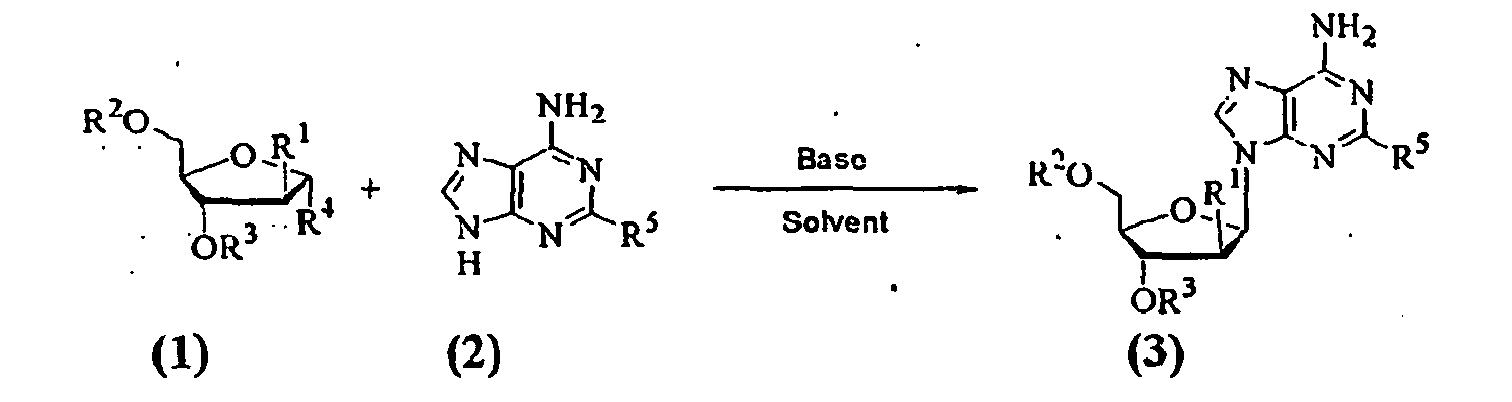
- this reaction can be depicted as: R 1 is hydrogen, halogen or -OR 6 , wherein R 6 is a hydroxy protecting group.
- R 1 is fluoro.
- R 2 and R 3 are hydroxy-protecting groups.
- R 2 , R 3 and R 6 are independently benzoyl or acetyl.
- R 4 is a leaving group.
- Suitable leaving groups include, halo, fluorosulfonyl, alkylsulfonyloxy, trifluoroalkylsulfonyloxy and arylsulfonyloxy.
- R 4 is bromo.
- R 5 is hydrogen, halogen or -NH 2 .
- R 5 is chloro or fluoro.
- this reaction proceeds without substantial production of adducts resulting from addition of the blocked arabinofuranosyl (1) with the exocyclic amino group at the C-6 position of compound (2) (hereinafter termed "C-6 exocyclic amino group"), which remains unprotected during the reaction, and/or the nitrogen at the N-7 position of the adenine ring.
- C-6 exocyclic amino group the exocyclic amino group at the C-6 position of compound (2)
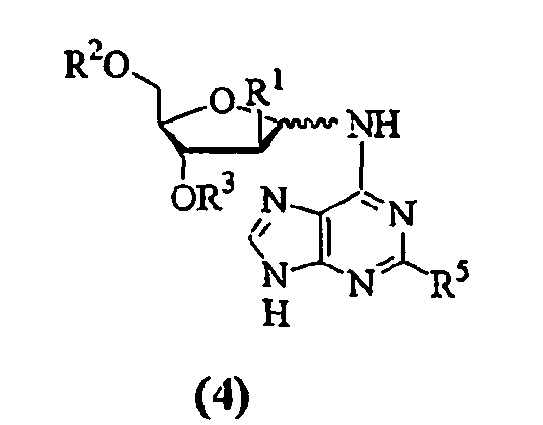
- an undesired C-6 exocyclic amino group by-product adduct is represented by the following formula:
- substantially formation means conversion of about 40 % of the adenine derivative of formula (2) to a by-product adduct or adducts resulting from addition of the blocked arabinofuranosyl of formula (1) to the unprotected C-6 exocyclic amino group and/or N-7 position of compound (2).
- substantially formation means conversion of about 40 % of the adenine derivative of formula (2) to by-product adduct(s) resulting from addition of the blocked arabinofuranosyl of formula (1) to the unprotected C-6 exocyclic amino group and/or N-7 position and/or the R 5 -NH 2 group of compound (2).
- reaction can proceed without even a significant production of adducts resulting from addition of the blocked arabinofuranosyl (1) with the C-6 exocyclic amino group and/or N-7 position of compound (2).
- "significant production” means conversion of about 5 % of the adenine derivative of formula (2) to a by-product adduct or adducts resulting from addition of the blocked arabinofuranosyl (1) to the unprotected C-6 exocyclic amino group and/or N-7 position of compound (2).
- "significant production” means conversion of about 5 % of the adenine derivative of formula (2) to a by-product adduct(s) resulting from addition of the blocked arabinofuranosyl of formula (1) to the unprotected C-6 exocyclic amino group and/or N-7 position and/or the R 5 -NH 2 group of compound (2).
- Useful bases are generally those with a pKa in water of 15 or greater.
- the base is an alkali metal base, more preferred being a potassium base.
- the base is a sterically hindered base, e.g. , potassium t -butoxide or potassium t -amylate.
- Suitable inert solvents include, but are not limited to, t -butyl alcohol, acetonitrile, dichloromethane, dichloroethane, t -amyl alcohol, tetrahydrofuran or mixtures thereof.
- the solvent or solvent mixture has a boiling point of about 80°C or , greater.
- the process of the present invention also further comprises de-protection of the blocked carbohydrate moiety to form a ⁇ -nucleoside of the formula: wherein, R 1 and R 5 are as defined above.
- the adenine derivative is 2-chloroadenine and the blocked arabinofuranosyl derivative is a 2-deoxy-2-fluoro-arabinofuranosyl derivative, whereupon the resulting ⁇ -nucleoside is a 2-chloro-9-(2'-deoxy-2'-fluoro- ⁇ -D-arabinofuranosyl) adenine derivative.
- the reaction can be depicted as: wherein R 2 , R 3 and R 4 are as defined above.
- the process also further comprises de-protecting the carbohydrate moiety to form 2-chloro-9-(2'-deoly-2'-fluoro- ⁇ -D-arabinofuranosyl) adenine, also known as clofarabine.
- R 7 and R 8 are independently halogen
- M + is potassium
- R 2 , R 3 , and R 5 are as defined above.
- Halogen includes bromo, fluoro, chloro and iodo.
- R 8 is fluoro.
- R 7 is chloro or, preferably, bromo.
- the process further comprises the addition of calcium hydride.
- Suitable inert solvents include t -butyl alcohol, acetonitrile, dichloromethane, dichloroethane, t -amyl alcohol, tetrahydrofuran or mixtures thereof.
- the solvent is a mixture of t -butyl alcohol and acetonitrile, or a mixture of t -butyl alcohol and dichloroethane, or a mixture of dichloroethane and acetonitrile, or a mixture of t -amyl alcohol and dichloroethane, or a mixture of t -amyl alcohol and acetonitrile, or a mixture of t -amyl alcohol, acetonitrile and dichloromethane, or a mixture of t -amyl alcohol, acetonitrile and dichloroethane.
- the solvent or solvent mixture has a boiling point of about 80°C or greater.
- the adenine derivative salt (10) is formed in situ by the reaction of a potassium base with the corresponding adenine derivative (2).
- the base is potassium t -butoxide or potassium t -amylate.
- the coupling reaction produces a preparation wherein the ratio of the ⁇ -anomer of formula (11) to the ⁇ -anomer of formula (12) is at least about 10:1, or preferably is at least about 15:1, or more preferable is at least about 20:1.
- the anomer ratio may be 10:1 or greater, 15:1 or greater or 20:1 or greater.
- the ⁇ -anomer of formula (11) is prepared in a yield of about 40 % or greater.
- the ⁇ -anomer of formula (11) is prepared in yields of about 50% or greater or about 80% or greater.
- the process of the present invention may also further comprises isolation of the ⁇ -anomer (11) by subjecting the mixture of ⁇ and ⁇ -anomers to recrystallization or by a re-slurry procedure.
- the further purification comprises reslurry from methanol or crystallization from a mixture of butyl acetate and heptane.
- the purified preparation comprises a mixture of nucleosides wherein the ratio of the ⁇ -anomer of formula (11) to the ⁇ -anomer of formula (12) is at least about 20:1, or least about 40:1, or at least about 60:1.
- the process also further comprises de-protection of the blocked carbohydrate moiety of the protected ⁇ -anomer to form a ⁇ -nucleoside of the formula: wherein, R 5 and R 8 are as defined above.
- R 5 is chloro and R 8 is fluoro
- the unblocked ⁇ -nucleoside of formula (13) is 2-chloro-9-(2'-deoxy-2'-fluoro- ⁇ -D-arabinofuranosyl) adenine.
- Another aspect of the present invention is a multi-step process for the preparation of a composition comprising 2-chloro-9-(2'-deoxy'-2'-fluoro- ⁇ -D-arabinofuranosyl) adenine.
- This comprises the integration of the other aspects of the present invention into an economically preferable, effective and efficient synthesis and isolation of 2-chloro-9-(2'-deoxy-2'-fluoro- ⁇ -D-arabinofurailosyl) adenine.
- This process minimizes the number of steps in part by not requiring protection of the C-6 exocyclic amino group.
- the surprising stereoselective preference for the ⁇ -anomer in part enables the preparation of a composition with an ⁇ : ⁇ anomer ratio of at least 99:1 or in preferred embodiments is about 400:1 or greater, about 500:1 or greater or about 1000:1 or greater, without utilizing a preparative chromatography step for the purification of the ⁇ -anomer.
- the absence of a chromatographic step is a major advantage in regard to an economically preferable commercial-scale process.
- the process comprises reacting 3,5-O-dibenzoyl-2-deoxy-2-fluoro- ⁇ -D-arabinofuranosyl bromide with a 2-chloroadenine potassium salt of the formula: in the presence of a solvent to form 2-chloro-9-(3',5'-O-dibenzoyl-2'-deoxy-2'-fluoro- ⁇ -D-arabinofuranosyl) adenine.
- the C-6 exocyclic amino group of the 2-chloroadenine potassium salt is not protected during the process.
- the 2-chloro-9-(3',5'-O-dibenzoyl-2'-deoxy-2'-fluoro- ⁇ -D-arabinofuranosyl) adenine is then de-protected to form 2-chloro-9-(2'-deoxy-2'-fluoro- ⁇ -D-arabinofuranosyl) adenine, which is then isolated to provide a composition comprising 2-chloro-9-(2'-deoxy-2'-fluoro- ⁇ -D-arabinofuranosyl) adenine.
- composition produced by the multi-step process also comprises 2-chloro-9-(2'-deoxy-2'-fluoro- ⁇ -D-arabinofuranosyl) adenine
- the 2-chloro-9-(2'-deoxy-2'-fluoro- ⁇ -D-arabinofuranosyl) adenine is substantially pure.
- substantially pure 2-chloro-9-(2'-deoxy-2'-fluoro- ⁇ -D-arabinofuranosyl) adenine means that the ratio of ⁇ -anomer to ⁇ -anomer as measured by high pressure liquid chromatography and spectrophotometric analysis, is at least 99:1.
- the process may further comprise isolating the 2-chloro-9-(3',5'-O-dibenzoyl-2'-deoxy-2'-fluoro- ⁇ -D-arabinofuranosyl) adenine before the deprotection step.
- this isolation may comprise reslurry and/or recrystallization, which may be effected by use of methanol or by use of a mixture of butyl acetate and heptane.
- the isolation of 2-chloro-9-(2'-deoxy-2'-fluoro-(3-D-arabinofuranosyl) adenine also comprises recrystallization.
- the recrystallization is from methanol.
- the 2-chloroadenine potassium salt is prepared in situ by the reaction of a potassium base with 2-chloroadenine in a suitable inert solvent.
- the base is potassium t -butoxide or potassium t -amylate.
- Suitable inert solvents include t -butyl alcohol, acetonitrile, dichloromethane, dichloroethane, t -amyl alcohol, tetrahydrofuran or mixtures thereof.
- the solvent is a mixture of t -butyl alcohol and acetonitrile, or a mixture of t -butyl alcohol and dichloroethane, or a mixture of dichloroethane and acetonitrile, or a mixture of t -amyl alcohol and dichloroethane, or a mixture of t -amyl alcohol and acetonitrile, or a mixture of t -amyl alcohol, acetonitrile and dichloromethane, or a mixture of t -amyl alcohol, acetonitrile and dichloroethane.
- FIG.1 Schematic representing potential rationale for the effect of potassium in the stereoselective production of 2'-deoxy-2'-fluoro- ⁇ -D-adenine nucleosides.
- R 2 , R 3 and R 5 are as defined above.
- FIG. 2 Schematic of expected conformations of the relevant protons and fluorine atoms for 2-chloro-9-(2'-deoxy-2'-halo- ⁇ -D-arabinofuranosyl) adenine (clofarabine) (21) and 2-chloro-9-(2'-deoxy-2'-fluoro- ⁇ -D-arabinofuranosyl) adenine (epi-clofarabine) (22).
- FIG. 3 Partial 1H NMR for 2-chloro-9-(2'-deoxy-2'-fluoro- ⁇ -D-arabinofuranosyl) adenine (clofarabine) (21).
- FIG. 4 Partial 1H NMR for 2-chloro-9-(2'-deoxy-2'-fluoro- ⁇ -D-arabinofuranosyl) adenine (epi-clofarabine) (22).
- One aspect of the present invention provides for the preparation ⁇ -adenine nucleosides by coupling an adenine derivative with an unprotected C-6 exocyclic amino group and a blocked arabinofuranosyl derivative, in the presence of a base and solvent.
- the blocked arabinofuranosyl derivative may be depicted by the structure: R 1 is hydrogen, halogen or -OR 6 , wherein R 6 is a hydroxy protecting group.
- Halogens include bromo, chloro, fluoro and iodo.
- R 2 and R 3 are hydroxy protecting groups.
- Hydroxy protecting groups are known in the art as chemical functional groups that can be selectively appended to and removed from a hydroxy functionality present in a chemical compound to render such functionality inert to chemical reaction conditions to which the compound is exposed Hydroxy protecting groups are described in Greene and Wuts, Protective Groups in Organic Synthesis, 2d edition, John Wiley & Sons, New York, 1991 , and include formyl, acetyl, propionyl, arylacyl ( e.g ., benzoyl or substituted benzoyl), trityl or monomethoxytrityl, benzyl or substituted benzyl, carbonate derivatives ( e.g ., phenoxycarbonyl, ethoxycarbonyl and t-butoxycarbonyl), and trisubstituted silyl, including trialkylsilyl (e.g . dimethyl-t-butylsilyl) or diphenylmethylsilyl.
- the protecting groups are independently
- R 4 is a leaving group, suitable examples of which include halogen, alk-ylsulfonyloxy, and arylsulfonyloxy.
- Halogens include chloro, fluoro, iodo and, in a preferred embodiment, bromo.
- Blocked ⁇ -arabinofuranosyl halides can be prepared by various methods known in the art employing standard procedures commonly used by one of skill in the art, e.g., 3,5-O-dibenzoyl-2-deoxy-2-fluoro- ⁇ -D-arabinofuranosyl bromide (exemplified in Example 1; Tann et al., J. Org.
- Alkyl sulfonates include methanesulfonate, ethylsulfonate and butylsulfonate and substituted alkyl sulfonates include compounds such as trifluoromethane sulfonate and 1,1,1-trifluoromethanesulfonate.
- Arylsulfonates includes substituted arylsulfonates such as p- nitrobenzenesulfonate, p -bromobenzenesulfonate, p -methylbenzesulfonate, and the like.
- Useful bases generally have a pKa in water of 15 or greater and are suitable for the formation of a salt of the adenine derivative (2) , as depicted by the formula: R 5 is as defined previously and R + is a monovalent cation.
- the base may be an alkali metal base, and in preferred embodiments the alkali metal base is a potassium base.
- the base is a sterically hindered base, e.g ., potassium t -butoxide or potassium t- amylate.
- Solvents useful in the present invention are those that are inert in respect to the reaction. Suitable inert solvent include, but are not limited to, t -butyl alcohol, acetonitrile, dichloromethane, dichloroethane, t -amyl alcohol, tetrahydrofuran or mixtures thereof.
- the reaction is carried out at room temperature. However, in other embodiments the reaction is carried out at elevated or lower temperatures. E.g., the reaction can be carried out at about 40 °C, or about 50 °C, or about 60 °C, or under reflux conditions. Alternatively the reaction can be carried out from about -25 °C to about 25 °C, e.g., at about -20 °C or at about -10 °C, or at about 0°C, or at about 10 °C.
- amino protecting group wherein an amino group is described as "unprotected,” this means that the amino group has not been blocked by an amino protecting group.
- amino protecting functionalities are well known in the art. Examples are described in Greene and Wuts, Protective Groups in Organic Synthesis, 2d edition, John Wiley & Sons, New York, 1991 .
- the molar ratio of reactants is not considered to be critical and in preferred embodiments approximately equal molar equivalents of blocked arabinofuranosyl derivative (1), adenine derivative (2) and base are used. In some embodiments, a slight molar excess (e.g., 1.05 to 1.15 equivalents) of adenine derivative (2) and/or base are used.
- the preferred order and manner of addition for any specific embodiment can be determined by routine experimentation with a view towards both reaction performance and chemical engineering and productions considerations.
- Another aspect of the invention is the stereoselective preparation of 2-deoxy- ⁇ -D-adenine nucleosides.
- a blocked 2-deoxy- ⁇ -D-arabinofuranosyl halide is coupled with the salt of an adenine derivative depicted by the formula: R 5 and M + are as previously described.
- the identity of the cation has a profound effect on the stereoselectivity of the coupling reaction.
- Potassium salts produced larger ⁇ : ⁇ anomer ratios than lithium or sodium salts.
- the salt depicted by formula (10) can be produced in situ by use of potassium bases and adenine derivatives of formula (2).
- Suitable bases generally have a pKa in water of 15 or greater and include potassium t -alkoxide bases, potassium hydroxide and hindered bases include potassium diisopropylamide, potassium bis(trimethylsilyl)amide, potassium hexamethyldisilazide, potassium hydride and the like.
- the base is a sterically hindered base, e.g ., potassium t -butoxide or potassium t -amylate.
- the preferential stereoselectivity observed with potassium may be due, e.g., when R 8 is fluoro and R 7 is bromo, to an electrostatic attraction between the electronegative fluorine atom and the hard potassium cation, leading to a preferential ⁇ -face attack, as depicted in Fig. 1 .
- the lack of selectivity of lithium and sodium may be due to a more covalent association of the cation with the purine base.
- the present invention also encompasses other cations, such as cesium, that can replace potassium as a hard cation.
- the solvent employed also has a marked effect on the ⁇ : ⁇ anomer ratio.
- solvents with a lower dielectric constant favor production of the ⁇ anomer.
- solvent choice is not dictated simply by dielectric constant, in that there is a tendency for an inverse relationship between increasing the ⁇ : ⁇ anomer ratio and the yield of the ⁇ and ⁇ anomers. This effect presumably relates to the solubility of reactants and/or intermediates.
- Suitable solvents include t-butyl alcohol, acetonitrile, dichloromethane, dichloroethane, t -amyl alcohol, isoamyl alcohol, tetrahydrofuran or mixtures thereof.
- the solvent is a mixture of t-butyl alcohol and acetonitrile, or a mixture of t- butyl alcohol and dichloroethane, or a mixture of dichloroethane and acetoutrile, or a mixture of t -amyl alcohol and dichloroethane, or a mixture of t -amyl alcohol and acetonitrile, or a mixture of t -amyl alcohol, acetonitrile and dichloromethane, or a mixture of t -amyl alcohol, acetonitrile and dichloroethane.
- Two component mixtures the two solvents may be combined in the range of about 1:4 to about 1:1 v/v.
- the three solvents may be combined in ratios of about 2:3:1, or about 2:1:1, or about 1:1:1.
- the reaction is carried out at room temperature.
- elevated or lower temperatures are used. Lowering the temperature of the reaction, such as in the range of from room temperature to about -25 °C, may lead to an increase the ⁇ : ⁇ anomer ratio. Elevated temperatures can be used in the range from room temperature to reflux conditions.
- calcium hydride is added.
- the addition of calcium hydride generally increases the ⁇ : ⁇ anomer ratio. This effect may be due in part to the removal of traces of water from the solvent.
- the molar ratio of reactants is not considered to be critical and in preferred embodiments when the adenine derivative salt (10) is produced in situ, approximately equal molar equivalents of blocked arabinofuranosyl derivative (9) , adenine derivative (2) , base and, when added, calcium hydride are used. In some embodiments, a slight molar excess (e.g., 1.05 to 1.15 equivalents) of adenine derivative (2) and/or base are used.
- the preferred order and manner of addition for any specific embodiment can be determined by routine experimentation with a view towards both reaction performance and chemical engineering and productions considerations.
- a 1-neck roundbottom flask (100 mL) was equipped with a stir bar and nitrogen inlet adapter. The flask was charged with dichloromethane (10.4 mL) and 1, 3, 5-O-tribenzoyl 2-deoxy-2-fluoro- ⁇ -D-arabinofuranosyl (16) (2.6 gm, Sigma, St. Louis, MO) at room temperature. The solution was placed under nitrogen. A 33% solution of hydrogen bromide in acetic acid (0.96 gm) was charged and the resultant mixture stirred for 18 hr. The solvent was removed by rotary evaporation to give an orange residue.
- a three neck roundbottom flask was equipped with a temperature controller, nitrogen inlet and outlet tubes, septa and a magnetic stir bar. Chloroadenine (18) (0.45g) was charged as a solid under nitrogen, followed by potassium t -butoxide (0.34 g), acetonitrile (2.3 mL) and t -butyl alcohol (6.9 mL). After stirring for 1 hour at 24°C-26°C, 3,5-O-dibenzoyl-2-deoxy-2-fluoro- ⁇ -D-arabinofuranosyl bromide (17) (1.21 gm) was added. The resulting orange suspension was stirred at 24°C-26 °C for 16 hours.
- HPLC analysis of an in-process control sample showed a 96.6 % conversion and a 10.7:1 ratio of ⁇ -anomers (19) to ⁇ -anomer (20) .
- HPLC analysis utilized a reverse phase system with a Zorbax-SB-C18 column and a mobile phase of 80:20 acetonitrile/water with 15 % v/v trifluoroacetic acid at a flow rate of 1 mL/min. at 30 °C. Detection was by spectrophotometric analysis at 263 nm. Conversion is expressed as area under the curve (a.u.c.) values of (19) + (20) / (18) + (19) + (20) x 100.
- a 3-neck roundbottom flask was equipped with a magnetic stir bar, temperature controller, and nitrogen inlet line and charged with 2-cliloradenine (18) (0.29 g), followed by acetonitrile (1.6 mL), t-amyl alcohol (3.3 mL), potassium tert-butoxide (0.2 g) and calcium hydride (0.069 g). This mixture was stirred at 25°C for 30 minutes before 3,5-O-dibenzoyl-2-deoxy-2-fluoro- ⁇ -D-arabinofuranosyl bromide (17) (0.68 g gm) dissolved in dichloromethane (3.25 mL) was charged.
- a re-slurry step utilizing methanol reflux was used to purify compound (19). I necessary, the pH should be adjusted to 6.0 prior to this step to prevent deprotection during the re-slurry step. Given that the re-slurry must involve an equilibrium between the solid and solution phases, a period of time is required for this equilibrium to become established under a given set of experimental conditions. Thus, the times required for equilibration by monitoring the anomeric composition of slurries at different solvent ratios and temperatures were examined.
- Results of this method are shown in Table 2 for 20 gm runs undertaken in a 1L reactor.
- Table 2 Conditions ⁇ Initial ratio (19)/(20) ⁇ Final ratio (19)/(20) Mass recovery* A 19 79 62 B 20 39 69 B 24 66 74 ⁇ Conditions: A: 10 mi MeOH per gram of crude (19), reflux 0.5 hour then room temperature for 19 hours, B: room temperature for 5 days.
- ⁇ refers to the anomeric ratio going into methanol re-slurry step.
- * refers to the mass recovery in the methanol re-slurry step only.
- methyl benzoate is a liquid and is readily soluble in many organic solvents, cleavage of benzyl groups with sodium methoxide was preferred.
- the reaction flask was cooled in an ice bath 2 hours and the reaction mixture was filtered and the flask and filtercake were washed with 9.5 ml methanol.
- the wet solid and 105 ml methanol were charged to a 250 ml, multi-neck flask, equipped with a thermocouple, magnetic stirrer, nitrogen purge and reflux condenser, stirred and heated to reflux.
- the hot solution was filtered and filtrate transferred to the original reaction flask, wherein the mixture was cooled to ambient temperature.
- the mixture was cooled in and ice/water bath for 0.5 hour and the mixture filtered and flask and filtercake rinsed with 9.8 ml methanol.
- the wet solid was dried in a vacuum oven to produced (21) at a yield of 69.4% with a purity of 99.14 (a.u.c.). No ⁇ -amoner was detectable by HPLC
- FIG. 2 shows the expected conformations of the relevant protons and fluorine atoms for 2-chloro-9-(2'-deoxy-2-fluoro- ⁇ -D-arabinofuranosyl) adenine (clofarabine) (21) and 2-chloro-9-(2'-deoxy-2'-Suoro- ⁇ -D-arabinofuranosyl) adenine (epi-clofarabine): Based on these conformational assumptions and the Karpus relationship, the predicted coupling constants of the ⁇ -anomer (21) and the ⁇ -anomer (22) should conform to the following relationship:
Landscapes
- Chemical & Material Sciences (AREA)
- Organic Chemistry (AREA)
- Health & Medical Sciences (AREA)
- Life Sciences & Earth Sciences (AREA)
- Engineering & Computer Science (AREA)
- Biochemistry (AREA)
- Biotechnology (AREA)
- General Health & Medical Sciences (AREA)
- Genetics & Genomics (AREA)
- Molecular Biology (AREA)
- Saccharide Compounds (AREA)
- Pharmaceuticals Containing Other Organic And Inorganic Compounds (AREA)
Abstract
Description
- The present invention relates generally to the chemical preparation of purine nucleosides. More specifically, the invention relates to the coupling of an adenine derivative with a blocked arabinofuranosyl to form a β-D-adenine nucleoside. Such nucleosides are valuable compounds in the field of cancer therapy and as anti-viral agents.
- A number of β-D-purine nucleosides derived from adenine are useful as antitumor and antiviral agents. An important step in the synthesis of such agents is the formation of the N-glycoside bond between the adenine nucleobase and an arabinofuranosyl derivative. The coupling reactions used to form the N-glycoside bond of 2'-deoxynucleosides have typically resulted in the formation of a mixture of α and β-anomers.
- Nucleosides have been synthesized by fusion glycosylation, wherein the reaction is carried out in the absence of solvent at a temperature sufficient to convert the reactants to a molten phase. E.g., 2,6-dichloropurine has been coupled under fusion conditions with 5-O-benzyl-2-deoxy-1,3-di-O-acetyl-2-fluroarabinose to form a 2'-fluoroarabinonucleoside in 27% yield (Wright et al., J. Org. Chem. 34:2632, 1969). Another synthetic method utilizes silylated nucleobase derivatives, e.g., a silylated nucleobase has been coupled with a peracetylated deoxy-sugar in the presence of a solvent and a Friedel Crafts catalyst (Vorbruggen et al., J. Org. Chem. 41:, 2084, 1976). This method has been modified by incorporating a sulfonate leaving group in the deoxy-sugar in the synthesis of 2'-deoxy-2'-difluoronucleosides (
U.S. Pat. No. 4,526,988 ;U.S. Pat. No. 4,965,374 ). - High yields of 2'-deoxy-2'-fluoro-pyrimidine nucleosides were obtained from refluxing pyrimidines with 2-deoxy-2-fluoro-3,5-di-O-benzoyl-α-O-arabinofuranosyl bromide. (Howell et al., J. Org. Chem. 53:85-88, 1988). It was found that use of solvents with lower dielectric constants produced have higher β:α anomer ratios. It was postulated that such solvents favored an
S N 2 reaction, whereas solvents with higher dielectric constants favored production of α-anomers via an ionic S N 1 pathway. - Anion glycosylation procedures have also been used to prepare 2'-deoxy-2'-fluoropurine nucleosides.
EP 428109 S N 2 displacement. Use of 1:1 acetonitrile/methylene chloride resulted in a nucleoside product with a β:α anomer ratio 10:1, as opposed to a ratio of 3.4:1 observed when using a silylated purine reactant. In regard to the use of adenine salts, the amino substituent at the C-6 position was protected as a benzoyl derivative during the coupling reaction. Protecting the exocyclic amino group precludes the formation of arabinofuranosyl adducts which otherwise may be expected to be produced (e.g., Ubukata et al., Tetrahedron Lett., 27:3907-3908, 1986; Ubukata et al., Agric. Biol. Chem., 52: 1117-1122, 1988; Searle et al., J. Org. Chem., 60:4296-4298, 1995; Baraldi et al., J. Med. Chem., 41:3174-3185, 1998). The preparation of α and β anomers of 2'-deoxy-2'-fluoropurine and 2'-difluoropurine nucleosides by anion glycosylation are disclosed byU. S. Patent Nos. 5,744,597 andU.S. Patent No. 5,821,357 with β-anomer enriched nucleosides prepared in a β:α anomer ratio of greater than 1:1 to about 10:1 and from greater that 1:1 to about 7:1 respectively. In regard to purines substituted with exocyclic amino groups, both patents again disclose protecting such groups during coupling to an appropriate sugar moiety (See alsoEP 577304 U.S. Patent No. 5,281,357 also discloses the effect of solvents on the β:α anomer ratio of 9-[1-(2'-deoxy-2',2'-difluoro-3',5'-di-O-benzoyl-D-ribofuranosyl)]-2,6-dipivalamidopurine prepared by coupling the potassium salt of 2,6-dipivalanudopurine with an α anomer enriched preparation of 2-deoxy-2,2-difluoro-'D-ribofuranosyl-3,5-dibenzoyl-1-trifluoromethanesulfonate. There was no correlation between the dielectric constant of the six solvents used and the β:α anomer ratio, e.g. ethyl acetate and acetonitrile both gave the same ratio of 1.6:1. t-Butyl alcohol gave the highest β:α anomer ratio of 3.5:1. - Despite the preparative methods for purine nucleosides known in the art, there is still a need for economically preferable, effective and efficient process for the preparation of these compounds. The object of the present invention is to provide such a process. Further objects are to minimize the number of process reaction steps and to provide a process that is readily scalable for the production of commercial-scale quantities. Other objects and advantages will become apparent to persons skilled in the art and familiar with the background references from a careful reading of this specification.
- In its most general terms, one aspect of the present invention provides for the preparation of β-adenine nucleosides by coupling an adenine derivative containing an unprotected exocyclic amino group at the C-6 position, and a blocked arabinofuranosyl derivative. In preferred embodiments, this reaction can be depicted as:
- Surprisingly, this reaction proceeds without substantial production of adducts resulting from addition of the blocked arabinofuranosyl (1) with the exocyclic amino group at the C-6 position of compound (2) (hereinafter termed "C-6 exocyclic amino group"), which remains unprotected during the reaction, and/or the nitrogen at the N-7 position of the adenine ring. An example of an undesired C-6 exocyclic amino group by-product adduct is represented by the following formula:
- Even more surprising is that the reaction can proceed without even a significant production of adducts resulting from addition of the blocked arabinofuranosyl (1) with the C-6 exocyclic amino group and/or N-7 position of compound (2). For the purposes of the present invention, "significant production" means conversion of about 5 % of the adenine derivative of formula (2) to a by-product adduct or adducts resulting from addition of the blocked arabinofuranosyl (1) to the unprotected C-6 exocyclic amino group and/or N-7 position of compound (2). In embodiments wherein R5 is -NH2, "significant production" means conversion of about 5 % of the adenine derivative of formula (2) to a by-product adduct(s) resulting from addition of the blocked arabinofuranosyl of formula (1) to the unprotected C-6 exocyclic amino group and/or N-7 position and/or the R5 -NH2 group of compound (2).
- Useful bases are generally those with a pKa in water of 15 or greater. In preferred embodiments, the base is an alkali metal base, more preferred being a potassium base. In preferred embodiments, the base is a sterically hindered base, e.g., potassium t-butoxide or potassium t-amylate. Suitable inert solvents include, but are not limited to, t-butyl alcohol, acetonitrile, dichloromethane, dichloroethane, t-amyl alcohol, tetrahydrofuran or mixtures thereof. In preferred embodiments, the solvent or solvent mixture has a boiling point of about 80°C or , greater.
- The process of the present invention also further comprises de-protection of the blocked carbohydrate moiety to form a β-nucleoside of the formula:

- In some embodiments, the adenine derivative is 2-chloroadenine and the blocked arabinofuranosyl derivative is a 2-deoxy-2-fluoro-arabinofuranosyl derivative, whereupon the resulting β-nucleoside is a 2-chloro-9-(2'-deoxy-2'-fluoro-β-D-arabinofuranosyl) adenine derivative. The reaction can be depicted as:

- Another aspect of the invention is the discovery of the surprising steroselectivity that can be achieved in the production 2'-deoxy-2'-halo-β-D-adenine nucleosides wherein such nucleosides are also produced in high yield. This reaction can be depicted as:

- In some embodiments, the adenine derivative salt (10) is formed in situ by the reaction of a potassium base with the corresponding adenine derivative (2). In preferred embodiments, the base is potassium t-butoxide or potassium t-amylate.
- In various embodiments of the invention, the coupling reaction produces a preparation wherein the ratio of the β-anomer of formula (11) to the α-anomer of formula (12) is at least about 10:1, or preferably is at least about 15:1, or more preferable is at least about 20:1. Thus, the anomer ratio may be 10:1 or greater, 15:1 or greater or 20:1 or greater. In preferred embodiments the β-anomer of formula (11) is prepared in a yield of about 40 % or greater. In more preferred embodiments, the β-anomer of formula (11) is prepared in yields of about 50% or greater or about 80% or greater.
- The process of the present invention may also further comprises isolation of the β-anomer (11) by subjecting the mixture of β and α-anomers to recrystallization or by a re-slurry procedure. In a preferred embodiment, the further purification comprises reslurry from methanol or crystallization from a mixture of butyl acetate and heptane. In various embodiments, the purified preparation comprises a mixture of nucleosides wherein the ratio of the β-anomer of formula (11) to the α-anomer of formula (12) is at least about 20:1, or least about 40:1, or at least about 60:1.
- The process also further comprises de-protection of the blocked carbohydrate moiety of the protected β-anomer to form a β-nucleoside of the formula:

- Another aspect of the present invention is a multi-step process for the preparation of a composition comprising 2-chloro-9-(2'-deoxy'-2'-fluoro-β-D-arabinofuranosyl) adenine. This comprises the integration of the other aspects of the present invention into an economically preferable, effective and efficient synthesis and isolation of 2-chloro-9-(2'-deoxy-2'-fluoro-β-D-arabinofurailosyl) adenine. This process minimizes the number of steps in part by not requiring protection of the C-6 exocyclic amino group. In addition, the surprising stereoselective preference for the β-anomer in part enables the preparation of a composition with an β:α anomer ratio of at least 99:1 or in preferred embodiments is about 400:1 or greater, about 500:1 or greater or about 1000:1 or greater, without utilizing a preparative chromatography step for the purification of the β-anomer. The absence of a chromatographic step is a major advantage in regard to an economically preferable commercial-scale process.
- The process comprises reacting 3,5-O-dibenzoyl-2-deoxy-2-fluoro-α-D-arabinofuranosyl bromide with a 2-chloroadenine potassium salt of the formula:

- The process may further comprise isolating the 2-chloro-9-(3',5'-O-dibenzoyl-2'-deoxy-2'-fluoro-β-D-arabinofuranosyl) adenine before the deprotection step. In some embodiments, this isolation may comprise reslurry and/or recrystallization, which may be effected by use of methanol or by use of a mixture of butyl acetate and heptane. In other embodiments, the isolation of 2-chloro-9-(2'-deoxy-2'-fluoro-(3-D-arabinofuranosyl) adenine also comprises recrystallization. In some embodiments, the recrystallization is from methanol.
- In some embodiments, the 2-chloroadenine potassium salt is prepared in situ by the reaction of a potassium base with 2-chloroadenine in a suitable inert solvent. In preferred embodiments, the base is potassium t-butoxide or potassium t-amylate. Suitable inert solvents include t-butyl alcohol, acetonitrile, dichloromethane, dichloroethane, t-amyl alcohol, tetrahydrofuran or mixtures thereof. In preferred embodiments, the solvent is a mixture of t-butyl alcohol and acetonitrile, or a mixture of t-butyl alcohol and dichloroethane, or a mixture of dichloroethane and acetonitrile, or a mixture of t-amyl alcohol and dichloroethane, or a mixture of t-amyl alcohol and acetonitrile, or a mixture of t-amyl alcohol, acetonitrile and dichloromethane, or a mixture of t-amyl alcohol, acetonitrile and dichloroethane.
- The following drawings form part of the present specification and are included to further demonstrate certain aspects of the present invention. The invention may be better understood by reference to one or more of these drawings in combination with the detailed description of specific embodiments presented herein.
-
FIG.1 - Schematic representing potential rationale for the effect of potassium in the stereoselective production of 2'-deoxy-2'-fluoro-β-D-adenine nucleosides. R2, R3 and R5 are as defined above. -
FIG. 2 - Schematic of expected conformations of the relevant protons and fluorine atoms for 2-chloro-9-(2'-deoxy-2'-halo-β-D-arabinofuranosyl) adenine (clofarabine) (21) and 2-chloro-9-(2'-deoxy-2'-fluoro-α-D-arabinofuranosyl) adenine (epi-clofarabine) (22). -
FIG. 3 - Partial 1H NMR for 2-chloro-9-(2'-deoxy-2'-fluoro-β-D-arabinofuranosyl) adenine (clofarabine) (21). -
FIG. 4 - Partial 1H NMR for 2-chloro-9-(2'-deoxy-2'-fluoro-α-D-arabinofuranosyl) adenine (epi-clofarabine) (22). - One aspect of the present invention provides for the preparation β-adenine nucleosides by coupling an adenine derivative with an unprotected C-6 exocyclic amino group and a blocked arabinofuranosyl derivative, in the presence of a base and solvent. The blocked arabinofuranosyl derivative may be depicted by the structure:

- R4 is a leaving group, suitable examples of which include halogen, alk-ylsulfonyloxy, and arylsulfonyloxy. Halogens include chloro, fluoro, iodo and, in a preferred embodiment, bromo. Blocked α-arabinofuranosyl halides can be prepared by various methods known in the art employing standard procedures commonly used by one of skill in the art, e.g., 3,5-O-dibenzoyl-2-deoxy-2-fluoro-α-D-arabinofuranosyl bromide (exemplified in Example 1; Tann et al., J. Org. Chem., 50:3644, 1985, herein incorporated by reference); 3-O-acetyl-5-O-benzyl-2-deoxy-2-fluoro-α-D-arabinofuranosyl bromide (Fox et al., Carbohydrate Res., 42:233, 1975, herein incorporated by reference); 2,3,5-O-tribenzyl-α-D-arabinofuranosyl chloride (
U.S. Patent No. 5,110,919 , herein incorporated by reference); and 3,5-O-di-p-toluoyl-2-deoxy-α-arabinofuratiosyl chloride (Bhattacharya et al., J. Org. Chem., 28:428 1963; Nuhn et al., Pharmazie, 24:237, 1969, both herein incorporated by reference). Preparation of blocked α-arabinofuranosyl derivatives substituted at the C-1 position with alkylsulfonates and arylsulfonates are disclosed inU.S. Patent No. 5,401,861 andU.S. Patent No. 5,744,579 , both herein incorporated by reference. Alkyl sulfonates include methanesulfonate, ethylsulfonate and butylsulfonate and substituted alkyl sulfonates include compounds such as trifluoromethane sulfonate and 1,1,1-trifluoromethanesulfonate. Arylsulfonates includes substituted arylsulfonates such as p-nitrobenzenesulfonate, p-bromobenzenesulfonate, p-methylbenzesulfonate, and the like. - Useful bases generally have a pKa in water of 15 or greater and are suitable for the formation of a salt of the adenine derivative (2), as depicted by the formula:

- Solvents useful in the present invention are those that are inert in respect to the reaction. Suitable inert solvent include, but are not limited to, t-butyl alcohol, acetonitrile, dichloromethane, dichloroethane, t-amyl alcohol, tetrahydrofuran or mixtures thereof.
- In a preferred embodiment, the reaction is carried out at room temperature. However, in other embodiments the reaction is carried out at elevated or lower temperatures. E.g., the reaction can be carried out at about 40 °C, or about 50 °C, or about 60 °C, or under reflux conditions. Alternatively the reaction can be carried out from about -25 °C to about 25 °C, e.g., at about -20 °C or at about -10 °C, or at about 0°C, or at about 10 °C.
- Wherein an amino group is described as "unprotected," this means that the amino group has not been blocked by an amino protecting group. The use and types of amino protecting functionalities are well known in the art. Examples are described in Greene and Wuts, Protective Groups in Organic Synthesis, 2d edition, John Wiley & Sons, New York, 1991.
- The molar ratio of reactants is not considered to be critical and in preferred embodiments approximately equal molar equivalents of blocked arabinofuranosyl derivative (1), adenine derivative (2) and base are used. In some embodiments, a slight molar excess (e.g., 1.05 to 1.15 equivalents) of adenine derivative (2) and/or base are used. The preferred order and manner of addition for any specific embodiment can be determined by routine experimentation with a view towards both reaction performance and chemical engineering and productions considerations.
- Another aspect of the invention is the stereoselective preparation of 2-deoxy-β-D-adenine nucleosides. In this process, a blocked 2-deoxy-α-D-arabinofuranosyl halide is coupled with the salt of an adenine derivative depicted by the formula:
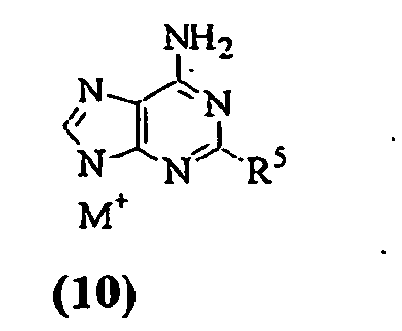
- While not being bound by any theory, the preferential stereoselectivity observed with potassium may be due, e.g., when R8 is fluoro and R7 is bromo, to an electrostatic attraction between the electronegative fluorine atom and the hard potassium cation, leading to a preferential β-face attack, as depicted in
Fig. 1 . The lack of selectivity of lithium and sodium may be due to a more covalent association of the cation with the purine base. The present invention also encompasses other cations, such as cesium, that can replace potassium as a hard cation. - The solvent employed also has a marked effect on the β:α anomer ratio. Generally solvents with a lower dielectric constant favor production of the β anomer. But solvent choice is not dictated simply by dielectric constant, in that there is a tendency for an inverse relationship between increasing the β:α anomer ratio and the yield of the β and α anomers. This effect presumably relates to the solubility of reactants and/or intermediates. Suitable solvents include t-butyl alcohol, acetonitrile, dichloromethane, dichloroethane, t-amyl alcohol, isoamyl alcohol, tetrahydrofuran or mixtures thereof. In preferred embodiments, the solvent is a mixture of t-butyl alcohol and acetonitrile, or a mixture of t-butyl alcohol and dichloroethane, or a mixture of dichloroethane and acetoutrile, or a mixture of t-amyl alcohol and dichloroethane, or a mixture of t-amyl alcohol and acetonitrile, or a mixture of t-amyl alcohol, acetonitrile and dichloromethane, or a mixture of t-amyl alcohol, acetonitrile and dichloroethane. Two component mixtures the two solvents may be combined in the range of about 1:4 to about 1:1 v/v. In three component mixtures, the three solvents may be combined in ratios of about 2:3:1, or about 2:1:1, or about 1:1:1.
- In a preferred embodiment, the reaction is carried out at room temperature. In other embodiments, elevated or lower temperatures are used. Lowering the temperature of the reaction, such as in the range of from room temperature to about -25 °C, may lead to an increase the β:α anomer ratio. Elevated temperatures can be used in the range from room temperature to reflux conditions.
- In some embodiments, calcium hydride is added. The addition of calcium hydride generally increases the β:α anomer ratio. This effect may be due in part to the removal of traces of water from the solvent.
- The molar ratio of reactants is not considered to be critical and in preferred embodiments when the adenine derivative salt (10) is produced in situ, approximately equal molar equivalents of blocked arabinofuranosyl derivative (9), adenine derivative (2), base and, when added, calcium hydride are used. In some embodiments, a slight molar excess (e.g., 1.05 to 1.15 equivalents) of adenine derivative (2) and/or base are used. The preferred order and manner of addition for any specific embodiment can be determined by routine experimentation with a view towards both reaction performance and chemical engineering and productions considerations.
- Without further elaboration, it is believed that one skilled in the art can, using the preceding description, utilize the present invention to its fullest extent. The following specific examples are intended merely to illustrate the invention and not to limit the scope of the disclosure or the scope of the claims in any way whatsoever.
-

- A 1-neck roundbottom flask (100 mL) was equipped with a stir bar and nitrogen inlet adapter. The flask was charged with dichloromethane (10.4 mL) and 1, 3, 5-O-tribenzoyl 2-deoxy-2-fluoro-β-D-arabinofuranosyl (16) (2.6 gm, Sigma, St. Louis, MO) at room temperature. The solution was placed under nitrogen. A 33% solution of hydrogen bromide in acetic acid (0.96 gm) was charged and the resultant mixture stirred for 18 hr. The solvent was removed by rotary evaporation to give an orange residue. This was dissolved in dichloromethane (30 mL) and quenched with sodium bicarbonate brine (30 mL), whereupon the pH was 7-8. The organic phase was partitioned and washed with sodium chloride brine (30 mL). The organic phase was dried over MgSO4 and filtered. Solvent removal by rotary evaporation and high vacuum afforded 3,5-O-dibenzoyl-2-deoxy-2-fluoro-α-D-arabinofuranosyl bromide (17) as a viscous yellow gum.
-

- 2-Chloro-9-(3,5-O-dibenzoyl-2-deoxy-2-fluoro-β-D-arabinofuranosyl) adenine (19) (Borregaard) was prepared utilizing different bases and numerous solvent systems and the optional addition of calcium hydride. In the following exemplifications, three preparations are described in detail and other preparations are summarized in Table 1.
- A three neck roundbottom flask was equipped with a temperature controller, nitrogen inlet and outlet tubes, septa and a magnetic stir bar. Chloroadenine (18) (0.45g) was charged as a solid under nitrogen, followed by potassium t-butoxide (0.34 g), acetonitrile (2.3 mL) and t-butyl alcohol (6.9 mL). After stirring for 1 hour at 24°C-26°C, 3,5-O-dibenzoyl-2-deoxy-2-fluoro-α-D-arabinofuranosyl bromide (17) (1.21 gm) was added. The resulting orange suspension was stirred at 24°C-26 °C for 16 hours. HPLC analysis of an in-process control sample showed a 96.6 % conversion and a 10.7:1 ratio of β-anomers (19) to α-anomer (20). HPLC analysis utilized a reverse phase system with a Zorbax-SB-C18 column and a mobile phase of 80:20 acetonitrile/water with 15 % v/v trifluoroacetic acid at a flow rate of 1 mL/min. at 30 °C. Detection was by spectrophotometric analysis at 263 nm. Conversion is expressed as area under the curve (a.u.c.) values of (19)+(20)/(18)+(19)+(20) x 100. The solvent was evaporated to afford 1.79 g of an orange residue. To this was added ethyl acetate (34 mL) and the mixture stirred at ambient temperature for 1.25 hr and then filtered through filter paper and the paper rinsed twice with 5 mL of ethyl acetate. Evaporation of the filtrate solution afforded 1.28 g of light orange crystals (86.8% by HPLC area of the combined anomers). This material still contained a small amount of 2-chloroadenine (13) by HPLC. The anomeric ratio was 11.8:1. The crystals were dissolved with 33 mL ethyl acetate at ambient temperature to afford a slightly opaque solution. This was filtered through filtered through a Celite pad and the filtrate evaporated to afford 1.16 g of crystals. This material still contained a small amount of (13). The problem was remedied by more efficient filtration. The crystals were dissolved in 25 mL ethyl acetate overnight at ambient temperature to give a slightly cloudy solution. This was filtered through a Whatman 0.45 mM nylon syringe filter and evaporated to afford 1.13 g. This material contained no (18) by HPLC analysis and had an anomeric ratio of 11.9:1 and a yield of 83 % with a purity of 98.1% (a.u.c.). Considering the production of anomers (19) and (20), there was no substantial formation of a by-product adduct formed by reaction of 3,5-O-dibenzoyl-2-deoxy-2-fluoro-α-D-arabinofuranosyl bromide (17) with the unprotected exocyclic amino group of 2-chloroadenine (18). In addition, HPLC analysis revealed no substantial formation of by-products.
- A 3-neck roundbottom flask was equipped with a magnetic stir bar, temperature controller, and nitrogen inlet line and charged with 2-cliloradenine (18) (0.29 g), followed by acetonitrile (1.6 mL), t-amyl alcohol (3.3 mL), potassium tert-butoxide (0.2 g) and calcium hydride (0.069 g). This mixture was stirred at 25°C for 30 minutes before 3,5-O-dibenzoyl-2-deoxy-2-fluoro-α-D-arabinofuranosyl bromide (17) (0.68 g gm) dissolved in dichloromethane (3.25 mL) was charged. The orange solution was stirred for two days whereupon IIPLC analysis showed a β:α anomeric ratio of 18.8:1 and a conversion of approximately 67 %. Heating at 40 °C for approximately 4.5 hr resulted in a β:α anomer ratio of 18.7:1 and a decrease in the apparent conversion to 63 %. The reaction mixture was vacuum filtered and the filter cake washed with dichloromethane (2 x 12 mL). The filtrate was passed through a nylon syringe filter and then concentrated by rotary evaporation and high vacuum pumping to afford 0.72 g of material with a β:α anomeric ratio of 19:1 and was 88% pure by HPLC (a.u.c.), giving a yield of the anomers (19) and (20) of 77 %. In that there was an approximately 77 % conversion of the chloroadenine, there was neither substantial nor significant formation of a by-product adduct formed by reaction of 3,5-O-dibenzoyl-2-deoxy-2-fluoro-α-D-arabinofuranosyl bromide (17) with the unprotected exocyclic amino group of 2-chloroadenine (18). In addition, HPLC analysis revealed no substantial or significant formation of by-products.
- A 3-neck 100 ml round-bottomed flask equipped with magnetic stir bar, temperature controller, and nitrogen inlet line and charged with 2: 1 t-amyl alcohol:acetonitrile (9 mL) followed by 2-chloradenine (18) (0.63 g), potassium t-amylate (0.47 g) and calcium hydride (0.15 g). This mixture was stirred at room temperature for 30 minutes before the addition of 3,5-O-dibenzoyl-2-deoxy-2-fluoro-α-D-arabinofuranosyl bromide (17) (1.5 gm) dissolved in 2:1 t-amyl alcohol:acetonitrile (7 mL). The solution was stirred for 17 hr. whereupon analysis by HPLC showed the conversion to be approximately 79 % and a β:α anomer ratio of 14.5:1. The reaction mixture was vacuum filtered and the residue washed with 2 x 5 mL acetonitrile. The filtrate was re-filtered through a 0.45 µ nylon filter and then concentrated. The concentrate residue was dissolved in butyl acetate (5 mL). Heptane (35 mL) was added and the resulting crystals were collected by vacuum filtration and subjected to a high vacuum. HPLC analysis of the crystals indicated a β:α anomer ratio of 19.4:1 and a 63 % yield of material with a 90 % purity (a.u.c.). In that there was an approximately 79 % conversion of the chloroadenine, there was no substantial formation of a by-product adduct formed by reaction of 3,5-O-dibenzoyl-2-deoxy-2-fluoro-α-D-arabinofuranosyl bromide (17) with the unprotected exocyclic amino group of 2-chloroadenine (18). In addition, HPLC analysis revealed no substantial formation of by-products.
- Results of preparative examples in addition to those exemplified above in Preparations I, II and III, are summarized in Table 1. Preparative methods typically used approximately molar equivalents of (17) and (18) and calcium hydride and a slight molar excess of base.
Table 1 Solvent‡ Base* CaH2 Time (hrs) β:α Ratio (19)/(20) Conversion %† Isolated Yield (%) 2:1 KOtBu + 14 17 54 ND†† tBuOH/DCE 1:2 KOtBu + 14 20.1 60 ND DCE/tAmOH 1:4 KOtBu + 14 20.5 58 ND DCE/tAmOH 1:2:2 KOtBu + 14 22.1 74 ND MeCN/DCE/ tAmOH 52% tBuOH KOtBu + 26 10.7 90 42 48% MeCN 52% tBuOH KOtBu - 22 10.7 84 77 48% MeCN. 52% tBuOH KOtBu - 21 11 86 79 48% McCN 51%amyl KOtBu - 17 13.1 80 83 alcohol 49% MeCN 2:2:1 CH2Cl2: KOtBu + 85 18.7 71 80 tAmOH: MeCN 2:1 KOtBu + 85 12.7 70 84 tAmOH: MeCN 2:1 KOtBu + 85 13.1 77 89 tAmOH: MeCN 2:2:1 CH2Cl2: KOtBu + 69 13.9 73 41 tAmOH: MeCN 2:1 tAmOH: MeCN K t-amylate - 18 19.6 76 80 1:1 t-AmOH: K - 18 13.3 79 84 MeCN t-amylate 1:2 tAmOH: K - 18 6.73 92 ND MeCN t-amylate 2:1:1 tAmOH: KOtBu + 16 20.3 79 48 MeCN:CH2Cl2 ‡ tBuOH = t-butyl alcohol; DCE = dichloroethane; tAmOH = t-amyl alcohol; MeCN = acetonitrile.
* KOtBu = potassium t-butoxide.
† Conversion % = a.u.c. of (19)+(20)/(18)+(19)+(20) x 100.
†† ND = not determined. - A re-slurry step utilizing methanol reflux was used to purify compound (19). I necessary, the pH should be adjusted to 6.0 prior to this step to prevent deprotection during the re-slurry step. Given that the re-slurry must involve an equilibrium between the solid and solution phases, a period of time is required for this equilibrium to become established under a given set of experimental conditions. Thus, the times required for equilibration by monitoring the anomeric composition of slurries at different solvent ratios and temperatures were examined. Three salient features became apparent: (1) a hot re-slurry resulted in greater amounts of (19) in the solution at equilibrium; (2) the amount of (19) in solution phase increases over time as equilibrium is approached for the hot re-slurry and decreases over time for a room temperature re-slurry; and (3), equilibrium is essentially achieved at 5 hours under hot or room-temperature re-slurry conditions, although a slight change is observed under room temperature conditions over overnight stirring. The room temperature re-slurry produced a greater anomeric increase. It was concluded that a re-slurry at room temperature, for at least 5 hours, followed by a 1 hour cooling and filtration results in the best recovery and anomeric ration. Results of this method are shown in Table 2 for 20 gm runs undertaken in a 1L reactor.
Table 2 Conditions† Initial ratio (19)/(20)‡ Final ratio (19)/(20) Mass recovery* A 19 79 62 B 20 39 69 B 24 66 74 † Conditions: A: 10 mi MeOH per gram of crude (19), reflux 0.5 hour then room temperature for 19 hours, B: room temperature for 5 days.
‡ refers to the anomeric ratio going into methanol re-slurry step.
* refers to the mass recovery in the methanol re-slurry step only. -

- Because methyl benzoate is a liquid and is readily soluble in many organic solvents, cleavage of benzyl groups with sodium methoxide was preferred. A 250 ml, multi-neck flask, equipped with a thermocouple, magnetic stirrer, nitrogen purge and reflux condenser, was charged with (19) (8.42 gm, 16.45 mmol) and 15 ml methanol at ambient temperature. Stirring was started ands the mixture heated to 38°C. The reaction was charged with sodium methoxide (62µl, 0.329 mmol). The reaction mixture was stirred at 38°C for 7 hours, heating was them shut off and the mixture cooled to ambient temperature and stirred overnight. The pH was adjusted to 5.0 with acetic acid. The reaction flask was cooled in an
ice bath 2 hours and the reaction mixture was filtered and the flask and filtercake were washed with 9.5 ml methanol. The wet solid and 105 ml methanol were charged to a 250 ml, multi-neck flask, equipped with a thermocouple, magnetic stirrer, nitrogen purge and reflux condenser, stirred and heated to reflux. The hot solution was filtered and filtrate transferred to the original reaction flask, wherein the mixture was cooled to ambient temperature. The mixture was cooled in and ice/water bath for 0.5 hour and the mixture filtered and flask and filtercake rinsed with 9.8 ml methanol. The wet solid was dried in a vacuum oven to produced (21) at a yield of 69.4% with a purity of 99.14 (a.u.c.). No α-amoner was detectable by HPLC - Further examples of the deprotection method with varying conditions are shown in Table 3.
Table 3 mmol (19) NaOMe eq. MeOH mL/g Temp. °C % Mass Recovery Anomeric Ratio HPLC Area (%) 1.68 0.015 4 25 68.8 338/1 98.0 2.05 0.100 20 25 58.9 415/1 99.6 2.11 0.010 20 25 58.4 469/1 93.7 2.09 0.010 4 25 64.2 248/1 99.0 2.03 0.100 4 25 68.2 126/1 98.6 2.82 0.055 12 38 60.2 330/1 99.1 3.07 0.055 12 38 66.9 521/1 99.0 2.94 0.055 12 38 64.9 ∞/1 99.6 2.01 0.100 4 50 62.6 1657/1 99.4 2.07 0.010 4 50 64.3 521/1 98.9 1.97 0.010 20 50 59.3 432/1 99.4 1.99 0.100 20 50 61.0 397/1 61.0 17.05 0.020 8 25 53.5 988/1 98.8 - Pooled preparations of anomeric mixtures of (19) and (20) were pooled and de-protected by removal of the benzoyl groups by treatment with sodium methoxide and methanol. The resulting clofarabine and epi-clofarabine were isolated by preparative HPLC. In a typical run, 60 mg of crude sample was dissolved in 1.4 mL of the mobile phase, i.e. 1:9 (v/v) acetonitrile/water, for injection onto a Phenomenex Progidy C 18, 10 µ ODS, 250 x 21.2 mm column and a flow rate of 12 mL/min. Pooled fractions were rotary evaporated to remove acetonitrile and lyophilized. Purified samples were subjected to NMR analysis.
-
FIG. 2 shows the expected conformations of the relevant protons and fluorine atoms for 2-chloro-9-(2'-deoxy-2-fluoro-β-D-arabinofuranosyl) adenine (clofarabine) (21) and 2-chloro-9-(2'-deoxy-2'-Suoro-α-D-arabinofuranosyl) adenine (epi-clofarabine):
- a) JH2F will be large for both the β or α anomers
- b) (JH1F)β < (JH1F)α
- c) (JH1H2)β > (JH1H2)α
- d) JH2H3 will be small for both the β or α anomers
- These predictions are borne out by the NMR analysis of the purified anomers as shown in Table 2,
FIG. 3 andFIG.4 . Notably, the exocyclic N6 protons occur at a predictable chemical shift (7.8-8.0 ppm) for clofarabine (21) and epi-clofarabine (22). Similar N6 chemical shifts were reported for other adenine derivatives (Reid et al., Helv. Chim. Acta, 72:1597-1606, 1989).Table 2. Relevant Chemical Shifts and Coupling Constants for Anomers† Compound H2 δ (ppm) H1 δ (ppm) Clofarabine 5.76 (dt, 1H, J = 63 Hz, J = 5 Hz) 6.31 (dd, J = 15 Hz, J = 5 Hz) Epi-Clofarabine 5.61 (dt, J = 57 Hz, J =4 Hz) 6.19 (dd, J = 19.5 Hz, J = 4 Hz) † HNMR data collected at 250 MHz in DMSO-d6 - The present invention has been shown by both description and examples. The Examples are only examples and cannot be construed to limit the scope of the invention. One of ordinary skill in the art will envision equivalents to the inventive process described by the following claims that are within the scope of the claimed invention.
Claims (27)
- A process for the preparation of a β-nucleoside of the formula:
 - R1 is hydrogen, halogen or -OR6,- R6 is a hydroxy protecting group,- R2 and R3 are independently hydroxy protecting groups, and- R5 is a halogen or -NH2,the process comprising the step of reacting an α-arabinofuranosyl derivative of the formula:
with an adenine derivative of the formula:
- The process of claim 1, wherein R5 is -NH2 (unprotected) and there is no substantial production of adducts formed by addition of said α-arabinofuranosyl derivative with said - NH2 group.
- The process of claim 1, wherein R1 is fluoro or wherein R5 is chloro.
- The process of claim 1, wherein R1 is fluoro and R5 is chloro.
- The process of claim 1, wherein R2 and R3 are independently benzyl or acetyl.
- The process of claim 1, wherein R4 is bromo.
- The process of claim 1, wherein said base is potassium t-butoxide or potassium t-amylate.
- The process of claim 1, wherein said solvent is mixture of two or more of t-butyl alcohol, acetonitrile, dichloroethane, dichloromethane, tetrahydrofuran and t-amyl alcohol:
- The process of claim 1 or 4, the process further comprising the step of de-protecting said β-nucleoside to form a β-nucleoside of the formula:

- The process of claim 4, wherein said base is potassium t-butoxide and said solvent is a mixture of t-butyl alcohol and acetonitrile.
- A process for the stereoselective preparation of a 2'-deoxy-β-nucleoside of the formula:


with an adenine derivative salt of the formula:

- The process of claim 11, wherein R5 is chloro and/or wherein R7 is bromo or chloro.
- The process of claim 12, wherein R5 is chloro and R7 is bromo.
- The process of claim 11 or 13, wherein said molar ratio of said 2'-deoxy-β-nucteoside to said 2'-deoxy-α-nuclcoside is at least 15:1, preferably at least 20:1.
- The process of claim 11 or 13, wherein R2 and R3 arc independently benzyl or acetyl.
- The process of claim 11 or 13, wherein said adenine derivative salt is formed in situ in said solvent by the reaction of a potassium base with an adenine derivative of the formula:

- The process of claim 16, wherein said potassium base is potassium t-butoxide or potassium t-amylate.
- The process of claim 11 or 13, wherein said solvent is selected from t-butyl alcohol, a mixture of t-butyl alcohol and acetonitrile, a mixture of t-butyl alcohol and dichloroethane, a mixture of dichloroethane and acetonitrile, a mixture of t-amyl alcohol and dichloroethane, a mixture of t-amyl alcohol and acetonitrile, a mixture of t-amyl alcohol, acetonitrile and dichloromethane and a mixture of t-amyl alcohol, acetonitrile and dichloroethane.
- The process of claim 11 or 13, wherein there is no substantial or significant production of adducts formed by addition of said 2'-deoxy-α-arabinofuranosyl derivative with said C-6 exocyclic amino group of said adenine derivative salt.
- The process of claim 11 or 13, further comprising the step of purifying said β-nucleoside by recrystallization or preparation of a slurry in an inert solvent.
- The process of claim 20, wherein said purification of said β-nucleoside comprises reslurry from methanol or recrystallization from mixture of butyl acetate and heptane.
- The process of claim 11 or 13, further comprising the step of de-protecting said 2'-deoxy-β-nucleoside to form a 2'-dcoxy-β-nucleoside of the formula:

- A process for the preparation of a composition comprising 2-chloro-9-(2'-deoxy-2'-fluoro-β-D-arabinofuranosyl) adenine, the process comprising the steps of:(1) reacting 3',5'-O-dibenzoyl-2'-deoxy-2'-fluoro-α-D-arabinofuranosyl bromide with a 2-chloroadeinine potassium salt of the formula:
 (2) de-protecting said 2-chloro-9-(3',5'-O-dibenzoyl-2'-deoxy-2'-fluoro-β-D-arabinofuranosyl) adenine to form 2-chloro-9-(2'-deoxy-2'-fluoro-β-D-arabinofuranosyl) adenine; and(3) isolating said 2-chloro-9-(2'-deoxy-2'-fluoro-β-D-arabinofuranosyl) adenine to form a composition comprising 2-chloro-9-(2'-deoxy-2'-fluoro-β-D-arabinofuranosyl) adenine.
 - The process of claim 23, wherein said composition comprises substantially pure 2-chloro-9-(2'-deoxy-2'-fluoro-β-D-arabinofuranosyl) adenine, that is, the ratio of said 2-chloro-9-(2'-deoxy-2'-fluoro-β-D-arabinofuranosyl) adenine to its α-anomer as measured by high pressure liquid chromatography and spectrophotometric analysis is at least 99:1.
- The process of claim 23, the process further comprising the step of(4) isolating said 2-chloro-9-(3',5'-O-dibenzoyl-2'-deoxy-2'-fluoro-β-D-arabinofuranosyl) adenine before de-protecting said 2-chtoro-9-(3',5'-O-dibenzoyl-2'-deoxy-2'-fluoro-β-D-arabinofuranosyl) adenine, in particular wherein said isolating step (4) comprises a reslurry procedure.
- The process of claim 23, wherein said isolating step (3) comprises recrystallization of said 2-chloro-9-(2'-deoxy-2'-fluoro-β-D-arabinofuranosyl) adenine.
- The process of claim 23, wherein said 2-chloroadenine potassium salt is formed in situ in said solvent by the reaction of a potassium base with 2-chloroadenine.
Applications Claiming Priority (3)
| Application Number | Priority Date | Filing Date | Title |
|---|---|---|---|
| US30959001P | 2001-08-02 | 2001-08-02 | |
| US309590P | 2001-08-02 | ||
| PCT/US2002/024392 WO2003011877A2 (en) | 2001-08-02 | 2002-08-01 | Process for preparing purine nucleosides |
Publications (2)
| Publication Number | Publication Date |
|---|---|
| EP1412369A2 EP1412369A2 (en) | 2004-04-28 |
| EP1412369B1 true EP1412369B1 (en) | 2008-05-07 |
Family
ID=23198848
Family Applications (1)
| Application Number | Title | Priority Date | Filing Date |
|---|---|---|---|
| EP02768391A Expired - Lifetime EP1412369B1 (en) | 2001-08-02 | 2002-08-01 | Process for preparing purine nucleosides |
Country Status (8)
| Country | Link |
|---|---|
| US (1) | US6680382B2 (en) |
| EP (1) | EP1412369B1 (en) |
| JP (1) | JP4593917B2 (en) |
| AT (1) | ATE394409T1 (en) |
| CA (1) | CA2449561A1 (en) |
| DE (1) | DE60226447D1 (en) |
| ES (1) | ES2306783T3 (en) |
| WO (1) | WO2003011877A2 (en) |
Families Citing this family (17)
| Publication number | Priority date | Publication date | Assignee | Title |
|---|---|---|---|---|
| US7528247B2 (en) * | 2001-08-02 | 2009-05-05 | Genzyme Corporation | Process for preparing purine nucleosides |
| US7214791B2 (en) * | 2004-07-01 | 2007-05-08 | Shenzhen Hande Technology Co., Ltd. | Method for preparation of 2′-deoxy-2′, 2′-difluoro-β-cytidine or pharmaceutically acceptable salts thereof by using 1,6-anhydro-β-d-glucose as raw material |
| WO2009042064A2 (en) | 2007-09-21 | 2009-04-02 | Nektar Therapeutics Al, Corporation | Oligomer-nucleoside phosphate conjugates |
| EP2070938A1 (en) | 2007-12-13 | 2009-06-17 | Heidelberg Pharma AG | Clofarabine dietherphospholipid derivatives |
| CN101240003B (en) * | 2008-03-12 | 2011-05-25 | 广州仁心医药科技有限公司 | A kind of preparation method of clorabine crude drug |
| TW201026715A (en) | 2008-12-23 | 2010-07-16 | Pharmasset Inc | Nucleoside phosphoramidates |
| CL2009002206A1 (en) | 2008-12-23 | 2011-08-26 | Gilead Pharmasset Llc | Compounds derived from pyrrolo - (2-3-d] -pyrimidin-7 (6h) -tetrahydrofuran-2-yl phosphonamidate, pharmaceutical composition; and its use in the treatment of viral diseases. |
| JP6104504B2 (en) | 2008-12-23 | 2017-03-29 | ギリアド ファーマセット エルエルシー | Nucleoside analogues |
| CN101830955B (en) * | 2009-03-13 | 2013-09-11 | 浙江海正药业股份有限公司 | Synthesizing process of antineoplastic agent clofarabine |
| AU2010228982B2 (en) * | 2009-03-23 | 2015-05-14 | Ambit Biosciences Corporation | Methods of treatment using combination therapy |
| US8232387B2 (en) * | 2009-08-18 | 2012-07-31 | Scinopharm Taiwan, Ltd. | Process for the preparation of cladribine |
| CL2011000716A1 (en) | 2010-03-31 | 2012-04-20 | Gilead Pharmasset Llc | Crystalline forms 1 6 of (s) -isopropyl-2 - (((s) - (((2r.3r.4r.5r) -5- (2,4-dioxo-3,4-dihydropyrimidin-1 (2h) -yl) -4-fluoro-3-hydroxy-4-methyl tetrahydrofuran-2-yl) methoxy) (phenoxy) phosphoryl) amino) propanoate; pharmaceutical composition and combination; and its use to treat a hepatitis c virus infection. |
| CN102311472B (en) * | 2010-07-09 | 2014-09-03 | 神隆(昆山)生化科技有限公司 | Preparation of 2-chloro-9-(2'-deoxy-2'-fluoro-beta-D-arabinofuranosyl)-adenine |
| WO2012075140A1 (en) | 2010-11-30 | 2012-06-07 | Pharmasset, Inc. | Compounds |
| WO2015118558A2 (en) * | 2014-02-04 | 2015-08-13 | Msn Laboratories Private Limited | Process for the preparation of clofarabine |
| EP2937420A1 (en) | 2014-04-23 | 2015-10-28 | Synbias Pharma AG | Method for the synthesis of clofarabine |
| CN105601688A (en) * | 2015-12-23 | 2016-05-25 | 国药一心制药有限公司 | Preparation methods for clofarabine intermediate and clofarabine |
Family Cites Families (10)
| Publication number | Priority date | Publication date | Assignee | Title |
|---|---|---|---|---|
| US4751221A (en) | 1985-10-18 | 1988-06-14 | Sloan-Kettering Institute For Cancer Research | 2-fluoro-arabinofuranosyl purine nucleosides |
| US5459256A (en) | 1987-04-17 | 1995-10-17 | The Government Of The United States Of America As Represented By The Department Of Health And Human Services | Lipophilic, aminohydrolase-activated prodrugs |
| JPH0217199A (en) | 1988-07-05 | 1990-01-22 | Japan Tobacco Inc | Production of 2'-deoxy-beta-adenosine |
| US5384310A (en) | 1989-05-23 | 1995-01-24 | Southern Research Institute | 2'-fluoro-2-haloarabinoadinosines and their pharmaceutical compositions |
| HU906976D0 (en) | 1989-11-13 | 1991-05-28 | Bristol Myers Squibb Co | Process for producing 2', 3'-didesoxy-2'-fluoarabinonucleoside analogues |
| US5206351A (en) | 1990-06-15 | 1993-04-27 | Ash Stevens, Inc. | Process for the preparation of 2-amino (2,3,5-tri-o-benzyl-beta-d-arabinofuranosyl)adenine |
| US5821357A (en) * | 1992-06-22 | 1998-10-13 | Eli Lilly And Company | Stereoselective glycosylation process for preparing 2'-deoxy-2',2'-difluoropurine and triazole nucleosides |
| UA41261C2 (en) * | 1992-06-22 | 2001-09-17 | Елі Ліллі Енд Компані | METHOD OF OBTAINING BETA-ANOMER-ENRICHED NUCLEOSIDES |
| ES2101231T3 (en) * | 1992-06-22 | 1997-07-01 | Lilly Co Eli | STEREOSELECTIVE PROCEDURE FOR ANION GLYCOSILATION. |
| JP4555536B2 (en) | 2000-02-18 | 2010-10-06 | サザン・リサーチ・インスティテュート | Method for the synthesis of 2-chloro-9- (2-deoxy-2-fluoro-β-D-arabinofuranosyl) -9H-purin-6-amine |
-
2002
- 2002-08-01 ES ES02768391T patent/ES2306783T3/en not_active Expired - Lifetime
- 2002-08-01 CA CA002449561A patent/CA2449561A1/en not_active Abandoned
- 2002-08-01 DE DE60226447T patent/DE60226447D1/en not_active Expired - Lifetime
- 2002-08-01 US US10/209,808 patent/US6680382B2/en not_active Expired - Lifetime
- 2002-08-01 AT AT02768391T patent/ATE394409T1/en not_active IP Right Cessation
- 2002-08-01 EP EP02768391A patent/EP1412369B1/en not_active Expired - Lifetime
- 2002-08-01 JP JP2003517068A patent/JP4593917B2/en not_active Expired - Lifetime
- 2002-08-01 WO PCT/US2002/024392 patent/WO2003011877A2/en not_active Ceased
Also Published As
| Publication number | Publication date |
|---|---|
| US20030114663A1 (en) | 2003-06-19 |
| JP2005504036A (en) | 2005-02-10 |
| JP4593917B2 (en) | 2010-12-08 |
| DE60226447D1 (en) | 2008-06-19 |
| WO2003011877A2 (en) | 2003-02-13 |
| EP1412369A2 (en) | 2004-04-28 |
| WO2003011877A3 (en) | 2003-04-17 |
| ATE394409T1 (en) | 2008-05-15 |
| US6680382B2 (en) | 2004-01-20 |
| ES2306783T3 (en) | 2008-11-16 |
| CA2449561A1 (en) | 2003-02-13 |
Similar Documents
| Publication | Publication Date | Title |
|---|---|---|
| US6680382B2 (en) | Process for preparing purine nucleosides | |
| JP7425734B2 (en) | Stereoselective synthesis and process for producing 2'-deoxynucleosides | |
| CN102311472B (en) | Preparation of 2-chloro-9-(2'-deoxy-2'-fluoro-beta-D-arabinofuranosyl)-adenine | |
| JPS61204193A (en) | Production of cytosine nuceoside | |
| GB2125401A (en) | Desoxyuridine derivatives and their use as pharmaceuticals | |
| EP0519464B1 (en) | Nucleoside derivatives and production thereof | |
| US20030060622A1 (en) | Process for the preparation of 2'-halo-beta-L-arabinofuranosyl nucleosides | |
| US20130035306A1 (en) | Process for preparing purine nucleosides | |
| EP0350292B1 (en) | Process for preparing 2'-deoxy-beta-adenosine | |
| US8232387B2 (en) | Process for the preparation of cladribine | |
| JP2007522151A (en) | Difluoronucleoside and process for preparing the same | |
| AU2002330955A1 (en) | Process for preparing purine nucleosides | |
| JP5599078B2 (en) | Process for producing adenosine tetraphosphate compounds | |
| JPH01224390A (en) | Production of nucleoside derivative | |
| JP3123238B2 (en) | Purification method of nucleoside derivative | |
| JP3123239B2 (en) | Resin purification method for nucleoside derivatives | |
| JPH01104092A (en) | Nucleoside derivative | |
| HK1117169B (en) | PROCESS FOR THE PREPARATION OF 2'-HALO-β-L-ARABINOFURANOSYL NUCLEOSIDES | |
| JPH0559088A (en) | Production of 2'-deoxy-5-fluoro-beta-uridine | |
| JP2014506593A (en) | Synthesis of FLG |
Legal Events
| Date | Code | Title | Description |
|---|---|---|---|
| PUAI | Public reference made under article 153(3) epc to a published international application that has entered the european phase |
Free format text: ORIGINAL CODE: 0009012 |
|
| 17P | Request for examination filed |
Effective date: 20031204 |
|
| AK | Designated contracting states |
Kind code of ref document: A2 Designated state(s): AT BE BG CH CY CZ DE DK EE ES FI FR GB GR IE IT LI LU MC NL PT SE SK TR |
|
| AX | Request for extension of the european patent |
Extension state: AL LT LV MK RO SI |
|
| RIN1 | Information on inventor provided before grant (corrected) |
Inventor name: PUENTE, JOSE Inventor name: LOVETT, DENNIS Inventor name: BAUTA, WILLIAM, E. Inventor name: CANTRELL, WILLIAM, R., JR. Inventor name: SCHULMEIER, BRIAN, E. |
|
| GRAP | Despatch of communication of intention to grant a patent |
Free format text: ORIGINAL CODE: EPIDOSNIGR1 |
|
| GRAS | Grant fee paid |
Free format text: ORIGINAL CODE: EPIDOSNIGR3 |
|
| GRAA | (expected) grant |
Free format text: ORIGINAL CODE: 0009210 |
|
| AK | Designated contracting states |
Kind code of ref document: B1 Designated state(s): AT BE BG CH CY CZ DE DK EE ES FI FR GB GR IE IT LI LU MC NL PT SE SK TR |
|
| REG | Reference to a national code |
Ref country code: GB Ref legal event code: FG4D |
|
| REG | Reference to a national code |
Ref country code: CH Ref legal event code: EP |
|
| REG | Reference to a national code |
Ref country code: IE Ref legal event code: FG4D Free format text: LANGUAGE OF EP DOCUMENT: FRENCH |
|
| REF | Corresponds to: |
Ref document number: 60226447 Country of ref document: DE Date of ref document: 20080619 Kind code of ref document: P |
|
| REG | Reference to a national code |
Ref country code: GB Ref legal event code: 732E |
|
| PG25 | Lapsed in a contracting state [announced via postgrant information from national office to epo] |
Ref country code: FI Free format text: LAPSE BECAUSE OF FAILURE TO SUBMIT A TRANSLATION OF THE DESCRIPTION OR TO PAY THE FEE WITHIN THE PRESCRIBED TIME-LIMIT Effective date: 20080507 |
|
| REG | Reference to a national code |
Ref country code: ES Ref legal event code: FG2A Ref document number: 2306783 Country of ref document: ES Kind code of ref document: T3 |
|
| PG25 | Lapsed in a contracting state [announced via postgrant information from national office to epo] |
Ref country code: AT Free format text: LAPSE BECAUSE OF FAILURE TO SUBMIT A TRANSLATION OF THE DESCRIPTION OR TO PAY THE FEE WITHIN THE PRESCRIBED TIME-LIMIT Effective date: 20080507 |
|
| PG25 | Lapsed in a contracting state [announced via postgrant information from national office to epo] |
Ref country code: SE Free format text: LAPSE BECAUSE OF FAILURE TO SUBMIT A TRANSLATION OF THE DESCRIPTION OR TO PAY THE FEE WITHIN THE PRESCRIBED TIME-LIMIT Effective date: 20080807 Ref country code: PT Free format text: LAPSE BECAUSE OF FAILURE TO SUBMIT A TRANSLATION OF THE DESCRIPTION OR TO PAY THE FEE WITHIN THE PRESCRIBED TIME-LIMIT Effective date: 20081007 Ref country code: CZ Free format text: LAPSE BECAUSE OF FAILURE TO SUBMIT A TRANSLATION OF THE DESCRIPTION OR TO PAY THE FEE WITHIN THE PRESCRIBED TIME-LIMIT Effective date: 20080507 Ref country code: DK Free format text: LAPSE BECAUSE OF FAILURE TO SUBMIT A TRANSLATION OF THE DESCRIPTION OR TO PAY THE FEE WITHIN THE PRESCRIBED TIME-LIMIT Effective date: 20080507 |
|
| PG25 | Lapsed in a contracting state [announced via postgrant information from national office to epo] |
Ref country code: SK Free format text: LAPSE BECAUSE OF FAILURE TO SUBMIT A TRANSLATION OF THE DESCRIPTION OR TO PAY THE FEE WITHIN THE PRESCRIBED TIME-LIMIT Effective date: 20080507 |
|
| BECH | Be: change of holder |
Owner name: GENZYME CORP. Effective date: 20090211 |
|
| REG | Reference to a national code |
Ref country code: ES Ref legal event code: PC2A |
|
| NLS | Nl: assignments of ep-patents |
Owner name: GLBC LLC Effective date: 20081219 Owner name: GENZYME CORPORATION Effective date: 20081219 |
|
| PLBE | No opposition filed within time limit |
Free format text: ORIGINAL CODE: 0009261 |
|
| STAA | Information on the status of an ep patent application or granted ep patent |
Free format text: STATUS: NO OPPOSITION FILED WITHIN TIME LIMIT |
|
| PG25 | Lapsed in a contracting state [announced via postgrant information from national office to epo] |
Ref country code: MC Free format text: LAPSE BECAUSE OF NON-PAYMENT OF DUE FEES Effective date: 20080831 |
|
| REG | Reference to a national code |
Ref country code: CH Ref legal event code: PL |
|
| 26N | No opposition filed |
Effective date: 20090210 |
|
| REG | Reference to a national code |
Ref country code: FR Ref legal event code: TP |
|
| PG25 | Lapsed in a contracting state [announced via postgrant information from national office to epo] |
Ref country code: EE Free format text: LAPSE BECAUSE OF FAILURE TO SUBMIT A TRANSLATION OF THE DESCRIPTION OR TO PAY THE FEE WITHIN THE PRESCRIBED TIME-LIMIT Effective date: 20080507 Ref country code: BG Free format text: LAPSE BECAUSE OF FAILURE TO SUBMIT A TRANSLATION OF THE DESCRIPTION OR TO PAY THE FEE WITHIN THE PRESCRIBED TIME-LIMIT Effective date: 20080807 |
|
| PG25 | Lapsed in a contracting state [announced via postgrant information from national office to epo] |
Ref country code: LI Free format text: LAPSE BECAUSE OF NON-PAYMENT OF DUE FEES Effective date: 20080831 Ref country code: CH Free format text: LAPSE BECAUSE OF NON-PAYMENT OF DUE FEES Effective date: 20080831 |
|
| PG25 | Lapsed in a contracting state [announced via postgrant information from national office to epo] |
Ref country code: LU Free format text: LAPSE BECAUSE OF NON-PAYMENT OF DUE FEES Effective date: 20080801 Ref country code: CY Free format text: LAPSE BECAUSE OF FAILURE TO SUBMIT A TRANSLATION OF THE DESCRIPTION OR TO PAY THE FEE WITHIN THE PRESCRIBED TIME-LIMIT Effective date: 20080507 |
|
| PG25 | Lapsed in a contracting state [announced via postgrant information from national office to epo] |
Ref country code: TR Free format text: LAPSE BECAUSE OF FAILURE TO SUBMIT A TRANSLATION OF THE DESCRIPTION OR TO PAY THE FEE WITHIN THE PRESCRIBED TIME-LIMIT Effective date: 20080507 |
|
| PG25 | Lapsed in a contracting state [announced via postgrant information from national office to epo] |
Ref country code: GR Free format text: LAPSE BECAUSE OF FAILURE TO SUBMIT A TRANSLATION OF THE DESCRIPTION OR TO PAY THE FEE WITHIN THE PRESCRIBED TIME-LIMIT Effective date: 20080808 |
|
| REG | Reference to a national code |
Ref country code: FR Ref legal event code: PLFP Year of fee payment: 15 |
|
| REG | Reference to a national code |
Ref country code: FR Ref legal event code: PLFP Year of fee payment: 16 |
|
| REG | Reference to a national code |
Ref country code: FR Ref legal event code: PLFP Year of fee payment: 17 |
|
| PGFP | Annual fee paid to national office [announced via postgrant information from national office to epo] |
Ref country code: DE Payment date: 20180717 Year of fee payment: 17 Ref country code: ES Payment date: 20180903 Year of fee payment: 17 Ref country code: NL Payment date: 20180712 Year of fee payment: 17 Ref country code: IE Payment date: 20180809 Year of fee payment: 17 Ref country code: IT Payment date: 20180823 Year of fee payment: 17 |
|
| PGFP | Annual fee paid to national office [announced via postgrant information from national office to epo] |
Ref country code: GB Payment date: 20180801 Year of fee payment: 17 |
|
| PGFP | Annual fee paid to national office [announced via postgrant information from national office to epo] |
Ref country code: BE Payment date: 20190617 Year of fee payment: 18 Ref country code: FR Payment date: 20190619 Year of fee payment: 18 |
|
| REG | Reference to a national code |
Ref country code: DE Ref legal event code: R119 Ref document number: 60226447 Country of ref document: DE |
|
| REG | Reference to a national code |
Ref country code: NL Ref legal event code: MM Effective date: 20190901 |
|
| GBPC | Gb: european patent ceased through non-payment of renewal fee |
Effective date: 20190801 |
|
| PG25 | Lapsed in a contracting state [announced via postgrant information from national office to epo] |
Ref country code: IE Free format text: LAPSE BECAUSE OF NON-PAYMENT OF DUE FEES Effective date: 20190801 Ref country code: DE Free format text: LAPSE BECAUSE OF NON-PAYMENT OF DUE FEES Effective date: 20200303 Ref country code: NL Free format text: LAPSE BECAUSE OF NON-PAYMENT OF DUE FEES Effective date: 20190901 |
|
| PG25 | Lapsed in a contracting state [announced via postgrant information from national office to epo] |
Ref country code: IT Free format text: LAPSE BECAUSE OF NON-PAYMENT OF DUE FEES Effective date: 20190801 Ref country code: GB Free format text: LAPSE BECAUSE OF NON-PAYMENT OF DUE FEES Effective date: 20190801 |
|
| REG | Reference to a national code |
Ref country code: ES Ref legal event code: FD2A Effective date: 20210105 |
|
| PG25 | Lapsed in a contracting state [announced via postgrant information from national office to epo] |
Ref country code: ES Free format text: LAPSE BECAUSE OF NON-PAYMENT OF DUE FEES Effective date: 20190802 |
|
| REG | Reference to a national code |
Ref country code: BE Ref legal event code: MM Effective date: 20200831 |
|
| PG25 | Lapsed in a contracting state [announced via postgrant information from national office to epo] |
Ref country code: FR Free format text: LAPSE BECAUSE OF NON-PAYMENT OF DUE FEES Effective date: 20200831 |
|
| PG25 | Lapsed in a contracting state [announced via postgrant information from national office to epo] |
Ref country code: BE Free format text: LAPSE BECAUSE OF NON-PAYMENT OF DUE FEES Effective date: 20200831 |