EP1412343B1 - Compounds, which are potent inhibitors of na+/ca2+ exchange mechanism and are useful in the treatment of arrhythmias - Google Patents
Compounds, which are potent inhibitors of na+/ca2+ exchange mechanism and are useful in the treatment of arrhythmias Download PDFInfo
- Publication number
- EP1412343B1 EP1412343B1 EP02755036A EP02755036A EP1412343B1 EP 1412343 B1 EP1412343 B1 EP 1412343B1 EP 02755036 A EP02755036 A EP 02755036A EP 02755036 A EP02755036 A EP 02755036A EP 1412343 B1 EP1412343 B1 EP 1412343B1
- Authority
- EP
- European Patent Office
- Prior art keywords
- yloxy
- chroman
- phenylchroman
- nmr
- mhz
- Prior art date
- Legal status (The legal status is an assumption and is not a legal conclusion. Google has not performed a legal analysis and makes no representation as to the accuracy of the status listed.)
- Expired - Lifetime
Links
- 0 C*(*)C1=NCCN1 Chemical compound C*(*)C1=NCCN1 0.000 description 6
- QUPKCFBHJFNUEW-UHFFFAOYSA-N CCC1=NCCN1 Chemical compound CCC1=NCCN1 QUPKCFBHJFNUEW-UHFFFAOYSA-N 0.000 description 1
Images

Classifications
-
- C—CHEMISTRY; METALLURGY
- C07—ORGANIC CHEMISTRY
- C07D—HETEROCYCLIC COMPOUNDS
- C07D405/00—Heterocyclic compounds containing both one or more hetero rings having oxygen atoms as the only ring hetero atoms, and one or more rings having nitrogen as the only ring hetero atom
- C07D405/02—Heterocyclic compounds containing both one or more hetero rings having oxygen atoms as the only ring hetero atoms, and one or more rings having nitrogen as the only ring hetero atom containing two hetero rings
- C07D405/12—Heterocyclic compounds containing both one or more hetero rings having oxygen atoms as the only ring hetero atoms, and one or more rings having nitrogen as the only ring hetero atom containing two hetero rings linked by a chain containing hetero atoms as chain links
-
- A—HUMAN NECESSITIES
- A61—MEDICAL OR VETERINARY SCIENCE; HYGIENE
- A61P—SPECIFIC THERAPEUTIC ACTIVITY OF CHEMICAL COMPOUNDS OR MEDICINAL PREPARATIONS
- A61P43/00—Drugs for specific purposes, not provided for in groups A61P1/00-A61P41/00
-
- A—HUMAN NECESSITIES
- A61—MEDICAL OR VETERINARY SCIENCE; HYGIENE
- A61P—SPECIFIC THERAPEUTIC ACTIVITY OF CHEMICAL COMPOUNDS OR MEDICINAL PREPARATIONS
- A61P7/00—Drugs for disorders of the blood or the extracellular fluid
- A61P7/02—Antithrombotic agents; Anticoagulants; Platelet aggregation inhibitors
-
- A—HUMAN NECESSITIES
- A61—MEDICAL OR VETERINARY SCIENCE; HYGIENE
- A61P—SPECIFIC THERAPEUTIC ACTIVITY OF CHEMICAL COMPOUNDS OR MEDICINAL PREPARATIONS
- A61P9/00—Drugs for disorders of the cardiovascular system
-
- A—HUMAN NECESSITIES
- A61—MEDICAL OR VETERINARY SCIENCE; HYGIENE
- A61P—SPECIFIC THERAPEUTIC ACTIVITY OF CHEMICAL COMPOUNDS OR MEDICINAL PREPARATIONS
- A61P9/00—Drugs for disorders of the cardiovascular system
- A61P9/06—Antiarrhythmics
-
- A—HUMAN NECESSITIES
- A61—MEDICAL OR VETERINARY SCIENCE; HYGIENE
- A61P—SPECIFIC THERAPEUTIC ACTIVITY OF CHEMICAL COMPOUNDS OR MEDICINAL PREPARATIONS
- A61P9/00—Drugs for disorders of the cardiovascular system
- A61P9/10—Drugs for disorders of the cardiovascular system for treating ischaemic or atherosclerotic diseases, e.g. antianginal drugs, coronary vasodilators, drugs for myocardial infarction, retinopathy, cerebrovascula insufficiency, renal arteriosclerosis
-
- C—CHEMISTRY; METALLURGY
- C07—ORGANIC CHEMISTRY
- C07C—ACYCLIC OR CARBOCYCLIC COMPOUNDS
- C07C217/00—Compounds containing amino and etherified hydroxy groups bound to the same carbon skeleton
- C07C217/02—Compounds containing amino and etherified hydroxy groups bound to the same carbon skeleton having etherified hydroxy groups and amino groups bound to acyclic carbon atoms of the same carbon skeleton
- C07C217/04—Compounds containing amino and etherified hydroxy groups bound to the same carbon skeleton having etherified hydroxy groups and amino groups bound to acyclic carbon atoms of the same carbon skeleton the carbon skeleton being acyclic and saturated
- C07C217/06—Compounds containing amino and etherified hydroxy groups bound to the same carbon skeleton having etherified hydroxy groups and amino groups bound to acyclic carbon atoms of the same carbon skeleton the carbon skeleton being acyclic and saturated having only one etherified hydroxy group and one amino group bound to the carbon skeleton, which is not further substituted
- C07C217/14—Compounds containing amino and etherified hydroxy groups bound to the same carbon skeleton having etherified hydroxy groups and amino groups bound to acyclic carbon atoms of the same carbon skeleton the carbon skeleton being acyclic and saturated having only one etherified hydroxy group and one amino group bound to the carbon skeleton, which is not further substituted the oxygen atom of the etherified hydroxy group being further bound to a carbon atom of a six-membered aromatic ring
-
- C—CHEMISTRY; METALLURGY
- C07—ORGANIC CHEMISTRY
- C07C—ACYCLIC OR CARBOCYCLIC COMPOUNDS
- C07C217/00—Compounds containing amino and etherified hydroxy groups bound to the same carbon skeleton
- C07C217/54—Compounds containing amino and etherified hydroxy groups bound to the same carbon skeleton having etherified hydroxy groups bound to carbon atoms of at least one six-membered aromatic ring and amino groups bound to acyclic carbon atoms or to carbon atoms of rings other than six-membered aromatic rings of the same carbon skeleton
-
- C—CHEMISTRY; METALLURGY
- C07—ORGANIC CHEMISTRY
- C07C—ACYCLIC OR CARBOCYCLIC COMPOUNDS
- C07C217/00—Compounds containing amino and etherified hydroxy groups bound to the same carbon skeleton
- C07C217/78—Compounds containing amino and etherified hydroxy groups bound to the same carbon skeleton having amino groups and etherified hydroxy groups bound to carbon atoms of six-membered aromatic rings of the same carbon skeleton
- C07C217/80—Compounds containing amino and etherified hydroxy groups bound to the same carbon skeleton having amino groups and etherified hydroxy groups bound to carbon atoms of six-membered aromatic rings of the same carbon skeleton having amino groups and etherified hydroxy groups bound to carbon atoms of non-condensed six-membered aromatic rings
- C07C217/82—Compounds containing amino and etherified hydroxy groups bound to the same carbon skeleton having amino groups and etherified hydroxy groups bound to carbon atoms of six-membered aromatic rings of the same carbon skeleton having amino groups and etherified hydroxy groups bound to carbon atoms of non-condensed six-membered aromatic rings of the same non-condensed six-membered aromatic ring
- C07C217/90—Compounds containing amino and etherified hydroxy groups bound to the same carbon skeleton having amino groups and etherified hydroxy groups bound to carbon atoms of six-membered aromatic rings of the same carbon skeleton having amino groups and etherified hydroxy groups bound to carbon atoms of non-condensed six-membered aromatic rings of the same non-condensed six-membered aromatic ring the oxygen atom of at least one of the etherified hydroxy groups being further bound to a carbon atom of a six-membered aromatic ring, e.g. amino-diphenylethers
-
- C—CHEMISTRY; METALLURGY
- C07—ORGANIC CHEMISTRY
- C07D—HETEROCYCLIC COMPOUNDS
- C07D213/00—Heterocyclic compounds containing six-membered rings, not condensed with other rings, with one nitrogen atom as the only ring hetero atom and three or more double bonds between ring members or between ring members and non-ring members
- C07D213/02—Heterocyclic compounds containing six-membered rings, not condensed with other rings, with one nitrogen atom as the only ring hetero atom and three or more double bonds between ring members or between ring members and non-ring members having three double bonds between ring members or between ring members and non-ring members
- C07D213/04—Heterocyclic compounds containing six-membered rings, not condensed with other rings, with one nitrogen atom as the only ring hetero atom and three or more double bonds between ring members or between ring members and non-ring members having three double bonds between ring members or between ring members and non-ring members having no bond between the ring nitrogen atom and a non-ring member or having only hydrogen or carbon atoms directly attached to the ring nitrogen atom
- C07D213/60—Heterocyclic compounds containing six-membered rings, not condensed with other rings, with one nitrogen atom as the only ring hetero atom and three or more double bonds between ring members or between ring members and non-ring members having three double bonds between ring members or between ring members and non-ring members having no bond between the ring nitrogen atom and a non-ring member or having only hydrogen or carbon atoms directly attached to the ring nitrogen atom with hetero atoms or with carbon atoms having three bonds to hetero atoms with at the most one bond to halogen, e.g. ester or nitrile radicals, directly attached to ring carbon atoms
- C07D213/62—Oxygen or sulfur atoms
- C07D213/63—One oxygen atom
- C07D213/64—One oxygen atom attached in position 2 or 6
-
- C—CHEMISTRY; METALLURGY
- C07—ORGANIC CHEMISTRY
- C07D—HETEROCYCLIC COMPOUNDS
- C07D311/00—Heterocyclic compounds containing six-membered rings having one oxygen atom as the only hetero atom, condensed with other rings
- C07D311/02—Heterocyclic compounds containing six-membered rings having one oxygen atom as the only hetero atom, condensed with other rings ortho- or peri-condensed with carbocyclic rings or ring systems
- C07D311/04—Benzo[b]pyrans, not hydrogenated in the carbocyclic ring
- C07D311/22—Benzo[b]pyrans, not hydrogenated in the carbocyclic ring with oxygen or sulfur atoms directly attached in position 4
- C07D311/26—Benzo[b]pyrans, not hydrogenated in the carbocyclic ring with oxygen or sulfur atoms directly attached in position 4 with aromatic rings attached in position 2 or 3
- C07D311/28—Benzo[b]pyrans, not hydrogenated in the carbocyclic ring with oxygen or sulfur atoms directly attached in position 4 with aromatic rings attached in position 2 or 3 with aromatic rings attached in position 2 only
-
- C—CHEMISTRY; METALLURGY
- C07—ORGANIC CHEMISTRY
- C07D—HETEROCYCLIC COMPOUNDS
- C07D311/00—Heterocyclic compounds containing six-membered rings having one oxygen atom as the only hetero atom, condensed with other rings
- C07D311/02—Heterocyclic compounds containing six-membered rings having one oxygen atom as the only hetero atom, condensed with other rings ortho- or peri-condensed with carbocyclic rings or ring systems
- C07D311/04—Benzo[b]pyrans, not hydrogenated in the carbocyclic ring
- C07D311/58—Benzo[b]pyrans, not hydrogenated in the carbocyclic ring other than with oxygen or sulphur atoms in position 2 or 4
-
- C—CHEMISTRY; METALLURGY
- C07—ORGANIC CHEMISTRY
- C07D—HETEROCYCLIC COMPOUNDS
- C07D311/00—Heterocyclic compounds containing six-membered rings having one oxygen atom as the only hetero atom, condensed with other rings
- C07D311/02—Heterocyclic compounds containing six-membered rings having one oxygen atom as the only hetero atom, condensed with other rings ortho- or peri-condensed with carbocyclic rings or ring systems
- C07D311/04—Benzo[b]pyrans, not hydrogenated in the carbocyclic ring
- C07D311/58—Benzo[b]pyrans, not hydrogenated in the carbocyclic ring other than with oxygen or sulphur atoms in position 2 or 4
- C07D311/60—Benzo[b]pyrans, not hydrogenated in the carbocyclic ring other than with oxygen or sulphur atoms in position 2 or 4 with aryl radicals attached in position 2
-
- C—CHEMISTRY; METALLURGY
- C07—ORGANIC CHEMISTRY
- C07D—HETEROCYCLIC COMPOUNDS
- C07D411/00—Heterocyclic compounds containing two or more hetero rings, at least one ring having oxygen and sulfur atoms as the only ring hetero atoms
- C07D411/02—Heterocyclic compounds containing two or more hetero rings, at least one ring having oxygen and sulfur atoms as the only ring hetero atoms containing two hetero rings
- C07D411/12—Heterocyclic compounds containing two or more hetero rings, at least one ring having oxygen and sulfur atoms as the only ring hetero atoms containing two hetero rings linked by a chain containing hetero atoms as chain links
-
- C—CHEMISTRY; METALLURGY
- C07—ORGANIC CHEMISTRY
- C07C—ACYCLIC OR CARBOCYCLIC COMPOUNDS
- C07C2602/00—Systems containing two condensed rings
- C07C2602/02—Systems containing two condensed rings the rings having only two atoms in common
- C07C2602/04—One of the condensed rings being a six-membered aromatic ring
- C07C2602/08—One of the condensed rings being a six-membered aromatic ring the other ring being five-membered, e.g. indane
Definitions
- the present invention relates to new therapeutically active compounds and pharmaceutically acceptable salts and esters thereof.
- the invention also relates to pharmaceutical compositions containing these compounds as active ingredients.
- the compounds of the invention are potent inhibitors of Na + /Ca 2+ exchange mechanism.
- Na + /Ca 2+ exchange mechanism is one of the ion transport mechanisms that regulate the concentration of sodium and calcium ions in the cells.
- Compounds which selectively inhibit Na + /Ca 2+ exchange mechanism and thereby prevent overload of Ca 2+ in cells are regarded useful in preventing the cell injury mechanism of cardiac muscle and the like after ischemia and reperfusion. Such compounds are useful in the treatment of ischemic heart diseases, ischemic cerebral diseases, ischemic renal diseases and in the protection of cells during thrombolytic therapy, angioplasty, bypass operation of coronary artery or organ transplantation and arrhythmias.
- compounds of formula (I) are particularly potent inhibitors of Na + /Ca 2+ exchange mechanism and are particularly useful in the treatment of arrhythmias.
- preferred compounds and pharmaceutically acceptable salts and esters thereof are compounds of formula: wherein R 1 , R 2 , R 3 , X, Y, and Z are as defined above.
- X is O
- Z and Y is -CH 2 -.
- X is O
- Z is -CH 2 - and Y is CHOH.
- R 1 is one of the following groups
- R 6 is -NO 2 or NR 14 R 19 .
- R 14 and R 19 are independently H, acyl or alkylsulfonyl, R 15 and R 16 is preferably H and R 5 is H or lower alkoxy.
- R 2 and R 3 are independently H or halogen. Fluorine is the preferred halogen.
- the present invention also provides a pharmaceutical composition
- a pharmaceutical composition comprising a compound of the invention together with a pharmaceutically acceptable carrier.
- the compounds of the present invention may be used for inhibiting Na + /Ca 2+ exchange mechanism in a cell, for preventing overload of Ca 2+ ions in cells or for treating arrhythmias, by administering to a subject in need thereof a therapeutically effective amount of the compounds.
- the compounds of the invention can be prepared from corresponding phenol derivatives (II), wherein R 2 , R 3 , X, Z and Y are the same as defined above.
- 2-Oxymethyl imidazoline derivatives (14) can be synthesised from phenol derivatives (II) via cyano methyl ether (13), which is converted to imidazoline (14) by a known method (e.g. J. Med. Chem. 1994, 37(12), 1874).
- Alkoxyazide derivatives (16) are obtained via corresponding haloalkoxy derivatives (15) by reaction with sodium azide.
- Azides (16) are converted to amines (17) by reaction with triphenylamine.
- 2-(Dimethylamino)ethoxy derivatives (18) are obtained by direct reactions of phenols of formula (II) with 2-(dimethylamino)ethyl chloride.
- the reduction of nitropyridines (22) followed by acylation, mesylation etc. produces compounds of formula (24), as shown by Scheme 2.
- 6- and 7-hydroxyflavane derivatives (2) are obtained from corresponding flavanones (1) by Clemmensen reduction.
- 6- and 7-hydroxyflavanones (1) are commercially available or can be synthesised by methods described in the literature, e.g. J. Org Chem., 1960, 25, 1247-9 and J. Org. Chem., 1958, 23, 1159-61 or as described later in Scheme 5.
- 6-Hydroxyflavanone derivatives can be synthesised as shown in Scheme 5. 2',5'-Dihydroxyacetophenone or corresponding propiophenone is condensed with appropriate benzaldehyde resulting in a mixture of desired 6-hydroxyflavanone (36) and the corresponding chalcone (35). The chalcone can be cyclised to flavanone.
- 2-Phenylchroman-4,6-diol derivatives (37) are obtained from corresponding 6-hydroxyflavanones (36) by reduction as shown in Scheme 6. These diol derivatives can be reduced further into 6-hydroxyflavanes (38).
- the 4-amino-2-phenylchromanol derivatives (19) can be synthesised from corresponding flavanones (1) via hydroxy-2-phenylchroman-4-one oximes (20). Reduction of oxime derivative gives 4-amino-2-phenylchromanols (21) which can be alkylated or acylated by common methods. 4-Hydroxy-2-phenylchromanol derivatives can be treated by similar methods.
- Salts and esters of the compounds when applicable, may be prepared by known methods.
- Physiologically acceptable salts are useful as active medicaments. Examples are the salts with inorganic acids such as hydrochloric acid, hydrobromic acid or nitric acid, and salts with organic acids such as methanesulfonic acid, citric acid or tartaric acid.
- Physiologically acceptable esters are also useful as active medicaments. Examples are the esters with aliphatic or aromatic acids such as acetic acid or with aliphatic or aromatic alcohols.
- alkyl as employed herein by itself or as part of another group includes both straight, branched and cyclized chain radicals of up to 18 carbon atoms, preferably 1 to 7 carbon atoms, most preferably 1 to 4 carbon atoms.
- lower alkyl as employed herein by itself or as part of another group includes straight, branched and cyclized chain radicals of 1 to 7, preferably 1 to 4, most preferably 1 or 2 carbon atoms.
- Specific examples for the alkyl and lower alkyl residues, respectively, are methyl, ethyl, propyl, isopropyl, butyl, tert. butyl, pentyl, cyclopentyl, hexyl, cyclohexyl, octyl, decyl and dodecyl including the various branched chain isomers thereof.
- alkoxy as employed herein by itself or as part of another group includes an alkyl group as defined above linked to an oxygen atom.
- acyl as employed herein by itself or as part of another group refers to an alkylcarbonyl or alkenylcarbonyl group, the alkyl and alkenyl groups being defined above.
- Compounds of the invention may be administered to a patient in therapeutically effective amounts which range usually from about 0.05 to 200 mg, preferably 0.1 to 100 mg, more preferably 0.5 to 50, mg per day depending on the age, weight, condition of the patient, administration route and the Na+/Ca 2+ exchange inhibitor used.
- the compounds of the invention can be formulated into dosage forms using the principles known in the art. It can be given to a patient as such or in combination with suitable pharmaceutical excipients in the form of tablets, granules, capsules, suppositories, emulsions, suspensions or solutions. Choosing suitable ingredients for the composition is a routine for those of ordinary skill in the art.
- compositions containing the active compound can be given enterally or parenterally, the oral route being the preferred way.
- the contents of the active compound in the composition is from about 0.5 to 100 %, preferably from about 0.5 to about 20 %, per weight of the total composition.
- Tyrode solution was used for superfusion of muscle preparations.
- the composition of the Tyrode solution was the following (mM): NaCl 135, MgCl 2 x 6H 2 O1, KCl 5, CaCl 2 x 2H 2 O 2, NaHCO 3 15, Na 2 HPO 4 x 2H 2 O 1, and glucose 10.
- the Tyrode solution was gassed with carbogen (95% O 2 , 5% CO 2 ) to set pH at 7.4. Experiments were carried out at 37 °C. Acquisition and analysis of twitch tensions with Action Potential and Force Measurement System (ACFO v1.0, Fision Ltd, Finland).
- Ouabain by blocking of sodium-potassium ATPase increase intracellular sodium which is changed for calcium via NCX. Increased intracellular calcium is leading to overload of sarcoplasmic reticulum (SR) and spontaneous calcium release from SR inducing delayed afterpolarizations (DADs). Equivalence for DADs in force signal is aftercontractions (ACs) which are seen as spontaneous twitches after the pacing controlled twitch.
- SR sarcoplasmic reticulum
- DADs delayed afterpolarizations
- ACs aftercontractions
- the compounds of the invention delayed appearance and decreased amplitude of aftercontractions.
- the 2-phenylchroman-6-ol was purified by column chromatography using heptane-ethyl acetate (2:1) as an eluant.
- 1 H NMR 400 MHz, d 6 -DMSO
- the 2-phenylchroman-6-ol (500 mg) and 1-chloro-4-methoxy 2-nitrobenzene (390 mg) were dissolved in DMSO (10 ml). Potassium hydroxide (230 mg) and potassium iodide (520 mg) were added and the resulting mixture was stirred at 90°C for 1 hour. After cooling it was poured in to 1 M HCl-solution (20 ml) and extracted with dichlommethane. The combined organic layers were washed with water until neutral and then with saturated NaCl-solution and dried with Na 2 SO 4 . After evaporating the solvents the 6-(4-Methoxy-2-nitrophenoxy)-2-phenylchroman was obtained by trituration with methanol.
- 6-(4-Methoxy-2-nitrophenoxy)-2-phenylchroman 360 mg was dissolved ethyl acetate and 10 % palladium on carbon (90 mg) was added. The reaction mixture was hydrogenated for 2 hours at normal pressure and room temperature. It was then filtered through Celite and washed with ethyl acetate. The 5-methoxy-2-(2-phenyl-chroman-6-yloxy)phenylamine was isolated as its hydrochloride salt.
- Triphenylphosphine 165 mg
- 40 ⁇ l of water 40 ⁇ l were added into a solution of 6-(2-azidoethoxy)-2-phenylchroman (155 mg) in tetrahydrofuran.
- the resulting mixture was stirred for 2 hours at room temperature.
- 2-(2-Phenylchroman-6-yloxy)-ethylamine was isolated as its methane sulfonate salt.
- 6-(5-Nitropyridin-2-yloxy)-2-phenylchroman-4-one was prepared as described for 5-Nitro-2-(2-phenylchroman-6-yloxy)pyridine in Example 1 (b) using 200 mg of 6-hydroxyflavanone.
- 6-(5-Nitropyridin-2-yloxy)-2-phenylchroman-4-ol was prepared as described for 5-nitro-2-(2-phenylchroman-6-yloxy)pyridine in Example 1(b) starting from 1.5 g of 2-phenylchroman-4,6-diol.
- the product was passed through a silica gel column using toluene - ethyl acetate (4:1) as an eluant and then crystallised from 2-propanol.
- the obtained mixture was dissolved in ethanol (90 ml) and sodium acetate (1.75 g) was added. The reaction mixture was refluxed for 5 hours. It was then allowed to cool to room temperature and diluted with water and filtered. The 2-(3-fluorophenyl)-6-hydroxychroman-4-one was recrystallised from acetic acid.
- 2-(3-Fluorophenyl)chroman-4,6-diol was prepared as described for 2-phenylchroman-4,6-diol in Example 8(a) starting from 220 mg of 2-(3-fluorophenyl)-6-hydroxychroman-4-one.
- Triethylsilane (960 ⁇ l) was added slowly into a solution of 2-(3-fluorophenyl)chroman-4,6-diol (195 mg) in dichloromethane (4 ml) .
- Trifluoroacetic acid (1.9 ml) was then added dropwise into a reaction mixture and it was stirred at room temperature for 5 hours.
- the reaction mixture was poured on ice-water and extracted with dichloromethane. The residue was evaporated under reduced pressure with toluene to obtain 2-(3-fluorophenyl)chroman-6-ol.
- 2-Phenyl-chroman-7-ol was prepared as described for 5-nitro-2-(2-phenylchroman-6-yloxy)pyridine in Example 1(a) starting from 1.0 g of 7-hydroxyflavanone.
- the product was purified by column chromatography using heptane-ethyl acetate (2:1) as an eluant.
- 5-Nitro-2-(2-phenylchroman-7-yloxy)pyridine was prepared as described for 5-nitro-2-(2-phenylchroman-6-yloxy)pyridine in Example 1(b) starting from 115 mg of 2-phenyl-chroman-7-ol.
- the product was purified on preparative TLC-plate covered with silica gel using toluene - ethyl acetate (15:1) as an eluant.
- 2-(2,4-Dichlorophenyl)-6-hydroxychroman-4-one was prepared as described for 2-(3-fluorophenyl)-6-hydroxychroman-4-one in Example 9(a) starting from 1.0 g of 2',5'-dihydroxyacetophenone and 1.4 g of 2,4-dichlorobenzaldehyde. The product was recrystallised from acetic acid.
- 2-(2,4-Dichlorophenyl)chroman-4,6-diol was prepared as described for 2-phenylchroman-4,6-diol in Example 8(a) starting from 1.2 g of 2-(2,4-dichlorophenyl)-6-hydroxychroman-4-one.
- the product was purified by column chromatography using heptane - ethyl acetate (2:1) as an eluant.
- 2-(2,4-Dichlorophenyl)chroman-6-ol was prepared as described for 2-(3-fluorophenyl)chroman-6-ol in Example 9(c) starting from 625 mg of 2-(2,4-dichlorophenyl)chroman-4,6-diol.
- 2-[2-(2,4-dichlorophenyl)chroman-6-yloxy]-5-nitropyridine was prepared as described for 5-nitro-2-(2-phenylchroman-b-yloxy)pyridine in Example 1 (b) starting from 530 mg of 2-(2,4-(Hchlorophenyl)chroman-6-ol.
- the product was purified on preparative TLC-plate covered with silica gel using heptane - ethyl acetate (3: 1) as an eluant.
- 2-(3-Chlorophenyl)-6-hydroxychroman-4-one was prepared as described for 2-(3-fluorophenyl)-6-hydroxychroman-4-one in Example 9(a) starting from 2.0 g of 2',5'-dihydroxyacetophenone and 1.85 g of 3-chlorobenzaldehyde. The product was recrystallised from acetic acid.
- 2-(3-Chlomphenyl)chroman-4,6-diol was prepared as described for 2-phenylchroman-4,6-diol in Example 8(a) starting from 730 mg of 2-(3-chlorophenyl)-6-hydroxychmman-4-one.
- 2-(3-Chlorophenyl)chroman-6-ol was prepared as described for 2-(3-fluorophenylkhroman-6-ol in Example 9(c) starting from 635 mg of 2-(3-chlorophenyl)chroman-4,6-diol.
- 1 H NMR 300 MHz, d 6 -DMSO
- 2-(3,5-Difluorophenyl)-6-hydroxychroman-4-one was prepared as described for 2-(3-fluorophenyl)-6-hydroxychroman-4-one in Example 9(a) starting from 1.0 g of 2',5'-dihydroxyacetophenone and 1.12 g of 3,5-difluorobenzaldehyde. The product was recrystallised from acetic acid.
- 2-(3,5-Difluorophenyl)chroman-4,6-diol was prepared as described for 2-phenylchroman-4,6-diol in Example 8(a) starting from 800 mg of 2-(3,5-difluorophenyl)-6-hydroxychroman-4-one.
- 2-(3,5-Difluorophenyl)chroman-6-ol was prepared as described for 2-(3-fluorophenyl)chroman-6-ol in Example 9(c) starting from 500 mg of 2-(3,5-difluorophenyl)chroman-4,6-diol.
- 2-[2-(3,5-Difluorophenyl)chroman-6-yloxy]-5-nitropyridine was prepared as described for 5-nitro-2-(2-phenylchroman-6-yloxy)pyridine in Example 1(b) starting from 340 mg of 2-(3,5-difluorophenyl)chroman-6-ol.
- the product was purified on preparative TLC-plate covered with silica gel using toluene - ethyl acetate as an eluant and then crystallised from 2-propanol.
- 2-(2,5-Difluorophenyl)-6-hydroxychroman-4-one was prepared as described for 2-(3-fluorophenyl)-6-hydroxychroman-4-one in Example 9(a) starting from 3.0 g of 2',5'-dihydroxyacetophenone and 2.57 ml of 2,5-difluorobenzaldehyde. The product was recrystallised from acetic acid.
- 2-(2,5-Difluorophenyl)chroman-4,6-diol was prepared as described for 2-phenylchroman-4,6-diol in Example 8(a) starting from 1.0 g of 2-(2,5-difluorophenyl)-6-hydroxychroman-4-one.
- 2-(2,5-Difluorophenyl)chroman-6-ol was prepared as described for 2-(3-fluorophonyl)chroman-6-ol in Example 9(c) starting from 420 mg of 2-(2,5-difluorophenyl)chroman-4,6-diol.
- 1 H NMR 300 MHz, d 6 -DMSO
- 2-[2-(2,5-Difluorophenyl)chroman-6-yloxy]-5-nitropyridine was prepared as described for 5-nitro-2-(2-phenylchroman-6-yloxy)pyridine in Example 1(b) starting from 100 mg of 2-(2,5-difluorophenyl)chroman-6-ol. The product was recrystallised from 2-propanol.
- 2-(3-Bromophenyl)-6-hydroxychroman-one was prepared as described for 2-(3-fluorophenyl)-6-hydroxychroman-4-one in Example 9(a) starting from 3.0 g of 2',5'-dihydroxyacetophenone and 2.3 ml of 3-bromobenzaldehyde. The product was recrystallised from acetic acid.
- 2-(3-Bromophenyl)-chroman-4,6-diol was prepared as described for 2-phenylchroman-4,6-diol in Example 8(a) starting from 1.0 g of 2-(3-bromophenyl)-6-hydroxychroman-4-one.
- 2-(3-Bromophenyl)chroman-6-ol was prepared as described for 2-(3-fluorophenyl)chroman-6-ol in Example 9(c) starting from 700 mg of 2-(3-bromophenyl)chroman-4,6-diol.
- 2-[2-(3-Bromophenyl)chroman-6-yloxy]-5-nitropyridine was prepared as described for 5-nitro-2-(2-phenylchroman-6-yloxy)pyridine in Example 1(b) starting from 339 mg of 2-(3-bromophenyl)chroman-6-ol.
- the product was filtered through silica gel using toluene - ethyl acetate as an eluant and then crystallised from 2-propanol.
- 2-(4-Ethylphenyl)-6-hydroxychroman-4-one was prepared as described for 2-(3-fluorophenyl)-6-hydroxychroman-4-one in Example 9(a) starting from 1.0 g of 2',5'-dihydroxyacetophenone and 0.8 ml of 4-ethylbenzaldehyde. The product was recrystallised from acetic acid.
- 2-(4-Ethylphenyl)chroman-4,6-diol was prepared as described for 2-phenylchroman-4,6-diol in Example 8(a) starting from 474 mg of 2-(4-ethylphenyl)-6-hydroxychroman-4-one.
- 2-(4-Ethylphenyl)chroman-6-ol was prepared as described for 2-(3-fluorophenyl)chroman-6-ol in Example 9(c) starting from 425 mg of 2-(4-ethylphenyl)chroman-4,6-diol.
- the product was purified using heptane - ethyl acetate (3:1) as an eluant.
- 6-Hydroxy-3-methyl-2-phenylchroman-4-one was prepared as described for 2-(3-fluorophenyl)-6-hydroxychroman-4-one in Example 9(a) starting from 2.0 g of 2,5-dihydroxypropiophenone and 1.63 ml of benzaldehyde.
- the product was purified by column chromatography using heptane - ethyl acetate (3:1) as an eluant.
- 2-(3-Methyl-2-phenylchroman-6-yloxy)-5-nitropyridine was prepared as described for 5-nitro-2-(2-phenylchroman-6-yloxy)pyridine in Example 1(b) starting from 600 mg of 3-methyl-2-phenylchroman-6-ol.
- the product was purified by column chromatography using heptane - 2-propanol (20:1) as an eluant.
- Methyl-6-(5-nitropyridin-2-yloxy)-2-phenylchroman-4-one was prepared as described for 5-nitro-2-(2-phenylchroman-6-yloxy)pyridine in Example 1 (b) starting from 200 mg of 6-hydroxy-3-methyl-2-phenylchroman-4-one.
- the product was purified by column chromatography using heptane - ethyl acetate (2:1) as an eluant and then crystallised from a mixture of 2-propanol and acetone.
- 2-(2-Fluorophenyl)-6-hydroxychroman-4-one was prepared as described for 2-(3-fluorophenyl)-6-hydroxychroman-4-one in Example 9(a) starting from 2.0 g of 2',5'-dihydroxyacetophenone and 1.4 ml of 2-fluorobenzaldehyde. The product was recrystallised from acetic acid.
- 2-(2-Fluorophenylkhroman-4,6-diol was prepared as described for 2-phenylchroman-4,6-diol in Example 8(a) starting from 1.19 g of 2-(2-fluorophenyl)-6-hydroxychroman-4-one.
- 2-(2-Fluorophenyl)chroman-6-ol was prepared as described for 2-(3-fluorophenyl)chroman-6-ol in Example 9(c) starting from 800 mg of 2-(2-fluorophenyl)chroman-4,6-diol.
- 2-(2,3-Dihydro-2-phenyl-benzo[1,4]dioxin-6-yloxy)-5-trifluoromethylpyridine was prepared in the same way as 2-(2,3-dihydro-2-phenyl-benzo[1,4]dioxin-6-yloxy)-5-nitropyridine above from 2,3-dihydro-2-phenyl-benzo[1,4]dioxin-6-ol (80 mg) and 2-chloro-5-(trifluoromethyl)pyridine (64 mg). Yield is 50 mg and mp 104-110 °C.
- 6-Methoxy-2-phenyl-3,4-dihydro-2 H -naphthalen-1-one (1.0 g) was refluxed with 47 % HBr (20 ml) until disappearance of the starting material. The mixture was poured into water and extracted with ethyl acetate. Ethyl acetate was dried and evaporated. The product was recrystallised from toluene.
- 6-Phenyl-5,6,7,8-tetrahydro-naphthalen-2-ol (30 mg), 2-chloro-5-nitropyridine (21 mg) and potassium fluoride (23 mg) in dry dimethylformamide were heated at 120 °C until disappearance of the starting material.
- Water and 1 N HCl were added and the mixture extracted with ethyl acetate.
- Ethyl acetate was washed with brine and water, dried and evaporated. The product was recrystallised from toluene.
- 6-(5-Nitro-pyridin-2-yloxy)-2-phenyl-3,4-dihydro-2 H -naphthalen-1-one was prepared as described for 5-nitro-2-(6-phenyl-5,6,7,8-tetrahydro-naphthalen-2-yloxy)-pyridine in Example 23(d) using 50 mg 6-hydroxy-2-phenyl-3,4-dihydro-2H-naphthalen-1-one, 33 mg 2-chloro-5-nitropyridine and 37 mg potassium fluoride.
- 6-Hydroxyflavane (0.150 g) was dissolved in dry DMSO (5 ml) under nitrogen. KI (0.166 g) and KOH (0.074g) were added and solution was stirred at room temperature for 15 minutes. 2-Chloro-1-nitrobenzene (0.104 g) was added and the solution was stirred at +90°C for 2.5 hours. Cooled solution was taken up with CH 2 Cl 2 and washed with H 2 O and 2M NaOH. Phases were separated and water phase was washed CH 2 Cl 2 . All organic phases were combined and washed with 1M HCl and then H 2 O (until pH ⁇ 7) and brine.
- 2-Nitro-1-(2-phenyIchroman-6-yIoxy)-4-tnfIuoromethyIbenzene was prepared as described for 2-nitro-1-(2-phenylchroman-6-yloxy)-benzene in Example 29(a) except that 6-hydroxyflavane (0.339 g) was used in 7 ml of dry DMSO under nitrogen. Also KI (0.374 g) and KOH (0.168g) and 4-chloro-3-nitro-1-trifluoromethylbenzene (0.24 ml) were added in similar manner. Product was purified by column chromatography (CH 2 Cl 2 : n-heptane / 60:40).
- 2,4-Dinitro-1-(2-phenylchroman-6-yloxy)-benzene was prepared as described for 2-nitro-1-(2-phenylchroman-6-yloxy)-benzene in Example 29(a) except that 6-hydroxyflavane (0.0.226 g) was used in 5 ml of dry DMSO under nitrogen. Also KI (0.249 g) and KOH (0.112g) and 2,4-dinitrochlombenzeae (0.210 mg) were added in similar manner. Product was purified by column chromatography (CH 2 Cl 2 : n-heptane / 75:25 as the eluant).
- 6-Hydroxyflavane (0.150 g) was dissolved in 3 ml of dry DMF under nitrogen. KF (0.117 g) was added and the solution was stirred for 30 minutes at +120°C. The solution was cooled a bit and 2-chloro-3-nitropyridine was added (0.212 g) and stirred for 7 hours at +120°C and overnight at room temperature. The reaction mixture was taken up with EtOAc and 1M HCl and water were added and phases separated. Organic phase was washed with water and pH was adjusted to 7 with 1M NaOH. Organic phase was washed with water, brine and dried over Na 2 SO 4 . Product was purified by column chromatography (CH 2 Cl 2 : n-heptane / 80:20).
- 2,6-Dinitro-1-(2-phenylchroman-6-yloxy)-4-trifluoromethylbenzene was prepared as described for 2-nitro-1-(2-phenylchroman-6-yloxy)-benzene in Example 29(a) except that 6-hydroxyflavane (0.453 g) was used in 10 ml of dry DMSO under nitrogen. Also KI (0.498 g) and KOH (0.224 g) and 4-chloro-3,5-dinitro benzotrifluoride (0.541 mg) were added in similar manner.
- 5-( O , O '-Diacetyl-L-tartaricimido)-2-(2-phenylchroman-6-yloxy)-pyridine was prepared as described for 5-succinimido-2-(2-phenylchroman-6-yloxy)-pyridine in Example 36 except that 5-amino-2-(2-phenylchroman-6-yloxy)-pyridine (0.318 g) and (+)-diacetyl-L-tartaric acid anhydride (0.227 g) were refluxed in 15 ml of glacial acetic acid for 60 minutes.
- Triethylamine was added to solution of p-anisaldehyde (10 g) and phenylacetic acid (10 g) in acetic anhydride (25 ml). Reaction mixture was stirred at 90°C for 8 h. Reaction mixture was cooled and water (600ml) solution of potassium carbonate (81 g) was added. After addition reaction mixture was heated at 60°C for an hour. Before neutralising with concentrated hydrochloric acid the reaction mixture was cooled below 10°C. Precipitate was filtered and washed with water.
- 5-Methoxy-2-(2-phenylindan-5-yloxy)phenylamine was prepared as described for 5-methoxy-2-(2-phenylchroman-6-yloxy)phenylamine in Example 3(b) using 200 mg of 5-(4-methoxy-2-nitrophenoxy)-2-phenylindane.
- 5-(2-nitrophenoxy)-2-phenylindane was prepared as described for 6-(4-methoxy-2-nitrophenoxy)-2-phenylchroman in Example 3(a) using 200 mg 2-phenylindan-5-ol and 150 mg of 1-chloro-2-nitrobenzene.
- 2-(2-Phenylindan-5-yloxy)phenylamine was prepared as described for 2-(2-phenyl-chroman-6-yloxy)-phenylamine in Example 29(b) using 170 mg of 5-(2-nitrophenoxy)-2-phenylindane.
- 2-(2-Phenylindan-5-yloxy)-5-trifluoromethylbenzene-1,3-diamine was prepared as described for 2-(2-phenylchroman-6-yloxy)-5-trifluoromethylbenzene-1,3-diamine in Example 35(b) using 230 mg of 5-(2,6-dinitro-4-trifluoromethylphenoxy)-2-phenylindan.
- 6-(5-Nitropyridin-2-yloxy)-2-phenylchroman-4-ylamine was prepared as described for 2-phenylchroman-6-yloxy)pyridine in Example 1(b) using 100 mg of hydrochloride salt of 4-amino-2-phenylchroman-6-ol. Mixture of diastereomers of 6-(5-nitropyridin-2-yloxy)-2-phenylchroman-4-ylamine was isolated as its hydrochloride salt.
- (M) + 363 (22%), 259 (100%), 242 (70%), 224 (64%), 223 (62%).
- N,N -Dimethyl-[6-(5-nitropyridin-2-yloxy)-2-phenylchroman-4-yl]-amine was prepared as described for 2-phenylchroman-6-yloxy)pyridine in Example 1(b) using 220 mg of 4- N,N -dimethylamino-2-phenylchroman-6-ol.
- 6-Hydroxy-2-(3-hydroxyphenyl)chroman-4-one was prepared as described for 6-hydroxy-2-(3-fluorophenyl)chroman-4-one in Example 9(a). The product was recrystallised from ethanol.
- 2-(3-Hydroxyphenyl)chroman-4,6-diol was prepared as described for 2-phenylchroman-4,6-diol in Example 8(a) starting from 6-hydroxy-2-(3-hydroxyphenyl)chroman-4-one.
- 2-(3-Hydroxyphenyl)chroman-6-ol was prepared as described for 2-(3-fluorophenyl)chroman-6-ol in Example 9(c) starting from 2-(3-hydroxyphenyl)-chroman-4,6-diol.
- N- ⁇ 6-[2-(2,5-Difluorophenyl)chroman-6-yloxy]pyridin-3-yl ⁇ acetamide was prepared as described for 5-N'-acetylamino-2-(2-phenylchroman-6-yloxy)pyridine in Example 27 starting from 370 mg of 6-[2-(2,5-difluorophenyl)chroman-6-yloxy]-pyridin-3-ylamine (Example 49). The product was purified on preparative TLC-plate covered with silica gel using ethyl acetate-heptane (4:1) as an eluant.
- 6-[2-(2-Fluorophenyl)chroman-6-yloxy]-pyridin-3-ylamine was prepared as described for 5-amino-2-(2 phenylchroman-6-yloxy)pyridine in Example 26 starting from 240 mg of 2-[2-(2-fluorophenyl)chroman-6-yloxy]-5-nitropyridine (Example 19(d)).
- N- ⁇ 6-[2-(2-Fluorophenyl)chroman-6-yloxy]pyridin-3-yl ⁇ acetamide was prepared as described for 5-N'-acetylamino-2-(2-phenylchroman-6-yloxy)pyridine in Example 27 starting from 220 mg of 6-[2-(2-fluorophenyl)chroman-6-yloxy]-pyridin-3-ylamine (Example 51). The product was recrystallised from a mixture of methanol and diethyl ether.
- N- ⁇ 6-[2-(2-Fluorophenyl)chroman-6-yloxy]pyridin-3-yl ⁇ methanesulfonamide was prepared as described for N-[6-(2-phenylchroman-6-yloxy)pyridin-3-yl] methane sulfonamide in Example 46 starting from 400 mg of 6-[2-(2-fluorophenylkhroman-6-yloxy]-pyridin-3-ylamine (Example 51). The product was crystallised from a mixture of methanol and diethyl ether.
- 6-[2-(3-fluorophenyl)chroman-6-yloxy]-pyridin-3-ylamine was prepared as described for 5-amino-2-(2-phenylchroman-6-yloxy)pyridine in Example 26 starting from 2,34 g of 2-[2-(3-fluorophenyl)chroman-6-yloxy]-5-nitropyridine (Example 9(d)).
- N- ⁇ 6-[2-(3-fluorophenyl)chroman-6-yloxy]pyridin-3-yl ⁇ acetamide was prepared as described for 5-N'-acetylamino-2-(2-phenylehroman-6-yloxy)pyridine in Example 27 starting from 300 mg of 6-[2-(3-fluorophenyl)chroman-6-yloxy]pyridin-3-ylamine (Example 54). The product was recrystallised from a mixture of methanol and diethyl ether.
- 6-(5-Aminopyridin2-yloxy)-2-phenylchroman-4-one was prepared as described for 5-amino-2-(2-phenylchroman-6-yloxy)pyridine in Example 26 starting from 100 mg of 6-(5-nitropyridin-2-yloxy)-2-phenylehroman-4-one (Example 6).
- 1 H NMR 400 MHz, CD 3 OD
- Acetanhydride (0,26 ml) was added dropwise into a solution of 100 mg of 6-(5-nitropyridin-2-yloxy)-2-phenylchroman4-ol (Example 8(b)) in dry pyridine.
- the reaction mixture was refluxed for 1 1 ⁇ 2 hours. It was then poured in ice-water and extracted with ethyl acetate. The organic phase was washed with 1 M HCI-solution, water and saturated NaCI-solution. It was then dried with MgSO 4 and evaborated to dryness.
- 6-(2-Azidoethoxy)-2-phenylchroman-4-one was prepared as described for 6-(2-azidoethoxy)-2-phenylchroman in example 4(a) starting from 1.0 g of 6-hydroxyflavanone.
- 6-(2-Aminoethoxy)2-phenylchroman-4-one methane sulfonate was prepared as described for 2-(2-phenylchroman-6-yloxy)ethylamine methane sulfonate in Example 4 (b) starting from 6-(2-azidoethoxy)-2-phenylchroman-4-one.
- 2-(3-Bromophenyl)-6-(5-nitropyridin-2-yloxy)chroman-4-ol was prepared as described for 5-nitro-2-(2-phenylchroman-6-yloxy)pyridine in Example 1(b) starting from 215 mg of 2-(3-bromophenyl)chroman-4,6-diol (Example 15(b)).
- the product was recrystallised from a mixture of 2-propanol and acetone.
- 2-(2-Fluorophenyl)-6-(5-nitropyridin-2-yloxy)chroman-4-ol was prepared as described for 5-nitro-2-(2-phenylchmman-6-yloxy)pyridine in Example 1(b) starting from 315 mg of 2-(2-fluorophenyl)chroman-4,6-diol (Example 19(b)).
- the product was recrystallised from a mixture of 2-propanol and acetone.
- 2-(2,5-Difluorophenyl)-6-(5-nitropyridin-2-yloxy)chroman-4-ol was prepared as described for 5-nitro-2-(2-phenylchroman-6-yloxy)pyridine in Example 1(b) starting from 200 mg of 2-(2,5-difluorophenyl)chroman-4,6-diol (Example 14(b)).
- the product was purified on preparative TLC-plate covered with silica gel using toluene -ethyl acetate (4:1) as an eluant.
- 1 H NMR 400 MHz, CDCl 3
- 2-(3-Fluorophenyl)-6-(5-nitropyridin-2-yloxy)chroman-4-ol was prepared as described for 5-nitro-2-(2-phenylchroman-6-yloxy)pyridine in Example 1(b) starting from 890 mg of 2-(3-fluorophenyl)chroman-4,6-diol (Example 9(b)).
- the product was purified by column chromatography using gradient elution with ethyl acetate - heptane (20 %-> 33 %) and then crystallised from a mixture of 2-propanol and acetone.
- 6-Hydroxy-2-(4-trifluoromethylphenyl)chroman-4-one was prepared as described for 2-(3-fluorophenyl)-6-hydroxychroman-4-one in Example 9(a) starting from 2,0 g of 2',5'-dihydroxyacetophenone and 2,1 ml of 4-trifluoromethylbenzaldehyde.
- the product was purified by column chromatography using heptane - ethyl acetate (2:1) as an eluant. Further purification was carried out by column chromatography using toluene-ethyl acetate (4: 1) as an eluant. Finally the product was crystallised from ethanol.
- 2-(4-Trifluromethylphenyl)chroman-4,6-diol was prepared as described for 2-phenylchroman-4,6-diol in Example 8(a) starting from 860 mg of 2-(4-trifluoromethylphenyl)-6-hydroxychroman-4-one.
- 2-(4-Trifluoromethyl phenyl)chroman-6-ol was prepared as described for 2-(3-fluorophenyl)chroman-6-ol in Example 9(c) starting from 730 mg of 2-(4-trifluoromethytphenyl)chroman-4,6-diol.
- 2-[2-(4-Trifluoromethylphenyl)chroman-6-yloxy]-5-nitropyridine was prepared as described for 5-nitro-2-(2-phenylchroman-6-yloxy)pyridine in Example 1(b) starting from 605 mg of 2-(4-trifluoromethylphenyl)chroman-6-ol.
- the product was purified column chromatography using 1,5 % ethyl acetate in toluene as an eluant and then crystallised from a mixture of 2-propanol and acetone.
- 6-[2-(4-Trifluoromethylphenyl)chroman-6-yloxy]pyridin-3-ylamine was prepared as described for 5-amino-2-(2-phenylchroman-6-yloxy)pyridine in Example 26 starting from 275 mg of 2-[2-(4-trifluoromethylphenyl)chroman-6-yloxy]-5-nitropyridine (Example 64(d)).
- N- ⁇ 6-[2-(4-Trifluoromethylphenyl)chroman-6-yloxy]pyridin-3-yl ⁇ acetamide was prepared as described for 5-N'-acetylamino-2-(2-phenylchroman-6-yloxy)pyridine in Example 27 starting from 140 mg of 6-[2-(4-trifluoromethylphenyl)chroman-6-yloxy]-pyridin-3-ylamine (Example 65).
- N- ⁇ 6-[2-(3-Fluoiophenyl)chroman-6-yloxy]pyridin-3-yl ⁇ methane sulfonamide was prepared as described for N-[6-(2-phenylchroman-6-yloxy)pyridin-3-yl]methanesulfonamide in Example 46 starting from 300 mg of 6-[2-(3-fluorophenyl)chroman-6-yloxy]-pyridin-3-ylamine (Example 54). The product was purified by passing through silica gel using ethyl acetate-heptane (5:1) as an eluant.
- 6-Hydroxy-2-(4-chlorophenyl)chroman-4-one was prepared as described for 2-(3-fluorophenyl)-6-hydroxychroman4-one in Example 9(a) starting from 3.0 g of 2',5'-dihydroxyacetophenone and 2.8 g of 4-chlorobenzaldehyde. The product was triturated from ethanol.
- 2-(4-Chlorophenyl)chroman-4,6-diol was prepared as described for 2-phenylchroman-4,6-diol in Example 8(a) starting from 375 mg of 2-(4-chlorophenyl)-6-hydroxychroman-4-one.
- 2-(4-Chlorophenyl)-6-(5-nitropyridin-2-yloxy)chroman-4-ol was prepared as described for 5-nitro-2-(2-phenylchroman-6-yloxy)pyridine in Example 1(b) starting from 330 mg of 2-(4-chlorophenyl)chroman-4,6-diol.
- the product was purified by column chromatography using heptane- ethyl acetate (2:1) as an eluant.
- 2-(2,4-Difluorophenyl)-6-hydroxychroman-4-one was prepared as described for 2-(3-fluorophenyl)-6-hydroxychroman-4-one in Example 9(a) starting from 3.0 g of 2',5'-dihydroxyacetophenone and 1,6 ml of 2,4-difluorobenzaldehyde.
- 2-(2,4-Difluorophenyl)chroman-4,6-diol was prepared as described for 2-phenylchroman-4,6-diol in Example 8(a) starting from 1,47 g of 2-(2,4-difluorophenyl)-6-hydroxychroman-4-one.
- 2-(2,4-Difluorophenyl)chroman-6-ol was prepared as described for 2-(3-fluorophenyl)chroman-6-ol in Example 9(c) starting from 800 mg of 2-(2,4-difluorophenyl)chroman-4,6-diol.
- N- ⁇ 6-[2-(2,4-difluorophenylxhroman-6-yloxy]pyridin-3-yl ⁇ methane sulfonamide was prepared as described for N-[6-(2-phenylchroman-6-yloxy)pyridin-3-yl] methane sulfonamide in Example 46 starting from 100 mg of 6-[2-(2,4-difluorophenyl)chroman-6-yloxy]-pyridin-3-ylamine (Example 70). The product was crystallised from a mixture of methanol and diethyl ether.
- 2-(2,4-Difluorophenyl)-6-(5-nitropyridin-2-yloxy)chroman-4-ol was prepared as described for 5-nitro-2-(2-phenylchroman-6-yloxy)pyridine in Example 1(b) starting from 520 mg of 2-(2,4-difluorophenyl)chroman-4,6-diol (Example 69(b)). The product was recrystallised from a mixture of 2-propanol and diethyl ether.
- 2-(2-Chlorophenyl)-6-hydroxychroman-4-one was prepared as described for 2-(3-fluorophenyl)-6-hydroxychroman-4-one in Example 9(a) starting from 3.0 g of 2',5'-dihydroxyacetophenone and 2.8 g of 2-chlorobenzaldehyde.
- the product was passed though silica gel using heptane - ethyl acetate as an eluant and then triturated with ethanol.
- 2-(2-Chlorophenyl)chroman-4,6-diol was prepared as described for 2-phenylchroman-4,6-diol in Example 8(a) starting from 1.12 g of 2-(2-chlorophenyl)-6-hydroxychroman-4-one.
- 2-(2-Chlorophenyl)chroman-6-ol 1 was prepared as described for 2-(3-fluorophenyl)chroman-6-ol in Example 9(c) starting from 500 mg of 2-(2-chlorophenyl)-chromaa-4,6-diol.
- 1 H NMR 300 MHz, d 6 -DMSO) ⁇ : 7.58-7.36 (m, 4H), 6.66 (m, 1H), 6.55-6.51 (m, 2H), 5.23 (dd, 1H, J 10.1,2.1 Hz), 2.92 (m, 1H), 2.68 (m, 1H), 2.17 (m, 1H), 1.87 (m, 1H).
- 2-(2-Chlorophenyl)-6-(5-nitropyridin-2-yloxy)chroman-4-ol was prepared as described for 5-nitro-2-(2-phenylchroman-6-yloxy)pyridine in Example 1 (b) starting from 520 mg of 2-(2-chlorophenyl)chmman-4,6-diol (Example 68(b)). The product was recrystallised from 2-propanol.
- 6-Hydroxy-2-(4-fluorophenyl)chroman-4-one was prepared as described for 2-(3-fluorophenyl)-6-hydroxychroman-4-one in Example 9(a) starting from 2.0 g of 2',5'-dihydroxyacetophenone and 1.6 ml of 4-fluombenzaldehyde. The product was recrystallised from acetic acid.
- 2-(4-Fluorophenyl)chroman-4,6-diol was prepared as described for 2-phenylchroman-4,6-diol in Example 8(a) starting from 1,5 g of 2-(4-fluorophenyl)-6-hydroxychroman-4-one.
- 2-(4-Fluorophenyl)chroman-6-ol was prepared as described for 2-(3-fluorophenyl)chroman-6-ol in Example 9(c) starting from 480 mg of 2-(4-fluorophenyl)-chroman-4,6-diol.
- 2-[2-(4-Fluorophenylkhmman-6-yloxy]-5-nitropyridine was prepared as described for 5-nitro-2-(2-phenylchroman-6-yloxy)pyridine in Example 1(b) starting from 160 mg of 2-(4-fluorophenyl)chroman-6-ol.
- the product was purified on preparative TLC-plate covered with silica gel using heptane- ethyl acetate (4:1) as an eluant.
- 6-[2-(4-Fluorophenyl)chroman-6-yloxy]pyridin-3-ylamine was prepared as described for 5-amino-2-(2-phenylchroman-6-yloxy)pyridine in Example 26 starting from 3.04 g of 2-[2-(4-fluorophenyl)chroman-6-yloxy]-5-nitropyridine (Example 75(d)).
- N- ⁇ 6-[2-(4-Fluorophenyl)chroman-6-yloxy]pyridin-3-yl ⁇ methane sulfonamide was prepared as described for N-[6-(2-phenylchroman-6-yloxy)pyridin-3-yl] methane sulfonamide in Example 46 starting from 442 mg of 6-[2-(4-fluorophenyl)-chroman-6-yloxy]-pyridin-3-ylamine (Example 76). The product was passed through silica gel using ethyl acetate - heptane (10:3) as an eluant and then crystallised from diethyl ether.
- 2-(2,3-Difluorophenyl)-6-hydroxychroman-4-one was prepared as described for 2-(3-fluomphenyl)-6-hydroxychroman-4-one in Example 9(a) starting from 3.0 g of 2',5'-dihydroxyacetophenone and 2.6 ml of 2,3-difluorobenzaldehyde.
- 2-(2,3-Difluorophenyl)chroman-4,6-diol was prepared as described for 2-phenylchroman-4,6-diol in Example 8(a) starting from 2.91 g of 2-(2,3-difluorophenyl)-6-hydroxychroman-4-one.
- 2-(2,3-Difluorophenyl)chroman-6-ol was prepared as described for 2-(3-fluorophenyl)chroman-6-ol in Example 9(c) starting from 1.5 g of 2-(2,3-difluorophenyl)chroman-4,6-diol.
- 6-Hydroxy-2-(2,6-Difluorophenyl)chroman-4-one was prepared as described for 2-(3-fluorophenyl)-6-hydroxychroman-4-one in Example 9(a) starting from 3.0 g of 2',5'-dihydroxyacetophenone and 2.6 ml of 2,6-difluorobenzaldehyde. The product was triturated from ethanol.
- 2-(2,6-Difluorophenyl)chroman-4,6-diol was prepared as described for 2-phenylchroman-4,6-diol in Example 8(a) starting from 4.45 g of 2-(2,6-difluorophenyl)-6-hydroxychroman-4-one.
- 2-(2,6-Difluorophenyl)-6-(5-nitropyridin-2-yloxy)chroman-4-ol was prepared as described for 5-nitro-2-(2-phenylchroman-6-yloxy)pyridine in Example 1(b) starting from 1.9 g of 2-(2,6-difluorophenyl)chmman-4,6-diol.
- 6-Hydroxy-2-(2-trifluoromethylphenyl)chroman-4-one was prepared as described for 2-(3-fluorophenyl)-6-hydroxychroman-4-one in Example 9(a) starting from 3.0 g of 2',5'-dihydroxyacetophenone and 3.0 ml of 2-trifluoromethylbenzaldehyde. The product was triturated from ethanol.
- 2-(2-Trifluoromethylophenyl)chroman-4,6-diol was prepared as described for 2-phenylchroman-4,6-diol in Example 8(a) starting from 1.43 g of 2-(2-trifluoromethylphenyl)-6-hydroxychroman-4-one.
- 6-(5-Nitropyridin-2-yloxy)-2-(2-trifluoromethylphenyl)chroman-4-ol was prepared as described for 5-nitro-2-(2-phenylchroman-6-yloxy)pyridine in Example 1(b) starting from 350 mg of 2-(2-tritluoromethylphenyl)chroman-4,6-diol.
- 3-(3-Fluorophenyl)-7-hydroxychromen-4-one 160 mg was dissolved in ethanol (40 ml) and 10 % palladium on carbon (400 mg) was added. The reaction mixture was hydrogenated for 6 hours at normal pressure and room temperature. It was then filtered through Celite and washed with ethanol. The solvent was evaporated under reduced pressure to give 3-(3-fluorophenyl)chroman-7-ol.
- 3-Phenylchroman-7-ol was prepared as described for 3-(3-fluorophenyl)-chroman-7-ol in Example 81 (d) using 0.5 g of 7-hydroxy-3-phenylchromen-4-one.
- 1 H NMR 400 MHz, d 6 -DMSO) ⁇ : 8.18 (br s, 1H), 7.31-7.34 (m, 4H), 7.25-7.27 (m, 1H), 6.88 (d, 1H, J 8.2 Hz), 6.30 (dd, 1H, J 8.2, 2.4 Hz), 6.20 (d, 1H, J 2.4 Hz), 4.21 (dd, 1H, J 10.3, 3.6 Hz), 4.00 (t, 1H, 10.3 Hz), 3.13 (m, 1H), 2.84-2.87 (m, 2H).
- 5-Nitro-2-(3-phenylchroman-7-yloxy)pyridine was prepared as described for 5-nitro-2-(2-phenylchroman-6-yloxy)pyridine in Example 1(b) using 200 mg of 3-phenylchroman-7-ol.
- 5-Nitro-2-(2-phenyl-2,3-dihydrobenzo[1,4]oxathiin-6-yloxy)pyridine was prepared as described for 5-nitro-2-(2-phenylchroman-6-yloxy)pyridine in Example 1(b) using 269 mg 2-phenyl-2,3-dihydrobenzo[1,4]oxathiin-6-ol. The product was recrystallised from ethanol.
- 6-Hydroxy-2-(4-nitrophenyl)chroman-4-one was prepared as described for 6-hydroxy-2-(3-fluorophenyl)chroman-4-one in Example 9(a). The product was recrystallised from ethanol.
- 2-(4-Nitrophenyl)chroman-4,6-diol was prepared as described for 2-phenylchroman-4,6-diol in Example 8(a) starting from 6-hydroxy-2-(4-nitrophenyl)-chroman-4-one.
- 2-(4-Nitrophenyl)chroman-6-ol was prepared as described for 2-(3-fluorophenyl)chroman-6-ol in Example 9(c) starting from 2-(4-nitrophenyl)chroman-4,6-diol.
- 6-[2-(4-Aminophenyl)chroman-6-yloxy]-pyridin-3-ylamine was prepared as described for 5-amino-2-(2-phenylchroman-6-yloxy)pyridine in Example 26 using 100 mg 5-nitro-2-[2-(4-nitrophenyl)chroman-6-yloxy]pyridine (Example 87(d)) and 665 mg ofZn.
- 6-Hydroxy-2-(2-nitrophenyl)chroman-4-one was prepared as described for 6-hydroxy-2-(3-fluorophenyl)chroman-4-one in Example 9(a).
- 2-(2-Nitrophenyl)chroman-4,6-diol was prepared as described for 2-phenylchroman-4,6-diol in Example 8(a) starting from 6-hydroxy-2-(2-nitrophenyl)-chroman-4-one.
- 2-(2-Nitrophenyl)chroman-6-ol was prepared as described for 2-(3-fluorophenyl)chroman-6-ol in Example 9(c) starting from 2-(2-nitrophenyl)chroman-4,6-diol.
- 5-Nitro-2-[2-(2-nitrophenyl)chroman-6-yloxy]pyridine was prepared as described for 5-nitro-2-(2-phenylchroman-6-yloxy)pyridine in Example 1(b) starting from 2-(2-nitrophenyl)chromaa-6-ol.
- 6-[2-(2-Aminophenyl)chroman-6-yloxy]-pyridin-3-ylamine was prepared as described for 5-amino-2-(2-phenylchroman-6-yloxy)pyridine in Example 26 using 100 mg 5-nitro-2-[2-(2-nitrophenyl)chroman-6-yloxy]pyridine (Example 89(d)) and 700 mg of Zn.
- N- ⁇ 6-[2-(2-Acetylaminophenyl)chroman-6-yloxy]pyridin-3-yl ⁇ acetamide was prepared as described for 5-N'-acetylamino-2-(2-phenylchroman-6-yloxy)pyridine in Example 27 starting from 6-[2-(2-aminophenyl)chroman-6-yloxy]-pyridin-3-ylamine (Example 90).
- 6-Hydroxy-2-(3-nitrophenyl)chroman-4-one was prepared as described for 6-hydroxy-2-(3-fluorophenyl)ehroman-4-one in Example 9(a). The product was recrystallised from ethanol.
- 1 H NMR 300 MHz, d 6 -DMSO) ⁇ : 8.40 (s, 1H), 8.24 (dd, 1H, J 8.2,2.3 Hz), 8.01 (d, 1H, J 7.9 Hz), 7.74 (t, 1H, J 15.9, 7.9 Hz), 7.13 (d, 1H, J 2.9 Hz), 7.07 (dd, 1H, J 8.8, 2.9 Hz), 7.00 (d, 1H, 8.8 Hz), 5.75 (dd, 1H, J 13.1, 2.9 Hz), 3.21 (dd, 1H, J 16.8, 13.1 Hz), 2.88 (dd, 1H, J 16.8, 2.9 Hz).
- 2-(3-Nitrophenyl)chroman-4,6-diol was prepared as described for 2-phenylchroman-4,6-diol in Example 8(a) starting from 6-hydroxy-2-(3-nitrophenyl)chroman-4-one.
- 2-(3-Nitrophenyl)chroman-6-ol was prepared as described for 2-(3-fluorophenyl)chroman-6-ol in Example 9(c) starting from 2-(3-nitrophenyl)chroman-4,6-diol.
- 6-[2-(3-Aminophenyl)chroman-6-yloxy]-pyridin-3-ylamine was prepared as described for 5-amino-2-(2-phenylchroman-6-yloxy)pyridine in Example 26 using 150 mg 5-nitro-2-[2-(3-nitrophenyl)chroman-6-yloxy]pyridine (Example 92(d)) and 997 mg of Zn.
- 6-Hydroxy-2-(4-methoxyphenyl)-hroman-4-one was prepared as described for 6-hydroxy-2-(3-fluorophenyl)chroman-4-one in Example 9(a). The product was recrystallised from ethanol.
- 2-(4-Methoxyphenyl)chroman-4,6-diol was prepared as described for 2-phenylchroman-4,6-diol in Example 8(a) starting from 6-hydroxy-2-(4-methoxyphenyl)chroman-4-one.
- 6-(5-Aminopyridin-2-yloxy)-2-(4-methoxyphenyl)chroman-4-ol was prepared as described for 5-amino-2-(2-phenylchroman-6-yloxy)pyridine in Example 26 using 105 mg 2-(4-methoxyphenyl)-6-(5-nitropyridin-2-yloxy)chroman-4-ol (Example 94(c)) and 348 mg of Zn.
- N- ⁇ 6-[4-Hydroxy-2-(4-methoxyphenyl)chroman-6-yloxy]pyridin-3-yl ⁇ -acetamide was prepared as described for 5-N'-acetylamino-2-(2-phenylchroman-6-yloxy)pyridine in Example 27 starting from 6-(5-aminopyridin-2-yloxy)-2-(4-methoxyphenyl)chroman-4-ol (Example 95).
- 6-Hydroxy-2-(2-methoxyphenyl)chroman-4-one was prepared as described for 6-hydroxy-2-(3-fluorophenyl)chroman-4-one in Example 9(a). The product was recrystallised from ethanol.
- 2-(2-Methoxyphenyl)chroman-4,6-diol was prepared as described for 2-phenylchroman-4,6-diol in Example 8(a) starting from 6-hydroxy-2-(2-methoxyphenyl)-chroman-4-one.
- 6-(S-Aminopyridin-2-yloxy)-2-(2-methoxyphenyl)chroman-4-ol was prepared as described for 5-amino-2-(2-phenylchroman-6-yloxy)pyridine in Example 26 using 79 mg 2-(2-methoxyphenyl)-6-(5-nitropyridin-2-yloxy)chroman-4-ol (Example 97(c)) and 262 mg of Zn.
- 6-Hydroxy-2-(3-methoxyphenyl)chroman-4-one was prepared as described for 6-hydroxy 2-(3-fluorophenyl)chroman-4-one in Example 9(a). The product was recrystallised from ethanol.
- 2-(3-Methoxyphenyl)chroman-4,6-diol was prepared as described for 2-phenylchroman-4,6-diol in Example 8(a) starting from 6-hydroxy 2-(3-methoxyphenyl)-chroman-4-one.
- 2-(3-Methoxyphenyl)chroman-6-ol was prepared as described for 2-(3-fluorophenyl)chroman-6-ol in Example 9(c) starting from 2-(3-methoxyphenyl)chroman-4,6-diol.
- 6-[2-(3-Methoxyphenyl)chroman-6-yloxy]pyridin-3-ylamine was prepared as described for 5-amino-2-(2-phenylchroman-6-yloxy)pyridine in Example 26 using 300 mg 2-[2-(3-methoxyphenylkhmman-6-yloxy]-5-nitropyridine (Example 99(d)) and 1.0 g of Zn.
- N- ⁇ 6-[2-(3-Methoxyphenyl)chroman-6-yloxy]pyridin-3-yl ⁇ acetamide was prepared as described for 5-N'-acetylamino-2-(2-phenylchroman-6-yloxy)pyridine in Example 27 starting from 6-[2-(3-Methoxyphenyl)chroman-6-yloxy]pyridin-3-ylamine (Example 100).
- 6-(5-Aminopyridin-2-yloxy)-2-(3-methoxyphenyl)chroman-4-ol was prepared as described for 5-amino-2-(2-phenylchroman-6-yloxy)pyridine in Example 26 using 138 mg 2-(3-methoxyphenyl)-6-(5-nitropyridin-2-yloxy)chroman-4-ol (Example 102) and 457 mg ofZn.
- 6-(2-Phenyl-2,3-dihydrobenzo[1,4]oxathiin-6-yloxy)pyridin-3-ylamine was prepared as described for 5-amino-2-(2-phenylchroman-6-yloxy)pyridine in Example 26 starting from 5-nitro-2-(2-phenyl-2,3-dihydrobenzo[1,4]oxathiin-6-yloxy)pyridine (Example 84). 6-(2-Phenyl-2,3-dihydrobenzo[1,4]oxathiin-6-yloxy)pyridin-3-ylamine was isolated as its dihydrochloride salt.
- N-[6-(2-Phenyl-2,3-dihydmbenzo[1,4]oxathiin-6-yloxy)pyridin-3-yl]acetamide was prepared as described for 5-N'-acetylainino-2-(2-phenylchroman-6-yloxy)-pyridine in Example 27 starting from 6-(2-phenyl-2,3-dihydrobenzo[1,4]oxathiin-6-yloxy)pyridin-3-ylamine.
Landscapes
- Chemical & Material Sciences (AREA)
- Organic Chemistry (AREA)
- Health & Medical Sciences (AREA)
- Engineering & Computer Science (AREA)
- Bioinformatics & Cheminformatics (AREA)
- Veterinary Medicine (AREA)
- General Health & Medical Sciences (AREA)
- Public Health (AREA)
- Chemical Kinetics & Catalysis (AREA)
- General Chemical & Material Sciences (AREA)
- Medicinal Chemistry (AREA)
- Nuclear Medicine, Radiotherapy & Molecular Imaging (AREA)
- Animal Behavior & Ethology (AREA)
- Pharmacology & Pharmacy (AREA)
- Life Sciences & Earth Sciences (AREA)
- Heart & Thoracic Surgery (AREA)
- Cardiology (AREA)
- Vascular Medicine (AREA)
- Urology & Nephrology (AREA)
- Diabetes (AREA)
- Hematology (AREA)
- Pharmaceuticals Containing Other Organic And Inorganic Compounds (AREA)
- Acyclic And Carbocyclic Compounds In Medicinal Compositions (AREA)
- Organic Low-Molecular-Weight Compounds And Preparation Thereof (AREA)
- Plural Heterocyclic Compounds (AREA)
- Pyridine Compounds (AREA)
- Pyrane Compounds (AREA)
Abstract
Description
- The present invention relates to new therapeutically active compounds and pharmaceutically acceptable salts and esters thereof. The invention also relates to pharmaceutical compositions containing these compounds as active ingredients. The compounds of the invention are potent inhibitors of Na+/Ca2+ exchange mechanism.
- Na+/Ca2+ exchange mechanism is one of the ion transport mechanisms that regulate the concentration of sodium and calcium ions in the cells. Compounds which selectively inhibit Na+/Ca2+ exchange mechanism and thereby prevent overload of Ca2+ in cells are regarded useful in preventing the cell injury mechanism of cardiac muscle and the like after ischemia and reperfusion. Such compounds are useful in the treatment of ischemic heart diseases, ischemic cerebral diseases, ischemic renal diseases and in the protection of cells during thrombolytic therapy, angioplasty, bypass operation of coronary artery or organ transplantation and arrhythmias.
- Compounds capable of inhibiting Na+/Ca2+ exchange system have been described earlier e.g. in patent publications WO 97/09306, EP 0978506, EP 1031556, JP 11049752 and JP 11302235.
- It has now been found that compounds of formula (I) are particularly potent inhibitors of Na+/Ca2+ exchange mechanism and are particularly useful in the treatment of arrhythmias.
- The invention provides use of a Compound of formula (I):

- X is -O-, -CH2- or -C(O)-;
- Z is -CHR9- or valence bond;
- Y is -CH2-, -C(O)-, CH(OR10)-, -CH(NR11R12)-, -O-, -S-, -S(O)- or -S(O2)-provided that in case Z is a valence bond, Y is not C(O);
- the dashed line represents an optional double bond in which case Z is -CR9- and Y is -CH-, C(OR10)- or -C(NR11R12)-;
- R1 is -(CH2)nNR4R7 or one of the following groups:

- n is 1-4,
- R2 and R3 are independently H, C1-7alkyl, C1-7alkoxy, -NO2, halogen, -CF3, -OH, -NHR8 or -COOH,
- R4 and R7 are independently H, C1-7 alkyl or C1-7 hydroxyalkyl,
- R5 is H, C1-7 alkoxy, -CF3, -NH2 or -CN,
- R6 is -NO2, -NR14R19, -CF3 or

- R8 and R16 are independently H, alkylcarbonyl or alkenylcarbonyl.
- R9 is H or C1-7 alkyl,
- R10 is H, alkylsulfonyl, alkylcarbonyl or alkenylcarbonyl;
- R11 and R12 are independently H, C1-7 alkyl, alkylcarbonyl or alkenylcarbonyl;
- R13 and R18 are independently H or -OR20,
- R14 and R19 are independently H, alkylcarbonyl, alkenylcarbonyl, alkylsulfonyl, C(S)NHR17 or C(O)NHR17,
- R15 is H or NH2.
- R17 is H or C1-7 alkyl,
- R20 is H, alkylcarbonyl or alkenylcarbonyl,
- and pharmaceutically acceptable salts and esters thereof; in the manufacture of a medicament for inhibiting Na+/Ca2+ exchange mechanism in a cell or the treatment of arrhythmias.
- The compounds of the present invention have a structure represented by formula (I):

- X is -O-, -CH2- or -C(O)-;
- Z is -CHR9- or valence bond;
- Y is -CH2-, -C(O)-, CH(OR10)-, -CH(NR11R12)-, -O-, -S-, -S(O)- or -S(O2)-provided that in case Z is a valence bond, Y is not C(O);
- the dashed line represents an optional double bond in which case Z is -CR9- and Y is -CH-, C(OR10)- or -C(NR11R12)-;
- R1 is one of the following groups:

- R2 and R3 are independently H, C1-7alkyl, C1-7alkxy, -NO2, halogen, -CF3 -OH, -NHR8 or -COOH,
- R5 is H, C1-7 alkoxy, -CF3, -NH2 or -CN,
- R6 is -NO2, -NR14R19, -CF3 or

- R8 and R16 are independently H, alkylcarbonyl or alkenylcarbonyl.
- R9 is H or C1-7 alkyl,
- R10 is H, alkylsulfonyl, alkylcarbonyl or alkenylcarbonyl;
- R11 and R12 are independently H, C1-7 alkyl, alkylcarbonyl or alkenylcarbonyl;
- R13 and R18 are independently H or -OR20,
- R14 and R19 are independently H, alkylcarbonyl, allcenylcarbonyl, alkylsulfonyl, C(S)NHR17 or C(O)NHR17,
- R15 is H or NH2,
- R17 is H or C1-7 alkyl,
- R20 is H, alkylcarbonyl, alkenylcarbonyl,
- and pharmaceutically acceptable salts or esters thereof:
- In one class of preferred compounds and pharmaceutically acceptable salts and esters thereof are compounds of formula:

- In one subclass of preferred compounds and pharmaceutically acceptable salts and esters thereof R1 is one of the following groups

- In another subclass of preferred compounds, R6 is -NO2 or NR14R19. In a group of this subclass R14 and R19 are independently H, acyl or alkylsulfonyl, R15 and R16 is preferably H and R5 is H or lower alkoxy.
- In one subclass of preferred compounds, R2 and R3 are independently H or halogen. Fluorine is the preferred halogen.
- The present invention also provides a pharmaceutical composition comprising a compound of the invention together with a pharmaceutically acceptable carrier.
- The compounds of the present invention may be used for inhibiting Na+/Ca2+ exchange mechanism in a cell, for preventing overload of Ca2+ ions in cells or for treating arrhythmias, by administering to a subject in need thereof a therapeutically effective amount of the compounds.
-
- FIG.1 shows the antiarrhythmic effects of the compound of Example 27 on ouabain-induced aftercontractions in guinea-pig isolated papillary muscles.
- FIG. 2 shows the antiarrhythmic effects of the compound of Example 67 on ouabain-induced aftercontractions in guinea-pig isolated papillary muscles.
- The compounds of the invention can be prepared from corresponding phenol derivatives (II), wherein R2, R3, X, Z and Y are the same as defined above.

- The syntheses are shown in
Scheme 1, wherein formula (II) is abbreviated as Ar-OH (II), and R4, R5, R6, R7, R15 and R16 are the same as defined above, and Hal means halogen. - Compounds of formula (II) can be reacted with 1-chloro-2-nitrobenzene derivatives to result in nitrophenoxy compounds (10), which in turn by hydrogenation gives phenylamine derivatives (11). 5-Nitropyridin-2-yloxy derivatives (12) are obtained by reactions with 2-chloro-5-nitropyridine.
- 2-Oxymethyl imidazoline derivatives (14) can be synthesised from phenol derivatives (II) via cyano methyl ether (13), which is converted to imidazoline (14) by a known method (e.g. J. Med. Chem. 1994, 37(12), 1874). Alkoxyazide derivatives (16) are obtained via corresponding haloalkoxy derivatives (15) by reaction with sodium azide. Azides (16) are converted to amines (17) by reaction with triphenylamine. 2-(Dimethylamino)ethoxy derivatives (18) are obtained by direct reactions of phenols of formula (II) with 2-(dimethylamino)ethyl chloride.
The reduction of nitropyridines (22) followed by acylation, mesylation etc. produces compounds of formula (24), as shown by Scheme 2.

- As shown in the following Scheme 3, wherein R2 and R3 are the same as defined above, 6- and 7-hydroxyflavane derivatives (2) are obtained from corresponding flavanones (1) by Clemmensen reduction. 6- and 7-hydroxyflavanones (1) are commercially available or can be synthesised by methods described in the literature, e.g. J. Org Chem., 1960, 25, 1247-9 and J. Org. Chem., 1958, 23, 1159-61 or as described later in Scheme 5.

- The following Scheme 4, wherein R2 and R3 are the same as defined above, describes the synthesis of 2-phenyl indan-5-ols (9). Condensation of p-anisaldehyde (3) with substituted phenyl acetic acid (4) gives mixture of cis-and trans-isomers of the corresponding acrylic acid (5). After hydrogenation and intramolecular Friedel-Crafts reaction carbonyl functionality of 1-indanones (7) can be reduced by Clemmensen reduction. Finally methoxy indane (8) is refluxed in concentrated hydrobromic acid to obtain 2-phenyl indan-5-ols (9).

- 6-Hydroxyflavanone derivatives can be synthesised as shown in Scheme 5. 2',5'-Dihydroxyacetophenone or corresponding propiophenone is condensed with appropriate benzaldehyde resulting in a mixture of desired 6-hydroxyflavanone (36) and the corresponding chalcone (35). The chalcone can be cyclised to flavanone.

- 2-Phenylchroman-4,6-diol derivatives (37) are obtained from corresponding 6-hydroxyflavanones (36) by reduction as shown in Scheme 6. These diol derivatives can be reduced further into 6-hydroxyflavanes (38).

- As shown in the following Scheme 7, the 4-amino-2-phenylchromanol derivatives (19) can be synthesised from corresponding flavanones (1) via hydroxy-2-phenylchroman-4-one oximes (20). Reduction of oxime derivative gives 4-amino-2-phenylchromanols (21) which can be alkylated or acylated by common methods. 4-Hydroxy-2-phenylchromanol derivatives can be treated by similar methods.

- The following
Scheme 8, wherein R2 and R3 are the same as defined above, describes the synthesis of 7-hydroxyisoflavones (29) and 7-hydroxyisoflavans (30). Acylation of 3-methoxyphenol with substituted phenyl acetic acids gives the corresponding 2-hydroxydeoxybenzoins (27) which can be cyclised with triethylortoformate to yield isoflavones (28). Deprotection with hydrobromic acid and catalytic hydrogenation gives 7-hydroxyisoflavans (30).
- The following Scheme 9 describes the synthesis of 2-phenyl-2,3-dihydroenzo[1,4]oxathiin-6-ol (34). The reaction of 2-mercaptobenzene-1,4-diol with styrene epoxide in the presence of base gives sulfide (33). The ring closure with an acid ion exchanger affords 2-phenyl-2,3-dihydrobenzo[1,4]oxathiin-6-ol (34).

- The following
Scheme 10 describes the synthesis of 6-phenyl-5,6,7,8-tetrahydro-naphthalen-2-ol (41) and 6-hydroxy-2-phenyl-3,4-dihydro-2H naphthalen-1-one (40). Pd-catalyzed α-arylation of 6-methoxy-1-tetralone gives 6-methoxy-2-phenyl-3,4-dihydro-2H-naphthalen-1-one (39) which after demethylation leads to the phenolic compound (40).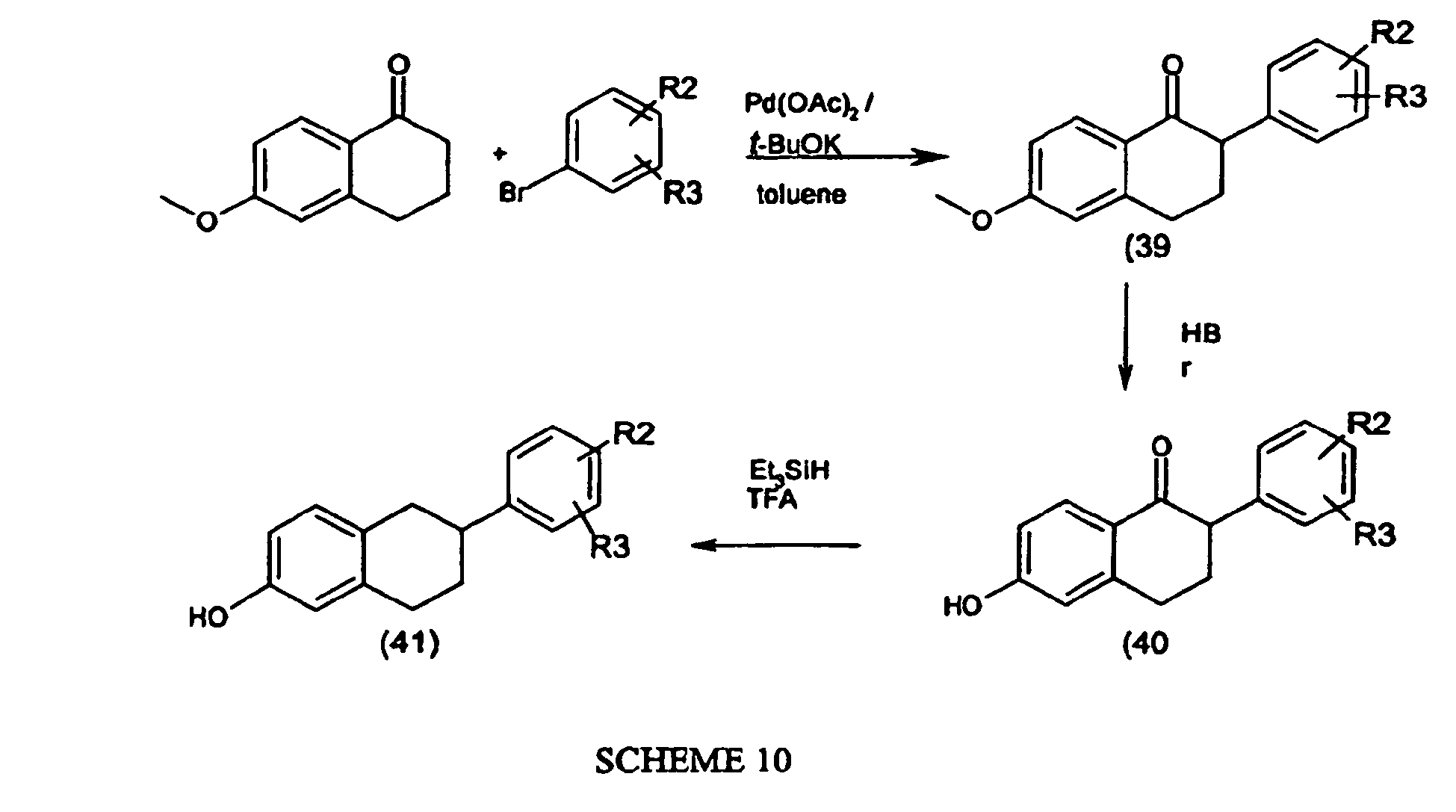
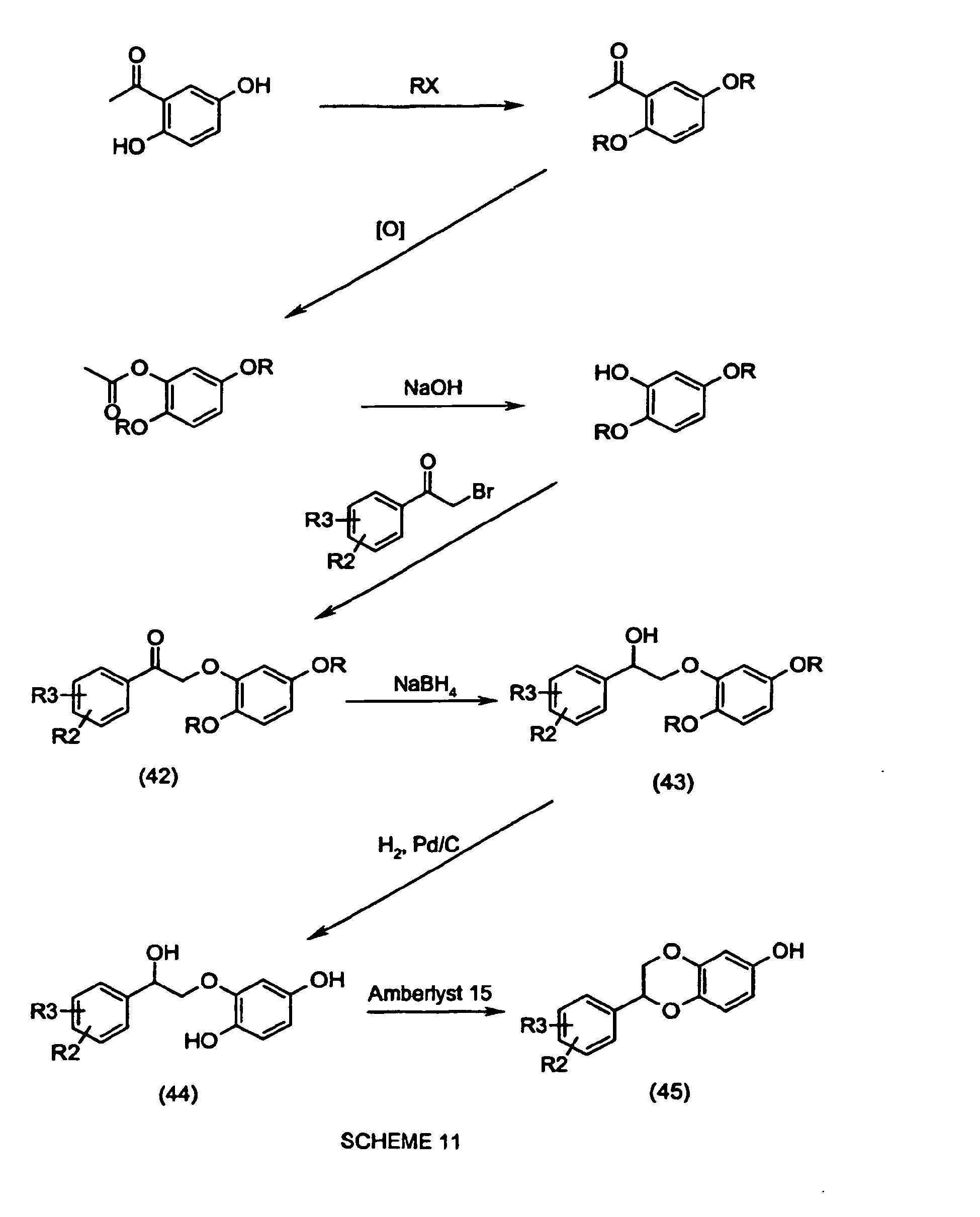
- The following Scheme (11), wherein R2 and R3 are the same as defined above, describes the synthesis of 2,3-dihydro-2-phenyl-benzo[1,4]dioxin-6-ols (45). After protecting hydroxyl groups of 2,5-dihydroxyacetophenone this ketone rearranges with peracids and gives a phenol after hydrolysis. The phenol is condensed with a haloketone and after reduction and removal of protection groups the hydroxyphenol (44) is cyclised to a 2,3-dihydro-2-phenyl-benzo[1,4]-dioxin-6-ol (45).
- Salts and esters of the compounds, when applicable, may be prepared by known methods. Physiologically acceptable salts are useful as active medicaments. Examples are the salts with inorganic acids such as hydrochloric acid, hydrobromic acid or nitric acid, and salts with organic acids such as methanesulfonic acid, citric acid or tartaric acid. Physiologically acceptable esters are also useful as active medicaments. Examples are the esters with aliphatic or aromatic acids such as acetic acid or with aliphatic or aromatic alcohols.
- The term "alkyl" as employed herein by itself or as part of another group includes both straight, branched and cyclized chain radicals of up to 18 carbon atoms, preferably 1 to 7 carbon atoms, most preferably 1 to 4 carbon atoms. The term "lower alkyl" as employed herein by itself or as part of another group includes straight, branched and cyclized chain radicals of 1 to 7, preferably 1 to 4, most preferably 1 or 2 carbon atoms. Specific examples for the alkyl and lower alkyl residues, respectively, are methyl, ethyl, propyl, isopropyl, butyl, tert. butyl, pentyl, cyclopentyl, hexyl, cyclohexyl, octyl, decyl and dodecyl including the various branched chain isomers thereof.
- The term "alkoxy" as employed herein by itself or as part of another group includes an alkyl group as defined above linked to an oxygen atom.
- The term "acyl" as employed herein by itself or as part of another group refers to an alkylcarbonyl or alkenylcarbonyl group, the alkyl and alkenyl groups being defined above.
- Compounds of the invention may be administered to a patient in therapeutically effective amounts which range usually from about 0.05 to 200 mg, preferably 0.1 to 100 mg, more preferably 0.5 to 50, mg per day depending on the age, weight, condition of the patient, administration route and the Na+/Ca2+ exchange inhibitor used. The compounds of the invention can be formulated into dosage forms using the principles known in the art. It can be given to a patient as such or in combination with suitable pharmaceutical excipients in the form of tablets, granules, capsules, suppositories, emulsions, suspensions or solutions. Choosing suitable ingredients for the composition is a routine for those of ordinary skill in the art. It is evident that suitable carriers, solvents, gel forming ingredients, dispersion forming ingredients, antioxidants, colours, sweeteners, wetting compounds and other ingredients normally used in this field of technology may be also used. The compositions containing the active compound can be given enterally or parenterally, the oral route being the preferred way. The contents of the active compound in the composition is from about 0.5 to 100 %, preferably from about 0.5 to about 20 %, per weight of the total composition.
- The effects of the compounds of the invention were tested on ouabain-induced arrhythmias in guinea-pig papillary muscles.
- Guinea-pig papillary muscles were mounted into horizontal muscle cuvette. A hook connected to force transducer was attached to another end of the muscle. Muscle preparations were electrically paced at 1Hz with field stimulation via platinum electrodes. Modified Tyrode solution was used for superfusion of muscle preparations. The composition of the Tyrode solution was the following (mM): NaCl 135, MgCl2 x 6H2O1, KCl 5, CaCl2 x 2H2O 2, NaHCO3 15, Na2HPO4 x 2H2O 1, and
glucose 10. The Tyrode solution was gassed with carbogen (95% O2, 5% CO2) to set pH at 7.4. Experiments were carried out at 37 °C. Acquisition and analysis of twitch tensions with Action Potential and Force Measurement System (ACFO v1.0, Fision Ltd, Finland). - Ouabain by blocking of sodium-potassium ATPase increase intracellular sodium which is changed for calcium via NCX. Increased intracellular calcium is leading to overload of sarcoplasmic reticulum (SR) and spontaneous calcium release from SR inducing delayed afterpolarizations (DADs). Equivalence for DADs in force signal is aftercontractions (ACs) which are seen as spontaneous twitches after the pacing controlled twitch.
- The compounds of the invention delayed appearance and decreased amplitude of aftercontractions. As shown in Figure 1, the title compound of Example 27, at 30 µM concentration, delayed appearance [38 ± 7.5 min vs vehicle: 25 ± 8.9 min (mean ± SD), p=0.013, n=5] and decreased maximum amplitude of aftercontractions #1 (74 ± 16 mg vs vehicle: 143 ± 54 mg, p=0.008, One-way ANOVA followed by LSD; n=5). As shown in Figure 2, the title compound of Example 67, at 10 µM, decreased maximum amplitude of aftercontractions #1 (88 ± 20 mg vs vehicle: 143 ± 54 mg, p=0.027, n=5).
- Zinc (5,4 g, 83,2 mmol), mercury (II) chloride (340 mg), concentrated hydrogen chloride (0,2 ml) and water were mixed at room temperature for 15 minutes and the mixture was decanted. 6-Hydroxyflavanone (1,0 g) was added as a suspension in a mixture of acetic acid (25 ml), concentrated hydrogen chloride (5,2 ml) and water (2 ml). The reaction mixture was refluxed for 1 ½ hours. After cooling into room temperature, the reaction mixture was filtered and the filtrate was extracted with ethyl acetate. The combined organic layers were washed with saturated NaHCO3-solution, then with water and dried with Na2SO4. The 2-phenylchroman-6-ol was purified by column chromatography using heptane-ethyl acetate (2:1) as an eluant. 1H NMR (400 MHz, d6-DMSO) δ: 8.78 (s, 1H), 7.43-7.31 (m, 5H), 6.63 (d, 1H, J 8.6 Hz) 6.51 (dd, 1H, J 8.6,2.9 Hz), 6.48 (d, 1H, J 2.9 Hz), 4.98 (dd, 1H, J, 9.9, 2.2 Hz), 2.89 (ddd, 1H, J -16.7, 11.3, 6.1Hz), 2.63 (ddd, 1H, J -16.7, 5.5, 3.3 Hz) 2.10 (m, 1H), 1.94 (m, 1H).
- Potassium fluoride (225 mg) was added into a solution of 2-phenylchroman-6-ol (300 mg) in dry DMF (3 ml). After stirring the resulting mixture at 120°C for 30 minutes 2-chloro-5-nitropyridine (195 mg) was added. The reaction mixture was stirred for a further 6½ hours at 120°C. After cooling into room temperature 1 M HCl-solution was added and the mixture was extracted with ethyl acetate. The combined organic layers were washed with water then with saturated NaCl-solution and dried with Na2SO4. 5-Nitro-2-(2-phenylchroman-6-yloxy)-pyridine was recrystallised from acetone- 2-propanol (1:5). 1H NMR (400 MHz, d6-DMSO) δ: 9.00 (d, 1H, J 2.9 Hz), 8.60 (dd, 1H, J 9.2,2.9 Hz), 7.47-7.32 (m, 5H), 7.20 (d, 1H, J 9.2 Hz), 7.00-6.89 (m, 3H), 5.15 (dd, 1H, J 10.1,2.2 Hz), 2.99 (ddd, 1H, J -16.8, 11.3,6.2 Hz), 2.75 (ddd, 1H, J -16.8, 5.4, 3.3 Hz) 2.18 (m, 1H), 2.02 (m, 1H).
- Cesium carbonate (230 mg) and an excess of 2-(dimethylamino)ethyl chloride in ethyl acetate were added into a solution of 2-phenylchroman-6-ol (150 mg) in acetonitrile (5 ml). The reaction mixture was refluxed for 30 minutes. After removing the solvents, the residue was taken up in water and extracted with ethyl acetate. The combined organic layers were washed with water and then with saturated NaCl-solution and dried with Na2SO4. The dimethyl[2-(2-phenylchroman-6-yloxy)-ethyl]amine was crystallised from heptane. 1H NMR (400 MHz, d6-DMSO) δ: 7.43-7.30 (m, 5H) 6.75-6.67 (m, 3H), 5.03 (dd, 1M, J 10.0, 2.2 Hz), 3.95 (t, 2H, J 5.9 Hz), 2.94 (ddd, 1H, J -16.7, 10.9, 5.8 Hz), 2.69 (ddd, 1H, J -16.7, 5.2, 3.3 Hz), 2.58 (t, 2H, J 5.9 Hz) 2.13 (m, 1H), 1.96 (m, 1H).
- The 2-phenylchroman-6-ol (500 mg) and 1-chloro-4-methoxy 2-nitrobenzene (390 mg) were dissolved in DMSO (10 ml). Potassium hydroxide (230 mg) and potassium iodide (520 mg) were added and the resulting mixture was stirred at 90°C for 1 hour. After cooling it was poured in to 1 M HCl-solution (20 ml) and extracted with dichlommethane. The combined organic layers were washed with water until neutral and then with saturated NaCl-solution and dried with Na2SO4. After evaporating the solvents the 6-(4-Methoxy-2-nitrophenoxy)-2-phenylchroman was obtained by trituration with methanol. 1H NMR (400 MHz, d6-DMSO) δ: 7.58 (d, 1H, J 3.1 Hz), 7.45-7.33 (m, 6H), 7.28 (dd, 1H, J 9.2 Hz, 3.1 Hz) 7.10 (d, 1H, J 9.2 Hz), 6.86-6.78 (m, 3H), 5.10 (dd, 1H, J 10.0, 1.9 Hz), 3.83 (s, 3H) 2.92 (ddd, 1H, J -16.9, 11.2, 5.9 Hz), 2.75 (ddd, 1H, J -16.9, 7.9, 4.2 Hz) 2.15 (m, 1H), 1,97 (m, 1H).
- 6-(4-Methoxy-2-nitrophenoxy)-2-phenylchroman (360 mg) was dissolved ethyl acetate and 10 % palladium on carbon (90 mg) was added. The reaction mixture was hydrogenated for 2 hours at normal pressure and room temperature. It was then filtered through Celite and washed with ethyl acetate. The 5-methoxy-2-(2-phenyl-chroman-6-yloxy)phenylamine was isolated as its hydrochloride salt. 1H NMR (400 MHz, d6-DMSO) δ: 7.44-7.33 (m, 5H) 6.83-6.72 (m, 4H), 6.68 (d, 1H, J 2.9 Hz), 6,48 (dd, 1H, J 8.9, 2.8 Hz) 5.07 (dd, 1H, J 10.0, 2.2 Hz), 3.70 (s, 3H) 2.93 (ddd, 1H, J -17.0, 11.1, 6.1 Hz), 2.68 (ddd, 1H, J -17.0, 8.3, 4.5 Hz) 2.15 (m, 1H), 1,97 (m, 1H).
- 2-Phenylchroman-6-ol (340 mg), 1-bromo-2-chloroethane (1,25 ml) and cesium carbonate (977 mg) were dissolved in acetonitrile (4 ml). The reaction mixture was refluxed for 4 hours. After cooling into room temperature it was poured in 1 M HCl-solution and extracted with dichloromethane. The combined dichloromethane extracts were washed with water and dried with Na2SO4. The mixture was passed through silica gel column using ethyl acetate- hexane (1:7) as an eluant resulting 190 mg of haloethane derivative. It was dissolved in DMF (5 ml) and sodium azide (214 mg) was added. The reaction mixture was refluxed for 2 hours. The mixture was filtered. Ethyl acetate was added to the filtrate and it was then washed once with 1 M HCl-solution and then several times with water and dried with Na2SO4. The solvents were evaborated under reduced pressure to give 6-(2-azidoethoxy)-2-phenylchroman. 1H NMR (400 MHz, d6-DMSO) δ: 7.44-7.32 (m, 5H) 6.78-6.71 (m, 3H), 5.04 (dd, 1H, J 10.1,2.3 Hz), 4.10 (t, 2H, J 4.8 Hz), 3.60 (t, 2H, J 4.8 Hz), 2.95 (ddd, 1H, J -16.8, 11.1, 6.0 Hz), 2.70 (ddd, 1H, J -16.8, 5.3, 3.3 Hz), 2.14 (m, 1H), 1.97 (m, 1H).
- Triphenylphosphine (165 mg) and 40 µl of water were added into a solution of 6-(2-azidoethoxy)-2-phenylchroman (155 mg) in tetrahydrofuran. The resulting mixture was stirred for 2 hours at room temperature. 2-(2-Phenylchroman-6-yloxy)-ethylamine was isolated as its methane sulfonate salt. 1H NMR (400 MHz, d6-DMSO) δ: 7.91 (bs, 3H), 7.44-7.32 (m, 5H), 6.81-6.75 (m, 3H), 5.05 (dd, 1H, J 9.9, 2.3 Hz), 4.08 (t, 2H, J 5.1 Hz), 3.19 (m, 2H), 2.95 (ddd, 1H, J -16.8, 11.0, 5.9. Hz), 2.71 (ddd, 1H, J-16.8, 5.2, 3.4 Hz), 2.30 (s, 3H) 2.15 (m, 1H), 1,97 (m, 1H).
- Cesium carbonate (310 mg) and chloroacetonitrile (62 µl) were added into a solution of 2-phenylchroman-6-ol (200 mg) in acetonitrile (3 ml). The resulting mixture was refluxed for 6 hours. The reaction mixture was allowed to cool to room temperature and 1 M HCl-solution was added and it was extracted with ethyl acetate. The combined organic layers were washed with water and saturated NaCl-solution and dried with Na2SO4. The solvents were evaporated under reduced pressure to give (2-phenylchmman-6-yloxy)acetonitrile. 1H NMR (400 MHz, d6-DMSO) δ: 7.44-7.30 (m, 5H), 6.86-6.81 (m, 3H), 5.08 (dd, 1H, J 9.8, 2.2 Hz), 5.07 (s, 2H), 2.97 (ddd, 1H, J -16.9, 10.9, 6.0. Hz), 2.71 (ddd, 1H, J -16.9, 5.0, 3.4 Hz), 2.15 (m, 1H), 1,97 (m, 1H).
- Dry HCl was passed through a solution of (2-phenylchroman-6-yloxy)acetonitrile (270 mg) in diethyl ether and 90 µl of absolute ethanol while cooling with ice bath. Reaction mixture was evaporated to the dryness after formation of the intermediate imidate. Precipitate was dissolved in absolute ethanol and 252 µl ethylene diamine was added to the cooled solution. Reaction mixture was allowed to warm to room temperature, evaporated to dryness, dissolved in dichloromethane and washed with water. Combined organic layers were dried and treated with charcoal. The 2-(2-Phenylchroman-6-yloxymethyl)-4,5-dihydro-1H-imidazole was isolated as its HCl-salt. 1H-NNiR (d4-MeOH): 7.5-7.2 (m, 5H), 6.85-6.75 (m, 3H), 5.01 (d, 1H, J 8.8 Hz), 4.97 (s, 2H), 4.00 (s, 4H), 3.02-2.90 (m, 1H), 2.80-2.70 (m, 1H), 2.21-2.12 (m, 1H), 2.05-1.90 (m, 1H). (M)+ = 308 (100%)
- 6-(5-Nitropyridin-2-yloxy)-2-phenylchroman-4-one was prepared as described for 5-Nitro-2-(2-phenylchroman-6-yloxy)pyridine in Example 1 (b) using 200 mg of 6-hydroxyflavanone. 1H NMR (400 MHz, d6-DMSO) δ: 9.03 (bs, 1H), 8.64 (d, 1H, J 9.0 Hz), 7.59-7.41 (m, 7H), 7.31 (d, 1H, J 9.0 Hz), 7.23 (d, 1H, 8.8 Hz), 5.75 (dd, 1H, J 12.3, 2.9 Hz), 3.30 (dd, 1H, -16.3, 12.3 Hz), 2.87 (dd, 1H, -16.3, 2.9 Hz).
- 7-(5-Nitropyridin-2-yloxy)-2-phenylchroman-4-one was prepared as described for 5-Nitro-2-(2-phenylchroman-6-yloxy)pyridine in Example 1 (b) using 150 mg of 7-hydroxyflavanone. 1H NMR (400 MHz, d6-DMSO) δ: 9.07 (d, 1H, J 2.8 Hz), 8.67 (dd, 1H, J 9.0, 2.8 Hz), 7.89 (d, 1H, 8.6 Hz), 7.60-7.35 (m, 6H), 7.04 (d, 1H, 2.1 Hz), 6.97 (dd, 1H, 8.6, 2.1 HZ), 5.75 (dd, 1H, J 13.0,2.7 Hz), 3.32 (dd, 1H, 16.9, 13.0 Hz), 2.85 (d, -16.9, 2.7 Hz).
- Into a suspension of 6-hydroxyflavanone (1.0 g) in dry THF (11.5 ml) was added dropwise a solution of borane-THF complex (12.5 ml, 1.0 M in THF) under nitrogen. The reaction mixture was refluxed for 1 hour. After cooling to the room temperature it was poured into an ice-2 M HCl-solution 2-Phenylchroman-4,6-diol was filtered. 1H NMR (400 MHz, d6-DMSO) δ: 8.83 (s, 1H), 7.45-7.38 (m, 4H), 7.35 (m, 1H), 6.89 (d, 1H, J 2.8 Hz), 6.59 (d, 1H, J 8.7 Hz), 6.54 (dd, 1H, J 8.7, 2.8Hz), 5.41 (d, 1H, J 7.0 Hz), 5.11 (dd, 1H, J 11.7, 1.2 Hz), 4.87 (m, 1H), 2.26 (m, 1H), 1.90 (m, 1H).
- 6-(5-Nitropyridin-2-yloxy)-2-phenylchroman-4-ol was prepared as described for 5-nitro-2-(2-phenylchroman-6-yloxy)pyridine in Example 1(b) starting from 1.5 g of 2-phenylchroman-4,6-diol. The product was passed through a silica gel column using toluene - ethyl acetate (4:1) as an eluant and then crystallised from 2-propanol. 1H NMR (400 MHz, d6-DMSO) δ: 9.04 (d, 1H, J 2.7 Hz), 8.61 (dd, 1H, J 9.1, 2.7 Hz), 7.50-7.36 (m, 5H), 7.25 (d, 1H, J 2.7 Hz), 7.22 (d, 1H, 9.1 Hz), 7.00 (dd, 1H, J 8.7,2.7 Hz), 6.88 (d, 1H, J 8.7 Hz), 5.65 (d, 1H, J 6.3 Hz), 5.30 (dd, 1H, J 11.9, 1.3 Hz), 4.99 (m, 1H), 2.33 (m, 1H), 1.98 (m, 1H).
- 2',5'-Dihydroxyacetophenone (1.50 g) was dissolved in warm glacial acetic acid (26 ml). 3-Fluorobenzaldehyde (1.35 g) and ammonium acetate (0.98 g) were added. The reaction mixture was refluxed for 2 hours. It was allowed to cool to room temperature and poured in ice. The precipitate formed was filtered resulting in 2.2 g of a mixture of 2-(3-fluorophenyl)-6-hydmxychroman-4-one and 1-(2,5-dihydroxy phenyl)-3-(3-fluorophenyl)propenone. The obtained mixture was dissolved in ethanol (90 ml) and sodium acetate (1.75 g) was added. The reaction mixture was refluxed for 5 hours. It was then allowed to cool to room temperature and diluted with water and filtered. The 2-(3-fluorophenyl)-6-hydroxychroman-4-one was recrystallised from acetic acid. 1H NMR (400 MHz, d6-DMSO) δ: 9.45 (s, 1H), 7.47 (m, 1H), 7.40-7.37 (m, 2H), 7.22 (m, 1H), 7.12 (d, 1H, J 3.0 Hz), 7.05 (dd, 1H, J 8.8, 3.0 Hz), 6.98 (d, 1H, J 8.8 Hz), 5.59 (dd, 1H, J 13.0,2.9 Hz), 3.21 (dd, 1H, J -16.9,13.0 Hz), 2.82 (dd, 1H, J -16.9,2.9 Hz).
- 2-(3-Fluorophenyl)chroman-4,6-diol was prepared as described for 2-phenylchroman-4,6-diol in Example 8(a) starting from 220 mg of 2-(3-fluorophenyl)-6-hydroxychroman-4-one. 1H NMR (400 MHz, d6-DMSO) δ: 8.85 (s, 1H), 7.45 (m, 1H), 7.30-7.25 (m, 2H), 7.15 (m, 1H), 6.88 (d, 1H, J 2.8 Hz), 6.62 (d, 1H, J 8.7 Hz), 6.55 (dd, 1H, J 8.7, 2.8 Hz), 5.44 (d, 1H, J 7.0 Hz), 5.15 (d, 1H, J 10.7 Hz), 4.86 (m, 1H), 2.29 (m, 1H), 1.86 (m, 1H).
- Triethylsilane (960 µl) was added slowly into a solution of 2-(3-fluorophenyl)chroman-4,6-diol (195 mg) in dichloromethane (4 ml) . Trifluoroacetic acid (1.9 ml) was then added dropwise into a reaction mixture and it was stirred at room temperature for 5 hours. The reaction mixture was poured on ice-water and extracted with dichloromethane. The residue was evaporated under reduced pressure with toluene to obtain 2-(3-fluorophenyl)chroman-6-ol. 1H NMR (400 MHz, d6-DMSO) δ: 8.78 (s, 1H), 7.43 (m, 1H), 7.28-7.25 (m, 2H), 7.14 (m, 1H), 6.66 (d, 1H, J 8.5 Hz) 6.52 (dd, 1H, J 8.5, 2.7 Hz), 6.49 (d, 1H, J 2.7 Hz), 5.03 (dd, 1H, J 9.9,2.1 Hz), 2.86 (m, 1H), 2.63 (m, 1H) 2.13 (m, 1H), 1.93 (m, 1H).
- 2-[2-(3-Fluorophenyl)chroman-6-yloxy]-5-nitropyridine was prepared as described for 5-nitro-2-(2-phenylchroman-6-yloxy)pyridine in Example 1(b) starting from 210 mg of 2-(3-fluorophenyl)chroman-6-ol. The product was recrystallised from 2-propanol. 1H NMR (400 MHz, CDCl3) δ: 9.07 (d, 1H, J 2.8 Hz), 8.46 (dd, 1H, J 9.0, 2.8 Hz), 7.36 (m, 1H), 7.21-7.15 (m, 2H), 7.03 (m, 1H), 7.01 (d, 1H, J 9.0 Hz), 6.98 (d, 1H, J 8.6 Hz) 6.92 (dd, 1H, J 8.6, 2.7 Hz), 6.90 (d, 1H, J 2.7 Hz), 5.09 (dd, 1H, J 10.3,2.4 Hz), 3.01 (ddd, 1H, J -16.9, 11.4, 6.0 Hz), 2.82 (ddd,1H, J - 16.9, 5.1, 3.2 Hz) 2.24 (m, 1H), 2.09 (m, 1H).
- 2-Phenyl-chroman-7-ol was prepared as described for 5-nitro-2-(2-phenylchroman-6-yloxy)pyridine in Example 1(a) starting from 1.0 g of 7-hydroxyflavanone. The product was purified by column chromatography using heptane-ethyl acetate (2:1) as an eluant. 1H NMR (400 MHz, CD3OD) δ: 7.41-7.28 (m, 5H), 6.86 (d, 1H, J 8.2 Hz) 6.32 (dd, 1H, J 8.2, 2.4 Hz), 6.29 (d, 1H, J 2.4 Hz), 5.00 (dd, 1H, J 9.9, 2.4 Hz), 2.84 (m, 1H), 2.64 (m, 1H) 2.15 (m, 1H), 1.99 (m, 1H).
- 5-Nitro-2-(2-phenylchroman-7-yloxy)pyridine was prepared as described for 5-nitro-2-(2-phenylchroman-6-yloxy)pyridine in Example 1(b) starting from 115 mg of 2-phenyl-chroman-7-ol. The product was purified on preparative TLC-plate covered with silica gel using toluene - ethyl acetate (15:1) as an eluant. 1H NMR (400 MHz, d6-DMSO) δ: 9.04. (d, 1H, J 2.8 Hz), 8.60 (dd, 1H, J 9.1, 2.8 Hz), 7.46-7.32 (m, 5H), 7.22 (d, 1H, J 9.1 Hz), 7.20 (d, 1H, J 8.9 Hz) 6.72 (dd, 1H, J 8.9,2.3 Hz), 6.72 (d, 1H, J 2.3 Hz), 5.16 (dd, 1H, J 10.1, 2.1 Hz), 2.97 (ddd, 1H, J -16.7,11.3,5.9 Hz), 2.77 (ddd, 1H, J-16.7, 8.1,4.5 Hz) 2.20 (m, 1H), 2.02 (m, 1H).
- 2-(2,4-Dichlorophenyl)-6-hydroxychroman-4-one was prepared as described for 2-(3-fluorophenyl)-6-hydroxychroman-4-one in Example 9(a) starting from 1.0 g of 2',5'-dihydroxyacetophenone and 1.4 g of 2,4-dichlorobenzaldehyde. The product was recrystallised from acetic acid. 1H NMR (400 MHz, d6-DMSO) δ: 9.49 (s, 1H), 7.78 (d, 1H, J 8.5 Hz), 7.71(d, 1H, J 2.0 Hz)), 7.57 (dd, 1H, J 8.5,2.0 Hz), 7.14 (d, 1H, J 3.0 Hz), 7.06 (dd, 1H, J 8.8, 3.0 Hz), 6.97 (d, 1H, J 8.8 Hz), 5.77 (dd, 1H, J 13.5,2.7 Hz), 3.18 (dd, 1H, J -16.9, 13.5 Hz), 2.78 (dd, 1H, J -16.9, 2.7 Hz).
- 2-(2,4-Dichlorophenyl)chroman-4,6-diol was prepared as described for 2-phenylchroman-4,6-diol in Example 8(a) starting from 1.2 g of 2-(2,4-dichlorophenyl)-6-hydroxychroman-4-one. The product was purified by column chromatography using heptane - ethyl acetate (2:1) as an eluant. 1H NMR (400 MHz, d6-DMSO) δ: 8.89 (s, 1H), 7.66 (d, 1H, J 2.1 Hz), 7.64 (d, 1H, J 8.5 Hz), 7.51 (dd, 1H, J 2.1, 8.5 Hz), 6.89 (d, 1H, J 2.7 Hz), 6.63 (d, 1H, J 8.7 Hz), 6.56 (dd, 1H, J 2.7, 8.7 Hz), 5.50 (d, 1H, J 6.8 Hz), 5.37 (d, 1H, J 10.4 Hz), 4.90 (m, 1H), 2.32 (m, 1H), 1.80 (m, 1H).
- 2-(2,4-Dichlorophenyl)chroman-6-ol was prepared as described for 2-(3-fluorophenyl)chroman-6-ol in Example 9(c) starting from 625 mg of 2-(2,4-dichlorophenyl)chroman-4,6-diol. 1H NMR (400 MHz, d6-DMSO) δ: 8.85 (s, 1H), 7.65 (d, 1H, J 2.2 Hz), 7.57 (d, 1H, J 8.4 Hz), 7.49 (dd, 1H, J 8.4, 2.2 Hz), 6.67-6.51 (m, 3H), 5.21 (dd, 1H, J 10.3, 2.1 Hz), 2.91 (m, 1H), 2.69 (m, 1H), 2.16 (m, 1H), 1.85 (m, 1H).
- 2-[2-(2,4-dichlorophenyl)chroman-6-yloxy]-5-nitropyridine was prepared as described for 5-nitro-2-(2-phenylchroman-b-yloxy)pyridine in Example 1 (b) starting from 530 mg of 2-(2,4-(Hchlorophenyl)chroman-6-ol. The product was purified on preparative TLC-plate covered with silica gel using heptane - ethyl acetate (3: 1) as an eluant. 1H NMR (400 MHz, CDCl3) δ: 9.06 (d, 1H, J 2.7 Hz), 8.47 (dd, 1H, J 9.0, 2.7 Hz), 7.56 (d, 1H, J 8.4 Hz), 7.41 (d, 1H, J 2.0 Hz), 7.33 (dd, 1H, J 8.4,2.0 Hz) 7.02 (d, 1H, J 9.0 Hz) 6.99-6.92 (m, 3H), 5.39 (dd, 1H, J 10.4,2.2 Hz), 3.06 (ddd, 1H, J -16.9,11.9,6.0 Hz), 2.83 (ddd, 1H, J -16.9,5.3,2.7 Hz) 2.34 (m, 1H), 1.89 (m, 1H).
- 2-(3-Chlorophenyl)-6-hydroxychroman-4-one was prepared as described for 2-(3-fluorophenyl)-6-hydroxychroman-4-one in Example 9(a) starting from 2.0 g of 2',5'-dihydroxyacetophenone and 1.85 g of 3-chlorobenzaldehyde. The product was recrystallised from acetic acid. 1H NMR (400 MHz, d6-DMSO) δ: 9.47 (s, 1H), 7.62 (s, 1H), 7.51-7.45 (m, 3H), 7.12 (d, 1H, J 3.0 Hz), 7.05 (dd, 1H, J 8.8, 3.0 Hz), 6.98 (d, 1H, J 8.8 Hz), 5.58 (dd, 1H, J 13.1, 2.9 Hz), 3.18 (dd, 1H, J-16.9,13.1 Hz), 2.81 (dd, 1H, J -16.9, 2.9 Hz).
- 2-(3-Chlomphenyl)chroman-4,6-diol was prepared as described for 2-phenylchroman-4,6-diol in Example 8(a) starting from 730 mg of 2-(3-chlorophenyl)-6-hydroxychmman-4-one. 1H NMR (400 MHz, d6-DMSO) δ: 8.85 (s, 1H), 7.50 (d, 1H, J 1.7 Hz), 7.46-7.38 (m, 3H), 6.88 (d, 1H, J 2.5 Hz), 6.62 (d, 1H, J 8.6 Hz), 6.55 (dd, 1H, J 8.6, 2.5 Hz), 5.44 (d, 1H, J 6.6 Hz), 5.15 (dd, 1H, J 11.8, 1.4 Hz), 4.87 (m, 1H), 2.29 (m, 1H), 1.85 (m, 1H).
- 2-(3-Chlorophenyl)chroman-6-ol was prepared as described for 2-(3-fluorophenylkhroman-6-ol in Example 9(c) starting from 635 mg of 2-(3-chlorophenyl)chroman-4,6-diol. 1H NMR (300 MHz, d6-DMSO) δ: 8.79 (s, 1H), 7.48 (d, 1H, J 0.7 Hz), 7.42-7.37 (m, 3H), 6.71-6.49 (m, 3H), 5.04 (m, 1H), 2.91 (m, 1H), 2.65 (m, 1H), 2.12 (m, 1H), 1.93.(m, 1H).
- 2-[2-(3-Chlorophenyl)chroman-6-yloxy]-5-nitropyridine was prepared as described for 5-nitro-2-(2-phenylchroman-6-yloxy)pyridine in Example 1(b) starting from 590 mg of 2-(3-chlorophenyl)chroman-6-ol. The product was recrystallised from a 3:1 mixture of 2-propanol and ethyl acetate. 1H NMR (400 MHz, CDCl3) δ: 9.04 (d, 1H, J 2.9 Hz), 8.60 (dd, 1H, J 9.0, 2.9 Hz), 7.53 (s, 1H), 7.46-7.42 (m, 3H), 7.20 (d, 1H, J 9.0 Hz) 7.00 (dd, 1H, J 8.7,2.7 Hz), 6.97 (d, 1H, J 2.7 Hz), 6.94 (d, 1H, J 8.7 Hz), 5.18 (dd, 1H, J 10.2, 22 Hz), 2.97 (ddd, 1H, J -17.0, 11.5, 5.9 Hz), 2.83 (ddd, 1H, J -17.0, 8.1, 4.5 Hz) 2.21 (m, 1H), 2.00 (m, 1H).
- 2-(3,5-Difluorophenyl)-6-hydroxychroman-4-one was prepared as described for 2-(3-fluorophenyl)-6-hydroxychroman-4-one in Example 9(a) starting from 1.0 g of 2',5'-dihydroxyacetophenone and 1.12 g of 3,5-difluorobenzaldehyde. The product was recrystallised from acetic acid. 1H NMR (400 MHz, d6-DMSO) δ: 9.47 (s, 1H), 7.30-7.23 (m, 3H), 7.12 (d, 1H, J 2.9 Hz), 7.06 (dd, 1H, J 8.8, 2.9 Hz), 7.00 (d, 1H, J 8.8 Hz), 5.60 (dd, 1H, J 13.1, 2.8 Hz), 3.15 (dd, 1H, J-16.8, 13.1 Hz), 2.85 (dd, 1H, J -16.8, 2.8 Hz).
- 2-(3,5-Difluorophenyl)chroman-4,6-diol was prepared as described for 2-phenylchroman-4,6-diol in Example 8(a) starting from 800 mg of 2-(3,5-difluorophenyl)-6-hydroxychroman-4-one. 1H NMR (400 MHz, d6-DMSO) δ: 8.87 (s, 1H), 7.21-7.17 (m, 3H), 6.88 (d, 1H, J 2.4 Hz), 6.64 (d, 1H, J 8.7 Hz), 6.55 (dd, 1H, J 2.4, 8.7 Hz), 5.47 (d, 1H, J 7.0 Hz), 5.17 (d, 1H, J 10.5 Hz), 4.86 (m, 1H), 2.32 (m, 1H), 1.85 (m, 1H).
- 2-(3,5-Difluorophenyl)chroman-6-ol was prepared as described for 2-(3-fluorophenyl)chroman-6-ol in Example 9(c) starting from 500 mg of 2-(3,5-difluorophenyl)chroman-4,6-diol. 1H NMR (300 MHz, d6-DMSO) δ: 8.82 (s, 1H), 7.20-7.14 (m, 3H), 6.68 (d, 1H, J 8.6 Hz), 6.53 (d, 1H, J 2.9 Hz), 6.50 (dd, 1H, J 8.6, 2.9 Hz), 5.05 (dd, 1H, J 9.8, 2.2 Hz), 2.88 (ddd, 1H, J -16.7, 10.8, 5.9 Hz), 2.62 (ddd, 1H, J -16.7, 8.9, 5.0 Hz), 2.15 (m, 1H), 1.93 (m, 1H).
- 2-[2-(3,5-Difluorophenyl)chroman-6-yloxy]-5-nitropyridine was prepared as described for 5-nitro-2-(2-phenylchroman-6-yloxy)pyridine in Example 1(b) starting from 340 mg of 2-(3,5-difluorophenyl)chroman-6-ol. The product was purified on preparative TLC-plate covered with silica gel using toluene - ethyl acetate as an eluant and then crystallised from 2-propanol. 1H NMR (400 MHz, d6-DMSO) δ: 9.04 (d, 1H, J 2.9 Hz), 8.60 (dd, 1H, J 9.1,2.9 Hz), 7.23-7.19 (m, 4H), 7.01-6.95 (m, 3H), 5.18 (dd, 1H, J 10.0, 2.1 Hz), 2.97 (ddd, 1H, J -16.9, 10.9, 5.7 Hz), 2.76 (ddd, 1H, J -16.9, 8.4, 4.7 Hz) 2.22 (m, 1H),1.99 (m, 1H).
- 2-(2,5-Difluorophenyl)-6-hydroxychroman-4-one was prepared as described for 2-(3-fluorophenyl)-6-hydroxychroman-4-one in Example 9(a) starting from 3.0 g of 2',5'-dihydroxyacetophenone and 2.57 ml of 2,5-difluorobenzaldehyde. The product was recrystallised from acetic acid. 1H NMR (300 MHz, d6-DMSO) δ: 9.46 (s, 1H), 7.53 (m, 1H), 7.36-7.30 (m, 2H), 7.14 (d, 1H, J 3.0 Hz), 7.05 (dd, 1H, J 8.8, 3.0 Hz), 6.97 (d, 1H, J 8.8 Hz), 5.76 (dd, 1H, J 13.6, 2.7 Hz), 3.26 (dd, 1H, J -16.8, 13.6 Hz), 2.76 (dd, 1H, J -16.8, 2.7 Hz).
- 2-(2,5-Difluorophenyl)chroman-4,6-diol was prepared as described for 2-phenylchroman-4,6-diol in Example 8(a) starting from 1.0 g of 2-(2,5-difluorophenyl)-6-hydroxychroman-4-one. 1H NMR (400 MHz, d6-DMSO) δ: 8.87 (s, 1H), 7.39-7.22 (m, 3H), 6.89 (d, 1H, J 2.8 Hz), 6.63 (d, 1H, J 8.7 Hz), 6.56 (dd, 1H, J 8.7, 2.8 Hz), 5.50 (d, 1H, J 6.8 Hz), 5.35 (d, 1H, J 11.2 Hz), 4.89 (m, 1H), 2.28 (m, 1H), 1.95 (m, 1H).
- 2-(2,5-Difluorophenyl)chroman-6-ol was prepared as described for 2-(3-fluorophonyl)chroman-6-ol in Example 9(c) starting from 420 mg of 2-(2,5-difluorophenyl)chroman-4,6-diol. 1H NMR (300 MHz, d6-DMSO) δ: 8.82 (s, 1H), 7.34-7.22 (m, 3H), 6.71-6.51 (m, 3H), 5.20 (m, 1H), 2.93 (m, 1H,), 2.68 (m, 1H), 2.11 (m, 1H),1.98 (m, 1H).
- 2-[2-(2,5-Difluorophenyl)chroman-6-yloxy]-5-nitropyridine was prepared as described for 5-nitro-2-(2-phenylchroman-6-yloxy)pyridine in Example 1(b) starting from 100 mg of 2-(2,5-difluorophenyl)chroman-6-ol. The product was recrystallised from 2-propanol. 1H NMR (400 MHz, CDCl3) δ: 9.07 (dd, 1H, J 2.8,0.4 Hz), 8.47 (dd, 1H, J 9.1, 2.8 Hz), 7.26 (m, 1H), 7.05-6.91 (m, 6H), 5.35 (dd, 1H, J 10.3, 1.5 Hz), 3.04 (ddd, 1H, J -16.9, 11.7, 6.0 Hz), 2.82 (ddd, 1H, J -16.9, 5.2, 3.0 Hz) 2.29 (m, 1H), 2.01 (m, 1H).
- 2-[2-(3-Bromophenynchroman-6-yloxy]-5-nitropyridine
- 2-(3-Bromophenyl)-6-hydroxychroman-one was prepared as described for 2-(3-fluorophenyl)-6-hydroxychroman-4-one in Example 9(a) starting from 3.0 g of 2',5'-dihydroxyacetophenone and 2.3 ml of 3-bromobenzaldehyde. The product was recrystallised from acetic acid. 1H NMR (300 MHz, d6-DMSO) δ: 9.41 (s, 1H), 7.50 (m, 1H), 7.59-7.53 (m, 2H), 7.39 (m, 1H) 7.12 (d, 1H, J 2.9 Hz), 7.05 (dd, 1H, J 8.8, 2.9 Hz), 6.98 (d, 1H, J 8.8 Hz), 5.57 (dd, 1H, J 13.0,2.9 Hz), 3.12 (dd, 1H, J -16.9, 13.0 Hz), 2.81 (dd, 1H, J -16.9, 2.9 Hz).
- 2-(3-Bromophenyl)-chroman-4,6-diol was prepared as described for 2-phenylchroman-4,6-diol in Example 8(a) starting from 1.0 g of 2-(3-bromophenyl)-6-hydroxychroman-4-one. 1H NMR (300 MHz, d6-DMSO) δ: 8.83 (s, 1H), 7.63 (m, 1H) 7.53 (m, 1H) 7.46 (m, 1H) 7.37 (m, 1H), 6.88 (d, 1H, J 2.9 Hz), 6.62 (d, 1H, J 8.7 Hz), 6.55 (dd, 1H, J 8.7, 2.9 Hz), 5.42 (d, 1H, J 7.0 Hz), 5.14 (d, 1H, J 10.5 Hz), 4.86 (m, 1H), 2.29 (m, 1H), 1.84 (m, 1H).
- 2-(3-Bromophenyl)chroman-6-ol was prepared as described for 2-(3-fluorophenyl)chroman-6-ol in Example 9(c) starting from 700 mg of 2-(3-bromophenyl)chroman-4,6-diol. 1H NMR (400 MHz, d6-DMSO) δ: 8.81 (s, 1H), 7.61 (m, 1H), 7.51 (m, 1H), 7.43 (m, 1H), 7.35 (m, 1H) 6.67-6.48 (m, 3H), 5.01 (m, 1H), 2.87 (m, 1H,), 2.63 (m, 1H), 2.12 (m, 1H), 1.92 (m, 1H).
- 2-[2-(3-Bromophenyl)chroman-6-yloxy]-5-nitropyridine was prepared as described for 5-nitro-2-(2-phenylchroman-6-yloxy)pyridine in Example 1(b) starting from 339 mg of 2-(3-bromophenyl)chroman-6-ol. The product was filtered through silica gel using toluene - ethyl acetate as an eluant and then crystallised from 2-propanol. 1H NMR (400 MHz, CDCl3) δ: 9.04 (d, 1H, J 2.9 Hz), 8.60 (dd, 1H, J 9.2, 2.9 Hz), 7.66 (bs, 1H), 7.55 (m, 1H), 7.48 (m, 1H), 7.39 (m, 1H) 7.20 (d, 1H, J 9.2 Hz) 7.01-6.93 (m, 3H), 5.17 (dd, 1H, J 10.1, 2.2 Hz), 2.97 (m, 1H), 2.72 (m, 1H) 2.20 (m, 1H), 2.00 (m, 1H).
- 2-(4-Ethylphenyl)-6-hydroxychroman-4-one was prepared as described for 2-(3-fluorophenyl)-6-hydroxychroman-4-one in Example 9(a) starting from 1.0 g of 2',5'-dihydroxyacetophenone and 0.8 ml of 4-ethylbenzaldehyde. The product was recrystallised from acetic acid. 1H NMR (400 MHz, d6-DMSO) δ: 7.43 (d, 2H, J 8.1 Hz), 7.25 (d, 2H, J 8.1 Hz), 7.11 (d, 1H, J 3.1 Hz), 7.03 (dd, 1H, J 8.9, 3.1 Hz), 6.93 (d, 1H, J 8.9 Hz), 5.51 (dd, 1H, J 13.0,2.9 Hz), 3.15 (dd, 1H, J -16.9, 13.0 Hz), 2.75 (dd, 1H, J -16.9, 2.9 Hz), 2.62 (q, 2H, J 7.5 Hz), 1.18 (t, 3H, J 7.5 Hz).
- 2-(4-Ethylphenyl)chroman-4,6-diol was prepared as described for 2-phenylchroman-4,6-diol in Example 8(a) starting from 474 mg of 2-(4-ethylphenyl)-6-hydroxychroman-4-one. 1H NMR (400 MHz, d6-DMSO) δ: 8.81 (s, 1H), 7.34 (d, 2H, J 8.0 Hz) 7.22 (d, 2H, J8.0 Hz), 6.88 (d, 1H, J 2.8 Hz), 6.57 (d, 1H, J 8.6 Hz), 6.53 (dd, 1H, J 8.6, 2.8 Hz), 5.39 (d, 1H, J 7.1 Hz), 5.06 (d, 1H, J 10.7 Hz), 4.86 (m, 1H), 2.61 (q, 2H, J 7.6 Hz), 2.29 (m, 1H), 1.84 (m, 1H), 1.19 (t, 3H, J 7.6 Hz).
- 2-(4-Ethylphenyl)chroman-6-ol was prepared as described for 2-(3-fluorophenyl)chroman-6-ol in Example 9(c) starting from 425 mg of 2-(4-ethylphenyl)chroman-4,6-diol. The product was purified using heptane - ethyl acetate (3:1) as an eluant. 1H NMR (400 MHz, CD3OD) δ: 7.26 (d, 2H, J 8.2 Hz) 7.13 (d, 2H, J 8.2 Hz), 6.65 (d, 1H, J 8.6 Hz), 6.55 (dd, 1H, J 8.6, 2.8 Hz), 6.51 (d, 1H, J 2.8 Hz)" 4.83 (dd, 1H, J 10.1, 2.3 Hz), 2.84 (m, 1H,), 2.62 (m, 1H), 2.59 (q, 2H, J 7.6 Hz) 2.03 (m, 1H), 1.93 (m, 1H), 1.19 (t, 3H, J 7.6 Hz).
- 2-[2-(4-Ethylphenyl)chroman-6-yloxy]-5-nitropyridine was prepared as described for 5-nitro-2-(2-phenylchroman-6-yloxy)pyridine in Example 1(b) starting from 205 mg of 2-(4-ethylphenyl)chroman-6-ol. The product was recrystallised from a mixture of 2-propanol and acetone. 1H NMR (400 MHz, CDCl3) δ: 9.04 (d, 1H, J 2.8 Hz), 8.60 (dd, 1H, J 9.1, 2.8 Hz), 7.36 (d, 2H, J 8.1 Hz) 7.24 (d, 2H, J 8.1 Hz), 7.20 (d, 1H, J 9.1 Hz), 7.00 (d, 1H, J 2.7 Hz) 6.96 (dd, 1H, J 8.8, 2.7 Hz), 6.89 (d, 1H, J 2.7 Hz), 5.11 (dd, 1H,
J 10. 1, 2.2 Hz), 2.98 (m, 1H), 2.75 (m, 1H), 2.62 (q, 2H, J 7.5 Hz) 2.16 (m, 1H), 2.01 (m, 1H), 1.19 (t, 3H, J 7.5 Hz). - 6-Hydroxy-3-methyl-2-phenylchroman-4-one was prepared as described for 2-(3-fluorophenyl)-6-hydroxychroman-4-one in Example 9(a) starting from 2.0 g of 2,5-dihydroxypropiophenone and 1.63 ml of benzaldehyde. The product was purified by column chromatography using heptane - ethyl acetate (3:1) as an eluant. 1H NMR (300 MHz, d6-DMSO) 8: 9.37 (s, 1H), 7.53 (m, 2H), 7.47-7.39 (m, 3H), 7.13 (d, 1H, J 3.1 Hz), 7.02 (dd, 1H, J 8.9, 3.1 Hz), 6.89(d,1 1H, J 8.9 Hz), 5.17 (d, 1H, J 12.3), 3.18 (dq, 1H, J 12.3, 6.9 Hz), 0.84 (d, 3H, J 6.9 Hz).
- 3-Methyl-2-phenylchroman-4,6-diol was prepared as described for 2-phenylchroman-4,6-diol in Example 8(a) starting from 474 mg of 6-hydroxy-3-methyl-2-phenylchroman-4-one. 1H NMR (300 MHz, d6-DMSO) δ: 8.79 (s, 1H), 7.42-7.33 (m, 5H), 6.88 (bs, 1H,), 6.53 (m, 2H), 5.37 (d, 1H, J 8.0 Hz), 4.70 (d, 1H, J 10.6 Hz), 1.94 (m, 1H), 0.73 (d, 3H, J 6.7 Hz).
- 3-Methyl-2-phenylchroman-6-ol was prepared as described for 2-(3-fluorophenyl)chroman-6-ol in Example 9(c) starting from 605 mg of 3-methyl-2-phenyl-chroman-4,6-diol. 1H NMR (400 MHz, CD3OD) δ: 8.77 (s, 1H), 7.41-7.33 (m, 5H), 6.59-6.48 (m, 3H), 4.56 (d, 1H, J 9.2 Hz), 2.73 (dd, 1H, J -16.5, 5.0 Hz), 2.54 (dd, 1H, J -16.5,5.8 Hz), 2.11 (m, 1H), 0.72 (d, 3H, J 6.6 Hz).
- 2-(3-Methyl-2-phenylchroman-6-yloxy)-5-nitropyridine was prepared as described for 5-nitro-2-(2-phenylchroman-6-yloxy)pyridine in Example 1(b) starting from 600 mg of 3-methyl-2-phenylchroman-6-ol. The product was purified by column chromatography using heptane - 2-propanol (20:1) as an eluant. 1H NMR (400 MHz, d6-DMSO) δ: 9.04 (d, 1H, J 2.8 Hz), 8.59 (dd, 1H, J 9.1, 2.8 Hz), 7.43-7.36 (m, 5H), 7.19 (d, 1H, J 9.1 Hz), 7.00 (d, 1H, J 2.6 Hz) 6.95 (dd, 1H, J 8.7, 2.6 Hz), 6.86 (d, 1H, J 8.7 Hz), 4.73 (d, 1H, J 9.3 Hz), 2.85 (dd, 1H, J -16.7, 5.0 Hz), 2.64 (dd, 1H, J -16.5, 10.9 Hz), 2.18 (m, 1H), 0.77 (d, 3H, J 6.7 Hz).
- Methyl-6-(5-nitropyridin-2-yloxy)-2-phenylchroman-4-one was prepared as described for 5-nitro-2-(2-phenylchroman-6-yloxy)pyridine in Example 1 (b) starting from 200 mg of 6-hydroxy-3-methyl-2-phenylchroman-4-one. The product was purified by column chromatography using heptane - ethyl acetate (2:1) as an eluant and then crystallised from a mixture of 2-propanol and acetone. 1H NMR (400 MHz, d6-DMSO) δ: 9.03 (d, 1H, J 2.9 Hz), 8.64 (dd, 1H, J 9.1, 2.9 Hz), 7.59-7.56 (m, 3H), 7.50-7.32 (m, 4H) 7.30 (d, 1H, J 9.1 Hz), 7.18 (d, 1H, J 8.9 Hz), 5.38 (d, 1H, J 12.5 Hz), 3.36 (dd, 1H, J 12.5, 6.9 Hz), 0.86 (d, 3H, J 6.9 Hz).
- 2-(2-Fluorophenyl)-6-hydroxychroman-4-one was prepared as described for 2-(3-fluorophenyl)-6-hydroxychroman-4-one in Example 9(a) starting from 2.0 g of 2',5'-dihydroxyacetophenone and 1.4 ml of 2-fluorobenzaldehyde. The product was recrystallised from acetic acid. 1H NMR (400 MHz, d6-DMSO) δ: 9.45 (s, 1H), 7.67 (m, 1H), 7.47 (m, 1H), 7.32-7.25 (m, 2H), 7.14 (d, 1H, J 3.0 Hz), 7.04 (dd, 1H, J 8.9, 3.0 Hz), 6.95 (d, 1H, J 8.9 Hz), 5.77 (dd, 1H, J 13.5, 2.8 Hz), 3.26 (dd, 1H, J -16.9, 13.5 Hz), 2.76 (dd, 1H, J-16.9, 2.8 Hz).
- 2-(2-Fluorophenylkhroman-4,6-diol was prepared as described for 2-phenylchroman-4,6-diol in Example 8(a) starting from 1.19 g of 2-(2-fluorophenyl)-6-hydroxychroman-4-one. 1H NMR (400 MHz, d6-DMSO) δ: 8.85 (s, 1H), 7.56 (m, 1H), 7.40 (m, 1H), 7.28-7.21 (m, 2H), 6.89 (d, 1H, J 2.9 Hz), 6.60 (d, 1H, J 8.7 Hz), 6.54 (dd, 1H, J 8.7, 2.8 Hz), 5.46 (d, 1H, J 6.9 Hz), 5.35 (d, 1H, J 10.6 Hz), 4.89 (m, 1H), 2.26 (m, 1H), 1.98 (m, 1H).
- 2-(2-Fluorophenyl)chroman-6-ol was prepared as described for 2-(3-fluorophenyl)chroman-6-ol in Example 9(c) starting from 800 mg of 2-(2-fluorophenyl)chroman-4,6-diol. 1H NMR (300 MHz, d6-DMSO) δ: 7.50 (m, 1H), 7.39 (m, 1H), 7.26-7.19 (m, 2H), 6.63 (m, 1H) 6.53-6.50 (m, 2H), 5.21 (dd, 1H. J, 10.2,2.3 Hz), 2.98 (ddd, 1H, J -16.9,11.2,6.0 Hz), 2.66 (ddd, 1H, J -16.9, 5.0, 2.9 Hz) 2.11 (m, 1H), 1.99 (m, 1H).
- 2-[2-(2-Fluorophenyl)chroman-6-yloxy]-5-nitropyridine was prepared as described for 5-nitro-2-(2-phenylchroman-6-yloxy)pyridine in Example 1(b) starting from 390 mg of 2-(2-fluorophenyl)chroman-6-ol. The product was purified by column chromatography using heptane- ethyl acetate (4:1) as an eluant. 1H NMR (400 MHz, CDCl3) δ: 9.04 (d, 1H, J 2.8 Hz), 8.60 (dd, 1H, J 9.1, 2.8 Hz), 7.56 (m, 1H), 7.43 (m, 1H), 7.30-7.22 (m, 2H), 7.20 (d, 1H, J 9.1 Hz), 7.02 (d, 1H, J 2.8 Hz) 6.98 (dd, 1H, J 8.7, 2.8 Hz), 6.91 (d, 1H,18.7 Hz), 5.37 (dd, 1H, J 10.4, 2.3 Hz), 3.04 (ddd, 1H, J -17.0, 11.5, 6.0 Hz), 2.82 (ddd, 1H, J -17.0,5.1,2.8 Hz) 2.18 (m, 1H), 2.08 (m, 1H).
- A mixture of 1-(2,5-dihydroxyphenyl)ethanone (3.16 g), benzyl chloride (7.04 g), potassium carbonate (12.4 g) and 18-Crown-6 (30 mg) in 2-butanone (50 ml) was heated under reflux for 5 hrs. After cooling the precipitate was filtered off. The filtrate was evaporated to dryness under reduced pressure and ether (50 ml) was added to it. The solution was washed twice with dilute sodium hydroxide solution, twice with dilute hydrochloric acid, dried over sodium sulphate and substantially evaporated to dryness under reduced pressure. The residue was triturated with cold n-heptane (30 ml), and the precipitate was filtered off with suction filtration giving after drying 2.85 g of 1-[2,5-Bis(benzyloxy)phenyl]ethanone. 1H NMR (400 MHz, DMSO-d6) δ = 2.50 (s, 3H), 5.08 (s, 2H), 5.18 (s, 2H), 7.20-7.50 (m, 13H).
- A solution of 1-[2,5-bis(benzyloxy)phenyl]ethanone (2.25 g) and
peracetic acid 40% (1.63 ml) in acetic acid (5.4 ml) was stirred at 60 °C for 1 h. After cooling to room temperature the precipitated product was collected by filtration, washed with cold ether and dried under reduced pressure. Acetic acid 2,5-bis(benzyloxy)phenyl ester was recrystallized from 2-propanol. Yield is 1.87 g. 1H NMR (DMSO-d6) δ = 2.23 (s, 1H), 5.03 (s, 2H), 5.05 (s, 2H), 6.84-7.44 (m, 13H). - A solution of acetic acid 2,5-bis(benzyloxy)phenyl ester (1.85 g) and 5M sodium hydroxide solution (10.6ml) in ethanol (11 ml) was heated under reflux for 6.5 hrs. After ethanol was evaporated under reduced pressure the clear solution was made acidic with diluted hydrochloric acid. The precipitated product was collected by filtration, washed with cold water and dried under reduced pressure. Yield is 0.56 g. 1H NMR (DMSO-d6) δ = 4.97 (s, 2H). 5.01 (s, 2H), 6.34 (dd, J = 3.1, 8.8 Hz, 1H), 6.49(d, J = 3.1 Hz, 1H), 6.85 (d, J = 8.8 Hz, 1H), 7.28-7.46 (m, 10H), 9.1 (br s, 1H).
- A mixture of 2,5-bis(benzyloxy)phenol (028 g), 2-bromoacetophenone (0.22 g), potassium hydrogen-carbonate (0.25 g) and 18-Crown-6 (3 mg) in acetonitrile (4.2 ml) was stirred at 22 °C for one week. The mixture was filtered and evaporated to dryness under reduced pressure. The residue was triturated with the mixture of ether (8.2 ml) and water (1.4 ml) at the ice bath temperature. The product was collected by filtration, washed with cold ether and dried under reduced pressure. Yield is 0.14 g. 1H NMR (DMSO-d6) δ = 4.98 (s, 2H), 5.06 (s, 2H), 5.58 (s, 2H), 6.51 (dd, J = 8.9, 2.3 Hz, 1H), 6.68 (d, J = 2.3 Hz, 1H), 6.94 (d, J = 8.9 Hz, 1H), 7.28-8.03 (m, 15H).
- To the solution of 2-[2,5-bis(benzyloxy)phenoxy]-1-phenylethanone (0.14 g) in methanol (0.5 ml) and tetrahydrofuran (1.9 ml) was added at the 0 °C temperature sodium borohydride (6.5 mg). The reaction was stirred 15 minutes at 0 °C and 2 hrs at 22 °C temperature. After adding water (5 ml) methanol and tetrahydrofuran were evaporated off. After the residue was stirred at 22°C 0.5 hr the product was filtered, washed with cold water and dried under reduced pressure. Yield is 0.09 g. 1H NMR (DMSO-d6) δ = 4.05 (m, 2H), 4.91 (m,1 1H), 4.95 (s, 2H), 5.01 (s, 2H), 5.59 (d, J = 4.7 Hz, 1H), 6.47 (dd, J = 2.8, 8.8 Hz, 1H), 6.68 (d, J = 2.8 Hz, 1H), 6.89 (d, J = 8.8 Hz, 1H), 7.24-7.45 (m, 15H).
- A solution of 2-[2,5-bis(benzyloxy)phenoxy]-1-phenylethanol (3.9 g) in ethanol (175 ml) was hydrogenated in the presence of 10 % palladium on charcoal (100 mg) at 30 psi. The catalyst was removed by filtration and the solvent was evaporated under reduced pressure. The residue was recrystallized from the mixture of toluene-ethyl acetate 8:1 (15 ml). The yield of 2-(2-Hydroxy-2-phenylethoxy)-benzene-1,4-diol is 1.2 g. 1H NMR (DMSO-d6) δ = 3.79 (dd, J = 9.6, 8.3 Hz, 1H), 4.00 (dd, J = 9.6, 3.6 Hz, 1H), 4.94 (ddd, J = 3.6, 8.3, 3.9 Hz, 1H), 5.66 (d, J = 3.9 Hz, 1H), 6.18 (dd, J = 8.5, 2.3 Hz, 1H), 6.34 (d, J = 2.3, 1H), 6.57 (d, J = 8.5, 1H), 7.26-7.47 (m, 5H), 7.97 (s, 1H), 8.66 (s, 1H).
- A solution of 2-(2-hydmxy 2-phenylethoxy)benzene-1,4-diol (1.2 g) in toluene (75 ml) was heated with Amberlyst 15 catalyst (0.5 g) under reflux for 7 hrs. After filtering the solvent was evaporated under reduced pressure. The residue was purified by column chromatography on silica gel (toluene/ethyl acetate/acetic acid = 8:1:1). The yield of 2,3-dihydro-2-phenyl-benzo[1,4]dioxin-6-ol is 0.5 g. 1H NMR (DMSO-d6) δ = 4.02 (dd, J = 8.5, 11.4 Hz, 1H), 4.35 (dd, J = 2.3, 11.4 Hz, 1H), 5.11 (dd, J = 8.5, 2.3 Hz, 1H), 6.29 (dd, J = 2.8, 8.5 Hz, 1H), 6.32 (d, J = 2.8 Hz, 1H), 6.75 (d, J = 8.5 Hz, 1H), 7.36-7.47 (m, 5H), 8.99 (s, 1H).
- A solution of 2,3-dihydro-2-phenyl-benzo[1,4]dioxin-6-ol (80 mg), 2-chloro-5-nitropyridine (56 mg) and potassium carbonate (52 mg) in dimethylformamide (1.0 ml) was stirred at 120°C for 2 hrs. After cooling the mixture water (10 ml) was added and the precipitated product was filtered, washed with water and 2-propanol and dried under reduced pressure. Yield is 60 mg and mp 163-170 °C. 1H NMR (DMSO-d6) δ = 4.16 (dd, J = 8.5, 11.6 Hz, 1H), 4.47 (dd, J =11.6, 2.6 Hz, 1H), 5.28 (dd, J = 2.6, 8.5 Hz, 1H), 6.75 (dd, J = 2.6, 8.8 Hz, 1H), 6.88 (d, J = 2.6 Hz, 1H), 7.05 (d, J = 8.8 Hz, 1H), 7.21 (d, J = 9.1 Hz, 1H), 7.39-7.52 (m, 5H), 8.60 (dd, J = 2.8, 9.1 Hz, 1H), 9.05 (d, J = 2.8 Hz, 1H).
- 2-(2,3-Dihydro-2-phenyl-benzo[1,4]dioxin-6-yloxy)-3-nitropyridine was prepared in the same way as 2-(2,3-dihydro-2-phenyl-benzo[1,4]dioxin-6-yloxy)-5-nitropyridine above from 2,3-dihydro-2-phenyl-benzo[1,4]dioxin-6-ol (80 mg) and 2-chloro-3-nitropyridine (56 mg). Yield is 30 mg and mp <60 °C. 1H NMR (DMSO-d6) δ = 4.16 (dd, J = 8.6, 11.4 Hz, 1H), 4.46 (dd, J =11.4, 2.5 Hz, 1H), 5.27 (dd, J = 2.5, 8.6 Hz, 1H), 6.73 (dd, J = 2.5, 8.6 Hz, 1H), 6.85 (d, J = 2.5 Hz, 1H), 7.03 (d, J = 8.6 Hz, 1H), 7.34-7.52 (m, 6H), 8.43 (dd, J =1.9, 4.8 Hz, 1H), 8.55 (dd, J = 7.8, 1,9 Hz, 1H).
- 2-(2,3-Dihydro-2-phenyl-benzo[1,4]dioxin-6-yloxy)-5-trifluoromethylpyridine was prepared in the same way as 2-(2,3-dihydro-2-phenyl-benzo[1,4]dioxin-6-yloxy)-5-nitropyridine above from 2,3-dihydro-2-phenyl-benzo[1,4]dioxin-6-ol (80 mg) and 2-chloro-5-(trifluoromethyl)pyridine (64 mg). Yield is 50 mg and mp 104-110 °C. 1H NMR (DMSO-d6) δ = 4.15 (dd, J = 8.3, 11.4 Hz, 1H), 4.46 (dd, J = 2.3, 11.4 Hz, 1H), 5.27 (dd, J = 2.3, 8.3 Hz, 1H), 6.72 (dd, J = 2.8, 8.8 Hz, 1H), 6.84 (d, J = 2.8 Hz, 1H), 7.03 (d, J = 8.8 Hz, 1H), 7.19 (d, J = 8.8 Hz, 1H), 7.39-7.52 (m, 5H), 8.20 (dd, J = 8.8, 2.6 Hz, 1H), 8.58 (d, J = 2.6 Hz, 1H).
- A mixture of palladium(II) acetate (0.57 g), rac-2,2'-bis(diphenylphosphino)-1,1'-binaphtyl (1.91 g) and potassium tert-butoxide (4.15 g) in dry toluene was stirred under argon for 10 minutes. Bromobenzene (5.34 g) and 6-methoxy-1-tetralone (3.0 g) solvated in dry toluene were added and the mixture was stirred at 100 °C for 2 h. The reaction mixture was cooled to room temperature and poured into saturated aqueous ammonium chloride and extracted with ethyl ether. Organic extract was washed with brine, dried and evaporated. The crude product was purified by flash chromatography on silica gel using toluene and toluene-ethyl acetate (9: 1) as an eluant. 1H NMR (400 MHz, d6-DMSO) δ: 7.87 (d, 1H, J 7.8 Hz), 7.16-7.33 (m, 5H), 6.91-6.94 (m, 2H), 3.85 (s, 3H), 3.82-3.88 (m, 1H), 3.06-3.14 (m, 1H), 2.92-2.98 (m, 1H), 2.23-2.38 (m, 2H).
- 6-Methoxy-2-phenyl-3,4-dihydro-2H-naphthalen-1-one (1.0 g) was refluxed with 47 % HBr (20 ml) until disappearance of the starting material. The mixture was poured into water and extracted with ethyl acetate. Ethyl acetate was dried and evaporated. The product was recrystallised from toluene. 1H NMR (400 MHz, d6-DMSO) δ: 10.35 (s, 1H), 7.79 (d, 1H, J 8.6 Hz), 7.15-7.33 (m, 5H), 6.75 (dd, 1H, J 8.6,2.4 Hz), 6.68 (d, 1H, J 2.3 Hz), 3.79-3.85 (m, 1H), 2.99-3.06 (m,1H), 2.83-2.90 (m, 1H), 2.19-2.33 (m, 2H).
- To a solution of 6-hydroxy-2-phenyl-3,4-dihydro-2H-naphalen- 1-one (50 mg) in trifluoroacetic acid was added triethylsilane (98 mg). The mixture was heated at 60°C for 3 h. Solvent was evaporated, water added to the residue and the mixture extracted with ethyl acetate. Organic extract was dried and evaporated. 1H NMR (400 MHz, d6-DMSO) δ: 9.02 (s, 1H), 7.18-7.32 (m, 5H), 6.87 (d, 1H, J 7.9), 6.50-6.53 (m, 2H), 2.68-2.92 (m, 5H), 1.94-1.99 (m, 1H), 1.81-1.89 (m, 1H).
- 6-Phenyl-5,6,7,8-tetrahydro-naphthalen-2-ol (30 mg), 2-chloro-5-nitropyridine (21 mg) and potassium fluoride (23 mg) in dry dimethylformamide were heated at 120 °C until disappearance of the starting material. Water and 1 N HCl were added and the mixture extracted with ethyl acetate. Ethyl acetate was washed with brine and water, dried and evaporated. The product was recrystallised from toluene. 1H NMR (400 MHz, d6-DMSO) δ: 9.04 (d, 1H, J 2.4 Hz), 8.61 (dd, 1H, J 9.0, 2.5), 7.18-7.35 (m, 7H), 6.95-6.99 (m, 2H), 2.83-3.01 (m, 5H), 1.87-2.04 (m, 2H).
- 6-(5-Nitro-pyridin-2-yloxy)-2-phenyl-3,4-dihydro-2H-naphthalen-1-one was prepared as described for 5-nitro-2-(6-phenyl-5,6,7,8-tetrahydro-naphthalen-2-yloxy)-pyridine in Example 23(d) using 50 mg 6-hydroxy-2-phenyl-3,4-dihydro-2H-naphthalen-1-one, 33 mg 2-chloro-5-nitropyridine and 37 mg potassium fluoride. 1H NMR (400 MHz, d6-DMSO) δ: 9.07 (d, 1H, J 2.8 Hz), 8.68 (dd, 1H, J 9.0, 2.9), 8.01 (d, 1H, J 8.5), 7.37 (d, 1H, J 9.1 Hz), 7.21-7.38 (m, 7H), 3.96-4.04 (m, 1H), 3.15-3.23 (m, 1H), 2.98-3.04 (m, 1H), 2.39-2.48 (m, 1H), 2.25-2.31 (m, 1H).
- 3-Amino-4-(2-phenylchroman-6-yloxy)-anisole of Example 3 (0.174 g) was dissolved in 2 ml of dry pyridine under nitrogen. Acetic anhydride (0.15 ml) and 10 mol-% of 4-(N,N-dimethylamino)pyridine (DMAP) were added and the reaction solution was stirred for 2.5 hours at room temperature and quenched with addition of 1 ml of H2O. Toluene was added into the reaction mixture and evaporated to dryness. Toluene evaporation was repeated. Product was purified by column chromatography (CH2Cl2: EtOAc / 98 : 2). 1H-NMR (400 MHz; d6-DMSO): δ 9.38 (s, 1H), 7.68 (s, 1H), 7.47-7.25 (m, 5H), 6.85-6.66 (m, 4H), 6.63 (dd, 1H, J= 8.8 Hz, J= 3.0 Hz), 5.07 (dd, 1H, J = 9.9 Hz, J = 1.9 Hz), 3.71 (s, 3H), 3.0-2.85 (m, 1H), 2.75-2.62 (s, 1H), 2.20-2.10 (m, 1H), 2.05 (s, 3H), 2.08-1.90 (m, 1H).
- 5-Nitro-2-(2-phenylchroman-6-yloxy)-pyridine of Example 1 (2.26g) was dissolved in 350 ml of glacial acetic acid. Zinc powder (8.48g) was added in few portions due to exothermic reaction. The mixture was stirred at room temperature for 2 hours and filtered. The zinc was washed with glacial acetic acid. The acid was evaporated and toluene was added and evaporated again. A product mixture was dissolved in CH2Cl2 and washed with 1M NaOH. Water phase was further washed with CH2Cl2. Both organic fractions were combined and dried over Na2SO4. Product was purified by column chromatography. 1H-NMR (400 MHz; d6-DMSO): δ 7.52 (d, 1H, J = 2.8 Hz), 7.46-7.30 (m, 5H), 7.05 (dd, 1H, J = 8.6 Hz, J = 3.0 Hz), 6.82-6.72 (m, 3H), 6.69 (d, 1H, J = 8.6 Hz), 5.08 (dd, 1H, J =10.0 Hz; J = 2.1 Hz), 5.00 (s, 2H), 3.00-2.87 (m, 1H), 2.74-2.64 (m, 1H), 2.19-2.10 (m, 1H), 2.05-1.91 (m, 1H).
- 5-Amino-2-(2-phenylchroman-6-yloxy)-pyridine of Example 26 (0.955g) was dissolved in 8 ml of dry pyridine under nitrogen. DMAP (0.038g) was added. AcCl (0.26 ml) was added at room temperature into the reaction solution dropwise because of vigorous and exothermic reaction. The reaction was stirred for 90 minutes at room temperature and quenched with slow addition of 1ml of H2O. 50 ml of toluene was added and evaporated to dryness. Toluene evaporation was repeated twice. Brownish product mixture was purified with column chromatography (EtOAc:CH2Cl2 / 60:40) to give of crystalline slightly yellowish product. The product was further purified with recrystallization from MeOH:H2O (71:29). The precipitate was filtered and washed with 2 x 10 ml of ice cold MeOH:H2O (1:1). 1H-NMR (400 MHz; d6-DMSO): δ 10.04 (s, 1H), 8.27 (d, 1H, J = 2.4 Hz), 8.01 (dd, 1H, J = 8.9 Hz; J= 2.8 Hz), 7.47-7.31 (m, 5H), 6.93 (d, 1H, J = 8.9 Hz), 6.85 (d, 2H, J = 6.8 Hz), 6.84 (s, 1H), 5.11 (dd, 1H, J = 10.1 Hz; J= 2.2 Hz), 3.02-2.90 (m, 1H), 2.71 (ddd, 1H, J = 16.8 Hz; J= 5.1 Hz, J= 1.8 Hz), 2.22-2.11 (m, 1H), 2.08-1.92 (m, 1H).
- 5-Amino-2-(2-phenylchroman-6-yloxy)-pyridine of Example 26 (0.40g) was dissolved in 1.5 ml of dry pyridine under nitrogen. DMAP (10 mol-%) and Ac2O (1.0 ml) were added and the solution was stirred at room temperature for 2.5 hours. Toluene was added and evaporated to dryness. Toluene evaporation was repeated twice. Product was purified by column chromatography (EtOAc:CH2Cl2 / 60:40). 1H-NMR (400 MHz; d6-DMSO): δ 8.05 (d, 1H, J = 2.6 Hz), 7.78 (dd, 1H, J = 8.7 Hz; J = 2.6 Hz), 7.48-7.31 (m, 5H), 7.07 (d, 1H, J = 8.9 Hz), 6.99-6.85 (m, 3H), 5.13 (dd, 1H, J =10.1 Hz; J = 1.9 Hz), 3.05-2.92 (m, 1H), 2.78-2.70 (m, 1H), 2.21 (s, 6H), 2.25-2.12 (m, 1H), 2.08-1.94 (m, 1H).
- 6-Hydroxyflavane (0.150 g) was dissolved in dry DMSO (5 ml) under nitrogen. KI (0.166 g) and KOH (0.074g) were added and solution was stirred at room temperature for 15 minutes. 2-Chloro-1-nitrobenzene (0.104 g) was added and the solution was stirred at +90°C for 2.5 hours. Cooled solution was taken up with CH2Cl2 and washed with H2O and 2M NaOH. Phases were separated and water phase was washed CH2Cl2. All organic phases were combined and washed with 1M HCl and then H2O (until pH~7) and brine. Solution was dried over Na2SO4 and purified with filtration through the small silica column in CH2Cl2:n-heptane (60:40). 1H-NMR (300 MHz; d6-DMSO): δ 8.01 (dd, 1H, J = 8.1 Hz; J = 1.7 Hz), 7.69 (m, 1H), 7.50-7.31 (m, 5H), 7.31-7.24 (m, 1H), 7.04 (dd, 1H, J = 8.5 Hz; J = 1.2 Hz), 6.92 (s, 1H), 6.90 (s, 2H), 5.12 (dd, 1H, J = 10.1 Hz; J = 2.3 Hz), 2.95 (ddd, 1H, J = 16.9 Hz; J = 11.2 Hz, J = 5.8 Hz), 2.73 (ddd, 1H, J = 16.9 Hz; J= 3.2 Hz, J = 1.7 Hz), 2.25-2.10 (m, 1H), 2.08-1.90 (m, 1H).
- 2-Nitro-1-(2-phenylchroman-6-yloxy)-benzene (0.160 g) was mostly dissolved in 30 ml of glacial acetic acid. Zinc powder (1.190 g) was added in few portions and the mixture was stirred for 90 minutes at room temperature. The zinc was filtered and washed with glacial acetic acid and evaporated. The evaporation residue was taken up with toluene and evaporated again. The residue was dissolved in CH2Cl2 and washed with 1M NaOH. NaOH solution was further washed with CH2Cl2. Both organic fractions were combined and dried over Na2SO4. The purification of the crude product was done by elution in CH2Cl2 through a small silica column. 1H-NMR (400 MHz; d6-DMSO): δ 7.45-7.28 (m, 5H), 6.89-6.83 (m, 1H), 6.80 (d, 1H, J = 8.5 Hz), 6.77 (dd, 1H, J= 8.0 Hz; J = 1.7 Hz), 6.73-6.67 (m, 3H), 6.54-6.48 (m, 1H), 5.06 (dd, 1H, J = 10.1 Hz; J= 2.3 Hz), 4.85 (s, 2H), 2.99-2.87 (m, 1H), 2.73-2.61 (m, 1H), 2.19-2.09 (m, 1H), 2.03-1.90 (m, 1H).
- 2-Nitro-1-(2-phenyIchroman-6-yIoxy)-4-tnfIuoromethyIbenzene was prepared as described for 2-nitro-1-(2-phenylchroman-6-yloxy)-benzene in Example 29(a) except that 6-hydroxyflavane (0.339 g) was used in 7 ml of dry DMSO under nitrogen. Also KI (0.374 g) and KOH (0.168g) and 4-chloro-3-nitro-1-trifluoromethylbenzene (0.24 ml) were added in similar manner. Product was purified by column chromatography (CH2Cl2 : n-heptane / 60:40). 1H-NMR (300 MHz; d6-DMSO): δ 8.44 (d, 1H, J = 2.1 Hz), 7.99 (dd, 1H, J = 9.0 Hz; J = 2.2 Hz), 7.51-7.29 (m, 5H), 7.15 (d, 1H, J = 8.7 Hz), 7.09-6.91 (m, 3H), 5.15 (dd, 1H, J= 10.1 Hz; J = 2.3 Hz), 3.08-2.90 (m, 1H), 2.83-2.68 (m, 1H), 2.25-2.11 (m, 1H), 2.09-1.91 (m, 1H).
- 2-Nitro-1-(2-phenylchmman-6-yloxy)-4-trifluoromethylbenzene (0.311 g) was reduced in 25 ml of glacial acetic acid with zinc (1.48 g) as described for 2-(2-phenylchroman-6-yloxy)-aniline in Example 29. Product was purified by column chromatography (CH2Cl2: n-heptane / 70:30 as the eluant). 1H-NMR (300 MHz; d6-DMSO): δ 7.48-7.28 (m, 5H), 7.06 (d, 1H, J= 2.2 Hz), 6.86 (dd, 1H, J= 7.8 Hz, J = 1.5 Hz), 6.85-6.56 (m, 3H), 6.72 (d, 1H, J = 8.4 Hz), 5.40 (s, 2H), 5.10 (dd, 1H, J= 10.0 Hz; J = 2.3 Hz), 3.04-2.87 (m, 1H), 2.78-2.65 (m, 1H), 2.24-2.10 (m, 1H), 2.08-1.89 (m, 1H).
- 2,4-Dinitro-1-(2-phenylchroman-6-yloxy)-benzene was prepared as described for 2-nitro-1-(2-phenylchroman-6-yloxy)-benzene in Example 29(a) except that 6-hydroxyflavane (0.0.226 g) was used in 5 ml of dry DMSO under nitrogen. Also KI (0.249 g) and KOH (0.112g) and 2,4-dinitrochlombenzeae (0.210 mg) were added in similar manner. Product was purified by column chromatography (CH2Cl2 : n-heptane / 75:25 as the eluant). 1H-NMR (400 MHz; d6-DMSO): δ 8.88 (d, 1H, J = 2.8 Hz), 8.45 (dd, 1H, J = 9.4 Hz, J = 2.9 Hz), 7.48-7.30 (m, 5H), 7.14 (d,1H, J = 9.3 Hz), 7.10 (d, 1H, J = 2.8 Hz), 7.05 (dd, 1H, J = 8.8 Hz, J = 2.9 Hz), 6.98 (d, 1H, J = 8.7 Hz), 5.16 (dd, 1H, J = 10.2 Hz, J = 2.1 Hz), 3.08-2.93 (m, 1H), 2.83-2.71 (m, 1H), 2.25-2.13 (m, 1H), 2.08-1.94 (m, 1H).
- 2,4-Dinitro-1-(2-phenylchroman-6-yloxy)-benzene (0.04 g) was dissolved in 12 ml of glacial acetic acid and zinc (0.131 g) was added. The reaction stirred at room temperature for 30 minutes. Workup was done as described for 2-(2-phenylchroman-6-yloxy)-aniline in Example 29. Product was purified by column chromatography (CH2Cl2: Et3N / 96:4 as the eluant). 1H-NMR (300 MHz; d6-DMSO): δ 7.48-7.28 (m, 5H), 6.74 (d, 1H, J = 8.8 Hz), 6.63 (dd, 1H, J = 8.8 Hz, J = 2.9 Hz), 6.57 (d, 1H, J = 2.8 Hz), 6.49 (d, 1H, J = 8.4 Hz), 6.02 (d, 1H, J = 2.6 Hz), 5.81 (dd, 1H, J = 8.4 Hz, J = 2.6 Hz), 5.03 (dd, 1H, J = 10.0 Hz, J = 2.3 Hz), 4.62 (s, 2H), 4.48 (s, 2H), 2.99-2.82 (m, 1H), 2.71-2.57 (m, 1H), 2.20-2.06 (m, 1H), 2.03-1.86 (m, 1H)
- 4-Cyano-2-nitro-1-(2-phenylchroman-6-yloxy)-benzene was prepared as described for 2-nitro-1-(2-phenylchroman-6-yloxy)-benzene in Example 29(a) except that 6-hydroxyflavane (0.453 g) was used in 10 ml of dry DMSO under nitrogen. Also KI (0.498 g) and KOH (0.224 g) and 4-chloro-3-nitro benzonitrile (0.365 mg) were added in similar manner. Product was purified by column chromatography (CH2Cl2 : n-heptane / 90:10 as the eluant). 1H-NMR (400 MHz; d6-DMSO): δ 8.64 (d, H, J = 2.0 Hz), 8.06 (dd, 1H, J= 8.8 Hz, J = 2.1 Hz), 7.08 (d, 1H, J= 8.8 Hz), 7.07-6.93 (m, 3H), 5.15 (dd, 1H, J= 10.1 Hz, J= 2.1 Hz), 3.05-2.91 (m, 1H), 2.82-2.70 (m, 1H), 2.24-2.12 (m, 1H), 2.08-1.92 (m, 1H).
- 4-Cyano-2-nitro-1-(2-phenylchroman-6-yloxy)-benzene (0.155 g; 0.4 mmol) was reduced to the corresponding aniline as described for 2-(2-phenylchroman-6-yloxy)-aniline in Example 29 except that 40 ml of glacial acetic acid and 0.93 g of zinc powder were used. Product was purified by column chromatography (100% CH2Cl2 as the eluant). 1H-NMR (300 MHz; d6-DMSO): δ 7.57-7.28 (m, 5H), 7.06 (d, 1H, J = 2.0 Hz), 6.95-6.78 (m, 4H), 6.65 (d, 1H, J = 8.3 Hz), 5.46 (s, 2H), 5.11 (dd, 1H, J =10.0 Hz, J = 2.1 Hz), 3.03-2.88 (m, 1H), 2.78-2.66 (m, 1H), 2.23-2.10 (m, 1H), 2.08-1.89 (m, 1H).
- 2-(2-Penylchroman-6-yloxy)-aniline (0.093 g) was dissolved in 1 ml of dry pyridine under nitrogen. DMAP (10 mol-%) and acetic acid anhydride (0.1 ml) were added and the solution was stirred for 4 hours at room temperature followed with quenching with 0.5 ml of H2O. The solution was evaporated to dryness and toluene was added and evaporated again. Toluene evaporation was repeated. Product was purified by column chromatography (CH2Cl2 : i-PrOH / 98:2 as the eluant) and recrystallized from 0.5 ml of heated absolute ethanol by cooling and adding 0.5 ml of. 1H-NMR (400 MHz; d6-DMSO): δ 9.43 (s, 1H), 7.96 (m, 1H), 7.48-7.30 (m, 5H), 7.08-6.99 (m, 2H), 6.89-6.74 (m, 4H), 5.10 (dd, 1H, J = 9.9, J = 2.0), 3.03-2.88 (m, 1H), 2.76-2.65 (m, 1H), 2.21-2.11 (m, 1H), 2.10-1.91 (m, 1H), 2.06 (s, 3H).
- 6-Hydroxyflavane (0.150 g) was dissolved in 3 ml of dry DMF under nitrogen. KF (0.117 g) was added and the solution was stirred for 30 minutes at +120°C. The solution was cooled a bit and 2-chloro-3-nitropyridine was added (0.212 g) and stirred for 7 hours at +120°C and overnight at room temperature. The reaction mixture was taken up with EtOAc and 1M HCl and water were added and phases separated. Organic phase was washed with water and pH was adjusted to 7 with 1M NaOH. Organic phase was washed with water, brine and dried over Na2SO4. Product was purified by column chromatography (CH2Cl2 : n-heptane / 80:20). 1H-NMR (400 MHz; d6-DMSO): δ 8.55 (dd, 1H, J = 7.9 Hz, J = 1.7 Hz), 8.42 (dd, 1H, J = 4.9 Hz, J = 1.7 Hz), 7.51-7.29 (m, 6H), 7.02-6.92 (m, 2H), 6.88 (d, 1H, J = 8.7 Hz), 5.14 (dd, 1H, J= 10.0 Hz, J = 2.1 Hz), 3.05-2.92 (m, 1H), 2.78-2.68 (m, 1H), 2.22-2.13 (m, 1H) 2.07-1.95 (m, 1H).
- 2,6-Dinitro-1-(2-phenylchroman-6-yloxy)-4-trifluoromethylbenzene was prepared as described for 2-nitro-1-(2-phenylchroman-6-yloxy)-benzene in Example 29(a) except that 6-hydroxyflavane (0.453 g) was used in 10 ml of dry DMSO under nitrogen. Also KI (0.498 g) and KOH (0.224 g) and 4-chloro-3,5-dinitro benzotrifluoride (0.541 mg) were added in similar manner. 1H-NMR (400 MHz; d6-DMSO): δ 8.87 (s, 2H), 7.46-7.29 (m, 5H), 6.89-6.75 (m, 4H), 5.09 (dd, 1H, J = 10.3 Hz, J = 2.1 Hz), 2.98-2.85 (m, 1H), 2.75-2.62 (m, 1H), 2.19-2.08 (m, 1H), 2.03-1.88 (m, 1H).
- 2,6-Dinitro-1-(2-phenylehroman-6-yloxy)-4-trifluoromethylbenzene (0.198 g; 0.43 mmol) was reduced to corresponding diamino compound as described for 2-(2-phenylchroman-6-yloxy)-aniline in Example 29 except that 25 ml of glacial acetic acid and 1.525 g of metallic zinc powder were used. Product was purified by column chromatography (100% CH2Cl2 as the eluant). 1H-NMR (400 MHz; d6-DMSO): δ 7.45-7.28 (m, 5H), 6.76 (d, 1H, J = 8.8 Hz), 6.65 (dd, 1H, J = 8.7 Hz, J = 3.0 Hz), 6.62 (d, 1H, J = 2.8 Hz), 5.04 (dd, 1H, J = 10.0 Hz, J = 2.1 Hz), 4.98 (s, 4H), 2.98-2.86 (m, 1H), 2.70-2.60 (m, 1H), 2.18-2.09 (m, 1H), 2.00-1.88 (m, 1H).
- 5-Amino-2-(2-phenylchroman-6-yloxy)-pyridine of Example 26 (0.16 g) was dissolved in 7.5 ml of glacial acetic acid under nitrogen. Succinic anhydride (0.0563 g) was added and the solution refluxed 60 minutes and solution was cooled and evaporated to dryness. Toluene (25 ml) was added and evaporated again to dryness. Product was purified by column chromatography (CH2Cl2 : i-PrOH / 95:5 as the eluant. 1H-NMR (400 MHz; d6-DMSO): δ 8.03 (d, 1H, J = 2.6 Hz), 7.73 (dd, 1H, J = 8.7 Hz, J = 2.6 Hz), 7.48-7.31 (m, 5H), 7.10 (d, 1H, J = 8.7 Hz), 6.95 (d, 1H, J = 2.6 Hz), 6.92 (dd, 1H, J = 8.7 Hz, J = 2.7 Hz), 6.88 (d, 1H, J = 8.6 Hz), 5.13 (dd, 1H, J = 10.2 Hz, J = 2.2 Hz), 3.05-2.92 (m,1H), 2.84-6.68 (m, 1H), 2.79 (s, 4H), 2.22-2.12 (m, 1H), 2.08-1.93 (m, 1H).
- 5-(O,O'-Diacetyl-L-tartaricimido)-2-(2-phenylchroman-6-yloxy)-pyridine was prepared as described for 5-succinimido-2-(2-phenylchroman-6-yloxy)-pyridine in Example 36 except that 5-amino-2-(2-phenylchroman-6-yloxy)-pyridine (0.318 g) and (+)-diacetyl-L-tartaric acid anhydride (0.227 g) were refluxed in 15 ml of glacial acetic acid for 60 minutes. 1H-NMR (400 MHz; d6-DMSO): δ 8.10 (d, 1H, J = 2.6 Hz), 7.79 (dd, 1H, J = 8.7 Hz, J = 2.6 Hz), 7.49-7.30 (m, 5H), 7.13 (d, 1H, J = 8.8 Hz), 6.97 (d, 1H, J = 2.5 Hz), 6.93 (dd, 1H, J = 8.7 Hz, J = 2.7 Hz), 6.88 (d, 1H, J = 8.7 Hz), 6.08 (s, 2H), 5.13 (dd, 1H, J = 10.1 Hz, J = 1.9 Hz), 3.06-2.92 (m, 1H), 2.80-2.69 (m, 1H), 2.23-2.12 (m, 1H), 2.18 (s, 6H), 2.08-1.93 (m, 1H).
- Triethylamine was added to solution of p-anisaldehyde (10 g) and phenylacetic acid (10 g) in acetic anhydride (25 ml). Reaction mixture was stirred at 90°C for 8 h. Reaction mixture was cooled and water (600ml) solution of potassium carbonate (81 g) was added. After addition reaction mixture was heated at 60°C for an hour. Before neutralising with concentrated hydrochloric acid the reaction mixture was cooled below 10°C. Precipitate was filtered and washed with water. 1H-NMR (400 MHz, d6-DMSO): 12.6 (bs, 1H), 7.67 (s, 1H), 7.4-7.3 (m, 3H), 7.2-7.1 (m, 2H), 7.0-6.9 (m, 2H), 6.8-6.7 (m, 2H), 3.70 (s, 3H). (M)+ = 254 (100%).
- 13 g of 3-(4-methoxyphenyl)-2-phenylacrylic acid was dissolved to 600 ml of ethyl acetate and 2.6 g of 10% palladium on charcoal was added under inert atmosphere. Starting material was hydrogenated at room temperature to give quantitative yield of 3-(4-methoxyphenyl)-2-phenylpropionic acid. 1H-NMR (400 MHz, d6-DMSO): 12.3 (bs, 1H), 7.32-7.20 (m, 5H), 7.1-7.0 (m, 2H), 6.8-6.7 (m, 2H), 3.79 (dd, 1H, J 6.9, 8.7 Hz), 3.70 (s, 3H), 3.22 (dd, 1H, J 8.7, 13.7 Hz), 2.87 (dd, 1H, J 6.9, 13.7 Hz).
- To solution of 3-(4-methoxyphenyl)-2-phenylpropionic acid (4.6 g) in dry methylenechloride (26 ml) was added two drops of dry DMF. Thionylchloride (3 ml) was added and reaction mixture was stirred at 40°C for 4 h. Solvent was evaporated under vacuum. Precipitate was dissolved to methylenechloride. Solution was cooled to 0-3°C. This solution and aluminium chloride (2.5g) were mixed slowly over 4 hours keeping temperature under 4°C. After mixing reaction mixture was stirred at room temperature for 2 h. Reaction was quenched by pouring to dilute ice cold hydrochloric acid. Layers were separated and water solution was extracted with methylenechloride. Combined organic layers were washed with water, dried and evaporated. Crude product was triturated to give 2.9 g of 6-Methoxy-2-phenylindan-1-one. 1H-NMR (400 MHz, d6-DMSO): 7.56 (d, 1H), 7.35-7.23 (m, 4H), 7.18-7.13 (m, 3H), 4.02 (dd, 1H, J 3.9, 8.0 Hz), 3.82 (s, 3H), 3.61 (dd, 1H, J 8.0, 17.2 Hz), 3.11 (dd, 1H, J 3.9, 17.2 Hz).
- 5-Methoxy-2-phenylindane was prepared as described for 2-phenylchroman-6-ol in Example 1(a) using 600 mg of 6-methoxy-2-phenylindan-1-one. 1H-NMR (400 MHz, d6-DMSO): 7.32-7.27 (m, 4H), 7.21-7.18 (m, 1H), 7.13 (d, 1H, J 8.2 Hz), 6.83 (d, 1M, J 2.4 Hz), 6.72 (dd, 1H, J 2.4, 8.2 Hz), 3.72 (s, 3H), 3.64 (k, 1H, J 8.5 Hz), 3.23 (dt, 2H, J 8.5, 15.9 Hz), 2.92 (m, 2H).
- Mixture of 5-methoxy-2-phenylindane (200 mg) and concentrated HBr (4 ml) was refluxed for 5.5 h. Reaction mixture was allowed to cool to room temperature and 20 ml of ice water and it was extracted with methylenechloride. The combined organic layers were washed with brine and dried with Na2SO4. The solvents were evaporated to give 2-phenylindan-5-ol. 1H-NMR (400 MHz, d6-DMSO): 9.05 (bs, 1H), 7.3-7.28 (m, 4H), 7.26-7.15 (m, 1H), 7.0 (d, 1H, J 8.1 Hz), 6.64 (d, 1H, J 1.9 Hz), 6.55 (dd, 1H, J 1.9, 8.1 Hz), 3.60 (k, 1H, J 8.6 Hz), 3.18 (m, 2H), 2.86 (dt, 2H, J 8.6, 16 Hz).
- 5-Nitro-2-(2-phenylindan-5-yloxy) pyridine was prepared as described for 2-phenylchroman-6-yloxy)pyridine in Example 1(b) using 107 mg of 2-phenylindan-5-ol. 1H-NMR (400 MHz, d6-DMSO): 9.04 (d, 1H, J 2.9 Hz), 8.61 (dd, 1H, J 2.9,9.1 Hz), 7.38-7.28 (m, 5H), 7.24-7.20 (m, 2H), 7.11 (d, 1H, J 2.2 Hz), 7.00 (dd, 1H, J 2.2, 8.0 Hz), 3.72 (k, 1H, J 8.9 Hz), 3.36-3.28 (m, 2H), 3.01 (dd, 2H, J 8.9, 15.3 Hz).
- 5-(4-Methoxy-2-nitrophenoxy)-2-phenylindan was prepared as described for 6-(4-methoxy-2-nitrophenoxy)-2-phenylchroman in Example 3(a) using 575 mg of 2-phenylindan-5-ol. 1H-NMR (400 MHz, d6-DMSO): 7.60 (d, 1H, J 3.1 Hz), 7.35-7.28 (m, 5H), 7.25-7.16 (m, 3H), 6.86 (d,1H, J 2.3 Hz), 6.78 (dd, 1H, J 2.3, 8.2 Hz), 3.84 (s, 3H), 3.67 (k, 1H, J 8.3 Hz), 3.25 (dd, 2H, J 8.3, 15.7 Hz), 2.95 (m, 2H). (M)+ = 361 (60%), 209 (100%)
- 5-Methoxy-2-(2-phenylindan-5-yloxy)phenylamine was prepared as described for 5-methoxy-2-(2-phenylchroman-6-yloxy)phenylamine in Example 3(b) using 200 mg of 5-(4-methoxy-2-nitrophenoxy)-2-phenylindane. 1H-NMR (400 MHz, d6-DMSO): 7.33-7.27 (m, 4H), 7.23-7.18 (m, 2H), 6.82 (d, 1H, J 8.4 Hz), 6.81 (s, 1H), 6.77 (dd, 1H, J 2.3, 8.4 Hz), 6.69 (d, 1H, J 2.3 Hz), 6.48 (bd, 1H, J 6.4 Hz), 3.71 (s, 3H), 3.66 (k, 1H, J 8.3 Hz), 3.24 (dd, 2H, J 8.3, 15.6 Hz), 2.93 (m, 2H). (M)+ = 331 (100%)
- 2-(3-Fluorophenyl)indan-5-ol was prepared as described for 2-phenylindan-5-ol in Example 25(a-e) using 5 g of 3-fluorophenylacetic acid. 1H-NMR (400 MHz, d6-DMSO): 9.09 (s, 1H), 7.37-7.29 (m, 1H), 7.14-7.7.09 (m, 2H), 7.02-6.98 (m, 2H), 6.64 (d, 1H, J 1.7 Hz), 6.55 (dd, 1H, J 2.3, 8.1 Hz), 3.63 (k, 1H, J 8.3 Hz), 3.24-3.12 (m, 2H), 2.94-2.79 (m, 2H).
- 5-Methoxy-2-[2-(3-fluorophenyl)indan-5-yloxy]phenylamine was prepared as described for 5-methoxy 2-(2-phenylchroman-6-yloxy)phenylamine in Example 3(a-b) using 500 mg of 2-(3-fluorophenyl)indan-5-ol. 1H-NMR (400 MHz, CDCl3): 7.26-7.21 (m, 1H), 7.16 (d, 1H, J 2.9 Hz), 7.09 (d, 1H, J 8.2 Hz), 7.02 (d, 1H, J 7.7 Hz), 6.96-6.88 (m, 4H), 6.83 (d, 1H, J 9.1 Hz), 6.72 (dd, 1H, J 2.9, 9.1 Hz), 3.69 (s, 3H), 3.65 (k, 1H, J 8.8 Hz), 3.26-3.19 (m, 2H), 2.94 (dd, 2H, J 8.8, 15.1 Hz).
- 5-(2-nitrophenoxy)-2-phenylindane was prepared as described for 6-(4-methoxy-2-nitrophenoxy)-2-phenylchroman in Example 3(a) using 200 mg 2-phenylindan-5-ol and 150 mg of 1-chloro-2-nitrobenzene. 1H-NMR (400 MHz, d6-DMSO): 8.04 (dd, 1H, J 1.6, 8.3 Hz), 7.68 (ddd, 1H, J 1.6, 7.4, 8.3 Hz), 7.36-7.27 (m, 6H), 7.24-7.17 (m, 1H), 7.11 (dd, 1H, J 1.1, 8.4 Hz), 6.98 (bd,1H, J 2.3 Hz), 6.89 (dd, 1H, J 2.3, 8.1 Hz), 3.69 (k, 1H, J 8.5 Hz), 3.28 (dd, 2H J 8.5, 15.8 Hz), 3.05-2.95 (m, 2H).
- 2-(2-Phenylindan-5-yloxy)phenylamine was prepared as described for 2-(2-phenyl-chroman-6-yloxy)-phenylamine in Example 29(b) using 170 mg of 5-(2-nitrophenoxy)-2-phenylindane. 1H-NMR (400 MHz, d6-DMSO): 7.32-7.27 (m, 4H), 7.23-7.16 (m, 2H), 6.92-6.87 (m, 1H), 6.81-6.71 (m, 4H), 6.56-6.53 (m, 1H), 4.85 (bs, 2H), 3.65 (k, 1H, J 8.3 Hz), 3.23 (dd, 2H, J 8.3, 15.5 Hz), 2.97-2.88 (m, 2H).
- Potassium-t-butoxide (117 mg) was added into a solution of 2-phenylindan-5-ol (200 mg) in dry DMF (3 ml). After stirring resulting mixture at room temperature for 30 min 4-chloro-3,5-dinitrobenzotrifluoride (275 mg) was added. Reaction mixture was stirred for a further three hours at 150°C. After cooling into room temperature water and ethyl acetate was added into the mixture. 1 M Hydrochloric acid was added into water layer and the solution was extracted with ethyl acetate. Combined organic layers were washed with water and brine, dried with Na2SO4 and evaporated. 5-(2,6-Dinitro-4-trifluoromethylphenoxy)-2-phenylindan was recrystallised from ethanol. 1H-NMR (400 MHz, d6-DMSO): 8.89 (s, 2H), 7.33-7.27 (m, 4H), 7.23-7.18 (m, 2H), 6.96 (d, 1H, J 2.5 Hz), 6.83 (dd, 1H, J 2.5, 8.2 Hz), 3.67 (k, 1H, J 8.6 Hz), 3.27-3.19 (m, 2H), 2.97-2.89 (m, 2H).
- 2-(2-Phenylindan-5-yloxy)-5-trifluoromethylbenzene-1,3-diamine was prepared as described for 2-(2-phenylchroman-6-yloxy)-5-trifluoromethylbenzene-1,3-diamine in Example 35(b) using 230 mg of 5-(2,6-dinitro-4-trifluoromethylphenoxy)-2-phenylindan. 1H-NMR (300 MHz, d6-DMSO): 7.33-7.27 (m, 4H), 7.22-7.18 (m, 1H), 7.14 (d, 1H, J 8.1 Hz), 6.73-6.69 (m, 2H), 6.31 (s, 2H), 4.98 (s, 4H), 3.64 (k, 1H, J 8.5 Hz), 3.26-3.18 (m, 2H), 2.96-2.86 (m, 2H).
- Sodium hydroxide (122 mg) was added into a cooled solution of 6-hydroxy flavanone (2 g) and hydroxylamine hydrochloride (900 mg) in ethanol (5 ml) and water (2 ml). Resulting mixture was refluxed for 6 hours and hydroxylamine hydrochloride (450 mg) and sodium hydroxide (61 mg) were added after every 45 min. After cooling into room temperature water (23 ml) and concentrated hydrochloric acid (5.6 ml) were added into the mixture. Precipitate was filtered, washed with water and dried in vacuum. 1H-NMR (400 MHz, d6-DMSO): 11.3 (s, 1H), 9.11 (s, 1H), 7.50-7.48 (m, 2H), 7.43-7.33 (m, 3H), 7.21 (d, 1H, J 2.9 Hz), 6.80 (d, 1H, J 8.8 Hz), 6.72 (dd, 1H, J 2.9, 8.8 Hz), 5.07 (dd, 1H, J 3.2, 11.9 Hz), 3.28 (dd, 1H, J 3.2, 17.1 Hz), 2.64 (dd, 1H, J 11.9, 17.1 Hz).
- A solution of 6-hydroxy-2-phenylchroman-4-one oxime (2.07 g) in 1,2-dimethoxy ethane (20 ml) was added into a cooled solution of titanium(IV)chloride (1.9 ml) and sodium borohydride (1.29 g) in 1,2-dimethoxy ethane (20 ml). Resulting mixture was stirred for a further 4 hours at room temperature. Reaction was quenched with ice and pH was adjusted to 2-3. Resulting mixture was extracted with toluene. Water layer was made alkaline with solution of sodium hydroxide. Dark precipitate was filtered and washed with methanol. Methanol washings were evaporated to dryness, dissolved to water and neutralised and finally precipitate was filtered. Mixture of diastereomers of 4-amino-2-phenylchroman-6-ol was isolated as its hydrochloride salt. (M)+ = 241 (4.4%), 224 (10%), 137 (100%).
- 6-(5-Nitropyridin-2-yloxy)-2-phenylchroman-4-ylamine was prepared as described for 2-phenylchroman-6-yloxy)pyridine in Example 1(b) using 100 mg of hydrochloride salt of 4-amino-2-phenylchroman-6-ol. Mixture of diastereomers of 6-(5-nitropyridin-2-yloxy)-2-phenylchroman-4-ylamine was isolated as its hydrochloride salt.(M)+ = 363 (22%), 259 (100%), 242 (70%), 224 (64%), 223 (62%).
- Acetic anhydride (60 µl) was added into a cooled solution of 6-(5-nitropyridin-2-yloxy)-2-phenylchroman-4-ylamine hydrochloride (100 mg) and pyridine (41 µl) in dry DMF. Resulting mixture was stirred for a further 20 hours at 0°C. Reaction was quenched with ice water and neutralised. Resulting mixture was extracted with dichloromethane, dried with Na2SO4 and evaporated. Mixture of diastereomers of N-[6-(5-nitropyridin-2-yloxy)-2-phenylchroman-4-yl]-acetamide was recrystallised from dichloromethane. (M)+ = 405 (24%), 301 (14%), 259 (100%), 242 (55%), 224 (96%).
- Sodium cyanoborohydride (274 mg) was added into a solution of free base of 4-amino-2-phenylchroman-6-ol (263 mg) and 37 % formaldehyde (1.4 ml) in acetonitrile (15 ml). After 30 min pH was adjusted to 6-7 with acetic acid. Resulting mixture was stirred at room temperature over night. Reaction mixture was evaporated to dryness, precipitate was dissolved to 10% solution of potassium hydroxide and extracted with methylene chloride. Combined organic layers were dried and evaporated to give 4-N,N-dimethylamino-2-phenylchroman-6-ol as mixture of diastereomers. 1H-NMR (400 MHz, d6-DMSO): 8.79 (bs, 1H, major and minor), 7.5-7.3 (m, 5H, major and minor), 6.96 (d, 1H, J 2.8 Hz, major), 6.75 (d, 1H, J 2.9 Hz, minor), 6.69 (d, 1H, 8.7 Hz, minor), 6.63-6.60 (m, 1H, major and minor), 6.53 (dd, 1H, J 2.8, 8.7 Hz, major), 5.17 (dd, 1H, J 2.7, 9.7 Hz, minor), 5.04 (d, 1H, J 10.7 Hz, major), 4.17 (dd, 1H, J 5.7,11.4 Hz, major), 3.35 (m, 1H, minor), 2.24 (s, 3H, minor), 2.21 (s, 3H, major), 2.2-1.7 (m, 2H, major and minor).
- N,N-Dimethyl-[6-(5-nitropyridin-2-yloxy)-2-phenylchroman-4-yl]-amine was prepared as described for 2-phenylchroman-6-yloxy)pyridine in Example 1(b) using 220 mg of 4-N,N-dimethylamino-2-phenylchroman-6-ol. N,N-Dimethyl-[6-(5-nitro-pyridin-2-yloxy)-2-phenylchroman-4-yl]-amine was isolated as a mixture of diastereomers. (M)+ = 391 (8%), 347 (8%), 346 (8%), 287 (68%), 147 (100%).
- Pyridine (77 µl) and methanesufonyl chloride (32µl) were added into a cooled solution of 6-(2-phenylchroman-6-yloxy)pyridin-3-ylamine (121 mg) in dry THF (2 ml). After stirring resulting mixture at 0°C for additional 2 hours 1 M hydrochloric acid was added. Solution was extracted with ethyl acetate. Combined organic layers were dried with Na2SO4 and evaporated. N-[6-(2-Phenylchroman-6-yloxy)pyridin-3-yl]methanesulfonamide was recrystallised from diethyl ether. 1H NMR (300 MHz, d6-DMSO) δ: 9.64 (s, 1H), 7.99 (d, 1H, J 2.8 Hz), 7.67 (dd, 1H, J 2.8, 8.8 Hz), 7.47-7.31 (m, 5H), 6.97 (d, 1H, J 8.8 Hz), 6.89-6.82 (m, 3H), 5.12 (dd, 1H J 2.2, 10.1 Hz), 3.0-2.9 (m, 1H), 2.98 (s, 3H), 2.77-2.69 (m, 1H), 2.20-2.13 (m, 1H), 2.04-1.96 (m, 1H).
- Solution of 6-(2-phenylchroman-6-yloxy)pyridin-3-ylamine (150 mg) and methyl isothiocyanate (94 µl) in ethanol was refluxed for 10 hours. After cooling solvents were evaporated. Crude product of 1-methyl-3-[6-(2-phenylchroman-6-yloxy)pyridin-3-yl]thiourea was purified by column chromatography (5% methanol in dichloromethane). 1H NMR (400 MHz, d6-DMSO) δ: 9.45 (bs, 1H), 8.02 (d, 1H, J 2.7 Hz), 7.81 (dd, 1H, J 2.7, 8.8 Hz), 7.70 (bs, 1H), 7.47-7.38 (m, 4H), 7.36-7.32 (m, 1H), 6.94-6.86 (m, 4H), 5.12 (dd, 1H J 2.3, 10.1 Hz), 2.98-2.93 (m, 1H), 2.90 (d, 3H, J 4.3 Hz), 2.76-2.71 (m, 1H), 2.19-2.15 (m, 1H), 2.15-1.99 (m, 1H).
- 6-Hydroxy-2-(3-hydroxyphenyl)chroman-4-one was prepared as described for 6-hydroxy-2-(3-fluorophenyl)chroman-4-one in Example 9(a). The product was recrystallised from ethanol. 1H NMR (400 MHz, d6-DMSO) δ: 9.50 (bs, 1H), 9.41 (bs, 1H), 7.22-7.17 (m, 1H), 7.11 (d, 1H, J 3.0 Hz), 7.03 (dd, 1H J 3.0, 8.9 Hz), 6.64 (d, 1H, J 8.9 Hz), 6.92-6.90 (m, 2H), 6.76-6.73 (m, 1H), 5.46 (dd, 1H J 2.9, 12.7 Hz), 3.09 (dd, 1H, J 12.7, 16.9 Hz), 2.75 (dd, 1H, J 2.9, 16.9 Hz).
- 2-(3-Hydroxyphenyl)chroman-4,6-diol was prepared as described for 2-phenylchroman-4,6-diol in Example 8(a) starting from 6-hydroxy-2-(3-hydroxyphenyl)chroman-4-one. 1H NMR (400 MHz, d6-DMSO) δ: 9.43 (bs, 1H), 8.88 (bs, 1H), 7.19-7.15 (m, 1H), 6.87 (d, 1H, J 2.7 Hz), 6.84-6.82 (m, 2H), 6.72-6.69 (m, 1H), 6.58 (d, 1H, J 8.7 Hz), 6.53 (dd, 1H, J 2.7, 8.7), 5.01 (d, 1H, J 11.3 Hz), 4.86 (dd, 1H, J 6.2, 10.8 Hz), 2.25-2.19 (m, 1H), 1.88-1.75 (m, 1H).
- 2-(3-Hydroxyphenyl)chroman-6-ol was prepared as described for 2-(3-fluorophenyl)chroman-6-ol in Example 9(c) starting from 2-(3-hydroxyphenyl)-chroman-4,6-diol. 1H NMR (400 MHz, d6-DMSO) δ: 9.38 (s, 1H), 8.77 (s, 1H), 7.17-7.13 (m, 1H), 6.82-6.79 (m, 2H), 6.70-6.67 (m, 1H), 6.62 (d, 1H, J 8.6 Hz), 6.52-6.47 (m, 2H), 4.89 (dd, 1H, J 2.1, 9.9 Hz), 2.86-2.82 (m, 1H), 2.65-2.59 (m, 1H), 2.09-2.04 (m, 1H), 1.91-1.85 (m, 1H).
- 3-[6-(5-Nitropyridin-2-yloxy)chroman-2-yl]phenol was prepared as described for 5-nitro-2-(2-phenylchroman-6-yloxy)pyridine in Example 1 (b) starting from 2-(3-hydroxyphenyl)chroman-6-ol. 1H NMR (400 MHz, d6-DMSO) δ: 9.44 (s, 1H), 9.04 (d, 1H, J 2.8 Hz), 8.60 (dd, 1H, J 2.8, 9.1 Hz), 7.21-7.16 (m, 2H), 7.00-6.94 (m, 2H), 6.91-6.84 (m, 3H), 6.73-6.70 (m, 1H), 5.06 (dd, 1H, J 2.1, 9.9 Hz), 2.99-2.92 (m, 1H), 2.75-2.69 (m, 1H), 2.17-2.01 (m, 1H), 2.00-1.93 (m, 1H).
- 6-[2-(2,5-Difluorophenyl)chroman-6-yloxy]-pyridin-3-ylamine was prepared as described for 5-amino-2-(2-phenylchroman-6-yloxy)pyridine in Example 26 starting from 830 mg of 2-[2-(2,5-Difluorophenyl)chroman-6-yloxy]-5-nitropyridine (Example 14(d)). 1H NMR (300 MHz, d6-DMSO) δ: 7.51 (d, 1H, J 2.9 Hz), 7.36-7.25 (m, 3H), 7.05 (dd, 1H, J 8.6, 2.9 Hz), 6.84-6.68 (m, 4H), 5.29 (d, 1H, J 8.6), 4.99 (s, 2H), 2.96 (m, 1H), 2.72 (m, 1H), 2.14 (m, 1H), 2.01 (m, 1H).
- 6-[2-(2-Fluorophenyl)chroman-6-yloxy]-pyridin-3-ylamine was prepared as described for 5-amino-2-(2 phenylchroman-6-yloxy)pyridine in Example 26 starting from 240 mg of 2-[2-(2-fluorophenyl)chroman-6-yloxy]-5-nitropyridine (Example 19(d)). 1H NMR (400 MHz, d6-DMSO) δ: 7.52 (m, 1H), 7.51 (d, 1H, J 3.0 Hz), 7.41 (m, 1H), 7.28-7.24 (m, 2H), 7.05 (dd, 1H, J 8.6, 3.0 Hz), 6.81-6.73 (m, 3H), 6.70 (d, 1H, J 8.6 Hz), 5.31 (dd, 1H, J 10.3, 2.2 Hz), 5.00 (s, 2H), 2.98 (m, 1H), 2.72 (m, 1H), 2.15 (m, 1H), 2.06 (m, 1H).
- N- {6-[2-(2-Fluorophenyl)chroman-6-yloxy]pyridin-3-yl} acetamide was prepared as described for 5-N'-acetylamino-2-(2-phenylchroman-6-yloxy)pyridine in Example 27 starting from 220 mg of 6-[2-(2-fluorophenyl)chroman-6-yloxy]-pyridin-3-ylamine (Example 51). The product was recrystallised from a mixture of methanol and diethyl ether. 1H NMR (400 MHz, 4-DMSO) δ: 10.06 (s, 1H), 8.27 (d, 1H, J 2.7 Hz), 8.01 (dd,1H, J 8.8,2.7 Hz), 7.55 (m, 1H), 7.42 (m, 1H), 7.29-7.23 (m, 2H), 6.93 (d, 1H, J 8.8 Hz), 6.89-6.85 (m, 3H), 5.34 (dd, 1H, J 10.2,2.2 Hz), 3.01 (m, 1H), 2.75 (m, 1H), 2.17 (m, 1H), 2.05 (m, 1H), 2.04 (s, 3H).
- N- {6-[2-(2-Fluorophenyl)chroman-6-yloxy]pyridin-3-yl} methanesulfonamide was prepared as described for N-[6-(2-phenylchroman-6-yloxy)pyridin-3-yl] methane sulfonamide in Example 46 starting from 400 mg of 6-[2-(2-fluorophenylkhroman-6-yloxy]-pyridin-3-ylamine (Example 51). The product was crystallised from a mixture of methanol and diethyl ether. 1H NMR (400 MHz, d6-DMSO) δ: 9.67 (s, 1H), 7.99 (d, 1H, J 2.8 Hz), 7.67 (dd, 1H, J 8.8, 2.8 Hz), 7.55 (m, 1H), 7.42 (m, 1H), 7.29-7.23 (m, 2H), 6.98 (dd, 1H, J 8.8 Hz), 6.92-6.84 (m, 3H), 5.35 (dd, 1H, J 10.4, 2.3 Hz), 3.01 (m, 1H), 2.99 (s, 3H), 2.76 (m, 1H), 2.16 (m, 1H), 2.04 (m, 1H).
- 6-[2-(3-fluorophenyl)chroman-6-yloxy]-pyridin-3-ylamine was prepared as described for 5-amino-2-(2-phenylchroman-6-yloxy)pyridine in Example 26 starting from 2,34 g of 2-[2-(3-fluorophenyl)chroman-6-yloxy]-5-nitropyridine (Example 9(d)). 1H NMR (400 MHz, d6-DMSO) δ: 7.51 (d, 1H, J 3.0 Hz), 7.44 (m, 1H), 7.30-7.25 (m, 2H), 7.16 (m, 1H), 7.05 (dd, 1H, J 8.6, 3.0 Hz), 6.83-6.73 (m, 3H), 6.69 (d, 1H, J 8.6 Hz), 5.13 (dd, 1H, J 10.0, 3.0 Hz), 5.00 (s, 2H), 2.93 (ddd, 1H, -16.8, 10.5, 5.3 Hz), 2.68 (ddd, 1H, J-16.8, 8.0, 4.4 Hz), 2.18 (m, 1H), 1.96 (m, 1H).
- N-{6-[2-(3-fluorophenyl)chroman-6-yloxy]pyridin-3-yl}acetamide was prepared as described for 5-N'-acetylamino-2-(2-phenylehroman-6-yloxy)pyridine in Example 27 starting from 300 mg of 6-[2-(3-fluorophenyl)chroman-6-yloxy]pyridin-3-ylamine (Example 54). The product was recrystallised from a mixture of methanol and diethyl ether. 1H NMR (400 MHz, d6-DMSO) δ: 10.09 (s, 1H), 8.28 (d, 1H, J 2.7 Hz), 8.02 (dd, 1H, J 8.8,2.7 Hz), 7.46 (m, 1H), 7.31-7.27 (m, 2H), 7.17 (m, 1H), 6.93 (d, 1H, J 8.8 Hz) 6.89-6.83 (m, 3H), 5.16 (dd, 1H, J 10.1, 2.1 Hz), 2.95 (ddd, 1H, J -16.5,11.0,6.5 Hz), 2.71 (ddd, 1H, J -16.5, 8.7, 4.4 Hz), 2.19 (m, 1H), 2.04 (s, 3H), 1.96 (m, 1H).
- 6-(5-Aminopyridin2-yloxy)-2-phenylchroman-4-one was prepared as described for 5-amino-2-(2-phenylchroman-6-yloxy)pyridine in Example 26 starting from 100 mg of 6-(5-nitropyridin-2-yloxy)-2-phenylehroman-4-one (Example 6). 1H NMR (400 MHz, CD3OD) δ: 7.62 (d, 1H, J 3.0 Hz), 7.51-7.49 (m, 2H), 7.42-7.33 (m. 3H), 7.25-7.18 (m, 3H), 7.06 (d, 1H, J 8.8 Hz), 6.76 (d, 1H, J 8.6Hz), 5.50 (dd, 1H, J 13.0,2.9 Hz), 3.08 (dd, 1H, -17.0, 13.0 Hz), 2.82 (dd, 1H, J -17.0,2.9 Hz).
- Acetanhydride (0,26 ml) was added dropwise into a solution of 100 mg of 6-(5-nitropyridin-2-yloxy)-2-phenylchroman4-ol (Example 8(b)) in dry pyridine. The reaction mixture was refluxed for 1 ½ hours. It was then poured in ice-water and extracted with ethyl acetate. The organic phase was washed with 1 M HCI-solution, water and saturated NaCI-solution. It was then dried with MgSO4 and evaborated to dryness. 1H NMR (400 MHz, d6-DMSO) δ: 9.05 (d, 1H, J 2.8 Hz), 8.61 (dd, 1H, J 9.1, 2.8 Hz), 7.52-7.35 (m, 5H), 7.23 (d, 1H, J 9.1 Hz), 7.14-7.10 (m, 2H), 6.98 (d, 1H, J 8.5 Hz), 6.18 (dd, 1H, J 10.1,6.4 Hz), 5.44 (dd, 1H, J 11.4, 1.4 Hz), 2.51 (m, 1H), 2.15 (m,1H), 2.05 (s, 3H).
- 6-(2-Azidoethoxy)-2-phenylchroman-4-one was prepared as described for 6-(2-azidoethoxy)-2-phenylchroman in example 4(a) starting from 1.0 g of 6-hydroxyflavanone. 1H NMR (400 MHz, CD3OD) δ: 7.53-7.51 (m, 2H), 7.44-7.35 (m, 4H), 7.22 (dd, 1H, J 9.0, 3.1 Hz), 7.04 (d, 1H, J 9.0 Hz), 5.51 (dd, 1H, J 13.1, 3.0 Hz), 4.17 (t, 2H, J 4.9 Hz), 3.60 (t, 2H, J 4.9 Hz), 3.11 (dd, 1H, J -16.9, 13.1 Hz), 2.85 (dd, 1H, J -16.9, 3.0 Hz).
- 6-(2-Aminoethoxy)2-phenylchroman-4-one methane sulfonate was prepared as described for 2-(2-phenylchroman-6-yloxy)ethylamine methane sulfonate in Example 4 (b) starting from 6-(2-azidoethoxy)-2-phenylchroman-4-one. 1H NMR (400 MHz, d6-DMSO) δ: 7.91 (bs, 3H), 7.55-7.54 (m, 2H), 7.46-7.37 (m, 3H), 7.31 (d, 1H, J 3.1 Hz), 7.28 (dd, 1H, 8.8, 3.1 Hz), 7.12 (d, 1H, 8.8 Hz), 5.63 (dd, 1H, J 13.0, 3.0 Hz), 4.17 (t, 2H, J 5.1 Hz), 3.25 (dd, 1H, J -16.9, 13.0 Hz), 3.23 (m, 2H), 2.86 (dd, 1H, J -16.9, 3.0 Hz), 2.29 (s, 3H).
- 2-(3-Bromophenyl)-6-(5-nitropyridin-2-yloxy)chroman-4-ol was prepared as described for 5-nitro-2-(2-phenylchroman-6-yloxy)pyridine in Example 1(b) starting from 215 mg of 2-(3-bromophenyl)chroman-4,6-diol (Example 15(b)). The product was recrystallised from a mixture of 2-propanol and acetone. 1H NMR (300 MHz, d6-DMSO) δ: 9.04 (d, 1H, J 2.8 Hz), 8.61 (dd, 1H, J 9.1, 2.8 Hz), 7.69 (m, 1H), 7.5 8-7.50 (m, 2H), 7.40 (m, 1H), 7.25 (d, 1H, J 2.7 Hz), 7.22 (d, 1H, 9.1 Hz), 7.02 (dd, 1H, J 8.8, 2.7 Hz), 6.91 (d, 1H, J 8.8 Hz), 5.65 (d, 1H, J 6.4 Hz), 5.33 (d, 1H, J 10.8 Hz), 4.97 (m, 1H), 2.36 (m, 1H), 1.94 (m, 1H).
- 2-(2-Fluorophenyl)-6-(5-nitropyridin-2-yloxy)chroman-4-ol was prepared as described for 5-nitro-2-(2-phenylchmman-6-yloxy)pyridine in Example 1(b) starting from 315 mg of 2-(2-fluorophenyl)chroman-4,6-diol (Example 19(b)). The product was recrystallised from a mixture of 2-propanol and acetone. 1H NMR (400 MHz, d6-DMSO) δ: 9.04 (d, 1H, J 2.9 Hz), 8.61 (dd, 1H, J 9.1, 2.9 Hz), 7.61 (m, 1H), 7.43 (m, 1H), 7.31-7.24 (m, 3H), 7.23 (d, 1H, J 9.1 Hz), 7.02 (dd, 1H, J 8.7, 3.1 Hz), 6.89 (d, 1H, J 8.7 Hz), 5.69 (d, 1H, J 6.3 Hz), 5.55 (d, 1H, J 11.9 Hz), 5.00 (m,1H), 2.33 (m, 1H), 2.07 (m, 1H).
- 2-(2,5-Difluorophenyl)-6-(5-nitropyridin-2-yloxy)chroman-4-ol was prepared as described for 5-nitro-2-(2-phenylchroman-6-yloxy)pyridine in Example 1(b) starting from 200 mg of 2-(2,5-difluorophenyl)chroman-4,6-diol (Example 14(b)). The product was purified on preparative TLC-plate covered with silica gel using toluene -ethyl acetate (4:1) as an eluant. 1H NMR (400 MHz, CDCl3) δ: 9.03 (d, 1H, J 2.8 Hz). 8.50 (dd, 1H, J 9.1, 2.8 Hz), 7-36-7.33 (m, 2H), 7.08-6.95 (m, 5H), 5.50 (d, 1H, J 11.1 Hz), 5.09 (m, 1H), 2.53 (m, 1H), 2.05 (m, 1H).
- 2-(3-Fluorophenyl)-6-(5-nitropyridin-2-yloxy)chroman-4-ol was prepared as described for 5-nitro-2-(2-phenylchroman-6-yloxy)pyridine in Example 1(b) starting from 890 mg of 2-(3-fluorophenyl)chroman-4,6-diol (Example 9(b)). The product was purified by column chromatography using gradient elution with ethyl acetate - heptane (20 %-> 33 %) and then crystallised from a mixture of 2-propanol and acetone. 1H NMR (400 MHz, d6-DMSO) δ: 9.04 (d, 1H, J 2.9 Hz), 8.61 (dd, 1H, J 9.1, 2.9 Hz), 7.48 (m, 1H), 7.35-7.31 (m, 2H), 7.26-7.19 (m, 3H), 7.02 (dd, 1H, J 8.8, 2.9 Hz), 6.91 (d, 1H, J 8.8 Hz), 5.67 (d, 1H, J 6.4 Hz), 5.34 (d, 1H, J 10.4 Hz), 4.98 (m, 1H), 2.36 (m, 1H), 1.99 (m, 1H).
- 4-Chloro-3-nitrobenzene (5,0 g) was dissolved in acetone and ethyl iodide (2,5 ml) and potassium carbonate (4,4 g) were added. The reaction mixture was stirred at 40°C for 4½ hours. After cooling to room temperature the mixture was filtered and the filtrate was evaporated to dryness. 1H NMR (400 MHz, d6-DMSO) δ: 7.64 (m, 2H), 7.27 (dd, 1H, J 9.0, 3.1 Hz), 4.12 (q, 2H, J 7.0 Hz), 1.34 (t, 3H, 7.0 Hz).
- 320 mg of 2-(2,5-Difluorophenyl)chroman-6-ol (Example 14(c)) was dissolved in dry DMF and potassium tert-butoxide (150 mg) was added. The resulting mixture was stirred for 30 minutes and 1-chloro-4-ethoxy-2-nitrobenzene (250 mg) was added. The reaction mixture was refluxed for 8 hours. After cooling to room temperature 1 M HCl-solution was added into the reaction mixture and it was extracted with ethyl acetate. The combined organic extracts were washed with water and saturated NaCl-solution. The product was purified by column chromatography using heptane - ethyl acetate (3:1) as an eluant. 1H NMR (300 MHz, CDCl3) δ: 7.43 (d, 1H, J 2.9Hz), 7.25 (m, 1H), 7.08-6.97 (m, 4H), 6.89-6.75 (m, 3H), 5.31 (d, 1H, J 9.1 Hz), 4.06 (q, 2H, J 7.0 Hz), 2.97 (m, 1H), 2.74 (m, 1H), 2.26 (m, 1H), 1.98 (m, 1H), 1.44 (t, 3H, 7.0 Hz).
- 2-[2-(2,5-Difluorophenyl)chroman-6-yloxy]-5-ethoxyphenylamine hydrochloride was prepared as described for 5-methoxy-2-(2-phenylchroman-6-yloxy)phenylamine hydrochloride in example 3(b) starting from 120 mg of 2-(2,5-difluorophenyl)-6-(4-ethoxy-2-nitrophenoxy)chroman. 1H NMR (400 MHz, CDCl3) δ: 7.26-7.22 (m, 2H), 7.01-6.74 (m, 7H), 5.22 (d, 1H, J 9.1 Hz), 3.90 (q, 2H, J 6.9 Hz), 2.90 (m, 1H), 2.68 (m, 1H), 2.19 (m, 1H), 1.90 (m, 1H), 1.34 (t, 3H, 6.9 Hz).
- 6-Hydroxy-2-(4-trifluoromethylphenyl)chroman-4-one was prepared as described for 2-(3-fluorophenyl)-6-hydroxychroman-4-one in Example 9(a) starting from 2,0 g of 2',5'-dihydroxyacetophenone and 2,1 ml of 4-trifluoromethylbenzaldehyde. The product was purified by column chromatography using heptane - ethyl acetate (2:1) as an eluant. Further purification was carried out by column chromatography using toluene-ethyl acetate (4: 1) as an eluant. Finally the product was crystallised from ethanol. 1H NMR (400 MHz, d6-DMSO) δ: 9.47 (s, 1H), 7.82-7.76 (m, 4H), 7.13 (d, 1H, J 3.0 Hz), 7.06 (dd, 1H, J 8.8, 3.0 Hz), 6.99 (d, 1H, J 8.8 Hz), 5.70 (dd, 1H, J 12.9,2.9 Hz), 3.16 (dd, 1H, J -16.9, 12.9 Hz), 2.86 (dd, 1H, J -16.9, 2.9 Hz).
- 2-(4-Trifluromethylphenyl)chroman-4,6-diol was prepared as described for 2-phenylchroman-4,6-diol in Example 8(a) starting from 860 mg of 2-(4-trifluoromethylphenyl)-6-hydroxychroman-4-one. 1H NMR (400 MHz, d6-DMSO) δ: 8.86 (s, 1H), 7.77 (d, 2H, J 8.3 Hz), 7.68 (d, 2H, J 8.3 Hz), 6.89 (d, 1H, J 2.9 Hz), 6.63 (d, 1H, J 8.7 Hz), 6.56 (dd, 1H, J 8.7, 2.9 Hz), 5.45 (d, 1H, J 7.0 Hz), 5.26 (d, 1H, J 11.2 Hz), 4.90 (m, 1H), 2.32 (m, 1H), 1.85 (m, 1H).
- 2-(4-Trifluoromethyl phenyl)chroman-6-ol was prepared as described for 2-(3-fluorophenyl)chroman-6-ol in Example 9(c) starting from 730 mg of 2-(4-trifluoromethytphenyl)chroman-4,6-diol. 1H NMR (400 MHz, d6-DMSO) δ: 8.82 (s, 1H), 7.75 (d, 2H, J 8.3 Hz), 7.65 (d, 2H, J 8.3 Hz), 6.67 (d, 1H, J 8.6 Hz), 6.53 (d, 1H, J 2.9 Hz) 6.51 (dd, 1H, 8.6, 2.9 Hz), 5.12 (d, 1H, J 8.3 Hz), 2.90 (m, 1H), 2.63 (m, 1H), 2.16 (m, 1H), 1.92 (m, 1H).
- 2-[2-(4-Trifluoromethylphenyl)chroman-6-yloxy]-5-nitropyridine was prepared as described for 5-nitro-2-(2-phenylchroman-6-yloxy)pyridine in Example 1(b) starting from 605 mg of 2-(4-trifluoromethylphenyl)chroman-6-ol. The product was purified column chromatography using 1,5 % ethyl acetate in toluene as an eluant and then crystallised from a mixture of 2-propanol and acetone. 1H NMR (400 MHz, d6-DMSO) δ: 9.04 (d, 1H, J 2.9 Hz), 8.60 (dd, 1H, J 9.1,2.9 Hz), 7.79 (d, 2H, J 8.2 Hz), 7.70 (d, 1H, J 8.2 Hz), 7.21 (d, 1H, J 9.1 Hz) 7.01 (dd, 1H, J 8.7, 2.7 Hz) 6.98 (d, 1H, J 2.7 Hz), 6.95 (d, 1H, 8.7 Hz), 5.29 (dd, 1H, J 10.1, 2.0 Hz), 3.00 (ddd, 1H, J -16.9, 10.1, 5.8 Hz), 2.4 (ddd, 1H, J-16.9, 8.4, 4.5 Hz) 2.24 (m, 1H), 1.99 (m, 1H).
- 6-[2-(4-Trifluoromethylphenyl)chroman-6-yloxy]pyridin-3-ylamine was prepared as described for 5-amino-2-(2-phenylchroman-6-yloxy)pyridine in Example 26 starting from 275 mg of 2-[2-(4-trifluoromethylphenyl)chroman-6-yloxy]-5-nitropyridine (Example 64(d)). 1H NMR (400 MHz, d6-DMSO) δ: 7.78 (d, 2H, J 8.4 Hz), 7.68 (d, 2H, J 8.4 Hz), 7.52 (dd, 1H, J 2.9. 0.5 Hz), 7.06 (dd, 1H, 8.6, 2.9 Hz) 6.84 (m, 1H), 6.77-6.75 (m, 2H), 6.70 (dd, 1H, J 8.6, 0.5 Hz), 5.23 (dd, 1H, J 10.0, 2.0 Hz), 5.01 (s, 2H), 2.95 (ddd, 1H, -16.8, 11.1, 5.9 Hz), 2.69 (ddd, 1H, J -16.8, 8.5, 4.8 Hz), 2.21 (m, 1H), 1.97 (m, 1H).
- N-{6-[2-(4-Trifluoromethylphenyl)chroman-6-yloxy]pyridin-3-yl} acetamide was prepared as described for 5-N'-acetylamino-2-(2-phenylchroman-6-yloxy)pyridine in Example 27 starting from 140 mg of 6-[2-(4-trifluoromethylphenyl)chroman-6-yloxy]-pyridin-3-ylamine (Example 65). 1H NMR (400 MHz, d6-DMSO) δ: 10.11 (s, 1H), 8.29 (d, 1H, J 2.7 Hz), 8.02(dd, 1H, J 8.9, 2.7 Hz), 7.78 (d, 2H, J 8.3 Hz), 7.69 (d, 2H, J 8.3 Hz), 7.17 (m, 1H), 6.94-6.86 (m, 3H), 5.66 (d, 1H, J 8.2 Hz), 2.98 (m, 1H,), 2.72 (m, 1H), 2.23 (m, 1H), 2.04 (s, 3H), 1.97 (m, 1H).
- N- {6-[2-(3-Fluoiophenyl)chroman-6-yloxy]pyridin-3-yl} methane sulfonamide was prepared as described for N-[6-(2-phenylchroman-6-yloxy)pyridin-3-yl]methanesulfonamide in Example 46 starting from 300 mg of 6-[2-(3-fluorophenyl)chroman-6-yloxy]-pyridin-3-ylamine (Example 54). The product was purified by passing through silica gel using ethyl acetate-heptane (5:1) as an eluant. 1H NMR (400 MHz, d6-DMSO) δ: 9.67 (s, 1H), 7.99 (dd, 1H, J 2.8, 0.6 Hz), 7.67 (dd, 1H, J 8.8,2.8 Hz), 7.46 (m, 1H), 7.31-7.27 (m, 2H), 7.17 (m, 1H), 6.98 (dd, 1H, J 8.8, 0.6 Hz) 6.90-6.88 (m, 3H), 5.16 (dd, 1H, J 10.0, 2.2 Hz), 2.99 (s, 3H), 2.96 (m, 1H), 2.72 (m, 1H), 2.20 (m, 1H), 1.99 (m, 1H).
- 6-Hydroxy-2-(4-chlorophenyl)chroman-4-one was prepared as described for 2-(3-fluorophenyl)-6-hydroxychroman4-one in Example 9(a) starting from 3.0 g of 2',5'-dihydroxyacetophenone and 2.8 g of 4-chlorobenzaldehyde. The product was triturated from ethanol. 1H NMR (400 MHz, d6-DMSO) δ: 9.46 (s, 1H), 7.56 (d, 2H, J 8.5 Hz) 7.45 (d, 2H, J 8.5 Hz), 7.11 (d, 1H, J 2.8 Hz), 7.04 (dd, 1H, J 8.9, 2.8 Hz), 6.96 (d, 1H, J 8.9 Hz), 5.58 (dd, 1H, J 13.1, 2.9 Hz), 3.15 (dd, 1H, J -16.8,13.1 Hz), 2.79 (dd, 1H, J -16.8, 2.9 Hz).
- 2-(4-Chlorophenyl)chroman-4,6-diol was prepared as described for 2-phenylchroman-4,6-diol in Example 8(a) starting from 375 mg of 2-(4-chlorophenyl)-6-hydroxychroman-4-one. 1H NMR (400 MHz, d6-DMSO) δ: 8.84 (s, 1H), 7.49-7.44 (m, 4H), 6.88 (d, 1H, J 2.8 Hz), 6.60 (d, 1H, J 8.6 Hz), 6.55 (dd, 1H, J 8.6,2.8 Hz), 5.43 (bs, 1H), 5.14 (dd, 1H, J 11.9, 1.6 Hz), 4.87 (m, 1H), 2.26 (m, 1H), 1.85 (m, 1H).
- 2-(4-Chlorophenyl)-6-(5-nitropyridin-2-yloxy)chroman-4-ol was prepared as described for 5-nitro-2-(2-phenylchroman-6-yloxy)pyridine in Example 1(b) starting from 330 mg of 2-(4-chlorophenyl)chroman-4,6-diol. The product was purified by column chromatography using heptane- ethyl acetate (2:1) as an eluant. 1H NMR (300 MHz, d6-DMSO) δ: 9.04 (d, 1H, J 2.9 Hz), 8.61 (dd, 1H, J 9.1, 2.9 Hz), 7.54-7.47 (m, 4H), 7.25 (d, 1H, J 2.8 Hz), 7.22 (d, 1H, 9.1 Hz), 7.02 (dd, 1H, J 8.8, 2.8 Hz), 6.89 (d, 1H, J 8.8 Hz), 5.65 (d, 1H, J 6.4 Hz), 5.33 (d, 1H, J 10.6 Hz), 4.98 (m, 1H), 2.34 (m, 1H), 1.94 (m, 1H).
- 2-(2,4-Difluorophenyl)-6-hydroxychroman-4-one was prepared as described for 2-(3-fluorophenyl)-6-hydroxychroman-4-one in Example 9(a) starting from 3.0 g of 2',5'-dihydroxyacetophenone and 1,6 ml of 2,4-difluorobenzaldehyde. 1H NMR (400 MHz, d6-DMSO) δ: 9.46 (s, 1H), 7.73 (m, 1H), 7.34 (m, 1H), 7.19 (m, 1H), 7.13 (d, 1H, J 2.9 Hz), 7.04 (dd, 1H, J 8.8, 2.9 Hz), 6.95 (d, 1H, J 8.8 Hz), 5.74 (dd, 1H, J 13.5,2.8 Hz), 3.28 (dd, 1H, J -16.9, 13.5 Hz), 2.74 (dd, 1H, J -16.9, 2.8 Hz).
- 2-(2,4-Difluorophenyl)chroman-4,6-diol was prepared as described for 2-phenylchroman-4,6-diol in Example 8(a) starting from 1,47 g of 2-(2,4-difluorophenyl)-6-hydroxychroman-4-one. 1H NMR (400 MHz, d6-DMSO) δ: 8.86 (s, 1H), 7.61 (m, 1H), 7.28 (m, 1H), 7.14 (m, 1H), 6.88 (d, 1H, J 2.7 Hz), 6.59 (d, 1H, J 8.9 Hz), 6.54 (dd, 1H, J 8.9, 2.7 Hz), 5.46 (s, 1H), 5.32 (dd, 1H, J 11.9, 1.4 Hz), 4.88 (m, 1H), 2.24 (m, 1H), 1.99 (m, 1H).
- 2-(2,4-Difluorophenyl)chroman-6-ol was prepared as described for 2-(3-fluorophenyl)chroman-6-ol in Example 9(c) starting from 800 mg of 2-(2,4-difluorophenyl)chroman-4,6-diol. 1H NMR (400 MHz, d6-DMSO) δ: 8.83 (s, 1H), 7.56 (m, 1H), 7.28 (m, 1H), 7.13 (m, 1H), 6.63 (m, 1H), 6.53-6.50 (m, 2H), 5.17 (dd, 1H, J 10.3,2.3 Hz), 2.92 (ddd, 1H, J -17.0, 11.5, 5.8 Hz), 2.66 (ddd, 1H, J -17.0, 5.0, 2.7 Hz), 2.09 (m, 1H), 1.98 (m, 1H).
- 2-[2-(2,4-Difluomphenyl)chroman-6-yloxy]-5-nitropyridine was prepared as described for 5-nitro-2-(2-phenylchroman-6-yloxy)pyridine in Example 1(b) starting from 720 mg of 2-(2,4-difluorophenyl)chroman-6-ol. 1H NMR (400 MHz, d6 - DMSO) δ: 9.04 (d, 1H, J 3.0 Hz), 8.60 (dd, 1H, J 9.0, 3.0 Hz), 7.61 (m, 1H), 7.31 (m, 1H), 7.21 (d, 1H, 9.0Hz), 7.17 (m, 1H) 7.02 (d, 1H, J 2.9 Hz), 6.97 (dd, 1H, J 8.9,2.9 Hz), 6.91 (d, 1H, 8.9 Hz), 5.34 (dd, 1H, J 9.9, 2.0 Hz), 3.03 (m, 1H), 2.78 (m, 1H) 2.17 (m, 1H), 2.07 (m, 1H).
- 6-[2-(2,4-Difluorophenyl)chroman-6-yloxy]-pyridin-3-ylamine was prepared as described for 5-amino-2-(2-phenylchroman-6-yloxy)pyridine in Example 26 starting from 845 mg of 2-[2-(2,4-difluorophenyl)chroman-6-yloxy]-5-nitropyridine (Example 69(d)). 1H NMR (400 MHz, d6-DMSO) δ: 7.58 (m, 1H), 7.51 (d, 1H, J 3.3 Hz), 7.30 (m, 1H), 7.15 (m, 1H), 7.05 (dd, 1H, J 8.3, 3.3 Hz), 6.84-6.73 (m, 3H), 6.70 (d, 1H, J 8.3 Hz), 5.27 (dd, 1H, J 10.3,2.3 Hz), 5.01 (s, 2H), 2.97 (m, 1H), 2.73 (m, 1H), 2.13 (m, 1H), 2.03 (m, 1H).
- N-{6-[2-(2,4-difluorophenylxhroman-6-yloxy]pyridin-3-yl} methane sulfonamide was prepared as described for N-[6-(2-phenylchroman-6-yloxy)pyridin-3-yl] methane sulfonamide in Example 46 starting from 100 mg of 6-[2-(2,4-difluorophenyl)chroman-6-yloxy]-pyridin-3-ylamine (Example 70). The product was crystallised from a mixture of methanol and diethyl ether. 1H NMR (400 MHz, d6-DMSO) δ: 9.67 (s, 1H), 7.99 (d, 1H, J 2.8 Hz), 7.67 (dd, 1H, J 8.8, 2.8 Hz), 7.60 (m, 1H), 7.30 (m, 1H), 7.16 (m, 1H), 6.98 (d, 1H, J 8.8 Hz) 6.92-6.86 (m, 3H), 5.31 (dd, 1H, J 10.3, 2.3 Hz), 3.01 (m, 1H), 2.98 (s, 3H), 2.76 (m, 1H), 2.16 (m, 1H), 2.06 (m, 1H).
- 2-(2,4-Difluorophenyl)-6-(5-nitropyridin-2-yloxy)chroman-4-ol was prepared as described for 5-nitro-2-(2-phenylchroman-6-yloxy)pyridine in Example 1(b) starting from 520 mg of 2-(2,4-difluorophenyl)chroman-4,6-diol (Example 69(b)). The product was recrystallised from a mixture of 2-propanol and diethyl ether. 1H NMR (400 MHz, d6-DMSO) δ: 9.04 (d, 1H, J 2.8 Hz), 8.61 (dd,1H, J 9.1, 2.8 Hz), 7.66 (m, 1H), 7.32 (m, 1H), 7.26 (d, 1H, J 2.9 Hz), 7.23 (d, 1H, 9.1 Hz), 7.17 (m, 1H), 7.02 (dd, 1H, J 8.9, 2.9 Hz), 6.88 (d, 1H, J 8.9 Hz), 5.70 (bs, 1H), 5.52 (dd, 1H, J 11.9, 1.5 Hz), 5.00 (m, 1H), 2.31 (m, 1H), 2.09 (m, 1H).
- 2-(2-Chlorophenyl)-6-hydroxychroman-4-one was prepared as described for 2-(3-fluorophenyl)-6-hydroxychroman-4-one in Example 9(a) starting from 3.0 g of 2',5'-dihydroxyacetophenone and 2.8 g of 2-chlorobenzaldehyde. The product was passed though silica gel using heptane - ethyl acetate as an eluant and then triturated with ethanol. 1H NMR (400 MHz, d6-DMSO) δ: 9.49 (s, 1H), 7.77 (dd, 1H, J 7.7, 2.0 Hz), 7.53 (dd, 1H, J 7.6, 1.8 Hz), 7.49-7.41 (m, 2H), 7.14 (d, 1H, J 2.9 Hz), 7.06 (dd, 1H, J 8.8,2.9 Hz), 6.93 (d, 1H, J 8.8 Hz), 5.78 (dd, 1H, J 13.6,2.6 Hz), 3.19 (dd, 1H, J-16.9, 13.6 Hz), 2.78 (dd, 1H, J -16.9,2.6 Hz).
- 2-(2-Chlorophenyl)chroman-4,6-diol was prepared as described for 2-phenylchroman-4,6-diol in Example 8(a) starting from 1.12 g of 2-(2-chlorophenyl)-6-hydroxychroman-4-one. 1H NMR (400 MHz, d6-DMSO) δ: 7.63 (dd, 1H, J 7.7, 1.8 Hz), 7.49 (dd, 1H, J 7.8, 1.4 Hz), 7.45-7.36 (m, 2H), 6.89 (d, 1H, J 2.9 Hz), 6.63 (d, 1H, J 8.8 Hz), 6.56 (dd, 1H, J 8.9, 2.9 Hz), 5.39 (dd, 1H, J 11.7, 1.5 Hz), 4.90 (m, 1H), 2.33 (m, 1H), 1.82 (m, 1H).
- 2-(2-Chlorophenyl)chroman-6-
ol 1 was prepared as described for 2-(3-fluorophenyl)chroman-6-ol in Example 9(c) starting from 500 mg of 2-(2-chlorophenyl)-chromaa-4,6-diol. 1H NMR (300 MHz, d6-DMSO) δ: 7.58-7.36 (m, 4H), 6.66 (m, 1H), 6.55-6.51 (m, 2H), 5.23 (dd, 1H, J 10.1,2.1 Hz), 2.92 (m, 1H), 2.68 (m, 1H), 2.17 (m, 1H), 1.87 (m, 1H). - 2-[2-(2-Chlorophenyl)chroman-6-yloxy]-5-nitropyridine was prepared as described for 5-nitro-2-(2-phenylchroman-6-yloxy)pyridine in Example 1(b) starting from 485 mg of 2-(2-chlorophenyl)chroman-6-ol. 1H NMR (400 MHz, d6-DMSO) δ: 9.04 (d, 1H, J 2.9, 0.5 Hz), 8.60 (dd, 1H, J 9.1, 2.9 Hz), 7.62 (dd, 1H, J 7.5, 1.8 Hz), 7.51 (dd, 1H, J 7.6, 1.7 Hz), 7.45-7.40 (m, 2H), 7.21 (dd, 1H, J 9.1,0.5 Hz), 7.04 (d, 1H, J 2.7 Hz), 6.99 (dd, 1H, J 8.8, 2.7 Hz), 6.94 (d, 1H, 8.8 Hz), 5.40 (dd, 1H, J 10.4, 2.1 Hz), 3.04 (m, 1H), 2.80 (m, 1H) 2.24 (m, 1H), 1.95 (m, 1H).
- 2-(2-Chlorophenyl)-6-(5-nitropyridin-2-yloxy)chroman-4-ol was prepared as described for 5-nitro-2-(2-phenylchroman-6-yloxy)pyridine in Example 1 (b) starting from 520 mg of 2-(2-chlorophenyl)chmman-4,6-diol (Example 68(b)). The product was recrystallised from 2-propanol. 1H NMR (300 MHz, d6-DMSO) 8: 9.04 (d, 1H, J 2.9 Hz), 8.61 (dd, 1H, J 9.1, 2.9 Hz), 7.68 (dd, 1H, J 7.6, 1.8 Hz), 7.51-7.40 (m, 3H), 7.27 (d, 1H, J 2.9 Hz), 7.23 (d, 1H, J 9.1 Hz), 7.04 (dd, 1H, J 8.8, 2.9 Hz), 6.92 (d, 1H, J 8.8 Hz), 5.59 (d, 1H, J 10.6 Hz), 5.02 (m, 1H), 2.40 (m, 1H), 1.93 (m, 1H).
- 6-Hydroxy-2-(4-fluorophenyl)chroman-4-one was prepared as described for 2-(3-fluorophenyl)-6-hydroxychroman-4-one in Example 9(a) starting from 2.0 g of 2',5'-dihydroxyacetophenone and 1.6 ml of 4-fluombenzaldehyde. The product was recrystallised from acetic acid. 1H NMR (400 MHz, d6-DMSO) δ: 7.59 (m, 2H), 7.27 (m, 2H), 7.14 (d, 1H, J 3.1 Hz), 7.05 (dd, 1H, J 8.9, 3.1 Hz), 6.96 (d, 1H, J 8.9 Hz), 5.56 (dd, 1H, J 13.2, 2.8 Hz), 3.18 (dd, 1H, J -16.9, 13.2 Hz), 2.77 (dd, 1H, J -16.9, 2.8 Hz).
- 2-(4-Fluorophenyl)chroman-4,6-diol was prepared as described for 2-phenylchroman-4,6-diol in Example 8(a) starting from 1,5 g of 2-(4-fluorophenyl)-6-hydroxychroman-4-one. 1H NMR (400 MHz, d6-DMSO) δ: 8.84 (s, 1H), 7.48 (m, 2H), 7.21 (m, 2H), 6.89 (d, 1H, J 2.7 Hz), 6.59 (d, 1H, J 8.7 Hz), 6.54 (dd, 1H, J 8.7, 2.7 Hz), 5.42 (bs, 1H), 5.12 (d, 1H, J 10.7 Hz), 4.87 (m, 1H), 2.25 (m, 1H), 1.89 (m, 1H).
- 2-(4-Fluorophenyl)chroman-6-ol was prepared as described for 2-(3-fluorophenyl)chroman-6-ol in Example 9(c) starting from 480 mg of 2-(4-fluorophenyl)-chroman-4,6-diol. 1H NMR (400 MHz, CDCl3) δ: 7.38 (m, 2H), 7.06 (m, 2H), 6.77 (d, 1H, J 8.6 Hz), 6.61 (dd, 1H, J 8.6, 2.9 Hz) 6.57 (d, 1H, 8.6 Hz), 4.97 (dd, 1H, J 10.2,2.4 Hz), 2.95 (ddd, 1H, J -16.8, 11.4, 6.2 Hz), 2.74 (ddd, 1H, J -16.8, 5.3, 3.1 Hz), 2.15 (m, 1H), 2.05 (m, 1H).
- 2-[2-(4-Fluorophenylkhmman-6-yloxy]-5-nitropyridine was prepared as described for 5-nitro-2-(2-phenylchroman-6-yloxy)pyridine in Example 1(b) starting from 160 mg of 2-(4-fluorophenyl)chroman-6-ol. The product was purified on preparative TLC-plate covered with silica gel using heptane- ethyl acetate (4:1) as an eluant. 1H NMR (400 MHz, d6-DMSO) δ: 9.04 (dd, 1H, J 2.9, 0.4 Hz), 8.60 (dd, 1H, J 9.1, 2.9 Hz), 7.51 (m, 2H), 7.24 (m, 1H), 7.20 (dd, 1H, J 9.1, 0.4 Hz), 7.01 (d, 1H, J 2.8 Hz), 6.96 (dd, 1H, J 8.7, 2.8 Hz) 6.91 (d, 1H, 8.7 Hz), 5.15 (dd, 1H, J 10.3, 2.2 Hz), 2.94 (m, 1H), 2.76 (m, 1H) 2.17 (m, 1H), 2.01 (m, 1H).
- 6-[2-(4-Fluorophenyl)chroman-6-yloxy]pyridin-3-ylamine was prepared as described for 5-amino-2-(2-phenylchroman-6-yloxy)pyridine in Example 26 starting from 3.04 g of 2-[2-(4-fluorophenyl)chroman-6-yloxy]-5-nitropyridine (Example 75(d)). 1H NMR (400 MHz, d6-DMSO) δ: 7.52-7.47 (m, 3H), 7.24 (m, 2H), 7.05 (dd, 1H, J 8.6, 3.0 Hz), 6.84-6.68 (m, 4H), 5.09 (dd, 1H, J 10.2, 2.1 Hz), 5.00 (bs, 2H), 2.93 (m, 1H), 2.69 (m, 1H), 2.13 (m, 1H), 1.98 (m, 1H).
- N-{6-[2-(4-Fluorophenyl)chroman-6-yloxy]pyridin-3-yl}methane sulfonamide was prepared as described for N-[6-(2-phenylchroman-6-yloxy)pyridin-3-yl] methane sulfonamide in Example 46 starting from 442 mg of 6-[2-(4-fluorophenyl)-chroman-6-yloxy]-pyridin-3-ylamine (Example 76). The product was passed through silica gel using ethyl acetate - heptane (10:3) as an eluant and then crystallised from diethyl ether. 1H NMR (400 MHz, CDCl3) δ: 8.09 (d, 1H, J 2.8 Hz), 7.72 (dd, 1H, J 8.9, 2.8 Hz), 7.40 (m, 2H), 7.08 (m, 2H), 6.92-6.87 (m, 4H), 6.74 (s, 1H), 5.03 (dd, 1H, J 10.4, 2.3 Hz), 3.01 (m, 1H), 3.00 (s, 3H), 2.80 (m, 1H), 2.19 (m, 1H), 2.07 (m, 1H).
- 2-(2,3-Difluorophenyl)-6-hydroxychroman-4-one was prepared as described for 2-(3-fluomphenyl)-6-hydroxychroman-4-one in Example 9(a) starting from 3.0 g of 2',5'-dihydroxyacetophenone and 2.6 ml of 2,3-difluorobenzaldehyde. 1H NMR (400 MHz, d6-DMSO) δ: 9.51 (s, 1H), 7.53-7.46 (m, 2H), 7.31 (m, 1H), 7.14 (d, 1H, J 3.0 Hz), 7.05 (dd, 1H, J 8.8, 3.0 Hz), 6.96 (d, 1H, J 8.8 Hz), 5.82 (dd, 1H, J 13.4, 2.8 Hz), 3.26 (dd, 1H, J-16.9, 13.4 Hz), 2.79 (dd,1H, J -16.9, 2.8 Hz).
- 2-(2,3-Difluorophenyl)chroman-4,6-diol was prepared as described for 2-phenylchroman-4,6-diol in Example 8(a) starting from 2.91 g of 2-(2,3-difluorophenyl)-6-hydroxychroman-4-one. 1H NMR (400 MHz, d6-DMSO) δ: 8.88 (s, 1H), 7.45-7.36 (m, 2H), 7.28 (m,1H), 6.89 (d, 1H, J 2.8 Hz), 6.61 (d, 1H, J 8.7 Hz), 6.55 (dd, 1H, J 8.7, 2.8 Hz), 5.49 (bs, 1H), 5.40 (dd, 1H, J 11.8, 1.4 Hz), 4.90 (m, 1H), 2.28 (m, 1H), 1.99 (m, 1H).
- 2-(2,3-Difluorophenyl)chroman-6-ol was prepared as described for 2-(3-fluorophenyl)chroman-6-ol in Example 9(c) starting from 1.5 g of 2-(2,3-difluorophenyl)chroman-4,6-diol. 1H NMR (400 MHz, d6-DMSO) δ: 8.85 (s, 1H), 7.41 (m, 1H), 7.33 (m, 1H), 7.26 (m, 1H), 6.64 (dd, 1H, 9.0, 2.8 Hz), 6.54-6.51 (m, 2H), 5.25 (dd, 1H, J 10.2, 2.2 Hz), 2.93 (m, 1H), 2.66 (m, 1H), 2.14 (m, 1H), 2.01 (m, 1H).
- 2-[2-(2,3-Difluorophenyl)chroman-6-yloxy]-5-nitropyridine was prepared as described for 5-nitro-2-(2-phenylchroman-6-yloxy)pyridine in Example 1(b) starting from 1.88 g of 2-(2,3-difluorophenyl)chroman-6-ol. 1H NMR (400 MHz, d6-DMSO) δ: 9.04 (d, 1H, J 3.0 Hz), 8.60 (dd, 1H, J 9.1, 3.0 Hz), 7.45 (m, 1H), 7.38 (m, 1H), 7.30 (m, 1H), 7.21 (d, 1H, 9.1Hz), 7.03 (d, 1H, J 2.7 Hz), 6.98 (dd, 1H, J 8.8, 2.7 Hz), 6.92 (d, 1H, 8.8 Hz), 5.42 (dd, 1H, J 10.4,2.3 Hz), 3.04 (m, 1H), 2.79 (m, 1H) 2.21 (m, 1H), 2.08 (m, 1H).
- 6-Hydroxy-2-(2,6-Difluorophenyl)chroman-4-one was prepared as described for 2-(3-fluorophenyl)-6-hydroxychroman-4-one in Example 9(a) starting from 3.0 g of 2',5'-dihydroxyacetophenone and 2.6 ml of 2,6-difluorobenzaldehyde. The product was triturated from ethanol. 1H NMR (400 MHz, d6-DMSO) δ: 7.55 (m, 1H) 7.22-7.18 (m, 2H), 7.14 (d, 1H, J 3.0 Hz), 7.03 (dd, 1H, J 8.9, 3.0 Hz), 6.93 (d, 1H, J 8.9 Hz), 5.84 (dd, 1H, J 14.0, 3.0 Hz), 3.38 (dd, 1H, J -17.0,14.0 Hz), 2.80 (dd, 1H, J-17.0,3.0 Hz).
- 2-(2,6-Difluorophenyl)chroman-4,6-diol was prepared as described for 2-phenylchroman-4,6-diol in Example 8(a) starting from 4.45 g of 2-(2,6-difluorophenyl)-6-hydroxychroman-4-one. 1H NMR (400 MHz, d6-DMSO) δ: 8.87 (s, 1H), 7.48 (m, 1H), 7.17-7.13 (m, 2H), 6.90 (d, 1H, J 2.9 Hz), 6.55-6.54 (m, 2H), 5.46 (dd, 1H, J 12.2,1.8 Hz), 4.87 (m, 1H), 2.37 (m, 1H), 2.23 (m, 1H).
- 2-(2,6-Difluorophenyl)-6-(5-nitropyridin-2-yloxy)chroman-4-ol was prepared as described for 5-nitro-2-(2-phenylchroman-6-yloxy)pyridine in Example 1(b) starting from 1.9 g of 2-(2,6-difluorophenyl)chmman-4,6-diol. 1H NMR (300 MHz, d6-DMSO) δ: 9.03 (d, 1H, J 2.9 Hz), 8.61 (dd, 1H, J 9.1, 2.9 Hz), 7.52 (m, 1H), 7.26-7.16 (m, 4H), 7.01 (dd, 1H, J 8.8, 2.9 Hz), 6.83 (d, 1H, 8.8 Hz), 5.69-5.64 (m, 2H), 4.98 (m, 1H), 2.37 (m, 1H), 2.29 (m, 1H).
- 6-Hydroxy-2-(2-trifluoromethylphenyl)chroman-4-one was prepared as described for 2-(3-fluorophenyl)-6-hydroxychroman-4-one in Example 9(a) starting from 3.0 g of 2',5'-dihydroxyacetophenone and 3.0 ml of 2-trifluoromethylbenzaldehyde. The product was triturated from ethanol. 1H NMR (300 MHz, d6-DMSO) δ: 9.48 (s, 1H), 8.07 (m, 1H,) 7.86-7.79 (m, 2H), 7.66 (m, 1H), 7.15 (d, 1H, J 3.0 Hz), 7.06 (dd, 1H, J 8.8, 3.0 Hz), 6.95 (d, 1H, J 8.8 Hz), 5.70 (dd, 1H, J 13.8, 2.4 Hz), 3.38 (dd, 1H, J -16.9, 13.8 Hz), 2.66 (dd, 1H, J -16.9, 3.0 Hz).
- 2-(2-Trifluoromethylophenyl)chroman-4,6-diol was prepared as described for 2-phenylchroman-4,6-diol in Example 8(a) starting from 1.43 g of 2-(2-trifluoromethylphenyl)-6-hydroxychroman-4-one. 1H NMR (300 MHz, d6-DMSO) δ: 8.89 (s, 1H), 7.83 (m, 1H), 7.79-7.74 (m, 2H), 7.58 (m, 1H), 6.90 (d, 1H, J 2.7 Hz), 6.61 (d, 1H, J 8.9 Hz), 6.56 (dd, 1H, J 8.7,2.7 Hz), 5.51 (d, 1H, J 6.5 Hz), 5.34 (d, 1H, J 11.6 Hz), 4.88 (m, 1H), 2.21 (m, 1H), 1.95 (m, 1H).
- 6-(5-Nitropyridin-2-yloxy)-2-(2-trifluoromethylphenyl)chroman-4-ol was prepared as described for 5-nitro-2-(2-phenylchroman-6-yloxy)pyridine in Example 1(b) starting from 350 mg of 2-(2-tritluoromethylphenyl)chroman-4,6-diol. 1H NMR (400 MHz, d6-DMSO) δ: 9.04 (d, 1H, J 2.8 Hz), 8.62 (dd, 1H, J 9.1, 2.8 Hz), 7.89 (m, 1H), 7.82-7.78 (m, 2H), 7.62 (m, 1H), 7.28 (d, 1H, J 2.7 Hz), 7.24 (d, 1H, 9.1 Hz), 7.04 (dd, 1H, J 8.7, 2.7 Hz), 6.90 (d, 1H, J 8.7 Hz), 5.7 (bs, 1H), 5.38 (d, 1H, J 11.6 Hz), 5.01 (m, 1H), 2.29 (m, 1H), 2.05 (m, 1H).
- (3-Fluorophenyl)acetic acid (3.7 g) and 3-methoxyphenol (3.0 g) were dissolved into BF3Et2O (60 ml, 20 eq) under argon. The mixture was stirred at 60-70°C until disappearance of the starting materials (9 h) and poured into large volume of ice water. After extraction with ethyl acetate the combined organic layers were washed with water, dried and evaporated. The crude product was purified by column chromatography using CH2Cl2 as an eluant. 1H NMR (400 MHz, d6-DMSO) δ: 12.41 (br s, 1H), 8.02 (d, 1H, J 9.0 Hz), 7.34-7.38 (m, 1H), 7.09-7.13 (m, 3H), 6.56 (dd, 1H, J 9.0, 2.5 Hz), 6.49 (d, 1H, J 2.5 Hz), 4.41 (s, 2H), 3.83 (s, 3H).
- 2-(3-Fluorophenyl)-1-(2-hydroxy-4-methoxyphenyl)ethanone (1.76 g) was dissolved in pyridine (88 ml). Piperidine (8.8 ml) and triethylorthoformate (88 ml) were added and the mixture was stirred at 120°C for 3.5 hours. After pouring the mixture into water and acidification with conc. HCl the crude product was filtered. Purification by column chromatography using heptane-ethyl acetate (7:3) as an eluant afforded 3-(3-fluorophenyl)-7-methoxychromen-4-one. 1H NMR (400 MHz, d6-DMSO) δ: 8.57 (s, 1H), 8.06 (d, 1H, J 8.9 Hz), 7.45-7.50 (m, 3H), 7.21-7.25 (m, 1H), 7.20 (d, 1H, J 2.4 Hz), 7.12 (dd, 1H, J 8.9, 2.4 Hz), 3.92 (s, 3H).
- 3-(3-Fluorophenyl)-7-methoxychromen-4-one (320 mg) was refluxed with 47 % HBr (18 ml) until disappearance of the starting material. The mixture was poured into water and the precipitate was filtrated and dried yielding 3-(3-fluorophenyl)-7-hydroxychromen-4-one. 1H NMR (400 MHz, d6-DMSO) δ: 10.87 (s, 1H), 8.49 (s, 1H), 7.99 (d, 1H, J 8.7 Hz), 7.43-7.49 (m, 3H), 7.20-7.24 (m, 1H), 6.97 (dd, 1H, J 8.7,2.2 Hz), 6.90 (d, 1H, J 2.2 Hz).
- 3-(3-Fluorophenyl)-7-hydroxychromen-4-one (160 mg) was dissolved in ethanol (40 ml) and 10 % palladium on carbon (400 mg) was added. The reaction mixture was hydrogenated for 6 hours at normal pressure and room temperature. It was then filtered through Celite and washed with ethanol. The solvent was evaporated under reduced pressure to give 3-(3-fluorophenyl)chroman-7-ol. 1H NMR (400 MHz, d6-DMSO) δ: 9.19 (br s, 1H), 7.38 (m, 1H), 7.17-7.21 (m, 2H), 7.08 (m, 1H), 6.88 (d, 1H, J 8.2 Hz), 6.30 (dd, 1H, J 8.2,2.4 Hz), 6.20 (d, 1H, J 2.4 Hz), 4.22 (dd, 1H, J 10.3, 3.6 Hz), 4.02 (t, 1H, 10.3 Hz), 3.20 (m, 1H), 2.90 (m, 2H).
- 2-[3-(3-Fluorophenyl)chroman-7-yloxy]-5-nitropyridine was prepared as described for 5-nitro-2-(2-phenylchroman-6-yloxy)pyridine in Example 1(b) using 125 mg of 3-(3-fluorophenyl)-chroman-7-ol. The product was recrystallised from ethanol. 1H NMR (400 MHz, CDCl3) δ: 9.07 (d, 1H, J 2.8 Hz), 8.47 (dd, 1H, J 9.0, 2.8 Hz), 7.33 (m, 1H), 7.16 (d, 1H J 8.9 Hz), 6.95-7.06 (m, 4H), 6.69-6.71 (m, 2H), 4.38 (dd, 1H, J 10.6,4.3 Hz), 4.06 (t, 1H, 10.6 Hz), 3.30 (m, 1H), 3.06 (m, 2H).
- 7-Hydroxy-3-phenylchromen-4-one is commercially available or can be synthesised by methods described for 3-(3-fluorophenyl)-7-hydroxychromen-4-one (Example 81(a-c)). 1H NMR spectrum as reported in the literature (Synth. Commun., 2000, 30(3), 469-484).
- 3-Phenylchroman-7-ol was prepared as described for 3-(3-fluorophenyl)-chroman-7-ol in Example 81 (d) using 0.5 g of 7-hydroxy-3-phenylchromen-4-one. 1H NMR (400 MHz, d6-DMSO) δ: 8.18 (br s, 1H), 7.31-7.34 (m, 4H), 7.25-7.27 (m, 1H), 6.88 (d, 1H, J 8.2 Hz), 6.30 (dd, 1H, J 8.2, 2.4 Hz), 6.20 (d, 1H, J 2.4 Hz), 4.21 (dd, 1H, J 10.3, 3.6 Hz), 4.00 (t, 1H, 10.3 Hz), 3.13 (m, 1H), 2.84-2.87 (m, 2H).
- 5-Nitro-2-(3-phenylchroman-7-yloxy)pyridine was prepared as described for 5-nitro-2-(2-phenylchroman-6-yloxy)pyridine in Example 1(b) using 200 mg of 3-phenylchroman-7-ol. 1H NMR (400 MHz, d6-DMSO) δ: δ: 9.05 (d, 1H, J 2.9 Hz), 8.61 (dd, 1H, J 9.1, 2.9 Hz), 7.34-7.38 (m, 4H), 7.27-7.30 (m, 1H), 7.22 (m, 2H), 6.70-6.74 (m, 2H), 4.31 (dd, 1H, J 10.4,3.5 Hz), 4.12 (t, 1H, 10.4 Hz), 3.24 (m, 1H), 3.01-3.11(m, 2H).
- 7-(4-Methoxy-2-nitrophenoxy)-3-phenylchroman was prepared as described for 6-(4-methoxy-2-nitrophenoxy)-2-phenylchroman in Example 3(a) using 0.5 g of 3-phenylchroman-7-ol. 1H NMR (400 MHz, d6-DMSO) δ: 7.60 (d, 1H, J 3.1 Hz), 7.35 (m, 4H), 7.32 (dd, 1H, J 9.1, 3.1 Hz), 7.27-7.29 (m, 1H), 7.21 (d, 1H, J 9.1 Hz), 7.12 (d, 1H, J 8.3 Hz), 6.48 (dd, 1H, J 8.3,2.5 Hz), 6.38 (d, 1H, J 2.5 Hz), 4.26 (dd, 1H, J 10.4, 3.5 Hz), 4.08 (t, 1H, J 10.4 Hz), 3.85 (s, 3H), 3.20 (m, 1H), 2.90-3.04 (m, 2H).
- 5-Methoxy-2-(3-phenylchroman-7-yloxy)phenylamine hydrochloride was prepared as described for 5-methoxy-2-(2-phenylchroman-6-yloxy)phenylamine hydrochloride in Example 3(b) using 310 mg of 7-(4-methoxy-2-nitrophenoxy)-3-phenylchroman. 1H NMR (400 MHz, d6-DMSO) δ: 7.32-7.35 (m, 4H), 7.23-7.29 (m, 1H), 7.05 (d, 1H, J 8.4 Hz), 6.76 (d, 1H, J 8.8. Hz), 6.46 (d, 1H, J 2.8 Hz), 6.43 (dd, 1H, J 8.4,2.5 Hz), 6.28 (d, 1H, J 2.5 Hz), 6.24 (dd, 1H, J 8.8,2.8 Hz), 4.24 (dd, 1H, J 10.4, 3.4 Hz), 4.05 (t, 1H, J 10.4 Hz), 3.18 (m, 1H), 2.88-3.01 (m, 2H).
- To a stirred solution of 2-mercaptobenzene-1,4-diol (0.5 g) and potassium carbonate (0.49 g) in water (5 ml) was added 2-phenyloxirane (0.40 ml) under argon. The mixture was stirred at room temperature for 2.5 hours and then treated with 2 M HCl and extracted with ethyl acetate. The combined organic layers were washed with water and brine, dried and evaporated. The crude product was purified by column chromatography using heptane-ethyl acetate (1:1) as an eluant. 1H NMR (400 MHz, d6-DMSO) δ: 8.94 (br s, 1H), 8.72 (br s, 1H), 7.24-7.37 (m, 5H), 6.62-6.65 (m, 2H), 6.47 (dd, 1H, J 8.6,2.8 Hz), 4.97 (br s, 1H), 4.34 (m, 1H), 3.72 (m, 2H).
- A solution of 2-(2-hydroxy-1-phenylethylsulfanyl)benzene-1,4-diol (0.83 g) in dry toluene (60 ml) was stirred with Amberlyst 15 (0.5 g) at 60°C until disappearance of the starting material. After the mixture was filtered and solvent evaporated the crude product was purified by column chromatography using heptane-ethyl acetate (1:1) as an eluant. 1H NMR (400 MHz, CDCl3) δ: 7.41 (m, 4H), 7.33-7.40 (m, 1H), 6.81 (d, 1H, J 8.7 Hz), 6.61 (d, 1H, J 3.0 Hz), 6.51 (dd, 1H, J 8.7, 3.0 Hz), 5.10 (dd, 1H, J 9.6, 1.9 Hz), 3.28 (dd, 1H, J 13.0,9.6 Hz), 3.06 (dd, 1H, J 13.0, 1.9 Hz).
- 5-Nitro-2-(2-phenyl-2,3-dihydrobenzo[1,4]oxathiin-6-yloxy)pyridine was prepared as described for 5-nitro-2-(2-phenylchroman-6-yloxy)pyridine in Example 1(b) using 269 mg 2-phenyl-2,3-dihydrobenzo[1,4]oxathiin-6-ol. The product was recrystallised from ethanol. 1H NMR (400 MHz, CDCl3) δ: 9.07 (d, 1H, J 2.8 Hz), 8.47 (dd, 1H, J 9.1, 2.8 Hz), 7.43 (m, 4H), 7.37-7.41 (m, 1H), 7.02 (d, 1H, J 9.1 Hz), 6.99 (d, 1H, J 8.9 Hz), 6.95 (d, 1H, J 2.8 Hz), 6.82 (dd, 1H, J 8.9, 2.8 Hz), 5.21 (dd, 1H, J 9.7, 1.9 Hz), 3.31 (dd, 1H, 13.2,9.7 Hz), 3.11 (dd, 1H, 13.2, 1.9 Hz).
- To 5-nitro-2-(2-phenyl-2,3-dihydrobenzo[1,4]oxathiin-6-yloxy)pyridine (214 mg) in methanol (80 ml) at 60°C, NaIO4 (total 2.5 eq) was added in small portions until disappearance of the starting material. The mixture was poured into water and precipitate was filtered and washed with water. The crude product was purified by column chromatography using heptane-ethyl acetate (1:1) as an eluant. 1H NMR (400 MHz, CDCl3) δ: 9.02 (d, 1H, J 2.8 Hz), 8.51 (dd, 1H, J 9.1, 2.8 Hz), 7.45-7.56 (m, 6H), 7.32 (dd, 1H, J 9.0,2.8 Hz), 7.21 (d, 1H, J 9.0 Hz), 7.10 (d, 1H, J 9.1 Hz), 5.77 (dd, 1H, J 12.0, 1.5 Hz), 3.34 (dd, 1H, 14.4,1.5 Hz), 3.13 (dd, 1H, 14.4, 12.0 Hz).
- To stirred solution of 5-nitro-2-(2-phenyl-2,3-dihydrobenzo[1,4]oxathiin-6-yloxy)pyridine (150 mg) in AcOH (3.7 ml) and water (1.2 ml) was added KMnO4 (125 mg) in an ice/water bath. The mixture was stirred at room temperature for 1.5 hours, then water (5ml) and 30% H2O2 were added until decomposition of excess KMnO4 was complete. The mixture was diluted with additional water (20 ml). The white precipitate was filtered, washed with water and dried to give 2-(4,4-dioxo-2-phenyl-3,4-dihydro-2-benzo[1,4]oxathiin-6-yloxy)-5-nitropyridine. 1H NMR (400 MHz, CDCl3) δ: 9.03 (d, 1H, J 2.8 Hz), 8.52 (dd, 1H, J 9.0, 2.8 Hz), 7.68 (d, 1H, J 2.8 Hz), 7.46-7.52 (m, 5H), 7.33 (dd, 1H, J 9.1,2.8 Hz), 7.17 (d, 1H, J 9.1 Hz), 7.11 (d, 1H, J 9.0 Hz), 5.87 (dd, 1H, J 12.2, 1.6 Hz), 3.76 (dd, 1H, 14.1, 12.2 Hz), 3.55 (dd, 1H, 14.1, 1.6 Hz).
- 6-Hydroxy-2-(4-nitrophenyl)chroman-4-one was prepared as described for 6-hydroxy-2-(3-fluorophenyl)chroman-4-one in Example 9(a). The product was recrystallised from ethanol. 1H NMR (400 MHz, d6-DMSO) δ: 9.48 (s, 1H), 8.29 (d, 2H, J 6.9 Hz), 7.83 (d, 2H, J 6.9 Hz), 7.13 (d, 1H J 2.9 Hz), 7.06 (dd, 1H, J 8.8, 2.9 Hz), 7.01 (d, 1H, J 8.8 Hz), 5.77 (dd, 1H, J 13.0, 3.0 Hz), 3.15 (dd, 1H, J 16.8, 13.0 Hz), 2.89 (dd, 1H, J 16.8, 3.0 Hz).
- 2-(4-Nitrophenyl)chroman-4,6-diol was prepared as described for 2-phenylchroman-4,6-diol in Example 8(a) starting from 6-hydroxy-2-(4-nitrophenyl)-chroman-4-one. 1H NMR (300 MHz, d6-DMSO) δ: 8.86 (s, 1H), 8.26 (d, 2H, J 6.9 Hz), 7.74 (d, 2H, J 6.9 Hz), 6.89 (d, 1H J 2.8 Hz), 6.65 (d, 1H, J 8.6 Hz), 6.56 (dd, 1H, J 8.6,2.8 Hz), 5.46 (d, 1H, J 6.9 Hz), 5.32 (d, 1H, J 10.5 Hz), 4.86-4.94 (m, 1H), 2.31-2.38 (m, 1H), 1.78-1.89 (m, 1H).
- 2-(4-Nitrophenyl)chroman-6-ol was prepared as described for 2-(3-fluorophenyl)chroman-6-ol in Example 9(c) starting from 2-(4-nitrophenyl)chroman-4,6-diol. 1H NMR (400 MHz, d6-DMSO) δ: 8.84 (s, 1H), 8.26 (d, 2H, J 6.9 Hz), 7.71 (d, 2H, J 6.9 Hz), 6.69 (d, 1H, J 8.6 Hz), 6.53 (dd, 1H, J 8.6, 2.8 Hz), 6.50 (d, 1H, J 2.8 Hz), 5.19 (dd, 1H, J 9.9, 2.2 Hz), 2.87-2.91 (m, 1H), 2.61-2.66 (m, 1H), 2.16-2.21 (m, 1H), 1.89-1.93 (m, 1H).
- 5-Nitro-2-[2-(4-nitrophenyl)chroman-6-yloxy]pyridine was prepared as described for 5-nitro-2-(2-phenylchroman-6-yloxy)pyridine in Example 1(b) starting from 2-(4-nitrophenyl)chroman-6-ol. 1H NMR (300 MHz, d6-DMSO) δ: 9.04 (d, 1H, J 2.9 Hz), 8.60 (dd, 1H, J 9.1, 2.9 Hz), 8.29 (d, 2H, J 6.9 Hz), 7.76 (d, 2H, J 6.9 Hz), 7.21 (d, 1H, J 9.1 Hz), 6.98-7.02 (m, 3H), 5.35 (dd, 1H, J 9.9, 2.2 Hz), 2.96-3.05 (m, 1H), 2.73-2.78 (m, 1H), 2.24-2.29 (m, 1H), 1.96-2.04 (m, 1H).
- 6-[2-(4-Aminophenyl)chroman-6-yloxy]-pyridin-3-ylamine was prepared as described for 5-amino-2-(2-phenylchroman-6-yloxy)pyridine in Example 26 using 100 mg 5-nitro-2-[2-(4-nitrophenyl)chroman-6-yloxy]pyridine (Example 87(d)) and 665 mg ofZn. 1H NMR (400 MHz, d6-DMSO) δ: 7.50 (d, 1H, J 2.9 Hz), 7.07 (d, 2H, 8.4 Hz), 7.04 (dd, 1H, J 8.6, 2.9 Hz), 6.71 (s, 3H), 6.68 (d, 1H, J 8.6 Hz), 6.56 (d, 2H, J 8.4 Hz), 5.07 (s, 2H), 4.99 (s, 2H), 4.84 (dd, 1H, J 9.7, 2.3 Hz), 2.86-2.95 (m, 1H), 2.66-2.71 (m, 1H), 1.95-2.05 (m, 2H).
- 6-Hydroxy-2-(2-nitrophenyl)chroman-4-one was prepared as described for 6-hydroxy-2-(3-fluorophenyl)chroman-4-one in Example 9(a). 1H NMR (400 MHz, d6-DMSO) δ: 9.49 (s, 1H), 8.05-8.06 (m, 1H), 7.96-7.98 (m, 1H), 7.83-7.87 (m, 1H), 7.65-7.69 (m, 1H), 7.14 (d, 1H, J 3.1 Hx), 7.05 (dd, 1H, J 8.8, 3.1 Hz), 6.91 (d, 1H, J 8.8 Hz), 5.69 (dd, 1H, J 13.0,2.6 Hz), 3.22 (dd, 1H, J 16.8, 13.0 Hz), 2.98 (dd, 1H, J 16.8, 2.6 Hz).
- 2-(2-Nitrophenyl)chroman-4,6-diol was prepared as described for 2-phenylchroman-4,6-diol in Example 8(a) starting from 6-hydroxy-2-(2-nitrophenyl)-chroman-4-one. 1H NMR (300 MHz, d6-DMSO) δ: 8.87 (s, 1H), 7.99-8.02 (m, 1H), 7.77-7.86 (m, 2H), 7.59-7.64 (m, 1H), 6.89 (d, 1H, J 2.4 Hz), 6.56-6.57 (m, 2H), 5.51-5.55 (m, 2H), 4.85-4.92 (m, 1H), 2.42-2.47 (m, 1H), 1.85-1.96 (m, 1H).
- 2-(2-Nitrophenyl)chroman-6-ol was prepared as described for 2-(3-fluorophenyl)chroman-6-ol in Example 9(c) starting from 2-(2-nitrophenyl)chroman-4,6-diol. 1H NMR (400 MHz, d6-DMSO) δ: 8.85 (s, 1H), 8.00 (d, 1H, J 8.0 Hz), 7.79-7.80 (m, 2H), 7.59-7.63 (m, 1H), 6.59-6.62 (m, 1H), 6.50-6.53 (m, 2H), 5.36 (dd, 1H, J 10.2, 2.0 Hz), 2.89-2.93 (m, 1H), 2.67-2.73 (m, 1H), 2.26-2.31 (m, 1H), 1.90-1.95 (m, 1H).
- 5-Nitro-2-[2-(2-nitrophenyl)chroman-6-yloxy]pyridine was prepared as described for 5-nitro-2-(2-phenylchroman-6-yloxy)pyridine in Example 1(b) starting from 2-(2-nitrophenyl)chromaa-6-ol. 1H NMR (400 MHz, d6-DMSO) δ: 9.04 (d, 1H, J 2.9 Hz), 8.60 (dd, 1H, J 9.1, 2.9 Hz), 8.03 (d, 1H, J 7.9 Hz), 7.80-7.85 (m, 2H), 7.62-7.66 (m, 1H), 7.22 (d, 1H, J 9.1 Hz), 7.04 (d, 1H, J 2.8 Hz), 6.98 (dd, 1H, J 8.8, 2.8 Hz), 6.88 (d, 1H, J 8.8 Hz), 5.52 (dd, 1H, J 10.3,2.0 Hz), 2.99-3.31 (m, 1H), 2.80-2.85 (m, 1H), 2.35-2.40 (m, 1H), 1.99-2.04 (m, 1H).
- 6-[2-(2-Aminophenyl)chroman-6-yloxy]-pyridin-3-ylamine was prepared as described for 5-amino-2-(2-phenylchroman-6-yloxy)pyridine in Example 26 using 100 mg 5-nitro-2-[2-(2-nitrophenyl)chroman-6-yloxy]pyridine (Example 89(d)) and 700 mg of Zn. 1H NMR (300 MHz, d6-DMSO) δ: 7.51 (d, 1H, J 2.9 Hz), 7.15-7.18 (m, 1H), 7.05 (dd, 1H, J 8.6, 2.9 Hz), 6.98-7.00 (m, 1H), 6.77 (d, 1H, J 8.6 Hz), 6.73-6.75 (m, 2H), 6.66-6.71 (m, 2H), 6.56-6.61 (m, 1H), 5.11 (dd, 1H, J 10.4,2.0 Hz), 5.01 (s, 2H), 4.99 (s, 2H), 2.94-2.99 (m, 1H), 2.66-2.74 (m, 1H), 2.06-2.13 (m, 1H), 1.88-1.95 (m, 1H).
- N- {6-[2-(2-Acetylaminophenyl)chroman-6-yloxy]pyridin-3-yl} acetamide was prepared as described for 5-N'-acetylamino-2-(2-phenylchroman-6-yloxy)pyridine in Example 27 starting from 6-[2-(2-aminophenyl)chroman-6-yloxy]-pyridin-3-ylamine (Example 90). 1H NMR (300 MHz, d6-DMSO) δ: 10.02 (s, 1H), 9.44 (s, 1H), 8.27 (d, 1H, J 2.7 Hz), 8.00 (dd, 1H, J 8.8, 2.7 Hz), 7.49 (d, 1H, J 8.8 Hz), 7.25-7.38 (m, 3H), 6.92 (d, 1H, J 8.9 Hz), 6.88 (s, 1H), 6.83 (s, 2H), 5.22 (d, 1H, J 8.7 Hz), 2.90-2.99 (m, 1H), 2.72-2.79 (m, 1H), 2.12-2.18 (m, 1H), 2.04 (s, 6H), 1.86-1.94 (m, 1H).
- 6-Hydroxy-2-(3-nitrophenyl)chroman-4-one was prepared as described for 6-hydroxy-2-(3-fluorophenyl)ehroman-4-one in Example 9(a). The product was recrystallised from ethanol. 1H NMR (300 MHz, d6-DMSO) δ: 8.40 (s, 1H), 8.24 (dd, 1H, J 8.2,2.3 Hz), 8.01 (d, 1H, J 7.9 Hz), 7.74 (t, 1H, J 15.9, 7.9 Hz), 7.13 (d, 1H, J 2.9 Hz), 7.07 (dd, 1H, J 8.8, 2.9 Hz), 7.00 (d, 1H, 8.8 Hz), 5.75 (dd, 1H, J 13.1, 2.9 Hz), 3.21 (dd, 1H, J 16.8, 13.1 Hz), 2.88 (dd, 1H, J 16.8, 2.9 Hz).
- 2-(3-Nitrophenyl)chroman-4,6-diol was prepared as described for 2-phenylchroman-4,6-diol in Example 8(a) starting from 6-hydroxy-2-(3-nitrophenyl)chroman-4-one. 1H NMR (400 MHz, d6-DMSO) δ: 8.89 (br s, 1H), 8.29 (s, 1H), 8.20 (dd, 1H, J 8.2,2.3 Hz), 7.93 (d, 1H, J 7.9 Hz), 7.71 (t, 1H, J 15.9, 7.9 Hz), 6.89 (d, 1H, J 2.8 Hz), 6.66 (d, 1H, J 8.7 Hz), 6.57 (dd, 1H, J 8.7, 2.9 Hz), 5.47 (br s, 1H), 5.33 (d, 1H, J 10.7 Hz), 4.88-4.92 (m, 1H), 2.33-2.39 (m, 1H), 1.83-1.92 (m, 1H).
- 2-(3-Nitrophenyl)chroman-6-ol was prepared as described for 2-(3-fluorophenyl)chroman-6-ol in Example 9(c) starting from 2-(3-nitrophenyl)chroman-4,6-diol. 1H NMR (300 MHz, d6-DMSO) δ: 8.80 (s, 1H), 8.26 (s, 1H), 8.19 (dd, 1H, J 8.1, 2.3 Hz), 7.90 (d, 1H, J 7.9 Hz), 7.70 (t, 1H, J 15.9, 7.9 Hz), 6.70 (d, 1H, J 8.4 Hz), 6.51-6.55 (m, 2H), 5.19 (dd, 1H, J 10.0, 2.0), 2.86-2.91 (m, 1H), 2.61-2.68 (m, 1H), 2.17-2.23 (m, 1H), 1.91-1.97 (m, 1H).
- 5-Nitro-2-[2-(3-nitrophenyl)chroman-6-yloxy]pyridine was prepared as described for 5-nitro-2-(2-phenylchroman-6-yloxy)pyridine in Example 1(b) starting from 2-(3-nitrophenyl)chroman-6-ol. 1H NMR (400 MHz, d6-DMSO) δ: 9.04 (d, 1H, J 2.9 Hz), 8.60 (dd, 1H, J 9.0, 2.9 Hz), 8.32 (s, 1H), 8.23 (d, 1H, J 8.3 Hz), 7.95 (d, 1H, J 7.9 Hz), 7.74 (t, 1H, J 15.8, 7.9 Hz), 7.21 (d, 1H, J 9.0 Hz), 6.96-7.03 (m, 3H), 5.35 (d, 1H, J 8.7 Hz), 2.98-3.06 (m, 1H), 2.72-2.79 (m, 1H), 2.26-2.33 (m, 1H), 1.99-2.06 (m, 1H).
- 6-[2-(3-Aminophenyl)chroman-6-yloxy]-pyridin-3-ylamine was prepared as described for 5-amino-2-(2-phenylchroman-6-yloxy)pyridine in Example 26 using 150 mg 5-nitro-2-[2-(3-nitrophenyl)chroman-6-yloxy]pyridine (Example 92(d)) and 997 mg of Zn. 1H NMR (300 MHz, d6-DMSO) δ: 7.51 (d, 1H, J 2.8 Hz), 7.05 (dd, 1H, J 8.6, 2.8 Hz), 7.01 (t, 1H, J 15.4, 7.7 Hz), 6.70-6.78 (m, 3H), 6.68 (d, 1H, J 8.6 Hz), 6.63 (s, 1H), 6.54 (d, 1H, J 7.7 Hz), 6.50 (d, 1H, J 8.6 Hz), 5.06 (s, 2H), 4.98 (s, 2H), 4.90 (dd, 1H, J 10.0, 2.2 Hz), 2.85-2.96 (m, 1H), 2.62-2.74 (m, 1H), 2.05-2.11 (m, 1H), 1.89-1.95 (m, 1H).
- 6-Hydroxy-2-(4-methoxyphenyl)-hroman-4-one was prepared as described for 6-hydroxy-2-(3-fluorophenyl)chroman-4-one in Example 9(a). The product was recrystallised from ethanol. 1H NMR (400 MHz, d6-DMSO) δ: 9.40 (s, 1H), 7.45 (d, 2H, J 8.7 Hz), 7.11 (d, 1H, J 3.0 Hz), 7.02 (dd, 1H, J 8.9, 3.0 Hz), 6.97 (d, 2H, J 8.7 Hz), 6.93 (d, 1H, J 8.9 Hz), 5.47 (dd, 1H, J 13.1,2.8 Hz), 3.77 (s, 3H), 3.19 (dd, 1H, J 16.8, 13.1 Hz), 2.72 (dd, 1H, J 16.8, 2.8 Hz).
- 2-(4-Methoxyphenyl)chroman-4,6-diol was prepared as described for 2-phenylchroman-4,6-diol in Example 8(a) starting from 6-hydroxy-2-(4-methoxyphenyl)chroman-4-one. 1H NMR (300 MHz, d6-DMSO) δ: 8.78 (s, 1H), 7.35 (d, 2H, J 8.7 Hz), 6.94 (d, 2H, J 8.7 Hz), 6.88 (d, 1H, J 2.5 Hz), 6.56 (d, 1H, J 8.7 Hz), 6.52 (dd, 1H, J 8.7,2.5 Hz), 5.37 (br s, 1H), 5.04 (d, 1H, J 10.9 Hz), 4.83-4.89 (m, 1H), 3.76 (s, 3H), 2.18-2.25 (m, 1H), 1.85-1.97 (m, 1H).
- 2-(4-Methoxyphenyl)-6-(5-nitropyridin-2-yloxy)chroman-4-ol was prepared as described for 5-nitro-2-(2-phenylchroman-6-yloxy)pyridine in Example 1(b) starting from 2-(4-methoxyphenyl)chroman-4,6-diol. 1H NMR (400 MHz, d6-DMSO) δ:9.04 (d, 1H, J 2.9 Hz), 8.61 (dd, 1H, J 9.1,2.9 Hz), 7.40 (d, 2H, J 8.7 Hz), 7.24 (d, 1H, J 2.8 Hz), 7.22 (d, 1H, J 9.1 Hz), 7.00 (dd, 1H, J 8.7, 2.8 Hz), 6.97 (d, 2H, J 8.7 Hz), 6.84 (d, 1H, J 8.7 Hz), 5.63 (d, 1H, J 6.4 Hz), 5.23 (d, 1H, J 10.8 Hz), 4.95-5.02 (m, 1H), 3.78 (s, 3H), 2.25-2.29 (m, 1H), 1.98-2.04 (m, 1H).
- 6-(5-Aminopyridin-2-yloxy)-2-(4-methoxyphenyl)chroman-4-ol was prepared as described for 5-amino-2-(2-phenylchroman-6-yloxy)pyridine in Example 26 using 105 mg 2-(4-methoxyphenyl)-6-(5-nitropyridin-2-yloxy)chroman-4-ol (Example 94(c)) and 348 mg of Zn. 1H NMR (400 MHz, d6-DMSO) δ: 7.52 (d, 1H, J 3.0 Hz), 7.38 (d, 2H, J 8.8 Hz), 7.06 (dd, 1H, J 8.7, 3.0 Hz), 7.04 (d, 1H, J 2.9 Hz), 6.96 (d, 2H, J 8.8 Hz), 6.77 (dd, 1H, J 8.7, 2.9 Hz), 6.72 (d, 1H, J 8.7 Hz), 6.70 (d, 1H, J 8.6 Hz), 5.52 (d, 1H, J 6.6 Hz), 5.15 (d, 1H, J 10.7 Hz), 5.01 (s, 2H), 4.87-4.93 (m, 1H), 3.77 (s, 3H), 2.22-2.26 (m, 1H), 1.90-1.99 (m, 1H).
- N- {6-[4-Hydroxy-2-(4-methoxyphenyl)chroman-6-yloxy]pyridin-3-yl} -acetamide was prepared as described for 5-N'-acetylamino-2-(2-phenylchroman-6-yloxy)pyridine in Example 27 starting from 6-(5-aminopyridin-2-yloxy)-2-(4-methoxyphenyl)chroman-4-ol (Example 95). 1H NMR (400 MHz, d6-DMSO) δ: 10.05 (s, 1H), 8.28 (d, 1H, J 2.7 Hz), 8.01 (dd, 1H, J 8.8, 2.7 Hz), 7.39 (d, 2H, J 8.7 Hz), 7.14 (d, 1H, J 2.7 Hz), 6.97 (d, 2H, J 8.7 Hz), 6.94 (d, 1H, J 8.8 Hz), 6.88 (dd, 1H, J 8.8, 2.7 Hz), 6.77 (d, 1H, J 8.8 Hz), 5.57 (d, 1H, J 6.5 Hz), 5.19 (d, 1H, J 10.6 Hz), 4.90-4.97 (m, 1H), 3.77 (s, 3H), 2.24-2.27 (m, 1H), 2.04 (s, 3H), 1.93-2.01 (m, 1H).
- 6-Hydroxy-2-(2-methoxyphenyl)chroman-4-one was prepared as described for 6-hydroxy-2-(3-fluorophenyl)chroman-4-one in Example 9(a). The product was recrystallised from ethanol. 1H NMR (400 MHz, d6-DMSO) δ: 9.40 (s, 1H), 7.56 (dd, 1H,17.6, 1.6 Hz), 7.37 (dt, 1H, J 8.6, 7.0, 1.6 Hz), 7.12 (d, 1H, J 2.9 Hz), 7.07 (d, 1H, J 8.6 Hz), 7.03 (d, 1H, J 8.9 Hz), 7.02 (d, 1H, J 7.0 Hz), 6.95 (d, 1H, J 8.9 Hz), 5.70 (dd, 1H, J 13.3, 2.7 Hz), 3.82 (s, 3H), 3.09 (dd, 1H, J 16.8, 13.3 Hz), 2.71 (dd, 1H, J 16.8,2.7 Hz).
- 2-(2-Methoxyphenyl)chroman-4,6-diol was prepared as described for 2-phenylchroman-4,6-diol in Example 8(a) starting from 6-hydroxy-2-(2-methoxyphenyl)-chroman-4-one. 1H NMR (300 MHz, d6-DMSO) δ: 8.79 (s, 1H), 7.45 (dd, 1H, J 7.6, 1.6 Hz), 7.31 (dt,1H, J 8.5, 7.3, 1.6 Hz), 7.04 (d, 1H, J 8.5 Hz), 6.99 (d, 1H, J 7.3 Hz), 6.88 (d, 1H, J 2.7 Hz), 6.59 (d, 1H, J 8.7 Hz), 6.54 (dd, 1H, J 8.7,2.7 Hz), 5.38 (s, 1H), 5.34 (d, 1H, J 11.4 Hz), 4.80-4.88 (m, 1H), 3.81 (s, 3H), 2.24-2.28 (m, 1H), 1.74-1.86 (m, 1H).
- 2-(2-Methoxyphenyl)-6-(5-nitropyridin-2-yloxy)chroman4-ol was prepared as described for 5-nitro-2-(2-phenylchroman-6-yloxy)pyridine in Example 1(b) starting from 2-(2-methoxyphenyl)chroman-4,6-diol. 1H NMR (400 MHz, d6-DMSO) δ: 9.04 (d, 1H, J 2.9 Hz), 8.61 (dd, 1H, J 9.1, 2.9 Hz), 7.49 (dd, 1H, J 7.6, 1.7 Hz), 7.34 (dt, 1H, J 8.3, 7.5, 1.7 Hz), 7.24 (d, 1H, J 2.8 Hz), 7.22 (d, 1H, J 9.1 Hz), 7.07 (d, 1H, J 8.3 Hz), 7.03 (d, 1H, J 7.5 Hz), 7.01 (dd, 1H, J 8.7, 2.8 Hz), 6.88 (d, 1H, J 8.7 Hz), 5.62 (d, 1H, J 6.3 Hz), 5.52 (d, 1H, J 10.4 Hz), 4.93-4.99 (m, 1H), 3.84 (s, 3H), 2.30-2.35 (m, 1H), 1.85-1.94 (m, 1H).
- 6-(S-Aminopyridin-2-yloxy)-2-(2-methoxyphenyl)chroman-4-ol was prepared as described for 5-amino-2-(2-phenylchroman-6-yloxy)pyridine in Example 26 using 79 mg 2-(2-methoxyphenyl)-6-(5-nitropyridin-2-yloxy)chroman-4-ol (Example 97(c)) and 262 mg of Zn. 1H NMR (400 MHz, d6-DMSO) δ: 7.52 (d, 1H, J 2.9 Hz), 7.47 (dd, 1H, J 7.5, 1.6 Hz), 7.33 (dt, 1H, J 8.5, 7.4, 1.6 Hz), 7.06 (d, 1H, J 2.8 Hz), 7.03-7.05 (m, 2H), 7.01 (d, 1H, J 7.4 Hz), 6.79 (dd, 1H, J 8.6,2.8 Hz), 6.75 (d, 1H, J 8.7 Hz), 6.71 (d, 1H, J 8.6 Hz), 5.52 (d, 1H, J 6.5 Hz), 5.44 (d, 1H, J 10.5 Hz), 5.01 (s, 2H), 4.86-4.92 (m, 1H), 3.83 (s, 3H), 2.27-2.32 (m, 1H), 1.80-1.88 (m, 1H).
- 6-Hydroxy-2-(3-methoxyphenyl)chroman-4-one was prepared as described for 6-hydroxy 2-(3-fluorophenyl)chroman-4-one in Example 9(a). The product was recrystallised from ethanol. 1H NMR (400 MHz, d6-DMSO) δ: 9.42 (s, 1H), 7.33 (t, 1H, J 15.8, 8.3 Hz), 7.12 (d, 1H, J 3.0 Hz), 7.10 (s, 1H), 7.09 (d, 1H, J 8.3 Hz), 7.04 (dd, H, J 8.8, 3.0 Hz), 6.96 (d, 1H, 8.8 Hz), 6.93 (dd, 1H, J 8.0, 2.5 Hz), 5.52 (dd, 1H, J 12.9, 2.9 Hz), 3.77 (s, 3H), 3.17 (dd, 1H, J 16.9, 12.9 Hz), 2.77 (dd, 1H, J 16.9, 2.9 Hz).
- 2-(3-Methoxyphenyl)chroman-4,6-diol was prepared as described for 2-phenylchroman-4,6-diol in Example 8(a) starting from 6-hydroxy 2-(3-methoxyphenyl)-chroman-4-one. 1H NMR (400 MHz, d6-DMSO) δ: 8.82 (s, 1H), 7.31 (t, 1H, J 15.7, 7.9 Hz), 6.99-7.02 (m, 2H), 6.88-6.90 (m, 2H), 6.59 (d, 1H, J 8.7 Hz), 6.54 (dd, 1H, J 8.7,2.8 Hz), 5.40 (d, 1H, J 7.0 Hz), 5.08 (d, 1H, J 11.5 Hz), 4.83-4.89 (m, 1H), 3.77 (s, 3H), 2.23-2.28 (m, 1H), 1.83-1.92 (m, 1H).
- 2-(3-Methoxyphenyl)chroman-6-ol was prepared as described for 2-(3-fluorophenyl)chroman-6-ol in Example 9(c) starting from 2-(3-methoxyphenyl)chroman-4,6-diol.1H NMR (300 MHz, d6-DMSO) δ: 8.75 (s, 1H), 7.28 (t, 1H, J 15.7, 7.9 Hz), 6.96-6.99 (m, 2H), 6.87 (dd, 1H, J 7.9, 2.5 Hz), 6.63 (d, 1H, J 8.3 Hz), 6.52 (d, 1H, J 2.9 Hz), 6.48 (s, 1H), 4.95 (dd, 1H, J 9.8,2.2 Hz), 3.75 (s, 3H), 2.82-2.89 (m, 1H), 2.57-2.66 (m, 1H), 2.06-2.13 (m, 1H), 1.89-1.97 (m, 1H).
- 2-[2-(3-Methoxyphenyl)chroman-6-yloxy]-5-nitropyridine was prepared as described for 5-nitro-2-(2-phenylchroman-6-yloxy)pyridine in Example 1(b) starting from 2-(3-methoxyphenyl)chroman-6-ol. 1H NMR (400 MHz, d6-DMSO) δ: 9.04 (d, 1H, J 2.9 Hz), 8.60 (dd, 1H, J 9.1, 2.9 Hz), 7.32 (t, 1H, J 15.7, 7.9 Hz), 7.20 (d, 1H, J 9.1 Hz), 7.03 (d, 1H, J 8.4 Hz), 7.01 (s, 1H), 7.00 (d, 1H, J 2.8 Hz), 6.96 (dd, 1H, J 8.7,2.8 Hz), 6.92 (d, 1H, J 8.7 Hz), 6.90 (dd, 1H, J 8.4, 2.6 Hz), 5.12 (dd, 1H, J 10.0, 2.3 Hz), 3.77 (s, 3H), 2.93-2.97 (m, 1H), 2.71-2.77 (m, 1H), 2.15-220 (m, 1H), 1.99-2.05 (m, 1H).
- 6-[2-(3-Methoxyphenyl)chroman-6-yloxy]pyridin-3-ylamine was prepared as described for 5-amino-2-(2-phenylchroman-6-yloxy)pyridine in Example 26 using 300 mg 2-[2-(3-methoxyphenylkhmman-6-yloxy]-5-nitropyridine (Example 99(d)) and 1.0 g of Zn. 1H NMR (400 MHz, d6-DMSO) δ: 7.51 (d, 1H, J 3.0 Hz), 7.31 (t, 1H, J 15.8, 7.9 Hz), 7.04 (dd, 1H, J 8.7, 3.0 Hz), 6.99-7.02 (m, 1H), 6.99 (d, 1H, J 2.6 Hz), 6.90 (dd, 1H, J 8.9, 2.6 Hz), 6.79-6.81 (m, 1H), 6.72-6.74 (m, 2H), 6.69 (d, 1H, J 8.9 Hz), 5.06 (dd, 1H, J 9.9, 2.2 Hz), 4.50 (s, 2H), 3.77 (s, 3H), 2.88-2.95 (m, 1H), 2.66-2.71 (m, 1H), 2.12-2.17 (m, 1H), 1.94-2.00 (m, 1H).
- N- {6-[2-(3-Methoxyphenyl)chroman-6-yloxy]pyridin-3-yl}acetamide was prepared as described for 5-N'-acetylamino-2-(2-phenylchroman-6-yloxy)pyridine in Example 27 starting from 6-[2-(3-Methoxyphenyl)chroman-6-yloxy]pyridin-3-ylamine (Example 100). 1H NMR (400 MHz, d6-DMSO) δ: 10.04 (s, 1H), 8.27 (d, 1H, J 2.7 Hz), 8.01 (dd, 1H, J 8.9, 2.7 Hz), 7.32 (t, 1H, J 15.7, 7.8 Hz), 7.02 (d, 1H, J 8.8 Hz), 7.00 (d, 1H, J 2.5 Hz), 6.92 (d, 1H, J 8.9 Hz), 6.90 (dd, 1H, J 8.2, 2.5 Hz), 6.84-6.86 (m, 3H), 5.09 (dd, 1H, J 9.9, 2.1 Hz), 3.77 (s, 3H), 2.91-2.95 (m, 1H), 2.68-2.74 (m, 1H), 2.14-2.18 (m, 1H), 2.04 (s, 3H), 1.97-2.02 (m, 1H).
- 2-(3-Methoxyphenyl)-6-(5-nitropyridin-2-yloxy)chroman-4-ol was prepared as described for 5-nitro-2-(2-phenylchroman-6-yloxy)pyridine in Example 1(b) starting from 2-(3-methoxyphenyl)chroman-4,6-diol (Example 99(b)). 1H NMR (400 MHz, d6-DMSO) δ: 9.04 (d, 1H, J 2.9 Hz), 8.61 (dd, 1H, 9.1, 2.9 Hz), 7.34 (t, 1H, J 15.7, 7.8 Hz), 7.25 (d, 1H, J 2.4 Hz), 7.22 (d, 1H, 9.1 Hz), 7.00-7.06 (m, 3H), 6.92 (dd, 1H, J 8.8, 2.4 Hz), 6.88 (d, 1H, J 8.8 Hz), 5.64 (d, 1H, J 6.4 Hz), 5.27 (d, 1H, J 10.7 Hz), 4.95-5.00 (m, 1H), 3.79 (s, 3H), 2.30-2.35 (m, 1H), 1.92-2.01 (m, 1H).
- 6-(5-Aminopyridin-2-yloxy)-2-(3-methoxyphenyl)chroman-4-ol was prepared as described for 5-amino-2-(2-phenylchroman-6-yloxy)pyridine in Example 26 using 138 mg 2-(3-methoxyphenyl)-6-(5-nitropyridin-2-yloxy)chroman-4-ol (Example 102) and 457 mg ofZn. 1H NMR (400 MHz, d6-DMSO) δ: 7.52 (d, 1H, J 3.0 Hz), 7.32 (t, 1H, J 15.7,7.8 Hz), 7.06 (dd, 1H, 8.7, 3.0 Hz), 7.01-7.04 (m, 3H), 6.91 (dd, 1H, J 8.6,2.4 Hz), 6.78-6.80 (m, 1H), 6.76 (d, 1H, J 8.7 Hz), 6.71 (d, 1H, J 8.6 Hz), 5.54 (d, 1H, J 6.5 Hz), 5.19 (d, 1H, J 10.6 Hz), 5.01 (s, 2H), 4.88-4.94 (m, 1H), 3.78 (s, 3H), 2.27-2.32 (m, 1H), 1.87-1.96 (m, 1H).
- 6-(2-Phenyl-2,3-dihydrobenzo[1,4]oxathiin-6-yloxy)pyridin-3-ylamine was prepared as described for 5-amino-2-(2-phenylchroman-6-yloxy)pyridine in Example 26 starting from 5-nitro-2-(2-phenyl-2,3-dihydrobenzo[1,4]oxathiin-6-yloxy)pyridine (Example 84). 6-(2-Phenyl-2,3-dihydrobenzo[1,4]oxathiin-6-yloxy)pyridin-3-ylamine was isolated as its dihydrochloride salt. 1H NMR (400 MHz, CDCl3) δ: 8.20 (d, 1H, J 2.1 Hz), 7.87 (dd, 1H, J 8.9, 2.1 Hz), 7.41-7.44 (m, 4H), 7.37-7.40 (m, 1H), 6.98 (d, 1H, J 8.9 Hz), 6.97 (d, 1H, J 8.8 Hz), 6.93 (d, 1H, J 2.7 Hz), 6.80 (dd, 1H, J 8.8, 2.7 Hz), 5.20 (dd, 1H, J 9.6, 1.9 Hz), 3.30 (dd, 1H, 13.2, 9.6 Hz), 3.12 (dd, 1H, 13.2, 1.9 Hz).
- N-[6-(2-Phenyl-2,3-dihydmbenzo[1,4]oxathiin-6-yloxy)pyridin-3-yl]acetamide was prepared as described for 5-N'-acetylainino-2-(2-phenylchroman-6-yloxy)-pyridine in Example 27 starting from 6-(2-phenyl-2,3-dihydrobenzo[1,4]oxathiin-6-yloxy)pyridin-3-ylamine. 1H NMR (400 MHz, CDCl3) δ: 8.07-8.1 (m, 2H), 7.40-7.42 (m, 4H), 7.36-7.39 (m, 1H), 7.15 (br s, 1H), 6.94 (d, 1H, J 8.8 Hz), 6.90 (d, 1H, J 2.8 Hz), 6.88 (d, 1H, J 9.1 Hz), 6.78 (dd, 1H, J 8.8, 2.8 Hz), 5.17 (dd, 1H, J 9.6, 1.9 Hz), 3.28 (dd, 1H, 13.2, 9.6 Hz), 3.08 (dd, 1H, 13.2, 1.9 Hz), 2.19 (s, 3H).
Claims (25)
- Use of a Compound of formula (I):
 X is -O-, -CH2- or -C(O)-;Z is -CHR9- or valence bond;Y is -CH2-, -C(O)-, CH(OR10)-, -CH(NR11R12)-, -O-, -S-, -S(O)- or -S(O2)- provided that in case Z is a valence bond, Y is not C(O);the dashed line represents an optional double bond in which case Z is -CR9- and Y is -CH-, C(OR10)- or -C(NR11R12)-;R1 is -(CH2)nNR4R7 or one of the following groups:
 n is 1-4,R2 and R3 are independently H, C1-7 alkyl, C1-7 alkoxy, -NO2, halogen, -CF3, -OH, -NHR8 or -COOH,R4 and R7 are independently H, C1-7alkyl or C1-7hydroxyalkyl,R5 is H, C1-7 alkoxy, -CF3, -NH2 or -CN,R6 is -NO2, -NR14R19, -CF3 or
 R8 and R16 are independently H, alkylcarbonyl or alkenylcarbonylR9 is H or C1-7 alkyl,R10 is H, alkylsulfonyl alkylcarbonyl or alkenylcarbonyl;R11 and R12 are independently H, C1-7 alkyl, alkylcarbonyl or alkenylcarbonyl;R13 and R18 are independently H or -OR20,R14 and R19 are independently H, alkylcarbonyl, alkenylcarbonyl, alkylsulfonyl, C(S)NHR17 or C(O)NHR17,R15 is H or NH2.R17 is H or C1-7 alkyl,R20 is H, alkylcarbonyl or alkenylcarbanyl,and pharmaceutically acceptable salts and esters thereof;in the manufacture of a medicament for inhibiting Na+/Ca2+ exchange mechanism in a cell or the treatment of arrhythmias.
 - Use according to claim 1, wherein the compound has the structure

- Use according to claim 1 or 2, wherein X is O, and Z and Y is -CH2-.
- Use according to any of claims 1 or 2, wherein X is O, Z is -CH2 and Y is CHOH.
- Use according to any of claims 1 to 4, wherein R1 is one of the following groups:

- Use according to any of claims 1 to 5, wherein R6 is NO2 or -NR14R19.
- Use according to claim 6, wherein R14 and R19 are independently H, alkylcarbonyl, alkenylcarbonyl or alkylsulfonyl.
- Use according to any of claims 1 to 7, wherein R15 and R16 is H.
- Use according to any of claims 1 to 8, wherein R5 is H or C1-7alkoxy.
- Use according to any of claims 1 to 9, wherein R2 and R3 are independently H or halogen.
- Use according to claim 10, wherein halogen is fluorine.
- Use according to any of claims 1 to 11, wherein n = 2.
- Use according to any of claims 1 to 12, wherein R4 and R7 are methyl.
- A compound which is of formula (I):
 X is -O-, -CH2- or -C(O)-;Z is -CHR9- or valence bond;Y is -CH2-, -C(O)-, CH(OR10)-, -CH(NR11R12)-, -O-, -S-, -S(O)- or -S(O2)-provided that in case Z is a valence bond, Y is not C(O);the dashed line represents an optional double bond in which case Z is -CR9- and Y is -CH-, C(OR10)- or -C(NR11R12)-;R1 is one of the following groups:
 R2 and R3 are independently H, C1-7alkyl. C1-7alkoxy, -NO2, halogen, -CF3 -OH, -NHR8 or -COOH,R5 is H, C1-7 alkoxy, -CF3, -NH2 or -CN,R6 is -NO2, -NR14R19, -CF3 or
 R8 and R16 are independently H, alkylcarbonyl or alkenylcarbonyl.R9 is H or C1-7 alkyl,R10 is H, alkylsulfonyl, alkylcarbonyl or alkenylcarbonyl;R11 and R12 are independently H, C1-7 alkyl, alkylcarbonyl or alkenylcarbonyl;R13 and R18 are independently H or -OR20,R14 and R19 are independently H, alkylcarbonyl, alkenylcarbonyl, alkylsulfonyl, C(S)NHR17 or C(O)NHR17,R15 is H or NH2,R17 is H or C1-7 alkyl,R20 is H, alkylcarbonyl, alkenylcarbonyl,or a pharmaceutically acceptable salt or ester thereof.
 - A compound according to claim 14 having structure

- A compound according to claim 14 or 15, wherein X is O, and Z and Y is -CH2-.
- A compound according to claims 14 or 15, wherein X is O, Z is -CH2 and Y is CHOH.
- A compound according to any of claims 14 to 17, wherein R1 is one of the following groups:

- A compound according to any of claims 14 to 18, wherein R6 is NO2 or -NR14R19.
- A compound according to claim 19, wherein R14 and R19 are independently H, alkylcarbonyl, alkenylcarbonyl or alkylsulfonyl.
- A compound according to any of claims 14 to 20, wherein R15 and R16 is H.
- A compound according to any of claims 14 to 21, wherein R5 is H or C1-7 alkoxy.
- A compound according to any of claims 14 to 22 wherein R2 and R3 are independently H or halogen.
- A compound according to claim 23, wherein halogen is fluorine.
- A pharmaceutical composition comprising a compound of claim 14 together with a pharmaceutically acceptable carrier.
Priority Applications (1)
| Application Number | Priority Date | Filing Date | Title |
|---|---|---|---|
| SI200230422T SI1412343T1 (en) | 2001-07-10 | 2002-07-10 | Compounds, which are potent inhibitors of na+/ca2+ exchange mechanism and are useful in the treatment of arrhythmias |
Applications Claiming Priority (3)
| Application Number | Priority Date | Filing Date | Title |
|---|---|---|---|
| FI20011507 | 2001-07-10 | ||
| FI20011507A FI20011507A0 (en) | 2001-07-10 | 2001-07-10 | New compounds |
| PCT/FI2002/000621 WO2003006452A1 (en) | 2001-07-10 | 2002-07-10 | New compounds, which are potent inhibitors of na+/ca2+ exchange mechanism and are useful in the treatment of arrhythmias |
Publications (2)
| Publication Number | Publication Date |
|---|---|
| EP1412343A1 EP1412343A1 (en) | 2004-04-28 |
| EP1412343B1 true EP1412343B1 (en) | 2006-08-30 |
Family
ID=8561628
Family Applications (1)
| Application Number | Title | Priority Date | Filing Date |
|---|---|---|---|
| EP02755036A Expired - Lifetime EP1412343B1 (en) | 2001-07-10 | 2002-07-10 | Compounds, which are potent inhibitors of na+/ca2+ exchange mechanism and are useful in the treatment of arrhythmias |
Country Status (27)
| Country | Link |
|---|---|
| US (1) | US7425568B2 (en) |
| EP (1) | EP1412343B1 (en) |
| JP (1) | JP4113839B2 (en) |
| KR (1) | KR20040025697A (en) |
| CN (1) | CN1281597C (en) |
| AR (1) | AR036236A1 (en) |
| AT (1) | ATE338038T1 (en) |
| AU (1) | AU2002321339B2 (en) |
| BR (1) | BR0211070A (en) |
| CA (1) | CA2452918C (en) |
| DE (1) | DE60214388T2 (en) |
| DK (1) | DK1412343T3 (en) |
| EA (1) | EA006580B1 (en) |
| ES (1) | ES2269746T3 (en) |
| FI (1) | FI20011507A0 (en) |
| HR (1) | HRP20040133A2 (en) |
| HU (1) | HUP0400391A3 (en) |
| IL (2) | IL159647A0 (en) |
| MX (1) | MXPA04000267A (en) |
| NO (1) | NO20035821L (en) |
| NZ (1) | NZ530490A (en) |
| PL (1) | PL367958A1 (en) |
| PT (1) | PT1412343E (en) |
| RS (1) | RS50886B (en) |
| UA (1) | UA76168C2 (en) |
| WO (1) | WO2003006452A1 (en) |
| ZA (1) | ZA200400145B (en) |
Families Citing this family (12)
| Publication number | Priority date | Publication date | Assignee | Title |
|---|---|---|---|---|
| FI20030030A0 (en) * | 2003-01-09 | 2003-01-09 | Orion Corp | New compounds |
| NZ560633A (en) | 2005-03-11 | 2011-08-26 | Neuprotect Pty Ltd | Flavonoid compounds and uses thereof |
| US8912224B2 (en) | 2011-09-12 | 2014-12-16 | Sanofi | Substituted 2-(chroman-6-yloxy)-thiazoles and their use as pharmaceuticals |
| SI2567958T1 (en) | 2011-09-12 | 2015-01-30 | Sanofi | Substituted 2-(chroman-6-yloxy)-thiazoles and their use as pharmaceuticals |
| KR101817925B1 (en) | 2011-09-12 | 2018-01-12 | 사노피 | Substituted 2-(chroman-6-yloxy)-thiazoles and their use as pharmaceuticals |
| JP5941637B2 (en) * | 2011-09-12 | 2016-06-29 | サノフイ | Substituted 2- (chroman-6-yloxy) -thiazole and its use as a medicament |
| CN102993195B (en) * | 2011-09-14 | 2017-05-17 | 赛诺菲 | Substitutional-2-(chroman-6-oxyl) thiazole and application thereof as medicine |
| CN103030646B (en) * | 2011-09-29 | 2016-08-24 | 上海恒瑞医药有限公司 | Benzodioxane analog derivative, its preparation method and in application pharmaceutically |
| TWI633095B (en) * | 2013-03-08 | 2018-08-21 | 賽諾菲公司 | Substituted chroman-6-yloxy-cycloalkanes and their use as pharmaceuticals |
| GB201416186D0 (en) | 2014-09-12 | 2014-10-29 | Redx Pharma Ltd | Compounds |
| WO2019175464A1 (en) | 2018-03-14 | 2019-09-19 | Orion Corporation | Compounds useful as inhibitors of sodium-calcium exchanger (ncx) |
| BR112023001557A2 (en) | 2020-07-28 | 2023-04-04 | Jazz Pharmaceuticals Ireland Ltd | CAST BICYCLIC RAF INHIBITORS AND METHODS FOR THE USE THEREOF |
Family Cites Families (14)
| Publication number | Priority date | Publication date | Assignee | Title |
|---|---|---|---|---|
| US2820817A (en) * | 1954-02-04 | 1958-01-21 | Mcneilab Inc | Oxygenated indan compounds and method of making the same |
| BE650081A (en) * | 1963-07-03 | |||
| US3862232A (en) * | 1963-07-03 | 1975-01-21 | Upjohn Co | 1-(p-hydroxyphenyl)-2-phenyl-6-(2-diethylaminoethoxy)-3,4-dihydronaphthalene and the salts thereof |
| GB1154119A (en) * | 1968-05-20 | 1969-06-04 | Merck Ag E | 3-Alkyl-Flavanones |
| FR2733685B1 (en) * | 1995-05-05 | 1997-05-30 | Adir | USE OF BENZOPYRANE DERIVATIVES FOR OBTAINING PHARMACEUTICAL COMPOSITIONS FOR THE TREATMENT OF CONDITIONS RELATED TO THE C1- / HC03-, NA + INDEPENDENT EXCHANGER |
| JPH0967336A (en) | 1995-09-04 | 1997-03-11 | Kanebo Ltd | New isothiourea derivative |
| CA2285553A1 (en) | 1997-03-27 | 1998-10-08 | Taisho Pharmaceutical Co., Ltd. | 2-phenoxyaniline derivatives |
| JPH1149752A (en) * | 1997-08-05 | 1999-02-23 | Taisho Pharmaceut Co Ltd | Phenoxypyridine derivative |
| DE19742508A1 (en) | 1997-09-26 | 1999-04-01 | Hoechst Marion Roussel De Gmbh | Sulfonamide-substituted chromanes, processes for their preparation, their use as medicaments or diagnostic agents and pharmaceutical preparations containing them |
| CA2305734A1 (en) * | 1997-10-20 | 1999-04-29 | Taisho Pharmaceutical Co., Ltd. | 2-phenoxyaniline derivatives |
| JPH11302235A (en) * | 1998-04-15 | 1999-11-02 | Taisho Pharmaceut Co Ltd | Phenoxyalkylamine derivatives |
| WO2000064445A1 (en) * | 1999-04-23 | 2000-11-02 | Bristol-Myers Squibb Company | Bicyclic acyl guanidine sodium/proton exchange inhibitors and method |
| ATE311378T1 (en) | 1999-09-17 | 2005-12-15 | Nissan Chemical Ind Ltd | BENZOPYRANE DERIVATIVES |
| FI20030030A0 (en) | 2003-01-09 | 2003-01-09 | Orion Corp | New compounds |
-
2001
- 2001-07-10 FI FI20011507A patent/FI20011507A0/en unknown
-
2002
- 2002-07-10 US US10/482,396 patent/US7425568B2/en not_active Expired - Fee Related
- 2002-07-10 CA CA2452918A patent/CA2452918C/en not_active Expired - Fee Related
- 2002-07-10 HR HR20040133A patent/HRP20040133A2/en not_active Application Discontinuation
- 2002-07-10 BR BR0211070-9A patent/BR0211070A/en not_active IP Right Cessation
- 2002-07-10 IL IL15964702A patent/IL159647A0/en active IP Right Grant
- 2002-07-10 NZ NZ530490A patent/NZ530490A/en not_active IP Right Cessation
- 2002-07-10 CN CNB028138635A patent/CN1281597C/en not_active Expired - Fee Related
- 2002-07-10 DE DE60214388T patent/DE60214388T2/en not_active Expired - Fee Related
- 2002-07-10 AR ARP020102586A patent/AR036236A1/en unknown
- 2002-07-10 EA EA200400161A patent/EA006580B1/en not_active IP Right Cessation
- 2002-07-10 PT PT02755036T patent/PT1412343E/en unknown
- 2002-07-10 EP EP02755036A patent/EP1412343B1/en not_active Expired - Lifetime
- 2002-07-10 WO PCT/FI2002/000621 patent/WO2003006452A1/en not_active Ceased
- 2002-07-10 ES ES02755036T patent/ES2269746T3/en not_active Expired - Lifetime
- 2002-07-10 DK DK02755036T patent/DK1412343T3/en active
- 2002-07-10 AU AU2002321339A patent/AU2002321339B2/en not_active Ceased
- 2002-07-10 MX MXPA04000267A patent/MXPA04000267A/en active IP Right Grant
- 2002-07-10 RS YUP-6/04A patent/RS50886B/en unknown
- 2002-07-10 KR KR10-2004-7000332A patent/KR20040025697A/en not_active Ceased
- 2002-07-10 PL PL02367958A patent/PL367958A1/en unknown
- 2002-07-10 HU HU0400391A patent/HUP0400391A3/en unknown
- 2002-07-10 JP JP2003512224A patent/JP4113839B2/en not_active Expired - Fee Related
- 2002-07-10 AT AT02755036T patent/ATE338038T1/en not_active IP Right Cessation
- 2002-10-07 UA UA2004020928A patent/UA76168C2/en unknown
-
2003
- 2003-12-23 NO NO20035821A patent/NO20035821L/en not_active Application Discontinuation
- 2003-12-30 IL IL159647A patent/IL159647A/en not_active IP Right Cessation
-
2004
- 2004-01-08 ZA ZA200400145A patent/ZA200400145B/en unknown
Also Published As
Similar Documents
| Publication | Publication Date | Title |
|---|---|---|
| AU742641B2 (en) | Novel tricyclic compound | |
| US7425568B2 (en) | Compounds, which are potent inhibitors of Na+ /Ca2+ exchange mechanism and are useful in the treatment of arrhythmias | |
| CA1210770A (en) | Leukotriene antagonists | |
| PT699185E (en) | GUANIDINE DERIVATIVES NA + / H + EXCHANGE INHIBITORS IN CELLS | |
| AU2004203943B2 (en) | Pyridine derivatives useful for inhibiting sodium/calcium exchange system | |
| AU2002321339A1 (en) | New compounds, which are potent inhibitors of NA+/CA2+ exchange mechanism and are useful in the treatment of arrhythmias | |
| WO2012068284A2 (en) | Efficient method for preparing functionalized benzosuberenes | |
| US5721259A (en) | Method of using 2-formylpyridine thiosemicarbazone compounds | |
| US5296492A (en) | Certain chroman derivatives useful for treating symptoms caused by contraction of smooth muscles, circulatory diseases or epilepsy | |
| EP0712837A2 (en) | Ring-substituted 2-amino-1,2,3,4-tetra-hydronaphthalenes and 3-aminochromanes | |
| EP2436669A2 (en) | Novel preparation of anticancer-active tricyclic compounds via alkyne coupling reaction | |
| US5498628A (en) | Naphthamide derivatives | |
| ES2251827T3 (en) | DERIVED FROM PIRIDINE AND PHARMACEUTICAL PRODUCT THAT CONTAINS IT. | |
| DE69217717T2 (en) | Benzopyran derivatives and process for their preparation | |
| US5356915A (en) | Tetralones with pharmacological activity, compositions containing them | |
| US5807860A (en) | Urea derivatives | |
| Corsano et al. | Novel and highly selective postsynaptic α-adrenoreceptor antagonists: synthesis and structure-activity relationships of alkane-bridged [4-(phenoxyethyl)-1-piperazinyl]-3 (2H)-pyridazinones | |
| Alvarez et al. | Synthesis of 2‐hydroxy‐2‐phenylethylamino derivatives as potential α‐adrenergic blocking agents | |
| AU2007231842A1 (en) | Derivatives of aryl-quinazoline/aryl-2-amino-phenyl methanone which promote the release of parathyroid hormone |
Legal Events
| Date | Code | Title | Description |
|---|---|---|---|
| PUAI | Public reference made under article 153(3) epc to a published international application that has entered the european phase |
Free format text: ORIGINAL CODE: 0009012 |
|
| 17P | Request for examination filed |
Effective date: 20040122 |
|
| AK | Designated contracting states |
Kind code of ref document: A1 Designated state(s): AT BE BG CH CY CZ DE DK EE ES FI FR GB GR IE IT LI LU MC NL PT SE SK TR |
|
| AX | Request for extension of the european patent |
Extension state: AL LT LV MK RO SI |
|
| 17Q | First examination report despatched |
Effective date: 20050208 |
|
| GRAP | Despatch of communication of intention to grant a patent |
Free format text: ORIGINAL CODE: EPIDOSNIGR1 |
|
| RTI1 | Title (correction) |
Free format text: COMPOUNDS, WHICH ARE POTENT INHIBITORS OF NA+/CA2+ EXCHANGE MECHANISM AND ARE USEFUL IN THE TREATMENT OF ARRHYTHMIAS |
|
| GRAS | Grant fee paid |
Free format text: ORIGINAL CODE: EPIDOSNIGR3 |
|
| GRAA | (expected) grant |
Free format text: ORIGINAL CODE: 0009210 |
|
| AK | Designated contracting states |
Kind code of ref document: B1 Designated state(s): AT BE BG CH CY CZ DE DK EE ES FI FR GB GR IE IT LI LU MC NL PT SE SK TR |
|
| AX | Request for extension of the european patent |
Extension state: LT LV RO SI |
|
| PG25 | Lapsed in a contracting state [announced via postgrant information from national office to epo] |
Ref country code: IT Free format text: LAPSE BECAUSE OF FAILURE TO SUBMIT A TRANSLATION OF THE DESCRIPTION OR TO PAY THE FEE WITHIN THE PRESCRIBED TIME-LIMIT;WARNING: LAPSES OF ITALIAN PATENTS WITH EFFECTIVE DATE BEFORE 2007 MAY HAVE OCCURRED AT ANY TIME BEFORE 2007. THE CORRECT EFFECTIVE DATE MAY BE DIFFERENT FROM THE ONE RECORDED. Effective date: 20060830 |
|
| REG | Reference to a national code |
Ref country code: GB Ref legal event code: FG4D |
|
| REG | Reference to a national code |
Ref country code: CH Ref legal event code: EP |
|
| REG | Reference to a national code |
Ref country code: IE Ref legal event code: FG4D |
|
| REF | Corresponds to: |
Ref document number: 60214388 Country of ref document: DE Date of ref document: 20061012 Kind code of ref document: P |
|
| REG | Reference to a national code |
Ref country code: GR Ref legal event code: EP Ref document number: 20060403591 Country of ref document: GR |
|
| REG | Reference to a national code |
Ref country code: SE Ref legal event code: TRGR |
|
| REG | Reference to a national code |
Ref country code: CH Ref legal event code: NV Representative=s name: A. BRAUN, BRAUN, HERITIER, ESCHMANN AG PATENTANWAE |
|
| REG | Reference to a national code |
Ref country code: PT Ref legal event code: SC4A Free format text: AVAILABILITY OF NATIONAL TRANSLATION Effective date: 20061027 |
|
| REG | Reference to a national code |
Ref country code: DK Ref legal event code: T3 |
|
| REG | Reference to a national code |
Ref country code: EE Ref legal event code: FG4A Ref document number: E000796 Country of ref document: EE Effective date: 20061114 |
|
| ET | Fr: translation filed | ||
| REG | Reference to a national code |
Ref country code: ES Ref legal event code: FG2A Ref document number: 2269746 Country of ref document: ES Kind code of ref document: T3 |
|
| RAP2 | Party data changed (patent owner data changed or rights of a patent transferred) |
Owner name: ORION CORPORATION |
|
| NLT2 | Nl: modifications (of names), taken from the european patent patent bulletin |
Owner name: ORION CORPORATION Effective date: 20070418 |
|
| PLBE | No opposition filed within time limit |
Free format text: ORIGINAL CODE: 0009261 |
|
| STAA | Information on the status of an ep patent application or granted ep patent |
Free format text: STATUS: NO OPPOSITION FILED WITHIN TIME LIMIT |
|
| 26N | No opposition filed |
Effective date: 20070531 |
|
| PG25 | Lapsed in a contracting state [announced via postgrant information from national office to epo] |
Ref country code: MC Free format text: LAPSE BECAUSE OF NON-PAYMENT OF DUE FEES Effective date: 20070731 |
|
| REG | Reference to a national code |
Ref country code: CH Ref legal event code: PFA Owner name: ORION CORPORATION Free format text: ORION CORPORATION#ORIONINTIE 1#02200 ESPOO (FI) -TRANSFER TO- ORION CORPORATION#ORIONINTIE 1#02200 ESPOO (FI) |
|
| PG25 | Lapsed in a contracting state [announced via postgrant information from national office to epo] |
Ref country code: LU Free format text: LAPSE BECAUSE OF NON-PAYMENT OF DUE FEES Effective date: 20070710 Ref country code: CY Free format text: LAPSE BECAUSE OF FAILURE TO SUBMIT A TRANSLATION OF THE DESCRIPTION OR TO PAY THE FEE WITHIN THE PRESCRIBED TIME-LIMIT Effective date: 20060830 |
|
| PGFP | Annual fee paid to national office [announced via postgrant information from national office to epo] |
Ref country code: CZ Payment date: 20090623 Year of fee payment: 8 Ref country code: PT Payment date: 20090622 Year of fee payment: 8 Ref country code: TR Payment date: 20090624 Year of fee payment: 8 |
|
| PGFP | Annual fee paid to national office [announced via postgrant information from national office to epo] |
Ref country code: SK Payment date: 20090625 Year of fee payment: 8 |
|
| PGFP | Annual fee paid to national office [announced via postgrant information from national office to epo] |
Ref country code: DK Payment date: 20090714 Year of fee payment: 8 Ref country code: EE Payment date: 20090713 Year of fee payment: 8 Ref country code: ES Payment date: 20090722 Year of fee payment: 8 Ref country code: FR Payment date: 20090716 Year of fee payment: 8 Ref country code: IE Payment date: 20090723 Year of fee payment: 8 |
|
| PGFP | Annual fee paid to national office [announced via postgrant information from national office to epo] |
Ref country code: AT Payment date: 20090715 Year of fee payment: 8 Ref country code: CH Payment date: 20090715 Year of fee payment: 8 Ref country code: DE Payment date: 20090722 Year of fee payment: 8 Ref country code: FI Payment date: 20090715 Year of fee payment: 8 Ref country code: GB Payment date: 20090720 Year of fee payment: 8 Ref country code: NL Payment date: 20090730 Year of fee payment: 8 Ref country code: SE Payment date: 20090715 Year of fee payment: 8 |
|
| PGFP | Annual fee paid to national office [announced via postgrant information from national office to epo] |
Ref country code: BG Payment date: 20090715 Year of fee payment: 8 |
|
| PGFP | Annual fee paid to national office [announced via postgrant information from national office to epo] |
Ref country code: BE Payment date: 20090818 Year of fee payment: 8 |
|
| PGFP | Annual fee paid to national office [announced via postgrant information from national office to epo] |
Ref country code: IT Payment date: 20090727 Year of fee payment: 8 |
|
| PGFP | Annual fee paid to national office [announced via postgrant information from national office to epo] |
Ref country code: GR Payment date: 20090730 Year of fee payment: 8 |
|
| REG | Reference to a national code |
Ref country code: PT Ref legal event code: MM4A Free format text: LAPSE DUE TO NON-PAYMENT OF FEES Effective date: 20110110 |
|
| BERE | Be: lapsed |
Owner name: *ORION CORP. Effective date: 20100731 |
|
| REG | Reference to a national code |
Ref country code: NL Ref legal event code: V1 Effective date: 20110201 |
|
| LTLA | Lt: lapse of european patent or patent extension |
Effective date: 20100710 |
|
| REG | Reference to a national code |
Ref country code: CH Ref legal event code: PL |
|
| GBPC | Gb: european patent ceased through non-payment of renewal fee |
Effective date: 20100710 |
|
| REG | Reference to a national code |
Ref country code: SI Ref legal event code: KO00 Effective date: 20110222 |
|
| REG | Reference to a national code |
Ref country code: SK Ref legal event code: MM4A Ref document number: E 1566 Country of ref document: SK Effective date: 20100710 |
|
| REG | Reference to a national code |
Ref country code: EE Ref legal event code: MM4A Ref document number: E000796 Country of ref document: EE Effective date: 20100731 |
|
| REG | Reference to a national code |
Ref country code: FR Ref legal event code: ST Effective date: 20110331 |
|
| PG25 | Lapsed in a contracting state [announced via postgrant information from national office to epo] |
Ref country code: DE Free format text: LAPSE BECAUSE OF NON-PAYMENT OF DUE FEES Effective date: 20110201 Ref country code: LI Free format text: LAPSE BECAUSE OF NON-PAYMENT OF DUE FEES Effective date: 20100731 Ref country code: CH Free format text: LAPSE BECAUSE OF NON-PAYMENT OF DUE FEES Effective date: 20100731 |
|
| REG | Reference to a national code |
Ref country code: DE Ref legal event code: R119 Ref document number: 60214388 Country of ref document: DE Effective date: 20110201 |
|
| PG25 | Lapsed in a contracting state [announced via postgrant information from national office to epo] |
Ref country code: AT Free format text: LAPSE BECAUSE OF NON-PAYMENT OF DUE FEES Effective date: 20100710 Ref country code: SK Free format text: LAPSE BECAUSE OF NON-PAYMENT OF DUE FEES Effective date: 20100710 Ref country code: CZ Free format text: LAPSE BECAUSE OF NON-PAYMENT OF DUE FEES Effective date: 20100710 Ref country code: FR Free format text: LAPSE BECAUSE OF NON-PAYMENT OF DUE FEES Effective date: 20100802 Ref country code: PT Free format text: LAPSE BECAUSE OF NON-PAYMENT OF DUE FEES Effective date: 20110110 Ref country code: NL Free format text: LAPSE BECAUSE OF NON-PAYMENT OF DUE FEES Effective date: 20110201 Ref country code: FI Free format text: LAPSE BECAUSE OF NON-PAYMENT OF DUE FEES Effective date: 20100710 Ref country code: EE Free format text: LAPSE BECAUSE OF NON-PAYMENT OF DUE FEES Effective date: 20100731 Ref country code: BG Free format text: LAPSE BECAUSE OF NON-PAYMENT OF DUE FEES Effective date: 20100831 Ref country code: IT Free format text: LAPSE BECAUSE OF NON-PAYMENT OF DUE FEES Effective date: 20100710 |
|
| PG25 | Lapsed in a contracting state [announced via postgrant information from national office to epo] |
Ref country code: BE Free format text: LAPSE BECAUSE OF NON-PAYMENT OF DUE FEES Effective date: 20100731 Ref country code: GR Free format text: LAPSE BECAUSE OF NON-PAYMENT OF DUE FEES Effective date: 20110202 |
|
| PG25 | Lapsed in a contracting state [announced via postgrant information from national office to epo] |
Ref country code: GB Free format text: LAPSE BECAUSE OF NON-PAYMENT OF DUE FEES Effective date: 20100710 Ref country code: IE Free format text: LAPSE BECAUSE OF NON-PAYMENT OF DUE FEES Effective date: 20100712 |
|
| REG | Reference to a national code |
Ref country code: ES Ref legal event code: FD2A Effective date: 20110818 |
|
| REG | Reference to a national code |
Ref country code: DK Ref legal event code: EBP |
|
| PG25 | Lapsed in a contracting state [announced via postgrant information from national office to epo] |
Ref country code: ES Free format text: LAPSE BECAUSE OF NON-PAYMENT OF DUE FEES Effective date: 20100711 |
|
| PG25 | Lapsed in a contracting state [announced via postgrant information from national office to epo] |
Ref country code: DK Free format text: LAPSE BECAUSE OF NON-PAYMENT OF DUE FEES Effective date: 20100802 |
|
| PG25 | Lapsed in a contracting state [announced via postgrant information from national office to epo] |
Ref country code: SE Free format text: LAPSE BECAUSE OF NON-PAYMENT OF DUE FEES Effective date: 20100711 |
|
| PG25 | Lapsed in a contracting state [announced via postgrant information from national office to epo] |
Ref country code: TR Free format text: LAPSE BECAUSE OF NON-PAYMENT OF DUE FEES Effective date: 20100710 |
|
| PG25 | Lapsed in a contracting state [announced via postgrant information from national office to epo] |
Ref country code: BG Free format text: LAPSE BECAUSE OF NON-PAYMENT OF DUE FEES Effective date: 20110630 |
|
| REG | Reference to a national code |
Ref country code: GR Ref legal event code: ML Ref document number: 20060403591 Country of ref document: GR Effective date: 20110202 |