EP1411715A2 - Balancing grays on color printers - Google Patents
Balancing grays on color printers Download PDFInfo
- Publication number
- EP1411715A2 EP1411715A2 EP03023265A EP03023265A EP1411715A2 EP 1411715 A2 EP1411715 A2 EP 1411715A2 EP 03023265 A EP03023265 A EP 03023265A EP 03023265 A EP03023265 A EP 03023265A EP 1411715 A2 EP1411715 A2 EP 1411715A2
- Authority
- EP
- European Patent Office
- Prior art keywords
- gray
- data values
- values
- cmy
- component
- Prior art date
- Legal status (The legal status is an assumption and is not a legal conclusion. Google has not performed a legal analysis and makes no representation as to the accuracy of the status listed.)
- Ceased
Links
- 238000000034 method Methods 0.000 claims abstract description 29
- 239000003086 colorant Substances 0.000 description 13
- 238000010586 diagram Methods 0.000 description 10
- 239000000976 ink Substances 0.000 description 8
- 230000006870 function Effects 0.000 description 4
- 230000007935 neutral effect Effects 0.000 description 2
- 238000005259 measurement Methods 0.000 description 1
- 238000001228 spectrum Methods 0.000 description 1
- 239000000758 substrate Substances 0.000 description 1
- 230000000007 visual effect Effects 0.000 description 1
- 230000016776 visual perception Effects 0.000 description 1
Images


Classifications
-
- H—ELECTRICITY
- H04—ELECTRIC COMMUNICATION TECHNIQUE
- H04N—PICTORIAL COMMUNICATION, e.g. TELEVISION
- H04N1/00—Scanning, transmission or reproduction of documents or the like, e.g. facsimile transmission; Details thereof
- H04N1/46—Colour picture communication systems
- H04N1/56—Processing of colour picture signals
- H04N1/60—Colour correction or control
- H04N1/6016—Conversion to subtractive colour signals
- H04N1/6022—Generating a fourth subtractive colour signal, e.g. under colour removal, black masking
Definitions
- Color printers typically employ a plurality of inks of different primary colors to generate a spectrum of colors. For example, many color printers use four ink colors: cyan (C), magenta (M), yellow (Y) and black (K). Color images are formed on a receiving substrate or medium by placing combinations of zero or more dots of C, M, Y or K ink at each pixel location. Cyan, magenta and yellow are typically employed since a wide range of colors can be produced by different combinations of these inks.
- gray balancing can involve adjusting the amounts of C, M, and/or Y so that when the input color data contains equal amounts of CMY, the printed output is gray or substantially corresponds to a black output of the same density. Gray balancing can be difficult to achieve. It is therefore an object of the present invention to provide a technique for an effective gray balancing. In one aspect the object is solved by a method according to claim 1. In another aspect the object is solved by a method as defined in claim 4.
- modifying the CMY data values comprises gray balancing the CMY data values as a function of the gray component.
- a method of gray balancing comprises:
- determining a gray component of CMY data values for a pixel comprises determining a minimum of CMY data values for a pixel.
- a method of gray balancing primary color data values for a pixel wherein the primary color data values include a value for each of a plurality of primary colors.
- the method comprises:
- determining whether primary color data values for a pixel includes a gray component comprises determining whether all of primary color data values for a pixel are non-zero.
- modifying the primary color data values comprises gray balancing the color data values as a function of the gray component.
- modifying the primary color data values only if the primary color data values includes a gray component comprises:
- FIG. 1 is a schematic block diagram of an embodiment of a printing apparatus that includes an interface 31 that receives print data, for example from a host computer, and stores the print data in a buffer memory 33.
- a processor 35 is configured to process the print data to produce bit mapped raster data that is stored in a memory 37.
- a print engine 39 prints an image pursuant to the bit map raster data generated by the processor 35.
- the print engine 39 can be an electrophotographic print engine or an ink jet print engine, for example.
- FIG. 2 is a block diagram of an embodiment of a portion of an image processing pipeline for a color printer.
- partial gray replacement is performed on input primary color data such as CMYK (cyan, magenta, yellow, black), wherein some amounts of CMY are replaced with black.
- gray balancing is performed.
- linearization is performed so that substantially equal changes in C, M or Y tends to produce substantially equal changes in visual perception, for example.
- 117 half-toning is performed, and at 117 printing takes place.
- FIG. 3 is a schematic flow diagram of an embodiment of a procedure for gray balancing non-black primary color data such as CMY data for a pixel of an image, and can be employed to gray balance some or all of the pixels of an image, as desired.
- the CMY data values for a pixel contain a gray component if all of the CMY data values for a pixel are non-zero.
- the gray component can comprise for example the minimum of the C, M and Y data values.
- the CMY data values for a pixel are adjusted pursuant to gray balancing curves only if they include a gray component.
- FIG. 4 is a schematic flow diagram of an embodiment of a procedure for gray balancing non-black primary color data such as CMY data for a pixel of an image, and can be employed to gray balance some or all of the pixels of an image, as desired.
- a GRAY component is set to the minimum of the original or input C, M and Y data values for a pixel.
- the GRAY component is subtracted from the input CMY data values to arrive at CMY color component values.
- gray-balanced CMY values GRAYBAL_C(GRAY), GRAYBAL_M(GRAY) and GRAYBAL_Y(GRAY) are added to the CMY color component values to obtain gray balanced output CMY values.
- the gray-balanced CMY values GRAYBAL_C(GRAY), GRAYBAL_M(GRAY) and GRAYBAL_Y(GRAY) are obtained from gray balancing curves that can be implemented as a look-up table that is indexed by the GRAY component value, for example.
- the gray balancing curves are configured such that GRAYBAL_C(GRAY), GRAYBAL_M(GRAY) and GRAYBAL_Y(GRAY) are all zero for the argument GRAY being equal to zero.
- Each pixel of an image can be processed in accordance with the foregoing, but the CMY values are adjusted only if there is a gray component (i.e., all of the CMY values are non-zero). In other words, if at least one of the CMY data values of a pixel is zero, such CMY data values are not adjusted.
- the gray balancing curves can be arrived at empirically by printing a plurality of color samples or patches, and then selecting gray patches from the printed color patches, for example by initial visual sorting and then electro-optical measurement. A curve fitting procedure is then performed on the CMY values of the selected gray patches to approximate the ink combinations needed to obtain grays of different densities.
- the gray balancing curves can also be arrived at empirically by printing a plurality of color patches or samples that encompass predetermined gray targets, and measuring the color of the color samples to obtain their colorimetric values.
- the color samples can include non-neutral colors, and preferably define a volume that surrounds or encompasses the predetermined gray targets.
- the CMY values of the color samples are then interpolated in a color space such as L*a*b, for example using tetrahedral interpolation, to determine discrete CMY combinations that substantially match the predetermined gray targets. Curve fitting can then be performed on the discrete CMY combinations to arrive at the gray balancing curves.
- Tetrahedral interpolation can be accomplished for example by employing Delauney tessellation to tessellate the space covered by the color sample colorimetric data values. Delauney tessellation fills that space with non-overlapping tetrahedra.
- the tetrahedron that encompasses the gray target is first located, and barycentric weights are calculated and applied to the four vertices of the tetrahedron to obtain the CMY values for the gray target.
- the color samples can be selected such that the predetermined gray targets are encompassed by the space defined by the tetrahedra employed for tetrahedral interpolation.
- the gray balancing curves can be configured to track the density characteristic of the black ink used by the printer, for example.
- FIG. 5 is a schematic flow diagram of an embodiment of another procedure for gray balancing non-black primary color data such as CMY data for a pixel of an image, and can be employed to gray balance some or all of the pixels of an image, as desired.
- a GRAY component is set to the minimum of the original or input C, M and Y data values for a pixel.
- MAXCMY is set to the maximum of the input C, M and Y data values for a pixel.
- the procedure is stopped if the maximum MAXCMY of the C, M and Y values is zero (i.e., if all of the C, M and Y values are zero), and the CMY data values for this pixel are not adjusted.
- a RATIO of the GRAY component to MAXCMY is calculated.
- gray balanced output CMY data values are calculated by adding to each of the original CMY values a product of: (1) the difference between the corresponding balanced gray values GRAYBAL_C(C), GRAYBAL_M(M) and GRAYBAL_Y(Y), and the original C, M and Y values, and (2) the RATIO calculated previously.
- the gray balanced values GRAYBAL_C(C), GRAYBAL_M(M) and GRAYBAL_Y(Y) are obtained from gray balancing curves that can be determined as discussed previously relative to the procedure of FIG. 4. In this case, however, the independent variables are the respective C, M and Y values.
- the amount of gray balancing that is performed increases with the relative amount of gray that is contained in the original input CMY data.
- the amount of gray balancing is a function of the relative amount of gray in the input CMY data, and less gray results in less gray balancing.
- RATIO is 1 and full gray balancing is performed. If at least one of the original values of C, M and Y is zero (i.e., the gray component is zero), RATIO is zero and no gray balancing is performed.
Landscapes
- Engineering & Computer Science (AREA)
- Multimedia (AREA)
- Signal Processing (AREA)
- Color, Gradation (AREA)
- Image Processing (AREA)
- Facsimile Image Signal Circuits (AREA)
- Color Image Communication Systems (AREA)
Abstract
Description
It is therefore an object of the present invention to provide a technique for an effective gray balancing.
In one aspect the object is solved by a method according to claim 1.
In another aspect the object is solved by a method as defined in claim 4.
In yet a further aspect the object is solved by a method as defined in claim 8.
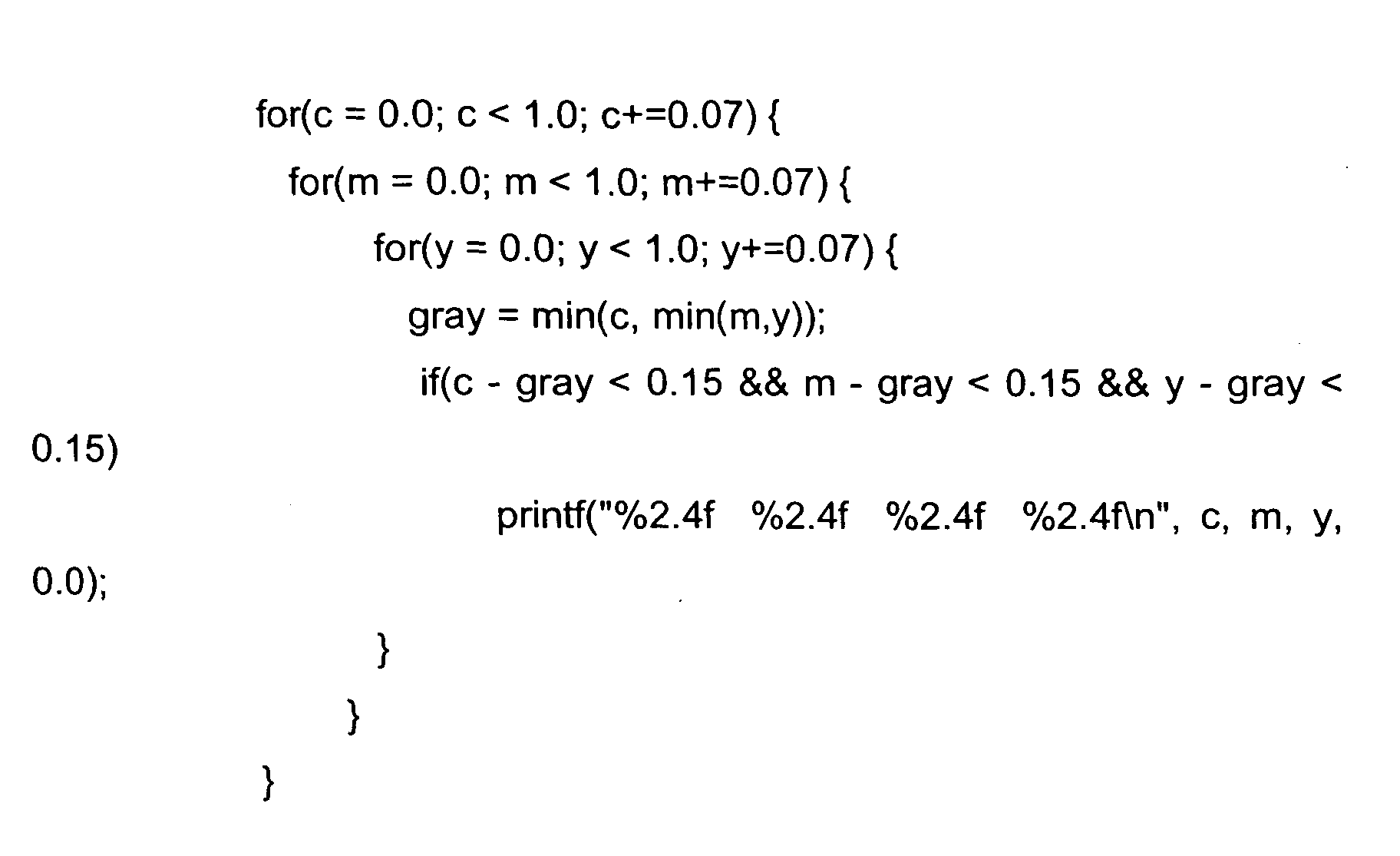
In a further embodiment modifying the CMY data values comprises:
determining a gray component of the CMY data values using:
modifying each of the CMY data values using:
Claims (10)
- A method of gray balancing comprising:determining a gray component in a set of CMY data values for a pixel;subtracting the gray component from the CMY data values to arrive at CMY color component values; andadding to the CMY color component values respective balanced gray values based on the gray component.
- The method of claim 1 wherein adding to the CMY respective balanced gray values comprises adding to the CMY color component values respective balanced gray values retrieved from a look-up table.
- The method of claim 1 wherein determining a gray component comprises defining a gray component as a minimum of the CMY data values.
- A method of gray balancing comprising:determining a gray component in CMY data values for a pixel;determining a relative amount of gray in the CMY data values; andmodifying each of the CMY data values as a function of the relative amount of gray in the CMY data values.
- The method of claim 4 wherein determining a gray component in CMY data values for a pixel comprises defining a gray component as a minimum of CMY data values.
- The method of claim 4 wherein determining a relative amount of gray comprises calculating a ratio between a minimum of the CMY data values and a maximum of the CMY data values.
- The method of claim 4 wherein:determining a gray component in CMY data values for a pixel comprises determining a gray component in CMY data values for a pixel using:modifying each of the CMY data values comprises modifying each of the CMY data values using:
- A method of gray balancing comprising:determining whether CMY data values for a pixel includes a gray component;modifying the CMY data values only if the CMY data values include a gray component.
- The method of claim 8 wherein determining whether CMY data values for a pixel includes a gray component comprises determining whether all of CMY data values for a pixel are non-zero.
- The method of claim 8 wherein modifying the CMY data values comprises:subtracting the gray component from the CMY data values to arrive at CMY color component values; andadding to the CMY color component values respective gray balanced values based on the gray component.
Applications Claiming Priority (2)
| Application Number | Priority Date | Filing Date | Title |
|---|---|---|---|
| US10/270,966 US7576885B2 (en) | 2002-10-15 | 2002-10-15 | Balancing grays on color printers |
| US270966 | 2002-10-15 |
Publications (2)
| Publication Number | Publication Date |
|---|---|
| EP1411715A2 true EP1411715A2 (en) | 2004-04-21 |
| EP1411715A3 EP1411715A3 (en) | 2006-02-08 |
Family
ID=32042905
Family Applications (1)
| Application Number | Title | Priority Date | Filing Date |
|---|---|---|---|
| EP03023265A Ceased EP1411715A3 (en) | 2002-10-15 | 2003-10-14 | Balancing grays on color printers |
Country Status (5)
| Country | Link |
|---|---|
| US (1) | US7576885B2 (en) |
| EP (1) | EP1411715A3 (en) |
| JP (1) | JP4327549B2 (en) |
| BR (1) | BR0304519A (en) |
| CA (1) | CA2444319C (en) |
Families Citing this family (5)
| Publication number | Priority date | Publication date | Assignee | Title |
|---|---|---|---|---|
| US8014024B2 (en) * | 2005-03-02 | 2011-09-06 | Xerox Corporation | Gray balance for a printing system of multiple marking engines |
| US7715044B2 (en) * | 2005-03-29 | 2010-05-11 | Xerox Corporation | Two-dimensional gray component replacement |
| US8149454B2 (en) * | 2005-06-09 | 2012-04-03 | Xerox Corporation | Color printing |
| JP4877279B2 (en) * | 2008-05-30 | 2012-02-15 | 富士ゼロックス株式会社 | Image processing apparatus and image processing program |
| US8937749B2 (en) | 2012-03-09 | 2015-01-20 | Xerox Corporation | Integrated color detection and color pixel counting for billing |
Family Cites Families (15)
| Publication number | Priority date | Publication date | Assignee | Title |
|---|---|---|---|---|
| DE3109190C2 (en) * | 1981-03-11 | 1985-07-11 | Dr.-Ing. Rudolf Hell Gmbh, 2300 Kiel | Process for the reproduction of colored originals in four-color printing with color removal |
| EP0741042B1 (en) * | 1992-09-30 | 2002-08-28 | Hewlett-Packard Company, A Delaware Corporation | Method of reducing ink migration in digital color printing |
| US5305119A (en) * | 1992-10-01 | 1994-04-19 | Xerox Corporation | Color printer calibration architecture |
| JP2741996B2 (en) | 1992-10-30 | 1998-04-22 | 大日本スクリーン製造株式会社 | How to create a normalized curve |
| US5604567A (en) * | 1994-06-03 | 1997-02-18 | Xerox Corporation | Printer color and gray balance adjustment system |
| US5710824A (en) * | 1996-03-13 | 1998-01-20 | Xerox Corporation | System to improve printer gamut |
| JPH1013697A (en) * | 1996-06-18 | 1998-01-16 | Canon Inc | Image processing apparatus and method |
| JPH10200765A (en) | 1997-01-08 | 1998-07-31 | Canon Inc | Image processing method and apparatus and recording apparatus |
| US6480299B1 (en) * | 1997-11-25 | 2002-11-12 | University Technology Corporation | Color printer characterization using optimization theory and neural networks |
| US6607258B2 (en) * | 2001-04-11 | 2003-08-19 | Hewlett-Packard Development Company, L.P. | Proofing data file generated by target printer facility |
| US7088470B2 (en) * | 2001-06-04 | 2006-08-08 | Hewlett-Packard Development Company, L.P. | All-device-space automatic black replacement |
| US7027185B2 (en) * | 2001-07-30 | 2006-04-11 | Hewlett-Packard Development Company, L.P. | Linearization of an incremental printer by measurements referred to a media-independent sensor calibration |
| US7190487B2 (en) * | 2001-09-25 | 2007-03-13 | Sharp Laboratories Of America, Inc. | Color conversion with hue straightening using multiple look-up tables and interpolation |
| EP1398956A1 (en) * | 2002-09-05 | 2004-03-17 | Hewlett Packard Company, a Delaware Corporation | 4-dimensional gray neutrality calibration |
| US7423778B2 (en) * | 2003-08-01 | 2008-09-09 | Ecole Polytechnique Federale De Lausanne (Epfl) | Prediction model for color separation, calibration and control of printers |
-
2002
- 2002-10-15 US US10/270,966 patent/US7576885B2/en not_active Expired - Lifetime
-
2003
- 2003-10-08 JP JP2003349228A patent/JP4327549B2/en not_active Expired - Fee Related
- 2003-10-08 CA CA2444319A patent/CA2444319C/en not_active Expired - Fee Related
- 2003-10-14 BR BR0304519-6A patent/BR0304519A/en not_active IP Right Cessation
- 2003-10-14 EP EP03023265A patent/EP1411715A3/en not_active Ceased
Also Published As
| Publication number | Publication date |
|---|---|
| JP4327549B2 (en) | 2009-09-09 |
| US20040070775A1 (en) | 2004-04-15 |
| US7576885B2 (en) | 2009-08-18 |
| EP1411715A3 (en) | 2006-02-08 |
| CA2444319A1 (en) | 2004-04-15 |
| CA2444319C (en) | 2012-04-24 |
| JP2004136676A (en) | 2004-05-13 |
| BR0304519A (en) | 2004-08-31 |
Similar Documents
| Publication | Publication Date | Title |
|---|---|---|
| EP0590921B1 (en) | Color printer calibration and printing method and corresponding printing system | |
| EP0820189B1 (en) | Method and apparatus for converting color space | |
| US6897988B1 (en) | Image processing apparatus, image processing method, and storage medium for color matching | |
| EP1638313B1 (en) | Calibration of color devices | |
| EP1365579A2 (en) | Image processing apparatus, method and program | |
| EP2421240B1 (en) | Image processing apparatus and image processing method | |
| US7453591B2 (en) | Color saturation adjustment | |
| EP1499108B1 (en) | Color saturation adjustment | |
| US7375849B2 (en) | Balancing grays on color printers | |
| CA2444319C (en) | Balancing grays on color printers | |
| JP2007049711A (en) | Color transformation method and color transformation system | |
| US8149454B2 (en) | Color printing | |
| US7417766B2 (en) | Calibration of color devices | |
| JP4215348B2 (en) | Method for converting non-printable color values into printable color values, an image reproduction system for reproducing a color image, and control means comprising color conversion means suitable for this image reproduction system | |
| WO2008124007A1 (en) | Adjusting colorants specified in a digital image | |
| JPH08331365A (en) | Image processing apparatus and method thereof |
Legal Events
| Date | Code | Title | Description |
|---|---|---|---|
| PUAI | Public reference made under article 153(3) epc to a published international application that has entered the european phase |
Free format text: ORIGINAL CODE: 0009012 |
|
| AK | Designated contracting states |
Kind code of ref document: A2 Designated state(s): AT BE BG CH CY CZ DE DK EE ES FI FR GB GR HU IE IT LI LU MC NL PT RO SE SI SK TR |
|
| AX | Request for extension of the european patent |
Extension state: AL LT LV MK |
|
| PUAL | Search report despatched |
Free format text: ORIGINAL CODE: 0009013 |
|
| AK | Designated contracting states |
Kind code of ref document: A3 Designated state(s): AT BE BG CH CY CZ DE DK EE ES FI FR GB GR HU IE IT LI LU MC NL PT RO SE SI SK TR |
|
| AX | Request for extension of the european patent |
Extension state: AL LT LV MK |
|
| 17P | Request for examination filed |
Effective date: 20060808 |
|
| AKX | Designation fees paid |
Designated state(s): DE FR GB |
|
| 17Q | First examination report despatched |
Effective date: 20070119 |
|
| STAA | Information on the status of an ep patent application or granted ep patent |
Free format text: STATUS: THE APPLICATION HAS BEEN REFUSED |
|
| 18R | Application refused |
Effective date: 20110509 |