EP1411498A1 - Method and apparatus for describing sound sources - Google Patents
Method and apparatus for describing sound sources Download PDFInfo
- Publication number
- EP1411498A1 EP1411498A1 EP20020022866 EP02022866A EP1411498A1 EP 1411498 A1 EP1411498 A1 EP 1411498A1 EP 20020022866 EP20020022866 EP 20020022866 EP 02022866 A EP02022866 A EP 02022866A EP 1411498 A1 EP1411498 A1 EP 1411498A1
- Authority
- EP
- European Patent Office
- Prior art keywords
- scene description
- audio
- audio objects
- objects
- scene
- Prior art date
- Legal status (The legal status is an assumption and is not a legal conclusion. Google has not performed a legal analysis and makes no representation as to the accuracy of the status listed.)
- Withdrawn
Links
- 238000000034 method Methods 0.000 title claims description 8
- 230000000694 effects Effects 0.000 description 3
- 241000238631 Hexapoda Species 0.000 description 1
- ZYXYTGQFPZEUFX-UHFFFAOYSA-N benzpyrimoxan Chemical compound O1C(OCCC1)C=1C(=NC=NC=1)OCC1=CC=C(C=C1)C(F)(F)F ZYXYTGQFPZEUFX-UHFFFAOYSA-N 0.000 description 1
- 230000001419 dependent effect Effects 0.000 description 1
Images

Classifications
-
- G—PHYSICS
- G10—MUSICAL INSTRUMENTS; ACOUSTICS
- G10L—SPEECH ANALYSIS TECHNIQUES OR SPEECH SYNTHESIS; SPEECH RECOGNITION; SPEECH OR VOICE PROCESSING TECHNIQUES; SPEECH OR AUDIO CODING OR DECODING
- G10L19/00—Speech or audio signals analysis-synthesis techniques for redundancy reduction, e.g. in vocoders; Coding or decoding of speech or audio signals, using source filter models or psychoacoustic analysis
Definitions
- the invention relates to a method and to an apparatus for describing sound sources, especially for sound sources encoded as audio objects according to the MPEG-4 Audio standard.
- the MPEG-4 Audio standard as defined in ISO/IEC 14496-3 and 14496-1 facilitates a wide variety of applications by supporting the representation of audio objects.
- the audio objects are decoded separately and composed using the scene description in order to prepare a single soundtrack, which is then played to the listener.
- BIFS Binary Format for Scene Description
- AudioBIFS AudioBIFS
- a scene description is structured hierarchically and can be represented as a graph, wherein leaf-nodes of the graph form the separate objects and the other nodes describes the processing, e.g. positioning, scaling, effects etc..
- the appearance and behavior of the separate objects can be controlled using parameters within the scene description nodes.
- the invention is based on the recognition of the following fact.
- the MPEG-4 Audio standard cannot describe sound sources that have a certain dimension, like a choir, orchestra, sea or rain but only a point source, e.g. a flying insect, or a single instrument. According to listening tests wideness of sound sources is clearly audible, whereby more complicate descriptions like the shape of the audio object is not necessary.
- a problem to be solved by the invention is to allow the description of the wideness of sound sources that have a certain dimension in a simple and backwards compatible way.
- the inventive method allows to describe sound sources, which are encoded as separate audio objects.
- the arrangement of the sound sources in a sound scene is described by a scene description.
- the audio objects are decoded separately and a single soundtrack is composed from the decoded audio objects using said scene description.
- an audio spatial diffuseness node is defined within the scene description.
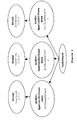
- Figure 1 shows an illustration of the functionality of the inventive AudioSpatialDiffuseness node.
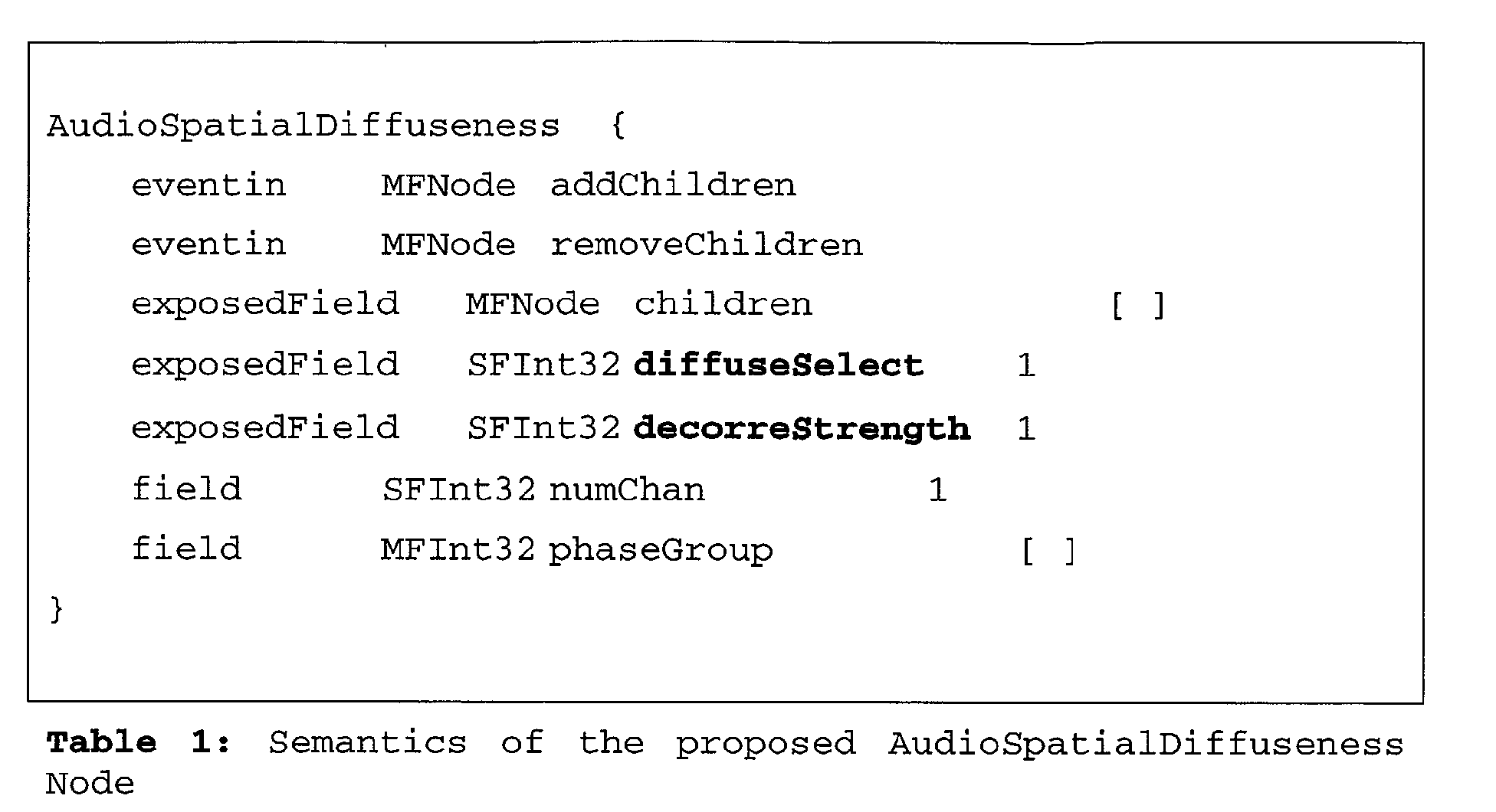
- This AudioSpatialDiffuseness node will have a children field as input and will produce the same number of channels (numChan) as output. Branches that are connected to an upper level branch are called children in MPEG-4 terms. It can be inserted in each branch of the audio subtree, without changing any other node.
- a diffuseSelection field will allow the scene author to control the diffuseness algorithms, so that each AudioSpatialDiffuseness node will produce a different output.
- a diffuseness node will virtual produce N different signals, but only one real signal is passed through to the output of the node, signaled by the diffuseSelect field.
- Other fields like a decorrelation strength (decorrStrength) etc. could be added to the node, if required.
- each channel should be diffused separately.
- Figure 2 depicts an Audio Scene for a Line Sound Source.
- the scene author has to decide how many and at which position the decorrelated multiple point sound sources will be located.
- the advantage is, that the content author has much more control over the shape effect. He can also use intensity and direction of each point source as well as using the AudioDelay and AudioEffects node for certain Sound nodes to manipulate the effect. It is still possible for the renderer to reduce the computational power by passing the scene tree to look for identical AudioSources.
Landscapes
- Engineering & Computer Science (AREA)
- Computational Linguistics (AREA)
- Signal Processing (AREA)
- Health & Medical Sciences (AREA)
- Audiology, Speech & Language Pathology (AREA)
- Human Computer Interaction (AREA)
- Physics & Mathematics (AREA)
- Acoustics & Sound (AREA)
- Multimedia (AREA)
- Stereophonic System (AREA)
Abstract
The MPEG-4 Audio standard as defined in ISO/IEC 14496-1 and
- 3 facilitates a wide variety of applications by supporting
the representation of audio objects. For the combination of
the audio objects additional information - the so-called
scene description - determines the placement in space and
time and is transmitted together with the coded audio objects.
For playback the audio objects are decoded separately and
composed using the scene description in order to prepare a
single soundtrack, which is then played to the listener. A
scene description is structured hierarchically and can be
represented as a graph, wherein nodes of the graph form the
separate objects. The appearance and behaviour of the separate
objects can be controlled using parameters within the
scene description nodes. For describing the wideness of a
sound source an audio diffuseness node is defined within
the scene description.
Description
- The invention relates to a method and to an apparatus for describing sound sources, especially for sound sources encoded as audio objects according to the MPEG-4 Audio standard.
- The MPEG-4 Audio standard as defined in ISO/IEC 14496-3 and 14496-1 facilitates a wide variety of applications by supporting the representation of audio objects. For the combination of the audio objects additional information - the so-called scene description - determines the placement in space and time and is transmitted together with the coded audio objects.
For playback the audio objects are decoded separately and composed using the scene description in order to prepare a single soundtrack, which is then played to the listener. - For efficiency, the MPEG-4 Systems standard ISO/IEC 14496-1defines a way to encode the scene description in a binary representation, the so-called Binary Format for Scene Description (BIFS). Correspondingly, audio scenes are described using so-called AudioBIFS.
- A scene description is structured hierarchically and can be represented as a graph, wherein leaf-nodes of the graph form the separate objects and the other nodes describes the processing, e.g. positioning, scaling, effects etc.. The appearance and behavior of the separate objects can be controlled using parameters within the scene description nodes.
- The invention is based on the recognition of the following fact. Currently the MPEG-4 Audio standard cannot describe sound sources that have a certain dimension, like a choir, orchestra, sea or rain but only a point source, e.g. a flying insect, or a single instrument. According to listening tests wideness of sound sources is clearly audible, whereby more complicate descriptions like the shape of the audio object is not necessary.
- Therefore, a problem to be solved by the invention is to allow the description of the wideness of sound sources that have a certain dimension in a simple and backwards compatible way.
- This problem is solved by the method disclosed in
claim 1 and the corresponding apparatus in claim 4. - In principle, the inventive method allows to describe sound sources, which are encoded as separate audio objects. The arrangement of the sound sources in a sound scene is described by a scene description. For playback the audio objects are decoded separately and a single soundtrack is composed from the decoded audio objects using said scene description. For describing the wideness of a sound source an audio spatial diffuseness node is defined within the scene description.
- Advantageous additional embodiments of the invention are disclosed in the respective dependent claims.
- Exemplary embodiments of the invention are described with reference to the accompanying drawings, which show in
- Fig. 1
- the illustration of the functionality of the AudioSpatialDiffuseness mode;
- Fig. 2
- an Audio Scene for a Line Sound Source.
- Figure 1 shows an illustration of the functionality of the inventive AudioSpatialDiffuseness node.
- This AudioSpatialDiffuseness node will have a children field as input and will produce the same number of channels (numChan) as output. Branches that are connected to an upper level branch are called children in MPEG-4 terms. It can be inserted in each branch of the audio subtree, without changing any other node.
- A diffuseSelection field will allow the scene author to control the diffuseness algorithms, so that each AudioSpatialDiffuseness node will produce a different output. In practice a diffuseness node will virtual produce N different signals, but only one real signal is passed through to the output of the node, signaled by the diffuseSelect field. Other fields like a decorrelation strength (decorrStrength) etc. could be added to the node, if required.
- In the case of numChan greater than one each channel should be diffused separately.
- Figure 2 depicts an Audio Scene for a Line Sound Source. By using this proposal the scene author has to decide how many and at which position the decorrelated multiple point sound sources will be located. The advantage is, that the content author has much more control over the shape effect. He can also use intensity and direction of each point source as well as using the AudioDelay and AudioEffects node for certain Sound nodes to manipulate the effect.
It is still possible for the renderer to reduce the computational power by passing the scene tree to look for identical AudioSources.

Claims (4)
- Method for describing sound sources, which are encoded as separate audio objects, wherein the arrangement of the sound sources in a sound scene is described by a scene description, and wherein for playback the audio objects are decoded separately and a single soundtrack is composed from the decoded audio objects using said scene description, characterized by an audio diffuseness node which is defined within the scene description for describing the wideness of a sound source.
- Method according to claim 1, wherein a diffuse selection field will allow the scene author to control the diffuseness algorithms.
- Method according to claim 1 or 2, wherein a decorrelation strength field will allow author to control the strenght of the decorrelation.
- Apparatus for performing a method according to any of claims 1 to 3.
Priority Applications (13)
| Application Number | Priority Date | Filing Date | Title |
|---|---|---|---|
| EP20020022866 EP1411498A1 (en) | 2002-10-14 | 2002-10-14 | Method and apparatus for describing sound sources |
| EP03757948A EP1570462B1 (en) | 2002-10-14 | 2003-10-10 | Method for coding and decoding the wideness of a sound source in an audio scene |
| JP2005501282A JP4751722B2 (en) | 2002-10-14 | 2003-10-10 | Method for encoding and decoding the wideness of a sound source in an audio scene |
| CN2003801013259A CN1973318B (en) | 2002-10-14 | 2003-10-10 | Method and device for coding and decoding the presentation of an audio signal |
| DE60312553T DE60312553T2 (en) | 2002-10-14 | 2003-10-10 | PROCESS FOR CODING AND DECODING THE WIDTH OF A SOUND SOURCE IN AN AUDIOSCENE |
| AU2003273981A AU2003273981A1 (en) | 2002-10-14 | 2003-10-10 | Method for coding and decoding the wideness of a sound source in an audio scene |
| AT03757948T ATE357043T1 (en) | 2002-10-14 | 2003-10-10 | METHOD FOR ENCODING AND DECODING THE WIDTH OF A SOUND SOURCE IN AN AUDIO SCENE |
| BRPI0315326A BRPI0315326B1 (en) | 2002-10-14 | 2003-10-10 | Method for encoding and decoding the width of a sound source in an audio scene |
| PCT/EP2003/011242 WO2004036548A1 (en) | 2002-10-14 | 2003-10-10 | Method for coding and decoding the wideness of a sound source in an audio scene |
| KR1020057006371A KR101004836B1 (en) | 2002-10-14 | 2003-10-10 | Methods for coding and decoding the wideness of sound sources in audio scenes |
| ES03757948T ES2283815T3 (en) | 2002-10-14 | 2003-10-10 | METHOD FOR CODING AND DECODING THE WIDTH OF A SOUND SOURCE IN AN AUDIO SCENE. |
| US10/530,881 US8437868B2 (en) | 2002-10-14 | 2003-10-10 | Method for coding and decoding the wideness of a sound source in an audio scene |
| JP2010095347A JP2010198033A (en) | 2002-10-14 | 2010-04-16 | Method for coding and decoding wideness of sound source in audio scene |
Applications Claiming Priority (1)
| Application Number | Priority Date | Filing Date | Title |
|---|---|---|---|
| EP20020022866 EP1411498A1 (en) | 2002-10-14 | 2002-10-14 | Method and apparatus for describing sound sources |
Publications (1)
| Publication Number | Publication Date |
|---|---|
| EP1411498A1 true EP1411498A1 (en) | 2004-04-21 |
Family
ID=32039126
Family Applications (1)
| Application Number | Title | Priority Date | Filing Date |
|---|---|---|---|
| EP20020022866 Withdrawn EP1411498A1 (en) | 2002-10-14 | 2002-10-14 | Method and apparatus for describing sound sources |
Country Status (1)
| Country | Link |
|---|---|
| EP (1) | EP1411498A1 (en) |
Cited By (1)
| Publication number | Priority date | Publication date | Assignee | Title |
|---|---|---|---|---|
| CN116110387A (en) * | 2022-12-19 | 2023-05-12 | 达闼科技(北京)有限公司 | A multi-modal information transmission method, device, equipment and storage medium |
-
2002
- 2002-10-14 EP EP20020022866 patent/EP1411498A1/en not_active Withdrawn
Non-Patent Citations (3)
| Title |
|---|
| BAUER S ET AL: "DER MULTIMEDIA-STANDARD MPEG-4 UND SEINE ANWENDUNGEN IM MINT-PROJEKT", FERNMELDE-INGENIEUR, BAD WINSHEIM, DE, vol. 52, no. 11/12, November 1998 (1998-11-01), pages 43 - 64, XP000997456, ISSN: 0015-010X * |
| CONVENOR: "Coding of moving pictures and audio, ISO/IEC JTC1/SC29/WG11/N4907", ORGANISATION INTERNATIONALE DE NORMALISATION, July 2002 (2002-07-01), Klagenfurt, DE, XP002239259 * |
| PURNHAGEN H.: "An overview of MPEG-4 audio version 2", AES 17TH INTERNATIONAL CONFERENCE ON HIGH QUALITY AUDIO CODING, 2 September 1999 (1999-09-02) - 5 September 1999 (1999-09-05), Italy, XP002239258 * |
Cited By (1)
| Publication number | Priority date | Publication date | Assignee | Title |
|---|---|---|---|---|
| CN116110387A (en) * | 2022-12-19 | 2023-05-12 | 达闼科技(北京)有限公司 | A multi-modal information transmission method, device, equipment and storage medium |
Similar Documents
| Publication | Publication Date | Title |
|---|---|---|
| US8437868B2 (en) | Method for coding and decoding the wideness of a sound source in an audio scene | |
| US12010502B2 (en) | Apparatus and method for audio rendering employing a geometric distance definition | |
| US8239209B2 (en) | Method and apparatus for decoding an audio signal using a rendering parameter | |
| CN102165797B (en) | Device and method for determining space to output multi-channel audio signal | |
| EP2437257B1 (en) | Saoc to mpeg surround transcoding | |
| JP5525527B2 (en) | Apparatus for determining a transformed spatial audio signal | |
| KR101004249B1 (en) | How to explain the composition of audio signals | |
| US20110166681A1 (en) | System and method for transmitting/receiving object-based audio | |
| WO2007083958A1 (en) | Method and apparatus for decoding a signal | |
| EP3161820B1 (en) | Method and apparatus for determining for the compression of an hoa data frame representation a lowest integer number of bits required for representing non-differential gain values | |
| CN101361115A (en) | Method and apparatus for decoding a signal | |
| Riedmiller et al. | Delivering scalable audio experiences using AC-4 | |
| KR100626661B1 (en) | Method of Processing 3D Audio Scene with Extended Spatiality of Sound Source | |
| US7894610B2 (en) | Method for coding and decoding impulse responses of audio signals | |
| KR100717842B1 (en) | Interactive multimedia content encoding device and decoding device using parametric scene description information | |
| JP2001236084A (en) | Sound signal processor and signal separating device used for the processor | |
| Terentiev et al. | SAOC for gaming–The upcoming MPEG standard on parametric object based audio coding | |
| ZA200503594B (en) | Method for describing the composition of audio signals | |
| HK1233105A1 (en) | Apparatus and method for audio rendering employing a geometric distance definition | |
| HK1233105B (en) | Apparatus and method for audio rendering employing a geometric distance definition |
Legal Events
| Date | Code | Title | Description |
|---|---|---|---|
| PUAI | Public reference made under article 153(3) epc to a published international application that has entered the european phase |
Free format text: ORIGINAL CODE: 0009012 |
|
| AK | Designated contracting states |
Kind code of ref document: A1 Designated state(s): AT BE BG CH CY CZ DE DK EE ES FI FR GB GR IE IT LI LU MC NL PT SE SK TR |
|
| AX | Request for extension of the european patent |
Extension state: AL LT LV MK RO SI |
|
| AKX | Designation fees paid | ||
| REG | Reference to a national code |
Ref country code: DE Ref legal event code: 8566 |
|
| STAA | Information on the status of an ep patent application or granted ep patent |
Free format text: STATUS: THE APPLICATION IS DEEMED TO BE WITHDRAWN |
|
| 18D | Application deemed to be withdrawn |
Effective date: 20041022 |