EP1411131A1 - Process for producing template dna and process for producing protein in cell-free protein synthesis system with the use of the same - Google Patents
Process for producing template dna and process for producing protein in cell-free protein synthesis system with the use of the same Download PDFInfo
- Publication number
- EP1411131A1 EP1411131A1 EP02736176A EP02736176A EP1411131A1 EP 1411131 A1 EP1411131 A1 EP 1411131A1 EP 02736176 A EP02736176 A EP 02736176A EP 02736176 A EP02736176 A EP 02736176A EP 1411131 A1 EP1411131 A1 EP 1411131A1
- Authority
- EP
- European Patent Office
- Prior art keywords
- dna fragment
- pcr
- protein
- dna
- sequence
- Prior art date
- Legal status (The legal status is an assumption and is not a legal conclusion. Google has not performed a legal analysis and makes no representation as to the accuracy of the status listed.)
- Granted
Links
Images


Classifications
-
- C—CHEMISTRY; METALLURGY
- C12—BIOCHEMISTRY; BEER; SPIRITS; WINE; VINEGAR; MICROBIOLOGY; ENZYMOLOGY; MUTATION OR GENETIC ENGINEERING
- C12N—MICROORGANISMS OR ENZYMES; COMPOSITIONS THEREOF; PROPAGATING, PRESERVING, OR MAINTAINING MICROORGANISMS; MUTATION OR GENETIC ENGINEERING; CULTURE MEDIA
- C12N15/00—Mutation or genetic engineering; DNA or RNA concerning genetic engineering, vectors, e.g. plasmids, or their isolation, preparation or purification; Use of hosts therefor
- C12N15/09—Recombinant DNA-technology
- C12N15/10—Processes for the isolation, preparation or purification of DNA or RNA
-
- C—CHEMISTRY; METALLURGY
- C12—BIOCHEMISTRY; BEER; SPIRITS; WINE; VINEGAR; MICROBIOLOGY; ENZYMOLOGY; MUTATION OR GENETIC ENGINEERING
- C12Q—MEASURING OR TESTING PROCESSES INVOLVING ENZYMES, NUCLEIC ACIDS OR MICROORGANISMS; COMPOSITIONS OR TEST PAPERS THEREFOR; PROCESSES OF PREPARING SUCH COMPOSITIONS; CONDITION-RESPONSIVE CONTROL IN MICROBIOLOGICAL OR ENZYMOLOGICAL PROCESSES
- C12Q1/00—Measuring or testing processes involving enzymes, nucleic acids or microorganisms; Compositions therefor; Processes of preparing such compositions
- C12Q1/68—Measuring or testing processes involving enzymes, nucleic acids or microorganisms; Compositions therefor; Processes of preparing such compositions involving nucleic acids
- C12Q1/6844—Nucleic acid amplification reactions
- C12Q1/6865—Promoter-based amplification, e.g. nucleic acid sequence amplification [NASBA], self-sustained sequence replication [3SR] or transcription-based amplification system [TAS]
-
- C—CHEMISTRY; METALLURGY
- C07—ORGANIC CHEMISTRY
- C07K—PEPTIDES
- C07K2319/00—Fusion polypeptide
- C07K2319/20—Fusion polypeptide containing a tag with affinity for a non-protein ligand
- C07K2319/21—Fusion polypeptide containing a tag with affinity for a non-protein ligand containing a His-tag
-
- C—CHEMISTRY; METALLURGY
- C07—ORGANIC CHEMISTRY
- C07K—PEPTIDES
- C07K2319/00—Fusion polypeptide
- C07K2319/20—Fusion polypeptide containing a tag with affinity for a non-protein ligand
- C07K2319/22—Fusion polypeptide containing a tag with affinity for a non-protein ligand containing a Strep-tag
-
- C—CHEMISTRY; METALLURGY
- C07—ORGANIC CHEMISTRY
- C07K—PEPTIDES
- C07K2319/00—Fusion polypeptide
- C07K2319/20—Fusion polypeptide containing a tag with affinity for a non-protein ligand
- C07K2319/23—Fusion polypeptide containing a tag with affinity for a non-protein ligand containing a GST-tag
-
- C—CHEMISTRY; METALLURGY
- C07—ORGANIC CHEMISTRY
- C07K—PEPTIDES
- C07K2319/00—Fusion polypeptide
- C07K2319/35—Fusion polypeptide containing a fusion for enhanced stability/folding during expression, e.g. fusions with chaperones or thioredoxin
Definitions
- the present invention relates to a method of producing a template DNA for protein synthesis and a method of producing a protein using a template DNA that is produced by the method.
- cell-free protein synthesis systems As a system for expressing and preparing a number of protein samples at good efficiency, cell-free protein synthesis systems have been improved by various modifications such as introduction of dialysis, to obtain proteins in the order of milligrams within several hours (refer to Kigawa et al ., FEBS Lett., vol. 442, pp. 15-19, 1999 and Japanese Patent Kokai publication JP-A-2000-175695).
- a double-stranded DNA containing an appropriate expression regulatory region and a gene sequence coding for a target protein to be expressed is needed as a template DNA.
- the present inventors have assiduously conducted investigations on a method of producing a template DNA in a cell-free protein synthesis system, and have consequently found that a linear template DNA appropriate for expression of a protein can be synthesized very quickly and efficiently by amplifying an optional cloned DNA selected from cDNA library through 2-step PCR. This finding has led to the completion of the invention.
- a method of producing a template DNA used for protein synthesis comprising a step of:
- the invention is characterized in that the reaction solution (second PCR solution) comprises first PCR products obtained by polymerase chain reaction (first PCR) to amplify the first double-stranded DNA fragment, and the respective concentrations of primers remaining in the first PCR products and primer dimers produced in the first PCR are less than 20 nmol/L in the second PCR solution.
- first PCR polymerase chain reaction
- the invention is characterized in that for decreasing the amounts, incorporated into the second PCR, of primers used in the first PCR and primer dimers produced as byproducts, the concentrations of the primers used for the first PCR are in the range of from 20 to 500 nmol/L, or the second PCR is performed with the first PCR products which are diluted to 10- to 100-fold (at a final concentration in the second PCR solution), or both of these are performed in combination, or the second PCR is performed after removing the primers and the primer dimers from the first PCR solution.
- the invention is characterized in that the first PCR is carried out using recombinant microorganisms or a culture broth thereof comprising the first double-stranded DNA fragment.
- the invention is characterized in that the sense primer and the anti-sense primer have the same nucleotide sequence, and/or the second DNA fragment comprises a transcription termination sequence.
- the invention is characterized in that at least one of the second DNA fragment and the third DNA fragment comprises a sequence coding for a tag peptide, and the tag peptide is synthesized by being fused with the protein or a portion thereof.
- the tag peptide is preferably maltose binding protein, cellulose binding domain, glutathione-S-transferase, thioredoxin, streptavidin binding peptide or histidine tag peptide.
- the invention provides, in another aspect, a method of producing a protein in a cell-free protein synthesis system, characterized by using a template DNA that is produced by any of the foregoing methods.
- Fig. 1 is a flow chart showing a method of producing a linear double-stranded template DNA for protein synthesis by 2-step PCR using a plasmid DNA with a full-length cDNA cloned.
- any template DNA will be used, so long as it comprises a sequence coding for a desired protein.
- a DNA cloned from cDNA library but also a genomic DNA clone or a synthetic DNA can be used.
- an unpurified DNA is also available.
- a strain carrying a plasmid vector comprising the foregoing sequence or a culture broth of the strain can be used.
- Fig. 1 shows modified bluescript 1 which is a plasmid obtained by cloning mouse full-length cDNA in Sac I and XhoI sites of plasmid vector pBLUESCRIPT SK+.
- two primers (5'-primer 1 and 5'-primer 2) are used as 5'-primers for amplifying a protein code region of a cloned cDNA.
- a nucleotide sequence of the 5'-primer 2 is designed to anneal with a nucleotide sequence corresponding to an amino terminal region of the protein encoded by the cloned cDNA.
- the 5'-primer 2 can further contain an arbitrary nucleotide sequence in the 5'-terminal side.
- the 5'-primer 1 may have a sequence common to a part of the 5'-terminal side of the 5'-primer 2, and both of the primers overlap to function as the 5'-primers of the first PCR.
- the 3'-primer is designed to anneal with a region of the plasmid vector where is located in the 3' downstream of the protein coding region, and elongates the DNA chain by PCR together with the 5'-primers to amplify the first DNA fragment coding for the protein to be expressed. Since the first DNA fragment is used as a template of the second PCR to be described later, it can be purified from the PCR reaction solution by a known method, or the PCR reaction solution can also be used directly. In this case, the primers remaining in the reaction solution might inhibit the second PCR reaction.
- the amounts, incorporated into the second PCR solution, of primers used in the first PCR and primer dimers produced as byproducts in the first PCR are decreased to less than 20 nmol/L.
- primers used as the 5'-primer or the 3'-primer they are preferably used at a total concentration of from 20 to 500 nmol/L, more preferably from 50 to 100 nmol/L.
- the amounts, incorporated into the second PCR, of the primers and the primer dimers can be reduced by diluting the first PCR solution to 10- to 100-fold.
- PCR using various primers is possible for obtaining the first DNA fragment.
- nucleotide sequences of primers, PCR reaction conditions and the like employed at that time ordinary ones are available, and it is desirable to properly determine them by those skilled in the art. It is further possible to obtain the first DNA fragment by excising a DNA fragment directly from the cDNA clone with a restriction enzyme or the like.
- the double-stranded second DNA fragment (hereinafter sometimes referred to as "5' DNA fragment") comprising a sequence overlapping with the 5' terminal region of the first DNA fragment is prepared.
- the second DNA fragment overlaps with the 5' terminal region of the first DNA fragment in its 3' terminal region, whereby these two DNA fragments mutually become primers and a template to allow an elongation reaction, producing a template DNA in the second PCR.
- the overlapping region is preferably at least 12 base pairs, more preferably at least 17 bases.
- the double-stranded third DNA fragment (hereinafter sometimes referred to as "3' DNA fragment") comprising a sequence overlapping with the 3' terminal region of the first DNA fragment is produced.
- the third DNA fragment overlaps with the 3' terminal region of the first DNA fragment in its 5' terminal region, whereby these two DNA fragments mutually become primers and a template to allow an elongation reaction, producing a template DNA in the second PCR.
- the overlapping region is preferably at least 12 base pairs, more preferably at least 17 bases.
- the sense primer which anneals with the 5' terminal region of the 5' DNA fragment and the anti-sense primer which anneals with the 3' terminal region of the 3' DNA fragment are synthesized.
- These primers may anneal with the template DNA of the second PCR to allow a DNA elongation reaction and amplify a desired DNA fragment.
- Plural primers that anneal with the both terminal regions of the template DNA can be used.
- an amplification reaction is possible with one type of a primer (universal primer) as shown in Fig. 1.
- This primer usually comprises a single-stranded oligonucleotide of from 5 to 50 bases, preferably a single-stranded oligonucleotide of from 15 to 25 bases.
- the use of one type of a universal primer is more advantageous than the use of two types of primers because byproducts are less formed by PCR.
- primer dimers in which primers are paired are formed by PCR.
- primer dimers once formed serve as a template DNA to amplify the byproducts and decrease amounts of primers used for amplification of a desired product. Consequently, an amount of a desired product is considered to be decreased.
- PCR is performed using only one type of a primer, it is considered that the resulting primer dimers tend to take a hairpin structure because they have complementary sequences in the same molecule, and are therefore less amplified by PCR to less form byproducts.
- the 5' DNA fragment contains sequences of inducing and regulating transcription and translation of a gene in the upstream of the region overlapping with the first DNA fragment.
- the sequences of inducing and regulating the transcription of the gene are called promoter and operator sequences, and they have been studied in detail in prokaryotic cells and eukaryotic cells such as Escherichia coli and yeasts.
- T7 promoter derived from a phage of Escherichia coli is used. It is known that in T7 promoter, potent transcription is performed with T7 RNA polymerase.
- Translation of an mRNA into a protein is induced by binding a translation initiation complex of a ribosome or the like to an mRNA.
- a ribosome binding sequence (RBS) is called an SD sequence, and important for efficient expression of a protein.
- these expression regulatory sequences contain, in the upstream, the sequence with which the sense primer anneals in PCR.
- the nucleotide sequence of the sense primer here may be one which serves as a primer by being hybridized with the 5' terminal region of the 5' DNA fragment, and it includes one in which one or more bases in the sequence complementary to the template DNA are deleted, substituted or added.
- the 3' DNA fragment contains, in the 3' terminal region, the sequence with which the anti-sense primer anneals in PCR.
- the anti-sense primer may be one which serves as a primer by being hybridized with the 3' terminal region of the 3' DNA fragment, and it includes one in which one or more bases in the sequence complementary to the template DNA are deleted, substituted or added.
- the concentrations of the 5' DNA fragment and the 3' DNA fragment in the reaction solution of the second PCR are preferably lower than the concentrations of primer DNAs in usual PCR, and they are used at concentrations of from 5 to 2,500 pmol/L, preferably from 10 to 500 pmol/L.
- concentrations of these DNA fragments are higher than 2,500 pmol/L, byproducts tend to be formed during PCR. That is, single-stranded DNAs produced from the universal primer bound to the 5' DNA fragment and the 3' DNA fragment are bound in the same manner as the foregoing primer dimers, with the result that byproducts in which the 5' DNA fragment and the 3' DNA fragment are directly bound tend to be formed.
- these byproducts are shorter than the desired products, they tend to be amplified by PCR, act as a template that expresses only short proteins in the protein synthesis, and have therefore an adverse effect on the protein synthesis.
- the concentrations of the DNA fragments are lower than 5 pmol/L, the amount of a DNA that serves as a template itself is decreased, and a sufficient amount of a desired DNA is not amplified.
- the other reaction conditions of the second PCR can properly be selected and used by those skilled in the art.
- the 3' DNA fragment further comprises a transcription termination sequence.
- the transcription termination sequence is a DNA sequence of prompting separation of an RNA polymerase, and it has generally a characteristic structure of a symmetrical sequence enriched in GC and followed by T to allow an efficient transcription reaction.
- the second PCR can be performed even with one or both of the 5' DNA fragment and the 3' DNA fragment being single-stranded DNA (s) instead of the double-stranded DNA (s), and this embodiment is also included in the scope of the invention.
- the 5' DNA fragment and the 3' DNA comprises a sequence coding for a tag peptide.
- the tag peptide is an amino acid sequence added to an N terminal and/or a C terminal of a protein to be expressed, and this is a sequence as a mark in affinity purification or western blotting detection of the protein. Examples thereof include glutathione-S-transferase (GST), maltose binding protein (MBP), thioredoxin (TrxA), cellulose binding domain (CBD), streptavidin binding peptide (for example, Streptag (trademark)) and histidine tag peptide.
- GST glutathione-S-transferase
- MBP maltose binding protein
- TrxA thioredoxin
- CBD cellulose binding domain
- streptavidin binding peptide for example, Streptag (trademark)
- histidine tag peptide for example, Streptag (trademark)
- Glutathione-S-transferase is a soluble enzyme protein.
- a fusion protein with GST can be expressed.
- Recombinant vectors pGEX Vectors for this purpose are commercially available from Amersham Pharmacia Biotech. It is used for affinity purification or enzymatic immunostaining by utilizing an antibody that specifically recognizes a protein portion of GST or a property of binding to glutathione.
- the maltose binding protein is maltose binding protein of Escherichia coli.
- a fusion protein with MBP can be adsorbed on amylose or agarose gel, then separated with excess maltose and purified. Further, anti-MBP antibody can also be used.
- Thioredoxin is a protein of Escherichia coli that catalyzes a redox reaction, and can be purif ied by metal chelate affinity chromatography with a pair of functional thiol groups.
- ThioBond (trademark) Resin manufactured by Invitrogen is commercially available.
- the cellulose binding domain is a cellulose binding domain sequence derived from Clostridium cellulovorans and Cellulomonasfini , and has a property of specifically binding to cellulose. It can be immobilized on an inert carrier such as cellulose or chitin without chemical modification.
- streptavidin binding peptide for example, a peptide made of 8 amino acids, called Strep-tag II, is known, and it can be purified by being bound selectively to StrepTactin (trade mark) or Streptavidine (trademark).
- the histidine tag a peptide comprising at least 6 histidines which are located continuously or in close proximity is preferable.
- the protein encoded by the first DNA fragment is bound to this histidine tag either directly or through an amino acid sequence.
- the histidine tag has a high affinity for a divalent metallic atom, especially, a nickel atom. Accordingly, the protein having the histidine tag is firmly bound to a nickel affinity matrix and can easily be purified.
- the histidine tag has an amino acid sequence described in SEQ ID No. 1.
- This sequence is a natural sequence (native His tag) derived from an N terminal of a lactic acid hydrogenase of a chicken muscle. Since the 6 histidine residues being basic amino acids are present by being properly separated, this is advantageously lower in isoelectric point than the histidine tag comprising the continuous 6 histidine residues and enables affinity purification under neutral buffer conditions.
- these tag peptides are useful for affinity purification or detection of the expressed protein.
- the fusion protein with the tag peptide is sometimes increased in expression amount in comparison to natural proteins. The reason is, though not clear, presumably that a complex with an mRNA, ribosome or the like is stabilized at the translation initiation stage to increase translation efficiency.
- tag sequences may contain, in the downstream thereof, a nucleotide sequence that can provide a cleavage site of a protease such as thrombin, Factor Xa or enterokinase, and a desired protein can be purified by being separated from the tag sequences.
- a protease such as thrombin, Factor Xa or enterokinase
- tag sequences are located on the C terminal side of the desired protein and purification can easily be conducted while a function of a leader sequence of the N terminal side remains.
- the thus-produced template DNA can synthesize a protein by various methods.
- a protein is synthesized in a cell-free protein synthesis system.
- the cell-free protein synthesis system is a system that synthesizes a protein in vitro using a cell extract.
- an extract of hitherto-known eukaryotic cells or prokaryotic cells, containing ingredients necessary for protein synthesis, such as ribosome and t-RNA, can be used.
- a cell extract derived from wheat germ, Escherichia coli (for example, E. coli S30 cell extract) or Thermus thermophilus is preferable because a high synthesis amount is obtained. This E. coli S30 cell extract can be produced from E.
- coli A19 (rna met), BL21, BL21 star, BL21 codon plus or the like according to a known method (refer to Pratt. J. M. et al ., Transcription and translation - a practical approach, (1984), pp. 179-209, compiled by Henes, B. D. and Higgins, S. J., IRL Press, Oxford), or a product marketed from Promega, Novagen or Roche may be used.
- any of a batchwise method, a flow method and other known techniques can be applied to the cell-free protein synthesis system of the invention.
- Examples thereof can include a ultrafiltration membrane method, a dialysis membrane method, and a column chromatography method in which a translation template is fixed on a resin (refer to Spirin, A. et al ., Meth. In Enzymol. vol. 217, pp. 123 - 142, 1993).
- a template DNA is introduced into animal cells through lipofection or the like to express a gene, and a function of the gene product in viable cells is analyzed.
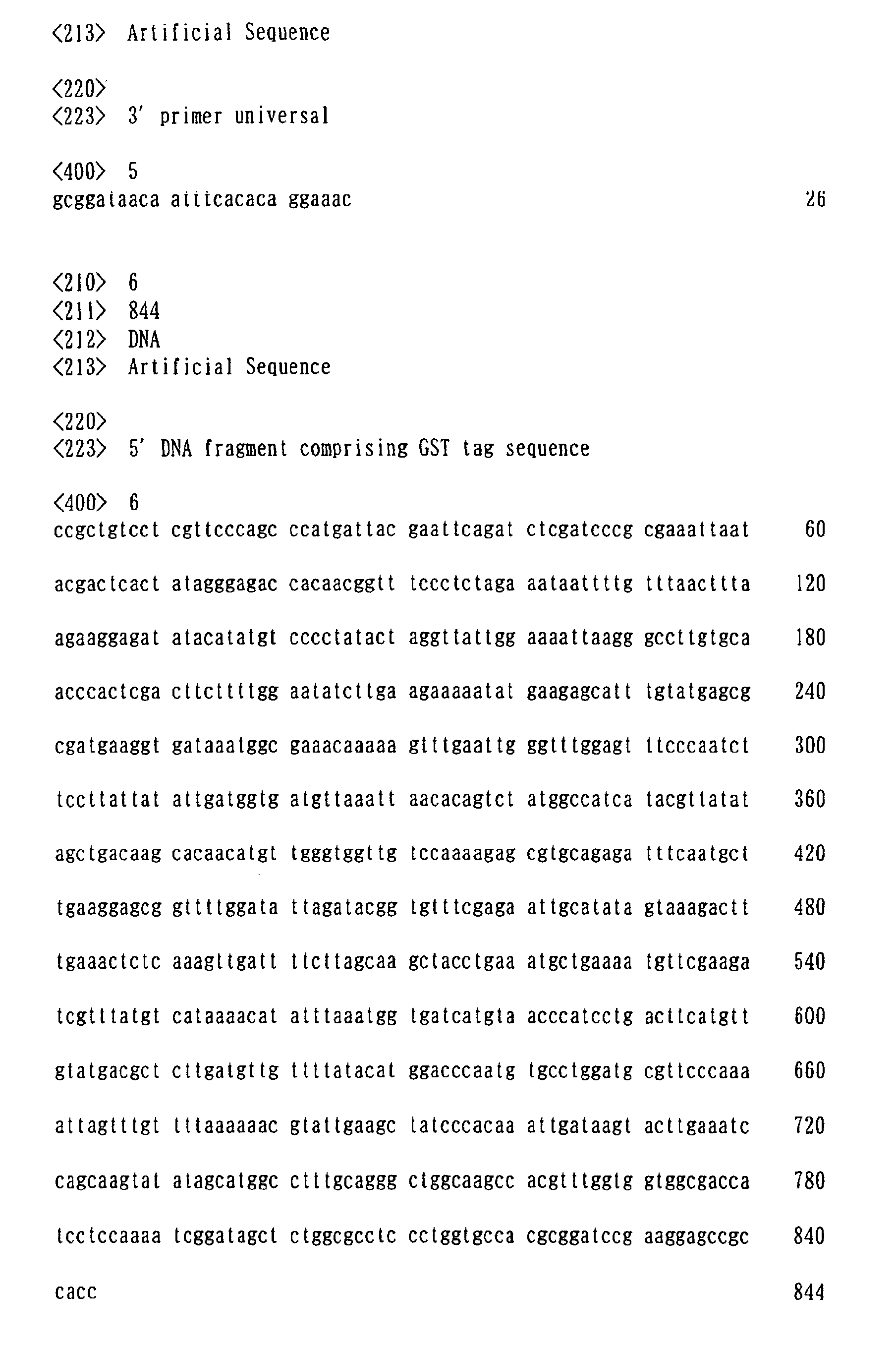
- PCR was performed using a linear double-stranded DNA (nucleotide sequence was described in SEQ ID No. 2) coding for Ras protein as a template and three types of primers, 5' primer 1: hRBS>B+6 (SEQ ID. No. 3), 5' primer 2: pRas (SEQ ID No. 4) and 3' primer: p8.2 (SEQ ID No. 5).
- the composition of the PCR solution and the amplification program were shown in Tables 1 and 2 respectively.
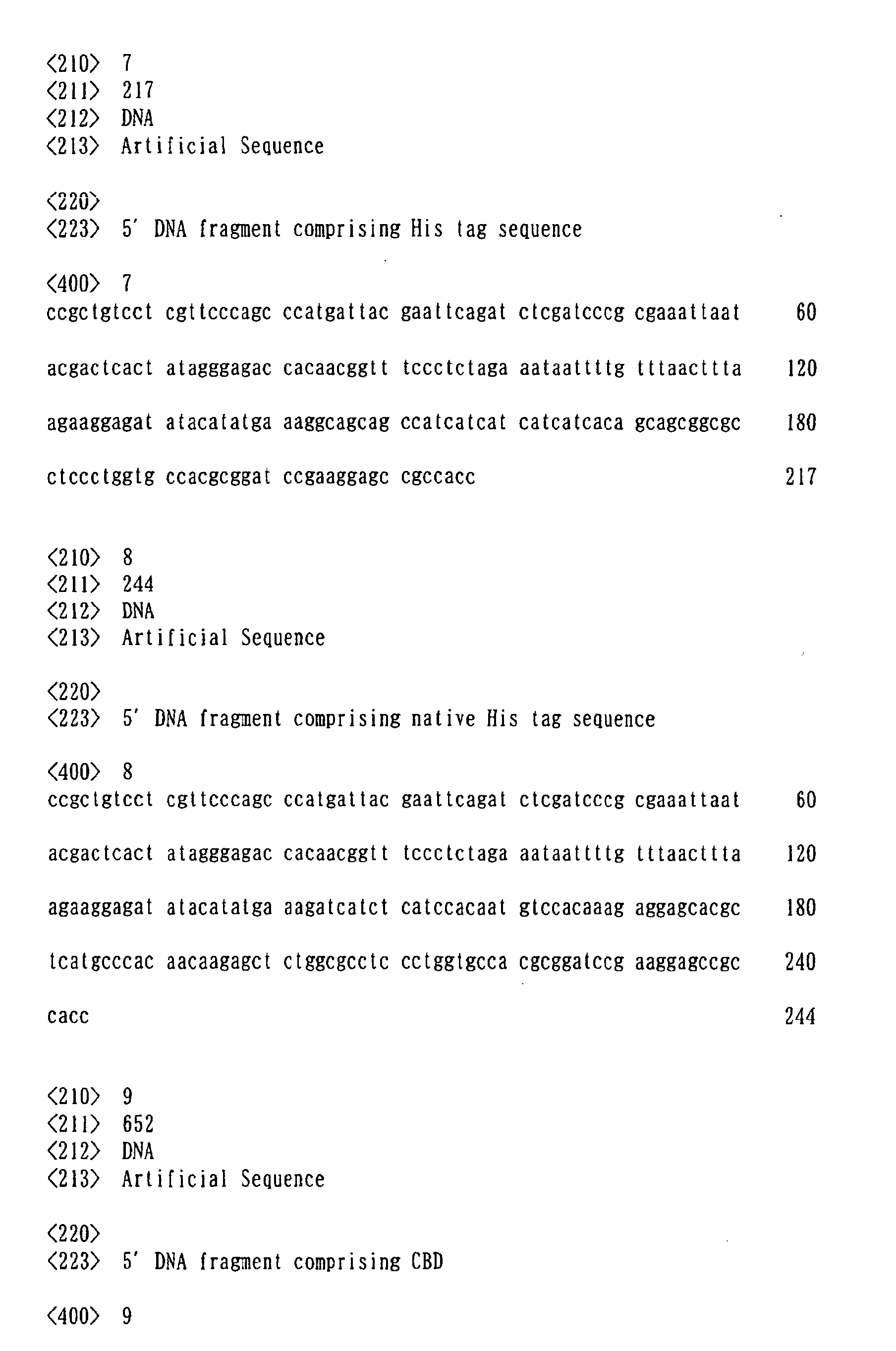
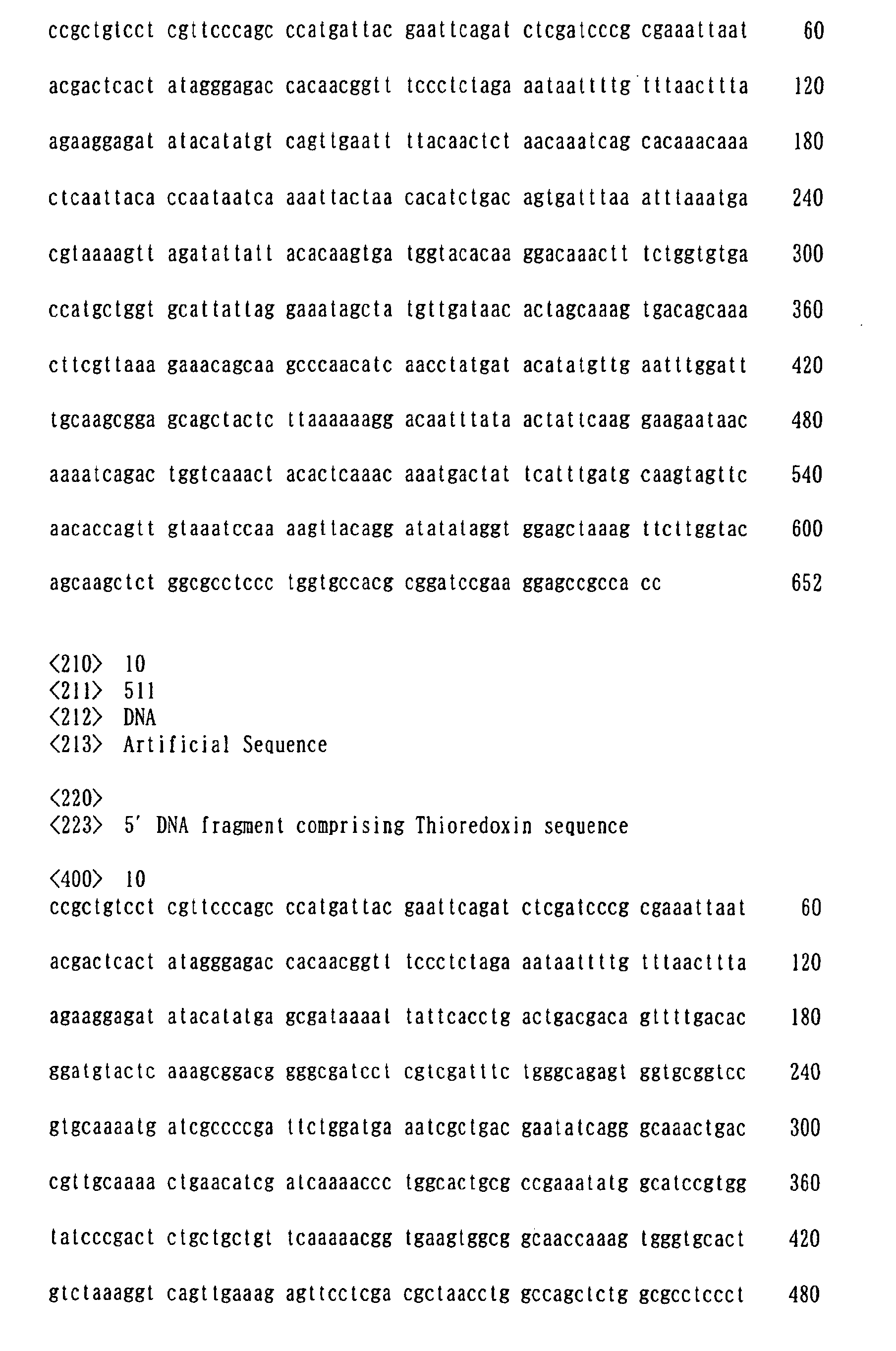
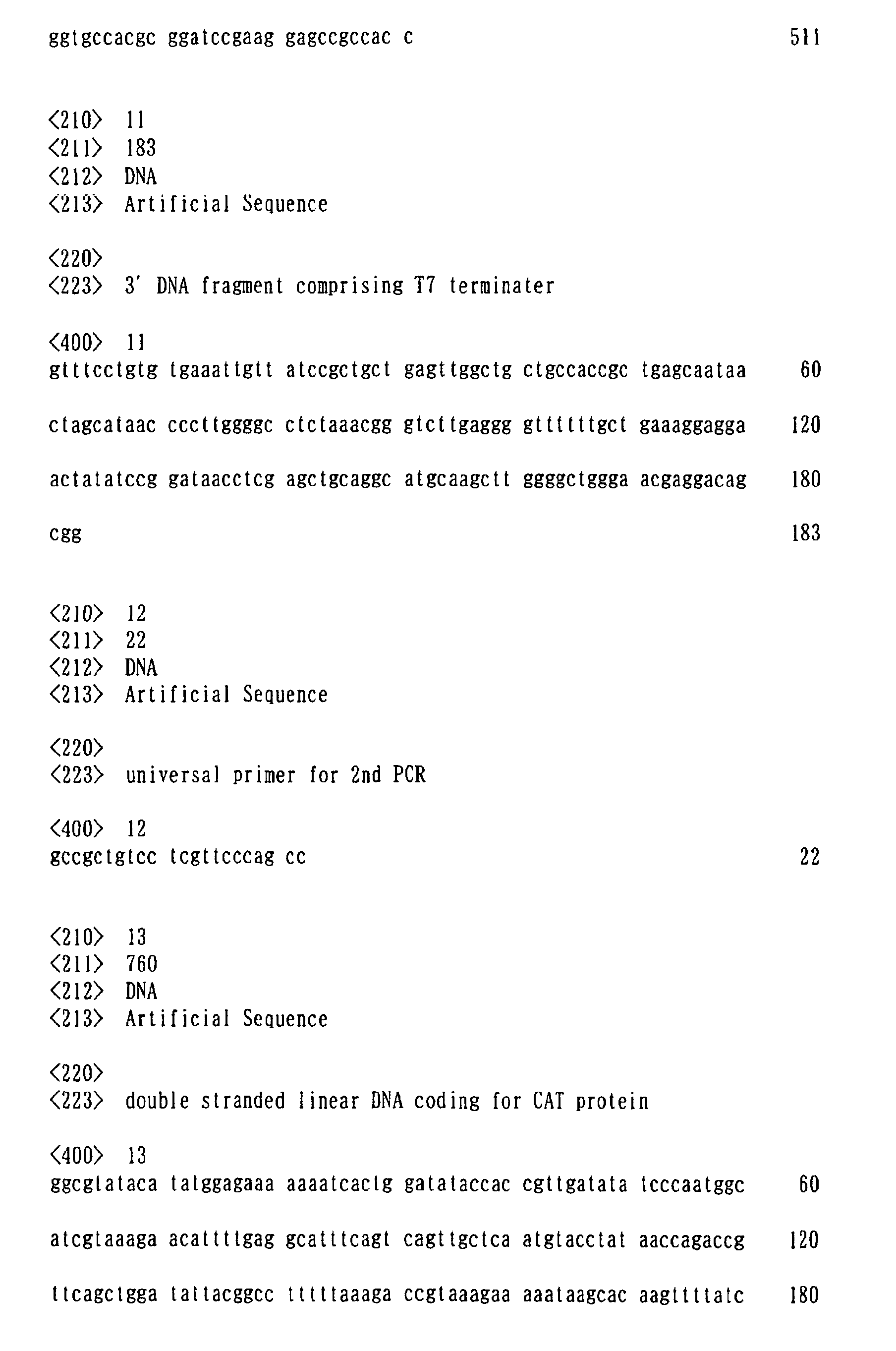
- the second overlap PCR was performed using the first PCR products obtained in the foregoing reaction, 5' DNA fragment: T7P (one of SEQ ID Nos. 6 to 10) having respective tag sequence in the downstream of the T7 promoter sequence, 3' DNA fragment: T7T (SEQ ID No. 11) having a T7 terminator sequence and universal primer (YA1.2):
- the composition of the PCR solution and the amplification program were shown in Tables 3 and 2 respectively.
- the outline of the tag peptides encoded in the 5' DNA fragment used here was shown in Table 4. Consequently, as shown in Fig.
- composition Concentration Concentration Amount Final concentration First PCR product (template) (x 1/5) 5 ⁇ l (x 1/20) Universal primer (YA1.
- E. coli S30 extract was prepared from E. coli BL21 strain according to a method of Zubay et al . (Annu. Rev. Geneti., 7, 267-287, 1973). With respect to the protein synthesis reaction, Ras protein was synthesized at 37°C for 1 hour using a 96-well microplate by adding 1 ⁇ l of the second PCR products and 7.2 ⁇ l of the E. coli S30 extract to a solution of a composition shown in Table 5 below in each well thereof to adjust the whole volume of the reaction solution to 30 ⁇ l.
- the first PCR was performed in the same manner as in Example 1 using, as a template, a linear double-stranded DNA having a nucleotide sequence described in SEQ ID No. 13 which DNA codes for CAT protein.
- primer pCAT specific for CAT gene and having a nucleotide sequence described in SEQ ID No. 14 was used as 5' primer 2.
- the protein was synthesized in a cell-free protein synthesis system after second PCR in the same manner as in Example 1.
- cDNA clones optionally selected from mouse full-length cDNA library were used as a template. These are obtained by cloning the respective cDNAs in SacI and XhoI sites of plasmid pBluescriptSK+, and have been registered in GenBank (Accession Nos. are m16206, m21532, x13605, u51204, 116904, s68022, d87663, x65627, m32599 and u85511 respectively). PCR was performed using the common primers in Example 1 as 5' primer 1 and 3' primer and primers specific for the respective cDNAs and having the following nucleotide sequences as 5' primer 2.
- composition of the PCR solution and the program were shown in Tables 6 and 2 respectively.
- Composition Concentration Amount Final concentration Template plasmid 0.2 ng/ ⁇ l 4 pl 0.04 ng/ ⁇ l 5' Primer 1 (hRBS>B+6) 10 ⁇ M 1 ⁇ l 0.5 ⁇ M 5' Primer 2 0.1 ⁇ M 1 ⁇ l 0.005 ⁇ M 3' Primer (p8.2) 10 ⁇ M 1 ⁇ l 0.5 ⁇ M dNTPs (Toyobo) 2 mM 2 ⁇ l 0.2 mM Expand HF buffer (Boehringer Mannheim) (10 x) 2 ⁇ l (1x) (containing 15 mM magnesium chloride) Sterile distilled water 8.85 ⁇ l DNA polymerase (Boehringer Mannheim) 3.5 U/ ⁇ l 0.15 ⁇ l 0.02625 U/ ⁇ l Total amount 20 ⁇ l
- Second PCR was performed in the same manner as in Example 1. However, regarding the composition of the PCR solution, a reaction solution of a composition shown in Table 7 was used instead of that shown in Table 3.
- Lanes 1 to 7 show the following respectively. 1: first PCR products, 2: second PCR products with the addition of His tag, 3: second PCR products with the addition of native His tag, 4: second PCR products with the addition of GST tag, 5: second PCR products with the addition of MBP tag, 6: second PCR products with the addition of CBD tag, and 7: second PCR products with the addition of TrxA tag. It is found that only a single DNA band is detected in both the first PCR and the second PCR and DNAs of correct lengths having bound thereto tag sequences coding for the respective tag peptides are amplified in the second PCR.
- the proteins synthesized in the cell-free synthesis system by the methods of Examples 1 and 2 were quantitatively determined using TOPCOUNT after synthesis in the presence of 14 C labeled Leu. The results were shown in Table 8 below and Fig. 3. Table 8 showed a presumptive molecular weight and an expression amount of Ras protein and CAT protein synthesized as fusion proteins with 6 types of tag peptides. Results of synthesis without the addition of a DNA and results of synthesis in a cell-free protein synthesis system using plasmids pk7-Ras and pk7-CAT (refer to Kigawa et al ., FEBS Lett., vol. 442, pp.
- Fig. 4 shows the following respectively.
- 1 Ras or CAT protein with the addition of His tag
- 2 Ras or CAT protein with the addition of native His tag
- 3 Ras or CAT protein with GST tag
- 4 Ras or CAT protein with the addition of MBP tag
- 5 Ras or CAT protein with the addition of CBD tag
- 6 Ras or CAT protein with the addition of TrxA tag.
- Ras and CAT proteins synthesized in a cell-free protein synthesis system using plasmids pk7-Ras and pk7-CAT as a template are shown as a control, and H and L indicate a high-molecular-weight marker and a low-molecular-weight marker respectively. From these results, it is found that Ras and CAT proteins with the addition of the respective tags are synthesized with correct molecular weights.
- Two-step PCR was performed in the same manner as in Examples 1 and 2 by varying concentrations of the 5' DNA fragment (T7P (GST) or T7P (His tag) ) and the 3' DNA fragment (T7T) used in the second PCR. All of the other conditions were the same as in Examples 1 and 2. The results of examining the second PCR products by 1% agarose gel electrophoresis were shown in Table 9.
- Two-step PCR was performed in the same manner as in Examples 1 and 2 by varying concentrations of primers used in the first PCR as follows.
- T7P GST
- T7P His tag
- All of the other conditions were the same as in Examples 1 and 2.
- the results of examining the second PCR products by 1% agarose gel electrophoresis were shown in Table 10.
- Sample 1 2 3 4 5 6 7 Concentration of primer in first PCR solution (nmol/L) hRBS>B+6 primer 5 15 40 80 230 480 980 pRas or pCAT 5 10 10 20 20 20 20 20 p8.
- the template DNA for synthesis, purification and detection of the protein in the cell-free protein synthesis system or the like can be produced rapidly and efficiently on the basis of the cDNA or genomic DNA comprising the sequence coding for the protein. This enables construction of an automated system for the structure and functional analysis of the protein used for study of the Structural Genomics.
Landscapes
- Chemical & Material Sciences (AREA)
- Life Sciences & Earth Sciences (AREA)
- Organic Chemistry (AREA)
- Health & Medical Sciences (AREA)
- Engineering & Computer Science (AREA)
- Zoology (AREA)
- Wood Science & Technology (AREA)
- Genetics & Genomics (AREA)
- Bioinformatics & Cheminformatics (AREA)
- Biotechnology (AREA)
- General Engineering & Computer Science (AREA)
- General Health & Medical Sciences (AREA)
- Physics & Mathematics (AREA)
- Molecular Biology (AREA)
- Microbiology (AREA)
- Biophysics (AREA)
- Biomedical Technology (AREA)
- Biochemistry (AREA)
- Proteomics, Peptides & Aminoacids (AREA)
- Crystallography & Structural Chemistry (AREA)
- Chemical Kinetics & Catalysis (AREA)
- Analytical Chemistry (AREA)
- Plant Pathology (AREA)
- Immunology (AREA)
- Preparation Of Compounds By Using Micro-Organisms (AREA)
- Measuring Or Testing Involving Enzymes Or Micro-Organisms (AREA)
Abstract
Description



| Composition | Concentration | Amount | Final |
| Template plasmid | |||
| 1 ng/ | 4 µl | 0.2 ng/µl | |
| 5' Primer 1 (hRBS>B+6) | 1.6 | 1 µl | 0.08 µM |
| 5' | 0.2 | 2 µl | 0.02 µM |
| 3' Primer (p8.2) | 2 | 1 µl | 0.1 µM |
| dNTPs (Toyobo) | 2 | 2 µl | 0.2 mM |
| Expand HF buffer (Boehringer Mannheim) | (10 x) | 2 µl | (1x) |
| (containing 15 mM magnesium chloride) | |||
| Sterile distilled water | 7.85 µl | ||
| DNA polymerase (Boehringer Mannheim) | 3.5 U/µl | 0.15 µl | 0.02625 U/µl |
| Total amount | 20 |
| STEP |
| 1 | 94° | 2 |
| STEP | ||
| 2 | 94° | 30 |
| STEP | ||
| 3 | 60° | 30 |
| STEP | ||
| 4 | 72° | 2 |
| STEP | ||
| 5 | | |
| STEP | ||
| 6 | 94° | 30 |
| STEP | ||
| 7 | 60° | 30 sec |
| STEP 8 | 72° | 2 min + 5 sec/cycle |
| STEP 9 | | |
| STEP 10 | 72° | 7 min |
| STEP 11 | 4°C | forever |

| Composition | Concentration | Amount | Final concentration |
| First PCR product (template) | (x 1/5) | 5 µl | (x 1/20) |
| Universal primer (YA1. 2) | 100 µM | 0.2 | 1 µM |
| 5' Fragment (T7P fragment) | 2 | 1 µl | 0.1 nM |
| 3' Fragment (T7T fragment) | 2 | 1 µl | 0.1 nM |
| dNTPs (Toyobo) | 2 | 2 µl | 0.2 mM |
| Expand HF buffer (Boehringer Mannheim) | (10 x) | 2 µl | (1x) |
| (containing 15 mM magnesium chloride) | |||
| Sterile distilled water | 8.65 µl | ||
| DNA polymerase (Boehringer Mannheim) | 3.5 U/µl | 0.15 pl | 0.02625 U/µl |
| Total amount | 20 |
| 1 | GST | glutathione-S- | |
| 2 | MBP | | |
| 3 | | thioredoxin | |
| 4 | CBD | | |
| 5 | His | MKGSSHHHHHH | |
| 6 | native His tag | MKDHLIHNVHKEEHAHAHNK |
| Composition | Concentration |
| HEPES-KOH pH 7.5 | 58.0 mM |
| Dithiothreitol | 2.3 mM |
| ATP | 1.2 mM |
| CTP, GTP, UTP | 0.9 mM each |
| Creatine phosphate | 81.0 mM |
| Creatine kinase | 250.0 µg/ml |
| Polyethylene glycol 8000 | 4.0% |
| 3',5'-cAMP | 0.64 mM |
| L(-)-5-formyl-5,6,7,8-tetrahydroforic acid | 35.0 µg/ml |
| E. coli total tRNA | 170.0 µg/ml |
| Potassium glutamate | 200.0 mM |
| Ammonium acetate | 27.7 mM |
| Magnesium acetate | 10.7 mM |
| Amino acids | 1.5 mM each |
| T7 RNA polymerase (Toyobo) | 16.0 units/µl |











| Composition | Concentration | Amount | Final concentration |
| Template plasmid | 0.2 ng/ | 4 pl | 0.04 ng/µl |
| 5' Primer 1 (hRBS>B+6) | 10 | 1 µl | 0.5 µM |
| 5' | 0.1 | 1 µl | 0.005 µM |
| 3' Primer (p8.2) | 10 | 1 µl | 0.5 µM |
| dNTPs (Toyobo) | 2 | 2 µl | 0.2 mM |
| Expand HF buffer (Boehringer Mannheim) | (10 x) | 2 µl | (1x) |
| (containing 15 mM magnesium chloride) | |||
| Sterile distilled water | 8.85 µl | ||
| DNA polymerase (Boehringer Mannheim) | 3.5 U/µl | 0.15 µl | 0.02625 U/µl |
| Total amount | 20 µl |
| Composition | Concentration | Amount | Final concentration |
| First PCR product (template) | (x 1/10) | 5 µl | (x 1/40) |
| Universal primer (YA1. 2) | 100 µM | 0.2 | 1 µM |
| 5' Fragment (T7P fragment) | 2 nM | 0.5 µl | 0.05 nM |
| 3' Fragment (T7T fragment) | 2 nM | 0.5 µl | 0.05 nM |
| dNTPs (Toyobo) | 2 | 2 µl | 0.2 mM |
| Expand HF buffer (Boehringer Mannheim) | (10 x) | 2 µl | (1x) |
| (containing 15 mM magnesium chloride) | |||
| Sterile distilled water | 9.65 µl | ||
| DNA polymerase (Boehringer Mannheim) | 3.5 U/µl | 0.15 µl | 0.02625 U/µl |
| Total amount | 20 µl |
| Tag sequence | Ras CAT | |||
| Molecular weight (kDa) | Expression amount (µg/ml) | Molecular weight (kDa) | Expression amount (µg/ml) | |
| His tag | 22.2 | 45.3 | 28.4 | 99.1 |
| Native His | 20.7 | 268.9 | 29.5 | 413.7 |
| GST | 42.6 | 293.8 | 52.8 | 374.9 |
| MBP | 57.3 | 663.1 | 67.4 | 684.8 |
| CBD | 37.8 | 467.8 | 44.0 | 493.9 |
| TrxA | 28.7 | 375.2 | 38.9 | 335.8 |
| No addition of DNA | - | 14.1 | - | - |
| pk7-Ras | 498.5 | - | - | |
| pk7-CAT | - | - | 28.6 | 478.4 |
| | 1 | 2 | 3 | 4 | 5 | 6 | 7 |
| Concentrations of T7P and T7T in second PCR solution (pmol/L) | 1 | 5 | 50 | 500 | 2500 | 5000 | 10000 |
| Results of analysis by agarose gel electrophoresis | |||||||
| Ras + GST tag | - | - | ○ | ○ | Δ | Δ | Δ |
| Ras + His tag | - | ○ | ○ | ○ | ○ | Δ | Δ |
| CAT + GST tag | - | ○ | ○ | ○ | Δ | Δ | Δ |
| CAT + His tag | - | ○ | ○ | ○ | ○ | Δ | Δ |
| no DNA + GST tag | - | - | - | - | × | × | × |
| no DNA + His tag | - | - | - | × | × | × | × |
| | 1 | 2 | 3 | 4 | 5 | 6 | 7 |
| Concentration of primer in first PCR solution (nmol/L) | |||||||
| hRBS>B+6 | 5 | 15 | 40 | 80 | 230 | 480 | 980 |
| pRas or | 5 | 10 | 10 | 20 | 20 | 20 | 20 |
| p8. 2 primer | 10 | 25 | 50 | 100 | 250 | 500 | 1000 |
| Concentration of primer in second PCR solution (nmol/L) | |||||||
| p8. 2 primer | 0.5 | 1.25 | 2.5 | 5 | 12.5 | 25 | 50 |
| Results of analysis by agarose gel electrophoresis | |||||||
| Ras + GST tag | - | - | ○ | ○ | ○ | × | × |
| Ras + His tag | - | ○ | ○ | ○ | ○ | Δ | Δ |
| CAT + GST tag | - | ○ | ○ | ○ | ○ | × | × |
| CAT + His tag | - | ○ | ○ | ○ | ○ | ○ | Δ |
| no DNA + GST tag | - | - | - | - | × | × | × |
| no DNA + His tag | - | - | - | - | × | × | × |




Claims (13)
- A method of producing a template DNA used for protein synthesis comprising a step of
amplifying a linear double-stranded DNA by polymerase chain reaction (PCR), using a reaction solution comprising,
a first double-stranded DNA fragment comprising a sequence coding for a protein or a portion thereof,
a second double-stranded DNA fragment comprising a sequence overlapping with the 5' terminal region of the first DNA fragment,
a third double-stranded DNA fragment comprising a sequence overlapping with the 3' terminal region of the first DNA fragment,
a sense primer which anneals with the 5' terminal region of the second DNA fragment, and
an anti-sense primer which anneals with the 3' terminal region of the third DNA fragment,
wherein the second DNA fragment comprises a regulatory sequence for transcription and translation of a gene, and the concentrations of the second DNA fragment and the third DNA fragment in the reaction solution each range from 5 to 2,500 pmol/L. - The method of claim 1, wherein the reaction solution (second PCR solution) comprises first PCR products obtained by polymerase chain reaction (first PCR) to amplify the first double-stranded DNA fragment, and the respective concentrations of primers remaining in the first PCR products and primer dimers produced in the first PCR are less than 20 nmol/L in the second PCR solution.
- The method of claim 2, wherein the respective concentrations of primers used for the first PCR are from 20 to 500 nmol/L.
- The method of claim 2, wherein the second PCR is performed with the first PCR products which are diluted to 10- to 100-fold (at a final concentration in the second PCR solution).
- The method of claim 2, further comprising a step of removing the primers and the primer dimers from the first PCR products.
- The method of claim 2, wherein the first PCR is carried out using recombinant microorganisms or a culture broth thereof comprising the first double-stranded DNA fragment.
- The method of any one of claims 1 to 6, wherein the second DNA fragment and/or the third DNA fragment is (are) single-stranded DNA(s) instead of double-stranded DNAs.
- The method of any one of claims 1 to 7, wherein the sense primer and the anti-sense primer have the same nucleotide sequence.
- The method of any one of claims 1 to 8, wherein the third DNA fragment comprises a transcription termination sequence.
- The method of any one of claims 1 to 9, wherein at least one of the second DNA fragment and the third DNA fragment comprises a sequence coding for a tag peptide, and the tag peptide is synthesized by being fused with the protein or a portion thereof.
- The method of claim 10, wherein the tag peptide is maltose binding protein, cellulose binding domain, glutathione-S-transferase, thioredoxin, streptavidin binding peptide or histidine tag peptide.
- The method of claim 10, wherein the tag peptide is a histidine tag peptide consisting of the amino acid sequence of SEQ ID No. 1.
- A method of producing a protein in a cell-free protein synthesis system using a template DNA that is produced by the method of any one of claims 1 to 12.
Applications Claiming Priority (3)
| Application Number | Priority Date | Filing Date | Title |
|---|---|---|---|
| JP2001201356 | 2001-07-02 | ||
| JP2001201356A JP4768155B2 (en) | 2001-07-02 | 2001-07-02 | Method for producing template DNA and method for producing protein by cell-free protein synthesis system using the same |
| PCT/JP2002/006261 WO2003004703A1 (en) | 2001-07-02 | 2002-06-24 | Process for producing template dna and process for producing protein in cell-free protein synthesis system with the use of the same |
Publications (3)
| Publication Number | Publication Date |
|---|---|
| EP1411131A1 true EP1411131A1 (en) | 2004-04-21 |
| EP1411131A4 EP1411131A4 (en) | 2005-11-30 |
| EP1411131B1 EP1411131B1 (en) | 2007-04-18 |
Family
ID=19038333
Family Applications (1)
| Application Number | Title | Priority Date | Filing Date |
|---|---|---|---|
| EP02736176A Expired - Lifetime EP1411131B1 (en) | 2001-07-02 | 2002-06-24 | Process for producing template dna and process for producing protein in cell-free protein synthesis system with the use of the same |
Country Status (7)
| Country | Link |
|---|---|
| US (2) | US7195895B2 (en) |
| EP (1) | EP1411131B1 (en) |
| JP (1) | JP4768155B2 (en) |
| AT (1) | ATE360065T1 (en) |
| CA (1) | CA2452396A1 (en) |
| DE (1) | DE60219632T2 (en) |
| WO (1) | WO2003004703A1 (en) |
Cited By (1)
| Publication number | Priority date | Publication date | Assignee | Title |
|---|---|---|---|---|
| EP2749567A4 (en) * | 2011-08-26 | 2015-04-01 | Bioneer Corp | Protein synthesis kit, and method for expressing and extracting proteins using automatic extraction equipment |
Families Citing this family (13)
| Publication number | Priority date | Publication date | Assignee | Title |
|---|---|---|---|---|
| JP4768155B2 (en) * | 2001-07-02 | 2011-09-07 | 独立行政法人理化学研究所 | Method for producing template DNA and method for producing protein by cell-free protein synthesis system using the same |
| JP4441170B2 (en) * | 2002-11-28 | 2010-03-31 | 独立行政法人理化学研究所 | Escherichia coli cell extract having mutation in S12 ribosomal protein and cell-free protein production method using the same |
| TW200526786A (en) * | 2003-02-10 | 2005-08-16 | Tatsuya Sawazaki | Automatic process for protein synthesis and apparatus therefor |
| AU2004203649B2 (en) | 2003-08-12 | 2006-01-12 | F. Hoffmann-La Roche Ag | Thermostable Taq polymerase fragment |
| JP4590249B2 (en) * | 2004-11-17 | 2010-12-01 | 独立行政法人理化学研究所 | Cell-free protein synthesis system for glycoprotein synthesis |
| JP4868731B2 (en) | 2004-11-17 | 2012-02-01 | 独立行政法人理化学研究所 | Cell-free protein synthesis system derived from cultured mammalian cells |
| JP4787488B2 (en) * | 2004-11-19 | 2011-10-05 | 独立行政法人理化学研究所 | Cell-free protein synthesis method using linear template DNA and cell extract therefor |
| US20070117179A1 (en) * | 2005-09-27 | 2007-05-24 | Invitrogen Corporation | In vitro protein synthesis systems for membrane proteins that include adolipoproteins and phospholipid-adolipoprotein particles |
| WO2008106660A2 (en) * | 2007-03-01 | 2008-09-04 | Invitrogen Corporation | Isolated phospholipid-protein particles |
| US20100248310A1 (en) * | 2007-10-22 | 2010-09-30 | Monoquant Pty Ltd. | Method of dna amplification |
| US8226976B2 (en) * | 2007-11-05 | 2012-07-24 | Riken | Method of using cell-free protein synthesis to produce a membrane protein |
| US20160333397A1 (en) * | 2014-01-27 | 2016-11-17 | Hitachi, Ltd. | Method and device for analyzing reaction liquid after nucleic acid amplification reaction, and device for processing reaction liquid after nucleic acid amplification reaction |
| US11618777B2 (en) | 2015-07-31 | 2023-04-04 | Shigeyuki Yokoyama | Method of manufacturing membrane protein and utilization thereof |
Family Cites Families (15)
| Publication number | Priority date | Publication date | Assignee | Title |
|---|---|---|---|---|
| JPH0491790A (en) | 1990-08-02 | 1992-03-25 | Shionogi & Co Ltd | Two step pcr method |
| WO1992007949A1 (en) * | 1990-11-05 | 1992-05-14 | The United States Of America, As Represented By The Secretary Of The Army | Method for the in vitro production of protein from a dna sequence without cloning |
| EP0566670A4 (en) | 1990-12-17 | 1993-12-08 | Idexx Laboratories, Inc. | Nucleic acid sequence detection by triple helix formation |
| JPH09234074A (en) * | 1996-03-04 | 1997-09-09 | Sumitomo Electric Ind Ltd | Adapter double-stranded DNA and DNA amplification method using the same |
| WO1997046696A1 (en) * | 1996-06-07 | 1997-12-11 | Genentech, Inc. | Methods for in vitro protein synthesis |
| US6136568A (en) * | 1997-09-15 | 2000-10-24 | Hiatt; Andrew C. | De novo polynucleotide synthesis using rolling templates |
| US6607878B2 (en) * | 1997-10-06 | 2003-08-19 | Stratagene | Collections of uniquely tagged molecules |
| CA2307177C (en) | 1997-10-23 | 2004-06-29 | Exact Laboratories, Inc. | Methods for detecting contamination in molecular diagnostics using pcr |
| WO1999057992A1 (en) * | 1998-05-14 | 1999-11-18 | Clontech Laboratories, Inc. | Compositions and methods for protein purification based on a metal ion affinity site |
| WO2000056914A1 (en) * | 1999-03-24 | 2000-09-28 | Gene Therapy Systems, Inc. | Method for generating transcriptionally active dna fragments |
| US6303337B1 (en) * | 1999-08-25 | 2001-10-16 | Amber Gen. Inc. | N-terminal and C-terminal markers in nascent proteins |
| AU8020201A (en) * | 2000-08-30 | 2002-03-13 | Wakenyaku Co Ltd | Design and construction of transcription template for synthesizing cell-free protein, and dilution batch-type method of synthesizing cell-free wheat germ protein by using the same |
| JP4768155B2 (en) * | 2001-07-02 | 2011-09-07 | 独立行政法人理化学研究所 | Method for producing template DNA and method for producing protein by cell-free protein synthesis system using the same |
| DE10158904A1 (en) * | 2001-11-30 | 2003-06-12 | Roche Diagnostics Gmbh | Process for the preparation of linear DNA fragments for the in vitro expression of proteins |
| EP1394227B1 (en) | 2002-08-30 | 2006-05-24 | Eastman Kodak Company | Ink jet ink composition and printing process |
-
2001
- 2001-07-02 JP JP2001201356A patent/JP4768155B2/en not_active Expired - Fee Related
-
2002
- 2002-06-24 AT AT02736176T patent/ATE360065T1/en not_active IP Right Cessation
- 2002-06-24 WO PCT/JP2002/006261 patent/WO2003004703A1/en not_active Ceased
- 2002-06-24 DE DE60219632T patent/DE60219632T2/en not_active Expired - Lifetime
- 2002-06-24 EP EP02736176A patent/EP1411131B1/en not_active Expired - Lifetime
- 2002-06-24 CA CA002452396A patent/CA2452396A1/en not_active Abandoned
-
2003
- 2003-12-31 US US10/748,055 patent/US7195895B2/en not_active Expired - Lifetime
-
2006
- 2006-03-14 US US11/374,114 patent/US7846694B2/en active Active
Cited By (2)
| Publication number | Priority date | Publication date | Assignee | Title |
|---|---|---|---|---|
| EP2749567A4 (en) * | 2011-08-26 | 2015-04-01 | Bioneer Corp | Protein synthesis kit, and method for expressing and extracting proteins using automatic extraction equipment |
| US9163272B2 (en) | 2011-08-26 | 2015-10-20 | Bioneer Corporation | Protein synthesis kit, and method for expressing and extracting proteins using automatic extraction equipment |
Also Published As
| Publication number | Publication date |
|---|---|
| DE60219632T2 (en) | 2008-01-17 |
| US7195895B2 (en) | 2007-03-27 |
| ATE360065T1 (en) | 2007-05-15 |
| JP2003009880A (en) | 2003-01-14 |
| DE60219632D1 (en) | 2007-05-31 |
| US7846694B2 (en) | 2010-12-07 |
| EP1411131B1 (en) | 2007-04-18 |
| WO2003004703A1 (en) | 2003-01-16 |
| EP1411131A4 (en) | 2005-11-30 |
| US20060147990A1 (en) | 2006-07-06 |
| US20040214292A1 (en) | 2004-10-28 |
| JP4768155B2 (en) | 2011-09-07 |
| CA2452396A1 (en) | 2003-01-16 |
Similar Documents
| Publication | Publication Date | Title |
|---|---|---|
| US20220243244A1 (en) | Compositions and methods for in vivo synthesis of unnatural polypeptides | |
| US7846694B2 (en) | Process for producing template DNA and process for producing protein in cell-free protein synthesis system with the use of the same | |
| JP7058839B2 (en) | Cell-free protein expression using rolling circle amplification products | |
| JP2011522552A (en) | Method for enzymatic synthesis of chemically modified RNA | |
| CN110997922B (en) | Cell-free protein expression using double-stranded concatemeric DNA | |
| JPWO2014119600A1 (en) | Flexible display method | |
| JP4762481B2 (en) | Design and construction of transcription template for cell-free protein synthesis and dilution batch method wheat germ cell-free protein synthesis method using the same | |
| EP3763818A1 (en) | Devices and methods for producing proteins | |
| KR20240051994A (en) | Systems, compositions, and methods comprising retrotransposons and functional fragments thereof | |
| AU2016256579B2 (en) | Uncoupling growth and protein production | |
| US20080153128A1 (en) | Cell-Free Protein Synthesis | |
| EP3354736B1 (en) | Promoter construct for cell-free protein synthesis | |
| EP3090049B1 (en) | Enrichment of full-length oligonucleotides via transcription/translation-mediated purification | |
| Asahara et al. | Guidelines for nucleic acid template design for optimal cell-free protein synthesis using an Escherichia coli reconstituted system or a lysate-based system | |
| JP5858415B2 (en) | Linker for preparing mRNA / cDNA-protein conjugate and purification method of nucleotide-protein conjugate using the same | |
| US6399352B1 (en) | Plant porphobilinogen synthase and fusion protein thereof | |
| JP2003009877A (en) | Method for producing template DNA and method for producing protein using cell-free protein synthesis system using the same | |
| CN117683804A (en) | A kind of nucleic acid construct and its application in IVTT system | |
| WO2026050151A1 (en) | Rna polymerases for mrna manufacturing | |
| JP2001048898A (en) | Methods for obtaining polypeptides having precisely linked disulfide bonds | |
| Jo et al. | A simple method for constructing a tagged protein | |
| Plus | EasyXpress® Linear Template Kit Plus Handbook |
Legal Events
| Date | Code | Title | Description |
|---|---|---|---|
| PUAI | Public reference made under article 153(3) epc to a published international application that has entered the european phase |
Free format text: ORIGINAL CODE: 0009012 |
|
| 17P | Request for examination filed |
Effective date: 20040109 |
|
| AK | Designated contracting states |
Kind code of ref document: A1 Designated state(s): AT BE CH CY DE DK ES FI FR GB GR IE IT LI LU MC NL PT SE TR |
|
| A4 | Supplementary search report drawn up and despatched |
Effective date: 20051019 |
|
| RIC1 | Information provided on ipc code assigned before grant |
Ipc: 7C 12N 15/10 A Ipc: 7C 12Q 1/68 B Ipc: 7C 12P 19/34 B Ipc: 7A 21D 8/04 B Ipc: 7C 12N 15/62 B Ipc: 7C 12P 21/02 B |
|
| GRAP | Despatch of communication of intention to grant a patent |
Free format text: ORIGINAL CODE: EPIDOSNIGR1 |
|
| GRAS | Grant fee paid |
Free format text: ORIGINAL CODE: EPIDOSNIGR3 |
|
| GRAA | (expected) grant |
Free format text: ORIGINAL CODE: 0009210 |
|
| AK | Designated contracting states |
Kind code of ref document: B1 Designated state(s): AT BE CH CY DE DK ES FI FR GB GR IE IT LI LU MC NL PT SE TR |
|
| PG25 | Lapsed in a contracting state [announced via postgrant information from national office to epo] |
Ref country code: LI Free format text: LAPSE BECAUSE OF FAILURE TO SUBMIT A TRANSLATION OF THE DESCRIPTION OR TO PAY THE FEE WITHIN THE PRESCRIBED TIME-LIMIT Effective date: 20070418 Ref country code: CH Free format text: LAPSE BECAUSE OF FAILURE TO SUBMIT A TRANSLATION OF THE DESCRIPTION OR TO PAY THE FEE WITHIN THE PRESCRIBED TIME-LIMIT Effective date: 20070418 Ref country code: FI Free format text: LAPSE BECAUSE OF FAILURE TO SUBMIT A TRANSLATION OF THE DESCRIPTION OR TO PAY THE FEE WITHIN THE PRESCRIBED TIME-LIMIT Effective date: 20070418 |
|
| REG | Reference to a national code |
Ref country code: CH Ref legal event code: EP |
|
| REG | Reference to a national code |
Ref country code: IE Ref legal event code: FG4D |
|
| REF | Corresponds to: |
Ref document number: 60219632 Country of ref document: DE Date of ref document: 20070531 Kind code of ref document: P |
|
| PG25 | Lapsed in a contracting state [announced via postgrant information from national office to epo] |
Ref country code: SE Free format text: LAPSE BECAUSE OF FAILURE TO SUBMIT A TRANSLATION OF THE DESCRIPTION OR TO PAY THE FEE WITHIN THE PRESCRIBED TIME-LIMIT Effective date: 20070718 |
|
| PG25 | Lapsed in a contracting state [announced via postgrant information from national office to epo] |
Ref country code: ES Free format text: LAPSE BECAUSE OF FAILURE TO SUBMIT A TRANSLATION OF THE DESCRIPTION OR TO PAY THE FEE WITHIN THE PRESCRIBED TIME-LIMIT Effective date: 20070729 |
|
| PG25 | Lapsed in a contracting state [announced via postgrant information from national office to epo] |
Ref country code: PT Free format text: LAPSE BECAUSE OF FAILURE TO SUBMIT A TRANSLATION OF THE DESCRIPTION OR TO PAY THE FEE WITHIN THE PRESCRIBED TIME-LIMIT Effective date: 20070918 |
|
| REG | Reference to a national code |
Ref country code: CH Ref legal event code: PL |
|
| NLV1 | Nl: lapsed or annulled due to failure to fulfill the requirements of art. 29p and 29m of the patents act | ||
| PG25 | Lapsed in a contracting state [announced via postgrant information from national office to epo] |
Ref country code: AT Free format text: LAPSE BECAUSE OF FAILURE TO SUBMIT A TRANSLATION OF THE DESCRIPTION OR TO PAY THE FEE WITHIN THE PRESCRIBED TIME-LIMIT Effective date: 20070418 |
|
| EN | Fr: translation not filed | ||
| PG25 | Lapsed in a contracting state [announced via postgrant information from national office to epo] |
Ref country code: BE Free format text: LAPSE BECAUSE OF FAILURE TO SUBMIT A TRANSLATION OF THE DESCRIPTION OR TO PAY THE FEE WITHIN THE PRESCRIBED TIME-LIMIT Effective date: 20070418 |
|
| PG25 | Lapsed in a contracting state [announced via postgrant information from national office to epo] |
Ref country code: MC Free format text: LAPSE BECAUSE OF NON-PAYMENT OF DUE FEES Effective date: 20070630 Ref country code: NL Free format text: LAPSE BECAUSE OF FAILURE TO SUBMIT A TRANSLATION OF THE DESCRIPTION OR TO PAY THE FEE WITHIN THE PRESCRIBED TIME-LIMIT Effective date: 20070418 Ref country code: DK Free format text: LAPSE BECAUSE OF FAILURE TO SUBMIT A TRANSLATION OF THE DESCRIPTION OR TO PAY THE FEE WITHIN THE PRESCRIBED TIME-LIMIT Effective date: 20070418 |
|
| PLBE | No opposition filed within time limit |
Free format text: ORIGINAL CODE: 0009261 |
|
| STAA | Information on the status of an ep patent application or granted ep patent |
Free format text: STATUS: NO OPPOSITION FILED WITHIN TIME LIMIT |
|
| 26N | No opposition filed |
Effective date: 20080121 |
|
| GBPC | Gb: european patent ceased through non-payment of renewal fee |
Effective date: 20070718 |
|
| PG25 | Lapsed in a contracting state [announced via postgrant information from national office to epo] |
Ref country code: GR Free format text: LAPSE BECAUSE OF FAILURE TO SUBMIT A TRANSLATION OF THE DESCRIPTION OR TO PAY THE FEE WITHIN THE PRESCRIBED TIME-LIMIT Effective date: 20070719 Ref country code: FR Free format text: LAPSE BECAUSE OF FAILURE TO SUBMIT A TRANSLATION OF THE DESCRIPTION OR TO PAY THE FEE WITHIN THE PRESCRIBED TIME-LIMIT Effective date: 20071214 Ref country code: IT Free format text: LAPSE BECAUSE OF FAILURE TO SUBMIT A TRANSLATION OF THE DESCRIPTION OR TO PAY THE FEE WITHIN THE PRESCRIBED TIME-LIMIT Effective date: 20070418 |
|
| PG25 | Lapsed in a contracting state [announced via postgrant information from national office to epo] |
Ref country code: IE Free format text: LAPSE BECAUSE OF NON-PAYMENT OF DUE FEES Effective date: 20070625 Ref country code: GB Free format text: LAPSE BECAUSE OF NON-PAYMENT OF DUE FEES Effective date: 20070718 |
|
| PG25 | Lapsed in a contracting state [announced via postgrant information from national office to epo] |
Ref country code: FR Free format text: LAPSE BECAUSE OF FAILURE TO SUBMIT A TRANSLATION OF THE DESCRIPTION OR TO PAY THE FEE WITHIN THE PRESCRIBED TIME-LIMIT Effective date: 20070418 |
|
| PG25 | Lapsed in a contracting state [announced via postgrant information from national office to epo] |
Ref country code: CY Free format text: LAPSE BECAUSE OF FAILURE TO SUBMIT A TRANSLATION OF THE DESCRIPTION OR TO PAY THE FEE WITHIN THE PRESCRIBED TIME-LIMIT Effective date: 20070418 |
|
| PG25 | Lapsed in a contracting state [announced via postgrant information from national office to epo] |
Ref country code: LU Free format text: LAPSE BECAUSE OF NON-PAYMENT OF DUE FEES Effective date: 20070624 |
|
| PG25 | Lapsed in a contracting state [announced via postgrant information from national office to epo] |
Ref country code: TR Free format text: LAPSE BECAUSE OF FAILURE TO SUBMIT A TRANSLATION OF THE DESCRIPTION OR TO PAY THE FEE WITHIN THE PRESCRIBED TIME-LIMIT Effective date: 20070418 |
|
| PGFP | Annual fee paid to national office [announced via postgrant information from national office to epo] |
Ref country code: DE Payment date: 20210618 Year of fee payment: 20 |
|
| REG | Reference to a national code |
Ref country code: DE Ref legal event code: R071 Ref document number: 60219632 Country of ref document: DE |