EP1408960B1 - Benz-indole and benzo-quinoline derivatives as prodrugs for tumour treatment - Google Patents
Benz-indole and benzo-quinoline derivatives as prodrugs for tumour treatment Download PDFInfo
- Publication number
- EP1408960B1 EP1408960B1 EP02701418A EP02701418A EP1408960B1 EP 1408960 B1 EP1408960 B1 EP 1408960B1 EP 02701418 A EP02701418 A EP 02701418A EP 02701418 A EP02701418 A EP 02701418A EP 1408960 B1 EP1408960 B1 EP 1408960B1
- Authority
- EP
- European Patent Office
- Prior art keywords
- optionally substituted
- group
- alkyl
- compound
- aralkyl
- Prior art date
- Legal status (The legal status is an assumption and is not a legal conclusion. Google has not performed a legal analysis and makes no representation as to the accuracy of the status listed.)
- Expired - Lifetime
Links
- 0 CC1(C=CC(N=C(C)*2)=C2C=C1)O Chemical compound CC1(C=CC(N=C(C)*2)=C2C=C1)O 0.000 description 8
- JJPBZBLQMWMMIW-UHFFFAOYSA-N CC(C)(C)OC(N(CC(C1)N)c2c1c1ccccc1cc2)=O Chemical compound CC(C)(C)OC(N(CC(C1)N)c2c1c1ccccc1cc2)=O JJPBZBLQMWMMIW-UHFFFAOYSA-N 0.000 description 1
- CKJBHBNTEGXSKU-UHFFFAOYSA-N CC(C)(C)OC(N(CC1OC11)C2=C1c1ccccc1CC2)=O Chemical compound CC(C)(C)OC(N(CC1OC11)C2=C1c1ccccc1CC2)=O CKJBHBNTEGXSKU-UHFFFAOYSA-N 0.000 description 1
- LYMPZBRSEKAAKW-UHFFFAOYSA-N CC(C)(C)OC(N1c2cc(OCc3ccccc3)c(cccc3)c3c2C(CCl)C1)=O Chemical compound CC(C)(C)OC(N1c2cc(OCc3ccccc3)c(cccc3)c3c2C(CCl)C1)=O LYMPZBRSEKAAKW-UHFFFAOYSA-N 0.000 description 1
Classifications
-
- A—HUMAN NECESSITIES
- A61—MEDICAL OR VETERINARY SCIENCE; HYGIENE
- A61K—PREPARATIONS FOR MEDICAL, DENTAL OR TOILETRY PURPOSES
- A61K31/00—Medicinal preparations containing organic active ingredients
- A61K31/33—Heterocyclic compounds
- A61K31/395—Heterocyclic compounds having nitrogen as a ring hetero atom, e.g. guanethidine or rifamycins
- A61K31/435—Heterocyclic compounds having nitrogen as a ring hetero atom, e.g. guanethidine or rifamycins having six-membered rings with one nitrogen as the only ring hetero atom
- A61K31/47—Quinolines; Isoquinolines
-
- A—HUMAN NECESSITIES
- A61—MEDICAL OR VETERINARY SCIENCE; HYGIENE
- A61K—PREPARATIONS FOR MEDICAL, DENTAL OR TOILETRY PURPOSES
- A61K31/00—Medicinal preparations containing organic active ingredients
- A61K31/33—Heterocyclic compounds
- A61K31/395—Heterocyclic compounds having nitrogen as a ring hetero atom, e.g. guanethidine or rifamycins
- A61K31/40—Heterocyclic compounds having nitrogen as a ring hetero atom, e.g. guanethidine or rifamycins having five-membered rings with one nitrogen as the only ring hetero atom, e.g. sulpiride, succinimide, tolmetin, buflomedil
- A61K31/403—Heterocyclic compounds having nitrogen as a ring hetero atom, e.g. guanethidine or rifamycins having five-membered rings with one nitrogen as the only ring hetero atom, e.g. sulpiride, succinimide, tolmetin, buflomedil condensed with carbocyclic rings, e.g. carbazole
-
- A—HUMAN NECESSITIES
- A61—MEDICAL OR VETERINARY SCIENCE; HYGIENE
- A61P—SPECIFIC THERAPEUTIC ACTIVITY OF CHEMICAL COMPOUNDS OR MEDICINAL PREPARATIONS
- A61P35/00—Antineoplastic agents
-
- C—CHEMISTRY; METALLURGY
- C07—ORGANIC CHEMISTRY
- C07D—HETEROCYCLIC COMPOUNDS
- C07D209/00—Heterocyclic compounds containing five-membered rings, condensed with other rings, with one nitrogen atom as the only ring hetero atom
- C07D209/56—Ring systems containing three or more rings
- C07D209/58—[b]- or [c]-condensed
- C07D209/60—Naphtho [b] pyrroles; Hydrogenated naphtho [b] pyrroles
Definitions
- the present invention concerns aromatic oxidation/hydroxylation activated prodrugs, particularly anti-tumour prodrugs and those which are specifically activated by the oxidation/hydroxylation activities of the cytochrome P450 family of enzymes.
- cytotoxic drugs are known that can be used for therapeutic purposes. However, they typically suffer from the problem that they are generally cytotoxic and therefore may affect cells other than those that are required to be destroyed. This can be alleviated to some extent by the use of targeted drug delivery systems, for example direct injection to a site of tumourous tissue or, e.g. binding the cytotoxic agent to an antibody that specifically recognises an antigen displayed only on the cancer cell surface. Alternatively, electromagnetic radiation may be used to cause chemical alteration in an agent at a desired site such that it becomes cytotoxic. However, all of these techniques have, to a greater or lesser extent, certain limitations and disadvantages.
- the compound (+)-CC-1065 and the duocarmycins are naturally occurring representatives of a class of DNA alkylating agents.
- the naturally occurring compounds consist of a DNA alkylating unit based upon a pyrrolo[3,2-e]indole core, with one or two sub units, conferring DNA binding capabilities.
- CC-1065 and duocarmycin A comprise a spirocyclic cyclopropane group responsible for the DNA alkylation properties.
- Duocarmycin B 2 , C 2 and D 2 are believed to be precursors for cyclopropane actives, and comprise a substituted (by a leaving group) methyl group at the eight position on the dihydro pyrrole ring.
- CC-1065 has been synthesised by various routes, summarised by Boger et al in Chem. Rev. 1997, 97, 787-828.
- the present invention relates to precursors of analogues CC-1065, which do not have the hydroxyl group in the B ring of the alkylating sub unit, and which are hence substantially inactive as DNA alkylating agents themselves.
- cytochrome P450 isoforms in tumour cells provides a molecular target for the development of new antitumour drugs that could be selectively activated by the CYP enzymes in tumour cells, although no drug examples were given.
- a number of other CYP isoforms have been shown to be expressed in various tumours. Many of the CYP's expressed in tumours are mentioned in Patterson, LH et al, (1999) Anticancer Drug Des. 14(6), 473-486.
- prodrugs of styrene- and chalcone-derivatives are described.
- the respective hydroxylated forms of the prodrugs, formed in situ, are potent tyrosine kinase (TK) inhibitors. Inhibition of TK activity contributes to tumour inhibition and cell destruction.
- the prodrugs were shown to be activated by microsomal preparations expressing CYP1B1 enzyme, and to have cytotoxic activity against cell lines expressing the same enzyme, whilst having much lower cytotoxic activity against cell lines not expressing the enzyme.
- the present invention is directed to a new class of prodrugs which are expected to be hydroxylated in situ by CYP enzymes, in particular enzymes expressed at high levels in tumours.
- the prodrugs are believed to be metabolisable by CYP1B1 enzyme.
- Some of the compounds are new.
- the present invention relates to the first therapeutic use of a broad range of compounds, and their synthesis as well as intermediates used therein.
- X is H
- Y is a leaving group
- R 1 is -Ar, NH 2 , OR 7 or R 7
- R 2 , R 3 , R 4 R 5 and R 6 are each independently selected from H, C 1-4 alkyl, -OH, C 1-4 alkoxy, -CN, Cl, Br, I, -NO 2 , -NH 2 , -NHR 16 , -NR 16 2 , -N + R 16 3 , -NHCOR 8 , -COOH, CONHR 9 , -NHCOOR 9 and -COOR 9
- R 7 , R 8 and R 9 are independently selected from C 1-4 alkyl, optionally substituted phenyl, C 7-12 -aralkyl, optionally substituted heteroaryl and a lig
- the animal which is treated is generally a human, although the compounds may also have veternary use.
- the indication treated is generally cancer including adenocarcinoma, leukemia, lymphoma, melanoma, myeloma, sarcoma, teratocarcinoma, and, in particular, cancers of the adrenal gland, bladder, bone, bone marrow, brain, breast, cervix, gall bladder, ganglia, gastrointestinal tract, heart, kidney, liver, lung, muscle, ovary, pancreas, parathyroid, penis, prostate, salivary glands, skin, spleen, testis, thymus, thyroid, and uterus.
- the tumour may, for instance, be defined as a tumour expressing high levels of CYP1B1.
- the leaving group Y is, for instance, in a group which has utility in nucleophilic substitution reactions.
- Suitable examples of leaving groups are -OCOOR 17 , -OCONHR 18 , Cl, Br, I, or -OSOOR 19 , in which R 17 , R 18 and R 19 are selected from C 1-4 alkyl, optionally substituted phenyl, C 7-12- aralkyl and optionally substituted heteroaryl.
- the leaving group is a halogen atom, preferably chlorine.
- Optional substituents in phenyl, aralkyl and heteroaryl groups are, for instance, C 1-4 -alkyl, halogen, hydroxyl, C 1-4 -alkoxy, -NH 2 , -NHR 16 , -NR 16 2 , -N + R 16 3 , -NO 2 , -CN, -COOH, -NHCOR 14 , -CONHR 15 , -NHCOOR 15 , -COOR 15 etc.
- ligand includes a group having specific targeting characteristics, useful for instance in antibody or gene-directed enzyme prodrug-type environments.
- a ligand may be an oligopeptide, biotin, avidin or streptavidin, a polymeric group, an oligonucleotide or a protein.
- it has specific binding characteristics such as an antibody or fragment, an antigen, a sense or antisense oligo-nucleotide, or one of avidin, streptavidin and biotin, that is it is one component of a specific binding pair.
- it may be a group designed for passive targeting, such as a polymeric group, or a group designed to prolong the stability or reduce immunogenicity such as a hydrophilic group.
- US-A-5843937 discloses suitable ligands for conjugating to these types of actives and methods for carrying out the conjugation.
- R 1 is other than OR 7 .
- the group R 1 in a compound of the general formula I is a group Ar.
- the compound may include two aromatic groups joined to one another.
- one of the groups R 11 of the Ar group, or the group R 12 is a group Ar 1 .
- the group R 12 should be other than a group -COAr 1 .
- a group Ar 1 which is one of the other types of group there should preferably either be no substituents R 11 or R 13 , as the case may be, or, if there are any substituents, no such substituents should include a group Ar 1 .
- the substituent Ar is a group
- B is preferably CR 10 .
- R 10 is preferably H.
- the groups B and Z are selected amongst the same preferable groups.
- n is at least 1 and one of the groups R 11 is -NHCOAr 1 .
- Ar 1 is preferably a group in which B and Z are the same as in Ar.
- R 12 in Ar is other than -COOR 15 , more preferably it is a group -COAr 1 in which Ar 1 preferably is the same type of group.
- m in the indole type group is preferably zero.
- substituents R 11 there may be several substituents R 11 . Most preferably such substituents are selected amongst C 1-4 -alkoxy groups.
- the core indole ring of the DNA alkylating sub-unit is preferably unsubstituted in the benzene ring (R 2 is hydrogen), whilst the benz ring may be unsubstituted (R 3 , R 4 , R 5 and R 6 are all hydrogen), or one or more of R 3 to R 6 represents a cyano group, an alkoxy group, a group -COOR 10 , or a C 1-4 alkyl group (preferably methyl).
- R 5 is a alkoxy, preferably methoxy and R 2 , R 3 , R 4 , R 6 are all H.
- R 5 is cyano and R 2 , R 3 , R 4 and R 6 are H.
- X is H. It is believed that, hydroxylation of the compound will occur in situ at the carbon atom to which X is attached, thereby activating the compound enabling it to act as a DNA alkylating agent.
- R 26 is selected from C 1-4 alkyl, optionally substituted phenyl, C 7-12- aralkyl and optionally substituted heteroaryl; and Ar 3 is selected from the same groups as Ar 2 provided that no more than one R 22 or R 24 in any one ring includes a group Ar 3 .
- Ar 3 is preferably
- amine protecting groups R 21 or R 23 are benzyl, benzyloxycarbonyl, tertiary butyloxycarbonyl (BOC), fluorenyl-N-methoxy-carbonyl (FMOC) and 2-[biphenylyl-(4)]-propyl-2-oxycarbonyl. Where more than one amine group is protected in the molecule, the protecting groups may be the same or different.
- R 20 is OR 7 and R 7 is an amine protecting group different to R 1 CO.
- R 20 is other than OR 7 .
- R 20 is preferably Ar 2
- Y 1 is preferably selected from -OCOOR 17 , -OCONHR 18 , Cl, Br, I, or - OSOOR 19 , in which R 17 , R 18 and R 19 are selected from C 1-4 alkyl, optionally substituted phenyl, C 7-12 -aralkyl and optionally substituted heteroaryl.
- the leaving group is a halogen atom, preferably chlorine.
- compositions comprising compounds of the formula I or IA and a pharmaceutically acceptable excipient.
- Pharmaceutical compositions may be suitable for intramuscular, intraperitoneal, intrapulmonary, oral or, most preferably, intravenous administration.
- the compositions contain suitable matrixes, for example for controlled or delayed release.
- the compositions may be in the form of solutions, solids, for instance powders, tablets or implants, and may comprise the compound of the formula I in solid or dissolved form.
- the compound may be incorporated in a particulate drug delivery system, for instance in a liquid formulation.
- excipients include lactose, sucrose, mannitol, and sorbitol; starch from com, wheat, rice, potato, or other plants; cellulose, such as methyl cellulose, hydroxypropylmethyl-cellulose, or sodium carboxymethylcellulose; gums, including arabic and tragacanth; and proteins, such as gelatin and collagen.
- disintegrating or solubilizing agents may be added, such as the cross-linked polyvinyl pyrrolidone, agar, and alginic acid or a salt thereof, such as sodium alginate.
- Solid compositions may take the form of powders and gels but are more conveniently of a formed type, for example as tablets, cachets or capsules (including spansules). Alternative, more specialised types of formulation including liposomes, nanosomes and nanoparticles.
- a 5 is preferably Y 3 is, for instance, selected amongst the preferred leaving groups listed above for Y. Most suitably the definition of Y 3 is Cl. Alternatively, the group Y 3 may be OH. In this case, it may be necessary to include a coupling agent to assist in the coupling reaction.
- reaction between the compound of the general formula III or IIIA and the carboxylic acid or derivative of the general formula IV is carried out under conditions allowing such coupling to take place.
- Such conditions are similar to those generally used for formation of peptide bonds, for instance as used in peptide synthetic methods.
- Y 2 is a hydroxy or protected hydroxyl group or a leaving group, which may be the same as Y, or may be converted to Y in a subsequent step.
- amine groups After the coupling process, it may be desirable to deprotect one or more of the protected amine groups. If further reaction, for instance with other derivatising agents such as glycosyl compounds, peptides, polymers etc is desired through any such amine groups, it may be desirable to deprotect only those to which subsequent reaction to to take place, whilst retaining the other amine groups in a protected form. Selection of suitable amine protecting groups and protection and deprotection protocols may be made using techniques commonly utilised in peptide chemistry.
- a novel compound may have the general formula V or VA in which R 38 , R 39 , R 40 , R 41 and R 42 are selected from H, C 1-4 -alkyl, -OH, C 1-4- alkoxy, -CN, Cl, Br, I, NO 2 , NHR 43 , -NHCOR 44 , -NR 45 2 , -N + R 45 3 , -COOH, -CONHR 46 and -COOR 46
- X 2 is H
- Y 2 is a leaving group or a hydroxyl or protected hydroxyl group
- R 37 is H or an amine protecting group
- R 43 is selected from H, C 1-4 alkyl, optionally substituted phenyl, C 7-12- aralkyl, and optionally substituted heteroaryl an amine protecting group
- R 44 is selected from C 1-4 alkyl, optionally substituted phenyl, C 7-12- aralkyl, optionally
- R 24 is H.
- Precursors for such compounds have the ring nitrogen atom in protected form, that is in which R 37 represents a protecting group.
- the group Y 2 may be selected amongst those defined above for leaving group Y.
- the nature of the group Y 2 should be selected having regard to the nature of the reagent with which the compound of the formula III/V is to react in a subsequent step, for instance with a compound of the general formula IV, such that the group Y 2 is not deactivated and does not form a dimer of compounds of the formula III or V.
- Suitable examples of leaving group Y 2 are Cl and Br.
- the starting compound for such a reaction may be represented by the general formula VI in which R 38 through R 42 and X 2 are the same as in the compound of the formula IV; R 47 is an amine protecting group, one of Z 1 and Z 2 is Y 5 and the other is H; Y 5 is a leaving group which is different from or the same as Y 2 ; and Y 4 is the radical leaving group.
- the group Z 1 is Y 5 and Y 5 is either H or a leaving group, preferably the same group as Y 2 wherein the group Y 5 is not effective as a leaving group in this step of the synthesis.
- the reaction is conducted in the presence of a suitable catalyst, optionally in the presence of a free radical trap.
- the group Y 4 should be a radical leaving group, such as halogen, preferably Br or I.
- Suitable radicals for carrying out the cyclisation reaction using a compound VI in which Y 5 is H are nitroxy compounds such as 2,2,6,6-tetramethylpiperidinyloxy (TEMPO).
- Y 5 is a leaving group
- cyclisation may be carried out in the presence of a radical derived from azoisobutyronitrile (AIBN).
- AIBN azoisobutyronitrile
- Suitable catalysts for such a radical cyclisation step are tin hydride compounds such as tributyl tin hydride. Such a synthetic route is illustrated in Examples 1 and 3.
- a compound VI for cyclisation to form a 6-membered ring it is preferred to use a compound VI in which Z 2 is Y 5 and Y 5 is a leaving group, preferably a trialkyl stannyl group, and to carry out the reaction in the presence of a suitable catalyst palladium complexes such as tetrakis (triphenylphosphine) palladium (0), bis(triphenyl phosphine) palladium (II) chloride or palladium (II) acetate.
- the dihydroquinoline intermediate is oxidised to form a further intermediate which is an epoxide, for instance using a peroxide reagent.
- the epoxide intermediate is reduced using a suitable selective reducing agent such as a dialkyl aluminium hydride to produce the corresponding tetrahydroquinoline alcohol which is subsequently halogenated, for instance using carbon tetrachloride/triphenyl phosphine.
- a suitable selective reducing agent such as a dialkyl aluminium hydride to produce the corresponding tetrahydroquinoline alcohol which is subsequently halogenated, for instance using carbon tetrachloride/triphenyl phosphine.
- the compound of the general formula VI may be produced by alkylation of the sodium salt of the corresponding aniline derivative with a 1,3-dihalo propene compound.
- the carboxylic acid derivative of the general formula V may be synthesised using the methods generally described in Boger et al , 1997 op.cit. for instance PDE-I and PDE-II may be synthesised using the Umezawa synthesis, the Rees-Moody synthesis, the Magnus synthesis, the Cava-Rawal synthesis, the Boger-Coleman synthesis, the Sundberg synthesis, the Martin synthesis, the Tojo synthesis. Indole-2-carboxylic acid is commercially available. Other analogues of the DNA binding sub-units of the duocarmycins, and reactive carboxylic acid derivatives thereof are described by Boger et al, op.cit. and in US-A-5843937.
- the present invention relates to the creation of a range of prodrugs that have little or no cytotoxic effects when in their normal state, but are highly cytotoxic (i.e. have a substantially increased cytotoxicity) when activated by oxidation or hydroxylation by CYP enzymes.
- This provides for a self-targeting drug delivery system in which a non cytotoxic (or negligibly cytotoxic) compound can be administered to a patient, for example in a systemic manner, the compound then being activated at the site of the tumour cells (intratumoural activation) to form a highly cytotoxic compound which acts to kill the tumour cells.
- cytotoxic or negligibly cytotoxic
- the fact that the CYP isoforms are not expressed by normal cells mean that the activation of the compound only occurs at the site of the tumour cells and therefore only tumour cells are affected, thus providing a self-targeting system.
- the prodrugs of the present invention have the distinct advantage of being useful in the treatment of tumours at any site in the body, meaning that even tumours that have undergone metastasis (which are normally not susceptible to site specific therapies) may be treated.
- the prodrug may be an antitumour prodrug.
- tumours include cancers (malignant neoplasms) as well as other neoplasms e.g. innocent tumours.
- the prodrug may be activated by hydroxylation by isoforms of cytochrome P450's.
- tumour tissue and normal tissue can be enhanced in a two part procedure.
- infecting tumor cells with a viral vector carrying a cytochrome P450 gene and a cytochrome P450 reductase gene wherein expression of cytochrome P450 gene and cytochrome P450 reductase gene by tumor cells enables the enzymatic conversion of a chemotherapeutic agent to its cytotoxic form within the tumor, whereby the tumor cells become selectively sensitized to the prodrug chemotherapeutic agent
- prodrugs are benz(e)dihydroindole or benz-tetrahydroquinoline derivatives. Their specific use as antitumour prodrugs has not been previously suggested or disclosed, nor has the suggestion that they are prodrugs having an activated hydroxylated form. Where compounds of formula (I) have been previously identified and made, they have not been identified as anti-tumour agents due to their poor (or negligible) cytotoxicity. Thus the intratumoural hydroxylation of the prodrugs of the present invention provides them with a surprising and unexpected efficacy.
- Hydroxylated forms of the prodrugs are potent DNA alkylating agents that bind in the minor groove of DNA and alkylate the purine bases at the N3 position.
- they are potent cytotoxic agents whose exact biological mechanism of action is unknown but involves the disruption of template and other functions of DNA
- General inhibition of template function of DNA will affect and be generally cytotoxic to all dividing cells in the body and lead to unacceptable side effects in a therapeutic setting.
- the targetted production of hydroxylated forms only in tumour cells that overexpress particular isoforms of cytochrome P450's will lead to a specific cytotoxic effect only in those cells.
- the non-hydroxylated forms are essentially nontoxic to all cells.
- FABMS (NBA/Nal): 318 (M + H + expected 318), 340 (M + Na + expected 340).
- the product may subsequently be deprotected and conjugated to a DNA-binding subunit such as 5-methoxyindole-2-carboxylic acid by process steps analogous to example 1.8.
- Test compound activation by CYP enzymes was carried out using NADPH supplemented rat liver microsomes.
- Incubation mixtures comprised microsomal protein (1 mg/ml), reduced-nicotinamide adenine dinucleotide phosphate (NADPH,10mM) and phosphate buffer (pH7.4, 100mM).
- Test compound (0.01-100 ⁇ M final concentration) in DMSO (20 ⁇ l) was added to the microsomal incubation mixtures (0.5ml) and incubated for 60 min at 37C.
- Control incubates contained test compound and microsomal incubation mixture terminated at 0 time. All incubations were terminated by addition of an equal volume of ice-cold acetonitrile and microfuged for 3 min. Aliquots of the supernatant were added to cells in culture and cytotoxicity determined as described below.
- Chinese Hamster Ovary (CHO) cell were grown in MEM supplemented with 10% dialysed FBS and G418 (400 ⁇ g/ml). All cells were seeded at an initial density of 1000 cells/well in 96-well-plates, incubation at 37°C for 24 hours. Aliquots (0.1 ml) of the test compound/microsomal/acetonitrile supematnant was then added to the CHO cells. Cells were then incubated for 24 hours at 37°C, 5% CO 2 . After this time period MTT (50 ⁇ l; 2mg/ml stock solution) was added to each well and cells were incubated for a further 4 hours.
- MTT 50 ⁇ l; 2mg/ml stock solution
- a hydrogen acceptor tetrazolium salt is reduced to formazan dye by mitochondrial dehydrogenase of viable cells.
- the media was aspirated from cells and DMSO (100 ⁇ l/well) added to solubilise the coloured formazan dye. Absorbance of the formazan dye in the 96-well-plates was then determined at 550nm. The effect of microsomal activation by the test compound on the arrest of CHO cell growth could be determined by comparing the IC 50 (concentration that inhibited cell growth by 50%) with and without microsomal incubation.
Landscapes
- Health & Medical Sciences (AREA)
- Chemical & Material Sciences (AREA)
- Organic Chemistry (AREA)
- Veterinary Medicine (AREA)
- General Health & Medical Sciences (AREA)
- Medicinal Chemistry (AREA)
- Public Health (AREA)
- Pharmacology & Pharmacy (AREA)
- Life Sciences & Earth Sciences (AREA)
- Animal Behavior & Ethology (AREA)
- Epidemiology (AREA)
- General Chemical & Material Sciences (AREA)
- Nuclear Medicine, Radiotherapy & Molecular Imaging (AREA)
- Chemical Kinetics & Catalysis (AREA)
- Pharmaceuticals Containing Other Organic And Inorganic Compounds (AREA)
- Other In-Based Heterocyclic Compounds (AREA)
- Plural Heterocyclic Compounds (AREA)
- Indole Compounds (AREA)
Abstract
Description
- The present invention concerns aromatic oxidation/hydroxylation activated prodrugs, particularly anti-tumour prodrugs and those which are specifically activated by the oxidation/hydroxylation activities of the cytochrome P450 family of enzymes.
- Many conventional cytotoxic drugs are known that can be used for therapeutic purposes. However, they typically suffer from the problem that they are generally cytotoxic and therefore may affect cells other than those that are required to be destroyed. This can be alleviated to some extent by the use of targeted drug delivery systems, for example direct injection to a site of tumourous tissue or, e.g. binding the cytotoxic agent to an antibody that specifically recognises an antigen displayed only on the cancer cell surface. Alternatively, electromagnetic radiation may be used to cause chemical alteration in an agent at a desired site such that it becomes cytotoxic. However, all of these techniques have, to a greater or lesser extent, certain limitations and disadvantages.
- The compound (+)-CC-1065 and the duocarmycins are naturally occurring representatives of a class of DNA alkylating agents. The naturally occurring compounds consist of a DNA alkylating unit based upon a pyrrolo[3,2-e]indole core, with one or two sub units, conferring DNA binding capabilities. CC-1065 and duocarmycin A comprise a spirocyclic cyclopropane group responsible for the DNA alkylation properties. Duocarmycin B2, C2 and D2 are believed to be precursors for cyclopropane actives, and comprise a substituted (by a leaving group) methyl group at the eight position on the dihydro pyrrole ring. CC-1065 has been synthesised by various routes, summarised by Boger et al in Chem. Rev. 1997, 97, 787-828.
- In US-A-4413132 the first synthesis of the left hand sub-unit of CC-1065 was described. The synthesis is based on a Winstein Ar-3' alkylation in which the cyclopropane ring is introduced. In a previous step, the A ring (of the indole core) is introduced by reaction of an aniline with an α-thiomethylester using chemistry based on Gassman's Oxindole Synthesis. The aniline has a protected phenolic hydroxyl group ortho to the NH2 group, which, in the final product, is believed to be crucial for DNA alkylation. CC-1065 has broad antitumour activity but is too toxic against normal cells to be clinically useful.
- Boger et al (1997) op. cit. also describe various deep-seated structural modifications of the DNA-alkylation subunit, in which the pyrrolo 'A' ring is replaced by other aromatic ring structures. In one class of analogues the replacement ring is a benzene ring.
- Attempts have been made to target the delivery of CC-1065 and analogues by conjugating the drug via the DNA binding subunit to polymers, or specific binding agents such as antibodies or biotin described in US 5,843,937. Boger et al in Synthesis 1999 SI, 1505-1509 described prodrugs of 1,2,9,9a-tetrahydrocyclopropa(c)benz[e]indol-4-one, in which the cyclopropane ring-opened version of the compounds were derivatised by reaction of the phenolic group to form esters and carbamates.
- In Tet. Letts. (1998) 39, 2227-2230 Boger et al. describe (the synthesis of a range of precursors for the alkylation subunits of duocarmycin and CC-1065 analogues having a deep-seated structural modifications of the alkylation subunit. One of the compounds synthesised is a benzodihydroindole derivative:

- In J. Org. Chem. (2000), 65/13, 4101-4111 the corresponding ring closed indoline compound (CBI derivative) derived from that benzodihydroindole derivative was coupled to the DNA-binding subunit of CC-1065 and shown to have DNA alkylation activity. Analogues of the alkylation subunit precursor in which the benz moiety is substituted with methoxy or cyano were also synthesised. Similar compounds are described in WO-A-9745411 and WO-A-9732850. In '411 the benz moiety is substituted by cyano at the 7-position or the cyclopropane group may be difluoro substituted. In '850 the 7-methoxy CBI compounds are described.
- In WO-A-9811101 the phenolic hydroxyl group in the B ring of CBI-type compounds is replaced by amino, nitro or thiol-based groups.
- In J.Am.Chem.Soc. (1991), 113, 3980-3983 Boger et al describe a study to identify features of CC-1065 analogues contributing to the selectivity of the DNA-alkylation. The compounds tested in vitro had alkylating subunits based on 2,3-dihydroindole and included the 6-deshydroxy analogues. These were shown to have some DNA alkylating properties though at concentrations 104 times higher than that of the 6-hydroxy compounds.
- The present invention relates to precursors of analogues CC-1065, which do not have the hydroxyl group in the B ring of the alkylating sub unit, and which are hence substantially inactive as DNA alkylating agents themselves.
- It has been reported (Murray, G. I. et al, 15 July 1997, Cancer Research, 57m 3026-3031 and WO-A-9712246) that the enzyme CYP1B1, a member of the cytochrome P450 (CYP) family of xenobiotic metabolising enzymes, is expressed at a high frequency in a range of human cancers, including cancers of the breast, colon, lung, oesophagus, skin, lymph node, brain and testes, and that it is not detectable in normal tissues. This led to the conclusion that the expression of cytochrome P450 isoforms in tumour cells provides a molecular target for the development of new antitumour drugs that could be selectively activated by the CYP enzymes in tumour cells, although no drug examples were given. A number of other CYP isoforms have been shown to be expressed in various tumours. Many of the CYP's expressed in tumours are mentioned in Patterson, LH et al, (1999) Anticancer Drug Des. 14(6), 473-486.
- In WO-A-99/40056 prodrugs of styrene- and chalcone-derivatives are described. The respective hydroxylated forms of the prodrugs, formed in situ, are potent tyrosine kinase (TK) inhibitors. Inhibition of TK activity contributes to tumour inhibition and cell destruction. The prodrugs were shown to be activated by microsomal preparations expressing CYP1B1 enzyme, and to have cytotoxic activity against cell lines expressing the same enzyme, whilst having much lower cytotoxic activity against cell lines not expressing the enzyme.
- The present invention is directed to a new class of prodrugs which are expected to be hydroxylated in situ by CYP enzymes, in particular enzymes expressed at high levels in tumours. In particular the prodrugs are believed to be metabolisable by CYP1B1 enzyme. Some of the compounds are new. The present invention relates to the first therapeutic use of a broad range of compounds, and their synthesis as well as intermediates used therein.
- There is provided according to the first aspect of the invention the new use of a compound of the general formula I or IA or a salt thereof in the manufacture of a composition for use in a method of treatment by therapy of an animal:


Y is a leaving group
R1 is -Ar, NH2, OR7 or R7;
R2, R3, R4 R5 and R6 are each independently selected from H, C1-4 alkyl, -OH, C1-4 alkoxy, -CN, Cl, Br, I, -NO2, -NH2, -NHR16, -NR16 2, -N+R16 3, -NHCOR8, -COOH, CONHR9, -NHCOOR9 and -COOR9;
R7, R8 and R9 are independently selected from C1-4alkyl, optionally substituted phenyl, C7-12-aralkyl, optionally substituted heteroaryl and a ligand;
Ar is selected from

R10 is selected from OH, C1-4 alkoxy, C1-4 alkyl, -NO2, -NH2, -CN, Cl, Br, I, -NHCOR14, -COOH, -CONHR15, -NHCOOR15 and -COOR15 and H;
Z is O, S, -CH=CH- or NH;
the or each R11 is selected from OH, C1-4 alkoxy, C1-4 alkyl, -NO2, -NH2, -NHR16, -NR16 2, -N+R16 3, -CN, Cl, Br, I, -NHCOR14, -COOH, -CONHR15, -NHCOOR15 and -COOR15;
n is an integer in the range 0 to 4;
R12 is H, -COAr1, -CONH2, -COOH, -COOR15 or -COR15;
the or each R13 is selected from OH, C1-4 alkoxy, C1-4 alkyl, -NO2, NH2, -NHR16, -NR16 2, -N+R16 3, -CN, Cl, Br, I, -NHCOR14, -COOH, -CONHR15, -NHCOOR15 and -COOR15;
m is 0, 1 or 2;
R14 is selected from C1-4 alkyl, optionally substituted phenyl, optionally substituted heteroaryl, C7-12 aralkyl, Ar1 and ligands;
R15 is selected from C1-4alkyl, optionally substituted phenyl, C7-12-aralkyl optionally substituted heteroaryl and ligands;
the or each R16 is independently selected from C1-4alkyl, optionally substituted phenyl, C7-12-aralkyl and optionally substituted heteroaryl; and
Ar1 is selected from the same groups as Ar;
provided that no more than one group R11 or R13 in any one ring includes a group Ar1.
Ar1 is preferably
- The animal which is treated is generally a human, although the compounds may also have veternary use. The indication treated is generally cancer including adenocarcinoma, leukemia, lymphoma, melanoma, myeloma, sarcoma, teratocarcinoma, and, in particular, cancers of the adrenal gland, bladder, bone, bone marrow, brain, breast, cervix, gall bladder, ganglia, gastrointestinal tract, heart, kidney, liver, lung, muscle, ovary, pancreas, parathyroid, penis, prostate, salivary glands, skin, spleen, testis, thymus, thyroid, and uterus.
- The tumour may, for instance, be defined as a tumour expressing high levels of CYP1B1.
- In the invention, the leaving group Y is, for instance, in a group which has utility in nucleophilic substitution reactions. Suitable examples of leaving groups are -OCOOR17, -OCONHR18, Cl, Br, I, or -OSOOR19, in which R17, R18 and R19 are selected from C1-4 alkyl, optionally substituted phenyl, C7-12-aralkyl and optionally substituted heteroaryl. Most preferably the leaving group is a halogen atom, preferably chlorine.
- Optional substituents in phenyl, aralkyl and heteroaryl groups are, for instance, C1-4-alkyl, halogen, hydroxyl, C1-4-alkoxy, -NH2, -NHR16, -NR16 2, -N+R16 3, -NO2, -CN, -COOH, -NHCOR14, -CONHR15, -NHCOOR15, -COOR15 etc.
- In the present invention the term ligand includes a group having specific targeting characteristics, useful for instance in antibody or gene-directed enzyme prodrug-type environments. A ligand may be an oligopeptide, biotin, avidin or streptavidin, a polymeric group, an oligonucleotide or a protein. Preferably it has specific binding characteristics such as an antibody or fragment, an antigen, a sense or antisense oligo-nucleotide, or one of avidin, streptavidin and biotin, that is it is one component of a specific binding pair. Alternatively it may be a group designed for passive targeting, such as a polymeric group, or a group designed to prolong the stability or reduce immunogenicity such as a hydrophilic group. US-A-5843937 discloses suitable ligands for conjugating to these types of actives and methods for carrying out the conjugation.
- In a pharmaceutically active compound R1 is other than OR7.
- In general, for optimised DNA binding ability, the group R1 in a compound of the general formula I is a group Ar. Often the compound may include two aromatic groups joined to one another. In such compounds, one of the groups R11 of the Ar group, or the group R12, as the case may be, is a group Ar1. Whilst for some compounds it may be desirable for three or more such aromatic groups to be linked, it is preferred that there is one group Ar and one group Ar1. Thus in a group Ar1 which is a pyrrolo-dihydroindole type of group, the group R12 should be other than a group -COAr1. In a group Ar1 which is one of the other types of group there should preferably either be no substituents R11 or R13, as the case may be, or, if there are any substituents, no such substituents should include a group Ar1.
- According to one embodiment of the invention, the substituent Ar is a group

- In such groups Ar, B is preferably CR10. R10 is preferably H. The definition of Z is preferably NH, although furan (Z=O) and thiophene (Z=S) analogues had been generated for conjugation to DNA alkylating units and may have useful DNA binding characteristics. Similarly, in a group Ar1, the groups B and Z are selected amongst the same preferable groups. Preferably n is at least 1 and one of the groups R11 is -NHCOAr1. In this embodiment Ar1 is preferably a group

- In another embodiment the substituent Ar is a group

- Preferably R12 in Ar is other than -COOR15, more preferably it is a group -COAr1 in which Ar1 preferably is the same type of group.
- In both groups Ar and Ar1, m in the indole type group is preferably zero.
- In Ar and Ar1, there may be several substituents R11. Most preferably such substituents are selected amongst C1-4-alkoxy groups.
- In compounds of the formula I, the core indole ring of the DNA alkylating sub-unit is preferably unsubstituted in the benzene ring (R2 is hydrogen), whilst the benz ring may be unsubstituted (R3, R4, R5 and R6 are all hydrogen), or one or more of R3 to R6 represents a cyano group, an alkoxy group, a group -COOR10, or a C1-4 alkyl group (preferably methyl).
- In one preferred embodiment R5 is a alkoxy, preferably methoxy and R2, R3, R4, R6 are all H.
- In another embodiment R5 is cyano and R2, R3, R4 and R6 are H.
- In the compounds of the formula I, X is H. It is believed that, hydroxylation of the compound will occur in situ at the carbon atom to which X is attached, thereby activating the compound enabling it to act as a DNA alkylating agent.
- Many of the compounds of the general formula I and salts thereof are believed to be novel compounds. According to a further aspect of the invention there is provided a new compound of the general formula II or a salt thereof


X1 is H;
Y1 is a leaving group;
R20 is -R7, -OR7, -NH2 or Ar2;
R7 is as defined above;
Ar2 is selected from

Z1 is O, S, -CH=CH- or NR21;
R21 is an amine protecting group;
the or each R22 is selected from OH, C1-4 alkoxy C1-4 alkyl, NO2, -NHR21, -NHR26, -NR26 2, -N+R26 3, -CN, Cl, Br, I, -NHCOR25, -COOH, -CONHR7 and -COOR25;
p is an integer in the range 0 to 4;
R23 is H, COAr3, -CONH2, -COOH, -CONHR7 or -COR7 or is an amine protecting group;
the or each R24 is selected from OH, C1-4 alkoxy C1-4 alkyl, NO2, -NHR21, -NHR26, -NR26 2, -N+R26 3, -CN, Cl, Br, I, -NHCOR25, -COOH, -CONHR7 and -COOR7;
q is 0, 1 or 2;
R25 is selected from C1-4 alkyl; optionally substituted phenyl, optionally substituted heteroalkyl, C7-12 aralkyl Ar3 and a ligand.
R26 is selected from C1-4alkyl, optionally substituted phenyl, C7-12-aralkyl and optionally substituted heteroaryl; and
Ar3 is selected from the same groups as Ar2
provided that no more than one R22 or R24 in any one ring includes a group Ar3.
Ar3 is preferably
- Compounds of the formula II or IIA, in which primary or secondary amine nitrogen atoms are protected are generally deprotected before being used in pharmaceutical compositions. Examples of amine protecting groups R21 or R23 are benzyl, benzyloxycarbonyl, tertiary butyloxycarbonyl (BOC), fluorenyl-N-methoxy-carbonyl (FMOC) and 2-[biphenylyl-(4)]-propyl-2-oxycarbonyl. Where more than one amine group is protected in the molecule, the protecting groups may be the same or different. In a particularly useful series of compounds of the general formula II and II A, R20 is OR7 and R7 is an amine protecting group different to R1CO. In another preferred series R20 is other than OR7.
- In compounds of the general formula II and IIA, R20 is preferably Ar2, and/or Y1 is preferably selected from -OCOOR17, -OCONHR18, Cl, Br, I, or - OSOOR19, in which R17, R18 and R19 are selected from C1-4alkyl, optionally substituted phenyl, C7-12-aralkyl and optionally substituted heteroaryl. Most preferably the leaving group is a halogen atom, preferably chlorine.
- The present invention further provides pharmaceutical compositions comprising compounds of the formula I or IA and a pharmaceutically acceptable excipient. Pharmaceutical compositions may be suitable for intramuscular, intraperitoneal, intrapulmonary, oral or, most preferably, intravenous administration. The compositions contain suitable matrixes, for example for controlled or delayed release. The compositions may be in the form of solutions, solids, for instance powders, tablets or implants, and may comprise the compound of the formula I in solid or dissolved form. The compound may be incorporated in a particulate drug delivery system, for instance in a liquid formulation. Specific examples of suitable excipients include lactose, sucrose, mannitol, and sorbitol; starch from com, wheat, rice, potato, or other plants; cellulose, such as methyl cellulose, hydroxypropylmethyl-cellulose, or sodium carboxymethylcellulose; gums, including arabic and tragacanth; and proteins, such as gelatin and collagen. If desired, disintegrating or solubilizing agents may be added, such as the cross-linked polyvinyl pyrrolidone, agar, and alginic acid or a salt thereof, such as sodium alginate. Solid compositions may take the form of powders and gels but are more conveniently of a formed type, for example as tablets, cachets or capsules (including spansules). Alternative, more specialised types of formulation including liposomes, nanosomes and nanoparticles.
- Compounds of the formula I may be synthesised using techniques analogous to those summarised by Boger et al 1997, op. cit. It is convenient to form the DNA alkylating sub unit in one series of steps and to attach this through the nitrogen atom of the dihydro-pyrrole or tetrahydroquinoline (C) ring to the rest of the molecule. The DNA alkylating sub-unit may be conjugated to DNA binding sub-units synthesised as described in Boger et al, 1997 op. cit., for instance the PDE-I and PDE-II sub-units described in that reference. The DNA binding subunits are those including the groups Ar and Ar1.
- According to a further aspect of the invention there is provided a new synthetic method in which a compound of the formula III or IIIA

X2 is H; and
Y2 is a leaving group or a hydroxyl or protected hydroxyl group;
is reacted with a compound of the general formula IV
R27 COY3 IV
in which R27 is selected from C1-4-alkyl, optionally substituted phenyl, C7-17aralkyl, optionally substituted heteroaryl and Ar4;
Ar4 is selected from

Z2 is O, S, -CH=CH- or NR33;
the or each R28 is selected from C1-4-alkoxy, C1-4-alkyl, NO2, CN, Cl, Br, I, -NHR33, -NHR35, -NR35 2, -N+R35 3-, -NHCOR34, -COOH, -CONHR36 and -COOR36;
r is an integer in the range 0 to 4;
R29 is an amine protecting group;
R30 is an amine protecting group, -CONH2, -COOH, -COR36 or -COAr5;
the or each R31 is selected from C1-4-alkoxy, C1-4-alkyl, NO2, CN, Cl, Br, I, -NHR33, -NHR35, -NR35 2, -N+R35 3-, NHCOR34, -COOH, -CONHR36 and -COOR36;
s is 0, 1 or 2;
R32 is selected from H, C1-4-alkoxy, C1-4-alkyl, NO2, CN, Cl, Br, I, -NHR53, -NHR35, -NHR35 2, -NTR35 3, NHCOR34, COOH, -CONHR36 and COOR36;
R33 is an amine protecting group;
R34 is selected from Ar5, C1-4-alkyl, optionally substituted phenyl, C7-12-aralkyl, optionally substituted heteroaryl and a ligand;
R35 is selected from C1-4-alkyl; optionally substituted phenyl, C7-12-aralkyl and optionally substituted heteroaryl;
R36 is selected from C1-4-alkyl, optionally substituted phenyl, C7-12-aralkyl optionally substituted heteroaryl and a ligand;
Ar5 is selected from the same groups as Ar4 and
Y3 is a leaving group
provided that no more than one R28 or R31 in any one ring includes a group Ar5.
A5 is preferably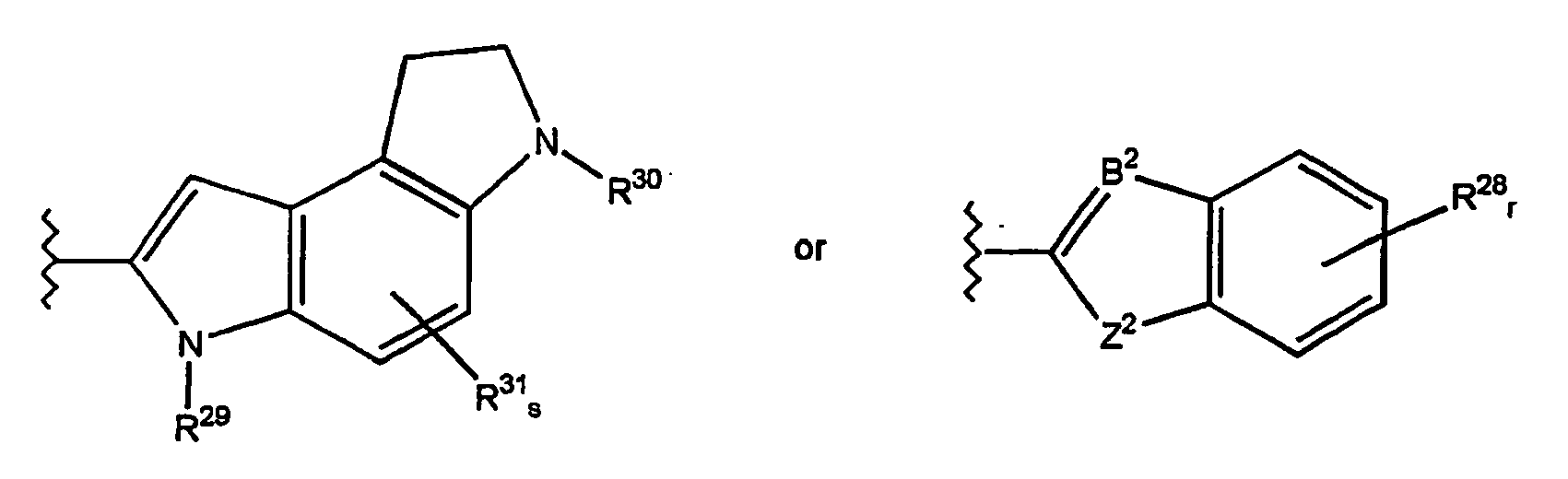
- The reaction between the compound of the general formula III or IIIA and the carboxylic acid or derivative of the general formula IV is carried out under conditions allowing such coupling to take place. Such conditions are similar to those generally used for formation of peptide bonds, for instance as used in peptide synthetic methods.
- Y2 is a hydroxy or protected hydroxyl group or a leaving group, which may be the same as Y, or may be converted to Y in a subsequent step.
- After the coupling process, it may be desirable to deprotect one or more of the protected amine groups. If further reaction, for instance with other derivatising agents such as glycosyl compounds, peptides, polymers etc is desired through any such amine groups, it may be desirable to deprotect only those to which subsequent reaction to to take place, whilst retaining the other amine groups in a protected form. Selection of suitable amine protecting groups and protection and deprotection protocols may be made using techniques commonly utilised in peptide chemistry.
- It is believed that some of the intermediates of the general formula III or IIIA may be novel compounds. A novel compound may have the general formula V or VA


X2 is H;
Y2 is a leaving group or a hydroxyl or protected hydroxyl group;
R37 is H or an amine protecting group;
R43 is selected from H, C1-4 alkyl, optionally substituted phenyl, C7-12-aralkyl, and optionally substituted heteroaryl an amine protecting group;
R44is selected from C1-4 alkyl, optionally substituted phenyl, C7-12-aralkyl, optionally substituted heteroaryl and a ligand;
each R45 is selected from C1-4alkyl, optionally substituted phenyl, C7-12-aralkyl and optionally substituted heteroaryl; and
R46 is selected from C1-4 alkyl, optionally substituted phenyl, C7-12-aralkyl, optionally substituted heteroaryl and a ligand. - In compounds of the general formula III, in the compound ready for reaction with a carboxylic acid derivative, for instance of the general formula IV, R24 is H. Precursors for such compounds have the ring nitrogen atom in protected form, that is in which R37 represents a protecting group.
- In compounds of the formula V, the group Y2 may be selected amongst those defined above for leaving group Y. The nature of the group Y2 should be selected having regard to the nature of the reagent with which the compound of the formula III/V is to react in a subsequent step, for instance with a compound of the general formula IV, such that the group Y2 is not deactivated and does not form a dimer of compounds of the formula III or V. Suitable examples of leaving group Y2 are Cl and Br.
- The compound of the formula III or IIIA and V or VA may be prepared in a preliminary step including a cyclisation step in the presence of a catalyst using as the starting material an aniline compound having a leaving group substituent Y4 at the carbon atom ortho to the amine group substituent, and an N-substituent which is a group -CH2CH=CHY5, in which the aniline derivative is reacted under cyclisation conditions, to form a dihydropyrrole or a di- or tetra hydroquinoline ring. The starting compound for such a reaction may be represented by the general formula VI

R47 is an amine protecting group,
one of Z1 and Z2 is Y5 and the other is H;
Y5 is a leaving group which is different from or the same as Y2; and
Y4 is the radical leaving group. - For cyclisation to form a dihydropyrrole ring, the group Z1 is Y5 and Y5 is either H or a leaving group, preferably the same group as Y2 wherein the group Y5 is not effective as a leaving group in this step of the synthesis. The reaction is conducted in the presence of a suitable catalyst, optionally in the presence of a free radical trap. The group Y4 should be a radical leaving group, such as halogen, preferably Br or I. Suitable radicals for carrying out the cyclisation reaction using a compound VI in which Y5 is H are nitroxy compounds such as 2,2,6,6-tetramethylpiperidinyloxy (TEMPO). Where Y5, is a leaving group the cyclisation may be carried out in the presence of a radical derived from azoisobutyronitrile (AIBN). Suitable catalysts for such a radical cyclisation step are tin hydride compounds such as tributyl tin hydride. Such a synthetic route is illustrated in Examples 1 and 3.
- For cyclisation to form a 6-membered ring it is preferred to use a compound VI in which Z2 is Y5 and Y5 is a leaving group, preferably a trialkyl stannyl group, and to carry out the reaction in the presence of a suitable catalyst palladium complexes such as tetrakis (triphenylphosphine) palladium (0), bis(triphenyl phosphine) palladium (II) chloride or palladium (II) acetate. The dihydroquinoline intermediate is oxidised to form a further intermediate which is an epoxide, for instance using a peroxide reagent. The epoxide intermediate is reduced using a suitable selective reducing agent such as a dialkyl aluminium hydride to produce the corresponding tetrahydroquinoline alcohol which is subsequently halogenated, for instance using carbon tetrachloride/triphenyl phosphine. This reaction is illustrated in Example 2.
- The compound of the general formula VI may be produced by alkylation of the sodium salt of the corresponding aniline derivative with a 1,3-dihalo propene compound.
- The carboxylic acid derivative of the general formula V may be synthesised using the methods generally described in Boger et al, 1997 op.cit. for instance PDE-I and PDE-II may be synthesised using the Umezawa synthesis, the Rees-Moody synthesis, the Magnus synthesis, the Cava-Rawal synthesis, the Boger-Coleman synthesis, the Sundberg synthesis, the Martin synthesis, the Tojo synthesis. Indole-2-carboxylic acid is commercially available. Other analogues of the DNA binding sub-units of the duocarmycins, and reactive carboxylic acid derivatives thereof are described by Boger et al, op.cit. and in US-A-5843937.
- The present invention relates to the creation of a range of prodrugs that have little or no cytotoxic effects when in their normal state, but are highly cytotoxic (i.e. have a substantially increased cytotoxicity) when activated by oxidation or hydroxylation by CYP enzymes. This provides for a self-targeting drug delivery system in which a non cytotoxic (or negligibly cytotoxic) compound can be administered to a patient, for example in a systemic manner, the compound then being activated at the site of the tumour cells (intratumoural activation) to form a highly cytotoxic compound which acts to kill the tumour cells. The fact that the CYP isoforms are not expressed by normal cells mean that the activation of the compound only occurs at the site of the tumour cells and therefore only tumour cells are affected, thus providing a self-targeting system.
- The prodrugs of the present invention have the distinct advantage of being useful in the treatment of tumours at any site in the body, meaning that even tumours that have undergone metastasis (which are normally not susceptible to site specific therapies) may be treated.
- The prodrug may be an antitumour prodrug. Examples of tumours include cancers (malignant neoplasms) as well as other neoplasms e.g. innocent tumours. The prodrug may be activated by hydroxylation by isoforms of cytochrome P450's.
- In a variation of the normal procedure which relies upon CYP expression within tumour cells to effect selective hydroxylation and hence activation of the prodrugs, the selectivity between tumour tissue and normal tissue can be enhanced in a two part procedure. Thus (a) infecting tumor cells with a viral vector carrying a cytochrome P450 gene and a cytochrome P450 reductase gene, wherein expression of cytochrome P450 gene and cytochrome P450 reductase gene by tumor cells enables the enzymatic conversion of a chemotherapeutic agent to its cytotoxic form within the tumor, whereby the tumor cells become selectively sensitized to the prodrug chemotherapeutic agent (b) contacting tumor cells with the prodrug chemotherapeutic agent whereby tumor cells are selectively killed.
- These prodrugs are benz(e)dihydroindole or benz-tetrahydroquinoline derivatives. Their specific use as antitumour prodrugs has not been previously suggested or disclosed, nor has the suggestion that they are prodrugs having an activated hydroxylated form. Where compounds of formula (I) have been previously identified and made, they have not been identified as anti-tumour agents due to their poor (or negligible) cytotoxicity. Thus the intratumoural hydroxylation of the prodrugs of the present invention provides them with a surprising and unexpected efficacy.
- Hydroxylated forms of the prodrugs are potent DNA alkylating agents that bind in the minor groove of DNA and alkylate the purine bases at the N3 position. As such, they are potent cytotoxic agents whose exact biological mechanism of action is unknown but involves the disruption of template and other functions of DNA General inhibition of template function of DNA will affect and be generally cytotoxic to all dividing cells in the body and lead to unacceptable side effects in a therapeutic setting. However, the targetted production of hydroxylated forms only in tumour cells that overexpress particular isoforms of cytochrome P450's will lead to a specific cytotoxic effect only in those cells. The non-hydroxylated forms are essentially nontoxic to all cells.
- The following examples illustrate the invention.
-

- A solution of 2-napthoic acid (100 mg, 0.581 mmol) in t-BuOH (33 mL) was treated with Et3N (96 µL, 0.7 mmol) and 4 A molecular sieves (1 g). Diphenyl phosphorylazide (0.15 ml, 0.7 mmol) was added, and the reaction mixture was warmed to reflux for 14 h. The mixture was cooled to 25 °C and the solvent removed under vacuum. The residue was dissolved in EtOAc (10 mL) and the organic phase was washed with 10% aqueous HCl (3 x 15 mL), dried (MgSO4) and concentrated. Purification by flash chromatography (SiO2, 10 % EtOAc in hexanes) afforded 2 (0.108mg, 77%) as a pale yellow solid. FABMS (NBA/Nal) 243([M + H]+ expected 243) 269 ([M + Na]+ expected 269).
- Compound 1.1 (1.5 g, 6.17 mmol) was dissolved in EtOAc (10 mL) to which was added 2.5 M HCl in EtOAc. The reaction mixture was stirred for 30 min. The resulting solution was then diluted with sat'd aq. NaHCO3 (50 mL) and extracted with EtOAc (2 x 25 mL). The combined organic layers were dried (MgSO4) and concentrated. The residue was crystalised from 20% EtOAc in hexane to afford 3.3 (0.74g, 84%) as pale brown crystals: 1H NMR (250 MHz, CDCl3) δ ppm 7.12-7.32 (m, 3 H), 6.96 (t, 1 H), 6.80 (t, 1 H), 6.56 (s, 1 H), 6.52 (dd, 1 H), 3.46 (br s, 2 H); FAB MS (NBA/Nal) 143 ([M + H]+ expected 143), 165 ([M + Na]+ expected 165).
- A solution of 1.2 (100 mg, 0.7 mmol), TsOH (48 mg, 0.28 mmol) in THF (6 mL) was stirred and cooled to 0°C. To the resulting mixture NIS (125 mg, 0.56 mmol) and THF (6 mL) were added and the solution was allowed to warm to 25 °C. After 3 h, additional NIS (31 mg, 0.14 mmol) was added. After 1 h, the mixture was diluted with 10% aqueous NaHCO3 (10 mL) and extracted with CHCl3 (3 × 10 mL). The organic layers were combined, dried (MgSO4) and concentrated. The residue was purified by flash chromatography (SiO2, 30 % EtOAc in hexane) to afford 1.3 (110 mg, 59 %) as a brown-yellow oil1H NMR (250 MHz, CDCl3) δ ppm 8.04 (d, 1 H), 7.68 (d, 1 H), 7.62 (d, 1 H), 7.50 (t, 1 H), 7.28 (t, 1 H), 7.00 (d, 1 H), 4.40 (br s, 2 H); FABMS (NBA/Nal): 221 ([M + H]+ expected 221), 243 ([M + Na]+ expected 243).
- A solution of 1.3 (100 mg, 0.37 mmol) in CH2Cl2 (5mL) was treated with Boc-dicarbonate (219 mg, 1.0 mmol), Et3N (62 µl, 0.45 mmol) and DMAP (4.5 mg, 0.037 mmol). The reaction was refluxed at 50 °C for 24 h. The resulting mixture was washed with H2O (2×10 mL), 5% HCl (10 mL) and finally again with H2O (10 mL). The organic layers were combined, dried (MgSO4) and concentrated. The reaction was purified by flash chromatography (SiO2 CH2Cl2/hexane 1:1) to afford 1.4 (125 mg, 72%) as a colourless solid. 1H NMR (250 MHz, CDCl3) δ ppm 8.32 (d, 1 H), 7.86 (d, 1 H), 7.80 (d, 1 H). 7.52-7.68 (m, 2 H), 7.32 (d, 1 H), 1.50 (s, 18 H); FABMS (NBA/Nal) 422 ([M + H]+ expected 422), 446 ([M + Na]+ expected 446).
- Compound 1.4 (50mg, 0.107 mmol) was treated with a solution of TFA (16 µL, 0.213 mmol) in CH2Cl2 (2mL) and stirred for 45 min. The mixture was concentrated and recrystallised from hexane to afford 1.5 (13 mg, 34 %) as white crystals. FABMS (NBA/Nal) 323 ([M + H]+ expected 323), 346 ([M + Na]+ expected 346).
- A solution of 1.5 (50 mg, 0.14 mmol) and DMF (5 mL) was cooled to 0 °C and NaH (9.8 mg, 0.408 mmol) was added. The resulting mixture was stirred for 15 min and 1,3 dichloropropene (38 µL, 0.41 mmol) was added. The solution was allowed to warm to 25 °C and stirred for 90 min. The mixture was concentrated and the residue was purified by flash chromatography (SiO2, 10 % EtOAc in hexane) to afford 1.6 (56 mg, 93 %) as a clear film. FABMS (NBA/Nal) 396 ([M + H]+ expected 396), 418 ([M + Na]+ expected 418).
- A solution of 1.6 (55 mg, 0.12 mmol) and AIBN (8 mg, 0.05 mmol) in anhydrous toluene (5 mL) was degassed for 15 min with N2 and then heated to 90 °C. Bu3SnH (65 µl. 0.25 mmol) was added in four portions over 1 h and the resulting mixture was stirred for 1 h. The soluion was then concentrated and purified by flash chromatography (SiO2, 10% EtOAc in hexane) to afford impure 3.8. The solid was then dissolved in EtOAc (2 mL) to which a 1 M KF solution (1 ml) in EtOAc (1 ml) was added. The solution was stirred for 45 mins after which the insoluble precipitate was filtered and the remaining solution concentrated to afford pure 1.7 (34mg, 87%) as a pale yellow oily film. FABMS (NBA/Nal) 317 ([M + H]+ expected 317).
- Compound 1.7 (10 mg, 0.03 mmol) was treated with 2.5 M HCl in EtOAc (100 µl) and the solution was stirred for 30 min. The solvent was removed under a stream of nitrogen and the grey residue was dissolved in DMF (1 mL). 5-Methoxyindole-2-carboxylic acid (17 mg, 0.09 mmol) and EDC (17 mg, 0.09 mmol) were added and the mixture stirred for 16 h. Solvent was removed in vacuo and the residue subjected to flash chromatography (SiO2, EtOAc/hexanes 1:1) to give the product as a red oil (11 mg, 94 %). FABMS (NBA/Nal) 391 (M + H+ expected 391).
-
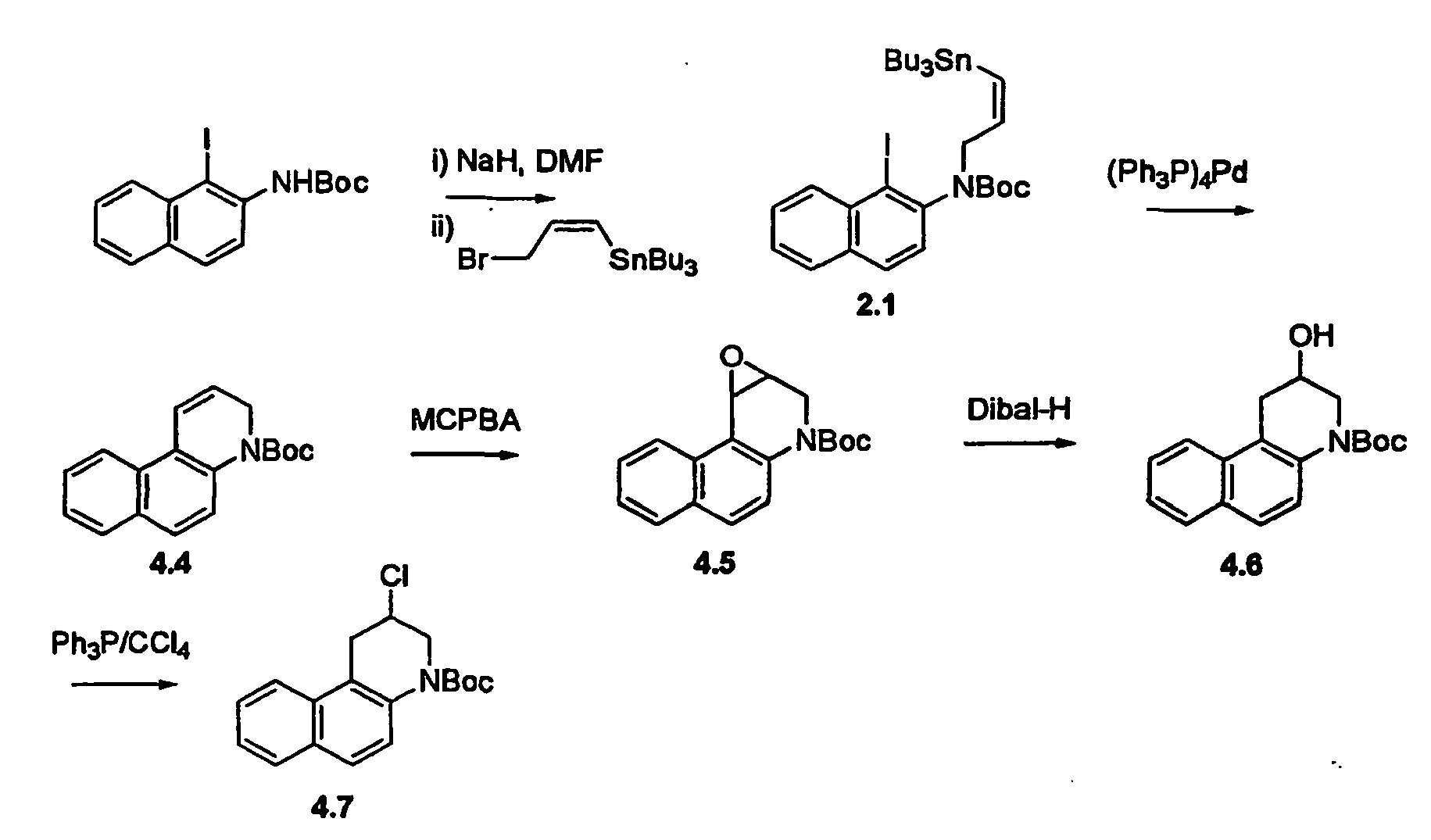
- 1-benzoyl-5-(tert butyloxycarbonyl)amino-4-iodoindole (100 mg, 0.22 mmol) was stirred in DMF (1 mL) and sodium hydride (26 mg, 0.66 mmol, 60% dispersion in oil, 3 equiv.) was added. After 15 min, the suspension was treated with E/Z-1-tributylstannyl-3-bromopropene (270 mg, 0.66 mmol, 3 equiv) and the resulting solution was stirred at RT for 16 h. The solution was concentrated and water (10 mL) was added. The aqueous solution was extracted with ethyl acetate (3 x 10 mL), the organic layers combined, dried and concentrated. Flash chromatography (SiO2, 10% ethyl acetate/hexanes) gave the product (120 mg, 78%) as a yellow solid. FABMS (NBA/Nal): 699 (M + H+ expected 699).
- 1-Benzoyl-5-[N-(3-(tributylstannyl)-2-propen-1-yl)-N-((tert-butyloxy)carbonyl)] amino-4-iodoindole (100 mg, 0.14 mmol) and tetrakis(triphenylphosphine) palladium(0) (32 mg, 0.2 equiv) were stirred in toluene (2 mL) at 50°C under N2 for 4 h. The solvent was then removed in vacuo. Chromatography (SiO2, 10% ethyl acetate/hexanes) gave the product as a red oil (38 mg, 99%). FABMS (NBA/Nal): 282 (M + H+ expected 282).
- 1,2-dihydro-1-((tert-butyloxy)carbonyl)-5,6-benzoquinolline (100 mg, 0.36 mmol) and MCPBA (91 mg, 0.54 mmol, 1.5 equiv) were stirred in CH2Cl2 (2 mL) at -30 °C under N2 for 6 h. The solvent was then removed in vacuo. Chromatography (SiO2, 10% ethyl acetate/hexanes) gave the product (101 mg, 95%). FABMS (NBA/Nal): 298 (M + H+ expected 298).
- 3,4-epoxy-1-((tert-butyloxy)carbonyl)-1,2,3,4-tetrahydro-5,6-benzoquinoline. (100 mg, 0.34 mmol) was treated with Dibal-H (91 mg, 0.54 mmol, 1.5 equiv) in THF (2 mL) at -78°C to -30 °C under N2. After 1 h, the reaction was quenched by the addition of water (2 mL) and the resulting solution was extracted with ethyl acetate (3 × 10 mL), the organic layers combined, dried and concentrated. The solvent was removed in vacuo. Chromatography (SiO2, 10% ethyl acetate/hexanes) gave the product (55 mg, 54 %) as a colourless solid. FABMS (NBA/Nal): 300 (M + H+ expected 300), 322 (M + Na+ expected 322).
- 4-hydroxy-1-((tert-butyloxy)carbonyl)-1,2,3,4-tetrahydro-5,6-benzoquinoline (100 mg, 0.33 mmol) in CH2Cl2 (2 mL)was treated with a prepared solution of PPh3 (175 mg, 0.66 mmol, 2 equiv) and CCl4 (200 µL) in CH2Cl2 (2 mL) at RT. After 4 h, the solvent was removed in vacuo. Chromatography (Silica gel, 2 x 15 cm, 10% ethyl acetate/hexanes) gave the chloride as an oil (65mg, 63%). FABMS (NBA/Nal): 318 (M + H+ expected 318), 340 (M + Na+ expected 340). The product may subsequently be deprotected and conjugated to a DNA-binding subunit such as 5-methoxyindole-2-carboxylic acid by process steps analogous to example 1.8.
- Test compound activation by CYP enzymes was carried out using NADPH supplemented rat liver microsomes. Incubation mixtures comprised microsomal protein (1 mg/ml), reduced-nicotinamide adenine dinucleotide phosphate (NADPH,10mM) and phosphate buffer (pH7.4, 100mM). Test compound (0.01-100 µM final concentration) in DMSO (20µl) was added to the microsomal incubation mixtures (0.5ml) and incubated for 60 min at 37C. Control incubates contained test compound and microsomal incubation mixture terminated at 0 time. All incubations were terminated by addition of an equal volume of ice-cold acetonitrile and microfuged for 3 min. Aliquots of the supernatant were added to cells in culture and cytotoxicity determined as described below.
- Chinese Hamster Ovary (CHO) cell were grown in MEM supplemented with 10% dialysed FBS and G418 (400µg/ml). All cells were seeded at an initial density of 1000 cells/well in 96-well-plates, incubation at 37°C for 24 hours. Aliquots (0.1 ml) of the test compound/microsomal/acetonitrile supematnant was then added to the CHO cells. Cells were then incubated for 24 hours at 37°C, 5% CO2. After this time period MTT (50 µl; 2mg/ml stock solution) was added to each well and cells were incubated for a further 4 hours. During this time period MTT, a hydrogen acceptor tetrazolium salt, is reduced to formazan dye by mitochondrial dehydrogenase of viable cells. The media was aspirated from cells and DMSO (100 µl/well) added to solubilise the coloured formazan dye. Absorbance of the formazan dye in the 96-well-plates was then determined at 550nm. The effect of microsomal activation by the test compound on the arrest of CHO cell growth could be determined by comparing the IC50 (concentration that inhibited cell growth by 50%) with and without microsomal incubation.
-
compound CHO IC50 (µM) AF +activation -activation 1.8 0.1±1.2 1.5±0.53 15.0* * represents significance at p>0.05. - Effect of compound 3.9 and its metabolism (activation) product on the survival of Chinese hamster ovary cells in culture. Cells were incubated for 24 hours with supernatants from reaction mixtures of compound 3.9 with NADPH fortified rat liver microsomes. IC50 represents the concentration of drug required to inhibit cell growth by 50%. Values are expressed as the mean + sd for three experiments. See methods for full details of metabolism. AF = activity factor i.e. the ratio of IC50 cytotoxicity values obtained for + compound 1.8 activation
Claims (60)
- Use of a compound of the general formula I or IA or a salt thereof in the manufacture of a composition for use in a method of treatment by therapy of an animal:


Y is a leaving group;
R1 is -Ar, NH2, R7 or -QR7;
R2, R3, R4 R5 and R6 are each independently selected from H, C1-4 alkyl, -OH, C1-4 alkoxy, -CN, CI, Br, I, -NO2, -NH2, -NHR16, -NR16 2, -N+R16 3; -NHCOR8, -COOH, -CONHR9, -NHCOOR9 and -COOR9;
R7, R8 and R9 are independently selected from C1-4 alkyl, optionally substituted phenyl, C7-12-aralkyl, optionally substituted heteroaryl and a ligand;
Ar is selected from

R10 is selected from OH, C1-4 alkoxy, C1-4 alkyl, -NO2, -NH2, -CN, Cl, Br, I, -NHCOR14, -COOH, -CONHR15, -NHCOOR15, -COOR15 and H;
Z is O, S, -CH=CH- or NH;
the or each R11 is selected from OH, C1-4 alkoxy, C1-4 alkyl, -NO2, -NH2, -NHR16, -NR16 2, -N+R16 3, -CN, Cl, Br, I, -NHCOR14, -COOH, -CONHR15-NHCOOR15 and COOR15;
n is an integer in the range 0 to 4;
R12 is H, -COAr1, -CONH2, -COOH, -COR15 or -COOR 15;
the or each R13 is selected from OH, C1-4 alkoxy, C1-4 alkyl, -NO2, -NH2, -NHR16, -NR16 2, -N+R16 3, -CN, Cl, Br, I, -NHCOR14, -COOH, -CONHR15, -NHCOOR15 and -COOR15;
m is 0, 1 or 2;
R14 is selected from C1-4 alkyl, optionally substituted phenyl, optionally substituted heteroaryl, C7-12 aralkyl, Ar1 and a ligand;
R15 is selected from C1-4alkyl, optionally substituted phenyl, C7-12-aralkyl and optionally substituted heteroaryl and a ligand;
the or each R16 is independently selected from C1-4 alkyl, optionally substituted phenyl, C7-12-aralkyl and optionally substituted heteroaryl; and
Ar1 is selected from the same groups as Ar;
provided that no more than one group R11 or R13 in any one ring includes a group Ar1. - Use according to claim 1 in which the animal is a human.
- Use according to claim 1 or claim 2 in which the treatment is of a tumour.
- Use according to any preceding claim in which Y is selected from -OCOOR17, -OCONHR18, Cl, Br, I, and -OSOOR19, in which R17, R18 and R19 are selected from C1-4alkyl, optionally substituted phenyl, C7-12-aralkyl and optionally substituted heteroaryl; preferably Cl.
- Use according to any preceding claim in which Ar1 is

- Use according to any preceding claim in which R1 is Ar.
- Use according to claim 6 in which Ar is a group
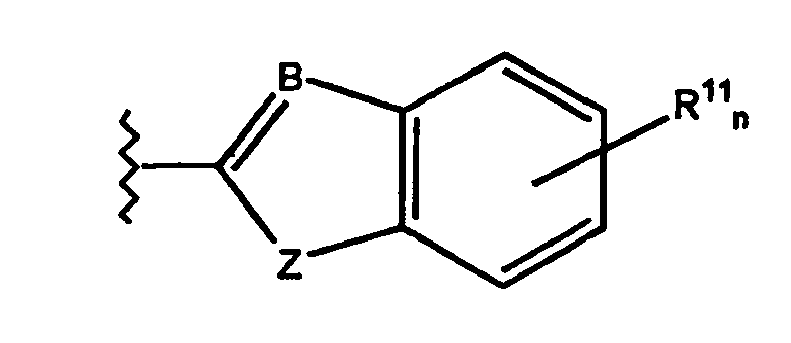
- Use according to claim 7 in which n is at least one and one of the groups R11 of the Ar group is -NHCOAr1.
- Use according to claim 8 in which Ar1 is a group

- Use according to claim 9 in which, in Ar1, n is at least 1 and R11 is other than -NHCOAr1, or n is 0.
- Use according to claim 6 in which Ar is a group

- Use according to claim 11 in which R12 is -COAr1.
- Use according to claim 12 in which Ar1 is a group

- Use according to claim 13 in which, in Ar1, R12 is other than -COAr1.
- Use according to any preceding claim in which R2 is H.
- Use according to any preceding claim in which R3 is H.
- Use according to any preceding claim in which R4 is H.
- Use according to any preceding claim in which R5 is H, C1-4-alkoxy or -CN, preferably MeO- or H.
- Use according to any preceding claim in which R6 is H.
- A compound of the general formula I as defined in any of claims 1 and 4 to 19 for use in the treatment an animal by therapy.
- A pharmaceutical composition comprising a compound of the general formula I as defined in any of claims 1 and 4 to 19 and a pharmaceutically acceptable excipient.
- A compound of the general formula II or IIA or a salt thereof


X1 is H;
Y1 is a leaving group;
R20 is R7, OR7, -NH2 or Ar2;
R7 is selected from C1-4alkyl, optionally substituted phenyl, C7-12-aralkyl, optionally substituted heteroaryl and a ligand;
Ar2 is selected from

Z1 is O, S, -CH=CH- or NR21;
R21 is an amine protecting group;
the or each R22 is selected from OH, C1-4 alkoxy C1-4 alkyl, NO2, -NHR21, -NHR26, -NR26 2, -N+R26 3, -CN, Cl, Br, I, -NHCOR25, -COOH, -CONHR7 and -COOR7;
p is an integer in the range 0 to 4;
R23 is H, COAr3, -CONH2, -COOH or -COR7 or is an amine protecting group;
the or each R24 is selected from OH, C1-4 alkoxy C1-4 alkyl, NO2, -NHR21, -NHR26, -NR26 2, -N+R26 3, -CN, Cl, Br, I, -NHCOR25, -COOH, -CONHR7 and -COOR7;
q is 0, 1 or 2
R25 is selected from C1-4 alkyl, optionally substituted phenyl, optionally substituted heteroalkyl, C7-12 aralkyl, Ar3 and a ligand;
R26 is selected from C1-4alkyl, optionally substituted phenyl, C7-12-aralkyl and optionally substituted heteroaryl; and
Ar3 is selected from the same groups as Ar2
provided that no more than one R22 or R24 in any one ring includes a group Ar3. - A compound according to claim 22 in which Y1 is selected from -OCOOR17, -OCONHR18, Cl, Br, I, and -OSOOR19 in which R17, R18 and R19 are selected from C1-4 alkyl, optionally substituted phenyl, C7-12-aralkyl and optionally substituted heteroaryl, preferably Cl.
- A compound according to claim 22 or claim 23 in which Ar3 is

- A compound according to any of claims 22 to 23 in which R20 is Ar2.
- A compound according to claim 25 in which Ar2 is a group

- A compound according to claim 26 in which p is at least 1 and one of the groups R22 of the group R20 is a group -NHCOAr3.
- A compound according to claim 27 in which Ar3 is

- A compound according to claim 28 in which, in Ar3, p is at least 1 and R22 is other than -NHCOAr3, or p is 0.
- A compound according to claim 25 in which Ar2 is a group

- A compound according to claim 30 in which R23 is COAr3.
- A compound according to claim 31 in which Ar3 is

- A compound according to claim 32 in which, in Ar3, R23 is other than -COAr3.
- A compound according to claim 22 or claim 23 in which R20 is other than Ar2.
- A compound according to any of claims 22 to 34 in which R1 is H.
- A compound according to any of claims 22 to 35 in which R3 is H.
- A compound according to any of claims 22 to 36 in which R4 is H.
- A compound according to any of claims 22 to 37 in which R5 is selected from H, C1-4-alkoxy and -CN, preferably MeO-.
- A compound according to any of claims 22 to 37 in which R6 is H.
- A compound according to claim 22 selected from:3-(tert-Butyloxycarbonyl)-1-(chloromethyl)-1,2-dihydro-3H-benz[e]indole;1-(chloromethyl)-3-[(5-methoxyindol-2-yl)carbonyl]-1,2-dihydro-3H-benz[e]indole;4-chloro-1-((tert-butyloxy)carbonyl)-1,2,3,4-tetrahydro-5,6-benzoquinoline; and4-chloro-1-((5methoxyindol-2-yl)carbonyl)-1,2,3,4-tetrahydro-5,6-benzoquinoline.
- A compound according to any of claims 22 to 40 for use in the treatment of an animal by therapy.
- A pharmaceutical composition comprising a compound according to any claims 22 to 40 and a pharmaceutically acceptable excipient.
- A synthetic method in which a compound of the formula III or IIIA

X2 is H; and
Y2 is a leaving group or a hydroxyl or protected hydroxyl group; is reacted with a compound of the general formula V
R27COY3 IV
in which R27 is selected from C1-4-alkyl, optionally substituted phenyl, C7-12-aralkyl, optionally substituted heteroaryl and Ar4;
Ar4 is selected from

Z2 is O, S, -CH=CH- or NR33;
the or each R28 is selected from C1-4-alkoxy, C1-4-alkyl, NO2, CN, Cl, Br, -NHR33, -NHR35, -NR35 2, -N+R35 3-, -NHCOR34, -COOH, -CONHR36 and -COOR36;
r is an integer in the range 0 to 4;
R29 is an amine protecting group;
R30 is an amine protecting group, -CONH2, -COOH, -COR36 or -COAr5; the or each R31 is selected from C1-4-alkoxy, C1-4-alkyl, NO2, CN, Cl, Br, -NHR33, -NHR35, -NR35 2, -N+R35 3, I, -NHCOR34, -COOH, -CONHR36 and -COOR35;
s is 0, 1 or 2;
R32 is, selected from H C1-4-alkoxy, C1-4-alkyl, NO2, CN, Cl, Br, I, -NHR33, -NHR35, -NR35 2, -N+R35 3, -NHCOR34, -COOH, -CONHR36 and COOR36;
R33 is an amine protecting group;
R34 is selected from Ar5, C1-4-alkyl, optionally substituted phenyl, C7-12-aralkyl optionally substituted heteroaryl and a ligand;
R35 is selected from C1-4-alkyl, optionally substituted phenyl, C7-12-aralkyl and optionally substituted heteroaryl;
R36 is selected from C1-4-alkyl, optionally substituted phenyl, C7-12-aralkyl, optionally substituted heteroaryl and a ligand;
Ar5 is selected from the same groups as Ar4, and
Y3 is a leaving group;
provided that no more than one R28 or R31 is any one ring is NHCOAr5. - A method according to claim 43 which is carried out in the presence of an amide coupling reagent.
- A method according to claim 43 or 44 in which the product is subsequently subjected to an amine deprotection step in which any or all groups R29 (if any) and/or any or all groups R33 (if any) are replaced by H.
- A method according to any of claims 43 to 45 in which Y2 is selected from -OCOOR17, -OCONHR18, Cl, Br, I, and -OSOOR19, in which R17, R18 and R19 are selected from C1-4alkyl, optionally substituted phenyl, C7-12-aralkyl and optionally substituted heteroaryl; preferably Cl.
- A method according to any of claims 43 to 46 in which Ar5 is selected from

- A method according to any of claims 43 to 47 in which R27 is Ar4.
- A method according to claim 48 in which Ar4 is a group

- A method according to claim 49 in which, in R27, r is at least 1 and one of the groups R28 is -NHCOAr5.
- A method according to claim 50 in which Ar5 is

- A method according to claim 48 in which Ar4 is a group

- A method according to claim 52 in which R30 is -COAr5.
- A method according to claim 53 in which, in R27, Ar5 is a group

- A method according to any of claims 43 to 54 in which the compound of the formula III or IIIA is produced in a series of preliminary steps comprising a cyclisation step in which a compound of the general formula VI
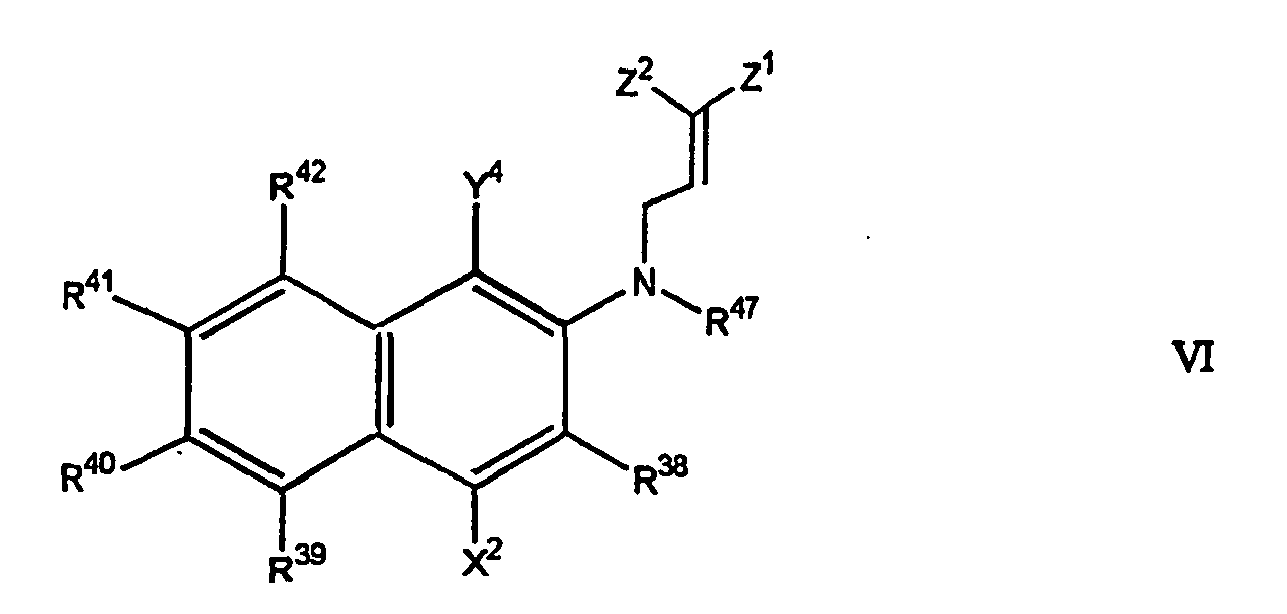
R47 is an amine protecting group,
one of Z1 and Z2 is Y5 and the other is H;
Y5 is a leaving group which is different from or the same as Y2 and
Y4 is a radical leaving group;
is cyclised via an arylradical-alkene cyclisation step in the presence of a catalyst. - A method according to claim 55 in which Z1 is Y2 and in which the cyclisation step is carried out in the presence of a free radical to form a dihydropyrole ring.
- A method according to claim 55 in which the free radical is generated from azoisobutyronitrile or is a 2,2,6,6-tetramethylpiperidinyloxy free radical.
- A method according to claim 56 or 57 in which the catalyst is tributyl tin hydride.
- A method according to claim 55 in which Z2 is Y5, Y5 is a trialkyl tin radical, and the cyclisation step is carried out in the presence of a palladium complex to form a tetra hydroquinoline, which is oxidised to form an epoxide, the epoxides then being reduced to form an alcohol compound if Y2 is other than hydroxyl, the hydroxyl group is subsequently conveited into Y2.
- A method according to any of claims 55 to 59 in which Y4 is a halogen, preferably I or Br.
Priority Applications (1)
| Application Number | Priority Date | Filing Date | Title |
|---|---|---|---|
| EP02701418A EP1408960B1 (en) | 2001-02-22 | 2002-02-22 | Benz-indole and benzo-quinoline derivatives as prodrugs for tumour treatment |
Applications Claiming Priority (4)
| Application Number | Priority Date | Filing Date | Title |
|---|---|---|---|
| EP01301634 | 2001-02-22 | ||
| EP01301634 | 2001-02-22 | ||
| PCT/GB2002/000801 WO2002067930A1 (en) | 2001-02-22 | 2002-02-22 | Benz-indole and benzo-quinoline derivatives as prodrugs for tumor treatment |
| EP02701418A EP1408960B1 (en) | 2001-02-22 | 2002-02-22 | Benz-indole and benzo-quinoline derivatives as prodrugs for tumour treatment |
Publications (2)
| Publication Number | Publication Date |
|---|---|
| EP1408960A1 EP1408960A1 (en) | 2004-04-21 |
| EP1408960B1 true EP1408960B1 (en) | 2006-05-31 |
Family
ID=8181736
Family Applications (1)
| Application Number | Title | Priority Date | Filing Date |
|---|---|---|---|
| EP02701418A Expired - Lifetime EP1408960B1 (en) | 2001-02-22 | 2002-02-22 | Benz-indole and benzo-quinoline derivatives as prodrugs for tumour treatment |
Country Status (6)
| Country | Link |
|---|---|
| US (2) | US7192977B2 (en) |
| EP (1) | EP1408960B1 (en) |
| JP (1) | JP4862120B2 (en) |
| AT (1) | ATE327750T1 (en) |
| DE (1) | DE60211905T2 (en) |
| WO (1) | WO2002067930A1 (en) |
Families Citing this family (13)
| Publication number | Priority date | Publication date | Assignee | Title |
|---|---|---|---|---|
| GB0302094D0 (en) | 2003-01-29 | 2003-02-26 | Pharmagene Lab Ltd | EP4 receptor antagonists |
| GB0324269D0 (en) | 2003-10-16 | 2003-11-19 | Pharmagene Lab Ltd | EP4 receptor antagonists |
| NZ536107A (en) * | 2004-10-22 | 2007-06-29 | Auckland Uniservices Ltd | Nitrobenzindoles and their use in cancer therapy |
| GB0505644D0 (en) | 2005-03-18 | 2005-04-27 | Univ London Pharmacy | Analogues of the azinomycins as anti-tumour agents and as prodrugs |
| US9901567B2 (en) | 2007-08-01 | 2018-02-27 | Syntarga B.V. | Substituted CC-1065 analogs and their conjugates |
| MX2011004625A (en) | 2008-11-03 | 2011-07-20 | Syntarga Bv | Novel cc-1065 analogs and their conjugates. |
| CA2956934C (en) | 2010-04-21 | 2019-07-09 | Syntarga B.V. | Novel conjugates of cc-1065 analogs and bifunctional linkers |
| AU2015205574B2 (en) | 2014-01-10 | 2019-08-15 | Byondis B.V. | Method for purifying Cys-linked antibody-drug conjugates |
| HRP20160797T1 (en) | 2014-01-10 | 2016-08-12 | Synthon Biopharmaceuticals B.V. | Duocarmycin adcs for use in treatment of endometrial cancer |
| MX368396B (en) | 2014-01-10 | 2019-10-01 | Synthon Biopharmaceuticals Bv | Duocarmycin adcs showing improved in vivo antitumor activity. |
| CN109020820B (en) * | 2017-06-08 | 2021-06-25 | 杭州惠诺医药科技有限公司 | Preparation method of 6-bromo-2-aminonaphthalene |
| JPWO2019004413A1 (en) * | 2017-06-30 | 2020-05-07 | 東レ株式会社 | Indoline derivative and cytotoxic agent containing the same |
| CN113292554A (en) * | 2021-06-25 | 2021-08-24 | 守恒(厦门)医疗科技有限公司 | Dihydronaphtho [2,1-d ] isoxazole amide derivatives and application thereof in antitumor drugs |
Family Cites Families (13)
| Publication number | Priority date | Publication date | Assignee | Title |
|---|---|---|---|---|
| US4413132A (en) * | 1980-11-18 | 1983-11-01 | The Upjohn Company | Antibiotic CC-1065 indoline intermediates |
| GB9519490D0 (en) | 1995-09-25 | 1995-11-29 | Melvin William T | Use of a cytochrome P450 enzyme in tumour cells as a marker and target |
| NZ321172A (en) * | 1995-10-03 | 2000-02-28 | Scripps Research Inst | CBI analogs of CC-1065 and the duocarmycins |
| EP0888301B1 (en) * | 1996-03-08 | 2005-08-10 | The Scripps Research Institute | Mcbi analogs of cc-1065 and the duocarmycins |
| US5843937A (en) * | 1996-05-23 | 1998-12-01 | Panorama Research, Inc. | DNA-binding indole derivatives, their prodrugs and immunoconjugates as anticancer agents |
| US6060608A (en) * | 1996-05-31 | 2000-05-09 | The Scripps Research Institute | Analogs of CC-1065 and the duocarmycins |
| DE69734722T2 (en) * | 1996-09-12 | 2006-07-20 | Auckland Uniservices Ltd. | CONDENSED N-ACYLINDOLE AS ANTITUMOROUSE |
| DE69918950T2 (en) | 1998-02-06 | 2005-07-28 | De Montfort University | BY HYDROXYLATION ACTIVATED MEDICAMENT PREPARATIONS |
| JP2004529887A (en) * | 2001-02-22 | 2004-09-30 | スクール オブ ファーマシー, ユニヴァーシティ オブ ロンドン | Pyrrolo-indole and pyrrolo-quinoline derivatives as prodrugs for treating tumors |
| DE60220057T2 (en) * | 2001-02-22 | 2008-01-10 | School Of Pharmacy, University Of London | Indolines and tetrahydroquinolines as prodrugs for tumor treatment |
| US7087600B2 (en) * | 2001-05-31 | 2006-08-08 | Medarex, Inc. | Peptidyl prodrugs and linkers and stabilizers useful therefor |
| WO2004101767A2 (en) * | 2003-05-13 | 2004-11-25 | The Scripps Research Institute | Cbi analogues of the duocarmycins and cc-1065 |
| US7517903B2 (en) * | 2004-05-19 | 2009-04-14 | Medarex, Inc. | Cytotoxic compounds and conjugates |
-
2002
- 2002-02-22 US US10/468,744 patent/US7192977B2/en not_active Expired - Lifetime
- 2002-02-22 EP EP02701418A patent/EP1408960B1/en not_active Expired - Lifetime
- 2002-02-22 AT AT02701418T patent/ATE327750T1/en not_active IP Right Cessation
- 2002-02-22 WO PCT/GB2002/000801 patent/WO2002067930A1/en not_active Ceased
- 2002-02-22 JP JP2002567297A patent/JP4862120B2/en not_active Expired - Fee Related
- 2002-02-22 DE DE60211905T patent/DE60211905T2/en not_active Expired - Lifetime
-
2007
- 2007-02-27 US US11/710,899 patent/US8017640B2/en not_active Expired - Fee Related
Also Published As
| Publication number | Publication date |
|---|---|
| US8017640B2 (en) | 2011-09-13 |
| JP4862120B2 (en) | 2012-01-25 |
| DE60211905T2 (en) | 2007-01-18 |
| US7192977B2 (en) | 2007-03-20 |
| US20040138246A1 (en) | 2004-07-15 |
| DE60211905D1 (en) | 2006-07-06 |
| WO2002067930A1 (en) | 2002-09-06 |
| US20070161669A1 (en) | 2007-07-12 |
| JP2004522779A (en) | 2004-07-29 |
| ATE327750T1 (en) | 2006-06-15 |
| EP1408960A1 (en) | 2004-04-21 |
Similar Documents
| Publication | Publication Date | Title |
|---|---|---|
| US8017640B2 (en) | Benz-indole and benzo-quinoline derivatives as prodrugs for tumor treatment | |
| EP1409480B1 (en) | Pyrrolo-indole and pyrrolo-quinoline derivatives as prodrugs for tumour treatment | |
| JP5567157B2 (en) | N-substituted indenoisoquinoline and its synthesis | |
| EP1948242B9 (en) | Cytotoxic compounds | |
| US7906545B2 (en) | Prodrugs of CC-1065 analogs | |
| JP4155598B2 (en) | Condensed N-acylindoles as anticancer agents | |
| US20110092478A1 (en) | Diazabenzo[de] anthracen-3-one compounds and methods for inhibiting parp | |
| Wolfe et al. | A novel, unusually efficacious duocarmycin carbamate prodrug that releases no residual byproduct | |
| EP1408970B1 (en) | Indolines and tetrahydro-quinolines as prodrugs for tumour treatment | |
| KR20130108454A (en) | Phosphorus substituted group-containing quinoline-like compound, its preparation process, medical composition containing the compound and application | |
| Ghosh et al. | Chemical and biological explorations of the family of CC-1065 and the duocarmycin natural products | |
| US7235578B2 (en) | Processes for preparing 3-substituted 1-(chloromethyl)-1,2-dihydro-3H-[ring fused indol-5-yl-(amine-derived)] compounds and analogues thereof, and to products obtained therefrom | |
| EP2343291A1 (en) | 3-(Indolyl)- or 3-(Azaindolyl)-4-arylmaleimide compounds and their use in tumor treatment | |
| WO2002036597A1 (en) | Tricyclic derivatives of indole with antiangiogenic activity | |
| TW200930716A (en) | Synthesis of 8H-3a-aza-cyclopenta[a]indenes and 5,10-dihydropyrrolo[1,2-b]isoquinolines derivatives and their use as antitumor therapeutic agents | |
| AU2002215186B2 (en) | Tricyclic derivatives of indole with antiangiogenic activity | |
| JPH0834788A (en) | Pyrrolobenzocarbazole derivative and method for producing the same | |
| HK40008068A (en) | Porphyrin compounds and compositions useful for treating cancer | |
| AU2016203107A1 (en) | N-Substituted indenoisoquinolines and syntheses thereof | |
| JPH0834787A (en) | Pyrrolocarbazole derivative and method for producing the same | |
| AU2002215186A1 (en) | Tricyclic derivatives of indole with antiangiogenic activity |
Legal Events
| Date | Code | Title | Description |
|---|---|---|---|
| PUAI | Public reference made under article 153(3) epc to a published international application that has entered the european phase |
Free format text: ORIGINAL CODE: 0009012 |
|
| 17P | Request for examination filed |
Effective date: 20031110 |
|
| AK | Designated contracting states |
Kind code of ref document: A1 Designated state(s): AT BE CH CY DE DK ES FI FR GB GR IE IT LI LU MC NL PT SE TR |
|
| AX | Request for extension of the european patent |
Extension state: AL LT LV MK RO SI |
|
| 17Q | First examination report despatched |
Effective date: 20041112 |
|
| GRAP | Despatch of communication of intention to grant a patent |
Free format text: ORIGINAL CODE: EPIDOSNIGR1 |
|
| RIN1 | Information on inventor provided before grant (corrected) |
Inventor name: SEARCEY, MARKSCHOOL OF PHARMACY,UNIVERS.OF LONDON Inventor name: PATTERSON, LAURENCE HYLTONSCHOOL OF PHARMACY |
|
| GRAS | Grant fee paid |
Free format text: ORIGINAL CODE: EPIDOSNIGR3 |
|
| RAP1 | Party data changed (applicant data changed or rights of an application transferred) |
Owner name: SCHOOL OF PHARMACY, UNIVERSITY OF LONDON |
|
| GRAA | (expected) grant |
Free format text: ORIGINAL CODE: 0009210 |
|
| AK | Designated contracting states |
Kind code of ref document: B1 Designated state(s): AT BE CH CY DE DK ES FI FR GB GR IE IT LI LU MC NL PT SE TR |
|
| PG25 | Lapsed in a contracting state [announced via postgrant information from national office to epo] |
Ref country code: FI Free format text: LAPSE BECAUSE OF FAILURE TO SUBMIT A TRANSLATION OF THE DESCRIPTION OR TO PAY THE FEE WITHIN THE PRESCRIBED TIME-LIMIT Effective date: 20060531 Ref country code: CH Free format text: LAPSE BECAUSE OF FAILURE TO SUBMIT A TRANSLATION OF THE DESCRIPTION OR TO PAY THE FEE WITHIN THE PRESCRIBED TIME-LIMIT Effective date: 20060531 Ref country code: IT Free format text: LAPSE BECAUSE OF FAILURE TO SUBMIT A TRANSLATION OF THE DESCRIPTION OR TO PAY THE FEE WITHIN THE PRESCRIBED TIME-LIMIT;WARNING: LAPSES OF ITALIAN PATENTS WITH EFFECTIVE DATE BEFORE 2007 MAY HAVE OCCURRED AT ANY TIME BEFORE 2007. THE CORRECT EFFECTIVE DATE MAY BE DIFFERENT FROM THE ONE RECORDED. Effective date: 20060531 Ref country code: AT Free format text: LAPSE BECAUSE OF FAILURE TO SUBMIT A TRANSLATION OF THE DESCRIPTION OR TO PAY THE FEE WITHIN THE PRESCRIBED TIME-LIMIT Effective date: 20060531 Ref country code: BE Free format text: LAPSE BECAUSE OF FAILURE TO SUBMIT A TRANSLATION OF THE DESCRIPTION OR TO PAY THE FEE WITHIN THE PRESCRIBED TIME-LIMIT Effective date: 20060531 Ref country code: LI Free format text: LAPSE BECAUSE OF FAILURE TO SUBMIT A TRANSLATION OF THE DESCRIPTION OR TO PAY THE FEE WITHIN THE PRESCRIBED TIME-LIMIT Effective date: 20060531 Ref country code: NL Free format text: LAPSE BECAUSE OF FAILURE TO SUBMIT A TRANSLATION OF THE DESCRIPTION OR TO PAY THE FEE WITHIN THE PRESCRIBED TIME-LIMIT Effective date: 20060531 |
|
| REG | Reference to a national code |
Ref country code: CH Ref legal event code: EP Ref country code: GB Ref legal event code: FG4D |
|
| REG | Reference to a national code |
Ref country code: IE Ref legal event code: FG4D |
|
| REF | Corresponds to: |
Ref document number: 60211905 Country of ref document: DE Date of ref document: 20060706 Kind code of ref document: P |
|
| PG25 | Lapsed in a contracting state [announced via postgrant information from national office to epo] |
Ref country code: SE Free format text: LAPSE BECAUSE OF FAILURE TO SUBMIT A TRANSLATION OF THE DESCRIPTION OR TO PAY THE FEE WITHIN THE PRESCRIBED TIME-LIMIT Effective date: 20060831 Ref country code: DK Free format text: LAPSE BECAUSE OF FAILURE TO SUBMIT A TRANSLATION OF THE DESCRIPTION OR TO PAY THE FEE WITHIN THE PRESCRIBED TIME-LIMIT Effective date: 20060831 |
|
| PG25 | Lapsed in a contracting state [announced via postgrant information from national office to epo] |
Ref country code: ES Free format text: LAPSE BECAUSE OF FAILURE TO SUBMIT A TRANSLATION OF THE DESCRIPTION OR TO PAY THE FEE WITHIN THE PRESCRIBED TIME-LIMIT Effective date: 20060911 |
|
| PG25 | Lapsed in a contracting state [announced via postgrant information from national office to epo] |
Ref country code: PT Free format text: LAPSE BECAUSE OF FAILURE TO SUBMIT A TRANSLATION OF THE DESCRIPTION OR TO PAY THE FEE WITHIN THE PRESCRIBED TIME-LIMIT Effective date: 20061031 |
|
| NLV1 | Nl: lapsed or annulled due to failure to fulfill the requirements of art. 29p and 29m of the patents act | ||
| ET | Fr: translation filed | ||
| REG | Reference to a national code |
Ref country code: CH Ref legal event code: PL |
|
| PG25 | Lapsed in a contracting state [announced via postgrant information from national office to epo] |
Ref country code: MC Free format text: LAPSE BECAUSE OF NON-PAYMENT OF DUE FEES Effective date: 20070228 |
|
| PLBE | No opposition filed within time limit |
Free format text: ORIGINAL CODE: 0009261 |
|
| STAA | Information on the status of an ep patent application or granted ep patent |
Free format text: STATUS: NO OPPOSITION FILED WITHIN TIME LIMIT |
|
| 26N | No opposition filed |
Effective date: 20070301 |
|
| PG25 | Lapsed in a contracting state [announced via postgrant information from national office to epo] |
Ref country code: IE Free format text: LAPSE BECAUSE OF NON-PAYMENT OF DUE FEES Effective date: 20070222 |
|
| PG25 | Lapsed in a contracting state [announced via postgrant information from national office to epo] |
Ref country code: GR Free format text: LAPSE BECAUSE OF FAILURE TO SUBMIT A TRANSLATION OF THE DESCRIPTION OR TO PAY THE FEE WITHIN THE PRESCRIBED TIME-LIMIT Effective date: 20060901 |
|
| PG25 | Lapsed in a contracting state [announced via postgrant information from national office to epo] |
Ref country code: LU Free format text: LAPSE BECAUSE OF NON-PAYMENT OF DUE FEES Effective date: 20070222 Ref country code: CY Free format text: LAPSE BECAUSE OF FAILURE TO SUBMIT A TRANSLATION OF THE DESCRIPTION OR TO PAY THE FEE WITHIN THE PRESCRIBED TIME-LIMIT Effective date: 20060531 |
|
| PG25 | Lapsed in a contracting state [announced via postgrant information from national office to epo] |
Ref country code: TR Free format text: LAPSE BECAUSE OF FAILURE TO SUBMIT A TRANSLATION OF THE DESCRIPTION OR TO PAY THE FEE WITHIN THE PRESCRIBED TIME-LIMIT Effective date: 20060531 |
|
| REG | Reference to a national code |
Ref country code: DE Ref legal event code: R082 Ref document number: 60211905 Country of ref document: DE Representative=s name: MEISSNER, BOLTE & PARTNER GBR, DE Ref country code: DE Ref legal event code: R082 Ref document number: 60211905 Country of ref document: DE Representative=s name: MEISSNER BOLTE PATENTANWAELTE RECHTSANWAELTE P, DE |
|
| REG | Reference to a national code |
Ref country code: DE Ref legal event code: R082 Ref document number: 60211905 Country of ref document: DE Representative=s name: MEISSNER, BOLTE & PARTNER GBR, DE |
|
| REG | Reference to a national code |
Ref country code: FR Ref legal event code: PLFP Year of fee payment: 14 |
|
| PGFP | Annual fee paid to national office [announced via postgrant information from national office to epo] |
Ref country code: DE Payment date: 20150225 Year of fee payment: 14 |
|
| PGFP | Annual fee paid to national office [announced via postgrant information from national office to epo] |
Ref country code: FR Payment date: 20150219 Year of fee payment: 14 |
|
| REG | Reference to a national code |
Ref country code: GB Ref legal event code: 732E Free format text: REGISTERED BETWEEN 20150709 AND 20150715 |
|
| REG | Reference to a national code |
Ref country code: DE Ref legal event code: R119 Ref document number: 60211905 Country of ref document: DE |
|
| REG | Reference to a national code |
Ref country code: FR Ref legal event code: ST Effective date: 20161028 |
|
| PG25 | Lapsed in a contracting state [announced via postgrant information from national office to epo] |
Ref country code: FR Free format text: LAPSE BECAUSE OF NON-PAYMENT OF DUE FEES Effective date: 20160229 Ref country code: DE Free format text: LAPSE BECAUSE OF NON-PAYMENT OF DUE FEES Effective date: 20160901 |
|
| PGFP | Annual fee paid to national office [announced via postgrant information from national office to epo] |
Ref country code: GB Payment date: 20190222 Year of fee payment: 18 |
|
| GBPC | Gb: european patent ceased through non-payment of renewal fee |
Effective date: 20200222 |
|
| PG25 | Lapsed in a contracting state [announced via postgrant information from national office to epo] |
Ref country code: GB Free format text: LAPSE BECAUSE OF NON-PAYMENT OF DUE FEES Effective date: 20200222 |