EP1408311A1 - Magnetic member for revolution detector - Google Patents
Magnetic member for revolution detector Download PDFInfo
- Publication number
- EP1408311A1 EP1408311A1 EP02736146A EP02736146A EP1408311A1 EP 1408311 A1 EP1408311 A1 EP 1408311A1 EP 02736146 A EP02736146 A EP 02736146A EP 02736146 A EP02736146 A EP 02736146A EP 1408311 A1 EP1408311 A1 EP 1408311A1
- Authority
- EP
- European Patent Office
- Prior art keywords
- magnetic
- strontium
- rotation detector
- based ferrite
- magnetic member
- Prior art date
- Legal status (The legal status is an assumption and is not a legal conclusion. Google has not performed a legal analysis and makes no representation as to the accuracy of the status listed.)
- Ceased
Links
Images


Classifications
-
- G—PHYSICS
- G01—MEASURING; TESTING
- G01D—MEASURING NOT SPECIALLY ADAPTED FOR A SPECIFIC VARIABLE; ARRANGEMENTS FOR MEASURING TWO OR MORE VARIABLES NOT COVERED IN A SINGLE OTHER SUBCLASS; TARIFF METERING APPARATUS; MEASURING OR TESTING NOT OTHERWISE PROVIDED FOR
- G01D5/00—Mechanical means for transferring the output of a sensing member; Means for converting the output of a sensing member to another variable where the form or nature of the sensing member does not constrain the means for converting; Transducers not specially adapted for a specific variable
- G01D5/12—Mechanical means for transferring the output of a sensing member; Means for converting the output of a sensing member to another variable where the form or nature of the sensing member does not constrain the means for converting; Transducers not specially adapted for a specific variable using electric or magnetic means
- G01D5/244—Mechanical means for transferring the output of a sensing member; Means for converting the output of a sensing member to another variable where the form or nature of the sensing member does not constrain the means for converting; Transducers not specially adapted for a specific variable using electric or magnetic means influencing characteristics of pulses or pulse trains; generating pulses or pulse trains
-
- G—PHYSICS
- G01—MEASURING; TESTING
- G01P—MEASURING LINEAR OR ANGULAR SPEED, ACCELERATION, DECELERATION, OR SHOCK; INDICATING PRESENCE, ABSENCE, OR DIRECTION, OF MOVEMENT
- G01P3/00—Measuring linear or angular speed; Measuring differences of linear or angular speeds
- G01P3/42—Devices characterised by the use of electric or magnetic means
- G01P3/44—Devices characterised by the use of electric or magnetic means for measuring angular speed
- G01P3/48—Devices characterised by the use of electric or magnetic means for measuring angular speed by measuring frequency of generated current or voltage
- G01P3/481—Devices characterised by the use of electric or magnetic means for measuring angular speed by measuring frequency of generated current or voltage of pulse signals
- G01P3/487—Devices characterised by the use of electric or magnetic means for measuring angular speed by measuring frequency of generated current or voltage of pulse signals delivered by rotating magnets
-
- H—ELECTRICITY
- H01—ELECTRIC ELEMENTS
- H01F—MAGNETS; INDUCTANCES; TRANSFORMERS; SELECTION OF MATERIALS FOR THEIR MAGNETIC PROPERTIES
- H01F1/00—Magnets or magnetic bodies characterised by the magnetic materials therefor; Selection of materials for their magnetic properties
- H01F1/01—Magnets or magnetic bodies characterised by the magnetic materials therefor; Selection of materials for their magnetic properties of inorganic materials
- H01F1/03—Magnets or magnetic bodies characterised by the magnetic materials therefor; Selection of materials for their magnetic properties of inorganic materials characterised by their coercivity
- H01F1/032—Magnets or magnetic bodies characterised by the magnetic materials therefor; Selection of materials for their magnetic properties of inorganic materials characterised by their coercivity of hard-magnetic materials
- H01F1/10—Magnets or magnetic bodies characterised by the magnetic materials therefor; Selection of materials for their magnetic properties of inorganic materials characterised by their coercivity of hard-magnetic materials non-metallic substances, e.g. ferrites, e.g. [(Ba,Sr)O(Fe2O3)6] ferrites with hexagonal structure
- H01F1/11—Magnets or magnetic bodies characterised by the magnetic materials therefor; Selection of materials for their magnetic properties of inorganic materials characterised by their coercivity of hard-magnetic materials non-metallic substances, e.g. ferrites, e.g. [(Ba,Sr)O(Fe2O3)6] ferrites with hexagonal structure in the form of particles
- H01F1/113—Magnets or magnetic bodies characterised by the magnetic materials therefor; Selection of materials for their magnetic properties of inorganic materials characterised by their coercivity of hard-magnetic materials non-metallic substances, e.g. ferrites, e.g. [(Ba,Sr)O(Fe2O3)6] ferrites with hexagonal structure in the form of particles in a bonding agent
- H01F1/117—Flexible bodies
-
- G—PHYSICS
- G01—MEASURING; TESTING
- G01D—MEASURING NOT SPECIALLY ADAPTED FOR A SPECIFIC VARIABLE; ARRANGEMENTS FOR MEASURING TWO OR MORE VARIABLES NOT COVERED IN A SINGLE OTHER SUBCLASS; TARIFF METERING APPARATUS; MEASURING OR TESTING NOT OTHERWISE PROVIDED FOR
- G01D2205/00—Indexing scheme relating to details of means for transferring or converting the output of a sensing member
- G01D2205/80—Manufacturing details of magnetic targets for magnetic encoders
Definitions
- the present invention relates to a magnetic member for a rotation detector that is used for an antilock brake system of an automobile or the like.
- wheel speed detection devices have been used for antilock brake systems of automobiles.
- wheel speed detection devices employing multi-pole pulser rings have been used increasingly.
- Such a multi-pole pulser ring is a multi-pole magnet in which an elastic magnetic member composed of high nitrile rubber (NBR) mixed with magnetic powder is bonded to a metal ring.
- NBR high nitrile rubber
- an object of the present invention is to provide a magnetic member for a rotation detector that is resistant to harsh conditions on operating temperature and that has a stable magnetic property.
- a magnetic member for a rotation detector comprising elastic magnetic material containing hydrogenated nitrile rubber as base material and containing strontium-based ferrite as a magnetism imparting component, wherein a weight percentage of strontium-based ferrite in the elastic magnetic material is in a range of 80 to 90 weight percent.
- the magnetic member for the rotation detector of the invention contains not more than 90 weight percent strontium-based ferrite as a magnetism imparting component combined with base material of hydrogenated nitrile rubber, therefore has no cracks in a thermal shock test (with thermal shock between -40°C and 150°C), and resists harsh conditions on operating temperature. With use of nitrile rubber (NBR) as base material, by contrast, cracks are caused by the thermal shock test.
- NBR nitrile rubber
- the magnetic member of the invention contains not less than 80 weight percent the strontium-based ferrite as the magnetism imparting component and therefore ensures a magnetic flux density required for a rotation detector. With a weight percentage of the strontium-based ferrite as the magnetism imparting component less than 80 percent, by contrast, a magnetic flux density falls short of that required for the rotation detector.
- the invention provides the magnetic member for the rotation detector that is resistant to harsh conditions on operating temperature and that has stable magnetic property.
- a weight percentage of strontium-based ferrite in the elastic magnetic material is in a range of 80 to 88 weight percent.
- the weight percentage of strontium-based ferrite in the elastic magnetic material is not more than 88 weight percent. Therefore, the magnetic member has no cracks in a thermal shock test and moreover exhibits a certain elongation (not less than 30%) to facilitate handling in the production process.
- the weight percentage of strontium-based ferrite in the elastic magnetic material is in a range of 80 to 85 weight percent.
- the weight percentage of strontium-based ferrite in the elastic magnetic material is not more than 85 weight percent. Therefore, the magnetic member has no cracks in a thermal shock test and moreover exhibits a large elongation (not less than 400 %) to highly improve its endurance.
- the elastic magnetic material generates a magnetic flux density not less than 20 m Tesla.
- the elastic magnetic material generates a magnetic flux density not less than 20 m Tesla. Therefore, a magnetic flux density required for a rotation detector can be ensured to obtain a sufficient precision of detection.
- Fig. 1A is a half sectional view of a magnetized pulser ring 1 for a rotation detector as an embodiment of a magnetic member for a rotation detector of a wheel speed detection device according to the invention, the pulser ring composed of an annular elastic magnetic body 3 and an annular steel member 2, and Fig. 1B is a fragmentary plan view of the magnetized pulser ring 1;
- Fig. 2 is a characteristic graph showing relations between weight percentages of strontium-based ferrite in elastic magnetic material that constitutes the annular elastic magnetic body 3 of the embodiment and elongation percentages in tensile tests;
- Fig. 3A is another characteristic graph showing relations between weight percentages of strontium-based ferrite in elastic magnetic material that constitutes the annular elastic magnetic body 3 of the embodiment and elongation percentages in tensile tests
- Fig. 3B is an enlarged detailed view of Fig. 3A in right-lower portion;
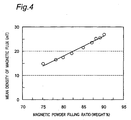
- Fig. 4 is a characteristic graph showing relations between weight percentages of strontium-based ferrite in elastic magnetic material that constitutes the annular elastic magnetic body 3 of the embodiment and densities of magnetic flux generated by the elastic magnetic material.
- Fig. 1A shows a half sectional view of a magnetized pulser ring 1 for a rotation detector of a wheel speed detection device.
- the magnetized pulser ring 1 is composed of an annular steel member 2 and an annular elastic magnetic body 3 as the embodiment of a magnetic member for a rotation detector of the invention.
- the annular steel member 2 is composed of a cylinder section 2A and a flange section 2B.
- the annular elastic magnetic body 3 is bonded onto an end surface 4 of the flange section 2B.
- the annular elastic magnetic body 3 has a fitting section 7 that surrounds an outer circumferential edge 5 of the flange section 2B and that covers an edge of a rear surface 6. Inside an edge 8 on a side of an internal diameter of the annular elastic magnetic body 3 is exposed the end surface 4 of the flange section 2B.
- Fig. 1B partially shows a view of the magnetized pulser ring 1, as seen looking in an axial direction.
- the annular elastic magnetic body 3 as shown in Fig. 1B, a plurality of magnetized areas 10 and 11 are alternately arranged along a circumferential direction.
- the magnetized areas 10 are magnetized as north poles and the magnetized areas 11 are magnetized as south poles.
- the annular elastic magnetic body 3 of the embodiment is composed of elastic magnetic material containing hydrogenated nitrile rubber (HNBR) as base material and containing strontium-based ferrite powder as a magnetism imparting component.
- HNBR hydrogenated nitrile rubber
- strontium-based ferrite powder as a magnetism imparting component.
- a weight percentage of strontium-based ferrite in the elastic magnetic material is in a range of 80 to 90 weight percent.
- the elastic magnetic material that forms the annular elastic magnetic body 3 is produced from hydro-nitrile rubber as the base material kneaded with the ferrite powder, is bonded to the annular steel member 2 by vulcanization molding, and is subjected to a predetermined magnetic field, so that the magnetized pulser ring 1 is completed in which north poles and south poles are alternately arranged as shown in Fig. 1B.
- the annular elastic magnetic body 3 of the embodiment contains not more than 85 weight percent strontium-based ferrite as the magnetism imparting component, therefore has no cracks in a thermal shock test (with thermal shock between -40°C and 150°C), and resists harsh conditions on operating temperature. With a weight percentage of strontium-based ferrite exceeding 85 percent, by contrast, an elongation (percentage) steeply decreases and strength also decreases. In the thermal shock test, an ambient temperature cyclically changes between -40°C and 150°C, and a predetermined number (e.g., on order of 500) of cycles of such temperature change are executed.
- a predetermined number e.g., on order of 500
- a reference character (1) shows an elongation characteristic curve with nitrile rubber (NBR) used in place of hydrogenated nitrile rubber (HNBR) as base material of the annular elastic magnetic body 3.
- NBR nitrile rubber
- the characteristic curve (2) with use of hydrogenated nitrile rubber as base material and the characteristic curve (1) with use of nitrile rubber as base material exhibit generally equivalent elongation characteristics.
- an annular elastic magnetic body with use of nitrile rubber (NBR) as base material had cracks in the thermal shock test and had a thermal shock endurance inferior to that of the embodiment.
- the annular elastic magnetic body 3 of the embodiment had no cracks as a result of the thermal shock test as described above and developed no anomalies in other various durability tests such as high temperature shelf test, low temperature shelf test, and oil resistant test.
- the magnetic member of the embodiment contains the strontium-based ferrite not less than 80 weight percent as the magnetism imparting component and therefore ensures a magnetic flux density required for a rotation detector. With a weight percentage of the strontium-based ferrite as the magnetism imparting component less than 80 percent, by contrast, a magnetic flux density falls short of that required for the rotation detector.
- the embodiment provides the magnetic member for the rotation detector that is resistant to harsh conditions on operating temperature and that has stable magnetic property.
- Fig. 3A shows the result of the tensile tests on the same elastic magnetic material as that of Fig. 2 in the same way, plotting elongations and magnetic powder filling ratios in axis of ordinates and abscissas, respectively.
- Fig. 3A shows an elongation characteristic, when weight percentages of strontium-based ferrite represented as magnetic powder filling ratio exceed 85 percent, then the elongations decrease steeply in the tensile test.
- Fig. 3B is an enlarged detailed view of Fig. 3A in the range of magnetic powder filling ratios from 85 to 90 weight percent.
- Fig. 3B when magnetic powder filling ratio becomes 90 percent, then the elongation decreases up to 1.4 percent, but there occurs no crack in the thermal shock test (between -40°C and 150°C), proving that the elastic magnetic material can endure harsh condition on operating temperature.
- an ambient temperature cyclically changes between -40°C and 150°C, and a predetermined number (e.g., on order of 500) of cycles of such temperature change are executed.
- the magnetic powder filling ratio is between 80 and 88 weight percent, as is understood from Fig. 3B, the elongation becomes more than 30 percent and the endurance is improved. Therefore, handling in the production process is facilitated, enabling reduction of defective products and manufacturing cost. Also, there occurs no crack in the thermal test and the elastic magnetic material can endure harsh condition on operating temperature.
- the magnetic powder filling ratio is not more than 85 weight percent, as is understood from Fig. 3B, the elongation becomes more than 400 percent and the endurance is improved remarkably and a crack occurs hardly.
- NBR nitrile rubber
- Fig. 4 shows relations between weight percentages of strontium-based ferrite in elastic magnetic material that constitutes the annular elastic magnetic body 3 shown in Fig. 1 and densities of magnetic flux generated by the elastic magnetic material.
- the mean density of magnetic flux plotted in the axis of ordinates is a measured value at the distance of approximate 1 to 4 mm from the surface of annular elastic magnetic body 3 to be measured.
- the mean density of magnetic flux is preferably more than 20 m Tesla for a rotation detector use in order to improve detective precision.
- the mean density of magnetic flux more than 20 m Tesla is obtained by the hydrogenated nitrile rubber containing strontium-based ferrite, the magnetic powder filling ratio of which is more than 84 weight percent.
- a hydrogenated nitrile rubber having magnetic powder filling ratio of strontium-based ferrite within a range of 84 to 90 weight percent can provide a rotation detector having a sufficient detective precision and the rotation detector can endure harsh conditions on operating temperature.
- This invention is applied to a magnetic member for a rotation detector used for an antilock brake system of an automobile or the like.
Landscapes
- Physics & Mathematics (AREA)
- General Physics & Mathematics (AREA)
- Engineering & Computer Science (AREA)
- Power Engineering (AREA)
- Transmission And Conversion Of Sensor Element Output (AREA)
Abstract
Description
wherein a weight percentage of strontium-based ferrite in the elastic magnetic material is in a range of 80 to 90 weight percent.
Claims (5)
- A magnetic member for a rotation detector, comprising elastic magnetic material containing hydrogenated nitrile rubber as base material and containing strontium-based ferrite as a magnetism imparting component,
wherein a weight percentage of strontium-based ferrite in the elastic magnetic material is in a range of 80 to 90 weight percent. - The magnetic member for a rotation detector as claimed in claim 1,
wherein a weight percentage of strontium-based ferrite in the elastic magnetic material is in a range of 80 to 88 weight percent. - The magnetic member for a rotation detector as claimed in claim 1,
wherein a weight percentage of strontium-based ferrite in the elastic magnetic material is in a range of 80 to 85 weight percent. - The magnetic member for a rotation detector as claimed in claim 1,
wherein the elastic magnetic material generates a magnetic flux density not less than 20 m Tesla. - The magnetic member for a rotation detector as claimed in claim 3,
wherein the elastic magnetic material generates a magnetic flux density not less than 20 m Tesla.
Applications Claiming Priority (3)
| Application Number | Priority Date | Filing Date | Title |
|---|---|---|---|
| JP2001184810 | 2001-06-19 | ||
| JP2001184810 | 2001-06-19 | ||
| PCT/JP2002/006040 WO2002103296A1 (en) | 2001-06-19 | 2002-06-18 | Magnetic member for revolution detector |
Publications (2)
| Publication Number | Publication Date |
|---|---|
| EP1408311A1 true EP1408311A1 (en) | 2004-04-14 |
| EP1408311A4 EP1408311A4 (en) | 2006-01-18 |
Family
ID=19024509
Family Applications (1)
| Application Number | Title | Priority Date | Filing Date |
|---|---|---|---|
| EP02736146A Ceased EP1408311A4 (en) | 2001-06-19 | 2002-06-18 | Magnetic member for revolution detector |
Country Status (4)
| Country | Link |
|---|---|
| US (1) | US20040233072A1 (en) |
| EP (1) | EP1408311A4 (en) |
| JP (1) | JP4258375B2 (en) |
| WO (1) | WO2002103296A1 (en) |
Cited By (1)
| Publication number | Priority date | Publication date | Assignee | Title |
|---|---|---|---|---|
| EP1785643B1 (en) * | 2004-08-24 | 2012-10-17 | NOK Corporation | Damper with trigger plate |
Families Citing this family (2)
| Publication number | Priority date | Publication date | Assignee | Title |
|---|---|---|---|---|
| FR2856189B1 (en) | 2003-06-10 | 2007-02-16 | Hutchinson | METHOD FOR MANUFACTURING A MAGNETIC ENCODING DEVICE, AND THE DEVICE THUS OBTAINED |
| JP6682113B2 (en) * | 2015-11-18 | 2020-04-15 | 内山工業株式会社 | Magnetic rubber composition, magnetic rubber molded product, magnetic encoder, and methods for producing the same |
Family Cites Families (9)
| Publication number | Priority date | Publication date | Assignee | Title |
|---|---|---|---|---|
| JPS60216523A (en) * | 1984-04-12 | 1985-10-30 | Seiko Epson Corp | Manufacture of anisotropic resin magnet sheet |
| US4987415A (en) * | 1989-09-18 | 1991-01-22 | The Torrington Company | High resolution encoder |
| FR2754903B1 (en) * | 1996-10-23 | 1998-12-04 | Skf France | ENCODER DEVICE FOR ROTATION SPEED SENSOR AND BEARING PROVIDED WITH SUCH A DEVICE |
| JPH11264739A (en) * | 1998-03-17 | 1999-09-28 | Yazaki Corp | Rotation detector |
| JP2001076920A (en) * | 1999-06-29 | 2001-03-23 | Dainippon Ink & Chem Inc | Flexible magnet sheet and method for manufacturing the same |
| JP2001110616A (en) * | 1999-10-13 | 2001-04-20 | Sumitomo Metal Mining Co Ltd | Composition for resin-bonded magnet |
| JP2001141069A (en) * | 1999-11-17 | 2001-05-25 | Ntn Corp | Sealing device for rolling bearing |
| DE10083914T1 (en) * | 1999-11-30 | 2002-06-06 | Uchiyama Mfg | Magnetic rubber composition for encoders |
| EP1424560A4 (en) * | 2001-07-30 | 2008-03-05 | Uchiyama Mfg | Rotor for rotation sensor |
-
2002
- 2002-06-18 US US10/481,444 patent/US20040233072A1/en not_active Abandoned
- 2002-06-18 WO PCT/JP2002/006040 patent/WO2002103296A1/en not_active Ceased
- 2002-06-18 EP EP02736146A patent/EP1408311A4/en not_active Ceased
- 2002-06-18 JP JP2003505568A patent/JP4258375B2/en not_active Expired - Fee Related
Cited By (1)
| Publication number | Priority date | Publication date | Assignee | Title |
|---|---|---|---|---|
| EP1785643B1 (en) * | 2004-08-24 | 2012-10-17 | NOK Corporation | Damper with trigger plate |
Also Published As
| Publication number | Publication date |
|---|---|
| WO2002103296A1 (en) | 2002-12-27 |
| JP4258375B2 (en) | 2009-04-30 |
| US20040233072A1 (en) | 2004-11-25 |
| EP1408311A4 (en) | 2006-01-18 |
| JPWO2002103296A1 (en) | 2004-10-07 |
Similar Documents
| Publication | Publication Date | Title |
|---|---|---|
| US20110193551A1 (en) | Rotor for rotation sensor | |
| US8049645B2 (en) | Cylindrical cover-attached encoder apparatus | |
| US20030230850A1 (en) | Device for sealing the gap between a stationary housing and rotating shaft | |
| JP3584446B2 (en) | Magnetic rubber composition for encoder | |
| US20100245007A1 (en) | Pulsar ring for magnetic rotary encoder | |
| US20180135700A1 (en) | Sealing device | |
| EP1457719B1 (en) | Wheel support bearing assembly with magnetic encoder | |
| AU621005B2 (en) | High resolution encoder | |
| US20070182406A1 (en) | Encoder | |
| US20040233072A1 (en) | Magnetic member for revolution detector | |
| US9476735B2 (en) | Magnetic encoder and bearing device including magnetic encoder | |
| US20040040392A1 (en) | Measuring device for the angle of rotation of a rotating machine member | |
| CN101688792B (en) | Magnetic encoder and rolling bearing | |
| EP1806523B1 (en) | Seal | |
| CN1768255A (en) | Pressure sensor | |
| EP2003424A2 (en) | Magnetic encoder and method for manufacturing the same | |
| JP2003075194A (en) | Method of magnetizing pulser ring | |
| US7508198B2 (en) | Load generating encoder wheel | |
| JP2005106091A (en) | Magnetic encoder and wheel bearing having this encoder | |
| AU2012244192A1 (en) | Rotation detecting unit | |
| Nachtigal et al. | Multi-pole magnetic encoders for active speed-measurement systems | |
| JP2017062144A (en) | Magnetic encoder and sealing device including the same | |
| JPH11264738A (en) | Rotation detector | |
| JP2006064490A (en) | Sealing device with rotary encoder |
Legal Events
| Date | Code | Title | Description |
|---|---|---|---|
| PUAI | Public reference made under article 153(3) epc to a published international application that has entered the european phase |
Free format text: ORIGINAL CODE: 0009012 |
|
| 17P | Request for examination filed |
Effective date: 20031224 |
|
| AK | Designated contracting states |
Kind code of ref document: A1 Designated state(s): AT BE CH CY DE DK ES FI FR GB GR IE IT LI LU MC NL PT SE TR |
|
| A4 | Supplementary search report drawn up and despatched |
Effective date: 20051206 |
|
| RAP1 | Party data changed (applicant data changed or rights of an application transferred) |
Owner name: JTEKT CORPORATION Owner name: KOYO SEALING TECHNO CO., LTD. |
|
| REG | Reference to a national code |
Ref country code: DE Ref legal event code: R003 |
|
| STAA | Information on the status of an ep patent application or granted ep patent |
Free format text: STATUS: THE APPLICATION HAS BEEN REFUSED |
|
| 18R | Application refused |
Effective date: 20110227 |