EP1408116A1 - Novel sulfated saccharide and process for producing the same - Google Patents

Novel sulfated saccharide and process for producing the same Download PDF

Info

Publication number
EP1408116A1
EP1408116A1 EP02705414A EP02705414A EP1408116A1 EP 1408116 A1 EP1408116 A1 EP 1408116A1 EP 02705414 A EP02705414 A EP 02705414A EP 02705414 A EP02705414 A EP 02705414A EP 1408116 A1 EP1408116 A1 EP 1408116A1
Authority
EP
European Patent Office
Prior art keywords
saccharide
glcnac
sulfated
residue
hydroxyl group
Prior art date
Legal status (The legal status is an assumption and is not a legal conclusion. Google has not performed a legal analysis and makes no representation as to the accuracy of the status listed.)
Withdrawn
Application number
EP02705414A
Other languages
German (de)
French (fr)
Other versions
EP1408116A4 (en
Inventor
Hirotaka c/o Tsukuba Center National Inst. UZAWA
Norihiko c/o Tsukuba Center Nat. Inst. MINOURA
Xiaoxiong c/o Tsukuba Center National Inst. ZENG
Current Assignee (The listed assignees may be inaccurate. Google has not performed a legal analysis and makes no representation or warranty as to the accuracy of the list.)
National Institute of Advanced Industrial Science and Technology AIST
Original Assignee
National Institute of Advanced Industrial Science and Technology AIST
Priority date (The priority date is an assumption and is not a legal conclusion. Google has not performed a legal analysis and makes no representation as to the accuracy of the date listed.)
Filing date
Publication date
Application filed by National Institute of Advanced Industrial Science and Technology AIST filed Critical National Institute of Advanced Industrial Science and Technology AIST
Publication of EP1408116A1 publication Critical patent/EP1408116A1/en
Publication of EP1408116A4 publication Critical patent/EP1408116A4/en
Withdrawn legal-status Critical Current

Links

Classifications

    • CCHEMISTRY; METALLURGY
    • C07ORGANIC CHEMISTRY
    • C07HSUGARS; DERIVATIVES THEREOF; NUCLEOSIDES; NUCLEOTIDES; NUCLEIC ACIDS
    • C07H15/00Compounds containing hydrocarbon or substituted hydrocarbon radicals directly attached to hetero atoms of saccharide radicals
    • C07H15/20Carbocyclic rings
    • C07H15/203Monocyclic carbocyclic rings other than cyclohexane rings; Bicyclic carbocyclic ring systems
    • CCHEMISTRY; METALLURGY
    • C07ORGANIC CHEMISTRY
    • C07HSUGARS; DERIVATIVES THEREOF; NUCLEOSIDES; NUCLEOTIDES; NUCLEIC ACIDS
    • C07H11/00Compounds containing saccharide radicals esterified by inorganic acids; Metal salts thereof
    • CCHEMISTRY; METALLURGY
    • C07ORGANIC CHEMISTRY
    • C07HSUGARS; DERIVATIVES THEREOF; NUCLEOSIDES; NUCLEOTIDES; NUCLEIC ACIDS
    • C07H15/00Compounds containing hydrocarbon or substituted hydrocarbon radicals directly attached to hetero atoms of saccharide radicals
    • C07H15/02Acyclic radicals, not substituted by cyclic structures
    • C07H15/04Acyclic radicals, not substituted by cyclic structures attached to an oxygen atom of the saccharide radical
    • CCHEMISTRY; METALLURGY
    • C12BIOCHEMISTRY; BEER; SPIRITS; WINE; VINEGAR; MICROBIOLOGY; ENZYMOLOGY; MUTATION OR GENETIC ENGINEERING
    • C12PFERMENTATION OR ENZYME-USING PROCESSES TO SYNTHESISE A DESIRED CHEMICAL COMPOUND OR COMPOSITION OR TO SEPARATE OPTICAL ISOMERS FROM A RACEMIC MIXTURE
    • C12P11/00Preparation of sulfur-containing organic compounds
    • CCHEMISTRY; METALLURGY
    • C12BIOCHEMISTRY; BEER; SPIRITS; WINE; VINEGAR; MICROBIOLOGY; ENZYMOLOGY; MUTATION OR GENETIC ENGINEERING
    • C12PFERMENTATION OR ENZYME-USING PROCESSES TO SYNTHESISE A DESIRED CHEMICAL COMPOUND OR COMPOSITION OR TO SEPARATE OPTICAL ISOMERS FROM A RACEMIC MIXTURE
    • C12P19/00Preparation of compounds containing saccharide radicals
    • C12P19/26Preparation of nitrogen-containing carbohydrates

Definitions

  • the present invention relates to novel sulfated saccharides and a process for preparing the same.
  • sulfated sialyl-Lewis X As saccharides and glycolipids having a sulfate group in their molecules, sulfated sialyl-Lewis X, sulfatides, etc. are known. They are also known to specifically bind with selectin proteins which are present in human and animal leukocytes. Thus, the sulfated saccharides which show selectin blockers are expected to be developed and utilized as medicines such as anti-inflammatory medicines and cancer metastasis-preventing medicines.
  • the desired product is generally obtained in only a trace amount. While the method (3) above can give the desired product in a large amount, much labors are required because the method includes many reaction steps. Concerning the method (2) above, the are relatively a large number of reports pertaining to the synthesis of sulfate group-free saccharides. Only a few synthesis examples are known with regard to sulfate group-containing saccharides.
  • the method (a) is characterized in the use of a transferase enzyme (sulfotransferase) capable of transferring a sulfate group.
  • the transferase enzyme is, however, expensive so that the sulfated saccharide product produced by using the expensive enzyme is unavoidably expensive too. Thus, such a method cannot be utilized for actual production on an industrial scale because of the production costs.
  • the position to which a sulfate group is transferred is limited to a 6 position on the reducing terminal side, i.e. it is difficult to synthesize sulfated saccharides in which the sulfate group is introduced to a non-reducing terminal. Therefore, the method (a) cannot be said as being a practical method.
  • a transferase enzyme (galactotransferase) capable of transferring a sulfate group is used.
  • the enzyme per se is currently used in various reactions and is in an already developed state. This enzyme, too, is expensive. Further, the substrate utilizable for this method is considerably limited. Therefore, the method (b) cannot be said to be a practical method.
  • the present inventors have found that the reaction of a sulfated saccharide as a donor with "another saccharide" as an acceptor in the presence of N-acetylhexosaminidase or N-acetylglucosaminidase as an enzyme can introduce a sulfated saccharide chain to a non-reducing terminal of the "another saccharide".
  • the reaction of a sulfated saccharide as an acceptor with "another saccharide” as a donor has been found to introduce a sulfated saccharide chain to the reducing terminal of the "another saccharide".
  • N-acetylhexosaminidase or N-acetylglucosaminidase used in each of the above reactions is substantially the same.
  • this enzyme By using this enzyme, the above reactions can be accelerated. Since this enzyme is easily feasible and has no economical problems, the above reactions can be carried out on an industrial scale in an advantageous manner.
  • the above symbol [A] represents a hydroxyl group or a saccharide residue.
  • the saccharide residues include residues derived from saccharides selected from monosaccharides, oligosaccharides and polysaccharides.
  • the monosaccharide may be a conventionally known monosaccharide, such as glucose, galactose, mannose, N-acetylglucosamine, N-acetylgalactosamine and N-acetylmannosamine.
  • the oligosaccharides may include those of the above monosaccharides, chondroitin sulfate, dermatan sulfate and heparin.
  • the polysaccharides may include those obtained by highly polymerizing the above monosaccharides or oligosaccharides. These saccharides may contain sulfate groups or phosphate groups.
  • the above symbol [C] represents a saccharide residue.
  • the saccharide residues include residues derived from saccharides selected from monosaccharides, oligosaccharides and polysaccharides.
  • the monosaccharide may be a conventionally known monosaccharide, such as glucose, galactose, mannose, N-acetylglucosamine, N-acetylgalactosamine and N-acetylmannosamine.
  • the oligosaccharides may include those of the above monosaccharides, chondroitin sulfate, dermatan sulfate and heparin.
  • the polysaccharides may include those obtained by highly polymerizing the above monosaccharides or oligosaccharides. These saccharides may contain sulfate groups or phosphate groups.
  • R represents a hydroxyl group or a substituted hydroxyl group.
  • substituted hydroxyl group as used herein is intended to refer to a hydroxyl group having the hydrogen substituted with a substituent and is represented by -OR' in which R' may be an aliphatic group or aromatic group.
  • the aliphatic group may contain an unsaturated bond and may contain 1 to 4 carbon atoms. Examples of the aliphatic group include methyl, ethyl, propyl and butyl.
  • the aromatic group may be phenyl or substituted phenyl.
  • the substituted phenyl there may be mentioned phenyl having a nitro group, an alkoxy group or the like as the substituent.
  • Preferred substituted phenyl is p-nitrophenyl or o-nitrophenyl.
  • the above symbol [D] represents a hydroxyl group, a substituted hydroxyl group or a saccharide residue.
  • the saccharide residues include residues derived from saccharides selected from monosaccharides, oligosaccharides and polysaccharides.
  • the monosaccharide may be a conventionally known monosaccharide, such as glucose, galactose, mannose, N-acetylglucosamine, N-acetylgalactosamine and N-acetylmannosamine.
  • the oligosaccharides may include those of the above monosaccharides, chondroitin sulfate, dermatan sulfate and heparin.
  • the polysaccharides may include those obtained by highly polymerizing the above monosaccharides or oligosaccharides. These saccharides may contain sulfate groups or phosphate groups.
  • substituted hydroxyl group as used herein is intended to refer to a hydroxyl group having the hydrogen substituted with a substituent. Specific examples of the substituted hydroxyl group include those described above.
  • the sulfated saccharide represented by the general formula (I) is produced by reacting a sulfated saccharide represented by the following general formula (Ia): [A] - (6SO 3 - GlcNAc) - [B] wherein (6SO 3 -GlcNAc) and [A] have the same meaning as above and [B] represents a hydroxyl group or a substituted hydroxyl group, with a saccharide of the following general formula (Ib): HO - [C] - R wherein [C] represents a saccharide residue and R represents a hydroxyl group or a substituted hydroxyl group, in the presence of N-acetylhexosaminidase or N-acetylglucosaminidase.
  • the bonding style between [B] and (6SO 3 -GlcNAc) may be either ⁇ -linkage or ⁇ -linkage, in which [B] is linked to the 1 position of (6SO 3 -GlcNAc).
  • [B] is a residue derived from a saccharide selected from monosaccharides and oligosaccharides
  • [B] is linked at the 2 position, 3 position, 4 position or 6 position thereof to the 1 position of (6SO 3 -GlcNAc).
  • [B] is a residue derived from N-acetylglucosamine or N-acetylmannosamine
  • [B] is linked at the 3 position, 4 position or 6 position thereof (other than the 1 position) to the 1 position of (6SO 3 -GlcNAc).
  • the sulfated saccharide represented by the above general formula (IIa) is a known compound and is commercially available as a natural or synthetic product. Specific examples of the sulfated saccharide represented by the above general formula (IIa) include:
  • [Gal] designates a galactose residue.
  • the galactose residue [Gal] may be replaced by a glucose residue, a mannose residue, an N-acetylglucosamine reside, an N-acetylgalactosamine residue, an N-acetylmannosamine residue or a residue of an oligosaccharide thereof.
  • R 3 to R 6 are each hydrogen, or one of R 3 to R 6 is a sulfate group, a phosphate group or a saccharide residue with the remainder groups being each hydrogen.
  • the saccharide residues include residues derived from monosaccharides such as glucose and galactose, and residues derived from oligosaccharides of the monosaccharides.
  • R 7 represents an alkyl group, a phenyl group, a substituted phenyl group, hydrogen or a saccharide residue.
  • R 8 to R 11 is a direct bond (-) and is linked to the 1 position (the position to which [B] of the formula Ia is linked) of (6SO 3 -GlcNAc), with the remainder groups being hydrogen atoms.
  • One of the hydrogen atoms may be replaced by a sulfate group or a phosphate group.
  • R 3 O-, R 5 O-, R 7 -, R 8 O- and R 10 O- may be either axial or equatorial conformation.
  • the linkage between [A] and (6SO 3 -GlcNAc) may be either ⁇ -linkage or ⁇ -linkage, in which [A] is linked at its 1 position to the 3 position or 4 position of (6SO 3 -GlcNAc).
  • the 6 position, 2 position, 3 position or 4 position may be sulfated or phosphated.
  • the sulfated or phosphated saccharides may include, for example, galactose sulfated at its 3 position and glucose phosphated at its 6 position.
  • [C] represents a saccharide residue.
  • the saccharide residues include residues derived from saccharides selected from monosaccharides, oligosaccharides and polysaccharides.
  • the monosaccharide may be a conventionally known monosaccharide, such as glucose, galactose, mannose, N-acetylglucosamine, N-acetylgalactosamine and N-acetylmannosamine.
  • the oligosaccharides may include those of the above monosaccharides, chondroitin sulfate, dermatan sulfate and heparin.
  • the polysaccharides may include those obtained by highly polymerizing the above monosaccharides or oligosaccharides.
  • R represents a hydroxyl group or a substituted hydroxyl group.
  • substituted hydroxyl group include those described previously.
  • the hydroxyl group at the 1 position may be a substituted hydroxyl group.
  • the substituted hydroxyl group include those described previously.
  • R 12 represents hydrogen, a substituent or a saccharide residue.
  • One of R 13 to R 16 is a direct bond (-) with the remainder groups being hydrogen atoms.
  • One of the hydrogen atoms may be replaced by a saccharide residue, a sulfate group or a phosphate group.
  • OR 13 may be NHAc.
  • Examples of the saccharide giving the saccharide reside [C] include methyl ⁇ -glucopyranoside, lactose (galactopyranoxyl ⁇ 1 ⁇ 4glucopyranoside) and ⁇ -D-N-acetylglucosamine.
  • the sulfated saccharide of the above general formula (Ia) is reacted with the saccharide of the above general formula (Ia).
  • the reaction in this case is a reaction for transferring the sulfate group (SO 3 )-containing saccharide.
  • the amount of the raw materials is generally 1:1 in molar ratio, though one of them can be used in an excess amount.
  • the reaction is performed in a liquid phase at a temperature in the range of 0 to 80°C, preferably between room temperature and 50°C.
  • N-acetylhexosaminidase (or N-acetylglucosaminidase) is used as an enzyme.
  • the enzyme may be derived from mold, bovine internal organs, bacteria, bean, yeast, recombinant DNA, etc.
  • N-acetylhexosaminidase (E.C. 3.2.1.52) or or N-acetylglucosaminidase (E.C. 3.2.1.52) (these enzymes are substantially the same but commercial products thereof are in the marketplace under different names) may be used in a state in which it is supported on a support.
  • the process can be carried out at low costs.
  • the support there may be mentioned an alginic acid resin and liposome.
  • reaction is carried out in the presence of a solvent which is generally an aqueous medium. After completion of the reaction, the reaction product is isolated with a yield of 1 to 80 % based on the raw materials. After completion of the reaction, the reaction product is separated and purified by means of reverse chromatography, molecular sieves or ion exchange.
  • a solvent which is generally an aqueous medium.
  • a customarily employed buffer solution such as phosphate butter, TRIS buffer or HEPES buffer.
  • a hydrophilic solvent such as acetonitrile or methanol may be added in an amount of 0 to 90 %, preferably 10 to 50 %.
  • a solvent such as toluene or diethyl ether is used.
  • the reaction is in a two-phase system and is performed at a temperature in the range of 0 to 80°C, preferably between about room temperature and 50°C.
  • the bonding style between (6SO 3 -GlcNAc) and [C] may be any one of ⁇ 1 ⁇ 2, ⁇ 1 ⁇ 3, ⁇ 1 ⁇ 4, ⁇ 1 ⁇ 6, ⁇ 1 ⁇ 2, ⁇ 1 ⁇ 3, ⁇ 1 ⁇ 4 and ⁇ 1 ⁇ 6, or a mixture thereof.
  • [C] is N-acetylglucosamine, N-acetylgalactosamine or N-acetylmannosamine, ⁇ 1 ⁇ 2 and ⁇ 1 ⁇ 2 styles are excluded.
  • [C] contains a sulfate group or a phosphate group, the linkage to the position at which such an anionic group exists is excluded.
  • the linkage between [A] and (6SO 3 - GlcNAc) may be either ⁇ -linkage or ⁇ -linkage, in which [A] is linked at its 1 position to the 3 position or 4 position of (6SO 3 -GlcNAc).
  • the compound of the general formula (I) is characterized by a structure which is obtained by reaction of a sulfated saccharide as a saccharide chain donor with "another saccharide” as a saccharide chain acceptor and in which the sulfated saccharide chain is introduced into the non-reducing terminal for extending the chain.
  • the byproduct corresponding to the desired product is a saccharide [B].
  • the compound of the general formula (I) effectively bonds to a selectin protein which is present in leukocytes and hbnce has anti-inflammatory activity. The compound is expected to be widely used in the medicinal field, etc.
  • the sulfated saccharide represented by the above general formula (II) may be produced by reacting a sulfated saccharide represented by the following general formula (IIa): HO - (6SO 3 - GlcNAc) - [D] with a saccharide represented by the following general formula (IIb): HO - [GlcNAc] - [Z] in the presence of the above-mentioned enzyme.
  • the above symbol [D] represents a hydroxyl group, a substituted hydrpxyl group or a saccharide residue.
  • the saccharide residues include residues derived from saccharides selected from monosaccharides, oligosaccharides and polysaccharides.
  • the monosaccharide may be a conventionally known monosaccharide, such as glucose, galactose, mannose, N-acetylglucosamine, N-acetylgalactosamine and N-acetylmannosamine.
  • the oligosaccharides may include those of the above monosaccharides, chondroitin sulfate, dermatan sulfate and heparin.
  • the polysaccharides may include those obtained by highly polymerizing the above monosaccharides or oligosaccharides. These saccharides may contain sulfate groups or phosphate groups. When [Z] and [D] are saccharide residues, it is preferred that [Z] and [D] be different saccharide residues.
  • the substituted hydroxyl group is intended to refer to a hydroxyl group whose hydrogen is substituted by a substituent. Specific examples of the substituted hydroxyl group are as described previously.
  • the bonding style between the saccharide residue represented by [D] and 6-sulfated-N-acetylglucosamine residue (6SO 3 -GlcNAc) is such that the position 1 of (6SO 3 -GlcNAc) is linked to the 2 position, 3 position, 4 position or 6 position of [D].
  • One of the hydroxyl groups at 2 position, 3 position, 4 position and 6 position of [D] to which (6SO 3 -GlcNAc) is not linked may be sulfated or phosphated.
  • the sulfated saccharide represented by the above general formula (IIa) serves as a saccharide chain acceptor in the above reaction.
  • the sulfated saccharide chain can be introduced to the reducing terminal thereof for extending the chain.
  • a preferred sulfated saccharide used as the saccharide chain acceptor in the present invention there may be mentioned p-nitrophenyl ⁇ -D-(6-sulfo)-N-acetylglucosamine.
  • [Z] is linked to the 1 position of (GlcNAc).
  • the linkage between [Z] and (GlcNAc) may be either ⁇ -linkage or ⁇ -linkage, in which (GlcNAc) is linked at its 1 position to the 2 position, 3 position, 4 position or 6 position of [Z].
  • One of the hydroxyl groups at 2 position, 3 position, 4 position and 6 position of [Z] to which (6SO 3 -GlcNAc) is not linked may be sulfated or phosphated.
  • [Z] is N-acetylglucosamine residue or the like residue in which the 2-position is blocked, () is linked to the position other than the 2 position, namely to the 3 position, 4 position or 6 position of [Z].
  • p-nitrophenyl- ⁇ -acetylglucosamine (GlcNAc)-[p-nitrophenyl]).
  • the sulfated saccharide represented by the formula HO-(6SO 3 -GlcNAc)-[D] is reacted with the saccharide represented by the general formula HO-[GlcNAc]-[Z] to transfer the saccharide chain HO-(GlcNAc) of the HO-[GlcNAc]-[Z] to the sulfated saccharide chain (6SO 3 -GlcNAc) of the HO-(6SO 3 -GlcNAc)-[D], thereby obtaining the sulfated saccharide of the above general formula (II).
  • the amount of the raw materials is generally 1:1 in molar ratio, though one of them can be used in an excess amount.
  • the reaction is performed in a liquid phase at a temperature in the range of 0 to 80°C, preferably between room temperature and 50°C.
  • N-Acetylhexosaminidase (E.C. 3.2.1.52) or N-acetylglucosaminidase (E.C. 3.2.1.52) is used as an enzyme.
  • the enzyme may be derived from mold, bovine internal organs, bacteria, bean, yeast, recombinant DNA, etc.
  • the enzyme may be used in a state in which it is supported on a support. When the enzyme is supported on a support, the process can be carried out at low costs.
  • As the support there may be mentioned an alginic acid resin and liposome.
  • reaction is carried out in the presence of a solvent which is generally water. After completion of the reaction, the reaction product is isolated with a yield of 1 to 80 % based on the raw materials. After completion of the reaction, the reaction product is separated and purified by means of reverse chromatography, molecular sieves (gel filtration) or ion exchange.
  • a customarily employed buffer solution such as phosphate butter, TRIS buffer or HEPES buffer.
  • a hydrophilic solvent such as acetonitrile or methanol may be added in an amount of 0 to 90 %, preferably 10 to 50 %.
  • a solvent such as toluene or diethyl ether is used.
  • the reaction is in a two-phase system and is performed at a temperature in the range of 0 to 80°C, preferably between about room temperature and 50°C.
  • the second sulfated saccharide chain according to the present invention is represented by the following general formula (II) : HO - (GlcNAc) - (6SO 3 - GlcNAc) - [D] wherein [D] has the same meaning as above.
  • the bonding style between (GlcNAc) and (6SO 3 -GlcNAc) may be either ⁇ -linkage or ⁇ -linkage, in which (GlcNAc) is linked at its 1 position to the 3 position or 4 position of (6SO 3 -GlcNAc).
  • the sulfated saccharide chain of the present invention is a saccharide compound which is characterized by having the sulfated saccharide chain in the reducing terminal of the saccharide.
  • the sulfated saccharide chain of the above general formula (II) effectively bonds to a selectin protein which is present in leukocytes and hence has anti-inflammatory activity.
  • the compound is expected to be widely used in the medicinal field, etc.
  • sulfated saccharide of the present invention is represented by the following formula: ⁇ -D-GlcNAc-(1 ⁇ 4)- ⁇ -D-(6-sulfo)-GlcNAc-OC 6 H 4 NO 2 -p
  • reaction mixture was then purified on DEAE Sephadex A-25 column (eluent: water ⁇ 0.2M ammonium acetate solution). This was further purified on Dowex-50W-X8 column (H + ) and finally by Bio-Gel P-2 chromatography, thereby obtaining 9.8 mg of ⁇ -D-(6-sulfo)-GlcNAc-(1 ⁇ 4)- ⁇ -Glc-OCH 3 as a desired product.
  • reaction mixture was then purified successively on C-18 ODS column, DEAE Sephadex A-25 column, Dowex-50W-X8 column (H + ) and finally Bio-Gel P-2 column, thereby obtaining 7.3 mg (38 %) of (6-sulfo)-GlcNAc- ⁇ (1 ⁇ 4)-GlcNAc as a desired product.
  • N-acetylhexosaminidase which is a commercially available enzyme for (1) the reaction of a sulfated saccharide as a donor with another saccharide as an acceptor can produce a novel sulfated saccharide in which a sulfated saccharide chain is introduced to a non-reducing terminal for extending the chain and for (2) the reaction of a sulfated saccharide as an acceptor with another saccharide as a donor can produce a novel sulfated saccharide in which a sulfated saccharide chain is introduced to the reducing terminal for extending the chain.

Landscapes

  • Chemical & Material Sciences (AREA)
  • Organic Chemistry (AREA)
  • Life Sciences & Earth Sciences (AREA)
  • Engineering & Computer Science (AREA)
  • Health & Medical Sciences (AREA)
  • Genetics & Genomics (AREA)
  • Biochemistry (AREA)
  • Biotechnology (AREA)
  • General Health & Medical Sciences (AREA)
  • Zoology (AREA)
  • Wood Science & Technology (AREA)
  • Molecular Biology (AREA)
  • Chemical Kinetics & Catalysis (AREA)
  • Microbiology (AREA)
  • Bioinformatics & Cheminformatics (AREA)
  • General Engineering & Computer Science (AREA)
  • General Chemical & Material Sciences (AREA)
  • Crystallography & Structural Chemistry (AREA)
  • Preparation Of Compounds By Using Micro-Organisms (AREA)
  • Polysaccharides And Polysaccharide Derivatives (AREA)
  • Pharmaceuticals Containing Other Organic And Inorganic Compounds (AREA)

Abstract

A sulfated saccharide represented by the following general formula (I): [A] - (6SO3 - GlcNAc) - [C] - R wherein (6SO3 - GlcNAc) represents a 6-sulfated N-acetylglucosamine residue, [A] represents a hydroxyl group or a saccharide residue, [C] represents a saccharide residue and R represents a hydroxyl group or a substituted hydroxyl group is disclosed. The sulfated saccharide effectively bonds to selectin protein which is present in leukocytes and hence has anti-inflammatory activity. The sulfated saccharide is expected to be widely used in the medicinal field, etc.

Description

TECHNICAL FIELD:
The present invention relates to novel sulfated saccharides and a process for preparing the same.
BACKGROUND ART
As saccharides and glycolipids having a sulfate group in their molecules, sulfated sialyl-Lewis X, sulfatides, etc. are known. They are also known to specifically bind with selectin proteins which are present in human and animal leukocytes. Thus, the sulfated saccharides which show selectin blockers are expected to be developed and utilized as medicines such as anti-inflammatory medicines and cancer metastasis-preventing medicines.
Various sulfated saccharides and methods for the preparation thereof have been hitherto developed. Such methods include as follows:
  • (1) method of recovering from natural products by separation methods such as extraction and chromatography;
  • (2) method using enzymes;
  • (3) method by chemical synthesis; and
  • (4) method combining the above methods (2) and (3).
  • With the method (1) above, the desired product is generally obtained in only a trace amount. While the method (3) above can give the desired product in a large amount, much labors are required because the method includes many reaction steps. Concerning the method (2) above, the are relatively a large number of reports pertaining to the synthesis of sulfate group-free saccharides. Only a few synthesis examples are known with regard to sulfate group-containing saccharides.
    Incidentally, known methods of synthesizing sulfated saccharides using enzymes may be classified into two groups depending upon the kind of enzymes used.
    (a) Synthesis using sulfotransferase
    GlcNAcβ1→4GlcNAc → GlcNAcβ1→4(6SO3)GlcNAc
    GlcNAcβ1→4GlcNAcβ1→4GlcNAcβ1→4GlcNAc →
    GlcNAcβ1→4GlcNAcβ1→4GlcNAcβ1→4(6SO3)GlcNAc
    The above synthesis method is disclosed in C.-H. Wong, J. Org. Chem., 65, 5565-5574 (2000); J. Am. Chem. Soc., 117, 8031 (1955).
    (b) Synthesis using galactotransferase
    6SO3-GlcNAcβ1→3Galβ1→4Glcβ→OMPM →
    Galβ1→44 (6SO3)GlcNAcβ1→3Galβ1→4Glcβ→OMPM
    The above synthesis method is disclosed in Lubineau, Carbohydrate Res., 305, 510 (1998).
    The reactions using the above enzymes are indicated as being useful as reactions per se but encounter great difficulties in actually carrying out the reactions.
    The method (a) is characterized in the use of a transferase enzyme (sulfotransferase) capable of transferring a sulfate group. The transferase enzyme is, however, expensive so that the sulfated saccharide product produced by using the expensive enzyme is unavoidably expensive too. Thus, such a method cannot be utilized for actual production on an industrial scale because of the production costs. Further, the position to which a sulfate group is transferred is limited to a 6 position on the reducing terminal side, i.e. it is difficult to synthesize sulfated saccharides in which the sulfate group is introduced to a non-reducing terminal. Therefore, the method (a) cannot be said as being a practical method.
    In the method (b), a transferase enzyme (galactotransferase) capable of transferring a sulfate group is used. The enzyme per se is currently used in various reactions and is in an already developed state. This enzyme, too, is expensive. Further, the substrate utilizable for this method is considerably limited. Therefore, the method (b) cannot be said to be a practical method.
    The objects of the present invention are as follows:
  • (1) to provide a novel sulfated saccharide having a structure in which a sulfated saccharide chain is introduced into a non-reducing terminal of a saccharide, and to provide a method of producing the sulfated saccharide; and
  • (2) to provide a novel sulfated saccharide having a structure in which a sulfated saccharide chain is introduced into a reducing terminal of a saccharide, and to provide a method of producing the sulfated saccharide.
  • DISCLOSURE OF THE INVENTION
    The present inventors have found that the reaction of a sulfated saccharide as a donor with "another saccharide" as an acceptor in the presence of N-acetylhexosaminidase or N-acetylglucosaminidase as an enzyme can introduce a sulfated saccharide chain to a non-reducing terminal of the "another saccharide". Similarly, the reaction of a sulfated saccharide as an acceptor with "another saccharide" as a donor has been found to introduce a sulfated saccharide chain to the reducing terminal of the "another saccharide".
    The N-acetylhexosaminidase (or N-acetylglucosaminidase) used in each of the above reactions is substantially the same. By using this enzyme, the above reactions can be accelerated. Since this enzyme is easily feasible and has no economical problems, the above reactions can be carried out on an industrial scale in an advantageous manner.
    In accordance with the present invention, there are provided the following novel sulfated saccharides and process of producing same.
  • (1) A sulfated saccharide represented by the following general formula (I): [A] - (6SO3 - GlcNAc) - [C] - R wherein (6SO3 - GlcNAc) represents a 6-sulfated N-acetylglucosamine residue, [A] represents a hydroxyl group or a saccharide residue, [C] represents a saccharide residue and R represents a hydroxyl group or a substituted hydroxyl group.
  • (2) A sulfated saccharide as recited in the above item (1), wherein the saccharide residue represented by [A] of the general formula (I) is a saccharide residue derived from a saccharide selected from glucose, galactose, mannose, N-acetylglucosamine, N-acetylgalactosamine, N-acetylmannosamine and oligosaccharides thereof.
  • (3) A sulfated saccharide as recited in the above item (1) or (2), wherein the substituted hydroxyl group represented by [C] of the general formula (I) is p-nitrophenoxy group.
  • (4) A sulfated saccharide as recited in any one of the above items (1) to (3), wherein the saccharide residue represented by [A] contains a sulfate group or a phosphate group.
  • (5) A sulfated saccharide as recited in any one of the above items (1) to (4), wherein the saccharide residue represented by [C] of the general formula (I) is a saccharide residue derived from a saccharide selected from glucose, galactose, mannose, N-acetylglucosamine, N-acetylgalactosamine, N-acetylmannosamine and oligosaccharides thereof.
  • (6) A sulfated saccharide as recited in the above item (5), wherein the saccharide residue represented by [C] contains a sulfate group or a phosphate group.
  • (7) A sulfated saccharide represented by the following general formula (II): HO - (GlcNAc) - (6SO3 - GlcNAc) - [D] wherein (6SO3 - GlcNAc) represents a 6-sulfated N-acetylglucosamine residue, (GlcNAc) represents an N-acetylglucosamine residue, and [D] represents a hydroxyl group, a substituted hydroxyl group or a saccharide residue.
  • (8) A sulfated saccharide as recited in the above item (7), wherein the saccharide residue represented by (D] of the general formula (II) is a saccharide residue derived from a saccharide selected from glucose, galactose, mannose, N-acetylglucosamine, N-acetylgalactosamine, N-acetylmannosamine and oligosaccharides thereof.
  • (9) A sulfated saccharide as recited in the above item (7) or (8), wherein the substituted hydroxyl group represented by [D] of the general formula (II) is p-nitrophenoxy group.
  • (10) A sulfated saccharide as recited in any one of the above items (7) to (9), wherein the saccharide residue represented by [D] contains a sulfate group or a phosphate group.
  • (11) A process of preparing a sulfated saccharide represented by the following general formula (I): [A] - (6SO3 - GlcNAc) - [C] - R wherein (6SO3 - GlcNAc) represents a 6-sulfated N-acetylglucosamine residue, [A] represents a hydroxyl group or a saccharide residue, [C] represents a saccharide residue and R represents a hydroxyl group or a substituted hydroxyl group, characterized in that a sulfated saccharide represented by the following general formula (Ia): [A] - (6SO3 - GlcNAc) - [B] wherein (6SO3 - GlcNAc) and [A] have the same meaning as above and [B] represents a hydroxyl group or a substituted hydroxyl group,
    is reacted with a saccharide of the following general formula (Ib): HO - [C] - R wherein [C] represents a saccharide residue and R represents a hydroxyl group, a substituted hydroxyl group or a saccharide residue, in the presence of N-acetylhexosaminidase or N-acetylglucosaminidase.
  • (12) A process of preparing a sulfated saccharide represented by the following general formula (II): HO - (GlcNAc) - (6SO3 - GlcNAc) - [D] wherein (6SO3 - GlcNAc) represents a 6-sulfated N-acetylglucosamine residue, (GlcNAc) represents an N-acetylglucosamine residue, and [D] represents a hydroxyl group, a substituted hydroxyl group or a saccharide residue, characterized in that a sulfated saccharide represented by the following general formula (IIa): HO - (6SO3 - GlcNAc) - [D] wherein (6SO3-GlcNAc) and [D] have the same meaning as above,
    is reacted with a saccharide of the following general formula (IIb) : HO - [GlcNAc] - [Z] wherein [GlcNAc] represents an N-acetylglucosamine residue and [Z] represents a hydroxyl group, a substituted hydroxyl group or a saccharide residue,
    in the presence of N-acetylhexosaminidase or N-acetylglucosaminidase.
  • In accordance with the first aspect of the present invention, there is provided a process of preparing a sulfated saccharide represented by the following general formula (I): [A] - (6SO3 - GlcNAc) - [C] - R wherein (6SO3-GlcNAc) represents a 6-sulfated N-acetylglucosamine residue.
    The above symbol [A] represents a hydroxyl group or a saccharide residue. The saccharide residues include residues derived from saccharides selected from monosaccharides, oligosaccharides and polysaccharides. The monosaccharide may be a conventionally known monosaccharide, such as glucose, galactose, mannose, N-acetylglucosamine, N-acetylgalactosamine and N-acetylmannosamine. The oligosaccharides may include those of the above monosaccharides, chondroitin sulfate, dermatan sulfate and heparin. The polysaccharides may include those obtained by highly polymerizing the above monosaccharides or oligosaccharides. These saccharides may contain sulfate groups or phosphate groups.
    The above symbol [C] represents a saccharide residue. The saccharide residues include residues derived from saccharides selected from monosaccharides, oligosaccharides and polysaccharides. The monosaccharide may be a conventionally known monosaccharide, such as glucose, galactose, mannose, N-acetylglucosamine, N-acetylgalactosamine and N-acetylmannosamine. The oligosaccharides may include those of the above monosaccharides, chondroitin sulfate, dermatan sulfate and heparin. The polysaccharides may include those obtained by highly polymerizing the above monosaccharides or oligosaccharides. These saccharides may contain sulfate groups or phosphate groups.
    The symbol R represents a hydroxyl group or a substituted hydroxyl group. The term "substituted hydroxyl group" as used herein is intended to refer to a hydroxyl group having the hydrogen substituted with a substituent and is represented by -OR' in which R' may be an aliphatic group or aromatic group. The aliphatic group may contain an unsaturated bond and may contain 1 to 4 carbon atoms. Examples of the aliphatic group include methyl, ethyl, propyl and butyl. The aromatic group may be phenyl or substituted phenyl. As the substituted phenyl, there may be mentioned phenyl having a nitro group, an alkoxy group or the like as the substituent. Preferred substituted phenyl is p-nitrophenyl or o-nitrophenyl.
    In accordance with the second aspect of the present invention, there is provided a process of preparing a sulfated saccharide represented by the following general formula (II): HO - (GlcNAc) - (6SO3 - GlcNAc) - [D] wherein (6SO3-GlcNAc) has the same meaning as above and (GlcNAc) represents a residue derived from N-acetylglucosamine.
    The above symbol [D] represents a hydroxyl group, a substituted hydroxyl group or a saccharide residue. The saccharide residues include residues derived from saccharides selected from monosaccharides, oligosaccharides and polysaccharides. The monosaccharide may be a conventionally known monosaccharide, such as glucose, galactose, mannose, N-acetylglucosamine, N-acetylgalactosamine and N-acetylmannosamine. The oligosaccharides may include those of the above monosaccharides, chondroitin sulfate, dermatan sulfate and heparin. The polysaccharides may include those obtained by highly polymerizing the above monosaccharides or oligosaccharides. These saccharides may contain sulfate groups or phosphate groups. The term "substituted hydroxyl group" as used herein is intended to refer to a hydroxyl group having the hydrogen substituted with a substituent. Specific examples of the substituted hydroxyl group include those described above.
    The sulfated saccharide represented by the general formula (I) is produced by reacting a sulfated saccharide represented by the following general formula (Ia): [A] - (6SO3 - GlcNAc) - [B] wherein (6SO3-GlcNAc) and [A] have the same meaning as above and [B] represents a hydroxyl group or a substituted hydroxyl group,
    with a saccharide of the following general formula (Ib): HO - [C] - R wherein [C] represents a saccharide residue and R represents a hydroxyl group or a substituted hydroxyl group, in the presence of N-acetylhexosaminidase or N-acetylglucosaminidase.
    The above reaction is shown by the following formula: [A] - (6SO3 - GlcNAc) - [B] + HO - [C] - R
    → [A] - (6SO3 - GlcNAc) - [C] - R + B
    In the above general formula (Ia), the bonding style between [B] and (6SO3-GlcNAc) may be either α-linkage or β-linkage, in which [B] is linked to the 1 position of (6SO3-GlcNAc). When [B] is a residue derived from a saccharide selected from monosaccharides and oligosaccharides, [B] is linked at the 2 position, 3 position, 4 position or 6 position thereof to the 1 position of (6SO3-GlcNAc). When [B] is a residue derived from N-acetylglucosamine or N-acetylmannosamine, [B] is linked at the 3 position, 4 position or 6 position thereof (other than the 1 position) to the 1 position of (6SO3-GlcNAc).
    The sulfated saccharide represented by the above general formula (IIa) is a known compound and is commercially available as a natural or synthetic product. Specific examples of the sulfated saccharide represented by the above general formula (IIa) include:
  • (1) HO - (6SO3 - GlcNAc) - OCH3
  • (2) HO - (6SO3 - GlcNAc) - OC2H5
  • (3) HO - (6SO3 - GlcNAc) - OC6H4NO2
    (the position of NO2 is preferably ortho- or para-position)
  • (4) HO - [Gal] - (6SO3 - GlcNAc) - OCH3
  • (5) HO - [Gal] - (6SO3 - GlcNAc) - OC2H5
  • (6) HO - [Gal] - (6SO3 - GlcNAc) - OC6H4NO2
    (the position of NO2 is preferably ortho- or para-position).
  • In the above formulas, [Gal] designates a galactose residue. The galactose residue [Gal] may be replaced by a glucose residue, a mannose residue, an N-acetylglucosamine reside, an N-acetylgalactosamine residue, an N-acetylmannosamine residue or a residue of an oligosaccharide thereof.
    The structural formula of [A] - (6SO3 - GlcNAc) - [B] is as shown below.
    Figure 00100001
    In the above formula, the following combinations of R1 and R2 are possible:
  • (1) R1 = [A] and R2 = H
  • (2) R1 = H and R2 = [A]
  • (3) R1 = H and R2 = H (when [A] is OH)
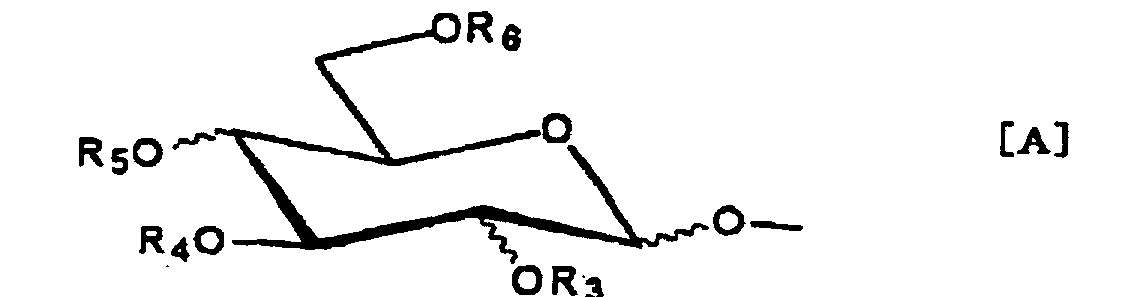
  • The structural formula of the saccharide residue represented by [A] is as shown below.
    Figure 00100002
    In the above formula, R3 to R6 are each hydrogen, or one of R3 to R6 is a sulfate group, a phosphate group or a saccharide residue with the remainder groups being each hydrogen. The saccharide residues include residues derived from monosaccharides such as glucose and galactose, and residues derived from oligosaccharides of the monosaccharides.
    The structural formula of the saccharide residue represented by [B] is as shown below.
    Figure 00110001
    In the above formula, R7 represents an alkyl group, a phenyl group, a substituted phenyl group, hydrogen or a saccharide residue. One of R8 to R11 is a direct bond (-) and is linked to the 1 position (the position to which [B] of the formula Ia is linked) of (6SO3-GlcNAc), with the remainder groups being hydrogen atoms. One of the hydrogen atoms may be replaced by a sulfate group or a phosphate group.
    In the above formulas [A] and [B], R3O-, R5O-, R7-, R8O- and R10O- may be either axial or equatorial conformation.
    In the above general formulas (I) and (Ia), the linkage between [A] and (6SO3-GlcNAc) may be either α-linkage or β-linkage, in which [A] is linked at its 1 position to the 3 position or 4 position of (6SO3-GlcNAc).
    In the saccharide residue represented by [A], the 6 position, 2 position, 3 position or 4 position may be sulfated or phosphated. The sulfated or phosphated saccharides may include, for example, galactose sulfated at its 3 position and glucose phosphated at its 6 position.
    In the above [C]-R, [C] represents a saccharide residue. The saccharide residues include residues derived from saccharides selected from monosaccharides, oligosaccharides and polysaccharides. The monosaccharide may be a conventionally known monosaccharide, such as glucose, galactose, mannose, N-acetylglucosamine, N-acetylgalactosamine and N-acetylmannosamine. The oligosaccharides may include those of the above monosaccharides, chondroitin sulfate, dermatan sulfate and heparin. The polysaccharides may include those obtained by highly polymerizing the above monosaccharides or oligosaccharides.
    The symbol R represents a hydroxyl group or a substituted hydroxyl group. Examples of the substituted hydroxyl group include those described previously.
    In the saccharide residue represented by [C], the hydroxyl group at the 1 position may be a substituted hydroxyl group. Examples of the substituted hydroxyl group include those described previously.
    The structural formula of an example of the saccharide residue represented by [C] is as shown below.
    Figure 00120001
    In the above formula, R12 represents hydrogen, a substituent or a saccharide residue. One of R13 to R16 is a direct bond (-) with the remainder groups being hydrogen atoms. One of the hydrogen atoms may be replaced by a saccharide residue, a sulfate group or a phosphate group. OR13 may be NHAc. Examples of the saccharide giving the saccharide reside [C] include methyl α-glucopyranoside, lactose (galactopyranoxylβ1→4glucopyranoside) and β-D-N-acetylglucosamine.
    In the present invention, the sulfated saccharide of the above general formula (Ia) is reacted with the saccharide of the above general formula (Ia). The reaction in this case is a reaction for transferring the sulfate group (SO3)-containing saccharide.
    The amount of the raw materials is generally 1:1 in molar ratio, though one of them can be used in an excess amount. The reaction is performed in a liquid phase at a temperature in the range of 0 to 80°C, preferably between room temperature and 50°C. N-acetylhexosaminidase (or N-acetylglucosaminidase) is used as an enzyme. The enzyme may be derived from mold, bovine internal organs, bacteria, bean, yeast, recombinant DNA, etc.
    The enzyme N-acetylhexosaminidase (E.C. 3.2.1.52) or or N-acetylglucosaminidase (E.C. 3.2.1.52) (these enzymes are substantially the same but commercial products thereof are in the marketplace under different names) may be used in a state in which it is supported on a support. When the enzyme is supported on a support, the process can be carried out at low costs. As the support, there may be mentioned an alginic acid resin and liposome.
    The reaction is carried out in the presence of a solvent which is generally an aqueous medium. After completion of the reaction, the reaction product is isolated with a yield of 1 to 80 % based on the raw materials. After completion of the reaction, the reaction product is separated and purified by means of reverse chromatography, molecular sieves or ion exchange.
    In the above reaction, a customarily employed buffer solution such as phosphate butter, TRIS buffer or HEPES buffer. In the buffer solution, a hydrophilic solvent such as acetonitrile or methanol may be added in an amount of 0 to 90 %, preferably 10 to 50 %. Although a rare case, a solvent such as toluene or diethyl ether is used. In this case, the reaction is in a two-phase system and is performed at a temperature in the range of 0 to 80°C, preferably between about room temperature and 50°C.
    In the product [A]-(6SO3-GlcNAc)-[C]-R obtained in the above reaction, the bonding style between (6SO3-GlcNAc) and [C] may be any one of β1→2, β1→3, β1→4, β1→6, α1→2, α1→3, α1→4 and α1→6, or a mixture thereof. When [C] is N-acetylglucosamine, N-acetylgalactosamine or N-acetylmannosamine, β1→2 and α1→2 styles are excluded. When [C] contains a sulfate group or a phosphate group, the linkage to the position at which such an anionic group exists is excluded.
    The linkage between [A] and (6SO3 - GlcNAc) may be either α-linkage or β-linkage, in which [A] is linked at its 1 position to the 3 position or 4 position of (6SO3-GlcNAc).
    Specific examples of the sulfated saccharide represented by the above general formula (I) include:
  • (1) HO-β-D-(6-sulfo)- GlcNAc-(1→4)-α-Glc-OCH3
  • (2) HO-(6-sulfo)-GlcNAcβ-(1→3 or 6)-Galβ-1→4-Glc
  • (3) HO-(6-sulfo)-GlcNAcβ-(1→3 or 4)-GlcNAc
  • The compound of the general formula (I) is characterized by a structure which is obtained by reaction of a sulfated saccharide as a saccharide chain donor with "another saccharide" as a saccharide chain acceptor and in which the sulfated saccharide chain is introduced into the non-reducing terminal for extending the chain. The byproduct corresponding to the desired product is a saccharide [B]. The compound of the general formula (I) effectively bonds to a selectin protein which is present in leukocytes and hbnce has anti-inflammatory activity. The compound is expected to be widely used in the medicinal field, etc.
    The sulfated saccharide represented by the above general formula (II) may be produced by reacting a sulfated saccharide represented by the following general formula (IIa): HO - (6SO3 - GlcNAc) - [D] with a saccharide represented by the following general formula (IIb): HO - [GlcNAc] - [Z] in the presence of the above-mentioned enzyme.
    The above reaction is shown by the following formula: HO - (6SO3 - GlcNAc) - [D] + HO - [GlcNAc] - [Z]
    → HO - [GlcNAc] - (6SO3 - GlcNAc) - [D] + [Z]
    The above symbol [D] represents a hydroxyl group, a substituted hydrpxyl group or a saccharide residue. The saccharide residues include residues derived from saccharides selected from monosaccharides, oligosaccharides and polysaccharides. The monosaccharide may be a conventionally known monosaccharide, such as glucose, galactose, mannose, N-acetylglucosamine, N-acetylgalactosamine and N-acetylmannosamine. The oligosaccharides may include those of the above monosaccharides, chondroitin sulfate, dermatan sulfate and heparin. The polysaccharides may include those obtained by highly polymerizing the above monosaccharides or oligosaccharides. These saccharides may contain sulfate groups or phosphate groups. When [Z] and [D] are saccharide residues, it is preferred that [Z] and [D] be different saccharide residues.
    The substituted hydroxyl group is intended to refer to a hydroxyl group whose hydrogen is substituted by a substituent. Specific examples of the substituted hydroxyl group are as described previously.
    The bonding style between the saccharide residue represented by [D] and 6-sulfated-N-acetylglucosamine residue (6SO3-GlcNAc) is such that the position 1 of (6SO3-GlcNAc) is linked to the 2 position, 3 position, 4 position or 6 position of [D]. One of the hydroxyl groups at 2 position, 3 position, 4 position and 6 position of [D] to which (6SO3-GlcNAc) is not linked may be sulfated or phosphated. When [D] is N-acetylglucosamine residue or the like residue, (6SO3-GlcNAc) is linked to the position other than the 2 position, namely to the 3 position, 4 position or 6 position of [D], because the 2-position is blocked.
    The sulfated saccharide represented by the above general formula (IIa) serves as a saccharide chain acceptor in the above reaction. By reacting the sulfated saccharide with HO-[GlcNAc]-[Z] as a saccharide chain donor, the sulfated saccharide chain can be introduced to the reducing terminal thereof for extending the chain. As a preferred sulfated saccharide used as the saccharide chain acceptor in the present invention, there may be mentioned p-nitrophenylβ-D-(6-sulfo)-N-acetylglucosamine.
    In the formula HO-[GlcNAc]-[Z], [Z] is linked to the 1 position of (GlcNAc). When [Z] is a saccharide residue, the linkage between [Z] and (GlcNAc) may be either α-linkage or β-linkage, in which (GlcNAc) is linked at its 1 position to the 2 position, 3 position, 4 position or 6 position of [Z]. One of the hydroxyl groups at 2 position, 3 position, 4 position and 6 position of [Z] to which (6SO3-GlcNAc) is not linked may be sulfated or phosphated. When [Z] is N-acetylglucosamine residue or the like residue in which the 2-position is blocked, () is linked to the position other than the 2 position, namely to the 3 position, 4 position or 6 position of [Z].
    As a preferred saccharide chain donor used in the present invention, there may be mentioned p-nitrophenyl-β-acetylglucosamine ((GlcNAc)-[p-nitrophenyl]).
    In the present invention, the sulfated saccharide represented by the formula HO-(6SO3-GlcNAc)-[D] is reacted with the saccharide represented by the general formula HO-[GlcNAc]-[Z] to transfer the saccharide chain HO-(GlcNAc) of the HO-[GlcNAc]-[Z] to the sulfated saccharide chain (6SO3-GlcNAc) of the HO-(6SO3-GlcNAc)-[D], thereby obtaining the sulfated saccharide of the above general formula (II).
    The amount of the raw materials is generally 1:1 in molar ratio, though one of them can be used in an excess amount. The reaction is performed in a liquid phase at a temperature in the range of 0 to 80°C, preferably between room temperature and 50°C. N-Acetylhexosaminidase (E.C. 3.2.1.52) or N-acetylglucosaminidase (E.C. 3.2.1.52) is used as an enzyme. The enzyme may be derived from mold, bovine internal organs, bacteria, bean, yeast, recombinant DNA, etc. The enzyme may be used in a state in which it is supported on a support. When the enzyme is supported on a support, the process can be carried out at low costs. As the support, there may be mentioned an alginic acid resin and liposome.
    The reaction is carried out in the presence of a solvent which is generally water. After completion of the reaction, the reaction product is isolated with a yield of 1 to 80 % based on the raw materials. After completion of the reaction, the reaction product is separated and purified by means of reverse chromatography, molecular sieves (gel filtration) or ion exchange.
    In the above reaction, a customarily employed buffer solution such as phosphate butter, TRIS buffer or HEPES buffer. In the buffer solution, a hydrophilic solvent such as acetonitrile or methanol may be added in an amount of 0 to 90 %, preferably 10 to 50 %. Although a rare case, a solvent such as toluene or diethyl ether is used. In this case, the reaction is in a two-phase system and is performed at a temperature in the range of 0 to 80°C, preferably between about room temperature and 50°C.
    The second sulfated saccharide chain according to the present invention is represented by the following general formula (II) : HO - (GlcNAc) - (6SO3 - GlcNAc) - [D] wherein [D] has the same meaning as above.
    The bonding style between (GlcNAc) and (6SO3-GlcNAc) may be either α-linkage or β-linkage, in which (GlcNAc) is linked at its 1 position to the 3 position or 4 position of (6SO3-GlcNAc). Namely, the sulfated saccharide chain of the present invention is a saccharide compound which is characterized by having the sulfated saccharide chain in the reducing terminal of the saccharide.
    The sulfated saccharide chain of the above general formula (II) effectively bonds to a selectin protein which is present in leukocytes and hence has anti-inflammatory activity. The compound is expected to be widely used in the medicinal field, etc.
    Specific example of the sulfated saccharide of the present invention is represented by the following formula: β-D-GlcNAc-(1→4)-β-D-(6-sulfo)-GlcNAc-OC6H4NO2-p
    Example
    Embodiments of the present invention will be next described. The present invention, however, is not limited to these embodiments. The substances obtained are confirmed by NMR.
    Example 1 Synthesis of compound of general formula (I):
    In a 50 mM sodium phosphate buffer solution (pH 6.0; 1 mL), sodium p-nitrophenylβ-D-(6-sulfo)-N-acetylglucosamine (54 mg) and α-D-glucopyranoside (500 mg) were dissolved, to which Aspergillus oryzae-derived β-D-N-acetylhexosaminidase (10.5 units) (EC.3.2.1.52, Sigma Inc.) was added. The mixture was incubated at 35°C for 71 hours. The reaction liquid is then immersed in water at 100°C for 5 minutes to stop the reaction. The reaction mixture was then purified on DEAE Sephadex A-25 column (eluent: water→0.2M ammonium acetate solution). This was further purified on Dowex-50W-X8 column (H+) and finally by Bio-Gel P-2 chromatography, thereby obtaining 9.8 mg of β-D-(6-sulfo)-GlcNAc-(1→4)-α-Glc-OCH3 as a desired product.
       1H NMR (400MHZ, D2O) : δ 5.187 (d, 1 H, J1,2 3.2 Hz, H-1), 4.70 4 (d, 1 H, J1,2 8.4 Hz, H-1'), 3.403 (s, 3H,OMe),and2.032(3H, Ac).
       13C NMR: δ 176.23,100.98,96.63,77.66,75.61,74.79,73.23,72. 92,72.38,71.52,71.25,62.26,56.71,55.79,23.58.
       [α]D+27.5° (C=0.47, H2O)
       FAB-MS 522(M+Na)+
    Example 2 Synthesis of compound of general formula (I):
    In a 50 mM sodium phosphate buffer solution (pH 6.0; 1.4 mL), sodium p-nitrophenylβ-D-(6-sulfo)-N-acetylglucosamine (40 mg) and lactose(galactopyranosylβ1→4glucopyranoside (510 mg) were dissolved, to which 1.2 mL of bovine epididyms (calf)-derived β-D-N-acetylglucosaminidase (EC.3.2.1.52, Sigma Inc.; 5 units/4.2 mL) was added. The mixture was incubated at 35°C for 29 hours. The reaction liquid is then immersed in water at 100°C for 5 minutes to stop the reaction. The reaction mixture was then purified successively on C-19 ODS column, DEAE Sephadex A-25 column, Dowex-50W-X8 column (H+) and finally Bio-Gel P-2 column, thereby obtaining 16 mg of (6-sulfo)-GlcNAcβ-(1→3)-Galβ1→4Glc as a desired product.
       1H NMR (D2O): δ 5.188 (d, 1 H, J1,2 3.6 Hz, H-1α), 4.733 (H-1 "), 4.710 (H-1'), 4.689(H-1β), and 2.032 (3 H, Ac).
    Example 3 Synthesis of compound of general formula (I):
    In a 50 mM sodium phosphate buffer solution (pH 6.0; 2.0 mL), sodium p-nitrophenylβ-D-(6-sulfo)-N-acetylglucosamine (50 mg) and β-D-N-acetylglucosamine (250 mg) were dissolved, to which 0.5 mL of Aspergillus oryzae-derived β-D-N-acetylhexosaminidase (EC.3.2.1.52, Sigma Inc.; 30 units/500 µL) was added. The mixture was incubated at 35°C for 370 hours. The reaction liquid is then immersed in water at 100°C for 5 minutes to stop the reaction. The reaction mixture was then purified successively on C-18 ODS column, DEAE Sephadex A-25 column, Dowex-50W-X8 column (H+) and finally Bio-Gel P-2 column, thereby obtaining 7.3 mg (38 %) of (6-sulfo)-GlcNAc-β(1→4)-GlcNAc as a desired product.
       400MHZ-1H NMR (D2O) : δ 5.180 (d, 1 H, J1,2 2.4 Hz, H-1α), 4.6 93 (d, 1 H, J1,2 7.6 Hz, H-1β), 4.591 (d, 1 H, J1',2' 8.4 Hz, H-1'α),), 4.582(d, 1 H, J1',2' 8.4 Hz, H-1'β), and 2.054 and 2.032 (3 H, Ac X 2).
       [α] D+12° (C=1.3, H2O)
       FAB-MS 548(M+Na)+
    Example 4 Synthesis of compound of general formula (II):
    In a 50 mM sodium phosphate buffer solution (pH 6.0; 10 mL), p-nitrophenylβ-D-N-acetylglucosamine (100 mg) and p-nitrophenylβ-D-(6-sulfo)-N-acetylglucosamine (800 mg) were dissolved, to which Aspergillus oryzae-derived β-D-N-acetylhexosaminidase (3 units, Sigma Inc.) was added. The mixture was incubated at 35°C for 7 hours. The reaction liquid is then immersed in water at 100°C for 5 minutes to stop the reaction. The reaction mixture was then purified directly on C-18 ODS column. Fractions containing the product and unreacted acceptor were further purified on Toyopearl HW-40S using 25 % methanol solution as an eluent, thereby obtaining 25 mg (14 %) of β-D-GlcNAc-(1→4)-β-D-(6-sulfo)-GlcNAc-OC6H4NO2-p as a desired product.
       1H NMR (D2O) : δ 8.251 (d, 2 H, J 9.2 Hz, m-Ph), 7.191 (d, 2 H, J 9.2 Hz, o-Ph), 5.325 (d, 1 H, J1,2 8.4, H-1), 4.658 (d, 1 H, J1',2' 8.4, H-1') , 2.102, 2.005 (6H, 2 Ac).
       [α] D-28° (C=0.6, H2O)
       FAB-MS 670 (M+Na)+
    Industrial Applicability
    According to the present invention, by using N-acetylhexosaminidase which is a commercially available enzyme for (1) the reaction of a sulfated saccharide as a donor with another saccharide as an acceptor can produce a novel sulfated saccharide in which a sulfated saccharide chain is introduced to a non-reducing terminal for extending the chain and for (2) the reaction of a sulfated saccharide as an acceptor with another saccharide as a donor can produce a novel sulfated saccharide in which a sulfated saccharide chain is introduced to the reducing terminal for extending the chain.
    These novel products effectively bond to selectin protein which is present in leukocytes and hence has anti-inflammatory activity. They are expected to be widely used in the medicinal field, etc.

    Claims (12)

    1. A sulfated saccharide represented by the following general formula (I): [A] - (6SO3 - GlcNAc) - [C] - R wherein (6SO3 - GlcNAc) represents a 6-sulfated N-acetylglucosamine residue, [A] represents a hydroxyl group or a saccharide residue, [C] represents a saccharide residue and R represents a hydroxyl group or a substituted hydroxyl group.
    2. A sulfated saccharide as recited in claim 1, wherein the saccharide residue represented by [A] of the general formula (I) is a saccharide residue derived from a saccharide selected from glucose, galactose, mannose, N-acetylglucosamine, N-acetylgalactosamine, N-acetylmannosamine and oligosaccharides thereof.
    3. A sulfated saccharide as recited in claim 1 or 2, wherein the substituted hydroxyl group represented by [C] of the general formula (I) is p-nitrophenoxy group.
    4. A sulfated saccharide as recited in any one of claims 1 through 3, wherein the saccharide residue represented by [A] contains a sulfate group or a phosphate group.
    5. A sulfated saccharide as recited in any one of claims 1 through 4, wherein the saccharide residue represented by [C] of the general formula (I) is a saccharide residue derived from a saccharide selected from glucose, galactose, mannose, N-acetylglucosamine, N-acetylgalactosamine, N-acetylmannosamine and oligosaccharides thereof.
    6. A sulfated saccharide as recited in claim 5, wherein the saccharide residue represented by [C] contains a sulfate group or a phosphate group.
    7. A sulfated saccharide represented by the following general formula (II): HO - (GlcNAc) - (6SO3 - GlcNAc) - [D] wherein (6SO3 - GlcNAc) represents a 6-sulfated N-acetylglucosamine residue, (GlcNAc) represents an N-acetylglucosamine residue, and [D] represents a hydroxyl group, a substituted hydroxyl group or a saccharide residue.
    8. A sulfated saccharide as recited in claim 7, wherein the saccharide residue represented by [D] of the general formula (II) is a saccharide residue derived from a saccharide selected from glucose, galactose, mannose, N-acetylglucosamine, N-acetylgalactosamine, N-acetylmannosamine and oligosaccharides thereof.
    9. A sulfated saccharide as recited in claim 7 or 8, wherein the substituted hydroxyl group represented by [D] of the general formula (II) is p-nitrophenoxy group.
    10. A sulfated saccharide as recited in any one of claims 7 through 9, wherein the saccharide residue represented by [D] contains a sulfate group or a phosphate group.
    11. A process of preparing a sulfated saccharide represented by the following general formula (I): [A] - (6SO3 - GlcNAc) - [C] - R wherein (6SO3 - GlcNAc) represents a 6-sulfated N-acetylglucosamine residue, [A] represents a hydroxyl group or a saccharide residue, [C] represents a saccharide residue and R represents a hydroxyl group or a substituted hydroxyl group, characterized in that a sulfated saccharide represented by the following general formula (Ia): [A] - (6SO3 - GlcNAc) - [B] wherein (6SO3 - GlcNAc) and [A] have the same meaning as above and [B] represents a hydroxyl group or a substituted hydroxyl group,
      is reacted with a saccharide of the following general formula (Ib): HO - [C] - R wherein [C] represents a saccharide residue and R represents a hydroxyl group or a substituted hydroxyl group, in the presence of N-acetylhexosaminidase or N-acetylglucosaminidase.
    12. A process of preparing a sulfated saccharide represented by the following general formula (II): HO - (GlcNAc) - (6SO3 - GlcNAc) - [D] wherein (6SO3 - GlcNAc) represents a 6-sulfated N-acetylglucosamine residue, (GlcNAc) represents an N-acetylglucosamine residue, and [D] represents a hydroxyl group, a substituted hydroxyl group or a saccharide residue, characterized in that a sulfated saccharide represented by the following general formula (IIa): HO - (6SO3 - GlcNAc) - [D] wherein (6SO3 - GlcNAc) and [D] have the same meaning as above,
      is reacted with a saccharide of the following general formula (IIb): HO - [GlcNAc] - [Z] wherein [GlcNAc] represents an N-acetylglucosamine residue and [Z] represents a hydroxyl group, a substituted hydroxyl group or a saccharide residue,
      in the presence of N-acetylhexosaminidase or N-acetylglucosaminidase.
    EP02705414A 2001-06-14 2002-03-20 NEW SULFATE SACCHARIDE AND PROCESS FOR PRODUCING THE SAME Withdrawn EP1408116A4 (en)

    Applications Claiming Priority (3)

    Application Number Priority Date Filing Date Title
    JP2001180163 2001-06-14
    JP2001180163 2001-06-14
    PCT/JP2002/002716 WO2002103025A1 (en) 2001-06-14 2002-03-20 Novel sulfated saccharide and process for producing the same

    Publications (2)

    Publication Number Publication Date
    EP1408116A1 true EP1408116A1 (en) 2004-04-14
    EP1408116A4 EP1408116A4 (en) 2006-11-08

    Family

    ID=19020625

    Family Applications (1)

    Application Number Title Priority Date Filing Date
    EP02705414A Withdrawn EP1408116A4 (en) 2001-06-14 2002-03-20 NEW SULFATE SACCHARIDE AND PROCESS FOR PRODUCING THE SAME

    Country Status (4)

    Country Link
    US (1) US20050004069A1 (en)
    EP (1) EP1408116A4 (en)
    JP (1) JPWO2002103025A1 (en)
    WO (1) WO2002103025A1 (en)

    Cited By (1)

    * Cited by examiner, † Cited by third party
    Publication number Priority date Publication date Assignee Title
    CN108884122A (en) * 2016-03-09 2018-11-23 株式会社糖锁工学研究所 Method for producing the sugar with sulfate and/or phosphate

    Families Citing this family (1)

    * Cited by examiner, † Cited by third party
    Publication number Priority date Publication date Assignee Title
    AU2003252593A1 (en) 2002-07-10 2004-02-02 Seikagaku Corporation Sulfotransferase inhibitors

    Family Cites Families (5)

    * Cited by examiner, † Cited by third party
    Publication number Priority date Publication date Assignee Title
    GB9117523D0 (en) * 1991-08-14 1991-10-02 Unilever Plc Di and tri saccharides, methods of making them and hair growth compositions containing them
    DE69521074T2 (en) * 1994-03-30 2001-09-13 Takara Shuzo Co., Ltd. Transglycosylation process for the production of a carbohydrate or a glycoconjugate
    EP0795560B1 (en) * 1994-12-01 2003-12-10 Seikagaku Corporation Keratan sulfate oligosaccharide fraction and drug containing the same
    JP4023848B2 (en) * 1996-03-29 2007-12-19 生化学工業株式会社 Method for producing sulfated lactosamine oligosaccharide
    JP3809277B2 (en) * 1998-03-05 2006-08-16 生化学工業株式会社 N-acetylglucosamine-6-O-sulfotransferase polypeptide and DNA encoding the same

    Cited By (4)

    * Cited by examiner, † Cited by third party
    Publication number Priority date Publication date Assignee Title
    CN108884122A (en) * 2016-03-09 2018-11-23 株式会社糖锁工学研究所 Method for producing the sugar with sulfate and/or phosphate
    EP3428175A4 (en) * 2016-03-09 2020-02-19 Glytech, Inc. PROCESS FOR PRODUCING SUGAR CONTAINING A SULFATE GROUP AND / OR A PHOSPHATE GROUP
    US10913763B2 (en) 2016-03-09 2021-02-09 Glytech, Inc. Method for producing sugar having sulfate group and/or phosphate group
    CN108884122B (en) * 2016-03-09 2022-06-07 株式会社糖锁工学研究所 Method for producing sugar having sulfate group and/or phosphate group

    Also Published As

    Publication number Publication date
    JPWO2002103025A1 (en) 2005-04-07
    US20050004069A1 (en) 2005-01-06
    WO2002103025A1 (en) 2002-12-27
    EP1408116A4 (en) 2006-11-08

    Similar Documents

    Publication Publication Date Title
    Li et al. Efficient chemoenzymatic synthesis of an N-glycan isomer library
    Sabesan et al. Combined chemical and enzymatic synthesis of sialyloligosaccharides and characterization by 500-MHz and proton and carbon-13 NMR spectroscopy
    Pachamuthu et al. Synthetic routes to thiooligosaccharides and thioglycopeptides
    US5583042A (en) Apparatus for the synthesis of saccharide compositions
    Virgilio et al. Enzymatic synthesis of natural and 13C enriched linear poly-N-acetyllactosamines as ligands for galectin-1
    US6013779A (en) Process for preparation of glycosides of tumor-associated carbohydrate antigens
    Murata et al. Preparation of oligosaccharide units library and its utilization
    EP0432157A1 (en) PROCESS FOR THE SYNTHESIS OF OLIGOSACCHARIDES.
    CN103108956A (en) Synthesis of Novel Sialic Acid Oligosaccharide Derivatives
    Nilsson Synthesis with glycosidases
    CA2385295A1 (en) Novel fucosylated oligosaccharides and process for their preparation
    US7208561B2 (en) Saccharide residue-functional organopolysiloxanes and method for the preparation thereof
    Look et al. A combined chemical and enzymatic strategy for the construction of carbohydrate-containing antigen core units
    Parodi et al. Lipid intermediates in protein glycosylation
    Li et al. Enzymatic synthesis of glycosphingolipids: A review
    Gronow et al. Characterization of the physiological substrate for lipopolysaccharide heptosyltransferases I and II
    Wang et al. Chemoenzymatic syntheses of tumor‐associated carbohydrate antigen Globo‐H and stage‐specific embryonic antigen 4
    Renkonen Enzymatic in vitro synthesis of I-branches of mammalian polylactosamines: generation of scaffolds for multiple selectin-binding saccharide determinants
    US20050004069A1 (en) Novel sulfated saccharide and process for producing the same
    Weïwer et al. Synthesis of uridine 5′-diphosphoiduronic acid: A potential substrate for the chemoenzymatic synthesis of heparin
    Bojarová et al. N-Acetylhexosamine triad in one molecule: Chemoenzymatic introduction of 2-acetamido-2-deoxy-β-d-galactopyranosyluronic acid residue into a complex oligosaccharide
    US5882902A (en) Amino acid conjugate
    WO1995018864A1 (en) Method of producing derivatives of lactosamine
    EP0839210B1 (en) Method of producing derivatives of glc-beta 1-4glc-n-acetyl
    Natunen et al. Enzymatic synthesis of two lacto-N-neohexaose-related Lewis x heptasaccharides and their separation by chromatography on

    Legal Events

    Date Code Title Description
    PUAI Public reference made under article 153(3) epc to a published international application that has entered the european phase

    Free format text: ORIGINAL CODE: 0009012

    17P Request for examination filed

    Effective date: 20040114

    AK Designated contracting states

    Kind code of ref document: A1

    Designated state(s): AT BE CH CY DE DK ES FI FR GB GR IE IT LI LU MC NL PT SE TR

    AX Request for extension of the european patent

    Extension state: AL LT LV MK RO SI

    RIN1 Information on inventor provided before grant (corrected)

    Inventor name: ZENG, XIAOXIONG,NAT.INST.ADVANCED IND.SCI& TEC

    Inventor name: MINOURA, NORIHIKO,NAT.INST.ADVANCED IND.SCI&TE

    Inventor name: UZAWA, HIROTAKA,NAT.INST.ADVANCED IND.SCI&TECH

    A4 Supplementary search report drawn up and despatched

    Effective date: 20061010

    17Q First examination report despatched

    Effective date: 20070724

    STAA Information on the status of an ep patent application or granted ep patent

    Free format text: STATUS: THE APPLICATION IS DEEMED TO BE WITHDRAWN

    18D Application deemed to be withdrawn

    Effective date: 20071204