EP1408068A1 - Chemical;resistant polystyrene resin composition and molded article - Google Patents

Chemical;resistant polystyrene resin composition and molded article Download PDF

Info

Publication number
EP1408068A1
EP1408068A1 EP02728178A EP02728178A EP1408068A1 EP 1408068 A1 EP1408068 A1 EP 1408068A1 EP 02728178 A EP02728178 A EP 02728178A EP 02728178 A EP02728178 A EP 02728178A EP 1408068 A1 EP1408068 A1 EP 1408068A1
Authority
EP
European Patent Office
Prior art keywords
styrene
component
weight
parts
chemical
Prior art date
Legal status (The legal status is an assumption and is not a legal conclusion. Google has not performed a legal analysis and makes no representation as to the accuracy of the status listed.)
Withdrawn
Application number
EP02728178A
Other languages
German (de)
French (fr)
Other versions
EP1408068A4 (en
Inventor
Akihiko Okada
Takuma Aoyama
Current Assignee (The listed assignees may be inaccurate. Google has not performed a legal analysis and makes no representation or warranty as to the accuracy of the list.)
Idemitsu Kosan Co Ltd
Original Assignee
Idemitsu Petrochemical Co Ltd
Priority date (The priority date is an assumption and is not a legal conclusion. Google has not performed a legal analysis and makes no representation as to the accuracy of the date listed.)
Filing date
Publication date
Priority claimed from JP2001161731A external-priority patent/JP4926335B2/en
Priority claimed from JP2001161730A external-priority patent/JP4878697B2/en
Priority claimed from JP2001161729A external-priority patent/JP4943590B2/en
Application filed by Idemitsu Petrochemical Co Ltd filed Critical Idemitsu Petrochemical Co Ltd
Publication of EP1408068A1 publication Critical patent/EP1408068A1/en
Publication of EP1408068A4 publication Critical patent/EP1408068A4/en
Withdrawn legal-status Critical Current

Links

Classifications

    • CCHEMISTRY; METALLURGY
    • C08ORGANIC MACROMOLECULAR COMPOUNDS; THEIR PREPARATION OR CHEMICAL WORKING-UP; COMPOSITIONS BASED THEREON
    • C08LCOMPOSITIONS OF MACROMOLECULAR COMPOUNDS
    • C08L25/00Compositions of, homopolymers or copolymers of compounds having one or more unsaturated aliphatic radicals, each having only one carbon-to-carbon double bond, and at least one being terminated by an aromatic carbocyclic ring; Compositions of derivatives of such polymers
    • C08L25/02Homopolymers or copolymers of hydrocarbons
    • C08L25/04Homopolymers or copolymers of styrene
    • C08L25/06Polystyrene
    • CCHEMISTRY; METALLURGY
    • C08ORGANIC MACROMOLECULAR COMPOUNDS; THEIR PREPARATION OR CHEMICAL WORKING-UP; COMPOSITIONS BASED THEREON
    • C08LCOMPOSITIONS OF MACROMOLECULAR COMPOUNDS
    • C08L71/00Compositions of polyethers obtained by reactions forming an ether link in the main chain; Compositions of derivatives of such polymers
    • C08L71/08Polyethers derived from hydroxy compounds or from their metallic derivatives
    • C08L71/10Polyethers derived from hydroxy compounds or from their metallic derivatives from phenols
    • C08L71/12Polyphenylene oxides
    • C08L71/123Polyphenylene oxides not modified by chemical after-treatment
    • CCHEMISTRY; METALLURGY
    • C08ORGANIC MACROMOLECULAR COMPOUNDS; THEIR PREPARATION OR CHEMICAL WORKING-UP; COMPOSITIONS BASED THEREON
    • C08LCOMPOSITIONS OF MACROMOLECULAR COMPOUNDS
    • C08L2205/00Polymer mixtures characterised by other features
    • C08L2205/02Polymer mixtures characterised by other features containing two or more polymers of the same C08L -group
    • CCHEMISTRY; METALLURGY
    • C08ORGANIC MACROMOLECULAR COMPOUNDS; THEIR PREPARATION OR CHEMICAL WORKING-UP; COMPOSITIONS BASED THEREON
    • C08LCOMPOSITIONS OF MACROMOLECULAR COMPOUNDS
    • C08L53/00Compositions of block copolymers containing at least one sequence of a polymer obtained by reactions only involving carbon-to-carbon unsaturated bonds; Compositions of derivatives of such polymers
    • C08L53/02Compositions of block copolymers containing at least one sequence of a polymer obtained by reactions only involving carbon-to-carbon unsaturated bonds; Compositions of derivatives of such polymers of vinyl-aromatic monomers and conjugated dienes
    • CCHEMISTRY; METALLURGY
    • C08ORGANIC MACROMOLECULAR COMPOUNDS; THEIR PREPARATION OR CHEMICAL WORKING-UP; COMPOSITIONS BASED THEREON
    • C08LCOMPOSITIONS OF MACROMOLECULAR COMPOUNDS
    • C08L71/00Compositions of polyethers obtained by reactions forming an ether link in the main chain; Compositions of derivatives of such polymers
    • C08L71/08Polyethers derived from hydroxy compounds or from their metallic derivatives
    • C08L71/10Polyethers derived from hydroxy compounds or from their metallic derivatives from phenols
    • C08L71/12Polyphenylene oxides

Definitions

  • the first aspect of the present invention relates to a chemical-resistant polystyrene-based resin molded article, more specifically to a chemical-resistant polystyrene-based resin molded article provided with a chemical-resistance by blending with a styrene-based polymer (hereinafter referred to as a syndiotactic polystyrene (B)) having primarily a syndiotactic structure, in which a crystallinity is not higher than a fixed value.
  • a syndiotactic polystyrene (B) having primarily a syndiotactic structure, in which a crystallinity is not higher than a fixed value.
  • the second aspect of the present invention relates to a chemical-resistant polystyrene-based resin molded article, more specifically to a chemical-resistant polystyrene-based resin molded article provided with a chemical resistance by blending with a styrene-based polymer (hereinafter referred to as a syndiotactic polystyrene (c)) having primarily a syndiotactic structure, in which a peak value of a crystallinity is not higher than a fixed value.
  • a syndiotactic polystyrene (c) styrene having primarily a syndiotactic structure, in which a peak value of a crystallinity is not higher than a fixed value.
  • the third aspect of the present invention relates to a chemical-resistant polystyrene-based resin molded article having an excellent transparency, more specifically to a chemical-resistant polystyrene-based resin molded article having an excellent transparency in which a transparency get compatible with a chemical resistance under distortion by blending with a styrene-based block polymer having a styrene content of 70 mass % or more as a rubber component.
  • a polystyrene-based resin obtained by radically polymerizing an aromatic vinyl compound is inexpensive and has so far been applied to a great variety of uses. However, because of an atactic structure thereof, it is amorphous and is not necessarily satisfactory as far as a chemical resistance is concerned, and this has narrowed the application range thereof.
  • atactic polystyrene In order to improve a chemical resistance of a polystyrene-based resin having an atactic structure (hereinafter referred to as atactic polystyrene), it has been tried to copolymerize styrene with a polar monomer such as acrylonitrile, methacrylate, acrylate, maleic anhydride and maleimide to thereby improve the chemical resistance.
  • a polar monomer such as acrylonitrile, methacrylate, acrylate, maleic anhydride and maleimide
  • syndiotactic polystyrene having crystallinity has been developed, and a composition of syndiotactic polystyrene has been proposed for the purpose of elevating a chemical resistance of atactic polystyrene (Japanese Patent Application Laid-Open No. 279347/1999 and Japanese Patent Application Laid-Open No. 279349/1999).
  • syndiotactic polystyrene has a too fast crystallizing speed, and therefore observed is the phenomenon that when a blended matter of syndiotactic polystyrene and atactic polystyrene is molded, partial crystallization is caused in the molded article.
  • this molded article is improved in a chemical resistance as compared with a molded article produced from atactic polystyrene, the effect thereof is not sufficiently high, and the impact strength and the elongation are reduced, so that the application range thereof has been narrowed.
  • the first aspect of the present invention has been made from the viewpoints described above, and an object thereof is to provide a chemical-resistant polystyrene-based resin molded article which comprises a composition prepared by blending syndiotactic polystyrene (B) with atactic polystyrene or atactic polystyrene and polyphenylene ether and in which a chemical resistance is further effectively revealed.
  • an object of the second aspect of the present invention is to provide a resin composition which can be further improved in a chemical resistance as compared with a composition blended with conventional syndiotactic polystyrene by blending specific syndiotactic polystyrene (C) with atactic polystyrene or atactic polystyrene and polyphenylene ether and which can reveal satisfactory physical properties and a molded article thereof.
  • C syndiotactic polystyrene
  • a polystyrene-based resin obtained by radically polymerizing an aromatic vinyl compound is inexpensive and has so far been applied to a great variety of uses. However, because of an atactic structure thereof, it is amorphous and has not necessarily been satisfactory as far as a chemical resistance is concerned.
  • GPPS general purpose polystyrene
  • HIPS high impact polystyrene
  • a method in which a refractive index of a monomer used for a matrix component for HIPS and ABS (acrylonitrile-butadiene-styrene) or a rubber component are controlled by copolymerization to achieve transparency is available in order to improve a transparency of a styrene polymer having an atactic structure (hereinafter referred to as atactic polystyrene).
  • these copolymers have had the problems of a restriction in a random copolymerization ratio, a reduction in productivity, a change in a color tone, the presence of an odor and a production in cyan gas in incinerating. Further, these copolymers are different from polystyrene in terms of a chemical structure, and therefore they have had the problem that they are not readily miscible with polystyrene and blended recycling is difficult.
  • the third aspect of the present invention has been made from the viewpoints described above, and an object thereof is to provide a chemical-resistant polystyrene-based resin composition having an excellent transparency which provides a molded article provided with a transparency in combination with a chemical resistance under distortion by adding a specific rubber component to syndiotactic polystyrene, syndiotactic polystyrene and atactic polystyrene or syndiotactic polystyrene, atactic polystyrene and polyphenylene ether.
  • a chemical resistance is further effectively revealed in a molded article which comprises a composition prepared by blending the syndiotactic polystyrene (B) with atactic polystyrene or atactic polystyrene and polyphenylene ether and which has a relative crystallinity of not higher than a fixed value.
  • the present invention has been completed based on such knowledges.
  • the first aspect of the present invention provides a chemical-resistant polystyrene-based resin molded article obtained by molding a styrene-based resin composition
  • a styrene-based resin composition comprising component (A): a styrene-based polymer having an atactic structure or a mixture of the styrene base polymer having an atactic structure and polyphenylene ether in a total amount of 10 to 95 parts by weight and component (B): a styrene-based polymer having primarily a syndiotactic structure in an amount of 90 to 5 parts by weight, wherein the component (B) has a relative crystallinity of 30 % or less in a depth of up to 0.5 mm from the surface of the above molded article.
  • the second aspect of the present invention provides a chemical-resistant polystyrene-based resin composition
  • Tc crystallizing temperature
  • the third aspect of the present invention provides a chemical-resistant polystyrene-based resin composition having an excellent transparency, comprising component (D): (d1) a styrene base polymer having primarily a syndiotactic structure in an amount of 97 to 3 parts by weight or (d2) the styrene-based polymer having primarily a syndiotactic structure or at least one of a styrene base polymer having an atactic structure or polyphenylene ether in a total amount of 97 to 3 parts by weight and component (E): a rubber component which is a block polymer having a styrene content of 70 mass % or more in an amount of 3 to 97 parts by weight, wherein the styrene-based polymer having primarily a syndiotactic structure has a content of 3 parts by weight or more per total 100 parts by weight of the component (D) and the component (E); and a molded article thereof.
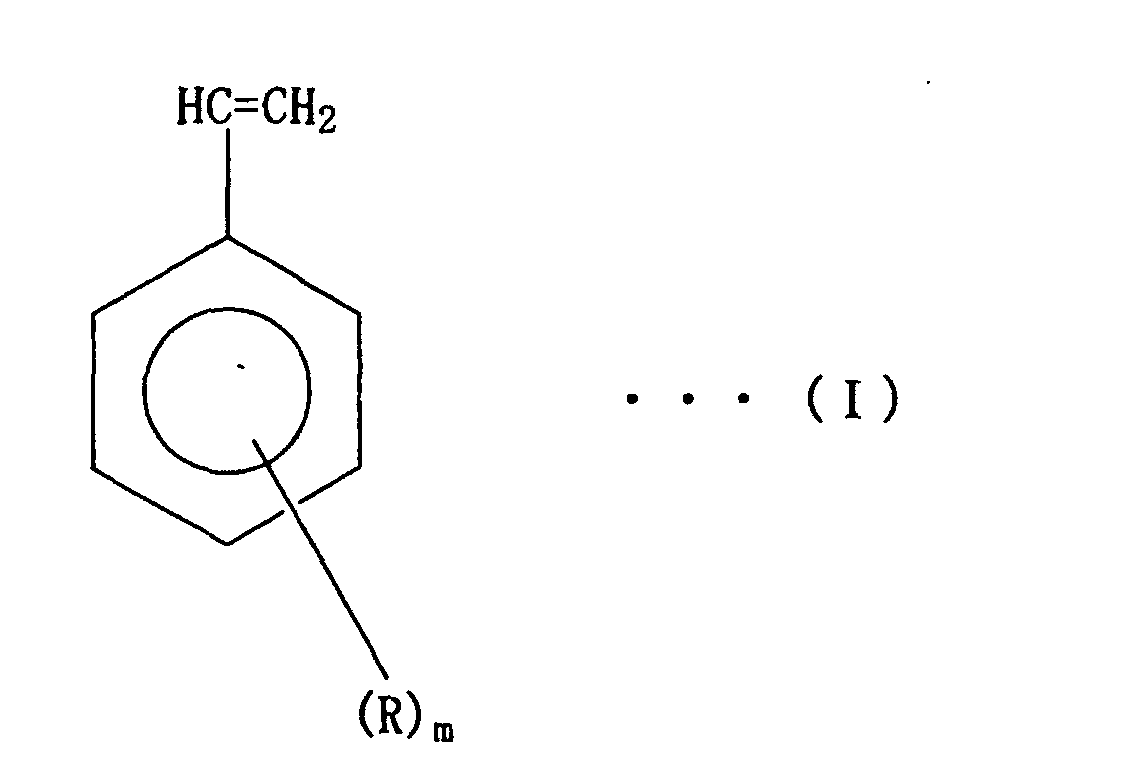
  • the atactic polystyrene of the component (A) used in the first and second aspects of the present invention is a polymer which is obtained by a polymerizing method such as solution polymerization, bulk polymerization, suspension polymerization and bulk-suspension polymerization comprising at least one aromatic vinyl compound represented by the following Formula (I): (wherein R represents a hydrogen atom, a halogen atom or a substituent containing at least one of a carbon atom, an oxygen atom, a nitrogen atom, a sulfur atom, a phosphorus atom, a selenium atom, a tin atom and a silicon atom; and m represents an integer of 1 to 3, provided that when m is plural, respective R may be the same or different), a copolymer of at least one other vinyl monomer which is copolymerizable with the at least one aromatic vinyl compound, or a hydrogenated polymer of these polymers and a mixture thereof.
  • Formula (I) wherein R represents a hydrogen
  • the preferred aromatic vinyl compound includes styrene, alkylstyrens such as ⁇ -methylstyrene, methylstyrene, ethylstyrene, isopropylstyrene and tertiary butylstyrene, phenylstyrene, vinylstyrene, chlorostyrene, bromostyrene, fluorostyrene, chloromethylstyrene, methoxystyrene and ethoxystyrene, and they are used alone or in combination of two or more kinds thereof.
  • alkylstyrens such as ⁇ -methylstyrene, methylstyrene, ethylstyrene, isopropylstyrene and tertiary butylstyrene
  • phenylstyrene vinylstyrene
  • chlorostyrene bromostyrene
  • the particularly preferred aromatic vinyl compounds are styrene, p-methylstyrene, m-methylstyrene, p-tertiary butylstyrene, p-chlorostyrene, m-chlorostyrene and p-fluorostyrene.
  • the other vinyl monomer copolymerizable with the aromatic vinyl compound described above includes vinyl cyan compounds such as acrylonitrile and methacrylonitrile, acrylic acid esters such as methyl acrylate, ethyl acrylate, propyl acrylate, butyl acrylate, amyl acrylate, hexyl acrylate, octyl acrylate, 2-ethylhexyl acrylate, cyclohexyl acrylate, dodecyl acrylate, octadecyl acrylate, phenyl acrylate and benzyl acrylate, methacrylic acid esters such as methyl methacrylate, ethyl methacrylate, butyl methacrylate, amyl methacrylate, hexyl methacrylate, octyl methacrylate, 2-ethylhexyl methacrylate, cyclohexyl methacrylate, dodecy
  • the rubber-like polymer copolymerizable with the aromatic vinyl compound described above includes diene base rubber such as polybutadiene, styrene-butadiene copolymers, acrylonitrile-butadiene copolymers and polyisoprene, non-diene base rubber such as ethylene- ⁇ -olefin copolymers, ethylene- ⁇ -olefin-polyene copolymers and polyacrylates, styrene-butadiene block copolymers, hydrogenated styrene-butadiene block copolymers, ethylene-propylene elastomers, styrene-grafted-ethylene-propylene elastomers, ethylene base ionomer resins and hydrogenated styrene-isoprene copolymers.
  • diene base rubber such as polybutadiene, styrene-butadiene copolymers, acrylonitrile-buta
  • the atactic polystyrene of the component (A) shall not specifically be restricted in a molecular weight thereof, and in general, the weight average molecular weight is 10,000 or more, preferably 50,000 or more.
  • the resultant molded article is reduced in a thermal property and a mechanical property, and therefore it is not preferred.
  • the molecular weight distribution shall not be restricted in a range thereof, and various ones can be applied.
  • the atactic polystyrene of the component (D) used in the third aspect of the present invention is a polymer which is obtained by a polymerizing method such as solution polymerization, bulk polymerization, suspension polymerization and bulk-suspension polymerization and which comprises at least one aromatic vinyl compound represented by the following Formula (I): (wherein R represents a hydrogen atom, a halogen atom or a substituent containing at least one of a carbon atom, an oxygen atom, a nitrogen atom, a sulfur atom, a phosphorus atom, a selenium atom, a tin atom and a silicon atom; and m represents an integer of 1 to 3, provided that when m is plural, respective R may be the same or different).
  • Formula (I) wherein R represents a hydrogen atom, a halogen atom or a substituent containing at least one of a carbon atom, an oxygen atom, a nitrogen atom, a sulfur atom, a phosphorus
  • the preferred aromatic vinyl compound includes styrene, alkylstyrens such as ⁇ -methylstyrene, methylstyrene, ethylstyrene, isopropylstyrene and tertiary butylstyrene, phenylstyrene, vinylstyrene, chlorostyrene, bromostyrene, fluorostyrene, chloromethylstyrene, methoxystyrene and ethoxystyrene, and they are used alone or in combination of two or more kinds thereof.
  • alkylstyrens such as ⁇ -methylstyrene, methylstyrene, ethylstyrene, isopropylstyrene and tertiary butylstyrene
  • phenylstyrene vinylstyrene
  • chlorostyrene bromostyrene
  • the particularly preferred aromatic vinyl compounds are styrene, p-methylstyrene, m-methylstyrene, p-tertiary butylstyrene, p-chlorostyrene, m-chlorostyrene and p-fluorostyrene.
  • the atactic polystyrene of the component (D) shall not specifically be restricted in a molecular weight thereof, and in general, the weight average molecular weight is 10,000 or more, preferably 50,000 or more.
  • the weight average molecular weight is less than 10,000, the resulting molded article is reduced in a thermal property and a mechanical property, and therefore it is not preferred.
  • the molecular weight distribution shall not be restricted in a range thereof, and various ones can be applied.
  • polyphenylene ether can be employed as a part of the component (A) or the component (D) in order to improve a heat resistance of the molded article.
  • Polyphenylene ether is a publicly known compound and can be referred to U.S. Patents No. 3306874, 3306875, 3257357 and 3257358 in order to use for the purpose described above.
  • Polyphenylene ether is usually prepared by an oxidation coupling reaction in which a homopolymer or a copolymer is produced in the presence of a copper amine complex or one or more two- or three-substituted phenol.
  • a copper amine complex derived from primary, secondary or tertiary amine can be used.
  • polyphenylene ether examples include poly(2,3-dimethyl-6-ethyl-1,4-phenylene ether), poly(2-methyl-6-chloromethyl-1,4-phenylene ether), poly(2-methyl-6-hydroxyethyl-1,4-phenylene ether), poly(2-methyl-6-n-butyl-1,4-phenylene ether), poly(2-ethyl-6-isobutyl-1,4-phenylene ether), poly(2-ethyl-6-isopropyl-1,4-phenylene ether), poly(2-ethyl-6-n-propyl-1,4-phenylene ether), poly(2,3,6-trimethyl-1,4-phenylene ether), poly(2-(4'-methylphenyl)-1,4-phenylene ether), poly(2-bromo-6-phenyl-1,4-phenylene ether), poly(2-methyl-6-phenyl-1,4-phenylene ether), poly(2-phenyl-1,
  • a copolymer such as copolymers derived from two or more phenol compounds used for preparing the homopolymer described above.
  • a graft copolymer and a block copolymer of a vinyl aromatic compound such as polystyrene with the polyphenylene ether described above are particularly preferred.
  • This polyphenylene ether shall not specifically be restricted in a molecular weight, and those having an intrinsic viscosity of 0.5 deciliter/g or less, preferably 0.45 deciliter/g or less measured in chloroform at 25°C are used.
  • a blending proportion thereof shall not specifically be restricted, and it is preferably 5 to 80 mass %, more preferably 10 to 60 mass % based on the component (A).
  • the blending proportion is smaller than 5 mass %, the heat resistance-improving effect is small, and when it exceeds 80 mass %, the fluidity in molding is reduced to a large extent in a certain case.
  • a blending proportion of the syndiotactic polystyrene, the atactic polystyrene and the polyphenylene ether each contained in the component (D) shall not specifically be restricted, and the syndiotactic polystyrene has to have a proportion of 3 parts by weight or more, preferably 5 parts by weight or more and more preferably 10 parts by weight or more per 100 parts by weight of the total weight of the component (D) and the component (E).
  • the syndiotactic polystyrene has a proportion of less than 3 parts by weight, the chemical resistance-improving effect is reduced.
  • the component (A) can be used in combination with a rubber-like elastic body in order to elevate the impact resistance.
  • the specific examples of the rubber-like elastic body include natural rubber, polybutadiene, polyisoprene, polybutylene, neoprene, polysulfide rubber, thiocol rubber, acryl rubber, urethane rubber, silicon rubber, epichlorohydrin rubber, styrene-butadiene block copolymers (SBR), hydrogenated styrene-butadiene block copolymers (SEB, SEBC), styrene-butadiene-styrene block copolymers (SBS), hydrogenated styrene-butadiene-styrene block copolymers (SEBS), styrene-isoprene block copolymers (SIR), hydrogenated styrene-isoprene block copolymers (SEP), styrene-isoprene-styrene block copolymers (SIS), hydrogenated styrene-iso
  • SBR SBR
  • SEB SEB
  • SEBS SEBS
  • SIR SEP
  • SIS SEPS
  • core shell rubbers EPM, EPDM and rubbers obtained by modifying them are preferably used.
  • These rubber-like elastic bodies can be used alone or in a blend of two or more kinds thereof.
  • a blending proportion of the rubber-like shall not specifically be restricted, and it is 50 mass % or less, preferably 40 mass % or less and more preferably 30 mass % or less based on the component (A).
  • the component (E) in the third aspect of the present invention is a rubber component, and a block polymer having a styrene content of 70 mass % or more is used therefor.
  • the styrene content is preferably 75 mass %.
  • An upper limit of the styrene content shall not specifically be restricted, and it is preferably 95 mass % or less.
  • Such rubber component includes styrene-butadiene block copolymers (SBR), hydrogenated styrene-butadiene block copolymers (SEB, SEBC), styrene-butadiene-styrene block copolymers (SBS), hydrogenated styrene-butadiene-styrene block copolymers (SEBS), styrene-isoprene block copolymers (SIR), hydrogenated styrene-isoprene block copolymers (SEP), styrene-isoprene-styrene block copolymers (SIS), hydrogenated styrene-isoprene-styrene block copolymers (SEPS) or rubbers obtained by modifying them.
  • SBR styrene-butadiene block copolymers
  • SEB hydrogenated styrene-butadiene block copolymers
  • SBS, SEBS, SIS and SEPS are preferably used, and SEBS and SEPS are more preferably used from the viewpoint of the heat stability.
  • These rubber-like elastic bodies can be used alone or in a blend of two or more kinds thereof.
  • a syndiotactic structure in the styrene base polymer having primarily a syndiotactic polystyrene structure in the component (B), the component (C) and the component (D) is that the stereochemical structure has a syndiotactic structure, that is, a steric structure in which phenyl groups being side chains are positioned alternately in a reverse direction to a principal chain formed from a carbon-carbon bond, and the tacticity thereof is determined by a nuclear magnetic resonance ( 13 C-NMR) using isotopic carbon.
  • the tacticity determined by a 13 C-NMR method can be shown by diad when a present proportion of plural continuous structural units are, for example, 2, triad when it is 3 and pentad when it is 5.
  • the styrene-based polymer having primarily a syndiotactic structure referred to in the present invention is usually shown by polystyrene, poly(alkylstyrene), poly(halogenated styrene), poly(halogenated alkylstyrene), poly(alkoxystyrene), poly(vinyl benzoate), hydrogenated polymers thereof and mixtures thereof or copolymers comprising them as principal components each having a syndiotacticity of 75 % or more, preferably 85 % or more in terms of racemidiad or 30 % or more, preferably 50 % or more in terms of racemipentad.
  • poly(alkylstyrene) includes poly(methylstyrene), poly(ethylstyrene), poly(isopropylstyrene), poly(tertiary buthylstyrene), poly(phenylstyrene), poly(vinylnaphthalene) and poly(vinylstyrene), and poly(halogenated styrene) includes poly(chlorostyrene), poly(bromostyrene) and poly(fluorostyrene).
  • poly(halogenated alkylstyrene) includes poly(chloromethylstyrene)
  • poly(alkoxystyrene) includes poly(methoxystyrene) and poly(ethoxystyrene).
  • styrene-based polymers having a syndiotactic structure can be used alone or in combination of two or more kinds thereof.
  • the particularly preferred syndiotactic polystyrene includes polystyrene, poly(p-methylstyrene), poly(m-methylstyrene), poly(p-tertiary buthylstyrene), poly(p-chlorostyrene), poly(m-chlorostyrene), poly(p-fluorostyrene), hydrogenated polystyrenes and copolymers comprising these structural units.
  • the syndiotactic polystyrene (B) component in the molded article of the first aspect of the present invention has to have a crystallinity of 30 % or less in terms of a relative crystallinity in a depth of up to 0.5 mm from the surface of the molded article.
  • This relative crystallinity is preferably 20 % or less, more preferably 10 % or less.
  • a method for controlling this crystallinity includes a method in which controlled are the resin temperature, the die temperature, the cooling speed, the design of the syndiotactic polystyrene (B) component, the additives, a proportion of the syndiotactic polystyrene component and the molecular weights and the added amounts of the atactic polystyrene component and the polyphenylene ether component.
  • the syndiotactic polystyrene (C) used in the second aspect of the present invention has to have a peak value of 220°C or lower in a crystallizing temperature (Tc) when the temperature is lowered from 300°C at a cooling rate of 20°C/minute by means of a differential scanning colorimeter (DSC).
  • This peak value in the crystallizing temperature is preferably 210°C or lower, more preferably 200°C or lower.
  • this peak value in the crystallizing temperature exceeds 220°C, it is difficult to inhibit the crystallization of the syndiotactic polystyrene component in the molded article, and the component (A) and the component (C) stay in a heterogeneous mixing state, so that it is difficult to sufficiently reveal the chemical resistance. Further, a reduction in a dynamic characteristic and a surface characteristic of the molded article is brought about in a certain case.
  • the syndiotactic polystyrene having a peak value of 220°C or lower in Tc can be obtained by, for example, a method such as using a copolymer of styrene and substituted styrene, adding the polyphenylene ether component, using a low stereospecific polymer and adding a crystallizing rate-retarding agent such as fatty acid metal salts including montanoic acid metal salts (sodium montanoate and zinc montanoate).
  • a molecular weight of the syndiotactic polystyrenes in the first, second and third aspects of the present invention shall not specifically be restricted, and the weight average molecular weight in terms of polystyrene measured at 135°C by a GPC (gel permeation chromatography) method using trichlorobenzene as a solvent is 10,000 or more, preferably 50,000 or more.
  • the molecular weight distribution shall not specifically be restricted in a range thereof, and various ones can be applied.
  • the weight average molecular weight is less than 10,000, the resulting composition or molded article is reduced in a thermal property and a mechanical property, and therefore it is not preferred.
  • a melting point of the syndiotactic polystyrenes (B) and (D) in the first and third aspects of the present invention shall not specifically be restricted, and it is preferably 270°C or lower, more preferably 250°C or lower.
  • the syndiotactic polystyrene (D) in the third aspect of the present invention has a peak value of preferably 230°C or lower, more preferably 200°C or lower in a crystallizing temperature (Tc) when the temperature is lowered from 300°C with a cooling rate of 20°C/minute by means of a differential scanning colorimeter (DSC).
  • Tc crystallizing temperature
  • a method for preparing the syndiotactic polystyrenes in the first, second and third aspects of the present invention includes, for example, a method in which a styrene base monomer (a monomer corresponding to the styrene base polymer described above) is polymerized in an inert hydrocarbon solvent or in the absence of a solvent using a titanium compound and a condensation product of water and trialkylaluminum as a catalyst (Japanese Patent Application Laid-Open No. 187708/1987).
  • poly(halogenated alkylstyrene) and halogenated polymers thereof can be obtained as well, for example, by methods described in Japanese Patent Application Laid-Open No. 46912/1989 and Japanese Patent Application Laid-Open No. 178505/1989.
  • a blending amount of the component (B) is 90 to 5 parts by weight, preferably 80 to 10 parts by weight and more preferably 50 to 15 parts by weight per 100 parts by weight of the total amount of the component (A) and the component (B).
  • a blending amount of the component (B) is less than 5 parts by weight, an effect for improving the chemical resistance is not observed as a matter of fact, and when it exceeds 90 parts by weight, it is disadvantageous in terms of the cost. Accordingly, both are not preferred.
  • a blending amount of the component (C) is 90 to 5 parts by weight, preferably 80 to 10 parts by weight and more preferably 50 to 15 parts by weight per 100 parts by weight of the total amount of the component (A) and the component (C).
  • a blending amount of the component (C) is less than 5 parts by weight, an effect for improving the chemical resistance is not observed as a matter of fact, and when it exceeds 90 parts by weight, it is disadvantageous in terms of the cost. Accordingly, both are not preferred.
  • a blending amount of the component (D) is 3 to 97 parts by weight, preferably 5 to 90 parts by weight and more preferably 10 to 80 parts by weight per 100 parts by weight of the total amount of the component (D) and the component (E).
  • a blending amount of the component (D) is less than 3 parts by weight, the chemical resistance-improving effect under distortion is small, and when it exceeds 97 parts by weight, a blending amount of the syndiotactic polystyrene is reduced, so that the chemical resistance is reduced as well. Accordingly, both are not preferred.
  • additives such as an inorganic filler, an antioxidant, a nuclear agent, a plasticizer, a mold releasing agent, a flame retardant, a flame retardant aid, a pigment, a dye, carbon black and an antistatic agent and the other thermoplastic resins can be blended as long as the objects of the present invention are not inhibited.
  • the inorganic filler includes glass fibers, carbon fibers, whiskers, talc, carbon black, graphite, titanium dioxide, silica, mica, calcium carbonate, calcium sulfate, barium carbonate, magnesium carbonate, magnesium sulfate, barium sulfate, oxysulfate, tin oxide, alumina, kaolin, silicon carbide, metal powder, glass powder, glass flake and glass beads.
  • Compounds optionally selected from publicly known compounds of a phosphorus base, a phenol base and a sulfur base can be used as the antioxidant.
  • Compounds optionally selected from publicly known compounds such as metal salts of carboxylic acids including aluminum di(p-t-butylbenzoate), metal salts of phosphoric acid including sodium methylenebis(2,4-di-t-butylphenol)acid phosphate, talc and phthalocyanine derivatives can be used as the nuclear agent.
  • Plasticizer Compounds optionally selected from publicly known compounds such as polyethylene glycol, polyamide oligomers, ethylenebisstearoamide, phthalic acid esters, polystyrene oligomers, polyethylene waxes, mineral oils and silicon oils can be used as the plasticizer.
  • Compounds optionally selected from publicly known compounds such as polyethylene waxes, silicon oils, long chain carboxylic acids and long chain carboxylic acid metal salts can be used as the mold releasing agent.
  • Compounds optionally selected from publicly known compounds such as brominated polymers including brominated polystyrene, brominated syndiotactic polystyrene and brominated polyphenylene ether, brominated aromatic compounds including brominated diphenylalkanes and brominated diphenyl ethers and phosphorus base flame retardants including tricresyl phosphate, triphenyl phosphate and tris-3-chloropropyl phosphate can be used as the flame retardant.
  • brominated polymers including brominated polystyrene, brominated syndiotactic polystyrene and brominated polyphenylene ether
  • brominated aromatic compounds including brominated diphenylalkanes and brominated diphenyl ethers
  • phosphorus base flame retardants including tricresyl phosphate, triphenyl phosphate and tris-3-chloropropyl phosphate
  • Antimony compounds including antimony trioxide and the other publicly known compounds can be used as a flame retardant aid.
  • thermoplastic resins Capable of being employed as the thermoplastic resins in the first and second aspects of the present invention are compounds optionally selected from publicly known compounds such as polystyrene-based resins including AS (acrylonitrile-styrene) and ABS (acrylonitrile-butadiene-styrene), polyester base resins including polycarbonate, polyethylene terephthalate and polybutylene terephthalate, polyamide base resins including polyamide 6 and polyamide 6, 6, PPS (polyphenylene sulfide) and polyethers.
  • polystyrene-based resins including AS (acrylonitrile-styrene) and ABS (acrylonitrile-butadiene-styrene)
  • polyester base resins including polycarbonate, polyethylene terephthalate and polybutylene terephthalate
  • polyamide base resins including polyamide 6 and polyamide 6, 6, 6, PPS (polyphenylene sulfide) and polyethers.
  • Polycarbonates and polyethers can be selected and used as the thermoplastic resin in the third aspect of the present invention.
  • a method for preparing the polystyrene-based resin compositions according to the first, second and third aspects of the present invention shall not specifically be restricted and they can be prepared by publicly known methods.
  • the polystyrene-based resin compositions can be obtained by melting and mixing or dry-blending the components and various additives each described above by means of a ribbon blender, a Henschel mixer, a Banbury mixer, a drum tumbler, a single shaft screw extruding machine, a double shaft screw extruding machine, a cokneader and a multi-shaft screw extruding machine.
  • the molding method shall not specifically be restricted, and they can be molded by publicly known methods such as injection molding, extrusion molding, heat molding and foaming molding.
  • a cylinder temperature in molding has to be not lower than a melting point of the syndiotactic polystyrene in the component (C) or the component (D).
  • An upper limit of the cylinder temperature is varied depending on the compositions of the materials, and it is usually 300°C or lower, preferably 280°C or lower and more preferably 260°C or lower.
  • 300°C a reduction in the molding cycle (an increase in the cooling time), deterioration in the shrink of the molded article and degradation in the materials in residence are brought about in a certain case.
  • Controlling of the die temperature and cooling by a cooling roll are important in order to inhibit the syndiotactic polystyrene component from being crystallized in injection molding and extrusion molding.
  • the die temperature in injection molding is, though varied depending on the compositions of the materials, preferably about 40°C.
  • the chemical-resistant polystyrene resin molded articles in the first, second and third aspects of the present invention have durability against surfactants for a kitchen, a bath room, a toilet and others, fungicides, cleansing agents, toiletries such as shampoos, rinses, body soaps, bathing agents, lip sticks and anti-suntan agents, edible oils such as salad oil, sesame oil, soybean oil and cotton seed oil, foods such as margarine and butter and various chemicals and oils such as greases, machine oils, cutting oils and fuel oils.
  • the chemical-resistant polystyrene resin molded articles in the first and second aspects of the present invention can be used for various applications in which a chemical resistance is required, and the applications thereof shall not specifically be restricted.
  • the chemical-resistant polystyrene resin molded article in the third aspect of the present invention can be used for various applications in which a chemical resistance and a transparency are required, and the applications thereof shall not specifically be restricted.
  • car components include radiator grills, grills, marks, back panels, door mirrors, wheel caps, air spoilers and cowls for two wheelers as exterior parts and instrument panels, meter hoods, pillars, glove boxes, console boxes, speaker boxes, rids and battery containers s as interior parts.
  • the uses for electric appliances include housings, chassis, cassette cases, CD magazines and remote controller cases for AV equipment; linings, trays, arms, door caps and handles for electric refrigerators; housings, handles, pipes and inlet ports for electric cleaners; housings, fans, remote controller cases; drain pans and back panels for air conditioners; and other parts for electric fans, ventilation fans, washing machines; lighting equipments and battery cases.
  • the uses for telephones and communication equipments include housings, receivers and mechanical chassis.
  • the uses for the other equipments include machines, registers, typewriters, calculators, optical equipments and musical instruments.
  • miscellaneous goods remote control cars, radio control cars, blocks, parts for pinball machines, writing instruments, trays for writing instruments, toys such as surfing boards and helmets, stationeries and leisure and sporting goods.
  • Pelletized syndiotactic polystyrenes having properties shown in Table 2 were used as the component (B).
  • a weight average molecular weight (Mw) and a molecular weight distribution [Mw/Mn (Mn: number average molecular weight)] of the syndiotactic polystyrenes (B) were measured at 135°C in terms of polyethylene by gel permeation chromatography (GPC) using 1,2,4-trichlorobenzene as a solvent.
  • the melting points were measured by means of DSC (differential scanning colorimeter) and determined by melting peak positions observed when the temperature was raised at a heating rate of 20°C/minute.
  • the component (A) and the component (B) each described above were dry-blended in a composition shown in Table 4 and extruded at a resin temperature of 280°C by means of a single shaft-extruding machine to obtain a strand, and this was pelletized.
  • a nuclear agent NA11 sodium methylenebis(2,4-di-t-butylphenol)acid phosphate, manufactured by Asahi Denka Ind. Co., Ltd.
  • the pellets thus obtained were molded into a self-tap boss on conditions shown in Table 4 by means of an injection-molding machine, and it was evaluated by the following methods.
  • a self-tap boss having a shape shown in Table 3 was molded, and a screw was clamped at a prescribed torque. Then, a chemical was applied on the periphery of the boss and left standing at a room temperature for 24 hours, and then the state thereof was observed and ranked.
  • Syndiotactic polystyrenes having properties shown in Table 6 and polymers which were obtained by melt-blending this syndiotactic polystyrene with sodium montanoate or tin montanoate and which were palletized were used as the component (C).
  • a weight average molecular weight (Mw) and a molecular weight distribution [Mw/Mn (Mn: number average molecular weight)] of the syndiotactic polystyrenes were measured at 135°C in terms of polyethylene by gel permeation chromatography (GPC) using 1,2,4-trichlorobenzene as a solvent.
  • Tc peak values were measured by means of DSC (differential scanning colorimeter) and determined by peak positions observed when the temperature was lowered at a cooling rate of 20°C/minute after held at 300°C for 5 minutes.
  • a weight average molecular weight and the like of the syndiotactic polystyrenes that were determined in the manners described above are shown in Table 6.
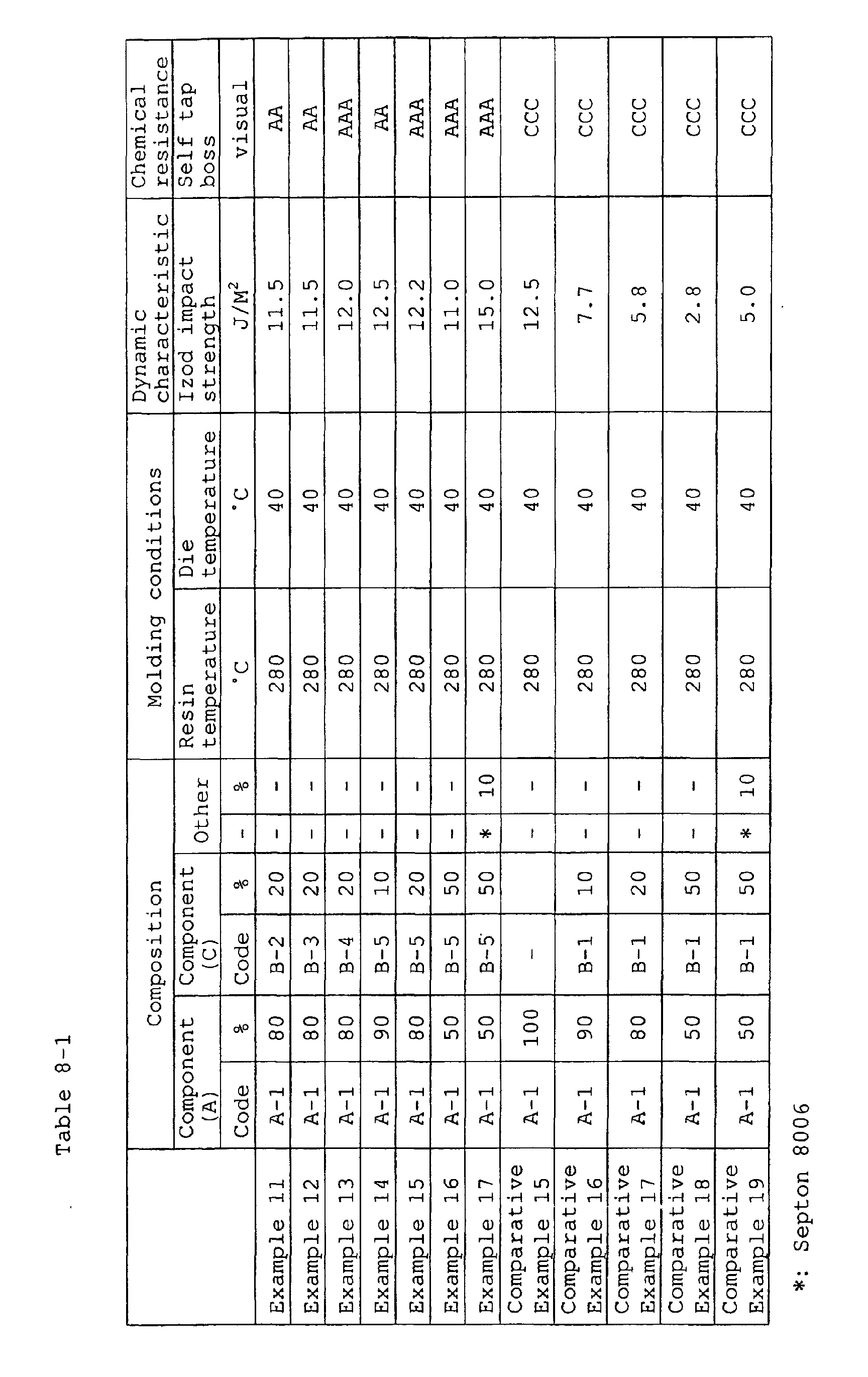
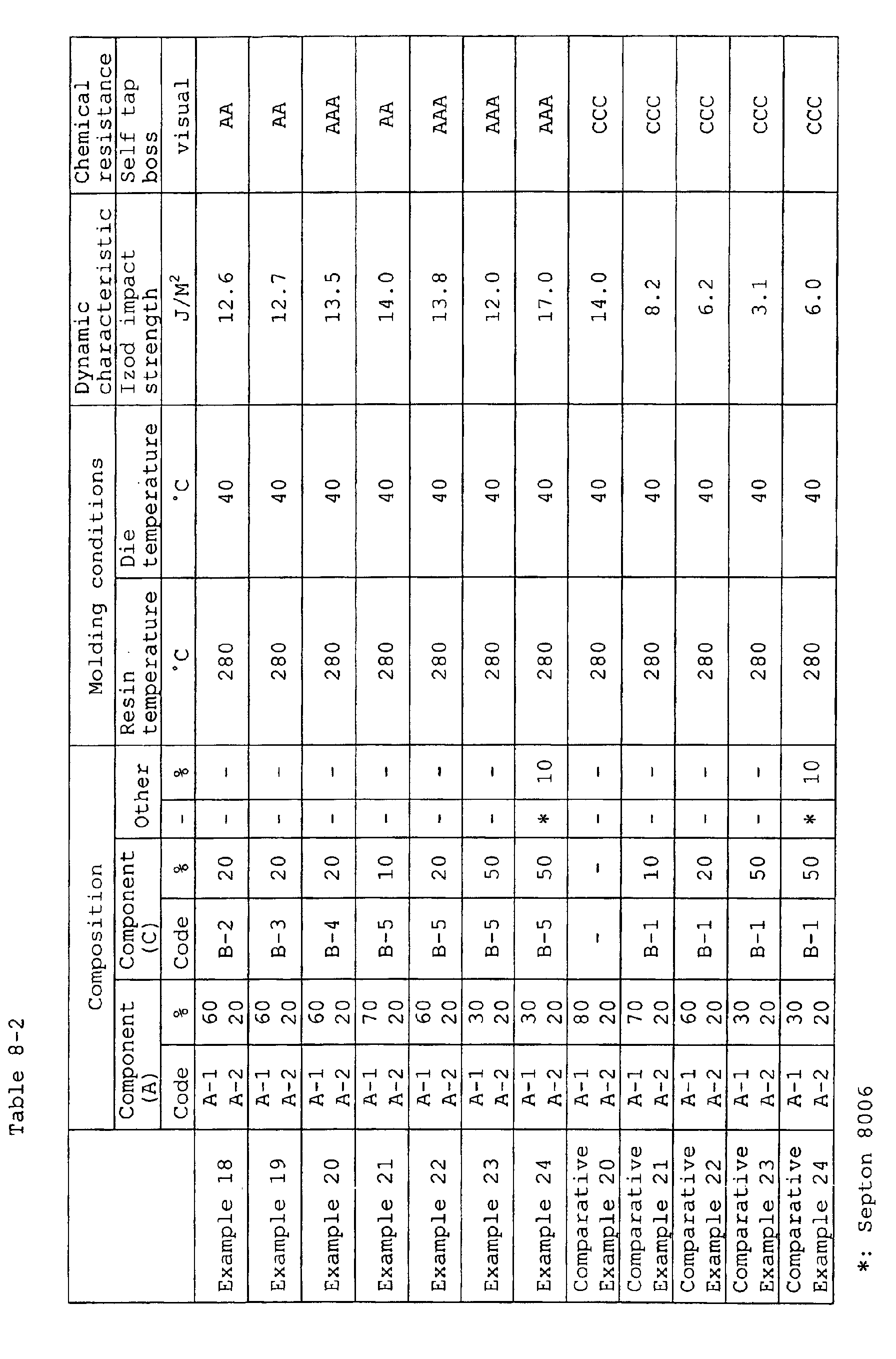
  • the component (A) and the component (C) each described above, 0.2 phr of Irganox 1076 (antioxidant, available from Chiba Specialty Chemicals Co., Ltd.) and the other component were dry-blended in a composition shown in Table 8 and extruded at a resin temperature of 280°C by means of a single shaft extruding machine to obtain a strand, and this was pelletized.
  • Septon 8006 (SEBS, available from KURARAY CO., LTD.) as a rubber component was used as the other component.
  • the pellets thus obtained were molded into a self-tap boss on conditions shown in Table 7 by means of an injection-molding machine, and it was evaluated by the following methods.
  • a self-tap boss having a shape shown in Table 7 was molded, and a screw was clamped at a prescribed torque. Then, a chemical was applied on the periphery of the boss and left standing at a room temperature for 24 hours, and then the state thereof was observed and ranked.
  • Pelletized syndiotactic polystyrenes having properties shown in Table 9 were used for the syndiotactic polystyrene in the component (D).
  • a weight average molecular weight (Mw) and a molecular weight distribution [Mw/Mn (Mn: number average molecular weight)] of the syndiotactic polystyrenes were measured at 135°C in terms of polyethylene by gel permeation chromatography (GPC) using 1,2,4-trichlorobenzene as a solvent.
  • the melting points were measured by means of DSC (differential scanning colorimeter) and determined by melting peak positions observed when the temperature was raised at a heating rate of 20°C/minute.
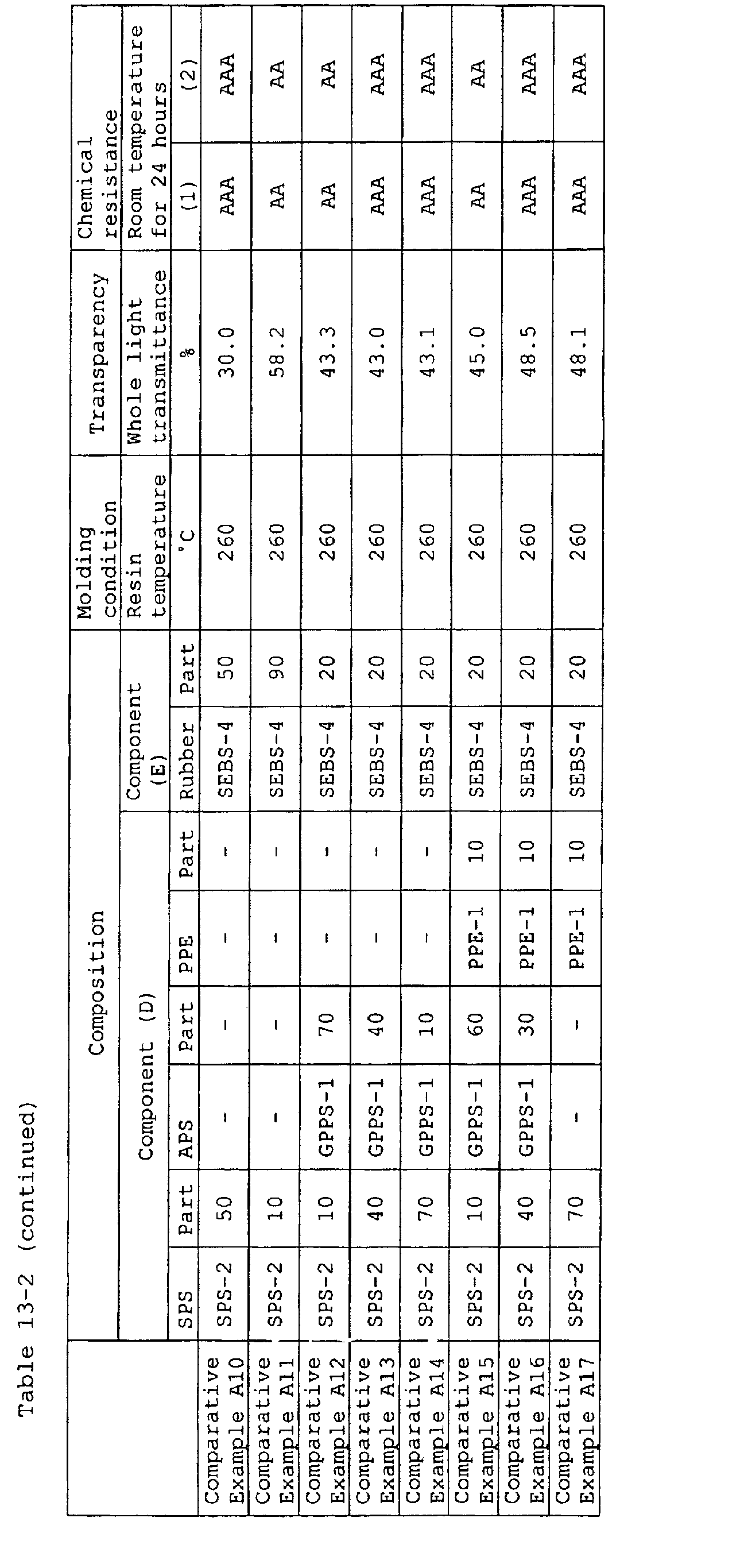
  • the component (D) and the component (E) each described above were molten and mixed in a composition shown in Table 13 by means of a single shaft extruding machine and injection-molded into a flat plate of 50 mm ⁇ 50 mm ⁇ 3.2 mm and a bar having a thickness of 3.2 mm on the conditions of a resin temperature which was 10°C higher than a melting point of the syndiotactic polystyrene and a die temperature of 40°C.
  • Distortion was applied onto the bar having a thickness of 3.2 mm produced by injection-molding, and then a gauze impregnated with a solvent was put on the distorted part. It was covered with a wrapping film in order to prevent the solvent from volatilizing and then left standing at a room temperature for 24 hours, and a change in the surface appearance and the presence of cracks were visually evaluated.
  • a chemical resistance is effectively revealed in the chemical-resistant polystyrene-based resin molded article of the first aspect of the present invention, and it can be used for various applications in which the chemical resistance is required.
  • the chemical-resistant polystyrene-based resin composition of the second aspect of the present invention effectively reveals a chemical resistance and is excellent as well in physical properties, and it can readily provide a molded article having excellent characteristics at a low cost.
  • a transparency and a chemical resistance are effectively revealed in the chemical-resistant polystyrene-based resin composition of the third aspect of the present invention, and it can readily provide a molded article provided with a transparency in combination with a chemical resistance.
Landscapes

  • Chemical & Material Sciences (AREA)
  • Health & Medical Sciences (AREA)
  • Chemical Kinetics & Catalysis (AREA)
  • Medicinal Chemistry (AREA)
  • Polymers & Plastics (AREA)
  • Organic Chemistry (AREA)
  • Compositions Of Macromolecular Compounds (AREA)
  • Manufacture Of Macromolecular Shaped Articles (AREA)

Abstract

A chemical-resistant polystyrene-based resin molded article obtained by molding a styrene-based resin composition comprising component (A): a styrene-based polymer having an atactic structure or a mixture of the styrene base polymer having an atactic structure and polyphenylene ether in a total amount of 10 to 95 parts by weight and component (B): a styrene-based polymer having primarily a syndiotactic structure in an amount of 90 to 5 parts by weight, wherein the component (B) has a relative crystallinity of 30 % or less in a depth of up to 0.5 mm from the surface of the above molded article. By incorporating a rubber component which is a block polymer having a styrene content of 70 mass % or more in an amount of 3 to 97 parts by weight, a molded article excellent in transparency and chemical resistance can be obtained.

Description

BACKGROUND OF THE INVENTION
The first aspect of the present invention relates to a chemical-resistant polystyrene-based resin molded article, more specifically to a chemical-resistant polystyrene-based resin molded article provided with a chemical-resistance by blending with a styrene-based polymer (hereinafter referred to as a syndiotactic polystyrene (B)) having primarily a syndiotactic structure, in which a crystallinity is not higher than a fixed value.
Also, the second aspect of the present invention relates to a chemical-resistant polystyrene-based resin molded article, more specifically to a chemical-resistant polystyrene-based resin molded article provided with a chemical resistance by blending with a styrene-based polymer (hereinafter referred to as a syndiotactic polystyrene (c)) having primarily a syndiotactic structure, in which a peak value of a crystallinity is not higher than a fixed value.
Further, the third aspect of the present invention relates to a chemical-resistant polystyrene-based resin molded article having an excellent transparency, more specifically to a chemical-resistant polystyrene-based resin molded article having an excellent transparency in which a transparency get compatible with a chemical resistance under distortion by blending with a styrene-based block polymer having a styrene content of 70 mass % or more as a rubber component.
RELATED ART
A polystyrene-based resin obtained by radically polymerizing an aromatic vinyl compound is inexpensive and has so far been applied to a great variety of uses. However, because of an atactic structure thereof, it is amorphous and is not necessarily satisfactory as far as a chemical resistance is concerned, and this has narrowed the application range thereof.
Various detergents and toiletry-related goods which have been put to practical use in recent years bring about cracking and cleaving of polystyrene-based resins in many cases, so that the polystyrene-based resins are strongly required to be improved in a chemical resistance.
In order to improve a chemical resistance of a polystyrene-based resin having an atactic structure (hereinafter referred to as atactic polystyrene), it has been tried to copolymerize styrene with a polar monomer such as acrylonitrile, methacrylate, acrylate, maleic anhydride and maleimide to thereby improve the chemical resistance.
However, these copolymers have had the problems of a restriction in a random copolymerization ratio, a reduction in productivity, a change in a color tone, the presence of an odor, a difficulty in mixing recycle with the other polystyrene-based resins and a production in cyan gas in incinerating.
Accordingly, syndiotactic polystyrene having crystallinity has been developed, and a composition of syndiotactic polystyrene has been proposed for the purpose of elevating a chemical resistance of atactic polystyrene (Japanese Patent Application Laid-Open No. 279347/1999 and Japanese Patent Application Laid-Open No. 279349/1999).
However, when a blended matter of syndiotactic polystyrene and atactic polystyrene was molded, the satisfactory chemical resistance was not necessarily revealed depending on the state of the molded article.
Further, conventional syndiotactic polystyrene has a too fast crystallizing speed, and therefore observed is the phenomenon that when a blended matter of syndiotactic polystyrene and atactic polystyrene is molded, partial crystallization is caused in the molded article.
Accordingly, though this molded article is improved in a chemical resistance as compared with a molded article produced from atactic polystyrene, the effect thereof is not sufficiently high, and the impact strength and the elongation are reduced, so that the application range thereof has been narrowed.
The first aspect of the present invention has been made from the viewpoints described above, and an object thereof is to provide a chemical-resistant polystyrene-based resin molded article which comprises a composition prepared by blending syndiotactic polystyrene (B) with atactic polystyrene or atactic polystyrene and polyphenylene ether and in which a chemical resistance is further effectively revealed.
Also, an object of the second aspect of the present invention is to provide a resin composition which can be further improved in a chemical resistance as compared with a composition blended with conventional syndiotactic polystyrene by blending specific syndiotactic polystyrene (C) with atactic polystyrene or atactic polystyrene and polyphenylene ether and which can reveal satisfactory physical properties and a molded article thereof.
In recent years, uses of molded articles to which a transparency is required grow larger, and materials provided with a transparency in combination with a chemical resistance are strongly required to be developed.
A polystyrene-based resin obtained by radically polymerizing an aromatic vinyl compound is inexpensive and has so far been applied to a great variety of uses. However, because of an atactic structure thereof, it is amorphous and has not necessarily been satisfactory as far as a chemical resistance is concerned.
In particular, GPPS (general purpose polystyrene) containing no rubber component has a transparency but is inferior to HIPS (high impact polystyrene) in toughness and a chemical resistance, and therefore the application range thereof has been narrowed.
A method in which a refractive index of a monomer used for a matrix component for HIPS and ABS (acrylonitrile-butadiene-styrene) or a rubber component are controlled by copolymerization to achieve transparency is available in order to improve a transparency of a styrene polymer having an atactic structure (hereinafter referred to as atactic polystyrene).
To be specific, it is tried to improve the transparency by copolymerizing styrene with a polar monomer such as acrylonitrile, methacrylate, acrylate, maleic anhydride and maleimides.
However, these copolymers have had the problems of a restriction in a random copolymerization ratio, a reduction in productivity, a change in a color tone, the presence of an odor and a production in cyan gas in incinerating. Further, these copolymers are different from polystyrene in terms of a chemical structure, and therefore they have had the problem that they are not readily miscible with polystyrene and blended recycling is difficult.
Further, the chemical resistance has not necessarily been satisfactory as well.
Then, syndiotactic polystyrene having crystallinity has been developed, and a composition provided with a transparency and a chemical resistance by syndiotactic polystyrene alone or a blending thereof with GPPS has been proposed (Japanese Patent Application Laid-Open No. 279347/1999 and Japanese Patent Application Laid-Open No. 279349/1999).
However, when this composition is molded, a toughness of the molded article cannot exceed the range of GPPS, and prevention of cleaving caused by chemicals under distortion has not yet been satisfactory, and therefore the application range thereof has been narrowed.
Adding of a rubber component to syndiotactic polystyrene or blending of syndiotactic polystyrene with HIPS has made it possible to improve the toughness and cleaving caused by chemicals under distortion but has made it impossible to maintain the transparency.
The third aspect of the present invention has been made from the viewpoints described above, and an object thereof is to provide a chemical-resistant polystyrene-based resin composition having an excellent transparency which provides a molded article provided with a transparency in combination with a chemical resistance under distortion by adding a specific rubber component to syndiotactic polystyrene, syndiotactic polystyrene and atactic polystyrene or syndiotactic polystyrene, atactic polystyrene and polyphenylene ether.
DISCLOSURE OF THE INVENTION
Intensive researches repeated by the present inventors in order to overcome the problems described above have resulted in first paying attentions to a crystallinity of syndiotactic polystyrene (B).
Then, they have found that a chemical resistance is further effectively revealed in a molded article which comprises a composition prepared by blending the syndiotactic polystyrene (B) with atactic polystyrene or atactic polystyrene and polyphenylene ether and which has a relative crystallinity of not higher than a fixed value.
That is, conventional resins have to be improved in a crystallinity in order to reveal a chemical resistance, but to be surprising, it has been found that a chemical resistance of a molded article in which a relative crystallinity is controlled to not higher than a fixed value can effectively be revealed by blending the syndiotactic polystyrene (B) with atactic polystyrene or atactic polystyrene and polyphenylene ether.
Also, intensive researches repeated by the present inventors in order to develop a polystyrene-based resin composition having the preferred characteristics described above have resulted in finding that the satisfactory chemical resistance and physical properties can be revealed by blending syndiotactic polystyrene (C) having a specific crystallizing temperature (Tc).
Further, intensive researches repeated by the present inventors in order to overcome the problems described above have resulted in finding that a molded article having both of a transparency and a chemical resistance under distortion is obtained by using a styrene-based block polymer having a styrene content of 70 mass % or more as a rubber component.
The present invention has been completed based on such knowledges.
That is, the first aspect of the present invention provides a chemical-resistant polystyrene-based resin molded article obtained by molding a styrene-based resin composition comprising component (A): a styrene-based polymer having an atactic structure or a mixture of the styrene base polymer having an atactic structure and polyphenylene ether in a total amount of 10 to 95 parts by weight and component (B): a styrene-based polymer having primarily a syndiotactic structure in an amount of 90 to 5 parts by weight, wherein the component (B) has a relative crystallinity of 30 % or less in a depth of up to 0.5 mm from the surface of the above molded article.
Also, the second aspect of the present invention provides a chemical-resistant polystyrene-based resin composition comprising component (A): a styrene-based polymer having an atactic structure or a mixture of the styrene-based polymer having an atactic structure and polyphenylene ether in a total amount of 10 to 95 parts by weight and component (C): a styrene-based polymer having a syndiotactic structure in which a crystallizing temperature (Tc) has a peak value of 220°C or lower when lowering the temperature from 300°C at a cooling rate of 20°C/minute by means of a differential scanning colorimeter (DSC) in an amount of 90 to 5 parts by weight.
Further, the third aspect of the present invention provides a chemical-resistant polystyrene-based resin composition having an excellent transparency, comprising component (D): (d1) a styrene base polymer having primarily a syndiotactic structure in an amount of 97 to 3 parts by weight or (d2) the styrene-based polymer having primarily a syndiotactic structure or at least one of a styrene base polymer having an atactic structure or polyphenylene ether in a total amount of 97 to 3 parts by weight and component (E): a rubber component which is a block polymer having a styrene content of 70 mass % or more in an amount of 3 to 97 parts by weight, wherein the styrene-based polymer having primarily a syndiotactic structure has a content of 3 parts by weight or more per total 100 parts by weight of the component (D) and the component (E); and a molded article thereof.
BEST MODE FOR CARRYING OUT THE INVENTION
The atactic polystyrene of the component (A) used in the first and second aspects of the present invention is a polymer which is obtained by a polymerizing method such as solution polymerization, bulk polymerization, suspension polymerization and bulk-suspension polymerization comprising at least one aromatic vinyl compound represented by the following Formula (I):
Figure 00120001
(wherein R represents a hydrogen atom, a halogen atom or a substituent containing at least one of a carbon atom, an oxygen atom, a nitrogen atom, a sulfur atom, a phosphorus atom, a selenium atom, a tin atom and a silicon atom; and m represents an integer of 1 to 3, provided that when m is plural, respective R may be the same or different), a copolymer of at least one other vinyl monomer which is copolymerizable with the at least one aromatic vinyl compound, or a hydrogenated polymer of these polymers and a mixture thereof.
The preferred aromatic vinyl compound includes styrene, alkylstyrens such as α-methylstyrene, methylstyrene, ethylstyrene, isopropylstyrene and tertiary butylstyrene, phenylstyrene, vinylstyrene, chlorostyrene, bromostyrene, fluorostyrene, chloromethylstyrene, methoxystyrene and ethoxystyrene, and they are used alone or in combination of two or more kinds thereof.
Among them, the particularly preferred aromatic vinyl compounds are styrene, p-methylstyrene, m-methylstyrene, p-tertiary butylstyrene, p-chlorostyrene, m-chlorostyrene and p-fluorostyrene.
The other vinyl monomer copolymerizable with the aromatic vinyl compound described above includes vinyl cyan compounds such as acrylonitrile and methacrylonitrile, acrylic acid esters such as methyl acrylate, ethyl acrylate, propyl acrylate, butyl acrylate, amyl acrylate, hexyl acrylate, octyl acrylate, 2-ethylhexyl acrylate, cyclohexyl acrylate, dodecyl acrylate, octadecyl acrylate, phenyl acrylate and benzyl acrylate, methacrylic acid esters such as methyl methacrylate, ethyl methacrylate, butyl methacrylate, amyl methacrylate, hexyl methacrylate, octyl methacrylate, 2-ethylhexyl methacrylate, cyclohexyl methacrylate, dodecyl methacrylate, octadecyl methacrylate, phenyl methacrylate and benzyl methacrylate and maleimide base compounds such as maleimide, N-methylmaleimide, N-ethylmaleimide, N-butylmaleimide, N-laurylmaleimide, N-cyclohexylmaleimide, N-phenylmaleimide and N-(p-boromophenyl)maleimides.
The rubber-like polymer copolymerizable with the aromatic vinyl compound described above includes diene base rubber such as polybutadiene, styrene-butadiene copolymers, acrylonitrile-butadiene copolymers and polyisoprene, non-diene base rubber such as ethylene-α-olefin copolymers, ethylene-α-olefin-polyene copolymers and polyacrylates, styrene-butadiene block copolymers, hydrogenated styrene-butadiene block copolymers, ethylene-propylene elastomers, styrene-grafted-ethylene-propylene elastomers, ethylene base ionomer resins and hydrogenated styrene-isoprene copolymers.
In the first and the second aspects of the present invention, the atactic polystyrene of the component (A) shall not specifically be restricted in a molecular weight thereof, and in general, the weight average molecular weight is 10,000 or more, preferably 50,000 or more.
In this case, when the weight average molecular weight is less than 10,000, the resultant molded article is reduced in a thermal property and a mechanical property, and therefore it is not preferred.
Further, the molecular weight distribution shall not be restricted in a range thereof, and various ones can be applied.
The atactic polystyrene of the component (D) used in the third aspect of the present invention is a polymer which is obtained by a polymerizing method such as solution polymerization, bulk polymerization, suspension polymerization and bulk-suspension polymerization and which comprises at least one aromatic vinyl compound represented by the following Formula (I):
Figure 00150001
(wherein R represents a hydrogen atom, a halogen atom or a substituent containing at least one of a carbon atom, an oxygen atom, a nitrogen atom, a sulfur atom, a phosphorus atom, a selenium atom, a tin atom and a silicon atom; and m represents an integer of 1 to 3, provided that when m is plural, respective R may be the same or different).
The preferred aromatic vinyl compound includes styrene, alkylstyrens such as α-methylstyrene, methylstyrene, ethylstyrene, isopropylstyrene and tertiary butylstyrene, phenylstyrene, vinylstyrene, chlorostyrene, bromostyrene, fluorostyrene, chloromethylstyrene, methoxystyrene and ethoxystyrene, and they are used alone or in combination of two or more kinds thereof.
Among them, the particularly preferred aromatic vinyl compounds are styrene, p-methylstyrene, m-methylstyrene, p-tertiary butylstyrene, p-chlorostyrene, m-chlorostyrene and p-fluorostyrene.
The atactic polystyrene of the component (D) shall not specifically be restricted in a molecular weight thereof, and in general, the weight average molecular weight is 10,000 or more, preferably 50,000 or more.
In this case, when the weight average molecular weight is less than 10,000, the resulting molded article is reduced in a thermal property and a mechanical property, and therefore it is not preferred.
Further, the molecular weight distribution shall not be restricted in a range thereof, and various ones can be applied.
In the first, second and third aspects of the present invention, polyphenylene ether can be employed as a part of the component (A) or the component (D) in order to improve a heat resistance of the molded article.
Polyphenylene ether is a publicly known compound and can be referred to U.S. Patents No. 3306874, 3306875, 3257357 and 3257358 in order to use for the purpose described above.
Polyphenylene ether is usually prepared by an oxidation coupling reaction in which a homopolymer or a copolymer is produced in the presence of a copper amine complex or one or more two- or three-substituted phenol.
In this case, a copper amine complex derived from primary, secondary or tertiary amine can be used.
The examples of polyphenylene ether include poly(2,3-dimethyl-6-ethyl-1,4-phenylene ether), poly(2-methyl-6-chloromethyl-1,4-phenylene ether), poly(2-methyl-6-hydroxyethyl-1,4-phenylene ether), poly(2-methyl-6-n-butyl-1,4-phenylene ether), poly(2-ethyl-6-isobutyl-1,4-phenylene ether), poly(2-ethyl-6-isopropyl-1,4-phenylene ether), poly(2-ethyl-6-n-propyl-1,4-phenylene ether), poly(2,3,6-trimethyl-1,4-phenylene ether), poly(2-(4'-methylphenyl)-1,4-phenylene ether), poly(2-bromo-6-phenyl-1,4-phenylene ether), poly(2-methyl-6-phenyl-1,4-phenylene ether), poly(2-phenyl-1,4-phenylene ether), poly(2-chloro-1,4-phenylene ether), poly(2-methyl-1,4-phenylene ether), poly(2-chloro-6-ethyl-1,4-phenylene ether), poly(2-chloro-6-bromo-1,4-phenylene ether), poly(2,6-di-n-propyl-1,4-phenylene ether), poly(2-methyl-6-isopropyl-1,4-phenylene ether), poly(2-chloro-6-methyl-1,4-phenylene ether), poly(2-methyl-6-ethyl-1,4-phenylene ether), poly(2,6-dibromo-1,4-phenylene ether), poly(2,6-dichloro-1,4-phenylene ether), poly(2,6-diethyl-1,4-phenylene ether) and poly(2,6-dimethyl-1,4-phenylene ether).
Suited as well is, for example, a copolymer such as copolymers derived from two or more phenol compounds used for preparing the homopolymer described above.
Also, those obtained by modifying them with a modifying agent including maleic anhydride and fumaric anhydride are suitably used as well.
Further, included are, for example, a graft copolymer and a block copolymer of a vinyl aromatic compound such as polystyrene with the polyphenylene ether described above. Among them, poly(2,6-dimethyl-1,4-phenylene ether) is particularly preferred.
This polyphenylene ether shall not specifically be restricted in a molecular weight, and those having an intrinsic viscosity of 0.5 deciliter/g or less, preferably 0.45 deciliter/g or less measured in chloroform at 25°C are used.
When the intrinsic viscosity exceeds 0.5 deciliter/g, the fluidity in molding is reduced to a large extent in a certain case.
When polyphenylene ether is blended in the first and second aspects of the present invention, a blending proportion thereof shall not specifically be restricted, and it is preferably 5 to 80 mass %, more preferably 10 to 60 mass % based on the component (A).
When the blending proportion is smaller than 5 mass %, the heat resistance-improving effect is small, and when it exceeds 80 mass %, the fluidity in molding is reduced to a large extent in a certain case.
In the third aspect of the present invention, a blending proportion of the syndiotactic polystyrene, the atactic polystyrene and the polyphenylene ether each contained in the component (D) shall not specifically be restricted, and the syndiotactic polystyrene has to have a proportion of 3 parts by weight or more, preferably 5 parts by weight or more and more preferably 10 parts by weight or more per 100 parts by weight of the total weight of the component (D) and the component (E).
When the syndiotactic polystyrene has a proportion of less than 3 parts by weight, the chemical resistance-improving effect is reduced.
In the first and second aspects of the present invention, the component (A) can be used in combination with a rubber-like elastic body in order to elevate the impact resistance.
The specific examples of the rubber-like elastic body include natural rubber, polybutadiene, polyisoprene, polybutylene, neoprene, polysulfide rubber, thiocol rubber, acryl rubber, urethane rubber, silicon rubber, epichlorohydrin rubber, styrene-butadiene block copolymers (SBR), hydrogenated styrene-butadiene block copolymers (SEB, SEBC), styrene-butadiene-styrene block copolymers (SBS), hydrogenated styrene-butadiene-styrene block copolymers (SEBS), styrene-isoprene block copolymers (SIR), hydrogenated styrene-isoprene block copolymers (SEP), styrene-isoprene-styrene block copolymers (SIS), hydrogenated styrene-isoprene-styrene block copolymers (SEPS), ethylene propylene rubber (EPM), ethylene propylene diene rubber (EPDM), butadiene-acrylonitrile-styrene-core shell rubber (ABS), methyl methacrylate-butadiene-styrene-core shell rubber (MBS), methyl methacrylate-butyl acrylate-styrene-core shell rubber (MAS), octyl acrylate-butadiene-styrene-core shell rubber (MABS), alkyl acrylate-butadiene-acrylonitrile-styrene-core shell rubber (AABS), butadiene-styrene-core shell rubber (SBR), particulate elastic bodies of a core shell type such as siloxane-containing core shell rubber including methyl methacrylate-butyl acrylate-siloxane and rubbers obtained by modifying them.
Among them, SBR, SEB, SBS, SEBS, SIR, SEP, SIS, SEPS, core shell rubbers, EPM, EPDM and rubbers obtained by modifying them are preferably used.
These rubber-like elastic bodies can be used alone or in a blend of two or more kinds thereof.
A blending proportion of the rubber-like shall not specifically be restricted, and it is 50 mass % or less, preferably 40 mass % or less and more preferably 30 mass % or less based on the component (A).
When it exceeds 50 mass %, a reduction in the chemical resistance and the elastic modulus is brought about in a certain case.
The component (E) in the third aspect of the present invention is a rubber component, and a block polymer having a styrene content of 70 mass % or more is used therefor. The styrene content is preferably 75 mass %.
When the styrene content is less than 70 mass %, it is difficult to secure a satisfactory transparency in the molded article.
An upper limit of the styrene content shall not specifically be restricted, and it is preferably 95 mass % or less.
When the styrene content exceeds 95 mass %, the chemical resistance-improving effect under distortion is small, so that the rubber component has to be added in a large amount, and it is economically disadvantageous.
Such rubber component includes styrene-butadiene block copolymers (SBR), hydrogenated styrene-butadiene block copolymers (SEB, SEBC), styrene-butadiene-styrene block copolymers (SBS), hydrogenated styrene-butadiene-styrene block copolymers (SEBS), styrene-isoprene block copolymers (SIR), hydrogenated styrene-isoprene block copolymers (SEP), styrene-isoprene-styrene block copolymers (SIS), hydrogenated styrene-isoprene-styrene block copolymers (SEPS) or rubbers obtained by modifying them.
Among them, SBS, SEBS, SIS and SEPS are preferably used, and SEBS and SEPS are more preferably used from the viewpoint of the heat stability.
These rubber-like elastic bodies can be used alone or in a blend of two or more kinds thereof.
In the first, second and third aspects of the present invention, a syndiotactic structure in the styrene base polymer having primarily a syndiotactic polystyrene structure in the component (B), the component (C) and the component (D) is that the stereochemical structure has a syndiotactic structure, that is, a steric structure in which phenyl groups being side chains are positioned alternately in a reverse direction to a principal chain formed from a carbon-carbon bond, and the tacticity thereof is determined by a nuclear magnetic resonance (13C-NMR) using isotopic carbon.
The tacticity determined by a 13C-NMR method can be shown by diad when a present proportion of plural continuous structural units are, for example, 2, triad when it is 3 and pentad when it is 5. The styrene-based polymer having primarily a syndiotactic structure referred to in the present invention is usually shown by polystyrene, poly(alkylstyrene), poly(halogenated styrene), poly(halogenated alkylstyrene), poly(alkoxystyrene), poly(vinyl benzoate), hydrogenated polymers thereof and mixtures thereof or copolymers comprising them as principal components each having a syndiotacticity of 75 % or more, preferably 85 % or more in terms of racemidiad or 30 % or more, preferably 50 % or more in terms of racemipentad.
In this case, poly(alkylstyrene) includes poly(methylstyrene), poly(ethylstyrene), poly(isopropylstyrene), poly(tertiary buthylstyrene), poly(phenylstyrene), poly(vinylnaphthalene) and poly(vinylstyrene), and poly(halogenated styrene) includes poly(chlorostyrene), poly(bromostyrene) and poly(fluorostyrene).
Further, poly(halogenated alkylstyrene) includes poly(chloromethylstyrene), and poly(alkoxystyrene) includes poly(methoxystyrene) and poly(ethoxystyrene).
These styrene-based polymers having a syndiotactic structure can be used alone or in combination of two or more kinds thereof.
Among them, the particularly preferred syndiotactic polystyrene includes polystyrene, poly(p-methylstyrene), poly(m-methylstyrene), poly(p-tertiary buthylstyrene), poly(p-chlorostyrene), poly(m-chlorostyrene), poly(p-fluorostyrene), hydrogenated polystyrenes and copolymers comprising these structural units.
The syndiotactic polystyrene (B) component in the molded article of the first aspect of the present invention has to have a crystallinity of 30 % or less in terms of a relative crystallinity in a depth of up to 0.5 mm from the surface of the molded article. This relative crystallinity is preferably 20 % or less, more preferably 10 % or less.
When this relative crystallinity exceeds 30 %, it is difficult to sufficiently reveal a chemical resistance of the molded article, and a reduction in glossiness and a physical property of the molded article is brought about in a certain case.
A method for controlling this crystallinity includes a method in which controlled are the resin temperature, the die temperature, the cooling speed, the design of the syndiotactic polystyrene (B) component, the additives, a proportion of the syndiotactic polystyrene component and the molecular weights and the added amounts of the atactic polystyrene component and the polyphenylene ether component.
Further, the syndiotactic polystyrene (C) used in the second aspect of the present invention has to have a peak value of 220°C or lower in a crystallizing temperature (Tc) when the temperature is lowered from 300°C at a cooling rate of 20°C/minute by means of a differential scanning colorimeter (DSC). This peak value in the crystallizing temperature is preferably 210°C or lower, more preferably 200°C or lower.
When this peak value in the crystallizing temperature exceeds 220°C, it is difficult to inhibit the crystallization of the syndiotactic polystyrene component in the molded article, and the component (A) and the component (C) stay in a heterogeneous mixing state, so that it is difficult to sufficiently reveal the chemical resistance. Further, a reduction in a dynamic characteristic and a surface characteristic of the molded article is brought about in a certain case.
The syndiotactic polystyrene having a peak value of 220°C or lower in Tc can be obtained by, for example, a method such as using a copolymer of styrene and substituted styrene, adding the polyphenylene ether component, using a low stereospecific polymer and adding a crystallizing rate-retarding agent such as fatty acid metal salts including montanoic acid metal salts (sodium montanoate and zinc montanoate).
A molecular weight of the syndiotactic polystyrenes in the first, second and third aspects of the present invention shall not specifically be restricted, and the weight average molecular weight in terms of polystyrene measured at 135°C by a GPC (gel permeation chromatography) method using trichlorobenzene as a solvent is 10,000 or more, preferably 50,000 or more.
Further, the molecular weight distribution shall not specifically be restricted in a range thereof, and various ones can be applied.
In this case, when the weight average molecular weight is less than 10,000, the resulting composition or molded article is reduced in a thermal property and a mechanical property, and therefore it is not preferred.
A melting point of the syndiotactic polystyrenes (B) and (D) in the first and third aspects of the present invention shall not specifically be restricted, and it is preferably 270°C or lower, more preferably 250°C or lower.
When the melting point exceeds 270°C, a temperature of 280 to 300°C is required in molding, and therefore a deterioration in the moldability of the composition and a reduction in the physical properties caused by heat deterioration are likely to be brought about.
Also, the syndiotactic polystyrene (D) in the third aspect of the present invention has a peak value of preferably 230°C or lower, more preferably 200°C or lower in a crystallizing temperature (Tc) when the temperature is lowered from 300°C with a cooling rate of 20°C/minute by means of a differential scanning colorimeter (DSC).
When this peak value in the crystallizing temperature exceeds 230°C, the syndiotactic polystyrene component is crystallized in the molded article, and therefore it is difficult to maintain a transparency of the molded article.
A method for preparing the syndiotactic polystyrenes in the first, second and third aspects of the present invention includes, for example, a method in which a styrene base monomer (a monomer corresponding to the styrene base polymer described above) is polymerized in an inert hydrocarbon solvent or in the absence of a solvent using a titanium compound and a condensation product of water and trialkylaluminum as a catalyst (Japanese Patent Application Laid-Open No. 187708/1987).
Further, poly(halogenated alkylstyrene) and halogenated polymers thereof can be obtained as well, for example, by methods described in Japanese Patent Application Laid-Open No. 46912/1989 and Japanese Patent Application Laid-Open No. 178505/1989.
In the resin composition according to the first aspect of the present invention, a blending amount of the component (B) is 90 to 5 parts by weight, preferably 80 to 10 parts by weight and more preferably 50 to 15 parts by weight per 100 parts by weight of the total amount of the component (A) and the component (B).
When a blending amount of the component (B) is less than 5 parts by weight, an effect for improving the chemical resistance is not observed as a matter of fact, and when it exceeds 90 parts by weight, it is disadvantageous in terms of the cost. Accordingly, both are not preferred.
Also, in the resin composition of the second aspect of the present invention, a blending amount of the component (C) is 90 to 5 parts by weight, preferably 80 to 10 parts by weight and more preferably 50 to 15 parts by weight per 100 parts by weight of the total amount of the component (A) and the component (C).
When a blending amount of the component (C) is less than 5 parts by weight, an effect for improving the chemical resistance is not observed as a matter of fact, and when it exceeds 90 parts by weight, it is disadvantageous in terms of the cost. Accordingly, both are not preferred.
Further, in the resin composition of the third aspect of the present invention, a blending amount of the component (D) is 3 to 97 parts by weight, preferably 5 to 90 parts by weight and more preferably 10 to 80 parts by weight per 100 parts by weight of the total amount of the component (D) and the component (E).
When a blending amount of the component (D) is less than 3 parts by weight, the chemical resistance-improving effect under distortion is small, and when it exceeds 97 parts by weight, a blending amount of the syndiotactic polystyrene is reduced, so that the chemical resistance is reduced as well. Accordingly, both are not preferred.
In the resin compositions according to the first, second and third aspects of the present invention, additives such as an inorganic filler, an antioxidant, a nuclear agent, a plasticizer, a mold releasing agent, a flame retardant, a flame retardant aid, a pigment, a dye, carbon black and an antistatic agent and the other thermoplastic resins can be blended as long as the objects of the present invention are not inhibited.
They each can be used alone or in combination of two or more kinds thereof.
The inorganic filler includes glass fibers, carbon fibers, whiskers, talc, carbon black, graphite, titanium dioxide, silica, mica, calcium carbonate, calcium sulfate, barium carbonate, magnesium carbonate, magnesium sulfate, barium sulfate, oxysulfate, tin oxide, alumina, kaolin, silicon carbide, metal powder, glass powder, glass flake and glass beads.
Compounds optionally selected from publicly known compounds of a phosphorus base, a phenol base and a sulfur base can be used as the antioxidant.
Compounds optionally selected from publicly known compounds such as metal salts of carboxylic acids including aluminum di(p-t-butylbenzoate), metal salts of phosphoric acid including sodium methylenebis(2,4-di-t-butylphenol)acid phosphate, talc and phthalocyanine derivatives can be used as the nuclear agent.
Compounds optionally selected from publicly known compounds such as polyethylene glycol, polyamide oligomers, ethylenebisstearoamide, phthalic acid esters, polystyrene oligomers, polyethylene waxes, mineral oils and silicon oils can be used as the plasticizer.
Compounds optionally selected from publicly known compounds such as polyethylene waxes, silicon oils, long chain carboxylic acids and long chain carboxylic acid metal salts can be used as the mold releasing agent.
Compounds optionally selected from publicly known compounds such as brominated polymers including brominated polystyrene, brominated syndiotactic polystyrene and brominated polyphenylene ether, brominated aromatic compounds including brominated diphenylalkanes and brominated diphenyl ethers and phosphorus base flame retardants including tricresyl phosphate, triphenyl phosphate and tris-3-chloropropyl phosphate can be used as the flame retardant.
Compounds optionally selected from antimony compounds including antimony trioxide and the other publicly known compounds can be used as a flame retardant aid.
Compounds optionally selected from publicly known compounds such as Teflon can be used as dripping preventive.
Capable of being employed as the thermoplastic resins in the first and second aspects of the present invention are compounds optionally selected from publicly known compounds such as polystyrene-based resins including AS (acrylonitrile-styrene) and ABS (acrylonitrile-butadiene-styrene), polyester base resins including polycarbonate, polyethylene terephthalate and polybutylene terephthalate, polyamide base resins including polyamide 6 and polyamide 6, 6, PPS (polyphenylene sulfide) and polyethers.
Polycarbonates and polyethers can be selected and used as the thermoplastic resin in the third aspect of the present invention.
A method for preparing the polystyrene-based resin compositions according to the first, second and third aspects of the present invention shall not specifically be restricted and they can be prepared by publicly known methods.
The polystyrene-based resin compositions can be obtained by melting and mixing or dry-blending the components and various additives each described above by means of a ribbon blender, a Henschel mixer, a Banbury mixer, a drum tumbler, a single shaft screw extruding machine, a double shaft screw extruding machine, a cokneader and a multi-shaft screw extruding machine.
The molding method shall not specifically be restricted, and they can be molded by publicly known methods such as injection molding, extrusion molding, heat molding and foaming molding.
In the second and third aspects of the present invention, when they can be molded by publicly known methods such as injection molding, extrusion molding, heat molding and foaming molding, a cylinder temperature in molding has to be not lower than a melting point of the syndiotactic polystyrene in the component (C) or the component (D).
When they are molded at a temperature of not higher than a melting point of the syndiotactic polystyrene, it is difficult to reveal the sufficiently high transparency, chemical resistance and physical properties.
An upper limit of the cylinder temperature is varied depending on the compositions of the materials, and it is usually 300°C or lower, preferably 280°C or lower and more preferably 260°C or lower. When the molding temperature exceeds 300°C, a reduction in the molding cycle (an increase in the cooling time), deterioration in the shrink of the molded article and degradation in the materials in residence are brought about in a certain case.
Controlling of the die temperature and cooling by a cooling roll are important in order to inhibit the syndiotactic polystyrene component from being crystallized in injection molding and extrusion molding.
The die temperature in injection molding is, though varied depending on the compositions of the materials, preferably about 40°C.
The chemical-resistant polystyrene resin molded articles in the first, second and third aspects of the present invention have durability against surfactants for a kitchen, a bath room, a toilet and others, fungicides, cleansing agents, toiletries such as shampoos, rinses, body soaps, bathing agents, lip sticks and anti-suntan agents, edible oils such as salad oil, sesame oil, soybean oil and cotton seed oil, foods such as margarine and butter and various chemicals and oils such as greases, machine oils, cutting oils and fuel oils.
The chemical-resistant polystyrene resin molded articles in the first and second aspects of the present invention can be used for various applications in which a chemical resistance is required, and the applications thereof shall not specifically be restricted.
The chemical-resistant polystyrene resin molded article in the third aspect of the present invention can be used for various applications in which a chemical resistance and a transparency are required, and the applications thereof shall not specifically be restricted.
The uses for car components include radiator grills, grills, marks, back panels, door mirrors, wheel caps, air spoilers and cowls for two wheelers as exterior parts and instrument panels, meter hoods, pillars, glove boxes, console boxes, speaker boxes, rids and battery containers s as interior parts.
The uses for electric appliances include housings, chassis, cassette cases, CD magazines and remote controller cases for AV equipment; linings, trays, arms, door caps and handles for electric refrigerators; housings, handles, pipes and inlet ports for electric cleaners; housings, fans, remote controller cases; drain pans and back panels for air conditioners; and other parts for electric fans, ventilation fans, washing machines; lighting equipments and battery cases.
The uses for telephones and communication equipments include housings, receivers and mechanical chassis.
The uses for the other equipments include machines, registers, typewriters, calculators, optical equipments and musical instruments.
Further, they are used for miscellaneous goods, remote control cars, radio control cars, blocks, parts for pinball machines, writing instruments, trays for writing instruments, toys such as surfing boards and helmets, stationeries and leisure and sporting goods.
They are used as well for housing facilities such as toilet seats, toilet lids, tanks, showers, dressing tables, storage panels in a bath room and faucet covers, household goods such as lunch boxes, various containers, pot parts and milk portions, building materials for housing parts and furnitures.
In respect to the uses for industrial structural materials, they are suitably used for applications such as pipes, vessels, trays, monoaxially and biaxially stretched films by extrusion molding and stretching, sheets and fibrous molded articles by spinning.
Next, the present invention shall be explained in further details with reference to examples, but the present invention shall by no means be restricted by these examples.
Examples 1 to 10 and Comparative Examples 1 to 14
Compounds shown in Table 1 were used as the component (A).
Code Grade
A-1 HT52 HIPS manufactured by Idemitsu Petrochemical Co., Ltd.
A-2 YPX100L Polyphenylene ether manufactured by Mitsubishi Chemical Gas Co., Ltd.
Pelletized syndiotactic polystyrenes having properties shown in Table 2 were used as the component (B).
A weight average molecular weight (Mw) and a molecular weight distribution [Mw/Mn (Mn: number average molecular weight)] of the syndiotactic polystyrenes (B) were measured at 135°C in terms of polyethylene by gel permeation chromatography (GPC) using 1,2,4-trichlorobenzene as a solvent.
The melting points were measured by means of DSC (differential scanning colorimeter) and determined by melting peak positions observed when the temperature was raised at a heating rate of 20°C/minute.
A weight average molecular weight and the like of the syndiotactic polystyrenes (B) which were determined in the manners described above are shown in Table 2.
Code Weight average molecular weight Molecular weight distribution Melting point
(°C)
B-1 Styrene homopolymer 200,000 2.1 270
B-2 Styrene-p-methylstyrene copolymer 200,000 2.3 235
The component (A) and the component (B) each described above were dry-blended in a composition shown in Table 4 and extruded at a resin temperature of 280°C by means of a single shaft-extruding machine to obtain a strand, and this was pelletized.
In the comparative exemples, used as the other component was a nuclear agent NA11 (sodium methylenebis(2,4-di-t-butylphenol)acid phosphate, manufactured by Asahi Denka Ind. Co., Ltd.).
The pellets thus obtained were molded into a self-tap boss on conditions shown in Table 4 by means of an injection-molding machine, and it was evaluated by the following methods.
The results thereof are shown in Table 4. In Table 4, a percentage of the compositions shows mass %.
(1) Evaluation of relative crystallinity
A surface layer part of the molded article was sampled in a depth of up to 0.5 mm to determine an enthalpy (ΔHTcc) in a crystallization peak and an enthalpy (ΔHTm) in a melting peak observed in elevating the temperature (heating rate = 1°C/minute) by means of DSC, and the relative crystallinity was calculated in accordance with the following equation: relative crystallinity (%) = (|ΔHTm| - |ΔHTcc|)/ΔHTm × 100
(2) Evaluation of chemical resistance
A self-tap boss having a shape shown in Table 3 was molded, and a screw was clamped at a prescribed torque. Then, a chemical was applied on the periphery of the boss and left standing at a room temperature for 24 hours, and then the state thereof was observed and ranked.
Figure 00420001
Figure 00430001
Figure 00440001
It can be found from the results shown in Table 4 that the chemical resistance is effectively revealed by controlling a relative crystallinity of the syndiotactic polystyrene component (B) in the molded article to 30 % or less.
Examples 11 to 20 and Comparative Examples 15 to 28
Compounds shown in Table 5 were used as the component (A).
Code Grade
A-1 HT62 HIPS manufactured by Idemitsu Petrochemical Co., Ltd.
A-2 YPX100L Polyphenylene ether manufactured by Mitsubishi Chemical Gas Co., Ltd.
Syndiotactic polystyrenes having properties shown in Table 6 and polymers which were obtained by melt-blending this syndiotactic polystyrene with sodium montanoate or tin montanoate and which were palletized were used as the component (C).
A weight average molecular weight (Mw) and a molecular weight distribution [Mw/Mn (Mn: number average molecular weight)] of the syndiotactic polystyrenes were measured at 135°C in terms of polyethylene by gel permeation chromatography (GPC) using 1,2,4-trichlorobenzene as a solvent.
The peak values of Tc were measured by means of DSC (differential scanning colorimeter) and determined by peak positions observed when the temperature was lowered at a cooling rate of 20°C/minute after held at 300°C for 5 minutes. A weight average molecular weight and the like of the syndiotactic polystyrenes that were determined in the manners described above are shown in Table 6.
Code Weight average molecular weight Molecular weight distribution Tc
(°C)
B-1 Styrene homopolymer 200,000 2.1 235
B-2 SPS/sodium montanoate = 100/3 (melt blend) 200,000 2.1 219
B-3 SPS/tin montanoate = 100/3 (melt blend) 200,000 2.1 210
B-4 Styrene-p-methylstyrene 7 mol % copolymer 200,000 2.3 196
B-5 Styrene-p-methylstyrene 14 mol % copolymer 200,000 2.3 183
The component (A) and the component (C) each described above, 0.2 phr of Irganox 1076 (antioxidant, available from Chiba Specialty Chemicals Co., Ltd.) and the other component were dry-blended in a composition shown in Table 8 and extruded at a resin temperature of 280°C by means of a single shaft extruding machine to obtain a strand, and this was pelletized.
Septon 8006 (SEBS, available from KURARAY CO., LTD.) as a rubber component was used as the other component.
The pellets thus obtained were molded into a self-tap boss on conditions shown in Table 7 by means of an injection-molding machine, and it was evaluated by the following methods.
The results thereof are shown in Table 8. In Table 8, a percentage of the compositions shows mass %.
(1) Izod impact strength (notched)
Measured in accordance with JIS-K7110.
(2) Evaluation of chemical resistance
A self-tap boss having a shape shown in Table 7 was molded, and a screw was clamped at a prescribed torque. Then, a chemical was applied on the periphery of the boss and left standing at a room temperature for 24 hours, and then the state thereof was observed and ranked.
Figure 00480001
Figure 00490001
Figure 00500001
It can be found from the results shown in Table 8 that when using the syndiotactic polystyrenes having a peak value of 220°C or lower in Tc, the impact strength and the chemical resistance are improved as compared with those observed when using the syndiotactic polystyrene having a peak value of exceeding 220°C in Tc.
Examples 21 to 35 and Comparative Examples 29 to 45
Pelletized syndiotactic polystyrenes having properties shown in Table 9 were used for the syndiotactic polystyrene in the component (D).
A weight average molecular weight (Mw) and a molecular weight distribution [Mw/Mn (Mn: number average molecular weight)] of the syndiotactic polystyrenes were measured at 135°C in terms of polyethylene by gel permeation chromatography (GPC) using 1,2,4-trichlorobenzene as a solvent.
The melting points were measured by means of DSC (differential scanning colorimeter) and determined by melting peak positions observed when the temperature was raised at a heating rate of 20°C/minute.
A weight average molecular weight and the like of the syndiotactic polystyrenes which were determined in the manners described above are shown in Table 2.
Code Weight average molecular weight Molecular Weight distribution Tc
(°C)
Melting point
(°C)
SPS-1 Syndiotactic styrene homopolymer 200,000 2.1 232 232
SPS-2 Syndiotactic styrene-p-methylstyrene copolymer 200,000 2.3 232 232
Compounds shown in Table 10 were used for the atactic polystyrene and the polyphenylene ether in the component (D), and compounds shown in Table 11 were used for the rubber component in the component (E).
Code Grade
Atactic polystyrene-based resin GPPS-1 US305 Atactic polystyrene Available from Idemitsu Petrochemical Co., Ltd.
Polyphenylene Ether-based resin PPE-1 YPXL100L Poly(2,6-dimethyl-1,4-phenylene ether) available from Mitsubishi Chemical Gas Co., Ltd.
Code Kind Styrene content (mass %)
SEBS-1 SEBS 70
SEBS-2 SEBS 80
SEBS-3 SEBS 90
SEBS-4 SEBS 65
SBS-1 SBS 80
SBS-2 SBS 60
The component (D) and the component (E) each described above were molten and mixed in a composition shown in Table 13 by means of a single shaft extruding machine and injection-molded into a flat plate of 50 mm × 50 mm × 3.2 mm and a bar having a thickness of 3.2 mm on the conditions of a resin temperature which was 10°C higher than a melting point of the syndiotactic polystyrene and a die temperature of 40°C.
The injection-molded articles thus obtained were evaluated by the following methods. The results thereof are shown in Table 13.
In Table 13, a percentage of the compositions shows mass %.
(1) Measurement of whole light transmittance
Measured in accordance with JIS-K7105 using the flat plate of 50 mm × 50 mm × 3.2 mm produced by injection-molding.
(2) Evaluation of chemical resistance
Distortion was applied onto the bar having a thickness of 3.2 mm produced by injection-molding, and then a gauze impregnated with a solvent was put on the distorted part. It was covered with a wrapping film in order to prevent the solvent from volatilizing and then left standing at a room temperature for 24 hours, and a change in the surface appearance and the presence of cracks were visually evaluated.
The solvent used for the evaluation and the conditions are shown in Table 12.
Code Solvent used Conditions Visual evaluation
Distortion
(%)
Temperature Time Evaluation criteria
(1) Salad oil (available from Nisshin Oil Mills Co., Ltd.) 0.2 Room temperature Left standing for 24 hours AAA: no change
AA: cloudy on surface or fine cracks produced
BB: roughened on surface, cracks produced
CCC: dissolved, large cracks produced, broken
(2) Salad oil (available from Nisshin Oil Mills Co., Ltd.) 0.4 Room temperature Left standing for 24 hours
Figure 00550001
Figure 00560001
Figure 00570001
It can be found from the results shown in Table 13 that the molded articles in which a transparency is compatible with a chemical resistance under distortion is obtained when using the styrene block copolymer having a styrene content of 70 mass % or more as the component (E).
INDUSTRIAL APPLICABILITY
A chemical resistance is effectively revealed in the chemical-resistant polystyrene-based resin molded article of the first aspect of the present invention, and it can be used for various applications in which the chemical resistance is required.
Also, the chemical-resistant polystyrene-based resin composition of the second aspect of the present invention effectively reveals a chemical resistance and is excellent as well in physical properties, and it can readily provide a molded article having excellent characteristics at a low cost.
Further, a transparency and a chemical resistance are effectively revealed in the chemical-resistant polystyrene-based resin composition of the third aspect of the present invention, and it can readily provide a molded article provided with a transparency in combination with a chemical resistance.
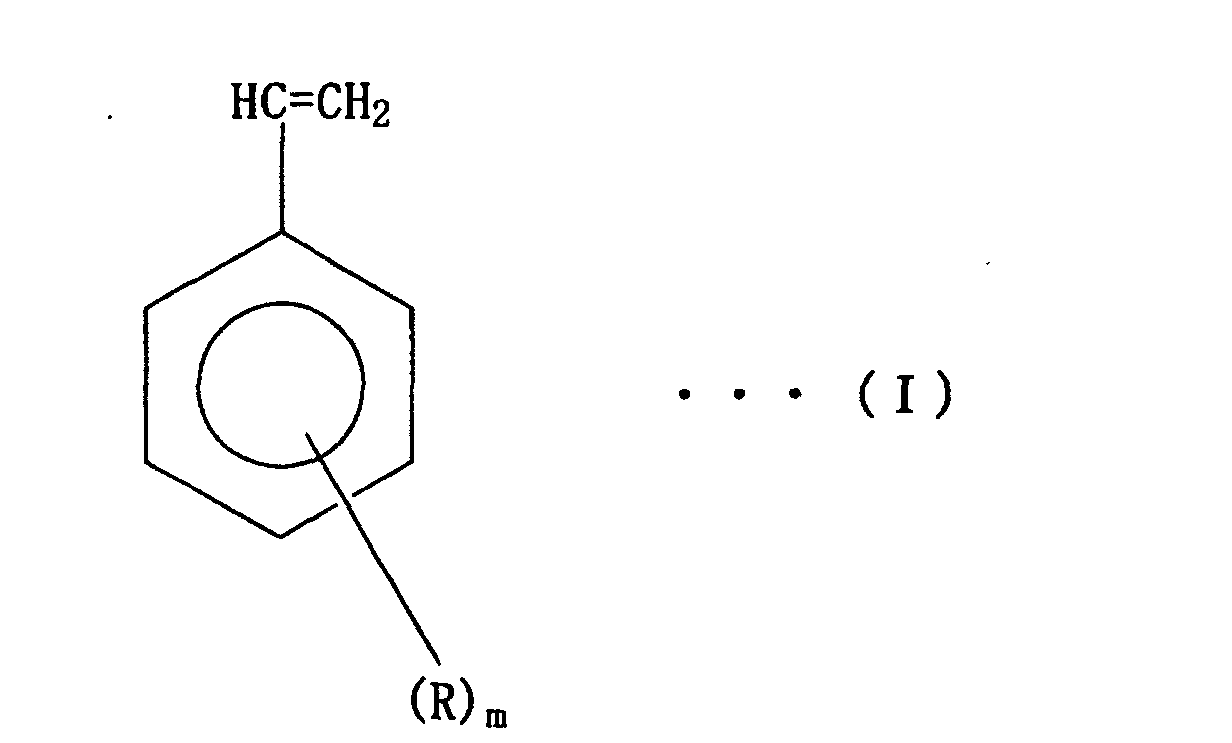
Claims (10)

  1. A chemical-resistant polystyrene-based resin molded article obtained by molding a styrene-based resin composition comprising component (A): a styrene-based polymer having an atactic structure or a mixture of the styrene base polymer having an atactic structure and polyphenylene ether in a total amount of 10 to 95 parts by weight and component (B): a styrene-based polymer having primarily a syndiotactic structure in an amount of 90 to 5 parts by weight, wherein the component (B) has a relative crystallinity of 30 % or less in a depth of up to 0.5 mm from the surface of the above molded article.
  2. A chemical-resistant polystyrene-based resin composition comprising component (A): a styrene-based polymer having an atactic structure or a mixture of the styrene-based polymer having an atactic structure and polyphenylene ether in a total amount of 10 to 95 parts by weight and component (C): a styrene-based polymer having a syndiotactic structure in which a crystallizing temperature (Tc) has a peak value of 220°C or lower when lowering the temperature from 300°C at a cooling rate of 20°C/minute by means of a differential scanning colorimeter (DSC) in an amount of 90 to 5 parts by weight.
  3. The chemical-resistant polystyrene-based resin as described in claim 2, wherein the component (C) is a copolymer of styrene and nucleus-substituted styrene.
  4. The chemical-resistant polystyrene-based resin as described in claim 2, wherein the component (C) is mixed with a fatty acid metal salt.
  5. A molded article obtained by molding the composition as described in any of claims 2 to 4.
  6. A chemical-resistant polystyrene-based resin composition having an excellent transparency, comprising component (D): (d1) a styrene base polymer having primarily a syndiotactic structure in an amount of 97 to 3 parts by weight or (d2) the styrene-based polymer having primarily a syndiotactic structure or at least one of a styrene base polymer having an atactic structure or polyphenylene ether in a total amount of 97 to 3 parts by weight and component (E): a rubber component which is a block polymer having a styrene content of 70 mass % or more in an amount of 3 to 97 parts by weight, wherein the styrene-based polymer having primarily a syndiotactic structure has a content of 3 parts by weight or more per total 100 parts by weight of the component (D) and the component (E).
  7. The chemical-resistant polystyrene-based resin as described in claim 6, wherein the component (E) is a styrene-butadiene-styrene block copolymer (SBS), a styrene-isoprene-styrene block copolymer (SIS) or a hydrogenated product thereof.
  8. The chemical-resistant polystyrene-based resin as described in claim 6, wherein the styrene base polymer having primarily a syndiotactic structure of the component (D) has a melting point of 250°C or lower and a crystallizing temperature (Tc) of 200°C or lower.
  9. The chemical-resistant polystyrene-based resin as described in claim 6, wherein the styrene base polymer having an atactic structure of the component (D) is a general purpose polystyrene (GPPS).
  10. A molded article obtained by molding the composition as described in any of claims 6 to 9.
EP02728178A 2001-05-30 2002-05-28 CHEMICAL RESISTANT POLYSTYRENE RESIN COMPOSITION AND MOLDED ARTICLE Withdrawn EP1408068A4 (en)

Applications Claiming Priority (7)

Application Number Priority Date Filing Date Title
JP2001161731A JP4926335B2 (en) 2001-05-30 2001-05-30 Chemically resistant polystyrene resin composition and molded article with excellent transparency
JP2001161730A JP4878697B2 (en) 2001-05-30 2001-05-30 Chemical resistant polystyrene resin composition and molded article
JP2001161729 2001-05-30
JP2001161729A JP4943590B2 (en) 2001-05-30 2001-05-30 Chemical-resistant polystyrene resin molded product
JP2001161731 2001-05-30
JP2001161730 2001-05-30
PCT/JP2002/005157 WO2002098960A1 (en) 2001-05-30 2002-05-28 Chemical-resistant polystyrene resin composition and molded article

Publications (2)

Publication Number Publication Date
EP1408068A1 true EP1408068A1 (en) 2004-04-14
EP1408068A4 EP1408068A4 (en) 2005-01-05

Family

ID=27346816

Family Applications (1)

Application Number Title Priority Date Filing Date
EP02728178A Withdrawn EP1408068A4 (en) 2001-05-30 2002-05-28 CHEMICAL RESISTANT POLYSTYRENE RESIN COMPOSITION AND MOLDED ARTICLE

Country Status (3)

Country Link
US (1) US20040152838A1 (en)
EP (1) EP1408068A4 (en)
WO (1) WO2002098960A1 (en)

Cited By (1)

* Cited by examiner, † Cited by third party
Publication number Priority date Publication date Assignee Title
EP4043521A4 (en) * 2019-10-11 2023-11-01 Oji Holdings Corporation Resin composition suitable for use as film for film capacitor

Families Citing this family (4)

* Cited by examiner, † Cited by third party
Publication number Priority date Publication date Assignee Title
ITMI20021496A1 (en) * 2002-07-09 2004-01-09 Polimeri Europa Spa POLYMERIC COMPOSITIONS BASED ON SHOCKPROOF VINYLAROMATIC POLYMERS
US12139597B2 (en) 2019-10-11 2024-11-12 Oji Holdings Corporation Resin composition suitable for use as film for film capacitor
JP2024022643A (en) * 2019-10-11 2024-02-16 王子ホールディングス株式会社 Resin composition suitable for film use in film capacitors
CN111909502B (en) * 2020-06-30 2022-05-17 会通新材料股份有限公司 A kind of PPO-sPS composition and preparation method thereof

Family Cites Families (26)

* Cited by examiner, † Cited by third party
Publication number Priority date Publication date Assignee Title
JPS57195139A (en) * 1981-05-26 1982-11-30 Nippon Steel Chem Co Ltd Resin composition
US5891951A (en) * 1987-09-14 1999-04-06 Idemitsu Kosan Co., Ltd. Styrene-based resin composition
MY104125A (en) * 1988-01-13 1994-02-28 Idemitsu Kosan Co Styrene-based resin composition.
US5109068A (en) * 1988-08-31 1992-04-28 Idemitsu Kosan Co., Ltd. Styrene-based polymer composition, stretched molding thereof and process for producing the same
JP2812972B2 (en) * 1989-02-02 1998-10-22 出光興産株式会社 Styrene resin composition and method for producing molded article
US5357014A (en) * 1991-08-09 1994-10-18 Idemitsu Kosan Co., Ltd. Styrenic resin molding and process for producing same
US5460868A (en) * 1991-09-12 1995-10-24 Idemitsu Kosan Co., Ltd. Method for using molding
EP0546497A3 (en) * 1991-12-10 1993-11-18 Idemitsu Kosan Co Thermoplastic resin composition
JPH0693151A (en) * 1992-09-10 1994-04-05 Idemitsu Kosan Co Ltd Polystyrene resin composition
JP3139516B2 (en) * 1992-10-08 2001-03-05 出光興産株式会社 Thermoplastic resin composition
US5760105A (en) * 1993-06-04 1998-06-02 Idemitsu Kosan Co., Ltd. Styrenic resin composition
JP3421439B2 (en) * 1994-09-20 2003-06-30 旭化成株式会社 Manufacturing method of styrene-based resin molded product
JPH08104785A (en) * 1994-10-05 1996-04-23 Idemitsu Kosan Co Ltd Impact-resistant polystyrene resin composition
JPH08132538A (en) * 1994-11-10 1996-05-28 Idemitsu Petrochem Co Ltd Production of styrenic resin molding
JP3705624B2 (en) * 1995-05-16 2005-10-12 出光興産株式会社 Method for producing acid-modified polyphenylene ether
JPH08319385A (en) * 1995-05-26 1996-12-03 Idemitsu Petrochem Co Ltd Polystyrene-based resin composition and its molding
US6027817A (en) * 1995-07-28 2000-02-22 Idemitsu Petrochemical Co., Ltd. Plated molded article and process for producing a plated molded article
DE69602150T2 (en) * 1995-09-08 1999-09-02 Idemitsu Petrochemical Co. Styrene-based resin composition
JPH11166115A (en) * 1997-12-02 1999-06-22 Sumitomo Chem Co Ltd Polyphenylene ether resin composition
JP3805105B2 (en) * 1998-01-29 2006-08-02 出光興産株式会社 Styrene resin composition and method for producing the same, and method for producing styrene resin molded product
US6037410A (en) * 1998-01-06 2000-03-14 General Electric Co. Semi-transparent blends of polyphenylene ether and styrenic radial block copolymers
JP2000080228A (en) * 1998-09-08 2000-03-21 Asahi Chem Ind Co Ltd Styrene-based thermoplastic resin composition
JP4347956B2 (en) * 1999-09-01 2009-10-21 ダイセル化学工業株式会社 Biaxially stretched polystyrene resin sheet and container using the same
WO2001025329A1 (en) * 1999-10-05 2001-04-12 Idemitsu Petrochemical Co., Ltd. Molding material, process for producing molded article, and molded article
KR100367342B1 (en) * 2000-01-20 2003-01-10 삼성전자 주식회사 Syndiotactic Polystyrene Copolymer Resin Composition Having Macromonomer for Improving Impact Strength
JP4629846B2 (en) * 2000-10-05 2011-02-09 出光興産株式会社 Method for producing transparent styrene resin molded body and transparent styrene resin molded body

Cited By (1)

* Cited by examiner, † Cited by third party
Publication number Priority date Publication date Assignee Title
EP4043521A4 (en) * 2019-10-11 2023-11-01 Oji Holdings Corporation Resin composition suitable for use as film for film capacitor

Also Published As

Publication number Publication date
EP1408068A4 (en) 2005-01-05
WO2002098960A1 (en) 2002-12-12
US20040152838A1 (en) 2004-08-05

Similar Documents

Publication Publication Date Title
US5418275A (en) Polystyrene composition
JP3805105B2 (en) Styrene resin composition and method for producing the same, and method for producing styrene resin molded product
JP2004161929A (en) Resin composition for wire / cable coating materials
US20040030012A1 (en) Resin composition for wire and cable coverings
JP4364319B2 (en) Polyphenylene ether resin composition
JP4926335B2 (en) Chemically resistant polystyrene resin composition and molded article with excellent transparency
JP4865952B2 (en) Styrene polymer composition and molded article using the same
US20040152838A1 (en) Chemical-resitant polystyrene resin compositon and molded article
JP2000080228A (en) Styrene-based thermoplastic resin composition
JP2003253066A (en) Resin composition and method for producing the same
US6635712B1 (en) Molding material, process for producing molded article, and molded article
JP4294328B2 (en) Polyphenylene ether resin composition
JP4943590B2 (en) Chemical-resistant polystyrene resin molded product
JP4878697B2 (en) Chemical resistant polystyrene resin composition and molded article
JP2002003672A (en) Chemical-resistant styrenic resin composition and molded article using the same
JP2001106851A (en) Molding material and preparation of molded article and molded article
JP2005008762A (en) Resin composition for food container
JPH08151492A (en) Impact-resistant polystyrene resin composition
JPH11279349A (en) Styrenic resin composition
JPH0912800A (en) Thermoplastic resin composition
JPH11279348A (en) Styrenic resin composition
JPH11181225A (en) Acrylonitrile / butadiene / styrene resin composition
JP2003142044A (en) Battery box for sealed secondary battery
JP2003335882A (en) Solvent-resistant styrene resin composition and expansion molded product
WO2004014995A1 (en) Resin composition for wire and cable coverings

Legal Events

Date Code Title Description
PUAI Public reference made under article 153(3) epc to a published international application that has entered the european phase

Free format text: ORIGINAL CODE: 0009012

17P Request for examination filed

Effective date: 20031125

AK Designated contracting states

Kind code of ref document: A1

Designated state(s): AT BE CH CY DE DK ES FI FR GB GR IE IT LI LU MC NL PT SE TR

RTI1 Title (correction)

Free format text: CHEMICAL-RESISTANT POLYSTYRENE RESIN COMPOSITION AND MOLDED ARTICLE

A4 Supplementary search report drawn up and despatched

Effective date: 20041117

RAP1 Party data changed (applicant data changed or rights of an application transferred)

Owner name: IDEMITSU KOSAN CO., LTD.

17Q First examination report despatched

Effective date: 20050124

STAA Information on the status of an ep patent application or granted ep patent

Free format text: STATUS: THE APPLICATION IS DEEMED TO BE WITHDRAWN

18D Application deemed to be withdrawn

Effective date: 20050604