-
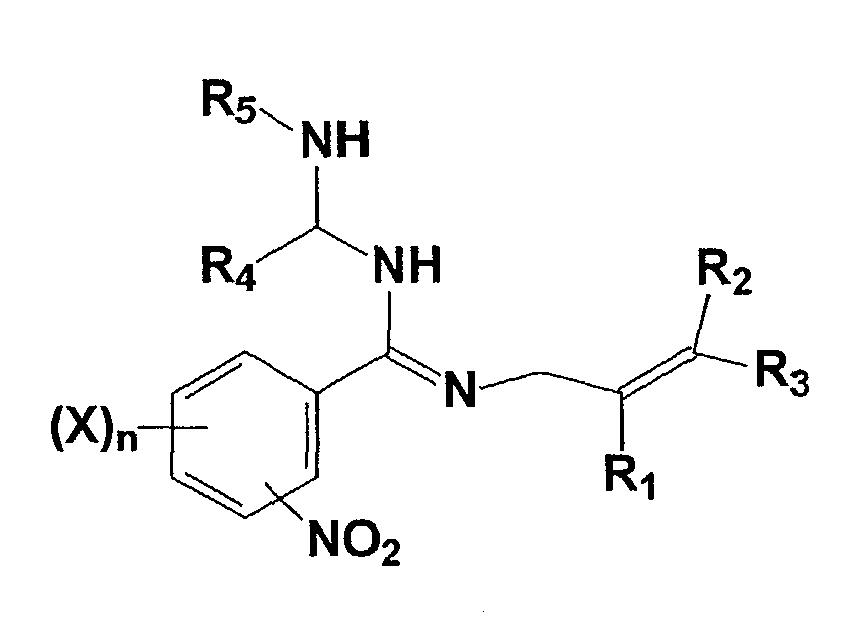
This invention relates to an α-amino-N-allylamidino nitrobenzene
compound and process for its preparation.
-
The photographic art employs couplers to provide colored dyes in
image reproductions. The couplers react imagewise with color developer to
produce the desire reproduction. One of the couplers useful for this purpose is a
pyrazolo[1,5-b][1,2,4]triazole compound that has found utility for forming a
magenta dye in the usual system employing subtractive primaries.
-
Such couplers and methods of making them were originally
disclosed in U.S. Patent No. 4,621,046. Other methods have been disclosed in
U. S. Patent Nos. 4,705,863 and 6,020,498. The latter patent suggests the use of
certain N-alkylamidino nitrobenzene derivatives for synthesizing intermediates in
the process. It is desirable, however to provide alternative processes for preparing
the desired compounds, especially processes that can provide improved yields.
-
The invention provides a process comprising reacting an N-allylimino
nitrobenzene compound with a diaminodinucleophile to form an α-amino-N-allylamidino
nitrobenzene compound and also provides the compound
itself as a composition of matter.
-
The invention provides a useful process for synthesizing useful
compounds employing allyl groups. Embodiments of the invention can provide
improved yields compared to prior art processes.
-
The invention is summarized above. The process of the invention
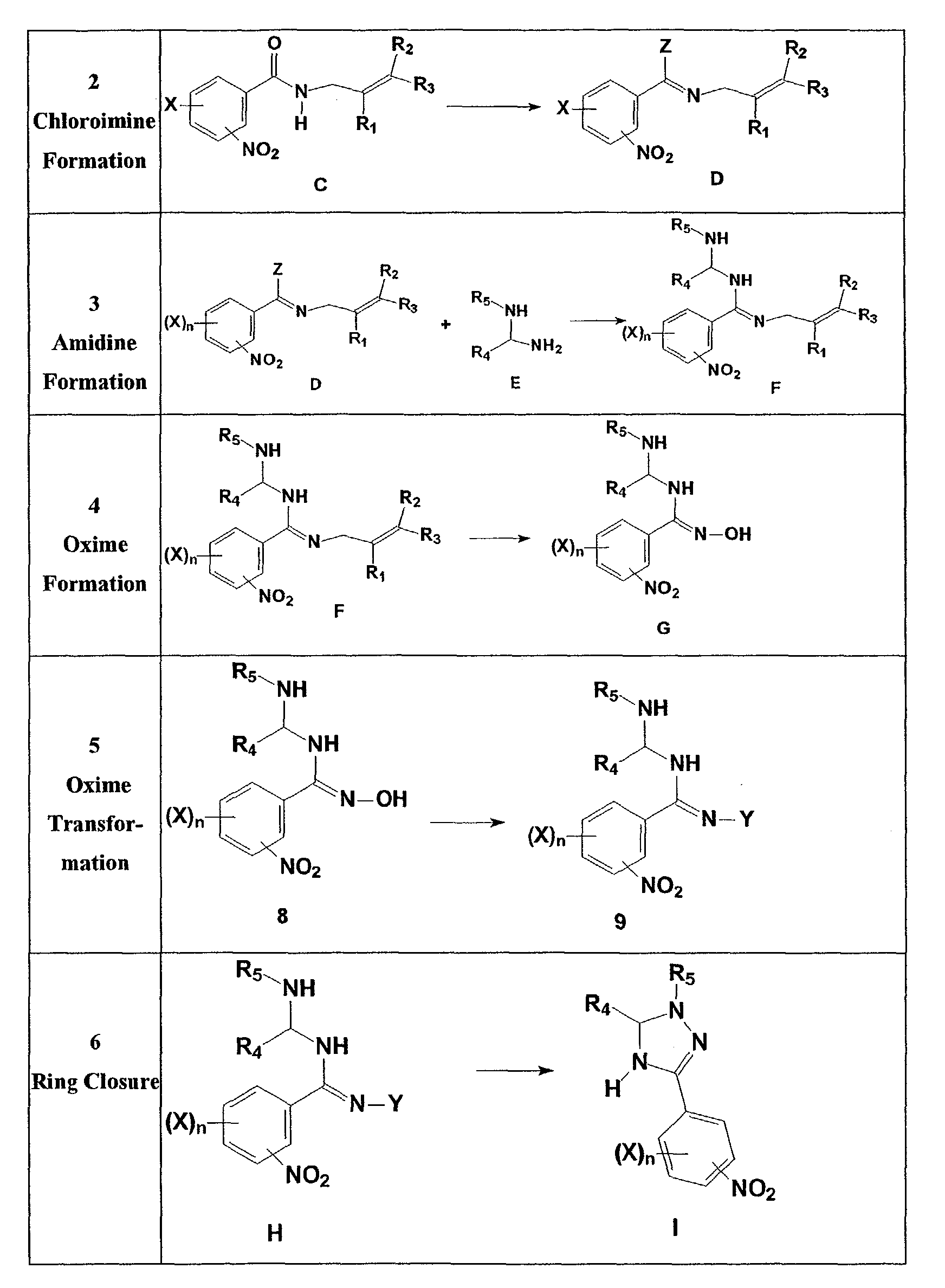
is generally shown in reaction scheme 3 in the following scheme.
-
In reaction 3, an N-allylimino nitrobenzene compound is reacted
with a diaminodinucleophile to form an α-amino-N-allylamidino nitrobenzene
compound. Suitably, the reaction is carried out in the presence of a solvent that is
inert under the reaction conditions. Useful solvents may be selected from the
group consisting of C1 to C8 aliphatic alcohols, chlorinated or unchlorinated
aromatic hydrocarbons such as toluene, the xylenes, monochlorobenzene or
dichlorobenzenes, chlorinated or unchlorinated aliphatic hydrocarbons, ethers
such as tetrahydrofuran, and esters such as ethyl acetate or isopropyl acetate.
Preference is given to using alcohols, in particular isopropyl alcohol. In particular
the reaction may be carried out using a mixture of toluene and isopropyl alcohol
where the 3-tert-butyl-5-aminopyrazole in an isopropyl alcohol solution is added
to a toluene solution of the amidine.
-
The reaction is exothermic and conveniently carried out at a
temperature ranging from -10 °C to +30 °C, and desirably from 0 to 15 °C.
-
The reaction is carried out with the diaminodinucleophile being
present in stoichiometric quantity or in excess compared to the α-amino-N-allylamidino
nitrobenzene compound, with an excess of up to 0.5 mols/mol and a
range of 1 to 1.25 mols/mol preferred. The compound is one having at least two
nucleophilic nitrogen atoms and may include a ring compound such as an 3-tert-butyl-5-aminopyrazole.
-
Reaction 3 is typically described using the above captioned
equation and the following limitations:
- Z and X may independently be halogen, alkoxy, aryloxy, alkylthio,
arylthio or heterocyclic groups;
- R1, R2, and R3 may independently be hydrogen, halogen, alkoxy, aryloxy,
alkylthio, arylthio, (cyclo-)alkyl, alkenyl, alkynyl, silyl or heterocyclic groups;
provided that R1, R2, and R3 may also be contained within a carbocyclic or
heterocyclic aromatic or non-aromatic ring system;
- R4 and R5 may independently be hydrogen, halogen, alkoxy, aryloxy,
alkylthio, arylthio, alkyl, alkenyl, alkynyl, silyl or heterocyclic groups; provided
that R4 and R5 may also be contained within a carbocyclic or heterocyclic
aromatic or non-aromatic ring system; and
- Y is a leaving group such as hydroxy, halogen, alkoxy, aryloxy, acetoxy,
siloxy, mesylate or tosylate. The preferred leaving groups are mesylate or
tosylate.
-
-
The reaction may be represented by the following reaction 3
wherein
Z and X are independently selected from halogen, alkoxy, aryloxy,
alkylthio, arylthio and heterocyclic alkyl groups and n is 0 to 4;
R
1, R
2, R
3 are independently selected from H, halogen, alkoxy, aryloxy,
alkylthio, arylthio, alkyl, saturated or unsaturated cyclohydrocarbyl, heterocylic,
aryl, alkenyl, alkynyl, and silyl groups, provided that R
1, R
2, R
3 may also be
contained within a ring system; and
R
4 and R
5 are independently selected from H, halogen alkoxy, aryloxy,
alkylthio, arylthio, alkyl, saturated or unsaturated cyclohydrocarbyl, hetereocylic,
aromatic, aryl, alkenyl, alkynyl, silyl, provided that R
4 and R
5 may also be
contained within a ring system.
-
The starting amide can be prepared using known methods, for
example where the amine can be reacted with an acyl halide, an anhydride, an
ester, or direct coupling with a carboxylic acid. (Woodcock, D.J. in Patai The
Chemistry of the Amino Group; Wiley: NY, 1968, p. 440.)
-
In order to carry out step 2, use is generally made of a chlorinating
agent such as, in particular, thionyl chloride (SOCl
2), phosphorus pentachloride
(PCI
5), phosphorus oxychloride (POCI
3), phosgene (COCI
2), or oxalyl chloride
(COCI)
2, or one of their mixtures as more fully described in:
- SOCI2 Lawson, A.; Miles, D. H.; J Chem Soc [JCSOA9] 1959, 2865.
- POCL3 Harris, R. L. N.; Synthesis [SYNTBF] 1980 (10), 841.
- PCI5 Madronero, R.; Vega, S.; Synthesis [SYNTBF] 1987 (7), 628.
- (COCI)2 Fujisawa, T.; Mori, T.; Sato, T.; Tetrahedron Lett [TELEAY]
1982, 23 (48), 5059.
-
-
Preference is given to using thionyl chloride. The chlorinating
agent is employed in stoichiometric quantity or in excess. For reasons of
economy, the quantity of chlorinating agent is preferably from 1 to 1.25 mol per
mol of amide. The reaction can be carried out without solvent, with the
chlorinating agent then serving as the solvent, or in the presence of a solvent or a
mixture of solvents which are inert under the reaction conditions and which are
selected from chlorinated or unchlorinated aromatic hydrocarbons such as toluene,
the xylenes, monochlorobenzene or the dichlorobenzenes, or chlorinated or
unchlorinated aliphatic hydrocarbons such as ethane or dichloromethane. Toluene
is very suitable.
-
The temperature of this reaction is generally between 25 °C and the
reflux temperature of the solvent. When toluene is the chosen solvent and the
chlorinating agent is thionyl chloride, the temperature is, in particular, between
70 °C and 110 °C.
-
Catalysts such as N,N-dialkylated amides, in particular dialkylated
formamides whose alkyl groups possess from 1 to 8 carbon atoms, such as N,N-dimethylformamide
and, more especially, N,N- dibutylformamimde, can be added
in order to accelerate the reaction. In general, the chlorination lasts between 2 and
15 hours. Once the reaction has finished, it is not necessary to isolate the
chloroimine that is formed from the reaction medium.
-
General conditions for forming the oxime are described in the
following literature:
- C.G. McCarty, "Chemistry of the Carbon-Nitrogen Double Bond" Ed. S.
Patai, Interscience, New York (1970), pp 408-439;
- J. A. Gautier, M. Miocque and C. C. Farnoux, "The Chemistry of
Amidines and Imidates", Ed. S. Patai, Interscience, New York, (1975) pp 313-314.
-
-
Steps 5 and 6 are ring closure reactions and are more fully
described in U.S. Patent 4,705,863.
-
Unless otherwise specifically stated, use of the term "group",
"substituted" or "substituent" means any group or radical other than hydrogen.
Additionally, when reference is made in this application to a compound or group
that contains a substitutable hydrogen, it is also intended to encompass not only
the unsubstituted form, but also its form further substituted with any substituent
group or groups as herein mentioned, so long as the substituent does not destroy
properties necessary for the intended utility. Suitably, a substituent group may be
halogen or may be bonded to the remainder of the molcule by an atom of carbon,
silicon, oxygen, nitrogen, phosphorous, or sulfur. The substituent may be, for
example, halogen, such as chloro, bromo or fluoro; nitro; hydroxyl; cyano;
carboxyl; or groups which may be further substituted, such as alkyl, including
straight or branched chain or cyclic alkyl, such as methyl, trifluoromethyl, ethyl, t-butyl,
3-(2,4-di-t-pentylphenoxy) propyl, cyclohexyl, and tetradecyl; alkenyl, such
as ethylene, 2-butene; alkoxy, such as methoxy, ethoxy, propoxy, butoxy, 2-methoxyethoxy,
sec-butoxy, hexyloxy, 2-ethylhexyloxy, tetradecyloxy, 2-(2,4-di-t-pentylphenoxy)ethoxy,
and 2-dodecyloxyethoxy; aryl such as phenyl, 4-t-butylphenyl,
2,4,6-trimethylphenyl, naphthyl; aryloxy, such as phenoxy, 2-methylphenoxy,
alpha- or beta-naphthyloxy, and 4-tolyloxy; carbonamido, such as
acetamido, benzamido, butyramido, tetradecanamido, alpha-(2,4-di-t-pentylphenoxy)acetamido,
alpha-(2,4-di-t-pentylphenoxy)butyramido, alpha-(3-pentadecylphenoxy)-hexanamido,
alpha-(4-hydroxy-3-t-butylphenoxy)-tetradecanamido,
2-oxo-pyrrolidin-1-yl, 2-oxo-5-tetradecylpyrrolin-1-yl, N-methyltetradecanamido,
N-succinimido, N-phthalimido, 2,5-dioxo-1-oxazolidinyl,
3-dodecyl-2,5-dioxo-1-imidazolyl, and N-acetyl-N-dodecylamino,
ethoxycarbonylamino, phenoxycarbonylamino, benzyloxycarbonylamino,
hexadecyloxycarbonylamino, 2,4-di-t-butylphenoxycarbonylamino,
phenylcarbonylamino, 2,5-(di-t-pentylphenyl)carbonylamino, p-dodecylphenylcarbonylamino,
p-tolylcarbonylamino, N-methylureido, N,N-dimethylureido,
N-methyl-N-dodecylureido, N-hexadecylureido, N,N-dioctadecylureido,
N,N-dioctyl-N'-ethylureido, N-phenylureido, N,N-diphenylureido,
N-phenyl-N-p-tolylureido, N-(m-hexadecylphenyl)ureido, N,N-(2,5-di-t-pentylphenyl)-N'-ethylureido,
and t-butylcarbonamido; sulfonamido,
such as methylsulfonamido, benzenesulfonamido, p-tolylsulfonamido, p-dodecylbenzenesulfonamido,
N-methyltetradecylsulfonamido, N,N-dipropylsulfamoylamino,
and hexadecylsulfonamido; sulfamoyl, such as
N-methylsulfamoyl, N-ethylsulfamoyl, N,N-dipropylsulfamoyl, N-hexadecylsulfamoyl,
N,N-dimethylsulfamoyl; N-[3-(dodecyloxy)propyl]sulfamoyl,
N-[4-(2,4-di-t-pentylphenoxy)butyl]sulfamoyl, N-methyl-N-tetradecylsulfamoyl,
and N-dodecylsulfamoyl; carbamoyl, such as N-methylcarbamoyl,
N,N-dibutylcarbamoyl, N-octadecylcarbamoyl, N-[4-(2,4-di-t-pentylphenoxy)butyl]carbamoyl,
N-methyl-N-tetradecylcarbamoyl, and N,N-dioctylcarbamoyl;
acyl, such as acetyl, (2,4-di-t-amylphenoxy)acetyl,
phenoxycarbonyl, p-dodecyloxyphenoxycarbonyl methoxycarbonyl,
butoxycarbonyl, tetradecyloxycarbonyl, ethoxycarbonyl, benzyloxycarbonyl, 3-pentadecyloxycarbonyl,
and dodecyloxycarbonyl; sulfonyl, such as
methoxysulfonyl, octyloxysulfonyl, tetradecyloxysulfonyl, 2-ethylhexyloxysulfonyl,
phenoxysulfonyl, 2,4-di-t-pentylphenoxysulfonyl,
methylsulfonyl, octylsulfonyl, 2-ethylhexylsulfonyl, dodecylsulfonyl,
hexadecylsulfonyl, phenylsulfonyl, 4-nonylphenylsulfonyl, and p-tolylsulfonyl;
sulfonyloxy, such as dodecylsulfonyloxy, and hexadecylsulfonyloxy; sulfinyl,
such as methylsulfinyl, octylsulfinyl, 2-ethylhexylsulfinyl, dodecylsulfinyl,
hexadecylsulfinyl, phenylsulfinyl, 4-nonylphenylsulfinyl, and p-tolylsulfinyl; thio,
such as ethylthio, octylthio, benzylthio, tetradecylthio, 2-(2,4-di-t-pentylphenoxy)ethylthio,
phenylthio, 2-butoxy-5-t-octylphenylthio, and p-tolylthio;
acyloxy, such as acetyloxy, benzoyloxy, octadecanoyloxy, p-dodecylamidobenzoyloxy,
N-phenylcarbamoyloxy, N-ethylcarbamoyloxy, and
cyclohexylcarbonyloxy; amine, such as phenylanilino, 2-chloroanilino,
diethylamine, dodecylamine; imino, such as 1 (N-phenylimido)ethyl, N-succinimido
or 3-benzylhydantoinyl; phosphate, such as dimethylphosphate and
ethylbutylphosphate; phosphite, such as diethyl and dihexylphosphite; a
heterocyclic group, a heterocyclic oxy group or a heterocyclic thio group, each of
which may be substituted and which contain a 3 to 7 membered heterocyclic ring
composed of carbon atoms and at least one hetero atom selected from the group
consisting of oxygen, nitrogen and sulfur, such as 2-furyl, 2-thienyl, 2-benzimidazolyloxy
or 2-benzothiazolyl; quaternary ammonium, such as
triethylammonium; and silyloxy, such as trimethylsilyloxy.
-
If desired, the substituents may themselves be further substituted
one or more times with the described substituent groups. The particular
substituents used may be selected by those skilled in the art to attain the desired
desirable properties for a specific application and can include, for example,
hydrophobic groups, solubilizing groups, blocking groups, and releasing or
releasable groups. When a molecule may have two or more substituents, the
substituents may be joined together to form a ring such as a fused ring unless
otherwise provided.
EXAMPLES
Example 1
-
Step 1' A 2-L, three-necked, round-bottomed flask equipped with a
magnetic stirring bar, a 24/40 adapter fitted with a thermometer, an argon inlet
adapter, and a 250-mL pressure-equalizing addition funnel fitted with a glass
stopper was purged with argon. The flask was charged with 3-nitrobenzoyl
chloride (J) 112.0 g (0.6035 mol) and 850 mL of dichloromethane, and then
cooled with an ice-water bath. The addition funnel was charged with
triethylamine 93.0 mL (0.667 mol) and allylamine (K) 50.0 mL (0.666 mol), and
this solution was then added dropwise to the reaction mixture over ca. 2.5 h while
the reaction temperature was maintained at 0-4 °C. The addition funnel was then
rinsed with two
5-mL portions of dichloromethane. The resulting turbid pale orange-pink reaction
mixture was allowed to slowly warm to and stir at room temperature. After 16.5
h, 600 mL of 1N HCL was added to the turbid bright yellow solution over
30 sec and the biphasic mixture was transferred to a separatory funnel. The
reaction flask was rinsed with three 100-mL portions of 1:1 CH2Cl2: 1N HCl and
the organic phase was separated and washed with 500 mL of saturated sodium
chloride solution, dried over sodium sulfate, filtered, and concentrated under
reduced pressure to afford 122 g (98% crude yield) of a pale yellow solid. The
crude product was recrystallized from 450 mL of toluene to afford 113 g (91 %
yield) of N-allyl-3-nitrobenzamide (L) as a powdery pale yellow solid. 1H NMR spectrum (CDCI3, 300 MHz), δ (ppm): 4.11 (tt, J = 6.0, 3.0 Hz, 2H),
5.21 (dq, J = 10.5, 3.0 Hz, 1H), 5.28 (dq, J = 16.5, 3.0 Hz, 1H), 5. 87-6.00 (m,
1H), 6.62 (br s, 1H), 7.64 (appar. t, J = 9.0 Hz, 1H), 8.18 (appar. dt, J = 9.0,1.5
Hz, 1H), 8.35 (ddd, J = 6.0, 3.0, 1.5 Hz, 1H), 8.60 (appar. t, J= 3.0 Hz, 1H).
LRMS m/z 205 (M-).
-
Step 2' A 50-mL, one-necked, round-bottomed flask equipped with a
magnetic stirring bar and a reflux condenser fitted with an argon inlet adapter was
evacuated and purged with argon three times and then maintained under an
atmosphere of argon during the course of the reaction. The flask was charged with
N-allyl-3-nitrobenzamide (L)
5.15 g (0.025 mol) and thionyl chloride 12.2 mL (0.167 mol), and then the clear
pale yellow reaction mixture was heated to reflux over 50 min. After stirring at
reflux for 2.25 h, the oil bath was removed and the clear yellow reaction mixture
was allowed to cool to room temperature over 45 min. The magnetic stirring bar
was removed and rinsed along with the condenser using a total of ca. 10 mL
toluene. The yellow solution was concentrated at reduced pressure to afford the
chloroimine M as a dark yellow liquid. The chloroimine M was treated with five
successive 6-mL portions of toluene and each time the toluene was removed under
reduced pressure. The product was used in the next step without purification.
-
Step 3' A 50-mL, one-necked, round-bottomed flask containing the
chloroimine M equipped with a magnetic stirring bar and a 30-mL pressure-equalizing
addition funnel fitted with an argon inlet adapter was purged with
argon. The flask was charged with 6 mL of toluene and then cooled with an ice-water
bath. Then a solution of 3-tert-butyl-5-aminopyrazole (N) 3.45 g (0.025
mol) in 9 mL of isopropyl alcohol was added dropwise via addition funnel over
1.25 h. The addition funnel was then rinsed with two 5-mL portions of isopropyl
alcohol, the ice-water bath was removed and the clear orange-yellow reaction
mixture was stirred at room temperature for 19 h and then the N-allylamidine O in
toluene-isopropyl alcohol was used in the next step without purification.
Preparation, isolation, and characterization of this intermediate, N-allylamidine O,
can be found in Example 5.
-
Step 4' A 100-mL, three-necked, round-bottomed flask equipped with a
magnetic stirring bar, a reflux condenser fitted with an argon inlet adapter, and
two glass stoppers was evacuated and purged with argon three times and then
maintained under an atmosphere of argon during the course of the reaction. The
flask was charged with the solution of
N-allylamidine O in toluene-isopropyl alcohol prepared in the previous reaction
and a total of 10 mL of methanol was used to aid in the transfer. The flask was
then charged with hydroxylamine hydrochloride 3.63 g (0.052 mol) and the
slightly turbid pale orange reaction mixture was heated to 40 °C over 45 min
followed by the addition of sodium acetate 1.95 g (0.024 mol) in one portion. The
resulting yellow heterogeneous reaction mixture was stirred at 40-48 °C for
20.5 h. The reaction mixture was then partially concentrated under reduced
pressure using an aspirator followed by the addition of 25 mL total of ca. 50 °C
water to the viscous yellow slurry in portions over ca. 1 min. After stirring at
40-44 °C for ca. 1.5 h, the oil bath was removed and the biphasic yellow solution
was allowed to cool to room temperature over 55 min. The biphasic yellow-green
solution was diluted with 25 mL of ethyl acetate and transferred to a separatory
funnel with the aid of three 10-mL portions of 1:1 EtOAc:H2O. The green-yellow
organic phase was separated and washed with 25 mL of water, 25 mL of saturated
sodium chloride solution, dried over sodium sulfate, filtered and concentrated
under reduced pressure. The resulting yellow-green glass was treated with five
successive
50-mL portions of dichloromethane and each time the dichloromethane was
removed under reduced pressure. Further concentration under high vacuum
afforded 7.3 g (96% crude yield based upon the starting amide) of the amidoxime
P as a yellow-green glass which was 86% pure by LC. By multiplying the crude
yield times the LC purity a final yield of 83% was obtained. 1H NMR and mass
spec were consistent with the product.
1H NMR spectrum (DMSO, 300 MHz), δ (ppm): 1.12 (s, 9H), 5.45 (s, 1H), 7.56
(appar. t, J = 7.5 Hz, 1H), 7.76 (appar. d, J = 9.0 Hz, 1H),
8.06 (appar. t, J = 3.0 Hz, 1H), 8.08 (s, 1H), 8.13 (appar. d, J= 6.0 Hz, 1H), 10.60
(s, 1H), 11.70 (br s, 1H). LRMS m/z 302 (M-).
Example 2
-
Step 1' A 3-L, three-necked, round-bottomed flask equipped with a
mechanical stirrer, a nitrogen inlet adapter, and a 500-mL pressure-equalizing
addition funnel fitted with a glass stopper was purged with nitrogen. The flask
was charged with allylamine (K) 33.9 g (0.593 mol), 50 mL of ethyl acetate,
triethylamine 60.0 g (0.593 mol), and then cooled with an ice-water bath. The
addition funnel was charged with 3-nitro-benzoyl chloride (J) 100.0 g (0.539 mol)
and 230 mL ethyl acetate, and this solution was then added dropwise to the
reaction mixture over 1 h while the reaction mixture was maintained at 0 °C . The
reaction mixture was stirred at 0 °C for 3 h and then filtered. The filtrate was
transferred to a separatory funnel and washed with 150 mL of a 10% (by volume)
HCl aqueous solution, 100 mL of saturated sodium chloride solution, dried over
magnesium sulfate, and the solvent volume was reduced to one-third the original
volume under reduced pressure. The clear solution was cooled to 0 °C overnight.
The resulting yellow solid was collected by filtration and dried in a vacuum oven
at 50 °C for 6 h to afford 89.4 g (80% yield) of N-allyl-3-nitrobenzamide (L) as a
yellow solid.
-
Step 2' A 1-L, one-necked, round-bottomed flask equipped with a
magnetic stirring bar and a reflux condenser fitted with a nitrogen inlet adapter
was purged with nitrogen. The flask was charged with N-allyl-3-nitrobenzamide
(L) 85.0 g (0.412 mol), thionyl chloride 383.5 g (3.22 mol), three drops of DMF,
and the reaction was stirred at reflux for 2.5 h. The excess thionyl chloride was
then removed under reduced pressure. The resulting chloroimine M (yellow oil)
was treated with three successive 75-mL portions of toluene and each time the
toluene was removed under reduced pressure. The chloroimine M was dissolved
in 50 mL of toluene and used in the next step without purification.
-
Step 3' A 3-L, three-necked, round-bottomed flask equipped with a
mechanical stirrer, a nitrogen inlet adapter, and a 250-mL pressure-equalizing
addition funnel fitted with a glass stopper was purged with nitrogen. The flask
was charged with the solution of chloroimine M in 50 mL of toluene and the flask
was placed in an ice-water bath. Separately, a 1-L, one-necked, round-bottomed
flask was charged with 3-tert-butyl-5-aminopyrazole (N) 61.94 g (0.445 mol) and
150 mL of toluene. The toluene was removed under reduced pressure. The
resulting red oil was dissolved in 110 mL of isopropyl alcohol and transferred to
the addition funnel. The solution of 3-tert-butyl-5-aminopyrazole (N) in 110 mL
of isopropyl alcohol was added dropwise via addition funnel to the 0 °C solution
of chloroimine M in toluene over 1.25 h while maintaining a reaction temperature
of 0-10 °C. The reaction mixture was stirred at 0 °C for 2 h and at the end of this
time, an orange precipitate formed.
-
Step 4' A 3-L, three-necked, round-bottomed flask containing the solution
of N-allylamidine O in toluene-isopropyl alcohol equipped with a mechanical
stirrer, a glass stopper, and a reflux condenser fitted with a nitrogen inlet adapter
was purged with nitrogen. The flask was charged with 280 mL of methanol,
hydroxylamine hydrochloride
57.26 g (0.824 mol), and placed in an oil bath. The reaction mixture was heated
and upon reaching 45 °C, sodium acetate 40.56 g (0.494 mol) was added in one
portion. The reaction was stirred at 45 °C for 14 h. The reaction mixture was then
cooled to room temperature and 300 mL of a 10% HCL/H2O was solution was
added. The biphasic solution was transferred to a separatory funnel and the
organic layer was recovered. The aqueous layer was extracted with two
150-mL portions of ethyl acetate. The combined organic layers were dried over
magnesium sulfate and concentrated under reduced pressure. The resulting dark
yellow oil was treated with three successive 150-mL portions of dichloromethane
and each time the solvent was removed under reduced pressure. Further
concentration under high vacuum afforded 102 g (80% crude yield based upon the
starting amide) of the amidoxime P as a yellow solid which was 89% pure by LC.
By multiplying the crude yield times the LC purity a final yield of 73% was
obtained. 1H NMR and mass spec was consistent with product data in Example 1.
Example 3 (Comparative as taught in US 6,020,498)
-
A 250-mL, one-necked, round-bottomed flask equipped with a magnetic
stirring bar and a reflux condenser fitted with a nitrogen inlet adapter was purged
with nitrogen. The flask was charged with N-propyl-3-nitrobenzamide 9.0 g
(0.043 mol), thionyl chloride 40.0 g (0.336 mol), and several drops of DMF. The
reaction mixture was stirred at reflux for 2 h. The excess thionyl chloride was then
removed under reduced pressure. The resulting yellow oil was treated with two
successive 10-mL portions of toluene and each time the toluene was removed
under reduced pressure. The yellow oil was dissolved in 15 mL of toluene and
used without purification. The reflux condenser was replaced with a 60-mL
pressure-equalizing addition funnel and the flask was placed in an ice-water bath.
The addition funnel was charged with 3-tert-butyl-5-aminopyrazole (N) 6.47 g
(0.046 mol) dissolved in 35 mL of isopropyl alcohol and this solution was added
dropwise via addition funnel to the 0 °C solution of chloroimine in toluene over
0.5 h. The reaction mixture was stirred at 0 °C for 5 h and then allowed to warm
to 20 °C over 4 h. After stirring at 20 °C for an additional 3 days, approximately
two-thirds of the solvent was removed under reduced pressure to afford an orange
slurry.
-
A 250-mL, one-necked, round-bottomed flask containing the orange slurry
equipped with a magnetic stirring bar and reflux condenser fitted with a nitrogen
inlet adapter was purged with nitrogen. The flask was charged with 20 mL of
methanol, hydroxylamine hydrochloride 6.72 g (0.097 mol), and placed in an oil
bath. The reaction mixture was heated and upon reaching 45 °C, sodium acetate
5.75 g (0.070 mol) was added in one portion. The reaction was stirred at
45 °C for 4 days. The final TLC and LC indicated a complex mixture with three
major products present. Compared to an authentic sample of the amidoxime P,
LC analysis indicated a 38% yield of product P.
Example 4
-
The procedure as described in Example 3, where R = methyl, afforded the
amidoxime
P in 46% yield by LC.
| Example | % Yield | R |
| | US 6,020,498 | Allyl Modification |
| 1 | | 83% | C3H5 |
| 2 | | 73% | C3H5 |
| 3 | 38% | | C3H7-n |
| 4 | 46% | | CH3 |
-
The data in Table I shows that preparation of the oxime
intermediate of Example 3 following the prior art procedure taught in US
6,020,498, gave the desired product in only 38-46% yield. Several other products
were also produced during this reaction indicating competing, undesired, side
reactions. In contrast, preparation of the oxime in the manner described in
Examples 1 and 2 where N-allyl (i.e., Allyl Modification) was substituted for
alkyl, resulted in significant increases in yields (83% and 73% respectively). No
major side reactions were observed. Preparation of the 4-nitrobenzene oxime
proceeded with similar yields that were comparable to the prior art.
Example 5 Synthesis of isolated Intermediate N-allyl, N'-(3-tert-butyl-5-pyrazolyl)-4-nitrobenzamidine
(O)
-
A 100-mL, one-necked, round-bottomed flask equipped with a magnetic
stirring bar and a reflux condenser fitted with an argon inlet adapter was
evacuated and purged with argon three times and then maintained under an
atmosphere of argon during the course of the reaction. The flask was charged with
N-allyl-3-nitrobenzamide (L) 5.15 g (0.025 mol), prepared as described
previously in example 1, and thionyl chloride 12.2 mL (0.167 mol), and then the
clear pale yellow reaction mixture was heated to reflux over 50 min. After 2 h,
the oil bath was removed and the clear yellow reaction mixture was allowed to
cool to room temperature over 25 min. The condenser was rinsed with three 1. 5-mL
portions of toluene and the yellow solution, containing the magnetic stirring
bar, was concentrated under reduced pressure to afford the chloroimine M as a
dark yellow liquid. The chloroimine M was treated with five successive 6-mL
portions of toluene and each time the toluene was removed under reduced
pressure. The product was used in the next step without purification.
-
A 100-mL, one-necked, round-bottomed flask containing the chloroimine
M equipped with a magnetic stirring bar and a 30-mL pressure-equalizing
addition funnel fitted with an argon inlet adapter was purged with argon. The
flask was charged with 6 mL of toluene and then cooled with an ice-water bath.
Then a solution of 3-tert-butyl-5-aminopyrazole (N) 3.45 g (0.025 mol) in 9 mL of
isopropyl alcohol was added dropwise via addition funnel over 1 h. The addition
funnel was then rinsed with two 5-mL portions of isopropyl alcohol, the ice-water
bath was removed and the clear orange-yellow reaction mixture was stirred at
room temperature for ca. 5 days. The clear orange-yellow reaction mixture was
then transferred to a separatory containing 100 mL of ethyl acetate and 100 mL of
half-saturated sodium bicarbonate solution. The flask was rinsed with three 10-mL
portions of 1:1 toluene:isopropyl alcohol. The yellow organic phase was
separated and washed with 100 mL of water, 100 mL of saturated sodium chloride
solution, dried over sodium sulfate, filtered and concentrated under reduced
pressure. The resulting orange oil was treated with three successive 100-mL
portions of dichloromethane and each time the dichloromethane was removed
under reduced pressure. Further concentration under high vacuum afforded 8.0 g
(98% crude yield based upon the starting amide) of the N-allylamidine O as a
bright yellow solid which was 88% pure by LC. By multiplying the crude yield
times the LC purity a final yield of 86% was obtained. The 1H NMR and mass
spec were consistent with N-allyl, N'-(3-tert-butyl-5-pyrazolyl)-4-nitrobenzamidine
(O).
1H NMR spectrum (CDCl3, 300 MHz), δ (ppm): 1.32 (s, 9H), 3.81 (br s, 2H),
5.15-5.31 (m, 2H), 5. 77-5. 90 (m, 1H), 6.02 (s, 1H), 7. 57 (appar. t, J = 7. 5 Hz, 1H),
7.89 (appar. d, J = 9.0 Hz, 1H), 8.26 (dd, J = 9.0, 1.5 Hz, 1H), 8.43 (appar.t, J=
3.0 Hz, 1H), 9.37 (br s, 1H). LRMS m/z 326 (M-).
-
Embodiments of the invention include the process where:
- the reaction is carried out in the presence of a solvent that is inert under the
reaction conditions, such as a solvent selected from the group consisting of C1 to
C8 aliphatic alcohols (e.g. isopropyl alcohol), aromatic hydrocarbons, aliphatic
hydrocarbons, ethers, and esters;
- the nitro group is located para to the link to the allyl group;
- the process is preceded by the step of preparing the N-allylimino
nitrobenzene compound by reacting the corresponding allylamidonitrobenzene
compound with a chlorinating agent and further including the still further
preceding step of preparing the corresponding allylamidonitrobenzene compound
by reacting the corresponding nitrobenzoyl compound bearing a leaving group
with an allyl amine; and
- th process comprising the subsequent steps of forming the oxime and then
closing the α-aminoamidino ring.
-
-
The entire contents of the patents and other publications referred to
in this specification are incorporated herein by reference.