EP1407891A1 - Porous ink-jet printed media sealed by interpolymer complex - Google Patents
Porous ink-jet printed media sealed by interpolymer complex Download PDFInfo
- Publication number
- EP1407891A1 EP1407891A1 EP20030255970 EP03255970A EP1407891A1 EP 1407891 A1 EP1407891 A1 EP 1407891A1 EP 20030255970 EP20030255970 EP 20030255970 EP 03255970 A EP03255970 A EP 03255970A EP 1407891 A1 EP1407891 A1 EP 1407891A1
- Authority
- EP
- European Patent Office
- Prior art keywords
- ink
- porous
- dye
- media sheet
- ionically
- Prior art date
- Legal status (The legal status is an assumption and is not a legal conclusion. Google has not performed a legal analysis and makes no representation as to the accuracy of the status listed.)
- Withdrawn
Links
- 239000000758 substrate Substances 0.000 claims abstract description 28
- 239000011230 binding agent Substances 0.000 claims abstract description 23
- 239000002184 metal Substances 0.000 claims abstract description 14
- 229910044991 metal oxide Inorganic materials 0.000 claims abstract description 14
- 239000000975 dye Substances 0.000 claims description 46
- 239000012530 fluid Substances 0.000 claims description 33
- 239000000203 mixture Substances 0.000 claims description 33
- 239000000565 sealant Substances 0.000 claims description 33
- XLYOFNOQVPJJNP-UHFFFAOYSA-N water Substances O XLYOFNOQVPJJNP-UHFFFAOYSA-N 0.000 claims description 26
- 125000000129 anionic group Chemical group 0.000 claims description 25
- 229920001577 copolymer Polymers 0.000 claims description 23
- 229920000642 polymer Polymers 0.000 claims description 20
- VYPSYNLAJGMNEJ-UHFFFAOYSA-N Silicium dioxide Chemical group O=[Si]=O VYPSYNLAJGMNEJ-UHFFFAOYSA-N 0.000 claims description 18
- 125000002091 cationic group Chemical group 0.000 claims description 18
- 239000004372 Polyvinyl alcohol Substances 0.000 claims description 16
- 229920002451 polyvinyl alcohol Polymers 0.000 claims description 16
- 229920005989 resin Polymers 0.000 claims description 15
- 239000011347 resin Substances 0.000 claims description 15
- 229920006318 anionic polymer Polymers 0.000 claims description 14
- 238000007641 inkjet printing Methods 0.000 claims description 12
- 238000000034 method Methods 0.000 claims description 12
- 238000007789 sealing Methods 0.000 claims description 11
- 229920002401 polyacrylamide Polymers 0.000 claims description 10
- PNEYBMLMFCGWSK-UHFFFAOYSA-N aluminium oxide Inorganic materials [O-2].[O-2].[O-2].[Al+3].[Al+3] PNEYBMLMFCGWSK-UHFFFAOYSA-N 0.000 claims description 8
- 229920000058 polyacrylate Polymers 0.000 claims description 8
- 229920000881 Modified starch Polymers 0.000 claims description 7
- 229920006317 cationic polymer Polymers 0.000 claims description 7
- 235000019426 modified starch Nutrition 0.000 claims description 7
- 230000007935 neutral effect Effects 0.000 claims description 7
- 239000000377 silicon dioxide Substances 0.000 claims description 7
- 150000004676 glycans Chemical class 0.000 claims description 6
- 239000000178 monomer Substances 0.000 claims description 6
- 229920005646 polycarboxylate Polymers 0.000 claims description 6
- 229920000193 polymethacrylate Polymers 0.000 claims description 6
- 229920001282 polysaccharide Polymers 0.000 claims description 6
- 239000005017 polysaccharide Substances 0.000 claims description 6
- 230000002209 hydrophobic effect Effects 0.000 claims description 5
- SMZOUWXMTYCWNB-UHFFFAOYSA-N 2-(2-methoxy-5-methylphenyl)ethanamine Chemical compound COC1=CC=C(C)C=C1CCN SMZOUWXMTYCWNB-UHFFFAOYSA-N 0.000 claims description 4
- 229920002134 Carboxymethyl cellulose Polymers 0.000 claims description 4
- 108010010803 Gelatin Proteins 0.000 claims description 4
- 229920000663 Hydroxyethyl cellulose Polymers 0.000 claims description 4
- 239000004354 Hydroxyethyl cellulose Substances 0.000 claims description 4
- 229920000877 Melamine resin Polymers 0.000 claims description 4
- CERQOIWHTDAKMF-UHFFFAOYSA-N Methacrylic acid Chemical compound CC(=C)C(O)=O CERQOIWHTDAKMF-UHFFFAOYSA-N 0.000 claims description 4
- 108010073771 Soybean Proteins Proteins 0.000 claims description 4
- 229920002472 Starch Polymers 0.000 claims description 4
- 229920001807 Urea-formaldehyde Polymers 0.000 claims description 4
- 229920002433 Vinyl chloride-vinyl acetate copolymer Polymers 0.000 claims description 4
- NIXOWILDQLNWCW-UHFFFAOYSA-N acrylic acid group Chemical group C(C=C)(=O)O NIXOWILDQLNWCW-UHFFFAOYSA-N 0.000 claims description 4
- 125000000217 alkyl group Chemical group 0.000 claims description 4
- 150000001408 amides Chemical class 0.000 claims description 4
- 239000001768 carboxy methyl cellulose Substances 0.000 claims description 4
- 235000010948 carboxy methyl cellulose Nutrition 0.000 claims description 4
- 239000008112 carboxymethyl-cellulose Substances 0.000 claims description 4
- 239000005018 casein Substances 0.000 claims description 4
- BECPQYXYKAMYBN-UHFFFAOYSA-N casein, tech. Chemical compound NCCCCC(C(O)=O)N=C(O)C(CC(O)=O)N=C(O)C(CCC(O)=N)N=C(O)C(CC(C)C)N=C(O)C(CCC(O)=O)N=C(O)C(CC(O)=O)N=C(O)C(CCC(O)=O)N=C(O)C(C(C)O)N=C(O)C(CCC(O)=N)N=C(O)C(CCC(O)=N)N=C(O)C(CCC(O)=N)N=C(O)C(CCC(O)=O)N=C(O)C(CCC(O)=O)N=C(O)C(COP(O)(O)=O)N=C(O)C(CCC(O)=N)N=C(O)C(N)CC1=CC=CC=C1 BECPQYXYKAMYBN-UHFFFAOYSA-N 0.000 claims description 4
- 235000021240 caseins Nutrition 0.000 claims description 4
- 229920000159 gelatin Polymers 0.000 claims description 4
- 239000008273 gelatin Substances 0.000 claims description 4
- 235000019322 gelatine Nutrition 0.000 claims description 4
- 235000011852 gelatine desserts Nutrition 0.000 claims description 4
- 235000019447 hydroxyethyl cellulose Nutrition 0.000 claims description 4
- FPYJFEHAWHCUMM-UHFFFAOYSA-N maleic anhydride Chemical compound O=C1OC(=O)C=C1 FPYJFEHAWHCUMM-UHFFFAOYSA-N 0.000 claims description 4
- 125000005395 methacrylic acid group Chemical class 0.000 claims description 4
- 229920001200 poly(ethylene-vinyl acetate) Polymers 0.000 claims description 4
- 229920003229 poly(methyl methacrylate) Polymers 0.000 claims description 4
- 229920002037 poly(vinyl butyral) polymer Polymers 0.000 claims description 4
- 239000004645 polyester resin Substances 0.000 claims description 4
- 229920001225 polyester resin Polymers 0.000 claims description 4
- 239000004926 polymethyl methacrylate Substances 0.000 claims description 4
- 229920005749 polyurethane resin Polymers 0.000 claims description 4
- 229920002689 polyvinyl acetate Polymers 0.000 claims description 4
- 239000011118 polyvinyl acetate Substances 0.000 claims description 4
- 229920000036 polyvinylpyrrolidone Polymers 0.000 claims description 4
- 239000001267 polyvinylpyrrolidone Substances 0.000 claims description 4
- 235000013855 polyvinylpyrrolidone Nutrition 0.000 claims description 4
- 235000019710 soybean protein Nutrition 0.000 claims description 4
- 235000019698 starch Nutrition 0.000 claims description 4
- 229920003048 styrene butadiene rubber Polymers 0.000 claims description 4
- 108010076119 Caseins Proteins 0.000 claims 3
- 239000004640 Melamine resin Substances 0.000 claims 3
- 235000013808 oxidized starch Nutrition 0.000 claims 3
- 239000010410 layer Substances 0.000 description 92
- 239000000976 ink Substances 0.000 description 68
- 241000894007 species Species 0.000 description 18
- RTLULCVBFCRQKI-UHFFFAOYSA-N 1-amino-4-[3-[(4,6-dichloro-1,3,5-triazin-2-yl)amino]-4-sulfoanilino]-9,10-dioxoanthracene-2-sulfonic acid Chemical compound C1=2C(=O)C3=CC=CC=C3C(=O)C=2C(N)=C(S(O)(=O)=O)C=C1NC(C=1)=CC=C(S(O)(=O)=O)C=1NC1=NC(Cl)=NC(Cl)=N1 RTLULCVBFCRQKI-UHFFFAOYSA-N 0.000 description 12
- 238000000576 coating method Methods 0.000 description 11
- 239000000126 substance Substances 0.000 description 9
- 230000008901 benefit Effects 0.000 description 8
- 238000007639 printing Methods 0.000 description 8
- 229940068984 polyvinyl alcohol Drugs 0.000 description 7
- 235000019422 polyvinyl alcohol Nutrition 0.000 description 7
- 239000011148 porous material Substances 0.000 description 7
- 239000010981 turquoise Substances 0.000 description 7
- 239000011248 coating agent Substances 0.000 description 6
- -1 without limitation Substances 0.000 description 6
- 229920002873 Polyethylenimine Polymers 0.000 description 5
- 239000008199 coating composition Substances 0.000 description 5
- 150000003863 ammonium salts Chemical group 0.000 description 4
- 230000015572 biosynthetic process Effects 0.000 description 4
- 239000003086 colorant Substances 0.000 description 4
- 238000012986 modification Methods 0.000 description 4
- 230000004048 modification Effects 0.000 description 4
- 229920003169 water-soluble polymer Polymers 0.000 description 4
- GKZCMEUEEFOXIJ-UHFFFAOYSA-N Lanosol Chemical compound OCC1=CC(O)=C(O)C(Br)=C1Br GKZCMEUEEFOXIJ-UHFFFAOYSA-N 0.000 description 3
- 241000083869 Polyommatus dorylas Species 0.000 description 3
- 229920002125 Sokalan® Polymers 0.000 description 3
- 230000002378 acidificating effect Effects 0.000 description 3
- 230000000903 blocking effect Effects 0.000 description 3
- 229910052809 inorganic oxide Inorganic materials 0.000 description 3
- 239000000463 material Substances 0.000 description 3
- 150000004706 metal oxides Chemical class 0.000 description 3
- 239000002245 particle Substances 0.000 description 3
- 239000004584 polyacrylic acid Substances 0.000 description 3
- 238000002360 preparation method Methods 0.000 description 3
- 150000003839 salts Chemical class 0.000 description 3
- YXZRCLVVNRLPTP-UHFFFAOYSA-J turquoise blue Chemical compound [Na+].[Na+].[Na+].[Na+].[Cu+2].NC1=NC(Cl)=NC(NC=2C=C(NS(=O)(=O)C3=CC=4C(=C5NC=4NC=4[N-]C(=C6C=CC(=CC6=4)S([O-])(=O)=O)NC=4NC(=C6C=C(C=CC6=4)S([O-])(=O)=O)NC=4[N-]C(=C6C=CC(=CC6=4)S([O-])(=O)=O)N5)C=C3)C(=CC=2)S([O-])(=O)=O)=N1 YXZRCLVVNRLPTP-UHFFFAOYSA-J 0.000 description 3
- 229910002016 Aerosil® 200 Inorganic materials 0.000 description 2
- NLXLAEXVIDQMFP-UHFFFAOYSA-N Ammonia chloride Chemical compound [NH4+].[Cl-] NLXLAEXVIDQMFP-UHFFFAOYSA-N 0.000 description 2
- SGHZXLIDFTYFHQ-UHFFFAOYSA-L Brilliant Blue Chemical compound [Na+].[Na+].C=1C=C(C(=C2C=CC(C=C2)=[N+](CC)CC=2C=C(C=CC=2)S([O-])(=O)=O)C=2C(=CC=CC=2)S([O-])(=O)=O)C=CC=1N(CC)CC1=CC=CC(S([O-])(=O)=O)=C1 SGHZXLIDFTYFHQ-UHFFFAOYSA-L 0.000 description 2
- OKTJSMMVPCPJKN-UHFFFAOYSA-N Carbon Chemical compound [C] OKTJSMMVPCPJKN-UHFFFAOYSA-N 0.000 description 2
- JUJWROOIHBZHMG-UHFFFAOYSA-N Pyridine Chemical compound C1=CC=NC=C1 JUJWROOIHBZHMG-UHFFFAOYSA-N 0.000 description 2
- PPBRXRYQALVLMV-UHFFFAOYSA-N Styrene Chemical compound C=CC1=CC=CC=C1 PPBRXRYQALVLMV-UHFFFAOYSA-N 0.000 description 2
- 229920001079 Thiokol (polymer) Polymers 0.000 description 2
- 229920006243 acrylic copolymer Polymers 0.000 description 2
- 238000005266 casting Methods 0.000 description 2
- 239000003795 chemical substances by application Substances 0.000 description 2
- 239000002131 composite material Substances 0.000 description 2
- 239000011258 core-shell material Substances 0.000 description 2
- 230000008021 deposition Effects 0.000 description 2
- 239000006185 dispersion Substances 0.000 description 2
- 238000001035 drying Methods 0.000 description 2
- 238000005516 engineering process Methods 0.000 description 2
- 238000005562 fading Methods 0.000 description 2
- 229910021485 fumed silica Inorganic materials 0.000 description 2
- 230000009477 glass transition Effects 0.000 description 2
- 230000006872 improvement Effects 0.000 description 2
- SXQCTESRRZBPHJ-UHFFFAOYSA-M lissamine rhodamine Chemical compound [Na+].C=12C=CC(=[N+](CC)CC)C=C2OC2=CC(N(CC)CC)=CC=C2C=1C1=CC=C(S([O-])(=O)=O)C=C1S([O-])(=O)=O SXQCTESRRZBPHJ-UHFFFAOYSA-M 0.000 description 2
- 230000007774 longterm Effects 0.000 description 2
- GVKCHTBDSMQENH-UHFFFAOYSA-L phloxine B Chemical compound [Na+].[Na+].[O-]C(=O)C1=C(Cl)C(Cl)=C(Cl)C(Cl)=C1C1=C2C=C(Br)C(=O)C(Br)=C2OC2=C(Br)C([O-])=C(Br)C=C21 GVKCHTBDSMQENH-UHFFFAOYSA-L 0.000 description 2
- 229920000962 poly(amidoamine) Polymers 0.000 description 2
- 229920000768 polyamine Polymers 0.000 description 2
- 125000002924 primary amino group Chemical group [H]N([H])* 0.000 description 2
- 230000005855 radiation Effects 0.000 description 2
- 239000002904 solvent Substances 0.000 description 2
- 239000004094 surface-active agent Substances 0.000 description 2
- OSSNTDFYBPYIEC-UHFFFAOYSA-N 1-ethenylimidazole Chemical class C=CN1C=CN=C1 OSSNTDFYBPYIEC-UHFFFAOYSA-N 0.000 description 1
- KGIGUEBEKRSTEW-UHFFFAOYSA-N 2-vinylpyridine Chemical class C=CC1=CC=CC=N1 KGIGUEBEKRSTEW-UHFFFAOYSA-N 0.000 description 1
- KFDVPJUYSDEJTH-UHFFFAOYSA-N 4-ethenylpyridine Chemical class C=CC1=CC=NC=C1 KFDVPJUYSDEJTH-UHFFFAOYSA-N 0.000 description 1
- CQPFMGBJSMSXLP-ZAGWXBKKSA-M Acid orange 7 Chemical compound OC1=C(C2=CC=CC=C2C=C1)/N=N/C1=CC=C(C=C1)S(=O)(=O)[O-].[Na+] CQPFMGBJSMSXLP-ZAGWXBKKSA-M 0.000 description 1
- BRLQWZUYTZBJKN-UHFFFAOYSA-N Epichlorohydrin Chemical compound ClCC1CO1 BRLQWZUYTZBJKN-UHFFFAOYSA-N 0.000 description 1
- CBENFWSGALASAD-UHFFFAOYSA-N Ozone Chemical compound [O-][O+]=O CBENFWSGALASAD-UHFFFAOYSA-N 0.000 description 1
- 239000004698 Polyethylene Substances 0.000 description 1
- WTKZEGDFNFYCGP-UHFFFAOYSA-N Pyrazole Chemical compound C=1C=NNC=1 WTKZEGDFNFYCGP-UHFFFAOYSA-N 0.000 description 1
- 241001074085 Scophthalmus aquosus Species 0.000 description 1
- 150000003926 acrylamides Chemical class 0.000 description 1
- 150000001252 acrylic acid derivatives Chemical class 0.000 description 1
- 239000000809 air pollutant Substances 0.000 description 1
- 231100001243 air pollutant Toxicity 0.000 description 1
- 125000003368 amide group Chemical group 0.000 description 1
- 150000001412 amines Chemical class 0.000 description 1
- MDFFNEOEWAXZRQ-UHFFFAOYSA-N aminyl Chemical group [NH2] MDFFNEOEWAXZRQ-UHFFFAOYSA-N 0.000 description 1
- 235000019270 ammonium chloride Nutrition 0.000 description 1
- RWCCWEUUXYIKHB-UHFFFAOYSA-N benzophenone Chemical compound C=1C=CC=CC=1C(=O)C1=CC=CC=C1 RWCCWEUUXYIKHB-UHFFFAOYSA-N 0.000 description 1
- 239000012965 benzophenone Substances 0.000 description 1
- 239000003139 biocide Substances 0.000 description 1
- 235000012745 brilliant blue FCF Nutrition 0.000 description 1
- 239000004161 brilliant blue FCF Substances 0.000 description 1
- 239000000872 buffer Substances 0.000 description 1
- 235000019241 carbon black Nutrition 0.000 description 1
- 125000003178 carboxy group Chemical group [H]OC(*)=O 0.000 description 1
- 239000001913 cellulose Substances 0.000 description 1
- 229920002678 cellulose Polymers 0.000 description 1
- HFIYIRIMGZMCPC-UHFFFAOYSA-J chembl1326377 Chemical compound [Na+].[Na+].[Na+].[Na+].[O-]S(=O)(=O)C1=CC2=CC(S([O-])(=O)=O)=C(N=NC=3C=CC(=CC=3)S(=O)(=O)CCOS([O-])(=O)=O)C(O)=C2C(N)=C1N=NC1=CC=C(S(=O)(=O)CCOS([O-])(=O)=O)C=C1 HFIYIRIMGZMCPC-UHFFFAOYSA-J 0.000 description 1
- 238000007640 computer printing Methods 0.000 description 1
- 239000000356 contaminant Substances 0.000 description 1
- 238000005260 corrosion Methods 0.000 description 1
- 230000007797 corrosion Effects 0.000 description 1
- 239000006184 cosolvent Substances 0.000 description 1
- 229920006037 cross link polymer Polymers 0.000 description 1
- SWXVUIWOUIDPGS-UHFFFAOYSA-N diacetone alcohol Chemical compound CC(=O)CC(C)(C)O SWXVUIWOUIDPGS-UHFFFAOYSA-N 0.000 description 1
- FHIVAFMUCKRCQO-UHFFFAOYSA-N diazinon Chemical compound CCOP(=S)(OCC)OC1=CC(C)=NC(C(C)C)=N1 FHIVAFMUCKRCQO-UHFFFAOYSA-N 0.000 description 1
- YIOJGTBNHQAVBO-UHFFFAOYSA-N dimethyl-bis(prop-2-enyl)azanium Chemical compound C=CC[N+](C)(C)CC=C YIOJGTBNHQAVBO-UHFFFAOYSA-N 0.000 description 1
- XFOSBZOUUACCCN-UHFFFAOYSA-M dimethyl-bis(prop-2-enyl)azanium;prop-2-enamide;chloride Chemical compound [Cl-].NC(=O)C=C.C=CC[N+](C)(C)CC=C XFOSBZOUUACCCN-UHFFFAOYSA-M 0.000 description 1
- XDBZPHDFHYZHNG-UHFFFAOYSA-L disodium 3-[(5-chloro-2-phenoxyphenyl)diazenyl]-4-hydroxy-5-[(4-methylphenyl)sulfonylamino]naphthalene-2,7-disulfonate Chemical compound [Na+].[Na+].C1=CC(C)=CC=C1S(=O)(=O)NC(C1=C2O)=CC(S([O-])(=O)=O)=CC1=CC(S([O-])(=O)=O)=C2N=NC1=CC(Cl)=CC=C1OC1=CC=CC=C1 XDBZPHDFHYZHNG-UHFFFAOYSA-L 0.000 description 1
- HNPZBDFFHBHBFR-UHFFFAOYSA-L disodium 5-[[4-(2-bromoprop-2-enoylamino)-2-sulfonatophenyl]diazenyl]-4-hydroxy-6-(methylamino)naphthalene-2-sulfonate Chemical compound [Na+].[Na+].CNc1ccc2cc(cc(O)c2c1N=Nc1ccc(NC(=O)C(Br)=C)cc1S([O-])(=O)=O)S([O-])(=O)=O HNPZBDFFHBHBFR-UHFFFAOYSA-L 0.000 description 1
- DNDMQQPFVIIALP-UHFFFAOYSA-L disodium 7-amino-4-hydroxy-3-[[4-[(4-sulfonatophenyl)diazenyl]phenyl]diazenyl]naphthalene-2-sulfonate Chemical compound [Na+].[Na+].Nc1ccc2c(O)c(N=Nc3ccc(cc3)N=Nc3ccc(cc3)S([O-])(=O)=O)c(cc2c1)S([O-])(=O)=O DNDMQQPFVIIALP-UHFFFAOYSA-L 0.000 description 1
- FTZLWXQKVFFWLY-UHFFFAOYSA-L disodium;2,5-dichloro-4-[3-methyl-5-oxo-4-[(4-sulfonatophenyl)diazenyl]-4h-pyrazol-1-yl]benzenesulfonate Chemical compound [Na+].[Na+].CC1=NN(C=2C(=CC(=C(Cl)C=2)S([O-])(=O)=O)Cl)C(=O)C1N=NC1=CC=C(S([O-])(=O)=O)C=C1 FTZLWXQKVFFWLY-UHFFFAOYSA-L 0.000 description 1
- BMAUDWDYKLUBPY-UHFFFAOYSA-L disodium;3-[[4-[(4,6-dichloro-1,3,5-triazin-2-yl)amino]-2-methylphenyl]diazenyl]naphthalene-1,5-disulfonate Chemical compound [Na+].[Na+].C=1C=C(N=NC=2C=C3C(=CC=CC3=C(C=2)S([O-])(=O)=O)S([O-])(=O)=O)C(C)=CC=1NC1=NC(Cl)=NC(Cl)=N1 BMAUDWDYKLUBPY-UHFFFAOYSA-L 0.000 description 1
- 230000000694 effects Effects 0.000 description 1
- QYXHJMXBZWOTJN-UHFFFAOYSA-N formaldehyde;guanidine Chemical compound O=C.NC(N)=N QYXHJMXBZWOTJN-UHFFFAOYSA-N 0.000 description 1
- 125000000524 functional group Chemical group 0.000 description 1
- WTIFIAZWCCBCGE-UUOKFMHZSA-N guanosine 2'-monophosphate Chemical compound C1=2NC(N)=NC(=O)C=2N=CN1[C@@H]1O[C@H](CO)[C@@H](O)[C@H]1OP(O)(O)=O WTIFIAZWCCBCGE-UUOKFMHZSA-N 0.000 description 1
- 229920001519 homopolymer Polymers 0.000 description 1
- 238000003384 imaging method Methods 0.000 description 1
- 150000002466 imines Chemical class 0.000 description 1
- 230000003993 interaction Effects 0.000 description 1
- 229920000831 ionic polymer Polymers 0.000 description 1
- 239000007788 liquid Substances 0.000 description 1
- 239000011159 matrix material Substances 0.000 description 1
- 150000002734 metacrylic acid derivatives Chemical class 0.000 description 1
- FQPSGWSUVKBHSU-UHFFFAOYSA-N methacrylamide Chemical class CC(=C)C(N)=O FQPSGWSUVKBHSU-UHFFFAOYSA-N 0.000 description 1
- RQAKESSLMFZVMC-UHFFFAOYSA-N n-ethenylacetamide Chemical class CC(=O)NC=C RQAKESSLMFZVMC-UHFFFAOYSA-N 0.000 description 1
- ZQXSMRAEXCEDJD-UHFFFAOYSA-N n-ethenylformamide Chemical class C=CNC=O ZQXSMRAEXCEDJD-UHFFFAOYSA-N 0.000 description 1
- PZNOBXVHZYGUEX-UHFFFAOYSA-N n-prop-2-enylprop-2-en-1-amine;hydrochloride Chemical compound Cl.C=CCNCC=C PZNOBXVHZYGUEX-UHFFFAOYSA-N 0.000 description 1
- 231100000989 no adverse effect Toxicity 0.000 description 1
- 230000003287 optical effect Effects 0.000 description 1
- 229920003023 plastic Polymers 0.000 description 1
- 239000004033 plastic Substances 0.000 description 1
- 229920000867 polyelectrolyte Polymers 0.000 description 1
- 229920000573 polyethylene Polymers 0.000 description 1
- 229920005596 polymer binder Polymers 0.000 description 1
- 239000002491 polymer binding agent Substances 0.000 description 1
- XWZDJOJCYUSIEY-YOYNBWDYSA-L procion red MX-5B Chemical compound [Na+].[Na+].[O-]S(=O)(=O)C1=CC2=CC(S([O-])(=O)=O)=CC(NC=3N=C(Cl)N=C(Cl)N=3)=C2C(O)=C1\N=N\C1=CC=CC=C1 XWZDJOJCYUSIEY-YOYNBWDYSA-L 0.000 description 1
- UMJSCPRVCHMLSP-UHFFFAOYSA-N pyridine Natural products COC1=CC=CN=C1 UMJSCPRVCHMLSP-UHFFFAOYSA-N 0.000 description 1
- WXQMFIJLJLLQIS-UHFFFAOYSA-N reactive blue 21 Chemical compound [Cu+2].C1=CC(S(=O)(=O)CCO)=CC=C1NS(=O)(=O)C1=CC=C2C([N-]3)=NC(C=4C5=CC=C(C=4)S(O)(=O)=O)=NC5=NC(C=4C5=CC=C(C=4)S(O)(=O)=O)=NC5=NC([N-]4)=C(C=C(C=C5)S(O)(=O)=O)C5=C4N=C3C2=C1 WXQMFIJLJLLQIS-UHFFFAOYSA-N 0.000 description 1
- 230000004044 response Effects 0.000 description 1
- 239000002356 single layer Substances 0.000 description 1
- 239000002195 soluble material Substances 0.000 description 1
- 125000000020 sulfo group Chemical group O=S(=O)([*])O[H] 0.000 description 1
- 239000002352 surface water Substances 0.000 description 1
- 229920003002 synthetic resin Polymers 0.000 description 1
- 239000000057 synthetic resin Substances 0.000 description 1
- UJMBCXLDXJUMFB-GLCFPVLVSA-K tartrazine Chemical compound [Na+].[Na+].[Na+].[O-]C(=O)C1=NN(C=2C=CC(=CC=2)S([O-])(=O)=O)C(=O)C1\N=N\C1=CC=C(S([O-])(=O)=O)C=C1 UJMBCXLDXJUMFB-GLCFPVLVSA-K 0.000 description 1
- 235000012756 tartrazine Nutrition 0.000 description 1
- 239000004149 tartrazine Substances 0.000 description 1
- 125000001302 tertiary amino group Chemical group 0.000 description 1
- XRFRTDKENRGSSX-UHFFFAOYSA-J tetrasodium;3-[[4-[[4-[(4,8-disulfonatonaphthalen-2-yl)diazenyl]-3-methylphenyl]carbamoylamino]-2-methylphenyl]diazenyl]naphthalene-1,5-disulfonate Chemical compound [Na+].[Na+].[Na+].[Na+].C1=CC=C(S([O-])(=O)=O)C2=CC(N=NC3=CC=C(NC(=O)NC=4C=C(C)C(N=NC=5C=C6C(=CC=CC6=C(C=5)S([O-])(=O)=O)S([O-])(=O)=O)=CC=4)C=C3C)=CC(S([O-])(=O)=O)=C21 XRFRTDKENRGSSX-UHFFFAOYSA-J 0.000 description 1
- 229920001187 thermosetting polymer Polymers 0.000 description 1
- GWAKFAUFNNPZFE-UHFFFAOYSA-K trisodium 2-[4-[(2-amino-4-oxidophenyl)diazenyl]anilino]-5-[(1-amino-8-oxido-7-phenyldiazenyl-3,6-disulfonaphthalen-2-yl)diazenyl]benzenesulfonate Chemical compound NC1=C(C(=CC2=CC(=C(C(=C12)O)N=NC1=CC=CC=C1)S(=O)(=O)[O-])S(=O)(=O)[O-])N=NC1=CC(=C(C=C1)NC1=CC=C(C=C1)N=NC1=C(C=C(C=C1)O)N)S(=O)(=O)[O-].[Na+].[Na+].[Na+] GWAKFAUFNNPZFE-UHFFFAOYSA-K 0.000 description 1
- ZZHYREJHWJCRBB-UHFFFAOYSA-K trisodium 5-[(4,6-dichloro-1,3,5-triazin-2-yl)amino]-4-hydroxy-3-[(1-sulfonatonaphthalen-2-yl)diazenyl]naphthalene-2,7-disulfonate Chemical compound [Na+].[Na+].[Na+].Oc1c(N=Nc2ccc3ccccc3c2S([O-])(=O)=O)c(cc2cc(cc(Nc3nc(Cl)nc(Cl)n3)c12)S([O-])(=O)=O)S([O-])(=O)=O ZZHYREJHWJCRBB-UHFFFAOYSA-K 0.000 description 1
- 239000006097 ultraviolet radiation absorber Substances 0.000 description 1
- 125000000391 vinyl group Chemical group [H]C([*])=C([H])[H] 0.000 description 1
- 229920002554 vinyl polymer Polymers 0.000 description 1
- 239000004034 viscosity adjusting agent Substances 0.000 description 1
Images

Classifications
-
- B—PERFORMING OPERATIONS; TRANSPORTING
- B41—PRINTING; LINING MACHINES; TYPEWRITERS; STAMPS
- B41M—PRINTING, DUPLICATING, MARKING, OR COPYING PROCESSES; COLOUR PRINTING
- B41M5/00—Duplicating or marking methods; Sheet materials for use therein
- B41M5/0011—Pre-treatment or treatment during printing of the recording material, e.g. heating, irradiating
-
- B—PERFORMING OPERATIONS; TRANSPORTING
- B41—PRINTING; LINING MACHINES; TYPEWRITERS; STAMPS
- B41M—PRINTING, DUPLICATING, MARKING, OR COPYING PROCESSES; COLOUR PRINTING
- B41M5/00—Duplicating or marking methods; Sheet materials for use therein
- B41M5/50—Recording sheets characterised by the coating used to improve ink, dye or pigment receptivity, e.g. for ink-jet or thermal dye transfer recording
- B41M5/502—Recording sheets characterised by the coating used to improve ink, dye or pigment receptivity, e.g. for ink-jet or thermal dye transfer recording characterised by structural details, e.g. multilayer materials
-
- B—PERFORMING OPERATIONS; TRANSPORTING
- B41—PRINTING; LINING MACHINES; TYPEWRITERS; STAMPS
- B41M—PRINTING, DUPLICATING, MARKING, OR COPYING PROCESSES; COLOUR PRINTING
- B41M5/00—Duplicating or marking methods; Sheet materials for use therein
- B41M5/50—Recording sheets characterised by the coating used to improve ink, dye or pigment receptivity, e.g. for ink-jet or thermal dye transfer recording
- B41M5/502—Recording sheets characterised by the coating used to improve ink, dye or pigment receptivity, e.g. for ink-jet or thermal dye transfer recording characterised by structural details, e.g. multilayer materials
- B41M5/506—Intermediate layers
-
- B—PERFORMING OPERATIONS; TRANSPORTING
- B41—PRINTING; LINING MACHINES; TYPEWRITERS; STAMPS
- B41M—PRINTING, DUPLICATING, MARKING, OR COPYING PROCESSES; COLOUR PRINTING
- B41M5/00—Duplicating or marking methods; Sheet materials for use therein
- B41M5/50—Recording sheets characterised by the coating used to improve ink, dye or pigment receptivity, e.g. for ink-jet or thermal dye transfer recording
- B41M5/52—Macromolecular coatings
-
- B—PERFORMING OPERATIONS; TRANSPORTING
- B41—PRINTING; LINING MACHINES; TYPEWRITERS; STAMPS
- B41M—PRINTING, DUPLICATING, MARKING, OR COPYING PROCESSES; COLOUR PRINTING
- B41M7/00—After-treatment of prints, e.g. heating, irradiating, setting of the ink, protection of the printed stock
- B41M7/0027—After-treatment of prints, e.g. heating, irradiating, setting of the ink, protection of the printed stock using protective coatings or layers by lamination or by fusion of the coatings or layers
-
- B—PERFORMING OPERATIONS; TRANSPORTING
- B41—PRINTING; LINING MACHINES; TYPEWRITERS; STAMPS
- B41M—PRINTING, DUPLICATING, MARKING, OR COPYING PROCESSES; COLOUR PRINTING
- B41M2205/00—Printing methods or features related to printing methods; Location or type of the layers
- B41M2205/38—Intermediate layers; Layers between substrate and imaging layer
-
- B—PERFORMING OPERATIONS; TRANSPORTING
- B41—PRINTING; LINING MACHINES; TYPEWRITERS; STAMPS
- B41M—PRINTING, DUPLICATING, MARKING, OR COPYING PROCESSES; COLOUR PRINTING
- B41M5/00—Duplicating or marking methods; Sheet materials for use therein
- B41M5/50—Recording sheets characterised by the coating used to improve ink, dye or pigment receptivity, e.g. for ink-jet or thermal dye transfer recording
- B41M5/52—Macromolecular coatings
- B41M5/5218—Macromolecular coatings characterised by inorganic additives, e.g. pigments, clays
-
- B—PERFORMING OPERATIONS; TRANSPORTING
- B41—PRINTING; LINING MACHINES; TYPEWRITERS; STAMPS
- B41M—PRINTING, DUPLICATING, MARKING, OR COPYING PROCESSES; COLOUR PRINTING
- B41M5/00—Duplicating or marking methods; Sheet materials for use therein
- B41M5/50—Recording sheets characterised by the coating used to improve ink, dye or pigment receptivity, e.g. for ink-jet or thermal dye transfer recording
- B41M5/52—Macromolecular coatings
- B41M5/5227—Macromolecular coatings characterised by organic non-macromolecular additives, e.g. UV-absorbers, plasticisers, surfactants
-
- B—PERFORMING OPERATIONS; TRANSPORTING
- B41—PRINTING; LINING MACHINES; TYPEWRITERS; STAMPS
- B41M—PRINTING, DUPLICATING, MARKING, OR COPYING PROCESSES; COLOUR PRINTING
- B41M5/00—Duplicating or marking methods; Sheet materials for use therein
- B41M5/50—Recording sheets characterised by the coating used to improve ink, dye or pigment receptivity, e.g. for ink-jet or thermal dye transfer recording
- B41M5/52—Macromolecular coatings
- B41M5/5245—Macromolecular coatings characterised by the use of polymers containing cationic or anionic groups, e.g. mordants
-
- B—PERFORMING OPERATIONS; TRANSPORTING
- B41—PRINTING; LINING MACHINES; TYPEWRITERS; STAMPS
- B41M—PRINTING, DUPLICATING, MARKING, OR COPYING PROCESSES; COLOUR PRINTING
- B41M5/00—Duplicating or marking methods; Sheet materials for use therein
- B41M5/50—Recording sheets characterised by the coating used to improve ink, dye or pigment receptivity, e.g. for ink-jet or thermal dye transfer recording
- B41M5/52—Macromolecular coatings
- B41M5/5254—Macromolecular coatings characterised by the use of polymers obtained by reactions only involving carbon-to-carbon unsaturated bonds, e.g. vinyl polymers
Definitions
- the present invention is drawn to ink-jet ink media, systems, and methods for reducing air fade of ink-jet produced images.
- the present invention is drawn to the preparation of interpolymer complexes for the sealing of ink-jet produced images on porous media.
- Papers used for ink-jet printing have typically included high-quality or wood-free papers designed to have a high ink absorptivity. These papers are functionally good for ink-jet printing because the ink-jet inks may be absorbed readily and dry quickly. However, such papers often do not allow for a crisp or sharp image.
- an ink receiving layer can comprise a porous inorganic oxide (usually silica or alumina) bound together by some polymer binder, and optionally, mordants or ionic binding species, e.g., cationic binding species for use with anionic dyes or anionic binding species for use with cationic dyes.
- mordants or ionic binding species e.g., cationic binding species for use with anionic dyes or anionic binding species for use with cationic dyes.
- the colorant typically a dye
- This type of media has the advantage of relatively short dry-times, good smearfastness, and often, acceptable water and humidity resistance.
- porous media often exhibits poor fade resistance (both in light and dark conditions), and sometimes exhibits poor water and humidity resistance.
- an ink receiving layer is present that comprises a continuous layer of a swellable polymer that is not physically porous.
- ink Upon printing, ink is absorbed as water contacts and swells the polymer matrix.
- the colorant typically a dye
- Advantages of this approach include much better fade resistance (in both light and dark conditions) than is present with porous media.
- swellable media requires a longer dry time and exhibits poor smearfastness.
- the present invention provides a media sheet, comprising a substrate, a porous dye-receiving layer deposited on the substrate, and a porous ionic layer deposited on the porous dye-receiving layer.
- the porous dye-receiving layer can comprise a metal or semi-metal oxide bound by a polymeric binder.
- the porous ionic layer can comprise particulates having ionically-charged surfaces.
- the media sheet can include other added materials, including an ink-jet ink deposited on the porous ionic layer, wherein the ink-jet ink comprises an ink vehicle and a dye.
- the dye can have the same polarity as the ionically-charged surfaces, and the ink vehicle can be substantially free of components that would substantially react with the ionically-charged surfaces.
- a fluid sealant composition can be deposited on the porous ionic layer forming an interpolymer complex.
- Such a fluid sealant composition can comprise a substantially uncrosslinked water soluble or dispersible polymer having an opposite polarity than the ionically-charged surfaces.
- a system of generating ink-jet images can comprise a properly configured media sheet, an ink-jet ink, and a fluid sealant composition.
- the media sheet can comprise a substrate, a porous dye-receiving layer deposited on the substrate, and a porous ionic layer deposited on the porous dye-receiving layer.
- the porous dye-receiving layer can comprise a metal or semi-metal oxide bound by a polymeric binder, and the porous ionic layer can comprise particulates having ionically-charged surfaces or can comprise ionically-charged water-soluble polymers.
- the ink-jet ink can comprise an ink vehicle and a dye, wherein the dye has the same polarity as the ionically-charged species in the porous ionic layer, and the ink vehicle is substantially free of components that would substantially react with the ionically-charged surfaces or species in the porous ionic layer.
- the ink-jet ink passes through the porous ionic layer and is deposited on the porous dye-receiving layer forming an ink-jet ink-containing media sheet.
- a fluid sealant composition can then be deposited that comprises a substantially uncrosslinked water soluble or dispersible polymer having an opposite polarity compared to the ionically-charged surfaces.
- an interpolymer complex can be formed, sealing the ink-jet ink in the media sheet.
- a method of ink-jet recording can comprise the steps of providing an appropriately configured media sheet, ink-jet printing an appropriately configured ink-jet ink onto the media sheet, and sealing the ink-jet ink in the media sheet with an appropriately configured fluid sealant composition.
- the media sheet can comprise a substrate, a porous dye-receiving layer deposited on the substrate, and a porous ionic layer deposited on the porous dye-receiving layer.
- the porous dye-receiving layer can comprise a metal or semi-metal oxide bound by a polymeric binder, and the porous ionic layer can comprise particulates having ionically-charged surfaces.
- the ink-jet ink can comprise an ink vehicle and a dye, wherein the dye has the same polarity as the ionically-charged surfaces, and the ink vehicle is substantially free of components that would substantially react with the ionically-charged surfaces.
- the media sheet can accept the ink-jet ink without substantial reaction at the porous ionic layer, thereby forming an ink-jet ink-containing media sheet.
- the sealing step can occur using a fluid sealant composition comprising a substantially uncrosslinked water soluble or dispersible polymer having an opposite polarity as the ionically-charged surfaces.
- an interpolymer complex can be formed that seals the ink-jet ink in the media sheet.
- an effective amount refers to the minimal amount of a substance or agent, which is sufficient to achieve a desire effect.
- an effective amount of an "ink vehicle” is the minimum amount required in order to create ink, which will meet functional performance and characteristic standards.
- ink vehicle refers to a vehicle in which the dyes used in accordance with the present invention are incorporated in the form of an ink-jet ink.
- Ink vehicles are well known in the art, and a wide variety of ink vehicles may be used with the ink composition of the present invention.
- Such ink vehicles may include a mixture of a variety of different agents, including without limitation, surfactants, solvents, cosolvents, buffers, biocides, viscosity modifiers, surface- active agents, and water.
- the ink vehicle can be substantially free of any components that are reactive with the porous ionic layer of the media, systems, and/or methods of the present invention.
- Porous media refers to any substantially inorganic composition-coated media having surface voids and/or cavities capable of taking in the ink-jet inks of the present invention. As ink is printed on the porous media, the ink can fill the voids and the outermost surface can become dry to the touch in a more expedited manner as compared to traditional or swellable media.
- Common coatings included silica- and alumina-based coatings. Additionally, such coatings are typically bound together by a polymeric binder, and optionally, can include mordants or ionic binding species that are attractive of classes of predetermined dye species.
- Chroma refers to the brightness exhibited by the ink-jet ink once printed on the substrate.
- Light fade refers to a phenomenon of fading of the brightness or chroma, or a hue shift of a printed image over time due primarily to exposure to visible and invisible light frequencies.
- Air fade refers to a phenomenon of fading of the brightness or chroma, or a hue shift of a printed image over time due to exposure to air contaminants, including ozone and air pollutants, e.g., auto emissions.
- Standard polarity does not mean that two or more components have the same exact charge, e.g., +2 and +2, but merely that individual components have are both negatively charged, or both positively charged.
- Optesite polarity does not mean that two components have an exact opposite charge, e.g., +2 and -2, but merely that a first individual component is positively charged and a second individual component is negatively charged.
- Surface-charged or “ionically charged surface” does not imply that only the surface is charged. Surface charged particulates can be charged throughout the particulate, or charged only at or near the surface.
- the system provides a substrate 10, and a porous dye-receiving layer 12 deposited on the substrate.
- the substrate 10 can be paper, plastic, photobase, other known substrate used in the ink-jet printing arts.
- photobase can be preferred for use as the substrate.
- Photobase is typically a three-layered system comprising a single layer of paper sandwiched by two polymeric layers, such as polyethylene layers.
- an inorganic semi-metal or metal oxide is typically present.
- the semi-metal or metal oxide can be silica or alumina.
- the semi-metal or metal oxide can be bound together by a polymeric binder.
- Exemplary polymeric binders include polyvinyl alcohol including water-soluble copolymers thereof; polyvinyl acetate; polyvinyl pyrrolidone; modified starches including oxidized and etherified starches; water soluble cellulose derivatives including carboxymethyl cellulose, hydroxyethyl cellulose; polyacrylamide including its derivatives and copolymers; casein; gelatin; soybean protein; silyl-modified polyvinyl alcohol; conjugated diene copolymer latexes including maleic anhydride resin, styrene-butadiene copolymer, and the like; acrylic polymer latexes including polymers and copolymers of acrylic and methacrylic acids, and the like; vinyl polymer latexes including ethylene-vinyl acetate copolymers; functional group-modified latexes including those obtained by modifying the above-mentioned polymers with monomers containing functional groups (e.g.
- aqueous binders of thermosetting resins including melamine resins, urea resin, and the like; synthetic resin binders including polymethyl methacrylate, polyurethane resin, polyester resin, amide resin, vinyl chloride-vinyl acetate copolymer, polyvinyl butyral, and alkyl resins.
- Such binder can be present to bind the porous dye-receiving layer together, but can also be present in a small enough amount to maintain the porous nature of the porous dye-receiving layer.
- Polyvinyl alcohol is a preferred binder for use.
- the porous dye-receiving layer can also be modified with an ionic binding species or mordant 14 known to interact with a predetermined class of dyes, thereby increasing permanence.
- Typical mordants that can be used in the dye-receiving layer when the dye is an anionic dye include hydrophilic, water dispersible, or water soluble polymers having cationic groups (amino, tertiary amino, amidoamino, pyridine, imine, and the like). These cationically modified polymers can be compatible with water-soluble or water dispersible binders and have little or no adverse effect on image processing or colors present in the image.
- Suitable examples of such polymers include, but are not limited to, polyquaternary ammonium salts, cationic polyamines, polyamidins, cationic acrylic copolymers, guanidine-formaldehyde polymers, polydimethyl diallylammonium chloride, diacetone acrylamide-dimethyldiallyl ammonium chloride, polyethyleneimine, and a polyethyleneimine adduct with epichlorhydrin.
- porous ionic layer 16 Coated on top of the porous dye-receiving layer 14 is a porous ionic layer 16.
- the porous ionic layer 16 comprises multiple particulates that have commonly ionically-charged surface.
- An example of such compositions can include grafted chains of anionic polymer.
- the porous ionic layer comprises a crosslinked polymer, though this is not required.
- dyes are typically anionic, anionic surface-charged polymeric compositions are preferred for use in the porous ionic layer.
- Typical examples of particulates that can be used in the porous ionic layer include core-shell composite copolymers, or copolymers that are water insoluble at a neutral pH, and can be solubilized at basic pH levels of pH 8 and above, though pH 8 to 10.5 is preferred.
- the copolymers can include a polymeric shell and a polymeric core, wherein the polymeric shell comprises a hydrophilic anionic polymer grafted to the polymeric core.
- polymeric shell components can include, in one embodiment, anionic polymers selected from the group consisting of polyacrylates, polymethacrylates, anionically modified starches, polysaccharides, polycarboxylates, polysulfonates, polyphosphonates, and copolymers thereof.
- the polymeric shell can be a cationic polymer of a polybase type, such as poly(amine), poly(ethyleneimine), poly(amidoamine), poly (diallyldimethyl ammonium salts), polyquternary ammonium salts, cationic acrylic copolymers, and the like.
- the polymeric core can be any neutral non-soluble material.
- the particulates can comprise a hydrophobic monomer, and acrylic or methacrylic acid.
- hydrophobic monomers examples include acrylate esters, methacrylate esters, styrene, and the like.
- particulates can be crosslinked, though this is not required.
- Other optional characteristics to consider when selecting the polymeric particulates of the porous ionic layer 16 can include appropriate glass transition temperature, ultraviolet absorbing capability, and resistance to water or hydrophobicity.
- the glass transition temperature (Tg) of the polymer particles should be above ambient in order to prevent fusing of the particulates and the media, as such would diminish the desired porosity prior to printing.
- a composition package comprising benzophenone and/or a hindered amine (HALS) species can be used.
- HALS hindered amine
- the blocking species can be selected such that it is soluble in the polymer of the porous ionic layer.
- a polymer can be selected that is, to some degree, water-resistant at neutral and slightly acidic pH levels. This can provide improved water resistance of the finished ink-jet print.
- the porous ionic layer may also consist of porous inorganic oxide (silica, alumina) and water-soluble anionic polymer.
- porous inorganic oxide silicon, alumina
- anionic polymer for example, polyacrylates, polymethacrylates, anionically modified starches, polysaccharides, polycarboxylates, polysulfonates, polyphosphonates and copolymers thereof can be used, provided the composition is different than the dye-receiving layer.
- a small amount of the binder can be added to the coating to bind the components together.
- An example of such a binder that can be used includes poly-vinyl alcohol (PVOH).
- the binders that can be used in ionic layer are similar to those described with respect to the porous dye-receiving layer. The amount of binder used should be high enough to bind particles together, and low enough to avoid blocking of the physical porosity between particles.
- the porous dye-receiving layer 12 and the porous ionic layer 16 provide a large number of voids or pores 18a, 18b, respectively, such that ink-jet ink 20 can pass through the coating upon printing, and be deposited on the porous dye-receiving layer 12.
- the porous ionic layer 16 comprises particulates 22 having a surface charge 24 of a first polarity "a”.
- the ink-jet ink 20 comprises a dye also having the first polarity "a”.
- the porous ionic layer 16 does not attract the dye of the ink-jet ink 20, and thus, the ink-jet ink is allowed to substantially pass therethrough and become deposited at the pores 18a of the porous dye-receiving layer 12. This is not to say that none of the ink-jet ink remains within the pores 18b of the porous ionic layer, as certainly some ink-jet ink will incidentally remain therein.
- the dye 20 can be immobilized on or within the dye-receiving layer by ionic binding species or mordants 14 attached to or homogenously mixed with the porous metal or semi-metal oxide.
- a fluid sealant composition 26 such as present in a solution or dispersion, can be added atop the porous ionic layer.
- a fluid sealant composition 26 can comprise a water-soluble ionic polymer having a charge "b" that is of opposite polarity with respect to the porous ionic layer.
- the fluid sealant composition can be cationic, i.e., "b" is positive.
- the porous ionic layer comprises particulates with cationic surface properties, i.e., "a” is positive, then the fluid sealant composition can be anionic, i.e., "b” is negative.
- the cationic or anionic polymer in fluid sealant solution or dispersion upon contact with the porous ionic layer (of opposite polarity) will then form an insoluble polyelectrolyte complex (PEC) or interpolymer complex 30, thus protecting the dye from image fade due to light, air, or moisture exposure.
- PEC polyelectrolyte complex
- the fluid sealant solution containing fluid sealant composition 26 can be applied to the print surface either through ejection from an ink-jet print head, or directly by more traditional coating processes, e.g., roll-coating.
- the pore-sealing function of the fluid sealant composition can be enabled through its presence in a fluid.
- the fluid sealant composition 26 will be a water-soluble polymer species with charge opposite that of the porous ionic layer 16.
- the porous ionic layer comprises an anionic polymer species
- the polymer in the sealant solution can be polycationic.
- the pH of the sealing solution can be in a range that enables the formation of an insoluble interpolymer complex 30.
- porous ionic layer is anionic
- typical cationic polymers that can be present as the fluid sealant composition include any cationic polymer species having reasonable solubility in water, and the ability to form an insoluble polymer complex upon interaction with anionic species of the porous ionic layer.
- the ability to form such an insoluble complex enables pore-sealing, and shielding of the ink-jet ink (and ultimately the dye) from the outside environment. This will improve fade resistance of the printed image.
- Typical examples of the cationic polymers that can be present in the fluid sealant composition include, but are not limited to, water-soluble polyamines with a vinyl backbone, polyethyleneimine and its derivatives, polyamidoamines, cationic acrylic polymers, cationic homopolymers and copolymers of dialkyldiallyl ammonium salts, cationic acrylic polyquaternary ammonium salts, substituted acrylamide and methacrylamide salts, N-vinylformamide and N-vinylacetamide (both of which can be polymerized and hydrolyzed in alkaline or acidic media to vinylamine copolymers), and salts of N-vinylimidazole, 2-vinylpyridine or 4-vinylpyridine.
- the fluid sealant composition should be anionic.
- anionic polymers that can be present in the fluid sealant composition include, but are not limited to, polyacrylates, polymethacrylates, anionically modified starches and other polysaccharides or polycarboxylates, polysulfonates, polyphosphonates and copolymers of all the above mentioned species.
- Anionic water-soluble polymers can also be used in both acidic and salt forms, e.g., polyacrylic acid and soluble salts of polyacrylic acid.
- the suggested media sheets, systems, and methods of the present invention combine advantages of both porous media and swellable media types, e.g., rapid drying time as with porous media and improved fade resistance as with swellable media.
- the media behaves more like porous media. Its two porous layers, i.e., porous dye-receiving layer and porous ionic layer, absorb the ink into and through its pores or voids, resulting in the quick dry-time.
- the porous ionic layer can become substantially sealed through the formation of an interpolymer complex 30.
- the sealing of the surface porosity acts to isolate the ink-jet ink and its contained dye within the pores, particularly at or near the porous dye-receiving layer. This results in significantly improved print fade resistance due to air fade and light fade.
- a cationic dye or an anionic dye should be used.
- anionic dyes are much more prevalent, most embodiments will utilize a porous anionic layer, an anionic dye, and a cationic fluid sealant composition.
- dyes examples include, but are not limited to Direct Red 9, Direct Red 254, Magenta 377, Acid Yellow 23, Direct Yellow 86, Yellow 104, Direct Yellow 4, Yellow PJY H-3RNA, Direct Yellow 50, Acid Orange 7, Acid Red 249, Direct Blue 199, Direct Black 168, Direct Yellow 132; Aminyl Brilliant Red F-B (Sumitomo Chemical Co.); Reactive Black 31 Direct Yellow 157, Reactive Yellow 37, Reactive Red 180, Acid Red 52), Acid Blue 9); mixtures thereof; and the like.
- Tricon Acid Red 52 Tricon Direct Red 227, and Tricon Acid Yellow 17 (Tricon Colors Incorporated), Bernacid Red 2BMN, Pontamine Brilliant Bond Blue A, BASF X-34, Pontamine, Food Black 2, Reactive Red 4Reactive Red 56, Levafix Brilliant Red E-4B (Mobay Chemical), Levafix Brilliant Red E-6BA (Mobay Chemical), Pylam Certified D&C Red #28 (Acid Red 92, Pylam), Direct Brill Pink B Ground Crude (Crompton & Knowles), Cartasol Yellow GTF Presscake (Sandoz, Inc.), Cartasol Yellow GTF Liquid Special 110 (Sandoz, Inc.), D&C Yellow #10 (Yellow 3, Tricon), Yellow Shade 16948 (Tricon), Basacid Black X34 (BASF), Carta Black 2GT (Sandoz, Inc.), Neozapon Red 492 (BASF), Orasol Red G (Ciba-Geigy), Direct Brilliant Pink B (Crompton-
- a substrate 10 is provided, such as a photobase substrate.
- the substrate is coated with a porous dye-receiving layer 12, such as an alumina or silica based coating bound together by a polymeric binder, and optionally containing ionic binding species and/or mordants.
- the porous dye-receiving layer 12 provides pores or voids 18a at or near the surface.
- a porous anionic layer 16 is coated on the porous dye-receiving layer.
- the porous anionic layer 16 comprises a plurality of particulates having negatively-charged surfaces, such as grafted chains of a crosslinked anionic polymer.
- the porous anionic layer 16 provides pores or voids 18b for a negatively charged dye-based ink-jet ink 20 to pass through and become deposited on the porous dye-receiving layer 12.
- a cationic fluid sealant composition can be applied to the surface of the printed media.
- an interpolymer complex 30 is formed that substantially seals the ink-jet ink and its anionic dye within and beneath the interpolymer complex 30
- a dye-receiving layer coating composition was prepared by admixing, by weight, 100 parts fumed silica (Aerosil 200 from Degussa), 400 parts of 10% weight solution polyvinyl alcohol (MO56-98 from Clariant), 25 parts of a 20% weight solution of the cationic mordant polydimethyldiallyl ammonium chloride, and 600 parts water.
- the dye-receiving layer coating composition was applied to a 7-mil resin-coated photobase (from Rexham) by knife casting to a dry coating weight of 25g/m 2 .
- a porous dye-receiving layer coating composition was prepared by admixing, by weight, 100 parts of fumed silica (Aerosil 200" from Degussa), 200 parts of a 10% weight solution polyvinyl alcohol (MO56-9 from Clariant), 200 parts of a 5% weight solution polyacrylic acid (M-90,000), and 600 parts water.
- the porous dye-receiving layer coating composition was applied to a 7 mil resin-coated photobase (from Rexham) by knife casting to a dry coating weight 15g/m 2 .
- Example 1 To the dye-receiving layer coated photobases of Example 1 and Example 2 were printed an anionic dye-based ink-jet ink. After 5 minutes, a 2% weight solution of branched polyethyleneimine (M ⁇ 60,000-90,000) was sprayed with an airbrush on top of both printed images. An interpolymer complex protected ink-jet ink image was produced in both cases that exhibited good air fade and light fade resistance.
- branched polyethyleneimine M ⁇ 60,000-90,000
Landscapes
- Ink Jet Recording Methods And Recording Media Thereof (AREA)
- Ink Jet (AREA)
Abstract
A media sheet, comprises a substrate; a porous dye-receiving layer (a1) deposited on the substrate; and a porous ionic layer (b1) deposited on (a1). (a1) is a metal or semi-metal oxide bound by a polymeric binder. (b1) comprises particulate having ionically-charged surfaces.
Description
- The present invention is drawn to ink-jet ink media, systems, and methods for reducing air fade of ink-jet produced images. In one detailed aspect, the present invention is drawn to the preparation of interpolymer complexes for the sealing of ink-jet produced images on porous media.
- Computer printing technology has evolved to a point where very high resolution images can be prepared on various types of media. This has been, in part, why ink-jet printing has become a popular way of recording images on various media, particularly paper. Other reasons include low noise, capability of high speed recording, and multi-color recording. Additionally, these advantages can be obtained at a relatively low price to consumers. Though there has been great improvement in ink-jet printing, accompanying this improvement are increased demands on ink-jet printing, e.g., higher speed, higher resolution, full color image formation, image permanence, etc.
- There are several characteristics to consider when evaluating a printer ink in conjunction with a printing surface or substrate. Such characteristics include edge acuity and optical density of the image on the surface, dry time of the ink on the substrate, adhesion to the substrate, lack of deviation of ink droplets, presence of all dots, resistance of the ink after drying to water and other solvents, long-term storage stability, and long-term reliability without corrosion or nozzle clogging. In addition to these characteristics, when printing on inorganic porous media substrates, light fade and air fade resistance is also an issue for consideration. Though the above list of characteristics provides a worthy goal to achieve, there are difficulties associated with satisfying all of the above characteristics. Often, the inclusion of an ink component meant to satisfy one of the above characteristics can prevent another characteristic from being met. Thus, most commercial inks for use in ink-jet printers represent a compromise in an attempt to achieve at least an adequate response in meeting all of the above listed requirements.
- Papers used for ink-jet printing have typically included high-quality or wood-free papers designed to have a high ink absorptivity. These papers are functionally good for ink-jet printing because the ink-jet inks may be absorbed readily and dry quickly. However, such papers often do not allow for a crisp or sharp image.
- In order to attain enhanced print quality and image quality as in a photograph, special media has been developed to work with aqueous inks. For example, various coated papers have been prepared for use with ink-jet printing technology. Existing ink-jet media used in digital imaging can be separated into two broad groups: porous media and swellable media.
- With porous media, an ink receiving layer can comprise a porous inorganic oxide (usually silica or alumina) bound together by some polymer binder, and optionally, mordants or ionic binding species, e.g., cationic binding species for use with anionic dyes or anionic binding species for use with cationic dyes. During printing, ink is quickly absorbed by the physical porosity of the media, and if an ionic binding species is present, the dye is attracted to the ionic species of opposite charge. In other words, the colorant (typically a dye) can be bound either by mordants incorporated into porous layer, or by the inorganic oxide surface itself. This type of media has the advantage of relatively short dry-times, good smearfastness, and often, acceptable water and humidity resistance. However, porous media often exhibits poor fade resistance (both in light and dark conditions), and sometimes exhibits poor water and humidity resistance.
- Conversely, with swellable media, an ink receiving layer is present that comprises a continuous layer of a swellable polymer that is not physically porous. Upon printing, ink is absorbed as water contacts and swells the polymer matrix. The colorant (typically a dye) can be immobilized inside the continuous layer of the polymer with significantly limited exposure to the outside environment. Advantages of this approach include much better fade resistance (in both light and dark conditions) than is present with porous media. However, swellable media requires a longer dry time and exhibits poor smearfastness.
- Though both swellable media and porous media each provide unique advantages in the area of ink-jet printing, new media and a system for printing images that provide advantages from both systems while minimizing their respective disadvantages would be an advancement in the art.
- It has been recognized that it would be advantageous to develop ink-jet ink media, systems, and methods that provide the advantages of both porous media and swellable media. Specifically, the present invention provides a media sheet, comprising a substrate, a porous dye-receiving layer deposited on the substrate, and a porous ionic layer deposited on the porous dye-receiving layer. The porous dye-receiving layer can comprise a metal or semi-metal oxide bound by a polymeric binder. The porous ionic layer can comprise particulates having ionically-charged surfaces.
- The media sheet can include other added materials, including an ink-jet ink deposited on the porous ionic layer, wherein the ink-jet ink comprises an ink vehicle and a dye. The dye can have the same polarity as the ionically-charged surfaces, and the ink vehicle can be substantially free of components that would substantially react with the ionically-charged surfaces. In an alternative embodiment, a fluid sealant composition can be deposited on the porous ionic layer forming an interpolymer complex. Such a fluid sealant composition can comprise a substantially uncrosslinked water soluble or dispersible polymer having an opposite polarity than the ionically-charged surfaces.
- In accordance with an alternative detailed aspect of the present invention, a system of generating ink-jet images can comprise a properly configured media sheet, an ink-jet ink, and a fluid sealant composition. The media sheet can comprise a substrate, a porous dye-receiving layer deposited on the substrate, and a porous ionic layer deposited on the porous dye-receiving layer. The porous dye-receiving layer can comprise a metal or semi-metal oxide bound by a polymeric binder, and the porous ionic layer can comprise particulates having ionically-charged surfaces or can comprise ionically-charged water-soluble polymers. The ink-jet ink can comprise an ink vehicle and a dye, wherein the dye has the same polarity as the ionically-charged species in the porous ionic layer, and the ink vehicle is substantially free of components that would substantially react with the ionically-charged surfaces or species in the porous ionic layer. Thus, when the ink-jet ink is printed onto the media sheet, the ink-jet ink passes through the porous ionic layer and is deposited on the porous dye-receiving layer forming an ink-jet ink-containing media sheet. A fluid sealant composition can then be deposited that comprises a substantially uncrosslinked water soluble or dispersible polymer having an opposite polarity compared to the ionically-charged surfaces. Upon deposition of the fluid sealant to the ink-jet ink-containing media sheet, an interpolymer complex can be formed, sealing the ink-jet ink in the media sheet.
- In another aspect of the present invention, a method of ink-jet recording can comprise the steps of providing an appropriately configured media sheet, ink-jet printing an appropriately configured ink-jet ink onto the media sheet, and sealing the ink-jet ink in the media sheet with an appropriately configured fluid sealant composition. The media sheet can comprise a substrate, a porous dye-receiving layer deposited on the substrate, and a porous ionic layer deposited on the porous dye-receiving layer. The porous dye-receiving layer can comprise a metal or semi-metal oxide bound by a polymeric binder, and the porous ionic layer can comprise particulates having ionically-charged surfaces. The ink-jet ink can comprise an ink vehicle and a dye, wherein the dye has the same polarity as the ionically-charged surfaces, and the ink vehicle is substantially free of components that would substantially react with the ionically-charged surfaces. With this combination or configuration, the media sheet can accept the ink-jet ink without substantial reaction at the porous ionic layer, thereby forming an ink-jet ink-containing media sheet. The sealing step can occur using a fluid sealant composition comprising a substantially uncrosslinked water soluble or dispersible polymer having an opposite polarity as the ionically-charged surfaces. Upon application of the fluid sealant to the ink-jet ink-containing media sheet, an interpolymer complex can be formed that seals the ink-jet ink in the media sheet.
- Additional features and advantages of the invention will be apparent from the detailed description which follows, taken in conjunction with the accompanying drawings, which together illustrate, by way of example, features of the invention.
-
- FIG. 1 provides a representational view of a system in accordance with an embodiment of the present invention;
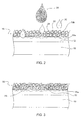
- FIG. 2 is a cross-sectional view of a media sheet as used for the system and method in accordance with embodiments of the present invention; and
- FIG. 3 is a cross-sectional view of a media sheet having an ink-jet ink shielded by an interpolymer complex in accordance with embodiments of the present invention.
-
- Before the present invention is disclosed and described, it is to be understood that this invention is not limited to the particular process steps and materials disclosed herein because such process steps and materials may vary somewhat. It is also to be understood that the terminology used herein is used for the purpose of describing particular embodiments only. The terms are not intended to be limiting because the scope of the present invention is intended to be limited only by the appended claims and equivalents thereof.
- It must be noted that, as used in this specification and the appended claims, the singular forms "a," "an," and "the" include plural referents unless the content clearly dictates otherwise.
- As used herein, "effective amount" refers to the minimal amount of a substance or agent, which is sufficient to achieve a desire effect. For example, an effective amount of an "ink vehicle" is the minimum amount required in order to create ink, which will meet functional performance and characteristic standards.
- As used herein, "ink vehicle," refers to a vehicle in which the dyes used in accordance with the present invention are incorporated in the form of an ink-jet ink. Ink vehicles are well known in the art, and a wide variety of ink vehicles may be used with the ink composition of the present invention. Such ink vehicles may include a mixture of a variety of different agents, including without limitation, surfactants, solvents, cosolvents, buffers, biocides, viscosity modifiers, surface- active agents, and water. Typically, the ink vehicle can be substantially free of any components that are reactive with the porous ionic layer of the media, systems, and/or methods of the present invention.
- "Porous media" refers to any substantially inorganic composition-coated media having surface voids and/or cavities capable of taking in the ink-jet inks of the present invention. As ink is printed on the porous media, the ink can fill the voids and the outermost surface can become dry to the touch in a more expedited manner as compared to traditional or swellable media. Common coatings included silica- and alumina-based coatings. Additionally, such coatings are typically bound together by a polymeric binder, and optionally, can include mordants or ionic binding species that are attractive of classes of predetermined dye species.
- "Chroma" refers to the brightness exhibited by the ink-jet ink once printed on the substrate.
- "Light fade" refers to a phenomenon of fading of the brightness or chroma, or a hue shift of a printed image over time due primarily to exposure to visible and invisible light frequencies.
- "Air fade" refers to a phenomenon of fading of the brightness or chroma, or a hue shift of a printed image over time due to exposure to air contaminants, including ozone and air pollutants, e.g., auto emissions.
- "Same polarity" does not mean that two or more components have the same exact charge, e.g., +2 and +2, but merely that individual components have are both negatively charged, or both positively charged.
- "Opposite polarity" does not mean that two components have an exact opposite charge, e.g., +2 and -2, but merely that a first individual component is positively charged and a second individual component is negatively charged.
- "Surface-charged" or "ionically charged surface" does not imply that only the surface is charged. Surface charged particulates can be charged throughout the particulate, or charged only at or near the surface.
- In accordance with one aspect of the present invention, the system provides a
substrate 10, and a porous dye-receivinglayer 12 deposited on the substrate. Thesubstrate 10 can be paper, plastic, photobase, other known substrate used in the ink-jet printing arts. In some embodiments, photobase can be preferred for use as the substrate. Photobase is typically a three-layered system comprising a single layer of paper sandwiched by two polymeric layers, such as polyethylene layers. - With respect to the porous dye-receiving
layer 12, an inorganic semi-metal or metal oxide is typically present. For example, the semi-metal or metal oxide can be silica or alumina. The semi-metal or metal oxide can be bound together by a polymeric binder. Exemplary polymeric binders include polyvinyl alcohol including water-soluble copolymers thereof; polyvinyl acetate; polyvinyl pyrrolidone; modified starches including oxidized and etherified starches; water soluble cellulose derivatives including carboxymethyl cellulose, hydroxyethyl cellulose; polyacrylamide including its derivatives and copolymers; casein; gelatin; soybean protein; silyl-modified polyvinyl alcohol; conjugated diene copolymer latexes including maleic anhydride resin, styrene-butadiene copolymer, and the like; acrylic polymer latexes including polymers and copolymers of acrylic and methacrylic acids, and the like; vinyl polymer latexes including ethylene-vinyl acetate copolymers; functional group-modified latexes including those obtained by modifying the above-mentioned polymers with monomers containing functional groups (e.g. carboxyl, amino, amido, sulfo, etc.); aqueous binders of thermosetting resins including melamine resins, urea resin, and the like; synthetic resin binders including polymethyl methacrylate, polyurethane resin, polyester resin, amide resin, vinyl chloride-vinyl acetate copolymer, polyvinyl butyral, and alkyl resins. Such binder can be present to bind the porous dye-receiving layer together, but can also be present in a small enough amount to maintain the porous nature of the porous dye-receiving layer. Polyvinyl alcohol is a preferred binder for use. - Optionally, the porous dye-receiving layer can also be modified with an ionic binding species or mordant 14 known to interact with a predetermined class of dyes, thereby increasing permanence. Typical mordants that can be used in the dye-receiving layer when the dye is an anionic dye include hydrophilic, water dispersible, or water soluble polymers having cationic groups (amino, tertiary amino, amidoamino, pyridine, imine, and the like). These cationically modified polymers can be compatible with water-soluble or water dispersible binders and have little or no adverse effect on image processing or colors present in the image. Suitable examples of such polymers include, but are not limited to, polyquaternary ammonium salts, cationic polyamines, polyamidins, cationic acrylic copolymers, guanidine-formaldehyde polymers, polydimethyl diallylammonium chloride, diacetone acrylamide-dimethyldiallyl ammonium chloride, polyethyleneimine, and a polyethyleneimine adduct with epichlorhydrin.
- Coated on top of the porous dye-receiving
layer 14 is a porousionic layer 16. The porousionic layer 16 comprises multiple particulates that have commonly ionically-charged surface. An example of such compositions can include grafted chains of anionic polymer. Preferably, the porous ionic layer comprises a crosslinked polymer, though this is not required. - As dyes are typically anionic, anionic surface-charged polymeric compositions are preferred for use in the porous ionic layer. Typical examples of particulates that can be used in the porous ionic layer include core-shell composite copolymers, or copolymers that are water insoluble at a neutral pH, and can be solubilized at basic pH levels of pH 8 and above, though pH 8 to 10.5 is preferred. With respect to the core-shell composite copolymers, the copolymers can include a polymeric shell and a polymeric core, wherein the polymeric shell comprises a hydrophilic anionic polymer grafted to the polymeric core. Examples of polymeric shell components can include, in one embodiment, anionic polymers selected from the group consisting of polyacrylates, polymethacrylates, anionically modified starches, polysaccharides, polycarboxylates, polysulfonates, polyphosphonates, and copolymers thereof. In another embodiment, the polymeric shell can be a cationic polymer of a polybase type, such as poly(amine), poly(ethyleneimine), poly(amidoamine), poly (diallyldimethyl ammonium salts), polyquternary ammonium salts, cationic acrylic copolymers, and the like. The polymeric core can be any neutral non-soluble material. With respect to the water insoluble copolymers at neutral pH (and soluble at high pH levels), the particulates can comprise a hydrophobic monomer, and acrylic or methacrylic acid. Examples of hydrophobic monomers that can be used include acrylate esters, methacrylate esters, styrene, and the like. In either embodiment, or other similar embodiments where the surface is ionically charged, preferably, particulates can be crosslinked, though this is not required.
- Other optional characteristics to consider when selecting the polymeric particulates of the porous
ionic layer 16 can include appropriate glass transition temperature, ultraviolet absorbing capability, and resistance to water or hydrophobicity. The glass transition temperature (Tg) of the polymer particles should be above ambient in order to prevent fusing of the particulates and the media, as such would diminish the desired porosity prior to printing. Further, in some embodiments, it may be desirable for a polymer of the porousionic layer 16 to possess ultraviolet-absorbing capability. Blocking of ultraviolet radiation can significantly slow light fade of many dyes used in ink-jet printing. Any species capable of absorbing ultraviolet or near-ultraviolet radiation that is transparent to visible light can be used. For example, a composition package comprising benzophenone and/or a hindered amine (HALS) species can be used. If using an ultraviolet absorber with the present invention, the blocking species can be selected such that it is soluble in the polymer of the porous ionic layer. Additionally, a polymer can be selected that is, to some degree, water-resistant at neutral and slightly acidic pH levels. This can provide improved water resistance of the finished ink-jet print. - The porous ionic layer may also consist of porous inorganic oxide (silica, alumina) and water-soluble anionic polymer. For example, polyacrylates, polymethacrylates, anionically modified starches, polysaccharides, polycarboxylates, polysulfonates, polyphosphonates and copolymers thereof can be used, provided the composition is different than the dye-receiving layer.
- In addition to the above three optional components, in order to keep particulates of the porous ionic layer together, a small amount of the binder can be added to the coating to bind the components together. An example of such a binder that can be used includes poly-vinyl alcohol (PVOH). Additionally, the binders that can be used in ionic layer are similar to those described with respect to the porous dye-receiving layer. The amount of binder used should be high enough to bind particles together, and low enough to avoid blocking of the physical porosity between particles.
- The porous dye-receiving
layer 12 and the porousionic layer 16 provide a large number of voids orpores jet ink 20 can pass through the coating upon printing, and be deposited on the porous dye-receivinglayer 12. The porousionic layer 16 comprisesparticulates 22 having asurface charge 24 of a first polarity "a". The ink-jet ink 20 comprises a dye also having the first polarity "a". Because the polarity of the dye and the polarity of the porous ionic layer are the same (i.e., both positive or both negative), the porousionic layer 16 does not attract the dye of the ink-jet ink 20, and thus, the ink-jet ink is allowed to substantially pass therethrough and become deposited at thepores 18a of the porous dye-receivinglayer 12. This is not to say that none of the ink-jet ink remains within thepores 18b of the porous ionic layer, as certainly some ink-jet ink will incidentally remain therein. - Once the ink-
jet ink 20 substantially penetrates the porousionic layer 16 and is deposited on the porous dye-receivinglayer 12 of the media, thedye 20 can be immobilized on or within the dye-receiving layer by ionic binding species ormordants 14 attached to or homogenously mixed with the porous metal or semi-metal oxide. After deposition of the ink-jet ink, afluid sealant composition 26, such as present in a solution or dispersion, can be added atop the porous ionic layer. Such afluid sealant composition 26 can comprise a water-soluble ionic polymer having a charge "b" that is of opposite polarity with respect to the porous ionic layer. For example, if the porous ionic layer comprises particulates with anionic surface properties, i.e., "a" is negative, then the fluid sealant composition can be cationic, i.e., "b" is positive. Conversely, if the porous ionic layer comprises particulates with cationic surface properties, i.e., "a" is positive, then the fluid sealant composition can be anionic, i.e., "b" is negative. The cationic or anionic polymer in fluid sealant solution or dispersion, upon contact with the porous ionic layer (of opposite polarity) will then form an insoluble polyelectrolyte complex (PEC) orinterpolymer complex 30, thus protecting the dye from image fade due to light, air, or moisture exposure. - The fluid sealant solution containing
fluid sealant composition 26 can be applied to the print surface either through ejection from an ink-jet print head, or directly by more traditional coating processes, e.g., roll-coating. The pore-sealing function of the fluid sealant composition can be enabled through its presence in a fluid. Preferably, thefluid sealant composition 26 will be a water-soluble polymer species with charge opposite that of the porousionic layer 16. For example, if the porous ionic layer comprises an anionic polymer species, the polymer in the sealant solution can be polycationic. The pH of the sealing solution can be in a range that enables the formation of aninsoluble interpolymer complex 30. - If the porous ionic layer is anionic, then typical cationic polymers that can be present as the fluid sealant composition include any cationic polymer species having reasonable solubility in water, and the ability to form an insoluble polymer complex upon interaction with anionic species of the porous ionic layer. The ability to form such an insoluble complex enables pore-sealing, and shielding of the ink-jet ink (and ultimately the dye) from the outside environment. This will improve fade resistance of the printed image. Typical examples of the cationic polymers that can be present in the fluid sealant composition include, but are not limited to, water-soluble polyamines with a vinyl backbone, polyethyleneimine and its derivatives, polyamidoamines, cationic acrylic polymers, cationic homopolymers and copolymers of dialkyldiallyl ammonium salts, cationic acrylic polyquaternary ammonium salts, substituted acrylamide and methacrylamide salts, N-vinylformamide and N-vinylacetamide (both of which can be polymerized and hydrolyzed in alkaline or acidic media to vinylamine copolymers), and salts of N-vinylimidazole, 2-vinylpyridine or 4-vinylpyridine. If the porous ionic layer is cationic, then the fluid sealant composition should be anionic. Typical examples of the anionic polymers that can be present in the fluid sealant composition include, but are not limited to, polyacrylates, polymethacrylates, anionically modified starches and other polysaccharides or polycarboxylates, polysulfonates, polyphosphonates and copolymers of all the above mentioned species. Anionic water-soluble polymers can also be used in both acidic and salt forms, e.g., polyacrylic acid and soluble salts of polyacrylic acid.
- The suggested media sheets, systems, and methods of the present invention combine advantages of both porous media and swellable media types, e.g., rapid drying time as with porous media and improved fade resistance as with swellable media. For example, during actual printing, the media behaves more like porous media. Its two porous layers, i.e., porous dye-receiving layer and porous ionic layer, absorb the ink into and through its pores or voids, resulting in the quick dry-time. After the fluid sealant composition is applied to the media surface (either by an ink-jet pen, a roller, or other coating method), the porous ionic layer can become substantially sealed through the formation of an
interpolymer complex 30. The sealing of the surface porosity acts to isolate the ink-jet ink and its contained dye within the pores, particularly at or near the porous dye-receiving layer. This results in significantly improved print fade resistance due to air fade and light fade. - With respect to the various dyes of the ink-
jet ink 20 that can be used, either a cationic dye or an anionic dye should be used. As anionic dyes are much more prevalent, most embodiments will utilize a porous anionic layer, an anionic dye, and a cationic fluid sealant composition. Examples of dyes that can be used include, but are not limited to Direct Red 9, Direct Red 254, Magenta 377, Acid Yellow 23, Direct Yellow 86, Yellow 104, Direct Yellow 4, Yellow PJY H-3RNA, Direct Yellow 50, Acid Orange 7, Acid Red 249, Direct Blue 199, Direct Black 168, Direct Yellow 132; Aminyl Brilliant Red F-B (Sumitomo Chemical Co.); Reactive Black 31 Direct Yellow 157, Reactive Yellow 37, Reactive Red 180, Acid Red 52), Acid Blue 9); mixtures thereof; and the like. Further examples include Tricon Acid Red 52, Tricon Direct Red 227, and Tricon Acid Yellow 17 (Tricon Colors Incorporated), Bernacid Red 2BMN, Pontamine Brilliant Bond Blue A, BASF X-34, Pontamine, Food Black 2, Reactive Red 4Reactive Red 56, Levafix Brilliant Red E-4B (Mobay Chemical), Levafix Brilliant Red E-6BA (Mobay Chemical), Pylam Certified D&C Red #28 (Acid Red 92, Pylam), Direct Brill Pink B Ground Crude (Crompton & Knowles), Cartasol Yellow GTF Presscake (Sandoz, Inc.), Cartasol Yellow GTF Liquid Special 110 (Sandoz, Inc.), D&C Yellow #10 (Yellow 3, Tricon), Yellow Shade 16948 (Tricon), Basacid Black X34 (BASF), Carta Black 2GT (Sandoz, Inc.), Neozapon Red 492 (BASF), Orasol Red G (Ciba-Geigy), Direct Brilliant Pink B (Crompton-Knolls), Aizen Spilon Red C-BH (Hodagaya Chemical Company), Kayanol Red 3BL (Nippon Kayaku Company), Levanol Brilliant Red 3BW (Mobay Chemical Company), Levaderm Lemon Yellow (Mobay Chemical Company), Aizen Spilon Yellow C-GNH (Hodagaya Chemical Company), Spirit Fast Yellow 3G, Sirius Supra Yellow GD 167, Cartasol Brilliant Yellow 4GF (Sandoz), Pergasol Yellow CGP (Ciba-Geigy), Orasol Black RL (Ciba-Geigy), Orasol Black RLP (Ciba-Geigy), Savinyl Black RLS (Sandoz), Dermacarbon 2GT (Sandoz), Pyrazol Black BG (ICI Americas), Morfast Black Conc A (Morton-Thiokol), Diazol Black RN Quad (ICI Americas), Orasol Blue GN (Ciba-Geigy), Savinyl Blue GLS (Sandoz, Inc.), Luxol Blue MBSN (Morton-Thiokol), Sevron Blue 5GMF (ICI Americas), and Basacid Blue 750 (BASF); Levafix Brilliant Yellow E-GA, Levafix Yellow E2RA, Levafix Black EB, Levafix Black E-2G, Levafix Black P-36A, Levafix Black PN-L, Levafix Brilliant Red E6BA, and Levafix Brilliant Blue EFFA, all available from Bayer; Procion Turquoise PA, Procion Turquoise HA, Procion Turquoise Ho5G, Procion Turquoise H-7G, Procion Red MX-5B, Procion Red H8B (Reactive Red 31), Procion Red MX 8B GNS, Procion Red G, Procion Yellow MX-8G, Procion Black H-EXL, Procion Black P-N, Procion Blue MX-R, Procion Blue MX-4GD, Procion Blue MX-G, and Procion Blue MX-2GN, all available from ICI Americas; Cibacron Red F-B, Cibacron Black BG, Lanasol Black B, Lanasol Red 5B, Lanasol Red B, and Lanasol Yellow 46, all available from Ciba-Geigy; Baslien Black P-BR, Baslien Yellow EG, Baslien Brilliant Yellow P-3GN, Baslien Yellow M-6GD, Baslien Brilliant Red P-3B, Baslien Scarlet E-2G, Baslien Red E-B, Baslien Red E-7B, Baslien Red M-5B, Baslien Blue E-R, Baslien Brilliant Blue P-3R, Baslien Black P-BR, Baslien Turquoise Blue P-GR, Baslien Turquoise M-2G, Baslien Turquoise E-G, and Baslien Green E-6B, all available from BASF; Sumifix Turquoise Blue G, Sumifix Turquoise Blue H-GF, Sumifix Black B, Sumifix Black H-BG, Sumifix Yellow 2GC, Sumifix Supra Scarlet 2GF, and Sumifix Brilliant Red 5BF, all available from Sumitomo Chemical Company; Intracron Yellow C-8G, Intracron Red C-8B, Intracron Turquoise Blue GE, Intracron Turquoise HA, and Intracron Black RL, all available from Crompton and Knowles, Dyes and Chemicals Division; mixtures thereof, and the like. This list is provided as exemplary, and is not intended to be limiting. - Turning to FIGS. 2 and 3, a specific embodiment is provided. Specifically, a
substrate 10 is provided, such as a photobase substrate. The substrate is coated with a porous dye-receivinglayer 12, such as an alumina or silica based coating bound together by a polymeric binder, and optionally containing ionic binding species and/or mordants. The porous dye-receivinglayer 12 provides pores orvoids 18a at or near the surface. A porousanionic layer 16 is coated on the porous dye-receiving layer. The porousanionic layer 16 comprises a plurality of particulates having negatively-charged surfaces, such as grafted chains of a crosslinked anionic polymer. The porousanionic layer 16 provides pores or voids 18b for a negatively charged dye-based ink-jet ink 20 to pass through and become deposited on the porous dye-receivinglayer 12. After application of a large portion of the ink-jet ink 20 onto the porous dye-receivinglayer 12, a cationic fluid sealant composition can be applied to the surface of the printed media. Upon such application, aninterpolymer complex 30 is formed that substantially seals the ink-jet ink and its anionic dye within and beneath theinterpolymer complex 30 - The following examples illustrate the embodiments of the invention that are presently best known. However, it is to be understood that the following are only exemplary or illustrative of the application of the principles of the present invention. Numerous modifications and alternative compositions, methods, and systems may be devised by those skilled in the art without departing from the spirit and scope of the present invention. The appended claims are intended to cover such modifications and arrangements. Thus, while the present invention has been described above with particularity, the following Examples provide further detail in connection with what are presently deemed to be the most practical and preferred embodiments of the invention.
- A dye-receiving layer coating composition was prepared by admixing, by weight, 100 parts fumed silica (Aerosil 200 from Degussa), 400 parts of 10% weight solution polyvinyl alcohol (MO56-98 from Clariant), 25 parts of a 20% weight solution of the cationic mordant polydimethyldiallyl ammonium chloride, and 600 parts water. The dye-receiving layer coating composition was applied to a 7-mil resin-coated photobase (from Rexham) by knife casting to a dry coating weight of 25g/m2.
- A porous dye-receiving layer coating composition was prepared by admixing, by weight, 100 parts of fumed silica (Aerosil 200" from Degussa), 200 parts of a 10% weight solution polyvinyl alcohol (MO56-9 from Clariant), 200 parts of a 5% weight solution polyacrylic acid (M-90,000), and 600 parts water. The porous dye-receiving layer coating composition was applied to a 7 mil resin-coated photobase (from Rexham) by knife casting to a dry coating weight 15g/m2.
- To the dye-receiving layer coated photobases of Example 1 and Example 2 were printed an anionic dye-based ink-jet ink. After 5 minutes, a 2% weight solution of branched polyethyleneimine (M∼60,000-90,000) was sprayed with an airbrush on top of both printed images. An interpolymer complex protected ink-jet ink image was produced in both cases that exhibited good air fade and light fade resistance.
- It is to be understood that the above arrangements and Examples are only illustrative of the application for the principles of the present invention. Numerous modifications and alternative arrangements can be devised without departing from the spirit and scope of the present invention. While the present invention has been described by examples and fully described above with particularity and detail in connection with what is presently deemed to be the most practical and preferred embodiment(s) of the invention, it will be apparent to those of ordinary skill in the art that numerous modifications can be made without departing from the principles and concepts of the invention as set forth in the claims.
Claims (19)
- A media sheet, comprising:a substrate;a porous dye-receiving layer deposited on the substrate, said porous dye-receiving layer comprising a metal or semi-metal oxide bound by a polymeric binder; anda porous ionic layer deposited on the porous dye-receiving layer, said porous ionic layer comprising particulates having ionically-charged surfaces.
- A media sheet as in claim 1, wherein the porous dye-receiving layer further comprises a mordant component configured for fixing a predetermined class of dyes.
- A media sheet as in claim 1, wherein the metal or semi-metal oxide is silica or alumina.
- A media sheet as in claim 1, wherein the particulates are anionically charged at their surfaces.
- A media sheet as in claim 1, wherein the polymeric binder is selected from the group consisting of polyvinyl alcohol, water-soluble copolymers of polyvinyl alcohol, polyvinyl acetate, polyvinyl pyrrolidone, oxidized starches, etherified starches, carboxymethyl cellulose, hydroxyethyl cellulose, polyacrylamide, polyacrylamide derivatives, polyacrylamide copolymers, casein, gelatin, soybean protein, silyl-modified polyvinyl alcohol, maleic anhydride resin, styrene-butadiene copolymer, copolymers of acrylic and methacrylic acids, ethylene-vinyl acetate copolymers, carboxyl-modified latexes, amino-modified latexes, amido-modified latexes, sulfo-modified latexes, melamine resin, urea resin, polymethyl methacrylate, polyurethane resin, polyester resin, amide resin, vinyl chloride-vinyl acetate copolymer, polyvinyl butyral, alkyl resins, and combinations thereof.
- A media sheet as in claim 4, wherein the particulates comprise a polymeric shell and a polymeric core, said polymeric shell comprising a hydrophilic anionic polymer grafted to the polymeric core, and wherein the hydrophilic anionic polymer is selected from the group consisting of polyacrylates, polymethacrylates, polysulfonates, anionically modified starches, polysaccharides, polycarboxylates, polyphosphonates.
- A media sheet as in claim 4, wherein the particulates are water insoluble at a neutral pH, and are configured to be solubilized in basic conditions from pH 8 to 10.5, and wherein the particulates are copolymers of a hydrophobic monomer, and acrylic or methacrylic acid.
- A media sheet as in claim 1, further comprising an ink-jet ink deposited on the porous ionic layer, said ink-jet ink comprising an ink vehicle and a dye, said dye having the same polarity as the ionically-charged surfaces, said ink vehicle being free of components that would substantially react with the ionically-charged surfaces.
- A media sheet as in claim 8, further comprising a fluid sealant composition deposited on the porous ionic layer forming an interpolymer complex, said fluid sealant comprising a substantially uncrosslinked water soluble or dispersible polymer having an opposite polarity than the ionically-charged surfaces.
- A system of generating ink-jet images, comprising:a media sheet comprising a substrate, a porous dye-receiving layer deposited on the substrate, and a porous ionic layer deposited on the porous dye-receiving layer, said porous dye-receiving layer comprising a metal or semi-metal oxide bound by a polymeric binder, said porous ionic layer comprising particulates having ionically-charged surfaces;an ink-jet ink comprising an ink vehicle and a dye, said dye having the same polarity as the ionically-charged surfaces, and said ink vehicle being free of components that would substantially react with the ionically-charged surfaces, such that when the ink-jet ink is printed onto the media sheet, ink-jet ink passes through the porous ionic layer and onto the porous dye-receiving layer forming an ink-jet ink-containing media sheet; anda fluid sealant composition comprising a substantially uncrosslinked water soluble or dispersible polymer having an opposite polarity than the ionically-charged surfaces, wherein upon application of the fluid sealant to the ink-jet ink-containing media sheet, an interpolymer complex is formed sealing the ink-jet ink in the media sheet.
- A system as in claim 10, wherein the ionically-charged surfaces are anionic, the dye is anionic, the ink-vehicle is substantially free of high molecular weight cationic components, and the fluid sealant comprises a water soluble or dispersible cationic polymer.
- A system as in claim 10, wherein the metal or semi-metal oxide is selected from the group consisting of silica and alumina; the polymeric binder is selected from the group consisting of polyvinyl alcohol, water-soluble copolymers of polyvinyl alcohol, polyvinyl acetate, polyvinyl pyrrolidone, oxidized starches, etherified starches, carboxymethyl cellulose, hydroxyethyl cellulose, polyacrylamide, polyacrylamide derivatives, polyacrylamide copolymers, casein, gelatin, soybean protein, silyl-modified polyvinyl alcohol, maleic anhydride resin, styrene-butadiene copolymer, copolymers of acrylic and methacrylic acids, ethylene-vinyl acetate copolymers, carboxyl-modified latexes, amino-modified latexes, amido-modified latexes, sulfo-modified latexes, melamine resin, urea resin, polymethyl methacrylate, polyurethane resin, polyester resin, amide resin, vinyl chloride-vinyl acetate copolymer, polyvinyl butyral, alkyl resins, and combinations thereof; and the porous dye-receiving layer further comprises a mordant component configured for fixing a predetermined class of dyes, and wherein.
- A system as in claim 10, wherein the particulates comprise a polymeric shell and a polymeric core, said polymeric shell comprising a hydrophilic anionic polymer grafted to the polymeric core, and wherein the hydrophilic anionic polymer is selected from the group consisting of polyacrylates, polymethacrylates, polysulfonates, anionically modified starches, polysaccharides, polycarboxylates, polyphosphonates.
- A system as in claim 10, wherein the particulates are water insoluble at a neutral pH, and are configured to be solubilized in basic conditions from pH 8 to 10.5, and wherein the particulates are copolymers of a hydrophobic monomer, and acrylic or methacrylic acid.
- A method of ink-jet recording, comprising:providing a media sheet comprising a substrate, a porous dye-receiving layer deposited on the substrate, and a porous ionic layer deposited on the porous dye-receiving layer, said porous dye-receiving layer comprising a metal or semi-metal oxide bound by a polymeric binder, said porous ionic layer comprising particulates having ionically-charged surfaces;ink-jet printing an ink-jet ink onto the media sheet, said ink-jet ink comprising an ink vehicle and a dye, said dye having the same polarity as the ionically-charged surfaces, and said ink vehicle being free of components that would substantially react with the ionically-charged surfaces, thereby forming an ink-jet ink-containing media sheet; andsealing the ink-jet ink-containing media sheet with a fluid sealant composition comprising a substantially uncrosslinked water soluble or dispersible polymer having an opposite polarity as the ionically-charged surfaces, wherein upon application of the fluid sealant to the ink-jet ink-containing media sheet, an interpolymer complex is formed sealing the ink-jet ink in the media sheet.
- A method as in claim 15, wherein the ionically-charged surfaces are anionic, the dye is anionic, the ink-vehicle is substantially free of high molecular weight cationic components, and the fluid sealant comprises a water soluble or dispersible cationic polymer.
- A method as in claim 15, wherein the metal or semi-metal oxide is selected from the group consisting of silica and alumina; the polymeric binder is selected from the group consisting of polyvinyl alcohol, water-soluble copolymers of polyvinyl alcohol, polyvinyl acetate, polyvinyl pyrrolidone, oxidized starches, etherified starches, carboxymethyl cellulose, hydroxyethyl cellulose, polyacrylamide, polyacrylamide derivatives, polyacrylamide copolymers, casein, gelatin, soybean protein, silyl-modified polyvinyl alcohol, maleic anhydride resin, styrene-butadiene copolymer, copolymers of acrylic and methacrylic acids, ethylene-vinyl acetate copolymers, carboxyl-modified latexes, amino-modified latexes, amido-modified latexes, sulfo-modified latexes, melamine resin, urea resin, polymethyl methacrylate, polyurethane resin, polyester resin, amide resin, vinyl chloride-vinyl acetate copolymer, polyvinyl butyral, alkyl resins, and combinations thereof; and the porous dye-receiving layer further comprises a mordant component configured for fixing a predetermined class of dyes, and wherein.
- A system as in claim 15, wherein the particulates comprise a polymeric shell and a polymeric core, said polymeric shell comprising a hydrophilic anionic polymer grafted to the polymeric core, and wherein the hydrophilic anionic polymer is selected from the group consisting of polyacrylates, polymethacrylates, polysulfonates, anionically modified starches, polysaccharides, polycarboxylates, polyphosphonates.
- A system as in claim 15, wherein the particulates are water insoluble at a neutral pH, and are configured to be solubilized in basic conditions from pH 8 to 10.5, and wherein the particulates are copolymers of a hydrophobic monomer, and acrylic or methacrylic acid.
Applications Claiming Priority (2)
| Application Number | Priority Date | Filing Date | Title |
|---|---|---|---|
| US10/267,233 US6833169B2 (en) | 2002-10-08 | 2002-10-08 | Porous ink-jet printed media sealed by interpolymer complex |
| US267233 | 2002-10-08 |
Publications (1)
| Publication Number | Publication Date |
|---|---|
| EP1407891A1 true EP1407891A1 (en) | 2004-04-14 |
Family
ID=32030355
Family Applications (1)
| Application Number | Title | Priority Date | Filing Date |
|---|---|---|---|
| EP20030255970 Withdrawn EP1407891A1 (en) | 2002-10-08 | 2003-09-23 | Porous ink-jet printed media sealed by interpolymer complex |
Country Status (3)
| Country | Link |
|---|---|
| US (1) | US6833169B2 (en) |
| EP (1) | EP1407891A1 (en) |
| JP (1) | JP3954003B2 (en) |
Cited By (7)
| Publication number | Priority date | Publication date | Assignee | Title |
|---|---|---|---|---|
| WO2005118306A1 (en) * | 2004-05-26 | 2005-12-15 | Hewlett-Packard Development Company, L.P. | Ink-jet recording medium for dye- or pigment-based ink-jet inks |
| WO2005118303A3 (en) * | 2004-05-26 | 2006-02-02 | Hewlett Packard Development Co | Ink-jet recording medium for dye- or pigment-based ink-jet inks |
| EP1591265A3 (en) * | 2004-04-27 | 2006-03-22 | Hewlett-Packard Development Company, L.P. | Photo medium composition |
| WO2006113165A3 (en) * | 2005-04-19 | 2006-12-07 | Hewlett Packard Development Co | Ink-jet recording medium for dye- or pigment-based ink-jet inks |
| EP1986865A4 (en) * | 2006-02-24 | 2009-08-05 | Arkwright Inc | Fast drying ink jet recording medium having an anionic surface layer and a cationic under layer |
| WO2010052133A1 (en) * | 2008-11-05 | 2010-05-14 | Oce-Technologies B.V. | Recording sheet for ink-jet printing |
| CN108641507A (en) * | 2018-04-05 | 2018-10-12 | 王利新 | Quick-dry type ink-jet printing material colorant receiving layer coating fluid |
Families Citing this family (7)
| Publication number | Priority date | Publication date | Assignee | Title |
|---|---|---|---|---|
| US7638176B2 (en) * | 2003-06-11 | 2009-12-29 | Hewlett-Packard Development Company, L.P. | Sealable coating for ink-jet media |
| US20050003112A1 (en) * | 2003-07-02 | 2005-01-06 | Tienteh Chen | Inkjet recording materials containing siloxane copolymer surfactants |
| US20050003113A1 (en) * | 2003-07-02 | 2005-01-06 | Tienteh Chen | Inkjet recording materials |
| US7441886B2 (en) * | 2004-02-05 | 2008-10-28 | Hewlett-Packard Development Company, L.P. | Fused ink-jet image with high image quality, air fastness, and light stability |
| US7901749B2 (en) * | 2004-10-29 | 2011-03-08 | Hewlett-Packard Development Company, L.P. | Porous inkjet printing substrate containing polymer-grafted mineral oxides |
| WO2009091361A1 (en) * | 2008-01-15 | 2009-07-23 | Hewlett-Packard Development Company, L.P. | High performance porous ink-jet media with superior image quality |
| JP2010184413A (en) * | 2009-02-12 | 2010-08-26 | Fujifilm Corp | Inkjet recording method |
Citations (4)
| Publication number | Priority date | Publication date | Assignee | Title |
|---|---|---|---|---|
| EP0685344A2 (en) * | 1994-05-19 | 1995-12-06 | Mitsubishi Paper Mills, Ltd. | Ink jet recording sheet and process for its production |
| EP1008457A1 (en) * | 1998-12-02 | 2000-06-14 | Nippon Paper Industries Co., Ltd. | Ink-jet recording sheet with image-protecting layer |
| EP1127709A1 (en) * | 2000-02-28 | 2001-08-29 | Eastman Kodak Company | Ink jet printing method |
| WO2002072359A1 (en) * | 2001-03-13 | 2002-09-19 | Zanders Feinpapiere Ag | Sheeny ink jet printing material |
Family Cites Families (9)
| Publication number | Priority date | Publication date | Assignee | Title |
|---|---|---|---|---|
| US5448273A (en) | 1993-06-22 | 1995-09-05 | Xerox Corporation | Thermal ink jet printhead protective layers |
| US5474843A (en) | 1993-12-16 | 1995-12-12 | Labelon Corporation | Acceptor material for inks |
| US5500457A (en) | 1994-11-18 | 1996-03-19 | Minnesota Mining And Manufacturing Company | Water based toner receptive core/shell latex compositions |
| US6010590A (en) | 1997-06-27 | 2000-01-04 | Cherkas; Ronald | Surface coating on a substrate for printing a high quality image thereon and method of providing same |
| US6194075B1 (en) | 1998-06-11 | 2001-02-27 | Arkwright, Incorporated | Water insoluble absorbent coating materials |
| US6268101B1 (en) | 2000-04-13 | 2001-07-31 | Eastman Kodak Company | Water-resistant polyurethane overcoat for imaging materials |
| US6412935B1 (en) | 2000-05-16 | 2002-07-02 | Hewlett-Packard Company | Application of clear overcoat fluid |
| US6475603B1 (en) * | 2000-08-31 | 2002-11-05 | Eastman Kodak Company | Ink jet recording element |
| US6457834B1 (en) * | 2001-01-24 | 2002-10-01 | Scram Technologies, Inc. | Optical system for display panel |
-
2002
- 2002-10-08 US US10/267,233 patent/US6833169B2/en not_active Expired - Fee Related
-
2003
- 2003-09-23 EP EP20030255970 patent/EP1407891A1/en not_active Withdrawn
- 2003-10-06 JP JP2003346495A patent/JP3954003B2/en not_active Expired - Fee Related
Patent Citations (4)
| Publication number | Priority date | Publication date | Assignee | Title |
|---|---|---|---|---|
| EP0685344A2 (en) * | 1994-05-19 | 1995-12-06 | Mitsubishi Paper Mills, Ltd. | Ink jet recording sheet and process for its production |
| EP1008457A1 (en) * | 1998-12-02 | 2000-06-14 | Nippon Paper Industries Co., Ltd. | Ink-jet recording sheet with image-protecting layer |
| EP1127709A1 (en) * | 2000-02-28 | 2001-08-29 | Eastman Kodak Company | Ink jet printing method |
| WO2002072359A1 (en) * | 2001-03-13 | 2002-09-19 | Zanders Feinpapiere Ag | Sheeny ink jet printing material |
Cited By (10)
| Publication number | Priority date | Publication date | Assignee | Title |
|---|---|---|---|---|
| EP1591265A3 (en) * | 2004-04-27 | 2006-03-22 | Hewlett-Packard Development Company, L.P. | Photo medium composition |
| WO2005118306A1 (en) * | 2004-05-26 | 2005-12-15 | Hewlett-Packard Development Company, L.P. | Ink-jet recording medium for dye- or pigment-based ink-jet inks |
| WO2005118303A3 (en) * | 2004-05-26 | 2006-02-02 | Hewlett Packard Development Co | Ink-jet recording medium for dye- or pigment-based ink-jet inks |
| US7744959B2 (en) | 2004-05-26 | 2010-06-29 | Hewlett-Packard Development Company, L.P. | Ink-jet recording medium for dye- or pigment-based ink-jet inks |
| US7867584B2 (en) | 2004-05-26 | 2011-01-11 | Hewlett-Packard Development Company, L.P. | Ink-jet recording medium for dye- or pigment-based ink-jet inks |
| WO2006113165A3 (en) * | 2005-04-19 | 2006-12-07 | Hewlett Packard Development Co | Ink-jet recording medium for dye- or pigment-based ink-jet inks |
| EP1986865A4 (en) * | 2006-02-24 | 2009-08-05 | Arkwright Inc | Fast drying ink jet recording medium having an anionic surface layer and a cationic under layer |
| WO2010052133A1 (en) * | 2008-11-05 | 2010-05-14 | Oce-Technologies B.V. | Recording sheet for ink-jet printing |
| US8512826B2 (en) | 2008-11-05 | 2013-08-20 | Oce-Technologies B.V. | Recording sheet for ink-jet printing |
| CN108641507A (en) * | 2018-04-05 | 2018-10-12 | 王利新 | Quick-dry type ink-jet printing material colorant receiving layer coating fluid |
Also Published As
| Publication number | Publication date |
|---|---|
| JP3954003B2 (en) | 2007-08-08 |
| US20040066439A1 (en) | 2004-04-08 |
| JP2004130802A (en) | 2004-04-30 |
| US6833169B2 (en) | 2004-12-21 |
Similar Documents
| Publication | Publication Date | Title |
|---|---|---|
| US7246896B2 (en) | Ink-jet printing methods and systems providing improved image durability | |
| US6833169B2 (en) | Porous ink-jet printed media sealed by interpolymer complex | |
| US7641961B2 (en) | Ink solvent assisted heat sealable media | |
| JP4854693B2 (en) | Fusible inkjet recording material containing hollow beads, system using the recording material, and method using the recording material | |
| EP1408094B1 (en) | Ink-jet printing systems and methods for extending air fade resistance of ink-jet prints | |
| US8084107B2 (en) | Ink-jet media with multiple porous media coating layers | |
| US7799393B2 (en) | Ink-jet media coatings including expoxy-functionalized inorganic particulates and amine-functionalized inorganic particulates | |
| US7441886B2 (en) | Fused ink-jet image with high image quality, air fastness, and light stability | |
| EP1629989B1 (en) | Fusible ink-jet recording materials containing hollow beads and ultrafine polymer particles | |
| US20050287312A1 (en) | Ink jet printing media | |
| EP1809483B1 (en) | Ink-jet media with multiple porous media coating layers | |
| US20050287311A1 (en) | Fusible inkjet recording materials containing hollow beads, system using the recording materials, and methods of using the recording materials | |
| EP1561590B1 (en) | Weak base modification of coatings for porous ink-jet recording materials | |
| JP3911841B2 (en) | Ink jet recording paper and method for producing the same | |
| US20080118677A1 (en) | Reactive ink and ink-media system for reduced air fade on porous media |
Legal Events
| Date | Code | Title | Description |
|---|---|---|---|
| PUAI | Public reference made under article 153(3) epc to a published international application that has entered the european phase |
Free format text: ORIGINAL CODE: 0009012 |
|
| AK | Designated contracting states |
Kind code of ref document: A1 Designated state(s): AT BE BG CH CY CZ DE DK EE ES FI FR GB GR HU IE IT LI LU MC NL PT RO SE SI SK TR |
|
| AX | Request for extension of the european patent |
Extension state: AL LT LV MK |
|
| 17P | Request for examination filed |
Effective date: 20040924 |
|
| AKX | Designation fees paid |
Designated state(s): DE FR GB NL |
|
| 17Q | First examination report despatched |
Effective date: 20050217 |
|
| STAA | Information on the status of an ep patent application or granted ep patent |
Free format text: STATUS: THE APPLICATION IS DEEMED TO BE WITHDRAWN |
|
| 18D | Application deemed to be withdrawn |
Effective date: 20060304 |