EP1406422A2 - Hierarchical transmission of data - Google Patents
Hierarchical transmission of data Download PDFInfo
- Publication number
- EP1406422A2 EP1406422A2 EP03256240A EP03256240A EP1406422A2 EP 1406422 A2 EP1406422 A2 EP 1406422A2 EP 03256240 A EP03256240 A EP 03256240A EP 03256240 A EP03256240 A EP 03256240A EP 1406422 A2 EP1406422 A2 EP 1406422A2
- Authority
- EP
- European Patent Office
- Prior art keywords
- data
- signal
- layers
- transmitted
- hierarchized
- Prior art date
- Legal status (The legal status is an assumption and is not a legal conclusion. Google has not performed a legal analysis and makes no representation as to the accuracy of the status listed.)
- Withdrawn
Links
Images


Classifications
-
- H—ELECTRICITY
- H04—ELECTRIC COMMUNICATION TECHNIQUE
- H04L—TRANSMISSION OF DIGITAL INFORMATION, e.g. TELEGRAPHIC COMMUNICATION
- H04L27/00—Modulated-carrier systems
- H04L27/32—Carrier systems characterised by combinations of two or more of the types covered by groups H04L27/02, H04L27/10, H04L27/18 or H04L27/26
- H04L27/34—Amplitude- and phase-modulated carrier systems, e.g. quadrature-amplitude modulated carrier systems
- H04L27/38—Demodulator circuits; Receiver circuits
-
- H—ELECTRICITY
- H04—ELECTRIC COMMUNICATION TECHNIQUE
- H04H—BROADCAST COMMUNICATION
- H04H20/00—Arrangements for broadcast or for distribution combined with broadcast
- H04H20/44—Arrangements characterised by circuits or components specially adapted for broadcast
-
- H—ELECTRICITY
- H04—ELECTRIC COMMUNICATION TECHNIQUE
- H04H—BROADCAST COMMUNICATION
- H04H40/00—Arrangements specially adapted for receiving broadcast information
- H04H40/18—Arrangements characterised by circuits or components specially adapted for receiving
-
- H—ELECTRICITY
- H04—ELECTRIC COMMUNICATION TECHNIQUE
- H04J—MULTIPLEX COMMUNICATION
- H04J13/00—Code division multiplex systems
-
- H—ELECTRICITY
- H04—ELECTRIC COMMUNICATION TECHNIQUE
- H04L—TRANSMISSION OF DIGITAL INFORMATION, e.g. TELEGRAPHIC COMMUNICATION
- H04L1/00—Arrangements for detecting or preventing errors in the information received
- H04L1/0001—Systems modifying transmission characteristics according to link quality, e.g. power backoff
-
- H—ELECTRICITY
- H04—ELECTRIC COMMUNICATION TECHNIQUE
- H04L—TRANSMISSION OF DIGITAL INFORMATION, e.g. TELEGRAPHIC COMMUNICATION
- H04L27/00—Modulated-carrier systems
- H04L27/32—Carrier systems characterised by combinations of two or more of the types covered by groups H04L27/02, H04L27/10, H04L27/18 or H04L27/26
- H04L27/34—Amplitude- and phase-modulated carrier systems, e.g. quadrature-amplitude modulated carrier systems
- H04L27/3488—Multiresolution systems
-
- H—ELECTRICITY
- H04—ELECTRIC COMMUNICATION TECHNIQUE
- H04L—TRANSMISSION OF DIGITAL INFORMATION, e.g. TELEGRAPHIC COMMUNICATION
- H04L1/00—Arrangements for detecting or preventing errors in the information received
- H04L1/0001—Systems modifying transmission characteristics according to link quality, e.g. power backoff
- H04L1/0002—Systems modifying transmission characteristics according to link quality, e.g. power backoff by adapting the transmission rate
- H04L1/0003—Systems modifying transmission characteristics according to link quality, e.g. power backoff by adapting the transmission rate by switching between different modulation schemes
-
- H—ELECTRICITY
- H04—ELECTRIC COMMUNICATION TECHNIQUE
- H04L—TRANSMISSION OF DIGITAL INFORMATION, e.g. TELEGRAPHIC COMMUNICATION
- H04L1/00—Arrangements for detecting or preventing errors in the information received
- H04L1/0001—Systems modifying transmission characteristics according to link quality, e.g. power backoff
- H04L1/0009—Systems modifying transmission characteristics according to link quality, e.g. power backoff by adapting the channel coding
-
- H—ELECTRICITY
- H04—ELECTRIC COMMUNICATION TECHNIQUE
- H04L—TRANSMISSION OF DIGITAL INFORMATION, e.g. TELEGRAPHIC COMMUNICATION
- H04L1/00—Arrangements for detecting or preventing errors in the information received
- H04L2001/0098—Unequal error protection
Definitions
- the present invention relates to a communication system, a signal receiving device, a signal transmitting device, and a communication method, in particular, to a communication system in which data hierarchized at the signal transmitting end are received at the signal receiving end after data layers to be received are selected according to receiving ability at the signal receiving end, a signal receiving device, a signal transmitting device in the communication system, and a communication method thereof.
- Digital modulations are employed in recent radio communications such as cellular phone communication systems or BS (Broadcasting Satellite) television broadcasting systems.
- QPSK Quadratture Phase Shift Keying
- 16QAM sixteen-position Quadrature Amplitude Modulation
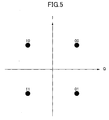
- FIG. 5 is a signal space diagram (also called phase diagram) showing the amplitude and the phase of the carrier in QPSK, where the I (In-Phase) axis represents the in-phase component, and the Q (Quadrature) axis represents the quadrature component, namely, the component 90 degrees phase-shifted from the reference axis I.
- I In-Phase
- Q Quadrature
- phases of the QPSK modulated carrier are located at the vertices of a square.
- QPSK allows the transmission of two bits of digital data in four phase states (00, 10, 11, and 01) with the phase positions of the carrier at 45, 135, 225 and 315 degrees, respectively.
- a derivative of the above QPSK is ⁇ /4 shift-QPSK, which is used in a PDC (Personal Digital Cellular) cellular phone communication system, known as the second generation mobile communication system.
- ⁇ /4 shift-QPSK the phase positions of the carrier are shifted by ⁇ /4 relative to the corresponding phase positions in QPSK.
- ⁇ /4 shift-QPSK also allows the transmission of two bits of digital data in four phase states.
- IMT-2000 International Mobile Telecommunication-2000
- W-CDMA Wideband Code Division Multiple Access
- BPSK Binary Phase Shift Keying
- QPSK Quadrature Phase Shift Keying
- TDD mode of the W-CDMA scheme QPSK is used in both uplink and downlink data modulations.
- 16QAM varies both the amplitude and the phase of the carrier wave to represent more digital symbol points and thus more bits of digital data, allowing the transmission of four bits of digital data in sixteen phase states in each symbol.
- FIG. 6 is a signal space diagram showing the amplitude and the phase of the carrier in 16QAM, where numerals 0.9487, 0.3162, -0.3162, and -0.9487 indicate scales of I axis and Q axis.
- 16QAM the four bits in each symbol are divided into two groups each consisting of two bits. Combining the variation of the values of the two bit groups with the variation of the amplitude, sixteen symbol points are obtained, as illustrated in FIG. 6.
- the bandwidth occupied by 16QAM is narrower than that of QPSK, and 16QAM is more efficient in high speed digital data transmission using a narrow bandwidth, but is weak against fading (change of strength of the electrical wave due to change of time or the distance between the transmitter and the receiver).
- the above 16QAM is used in digital MCA (for public radio service) and others.
- QPSK and 16QAM are typical digital modulation schemes used in digital mobile communications, and are used for transmission of hierarchized data together with another digital modulation scheme 64QAM.
- additional data for identifying data layers may be utilized.
- data and the additional data representing data layer classification are transmitted from a transmitter, and at a receiving end, the received signal is classified, and a user may use or extract desired information included in the received signal by making simple selection by using the additional data.
- Japanese Laid Open Patent Application No. 11-66085 discloses such a communication method.
- the receiving ability of the receiving end is not considered. For this reason, when the receiving ability of the receiving end degrades relative to transmitting ability of the transmitting end, the utilization of the processing unit of the receiver (for example, CPU) rises, and data delay increases; consequently, communication quality is degraded.
- the processing unit of the receiver for example, CPU
- the transmitting device is a base station and the receiving device is a mobile station
- the mobile station is weak against fading, and this is the environmental problem of a mobile communication system.
- the above prior art technique doe not take the influence of fading into account. For this reason, in the related art, communications are apt to be interrupted due to fading, and the communication quality is degraded.
- a more specific object of the present invention is to provide a communication system capable of reducing data delay in transmitted hierarchized data, and selecting predetermined data from the transmitted hierarchized data for communication according to conditions of a receiving end; and a signal receiving device and a signal transmitting device in the communication system, and a communication method thereof.
- a signal receiving device for receiving data hierarchized by a signal transmitting device, the signal receiving device comprising: a layer identifying unit configured to identify data layers transmitted from the signal transmitting device; and a hierarchized data receiving unit configured to select at least one of the identified data layers according to a criteria including at least one of a receiving buffer size of the signal receiving device, calculating capability of the signal receiving device, and a propagating environment characteristic of the signal receiving device, and to receive the selected data layers.
- the hierarchized data receiving unit comprises a selection unit configured to select one or more of the receiving buffer size of the signal receiving device, the calculating capability of the signal receiving device, and the propagating environment of the signal receiving device for selecting the identified data layers.
- a signal transmitting device for hierarchizing data to be transmitted and transmitting the hierarchized data
- the signal transmitting device comprising a hierarchized data transmitting unit configured to hierarchize the data to be transmitted into a plurality of layers according to at least one of a number of multiplexed codes in CDMA (Code Division Multiple Access), a coding unit of error correction codes, and an information block number, and to transmit the hierarchized data.
- CDMA Code Division Multiple Access
- the signal transmitting device further comprises a selection unit configured to select at least one of the number of multiplexed codes, the coding unit of error correction codes, and the information block number for dividing the data to be transmitted into a plurality of layers.
- a communication system comprising: a signal transmitting device that hierarchizes data to be transmitted and transmits the hierarchized data; and a signal receiving device that receives the hierarchized data from the transmitting device, wherein the signal transmitting device comprises a data hierarchizing and transmitting unit configured to hierarchize the data to be transmitted into a plurality of data layers, and to transmit the data layers; and the signal receiving device comprises: a layer identifying unit configured to identify the data layers transmitted from the signal transmitting device; and a hierarchized data receiving unit configured to select the identified data layers according to at least one of receiving capability and a propagating environment of the signal receiving device, and to receive the selected data layers.
- a method of a communication system including a signal transmitting device for hierarchizing data to be transmitted and transmitting the hierarchized data and a signal receiving device for receiving the hierarchized data from the transmitting device, the method comprising the steps of: dividing, by the signal transmitting device, the data to be transmitted into a plurality of data layers and transmitting the data layers; and identifying, by the signal receiving device, the data layers transmitted from the signal transmitting device; and selecting, by the signal receiving device, the identified data layers according to at least one of receiving capability and a propagating environment characteristic of the signal receiving device, and receiving the selected data layers.
- the signal transmitting device uses different modulation schemes, numbers of multiplexed codes, coding units of error correction codes, or information block numbers as identifiers of data layers for hierarchizing the data to be transmitted, and transmits the hierarchized data.
- the signal receiving device selects data layers according to receiving capability such as receiving buffer size, calculation method, amount of calculations, and a propagating environment of the signal receiving device, and to receive the selected data layers. Therefore, it is possible to reduce the data delay in the hierarchized data at the transmitting end, and adaptively select and receive desired data.
- FIG. 1 is a block diagram showing an example of a configuration of a communication system according to an embodiment of the present invention.
- the communication system includes a transmitting device 100 and a receiving device 200.
- the transmitting device 100 includes a layer classification unit 1, an identification method selection unit 2, a modulation unit 3, a first data layer output unit 4, a second data layer output unit 5, an N-th data layer output unit 6, and a transmitting unit 7.
- the receiving device 200 includes a receiving unit 11, an identification method selection unit 12, a layer selection unit 13, and a selected layer data extraction unit 14.
- the data to be transmitted by the transmitting device 100 are first input to the layer classification unit 1, and are classified with identifiers determined by the identification method selection unit 2.
- the identifiers may be made in connection with modulation schemes used by the transmitting device 100, code numbers of multiplexed radio frames in CDMA (Code Division Multiple Access), coding units of the error correction codes, or information block numbers.
- CDMA Code Division Multiple Access
- coding units of the error correction codes or information block numbers.
- the data layer identifier is in correspondence with modulation schemes used by the transmitting device 100.
- the layer classification unit 1 After the layer classification unit 1 receives a notification from the identification method selection unit 2 indicating that the modulation schemes (for example, 16QAM and QPSK) are to be used as identifiers of data layers, the layer classification unit 1 classifies the data to be transmitted into data A consisting of a bit sequence containing the first bit to the n-th bit, data B consisting of a bit sequence containing the (n+1)-th bit to the m-th bit. For example, if the data to be transmitted are ABCDEFGHIJKLabcdefghijkl, assuming an alphabetic character is represented by one bit, the bit sequence ABCDEFGHIJKL is specified to be data A, and the bit sequence abcdefghijkl is specified to be data B.
- the modulation schemes for example, 16QAM and QPSK
- the layer classification unit 1 specifies data A as the first layer, and data B as the second layer, and outputs the data layers to the modulation unit 3. If the modulation unit 3 uses 16QAM to modulate the data layers, as each symbol in 16QAM consists of four bits, the first two bits in each symbol form the first layer (data A), the second two bits form the second layer (data B), and data A and data B are modulated separately.
- each symbol in QPSK consists of two bits, the first two bits in each symbol, that is, the first layer (data A) are modulated.
- the data to be transmitted become: ABabCDcdEFefGHghIJijKLkl.
- the layer-modulated data are output from the modulation unit 3, and are input to corresponding data layer output units.
- the first layer data are input to the first data layer output unit 4, and the second layer data are input to the second data layer output unit 5.
- the first data layer output unit 4 and the second data layer output unit 5 transform the format of the input data, and output the data to the transmitting unit 7.
- the transmitting unit 7 converts the data received from the first data layer output unit 4 and the second data layer output unit 5 into radio frequency signals, and transmits the signals.
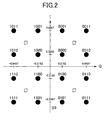
- FIG. 2 is a signal space diagram showing an example of the constellation points of the data to be transmitted from the transmitting device 100, specifically, showing the constellation points when hierarchizing the data to be transmitted using 16QAM and QPSK.
- the four points (represented by solid circles) in the first quadrant of 16QAM correspond to the two-bit point (00) (represented by an open square) in the QPSK signal space, and are mapped to the two-bit point (00) at a phase of ⁇ /4.
- the four points (represented by solid circles) in the second quadrant of 16QAM correspond to the point (10) (represented by an open square) in the QPSK signal space, and are mapped to the two-bit point (10) at a phase of 3 ⁇ /4.
- the four points (represented by solid circles) in the third quadrant of 16QAM (1100, 1101, 1110, 1111) correspond to the point (11) (represented by an open square) in the QPSK signal space, and are mapped to the two-bit point (11) at a phase of -3 ⁇ /4.
- the four points (represented by solid circles) in the fourth quadrant of 16QAM (0100, 0101, 0110, 0111) correspond to the point (01) (represented by an open square) in the QPSK signal space, and are mapped to the two-bit point (01) at a phase of - ⁇ /4.
- the receiving unit 11 of the receiving device 200 is capable of demodulation using 16QAM and QPSK.
- the receiving unit 11 receives the data transmitted from the transmitting device 100, and identifies the data using the identifiers specified by the identification method selection unit 12, and receives and demodulates data of the layer selected by the layer selection unit 13. For example, if the identification method selection unit 12 specifies that 16QAM be used to identify the data transmitted from the transmitting device 100, the identification method selection unit 12 notifies the receiving unit 11 and the layer selection unit 13 of the specification.
- the layer selection unit 13 selects data layers to be received so as to enable the receiving unit 11 to receive the hierarchized data, and then informs the receiving unit 11 of the selection.
- the layer selection unit 13 since 16QAM is specified to be used for demodulation, the layer selection unit 13 selects the first layer and the second layer as the layers to be received. Therefore, the receiving unit 11 receives four bits per symbol to demodulate data in the first layer and the second layer.
- the receiving unit 11 sends data in the first layer and the second layer to the selected layer data extraction unit 14.
- the selected layer data extraction unit 14 extracts data in the two layers and multiplexes them. Therefore, the original data sequence is reproduced.
- the receiving capability of the receiving unit 11 covers the demodulation capability of the receiving unit 11 (16QAM, or QPSK, and others). If the receiving unit 11 is capable of demodulation using only QPSK, the identification method selection unit 12 may specify QPSK to be used for identification of data layers, and notifies the receiving unit 11 and the layer selection unit 13 of the specification.
- the layer selection unit 13 selects only the first data layer as the layer to be received, and hence, the receiving unit 11 receives the first two-bit data of each symbol (the first layer) and demodulates the data.
- the subsequent processing is the same as the above.
- the receiving unit 11 is capable of demodulation using 16QAM and QPSK, one of 16QAM and QPSK is selected for demodulation, and data are demodulated by using the selected demodulation scheme. If the receiving unit 11 is capable of demodulation using only QPSK, only the first data layer is selected, or in other words, the data layer to be received is limited to the first data layer, and data are demodulated by using QPSK.
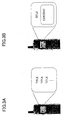
- FIGs. 3A and 3B are views showing an application of transmission of hierarchized data.
- the transmitting device 100 modulates the data of the reports in such a way that the titles of the reports are contained in the sequence formed by the first two bits (the first layer) of each symbol, and the contents of the reports are contained in the sequence formed by the second two bits (the second layer) of each symbol. Then, the transmitting device 100 transmits these modulated data.
- the receiving device 200 When the receiving device 200, for example, a cellular phone, or another mobile terminal, is configured to select the first data layer from the data transmitted by the transmitting device 100, the receiving device 200 only selects the titles of the reports, as shown in FIG. 3A. When the receiving device 200 is configured to select both the first data layer and the second data layer, the receiving device 200 selects the titles and contents of the reports, as shown in FIG. 3B.
- the receiving device 200 is capable of adaptive data reception, it is possible to improve the efficiency of data reception.
- QPSK and 16QAM can be used for demodulation, data are hierarchized into two layers. If QPSK and 64QAM, or QPSK and 256QAM are used for demodulation, it is possible to hierarchize the data into more data layers.
- the data layer to be received is selected based on the capability of demodulation of the receiving device 200, but the present invention is not limited to this embodiment.
- as many as possible data layers can be selected within the processing limit of the receiving buffer size.
- data layers based on calculation capability of the receiving device 200, for example, number of bits and number of codes in each processing, or computation method. Specifically, as many as possible data layers can be selected within the calculation capability.
- M is an integer not less than two
- M codes are multiplexed for transmission.
- M the number of the multiplexed codes along a certain time axis
- code 1 through code 4 the number of codes along a certain time axis
- each code is capable of accommodating data of six bits.
- the four codes are classified into a first layer containing code 1 and code 2 and a second layer containing code 3 and code 4.
- the receiving device 200 receives the code-multiplexed data, and selects layers by specifying the code numbers.
- the error correction codes are used in cable and radio communications to detect errors in communication data caused by noise in the communication lines, attenuation of the signals, and other reasons, and to correct the errors using additional codes.
- the error correction codes may be formed by block codes, convolutional codes, or turbo codes, which are used in a vast field including mobile communications and digital broadcasting and known as codes of high performance and high reliability.
- the input signal is divided into blocks each consisting of a certain number of bits, and the input signal is coded in units of blocks, that is, the coding unit. Therefore, when the error correction codes are coded in the coding unit, the data to be transmitted may be hierarchized into layers according to the coding unit. On the decoding side, data layers can be selected if data for identifying layers using a decoding unit, for example, blocks, can be extracted.
- An information block number is a number assigned to a unit of data to be transmitted; the unit of the transmission data is a block of data of a certain length.
- the transmission data are hierarchized into layers with each layer corresponding to an information block number. For example, if a data block contains twelve bits, the aforementioned data "ABCDEFGHIJKLabcdefghijkl" are divided into two blocks in the following way:
- data layers can be identified by other various methods in addition to the modulation scheme. Therefore, it is possible to select one of the above various methods to hierarchize the data to be transmitted.
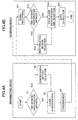
- FIGs. 4A and 4B are flowcharts showing the operations of the transmitting device 100 and the receiving device 200 involving selection of data layer identification methods.
- the flowchart in FIG. 4A shows the operations of the transmitting device 100.
- step S1 the identification method selection unit 2 determines if two or more data identification methods are available.
- step S2 if two or more data identification methods are available, the identification method selection unit 2 selects one of them, and notifies the layer classification unit 1 of the selection. For example, if modulation scheme and coding unit of error correction codes are available for data identification, the identification method selection unit 2 selects one of them.
- step S3 the layer classification unit 1 classifies the transmission data based on the identification method selected by the identification method selection unit 2, and outputs the data layers to the modulation unit 3.
- the modulation unit 3 After the hierarchical modulation on the transmission data, the modulation unit 3 outputs the layer-modulated data to the corresponding data layer output units (here, the first data layer output unit 4 and the second data layer output unit 5).
- step S4 the corresponding data layer output units transform the format of the input data and output the data to the transmitting unit 7.
- the transmitting unit 7 converts the received data to radio frequency signals and transmits the signals.
- the identification method selection unit 2 notifies the layer classification unit 1 of the data identification method. Further, when only one data identification method is available, the layer classification unit 1 may identify the data identification method by itself in advance.
- the layer classification unit 1 classifies the transmission data using the identification method as shown in step 3, and outputs the data layers to the modulation unit 3.
- the subsequent steps are the same as those described above.
- the flowchart in FIG. 4B shows the operations of the receiving device 200.
- step S11 the receiving unit 11 receives the data transmitted from the transmitting device 100.
- step S12 the identification method selection unit 12 determines if two or more data identification methods are available.
- step S13 if two or more data identification methods are available, the identification method selection unit 2 selects one of them, and notifies the receiving unit 11 and the layer selection unit 13 of the selection.
- the layer selection unit 13 selects data layers to be received according to the receiving capability of the receiving unit 11, and then informs the receiving unit 11 of the selection. For example, if demodulation is performed by using only QPSK, the layer selection unit 13 selects the first data layer and then informs the receiving unit 11 of the selection. If demodulation is performed by using only 16QAM, the layer selection unit 13 selects the first data layer and the second data layer, and then informs the receiving unit 11 of the selection.
- step S14 the receiving unit 11 identifies the input data using the identification method selected by the identification method selection unit 12, and receives the data of the layers selected by the layer selection unit 13.
- step S15 the receiving unit 11 sends the received data layers to the selected layer data extraction unit 14.
- the selected layer data extraction unit 14 performs error correction for the selected data layers, and extracts and outputs the desired data.
- the identification method selection unit 12 notifies the receiving unit 11 and the layer selection unit 13 of the method.
- the layer selection unit 13 selects data layers to be received according to the receiving capability of the receiving unit 11, and then informs the receiving unit 11 of the selection. Further, when only one data identification method is available, the layer selection unit 13 may identify the data identification method by itself in advance. Then the receiving unit 11 identifies the input data using the identification method selected by the identification method selection unit 12, and receives the data of the layers selected by the layer selection unit 13. The subsequent steps are the same as those described above.
- the signal transmitting device uses different modulation schemes, such as numbers of multiplexed codes, coding units of error correction codes, or information block numbers as identifiers of data layers, to hierarchize the data.
- the signal receiving device selects data layers according to receiving capability such as decoding method, receiving buffer size, calculation methods, amount of calculations, and propagating environments of the signal receiving device, and to receive the selected data layers. Therefore, it is possible to reduce the data delay in the hierarchized data at the transmitting end, and adaptively select and receive desired data.
- the identification method selection unit 12 of the receiving device 200 selects the method of identifying data layers, but the present invention is not limited to this embodiment.
- the identification method selection unit 2 of the transmitting device 100 may select the identification method, and the transmitting unit 1 of the transmitting device 100 may send information of the selected method.
- the layer classification unit 1 and the identification method selection unit 2 of the transmitting device 100 correspond to the hierarchized data transmitting unit in the claims
- the receiving unit 11 and the identification method selection unit 12 of the receiving device 200 correspond to the layer identifying unit in the claims
- the layer selection unit 13 and the selected layer data extraction unit 14 correspond to the hierarchized data receiving unit in the claims.
- the signal transmitting device uses different modulation schemes, numbers of multiplexed codes, coding units of error correction codes, or information block numbers as identifiers of data layers, to hierarchize the data.
- the signal receiving device selects data layers according to receiving capability such as decoding method, receiving buffer size, calculation method, amount of calculations, and propagating environment of the signal receiving device, and to receive the selected data layers. Therefore, it is possible to reduce the data delay in the hierarchized data at the transmitting end, and adaptively select and receive desired data.
Landscapes
- Engineering & Computer Science (AREA)
- Signal Processing (AREA)
- Computer Networks & Wireless Communication (AREA)
- Quality & Reliability (AREA)
- Digital Transmission Methods That Use Modulated Carrier Waves (AREA)
- Mobile Radio Communication Systems (AREA)
- Two-Way Televisions, Distribution Of Moving Picture Or The Like (AREA)
- Communication Control (AREA)
Abstract
Description
ABabCDcdEFefGHghIJijKLkl.
| Code number | data |
| Code 1 | |
| Code | |
| 2 | |
| Code | |
| 3 | |
| Code | |
| 4 | ghijkl |
Claims (6)
- A signal receiving device for receiving data hierarchized by a signal transmitting device, the signal receiving device comprising:a layer identifying unit configured to identify data layers transmitted from the signal transmitting device; anda hierarchized data receiving unit configured to select at least one of the identified data layers according to a criteria including at least one of a receiving buffer size of the signal receiving device, calculating capability of the signal receiving device, and a propagating environment characteristic of the signal receiving device, and to receive the selected data layers.
- The signal receiving device as claimed in claim 1, wherein the hierarchized data receiving unit comprises a selection unit configured to select one or more of the receiving buffer size of the signal receiving device, the calculating capability of the signal receiving device, and the propagating environment of the signal receiving device, for selecting the identified data layers.
- A signal transmitting device for hierarchizing data to be transmitted and transmitting the hierarchized data, the signal transmitting device comprising:a hierarchized data transmitting unit configured to hierarchize the data to be transmitted into a plurality of layers according to at least one of a number of multiplexed codes in CDMA (Code Division Multiple Access), a coding unit of error correction codes, and an information block number, and to transmit the hierarchized data.
- The signal transmitting device as claimed in claim 3, further comprising a selection unit configured to select at least one of the number of multiplexed codes, the coding unit of error correction codes, and the information block number, for dividing the data to be transmitted into a plurality of layers.
- A communication system, comprising:whereina signal transmitting device that hierarchizes data to be transmitted and transmits the hierarchized data; anda signal receiving device that receives the hierarchized data from the transmitting device,
the signal transmitting device comprises a data hierarchizing and transmitting unit configured to hierarchize the data to be transmitted into a plurality of data layers, and to transmit the data layers; and
the signal receiving device comprises:a layer identifying unit configured to identify the data layers transmitted from the signal transmitting device; anda hierarchized data receiving unit configured to select the identified data layers according to at least one of receiving capability and a propagating environment of the signal receiving device, and to receive the selected data layers. - A method of a communication system including a signal transmitting device for hierarchizing data to be transmitted and transmitting the hierarchized data, and a signal receiving device for receiving the hierarchized data from the transmitting device, the method comprising the steps of:dividing, by the signal transmitting device, the data to be transmitted into a plurality of data layers and transmitting the data layers; andidentifying, by the signal receiving device, the data layers transmitted from the signal transmitting device; andselecting, by the signal receiving device, the identified data layers according to at least one of receiving capability and a propagating environment characteristic of the signal receiving device, and receiving the selected data layers.
Applications Claiming Priority (2)
| Application Number | Priority Date | Filing Date | Title |
|---|---|---|---|
| JP2002291572A JP2004128988A (en) | 2002-10-03 | 2002-10-03 | Communication system, receiving device, transmitting device and communication method |
| JP2002291572 | 2002-10-03 |
Publications (2)
| Publication Number | Publication Date |
|---|---|
| EP1406422A2 true EP1406422A2 (en) | 2004-04-07 |
| EP1406422A3 EP1406422A3 (en) | 2007-04-18 |
Family
ID=31987195
Family Applications (1)
| Application Number | Title | Priority Date | Filing Date |
|---|---|---|---|
| EP20030256240 Withdrawn EP1406422A3 (en) | 2002-10-03 | 2003-10-02 | Hierarchical transmission of data |
Country Status (3)
| Country | Link |
|---|---|
| US (1) | US7346074B2 (en) |
| EP (1) | EP1406422A3 (en) |
| JP (1) | JP2004128988A (en) |
Cited By (2)
| Publication number | Priority date | Publication date | Assignee | Title |
|---|---|---|---|---|
| EP1589752A2 (en) * | 2004-04-20 | 2005-10-26 | Hitachi, Ltd. | Digital broadcast receiving device and method |
| EP2326053A4 (en) * | 2008-09-12 | 2016-08-03 | Fujitsu Ltd | TRANSMITTING DEVICE, RECEIVING DEVICE, TRANSMITTING METHOD, AND RECEIVING METHOD |
Families Citing this family (10)
| Publication number | Priority date | Publication date | Assignee | Title |
|---|---|---|---|---|
| US9385843B2 (en) * | 2004-12-22 | 2016-07-05 | Qualcomm Incorporated | Method and apparatus for using multiple modulation schemes for a single packet |
| KR100951029B1 (en) * | 2005-01-11 | 2010-04-05 | 콸콤 인코포레이티드 | Multiple resolution modulation with variable Euclidean distance ratio and blind receiver |
| US7660368B2 (en) | 2005-01-11 | 2010-02-09 | Qualcomm Incorporated | Bit log likelihood ratio evaluation |
| KR100926020B1 (en) | 2005-01-11 | 2009-11-11 | 퀄컴 인코포레이티드 | Method and apparatus for decoding data in a layered modulation system |
| TWI470979B (en) * | 2006-05-19 | 2015-01-21 | Lg Electronics Inc | A method of utilizing and manipulating wireless resources for efficient and effective wireless communication |
| JP5083026B2 (en) | 2008-05-15 | 2012-11-28 | 富士通セミコンダクター株式会社 | Digital broadcast receiver and digital broadcast receiving method |
| JP4929393B1 (en) * | 2010-11-19 | 2012-05-09 | 株式会社東芝 | Reception device, reception method, and reception program |
| CN102594840A (en) * | 2012-03-20 | 2012-07-18 | 广东凌康科技有限公司 | Remote data storage protection method |
| CN102594920A (en) * | 2012-03-20 | 2012-07-18 | 广东凌康科技有限公司 | Remote data transmission system |
| US9866364B2 (en) | 2014-08-29 | 2018-01-09 | Huawei Technologies Co., Ltd. | System and method for semi-orthogonal multiple access |
Family Cites Families (23)
| Publication number | Priority date | Publication date | Assignee | Title |
|---|---|---|---|---|
| US5267021A (en) * | 1992-04-03 | 1993-11-30 | The Trustees Of Columbia University In The City Of New York | Multiresolution digital television broadcast system |
| ATE230183T1 (en) | 1992-09-25 | 2003-01-15 | Matsushita Electric Industrial Co Ltd | MULTIPLE RESOLUTION TRANSMISSION SYSTEM |
| JP3295490B2 (en) | 1993-05-25 | 2002-06-24 | 大日本印刷株式会社 | Thermal transfer sheet |
| JP3139909B2 (en) * | 1994-03-15 | 2001-03-05 | 株式会社東芝 | Hierarchical orthogonal frequency multiplexing transmission system and transmitting / receiving apparatus |
| KR100247373B1 (en) * | 1994-08-31 | 2000-03-15 | 이데이 노부유끼 | Means and method of improving multiplexed transmission and reception by coding and modulating divided digital signals |
| JPH08163085A (en) * | 1994-12-02 | 1996-06-21 | Toshiba Corp | Information communication device |
| JPH0923207A (en) | 1995-07-07 | 1997-01-21 | Toshiba Corp | Information multiplexing system |
| JP2768354B2 (en) | 1996-07-15 | 1998-06-25 | 日本電気株式会社 | Relay system, transmission device and relay device used for the same |
| US6233017B1 (en) * | 1996-09-16 | 2001-05-15 | Microsoft Corporation | Multimedia compression system with adaptive block sizes |
| JPH10233692A (en) * | 1997-01-16 | 1998-09-02 | Sony Corp | Audio signal encoding device and encoding method, and audio signal decoding device and decoding method |
| EP2239876A3 (en) * | 1997-06-19 | 2011-01-26 | Kabushiki Kaisha Toshiba | Information data multiplexing transmission system, multiplexer and demultiplexer used therefor, and error correcting encoder and decoder |
| US5966412A (en) | 1997-06-30 | 1999-10-12 | Thomson Consumer Electronics, Inc. | Apparatus and method for processing a Quadrature Amplitude Modulated (QAM) signal |
| JPH1166085A (en) | 1997-08-19 | 1999-03-09 | Matsushita Electric Ind Co Ltd | Information transmitting device and receiving device |
| US6188670B1 (en) * | 1997-10-31 | 2001-02-13 | International Business Machines Corporation | Method and system in a data processing system for dynamically controlling transmission of data over a network for end-to-end device flow control |
| JP2000067223A (en) | 1998-08-25 | 2000-03-03 | Fuji Photo Film Co Ltd | File creation method and device, file transfer control method and device, and recording medium |
| JP2001045098A (en) | 1999-05-26 | 2001-02-16 | Canon Inc | Data communication system, data communication device, data communication method, and storage medium |
| JP2001223665A (en) * | 2000-02-08 | 2001-08-17 | Matsushita Electric Ind Co Ltd | Signal encoding transmission device, signal decoding receiving device, and program recording medium |
| JP3893247B2 (en) | 2001-01-12 | 2007-03-14 | 三菱電機株式会社 | Data distribution management device |
| US6987728B2 (en) * | 2001-01-23 | 2006-01-17 | Sharp Laboratories Of America, Inc. | Bandwidth allocation system |
| US20020172166A1 (en) * | 2001-03-22 | 2002-11-21 | Huseyin Arslan | Communications system and method for measuring short-term and long-term channel characteristics |
| US7043210B2 (en) * | 2001-06-05 | 2006-05-09 | Nortel Networks Limited | Adaptive coding and modulation |
| US7957486B2 (en) * | 2002-09-30 | 2011-06-07 | Intel Corporation | Transmission link adaptation |
| JP3899005B2 (en) * | 2002-10-03 | 2007-03-28 | 株式会社エヌ・ティ・ティ・ドコモ | Modulation apparatus, modulation method, demodulation apparatus, and demodulation method |
-
2002
- 2002-10-03 JP JP2002291572A patent/JP2004128988A/en active Pending
-
2003
- 2003-10-02 EP EP20030256240 patent/EP1406422A3/en not_active Withdrawn
- 2003-10-02 US US10/675,959 patent/US7346074B2/en not_active Expired - Fee Related
Cited By (2)
| Publication number | Priority date | Publication date | Assignee | Title |
|---|---|---|---|---|
| EP1589752A2 (en) * | 2004-04-20 | 2005-10-26 | Hitachi, Ltd. | Digital broadcast receiving device and method |
| EP2326053A4 (en) * | 2008-09-12 | 2016-08-03 | Fujitsu Ltd | TRANSMITTING DEVICE, RECEIVING DEVICE, TRANSMITTING METHOD, AND RECEIVING METHOD |
Also Published As
| Publication number | Publication date |
|---|---|
| EP1406422A3 (en) | 2007-04-18 |
| JP2004128988A (en) | 2004-04-22 |
| US7346074B2 (en) | 2008-03-18 |
| US20040066843A1 (en) | 2004-04-08 |
Similar Documents
| Publication | Publication Date | Title |
|---|---|---|
| US8548079B2 (en) | Transmitter, transmission method, receiver, and reception method | |
| KR101032534B1 (en) | Improved coding methods and apparatus in multi-user communication systems | |
| US7277492B2 (en) | Transmission apparatus, transmission control method, reception apparatus, and reception control method | |
| EP2047620B1 (en) | Cooperative multiple-access using user-clustering and space-time-frequency coding techniques for higher reliability reception | |
| JP3589992B2 (en) | Communication device and transmission method selection method | |
| US7050413B2 (en) | Information transmission method, mobile communications system, base station and mobile station in which data size of identification data is reduced | |
| EP1071238A2 (en) | Universal modem for digital video, audio and data communications | |
| US7092434B2 (en) | Mobile station used as a repeater station when communicating with a base station | |
| KR101096309B1 (en) | Apparatus and method for rate matching to maintain code block resource element boundary | |
| US7346074B2 (en) | Communication system, signal receiving device, signal transmitting device, and communication method | |
| US6646993B1 (en) | Communication apparatus and method of format adaptation therefor | |
| CN109075897A (en) | Data transmission method, equipment and system | |
| US7031397B1 (en) | Communication system with reduced power variation and method therefor | |
| US20040066844A1 (en) | Modulation and demodulation based on hierarchical modulation | |
| US20040165552A1 (en) | Adaptive wireless transmission/reception system | |
| US8229022B2 (en) | Modulation and demodulation method, modulation apparatus and demodulation apparatus | |
| US7031283B2 (en) | Method and system for enhancing channel capacity in a point to multipoint radio communications system having different kinds of terminals | |
| US8116244B2 (en) | Method and apparatus for transmitting a superframe across a communication network | |
| US8542624B2 (en) | Method of transmitting signal | |
| US20110107167A1 (en) | Method and apparatus for transmitting and receiving frequency channel information | |
| EP2180650B1 (en) | A method and device for modulating the information of tfci | |
| CN1841967B (en) | Mobile communication system and its information signal sequence transmission method | |
| JPH077967B2 (en) | Digital wireless transmission method | |
| KR100794124B1 (en) | Apparatus and Method for Time-Based Encoding / Decoding for Data Transmission in Wireless Communication System | |
| KR20010068526A (en) | Method and apparatus for time based data coding for communication systems |
Legal Events
| Date | Code | Title | Description |
|---|---|---|---|
| PUAI | Public reference made under article 153(3) epc to a published international application that has entered the european phase |
Free format text: ORIGINAL CODE: 0009012 |
|
| 17P | Request for examination filed |
Effective date: 20031027 |
|
| AK | Designated contracting states |
Kind code of ref document: A2 Designated state(s): AT BE BG CH CY CZ DE DK EE ES FI FR GB GR HU IE IT LI LU MC NL PT RO SE SI SK TR |
|
| AX | Request for extension of the european patent |
Extension state: AL LT LV MK |
|
| RIC1 | Information provided on ipc code assigned before grant |
Ipc: H04L 12/18 20060101ALI20061218BHEP Ipc: H04J 13/02 20060101ALI20061218BHEP Ipc: H04L 29/06 20060101ALI20061218BHEP Ipc: H04L 1/00 20060101ALI20061218BHEP Ipc: H04L 27/34 20060101AFI20040131BHEP |
|
| PUAL | Search report despatched |
Free format text: ORIGINAL CODE: 0009013 |
|
| AK | Designated contracting states |
Kind code of ref document: A3 Designated state(s): AT BE BG CH CY CZ DE DK EE ES FI FR GB GR HU IE IT LI LU MC NL PT RO SE SI SK TR |
|
| AX | Request for extension of the european patent |
Extension state: AL LT LV MK |
|
| STAA | Information on the status of an ep patent application or granted ep patent |
Free format text: STATUS: THE APPLICATION HAS BEEN WITHDRAWN |
|
| 18W | Application withdrawn |
Effective date: 20070829 |
|
| P01 | Opt-out of the competence of the unified patent court (upc) registered |
Effective date: 20230520 |