EP1406249A1 - Method for manufacturing magnetic recording medium - Google Patents
Method for manufacturing magnetic recording medium Download PDFInfo
- Publication number
- EP1406249A1 EP1406249A1 EP01926152A EP01926152A EP1406249A1 EP 1406249 A1 EP1406249 A1 EP 1406249A1 EP 01926152 A EP01926152 A EP 01926152A EP 01926152 A EP01926152 A EP 01926152A EP 1406249 A1 EP1406249 A1 EP 1406249A1
- Authority
- EP
- European Patent Office
- Prior art keywords
- film
- magnetic
- recording medium
- magnetic recording
- monomolecular film
- Prior art date
- Legal status (The legal status is an assumption and is not a legal conclusion. Google has not performed a legal analysis and makes no representation as to the accuracy of the status listed.)
- Granted
Links
Images


Classifications
-
- G—PHYSICS
- G11—INFORMATION STORAGE
- G11B—INFORMATION STORAGE BASED ON RELATIVE MOVEMENT BETWEEN RECORD CARRIER AND TRANSDUCER
- G11B5/00—Recording by magnetisation or demagnetisation of a record carrier; Reproducing by magnetic means; Record carriers therefor
- G11B5/62—Record carriers characterised by the selection of the material
-
- G—PHYSICS
- G11—INFORMATION STORAGE
- G11B—INFORMATION STORAGE BASED ON RELATIVE MOVEMENT BETWEEN RECORD CARRIER AND TRANSDUCER
- G11B5/00—Recording by magnetisation or demagnetisation of a record carrier; Reproducing by magnetic means; Record carriers therefor
- G11B5/62—Record carriers characterised by the selection of the material
- G11B5/73—Base layers, i.e. all non-magnetic layers lying under a lowermost magnetic recording layer, e.g. including any non-magnetic layer in between a first magnetic recording layer and either an underlying substrate or a soft magnetic underlayer
- G11B5/7368—Non-polymeric layer under the lowermost magnetic recording layer
- G11B5/7379—Seed layer, e.g. at least one non-magnetic layer is specifically adapted as a seed or seeding layer
-
- B—PERFORMING OPERATIONS; TRANSPORTING
- B82—NANOTECHNOLOGY
- B82Y—SPECIFIC USES OR APPLICATIONS OF NANOSTRUCTURES; MEASUREMENT OR ANALYSIS OF NANOSTRUCTURES; MANUFACTURE OR TREATMENT OF NANOSTRUCTURES
- B82Y10/00—Nanotechnology for information processing, storage or transmission, e.g. quantum computing or single electron logic
-
- B—PERFORMING OPERATIONS; TRANSPORTING
- B82—NANOTECHNOLOGY
- B82Y—SPECIFIC USES OR APPLICATIONS OF NANOSTRUCTURES; MEASUREMENT OR ANALYSIS OF NANOSTRUCTURES; MANUFACTURE OR TREATMENT OF NANOSTRUCTURES
- B82Y30/00—Nanotechnology for materials or surface science, e.g. nanocomposites
-
- G—PHYSICS
- G11—INFORMATION STORAGE
- G11B—INFORMATION STORAGE BASED ON RELATIVE MOVEMENT BETWEEN RECORD CARRIER AND TRANSDUCER
- G11B5/00—Recording by magnetisation or demagnetisation of a record carrier; Reproducing by magnetic means; Record carriers therefor
- G11B5/62—Record carriers characterised by the selection of the material
- G11B5/73—Base layers, i.e. all non-magnetic layers lying under a lowermost magnetic recording layer, e.g. including any non-magnetic layer in between a first magnetic recording layer and either an underlying substrate or a soft magnetic underlayer
- G11B5/7368—Non-polymeric layer under the lowermost magnetic recording layer
- G11B5/7369—Two or more non-magnetic underlayers, e.g. seed layers or barrier layers
-
- G—PHYSICS
- G11—INFORMATION STORAGE
- G11B—INFORMATION STORAGE BASED ON RELATIVE MOVEMENT BETWEEN RECORD CARRIER AND TRANSDUCER
- G11B5/00—Recording by magnetisation or demagnetisation of a record carrier; Reproducing by magnetic means; Record carriers therefor
- G11B5/62—Record carriers characterised by the selection of the material
- G11B5/73—Base layers, i.e. all non-magnetic layers lying under a lowermost magnetic recording layer, e.g. including any non-magnetic layer in between a first magnetic recording layer and either an underlying substrate or a soft magnetic underlayer
- G11B5/7368—Non-polymeric layer under the lowermost magnetic recording layer
- G11B5/7375—Non-polymeric layer under the lowermost magnetic recording layer for heat-assisted or thermally-assisted magnetic recording [HAMR, TAMR]
-
- G—PHYSICS
- G11—INFORMATION STORAGE
- G11B—INFORMATION STORAGE BASED ON RELATIVE MOVEMENT BETWEEN RECORD CARRIER AND TRANSDUCER
- G11B5/00—Recording by magnetisation or demagnetisation of a record carrier; Reproducing by magnetic means; Record carriers therefor
- G11B5/84—Processes or apparatus specially adapted for manufacturing record carriers
- G11B5/8404—Processes or apparatus specially adapted for manufacturing record carriers manufacturing base layers
Definitions
- the present invention relates to a magnetic recording medium mounted on a magnetic recording and reproducing apparatus such as a hard disk drive, etc., and in particular, relates to a method of fabricating a magnetic recording medium capable of recording magnetic information with a high recording density and further reproducing the information with low noise.
- the recording density of the HDD is improving at breakneck speed such as an annual rate at or over 100 %.
- the main technical problems are to refine crystal grains of the magnetic film for recording data according to the miniaturization of bit cells and to isolate the crystal grains magnetically so that magnetic coupling between the crystal grains is reduced as much as possible.
- the adjustment of the composition of the magnetic film or the adjustment of the sputter conditions; which is an aforementioned conventional technique, is one of the effective methods in the techniques for facilitating the refinement or magnetic isolation of the crystal grains of the magnetic film.
- the main object of the present invention is to provide a method of fabricating a magnetic recording medium having a magnetic film, in which the sizes of the crystal grains are fully small and uniform, the falling density thereof is high, and further each crystal grain is fully magnetically isolated.
- the above object is achieved by a method of fabricating a magnetic recording medium, including at least a monomolecular film formation step of forming a monomolecular film on a substrate, and a magnetic film formation step of forming on the monomolecular film a magnetic film for recording magnetic information.
- the monomolecular film has the structure of molecules of which the shapes are singular and the sizes are fine and a magnetic film formed thereon is formed so that the moncmolecular film is a nucleation site, and the crystal grain diameters, the grain diameter distribution, and the filling factor are improved. Consequently, if the isolation degree of the crystals is controlled together by performing the composition adjustment or an annealing treatment when the magnetic film is formed, a magnetic recording medium that satisfies all of the aforementioned conditions required for the magnetic recording medium can be fabricated.
- the monomolecular film formation step can be an organic monomolecular film formation step of forming an organic monomolecular film on the substrate, and particularly, it is preferable to employ a perylene-based organic monomolecular film having 2-dinensional microfine molecular structures.
- a seed film formation step of controlling the crystalline state of the organic moncmolecular film may be included before the organic monomolecular film formation step.
- the seed film formation step it is preferable to form at least one of Ag and Au on the substrate.
- a heat-resisting intermediate film formation step of forming a heat-resisting intermediate film having heat resistance, which is adsorbed on the organic monomolecular film may be further included after the organic monomolecular film formation step.
- the heat-resisting intermediate film formation step it is preferable to form at least one of Ge and Si on the organic monomolecular film.
- the heat-resisting intermediate film formed on the organic monomolecular film is a crystal control film for a film formed thereon, since it has such a structure on which the crystal structure of the organic monomolecular film is reflected, which has a structure such that the crystal structure of the organic monomolecular film that is weak against heat can be utilized with certainty as the nucleation site when the magnetic film is formed since the heat resistance is excellent.
- a heat treatment step of performing heat treatment may be further included.
- the isolation of the crystal grains of the magnetic film can be facilitated by the heat treatment.
- the organic monomolecular film may be evaporated by the heat treatment and, in this case, the heat treatment is carried out at or above the temperature at which the organic monomolecular film is evaporated.
- the scope of the present invention includes a magnetic recording and reproducing apparatus in which a magnetic recording medium fabricated by the method of fabricating a magnetic recording medium is mounted.
- a magnetic recording and reproducing apparatus can be provided as an apparatus capable of recording and reproducing high-capacity magnetic information.
- a monomolecular film having a regular microfine structure preferably an organic monomolecular film
- the underlying film is used as a template (a nucleation site) and a magnetic film is formed based on the underlying film, so that the crystal grain diameter, the grain diameter distribution, and the filling factor are improved.
- the isolation degree of the crystals is facilitated by adjusting the composition and by heat treatment (annealing), so that a magnetic recording medium with a preferred magnetic film is fabricated.
- an organic monomolecular film can be employed as a monomolecular film that is used as the underlying film and, particularly, it is desirable to employ a perylene-based organic monomolecular film.
- Perylene is an organic molecule that is composed of five 6-membered rings and has a structure such that termination is provided by hydrogen. Perylene can have a variety of molecular structures dependent on the structures at the terminal portions.
- a perylene-based compound for example, perylene-3,4,9,10-tetracarboxylic-3,4,9,10-dianhydride (hereinafter, PTCDA) shown in FIG. 1B and N,N'-dimethylperylene-3,4,9,10-bis(dicarboximide) (hereinafter, DM-PBDCI) shown in FIG. 1C can be listed.
- the perylene-based compounds of which the molecular size is fine as being equal to or less than 2 nm, have an array structure in which the filling factor of the molecules is high.
- the monomolecular films of the perylene-based compounds have such a property that the molecules mutually form a regular 2-dimensional lattice.
- the perylene-based compound has a regular and high filling-factor planar structure so as to function preferably as the underlying film.
- Each of the molecules of the perylene-based compound is provided as the structure of molecules of which the shape and size are singular.
- the crystal structure becomes a regularly arrayed uniform and high-density structure, in which the sizes of the crystal grains are unified.
- a preferred magnetic film can be similarly obtained. That is, a preferred magnetic film can be obtained similarly by a method of forming first the intermediate film while the perylene-based compound is the nucleation site and forming the magnetic film on the intermediate film. From the viewpoint of suppressing magnetic influence on the magnetic film, the intermediate film is preferably non-magnetic.
- the perylene compound can be epitaxially grown at a preferred condition on the surface of a metal thin film formed from, for example, Ag or Au or alloys thereof. Accordingly, if the metal thin film due to Ag, etc., is used as a seed film of the organic monomolecular film, an organic monomolecular film having a uniform and dense molecular structure can be widely formed.
- the perylene-based organic monomolecular film formed as described above has a relatively high volatility and evaporates at approximately 200 °C.
- a heating step is generally included.
- a step of forming a heat-resisting intermediate film with heat resistance on the perylene-based monomolecular film be included.
- a heat-resisting intermediate film preferable is one having a relatively high melting point and a structure strong against heat and having a prcperty of adsorbing organic molecules selectively.
- the heat-resisting intermediate film formed from Ge, etc. has a structure on which the crystal structure of the perylene-based monomolecular film is reflected, by being adsorbed by the perylene-based monomolecular film, and is thermally stable.
- a structure can be made which forms the magnetic film while the crystal structure of the perylene-based monomolecular film is the nucleation site, by making a structure such that the heat-resisting intermediate film is intervening.
- a film that is formed from Ge, etc., formed on the perylene-based monomolecular film is a thermally stable heat-resisting film and it has a crystal structure on which the perylene-based monomolecular film as the nucleation site is reflected.
- the magnetic film further formed thereon, in which the sizes of crystal grains are unified, has a regularly arrayed uniform and high-density structure.
- the perylene-based monomolecular film is not a necessary component in the magnetic recording medium.
- the perylene-based monomolecular film may be evaporated by raising the temperature fcr the annealing treatment. In this case, heat treatment is performed at a temperature such that the perlyelne-based monomolecular film is evaporated.
- the annealing treatment is performed, for example, at 200 through 350 °C for 0.5 through 10 minutes.
- the heat-resisting intermediate film maintains an array structure that is formed while perylene molecules are nuclei.
- the segregation to a grain boundary of the magnetic film formed from a Cr-based material can be facilitated so as to improve the isolation degree of the crystal grains.
- the heat-resisting intermediate film may be omitted so as to form a magnetic film directly while the perylene-based monomolecular film is the nucleation site.
- the monomolecular film having a regular and microfine structure functions as the magnetic film or the nucleation site for the crystal grains of the intermediate film, the crystal. grain diameter, the grain diameter distribution, and the filling factor can be improved. Furthermore, a magnetic recording medium of which the recording density is heightened can be fabricated by controlling the isolation degree of the crystal grains.
- FIG. 2 The general structure of one example magnetic recording medium 10 fabricated in accordance with the embodied example is shown in FIG. 2.
- the fabrication processes for the magnetic recording medium 10 are described in sequence by referring to FIG. 2.
- a glass disk (2.5 inches) was employed as a substrate 11. Otherwise, an organic material such as polycarbonate, etc., may be employed.
- a metal thin film of Ag with a thickness of 10 nm as a 1st underlying film 12 was deposited on the substrate 11 by a vapor deposition method.
- the 1st underlying film 12 corresponds to the aforementioned seed film for organic monomolecular film. That is, as a preferred example, it is provided so that a 2nd underlying film 13 deposited thereon is epitaxially grown so as to be an organic monomolecular film having uniform and microfine molecular structures.
- the 2nd underlying film 13 is the organic monomolecular film being a nucleation site. As described above, the 2nd underlying film 13 has structures of molecules of which the shapes are singular and the sizes are microfine.
- Ge is deposited by 1 nm on the 2nd underlying film 13 by a vapor deposition method so as to be a 1st non-magnetic intermediate film 14.
- the 1st non-magnetic intermediate film 14 corresponds to the aforementioned heat-resisting intermediate film and a film with heat resistance and functions as a crystal control film for a magnetic layer formed thereon.
- the 1st underlying film 12 of Ag through the 1st non-magnetic intermediate film 14 of Ge were deposited on the substrate 11, as described above, it was introduced into a DC magnetron sputter apparatus and annealing treatment of 250 °C ⁇ 1 min. was performed.
- the annealing treatment is a treatment of heating the side of substrate 11 in order to improve the crystal orientations of the films formed afterward. Although heating is nct provided until the PTCDA film (the 2nd underlying film 13) evaporates in the embodied example, temperature may be further raised so as to evaporate the PTCDA film at this moment.
- the film was not an essential one, but is provided as a preferred embodiment from the viewpoint of further improving the crystallizability of a magnetic film formed thereon.
- the 2nd non-magnetic intermediate film of Cr also has a crystal structure similar to those of the 1st non-magnetic intermediate film 14 and is a crystal control film for the magnetic layer.
- a magnetic film for recording magnetic information is deposited on the 2nd non-magnetic intermediate film 15.
- An example such that 2 magnetic films 16 and 17 are formed is shown in the embodied example, but a monolayer or further a multilayer of 3 or more layers may be provided.
- Co 69 Cr 21 Pt 9 Ta 2 is deposited by 3 nm so as to be a 1st magnetic film 16 and Co 56 Cr 24 Pt 12 B 8 is further deposited by 22 nm on the 1st magnetic film 16 so as to be a 2nd magnetic film 17, that is, 2 layers of magnetic film are formed.
- an amorphous carbon (a-C) was formed by 5 nm on the 2nd magnetic film 17 by DC magnetron sputtering so as to be a protective film 18.
- perfluoroether (PFFPE) was applied on the protective film 16 by a substrate-lifting method so as to form a lubricating film 19 by air seasoning, so that the magnetic recording medium shown in FIG. 2 was fabricated.
- the structure of a magnetic recording medium in the prior art is as follows. This is a structure such that the 1st underlying film 12 (a seed film), the 2nd underlying film 13 (an organic monomolecular film) and the 1st non-magnetic intermediate film 14 (a heat resisting intermdiate film) are removed from the magnetic recording medium of the embodied example shown in FIG. 2. Additionally, the fabrication process and the film deposition conditions were similar to those of the embodied example so as to perform the fabrication.
- the structure of the prior magnetic recording medium is:
- FIG. 3 is a diagram that collectively shows the results of studied recording and reproducing properties of the magnetic recording medium in the embodied example and the magnetic recording medium in the prior example.
- the recording and reproducing conditions in these cases are as follows:
- the magnetic recording medium fabricated in the embodied example medium noise decreases significantly and the signal S/N in the embodied example is 3.4 dB higher than that in the prior example. Furthermore, the overwrite property and the reproduction signal intensity are also improved. That is, according to the present invention, a magnetic recording medium capable of recording and reproducing at high recording density compared with the prior one can be confirmed.
- a magnetic recording medium having a magnetic film in which the crystal grain diameter, the grain diameter distribution and the filling factor and further the isolation degree are all controlled can be formed, which has conventionally been difficult to achieve. Accordingly, a high-performance magnetic recording medium can be obtained, and as a result, recording and reproducing at high recording density are enabled.
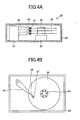
- FIG. 4A is a cross-sectional view showing a substantial part of one embodied example of the magnetic recording and reproducing apparatus 20 and FIG. 4B is a plan view showing the substantial part of the same apparatus.
- the magnetic recording and reproducing apparatus generally includes a housing 23.
- a motor 24, a hub 25, a plurality of magnetic recording media 26, a plurality of recording and reproducing heads 27, a plurality of suspensions 28, a plurality of arms 29, and an actuator unit 21 are provided.
- the magnetic recording media 26 are installed on the hub 25 that is rotated by the motor 24.
- the recording and reproducing heads 27 are composite-type recording and reproducing heads that include a reproducing head such as a MR head.and a GMR head, etc., and a recording head such as an inductive head, etc.
- Each recording and reproducing head 27 is attached to the end of the corresponding arm 29 via the suspension 28.
- the arms 29 are driven by the actuatcr unit 21.
- the basic structure of the magnetic recording and reproducing apparatus 20 itself is well known, which description is omitted in this specification.
- the embodied example of the magnetic recording and reproducing apparatus 20 is characterized by the magnetic recording medium 26.
- Each magnetic recording medium 26 has a structure similar to that as illustrated in FIG. 2.
- the number of the magnetic recording media 26 is not limited to 3 and may be 1, 2, or 4 or greater.
- the basic structure of the magnetic recording and reproducing apparatus 20 is not limited to that as shown in FIG. 4A and B. Also, the magnetic recording medium used for the present invention is not limited to a magnetic disk.
Landscapes
- Engineering & Computer Science (AREA)
- Chemical & Material Sciences (AREA)
- Nanotechnology (AREA)
- Physics & Mathematics (AREA)
- Crystallography & Structural Chemistry (AREA)
- Materials Engineering (AREA)
- General Physics & Mathematics (AREA)
- Condensed Matter Physics & Semiconductors (AREA)
- Composite Materials (AREA)
- Manufacturing & Machinery (AREA)
- Mathematical Physics (AREA)
- Theoretical Computer Science (AREA)
- Magnetic Record Carriers (AREA)
- Manufacturing Of Magnetic Record Carriers (AREA)
Abstract
Description
that is,
Claims (10)
- A method of fabricating a magnetic recording medium characterized by comprising
a monomolecular film formation step of forming a monomolecular film on a substrate and
a magnetic film formation step of forming on the monomolecular film a magnetic film for recording magnetic information. - The method of fabricating a magnetic recording medium as claimed in claim 1, characterized in that the monomolecular film formation step is an organic monomolecular film formation step of forming an organic monomolecular film on the substrate.
- The method of fabricating a magnetic recording medium as claimed in claim 2, characterized in that the organic monomolecular film is a perylene-based organic monomolecular film.
- The method of fabricating a magnetic recording medium as claimed in claim 3, characterized by further comprising a step of forming a seed film for controlling a crystal state of the organic monomolecular film before the organic monomolecular film formation step.
- The method of fabricating a magnetic recording medium as claimed in claim 4, characterized in that at least one of Ag and Au is formed on the substrate in the step of forming a seed film.
- The method of fabricating a magnetic recording medium as claimed in any of claims 2 through 5, characterized by further comprising a heat-resisting intermediate film formation step of forming a heat-resisting intermediate film adsorbed selectively on the organic monomolecular film after the organic monomolecular film formation step.
- The method of fabricating a magnetic recording medium as claimed in claim 6, characterized in that at least one of Ge and Si is formed on the organic monomolecular film in the heat-resisting intermediate film formation step.
- The method of fabricating a magnetic recording medium as claimed in claim 6 or 7, characterized by further comprising a heat treatment step of performing a heat treatment after the heat-resisting intermediate film formation step.
- The method of fabricating a magnetic recording medium as claimed in claim 8, characterized in that the heat treatment is performed at or above a temperature at which the organic monomolecular film evaporates.
- A magnetic recording and reproducing apparatus in which a magnetic recording medium fabricated by the method of fabricating a mantic recording medium as claimed in any of claims 1 through 9 is mounted.
Applications Claiming Priority (1)
| Application Number | Priority Date | Filing Date | Title |
|---|---|---|---|
| PCT/JP2001/003843 WO2002091368A1 (en) | 2001-05-08 | 2001-05-08 | Method for manufacturing magnetic recording medium |
Publications (3)
| Publication Number | Publication Date |
|---|---|
| EP1406249A1 true EP1406249A1 (en) | 2004-04-07 |
| EP1406249A4 EP1406249A4 (en) | 2004-11-17 |
| EP1406249B1 EP1406249B1 (en) | 2007-03-14 |
Family
ID=11737296
Family Applications (1)
| Application Number | Title | Priority Date | Filing Date |
|---|---|---|---|
| EP01926152A Expired - Lifetime EP1406249B1 (en) | 2001-05-08 | 2001-05-08 | Method for manufacturing magnetic recording medium |
Country Status (6)
| Country | Link |
|---|---|
| US (1) | US7258893B2 (en) |
| EP (1) | EP1406249B1 (en) |
| JP (1) | JP3961958B2 (en) |
| KR (1) | KR100708280B1 (en) |
| DE (1) | DE60127316T2 (en) |
| WO (1) | WO2002091368A1 (en) |
Family Cites Families (14)
| Publication number | Priority date | Publication date | Assignee | Title |
|---|---|---|---|---|
| US4769281A (en) * | 1986-04-15 | 1988-09-06 | The Furukawa Electric Co., Ltd. | Magnetic recording medium and method of manufacturing the same |
| JPH071545B2 (en) * | 1986-04-15 | 1995-01-11 | 古河電気工業株式会社 | Method for manufacturing protective film for magnetic recording medium |
| JP2708457B2 (en) * | 1988-03-31 | 1998-02-04 | 沖電気工業株式会社 | Ultrafine particle array LB film and method for producing the same |
| US4985273A (en) * | 1988-06-07 | 1991-01-15 | Matsushita Electric Industrial Co., Ltd. | Method of producing fine inorganic particles |
| JPH0686535B2 (en) | 1989-02-27 | 1994-11-02 | 松下電器産業株式会社 | Ultrafine inorganic fine particle film, method for producing the same, magnetic recording medium to which the same is applied, and method for producing the same |
| JPH04143910A (en) | 1990-10-04 | 1992-05-18 | Matsushita Electric Ind Co Ltd | Manufacturing method of laminated magnetic head |
| US5175240A (en) * | 1990-12-17 | 1992-12-29 | E.I. Du Pont De Nemours And Company | Aromatic homopolyimide or copolyimide films having low water absorption and high thermal durability |
| KR0138251B1 (en) * | 1991-02-05 | 1998-05-15 | 다니이 아끼오 | Magnetic recording medium and its manufacturing method |
| EP0555906A1 (en) * | 1992-02-11 | 1993-08-18 | Koninklijke Philips Electronics N.V. | Glass substrate for magnetic recording medium |
| JPH05228845A (en) * | 1992-02-12 | 1993-09-07 | Tokyo Jiki Insatsu Kk | Polishing film for texturing magnetic disc board |
| US5552236A (en) * | 1992-03-16 | 1996-09-03 | Matsushita Electric Industrial Co., Ltd. | Organic magnetic film and method of manufacturing the same |
| JP3388797B2 (en) * | 1992-03-16 | 2003-03-24 | 松下電器産業株式会社 | Organic magnetic film and method for producing the same |
| JPH0973692A (en) * | 1995-08-31 | 1997-03-18 | Sony Corp | Magnetic recording / reproducing apparatus and magnetic recording / reproducing method |
| US5909337A (en) * | 1997-08-12 | 1999-06-01 | International Business Machines Corporation | Magnetic recording device |
-
2001
- 2001-05-08 WO PCT/JP2001/003843 patent/WO2002091368A1/en not_active Ceased
- 2001-05-08 KR KR1020037014303A patent/KR100708280B1/en not_active Expired - Fee Related
- 2001-05-08 EP EP01926152A patent/EP1406249B1/en not_active Expired - Lifetime
- 2001-05-08 JP JP2002588539A patent/JP3961958B2/en not_active Expired - Fee Related
- 2001-05-08 DE DE60127316T patent/DE60127316T2/en not_active Expired - Fee Related
-
2003
- 2003-11-07 US US10/704,362 patent/US7258893B2/en not_active Expired - Fee Related
Also Published As
| Publication number | Publication date |
|---|---|
| JP3961958B2 (en) | 2007-08-22 |
| WO2002091368A1 (en) | 2002-11-14 |
| JPWO2002091368A1 (en) | 2004-08-26 |
| KR20030095401A (en) | 2003-12-18 |
| EP1406249A4 (en) | 2004-11-17 |
| US20040131891A1 (en) | 2004-07-08 |
| DE60127316T2 (en) | 2007-12-20 |
| DE60127316D1 (en) | 2007-04-26 |
| EP1406249B1 (en) | 2007-03-14 |
| KR100708280B1 (en) | 2007-04-17 |
| US7258893B2 (en) | 2007-08-21 |
Similar Documents
| Publication | Publication Date | Title |
|---|---|---|
| US8512884B2 (en) | Perpendicular magnetic recording medium, method for producing the same, and magnetic recording/reproducing device | |
| CN100440325C (en) | Perpendicular magnetic recording medium, manufacturing method thereof, and magnetic storage device | |
| US6596409B2 (en) | Onset layer for thin film disk with CoPtCrB alloy | |
| JPWO2002039433A1 (en) | Magnetic recording medium and magnetic recording device | |
| US9899050B2 (en) | Multiple layer FePt structure | |
| JP2002190108A (en) | Magnetic recording medium and method of manufacturing the same | |
| JP2009032356A (en) | Perpendicular magnetic recording medium, its manufacturing method, and magnetic recording and reproducing device | |
| KR100800018B1 (en) | Magnetic recording medium and its manufacturing method | |
| US6914749B2 (en) | Magnetic anisotropy of soft-underlayer induced by magnetron field | |
| US20070218316A1 (en) | Magnetic recording medium, method of producing same, and magnetic storage apparatus | |
| US7179548B2 (en) | Polycrystalline structure film and method of making the same | |
| US6878439B2 (en) | Magnetic recording medium, its production process and magnetic recording device | |
| US20080044688A1 (en) | Longitudinal magnetic recording medium and method of manufacturing the same | |
| JP2006155865A (en) | Perpendicular magnetic recording medium and perpendicular magnetic recording / reproducing apparatus | |
| EP1406249B1 (en) | Method for manufacturing magnetic recording medium | |
| JP2003203330A (en) | Magnetic recording media | |
| US6506508B1 (en) | Magnetic recording medium, method of production and magnetic storage apparatus | |
| JPH11219511A (en) | Magnetic recording medium and magnetic recording device | |
| CN1815566A (en) | Perpendicular magnetic recording medium | |
| JP2003022523A (en) | Perpendicular magnetic recording medium and manufacturing method thereof | |
| US20110116189A1 (en) | Magnetic recording medium and magnetic recording/reproducing device | |
| JP4066845B2 (en) | Magnetic recording medium and method for manufacturing the same | |
| US20050158883A1 (en) | Multilayered structure film and method of making the same | |
| JPWO2003085649A1 (en) | Polycrystalline structure and method for producing the same | |
| EP1553565B1 (en) | Magnetic recording medium and a method for its manufacture |
Legal Events
| Date | Code | Title | Description |
|---|---|---|---|
| PUAI | Public reference made under article 153(3) epc to a published international application that has entered the european phase |
Free format text: ORIGINAL CODE: 0009012 |
|
| 17P | Request for examination filed |
Effective date: 20031107 |
|
| AK | Designated contracting states |
Kind code of ref document: A1 Designated state(s): AT BE CH CY DE DK ES FI FR GB GR IE IT LI LU MC NL PT SE TR |
|
| A4 | Supplementary search report drawn up and despatched |
Effective date: 20041006 |
|
| RIC1 | Information provided on ipc code assigned before grant |
Ipc: 7G 11B 5/64 B Ipc: 7G 11B 5/738 B Ipc: 7G 11B 5/84 A |
|
| 17Q | First examination report despatched |
Effective date: 20050527 |
|
| GRAP | Despatch of communication of intention to grant a patent |
Free format text: ORIGINAL CODE: EPIDOSNIGR1 |
|
| GRAS | Grant fee paid |
Free format text: ORIGINAL CODE: EPIDOSNIGR3 |
|
| GRAA | (expected) grant |
Free format text: ORIGINAL CODE: 0009210 |
|
| AK | Designated contracting states |
Kind code of ref document: B1 Designated state(s): DE FR GB |
|
| REG | Reference to a national code |
Ref country code: GB Ref legal event code: FG4D |
|
| REF | Corresponds to: |
Ref document number: 60127316 Country of ref document: DE Date of ref document: 20070426 Kind code of ref document: P |
|
| ET | Fr: translation filed | ||
| PLBE | No opposition filed within time limit |
Free format text: ORIGINAL CODE: 0009261 |
|
| STAA | Information on the status of an ep patent application or granted ep patent |
Free format text: STATUS: NO OPPOSITION FILED WITHIN TIME LIMIT |
|
| 26N | No opposition filed |
Effective date: 20071217 |
|
| PGFP | Annual fee paid to national office [announced via postgrant information from national office to epo] |
Ref country code: DE Payment date: 20090429 Year of fee payment: 9 Ref country code: FR Payment date: 20090515 Year of fee payment: 9 |
|
| PGFP | Annual fee paid to national office [announced via postgrant information from national office to epo] |
Ref country code: GB Payment date: 20090506 Year of fee payment: 9 |
|
| REG | Reference to a national code |
Ref country code: GB Ref legal event code: 732E Free format text: REGISTERED BETWEEN 20100128 AND 20100203 |
|
| REG | Reference to a national code |
Ref country code: FR Ref legal event code: TP |
|
| GBPC | Gb: european patent ceased through non-payment of renewal fee |
Effective date: 20100508 |
|
| REG | Reference to a national code |
Ref country code: FR Ref legal event code: ST Effective date: 20110131 |
|
| PG25 | Lapsed in a contracting state [announced via postgrant information from national office to epo] |
Ref country code: DE Free format text: LAPSE BECAUSE OF NON-PAYMENT OF DUE FEES Effective date: 20101201 |
|
| PG25 | Lapsed in a contracting state [announced via postgrant information from national office to epo] |
Ref country code: FR Free format text: LAPSE BECAUSE OF NON-PAYMENT OF DUE FEES Effective date: 20100531 |
|
| PG25 | Lapsed in a contracting state [announced via postgrant information from national office to epo] |
Ref country code: GB Free format text: LAPSE BECAUSE OF NON-PAYMENT OF DUE FEES Effective date: 20100508 |