EP1405856A1 - Crystals of oligosaccharides and processes for preparation thereof - Google Patents
Crystals of oligosaccharides and processes for preparation thereof Download PDFInfo
- Publication number
- EP1405856A1 EP1405856A1 EP02733463A EP02733463A EP1405856A1 EP 1405856 A1 EP1405856 A1 EP 1405856A1 EP 02733463 A EP02733463 A EP 02733463A EP 02733463 A EP02733463 A EP 02733463A EP 1405856 A1 EP1405856 A1 EP 1405856A1
- Authority
- EP
- European Patent Office
- Prior art keywords
- oligosaccharide
- glcnac
- gal
- fuc
- crystals
- Prior art date
- Legal status (The legal status is an assumption and is not a legal conclusion. Google has not performed a legal analysis and makes no representation as to the accuracy of the status listed.)
- Granted
Links
Classifications
-
- C—CHEMISTRY; METALLURGY
- C07—ORGANIC CHEMISTRY
- C07H—SUGARS; DERIVATIVES THEREOF; NUCLEOSIDES; NUCLEOTIDES; NUCLEIC ACIDS
- C07H5/00—Compounds containing saccharide radicals in which the hetero bonds to oxygen have been replaced by the same number of hetero bonds to halogen, nitrogen, sulfur, selenium, or tellurium
- C07H5/04—Compounds containing saccharide radicals in which the hetero bonds to oxygen have been replaced by the same number of hetero bonds to halogen, nitrogen, sulfur, selenium, or tellurium to nitrogen
- C07H5/06—Aminosugars
Definitions
- the present invention relates to crystals of an oligosaccharide useful, for example, as raw materials for or as intermediates of health foods, pharmaceutical compositions, cosmetics, etc. and a process for producing crystals of an oligosaccharide.
- Oligosaccharides are useful, for example, as raw materials for or as intermediates of health foods, pharmaceutical compositions, cosmetics, etc. Therefore, there is a demand for oligosaccharides of good storage stability and of high purity which do not contain impurities, decomposition products or the like.
- Some reports have been made on methods for synthesis or fermentation of oligosaccharides [Chem. Rev., Vol. 100, p. 4465 (2000); Curr. Opin. in Drug Discovery & Develop., Vol. 3, p. 756 (2000); WO98/12343; WO99/40205]. In these methods, end products are usually obtained as powders (amorphous) by freeze-drying treatment, and obtaining them as crystals is considered to be difficult.
- the powders (amorphous) obtained by freeze-drying treatment are generally known to have a problem in respect of stability because of their hygroscopicity, deliquescence, etc., and thus need to be refrigerated or frozen when stored, transported, distributed, etc. Therefore, there exists a demand for crystals of an oligosaccharide capable of being stored at ordinary temperatures and a process for production thereof for a large supply of oligosaccharides on an industrial scale.
- An object of the present invention is to provide crystals of an oligosaccharide useful, for example, as materials for or as intermediates of health foods, pharmaceutical compositions, cosmetics, etc. and a process for producing crystals of an oligosaccharide which is suitable for large-scale synthesis or industrialization.
- the present invention relates to the following (1) to (24).
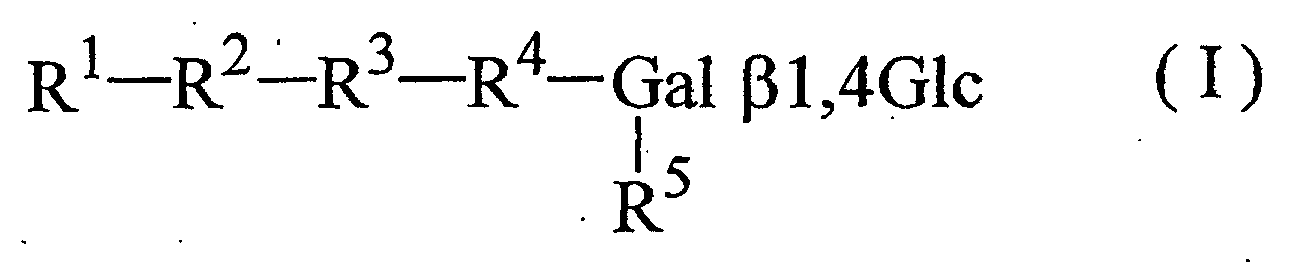
- Oligosaccharides comprising three or more monosaccharide residues or the oligosaccharides represented by general formula (I) are referred to as Oligosaccharides (I), and the crystals of an Oligosaccharide (I) are referred to as Oligosaccharide Crystals (I).
- a reaction solution, a culture medium or a cell-free culture medium containing Oligosaccharide (I) obtained by a synthesis method or a fermentation method is pretreated according a known method [e.g., Chem. Rev., Vol. 100, p. 4465 (2000); Curr. Opin. in Drug Discovery & Develop, Vol. 3, p. 756 (2000); WO98/12343; and WO99/40205] to prepare an aqueous solution containing Oligosaccharide (I) whose saccharide purity is 50% or more, preferably 70% or more.
- the obtained solution containing Oligosaccharide (I) is added dropwise to a water-miscible organic solvent which is a bad solvent at a temperature between -20°C and the boiling point of the water-miscible organic solvent or under reflux for one minute to 10 hours, preferably 10 minutes to 2 hours. After the completion of dropping, the resulting mixture is stirred at a temperature between - 20°C and the boiling point of the water-miscible organic solvent or under reflux for 1 to 20 hours, preferably 2 to 4 hours to deposit crystals.
- a water-miscible organic solvent which is a bad solvent at a temperature between -20°C and the boiling point of the water-miscible organic solvent or under reflux for one minute to 10 hours, preferably 10 minutes to 2 hours.
- Oligosaccharide Crystals (I) are separated by centrifugal filtration, decantation or the like, washed with water or a water-miscible organic solvent, and then dried under reduced pressure or by airflow to obtain Oligosaccharide Crystals (I). Oligosaccharide Crystals (I) can be further purified by carrying out operations such as washing, drying and recrystallization.
- the pretreatments to obtain the aqueous solution containing Oligosaccharide (I) include treatment with a membrane, gel filtration, treatment with activated carbon, treatment with an ion exchange resin, treatment with a synthetic adsorption resin and solvent precipitation.
- Preferred are treatment with activated carbon, treatment with an ion exchange resin, treatment with a synthetic adsorption resin and solvent precipitation, among which solvent precipitation and treatment with a synthetic adsorption resin are particularly preferred.
- These treatments may be appropriately employed in combination.
- treatment with a synthetic adsorption resin is preferred as the pretreatment to obtain an aqueous solution containing Oligosaccharide (I) wherein at least one of the monosaccharide residues is Fuc.
- the water-miscible organic solvent can be used alone, or as a mixture of two or more kinds or a mixture with water.
- Oligosaccharide Crystals (I) can also be obtained by general crystallization methods such as a method in which the aqueous solution containing Oligosaccharide (I) is concentrated, cooled and neutralized, and a method in which a water-miscible organic solvent as a bad solvent is added to the aqueous solution containing Oligosaccharide (I) to promote the formation of Oligosaccharide Crystals (I).
- Oligosaccharide Crystals (I) obtained by the above processes may be obtained as adducts with water or with various water-miscible organic solvents.
- Oligosaccharide Crystals (I) obtained by the above processes sometimes exist in different crystalline forms or different grain sizes, and these can be obtained alone or as a mixture.
- Oligosaccharide Crystals (I) obtained by the above processes are shown in Table 1.
- Example No. Crystals No. Oligosaccharide Crystals 1 1 GlcNAc ⁇ 1,3Gal ⁇ 1,4Glc 2 2 Gal ⁇ 1,4GlcNAc ⁇ 1,3Gal ⁇ 1,4Glc 3 3 GlcNAc ⁇ 1,3Gal ⁇ 1,4GlcNAc ⁇ 1,3Gal ⁇ 1,4GlcNAc ⁇ 1,3Gal ⁇ 1,4GlcNAc ⁇ 1,3Gal ⁇ 1,4Glc
- the residual rate of Oligosaccharides (I) in the samples was measured by high performance liquid chromatography (HPLC) and expressed in terms of HPLC purity (%).
- the GlcNAc ⁇ 1,3Gal ⁇ 1,4Glc reaction solution obtained in Reference Example 4 was centrifuged to remove cells and passed through a column of DIAION SK-1B (H type, Mitsubishi Chemical Corporation) and then a column of DIAION WA-30 (OH type, Mitsubishi Chemical Corporation) for desalting.
- the resulting solution was adjusted to pH 6.5 with HCl and concentrated under reduced pressure to obtain a treated solution of GlcNAc ⁇ 1,3Gal ⁇ 1,4Glc (aqueous solution: 100 mL, 200 g/L).
- the obtained solution was gradually added to methanol heated to 60°C (500 mL) in about 30 minutes, and the resulting mixture was refluxed at 60°C for about 3 hours for crystallization.
- the Gal ⁇ 1,4 GlcNAc ⁇ 1,3Gal ⁇ 1,4Glc reaction solution obtained in Reference Example 5 was centrifuged to remove cells and passed through a column of DIAION SK-1B (H type, Mitsubishi Chemical Corporation) and then a column of DIAION WA-30 (OH type, Mitsubishi Chemical Corporation) for desalting.
- the resulting solution was adjusted to pH 6.5 with HCl and concentrated under reduced pressure to obtain a treated solution of Gal ⁇ 1,4GlcNAc ⁇ 1,3Gal ⁇ 1,4Glc (aqueous solution: 70 mL, 300 g/L).
- the obtained solution was gradually added to acetone heated to 58°C (500 mL) in about 30 minutes, and the resulting mixture was refluxed at 58°C for about 2 hours for crystallization.
- the resulting mixture was cooled to 20°C and stirred for one hour. Then, crystals were separated by filtration and' washed with acetone.
- the obtained crystals were dried by airflow, whereby 16 g of Gal ⁇ 1,4GlcNAc ⁇ 1,3Gal ⁇ 1,4Glc Crystals was obtained.
- the GlcNAc ⁇ 1,3Gal ⁇ 1,4GlcNAc ⁇ 1,3Gal ⁇ 1,4Glc reaction solution obtained in Reference Example 6 was centrifuged to remove cells and passed through a column of DIAION SK-1B (H type, Mitsubishi Chemical Corporation) and then a column of DIAION WA-30 (OH type, Mitsubishi Chemical Corporation) for desalting.
- the resulting solution was adjusted to pH 6.5 with HCl and concentrated under reduced pressure to obtain a treated solution of GlcNAc ⁇ 1,3Gal ⁇ 1,4GlcNAc ⁇ 1,3Gal ⁇ 1,4Glc (aqueous solution: 100 mL, 200 g/L).
- the obtained solution was gradually added to methanol heated to 60°C (500 mL) in about 30 minutes, and the resulting mixture was refluxed at 60°C for about 3 hours for crystallization.
- the resulting mixture was cooled to 20°C and stirred for one hour.
- crystals were separated by filtration and washed with methanol.
- the obtained crystals were dried by airflow, whereby 16 g of GlcNAc ⁇ 1,3Gal ⁇ 1,4GlcNAc ⁇ 1,3Gal ⁇ 1,4Glc Crystals was obtained.
- the GlcNAc ⁇ 1,3Gal ⁇ 1,4Glc Crystals obtained in Example 1 (5 g) were dissolved in water to obtain a GlcNAc ⁇ 1,3Gal ⁇ 1,4Glc solution (10 mL, 500 g/L). The solution was frozen at -30°C and then dried in a freeze-dryer to obtain 4.8 g of freeze-dried GlcNAc ⁇ 1,3Gal ⁇ 1,4Glc powders.
- the Gal ⁇ 1,4GlcNAc ⁇ 1,3Gal ⁇ 1,4Glc Crystals obtained in Example 2 (5 g) were dissolved in water to obtain a Gal ⁇ 1,4GlcNAc ⁇ 1,3Gal ⁇ 1,4Glc solution (10 mL, 500 g/L). The solution was frozen at -30°C and then dried in a freeze-dryer to obtain 4.5 g of freeze-dried Gal ⁇ 1,4GlcNAc ⁇ 1,3Gal ⁇ 1,4Glc powders.
- the GlcNAc ⁇ 1,3Gal ⁇ 1,4GlcNAc ⁇ 1,3Gal ⁇ 1,4Glc Crystals obtained in Example 3 were dissolved in water to obtain a GlcNAc ⁇ 1,3Gal ⁇ 1,4GlcNAc ⁇ 1,3Gal ⁇ 1,4Glc solution (10 ml, 500 g/l). The solution was frozen at -30°C and then dried in a freeze-dryer to obtain 4.7 g of freeze-dried GlcNAc ⁇ 1,3Gal ⁇ 1,4GlcNAc ⁇ 1,3Gal ⁇ 1,4Glc powders.
- a GlcNAc ⁇ 1,3Gal ⁇ 1,4Glc reaction solution was obtained from uridine diphosphate-N-acetylglucosamine obtained by the method described in WO98/12343 and lactose using recombinant Escherichia coli highly expressing the enzyme described in Glycobiology, Vol. 9, p. 1061 (1999) according to the method for producing sugar chains described in WO98/12343.
- a Gal ⁇ 1,4GlcNAc ⁇ 1,3Gal ⁇ 1,4Glc reaction solution was obtained using the GlcNAc ⁇ 1,3Gal ⁇ 1,4Glc reaction solution obtained in Reference Example 4 and uridine diphosphate-galactose according to the method described in Reference Example 4.
- a GlcNAc ⁇ 1,3Gal ⁇ 1,4GlcNAc ⁇ 1,3Gal ⁇ 1,4Glc reaction solution is obtained from uridine diphosphate-N-acetylglucosamine obtained by the method described in WO98/12343 and the Gal ⁇ 1,4GlcNAc ⁇ 1,3Gal ⁇ 1,4Glc reaction solution obtained in Reference Example 5 according to the method described in Reference Example 4.
- the present invention provides crystals of an oligosaccharide useful, for example, as raw materials for or as intermediates of health foods, pharmaceutical compositions, cosmetics, etc. and a process for producing crystals of an oligosaccharide which is suitable for large-scale synthesis or industrialization.
Landscapes
- Chemical & Material Sciences (AREA)
- Organic Chemistry (AREA)
- Engineering & Computer Science (AREA)
- Health & Medical Sciences (AREA)
- Biochemistry (AREA)
- Biotechnology (AREA)
- General Health & Medical Sciences (AREA)
- Genetics & Genomics (AREA)
- Molecular Biology (AREA)
- Life Sciences & Earth Sciences (AREA)
- Saccharide Compounds (AREA)
- Polysaccharides And Polysaccharide Derivatives (AREA)
- Pharmaceuticals Containing Other Organic And Inorganic Compounds (AREA)
Abstract
Description
| Example No. | Crystals No. | Oligosaccharide Crystals |
| 1 | 1 | GlcNAcβ1,3Galβ1,4Glc |
| 2 | 2 | Galβ1,4GlcNAcβ1,3Galβ1,4Glc |
| 3 | 3 | GlcNAcβ1,3Galβ1,4GlcNAcβ1,3Galβ1,4Glc |
| Residual rate of oligosaccharides: HPLC purity (%) | |||||
| Days that passed | |||||
| 0 | 1 | 4 | 7 | 20 | |
| GlcNAcβ1,3Galβ1,4Glc Crystals (Crystals No. 1) | 98.0 | 99.7 | 99.7 | 99.7 | 98.9 |
| Freeze-dried GlcNAcβ1,3Gal-β1,4Glc powders | 99.8 | 99.7 | 97.0 | 98.8 | 93.8 |
| Galβ1,4G1cNAcβ1,3Gal-β1,4Glc Crystals (Crystals No. 2) | 99.3 | 99.0 | 99.2 | 99.0 | 98.8 |
| Freeze-dried Galβ1,4GlcNAc-β1,3Galβ1,4Glc powders | 99.3 | 98.6 | 97.6 | 96.2 | 90.9 |
| GlcNAcβ1,3Galβ1,4GlcNAc-β1,3Galβ1,4Glc Crystals (Crystals No. 3) | 98.8 | 99.3 | 99.0 | 99.0 | 99.3 |
| Freeze-dried GlcNAcβ1,3Gal-β1,4GlcNAcβ1,3Galβ1,4Glc powders | 98.6 | 98.2 | 97.4 | 95.4 | 85.2 |


Claims (24)
- A process for producing crystals of an oligosaccharide comprising three or more monosaccharide residues which comprises adding an aqueous solution containing the oligosaccharide comprising three or more monosaccharide residues to a water-miscible organic solvent.
- A process for producing crystals of an oligosaccharide which comprises adding an aqueous solution containing an oligosaccharide represented by general formula (I):[wherein Gal represents galactose (hereinafter abbreviated in the same manner); Glc represents glucose (hereinafter abbreviated in the same manner); R1 represents a monosaccharide residue, an amino sugar residue, or a derivative of the monosaccharide residue or the amino sugar residue; R2, R3 and R4, which may be the same or different, each represent a monosaccharide residue, an amino sugar residue, a derivative of the monosaccharide residue or the amino sugar residue, -X(-Y)- (wherein X and Y, which may be the same or different, each represent a monosaccharide residue, an amino sugar residue, or a derivative of the monosaccharide residue or the amino sugar residue) or a single bond; and R5 represents a hydrogen atom, a monosaccharide residue, an amino sugar residue, or a derivative of the monosaccharide residue or the amino sugar residue] to a water-miscible organic solvent.

- The process for producing crystals of an oligosaccharide according to Claim 2, wherein R1 is GlcNAc (GlcNAc represents N-acetylglucosamine, which is hereinafter abbreviated in the same manner), NeuAc (NeuAc represents N-acetylneuraminic acid, which is hereinafter abbreviated in the same manner), Gal, Fuc (Fuc represents fucose, which is hereinafter abbreviated in the same manner) or GalNAc (GalNAc represents N-acetylgalactosamine, which is hereinafter abbreviated in the same manner); R2, R3 and R4, which may be the same or different, each are a single bond, GlcNAc, NeuAc, Gal, Fuc or GalNAc; and R5 is a hydrogen atom, GlcNAc, NeuAc, Gal, Fuc or GalNAc.
- The process for producing crystals of an oligosaccharide according to Claim 2 or 3, wherein R2, R3 and R4, which may be the same or different, each are GlcNAc, NeuAc, Gal, Fuc or GalNAc.
- The process for producing crystals of an oligosaccharide according to Claim 2 or 3, wherein R4 is a single bond.
- The process for producing crystals of an oligosaccharide according to Claim 2 or 3, wherein R3 and R4 each are a single bond.
- The process for producing crystals of an oligosaccharide according to Claim 2 or 3, wherein R2, R3 and R4 each are a single bond.
- The process for producing crystals of an oligosaccharide according to Claim 5, wherein R1 is GlcNAc; R2 is Gal; R3 is GlcNAc; and R5 is a hydrogen atom.
- The process for producing crystals of an oligosaccharide according to Claim 6, wherein R1 is NeuAc or Gal; R2 is GlcNAc or GalNAc; and R5 is a hydrogen atom.
- The process for producing crystals of an oligosaccharide according to Claim 7, wherein R1 is GlcNAc, Gal, NeuAc or Fuc; and R5 is a hydrogen atom or GalNAc.
- The process for producing crystals of an oligosaccharide according to Claim 2, wherein at least one of R1, R2, R3, R4 and R5 is a deoxy sugar residue, and the aqueous solution containing an oligosaccharide is an aqueous solution obtained by treatment with a synthetic adsorption resin.
- The process for producing crystals of an oligosaccharide according to Claim 11, wherein the deoxy sugar residue is Fuc.
- The process for producing crystals of an oligosaccharide according to Claim 11, wherein R1 is Fuc; R2, R3 and R4 each are a single bond; and R5 is a hydrogen atom.
- The process for producing crystals of an oligosaccharide according to any one of Claims 1 to 13, wherein the water-miscible organic solvent is an alcohol or a ketone.
- The process for producing crystals of an oligosaccharide according to any one of Claims 1 to 13, wherein the water-miscible organic solvent is methanol or acetone.
- A Crystal of an oligosaccharide represented by general formula (I) according to Claim 2.
- The crystal of an oligosaccharide according to Claim 16, wherein R1 is GlcNAc, NeuAc, Gal, Fuc or GalNAc; R2, R3 and R4, which may be the same or different, each are a single bond, GlcNAc, NeuAc, Gal, Fuc or GalNAc; and R5 is a hydrogen atom, GlcNAc, NeuAc, Gal, Fuc or GalNAc.
- The crystal of an oligosaccharide according to Claim 16 or 17, wherein R2, R3 and R4, which may be the same or different, each are GlcNAc, NeuAc, Gal, Fuc or GalNAc.
- The crystal of an oligosaccharide according to Claim 16 or 17, wherein R4 is a single bond.
- The crystal of an oligosaccharide according to Claim 16 or 17, wherein R3 and R4 each are a single bond.
- The crystal of an oligosaccharide according to Claim 16 or 17, wherein R2, R3 and R4 each are a single bond.
- The crystal of an oligosaccharide according to Claim 19, wherein R1 is GlcNAc; R2 is Gal; R3 is GlcNAc; and R5 is a hydrogen atom.
- The crystal of an oligosaccharide according to Claim 20, wherein R1 is NeuAc or Gal; R2 is GlcNAc or GalNAc; and R5 is a hydrogen atom.
- The crystal of an oligosaccharide according to Claim 21, wherein R1 is GlcNAc, Gal, NeuAc or Fuc; and R5 is a hydrogen atom or GalNAc.
Applications Claiming Priority (3)
| Application Number | Priority Date | Filing Date | Title |
|---|---|---|---|
| JP2001175930 | 2001-06-11 | ||
| JP2001175930 | 2001-06-11 | ||
| PCT/JP2002/005787 WO2002100875A1 (en) | 2001-06-11 | 2002-06-11 | Crystals of oligosaccharides and processes for preparation thereof |
Publications (3)
| Publication Number | Publication Date |
|---|---|
| EP1405856A1 true EP1405856A1 (en) | 2004-04-07 |
| EP1405856A4 EP1405856A4 (en) | 2007-01-03 |
| EP1405856B1 EP1405856B1 (en) | 2018-09-26 |
Family
ID=19016988
Family Applications (1)
| Application Number | Title | Priority Date | Filing Date |
|---|---|---|---|
| EP02733463.0A Expired - Lifetime EP1405856B1 (en) | 2001-06-11 | 2002-06-11 | Crystals of oligosaccharides and processes for preparation thereof |
Country Status (9)
| Country | Link |
|---|---|
| US (1) | US20040149200A1 (en) |
| EP (1) | EP1405856B1 (en) |
| JP (1) | JP4347042B2 (en) |
| KR (1) | KR100907590B1 (en) |
| CN (1) | CN100509830C (en) |
| CA (1) | CA2449736A1 (en) |
| DK (1) | DK1405856T3 (en) |
| ES (1) | ES2698398T3 (en) |
| WO (1) | WO2002100875A1 (en) |
Cited By (13)
| Publication number | Priority date | Publication date | Assignee | Title |
|---|---|---|---|---|
| WO2011100980A1 (en) | 2010-02-19 | 2011-08-25 | Glycom A/S | A method for preparation of the tetrasaccharide lacto-n-neotetraose (lnnt) containing n-acetyllactosamine |
| WO2014086373A1 (en) | 2012-12-07 | 2014-06-12 | Glycom A/S | Crystallisation of human milk oligosaccharides (hmo) |
| WO2014094783A1 (en) * | 2012-12-18 | 2014-06-26 | Glycom A/S | Novel polymorphs of lnnt |
| WO2017101953A1 (en) * | 2015-12-17 | 2017-06-22 | Glycom A/S | Crystalline forms of lnt |
| WO2018077368A1 (en) | 2016-10-31 | 2018-05-03 | Glycom A/S | Method for removing residual organic solvent from a crystalline oligosaccharide |
| US10676770B2 (en) | 2014-12-16 | 2020-06-09 | Glycom A/S | Separation of 2′-FL from a fermentation broth |
| WO2020128945A1 (en) * | 2018-12-19 | 2020-06-25 | Glycom A/S | Separation of oligosaccharides |
| US11142541B2 (en) | 2017-06-30 | 2021-10-12 | Glycom A/S | Purification of oligosaccharides |
| US11419884B2 (en) | 2016-06-24 | 2022-08-23 | Glycom A/S | Compositions comprising HMOS, their production and use for the prevention and/or treatment of viral and/or bacterial infections |
| US11505567B2 (en) | 2017-07-12 | 2022-11-22 | Glycom A/S | Amorphous mixture comprising a neutral mono- or oligosaccharide and an acidic non-carbohydrate component |
| WO2023117673A1 (en) | 2021-12-21 | 2023-06-29 | Dsm Ip Assets B.V. | CRYSTALLIZATION OF LNnT |
| WO2023175130A1 (en) | 2022-03-17 | 2023-09-21 | Dsm Ip Assets B.V. | Crystalline lacto-n-triose ii |
| EP4431518A4 (en) * | 2022-05-07 | 2025-05-21 | Shandong Henglu Biotech. Co., Ltd. | NEW CRYSTALLINE FORM OF TRISACCHARIDE |
Families Citing this family (11)
| Publication number | Priority date | Publication date | Assignee | Title |
|---|---|---|---|---|
| TW200800354A (en) * | 2005-10-28 | 2008-01-01 | Kyowa Hakko Kogyo Kk | Concentration crystallizer and method |
| JPWO2007052787A1 (en) * | 2005-11-07 | 2009-04-30 | 協和発酵バイオ株式会社 | Crystal or amorphous cleaning method and cleaning apparatus |
| IL207945A0 (en) | 2010-09-02 | 2010-12-30 | Robert Jansen | Method for the production of carbohydrates |
| US20130005954A1 (en) * | 2011-06-28 | 2013-01-03 | Apicore, Llc | Process for preparing heparinoids and intermediates useful in the synthesis thereof |
| ES2929571T3 (en) | 2014-08-22 | 2022-11-30 | Isothrive Inc | Process for the production of isomaltooligosaccharides |
| CA2969748A1 (en) | 2014-08-22 | 2016-02-25 | Isothrive Llc | Process for the production of isomaltooligosaccharides |
| US20250051814A1 (en) | 2021-12-21 | 2025-02-13 | Kyowa Hakko Bio Co., Ltd. | Method for producing sugar including lacto-n-triose ii as core trisaccharide and method for producing crystals of said sugar |
| EP4502168A1 (en) | 2022-03-25 | 2025-02-05 | Kirin Holdings Kabushiki Kaisha | Production method for lactodifucotetraose (ldft) |
| CN115873051B (en) * | 2022-05-17 | 2024-06-25 | 山东恒鲁生物科技有限公司 | Novel crystal forms of trisaccharides |
| WO2025012361A1 (en) | 2023-07-11 | 2025-01-16 | Chr. Hansen A/S | Crystallization of lacto-n-triose ii |
| KR20250118895A (en) | 2024-01-30 | 2025-08-07 | 경희대학교 산학협력단 | Method for producing water-soluble amylose using amylosucrase |
Family Cites Families (11)
| Publication number | Priority date | Publication date | Assignee | Title |
|---|---|---|---|---|
| JPS56115796A (en) * | 1980-02-18 | 1981-09-11 | Rikagaku Kenkyusho | Novel oligosaccharide and its preparation |
| JPS60232095A (en) * | 1984-05-01 | 1985-11-18 | Norin Suisansyo Shokuhin Sogo Kenkyusho | Crystal of reduced oligosaccharide and production thereof |
| JPS63109789A (en) * | 1986-10-27 | 1988-05-14 | Yakult Honsha Co Ltd | Production of oligosaccharide |
| JPS63246391A (en) * | 1987-04-01 | 1988-10-13 | Nisshin Seito Kk | Novel oligosaccharides |
| US5158939A (en) * | 1989-07-21 | 1992-10-27 | Wisconsin Alumni Research Foundation | Method of stimulating the immune systems of animals and compositions useful therefor |
| JPH0670075B2 (en) * | 1990-08-28 | 1994-09-07 | ホクレン農業協同組合連合会 | 1-Kestose crystal and method for producing the same |
| JP3623974B2 (en) * | 1993-09-13 | 2005-02-23 | カルピス株式会社 | Oligosaccharide purification method |
| EP0670327B1 (en) * | 1994-03-01 | 1998-10-21 | Kabushiki Kaisha Hayashibara Seibutsu Kagaku Kenkyujo | Crystalline maltotetraosyl glucoside, and its production and use |
| JPH11221079A (en) * | 1998-02-04 | 1999-08-17 | Kyowa Hakko Kogyo Co Ltd | Glycosyltransferase and DNA encoding the enzyme |
| JP2000279191A (en) * | 1999-03-31 | 2000-10-10 | Snow Brand Milk Prod Co Ltd | Method for producing oligosaccharide |
| JP3611110B2 (en) | 2001-03-19 | 2005-01-19 | 株式会社八十二銀行 | System, method and program for completion process of the previous date, program for cancel / recut main process used therefor, resource optimization system, program and program for cancel / reexecute main process used therefor |
-
2002
- 2002-06-11 CN CNB028086082A patent/CN100509830C/en not_active Expired - Lifetime
- 2002-06-11 WO PCT/JP2002/005787 patent/WO2002100875A1/en not_active Ceased
- 2002-06-11 KR KR1020037016131A patent/KR100907590B1/en not_active Expired - Lifetime
- 2002-06-11 JP JP2003503641A patent/JP4347042B2/en not_active Expired - Lifetime
- 2002-06-11 US US10/479,050 patent/US20040149200A1/en not_active Abandoned
- 2002-06-11 CA CA002449736A patent/CA2449736A1/en not_active Abandoned
- 2002-06-11 ES ES02733463T patent/ES2698398T3/en not_active Expired - Lifetime
- 2002-06-11 EP EP02733463.0A patent/EP1405856B1/en not_active Expired - Lifetime
- 2002-06-11 DK DK02733463.0T patent/DK1405856T3/en active
Cited By (34)
| Publication number | Priority date | Publication date | Assignee | Title |
|---|---|---|---|---|
| US8993740B2 (en) | 2010-02-19 | 2015-03-31 | Glycom A/S | Method for preparation of the tetrasaccharide lacto-N-neotetraose (LNnt) containing N-acetyllactosamine |
| WO2011100980A1 (en) | 2010-02-19 | 2011-08-25 | Glycom A/S | A method for preparation of the tetrasaccharide lacto-n-neotetraose (lnnt) containing n-acetyllactosamine |
| EP3241836A1 (en) | 2010-02-19 | 2017-11-08 | Glycom A/S | Polymorph of a tetrasaccharide containing nacetyl-lactosamine |
| DE202011111124U1 (en) | 2010-02-19 | 2020-05-22 | Glycom A/S | Polymorph of a tretrasaccharide containing N-acetyllactosamine |
| WO2014086373A1 (en) | 2012-12-07 | 2014-06-12 | Glycom A/S | Crystallisation of human milk oligosaccharides (hmo) |
| WO2014094783A1 (en) * | 2012-12-18 | 2014-06-26 | Glycom A/S | Novel polymorphs of lnnt |
| US9815862B2 (en) | 2012-12-18 | 2017-11-14 | Glycom A/S | Polymorphs of LNnT |
| DE202013012839U1 (en) | 2012-12-18 | 2020-05-15 | Glycom A/S | New polymorphs from LNnT |
| US10676770B2 (en) | 2014-12-16 | 2020-06-09 | Glycom A/S | Separation of 2′-FL from a fermentation broth |
| US12060594B2 (en) | 2014-12-16 | 2024-08-13 | Glycom A/S | Separation of 2′-FL from a fermentation broth |
| US10696705B2 (en) | 2015-12-17 | 2020-06-30 | Glycom A/S | Crystalline forms of LNT |
| WO2017101953A1 (en) * | 2015-12-17 | 2017-06-22 | Glycom A/S | Crystalline forms of lnt |
| US11767340B2 (en) | 2015-12-17 | 2023-09-26 | Glycom A/S | Crystalline forms of LNT |
| US11267839B2 (en) | 2015-12-17 | 2022-03-08 | Glycom A/S | Crystalline forms of LNT |
| US11419884B2 (en) | 2016-06-24 | 2022-08-23 | Glycom A/S | Compositions comprising HMOS, their production and use for the prevention and/or treatment of viral and/or bacterial infections |
| WO2018077368A1 (en) | 2016-10-31 | 2018-05-03 | Glycom A/S | Method for removing residual organic solvent from a crystalline oligosaccharide |
| US11384110B2 (en) | 2016-10-31 | 2022-07-12 | Glycom A/S | Method for removing residual organic solvent from a crystalline oligosaccharide |
| US11214588B2 (en) | 2017-06-30 | 2022-01-04 | Glycom A/S | Synthesis of oligosaccharides |
| US11142541B2 (en) | 2017-06-30 | 2021-10-12 | Glycom A/S | Purification of oligosaccharides |
| US12065462B2 (en) | 2017-06-30 | 2024-08-20 | Glycom A/S | Purification of oligosaccharides |
| US11919919B2 (en) | 2017-06-30 | 2024-03-05 | Glycom A/S | Synthesis of oligosaccharides |
| US12054513B2 (en) | 2017-07-12 | 2024-08-06 | Glycom A/S | Amorphous mixture comprising a neutral mono- or oligosaccharide and an acidic non-carbohydrate component |
| US11505567B2 (en) | 2017-07-12 | 2022-11-22 | Glycom A/S | Amorphous mixture comprising a neutral mono- or oligosaccharide and an acidic non-carbohydrate component |
| US11939351B2 (en) | 2017-07-12 | 2024-03-26 | Glycom A/S | Amorphous mixture comprising a neutral mono- or oligosaccharide and an acidic non-carbohydrate component |
| JP2022513615A (en) * | 2018-12-19 | 2022-02-09 | グリコム・アクティーゼルスカブ | Separation of oligosaccharides |
| CN113226506B (en) * | 2018-12-19 | 2023-05-12 | 格礼卡姆股份公司 | Separation of oligosaccharides |
| EP3897902A4 (en) * | 2018-12-19 | 2022-07-20 | Glycom A/S | SEPARATION OF OLIGOSACCHARIDES |
| CN113226506A (en) * | 2018-12-19 | 2021-08-06 | 格礼卡姆股份公司 | Isolation of oligosaccharides |
| WO2020128945A1 (en) * | 2018-12-19 | 2020-06-25 | Glycom A/S | Separation of oligosaccharides |
| US12583880B2 (en) | 2018-12-19 | 2026-03-24 | Glycom A/S | Separation of oligosaccharides |
| WO2023117673A1 (en) | 2021-12-21 | 2023-06-29 | Dsm Ip Assets B.V. | CRYSTALLIZATION OF LNnT |
| DK181566B1 (en) * | 2021-12-21 | 2024-05-24 | Dsm Ip Assets Bv | Crystallization of LNnT |
| WO2023175130A1 (en) | 2022-03-17 | 2023-09-21 | Dsm Ip Assets B.V. | Crystalline lacto-n-triose ii |
| EP4431518A4 (en) * | 2022-05-07 | 2025-05-21 | Shandong Henglu Biotech. Co., Ltd. | NEW CRYSTALLINE FORM OF TRISACCHARIDE |
Also Published As
| Publication number | Publication date |
|---|---|
| WO2002100875A1 (en) | 2002-12-19 |
| KR100907590B1 (en) | 2009-07-14 |
| EP1405856A4 (en) | 2007-01-03 |
| ES2698398T3 (en) | 2019-02-04 |
| DK1405856T3 (en) | 2019-01-07 |
| CN1503803A (en) | 2004-06-09 |
| KR20040014550A (en) | 2004-02-14 |
| JPWO2002100875A1 (en) | 2004-09-24 |
| US20040149200A1 (en) | 2004-08-05 |
| JP4347042B2 (en) | 2009-10-21 |
| EP1405856B1 (en) | 2018-09-26 |
| CN100509830C (en) | 2009-07-08 |
| CA2449736A1 (en) | 2002-12-19 |
Similar Documents
| Publication | Publication Date | Title |
|---|---|---|
| EP1405856B1 (en) | Crystals of oligosaccharides and processes for preparation thereof | |
| Srivastava et al. | Recognition of oligosaccharide substrates by N-acetylglucosaminyltransferase-V | |
| Chen et al. | The total synthesis of eleutherobin: a surprise ending | |
| Siciňska et al. | A detailed 1H and 13C NMR study of a repeating disaccharide of hyaluronan: the effects of temperature and counterion type | |
| JPWO2008111526A1 (en) | Method for producing sugar oxazoline derivative | |
| Yamanoi et al. | New Synthetic Methods and Reagents for Complex Carbohydrates. VIII. Stereoselective. ALPHA.-and. BETA.-Mannopyranoside Formation from Glycosyl Dimethylphosphinothioates with the C-2 Axial Benzyloxyl Group. | |
| US5618705A (en) | Synthesis of anti-inflammatory compounds and novel trisaccharides useful in the synthesis of anti-inflammatory compounds | |
| CA2376860C (en) | Dinucleotide crystals | |
| JP5150896B2 (en) | Production method of sugar chain polymer | |
| RU2135585C1 (en) | Method of preparing lactosamine derivatives, lactosamine derivative prepared by this method, method of preparing levis-x compounds and their derivatives utilizing lactosamine derivatives | |
| du Mortier et al. | A new approach to the synthesis of disaccharide derivatives having a furanose as the reducing unit | |
| HK1061035A (en) | Crystals of oligosaccharides and processes for preparation thereof | |
| Kadokawa et al. | Thermostable α-glucan phosphorylase-catalyzed enzymatic chain-elongation to produce 6-deoxygenated α (1→ 4)-oligoglucans | |
| KR20140042802A (en) | N-substituted mannosamine derivatives, process for their preparation and their use | |
| US6077695A (en) | Method of producing derivatives of Glc-β 1-4Glc-N-acetyl | |
| Duus et al. | Synthesis and structural studies of branched 2-linked trisaccharides related to blood group determinants | |
| JP3024848B2 (en) | Method for producing catechin glycosides | |
| Ljevaković et al. | Selective pivaloylation of 2-acetamido-2-deoxy sugars | |
| JP3650409B2 (en) | Process for producing low molecular weight branched β-1,3-glucan and branched laminary oligosaccharide | |
| US5068186A (en) | Process for the enzymatic preparation of disaccharide fluorides using α-glycosyl fluorides as substrates | |
| Khan | The chemistry of maltose | |
| KINOSHITA et al. | MYCINAMICINS, NEW MACROLIDE ANTIBIOTICS X. X-RAY CRYSTALLOGRAPHY AND THE ABSOLUTE CONFIGURATION OF MYCINAMICIN IV | |
| Alton et al. | Use of N-acetylglucosamiyltransferases I and II in the synthesis of a dideoxypentasaccharide | |
| Galan et al. | Chemo-enzymatic synthesis of conformationally constrained oligosaccharides | |
| Yi et al. | Highly Efficient Syntheses of the Phytoalexin-Elicitor Active β-(1→ 3)-Branched β-(1→ 6)-Linked Heptaglucose and Its Dodecyl Glycoside |
Legal Events
| Date | Code | Title | Description |
|---|---|---|---|
| PUAI | Public reference made under article 153(3) epc to a published international application that has entered the european phase |
Free format text: ORIGINAL CODE: 0009012 |
|
| 17P | Request for examination filed |
Effective date: 20040105 |
|
| AK | Designated contracting states |
Kind code of ref document: A1 Designated state(s): AT BE CH CY DE DK ES FI FR GB GR IE IT LI LU MC NL PT SE TR |
|
| AX | Request for extension of the european patent |
Extension state: AL LT LV MK RO SI |
|
| REG | Reference to a national code |
Ref country code: HK Ref legal event code: DE Ref document number: 1061035 Country of ref document: HK |
|
| A4 | Supplementary search report drawn up and despatched |
Effective date: 20061206 |
|
| 17Q | First examination report despatched |
Effective date: 20070411 |
|
| RAP1 | Party data changed (applicant data changed or rights of an application transferred) |
Owner name: KYOWA HAKKO KIRIN CO., LTD. |
|
| RAP1 | Party data changed (applicant data changed or rights of an application transferred) |
Owner name: KYOWA HAKKO BIO CO., LTD |
|
| STAA | Information on the status of an ep patent application or granted ep patent |
Free format text: STATUS: EXAMINATION IS IN PROGRESS |
|
| GRAP | Despatch of communication of intention to grant a patent |
Free format text: ORIGINAL CODE: EPIDOSNIGR1 |
|
| STAA | Information on the status of an ep patent application or granted ep patent |
Free format text: STATUS: GRANT OF PATENT IS INTENDED |
|
| INTG | Intention to grant announced |
Effective date: 20180420 |
|
| RIN1 | Information on inventor provided before grant (corrected) |
Inventor name: SHIMOSE, TSUYOSHI, TECHNICAL RESEARCH LABORATORIES Inventor name: MURATA, HIDEKI, TECHNICAL RESEARCH LABORATORIES Inventor name: ARIMOTO, MASARU, OSAKA BRANCH OFFICE Inventor name: NAGANO, HIROSHI, TECHNICAL RESEARCH LABORATORIES |
|
| GRAS | Grant fee paid |
Free format text: ORIGINAL CODE: EPIDOSNIGR3 |
|
| GRAA | (expected) grant |
Free format text: ORIGINAL CODE: 0009210 |
|
| STAA | Information on the status of an ep patent application or granted ep patent |
Free format text: STATUS: THE PATENT HAS BEEN GRANTED |
|
| RAP1 | Party data changed (applicant data changed or rights of an application transferred) |
Owner name: KYOWA HAKKO BIO CO., LTD. |
|
| AK | Designated contracting states |
Kind code of ref document: B1 Designated state(s): AT BE CH CY DE DK ES FI FR GB GR IE IT LI LU MC NL PT SE TR |
|
| REG | Reference to a national code |
Ref country code: GB Ref legal event code: FG4D |
|
| REG | Reference to a national code |
Ref country code: CH Ref legal event code: EP |
|
| REG | Reference to a national code |
Ref country code: AT Ref legal event code: REF Ref document number: 1045918 Country of ref document: AT Kind code of ref document: T Effective date: 20181015 |
|
| REG | Reference to a national code |
Ref country code: IE Ref legal event code: FG4D |
|
| REG | Reference to a national code |
Ref country code: DE Ref legal event code: R096 Ref document number: 60249617 Country of ref document: DE |
|
| REG | Reference to a national code |
Ref country code: DK Ref legal event code: T3 Effective date: 20190104 |
|
| REG | Reference to a national code |
Ref country code: NL Ref legal event code: MP Effective date: 20180926 |
|
| PG25 | Lapsed in a contracting state [announced via postgrant information from national office to epo] |
Ref country code: SE Free format text: LAPSE BECAUSE OF FAILURE TO SUBMIT A TRANSLATION OF THE DESCRIPTION OR TO PAY THE FEE WITHIN THE PRESCRIBED TIME-LIMIT Effective date: 20180926 Ref country code: FI Free format text: LAPSE BECAUSE OF FAILURE TO SUBMIT A TRANSLATION OF THE DESCRIPTION OR TO PAY THE FEE WITHIN THE PRESCRIBED TIME-LIMIT Effective date: 20180926 Ref country code: GR Free format text: LAPSE BECAUSE OF FAILURE TO SUBMIT A TRANSLATION OF THE DESCRIPTION OR TO PAY THE FEE WITHIN THE PRESCRIBED TIME-LIMIT Effective date: 20181227 |
|
| REG | Reference to a national code |
Ref country code: CH Ref legal event code: PK Free format text: BERICHTIGUNGEN |
|
| REG | Reference to a national code |
Ref country code: ES Ref legal event code: FG2A Ref document number: 2698398 Country of ref document: ES Kind code of ref document: T3 Effective date: 20190204 |
|
| RIC2 | Information provided on ipc code assigned after grant |
Ipc: C07H 5/06 20060101AFI20030109BHEP |
|
| REG | Reference to a national code |
Ref country code: AT Ref legal event code: MK05 Ref document number: 1045918 Country of ref document: AT Kind code of ref document: T Effective date: 20180926 |
|
| PG25 | Lapsed in a contracting state [announced via postgrant information from national office to epo] |
Ref country code: AT Free format text: LAPSE BECAUSE OF FAILURE TO SUBMIT A TRANSLATION OF THE DESCRIPTION OR TO PAY THE FEE WITHIN THE PRESCRIBED TIME-LIMIT Effective date: 20180926 Ref country code: NL Free format text: LAPSE BECAUSE OF FAILURE TO SUBMIT A TRANSLATION OF THE DESCRIPTION OR TO PAY THE FEE WITHIN THE PRESCRIBED TIME-LIMIT Effective date: 20180926 |
|
| PG25 | Lapsed in a contracting state [announced via postgrant information from national office to epo] |
Ref country code: PT Free format text: LAPSE BECAUSE OF FAILURE TO SUBMIT A TRANSLATION OF THE DESCRIPTION OR TO PAY THE FEE WITHIN THE PRESCRIBED TIME-LIMIT Effective date: 20190126 |
|
| REG | Reference to a national code |
Ref country code: DE Ref legal event code: R097 Ref document number: 60249617 Country of ref document: DE |
|
| PLBE | No opposition filed within time limit |
Free format text: ORIGINAL CODE: 0009261 |
|
| STAA | Information on the status of an ep patent application or granted ep patent |
Free format text: STATUS: NO OPPOSITION FILED WITHIN TIME LIMIT |
|
| 26N | No opposition filed |
Effective date: 20190627 |
|
| REG | Reference to a national code |
Ref country code: HK Ref legal event code: WD Ref document number: 1061035 Country of ref document: HK |
|
| PG25 | Lapsed in a contracting state [announced via postgrant information from national office to epo] |
Ref country code: MC Free format text: LAPSE BECAUSE OF FAILURE TO SUBMIT A TRANSLATION OF THE DESCRIPTION OR TO PAY THE FEE WITHIN THE PRESCRIBED TIME-LIMIT Effective date: 20180926 |
|
| REG | Reference to a national code |
Ref country code: CH Ref legal event code: PL |
|
| GBPC | Gb: european patent ceased through non-payment of renewal fee |
Effective date: 20190611 |
|
| REG | Reference to a national code |
Ref country code: BE Ref legal event code: MM Effective date: 20190630 |
|
| PG25 | Lapsed in a contracting state [announced via postgrant information from national office to epo] |
Ref country code: TR Free format text: LAPSE BECAUSE OF FAILURE TO SUBMIT A TRANSLATION OF THE DESCRIPTION OR TO PAY THE FEE WITHIN THE PRESCRIBED TIME-LIMIT Effective date: 20180926 |
|
| PG25 | Lapsed in a contracting state [announced via postgrant information from national office to epo] |
Ref country code: GB Free format text: LAPSE BECAUSE OF NON-PAYMENT OF DUE FEES Effective date: 20190611 Ref country code: IE Free format text: LAPSE BECAUSE OF NON-PAYMENT OF DUE FEES Effective date: 20190611 |
|
| PG25 | Lapsed in a contracting state [announced via postgrant information from national office to epo] |
Ref country code: BE Free format text: LAPSE BECAUSE OF NON-PAYMENT OF DUE FEES Effective date: 20190630 Ref country code: LI Free format text: LAPSE BECAUSE OF NON-PAYMENT OF DUE FEES Effective date: 20190630 Ref country code: LU Free format text: LAPSE BECAUSE OF NON-PAYMENT OF DUE FEES Effective date: 20190611 Ref country code: CH Free format text: LAPSE BECAUSE OF NON-PAYMENT OF DUE FEES Effective date: 20190630 |
|
| PG25 | Lapsed in a contracting state [announced via postgrant information from national office to epo] |
Ref country code: FR Free format text: LAPSE BECAUSE OF NON-PAYMENT OF DUE FEES Effective date: 20190630 |
|
| PG25 | Lapsed in a contracting state [announced via postgrant information from national office to epo] |
Ref country code: CY Free format text: LAPSE BECAUSE OF FAILURE TO SUBMIT A TRANSLATION OF THE DESCRIPTION OR TO PAY THE FEE WITHIN THE PRESCRIBED TIME-LIMIT Effective date: 20180926 |
|
| PGFP | Annual fee paid to national office [announced via postgrant information from national office to epo] |
Ref country code: DE Payment date: 20210518 Year of fee payment: 20 Ref country code: IT Payment date: 20210511 Year of fee payment: 20 |
|
| PGFP | Annual fee paid to national office [announced via postgrant information from national office to epo] |
Ref country code: DK Payment date: 20210610 Year of fee payment: 20 |
|
| PGFP | Annual fee paid to national office [announced via postgrant information from national office to epo] |
Ref country code: ES Payment date: 20210705 Year of fee payment: 20 |
|
| REG | Reference to a national code |
Ref country code: DE Ref legal event code: R071 Ref document number: 60249617 Country of ref document: DE |
|
| REG | Reference to a national code |
Ref country code: DK Ref legal event code: EUP Expiry date: 20220611 |
|
| REG | Reference to a national code |
Ref country code: ES Ref legal event code: FD2A Effective date: 20220902 |
|
| PG25 | Lapsed in a contracting state [announced via postgrant information from national office to epo] |
Ref country code: ES Free format text: LAPSE BECAUSE OF EXPIRATION OF PROTECTION Effective date: 20220612 |