EP1405517B1 - Anonymous ordering system - Google Patents
Anonymous ordering system Download PDFInfo
- Publication number
- EP1405517B1 EP1405517B1 EP01274300A EP01274300A EP1405517B1 EP 1405517 B1 EP1405517 B1 EP 1405517B1 EP 01274300 A EP01274300 A EP 01274300A EP 01274300 A EP01274300 A EP 01274300A EP 1405517 B1 EP1405517 B1 EP 1405517B1
- Authority
- EP
- European Patent Office
- Prior art keywords
- authorization
- security element
- item
- removable security
- removable
- Prior art date
- Legal status (The legal status is an assumption and is not a legal conclusion. Google has not performed a legal analysis and makes no representation as to the accuracy of the status listed.)
- Expired - Lifetime
Links
- 238000013475 authorization Methods 0.000 claims description 60
- 238000000034 method Methods 0.000 claims description 46
- 238000004891 communication Methods 0.000 claims description 11
- 238000010586 diagram Methods 0.000 description 4
- 238000005516 engineering process Methods 0.000 description 3
- 230000005540 biological transmission Effects 0.000 description 2
- 230000002441 reversible effect Effects 0.000 description 2
- 230000004075 alteration Effects 0.000 description 1
- 230000008878 coupling Effects 0.000 description 1
- 238000010168 coupling process Methods 0.000 description 1
- 238000005859 coupling reaction Methods 0.000 description 1
- 230000008034 disappearance Effects 0.000 description 1
- 230000006870 function Effects 0.000 description 1
- 238000009434 installation Methods 0.000 description 1
- 230000002452 interceptive effect Effects 0.000 description 1
- 230000009545 invasion Effects 0.000 description 1
- 210000004761 scalp Anatomy 0.000 description 1
Images


Classifications
-
- H—ELECTRICITY
- H04—ELECTRIC COMMUNICATION TECHNIQUE
- H04N—PICTORIAL COMMUNICATION, e.g. TELEVISION
- H04N21/00—Selective content distribution, e.g. interactive television or video on demand [VOD]
- H04N21/60—Network structure or processes for video distribution between server and client or between remote clients; Control signalling between clients, server and network components; Transmission of management data between server and client, e.g. sending from server to client commands for recording incoming content stream; Communication details between server and client
- H04N21/63—Control signaling related to video distribution between client, server and network components; Network processes for video distribution between server and clients or between remote clients, e.g. transmitting basic layer and enhancement layers over different transmission paths, setting up a peer-to-peer communication via Internet between remote STB's; Communication protocols; Addressing
- H04N21/633—Control signals issued by server directed to the network components or client
- H04N21/6332—Control signals issued by server directed to the network components or client directed to client
- H04N21/6334—Control signals issued by server directed to the network components or client directed to client for authorisation, e.g. by transmitting a key
-
- H—ELECTRICITY
- H04—ELECTRIC COMMUNICATION TECHNIQUE
- H04N—PICTORIAL COMMUNICATION, e.g. TELEVISION
- H04N21/00—Selective content distribution, e.g. interactive television or video on demand [VOD]
- H04N21/40—Client devices specifically adapted for the reception of or interaction with content, e.g. set-top-box [STB]; Operations thereof
- H04N21/41—Structure of client; Structure of client peripherals
- H04N21/418—External card to be used in combination with the client device, e.g. for conditional access
- H04N21/4181—External card to be used in combination with the client device, e.g. for conditional access for conditional access
-
- H—ELECTRICITY
- H04—ELECTRIC COMMUNICATION TECHNIQUE
- H04N—PICTORIAL COMMUNICATION, e.g. TELEVISION
- H04N21/00—Selective content distribution, e.g. interactive television or video on demand [VOD]
- H04N21/40—Client devices specifically adapted for the reception of or interaction with content, e.g. set-top-box [STB]; Operations thereof
- H04N21/47—End-user applications
- H04N21/472—End-user interface for requesting content, additional data or services; End-user interface for interacting with content, e.g. for content reservation or setting reminders, for requesting event notification, for manipulating displayed content
- H04N21/47211—End-user interface for requesting content, additional data or services; End-user interface for interacting with content, e.g. for content reservation or setting reminders, for requesting event notification, for manipulating displayed content for requesting pay-per-view content
-
- H—ELECTRICITY
- H04—ELECTRIC COMMUNICATION TECHNIQUE
- H04N—PICTORIAL COMMUNICATION, e.g. TELEVISION
- H04N7/00—Television systems
- H04N7/16—Analogue secrecy systems; Analogue subscription systems
- H04N7/162—Authorising the user terminal, e.g. by paying; Registering the use of a subscription channel, e.g. billing
Definitions
- the present invention relates to pay television and related pay-for-electronic-item technologies generally, especially to pay-per-view systems.
- a subscriber to pay television may order a particular pay television service allowing the subscriber to view a plurality of items falling in a predefined category.
- References describing systems related to privacy in transmission of content include the following:
- PCT Patent Application WO 99/66714 to Peterka describes a system that allows service providers, consumer electronics manufacturers or standards bodies to define flexible security policies for the execution of downloaded applications on digital television receivers.
- US Patent 5,590,193 to Le Roux describes a method for securing access to detachable cards of the mass storage or I/O type using a password to encipher the address of the configuration register placed in the descriptor of the card, which descriptor is stored in a non-volatile memory of the card.
- US Patent 5,768,385 to Simon describes an untraceable electronic cash protocol one-way function f.sub.1 (x) to generate an image f.sub.1 (x.sub.1) from a preimage x.sub.1; sending the image f.sub.1 (x.sub.1) in an unblinded form to a second party; and receiving from the second party a note including a digital signature, wherein the note represents a commitment by the second party to credit a predetermined amount of money to a first presenter of the preimage x.sub.1 to the second party.
- US Patent 3,890,461 to Vogelman et al describes a subscription television receiver for receiving a scrambled television signal, which includes a card or ticket reader into which a ticket having a unique coding pattern is placed.
- US Patent 5,070,400 to Lieberman describes a technique in which a pay television subscriber pays for viewing credits which are transmitted to the subscriber equipment from a central office, and each program is associated with a pulse having a rate corresponding to the charge per unit time for that program, and the viewing credits are debited appropriately.
- US Patent 4,682,224 to Ragan et al describes a system for providing intelligible video program signals and corresponding video synchronization signals to authorized video displays only comprising transmitting means for transmitting scrambled signals of at least one video program; a receiver for receiving said scrambled video program signals for said at least one video program; and a descrambling unit coupled to said receiver and including an electronic ticket removably coupled to the input of said video receiver for intercepting and descrambling the at least one scrambled video program signal from said receiver and recovering the synchronizing signals, and means coupling the recovered synchronization sweep signals and the unscrambled intelligible video program signals to said video display.
- the present invention seeks to provide an improved system for pay-per-view and pay-per-electronic-item ordering.
- the prior art does not provide a convenient way for pay-per-view ordering or ordering a subscription "anonymously", in which the broadcaster or content provider knows how many orders have been placed and controls ordering, but the broadcaster or content provider does not know who has ordered each item. Anonymous ordering of this type is believed to be particularly relevant when the content being ordered might be considered embarrassing to the consumer; for example, if "blue" movies are being ordered.
- the present invention is particularly suited to systems, such as that described above in US Patents 5,282,249 to Cohen et al. and 5,481,609 to Cohen et al. , in which a removable security element, such as a smart card, is used to store entitlement data defining items or services to which a user of the system is entitled.
- a removable security element such as a smart card
- such a removable security element will be referred to in the present application as a "smart card", it being appreciated that any other appropriate form of removable security element may alternatively be used.
- the user removes a smart card from a set top box (STB) associated with the user's home television or entertainment system.
- STB set top box
- the smart card may be the main smart card used with the STB, or may be a second or auxiliary smart card; systems using a second or auxiliary smart card are described, for example, in the following US Patents:
- the present invention is not limited to a home environment, but may be also be used in any other appropriate environment ; without limiting the generality of the foregoing and for the sake of simplicity of description, a home environment is generally described in the present specification.
- the user then preferably takes the smart card to an ordering location, such as a manned or unmanned kiosk.
- an ordering location such as a manned or unmanned kiosk.
- the smart card may be provided at the kiosk rather than having been previously removed from the user's home or from another user location.
- an authorization for the desired item is preferably provided to the smart card.
- Communication is preferably maintained with the broadcaster or other content provider in order to ensure that the broadcaster or other content provider knows how many consumers have ordered the item, and preferably to prevent certain kinds of cheating, such as sharing a single authorization among a plurality of users.
- the user then preferably returns home with the smart card having the authorization and re-inserts the smart card in the STB.
- the user is thus enabled to order a pay-per-view item anonymously, and to utilize the anonymously ordered item.
- WO-A-00/57636 discloses a pay-per-item system, a method of anonymously ordering an item, the method comprising, providing a removable security element; and ordering the item through an interface device by, placing the removable security element in removable operative association with the interface device; and the removable security element receiving an authorization for utilizing the item from the interface device.
- the removable security element may comprise a smart card.
- the ordering may also comprise, removing the removable security element from removable operative association with the interface device.
- the method may also comprise, before the ordering, removing the removable security element from removable operative association with a set top box (STB).
- STB set top box
- the method may also comprise, after the ordering, placing the removable security element in removable operative association with the STB.
- the method may also comprise, utilizing the item with the STB.
- the authorization request may comprise a disguising number, and the authorization comprises an authorization disguised with the disguising number.
- the method may also comprise, the interface device sends the disguising number to the headend; and the authorization received by the interface device from the headend is disguised with the disguising number.
- the pay-per-item system may comprise a pay television system.
- the item may comprise a pay-per-view item.
- the item may comprise a subscription.
- the invention also provides an interface device comprising a removable security element communicator for communicating with a removable security element; and an authorization provider for providing an authorization for an item to the removable security element via the removable security element communicator, the authorization provider comprising communication apparatus for communicating with a headend, characterized in that the authorization provider sends an intermediary authorization request to the headend via the communication apparatus and receives the authorization from the headend via the communication apparatus.
- the removable security element communicator may receive a disguising number from the removable security element and sends the disguising number to the authorization provider, and the intermediary authorization request comprises the disguising number, and the authorization comprises a disguised authorization disguised with the disguising number.
- the removable security element may comprise a smart card.
- the item may be utilizable as part of a pay-per-item system.
- the pay-per-item system may comprise a pay television system.
- the item may comprise a pay-per-view item.
- the item may comprise a subscription.
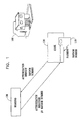
- Fig.1 is a simplified partly pictorial, partly block diagram illustration of a pay-for-electronic-item ordering system constructed and operative in accordance with a preferred embodiment of the present invention.
- a user (not shown) has removed, from the user's home location 100, a removable security element such as a smart card 110.
- a smart card 110 For the sake of simplicity of description and without limiting the generality of the present invention, the example of the smart card 110 will generally be described in the present specification.
- the smart card 110 will have been removed from an STB (not shown), as described above. It is appreciated, as described above, that the present invention is not limited to a home environment, but may be also be used in any other appropriate environment. It is further appreciated that, in an alternative preferred embodiment of the present invention, the smart card may be provided at a kiosk (see below), rather than having been previously removed from the user's home or from another user location.
- the smart card 110 preferably stores authorization information authorizing access to items to which the user is entitled.
- the system of Fig. 1 comprises a kiosk 120 or other automated or semi-automated interface device, preferably comprising an appropriate smart card reader (not shown in Fig. 1 ) adapted to receive the smart card 110.
- the kiosk 120 also preferably comprises appropriate communication apparatus (not shown in Fig. 1 ), such as communication apparatus well known in the art, for communicating with a broadcaster-controlled or content-provider-controlled center such as a headend 130. It is appreciated that communications between the kiosk 120 and the headend 130 may be via any suitable communications channel or channels, and may or may not be secured or otherwise protected from eavesdropping and alteration, using methods well known in the art.
- the user In order to purchase authorization for a particular item, the user (not shown) indicates a choice of item to the kiosk 120.
- the user's smart card 110 provides to the kiosk 120, typically when queried by the kiosk 120 or upon the user's indication of a choice of item:
- the kiosk 120 typically after confirming authenticity of the payment authorization, sends an authorization request and the random number to the headend 130.
- the kiosk 120 may also send its own payment authorization to the headend 130, or payment may be arranged by any other appropriate method.
- the headend 130 if it determines that it wishes to grant the requested authorization, transmits to the kiosk 120 an authorization disguised in some appropriate reversible way by the random number.
- the authorization comprises a number
- the kiosk 120 preferably passes the disguised authorization on to the smart card 110.
- the smart card 110 which has stored the random number as previously described, reverses the disguising operation to obtain the authorization.
- the smart card 110 comprises a secure device which has not been tampered with
- other similar smart cards also comprise secure devices which have not been tampered with
- disguising the authorization sent from the headend 130 prevents the authorization from being used by another smart card, other than the smart card 110, which has not paid for the authorization and does not have access to the random number.
- the user then returns home with the smart card 110 having the authorization and re-inserts the smart card 110 in the STB (not shown).
- the user is thus enabled to order a pay-per-view item anonymously, and to utilize the ordered item.
- FIG. 2 is a simplified block diagram illustration of a preferred implementation of the kiosk 120 of Fig. 1 .
- the apparatus of Fig. 2 is self-explanatory.
- FIG. 3 is a simplified flowchart illustration of a preferred method of operation of the system of Fig. 1 .
- the method of Fig. 3 comprising steps 200 - 270, is self-explanatory in light of the above discussion, except as described below.
Landscapes
- Engineering & Computer Science (AREA)
- Multimedia (AREA)
- Signal Processing (AREA)
- Computer Security & Cryptography (AREA)
- Computer Networks & Wireless Communication (AREA)
- Databases & Information Systems (AREA)
- Human Computer Interaction (AREA)
- Two-Way Televisions, Distribution Of Moving Picture Or The Like (AREA)
- Management, Administration, Business Operations System, And Electronic Commerce (AREA)
Description
- The present invention relates to pay television and related pay-for-electronic-item technologies generally, especially to pay-per-view systems.
- It is known in the prior art of pay television systems to be able to order pay-per-view items via a television system. Generally, a broadcaster or other content provider is informed of the items that are ordered, whether the items are pre-ordered or ordered on impulse for immediate viewing. In impulse pay-per-view systems, which allow ordering of an item without a real-time connection to the broadcaster, the broadcaster is later notified using, for example, a call-back mechanism as is well known in the art.
- Similarly, in the prior art, a subscriber to pay television may order a particular pay television service allowing the subscriber to view a plurality of items falling in a predefined category.
- Systems for scrambling a television data stream are well-known in the art. One such system is described in the following
US Patents: 5,282,249 to Cohen et al. ;5,481,609 to Cohen et al. Scrambled television data streams described in the Cohen et al patents comprise both scrambled data representing television signals and coded control messages, also known as ECMs. The ECMs of Cohen et al comprise, in a coded form, data necessary for generating a control word (CW) which may be used to descramble the scrambled data representing television signals. An ECM is also termed a control word packet or CWP. - While the two patents to Cohen et al describe an analog system, that is, a system in which analog television data streams are broadcast to television sets, it is appreciated that similar ECM methods may also be used for digital television data streams. Generally, the scrambling techniques used for scrambling analog television signals such as, for example, the well-known "cut-and-rotate" technique, are chosen for their applicability to analog signals. In scrambling of digital television signals other scrambling techniques, well-known in the art, are used, the techniques being more appropriate to digital signals such as, for example, applying the well-known DES algorithm to the digital television signals.
- References describing systems related to privacy in transmission of content include the following:
- An internet article entitled "Prepaid Smart Card Techniques - A Brief Introduction and Comparison, by D. Chaum at
- http://www.chaum.com/articles/Prepaid_Smart_Cad_Techniques.htm describes a method in which a system provider receives money in advance from users and stores the corresponding value onto the users' smart cards. After accepting stored value from the smart cards of users, retailers are periodically reimbursed with actual money by system providers.
- An internet article entitled "Security without Identification -Card Computers to make Big Brother Obsolete," by D. Chaum at
- http://www.chaum.com/articles/Security_Without_Identification.htm describes a method in which a personal "card computer" is used to handle consumer payments and transactions in a way which safeguards security and privacy.
- An internet article entitled "On Electronic Commerce - How Much do You Trust Big Brother?" by D. Chaum at
- http://computer.org/Internet/v1n6/w6chaum.htm describes a method for preventing invasion of privacy.
-
U.S. Patents 4,325,078 to Seaton et al describes a use of disposal magnetic cards for viewing a single broadcast. -
US Patent 6,169,975 to White et al describes a method for issuance of smart cards by a vending machine. -
US Patent 5,915,226 to Martineau describes a method of anonymous use of a prepaid smart card. -
US Patent 5,913,203 to Wong et al describes methods for guarding the privacy of Web payments through a third party. -
US Patents 4,987,593 and4,914,698 to Chaum describe a technique for issuing and showing blind digital signatures. -
US Patent 5,003,348 to Howitt describes impulse pay per view systems. -
PCT Patent Application WO 99/66714 to Peterka -
US Patent 5,731,576 to Valadier describes a method of transaction that replenishes a microprocessor-based card. -
US Patent 5,590,193 to Le Roux describes a method for securing access to detachable cards of the mass storage or I/O type using a password to encipher the address of the configuration register placed in the descriptor of the card, which descriptor is stored in a non-volatile memory of the card. -
US Patent 5,264,689 to Maes et al describes memory cards, which contain rechargeable memory, and are used as a means of prepayment in installations for the dispensing of products and services. -
US Patent 5,768,385 to Simon describes an untraceable electronic cash protocol one-way function f.sub.1 (x) to generate an image f.sub.1 (x.sub.1) from a preimage x.sub.1; sending the image f.sub.1 (x.sub.1) in an unblinded form to a second party; and receiving from the second party a note including a digital signature, wherein the note represents a commitment by the second party to credit a predetermined amount of money to a first presenter of the preimage x.sub.1 to the second party. -
US Patent 4,484,217 to Block et al which describes a method and system for providing subscription services, particularly subscription television services, involving transmissions from a remote location to a subscriber location for which payment is required for access. -
US Patent 6,126,069 to Stiefel et al describes anonymous use of and payment for, as well as collection of statistics, fee-based services, in particular Near-VOD services, employing a single chip card that can be used for all service providers. -
US Patent 6,009,465 to Decker et al describes a remote video delivery system, which transmits video and text from a hotel office to hotel rooms. -
US Patent 3,890,461 to Vogelman et al describes a subscription television receiver for receiving a scrambled television signal, which includes a card or ticket reader into which a ticket having a unique coding pattern is placed. -
US Patent 5,070,400 to Lieberman describes a technique in which a pay television subscriber pays for viewing credits which are transmitted to the subscriber equipment from a central office, and each program is associated with a pulse having a rate corresponding to the charge per unit time for that program, and the viewing credits are debited appropriately. -
US Patent 4,682,224 to Ragan et al describes a system for providing intelligible video program signals and corresponding video synchronization signals to authorized video displays only comprising transmitting means for transmitting scrambled signals of at least one video program; a receiver for receiving said scrambled video program signals for said at least one video program; and a descrambling unit coupled to said receiver and including an electronic ticket removably coupled to the input of said video receiver for intercepting and descrambling the at least one scrambled video program signal from said receiver and recovering the synchronizing signals, and means coupling the recovered synchronization sweep signals and the unscrambled intelligible video program signals to said video display. - D. Husemann. April-June 1999. The Smart Card: Don't Leave Home Without It. IEEE Concurrency, pp. 24-27.
- S. Dokko, J. Jeon, Y. Kim. An Implementation of Prepaid Service in CDMA PCS System. 5 pages. 1998, Proceedings of the IEEE International Conference on Networks.
- J. Dhem, D. Veithen, J. Quisquater. June 1996. SCALPS: Smart Card for Limited Payment Systems. IEEEMicro, pp. 42-50.
- M. Milenkovic. October-December 1998. Delivering Interactive Services via a Digital TV Infrastructure. IEEE Multimedia, pp. 34-43.
- An internet article entitled "The Disappearance of Telecommunications: Beyond the Physical" at
- http://www.ieee.org/organizations/pubs/press/authors/saracco/cap4_a pp.htm.
- An internet article entitled "Breaking Up is Hard to Do: Modeling Security Threats for Smart Cards" at
- http://www.usenix.net/publications/library/proceedings/smartcard99/f ull_papers/schneier/schneier_html/index.htm.
- An internet article entitled "Breaking Up is Hard to Do: Modeling Security Threats for Smart Cards" at
- http://www.usenix.net/event/smartcard99/full_papers/schneier/schneie r_html/index.html.
- An internet article entitled " Diffuse Guide To Electronic Payment" at http://www.diffuse.org/payguide.html.
- An internet article entitled "The Regulation of Conditional Access for Digital Television Services - Oftel Guidelines" at
- http://www.oftel.gov.uk/broadcast/conacc.htm.
- An internet article entitled "Interactivity in 2000: An Industry Viewpoint" at
- http://jiad.org/voll/nol/katz/index.html.
- An internet article entitled "Case Study - Putting Interactivity in Prime Time" at
- http://www.cardtechnology.com/jun00.htm.
- An internet article entitled " Online Shopper - Undercover Buying, Fake Names and All" at
- http://www.nytimes.com/2000/09/14/technology/14SHOP.html.
- An internet article entitled "Web Sites that Help Keep You Private" at http://www.nytimes.com/library/tech/00/06/biztech/technology/07priv.html.
- An internet article entitled "Broadcast Conditional Access" at http://www.cedmagazine.com/ced/9803/9803cc.htm.
- An internet article entitled "Subscription TV - It's Your Dime" at http://www.digitaltelevisiion.com/tvtoday/philipos/12.htm.
- It is know in the art to use prior art systems of the type described above for pay-per-view ordering.
- The disclosures of all references mentioned above and throughout the present specification are hereby incorporated herein by reference.
- The present invention seeks to provide an improved system for pay-per-view and pay-per-electronic-item ordering.
- The prior art does not provide a convenient way for pay-per-view ordering or ordering a subscription "anonymously", in which the broadcaster or content provider knows how many orders have been placed and controls ordering, but the broadcaster or content provider does not know who has ordered each item. Anonymous ordering of this type is believed to be particularly relevant when the content being ordered might be considered embarrassing to the consumer; for example, if "blue" movies are being ordered.
- In certain preferred embodiments, the present invention is particularly suited to systems, such as that described above in
US Patents 5,282,249 to Cohen et al. and5,481,609 to Cohen et al. , in which a removable security element, such as a smart card, is used to store entitlement data defining items or services to which a user of the system is entitled. For sake of simplicity of description, such a removable security element will be referred to in the present application as a "smart card", it being appreciated that any other appropriate form of removable security element may alternatively be used. - In a preferred embodiment of the present invention, the user removes a smart card from a set top box (STB) associated with the user's home television or entertainment system. The smart card may be the main smart card used with the STB, or may be a second or auxiliary smart card; systems using a second or auxiliary smart card are described, for example, in the following US Patents:
- It is appreciated that the present invention is not limited to a home environment, but may be also be used in any other appropriate environment ; without limiting the generality of the foregoing and for the sake of simplicity of description, a home environment is generally described in the present specification.
- The user then preferably takes the smart card to an ordering location, such as a manned or unmanned kiosk.
- It is appreciated that, in an alternative preferred embodiment of the present invention, the smart card may be provided at the kiosk rather than having been previously removed from the user's home or from another user location.
- At the kiosk, an authorization for the desired item is preferably provided to the smart card. Communication is preferably maintained with the broadcaster or other content provider in order to ensure that the broadcaster or other content provider knows how many consumers have ordered the item, and preferably to prevent certain kinds of cheating, such as sharing a single authorization among a plurality of users.
- The user then preferably returns home with the smart card having the authorization and re-inserts the smart card in the STB.
- The user is thus enabled to order a pay-per-view item anonymously, and to utilize the anonymously ordered item.
-
WO-A-00/57636 - The invention is characterised in accordance with claims 1 and 11.
- The removable security element may comprise a smart card.
- The ordering may also comprise, removing the removable security element from removable operative association with the interface device.
- The method may also comprise, before the ordering, removing the removable security element from removable operative association with a set top box (STB).
- The method may also comprise, after the ordering, placing the removable security element in removable operative association with the STB.
- The method may also comprise, utilizing the item with the STB.
- The authorization request may comprise a disguising number, and the authorization comprises an authorization disguised with the disguising number.
- The method may also comprise, the interface device sends the disguising number to the headend; and the authorization received by the interface device from the headend is disguised with the disguising number.
- The pay-per-item system may comprise a pay television system.
- The item may comprise a pay-per-view item.
- The item may comprise a subscription.
- The invention also provides an interface device comprising a removable security element communicator for communicating with a removable security element; and an authorization provider for providing an authorization for an item to the removable security element via the removable security element communicator, the authorization provider comprising communication apparatus for communicating with a headend, characterized in that the authorization provider sends an intermediary authorization request to the headend via the communication apparatus and receives the authorization from the headend via the communication apparatus.
- The removable security element communicator may receive a disguising number from the removable security element and sends the disguising number to the authorization provider, and the intermediary authorization request comprises the disguising number, and the authorization comprises a disguised authorization disguised with the disguising number.
- The removable security element may comprise a smart card.
- The item may be utilizable as part of a pay-per-item system.
- The pay-per-item system may comprise a pay television system.
- The item may comprise a pay-per-view item.
- The item may comprise a subscription.
- The present invention will be understood and appreciated more fully from the following detailed description, taken in conjunction with the drawings in which:
-
Fig.1 is a simplified partly pictorial, partly block diagram illustration of a pay-for-electronic-item ordering system constructed and operative in accordance with a preferred embodiment of the present invention ; -
Fig. 2 is a simplified block diagram illustration of a preferred implementation of a portion of the apparatus ofFig. 1 ; and -
Fig. 3 is a simplified flowchart illustration of a preferred method of operation of the system ofFig. 1 . - Reference is now made to
Fig.1 , which is a simplified partly pictorial, partly block diagram illustration of a pay-for-electronic-item ordering system constructed and operative in accordance with a preferred embodiment of the present invention. In the system ofFig.1 , which, as described above, is particularly useful for ordering items for use with a home-based pay television or other pay entertainment system, a user (not shown) has removed, from the user'shome location 100, a removable security element such as asmart card 110. For the sake of simplicity of description and without limiting the generality of the present invention, the example of thesmart card 110 will generally be described in the present specification. - Typically, as described above, the
smart card 110 will have been removed from an STB (not shown), as described above. It is appreciated, as described above, that the present invention is not limited to a home environment, but may be also be used in any other appropriate environment. It is further appreciated that, in an alternative preferred embodiment of the present invention, the smart card may be provided at a kiosk (see below), rather than having been previously removed from the user's home or from another user location. - As described above and as is well-known in the art, the
smart card 110 preferably stores authorization information authorizing access to items to which the user is entitled. - The system of
Fig. 1 comprises akiosk 120 or other automated or semi-automated interface device, preferably comprising an appropriate smart card reader (not shown inFig. 1 ) adapted to receive thesmart card 110. Thekiosk 120 also preferably comprises appropriate communication apparatus (not shown inFig. 1 ), such as communication apparatus well known in the art, for communicating with a broadcaster-controlled or content-provider-controlled center such as aheadend 130. It is appreciated that communications between thekiosk 120 and theheadend 130 may be via any suitable communications channel or channels, and may or may not be secured or otherwise protected from eavesdropping and alteration, using methods well known in the art. - The operation of the system of
Fig. 1 is now briefly described. - In order to purchase authorization for a particular item, the user (not shown) indicates a choice of item to the
kiosk 120. The user'ssmart card 110 provides to thekiosk 120, typically when queried by thekiosk 120 or upon the user's indication of a choice of item: - 1. payment for the item, typically comprising any appropriate payment authorization; by way of example only, such payment authorization may include debit card or credit card payment authorization; and
- 2. a random or pseudo-random number generated by the
smart card 110 and then stored in a memory (not shown) thereof. - The
kiosk 120, typically after confirming authenticity of the payment authorization, sends an authorization request and the random number to theheadend 130. Thekiosk 120 may also send its own payment authorization to theheadend 130, or payment may be arranged by any other appropriate method. - The
headend 130, if it determines that it wishes to grant the requested authorization, transmits to thekiosk 120 an authorization disguised in some appropriate reversible way by the random number. For example, and without limiting the generality of the foregoing, if the authorization comprises a number, the disguised authorization may comprise the authorization XOR the random number, where "XOR" represents an exclusive-OR operation. It is appreciated that, for a known random number r, an XOR operation using r is reversible, since:
- The
kiosk 120 preferably passes the disguised authorization on to thesmart card 110. Thesmart card 110, which has stored the random number as previously described, reverses the disguising operation to obtain the authorization. - It is appreciated that, in a case where the
smart card 110 comprises a secure device which has not been tampered with, and other similar smart cards (not shown) also comprise secure devices which have not been tampered with, disguising the authorization sent from theheadend 130 prevents the authorization from being used by another smart card, other than thesmart card 110, which has not paid for the authorization and does not have access to the random number. - Preferably, the user then returns home with the
smart card 110 having the authorization and re-inserts thesmart card 110 in the STB (not shown). - The user is thus enabled to order a pay-per-view item anonymously, and to utilize the ordered item.
- Reference is now made to
Fig. 2 , which is a simplified block diagram illustration of a preferred implementation of thekiosk 120 ofFig. 1 . The apparatus ofFig. 2 is self-explanatory. - Reference is now made to
Fig. 3 , which is a simplified flowchart illustration of a preferred method of operation of the system ofFig. 1 . The method ofFig. 3 , comprising steps 200 - 270, is self-explanatory in light of the above discussion, except as described below. - It is appreciated that other alternative preferred methods of operation of the system of
Fig. 1 may include various appropriate portions of the method ofFig. 3 , such as, for example: - a) a method comprising steps 210 - 260 of
Fig. 3 , and not comprising the other steps ofFig. 3 ; - b) a method similar to the method of
Fig. 3 , but without the use of disguising using a random number; and - It is appreciated that various features of the invention which are, for clarity, described in the contexts of separate embodiments may also be provided in combination in a single embodiment. Conversely, various features of the invention which are, for brevity, described in the context of a single embodiment may also be provided separately or in any suitable subcombination.
- It will be appreciated by persons skilled in the art that the present invention is not limited by what has been particularly shown and described hereinabove. Rather, the scope of the present invention is defined only by the claims which follow:
Claims (17)
- A method of operating an interface device for anonymously ordering an item, the method comprising:receiving a removable security element (110) in removable operative association with the interface device (120); andproviding to the removable security element (110) an authorization for utilizing the item from the interface device (120),
characterized in that the interface device supplies the removable security element (110) with the authorization by:receiving an authorization request from the removable security element (110) at the interface device (120);the interface device (120) sending an intermediary authorization request to a headend (130);the interface device (120) receiving the authorization from the headend(130); andthe interface device (120) sending the authorization to the removable security element (110);the method further comprising removing the removable security element (110) from removable operative association with the interface device (120) for subsequent use at another user location. - The method according to claim 1 and wherein the removable security element (110) comprises a smart card.
- The method according to any of claims 1 or 2 and also comprising:before the ordering, removing the removable security element (110) from removable operative association with a set top box (STB).
- The method according to claim 1, 2 or 3, and also comprising:after the ordering, placing the removable security element (110) in removable operative association with the STB.
- The method according to claim 4 and also comprising:utilizing the item with the STB.
- The method according to any of claims 1 - 5 and wherein the authorization request comprises a disguising number, and
the authorization comprises an authorization disguised with the disguising number. - The method according to claim 6 and also comprising:the interface device (120) sends the disguising number to the headend (130); andthe authorization received by the interface device (120) from the headend (130) is disguised with the disguising number.
- The method according to any of claims 1 - 7 and wherein the pay-per-item system comprises a pay television system.
- The method according to claim 8 and wherein the item comprises a pay-per-view item.
- The method according to claim 8 and wherein the item comprises a subscription.
- An interface device (120) comprising:a removable security element communicator for communicating with a removable security element (110); andan authorization provider for providing an authorization for an item to the removable security element (110) via the removable security element communicator, the authorisation provider comprising communication apparatus for communicating with a headend (130),characterized in that the interface is arranged to supply the authorisation to the removable security element by:receiving an authorisation request from a removable security element;the authorization provider sending an intermediary authorization request to the headend (130) via the communication apparatus;receiving the authorization from the headend (130) via the communication apparatus; andsending the authorization to a removable security element (110);whereby a removable security element (110) is removable from operative association with the interface device (120) for subsequent use at another user location.
- Apparatus according to claim 11 and wherein the removable security element communicator is arranged to receive a disguising number from the removable security element (110) and to send the disguising number to the authorization provider, and
the intermediary authorization request comprises the disguising number, and
the authorization comprises a disguised authorization disguised with the disguising number. - Apparatus according to claim 11 or claim 12 and wherein the removable security element (110) comprises a smart card.
- Apparatus according to any of claims 12 - 14 and wherein the item is utilizable as part of a pay-per-item system.
- Apparatus according to claim 14 and wherein the pay-per-item system comprises a pay television system.
- Apparatus according to claim 15 and wherein the item comprises a pay-per-view item.
- Apparatus according to claim 15 and wherein the item comprises a subscription.
Applications Claiming Priority (3)
| Application Number | Priority Date | Filing Date | Title |
|---|---|---|---|
| US29761901P | 2001-06-11 | 2001-06-11 | |
| US297619P | 2001-06-11 | ||
| PCT/IL2001/001048 WO2002100150A2 (en) | 2001-06-11 | 2001-11-12 | Anonymous ordering system |
Publications (2)
| Publication Number | Publication Date |
|---|---|
| EP1405517A2 EP1405517A2 (en) | 2004-04-07 |
| EP1405517B1 true EP1405517B1 (en) | 2013-01-02 |
Family
ID=23147066
Family Applications (1)
| Application Number | Title | Priority Date | Filing Date |
|---|---|---|---|
| EP01274300A Expired - Lifetime EP1405517B1 (en) | 2001-06-11 | 2001-11-12 | Anonymous ordering system |
Country Status (5)
| Country | Link |
|---|---|
| US (1) | US20040111751A1 (en) |
| EP (1) | EP1405517B1 (en) |
| AU (1) | AU2002223993A1 (en) |
| IL (1) | IL157796A0 (en) |
| WO (1) | WO2002100150A2 (en) |
Families Citing this family (10)
| Publication number | Priority date | Publication date | Assignee | Title |
|---|---|---|---|---|
| US8851369B2 (en) | 1999-11-05 | 2014-10-07 | Lead Core Fund, L.L.C. | Systems and methods for transaction processing using a smartcard |
| US8250225B1 (en) | 2003-10-14 | 2012-08-21 | Paradox Technical Solutions Llc | Generation of suffixes for pseudo e-mail addresses |
| US7567936B1 (en) | 2003-10-14 | 2009-07-28 | Paradox Technical Solutions Llc | Method and apparatus for handling pseudo identities |
| US8001047B2 (en) * | 2004-06-18 | 2011-08-16 | Paradox Technical Solutions Llc | Method and apparatus for effecting payment |
| SE0500541L (en) * | 2005-03-08 | 2006-09-09 | Inator Kb | Authorization system and method |
| US20070261069A1 (en) * | 2006-05-05 | 2007-11-08 | Petrisor Gregory C | Search, selection and charge methods for on the go video content distribution system |
| JP4855150B2 (en) * | 2006-06-09 | 2012-01-18 | 株式会社トプコン | Fundus observation apparatus, ophthalmic image processing apparatus, and ophthalmic image processing program |
| US8644511B2 (en) * | 2008-11-05 | 2014-02-04 | Comcast Cable Communications, LLC. | System and method for providing digital content |
| IL217478A0 (en) | 2012-01-10 | 2012-03-29 | Nds Ltd | Anonymous authentication |
| RU2703953C1 (en) * | 2018-06-14 | 2019-10-22 | Мастеркард Интернэшнл Инкорпорейтед | System and a computer-implemented method for decoding data when switching between jurisdictions in payment systems |
Family Cites Families (27)
| Publication number | Priority date | Publication date | Assignee | Title |
|---|---|---|---|---|
| US3890461A (en) * | 1973-03-27 | 1975-06-17 | Theatrevision Inc | Ticket operated subscription television receiver |
| US4325078A (en) * | 1978-12-14 | 1982-04-13 | The Telemine Company, Inc. | Pay per view television control device |
| US4484217A (en) * | 1982-05-11 | 1984-11-20 | Telease, Inc. | Method and system for remote reporting, particularly for pay television billing |
| US4682224A (en) * | 1983-10-31 | 1987-07-21 | R. F. Monolithics, Inc. | System, method, and apparatus for television signal scrambling and descrambling |
| US5070400A (en) * | 1987-06-30 | 1991-12-03 | Comsat | Pay-tv time purchase scheme |
| US4987593A (en) * | 1988-03-16 | 1991-01-22 | David Chaum | One-show blind signature systems |
| US5003384A (en) * | 1988-04-01 | 1991-03-26 | Scientific Atlanta, Inc. | Set-top interface transactions in an impulse pay per view television system |
| US5264689A (en) * | 1989-01-11 | 1993-11-23 | Gemplus Card International | Rechargeable prepaid memory card with both unit and page counters |
| FR2716021B1 (en) * | 1994-02-09 | 1996-04-12 | Gemplus Card Int | Chip card transaction method and system. |
| FR2719680B1 (en) * | 1994-05-05 | 1996-07-12 | Gemplus Card Int | Method for securing access to removable cards for computer. |
| US5758257A (en) * | 1994-11-29 | 1998-05-26 | Herz; Frederick | System and method for scheduling broadcast of and access to video programs and other data using customer profiles |
| FR2735261B1 (en) * | 1995-06-08 | 1997-07-11 | France Telecom | METHOD OF MAKING A PAYMENT USING AN ACCOUNT MANAGER |
| US5768385A (en) * | 1995-08-29 | 1998-06-16 | Microsoft Corporation | Untraceable electronic cash |
| US6009465A (en) * | 1996-01-22 | 1999-12-28 | Svi Systems, Inc. | Entertainment and information systems and related management networks for a remote video delivery system |
| US5973756A (en) * | 1996-02-06 | 1999-10-26 | Fca Corporation | IR Transmitter with integral magnetic-stripe ATM type credit card reader & method therefor |
| DE19604691A1 (en) * | 1996-02-09 | 1997-08-14 | Sel Alcatel Ag | Chip card, method and system for using paid services |
| US6055314A (en) * | 1996-03-22 | 2000-04-25 | Microsoft Corporation | System and method for secure purchase and delivery of video content programs |
| US5915226A (en) * | 1996-04-19 | 1999-06-22 | Gemplus Card International | Prepaid smart card in a GSM based wireless telephone network and method for operating prepaid cards |
| ATE206228T1 (en) * | 1996-07-09 | 2001-10-15 | Ldc Direct Ltd Co | SALES SYSTEM FOR PREPAID CARDS IN SALES OFFICE |
| US5913203A (en) * | 1996-10-03 | 1999-06-15 | Jaesent Inc. | System and method for pseudo cash transactions |
| US6339765B1 (en) * | 1997-11-13 | 2002-01-15 | At&T Corp. | Method and apparatus for defining private currencies |
| US6267672B1 (en) * | 1998-10-21 | 2001-07-31 | Ayecon Entertainment, L.L.C. | Product sales enhancing internet game system |
| US6304969B1 (en) * | 1999-03-16 | 2001-10-16 | Webiv Networks, Inc. | Verification of server authorization to provide network resources |
| WO2000057637A1 (en) * | 1999-03-24 | 2000-09-28 | Microsoft Corporation | Associating content with households using smart cards |
| US6955299B1 (en) * | 1999-12-17 | 2005-10-18 | Centre For Wireless Communications Of National University Of Singapore | System and method for using a smart card |
| US7003789B1 (en) * | 1999-12-21 | 2006-02-21 | International Business Machines Corporation | Television commerce payments |
| US20020116337A1 (en) * | 2001-02-20 | 2002-08-22 | Ariel Peled | System for anonymous distribution and delivery of digital goods |
-
2001
- 2001-11-12 US US10/471,380 patent/US20040111751A1/en not_active Abandoned
- 2001-11-12 EP EP01274300A patent/EP1405517B1/en not_active Expired - Lifetime
- 2001-11-12 IL IL15779601A patent/IL157796A0/en unknown
- 2001-11-12 AU AU2002223993A patent/AU2002223993A1/en not_active Abandoned
- 2001-11-12 WO PCT/IL2001/001048 patent/WO2002100150A2/en not_active Ceased
Also Published As
| Publication number | Publication date |
|---|---|
| IL157796A0 (en) | 2004-03-28 |
| WO2002100150A2 (en) | 2002-12-19 |
| WO2002100150A3 (en) | 2003-02-27 |
| AU2002223993A1 (en) | 2002-12-23 |
| US20040111751A1 (en) | 2004-06-10 |
| EP1405517A2 (en) | 2004-04-07 |
Similar Documents
| Publication | Publication Date | Title |
|---|---|---|
| AU745304B2 (en) | Interactive gaming system | |
| EP0968608B1 (en) | Receiver/decoder and method of reception | |
| EP0968607B1 (en) | Smartcard for use with a receiver of encrypted broadcast signals, and receiver | |
| AU754166B2 (en) | Broadcast and reception system, and conditional access system therefor | |
| JP4409940B2 (en) | Interactive information service system and associated method for capturing transaction data | |
| AU745783B2 (en) | Signal generation and broadcasting | |
| WO2013061174A2 (en) | Two-dimensional barcode system | |
| GB2329736A (en) | Television subscriber equipment | |
| ZA200304817B (en) | Match control method. | |
| AU2003220751B2 (en) | Transaction System | |
| US20040111751A1 (en) | Anonymous ordering system | |
| KR100663127B1 (en) | Payment processing method and system using digital TV set top box and mobile terminal | |
| KR20050092532A (en) | Apparatus and method for providing interactive television service using personal authentication | |
| AU770198B2 (en) | Broadcast and reception system, and receiver/decoder and remote controller therefor | |
| HK1044659A1 (en) | Broadcast and reception system, and receiver/decoder and remote controller therefor | |
| HK1024807B (en) | Receiver/decoder and method of reception | |
| HK1030178B (en) | Interactive gaming system | |
| HK1024806B (en) | Smartcard for use with a receiver of encrypted broadcast signals, and receiver | |
| HK1061941A (en) | Transaction system |
Legal Events
| Date | Code | Title | Description |
|---|---|---|---|
| PUAI | Public reference made under article 153(3) epc to a published international application that has entered the european phase |
Free format text: ORIGINAL CODE: 0009012 |
|
| 17P | Request for examination filed |
Effective date: 20030909 |
|
| AK | Designated contracting states |
Kind code of ref document: A2 Designated state(s): AT BE CH CY DE DK ES FI FR GB GR IE IT LI LU MC NL PT SE TR |
|
| AX | Request for extension of the european patent |
Extension state: AL LT LV MK RO SI |
|
| 17Q | First examination report despatched |
Effective date: 20061221 |
|
| 111Z | Information provided on other rights and legal means of execution |
Free format text: AT BE CH CY DE DK ES FI FR GB GR IE IT LU MC NL PT SE TR Effective date: 20090430 |
|
| RAP1 | Party data changed (applicant data changed or rights of an application transferred) |
Owner name: NDS LIMITED |
|
| GRAP | Despatch of communication of intention to grant a patent |
Free format text: ORIGINAL CODE: EPIDOSNIGR1 |
|
| D11X | Information provided on other rights and legal means of execution (deleted) | ||
| GRAS | Grant fee paid |
Free format text: ORIGINAL CODE: EPIDOSNIGR3 |
|
| GRAA | (expected) grant |
Free format text: ORIGINAL CODE: 0009210 |
|
| AK | Designated contracting states |
Kind code of ref document: B1 Designated state(s): AT BE CH CY DE DK ES FI FR GB GR IE IT LI LU MC NL PT SE TR |
|
| REG | Reference to a national code |
Ref country code: GB Ref legal event code: FG4D |
|
| REG | Reference to a national code |
Ref country code: AT Ref legal event code: REF Ref document number: 592150 Country of ref document: AT Kind code of ref document: T Effective date: 20130115 Ref country code: CH Ref legal event code: EP |
|
| REG | Reference to a national code |
Ref country code: IE Ref legal event code: FG4D |
|
| REG | Reference to a national code |
Ref country code: DE Ref legal event code: R096 Ref document number: 60147546 Country of ref document: DE Effective date: 20130228 |
|
| REG | Reference to a national code |
Ref country code: AT Ref legal event code: MK05 Ref document number: 592150 Country of ref document: AT Kind code of ref document: T Effective date: 20130102 Ref country code: NL Ref legal event code: T3 |
|
| PG25 | Lapsed in a contracting state [announced via postgrant information from national office to epo] |
Ref country code: CY Free format text: LAPSE BECAUSE OF FAILURE TO SUBMIT A TRANSLATION OF THE DESCRIPTION OR TO PAY THE FEE WITHIN THE PRESCRIBED TIME-LIMIT Effective date: 20130102 Ref country code: SE Free format text: LAPSE BECAUSE OF FAILURE TO SUBMIT A TRANSLATION OF THE DESCRIPTION OR TO PAY THE FEE WITHIN THE PRESCRIBED TIME-LIMIT Effective date: 20130102 Ref country code: BE Free format text: LAPSE BECAUSE OF FAILURE TO SUBMIT A TRANSLATION OF THE DESCRIPTION OR TO PAY THE FEE WITHIN THE PRESCRIBED TIME-LIMIT Effective date: 20130102 Ref country code: ES Free format text: LAPSE BECAUSE OF FAILURE TO SUBMIT A TRANSLATION OF THE DESCRIPTION OR TO PAY THE FEE WITHIN THE PRESCRIBED TIME-LIMIT Effective date: 20130413 Ref country code: AT Free format text: LAPSE BECAUSE OF FAILURE TO SUBMIT A TRANSLATION OF THE DESCRIPTION OR TO PAY THE FEE WITHIN THE PRESCRIBED TIME-LIMIT Effective date: 20130102 |
|
| PG25 | Lapsed in a contracting state [announced via postgrant information from national office to epo] |
Ref country code: GR Free format text: LAPSE BECAUSE OF FAILURE TO SUBMIT A TRANSLATION OF THE DESCRIPTION OR TO PAY THE FEE WITHIN THE PRESCRIBED TIME-LIMIT Effective date: 20130403 Ref country code: FI Free format text: LAPSE BECAUSE OF FAILURE TO SUBMIT A TRANSLATION OF THE DESCRIPTION OR TO PAY THE FEE WITHIN THE PRESCRIBED TIME-LIMIT Effective date: 20130102 Ref country code: PT Free format text: LAPSE BECAUSE OF FAILURE TO SUBMIT A TRANSLATION OF THE DESCRIPTION OR TO PAY THE FEE WITHIN THE PRESCRIBED TIME-LIMIT Effective date: 20130502 |
|
| PG25 | Lapsed in a contracting state [announced via postgrant information from national office to epo] |
Ref country code: DK Free format text: LAPSE BECAUSE OF FAILURE TO SUBMIT A TRANSLATION OF THE DESCRIPTION OR TO PAY THE FEE WITHIN THE PRESCRIBED TIME-LIMIT Effective date: 20130102 |
|
| PLBE | No opposition filed within time limit |
Free format text: ORIGINAL CODE: 0009261 |
|
| STAA | Information on the status of an ep patent application or granted ep patent |
Free format text: STATUS: NO OPPOSITION FILED WITHIN TIME LIMIT |
|
| 26N | No opposition filed |
Effective date: 20131003 |
|
| REG | Reference to a national code |
Ref country code: DE Ref legal event code: R097 Ref document number: 60147546 Country of ref document: DE Effective date: 20131003 |
|
| PG25 | Lapsed in a contracting state [announced via postgrant information from national office to epo] |
Ref country code: MC Free format text: LAPSE BECAUSE OF FAILURE TO SUBMIT A TRANSLATION OF THE DESCRIPTION OR TO PAY THE FEE WITHIN THE PRESCRIBED TIME-LIMIT Effective date: 20130102 |
|
| REG | Reference to a national code |
Ref country code: IE Ref legal event code: MM4A |
|
| PG25 | Lapsed in a contracting state [announced via postgrant information from national office to epo] |
Ref country code: IE Free format text: LAPSE BECAUSE OF NON-PAYMENT OF DUE FEES Effective date: 20131112 |
|
| PG25 | Lapsed in a contracting state [announced via postgrant information from national office to epo] |
Ref country code: TR Free format text: LAPSE BECAUSE OF FAILURE TO SUBMIT A TRANSLATION OF THE DESCRIPTION OR TO PAY THE FEE WITHIN THE PRESCRIBED TIME-LIMIT Effective date: 20130102 |
|
| PG25 | Lapsed in a contracting state [announced via postgrant information from national office to epo] |
Ref country code: LU Free format text: LAPSE BECAUSE OF NON-PAYMENT OF DUE FEES Effective date: 20131112 |
|
| REG | Reference to a national code |
Ref country code: FR Ref legal event code: PLFP Year of fee payment: 15 |
|
| PGFP | Annual fee paid to national office [announced via postgrant information from national office to epo] |
Ref country code: CH Payment date: 20151127 Year of fee payment: 15 Ref country code: IT Payment date: 20151124 Year of fee payment: 15 |
|
| PGFP | Annual fee paid to national office [announced via postgrant information from national office to epo] |
Ref country code: NL Payment date: 20151126 Year of fee payment: 15 |
|
| REG | Reference to a national code |
Ref country code: FR Ref legal event code: PLFP Year of fee payment: 16 |
|
| REG | Reference to a national code |
Ref country code: CH Ref legal event code: PL |
|
| REG | Reference to a national code |
Ref country code: NL Ref legal event code: MM Effective date: 20161201 |
|
| PG25 | Lapsed in a contracting state [announced via postgrant information from national office to epo] |
Ref country code: CH Free format text: LAPSE BECAUSE OF NON-PAYMENT OF DUE FEES Effective date: 20161130 Ref country code: LI Free format text: LAPSE BECAUSE OF NON-PAYMENT OF DUE FEES Effective date: 20161130 |
|
| PG25 | Lapsed in a contracting state [announced via postgrant information from national office to epo] |
Ref country code: NL Free format text: LAPSE BECAUSE OF NON-PAYMENT OF DUE FEES Effective date: 20161201 |
|
| PG25 | Lapsed in a contracting state [announced via postgrant information from national office to epo] |
Ref country code: IT Free format text: LAPSE BECAUSE OF NON-PAYMENT OF DUE FEES Effective date: 20161112 |
|
| REG | Reference to a national code |
Ref country code: FR Ref legal event code: PLFP Year of fee payment: 17 |
|
| REG | Reference to a national code |
Ref country code: DE Ref legal event code: R082 Ref document number: 60147546 Country of ref document: DE Representative=s name: MARKS & CLERK (LUXEMBOURG) LLP, LU Ref country code: DE Ref legal event code: R081 Ref document number: 60147546 Country of ref document: DE Owner name: SYNAMEDIA LIMITED, STAINES, GB Free format text: FORMER OWNER: NDS LTD., STAINES, MIDDLESEX, GB |
|
| PGFP | Annual fee paid to national office [announced via postgrant information from national office to epo] |
Ref country code: DE Payment date: 20201127 Year of fee payment: 20 Ref country code: FR Payment date: 20201125 Year of fee payment: 20 Ref country code: GB Payment date: 20201127 Year of fee payment: 20 |
|
| REG | Reference to a national code |
Ref country code: DE Ref legal event code: R071 Ref document number: 60147546 Country of ref document: DE |
|
| REG | Reference to a national code |
Ref country code: GB Ref legal event code: PE20 Expiry date: 20211111 |
|
| PG25 | Lapsed in a contracting state [announced via postgrant information from national office to epo] |
Ref country code: GB Free format text: LAPSE BECAUSE OF EXPIRATION OF PROTECTION Effective date: 20211111 |