EP1404088A1 - Cell phone - Google Patents
Cell phone Download PDFInfo
- Publication number
- EP1404088A1 EP1404088A1 EP02738875A EP02738875A EP1404088A1 EP 1404088 A1 EP1404088 A1 EP 1404088A1 EP 02738875 A EP02738875 A EP 02738875A EP 02738875 A EP02738875 A EP 02738875A EP 1404088 A1 EP1404088 A1 EP 1404088A1
- Authority
- EP
- European Patent Office
- Prior art keywords
- casing
- hinge
- display
- axis
- mobile telephone
- Prior art date
- Legal status (The legal status is an assumption and is not a legal conclusion. Google has not performed a legal analysis and makes no representation as to the accuracy of the status listed.)
- Withdrawn
Links
Images

Classifications
-
- H—ELECTRICITY
- H04—ELECTRIC COMMUNICATION TECHNIQUE
- H04M—TELEPHONIC COMMUNICATION
- H04M1/00—Substation equipment, e.g. for use by subscribers
- H04M1/02—Constructional features of telephone sets
- H04M1/0202—Portable telephone sets, e.g. cordless phones, mobile phones or bar type handsets
- H04M1/0206—Portable telephones comprising a plurality of mechanically joined movable body parts, e.g. hinged housings
- H04M1/0208—Portable telephones comprising a plurality of mechanically joined movable body parts, e.g. hinged housings characterized by the relative motions of the body parts
- H04M1/0214—Foldable telephones, i.e. with body parts pivoting to an open position around an axis parallel to the plane they define in closed position
-
- H—ELECTRICITY
- H04—ELECTRIC COMMUNICATION TECHNIQUE
- H04M—TELEPHONIC COMMUNICATION
- H04M1/00—Substation equipment, e.g. for use by subscribers
- H04M1/02—Constructional features of telephone sets
- H04M1/0202—Portable telephone sets, e.g. cordless phones, mobile phones or bar type handsets
- H04M1/0206—Portable telephones comprising a plurality of mechanically joined movable body parts, e.g. hinged housings
- H04M1/0208—Portable telephones comprising a plurality of mechanically joined movable body parts, e.g. hinged housings characterized by the relative motions of the body parts
- H04M1/0214—Foldable telephones, i.e. with body parts pivoting to an open position around an axis parallel to the plane they define in closed position
- H04M1/0216—Foldable in one direction, i.e. using a one degree of freedom hinge
- H04M1/0218—The hinge comprising input and/or output user interface means
-
- H—ELECTRICITY
- H04—ELECTRIC COMMUNICATION TECHNIQUE
- H04M—TELEPHONIC COMMUNICATION
- H04M1/00—Substation equipment, e.g. for use by subscribers
- H04M1/72—Mobile telephones; Cordless telephones, i.e. devices for establishing wireless links to base stations without route selection
- H04M1/724—User interfaces specially adapted for cordless or mobile telephones
-
- H—ELECTRICITY
- H04—ELECTRIC COMMUNICATION TECHNIQUE
- H04M—TELEPHONIC COMMUNICATION
- H04M2250/00—Details of telephonic subscriber devices
- H04M2250/16—Details of telephonic subscriber devices including more than one display unit
Definitions
- the present invention relates to mobile telephones that can effectively utilize their displays.
- folding-type mobile telephones are inconvenient in that, when folded, a main display cannot be directly viewed from the outside, and it is not possible to quickly view necessary information about incoming calls. Therefore, in order to be able to view minimal information for incoming calls and similar situations even when in the folded state, there are mobile telephones that have a sub-display provided in the outer face of the casing.
- Japanese Patent Laid-Open No. 1999-088483 discloses a mobile telephone that does not have a sub-display.
- this mobile telephone since a display is provided in a narrow space below the hinge and above the operation keys, there is a problem in that only a small display is feasible.
- the present invention has as an object the provision of a mobile telephone that solves these problems and enables effective display utilization.
- a mobile communications device comprises a mobile telephone having: a first casing and a second casing rotatably connected by a hinge as an axis; the first casing having an opposing face opposite one face of the second casing when the first casing and the second casing are folded in two into a closed state; wherein the first casing has a display for displaying text or images on an exposed part close to the hinge on the opposing face and exposed by the second casing when in a folded state; and the second casing is provided with an opening at a position overlapping the exposed part when the first casing and the second casing are in an open state, with the hinge as the axis.
- the first casing is provided with a selector for selecting information displayed on the display in the exposed part
- the second casing has the opening at a position overlapping the selector when the first casing and the second casing are folded in two into the closed state, with the hinge as axis.
- the edge of the opening touches, at a position away from the axis of the hinge, on the surface of the first casing, and thus the hinge together with the second casing are supported.
- the first casing having an opposing face opposite one face of the second casing when the first casing and the second casing are folded in two into a closed state
- the first casing has a display for displaying text or images close to the hinge on the opposing face
- the second casing is provided with an opening at a position overlapping the display when the first casing and the second casing are folded in two into a closed state, with the hinge as the axis; and the hinge supports both edges of the opening.
- the display is arranged to overlap the axis of the hinge.
- Fig. 1 is a front view illustrating the external appearance of a mobile telephone according to Embodiment 1.
- Fig. 1(a) illustrates an upper casing of the folding casing, in an open state with regard to a lower casing, with a hinge as axis
- Fig. 1(b) illustrates the upper casing in a closed state.
- reference numeral 1 indicates the lower casing of the folding mobile telephone
- reference numeral 2 indicates the upper casing of the mobile telephone
- the mobile telephone is configured so that it can open and close rotatably about the hinge 10 as center.
- an opening is provided so that the hinge 10 edge of the upper casing 2 does not cover a sub-display 7 on the lower casing.
- Reference numeral 3 indicates a microphone, arranged at the lower edge of the front face of the lower casing 1, that converts a user's voice into electrical signals
- reference numeral 4 indicates a speaker, arranged at the upper edge of the front face of the upper casing 2, that outputs the voice of the communication partner
- reference numeral 5 indicates a selector, arranged on the lower casing 1, for choosing from menus or similar displayed on a main display 6 or the sub-display 7
- reference numeral 6 indicates the main display, arranged on the upper casing 2, for displaying text or graphic information generated within the mobile telephone, or information obtained externally through a network
- reference numeral 7 indicates the sub-display for displaying a menu for dialing, other text information, or graphic information
- reference numeral 8 indicates a camera
- reference numeral 9 indicates numeric keys for inputting text.
- Fig. 1(a) illustrates the state in which the upper casing 2 is open, and the sub-display 7, in this state, faces out with the front face of the lower casing 1, that is, the face with the numeric keys 9.
- the upper casing 2 is provided with an opening 2a at a position overlapping an exposed part 1a of the lower casing 1 when the lower casing 1 and the upper casing 2 are in the open state with the hinge 10 as axis. Therefore, during usage with the casing in the open state, due to the opening 2a, the upper casing 2 does not cover or hide the display 7, and thus a user of this mobile telephone can operate the numeric keys or the selector 5 while viewing the sub-display 7. In addition, the user can carry out internet browsing, dialing operations, or similar, while viewing the sub-casing 7.
- the mobile telephone user can use the main display 6 and the sub-display 7 at the same time. Therefore, as an example, while displaying an image of one's own face taken by the camera on the sub-display 7, it is possible to display images, such as that of a communication partner's face, sent from the communication partner, on the main display 6.
- Fig. 1(b) illustrates the state where the upper casing 2 is closed with respect to the lower casing 1, that is, in a folded state.
- the upper casing 2 does not cover the sub-display 7, due to the opening provided on the hinge 10 side of the upper casing 2, it is possible for the user to view the sub-display 7 while the casing is in the folded state. That is, when the upper casing 1 and the lower casing 2 are folded in two into the closed state, the sub-display 7 is provided for displaying text or images on the exposed part 1a.
- This exposed part 1a is provided close to the hinge 10, and on the opposing face of the lower casing 1 opposite one face of the upper casing 2, and is exposed through the upper casing 2 when in the folded state.
- the mobile telephone user can operate the mobile telephone while viewing information displayed on the sub-display 7.
- the mobile telephone of Embodiment 1 since the opening 2a is provided at the hinge-edge face of the upper casing 2, whether in the open state or in the closed state, the mobile telephone user can view the sub-display 7, and can effectively utilize the sub-display 7.
- the opening 2a does not cover the selector 5 when the casing is folded in two into the closed state, the mobile telephone user can operate the selector 5.
- the lower casing 1 is provided with the selector 5 for selecting information displayed on the sub-display 7 on the exposed part 1a.
- the upper casing 2 is provided with the opening 2a at a position overlapping the selector 5, when the lower casing 1 and the upper casing 2 are folded in two into a closed state with the hinge 10 as the axis.
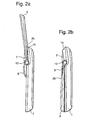
- Fig. 2 is a side view of the mobile telephone of Embodiment 1, and (a) illustrates the open state and (b) illustrates the closed state.
- reference numerals identical to those of Fig. 1 represent identical or equivalent members.
- the edge of the opening 2b touches at a position 1b away from the axis of the hinge 10 on the surface of the lower casing 1.
- the upper casing 2 is supported at support points, which are vertices of a triangular shape, by means of two points on the hinge 10 and the contact point 1b, and it is possible to compensate for strength deterioration around the hinge 10 caused by the provision of the opening.
- the lower casing 1 and the upper casing 2 are supported by the contact surface provided around the exposed part 1a of the lower casing 1 and by the contact surface provided at the edge of the opening of the upper casing 2, improved strength can be realized.
- the sub-display 7 and the selector 5 are provided on the exposed part 1a; however, the selector 5 may be provided without the sub-display 7. Even in this case, whether the casing is in the open state or in the closed state, the advantage of having a convenient-to-use operation unit is obtained. As an option, it is possible to provide, outside of the exposed part, a display that can be used with the casing in the folded state.
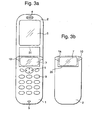
- Fig. 3 is a front view illustrating an external appearance of a mobile telephone according to Embodiment 2 of the invention.
- Fig. 3(a) illustrates an upper casing of a folding casing in an open state relative to a lower casing, with a hinge as axis;
- Fig. 3(b) illustrates the upper casing in a closed state.
- reference numerals identical to those of Fig. 1 represent identical or equivalent parts.
- an opening 2c is provided in the upper casing 2 so that, when the casing is closed, the sub-display 7 will not be covered.
- the sub-display 7 for displaying text or images is provided near the hinge 10, on the lower casing 1, on an opposing face opposite one face of the upper casing 2 when the lower casing 1 and the upper casing 2 are folded in two into a closed state.
- the upper casing 2 on the other hand, is provided with an opening at a position overlapping the sub-display 7 when the lower casing 1 and the upper casing 2 are folded in two into a closed state with the hinge 10 as axis.
- the configuration described above also has the advantage of being able to use the sub-display 7 in both the folded casing state and the open state.
- the selector 5 may also be provided in the exposed part, similarly to Embodiment 1.
- an additional selector 5 may also be provided, on the upper casing 2, on the opposite face to the face on which the main display 6 is provided, and it may be arranged to enable menu selection and similar, using the sub-display 7 even when the casing is in the folded state.
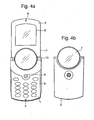
- Fig. 4 is a front view illustrating an external appearance of a mobile telephone according to Embodiment 3 of the invention.
- Fig. 4(a) illustrates an upper casing of a foldable casing in an open state relative to a lower casing with a hinge as axis; and
- Fig. 4(b) illustrates the upper casing in a closed state.
- reference numerals identical to those of Fig. 1 represent identical or equivalent members.
- the mobile telephone of Fig. 4 resembles the mobile telephone of Fig. 1 but there is no selector 5 in the exposed part and a large sub-display 7 can be realized.
- the sub-display is arranged to overlap the hinge axis and also to protrude from the hinge area in projection along the hinge axis towards the upper side and/or lower outer side.
- the sub-display 7 is arranged in the proximity of the hinge, but it may also be arranged in positions other than the proximity of the hinge.
- the proximity of the hinge means the proximity of the folding axis of the folding casing, and includes:(1) obviously situations where part of the sub-display 7 overlaps the rotating axis of the hinge 10, (2) situations where part of the sub-display 7 is between the numerical keys 9 or the selector 5 and the hinge 10, and/or (3) situations where at least part of the sub-display 7 is on an opposite side to the numerical keys 9 with respect to the hinge 10, in the area from the hinge 10 to the edge of the lower casing 1.
- the sub-display 7 is more towards the hinge 10 than the numerical keys 9 when a user is operating the numerical keys 9 or the selector 5, the user's hands do not hide the sub-display 7 and the advantage of good operability is obtained.
- the sub-display 7 is arranged to extend from the cross-section area of the hinge 10 in projection, along the hinge 10 axis connecting the two parts of the hinge 10, to the area of the outer face of the lower casing 1 excluding the above described projection area.
- the sub-display 7 is contained within the projection area between two parts of the hinge 10 as described above, the advantage of facilitating a large sub-display 7 is realized.
- this invention can be used with any portable terminal, even multi-folding mobile devices, once they have a display and voice communication functions.
- a mobile telephone according to the present invention may be applied to foldable mobile telephones for effective display utilization.
Landscapes
- Engineering & Computer Science (AREA)
- Signal Processing (AREA)
- Human Computer Interaction (AREA)
- Telephone Set Structure (AREA)
Abstract
A mobile telephone including a first casing (1) and a second casing (2) rotatably connected about a hinge (10) as an axis; the first casing (1) having an opposing face opposite one face of the second casing (2) when the first casing (1) and the second casing (2) are folded in two into a closed state. Further, the first casing (1) is provided with a display (7) for displaying text or images, close to the hinge on the opposing face, on an exposed part exposed by the second casing (2) when in a folded state; and the second casing (2) is provided with an opening at a position overlapping the exposed part, when the first casing (1) and the second casing (2) are in an open state, with the hinge (10) as axis. Thus, whether in the closed state or the open state, the display can be utilized. Further, since the display is arranged to overlap the hinge axis, a large display can be realized.
Description
- The present invention relates to mobile telephones that can effectively utilize their displays.
- Recently, small sized mobile telephone models that can fit into a user's pocket are becoming preferred by users. Among them, models that are folded when they are being carried so that they are not bulky, and that are opened when in use, enable display and button size to be ensured, and thus folding-type mobile telephones with good operability are widely used.
- However, folding-type mobile telephones are inconvenient in that, when folded, a main display cannot be directly viewed from the outside, and it is not possible to quickly view necessary information about incoming calls. Therefore, in order to be able to view minimal information for incoming calls and similar situations even when in the folded state, there are mobile telephones that have a sub-display provided in the outer face of the casing.
- With mobile telephones having the conventional sub-display as described above, it is possible to view a limited amount of information while in the folded state, but, when using it in the open state, because the sub-display is on the opposite face to operation components such as selectors and the main display, the mobile telephone user cannot view nor use the sub-display.
- Japanese Patent Laid-Open No. 1999-088483 discloses a mobile telephone that does not have a sub-display. In this mobile telephone, since a display is provided in a narrow space below the hinge and above the operation keys, there is a problem in that only a small display is feasible.
- The present invention has as an object the provision of a mobile telephone that solves these problems and enables effective display utilization.
- A mobile communications device according to this invention comprises a mobile telephone having: a first casing and a second casing rotatably connected by a hinge as an axis; the first casing having an opposing face opposite one face of the second casing when the first casing and the second casing are folded in two into a closed state; wherein the first casing has a display for displaying text or images on an exposed part close to the hinge on the opposing face and exposed by the second casing when in a folded state; and the second casing is provided with an opening at a position overlapping the exposed part when the first casing and the second casing are in an open state, with the hinge as the axis.
- In another aspect, the first casing is provided with a selector for selecting information displayed on the display in the exposed part, and the second casing has the opening at a position overlapping the selector when the first casing and the second casing are folded in two into the closed state, with the hinge as axis.
- In another aspect, when the first casing and the second casing are in the open state with the hinge as the axis, the edge of the opening touches, at a position away from the axis of the hinge, on the surface of the first casing, and thus the hinge together with the second casing are supported.
- Furthermore, in a mobile telephone with a first casing and a second casing rotatably connected through the hinge axis, the first casing having an opposing face opposite one face of the second casing when the first casing and the second casing are folded in two into a closed state, the first casing has a display for displaying text or images close to the hinge on the opposing face; the second casing is provided with an opening at a position overlapping the display when the first casing and the second casing are folded in two into a closed state, with the hinge as the axis; and the hinge supports both edges of the opening.
- In another aspect, the display is arranged to overlap the axis of the hinge.
-
- Fig. 1 is a front view of a mobile telephone according to Embodiment 1 of the present invention;
- Fig. 2 is a side view of the mobile telephone according to
Embodiment 1 of the invention; - Fig. 3 is a front view of a mobile telephone according to
Embodiment 2 of the invention; and - Fig. 4 is a front view of a mobile telephone according to Embodiment 3 of the invention.
- Fig. 1 is a front view illustrating the external appearance of a mobile telephone according to Embodiment 1. Here, Fig. 1(a) illustrates an upper casing of the folding casing, in an open state with regard to a lower casing, with a hinge as axis, and Fig. 1(b) illustrates the upper casing in a closed state.
- In Fig. 1,
reference numeral 1 indicates the lower casing of the folding mobile telephone,reference numeral 2 indicates the upper casing of the mobile telephone, and the mobile telephone is configured so that it can open and close rotatably about thehinge 10 as center. Here, an opening is provided so that thehinge 10 edge of theupper casing 2 does not cover asub-display 7 on the lower casing. -
Reference numeral 3 indicates a microphone, arranged at the lower edge of the front face of thelower casing 1, that converts a user's voice into electrical signals,reference numeral 4 indicates a speaker, arranged at the upper edge of the front face of theupper casing 2, that outputs the voice of the communication partner,reference numeral 5 indicates a selector, arranged on thelower casing 1, for choosing from menus or similar displayed on amain display 6 or thesub-display 7,reference numeral 6 indicates the main display, arranged on theupper casing 2, for displaying text or graphic information generated within the mobile telephone, or information obtained externally through a network,reference numeral 7 indicates the sub-display for displaying a menu for dialing, other text information, or graphic information,reference numeral 8 indicates a camera, andreference numeral 9 indicates numeric keys for inputting text. - Next, the operation of this mobile telephone is explained, referring to Fig. 1.
- Fig. 1(a) illustrates the state in which the
upper casing 2 is open, and thesub-display 7, in this state, faces out with the front face of thelower casing 1, that is, the face with thenumeric keys 9. Here, theupper casing 2 is provided with an opening 2a at a position overlapping an exposedpart 1a of thelower casing 1 when thelower casing 1 and theupper casing 2 are in the open state with thehinge 10 as axis. Therefore, during usage with the casing in the open state, due to the opening 2a, theupper casing 2 does not cover or hide thedisplay 7, and thus a user of this mobile telephone can operate the numeric keys or theselector 5 while viewing thesub-display 7. In addition, the user can carry out internet browsing, dialing operations, or similar, while viewing thesub-casing 7. - As may be understood from Fig. 1(a), since the
upper casing 2 is provided with the main display on an opposing face opposite thelower casing 1 when thelower casing 1 and theupper casing 2 are folded in two into the closed state, the mobile telephone user can use themain display 6 and thesub-display 7 at the same time. Therefore, as an example, while displaying an image of one's own face taken by the camera on thesub-display 7, it is possible to display images, such as that of a communication partner's face, sent from the communication partner, on themain display 6. - Fig. 1(b) on the other hand, illustrates the state where the
upper casing 2 is closed with respect to thelower casing 1, that is, in a folded state. At this time, since theupper casing 2 does not cover thesub-display 7, due to the opening provided on thehinge 10 side of theupper casing 2, it is possible for the user to view thesub-display 7 while the casing is in the folded state. That is, when theupper casing 1 and thelower casing 2 are folded in two into the closed state, thesub-display 7 is provided for displaying text or images on the exposedpart 1a. This exposedpart 1a is provided close to thehinge 10, and on the opposing face of thelower casing 1 opposite one face of theupper casing 2, and is exposed through theupper casing 2 when in the folded state. - Therefore, using the
selector 5, the mobile telephone user can operate the mobile telephone while viewing information displayed on thesub-display 7. - With the mobile telephone of Embodiment 1 as described above, since the opening 2a is provided at the hinge-edge face of the
upper casing 2, whether in the open state or in the closed state, the mobile telephone user can view thesub-display 7, and can effectively utilize thesub-display 7. - Further, since the
opening 2a does not cover theselector 5 when the casing is folded in two into the closed state, the mobile telephone user can operate theselector 5. - Further, the
lower casing 1 is provided with theselector 5 for selecting information displayed on thesub-display 7 on the exposedpart 1a. Theupper casing 2 is provided with the opening 2a at a position overlapping theselector 5, when thelower casing 1 and theupper casing 2 are folded in two into a closed state with thehinge 10 as the axis. Thus, whether the casing is in the folded state or in the open state, the advantage of being able to operate the selector is realized. - Next, a configuration for supporting the
upper casing 2 is explained. - Fig. 2 is a side view of the mobile telephone of Embodiment 1, and (a) illustrates the open state and (b) illustrates the closed state. In Fig. 2, reference numerals identical to those of Fig. 1 represent identical or equivalent members.
- In the mobile telephone illustrated in Fig. 2, when the
lower casing 1 and theupper casing 2 are open with thehinge 10 as axis, the edge of the opening 2b touches at aposition 1b away from the axis of thehinge 10 on the surface of thelower casing 1. In this way, theupper casing 2 is supported at support points, which are vertices of a triangular shape, by means of two points on thehinge 10 and thecontact point 1b, and it is possible to compensate for strength deterioration around thehinge 10 caused by the provision of the opening. Also, because thelower casing 1 and theupper casing 2 are supported by the contact surface provided around the exposedpart 1a of thelower casing 1 and by the contact surface provided at the edge of the opening of theupper casing 2, improved strength can be realized. - In the above explanation, the
sub-display 7 and theselector 5 are provided on the exposedpart 1a; however, theselector 5 may be provided without thesub-display 7. Even in this case, whether the casing is in the open state or in the closed state, the advantage of having a convenient-to-use operation unit is obtained. As an option, it is possible to provide, outside of the exposed part, a display that can be used with the casing in the folded state. - Fig. 3 is a front view illustrating an external appearance of a mobile telephone according to
Embodiment 2 of the invention. Here, Fig. 3(a) illustrates an upper casing of a folding casing in an open state relative to a lower casing, with a hinge as axis; Fig. 3(b) illustrates the upper casing in a closed state. In Fig. 3, reference numerals identical to those of Fig. 1 represent identical or equivalent parts. - In
Embodiment 2, an opening 2c is provided in theupper casing 2 so that, when the casing is closed, thesub-display 7 will not be covered. In other words, thesub-display 7 for displaying text or images is provided near thehinge 10, on thelower casing 1, on an opposing face opposite one face of theupper casing 2 when thelower casing 1 and theupper casing 2 are folded in two into a closed state. Theupper casing 2, on the other hand, is provided with an opening at a position overlapping thesub-display 7 when thelower casing 1 and theupper casing 2 are folded in two into a closed state with thehinge 10 as axis. - In the same way as in
Embodiment 1, the configuration described above also has the advantage of being able to use thesub-display 7 in both the folded casing state and the open state. - In the mobile telephone of Fig. 3, while the
selector 5 is not provided in the exposedpart 1a created by the opening 2c, theselector 5 may also be provided in the exposed part, similarly toEmbodiment 1. In the mobile telephone of Fig. 3, anadditional selector 5 may also be provided, on theupper casing 2, on the opposite face to the face on which themain display 6 is provided, and it may be arranged to enable menu selection and similar, using thesub-display 7 even when the casing is in the folded state. - Fig. 4 is a front view illustrating an external appearance of a mobile telephone according to
Embodiment 3 of the invention. Fig. 4(a) illustrates an upper casing of a foldable casing in an open state relative to a lower casing with a hinge as axis; and Fig. 4(b) illustrates the upper casing in a closed state. In Fig. 4, reference numerals identical to those of Fig. 1 represent identical or equivalent members. - Basically, the mobile telephone of Fig. 4 resembles the mobile telephone of Fig. 1 but there is no
selector 5 in the exposed part and alarge sub-display 7 can be realized. - In the embodiments explained above, the sub-display is arranged to overlap the hinge axis and also to protrude from the hinge area in projection along the hinge axis towards the upper side and/or lower outer side. Thus, by providing the hinge, there are few size constraints on the display, and the advantage of a large sub-display can be realized.
- Further, in the embodiments explained above, the
sub-display 7 is arranged in the proximity of the hinge, but it may also be arranged in positions other than the proximity of the hinge. - Further, the proximity of the hinge means the proximity of the folding axis of the folding casing, and includes:(1) obviously situations where part of the sub-display 7 overlaps the rotating axis of the
hinge 10, (2) situations where part of thesub-display 7 is between thenumerical keys 9 or theselector 5 and thehinge 10, and/or (3) situations where at least part of thesub-display 7 is on an opposite side to thenumerical keys 9 with respect to thehinge 10, in the area from thehinge 10 to the edge of thelower casing 1. In situations where thesub-display 7 is more towards thehinge 10 than thenumerical keys 9, when a user is operating thenumerical keys 9 or theselector 5, the user's hands do not hide the sub-display 7 and the advantage of good operability is obtained. - Further, in the embodiment described above, the
sub-display 7 is arranged to extend from the cross-section area of thehinge 10 in projection, along thehinge 10 axis connecting the two parts of thehinge 10, to the area of the outer face of thelower casing 1 excluding the above described projection area. Thus, compared to the case where thesub-display 7 is contained within the projection area between two parts of thehinge 10 as described above, the advantage of facilitating alarge sub-display 7 is realized. - In addition, this invention can be used with any portable terminal, even multi-folding mobile devices, once they have a display and voice communication functions.
- As described above, a mobile telephone according to the present invention may be applied to foldable mobile telephones for effective display utilization.
Claims (5)
- A mobile telephone comprising:a first casing and a second casing rotatably connected by a hinge as an axis, the first casing having an opposing face opposite one face of the second casing when the first casing and the second casing are folded in two into a closed state; whereinthe first casing has a display for displaying text or images on an exposed part close to the hinge on the opposing face and exposed by the second casing when in a folded state; andthe second casing is provided with an opening at a position overlapping the exposed part, when the first casing and the second casing are in an open state, with the hinge as the axis.
- The mobile telephone according to claim 1, wherein the first casing has a selector for selecting information displayed on the display in the exposed part, and the second casing is provided with the opening at a position overlapping the selector, when the first casing and the second casing are folded in two into the closed state, with the hinge as the axis.
- The mobile telephone according to claim 1, wherein, when the first casing and the second casing are in the open state with the hinge as the axis, the edge of the opening touches, at a position away from the axis of the hinge, on the surface of the first casing whereby the edge and the hinge support the second casing.
- A mobile telephone comprising:a first casing and a second casing rotatably connected by a hinge as an axis, the first casing having an opposing face opposite one face of the second casing when the first casing and the second casing are folded in two into a closed state; whereinthe first casing has a display for displaying text or images, close to the hinge, on the opposing face;the second casing is provided with an opening at a position overlapping the display when the first casing and the second casing are folded in two into the closed state, with the hinge as the axis; andthe hinge supports opposing edges of the opening.
- The mobile telephone according to claim 1 or claim 4, wherein the display is arranged to overlap the axis of the hinge.
Applications Claiming Priority (3)
| Application Number | Priority Date | Filing Date | Title |
|---|---|---|---|
| JP2001202030 | 2001-07-03 | ||
| JP2001202030A JP3906655B2 (en) | 2001-07-03 | 2001-07-03 | Mobile phone |
| PCT/JP2002/006592 WO2003005683A1 (en) | 2001-07-03 | 2002-06-28 | Cell phone |
Publications (2)
| Publication Number | Publication Date |
|---|---|
| EP1404088A1 true EP1404088A1 (en) | 2004-03-31 |
| EP1404088A4 EP1404088A4 (en) | 2006-04-05 |
Family
ID=19038903
Family Applications (1)
| Application Number | Title | Priority Date | Filing Date |
|---|---|---|---|
| EP02738875A Withdrawn EP1404088A4 (en) | 2001-07-03 | 2002-06-28 | MOBILE PHONE |
Country Status (5)
| Country | Link |
|---|---|
| US (1) | US20040198476A1 (en) |
| EP (1) | EP1404088A4 (en) |
| JP (1) | JP3906655B2 (en) |
| CN (1) | CN1524373A (en) |
| WO (1) | WO2003005683A1 (en) |
Cited By (4)
| Publication number | Priority date | Publication date | Assignee | Title |
|---|---|---|---|---|
| EP1638299A1 (en) * | 2004-09-17 | 2006-03-22 | Siemens Communications, Inc. | Hand-held communication device with two housings and a keypad accessible both in the open and the closed position |
| EP1748628A2 (en) | 2005-07-29 | 2007-01-31 | Samsung Electronics Co., Ltd. | Slim portable terminal |
| EP1796348A1 (en) * | 2005-12-06 | 2007-06-13 | TCL & Alcatel Mobile Phones Limited | Mobile phone of the clamshell type with camera |
| EP1467539A3 (en) * | 2003-04-09 | 2009-11-11 | Nec Corporation | Mobile terminal |
Families Citing this family (26)
| Publication number | Priority date | Publication date | Assignee | Title |
|---|---|---|---|---|
| JP3675430B2 (en) * | 2002-09-20 | 2005-07-27 | 株式会社日立製作所 | Mobile phone |
| JP2004128908A (en) * | 2002-10-03 | 2004-04-22 | Hitachi Ltd | Mobile terminal |
| JP2004135177A (en) * | 2002-10-11 | 2004-04-30 | Sharp Corp | Mobile phone |
| USD524776S1 (en) * | 2003-05-26 | 2006-07-11 | Lg Electronics Inc. | Cellular phone |
| WO2005046187A1 (en) | 2003-11-06 | 2005-05-19 | Sanyo Electric Co., Ltd. | Folding portable terminal |
| KR100608726B1 (en) * | 2003-12-09 | 2006-08-04 | 엘지전자 주식회사 | Bidirectional Sliding Handheld Terminal |
| KR100677303B1 (en) | 2003-12-26 | 2007-02-05 | 엘지전자 주식회사 | Mobile terminal |
| JP4311254B2 (en) | 2004-03-31 | 2009-08-12 | 日本電気株式会社 | Portable electronic devices |
| USD508903S1 (en) * | 2004-05-13 | 2005-08-30 | Samsung Electronics Co., Ltd. | Portable telephone |
| USD510080S1 (en) * | 2004-06-04 | 2005-09-27 | Samsung Electronics Co., Ltd. | Cellular phone |
| KR100600750B1 (en) | 2004-07-27 | 2006-07-14 | 엘지전자 주식회사 | Mobile terminal equipped with dual camera |
| USD520485S1 (en) * | 2004-07-27 | 2006-05-09 | Lg Electronics Inc. | Mobile phone |
| USD521481S1 (en) * | 2004-09-24 | 2006-05-23 | Lg Electronics, Inc. | Cellular phone |
| USD519480S1 (en) * | 2004-12-03 | 2006-04-25 | Lg Electronics Inc. | Mobile phone |
| USD518460S1 (en) * | 2004-12-03 | 2006-04-04 | Lg Electronics Inc. | Mobile phone |
| KR100630068B1 (en) * | 2005-01-25 | 2006-09-27 | 삼성전자주식회사 | Hinge device for display rotatable mobile terminal |
| USD546794S1 (en) * | 2005-01-26 | 2007-07-17 | Samsung Electronics Co., Ltd. | Portable phone |
| US20070013608A1 (en) * | 2005-07-12 | 2007-01-18 | Goo Siew C | Dual display electronic device |
| US20070178949A1 (en) * | 2005-07-28 | 2007-08-02 | Kyocera Corporation | Mobile Terminal |
| USD561717S1 (en) * | 2006-08-03 | 2008-02-12 | Samsung Electronics Co., Ltd. | Mobile phone |
| KR100800827B1 (en) * | 2006-09-18 | 2008-02-04 | 삼성전자주식회사 | Flip-up type mobile terminal |
| TWD122260S1 (en) * | 2006-10-26 | 2008-04-01 | 諾基亞股份有限公司 | Handset |
| USD580901S1 (en) * | 2007-02-13 | 2008-11-18 | Huawei Technologies Co., Ltd. | Handset |
| USD586772S1 (en) * | 2007-02-13 | 2009-02-17 | Huawei Technologies Co., Ltd. | Handset |
| JP4583392B2 (en) * | 2007-02-19 | 2010-11-17 | 京セラ株式会社 | Control method of mobile terminal |
| USD603818S1 (en) * | 2007-12-23 | 2009-11-10 | Darius Bruner | Cellular telephone with removable ear piece |
Family Cites Families (8)
| Publication number | Priority date | Publication date | Assignee | Title |
|---|---|---|---|---|
| JPH09307610A (en) * | 1996-05-10 | 1997-11-28 | Mitsubishi Electric Corp | Mobile phone |
| FR2764152A1 (en) * | 1997-05-27 | 1998-12-04 | Philips Electronics Nv | PORTABLE DEVICE FORMED OF A MAIN PART AND A PIVOTING PART |
| US6073187A (en) * | 1997-06-20 | 2000-06-06 | Compaq Computer Corporation | Controls and indicators available to a user for a secondary operational mode of a portable computer which is open or closed state of the computer case |
| USD398305S (en) * | 1997-08-28 | 1998-09-15 | Lucent Technologies Inc. | Wireless phone terminal |
| JP3439086B2 (en) * | 1997-09-10 | 2003-08-25 | 松下電器産業株式会社 | Simple mobile phone |
| GB2335081B (en) * | 1998-03-05 | 2002-04-03 | Nec Technologies | Antenna for mobile telephones |
| JP2003162355A (en) * | 2001-11-26 | 2003-06-06 | Sony Corp | Task display switching method, portable device and portable communication device |
| JP2003209602A (en) * | 2002-01-11 | 2003-07-25 | Sony Corp | Mobile phone |
-
2001
- 2001-07-03 JP JP2001202030A patent/JP3906655B2/en not_active Expired - Fee Related
-
2002
- 2002-06-28 WO PCT/JP2002/006592 patent/WO2003005683A1/en not_active Ceased
- 2002-06-28 EP EP02738875A patent/EP1404088A4/en not_active Withdrawn
- 2002-06-28 CN CNA028132971A patent/CN1524373A/en active Pending
- 2002-06-28 US US10/481,889 patent/US20040198476A1/en not_active Abandoned
Non-Patent Citations (2)
| Title |
|---|
| No further relevant documents disclosed * |
| See also references of WO03005683A1 * |
Cited By (9)
| Publication number | Priority date | Publication date | Assignee | Title |
|---|---|---|---|---|
| EP1467539A3 (en) * | 2003-04-09 | 2009-11-11 | Nec Corporation | Mobile terminal |
| US7907978B2 (en) | 2003-04-09 | 2011-03-15 | Nec Corporation | Mobile terminal |
| EP1638299A1 (en) * | 2004-09-17 | 2006-03-22 | Siemens Communications, Inc. | Hand-held communication device with two housings and a keypad accessible both in the open and the closed position |
| EP1748628A2 (en) | 2005-07-29 | 2007-01-31 | Samsung Electronics Co., Ltd. | Slim portable terminal |
| EP1748628A3 (en) * | 2005-07-29 | 2009-07-08 | Samsung Electronics Co., Ltd. | Slim portable terminal |
| US8140133B2 (en) | 2005-07-29 | 2012-03-20 | Samsung Electronics Co., Ltd. | Slim portable terminal |
| EP1796348A1 (en) * | 2005-12-06 | 2007-06-13 | TCL & Alcatel Mobile Phones Limited | Mobile phone of the clamshell type with camera |
| US7616976B2 (en) | 2005-12-06 | 2009-11-10 | Ipg Electronics 504 Limited | Clamshell-type mobile phone with camera |
| RU2437241C2 (en) * | 2005-12-06 | 2011-12-20 | Ипг Электроникс 504 Лимитед | Mobile phone of folding type with camera |
Also Published As
| Publication number | Publication date |
|---|---|
| JP2003018257A (en) | 2003-01-17 |
| JP3906655B2 (en) | 2007-04-18 |
| WO2003005683A1 (en) | 2003-01-16 |
| EP1404088A4 (en) | 2006-04-05 |
| CN1524373A (en) | 2004-08-25 |
| US20040198476A1 (en) | 2004-10-07 |
Similar Documents
| Publication | Publication Date | Title |
|---|---|---|
| EP1404088A1 (en) | Cell phone | |
| EP1610530B1 (en) | Dual-axis rotation folder-type portable apparatus | |
| US7565182B2 (en) | Wireless cell phone | |
| JP4087423B2 (en) | Portable communication device | |
| US6865400B2 (en) | User interfacing device for PDA/wireless terminal | |
| JP2004312389A (en) | Mobile communication terminal device | |
| KR20020089574A (en) | Portable electronic device with an adaptable user interface | |
| WO2006008588A1 (en) | Improved mobile communication terminal and method | |
| JPH11346258A (en) | Electronic device with a variable keyboard | |
| JPH11215218A (en) | Portable wireless communication device | |
| JP2007516628A (en) | Communication device having folding and rotatable storage member | |
| JP4578717B2 (en) | Mobile terminal device | |
| JP2001339497A (en) | Mobile terminal housing structure | |
| JP4087610B2 (en) | Portable communication device | |
| KR100747539B1 (en) | Dual screen mobile terminal | |
| JP2002218030A (en) | Folding portable terminal | |
| JP4107194B2 (en) | Folding mobile phone | |
| JP2002369252A (en) | Mobile phone terminal and display control method thereof | |
| KR20060032881A (en) | A portable terminal having a plurality of screens and a control method thereof. | |
| JP2002171320A (en) | Mobile communication terminal | |
| JP3827580B2 (en) | Portable communication device | |
| JP2003198685A (en) | Mobile terminal | |
| JP4087422B2 (en) | Portable communication device | |
| JP3709819B2 (en) | Mobile phone | |
| JP4499619B2 (en) | Portable communication device |
Legal Events
| Date | Code | Title | Description |
|---|---|---|---|
| PUAI | Public reference made under article 153(3) epc to a published international application that has entered the european phase |
Free format text: ORIGINAL CODE: 0009012 |
|
| 17P | Request for examination filed |
Effective date: 20031218 |
|
| AK | Designated contracting states |
Kind code of ref document: A1 Designated state(s): AT BE CH CY DE DK ES FI FR GB GR IE IT LI LU MC NL PT SE TR |
|
| A4 | Supplementary search report drawn up and despatched |
Effective date: 20060221 |
|
| RAP1 | Party data changed (applicant data changed or rights of an application transferred) |
Owner name: MITSUBISHI DENKI KABUSHIKI KAISHA |
|
| 17Q | First examination report despatched |
Effective date: 20060921 |
|
| STAA | Information on the status of an ep patent application or granted ep patent |
Free format text: STATUS: THE APPLICATION HAS BEEN WITHDRAWN |
|
| 18W | Application withdrawn |
Effective date: 20061205 |