EP1403340A1 - Inkjet printing method and inkjet ink composition - Google Patents
Inkjet printing method and inkjet ink composition Download PDFInfo
- Publication number
- EP1403340A1 EP1403340A1 EP20030077889 EP03077889A EP1403340A1 EP 1403340 A1 EP1403340 A1 EP 1403340A1 EP 20030077889 EP20030077889 EP 20030077889 EP 03077889 A EP03077889 A EP 03077889A EP 1403340 A1 EP1403340 A1 EP 1403340A1
- Authority
- EP
- European Patent Office
- Prior art keywords
- ink
- ink jet
- pigment
- printing
- polymer
- Prior art date
- Legal status (The legal status is an assumption and is not a legal conclusion. Google has not performed a legal analysis and makes no representation as to the accuracy of the status listed.)
- Withdrawn
Links
- 239000000203 mixture Substances 0.000 title claims abstract description 33
- 238000000034 method Methods 0.000 title claims abstract description 31
- 238000007641 inkjet printing Methods 0.000 title claims abstract description 13
- 239000000049 pigment Substances 0.000 claims abstract description 78
- 229920000642 polymer Polymers 0.000 claims abstract description 52
- 238000007639 printing Methods 0.000 claims abstract description 37
- 239000000758 substrate Substances 0.000 claims abstract description 33
- 239000000178 monomer Substances 0.000 claims abstract description 28
- 238000010438 heat treatment Methods 0.000 claims abstract description 20
- 239000004094 surface-active agent Substances 0.000 claims abstract description 17
- 239000002491 polymer binding agent Substances 0.000 claims abstract description 7
- 239000003906 humectant Substances 0.000 claims abstract description 6
- 238000011068 loading method Methods 0.000 claims abstract description 6
- 229920005596 polymer binder Polymers 0.000 claims abstract description 6
- 239000012736 aqueous medium Substances 0.000 claims abstract description 4
- 230000004044 response Effects 0.000 claims abstract description 4
- 239000002245 particle Substances 0.000 claims description 15
- 229910052751 metal Inorganic materials 0.000 claims description 5
- 239000002184 metal Substances 0.000 claims description 5
- 229920003023 plastic Polymers 0.000 claims description 4
- 239000004033 plastic Substances 0.000 claims description 4
- 239000011521 glass Substances 0.000 claims description 3
- 239000003431 cross linking reagent Substances 0.000 claims 1
- 238000011065 in-situ storage Methods 0.000 claims 1
- 239000000976 ink Substances 0.000 description 136
- MTHSVFCYNBDYFN-UHFFFAOYSA-N diethylene glycol Chemical compound OCCOCCO MTHSVFCYNBDYFN-UHFFFAOYSA-N 0.000 description 34
- -1 polytetrafluoroethylene Polymers 0.000 description 29
- XLYOFNOQVPJJNP-UHFFFAOYSA-N water Substances O XLYOFNOQVPJJNP-UHFFFAOYSA-N 0.000 description 26
- 239000004815 dispersion polymer Substances 0.000 description 25
- 238000003801 milling Methods 0.000 description 25
- 239000006185 dispersion Substances 0.000 description 17
- 230000000052 comparative effect Effects 0.000 description 14
- 239000004816 latex Substances 0.000 description 14
- 229920000126 latex Polymers 0.000 description 14
- 229920002554 vinyl polymer Polymers 0.000 description 14
- PPBRXRYQALVLMV-UHFFFAOYSA-N Styrene Natural products C=CC1=CC=CC=C1 PPBRXRYQALVLMV-UHFFFAOYSA-N 0.000 description 12
- 125000000391 vinyl group Chemical group [H]C([*])=C([H])[H] 0.000 description 12
- LYCAIKOWRPUZTN-UHFFFAOYSA-N Ethylene glycol Chemical compound OCCO LYCAIKOWRPUZTN-UHFFFAOYSA-N 0.000 description 11
- 229920000728 polyester Polymers 0.000 description 11
- 239000002270 dispersing agent Substances 0.000 description 10
- 229920002635 polyurethane Polymers 0.000 description 10
- 239000004814 polyurethane Substances 0.000 description 10
- PEDCQBHIVMGVHV-UHFFFAOYSA-N Glycerine Chemical compound OCC(O)CO PEDCQBHIVMGVHV-UHFFFAOYSA-N 0.000 description 9
- 125000004432 carbon atom Chemical group C* 0.000 description 9
- 229920001577 copolymer Polymers 0.000 description 9
- DNIAPMSPPWPWGF-UHFFFAOYSA-N Propylene glycol Chemical compound CC(O)CO DNIAPMSPPWPWGF-UHFFFAOYSA-N 0.000 description 8
- 239000007787 solid Substances 0.000 description 8
- 239000002904 solvent Substances 0.000 description 8
- 238000002360 preparation method Methods 0.000 description 7
- 230000008569 process Effects 0.000 description 7
- HIXDQWDOVZUNNA-UHFFFAOYSA-N 2-(3,4-dimethoxyphenyl)-5-hydroxy-7-methoxychromen-4-one Chemical compound C=1C(OC)=CC(O)=C(C(C=2)=O)C=1OC=2C1=CC=C(OC)C(OC)=C1 HIXDQWDOVZUNNA-UHFFFAOYSA-N 0.000 description 6
- IJGRMHOSHXDMSA-UHFFFAOYSA-N Atomic nitrogen Chemical compound N#N IJGRMHOSHXDMSA-UHFFFAOYSA-N 0.000 description 6
- 229940048053 acrylate Drugs 0.000 description 6
- 150000002148 esters Chemical class 0.000 description 6
- RTZKZFJDLAIYFH-UHFFFAOYSA-N ether Substances CCOCC RTZKZFJDLAIYFH-UHFFFAOYSA-N 0.000 description 6
- 229920001519 homopolymer Polymers 0.000 description 6
- 238000006116 polymerization reaction Methods 0.000 description 6
- 239000000243 solution Substances 0.000 description 6
- OKKJLVBELUTLKV-UHFFFAOYSA-N Methanol Chemical compound OC OKKJLVBELUTLKV-UHFFFAOYSA-N 0.000 description 5
- NIXOWILDQLNWCW-UHFFFAOYSA-N acrylic acid group Chemical group C(C=C)(=O)O NIXOWILDQLNWCW-UHFFFAOYSA-N 0.000 description 5
- 239000002609 medium Substances 0.000 description 5
- MYRTYDVEIRVNKP-UHFFFAOYSA-N 1,2-Divinylbenzene Chemical compound C=CC1=CC=CC=C1C=C MYRTYDVEIRVNKP-UHFFFAOYSA-N 0.000 description 4
- NIXOWILDQLNWCW-UHFFFAOYSA-M Acrylate Chemical compound [O-]C(=O)C=C NIXOWILDQLNWCW-UHFFFAOYSA-M 0.000 description 4
- VVJKKWFAADXIJK-UHFFFAOYSA-N Allylamine Chemical compound NCC=C VVJKKWFAADXIJK-UHFFFAOYSA-N 0.000 description 4
- SOGAXMICEFXMKE-UHFFFAOYSA-N Butylmethacrylate Chemical compound CCCCOC(=O)C(C)=C SOGAXMICEFXMKE-UHFFFAOYSA-N 0.000 description 4
- CERQOIWHTDAKMF-UHFFFAOYSA-N Methacrylic acid Chemical compound CC(=C)C(O)=O CERQOIWHTDAKMF-UHFFFAOYSA-N 0.000 description 4
- BAPJBEWLBFYGME-UHFFFAOYSA-N Methyl acrylate Chemical compound COC(=O)C=C BAPJBEWLBFYGME-UHFFFAOYSA-N 0.000 description 4
- 239000008365 aqueous carrier Substances 0.000 description 4
- 230000003115 biocidal effect Effects 0.000 description 4
- 239000003139 biocide Substances 0.000 description 4
- 229940093476 ethylene glycol Drugs 0.000 description 4
- 230000002209 hydrophobic effect Effects 0.000 description 4
- 239000000463 material Substances 0.000 description 4
- 229920000058 polyacrylate Polymers 0.000 description 4
- 239000002952 polymeric resin Substances 0.000 description 4
- BDERNNFJNOPAEC-UHFFFAOYSA-N propan-1-ol Chemical compound CCCO BDERNNFJNOPAEC-UHFFFAOYSA-N 0.000 description 4
- 229920003002 synthetic resin Polymers 0.000 description 4
- ZWEHNKRNPOVVGH-UHFFFAOYSA-N 2-Butanone Chemical compound CCC(C)=O ZWEHNKRNPOVVGH-UHFFFAOYSA-N 0.000 description 3
- WSUIRDORMCYOBS-UHFFFAOYSA-N 3-chloro-2-methylprop-2-enoic acid Chemical compound ClC=C(C)C(O)=O WSUIRDORMCYOBS-UHFFFAOYSA-N 0.000 description 3
- CSCPPACGZOOCGX-UHFFFAOYSA-N Acetone Chemical compound CC(C)=O CSCPPACGZOOCGX-UHFFFAOYSA-N 0.000 description 3
- XEKOWRVHYACXOJ-UHFFFAOYSA-N Ethyl acetate Chemical compound CCOC(C)=O XEKOWRVHYACXOJ-UHFFFAOYSA-N 0.000 description 3
- KFZMGEQAYNKOFK-UHFFFAOYSA-N Isopropanol Chemical compound CC(C)O KFZMGEQAYNKOFK-UHFFFAOYSA-N 0.000 description 3
- LRHPLDYGYMQRHN-UHFFFAOYSA-N N-Butanol Chemical compound CCCCO LRHPLDYGYMQRHN-UHFFFAOYSA-N 0.000 description 3
- 239000004793 Polystyrene Substances 0.000 description 3
- 238000005299 abrasion Methods 0.000 description 3
- 239000000654 additive Substances 0.000 description 3
- 238000013019 agitation Methods 0.000 description 3
- QGZKDVFQNNGYKY-UHFFFAOYSA-O ammonium group Chemical group [NH4+] QGZKDVFQNNGYKY-UHFFFAOYSA-O 0.000 description 3
- 239000011324 bead Substances 0.000 description 3
- 239000011230 binding agent Substances 0.000 description 3
- 238000000576 coating method Methods 0.000 description 3
- 238000009833 condensation Methods 0.000 description 3
- 230000005494 condensation Effects 0.000 description 3
- 239000008367 deionised water Substances 0.000 description 3
- 229910021641 deionized water Inorganic materials 0.000 description 3
- 150000002009 diols Chemical class 0.000 description 3
- 238000001035 drying Methods 0.000 description 3
- 238000007720 emulsion polymerization reaction Methods 0.000 description 3
- 235000019441 ethanol Nutrition 0.000 description 3
- 238000001914 filtration Methods 0.000 description 3
- 239000012530 fluid Substances 0.000 description 3
- XPFVYQJUAUNWIW-UHFFFAOYSA-N furfuryl alcohol Chemical compound OCC1=CC=CO1 XPFVYQJUAUNWIW-UHFFFAOYSA-N 0.000 description 3
- 238000000227 grinding Methods 0.000 description 3
- 229920001600 hydrophobic polymer Polymers 0.000 description 3
- 239000007788 liquid Substances 0.000 description 3
- 229910052757 nitrogen Inorganic materials 0.000 description 3
- 239000012860 organic pigment Substances 0.000 description 3
- 229920001223 polyethylene glycol Polymers 0.000 description 3
- 229920002223 polystyrene Polymers 0.000 description 3
- 229920001343 polytetrafluoroethylene Polymers 0.000 description 3
- 239000004810 polytetrafluoroethylene Substances 0.000 description 3
- 229960004063 propylene glycol Drugs 0.000 description 3
- 235000013772 propylene glycol Nutrition 0.000 description 3
- HNJBEVLQSNELDL-UHFFFAOYSA-N pyrrolidin-2-one Chemical compound O=C1CCCN1 HNJBEVLQSNELDL-UHFFFAOYSA-N 0.000 description 3
- 239000000126 substance Substances 0.000 description 3
- 150000005846 sugar alcohols Polymers 0.000 description 3
- ZIBGPFATKBEMQZ-UHFFFAOYSA-N triethylene glycol Chemical compound OCCOCCOCCO ZIBGPFATKBEMQZ-UHFFFAOYSA-N 0.000 description 3
- DGVVWUTYPXICAM-UHFFFAOYSA-N β‐Mercaptoethanol Chemical compound OCCS DGVVWUTYPXICAM-UHFFFAOYSA-N 0.000 description 3
- PQUXFUBNSYCQAL-UHFFFAOYSA-N 1-(2,3-difluorophenyl)ethanone Chemical compound CC(=O)C1=CC=CC(F)=C1F PQUXFUBNSYCQAL-UHFFFAOYSA-N 0.000 description 2
- JLIDVCMBCGBIEY-UHFFFAOYSA-N 1-penten-3-one Chemical compound CCC(=O)C=C JLIDVCMBCGBIEY-UHFFFAOYSA-N 0.000 description 2
- OEPOKWHJYJXUGD-UHFFFAOYSA-N 2-(3-phenylmethoxyphenyl)-1,3-thiazole-4-carbaldehyde Chemical compound O=CC1=CSC(C=2C=C(OCC=3C=CC=CC=3)C=CC=2)=N1 OEPOKWHJYJXUGD-UHFFFAOYSA-N 0.000 description 2
- YYPLPZPLLWYWKD-UHFFFAOYSA-N 2-ethenylpyridin-1-ium;chloride Chemical compound Cl.C=CC1=CC=CC=N1 YYPLPZPLLWYWKD-UHFFFAOYSA-N 0.000 description 2
- UPCODFUDKGSJEL-UHFFFAOYSA-N 2-methyl-n-propylprop-2-enamide;triethylazanium;chloride Chemical compound [Cl-].CC[NH+](CC)CC.CCCNC(=O)C(C)=C UPCODFUDKGSJEL-UHFFFAOYSA-N 0.000 description 2
- SVTBMSDMJJWYQN-UHFFFAOYSA-N 2-methylpentane-2,4-diol Chemical compound CC(O)CC(C)(C)O SVTBMSDMJJWYQN-UHFFFAOYSA-N 0.000 description 2
- JWAZRIHNYRIHIV-UHFFFAOYSA-N 2-naphthol Chemical compound C1=CC=CC2=CC(O)=CC=C21 JWAZRIHNYRIHIV-UHFFFAOYSA-N 0.000 description 2
- KUDUQBURMYMBIJ-UHFFFAOYSA-N 2-prop-2-enoyloxyethyl prop-2-enoate Chemical compound C=CC(=O)OCCOC(=O)C=C KUDUQBURMYMBIJ-UHFFFAOYSA-N 0.000 description 2
- KAKZBPTYRLMSJV-UHFFFAOYSA-N Butadiene Chemical compound C=CC=C KAKZBPTYRLMSJV-UHFFFAOYSA-N 0.000 description 2
- VEXZGXHMUGYJMC-UHFFFAOYSA-M Chloride anion Chemical compound [Cl-] VEXZGXHMUGYJMC-UHFFFAOYSA-M 0.000 description 2
- IAZDPXIOMUYVGZ-UHFFFAOYSA-N Dimethylsulphoxide Chemical compound CS(C)=O IAZDPXIOMUYVGZ-UHFFFAOYSA-N 0.000 description 2
- LFQSCWFLJHTTHZ-UHFFFAOYSA-N Ethanol Chemical compound CCO LFQSCWFLJHTTHZ-UHFFFAOYSA-N 0.000 description 2
- JIGUQPWFLRLWPJ-UHFFFAOYSA-N Ethyl acrylate Chemical compound CCOC(=O)C=C JIGUQPWFLRLWPJ-UHFFFAOYSA-N 0.000 description 2
- QIGBRXMKCJKVMJ-UHFFFAOYSA-N Hydroquinone Chemical compound OC1=CC=C(O)C=C1 QIGBRXMKCJKVMJ-UHFFFAOYSA-N 0.000 description 2
- UQSXHKLRYXJYBZ-UHFFFAOYSA-N Iron oxide Chemical compound [Fe]=O UQSXHKLRYXJYBZ-UHFFFAOYSA-N 0.000 description 2
- RRHGJUQNOFWUDK-UHFFFAOYSA-N Isoprene Chemical compound CC(=C)C=C RRHGJUQNOFWUDK-UHFFFAOYSA-N 0.000 description 2
- BAVYZALUXZFZLV-UHFFFAOYSA-O Methylammonium ion Chemical compound [NH3+]C BAVYZALUXZFZLV-UHFFFAOYSA-O 0.000 description 2
- SECXISVLQFMRJM-UHFFFAOYSA-N N-Methylpyrrolidone Chemical compound CN1CCCC1=O SECXISVLQFMRJM-UHFFFAOYSA-N 0.000 description 2
- 239000004952 Polyamide Substances 0.000 description 2
- 239000002202 Polyethylene glycol Substances 0.000 description 2
- 239000004743 Polypropylene Substances 0.000 description 2
- OFOBLEOULBTSOW-UHFFFAOYSA-N Propanedioic acid Natural products OC(=O)CC(O)=O OFOBLEOULBTSOW-UHFFFAOYSA-N 0.000 description 2
- NRCMAYZCPIVABH-UHFFFAOYSA-N Quinacridone Chemical compound N1C2=CC=CC=C2C(=O)C2=C1C=C1C(=O)C3=CC=CC=C3NC1=C2 NRCMAYZCPIVABH-UHFFFAOYSA-N 0.000 description 2
- XUIMIQQOPSSXEZ-UHFFFAOYSA-N Silicon Chemical compound [Si] XUIMIQQOPSSXEZ-UHFFFAOYSA-N 0.000 description 2
- DKGAVHZHDRPRBM-UHFFFAOYSA-N Tert-Butanol Chemical compound CC(C)(C)O DKGAVHZHDRPRBM-UHFFFAOYSA-N 0.000 description 2
- UWHCKJMYHZGTIT-UHFFFAOYSA-N Tetraethylene glycol, Natural products OCCOCCOCCOCCO UWHCKJMYHZGTIT-UHFFFAOYSA-N 0.000 description 2
- WYURNTSHIVDZCO-UHFFFAOYSA-N Tetrahydrofuran Chemical compound C1CCOC1 WYURNTSHIVDZCO-UHFFFAOYSA-N 0.000 description 2
- BZHJMEDXRYGGRV-UHFFFAOYSA-N Vinyl chloride Chemical compound ClC=C BZHJMEDXRYGGRV-UHFFFAOYSA-N 0.000 description 2
- HIBKPTWGUZEZGC-UHFFFAOYSA-M [Na+].[O-]P(=O)OC=C Chemical compound [Na+].[O-]P(=O)OC=C HIBKPTWGUZEZGC-UHFFFAOYSA-M 0.000 description 2
- 238000007792 addition Methods 0.000 description 2
- 150000001336 alkenes Chemical class 0.000 description 2
- 125000000217 alkyl group Chemical group 0.000 description 2
- 125000000129 anionic group Chemical group 0.000 description 2
- WPKYZIPODULRBM-UHFFFAOYSA-N azane;prop-2-enoic acid Chemical compound N.OC(=O)C=C WPKYZIPODULRBM-UHFFFAOYSA-N 0.000 description 2
- DZGUJOWBVDZNNF-UHFFFAOYSA-N azanium;2-methylprop-2-enoate Chemical compound [NH4+].CC(=C)C([O-])=O DZGUJOWBVDZNNF-UHFFFAOYSA-N 0.000 description 2
- 230000008901 benefit Effects 0.000 description 2
- DMSMPAJRVJJAGA-UHFFFAOYSA-N benzo[d]isothiazol-3-one Chemical compound C1=CC=C2C(=O)NSC2=C1 DMSMPAJRVJJAGA-UHFFFAOYSA-N 0.000 description 2
- IISBACLAFKSPIT-UHFFFAOYSA-N bisphenol A Chemical compound C=1C=C(O)C=CC=1C(C)(C)C1=CC=C(O)C=C1 IISBACLAFKSPIT-UHFFFAOYSA-N 0.000 description 2
- BTANRVKWQNVYAZ-UHFFFAOYSA-N butan-2-ol Chemical compound CCC(C)O BTANRVKWQNVYAZ-UHFFFAOYSA-N 0.000 description 2
- 125000002091 cationic group Chemical group 0.000 description 2
- 229920002678 cellulose Polymers 0.000 description 2
- 239000000919 ceramic Substances 0.000 description 2
- 239000003795 chemical substances by application Substances 0.000 description 2
- 239000003086 colorant Substances 0.000 description 2
- 239000012141 concentrate Substances 0.000 description 2
- 230000008021 deposition Effects 0.000 description 2
- 239000011929 di(propylene glycol) methyl ether Substances 0.000 description 2
- SWXVUIWOUIDPGS-UHFFFAOYSA-N diacetone alcohol Chemical compound CC(=O)CC(C)(C)O SWXVUIWOUIDPGS-UHFFFAOYSA-N 0.000 description 2
- 125000000664 diazo group Chemical group [N-]=[N+]=[*] 0.000 description 2
- 239000004205 dimethyl polysiloxane Substances 0.000 description 2
- GWVIABVICWKUMR-UHFFFAOYSA-L disodium;dioxido-oxo-prop-1-en-2-yl-$l^{5}-phosphane Chemical compound [Na+].[Na+].CC(=C)P([O-])([O-])=O GWVIABVICWKUMR-UHFFFAOYSA-L 0.000 description 2
- 238000012674 dispersion polymerization Methods 0.000 description 2
- 239000012153 distilled water Substances 0.000 description 2
- JOXWSDNHLSQKCC-UHFFFAOYSA-N ethenesulfonamide Chemical compound NS(=O)(=O)C=C JOXWSDNHLSQKCC-UHFFFAOYSA-N 0.000 description 2
- LZCLXQDLBQLTDK-UHFFFAOYSA-N ethyl 2-hydroxypropanoate Chemical compound CCOC(=O)C(C)O LZCLXQDLBQLTDK-UHFFFAOYSA-N 0.000 description 2
- 238000001704 evaporation Methods 0.000 description 2
- 230000008020 evaporation Effects 0.000 description 2
- 238000010528 free radical solution polymerization reaction Methods 0.000 description 2
- 239000004615 ingredient Substances 0.000 description 2
- 239000001023 inorganic pigment Substances 0.000 description 2
- 229920000554 ionomer Polymers 0.000 description 2
- ZXEKIIBDNHEJCQ-UHFFFAOYSA-N isobutanol Chemical compound CC(C)CO ZXEKIIBDNHEJCQ-UHFFFAOYSA-N 0.000 description 2
- QQVIHTHCMHWDBS-UHFFFAOYSA-N isophthalic acid Chemical compound OC(=O)C1=CC=CC(C(O)=O)=C1 QQVIHTHCMHWDBS-UHFFFAOYSA-N 0.000 description 2
- VZCYOOQTPOCHFL-UPHRSURJSA-N maleic acid Chemical compound OC(=O)\C=C/C(O)=O VZCYOOQTPOCHFL-UPHRSURJSA-N 0.000 description 2
- 239000011976 maleic acid Substances 0.000 description 2
- 150000002739 metals Chemical class 0.000 description 2
- FQPSGWSUVKBHSU-UHFFFAOYSA-N methacrylamide Chemical class CC(=C)C(N)=O FQPSGWSUVKBHSU-UHFFFAOYSA-N 0.000 description 2
- WFKDPJRCBCBQNT-UHFFFAOYSA-N n,2-dimethylprop-2-enamide Chemical compound CNC(=O)C(C)=C WFKDPJRCBCBQNT-UHFFFAOYSA-N 0.000 description 2
- JWAJUTZQGZBKFS-UHFFFAOYSA-N n,n-diethylprop-2-en-1-amine Chemical compound CCN(CC)CC=C JWAJUTZQGZBKFS-UHFFFAOYSA-N 0.000 description 2
- YPHQUSNPXDGUHL-UHFFFAOYSA-N n-methylprop-2-enamide Chemical compound CNC(=O)C=C YPHQUSNPXDGUHL-UHFFFAOYSA-N 0.000 description 2
- PNJWIWWMYCMZRO-UHFFFAOYSA-N pent‐4‐en‐2‐one Natural products CC(=O)CC=C PNJWIWWMYCMZRO-UHFFFAOYSA-N 0.000 description 2
- 229920000435 poly(dimethylsiloxane) Polymers 0.000 description 2
- 229920002647 polyamide Polymers 0.000 description 2
- 229920000515 polycarbonate Polymers 0.000 description 2
- 239000004417 polycarbonate Substances 0.000 description 2
- 229920001155 polypropylene Polymers 0.000 description 2
- 229920001296 polysiloxane Polymers 0.000 description 2
- 229910052700 potassium Inorganic materials 0.000 description 2
- 239000011164 primary particle Substances 0.000 description 2
- 238000010526 radical polymerization reaction Methods 0.000 description 2
- 229910052710 silicon Inorganic materials 0.000 description 2
- 239000010703 silicon Substances 0.000 description 2
- 229910052708 sodium Inorganic materials 0.000 description 2
- 239000011734 sodium Substances 0.000 description 2
- 229940047670 sodium acrylate Drugs 0.000 description 2
- SONHXMAHPHADTF-UHFFFAOYSA-M sodium;2-methylprop-2-enoate Chemical compound [Na+].CC(=C)C([O-])=O SONHXMAHPHADTF-UHFFFAOYSA-M 0.000 description 2
- MNCGMVDMOKPCSQ-UHFFFAOYSA-M sodium;2-phenylethenesulfonate Chemical compound [Na+].[O-]S(=O)(=O)C=CC1=CC=CC=C1 MNCGMVDMOKPCSQ-UHFFFAOYSA-M 0.000 description 2
- BWYYYTVSBPRQCN-UHFFFAOYSA-M sodium;ethenesulfonate Chemical compound [Na+].[O-]S(=O)(=O)C=C BWYYYTVSBPRQCN-UHFFFAOYSA-M 0.000 description 2
- CPJUXKYRSFYJPS-UHFFFAOYSA-M sodium;prop-1-ene-2-sulfonate Chemical compound [Na+].CC(=C)S([O-])(=O)=O CPJUXKYRSFYJPS-UHFFFAOYSA-M 0.000 description 2
- 239000003381 stabilizer Substances 0.000 description 2
- 229920001909 styrene-acrylic polymer Polymers 0.000 description 2
- 238000010557 suspension polymerization reaction Methods 0.000 description 2
- BSYVTEYKTMYBMK-UHFFFAOYSA-N tetrahydrofurfuryl alcohol Chemical compound OCC1CCCO1 BSYVTEYKTMYBMK-UHFFFAOYSA-N 0.000 description 2
- YODZTKMDCQEPHD-UHFFFAOYSA-N thiodiglycol Chemical compound OCCSCCO YODZTKMDCQEPHD-UHFFFAOYSA-N 0.000 description 2
- 238000004448 titration Methods 0.000 description 2
- VZCYOOQTPOCHFL-UHFFFAOYSA-N trans-butenedioic acid Natural products OC(=O)C=CC(O)=O VZCYOOQTPOCHFL-UHFFFAOYSA-N 0.000 description 2
- GPRLSGONYQIRFK-MNYXATJNSA-N triton Chemical compound [3H+] GPRLSGONYQIRFK-MNYXATJNSA-N 0.000 description 2
- 229920003169 water-soluble polymer Polymers 0.000 description 2
- 229920002818 (Hydroxyethyl)methacrylate Polymers 0.000 description 1
- GWYSWOQRJGLJPA-UHFFFAOYSA-N 1,1,2,2-tetrafluoropropyl 2-methylprop-2-enoate Chemical compound CC(=C)C(=O)OC(F)(F)C(C)(F)F GWYSWOQRJGLJPA-UHFFFAOYSA-N 0.000 description 1
- BQCIDUSAKPWEOX-UHFFFAOYSA-N 1,1-Difluoroethene Chemical compound FC(F)=C BQCIDUSAKPWEOX-UHFFFAOYSA-N 0.000 description 1
- ZWVMLYRJXORSEP-UHFFFAOYSA-N 1,2,6-Hexanetriol Chemical compound OCCCCC(O)CO ZWVMLYRJXORSEP-UHFFFAOYSA-N 0.000 description 1
- MYWOJODOMFBVCB-UHFFFAOYSA-N 1,2,6-trimethylphenanthrene Chemical compound CC1=CC=C2C3=CC(C)=CC=C3C=CC2=C1C MYWOJODOMFBVCB-UHFFFAOYSA-N 0.000 description 1
- VDYWHVQKENANGY-UHFFFAOYSA-N 1,3-Butyleneglycol dimethacrylate Chemical compound CC(=C)C(=O)OC(C)CCOC(=O)C(C)=C VDYWHVQKENANGY-UHFFFAOYSA-N 0.000 description 1
- CYSGHNMQYZDMIA-UHFFFAOYSA-N 1,3-Dimethyl-2-imidazolidinon Chemical compound CN1CCN(C)C1=O CYSGHNMQYZDMIA-UHFFFAOYSA-N 0.000 description 1
- RYHBNJHYFVUHQT-UHFFFAOYSA-N 1,4-Dioxane Chemical compound C1COCCO1 RYHBNJHYFVUHQT-UHFFFAOYSA-N 0.000 description 1
- RKDVKSZUMVYZHH-UHFFFAOYSA-N 1,4-dioxane-2,5-dione Chemical compound O=C1COC(=O)CO1 RKDVKSZUMVYZHH-UHFFFAOYSA-N 0.000 description 1
- ILJQHQSLZJHGTJ-UHFFFAOYSA-N 1-(3-nitrophenyl)hexyl 2-methylprop-2-enoate Chemical compound CCCCCC(OC(=O)C(C)=C)C1=CC=CC([N+]([O-])=O)=C1 ILJQHQSLZJHGTJ-UHFFFAOYSA-N 0.000 description 1
- AMWWEDYJIWRMFI-UHFFFAOYSA-N 1-(3-nitrophenyl)octadecyl prop-2-enoate Chemical compound CCCCCCCCCCCCCCCCCC(OC(=O)C=C)C1=CC=CC([N+]([O-])=O)=C1 AMWWEDYJIWRMFI-UHFFFAOYSA-N 0.000 description 1
- DURPTKYDGMDSBL-UHFFFAOYSA-N 1-butoxybutane Chemical compound CCCCOCCCC DURPTKYDGMDSBL-UHFFFAOYSA-N 0.000 description 1
- UZKWTJUDCOPSNM-UHFFFAOYSA-N 1-ethenoxybutane Chemical compound CCCCOC=C UZKWTJUDCOPSNM-UHFFFAOYSA-N 0.000 description 1
- XIRPMPKSZHNMST-UHFFFAOYSA-N 1-ethenyl-2-phenylbenzene Chemical group C=CC1=CC=CC=C1C1=CC=CC=C1 XIRPMPKSZHNMST-UHFFFAOYSA-N 0.000 description 1
- LWWJIQWIJBMGKE-UHFFFAOYSA-N 1-ethenyl-4-methylpyrrolidin-2-one Chemical compound CC1CN(C=C)C(=O)C1 LWWJIQWIJBMGKE-UHFFFAOYSA-N 0.000 description 1
- KNXAJSDVPFIKRN-UHFFFAOYSA-N 1-ethenyl-4-phenylpyrrolidin-2-one Chemical compound C1C(=O)N(C=C)CC1C1=CC=CC=C1 KNXAJSDVPFIKRN-UHFFFAOYSA-N 0.000 description 1
- UVHXEHGUEKARKZ-UHFFFAOYSA-N 1-ethenylanthracene Chemical compound C1=CC=C2C=C3C(C=C)=CC=CC3=CC2=C1 UVHXEHGUEKARKZ-UHFFFAOYSA-N 0.000 description 1
- OSSNTDFYBPYIEC-UHFFFAOYSA-N 1-ethenylimidazole Chemical compound C=CN1C=CN=C1 OSSNTDFYBPYIEC-UHFFFAOYSA-N 0.000 description 1
- WPMHMYHJGDAHKX-UHFFFAOYSA-N 1-ethenylpyrene Chemical compound C1=C2C(C=C)=CC=C(C=C3)C2=C2C3=CC=CC2=C1 WPMHMYHJGDAHKX-UHFFFAOYSA-N 0.000 description 1
- KZCSJWFLPQFDNW-UHFFFAOYSA-N 1-ethenylpyrrole-2,5-dione Chemical compound C=CN1C(=O)C=CC1=O KZCSJWFLPQFDNW-UHFFFAOYSA-N 0.000 description 1
- OYLCUJRJCUXQBQ-UHFFFAOYSA-N 1-hepten-3-one Chemical compound CCCCC(=O)C=C OYLCUJRJCUXQBQ-UHFFFAOYSA-N 0.000 description 1
- FBPVUBVZRPURIU-UHFFFAOYSA-N 1-hexylpyrrole-2,5-dione Chemical compound CCCCCCN1C(=O)C=CC1=O FBPVUBVZRPURIU-UHFFFAOYSA-N 0.000 description 1
- HIDBROSJWZYGSZ-UHFFFAOYSA-N 1-phenylpyrrole-2,5-dione Chemical compound O=C1C=CC(=O)N1C1=CC=CC=C1 HIDBROSJWZYGSZ-UHFFFAOYSA-N 0.000 description 1
- IGGDKDTUCAWDAN-UHFFFAOYSA-N 1-vinylnaphthalene Chemical compound C1=CC=C2C(C=C)=CC=CC2=C1 IGGDKDTUCAWDAN-UHFFFAOYSA-N 0.000 description 1
- AEZJNQZYZFLLIY-UHFFFAOYSA-N 12-hydroxydodecyl 2-methylprop-2-enoate Chemical compound CC(=C)C(=O)OCCCCCCCCCCCCO AEZJNQZYZFLLIY-UHFFFAOYSA-N 0.000 description 1
- NKYRAXWYDRHWOG-UHFFFAOYSA-N 12-hydroxydodecyl prop-2-enoate Chemical compound OCCCCCCCCCCCCOC(=O)C=C NKYRAXWYDRHWOG-UHFFFAOYSA-N 0.000 description 1
- HZDCCHQSZMIRHG-UHFFFAOYSA-N 18-hydroxyoctadecyl 2-methylprop-2-enoate Chemical compound CC(=C)C(=O)OCCCCCCCCCCCCCCCCCCO HZDCCHQSZMIRHG-UHFFFAOYSA-N 0.000 description 1
- JHGWYTWADRWKPW-UHFFFAOYSA-N 18-hydroxyoctadecyl prop-2-enoate Chemical compound OCCCCCCCCCCCCCCCCCCOC(=O)C=C JHGWYTWADRWKPW-UHFFFAOYSA-N 0.000 description 1
- VIEHKBXCWMMOOU-UHFFFAOYSA-N 2,2,3,3,4,4,4-heptafluorobutyl 2-methylprop-2-enoate Chemical compound CC(=C)C(=O)OCC(F)(F)C(F)(F)C(F)(F)F VIEHKBXCWMMOOU-UHFFFAOYSA-N 0.000 description 1
- SXZSFWHOSHAKMN-UHFFFAOYSA-N 2,3,4,4',5-Pentachlorobiphenyl Chemical compound C1=CC(Cl)=CC=C1C1=CC(Cl)=C(Cl)C(Cl)=C1Cl SXZSFWHOSHAKMN-UHFFFAOYSA-N 0.000 description 1
- LCPVQAHEFVXVKT-UHFFFAOYSA-N 2-(2,4-difluorophenoxy)pyridin-3-amine Chemical compound NC1=CC=CN=C1OC1=CC=C(F)C=C1F LCPVQAHEFVXVKT-UHFFFAOYSA-N 0.000 description 1
- SMZOUWXMTYCWNB-UHFFFAOYSA-N 2-(2-methoxy-5-methylphenyl)ethanamine Chemical compound COC1=CC=C(C)C=C1CCN SMZOUWXMTYCWNB-UHFFFAOYSA-N 0.000 description 1
- SJIXRGNQPBQWMK-UHFFFAOYSA-N 2-(diethylamino)ethyl 2-methylprop-2-enoate Chemical compound CCN(CC)CCOC(=O)C(C)=C SJIXRGNQPBQWMK-UHFFFAOYSA-N 0.000 description 1
- JKNCOURZONDCGV-UHFFFAOYSA-N 2-(dimethylamino)ethyl 2-methylprop-2-enoate Chemical compound CN(C)CCOC(=O)C(C)=C JKNCOURZONDCGV-UHFFFAOYSA-N 0.000 description 1
- DPBJAVGHACCNRL-UHFFFAOYSA-N 2-(dimethylamino)ethyl prop-2-enoate Chemical compound CN(C)CCOC(=O)C=C DPBJAVGHACCNRL-UHFFFAOYSA-N 0.000 description 1
- GOXQRTZXKQZDDN-UHFFFAOYSA-N 2-Ethylhexyl acrylate Chemical compound CCCCC(CC)COC(=O)C=C GOXQRTZXKQZDDN-UHFFFAOYSA-N 0.000 description 1
- HWSSEYVMGDIFMH-UHFFFAOYSA-N 2-[2-[2-(2-methylprop-2-enoyloxy)ethoxy]ethoxy]ethyl 2-methylprop-2-enoate Chemical compound CC(=C)C(=O)OCCOCCOCCOC(=O)C(C)=C HWSSEYVMGDIFMH-UHFFFAOYSA-N 0.000 description 1
- CMJUNAQINNWKAU-KTKRTIGZSA-N 2-[[(z)-2-oxononadec-10-enyl]amino]ethanesulfonic acid Chemical compound CCCCCCCC\C=C/CCCCCCCC(=O)CNCCS(O)(=O)=O CMJUNAQINNWKAU-KTKRTIGZSA-N 0.000 description 1
- GXJQMKFJQFGQKV-KHPPLWFESA-N 2-[methyl-[(z)-octadec-9-enoyl]amino]ethanesulfonic acid Chemical compound CCCCCCCC\C=C/CCCCCCCC(=O)N(C)CCS(O)(=O)=O GXJQMKFJQFGQKV-KHPPLWFESA-N 0.000 description 1
- QLIBJPGWWSHWBF-UHFFFAOYSA-N 2-aminoethyl methacrylate Chemical compound CC(=C)C(=O)OCCN QLIBJPGWWSHWBF-UHFFFAOYSA-N 0.000 description 1
- ZXMSEKZWSHOVQW-UHFFFAOYSA-N 2-but-2-enyloxirane Chemical group CC=CCC1CO1 ZXMSEKZWSHOVQW-UHFFFAOYSA-N 0.000 description 1
- NQIJAAURIDJBPB-UHFFFAOYSA-N 2-cyclopentyloxyethoxycyclopentane Chemical compound C1CCCC1OCCOC1CCCC1 NQIJAAURIDJBPB-UHFFFAOYSA-N 0.000 description 1
- FVCDMHWSPLRYAB-UHFFFAOYSA-N 2-ethenyl-2-methyloxirane Chemical compound C=CC1(C)CO1 FVCDMHWSPLRYAB-UHFFFAOYSA-N 0.000 description 1
- FJFXQAXZWRDDOO-UHFFFAOYSA-N 2-ethenyl-5-methyl-1h-imidazole Chemical compound CC1=CNC(C=C)=N1 FJFXQAXZWRDDOO-UHFFFAOYSA-N 0.000 description 1
- TZAAXWSIBQAITB-UHFFFAOYSA-N 2-ethenyl-5-phenyl-1h-imidazole Chemical compound N1C(C=C)=NC=C1C1=CC=CC=C1 TZAAXWSIBQAITB-UHFFFAOYSA-N 0.000 description 1
- IGDLZDCWMRPMGL-UHFFFAOYSA-N 2-ethenylisoindole-1,3-dione Chemical compound C1=CC=C2C(=O)N(C=C)C(=O)C2=C1 IGDLZDCWMRPMGL-UHFFFAOYSA-N 0.000 description 1
- WROUWQQRXUBECT-UHFFFAOYSA-N 2-ethylacrylic acid Chemical compound CCC(=C)C(O)=O WROUWQQRXUBECT-UHFFFAOYSA-N 0.000 description 1
- WDQMWEYDKDCEHT-UHFFFAOYSA-N 2-ethylhexyl 2-methylprop-2-enoate Chemical compound CCCCC(CC)COC(=O)C(C)=C WDQMWEYDKDCEHT-UHFFFAOYSA-N 0.000 description 1
- OMIGHNLMNHATMP-UHFFFAOYSA-N 2-hydroxyethyl prop-2-enoate Chemical compound OCCOC(=O)C=C OMIGHNLMNHATMP-UHFFFAOYSA-N 0.000 description 1
- IXPWKHNDQICVPZ-UHFFFAOYSA-N 2-methylhex-1-en-3-yne Chemical compound CCC#CC(C)=C IXPWKHNDQICVPZ-UHFFFAOYSA-N 0.000 description 1
- BTOVVHWKPVSLBI-UHFFFAOYSA-N 2-methylprop-1-enylbenzene Chemical compound CC(C)=CC1=CC=CC=C1 BTOVVHWKPVSLBI-UHFFFAOYSA-N 0.000 description 1
- RUMACXVDVNRZJZ-UHFFFAOYSA-N 2-methylpropyl 2-methylprop-2-enoate Chemical compound CC(C)COC(=O)C(C)=C RUMACXVDVNRZJZ-UHFFFAOYSA-N 0.000 description 1
- CFVWNXQPGQOHRJ-UHFFFAOYSA-N 2-methylpropyl prop-2-enoate Chemical compound CC(C)COC(=O)C=C CFVWNXQPGQOHRJ-UHFFFAOYSA-N 0.000 description 1
- ILZXXGLGJZQLTR-UHFFFAOYSA-N 2-phenylethyl 2-methylprop-2-enoate Chemical compound CC(=C)C(=O)OCCC1=CC=CC=C1 ILZXXGLGJZQLTR-UHFFFAOYSA-N 0.000 description 1
- HPSGLFKWHYAKSF-UHFFFAOYSA-N 2-phenylethyl prop-2-enoate Chemical compound C=CC(=O)OCCC1=CC=CC=C1 HPSGLFKWHYAKSF-UHFFFAOYSA-N 0.000 description 1
- 125000003903 2-propenyl group Chemical group [H]C([*])([H])C([H])=C([H])[H] 0.000 description 1
- YZTJKOLMWJNVFH-UHFFFAOYSA-N 2-sulfobenzene-1,3-dicarboxylic acid Chemical compound OC(=O)C1=CC=CC(C(O)=O)=C1S(O)(=O)=O YZTJKOLMWJNVFH-UHFFFAOYSA-N 0.000 description 1
- KGIGUEBEKRSTEW-UHFFFAOYSA-N 2-vinylpyridine Chemical compound C=CC1=CC=CC=N1 KGIGUEBEKRSTEW-UHFFFAOYSA-N 0.000 description 1
- HKADMMFLLPJEAG-UHFFFAOYSA-N 3,3,3-trifluoroprop-1-enylbenzene Chemical compound FC(F)(F)C=CC1=CC=CC=C1 HKADMMFLLPJEAG-UHFFFAOYSA-N 0.000 description 1
- LZMNXXQIQIHFGC-UHFFFAOYSA-N 3-[dimethoxy(methyl)silyl]propyl 2-methylprop-2-enoate Chemical compound CO[Si](C)(OC)CCCOC(=O)C(C)=C LZMNXXQIQIHFGC-UHFFFAOYSA-N 0.000 description 1
- MCDBEBOBROAQSH-UHFFFAOYSA-N 3-[dimethoxy(methyl)silyl]propyl prop-2-enoate Chemical compound CO[Si](C)(OC)CCCOC(=O)C=C MCDBEBOBROAQSH-UHFFFAOYSA-N 0.000 description 1
- NWBTXZPDTSKZJU-UHFFFAOYSA-N 3-[dimethyl(trimethylsilyloxy)silyl]propyl 2-methylprop-2-enoate Chemical compound CC(=C)C(=O)OCCC[Si](C)(C)O[Si](C)(C)C NWBTXZPDTSKZJU-UHFFFAOYSA-N 0.000 description 1
- JBDMKOVTOUIKFI-UHFFFAOYSA-N 3-[methoxy(dimethyl)silyl]propyl 2-methylprop-2-enoate Chemical compound CO[Si](C)(C)CCCOC(=O)C(C)=C JBDMKOVTOUIKFI-UHFFFAOYSA-N 0.000 description 1
- ZCRUJAKCJLCJCP-UHFFFAOYSA-N 3-[methoxy(dimethyl)silyl]propyl prop-2-enoate Chemical compound CO[Si](C)(C)CCCOC(=O)C=C ZCRUJAKCJLCJCP-UHFFFAOYSA-N 0.000 description 1
- JFGQHAHJWJBOPD-UHFFFAOYSA-N 3-hydroxy-n-phenylnaphthalene-2-carboxamide Chemical compound OC1=CC2=CC=CC=C2C=C1C(=O)NC1=CC=CC=C1 JFGQHAHJWJBOPD-UHFFFAOYSA-N 0.000 description 1
- BESKSSIEODQWBP-UHFFFAOYSA-N 3-tris(trimethylsilyloxy)silylpropyl 2-methylprop-2-enoate Chemical compound CC(=C)C(=O)OCCC[Si](O[Si](C)(C)C)(O[Si](C)(C)C)O[Si](C)(C)C BESKSSIEODQWBP-UHFFFAOYSA-N 0.000 description 1
- XOJWAAUYNWGQAU-UHFFFAOYSA-N 4-(2-methylprop-2-enoyloxy)butyl 2-methylprop-2-enoate Chemical compound CC(=C)C(=O)OCCCCOC(=O)C(C)=C XOJWAAUYNWGQAU-UHFFFAOYSA-N 0.000 description 1
- JLBJTVDPSNHSKJ-UHFFFAOYSA-N 4-Methylstyrene Chemical compound CC1=CC=C(C=C)C=C1 JLBJTVDPSNHSKJ-UHFFFAOYSA-N 0.000 description 1
- DBCAQXHNJOFNGC-UHFFFAOYSA-N 4-bromo-1,1,1-trifluorobutane Chemical compound FC(F)(F)CCCBr DBCAQXHNJOFNGC-UHFFFAOYSA-N 0.000 description 1
- RVBXFOZIRRHESC-UHFFFAOYSA-N 4h-naphtho[2,3-f]quinazolin-1-one Chemical compound C1=CC=CC2=CC3=C4C(=O)NC=NC4=CC=C3C=C21 RVBXFOZIRRHESC-UHFFFAOYSA-N 0.000 description 1
- XFOFBPRPOAWWPA-UHFFFAOYSA-N 6-hydroxyhexyl 2-methylprop-2-enoate Chemical compound CC(=C)C(=O)OCCCCCCO XFOFBPRPOAWWPA-UHFFFAOYSA-N 0.000 description 1
- OCIFJWVZZUDMRL-UHFFFAOYSA-N 6-hydroxyhexyl prop-2-enoate Chemical compound OCCCCCCOC(=O)C=C OCIFJWVZZUDMRL-UHFFFAOYSA-N 0.000 description 1
- NQSLZEHVGKWKAY-UHFFFAOYSA-N 6-methylheptyl 2-methylprop-2-enoate Chemical compound CC(C)CCCCCOC(=O)C(C)=C NQSLZEHVGKWKAY-UHFFFAOYSA-N 0.000 description 1
- DXPPIEDUBFUSEZ-UHFFFAOYSA-N 6-methylheptyl prop-2-enoate Chemical compound CC(C)CCCCCOC(=O)C=C DXPPIEDUBFUSEZ-UHFFFAOYSA-N 0.000 description 1
- UGPXSQUMTQDQLT-UHFFFAOYSA-N 6-phenylhexyl 2-methylprop-2-enoate Chemical compound CC(=C)C(=O)OCCCCCCC1=CC=CC=C1 UGPXSQUMTQDQLT-UHFFFAOYSA-N 0.000 description 1
- YLTABEXTXHMMLM-UHFFFAOYSA-N 6-phenylhexyl prop-2-enoate Chemical compound C=CC(=O)OCCCCCCC1=CC=CC=C1 YLTABEXTXHMMLM-UHFFFAOYSA-N 0.000 description 1
- HRPVXLWXLXDGHG-UHFFFAOYSA-N Acrylamide Chemical compound NC(=O)C=C HRPVXLWXLXDGHG-UHFFFAOYSA-N 0.000 description 1
- OKTJSMMVPCPJKN-UHFFFAOYSA-N Carbon Chemical compound [C] OKTJSMMVPCPJKN-UHFFFAOYSA-N 0.000 description 1
- RYGMFSIKBFXOCR-UHFFFAOYSA-N Copper Chemical compound [Cu] RYGMFSIKBFXOCR-UHFFFAOYSA-N 0.000 description 1
- 239000004908 Emulsion polymer Substances 0.000 description 1
- KMTRUDSVKNLOMY-UHFFFAOYSA-N Ethylene carbonate Chemical compound O=C1OCCO1 KMTRUDSVKNLOMY-UHFFFAOYSA-N 0.000 description 1
- ZRALSGWEFCBTJO-UHFFFAOYSA-N Guanidine Chemical group NC(N)=N ZRALSGWEFCBTJO-UHFFFAOYSA-N 0.000 description 1
- WOBHKFSMXKNTIM-UHFFFAOYSA-N Hydroxyethyl methacrylate Chemical compound CC(=C)C(=O)OCCO WOBHKFSMXKNTIM-UHFFFAOYSA-N 0.000 description 1
- DGAQECJNVWCQMB-PUAWFVPOSA-M Ilexoside XXIX Chemical compound C[C@@H]1CC[C@@]2(CC[C@@]3(C(=CC[C@H]4[C@]3(CC[C@@H]5[C@@]4(CC[C@@H](C5(C)C)OS(=O)(=O)[O-])C)C)[C@@H]2[C@]1(C)O)C)C(=O)O[C@H]6[C@@H]([C@H]([C@@H]([C@H](O6)CO)O)O)O.[Na+] DGAQECJNVWCQMB-PUAWFVPOSA-M 0.000 description 1
- RAXXELZNTBOGNW-UHFFFAOYSA-O Imidazolium Chemical group C1=C[NH+]=CN1 RAXXELZNTBOGNW-UHFFFAOYSA-O 0.000 description 1
- PEEHTFAAVSWFBL-UHFFFAOYSA-N Maleimide Chemical compound O=C1NC(=O)C=C1 PEEHTFAAVSWFBL-UHFFFAOYSA-N 0.000 description 1
- VVQNEPGJFQJSBK-UHFFFAOYSA-N Methyl methacrylate Chemical compound COC(=O)C(C)=C VVQNEPGJFQJSBK-UHFFFAOYSA-N 0.000 description 1
- WHNWPMSKXPGLAX-UHFFFAOYSA-N N-Vinyl-2-pyrrolidone Chemical compound C=CN1CCCC1=O WHNWPMSKXPGLAX-UHFFFAOYSA-N 0.000 description 1
- 229920001311 Poly(hydroxyethyl acrylate) Polymers 0.000 description 1
- 229920002732 Polyanhydride Polymers 0.000 description 1
- 239000004698 Polyethylene Substances 0.000 description 1
- 229920001710 Polyorthoester Polymers 0.000 description 1
- 229920002396 Polyurea Polymers 0.000 description 1
- 239000004372 Polyvinyl alcohol Substances 0.000 description 1
- ZLMJMSJWJFRBEC-UHFFFAOYSA-N Potassium Chemical compound [K] ZLMJMSJWJFRBEC-UHFFFAOYSA-N 0.000 description 1
- DBMJMQXJHONAFJ-UHFFFAOYSA-M Sodium laurylsulphate Chemical compound [Na+].CCCCCCCCCCCCOS([O-])(=O)=O DBMJMQXJHONAFJ-UHFFFAOYSA-M 0.000 description 1
- NINIDFKCEFEMDL-UHFFFAOYSA-N Sulfur Chemical compound [S] NINIDFKCEFEMDL-UHFFFAOYSA-N 0.000 description 1
- 239000004809 Teflon Substances 0.000 description 1
- GWEVSGVZZGPLCZ-UHFFFAOYSA-N Titan oxide Chemical compound O=[Ti]=O GWEVSGVZZGPLCZ-UHFFFAOYSA-N 0.000 description 1
- OKKRPWIIYQTPQF-UHFFFAOYSA-N Trimethylolpropane trimethacrylate Chemical compound CC(=C)C(=O)OCC(CC)(COC(=O)C(C)=C)COC(=O)C(C)=C OKKRPWIIYQTPQF-UHFFFAOYSA-N 0.000 description 1
- XTXRWKRVRITETP-UHFFFAOYSA-N Vinyl acetate Chemical compound CC(=O)OC=C XTXRWKRVRITETP-UHFFFAOYSA-N 0.000 description 1
- QYKIQEUNHZKYBP-UHFFFAOYSA-N Vinyl ether Chemical class C=COC=C QYKIQEUNHZKYBP-UHFFFAOYSA-N 0.000 description 1
- 239000001089 [(2R)-oxolan-2-yl]methanol Substances 0.000 description 1
- ORLQHILJRHBSAY-UHFFFAOYSA-N [1-(hydroxymethyl)cyclohexyl]methanol Chemical compound OCC1(CO)CCCCC1 ORLQHILJRHBSAY-UHFFFAOYSA-N 0.000 description 1
- GYKFOCBYAQDOCU-UHFFFAOYSA-N [2-(2-aminoethyl)phenyl] prop-2-enoate Chemical compound NCCC1=CC=CC=C1OC(=O)C=C GYKFOCBYAQDOCU-UHFFFAOYSA-N 0.000 description 1
- YIMQCDZDWXUDCA-UHFFFAOYSA-N [4-(hydroxymethyl)cyclohexyl]methanol Chemical compound OCC1CCC(CO)CC1 YIMQCDZDWXUDCA-UHFFFAOYSA-N 0.000 description 1
- DSHXMENPUICESR-UHFFFAOYSA-N [5-(hydroxymethyl)-5-bicyclo[2.2.1]hept-2-enyl]methanol Chemical compound C1C2C(CO)(CO)CC1C=C2 DSHXMENPUICESR-UHFFFAOYSA-N 0.000 description 1
- 239000011358 absorbing material Substances 0.000 description 1
- 239000002253 acid Substances 0.000 description 1
- 150000007513 acids Chemical class 0.000 description 1
- 150000003926 acrylamides Chemical class 0.000 description 1
- 239000011149 active material Substances 0.000 description 1
- 150000001298 alcohols Chemical class 0.000 description 1
- 229910052783 alkali metal Inorganic materials 0.000 description 1
- 150000001340 alkali metals Chemical class 0.000 description 1
- 125000002947 alkylene group Chemical group 0.000 description 1
- 239000000956 alloy Substances 0.000 description 1
- 229910045601 alloy Inorganic materials 0.000 description 1
- XYLMUPLGERFSHI-UHFFFAOYSA-N alpha-Methylstyrene Chemical compound CC(=C)C1=CC=CC=C1 XYLMUPLGERFSHI-UHFFFAOYSA-N 0.000 description 1
- 229910052782 aluminium Inorganic materials 0.000 description 1
- XAGFODPZIPBFFR-UHFFFAOYSA-N aluminium Chemical compound [Al] XAGFODPZIPBFFR-UHFFFAOYSA-N 0.000 description 1
- 125000000909 amidinium group Chemical group 0.000 description 1
- 150000008064 anhydrides Chemical class 0.000 description 1
- 239000003945 anionic surfactant Substances 0.000 description 1
- PGEHNUUBUQTUJB-UHFFFAOYSA-N anthanthrone Chemical compound C1=CC=C2C(=O)C3=CC=C4C=CC=C5C(=O)C6=CC=C1C2=C6C3=C54 PGEHNUUBUQTUJB-UHFFFAOYSA-N 0.000 description 1
- 239000008135 aqueous vehicle Substances 0.000 description 1
- 150000001491 aromatic compounds Chemical class 0.000 description 1
- 125000003118 aryl group Chemical group 0.000 description 1
- 125000000732 arylene group Chemical group 0.000 description 1
- MYONAGGJKCJOBT-UHFFFAOYSA-N benzimidazol-2-one Chemical compound C1=CC=CC2=NC(=O)N=C21 MYONAGGJKCJOBT-UHFFFAOYSA-N 0.000 description 1
- AOJOEFVRHOZDFN-UHFFFAOYSA-N benzyl 2-methylprop-2-enoate Chemical compound CC(=C)C(=O)OCC1=CC=CC=C1 AOJOEFVRHOZDFN-UHFFFAOYSA-N 0.000 description 1
- GCTPMLUUWLLESL-UHFFFAOYSA-N benzyl prop-2-enoate Chemical compound C=CC(=O)OCC1=CC=CC=C1 GCTPMLUUWLLESL-UHFFFAOYSA-N 0.000 description 1
- 229920002988 biodegradable polymer Polymers 0.000 description 1
- 239000004621 biodegradable polymer Substances 0.000 description 1
- INLLPKCGLOXCIV-UHFFFAOYSA-N bromoethene Chemical compound BrC=C INLLPKCGLOXCIV-UHFFFAOYSA-N 0.000 description 1
- 238000012662 bulk polymerization Methods 0.000 description 1
- CQEYYJKEWSMYFG-UHFFFAOYSA-N butyl acrylate Chemical compound CCCCOC(=O)C=C CQEYYJKEWSMYFG-UHFFFAOYSA-N 0.000 description 1
- 239000006229 carbon black Substances 0.000 description 1
- 239000003093 cationic surfactant Substances 0.000 description 1
- 239000001913 cellulose Substances 0.000 description 1
- 229920002301 cellulose acetate Polymers 0.000 description 1
- 229920003086 cellulose ether Polymers 0.000 description 1
- 238000004140 cleaning Methods 0.000 description 1
- 239000011248 coating agent Substances 0.000 description 1
- 150000001875 compounds Chemical class 0.000 description 1
- 150000004696 coordination complex Chemical class 0.000 description 1
- 229910052802 copper Inorganic materials 0.000 description 1
- 239000010949 copper Substances 0.000 description 1
- XCJYREBRNVKWGJ-UHFFFAOYSA-N copper(II) phthalocyanine Chemical group [Cu+2].C12=CC=CC=C2C(N=C2[N-]C(C3=CC=CC=C32)=N2)=NC1=NC([C]1C=CC=CC1=1)=NC=1N=C1[C]3C=CC=CC3=C2[N-]1 XCJYREBRNVKWGJ-UHFFFAOYSA-N 0.000 description 1
- 239000006184 cosolvent Substances 0.000 description 1
- 229920006037 cross link polymer Polymers 0.000 description 1
- 125000002993 cycloalkylene group Chemical group 0.000 description 1
- VKONPUDBRVKQLM-UHFFFAOYSA-N cyclohexane-1,4-diol Chemical compound OC1CCC(O)CC1 VKONPUDBRVKQLM-UHFFFAOYSA-N 0.000 description 1
- KBLWLMPSVYBVDK-UHFFFAOYSA-N cyclohexyl prop-2-enoate Chemical compound C=CC(=O)OC1CCCCC1 KBLWLMPSVYBVDK-UHFFFAOYSA-N 0.000 description 1
- 239000002274 desiccant Substances 0.000 description 1
- 150000001993 dienes Chemical class 0.000 description 1
- 238000010790 dilution Methods 0.000 description 1
- 239000012895 dilution Substances 0.000 description 1
- PPSZHCXTGRHULJ-UHFFFAOYSA-N dioxazine Chemical compound O1ON=CC=C1 PPSZHCXTGRHULJ-UHFFFAOYSA-N 0.000 description 1
- 239000002612 dispersion medium Substances 0.000 description 1
- GTZOYNFRVVHLDZ-UHFFFAOYSA-N dodecane-1,1-diol Chemical compound CCCCCCCCCCCC(O)O GTZOYNFRVVHLDZ-UHFFFAOYSA-N 0.000 description 1
- GMSCBRSQMRDRCD-UHFFFAOYSA-N dodecyl 2-methylprop-2-enoate Chemical compound CCCCCCCCCCCCOC(=O)C(C)=C GMSCBRSQMRDRCD-UHFFFAOYSA-N 0.000 description 1
- 238000004945 emulsification Methods 0.000 description 1
- 239000000839 emulsion Substances 0.000 description 1
- 238000010556 emulsion polymerization method Methods 0.000 description 1
- 230000002708 enhancing effect Effects 0.000 description 1
- 230000007613 environmental effect Effects 0.000 description 1
- POQYDDQHWCCGIZ-UHFFFAOYSA-N ethene;1-ethenoxypropane Chemical group C=C.CCCOC=C POQYDDQHWCCGIZ-UHFFFAOYSA-N 0.000 description 1
- FFYWKOUKJFCBAM-UHFFFAOYSA-N ethenyl 2-methylprop-2-enoate Chemical compound CC(=C)C(=O)OC=C FFYWKOUKJFCBAM-UHFFFAOYSA-N 0.000 description 1
- MEGHWIAOTJPCHQ-UHFFFAOYSA-N ethenyl butanoate Chemical compound CCCC(=O)OC=C MEGHWIAOTJPCHQ-UHFFFAOYSA-N 0.000 description 1
- SLZIQIZBQKIOGN-UHFFFAOYSA-N ethenyl morpholine-4-sulfonate;sodium Chemical compound [Na].C=COS(=O)(=O)N1CCOCC1 SLZIQIZBQKIOGN-UHFFFAOYSA-N 0.000 description 1
- BLCTWBJQROOONQ-UHFFFAOYSA-N ethenyl prop-2-enoate Chemical compound C=COC(=O)C=C BLCTWBJQROOONQ-UHFFFAOYSA-N 0.000 description 1
- UIWXSTHGICQLQT-UHFFFAOYSA-N ethenyl propanoate Chemical compound CCC(=O)OC=C UIWXSTHGICQLQT-UHFFFAOYSA-N 0.000 description 1
- 150000002170 ethers Chemical class 0.000 description 1
- DOMLXBPXLNDFAB-UHFFFAOYSA-N ethoxyethane;methyl prop-2-enoate Chemical compound CCOCC.COC(=O)C=C DOMLXBPXLNDFAB-UHFFFAOYSA-N 0.000 description 1
- SUPCQIBBMFXVTL-UHFFFAOYSA-N ethyl 2-methylprop-2-enoate Chemical compound CCOC(=O)C(C)=C SUPCQIBBMFXVTL-UHFFFAOYSA-N 0.000 description 1
- 229940116333 ethyl lactate Drugs 0.000 description 1
- STVZJERGLQHEKB-UHFFFAOYSA-N ethylene glycol dimethacrylate Substances CC(=C)C(=O)OCCOC(=O)C(C)=C STVZJERGLQHEKB-UHFFFAOYSA-N 0.000 description 1
- 238000002474 experimental method Methods 0.000 description 1
- 239000004744 fabric Substances 0.000 description 1
- 238000010304 firing Methods 0.000 description 1
- XUCNUKMRBVNAPB-UHFFFAOYSA-N fluoroethene Chemical compound FC=C XUCNUKMRBVNAPB-UHFFFAOYSA-N 0.000 description 1
- 229920002313 fluoropolymer Polymers 0.000 description 1
- 239000004811 fluoropolymer Substances 0.000 description 1
- 238000009472 formulation Methods 0.000 description 1
- VOZRXNHHFUQHIL-UHFFFAOYSA-N glycidyl methacrylate Chemical compound CC(=C)C(=O)OCC1CO1 VOZRXNHHFUQHIL-UHFFFAOYSA-N 0.000 description 1
- 150000002334 glycols Chemical class 0.000 description 1
- 230000036541 health Effects 0.000 description 1
- 125000001072 heteroaryl group Chemical group 0.000 description 1
- JTHNLKXLWOXOQK-UHFFFAOYSA-N hex-1-en-3-one Chemical compound CCCC(=O)C=C JTHNLKXLWOXOQK-UHFFFAOYSA-N 0.000 description 1
- SYQCAFAVQURTAX-UHFFFAOYSA-N hexane-1,2,6-triol;2-methylpentane-2,4-diol Chemical compound CC(O)CC(C)(C)O.OCCCCC(O)CO SYQCAFAVQURTAX-UHFFFAOYSA-N 0.000 description 1
- LNCPIMCVTKXXOY-UHFFFAOYSA-N hexyl 2-methylprop-2-enoate Chemical compound CCCCCCOC(=O)C(C)=C LNCPIMCVTKXXOY-UHFFFAOYSA-N 0.000 description 1
- LNMQRPPRQDGUDR-UHFFFAOYSA-N hexyl prop-2-enoate Chemical compound CCCCCCOC(=O)C=C LNMQRPPRQDGUDR-UHFFFAOYSA-N 0.000 description 1
- 229920001903 high density polyethylene Polymers 0.000 description 1
- 230000005661 hydrophobic surface Effects 0.000 description 1
- 238000003384 imaging method Methods 0.000 description 1
- 238000012690 ionic polymerization Methods 0.000 description 1
- 229940035429 isobutyl alcohol Drugs 0.000 description 1
- PXZQEOJJUGGUIB-UHFFFAOYSA-N isoindolin-1-one Chemical compound C1=CC=C2C(=O)NCC2=C1 PXZQEOJJUGGUIB-UHFFFAOYSA-N 0.000 description 1
- GWVMLCQWXVFZCN-UHFFFAOYSA-N isoindoline Chemical compound C1=CC=C2CNCC2=C1 GWVMLCQWXVFZCN-UHFFFAOYSA-N 0.000 description 1
- 150000002576 ketones Chemical class 0.000 description 1
- 239000005367 kimax Substances 0.000 description 1
- 238000002372 labelling Methods 0.000 description 1
- 238000003475 lamination Methods 0.000 description 1
- PBOSTUDLECTMNL-UHFFFAOYSA-N lauryl acrylate Chemical compound CCCCCCCCCCCCOC(=O)C=C PBOSTUDLECTMNL-UHFFFAOYSA-N 0.000 description 1
- 229910052744 lithium Inorganic materials 0.000 description 1
- 229920001427 mPEG Polymers 0.000 description 1
- 238000004519 manufacturing process Methods 0.000 description 1
- 230000007246 mechanism Effects 0.000 description 1
- NYGZLYXAPMMJTE-UHFFFAOYSA-M metanil yellow Chemical group [Na+].[O-]S(=O)(=O)C1=CC=CC(N=NC=2C=CC(NC=3C=CC=CC=3)=CC=2)=C1 NYGZLYXAPMMJTE-UHFFFAOYSA-M 0.000 description 1
- 230000000813 microbial effect Effects 0.000 description 1
- 150000002763 monocarboxylic acids Chemical class 0.000 description 1
- ZLSJVVLETDAEQY-UHFFFAOYSA-N n,n-dihexylprop-2-enamide Chemical compound CCCCCCN(C(=O)C=C)CCCCCC ZLSJVVLETDAEQY-UHFFFAOYSA-N 0.000 description 1
- 229940088644 n,n-dimethylacrylamide Drugs 0.000 description 1
- YLGYACDQVQQZSW-UHFFFAOYSA-N n,n-dimethylprop-2-enamide Chemical compound CN(C)C(=O)C=C YLGYACDQVQQZSW-UHFFFAOYSA-N 0.000 description 1
- FQGRKWXWJBMPOZ-UHFFFAOYSA-N n,n-dimethylprop-2-enamide;prop-2-enoic acid Chemical compound OC(=O)C=C.CN(C)C(=O)C=C FQGRKWXWJBMPOZ-UHFFFAOYSA-N 0.000 description 1
- JRUSUOGPILMFBM-UHFFFAOYSA-N n,n-dioctylprop-2-enamide Chemical compound CCCCCCCCN(C(=O)C=C)CCCCCCCC JRUSUOGPILMFBM-UHFFFAOYSA-N 0.000 description 1
- KKFHAJHLJHVUDM-UHFFFAOYSA-N n-vinylcarbazole Chemical compound C1=CC=C2N(C=C)C3=CC=CC=C3C2=C1 KKFHAJHLJHVUDM-UHFFFAOYSA-N 0.000 description 1
- 150000002825 nitriles Chemical class 0.000 description 1
- HILCQVNWWOARMT-UHFFFAOYSA-N non-1-en-3-one Chemical compound CCCCCCC(=O)C=C HILCQVNWWOARMT-UHFFFAOYSA-N 0.000 description 1
- 239000002736 nonionic surfactant Substances 0.000 description 1
- HMZGPNHSPWNGEP-UHFFFAOYSA-N octadecyl 2-methylprop-2-enoate Chemical compound CCCCCCCCCCCCCCCCCCOC(=O)C(C)=C HMZGPNHSPWNGEP-UHFFFAOYSA-N 0.000 description 1
- FSAJWMJJORKPKS-UHFFFAOYSA-N octadecyl prop-2-enoate Chemical compound CCCCCCCCCCCCCCCCCCOC(=O)C=C FSAJWMJJORKPKS-UHFFFAOYSA-N 0.000 description 1
- 239000003960 organic solvent Substances 0.000 description 1
- RPQRDASANLAFCM-UHFFFAOYSA-N oxiran-2-ylmethyl prop-2-enoate Chemical compound C=CC(=O)OCC1CO1 RPQRDASANLAFCM-UHFFFAOYSA-N 0.000 description 1
- 239000006179 pH buffering agent Substances 0.000 description 1
- 238000010951 particle size reduction Methods 0.000 description 1
- 239000008188 pellet Substances 0.000 description 1
- UCUUFSAXZMGPGH-UHFFFAOYSA-N penta-1,4-dien-3-one Chemical class C=CC(=O)C=C UCUUFSAXZMGPGH-UHFFFAOYSA-N 0.000 description 1
- DGBWPZSGHAXYGK-UHFFFAOYSA-N perinone Chemical compound C12=NC3=CC=CC=C3N2C(=O)C2=CC=C3C4=C2C1=CC=C4C(=O)N1C2=CC=CC=C2N=C13 DGBWPZSGHAXYGK-UHFFFAOYSA-N 0.000 description 1
- 125000002080 perylenyl group Chemical group C1(=CC=C2C=CC=C3C4=CC=CC5=CC=CC(C1=C23)=C45)* 0.000 description 1
- CSHWQDPOILHKBI-UHFFFAOYSA-N peryrene Natural products C1=CC(C2=CC=CC=3C2=C2C=CC=3)=C3C2=CC=CC3=C1 CSHWQDPOILHKBI-UHFFFAOYSA-N 0.000 description 1
- 125000005496 phosphonium group Chemical group 0.000 description 1
- IEQIEDJGQAUEQZ-UHFFFAOYSA-N phthalocyanine Chemical compound N1C(N=C2C3=CC=CC=C3C(N=C3C4=CC=CC=C4C(=N4)N3)=N2)=C(C=CC=C2)C2=C1N=C1C2=CC=CC=C2C4=N1 IEQIEDJGQAUEQZ-UHFFFAOYSA-N 0.000 description 1
- 230000000704 physical effect Effects 0.000 description 1
- 229940110337 pigment blue 1 Drugs 0.000 description 1
- 229920001200 poly(ethylene-vinyl acetate) Polymers 0.000 description 1
- 229920002627 poly(phosphazenes) Polymers 0.000 description 1
- 229920001610 polycaprolactone Polymers 0.000 description 1
- 238000012643 polycondensation polymerization Methods 0.000 description 1
- 125000003367 polycyclic group Chemical group 0.000 description 1
- 229920000570 polyether Polymers 0.000 description 1
- 229920000573 polyethylene Polymers 0.000 description 1
- 229920002338 polyhydroxyethylmethacrylate Polymers 0.000 description 1
- 229920006324 polyoxymethylene Polymers 0.000 description 1
- 229920003009 polyurethane dispersion Polymers 0.000 description 1
- 229920002451 polyvinyl alcohol Polymers 0.000 description 1
- 239000011591 potassium Substances 0.000 description 1
- XAEFZNCEHLXOMS-UHFFFAOYSA-M potassium benzoate Chemical compound [K+].[O-]C(=O)C1=CC=CC=C1 XAEFZNCEHLXOMS-UHFFFAOYSA-M 0.000 description 1
- USHAGKDGDHPEEY-UHFFFAOYSA-L potassium persulfate Chemical compound [K+].[K+].[O-]S(=O)(=O)OOS([O-])(=O)=O USHAGKDGDHPEEY-UHFFFAOYSA-L 0.000 description 1
- FBCQUCJYYPMKRO-UHFFFAOYSA-N prop-2-enyl 2-methylprop-2-enoate Chemical compound CC(=C)C(=O)OCC=C FBCQUCJYYPMKRO-UHFFFAOYSA-N 0.000 description 1
- QTECDUFMBMSHKR-UHFFFAOYSA-N prop-2-enyl prop-2-enoate Chemical compound C=CCOC(=O)C=C QTECDUFMBMSHKR-UHFFFAOYSA-N 0.000 description 1
- BOQSSGDQNWEFSX-UHFFFAOYSA-N propan-2-yl 2-methylprop-2-enoate Chemical compound CC(C)OC(=O)C(C)=C BOQSSGDQNWEFSX-UHFFFAOYSA-N 0.000 description 1
- LYBIZMNPXTXVMV-UHFFFAOYSA-N propan-2-yl prop-2-enoate Chemical compound CC(C)OC(=O)C=C LYBIZMNPXTXVMV-UHFFFAOYSA-N 0.000 description 1
- NHARPDSAXCBDDR-UHFFFAOYSA-N propyl 2-methylprop-2-enoate Chemical compound CCCOC(=O)C(C)=C NHARPDSAXCBDDR-UHFFFAOYSA-N 0.000 description 1
- PNXMTCDJUBJHQJ-UHFFFAOYSA-N propyl prop-2-enoate Chemical compound CCCOC(=O)C=C PNXMTCDJUBJHQJ-UHFFFAOYSA-N 0.000 description 1
- RUOJZAUFBMNUDX-UHFFFAOYSA-N propylene carbonate Chemical compound CC1COC(=O)O1 RUOJZAUFBMNUDX-UHFFFAOYSA-N 0.000 description 1
- JUJWROOIHBZHMG-UHFFFAOYSA-O pyridinium Chemical group C1=CC=[NH+]C=C1 JUJWROOIHBZHMG-UHFFFAOYSA-O 0.000 description 1
- FYNROBRQIVCIQF-UHFFFAOYSA-N pyrrolo[3,2-b]pyrrole-5,6-dione Chemical compound C1=CN=C2C(=O)C(=O)N=C21 FYNROBRQIVCIQF-UHFFFAOYSA-N 0.000 description 1
- IZMJMCDDWKSTTK-UHFFFAOYSA-N quinoline yellow Chemical compound C1=CC=CC2=NC(C3C(C4=CC=CC=C4C3=O)=O)=CC=C21 IZMJMCDDWKSTTK-UHFFFAOYSA-N 0.000 description 1
- 150000003254 radicals Chemical class 0.000 description 1
- 229920005989 resin Polymers 0.000 description 1
- 239000011347 resin Substances 0.000 description 1
- 229920006395 saturated elastomer Polymers 0.000 description 1
- 238000000926 separation method Methods 0.000 description 1
- 238000007873 sieving Methods 0.000 description 1
- 150000003384 small molecules Chemical class 0.000 description 1
- HRZFUMHJMZEROT-UHFFFAOYSA-L sodium disulfite Chemical compound [Na+].[Na+].[O-]S(=O)S([O-])(=O)=O HRZFUMHJMZEROT-UHFFFAOYSA-L 0.000 description 1
- 229940001584 sodium metabisulfite Drugs 0.000 description 1
- 235000010262 sodium metabisulphite Nutrition 0.000 description 1
- CHQMHPLRPQMAMX-UHFFFAOYSA-L sodium persulfate Substances [Na+].[Na+].[O-]S(=O)(=O)OOS([O-])(=O)=O CHQMHPLRPQMAMX-UHFFFAOYSA-L 0.000 description 1
- BHRHQZCSSMRTRF-UHFFFAOYSA-M sodium;1-(2-methylprop-2-enoylamino)propane-1-sulfonate Chemical compound [Na+].CCC(S([O-])(=O)=O)NC(=O)C(C)=C BHRHQZCSSMRTRF-UHFFFAOYSA-M 0.000 description 1
- IZXHPYDBFMESHF-UHFFFAOYSA-M sodium;1-(prop-2-enoylamino)propane-1-sulfonate Chemical compound [Na+].CCC(S([O-])(=O)=O)NC(=O)C=C IZXHPYDBFMESHF-UHFFFAOYSA-M 0.000 description 1
- IBBQVGDGTMTZRA-UHFFFAOYSA-N sodium;2-sulfobenzene-1,3-dicarboxylic acid Chemical compound [Na].OC(=O)C1=CC=CC(C(O)=O)=C1S(O)(=O)=O IBBQVGDGTMTZRA-UHFFFAOYSA-N 0.000 description 1
- UOULCEYHQNCFFH-UHFFFAOYSA-M sodium;hydroxymethanesulfonate Chemical compound [Na+].OCS([O-])(=O)=O UOULCEYHQNCFFH-UHFFFAOYSA-M 0.000 description 1
- 239000010935 stainless steel Substances 0.000 description 1
- 229910001220 stainless steel Inorganic materials 0.000 description 1
- 238000003860 storage Methods 0.000 description 1
- 150000003440 styrenes Chemical class 0.000 description 1
- 125000003011 styrenyl group Chemical group [H]\C(*)=C(/[H])C1=C([H])C([H])=C([H])C([H])=C1[H] 0.000 description 1
- HXJUTPCZVOIRIF-UHFFFAOYSA-N sulfolane Chemical compound O=S1(=O)CCCC1 HXJUTPCZVOIRIF-UHFFFAOYSA-N 0.000 description 1
- RWSOTUBLDIXVET-UHFFFAOYSA-O sulfonium group Chemical group [SH3+] RWSOTUBLDIXVET-UHFFFAOYSA-O 0.000 description 1
- 229910052717 sulfur Inorganic materials 0.000 description 1
- 239000011593 sulfur Substances 0.000 description 1
- 230000008961 swelling Effects 0.000 description 1
- CIHOLLKRGTVIJN-UHFFFAOYSA-N tert‐butyl hydroperoxide Chemical compound CC(C)(C)OO CIHOLLKRGTVIJN-UHFFFAOYSA-N 0.000 description 1
- BJQWBACJIAKDTJ-UHFFFAOYSA-N tetrabutylphosphanium Chemical group CCCC[P+](CCCC)(CCCC)CCCC BJQWBACJIAKDTJ-UHFFFAOYSA-N 0.000 description 1
- YLQBMQCUIZJEEH-UHFFFAOYSA-N tetrahydrofuran Natural products C=1C=COC=1 YLQBMQCUIZJEEH-UHFFFAOYSA-N 0.000 description 1
- NQRYJNQNLNOLGT-UHFFFAOYSA-N tetrahydropyridine hydrochloride Natural products C1CCNCC1 NQRYJNQNLNOLGT-UHFFFAOYSA-N 0.000 description 1
- 229920001169 thermoplastic Polymers 0.000 description 1
- 239000004416 thermosoftening plastic Substances 0.000 description 1
- 239000002562 thickening agent Substances 0.000 description 1
- JOUDBUYBGJYFFP-FOCLMDBBSA-N thioindigo Chemical compound S\1C2=CC=CC=C2C(=O)C/1=C1/C(=O)C2=CC=CC=C2S1 JOUDBUYBGJYFFP-FOCLMDBBSA-N 0.000 description 1
- OGIDPMRJRNCKJF-UHFFFAOYSA-N titanium oxide Inorganic materials [Ti]=O OGIDPMRJRNCKJF-UHFFFAOYSA-N 0.000 description 1
- 125000005627 triarylcarbonium group Chemical group 0.000 description 1
- ZMANZCXQSJIPKH-UHFFFAOYSA-O triethylammonium ion Chemical compound CC[NH+](CC)CC ZMANZCXQSJIPKH-UHFFFAOYSA-O 0.000 description 1
- AFFZTFNQQHNSEG-UHFFFAOYSA-N trifluoromethyl 2-methylprop-2-enoate Chemical compound CC(=C)C(=O)OC(F)(F)F AFFZTFNQQHNSEG-UHFFFAOYSA-N 0.000 description 1
- ZESXUEKAXSBANL-UHFFFAOYSA-N trifluoromethyl prop-2-enoate Chemical compound FC(F)(F)OC(=O)C=C ZESXUEKAXSBANL-UHFFFAOYSA-N 0.000 description 1
- JSPLKZUTYZBBKA-UHFFFAOYSA-N trioxidane Chemical class OOO JSPLKZUTYZBBKA-UHFFFAOYSA-N 0.000 description 1
- RIOQSEWOXXDEQQ-UHFFFAOYSA-O triphenylphosphanium Chemical group C1=CC=CC=C1[PH+](C=1C=CC=CC=1)C1=CC=CC=C1 RIOQSEWOXXDEQQ-UHFFFAOYSA-O 0.000 description 1
- 239000011882 ultra-fine particle Substances 0.000 description 1
- ADDGAKQSFRASOV-UHFFFAOYSA-N undec-1-en-3-one Chemical compound CCCCCCCCC(=O)C=C ADDGAKQSFRASOV-UHFFFAOYSA-N 0.000 description 1
- KYRXIBAPZPPDGD-UHFFFAOYSA-N undec-1-enyl 2-methylprop-2-enoate Chemical compound CCCCCCCCCC=COC(=O)C(C)=C KYRXIBAPZPPDGD-UHFFFAOYSA-N 0.000 description 1
- 239000003981 vehicle Substances 0.000 description 1
Classifications
-
- B—PERFORMING OPERATIONS; TRANSPORTING
- B41—PRINTING; LINING MACHINES; TYPEWRITERS; STAMPS
- B41M—PRINTING, DUPLICATING, MARKING, OR COPYING PROCESSES; COLOUR PRINTING
- B41M5/00—Duplicating or marking methods; Sheet materials for use therein
- B41M5/50—Recording sheets characterised by the coating used to improve ink, dye or pigment receptivity, e.g. for ink-jet or thermal dye transfer recording
- B41M5/52—Macromolecular coatings
-
- B—PERFORMING OPERATIONS; TRANSPORTING
- B41—PRINTING; LINING MACHINES; TYPEWRITERS; STAMPS
- B41J—TYPEWRITERS; SELECTIVE PRINTING MECHANISMS, i.e. MECHANISMS PRINTING OTHERWISE THAN FROM A FORME; CORRECTION OF TYPOGRAPHICAL ERRORS
- B41J2/00—Typewriters or selective printing mechanisms characterised by the printing or marking process for which they are designed
- B41J2/385—Typewriters or selective printing mechanisms characterised by the printing or marking process for which they are designed characterised by selective supply of electric current or selective application of magnetism to a printing or impression-transfer material
- B41J2/42—Typewriters or selective printing mechanisms characterised by the printing or marking process for which they are designed characterised by selective supply of electric current or selective application of magnetism to a printing or impression-transfer material for heating selectively
-
- C—CHEMISTRY; METALLURGY
- C09—DYES; PAINTS; POLISHES; NATURAL RESINS; ADHESIVES; COMPOSITIONS NOT OTHERWISE PROVIDED FOR; APPLICATIONS OF MATERIALS NOT OTHERWISE PROVIDED FOR
- C09D—COATING COMPOSITIONS, e.g. PAINTS, VARNISHES OR LACQUERS; FILLING PASTES; CHEMICAL PAINT OR INK REMOVERS; INKS; CORRECTING FLUIDS; WOODSTAINS; PASTES OR SOLIDS FOR COLOURING OR PRINTING; USE OF MATERIALS THEREFOR
- C09D11/00—Inks
- C09D11/30—Inkjet printing inks
-
- C—CHEMISTRY; METALLURGY
- C09—DYES; PAINTS; POLISHES; NATURAL RESINS; ADHESIVES; COMPOSITIONS NOT OTHERWISE PROVIDED FOR; APPLICATIONS OF MATERIALS NOT OTHERWISE PROVIDED FOR
- C09D—COATING COMPOSITIONS, e.g. PAINTS, VARNISHES OR LACQUERS; FILLING PASTES; CHEMICAL PAINT OR INK REMOVERS; INKS; CORRECTING FLUIDS; WOODSTAINS; PASTES OR SOLIDS FOR COLOURING OR PRINTING; USE OF MATERIALS THEREFOR
- C09D11/00—Inks
- C09D11/30—Inkjet printing inks
- C09D11/32—Inkjet printing inks characterised by colouring agents
- C09D11/322—Pigment inks
Definitions
- This invention related to ink jet printing method using an ink jet ink and ink receiver combination wherein the ink is an aqueous inkjet ink comprises a pigment and a polymer binder, and the receiver comprises a non-absorbing substrate, e.g. an untreated vinyl.
- the ink is an aqueous inkjet ink comprises a pigment and a polymer binder
- the receiver comprises a non-absorbing substrate, e.g. an untreated vinyl.
- Ink jet printing is a non-impact method for producing images by the deposition of ink droplets on a substrate (paper, transparent film, fabric, etc.) in response to digital signals.
- Ink jet printers have found broad applications across markets ranging from industrial labeling to short run printing to desktop document and pictorial imaging and large format printing for outdoor applications such as banners, signage, displays, posters, billboard and bus wraps.
- Porous inkjet receivers have the advantage of large fluid intake and this provides fast printing speed.
- these porous receivers suffer from durability issues such as lightfastness, waterfastness, abrasion resistance and weather resistance.
- the prints are usually post treated by methods such as lamination, which adds to the cost considerably.
- solvent based inks or UV curable inks were developed for printing on non-absorbing substrates such as vinyl to achieve the desired durability.
- EP 0 882 104 B1 describes a UV curable inkjet ink composition for better durability of the print on non-absorbing substrate. A significant environmental, health and safety concern with both of these types of ink is the evaporation of solvent or UV monomer during printing.
- US Patent 6,087,416 describes the use of an aqueous based pigment ink for printing on non-absorbing vinyl substrate. That ink contains a grafted copolymer binder that is soluble in the aqueous vehicle but insoluble in water.
- the problem with the ink is that, due to the soluble nature of the binder in the ink vehicle, the ink viscosity is high and the printing reliability is poor.
- the printed images are not durable to solvents.
- US Patent 4,762,875 described a printing ink containing pigment and polymer additives for plastics and metal surfaces.
- the solid content for this ink is high, therefore the viscosity of the ink is too high for inkjet ink applications; in addition, the additives used in this invention is hydrophilic in nature therefore the resulted coatings has poor water resistance.
- an ink jet printing method that uses an aqueous based inkjet ink to provide good waterfastness, lightfastness, abrasion resistance, good adhesion to non-absorbing substrates including untreated vinyl, and that can be printed reliably through a piezo or thermal printhead.
- the present invention discloses an ink jet printing method that uses an aqueous based inkjet ink to provide good waterfastness, lightfastness, abrasion resistance, good adhesion to non-absorbing substrates including untreated vinyl, and that can be printed reliably through a piezo or thermal printhead.
- the invention discloses an ink jet printing method, comprising the steps of:
- the method used in the present invention is suited for printing on a variety of non-absorbing substrates.
- the receivers that may be used in the present invention include any substrate that is essentially non-porous and has very low or no fluid absorbing capacity. Usually, these substrates are hydrophobic. Examples of such non-absorbing substrates are metal such as aluminum, copper, stainless steel and alloy etc.; plastics such as vinyl, polycarbonate, polytetrafluoroethylene (PTFE), polyethylene, polypropylene, polystyrene, cellulose; and other substrates such as ceramics, glass.
- PTFE polytetrafluoroethylene
- the polymeric binder in the ink composition needs to be essentially hydrophobic, capable of providing good adhesion strength to the non-absorbing substrate, and also not be easily re-dispersible in water after drying.
- the hydrophobic polymer binder also needs to be sufficiently stable as a dispersion and compatible with other ink components, such as surfactant, colorants and humectants. Therefore, the polymer binders need to be dispersible in aqueous ink environment but not soluble to achieve low ink viscosity and print durability to both water and solvents.
- the ink should have sufficiently low surface tension to have good wettability to the non-absorbing substrate.
- the pigment used in the current invention can be either self-dispersible pigment such as those described in US patent 5,630,868, encapsulated pigments as those described in EP Publication No. 1,245,653, or can be stabilized by a dispersant.
- the process of preparing inks from pigments commonly involves two steps: (a) a dispersing or milling step to break up the pigment to the primary particle, and (b) dilution step in which the dispersed pigment concentrate is diluted with a carrier and other addenda to a working strength ink.
- the pigment is usually suspended in a carrier (typically the same carrier as that in the finished ink) along with rigid, inert milling media.
- a dispersant or stabilizer, or both, is commonly added to the pigment dispersion to facilitate the deaggregation of the raw pigment, to maintain colloidal particle stability, and to retard particle reagglomeration and settling.
- the grinding media can comprise particles, preferably substantially spherical in shape, e.g., beads, consisting essentially of a polymeric resin.
- polymeric resins suitable for use as milling media are chemically and physically inert, substantially free of metals, solvent and monomers, and of sufficient hardness and firability to enable them to avoid being chipped or crushed during milling.
- Suitable polymeric resins include crosslinked polystyrenes, such as polystyrene crosslinked with divinylbenzene, styrene copolymers, polyacrylates such as poly(methyl methylacrylate), olycarbonates, polyacetals, such as Derlin TM , vinyl chloride polymers and copolymers, polyurethanes, polyamides, poly(tetrafluoroethylenes), e.g., Teflon TM , and other fluoropolymers, high density polyethylenes, polypropylenes, cellulose ethers and esters such as cellulose acetate, poly(hydroxyethylmethacrylate), poly(hydroxyethylacrylate), silicone containing polymers such as polysiloxanes and the like.
- crosslinked polystyrenes such as polystyrene crosslinked with divinylbenzene, styrene copolymers, polyacrylates such as poly(methyl methylacrylate), o
- the polymer can be biodegradable.
- biodegradable polymers include poly(lactides), poly(glycolids) copolymers of lactides and glycolide, polyanhydrides, poly(imino carbonates), poly(N-acylhydroxyproline) esters, poly(N-palmitoyl hydroxyprolino) esters, ethylene-vinyl acetate copolymers, poly(orthoesters), poly(caprolactones), and poly(phosphazenes).
- the polymeric resin can have a density from 0.9 to 3.0 g/cm3. Higher density resins are preferred inasmuch as it is believed that these provide more efficient particle size reduction. Most preferred are crosslinked or uncrosslinked polymeric media based on styrene.
- Milling can take place in any suitable grinding mill. Suitable mills include an air jet mill, a roller mill, a ball mill, an attritor mill and a bead mill.
- a high speed mill is preferred.
- high speed mill we mean milling devices capable of accelerating milling media to velocities greater than about 5 meters per second. Sufficient milling media velocity is achieved, for example, in Cowles-type saw tooth impeller having a diameter of 40 mm when operated at 9,000 rpm.
- the preferred proportions of the milling media, the pigment, the liquid dispersion medium and dispersant can vary within wide limits and depends, for example, up on the particular material selected and the size and density of the milling media etc.
- the dispersion of active material is separated from the grinding media by simple sieving or filtration.
- the contents of the milling mixture comprise the mill grind and the milling media.
- the mill grind comprises pigment, dispersant and a liquid carrier such as water.
- the pigment is usually present in the mill grind at 1 to 50 weight %, excluding the milling media.
- the weight ratio of pigment to dispersant is 20:1 to 1:2.
- the high speed mill is a high agitation device, such as those manufactured by Morehouse-Cowles, Hockmeyer et al.
- the dispersant is another ingredient in the mill grind. It can be either a small molecule or a polymer.
- Preferred dispersants used in the present invention include sodium dodecyl sulfate, acrylic and styrene-acrylic copolymers, such as those disclosed in U. S. Pat. Nos. 5,085,698 and 5,172,133, and sulfonated polyesters and styrenics, such as those disclosed in U.S. Pat. No. 4,597,794.
- Other patents referred to above in connection with pigment availability also disclose a wide variety of dispersants.
- the dispersant used in the examples is potassium N-methyl-N-oleoyl taurate (K-OMT).
- the milling time can vary widely and depends upon the pigment, mechanical means and residence conditions selected, the initial and desired final particle size, etc.
- milling times will typically range from 1 to 100 hours.
- the milled pigment concentrate is preferably separated from the milling media by filtration.
- the pigment particles useful in the invention may have any particle sizes which can be jetted through a print head.
- the pigment particles Preferably, have a mean particle size of less than about 0.5 micron, more preferably less than about 0.2 micron.
- Colorant particles which may be used in the invention include pigments as disclosed, for example in U.S. Patents 5,026,427; 5,086,698; 5,141,556; 5,160,370; and 5,169,436. The exact choice of pigments will depend upon the specific application and performance requirements such as color reproduction and image stability.
- Pigments suitable for use in the present invention include, for example, azo pigments, monoazo pigments, disazo pigments, azo pigment lakes, ⁇ -Naphthol pigments, Naphthol AS pigments, benzimidazolone pigments, disazo condensation pigments, metal complex pigments, isoindolinone and isoindoline pigments, polycyclic pigments, phthalocyanine pigments, quinacridone pigments, perylene and perinone pigments, thioindigo pigments, anthrapyrimidone pigments, flavanthrone pigments, anthanthrone pigments, dioxazine pigments, triarylcarbonium pigments, quinophthalone pigments, diketopyrrolo pyrrole pigments, titanium oxide, iron oxide, and carbon black.
- azo pigments monoazo pigments, disazo pigments, azo pigment lakes, ⁇ -Naphthol pigments, Naphthol AS pigments, benzimidazol
- Typical examples of pigments which may be used include Color Index (C. I.) Pigment Yellow 1, 2, 3, 5, 6,10, 12, 13, 14, 16, 17, 62, 65, 73, 74, 75, 81, 83, 87, 90, 93, 94, 95, 97, 98, 99, 100, 101, 104, 106, 108, 109, 110, 111, 113, 114, 116, 117, 120, 121, 123, 124,126, 127, 128, 129, 130, 133, 136, 138, 139, 147, 148, 150, 151, 152, 153, 154, 155, 165, 166, 167, 168, 169, 170, 171, 172, 173, 174, 175, 176, 177, 179, 180, 181, 182, 183, 184, 185, 187, 188, 190, 191, 192, 193, 194; C.
- the pigment is C.I. Pigment Blue 15:3, C.I. Pigment Red 122, C.I. Pigment Yellow 155, C.I. Pigment Yellow 74, C.I. Pigment Black 7 or bis(phthalocyanylalumino)tetraphenyldisiloxane as described in U.S. Pat. No. 4,311,775.
- the ink may contain up to approximately 20% pigment by weight, but will generally be in the range of approximately 0.1 to 10%, preferably approximately 0.1 to 5%, by weight of the total ink composition for most ink jet printing applications. If an inorganic pigment is selected, the ink will tend to contain higher weight percentages of pigment than with comparable inks employing organic pigments.
- the polymers used in the current invention are essentially hydrophobic polymers of any composition that can be stabilized but not dissolved in water-based ink medium. They can be either polymer latex or water dispersible polymer. Such hydrophobic polymers are generally classified as either condensation polymer or additional polymers. Condensation polymers include, for example, polyesters, polyamides, polyurethanes, polyureas, polyethers, polycarbonates, polyacid anhydrides, and polymers comprising combinations of the above-mentioned types.
- Addition polymers are polymers formed from polymerization of vinyl-type monomers including, for example, allyl compounds, vinyl ethers, vinyl heterocyclic compounds, styrenes, olefins and halogenated olefins, unsaturated acids and esters derived from them, unsaturated nitriles, vinyl alcohols, acrylamides and methacrylamides, vinyl ketones, multifunctional monomers, or copolymers formed from various combinations of these monomers.
- vinyl-type monomers including, for example, allyl compounds, vinyl ethers, vinyl heterocyclic compounds, styrenes, olefins and halogenated olefins, unsaturated acids and esters derived from them, unsaturated nitriles, vinyl alcohols, acrylamides and methacrylamides, vinyl ketones, multifunctional monomers, or copolymers formed from various combinations of these monomers.
- Most of monomer units in the polymer used in the invention may be hydrophobic, and the content of the hydrophilic monomer is less than 25% by weight of the total polymer, more preferably less than 10% by weight of the total polymer, most preferably less than 5% by weight of the total polymer.
- the polymer latex or water dispersible polymer is a styrene/acrylic polymer, a polyester or a polyurethane.
- the polymer can be prepared in aqueous media using well-known free radical emulsion polymerization methods and may consist of homopolymers made from one type of the above-mentioned monomers or copolymers made from more than one type of the above-mentioned monomers. Polymers comprising monomers which form water-insoluble homopolymers are preferred, as are copolymers of such monomers. Preferred polymers may also comprise monomers which give water-soluble homopolymers, if the overall polymer composition is sufficiently water-insoluble to form a latex.
- the polymer can be prepared by emulsion polymerization, solution polymerization, suspension polymerization, dispersion polymerization, ionic polymerization (cationic, anionic), Atomic Transfer Radical Polymerization, and other polymerization methods known in the art of polymerization.
- the first class of preferred polymer include those styrene/acrylic polymers prepared by free-radical polymerization of vinyl monomers in aqueous emulsion.
- the polymer latex can be homopolymer or copolymer or cross-linked polymers comprising ethylenically-unsaturated hydrophobic monomers which form water-insoluble homopolymers are preferred, as are copolymers of such monomers, which may also comprise ethylenically-unsaturated hydrophilic monomers which give water-soluble homopolymers, if the overall polymer composition is sufficiently water-insoluble to form a latex.
- the styrene/acrylic polymers can be made via emulsion polymerization, dispersion polymerization, suspension polymerization, grand milling, or solution/bulk polymerization and then post-emulsification. Detailed information about the process and the stabilizers can be found in "Emulsion Polymerization and Emulsion Polymers" (P. A. Lovell, M. S. El-Aasser, John Wiley & Sons Ltd., England, 1997).
- the ethylenically-unsaturated monomers which can be used in the invention include, for example, the following monomers and their mixtures: acrylic acid, methacrylic acid, ethacrylic acid, methyl acrylate, ethyl acrylate, ethyl methacrylate, benzyl acrylate, benzyl methacrylate, propyl acrylate, propyl methacrylate, iso-propyl acrylate, iso-propyl methacrylate, butyl acrylate, butyl methacrylate, hexyl acrylate, hexyl methacrylate, octadecyl methacrylate, octadecyl acrylate, lauryl methacrylate, lauryl acrylate, hydroxyethyl acrylate, hydroxyethyl methacrylate, hydroxyhexyl acrylate, hydroxyhexyl methacrylate, hydroxyocta
- the hydrophilic monomer is selected from the group consisting of acrylic acid, methacrylic acid, chloromethacrylic acid, maleic acid, allylamine, N,N-diethylallylamine, vinyl sulfonamide, sodium acrylate, sodium methacrylate, ammonium acrylate, ammonium methacrylate, acrylamidopropanetriethylammonium chloride, methacrylamidopropane-triethylammonium chloride, vinyl-pyridine hydrochloride, sodium vinyl phosphonate and sodium 1-methylvinylphosphonate, sodium vinyl sulfonate, sodium 1-methylvinyl-sulfonate and sodium styrenesulfonate.
- the ethylenically-unsaturated monomers are halogenated.
- examples are vinyl chloride, vinylidene chloride, vinyl fluoride, vinylidene fluoride, vinyl bromide and vinylidene bromide, chloromethacrylic acid and the like.
- the second class of polymer used in the invention may be water dispersible polyesters.
- the water-dispersible polyester ionomer polymers used in this invention have the following general formula: wherein:
- Examples of water dispersible polyesters useful in the invention include Eastman AQ® polyesters, (Eastman Chemical Company). Eastman Polyesters AQ 29, AQ 38, and AQ 55 are composed of varying amounts of isophthalic acid, sodium sulfoisophthalic acid, diethylene glycol, and 1,4-cyclohexanedimethanol. These thermoplastic, amorphous, ionic polyesters are prepared by a melt-phase condensation polymerization at high temperature and low pressure, and the molten product is extruded into small pellets. The solid polymer disperses readily in water at 70°C with minimal agitation to give translucent, low viscosity dispersions containing no added surfactants or solvents. Varying the amount of ionic monomers, i.e., sulfoisophthalic acid, can control the particle size. The particle sizes range from 0.02 to 0.1 ⁇ m.
- the third class of polymer used in the invention may be an aqueous dispersible polyurethane.
- Useful polyurethanes are disclosed in U.S. Patent No. 6,268,101 of Yacobucci et al. These materials may be prepared as described in "Polyurethane Handbook," Hanser Publishers, Kunststoff Vienna, 1985.
- Examples of aqueous dispersible polyurethanes are Witcobond® polyurethane dispersion such as W-240, W-232 and W-254 by Crompton Corp. or Sancure® polyurethane by BF Goodrich Company.
- the polymer employed in the invention in general has a Tg of -50 to 150°C, preferably 5 to 100°C, most preferably 10 to 80 °C.
- the polymer latex employed in the invention in general have an average particle size of less than 2 ⁇ m, preferably less than 0.5 ⁇ m, more preferably less than 0.25 ⁇ m.
- the polymer latex used in the invention is present in the ink jet ink generally from 0.1 % to 20% by weight, preferably from 0.5% to 10% by weight.
- the aqueous carrier medium for the ink composition is water or a mixture of water and at least one water miscible co-solvent. Selection of a suitable mixture depends on requirements of the specific application, such as desired surface tension and viscosity, the selected pigment, drying time of the pigmented ink jet ink, and the type of paper onto which the ink will be printed.
- water-miscible co-solvents that may be selected include (1) alcohols, such as methyl alcohol, ethyl alcohol, n-propyl alcohol, isopropyl alcohol, n-butyl alcohol, sec-butyl alcohol, t-butyl alcohol, iso-butyl alcohol, furfuryl alcohol, and tetrahydrofurfuryl alcohol; (2) ketones or ketoalcohols such as acetone, methyl ethyl ketone and diacetone alcohol; (3) ethers, such as tetrahydrofuran and dioxane; (4) esters, such as ethyl acetate, ethyl lactate, ethylene carbonate and propylene carbonate; (5) polyhydric alcohols, such as ethylene glycol, diethylene glycol, triethylene glycol, tetraethylene glycol, propylene glycol, polyethylene glycol, glycerol, 2-methyl-2,4-pentanediol 1,2,
- the amount of aqueous carrier medium is in the range of approximately 70 to 99 weight %, preferably approximately 90 to 98 weight %, based on the total weight of the ink.
- the inks contain from about 5 to about 60 weight % of water miscible organic solvent based on the total weight of the aqueous carrier medium.
- Jet velocity, separation length of the droplets, drop size and stream stability are greatly affected by the surface tension and the viscosity of the ink.
- the ink jet inks suitable for use with ink jet printing systems and to apply to non-absorbing substrates, especially high surface energy hydrophobic surfaces should have a surface tension in the range of about 20 dynes/cm to about 60 dynes/cm and, more preferably, in the range 20 dynes/cm to about 35 dynes/cm. Control of surface tensions in aqueous inks is accomplished by additions of small amounts of surfactants.
- the level of surfactants to be used can be determined through simple trial and error experiments, usually about 0.1% to about 6%, preferably, 0.5% to about 4% by weight of the total ink composition.
- Anionic, cationic and nonionic surfactants may be selected from those disclosed in U. S. Patents 5,324,349; 4,156,616 and 5,279,654 as well as many other surfactants known in the ink jet ink art.
- Commercial surfactants include the Surfynols® from Air Products; the Zonyls® from DuPont and the Fluorads® from 3M.
- Preferred surfactants can be silicon surfactants or fluorinated surfactants.
- Preferred silicon surfactants are available from BYK-Chemie as BYK surfactants, and from Crompton Corp, as Silwet@ surfactants.
- Commercially available fluorinated surfactants can be the Zonyls® from DuPont and the Fluorads® from 3M, they can be used alone or in combination with other surfactants.
- a humectant is added to the composition employed in the process of the invention to help prevent the ink from drying out or crusting in the orifices of the ink jet printhead.
- Polyhydric alcohols useful in the composition employed in the invention for this purpose include, for example, ethylene glycol, diethylene glycol, triethylene glycol, propylene glycol, tetraethylene glycol, polyethylene glycol, glycerol, 2-methyl-2,4-pentanediol, 1,2,6-hexanetriol and thioglycol.
- the humectant may be employed in a concentration of from about 10 to about 50 % by weight of the entire ink composition.
- diethylene glycol or a mixture of glycerol and diethylene glycol is employed a concentration of between 10 and 20 % by weight of the entire ink composition.
- the ink has physical properties compatible with a wide range of ejecting conditions, i.e., driving voltages and pulse widths for thermal ink jet printing devices, driving frequencies of the piezo element for either a drop-on-demand device or a continuous device, and the shape and size of the nozzle.
- a penetrant (0-10% by weight) may also be added to the ink composition employed in the process of the invention to help the ink penetrate the receiving substrate, especially when the substrate is a highly sized paper.
- a preferred penetrant for the inks employed in the present invention is n-propanol at a final concentration of 1-6 % by weight.
- a biocide (0.01-1.0% by weight) may also be added to prevent unwanted microbial growth which may occur in the ink over time.
- a preferred biocide for the inks employed in the present invention is Proxel® GXL (Zeneca Colours Co.) at a concentration of 0.05-0.5 % by weight.
- Additional additives which may optionally be present in ink jet inks include thickeners, conductivity enhancing agents, anti-kogation agents, pH buffering agents, drying agents, and defoamers.
- Ink jet inks made using polymers employed in this invention are employed in ink jet printing wherein liquid ink drops are applied in a controlled fashion to an ink receiving substrate, by ejecting ink droplets from plurality of nozzles, or orifices, in a print head of ink jet printers.
- a droplet of ink is ejected from an orifice directly to a position on the ink receiving layer by pressure created by, for example, a piezoelectric device, an acoustic device, or a thermal process controlled in accordance digital data signals.
- An ink droplet is not generated and ejected through the orifices of the print head unless it is needed.
- Ink jet printing methods, and related printers are commercially available and need not be described in detail.
- an extra heating step can be added during the process of printing the ink composition of this invention.
- This heating step can be employed either during printing or after printing. In a preferred embodiment, heating is employed both during and after printing. Heating will help fluids to spread on a non-absorbing substrate as well as to accelerate its evaporation. Heating can also help ink components to penetrate into the non-absorbing substrate by swelling mechanism.
- the heating step during printing can be achieved using a heating means so that the non-absorbing substrate is heated to elevated temperature during the process of printing.
- the substrate is preferably heated to between 30 °C and 90 °C, more preferably between 40 to 70 °C.
- the printed substrate is heated to elevated temperature using a heating means where substrate is heated to a temperature range between 50 °C and 150 °C, more preferably between 80 to 120 °C.
- a heating means where substrate is heated to a temperature range between 50 °C and 150 °C, more preferably between 80 to 120 °C.
- Various methods may be used for the means of heating, for example, using light irradiation, a hot air source or an electrical heater.
- an electrical heater or an infrared lamp is preferred.
- light irradiation such as an infrared lamp is preferred.
- an infrared absorbing material can be employed in the ink of the present invention to assist the heating by an infrared lamp.
- the magenta pigment dispersion contains: 300 g of Polymeric beads, mean diameter of 50 ⁇ m (milling media); 30 g of quinacridone magenta pigment Pigment Red 122 (Sun Chemicals); 9 g of Oleoyl methyl taurine, (OMT) Potassium salt and 208 g of Deionized water, and 0.2 g of Proxel GXL ® (biocide from Zeneca).
- the above components were milled in a 2 liter double walled vessel obtained from BYK-Gardner using a high energy media mill manufactured by Morehouse-Cowles Hochmeyer. The mill was run for approximately 8 hours at room temperature.
- the dispersion was separated from the milling media by filtering the millgrind through a 4-8 ⁇ m KIMAX® Buchner Funnel obtained from VWR Scientific Products. At the end of milling, additional water is added to the dispersion so that the pigment is about 10.0% by weight of the total final dispersion and the biocide is about 230ppm by weight of the total final dispersion.
- the particle size is about 30 nm as measured by MICROTRAC II Ultrafine particle analyzer (UPA) manufactured by Leeds & Northrup.
- the temperature was reduced to 50 °C and 1ml each of t-butyl hydroperoxide (10%) and sodium formaldehyde bisulfite (10%) were post-added.
- the content of the hydrophilic monomer is 30% by weight of the total polymer.
- the latex was cooled and filtered.
- the dispersion contains 22.2% solid by weight.
- Water soluble polymer Jonrez IJ-4655® is obtained from Westvaco as a styrene acrylic polymer solution at 25% Solids.
- the estimated content of the hydrophilic components in this polymer is about 40% by weight by titration.
- Solid AQ-55® polyester ionomer was purchased from Eastman Chemical Company and then added to water with heat and agitation to obtain AQ-55 dispersion at 30% solids in concentration.
- the estimated content of the ionic hydrophilic monomer in this polymer is less than 10% by weight.
- This polymer dispersion is designated as Polymer Dispersion 2 (P-2).
- W-240® was a self-crosslinkable polyurethane purchased from Crompton Corporation as aqueous dispersion at 30% solids. The estimated weight percentage of the hydrophilic monomer in this polymer is less than 10% by titration. This polymer dispersion is designated as Polymer Dispersion 3 (P-3).
- the final ink contained 2.18% Pigment Red 122, 1.0% Silwet® L-7608, 10.0% diethylene glycol, 5% di(propyleneglycol) methyl ether, 3% pyrrolidone and 2.2 % Polymer Dispersion-1.
- the solution was filtered through a 3 ⁇ m polytetrafluoroethylene filter.
- Ink-2 of the present invention was prepared similar to Ink-1 except that 1.46 g of Polymer Dispersion 2 (30.0% active) was used instead of Polymer Dispersion 1 such that the final ink contained 2.2% of Polymer Dispersion 2 by weight of the total ink.
- Ink-4 of the present invention was prepared similar to Ink-1 except that 1.46 g of Polymer Dispersion 3 (30.0% active) was used instead of Polymer Dispersion 1 such that the final ink contained 2.2% of Polymer Dispersion 3 by weight of the total ink.
- Comparative Ink 1 (C-1: acrylic latex with high hydrophilic content)
- the comparative ink 1 was prepared similar to Ink-1 of the Invention except that 1.98 g of Comparative Polymer Dispersion PC-1 (22.2% active) was used instead of Polymer Dispersion 1.
- the final Ink contained 2.2 % of Comparative Polymer Dispersion PC-1.
- Comparative Ink 2 (C-2: water soluble polymer)
- the comparative ink 2 was prepared similar to Comparative Ink 1 except that 1.76 g of Comparative Polymer Dispersion PC-2 (25% active) was used instead of Polymer Dispersion 1.
- the final Ink contained 2.2 % of Comparative Polymer Dispersion PC-2.
- Comparative Ink 5 of the invention was prepared similar to Ink 1 of the invention except that 2.9 g of distilled water was used instead of Polymer Dispersion 1 so that the final ink did not contain any polymer latex.
- the inks of the present invention were filled into Epson 880 empty cartridges and printing was done with an Epson 880 Ink jet printer, using the above inks. All inks of the invention fired well through the Epson 880 printer, no nozzles were clogged. The inks were left in printer for over 48 hours and the above printing test was repeated. All the nozzles were firing with minimum cleaning cycles without any problems for the inks of the present invention.
- the inks of the present invention were filled into an ink bag and tested using an Inkjet ink fixture apparatus having a Brother piezo printhead with a heatable printing drum. Ink drop volume was measured vs time to test the printing reliability.
- a 0.7"x4" Dmax density patch print target was printed. After printing, the samples were further heated at 90 °C for 1 minute using an infrared lamp.
- a successful test result occurred when 20 pL ink droplets of the ink composition were continuously fired through the printhead at a rate of 7,500 drops/second for at least an hour without nozzle failure or ink droplet misdirection.
- the inks were sprayed onto the heated vinyl substrates described above. Uniform coatings of the inks were obtained.
- the selected samples were then heated at 90 °C for 1 minute using an infrared lamp.
- the dry rub resistance test was carried out by rubbing the samples with a dry Q-tip for 4 passes under a consistent pressure in the inked area.
- the color loss in the treated sample area and the color transfer to Q-tip were examined visually and a rating of the dry rub resistance was given as follows on a scale of 0 to 5.
- a wet rub resistance test was carried out by placing an approximately 2.54 cm diameter water droplet on the ink-coated sample surface for 5 minutes, after which the excess water was wiped off with a paper towel. The above treated area was then rubbed with a dry paper towel for 4 passes under a consistent pressure a 3.5 cm diameter area. The color loss in the treated sample area and the color transfer to the paper towel were examined visually and a rating of the wet rub resistance was given similar as above on a scale of 0 to 5, 0 being the best and 5 being the worst. Both of the dry and wet rub resistance test results are shown in Table 1. Table 1 Ink Polymer Dry Rub Rating Wet Rub Rating C-1 PC-1 2 4 C-2 PC-2 1 3 C-3 N/A 4 5 I-1 P-1 0 1 I-2 P-2 1 2 I-3 P-3 0 0 0
Landscapes
- Chemical & Material Sciences (AREA)
- Life Sciences & Earth Sciences (AREA)
- Engineering & Computer Science (AREA)
- Materials Engineering (AREA)
- Wood Science & Technology (AREA)
- Organic Chemistry (AREA)
- Inks, Pencil-Leads, Or Crayons (AREA)
- Ink Jet Recording Methods And Recording Media Thereof (AREA)
- Ink Jet (AREA)
Abstract
An ink jet printing method, comprising the steps of: A) providing an ink jet printer that is responsive to digital data signals; B) loading the printer with an ink jet recording element comprising a non-absorbing substrate; C) loading the printer with an ink jet ink composition comprising an aqueous ink jet ink composition comprising: a pigment, a polymer binder containing less than 25% of hydrophilic monomer by weight of the total polymer, which is dispersible but insoluble in aqueous media, at least one surfactant, and a humectant; and D) printing on the ink jet recording element accompanied by a heating step using the ink jet ink composition in response to the digital data signals.
Description
- This invention related to ink jet printing method using an ink jet ink and ink receiver combination wherein the ink is an aqueous inkjet ink comprises a pigment and a polymer binder, and the receiver comprises a non-absorbing substrate, e.g. an untreated vinyl.
- Ink jet printing is a non-impact method for producing images by the deposition of ink droplets on a substrate (paper, transparent film, fabric, etc.) in response to digital signals. Ink jet printers have found broad applications across markets ranging from industrial labeling to short run printing to desktop document and pictorial imaging and large format printing for outdoor applications such as banners, signage, displays, posters, billboard and bus wraps.
- This technique of printing is well suited for printing on a variety of surfaces (receivers) including porous and non-porous surfaces. Porous inkjet receivers have the advantage of large fluid intake and this provides fast printing speed. However, in some applications, such as banners, signage, displays, posters, billboard and bus wraps, these porous receivers suffer from durability issues such as lightfastness, waterfastness, abrasion resistance and weather resistance. In order to overcome these problems, the prints are usually post treated by methods such as lamination, which adds to the cost considerably. Historically, in order to overcome these problems, solvent based inks or UV curable inks were developed for printing on non-absorbing substrates such as vinyl to achieve the desired durability. US patent 4,106,027 describes such a solvent-based ink that is suitable for printing images on non-absorbing receivers with improved adhesion and durability. EP 0 882 104 B1 describes a UV curable inkjet ink composition for better durability of the print on non-absorbing substrate. A significant environmental, health and safety concern with both of these types of ink is the evaporation of solvent or UV monomer during printing.
- US Patent 6,087,416 describes the use of an aqueous based pigment ink for printing on non-absorbing vinyl substrate. That ink contains a grafted copolymer binder that is soluble in the aqueous vehicle but insoluble in water. However, the problem with the ink is that, due to the soluble nature of the binder in the ink vehicle, the ink viscosity is high and the printing reliability is poor. In addition, the printed images are not durable to solvents.
- US Patent 4,762,875 described a printing ink containing pigment and polymer additives for plastics and metal surfaces. However, there is a problem with this invention that the solid content for this ink is high, therefore the viscosity of the ink is too high for inkjet ink applications; in addition, the additives used in this invention is hydrophilic in nature therefore the resulted coatings has poor water resistance.
- Therefore, there is a need for an ink jet printing method that uses an aqueous based inkjet ink to provide good waterfastness, lightfastness, abrasion resistance, good adhesion to non-absorbing substrates including untreated vinyl, and that can be printed reliably through a piezo or thermal printhead.
- The present invention discloses an ink jet printing method that uses an aqueous based inkjet ink to provide good waterfastness, lightfastness, abrasion resistance, good adhesion to non-absorbing substrates including untreated vinyl, and that can be printed reliably through a piezo or thermal printhead. The invention discloses an ink jet printing method, comprising the steps of:
- A) providing an ink jet printer that is responsive to digital data signals;
- B) loading said printer with an ink jet recording element comprising a non-absorbing substrate;
- C) loading said printer with an ink jet ink composition comprising an aqueous ink jet ink composition comprising:
- -- a pigment;
- -- a polymer binder containing less than 25% of hydrophilic monomer by weight of the total polymer, which is dispersible but insoluble in aqueous media;
- -- at least one surfactant; and
- -- a humectant; and
- D) printing on said ink jet recording element accompanied by a heating step using said ink jet ink composition in response to said digital data signals.
- The method used in the present invention is suited for printing on a variety of non-absorbing substrates. The receivers that may be used in the present invention include any substrate that is essentially non-porous and has very low or no fluid absorbing capacity. Usually, these substrates are hydrophobic. Examples of such non-absorbing substrates are metal such as aluminum, copper, stainless steel and alloy etc.; plastics such as vinyl, polycarbonate, polytetrafluoroethylene (PTFE), polyethylene, polypropylene, polystyrene, cellulose; and other substrates such as ceramics, glass.
- In order to achieve good image durability when printing aqueous based inks onto a non-absorbing substrate, the polymeric binder in the ink composition needs to be essentially hydrophobic, capable of providing good adhesion strength to the non-absorbing substrate, and also not be easily re-dispersible in water after drying. In addition, in order to provide good ink storage stability and prevent potential nozzle clogging, the hydrophobic polymer binder also needs to be sufficiently stable as a dispersion and compatible with other ink components, such as surfactant, colorants and humectants. Therefore, the polymer binders need to be dispersible in aqueous ink environment but not soluble to achieve low ink viscosity and print durability to both water and solvents. Furthermore, the ink should have sufficiently low surface tension to have good wettability to the non-absorbing substrate.
- The pigment used in the current invention can be either self-dispersible pigment such as those described in US patent 5,630,868, encapsulated pigments as those described in EP Publication No. 1,245,653, or can be stabilized by a dispersant. The process of preparing inks from pigments commonly involves two steps: (a) a dispersing or milling step to break up the pigment to the primary particle, and (b) dilution step in which the dispersed pigment concentrate is diluted with a carrier and other addenda to a working strength ink. In the milling step, the pigment is usually suspended in a carrier (typically the same carrier as that in the finished ink) along with rigid, inert milling media. Mechanical energy is supplied to this pigment dispersion, and the collisions between the milling media and the pigment cause the pigment to deaggregate into its primary particles. A dispersant or stabilizer, or both, is commonly added to the pigment dispersion to facilitate the deaggregation of the raw pigment, to maintain colloidal particle stability, and to retard particle reagglomeration and settling.
- There are many different types of materials which may be used as milling media, such as glasses, ceramics, metals, and plastics. In a preferred embodiment, the grinding media can comprise particles, preferably substantially spherical in shape, e.g., beads, consisting essentially of a polymeric resin. In general, polymeric resins suitable for use as milling media are chemically and physically inert, substantially free of metals, solvent and monomers, and of sufficient hardness and firability to enable them to avoid being chipped or crushed during milling. Suitable polymeric resins include crosslinked polystyrenes, such as polystyrene crosslinked with divinylbenzene, styrene copolymers, polyacrylates such as poly(methyl methylacrylate), olycarbonates, polyacetals, such as DerlinTM, vinyl chloride polymers and copolymers, polyurethanes, polyamides, poly(tetrafluoroethylenes), e.g., TeflonTM, and other fluoropolymers, high density polyethylenes, polypropylenes, cellulose ethers and esters such as cellulose acetate, poly(hydroxyethylmethacrylate), poly(hydroxyethylacrylate), silicone containing polymers such as polysiloxanes and the like. The polymer can be biodegradable. Exemplary biodegradable polymers include poly(lactides), poly(glycolids) copolymers of lactides and glycolide, polyanhydrides, poly(imino carbonates), poly(N-acylhydroxyproline) esters, poly(N-palmitoyl hydroxyprolino) esters, ethylene-vinyl acetate copolymers, poly(orthoesters), poly(caprolactones), and poly(phosphazenes). The polymeric resin can have a density from 0.9 to 3.0 g/cm3. Higher density resins are preferred inasmuch as it is believed that these provide more efficient particle size reduction. Most preferred are crosslinked or uncrosslinked polymeric media based on styrene.
- Milling can take place in any suitable grinding mill. Suitable mills include an air jet mill, a roller mill, a ball mill, an attritor mill and a bead mill. A high speed mill is preferred. By high speed mill we mean milling devices capable of accelerating milling media to velocities greater than about 5 meters per second. Sufficient milling media velocity is achieved, for example, in Cowles-type saw tooth impeller having a diameter of 40 mm when operated at 9,000 rpm. The preferred proportions of the milling media, the pigment, the liquid dispersion medium and dispersant can vary within wide limits and depends, for example, up on the particular material selected and the size and density of the milling media etc. After milling is complete, the dispersion of active material is separated from the grinding media by simple sieving or filtration. With either of the above modes the preferred amounts and ratios of the ingredients of the mill grind will vary widely depending upon the specific materials and the intended applications. The contents of the milling mixture comprise the mill grind and the milling media. The mill grind comprises pigment, dispersant and a liquid carrier such as water. For aqueous ink jet inks, the pigment is usually present in the mill grind at 1 to 50 weight %, excluding the milling media. The weight ratio of pigment to dispersant is 20:1 to 1:2. The high speed mill is a high agitation device, such as those manufactured by Morehouse-Cowles, Hockmeyer et al.
- The dispersant is another ingredient in the mill grind. It can be either a small molecule or a polymer. Preferred dispersants used in the present invention include sodium dodecyl sulfate, acrylic and styrene-acrylic copolymers, such as those disclosed in U. S. Pat. Nos. 5,085,698 and 5,172,133, and sulfonated polyesters and styrenics, such as those disclosed in U.S. Pat. No. 4,597,794. Other patents referred to above in connection with pigment availability also disclose a wide variety of dispersants. The dispersant used in the examples is potassium N-methyl-N-oleoyl taurate (K-OMT).
- The milling time can vary widely and depends upon the pigment, mechanical means and residence conditions selected, the initial and desired final particle size, etc. For aqueous mill grinds using the preferred pigments, dispersants, and milling media described above, milling times will typically range from 1 to 100 hours. The milled pigment concentrate is preferably separated from the milling media by filtration.
- The pigment particles useful in the invention may have any particle sizes which can be jetted through a print head. Preferably, the pigment particles have a mean particle size of less than about 0.5 micron, more preferably less than about 0.2 micron.
- A wide variety of organic and inorganic pigments, alone or in combination, may be selected for use in the present invention. Colorant particles which may be used in the invention include pigments as disclosed, for example in U.S. Patents 5,026,427; 5,086,698; 5,141,556; 5,160,370; and 5,169,436. The exact choice of pigments will depend upon the specific application and performance requirements such as color reproduction and image stability. Pigments suitable for use in the present invention include, for example, azo pigments, monoazo pigments, disazo pigments, azo pigment lakes, β-Naphthol pigments, Naphthol AS pigments, benzimidazolone pigments, disazo condensation pigments, metal complex pigments, isoindolinone and isoindoline pigments, polycyclic pigments, phthalocyanine pigments, quinacridone pigments, perylene and perinone pigments, thioindigo pigments, anthrapyrimidone pigments, flavanthrone pigments, anthanthrone pigments, dioxazine pigments, triarylcarbonium pigments, quinophthalone pigments, diketopyrrolo pyrrole pigments, titanium oxide, iron oxide, and carbon black. Typical examples of pigments which may be used include Color Index (C. I.) Pigment Yellow 1, 2, 3, 5, 6,10, 12, 13, 14, 16, 17, 62, 65, 73, 74, 75, 81, 83, 87, 90, 93, 94, 95, 97, 98, 99, 100, 101, 104, 106, 108, 109, 110, 111, 113, 114, 116, 117, 120, 121, 123, 124,126, 127, 128, 129, 130, 133, 136, 138, 139, 147, 148, 150, 151, 152, 153, 154, 155, 165, 166, 167, 168, 169, 170, 171, 172, 173, 174, 175, 176, 177, 179, 180, 181, 182, 183, 184, 185, 187, 188, 190, 191, 192, 193, 194; C. I. Pigment Orange 1, 2, 5, 6, 13, 15, 16, 17, 17:1, 19, 22, 24, 31, 34, 36, 38, 40, 43, 44, 46, 48, 49, 51, 59, 60, 61, 62, 64, 65, 66, 67, 68, 69; C. I. Pigment Red 1, 2, 3, 4, 5, 6, 7, 8, 9, 10, 11, 12, 13, 14, 15, 16, 17, 18, 21, 22, 23, 31, 32, 38, 48:1, 48:2, 48:3, 48:4, 49:1, 49:2, 49:3, 50:1, 51, 52:1, 52:2, 53:1, 57:1, 60:1, 63:1, 66, 67, 68, 81, 95, 112, 114, 119, 122, 136, 144, 146, 147, 148, 149, 150, 151, 164, 166, 168, 169, 170, 171, 172, 175, 176, 177, 178, 179, 181, 184, 185, 187, 188, 190, 192, 194, 200, 202, 204, 206, 207, 210, 211, 212, 213, 214, 216, 220, 222, 237, 238, 239, 240, 242, 243, 245, 247, 248, 251, 252, 253, 254, 255, 256, 258, 261, 264; C.I. Pigment Violet 1,2, 3, 5:1,13,19, 23,25, 27,29, 31, 32, 37, 39,42,44, 50; C.I. Pigment Blue 1, 2, 9, 10, 14, 15:1, 15:2, 15:3, 15:4, 15:6, 15, 16, 18, 19, 24:1, 25, 56, 60, 61, 62, 63, 64, 66; C.I. Pigment Green 1, 2, 4, 7, 8, 10, 36, 45; C.I. Pigment Black 1, 7, 20, 31, 32, and C.I. Pigment Brown 1, 5,22,23,25,38, 41, 42. In a preferred embodiment of the invention, the pigment is C.I. Pigment Blue 15:3, C.I. Pigment Red 122, C.I. Pigment Yellow 155, C.I. Pigment Yellow 74, C.I. Pigment Black 7 or bis(phthalocyanylalumino)tetraphenyldisiloxane as described in U.S. Pat. No. 4,311,775.
- In the case of organic pigments, the ink may contain up to approximately 20% pigment by weight, but will generally be in the range of approximately 0.1 to 10%, preferably approximately 0.1 to 5%, by weight of the total ink composition for most ink jet printing applications. If an inorganic pigment is selected, the ink will tend to contain higher weight percentages of pigment than with comparable inks employing organic pigments.
- The polymers used in the current invention are essentially hydrophobic polymers of any composition that can be stabilized but not dissolved in water-based ink medium. They can be either polymer latex or water dispersible polymer. Such hydrophobic polymers are generally classified as either condensation polymer or additional polymers. Condensation polymers include, for example, polyesters, polyamides, polyurethanes, polyureas, polyethers, polycarbonates, polyacid anhydrides, and polymers comprising combinations of the above-mentioned types. Addition polymers are polymers formed from polymerization of vinyl-type monomers including, for example, allyl compounds, vinyl ethers, vinyl heterocyclic compounds, styrenes, olefins and halogenated olefins, unsaturated acids and esters derived from them, unsaturated nitriles, vinyl alcohols, acrylamides and methacrylamides, vinyl ketones, multifunctional monomers, or copolymers formed from various combinations of these monomers. Most of monomer units in the polymer used in the invention may be hydrophobic, and the content of the hydrophilic monomer is less than 25% by weight of the total polymer, more preferably less than 10% by weight of the total polymer, most preferably less than 5% by weight of the total polymer.
- In a preferred embodiment of the invention, the polymer latex or water dispersible polymer is a styrene/acrylic polymer, a polyester or a polyurethane.
- The polymer can be prepared in aqueous media using well-known free radical emulsion polymerization methods and may consist of homopolymers made from one type of the above-mentioned monomers or copolymers made from more than one type of the above-mentioned monomers. Polymers comprising monomers which form water-insoluble homopolymers are preferred, as are copolymers of such monomers. Preferred polymers may also comprise monomers which give water-soluble homopolymers, if the overall polymer composition is sufficiently water-insoluble to form a latex. The polymer can be prepared by emulsion polymerization, solution polymerization, suspension polymerization, dispersion polymerization, ionic polymerization (cationic, anionic), Atomic Transfer Radical Polymerization, and other polymerization methods known in the art of polymerization.
- The first class of preferred polymer include those styrene/acrylic polymers prepared by free-radical polymerization of vinyl monomers in aqueous emulsion. The polymer latex can be homopolymer or copolymer or cross-linked polymers comprising ethylenically-unsaturated hydrophobic monomers which form water-insoluble homopolymers are preferred, as are copolymers of such monomers, which may also comprise ethylenically-unsaturated hydrophilic monomers which give water-soluble homopolymers, if the overall polymer composition is sufficiently water-insoluble to form a latex.
- The styrene/acrylic polymers can be made via emulsion polymerization, dispersion polymerization, suspension polymerization, grand milling, or solution/bulk polymerization and then post-emulsification. Detailed information about the process and the stabilizers can be found in "Emulsion Polymerization and Emulsion Polymers" (P. A. Lovell, M. S. El-Aasser, John Wiley & Sons Ltd., England, 1997).
- The ethylenically-unsaturated monomers which can be used in the invention include, for example, the following monomers and their mixtures: acrylic acid, methacrylic acid, ethacrylic acid, methyl acrylate, ethyl acrylate, ethyl methacrylate, benzyl acrylate, benzyl methacrylate, propyl acrylate, propyl methacrylate, iso-propyl acrylate, iso-propyl methacrylate, butyl acrylate, butyl methacrylate, hexyl acrylate, hexyl methacrylate, octadecyl methacrylate, octadecyl acrylate, lauryl methacrylate, lauryl acrylate, hydroxyethyl acrylate, hydroxyethyl methacrylate, hydroxyhexyl acrylate, hydroxyhexyl methacrylate, hydroxyoctadecyl acrylate, hydroxyoctadecyl methacrylate, hydroxylauryl methacrylate, hydroxylauryl acrylate, phenethylacrylate, phenethyl methacrylate, 6-phenylhexyl acrylate, 6-phenylhexyl methacrylate, phenyllauryl acrylate, phenyllaurylmethacrylate, 3-nitrophenyl-6-hexyl methacrylate, 3-nitrophenyl-18-octadecyl acrylate, ethyleneglycol dicyclopentyl ether acrylate, vinyl ethyl ketone, vinyl propyl ketone, vinyl hexyl ketone, vinyl octyl ketone, vinyl butyl ketone, cyclohexyl acrylate,3-methacryloxypropyl-dimethylmethoxysilane, 3-methacryloxypropyl-methyldimethoxysilane, 3-methacryloxypropylpentamethyldisiloxane, 3-methacryloxypropyltris-(trimethylsiloxy)silane, 3-acryloxypropyl-dimethylmethoxysilane, acryloxypropylmethyldimethoxysilane, trifluoromethyl styrene, trifluoromethyl acrylate, trifluoromethyl methacrylate, tetrafluoropropyl acrylate, tetrafluoropropyl methacrylate, heptafluorobutyl methacrylate, isobutyl acrylate, isobutyl methacrylate, 2-ethylhexyl acrylate, 2-ethylhexyl methacrylate, isooctyl acrylate, isooctyl methacrylate, N,N-dihexyl acrylamide, N,N-dioctyl acrylamide, N,N-dimethylaminoethyl acrylate, N,N-dimethylaminoethyl methacrylate, N,N-diethylaminoethyl acrylate, N,N-diethylaminoethyl methacrylate, piperidino-N-ethyl acrylate, vinyl propionate, vinyl acetate, vinyl butyrate, vinyl butyl ether, and vinyl propyl ether ethylene, styrene, vinyl carbazole, vinyl naphthalene, vinyl anthracene, vinyl pyrene, methyl methacrylate, methyl acrylate, alpha-methylstyrene, dimethylstyrene, methylstyrene, vinylbiphenyl, glycidyl acrylate, glycidyl methacrylate, glycidyl propylene, 2-methyl-2-vinyl oxirane, vinyl pyridine, aminoethyl methacrylate, aminoethylphenyl acrylate, maleimide, N-phenyl maleimide, N-hexyl maleimide, N-vinyl-phthalimide, and N-vinyl maleimide poly(ethylene glycol) methyl ether acrylate, polyvinyl alcohol, vinyl pyrrolidone, vinyl 4-methylpyrrolidone, vinyl 4-phenylpyrrolidone, vinyl imidazole, vinyl 4-methylimidazole, vinyl 4-phenylimidazole, acrylamide, methacrylamide, N,N-dimethyl acrylamide, N-methyl acrylamide, N-methyl methacrylamide, aryloxy dimethyl acrylamide, N-methyl acrylamide, N-methyl methacrylamide, aryloxy piperidine, and N,N-dimethyl acrylamide acrylic acid, methacrylic acid, chloromethacrylic acid, maleic acid, allylamine, N,N-diethylallylamine, vinyl sulfonamide, sodium acrylate, sodium methacrylate, ammonium acrylate, ammonium methacrylate, acrylamidopropanetriethylammonium chloride, methacrylamidopropane-triethylammonium chloride, vinyl-pyridine hydrochloride, sodium vinyl phosphonate and sodium 1-methylvinylphosphonate, sodium vinyl sulfonate, sodium 1-methylvinyl-sulfonate, sodium styrenesulfonate, sodium acrylamidopropanesulfonate, sodium methacrylamidopropanesulfonate, and sodium vinyl morpholine sulfonate, allyl methacrylate, allyl acrylate, butenyl acrylate, undecenyl acrylate, undecenyl methacrylate, vinyl acrylate, and vinyl methacrylate; dienes such as butadiene and isoprene; esters of saturated glycols or diols with unsaturated monocarboxylic acids such as, ethylene glycol diacrylate, ethylene glycol dimethacrylate, triethylene glycol dimethacrylate, 1,4-butanediol dimethacrylate, 1,3-butanediol dimethacrylate, pentaerythritol tetraacrylate, trimethylol propane trimethacrylate and polyfunctuional aromatic compounds such as divinylbenzene.
- The hydrophilic monomer is selected from the group consisting of acrylic acid, methacrylic acid, chloromethacrylic acid, maleic acid, allylamine, N,N-diethylallylamine, vinyl sulfonamide, sodium acrylate, sodium methacrylate, ammonium acrylate, ammonium methacrylate, acrylamidopropanetriethylammonium chloride, methacrylamidopropane-triethylammonium chloride, vinyl-pyridine hydrochloride, sodium vinyl phosphonate and sodium 1-methylvinylphosphonate, sodium vinyl sulfonate, sodium 1-methylvinyl-sulfonate and sodium styrenesulfonate.
- In a preferred embodiment of the invention, the ethylenically-unsaturated monomers are halogenated. Examples are vinyl chloride, vinylidene chloride, vinyl fluoride, vinylidene fluoride, vinyl bromide and vinylidene bromide, chloromethacrylic acid and the like.
- The second class of polymer used in the invention may be water dispersible polyesters. The water-dispersible polyester ionomer polymers used in this invention have the following general formula:

- A is the residue of one or more diol components which together comprise 100 mole % of recurring units and is represented by the following structure:
-O-(CHR2CHR3O)m-R1-(OCHR2CHR3)n-O-
- m and n independently represent an integer from 0-4;
- R1 represents S, an alkylene group of 1 to about 16 carbon atoms; a cycloalkylene group of 5 to about 20 carbon atoms; a cyclobisalkylene group of about 8 to about 20 carbon atoms, a bi- or tri-cycloalkylene group of about 7 to about 16 carbon atoms, a bi- or tri-cyclobisalkylene group of about 9 to about 18 carbon atoms, an arenebisalkylene group of from 8 to about 20 carbon atoms or an arylene group of 6 to about 12 carbon atoms, a carbinol-terminated polydimethylsiloxane segment; and
- R2 and R3 each independently represents H, a substituted or unsubstituted alkyl group of about 1 to about 6 carbon atoms or a substituted or unsubstituted aryl group of about 6 to about 12 carbon atoms;
- B is the residue of a diacid component which comprises 8 to 50 mole % of recurring units and is represented by one or more of the following structures:

- M+ represents alkali metals, such as Li, Na and K; ammonium groups such as ammonium, methylammonium, triethylammonium, tetralkylammonium, aryltrialkylammonium, etc.; phosphonium groups such as triphenylphosphonium; tetrabutylphosphonium; heteroaromatic ammonium groups such as pyridinium, imidazolium and N-methylammonium; sulfonium groups; guanidinium groups; amidinium groups, etc.; and
- D is the residue of a diacid component which comprises 50 to 92 mole % of recurring units and is represented by one or more of the following structures:
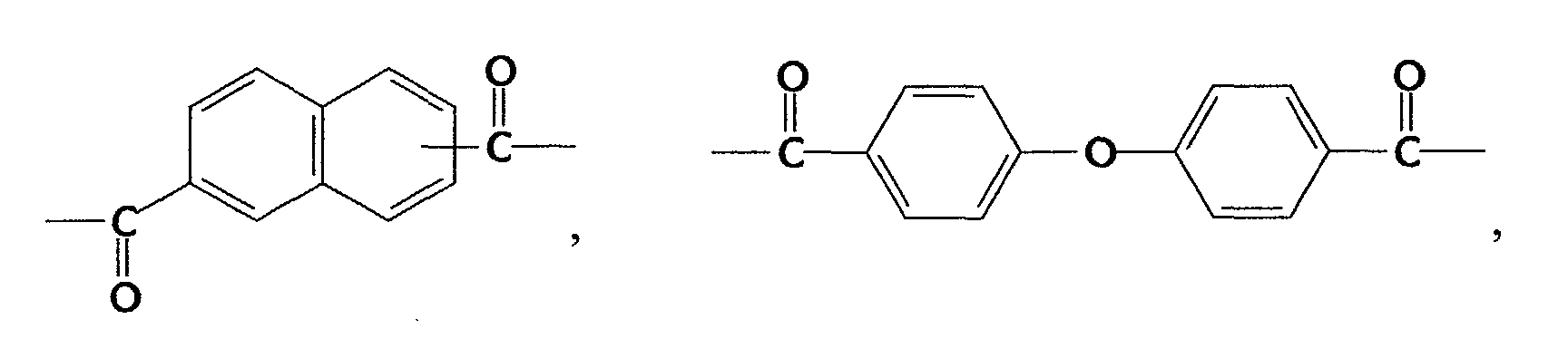

- Some typical diols which A in the above formula represents include ethylene glycol, diethylene glycol, triethylene glycol, thiodiethanol, cyclohexanedimethanol, bisphenol A, trans-1,4-cyclohexanediol, dodecanediol, cis-exo-2,3-norbomanediol, 5-norbornene-2,2-dimethanol, hydroquinone bis(2-hydroxyethylether), carbinol terminated polydimethylsiloxane, MW=1000 (DMS-C15), (Gelest Inc.), etc.
- Examples of water dispersible polyesters useful in the invention include Eastman AQ® polyesters, (Eastman Chemical Company). Eastman Polyesters AQ 29, AQ 38, and AQ 55 are composed of varying amounts of isophthalic acid, sodium sulfoisophthalic acid, diethylene glycol, and 1,4-cyclohexanedimethanol. These thermoplastic, amorphous, ionic polyesters are prepared by a melt-phase condensation polymerization at high temperature and low pressure, and the molten product is extruded into small pellets. The solid polymer disperses readily in water at 70°C with minimal agitation to give translucent, low viscosity dispersions containing no added surfactants or solvents. Varying the amount of ionic monomers, i.e., sulfoisophthalic acid, can control the particle size. The particle sizes range from 0.02 to 0.1µm.
- The third class of polymer used in the invention may be an aqueous dispersible polyurethane. Useful polyurethanes are disclosed in U.S. Patent No. 6,268,101 of Yacobucci et al. These materials may be prepared as described in "Polyurethane Handbook," Hanser Publishers, Munich Vienna, 1985. Examples of aqueous dispersible polyurethanes are Witcobond® polyurethane dispersion such as W-240, W-232 and W-254 by Crompton Corp. or Sancure® polyurethane by BF Goodrich Company.
- The polymer employed in the invention in general has a Tg of -50 to 150°C, preferably 5 to 100°C, most preferably 10 to 80 °C.
- The polymer latex employed in the invention in general have an average particle size of less than 2 µm, preferably less than 0.5 µm, more preferably less than 0.25 µm.
- The polymer latex used in the invention is present in the ink jet ink generally from 0.1 % to 20% by weight, preferably from 0.5% to 10% by weight.
- The aqueous carrier medium for the ink composition is water or a mixture of water and at least one water miscible co-solvent. Selection of a suitable mixture depends on requirements of the specific application, such as desired surface tension and viscosity, the selected pigment, drying time of the pigmented ink jet ink, and the type of paper onto which the ink will be printed. Representative examples of water-miscible co-solvents that may be selected include (1) alcohols, such as methyl alcohol, ethyl alcohol, n-propyl alcohol, isopropyl alcohol, n-butyl alcohol, sec-butyl alcohol, t-butyl alcohol, iso-butyl alcohol, furfuryl alcohol, and tetrahydrofurfuryl alcohol; (2) ketones or ketoalcohols such as acetone, methyl ethyl ketone and diacetone alcohol; (3) ethers, such as tetrahydrofuran and dioxane; (4) esters, such as ethyl acetate, ethyl lactate, ethylene carbonate and propylene carbonate; (5) polyhydric alcohols, such as ethylene glycol, diethylene glycol, triethylene glycol, tetraethylene glycol, propylene glycol, polyethylene glycol, glycerol, 2-methyl-2,4-pentanediol 1,2,6-hexanetriol and thioglycol; (6) lower alkyl mono- or di-ethers derived from alkylene glycols, such as ethylene glycol mono-methyl (or -ethyl) ether, diethylene glycol mono-methyl (or -ethyl) ether, diethylene glycol mono-butyl (or -ethyl) ether, propylene glycol mono-methyl (or -ethyl) ether, poly(ethylene glycol) butyl ether, triethylene glycol mono-methyl (or -ethyl) ether and diethylene glycol dimethyl (or -ethyl) ether; (7) nitrogen containing cyclic compounds, such as pyrrolidone, N-methyl-2-pyrrolidone, and 1,3-dimethyl-2-imidazolidinone; and (8) sulfur-containing compounds such as dimethyl sulfoxide, 2,2'-thiodiethanol, and tetramethylene sulfone.
- The amount of aqueous carrier medium is in the range of approximately 70 to 99 weight %, preferably approximately 90 to 98 weight %, based on the total weight of the ink. A mixture of water and a polyhydric alcohol, such as diethylene glycol, is useful as the aqueous carrier medium. In a preferred embodiment, the inks contain from about 5 to about 60 weight % of water miscible organic solvent based on the total weight of the aqueous carrier medium.
- Jet velocity, separation length of the droplets, drop size and stream stability are greatly affected by the surface tension and the viscosity of the ink. The ink jet inks suitable for use with ink jet printing systems and to apply to non-absorbing substrates, especially high surface energy hydrophobic surfaces, should have a surface tension in the range of about 20 dynes/cm to about 60 dynes/cm and, more preferably, in the range 20 dynes/cm to about 35 dynes/cm. Control of surface tensions in aqueous inks is accomplished by additions of small amounts of surfactants. The level of surfactants to be used can be determined through simple trial and error experiments, usually about 0.1% to about 6%, preferably, 0.5% to about 4% by weight of the total ink composition. Anionic, cationic and nonionic surfactants may be selected from those disclosed in U. S. Patents 5,324,349; 4,156,616 and 5,279,654 as well as many other surfactants known in the ink jet ink art. Commercial surfactants include the Surfynols® from Air Products; the Zonyls® from DuPont and the Fluorads® from 3M. Preferred surfactants can be silicon surfactants or fluorinated surfactants. Preferred silicon surfactants are available from BYK-Chemie as BYK surfactants, and from Crompton Corp, as Silwet@ surfactants. Commercially available fluorinated surfactants can be the Zonyls® from DuPont and the Fluorads® from 3M, they can be used alone or in combination with other surfactants.
- A humectant is added to the composition employed in the process of the invention to help prevent the ink from drying out or crusting in the orifices of the ink jet printhead. Polyhydric alcohols useful in the composition employed in the invention for this purpose include, for example, ethylene glycol, diethylene glycol, triethylene glycol, propylene glycol, tetraethylene glycol, polyethylene glycol, glycerol, 2-methyl-2,4-pentanediol, 1,2,6-hexanetriol and thioglycol. The humectant may be employed in a concentration of from about 10 to about 50 % by weight of the entire ink composition. In a preferred embodiment, diethylene glycol or a mixture of glycerol and diethylene glycol is employed a concentration of between 10 and 20 % by weight of the entire ink composition.
- The ink has physical properties compatible with a wide range of ejecting conditions, i.e., driving voltages and pulse widths for thermal ink jet printing devices, driving frequencies of the piezo element for either a drop-on-demand device or a continuous device, and the shape and size of the nozzle.
- A penetrant (0-10% by weight) may also be added to the ink composition employed in the process of the invention to help the ink penetrate the receiving substrate, especially when the substrate is a highly sized paper. A preferred penetrant for the inks employed in the present invention is n-propanol at a final concentration of 1-6 % by weight.
- A biocide (0.01-1.0% by weight) may also be added to prevent unwanted microbial growth which may occur in the ink over time. A preferred biocide for the inks employed in the present invention is Proxel® GXL (Zeneca Colours Co.) at a concentration of 0.05-0.5 % by weight. Additional additives which may optionally be present in ink jet inks include thickeners, conductivity enhancing agents, anti-kogation agents, pH buffering agents, drying agents, and defoamers.
- Ink jet inks made using polymers employed in this invention are employed in ink jet printing wherein liquid ink drops are applied in a controlled fashion to an ink receiving substrate, by ejecting ink droplets from plurality of nozzles, or orifices, in a print head of ink jet printers.
- Commercially available ink jet printers use several different methods to control the deposition of the ink droplets. Such methods are generally of two types: continuous stream and drop-on-demand.
- In drop-on-demand systems, a droplet of ink is ejected from an orifice directly to a position on the ink receiving layer by pressure created by, for example, a piezoelectric device, an acoustic device, or a thermal process controlled in accordance digital data signals. An ink droplet is not generated and ejected through the orifices of the print head unless it is needed. Ink jet printing methods, and related printers, are commercially available and need not be described in detail.
- To accelerate the printing speed and increase durability, an extra heating step can be added during the process of printing the ink composition of this invention. This heating step can be employed either during printing or after printing. In a preferred embodiment, heating is employed both during and after printing. Heating will help fluids to spread on a non-absorbing substrate as well as to accelerate its evaporation. Heating can also help ink components to penetrate into the non-absorbing substrate by swelling mechanism. The heating step during printing can be achieved using a heating means so that the non-absorbing substrate is heated to elevated temperature during the process of printing. The substrate is preferably heated to between 30 °C and 90 °C, more preferably between 40 to 70 °C. During the heating step after printing, the printed substrate is heated to elevated temperature using a heating means where substrate is heated to a temperature range between 50 °C and 150 °C, more preferably between 80 to 120 °C. Various methods may be used for the means of heating, for example, using light irradiation, a hot air source or an electrical heater. For the heating step during printing, an electrical heater or an infrared lamp is preferred. For the heating step after printing, light irradiation such as an infrared lamp is preferred. Optionally, an infrared absorbing material can be employed in the ink of the present invention to assist the heating by an infrared lamp.
- The following examples illustrate the utility of the present invention.
- The magenta pigment dispersion contains: 300 g of Polymeric beads, mean diameter of 50 µm (milling media); 30 g of quinacridone magenta pigment Pigment Red 122 (Sun Chemicals); 9 g of Oleoyl methyl taurine, (OMT) Potassium salt and 208 g of Deionized water, and 0.2 g of Proxel GXL ® (biocide from Zeneca). The above components were milled in a 2 liter double walled vessel obtained from BYK-Gardner using a high energy media mill manufactured by Morehouse-Cowles Hochmeyer. The mill was run for approximately 8 hours at room temperature. The dispersion was separated from the milling media by filtering the millgrind through a 4-8 µm KIMAX® Buchner Funnel obtained from VWR Scientific Products. At the end of milling, additional water is added to the dispersion so that the pigment is about 10.0% by weight of the total final dispersion and the biocide is about 230ppm by weight of the total final dispersion. The particle size is about 30 nm as measured by MICROTRAC II Ultrafine particle analyzer (UPA) manufactured by Leeds & Northrup.
- 600 g of deionized water and 3.6 g Triton 770® surfactant were charged to a 1-liter, three-neck round-bottom flask equipped with a mechanical stirrer and nitrogen inlet. The solution was purged with nitrogen for 30 min and heated to 60°C in a constant temperature bath. 36.0 g of styrene, 90.0 g of butyl methacrylate and 54.0 g of methacrylic acid were added and stirred for three minutes. 16.4 g of 10% sodium persulfate solution and 5.5 g of 10% sodium metabisulfite solution were added to initiate the polymerization. Polymerization was continued for one hour and heated one more hour at 60°C. The temperature was reduced to 50 °C and 1ml each of t-butyl hydroperoxide (10%) and sodium formaldehyde bisulfite (10%) were post-added. The content of the hydrophilic monomer is 30% by weight of the total polymer. The latex was cooled and filtered. The dispersion contains 22.2% solid by weight.
- Water soluble polymer Jonrez IJ-4655® is obtained from Westvaco as a styrene acrylic polymer solution at 25% Solids. The estimated content of the hydrophilic components in this polymer is about 40% by weight by titration.
- 160 g deionized water were charged to a 500 mL 1-neck round bottom flask equipped with mechanical stirrer. The flask was first flushed with nitrogen for 20 minutes, then immersed in a constant temperature bath at 40 °C. Afterwards, 0.25 g of potassium persulfate, 0.35 g sodium metabisufite, 2.0 g Triton 770 (30% active), 4.0 g of ethyl acrylate, 36.0 g vinylidene chloride were added to the flask. The polymerization reaction was continued for additional 12 hours. The latex was cooled and filtered. The final polymer latex dispersion contained 13.52% solid by weight and the average particle size is 0.056 micron. This polymer contains no hydrophilic monomer. This polymer dispersion is designated as Polymer Dispersion 1 (P-1).
- Solid AQ-55® polyester ionomer was purchased from Eastman Chemical Company and then added to water with heat and agitation to obtain AQ-55 dispersion at 30% solids in concentration. The estimated content of the ionic hydrophilic monomer in this polymer is less than 10% by weight. This polymer dispersion is designated as Polymer Dispersion 2 (P-2).
- W-240® was a self-crosslinkable polyurethane purchased from Crompton Corporation as aqueous dispersion at 30% solids. The estimated weight percentage of the hydrophilic monomer in this polymer is less than 10% by titration. This polymer dispersion is designated as Polymer Dispersion 3 (P-3).
- To prepare the Ink-1, 4.36 g of the Magenta Pigment Dispersion (10% active), 0.2 g Silwet® L-7608 (Crompton Corp.), 2.0 g diethylene glycol and 1.0 g di(propyleneglycol) methyl ether (Dowanol® DPM), 0.6 g 2-pyrrolidone, and 3.25 g of Polymer Dispersion 1 (13.52 % active) were added together with distilled water so that the final weight of the ink was 20.0 g. The final ink contained 2.18% Pigment Red 122, 1.0% Silwet® L-7608, 10.0% diethylene glycol, 5% di(propyleneglycol) methyl ether, 3% pyrrolidone and 2.2 % Polymer Dispersion-1. The solution was filtered through a 3 µm polytetrafluoroethylene filter.
- Ink-2 of the present invention was prepared similar to Ink-1 except that 1.46 g of Polymer Dispersion 2 (30.0% active) was used instead of Polymer Dispersion 1 such that the final ink contained 2.2% of Polymer Dispersion 2 by weight of the total ink.
- Ink-4 of the present invention was prepared similar to Ink-1 except that 1.46 g of Polymer Dispersion 3 (30.0% active) was used instead of Polymer Dispersion 1 such that the final ink contained 2.2% of Polymer Dispersion 3 by weight of the total ink.
- The comparative ink 1 was prepared similar to Ink-1 of the Invention except that 1.98 g of Comparative Polymer Dispersion PC-1 (22.2% active) was used instead of Polymer Dispersion 1. The final Ink contained 2.2 % of Comparative Polymer Dispersion PC-1.
- The comparative ink 2 was prepared similar to Comparative Ink 1 except that 1.76 g of Comparative Polymer Dispersion PC-2 (25% active) was used instead of Polymer Dispersion 1. The final Ink contained 2.2 % of Comparative Polymer Dispersion PC-2.
- The Comparative Ink 5 of the invention was prepared similar to Ink 1 of the invention except that 2.9 g of distilled water was used instead of Polymer Dispersion 1 so that the final ink did not contain any polymer latex.
- The inks of the present invention were filled into Epson 880 empty cartridges and printing was done with an Epson 880 Ink jet printer, using the above inks. All inks of the invention fired well through the Epson 880 printer, no nozzles were clogged. The inks were left in printer for over 48 hours and the above printing test was repeated. All the nozzles were firing with minimum cleaning cycles without any problems for the inks of the present invention.
- The inks of the present invention were filled into an ink bag and tested using an Inkjet ink fixture apparatus having a Brother piezo printhead with a heatable printing drum. Ink drop volume was measured vs time to test the printing reliability. A 1" by 10" non-absorbing vinyl substrate, a multi-purpose inkjet cast vinyl (MPI 1005 #226 from Avery Graphics), was mounted on the printing drum. The drum was kept at 50 °C during printing. A 0.7"x4" Dmax density patch print target was printed. After printing, the samples were further heated at 90 °C for 1 minute using an infrared lamp. A successful test result occurred when 20 pL ink droplets of the ink composition were continuously fired through the printhead at a rate of 7,500 drops/second for at least an hour without nozzle failure or ink droplet misdirection.
- A non-absorbing vinyl substrate, a multi-purpose inkjet cast vinyl (MPI 1005 #226 from Avery Graphics) was cut into 14 by 25 cm in size and placed on a heated coating block with temperature at about 40 °C. The above inks were filled into an airbrush (Paasche Sirbrush Set H-3 available from Paasche Airbrush Company, Harwood Heights, IL) connected to compressed house air. The pressure of the airbrush was adjusted to about 201b such that smooth ink flow was obtained. The inks were sprayed onto the heated vinyl substrates described above. Uniform coatings of the inks were obtained. The selected samples were then heated at 90 °C for 1 minute using an infrared lamp.
- The dry rub resistance test was carried out by rubbing the samples with a dry Q-tip for 4 passes under a consistent pressure in the inked area. The color loss in the treated sample area and the color transfer to Q-tip were examined visually and a rating of the dry rub resistance was given as follows on a scale of 0 to 5.
- 0: Best, No color loss, and/or color transfer;
- 1: hardly visible amount of color loss and/or color transfer;
- 2: visible amount of color loss and/or color transfer;
- 3: some color loss and color transfer;
- 4: large amount ofcolor loss and color transfer;
- 5: Worst, almost complete color loss and color transfer.
- A wet rub resistance test was carried out by placing an approximately 2.54 cm diameter water droplet on the ink-coated sample surface for 5 minutes, after which the excess water was wiped off with a paper towel. The above treated area was then rubbed with a dry paper towel for 4 passes under a consistent pressure a 3.5 cm diameter area. The color loss in the treated sample area and the color transfer to the paper towel were examined visually and a rating of the wet rub resistance was given similar as above on a scale of 0 to 5, 0 being the best and 5 being the worst. Both of the dry and wet rub resistance test results are shown in Table 1.
Table 1 Ink Polymer Dry Rub Rating Wet Rub Rating C-1 PC-1 2 4 C-2 PC-2 1 3 C-3 N/A 4 5 I-1 P-1 0 1 I-2 P-2 1 2 I-3 P-3 0 0 - From the above table, it is evident that the presence of polymer latex in the ink significantly improves the image durability under both dry and wet conditions compared to the inks without polymer latex. The inks of the present invention show further advantages in image durability compared to the comparative inks.
Claims (10)
- An ink jet printing method, comprising the steps of:A) providing an ink jet printer that is responsive to digital data signals;B) loading said printer with an ink jet recording element comprising a non-absorbing substrate;C) loading said printer with an ink jet ink composition comprising an aqueous ink jet ink composition comprising:-- a pigment;-- a polymer binder containing less than 25% of hydrophilic monomer by weight of the total polymer, which is dispersible but insoluble in aqueous media;-- at least one surfactant; and-- a humectant; andD) printing on said ink jet recording element accompanied by a heating step using said ink jet ink composition in response to said digital data signals.
- The method of claim 1 wherein said non-absorbing substrate is a plastic, glass or metal substrate.
- The method of claim 1 further comprising an in-situ heating step using a heating means wherein said ink jet recording element is heated to elevated temperature during the printing.
- The method of claim 3 wherein said temperature is between about 30°C to about 90°C.
- The method of claim 1 further comprising post-printing heating step wherein said ink jet recording element is heated to elevated temperature after printing using a heating means.
- The method of claim 5 where said temperature is between about 50°C to about 150°C.
- The method of claim 1 wherein the weight ratio of the said pigment to said polymer binder is 1:20 to 20:1.
- The method of claim 1 wherein said pigment comprises up to 10% by weight of the ink composition.
- The method of claim 1 wherein said pigment has an average particle size of less than 0.5 micron.
- The method of claim 1 wherein said ink further comprises a cross-linking agent.
Applications Claiming Priority (2)
| Application Number | Priority Date | Filing Date | Title |
|---|---|---|---|
| US256589 | 2002-09-27 | ||
| US10/256,589 US6773102B2 (en) | 2002-09-27 | 2002-09-27 | Inkjet printing method for an ink/receiver combination |
Publications (1)
| Publication Number | Publication Date |
|---|---|
| EP1403340A1 true EP1403340A1 (en) | 2004-03-31 |
Family
ID=31977869
Family Applications (1)
| Application Number | Title | Priority Date | Filing Date |
|---|---|---|---|
| EP20030077889 Withdrawn EP1403340A1 (en) | 2002-09-27 | 2003-09-15 | Inkjet printing method and inkjet ink composition |
Country Status (3)
| Country | Link |
|---|---|
| US (1) | US6773102B2 (en) |
| EP (1) | EP1403340A1 (en) |
| JP (1) | JP2004114693A (en) |
Cited By (2)
| Publication number | Priority date | Publication date | Assignee | Title |
|---|---|---|---|---|
| WO2004094542A1 (en) * | 2003-03-26 | 2004-11-04 | Eastman Kodak Company | Inkjet printing method |
| GB2414737A (en) * | 2004-05-19 | 2005-12-07 | Nanojetink Ltd | Inkjet printing ink |
Families Citing this family (11)
| Publication number | Priority date | Publication date | Assignee | Title |
|---|---|---|---|---|
| JP2004107481A (en) * | 2002-09-18 | 2004-04-08 | Sharp Corp | Ink composition, recording method and recorded image using the same, and ink set and ink head |
| US7381755B2 (en) * | 2002-09-27 | 2008-06-03 | Eastman Kodak Company | Inkjet ink composition and ink/receiver combination |
| US7338988B2 (en) * | 2002-11-12 | 2008-03-04 | Rohm And Haas Company | Aqueous inkjet ink composition |
| US20050004263A1 (en) * | 2003-07-02 | 2005-01-06 | Ilford Imaging Uk Limited | Ink jet ink and recording process |
| US7297407B2 (en) * | 2004-09-20 | 2007-11-20 | E. I. Du Pont De Nemours And Company | Glass laminates for reduction of sound transmission |
| EP1924658B1 (en) * | 2005-09-15 | 2010-08-25 | E.I. Du Pont De Nemours And Company | Aqueous inkjet ink |
| US10072168B2 (en) * | 2005-10-13 | 2018-09-11 | Hewlett-Packard Development Company L.P. | Marking fluids for vinyl substrates |
| US8814337B2 (en) * | 2007-12-27 | 2014-08-26 | Eastman Kodak Company | Inkjet ink sets for high speed printing on plain papers and glossy media |
| GB0805154D0 (en) * | 2008-03-20 | 2008-04-23 | Fujifilm Imaging Colorants Ltd | Ink,process and use |
| EP2443206A4 (en) * | 2009-06-18 | 2013-12-25 | Hewlett Packard Development Co | Ink compositions |
| CN105899625B (en) * | 2014-01-10 | 2018-09-18 | 惠普发展公司,有限责任合伙企业 | Magenta ink |
Citations (4)
| Publication number | Priority date | Publication date | Assignee | Title |
|---|---|---|---|---|
| EP0974626A1 (en) * | 1998-07-22 | 2000-01-26 | E.I. Dupont De Nemours And Company | Aqueous pigmented ink jet inks for printing on vinyls |
| EP1219688A1 (en) * | 2000-12-28 | 2002-07-03 | Xerox Corporation | Ink jet ink compositions and printing processes |
| EP1226970A2 (en) * | 2001-01-26 | 2002-07-31 | Eastman Kodak Company | Ink jet recording element and printing method |
| US6447110B1 (en) * | 2001-08-31 | 2002-09-10 | Eastman Kodak Company | Ink jet printing method |
Family Cites Families (18)
| Publication number | Priority date | Publication date | Assignee | Title |
|---|---|---|---|---|
| DE2543092C2 (en) | 1975-09-26 | 1985-05-15 | Agfa-Gevaert Ag, 5090 Leverkusen | Process for recording information using the ink-jet process |
| DE2638946C3 (en) | 1976-08-28 | 1983-06-16 | Hoechst Ag, 6230 Frankfurt | Pigment dispersions for use in hydrophilic and hydrophobic media |
| DE3115532A1 (en) | 1980-04-17 | 1982-01-28 | Canon K.K., Tokyo | INK-JET RECORDING METHOD AND RECORDING INK FOR RECORDING ON AN IMAGE RECEIVER |
| US4311775A (en) | 1980-10-06 | 1982-01-19 | Eastman Kodak Company | Novel phthalocyanine pigments and electrophotographic uses thereof |
| US4762875A (en) | 1984-03-26 | 1988-08-09 | Gold Marvin H | Water based printing inks for plastic and metal surfaces |
| US5026427A (en) | 1988-10-12 | 1991-06-25 | E. I. Dupont De Nemours And Company | Process for making pigmented ink jet inks |
| JPH0819361B2 (en) | 1988-12-27 | 1996-02-28 | キヤノン株式会社 | Recording liquid and ink jet recording method using the same |
| DE3920730A1 (en) | 1989-06-24 | 1991-01-10 | Heidelberger Druckmasch Ag | DEVICE FOR ARC SMOOTHING ON THE PRINT CYLINDER IN AN ARC ROTATION PRINTING MACHINE |
| US5085698A (en) | 1990-04-11 | 1992-02-04 | E. I. Du Pont De Nemours And Company | Aqueous pigmented inks for ink jet printers |
| JP2899088B2 (en) | 1990-08-31 | 1999-06-02 | キヤノン株式会社 | Ink jet ink, method of manufacturing the same, and ink jet recording method using such ink |
| US5141556A (en) | 1991-06-13 | 1992-08-25 | E. I. Du Pont De Nemours And Company | Penetrants for aqueous ink jet inks |
| GB9116240D0 (en) | 1991-07-27 | 1991-09-11 | Ciba Geigy Ag | Pigment compositions |
| US5169436A (en) | 1992-05-13 | 1992-12-08 | E. I. Du Pont De Nemours And Company | Sulfur-containing penetrants for ink jet inks |
| SG48074A1 (en) | 1992-05-20 | 1998-04-17 | Seiko Epson Corp | Ink composition for ink jet printing |
| IL116376A (en) | 1994-12-15 | 2001-03-19 | Cabot Corp | Aqueous ink jet ink compositions containing modified carbon products |
| US5764263A (en) * | 1996-02-05 | 1998-06-09 | Xerox Corporation | Printing process, apparatus, and materials for the reduction of paper curl |
| GB9603667D0 (en) | 1996-02-21 | 1996-04-17 | Coates Brothers Plc | Ink composition |
| US6268101B1 (en) | 2000-04-13 | 2001-07-31 | Eastman Kodak Company | Water-resistant polyurethane overcoat for imaging materials |
-
2002
- 2002-09-27 US US10/256,589 patent/US6773102B2/en not_active Expired - Lifetime
-
2003
- 2003-09-15 EP EP20030077889 patent/EP1403340A1/en not_active Withdrawn
- 2003-09-26 JP JP2003336208A patent/JP2004114693A/en active Pending
Patent Citations (4)
| Publication number | Priority date | Publication date | Assignee | Title |
|---|---|---|---|---|
| EP0974626A1 (en) * | 1998-07-22 | 2000-01-26 | E.I. Dupont De Nemours And Company | Aqueous pigmented ink jet inks for printing on vinyls |
| EP1219688A1 (en) * | 2000-12-28 | 2002-07-03 | Xerox Corporation | Ink jet ink compositions and printing processes |
| EP1226970A2 (en) * | 2001-01-26 | 2002-07-31 | Eastman Kodak Company | Ink jet recording element and printing method |
| US6447110B1 (en) * | 2001-08-31 | 2002-09-10 | Eastman Kodak Company | Ink jet printing method |
Cited By (2)
| Publication number | Priority date | Publication date | Assignee | Title |
|---|---|---|---|---|
| WO2004094542A1 (en) * | 2003-03-26 | 2004-11-04 | Eastman Kodak Company | Inkjet printing method |
| GB2414737A (en) * | 2004-05-19 | 2005-12-07 | Nanojetink Ltd | Inkjet printing ink |
Also Published As
| Publication number | Publication date |
|---|---|
| US20040061754A1 (en) | 2004-04-01 |
| JP2004114693A (en) | 2004-04-15 |
| US6773102B2 (en) | 2004-08-10 |
Similar Documents
| Publication | Publication Date | Title |
|---|---|---|
| EP1403343B1 (en) | An aqueous inkjet ink and receiver combination | |
| EP1403341B1 (en) | Inkjet printing method and inkjet ink composition | |
| EP1403342B1 (en) | Ink jet ink composition and ink/receiver combination | |
| EP1245588B1 (en) | Composite colorant particles | |
| US6533408B1 (en) | Ink jet printing method | |
| US6508548B2 (en) | Ink jet printing method | |
| US20070037902A1 (en) | Aqueous pigmented ink formulation containing polymer-encapsulated pigments, binder and smectite clay particles | |
| GB2324800A (en) | Ink-jet Ink | |
| US6773102B2 (en) | Inkjet printing method for an ink/receiver combination | |
| EP1245589B1 (en) | Process for making composite colorant particles | |
| US20030027893A1 (en) | Ink jet printing method | |
| US20050134665A1 (en) | Ink jet ink composition | |
| US6031022A (en) | Pigmented ink jet inks containing olefins | |
| EP1426422A1 (en) | Aqueous pigmented ink formulation containing polymer-encapsulated pigments binder and smectite clay particles | |
| JP2002363470A (en) | Ink jet ink composition | |
| US20030027892A1 (en) | Ink jet ink composition | |
| US20020193464A1 (en) | Ink jet printing method |
Legal Events
| Date | Code | Title | Description |
|---|---|---|---|
| PUAI | Public reference made under article 153(3) epc to a published international application that has entered the european phase |
Free format text: ORIGINAL CODE: 0009012 |
|
| AK | Designated contracting states |
Kind code of ref document: A1 Designated state(s): AT BE BG CH CY CZ DE DK EE ES FI FR GB GR HU IE IT LI LU MC NL PT RO SE SI SK TR |
|
| AX | Request for extension of the european patent |
Extension state: AL LT LV MK |
|
| 17P | Request for examination filed |
Effective date: 20040901 |
|
| AKX | Designation fees paid |
Designated state(s): DE FR GB |
|
| STAA | Information on the status of an ep patent application or granted ep patent |
Free format text: STATUS: THE APPLICATION HAS BEEN WITHDRAWN |
|
| 18W | Application withdrawn |
Effective date: 20051024 |