EP1403320A1 - Polyester resin composition - Google Patents
Polyester resin composition Download PDFInfo
- Publication number
- EP1403320A1 EP1403320A1 EP20030021673 EP03021673A EP1403320A1 EP 1403320 A1 EP1403320 A1 EP 1403320A1 EP 20030021673 EP20030021673 EP 20030021673 EP 03021673 A EP03021673 A EP 03021673A EP 1403320 A1 EP1403320 A1 EP 1403320A1
- Authority
- EP
- European Patent Office
- Prior art keywords
- polyester resin
- resin composition
- group
- polyester
- monomer
- Prior art date
- Legal status (The legal status is an assumption and is not a legal conclusion. Google has not performed a legal analysis and makes no representation as to the accuracy of the status listed.)
- Granted
Links
- 239000000203 mixture Substances 0.000 title claims abstract description 94
- 229920001225 polyester resin Polymers 0.000 title claims abstract description 91
- 239000004645 polyester resin Substances 0.000 title claims abstract description 91
- 229920000728 polyester Polymers 0.000 claims abstract description 52
- BPQQTUXANYXVAA-UHFFFAOYSA-N Orthosilicate Chemical compound [O-][Si]([O-])([O-])[O-] BPQQTUXANYXVAA-UHFFFAOYSA-N 0.000 claims abstract description 44
- 239000000178 monomer Substances 0.000 claims abstract description 41
- 239000003963 antioxidant agent Substances 0.000 claims abstract description 29
- 125000000542 sulfonic acid group Chemical group 0.000 claims abstract description 28
- 125000003277 amino group Chemical group 0.000 claims abstract description 26
- 125000003368 amide group Chemical group 0.000 claims abstract description 23
- 125000001841 imino group Chemical group [H]N=* 0.000 claims abstract description 23
- 229920006230 thermoplastic polyester resin Polymers 0.000 claims abstract description 17
- 230000003078 antioxidant effect Effects 0.000 claims abstract description 15
- -1 polyethylene terephthalate Polymers 0.000 claims description 40
- 229920000139 polyethylene terephthalate Polymers 0.000 claims description 9
- 239000005020 polyethylene terephthalate Substances 0.000 claims description 9
- 239000003795 chemical substances by application Substances 0.000 claims description 8
- 239000011112 polyethylene naphthalate Substances 0.000 claims description 5
- 229920003207 poly(ethylene-2,6-naphthalate) Polymers 0.000 claims description 4
- 239000000470 constituent Substances 0.000 claims description 2
- 229920005989 resin Polymers 0.000 description 24
- 239000011347 resin Substances 0.000 description 24
- 238000000465 moulding Methods 0.000 description 18
- 150000004760 silicates Chemical class 0.000 description 16
- 230000000052 comparative effect Effects 0.000 description 14
- 125000000524 functional group Chemical group 0.000 description 14
- 238000011156 evaluation Methods 0.000 description 13
- 238000000034 method Methods 0.000 description 13
- 239000011342 resin composition Substances 0.000 description 13
- 230000007062 hydrolysis Effects 0.000 description 12
- 238000004898 kneading Methods 0.000 description 11
- QVGXLLKOCUKJST-UHFFFAOYSA-N atomic oxygen Chemical compound [O] QVGXLLKOCUKJST-UHFFFAOYSA-N 0.000 description 10
- 238000006460 hydrolysis reaction Methods 0.000 description 10
- 229910052760 oxygen Inorganic materials 0.000 description 10
- 239000001301 oxygen Substances 0.000 description 10
- LYCAIKOWRPUZTN-UHFFFAOYSA-N Ethylene glycol Chemical compound OCCO LYCAIKOWRPUZTN-UHFFFAOYSA-N 0.000 description 9
- 230000004888 barrier function Effects 0.000 description 9
- 238000006068 polycondensation reaction Methods 0.000 description 9
- 239000002253 acid Substances 0.000 description 8
- 239000002131 composite material Substances 0.000 description 8
- 150000001875 compounds Chemical class 0.000 description 8
- 238000005979 thermal decomposition reaction Methods 0.000 description 8
- LFQSCWFLJHTTHZ-UHFFFAOYSA-N Ethanol Chemical compound CCO LFQSCWFLJHTTHZ-UHFFFAOYSA-N 0.000 description 7
- 239000002734 clay mineral Substances 0.000 description 7
- 230000035699 permeability Effects 0.000 description 7
- 238000012545 processing Methods 0.000 description 7
- OKKJLVBELUTLKV-UHFFFAOYSA-N Methanol Chemical compound OC OKKJLVBELUTLKV-UHFFFAOYSA-N 0.000 description 6
- VYFOAVADNIHPTR-UHFFFAOYSA-N isatoic anhydride Chemical compound NC1=CC=CC=C1CO VYFOAVADNIHPTR-UHFFFAOYSA-N 0.000 description 6
- 239000000047 product Substances 0.000 description 6
- 125000003118 aryl group Chemical group 0.000 description 5
- 239000006185 dispersion Substances 0.000 description 5
- 150000002500 ions Chemical class 0.000 description 5
- 239000011159 matrix material Substances 0.000 description 5
- 239000002245 particle Substances 0.000 description 5
- 238000012360 testing method Methods 0.000 description 5
- HEFNNWSXXWATRW-UHFFFAOYSA-N Ibuprofen Chemical compound CC(C)CC1=CC=C(C(C)C(O)=O)C=C1 HEFNNWSXXWATRW-UHFFFAOYSA-N 0.000 description 4
- OFOBLEOULBTSOW-UHFFFAOYSA-N Malonic acid Chemical compound OC(=O)CC(O)=O OFOBLEOULBTSOW-UHFFFAOYSA-N 0.000 description 4
- JKIJEFPNVSHHEI-UHFFFAOYSA-N Phenol, 2,4-bis(1,1-dimethylethyl)-, phosphite (3:1) Chemical compound CC(C)(C)C1=CC(C(C)(C)C)=CC=C1OP(OC=1C(=CC(=CC=1)C(C)(C)C)C(C)(C)C)OC1=CC=C(C(C)(C)C)C=C1C(C)(C)C JKIJEFPNVSHHEI-UHFFFAOYSA-N 0.000 description 4
- KKEYFWRCBNTPAC-UHFFFAOYSA-N Terephthalic acid Chemical compound OC(=O)C1=CC=C(C(O)=O)C=C1 KKEYFWRCBNTPAC-UHFFFAOYSA-N 0.000 description 4
- 125000003178 carboxy group Chemical group [H]OC(*)=O 0.000 description 4
- 229910000271 hectorite Inorganic materials 0.000 description 4
- KWLMIXQRALPRBC-UHFFFAOYSA-L hectorite Chemical compound [Li+].[OH-].[OH-].[Na+].[Mg+2].O1[Si]2([O-])O[Si]1([O-])O[Si]([O-])(O1)O[Si]1([O-])O2 KWLMIXQRALPRBC-UHFFFAOYSA-L 0.000 description 4
- 239000000463 material Substances 0.000 description 4
- 229910052751 metal Inorganic materials 0.000 description 4
- 239000002184 metal Substances 0.000 description 4
- 229910052618 mica group Inorganic materials 0.000 description 4
- 229910052708 sodium Inorganic materials 0.000 description 4
- 239000011734 sodium Substances 0.000 description 4
- DGAQECJNVWCQMB-PUAWFVPOSA-M Ilexoside XXIX Chemical compound C[C@@H]1CC[C@@]2(CC[C@@]3(C(=CC[C@H]4[C@]3(CC[C@@H]5[C@@]4(CC[C@@H](C5(C)C)OS(=O)(=O)[O-])C)C)[C@@H]2[C@]1(C)O)C)C(=O)O[C@H]6[C@@H]([C@H]([C@@H]([C@H](O6)CO)O)O)O.[Na+] DGAQECJNVWCQMB-PUAWFVPOSA-M 0.000 description 3
- KFZMGEQAYNKOFK-UHFFFAOYSA-N Isopropanol Chemical compound CC(C)O KFZMGEQAYNKOFK-UHFFFAOYSA-N 0.000 description 3
- MUBZPKHOEPUJKR-UHFFFAOYSA-N Oxalic acid Chemical compound OC(=O)C(O)=O MUBZPKHOEPUJKR-UHFFFAOYSA-N 0.000 description 3
- BGYHLZZASRKEJE-UHFFFAOYSA-N [3-[3-(3,5-ditert-butyl-4-hydroxyphenyl)propanoyloxy]-2,2-bis[3-(3,5-ditert-butyl-4-hydroxyphenyl)propanoyloxymethyl]propyl] 3-(3,5-ditert-butyl-4-hydroxyphenyl)propanoate Chemical compound CC(C)(C)C1=C(O)C(C(C)(C)C)=CC(CCC(=O)OCC(COC(=O)CCC=2C=C(C(O)=C(C=2)C(C)(C)C)C(C)(C)C)(COC(=O)CCC=2C=C(C(O)=C(C=2)C(C)(C)C)C(C)(C)C)COC(=O)CCC=2C=C(C(O)=C(C=2)C(C)(C)C)C(C)(C)C)=C1 BGYHLZZASRKEJE-UHFFFAOYSA-N 0.000 description 3
- 125000000217 alkyl group Chemical group 0.000 description 3
- 230000001588 bifunctional effect Effects 0.000 description 3
- 150000001735 carboxylic acids Chemical class 0.000 description 3
- GUJOJGAPFQRJSV-UHFFFAOYSA-N dialuminum;dioxosilane;oxygen(2-);hydrate Chemical compound O.[O-2].[O-2].[O-2].[Al+3].[Al+3].O=[Si]=O.O=[Si]=O.O=[Si]=O.O=[Si]=O GUJOJGAPFQRJSV-UHFFFAOYSA-N 0.000 description 3
- 230000000694 effects Effects 0.000 description 3
- 125000002887 hydroxy group Chemical group [H]O* 0.000 description 3
- 239000011256 inorganic filler Substances 0.000 description 3
- 229910003475 inorganic filler Inorganic materials 0.000 description 3
- 229910052744 lithium Inorganic materials 0.000 description 3
- 238000002844 melting Methods 0.000 description 3
- 230000008018 melting Effects 0.000 description 3
- VNWKTOKETHGBQD-UHFFFAOYSA-N methane Chemical compound C VNWKTOKETHGBQD-UHFFFAOYSA-N 0.000 description 3
- 239000010445 mica Substances 0.000 description 3
- 229910052901 montmorillonite Inorganic materials 0.000 description 3
- 230000000704 physical effect Effects 0.000 description 3
- 238000002360 preparation method Methods 0.000 description 3
- 239000002904 solvent Substances 0.000 description 3
- 230000008961 swelling Effects 0.000 description 3
- 238000002834 transmittance Methods 0.000 description 3
- CWLKGDAVCFYWJK-UHFFFAOYSA-N 3-aminophenol Chemical compound NC1=CC=CC(O)=C1 CWLKGDAVCFYWJK-UHFFFAOYSA-N 0.000 description 2
- PLIKAWJENQZMHA-UHFFFAOYSA-N 4-aminophenol Chemical compound NC1=CC=C(O)C=C1 PLIKAWJENQZMHA-UHFFFAOYSA-N 0.000 description 2
- NLZUEZXRPGMBCV-UHFFFAOYSA-N Butylhydroxytoluene Chemical compound CC1=CC(C(C)(C)C)=C(O)C(C(C)(C)C)=C1 NLZUEZXRPGMBCV-UHFFFAOYSA-N 0.000 description 2
- VTYYLEPIZMXCLO-UHFFFAOYSA-L Calcium carbonate Chemical compound [Ca+2].[O-]C([O-])=O VTYYLEPIZMXCLO-UHFFFAOYSA-L 0.000 description 2
- RTZKZFJDLAIYFH-UHFFFAOYSA-N Diethyl ether Chemical compound CCOCC RTZKZFJDLAIYFH-UHFFFAOYSA-N 0.000 description 2
- YCKRFDGAMUMZLT-UHFFFAOYSA-N Fluorine atom Chemical compound [F] YCKRFDGAMUMZLT-UHFFFAOYSA-N 0.000 description 2
- AEMRFAOFKBGASW-UHFFFAOYSA-N Glycolic acid Chemical compound OCC(O)=O AEMRFAOFKBGASW-UHFFFAOYSA-N 0.000 description 2
- QIGBRXMKCJKVMJ-UHFFFAOYSA-N Hydroquinone Chemical compound OC1=CC=C(O)C=C1 QIGBRXMKCJKVMJ-UHFFFAOYSA-N 0.000 description 2
- OWYWGLHRNBIFJP-UHFFFAOYSA-N Ipazine Chemical compound CCN(CC)C1=NC(Cl)=NC(NC(C)C)=N1 OWYWGLHRNBIFJP-UHFFFAOYSA-N 0.000 description 2
- WHXSMMKQMYFTQS-UHFFFAOYSA-N Lithium Chemical compound [Li] WHXSMMKQMYFTQS-UHFFFAOYSA-N 0.000 description 2
- 239000004952 Polyamide Substances 0.000 description 2
- ZLMJMSJWJFRBEC-UHFFFAOYSA-N Potassium Chemical compound [K] ZLMJMSJWJFRBEC-UHFFFAOYSA-N 0.000 description 2
- WNLRTRBMVRJNCN-UHFFFAOYSA-N adipic acid Chemical compound OC(=O)CCCCC(O)=O WNLRTRBMVRJNCN-UHFFFAOYSA-N 0.000 description 2
- 150000001298 alcohols Chemical class 0.000 description 2
- 229910052783 alkali metal Inorganic materials 0.000 description 2
- 150000001340 alkali metals Chemical class 0.000 description 2
- 150000008064 anhydrides Chemical class 0.000 description 2
- SVPXDRXYRYOSEX-UHFFFAOYSA-N bentoquatam Chemical compound O.O=[Si]=O.O=[Al]O[Al]=O SVPXDRXYRYOSEX-UHFFFAOYSA-N 0.000 description 2
- IISBACLAFKSPIT-UHFFFAOYSA-N bisphenol A Chemical compound C=1C=C(O)C=CC=1C(C)(C)C1=CC=C(O)C=C1 IISBACLAFKSPIT-UHFFFAOYSA-N 0.000 description 2
- WERYXYBDKMZEQL-UHFFFAOYSA-N butane-1,4-diol Chemical compound OCCCCO WERYXYBDKMZEQL-UHFFFAOYSA-N 0.000 description 2
- 125000004432 carbon atom Chemical group C* 0.000 description 2
- 150000001732 carboxylic acid derivatives Chemical class 0.000 description 2
- 230000006866 deterioration Effects 0.000 description 2
- 150000001991 dicarboxylic acids Chemical class 0.000 description 2
- 125000000118 dimethyl group Chemical group [H]C([H])([H])* 0.000 description 2
- 239000000945 filler Substances 0.000 description 2
- 229910052731 fluorine Inorganic materials 0.000 description 2
- 239000011737 fluorine Substances 0.000 description 2
- 125000004435 hydrogen atom Chemical group [H]* 0.000 description 2
- 229910010272 inorganic material Inorganic materials 0.000 description 2
- 239000011147 inorganic material Substances 0.000 description 2
- QQVIHTHCMHWDBS-UHFFFAOYSA-N isophthalic acid Chemical compound OC(=O)C1=CC=CC(C(O)=O)=C1 QQVIHTHCMHWDBS-UHFFFAOYSA-N 0.000 description 2
- 238000004519 manufacturing process Methods 0.000 description 2
- 238000002156 mixing Methods 0.000 description 2
- 150000004010 onium ions Chemical class 0.000 description 2
- 239000002530 phenolic antioxidant Substances 0.000 description 2
- 125000001997 phenyl group Chemical group [H]C1=C([H])C([H])=C(*)C([H])=C1[H] 0.000 description 2
- XNGIFLGASWRNHJ-UHFFFAOYSA-N phthalic acid Chemical compound OC(=O)C1=CC=CC=C1C(O)=O XNGIFLGASWRNHJ-UHFFFAOYSA-N 0.000 description 2
- 229920002647 polyamide Polymers 0.000 description 2
- 229920001707 polybutylene terephthalate Polymers 0.000 description 2
- 229910052700 potassium Inorganic materials 0.000 description 2
- 239000011591 potassium Substances 0.000 description 2
- 230000001737 promoting effect Effects 0.000 description 2
- 150000003839 salts Chemical class 0.000 description 2
- 229910000275 saponite Inorganic materials 0.000 description 2
- CXMXRPHRNRROMY-UHFFFAOYSA-N sebacic acid Chemical compound OC(=O)CCCCCCCCC(O)=O CXMXRPHRNRROMY-UHFFFAOYSA-N 0.000 description 2
- 229910021647 smectite Inorganic materials 0.000 description 2
- 239000000758 substrate Substances 0.000 description 2
- 125000001273 sulfonato group Chemical group [O-]S(*)(=O)=O 0.000 description 2
- 238000009864 tensile test Methods 0.000 description 2
- BJQWBACJIAKDTJ-UHFFFAOYSA-N tetrabutylphosphanium Chemical compound CCCC[P+](CCCC)(CCCC)CCCC BJQWBACJIAKDTJ-UHFFFAOYSA-N 0.000 description 2
- SZWHXXNVLACKBV-UHFFFAOYSA-N tetraethylphosphanium Chemical compound CC[P+](CC)(CC)CC SZWHXXNVLACKBV-UHFFFAOYSA-N 0.000 description 2
- 238000009283 thermal hydrolysis Methods 0.000 description 2
- WSNJABVSHLCCOX-UHFFFAOYSA-J trilithium;trimagnesium;trisodium;dioxido(oxo)silane;tetrafluoride Chemical compound [Li+].[Li+].[Li+].[F-].[F-].[F-].[F-].[Na+].[Na+].[Na+].[Mg+2].[Mg+2].[Mg+2].[O-][Si]([O-])=O.[O-][Si]([O-])=O.[O-][Si]([O-])=O.[O-][Si]([O-])=O WSNJABVSHLCCOX-UHFFFAOYSA-J 0.000 description 2
- XLYOFNOQVPJJNP-UHFFFAOYSA-N water Substances O XLYOFNOQVPJJNP-UHFFFAOYSA-N 0.000 description 2
- WZCQRUWWHSTZEM-UHFFFAOYSA-N 1,3-phenylenediamine Chemical compound NC1=CC=CC(N)=C1 WZCQRUWWHSTZEM-UHFFFAOYSA-N 0.000 description 1
- PXGZQGDTEZPERC-UHFFFAOYSA-N 1,4-cyclohexanedicarboxylic acid Chemical compound OC(=O)C1CCC(C(O)=O)CC1 PXGZQGDTEZPERC-UHFFFAOYSA-N 0.000 description 1
- FRASJONUBLZVQX-UHFFFAOYSA-N 1,4-dioxonaphthalene Natural products C1=CC=C2C(=O)C=CC(=O)C2=C1 FRASJONUBLZVQX-UHFFFAOYSA-N 0.000 description 1
- CBCKQZAAMUWICA-UHFFFAOYSA-N 1,4-phenylenediamine Chemical compound NC1=CC=C(N)C=C1 CBCKQZAAMUWICA-UHFFFAOYSA-N 0.000 description 1
- BOKGTLAJQHTOKE-UHFFFAOYSA-N 1,5-dihydroxynaphthalene Chemical compound C1=CC=C2C(O)=CC=CC2=C1O BOKGTLAJQHTOKE-UHFFFAOYSA-N 0.000 description 1
- SPJXZYLLLWOSLQ-UHFFFAOYSA-N 1-[(1-aminocyclohexyl)methyl]cyclohexan-1-amine Chemical compound C1CCCCC1(N)CC1(N)CCCCC1 SPJXZYLLLWOSLQ-UHFFFAOYSA-N 0.000 description 1
- SFWZZSXCWQTORH-UHFFFAOYSA-N 1-methyl-2-phenylindole Chemical compound C=1C2=CC=CC=C2N(C)C=1C1=CC=CC=C1 SFWZZSXCWQTORH-UHFFFAOYSA-N 0.000 description 1
- NJEGACMQQWBZTP-UHFFFAOYSA-N 1-piperazin-1-ylpropan-2-amine Chemical compound CC(N)CN1CCNCC1 NJEGACMQQWBZTP-UHFFFAOYSA-N 0.000 description 1
- HOLHFJBYIKOIPX-UHFFFAOYSA-N 16,16-dimethylheptadecylsulfanium bromide Chemical compound [Br-].CC(CCCCCCCCCCCCCCC[SH2+])(C)C HOLHFJBYIKOIPX-UHFFFAOYSA-N 0.000 description 1
- CDAWCLOXVUBKRW-UHFFFAOYSA-N 2-aminophenol Chemical class NC1=CC=CC=C1O CDAWCLOXVUBKRW-UHFFFAOYSA-N 0.000 description 1
- BTVWZWFKMIUSGS-UHFFFAOYSA-N 2-methylpropane-1,2-diol Chemical compound CC(C)(O)CO BTVWZWFKMIUSGS-UHFFFAOYSA-N 0.000 description 1
- XUSNPFGLKGCWGN-UHFFFAOYSA-N 3-[4-(3-aminopropyl)piperazin-1-yl]propan-1-amine Chemical compound NCCCN1CCN(CCCN)CC1 XUSNPFGLKGCWGN-UHFFFAOYSA-N 0.000 description 1
- 229940018563 3-aminophenol Drugs 0.000 description 1
- ICNFHJVPAJKPHW-UHFFFAOYSA-N 4,4'-Thiodianiline Chemical compound C1=CC(N)=CC=C1SC1=CC=C(N)C=C1 ICNFHJVPAJKPHW-UHFFFAOYSA-N 0.000 description 1
- PSHPCZGANRRQDN-UHFFFAOYSA-N 4-(4-aminophenyl)sulfonylphenol Chemical compound C1=CC(N)=CC=C1S(=O)(=O)C1=CC=C(O)C=C1 PSHPCZGANRRQDN-UHFFFAOYSA-N 0.000 description 1
- XXHIPRDUAVCXHW-UHFFFAOYSA-N 4-[2-ethyl-1-(4-hydroxyphenyl)hexyl]phenol Chemical compound C=1C=C(O)C=CC=1C(C(CC)CCCC)C1=CC=C(O)C=C1 XXHIPRDUAVCXHW-UHFFFAOYSA-N 0.000 description 1
- ABJQKDJOYSQVFX-UHFFFAOYSA-N 4-aminonaphthalen-1-ol Chemical compound C1=CC=C2C(N)=CC=C(O)C2=C1 ABJQKDJOYSQVFX-UHFFFAOYSA-N 0.000 description 1
- CYMPUOGZUXAIMY-UHFFFAOYSA-N 4-methoxy-2-methyl-n-phenylaniline Chemical compound CC1=CC(OC)=CC=C1NC1=CC=CC=C1 CYMPUOGZUXAIMY-UHFFFAOYSA-N 0.000 description 1
- IYLAYECSRJZCCB-UHFFFAOYSA-N 6-ethoxy-2,2,4-trimethyl-1-octyl-3,4-dihydroquinoline Chemical compound C1=C(OCC)C=C2C(C)CC(C)(C)N(CCCCCCCC)C2=C1 IYLAYECSRJZCCB-UHFFFAOYSA-N 0.000 description 1
- QPMQUGXWRITCSC-UHFFFAOYSA-N 6-ethoxy-2,2,4-trimethyl-1-octylquinoline Chemical compound C1=C(OCC)C=C2C(C)=CC(C)(C)N(CCCCCCCC)C2=C1 QPMQUGXWRITCSC-UHFFFAOYSA-N 0.000 description 1
- IFRZFVWGWWXBOD-UHFFFAOYSA-N 6-ethoxy-2,2,4-trimethyl-1-phenyl-3,4-dihydroquinoline Chemical compound CC1(C)CC(C)C2=CC(OCC)=CC=C2N1C1=CC=CC=C1 IFRZFVWGWWXBOD-UHFFFAOYSA-N 0.000 description 1
- GNIZAVWJHGXBEV-UHFFFAOYSA-N 6-ethoxy-2,2,4-trimethyl-1-phenylquinoline Chemical compound CC1(C)C=C(C)C2=CC(OCC)=CC=C2N1C1=CC=CC=C1 GNIZAVWJHGXBEV-UHFFFAOYSA-N 0.000 description 1
- 239000005995 Aluminium silicate Substances 0.000 description 1
- OYPRJOBELJOOCE-UHFFFAOYSA-N Calcium Chemical compound [Ca] OYPRJOBELJOOCE-UHFFFAOYSA-N 0.000 description 1
- 229920000049 Carbon (fiber) Polymers 0.000 description 1
- MQJKPEGWNLWLTK-UHFFFAOYSA-N Dapsone Chemical compound C1=CC(N)=CC=C1S(=O)(=O)C1=CC=C(N)C=C1 MQJKPEGWNLWLTK-UHFFFAOYSA-N 0.000 description 1
- 241001052442 Eubothrium fragile Species 0.000 description 1
- FYYHWMGAXLPEAU-UHFFFAOYSA-N Magnesium Chemical compound [Mg] FYYHWMGAXLPEAU-UHFFFAOYSA-N 0.000 description 1
- AOMUHOFOVNGZAN-UHFFFAOYSA-N N,N-bis(2-hydroxyethyl)dodecanamide Chemical compound CCCCCCCCCCCC(=O)N(CCO)CCO AOMUHOFOVNGZAN-UHFFFAOYSA-N 0.000 description 1
- OAICVXFJPJFONN-UHFFFAOYSA-N Phosphorus Chemical compound [P] OAICVXFJPJFONN-UHFFFAOYSA-N 0.000 description 1
- 239000004721 Polyphenylene oxide Substances 0.000 description 1
- KDYFGRWQOYBRFD-UHFFFAOYSA-N Succinic acid Natural products OC(=O)CCC(O)=O KDYFGRWQOYBRFD-UHFFFAOYSA-N 0.000 description 1
- UCKMPCXJQFINFW-UHFFFAOYSA-N Sulphide Chemical compound [S-2] UCKMPCXJQFINFW-UHFFFAOYSA-N 0.000 description 1
- HCHKCACWOHOZIP-UHFFFAOYSA-N Zinc Chemical compound [Zn] HCHKCACWOHOZIP-UHFFFAOYSA-N 0.000 description 1
- FDLQZKYLHJJBHD-UHFFFAOYSA-N [3-(aminomethyl)phenyl]methanamine Chemical compound NCC1=CC=CC(CN)=C1 FDLQZKYLHJJBHD-UHFFFAOYSA-N 0.000 description 1
- 239000001361 adipic acid Substances 0.000 description 1
- 235000011037 adipic acid Nutrition 0.000 description 1
- 125000001931 aliphatic group Chemical group 0.000 description 1
- 229910052784 alkaline earth metal Inorganic materials 0.000 description 1
- 150000001342 alkaline earth metals Chemical class 0.000 description 1
- 229910052782 aluminium Inorganic materials 0.000 description 1
- XAGFODPZIPBFFR-UHFFFAOYSA-N aluminium Chemical compound [Al] XAGFODPZIPBFFR-UHFFFAOYSA-N 0.000 description 1
- 235000012211 aluminium silicate Nutrition 0.000 description 1
- IMUDHTPIFIBORV-UHFFFAOYSA-N aminoethylpiperazine Chemical compound NCCN1CCNCC1 IMUDHTPIFIBORV-UHFFFAOYSA-N 0.000 description 1
- 239000000440 bentonite Substances 0.000 description 1
- 229910000278 bentonite Inorganic materials 0.000 description 1
- 229910052790 beryllium Inorganic materials 0.000 description 1
- ATBAMAFKBVZNFJ-UHFFFAOYSA-N beryllium atom Chemical compound [Be] ATBAMAFKBVZNFJ-UHFFFAOYSA-N 0.000 description 1
- 230000005540 biological transmission Effects 0.000 description 1
- 230000015572 biosynthetic process Effects 0.000 description 1
- KDYFGRWQOYBRFD-NUQCWPJISA-N butanedioic acid Chemical compound O[14C](=O)CC[14C](O)=O KDYFGRWQOYBRFD-NUQCWPJISA-N 0.000 description 1
- 229910052791 calcium Inorganic materials 0.000 description 1
- 239000011575 calcium Substances 0.000 description 1
- 229910000019 calcium carbonate Inorganic materials 0.000 description 1
- VNSBYDPZHCQWNB-UHFFFAOYSA-N calcium;aluminum;dioxido(oxo)silane;sodium;hydrate Chemical compound O.[Na].[Al].[Ca+2].[O-][Si]([O-])=O VNSBYDPZHCQWNB-UHFFFAOYSA-N 0.000 description 1
- 239000004917 carbon fiber Substances 0.000 description 1
- 150000001768 cations Chemical class 0.000 description 1
- 229920006026 co-polymeric resin Polymers 0.000 description 1
- 238000004040 coloring Methods 0.000 description 1
- 238000007334 copolymerization reaction Methods 0.000 description 1
- 239000013078 crystal Substances 0.000 description 1
- DHONBAIFEZNDPH-UHFFFAOYSA-L cyclohexanecarboxylate;nickel(2+) Chemical compound [Ni+2].[O-]C(=O)C1CCCCC1.[O-]C(=O)C1CCCCC1 DHONBAIFEZNDPH-UHFFFAOYSA-L 0.000 description 1
- 238000000354 decomposition reaction Methods 0.000 description 1
- 125000001142 dicarboxylic acid group Chemical group 0.000 description 1
- 239000000539 dimer Substances 0.000 description 1
- 150000002009 diols Chemical class 0.000 description 1
- 238000009826 distribution Methods 0.000 description 1
- 125000003700 epoxy group Chemical group 0.000 description 1
- 150000002148 esters Chemical class 0.000 description 1
- 239000000835 fiber Substances 0.000 description 1
- 238000011049 filling Methods 0.000 description 1
- 239000007789 gas Substances 0.000 description 1
- 239000003365 glass fiber Substances 0.000 description 1
- 230000005484 gravity Effects 0.000 description 1
- 125000005843 halogen group Chemical group 0.000 description 1
- 238000010438 heat treatment Methods 0.000 description 1
- 125000001183 hydrocarbyl group Chemical group 0.000 description 1
- 230000002401 inhibitory effect Effects 0.000 description 1
- 229910001410 inorganic ion Inorganic materials 0.000 description 1
- 238000005342 ion exchange Methods 0.000 description 1
- 150000008040 ionic compounds Chemical class 0.000 description 1
- NLYAJNPCOHFWQQ-UHFFFAOYSA-N kaolin Chemical compound O.O.O=[Al]O[Si](=O)O[Si](=O)O[Al]=O NLYAJNPCOHFWQQ-UHFFFAOYSA-N 0.000 description 1
- 229940031957 lauric acid diethanolamide Drugs 0.000 description 1
- 229940018564 m-phenylenediamine Drugs 0.000 description 1
- 229910052749 magnesium Inorganic materials 0.000 description 1
- 239000011777 magnesium Substances 0.000 description 1
- 239000000696 magnetic material Substances 0.000 description 1
- 238000005259 measurement Methods 0.000 description 1
- 229910021645 metal ion Inorganic materials 0.000 description 1
- GBMDVOWEEQVZKZ-UHFFFAOYSA-N methanol;hydrate Chemical compound O.OC GBMDVOWEEQVZKZ-UHFFFAOYSA-N 0.000 description 1
- OJURWUUOVGOHJZ-UHFFFAOYSA-N methyl 2-[(2-acetyloxyphenyl)methyl-[2-[(2-acetyloxyphenyl)methyl-(2-methoxy-2-oxoethyl)amino]ethyl]amino]acetate Chemical compound C=1C=CC=C(OC(C)=O)C=1CN(CC(=O)OC)CCN(CC(=O)OC)CC1=CC=CC=C1OC(C)=O OJURWUUOVGOHJZ-UHFFFAOYSA-N 0.000 description 1
- AZFQCTBZOPUVOW-UHFFFAOYSA-N methyl(triphenyl)phosphanium Chemical compound C=1C=CC=CC=1[P+](C=1C=CC=CC=1)(C)C1=CC=CC=C1 AZFQCTBZOPUVOW-UHFFFAOYSA-N 0.000 description 1
- 239000012046 mixed solvent Substances 0.000 description 1
- RXOHFPCZGPKIRD-UHFFFAOYSA-N naphthalene-2,6-dicarboxylic acid Chemical compound C1=C(C(O)=O)C=CC2=CC(C(=O)O)=CC=C21 RXOHFPCZGPKIRD-UHFFFAOYSA-N 0.000 description 1
- MNZMMCVIXORAQL-UHFFFAOYSA-N naphthalene-2,6-diol Chemical compound C1=C(O)C=CC2=CC(O)=CC=C21 MNZMMCVIXORAQL-UHFFFAOYSA-N 0.000 description 1
- WPUMVKJOWWJPRK-UHFFFAOYSA-N naphthalene-2,7-dicarboxylic acid Chemical compound C1=CC(C(O)=O)=CC2=CC(C(=O)O)=CC=C21 WPUMVKJOWWJPRK-UHFFFAOYSA-N 0.000 description 1
- SLCVBVWXLSEKPL-UHFFFAOYSA-N neopentyl glycol Chemical compound OCC(C)(C)CO SLCVBVWXLSEKPL-UHFFFAOYSA-N 0.000 description 1
- 229940117969 neopentyl glycol Drugs 0.000 description 1
- 229910000273 nontronite Inorganic materials 0.000 description 1
- 230000003287 optical effect Effects 0.000 description 1
- 150000002892 organic cations Chemical class 0.000 description 1
- 235000006408 oxalic acid Nutrition 0.000 description 1
- NFHFRUOZVGFOOS-UHFFFAOYSA-N palladium;triphenylphosphane Chemical compound [Pd].C1=CC=CC=C1P(C=1C=CC=CC=1)C1=CC=CC=C1.C1=CC=CC=C1P(C=1C=CC=CC=1)C1=CC=CC=C1.C1=CC=CC=C1P(C=1C=CC=CC=1)C1=CC=CC=C1.C1=CC=CC=C1P(C=1C=CC=CC=1)C1=CC=CC=C1 NFHFRUOZVGFOOS-UHFFFAOYSA-N 0.000 description 1
- 239000012466 permeate Substances 0.000 description 1
- 150000004986 phenylenediamines Chemical class 0.000 description 1
- 150000004714 phosphonium salts Chemical class 0.000 description 1
- 229910052698 phosphorus Inorganic materials 0.000 description 1
- 239000011574 phosphorus Substances 0.000 description 1
- DOIRQSBPFJWKBE-UHFFFAOYSA-N phthalic acid di-n-butyl ester Natural products CCCCOC(=O)C1=CC=CC=C1C(=O)OCCCC DOIRQSBPFJWKBE-UHFFFAOYSA-N 0.000 description 1
- 229920000570 polyether Polymers 0.000 description 1
- 229920000642 polymer Polymers 0.000 description 1
- BDERNNFJNOPAEC-UHFFFAOYSA-N propan-1-ol Chemical compound CCCO BDERNNFJNOPAEC-UHFFFAOYSA-N 0.000 description 1
- 238000000197 pyrolysis Methods 0.000 description 1
- 230000003014 reinforcing effect Effects 0.000 description 1
- 239000012783 reinforcing fiber Substances 0.000 description 1
- 229910052701 rubidium Inorganic materials 0.000 description 1
- IGLNJRXAVVLDKE-UHFFFAOYSA-N rubidium atom Chemical compound [Rb] IGLNJRXAVVLDKE-UHFFFAOYSA-N 0.000 description 1
- 229910000269 smectite group Inorganic materials 0.000 description 1
- 239000004575 stone Substances 0.000 description 1
- 229910052712 strontium Inorganic materials 0.000 description 1
- CIOAGBVUUVVLOB-UHFFFAOYSA-N strontium atom Chemical compound [Sr] CIOAGBVUUVVLOB-UHFFFAOYSA-N 0.000 description 1
- 125000001424 substituent group Chemical group 0.000 description 1
- 238000003786 synthesis reaction Methods 0.000 description 1
- 239000000454 talc Substances 0.000 description 1
- 229910052623 talc Inorganic materials 0.000 description 1
- USFPINLPPFWTJW-UHFFFAOYSA-N tetraphenylphosphonium Chemical compound C1=CC=CC=C1[P+](C=1C=CC=CC=1)(C=1C=CC=CC=1)C1=CC=CC=C1 USFPINLPPFWTJW-UHFFFAOYSA-N 0.000 description 1
- 229920001169 thermoplastic Polymers 0.000 description 1
- 239000004416 thermosoftening plastic Substances 0.000 description 1
- 150000003568 thioethers Chemical class 0.000 description 1
- AZJYLVAUMGUUBL-UHFFFAOYSA-A u1qj22mc8e Chemical compound [F-].[F-].[F-].[F-].[F-].[F-].[F-].[F-].[F-].[F-].[F-].[F-].[F-].[F-].[F-].[F-].[F-].[F-].[Na+].[Na+].[Na+].[Na+].[Na+].[Na+].[Na+].[Na+].[Na+].[Na+].[Mg+2].[Mg+2].[Mg+2].[Mg+2].[Mg+2].[Mg+2].[Mg+2].[Mg+2].[Mg+2].[Mg+2].[Mg+2].[Mg+2].[Mg+2].[Mg+2].[Mg+2].[Mg+2].O=[Si]=O.O=[Si]=O.O=[Si]=O.O1[Si](O2)([O-])O[Si]3([O-])O[Si]1([O-])O[Si]2([O-])O3.O1[Si](O2)([O-])O[Si]3([O-])O[Si]1([O-])O[Si]2([O-])O3.O1[Si](O2)([O-])O[Si]3([O-])O[Si]1([O-])O[Si]2([O-])O3.O1[Si](O2)([O-])O[Si]3([O-])O[Si]1([O-])O[Si]2([O-])O3.O1[Si](O2)([O-])O[Si]3([O-])O[Si]1([O-])O[Si]2([O-])O3.O1[Si](O2)([O-])O[Si]3([O-])O[Si]1([O-])O[Si]2([O-])O3 AZJYLVAUMGUUBL-UHFFFAOYSA-A 0.000 description 1
- 239000010455 vermiculite Substances 0.000 description 1
- 229910052902 vermiculite Inorganic materials 0.000 description 1
- 235000019354 vermiculite Nutrition 0.000 description 1
- 238000004736 wide-angle X-ray diffraction Methods 0.000 description 1
- 229910052725 zinc Inorganic materials 0.000 description 1
- 239000011701 zinc Substances 0.000 description 1
Classifications
-
- C—CHEMISTRY; METALLURGY
- C08—ORGANIC MACROMOLECULAR COMPOUNDS; THEIR PREPARATION OR CHEMICAL WORKING-UP; COMPOSITIONS BASED THEREON
- C08K—Use of inorganic or non-macromolecular organic substances as compounding ingredients
- C08K5/00—Use of organic ingredients
- C08K5/0008—Organic ingredients according to more than one of the "one dot" groups of C08K5/01 - C08K5/59
- C08K5/005—Stabilisers against oxidation, heat, light, ozone
-
- C—CHEMISTRY; METALLURGY
- C08—ORGANIC MACROMOLECULAR COMPOUNDS; THEIR PREPARATION OR CHEMICAL WORKING-UP; COMPOSITIONS BASED THEREON
- C08L—COMPOSITIONS OF MACROMOLECULAR COMPOUNDS
- C08L67/00—Compositions of polyesters obtained by reactions forming a carboxylic ester link in the main chain; Compositions of derivatives of such polymers
- C08L67/02—Polyesters derived from dicarboxylic acids and dihydroxy compounds
-
- C—CHEMISTRY; METALLURGY
- C08—ORGANIC MACROMOLECULAR COMPOUNDS; THEIR PREPARATION OR CHEMICAL WORKING-UP; COMPOSITIONS BASED THEREON
- C08K—Use of inorganic or non-macromolecular organic substances as compounding ingredients
- C08K3/00—Use of inorganic substances as compounding ingredients
- C08K3/34—Silicon-containing compounds
- C08K3/346—Clay
Definitions
- the present invention relates to a polyester resin composition and specifically to a polyester resin composition prepared by highly dispersing a layered silicate and excellent in strength, heat resistance, barrier properties, and the like.
- Thermoplastic polyester resins represented by polyethylene terephthalate (PET), polybutylene terephthalate (PBT), or polyethylene naphthalate (PEN) have excellent mechanical strength, heat resistance, and molding processability and therefore are used for a wide variety of purposes such as moldings, films, and fibers.
- a variety of resin compositions are known in which reinforcing fibers such as glass fiber and carbon fiber or inorganic fillers such as calcium carbonate, clay minerals, and mica are incorporated in these thermoplastic polyester resins and, then kneaded to be reinforced from the viewpoint of promoting a further improvement in the mechanical strength (mechanical characteristics) and heat resistance.
- reinforcing fibers such as glass fiber and carbon fiber or inorganic fillers such as calcium carbonate, clay minerals, and mica
- inorganic fillers such as calcium carbonate, clay minerals, and mica
- JP-A No.6-56975 discloses a resin composition prepared by dispersing kaolin or talc into a PET-PEN copolymer resin, and this resin composition also encounters a similar problem. Particularly, when resistance to thermal decomposition is not sufficient, the polyester itself undergoes hydrolysis during high-temperature processing and fails to give substantially moldings or films having good appearance and physical properties. An attempt to add a large amount of the inorganic materials in order to improve further the mechanical strength and heat resistance results in an increase in specific gravity and deterioration in processability.
- JP-A No.62-74957 discloses a composite material prepared by dispersing uniformly a sheet clay mineral into a polyamide and having excellent strength, stiffness, and heat resistance.
- Use of a small amount of the sheet clay mineral surely enables a significant improvement in the mechanical strength and heat resistance, but in the case of the polyester resin, a composite material in which the sheet clay mineral is uniformly dispersed cannot be obtained like the case of the polyamide by the method disclosed in the above document.
- JP-A No.8-53572 discloses a resin composition in which a layered silicate having an unreacted compound among the sheets is dispersed in a polymer.
- a polyester resin is used as a matrix resin, the polyester resin is subject to hydrolysis because the resin is exposed to high temperatures during molding processing and cannot give moldings and films having good appearance and physical properties.
- JP-A No. 11-130951 discloses a polyester composite material containing a layered silicate organized with a phosphonium salt, stating that the mechanical strength and heat resistance can be improved.
- the composite material can surely be prevented from coloring stemming from the thermal decomposition of the organizing agent itself to maintain a good color tone and simultaneously can be somewhat improved in the mechanical strength and heat resistance.
- the presence of an organic cation of the organizing agent promotes the hydrolysis of the polyester resin at high temperatures (in molding processing), the mechanical strength and heat resistance of the composite material is deteriorated, failing to give moldings and films practically usable.
- the layered silicate can be highly dispersed in the polyester resin by allowing an ionic bond of an organic phosphonium ion to the sheets to give moldings excellent in strength, stiffness, and heat resistance.
- it is impossible to prevent the hydrolysis at high temperatures as described above (For example, see JP-A No.11-1605).
- the compositions and resin films also have a problem in hydrolysis resistance at high temperatures (For example, see JP-A Nos.2000-53847 and 2000-327805).
- JP-A No.2000-86232 discloses a polyester resin composition containing a layered silicate in which an aromatic dicarboxylic acid residue having a metal sulfonate group as a substituent is copolymerized in a ratio of 0.01 to 10 mol% of the dicarboxylic acid residue.
- This reference states that the layered silicate is highly dispersed without losing transparency and gas barrier properties and mechanical strength are improved.
- the document limits the polyester composition to those copolymerized with the aromatic dicaroxylic acid monomer having 5 mol% or less of a metal sulfonate group and moreover does not mention anything as to the necessity of antioxidant.
- JP-A No.2002-82236 discloses a polyester composite material in which a polyester copolymer containing 10 mol% or less of an aromatic dicarboxylic acid which has a sulfonic acid group as an acid component is allowed to exist.
- a thermoplastic aromatic polyester a swellable layered silicate is uniformly dispersed at a molecular level.
- this document does not mention the antioxidant and does not disclose a necessary molar ratio of the aromatic dicarboxylic acid component having a sulfonic acid group in the total polyesters of the polyester composite material, either.
- polyester resin composition which is prepared by dispersing highly uniformly a layered silicate in a polyester resin matrix and has a good appearance, high barrier properties, particularly a high mechanical strength, and a high heat resistance without undergoing hydrolysis even in high-temperature molding.
- the present invention aims at providing a polyester resin composition prepared by dispersing highly uniformly a layered silicate filler of nanometer order.
- This polyester resin composition has a high strength and a high heat resistance, and does not undergo hydrolysis during a molding process. Moreover, it has a high transparency with low haze, dimensional stability, and good oxygen barrier property.
- a first aspect of the invention is to provide a polyester resin composition containing a thermoplastic polyester resin; a polyester copolymer containing a monomer having at least one of an amino group, an imino group, an amido group, and a sulfonic acid group; a layered silicate; and an antioxidant.
- the monomer having at least one of an amino group, an imino group, an amido group, and a sulfonic acid group is contained in the polyester copolymer in an amount of 5 to 15 mol%.
- the monomer having at least one of an amino group, an imino group, an amido group, and a sulfonic acid group is contained in the polyester resin composition in an amount of 1 to 5 mol% based on a total polyester content of the polyester resin composition.
- the antioxidant is contained in the polyester resin composition in an amount of 0.01% to 1.0% by mass.
- a second aspect of the invention is to provide the polyester resin composition of the first aspect in which the polyester copolymer contains polyethylene terephthalate and/or polyethylene naphthalate as a constituent monomer.
- a third aspect of the invention is to provide the polyester resin composition of the first or second aspect in which at least one of monomers constituting the polyester copolymer is the same as a monomer constituting the thermoplastic polyester resin.
- a fourth aspect of the invention is to provide the polyester resin composition of any one of the first to third aspects in which the content ratio of the polyester copolymer to the layered silicate is from 50% to 500% by mass.
- a fifth aspect of the invention is to provide the polyester resin composition of any one of the first to fourth aspects in which the layered silicate is contained in the polyester resin composition in an amount of 0.5% to 30% by mass based on a total mass of the polyester resin composition.
- a sixth aspect of the invention is to provide the polyester resin composition of any one of the first to fifth aspects in which the layered silicate is a swellable layered silicate organized by an organizing agent.
- the polyester resin composition of the present invention contains (1) a thermoplastic polyester resin, (2) a polyester copolymer containing a monomer having, as a functional group, at least one of an amino group, an imino group, an amido group, and a sulfonic acid group, (3) a layered silicate, and (4) an antioxidant.
- the monomer having, as a functional group, at least one of an amino group, an imino group, an amido group, and a sulfonic acid group is contained in the polyester copolymer of (2) is from 5 to 15 mol%.
- the monomer having, as a functional group, at least one of an amino group, an imino group, an amido group, and a sulfonic acid group is contained in the polyester resin composition in an amount of 1 to 5 mol% based on a total polyester content of the polyester resin composition.
- the antioxidant of (4) in the polyester resin composition falls in a range of 0.01% to 1.0% by mass.
- the invention uses the polyester copolymer containing a monomer having, as a functional group, at least one of an amino group, an imino group, an amido group, and a sulfonic acid group as a compatibilizing agent or a dispersing promoter together with the antioxidant.
- a compatibilizing agent or a dispersing promoter together with the antioxidant.
- thermoplastic polyester resins used in the invention are linear or branched polyester compounds having fluidity on heating, which are usually prepared from a divalent carboxylic acid compound and a divalent alcohol by polycondensation.
- the divalent carboxylic acid component includes aromatic dicarboxylic acids, aliphatic dicarboxylic acids, and other dicarboxylic acids. Examples thereof include oxalic acid, succinic acid, adipic acid, sebacic acid, dimer acid, hexahydroterephthalic acid, phthalic acid, isophthalic acid, terephthalic acid, 2,6-naphthalenedicarboxylic acid, 2,7-naphthalenedicarboxylic acid, 1,5-naphthalenedicaroxylic acid, diphenyletherdicarboxylic acid, diphenoxyethane-4,4-dicarboxylic acid, diphenylsulfonedicarboxylic acid, glycolic acid, p-oxybenzoic acid, p-oxyethoxybenzoic acid, and the like. One or more selected from these bifunctional carboxylic acids are used as the divalent dicarboxylic acid component.
- the divalent carboxylic acids may be esterified with methyl alcohol or the like, and then may be polycondensed by removing alcohol.
- the polycondensed product is also obtainable by using the anhydrides of the divalent carboxylic acids.
- the divalent carboxylic acid component is the esters or anhydrides of the dicarboxylic acids.
- the dihydric alcohol component includes aromatic dialcohols, aliphatic dialcohols, and other dialcohols.
- aromatic dialcohols examples thereof include ethylene glycol, alkanediol represented by HO(CH 2 ) n OH (n represents an integer of from 3 to 10), isobutylene glycol, neopentylglycol, 1,4-dicyclohexanediol, 2,2-bis-4-hydroxyphenylpropane, hydroquinone, 1,5-dihydroxy-naphthalene, and 2,6-dihydroxynaphthalene, and the like.
- One or more selected from these alcohols are used as the dihydric alcohol component.
- the polyester copolymer of the invention may be obtained by polycondensation of bifunctional monomers which have at least one functional group selected from an amino group (-NH 2 ), an imino group (>NH), an amido group (-CO-N ⁇ ), and a sulfonic acid group (-SO 2 OH) and can undergo polycondensation with a carboxyl group (-COOH) or a hydroxyl group (-OH).
- bifunctional carboxylic acid compounds and dihydric alcohols used for polycondensation of the thermoplastic polyester resins can be used as another copolymer-constituting unit for this polycondensation.
- polyester copolymers containing a monomer of polyethylene terephthalate and/or polyethylene naphthalate are preferable.
- At least one of monomers constituting the polyester copolymer of (2) is the same as one of the monomers constituting the thermoplastic polyester resins used in the invention.
- the content ratio of the polyester copolymer of (2) to the layered silicate of (3) is preferably from 50% to 500% by mass, more preferably from 70% to 400% by mass, and particularly preferably from 100% to 300% by mass.
- the content ratio of the monomer having, as a functional group, at least one of an amino group, an imino group, an amido group, and a sulfonic acid group in the polyester copolymer of (2) falls in a range of 5 to 15 mol%. If the molar ratio is less than 5 mol%, an effect to promote kneading of a filler such as the layered silicate and to inhibit the thermal decomposition of the matrix resin (polyester) becomes insufficient, and accordingly highly uniform dispersibility cannot be achieved. On the other hand, if the molar ratio is more than 15 mol%, a polyester resin composition becomes insufficient in the properties such as mechanical strength, heat resistance, and barrier properties.
- the content ratio of the monomer having, as a functional group, at least one of an amino group, an imino group, an amido group, and a sulfonic acid group in the aforementioned polyester copolymer of (2) falls preferably in a range of 5.5 to 12 mol%, and more preferably in a range of 6 to 9 mol%.
- Examples of the monomer having, as a functional group, at least one of an amino group, an imino group, an amido group, and a sulfonic acid group include 5-sodium sulfoisophthalic acid (or its dimethyl ester), N,N'-bis(3-aminopropyl)piperazine, bis(aminocyclohexyl)methane, 2-aminoethylpiperazine, 2-aminopropylpiperazine, lauric acid diethanolamide, o-aminobenzylalcohol, m-xylenediamine, p-aminophenol, m-aminophenol, various aminophenols, p-phenylenediamine, m-phenylenediamine, various phenylenediamines, 4-amino-1-naphthol, 4-amino-4'-hydroxydiphenyl, 4-amino-4'-hydroxy-diphenylmethane, 4-amino-4
- the monomer having, as a functional group, at least one of an amino group, an imino group, an amido group, and a sulfonic acid group may form a metal salt.
- the metal ions of monomers having a metal salt substituent include alkali metals such as lithium, sodium, potassium, and rubidium, alkaline earth metals such as beryllium, magnesium, calcium, and strontium, and aluminum, zinc, and the like. Of these, the alkali metals such as lithium, sodium, and potassium are preferred, and sodium is more preferred.
- the content ratio of the monomer having, as a functional group, an amino group, an imino group, an amido group, and a sulfonic acid group in the total polyesters in the polyester resin composition is in a range of 1 to 5 mol%.
- the ratio less than 1 mol% results in difficult kneading and insufficient dispersibility.
- the ratio exceeding 5 mol% results in insufficient mechanical strength, heat resistance, and barrier properties of the resulting polyester resin composition.
- the content ratio of the monomer having, as a functional group, an amino group, an imino group, an amido group, and a sulfonic acid group in the total polyesters is preferably in a range of 1.3 to 4.5 mol% and more preferably in a range of 1.5 to 4.0 mol%.
- a layered silicate is filled as an inorganic filler in a polyester resin matrix. Filling of the layered silicate, or particularly an organized swellable layered silicate as described later, makes it possible to improve the mechanical strength, heat resistance, and oxygen barrier properties of the moldings and films made of the polyester resin composition.
- swellable layered silicates are particularly preferable. Any swellable layered silicates can be appropriately used, and can be suitably selected from known swellable layered silicates.
- the swellable layered silicates include smectite group clay minerals such as natural or synthetic hectorite, saponite, stevensite, beidellite, montmorillonite, nontronite, and bentonite, swelling mica group clay minerals such as Na-type tetrasilicic fluorine mica, Li-type tetrasilicic fluorine mica, Na-type fluorine taeniolite, and Li-type fluorine taeniolite, vermiculite, and mixtures of two or more thereof.
- Raponite XLG Manufactured by Raport Co., England, Synthetic compound similar to hectorite
- Raponite RD Manufactured by Raport Co., England, Synthetic compound similar to hectorite
- Thermavis Manufactured by Henkel Co., Germany, Synthetic compound similar to hectorite
- Smecton SA-1 Manufactured by Kunimine Kogyo K.K., Compound similar to saponite
- Bengel Manufactured by Hojun Yoko K.K., Natural montmorillonite
- Kunipia F Manufactured by Kunimine Kogyo K.K., Natural montmorillonite
- Biegum Manufactured by Bunderbilt Co., Natural hectorite
- Dimonite Manufactured by Topy Industries, Ltd., Synthetic swelling mica
- Somasif Manufactured by Co-op
- the "swellable" means to have properties to swell when a solvent such as water, alcohol, or ether permeates through crystalline layers of the layered silicates.
- the swellable layered silicates are organized by an organizing agent and used in such a state.
- an organizing agent By substituting interlaminar inorganic ions of the layered silicates with organic ions, compatibility would be increased with resin components forming the matrix, particularly, the polyester copolymers containing the monomers having, as a functional group, at least one of an amino group, an imino group, an amido group, and a sulfonic acid group.
- the organizing agent includes organic onium ions.
- organic onium ions include ammonium ions, phosphonium ions, and sulfonium ions. Of these, ammonium ions and phosphonium ions are preferred, and phosphonium ions are particularly preferred in view of improvement in the heat resistance.
- an ionic compound represented by the following general formula (1) is preferred.
- R 1 , R 2 , R 3 , and R 4 independently represent one selected from the group consisting of a hydrogen atom, an alkyl group having 1 to 20 carbon atoms, and a hydrocarbon group containing a carboxyl group, a hydroxyl group, a phenyl group, or an epoxy group.
- a part of the hydrogen atoms of the alkyl group and the phenyl group can be replaced by halogen atoms, a hydroxyl group, a carboxyl group, and -COOR (R represents an alkyl group having 1 to 5 carbon atoms).
- Examples of the phosphonium ions represented by general formula (1) include tetraethylphosphonium ion, triethyl-benzylphophonium ion, tetrabutylphosphonium ion, tetraoctyl- phophonium ion, trimethyldecylphosphonium ion, trimethyl- dodecylphosphonium ion, trimethylhexadecylphosphonium ion, trimethyloctadecylphosphonium ion, tributylmethyl-phosphonium ion, tributyldodecylphosphonium ion, tributyl-hexadodecylphosphonium ion, tributyloctadecylphosphonium ion, tetrakis(hydroxymethyl)phosphonium ion, methyltriphenyl-phosphonium ion, ethyltriphenylphosphonium
- tetraethylphosphonium ion tetrabutylphosphonium ion, tetrakis(hydroxymethyl)phosphonium ion, ethyltriphenylphosphonium ion, and 2-hydroxyethyltriphenylphosphonium ion are particularly preferred.
- Methods for organizing the swellable layered silicates include a method in which a swellable layered silicate is dispersed into a solvent, a phosphonium ion represented by general formula (1) is added thereto, part or all of cations (Na, Li, etc.) present between crystal layers of the silicate undergo ion-exchange with the phosphonium ion, and thus the swellable layered silicate is organized.
- the solvent to be used may be water, methanol, ethanol, propanol, isopropyl alcohol, ethylene glycol, 1,4-butanediol, and the like.
- the content of the layered silicates (particularly organized swellable layered silicates) of the invention is preferably from 0.5% to 30% by mass and more preferably from 3% to 20% by mass to the total mass of the polyester resin composition. If the content is less than 0.5% by mass, the reinforcing effect may be insufficient in spite of addition of the layered silicates. On the other hand, if the content exceeds 30% by mass, dispersibility and transparency of the inorganic fillers such as the layered silicates may decrease, or the mechanical strength of moldings and films formed with the polyester resin composition may be insufficient (i.e. fragile).
- the antioxidants to be used may be one or more selected from phenolic antioxidants, thioether antioxidants, phosphorus antioxidants, hindered phenolic antioxidants, and other known antioxidants or pyrolysis retardants.
- the antioxidants to be used in the invention are not particularly limited thereto.
- antioxidants examples include 6-ethoxy-1-phenyl- 2,2,4-trimethyl-1,2-dihydroquinoline, 6-ethoxy-1-octyl-2,2,4-trimethyl-1,2-dihydroquinoline, 6-ethoxy-1-phenyl-2,2,4-trimethyl-1,2,3,4-tetrahydroquinoline, 6-ethoxy-1-octyl-2,2,4-trimethyl-1,2,3,4-tetrahydroquinoline, nickel cyclohexanoate, 2,2-bis(4-hydroxyphenyl)propane, 1,1-bis(4-hydroxyphenyl)-2-ethylhexane, 2-methyl-4-methoxy-diphenylamine, 1-methyl-2-phenylindole, and the like.
- antioxidants recited in the following documents may also be used.
- the documents are as follows: EP-A Nos. 223739, 309401, 309402, 310551, 310552, and 459416, GP-A No.3,435,443, JP-A Nos.54-48535, 60-107384, 60-107383, 60-125470, 60-125471, 60-125472, 60-287485, 60-287486, 60-287487, 60-287488, 61-160287, 61-185483, 61-211079, 62-146678, 62-146680, 62-146679, 62-282885, 62-262047, 63-051174, 63-89877, 63-88380, 66-88381, 63-113536, 63-163351, 63-203372, 63-224989, 63-251282, 63-267594, and 63-182484, JP-A Nos.
- antioxidants examples include “Sumirizer BHT” (2,6-di-t-butyl-4-methylphenol) manufactured by Sumitomo Chemical Co., Ltd., “Irganox 1010” (tetrakis[methylene-3-(3',5'-di-t-butyl-4-hydroxyphenol)-propionate]methane) manufactured by Ciba Geigy Ltd., “Sumirizer TDP” (pentaerythritoltetrakis(3-laurylthioprominate)) manufactured by Sumitomo Chemical Co., Ltd., "Irgafos 168” (tris(2,4-di-t-butylphenyl) phosphite) manufactured by Ciba Geigy Ltd., and the like.
- the content of the antioxidants in the polyester resin composition is in a range of 0.01% to 1.0% by mass. If the content is less than 0.01% by mass, the effect of inhibiting thermal decomposition during molding processing may be insufficient. A content exceeding 1.0% by mass should also be avoided since excess antioxidants are unnecessary and may cause problems such as decomposition of the polyester resin or decrease in the mechanical strength and heat resistance.
- the content of the antioxidants in the polyester resin composition is preferably in a range of 0.05% to 0.9% by mass and more preferably in a range of 0.1% to 0.8% by mass.
- the polyester resin composition of the invention can be easily prepared by kneading the materials in a melted form, and the procedure of kneading and the means adopted are not particularly limited. It is preferred, however, that the polyester copolymer and the layered silicate are kneaded beforehand, and then the thermoplastic polyester resin is added thereto and further kneaded.
- Examples of mixing kneaders used for the melting and kneading which are not particularly limited, include a twin-screw extruder, a double rotor-type continuous kneader, a stone mill-type continuous kneader where kneading is conducted between a rotary disk and a fixed disk, a Banbury mixer, a Kneaders, a roll mill, and the like.
- the polyester resin composition of the invention can be used for a variety of purposes such as moldings, films for optical materials, substrates for magnetic materials, and substrates for image forming layers.
- SWN synthetic smectite
- Co-op Chemical Co., Ltd. 5 kilograms of "SWN” (synthetic smectite) manufactured by Co-op Chemical Co., Ltd. were dispersed into 50 liters of a water-methanol mixed solvent, and then 5 kilograms of trimethylhexadecylsulphonium bromide were mixed and stirred to obtain a swellable layered silicate organized with trimethylhexadecylsulphonium ion.
- SWN synthetic smectite
- Polycondensation was carried out by using 45 mol% of terephthalic acid as a dicarboxylic acid component, 45 mol% of ethylene glycol as a diol component, 5 mol% of o-aminobenzyl alcohol as a monomer having an amino group as a functional group, and 5 mol% of dimethyl 5-sodium sulfoisophthalate as a monomer having a sulfonic acid group as a functional group.
- a polyester copolymer containing the monomer having an amino group and the monomer having a sulfonic acid group at a ratio of 10 mol% in total.
- the intrinsic viscosity of the resulting polyester copolymer was 0.61.
- PET polyethylene terephthalate
- the blended materials were melted and kneaded in a twin-screw extruder "TEM-37” produced by Toshiba Machine Co., Ltd., so as to obtain a polyester resin composition of the invention.
- the melting and kneading were carried out at a temperature of 280°C at a screw rotation speed of 500 rpm.
- a polyester resin composition was prepared in the same manner as Example 1 except that the polycondensation was carried out without use of the monomer having a sulfonic acid group (dimethyl 5-sodium sulfoisophthalate) to obtain a polyester copolymer.
- a polyester resin composition was prepared in the same manner as Example 1 except that the polycondensation was carried out without use of the monomer having an amino group (o-aminobenzyl alcohol) to obtain a polyester copolymer.
- a polyester resin composition was prepared in the same manner as Example 2 except that the amount of the thermoplastic polyester resin blended was 80 parts instead of 50 parts and the amount of the polyester copolymer blended was 9.5 parts instead of 39.5 parts.
- a polyester resin composition was prepared in the same manner as Example 2 except that the each amount of the antioxidants ("Irgafos 168" and “Irganox 1010") blended was 0.004 parts instead of 0.25 part.
- the "non-reinforced resin” composition for the evaluation test of Example 1 was prepared in the same manner as Example 1 except that the organized layered silicate and the antioxidant were omitted in the production process thereof.
- the "non-reinforced resin” composition of Example 1 was produced by melting and kneading 50 parts of thermoplastic polyester resin (polyethylene terephthalate (PET)) and 39.5 parts of the polyester copolymer.
- the "non-reinforced resin" compositions for the evaluation tests of Examples 2 and 3 and Comparative Examples 1 and 2 were also prepared in a similar manner by omitting the organized layered silicate and the antioxidant in the production process.
- the diffraction peak of a (001) plane of the layered silicates was measured by wide angle X-ray diffraction. The state of dispersion was also observed on a transmission electron microscope. Results of the measurement and the observation are evaluated based on the following criteria as follows:
- Test specimens of 1 mm (thickness) x 10 mm (width) were prepared from polyester resin compositions obtained in the Examples and Comparative Examples and "non-reinforced resin" compositions.
- a tensile test was carried out by using a tensile testing machine (Produced by Toyo Seiki Seisakusho K.K.) to measure the modulus of elasticity.
- the improvement ratio (%) of the modulus of elasticity of each polyester resin composition compared to the modulus of elasticity of the specimen of the corresponding "non-reinforced resin” composition was used as an index for evaluation. Criteria for the evaluation are as follows:
- the organized layered silicate was separated and removed from polyester resin compositions obtained in the Examples and the Comparative Examples.
- Molecular weight distribution of each polyester resin component was measured by GPC to find the number average molecular weight.
- the molecular weight ratio (%) of the number average molecular weight of each polyester resin component compared to the number average molecular weight of the corresponding "non-reinforced resin" composition was used as an index for the evaluation. Criteria for the evaluation are as follows:
- Sheets having a thickness of 0.5 mm were prepared from polyester resin compositions obtained in the Examples and Comparative Examples and "non-reinforced resin” compositions.
- the light transmittance was measured by using a turbidimeter "NDH-1001DP" produced by Nippon Denshoku Kogyo K.K.
- the ratio (%) of the light transmittance of each polyester resin sheet compared to the light transmittance of the sheet of the corresponding "non-reinforced resin” composition was used as an index for evaluation. Criteria for the evaluation are as follows:
- the polyester resin compositions (Examples 1 to 3) of the invention are superior in dispersibility of layered silicates, and improved in tensile modulus of elasticity (mechanical strength).
- the results of the number average molecular weight shows that thermal decomposition (hydrolysis) would be inhibited. Simultaneously, the heat resistance was also improved.
- the polyester resin compositions of the invention are excellent in oxygen-barrier properties and good in transparency.
- polyester resin compositions of Comparative Examples 1 and 2 are inferior in compatibility and poor in dispersibility of layered silicates.
- the results show polyester resin compositions of Comparative Examples 1 and 2 are also inferior in various other characteristics such as the mechanical strength and heat resistance.
- the decrease in the number average molecular weight proves the occurrence of the thermal decomposition (hydrolysis).
- the invention provides polyester resin compositions that are prepared by highly uniformly dispersing the layered silicate of nanometer order.
- the provided compositions particularly show high heat resistance without undergoing hydrolysis during molding processing. Moreover, they have high transparency with a low haze, high mechanical strength, dimensional stability, and oxygen-barrier properties.
Landscapes
- Chemical & Material Sciences (AREA)
- Health & Medical Sciences (AREA)
- Chemical Kinetics & Catalysis (AREA)
- Medicinal Chemistry (AREA)
- Polymers & Plastics (AREA)
- Organic Chemistry (AREA)
- Compositions Of Macromolecular Compounds (AREA)
Abstract
Description
- The present invention relates to a polyester resin composition and specifically to a polyester resin composition prepared by highly dispersing a layered silicate and excellent in strength, heat resistance, barrier properties, and the like.
- Thermoplastic polyester resins represented by polyethylene terephthalate (PET), polybutylene terephthalate (PBT), or polyethylene naphthalate (PEN) have excellent mechanical strength, heat resistance, and molding processability and therefore are used for a wide variety of purposes such as moldings, films, and fibers.
- A variety of resin compositions are known in which reinforcing fibers such as glass fiber and carbon fiber or inorganic fillers such as calcium carbonate, clay minerals, and mica are incorporated in these thermoplastic polyester resins and, then kneaded to be reinforced from the viewpoint of promoting a further improvement in the mechanical strength (mechanical characteristics) and heat resistance. However, a problem introduced by these inorganic materials is that a sufficient improvement in the mechanical strength and heat resistance cannot be achieved since the materials are difficult to form finely divided particles and disperse uniformly by simple mixing and kneading. For example, JP-A No.6-56975 discloses a resin composition prepared by dispersing kaolin or talc into a PET-PEN copolymer resin, and this resin composition also encounters a similar problem. Particularly, when resistance to thermal decomposition is not sufficient, the polyester itself undergoes hydrolysis during high-temperature processing and fails to give substantially moldings or films having good appearance and physical properties. An attempt to add a large amount of the inorganic materials in order to improve further the mechanical strength and heat resistance results in an increase in specific gravity and deterioration in processability.
- In recent years as a technique for solving the above problem, a variety of composite materials have been proposed which are improved in the heat resistance and mechanical characteristics by dispersing a small amount of a layered silicate on a molecular level in a polyester resin. For example, JP-A No.62-74957 discloses a composite material prepared by dispersing uniformly a sheet clay mineral into a polyamide and having excellent strength, stiffness, and heat resistance. Use of a small amount of the sheet clay mineral surely enables a significant improvement in the mechanical strength and heat resistance, but in the case of the polyester resin, a composite material in which the sheet clay mineral is uniformly dispersed cannot be obtained like the case of the polyamide by the method disclosed in the above document. With relation to this technique, a further technique for improving dispersibility of the sheet clay mineral with the aid of a compatibilizing agent is also disclosed. However, only moldings which are small in the effects of improving the mechanical strength and heat resistance and large in deterioration in toughness are obtained (For example, see JP-A No.3-62846).
- Furthermore, for example, JP-A No.8-53572 discloses a resin composition in which a layered silicate having an unreacted compound among the sheets is dispersed in a polymer. However, when a polyester resin is used as a matrix resin, the polyester resin is subject to hydrolysis because the resin is exposed to high temperatures during molding processing and cannot give moldings and films having good appearance and physical properties.
- Furthermore, for example, JP-A No. 11-130951 discloses a polyester composite material containing a layered silicate organized with a phosphonium salt, stating that the mechanical strength and heat resistance can be improved. The composite material can surely be prevented from coloring stemming from the thermal decomposition of the organizing agent itself to maintain a good color tone and simultaneously can be somewhat improved in the mechanical strength and heat resistance. However, since the presence of an organic cation of the organizing agent promotes the hydrolysis of the polyester resin at high temperatures (in molding processing), the mechanical strength and heat resistance of the composite material is deteriorated, failing to give moldings and films practically usable.
- This document discloses that the layered silicate can be highly dispersed in the polyester resin by allowing an ionic bond of an organic phosphonium ion to the sheets to give moldings excellent in strength, stiffness, and heat resistance. However, it is impossible to prevent the hydrolysis at high temperatures as described above (For example, see JP-A No.11-1605). Moreover, the compositions and resin films also have a problem in hydrolysis resistance at high temperatures (For example, see JP-A Nos.2000-53847 and 2000-327805).
- In addition, techniques for promoting the mechanical properties and heat resistance and improving a balance among physical properties of the polyester resin composition are proposed (For example, see JP-A Nos.2001-323143, 2001-323144, 2001-323145, and 2001-329150). However, all the techniques need complicated steps or a step of treating the surface of a sheet compound with a polyether compound to encounter a problem of causing the productivity to deteriorate.
- Furthermore, for example, JP-A No.2000-86232 discloses a polyester resin composition containing a layered silicate in which an aromatic dicarboxylic acid residue having a metal sulfonate group as a substituent is copolymerized in a ratio of 0.01 to 10 mol% of the dicarboxylic acid residue. This reference states that the layered silicate is highly dispersed without losing transparency and gas barrier properties and mechanical strength are improved. However, the document limits the polyester composition to those copolymerized with the aromatic dicaroxylic acid monomer having 5 mol% or less of a metal sulfonate group and moreover does not mention anything as to the necessity of antioxidant.
- JP-A No.2002-82236 discloses a polyester composite material in which a polyester copolymer containing 10 mol% or less of an aromatic dicarboxylic acid which has a sulfonic acid group as an acid component is allowed to exist. In a thermoplastic aromatic polyester, a swellable layered silicate is uniformly dispersed at a molecular level. However, this document does not mention the antioxidant and does not disclose a necessary molar ratio of the aromatic dicarboxylic acid component having a sulfonic acid group in the total polyesters of the polyester composite material, either.
- As described above, no polyester resin composition has been provided up to the present, which is prepared by dispersing highly uniformly a layered silicate in a polyester resin matrix and has a good appearance, high barrier properties, particularly a high mechanical strength, and a high heat resistance without undergoing hydrolysis even in high-temperature molding.
- The present invention aims at providing a polyester resin composition prepared by dispersing highly uniformly a layered silicate filler of nanometer order. This polyester resin composition has a high strength and a high heat resistance, and does not undergo hydrolysis during a molding process. Moreover, it has a high transparency with low haze, dimensional stability, and good oxygen barrier property.
- The above problems are solved by the following aspects of the invention.
- A first aspect of the invention is to provide a polyester resin composition containing a thermoplastic polyester resin; a polyester copolymer containing a monomer having at least one of an amino group, an imino group, an amido group, and a sulfonic acid group; a layered silicate; and an antioxidant. The monomer having at least one of an amino group, an imino group, an amido group, and a sulfonic acid group is contained in the polyester copolymer in an amount of 5 to 15 mol%. The monomer having at least one of an amino group, an imino group, an amido group, and a sulfonic acid group is contained in the polyester resin composition in an amount of 1 to 5 mol% based on a total polyester content of the polyester resin composition. The antioxidant is contained in the polyester resin composition in an amount of 0.01% to 1.0% by mass.
- A second aspect of the invention is to provide the polyester resin composition of the first aspect in which the polyester copolymer contains polyethylene terephthalate and/or polyethylene naphthalate as a constituent monomer.
- A third aspect of the invention is to provide the polyester resin composition of the first or second aspect in which at least one of monomers constituting the polyester copolymer is the same as a monomer constituting the thermoplastic polyester resin.
- A fourth aspect of the invention is to provide the polyester resin composition of any one of the first to third aspects in which the content ratio of the polyester copolymer to the layered silicate is from 50% to 500% by mass.
- A fifth aspect of the invention is to provide the polyester resin composition of any one of the first to fourth aspects in which the layered silicate is contained in the polyester resin composition in an amount of 0.5% to 30% by mass based on a total mass of the polyester resin composition.
- A sixth aspect of the invention is to provide the polyester resin composition of any one of the first to fifth aspects in which the layered silicate is a swellable layered silicate organized by an organizing agent.
- The polyester resin composition of the present invention contains (1) a thermoplastic polyester resin, (2) a polyester copolymer containing a monomer having, as a functional group, at least one of an amino group, an imino group, an amido group, and a sulfonic acid group, (3) a layered silicate, and (4) an antioxidant. The monomer having, as a functional group, at least one of an amino group, an imino group, an amido group, and a sulfonic acid group is contained in the polyester copolymer of (2) is from 5 to 15 mol%. The monomer having, as a functional group, at least one of an amino group, an imino group, an amido group, and a sulfonic acid group is contained in the polyester resin composition in an amount of 1 to 5 mol% based on a total polyester content of the polyester resin composition. The antioxidant of (4) in the polyester resin composition falls in a range of 0.01% to 1.0% by mass.
- When the layered silicate, particularly an organized swellable layered silicate as described later, is kneaded and dispersed in the thermoplastic polyester resin, the invention uses the polyester copolymer containing a monomer having, as a functional group, at least one of an amino group, an imino group, an amido group, and a sulfonic acid group as a compatibilizing agent or a dispersing promoter together with the antioxidant. Thus, the kneading is easily carried out and the dispersion is promoted, and the thermal decomposition or hydrolysis of the polyester resin and the like can be effectively inhibited in molding processing, to obtain a highly uniformly dispersed polyester resin composition.
- Major components of the polyester resin composition of the invention are described below in the detail.
- The thermoplastic polyester resins used in the invention are linear or branched polyester compounds having fluidity on heating, which are usually prepared from a divalent carboxylic acid compound and a divalent alcohol by polycondensation.
- The divalent carboxylic acid component includes aromatic dicarboxylic acids, aliphatic dicarboxylic acids, and other dicarboxylic acids. Examples thereof include oxalic acid, succinic acid, adipic acid, sebacic acid, dimer acid, hexahydroterephthalic acid, phthalic acid, isophthalic acid, terephthalic acid, 2,6-naphthalenedicarboxylic acid, 2,7-naphthalenedicarboxylic acid, 1,5-naphthalenedicaroxylic acid, diphenyletherdicarboxylic acid, diphenoxyethane-4,4-dicarboxylic acid, diphenylsulfonedicarboxylic acid, glycolic acid, p-oxybenzoic acid, p-oxyethoxybenzoic acid, and the like. One or more selected from these bifunctional carboxylic acids are used as the divalent dicarboxylic acid component.
- There are several other methods for polycondensation. The divalent carboxylic acids may be esterified with methyl alcohol or the like, and then may be polycondensed by removing alcohol. The polycondensed product is also obtainable by using the anhydrides of the divalent carboxylic acids. In these methods, the divalent carboxylic acid component is the esters or anhydrides of the dicarboxylic acids.
- The dihydric alcohol component includes aromatic dialcohols, aliphatic dialcohols, and other dialcohols. Examples thereof include ethylene glycol, alkanediol represented by HO(CH2)nOH (n represents an integer of from 3 to 10), isobutylene glycol, neopentylglycol, 1,4-dicyclohexanediol, 2,2-bis-4-hydroxyphenylpropane, hydroquinone, 1,5-dihydroxy-naphthalene, and 2,6-dihydroxynaphthalene, and the like. One or more selected from these alcohols are used as the dihydric alcohol component.
- The polyester copolymer of the invention may be obtained by polycondensation of bifunctional monomers which have at least one functional group selected from an amino group (-NH2), an imino group (>NH), an amido group (-CO-N<), and a sulfonic acid group (-SO2OH) and can undergo polycondensation with a carboxyl group (-COOH) or a hydroxyl group (-OH). Here, as another copolymer-constituting unit for this polycondensation, all of bifunctional carboxylic acid compounds and dihydric alcohols used for polycondensation of the thermoplastic polyester resins can be used. Among these, polyester copolymers containing a monomer of polyethylene terephthalate and/or polyethylene naphthalate are preferable.
- It is also preferable that at least one of monomers constituting the polyester copolymer of (2) is the same as one of the monomers constituting the thermoplastic polyester resins used in the invention.
- In the polyester resin composition of the invention, the content ratio of the polyester copolymer of (2) to the layered silicate of (3) (explained later) is preferably from 50% to 500% by mass, more preferably from 70% to 400% by mass, and particularly preferably from 100% to 300% by mass.
- It is necessary that the content ratio of the monomer having, as a functional group, at least one of an amino group, an imino group, an amido group, and a sulfonic acid group in the polyester copolymer of (2) falls in a range of 5 to 15 mol%. If the molar ratio is less than 5 mol%, an effect to promote kneading of a filler such as the layered silicate and to inhibit the thermal decomposition of the matrix resin (polyester) becomes insufficient, and accordingly highly uniform dispersibility cannot be achieved. On the other hand, if the molar ratio is more than 15 mol%, a polyester resin composition becomes insufficient in the properties such as mechanical strength, heat resistance, and barrier properties.
- The content ratio of the monomer having, as a functional group, at least one of an amino group, an imino group, an amido group, and a sulfonic acid group in the aforementioned polyester copolymer of (2) falls preferably in a range of 5.5 to 12 mol%, and more preferably in a range of 6 to 9 mol%.
- Examples of the monomer having, as a functional group, at least one of an amino group, an imino group, an amido group, and a sulfonic acid group include 5-sodium sulfoisophthalic acid (or its dimethyl ester), N,N'-bis(3-aminopropyl)piperazine, bis(aminocyclohexyl)methane, 2-aminoethylpiperazine, 2-aminopropylpiperazine, lauric acid diethanolamide, o-aminobenzylalcohol, m-xylenediamine, p-aminophenol, m-aminophenol, various aminophenols, p-phenylenediamine, m-phenylenediamine, various phenylenediamines, 4-amino-1-naphthol, 4-amino-4'-hydroxydiphenyl, 4-amino-4'-hydroxy-diphenylmethane, 4-amino-4'-hydroxydiphenylethane, 4-amino- 4'-hydroxydiphenyl sulfone, 4-amino-4'-hydroxydiphenyl sulfide, 4,4'-diaminophenyl sulfide, 4,4'-diaminophenyl sulfone, and halogen-substituted products of these, alkylsubstituted products of these such as methyl-substituted products, and aryl-substituted products of these such as phenyl-substituted products. These monomers for copolymerization can be used singly or as mixtures of two or more thereof.
- The monomer having, as a functional group, at least one of an amino group, an imino group, an amido group, and a sulfonic acid group may form a metal salt. The metal ions of monomers having a metal salt substituent include alkali metals such as lithium, sodium, potassium, and rubidium, alkaline earth metals such as beryllium, magnesium, calcium, and strontium, and aluminum, zinc, and the like. Of these, the alkali metals such as lithium, sodium, and potassium are preferred, and sodium is more preferred.
- The content ratio of the monomer having, as a functional group, an amino group, an imino group, an amido group, and a sulfonic acid group in the total polyesters in the polyester resin composition is in a range of 1 to 5 mol%. The ratio less than 1 mol% results in difficult kneading and insufficient dispersibility. The ratio exceeding 5 mol% results in insufficient mechanical strength, heat resistance, and barrier properties of the resulting polyester resin composition.
- The content ratio of the monomer having, as a functional group, an amino group, an imino group, an amido group, and a sulfonic acid group in the total polyesters is preferably in a range of 1.3 to 4.5 mol% and more preferably in a range of 1.5 to 4.0 mol%.
- In the polyester resin composition of the invention, a layered silicate is filled as an inorganic filler in a polyester resin matrix. Filling of the layered silicate, or particularly an organized swellable layered silicate as described later, makes it possible to improve the mechanical strength, heat resistance, and oxygen barrier properties of the moldings and films made of the polyester resin composition.
- As the layered silicate used in the invention, swellable layered silicates are particularly preferable. Any swellable layered silicates can be appropriately used, and can be suitably selected from known swellable layered silicates. Examples of the swellable layered silicates include smectite group clay minerals such as natural or synthetic hectorite, saponite, stevensite, beidellite, montmorillonite, nontronite, and bentonite, swelling mica group clay minerals such as Na-type tetrasilicic fluorine mica, Li-type tetrasilicic fluorine mica, Na-type fluorine taeniolite, and Li-type fluorine taeniolite, vermiculite, and mixtures of two or more thereof.
- Commercially available layered silicates include Raponite XLG (Manufactured by Raport Co., England, Synthetic compound similar to hectorite), Raponite RD (Manufactured by Raport Co., England, Synthetic compound similar to hectorite), Thermavis (Manufactured by Henkel Co., Germany, Synthetic compound similar to hectorite), Smecton SA-1 (Manufactured by Kunimine Kogyo K.K., Compound similar to saponite), Bengel (Manufactured by Hojun Yoko K.K., Natural montmorillonite), Kunipia F (Manufactured by Kunimine Kogyo K.K., Natural montmorillonite), Biegum (Manufactured by Bunderbilt Co., Natural hectorite), Dimonite (Manufactured by Topy Industries, Ltd., Synthetic swelling mica), Somasif (Manufactured by Co-op Chemical Co. Ltd., Synthetic swelling mica), SWN (Manufactured by Co-op Chemical Co. Ltd., Synthetic smectite), SWF (Manufactured by Co-op Chemical Co., Ltd.), and the like.
- The "swellable" means to have properties to swell when a solvent such as water, alcohol, or ether permeates through crystalline layers of the layered silicates.
- In the invention, it is preferred that the swellable layered silicates are organized by an organizing agent and used in such a state. By substituting interlaminar inorganic ions of the layered silicates with organic ions, compatibility would be increased with resin components forming the matrix, particularly, the polyester copolymers containing the monomers having, as a functional group, at least one of an amino group, an imino group, an amido group, and a sulfonic acid group.
- The organizing agent includes organic onium ions. Examples of the organic onium ions include ammonium ions, phosphonium ions, and sulfonium ions. Of these, ammonium ions and phosphonium ions are preferred, and phosphonium ions are particularly preferred in view of improvement in the heat resistance.
- As the phosphonium ion, an ionic compound represented by the following general formula (1) is preferred.
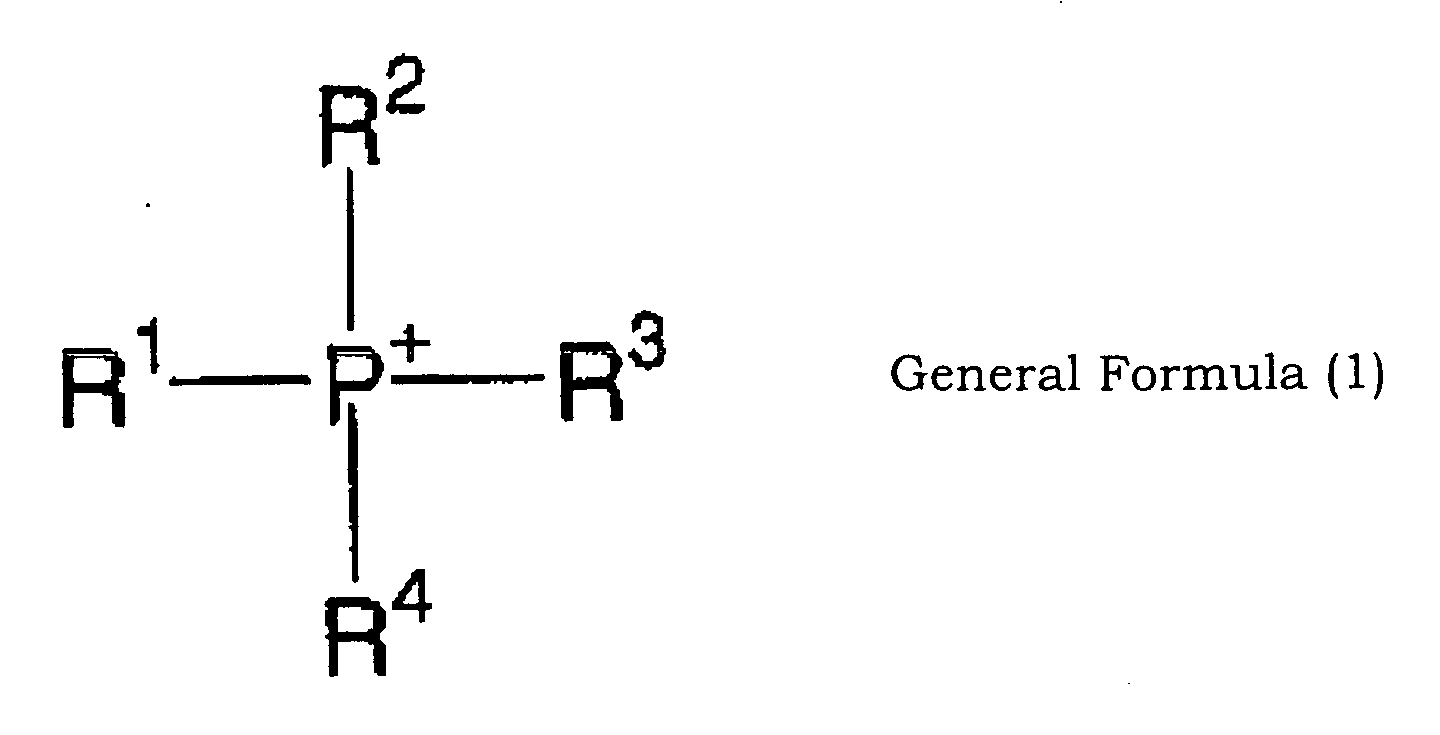
- In general formula (1), R1, R2, R3, and R4 independently represent one selected from the group consisting of a hydrogen atom, an alkyl group having 1 to 20 carbon atoms, and a hydrocarbon group containing a carboxyl group, a hydroxyl group, a phenyl group, or an epoxy group. Here, a part of the hydrogen atoms of the alkyl group and the phenyl group can be replaced by halogen atoms, a hydroxyl group, a carboxyl group, and -COOR (R represents an alkyl group having 1 to 5 carbon atoms).
- Examples of the phosphonium ions represented by general formula (1) include tetraethylphosphonium ion, triethyl-benzylphophonium ion, tetrabutylphosphonium ion, tetraoctyl- phophonium ion, trimethyldecylphosphonium ion, trimethyl- dodecylphosphonium ion, trimethylhexadecylphosphonium ion, trimethyloctadecylphosphonium ion, tributylmethyl-phosphonium ion, tributyldodecylphosphonium ion, tributyl-hexadodecylphosphonium ion, tributyloctadecylphosphonium ion, tetrakis(hydroxymethyl)phosphonium ion, methyltriphenyl-phosphonium ion, ethyltriphenylphosphonium ion, 2-hydroxyethyltriphenylphosphonium ion, diphenyldioctyl-phophonium ion, triphenyloctadecylphosphonium ion, tetraphenylphosphonium ion and the like. Of these, tetraethylphosphonium ion, tetrabutylphosphonium ion, tetrakis(hydroxymethyl)phosphonium ion, ethyltriphenylphosphonium ion, and 2-hydroxyethyltriphenylphosphonium ion are particularly preferred.
- Methods for organizing the swellable layered silicates include a method in which a swellable layered silicate is dispersed into a solvent, a phosphonium ion represented by general formula (1) is added thereto, part or all of cations (Na, Li, etc.) present between crystal layers of the silicate undergo ion-exchange with the phosphonium ion, and thus the swellable layered silicate is organized. However, the method is not particularly limited thereto. The solvent to be used may be water, methanol, ethanol, propanol, isopropyl alcohol, ethylene glycol, 1,4-butanediol, and the like.
- The content of the layered silicates (particularly organized swellable layered silicates) of the invention is preferably from 0.5% to 30% by mass and more preferably from 3% to 20% by mass to the total mass of the polyester resin composition. If the content is less than 0.5% by mass, the reinforcing effect may be insufficient in spite of addition of the layered silicates. On the other hand, if the content exceeds 30% by mass, dispersibility and transparency of the inorganic fillers such as the layered silicates may decrease, or the mechanical strength of moldings and films formed with the polyester resin composition may be insufficient (i.e. fragile).
- An antioxidant is added to the polyester resin composition of the invention in order to inhibit thermal decomposition or hydrolysis at high temperatures during molding processing. The antioxidants to be used may be one or more selected from phenolic antioxidants, thioether antioxidants, phosphorus antioxidants, hindered phenolic antioxidants, and other known antioxidants or pyrolysis retardants. However, the antioxidants to be used in the invention are not particularly limited thereto.
- Examples of the antioxidants include 6-ethoxy-1-phenyl- 2,2,4-trimethyl-1,2-dihydroquinoline, 6-ethoxy-1-octyl-2,2,4-trimethyl-1,2-dihydroquinoline, 6-ethoxy-1-phenyl-2,2,4-trimethyl-1,2,3,4-tetrahydroquinoline, 6-ethoxy-1-octyl-2,2,4-trimethyl-1,2,3,4-tetrahydroquinoline, nickel cyclohexanoate, 2,2-bis(4-hydroxyphenyl)propane, 1,1-bis(4-hydroxyphenyl)-2-ethylhexane, 2-methyl-4-methoxy-diphenylamine, 1-methyl-2-phenylindole, and the like.
- Furthermore, antioxidants recited in the following documents may also be used. The documents are as follows: EP-A Nos. 223739, 309401, 309402, 310551, 310552, and 459416, GP-A No.3,435,443, JP-A Nos.54-48535, 60-107384, 60-107383, 60-125470, 60-125471, 60-125472, 60-287485, 60-287486, 60-287487, 60-287488, 61-160287, 61-185483, 61-211079, 62-146678, 62-146680, 62-146679, 62-282885, 62-262047, 63-051174, 63-89877, 63-88380, 66-88381, 63-113536, 63-163351, 63-203372, 63-224989, 63-251282, 63-267594, and 63-182484, JP-A Nos. 1-239282, 2-262654, 2-71262, 3-121449, 6-135154, 6-135153, 5-61166, 5-119449, 7-17138, 7-17145, and 7-25162, JP-B Nos.48-43295 and 48-33212, and USP Nos.4,814,262 and 4,980,275.
- Examples of commercially available antioxidants include "Sumirizer BHT" (2,6-di-t-butyl-4-methylphenol) manufactured by Sumitomo Chemical Co., Ltd., "Irganox 1010" (tetrakis[methylene-3-(3',5'-di-t-butyl-4-hydroxyphenol)-propionate]methane) manufactured by Ciba Geigy Ltd., "Sumirizer TDP" (pentaerythritoltetrakis(3-laurylthioprominate)) manufactured by Sumitomo Chemical Co., Ltd., "Irgafos 168" (tris(2,4-di-t-butylphenyl) phosphite) manufactured by Ciba Geigy Ltd., and the like.
- In the polyester resin composition of the invention, the content of the antioxidants in the polyester resin composition is in a range of 0.01% to 1.0% by mass. If the content is less than 0.01% by mass, the effect of inhibiting thermal decomposition during molding processing may be insufficient. A content exceeding 1.0% by mass should also be avoided since excess antioxidants are unnecessary and may cause problems such as decomposition of the polyester resin or decrease in the mechanical strength and heat resistance. The content of the antioxidants in the polyester resin composition is preferably in a range of 0.05% to 0.9% by mass and more preferably in a range of 0.1% to 0.8% by mass.
- The polyester resin composition of the invention can be easily prepared by kneading the materials in a melted form, and the procedure of kneading and the means adopted are not particularly limited. It is preferred, however, that the polyester copolymer and the layered silicate are kneaded beforehand, and then the thermoplastic polyester resin is added thereto and further kneaded. Examples of mixing kneaders used for the melting and kneading, which are not particularly limited, include a twin-screw extruder, a double rotor-type continuous kneader, a stone mill-type continuous kneader where kneading is conducted between a rotary disk and a fixed disk, a Banbury mixer, a Kneaders, a roll mill, and the like.
- The polyester resin composition of the invention can be used for a variety of purposes such as moldings, films for optical materials, substrates for magnetic materials, and substrates for image forming layers.
- The invention is illustrated below by using examples, but these examples should not be construed to limit the scope of the invention. "Parts" in the examples indicate "mass parts" unless otherwise noted.
- 5 kilograms of "SWN" (synthetic smectite) manufactured by Co-op Chemical Co., Ltd. were dispersed into 50 liters of a water-methanol mixed solvent, and then 5 kilograms of trimethylhexadecylsulphonium bromide were mixed and stirred to obtain a swellable layered silicate organized with trimethylhexadecylsulphonium ion.
- Polycondensation was carried out by using 45 mol% of terephthalic acid as a dicarboxylic acid component, 45 mol% of ethylene glycol as a diol component, 5 mol% of o-aminobenzyl alcohol as a monomer having an amino group as a functional group, and 5 mol% of dimethyl 5-sodium sulfoisophthalate as a monomer having a sulfonic acid group as a functional group. As a result, obtained was a polyester copolymer containing the monomer having an amino group and the monomer having a sulfonic acid group at a ratio of 10 mol% in total. The intrinsic viscosity of the resulting polyester copolymer was 0.61.
- 50 parts of polyethylene terephthalate (PET) having an intrinsic viscosity of 0.65 as the thermoplastic polyester resin, 39.5 parts of the aforementioned polyester copolymer, 10 parts of the aforementioned organized layered silicate, and 0.25 parts each of "Irgafos 168" and "Irganox 1010" manufactured by Ciba-Geigy Ltd. as antioxidants were blended. The blended materials were melted and kneaded in a twin-screw extruder "TEM-37" produced by Toshiba Machine Co., Ltd., so as to obtain a polyester resin composition of the invention. The melting and kneading were carried out at a temperature of 280°C at a screw rotation speed of 500 rpm.
- A polyester resin composition was prepared in the same manner as Example 1 except that the polycondensation was carried out without use of the monomer having a sulfonic acid group (dimethyl 5-sodium sulfoisophthalate) to obtain a polyester copolymer.
- A polyester resin composition was prepared in the same manner as Example 1 except that the polycondensation was carried out without use of the monomer having an amino group (o-aminobenzyl alcohol) to obtain a polyester copolymer.
- A polyester resin composition was prepared in the same manner as Example 2 except that the amount of the thermoplastic polyester resin blended was 80 parts instead of 50 parts and the amount of the polyester copolymer blended was 9.5 parts instead of 39.5 parts.
- A polyester resin composition was prepared in the same manner as Example 2 except that the each amount of the antioxidants ("Irgafos 168" and "Irganox 1010") blended was 0.004 parts instead of 0.25 part.
- The "non-reinforced resin" composition for the evaluation test of Example 1 was prepared in the same manner as Example 1 except that the organized layered silicate and the antioxidant were omitted in the production process thereof. In other words, the "non-reinforced resin" composition of Example 1 was produced by melting and kneading 50 parts of thermoplastic polyester resin (polyethylene terephthalate (PET)) and 39.5 parts of the polyester copolymer.
- With respect to Examples 2 and 3 and Comparative Examples 1 and 2, the "non-reinforced resin" compositions for the evaluation tests of Examples 2 and 3 and Comparative Examples 1 and 2 were also prepared in a similar manner by omitting the organized layered silicate and the antioxidant in the production process.
- The following evaluation tests were carried out to the polyester resin compositions obtained in the Examples and Comparative Examples. Results are shown in the following Table 1.
- The diffraction peak of a (001) plane of the layered silicates was measured by wide angle X-ray diffraction. The state of dispersion was also observed on a transmission electron microscope. Results of the measurement and the observation are evaluated based on the following criteria as follows:
- oo: No diffraction peak existed and no aggregated particles were observed.
- o: No diffraction peak existed and aggregated particles observed were 5% or less.
- Δ: No diffraction peak existed and aggregated particles observed were less than 30%.
- x: A diffraction peak existed and aggregated particles observed were 30% or more.
- Test specimens of 1 mm (thickness) x 10 mm (width) were prepared from polyester resin compositions obtained in the Examples and Comparative Examples and "non-reinforced resin" compositions. A tensile test was carried out by using a tensile testing machine (Produced by Toyo Seiki Seisakusho K.K.) to measure the modulus of elasticity. The improvement ratio (%) of the modulus of elasticity of each polyester resin composition compared to the modulus of elasticity of the specimen of the corresponding "non-reinforced resin" composition was used as an index for evaluation. Criteria for the evaluation are as follows:
- oo: The improvement ratio when compared to the non-reinforced resin specimen was 50% or more.
- o: The improvement ratio when compared to the non-reinforced resin specimen was 20% or more and less than 50%.
- Δ: The improvement ratio when compared to the non-reinforced resin specimen was 5% or more and less than 20%.
- x: The improvement ratio when compared to the non-reinforced resin specimen was less than 5% or below 0% (no improvement).
- The oxygen permeability of polyester resin compositions obtained in the Examples and Comparative Examples and that of "non-reinforced resin" compositions were measured by using an instrument "OX-TRAN 10/50A" produced by Mocon, Inc. The degree of the oxygen permeability of each polyester resin composition compared to the oxygen permeability of the corresponding "non-reinforced resin" composition was used as an index for evaluation. Criteria for evaluation are as follows:
- oo: The degree of oxygen permeability when compared to the non-reinforced resin composition was 1/10 or less.
- o: The degree of oxygen permeability when compared to the non-reinforced resin composition is more than 1/10 and 1/5 or less.
- Δ: The degree of oxygen permeability when compared to the non-reinforced resin composition is more than 1/5 and 1/2 or less.
- x: The degree of oxygen permeability when compared to the non-reinforced resin composition is more than 1/2.
- The organized layered silicate was separated and removed from polyester resin compositions obtained in the Examples and the Comparative Examples. Molecular weight distribution of each polyester resin component was measured by GPC to find the number average molecular weight. The molecular weight ratio (%) of the number average molecular weight of each polyester resin component compared to the number average molecular weight of the corresponding "non-reinforced resin" composition was used as an index for the evaluation. Criteria for the evaluation are as follows:
- oo: The molecular weight ratio when compared to the non-reinforced resin composition was 95% or more.
- o: The molecular weight ratio when compared to the non-reinforced resin composition was 90% or more and less than 95%.
- Δ: The molecular weight ratio when compared to the non-reinforced resin composition was 70% or more and less than 90%.
- x: The molecular weight ratio when compared to the non-reinforced resin composition was less than 70%.
- Sheets having a thickness of 0.5 mm were prepared from polyester resin compositions obtained in the Examples and Comparative Examples and "non-reinforced resin" compositions. The light transmittance was measured by using a turbidimeter "NDH-1001DP" produced by Nippon Denshoku Kogyo K.K. The ratio (%) of the light transmittance of each polyester resin sheet compared to the light transmittance of the sheet of the corresponding "non-reinforced resin" composition was used as an index for evaluation. Criteria for the evaluation are as follows:
- oo: The ratio when compared to the non-reinforced resin sheet was 95% or more.
- o: The ratio when compared to the non-reinforced resin sheet was 90% or more and less than 95%.
- Δ: The ratio when compared to the non-reinforced resin sheet was 70% or more and less than 90%.
- x: The ratio when compared to the non-reinforced resin sheet was less than 70%.
- As shown in Table 1, the polyester resin compositions (Examples 1 to 3) of the invention are superior in dispersibility of layered silicates, and improved in tensile modulus of elasticity (mechanical strength). The results of the number average molecular weight shows that thermal decomposition (hydrolysis) would be inhibited. Simultaneously, the heat resistance was also improved. Moreover, the polyester resin compositions of the invention are excellent in oxygen-barrier properties and good in transparency.
- On the other hand, the polyester resin compositions of Comparative Examples 1 and 2 are inferior in compatibility and poor in dispersibility of layered silicates. The results show polyester resin compositions of Comparative Examples 1 and 2 are also inferior in various other characteristics such as the mechanical strength and heat resistance. Particularly, in Comparative Example 2 where the antioxidants are contained only in small amounts, the decrease in the number average molecular weight proves the occurrence of the thermal decomposition (hydrolysis).
- The invention provides polyester resin compositions that are prepared by highly uniformly dispersing the layered silicate of nanometer order. The provided compositions particularly show high heat resistance without undergoing hydrolysis during molding processing. Moreover, they have high transparency with a low haze, high mechanical strength, dimensional stability, and oxygen-barrier properties.
| Resin Composition | State of Dispersion | Modulus in Tension | Barrier Properties | Average Molecular Weight | Transparency |
| Example 1 | 00 | 00 | 00 | 00 | 00 |
| Example 2 | 00 | 00 | 00 | 00 | 00 |
| Example 3 | 00 | 00 | 00 | 00 | 00 |
| Comparative Example 1 | Δ | Δ | Δ | 00 | Δ |
| Comparative Example 2 | 0 | Δ | 0 | Δ | 0 |
Claims (10)
- A polyester resin composition comprising:a thermoplastic polyester resin,a polyester copolymer containing a monomer having at least one of an amino group, an imino group, an amido group, and a sulfonic acid group,a layered silicate, andan antioxidant,wherein:the monomer having at least one of an amino group, an imino group, an amido group, and a sulfonic acid group is contained in the polyester copolymer in an amount of 5 to 15 mol%;the monomer having at least one of an amino group, an imino group, an amido group, and a sulfonic acid group is contained in the polyester resin composition in an amount of 1 to 5 mol% based on a total polyester content of the polyester resin composition; andthe antioxidant is contained in the polyester resin composition in an amount of 0.01% to 1.0% by mass.
- The polyester resin composition of claim 1, wherein the polyester copolymer contains at least one of polyethylene terephthalate and polyethylene naphthalate as a constituent monomer.
- The polyester resin composition of claim 1 or 2, wherein at least one of monomers constituting the polyester copolymer is the same as a monomer constituting the thermoplastic polyester resin.
- The polyester resin composition of any one of claims 1 to 3, wherein a content ratio of the polyester copolymer to the layered silicate is from 50% to 500% by mass.
- The polyester resin composition of any one of claims 1 to 3, wherein a content ratio of the polyester copolymer to the layered silicate is from 70% to 400% by mass.
- The polyester resin composition of any one of claims 1 to 3, wherein a content ratio of the polyester copolymer to the layered silicate is from 100% to 300% by mass.
- The polyester resin composition of any one of claims 1 to 6, wherein the monomer having at least one of an amino group, an imino group, an amido group, and a sulfonic acid group is contained in the polyester copolymer in an amount of 5.5 to 12 mol%.
- The polyester resin composition of any one of claims 1 to 7, wherein the monomer having at least one of an amino group, an imino group, an amido group, and a sulfonic acid group is contained in the polyester resin composition in an amount of 1.3 to 4.5 mol% based on a total polyester content of the polyester resin composition.
- The polyester resin composition of any one of claims 1 to 8, wherein the layered silicate is contained in the polyester resin composition in an amount of 0.5% to 30% by mass based on a total mass of the polyester resin composition.
- The polyester resin composition of any one of claims 1 to 9, wherein the layered silicate is a swellable layered silicate organized by an organizing agent.
Applications Claiming Priority (4)
| Application Number | Priority Date | Filing Date | Title |
|---|---|---|---|
| JP2002283409 | 2002-09-27 | ||
| JP2002283409 | 2002-09-27 | ||
| JP2003330086A JP4256754B2 (en) | 2002-09-27 | 2003-09-22 | Polyester resin composition |
| JP2003330086 | 2003-09-22 |
Publications (2)
| Publication Number | Publication Date |
|---|---|
| EP1403320A1 true EP1403320A1 (en) | 2004-03-31 |
| EP1403320B1 EP1403320B1 (en) | 2005-12-14 |
Family
ID=31980641
Family Applications (1)
| Application Number | Title | Priority Date | Filing Date |
|---|---|---|---|
| EP03021673A Expired - Lifetime EP1403320B1 (en) | 2002-09-27 | 2003-09-29 | Polyester resin composition |
Country Status (4)
| Country | Link |
|---|---|
| US (1) | US6861468B2 (en) |
| EP (1) | EP1403320B1 (en) |
| JP (1) | JP4256754B2 (en) |
| DE (1) | DE60302736T2 (en) |
Families Citing this family (8)
| Publication number | Priority date | Publication date | Assignee | Title |
|---|---|---|---|---|
| US20080167440A1 (en) * | 2007-01-10 | 2008-07-10 | Pickel Deanna L | Use of copolymerizable sulfonate salts to promote char formation in polyesters and copolyesters |
| US9199879B2 (en) | 2007-05-10 | 2015-12-01 | Halliburton Energy Serives, Inc. | Well treatment compositions and methods utilizing nano-particles |
| US8685903B2 (en) | 2007-05-10 | 2014-04-01 | Halliburton Energy Services, Inc. | Lost circulation compositions and associated methods |
| US9540507B2 (en) * | 2007-08-23 | 2017-01-10 | M&G Usa Corporation | Composition for maintaining good color when thermally treating polyester-polyamide blends |
| CN101784598A (en) * | 2007-08-23 | 2010-07-21 | M&G聚合物意大利有限公司 | Phosphite Stabilizers for Ionic Polyester Compounds |
| DE102010032780A1 (en) | 2010-07-26 | 2012-01-26 | Helfried Haufe | Coating composition, useful for producing hydrophilic layer, which is used as anti-fog coating to prevent calcium deposits, protein- or fat-containing dirt and adhering of bacteria, comprises polyanion, polycation and a solvent |
| JP2018043773A (en) * | 2016-09-15 | 2018-03-22 | 三菱瓦斯化学株式会社 | Multilayer container and method for producing recycled polyester |
| US12049541B2 (en) * | 2018-04-04 | 2024-07-30 | Mitsubishi Gas Chemical Company, Inc. | Polyester resin composition |
Citations (5)
| Publication number | Priority date | Publication date | Assignee | Title |
|---|---|---|---|---|
| US4708975A (en) * | 1986-04-02 | 1987-11-24 | E. I. Du Pont De Nemours And Company | Low smoke generating, high char forming, flame retardant thermoplastic multi-block copolyesters |
| JP2000086232A (en) * | 1998-09-16 | 2000-03-28 | Mitsui Chemicals Inc | Modified sheet silicate, its production, polyester resin composition containing same and its production |
| US6162857A (en) * | 1997-07-21 | 2000-12-19 | Eastman Chemical Company | Process for making polyester/platelet particle compositions displaying improved dispersion |
| DE19943774A1 (en) * | 1999-09-13 | 2001-03-15 | Basf Ag | Biodegradable, thermoplastic molding compounds |
| US20020086953A1 (en) * | 2000-11-03 | 2002-07-04 | Williams James Carl | Blends of polycarbonate and polyester and sheets and films formed therefrom |
Family Cites Families (14)
| Publication number | Priority date | Publication date | Assignee | Title |
|---|---|---|---|---|
| JPH0822946B2 (en) | 1985-09-30 | 1996-03-06 | 株式会社豊田中央研究所 | Composite material |
| JP2627194B2 (en) | 1989-07-31 | 1997-07-02 | 株式会社豊田中央研究所 | Polyester composite material and method for producing the same |
| JP3278914B2 (en) | 1992-08-07 | 2002-04-30 | 東レ株式会社 | Polyethylene naphthalate composition and method for producing the same |
| JP3296100B2 (en) | 1994-08-11 | 2002-06-24 | 三菱化学株式会社 | Method for producing thermoplastic resin composition |
| JP3964497B2 (en) | 1997-06-12 | 2007-08-22 | ユニチカ株式会社 | Polyester composition |
| JPH11130951A (en) | 1997-10-31 | 1999-05-18 | Unitika Ltd | Polyester composite material and its production |
| JP4154761B2 (en) | 1998-08-07 | 2008-09-24 | 東レ株式会社 | Polyester resin composition |
| JP2000327805A (en) | 1999-05-18 | 2000-11-28 | Kanegafuchi Chem Ind Co Ltd | Resin film |
| JP2001323144A (en) | 2000-05-19 | 2001-11-20 | Kanegafuchi Chem Ind Co Ltd | Polyester resin composition |
| JP2001329150A (en) | 2000-05-22 | 2001-11-27 | Kanegafuchi Chem Ind Co Ltd | Polyester resin composition |
| JP2001323143A (en) | 2000-05-19 | 2001-11-20 | Kanegafuchi Chem Ind Co Ltd | Method for producing polyester resin composition |
| JP4467140B2 (en) | 2000-05-19 | 2010-05-26 | 株式会社カネカ | Polyester resin composition |
| JP3844665B2 (en) | 2000-06-19 | 2006-11-15 | 株式会社フジクラ | Slant short period grating |
| JP3706532B2 (en) * | 2000-09-14 | 2005-10-12 | 帝人株式会社 | Polyester composite material |
-
2003
- 2003-09-22 JP JP2003330086A patent/JP4256754B2/en not_active Expired - Fee Related
- 2003-09-26 US US10/670,558 patent/US6861468B2/en not_active Expired - Fee Related
- 2003-09-29 EP EP03021673A patent/EP1403320B1/en not_active Expired - Lifetime
- 2003-09-29 DE DE60302736T patent/DE60302736T2/en not_active Expired - Lifetime
Patent Citations (5)
| Publication number | Priority date | Publication date | Assignee | Title |
|---|---|---|---|---|
| US4708975A (en) * | 1986-04-02 | 1987-11-24 | E. I. Du Pont De Nemours And Company | Low smoke generating, high char forming, flame retardant thermoplastic multi-block copolyesters |
| US6162857A (en) * | 1997-07-21 | 2000-12-19 | Eastman Chemical Company | Process for making polyester/platelet particle compositions displaying improved dispersion |
| JP2000086232A (en) * | 1998-09-16 | 2000-03-28 | Mitsui Chemicals Inc | Modified sheet silicate, its production, polyester resin composition containing same and its production |
| DE19943774A1 (en) * | 1999-09-13 | 2001-03-15 | Basf Ag | Biodegradable, thermoplastic molding compounds |
| US20020086953A1 (en) * | 2000-11-03 | 2002-07-04 | Williams James Carl | Blends of polycarbonate and polyester and sheets and films formed therefrom |
Non-Patent Citations (1)
| Title |
|---|
| PATENT ABSTRACTS OF JAPAN vol. 2000, no. 06 22 September 2000 (2000-09-22) * |
Also Published As
| Publication number | Publication date |
|---|---|
| DE60302736D1 (en) | 2006-01-19 |
| JP2004137483A (en) | 2004-05-13 |
| JP4256754B2 (en) | 2009-04-22 |
| DE60302736T2 (en) | 2006-08-31 |
| US6861468B2 (en) | 2005-03-01 |
| US20040092641A1 (en) | 2004-05-13 |
| EP1403320B1 (en) | 2005-12-14 |
Similar Documents
| Publication | Publication Date | Title |
|---|---|---|
| EP1942144B1 (en) | Polyester resin composition and plastic article | |
| AU758550B2 (en) | A high barrier amorphous polyamide-clay nanocomposite and a process for preparing same | |
| EP2524945B1 (en) | Thermoplastic resin composition and molded item formed from same | |
| EP2370517B1 (en) | Reinforced polyester compositions, method of manufacture, and articles thereof | |
| EP2084228B1 (en) | Polyester compositions, methods of manufacture, and uses thereof | |
| JP5122116B2 (en) | Thermally conductive resin composition | |
| EP1403320B1 (en) | Polyester resin composition | |
| WO2017026476A1 (en) | Thermoplastic polyester resin composition and light reflector using same | |
| US5646209A (en) | Thermoplastic resin composition comprising liquid crystalline polyester, aromatic polycarbonate and glass fiber | |
| EP1283245B1 (en) | Polyester resin composition and process for the preparation thereof | |
| US20070015858A1 (en) | Methods of making nanocomposites and compositions of rubber toughened polyhydroxyalkanoates | |
| CN100547032C (en) | polyester resin composition | |
| TW552291B (en) | Fire-retardant resin compositions | |
| US20080248285A1 (en) | Polyester Compositions Having High Dimensional Stability | |
| US20040044144A1 (en) | Polyester resin composition containing inorganic filler, polyetherimide, and polymer containing polyethylene naphthalate in constituent unit thereof | |
| JP2001261947A (en) | Polyester resin composition | |
| JPH10330606A (en) | Flame-retardant polyester resin composition having antibacterial properties and molded article comprising the same | |
| JP3403277B2 (en) | Polybutylene terephthalate resin composition | |
| JPH11323106A (en) | Polyester resin composition and manufacturing method | |
| JP4708766B2 (en) | Thermoplastic resin composition having good alkali resistance and surface properties and molded article thereof | |
| KR100813078B1 (en) | Thermoplastic polyester resin composition capable of direct deposition of metal with improved release properties and heat resistance | |
| JP2002060600A (en) | Polyester resin composition | |
| JP2603030B2 (en) | Thin-walled container made of polycarbonate resin | |
| JP2004331967A (en) | Injection molded article made from biodegradable aromatic polyester blend composition and method for producing the same | |
| EP4600303A1 (en) | Flame retardant and light transmissive crystalline polymer compositions and articles |
Legal Events
| Date | Code | Title | Description |
|---|---|---|---|
| PUAI | Public reference made under article 153(3) epc to a published international application that has entered the european phase |
Free format text: ORIGINAL CODE: 0009012 |
|
| AK | Designated contracting states |
Kind code of ref document: A1 Designated state(s): AT BE BG CH CY CZ DE DK EE ES FI FR GB GR HU IE IT LI LU MC NL PT RO SE SI SK TR |
|
| AX | Request for extension of the european patent |
Extension state: AL LT LV MK |
|
| 17P | Request for examination filed |
Effective date: 20040709 |
|
| AKX | Designation fees paid |
Designated state(s): DE NL |
|
| GRAP | Despatch of communication of intention to grant a patent |
Free format text: ORIGINAL CODE: EPIDOSNIGR1 |
|
| GRAS | Grant fee paid |
Free format text: ORIGINAL CODE: EPIDOSNIGR3 |
|
| GRAA | (expected) grant |
Free format text: ORIGINAL CODE: 0009210 |
|
| AK | Designated contracting states |
Kind code of ref document: B1 Designated state(s): DE NL |
|
| REF | Corresponds to: |
Ref document number: 60302736 Country of ref document: DE Date of ref document: 20060119 Kind code of ref document: P |
|
| PLBE | No opposition filed within time limit |
Free format text: ORIGINAL CODE: 0009261 |
|
| STAA | Information on the status of an ep patent application or granted ep patent |
Free format text: STATUS: NO OPPOSITION FILED WITHIN TIME LIMIT |
|
| 26N | No opposition filed |
Effective date: 20060915 |
|
| PGFP | Annual fee paid to national office [announced via postgrant information from national office to epo] |
Ref country code: DE Payment date: 20140923 Year of fee payment: 12 Ref country code: NL Payment date: 20140809 Year of fee payment: 12 |
|
| REG | Reference to a national code |
Ref country code: DE Ref legal event code: R119 Ref document number: 60302736 Country of ref document: DE |
|
| REG | Reference to a national code |
Ref country code: NL Ref legal event code: MM Effective date: 20151001 |
|
| PG25 | Lapsed in a contracting state [announced via postgrant information from national office to epo] |
Ref country code: DE Free format text: LAPSE BECAUSE OF NON-PAYMENT OF DUE FEES Effective date: 20160401 |
|
| PG25 | Lapsed in a contracting state [announced via postgrant information from national office to epo] |
Ref country code: NL Free format text: LAPSE BECAUSE OF NON-PAYMENT OF DUE FEES Effective date: 20151001 |