EP1401880B1 - Metallocene catalysts containing an indenyl moiety substituted at the 4-, 5-, 6- or 7-position by a siloxy or germyloxy group - Google Patents
Metallocene catalysts containing an indenyl moiety substituted at the 4-, 5-, 6- or 7-position by a siloxy or germyloxy group Download PDFInfo
- Publication number
- EP1401880B1 EP1401880B1 EP02735637A EP02735637A EP1401880B1 EP 1401880 B1 EP1401880 B1 EP 1401880B1 EP 02735637 A EP02735637 A EP 02735637A EP 02735637 A EP02735637 A EP 02735637A EP 1401880 B1 EP1401880 B1 EP 1401880B1
- Authority
- EP
- European Patent Office
- Prior art keywords
- catalyst
- group
- ligand
- hydrocarbyl
- ring
- Prior art date
- Legal status (The legal status is an assumption and is not a legal conclusion. Google has not performed a legal analysis and makes no representation as to the accuracy of the status listed.)
- Expired - Lifetime
Links
- -1 germyloxy group Chemical group 0.000 title claims abstract description 59
- YBYIRNPNPLQARY-UHFFFAOYSA-N 1H-indene Natural products C1=CC=C2CC=CC2=C1 YBYIRNPNPLQARY-UHFFFAOYSA-N 0.000 title claims abstract description 53
- 125000003454 indenyl group Chemical group C1(C=CC2=CC=CC=C12)* 0.000 title claims abstract description 40
- 239000012968 metallocene catalyst Substances 0.000 title claims abstract description 21
- 125000004469 siloxy group Chemical group [SiH3]O* 0.000 title claims abstract description 15
- 239000003446 ligand Substances 0.000 claims abstract description 83
- 229910052751 metal Inorganic materials 0.000 claims abstract description 28
- 239000002184 metal Substances 0.000 claims abstract description 28
- 125000000058 cyclopentadienyl group Chemical group C1(=CC=CC1)* 0.000 claims abstract description 10
- ZSWFCLXCOIISFI-UHFFFAOYSA-N endo-cyclopentadiene Natural products C1C=CC=C1 ZSWFCLXCOIISFI-UHFFFAOYSA-N 0.000 claims abstract description 9
- 239000003054 catalyst Substances 0.000 claims description 82
- IJGRMHOSHXDMSA-UHFFFAOYSA-N Atomic nitrogen Chemical compound N#N IJGRMHOSHXDMSA-UHFFFAOYSA-N 0.000 claims description 32
- 125000001183 hydrocarbyl group Chemical group 0.000 claims description 28
- 239000001257 hydrogen Substances 0.000 claims description 25
- 229910052739 hydrogen Inorganic materials 0.000 claims description 25
- 238000006243 chemical reaction Methods 0.000 claims description 23
- XUIMIQQOPSSXEZ-UHFFFAOYSA-N Silicon Chemical compound [Si] XUIMIQQOPSSXEZ-UHFFFAOYSA-N 0.000 claims description 21
- 150000001336 alkenes Chemical class 0.000 claims description 20
- 229910052757 nitrogen Inorganic materials 0.000 claims description 19
- 229910052710 silicon Inorganic materials 0.000 claims description 19
- 229910052732 germanium Inorganic materials 0.000 claims description 17
- 238000000034 method Methods 0.000 claims description 17
- 239000010703 silicon Substances 0.000 claims description 17
- OKTJSMMVPCPJKN-UHFFFAOYSA-N Carbon Chemical compound [C] OKTJSMMVPCPJKN-UHFFFAOYSA-N 0.000 claims description 15
- 125000004429 atom Chemical group 0.000 claims description 15
- 229910052799 carbon Inorganic materials 0.000 claims description 15
- JRZJOMJEPLMPRA-UHFFFAOYSA-N olefin Natural products CCCCCCCC=C JRZJOMJEPLMPRA-UHFFFAOYSA-N 0.000 claims description 13
- UFHFLCQGNIYNRP-UHFFFAOYSA-N Hydrogen Chemical compound [H][H] UFHFLCQGNIYNRP-UHFFFAOYSA-N 0.000 claims description 12
- 239000012190 activator Substances 0.000 claims description 12
- 125000004435 hydrogen atom Chemical group [H]* 0.000 claims description 12
- 229910052760 oxygen Inorganic materials 0.000 claims description 12
- 239000001301 oxygen Substances 0.000 claims description 12
- 229910052717 sulfur Inorganic materials 0.000 claims description 12
- 125000004432 carbon atom Chemical group C* 0.000 claims description 11
- QVGXLLKOCUKJST-UHFFFAOYSA-N atomic oxygen Chemical compound [O] QVGXLLKOCUKJST-UHFFFAOYSA-N 0.000 claims description 10
- GNPVGFCGXDBREM-UHFFFAOYSA-N germanium atom Chemical group [Ge] GNPVGFCGXDBREM-UHFFFAOYSA-N 0.000 claims description 10
- 150000001412 amines Chemical class 0.000 claims description 9
- 229910052698 phosphorus Inorganic materials 0.000 claims description 9
- OAICVXFJPJFONN-UHFFFAOYSA-N Phosphorus Chemical compound [P] OAICVXFJPJFONN-UHFFFAOYSA-N 0.000 claims description 8
- 125000005842 heteroatom Chemical group 0.000 claims description 8
- 239000011574 phosphorus Substances 0.000 claims description 8
- 238000002360 preparation method Methods 0.000 claims description 8
- 125000006413 ring segment Chemical group 0.000 claims description 8
- 229910052723 transition metal Inorganic materials 0.000 claims description 7
- 150000003624 transition metals Chemical class 0.000 claims description 7
- MYMOFIZGZYHOMD-UHFFFAOYSA-N Dioxygen Chemical compound O=O MYMOFIZGZYHOMD-UHFFFAOYSA-N 0.000 claims description 6
- NINIDFKCEFEMDL-UHFFFAOYSA-N Sulfur Chemical compound [S] NINIDFKCEFEMDL-UHFFFAOYSA-N 0.000 claims description 6
- VGRFVJMYCCLWPQ-UHFFFAOYSA-N germanium Chemical compound [Ge].[Ge] VGRFVJMYCCLWPQ-UHFFFAOYSA-N 0.000 claims description 6
- 229910052747 lanthanoid Inorganic materials 0.000 claims description 6
- 230000000737 periodic effect Effects 0.000 claims description 6
- 125000004434 sulfur atom Chemical group 0.000 claims description 6
- 229910052735 hafnium Inorganic materials 0.000 claims description 5
- 150000002602 lanthanoids Chemical class 0.000 claims description 5
- 229910021645 metal ion Inorganic materials 0.000 claims description 5
- 125000004430 oxygen atom Chemical group O* 0.000 claims description 5
- 239000011593 sulfur Substances 0.000 claims description 5
- 229910052719 titanium Inorganic materials 0.000 claims description 5
- 229910052726 zirconium Inorganic materials 0.000 claims description 5
- 229910052804 chromium Inorganic materials 0.000 claims description 3
- 125000005843 halogen group Chemical group 0.000 claims description 3
- MAUMSNABMVEOGP-UHFFFAOYSA-N (methyl-$l^{2}-azanyl)methane Chemical compound C[N]C MAUMSNABMVEOGP-UHFFFAOYSA-N 0.000 claims description 2
- 150000003973 alkyl amines Chemical class 0.000 claims description 2
- 125000003368 amide group Chemical group 0.000 claims description 2
- 125000001309 chloro group Chemical group Cl* 0.000 claims description 2
- 150000003839 salts Chemical class 0.000 claims description 2
- 229910001428 transition metal ion Inorganic materials 0.000 claims description 2
- 125000003808 silyl group Chemical group [H][Si]([H])([H])[*] 0.000 claims 1
- 239000000243 solution Substances 0.000 description 60
- RTZKZFJDLAIYFH-UHFFFAOYSA-N Diethyl ether Chemical compound CCOCC RTZKZFJDLAIYFH-UHFFFAOYSA-N 0.000 description 41
- WYURNTSHIVDZCO-UHFFFAOYSA-N Tetrahydrofuran Chemical compound C1CCOC1 WYURNTSHIVDZCO-UHFFFAOYSA-N 0.000 description 34
- 150000001875 compounds Chemical class 0.000 description 33
- VLKZOEOYAKHREP-UHFFFAOYSA-N n-Hexane Chemical compound CCCCCC VLKZOEOYAKHREP-UHFFFAOYSA-N 0.000 description 33
- YXFVVABEGXRONW-UHFFFAOYSA-N Toluene Chemical compound CC1=CC=CC=C1 YXFVVABEGXRONW-UHFFFAOYSA-N 0.000 description 24
- 239000002904 solvent Substances 0.000 description 23
- OKKJLVBELUTLKV-UHFFFAOYSA-N Methanol Chemical compound OC OKKJLVBELUTLKV-UHFFFAOYSA-N 0.000 description 21
- 239000000463 material Substances 0.000 description 19
- 238000006116 polymerization reaction Methods 0.000 description 19
- YLQBMQCUIZJEEH-UHFFFAOYSA-N tetrahydrofuran Natural products C=1C=COC=1 YLQBMQCUIZJEEH-UHFFFAOYSA-N 0.000 description 17
- 229920000642 polymer Polymers 0.000 description 16
- 239000003921 oil Substances 0.000 description 15
- 239000011541 reaction mixture Substances 0.000 description 15
- MZRVEZGGRBJDDB-UHFFFAOYSA-N N-Butyllithium Chemical compound [Li]CCCC MZRVEZGGRBJDDB-UHFFFAOYSA-N 0.000 description 14
- 229910052782 aluminium Inorganic materials 0.000 description 14
- ZMXDDKWLCZADIW-UHFFFAOYSA-N N,N-Dimethylformamide Chemical compound CN(C)C=O ZMXDDKWLCZADIW-UHFFFAOYSA-N 0.000 description 13
- VYPSYNLAJGMNEJ-UHFFFAOYSA-N Silicium dioxide Chemical compound O=[Si]=O VYPSYNLAJGMNEJ-UHFFFAOYSA-N 0.000 description 13
- AQZWEFBJYQSQEH-UHFFFAOYSA-N 2-methyloxaluminane Chemical group C[Al]1CCCCO1 AQZWEFBJYQSQEH-UHFFFAOYSA-N 0.000 description 12
- 239000004411 aluminium Substances 0.000 description 12
- 239000000203 mixture Substances 0.000 description 12
- 239000005977 Ethylene Substances 0.000 description 11
- 239000002168 alkylating agent Substances 0.000 description 11
- 229940100198 alkylating agent Drugs 0.000 description 11
- 229960004132 diethyl ether Drugs 0.000 description 11
- XLYOFNOQVPJJNP-UHFFFAOYSA-N water Substances O XLYOFNOQVPJJNP-UHFFFAOYSA-N 0.000 description 11
- YMWUJEATGCHHMB-UHFFFAOYSA-N Dichloromethane Chemical compound ClCCl YMWUJEATGCHHMB-UHFFFAOYSA-N 0.000 description 10
- VGGSQFUCUMXWEO-UHFFFAOYSA-N Ethene Chemical compound C=C VGGSQFUCUMXWEO-UHFFFAOYSA-N 0.000 description 10
- PMZURENOXWZQFD-UHFFFAOYSA-L Sodium Sulfate Chemical compound [Na+].[Na+].[O-]S([O-])(=O)=O PMZURENOXWZQFD-UHFFFAOYSA-L 0.000 description 10
- 229910052938 sodium sulfate Inorganic materials 0.000 description 10
- ZMANZCXQSJIPKH-UHFFFAOYSA-N Triethylamine Chemical compound CCN(CC)CC ZMANZCXQSJIPKH-UHFFFAOYSA-N 0.000 description 9
- RAXXELZNTBOGNW-UHFFFAOYSA-N imidazole Natural products C1=CNC=N1 RAXXELZNTBOGNW-UHFFFAOYSA-N 0.000 description 9
- 239000004711 α-olefin Substances 0.000 description 9
- OFBQJSOFQDEBGM-UHFFFAOYSA-N Pentane Chemical compound CCCCC OFBQJSOFQDEBGM-UHFFFAOYSA-N 0.000 description 8
- UIIMBOGNXHQVGW-UHFFFAOYSA-M Sodium bicarbonate Chemical compound [Na+].OC([O-])=O UIIMBOGNXHQVGW-UHFFFAOYSA-M 0.000 description 8
- 238000001704 evaporation Methods 0.000 description 8
- 230000008020 evaporation Effects 0.000 description 8
- 239000007789 gas Substances 0.000 description 8
- 229960003010 sodium sulfate Drugs 0.000 description 8
- 235000011152 sodium sulphate Nutrition 0.000 description 8
- QNXSIUBBGPHDDE-UHFFFAOYSA-N indan-1-one Chemical compound C1=CC=C2C(=O)CCC2=C1 QNXSIUBBGPHDDE-UHFFFAOYSA-N 0.000 description 7
- 238000011068 loading method Methods 0.000 description 7
- 239000000178 monomer Substances 0.000 description 7
- 125000002524 organometallic group Chemical group 0.000 description 7
- VEXZGXHMUGYJMC-UHFFFAOYSA-N Hydrochloric acid Chemical compound Cl VEXZGXHMUGYJMC-UHFFFAOYSA-N 0.000 description 6
- 125000000217 alkyl group Chemical group 0.000 description 6
- XAGFODPZIPBFFR-UHFFFAOYSA-N aluminium Chemical compound [Al] XAGFODPZIPBFFR-UHFFFAOYSA-N 0.000 description 6
- 230000015572 biosynthetic process Effects 0.000 description 6
- 239000007795 chemical reaction product Substances 0.000 description 6
- DLEDOFVPSDKWEF-UHFFFAOYSA-N lithium butane Chemical compound [Li+].CCC[CH2-] DLEDOFVPSDKWEF-UHFFFAOYSA-N 0.000 description 6
- LIKMAJRDDDTEIG-UHFFFAOYSA-N n-hexene Natural products CCCCC=C LIKMAJRDDDTEIG-UHFFFAOYSA-N 0.000 description 6
- 239000012071 phase Substances 0.000 description 6
- 239000000047 product Substances 0.000 description 6
- 239000007787 solid Substances 0.000 description 6
- XKRFYHLGVUSROY-UHFFFAOYSA-N Argon Chemical compound [Ar] XKRFYHLGVUSROY-UHFFFAOYSA-N 0.000 description 5
- VEXZGXHMUGYJMC-UHFFFAOYSA-M Chloride anion Chemical compound [Cl-] VEXZGXHMUGYJMC-UHFFFAOYSA-M 0.000 description 5
- MUBZPKHOEPUJKR-UHFFFAOYSA-N Oxalic acid Chemical compound OC(=O)C(O)=O MUBZPKHOEPUJKR-UHFFFAOYSA-N 0.000 description 5
- 239000004743 Polypropylene Substances 0.000 description 5
- 239000012267 brine Substances 0.000 description 5
- 150000001993 dienes Chemical class 0.000 description 5
- DVSDBMFJEQPWNO-UHFFFAOYSA-N methyllithium Chemical compound C[Li] DVSDBMFJEQPWNO-UHFFFAOYSA-N 0.000 description 5
- 239000012074 organic phase Substances 0.000 description 5
- 239000003960 organic solvent Substances 0.000 description 5
- 229920001155 polypropylene Polymers 0.000 description 5
- 239000000377 silicon dioxide Substances 0.000 description 5
- HPALAKNZSZLMCH-UHFFFAOYSA-M sodium;chloride;hydrate Chemical compound O.[Na+].[Cl-] HPALAKNZSZLMCH-UHFFFAOYSA-M 0.000 description 5
- 238000006467 substitution reaction Methods 0.000 description 5
- CKSCMRNFDBWFND-UHFFFAOYSA-N 4-hydroxy-2,3-dihydroinden-1-one Chemical compound OC1=CC=CC2=C1CCC2=O CKSCMRNFDBWFND-UHFFFAOYSA-N 0.000 description 4
- WRDXZYNAEMBLAK-UHFFFAOYSA-N 7-hydroxy-2-methyl-2,3-dihydroinden-1-one Chemical compound C1=CC(O)=C2C(=O)C(C)CC2=C1 WRDXZYNAEMBLAK-UHFFFAOYSA-N 0.000 description 4
- NLXLAEXVIDQMFP-UHFFFAOYSA-N Ammonia chloride Chemical class [NH4+].[Cl-] NLXLAEXVIDQMFP-UHFFFAOYSA-N 0.000 description 4
- QQONPFPTGQHPMA-UHFFFAOYSA-N Propene Chemical compound CC=C QQONPFPTGQHPMA-UHFFFAOYSA-N 0.000 description 4
- PNEYBMLMFCGWSK-UHFFFAOYSA-N aluminium oxide Inorganic materials [O-2].[O-2].[O-2].[Al+3].[Al+3] PNEYBMLMFCGWSK-UHFFFAOYSA-N 0.000 description 4
- 150000001450 anions Chemical class 0.000 description 4
- 239000003795 chemical substances by application Substances 0.000 description 4
- 239000003426 co-catalyst Substances 0.000 description 4
- 229920001577 copolymer Polymers 0.000 description 4
- 230000000694 effects Effects 0.000 description 4
- 125000003983 fluorenyl group Chemical group C1(=CC=CC=2C3=CC=CC=C3CC12)* 0.000 description 4
- 125000000623 heterocyclic group Chemical group 0.000 description 4
- 229920001903 high density polyethylene Polymers 0.000 description 4
- 239000004700 high-density polyethylene Substances 0.000 description 4
- 125000002887 hydroxy group Chemical group [H]O* 0.000 description 4
- KWGKDLIKAYFUFQ-UHFFFAOYSA-M lithium chloride Chemical compound [Li+].[Cl-] KWGKDLIKAYFUFQ-UHFFFAOYSA-M 0.000 description 4
- 238000004519 manufacturing process Methods 0.000 description 4
- 125000002496 methyl group Chemical group [H]C([H])([H])* 0.000 description 4
- 239000011148 porous material Substances 0.000 description 4
- 239000002002 slurry Substances 0.000 description 4
- 229910000030 sodium bicarbonate Inorganic materials 0.000 description 4
- 125000001424 substituent group Chemical group 0.000 description 4
- 239000010936 titanium Substances 0.000 description 4
- MXQNFZNLFDXTMA-UHFFFAOYSA-N 4-[tert-butyl(dimethyl)silyl]oxy-2,3-dihydroinden-1-one Chemical compound CC(C)(C)[Si](C)(C)OC1=CC=CC2=C1CCC2=O MXQNFZNLFDXTMA-UHFFFAOYSA-N 0.000 description 3
- 239000004215 Carbon black (E152) Substances 0.000 description 3
- XTHFKEDIFFGKHM-UHFFFAOYSA-N Dimethoxyethane Chemical compound COCCOC XTHFKEDIFFGKHM-UHFFFAOYSA-N 0.000 description 3
- XEKOWRVHYACXOJ-UHFFFAOYSA-N Ethyl acetate Chemical compound CCOC(C)=O XEKOWRVHYACXOJ-UHFFFAOYSA-N 0.000 description 3
- QAOWNCQODCNURD-UHFFFAOYSA-N Sulfuric acid Chemical compound OS(O)(=O)=O QAOWNCQODCNURD-UHFFFAOYSA-N 0.000 description 3
- 229910007932 ZrCl4 Inorganic materials 0.000 description 3
- 229910052786 argon Inorganic materials 0.000 description 3
- 239000000460 chlorine Substances 0.000 description 3
- 230000000052 comparative effect Effects 0.000 description 3
- 239000012043 crude product Substances 0.000 description 3
- 238000010586 diagram Methods 0.000 description 3
- 238000001914 filtration Methods 0.000 description 3
- 150000004820 halides Chemical class 0.000 description 3
- 150000007857 hydrazones Chemical class 0.000 description 3
- 229930195733 hydrocarbon Natural products 0.000 description 3
- 150000002430 hydrocarbons Chemical class 0.000 description 3
- 150000002469 indenes Chemical class 0.000 description 3
- 150000002900 organolithium compounds Chemical class 0.000 description 3
- 125000001997 phenyl group Chemical group [H]C1=C([H])C([H])=C(*)C([H])=C1[H] 0.000 description 3
- 239000012429 reaction media Substances 0.000 description 3
- 238000010992 reflux Methods 0.000 description 3
- 229920006395 saturated elastomer Polymers 0.000 description 3
- 239000012279 sodium borohydride Substances 0.000 description 3
- 229910000033 sodium borohydride Inorganic materials 0.000 description 3
- 239000007858 starting material Substances 0.000 description 3
- BCNZYOJHNLTNEZ-UHFFFAOYSA-N tert-butyldimethylsilyl chloride Chemical compound CC(C)(C)[Si](C)(C)Cl BCNZYOJHNLTNEZ-UHFFFAOYSA-N 0.000 description 3
- VOITXYVAKOUIBA-UHFFFAOYSA-N triethylaluminium Chemical compound CC[Al](CC)CC VOITXYVAKOUIBA-UHFFFAOYSA-N 0.000 description 3
- OBAJXDYVZBHCGT-UHFFFAOYSA-N tris(pentafluorophenyl)borane Chemical compound FC1=C(F)C(F)=C(F)C(F)=C1B(C=1C(=C(F)C(F)=C(F)C=1F)F)C1=C(F)C(F)=C(F)C(F)=C1F OBAJXDYVZBHCGT-UHFFFAOYSA-N 0.000 description 3
- DUNKXUFBGCUVQW-UHFFFAOYSA-J zirconium tetrachloride Chemical compound Cl[Zr](Cl)(Cl)Cl DUNKXUFBGCUVQW-UHFFFAOYSA-J 0.000 description 3
- TZEIAPXWECOJGT-UHFFFAOYSA-N 1h-inden-4-ol Chemical compound OC1=CC=CC2=C1C=CC2 TZEIAPXWECOJGT-UHFFFAOYSA-N 0.000 description 2
- VJLWKQJUUKZXRZ-UHFFFAOYSA-N 2,4,5,5,6,6-hexakis(2-methylpropyl)oxaluminane Chemical compound CC(C)CC1C[Al](CC(C)C)OC(CC(C)C)(CC(C)C)C1(CC(C)C)CC(C)C VJLWKQJUUKZXRZ-UHFFFAOYSA-N 0.000 description 2
- WBZVXZGPXBXMSC-UHFFFAOYSA-N 2,5,6,6-tetrakis(2-methylpropyl)oxaluminane Chemical compound CC(C)CC1CC[Al](CC(C)C)OC1(CC(C)C)CC(C)C WBZVXZGPXBXMSC-UHFFFAOYSA-N 0.000 description 2
- WSSSPWUEQFSQQG-UHFFFAOYSA-N 4-methyl-1-pentene Chemical compound CC(C)CC=C WSSSPWUEQFSQQG-UHFFFAOYSA-N 0.000 description 2
- ICGLPKIVTVWCFT-UHFFFAOYSA-N 4-methylbenzenesulfonohydrazide Chemical compound CC1=CC=C(S(=O)(=O)NN)C=C1 ICGLPKIVTVWCFT-UHFFFAOYSA-N 0.000 description 2
- CSCPPACGZOOCGX-UHFFFAOYSA-N Acetone Chemical compound CC(C)=O CSCPPACGZOOCGX-UHFFFAOYSA-N 0.000 description 2
- CPELXLSAUQHCOX-UHFFFAOYSA-M Bromide Chemical compound [Br-] CPELXLSAUQHCOX-UHFFFAOYSA-M 0.000 description 2
- ZAMOUSCENKQFHK-UHFFFAOYSA-N Chlorine atom Chemical compound [Cl] ZAMOUSCENKQFHK-UHFFFAOYSA-N 0.000 description 2
- 239000007832 Na2SO4 Substances 0.000 description 2
- 239000004698 Polyethylene Substances 0.000 description 2
- MCMNRKCIXSYSNV-UHFFFAOYSA-N Zirconium dioxide Chemical compound O=[Zr]=O MCMNRKCIXSYSNV-UHFFFAOYSA-N 0.000 description 2
- 125000003342 alkenyl group Chemical group 0.000 description 2
- 125000003545 alkoxy group Chemical group 0.000 description 2
- 150000001399 aluminium compounds Chemical class 0.000 description 2
- 239000012300 argon atmosphere Substances 0.000 description 2
- 238000009835 boiling Methods 0.000 description 2
- 229910052796 boron Inorganic materials 0.000 description 2
- 150000001639 boron compounds Chemical class 0.000 description 2
- 150000001642 boronic acid derivatives Chemical class 0.000 description 2
- 230000003197 catalytic effect Effects 0.000 description 2
- 238000006555 catalytic reaction Methods 0.000 description 2
- 239000003153 chemical reaction reagent Substances 0.000 description 2
- 229910052801 chlorine Inorganic materials 0.000 description 2
- 238000001816 cooling Methods 0.000 description 2
- 125000004122 cyclic group Chemical group 0.000 description 2
- YNLAOSYQHBDIKW-UHFFFAOYSA-M diethylaluminium chloride Chemical compound CC[Al](Cl)CC YNLAOSYQHBDIKW-UHFFFAOYSA-M 0.000 description 2
- 238000009826 distribution Methods 0.000 description 2
- 125000001495 ethyl group Chemical group [H]C([H])([H])C([H])([H])* 0.000 description 2
- 238000003818 flash chromatography Methods 0.000 description 2
- 239000012530 fluid Substances 0.000 description 2
- 229910052736 halogen Inorganic materials 0.000 description 2
- 150000002367 halogens Chemical group 0.000 description 2
- 229920001519 homopolymer Polymers 0.000 description 2
- 238000011835 investigation Methods 0.000 description 2
- 229910052746 lanthanum Inorganic materials 0.000 description 2
- 229920000092 linear low density polyethylene Polymers 0.000 description 2
- 239000004707 linear low-density polyethylene Substances 0.000 description 2
- ZCSHNCUQKCANBX-UHFFFAOYSA-N lithium diisopropylamide Chemical compound [Li+].CC(C)[N-]C(C)C ZCSHNCUQKCANBX-UHFFFAOYSA-N 0.000 description 2
- UBJFKNSINUCEAL-UHFFFAOYSA-N lithium;2-methylpropane Chemical compound [Li+].C[C-](C)C UBJFKNSINUCEAL-UHFFFAOYSA-N 0.000 description 2
- 239000011572 manganese Substances 0.000 description 2
- 238000002156 mixing Methods 0.000 description 2
- 125000004433 nitrogen atom Chemical group N* 0.000 description 2
- VJHGSLHHMIELQD-UHFFFAOYSA-N nona-1,8-diene Chemical compound C=CCCCCCC=C VJHGSLHHMIELQD-UHFFFAOYSA-N 0.000 description 2
- 229920000573 polyethylene Polymers 0.000 description 2
- 229920000098 polyolefin Polymers 0.000 description 2
- 239000000843 powder Substances 0.000 description 2
- 239000002244 precipitate Substances 0.000 description 2
- 238000000746 purification Methods 0.000 description 2
- 229910052706 scandium Inorganic materials 0.000 description 2
- 229910000077 silane Inorganic materials 0.000 description 2
- 241000894007 species Species 0.000 description 2
- 239000000725 suspension Substances 0.000 description 2
- 238000003786 synthesis reaction Methods 0.000 description 2
- FPGGTKZVZWFYPV-UHFFFAOYSA-M tetrabutylammonium fluoride Chemical compound [F-].CCCC[N+](CCCC)(CCCC)CCCC FPGGTKZVZWFYPV-UHFFFAOYSA-M 0.000 description 2
- JLTRXTDYQLMHGR-UHFFFAOYSA-N trimethylaluminium Chemical compound C[Al](C)C JLTRXTDYQLMHGR-UHFFFAOYSA-N 0.000 description 2
- JABYJIQOLGWMQW-UHFFFAOYSA-N undec-4-ene Chemical compound CCCCCCC=CCCC JABYJIQOLGWMQW-UHFFFAOYSA-N 0.000 description 2
- 125000000008 (C1-C10) alkyl group Chemical group 0.000 description 1
- 125000004169 (C1-C6) alkyl group Chemical group 0.000 description 1
- APQIUTYORBAGEZ-UHFFFAOYSA-N 1,1-dibromoethane Chemical compound CC(Br)Br APQIUTYORBAGEZ-UHFFFAOYSA-N 0.000 description 1
- PRBHEGAFLDMLAL-UHFFFAOYSA-N 1,5-Hexadiene Natural products CC=CCC=C PRBHEGAFLDMLAL-UHFFFAOYSA-N 0.000 description 1
- VXNZUUAINFGPBY-UHFFFAOYSA-N 1-Butene Chemical compound CCC=C VXNZUUAINFGPBY-UHFFFAOYSA-N 0.000 description 1
- KWKAKUADMBZCLK-UHFFFAOYSA-N 1-octene Chemical compound CCCCCCC=C KWKAKUADMBZCLK-UHFFFAOYSA-N 0.000 description 1
- NMXLXQGHBSPIDR-UHFFFAOYSA-N 2-(2-methylpropyl)oxaluminane Chemical compound CC(C)C[Al]1CCCCO1 NMXLXQGHBSPIDR-UHFFFAOYSA-N 0.000 description 1
- GOJUJUVQIVIZAV-UHFFFAOYSA-N 2-amino-4,6-dichloropyrimidine-5-carbaldehyde Chemical group NC1=NC(Cl)=C(C=O)C(Cl)=N1 GOJUJUVQIVIZAV-UHFFFAOYSA-N 0.000 description 1
- GXUBPHMYNSICJC-UHFFFAOYSA-N 2-hydroxyfluoren-9-one Chemical compound C1=CC=C2C(=O)C3=CC(O)=CC=C3C2=C1 GXUBPHMYNSICJC-UHFFFAOYSA-N 0.000 description 1
- KIKOXLBFAUGZBP-UHFFFAOYSA-N 2-tert-butyl-6-[6-[3-tert-butyl-2-(dimethylamino)phenyl]-3h-inden-5-yl]-n,n-dimethylaniline Chemical compound C1=CC=C(C(C)(C)C)C(N(C)C)=C1C(C(=C1)C=2C(=C(C=CC=2)C(C)(C)C)N(C)C)=CC2=C1C=CC2 KIKOXLBFAUGZBP-UHFFFAOYSA-N 0.000 description 1
- UFERIGCCDYCZLN-UHFFFAOYSA-N 3a,4,7,7a-tetrahydro-1h-indene Chemical group C1C=CCC2CC=CC21 UFERIGCCDYCZLN-UHFFFAOYSA-N 0.000 description 1
- ZRKQOVXGDIZYDS-UHFFFAOYSA-N 5-hydroxy-2,3-dihydroinden-1-one Chemical compound OC1=CC=C2C(=O)CCC2=C1 ZRKQOVXGDIZYDS-UHFFFAOYSA-N 0.000 description 1
- BFGPVAJABOKXPA-UHFFFAOYSA-N 7-[tert-butyl(dimethyl)silyl]oxy-2-methyl-2,3-dihydroinden-1-one Chemical compound C1=CC(O[Si](C)(C)C(C)(C)C)=C2C(=O)C(C)CC2=C1 BFGPVAJABOKXPA-UHFFFAOYSA-N 0.000 description 1
- QGZKDVFQNNGYKY-UHFFFAOYSA-O Ammonium Chemical compound [NH4+] QGZKDVFQNNGYKY-UHFFFAOYSA-O 0.000 description 1
- BTBUEUYNUDRHOZ-UHFFFAOYSA-N Borate Chemical compound [O-]B([O-])[O-] BTBUEUYNUDRHOZ-UHFFFAOYSA-N 0.000 description 1
- ZOXJGFHDIHLPTG-UHFFFAOYSA-N Boron Chemical compound [B] ZOXJGFHDIHLPTG-UHFFFAOYSA-N 0.000 description 1
- ZDYPDPLNXKOOQL-UHFFFAOYSA-N CCCCCC(C(C)C=C1)C=C1O[Si](C)(C)C(C)(C)C Chemical compound CCCCCC(C(C)C=C1)C=C1O[Si](C)(C)C(C)(C)C ZDYPDPLNXKOOQL-UHFFFAOYSA-N 0.000 description 1
- KRHYYFGTRYWZRS-UHFFFAOYSA-M Fluoride anion Chemical compound [F-] KRHYYFGTRYWZRS-UHFFFAOYSA-M 0.000 description 1
- DGAQECJNVWCQMB-PUAWFVPOSA-M Ilexoside XXIX Chemical compound C[C@@H]1CC[C@@]2(CC[C@@]3(C(=CC[C@H]4[C@]3(CC[C@@H]5[C@@]4(CC[C@@H](C5(C)C)OS(=O)(=O)[O-])C)C)[C@@H]2[C@]1(C)O)C)C(=O)O[C@H]6[C@@H]([C@H]([C@@H]([C@H](O6)CO)O)O)O.[Na+] DGAQECJNVWCQMB-PUAWFVPOSA-M 0.000 description 1
- 238000005684 Liebig rearrangement reaction Methods 0.000 description 1
- PWHULOQIROXLJO-UHFFFAOYSA-N Manganese Chemical compound [Mn] PWHULOQIROXLJO-UHFFFAOYSA-N 0.000 description 1
- 239000004793 Polystyrene Substances 0.000 description 1
- 238000004639 Schlenk technique Methods 0.000 description 1
- 238000006882 Shapiro reaction Methods 0.000 description 1
- 239000005864 Sulphur Substances 0.000 description 1
- 229910010062 TiCl3 Inorganic materials 0.000 description 1
- HCHKCACWOHOZIP-UHFFFAOYSA-N Zinc Chemical compound [Zn] HCHKCACWOHOZIP-UHFFFAOYSA-N 0.000 description 1
- 239000003929 acidic solution Substances 0.000 description 1
- 229910052767 actinium Inorganic materials 0.000 description 1
- 150000001338 aliphatic hydrocarbons Chemical class 0.000 description 1
- 238000013459 approach Methods 0.000 description 1
- 239000007864 aqueous solution Substances 0.000 description 1
- 239000012298 atmosphere Substances 0.000 description 1
- 125000001797 benzyl group Chemical group [H]C1=C([H])C([H])=C(C([H])=C1[H])C([H])([H])* 0.000 description 1
- 230000002902 bimodal effect Effects 0.000 description 1
- LQZKUAGVYGYYSQ-UHFFFAOYSA-N bis[4-[tert-butyl(dimethyl)silyl]oxy-2-methyl-1h-inden-1-yl]-dimethylsilane Chemical compound CC1=CC(C(=CC=C2)O[Si](C)(C)C(C)(C)C)=C2C1[Si](C)(C)C1C(C=CC=C2O[Si](C)(C)C(C)(C)C)=C2C=C1C LQZKUAGVYGYYSQ-UHFFFAOYSA-N 0.000 description 1
- 238000000071 blow moulding Methods 0.000 description 1
- UORVGPXVDQYIDP-BJUDXGSMSA-N borane Chemical compound [10BH3] UORVGPXVDQYIDP-BJUDXGSMSA-N 0.000 description 1
- 229910000085 borane Inorganic materials 0.000 description 1
- 238000012662 bulk polymerization Methods 0.000 description 1
- 244000309464 bull Species 0.000 description 1
- 238000001354 calcination Methods 0.000 description 1
- 125000002837 carbocyclic group Chemical group 0.000 description 1
- 150000001721 carbon Chemical group 0.000 description 1
- 125000005626 carbonium group Chemical group 0.000 description 1
- 239000012876 carrier material Substances 0.000 description 1
- 150000001768 cations Chemical class 0.000 description 1
- IJOOHPMOJXWVHK-UHFFFAOYSA-N chlorotrimethylsilane Chemical compound C[Si](C)(C)Cl IJOOHPMOJXWVHK-UHFFFAOYSA-N 0.000 description 1
- 238000011097 chromatography purification Methods 0.000 description 1
- 239000012230 colorless oil Substances 0.000 description 1
- 150000004696 coordination complex Chemical class 0.000 description 1
- 238000007334 copolymerization reaction Methods 0.000 description 1
- 238000002425 crystallisation Methods 0.000 description 1
- 230000008025 crystallization Effects 0.000 description 1
- IDASTKMEQGPVRR-UHFFFAOYSA-N cyclopenta-1,3-diene;zirconium(2+) Chemical class [Zr+2].C=1C=C[CH-]C=1.C=1C=C[CH-]C=1 IDASTKMEQGPVRR-UHFFFAOYSA-N 0.000 description 1
- NLDGJRWPPOSWLC-UHFFFAOYSA-N deca-1,9-diene Chemical compound C=CCCCCCCC=C NLDGJRWPPOSWLC-UHFFFAOYSA-N 0.000 description 1
- 230000018044 dehydration Effects 0.000 description 1
- 238000006297 dehydration reaction Methods 0.000 description 1
- 230000005595 deprotonation Effects 0.000 description 1
- 238000010537 deprotonation reaction Methods 0.000 description 1
- 238000011161 development Methods 0.000 description 1
- 125000004177 diethyl group Chemical group [H]C([H])([H])C([H])([H])* 0.000 description 1
- SMBQBQBNOXIFSF-UHFFFAOYSA-N dilithium Chemical class [Li][Li] SMBQBQBNOXIFSF-UHFFFAOYSA-N 0.000 description 1
- 239000003085 diluting agent Substances 0.000 description 1
- JGHYBJVUQGTEEB-UHFFFAOYSA-M dimethylalumanylium;chloride Chemical compound C[Al](C)Cl JGHYBJVUQGTEEB-UHFFFAOYSA-M 0.000 description 1
- DWCMDRNGBIZOQL-UHFFFAOYSA-N dimethylazanide;zirconium(4+) Chemical compound [Zr+4].C[N-]C.C[N-]C.C[N-]C.C[N-]C DWCMDRNGBIZOQL-UHFFFAOYSA-N 0.000 description 1
- LIKFHECYJZWXFJ-UHFFFAOYSA-N dimethyldichlorosilane Chemical compound C[Si](C)(Cl)Cl LIKFHECYJZWXFJ-UHFFFAOYSA-N 0.000 description 1
- KZLUHGRPVSRSHI-UHFFFAOYSA-N dimethylmagnesium Chemical compound C[Mg]C KZLUHGRPVSRSHI-UHFFFAOYSA-N 0.000 description 1
- JZZIHCLFHIXETF-UHFFFAOYSA-N dimethylsilicon Chemical group C[Si]C JZZIHCLFHIXETF-UHFFFAOYSA-N 0.000 description 1
- ZMZIEZHJTIVGGP-UHFFFAOYSA-N diphenylmethanone;potassium Chemical group [K].C=1C=CC=CC=1C(=O)C1=CC=CC=C1 ZMZIEZHJTIVGGP-UHFFFAOYSA-N 0.000 description 1
- 238000006073 displacement reaction Methods 0.000 description 1
- 238000004821 distillation Methods 0.000 description 1
- 238000001035 drying Methods 0.000 description 1
- 150000002085 enols Chemical class 0.000 description 1
- VVVGBSBACSLYDS-UHFFFAOYSA-N ethene Chemical compound C=C.C=C.C=C.C=C.C=C.C=C VVVGBSBACSLYDS-UHFFFAOYSA-N 0.000 description 1
- 238000001125 extrusion Methods 0.000 description 1
- YLQWCDOCJODRMT-UHFFFAOYSA-N fluoren-9-one Chemical compound C1=CC=C2C(=O)C3=CC=CC=C3C2=C1 YLQWCDOCJODRMT-UHFFFAOYSA-N 0.000 description 1
- 125000002541 furyl group Chemical group 0.000 description 1
- 238000002290 gas chromatography-mass spectrometry Methods 0.000 description 1
- GEAWFZNTIFJMHR-UHFFFAOYSA-N hepta-1,6-diene Chemical compound C=CCCCC=C GEAWFZNTIFJMHR-UHFFFAOYSA-N 0.000 description 1
- PYGSKMBEVAICCR-UHFFFAOYSA-N hexa-1,5-diene Chemical compound C=CCCC=C PYGSKMBEVAICCR-UHFFFAOYSA-N 0.000 description 1
- 150000002431 hydrogen Chemical class 0.000 description 1
- XMBWDFGMSWQBCA-UHFFFAOYSA-N hydrogen iodide Chemical compound I XMBWDFGMSWQBCA-UHFFFAOYSA-N 0.000 description 1
- 239000005457 ice water Substances 0.000 description 1
- 238000010348 incorporation Methods 0.000 description 1
- 229910010272 inorganic material Inorganic materials 0.000 description 1
- 239000011147 inorganic material Substances 0.000 description 1
- 125000000468 ketone group Chemical group 0.000 description 1
- FZLIPJUXYLNCLC-UHFFFAOYSA-N lanthanum atom Chemical compound [La] FZLIPJUXYLNCLC-UHFFFAOYSA-N 0.000 description 1
- HWSZZLVAJGOAAY-UHFFFAOYSA-L lead(II) chloride Chemical compound Cl[Pb]Cl HWSZZLVAJGOAAY-UHFFFAOYSA-L 0.000 description 1
- 239000007788 liquid Substances 0.000 description 1
- 239000007791 liquid phase Substances 0.000 description 1
- 229920002521 macromolecule Polymers 0.000 description 1
- 239000011777 magnesium Substances 0.000 description 1
- 229910052749 magnesium Inorganic materials 0.000 description 1
- CCERQOYLJJULMD-UHFFFAOYSA-M magnesium;carbanide;chloride Chemical compound [CH3-].[Mg+2].[Cl-] CCERQOYLJJULMD-UHFFFAOYSA-M 0.000 description 1
- 229910052748 manganese Inorganic materials 0.000 description 1
- 238000001819 mass spectrum Methods 0.000 description 1
- 238000002844 melting Methods 0.000 description 1
- 230000008018 melting Effects 0.000 description 1
- 229910001510 metal chloride Inorganic materials 0.000 description 1
- 150000002736 metal compounds Chemical class 0.000 description 1
- 229910001507 metal halide Inorganic materials 0.000 description 1
- 150000005309 metal halides Chemical class 0.000 description 1
- 229910052752 metalloid Inorganic materials 0.000 description 1
- 150000002738 metalloids Chemical class 0.000 description 1
- 125000000956 methoxy group Chemical group [H]C([H])([H])O* 0.000 description 1
- 229940073584 methylene chloride Drugs 0.000 description 1
- 239000013081 microcrystal Substances 0.000 description 1
- 238000000302 molecular modelling Methods 0.000 description 1
- 239000002808 molecular sieve Substances 0.000 description 1
- 229910052750 molybdenum Inorganic materials 0.000 description 1
- CKWOGTUTBSUNSB-UHFFFAOYSA-N n-[chloro(dimethyl)silyl]-2-methylpropan-2-amine Chemical compound CC(C)(C)N[Si](C)(C)Cl CKWOGTUTBSUNSB-UHFFFAOYSA-N 0.000 description 1
- 230000007935 neutral effect Effects 0.000 description 1
- 229910052758 niobium Inorganic materials 0.000 description 1
- 239000012299 nitrogen atmosphere Substances 0.000 description 1
- JFNLZVQOOSMTJK-KNVOCYPGSA-N norbornene Chemical compound C1[C@@H]2CC[C@H]1C=C2 JFNLZVQOOSMTJK-KNVOCYPGSA-N 0.000 description 1
- 238000000655 nuclear magnetic resonance spectrum Methods 0.000 description 1
- 239000012434 nucleophilic reagent Substances 0.000 description 1
- 239000011368 organic material Substances 0.000 description 1
- 150000002899 organoaluminium compounds Chemical class 0.000 description 1
- 150000002902 organometallic compounds Chemical group 0.000 description 1
- 235000006408 oxalic acid Nutrition 0.000 description 1
- 239000002245 particle Substances 0.000 description 1
- 125000002097 pentamethylcyclopentadienyl group Chemical group 0.000 description 1
- 125000003367 polycyclic group Chemical group 0.000 description 1
- 150000004291 polyenes Chemical class 0.000 description 1
- 239000002685 polymerization catalyst Substances 0.000 description 1
- 229920002223 polystyrene Polymers 0.000 description 1
- LPNYRYFBWFDTMA-UHFFFAOYSA-N potassium tert-butoxide Chemical compound [K+].CC(C)(C)[O-] LPNYRYFBWFDTMA-UHFFFAOYSA-N 0.000 description 1
- 230000001376 precipitating effect Effects 0.000 description 1
- 239000002243 precursor Substances 0.000 description 1
- 125000004805 propylene group Chemical group [H]C([H])([H])C([H])([*:1])C([H])([H])[*:2] 0.000 description 1
- 125000000719 pyrrolidinyl group Chemical group 0.000 description 1
- 125000000168 pyrrolyl group Chemical group 0.000 description 1
- 238000011160 research Methods 0.000 description 1
- SIXSYDAISGFNSX-UHFFFAOYSA-N scandium atom Chemical compound [Sc] SIXSYDAISGFNSX-UHFFFAOYSA-N 0.000 description 1
- 238000000926 separation method Methods 0.000 description 1
- FZHAPNGMFPVSLP-UHFFFAOYSA-N silanamine Chemical compound [SiH3]N FZHAPNGMFPVSLP-UHFFFAOYSA-N 0.000 description 1
- 239000011734 sodium Substances 0.000 description 1
- 229910052708 sodium Inorganic materials 0.000 description 1
- URGAHOPLAPQHLN-UHFFFAOYSA-N sodium aluminosilicate Chemical compound [Na+].[Al+3].[O-][Si]([O-])=O.[O-][Si]([O-])=O URGAHOPLAPQHLN-UHFFFAOYSA-N 0.000 description 1
- 235000017557 sodium bicarbonate Nutrition 0.000 description 1
- 230000000707 stereoselective effect Effects 0.000 description 1
- 239000000126 substance Substances 0.000 description 1
- 229910052715 tantalum Inorganic materials 0.000 description 1
- YTNLJFVJRVGFTM-UHFFFAOYSA-N tert-butyl-(1h-inden-4-yloxy)-dimethylsilane Chemical compound CC(C)(C)[Si](C)(C)OC1=CC=CC2=C1C=CC2 YTNLJFVJRVGFTM-UHFFFAOYSA-N 0.000 description 1
- FLBLKJJOVVSRLL-UHFFFAOYSA-N tert-butyl-[[1-[1-[4-[tert-butyl(dimethyl)silyl]oxy-1h-inden-1-yl]ethyl]-1h-inden-4-yl]oxy]-dimethylsilane Chemical compound C1=CC(C(=CC=C2)O[Si](C)(C)C(C)(C)C)=C2C1C(C)C1C(C=CC=C2O[Si](C)(C)C(C)(C)C)=C2C=C1 FLBLKJJOVVSRLL-UHFFFAOYSA-N 0.000 description 1
- CZDYPVPMEAXLPK-UHFFFAOYSA-N tetramethylsilane Chemical compound C[Si](C)(C)C CZDYPVPMEAXLPK-UHFFFAOYSA-N 0.000 description 1
- ZWYDDDAMNQQZHD-UHFFFAOYSA-L titanium(ii) chloride Chemical compound [Cl-].[Cl-].[Ti+2] ZWYDDDAMNQQZHD-UHFFFAOYSA-L 0.000 description 1
- YONPGGFAJWQGJC-UHFFFAOYSA-K titanium(iii) chloride Chemical compound Cl[Ti](Cl)Cl YONPGGFAJWQGJC-UHFFFAOYSA-K 0.000 description 1
- 125000002088 tosyl group Chemical group [H]C1=C([H])C(=C([H])C([H])=C1C([H])([H])[H])S(*)(=O)=O 0.000 description 1
- 238000006478 transmetalation reaction Methods 0.000 description 1
- 125000005270 trialkylamine group Chemical group 0.000 description 1
- LALRXNPLTWZJIJ-UHFFFAOYSA-N triethylborane Chemical compound CCB(CC)CC LALRXNPLTWZJIJ-UHFFFAOYSA-N 0.000 description 1
- UORVGPXVDQYIDP-UHFFFAOYSA-N trihydridoboron Substances B UORVGPXVDQYIDP-UHFFFAOYSA-N 0.000 description 1
- KMAOGQALVOKQGR-UHFFFAOYSA-N trimethyl-(2-silyloxycyclopenta-1,4-dien-1-yl)silane Chemical compound C[Si](C)(C)C1=C(O[SiH3])CC=C1 KMAOGQALVOKQGR-UHFFFAOYSA-N 0.000 description 1
- 125000000026 trimethylsilyl group Chemical group [H]C([H])([H])[Si]([*])(C([H])([H])[H])C([H])([H])[H] 0.000 description 1
- 229910052721 tungsten Inorganic materials 0.000 description 1
- 229910052720 vanadium Inorganic materials 0.000 description 1
- 238000009834 vaporization Methods 0.000 description 1
- 229920002554 vinyl polymer Polymers 0.000 description 1
- 239000003039 volatile agent Substances 0.000 description 1
- 229910052727 yttrium Inorganic materials 0.000 description 1
- 229910052725 zinc Inorganic materials 0.000 description 1
- 239000011701 zinc Substances 0.000 description 1
- VPGLGRNSAYHXPY-UHFFFAOYSA-L zirconium(2+);dichloride Chemical compound Cl[Zr]Cl VPGLGRNSAYHXPY-UHFFFAOYSA-L 0.000 description 1
Classifications
-
- C—CHEMISTRY; METALLURGY
- C08—ORGANIC MACROMOLECULAR COMPOUNDS; THEIR PREPARATION OR CHEMICAL WORKING-UP; COMPOSITIONS BASED THEREON
- C08F—MACROMOLECULAR COMPOUNDS OBTAINED BY REACTIONS ONLY INVOLVING CARBON-TO-CARBON UNSATURATED BONDS
- C08F10/00—Homopolymers and copolymers of unsaturated aliphatic hydrocarbons having only one carbon-to-carbon double bond
-
- C—CHEMISTRY; METALLURGY
- C08—ORGANIC MACROMOLECULAR COMPOUNDS; THEIR PREPARATION OR CHEMICAL WORKING-UP; COMPOSITIONS BASED THEREON
- C08F—MACROMOLECULAR COMPOUNDS OBTAINED BY REACTIONS ONLY INVOLVING CARBON-TO-CARBON UNSATURATED BONDS
- C08F4/00—Polymerisation catalysts
- C08F4/42—Metals; Metal hydrides; Metallo-organic compounds; Use thereof as catalyst precursors
- C08F4/44—Metals; Metal hydrides; Metallo-organic compounds; Use thereof as catalyst precursors selected from light metals, zinc, cadmium, mercury, copper, silver, gold, boron, gallium, indium, thallium, rare earths or actinides
- C08F4/60—Metals; Metal hydrides; Metallo-organic compounds; Use thereof as catalyst precursors selected from light metals, zinc, cadmium, mercury, copper, silver, gold, boron, gallium, indium, thallium, rare earths or actinides together with refractory metals, iron group metals, platinum group metals, manganese, rhenium technetium or compounds thereof
- C08F4/62—Refractory metals or compounds thereof
- C08F4/64—Titanium, zirconium, hafnium or compounds thereof
-
- C—CHEMISTRY; METALLURGY
- C07—ORGANIC CHEMISTRY
- C07F—ACYCLIC, CARBOCYCLIC OR HETEROCYCLIC COMPOUNDS CONTAINING ELEMENTS OTHER THAN CARBON, HYDROGEN, HALOGEN, OXYGEN, NITROGEN, SULFUR, SELENIUM OR TELLURIUM
- C07F17/00—Metallocenes
-
- C—CHEMISTRY; METALLURGY
- C07—ORGANIC CHEMISTRY
- C07F—ACYCLIC, CARBOCYCLIC OR HETEROCYCLIC COMPOUNDS CONTAINING ELEMENTS OTHER THAN CARBON, HYDROGEN, HALOGEN, OXYGEN, NITROGEN, SULFUR, SELENIUM OR TELLURIUM
- C07F7/00—Compounds containing elements of Groups 4 or 14 of the Periodic Table
- C07F7/02—Silicon compounds
- C07F7/08—Compounds having one or more C—Si linkages
- C07F7/18—Compounds having one or more C—Si linkages as well as one or more C—O—Si linkages
- C07F7/1804—Compounds having Si-O-C linkages
-
- C—CHEMISTRY; METALLURGY
- C08—ORGANIC MACROMOLECULAR COMPOUNDS; THEIR PREPARATION OR CHEMICAL WORKING-UP; COMPOSITIONS BASED THEREON
- C08F—MACROMOLECULAR COMPOUNDS OBTAINED BY REACTIONS ONLY INVOLVING CARBON-TO-CARBON UNSATURATED BONDS
- C08F4/00—Polymerisation catalysts
- C08F4/42—Metals; Metal hydrides; Metallo-organic compounds; Use thereof as catalyst precursors
- C08F4/44—Metals; Metal hydrides; Metallo-organic compounds; Use thereof as catalyst precursors selected from light metals, zinc, cadmium, mercury, copper, silver, gold, boron, gallium, indium, thallium, rare earths or actinides
- C08F4/60—Metals; Metal hydrides; Metallo-organic compounds; Use thereof as catalyst precursors selected from light metals, zinc, cadmium, mercury, copper, silver, gold, boron, gallium, indium, thallium, rare earths or actinides together with refractory metals, iron group metals, platinum group metals, manganese, rhenium technetium or compounds thereof
- C08F4/62—Refractory metals or compounds thereof
- C08F4/64—Titanium, zirconium, hafnium or compounds thereof
- C08F4/659—Component covered by group C08F4/64 containing a transition metal-carbon bond
- C08F4/65912—Component covered by group C08F4/64 containing a transition metal-carbon bond in combination with an organoaluminium compound
-
- Y—GENERAL TAGGING OF NEW TECHNOLOGICAL DEVELOPMENTS; GENERAL TAGGING OF CROSS-SECTIONAL TECHNOLOGIES SPANNING OVER SEVERAL SECTIONS OF THE IPC; TECHNICAL SUBJECTS COVERED BY FORMER USPC CROSS-REFERENCE ART COLLECTIONS [XRACs] AND DIGESTS
- Y10—TECHNICAL SUBJECTS COVERED BY FORMER USPC
- Y10S—TECHNICAL SUBJECTS COVERED BY FORMER USPC CROSS-REFERENCE ART COLLECTIONS [XRACs] AND DIGESTS
- Y10S526/00—Synthetic resins or natural rubbers -- part of the class 520 series
- Y10S526/943—Polymerization with metallocene catalysts
Definitions
- This invention relates to catalysts for olefin polymerisation, in particular to catalysts which comprise a metal bonded to a pentahapto ( ⁇ 5 ) cyclopentadienyl moiety, fused to at least one 6-membered ring.
- metallocene is meant here a metal complex which comprises at least one ligand complexed to a metal and having a hapticity of 2 or greater, for example 2 to 5, especially 5.
- the metallocene may for example be a so-called "open sandwich” or "half sandwich” compound in which the metal is complexed by a single multihapto ⁇ 5 ligand; a “sandwich” compound in which the metal is complexed by 2 or more such ligands; a "handcuff compound” in which the metal is complexed by a bridged bis -multihapto ligand, for example a bis - ⁇ 5 -ligand; or a "scorpionate compound” in which the metal is complexed by a multihapto (e.g. ⁇ 5 ) ligand bridged to a ⁇ 1 (for example a ⁇ -bonded) ligand.
- a multihapto e.g. ⁇ 5
- Metallocenes have been much used in the copolymerization of olefins, especially ethylene, propylene, other ⁇ -olefins and higher olefins, in the presence of a co-catalyst/catalyst activator such as an alumoxane.
- Alumoxanes are compounds with alternating aluminium and oxygen atoms, generally compounds of formula I or II R 2 Al-(O-AlR) p -O-AlR 2 (I) where each R, which may be the same or different, is a C 1-10 alkyl group, and p is an integer having a value between 0 and 40). These compounds may be prepared by reaction of an aluminium alkyl with water.
- the production and use of alumoxanes is described in the patent literature, especially the patent applications of Texas Alkyls, Albemarle, Ethyl, Phillips, Akzo Nobel, Exxon, Idemitsu Kosan, Witco, BASF and Mitsui.
- alumoxane is methylalumoxane (MAO), an alumoxane compound in which the R groups are methyl groups.
- MAO methylalumoxane
- R alumoxane
- HIBAO hexaisobutylalumoxane
- US Patent No. 5,483,002 discloses similar types of bis indenyl-based metallocenes.
- Exemplary of such 5,6 fused systems is the indenyl system such as the bis 2,3-(triisopropylsiloxyindenyl) zircocenes described in Luttikhedde et al (J. Organometallic Chem. 1998, 555(1) 127-134 .
- Linnolanti et al. (Macromolecules 2000, 33(25), 9205 ) reports a theoretical study involving molecular modelling. Although bis(indenyl)-type zirconcenes with substituents at the 6-position are depicted, the compounds are purely theoretical and no method for their preparation is known.
- Chiral C 2 -symmetric bis (indenyl) ansa-metallocenes are precursors to highly active catalysts for stereoselective polymerisation of alpha-olefins.
- the performance characteristics of these systems are different, the variations being induced by size and position of the substituents.
- dimethylsilylene bridged 2,2'-dimethyl-4,4'-diaryl substituted bis (indenyl) zirconocenes developed by Brintzinger and co-workers ( Organometallics 1994, 13, 964 ) and Spaleck et al. (Organometallics 1994, 13, 954 ), catalyse the production of isotactic polypropylenes with catalyst activities and polymer properties comparable to those obtained with heterogeneous Ziegler-Natta catalysts.
- indenyloid is intended to embrace the general class of anions formed by the deprotonation of any 5,6-fused system whereby to form a cyclopentadienyl ⁇ 5 ligand fused to a 6-membered ring.
- indenyl itself may be considered as the parent indenyloid but will be referred to as indenyl here.
- the fluorenyl ligand is an example of an indenyloid ligand.
- the activity of these complexes in polymerisations is high, as measured by the quantity of polymer produced per unit time against the quantity of polymer produced per unit time against the quantity of metallocene used; and in copolymerisations, the complexes of the invention result in higher comonomer incorporation than do analogous compounds in which the 6-membered ring is not substituted by a siloxy or germyloxy group.
- the present invention provides a metallocene catalyst of formula (III) (Lig) p M (X) m (A) n (III) in which:
- metallocene catalyst is intended to embrace the actual catalytic species. This may be the metallocene compound itself or a metallocene procatalyst by which term is meant a compound which may be brought into a catalytically active state (e.g. for catalysis of ⁇ -olefin polymerization) by reaction with a co-catalyst or catalyst activator, e.g. an aluminium alkyl or other aluminium compound or a boron compound.
- a co-catalyst or catalyst activator e.g. an aluminium alkyl or other aluminium compound or a boron compound.
- the metal will generally be a transition metal or lanthanide, especially a Group 3 (i.e. including scandium) to Group 7 (i.e. including manganese) transition metal, particularly a Group 4 to 6 metal, in particular Zr, Ti or Hf.
- lanthanide metals herein include lanthanum itself.
- the invention provides an olefin polymerisation catalyst system comprising or produced by the reaction of:
- said aluminum alkyl compound may be one which contains at least two carbon atoms.
- the invention provides a process for olefin polymerisation comprising polymerising an olefin in the presence of a metallocene catalyst as hereinbefore defined.
- the invention provides a process for the preparation of a metallocene catalyst as hereinbefore defined which comprises metallating a ⁇ 5 cyclopentadienyl ligand which forms part of.an indenyl or indenyloid moiety of formula (IV) as defined herebefore with a transition metal or lanthanide.
- the metallocene catalyst may be produced by the exchange of a metal ion in an existing metallocene for another metal ion through transmetallation.
- the pendant siloxy or germyloxy group is directly bonded to one of the carbon atoms at position 4, 5, 6 or 7 (throughout this specification the numbering of carbon atoms is derived from the IUPAC numbering scheme for the indenyl ring).
- the invention does not relate to metallocene catalysts containing only ⁇ 5 cyclopentadienyl ligands which form part of an indenyl or indenyloid moiety which contain only one or more directly bonded siloxy or germyloxy substituents at the 1-, 2- or 3- positions and no other siloxy or germyloxy substituents elsewhere.
- M in the metallocene catalysts of the invention is preferably a group 4 to 6 transition metal, e.g. a metal selected from Ti, Zr, Hf, V, Nb, Ta, Cr, Mo and W.
- the metal is preferably Cr, Ti, Zr or Hf, particularly Cr if M is liganded by a single multihapto group or Ti, Zr or Hf if M is ⁇ -liganded by one or more multihapto groups.
- Indenyl or indenyloid ligands are of formula (IV): wherein one or more of the ring carbon atoms may be replaced by a ring heteroatom but preferably all the ring atoms are carbon atoms; each Q is either a silicon or a germanium atom; either or both of the bonds shown as ----- may be present or absent; each R 1 which may be the same or different is a hydrogen or a C 1-20 hydrocarbyl especially an alkenyl or alkyl group, especially a C 1-8 group, or a ⁇ 1 ligand which is an amine, e.g.
- each R 2 may be hydrogen or a group bonded to the 5-membered ring through an atom of carbon, oxygen, silicon, germanium, nitrogen, phosphorus or sulfur, e.g.
- each R 3 may be hydrogen or a group bonded to the 6-membered ring through an atom of groups 14, 15 ot 16 of the periodic table (IUPAC) carbon, oxygen, silicon, germanium, nitrogen, phosphorus or sulfur, e.g.
- IUPAC periodic table
- L-Z where present is attached to the 5-membered ring, especially at the 1- or 3-positions or less preferably to the 6-membered ring at the 4- or 7 positions.
- Z is present and both moieties of formula (IV) are identical.
- a ligand of formula (IV) (wherein one or more of the ring carbon atoms may be replaced by a ring heteroatom; each Q is either a silicon or a germanium atom; either or both of the bonds shown as ----- may be present or absent; each R 1 which may be the same or different is a hydrogen or a C 1-20 hydrocarbyl especially an alkenyl or alkyl group, especially a C 1-8 group, or a ⁇ 1 ligand which is an amine, at least one R 1 being other than hydrogen at least one group (R 1 ) 3 QO- being present at the 4 or 7 position; each R 2 may be hydrogen or a group bonded to the 5-membered ring through an atom of groups 14, 15 ot 16 of the periodic table (IUPAC) carbon, oxygen, silicon, germanium, nitrogen or sulfur, e.g.
- IUPAC periodic table
- each R 3 may be hydrogen or a group bonded to the 6-membered ring through an atom of groups 14, 15 to 16 of the periodic table (IUPAC) carbon, oxygen, silicon, germanium, nitrogen or sulfur, e.g.
- IUPAC periodic table
- R 2 or R 3 is -L-Z wherein L is a 1 to 4 atom chain and Z is a second moiety, which may the same as or different to said first moiety, preferably of formula (IV) and joined to L through one R 2 or R 3 , if present in which L is one and the same chain common to both moieties, a is an integer between 1 and 3, b is an integer between 1 and 3, the sum of a and b being no more than 4, c is an integer between 1 and 3, with the proviso that no more than one -L
- ligands In include homocyclic or heterocyclic indenyl/indenyloid moieties which may be optionally fused to other rings.
- fused or non-fused is meant that the indenyl or indenyloid ligand may have two carbon or heteroatoms also forming part of an additional ring which may itself by fused or an optionally substituted carbocyclic or heterocyclic ring etc.
- the fluorenyl ring is embraced by this invention.
- homo- or heterocyclic is meant that any ring of the indenyl ligand or indenyloid ligand may have only carbon ring atoms (i.e. homo or isocyclic) or may have ring atoms other than carbon (heterocyclic).
- ring heteroatoms may for example be, independently from each other, N, S, Se, O, P, B or Si.
- variables a, b and c are all preferably 1 or 2, especially 1.
- Preferred ligands In are those in which at least one group, of formula -OQ(R 1 ) 3 is a siloxy or germyloxy group attached to the 4-position or the 7-position. Also preferred are ligands In in which one or more of said moiety or moieties of formula (IV) contain 2 groups of formula (R 1 ) 3 QO-, for example one such group at position 4 and one at position 7 in the indenyl or indenyloid ring.
- one of the groups R 1 is an amine, e.g. alkylamine, bound to the Si or Ge atom via a carbon atom of said amine, wherein the nitrogen atom acts as a ⁇ -ligand coordinating any metal ion present.
- L-Z is absent.
- ligands of In are those in which one group R 2 is of formula -L-Z. Particularly preferred are those in which -L-Z is present at the 1-position and/or in which Z is another moiety of formula (IV), preferably attached to L through an R 2 group.
- L is preferably of formula (C(R 2 ) 2 ) q or Si(R 2 ) 2 in which q is one or 2 or more, e.g. 1 to 3 and R 2 is as hereinbefore defined but may not represent a group L-Z) but is preferably hydrogen or a hydrocarbyl group, especially preferably L is (CH 2 ) q or (Si(CH 3 ) 2 and q is 1 to 3.
- Compounds of formula (III) are preferably of formula (Lig) 2 M(A) n wherein M, A and n are as hereinbefore defined; and (Lig) 2 is a ligand In in which one group R 2 in said first moiety of formula (IV) is -L-Z, where L is preferably of formula (CR 2 ) 2 , ((CR 2 ) 2 ) 2 or Si(R 2 ) 2 in which R 2 is as hereinbefore defined but is preferably hydrogen or a hydrocarbyl group and Z is a second moiety preferably of formula (IV) which may or may not be the same as the first moiety of formula (IV) with the proviso that L is attached to the 1-position in said second moiety of formula (IV).
- Particularly preferred ligands In used according to the various aspects of the present invention are those of formula (V) (wherein R 1 , R 2 , R 3 , Q and L-Z are as hereinbefore defined).
- L is preferably of formula (C(R 2 ) 2 ) 2 or Si(R 2 ) 2 in which R 2 is as hereinbefore defined (but is not L-Z) and is preferably hydrogen or a hydrocarbyl group, for example methyl.
- ligands of formula In include mono or bisanions of the following mono and bridged bis indenes:
- Typical examples of the metallocene catalysts of the invention thus include:
- Examples of particular further ⁇ -ligands are well known from the technical and patent literature relating to metallocene olefin polymerization catalysts, e.g. EP-A-35242 (BASF), EP-A-129368 (Exxon), EP-A-206794 (Exxon), WO 97/28170 (Borealis ), EP-A-318048 , EP-A-643084 , EP-A-69951 , EP-A-410734 , EP-A-128045 , EP-B-35242 (BASF), EP-B-129368 (Exxon) and EP-B-206794 (Exxon).
- EP-A-35242 BASF
- EP-A-129368 Exxon
- EP-A-206794 WO 97/28170
- EP-A-318048 EP-A-643084 , EP-A-69951 , EP-A-410734 , EP-A-128045 , EP-B-35242 (BASF), EP-B-129368 (
- cyclopentadienyl indenyl, fluorenyl, octahydrofluorenyl, methylcyclopentadienyl, 1,2-dimethylcyclopentadienyl, pentamethylcyclopentadienyl, pentyl-cyclopentadienyl, .2-dimethyl,tertbutylsiloxy-inden-1-yl, n-butylcyclopentadienyl, 1,3-dimethylcyclopentadienyl, 4,7-dimethylindenyl, 1,-ethyl-2-methylcyclopentadienyl, tetrahydroindenyl, and methoxycyclopentadienyl.
- a ⁇ -ligand moiety is meant a group bonded to the metal at one or more places via a single atom, eg a hydrogen, halogen, silicon, carbon, oxygen, sulphur or nitrogen atom.
- ligands include:
- siloxy or germyloxy indenyl or indenyloid ligands used according to the various aspects of the invention may be prepared by any convenient means, for example by reaction of a corresponding indanone, or analogue thereof (for example a 9-fluorenone) in which a 6-membered ring fused to the 5-membered ring is directly or indirectly substituted with a hydroxyl group.
- a corresponding indanone or analogue thereof (for example a 9-fluorenone) in which a 6-membered ring fused to the 5-membered ring is directly or indirectly substituted with a hydroxyl group.
- Such compounds e.g. 2-hydroxy-9-fluorenone and 4- and 5-hydroxy-indanone, which may be purchased from Aldrich
- appropriate hydroxy-substituted indenes or other polycyclic structures containing the indene skeleton and with one or more appropriate hydroxyl groups may be used as starting materials.
- R 1 and Q are as defined above and Hal is an appropriate halide, for example chloride, bromide or iodide (chloride being preferred) in a suitable solvent, for example N,N-dimethyl formamide (DMF) or dichloromethane.
- a suitable solvent for example N,N-dimethyl formamide (DMF) or dichloromethane.
- Covalent catalysis may be used to assist in such reactions, e.g. effective quantities of triethylamine, 1,8-diazobicyclo[5,6,0]undec-7-ene (DBU) or imidazole may be employed.
- DBU 1,8-diazobicyclo[5,6,0]undec-7-ene
- imidazole may be employed.
- the starting materials comprise more than one hydroxyl group such reactions permit the formation of mono- or bis-substituted siloxy or germyloxy compounds.
- an appropriate starting indanone for example 4-hydroxy-indan-1-one with two equivalents of compound of formula (R 1 ) 3 QHal, which may or may not be the same, to afford the corresponding bis ether of 1,4-dihydroxy,-ind-1-ene through trapping of the enol tautomer.
- the appropriate siloxy or germyloxy compounds may then be converted by, for example, a two-step process involving converting the indanone into a hydrazone (e.g. by reaction with tosyl hydrazine), in the presence of an effective amount of sulfuric acid in methanol; followed by reaction of the so-formed hydrazone with an appropriate base, e.g. an organolithium compound, such as methyllithium or butyllithium.
- an appropriate base e.g. an organolithium compound, such as methyllithium or butyllithium.
- the parent reaction here is commonly known as the Shapiro reaction.
- Particular bases of use in this regard include t-BuLi, n-BuLi, lithium diisopropylamide, t-BuOK, trialkylamines, dialkyl-magnesium, alkylmagnesium chloride, alkyl CuLi and dialkyl zinc which may be used in conjunction with a suitable solvent. If necessary, a donor such as dimethoxyethane may be added to the reaction medium containing the hydrazone prior to addition of the base.
- keto group in the indanone may simply be reduced under standard conditions (e.g. sodium borohydride in methanol and/or tetrahydrofuran (THF)) followed by dehydration to form the desired indene or indene skeleton-containing compound.
- standard conditions e.g. sodium borohydride in methanol and/or tetrahydrofuran (THF)
- a bis indenyl or bis indenyloid ligand i.e. a "handcuff" ligand as herein before defined
- two equivalents which may or may not be the same
- 1 H - or 3 H -indene etc. may be reacted with an appropriate base, e.g. an organolithium compound, such as methyllithium or butyllithium.
- an appropriate base e.g. an organolithium compound, such as methyllithium or butyllithium.
- Particular bases and solvents of use in this regard are as hereinbefore defined.
- a donor such as dimethoxyethane may be added to the reaction medium containing the appropriate 1 H - or 3 H -indene etc. prior to addition of the base.
- the anion or anions may be reacted with a molecule of formula LG 1 -L-LG 2 (wherein L is as hereinbefore defined and LG 1 and LG 2 represent any appropriate leaving groups which may or may not be the same, for example bromide, tosyl, chloride etc., whereby to form the desired bis indenyl ligand.
- a "handcuff" ligand may be formed by a two step process in which one equivalent of a first indenyl anion is reacted with one equivalent of LG 1 -L-LG 2 and the resultant indene or equivalent molecule substituted with -L-LG 2 may be reacted with a second molecule anion whereby to form the desired bis indenyl/ bis indenyloid ligand.
- the indenyl to indenyl bridging may be achieved using the methods disclosed in WO96/38458 (Montell).
- Formation of the desired metallocene is effected by reacting the desired ligand with an appropriate quantity of base, e.g. an organolithium compound, such as methyllithium or butyllithium (i.e. where formation of a mono ⁇ 5 ligand is desired, one equivalent of base is used and where a bis indenyl ligand is being used (i.e. a bis ⁇ 5 ligand) two equivalents of base may be used.
- bases and solvents of use in this regard are as hereinbefore defined.
- a donor such as dimethoxyethane may be added to the reaction medium containing the appropriate 1 H or 3 H indene etc. prior to addition of the base.
- the ligand can be metallated conventionally, e.g. by reaction with a halide of the metal M, preferably in an organic solvent, e.g. a hydrocarbon or a hydrocarbon/ ether mixture.
- Bridged siloxy- or germyloxy cyclopentadienyl ligands may be constructed by reacting a siloxy- or germyloxy monocyclopentadienyl ligand with a bridging agent (e.g. Si(CH 3 ) 2 Cl 2 ) or with a bridging agent and a further ⁇ -ligand (e.g. a different cyclopentadienyl ligand or with an indenyl, fluorenyl, etc ligand).
- a bridging agent e.g. Si(CH 3 ) 2 Cl 2
- a further ⁇ -ligand e.g. a different cyclopentadienyl ligand or with an indenyl, fluoreny
- siloxycyclopentadiene is reacted with Zr(NMe 2 ) 4 or Zr(CH 2 Ph) 4 followed by Me 3 SiCl to yield the complex directly.
- trimethylsilyl (siloxy) cyclopentadiene reacts with ZrCl 4 to afford the complex directly.
- ⁇ -ligands other than chlorine may be introduced by displacement of chlorine from an ⁇ -ligand metal chloride by reaction with appropriate nucleophilic reagent (e.g. methyl lithium or methylmagnesium chloride) or using, instead of a metal halide, a reagent such as tetrakisdimethylamidotitanium or metal compounds with mixed chloro and dimethylamido ligands.
- nucleophilic reagent e.g. methyl lithium or methylmagnesium chloride
- a reagent such as tetrakisdimethylamidotitanium or metal compounds with mixed chloro and dimethylamido ligands.
- the cocatalyst of scheme 6 is particularly suitable in the preparation of isotactic polypropylene and the cocatalyst of scheme 7 is particularly suitable in high temperature production of polypropylenes.
- the metallocene catalyst and cocatalyst may be introduced into the polymerization reactor separately or together or, more preferably they are pre-reacted and their reaction product is introduced into the polymerization reactor.
- the olefin polymerisation catalyst system of the invention comprises (i) a metallocene catalyst in which the metal is coordinated by a ⁇ 5 cyclopentadienyl ligand which forms part of an indenyl or indenyloid moiety, characterised in that said moiety is substituted in the 4- or 7-position by a pendant siloxy or germyloxy group; and normally (ii) an aluminium alkyl compound (or other appropriate cocatalyst), or the reaction product thereof.
- the aluminium alkyl compound may be an aluminium trialkyl (e.g. triethylaluminium (TEA)) or an aluminium dialkyl halide (e.g. diethyl aluminium chloride (DEAC)), it is preferably an alumoxane, either MAO or an alumoxane other than MAO, such as an isobutylalumoxane, e.g. TIBAO (tetraisobutylalumoxane) or HIBAO (hexaisobutylalumoxane).
- the alkylated e.g.
- methylated metallocene catalysts of the invention may be used with other cocatalysts, e.g. boron compounds such as B(C 6 F 5 ) 3 , C 6 H 5 N(CH 3 ) 2 H:B(C 6 F 5 ) 4 , (C 6 H 5 ) 3 C:B(C 6 F 5 ) 4 or Ni(CN) 4 [B(C 6 F 5 ) 3 ] 4 2- .
- boron compounds such as B(C 6 F 5 ) 3 , C 6 H 5 N(CH 3 ) 2 H:B(C 6 F 5 ) 4 , (C 6 H 5 ) 3 C:B(C 6 F 5 ) 4 or Ni(CN) 4 [B(C 6 F 5 ) 3 ] 4 2- .
- the metal in the catalyst is a group 3 transition metal, i.e. Sc, Y, La or Ac
- no co-activator is required since such catalyst species are already in an active form, e.g. compounds of formula In 2 ScH wherein In is as hereinbefore defined and comprises 2 moieties of formula (IV).
- the metallocene catalyst and cocatalyst may be introduced into the polymerization reactor separately or together or, more preferably they are pre-reacted and their reaction product is introduced into the polymerization reactor.
- the catalyst, catalyst/cocatalyst mixture or a catalyst/cocatalyst reaction product may be used in unsupported form, e.g. metallocene and MAO can be precipitated without an actual carrier material and used as such.
- the metallocene catalyst or its reaction product with the cocatalyst may also be introduced into the polymerization reactor in supported form, e.g. impregnated into a porous particulate support.
- the particulate support material used is preferably an organic or inorganic material, e.g. a polymer (such as for example polyethylene, polypropylene, an ethylenepropylene copolymer, another polyolefin or polystyrene or a combination thereof).
- a polymer such as for example polyethylene, polypropylene, an ethylenepropylene copolymer, another polyolefin or polystyrene or a combination thereof.
- Such polymeric supports may be formed by precipitating a polymer or by a prepolymerization, e.g. of monomers used in the polymerization for which the catalyst is intended.
- the support is especially preferably a metal or metalloid oxide such as silica, alumina or zirconia or a mixed oxide such as silica-alumina, in particular silica, alumina or silica-alumina.
- the support is a porous material so that the metallocene may be loaded into the pores of the support, e.g. using a process analogous to those described in WO94/14856 (Mobil), WO95/12622 (Borealis) and WO96/00243 (Exxon).
- the particle size is not critical but is preferably in the range 5 to 200 ⁇ m, more preferably 20 to 80 ⁇ m.
- the particulate support material is preferably calcined, i.e. heat treated, preferably under a non-reactive gas such as nitrogen.
- This treatment is preferably at a temperature in excess of 100°C, more preferably 200°C or higher, e.g. 200-800°C, particularly about 300°C.
- the calcination treatment is preferably effected for several hours, e.g. 2 to 30 hours, more preferably about 10 hours.
- the support may be treated with an alkylating agent before being loaded with the metallocene.
- Treatment with the alkylating agent may be effected using an alkylating agent in a gas or liquid phase, e.g. in an organic solvent for the alkylating agent.
- the alkylating agent may be any agent capable of introducing alkyl groups, preferably C 1-6 alkyl groups and most especially preferably methyl groups. Such agents are well known in the field of synthetic organic chemistry.
- the alkylating agent is an organometallic compound, especially an organoaluminium compound (such as trimethylaluminium (TMA), dimethyl aluminium chloride, triethylaluminium) or a compound such as methyl lithium, dimethyl magnesium, triethylboron, etc.
- an organoaluminium compound such as trimethylaluminium (TMA), dimethyl aluminium chloride, triethylaluminium
- TMA trimethylaluminium
- dimethyl aluminium chloride triethylaluminium
- a compound such as methyl lithium, dimethyl magnesium, triethylboron, etc.
- alkylating agent used will depend upon the number of active sites on the surface of the carrier. Thus for example, for a silica support, surface hydroxyls are capable of reacting with the alkylating agent. In general, an excess of alkylating agent is preferably used with any unreacted alkylating agent subsequently being washed away.
- the support is preferably removed from the treatment fluid and any excess treatment fluid is allowed to drain off.
- the optionally alkylated support material is loaded with the catalyst.
- This loading may be effected by using a solution of the catalyst in an organic solvent therefor, e.g. as described in the patent publications referred to above.
- the volume of catalyst solution used is from 50 to 500% of the pore volume of the carrier, more especially preferably 80 to 120%.
- the concentration of catalyst compound in the solution used can vary from dilute to saturated depending on the amount of metallocene active sites that it is desired be loaded into the carrier pores.
- the active metal i.e. the metal of the catalyst
- the active metal is preferably loaded onto the support material at from 0.1 to 4%, preferably 0.5 to 3.0%, especially 1.0 to 2.0%, by weight metal relative to the dry weight of the support material.
- the loaded support may be recovered for use in olefin polymerization, e.g. by separation of any excess catalyst solution and if desired drying of the loaded support, optionally at elevated temperatures, e.g. 25 to 80°C.
- a cocatalyst e.g. an alumoxane or an ionic catalyst activator (such as a boron or aluminium compound, especially a fluoroborate) may also be mixed with or loaded onto the catalyst support material. This may be done subsequently or more preferably simultaneously to loading of the catalyst, for example by including the cocatalyst in the solution of the catalyst, by contacting the catalyst loaded support material with a solution of the cocatalyst or catalyst activator, e.g. a solution in an organic solvent, or by first impregnating the cocatalyst with a support and then contacting the cocatalyst impregnated support with a solution of the catalyst or neat catalyst (e.g. as described in WO96/32423 ). Alternatively however any such further material may be added to the catalyst-loaded support material in the polymerization reactor or shortly before dosing of the catalyst material into the reactor.
- an alumoxane or an ionic catalyst activator such as
- a fluoroborate catalyst activator for the alkylated catalysts especially a B(C 6 F 5 ) 3 or more especially a e B(C 6 F 5 ) 4 compound, such as C 6 H 5 N(CH 3 ) 2 H:B(C 6 F 5 ) 4 or (C 6 H 5 ) 3 C:B(C 6 F 5 ) 4 .
- borates of general formula (cation) a (borate) b where a and b are positive numbers may also be used.
- loading of the catalyst may be effected by mixing it with the optionally alkylated support material in the absence of solvents with said carrier at a temperature of at least 50°C but less than the vaporisation temperature of the metallocene compound.
- This method are disclosed in WO 96/32423 (Borealis). If use of a cocatalyst/catalyst activator in such process is desired, this may be impregnated into the optionally alkylated support material prior to loading of the catalyst.
- cocatalyst or catalyst activator it is preferably used in a mole ratio to the metallocene of from 0.1:1 to 10000:1, especially 1:1 to 50:1, particularly 1:2 to 30:1. More particularly, where an alumoxane cocatalyst is used, then for an unsupported catalyst the aluminium:metallocene metal (M) molar ratio is conveniently 2:1 to 10000:1, preferably 50:1 to 1000:1. Where the catalyst is supported the Al:M molar ratio is conveniently 2:1 to 10000:1 preferably 50:1 to 400:1.
- the B:M molar ratio is conveniently 2:1 to 1:2, preferably 9:10 to 10:9, especially 1:1.
- B:M molar ratio is typically 1:2 to 500:1, however some aluminium alkyl would normally also be used.
- ionic tetraaryl borate compounds it is preferred to use carbonium rather than ammonium counterions or to use B:M molar ratio 1:1.
- the support may be recovered and if desired dried before use in olefin polymerization.
- the olefin polymerized in the method of the invention is preferably ethylene or an alpha-olefin or a mixture of ethylene and an ⁇ -olefin or a mixture of alpha olefins, for example C 2-20 olefins, e.g. ethylene, propene, n-but-1-ene, n-hex-1-ene, 4-methyl-pent-1-ene, n-oct-1-ene etc.
- the olefins polymerized in the method of the invention may include any compound which includes unsaturated polymerizable groups.
- unsaturated compounds such as C 6-20 olefins (including cyclic and polycyclic olefins (e.g. norbornene)), and polyenes, especially C 6-20 dienes, may be included in a comonomer mixture with lower olefins, e.g. C 2-5 ⁇ -olefins.
- Diolefins i.e. dienes
- dienes include ⁇ , ⁇ linear dienes such as 1,5-hexadiene, 1,6-heptadiene, 1,8-nonadiene, 1,9-decadiene, etc.
- the polymer being produced is a homopolymer it will preferably be polyethylene or polypropylene. Where the polymer being produced is a copolymer it will likewise preferably be an ethylene or propylene copolymer with ethylene or propylene making up the major proportion (by number and more preferably by weight) of the monomer residues. Comonomers, such as C 4-6 alkenes, will generally be incorporated to contribute to the mechanical strength of the polymer product.
- metallocene catalysts yield relatively narrow molecular weight distribution polymers; however, if desired, the nature of the monomer/monomer mixture and the polymerization conditions may be changed during the polymerization process so as to produce a broad bimodal or multimodal molecular weight distribution (MWD) in the final polymer product.
- MWD molecular weight distribution
- the higher molecular weight component contributes to the strength of the end product while the lower molecular weight component contributes to the processability of the product, e.g. enabling the product to be used in extrusion and blow moulding processes, for example for the preparation of tubes, pipes, containers, etc.
- a multimodal MWD can be produced using a catalyst material with two or more different types of active polymerization sites, e.g. with one such site provided by the metallocene on the support and further sites being provided by further catalysts, e.g. Ziegler catalysts, other metallocenes, etc. included in the catalyst material.
- a catalyst material with two or more different types of active polymerization sites, e.g. with one such site provided by the metallocene on the support and further sites being provided by further catalysts, e.g. Ziegler catalysts, other metallocenes, etc. included in the catalyst material.
- Polymerization in the method of the invention may be effected in one or more, e.g. 1, 2 or 3, polymerization reactors, using conventional polymerization techniques, e.g. gas phase, solution phase, slurry or bulk polymerization.
- conventional polymerization techniques e.g. gas phase, solution phase, slurry or bulk polymerization.
- a combination of slurry (or bulk) and at least one gas phase reactor is often preferred, particularly with the reactor order being slurry (or bulk) then one or more gas phase.
- the reaction temperature will generally be in the range 40 to 110°C (e.g. 85-110°C)
- the reactor pressure will generally be in the range 5 to 80 bar (e.g. 50-65 bar)
- the residence time will generally be in the range 0.3 to 5 hours (e.g. 0.5 to 2 hours).
- the diluent used will generally be an aliphatic hydrocarbon having a boiling point in the range -70 to +100°C. In such reactors, polymerization may if desired be effected under supercritical conditions.
- the reaction temperature used will generally be in the range 60 to 115°C (e.g. 70 to 110°C)
- the reactor pressure will generally be in the range 10 to 25 bar
- the residence time will generally be 1 to 8 hours.
- the gas used will commonly be a non-reactive gas such as nitrogen together with monomer (e.g. ethylene).
- reaction temperature used will generally be in the range 130 to 270°C
- reactor pressure will generally be in the range 20 to 400 bar
- residence time will generally be in the range 0.005 to 1 hour.
- the solvent used will commonly be a hydrocarbon with a boiling point in the range 80-200°C.
- catalyst quantities will depend upon the nature of the catalyst, the reactor types and conditions and the properties desired for the polymer product. Conventional catalyst quantities, such as described in the publications referred to herein, may be used.
- NMR spectra were recorded using a JEOL JNM-EX270 MHz FT-NMR spectrometer with tetramethylsilane (TMS) as an internal reference.
- GC-MS analysis was performed using a Hewlett Packard 6890/5973 Mass Selective Detector in electron impact ionization mode (70eV), equipped with a silica capillary column (30m x 0.25 mm i.d).
- reaction solution was treated with a saturated NH 4 Cl solution (200 ml) and extracted with diethyl ether (2 x 200 ml). The organic phase was collected, evaporation of solvent left a solid which was recrystallized from methanol to give a pale yellow solid (11.45 g, 86.6 mmol, 65.1%).
- 4-Hydroxyindene (9.25 g, 70 mmol) was dissolved in methylenechloride (200 ml) and the solution was cooled to 0 °C. To this solution was triethylamine (10.7 g, 105 mmol) added. The reaction mixture was stirred for 1 h and then N-( tert -butyl)-N-(1-chloro-1,1-dimethylsilyl)amine (13.95 g, 84 mmol) added.
- N-( tert -Butyl)-N-(1-(1H-4-indenyloxy)-1,1-dimethylsilyl)amine dilithium salt 13
- N-( tert -Butyl)-N-(1-(1H-4-indenyloxy)-1,1-dimethylsilyl)amine 13.6 g, 52 mmol
- hexane 200 ml
- t-butyllithium 86 ml, 129 mmol, 1.5 M solution in pentane
- Catalysts were prepared by mixing the co-catalyst (30 wt% MAO in toluene or 70 wt% HIBAO in toluene, both from Albemarle) in toluene to reach the desired Aluminium: M (Metal) molar ratio.
- a feeding vessel in a glove box was charged with an appropriate amount of catalyst and transferred to a stirred (400 min -1 ) Büchi 2.0/3.0 L stirred autoclave reactor.
- the reactor was purged with nitrogen and charged with n-pentane at ambient temperature.
- the reactor temperature was adjusted to +80°C and the feed of ethylene into the reactor begun.
- the partial pressure of ethylene (10 6 Pa (10.0 bar)) and total pressure (1.3 x 10 6 Pa (13 bar)) were held constant by continuously feeding in monomer. After 30 minutes the reactor was vented and the polymer isolated.
Landscapes
- Chemical & Material Sciences (AREA)
- Organic Chemistry (AREA)
- Health & Medical Sciences (AREA)
- Chemical Kinetics & Catalysis (AREA)
- Medicinal Chemistry (AREA)
- Polymers & Plastics (AREA)
- Engineering & Computer Science (AREA)
- Materials Engineering (AREA)
- Transition And Organic Metals Composition Catalysts For Addition Polymerization (AREA)
- Organic Low-Molecular-Weight Compounds And Preparation Thereof (AREA)
Abstract
Description
- This invention relates to catalysts for olefin polymerisation, in particular to catalysts which comprise a metal bonded to a pentahapto (η5) cyclopentadienyl moiety, fused to at least one 6-membered ring.
- In olefin polymerizations, it has long been known to use as a catalyst system the combination of a metallocene procatalyst and an alumoxane co-catalyst or catalyst activator.
- By "metallocene" is meant here a metal complex which comprises at least one ligand complexed to a metal and having a hapticity of 2 or greater, for example 2 to 5, especially 5. Metallocenes which comprise one or more pentahapto (η5) ligands, for example the cyclopentadienyl ligand, have assumed greatest importance and the subsequent discussion will focus mainly on but is not limited to this subtype of multihapto-containing metal-ligand complexes.
- The metallocene may for example be a so-called "open sandwich" or "half sandwich" compound in which the metal is complexed by a single multihapto η5 ligand; a "sandwich" compound in which the metal is complexed by 2 or more such ligands; a "handcuff compound" in which the metal is complexed by a bridged bis-multihapto ligand, for example a bis-η5-ligand; or a "scorpionate compound" in which the metal is complexed by a multihapto (e.g. η5) ligand bridged to a η1 (for example a σ-bonded) ligand.
- Metallocenes have been much used in the copolymerization of olefins, especially ethylene, propylene, other α-olefins and higher olefins, in the presence of a co-catalyst/catalyst activator such as an alumoxane.
- Alumoxanes are compounds with alternating aluminium and oxygen atoms, generally compounds of formula I or II
R2Al-(O-AlR)p-O-AlR2 (I)

- Traditionally, the most widely used alumoxane is methylalumoxane (MAO), an alumoxane compound in which the R groups are methyl groups. MAO however is poorly characterised, appears to comprise a range of cage-like structures more complex than the simple linear or cyclic structures of formulae I and II, and is relatively expensive. Accordingly, efforts have been made to use alumoxanes other than MAO. Thus, for example
WO98/32775 (Borealis - Much effort has been expended into the development of improved metallocene-containing catalyst systems on account of the economic importance of olefin polymers. Of particular relevance are the investigations into indenyl-containing metallocenes in which the 5-membered cyclopentadienyl ring bonds in a η5 fashion to the metal in the complex. For example
WO 97/28170 (Borealis US Patent Nos. 5,672,668 ,5,504,232 and5,304,613 (all to Winter et al.) disclose, inter alia, handcuff compounds or other metallocenes comprised of indenyl-based complexes, particularly those in which the 6-membered ring in the indenyl moiety is functionalised with one or more hydrocarbyl or halohydrocarbyl substituents. Further substituted indene complexes are disclosed inWO 93/11258 US-A-6,160,184 which describes an indene substituted at the 5-position by Et3SiO. -
US Patent No. 5,483,002 (to Seelert et al. ) discloses similar types of bis indenyl-based metallocenes. Exemplary of such 5,6 fused systems is the indenyl system such as the bis 2,3-(triisopropylsiloxyindenyl) zircocenes described in Luttikhedde et al (J. Organometallic Chem. 1998, 555(1) 127-134. Linnolanti et al. (Macromolecules 2000, 33(25), 9205) reports a theoretical study involving molecular modelling. Although bis(indenyl)-type zirconcenes with substituents at the 6-position are depicted, the compounds are purely theoretical and no method for their preparation is known. - Chiral C2-symmetric bis(indenyl) ansa-metallocenes are precursors to highly active catalysts for stereoselective polymerisation of alpha-olefins. The performance characteristics of these systems are different, the variations being induced by size and position of the substituents. For example, dimethylsilylene bridged 2,2'-dimethyl-4,4'-diaryl substituted bis(indenyl) zirconocenes developed by Brintzinger and co-workers (Organometallics 1994, 13, 964) and Spaleck et al. (Organometallics 1994, 13, 954), catalyse the production of isotactic polypropylenes with catalyst activities and polymer properties comparable to those obtained with heterogeneous Ziegler-Natta catalysts.
- Research into electronically altered indenyl and bis(indenyl) metallocenes, however, has remained relatively sparse. So too are reports of electronically modified indenyloid and bis(indenyloid) ligands. As used herein, the term indenyloid is intended to embrace the general class of anions formed by the deprotonation of any 5,6-fused system whereby to form a cyclopentadienyl η5 ligand fused to a 6-membered ring. Indenyl itself may be considered as the parent indenyloid but will be referred to as indenyl here. The fluorenyl ligand is an example of an indenyloid ligand.
- Previously, it has been reported that halogen or alkoxy substitution in the six-membered rings of indenes reduces the activity of the catalyst system and the molecular weight of the produced polymer (Consiglio et al., Organometallics 1990, 9, 3098; Collins et al., Organometallics 1992, 11, 2115). Bis(indenyl) zirconocenes with 2-amino functionalised ligands have been reported by several groups (Luttikhedde et al., Organometallics 1996, 15, 3092; Plenio and Burth, J. Organomet. Chem. 1996, 519, 269; Brintzinger et al., J. Organomet. Chem. 1996, 520, 63). The bridged complexes show somewhat lower catalytic activities compared with their unsubstituted bis(indenyl) zirconocene analogues.
-
WO 97/28170 - However, there have been no reports of metallocenes in which the 6-membered ring of an indenyl or indenyloid ring has been electronically modified by substitution by a pendant heteroatom attached group at the 4- or 7-position (i.e. a position adjacent to an atom participating in both the 5- and 6-membered rings).
- Surprisingly, however, it has been found that a number of such compounds, viz metallocenes coordinated by a η5 indenyl or indenyloid moiety in which a 6-membered ring fused directly or indirectly to the 5-membered ring is substituted by a siloxy or germyloxy group, exhibit advantageous properties. These complexes, when used as procatalysts in α-olefin polymerisation, allow the production of α-olefin homo or copolymers with notably higher molecular weight than achievable with analogous compounds in which the 6-membered ring is not substituted by a siloxy or germyloxy group. Moreover the activity of these complexes in polymerisations is high, as measured by the quantity of polymer produced per unit time against the quantity of polymer produced per unit time against the quantity of metallocene used; and in copolymerisations, the complexes of the invention result in higher comonomer incorporation than do analogous compounds in which the 6-membered ring is not substituted by a siloxy or germyloxy group.
- Viewed from one aspect, therefore the present invention provides a metallocene catalyst of formula (III)
(Lig)p M (X)m (A)n (III)
in which: - M is a transition metal ion or a lanthanide metal ion;
- p is 1 or 2;
- m is greater than or equal to 0;
- n is greater than or equal to 0;
- n+m is equal to the valency of the metal not satisfied by ligand or ligands Lig;
- X is a ligand which co-ordinates to M selected from a η5 hydrocarbyl, η1 hydrocarbyl, halo, hydrocarbyl amino or hydrocarbyl amido ligand;
- A is a σ-ligand; and
- each Lig is independently a negatively charged indenyl or indenyloid moiety of the following formula (IV) :

- wherein one or more of the ring carbon atoms may be replaced by a ring heteroatom;
- each Q is either a silicon or a germanium atom;
- either or both of the bonds shown as ----- may be present or absent;
- each R1 which may be the same or different is hydrogen or a C1-20 hydrocarbyl or a η1 ligand which is an amine, at least one R1 group being other than hydrogen;
- each R2 is a hydrogen or a group bonded to the 5-membered ring through a carbon, oxygen, silicon, phosphorus, germanium, nitrogen or sulfur atom;
- each R3 is a hydrogen or a group bonded to the 6-membered ring through an atom of groups 14, 15 or 16 of the periodic table (IUPAC) carbon, oxygen, silicon, germanium, nitrogen, phosphorus or sulfur atom; or
- two or more R2 and/or two or more R3 groups attached to adjacent ring atoms on the same ring together form a 5- to 8-membered fused ring; and optionally
- one R2 or R3 is -L-Z wherein L is a 1 to 4 atom chain and Z is a second moiety of formula (IV), and joined to L through one R2 or R3, if present in which L is one and the same chain common to both moieties;
- a is an integer between 1 and 3,
- b is an integer between 1 and 3, the sum of a and b being no more than 4,
- c is an integer between 1 and 3,
- with the proviso that no more than one -L-Z group is present in each ligand.
- As used herein the term metallocene catalyst is intended to embrace the actual catalytic species. This may be the metallocene compound itself or a metallocene procatalyst by which term is meant a compound which may be brought into a catalytically active state (e.g. for catalysis of α-olefin polymerization) by reaction with a co-catalyst or catalyst activator, e.g. an aluminium alkyl or other aluminium compound or a boron compound.
- The metal will generally be a transition metal or lanthanide, especially a Group 3 (i.e. including scandium) to Group 7 (i.e. including manganese) transition metal, particularly a Group 4 to 6 metal, in particular Zr, Ti or Hf. For the avoidance of doubt, lanthanide metals herein include lanthanum itself.
- Viewed from a further aspect, the invention provides an olefin polymerisation catalyst system comprising or produced by the reaction of:
- (i) a metallocene catalyst as hereinbefore defined; and
- (ii) a cocatalyst/catalyst activator, e.g. an aluminium alkyl compound, in particular an alumoxane, especially an aluminum alkyl compound comprising alkyl groups containing from 1 to 6 carbon atoms.
- Alternatively, said aluminum alkyl compound may be one which contains at least two carbon atoms.
- Viewed from a still further aspect, the invention provides a process for olefin polymerisation comprising polymerising an olefin in the presence of a metallocene catalyst as hereinbefore defined.
- Viewed from a yet another aspect, the invention provides a process for the preparation of a metallocene catalyst as hereinbefore defined which comprises metallating a η5 cyclopentadienyl ligand which forms part of.an indenyl or indenyloid moiety of formula (IV) as defined herebefore with a transition metal or lanthanide.
- Alternatively it will be understood that the metallocene catalyst may be produced by the exchange of a metal ion in an existing metallocene for another metal ion through transmetallation.
- The pendant siloxy or germyloxy group is directly bonded to one of the carbon atoms at position 4, 5, 6 or 7 (throughout this specification the numbering of carbon atoms is derived from the IUPAC numbering scheme for the indenyl ring).
- For the avoidance of doubt, however, the invention does not relate to metallocene catalysts containing only η5 cyclopentadienyl ligands which form part of an indenyl or indenyloid moiety which contain only one or more directly bonded siloxy or germyloxy substituents at the 1-, 2- or 3- positions and no other siloxy or germyloxy substituents elsewhere.
- M in the metallocene catalysts of the invention is preferably a group 4 to 6 transition metal, e.g. a metal selected from Ti, Zr, Hf, V, Nb, Ta, Cr, Mo and W. However, the metal is preferably Cr, Ti, Zr or Hf, particularly Cr if M is liganded by a single multihapto group or Ti, Zr or Hf if M is η-liganded by one or more multihapto groups.
- Indenyl or indenyloid ligands (In) according to the invention are of formula (IV):

each Q is either a silicon or a germanium atom;
either or both of the bonds shown as ----- may be present or absent;
each R1 which may be the same or different is a hydrogen or a C1-20 hydrocarbyl especially an alkenyl or alkyl group, especially a C1-8 group, or a η1 ligand which is an amine, e.g. a c1-8alkylamine, at least one R1 being other than hydrogen;
each R2 may be hydrogen or a group bonded to the 5-membered ring through an atom of carbon, oxygen, silicon, germanium, nitrogen, phosphorus or sulfur, e.g. C1-20 hydrocarbyl, hydrocarbyl siloxy, hydrocarbyloxy, hydrocarbylgermyloxy, hydrocarbyl silyl or hydrocarbylgermyl group particularly an oxygen-, silicon-, germanium- or sulfur-attached hydrocarbyl group; especially a C1-8 hydrocarbyl or C1-20 hydrocarbylsiloxy group attached to the ring via the oxygen atom;
each R3 may be hydrogen or a group bonded to the 6-membered ring through an atom of groups 14, 15 ot 16 of the periodic table (IUPAC) carbon, oxygen, silicon, germanium, nitrogen, phosphorus or sulfur, e.g. C1-20 hydrocarbyl, hydrocarbyl siloxy, hydrocarbyloxy, hydrocarbylgermyloxy, hydrocarbyl silyl or hydrocarbylgermyl group particularly an oxygen-, silicon-, germanium- or sulfur-attached hydrocarbyl group; especially a C1-8 hydrocarbyl or C1-20 hydrocarbyl-siloxy group attached to the ring via the oxygen atom; or
two or more R2 and/or two or more R3 groups attached to adjacent ring atoms on the same ring together form a 5- to 8-membered fused ring, and optionally
one R2 or R3 is -L-Z wherein L is a 1 to 4 atom chain and Z is a second moiety, which may the same as or different to said first moiety, preferably of formula (IV) and joined to L through one R2 or R3 if present in which L is one and the same chain common to both moieties,
a is an integer between 1 and 3,
b is an integer between 1 and 3, the sum of a and b being no more than 4,
c is an integer between 1 and 3,
with the proviso that no more than one -L-Z group is present in each ligand In. - Preferably L-Z where present is attached to the 5-membered ring, especially at the 1- or 3-positions or less preferably to the 6-membered ring at the 4- or 7 positions. Preferably Z is present and both moieties of formula (IV) are identical.
- Some of the ligands in themselves are novel and form a further aspect of the invention. Viewed from this aspect, therefore, there is provided a ligand of formula (IV)

each Q is either a silicon or a germanium atom;
either or both of the bonds shown as ----- may be present or absent;
each R1 which may be the same or different is a hydrogen or a C1-20 hydrocarbyl especially an alkenyl or alkyl group, especially a C1-8 group, or a η1 ligand which is an amine, at least one R1 being other than hydrogen at least one group (R1)3QO- being present at the 4 or 7 position;
each R2 may be hydrogen or a group bonded to the 5-membered ring through an atom of groups 14, 15 ot 16 of the periodic table (IUPAC) carbon, oxygen, silicon, germanium, nitrogen or sulfur, e.g. C1-20 hydrocarbyl, hydrocarbyl siloxy, hydrocarbyloxy, hydrocarbylgermyloxy, hydrocarbyl silyl or hydrocarbylgermyl group particularly an oxygen-, silicon-, germanium- or sulfur-attached hydrocarbyl group;
each R3 may be hydrogen or a group bonded to the 6-membered ring through an atom of groups 14, 15 to 16 of the periodic table (IUPAC) carbon, oxygen, silicon, germanium, nitrogen or sulfur, e.g. C1-20 hydrocarbyl, hydrocarbyl siloxy, hydrocarbyloxy, hydrocarbylgermyloxy, hydrocarbyl silyl or hydrocarbylgermyl group particularly an oxygen-, silicon-, germanium- or sulfur-attached hydrocarbyl group; or
two or more R2 and/or two or more R3 groups attached to adjacent ring atoms on the same ring together form a 5- to 8-membered fused ring; and optionally
one R2 or R3 is -L-Z wherein L is a 1 to 4 atom chain and Z is a second moiety, which may the same as or different to said first moiety, preferably of formula (IV) and joined to L through one R2 or R3, if present in which L is one and the same chain common to both moieties,
a is an integer between 1 and 3,
b is an integer between 1 and 3, the sum of a and b being no more than 4,
c is an integer between 1 and 3,
with the proviso that no more than one -L-Z group is present in each ligand In) and salts and complexes thereof. - For the avoidance of doubt, ligands In include homocyclic or heterocyclic indenyl/indenyloid moieties which may be optionally fused to other rings.
- By fused or non-fused is meant that the indenyl or indenyloid ligand may have two carbon or heteroatoms also forming part of an additional ring which may itself by fused or an optionally substituted carbocyclic or heterocyclic ring etc. For example the fluorenyl ring is embraced by this invention.
- By homo- or heterocyclic is meant that any ring of the indenyl ligand or indenyloid ligand may have only carbon ring atoms (i.e. homo or isocyclic) or may have ring atoms other than carbon (heterocyclic). Such ring heteroatoms may for example be, independently from each other, N, S, Se, O, P, B or Si.
- The variables a, b and c are all preferably 1 or 2, especially 1.
- Preferred ligands In are those in which at least one group, of formula -OQ(R1)3 is a siloxy or germyloxy group attached to the 4-position or the 7-position. Also preferred are ligands In in which one or more of said moiety or moieties of formula (IV) contain 2 groups of formula (R1)3QO-, for example one such group at position 4 and one at position 7 in the indenyl or indenyloid ring.
- In one embodiment, one of the groups R1 is an amine, e.g. alkylamine, bound to the Si or Ge atom via a carbon atom of said amine, wherein the nitrogen atom acts as a σ-ligand coordinating any metal ion present. In such an embodiment it is preferred if L-Z is absent.
- Especially preferably ligands of In are those in which one group R2 is of formula -L-Z. Particularly preferred are those in which -L-Z is present at the 1-position and/or in which Z is another moiety of formula (IV), preferably attached to L through an R2 group.
- In ligands In, including those preferred types as described herein, L is preferably of formula (C(R2)2)q or Si(R2)2 in which q is one or 2 or more, e.g. 1 to 3 and R2 is as hereinbefore defined but may not represent a group L-Z) but is preferably hydrogen or a hydrocarbyl group, especially preferably L is (CH2)q or (Si(CH3)2 and q is 1 to 3.
- Compounds of formula (III) are preferably of formula (Lig)2M(A)n wherein M, A and n are as hereinbefore defined; and (Lig)2 is a ligand In in which one group R2 in said first moiety of formula (IV) is -L-Z, where L is preferably of formula (CR2)2, ((CR2)2)2 or Si(R2)2 in which R2 is as hereinbefore defined but is preferably hydrogen or a hydrocarbyl group and Z is a second moiety preferably of formula (IV) which may or may not be the same as the first moiety of formula (IV) with the proviso that L is attached to the 1-position in said second moiety of formula (IV).
- Preferably, in the moiety or moieties of formula (IV) of ligands In there is no other substitution other than the substituents OQ(R1)3 and R2 i.e. R3 = H.
- Particularly preferred ligands In used according to the various aspects of the present invention are those of formula (V)

- Preferably in ligands In, L is preferably of formula (C(R2)2)2 or Si(R2)2 in which R2 is as hereinbefore defined (but is not L-Z) and is preferably hydrogen or a hydrocarbyl group, for example methyl.
- Examples of suitable (R1)3Q0 groups wherein Q = Si in the metallocene procatalysts of the invention include: OSi(CH3)2N(C1-6alkyl)H


- Thus typical examples of ligands of formula In include mono or bisanions of the following mono and bridged bis indenes:


- Typical examples of the metallocene catalysts of the invention thus include:


- Examples of particular further η-ligands are well known from the technical and patent literature relating to metallocene olefin polymerization catalysts, e.g.
EP-A-35242 EP-A-129368 EP-A-206794 WO 97/28170 (Borealis EP-A-318048 EP-A-643084 EP-A-69951 EP-A-410734 EP-A-128045 EP-B-35242 EP-B-129368 EP-B-206794
cyclopentadienyl,
indenyl,
fluorenyl,
octahydrofluorenyl,
methylcyclopentadienyl,
1,2-dimethylcyclopentadienyl,
pentamethylcyclopentadienyl,
pentyl-cyclopentadienyl,
.2-dimethyl,tertbutylsiloxy-inden-1-yl,
n-butylcyclopentadienyl,
1,3-dimethylcyclopentadienyl,
4,7-dimethylindenyl,
1,-ethyl-2-methylcyclopentadienyl,
tetrahydroindenyl, and
methoxycyclopentadienyl. - By a σ-ligand moiety is meant a group bonded to the metal at one or more places via a single atom, eg a hydrogen, halogen, silicon, carbon, oxygen, sulphur or nitrogen atom. Examples of such ligands include:
- amido
- halogenides (e.g. chloride and fluoride),
- hydrogen,
- triC1-12 hydrocarbyl-silyl or -siloxy(e.g. trimethylsilyl),
- triC1-6hydrocarbylphosphimido (e.g. triisopropylphosphimido),
- C1-12 hydrocarbyl or hydrocarbyloxy (e.g. methyl, ethyl, phenyl, benzyl and methoxy),
- diC1-6 hydrocarbylamido (e.g. dimethylamido and diethylamido), and
- 5 to 7 ring membered heterocyclyl (e.g. pyrrolyl, furanyl and pyrrolidinyl).
- The siloxy or germyloxy indenyl or indenyloid ligands used according to the various aspects of the invention may be prepared by any convenient means, for example by reaction of a corresponding indanone, or analogue thereof (for example a 9-fluorenone) in which a 6-membered ring fused to the 5-membered ring is directly or indirectly substituted with a hydroxyl group. Such compounds (e.g. 2-hydroxy-9-fluorenone and 4- and 5-hydroxy-indanone, which may be purchased from Aldrich) are commercially available. Alternatively, appropriate hydroxy-substituted indenes or other polycyclic structures containing the indene skeleton and with one or more appropriate hydroxyl groups, may be used as starting materials.
- These starting materials may be reacted with a compound of formula (R1)3QHal wherein R1 and Q are as defined above and Hal is an appropriate halide, for example chloride, bromide or iodide (chloride being preferred) in a suitable solvent, for example N,N-dimethyl formamide (DMF) or dichloromethane.
- Covalent catalysis may be used to assist in such reactions, e.g. effective quantities of triethylamine, 1,8-diazobicyclo[5,6,0]undec-7-ene (DBU) or imidazole may be employed.
- Where the starting materials comprise more than one hydroxyl group such reactions permit the formation of mono- or bis-substituted siloxy or germyloxy compounds. Moreover, it is also possible to react an appropriate starting indanone, for example 4-hydroxy-indan-1-one with two equivalents of compound of formula (R1)3QHal, which may or may not be the same, to afford the corresponding bis ether of 1,4-dihydroxy,-ind-1-ene through trapping of the enol tautomer.
- The appropriate siloxy or germyloxy compounds may then be converted by, for example, a two-step process involving converting the indanone into a hydrazone (e.g. by reaction with tosyl hydrazine), in the presence of an effective amount of sulfuric acid in methanol; followed by reaction of the so-formed hydrazone with an appropriate base, e.g. an organolithium compound, such as methyllithium or butyllithium. The parent reaction here is commonly known as the Shapiro reaction. Particular bases of use in this regard include t-BuLi, n-BuLi, lithium diisopropylamide, t-BuOK, trialkylamines, dialkyl-magnesium, alkylmagnesium chloride, alkyl CuLi and dialkyl zinc which may be used in conjunction with a suitable solvent. If necessary, a donor such as dimethoxyethane may be added to the reaction medium containing the hydrazone prior to addition of the base.
- Alternatively, the keto group in the indanone may simply be reduced under standard conditions (e.g. sodium borohydride in methanol and/or tetrahydrofuran (THF)) followed by dehydration to form the desired indene or indene skeleton-containing compound.
- If the formation of a bisindenyl or bisindenyloid ligand (i.e. a "handcuff" ligand as herein before defined) is desirable, two equivalents (which may or may not be the same) of 1H- or 3H-indene etc. may be reacted with an appropriate base, e.g. an organolithium compound, such as methyllithium or butyllithium. Particular bases and solvents of use in this regard are as hereinbefore defined. If necessary, a donor such as dimethoxyethane may be added to the reaction medium containing the appropriate 1H- or 3H-indene etc. prior to addition of the base.
- The anion or anions, as appropriate, may be reacted with a molecule of formula LG1-L-LG2 (wherein L is as hereinbefore defined and LG1 and LG2 represent any appropriate leaving groups which may or may not be the same, for example bromide, tosyl, chloride etc., whereby to form the desired bisindenyl ligand. Alternatively, a "handcuff" ligand may be formed by a two step process in which one equivalent of a first indenyl anion is reacted with one equivalent of LG1-L-LG2 and the resultant indene or equivalent molecule substituted with -L-LG2 may be reacted with a second molecule anion whereby to form the desired bis indenyl/bis indenyloid ligand.
- Alternatively, wherein R3 is of formula -L-Z, the indenyl to indenyl bridging may be achieved using the methods disclosed in
WO96/38458 - Formation of the desired metallocene is effected by reacting the desired ligand with an appropriate quantity of base, e.g. an organolithium compound, such as methyllithium or butyllithium (i.e. where formation of a mono η5 ligand is desired, one equivalent of base is used and where a bisindenyl ligand is being used (i.e. a bis η5 ligand) two equivalents of base may be used. Particular bases and solvents of use in this regard are as hereinbefore defined. If necessary, a donor such as dimethoxyethane may be added to the reaction medium containing the appropriate 1H or 3H indene etc. prior to addition of the base.
- The ligand can be metallated conventionally, e.g. by reaction with a halide of the metal M, preferably in an organic solvent, e.g. a hydrocarbon or a hydrocarbon/ ether mixture. Bridged siloxy- or germyloxy cyclopentadienyl ligands may be constructed by reacting a siloxy- or germyloxy monocyclopentadienyl ligand with a bridging agent (e.g. Si(CH3)2Cl2) or with a bridging agent and a further η-ligand (e.g. a different cyclopentadienyl ligand or with an indenyl, fluorenyl, etc ligand).
- An alternative approach to the complexes is also envisaged where the siloxycyclopentadiene is reacted with Zr(NMe2)4 or Zr(CH2Ph)4 followed by Me3SiCl to yield the complex directly. Also, trimethylsilyl (siloxy) cyclopentadiene reacts with ZrCl4 to afford the complex directly.
- σ-ligands other than chlorine may be introduced by displacement of chlorine from an η-ligand metal chloride by reaction with appropriate nucleophilic reagent (e.g. methyl lithium or methylmagnesium chloride) or using, instead of a metal halide, a reagent such as tetrakisdimethylamidotitanium or metal compounds with mixed chloro and dimethylamido ligands.
- Aspects of these synthetic strategies are illustrated in the following schemes which are for illustrative purposes only:


- The cocatalyst of scheme 6 is particularly suitable in the preparation of isotactic polypropylene and the cocatalyst of scheme 7 is particularly suitable in high temperature production of polypropylenes.
- The metallocene catalyst and cocatalyst may be introduced into the polymerization reactor separately or together or, more preferably they are pre-reacted and their reaction product is introduced into the polymerization reactor.
- As mentioned above, the olefin polymerisation catalyst system of the invention comprises (i) a metallocene catalyst in which the metal is coordinated by a η5 cyclopentadienyl ligand which forms part of an indenyl or indenyloid moiety, characterised in that said moiety is substituted in the 4- or 7-position by a pendant siloxy or germyloxy group; and normally (ii) an aluminium alkyl compound (or other appropriate cocatalyst), or the reaction product thereof.
- While the aluminium alkyl compound may be an aluminium trialkyl (e.g. triethylaluminium (TEA)) or an aluminium dialkyl halide (e.g. diethyl aluminium chloride (DEAC)), it is preferably an alumoxane, either MAO or an alumoxane other than MAO, such as an isobutylalumoxane, e.g. TIBAO (tetraisobutylalumoxane) or HIBAO (hexaisobutylalumoxane). Alternatively, however, the alkylated (e.g. methylated) metallocene catalysts of the invention may be used with other cocatalysts, e.g. boron compounds such as B(C6F5)3, C6H5N(CH3)2H:B(C6F5)4, (C6H5)3C:B(C6F5)4 or Ni(CN)4[B(C6F5)3]4 2-.
- However, when the metal in the catalyst is a group 3 transition metal, i.e. Sc, Y, La or Ac, no co-activator is required since such catalyst species are already in an active form, e.g. compounds of formula In2ScH wherein In is as hereinbefore defined and comprises 2 moieties of formula (IV).
- The metallocene catalyst and cocatalyst may be introduced into the polymerization reactor separately or together or, more preferably they are pre-reacted and their reaction product is introduced into the polymerization reactor.
- If desired the catalyst, catalyst/cocatalyst mixture or a catalyst/cocatalyst reaction product may be used in unsupported form, e.g. metallocene and MAO can be precipitated without an actual carrier material and used as such. The metallocene catalyst or its reaction product with the cocatalyst may also be introduced into the polymerization reactor in supported form, e.g. impregnated into a porous particulate support.
- The particulate support material used is preferably an organic or inorganic material, e.g. a polymer (such as for example polyethylene, polypropylene, an ethylenepropylene copolymer, another polyolefin or polystyrene or a combination thereof). Such polymeric supports may be formed by precipitating a polymer or by a prepolymerization, e.g. of monomers used in the polymerization for which the catalyst is intended. However, the support is especially preferably a metal or metalloid oxide such as silica, alumina or zirconia or a mixed oxide such as silica-alumina, in particular silica, alumina or silica-alumina.
- Especially preferably the support is a porous material so that the metallocene may be loaded into the pores of the support, e.g. using a process analogous to those described in
WO94/14856 WO95/12622 WO96/00243 - Before loading, the particulate support material is preferably calcined, i.e. heat treated, preferably under a non-reactive gas such as nitrogen. This treatment is preferably at a temperature in excess of 100°C, more preferably 200°C or higher, e.g. 200-800°C, particularly about 300°C. The calcination treatment is preferably effected for several hours, e.g. 2 to 30 hours, more preferably about 10 hours.
- The support may be treated with an alkylating agent before being loaded with the metallocene. Treatment with the alkylating agent may be effected using an alkylating agent in a gas or liquid phase, e.g. in an organic solvent for the alkylating agent. The alkylating agent may be any agent capable of introducing alkyl groups, preferably C1-6 alkyl groups and most especially preferably methyl groups. Such agents are well known in the field of synthetic organic chemistry. Preferably the alkylating agent is an organometallic compound, especially an organoaluminium compound (such as trimethylaluminium (TMA), dimethyl aluminium chloride, triethylaluminium) or a compound such as methyl lithium, dimethyl magnesium, triethylboron, etc.
- The quantity of alkylating agent used will depend upon the number of active sites on the surface of the carrier. Thus for example, for a silica support, surface hydroxyls are capable of reacting with the alkylating agent. In general, an excess of alkylating agent is preferably used with any unreacted alkylating agent subsequently being washed away.
- Following treatment of the support material with the alkylating agent, the support is preferably removed from the treatment fluid and any excess treatment fluid is allowed to drain off.
- The optionally alkylated support material is loaded with the catalyst. This loading may be effected by using a solution of the catalyst in an organic solvent therefor, e.g. as described in the patent publications referred to above. Preferably, the volume of catalyst solution used is from 50 to 500% of the pore volume of the carrier, more especially preferably 80 to 120%. The concentration of catalyst compound in the solution used can vary from dilute to saturated depending on the amount of metallocene active sites that it is desired be loaded into the carrier pores.
- The active metal (i.e. the metal of the catalyst) is preferably loaded onto the support material at from 0.1 to 4%, preferably 0.5 to 3.0%, especially 1.0 to 2.0%, by weight metal relative to the dry weight of the support material.
- After loading of the catalyst onto the support material, the loaded support may be recovered for use in olefin polymerization, e.g. by separation of any excess catalyst solution and if desired drying of the loaded support, optionally at elevated temperatures, e.g. 25 to 80°C.
- Alternatively, a cocatalyst, e.g. an alumoxane or an ionic catalyst activator (such as a boron or aluminium compound, especially a fluoroborate) may also be mixed with or loaded onto the catalyst support material. This may be done subsequently or more preferably simultaneously to loading of the catalyst, for example by including the cocatalyst in the solution of the catalyst, by contacting the catalyst loaded support material with a solution of the cocatalyst or catalyst activator, e.g. a solution in an organic solvent, or by first impregnating the cocatalyst with a support and then contacting the cocatalyst impregnated support with a solution of the catalyst or neat catalyst (e.g. as described in
WO96/32423 - In this regard, as an alternative to an alumoxane it may be preferred to use a fluoroborate catalyst activator for the alkylated catalysts, especially a B(C6F5)3 or more especially a eB(C6F5)4 compound, such as C6H5N(CH3)2H:B(C6F5)4 or (C6H5)3C:B(C6F5)4. Other borates of general formula (cation)a (borate)b where a and b are positive numbers, may also be used.
- As an alternative to the loading of the optionally alkylated support material with a solution of the procatalyst in an organic solvent, loading of the catalyst may be effected by mixing it with the optionally alkylated support material in the absence of solvents with said carrier at a temperature of at least 50°C but less than the vaporisation temperature of the metallocene compound. The particular features of this method are disclosed in
WO 96/32423 - Where such a cocatalyst or catalyst activator is used, it is preferably used in a mole ratio to the metallocene of from 0.1:1 to 10000:1, especially 1:1 to 50:1, particularly 1:2 to 30:1. More particularly, where an alumoxane cocatalyst is used, then for an unsupported catalyst the aluminium:metallocene metal (M) molar ratio is conveniently 2:1 to 10000:1, preferably 50:1 to 1000:1. Where the catalyst is supported the Al:M molar ratio is conveniently 2:1 to 10000:1 preferably 50:1 to 400:1. Where a borane cocatalyst (catalyst activator) is used, the B:M molar ratio is conveniently 2:1 to 1:2, preferably 9:10 to 10:9, especially 1:1. When a neutral triarylboron type cocatalyst is used the B:M molar ratio is typically 1:2 to 500:1, however some aluminium alkyl would normally also be used. When using ionic tetraaryl borate compounds, it is preferred to use carbonium rather than ammonium counterions or to use B:M molar ratio 1:1.
- Where the further material is loaded onto the catalyst loaded support material, the support may be recovered and if desired dried before use in olefin polymerization.
- The olefin polymerized in the method of the invention is preferably ethylene or an alpha-olefin or a mixture of ethylene and an α-olefin or a mixture of alpha olefins, for example C2-20 olefins, e.g. ethylene, propene, n-but-1-ene, n-hex-1-ene, 4-methyl-pent-1-ene, n-oct-1-ene etc. The olefins polymerized in the method of the invention may include any compound which includes unsaturated polymerizable groups. Thus for example unsaturated compounds, such as C6-20 olefins (including cyclic and polycyclic olefins (e.g. norbornene)), and polyenes, especially C6-20 dienes, may be included in a comonomer mixture with lower olefins, e.g. C2-5 α-olefins. Diolefins (i.e. dienes) are suitably used for introducing long chain branching into the resultant polymer. Examples of such dienes include α,ω linear dienes such as 1,5-hexadiene, 1,6-heptadiene, 1,8-nonadiene, 1,9-decadiene, etc.
- In general, where the polymer being produced is a homopolymer it will preferably be polyethylene or polypropylene. Where the polymer being produced is a copolymer it will likewise preferably be an ethylene or propylene copolymer with ethylene or propylene making up the major proportion (by number and more preferably by weight) of the monomer residues. Comonomers, such as C4-6 alkenes, will generally be incorporated to contribute to the mechanical strength of the polymer product.
- Usually metallocene catalysts yield relatively narrow molecular weight distribution polymers; however, if desired, the nature of the monomer/monomer mixture and the polymerization conditions may be changed during the polymerization process so as to produce a broad bimodal or multimodal molecular weight distribution (MWD) in the final polymer product. In such a broad MWD product, the higher molecular weight component contributes to the strength of the end product while the lower molecular weight component contributes to the processability of the product, e.g. enabling the product to be used in extrusion and blow moulding processes, for example for the preparation of tubes, pipes, containers, etc.
- A multimodal MWD can be produced using a catalyst material with two or more different types of active polymerization sites, e.g. with one such site provided by the metallocene on the support and further sites being provided by further catalysts, e.g. Ziegler catalysts, other metallocenes, etc. included in the catalyst material.
- Polymerization in the method of the invention may be effected in one or more, e.g. 1, 2 or 3, polymerization reactors, using conventional polymerization techniques, e.g. gas phase, solution phase, slurry or bulk polymerization.
- In general, a combination of slurry (or bulk) and at least one gas phase reactor is often preferred, particularly with the reactor order being slurry (or bulk) then one or more gas phase.
- For slurry reactors, the reaction temperature will generally be in the range 40 to 110°C (e.g. 85-110°C), the reactor pressure will generally be in the range 5 to 80 bar (e.g. 50-65 bar), and the residence time will generally be in the range 0.3 to 5 hours (e.g. 0.5 to 2 hours). The diluent used will generally be an aliphatic hydrocarbon having a boiling point in the range -70 to +100°C. In such reactors, polymerization may if desired be effected under supercritical conditions.
- For gas phase reactors, the reaction temperature used will generally be in the range 60 to 115°C (e.g. 70 to 110°C), the reactor pressure will generally be in the range 10 to 25 bar, and the residence time will generally be 1 to 8 hours. The gas used will commonly be a non-reactive gas such as nitrogen together with monomer (e.g. ethylene).
- For solution phase reactors, the reaction temperature used will generally be in the range 130 to 270°C, the reactor pressure will generally be in the range 20 to 400 bar and the residence time will generally be in the range 0.005 to 1 hour. The solvent used will commonly be a hydrocarbon with a boiling point in the range 80-200°C.
- Generally the quantity of catalyst used will depend upon the nature of the catalyst, the reactor types and conditions and the properties desired for the polymer product. Conventional catalyst quantities, such as described in the publications referred to herein, may be used.
- The invention will now be illustrated by reference to the following non-limiting Examples:
- All operations are carried out under an argon or nitrogen atmosphere using standard Schlenk, vacuum and drybox techniques. Ether, tetrahydrofuran (THF) and toluene solvents were dried with potassium benzophenone ketyl and distilled under argon prior to use. Other solvents were dried using 13X+13A molecular sieves. All other chemicals were used as commercially available.
- NMR spectra were recorded using a JEOL JNM-EX270 MHz FT-NMR spectrometer with tetramethylsilane (TMS) as an internal reference.
- Direct inlet mass spectra were recorded using a VG TRIO 2 quadruple mass spectrometer in electron impact ionization mode (70eV).
- GC-MS analysis was performed using a Hewlett Packard 6890/5973 Mass Selective Detector in electron impact ionization mode (70eV), equipped with a silica capillary column (30m x 0.25 mm i.d).
- General Considerations. All reactions with organometallic reagents were carried out in an argon atmosphere using standard Schlenk techniques. Solvents were dried and distilled under argon prior to use. Merck Silica 60 (0.1 % Ca) was employed in chromatographic purifications.
- 4-(tert-Butyldimethylsiloxy)-1-indanone (1). To a solution of 4-hydroxy-1-indanone (25.0 g, 169 mmol) and imidazole (28.7 g, 422 mmol) in DMF (500 ml) was added tert-butyldimethylchiorosilane. The reaction mixture was stirred overnight at room temperature and treated with water (500 ml) and extracted with diethyl ether (500 ml). The organic phase was collected and dried over sodium sulfate. Evaporation gave a yellow oil which was distilled under reduced pressure to give indanone (1) (35.44 g, 135 mmol, 79.9%) as a colourless oil (120-121°C/0.1 mbar).
- 4-(tert-Butyldimethylsiloxy-1-indanone tosylhydrozone (2). To a solution of indanone (1) (30.0 g, 114 mmol) in methanol (1000 ml) was added p-toluenesulfonylhydrazide (21.29 g, (114 mmol) and 10 drops of concentrated sulfuric acid. The reaction mixture was then heated under reflux for 3 hours, whereafter the solution was concentrated and a crystallization followed overnight at room temperature. The crystalline tosylhydrozone (2) (40.38 g, 93.8 mmol, 82.2%) was isolated by filtration.
- 4-(tert-Butyldimethylsiloxy)-indene (3). To a solution of tosylhydrozone (2) (34.87 g, 81 mmol) in THF (350 ml) at 0°C was added dropwise n-butyllithium (99 ml, 247 mmol, 2.5 M solution in hexane). After the addition was complete the solution was stirred at room temperature overnight. The reaction solution was then treated with ice water (400 ml) and acidified with hydrochloric acid (5% solution). The acidic solution was extracted with diethyl ether (3 x 250 ml), the organic fractions were combined and washed successively with aqueous sodium bicarbonate solution and brine, and dried over sodium sulfate. The solvents were removed by evaporation and the remaining yellow oil was distilled under reduced pressure to give indene (3) (6.94g, 28.2 mmol, 34.8%) as a pale yellow oil (82-83°C/0.2 mbar) as a mixture of two doublebond (1H and 3H)isomers.
- Bis (4- (tert-butyldimethylsiloxy) -1-indenyl) ethane (4). To an ice cooled solution of indene (3) (8.5 g, 34.5 mmol) in THF (50 mL) was added n-BuLi (15.2 ml, 37.9 mmol, 2.5 M solution in hexane) and the reaction mixture stirred for two hours at room temperature. The solution was then cooled to -80°C and a solution of dibromoethane (3.24 g. 17.3 mmol) in THF (15 ml) was added dropwise. After addition was complete, the temperature of the reaction solution was slowly allowed to rise to room temperature and stirred overnight. The resulting solution was washed with saturated ammonium chloride solution (100 ml) and extracted with diethyl ether (2 x 100 ml). The organic fractions were combined and dried over sodium sulfate. Solvents were evaporated and the remaining oil was dissolved in a methanol/acetone mixture (3:1), cooling to -30°C gave (4) (0.68g, 7.6%) as a yellowish crystalline solid.
- Rac-[ethylenebis(4-(tert-butyldimethylsiloxy)-indeayl]-zirconium dichloride (5). To a solution of (4) (0.68 g, 1.3 mmol) in THF (25 mL) at 0°C was added dropwise n-BuLi (1.05 ml, 2.63 mmol, 2.5 M solution in hexane), and the reaction mixture was stirred for three hours at room temperature. The resulting solution was added dropwise to a suspension of ZrCl4 (0.39 g, 1.7 mmol) in THF (25 mL) at -80°C. The reaction mixture was gradually warmed to room temperature and stirred overnight. The solvents were evaporated, the remaining solid was extracted with CH2Cl2 (100 ml) and filtrated through Celite to remove lithium chloride. The solvent was evaporated and the crude product was extracted with diethyl ether (200 ml) and filtrated through Celite. Concentration and cooling to -30°C gave (5) (50 mg, 5.6%) as yellow microcrystals.
- This reaction sequence is depicted in Diagram 1 below.

- 7-hydroxy-2-methyl-1-indanone (6) was prepared according to the procedure described by Bringmann and Jansen (Liebigs Ann. Chem. 1985, 2116-2125).
- 7-(tert-butyldimethylsiloxy)-2-methyl-1-indanone (7). To a solution of 7-hydroxy-2-methyl-1-indanone (6) (10.2 g, 37 mmol) and imidazole (3.02 g, 44 mmol) dissolved in DMF (200 ml) was added tert-butyldimethylchlorosilane (6.11 g, 41 mmol) in DMF (50 ml). The reaction mixture was stirred overnight at room temperature and treated with water (200 ml) and extracted with diethylether (2 x 200 ml). The combined organic phases were washed with aqueos NH4Cl (300 ml), brine (100 ml) and dried over sodium sulfate. Evaporation gave (7) as a yellow oil which was used without further purification.
- 7-(tert-butyldimethylsiloxy)-2-methyl-1-indene (8). To a solution of 7 (13.0 g, 47.1 mmol) in THF/methanol (2:1, 500 ml) was added sodium borohydride (3.67 g, 94 mmol) in several portions. The reaction mixture was stirred at room temperature overnight. The clear colorless solution was diluted with diethylether (300 ml), washed with 5% HCl (2 x 300 ml), saturated aqueous NaHCO3 (300 ml), brine (200 ml) and dried over anhydrous Na2SO4. Evaporation of volatiles gave brownish oil which was used without further purification.
- The oil (11.2 g) was dissolved in toluene (300 ml) and anhydrous oxalic acid (10.8 g, 120 mmol) was added. The mixture was heated at 100°C for 1 hour and allowed to cool to room temperature. After decanting the solution on water it was diluted with diethyl ether (400 ml). The organic phase was washed with water (300 ml), 5% HCl (2 x 300 ml), saturated aqueous NaHCO3 (300 ml), brine (200 ml) and dried over anhydrous Na2SO4. The solvents were removed under reduced pressure to give brown oil. The crude product was purified by flash chromatography (99% hexane/1% ethyl acetate) to yield 8 (3.1 g) as a colorless oil.
- Bis(4-(tert-butyldimethylsiloxy)-2-methyl-1-indenyl)dimethylsilane (9). To an ice cooled solution of 8 (2.70 g, 10.4 mmol) in THF (50 mL) was added n-BuLi (4.2 ml, 10.5 mmol, 2.5 M solution in hexane) dropwise. The ice bath was removed 5 minutes after completion of the addition of n-BuLi and the reaction mixture was stirred for 40 minutes at room temperature. The orange solution was then cooled to 0°C and a solution of dichlorodimethylsilane (0.67 g, 5.2 mmol) in THF (5 ml) was dropwise added. The reaction mixture was slowly allowed to attain room temperature and stirred overnight. The resulting solution was washed with saturated ammonium chloride solution (100 ml) and extracted with diethyl ether (2 x 100ml). The organic fractions were combined and dried over sodium sulfate. The solvents were evaporated and the remaining oil was purified by flash chromatography (99% pentane/1% diethyl ether) to yield a mixture of rac- and meso-9 (1.91 g, 64 %) as a yellow oil.
- Rac-[dimethylsilylenebis(4-(tert-butyldimethylsiloxy)-2-methyl-indenyl)]-zirconium dichloride (10). To a pale yellow solution of 9 (0.42 g, 0.73 mmol) in Et2O (15 mL) at - 40°C was added dropwise n-BuLi (0.60 ml, 1.50 mmol, 2.5 M solution in hexane) and the reaction mixture was stirred for 15 minutes at -40°C and then at room temperature for 1.5 hours. The solvent was removed in vacuo and the resulting yellowish powder was mixed with ZrCl4 (0.17 g, 0.73 mmol). Precooled CH2Cl2 (-80°C, 50 ml) was added at -80 °C. The resulting red suspension was gradually warmed to room temperature and stirred overnight. The resulting red solution was filtered through Celite to remove lithium chloride and the solvent was evaporated. The crude product was extracted with Et2O, concentrated and cooled to -30°C to give 10 as an orange powder.
- This reaction sequence is depicted in Diagram 2 below.

- 4-(tert-Butyldimethylsiloxy)-1-indanone (1). To a solution of 4-hydroxy-1-indanone (25.0 g, 169 mmol) in DMF (500 ml) was triethylamine (22.2 g, 220 mmol) added, to the resulting solution was tert-butyldimethylchlorosilane (28.0 g, 186 mmol) added. The reaction mixture was stirred overnight at room temperature and treated with water (500 ml) and extracted with diethyl ether (500 ml). The organic phase was collected and dried over sodium sulfate. Evaporation gave a yellow oil which was distilled under reduced pressure to give the indanone (36.68 g, 140 mmol, 82.7%) as a colourless oil (120-121°C/0.1 mbar).
- 4-Hydroxyindene (11). To a solution of 4-(tert-butyldimethylsiloxy)-1-indanone (35.0 g, 133 mmol) in methanol/THF (100ml:200ml) was NaBH4 (7.57 g, 200 mmol) added in portions at 0 °C. The reaction mixture is stirred overnight. The resulting solution is poured on ice, acidified with concentrated hydrochloric acid to pH = 1 and extracted with diethyl eter (2 x 200 ml). The organic fractions were combined and washed with brine, water and dried over sodiumsulfate. The solvents were evaporated and the remaining oil (siloxyindanol) was dissolved in toluene (300 ml). To this solution was oxalic acid (24.0 g, 267 mmol) added. The mixture was heated under reflux for 3 hours, whereafter the reaction mixture was washed with a 10 % aqueous solution of NaHCO3 and dried over sodiumsulfate. The solvent was removed by evaporation. The remaining yellow oil was dissolved in THF (300 ml) and treated with tetra-n-butylammonium fluoride (69.6 g, 266 mmol) at 0 °C and stirred for 30 min at room temperature. The reaction solution was treated with a saturated NH4Cl solution (200 ml) and extracted with diethyl ether (2 x 200 ml). The organic phase was collected, evaporation of solvent left a solid which was recrystallized from methanol to give a pale yellow solid (11.45 g, 86.6 mmol, 65.1%).
- N-(tert-Butyl)-N-(1-(1H-4-indenyloxy)-1,1-dimethylsilyl)amine (12). 4-Hydroxyindene (9.25 g, 70 mmol) was dissolved in methylenechloride (200 ml) and the solution was cooled to 0 °C. To this solution was triethylamine (10.7 g, 105 mmol) added. The reaction mixture was stirred for 1 h and then N-(tert-butyl)-N-(1-chloro-1,1-dimethylsilyl)amine (13.95 g, 84 mmol) added. The mixture was stirred for 2 h at 0 °C and then the flask was warmed to room temperature and stirred overnight. The solvent was then removed by evaporation and the residue was extracted with hexane (2 x 40 ml) and filtered. Solvent was removed under reduced pressure leaving 14.6 g (56 mmol, 79.8 %)of the silylamine as a yellow liquid.
- N-(tert-Butyl)-N-(1-(1H-4-indenyloxy)-1,1-dimethylsilyl)amine dilithium salt (13). To a solution of N-(tert-Butyl)-N-(1-(1H-4-indenyloxy)-1,1-dimethylsilyl)amine (13.6 g, 52 mmol) in hexane (200 ml) at 0°C was added dropwise t-butyllithium (86 ml, 129 mmol, 1.5 M solution in pentane). The reaction mixture was stirred overnight at room temperature. The resulting off-white precipitate was collected via filtration, washed with hexane (100 ml) and dried under reduced pressure to give 9.8 g (36 mmol, 69.2 %) of the dilithium salt as an off-white solid.
- [(N-tert-butylamido)-dimethyl-(η5-inden-4-yloxy)-silane]-titanium dichloride (14). TiCl3(THF)3 (7.1g, 19.1 mmol) was suspended in THF (50 ml). To this solution was a solution of N-(tert-butyl)-N-(1-(1H-4-indenyloxy)-1,1-dimethylsilyl)amine dilithium salt (5.2 g, 19.1 mmol) in THF (200 ml) added. The reaction solution was stirred for 1 h. To the resulting solution was PbCl2 (3.45 g, 12.4 mmol) added and the solution was stirred for 1 h. The solvent was removed under reduced pressure. The residue was then extracted with toluene (50 ml), the solution was filtered, and the toluene was removed under reduced pressure. The residue was then titrated with hexane (50 ml) and the precipitate was collected via filtration, washed with hexane and dried under vacuum to give the titanium dichloride (3.72 g, 9.9 mmol, 51.6%) as an orange solid.
- This reaction sequence is depicted in Diagram 3 below.
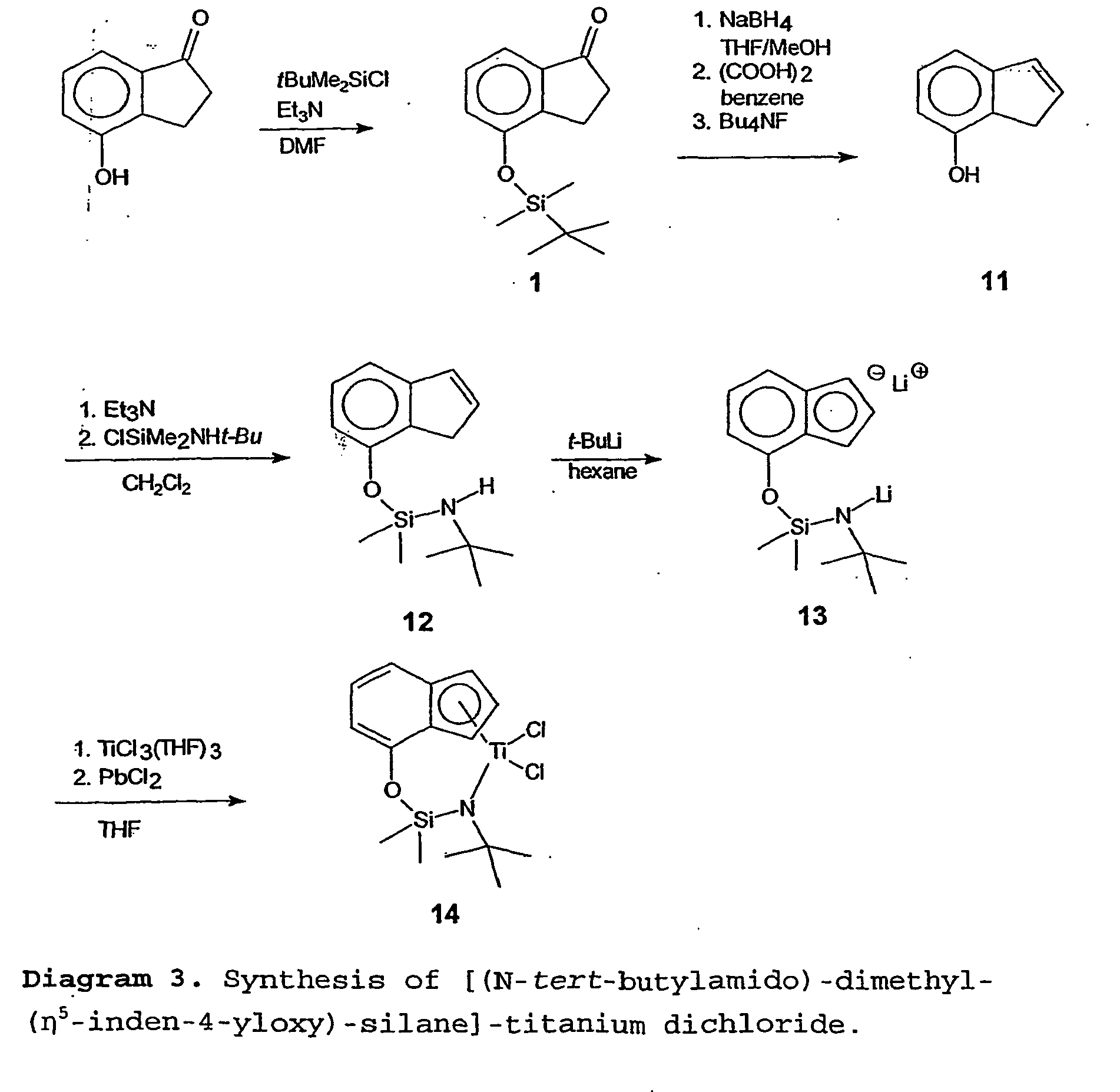
- Ethylene (>99.95%), nitrogen (>99.999%) and n-pentane (> 97%) were used. 1-Hexene was purified by refluxing over sodium and distillation under an atmosphere of nitrogen.
- Catalysts were prepared by mixing the co-catalyst (30 wt% MAO in toluene or 70 wt% HIBAO in toluene, both from Albemarle) in toluene to reach the desired Aluminium: M (Metal) molar ratio.
- A feeding vessel in a glove box was charged with an appropriate amount of catalyst and transferred to a stirred (400 min-1) Büchi 2.0/3.0 L stirred autoclave reactor. The reactor was purged with nitrogen and charged with n-pentane at ambient temperature. The reactor temperature was adjusted to +80°C and the feed of ethylene into the reactor begun. The partial pressure of ethylene (106 Pa (10.0 bar)) and total pressure (1.3 x 10⁶ Pa (13 bar)) were held constant by continuously feeding in monomer. After 30 minutes the reactor was vented and the polymer isolated.
- When 1-hexene was used as comonomer its addition to the reactor was simultaneous with ethylene.
- Table 1 below provides details of the polymerisations conducted. The catalysts used were either compound (5) (infra) or rac-[ethylenebis(2-(tertbutyldimethylsiloxy)-indenyl)]zirconium dichloride which is disclosed in
WO97/28170 Table 1 Polymer type HDPE HDPE LLDPE LLDPE HDPE HDPE Complex Comparative example Compound (5) of example Comparative example Compound (5) of example Comparative example Compound (5) of example Catalyst amount 0.25 µmol 0.52 µmol 0.27 µmol 0.5 µmol 0.25 µmol 1.27 µmol Polymer amount (g) 108 130 165 225 52 47 Polymerisation time (Min) 30 60 30 30 30 60 Cocatalyst MAO MAO MAO MAO HIBAO HIBAO Aluminium/ Metal ratio 1000 900 900 900 1000 916 Activity of metal (KgPol/g met h) 9472 2766 13399 9855 4560 433 Comonomer - - 1-hexene 1-hexene - - Comonomer amount (ml) - - 50.0 30.0 - - Comonomer amount (w-%) - - 2.4 3.3 - - Medium PENTANE ISOBUTANE PENTANE ISOBUTANE PENTANE ISOBUTANE Medium amount (ml) 1200 1800 1200 1800 1200 1800 Monomer ETHENE ETHENE ETHENE ETHENE ETHENE ETHENE Pressure tot (bar) 14 23 13 23 14 23 Temperature (°C) 80 80 80 95 80 80 CRYSTALLINITY (%) 67 64 53 43 71 - MELTING TEMP (°C) 135 134 122 116 133 - MFR, (g/10 min) n.a. <0.1 1.4 n.a. 1.32 - MFR21 (g/10 min) 7.5 120 46.20 0.10 47.50 - BD (kg/m3) 70.00 - 178 - 190 - T-VINYLENE (C=C/1000C) 0.01 0.04 0.00 0.04 0.01 - VINYL (C=C/1000C) 0.50 0.34 0.53 0.17 0.62 - VINYLIDENE (C=C/1000C) 0.02 0.04 0.03 0.06 0.01 - Mn 44300 63600 35200 143000 35700 - Mw 145000 270000 86600 477000 88700 - MWD 3.3 4.2 2.5 3.3 2.5 -
Claims (27)
- A metallocene catalyst of formula (III)
(Lig)p M (X)m (A)n (III)
in which:M is a transition metal ion or a lanthanide metal ion;p is 1 or 2;m is greater than or equal to 0;n is greater than or equal to 0;n+m is equal to the valency of the metal not satisfied by ligand or ligands Lig;X is a ligand which co-ordinates to M selected from a η5 hydrocarbyl, η1 hydrocarbyl, halo, hydrocarbyl amino or hydrocarbyl amido ligand;A is a σ-ligand; andeach Lig is independently a negatively charged indenyl or indenyloid moiety of the following formula (IV):
each Q is either a silicon or a germanium atom;
either or both of the bonds shown as ----- may be present or absent;
each R1 which may be the same or different is hydrogen or a C1-20 hydrocarbyl or a η1 ligand which is an amine, at least one R1 group being other than hydrogen;
each R2 is a hydrogen or a group bonded to the 5-membered ring through a carbon, oxygen, silicon, phosphorus, germanium, nitrogen or sulfur atom;
each R3 is a hydrogen or a group bonded to the 6-membered ring through an atom of groups 14, 15 or 16 of the periodic table (IUPAC) carbon, oxygen, silicon, germanium, nitrogen, phosphorus or sulfur atom; or
two or more R2 and/or two or more R3 groups attached to adjacent ring atoms on the same ring together form a 5- to 8-membered fused ring; and optionally
one R2 or R3 is -L-Z wherein L is a 1 to 4 atom chain and Z is a second moiety of formula (IV), and joined to L through one R2 or R3, if present in which L is one and the same chain common to both moieties;
a is an integer between 1 and 3,
b is an integer between 1 and 3, the sum of a and b being no more than 4,
c is an integer between 1 and 3,
with the proviso that no more than one -L-Z group is present in each ligand. - A catalyst as claimed in claim 1 wherein M is a group 4 to 6 transition metal.
- A catalyst as claimed in claim 2 wherein said metal is Cr, Ti, Zr or Hf.
- A catalyst as claimed in any one of claims 1 to 3 wherein p is 2 and m is zero.
- A catalyst as claimed in any one of claims 1 to 5 wherein each A is a halo, amido or C1-12-hydrocarbyl ligand.
- A catalyst as claimed in claim 5 wherein each A is a chloro ligand.
- A catalyst as claimed in any one of claims 1 to 6 wherein all the ring atoms are carbon atoms.
- A catalyst as claimed in any one of claims 1 to 7 wherein both ---- bonds are present.
- A catalyst as claimed in any one of claims 1 to 8 wherein Q is Si.
- A catalyst as claimed in any one of claims 1 to 9 wherein each R1 is independently a C1-8 hydrocarbyl or C1-8 alkylamine.
- A catalyst as claimed in any one of claims 1 to 10 wherein R3 is a group bonded to the 6-membered ring through a carbon, oxygen, silicon, germanium, nitrogen, phosphorus or sulfur atom.
- A catalyst as claimed in any one of claims 1 to 11 wherein each R2 or R3 is independently a C1-20 hydrocarbyl, C1-20 hydrocarbyl siloxy, C1-20 hydrocarbyloxy or C1-20 hydrocarbyl silyl group.
- A catalyst as claimed in claim 12 wherein each R2 or R3 is independently a C1-8 hydrocarbyl group or C1-20 hydrocarbylsiloxy group attached to the ring via the oxygen atom.
- A catalyst as claimed in any one of claims 1 to 9 wherein R3 is H.
- A catalyst as claimed in any one of claims 1 to 14 wherein a group L-Z is present at the 1 or 3 position of formula (IV).
- A catalyst as claimed in claim 15 wherein L is SiR2 2 or (CR2 2)q in which q is 1 to 3 and R2 is as hereinbefore defined.
- A catalyst as claimed in claim 16 wherein L is (CH2)q or Si(CH3)2.
- A catalyst as claimed in any one of claims 1 to 17 wherein at least one group -OQ(R1)3 is a siloxy or germyloxy group directly attached to the 4-position or 7-position.
- A catalyst as claimed in any one of claims 1 to 18 where a, b and c are 1.
- A catalyst as claimed in any one of claims 1 to 19 wherein at least two groups -OQ(R1)3 are present, one at position 4, one at position 7 of formula (IV).
- A catalyst as claimed in any one of claims 1 to 20 wherein (R1)3QO- is selected from the group consisting of
OSi(CH3)2N(C1-6-alkyl)H,


- A catalyst as claimed in any one of claims 1 to 21 wherein Z is present and both moieties of formula (IV) are identical.
- A catalyst as claimed in any one of claims 1 to 22 wherein Lig is of formula
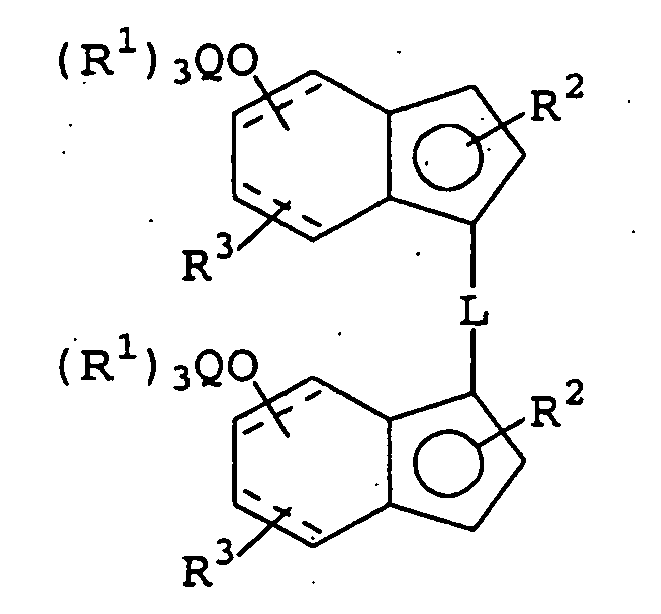
- An olefin polymerisation catalyst system comprising or produced by the reaction of:(i) a metallocene catalyst as claimed in any one of claims 1 to 23; and(ii) a cocatalyst/catalyst activator.
- A process for olefin polymerisation comprising polymerising an olefin in the presence of a metallocene catalyst as claimed in any one of claims 1 to 23.
- A process for the preparation of a metallocene catalyst as claimed in claim 1 to 23 which comprises metallating a η5 cyclopentadienyl ligand which forms part of an indenyl or indenyloid moiety of formula (IV) as defined in claim 1 with a transition metal or a lanthanide.
- A ligand of formula (IV)

each Q is either a silicon or a germanium atom;
either or both of the bonds shown as ----- may be present or absent; each R1 which may be the same or different is hydrogen or a C1-20 hydrocarbyl or a η1 ligand which is an amine, at least one R1 group being other than hydrogen at least one group (R1)3QO- being present on the 4 or 7 position;
each R2 may be hydrogen or a group bonded to the 5-membered ring through a carbon, oxygen, silicon, germanium, nitrogen or sulfur;
each R3 is a hydrogen or a group bonded to the 6-membered ring through an atom of groups 14, 15 or 16 of the periodic table (IUPAC) carbon, oxygen, silicon, germanium, nitrogen, phosphorus or sulfur atom; or
two or more R2 and/or two or more R3 groups attached to adjacent ring atoms on the same ring together form a 5- to 8-membered fused ring; and optionally
one R2 or R3 is -L-Z wherein L is a 1 to 4 atom chain and Z is a second moiety of formula (IV), and joined to L through one R2 or R3, if present in which L is one and the same chain common to both moietiesl;
a is an integer between 1 and 3,
b is an integer between 1 and 3, the sum of a and b being no more than 4, c is an integer between 1 and 3,
with the proviso that no more than one -L-Z group is present in each ligand and salts and complexes thereof.
Applications Claiming Priority (5)
| Application Number | Priority Date | Filing Date | Title |
|---|---|---|---|
| GB0115370 | 2001-06-22 | ||
| GB0115370A GB0115370D0 (en) | 2001-06-22 | 2001-06-22 | Catalysts |
| GB0117629 | 2001-07-19 | ||
| GB0117629A GB0117629D0 (en) | 2001-07-19 | 2001-07-19 | Catalysts |
| PCT/GB2002/002853 WO2003000744A1 (en) | 2001-06-22 | 2002-06-21 | Metallocene catalysts containing an idenyl moiety substituted at the 4-, 5-, 6- or 7-position by a siloxy or germyloxy group |
Publications (2)
| Publication Number | Publication Date |
|---|---|
| EP1401880A1 EP1401880A1 (en) | 2004-03-31 |
| EP1401880B1 true EP1401880B1 (en) | 2010-11-10 |
Family
ID=26246237
Family Applications (1)
| Application Number | Title | Priority Date | Filing Date |
|---|---|---|---|
| EP02735637A Expired - Lifetime EP1401880B1 (en) | 2001-06-22 | 2002-06-21 | Metallocene catalysts containing an indenyl moiety substituted at the 4-, 5-, 6- or 7-position by a siloxy or germyloxy group |
Country Status (9)
| Country | Link |
|---|---|
| US (1) | US7074863B2 (en) |
| EP (1) | EP1401880B1 (en) |
| JP (1) | JP2004532346A (en) |
| KR (1) | KR100626258B1 (en) |
| CN (1) | CN1269855C (en) |
| AT (1) | ATE487744T1 (en) |
| BR (1) | BR0210607B1 (en) |
| DE (1) | DE60238256D1 (en) |
| WO (1) | WO2003000744A1 (en) |
Families Citing this family (23)
| Publication number | Priority date | Publication date | Assignee | Title |
|---|---|---|---|---|
| GB0118010D0 (en) * | 2001-07-24 | 2001-09-19 | Borealis Tech Oy | Catalysts |
| ES2280826T5 (en) | 2002-08-05 | 2017-08-03 | Silence Therapeutics Gmbh | Additional new forms of interfering RNA molecules |
| US8008412B2 (en) | 2002-09-20 | 2011-08-30 | Exxonmobil Chemical Patents Inc. | Polymer production at supersolution conditions |
| GB0419851D0 (en) * | 2004-09-07 | 2004-10-13 | Borealis Tech Oy | Catalysts |
| KR20060056712A (en) * | 2004-11-22 | 2006-05-25 | 삼성전자주식회사 | Polymer for bottom resist used in photolithography and its manufacturing method |
| US7557171B2 (en) * | 2004-12-16 | 2009-07-07 | Exxonmobil Chemical Patents Inc. | Halogen substituted metallocene compounds for olefin polymerization |
| EP1739103A1 (en) | 2005-06-30 | 2007-01-03 | Borealis Technology Oy | Catalyst |
| DE602005013376D1 (en) | 2005-08-09 | 2009-04-30 | Borealis Tech Oy | Siloxy substituted metallocene catalysts |
| US7868197B2 (en) | 2005-12-14 | 2011-01-11 | Exxonmobil Chemical Patents Inc. | Halogen substituted heteroatom-containing metallocene compounds for olefin polymerization |
| US7667064B2 (en) * | 2005-12-14 | 2010-02-23 | Exxonmobil Chemical Patents Inc. | Halogen substituted metallocene compounds for olefin polymerization |
| US7538168B2 (en) | 2005-12-14 | 2009-05-26 | Exxonmobil Chemical Patents Inc. | Halogen substituted metallocene compounds for olefin polymerization |
| US7763562B2 (en) | 2005-12-14 | 2010-07-27 | Exxonmobil Chemical Patents Inc. | Heteroatom bridged metallocene compounds for olefin polymerization |
| US7550544B2 (en) | 2005-12-14 | 2009-06-23 | Exxonmobil Chemical Patents Inc. | Halogen substituted metallocene compounds for olefin polymerization |
| EP1803747A1 (en) | 2005-12-30 | 2007-07-04 | Borealis Technology Oy | Surface-modified polymerization catalysts for the preparation of low-gel polyolefin films |
| US8242237B2 (en) | 2006-12-20 | 2012-08-14 | Exxonmobil Chemical Patents Inc. | Phase separator and monomer recycle for supercritical polymerization process |
| JP2010529253A (en) | 2007-06-04 | 2010-08-26 | エクソンモービル・ケミカル・パテンツ・インク | Very homogeneous solution polymerization of propylene |
| US20100305286A1 (en) | 2007-08-27 | 2010-12-02 | Borealis Technology Oy | Catalysts |
| US7812104B2 (en) * | 2008-01-18 | 2010-10-12 | Exxonmobil Chemical Patents Inc. | Production of propylene-based polymers |
| US8318875B2 (en) | 2008-01-18 | 2012-11-27 | Exxonmobil Chemical Patents Inc. | Super-solution homogeneous propylene polymerization and polypropylenes made therefrom |
| US7544825B1 (en) | 2008-06-12 | 2009-06-09 | Basell Polyolefine Gmbh | Preparation of siloxy-bridged metallocenes |
| EP2330135B1 (en) | 2009-12-02 | 2012-11-07 | Borealis AG | Process for producing polyolefins |
| US8058461B2 (en) | 2010-03-01 | 2011-11-15 | Exxonmobil Chemical Patents Inc. | Mono-indenyl transition metal compounds and polymerization therewith |
| RU2671351C2 (en) * | 2014-08-20 | 2018-10-30 | Бриджстоун Корпорейшн | Method for manufacturing conjugated diene polymer with modified end, conjugated diene polymer with modified end, rubber composition and tyre |
Family Cites Families (12)
| Publication number | Priority date | Publication date | Assignee | Title |
|---|---|---|---|---|
| EP0537686B1 (en) * | 1991-10-15 | 2005-01-12 | Basell Polyolefine GmbH | Process for preparing an olefinpolymer by using metallocenes having specially substituted indenylligands |
| WO1993011258A1 (en) * | 1991-11-29 | 1993-06-10 | Bioxytech | Method for assaying the sod activity by using a self-oxidizable compound necessary for its implementation, self-oxidizable compounds and preparation thereof |
| ATE198207T1 (en) * | 1992-08-03 | 2001-01-15 | Targor Gmbh | METHOD FOR PRODUCING AN OLEFIN POLYMER USING SPECIAL METALLOCENES |
| ES2128371T3 (en) * | 1992-08-15 | 1999-05-16 | Targor Gmbh | PROCEDURE FOR OBTAINING POLYOLEFINS. |
| DE69408989T2 (en) | 1993-05-25 | 1998-11-05 | Exxon Chemical Patents Inc | METALOCENATE CATALYST SYSTEM ON A SUPPORT FOR THE OLEFIN POLYMERIZATION, THEIR PRODUCTION AND USE |
| DE4330661A1 (en) * | 1993-09-10 | 1995-03-16 | Basf Ag | Cold impact propylene polymers |
| CA2193882C (en) | 1994-06-24 | 2005-07-26 | Anthony Nicholas Speca | Polymerization catalyst systems, their production and use |
| FI104975B (en) | 1995-04-12 | 2000-05-15 | Borealis As | Process for producing catalytic components |
| IT1275408B (en) | 1995-05-30 | 1997-08-05 | Spherilene Spa | BIS-INDENYL METALLOCENIC COMPOUNDS PONTANTS PROCEDURE FOR THEIR PREPARATION AND THEIR USE IN CATALYSTS FOR THE POLYMERIZATION OF OLEFINS |
| FI104826B (en) | 1996-01-30 | 2000-04-14 | Borealis As | Heteroatom-substituted metallose compounds for catalytic systems in olefin polymerization and process for their preparation |
| US5723632A (en) * | 1996-08-08 | 1998-03-03 | Mgi Pharma, Inc. | Total synthesis of antitumor acylfulvenes |
| FI971565A7 (en) | 1997-04-14 | 1998-10-15 | Borealis As | Substituted metallocene compounds for catalyst systems for the polymerization of olefins, intermediates thereof and method of preparation |
-
2002
- 2002-06-21 WO PCT/GB2002/002853 patent/WO2003000744A1/en not_active Ceased
- 2002-06-21 JP JP2003507147A patent/JP2004532346A/en active Pending
- 2002-06-21 KR KR1020037016745A patent/KR100626258B1/en not_active Expired - Fee Related
- 2002-06-21 BR BRPI0210607-8A patent/BR0210607B1/en not_active IP Right Cessation
- 2002-06-21 DE DE60238256T patent/DE60238256D1/en not_active Expired - Lifetime
- 2002-06-21 EP EP02735637A patent/EP1401880B1/en not_active Expired - Lifetime
- 2002-06-21 AT AT02735637T patent/ATE487744T1/en not_active IP Right Cessation
- 2002-06-21 US US10/481,332 patent/US7074863B2/en not_active Expired - Fee Related
- 2002-06-21 CN CNB028154010A patent/CN1269855C/en not_active Expired - Fee Related
Also Published As
| Publication number | Publication date |
|---|---|
| CN1269855C (en) | 2006-08-16 |
| ATE487744T1 (en) | 2010-11-15 |
| KR20040007747A (en) | 2004-01-24 |
| US7074863B2 (en) | 2006-07-11 |
| CN1538975A (en) | 2004-10-20 |
| EP1401880A1 (en) | 2004-03-31 |
| BR0210607A (en) | 2004-09-28 |
| KR100626258B1 (en) | 2006-09-21 |
| WO2003000744A1 (en) | 2003-01-03 |
| BR0210607B1 (en) | 2011-06-28 |
| JP2004532346A (en) | 2004-10-21 |
| US20040152882A1 (en) | 2004-08-05 |
| DE60238256D1 (en) | 2010-12-23 |
Similar Documents
| Publication | Publication Date | Title |
|---|---|---|
| US7074863B2 (en) | Metallocene catalysts containing an idenyl moiety substituted at the 4,-5,-6- or 7-position by a siloxy or germyloxy group | |
| US7037872B2 (en) | Metallocene catalysts containing a cyclopentadienyl ligand substituted by a siloxy or germiloxy group containing an olefinic residue | |
| US6943225B2 (en) | Multinuclear metallocene catalyst | |
| JP6093858B2 (en) | Novel metallocene compound, catalyst composition containing the same, and method for producing olefin polymer using the same | |
| KR101712318B1 (en) | Metallocene isomeric catalyst and manufactured polyolefin using the same | |
| US6160072A (en) | Process for polymerizing tactioselective polyolefins in condensed phase using titanocenes | |
| KR20010023451A (en) | Homogeneous filled polymer composite | |
| JP3414769B2 (en) | Olefin polymerization catalyst and method for producing olefin polymer using the same | |
| US20050148460A1 (en) | Catalyst components and their use in the polymerization of olefins | |
| US6815514B2 (en) | Catalysts | |
| US6252019B1 (en) | Process for polymerizing tactioselective polyolefins in condensed phase using hafnocenes | |
| JP3537234B2 (en) | Catalyst component for producing polyolefin, catalyst for producing polyolefin containing the component, and method for producing polyolefin | |
| US20060148643A1 (en) | Polyolefin production | |
| US6482905B1 (en) | Unsymmetric unbridged bis-indenyl metallocenes and their use | |
| WO2001053362A1 (en) | Metallocene catalysts comprising monocyclic siloxy substituted cyclopentadienyl group(s) for the polymerisation of olefins | |
| ES2351298T3 (en) | METALOGEN CATALYSTS CONTAINING AN INDENILE REST REPLACED IN THE POSITION 4-, 5-, 6- OR 7-, WITH A SILOXI OR GERMILOXI GROUP. | |
| WO2001053361A1 (en) | Siloxy-substituted monocyclopentadienyl ligated constrained geometry olefin polymerisation catalysts | |
| JP2955400B2 (en) | Method for producing solid catalyst component for olefin polymerization | |
| JP3070257B2 (en) | Method for producing olefin polymer | |
| JP3061297B2 (en) | Method for producing olefin polymer | |
| JP2001288221A (en) | Propylene polymer | |
| SK175899A3 (en) | Process for the polymerisation of olefins in the gas phase | |
| JPH04275293A (en) | New transition metal compound and production of alpha-olefin using the same | |
| JP3302415B2 (en) | Internal olefin polymerization catalyst and method for producing internal olefin polymer | |
| JP3452525B2 (en) | Method for producing catalyst for olefin polymerization |
Legal Events
| Date | Code | Title | Description |
|---|---|---|---|
| PUAI | Public reference made under article 153(3) epc to a published international application that has entered the european phase |
Free format text: ORIGINAL CODE: 0009012 |
|
| 17P | Request for examination filed |
Effective date: 20031229 |
|
| AK | Designated contracting states |
Kind code of ref document: A1 Designated state(s): AT BE CH CY DE DK ES FI FR GB GR IE IT LI LU MC NL PT SE TR |
|
| AX | Request for extension of the european patent |
Extension state: AL LT LV MK RO SI |
|
| RIN1 | Information on inventor provided before grant (corrected) |
Inventor name: PENNINKANGAS, ANTTI Inventor name: MAARANEN, JANNE Inventor name: LUTTIKHEDDE, HENDRIK Inventor name: WILEN, CARL-ERIC Inventor name: EKHOLM, PETER |
|
| 17Q | First examination report despatched |
Effective date: 20070129 |
|
| GRAP | Despatch of communication of intention to grant a patent |
Free format text: ORIGINAL CODE: EPIDOSNIGR1 |
|
| GRAS | Grant fee paid |
Free format text: ORIGINAL CODE: EPIDOSNIGR3 |
|
| GRAA | (expected) grant |
Free format text: ORIGINAL CODE: 0009210 |
|
| AK | Designated contracting states |
Kind code of ref document: B1 Designated state(s): AT BE CH CY DE DK ES FI FR GB GR IE IT LI LU MC NL PT SE TR |
|
| REG | Reference to a national code |
Ref country code: GB Ref legal event code: FG4D |
|
| REG | Reference to a national code |
Ref country code: CH Ref legal event code: EP |
|
| REG | Reference to a national code |
Ref country code: IE Ref legal event code: FG4D |
|
| REF | Corresponds to: |
Ref document number: 60238256 Country of ref document: DE Date of ref document: 20101223 Kind code of ref document: P |
|
| REG | Reference to a national code |
Ref country code: ES Ref legal event code: FG2A Effective date: 20110121 |
|
| REG | Reference to a national code |
Ref country code: NL Ref legal event code: VDEP Effective date: 20101110 |
|
| PG25 | Lapsed in a contracting state [announced via postgrant information from national office to epo] |
Ref country code: FI Free format text: LAPSE BECAUSE OF FAILURE TO SUBMIT A TRANSLATION OF THE DESCRIPTION OR TO PAY THE FEE WITHIN THE PRESCRIBED TIME-LIMIT Effective date: 20101110 Ref country code: AT Free format text: LAPSE BECAUSE OF FAILURE TO SUBMIT A TRANSLATION OF THE DESCRIPTION OR TO PAY THE FEE WITHIN THE PRESCRIBED TIME-LIMIT Effective date: 20101110 Ref country code: NL Free format text: LAPSE BECAUSE OF FAILURE TO SUBMIT A TRANSLATION OF THE DESCRIPTION OR TO PAY THE FEE WITHIN THE PRESCRIBED TIME-LIMIT Effective date: 20101110 Ref country code: CY Free format text: LAPSE BECAUSE OF FAILURE TO SUBMIT A TRANSLATION OF THE DESCRIPTION OR TO PAY THE FEE WITHIN THE PRESCRIBED TIME-LIMIT Effective date: 20101110 Ref country code: SE Free format text: LAPSE BECAUSE OF FAILURE TO SUBMIT A TRANSLATION OF THE DESCRIPTION OR TO PAY THE FEE WITHIN THE PRESCRIBED TIME-LIMIT Effective date: 20101110 Ref country code: PT Free format text: LAPSE BECAUSE OF FAILURE TO SUBMIT A TRANSLATION OF THE DESCRIPTION OR TO PAY THE FEE WITHIN THE PRESCRIBED TIME-LIMIT Effective date: 20110310 |
|
| PG25 | Lapsed in a contracting state [announced via postgrant information from national office to epo] |
Ref country code: GR Free format text: LAPSE BECAUSE OF FAILURE TO SUBMIT A TRANSLATION OF THE DESCRIPTION OR TO PAY THE FEE WITHIN THE PRESCRIBED TIME-LIMIT Effective date: 20110211 |
|
| PG25 | Lapsed in a contracting state [announced via postgrant information from national office to epo] |
Ref country code: BE Free format text: LAPSE BECAUSE OF FAILURE TO SUBMIT A TRANSLATION OF THE DESCRIPTION OR TO PAY THE FEE WITHIN THE PRESCRIBED TIME-LIMIT Effective date: 20101110 |
|
| PG25 | Lapsed in a contracting state [announced via postgrant information from national office to epo] |
Ref country code: DK Free format text: LAPSE BECAUSE OF FAILURE TO SUBMIT A TRANSLATION OF THE DESCRIPTION OR TO PAY THE FEE WITHIN THE PRESCRIBED TIME-LIMIT Effective date: 20101110 |
|
| PLBE | No opposition filed within time limit |
Free format text: ORIGINAL CODE: 0009261 |
|
| STAA | Information on the status of an ep patent application or granted ep patent |
Free format text: STATUS: NO OPPOSITION FILED WITHIN TIME LIMIT |
|
| 26N | No opposition filed |
Effective date: 20110811 |
|
| REG | Reference to a national code |
Ref country code: DE Ref legal event code: R097 Ref document number: 60238256 Country of ref document: DE Effective date: 20110811 |
|
| REG | Reference to a national code |
Ref country code: CH Ref legal event code: PL |
|
| REG | Reference to a national code |
Ref country code: IE Ref legal event code: MM4A |
|
| PG25 | Lapsed in a contracting state [announced via postgrant information from national office to epo] |
Ref country code: IE Free format text: LAPSE BECAUSE OF NON-PAYMENT OF DUE FEES Effective date: 20110621 Ref country code: CH Free format text: LAPSE BECAUSE OF NON-PAYMENT OF DUE FEES Effective date: 20110630 Ref country code: LI Free format text: LAPSE BECAUSE OF NON-PAYMENT OF DUE FEES Effective date: 20110630 |
|
| PG25 | Lapsed in a contracting state [announced via postgrant information from national office to epo] |
Ref country code: MC Free format text: LAPSE BECAUSE OF NON-PAYMENT OF DUE FEES Effective date: 20110630 |
|
| PG25 | Lapsed in a contracting state [announced via postgrant information from national office to epo] |
Ref country code: LU Free format text: LAPSE BECAUSE OF NON-PAYMENT OF DUE FEES Effective date: 20110621 |
|
| PG25 | Lapsed in a contracting state [announced via postgrant information from national office to epo] |
Ref country code: TR Free format text: LAPSE BECAUSE OF FAILURE TO SUBMIT A TRANSLATION OF THE DESCRIPTION OR TO PAY THE FEE WITHIN THE PRESCRIBED TIME-LIMIT Effective date: 20101110 |
|
| REG | Reference to a national code |
Ref country code: FR Ref legal event code: PLFP Year of fee payment: 14 |
|
| PGFP | Annual fee paid to national office [announced via postgrant information from national office to epo] |
Ref country code: ES Payment date: 20150626 Year of fee payment: 14 Ref country code: GB Payment date: 20150618 Year of fee payment: 14 Ref country code: DE Payment date: 20150619 Year of fee payment: 14 |
|
| PGFP | Annual fee paid to national office [announced via postgrant information from national office to epo] |
Ref country code: IT Payment date: 20150622 Year of fee payment: 14 Ref country code: FR Payment date: 20150619 Year of fee payment: 14 |
|
| REG | Reference to a national code |
Ref country code: DE Ref legal event code: R119 Ref document number: 60238256 Country of ref document: DE |
|
| GBPC | Gb: european patent ceased through non-payment of renewal fee |
Effective date: 20160621 |
|
| REG | Reference to a national code |
Ref country code: FR Ref legal event code: ST Effective date: 20170228 |
|
| PG25 | Lapsed in a contracting state [announced via postgrant information from national office to epo] |
Ref country code: DE Free format text: LAPSE BECAUSE OF NON-PAYMENT OF DUE FEES Effective date: 20170103 Ref country code: FR Free format text: LAPSE BECAUSE OF NON-PAYMENT OF DUE FEES Effective date: 20160630 |
|
| PG25 | Lapsed in a contracting state [announced via postgrant information from national office to epo] |
Ref country code: GB Free format text: LAPSE BECAUSE OF NON-PAYMENT OF DUE FEES Effective date: 20160621 |
|
| PG25 | Lapsed in a contracting state [announced via postgrant information from national office to epo] |
Ref country code: IT Free format text: LAPSE BECAUSE OF NON-PAYMENT OF DUE FEES Effective date: 20160621 |
|
| PG25 | Lapsed in a contracting state [announced via postgrant information from national office to epo] |
Ref country code: ES Free format text: LAPSE BECAUSE OF NON-PAYMENT OF DUE FEES Effective date: 20160622 |
|
| REG | Reference to a national code |
Ref country code: ES Ref legal event code: FD2A Effective date: 20181203 |