EP1400895A2 - Object-oriented enumerated type facility - Google Patents
Object-oriented enumerated type facility Download PDFInfo
- Publication number
- EP1400895A2 EP1400895A2 EP03255511A EP03255511A EP1400895A2 EP 1400895 A2 EP1400895 A2 EP 1400895A2 EP 03255511 A EP03255511 A EP 03255511A EP 03255511 A EP03255511 A EP 03255511A EP 1400895 A2 EP1400895 A2 EP 1400895A2
- Authority
- EP
- European Patent Office
- Prior art keywords
- class
- enumerated type
- source code
- declaration
- enumeration
- Prior art date
- Legal status (The legal status is an assumption and is not a legal conclusion. Google has not performed a legal analysis and makes no representation as to the accuracy of the status listed.)
- Granted
Links
Images

Classifications
-
- G—PHYSICS
- G06—COMPUTING OR CALCULATING; COUNTING
- G06F—ELECTRIC DIGITAL DATA PROCESSING
- G06F9/00—Arrangements for program control, e.g. control units
- G06F9/06—Arrangements for program control, e.g. control units using stored programs, i.e. using an internal store of processing equipment to receive or retain programs
- G06F9/44—Arrangements for executing specific programs
- G06F9/448—Execution paradigms, e.g. implementations of programming paradigms
- G06F9/4488—Object-oriented
Definitions
- the present invention relates to computer systems and to programming languages, and more specifically, to a method and an apparatus for facilitating the use of an object-oriented enumerated type within a programming language.
- An enumerated type facility within a programming language allows a programmer to easily create types that include a fixed number of enumeration constants.
- an enumerated type can define a fixed set of colors, such as RED, WHITE and BLUE.
- an enumerated type can be used to represent many things, including natural enumerations (e.g., the four seasons) and program-specific enumerations (e.g., the states in a finite state machine).
- one embodiment of the present invention provides a system that facilitates use of an object-oriented enumerated type within a computer program.
- the system receives source code for the computer program, wherein the source code contains a declaration for an enumerated type. This declaration specifies a fixed number of enumeration constants that comprise the enumerated type.
- the system defines the enumerated type using a class defined within an object-oriented programming language, wherein the class includes a self-typed constant for each enumeration constant specified in the declaration. If the declaration additionally contains one or more method declarations, these methods are present on the defined class.
- the system implements the multi-way branch statement so that different enumeration constants are associated with different cases of the multi-way branch statement.
- implementing the multi-way branch statement involves using a translation table to implement the multi-way branch statement efficiently while preserving binary compatibility in cases where the enumerated type evolves.
- the system augments the class with the method.
- the system uses one or more methods associated with the class to implement an interface.
- the system augments the class to include the field.
- the system associates a different concrete method with each enumeration constant, if such concrete methods are specified in the source code. In this way, invoking the same abstract method on different enumeration constants can cause different concrete methods to execute.
- the method is performed during a pre-compilation operation.
- the method is performed during a compilation operation.
- the class includes a public static final self-typed field for each enumeration constant.
- the class does not include any public constructors.
- Table 1 illustrates the structure of an enum declaration in accordance with one embodiment of the present invention.
- Table 2 illustrates a new production for a switch statement in accordance with one embodiment of the present invention.
- Table 3 illustrates automatically generated fields for an enum declaration in accordance with one embodiment of the present invention.
- Table 4 illustrates an exemplary enum declaration in accordance with one embodiment of the present invention.
- Table 5 illustrates an example including a switch statement in accordance with one embodiment of the present invention.
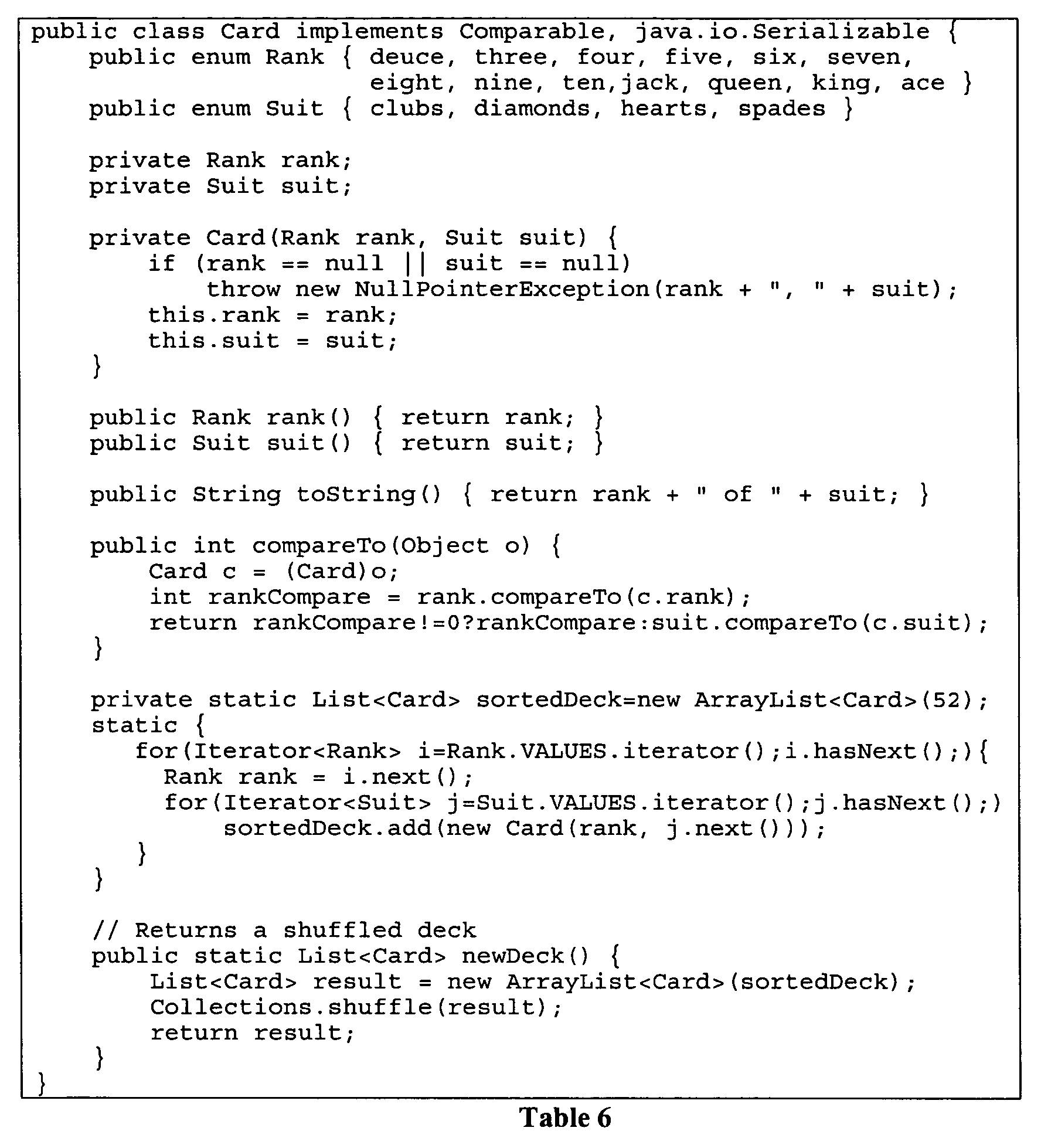
- Table 6 illustrates a rich playing card class built atop two simple enum types in accordance with one embodiment of the present invention.
- Table 7 illustrates use of an enhanced for statement in accordance with one embodiment of the present invention.
- Table 8 illustrates a program that exercises the card class in accordance with one embodiment of the present invention.
- Table 9 illustrates declaring methods on individual enum constants in accordance with one embodiment of the present invention.
- Table 10 illustrates a multi-way if statement to implement a switch statement in accordance with one embodiment of the present invention.
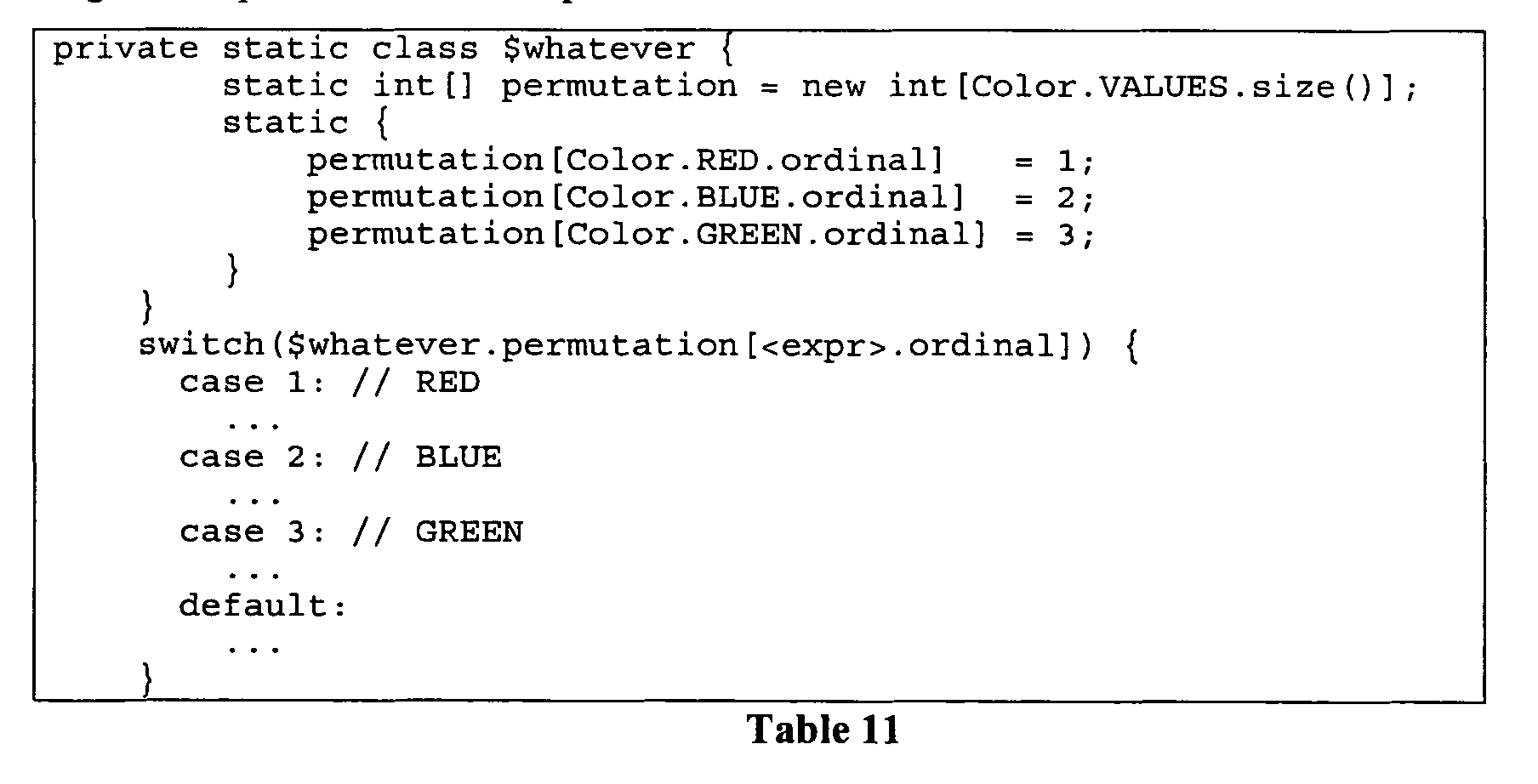
- Table 11 illustrates another implementation of a switch statement in accordance with one embodiment of the present invention.
- FIG. 1 illustrates a computer system 100 in accordance with one embodiment of the present invention.
- computer system 100 includes processor 102, which is coupled to a memory 112 and to peripheral bus 110 through bridge 106.
- Bridge 106 can generally include any type of circuitry for coupling components of computer system 100 together.
- Processor 102 can include any type of processor, including, but not limited to, a microprocessor, a mainframe computer, a digital signal processor, a personal organizer, a device controller and a computational engine within an appliance.
- Processor 102 includes a cache 104 that stores code and data for execution by processor 102.
- Storage device 108 can include any type of non-volatile storage device that can be coupled to a computer system. This includes, but is not limited to, magnetic, optical, and magneto-optical storage devices, as well as storage devices based on flash memory and/or battery-backed up memory.
- Processor 102 communicates with memory 112 through bridge 106.
- Memory 112 can include any type of memory that can store code and data for execution by processor 102.
- memory 112 contains compiler 116.
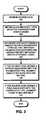
- Compiler 116 converts source code 114 into executable code 118. In doing so, compiler 116 facilitates the use of object-oriented enumerated types. This process is described in more detail below with reference to FIG. 3.
- FIG. 2 illustrates the structure of compiler 116 in accordance with one embodiment of the present invention.
- Compiler 116 takes as input source code 114 and outputs executable code 118.
- source code 114 may include any computer program written in a high-level programming language, such as the JAVA programming language.
- Executable code 118 includes executable instructions for a specific virtual machine or a specific processor architecture.
- Compiler 116 includes a number of components, including pre-compilation stage 200, front end 202 and back end 206.
- Pre-compilation stage 200 receives source code 114 and performs a number of pre-compilation operations, such as macro expansions, on source code 114 to produce pre-compiled source code 201.
- pre-compilation stage 200 provides support for object-oriented enumerated types as is described in more detail below with reference to FIG. 3.
- Front end 202 receives pre-compiled source code 201 from pre-compilation stage 200 and parses pre-compiled source code 201 to produce intermediate representation 204.
- Intermediate representation 204 is received by back end 206, which operates on intermediate representation 204 to produce executable code 118. During this process, intermediate representation 204 feeds through optimizer 208, and the resulting optimized intermediate representation 209 is passed to code generator 210.
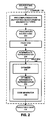
- FIG. 3 is a flow chart illustrating the process of defining an object-oriented enumerated type in accordance with one embodiment of the present invention. During this process, the system receives source code for a program (step 302).
- the system defines enumerated types specified in the source code using classes (step 304). This can be done for example by substituting class definitions for the enumerated type declarations during a pre-compilation operation. Note that the enumerated type declaration can look like a C++ enum declaration: "Public enum Suit ⁇ clubs, diamonds, hearts, spades ⁇ ".
- the system also implements multi-way branch statements (switch statements) involving enumerated types that are defined in the source code (step 306). For a given enumerated type, this may involve associating different enumeration constants with different cases of the multi-way branch statement.
- switch statements multi-way branch statements
- the system augments the associated class with the method (step 308).
- the source code can define constructors or accessor methods for the class.
- the system augments the associated class with the field (step 310).
- an enum declaration is permitted wherever a class declaration is now permitted, as is illustrated in Table 1 below.
- class modifiers in enum declarations are as for class declarations, with a few additional restrictions. All enum declarations are implicitly final unless they contain constant-specific class bodies (which result in implicit subclasses). It is permissible to use the final modifier on an enum declaration without constant-specific class bodies, but it has no effect (and is discouraged). Enum declarations may not use the class modifier abstract unless they contain constant-specific class bodies for every enum constant, and any abstract methods declared in the (optional) class body declarations are overridden in all the constant-specific class bodies. Enum member classes are implicitly static. Regardless of what class modifiers are used, it is illegal to explicitly instantiate an enum (using new).
- An enum constant may be followed by arguments, which are passed to the constructor when the constant is created.
- a constructor is chosen using the normal overloading rules. If the arguments are omitted, an empty argument list is assumed. If the enum class has no constructor declarations, a parameterless default constructor is provided (which matches the implicit empty argument list).
- Enum declarations may not contain members that conflict with automatically generated members: VALUES, family ( ) , readobj ect (ObjectInputStream) , and writeobj ect (ObjectOutputStream). (Similarly, enum declarations may not contain members that conflict with final methods in java.util.Enum: equals (Object), hashCode) ( ) , clone ( ) , compareTo (Object), and readResolve ().) Finally, enum declarations may not contain fields named ordinal and name (which would hide the like-named fields in java.util.Enum).
- serialized form of an enum constant consists of its name. If deserialization is attempted and no constant of the correct type exists with the serialized name, deserialization fails with an Invalid Object Exception. Deserialization will not be compromised by reordering of enum constants, addition of enum constants, or removal of unused enum constants.
- the syntax of the switch statement is extended ever-so-slightly.
- the type of the Expression is now permitted to be an enum class.
- a new production is added, as is illustrated in Table 2 below.
- the ClassName in an EnumConst must refer to an enum class.
- the Identifier must correspond to one of its enumeration constants.
- An enum declaration declares an enum class with the same visibility as a class declaration at the same point with the same access modifiers. Any members declared in the (optional) class body have the same visibility as they would have in a class declaration at the same point with the same access modifiers.
- Constant-specific class bodies define anonymous classes inside enum classes that extend the enclosing enum class. Thus, instance methods declared in these class bodies are accessible outside the bodies only if they override accessible methods in the enclosing enum class. Static methods and fields declared in constant-specific class bodies are never accessible outside the class body in which they are declared.
- the enum class has the following fields generated automatically, as is illustrated in Table 3 below.
- Switch statements are useful for simulating the addition of a method to an enum type from outside the type.
- This example which is illustrated in Table 5, "adds” a color method to the coin class, and prints a table of coins, their values, and their colors.
- Running the program prints: penny 1c copper nickel 5c nickel dime 10c silver quarter 25c silver
- Table 8 illustrates a little program that exercises the Card class. It takes two integer parameters on the command line, representing the number of hands to deal and the number of cards in each hand. Running the program produces results like this:
- the above pattern is suitable for moderately sophisticated programmers. It is admittedly a bit tricky, but it is much safer than using a case statement in the base class (operation), as the pattern precludes the possibility of forgetting to add a behavior for a new constant (there would be a compile-time error).
- switch statements on enums can easily be compiled down to ordinary switch statements, as it is guaranteed that no constants will be added, removed, or reordered from the enum class after the switch statement is compiled. Thus, the ordinals implied by the declarations are guaranteed to be correct at run time.
- a computer-readable storage medium which may be any device or medium that can store code and/or data for use by a computer system.
- the transmission medium may include a communications network, such as the Internet.
Landscapes
- Engineering & Computer Science (AREA)
- Software Systems (AREA)
- Theoretical Computer Science (AREA)
- Physics & Mathematics (AREA)
- General Engineering & Computer Science (AREA)
- General Physics & Mathematics (AREA)
- Devices For Executing Special Programs (AREA)
- Stored Programmes (AREA)
Abstract
Description
- The present invention relates to computer systems and to programming languages, and more specifically, to a method and an apparatus for facilitating the use of an object-oriented enumerated type within a programming language.
- An enumerated type facility within a programming language allows a programmer to easily create types that include a fixed number of enumeration constants. For example, an enumerated type can define a fixed set of colors, such as RED, WHITE and BLUE. In general, an enumerated type can be used to represent many things, including natural enumerations (e.g., the four seasons) and program-specific enumerations (e.g., the states in a finite state machine).
- Many programming languages, including C, C++, Ada and C# provide enumerated type facilities. However, in all of these facilities, enumerated types are merely thinly disguised integers. Some of these languages, including C++, Ada and C#, provide some measure of type safety and a few pieces of built-in functionality, such as automatic string conversion, but none allow for programmer extensibility.
- Programmers in object-oriented languages sometimes implement more powerful enumerated types manually by writing classes that export self-typed constants to serve as enumeration constants. For example, item 21 in "Effective Java Programming", by Joshua Bloch, pp. 104-114, Addison-Wesley 2001, discusses one such method of using a "Typesafe Enum" pattern.
- While enumerated types implemented in this way are more powerful than traditional enumerated types, they have a number of drawbacks: (1) they require substantial programming effort to produce code to define the classes; (2) the additional code required to define the classes makes the code less readable; (3) the additional code may introduce errors into the program; and (4) enumerated types defined in this way are not usable in all contexts where traditional types are used. In particular, they may not be used in a multi-way branch statement (also referred to as a "switch statement" or a "case statement").
- What is needed is a method and an apparatus for providing powerful enumerated types without the drawbacks involved in manually defining classes to support the enumerated types.
- Accordingly, one embodiment of the present invention provides a system that facilitates use of an object-oriented enumerated type within a computer program. During operation, the system receives source code for the computer program, wherein the source code contains a declaration for an enumerated type. This declaration specifies a fixed number of enumeration constants that comprise the enumerated type. Next, the system defines the enumerated type using a class defined within an object-oriented programming language, wherein the class includes a self-typed constant for each enumeration constant specified in the declaration. If the declaration additionally contains one or more method declarations, these methods are present on the defined class.
- In a variation on this embodiment, if the source code specifies a multi-way branch statement associated with the enumerated type, the system implements the multi-way branch statement so that different enumeration constants are associated with different cases of the multi-way branch statement. In a further variation, implementing the multi-way branch statement involves using a translation table to implement the multi-way branch statement efficiently while preserving binary compatibility in cases where the enumerated type evolves.
- In one embodiment, if the source code defines a method associated with the enumerated type, the system augments the class with the method.
- In one embodiment, the system uses one or more methods associated with the class to implement an interface.
- In one embodiment, if the source code defines a field associated with the enumerated type, the system augments the class to include the field.
- In one embodiment, the system associates a different concrete method with each enumeration constant, if such concrete methods are specified in the source code. In this way, invoking the same abstract method on different enumeration constants can cause different concrete methods to execute.
- In one embodiment, the method is performed during a pre-compilation operation.
- In one embodiment, the method is performed during a compilation operation.
- In one embodiment, the class includes a public static final self-typed field for each enumeration constant.
- In one embodiment, the class does not include any public constructors.
- Hence, the approach described herein can offer most of the advantages of the Typesafe Enum pattern:
- 1. Compile-time type safety.
- 2. Performance comparable to int constants.
- 3. Type system provides a namespace for each enum type, so you don't have to prefix each constant name.
- 4. Typesafe constants aren't compiled into clients, so you can add, reorder or even remove constants without the need to recompile clients. (If you remove a constant that a client is using, you'll fail fast with an informative error message.)
- 5. Printed values are informative.
- 6. Enum constants can be used in collections (e.g., as HashMap keys).
- 7. You can add arbitrary fields and methods to an enum class.
- 8. An enum type can be made to implement arbitrary interfaces.
-
- Additionally, the approach described herein can rectify two shortcomings of the Typesafe Enum pattern:
- 1. The proposed construct is simple and readable.
- 2. The proposed construct can be used with multi-way branch statements.
-
- Also note that the proposed facility can be implemented in a compiler with support from libraries.
- Various embodiments of the invention will now be described in detail by way of example only with reference to the following drawings:
- FIG. 1 illustrates a computer system in accordance with one embodiment of the present invention.
- FIG. 2 illustrates the structure of a compiler in accordance with one embodiment of the present invention.
- FIG. 3 is a flow chart illustrating the process of defining an object-oriented enumerated type in accordance with one embodiment of the present invention.
-
- Table 1 illustrates the structure of an enum declaration in accordance with one embodiment of the present invention.
- Table 2 illustrates a new production for a switch statement in accordance with one embodiment of the present invention.
- Table 3 illustrates automatically generated fields for an enum declaration in accordance with one embodiment of the present invention.
- Table 4 illustrates an exemplary enum declaration in accordance with one embodiment of the present invention.
- Table 5 illustrates an example including a switch statement in accordance with one embodiment of the present invention.
- Table 6 illustrates a rich playing card class built atop two simple enum types in accordance with one embodiment of the present invention.
- Table 7 illustrates use of an enhanced for statement in accordance with one embodiment of the present invention.
- Table 8 illustrates a program that exercises the card class in accordance with one embodiment of the present invention.
- Table 9 illustrates declaring methods on individual enum constants in accordance with one embodiment of the present invention.
- Table 10 illustrates a multi-way if statement to implement a switch statement in accordance with one embodiment of the present invention.
- Table 11 illustrates another implementation of a switch statement in accordance with one embodiment of the present invention.
- FIG. 1 illustrates a
computer system 100 in accordance with one embodiment of the present invention. As illustrated in FIG. 1,computer system 100 includesprocessor 102, which is coupled to amemory 112 and toperipheral bus 110 throughbridge 106. Bridge 106 can generally include any type of circuitry for coupling components ofcomputer system 100 together. -
Processor 102 can include any type of processor, including, but not limited to, a microprocessor, a mainframe computer, a digital signal processor, a personal organizer, a device controller and a computational engine within an appliance.Processor 102 includes acache 104 that stores code and data for execution byprocessor 102. -
Processor 102 communicates withstorage device 108 throughbridge 106 andperipheral bus 110.Storage device 108 can include any type of non-volatile storage device that can be coupled to a computer system. This includes, but is not limited to, magnetic, optical, and magneto-optical storage devices, as well as storage devices based on flash memory and/or battery-backed up memory. -
Processor 102 communicates withmemory 112 throughbridge 106.Memory 112 can include any type of memory that can store code and data for execution byprocessor 102. - As illustrated in FIG. 1,
memory 112 containscompiler 116.Compiler 116 convertssource code 114 intoexecutable code 118. In doing so,compiler 116 facilitates the use of object-oriented enumerated types. This process is described in more detail below with reference to FIG. 3. - Note that although the present invention is described in the context of
computer system 100 illustrated in FIG. 1, the present invention can generally operate on any type of computing device. Hence, the present invention is not limited to the specific implementation ofcomputer system 100 illustrated in FIG. 1. - FIG. 2 illustrates the structure of
compiler 116 in accordance with one embodiment of the present invention.Compiler 116 takes asinput source code 114 and outputsexecutable code 118. Note thatsource code 114 may include any computer program written in a high-level programming language, such as the JAVA programming language.Executable code 118 includes executable instructions for a specific virtual machine or a specific processor architecture. -
Compiler 116 includes a number of components, includingpre-compilation stage 200,front end 202 andback end 206.Pre-compilation stage 200 receivessource code 114 and performs a number of pre-compilation operations, such as macro expansions, onsource code 114 to produce pre-compiled source code 201. Note thatpre-compilation stage 200 provides support for object-oriented enumerated types as is described in more detail below with reference to FIG. 3. -
Front end 202 receives pre-compiled source code 201 frompre-compilation stage 200 and parses pre-compiled source code 201 to produceintermediate representation 204. -
Intermediate representation 204 is received byback end 206, which operates onintermediate representation 204 to produceexecutable code 118. During this process,intermediate representation 204 feeds throughoptimizer 208, and the resulting optimized intermediate representation 209 is passed to codegenerator 210. - FIG. 3 is a flow chart illustrating the process of defining an object-oriented enumerated type in accordance with one embodiment of the present invention. During this process, the system receives source code for a program (step 302).
- Next, the system defines enumerated types specified in the source code using classes (step 304). This can be done for example by substituting class definitions for the enumerated type declarations during a pre-compilation operation. Note that the enumerated type declaration can look like a C++ enum declaration: "Public enum Suit { clubs, diamonds, hearts, spades }".
- The system also implements multi-way branch statements (switch statements) involving enumerated types that are defined in the source code (step 306). For a given enumerated type, this may involve associating different enumeration constants with different cases of the multi-way branch statement.
- Next, for each method defined within the source code that is associated with an enumerated type, the system augments the associated class with the method (step 308). For example, the source code can define constructors or accessor methods for the class.
- Similarly, for each field defined within the source code that is associated with an enumerated type, the system augments the associated class with the field (step 310).
- The above-described process is described in more detail below in the following sections. Note that any restrictions on the implementation discussed in the following sections are not meant to restrict the present invention in general; they are limited in scope to the particular implementation described below.
- In one embodiment of the present invention, a new type of class declaration called an enum declaration is permitted wherever a class declaration is now permitted, as is illustrated in Table 1 below.

- The use of class modifiers in enum declarations is as for class declarations, with a few additional restrictions. All enum declarations are implicitly final unless they contain constant-specific class bodies (which result in implicit subclasses). It is permissible to use the final modifier on an enum declaration without constant-specific class bodies, but it has no effect (and is discouraged). Enum declarations may not use the class modifier abstract unless they contain constant-specific class bodies for every enum constant, and any abstract methods declared in the (optional) class body declarations are overridden in all the constant-specific class bodies. Enum member classes are implicitly static. Regardless of what class modifiers are used, it is illegal to explicitly instantiate an enum (using new).
- Any class body declarations in an enum declaration apply to the enum type exactly as if they had been present in the class body of an ordinary class declaration. There are few restrictions on the members that may be declared in the class body declarations of an enum type. Constructors must not chain to a superclass constructor--chaining is handled automatically by the compiler. Note, however, that one constructor for an enum class may chain to another. (The optional class body of an enum constant is effectively an anonymous class declaration, and may not contain any constructors.)
- An enum constant may be followed by arguments, which are passed to the constructor when the constant is created. A constructor is chosen using the normal overloading rules. If the arguments are omitted, an empty argument list is assumed. If the enum class has no constructor declarations, a parameterless default constructor is provided (which matches the implicit empty argument list).
- Enum declarations may not contain members that conflict with automatically generated members: VALUES, family ( ) , readobj ect (ObjectInputStream) , and writeobj ect (ObjectOutputStream). (Similarly, enum declarations may not contain members that conflict with final methods in java.util.Enum: equals (Object), hashCode) ( ) , clone ( ) , compareTo (Object), and readResolve ().) Finally, enum declarations may not contain fields named ordinal and name (which would hide the like-named fields in java.util.Enum).
- The serialized form of an enum constant consists of its name. If deserialization is attempted and no constant of the correct type exists with the serialized name, deserialization fails with an Invalid Object Exception. Deserialization will not be compromised by reordering of enum constants, addition of enum constants, or removal of unused enum constants.
- The syntax of the switch statement is extended ever-so-slightly. The type of the Expression is now permitted to be an enum class. A new production is added, as is illustrated in Table 2 below. The ClassName in an EnumConst must refer to an enum class. The Identifier must correspond to one of its enumeration constants.

- An enum declaration declares an enum class with the same visibility as a class declaration at the same point with the same access modifiers. Any members declared in the (optional) class body have the same visibility as they would have in a class declaration at the same point with the same access modifiers. Constant-specific class bodies define anonymous classes inside enum classes that extend the enclosing enum class. Thus, instance methods declared in these class bodies are accessible outside the bodies only if they override accessible methods in the enclosing enum class. Static methods and fields declared in constant-specific class bodies are never accessible outside the class body in which they are declared.
- In addition to the members it inherits from Enum, the enum class has a public static final "self-typed" field for each declared enum constant. Enum classes may not be instantiated using new, may not be cloned, and take full control of the serialization and de-serialization process. This ensures that no instances exist beyond those made available via the aforementioned fields. Because there is one instance for each value, it is permissible to use the == operator in place of the equals method when comparing two object references, at least one of which refers to an enum constant.
- The enum class has the following fields generated automatically, as is illustrated in Table 3 below.

- Here is a typical enum declaration:
- public enum Season { winter, spring, summer, fall }
-
- Here is a slightly more complex enum declaration for an enum type with an explicit instance field and an accessor for this field. Each member has a different value in the field, and the values are passed in via a constructor. In this example, which is illustrated in Table 4, the field represents the value, in cents, of an American coin.

- Switch statements are useful for simulating the addition of a method to an enum type from outside the type. This example, which is illustrated in Table 5, "adds" a color method to the coin class, and prints a table of coins, their values, and their colors.

Running the program prints: penny 1c copper nickel 5c nickel dime 10c silver quarter 25c silver - In the example illustrated in Table 6, a rich playing card class is built atop two simple enum types. Note that each enum type would be as long as the entire example in the absence of the enum facility.
- If the enhanced for-statement (commonly known as "foreach") were available, the loop to initialize the sorted deck would be much prettier as is illustrated in Table 7.

- Table 8 illustrates a little program that exercises the Card class. It takes two integer parameters on the command line, representing the number of hands to deal and the number of cards in each hand.Running the program produces results like this:

- java Deal 4 5
- [four of spades, nine of clubs, nine of spades, queen of spades, king of spades]
- [three of diamonds, five of hearts, six of spades, seven of diamonds, king of diamonds]
- [four of diamonds, five of spades, jack of clubs, ace of diamonds, ace of hearts]
- [three of hearts, five of diamonds, ten of hearts, jack of hearts, queen of hearts]
-
- Note that it is also possible to declare methods on individual enum constants to attach behaviors to the constants as is illustrated in Table 9.

- Running this program produces the following output:
- java Operation 2.0 4.0
- 2.0 PLUS 4.0 = 6.0
- 2.0 MINUS 4.0 = -2.0
- 2.0 TIMES 4.0 = 8.0
- 2.0 DIVIDED_BY 4.0 = 0.5
-
- The above pattern is suitable for moderately sophisticated programmers. It is admittedly a bit tricky, but it is much safer than using a case statement in the base class (operation), as the pattern precludes the possibility of forgetting to add a behavior for a new constant (there would be a compile-time error).
- Within the same compilation unit containing an enum class declaration, switch statements on enums can easily be compiled down to ordinary switch statements, as it is guaranteed that no constants will be added, removed, or reordered from the enum class after the switch statement is compiled. Thus, the ordinals implied by the declarations are guaranteed to be correct at run time.
- Outside of the compilation unit, there are at least two choices. (1) One is to compile the switch statement down to a "multi-way if-statement" as is illustrated in Table 10 below.
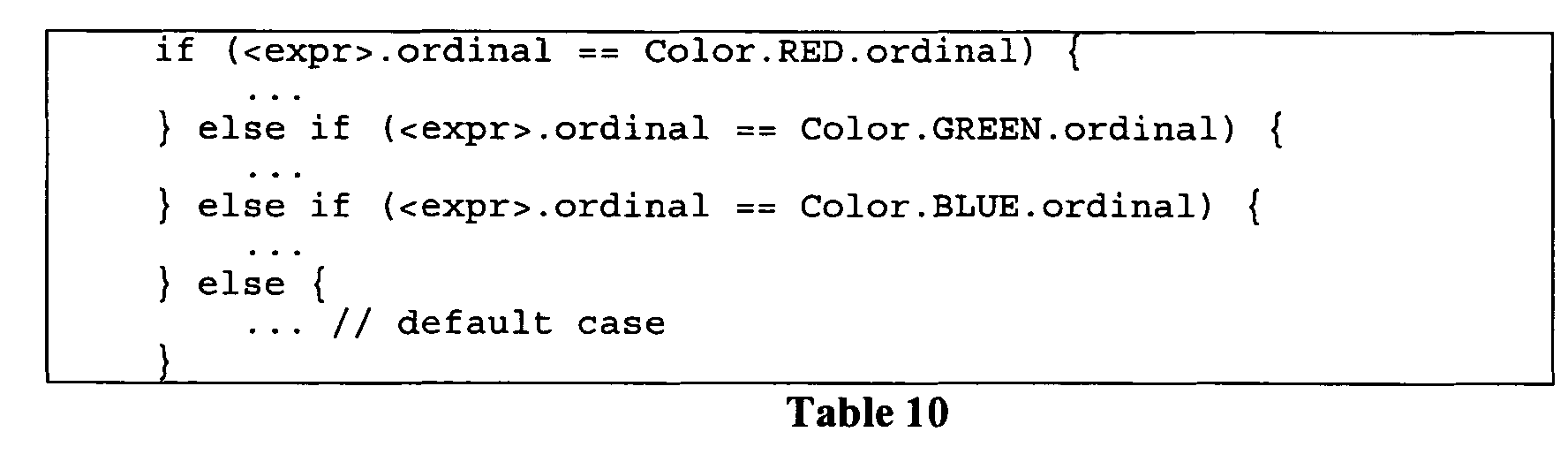
- The .ordinal after each enum expression is superfluous, but enables a JVM compiler optimization, wherein the JVM compiler recognizes at class initialization time that a case statement may be substituted for the if-statement.
- An intriguing alternative that might offer similar performance with no support from the virtual machine is to use an extra layer of indirection as is illustrated in Table 11 below. Each switch statement outside of the compilation unit containing the enum class declaration will compile down to a switch statement on an array reference. This array will be initialized lazily. This approach has higher "fixed cost" per case-statement and higher footprint, but low cost per execution of the case statement.
- The data structures and code described herein are typically stored on a computer-readable storage medium, which may be any device or medium that can store code and/or data for use by a computer system. This includes, but is not limited to, magnetic and optical storage devices such as disk drives, magnetic tape, CDs (compact discs) and DVDs (digital versatile discs or digital video discs), and computer instruction signals embodied in a transmission medium (with or without a carrier wave upon which the signals are modulated). For example, the transmission medium may include a communications network, such as the Internet.
- The foregoing descriptions of embodiments of the present invention have been presented for purposes of illustration in order to enable a person skilled in the art to appreciate and implement the invention. They are provided in the context of particular applications and their requirements, but are not intended to be exhaustive or to limit the present invention to the forms disclosed. Accordingly, many modifications and variations will be apparent to practitioners skilled in the art, and the scope of the present invention is defined by the appended claims.
Claims (25)
- A method for facilitating use of an object-oriented enumerated type within a computer program, comprising:receiving source code for the computer program, wherein the source code contains a declaration for an enumerated type, and wherein the declaration specifies a fixed number of enumeration constants that comprise the enumerated type; anddefining the enumerated type using a class defined within an object-oriented programming language, wherein the class includes a self-typed constant for each enumeration constant specified in the declaration.
- The method of claim 1, wherein if the source code specifies a multi-way branch statement associated with the enumerated type, the method further comprises implementing the multi-way branch statement so that different enumeration constants are associated with different cases of the multi-way branch statement.
- The method of claim 2, wherein implementing the multi-way branch statement involves using a translation table to implement the multi-way branch statement efficiently while preserving binary compatibility in cases where the enumerated type evolves.
- The method of any preceding claim, wherein if the source code defines a method associated with the enumerated type, the method further comprises augmenting the class with the method.
- The method of any preceding claim, further comprising using one or more methods associated with the class to implement an interface.
- The method of any preceding claim, wherein if the source code defines a field associated with the enumerated type, the method further comprises augmenting the class to include the field.
- The method of any preceding claim, further comprising associating a different concrete method with each enumeration constant, if such concrete methods are specified in the source code, so that invoking the same abstract method on different enumeration constants can cause different concrete methods to execute.
- The method of any preceding claim, wherein said receiving and defining are performed during a pre-compilation operation.
- The method of any of claims 1 to 7, wherein said receiving and defining are performed during a compilation operation.
- The method of any preceding claim, wherein the class includes a public static final self-typed field for each enumeration constant.
- The method of any preceding claim, wherein the class does not include any public constructors.
- An apparatus that facilitates use of an object-oriented enumerated type within a computer program, comprising:wherein the class includes a self-typed constant for each enumeration constant specified in the declaration.a receiving mechanism that is configured to receive source code for the computer program, wherein the source code contains a declaration for an enumerated type, and wherein the declaration specifies a fixed number of enumeration constants that comprise the enumerated type; anda class definition mechanism that is configured to define the enumerated type using a class defined within an object-oriented programming language,
- The apparatus of claim 12, further comprising a multi-way branch mechanism, wherein if the source code specifies a multi-way branch statement associated with the enumerated type, the multi-way branch mechanism is configured to implement the multi-way branch statement so that different enumeration constants are associated with different cases of the multi-way branch statement.
- The apparatus of claim 13, wherein the multi-way branch mechanism is configured to use a translation table to implement the multi-way branch statement efficiently while preserving binary compatibility in cases where the enumerated type evolves.
- The apparatus of any of claims 12 to 14, wherein if the source code defines a method associated with the enumerated type, the class definition mechanism is configured to augment the class with the method.
- The apparatus of any of claims 12 to 15, wherein the class definition mechanism is configured to use one or more methods associated with the class to implement an interface.
- The apparatus of any of claims 12 to 16, wherein if the source code defines a field associated with the enumerated type, the class definition mechanism is configured to augment the class to include the field.
- The apparatus of any of claims 12 to 17, wherein the class definition mechanism is configured to associate a different concrete method with each enumeration constant, if such concrete methods are specified in the source code, so that invoking the same abstract method on different enumeration constants can cause different concrete methods to execute.
- The apparatus of any of claims 12 to 18, wherein the apparatus is contained within a pre-compilation mechanism.
- The apparatus of any of claims 12 to 18, wherein the apparatus includes a compiler.
- The apparatus of any of claims 12 to 20, wherein the class includes a public static final self-typed field for each enumeration constant.
- The apparatus of any of claims 12 to 21, wherein the class does not include any public constructors.
- A computer-readable storage medium storing instructions that when executed by a computer cause the computer to perform a method for facilitating use of an object-oriented enumerated type within a computer program, the method comprising:receiving source code for the computer program, wherein the source code contains a declaration for an enumerated type, and wherein the declaration specifies a fixed number of enumeration constants that comprise the enumerated type; anddefining the enumerated type using a class defined within an object-oriented programming language, wherein the class includes a self-typed constant for each enumeration constant specified in the declaration.
- A computer program comprising instructions that when executed by a computer cause the computer to perform the method of any of claims 1 to 11.
- A means for facilitating use of an object-oriented enumerated type within a computer program, comprising:wherein the source code contains a declaration for an enumerated type;a receiving means for receiving source code for the computer program,
wherein the declaration specifies a fixed number of enumeration constants that comprise the enumerated type; and
a class definition means for defining the enumerated type using a class defined within an object-oriented programming language, wherein the class includes a self-typed constant for each enumeration constant specified in the declaration.
Applications Claiming Priority (2)
| Application Number | Priority Date | Filing Date | Title |
|---|---|---|---|
| US10/237,941 US7263687B2 (en) | 2002-09-09 | 2002-09-09 | Object-oriented enumerated type facility |
| US237941 | 2002-09-09 |
Publications (3)
| Publication Number | Publication Date |
|---|---|
| EP1400895A2 true EP1400895A2 (en) | 2004-03-24 |
| EP1400895A3 EP1400895A3 (en) | 2006-07-19 |
| EP1400895B1 EP1400895B1 (en) | 2014-12-31 |
Family
ID=31946371
Family Applications (1)
| Application Number | Title | Priority Date | Filing Date |
|---|---|---|---|
| EP03255511.2A Expired - Lifetime EP1400895B1 (en) | 2002-09-09 | 2003-09-03 | Object-oriented enumerated type facility |
Country Status (2)
| Country | Link |
|---|---|
| US (1) | US7263687B2 (en) |
| EP (1) | EP1400895B1 (en) |
Families Citing this family (12)
| Publication number | Priority date | Publication date | Assignee | Title |
|---|---|---|---|---|
| US7685582B2 (en) * | 2004-10-05 | 2010-03-23 | Microsoft Corporation | Looping constructs in object model software |
| US7506334B2 (en) * | 2005-02-25 | 2009-03-17 | Microsoft Corporation | Common, multi-version interface that allows a distributed sybsystem to communicate with multiple versions of the distributed subsystem |
| EP2229623A4 (en) * | 2008-01-11 | 2014-02-19 | Mathworks Inc | Enumeration classes |
| US8458683B2 (en) * | 2008-10-06 | 2013-06-04 | Sap Ag | System and method for providing extendable enumerations |
| US8775150B1 (en) * | 2009-12-17 | 2014-07-08 | Cadence Design Systems, Inc. | Method and system for providing an implicit unknown value to user enum data constructs in an HDL system to model power shutoff in simulation |
| CN107066270B (en) * | 2017-03-30 | 2020-07-17 | 成都海瑞恩网络科技有限公司 | Information acquisition method and terminal |
| CN111399901B (en) * | 2020-03-17 | 2023-11-14 | 深圳市铭数信息有限公司 | State enumeration class generation method, device, server and storage medium |
| CN111367524B (en) * | 2020-03-17 | 2023-08-29 | 上海东普信息科技有限公司 | Enumeration type design method and device |
| US11886838B2 (en) * | 2022-05-24 | 2024-01-30 | Oracle International Corporation | Space- and time-efficient enumerations |
| CN116483351A (en) * | 2023-03-16 | 2023-07-25 | 深圳前海环融联易信息科技服务有限公司 | Enumerated value modification method, device, computer equipment and readable storage medium |
| CN116225576B (en) * | 2023-05-08 | 2023-07-28 | 成都赛力斯科技有限公司 | Application program data environment switching method and device, electronic equipment and medium |
| CN117421313A (en) * | 2023-10-18 | 2024-01-19 | 中国平安人寿保险股份有限公司 | Data verification method, device, computer equipment and storage medium |
Family Cites Families (1)
| Publication number | Priority date | Publication date | Assignee | Title |
|---|---|---|---|---|
| US6412105B1 (en) * | 1997-12-31 | 2002-06-25 | Elbrus International Limited | Computer method and apparatus for compilation of multi-way decisions |
-
2002
- 2002-09-09 US US10/237,941 patent/US7263687B2/en not_active Expired - Lifetime
-
2003
- 2003-09-03 EP EP03255511.2A patent/EP1400895B1/en not_active Expired - Lifetime
Non-Patent Citations (3)
| Title |
|---|
| BLOCH J: "Effective Java Programming", 2001, ADDISON WESLEY, pages: 97 - 117 |
| DANIEL SAVARESE, IMPLEMENTING ENUMERATED TYPES IN JAVA, June 2000 (2000-06-01) |
| DAVID BACON: "Kava: A Java Dialect with a Uniform Object Model for Lightweight Classes", JAVA GRANDE CONFERENCE, 2001, pages 68 - 77, XP007900622 |
Also Published As
| Publication number | Publication date |
|---|---|
| US7263687B2 (en) | 2007-08-28 |
| EP1400895A3 (en) | 2006-07-19 |
| US20040049764A1 (en) | 2004-03-11 |
| EP1400895B1 (en) | 2014-12-31 |
Similar Documents
| Publication | Publication Date | Title |
|---|---|---|
| Raphael | Advanced programming language design | |
| US5923878A (en) | System, method and apparatus of directly executing an architecture-independent binary program | |
| US5659751A (en) | Apparatus and method for dynamic linking of computer software components | |
| US5339438A (en) | Version independence for object oriented programs | |
| US7013458B2 (en) | Method and apparatus for associating metadata attributes with program elements | |
| EP0546684A2 (en) | Method stubs for redispatch | |
| EP0546809A2 (en) | Computer with object oriented environment | |
| EP1400895B1 (en) | Object-oriented enumerated type facility | |
| US20120297171A1 (en) | Methods for generating code for an architecture encoding an extended register specification | |
| US20070033572A1 (en) | Method, apparatus, and computer program product for adaptively generating code for a computer program | |
| JPH10207870A (en) | Computer program generation method in vector processor programming and parallel programming of asymmetric dual processor including vector processor and RISC processor | |
| US20050097550A1 (en) | Token-based linking | |
| JPH05241845A (en) | System and method for generating interface definition | |
| Durov | Telegram open network virtual machine | |
| Albahari et al. | C# 9.0 Pocket Reference | |
| Alves-Foss et al. | Dynamic denotational semantics of Java | |
| US20040068480A1 (en) | Method and apparatus for initializing romized system classes at virtual machine build time | |
| US20080022260A1 (en) | Method for accessing internal states of objects in object oriented programming | |
| US20020174266A1 (en) | Parameterized application programming interface for reconfigurable computing systems | |
| de Figueiredo et al. | The design and implementation of a language for extending applications | |
| Varoumas et al. | Programming microcontrollers through high-level abstractions | |
| Morrisett | Typed assembly language | |
| Jones et al. | Hugs 98 | |
| Albahari et al. | C# 12 Pocket Reference: Instant Help for C# 12 Programmers | |
| Lee | Object-Oriented Programming |
Legal Events
| Date | Code | Title | Description |
|---|---|---|---|
| PUAI | Public reference made under article 153(3) epc to a published international application that has entered the european phase |
Free format text: ORIGINAL CODE: 0009012 |
|
| AK | Designated contracting states |
Kind code of ref document: A2 Designated state(s): AT BE BG CH CY CZ DE DK EE ES FI FR GB GR HU IE IT LI LU MC NL PT RO SE SI SK TR |
|
| AX | Request for extension of the european patent |
Extension state: AL LT LV MK |
|
| PUAL | Search report despatched |
Free format text: ORIGINAL CODE: 0009013 |
|
| AK | Designated contracting states |
Kind code of ref document: A3 Designated state(s): AT BE BG CH CY CZ DE DK EE ES FI FR GB GR HU IE IT LI LU MC NL PT RO SE SI SK TR |
|
| AX | Request for extension of the european patent |
Extension state: AL LT LV MK |
|
| 17P | Request for examination filed |
Effective date: 20061204 |
|
| AKX | Designation fees paid |
Designated state(s): DE FR GB |
|
| 17Q | First examination report despatched |
Effective date: 20070802 |
|
| RAP1 | Party data changed (applicant data changed or rights of an application transferred) |
Owner name: ORACLE AMERICA, INC. |
|
| GRAP | Despatch of communication of intention to grant a patent |
Free format text: ORIGINAL CODE: EPIDOSNIGR1 |
|
| INTG | Intention to grant announced |
Effective date: 20140722 |
|
| GRAS | Grant fee paid |
Free format text: ORIGINAL CODE: EPIDOSNIGR3 |
|
| GRAA | (expected) grant |
Free format text: ORIGINAL CODE: 0009210 |
|
| AK | Designated contracting states |
Kind code of ref document: B1 Designated state(s): DE FR GB |
|
| REG | Reference to a national code |
Ref country code: GB Ref legal event code: FG4D |
|
| REG | Reference to a national code |
Ref country code: DE Ref legal event code: R096 Ref document number: 60347163 Country of ref document: DE Effective date: 20150226 |
|
| REG | Reference to a national code |
Ref country code: DE Ref legal event code: R097 Ref document number: 60347163 Country of ref document: DE |
|
| PLBE | No opposition filed within time limit |
Free format text: ORIGINAL CODE: 0009261 |
|
| STAA | Information on the status of an ep patent application or granted ep patent |
Free format text: STATUS: NO OPPOSITION FILED WITHIN TIME LIMIT |
|
| 26N | No opposition filed |
Effective date: 20151001 |
|
| REG | Reference to a national code |
Ref country code: FR Ref legal event code: PLFP Year of fee payment: 14 |
|
| REG | Reference to a national code |
Ref country code: FR Ref legal event code: PLFP Year of fee payment: 15 |
|
| REG | Reference to a national code |
Ref country code: FR Ref legal event code: PLFP Year of fee payment: 16 |
|
| REG | Reference to a national code |
Ref country code: DE Ref legal event code: R082 Ref document number: 60347163 Country of ref document: DE Representative=s name: D YOUNG & CO LLP, DE |
|
| PGFP | Annual fee paid to national office [announced via postgrant information from national office to epo] |
Ref country code: GB Payment date: 20220804 Year of fee payment: 20 Ref country code: DE Payment date: 20220803 Year of fee payment: 20 |
|
| PGFP | Annual fee paid to national office [announced via postgrant information from national office to epo] |
Ref country code: FR Payment date: 20220808 Year of fee payment: 20 |
|
| P01 | Opt-out of the competence of the unified patent court (upc) registered |
Effective date: 20230522 |
|
| REG | Reference to a national code |
Ref country code: DE Ref legal event code: R071 Ref document number: 60347163 Country of ref document: DE |
|
| REG | Reference to a national code |
Ref country code: GB Ref legal event code: PE20 Expiry date: 20230902 |
|
| PG25 | Lapsed in a contracting state [announced via postgrant information from national office to epo] |
Ref country code: GB Free format text: LAPSE BECAUSE OF EXPIRATION OF PROTECTION Effective date: 20230902 |