EP1400680A1 - Stirling engine - Google Patents
Stirling engine Download PDFInfo
- Publication number
- EP1400680A1 EP1400680A1 EP03020440A EP03020440A EP1400680A1 EP 1400680 A1 EP1400680 A1 EP 1400680A1 EP 03020440 A EP03020440 A EP 03020440A EP 03020440 A EP03020440 A EP 03020440A EP 1400680 A1 EP1400680 A1 EP 1400680A1
- Authority
- EP
- European Patent Office
- Prior art keywords
- displacer
- chamber
- displacers
- cylinders
- stirling engine
- Prior art date
- Legal status (The legal status is an assumption and is not a legal conclusion. Google has not performed a legal analysis and makes no representation as to the accuracy of the status listed.)
- Granted
Links
- 238000010438 heat treatment Methods 0.000 claims abstract description 40
- 230000008602 contraction Effects 0.000 claims abstract description 30
- 238000001816 cooling Methods 0.000 claims abstract description 16
- 230000002093 peripheral effect Effects 0.000 claims description 17
- 238000004891 communication Methods 0.000 claims description 15
- 239000007789 gas Substances 0.000 description 34
- 238000001514 detection method Methods 0.000 description 8
- 238000002485 combustion reaction Methods 0.000 description 6
- 239000000463 material Substances 0.000 description 6
- 230000009471 action Effects 0.000 description 5
- 230000008878 coupling Effects 0.000 description 4
- 238000010168 coupling process Methods 0.000 description 4
- 238000005859 coupling reaction Methods 0.000 description 4
- 239000012530 fluid Substances 0.000 description 4
- 230000007246 mechanism Effects 0.000 description 3
- 229910000838 Al alloy Inorganic materials 0.000 description 2
- 230000008859 change Effects 0.000 description 2
- 230000005611 electricity Effects 0.000 description 2
- 239000001307 helium Substances 0.000 description 2
- 229910052734 helium Inorganic materials 0.000 description 2
- SWQJXJOGLNCZEY-UHFFFAOYSA-N helium atom Chemical compound [He] SWQJXJOGLNCZEY-UHFFFAOYSA-N 0.000 description 2
- 239000001257 hydrogen Substances 0.000 description 2
- 229910052739 hydrogen Inorganic materials 0.000 description 2
- 239000000696 magnetic material Substances 0.000 description 2
- 230000007935 neutral effect Effects 0.000 description 2
- 230000010355 oscillation Effects 0.000 description 2
- 230000004044 response Effects 0.000 description 2
- UFHFLCQGNIYNRP-UHFFFAOYSA-N Hydrogen Chemical compound [H][H] UFHFLCQGNIYNRP-UHFFFAOYSA-N 0.000 description 1
- 230000003247 decreasing effect Effects 0.000 description 1
- 238000010586 diagram Methods 0.000 description 1
- 230000000694 effects Effects 0.000 description 1
- 150000002431 hydrogen Chemical class 0.000 description 1
- 229910052751 metal Inorganic materials 0.000 description 1
- 239000002184 metal Substances 0.000 description 1
- 238000000034 method Methods 0.000 description 1
- 230000000149 penetrating effect Effects 0.000 description 1
- 229920003002 synthetic resin Polymers 0.000 description 1
- 239000000057 synthetic resin Substances 0.000 description 1
Images






Classifications
-
- F—MECHANICAL ENGINEERING; LIGHTING; HEATING; WEAPONS; BLASTING
- F02—COMBUSTION ENGINES; HOT-GAS OR COMBUSTION-PRODUCT ENGINE PLANTS
- F02G—HOT GAS OR COMBUSTION-PRODUCT POSITIVE-DISPLACEMENT ENGINE PLANTS; USE OF WASTE HEAT OF COMBUSTION ENGINES; NOT OTHERWISE PROVIDED FOR
- F02G1/00—Hot gas positive-displacement engine plants
- F02G1/04—Hot gas positive-displacement engine plants of closed-cycle type
- F02G1/043—Hot gas positive-displacement engine plants of closed-cycle type the engine being operated by expansion and contraction of a mass of working gas which is heated and cooled in one of a plurality of constantly communicating expansible chambers, e.g. Stirling cycle type engines
- F02G1/0435—Hot gas positive-displacement engine plants of closed-cycle type the engine being operated by expansion and contraction of a mass of working gas which is heated and cooled in one of a plurality of constantly communicating expansible chambers, e.g. Stirling cycle type engines the engine being of the free piston type
-
- F—MECHANICAL ENGINEERING; LIGHTING; HEATING; WEAPONS; BLASTING
- F02—COMBUSTION ENGINES; HOT-GAS OR COMBUSTION-PRODUCT ENGINE PLANTS
- F02G—HOT GAS OR COMBUSTION-PRODUCT POSITIVE-DISPLACEMENT ENGINE PLANTS; USE OF WASTE HEAT OF COMBUSTION ENGINES; NOT OTHERWISE PROVIDED FOR
- F02G1/00—Hot gas positive-displacement engine plants
- F02G1/04—Hot gas positive-displacement engine plants of closed-cycle type
- F02G1/043—Hot gas positive-displacement engine plants of closed-cycle type the engine being operated by expansion and contraction of a mass of working gas which is heated and cooled in one of a plurality of constantly communicating expansible chambers, e.g. Stirling cycle type engines
-
- F—MECHANICAL ENGINEERING; LIGHTING; HEATING; WEAPONS; BLASTING
- F02—COMBUSTION ENGINES; HOT-GAS OR COMBUSTION-PRODUCT ENGINE PLANTS
- F02G—HOT GAS OR COMBUSTION-PRODUCT POSITIVE-DISPLACEMENT ENGINE PLANTS; USE OF WASTE HEAT OF COMBUSTION ENGINES; NOT OTHERWISE PROVIDED FOR
- F02G1/00—Hot gas positive-displacement engine plants
- F02G1/04—Hot gas positive-displacement engine plants of closed-cycle type
- F02G1/043—Hot gas positive-displacement engine plants of closed-cycle type the engine being operated by expansion and contraction of a mass of working gas which is heated and cooled in one of a plurality of constantly communicating expansible chambers, e.g. Stirling cycle type engines
- F02G1/044—Hot gas positive-displacement engine plants of closed-cycle type the engine being operated by expansion and contraction of a mass of working gas which is heated and cooled in one of a plurality of constantly communicating expansible chambers, e.g. Stirling cycle type engines having at least two working members, e.g. pistons, delivering power output
Definitions
- the present invention relates to a Stirling engine. More specifically, the invention relates to a Stirling engine of the displacer type that operates at a predetermined operation speed.
- a Stirling engine of the displacer type usually comprises a displacer cylinder, a displacer slidably disposed in the displacer cylinder, an expansion chamber and a contraction chamber into which, and from which, an operation gas flows with the operation of the displacer, an operation chamber that communicates with either the expansion chamber or the contraction chamber, a power piston that operates in response to a change in the pressure of the operation gas in the operation chamber, and a displacer operation means that operates the displacer maintaining a predetermined phase difference from the power piston.
- an operation gas having a small specific heat, such as hydrogen, helium or the like In the displacer cylinder and the operation chamber is contained an operation gas having a small specific heat, such as hydrogen, helium or the like.
- the power piston is so constituted as to operate in response to a change in the pressure in the operation chamber with the expansion and contraction as the operation gas is heated and cooled.
- the expansion chamber side of the displacer cylinder is heated and the contraction chamber side is cooled.
- a combustion chamber is provided on the expansion chamber side of the displacer cylinder as disclosed in, for example, JP-A 5-44576 and Japanese Patent 2600219.
- a heating chamber is provided to surround the displacer cylinder on the side of the expansion chamber and a heated fluid is introduced into the heating chamber.
- the displacer cylinder on the side of the expansion chamber is heated from the surrounding thereof, and the heat of the heat source has not necessarily been effectively utilized.
- a Stirling engine comprising:
- the heating wall of the displacer cylinders can form a flow passage through which the heat source flows, and the flow passage formed by the heating wall can be of a cylindrical shape.
- a plurality of fins can be provided in the axial direction on the inner peripheral surface of the cylindrical heating wall constituting the displacer cylinders, and/or that the fins can be formed in a spiral shape. It is further desired that a core member can be arranged in the central portion of the flow passage formed by the cylindrical heating wall constituting the displacer cylinders over nearly the full length of the flow passage.
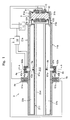
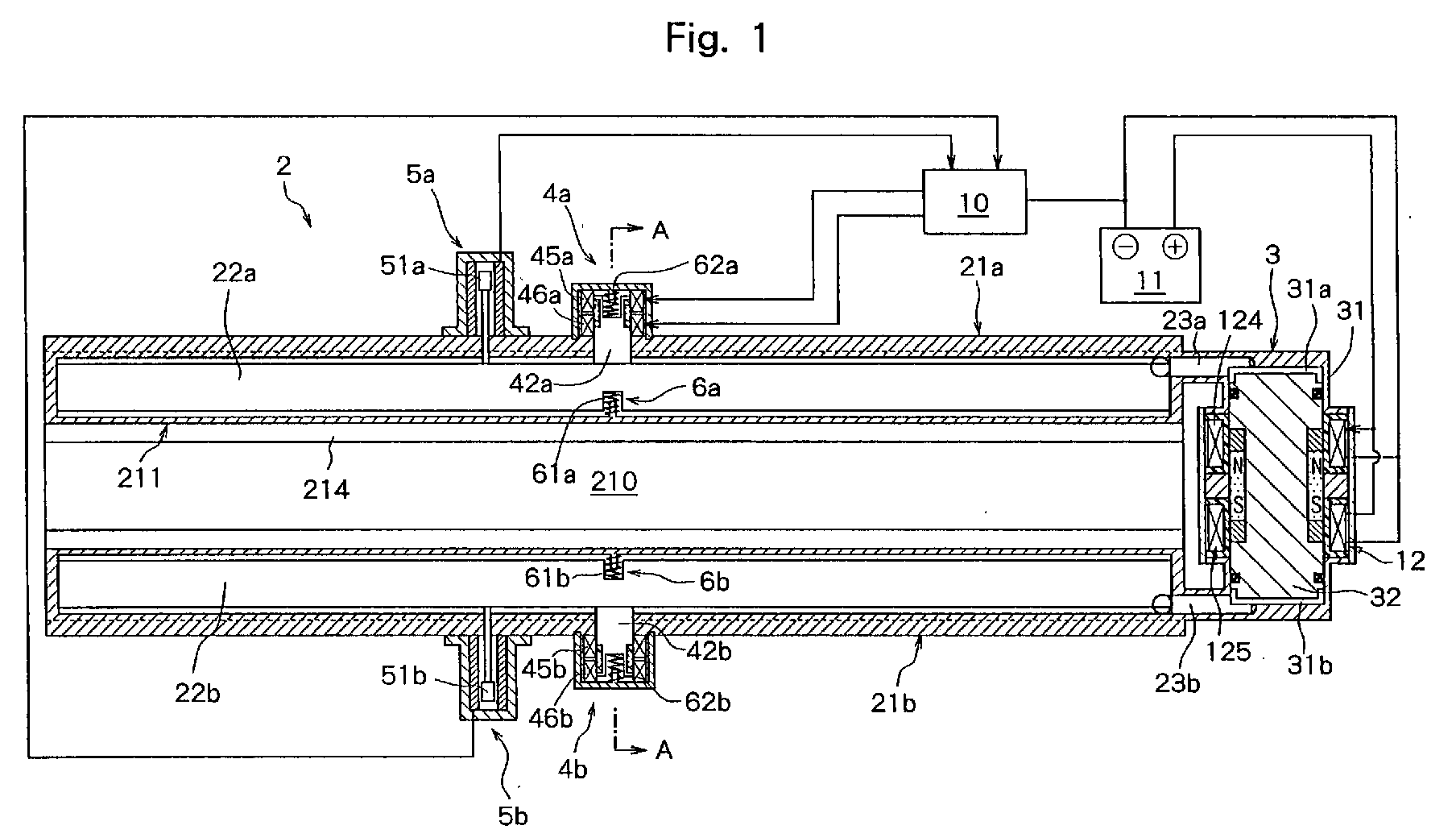
- Fig. 1 is a vertical sectional view illustrating an embodiment of the Stirling engine constituted according to the present invention
- Fig. 2 is a sectional view along the line A - A in Fig. 1.
- the Stirling engine of the embodiment shown in Figs. 1 and 2 has a displacer unit 2 and a power piston unit 3.
- the displacer unit 2 in the illustrated embodiment comprises a pair of displacer cylinders 21a and 21b that is made of nonmagnetic material such as aluminium alloy or the like, and a pair of displacers 22a and 22b each slidably disposed in the pair of displacer cylinders 21a and 21b.
- the pair of displacer cylinders 21a and 21b are constituted by a cylindrical heating wall 211 forming a flow passage 210 through which a heat source flows, and a pair of cooling walls 213a and 213b forming a pair of cylinder chambers 212a and 212b together with the heating wall 211.
- a plurality of fins 214 are radially formed in the axial direction on the inner peripheral surface of the cylindrical heating wall 211.
- the pair of cooling walls 213a and 213b form upper and lower cylinder chambers 212a and 212b so as to each surround nearly the half outer circumference of the cylindrical heating wall 211, and have a plurality of heat-radiating fins 215a, 215b formed on the outer peripheral surfaces thereof in the axial direction.
- To one end of the cylindrical heating wall 211 constituting the thus constituted pair of displacer cylinders 21a and 21b is connected, for example, an exhaust pipe of an internal combustion engine. Therefore, the exhaust gas of an internal combustion engine flows as a heat source through the flow passage 210 formed by the cylindrical heating wall 211. As described above, the heating wall 211 is formed surrounding the heat source.
- the pair of displacers 22a and 22b arranged in the cylinder chambers 212a and 212b of the pair of displacer cylinders 21a and 21b have inner peripheral surfaces that are formed as arcuate surfaces which corresponds to the outer peripheral surface of the heating wall 211 that constitutes the displacer cylinders 21a and 21b, and further have outer peripheral surfaces formed as arcuate surfaces which corresponds to the inner peripheral surfaces of the cooling walls 213a and 213b constituting the displacer cylinders 21a and 21b.
- the pair of displacers 22a and 22b have a plurality of holding plates 221a and 221b extending in the axial direction and regenerators 222a and 222b arranged between the plurality of holding plates 221a and 221b.
- the regenerators 222a and 222b are constituted by alternately overlapping the heat-insulating rings and metal gauzes.
- the thus constituted pair of displacers 22a and 22b are each disposed in the cylinder chambers 212a and 212b of the pair of displacer cylinders 21a and 21b so as to slide in the directions at right angles with the axial direction of the cylindrical heating wall 211, i.e., in the directions to approach and separate away from the heat source.
- An expansion chamber 216a, a contraction chamber 217a, an expansion chamber 216b and a contraction 217b are formed in the cylinder chambers 212a and 212b of the pair of displacer cylinders 21a and 21b in which the pair of displacers 22a and 22b are slidably disposed.
- the power piston unit 3 is constituted by a power cylinder 31 made of a nonmagnetic material such as an aluminum alloy or the like and a power piston 32 that is made of a nonmagnetic material and is slidably disposed in the power cylinder 31.
- the power cylinder 31 in which the power piston 32 is arranged has a first operation chamber 31a and a second operation chamber 31b formed on both sides of the power piston 32.
- the first operation chamber 31a and the second operation chamber 31b are each communicated with the contraction chamber 217a of one displacer cylinder 21a and with the contraction chamber 217b of the other displacer cylinder 21b through a first communication passage 23a and a second communication passage 23b.
- the pair of displacer cylinders 21a, 21b, power cylinder 31, first communication passage 23a and second communication passage 23b form a closed space.
- the thus closed pair of displacer cylinders 21a and 21b, first operation chamber 31a and second operation chamber 31b of the power cylinder 31, first communication passage 23a and second communication passage 23b are filled with an operation gas having a small specific heat, such as hydrogen or helium.
- the Stirling engine of the illustrated embodiment has a pair of displacer operation means 4a and 4b for operating each of the pair of displacers 22a and 22b maintaining a predetermined phase difference (180 degrees) from the power piston 32.
- the pair of displacer operation means 4a and 4b are respectively disposed at the central portions of the pair of displacer cylinders 21a, 21b and of the displacers 22a, 22b in the circumferential direction and in the lengthwise direction (axial direction).
- the pair of displacer operation means 4a and 4b comprise casings 41a and 41b made of a nonmagnetic material mounted on the central portions of the cooling walls 213a and 213b of the pair of displacer cylinders 21a and 21b in the circumferential direction and in the lengthwise direction (axial direction), operation rods 42a and 42b that are made of a nonmagnetic material, coupled to the pair of displacers 22a, 22b and inserted in the casings 41a and 41b penetrating through the cooling walls 213a and 213b, moving magnets 43a and 43b disposed on the outer peripheral surfaces of the operation rods 42a and 42b, cylindrical fixed yokes 44a and 44b disposed on the inside of the casing 41a and 41b surrounding the moving magnets 43a and 43b, and pairs of coils 45a, 46a and 45b, 46b juxtaposed on the inside of the fixed yokes 44a and 44b in the axial directions.
- the moving magnets 43a and 43b are constituted by annular permanent magnets 431a and 431b that are mounted on the outer peripheral surfaces of the operation rods 42a and 42b and have magnetic poles at both end surfaces in the axial direction, and pairs of moving yokes 432a, 433a and 432b, 433b arranged on the outside of the permanent magnets 431a and 431b in the axial direction.
- the permanent magnets 431a and 431b have their upper end surfaces magnetized into N-pole and have their lower end surfaces magnetized into S-pole.
- the pairs of moving yokes 432a, 433a and 432b, 433b are made of a magnetic material in an annular shape.
- the fixed yokes 44a and 44b are made of a magnetic material in a cylindrical shape. Pairs of coils 45a, 46a and 45b, 46b are respectively arranged on the inside of the fixed yokes 44a and 44b. The pairs of coils 45a, 46a and 45b, 46b are respectively wound on the bobbins 47a and 47b, in the opposite directions with each other, that are respectively made of the nonmagnetic material such as a synthetic resin or the like and mounted along the inner peripheries of the fixed yokes 44a and 44b. The directions of currents supplied to the pair of coils 45a, 46a and 45b, 46b can be controlled to be changed over by a control means 10 that will be described later.
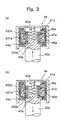
- the displacer operation means 4a and 4b are constituted by the moving magnets 43a and 43b, fixed yokes 44a and 44b and pairs of coils 45a, 46a and 45b, 45b, and operate based on the principle of a linear motor. The operation will be described below with reference to Figs. 3 and 4.
- a downward thrust generates in the moving magnets 43a and 43b, i.e., in the displacers 22a and 22b according to Fleming's left-hand rule as indicated by arrows in Figs. 3(b) and 4(b).
- the Stirling engine of the illustrated embodiment is provided with displacer position detection means 5a and 5b for detecting the operation positions of the above pair of displacers 22a and 22b.
- the displacer position detection means 5a and 5b are each constituted by stroke sensors for detecting the moving positions of the operators 51a and 51b coupled at the ends on one side thereof to the displacers 22a and 22b at the central portions in the circumferential direction, and sends the detection signals to the control means 10 that will be described later.
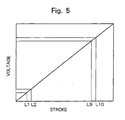
- Output values of the stroke sensors that are the displacer position detection means 5a, 5b will now be described with reference to Fig. 5. In Fig.
- the abscissa shows the strokes of the displacers 22a, 22b, i.e., the operators 51a, 51b, and the ordinate shows the voltage.
- the stroke sensors produce voltages that are in proportion to the strokes of the displacers 22a, 22b, i.e., the operators 51a, 51b.
- L1 on the abscissa is a full-stroke position on the return side and L10 is a full-stroke position on the feed side.
- the Stirling engine of the illustrated embodiment is provided with mechanical spring means 6a, 6b for imparting a predetermined oscillation cycle to the pair of displacers 22a and 22b.
- the mechanical spring means 6a, 6b comprise each pairs of coil springs 61a, 62a and 61b, 62b disposed between the inner peripheral surfaces of the displacers 22a, 22b and the heating wall 211 of the displacer cylinders 21a, 21b, and between the operation rods 42a, 42b coupled to the displacer cylinders 21a, 21b and the casings 41a, 41b.
- the pairs of springs 61a, 62a and 61b, 62b urge each other the displacers 22a and 22b toward the neutral positions thereof.
- the oscillation cycle is determined by the pairs of coil springs 61a, 62a, 61b and 62b and by the masses of the displacers 22a and 22b.
- the driving force of the displacer operation means 4a and 4b may be enough to be very small.
- the amplitudes of the pairs of coil springs 61a, 62a and 61b, 62b gradually increase, i.e., the moving widths of the displacers 22a and 22b gradually increase and reach a predetermined value due to simple harmonic motion, and establish a steady state operation.
- the displacers 22a and 22b are operated at a predetermined cycle due to the action of the pairs of coil springs 61a, 62a and 61b, 62b, but attenuate due to the air resistance. Therefore, the attenuation may be compensated by the driving force produced by the displacer operation means 4a and 4b.
- the control means 10 is constituted by a microcomputer that is connected to a battery 11, and comprises a central processing unit (CPU) for executing the processing according to a control program and the like, a read-only memory (ROM) for storing the control program, a random access memory (RAM) for storing results of the operation, and a drive circuit for driving the pairs of coils 45a, 46a and 45b, 46b of the displacer operation means 4a and 4b.
- the control means 10 controls drive currents to the pairs of coils 45a, 46a and 45b, 46b constituting the displacer operation means 4a and 4b.
- An electric generator 12 is disposed for the power piston 32 and for the power cylinder 31 constituting the power piston unit 3.
- the generator 12 is a linear generator constituted by an annular permanent magnet 121 arranged on the outer peripheral surface of the power piston 32, annular magnetic pole pieces 122 and 123 arranged on both sides of the permanent magnet 121, and generating coils 124 and 125 disposed on the outer peripheral surface of the power cylinder 31 surrounding the permanent magnet 121.
- the thus constituted generator 12 generates electricity by a left-and-right motion of the power piston 33, i.e., permanent magnet 121 in Fig. 1, and the generated electric power is stored in the battery 11.
- Figs. 1 and 2 illustrate a state of before the operation, where the displacers 22a and 22b are respectively brought to their neutral positions due to the action of the pairs of coil springs 61, 62a and 61b, 62b.
- the control means 10 causes the displacer operation means 4a and 4b to drive so that the displaces 22a and 22b move upward in the drawing (step S1). That is, the control means 10 controls to supply electric currents to the pairs of coils 45a, 46a and 45b, 46b constituting the displacer operation means 4a and 4b in the directions shown in Figs. 3(a) and 4(a).
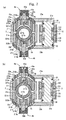
- the moving magnets 43a and 43b or the displacers 22a and 22b move upward as shown in Fig. 7(a). Due to the upward motion of the displacers 22a and 22b, the operation gas in the contraction chamber 217a of one displacer cylinder 21a flows into the expansion chamber 216a through the regenerator 222a of the displacer 22a, and the operation gas in the expansion chamber 216b of the other displacer cylinder 21b flows into the contraction chamber 217b through the regenerator 222b of the displacer 22b. On this occasion, the operation gas that had been cooled in the contraction chamber 217a of the one displacer cylinder 21a is heated by heat exchange as it passes through the regenerator 222a.
- the operation gas that had been heated in the expansion chamber 216b of the other displacer cylinder 21b is cooled by heat exchange as it passes through the regenerator 222b, as described above.
- the one displacer 22a moves upward and the operation gas flows into the expansion chamber 216a
- the operation gas expands being heated by the exhaust gas as the heat source that flows through the flow passage 210 formed by the cylindrical heating wall 211. Therefore, the operation gas flows into the first operation chamber 31a of the power cylinder 31 through the first communication passage 23a.
- the power piston 32 moves downward as shown in Fig. 7(a).
- step S1 the displacer operation means 4a and 4b are so driven as to move the pair of displacers 22a and 22b upward in the drawing.
- the routine proceeds to step S2 where the control means 10 checks, based on the detection signals from the displacer position detection means 5a and 5b, whether the stroke position L of the displacers 22a and 22b is larger than a stroke position L9 that is a threshold value smaller, by a predetermined amount, than the full-stroke position L10 on the feed side (L > L9).
- step S3 the control means 10 checks whether the stroke position L of the displacers 22a and 22b is smaller than a stroke position L2 that is a threshold value larger, by a predetermined amount, than the full-stroke position L1 on the return side (L ⁇ L2). This time, the displacers 22a and 22b are moved toward the feed side and hence, it does not happen that the stroke position L becomes smaller than L2. Accordingly, the control means 10 returns to step S2.
- step S2 the control means 10 judges that the displacers 22a and 22b have exceeded the position that is smaller, by a predetermined amount, than a position at the time of the end of expansion, shown in Fig. 7(a), and the routine proceeds to step S4 to drive the displacer operation means 4a and 4b so as to move the displacers 22a and 22b downward in the drawing. That is, the control means 10 controls to supply electric currents to the pairs of coils 45a, 46a and 45b, 46b constituting the displacer operation means 4a and 4b in the directions shown in Figs. 3(b) and 4(b).
- the moving magnets 43 i.e., the displacers 22a and 22b move downward as shown in Fig. 7(b).
- the operation gas in the expansion chamber 216a of one displacer cylinder 21a flows into the contraction chamber 217a through the regenerator 222a of the displacer 22a, while the operation gas in the contraction chamber 217b of the other displacer cylinder 21b flows into the expansion chamber 216b through the regenerator 222b of the displacer 22b.
- the operation gas that had been heated in the expansion chamber 216a of one displacer cylinder 21a is cooled by heat exchange as it passes through the regenerator 222a as described above.
- the operation gas that had been cooled in the contraction chamber 217b of the other displacer cylinder 21b is heated by heat exchange as it passes through the regenerator 222b as described above.
- the one displacer 22a moves downward and the operation gas flows into the contraction chamber 217a, the operation gas contracts being cooled by the by the air or by a suitable cooling means. Therefore, the operation gas in the first operation chamber 31a of the power cylinder 31 is sucked through the first communication passage 23a. As a result, the power piston 32 moves upward as shown in Fig. 7(b).
- step S4 the displacer operation means 4a and 4b are driven so as to move the pair of displacers 22a and 22b downward in the drawing. Then, the routine returns back to the above step S2 where the control means 10 checks whether the stroke position L of the displacers 22a and 22b is larger than the stroke position L9 that is the threshold value smaller, by a predetermined amount, than the full-stroke position L10 on the feed side. This time, the displacers 22a and 22b are moved toward the return side and hence, it does not happen that the stroke position L becomes larger than L9.
- step S3 the control means 10 checks whether the stroke position L of the displacers 22a and 22b is smaller than the stroke position L2 that is the threshold value larger, by a predetermined amount, than the full-stroke position L1 on the return side.
- the control means 10 so judges that the displacers 22a and 22b have not yet reached L2, and the routine returns to the step S2 to repeat the steps S2 and S3.
- step S3 the control means 10 judges that the displacers 22a and 22b have exceeded L2, and the routine proceeds to step S5 where the control means 10 controls to supply electric currents to the pairs of coils 45a, 46a and 45b, 46b in the directions shown in Figs. 3(a) and 4(a) to drive the displacer operation means 4a and 4b so that the displacers 22a and 22b operate upwards in the drawing.
- the power piston 32 can do reciprocating motion.
- the generator 12 generates electricity which is then stored in the battery 12.
- the pair of displacer cylinders 21a and 21b of the displacer unit 2 are constituted by the cylindrical heating wall 211 having the flow passage 210 through which the heat source flows and the cooling walls 213a and 213b forming the pair of cylinder chambers 212a and 212b surrounding the heating wall 211. Therefore, the heat of the heat source flowing through the flow passage 210 is effectively utilized without being emanated to the surrounding.
- the heating wall 211 is formed in an arcuate shape and can have a wide heat-receiving area to effectively absorb the heat of the heat source. Even when the exhaust gas of an internal combustion engine flows through the flow passage 210, further, pressure loss of the exhaust gas does not almost occur and hence, performance of the internal combustion engine is not affected. In the Stirling engine of the illustrated embodiment, further, since a closed space is formed by the pair of displacer cylinders 21a and 21b, power cylinder 31, first passage 23a and second passage 23b, the leakage of the operation fluid can be reliably prevented.
- the pair of displacers 22a and 22b are operated by the action of the pairs of coil springs 61a, 62a and 61b, 62b at a predetermined cycle. Therefore, the displacer operation means 4a and 4b for operating the displacers 22a and 22b at a predetermined cycle can be worked enough by a driving force for compensating the attenuation caused by the air resistance and the like; i.e., the driving force for operating the displacer operation means 4a and 4b can be decreased.
- the Stirling engine illustrated in Figs. 8 and 9 are so constituted as to rotate a crankshaft.
- a pair of power piston units 7a and 7b corresponding to the pair of displacer cylinders 21a and 21b that constitute the displacer unit 2 in the above-described embodiment of the present invention are provided.
- the power piston units 7a and 7b comprise power cylinders 71a and 71b, power pistons 72a and 72b slidably arranged in the power cylinders 71a and 71b, and connecting rods 73a and 73b connected at the ends on one side thereof to the power pistons 72a and 72b.
- the power cylinders 71a and 71b are mounted on the cooling walls 213a and 213b constituting the displacer cylinders 21a and 21b along the lengthwise direction (axial direction) of the cooling walls 213a and 213b of the displacer cylinders 21a and 21b.
- Operation chambers 711a and 711b are respectively formed in the power cylinders 71a and 71b together with the power pistons 72a and 72b arranged therein so as to slide in the axial direction.
- the operation chambers 711a and 711b are communicated, through the communication passages 74a and 74b, with the contraction chambers 217a and 217b in the pair of displacer cylinders 21a and 21b constituting the displacer unit 2.
- crankshafts 8a and 8b are rotatably supported by the cooling walls 213a and 213b constituting the displacer cylinders 21a and 21b through respective support brackets 821a, 822a and 821b, 822b.
- Small gears 85a and 85b are mounted on the ends of the crankshafts 8a and 8b on one side thereof.
- the small gears 85a and 85b are in mesh with a large gear 87 which also serves as a fly-wheel and is rotatably supported, through a support shaft 86, by the cooling walls 213a and 213b constituting the displacer cylinders 21a and 21b.
- the large gear 87 that also serves as the fly-wheel and the crankshafts 8a and 8b that are coupled together through small gears 85a and 85b are so constituted that they are operated maintaining a phase difference of 180 degrees relative to each other.
- the Stirling engine of the illustrated embodiment has a pair of displacer operation means 9a and 9b for operating the pair of displacers 22a and 22b maintaining a predetermined phase difference (90 degrees) relative to the power pistons 72a and 72b.
- the pair of displacer operation means 9a and 9b are constituted by connecting rods 91a, 92a and 91b, 92b mounted at the ends on one side thereof on the displacers 22a and 22b, levers 93a and 93b to which are connected the connecting rods 91a, 92a and 91b, 92b at the ends on the other side thereof, and coupling mechanisms 94a and 94b for coupling the levers 93a and 93b to the crankshafts 8a and 8b.
- the coupling mechanisms 94a and 94b are constituted by pins 941a and 941b fitted between flange portions 831a and 832a and between flange portions 831b and 832b that are provided on the crankshafts 8a and 8b, and elongated holes 942a and 942b formed in the central portions of the levers 93a and 93b, the elongated holes 942a and 942b being formed elongated in the axial direction of the power cylinders 71a and 71b.
- the crankshafts 8a and 8b rotate via the connecting rods 73 and 73b by a left-and-right reciprocating movement of the power pistons 72a and 72b in Fig. 8.
- the levers 93a and 93b move up and down in Fig. 8 by the coupling mechanisms 94a and 94b
- the displacers 22a and 22b are caused to move up and down in Fig. 8 via the connecting rods 91a, 92a and 91b, 92b.
- the action of the operation fluid caused by the up-and-down motion of the displacers 22a and 22b works in the same manner as in the embodiment described above.
- a plurality of fins 214 are formed in a spiral shape on the inner peripheral surface of a cylindrical heating wall 211 that constitutes a pair of displacer cylinders 21a and 21b of the displacer unit 2.
- the embodiment shown in Fig. 11 illustrates a flow passage 210 formed by a cylindrical heating wall 211 that constitutes a pair of displacer cylinders of the displacer unit.
- a core member 219 is disposed in the central portion of the flow passage 210 over nearly the full length of the flow passage.
- the core member 219 is mounted on the inner peripheral edges of a plurality of fins 214 formed on the inner peripheral surface of the cylindrical heating wall 211.
- the operation chambers of the power cylinders constituting the power piston units are communicated with the contraction chambers of the displacer cylinders.
- the operation chambers may be communicated with the expansion chambers of the displacer cylinders.
- the heated fluid such as the exhaust gas flows through the flow passage formed by the cylindrical heating wall that constitutes the displacer cylinders of the displacer unit.
- the flow passage may be designed as a combustion chamber of the combustor.
- the Stirling engine according to the present invention exhibits action and effect as described below.
- the displacer cylinders of the displacer unit are formed by the heating wall that surrounds the heat source and by the cooling walls that form a plurality of cylinder chambers surrounding the heating wall. Accordingly, the heat of the heat source is effectively utilized without being emanated to the surrounding. Further, the heating wall is formed in a curved shape and hence, can possess a wide heat-receiving area to efficiently absorb the heat of the heat source.
Landscapes
- Engineering & Computer Science (AREA)
- Chemical & Material Sciences (AREA)
- Combustion & Propulsion (AREA)
- Mechanical Engineering (AREA)
- General Engineering & Computer Science (AREA)
- Engine Equipment That Uses Special Cycles (AREA)
Abstract
the displacers (22 a, b) of the displacer unit (2) are slidably arranged in the plurality of cylinder chambers in the directions to approach the heat source and to separate away from the heat source.
Description
- The present invention relates to a Stirling engine. More specifically, the invention relates to a Stirling engine of the displacer type that operates at a predetermined operation speed.
- A Stirling engine of the displacer type usually comprises a displacer cylinder, a displacer slidably disposed in the displacer cylinder, an expansion chamber and a contraction chamber into which, and from which, an operation gas flows with the operation of the displacer, an operation chamber that communicates with either the expansion chamber or the contraction chamber, a power piston that operates in response to a change in the pressure of the operation gas in the operation chamber, and a displacer operation means that operates the displacer maintaining a predetermined phase difference from the power piston. In the displacer cylinder and the operation chamber is contained an operation gas having a small specific heat, such as hydrogen, helium or the like. In the Stirling engine described above, the power piston is so constituted as to operate in response to a change in the pressure in the operation chamber with the expansion and contraction as the operation gas is heated and cooled.
- In the Stirling engine of the displacer type as described above, the expansion chamber side of the displacer cylinder is heated and the contraction chamber side is cooled. In general, a combustion chamber is provided on the expansion chamber side of the displacer cylinder as disclosed in, for example, JP-A 5-44576 and Japanese Patent 2600219. There has further been proposed the one of the type in which a heating chamber is provided to surround the displacer cylinder on the side of the expansion chamber and a heated fluid is introduced into the heating chamber.
- According to the conventional Stirling engines, however, the displacer cylinder on the side of the expansion chamber is heated from the surrounding thereof, and the heat of the heat source has not necessarily been effectively utilized.
- It is an object of the present invention to provide a Stirling engine which is capable of effectively utilizing the heat of the heat source.
- In order to achieve the above object according to the present invention, there is provided a Stirling engine comprising:
- a displacer unit having displacer cylinders, displacers slidably arranged in the chambers of the displacer cylinders, expansion chambers and contraction chambers into which, and from which, an operation gas flows with the operation of the displacers; and/or
- a power piston unit having a power cylinder with an operation chamber that communicates with either the expansion chamber or the contraction chamber of the displacer unit, and a power piston slidably arranged in the power cylinder; wherein the displacer cylinders of the displacer unit can be equipped with a heating wall surrounding a heat source and cooling walls forming a plurality of cylinder chambers surrounding the heating wall; and/or
-
- The heating wall of the displacer cylinders can form a flow passage through which the heat source flows, and the flow passage formed by the heating wall can be of a cylindrical shape.
- It is desired that a plurality of fins can be provided in the axial direction on the inner peripheral surface of the cylindrical heating wall constituting the displacer cylinders, and/or that the fins can be formed in a spiral shape. It is further desired that a core member can be arranged in the central portion of the flow passage formed by the cylindrical heating wall constituting the displacer cylinders over nearly the full length of the flow passage.
- According to the present invention, there is further provided a Stirling engine in which:
- the displacer unit can comprise a pair of displacer cylinders arranged facing each other and a pair of displacers slidably arranged in the pair of displacer cylinders;
- the power piston unit can comprise a power cylinder that communicates with either the expansion chambers or the contraction chambers of the pair of displacers, and a power piston that is slidably arranged in the power cylinder and divides it into a first operation chamber and a second operation chamber; and/or
- the first operation chamber of the power piston unit can communicate with either the expansion chamber or the contraction chamber of the displacer unit through a first communication passage, and the second operation chamber of the power piston unit can communicate with the other expansion chamber or the contraction chamber of the displacer unit through a second communication passage.
-
-
- Fig. 1 is a sectional view illustrating one embodiment of a Stirling engine constituted according to the present invention;
- Fig. 2 is a sectional view along the line A - A in Fig. 1;
- Fig. 3 is a view illustrating the operation of one displacer operation meansconstitutingtheStirling engine according to the present invention;
- Fig. 4 is a view illustrating the operation of the other displacer operation means constituting the Stirling engine according to the present invention;
- Fig. 5 is a diagram illustrating output signals of a displacer position detection means constituting the Stirling engine according to the present invention;
- Fig. 6 is a flowchart illustrating the procedure of operation of a control means constituting the Stirling engine according to the present invention;
- Fig. 7 is a view illustrating the operation states of the Stirling engine shown in Fig. 1;
- Fig. 8 is a sectional view illustrating another embodiment of the Stirling engine constituted according to the present invention;
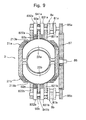
- Fig. 9 is a sectional view along the line B - B in Fig. 8;
- Fig. 10 is a sectional view illustrating essential portions of a further embodiment of the Stirling engine constituted according to the present invention; and
- Fig. 11 is a sectional view illustrating essential portions of a still further embodiment of the Stirling engine constituted according to the present invention.
-
- Preferred embodiments of the Stirling engine constituted according to the present invention will now be described in further detail with reference to the accompanying drawings.
- Fig. 1 is a vertical sectional view illustrating an embodiment of the Stirling engine constituted according to the present invention, and Fig. 2 is a sectional view along the line A - A in Fig. 1.
- The Stirling engine of the embodiment shown in Figs. 1 and 2 has a
displacer unit 2 and apower piston unit 3. Thedisplacer unit 2 in the illustrated embodiment comprises a pair ofdisplacer cylinders displacers displacer cylinders displacer cylinders cylindrical heating wall 211 forming aflow passage 210 through which a heat source flows, and a pair ofcooling walls cylinder chambers heating wall 211. A plurality offins 214 are radially formed in the axial direction on the inner peripheral surface of thecylindrical heating wall 211. The pair ofcooling walls lower cylinder chambers cylindrical heating wall 211, and have a plurality of heat-radiatingfins cylindrical heating wall 211 constituting the thus constituted pair ofdisplacer cylinders flow passage 210 formed by thecylindrical heating wall 211. As described above, theheating wall 211 is formed surrounding the heat source. - The pair of
displacers cylinder chambers displacer cylinders heating wall 211 that constitutes thedisplacer cylinders cooling walls displacer cylinders displacers holding plates regenerators holding plates regenerators displacers cylinder chambers displacer cylinders cylindrical heating wall 211, i.e., in the directions to approach and separate away from the heat source. Anexpansion chamber 216a, acontraction chamber 217a, anexpansion chamber 216b and acontraction 217b are formed in thecylinder chambers displacer cylinders displacers - The
power piston unit 3 is constituted by apower cylinder 31 made of a nonmagnetic material such as an aluminum alloy or the like and apower piston 32 that is made of a nonmagnetic material and is slidably disposed in thepower cylinder 31. Thepower cylinder 31 in which thepower piston 32 is arranged has afirst operation chamber 31a and asecond operation chamber 31b formed on both sides of thepower piston 32. Thefirst operation chamber 31a and thesecond operation chamber 31b are each communicated with thecontraction chamber 217a of onedisplacer cylinder 21a and with thecontraction chamber 217b of theother displacer cylinder 21b through afirst communication passage 23a and asecond communication passage 23b. - As described above, the pair of
displacer cylinders power cylinder 31,first communication passage 23a andsecond communication passage 23b form a closed space. The thus closed pair ofdisplacer cylinders first operation chamber 31a andsecond operation chamber 31b of thepower cylinder 31,first communication passage 23a andsecond communication passage 23b are filled with an operation gas having a small specific heat, such as hydrogen or helium. - The Stirling engine of the illustrated embodiment has a pair of displacer operation means 4a and 4b for operating each of the pair of
displacers power piston 32. The pair of displacer operation means 4a and 4b are respectively disposed at the central portions of the pair ofdisplacer cylinders displacers casings cooling walls displacer cylinders operation rods displacers casings cooling walls magnets operation rods yokes casing magnets coils fixed yokes - The moving
magnets permanent magnets operation rods yokes permanent magnets permanent magnets moving yokes - The
fixed yokes coils yokes coils bobbins yokes coils - As described above, the displacer operation means 4a and 4b are constituted by the moving
magnets yokes coils - In the displacer operation means 4a and 4b of the illustrated embodiment,thereareformed magnetic circuits as shown in Figs. 3(a), 3(b) and in Figs. 4(a), (4b) passing through the N-poles of
permanent magnets yokes yokes other coils yokes permanent magnets coils magnets displacers coils magnets displacers - The Stirling engine of the illustrated embodiment is provided with displacer position detection means 5a and 5b for detecting the operation positions of the above pair of
displacers operators displacers displacers operators displacers operators - The Stirling engine of the illustrated embodiment is provided with mechanical spring means 6a, 6b for imparting a predetermined oscillation cycle to the pair of
displacers coil springs displacers heating wall 211 of thedisplacer cylinders operation rods displacer cylinders casings springs displacers coil springs displacers displacers coil springs displacers coil springs displacers displacers coil springs - The control means 10 is constituted by a microcomputer that is connected to a
battery 11, and comprises a central processing unit (CPU) for executing the processing according to a control program and the like, a read-only memory (ROM) for storing the control program, a random access memory (RAM) for storing results of the operation, and a drive circuit for driving the pairs ofcoils displacers coils - An
electric generator 12 is disposed for thepower piston 32 and for thepower cylinder 31 constituting thepower piston unit 3. In the illustrated embodiment, thegenerator 12 is a linear generator constituted by an annularpermanent magnet 121 arranged on the outer peripheral surface of thepower piston 32, annularmagnetic pole pieces permanent magnet 121, and generatingcoils power cylinder 31 surrounding thepermanent magnet 121. The thus constitutedgenerator 12 generates electricity by a left-and-right motion of the power piston 33, i.e.,permanent magnet 121 in Fig. 1, and the generated electric power is stored in thebattery 11. - The Stirling engine of the embodiment shown in Figs. 1 and 2 is constituted as described above . The operation will now be described with reference to a flowchart of Fig. 6 and a view illustrating the operation states thereof in Fig. 7.
- Figs. 1 and 2 illustrate a state of before the operation, where the
displacers displaces coils magnets displacers displacers contraction chamber 217a of onedisplacer cylinder 21a flows into theexpansion chamber 216a through theregenerator 222a of thedisplacer 22a, and the operation gas in theexpansion chamber 216b of theother displacer cylinder 21b flows into thecontraction chamber 217b through the regenerator 222b of thedisplacer 22b. On this occasion, the operation gas that had been cooled in thecontraction chamber 217a of the onedisplacer cylinder 21a is heated by heat exchange as it passes through theregenerator 222a. On the other hand, the operation gas that had been heated in theexpansion chamber 216b of theother displacer cylinder 21b is cooled by heat exchange as it passes through theregenerator 222b, as described above. Thus, as the onedisplacer 22a moves upward and the operation gas flows into theexpansion chamber 216a, the operation gas expands being heated by the exhaust gas as the heat source that flows through theflow passage 210 formed by thecylindrical heating wall 211. Therefore, the operation gas flows into thefirst operation chamber 31a of thepower cylinder 31 through thefirst communication passage 23a. As a result, thepower piston 32 moves downward as shown in Fig. 7(a). On the other hand, as theother displacer 22b moves upward and the operation gas flows into thecontraction chamber 217b, the operation gas contracts being cooled by the air or by a suitable cooling means. Therefore, the operation gas in thesecond operation chamber 31b of thepower cylinder 31 is sucked through thesecond communication passage 23b. As a result, thepower piston 32 is caused to move downward as shown in Fig. 7(a). - At step S1 as described above, the displacer operation means 4a and 4b are so driven as to move the pair of
displacers displacers displacers displacers - When the stroke position L is larger than L9 at step S2, the control means 10 judges that the
displacers displacers coils magnets 43, i.e., thedisplacers displacers expansion chamber 216a of onedisplacer cylinder 21a flows into thecontraction chamber 217a through theregenerator 222a of thedisplacer 22a, while the operation gas in thecontraction chamber 217b of theother displacer cylinder 21b flows into theexpansion chamber 216b through the regenerator 222b of thedisplacer 22b. On this occasion, the operation gas that had been heated in theexpansion chamber 216a of onedisplacer cylinder 21a is cooled by heat exchange as it passes through theregenerator 222a as described above. Further, the operation gas that had been cooled in thecontraction chamber 217b of theother displacer cylinder 21b is heated by heat exchange as it passes through the regenerator 222b as described above. Thus, as the onedisplacer 22a moves downward and the operation gas flows into thecontraction chamber 217a, the operation gas contracts being cooled by the by the air or by a suitable cooling means. Therefore, the operation gas in thefirst operation chamber 31a of thepower cylinder 31 is sucked through thefirst communication passage 23a. As a result, thepower piston 32 moves upward as shown in Fig. 7(b). On the other hand, as theother displacer 22b moves downward and the operation gas flows into theexpansion chamber 216b, the operation gas expands being heated by the exhaust gas as the heat source that flows through theflow passage 210 formedby thecylindrical heating wall 211. Therefore, the operation gas flows into thesecond operation chamber 31b of thepower cylinder 31 through thesecond communication passage 23b. As a result, thepower piston 32 is caused to move upward as shown in Fig. 7(b). - At step S4 as described above, the displacer operation means 4a and 4b are driven so as to move the pair of
displacers displacers displacers displacers displacers displacers displacers coils displacers - By repeating the above cycle, the
power piston 32 can do reciprocating motion. As thepower piston 32 performs reciprocating motion, thegenerator 12 generates electricity which is then stored in thebattery 12. In the Stirling engine of the illustrated embodiment, the pair ofdisplacer cylinders displacer unit 2 are constituted by thecylindrical heating wall 211 having theflow passage 210 through which the heat source flows and thecooling walls cylinder chambers heating wall 211. Therefore, the heat of the heat source flowing through theflow passage 210 is effectively utilized without being emanated to the surrounding. Further, theheating wall 211 is formed in an arcuate shape and can have a wide heat-receiving area to effectively absorb the heat of the heat source. Even when the exhaust gas of an internal combustion engine flows through theflow passage 210, further, pressure loss of the exhaust gas does not almost occur and hence, performance of the internal combustion engine is not affected. In the Stirling engine of the illustrated embodiment, further, since a closed space is formed by the pair ofdisplacer cylinders power cylinder 31,first passage 23a andsecond passage 23b, the leakage of the operation fluid can be reliably prevented. In the Stirling engine of the illustrated embodiment, further, the pair ofdisplacers coil springs displacers - Next, another embodiment of the Stirling engine constituted according to the present invention will be described with reference to Figs. 8 and 9. In the embodiment of Figs. 8 and 9, the same members as those constituting the Stirling engine shown in Figs. 1 and 2 are denoted by the same reference numerals but their description is not repeated.
- The Stirling engine illustrated in Figs. 8 and 9 are so constituted as to rotate a crankshaft. In the embodiment illustrated in Figs. 8 and 9, a pair of
power piston units displacer cylinders displacer unit 2 in the above-described embodiment of the present invention, are provided. Thepower piston units power cylinders power pistons power cylinders rods power pistons - The
power cylinders cooling walls displacer cylinders cooling walls displacer cylinders Operation chambers power cylinders power pistons operation chambers communication passages contraction chambers displacer cylinders displacer unit 2. The connectingrods power pistons journals crankshafts crankshafts cooling walls displacer cylinders respective support brackets Small gears crankshafts small gears large gear 87 which also serves as a fly-wheel and is rotatably supported, through asupport shaft 86, by thecooling walls displacer cylinders large gear 87 that also serves as the fly-wheel and thecrankshafts small gears - The Stirling engine of the illustrated embodiment has a pair of displacer operation means 9a and 9b for operating the pair of
displacers power pistons rods displacers levers rods coupling mechanisms levers crankshafts coupling mechanisms pins flange portions 831a and 832a and betweenflange portions crankshafts elongated holes levers elongated holes power cylinders crankshafts rods 73 and 73b by a left-and-right reciprocating movement of thepower pistons levers coupling mechanisms displacers rods displacers - Next, further other embodiments of the Stirling engine constituted according to the present invention will be described with reference to Figs. 10 and 11. In the embodiments of Figs. 10 and 11, the same members as those constituting the Stirling engine shown in Figs. 1 and 2 are denoted by the same reference numerals but their description is not repeated.
- In the embodiment shown in Fig. 10, a plurality of
fins 214 are formed in a spiral shape on the inner peripheral surface of acylindrical heating wall 211 that constitutes a pair ofdisplacer cylinders displacer unit 2. By thus forming thefins 214 in a spiral shape, a flow passage of the fins on which the exhaust gas as the heat source flows through theflow passage 210 that is formed by thecylindrical heating wall 211 acts is lengthened, making it possible to increase the heat absorbing efficiency. - The embodiment shown in Fig. 11 illustrates a
flow passage 210 formed by acylindrical heating wall 211 that constitutes a pair of displacer cylinders of the displacer unit. In the embodiment shown in Fig. 11, acore member 219 is disposed in the central portion of theflow passage 210 over nearly the full length of the flow passage. Thecore member 219 is mounted on the inner peripheral edges of a plurality offins 214 formed on the inner peripheral surface of thecylindrical heating wall 211. By thus disposing thecore member 219 in the central portion of theflow passage 210 that contributes little to the exchange of heat, the exhaust gas as the heat source that flows through theflow passage 210 is caused to flow close to the inner peripheral surface of theheating wall 211, making it possible to improve the heat exchange efficiency. In this case, thecore member 219 works as a heat accumulator and hence, the heat exchange efficiency is further improved. - In the foregoing, the invention was described based on the embodiments illustrated in the drawings. The invention, however, is not limited to these embodiments only but can be modified in a variety of ways. In the illustrated embodiments, for example, the operation chambers of the power cylinders constituting the power piston units are communicated with the contraction chambers of the displacer cylinders. However, the operation chambers may be communicated with the expansion chambers of the displacer cylinders. In the illustrated embodiments, further, the heated fluid such as the exhaust gas flows through the flow passage formed by the cylindrical heating wall that constitutes the displacer cylinders of the displacer unit. The flow passage, however, may be designed as a combustion chamber of the combustor.
- Being constituted as described above, the Stirling engine according to the present invention exhibits action and effect as described below.
- Namely, the displacer cylinders of the displacer unit are formed by the heating wall that surrounds the heat source and by the cooling walls that form a plurality of cylinder chambers surrounding the heating wall. Accordingly, the heat of the heat source is effectively utilized without being emanated to the surrounding. Further, the heating wall is formed in a curved shape and hence, can possess a wide heat-receiving area to efficiently absorb the heat of the heat source.
the displacers of the displacer unit can be slidably arranged in the plurality of cylinder chambers in the directions to approach the heat source and to separate away from the heat source.
Claims (7)
- A Stirling engine comprising:wherein said displacer cylinders (21 a, b) of said displacer unit (2) are equipped with a heating wall (211) surrounding a heat source and cooling walls forming a plurality of cylinder chambers (212 a, b) surrounding said heating wall (211); anda displacer unit (2) having displacer cylinders (21 a, b), displacers (22 a, b) slidably arranged in the chambers of said displacer cylinders (21 a, b), expansion chambers and contraction chambers into which, and from which, an operation gas flows with the operation of said displacers (22 a, b); anda power piston unit (3) having a power cylinder (31) with an operation chamber (31 a, b) that communicates with either said expansion chamber or said contraction chamber of said displacer unit, and a power piston (32) slidably arranged in said power cylinder (31);
said displacers of said displacer unit (2) are slidably arranged in said plurality of cylinder chambers (212 a, b) in the directions to approach said heat source and to separate away from said heat source. - A Stirling engine according to claim 1, wherein said heating wall of said displacer cylinders (21 a, b) forms a flow passage (210) through which said heat source flows.
- A Stirling engine according to claim 1 or 2, wherein the flow passage (210) formed by said heating wall is of a cylindrical shape.
- A Stirling engine according to at least one of claims 1 to 3, wherein a plurality of fins (214) are provided in the axial direction on the inner peripheral surface of said cylindrical heating wall constituting said displacer cylinders (21 a, b).
- A Stirling engine according to claim 4, wherein said fins (214) are formed in a spiral shape.
- A Stirling engine according to at least one of claims 1 to 5, wherein a core member is arranged in the central portion of said flow passage (210) formed by said cylindrical heating wall (211) that constitutes said displacer cylinders (21 a, b) over nearly the full length of said flow passage (210).
- A Stirling engine according to at least one of claims 1 to 6, wherein:said displacer unit (2) comprises a pair of displacer cylinders (21 a, b) arranged facing each other, and a pair of displacers (22 a, b) slidably arranged in said pair of displacer cylinders (21 a, b);said power piston unit (3) comprises a power cylinder (31) that communicates with either said expansion chamber or said contraction chamber of the pair of displacers (21 a, b), and a power piston (32) that is slidably arranged in said power cylinder (31) and divides it into a first operation chamber (31 a) and a second operation chamber (31 b); andsaid first operation chamber (31 a) of said power piston unit (3) is communicated with either said expansion chamber or said contraction chamber of said displacer unit (2) through a first communication passage (23 a), and said second operation chamber of said power piston unit (3) is communicated with said other expansion chamber or said contraction chamber of said displacer unit (2) through a second communication passage (23 b).
Applications Claiming Priority (2)
| Application Number | Priority Date | Filing Date | Title |
|---|---|---|---|
| JP2002271532 | 2002-09-18 | ||
| JP2002271532A JP3809815B2 (en) | 2002-09-18 | 2002-09-18 | Stirling engine |
Publications (2)
| Publication Number | Publication Date |
|---|---|
| EP1400680A1 true EP1400680A1 (en) | 2004-03-24 |
| EP1400680B1 EP1400680B1 (en) | 2005-07-13 |
Family
ID=31944551
Family Applications (1)
| Application Number | Title | Priority Date | Filing Date |
|---|---|---|---|
| EP03020440A Expired - Lifetime EP1400680B1 (en) | 2002-09-18 | 2003-09-11 | Stirling engine |
Country Status (4)
| Country | Link |
|---|---|
| US (1) | US6865887B2 (en) |
| EP (1) | EP1400680B1 (en) |
| JP (1) | JP3809815B2 (en) |
| DE (1) | DE60301003T2 (en) |
Families Citing this family (5)
| Publication number | Priority date | Publication date | Assignee | Title |
|---|---|---|---|---|
| US7937939B2 (en) | 2004-01-16 | 2011-05-10 | Mark Christopher Benson | Bicycle thermodynamic engine |
| US7417331B2 (en) * | 2006-05-08 | 2008-08-26 | Towertech Research Group, Inc. | Combustion engine driven electric generator apparatus |
| US8096118B2 (en) * | 2009-01-30 | 2012-01-17 | Williams Jonathan H | Engine for utilizing thermal energy to generate electricity |
| EP2258947B1 (en) * | 2009-06-03 | 2012-08-22 | Thilo Dr. Ittner | Modular thermoelectric converter |
| US8495873B2 (en) * | 2009-09-16 | 2013-07-30 | University Of North Texas | Liquid cooled stirling engine with a segmented rotary displacer |
Citations (4)
| Publication number | Priority date | Publication date | Assignee | Title |
|---|---|---|---|---|
| US3579980A (en) * | 1969-11-10 | 1971-05-25 | Donald A Kelly | Uniflow stirling engine and frictional heating system |
| US6205792B1 (en) * | 1999-10-27 | 2001-03-27 | Maytag Corporation | Refrigerator incorporating stirling cycle cooling and defrosting system |
| US20020017098A1 (en) * | 2000-06-14 | 2002-02-14 | Lennart Johansson | Exhaust gas alternator system |
| FR2819555A1 (en) * | 2001-01-17 | 2002-07-19 | Conservatoire Nat Arts | GENERATOR WITH ALTERNATE LINEAR MOTION BASED ON STIRLING MOTOR, AND METHOD IMPLEMENTED IN THIS GENERATOR |
Family Cites Families (5)
| Publication number | Priority date | Publication date | Assignee | Title |
|---|---|---|---|---|
| US3508393A (en) * | 1968-09-17 | 1970-04-28 | Donald A Kelly | Low friction stirling engines and chemical heating means |
| US3733974A (en) * | 1969-09-26 | 1973-05-22 | M Schuman | Piston cylinder combination |
| US3807904A (en) * | 1971-03-05 | 1974-04-30 | M Schuman | Oscillating piston apparatus |
| US4642988A (en) * | 1981-08-14 | 1987-02-17 | New Process Industries, Inc. | Solar powered free-piston Stirling engine |
| TW347464B (en) * | 1996-11-15 | 1998-12-11 | Sanyo Electric Co | Stirling cycle machine |
-
2002
- 2002-09-18 JP JP2002271532A patent/JP3809815B2/en not_active Expired - Fee Related
-
2003
- 2003-09-11 EP EP03020440A patent/EP1400680B1/en not_active Expired - Lifetime
- 2003-09-11 DE DE60301003T patent/DE60301003T2/en not_active Expired - Lifetime
- 2003-09-16 US US10/662,301 patent/US6865887B2/en not_active Expired - Fee Related
Patent Citations (4)
| Publication number | Priority date | Publication date | Assignee | Title |
|---|---|---|---|---|
| US3579980A (en) * | 1969-11-10 | 1971-05-25 | Donald A Kelly | Uniflow stirling engine and frictional heating system |
| US6205792B1 (en) * | 1999-10-27 | 2001-03-27 | Maytag Corporation | Refrigerator incorporating stirling cycle cooling and defrosting system |
| US20020017098A1 (en) * | 2000-06-14 | 2002-02-14 | Lennart Johansson | Exhaust gas alternator system |
| FR2819555A1 (en) * | 2001-01-17 | 2002-07-19 | Conservatoire Nat Arts | GENERATOR WITH ALTERNATE LINEAR MOTION BASED ON STIRLING MOTOR, AND METHOD IMPLEMENTED IN THIS GENERATOR |
Also Published As
| Publication number | Publication date |
|---|---|
| US20040194461A1 (en) | 2004-10-07 |
| JP3809815B2 (en) | 2006-08-16 |
| DE60301003T2 (en) | 2006-04-20 |
| JP2004108241A (en) | 2004-04-08 |
| EP1400680B1 (en) | 2005-07-13 |
| DE60301003D1 (en) | 2005-08-18 |
| US6865887B2 (en) | 2005-03-15 |
Similar Documents
| Publication | Publication Date | Title |
|---|---|---|
| JP4542532B2 (en) | Alpha type free piston Stirling engine consisting of multistage cylinders | |
| US5642618A (en) | Combination gas and flexure spring construction for free piston devices | |
| US7152404B2 (en) | Power unit with reciprocating linear movement based on stirling motor, and method used in said power plant | |
| US7775041B2 (en) | Stirling engine | |
| EP0114840A1 (en) | VIBRATING FREE PISTON STIRLING MACHINE WITH VIRTUAL ROD DISPLACER AND LINEAR ELECTRO-DYNAMIC DISPLACEMENT CONTROL OF THE DISPLACEMENT DRIVE AND DAMPING. | |
| CN102232142A (en) | Heat engine | |
| EP1400680B1 (en) | Stirling engine | |
| JP2009236456A (en) | Pulse tube-type heat storage engine | |
| JP2003184649A (en) | Two-cycle hot-gas engine | |
| JP5399379B2 (en) | Stirling cycle cryocooler with two coil single magnetic circuit motor | |
| GB2206402A (en) | Refrigerator | |
| JP5067260B2 (en) | Free piston type Stirling cycle machine | |
| RU2692440C1 (en) | Rotating machine with pistons driven by magnet | |
| US5109673A (en) | Relative gas spring configuration free-piston stirling cycle system | |
| JP2009198084A (en) | Pulse pipe type heat storage engine | |
| JP7280494B2 (en) | Cooling system | |
| JP2004092406A (en) | Stirling engine | |
| WO2007088340A1 (en) | Reciprocating thermodynamic machine | |
| WO2008056162A1 (en) | A linear free piston stirling machine | |
| KR101116715B1 (en) | Heat engine | |
| GB2426553A (en) | Stirling machine cooling circuit | |
| JP2004069254A (en) | Stirling freezer | |
| JPH05296592A (en) | Compressor | |
| JP2004092405A (en) | Stirling engine | |
| JPS62210247A (en) | Heat engine by external heating |
Legal Events
| Date | Code | Title | Description |
|---|---|---|---|
| PUAI | Public reference made under article 153(3) epc to a published international application that has entered the european phase |
Free format text: ORIGINAL CODE: 0009012 |
|
| AK | Designated contracting states |
Kind code of ref document: A1 Designated state(s): AT BE BG CH CY CZ DE DK EE ES FI FR GB GR HU IE IT LI LU MC NL PT RO SE SI SK TR |
|
| AX | Request for extension of the european patent |
Extension state: AL LT LV MK |
|
| 17P | Request for examination filed |
Effective date: 20040908 |
|
| GRAP | Despatch of communication of intention to grant a patent |
Free format text: ORIGINAL CODE: EPIDOSNIGR1 |
|
| AKX | Designation fees paid |
Designated state(s): DE FR GB |
|
| GRAS | Grant fee paid |
Free format text: ORIGINAL CODE: EPIDOSNIGR3 |
|
| GRAA | (expected) grant |
Free format text: ORIGINAL CODE: 0009210 |
|
| AK | Designated contracting states |
Kind code of ref document: B1 Designated state(s): DE FR GB |
|
| REG | Reference to a national code |
Ref country code: GB Ref legal event code: FG4D |
|
| REF | Corresponds to: |
Ref document number: 60301003 Country of ref document: DE Date of ref document: 20050818 Kind code of ref document: P |
|
| ET | Fr: translation filed | ||
| PLBE | No opposition filed within time limit |
Free format text: ORIGINAL CODE: 0009261 |
|
| STAA | Information on the status of an ep patent application or granted ep patent |
Free format text: STATUS: NO OPPOSITION FILED WITHIN TIME LIMIT |
|
| 26N | No opposition filed |
Effective date: 20060418 |
|
| PGFP | Annual fee paid to national office [announced via postgrant information from national office to epo] |
Ref country code: DE Payment date: 20130904 Year of fee payment: 11 |
|
| PGFP | Annual fee paid to national office [announced via postgrant information from national office to epo] |
Ref country code: GB Payment date: 20130911 Year of fee payment: 11 Ref country code: FR Payment date: 20130910 Year of fee payment: 11 |
|
| REG | Reference to a national code |
Ref country code: DE Ref legal event code: R119 Ref document number: 60301003 Country of ref document: DE |
|
| GBPC | Gb: european patent ceased through non-payment of renewal fee |
Effective date: 20140911 |
|
| REG | Reference to a national code |
Ref country code: FR Ref legal event code: ST Effective date: 20150529 |
|
| PG25 | Lapsed in a contracting state [announced via postgrant information from national office to epo] |
Ref country code: DE Free format text: LAPSE BECAUSE OF NON-PAYMENT OF DUE FEES Effective date: 20150401 Ref country code: GB Free format text: LAPSE BECAUSE OF NON-PAYMENT OF DUE FEES Effective date: 20140911 |
|
| PG25 | Lapsed in a contracting state [announced via postgrant information from national office to epo] |
Ref country code: FR Free format text: LAPSE BECAUSE OF NON-PAYMENT OF DUE FEES Effective date: 20140930 |