EP1400496A1 - Pigment precursors for making pigmented vitreous material - Google Patents
Pigment precursors for making pigmented vitreous material Download PDFInfo
- Publication number
- EP1400496A1 EP1400496A1 EP03104149A EP03104149A EP1400496A1 EP 1400496 A1 EP1400496 A1 EP 1400496A1 EP 03104149 A EP03104149 A EP 03104149A EP 03104149 A EP03104149 A EP 03104149A EP 1400496 A1 EP1400496 A1 EP 1400496A1
- Authority
- EP
- European Patent Office
- Prior art keywords
- alkyl
- group
- formula
- hydrogen
- radical
- Prior art date
- Legal status (The legal status is an assumption and is not a legal conclusion. Google has not performed a legal analysis and makes no representation as to the accuracy of the status listed.)
- Withdrawn
Links
- 239000000049 pigment Substances 0.000 title abstract description 38
- 239000002243 precursor Substances 0.000 title abstract description 18
- 239000000463 material Substances 0.000 title description 24
- 229910052739 hydrogen Inorganic materials 0.000 claims abstract description 21
- 239000001257 hydrogen Substances 0.000 claims abstract description 19
- 230000003381 solubilizing effect Effects 0.000 claims abstract description 5
- -1 hydroxy, mercapto Chemical group 0.000 claims description 71
- 125000004169 (C1-C6) alkyl group Chemical group 0.000 claims description 20
- 150000001875 compounds Chemical class 0.000 claims description 17
- 125000001997 phenyl group Chemical group [H]C1=C([H])C([H])=C(*)C([H])=C1[H] 0.000 claims description 11
- ZAMOUSCENKQFHK-UHFFFAOYSA-N Chlorine atom Chemical compound [Cl] ZAMOUSCENKQFHK-UHFFFAOYSA-N 0.000 claims description 8
- 229910052801 chlorine Inorganic materials 0.000 claims description 8
- 239000000460 chlorine Substances 0.000 claims description 8
- WKBOTKDWSSQWDR-UHFFFAOYSA-N Bromine atom Chemical compound [Br] WKBOTKDWSSQWDR-UHFFFAOYSA-N 0.000 claims description 7
- GDTBXPJZTBHREO-UHFFFAOYSA-N bromine Substances BrBr GDTBXPJZTBHREO-UHFFFAOYSA-N 0.000 claims description 7
- 229910052794 bromium Inorganic materials 0.000 claims description 7
- JCXJVPUVTGWSNB-UHFFFAOYSA-N Nitrogen dioxide Chemical compound O=[N]=O JCXJVPUVTGWSNB-UHFFFAOYSA-N 0.000 claims description 6
- 125000002496 methyl group Chemical group [H]C([H])([H])* 0.000 claims description 6
- 229910052757 nitrogen Inorganic materials 0.000 claims description 6
- SSIXDIVVMZXRMJ-UHFFFAOYSA-N 2,5-dihydropyrrolo[3,4-c]pyrrole-3,6-dione Chemical compound O=C1NC=C2C(=O)NC=C21 SSIXDIVVMZXRMJ-UHFFFAOYSA-N 0.000 claims description 5
- 125000002373 5 membered heterocyclic group Chemical group 0.000 claims description 4
- 125000001301 ethoxy group Chemical group [H]C([H])([H])C([H])([H])O* 0.000 claims description 4
- 125000000956 methoxy group Chemical group [H]C([H])([H])O* 0.000 claims description 4
- UFHFLCQGNIYNRP-UHFFFAOYSA-N Hydrogen Chemical compound [H][H] UFHFLCQGNIYNRP-UHFFFAOYSA-N 0.000 claims description 3
- 125000001495 ethyl group Chemical group [H]C([H])([H])C([H])([H])* 0.000 claims description 3
- 125000004173 1-benzimidazolyl group Chemical group [H]C1=NC2=C([H])C([H])=C([H])C([H])=C2N1* 0.000 claims description 2
- 125000004070 6 membered heterocyclic group Chemical group 0.000 claims description 2
- 125000004327 carbazol-1-yl group Chemical group [H]N1C2=C(C([H])=C([H])C([H])=C2[H])C2=C1C(*)=C([H])C([H])=C2[H] 0.000 claims description 2
- 125000002887 hydroxy group Chemical group [H]O* 0.000 claims description 2
- 125000002883 imidazolyl group Chemical group 0.000 claims description 2
- 125000004536 indazol-1-yl group Chemical group N1(N=CC2=CC=CC=C12)* 0.000 claims description 2
- 125000000593 indol-1-yl group Chemical group [H]C1=C([H])C([H])=C2N([*])C([H])=C([H])C2=C1[H] 0.000 claims description 2
- 125000002757 morpholinyl group Chemical group 0.000 claims description 2
- 125000004433 nitrogen atom Chemical group N* 0.000 claims description 2
- 125000004193 piperazinyl group Chemical group 0.000 claims description 2
- 125000005936 piperidyl group Chemical group 0.000 claims description 2
- 125000003226 pyrazolyl group Chemical group 0.000 claims description 2
- 125000000719 pyrrolidinyl group Chemical group 0.000 claims description 2
- 125000000168 pyrrolyl group Chemical group 0.000 claims description 2
- 125000004568 thiomorpholinyl group Chemical group 0.000 claims description 2
- 125000001425 triazolyl group Chemical group 0.000 claims description 2
- 150000002431 hydrogen Chemical class 0.000 claims 5
- 125000004435 hydrogen atom Chemical group [H]* 0.000 abstract description 11
- 125000003118 aryl group Chemical group 0.000 abstract description 2
- 125000001072 heteroaryl group Chemical group 0.000 abstract 1
- 239000000203 mixture Substances 0.000 description 17
- 239000000499 gel Substances 0.000 description 16
- 239000002904 solvent Substances 0.000 description 13
- RTZKZFJDLAIYFH-UHFFFAOYSA-N Diethyl ether Chemical compound CCOCC RTZKZFJDLAIYFH-UHFFFAOYSA-N 0.000 description 11
- 238000010438 heat treatment Methods 0.000 description 10
- 239000003086 colorant Substances 0.000 description 8
- 239000011521 glass Substances 0.000 description 8
- 239000012860 organic pigment Substances 0.000 description 8
- 229910052760 oxygen Inorganic materials 0.000 description 8
- 239000000047 product Substances 0.000 description 8
- 239000000243 solution Substances 0.000 description 8
- 230000015572 biosynthetic process Effects 0.000 description 7
- 239000002270 dispersing agent Substances 0.000 description 7
- LFQSCWFLJHTTHZ-UHFFFAOYSA-N Ethanol Chemical compound CCO LFQSCWFLJHTTHZ-UHFFFAOYSA-N 0.000 description 6
- WYURNTSHIVDZCO-UHFFFAOYSA-N Tetrahydrofuran Chemical compound C1CCOC1 WYURNTSHIVDZCO-UHFFFAOYSA-N 0.000 description 6
- 238000006243 chemical reaction Methods 0.000 description 6
- VLKZOEOYAKHREP-UHFFFAOYSA-N n-Hexane Chemical compound CCCCCC VLKZOEOYAKHREP-UHFFFAOYSA-N 0.000 description 6
- 150000003623 transition metal compounds Chemical class 0.000 description 6
- XLYOFNOQVPJJNP-UHFFFAOYSA-N water Substances O XLYOFNOQVPJJNP-UHFFFAOYSA-N 0.000 description 6
- 239000003054 catalyst Substances 0.000 description 5
- 238000004132 cross linking Methods 0.000 description 5
- 229910052736 halogen Inorganic materials 0.000 description 5
- 150000002367 halogens Chemical class 0.000 description 5
- 239000007788 liquid Substances 0.000 description 5
- 239000002245 particle Substances 0.000 description 5
- 125000001424 substituent group Chemical group 0.000 description 5
- 125000004642 (C1-C12) alkoxy group Chemical group 0.000 description 4
- IGXUUWYVUGBMFT-UHFFFAOYSA-N 3-methyleneoxindole Chemical class C1=CC=C2C(=C)C(=O)NC2=C1 IGXUUWYVUGBMFT-UHFFFAOYSA-N 0.000 description 4
- KFZMGEQAYNKOFK-UHFFFAOYSA-N Isopropanol Chemical compound CC(C)O KFZMGEQAYNKOFK-UHFFFAOYSA-N 0.000 description 4
- 239000002253 acid Substances 0.000 description 4
- 239000011248 coating agent Substances 0.000 description 4
- 238000000576 coating method Methods 0.000 description 4
- 238000004040 coloring Methods 0.000 description 4
- 150000003254 radicals Chemical group 0.000 description 4
- 229910052717 sulfur Inorganic materials 0.000 description 4
- 230000004580 weight loss Effects 0.000 description 4
- 125000004178 (C1-C4) alkyl group Chemical group 0.000 description 3
- ZWEHNKRNPOVVGH-UHFFFAOYSA-N 2-Butanone Chemical compound CCC(C)=O ZWEHNKRNPOVVGH-UHFFFAOYSA-N 0.000 description 3
- QTBSBXVTEAMEQO-UHFFFAOYSA-N Acetic acid Chemical compound CC(O)=O QTBSBXVTEAMEQO-UHFFFAOYSA-N 0.000 description 3
- CSCPPACGZOOCGX-UHFFFAOYSA-N Acetone Chemical compound CC(C)=O CSCPPACGZOOCGX-UHFFFAOYSA-N 0.000 description 3
- WEVYAHXRMPXWCK-UHFFFAOYSA-N Acetonitrile Chemical compound CC#N WEVYAHXRMPXWCK-UHFFFAOYSA-N 0.000 description 3
- UHOVQNZJYSORNB-UHFFFAOYSA-N Benzene Chemical compound C1=CC=CC=C1 UHOVQNZJYSORNB-UHFFFAOYSA-N 0.000 description 3
- XEKOWRVHYACXOJ-UHFFFAOYSA-N Ethyl acetate Chemical compound CCOC(C)=O XEKOWRVHYACXOJ-UHFFFAOYSA-N 0.000 description 3
- PXGOKWXKJXAPGV-UHFFFAOYSA-N Fluorine Chemical compound FF PXGOKWXKJXAPGV-UHFFFAOYSA-N 0.000 description 3
- OKKJLVBELUTLKV-UHFFFAOYSA-N Methanol Chemical compound OC OKKJLVBELUTLKV-UHFFFAOYSA-N 0.000 description 3
- ZMXDDKWLCZADIW-UHFFFAOYSA-N N,N-Dimethylformamide Chemical compound CN(C)C=O ZMXDDKWLCZADIW-UHFFFAOYSA-N 0.000 description 3
- MUBZPKHOEPUJKR-UHFFFAOYSA-N Oxalic acid Chemical compound OC(=O)C(O)=O MUBZPKHOEPUJKR-UHFFFAOYSA-N 0.000 description 3
- YXFVVABEGXRONW-UHFFFAOYSA-N Toluene Chemical compound CC1=CC=CC=C1 YXFVVABEGXRONW-UHFFFAOYSA-N 0.000 description 3
- 238000010521 absorption reaction Methods 0.000 description 3
- JFDZBHWFFUWGJE-UHFFFAOYSA-N benzonitrile Chemical compound N#CC1=CC=CC=C1 JFDZBHWFFUWGJE-UHFFFAOYSA-N 0.000 description 3
- BTANRVKWQNVYAZ-UHFFFAOYSA-N butan-2-ol Chemical compound CCC(C)O BTANRVKWQNVYAZ-UHFFFAOYSA-N 0.000 description 3
- 125000004432 carbon atom Chemical group C* 0.000 description 3
- 229910052731 fluorine Inorganic materials 0.000 description 3
- 239000011737 fluorine Substances 0.000 description 3
- 238000013467 fragmentation Methods 0.000 description 3
- 238000006062 fragmentation reaction Methods 0.000 description 3
- 238000001879 gelation Methods 0.000 description 3
- 125000005843 halogen group Chemical group 0.000 description 3
- 125000005842 heteroatom Chemical group 0.000 description 3
- 239000010410 layer Substances 0.000 description 3
- 239000011159 matrix material Substances 0.000 description 3
- 238000000034 method Methods 0.000 description 3
- 125000000449 nitro group Chemical group [O-][N+](*)=O 0.000 description 3
- 229920000642 polymer Polymers 0.000 description 3
- 239000011541 reaction mixture Substances 0.000 description 3
- YLQBMQCUIZJEEH-UHFFFAOYSA-N tetrahydrofuran Natural products C=1C=COC=1 YLQBMQCUIZJEEH-UHFFFAOYSA-N 0.000 description 3
- 150000003624 transition metals Chemical group 0.000 description 3
- RYHBNJHYFVUHQT-UHFFFAOYSA-N 1,4-Dioxane Chemical compound C1COCCO1 RYHBNJHYFVUHQT-UHFFFAOYSA-N 0.000 description 2
- 0 CC(N(*)C(C1=C(*)N2*)=O)=C1C2=O Chemical compound CC(N(*)C(C1=C(*)N2*)=O)=C1C2=O 0.000 description 2
- CURLTUGMZLYLDI-UHFFFAOYSA-N Carbon dioxide Chemical compound O=C=O CURLTUGMZLYLDI-UHFFFAOYSA-N 0.000 description 2
- XTHFKEDIFFGKHM-UHFFFAOYSA-N Dimethoxyethane Chemical compound COCCOC XTHFKEDIFFGKHM-UHFFFAOYSA-N 0.000 description 2
- IAZDPXIOMUYVGZ-UHFFFAOYSA-N Dimethylsulphoxide Chemical compound CS(C)=O IAZDPXIOMUYVGZ-UHFFFAOYSA-N 0.000 description 2
- VEXZGXHMUGYJMC-UHFFFAOYSA-N Hydrochloric acid Chemical compound Cl VEXZGXHMUGYJMC-UHFFFAOYSA-N 0.000 description 2
- XEEYBQQBJWHFJM-UHFFFAOYSA-N Iron Chemical compound [Fe] XEEYBQQBJWHFJM-UHFFFAOYSA-N 0.000 description 2
- FXHOOIRPVKKKFG-UHFFFAOYSA-N N,N-Dimethylacetamide Chemical compound CN(C)C(C)=O FXHOOIRPVKKKFG-UHFFFAOYSA-N 0.000 description 2
- LRHPLDYGYMQRHN-UHFFFAOYSA-N N-Butanol Chemical compound CCCCO LRHPLDYGYMQRHN-UHFFFAOYSA-N 0.000 description 2
- PXHVJJICTQNCMI-UHFFFAOYSA-N Nickel Chemical compound [Ni] PXHVJJICTQNCMI-UHFFFAOYSA-N 0.000 description 2
- GRYLNZFGIOXLOG-UHFFFAOYSA-N Nitric acid Chemical compound O[N+]([O-])=O GRYLNZFGIOXLOG-UHFFFAOYSA-N 0.000 description 2
- JUJWROOIHBZHMG-UHFFFAOYSA-N Pyridine Chemical compound C1=CC=NC=C1 JUJWROOIHBZHMG-UHFFFAOYSA-N 0.000 description 2
- SMWDFEZZVXVKRB-UHFFFAOYSA-N Quinoline Chemical compound N1=CC=CC2=CC=CC=C21 SMWDFEZZVXVKRB-UHFFFAOYSA-N 0.000 description 2
- VYPSYNLAJGMNEJ-UHFFFAOYSA-N Silicium dioxide Chemical compound O=[Si]=O VYPSYNLAJGMNEJ-UHFFFAOYSA-N 0.000 description 2
- BOTDANWDWHJENH-UHFFFAOYSA-N Tetraethyl orthosilicate Chemical compound CCO[Si](OCC)(OCC)OCC BOTDANWDWHJENH-UHFFFAOYSA-N 0.000 description 2
- 150000004703 alkoxides Chemical class 0.000 description 2
- 125000000217 alkyl group Chemical group 0.000 description 2
- 125000002947 alkylene group Chemical group 0.000 description 2
- RDOXTESZEPMUJZ-UHFFFAOYSA-N anisole Chemical compound COC1=CC=CC=C1 RDOXTESZEPMUJZ-UHFFFAOYSA-N 0.000 description 2
- QVGXLLKOCUKJST-UHFFFAOYSA-N atomic oxygen Chemical compound [O] QVGXLLKOCUKJST-UHFFFAOYSA-N 0.000 description 2
- 230000005540 biological transmission Effects 0.000 description 2
- WTEOIRVLGSZEPR-UHFFFAOYSA-N boron trifluoride Chemical compound FB(F)F WTEOIRVLGSZEPR-UHFFFAOYSA-N 0.000 description 2
- 229910002092 carbon dioxide Inorganic materials 0.000 description 2
- MVPPADPHJFYWMZ-UHFFFAOYSA-N chlorobenzene Chemical compound ClC1=CC=CC=C1 MVPPADPHJFYWMZ-UHFFFAOYSA-N 0.000 description 2
- 125000004093 cyano group Chemical group *C#N 0.000 description 2
- JHIVVAPYMSGYDF-UHFFFAOYSA-N cyclohexanone Chemical compound O=C1CCCCC1 JHIVVAPYMSGYDF-UHFFFAOYSA-N 0.000 description 2
- 238000000354 decomposition reaction Methods 0.000 description 2
- 239000006185 dispersion Substances 0.000 description 2
- 238000001035 drying Methods 0.000 description 2
- 239000000975 dye Substances 0.000 description 2
- 238000001914 filtration Methods 0.000 description 2
- BDAGIHXWWSANSR-UHFFFAOYSA-N formic acid Substances OC=O BDAGIHXWWSANSR-UHFFFAOYSA-N 0.000 description 2
- 230000001771 impaired effect Effects 0.000 description 2
- ZXEKIIBDNHEJCQ-UHFFFAOYSA-N isobutanol Chemical compound CC(C)CO ZXEKIIBDNHEJCQ-UHFFFAOYSA-N 0.000 description 2
- 238000004519 manufacturing process Methods 0.000 description 2
- 230000007246 mechanism Effects 0.000 description 2
- 229910052751 metal Inorganic materials 0.000 description 2
- 239000002184 metal Substances 0.000 description 2
- PSHKMPUSSFXUIA-UHFFFAOYSA-N n,n-dimethylpyridin-2-amine Chemical compound CN(C)C1=CC=CC=N1 PSHKMPUSSFXUIA-UHFFFAOYSA-N 0.000 description 2
- 229910017604 nitric acid Inorganic materials 0.000 description 2
- LQNUZADURLCDLV-UHFFFAOYSA-N nitrobenzene Chemical compound [O-][N+](=O)C1=CC=CC=C1 LQNUZADURLCDLV-UHFFFAOYSA-N 0.000 description 2
- 239000001301 oxygen Substances 0.000 description 2
- 125000000951 phenoxy group Chemical group [H]C1=C([H])C([H])=C(O*)C([H])=C1[H] 0.000 description 2
- 125000003356 phenylsulfanyl group Chemical group [*]SC1=C([H])C([H])=C([H])C([H])=C1[H] 0.000 description 2
- 230000008569 process Effects 0.000 description 2
- 238000004528 spin coating Methods 0.000 description 2
- 238000003756 stirring Methods 0.000 description 2
- 239000000126 substance Substances 0.000 description 2
- 239000000725 suspension Substances 0.000 description 2
- DYHSDKLCOJIUFX-UHFFFAOYSA-N tert-butoxycarbonyl anhydride Chemical compound CC(C)(C)OC(=O)OC(=O)OC(C)(C)C DYHSDKLCOJIUFX-UHFFFAOYSA-N 0.000 description 2
- 239000010409 thin film Substances 0.000 description 2
- DTGKSKDOIYIVQL-WEDXCCLWSA-N (+)-borneol Chemical group C1C[C@@]2(C)[C@@H](O)C[C@@H]1C2(C)C DTGKSKDOIYIVQL-WEDXCCLWSA-N 0.000 description 1
- 125000006700 (C1-C6) alkylthio group Chemical group 0.000 description 1
- 125000006710 (C2-C12) alkenyl group Chemical group 0.000 description 1
- 125000006711 (C2-C12) alkynyl group Chemical group 0.000 description 1
- 125000004754 (C2-C12) dialkylamino group Chemical group 0.000 description 1
- UOCLXMDMGBRAIB-UHFFFAOYSA-N 1,1,1-trichloroethane Chemical compound CC(Cl)(Cl)Cl UOCLXMDMGBRAIB-UHFFFAOYSA-N 0.000 description 1
- SCYULBFZEHDVBN-UHFFFAOYSA-N 1,1-Dichloroethane Chemical compound CC(Cl)Cl SCYULBFZEHDVBN-UHFFFAOYSA-N 0.000 description 1
- LZDKZFUFMNSQCJ-UHFFFAOYSA-N 1,2-diethoxyethane Chemical compound CCOCCOCC LZDKZFUFMNSQCJ-UHFFFAOYSA-N 0.000 description 1
- HRRNEYQTKBPGJO-UHFFFAOYSA-N 1,4-bis[4-(n-phenylanilino)phenyl]-2,5-dihydropyrrolo[3,4-c]pyrrole-3,6-dione Chemical compound C=12C(=O)NC(C=3C=CC(=CC=3)N(C=3C=CC=CC=3)C=3C=CC=CC=3)=C2C(=O)NC=1C(C=C1)=CC=C1N(C=1C=CC=CC=1)C1=CC=CC=C1 HRRNEYQTKBPGJO-UHFFFAOYSA-N 0.000 description 1
- CRSBERNSMYQZNG-UHFFFAOYSA-N 1-dodecene Chemical group CCCCCCCCCCC=C CRSBERNSMYQZNG-UHFFFAOYSA-N 0.000 description 1
- XNWFRZJHXBZDAG-UHFFFAOYSA-N 2-METHOXYETHANOL Chemical compound COCCO XNWFRZJHXBZDAG-UHFFFAOYSA-N 0.000 description 1
- LCZVSXRMYJUNFX-UHFFFAOYSA-N 2-[2-(2-hydroxypropoxy)propoxy]propan-1-ol Chemical compound CC(O)COC(C)COC(C)CO LCZVSXRMYJUNFX-UHFFFAOYSA-N 0.000 description 1
- POAOYUHQDCAZBD-UHFFFAOYSA-N 2-butoxyethanol Chemical compound CCCCOCCO POAOYUHQDCAZBD-UHFFFAOYSA-N 0.000 description 1
- ZNQVEEAIQZEUHB-UHFFFAOYSA-N 2-ethoxyethanol Chemical compound CCOCCO ZNQVEEAIQZEUHB-UHFFFAOYSA-N 0.000 description 1
- 229940093475 2-ethoxyethanol Drugs 0.000 description 1
- BSKHPKMHTQYZBB-UHFFFAOYSA-N 2-methylpyridine Chemical compound CC1=CC=CC=N1 BSKHPKMHTQYZBB-UHFFFAOYSA-N 0.000 description 1
- 125000000094 2-phenylethyl group Chemical group [H]C1=C([H])C([H])=C(C([H])=C1[H])C([H])([H])C([H])([H])* 0.000 description 1
- 125000003903 2-propenyl group Chemical group [H]C([*])([H])C([H])=C([H])[H] 0.000 description 1
- OSWFIVFLDKOXQC-UHFFFAOYSA-N 4-(3-methoxyphenyl)aniline Chemical compound COC1=CC=CC(C=2C=CC(N)=CC=2)=C1 OSWFIVFLDKOXQC-UHFFFAOYSA-N 0.000 description 1
- QCMLOHSHCOOPQB-UHFFFAOYSA-N 4-[4-(trifluoromethyl)phenoxy]piperidin-1-ium;chloride Chemical compound Cl.C1=CC(C(F)(F)F)=CC=C1OC1CCNCC1 QCMLOHSHCOOPQB-UHFFFAOYSA-N 0.000 description 1
- 229910015900 BF3 Inorganic materials 0.000 description 1
- DRONTWNFPIOOAN-UHFFFAOYSA-N CCC(C)(C)OC(N(c(cccc1)c1C(c1c2)=O)c1cc1c2N(C(OC(C)(C)CC)=O)c(cccc2)c2C1=O)=O Chemical compound CCC(C)(C)OC(N(c(cccc1)c1C(c1c2)=O)c1cc1c2N(C(OC(C)(C)CC)=O)c(cccc2)c2C1=O)=O DRONTWNFPIOOAN-UHFFFAOYSA-N 0.000 description 1
- SNRUBQQJIBEYMU-UHFFFAOYSA-N Dodecane Natural products CCCCCCCCCCCC SNRUBQQJIBEYMU-UHFFFAOYSA-N 0.000 description 1
- 239000002841 Lewis acid Substances 0.000 description 1
- NTIZESTWPVYFNL-UHFFFAOYSA-N Methyl isobutyl ketone Chemical compound CC(C)CC(C)=O NTIZESTWPVYFNL-UHFFFAOYSA-N 0.000 description 1
- UIHCLUNTQKBZGK-UHFFFAOYSA-N Methyl isobutyl ketone Natural products CCC(C)C(C)=O UIHCLUNTQKBZGK-UHFFFAOYSA-N 0.000 description 1
- SECXISVLQFMRJM-UHFFFAOYSA-N N-Methylpyrrolidone Chemical compound CN1CCCC1=O SECXISVLQFMRJM-UHFFFAOYSA-N 0.000 description 1
- CTQNGGLPUBDAKN-UHFFFAOYSA-N O-Xylene Chemical compound CC1=CC=CC=C1C CTQNGGLPUBDAKN-UHFFFAOYSA-N 0.000 description 1
- DUFKCOQISQKSAV-UHFFFAOYSA-N Polypropylene glycol (m w 1,200-3,000) Chemical compound CC(O)COC(C)CO DUFKCOQISQKSAV-UHFFFAOYSA-N 0.000 description 1
- NRCMAYZCPIVABH-UHFFFAOYSA-N Quinacridone Chemical compound N1C2=CC=CC=C2C(=O)C2=C1C=C1C(=O)C3=CC=CC=C3NC1=C2 NRCMAYZCPIVABH-UHFFFAOYSA-N 0.000 description 1
- XUIMIQQOPSSXEZ-UHFFFAOYSA-N Silicon Chemical compound [Si] XUIMIQQOPSSXEZ-UHFFFAOYSA-N 0.000 description 1
- NINIDFKCEFEMDL-UHFFFAOYSA-N Sulfur Chemical class [S] NINIDFKCEFEMDL-UHFFFAOYSA-N 0.000 description 1
- RTAQQCXQSZGOHL-UHFFFAOYSA-N Titanium Chemical compound [Ti] RTAQQCXQSZGOHL-UHFFFAOYSA-N 0.000 description 1
- HCHKCACWOHOZIP-UHFFFAOYSA-N Zinc Chemical compound [Zn] HCHKCACWOHOZIP-UHFFFAOYSA-N 0.000 description 1
- QCWXUUIWCKQGHC-UHFFFAOYSA-N Zirconium Chemical compound [Zr] QCWXUUIWCKQGHC-UHFFFAOYSA-N 0.000 description 1
- 239000006096 absorbing agent Substances 0.000 description 1
- 150000007513 acids Chemical class 0.000 description 1
- 125000003670 adamantan-2-yl group Chemical group [H]C1([H])C(C2([H])[H])([H])C([H])([H])C3([H])C([*])([H])C1([H])C([H])([H])C2([H])C3([H])[H] 0.000 description 1
- 239000000654 additive Substances 0.000 description 1
- 150000001298 alcohols Chemical class 0.000 description 1
- 150000001336 alkenes Chemical class 0.000 description 1
- 239000004411 aluminium Substances 0.000 description 1
- 229910052782 aluminium Inorganic materials 0.000 description 1
- XAGFODPZIPBFFR-UHFFFAOYSA-N aluminium Chemical compound [Al] XAGFODPZIPBFFR-UHFFFAOYSA-N 0.000 description 1
- 150000001408 amides Chemical class 0.000 description 1
- 125000003277 amino group Chemical group 0.000 description 1
- 238000004458 analytical method Methods 0.000 description 1
- 230000003042 antagnostic effect Effects 0.000 description 1
- 125000002178 anthracenyl group Chemical group C1(=CC=CC2=CC3=CC=CC=C3C=C12)* 0.000 description 1
- 239000000010 aprotic solvent Substances 0.000 description 1
- 229920006187 aquazol Polymers 0.000 description 1
- 238000003491 array Methods 0.000 description 1
- 125000004429 atom Chemical group 0.000 description 1
- 230000008901 benefit Effects 0.000 description 1
- 125000001797 benzyl group Chemical group [H]C1=C([H])C([H])=C(C([H])=C1[H])C([H])([H])* 0.000 description 1
- 235000013361 beverage Nutrition 0.000 description 1
- 229910052799 carbon Inorganic materials 0.000 description 1
- 239000001569 carbon dioxide Substances 0.000 description 1
- 150000004649 carbonic acid derivatives Chemical class 0.000 description 1
- 125000002915 carbonyl group Chemical group [*:2]C([*:1])=O 0.000 description 1
- 239000012018 catalyst precursor Substances 0.000 description 1
- 239000011247 coating layer Substances 0.000 description 1
- 239000010941 cobalt Substances 0.000 description 1
- 229910017052 cobalt Inorganic materials 0.000 description 1
- GUTLYIVDDKVIGB-UHFFFAOYSA-N cobalt atom Chemical compound [Co] GUTLYIVDDKVIGB-UHFFFAOYSA-N 0.000 description 1
- 238000012505 colouration Methods 0.000 description 1
- 239000000549 coloured material Substances 0.000 description 1
- 239000013078 crystal Substances 0.000 description 1
- 125000001995 cyclobutyl group Chemical group [H]C1([H])C([H])([H])C([H])(*)C1([H])[H] 0.000 description 1
- 125000000113 cyclohexyl group Chemical group [H]C1([H])C([H])([H])C([H])([H])C([H])(*)C([H])([H])C1([H])[H] 0.000 description 1
- 125000001511 cyclopentyl group Chemical group [H]C1([H])C([H])([H])C([H])([H])C([H])(*)C1([H])[H] 0.000 description 1
- 125000003493 decenyl group Chemical class [H]C([*])=C([H])C([H])([H])C([H])([H])C([H])([H])C([H])([H])C([H])([H])C([H])([H])C([H])([H])C([H])([H])[H] 0.000 description 1
- 125000002704 decyl group Chemical group [H]C([H])([H])C([H])([H])C([H])([H])C([H])([H])C([H])([H])C([H])([H])C([H])([H])C([H])([H])C([H])([H])C([H])([H])* 0.000 description 1
- MTHSVFCYNBDYFN-UHFFFAOYSA-N diethylene glycol Chemical compound OCCOCCO MTHSVFCYNBDYFN-UHFFFAOYSA-N 0.000 description 1
- 238000010790 dilution Methods 0.000 description 1
- 239000012895 dilution Substances 0.000 description 1
- PPSZHCXTGRHULJ-UHFFFAOYSA-N dioxazine Chemical compound O1ON=CC=C1 PPSZHCXTGRHULJ-UHFFFAOYSA-N 0.000 description 1
- 125000005066 dodecenyl group Chemical class C(=CCCCCCCCCCC)* 0.000 description 1
- 125000003438 dodecyl group Chemical group [H]C([H])([H])C([H])([H])C([H])([H])C([H])([H])C([H])([H])C([H])([H])C([H])([H])C([H])([H])C([H])([H])C([H])([H])C([H])([H])C([H])([H])* 0.000 description 1
- 230000005670 electromagnetic radiation Effects 0.000 description 1
- 230000008030 elimination Effects 0.000 description 1
- 238000003379 elimination reaction Methods 0.000 description 1
- 238000005516 engineering process Methods 0.000 description 1
- 150000002148 esters Chemical class 0.000 description 1
- 150000002170 ethers Chemical class 0.000 description 1
- 238000002474 experimental method Methods 0.000 description 1
- 239000000706 filtrate Substances 0.000 description 1
- 125000001153 fluoro group Chemical group F* 0.000 description 1
- 108010025899 gelatin film Proteins 0.000 description 1
- 125000006038 hexenyl group Chemical class 0.000 description 1
- 229930195733 hydrocarbon Natural products 0.000 description 1
- 150000002430 hydrocarbons Chemical class 0.000 description 1
- 230000007062 hydrolysis Effects 0.000 description 1
- 238000006460 hydrolysis reaction Methods 0.000 description 1
- 150000004679 hydroxides Chemical class 0.000 description 1
- 125000003392 indanyl group Chemical group C1(CCC2=CC=CC=C12)* 0.000 description 1
- 239000004615 ingredient Substances 0.000 description 1
- 238000007641 inkjet printing Methods 0.000 description 1
- 229910052500 inorganic mineral Inorganic materials 0.000 description 1
- 239000001023 inorganic pigment Substances 0.000 description 1
- PNDPGZBMCMUPRI-UHFFFAOYSA-N iodine Chemical compound II PNDPGZBMCMUPRI-UHFFFAOYSA-N 0.000 description 1
- 229910052742 iron Inorganic materials 0.000 description 1
- 125000000959 isobutyl group Chemical group [H]C([H])([H])C([H])(C([H])([H])[H])C([H])([H])* 0.000 description 1
- PXZQEOJJUGGUIB-UHFFFAOYSA-N isoindolin-1-one Chemical compound C1=CC=C2C(=O)NCC2=C1 PXZQEOJJUGGUIB-UHFFFAOYSA-N 0.000 description 1
- 125000001449 isopropyl group Chemical group [H]C([H])([H])C([H])(*)C([H])([H])[H] 0.000 description 1
- 150000002576 ketones Chemical class 0.000 description 1
- 150000007517 lewis acids Chemical class 0.000 description 1
- 229910000000 metal hydroxide Inorganic materials 0.000 description 1
- UZKWTJUDCOPSNM-UHFFFAOYSA-N methoxybenzene Substances CCCCOC=C UZKWTJUDCOPSNM-UHFFFAOYSA-N 0.000 description 1
- 239000011707 mineral Substances 0.000 description 1
- 125000002950 monocyclic group Chemical group 0.000 description 1
- 125000004108 n-butyl group Chemical group [H]C([H])([H])C([H])([H])C([H])([H])C([H])([H])* 0.000 description 1
- 125000001280 n-hexyl group Chemical group C(CCCCC)* 0.000 description 1
- 125000000740 n-pentyl group Chemical group [H]C([H])([H])C([H])([H])C([H])([H])C([H])([H])C([H])([H])* 0.000 description 1
- 125000004123 n-propyl group Chemical group [H]C([H])([H])C([H])([H])C([H])([H])* 0.000 description 1
- 125000001624 naphthyl group Chemical group 0.000 description 1
- 125000005029 naphthylthio group Chemical group C1(=CC=CC2=CC=CC=C12)S* 0.000 description 1
- 125000001971 neopentyl group Chemical group [H]C([*])([H])C(C([H])([H])[H])(C([H])([H])[H])C([H])([H])[H] 0.000 description 1
- 229910052759 nickel Inorganic materials 0.000 description 1
- 150000002825 nitriles Chemical class 0.000 description 1
- 150000002828 nitro derivatives Chemical class 0.000 description 1
- 125000005187 nonenyl group Chemical class C(=CCCCCCCC)* 0.000 description 1
- 125000001400 nonyl group Chemical group [H]C([*])([H])C([H])([H])C([H])([H])C([H])([H])C([H])([H])C([H])([H])C([H])([H])C([H])([H])C([H])([H])[H] 0.000 description 1
- 125000004365 octenyl group Chemical class C(=CCCCCCC)* 0.000 description 1
- JRZJOMJEPLMPRA-UHFFFAOYSA-N olefin Natural products CCCCCCCC=C JRZJOMJEPLMPRA-UHFFFAOYSA-N 0.000 description 1
- 150000007524 organic acids Chemical class 0.000 description 1
- 235000005985 organic acids Nutrition 0.000 description 1
- 235000006408 oxalic acid Nutrition 0.000 description 1
- 125000005702 oxyalkylene group Chemical group 0.000 description 1
- 125000003538 pentan-3-yl group Chemical group [H]C([H])([H])C([H])([H])C([H])(*)C([H])([H])C([H])([H])[H] 0.000 description 1
- DGBWPZSGHAXYGK-UHFFFAOYSA-N perinone Chemical compound C12=NC3=CC=CC=C3N2C(=O)C2=CC=C3C4=C2C1=CC=C4C(=O)N1C2=CC=CC=C2N=C13 DGBWPZSGHAXYGK-UHFFFAOYSA-N 0.000 description 1
- 125000002080 perylenyl group Chemical group C1(=CC=C2C=CC=C3C4=CC=CC5=CC=CC(C1=C23)=C45)* 0.000 description 1
- CSHWQDPOILHKBI-UHFFFAOYSA-N peryrene Natural products C1=CC(C2=CC=CC=3C2=C2C=CC=3)=C3C2=CC=CC3=C1 CSHWQDPOILHKBI-UHFFFAOYSA-N 0.000 description 1
- IEQIEDJGQAUEQZ-UHFFFAOYSA-N phthalocyanine Chemical compound N1C(N=C2C3=CC=CC=C3C(N=C3C4=CC=CC=C4C(=N4)N3)=N2)=C(C=CC=C2)C2=C1N=C1C2=CC=CC=C2C4=N1 IEQIEDJGQAUEQZ-UHFFFAOYSA-N 0.000 description 1
- 230000000485 pigmenting effect Effects 0.000 description 1
- 125000003367 polycyclic group Chemical group 0.000 description 1
- 238000001556 precipitation Methods 0.000 description 1
- 230000002028 premature Effects 0.000 description 1
- 238000002360 preparation method Methods 0.000 description 1
- 238000007639 printing Methods 0.000 description 1
- 239000003586 protic polar solvent Substances 0.000 description 1
- 125000001725 pyrenyl group Chemical group 0.000 description 1
- UMJSCPRVCHMLSP-UHFFFAOYSA-N pyridine Natural products COC1=CC=CN=C1 UMJSCPRVCHMLSP-UHFFFAOYSA-N 0.000 description 1
- IZMJMCDDWKSTTK-UHFFFAOYSA-N quinoline yellow Chemical compound C1=CC=CC2=NC(C3C(C4=CC=CC=C4C3=O)=O)=CC=C21 IZMJMCDDWKSTTK-UHFFFAOYSA-N 0.000 description 1
- 230000005855 radiation Effects 0.000 description 1
- 230000001172 regenerating effect Effects 0.000 description 1
- 238000012552 review Methods 0.000 description 1
- 239000010979 ruby Substances 0.000 description 1
- 229910001750 ruby Inorganic materials 0.000 description 1
- 229920006395 saturated elastomer Polymers 0.000 description 1
- 238000006748 scratching Methods 0.000 description 1
- 230000002393 scratching effect Effects 0.000 description 1
- 238000007650 screen-printing Methods 0.000 description 1
- 125000002914 sec-butyl group Chemical group [H]C([H])([H])C([H])([H])C([H])(*)C([H])([H])[H] 0.000 description 1
- 238000010008 shearing Methods 0.000 description 1
- 238000003980 solgel method Methods 0.000 description 1
- 239000012453 solvate Substances 0.000 description 1
- 238000001228 spectrum Methods 0.000 description 1
- 239000000758 substrate Substances 0.000 description 1
- HXJUTPCZVOIRIF-UHFFFAOYSA-N sulfolane Chemical compound O=S1(=O)CCCC1 HXJUTPCZVOIRIF-UHFFFAOYSA-N 0.000 description 1
- 239000004094 surface-active agent Substances 0.000 description 1
- 125000000999 tert-butyl group Chemical group [H]C([H])([H])C(*)(C([H])([H])[H])C([H])([H])[H] 0.000 description 1
- 125000001935 tetracenyl group Chemical group C1(=CC=CC2=CC3=CC4=CC=CC=C4C=C3C=C12)* 0.000 description 1
- JOUDBUYBGJYFFP-FOCLMDBBSA-N thioindigo Chemical compound S\1C2=CC=CC=C2C(=O)C/1=C1/C(=O)C2=CC=CC=C2S1 JOUDBUYBGJYFFP-FOCLMDBBSA-N 0.000 description 1
- 239000010936 titanium Substances 0.000 description 1
- 229910052719 titanium Inorganic materials 0.000 description 1
- 125000003944 tolyl group Chemical group 0.000 description 1
- 230000009466 transformation Effects 0.000 description 1
- 229910052723 transition metal Inorganic materials 0.000 description 1
- 229910000314 transition metal oxide Inorganic materials 0.000 description 1
- JCVQKRGIASEUKR-UHFFFAOYSA-N triethoxy(phenyl)silane Chemical compound CCO[Si](OCC)(OCC)C1=CC=CC=C1 JCVQKRGIASEUKR-UHFFFAOYSA-N 0.000 description 1
- ZIBGPFATKBEMQZ-UHFFFAOYSA-N triethylene glycol Chemical compound OCCOCCOCCO ZIBGPFATKBEMQZ-UHFFFAOYSA-N 0.000 description 1
- 125000000391 vinyl group Chemical group [H]C([*])=C([H])[H] 0.000 description 1
- 229920002554 vinyl polymer Polymers 0.000 description 1
- 238000005406 washing Methods 0.000 description 1
- 239000008096 xylene Substances 0.000 description 1
- 229910052725 zinc Inorganic materials 0.000 description 1
- 239000011701 zinc Substances 0.000 description 1
- 229910052726 zirconium Inorganic materials 0.000 description 1
Classifications
-
- C—CHEMISTRY; METALLURGY
- C07—ORGANIC CHEMISTRY
- C07D—HETEROCYCLIC COMPOUNDS
- C07D487/00—Heterocyclic compounds containing nitrogen atoms as the only ring hetero atoms in the condensed system, not provided for by groups C07D451/00 - C07D477/00
- C07D487/02—Heterocyclic compounds containing nitrogen atoms as the only ring hetero atoms in the condensed system, not provided for by groups C07D451/00 - C07D477/00 in which the condensed system contains two hetero rings
- C07D487/04—Ortho-condensed systems
-
- C—CHEMISTRY; METALLURGY
- C03—GLASS; MINERAL OR SLAG WOOL
- C03C—CHEMICAL COMPOSITION OF GLASSES, GLAZES OR VITREOUS ENAMELS; SURFACE TREATMENT OF GLASS; SURFACE TREATMENT OF FIBRES OR FILAMENTS MADE FROM GLASS, MINERALS OR SLAGS; JOINING GLASS TO GLASS OR OTHER MATERIALS
- C03C14/00—Glass compositions containing a non-glass component, e.g. compositions containing fibres, filaments, whiskers, platelets, or the like, dispersed in a glass matrix
- C03C14/008—Glass compositions containing a non-glass component, e.g. compositions containing fibres, filaments, whiskers, platelets, or the like, dispersed in a glass matrix the non-glass component being in molecular form
-
- C—CHEMISTRY; METALLURGY
- C03—GLASS; MINERAL OR SLAG WOOL
- C03C—CHEMICAL COMPOSITION OF GLASSES, GLAZES OR VITREOUS ENAMELS; SURFACE TREATMENT OF GLASS; SURFACE TREATMENT OF FIBRES OR FILAMENTS MADE FROM GLASS, MINERALS OR SLAGS; JOINING GLASS TO GLASS OR OTHER MATERIALS
- C03C17/00—Surface treatment of glass, not in the form of fibres or filaments, by coating
- C03C17/006—Surface treatment of glass, not in the form of fibres or filaments, by coating with materials of composite character
- C03C17/007—Surface treatment of glass, not in the form of fibres or filaments, by coating with materials of composite character containing a dispersed phase, e.g. particles, fibres or flakes, in a continuous phase
-
- C—CHEMISTRY; METALLURGY
- C03—GLASS; MINERAL OR SLAG WOOL
- C03C—CHEMICAL COMPOSITION OF GLASSES, GLAZES OR VITREOUS ENAMELS; SURFACE TREATMENT OF GLASS; SURFACE TREATMENT OF FIBRES OR FILAMENTS MADE FROM GLASS, MINERALS OR SLAGS; JOINING GLASS TO GLASS OR OTHER MATERIALS
- C03C17/00—Surface treatment of glass, not in the form of fibres or filaments, by coating
- C03C17/006—Surface treatment of glass, not in the form of fibres or filaments, by coating with materials of composite character
- C03C17/008—Surface treatment of glass, not in the form of fibres or filaments, by coating with materials of composite character comprising a mixture of materials covered by two or more of the groups C03C17/02, C03C17/06, C03C17/22 and C03C17/28
- C03C17/009—Mixtures of organic and inorganic materials, e.g. ormosils and ormocers
-
- C—CHEMISTRY; METALLURGY
- C03—GLASS; MINERAL OR SLAG WOOL
- C03C—CHEMICAL COMPOSITION OF GLASSES, GLAZES OR VITREOUS ENAMELS; SURFACE TREATMENT OF GLASS; SURFACE TREATMENT OF FIBRES OR FILAMENTS MADE FROM GLASS, MINERALS OR SLAGS; JOINING GLASS TO GLASS OR OTHER MATERIALS
- C03C17/00—Surface treatment of glass, not in the form of fibres or filaments, by coating
- C03C17/28—Surface treatment of glass, not in the form of fibres or filaments, by coating with organic material
-
- C—CHEMISTRY; METALLURGY
- C07—ORGANIC CHEMISTRY
- C07D—HETEROCYCLIC COMPOUNDS
- C07D493/00—Heterocyclic compounds containing oxygen atoms as the only ring hetero atoms in the condensed system
- C07D493/02—Heterocyclic compounds containing oxygen atoms as the only ring hetero atoms in the condensed system in which the condensed system contains two hetero rings
- C07D493/04—Ortho-condensed systems
-
- C—CHEMISTRY; METALLURGY
- C03—GLASS; MINERAL OR SLAG WOOL
- C03C—CHEMICAL COMPOSITION OF GLASSES, GLAZES OR VITREOUS ENAMELS; SURFACE TREATMENT OF GLASS; SURFACE TREATMENT OF FIBRES OR FILAMENTS MADE FROM GLASS, MINERALS OR SLAGS; JOINING GLASS TO GLASS OR OTHER MATERIALS
- C03C2214/00—Nature of the non-vitreous component
- C03C2214/17—Nature of the non-vitreous component in molecular form (for molecular composites)
-
- C—CHEMISTRY; METALLURGY
- C03—GLASS; MINERAL OR SLAG WOOL
- C03C—CHEMICAL COMPOSITION OF GLASSES, GLAZES OR VITREOUS ENAMELS; SURFACE TREATMENT OF GLASS; SURFACE TREATMENT OF FIBRES OR FILAMENTS MADE FROM GLASS, MINERALS OR SLAGS; JOINING GLASS TO GLASS OR OTHER MATERIALS
- C03C2217/00—Coatings on glass
- C03C2217/40—Coatings comprising at least one inhomogeneous layer
- C03C2217/43—Coatings comprising at least one inhomogeneous layer consisting of a dispersed phase in a continuous phase
- C03C2217/46—Coatings comprising at least one inhomogeneous layer consisting of a dispersed phase in a continuous phase characterized by the dispersed phase
- C03C2217/48—Coatings comprising at least one inhomogeneous layer consisting of a dispersed phase in a continuous phase characterized by the dispersed phase having a specific function
- C03C2217/485—Pigments
Definitions
- the present application relates to soluble pigment precursors useful for the manufacture of pigmented vitreous materials, preferably in the absence of significant amounts of dispersants.
- These pigmented vitreous materials can be used as coloured materials for any known purposes. Examples of uses are layers on beverage bottles, TV screens and other glass items.
- pigmented vitreous materials there are understood materials comprising a crosslinked matrix of polycondensated transition metal oxides or hydroxides (generally referred to in the literature as "sol-gels"), wherein organic pigment particles are entrapped.
- the matrix may consist essentially of metal-oxygen-metal links, or may also comprise organic links between the metal atoms.
- the matrix in particular also can be a hybrid organic-inorganic system, for example an ormocer or a ceramer. All such materials are well-known in the art, and are described for example in many patents and patent applications, such as EP 354 465, EP 426 037, EP 504 926 and EP 590 740, as well as also in reviews articles, reference books and technical encyclopedia.
- EP 648 770 and EP 648 817 disclose carbamate-functional, soluble chromophors which can be converted to the corresponding pigments by heating them to relatively high temperatures, with the ensuing elimination of the carbamate radicals. These compounds are suitable for the mass colouring of polymers and, according to EP 654 711, for the colouring of resists and of polymer coats to which they are applied. Compounds of the same type but with improved properties are known for example from EP 742 556, WO 98/32802, WO 98/45757, WO 98/58027 and WO 99/01511.
- US 5,243,052 discloses carbonates of quinophthalones, which are of limited solubility and can be used in heat-sensitive recording systems.
- the leuco dye is embedded within a polymer, preferably in polyethyloxazoline.
- EP 504 926 discloses a coating solution composition for forming glass gel thin film, color glass gel filter, and display device using the same, wherein colorant material particles are incorporated together with not less than 0.01 weight % of a dispersant, preferably from 5 to 100 parts by weight with respect to 100 parts by weight of the coloring material.
- the colorant material particles are such of dyes or pigments, for example azo yellow and red, perylene, perinone, dioxazine, thioindigo, isoindolinone, quinophthalone, quinacridone, phthalocyanine or inorganic pigments.
- the glass gel thin film is formed at the temperature of 100 to 300°C.
- the dispersant is disclosed to strengthen the gel film layer, so that the negative influence of the colorant particles would be compensated.
- the sol-gels of the prior art do still not match satisfactory today's high requirements in workability, strength, homogeneity, light, heat and moisture stability, transparency and coloristics.
- the colorant is not entirely sealed within the inorganic gel, so that it is exposed to oxygen and moisture and partially extracted by chemicals used in the manufacture of articles comprising the gels. High concentrations of colorant furthermore require high amounts of dispersants, leading to further impaired properties.
- a key limitation is that organic pigments of different classes cannot satisfactory be used together because they require different, often antagonistic dispersants.
- the instant invention surprisingly leads to remarkably improved properties through the use of certain soluble organic pigment precursors which thermally split to insoluble organic pigments.
- the pigment particles are strongly bonded to the gel especially in the absence of an additional dispersant.
- Surfactants may nevertheless be added, for example to improve the surface quality, but advantageously they are only optional and do not need to be adapted to the pigment.
- the real mechanism is not elucidated yet, it is believed that the pigment's solubilizing groups do interfere with the gel formation mechanism so that the gel's affinity to organic pigments is improved, instead of just splitting off into an olefin and carbon dioxide as is generally the case in solution.
- the invention pertains to a 2,5-dihydro-pyrrolo[3,4-c]pyrrole-1,4-dione of the formula in which X 1 and X 2 independently of one another are a divalent aromatic radical of the formula or R 3 is a radical CN, COR 6 , CO 2 R 6 , CON(R 6 ) 2 , NO 2 , SO 2 R 6 , SOR 6 , SO 2 N(R 6 ) 2 or PO(OR 7 ) 2 , R 4 and R 5 independently of one another are hydrogen, chlorine, bromine, methyl, ethyl, methoxy or ethoxy, R 7 is C 1 -C 6 alkyl or phenyl, R 1 , R 2 , R 1 ', R 2 ' and R 6 independently of one another are hydrogen, C 1 -C 18 alkyl or C 1 -C 18 alkenyl which is unsubstituted or substituted by hydroxy, mercapto, C 1 -C 6 alkoxy or
- the instant compounds can be used in a process for making a pigmented vitreous material from a liquid or dissolved transition metal compound, wherein the liquid or dissolved transition metal compound reacts to form crosslinks between the liquid or dissolved transition metal atoms in the pigmented vitreous material, also comprising a dissolved compound of the formula (I) or (II), or including at least one moiety in its structure, and the vitreous material is heated so that said dissolved compound is transformed into a pigment.
- Transition metals are well-known in the art and may for example be aluminium, zinc, zirconium, titanium, iron, cobalt and nickel, and very particularly silicium.
- the liquid or dissolved transition metal compounds are also well-known in the art and may for example be an alkoxide or a mixed oxide/alkoxide, which may in addition contain further substituents, for example C 1 -C 4 alkyl groups or halogens.
- transformation of the compound of the formula (I) or (II) into a pigment by heating may be performed simultaneously with the liquid or dissolved transition metal compound's crosslinking reaction, or as a separate final step.
- the process of the invention has also the advantage that it is much faster than the prior art, due to the fact that a dispersion step is not necessary. Moreover, the reaction can be conducted at higher temperature and at higher pigment contents in the substantial absence of dispersants, without impairing the transparency, hue and chroma.
- the reaction is generally performed in the way, that all ingredients are first mixed to form a composition which can be applied as desired and heated to regenerate the pigment.
- the composition may also contain effective amounts of a catalyst, for example an acid or a precursor which forms an acid upon heating.
- the acid or precursor may be added at the time of the composition's preparation, or preferably just before the composition's application.
- An effective amount of a catalyst is any quantity suitable to start or accelerate the reaction.
- Catalysts and the suitable quantities thereof are well-known in the art. Examples are mineral acids, such as hydrochloric acid or nitric acid, Lewis acids, such as boron trifluoride, organic acids, such as formic, acetic or oxalic acid, or the like, preferably with a pK a of 3 or lower.
- compositions Before or during gelation, it is possible to work the composition into the desired form by usual means, for example coating layers by spin coating or by printing methods, such as for example screen or inkjet printing.
- coating layers by spin coating or by printing methods, such as for example screen or inkjet printing.
- resist technology disclosed for example in EP 654 711
- crosslinking only in specified areas by using for example a laser or arrays of thermoelements, so that an image is obtained which can be developed for example by washing out the ungelated areas with a suitable solvent.
- the material is if necessary further converted to a vitreous form by heating to a higher temperature, at which the pigment will also be regenerated.
- the instant pigmented vitreous materials have a high transparency, a high resistance to water, solvent and chemicals as well as also a good resistance to shearing and scratching, and particularly a very high thermal stability even under very severe conditions. Due to their high pigment content, they can be applied in very thin, highly transparent and low scattering layers, the thickness of which is from 0.1 to 3 ⁇ m.
- the crosslinks between the transition metal atoms may consist for example of oxygen, alkylene, oxyalkylene or oxyalkyleneoxy bridges, which may be unsubstituted or further substituted, for example by oxa or fluoro.
- Polymeric materials may also be used which have suitable substituents, such as -OH groups, may also be used for crosslinking.
- Suitable solvents are water or, preferably, any desired protic or aprotic solvents, examples being hydrocarbons, alcohols, amides, nitriles, nitro compounds, sulphur derivatives, N-heterocycles, ethers, ketones and esters which may also be either mono- or polyunsaturated or chlorinated: examples are methanol, ethanol, isopropanol, n-butanol, isobutanol, 2-butanol, diethyl ether, acetone, methyl ethyl ketone, methyl isobutyl ketone, 1,2-dimethoxyethane, 1,2-diethoxyethane, 2-n-butoxyethanol, 2-methoxyethanol, 2-ethoxyethanol, ethyl acetate, tetrahydrofuran, dioxane, acetonitrile, benzonitrile, nitrobenzene, N,N-dimethylformamide, N,N-d
- transition metal compounds which undergo crosslinking act themselves as solvents, too.
- the ratio of transition metal compound to other solvents is preferably from 25:1 to 2.5:1.
- the concentration of the pigment precursor in water or a solvent is usually from 0.01 % by weight, based on the weight of the solution, to approximately 99% by weight of the saturation concentration, it also being possible in certain cases to employ supersaturated solutions without premature precipitation of the solvate.
- the optimum concentration is around ⁇ 0.05-30% by weight, often around 0.1-15% by weight, based on the weight of the solution.
- the pigment precursor's fragmentation temperature is preferably in the same range as the gel formation, adequately from 50 to 400°C, preferably from 100 to 300°C, most preferably from about 150 to about 250°C.
- an effectively colouring amount is meant that amount which is sufficient to bring about a colour difference ⁇ E* (CIE-L*a*b*) of ⁇ 2 when the pigmented vitreous material is compared with the similarly made, unpigmented vitreous material under the standard illuminant D 65 and at a viewing angle of 10°.
- This amount is preferably from 0.01 to about 50% by weight, more preferably from 0.1 to 30% by weight, most preferably from 10 to 25% by weight, based on the weight of the pigmented vitreous material. It is generally preferred to have a pigment concentration as high as possible, without the vitreous material's properties to be impaired.
- the pigment precursors can be employed individually or preferably in mixtures with other pigment precursors.
- the components of the mixture are preferably those whose colour in the pigmentary form is red, blue, yellow, green, orange or black, more preferably bluish red, orange or black.
- the pigmented vitreous material contains each effective pigmenting amounts of from 2 to 10 organic pigments, preferably from 2 to 5 organic pigments.
- pigment precursors are known for example from EP 742 556, WO 98/32802, WO 98/45757, WO 98/58027, WO 99/01511, WO 00/17275 and subject-matter of the application PCT/EP-00/03085, as well as from many other publications cited therein, the contents of all are expressly incorporated herein by reference. They preferably contain at least one directly adjacent or conj ugated carbonyl group at each heteroatom attached to groups B.
- Bluish red is a wide colour range comprising also colours for which sometimes other designations are used, such as for example magenta, ruby, claret, cabernet, maroon and violet.
- An especially preferred bluish red has an absorption maximum ( ⁇ max ) from 550 to 590 nm, particularly preferred from 560 to 570 nm or from 570 to 580 nm.
- Black is preferably a mixture of each a blue and yellow component and from one to 3 red components, especially any mixture of each any C.I. Pigment Blue and Pigment Yellow and any one C.I. Pigment Red or any combination of two or three C.I. Pigment Red and/or Pigment Violet, examples of which are given below.
- the optimal ratio of the components depends on the respective spectra and should be chosen so that the absorption is nearly the same at all wavelength from 400 to 700 nm, whereby eventual transmission in some areas may be compensated by additional pigments, the absorption maxima of which correspond to the transmission to be reduced.
- 3-methylidene-2,3-dihydro-indol-2-on derivatives such as those disclosed in WO-00/24736 wherein R 1 is H
- 2,5-dihydro-pyrrolo-[3,4-c]pyrrole-1,4-dione derivatives having in the 3 and/or 6 position a rest substituted by at least one amino group such as those disclosed in EP-B-353184 or EP-A-755933.
- the contents of WO-00/24736, EP-B-353184 and EP-A-755933 are incorporated herein by reference.
- These pigments, pure or in combination with other pigments are particularly suitable for obtaining violet or green colourations. They also lead to surprisingly improved performance in vitreous materials.
- Particularly preferred chromophore is a 3-methylidene-2,3-dihydro-indol-2-on derivative of the formula
- -L is a group of the formula or in which R 1 , R 3 and R 2 independently of one another are C 1 -C 6 alkyl, R 4 and R 5 independently of one another are C 1 -C 6 alkyl, O, S or N(R 12 ) 2 -interrupted C 1 -C 6 alkyl, unsubstituted or C 1 -C 6 alkyl-, C 1 -C 6 alkoxy-, halo-, cyano- or nitro-substituted phenyl or biphenylyl, R 6 , R 7 and R 8 independently of one another are hydrogen or C 1 -C 6 alkyl, R 9 is hydrogen, C 1 -C 6 alkyl or a group of the formula R 11 and R 10 independently of one another are hydrogen, C 1 -C 6 alkyl, C 1 -C 6 alkoxy, halogen, cyano, nitro, N(R 12 ) 2 , unsubstituted or halo-
- L is C 1 -C 6 alkyl or particularly in which Q is C 2 -C 4 alkylene and L 1 and L 2 are [-C 2 -C 12 alkylene-Z-] n -C 1 -C 12 alkyl or are C 1 -C 12 alkyl which is substituted one or more times by C 1 -C 12 alkoxy, C 1 -C 12 alkylthio or C 2 -C 24 dialkylamino, and m and n are as defined above.
- L is C 4 -C 5 alkyl (especially tert.-butyl or tert.-amyl) or particularly , in which Q is C 2 -C 4 alkylene, X is O and m is zero, and L 2 is [-C 2 -C 12 alkylene-O-] n -C 1 -C 12 alkyl or is C 1 -C 12 alkyl which is substituted one or more times by C 1 -C 12 alkoxy, especially those in which -Q-X- is a group of the formula -C(CH 3 ) 2 -CH 2 -O-.
- Alkyl or alkylene can be straight-chain, branched, monocyclic or polycyclic.
- C 1 -C 12 alkyl is, for example, methyl, ethyl, n-propyl, isopropyl, n-butyl, sec-butyl, isobutyl, tert-butyl, cyclobutyl, n-pentyl, 2-pentyl, 3-pentyl, 2,2-dimethylpropyl, cyclopentyl, cyclohexyl, n-hexyl, n-octyl, 1,1,3,3-tetramethylbutyl, 2-ethylhexyl, nonyl, trimethylcyclohexyl, decyl, menthyl, thujyl, bornyl, 1-adamantyl, 2-adamantyl or dodecyl.
- C 2 -C 12 alkyl is mono- or polyunsaturated it is C 2 -C 12 alkenyl, C 2 -C 12 alkynyl, C 2 -C 12 alkapolyenyl or C 2 -C 12 alkapolyynyl in which two or more double bonds may if appropriate be isolated or conjugated, examples being vinyl, allyl, 2-propen-2-yl, 2-buten-1-yl, 3-buten-1-yl, 1,3-butadien-2-yl, 2-cyclobuten-1-yl, 2-penten-1-yl, 3-penten-2-yl, 2-methyl-1-buten-3-yl, 2-methyl-3-buten-2-yl, 3-methyl-2-buten-1-yl, 1,4-pentadien-3-yl, 2-cyclopenten-1-yl, 2-cyclohexen-1-yl, 3-cyclohexen-1-yl, 2,4-cyclohexadien-1-yl, 1- p
- C 2 -C 4 alkylene is, for example, 1,2-ethylene, 1,2-propylene, 1,3-propylene, 1,2-butylene, 1,3-butylene, 2,3-butylene, 1,4-butylene or 2-methyl-1,2-propylene.
- C 5 -C 12 alkylene is, for example, an isomer of pentylene, hexylene, octylene, decylene or dodecylene.
- C 1 -C 12 alkoxy is O-C 1 -C 12 alkyl, preferably O-C 1 -C 4 alkyl.
- C 6 -C 12 aryloxy is O-C 6 -C 12 aryl, for example phenoxy or naphthoxy, preferably phenoxy.
- C 1 -C 12 alkylthio is S-C 1 -C 12 alkyl, preferably S-C 1 -C 4 alkyl.
- C 6 -C 12 arylthio is S-C 6 -C 12 aryl, for example phenylthio or naphthylthio, preferably phenylthio.
- C 2 -C 24 dialkylamino is N(alkyl 1 )(alkyl 2 ), where the sum of the carbon atoms in the two groups alkyl 1 and alkyl 2 is from 2 to 24, preferably N(C 1 -C 4 alkyl)-C 1 -C 4 alkyl.
- C 7 -C 24 alkylarylamino is N(alkyl 1 )(aryl 2 ), where the sum of the carbon atoms in the two groups alkyl 1 and aryl 2 is from 7 to 24, for example methylphenylamino, ethylnaphthylamino or butylphenanthrylamino, preferably methylphenylamino or ethylphenylamino.
- C 12 -C 24 diarylamino is N(aryl 1 ,)(aryl 2 ), where the sum of the carbon atoms in the two groups aryl 1 and aryl 2 is from 12 to 24, for example diphenylamino or phenylnaphthylamino, preferably diphenylamino.
- C 6 -C 16 aryl ist for example phenyl, naphthyl, anthracenyl, pyrenyl or naphthacenyl.
- C 7 -C 24 aralkyl ist any group comprising at least each an alkyl and an aryl part, for example benzyl, phenethyl, tolyl, dodecylphenyl, indanyl or acenaphtenyl.
- Halogen is chlorine, bromine, fluorine or iodine, preferably fluorine or chlorine, most preferably fluorine.
- n is preferably a number from 1 to 100, with particular preference a number from 2 to 12.
- Particularly preferred pigment precursors are such wherein all B are identical groups of the formula and for each of above chromophores L is tert.-butyl, tert.-amyl, 3-methoxy-2-methyl-2-propyl, 3-(2'-methoxy-ethoxy)-2-methyl-2-propyl, 2-methyl-3-butin-2-yl or 3-methyl-2-buten-1-yl.
- the vitreous material may also contain other compounds such as additives known in the art to improve the material's properties such as UV absorbers or transparency improvers.
- Heating can be carried out by any desired thermal means, including irradiation; for example, by treatment in a thermal oven or by electromagnetic radiation, for example IR or NIR radiation, or laser pulses or microwaves.
- irradiation for example, by treatment in a thermal oven or by electromagnetic radiation, for example IR or NIR radiation, or laser pulses or microwaves.
- the heating time for regenerating the pigment is not critical, as long as care is taken that it is sufficiently long for the fragmentation of the pigment precursor to be completed. Typically, it ranges from several seconds to several hours, preferably from about 1 to about 30 minutes.
- the suitable heating time for gel formation depends on the temperature according to the laws of thermodynamics, so that it can simply be determined depending on the desired temperature.
- the heating temperature should be evaluated carefully. In general, it is appropriate to use a temperature from 150 to 300°C, especially from about 180°C to 250°C. Preferred temperatures are from 180°C to 200°C. Together with the solubilizing group and the solvent used for gel formation, the temperature influences the crystal structure of the pigment which is formed. Typically, one should run parallel experiments at 150°C and 200°C to check for eventual coloristic differences.
- the use of a pigment precursor in which L is together with a solvent for gel formation of structure leads to improvements in colour after heating to a temperature from 150 to 300°C to form the vitreous material.
- the compound may be added at once or also in portions, at any time from the beginning to just before the heating step, in any amounts.
- the weight ratio of such compound to compound (I) or (II) is from 1:4 to 100:1.
- Preferred solvents for gel formation are 2-C 1 -C 12 alkoxyethanol, 2-C 1 -C 12 alkoxypropanol, 2,3-di-C 1 -C 12 alkoxypropanol, diethylenglycol-mono-C 1 -C 12 alkyl ether, triethylenglycol-mono-C 1 -C 12 alkyl ether, dipropylenglycol-mono-C 1 -C 12 alkyl ether, tripropylenglycol-mono-C 1 -C 12 alkyl ether, or diethylenglycol, triethylenglycol, dipropylenglycol or tripropylenglycol each monoesterified with a C 1 -C 12 carboxylic acid.
- the catalyst precursor can for example be of formula wherein R 16 , R 17 and R 18 are independently from one another C 1 -C 24 alkyl, C 6 -C 24 aryl or C 7 -C 24 aralkyl, R 19 is C 1 -C 24 alkyl, R 20 , R 21 , R 22 and R 23 are independently from one another C 1 -C 24 alkyl, C 6 -C 24 aryl or C 7 -C 24 aralkyl, or R 20 and R 21 together or R 22 and R 23 together are C 4 -C 24 alkylen, C 4 -C 24 aralkylen, 3-oxa-pentylen or N-C 1 -C 24 alkyl-3-aza-pentylen,
- An is PX 6 , AsX 6 , SbX 6 , BX 4 , R 24 -SO 3 , R 24 -OSO 3 or R 25 -PO 3 R 26 , wherein R 24 , R 25 and R 26 are independently from one another C 1 -C 24 alkyl, C 6 -C 24 aryl or C 7 -C 24 aralkyl .
- R 25 and R 26 are preferably C 1 -C 24 alkyl, most preferably C 1 -C 4 alkyl, particularly methyl, and X is halogen.
- substituents may be present in the compounds of formulae (IVa), (IVb) and (IVc), for example halogen atoms or nitro or C 1 -C 24 alkoxy groups.
- the instant new 3-methylidene-2,3-dihydro-indol-2-on and amino-substituted 2,5-dihydro-pyrrolo[3,4-c]pyrrole-1,4-dione colorants may also be used in other fields, for example as fluorescent colorants or as latent pigments, such as described for example in US-5,484,943, EP-B-0 648 817, US-5,879,855, WO98/45756, WO98/45757, WO98/58027, WO00/27930 and EP-A-1 044 945.
- a mixture of 2.0 g tetraethoxysilane and 0.5 g of phenyltriethoxysilane is dissolved into a mixture of 12.5 g of ethanol and 3.75 g of 1 M-HCl. After 2 to 4 hours of hydrolysis, the reaction mixture is added dropwise to a solution of 0.40 g of the product of example 1 in 3.75 g of cyclohexanone. After dilution with 20 g of isopropanol, the resulting solution is microfiltrated through a 0.45 ⁇ m filter, then spin-coated onto a glass substrate (first 10 s at 100 rpm, then 30 s at 500 rpm). The coated glass plate is dried for 2 min at 100°C, then heated further for 5 min at 200°C, whereby the colour changes from orange-yellow to violet.
Landscapes
- Chemical & Material Sciences (AREA)
- Organic Chemistry (AREA)
- Engineering & Computer Science (AREA)
- General Chemical & Material Sciences (AREA)
- Life Sciences & Earth Sciences (AREA)
- Chemical Kinetics & Catalysis (AREA)
- Geochemistry & Mineralogy (AREA)
- Materials Engineering (AREA)
- Dispersion Chemistry (AREA)
- Composite Materials (AREA)
- Ceramic Engineering (AREA)
- Inorganic Chemistry (AREA)
- Compositions Of Macromolecular Compounds (AREA)
Abstract
Description
- The present application relates to soluble pigment precursors useful for the manufacture of pigmented vitreous materials, preferably in the absence of significant amounts of dispersants. These pigmented vitreous materials can be used as coloured materials for any known purposes. Examples of uses are layers on beverage bottles, TV screens and other glass items.
- As pigmented vitreous materials, there are understood materials comprising a crosslinked matrix of polycondensated transition metal oxides or hydroxides (generally referred to in the literature as "sol-gels"), wherein organic pigment particles are entrapped. The matrix may consist essentially of metal-oxygen-metal links, or may also comprise organic links between the metal atoms. The matrix in particular also can be a hybrid organic-inorganic system, for example an ormocer or a ceramer. All such materials are well-known in the art, and are described for example in many patents and patent applications, such as EP 354 465, EP 426 037, EP 504 926 and EP 590 740, as well as also in reviews articles, reference books and technical encyclopedia.
- EP 648 770 and EP 648 817 disclose carbamate-functional, soluble chromophors which can be converted to the corresponding pigments by heating them to relatively high temperatures, with the ensuing elimination of the carbamate radicals. These compounds are suitable for the mass colouring of polymers and, according to EP 654 711, for the colouring of resists and of polymer coats to which they are applied. Compounds of the same type but with improved properties are known for example from EP 742 556, WO 98/32802, WO 98/45757, WO 98/58027 and WO 99/01511.
- US 5,243,052 discloses carbonates of quinophthalones, which are of limited solubility and can be used in heat-sensitive recording systems. The leuco dye is embedded within a polymer, preferably in polyethyloxazoline.
- EP 504 926 discloses a coating solution composition for forming glass gel thin film, color glass gel filter, and display device using the same, wherein colorant material particles are incorporated together with not less than 0.01 weight % of a dispersant, preferably from 5 to 100 parts by weight with respect to 100 parts by weight of the coloring material. The colorant material particles are such of dyes or pigments, for example azo yellow and red, perylene, perinone, dioxazine, thioindigo, isoindolinone, quinophthalone, quinacridone, phthalocyanine or inorganic pigments. The glass gel thin film is formed at the temperature of 100 to 300°C.
- Further, similar sol-gel processes and compositions using organic pigment dispersions are disclosed in JP-A-07/207186, JP-A-08/175823, JP-A-09/239311 and JP-A-10/204296.
- The dispersant is disclosed to strengthen the gel film layer, so that the negative influence of the colorant particles would be compensated. However, the sol-gels of the prior art do still not match satisfactory today's high requirements in workability, strength, homogeneity, light, heat and moisture stability, transparency and coloristics. The colorant is not entirely sealed within the inorganic gel, so that it is exposed to oxygen and moisture and partially extracted by chemicals used in the manufacture of articles comprising the gels. High concentrations of colorant furthermore require high amounts of dispersants, leading to further impaired properties. A key limitation is that organic pigments of different classes cannot satisfactory be used together because they require different, often antagonistic dispersants.
- The instant invention surprisingly leads to remarkably improved properties through the use of certain soluble organic pigment precursors which thermally split to insoluble organic pigments. Highly unexpected, the pigment particles are strongly bonded to the gel especially in the absence of an additional dispersant. Surfactants may nevertheless be added, for example to improve the surface quality, but advantageously they are only optional and do not need to be adapted to the pigment. Althought the real mechanism is not elucidated yet, it is believed that the pigment's solubilizing groups do interfere with the gel formation mechanism so that the gel's affinity to organic pigments is improved, instead of just splitting off into an olefin and carbon dioxide as is generally the case in solution.
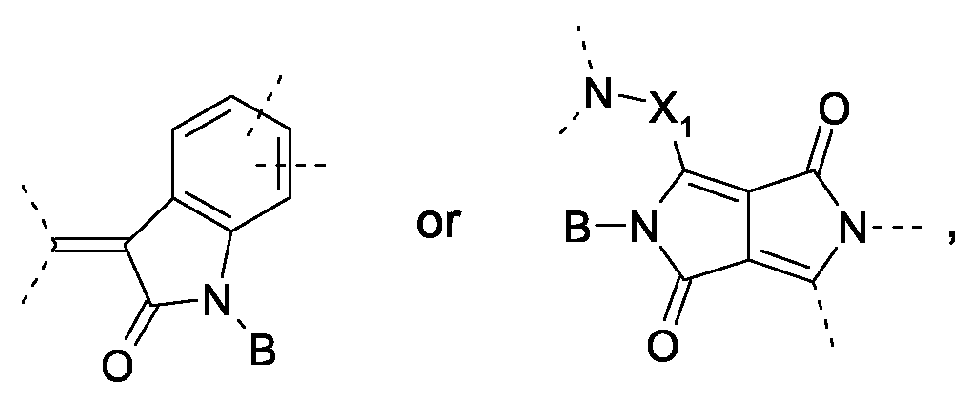
- The invention pertains to a 2,5-dihydro-pyrrolo[3,4-c]pyrrole-1,4-dione of the formulain which X1 and X2 independently of one another are a divalent aromatic radical of the formula
 or
or R3 is a radical CN, COR6, CO2R6, CON(R6)2, NO2, SO2R6, SOR6, SO2N(R6)2 or PO(OR7)2 ,
R4 and R5 independently of one another are hydrogen, chlorine, bromine, methyl, ethyl, methoxy or ethoxy,
R7 is C1-C6alkyl or phenyl,
R1, R2, R1', R2' and R6 independently of one another are hydrogen, C1-C18alkyl or C1-C18alkenyl which is unsubstituted or substituted by hydroxy, mercapto, C1-C6alkoxy or C1-C6alkylmercapto, or phenyl which is unsubstituted or substituted by chlorine, bromine, hydroxy, C1-C6alkyl, C1-C6alkoxy, C1-C6alkylmercapto, CN, NO2 or CF3,
or R1 and R2 or R1' and R2', together with the nitrogen atom to which they are attached, form a 5- or 6-membered heterocyclic radical which is unsubstituted or substituted by C1-C6alkyl or phenyl and is selected from the group consisting of pyrrolidinyl, piperidyl, pyrrolyl, triazolyl, imidazolyl, pyrazolyl, piperazinyl, morpholinyl, thiomorpholinyl, carbazol-1-yl, indol-1-yl, indazol-1-yl, benzimidazol-1-yl, tetrahydroquinol-1-yl and tetrahydroquinol-2-yl, or,
if R1 or R1' is hydrogen, R2 or R2' is a radical of the formulain which X3 and X4 independently of one another are hydrogen, chlorine, bromine, NO2, methyl, methoxy or ethoxy and X5 and X6 form a 5- or 6-membered heterocyclic ring which together with A produces a benzimidazolonyl, dihydroxyquinazolinyl, quinolonyl, benzoxazolonyl, phenmorpholonyl, quinazolinonyl or phthalimidyl radical or a radical of the formula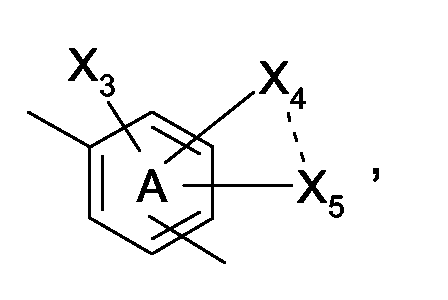 in which R8 is C1-C6alkyl or phenyl, or X2-R3 can be a radical
 E1 is hydrogen and E2 is a group B, E1 is a group B and E2 is hydrogen, or E1 and E2 are both a group B,
B is a group of the formulaand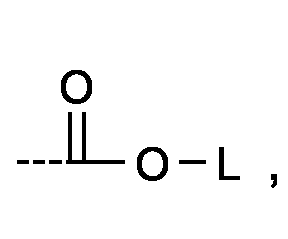
L is any suitable solubilizing group,
with the proviso that when said 2,5-dihydro-pyrrolo[3,4-c]pyrrole-1,4-dione is of formula (II), R1 is not C1-C18alkylamino. - Compounds which include at least onemoiety in their structure are new and are also an object of the invention.

- The instant compounds can be used in a process for making a pigmented vitreous material from a liquid or dissolved transition metal compound, wherein the liquid or dissolved transition metal compound reacts to form crosslinks between the liquid or dissolved transition metal atoms in the pigmented vitreous material, also comprising a dissolved compound of the formula (I) or (II), or including at least onemoiety in its structure, and the vitreous material is heated so that said dissolved compound is transformed into a pigment.

- Transition metals are well-known in the art and may for example be aluminium, zinc, zirconium, titanium, iron, cobalt and nickel, and very particularly silicium. The liquid or dissolved transition metal compounds are also well-known in the art and may for example be an alkoxide or a mixed oxide/alkoxide, which may in addition contain further substituents, for example C1-C4alkyl groups or halogens.
- The transformation of the compound of the formula (I) or (II) into a pigment by heating may be performed simultaneously with the liquid or dissolved transition metal compound's crosslinking reaction, or as a separate final step.
- Besides the product's excellent properties, the process of the invention has also the advantage that it is much faster than the prior art, due to the fact that a dispersion step is not necessary. Moreover, the reaction can be conducted at higher temperature and at higher pigment contents in the substantial absence of dispersants, without impairing the transparency, hue and chroma.
- The reaction is generally performed in the way, that all ingredients are first mixed to form a composition which can be applied as desired and heated to regenerate the pigment. The composition may also contain effective amounts of a catalyst, for example an acid or a precursor which forms an acid upon heating. The acid or precursor may be added at the time of the composition's preparation, or preferably just before the composition's application.
- An effective amount of a catalyst is any quantity suitable to start or accelerate the reaction. Catalysts and the suitable quantities thereof are well-known in the art. Examples are mineral acids, such as hydrochloric acid or nitric acid, Lewis acids, such as boron trifluoride, organic acids, such as formic, acetic or oxalic acid, or the like, preferably with a pKa of 3 or lower.
- In addition or even instead of catalysts, it is also well-known to use a light source or to heat the mixture to a mild temperature, for example about 50 to 80°C, in order for the crosslinking reaction (gelation) to start.
- Before or during gelation, it is possible to work the composition into the desired form by usual means, for example coating layers by spin coating or by printing methods, such as for example screen or inkjet printing. In analogy to the resist technology (disclosed for example in EP 654 711), it is also possible to perform the crosslinking only in specified areas by using for example a laser or arrays of thermoelements, so that an image is obtained which can be developed for example by washing out the ungelated areas with a suitable solvent.
- After the gelation is completed, the material is if necessary further converted to a vitreous form by heating to a higher temperature, at which the pigment will also be regenerated.
- The instant pigmented vitreous materials have a high transparency, a high resistance to water, solvent and chemicals as well as also a good resistance to shearing and scratching, and particularly a very high thermal stability even under very severe conditions. Due to their high pigment content, they can be applied in very thin, highly transparent and low scattering layers, the thickness of which is from 0.1 to 3 µm.
- The crosslinks between the transition metal atoms may consist for example of oxygen, alkylene, oxyalkylene or oxyalkyleneoxy bridges, which may be unsubstituted or further substituted, for example by oxa or fluoro. Polymeric materials may also be used which have suitable substituents, such as -OH groups, may also be used for crosslinking.
- Suitable solvents are water or, preferably, any desired protic or aprotic solvents, examples being hydrocarbons, alcohols, amides, nitriles, nitro compounds, sulphur derivatives, N-heterocycles, ethers, ketones and esters which may also be either mono- or polyunsaturated or chlorinated: examples are methanol, ethanol, isopropanol, n-butanol, isobutanol, 2-butanol, diethyl ether, acetone, methyl ethyl ketone, methyl isobutyl ketone, 1,2-dimethoxyethane, 1,2-diethoxyethane, 2-n-butoxyethanol, 2-methoxyethanol, 2-ethoxyethanol, ethyl acetate, tetrahydrofuran, dioxane, acetonitrile, benzonitrile, nitrobenzene, N,N-dimethylformamide, N,N-dimethylacetamide, dimethyl sulfoxide, sulfolane, N-methylpyrrolidone, pyridine, picoline, quinoline, dichloroethane, trichloroethane, benzene, toluene, xylene, anisole and chlorobenzene. Further examples of solvents are described in numerous tabular and reference works. Instead of a single solvent it is also possible to employ mixtures of two or more solvents.
- The transition metal compounds which undergo crosslinking act themselves as solvents, too. The ratio of transition metal compound to other solvents is preferably from 25:1 to 2.5:1.
- The concentration of the pigment precursor in water or a solvent is usually from 0.01 % by weight, based on the weight of the solution, to approximately 99% by weight of the saturation concentration, it also being possible in certain cases to employ supersaturated solutions without premature precipitation of the solvate. For many pigment precursors the optimum concentration is around ∼0.05-30% by weight, often around 0.1-15% by weight, based on the weight of the solution.
- Conversion of the pigment precursor into the pigmentary form takes place by thermal fragmentation, which can be carried out simultaneously with the gel formation or as a subsequent treatment at higher temperature. Thus, the pigment precursor's fragmentation temperature is preferably in the same range as the gel formation, adequately from 50 to 400°C, preferably from 100 to 300°C, most preferably from about 150 to about 250°C.
- By an effectively colouring amount is meant that amount which is sufficient to bring about a colour difference ΔE* (CIE-L*a*b*) of ≥ 2 when the pigmented vitreous material is compared with the similarly made, unpigmented vitreous material under the standard illuminant D65 and at a viewing angle of 10°. This amount is preferably from 0.01 to about 50% by weight, more preferably from 0.1 to 30% by weight, most preferably from 10 to 25% by weight, based on the weight of the pigmented vitreous material. It is generally preferred to have a pigment concentration as high as possible, without the vitreous material's properties to be impaired.
- The pigment precursors can be employed individually or preferably in mixtures with other pigment precursors. Where the pigment precursors are employed in mixtures, the components of the mixture are preferably those whose colour in the pigmentary form is red, blue, yellow, green, orange or black, more preferably bluish red, orange or black. Preferably, the pigmented vitreous material contains each effective pigmenting amounts of from 2 to 10 organic pigments, preferably from 2 to 5 organic pigments.
- Examples of other pigment precursors are known for example from EP 742 556, WO 98/32802, WO 98/45757, WO 98/58027, WO 99/01511, WO 00/17275 and subject-matter of the application PCT/EP-00/03085, as well as from many other publications cited therein, the contents of all are expressly incorporated herein by reference. They preferably contain at least one directly adjacent or conj ugated carbonyl group at each heteroatom attached to groups B.
- Bluish red is a wide colour range comprising also colours for which sometimes other designations are used, such as for example magenta, ruby, claret, cabernet, maroon and violet. An especially preferred bluish red has an absorption maximum (λmax) from 550 to 590 nm, particularly preferred from 560 to 570 nm or from 570 to 580 nm.
- Black is preferably a mixture of each a blue and yellow component and from one to 3 red components, especially any mixture of each any C.I. Pigment Blue and Pigment Yellow and any one C.I. Pigment Red or any combination of two or three C.I. Pigment Red and/or Pigment Violet, examples of which are given below. The optimal ratio of the components depends on the respective spectra and should be chosen so that the absorption is nearly the same at all wavelength from 400 to 700 nm, whereby eventual transmission in some areas may be compensated by additional pigments, the absorption maxima of which correspond to the transmission to be reduced.
- Particularly preferred are 3-methylidene-2,3-dihydro-indol-2-on derivatives (such as those disclosed in WO-00/24736 wherein R1 is H) and 2,5-dihydro-pyrrolo-[3,4-c]pyrrole-1,4-dione derivatives having in the 3 and/or 6 position a rest substituted by at least one amino group (such as those disclosed in EP-B-353184 or EP-A-755933). The contents of WO-00/24736, EP-B-353184 and EP-A-755933 are incorporated herein by reference. These pigments, pure or in combination with other pigments, are particularly suitable for obtaining violet or green colourations. They also lead to surprisingly improved performance in vitreous materials.
- Particularly preferred chromophore is a 3-methylidene-2,3-dihydro-indol-2-on derivative of the formula
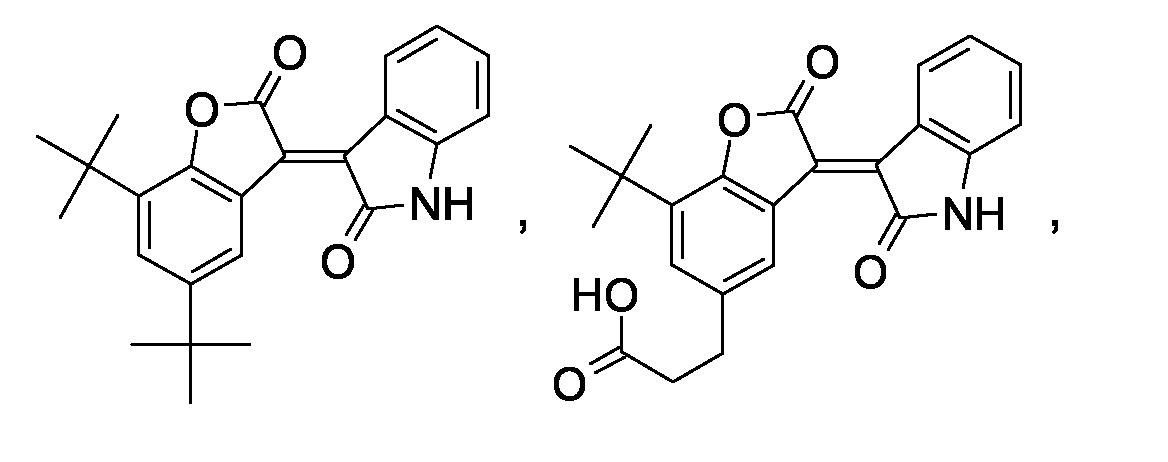

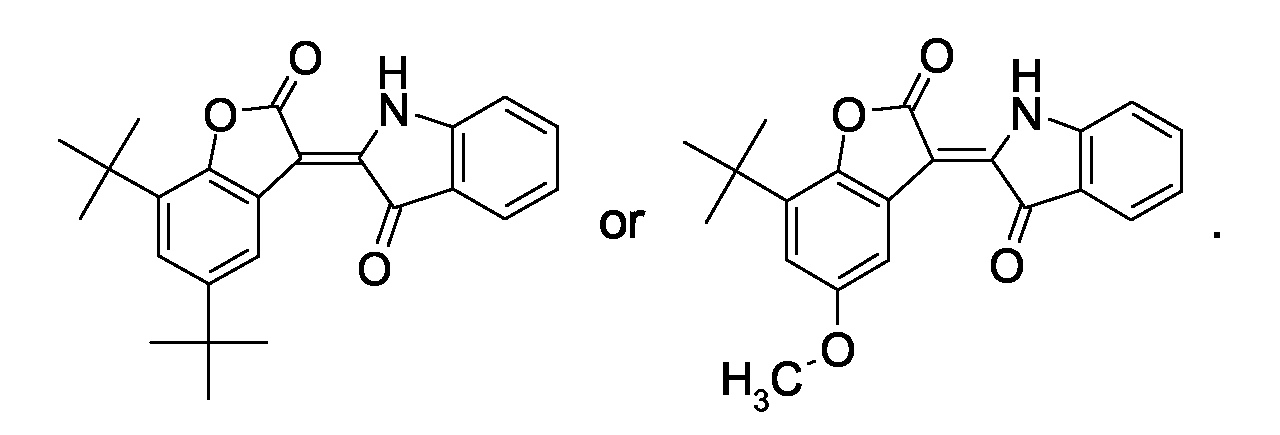
- Other 3-methylidene-2,3-dihydro-indol-2-on derivatives having other substituents are described for example in the above-cited reference WO-00/24736.
- Preferably -L is a group of the formulaor
 in which R1, R3 and R2 independently of one another are C1-C6alkyl,
R4 and R5 independently of one another are C1-C6alkyl, O, S or N(R12)2-interrupted C1-C6alkyl, unsubstituted or C1-C6alkyl-, C1-C6alkoxy-, halo-, cyano- or nitro-substituted phenyl or biphenylyl,
R6, R7 and R8 independently of one another are hydrogen or C1-C6alkyl,
R9 is hydrogen, C1-C6alkyl or a group of the formulaR11 and R10 independently of one another are hydrogen, C1-C6alkyl, C1-C6alkoxy, halogen, cyano, nitro, N(R12)2, unsubstituted or halo-, cyano-, nitro-, C1-C6alkyl- or C1-C6alkoxy-substituted phenyl,
R12 and R13 are C1-C6alkyl, R14 is hydrogen or C1-C6alkyl and R15 is hydrogen, C1-C6alkyl, unsubstituted or C1-C6alkyl-substituted phenyl,
Q is p,q-C2-C6alkylene which is unsubstituted or substituted one or more times by C1-C6alkoxy, C1-C6alkylthio or C2-C12dialkylamino, p and q being different numeric locants,
X is a heteroatom selected from the group consisting of N, O and S, where m is 0 if X is O or S and is 1 if X is N, and
L1 and L2 independently of one another are unsubstituted or mono- or poly-C1-C12alkoxy-, -C1-C12alkylthio-, -C2-C24dialkylamino-, -C6-C12aryloxy-, -C6-C12arylthio-, -C7-C24alkylarylamino- or -C12-C24diarylamino-substituted C1-C6alkyl or
[-(p',q'-C2-C6alkylene)-Z-]n-C1-C6alkyl, where n is a number from 1 to 1000, p' and q' are different numeric locants, each Z independently of the others is a heteroatom O, S or C1-C12alkyl-substituted N, and C2-C6alkylene in the repeating units [-C2-C6alkylene-Z-] can be identical or different,
and L1 and L2 can be saturated or mono- to deca-unsaturated, uninterrupted or interrupted in any desired points by from 1 to 10 groups selected from the group consisting of -(C=O)- and -C6H4-, and may carry no or 1 to 10 further substituents selected from the group consisting of halogen, cyano and nitro. - Of particular interest are compounds of the formula (I) or (II) in which L is C1-C6alkyl or particularlyin which Q is C2-C4alkylene and L1 and L2 are [-C2-C12alkylene-Z-]n-C1-C12alkyl or are C1-C12alkyl which is substituted one or more times by C1-C12alkoxy, C1-C12alkylthio or C2-C24dialkylamino, and m and n are as defined above.
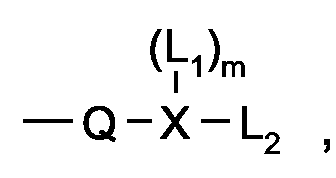
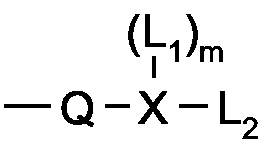
- Of very particular interest are compounds of the formula (I) or (II) in which L is C4-C5alkyl (especially tert.-butyl or tert.-amyl) or particularly, in which Q is C2-C4alkylene, X is O and m is zero, and L2 is [-C2-C12alkylene-O-]n-C1-C12alkyl or is C1-C12alkyl which is substituted one or more times by C1-C12alkoxy, especially those in which -Q-X- is a group of the formula -C(CH3)2-CH2-O-.
- Alkyl or alkylene can be straight-chain, branched, monocyclic or polycyclic.
- Thus C1-C12alkyl is, for example, methyl, ethyl, n-propyl, isopropyl, n-butyl, sec-butyl, isobutyl, tert-butyl, cyclobutyl, n-pentyl, 2-pentyl, 3-pentyl, 2,2-dimethylpropyl, cyclopentyl, cyclohexyl, n-hexyl, n-octyl, 1,1,3,3-tetramethylbutyl, 2-ethylhexyl, nonyl, trimethylcyclohexyl, decyl, menthyl, thujyl, bornyl, 1-adamantyl, 2-adamantyl or dodecyl.
- If C2-C12alkyl is mono- or polyunsaturated it is C2-C12alkenyl, C2-C12alkynyl, C2-C12alkapolyenyl or C2-C12alkapolyynyl in which two or more double bonds may if appropriate be isolated or conjugated, examples being vinyl, allyl, 2-propen-2-yl, 2-buten-1-yl, 3-buten-1-yl, 1,3-butadien-2-yl, 2-cyclobuten-1-yl, 2-penten-1-yl, 3-penten-2-yl, 2-methyl-1-buten-3-yl, 2-methyl-3-buten-2-yl, 3-methyl-2-buten-1-yl, 1,4-pentadien-3-yl, 2-cyclopenten-1-yl, 2-cyclohexen-1-yl, 3-cyclohexen-1-yl, 2,4-cyclohexadien-1-yl, 1-p-menthen-8-yl, 4(10)-thujen-10-yl, 2-norbornen-1-yl, 2,5-norbornadien-1-yl, 7,7-dimethyl-2,4-norcaradien-3-yl or the various isomers of hexenyl, octenyl, nonenyl, decenyl or dodecenyl.
- C2-C4alkylene is, for example, 1,2-ethylene, 1,2-propylene, 1,3-propylene, 1,2-butylene, 1,3-butylene, 2,3-butylene, 1,4-butylene or 2-methyl-1,2-propylene. C5-C12alkylene is, for example, an isomer of pentylene, hexylene, octylene, decylene or dodecylene.
- C1-C12alkoxy is O-C1-C12alkyl, preferably O-C1-C4alkyl.
- C6-C12aryloxy is O-C6-C12aryl, for example phenoxy or naphthoxy, preferably phenoxy.
- C1-C12alkylthio is S-C1-C12alkyl, preferably S-C1-C4alkyl.
- C6-C12arylthio is S-C6-C12aryl, for example phenylthio or naphthylthio, preferably phenylthio.
- C2-C24dialkylamino is N(alkyl1)(alkyl2), where the sum of the carbon atoms in the two groups alkyl1 and alkyl2 is from 2 to 24, preferably N(C1-C4alkyl)-C1-C4alkyl.
- C7-C24alkylarylamino is N(alkyl1)(aryl2), where the sum of the carbon atoms in the two groups alkyl1 and aryl2 is from 7 to 24, for example methylphenylamino, ethylnaphthylamino or butylphenanthrylamino, preferably methylphenylamino or ethylphenylamino.
- C12-C24diarylamino is N(aryl1,)(aryl2), where the sum of the carbon atoms in the two groups aryl1 and aryl2 is from 12 to 24, for example diphenylamino or phenylnaphthylamino, preferably diphenylamino.
- C6-C16aryl ist for example phenyl, naphthyl, anthracenyl, pyrenyl or naphthacenyl.
- C7-C24aralkyl ist any group comprising at least each an alkyl and an aryl part, for example benzyl, phenethyl, tolyl, dodecylphenyl, indanyl or acenaphtenyl.
- Halogen is chlorine, bromine, fluorine or iodine, preferably fluorine or chlorine, most preferably fluorine. n is preferably a number from 1 to 100, with particular preference a number from 2 to 12.
- Particularly preferred pigment precursors are such wherein all B are identical groups of the formulaand for each of above chromophores L is tert.-butyl, tert.-amyl, 3-methoxy-2-methyl-2-propyl, 3-(2'-methoxy-ethoxy)-2-methyl-2-propyl, 2-methyl-3-butin-2-yl or 3-methyl-2-buten-1-yl.

- In addition to the pigment, the vitreous material may also contain other compounds such as additives known in the art to improve the material's properties such as UV absorbers or transparency improvers.
- Heating can be carried out by any desired thermal means, including irradiation; for example, by treatment in a thermal oven or by electromagnetic radiation, for example IR or NIR radiation, or laser pulses or microwaves.
- The heating time for regenerating the pigment is not critical, as long as care is taken that it is sufficiently long for the fragmentation of the pigment precursor to be completed. Typically, it ranges from several seconds to several hours, preferably from about 1 to about 30 minutes.
- The suitable heating time for gel formation depends on the temperature according to the laws of thermodynamics, so that it can simply be determined depending on the desired temperature.
- The heating temperature, however, should be evaluated carefully. In general, it is appropriate to use a temperature from 150 to 300°C, especially from about 180°C to 250°C. Preferred temperatures are from 180°C to 200°C. Together with the solubilizing group and the solvent used for gel formation, the temperature influences the crystal structure of the pigment which is formed. Typically, one should run parallel experiments at 150°C and 200°C to check for eventual coloristic differences.
- Surprisingly, it has been found that the use of a pigment precursor in which L istogether with a solvent for gel formation of structure
 leads to improvements in colour after heating to a temperature from 150 to 300°C to form the vitreous material. The compound may be added at once or also in portions, at any time from the beginning to just before the heating step, in any amounts. Preferably, the weight ratio of such compound to compound (I) or (II) is from 1:4 to 100:1.
- Preferred solvents for gel formation are 2-C1-C12alkoxyethanol, 2-C1-C12alkoxypropanol, 2,3-di-C1-C12alkoxypropanol, diethylenglycol-mono-C1-C12alkyl ether, triethylenglycol-mono-C1-C12alkyl ether, dipropylenglycol-mono-C1-C12alkyl ether, tripropylenglycol-mono-C1-C12alkyl ether, or diethylenglycol, triethylenglycol, dipropylenglycol or tripropylenglycol each monoesterified with a C1-C12 carboxylic acid.
- When a catalyst is used in the form of its precursor, the catalyst precursor can for example be of formulawherein R16, R17 and R18 are independently from one another C1-C24alkyl, C6-C24aryl or C7-C24aralkyl,

R19 is C1-C24alkyl,
R20, R21, R22 and R23 are independently from one another C1-C24alkyl, C6-C24aryl or C7-C24aralkyl,
or R20 and R21 together or R22 and R23 together are C4-C24alkylen, C4-C24aralkylen, 3-oxa-pentylen or N-C1-C24alkyl-3-aza-pentylen, - An is PX6, AsX6, SbX6, BX4, R24-SO3, R24-OSO3 or R25-PO3R26, wherein R24, R25 and R26 are independently from one another C1-C24alkyl, C6-C24aryl or C7-C24aralkyl . R25 and R26 are preferably C1-C24alkyl, most preferably C1-C4alkyl, particularly methyl, and X is halogen.
- Further substituents may be present in the compounds of formulae (IVa), (IVb) and (IVc), for example halogen atoms or nitro or C1-C24alkoxy groups.
- Of course, the instant new 3-methylidene-2,3-dihydro-indol-2-on and amino-substituted 2,5-dihydro-pyrrolo[3,4-c]pyrrole-1,4-dione colorants may also be used in other fields, for example as fluorescent colorants or as latent pigments, such as described for example in US-5,484,943, EP-B-0 648 817, US-5,879,855, WO98/45756, WO98/45757, WO98/58027, WO00/27930 and EP-A-1 044 945.
- The examples which follow illustrate the invention, without limiting its scope in any way.
- 5.3 g of di-tert-butyldicarbonate are added to a suspension of 5 g of 3,6-bis-(4-diphenylamino-phenyl)-2,5-dihydro-pyrrolo[3,4-c]pyrrole-1,4-dione and 0.3 g of dimethylaminopyridine in 150 ml of tetrahydrofuran. After stirring overnight at room temperature, the reaction mixture was filtered through a small amount of kieselguhr. Addition of hexane to the residue followed by filtration provides 5.3 g of a compound having the formula:

- Analysis: calc.: C 75.89%, H 5.63%, N 6.81%, O 11.66%; found: C 74.96%, H 5.79%, N 6.64%, O 11.88%. Midpoint decomposition temperature: 184.7°C; weight loss (calc.) = 24.3%, weight loss (found) = 26.06%.
- 8.8 g of di-tert-amyldicarbonate are added to a suspension of 100 g of 3,7-bis-(2-oxo-1,2-dihydro-indol-3-ylidene)-3,7-dihydro-benzo[1,2-.b.;4,5-.b.']difuran-2,6-dione and 8.3 g of dimethylaminopyridine in 1250 ml of dimethylacetamide. After stirring overnight at room temperature, the reaction mixture is filtered through a small amount of kieselguhr and the filtrate is evaporated. Tetrahydrofuran and hexane are added to the residue, and filtration followed by drying provides 57.8 g (39% of theory) of a dark compound having the formulaMidpoint decomposition temperature: 133.1°C; weight loss (calc.) = 33.7%, weight loss (found) = 28.6%.

- A mixture of 2.0 g tetraethoxysilane and 0.5 g of phenyltriethoxysilane is dissolved into a mixture of 12.5 g of ethanol and 3.75 g of 1 M-HCl. After 2 to 4 hours of hydrolysis, the reaction mixture is added dropwise to a solution of 0.40 g of the product of example 1 in 3.75 g of cyclohexanone. After dilution with 20 g of isopropanol, the resulting solution is microfiltrated through a 0.45 µm filter, then spin-coated onto a glass substrate (first 10 s at 100 rpm, then 30 s at 500 rpm). The coated glass plate is dried for 2 min at 100°C, then heated further for 5 min at 200°C, whereby the colour changes from orange-yellow to violet.
- 7 parts by weight of tetraethoxysilane, 1.3 parts by weight of nitric acid in 1.5 part by weight of water, 0.5 parts by weight of the product of example 2 in 89.89 parts by weight of water are mixed together to form a coating solution which is coated onto a cleaned glass plate by spin coating. After drying for 20 minutes at 80°C, the plate is heated to 200°C for 20 minutes. A uniform coating is obtained on the glass plate, the absorbtion maximum of which is at about 760-765 nm.
- Following components are mixed:
- 25 parts by weight of the product of example 2;
- 25 parts by weight of the product of formula

- 25 parts by weight of the product of formula

- 25 parts by weight of the product of formula

- It is proceeded as in example 4, with the difference that dioxane is used as a solvent instead of water and the mixture of example 5 is used instead of the product of example 2. A uniform black coating is obtained.
Claims (2)
- A 2,5-dihydro-pyrrolo[3,4-c]pyrrole-1,4-dione of the formulain which X1 and X2 independently of one another are a divalent aromatic radical of the formula
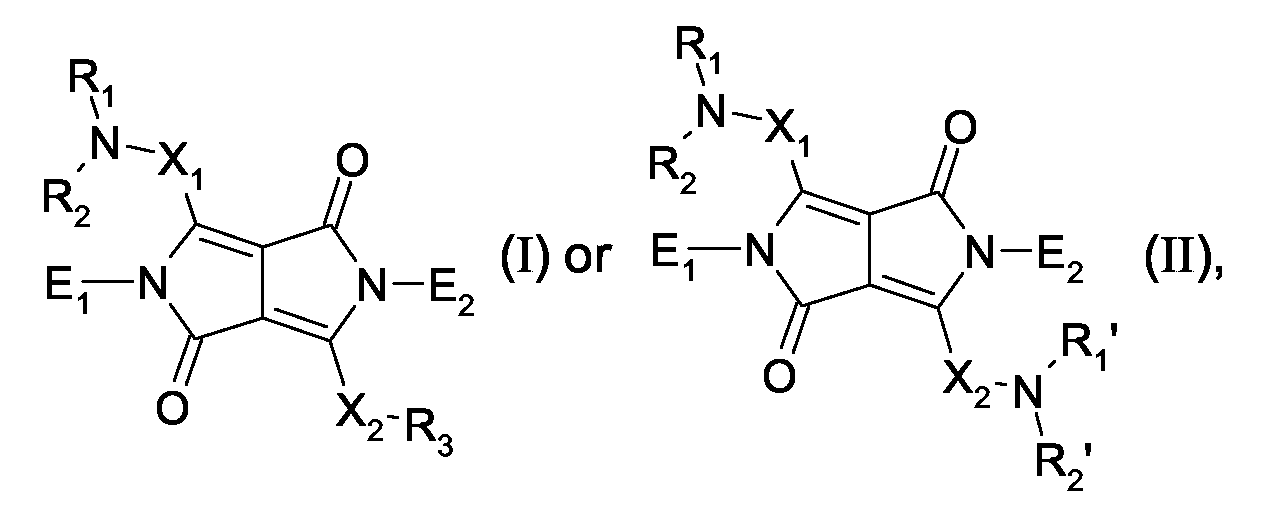 or
or R3 is a radical CN, COR6, CO2R6, CON(R6)2, NO2, SO2R6, SOR6, SO2N(R6)2 or PO(OR7)2 ,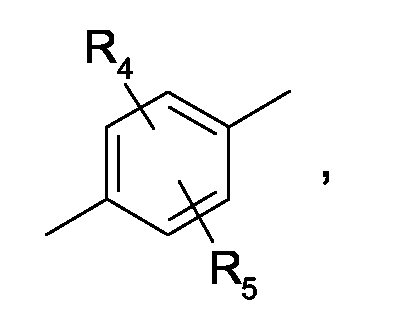
R4 and R5 independently of one another are hydrogen, chlorine, bromine, methyl, ethyl, methoxy or ethoxy,
R7 is C1-C6alkyl or phenyl,
R1, R2, R1', R2' and R6 independently of one another are hydrogen, C1-C18alkyl or C1-C18alkenyl which is unsubstituted or substituted by hydroxy, mercapto, C1-C6alkoxy or C1-C6alkylmercapto, or phenyl which is unsubstituted or substituted by chlorine, bromine, hydroxy, C1-C6alkyl, C1-C6alkoxy, C1-C6alkylmercapto, CN, NO2 or CF3,
or R1 and R2 or R1' and R2', together with the nitrogen atom to which they are attached, form a 5- or 6-membered heterocyclic radical which is unsubstituted or substituted by C1-C6alkyl or phenyl and is selected from the group consisting of pyrrolidinyl, piperidyl, pyrrolyl, triazolyl, imidazolyl, pyrazolyl, piperazinyl, morpholinyl, thiomorpholinyl, carbazol-1-yl, indol-1-yl, indazol-1-yl, benzimidazol-1-yl, tetrahydroquinol-1-yl and tetrahydroquinol-2-yl, or,
if R1 or R1' is hydrogen, R2 or R2' is a radical of the formulain which X3 and X4 independently of one another are hydrogen, chlorine, bromine, NO2, methyl, methoxy or ethoxy and X5 and X6 form a 5- or 6-membered heterocyclic ring which together with A produces a benzimidazolonyl, dihydroxyquinazolinyl, quinolonyl, benzoxazolonyl, phenmorpholonyl, quinazolinonyl or phthalimidyl radical or a radical of the formula in which R8 is C1-C6alkyl or phenyl,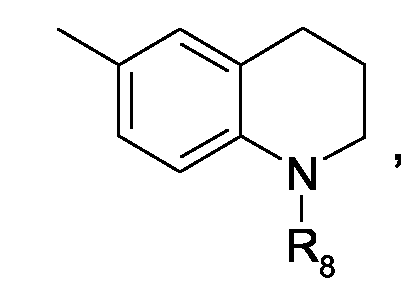
or X2-R3 can be a radicalE1 is hydrogen and E2 is a group B, E1 is a group B and E2 is hydrogen, or E1 and E2 are both a group B,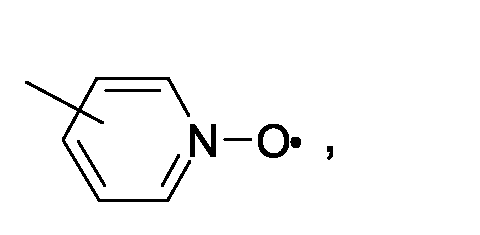
B is a group of the formulaand
L is any suitable solubilizing group,
with the proviso that when said 2,5-dihydro-pyrrolo[3,4-c]pyrrole-1,4-dione is of formula (II), R1 is not C1-C18alkylamino. - A compound having at least onemoiety in its structure, wherein B is a group as defined in claim 1.
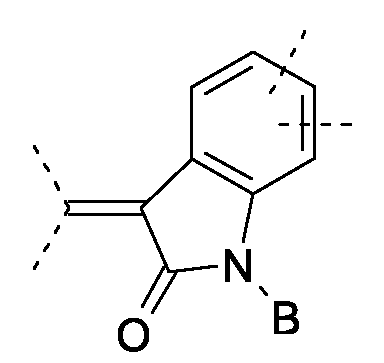
Priority Applications (1)
| Application Number | Priority Date | Filing Date | Title |
|---|---|---|---|
| EP03104149A EP1400496A1 (en) | 2000-07-04 | 2000-10-09 | Pigment precursors for making pigmented vitreous material |
Applications Claiming Priority (4)
| Application Number | Priority Date | Filing Date | Title |
|---|---|---|---|
| EP00114313 | 2000-07-04 | ||
| EP00114313 | 2000-07-04 | ||
| EP00969463A EP1242327B1 (en) | 1999-11-03 | 2000-10-09 | Pigmented vitreous material its precursor glass items coated therewith and method of its preparation |
| EP03104149A EP1400496A1 (en) | 2000-07-04 | 2000-10-09 | Pigment precursors for making pigmented vitreous material |
Related Parent Applications (2)
| Application Number | Title | Priority Date | Filing Date |
|---|---|---|---|
| EP00969463A Division EP1242327B1 (en) | 1999-11-03 | 2000-10-09 | Pigmented vitreous material its precursor glass items coated therewith and method of its preparation |
| EP00969463A Division-Into EP1242327B1 (en) | 1999-11-03 | 2000-10-09 | Pigmented vitreous material its precursor glass items coated therewith and method of its preparation |
Publications (1)
| Publication Number | Publication Date |
|---|---|
| EP1400496A1 true EP1400496A1 (en) | 2004-03-24 |
Family
ID=31947820
Family Applications (1)
| Application Number | Title | Priority Date | Filing Date |
|---|---|---|---|
| EP03104149A Withdrawn EP1400496A1 (en) | 2000-07-04 | 2000-10-09 | Pigment precursors for making pigmented vitreous material |
Country Status (1)
| Country | Link |
|---|---|
| EP (1) | EP1400496A1 (en) |
Citations (9)
| Publication number | Priority date | Publication date | Assignee | Title |
|---|---|---|---|---|
| EP0504926A1 (en) * | 1991-03-20 | 1992-09-23 | Kabushiki Kaisha Toshiba | Coating solution composition for forming glass gel thin film, color glass gel filter, and display device using the same |
| WO1995014667A1 (en) * | 1993-11-26 | 1995-06-01 | Pfizer Inc. | Substituted indoles as phosphodiesterase type iv inhibitors |
| EP0718697A2 (en) * | 1994-12-22 | 1996-06-26 | Ciba-Geigy Ag | Electrophotographic photoreceptor |
| EP0742556A1 (en) * | 1995-05-12 | 1996-11-13 | Ciba-Geigy Ag | Structured pigment coating and its manufacture and use |
| EP0755933A1 (en) * | 1995-06-22 | 1997-01-29 | Ciba SC Holding AG | Blue diketopyrrolopyrrole pigments |
| WO1998032802A1 (en) * | 1997-01-27 | 1998-07-30 | Ciba Specialty Chemicals Holding Inc. | Soluble chromophores having improved solubilising groups |
| EP0892018A1 (en) * | 1997-07-10 | 1999-01-20 | Ciba SC Holding AG | Reactive extrusion of latent pigments |
| WO2000024736A1 (en) * | 1998-10-22 | 2000-05-04 | Ciba Specialty Chemicals Holding Inc. | Oxobenzofuranylide-dihydroindolone |
| WO2000027930A1 (en) * | 1998-11-09 | 2000-05-18 | Ciba Specialty Chemicals Holding Inc. | Process for pigmenting porous metal oxides and materials pigmented therewith |
-
2000
- 2000-10-09 EP EP03104149A patent/EP1400496A1/en not_active Withdrawn
Patent Citations (9)
| Publication number | Priority date | Publication date | Assignee | Title |
|---|---|---|---|---|
| EP0504926A1 (en) * | 1991-03-20 | 1992-09-23 | Kabushiki Kaisha Toshiba | Coating solution composition for forming glass gel thin film, color glass gel filter, and display device using the same |
| WO1995014667A1 (en) * | 1993-11-26 | 1995-06-01 | Pfizer Inc. | Substituted indoles as phosphodiesterase type iv inhibitors |
| EP0718697A2 (en) * | 1994-12-22 | 1996-06-26 | Ciba-Geigy Ag | Electrophotographic photoreceptor |
| EP0742556A1 (en) * | 1995-05-12 | 1996-11-13 | Ciba-Geigy Ag | Structured pigment coating and its manufacture and use |
| EP0755933A1 (en) * | 1995-06-22 | 1997-01-29 | Ciba SC Holding AG | Blue diketopyrrolopyrrole pigments |
| WO1998032802A1 (en) * | 1997-01-27 | 1998-07-30 | Ciba Specialty Chemicals Holding Inc. | Soluble chromophores having improved solubilising groups |
| EP0892018A1 (en) * | 1997-07-10 | 1999-01-20 | Ciba SC Holding AG | Reactive extrusion of latent pigments |
| WO2000024736A1 (en) * | 1998-10-22 | 2000-05-04 | Ciba Specialty Chemicals Holding Inc. | Oxobenzofuranylide-dihydroindolone |
| WO2000027930A1 (en) * | 1998-11-09 | 2000-05-18 | Ciba Specialty Chemicals Holding Inc. | Process for pigmenting porous metal oxides and materials pigmented therewith |
Non-Patent Citations (1)
| Title |
|---|
| BECCALLI E M ET AL: "New Indole Derivatives. Synthesis of 3-Acyl-1-carbethoxy-2-trifluorom ethanesulfonylindoles and of Substituted 2-vinylindoles", TETRAHEDRON,NL,ELSEVIER SCIENCE PUBLISHERS, AMSTERDAM, vol. 51, no. 8, 20 February 1995 (1995-02-20), pages 2353 - 2362, XP004104809, ISSN: 0040-4020 * |
Similar Documents
| Publication | Publication Date | Title |
|---|---|---|
| EP1242327B1 (en) | Pigmented vitreous material its precursor glass items coated therewith and method of its preparation | |
| US6767620B2 (en) | Pigmented porous material | |
| DE69800715T2 (en) | SOLUBLE CHROMOPHORE CONTAINING GROUPS WITH IMPROVED SOLUBILITY | |
| EP1141476B1 (en) | Process for preparing a pigmented porous material | |
| EP1218154B1 (en) | Process for pigmenting wood | |
| EP1159276B1 (en) | Benzofuran-2-ones as colorants for organic materials | |
| US6258158B1 (en) | Process for pigmenting porous metal oxides and materials pigmented therewith | |
| US6423839B1 (en) | Mixed color pigment precursors and their use | |
| US6284036B1 (en) | Heat stable, pigmented sintered material comprising a boride, carbide, silicide, nitride or phosphide | |
| EP1044945B1 (en) | Heat stable, pigmented sintered material comprising a boride, carbide, silicide, nitride or phosphide | |
| TWI238812B (en) | Pigmented vitreous material | |
| KR20240100758A (en) | A Dark-Colored Pigment Composition And A Paint Layer Using The Same |
Legal Events
| Date | Code | Title | Description |
|---|---|---|---|
| PUAI | Public reference made under article 153(3) epc to a published international application that has entered the european phase |
Free format text: ORIGINAL CODE: 0009012 |
|
| AC | Divisional application: reference to earlier application |
Ref document number: 1242327 Country of ref document: EP Kind code of ref document: P |
|
| AK | Designated contracting states |
Kind code of ref document: A1 Designated state(s): AT BE CH CY DE DK ES FI FR GB GR IE IT LI LU MC NL PT SE |
|
| 17P | Request for examination filed |
Effective date: 20031111 |
|
| AKX | Designation fees paid |
Designated state(s): AT BE CH CY DE DK ES FI FR GB GR IE IT LI LU MC NL PT SE |
|
| 17Q | First examination report despatched |
Effective date: 20050609 |
|
| STAA | Information on the status of an ep patent application or granted ep patent |
Free format text: STATUS: THE APPLICATION IS DEEMED TO BE WITHDRAWN |
|
| 18D | Application deemed to be withdrawn |
Effective date: 20051020 |