EP1399452B1 - Biomembrane mimetic surface coatings - Google Patents
Biomembrane mimetic surface coatings Download PDFInfo
- Publication number
- EP1399452B1 EP1399452B1 EP02780860A EP02780860A EP1399452B1 EP 1399452 B1 EP1399452 B1 EP 1399452B1 EP 02780860 A EP02780860 A EP 02780860A EP 02780860 A EP02780860 A EP 02780860A EP 1399452 B1 EP1399452 B1 EP 1399452B1
- Authority
- EP
- European Patent Office
- Prior art keywords
- phospholipid
- gold
- compound
- monolayer
- thiol
- Prior art date
- Legal status (The legal status is an assumption and is not a legal conclusion. Google has not performed a legal analysis and makes no representation as to the accuracy of the status listed.)
- Expired - Lifetime
Links
- 238000000576 coating method Methods 0.000 title 1
- 229910052737 gold Inorganic materials 0.000 claims abstract description 28
- 238000000034 method Methods 0.000 claims abstract description 9
- 229910052709 silver Inorganic materials 0.000 claims abstract description 7
- 150000001875 compounds Chemical class 0.000 claims description 16
- 125000000217 alkyl group Chemical group 0.000 claims description 7
- 125000000816 ethylene group Chemical group [H]C([H])([*:1])C([H])([H])[*:2] 0.000 claims description 4
- OKTJSMMVPCPJKN-UHFFFAOYSA-N Carbon Chemical compound [C] OKTJSMMVPCPJKN-UHFFFAOYSA-N 0.000 claims 3
- 229910052799 carbon Inorganic materials 0.000 claims 3
- 150000003904 phospholipids Chemical class 0.000 abstract description 29
- 239000010931 gold Substances 0.000 abstract description 27
- PCHJSUWPFVWCPO-UHFFFAOYSA-N gold Chemical compound [Au] PCHJSUWPFVWCPO-UHFFFAOYSA-N 0.000 abstract description 24
- 239000000758 substrate Substances 0.000 abstract description 13
- 230000003592 biomimetic effect Effects 0.000 abstract description 7
- 239000008280 blood Substances 0.000 abstract description 3
- 210000004369 blood Anatomy 0.000 abstract description 3
- 239000000463 material Substances 0.000 abstract description 3
- 239000004332 silver Substances 0.000 abstract description 3
- 239000000543 intermediate Substances 0.000 abstract description 2
- BQCADISMDOOEFD-UHFFFAOYSA-N Silver Chemical compound [Ag] BQCADISMDOOEFD-UHFFFAOYSA-N 0.000 abstract 1
- OKKJLVBELUTLKV-UHFFFAOYSA-N Methanol Chemical compound OC OKKJLVBELUTLKV-UHFFFAOYSA-N 0.000 description 18
- 239000002356 single layer Substances 0.000 description 11
- IJGRMHOSHXDMSA-UHFFFAOYSA-N Atomic nitrogen Chemical compound N#N IJGRMHOSHXDMSA-UHFFFAOYSA-N 0.000 description 10
- 102000004882 Lipase Human genes 0.000 description 9
- 108090001060 Lipase Proteins 0.000 description 9
- YMWUJEATGCHHMB-UHFFFAOYSA-N Dichloromethane Chemical compound ClCCl YMWUJEATGCHHMB-UHFFFAOYSA-N 0.000 description 8
- 239000004367 Lipase Substances 0.000 description 8
- 235000019421 lipase Nutrition 0.000 description 8
- JGFZNNIVVJXRND-UHFFFAOYSA-N N,N-Diisopropylethylamine (DIPEA) Chemical compound CCN(C(C)C)C(C)C JGFZNNIVVJXRND-UHFFFAOYSA-N 0.000 description 7
- HEDRZPFGACZZDS-UHFFFAOYSA-N Chloroform Chemical compound ClC(Cl)Cl HEDRZPFGACZZDS-UHFFFAOYSA-N 0.000 description 6
- WYURNTSHIVDZCO-UHFFFAOYSA-N Tetrahydrofuran Chemical compound C1CCOC1 WYURNTSHIVDZCO-UHFFFAOYSA-N 0.000 description 6
- 238000001179 sorption measurement Methods 0.000 description 6
- 238000006243 chemical reaction Methods 0.000 description 5
- 239000010410 layer Substances 0.000 description 5
- 229910052757 nitrogen Inorganic materials 0.000 description 5
- 239000000047 product Substances 0.000 description 5
- 102000004169 proteins and genes Human genes 0.000 description 5
- 108090000623 proteins and genes Proteins 0.000 description 5
- XLYOFNOQVPJJNP-UHFFFAOYSA-N water Substances O XLYOFNOQVPJJNP-UHFFFAOYSA-N 0.000 description 5
- VHYFNPMBLIVWCW-UHFFFAOYSA-N 4-Dimethylaminopyridine Chemical compound CN(C)C1=CC=NC=C1 VHYFNPMBLIVWCW-UHFFFAOYSA-N 0.000 description 4
- CSCPPACGZOOCGX-UHFFFAOYSA-N Acetone Chemical compound CC(C)=O CSCPPACGZOOCGX-UHFFFAOYSA-N 0.000 description 4
- QOSSAOTZNIDXMA-UHFFFAOYSA-N Dicylcohexylcarbodiimide Chemical compound C1CCCCC1N=C=NC1CCCCC1 QOSSAOTZNIDXMA-UHFFFAOYSA-N 0.000 description 4
- DHMQDGOQFOQNFH-UHFFFAOYSA-N Glycine Chemical compound NCC(O)=O DHMQDGOQFOQNFH-UHFFFAOYSA-N 0.000 description 4
- 230000015572 biosynthetic process Effects 0.000 description 4
- 125000003178 carboxy group Chemical group [H]OC(*)=O 0.000 description 4
- 238000001704 evaporation Methods 0.000 description 4
- 238000002474 experimental method Methods 0.000 description 4
- HQHCYKULIHKCEB-UHFFFAOYSA-N tetradecanedioic acid Chemical compound OC(=O)CCCCCCCCCCCCC(O)=O HQHCYKULIHKCEB-UHFFFAOYSA-N 0.000 description 4
- VEXZGXHMUGYJMC-UHFFFAOYSA-N Hydrochloric acid Chemical compound Cl VEXZGXHMUGYJMC-UHFFFAOYSA-N 0.000 description 3
- XUIMIQQOPSSXEZ-UHFFFAOYSA-N Silicon Chemical compound [Si] XUIMIQQOPSSXEZ-UHFFFAOYSA-N 0.000 description 3
- 230000008901 benefit Effects 0.000 description 3
- 230000008020 evaporation Effects 0.000 description 3
- 239000011521 glass Substances 0.000 description 3
- 229960004956 glycerylphosphorylcholine Drugs 0.000 description 3
- 150000002632 lipids Chemical class 0.000 description 3
- 239000012046 mixed solvent Substances 0.000 description 3
- 239000000203 mixture Substances 0.000 description 3
- 238000002360 preparation method Methods 0.000 description 3
- 229910052710 silicon Inorganic materials 0.000 description 3
- 239000010703 silicon Substances 0.000 description 3
- VYPSYNLAJGMNEJ-UHFFFAOYSA-N silicon dioxide Inorganic materials O=[Si]=O VYPSYNLAJGMNEJ-UHFFFAOYSA-N 0.000 description 3
- 238000003756 stirring Methods 0.000 description 3
- 238000003786 synthesis reaction Methods 0.000 description 3
- 238000012360 testing method Methods 0.000 description 3
- YLQBMQCUIZJEEH-UHFFFAOYSA-N tetrahydrofuran Natural products C=1C=COC=1 YLQBMQCUIZJEEH-UHFFFAOYSA-N 0.000 description 3
- ASWBNKHCZGQVJV-UHFFFAOYSA-N (3-hexadecanoyloxy-2-hydroxypropyl) 2-(trimethylazaniumyl)ethyl phosphate Chemical compound CCCCCCCCCCCCCCCC(=O)OCC(O)COP([O-])(=O)OCC[N+](C)(C)C ASWBNKHCZGQVJV-UHFFFAOYSA-N 0.000 description 2
- IJFVSSZAOYLHEE-SSEXGKCCSA-N 1,2-dilauroyl-sn-glycero-3-phosphocholine Chemical compound CCCCCCCCCCCC(=O)OC[C@H](COP([O-])(=O)OCC[N+](C)(C)C)OC(=O)CCCCCCCCCCC IJFVSSZAOYLHEE-SSEXGKCCSA-N 0.000 description 2
- ASOKPJOREAFHNY-UHFFFAOYSA-N 1-Hydroxybenzotriazole Chemical compound C1=CC=C2N(O)N=NC2=C1 ASOKPJOREAFHNY-UHFFFAOYSA-N 0.000 description 2
- 238000005160 1H NMR spectroscopy Methods 0.000 description 2
- OGMADIBCHLQMIP-UHFFFAOYSA-N 2-aminoethanethiol;hydron;chloride Chemical compound Cl.NCCS OGMADIBCHLQMIP-UHFFFAOYSA-N 0.000 description 2
- PHDKRJGKKXUQCS-UHFFFAOYSA-N 3-undecyloxetane-2,4-dione Chemical compound CCCCCCCCCCCC1C(=O)OC1=O PHDKRJGKKXUQCS-UHFFFAOYSA-N 0.000 description 2
- 229960000549 4-dimethylaminophenol Drugs 0.000 description 2
- 241000589513 Burkholderia cepacia Species 0.000 description 2
- OKKJLVBELUTLKV-MZCSYVLQSA-N Deuterated methanol Chemical compound [2H]OC([2H])([2H])[2H] OKKJLVBELUTLKV-MZCSYVLQSA-N 0.000 description 2
- GZDFHIJNHHMENY-UHFFFAOYSA-N Dimethyl dicarbonate Chemical compound COC(=O)OC(=O)OC GZDFHIJNHHMENY-UHFFFAOYSA-N 0.000 description 2
- 239000004471 Glycine Substances 0.000 description 2
- UIIMBOGNXHQVGW-UHFFFAOYSA-M Sodium bicarbonate Chemical compound [Na+].OC([O-])=O UIIMBOGNXHQVGW-UHFFFAOYSA-M 0.000 description 2
- HEDRZPFGACZZDS-MICDWDOJSA-N Trichloro(2H)methane Chemical compound [2H]C(Cl)(Cl)Cl HEDRZPFGACZZDS-MICDWDOJSA-N 0.000 description 2
- PFKFTWBEEFSNDU-UHFFFAOYSA-N carbonyldiimidazole Chemical compound C1=CN=CN1C(=O)N1C=CN=C1 PFKFTWBEEFSNDU-UHFFFAOYSA-N 0.000 description 2
- 238000004587 chromatography analysis Methods 0.000 description 2
- DNJIEGIFACGWOD-UHFFFAOYSA-N ethanethiol Chemical compound CCS DNJIEGIFACGWOD-UHFFFAOYSA-N 0.000 description 2
- 238000001914 filtration Methods 0.000 description 2
- NPZTUJOABDZTLV-UHFFFAOYSA-N hydroxybenzotriazole Substances O=C1C=CC=C2NNN=C12 NPZTUJOABDZTLV-UHFFFAOYSA-N 0.000 description 2
- 238000007654 immersion Methods 0.000 description 2
- 238000001727 in vivo Methods 0.000 description 2
- 239000013554 lipid monolayer Substances 0.000 description 2
- 230000007774 longterm Effects 0.000 description 2
- 125000001570 methylene group Chemical group [H]C([H])([*:1])[*:2] 0.000 description 2
- 238000012986 modification Methods 0.000 description 2
- 230000004048 modification Effects 0.000 description 2
- 125000001436 propyl group Chemical group [H]C([*])([H])C([H])([H])C([H])([H])[H] 0.000 description 2
- 239000013545 self-assembled monolayer Substances 0.000 description 2
- 235000012239 silicon dioxide Nutrition 0.000 description 2
- 239000002904 solvent Substances 0.000 description 2
- 238000002198 surface plasmon resonance spectroscopy Methods 0.000 description 2
- 150000003573 thiols Chemical class 0.000 description 2
- ZQXIMYREBUZLPM-UHFFFAOYSA-N 1-aminoethanethiol Chemical compound CC(N)S ZQXIMYREBUZLPM-UHFFFAOYSA-N 0.000 description 1
- ASWBNKHCZGQVJV-HSZRJFAPSA-N 1-hexadecanoyl-sn-glycero-3-phosphocholine Chemical compound CCCCCCCCCCCCCCCC(=O)OC[C@@H](O)COP([O-])(=O)OCC[N+](C)(C)C ASWBNKHCZGQVJV-HSZRJFAPSA-N 0.000 description 1
- GHCZTIFQWKKGSB-UHFFFAOYSA-N 2-hydroxypropane-1,2,3-tricarboxylic acid;phosphoric acid Chemical compound OP(O)(O)=O.OC(=O)CC(O)(C(O)=O)CC(O)=O GHCZTIFQWKKGSB-UHFFFAOYSA-N 0.000 description 1
- -1 Alabama) Chemical compound 0.000 description 1
- 102000004506 Blood Proteins Human genes 0.000 description 1
- 108010017384 Blood Proteins Proteins 0.000 description 1
- 102000004190 Enzymes Human genes 0.000 description 1
- 108090000790 Enzymes Proteins 0.000 description 1
- 238000005033 Fourier transform infrared spectroscopy Methods 0.000 description 1
- 241000282412 Homo Species 0.000 description 1
- 239000000232 Lipid Bilayer Substances 0.000 description 1
- 108010013563 Lipoprotein Lipase Proteins 0.000 description 1
- 102100022119 Lipoprotein lipase Human genes 0.000 description 1
- BPQQTUXANYXVAA-UHFFFAOYSA-N Orthosilicate Chemical compound [O-][Si]([O-])([O-])[O-] BPQQTUXANYXVAA-UHFFFAOYSA-N 0.000 description 1
- 241000589774 Pseudomonas sp. Species 0.000 description 1
- 229920005654 Sephadex Polymers 0.000 description 1
- 239000012507 Sephadex™ Substances 0.000 description 1
- 125000002252 acyl group Chemical group 0.000 description 1
- 239000002099 adlayer Substances 0.000 description 1
- 239000010441 alabaster Substances 0.000 description 1
- 150000001408 amides Chemical class 0.000 description 1
- 238000004458 analytical method Methods 0.000 description 1
- 238000000137 annealing Methods 0.000 description 1
- 238000013459 approach Methods 0.000 description 1
- 238000004630 atomic force microscopy Methods 0.000 description 1
- 239000006121 base glass Substances 0.000 description 1
- 239000003012 bilayer membrane Substances 0.000 description 1
- 229920000249 biocompatible polymer Polymers 0.000 description 1
- 230000007321 biological mechanism Effects 0.000 description 1
- 239000012472 biological sample Substances 0.000 description 1
- 230000017531 blood circulation Effects 0.000 description 1
- OSGAYBCDTDRGGQ-UHFFFAOYSA-L calcium sulfate Chemical compound [Ca+2].[O-]S([O-])(=O)=O OSGAYBCDTDRGGQ-UHFFFAOYSA-L 0.000 description 1
- 239000000919 ceramic Substances 0.000 description 1
- 150000001793 charged compounds Chemical class 0.000 description 1
- 125000004122 cyclic group Chemical group 0.000 description 1
- 230000000994 depressogenic effect Effects 0.000 description 1
- 239000000706 filtrate Substances 0.000 description 1
- 210000003709 heart valve Anatomy 0.000 description 1
- 239000005457 ice water Substances 0.000 description 1
- 239000012535 impurity Substances 0.000 description 1
- 238000003780 insertion Methods 0.000 description 1
- 230000037431 insertion Effects 0.000 description 1
- 230000003993 interaction Effects 0.000 description 1
- 239000000787 lecithin Substances 0.000 description 1
- 235000010445 lecithin Nutrition 0.000 description 1
- 210000004072 lung Anatomy 0.000 description 1
- 238000004949 mass spectrometry Methods 0.000 description 1
- 238000005259 measurement Methods 0.000 description 1
- 238000001883 metal evaporation Methods 0.000 description 1
- 230000003278 mimic effect Effects 0.000 description 1
- 238000012544 monitoring process Methods 0.000 description 1
- 238000000465 moulding Methods 0.000 description 1
- 230000003287 optical effect Effects 0.000 description 1
- 239000012074 organic phase Substances 0.000 description 1
- 238000012856 packing Methods 0.000 description 1
- 238000010647 peptide synthesis reaction Methods 0.000 description 1
- 239000008363 phosphate buffer Substances 0.000 description 1
- 230000010287 polarization Effects 0.000 description 1
- 125000002924 primary amino group Chemical group [H]N([H])* 0.000 description 1
- 238000000746 purification Methods 0.000 description 1
- 239000010453 quartz Substances 0.000 description 1
- 239000011541 reaction mixture Substances 0.000 description 1
- 230000000717 retained effect Effects 0.000 description 1
- 238000007789 sealing Methods 0.000 description 1
- 239000000377 silicon dioxide Substances 0.000 description 1
- 238000002791 soaking Methods 0.000 description 1
- 229910000030 sodium bicarbonate Inorganic materials 0.000 description 1
- 239000012265 solid product Substances 0.000 description 1
- 238000004611 spectroscopical analysis Methods 0.000 description 1
- 238000001228 spectrum Methods 0.000 description 1
- 238000004544 sputter deposition Methods 0.000 description 1
- 239000000126 substance Substances 0.000 description 1
- 239000000725 suspension Substances 0.000 description 1
- 125000003396 thiol group Chemical group [H]S* 0.000 description 1
- 230000002792 vascular Effects 0.000 description 1
Images


Classifications
-
- B—PERFORMING OPERATIONS; TRANSPORTING
- B82—NANOTECHNOLOGY
- B82Y—SPECIFIC USES OR APPLICATIONS OF NANOSTRUCTURES; MEASUREMENT OR ANALYSIS OF NANOSTRUCTURES; MANUFACTURE OR TREATMENT OF NANOSTRUCTURES
- B82Y30/00—Nanotechnology for materials or surface science, e.g. nanocomposites
-
- B—PERFORMING OPERATIONS; TRANSPORTING
- B82—NANOTECHNOLOGY
- B82Y—SPECIFIC USES OR APPLICATIONS OF NANOSTRUCTURES; MEASUREMENT OR ANALYSIS OF NANOSTRUCTURES; MANUFACTURE OR TREATMENT OF NANOSTRUCTURES
- B82Y40/00—Manufacture or treatment of nanostructures
-
- C—CHEMISTRY; METALLURGY
- C07—ORGANIC CHEMISTRY
- C07F—ACYCLIC, CARBOCYCLIC OR HETEROCYCLIC COMPOUNDS CONTAINING ELEMENTS OTHER THAN CARBON, HYDROGEN, HALOGEN, OXYGEN, NITROGEN, SULFUR, SELENIUM OR TELLURIUM
- C07F9/00—Compounds containing elements of Groups 5 or 15 of the Periodic Table
- C07F9/02—Phosphorus compounds
- C07F9/06—Phosphorus compounds without P—C bonds
- C07F9/08—Esters of oxyacids of phosphorus
- C07F9/09—Esters of phosphoric acids
- C07F9/10—Phosphatides, e.g. lecithin
Definitions
- the present invention relates to artificial biocompatible surfaces. More particularly it relates to surfaces which mimic monolayer phospholipid structures in humans.
- a wide variety of medical devices have been developed for insertion into the human body to form part of the human blood circulation system (e.g. vascular grafts; heart valves), and/or to be positioned at locations exposed to human blood (conduits in heart lung machines).
- vascular grafts e.g. vascular grafts; heart valves
- clots, clogs and other problems can develop if such surfaces are not specially designed to minimize such problems (e.g. by making them biomimetic). In some applications this can even lead to increased risk of stroke.
- Biomimetic surfaces are also of interest in connection with protein chromatography, biological sample support, enzyme immobilization, and DNA surface computing. They are also of interest for researching biological mechanisms.
- One aspect the invention provides a compound having the following moiety: wherein R 1 , R 2 and R 3 are individually selected from the group consisting of CH 3 and H, n is 10 to 24, R 4 is alkyl with less than six carbons, n' is 10 to 24, and M is chosen from Au and Ag.
- both n and n' are 12, M is Au, each of R 1 , R 2 and R 3 are CH 3 , and R 4 is CH 2 CH 2 .
- the invention provides a method of forming such compounds.
- R 1 , R 2 and R 3 are individually selected from the group consisting of CH 3 and H, R 4 is alkyl with less than six carbons, n is 10 to 24, n' is 10 to 24, and M is chosen from Au and Ag.
- the invention provides a compound having the following formula: wherein R 1 , R 2 and R 3 are individually selected from the group consisting of CH 3 and H, R 4 is alkyl with less than six carbons, n is 10 to 24, and n' is 10 to 24. In a preferred form both n and n' are 12, each of R 1 , R 2 and R 3 are CH 3 , and R 4 is CH 2 CH 2 .
- Advantages of the present invention are to provide biomimetic surfaces that can be efficiently produced and which appear to be highly compatible with the human body. Further, such structures appear to be highly durable and stable. It is also an advantage to provide efficient methods for forming such compounds and structures, and intermediates useful for such purposes.
- a phospholipid monolayer on a thin gold surface.
- the layer is stably bound and resembles (both in terms of structure and functionality) the outer half-plane of a naturally occurring phospholipid bilayer membrane.
- Monomyristoyl lysolecithin (lyso-PC) and 1-myristoyl-2-12-[(7-nitro-2-1,3-benzoxadiazol-4-yl)amino]dodecanoyl-sn-glycero-3-phosphoethanolamine (NBD-PE) in a CHCl 3 solution were purchased from Avanti Polar Lipids, Inc. (Alabaster, Alabama), and dilauroyl-phosphatidylcholine (DLPC) was purchased from Sigma.
- Pseudomonas cepacia lipase (Amano LPL-200S) was obtained from Amano Pharmaceutical Co. (Nagoya, Japan).
- Dicyclohexylcarbodiimide (DCC), 1,12-dodecanedicarboxylic acid, 4-N,N-dimethylaminopyridine (DMAP), carbonyldiimidazole (CDI), 2-aminoethanethiol hydrochloride, 1-hydroxybenzotriazole (HOBT), N,N-diisopropylethylamine (DIEA), 1-[3-(dimethylamino) propyl]3-ethylcabodiimide hydrochloride (EDC) and all anhydrous solvents were purchased from Aldrich Chemical Co.
- the water used throughout the experiment was purified by a Milli-Q system from Millipore Co. with its initial resistivity better than 17 M ⁇ /cm.
- the DMPC-COOH was synthesized by following the procedure of C. Pidgeon et al. , 176 Anal. Biochem. 36 (1989) with minor modifications. Briefly, 10 g (0.038 mole) of 1,12-dodecanedicarboxylic acid was dissolved in 200 mL anhydrous tetrahydrofuran (THF) in a dry 500 mL round bottom flask at 40°C, and 8.1 g (39 mmole) of DCC was dissolved in 20 mL anhydrous THF in a dry beaker.
- THF anhydrous tetrahydrofuran
- the DCC solution was added to the reaction flask dropwise by a pipette while being purged with dry nitrogen, and a white suspension resulted.
- the reaction flask was then sealed under nitrogen and kept stirring at room temperature for 15 hours.
- 500 mL of acetone was added and filtered through a sintered glass funnel.
- the filtrate was slightly cloudy and stored in a refrigerator overnight.
- the cloudy solution was filtered again and the solid product was collected and dried under vacuum ( ⁇ 10 -4 torr).
- the DMPC-CONHCH 2 CH 2 SH was synthesized by following the linking procedure of D. Seebach et al. , 79 Helv. Chim. Acta 913 (1996) and M. Bodanszky et al. , The Practice of Peptide Synthesis, 119 Springer-Verlag, Berlin (1994), with minor modification.
- the gold was deposited in a film layer by sputtering it on the glass slide surface in a thermal metal evaporation device at vacuum of 2 ⁇ 10 -6 torr.
- the rate of gold evaporation and the film thickness were controlled by a quartz resonance sensor.
- the condition of gold film preparation were evaporation rate 10 ⁇ /s and annealing time 60 minutes to give a gold film thickness of 470 ⁇ .
- the gold substrate was immersed in a 1 mM solution of DMPC-CONHCH 2 CH 2 SH in mixed solvent of methylene chloride and methanol (2:2 v/v) for 24 hours. The resulting substrate was then taken out, washed with mixed solvent of methylene chloride and methanol (2:1 v/v) and dried by nitrogen.
- crude lipoprotein lipase LPL 200S which is mixture of glycine and lipase, from Pseudomonas cepacia was first purified by a Sephadex G-25 fine gel column. See K. Tanaka et al. , Langmuir (1999). The percent yield for this purification process was typically 40-50%. This is in agreement with the fact that the unpurified lipase mixture contains approximately 50% glycine by weight. Then, the substrate was soaked in the lipase solution with the concentration of 337/mg/L. After soaking for 4 hours, the substrate was taken out and rinsed in the water for 5 minutes.
- PM-FT-IRRAS Polarization modulation Fourier transform infrared reflection-adsorption
- the thickness of phospholipid monolayer on gold substrate and absorbed protein were determined with the optical technique of surface plasmon resonance.
- the surface morphology was analyzed by atomic force microscopy.
- Molecules of thiol-terminated phospholipid were chemisorbed onto a fresh polycrystalline gold surface by immersion for approximately 24 hours in a 1mM solution in mixed methylene and methanol with the ratio of two to one. Immersion of gold substrate for a longer period such as 3 and 4 days, no spectroscopic differences were observed.
- Pseudomonas Sp. lipase a water soluble extrinsic protein was chosen as an study candidate. Lipases in general trend to adsorb into the lipid/water interfaces.
- the alkyl sections of the phospholipids can be of different sizes.
- the substrate to which the phospholipid is linked may be gold/silver mixtures, silver, or a ceramic-containing silicon such as silicon dioxide.
- the preferred substrate is gold that has been sputtered onto a base glass surface
- other ways of forming the base layer are possible as well.
- the invention is not to be limited to just the preferred embodiments disclosed above. Rather, the claims should be looked to judge the full scope of the invention.
- the present invention provides biomimetic surfaces useful in the formation of medical device surfaces.
Landscapes
- Chemical & Material Sciences (AREA)
- Engineering & Computer Science (AREA)
- Nanotechnology (AREA)
- Condensed Matter Physics & Semiconductors (AREA)
- Physics & Mathematics (AREA)
- General Physics & Mathematics (AREA)
- Organic Chemistry (AREA)
- Crystallography & Structural Chemistry (AREA)
- Life Sciences & Earth Sciences (AREA)
- Health & Medical Sciences (AREA)
- Composite Materials (AREA)
- Biochemistry (AREA)
- General Health & Medical Sciences (AREA)
- Molecular Biology (AREA)
- Materials Engineering (AREA)
- Manufacturing & Machinery (AREA)
- Materials For Medical Uses (AREA)
Abstract
Description
- The present invention relates to artificial biocompatible surfaces. More particularly it relates to surfaces which mimic monolayer phospholipid structures in humans.
- A wide variety of medical devices have been developed for insertion into the human body to form part of the human blood circulation system (e.g. vascular grafts; heart valves), and/or to be positioned at locations exposed to human blood (conduits in heart lung machines). However, clots, clogs and other problems can develop if such surfaces are not specially designed to minimize such problems (e.g. by making them biomimetic). In some applications this can even lead to increased risk of stroke.
- Biomimetic surfaces are also of interest in connection with protein chromatography, biological sample support, enzyme immobilization, and DNA surface computing. They are also of interest for researching biological mechanisms.
- Some artificial conduits have been produced that have surfaces that are formed by taking mold impressions from naturally occurring surface via microcasting. See e.g. U.S. patent 5,380,589.
- However, this molding technique is somewhat costly, and is not suitable for certain applications.
- It has also been proposed to graft biocompatible polymer chains onto a substrate using a silicon linkage to form a biocompatible surface. See Z. Yang et al., 15 Langmuir 8405-8411 (1999) and Z. Yang et al., 9 Adv. Mater. 426-429 (1997). However, this approach is unlikely to be useful in certain in vivo applications requiring long-term stability and durability.
- There has also been some discussion of covalently linking phospholipids on a silicate gel surface for chromatography applications. See C. Pidgeon et al., 176 Anal. Biochem. 36 (1989).
- In Z. Yang et al., 15 Langmuir 1731-1737 (1999) it was proposed to form biomembrane mimetic surfaces by phospholipid self-assembled monolayers. However, the linkage we proposed relied on silicon. This rendered the structure unsuitable for certain in vivo applications.
- There has also been discussion of the use of thiol linkages between some compounds and fixed surfaces. See e.g. R. Nuzzo et al., 105 J. Am. Chem. Soc. 4481 (1983); T. Li et al., 106 J. Am. Chem. Soc. 6107 (1984); and K. Prime et al., 252 Science 1164 (1991). However in each case the compounds did not sufficiently address biomimetic needs.
- L. Coyle et al, Chem. Mater. (1989), 1(6), 606-610, discloses chemisorbed phospholipid monolayers on gold surfaces.
- Thus, a need exists for biomimetic surfaces which are compatible with the human body, stable long-term, and durable.
- One aspect the invention provides a compound having the following moiety:wherein R1 , R2 and R3 are individually selected from the group consisting of CH3 and H, n is 10 to 24, R4 is alkyl with less than six carbons, n' is 10 to 24, and M is chosen from Au and Ag.

- In a preferred form both n and n' are 12, M is Au, each of R1 , R2 and R3 are CH3, and R4 is CH2CH2.
- In another aspect, the invention provides a method of forming such compounds. One reacts a compound having the following moiety:with H2N-R4-SH, and then covalently links the resultant to M. R1, R2 and R3 are individually selected from the group consisting of CH3 and H, R4 is alkyl with less than six carbons, n is 10 to 24, n' is 10 to 24, and M is chosen from Au and Ag.
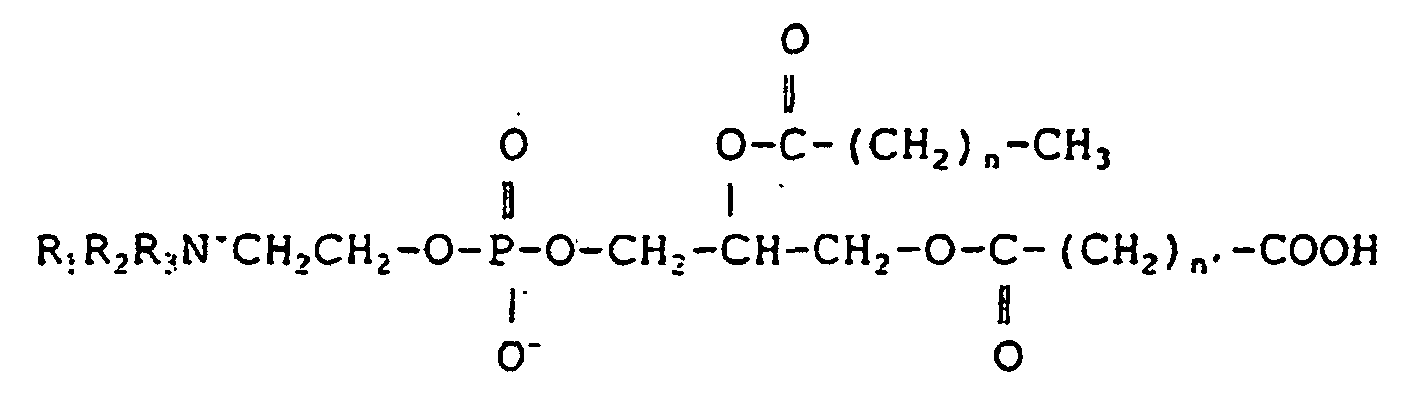
- Still another aspect the invention provides a compound having the following formula:wherein R1, R2 and R3 are individually selected from the group consisting of CH3 and H, R4 is alkyl with less than six carbons, n is 10 to 24, and n' is 10 to 24. In a preferred form both n and n' are 12, each of R1, R2 and R3 are CH3, and R4 is CH2CH2.

- There is a naturally occurring phospholipid in many blood-containing conduits. We have developed a way to stably link this type of phospholipid to a durable substrate (e.g. gold coated glass). The resulting array presents a well ordered monolayer of exposed phospholipid that closely mimics a layer of the naturally occurring material.
- Advantages of the present invention are to provide biomimetic surfaces that can be efficiently produced and which appear to be highly compatible with the human body. Further, such structures appear to be highly durable and stable. It is also an advantage to provide efficient methods for forming such compounds and structures, and intermediates useful for such purposes.
- These and other advantages of the present invention will become apparent after study of the following specification and claims.
-
- Fig. 1 is a schematic of a synthesis of thiol-linked phospholipids of the present invention; and
- Fig. 2 depicts phospholipids arrayed in a monolayer.
-
- For a preferred embodiment, we constructed a phospholipid monolayer on a thin gold surface. The layer is stably bound and resembles (both in terms of structure and functionality) the outer half-plane of a naturally occurring phospholipid bilayer membrane.
- We synthesized thiol-terminated phospholipid from carboxylate-terminate phospholipid, and then built up a biomembrane mimetic surface on gold through chemisorption of thiol-terminated phospholipid on gold substrates. We then confirmed that this self-assembled phospholipid monolayer had close packing and good order on the gold surface.
- In the naturally-occurring system proteins become embedded in a lipid bilayer which consists of two weakly coupled phospholipid monolayers. We therefore adsorbed lipase protein molecules and BSA protein molecules to these structures. The adsorbed lipase molecules retained their native conformation and dispersed uniformly on the surface.
- Monomyristoyl lysolecithin (lyso-PC) and 1-myristoyl-2-12-[(7-nitro-2-1,3-benzoxadiazol-4-yl)amino]dodecanoyl-sn-glycero-3-phosphoethanolamine (NBD-PE) in a CHCl3 solution were purchased from Avanti Polar Lipids, Inc. (Alabaster, Alabama), and dilauroyl-phosphatidylcholine (DLPC) was purchased from Sigma.
- Pseudomonas cepacia lipase (Amano LPL-200S) was obtained from Amano Pharmaceutical Co. (Nagoya, Japan).
- Dicyclohexylcarbodiimide (DCC), 1,12-dodecanedicarboxylic acid, 4-N,N-dimethylaminopyridine (DMAP), carbonyldiimidazole (CDI), 2-aminoethanethiol hydrochloride, 1-hydroxybenzotriazole (HOBT), N,N-diisopropylethylamine (DIEA), 1-[3-(dimethylamino) propyl]3-ethylcabodiimide hydrochloride (EDC) and all anhydrous solvents were purchased from Aldrich Chemical Co.
- The water used throughout the experiment was purified by a Milli-Q system from Millipore Co. with its initial resistivity better than 17 MΩ/cm.
- The DMPC-COOH was synthesized by following the procedure of C. Pidgeon et al., 176 Anal. Biochem. 36 (1989) with minor modifications. Briefly, 10 g (0.038 mole) of 1,12-dodecanedicarboxylic acid was dissolved in 200 mL anhydrous tetrahydrofuran (THF) in a dry 500 mL round bottom flask at 40°C, and 8.1 g (39 mmole) of DCC was dissolved in 20 mL anhydrous THF in a dry beaker.
- The DCC solution was added to the reaction flask dropwise by a pipette while being purged with dry nitrogen, and a white suspension resulted. The reaction flask was then sealed under nitrogen and kept stirring at room temperature for 15 hours. Then, 500 mL of acetone was added and filtered through a sintered glass funnel. The filtrate was slightly cloudy and stored in a refrigerator overnight. The cloudy solution was filtered again and the solid product was collected and dried under vacuum (< 10-4 torr).
- As a result, 3.5 g (∼40% yield) of cyclic dodecanedicarboxylic anhydride was obtained. The product was checked for diacid impurities, which were found to be negligible. Next, 1.0 g of monomyristoyl lysolecithin (2.1 mmol), 1.7 g (7.0 mmol) of dodecanedicarboxylic anhydride, and 0.26 g (2.1 mmol) of DMAP were added into 60 mL of anhydrous chloroform in a flame dried flask. The reaction flask was sealed under nitrogen and kept stirring in the dark at room temperature for 48 hours. Chloroform was removed by roto-evaporation, and 20 mL of methanol was added to dissolve the lecithins.
- After filtration, 300 mL of acetone was added to the methanol solution. The solution was stored in a refrigerator overnight, and the product was collected by filtration and then dried under vacuum. Finally, 1.15 g (∼75% yield) of DMPB-COOH was obtained. The product was checked with 1H-NMR(300 Mhz, CDCl3): δ 5.20 (m, 1H), 4.33 (br, 2H), 4.10 (br, 2H), 3.95 (t, 2H) 3.77 (br, 2H), 3.34 (s, 9H), 2.27 (t, 6H, 1.05-1.35 (br, 42H, 0.87 (t, 3H); and mass spectroscopy showing the molecular ion M+1=709.
- The DMPC-CONHCH2CH2SH was synthesized by following the linking procedure of D. Seebach et al., 79 Helv. Chim. Acta 913 (1996) and M. Bodanszky et al., The Practice of Peptide Synthesis, 119 Springer-Verlag, Berlin (1994), with minor modification. Briefly, 400 mg (0.57 mmol) of 1-myristoyl-2-ω-carboxylmyristoyl-sn-3-glycerophosphocholine (DMPC-COOH), 0.193 g (1.70 mmol) of 2-aminoethanethiol hydrochloride, 0.076 g (0.57 mmol) of 1-hydroxybenzotriazole (HOBT) and 0.2 mL (1.16 mmol) of N,N-diisopropylethylamine (DIEA) were dissolved in 15 mL anhydrous methylene dichloride in a dry 50 mL round bottom flask, the solution is stirred and cooled in an ice-water bath while 0.139g (0.73 mmol) of 1-[3-(dimethylamino) propyl]-3-ethylcabodiimide hydrochloride (EDC) in 5 mL was added and reaction flask was sealed under nitrogen.
- Stirring is continued for 30 minutes at 0°C and additional 48 hours at room temperature. The reaction mixture was then washed with 20 mL of 1.0 N HCl solution for three times to remove any unreacted ethanethiol and DIEA, and subsequently washed with 5% NaHCO3 solution for three times. The organic phase was collected and solvent was removed by rotatory evaporation under reduced pressure at room temperature. The product was dried in a vacuum. As a result, 150 mg of DMPC-CONHCH2CH2SH was obtained. The product was checked with 1H-NMR (300 Mhz, CD3Cl/CD3OD) δ 5.20 (m, 1H), 4.33 (br. 2H), 4.10 (br. 2H), 3.95 (t, 2H), 3.77 (br. 2H), 3.5-3.4 (m, 2H), 3.34 (s, 9H), 2.66 (t, 2H), 2.27 (t, 6H), 1.05-1.35 (br. 42H), 0.87 (t, 3H);
- The gold was deposited in a film layer by sputtering it on the glass slide surface in a thermal metal evaporation device at vacuum of 2×10⁻⁶ torr. The rate of gold evaporation and the film thickness were controlled by a quartz resonance sensor. The condition of gold film preparation were evaporation rate 10 Å/s and annealing time 60 minutes to give a gold film thickness of 470 Å.
- The gold substrate was immersed in a 1 mM solution of DMPC-CONHCH2CH2SH in mixed solvent of methylene chloride and methanol (2:2 v/v) for 24 hours. The resulting substrate was then taken out, washed with mixed solvent of methylene chloride and methanol (2:1 v/v) and dried by nitrogen.
- In our experiment we used a BSA solution (ca. 250 mg/L) in citrate phosphate buffer of phospholipid 7.8 and ionic strength of 0.107M for 1 hours, and then rinsed with water for 1-2 minutes.
- For lipase adsorption, crude lipoprotein lipase LPL 200S, which is mixture of glycine and lipase, from Pseudomonas cepacia was first purified by a Sephadex G-25 fine gel column. See K. Tanaka et al., Langmuir (1999). The percent yield for this purification process was typically 40-50%. This is in agreement with the fact that the unpurified lipase mixture contains approximately 50% glycine by weight. Then, the substrate was soaked in the lipase solution with the concentration of 337/mg/L. After soaking for 4 hours, the substrate was taken out and rinsed in the water for 5 minutes.
- Polarization modulation Fourier transform infrared reflection-adsorption (PM-FT-IRRAS) spectra of 1000 scans at 2 cm-1 resolution were obtained with a Mattson RS-1 spectrometer and a narrow-band HgCdTe-detector.
- The thickness of phospholipid monolayer on gold substrate and absorbed protein were determined with the optical technique of surface plasmon resonance. The surface morphology was analyzed by atomic force microscopy.
- Molecules of thiol-terminated phospholipid were chemisorbed onto a fresh polycrystalline gold surface by immersion for approximately 24 hours in a 1mM solution in mixed methylene and methanol with the ratio of two to one. Immersion of gold substrate for a longer period such as 3 and 4 days, no spectroscopic differences were observed.
- In order to confirm that the phospholipid were indeed chemisorbed on gold surface via the reaction between gold and thiol group of phospholipid, spectroscopy was employed as primary method for monitoring the chemical structure of adsorbed monolayer. After thoroughly rinsing with mixed solvent of methylene and methanol, the measurement was made. We confirmed that the aminoethanthiol molecule had attached to the end of acyl chain of DMPC by the amide linkage. We also observed peaks indicating that the thio-terminated DMPC had already adsorbed on the gold surface.
- Other tests indicated that the thiol-terminated phospholipid was coated on gold surface by chemisorption in a manner which was highly ordered and closely-packed. Still other tests indicated that a conformal monolayer surface is present on gold surface.
- To investigate the interaction between blood protein and lipid SAM on gold surface, an adsorption experiment of BSA on phospholipid monolayer was carried out. The thickness of adsorption layer was measured by surface plasmon resonance. The absorbed BSA thickness on thiol-terminated phospholipid monolayer is only 7 Å. This result suggests that the conformation of BSA molecules is not much perturbed by the lipid monolayer since the phospholipid monolayer provides a native environment similar to the biomembrane. The adsorption of BSA on lipid monolayer was significantly depressed and almost no BSA adsorption occur on such monolayer by comparison with the dimension of BSA molecules.
- Pseudomonas Sp. lipase, a water soluble extrinsic protein was chosen as an study candidate. Lipases in general trend to adsorb into the lipid/water interfaces.
- The above disclosure is merely of the preferred embodiments. For example, the alkyl sections of the phospholipids can be of different sizes. Further, the substrate to which the phospholipid is linked may be gold/silver mixtures, silver, or a ceramic-containing silicon such as silicon dioxide.
- Also, while the preferred substrate is gold that has been sputtered onto a base glass surface, other ways of forming the base layer are possible as well. Thus, the invention is not to be limited to just the preferred embodiments disclosed above. Rather, the claims should be looked to judge the full scope of the invention.
- The present invention provides biomimetic surfaces useful in the formation of medical device surfaces.
Claims (8)
- A compound having the following moiety:wherein each of R1, R2 and R3 are individually selected from the group consisting of CH3 and H;
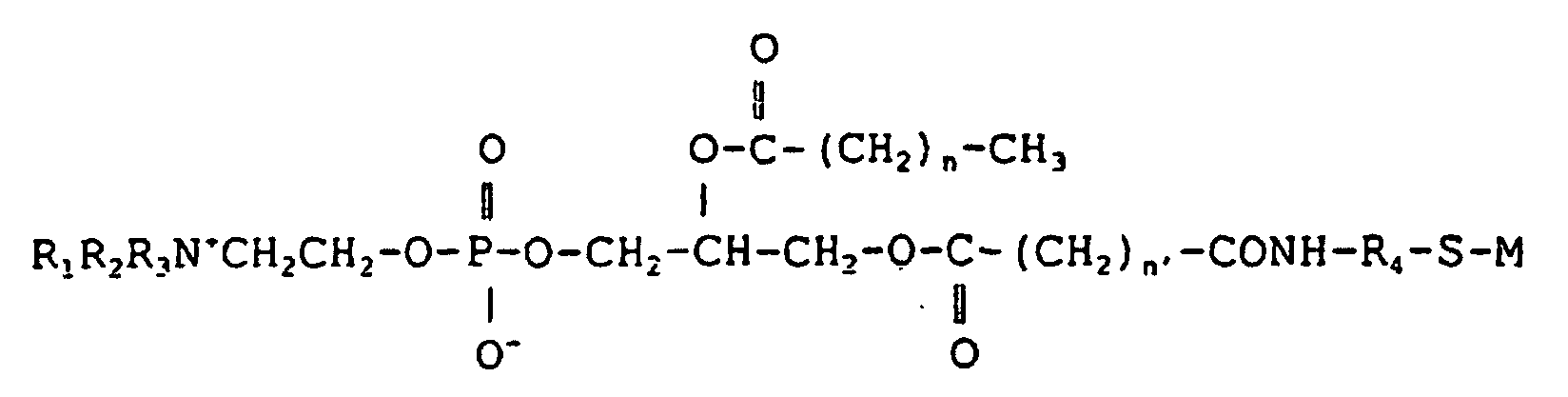
wherein R4 is alkyl with less than six carbon;
wherein n is 10 to 24;
wherein n' is 10 to 24; and
wherein M is chosen from Au and Ag. - The compound of claim 1, wherein both n and n' are 12.
- The compound of claim 1, wherein M is Au.
- The compound of claim 1, wherein each of R1, R2 and R3 are CH3, and R4 is CH2CH2.
- A compound having the following formula:wherein each of R1, R2 and R3 are individually selected from the group consisting of CH3 and H;

wherein R4 is alkyl with less than six carbon;
wherein n is 10 to 24; and
wherein n' is 10 to 24. - The compound of claim 5, wherein both n and n' are 12.
- The compound of claim 5, wherein each of R1 , R2 and R3 are CH3, and wherein R4 is CH2CH2.
- A method of forming a compound of claim 1 comprising:wherein each of R1, R2 and R3 are individually selected from the group consisting of CH3 and H;reacting a compound having the following moiety:with H2N-R4-SH, and then covalently linking the resultant to M;

wherein R4 is alkyl with less than six carbon;
wherein n is 10 to 24;
wherein n' is 10 to 24; and
wherein M is chosen from Au and Ag.
Applications Claiming Priority (3)
| Application Number | Priority Date | Filing Date | Title |
|---|---|---|---|
| US891083 | 2001-06-25 | ||
| US09/891,083 US6486334B1 (en) | 2001-06-25 | 2001-06-25 | Biomembrane mimetic surface coatings |
| PCT/US2002/003673 WO2003000701A1 (en) | 2001-06-25 | 2002-02-07 | Biomembrane mimetic surface coatings |
Publications (2)
| Publication Number | Publication Date |
|---|---|
| EP1399452A1 EP1399452A1 (en) | 2004-03-24 |
| EP1399452B1 true EP1399452B1 (en) | 2005-06-01 |
Family
ID=25397584
Family Applications (1)
| Application Number | Title | Priority Date | Filing Date |
|---|---|---|---|
| EP02780860A Expired - Lifetime EP1399452B1 (en) | 2001-06-25 | 2002-02-07 | Biomembrane mimetic surface coatings |
Country Status (5)
| Country | Link |
|---|---|
| US (1) | US6486334B1 (en) |
| EP (1) | EP1399452B1 (en) |
| AT (1) | ATE296830T1 (en) |
| DE (1) | DE60204459T2 (en) |
| WO (1) | WO2003000701A1 (en) |
Families Citing this family (6)
| Publication number | Priority date | Publication date | Assignee | Title |
|---|---|---|---|---|
| US9274129B2 (en) | 2006-05-31 | 2016-03-01 | Lpath, Inc. | Methods and reagents for detecting bioactive lipids |
| US20080138334A1 (en) | 2006-05-31 | 2008-06-12 | Sabbadini Roger A | Immune-Derived Moieties Reactive Against Bioactive Lipids, and Methods of Making and Using Same |
| US8796429B2 (en) * | 2006-05-31 | 2014-08-05 | Lpath, Inc. | Bioactive lipid derivatives, and methods of making and using same |
| US9274130B2 (en) | 2006-05-31 | 2016-03-01 | Lpath, Inc. | Prevention and treatment of pain using antibodies to lysophosphatidic acid |
| DE102007009009A1 (en) | 2007-02-23 | 2008-08-28 | Fev Motorentechnik Gmbh | Energy storage system for vehicle e.g. aircraft, hybrid system, has direct current regulator assigned to series and/or parallel circuit of energy part storages, where circuit performs storage and dispensing of electrical energy |
| US20090061463A1 (en) * | 2007-05-29 | 2009-03-05 | Wisconsin Alumni Research Foundation | P-Selectin associated with Eosinophils as a marker for asthma and correlating with B-1 integrin activation |
Family Cites Families (2)
| Publication number | Priority date | Publication date | Assignee | Title |
|---|---|---|---|---|
| US5380589A (en) | 1993-04-19 | 1995-01-10 | Wisconsin Alumni Research Foundation | Biotextured surfaces |
| US5801260A (en) * | 1995-06-07 | 1998-09-01 | Lajolla Pharmaceuticals Co. | Carbonothioate phospholipid analogs as substrate of phospholipases and lipases |
-
2001
- 2001-06-25 US US09/891,083 patent/US6486334B1/en not_active Expired - Fee Related
-
2002
- 2002-02-07 DE DE60204459T patent/DE60204459T2/en not_active Expired - Lifetime
- 2002-02-07 AT AT02780860T patent/ATE296830T1/en not_active IP Right Cessation
- 2002-02-07 EP EP02780860A patent/EP1399452B1/en not_active Expired - Lifetime
- 2002-02-07 WO PCT/US2002/003673 patent/WO2003000701A1/en not_active Ceased
Also Published As
| Publication number | Publication date |
|---|---|
| US6486334B1 (en) | 2002-11-26 |
| DE60204459D1 (en) | 2005-07-07 |
| WO2003000701A1 (en) | 2003-01-03 |
| ATE296830T1 (en) | 2005-06-15 |
| DE60204459T2 (en) | 2006-05-11 |
| EP1399452A1 (en) | 2004-03-24 |
Similar Documents
| Publication | Publication Date | Title |
|---|---|---|
| US7494714B2 (en) | Surfaces that resist the adsorption of biological species | |
| EP1078261B1 (en) | Method for immobilising and self-organizing biological macromolecules on carbon nanotubes and uses | |
| US5134192A (en) | Process for activating a polymer surface for covalent bonding for subsequent coating with heparin or the like | |
| Fabianowski et al. | Spontaneous assembly of phosphatidylcholine monolayers via chemisorption onto gold | |
| Chung et al. | Self-assembled biomimetic monolayers using phospholipid-containing disulfides | |
| US20130338044A1 (en) | Bioconjugation using bifunctional linkers | |
| Debrassi et al. | Stability of (bio) functionalized porous aluminum oxide | |
| JPH07508342A (en) | lipid membrane sensor | |
| US6486334B1 (en) | Biomembrane mimetic surface coatings | |
| JP4030867B2 (en) | SUBSTRATE CONTAINING MOLECULAR LAYER PROVIDED WITH ADJUSTED AMINE GROUP DENSITY AND SPACE AND METHOD FOR PRODUCING THE SAME | |
| US7320867B2 (en) | Linker compound, ligand, and producing method thereof | |
| KR20020007083A (en) | A Process for Preparing Monolayer by Using Dendrimer | |
| EP1203047B1 (en) | Electrically conductive polymers capable of being covalently grafted on by light, method for obtaining same and uses as supports in probes for specific identification in electronic biosensors | |
| EP2630494B1 (en) | Method for functionalising surfaces for analyte detection | |
| CA2453303C (en) | Method of functionalizing solid supports | |
| JP2001514375A (en) | Drug discovery support using multiple membrane pseudo-affinity | |
| CA2742093C (en) | Avoidance of non-specific binding on an acoustic wave biosensor using linker and diluent molecules for device surface modification | |
| FR2904784A1 (en) | PROCESS FOR RECOVERING METALLIC AND MINERAL SURFACES BY SELF-ASSEMBLED MONOMOUCHES OF BISPHOSPHONIC COMPOUNDS AND USES THEREOF | |
| EP1248859B1 (en) | Method for synthesising and immobilising nucleic acids on a silanized solid support | |
| JP4526388B2 (en) | Biochip manufacturing method | |
| EP2139999A1 (en) | Method for preparing a substrate for immobilising a cell, said substrate and uses thereof | |
| US20040023304A1 (en) | Biomimetic systems consisting of lipid membranes bound to a substrate | |
| JP3898961B2 (en) | Composite structure comprising porous silica containing amino acid-related residues and method for producing the same | |
| WO2000053310A1 (en) | Method for producing a matrix of sequences of chemical or biological molecules for a chemical or biological analysis device | |
| Tiwari et al. | Effect of Stereochemistry and Hydrophobicity on the Self‐Assembly of Phe‐Phe‐Nucleoside Conjugates |
Legal Events
| Date | Code | Title | Description |
|---|---|---|---|
| PUAI | Public reference made under article 153(3) epc to a published international application that has entered the european phase |
Free format text: ORIGINAL CODE: 0009012 |
|
| 17P | Request for examination filed |
Effective date: 20030701 |
|
| AK | Designated contracting states |
Kind code of ref document: A1 Designated state(s): AT BE CH CY DE DK ES FI FR GB GR IE IT LI LU MC NL PT SE TR |
|
| AX | Request for extension of the european patent |
Extension state: AL LT LV MK RO SI |
|
| GRAP | Despatch of communication of intention to grant a patent |
Free format text: ORIGINAL CODE: EPIDOSNIGR1 |
|
| RIN1 | Information on inventor provided before grant (corrected) |
Inventor name: JIANG, XIQUN Inventor name: STROTHER, CHARLES, M. Inventor name: PARK, SANGWOOK Inventor name: YU, HYUK |
|
| GRAS | Grant fee paid |
Free format text: ORIGINAL CODE: EPIDOSNIGR3 |
|
| GRAA | (expected) grant |
Free format text: ORIGINAL CODE: 0009210 |
|
| AK | Designated contracting states |
Kind code of ref document: B1 Designated state(s): AT BE CH CY DE DK ES FI FR GB GR IE IT LI LU MC NL PT SE TR |
|
| PG25 | Lapsed in a contracting state [announced via postgrant information from national office to epo] |
Ref country code: LI Free format text: LAPSE BECAUSE OF FAILURE TO SUBMIT A TRANSLATION OF THE DESCRIPTION OR TO PAY THE FEE WITHIN THE PRESCRIBED TIME-LIMIT Effective date: 20050601 Ref country code: FI Free format text: LAPSE BECAUSE OF FAILURE TO SUBMIT A TRANSLATION OF THE DESCRIPTION OR TO PAY THE FEE WITHIN THE PRESCRIBED TIME-LIMIT Effective date: 20050601 Ref country code: IT Free format text: LAPSE BECAUSE OF FAILURE TO SUBMIT A TRANSLATION OF THE DESCRIPTION OR TO PAY THE FEE WITHIN THE PRESCRIBED TIME-LIMIT;WARNING: LAPSES OF ITALIAN PATENTS WITH EFFECTIVE DATE BEFORE 2007 MAY HAVE OCCURRED AT ANY TIME BEFORE 2007. THE CORRECT EFFECTIVE DATE MAY BE DIFFERENT FROM THE ONE RECORDED. Effective date: 20050601 Ref country code: AT Free format text: LAPSE BECAUSE OF FAILURE TO SUBMIT A TRANSLATION OF THE DESCRIPTION OR TO PAY THE FEE WITHIN THE PRESCRIBED TIME-LIMIT Effective date: 20050601 Ref country code: BE Free format text: LAPSE BECAUSE OF FAILURE TO SUBMIT A TRANSLATION OF THE DESCRIPTION OR TO PAY THE FEE WITHIN THE PRESCRIBED TIME-LIMIT Effective date: 20050601 Ref country code: NL Free format text: LAPSE BECAUSE OF FAILURE TO SUBMIT A TRANSLATION OF THE DESCRIPTION OR TO PAY THE FEE WITHIN THE PRESCRIBED TIME-LIMIT Effective date: 20050601 Ref country code: CH Free format text: LAPSE BECAUSE OF FAILURE TO SUBMIT A TRANSLATION OF THE DESCRIPTION OR TO PAY THE FEE WITHIN THE PRESCRIBED TIME-LIMIT Effective date: 20050601 |
|
| REG | Reference to a national code |
Ref country code: GB Ref legal event code: FG4D |
|
| RIN1 | Information on inventor provided before grant (corrected) |
Inventor name: PARK, SANGWOOK Inventor name: YU, HYUK Inventor name: JIANG, XIQUN Inventor name: STROTHER, CHARLES, M. |
|
| REG | Reference to a national code |
Ref country code: CH Ref legal event code: EP |
|
| REF | Corresponds to: |
Ref document number: 60204459 Country of ref document: DE Date of ref document: 20050707 Kind code of ref document: P |
|
| REG | Reference to a national code |
Ref country code: IE Ref legal event code: FG4D |
|
| PG25 | Lapsed in a contracting state [announced via postgrant information from national office to epo] |
Ref country code: DK Free format text: LAPSE BECAUSE OF FAILURE TO SUBMIT A TRANSLATION OF THE DESCRIPTION OR TO PAY THE FEE WITHIN THE PRESCRIBED TIME-LIMIT Effective date: 20050901 Ref country code: SE Free format text: LAPSE BECAUSE OF FAILURE TO SUBMIT A TRANSLATION OF THE DESCRIPTION OR TO PAY THE FEE WITHIN THE PRESCRIBED TIME-LIMIT Effective date: 20050901 Ref country code: GR Free format text: LAPSE BECAUSE OF FAILURE TO SUBMIT A TRANSLATION OF THE DESCRIPTION OR TO PAY THE FEE WITHIN THE PRESCRIBED TIME-LIMIT Effective date: 20050901 |
|
| PG25 | Lapsed in a contracting state [announced via postgrant information from national office to epo] |
Ref country code: ES Free format text: LAPSE BECAUSE OF FAILURE TO SUBMIT A TRANSLATION OF THE DESCRIPTION OR TO PAY THE FEE WITHIN THE PRESCRIBED TIME-LIMIT Effective date: 20050912 |
|
| PG25 | Lapsed in a contracting state [announced via postgrant information from national office to epo] |
Ref country code: PT Free format text: LAPSE BECAUSE OF FAILURE TO SUBMIT A TRANSLATION OF THE DESCRIPTION OR TO PAY THE FEE WITHIN THE PRESCRIBED TIME-LIMIT Effective date: 20051107 |
|
| NLV1 | Nl: lapsed or annulled due to failure to fulfill the requirements of art. 29p and 29m of the patents act | ||
| REG | Reference to a national code |
Ref country code: CH Ref legal event code: PL |
|
| PG25 | Lapsed in a contracting state [announced via postgrant information from national office to epo] |
Ref country code: IE Free format text: LAPSE BECAUSE OF NON-PAYMENT OF DUE FEES Effective date: 20060207 |
|
| PG25 | Lapsed in a contracting state [announced via postgrant information from national office to epo] |
Ref country code: LU Free format text: LAPSE BECAUSE OF NON-PAYMENT OF DUE FEES Effective date: 20060228 Ref country code: MC Free format text: LAPSE BECAUSE OF NON-PAYMENT OF DUE FEES Effective date: 20060228 |
|
| ET | Fr: translation filed | ||
| PLBE | No opposition filed within time limit |
Free format text: ORIGINAL CODE: 0009261 |
|
| STAA | Information on the status of an ep patent application or granted ep patent |
Free format text: STATUS: NO OPPOSITION FILED WITHIN TIME LIMIT |
|
| 26N | No opposition filed |
Effective date: 20060302 |
|
| REG | Reference to a national code |
Ref country code: IE Ref legal event code: MM4A |
|
| PG25 | Lapsed in a contracting state [announced via postgrant information from national office to epo] |
Ref country code: TR Free format text: LAPSE BECAUSE OF FAILURE TO SUBMIT A TRANSLATION OF THE DESCRIPTION OR TO PAY THE FEE WITHIN THE PRESCRIBED TIME-LIMIT Effective date: 20050601 |
|
| PG25 | Lapsed in a contracting state [announced via postgrant information from national office to epo] |
Ref country code: CY Free format text: LAPSE BECAUSE OF FAILURE TO SUBMIT A TRANSLATION OF THE DESCRIPTION OR TO PAY THE FEE WITHIN THE PRESCRIBED TIME-LIMIT Effective date: 20050601 |
|
| PGFP | Annual fee paid to national office [announced via postgrant information from national office to epo] |
Ref country code: GB Payment date: 20090204 Year of fee payment: 8 |
|
| PGFP | Annual fee paid to national office [announced via postgrant information from national office to epo] |
Ref country code: FR Payment date: 20090213 Year of fee payment: 8 |
|
| PGFP | Annual fee paid to national office [announced via postgrant information from national office to epo] |
Ref country code: DE Payment date: 20100219 Year of fee payment: 9 |
|
| GBPC | Gb: european patent ceased through non-payment of renewal fee |
Effective date: 20100207 |
|
| REG | Reference to a national code |
Ref country code: FR Ref legal event code: ST Effective date: 20101029 |
|
| PG25 | Lapsed in a contracting state [announced via postgrant information from national office to epo] |
Ref country code: FR Free format text: LAPSE BECAUSE OF NON-PAYMENT OF DUE FEES Effective date: 20100301 |
|
| PG25 | Lapsed in a contracting state [announced via postgrant information from national office to epo] |
Ref country code: GB Free format text: LAPSE BECAUSE OF NON-PAYMENT OF DUE FEES Effective date: 20100207 |
|
| REG | Reference to a national code |
Ref country code: DE Ref legal event code: R119 Ref document number: 60204459 Country of ref document: DE Effective date: 20110901 |
|
| PG25 | Lapsed in a contracting state [announced via postgrant information from national office to epo] |
Ref country code: DE Free format text: LAPSE BECAUSE OF NON-PAYMENT OF DUE FEES Effective date: 20110901 |