EP1398939A1 - Procédé et serveur d'attibution de ressources d'un réseau local à un terminal, per discrimination de type - Google Patents
Procédé et serveur d'attibution de ressources d'un réseau local à un terminal, per discrimination de type Download PDFInfo
- Publication number
- EP1398939A1 EP1398939A1 EP03291788A EP03291788A EP1398939A1 EP 1398939 A1 EP1398939 A1 EP 1398939A1 EP 03291788 A EP03291788 A EP 03291788A EP 03291788 A EP03291788 A EP 03291788A EP 1398939 A1 EP1398939 A1 EP 1398939A1
- Authority
- EP
- European Patent Office
- Prior art keywords
- network
- terminals
- terminal
- networks
- server
- Prior art date
- Legal status (The legal status is an assumption and is not a legal conclusion. Google has not performed a legal analysis and makes no representation as to the accuracy of the status listed.)
- Granted
Links
- 238000000034 method Methods 0.000 title claims description 26
- 230000004069 differentiation Effects 0.000 title 1
- 208000033126 Colobomatous microphthalmia Diseases 0.000 claims description 78
- 208000034367 isolated with coloboma microphthalmia Diseases 0.000 claims description 78
- 238000009434 installation Methods 0.000 claims description 19
- 230000003247 decreasing effect Effects 0.000 claims description 3
- 230000006870 function Effects 0.000 claims description 3
- 230000002093 peripheral effect Effects 0.000 description 7
- 230000008901 benefit Effects 0.000 description 4
- 230000007423 decrease Effects 0.000 description 2
- 229920001690 polydopamine Polymers 0.000 description 2
- 230000005540 biological transmission Effects 0.000 description 1
- 238000006243 chemical reaction Methods 0.000 description 1
- 238000007726 management method Methods 0.000 description 1
- 238000013468 resource allocation Methods 0.000 description 1
- 230000005641 tunneling Effects 0.000 description 1
Images
Classifications
-
- H—ELECTRICITY
- H04—ELECTRIC COMMUNICATION TECHNIQUE
- H04L—TRANSMISSION OF DIGITAL INFORMATION, e.g. TELEGRAPHIC COMMUNICATION
- H04L63/00—Network architectures or network communication protocols for network security
- H04L63/04—Network architectures or network communication protocols for network security for providing a confidential data exchange among entities communicating through data packet networks
- H04L63/0428—Network architectures or network communication protocols for network security for providing a confidential data exchange among entities communicating through data packet networks wherein the data content is protected, e.g. by encrypting or encapsulating the payload
-
- H—ELECTRICITY
- H04—ELECTRIC COMMUNICATION TECHNIQUE
- H04W—WIRELESS COMMUNICATION NETWORKS
- H04W12/00—Security arrangements; Authentication; Protecting privacy or anonymity
- H04W12/03—Protecting confidentiality, e.g. by encryption
-
- H—ELECTRICITY
- H04—ELECTRIC COMMUNICATION TECHNIQUE
- H04W—WIRELESS COMMUNICATION NETWORKS
- H04W28/00—Network traffic management; Network resource management
- H04W28/16—Central resource management; Negotiation of resources or communication parameters, e.g. negotiating bandwidth or QoS [Quality of Service]
- H04W28/18—Negotiating wireless communication parameters
-
- H—ELECTRICITY
- H04—ELECTRIC COMMUNICATION TECHNIQUE
- H04W—WIRELESS COMMUNICATION NETWORKS
- H04W12/00—Security arrangements; Authentication; Protecting privacy or anonymity
- H04W12/60—Context-dependent security
- H04W12/69—Identity-dependent
- H04W12/71—Hardware identity
-
- H—ELECTRICITY
- H04—ELECTRIC COMMUNICATION TECHNIQUE
- H04W—WIRELESS COMMUNICATION NETWORKS
- H04W4/00—Services specially adapted for wireless communication networks; Facilities therefor
- H04W4/06—Selective distribution of broadcast services, e.g. multimedia broadcast multicast service [MBMS]; Services to user groups; One-way selective calling services
- H04W4/08—User group management
-
- H—ELECTRICITY
- H04—ELECTRIC COMMUNICATION TECHNIQUE
- H04W—WIRELESS COMMUNICATION NETWORKS
- H04W72/00—Local resource management
- H04W72/04—Wireless resource allocation
-
- H—ELECTRICITY
- H04—ELECTRIC COMMUNICATION TECHNIQUE
- H04W—WIRELESS COMMUNICATION NETWORKS
- H04W84/00—Network topologies
- H04W84/02—Hierarchically pre-organised networks, e.g. paging networks, cellular networks, WLAN [Wireless Local Area Network] or WLL [Wireless Local Loop]
- H04W84/10—Small scale networks; Flat hierarchical networks
- H04W84/12—WLAN [Wireless Local Area Networks]
Definitions
- the invention relates to the field of communications between terminals. within networks, and more particularly the allocation of resources from a local network to terminals.
- WLANs for “Wireless LANs”.
- LANs Local Area Networks
- WLANs for “Wireless LANs”.
- Some local networks also allow users authorized, to access other communications networks, such as example of public Internet / IP type data networks and / or public telephone networks of the PSTN or PSTN type.
- the local network generally belongs to the owner of the private network to which it is linked.
- the owner When the owner is a business, it allows people empowered, generally some of its employees, to remotely access corporate network terminals, and therefore to some of its data, and sometimes to the services made available within said corporate network.
- the owner In order to secure company data, only benefit from this possibility people who have a terminal configured to establish encrypted communications in a format chosen, with the local network and the corporate network.
- the invention therefore aims to remedy this drawback.
- a processing server dedicated to allocation resources from a local network to user terminals, and intended for be connected to at least one access point of this local network, by wire (for example using an Ethernet link) or by waves (for example to using an 802.11b radio link).
- This server is characterized by the fact that it includes means of control allowing, on the one hand, to classify the terminals, which try to establish communication with the local network, first or second group depending on whether this communication is or is not encrypted in at least a chosen format, and secondly, to allocate network resources local (including physical) to terminals that attempt to establish a communication with the latter, according to their classification in one of the first and second groups.
- control means are arranged so to determine the MAC address (for “Medium Access Control”) of each terminal attempting to establish communication with the local network, and the server includes means for assigning an IP address to the terminal whose MAC address has been determined.
- These means of allocation are preferably of the DHCP type (for “Dynamic Host Configuration Protocol ”).
- the server also includes a memory storing a table that contains primary MAC addresses associated with first terminals arranged so as to exchange data frames encrypted according to the chosen format.
- This table can also contain secondary MAC addresses associated with second terminals arranged so as to exchange unencrypted data frames.
- the control means are then preferably arranged to to determine whether a MAC address extracted from a received frame is a primary or rather secondary MAC address. If so, the means of control send the allocation means a request for allocation to the terminal corresponding to the primary or secondary MAC address, of a primary IP address which will allow it to establish a link with at least one first or at least a second remote network. However, in the negative, the control means send the allocation means a request for allocation to the terminal corresponding to the extracted MAC address, which is then called third terminal, from a secondary IP address making it possible to establish a link with at least one second remote network.
- the first terminals are attached to the first remote network, which is possibly connected to at least one second remote network.
- second remote network are, for example, corporate terminals, such as portable microcomputers allocated to company employees.
- the second terminals preferentially belong to known users of the first remote network. These are, for example, mobile phones belonging to employees of the company or to people attached to it.
- each first remote network is preferably chosen from a group comprising private networks, IP data networks and telephone networks (PSTN or other), and each second remote network is preferably chosen from a group including IP data networks and telephone networks (PSTN or other).
- control means can be arranged to assign at least two levels of priority for allocating local network resources depending on whether the communication is or is not encrypted in the chosen format.
- the means of control can also be arranged to assign at least a third level of allocation priority local network resources, for example to third terminals which establish unencrypted communications and whose MAC address does not belong to the table. Other levels higher than the third may also be considered according to the needs of the application.
- the priority levels relate at least to the bandwidth allocated to terminals, which can, for example example, decreasing from the first level to the third level, so that the first terminals are preferred.
- the means of control can dynamically change the allocation of bandwidths busy (or any other priority level), taking into account traffic (or resources available). So when traffic is low, a second level can be replaced by a first level and a third level can be replaced by a second level, and when traffic is very low, a third level can be replaced by a first level. The reverse is also possible when traffic is very high, a first level can be replaced by a second level, or even a third level, or a second level can be replaced by a third level.
- priority levels can also relate to rights access to local or remote databases, and in particular to audio and / or video data, for example in the context of type applications "Video on demand", or access rights to resources physical devices such as dedicated terminals or printers.
- the server according to the invention can for example be integrated into a router in order to hide the address plan of the first remote network (for example the private network of a company). But it can also be integrated in an access point.
- the invention also relates to a communications installation.
- a communications installation comprising at least one local network, for example of the wireless type (WLAN), accessible via one or more access points, at least a first network remote, at least a second remote network, as well as a processing server of the type presented above and coupled to at least one of the points and to said first and second remote networks.
- WLAN wireless type
- the processing server is preferably coupled to the first remote network via a virtual private network (or VPN for "Virtual Private Network”). But as a variant, it could be coupled with first remote network via a remote access server (or RAS for "Remote Access Server ”).
- a virtual private network or VPN for "Virtual Private Network”
- RAS Remote Access Server
- the invention further relates to a method for allocating resources. from a local network to user terminals, via at least one point consistent, when a terminal tries to establish a connection with the local network, on the one hand, to classify this terminal in a first or a second group depending on whether the link is encrypted in at least one format chosen, and on the other hand, to allocate local network resources to the terminal according to their classification in one of the first and second groups.
- a terminal when a terminal attempts to establish a connection with the local network, determine its MAC address, then assign an address IP at the terminal that has this MAC address.
- this table also contains secondary MAC addresses associated with second terminals arranged so as to exchange unencrypted data frames.
- an address MAC extracted from a received frame is a primary MAC address or secondary, and if so assign to the terminal corresponding to this primary or secondary MAC address, a primary IP address allowing it establish a link with at least a first remote network or at least one second remote network, and if not assign to the corresponding terminal to the MAC address, called the third terminal, a secondary IP address making it possible to establish a link with at least one second remote network.
- the MAC addresses of the table are stored in match at least one priority level, a first level of priority can then be assigned to the first terminals associated with primary MAC addresses and a second priority level that can be assigned second terminals associated with secondary MAC addresses.
- the priority levels relate at least to the bandwidth allocated to terminals, which can, for example example, decrease from the first level to the third level. But, the allocation of widths can also change dynamically, account given the traffic (or available resources).
- the invention can be implemented in public networks of PSTN (or PSTN), PLMN communications, and in particular in public communications networks for mobile equipment chosen from GSM, GPRS and UMTS networks, as well as in selected private networks among PABX and private communication gateways (better known as the English expression "Residential gateway") which can implement fixed and wireless access such as WLAN, Bluetooth or UWB (for "Ultra Wide Band ”).
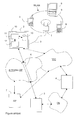
- the installation illustrated in the single figure firstly includes a CN private network and at least one WLAN local network, owned by example to a group of companies, a public PSTN telephone network, belonging to a telephone operator, and a public data network INTERNET / IP.
- the local WLAN network includes one or more access points 1, connected to a peripheral router (or “edge router”) 2, itself connected to the public PSTN telephone network and to the public data network INTERNET / IP.
- the access point 1 is connected to the peripheral router 2 by a cable 3, preferably of the Ethernet type.
- the connection could be made by waves, by example by an 802.11b radio link.
- the CN private network is connected, on the one hand, to the network PSTN public via a corporate server (or "Gateway") 4, and on the other hand, to the peripheral router 2, via an IP 5 router, with proxy or firewall functionality, and public INTERNET / IP data network, preferably via a link VPN 6 (for “Virtual Private Network”) ensuring the security of data by tunneling.
- VPN 6 for “Virtual Private Network”
- an intermediate server of the RAS type for “Remote Access Server ” possibly coupled to a Gateway type router.
- the installation also includes one or more routers (or gateway) 7, of infrastructures belonging to access providers to Internet (ISP), and each connected to the public PSTN telephone network and public INTERNET / IP data network.
- ISP Internet
- the local network is preferably of the wireless type (or WLAN for "Wireless Local Area Network”), but in variants it could be Bluetooth or UWB type (for “Ultra Wide Band”), or wired type (or LAN for "Local Area Network”).
- the CN private network is example of PABX type (for “Private Automatic Branch Exchange”), possibly wireless (if it uses the DECT standard).
- the network of telephony is preferably switched (or PSTN for "Network Switched Telephone ”, or PSTN for“ Public Switched Telephony Network "), but in a variant it could be a network PLMN type public (for "Public Land Mobile Network”), such as example GSM, GPRS and UMTS networks.
- the invention is not not limited to these types of networks alone, nor to the number of networks chosen. We could thus make several private networks coexist, each with a or several local networks, several public data networks and several public telephone networks, or only several networks public data and several public telephone networks.
- the invention is intended to enable people, who have a communications terminal 8 equipped with a removable (W) LAN card 9 or integrated, to access one or more networks of the installation, called networks distant, under conditions which will be described later, when they are are placed in the coverage area of a local WLAN network.
- a communications terminal 8 equipped with a removable (W) LAN card 9 or integrated
- the communications terminals 8 are for example portable telephones (or mobile), portable (or mobile) microcomputers, or assistants personal digital (or PDA).
- Each communications terminal 8 has a MAC address (for “Medium Access Control” - level 2 of OSI model), which is usually placed in the header of data it transmits.
- a first type consists of mobile terminals 8a which belong (or are attached) to the company to which the local WLAN network belongs and the CN private network.
- these terminals 8a are generally portable microcomputers equipped with a WLAN card 9 configured to allow the exchange of encrypted data with one access points 1 of the local WLAN network, according to a first format, as well than with the CN private network, in a second format.
- the first and second formats are usually different because it is usually expected that the access point itself encrypts the data frames received from a terminal 8a using an algorithm and a key provided to it by the manager from the CN private network.
- the MAC addresses of these terminals 8a called primary, are also known to the company and stored on a server of the CN private network.
- a second type consists of mobile terminals 8b which generally belong to employees of the company or to persons outsiders working for the company, such as consultants. These terminals 8b are generally portable telephones provided with a integrated WLAN card. However, this card is not configured to allow the exchange of encrypted data with one of the access points 1 of the WLAN local network, or with the CN private network. MAC addresses of these terminals 8b, called secondary, are however known to the company and stored in the aforementioned server of the private network CN.
- a third type consists of mobile terminals 8c which belong to people outside the company. These 8c terminals are mobile phones, PDAs or microcomputers, equipped a WLAN card. However, this card is not configured to allow the exchange of encrypted data with one of the access points 1 of the WLAN local network, or with the CN private network. MAC addresses of these 8c terminals, called tertiary, are completely unknown to the company.
- a processing server is provided 10, preferably located in the peripheral router 2. As a variant, it could be installed in one of the access points of the local WLAN network.
- a terminal 8 When a terminal 8 (a-c) is placed in the coverage area of the local WLAN network and wants to establish a connection with a network remote from the installation, it transmits a request to access point 1 connection, in the form of a data frame comprising in its header its MAC address. If the terminal is a first terminal 8a, the frames which it sends are already encrypted in a first format. Upon receipt of this encrypted frame, the access point 1 determines or verifies the algorithm that it must apply with the key given to it by the private network manager CN, to transform it into an encrypted frame according to a second format.
- this determination may be based on the content of the frame header, but this is not mandatory.
- the access point 1 does not determine, or does not verify, necessarily the algorithm that it must apply to the frames received from data contained in these frames.
- the frames encrypted according to the first format and the same frames not encrypted are processed by parallel processes.
- the access point 1 Once the access point 1 has encrypted the frame according to the second format, it transmits it to the processing server 2.
- the terminal is a second 8b or third 8c terminal, the frames it sends are not encrypted. Therefore, as soon as that the access point 1 receives the frames from these terminals, it transmits them to the processing server 2.
- the processing server 10 includes a control module 11 which analyzes each data frame transmitted by the access point 1. More specifically, this control module 11 determines whether the frame is encrypted or no, according to the second format. If this is the case, the control module 11 classifies the terminal which issued it in a first group corresponding to the first terminals 8a, which are authorized to access the CN private network and the different public networks, here PSTN and Internet / IP. Otherwise, it classifies the terminal that issued it in a second group corresponding to second 8b or third 8c terminals, which are not a priori authorized only to access the different public networks, here PSTN and Internet / IP.
- control module 11 allocates, without allocating them, resources of the local WLAN network at the terminal which tries to establish a communication (or link) with remote networks, depending on its classification in the first or second group.
- the processing continues with the transmission of instructions by the control module 11 to the access point 1, to which the terminal 8 which made the connection request is connected, involving a request for allocation of resources from a first or second type at the terminal depending on whether it is a first terminal 8a or a second 8b or third terminal 8c.
- the first terminals 8a are allocated a large bandwidth
- the second 8b or third 8c terminals are allocated narrow bandwidth.
- the first terminals 8a can then establish, in a conventional manner, a connection with any of the remote networks (CN private network, Internet / IP data network or PSTN telephone network), while second 8b and third 8c terminals cannot establish a connection than with the Internet / IP data network or the PSTN telephone network, as if they had connected directly to the peripheral router 2.
- the remote networks CN private network, Internet / IP data network or PSTN telephone network
- the priority levels may relate to other parameters than bandwidth. It could be access rights to databases local or remote data, including databases stock market or weather information, or audio and / or video, by example for “video streaming” or “video” type applications on demand ”, or to rights of access to physical resources such as dedicated terminals or printers.
- the control module 11 is arranged to determine in the frame, which is initially supplied to it by the access point 1, during a connection request by a terminal 8, and after having determined if it was encrypted or not, the MAC address contained in its header. Once this has been determined, terminal 8 can send a request assigning IP address to the processing server 10.
- a DHCP allocation module allows you to automatically distribute an IP address to a terminal (or equipment) who wants to interact with equipment located outside a local network. It generally constitutes a superset of BOOTP.
- the IP address unlike the Internet address, makes it possible to really identify (physically) a terminal. It usually consists of 4 numbers included in the range [0-255], and separated by periods. The reconciliation between an IP address and an Internet address is usually done by a DNS type name server (for “Domain Name System”).
- the terminal can then communicate with equipment located in the remote networks, if enabled.
- the processing server 11 comprises a memory 13 in which a table containing MAC addresses is stored primary associated with first terminals 8a, as well as, preferably, secondary MAC addresses associated with second terminals 8b.
- This table was provided to him by the CN private network manager, preferably via the VPN link 6.
- all the management information for configuring the processing server 10 are transmitted by the CN private network manager, preferably via the VPN link 6.
- the control module 11 can access the memory 13 in order to check if the MAC address it determined in the header of the received frame is a primary, secondary or tertiary MAC address (if it belongs to a third terminal 8c whose MAC address is unknown).
- the control module 11 sends a request to the allocation module 12 to him asking to assign to this terminal a primary IP address (or IP address which will allow it to establish a link with one of the networks remote to which the local network is connected via the peripheral router 2, y including the CN corporate network.
- the control module 11 addresses the module assignment 12 a request asking it to assign this terminal a secondary IP address (or non-company IP address) enabling it to establish a connection to the Internet / IP network via the infrastructure 7 of its supplier access or with the PSTN telephone network, possibly via a server access, not with the CN corporate network since is not empowered by it.
- control module 11 can also be arranged to so that you can assign multiple priority levels of allocation WLAN local network resources depending on whether communication is or is not encrypted in the second format.
- the objective is indeed to favor first terminals 8a relative to the second terminals 8b, and the second terminals 8b with respect to third terminals 8c.
- each primary and secondary MAC address of the table is stored in correspondence with a priority level.
- the table can by example be subdivided into two parts one containing the MAC addresses primary, associated with a first level of priority, the other containing the secondary MAC addresses, associated with a second priority level.
- the third terminals 8c associated with a tertiary MAC address (unknown), are automatically assigned a third level of priority.
- the priority levels relate at least to the bandwidth which is allocated to the terminals 8.
- the bandwidth decreases from the first level to the third level, so as to favor the first terminals 8a belonging to the company compared to the second terminals 8b belonging to employees of the company, or attached to it, and the second terminals 8b by report to third terminals 8c belonging to foreign persons to the company.
- the priority level that is assigned to a terminal 8 is communicated to the access point 1 which is the equipment of the local WLAN network responsible for allocating its resources.
- the control module 11 is preferably able to dynamically change the level of priority it assigns to terminal 8 based on the information contained in the address table. For example, if the control module 11 has assigned to a second terminal 8b a second priority level (for example corresponding to an intermediate bandwidth), and that network traffic local WLAN is weak or moderate (which corresponds to many resources available), he may decide to change this second level to a first level (for example corresponding to the highest bandwidth large). Under the same traffic conditions, the control module 11 may also decide to change a third priority level assigned to a third terminal 8c in a second level. In addition, if the traffic of the WLAN local network is very weak (which corresponds to very many resources available), the control module 11 can decide to change a third priority level assigned to a third terminal 8c in a first level.
- a second priority level for example corresponding to an intermediate bandwidth
- a first level for example corresponding to the highest bandwidth large
- the control module 11 may also decide to change a third priority level assigned to a third terminal 8c in a
- the control module 11 can be arranged so as to be able to change a first level of priority, assigned to a first terminal 8a, in a second level, or even a third level (corresponding to the least wide bandwidth). Of even, it can change a second level of priority, assigned to a second terminal 8b, in a third level.
- control module can order the access point to allocate, to the terminal with this address MAC, resources corresponding to the associated profile.
- the control module 11 can, if it is a first 8a or a second terminal 8b, of microcomputer type, conventionally access either the CN private network, via proxy router 5, or Internet / IP data network, via VPN link 6.
- Proxy router 5 requests generally the terminal user to identify himself by his login and his word password. If the first 8a or second 8b terminal is a mobile phone, it is conventionally routed to the gateway 4 server of the company in order to be connected to the PSTN telephone network or directly at the terminal of an employee of the company (via the network of internal telephony). If the calling user only transmits a single name, its call can be handled by a corporate server, such as DNS (for "Domain Name System"), or by a corporate directory (or directory), LDAP type (for "Lightweight Directory Access Protocol").
- DNS for "Domain Name System”
- LDAP type for "Lightweight Directory Access Protocol"
- the terminal is a third terminal 8c, of microcomputer type, it can only conventionally access the Internet / IP data network, via the infrastructure 7 of its usual access provider (ISP). It can for this purpose use your browser. During the user identification phase of the third terminal 8c, by the ISP, the latter can decide to change the address Secondary IP previously assigned by the assignment module 12.
- ISP access provider
- the terminal is a third terminal 8c, of the telephone type portable, two cases can be considered.
- the 8c phone is of type GSM (or GPRS or UMTS) and has an integrated local directory
- the router device 2 gives it a “media-gateway” type characteristic (for example example according to the MGCP standard for "Media Gateway Control Protocol", of the IETF) which allows him to directly access the telephone network RTC.
- the call is routed by the peripheral router 2 to the infrastructure 7 of the user's access provider (ISP), which processes it in classically performing, for example, a name conversion, a connection to the PSTN telephone network, and the like.
- ISP user's access provider
- control module 11 and the allocation module 12 of the server treatment 10 according to the invention can be carried out in the form of circuits electronic, software (or computer) modules, or a combination circuits and software.
- the invention also provides a method for allocating resources. from a local area network WLAN (or LAN) to user terminals 8, via at minus an access point 1.
- WLAN local area network
- This process consists, when a terminal 8 tries to establish a connection with the local WLAN, on the one hand, to classify it in a first or a second group depending on whether the link is encrypted in at least one format chosen, and secondly, to allocate local network resources to it WLAN according to its classification in one of the first and second groups.
- a terminal 8 when a terminal 8 attempts to establish a connection with the local WLAN, we determine its MAC address, then we assigns an IP address.
- MAC address extracted from a received frame is a MAC address primary or secondary, and if so assign to terminal 8 (a, b) corresponding to this primary or secondary MAC address, an IP address primary allowing it to establish a link with at least one first network remote or at least one second remote network, and if not assign to terminal 8c corresponding to the MAC address, called the third terminal, a secondary IP address allowing it to establish a link with at least one second remote network.
- At least two priority levels can be assigned allocation of WLAN local network resources, depending on whether the communication is encrypted in the chosen format or not.
- the MAC addresses of the table are stored in match at least one priority level, a first level of priority can then be assigned to the first terminals 8a associated with primary MAC addresses and a second priority level that can be assigned to the second terminals 8b associated with secondary MAC addresses.
- We can also assign a third priority level of allocation of local network resources at third terminals 8c.
- the invention it is now possible to allow people who are not, a priori, authorized to access networks remote connected to a local network, LAN or WLAN type, to access despite everything to at least some of these remote networks, provided that the local network has enough resources available. This access can be free or paid. This significantly enhances the mobility of communications terminals. In addition, it allows owners to local networks to make available to all potential users a means of access to data or telephone networks. So, localities which do not have good radio coverage can, in setting up a local network at moderate cost, allowing all users who wish to connect to the network of their telephone operator, even the Internet.
- the invention makes it possible to establish priority levels allocation of local network resources, or even profiles specific allocation of resources, regardless of the type of resource considered, including physical resources such as printers or database access terminal.
- the invention can relate to any other level of priority relating to the procedures for the allocation of local network resources, including physical resources such as printers or terminals providing access to databases of all types, including stock market information or weather,
- wireless WLAN type
- the invention also applies to networks Bluetooth or UWB type premises, as well as LAN type local networks.
- the local network belonged to a company or a group of companies with a private network (or first remote network) coupled to said local network.
- the invention also relates to local area networks which are not coupled to private networks.
- the local network can only be coupled to one or more data networks (or first or second remote network) and / or one or more telephone networks (or first or second network remote).
- a processing server has been described located in a router. But the processing server can also be installed in a local network access point.
Landscapes
- Engineering & Computer Science (AREA)
- Computer Security & Cryptography (AREA)
- Computer Networks & Wireless Communication (AREA)
- Signal Processing (AREA)
- Computer Hardware Design (AREA)
- Computing Systems (AREA)
- General Engineering & Computer Science (AREA)
- Quality & Reliability (AREA)
- Small-Scale Networks (AREA)
- Data Exchanges In Wide-Area Networks (AREA)
- Mobile Radio Communication Systems (AREA)
- Communication Control (AREA)
Abstract
Description
Claims (44)
- Serveur de traitement (10) pour l'attribution de ressources d'un réseau local (WLAN) à des terminaux d'utilisateurs (8), ledit serveur étant destiné à être couplé à au moins un point d'accès (1) audit réseau local, caractérisé en ce qu'il comporte des moyens de contrôle (11) agencés pour i) classer des terminaux (8) dans un premier ou un second groupe selon qu'ils sont propres à établir ou non avec ledit réseau local (WLAN) des communications cryptées dans au moins un format, et ii) attribuer des ressources dudit réseau local (WLAN) à des terminaux (8), tentant d'établir une communication avec celui-ci, en fonction de leur classement dans l'un desdits premier et second groupes.
- Serveur selon la revendication 1, caractérisé en ce que lesdits moyens de contrôle (11) sont agencés pour déterminer l'adresse MAC de chaque terminal (8) tentant d'établir une communication avec ledit réseau local (WLAN), et en ce qu'il comprend des moyens (12) pour attribuer une adresse IP audit terminal (8) possédant ladite adresse MAC déterminée.
- Serveur selon la revendication 2, caractérisé en ce que lesdits moyens d'attribution (12) sont de type DHCP.
- Serveur selon la revendication 2, caractérisé en ce qu'il comprend une mémoire (13) dans laquelle est stockée une table contenant des adresses MAC primaires associées à des premiers terminaux (8a) agencés de manière à échanger des trames de données cryptées selon ledit format.
- Serveur selon la revendication 4, caractérisé en ce que ladite table contient des adresses MAC secondaires associées à des seconds terminaux (8b) agencés de manière à échanger des trames de données non cryptées.
- Serveur selon la revendication 4, caractérisé en ce que lesdits moyens de contrôle (11) sont agencés pour déterminer si une adresse MAC extraite d'une trame reçue est une adresse MAC primaire ou secondaire, et dans l'affirmative, pour adresser aux moyens d'attribution (12) une requête d'attribution au terminal (8b), correspondant à ladite adresse MAC primaire ou secondaire, d'une adresse IP primaire destinée à lui permettre d'établir une liaison avec au moins un premier et un second réseaux distants, et dans la négative adresser aux moyens d'attribution (12) une requête d'attribution au terminal (8c), correspondant à ladite adresse MAC, dit troisième terminal, d'une adresse IP secondaire destinée à lui permettre d'établir une liaison avec au moins un second réseau distant.
- Serveur selon la revendication 4, caractérisé en ce que lesdits premiers terminaux (8a) sont rattachés audit premier réseau distant.
- Serveur selon la revendication 7, caractérisé en ce que lesdits seconds terminaux (8b) appartiennent à des utilisateurs connus dudit premier réseau distant.
- Serveur selon la revendication 6, caractérisé en ce que chaque premier réseau distant est choisi dans un groupe comprenant les réseaux privés, les réseaux de données IP et les réseaux de téléphonie (RTC), et en ce que chaque second réseau distant est choisi dans un groupe comprenant les réseaux de données IP et les réseaux de téléphonie (RTC).
- Serveur la revendication 1, caractérisé en ce que lesdits moyens de contrôle (11) sont agencés pour attribuer au moins deux niveaux de priorité d'allocation de ressources du réseau local (WLAN) selon que ladite communication est ou non cryptée dans ledit format.
- Serveur selon la revendication 10, caractérisé en ce que les adresses MAC de ladite table sont stockées en correspondance d'au moins un niveau de priorité.
- Serveur selon la revendication 11, caractérisé en ce que lesdits niveaux de priorité comprennent au moins un premier niveau de priorité attribué aux premiers terminaux (8a) associés à des adresses MAC primaires et un second niveau de priorité attribué aux seconds terminaux (8b) associés à des adresses MAC secondaires.
- Serveur selon la revendication 12, caractérisé en ce que lesdits moyens de contrôle (11) sont agencés pour attribuer un troisième niveau de priorité d'allocation de ressources du réseau local auxdits troisièmes terminaux (8c) établissant des communications non cryptées dans ledit format et dont l'adresse MAC n'appartient pas à ladite table.
- Serveur selon la revendication 11, caractérisé en ce que lesdits niveaux de priorité portent au moins sur une largeur de bande passante, ladite largeur décroissant du premier niveau vers le troisième niveau.
- Serveur selon la revendication 14, caractérisé en ce que lesdits moyens de contrôle (11) sont agencés pour transmettre audit point d'accès (1) des données représentatives de ladite bande passante attribuée à un terminal désigné (8), de sorte que ledit point d'accès alloue les ressources correspondantes audit terminal désigné.
- Serveur selon la revendication 10, caractérisé en ce que lesdits moyens de contrôle (11) sont agencés pour modifier un niveau de priorité attribué en fonction des ressources disponibles dudit réseau local (WLAN).
- Serveur selon la revendication 1, caractérisé en ce qu'il est destiné à être couplé audit réseau local (WLAN) par voie filaire (3).
- Serveur selon la revendication 17, caractérisé en ce que ladite voie filaire (3) est un lien Ethernet.
- Serveur selon la revendication 1, caractérisé en ce qu'il est destiné à être couplé audit réseau local (WLAN) par voie d'ondes.
- Serveur selon la revendication 19, caractérisé en ce que ladite voie d'ondes est un lien radio de type 802.11b.
- Routeur (2), caractérisé en ce qu'il comporte un serveur de traitement (10) selon l'une des revendications précédentes.
- Point d'accès à un réseau local, caractérisé en ce qu'il comporte un serveur de traitement (10) selon l'une des revendications 1 à 20.
- Installation de communications comportant au moins un réseau local (WLAN), accessible via au moins un point d'accès (1), au moins un premier réseau distant, et au moins un second réseau distant, caractérisée en ce qu'elle comprend un serveur de traitement (10) selon l'une des revendications 1 à 20, couplé audit point d'accès (1) et auxdits premier et second réseaux distants.
- Installation selon la revendication 23, caractérisée en ce que ledit réseau local (WLAN) est de type sans fil.
- Installation selon la revendication 23, caractérisée en ce que ledit serveur de traitement (10) est couplé audit premier réseau distant (CN) via un réseau privé virtuel (VPN).
- Installation selon la revendication 23, caractérisée en ce que ledit serveur de traitement (10) est couplé audit premier réseau distant (CN) via un serveur d'accès distant.
- Installation la revendication 23, caractérisée en ce que chaque premier réseau distant est choisi dans un groupe comprenant les réseaux privés, les réseaux de données IP et les réseaux de téléphonie (RTC), et en ce que chaque second réseau distant est choisi dans un groupe comprenant les réseaux de données IP et les réseaux de téléphonie (RTC).
- Procédé d'attribution de ressources d'un réseau local (WLAN) à des terminaux d'utilisateurs (8), via au moins un point d'accès (1) audit réseau local, caractérisé en ce qu'il consiste i) en cas de tentative d'établissement d'une liaison avec ledit réseau local (WLAN) par un terminal (8), à classer ledit terminal dans un premier ou un second groupe selon que ladite liaison est ou non cryptée dans au moins un format, et ii) à attribuer des ressources dudit réseau local (WLAN) audit terminal (8) en fonction de son classement dans l'un desdits premier et second groupes.
- Procédé selon la revendication 28, caractérisé en ce qu'en cas de tentative d'établissement par un terminal (8) d'une liaison avec ledit réseau local (WLAN), on détermine son adresse MAC, puis on attribue une adresse IP audit terminal possédant ladite adresse MAC déterminée.
- Procédé selon la revendication 29, caractérisé en ce que l'on stocke une table contenant des adresses MAC primaires associées à des premiers terminaux (8a) agencés de manière à échanger des trames de données cryptées selon ledit format.
- Procédé selon la revendication 30, caractérisé en ce que ladite table contient des adresses MAC secondaires associées à des seconds terminaux (8b) agencés de manière à échanger des trames de données non cryptées.
- Procédé selon la revendication 30, caractérisé en ce que l'on détermine si une adresse MAC extraite d'une trame reçue est une adresse MAC primaire ou secondaire, et dans l'affirmative on attribue au terminal (8a, 8b) correspondant à ladite adresse MAC primaire ou secondaire, une adresse IP primaire destinée à lui permettre d'établir une liaison avec au moins un premier et un second réseaux distants, et dans la négative on attribue au terminal (8c) correspondant à ladite adresse MAC, dit troisième terminal, une adresse IP secondaire destinée à lui permettre d'établir une liaison avec au moins un second réseau distant.
- Procédé selon la revendication 30, caractérisé en ce que lesdits premiers terminaux (8a) sont rattachés audit premier réseau distant.
- Procédé selon la revendication 33, caractérisé en ce que lesdits seconds terminaux (8b) appartiennent à des utilisateurs connus dudit premier réseau distant.
- Procédé selon la revendication 32, caractérisé en ce que chaque premier réseau distant est choisi dans un groupe comprenant les réseaux privés, les réseaux de données IP et les réseaux de téléphonie (RTC), et en ce que chaque second réseau distant est choisi dans un groupe comprenant les réseaux de données IP et les réseaux de téléphonie (RTC).
- Procédé selon la revendication 28, caractérisé en ce que l'on attribue au moins deux niveaux de priorité d'allocation de ressources du réseau local selon que ladite communication est ou non cryptée dans ledit format.
- Procédé selon la revendication 36, caractérisé en ce que les adresses MAC de ladite table sont stockées en correspondance d'au moins un niveau de priorité.
- Procédé selon la revendication 37, caractérisé en ce que les niveaux de priorité comprennent au moins un premier niveau de priorité attribué aux premiers terminaux (8a) associés à des adresses MAC primaires et un second niveau de priorité attribué aux seconds terminaux (8b) associés à des adresses MAC secondaires.
- Procédé selon la revendication 38, caractérisé en ce que l'on attribue un troisième niveau de priorité d'allocation de ressources du réseau local auxdits troisièmes terminaux (8c) établissant des communications non cryptées dans ledit format et dont l'adresse MAC n'appartient pas à ladite table.
- Procédé selon la revendication 36, caractérisé en ce que lesdits niveaux de priorité portent au moins sur une largeur de bande passante, ladite largeur décroissant du premier niveau vers le troisième niveau.
- Procédé selon la revendication 40, caractérisé en ce que l'on transmet audit point d'accès (1) des données représentatives de ladite bande passante attribuée à un terminal désigné (8), de sorte que ledit point d'accès (1) alloue les ressources correspondantes audit terminal désigné.
- Procédé selon l'une la revendication 36, caractérisé en ce que l'on modifie un niveau de priorité attribué en fonction des ressources disponibles dudit réseau local (WLAN).
- Utilisation des procédé, routeur, point d'accès, serveur de traitement et installation selon l'une des revendications précédentes dans des réseaux de communications choisis parmi les réseaux publics de type PSTN, PLMN, et Internet (IP), et dans les réseaux privés de type PABX et les passerelles de communication privées.
- Utilisation selon la revendication 43, caractérisée en ce que les réseaux publics PLMN sont des réseaux pour équipements mobiles choisis parmi les réseaux GSM, GPRS et UMTS.
Applications Claiming Priority (2)
| Application Number | Priority Date | Filing Date | Title |
|---|---|---|---|
| FR0210970 | 2002-09-05 | ||
| FR0210970A FR2844413B1 (fr) | 2002-09-05 | 2002-09-05 | Procede et serveur d'attribution de ressources d'un reseau local a un terminal, par discrimination de type |
Publications (2)
| Publication Number | Publication Date |
|---|---|
| EP1398939A1 true EP1398939A1 (fr) | 2004-03-17 |
| EP1398939B1 EP1398939B1 (fr) | 2007-01-31 |
Family
ID=31725844
Family Applications (1)
| Application Number | Title | Priority Date | Filing Date |
|---|---|---|---|
| EP03291788A Expired - Lifetime EP1398939B1 (fr) | 2002-09-05 | 2003-07-18 | Procédé et serveur d'attibution de ressources d'un réseau local à un terminal, per discrimination de type |
Country Status (6)
| Country | Link |
|---|---|
| EP (1) | EP1398939B1 (fr) |
| JP (1) | JP4421855B2 (fr) |
| CN (1) | CN100568836C (fr) |
| AT (1) | ATE353180T1 (fr) |
| DE (1) | DE60311550T2 (fr) |
| FR (1) | FR2844413B1 (fr) |
Cited By (2)
| Publication number | Priority date | Publication date | Assignee | Title |
|---|---|---|---|---|
| EP1653668A1 (fr) * | 2004-10-26 | 2006-05-03 | Alcatel Alsthom Compagnie Generale D'electricite | Accès restreint au reseau local sans fil pour un terminal sans fil inconnu |
| CN102916826A (zh) * | 2011-08-01 | 2013-02-06 | 中兴通讯股份有限公司 | 网络接入的控制方法及装置 |
Families Citing this family (10)
| Publication number | Priority date | Publication date | Assignee | Title |
|---|---|---|---|---|
| US20060251066A1 (en) * | 2005-05-09 | 2006-11-09 | Nokia Corporation | Terminal routing identity as user identity for UICC-less terminals |
| CN100417113C (zh) * | 2005-05-26 | 2008-09-03 | 中兴通讯股份有限公司 | 一种无线局域网系统中群轮方式下的群组分配方法 |
| CN100441048C (zh) * | 2005-12-15 | 2008-12-03 | 华为技术有限公司 | 一种智能业务的接入控制方法及系统 |
| CN101909298B (zh) * | 2010-07-15 | 2012-12-26 | 优视科技有限公司 | 无线网络安全接入控制方法和装置 |
| CN102088618A (zh) * | 2010-12-30 | 2011-06-08 | 苏州汉辰数字多媒体有限公司 | 酒店视频播放控制方法 |
| EP3382478B1 (fr) * | 2017-03-31 | 2021-09-08 | Siemens Aktiengesellschaft | Procédé, produit-programme d'ordinateur et unité de commande d'accès à des réseaux basés sur des systèmes it, en particulier des réseaux d'automatisation comprenant des systèmes intégrés ou des réseaux répartis, réseaux de commande ou réseaux de contrôle |
| KR102085959B1 (ko) * | 2019-04-17 | 2020-03-06 | 최동준 | 원격 다중 접속 시스템 및 이의 동작방법 |
| CN113923241B (zh) * | 2021-09-29 | 2024-05-24 | 青岛海尔空调器有限总公司 | 用于物联网设备配网的方法及装置、路由器、物联网设备 |
| CN114501564B (zh) * | 2022-02-09 | 2024-03-19 | 西安体育学院 | 一种计算机与移动终端的数据处理方法及系统 |
| WO2024236655A1 (fr) * | 2023-05-12 | 2024-11-21 | 日本電信電話株式会社 | Dispositif de commande, système de communication, procédé de détermination, et programme |
Citations (4)
| Publication number | Priority date | Publication date | Assignee | Title |
|---|---|---|---|---|
| US5602916A (en) * | 1994-10-05 | 1997-02-11 | Motorola, Inc. | Method and apparatus for preventing unauthorized monitoring of wireless data transmissions |
| US20020029280A1 (en) * | 1996-07-30 | 2002-03-07 | Holden James M. | Mixed enclave operation in a computer network |
| US20020061748A1 (en) * | 2000-11-17 | 2002-05-23 | Kabushiki Kaisha Toshiba | Scheme for registration and authentication in wireless communication system using wireless LAN |
| US20020118699A1 (en) * | 2000-05-19 | 2002-08-29 | Mckinnon Martin W. | Allocating access across a shared communications medium to user classes |
-
2002
- 2002-09-05 FR FR0210970A patent/FR2844413B1/fr not_active Expired - Fee Related
-
2003
- 2003-07-18 EP EP03291788A patent/EP1398939B1/fr not_active Expired - Lifetime
- 2003-07-18 DE DE60311550T patent/DE60311550T2/de not_active Expired - Lifetime
- 2003-07-18 AT AT03291788T patent/ATE353180T1/de not_active IP Right Cessation
- 2003-09-04 CN CNB03156190XA patent/CN100568836C/zh not_active Expired - Lifetime
- 2003-09-04 JP JP2003313148A patent/JP4421855B2/ja not_active Expired - Fee Related
Patent Citations (4)
| Publication number | Priority date | Publication date | Assignee | Title |
|---|---|---|---|---|
| US5602916A (en) * | 1994-10-05 | 1997-02-11 | Motorola, Inc. | Method and apparatus for preventing unauthorized monitoring of wireless data transmissions |
| US20020029280A1 (en) * | 1996-07-30 | 2002-03-07 | Holden James M. | Mixed enclave operation in a computer network |
| US20020118699A1 (en) * | 2000-05-19 | 2002-08-29 | Mckinnon Martin W. | Allocating access across a shared communications medium to user classes |
| US20020061748A1 (en) * | 2000-11-17 | 2002-05-23 | Kabushiki Kaisha Toshiba | Scheme for registration and authentication in wireless communication system using wireless LAN |
Non-Patent Citations (3)
| Title |
|---|
| AFIFI H ET AL: "Methods for IPv4-IPv6 transition", COMPUTERS AND COMMUNICATIONS, 1999. PROCEEDINGS. IEEE INTERNATIONAL SYMPOSIUM ON RED SEA, EGYPT 6-8 JULY 1999, LOS ALAMITOS, CA, USA,IEEE COMPUT. SOC, US, 6 July 1999 (1999-07-06), pages 478 - 484, XP010555073, ISBN: 0-7695-0250-4 * |
| BAHL P ET AL: "PAWNS: SATISFYING THE NEED FOR UBIQUITOUS SECURE CONNECTIVITY AND LOCATION SERVICES", IEEE WIRELESS COMMUNICATIONS, IEEE SERVICE CENTER, PISCATAWAY, NJ, US, vol. 9, no. 1, February 2002 (2002-02-01), pages 40 - 48, XP001077105, ISSN: 1070-9916 * |
| WILJAKKA J: "TRANSITION TO IPV6 IN GPRS AND WCDMA MOBILE NETWORKS", IEEE COMMUNICATIONS MAGAZINE, IEEE SERVICE CENTER. PISCATAWAY, N.J, US, vol. 40, no. 4, April 2002 (2002-04-01), pages 134 - 140, XP001102471, ISSN: 0163-6804 * |
Cited By (4)
| Publication number | Priority date | Publication date | Assignee | Title |
|---|---|---|---|---|
| EP1653668A1 (fr) * | 2004-10-26 | 2006-05-03 | Alcatel Alsthom Compagnie Generale D'electricite | Accès restreint au reseau local sans fil pour un terminal sans fil inconnu |
| WO2006045791A1 (fr) * | 2004-10-26 | 2006-05-04 | Alcatel Lucent | Acces a un reseau local sans fil restreint pour un terminal sans fil inconnu |
| CN100397835C (zh) * | 2004-10-26 | 2008-06-25 | 阿尔卡特公司 | 用于未知无线终端的受限wlan配置文件 |
| CN102916826A (zh) * | 2011-08-01 | 2013-02-06 | 中兴通讯股份有限公司 | 网络接入的控制方法及装置 |
Also Published As
| Publication number | Publication date |
|---|---|
| FR2844413B1 (fr) | 2004-11-26 |
| JP2004104784A (ja) | 2004-04-02 |
| CN100568836C (zh) | 2009-12-09 |
| EP1398939B1 (fr) | 2007-01-31 |
| CN1489341A (zh) | 2004-04-14 |
| JP4421855B2 (ja) | 2010-02-24 |
| DE60311550T2 (de) | 2007-10-25 |
| DE60311550D1 (de) | 2007-03-22 |
| ATE353180T1 (de) | 2007-02-15 |
| FR2844413A1 (fr) | 2004-03-12 |
Similar Documents
| Publication | Publication Date | Title |
|---|---|---|
| EP1678899B1 (fr) | Procede et dispositif d acces a un terminal serveur mobile d un premier reseau de communication au moyen d un termi nal client d un autre reseau de communication | |
| US8625553B2 (en) | Method and apparatus for providing communication over a white space channel without causing interference | |
| CA2393089C (fr) | Procede d'adressage d'un terminal mobile | |
| EP1398939B1 (fr) | Procédé et serveur d'attibution de ressources d'un réseau local à un terminal, per discrimination de type | |
| FR2855697A1 (fr) | SYSTEME DE CONVERSION DE DONNEES BASEE SUR IPv4 EN DONNEES BASEES SUR IPv6 A TRANSMETTRE A TRAVERS UN RESEAU COMMUTE IP | |
| EP1524798A1 (fr) | Réseau de communications sans fil à gestion d'allocation d'une portion de bande passante reservée à la transmission de requêtes prioritaires d'établissement de liaison | |
| FR2801754A1 (fr) | Methode pour assigner une double adresse ip a un poste de travail relie a un reseau de transmission de donnees ip | |
| EP2087709A1 (fr) | Procede de configuration d'une borne d'acces a un service, controleur, reseau d'acces, borne d'acces et programme d'ordinateur associes | |
| US20040073674A1 (en) | Method and a server for allocating local area network resources to a terminal according to the type of terminal | |
| FR2845848A1 (fr) | Procede de configuration automatique d'un equipement de telephonie sur ip et/ou de donnees, systeme et equipement le mettant en oeuvre | |
| FR2843265A1 (fr) | Procede pour etablir une ou des connexions internet de point a point ou de point a point multiples | |
| KR101471316B1 (ko) | 디바이스 사이의 접속을 제어하는 방법 | |
| EP1418733A2 (fr) | Procédé pour attribuer à un terminal un idientifiant de réseau virtuel, terminal, serveur de configuration dynamique d'un hôte, et serveur d'annuaire pour la mise en oeuvre de ce procédé | |
| FR2861246A1 (fr) | Reseau de communications sans fil a points d'acces radio a niveau de puissance de transmission adaptable dynamiquement | |
| EP2469936B1 (fr) | Procédé de sélection d'un réseau d'accès sans fil | |
| FR3110802A1 (fr) | Procédé de contrôle de l’attribution d’une adresse IP à un équipement client dans un réseau de communication local, procédé de traitement d’une requête d’attribution d’une adresse IP à un équipement client dans un réseau de communication local, dispositifs, équipement d’accès, équipement serveur et programmes d’ordinateur correspondants. | |
| EP1964363A1 (fr) | Procede de transfert de flux de communication | |
| EP1802052A1 (fr) | Optimisation d'utilisation de services dans des réseaux d'accés hybrides | |
| WO2025133029A1 (fr) | Procédé d'accès à un service par un dispositif de communication via au moins un réseau de communication | |
| WO2023242315A1 (fr) | Procédé de communication entre deux équipements, premier équipement, deuxième équipement et programme d'ordinateur correspondants. | |
| EP2080404B1 (fr) | Serveur descripteur de région et procédé de sélection d'un réseau sans fil | |
| WO2004071030A1 (fr) | Procede d'echange de donnees entre un reseau local de communications sans fil et un reseau de donnees, via un reseau de radiocommunications, et station de base associee | |
| WO2022117941A1 (fr) | Procédé de détection d'un équipement malveillant dans un réseau de communication, équipement de communication et programme d'ordinateur correspondants | |
| WO2004071019A1 (fr) | Procede pour l’autoconfiguration d’un routeur de bordure par diffusion d’un contexte | |
| EP2901624B1 (fr) | Ajustement de bande passante d'un flux de donnees au sein d'un canal virtuel xdsl mutualise |
Legal Events
| Date | Code | Title | Description |
|---|---|---|---|
| PUAI | Public reference made under article 153(3) epc to a published international application that has entered the european phase |
Free format text: ORIGINAL CODE: 0009012 |
|
| AK | Designated contracting states |
Kind code of ref document: A1 Designated state(s): AT BE BG CH CY CZ DE DK EE ES FI FR GB GR HU IE IT LI LU MC NL PT RO SE SI SK TR |
|
| AX | Request for extension of the european patent |
Extension state: AL LT LV MK |
|
| 17P | Request for examination filed |
Effective date: 20040917 |
|
| AKX | Designation fees paid |
Designated state(s): AT BE BG CH CY CZ DE DK EE ES FI FR GB GR HU IE IT LI LU MC NL PT RO SE SI SK TR |
|
| 17Q | First examination report despatched |
Effective date: 20041223 |
|
| GRAP | Despatch of communication of intention to grant a patent |
Free format text: ORIGINAL CODE: EPIDOSNIGR1 |
|
| GRAS | Grant fee paid |
Free format text: ORIGINAL CODE: EPIDOSNIGR3 |
|
| GRAA | (expected) grant |
Free format text: ORIGINAL CODE: 0009210 |
|
| AK | Designated contracting states |
Kind code of ref document: B1 Designated state(s): AT BE BG CH CY CZ DE DK EE ES FI FR GB GR HU IE IT LI LU MC NL PT RO SE SI SK TR |
|
| PG25 | Lapsed in a contracting state [announced via postgrant information from national office to epo] |
Ref country code: FI Free format text: LAPSE BECAUSE OF FAILURE TO SUBMIT A TRANSLATION OF THE DESCRIPTION OR TO PAY THE FEE WITHIN THE PRESCRIBED TIME-LIMIT Effective date: 20070131 Ref country code: NL Free format text: LAPSE BECAUSE OF FAILURE TO SUBMIT A TRANSLATION OF THE DESCRIPTION OR TO PAY THE FEE WITHIN THE PRESCRIBED TIME-LIMIT Effective date: 20070131 Ref country code: DK Free format text: LAPSE BECAUSE OF FAILURE TO SUBMIT A TRANSLATION OF THE DESCRIPTION OR TO PAY THE FEE WITHIN THE PRESCRIBED TIME-LIMIT Effective date: 20070131 Ref country code: AT Free format text: LAPSE BECAUSE OF FAILURE TO SUBMIT A TRANSLATION OF THE DESCRIPTION OR TO PAY THE FEE WITHIN THE PRESCRIBED TIME-LIMIT Effective date: 20070131 Ref country code: SI Free format text: LAPSE BECAUSE OF FAILURE TO SUBMIT A TRANSLATION OF THE DESCRIPTION OR TO PAY THE FEE WITHIN THE PRESCRIBED TIME-LIMIT Effective date: 20070131 Ref country code: IE Free format text: LAPSE BECAUSE OF FAILURE TO SUBMIT A TRANSLATION OF THE DESCRIPTION OR TO PAY THE FEE WITHIN THE PRESCRIBED TIME-LIMIT Effective date: 20070131 |
|
| REG | Reference to a national code |
Ref country code: GB Ref legal event code: FG4D Free format text: NOT ENGLISH |
|
| REG | Reference to a national code |
Ref country code: CH Ref legal event code: EP |
|
| REG | Reference to a national code |
Ref country code: IE Ref legal event code: FG4D Free format text: LANGUAGE OF EP DOCUMENT: FRENCH |
|
| REF | Corresponds to: |
Ref document number: 60311550 Country of ref document: DE Date of ref document: 20070322 Kind code of ref document: P |
|
| RAP2 | Party data changed (patent owner data changed or rights of a patent transferred) |
Owner name: ALCATEL LUCENT |
|
| PG25 | Lapsed in a contracting state [announced via postgrant information from national office to epo] |
Ref country code: SE Free format text: LAPSE BECAUSE OF FAILURE TO SUBMIT A TRANSLATION OF THE DESCRIPTION OR TO PAY THE FEE WITHIN THE PRESCRIBED TIME-LIMIT Effective date: 20070430 |
|
| PG25 | Lapsed in a contracting state [announced via postgrant information from national office to epo] |
Ref country code: BG Free format text: LAPSE BECAUSE OF EXPIRATION OF PROTECTION Effective date: 20070501 |
|
| GBT | Gb: translation of ep patent filed (gb section 77(6)(a)/1977) |
Effective date: 20070416 |
|
| PG25 | Lapsed in a contracting state [announced via postgrant information from national office to epo] |
Ref country code: ES Free format text: LAPSE BECAUSE OF FAILURE TO SUBMIT A TRANSLATION OF THE DESCRIPTION OR TO PAY THE FEE WITHIN THE PRESCRIBED TIME-LIMIT Effective date: 20070512 |
|
| NLT2 | Nl: modifications (of names), taken from the european patent patent bulletin |
Owner name: ALCATEL LUCENT Effective date: 20070404 |
|
| PG25 | Lapsed in a contracting state [announced via postgrant information from national office to epo] |
Ref country code: PT Free format text: LAPSE BECAUSE OF FAILURE TO SUBMIT A TRANSLATION OF THE DESCRIPTION OR TO PAY THE FEE WITHIN THE PRESCRIBED TIME-LIMIT Effective date: 20070702 |
|
| NLV1 | Nl: lapsed or annulled due to failure to fulfill the requirements of art. 29p and 29m of the patents act | ||
| REG | Reference to a national code |
Ref country code: FR Ref legal event code: CD |
|
| REG | Reference to a national code |
Ref country code: IE Ref legal event code: FD4D |
|
| PG25 | Lapsed in a contracting state [announced via postgrant information from national office to epo] |
Ref country code: SK Free format text: LAPSE BECAUSE OF FAILURE TO SUBMIT A TRANSLATION OF THE DESCRIPTION OR TO PAY THE FEE WITHIN THE PRESCRIBED TIME-LIMIT Effective date: 20070131 |
|
| PLBE | No opposition filed within time limit |
Free format text: ORIGINAL CODE: 0009261 |
|
| STAA | Information on the status of an ep patent application or granted ep patent |
Free format text: STATUS: NO OPPOSITION FILED WITHIN TIME LIMIT |
|
| PG25 | Lapsed in a contracting state [announced via postgrant information from national office to epo] |
Ref country code: CZ Free format text: LAPSE BECAUSE OF FAILURE TO SUBMIT A TRANSLATION OF THE DESCRIPTION OR TO PAY THE FEE WITHIN THE PRESCRIBED TIME-LIMIT Effective date: 20070131 Ref country code: RO Free format text: LAPSE BECAUSE OF FAILURE TO SUBMIT A TRANSLATION OF THE DESCRIPTION OR TO PAY THE FEE WITHIN THE PRESCRIBED TIME-LIMIT Effective date: 20070131 |
|
| 26N | No opposition filed |
Effective date: 20071101 |
|
| BERE | Be: lapsed |
Owner name: ALCATEL Effective date: 20070731 |
|
| REG | Reference to a national code |
Ref country code: CH Ref legal event code: PL |
|
| PG25 | Lapsed in a contracting state [announced via postgrant information from national office to epo] |
Ref country code: MC Free format text: LAPSE BECAUSE OF NON-PAYMENT OF DUE FEES Effective date: 20070731 Ref country code: CH Free format text: LAPSE BECAUSE OF NON-PAYMENT OF DUE FEES Effective date: 20070731 Ref country code: LI Free format text: LAPSE BECAUSE OF NON-PAYMENT OF DUE FEES Effective date: 20070731 |
|
| PG25 | Lapsed in a contracting state [announced via postgrant information from national office to epo] |
Ref country code: BE Free format text: LAPSE BECAUSE OF NON-PAYMENT OF DUE FEES Effective date: 20070731 |
|
| PG25 | Lapsed in a contracting state [announced via postgrant information from national office to epo] |
Ref country code: EE Free format text: LAPSE BECAUSE OF FAILURE TO SUBMIT A TRANSLATION OF THE DESCRIPTION OR TO PAY THE FEE WITHIN THE PRESCRIBED TIME-LIMIT Effective date: 20070131 |
|
| PG25 | Lapsed in a contracting state [announced via postgrant information from national office to epo] |
Ref country code: CY Free format text: LAPSE BECAUSE OF FAILURE TO SUBMIT A TRANSLATION OF THE DESCRIPTION OR TO PAY THE FEE WITHIN THE PRESCRIBED TIME-LIMIT Effective date: 20070131 |
|
| PG25 | Lapsed in a contracting state [announced via postgrant information from national office to epo] |
Ref country code: LU Free format text: LAPSE BECAUSE OF NON-PAYMENT OF DUE FEES Effective date: 20070718 |
|
| PG25 | Lapsed in a contracting state [announced via postgrant information from national office to epo] |
Ref country code: TR Free format text: LAPSE BECAUSE OF FAILURE TO SUBMIT A TRANSLATION OF THE DESCRIPTION OR TO PAY THE FEE WITHIN THE PRESCRIBED TIME-LIMIT Effective date: 20070131 Ref country code: HU Free format text: LAPSE BECAUSE OF FAILURE TO SUBMIT A TRANSLATION OF THE DESCRIPTION OR TO PAY THE FEE WITHIN THE PRESCRIBED TIME-LIMIT Effective date: 20070801 |
|
| PG25 | Lapsed in a contracting state [announced via postgrant information from national office to epo] |
Ref country code: GR Free format text: LAPSE BECAUSE OF NON-PAYMENT OF DUE FEES Effective date: 20070731 |
|
| REG | Reference to a national code |
Ref country code: FR Ref legal event code: GC Effective date: 20140717 |
|
| REG | Reference to a national code |
Ref country code: FR Ref legal event code: PLFP Year of fee payment: 13 |
|
| REG | Reference to a national code |
Ref country code: FR Ref legal event code: CA Effective date: 20150521 |
|
| REG | Reference to a national code |
Ref country code: FR Ref legal event code: CA Effective date: 20150521 |
|
| REG | Reference to a national code |
Ref country code: FR Ref legal event code: PLFP Year of fee payment: 14 |
|
| REG | Reference to a national code |
Ref country code: FR Ref legal event code: PLFP Year of fee payment: 15 |
|
| REG | Reference to a national code |
Ref country code: FR Ref legal event code: PLFP Year of fee payment: 16 |
|
| PGFP | Annual fee paid to national office [announced via postgrant information from national office to epo] |
Ref country code: IT Payment date: 20191120 Year of fee payment: 17 |
|
| REG | Reference to a national code |
Ref country code: DE Ref legal event code: R082 Ref document number: 60311550 Country of ref document: DE Representative=s name: METACOM LEGAL, DE Ref country code: DE Ref legal event code: R081 Ref document number: 60311550 Country of ref document: DE Owner name: WSOU INVESTMENTS, LLC, LOS ANGELES, US Free format text: FORMER OWNER: ALCATEL LUCENT, PARIS, FR Ref country code: DE Ref legal event code: R082 Ref document number: 60311550 Country of ref document: DE Representative=s name: BARKHOFF REIMANN VOSSIUS, DE |
|
| REG | Reference to a national code |
Ref country code: DE Ref legal event code: R079 Ref document number: 60311550 Country of ref document: DE Free format text: PREVIOUS MAIN CLASS: H04L0029060000 Ipc: H04L0065000000 |
|
| REG | Reference to a national code |
Ref country code: DE Ref legal event code: R082 Ref document number: 60311550 Country of ref document: DE Representative=s name: METACOM LEGAL, DE |
|
| PG25 | Lapsed in a contracting state [announced via postgrant information from national office to epo] |
Ref country code: IT Free format text: LAPSE BECAUSE OF NON-PAYMENT OF DUE FEES Effective date: 20200718 |
|
| PGFP | Annual fee paid to national office [announced via postgrant information from national office to epo] |
Ref country code: FR Payment date: 20221227 Year of fee payment: 20 Ref country code: GB Payment date: 20221227 Year of fee payment: 20 |
|
| PGFP | Annual fee paid to national office [announced via postgrant information from national office to epo] |
Ref country code: DE Payment date: 20221228 Year of fee payment: 20 |
|
| REG | Reference to a national code |
Ref country code: DE Ref legal event code: R071 Ref document number: 60311550 Country of ref document: DE |
|
| REG | Reference to a national code |
Ref country code: GB Ref legal event code: PE20 Expiry date: 20230717 |
|
| PG25 | Lapsed in a contracting state [announced via postgrant information from national office to epo] |
Ref country code: GB Free format text: LAPSE BECAUSE OF EXPIRATION OF PROTECTION Effective date: 20230717 |