EP1398936A2 - Service providing method - Google Patents
Service providing method Download PDFInfo
- Publication number
- EP1398936A2 EP1398936A2 EP03019602A EP03019602A EP1398936A2 EP 1398936 A2 EP1398936 A2 EP 1398936A2 EP 03019602 A EP03019602 A EP 03019602A EP 03019602 A EP03019602 A EP 03019602A EP 1398936 A2 EP1398936 A2 EP 1398936A2
- Authority
- EP
- European Patent Office
- Prior art keywords
- service
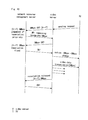
- quality
- bandwidth
- video
- network resource
- Prior art date
- Legal status (The legal status is an assumption and is not a legal conclusion. Google has not performed a legal analysis and makes no representation as to the accuracy of the status listed.)
- Withdrawn
Links
Images









Classifications
-
- H—ELECTRICITY
- H04—ELECTRIC COMMUNICATION TECHNIQUE
- H04L—TRANSMISSION OF DIGITAL INFORMATION, e.g. TELEGRAPHIC COMMUNICATION
- H04L12/00—Data switching networks
- H04L12/28—Data switching networks characterised by path configuration, e.g. LAN [Local Area Networks] or WAN [Wide Area Networks]
-
- H—ELECTRICITY
- H04—ELECTRIC COMMUNICATION TECHNIQUE
- H04L—TRANSMISSION OF DIGITAL INFORMATION, e.g. TELEGRAPHIC COMMUNICATION
- H04L65/00—Network arrangements, protocols or services for supporting real-time applications in data packet communication
- H04L65/80—Responding to QoS
-
- H—ELECTRICITY
- H04—ELECTRIC COMMUNICATION TECHNIQUE
- H04L—TRANSMISSION OF DIGITAL INFORMATION, e.g. TELEGRAPHIC COMMUNICATION
- H04L41/00—Arrangements for maintenance, administration or management of data switching networks, e.g. of packet switching networks
- H04L41/50—Network service management, e.g. ensuring proper service fulfilment according to agreements
- H04L41/5003—Managing SLA; Interaction between SLA and QoS
- H04L41/5019—Ensuring fulfilment of SLA
-
- H—ELECTRICITY
- H04—ELECTRIC COMMUNICATION TECHNIQUE
- H04L—TRANSMISSION OF DIGITAL INFORMATION, e.g. TELEGRAPHIC COMMUNICATION
- H04L41/00—Arrangements for maintenance, administration or management of data switching networks, e.g. of packet switching networks
- H04L41/50—Network service management, e.g. ensuring proper service fulfilment according to agreements
- H04L41/508—Network service management, e.g. ensuring proper service fulfilment according to agreements based on type of value added network service under agreement
- H04L41/509—Network service management, e.g. ensuring proper service fulfilment according to agreements based on type of value added network service under agreement wherein the managed service relates to media content delivery, e.g. audio, video or TV
-
- H—ELECTRICITY
- H04—ELECTRIC COMMUNICATION TECHNIQUE
- H04L—TRANSMISSION OF DIGITAL INFORMATION, e.g. TELEGRAPHIC COMMUNICATION
- H04L47/00—Traffic control in data switching networks
- H04L47/10—Flow control; Congestion control
-
- H—ELECTRICITY
- H04—ELECTRIC COMMUNICATION TECHNIQUE
- H04L—TRANSMISSION OF DIGITAL INFORMATION, e.g. TELEGRAPHIC COMMUNICATION
- H04L47/00—Traffic control in data switching networks
- H04L47/10—Flow control; Congestion control
- H04L47/25—Flow control; Congestion control with rate being modified by the source upon detecting a change of network conditions
-
- H—ELECTRICITY
- H04—ELECTRIC COMMUNICATION TECHNIQUE
- H04L—TRANSMISSION OF DIGITAL INFORMATION, e.g. TELEGRAPHIC COMMUNICATION
- H04L47/00—Traffic control in data switching networks
- H04L47/10—Flow control; Congestion control
- H04L47/38—Flow control; Congestion control by adapting coding or compression rate
-
- H—ELECTRICITY
- H04—ELECTRIC COMMUNICATION TECHNIQUE
- H04L—TRANSMISSION OF DIGITAL INFORMATION, e.g. TELEGRAPHIC COMMUNICATION
- H04L67/00—Network arrangements or protocols for supporting network services or applications
- H04L67/50—Network services
- H04L67/60—Scheduling or organising the servicing of application requests, e.g. requests for application data transmissions using the analysis and optimisation of the required network resources
- H04L67/61—Scheduling or organising the servicing of application requests, e.g. requests for application data transmissions using the analysis and optimisation of the required network resources taking into account QoS or priority requirements
-
- H—ELECTRICITY
- H04—ELECTRIC COMMUNICATION TECHNIQUE
- H04L—TRANSMISSION OF DIGITAL INFORMATION, e.g. TELEGRAPHIC COMMUNICATION
- H04L69/00—Network arrangements, protocols or services independent of the application payload and not provided for in the other groups of this subclass
- H04L69/30—Definitions, standards or architectural aspects of layered protocol stacks
- H04L69/32—Architecture of open systems interconnection [OSI] 7-layer type protocol stacks, e.g. the interfaces between the data link level and the physical level
- H04L69/322—Intralayer communication protocols among peer entities or protocol data unit [PDU] definitions
- H04L69/329—Intralayer communication protocols among peer entities or protocol data unit [PDU] definitions in the application layer [OSI layer 7]
-
- H—ELECTRICITY
- H04—ELECTRIC COMMUNICATION TECHNIQUE
- H04N—PICTORIAL COMMUNICATION, e.g. TELEVISION
- H04N21/00—Selective content distribution, e.g. interactive television or video on demand [VOD]
- H04N21/20—Servers specifically adapted for the distribution of content, e.g. VOD servers; Operations thereof
- H04N21/25—Management operations performed by the server for facilitating the content distribution or administrating data related to end-users or client devices, e.g. end-user or client device authentication, learning user preferences for recommending movies
- H04N21/262—Content or additional data distribution scheduling, e.g. sending additional data at off-peak times, updating software modules, calculating the carousel transmission frequency, delaying a video stream transmission, generating play-lists
- H04N21/26283—Content or additional data distribution scheduling, e.g. sending additional data at off-peak times, updating software modules, calculating the carousel transmission frequency, delaying a video stream transmission, generating play-lists for associating distribution time parameters to content, e.g. to generate electronic programme guide data
-
- H—ELECTRICITY
- H04—ELECTRIC COMMUNICATION TECHNIQUE
- H04N—PICTORIAL COMMUNICATION, e.g. TELEVISION
- H04N21/00—Selective content distribution, e.g. interactive television or video on demand [VOD]
- H04N21/40—Client devices specifically adapted for the reception of or interaction with content, e.g. set-top-box [STB]; Operations thereof
- H04N21/43—Processing of content or additional data, e.g. demultiplexing additional data from a digital video stream; Elementary client operations, e.g. monitoring of home network or synchronising decoder's clock; Client middleware
- H04N21/436—Interfacing a local distribution network, e.g. communicating with another STB or one or more peripheral devices inside the home
- H04N21/43615—Interfacing a Home Network, e.g. for connecting the client to a plurality of peripherals
-
- H—ELECTRICITY
- H04—ELECTRIC COMMUNICATION TECHNIQUE
- H04N—PICTORIAL COMMUNICATION, e.g. TELEVISION
- H04N21/00—Selective content distribution, e.g. interactive television or video on demand [VOD]
- H04N21/40—Client devices specifically adapted for the reception of or interaction with content, e.g. set-top-box [STB]; Operations thereof
- H04N21/43—Processing of content or additional data, e.g. demultiplexing additional data from a digital video stream; Elementary client operations, e.g. monitoring of home network or synchronising decoder's clock; Client middleware
- H04N21/439—Processing of audio elementary streams
- H04N21/4398—Processing of audio elementary streams involving reformatting operations of audio signals
-
- H—ELECTRICITY
- H04—ELECTRIC COMMUNICATION TECHNIQUE
- H04N—PICTORIAL COMMUNICATION, e.g. TELEVISION
- H04N21/00—Selective content distribution, e.g. interactive television or video on demand [VOD]
- H04N21/60—Network structure or processes for video distribution between server and client or between remote clients; Control signalling between clients, server and network components; Transmission of management data between server and client, e.g. sending from server to client commands for recording incoming content stream; Communication details between server and client
- H04N21/63—Control signaling related to video distribution between client, server and network components; Network processes for video distribution between server and clients or between remote clients, e.g. transmitting basic layer and enhancement layers over different transmission paths, setting up a peer-to-peer communication via Internet between remote STB's; Communication protocols; Addressing
- H04N21/647—Control signaling between network components and server or clients; Network processes for video distribution between server and clients, e.g. controlling the quality of the video stream, by dropping packets, protecting content from unauthorised alteration within the network, monitoring of network load, bridging between two different networks, e.g. between IP and wireless
- H04N21/64723—Monitoring of network processes or resources, e.g. monitoring of network load
- H04N21/64738—Monitoring network characteristics, e.g. bandwidth, congestion level
-
- H—ELECTRICITY
- H04—ELECTRIC COMMUNICATION TECHNIQUE
- H04N—PICTORIAL COMMUNICATION, e.g. TELEVISION
- H04N21/00—Selective content distribution, e.g. interactive television or video on demand [VOD]
- H04N21/60—Network structure or processes for video distribution between server and client or between remote clients; Control signalling between clients, server and network components; Transmission of management data between server and client, e.g. sending from server to client commands for recording incoming content stream; Communication details between server and client
- H04N21/63—Control signaling related to video distribution between client, server and network components; Network processes for video distribution between server and clients or between remote clients, e.g. transmitting basic layer and enhancement layers over different transmission paths, setting up a peer-to-peer communication via Internet between remote STB's; Communication protocols; Addressing
- H04N21/647—Control signaling between network components and server or clients; Network processes for video distribution between server and clients, e.g. controlling the quality of the video stream, by dropping packets, protecting content from unauthorised alteration within the network, monitoring of network load, bridging between two different networks, e.g. between IP and wireless
- H04N21/64746—Control signals issued by the network directed to the server or the client
- H04N21/64761—Control signals issued by the network directed to the server or the client directed to the server
- H04N21/64769—Control signals issued by the network directed to the server or the client directed to the server for rate control
-
- H—ELECTRICITY
- H04—ELECTRIC COMMUNICATION TECHNIQUE
- H04N—PICTORIAL COMMUNICATION, e.g. TELEVISION
- H04N21/00—Selective content distribution, e.g. interactive television or video on demand [VOD]
- H04N21/60—Network structure or processes for video distribution between server and client or between remote clients; Control signalling between clients, server and network components; Transmission of management data between server and client, e.g. sending from server to client commands for recording incoming content stream; Communication details between server and client
- H04N21/63—Control signaling related to video distribution between client, server and network components; Network processes for video distribution between server and clients or between remote clients, e.g. transmitting basic layer and enhancement layers over different transmission paths, setting up a peer-to-peer communication via Internet between remote STB's; Communication protocols; Addressing
- H04N21/647—Control signaling between network components and server or clients; Network processes for video distribution between server and clients, e.g. controlling the quality of the video stream, by dropping packets, protecting content from unauthorised alteration within the network, monitoring of network load, bridging between two different networks, e.g. between IP and wireless
- H04N21/64784—Data processing by the network
- H04N21/64792—Controlling the complexity of the content stream, e.g. by dropping packets
-
- H—ELECTRICITY
- H04—ELECTRIC COMMUNICATION TECHNIQUE
- H04N—PICTORIAL COMMUNICATION, e.g. TELEVISION
- H04N21/00—Selective content distribution, e.g. interactive television or video on demand [VOD]
- H04N21/80—Generation or processing of content or additional data by content creator independently of the distribution process; Content per se
- H04N21/81—Monomedia components thereof
- H04N21/8106—Monomedia components thereof involving special audio data, e.g. different tracks for different languages
-
- H—ELECTRICITY
- H04—ELECTRIC COMMUNICATION TECHNIQUE
- H04L—TRANSMISSION OF DIGITAL INFORMATION, e.g. TELEGRAPHIC COMMUNICATION
- H04L41/00—Arrangements for maintenance, administration or management of data switching networks, e.g. of packet switching networks
- H04L41/50—Network service management, e.g. ensuring proper service fulfilment according to agreements
- H04L41/5041—Network service management, e.g. ensuring proper service fulfilment according to agreements characterised by the time relationship between creation and deployment of a service
- H04L41/5051—Service on demand, e.g. definition and deployment of services in real time
Definitions
- This invention relates to the service providing method of providing a QoS (Quality of Service) guarantee and the related technologies.
- QoS Quality of Service
- RSVP Resource Reservation Protocol
- a user accesses a content server and operates a GUI (graphical user interface) screen to make a reservation demand that a user wants to see, for example, a movie "AAA" at 13:00-15:00 on March 15.
- GUI graphical user interface
- the content server manages reservation status.
- a content server notifies a reservation failure or shows an alternative time zone which is able to be reserved around the time zone that the user made the reservation.
- the object of the present invention is to provide a service providing method which can provide a service much as possible as when a user make a demand for receiving the service, thus releasing a user's dissatisfaction as much as possible.
- the service-providing method concerning to the first invention is a service-providing method using a service-providing unit operable to provide a requested service comprising the step providing a service having lower quality than quality of the requested service, when a network resource required for the requested service is not reservable.
- the quality of the provided service is lower than the quality of the service that a user demands, a service can be provided at least when a use wants to receive the service, a user's dissatisfaction can be lessened as compared with the case a service is not possible to be provided at all.
- the service-providing method concerning to the second invention is a service-providing method using a service-providing unit operable to provide a requested service comprising the step checking whether or not a network resource required for the requested service is reservable to generate a first result, the step checking whether or not a network resource required for a service of lower quality than the quality of the requested service is reservable to generate a second result, when the first result shows that the network resource required for the requested service is not reservable, the step notifying that the service of lower quality is reservable to request a response, when the second result shows that the service of lower quality is reservable, and the step providing the service of lower quality, when the response shows that the service of lower quality is requested.
- the quality of the provided service is lower than the quality of the service that a user demands, a service can be provided at least when a use wants to receive the service, a user's dissatisfaction can be lessened as compared with the case a service is not possible to be provided at all.
- the service-providing method concerning to the third invention is a service-providing method using a service-providing unit operable to provide a requested service comprising, the step checking whether or not a network resource required for the requested service is reservable to generate a first result, the step checking whether or not a network resource required for a service of lower quality than the quality of the requested service is reservable to generate a second result, when the first result shows that the network resource required for the requested service is reservable, and the step providing the service of lower quality, when the second result shows that the service of lower quality is requested.
- the quality of the provided service is lower than the quality of the service that a user demands, a service can be provided at least when a use wants to receive the service, a user's dissatisfaction can be lessened as compared with the case a service is not possible to be provided at all.
- the service-providing method concerning to the fourth invention is a service-providing method using a service-providing unit operable to provide a requested service comprising the service-providing method concerning to the second invention, and the service-providing method concerning to the third invention, wherein the service-providing method concerning to the second invention and the service-providing method concerning to the third invention are able to be switched over.
- the service-providing method of the fifth invention is the service-providing method, further comprising, the step providing a service having higher quality than quality of a current service, when a network resource required for a service of higher quality than the quality of the current service is reservable.
- the service-providing method concerning to the sixth invention is the service-providing method, further comprising, the step checking whether or not a network resource required for a service of higher quality than quality of a current service is reservable to generate a third result, the step notifying that the service of higher quality is reservable to request an additional response, when the third result shows that the service of higher quality is reservable, the step providing the service of higher quality, when the additional response shows that the service of higher quality is requested.
- the service-providing method concerning to the seventh invention is the service-providing method, further comprising, the step checking whether or not a network resource required for a service of higher quality than the quality of a current service is reservable to generate a third result, the step providing the service of higher quality, when the third result shows that the service of higher quality is reservable.
- the service-providing method concerning to the eight invention is a service-providing method using a service-providing unit operable to provide a requested service comprising the service-providing method concerning to the sixth invention and the service-providing method concerning to the seventh invention, wherein the service-providing method concerning to the sixth invention and the service-providing method concerning to the seventh invention are able to be switched over.
- the service-providing method concerning to the ninth invention is a service-providing method using a service-providing unit operable to provide a requested service comprising, the step checking an availability of a network resource to generate a first result, the step judging whether or not the requested service is able to provide, based on the first result, to generate a second result, the step preventing from requesting a service that is not able to provide, based on the second result.
- the service-providing method concerning to the tenth invention is a service-providing method using a service-providing unit operable to provide a service chosen from a list of available services comprising, the step checking an availability of a network resource to generate a first result, the step judging whether or not the requested service is able to provide, based on the first result, to generate a second result, and the step recording the list an item that is able to distinguish between an available service and an unavailable service, based on the second result.
- the service-providing method concerning to the eleventh invention is the service-providing method, further comprising, preventing from selecting an unavailable service on the list.
- the service-providing method concerning to the twelfth invention is the service-providing method as defined in claim 1, wherein the network resource is a bandwidth.
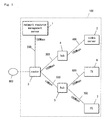
- Fig. 1 is a block diagram of a home network system according to Embodiment 1 of the present invention.
- a home network system 100 comprises a network resource management server 1, a video server 2, a router 3, hubs 4 and 5, a television 6, a personal computer (hereafter referred to as "PC”.) 7, and links 200, 300, 400, 500, 600, and 700.
- PC personal computer
- the network resource management server 1 and the router 3 are connected by the link 200.
- the router 3 and the hub 4 are connected by the link 300.
- the hub 4 and the video server 2 are connected by the link 400.
- the router 3 and the hub 5 are connected by the link 500.
- the hub 5 and the television 6 are connected by the link 600.
- the hub 5 and the PC 7 are connected by the link 700.
- the router 3 is connected to a network 800.
- the network 800 is the Internet.
- a network resource can be reserved.
- a bandwidth is mentioned as an example of a network resource.
- the network resource management server 1 has the function to manage the state of used bandwidth of the links 200 to 700 in the home network system 100.
- the video server 2 has the function to save video data, has the function of transmitting video data to the television 6 or the PC 7, which connected to the home network 200.
- the video server 2 has the function to transmit after converting the video data into an arbitrary transmission rate transmission rates if necessary.
- 6Mbps (bit per second) in the high-quality image mode of MPEG 2 and 3Mbps in the standard-quality image mode of MPEG 2 are examples of the transmission rate.
- the television 6 has the function to control the video server 2 distantly.
- the television 6 also has the function to receive video data sent from the video server 2, and to display the video data on a screen.
- the PC 7 is a computer for general purpose.
- the PC 7 has various functions of displaying a video after accessing to the video server 2, and displaying a video after accessing to the video server that connected to the network 800.
- the available bandwidth of the link 200 is set to 100Mbps
- the available bandwidth of a link 300 is set to 100Mbps
- the available bandwidth of a link 400 is set to 100Mbps
- the available bandwidth of the link 600 is set to 100Mbps
- the available bandwidth of the link 700 is set to 100Mbps.
- the available bandwidth of the link 500 is set to 11Mbps.
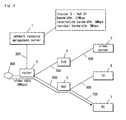
- Fig. 2 shows a state where a television is in access to a video server to receive a service.
- Fig. 3 shows a state where a PC 7 is receiving video data from an external network.
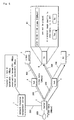
- Fig. 4 shows a state where a television can not receive a service of quality that the television has requested.
- Fig. 5 shows a state where a television can not receive a service of quality that the television 6 has requested.
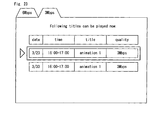
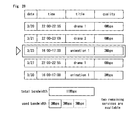
- the video server 2 transmits a video data list 60 to the television 6. Then, the television 6 displays the video data list 60 on a screen.
- the PC 7 has already accessed the video server (not shown) connected to the network 800, and has already received the video data of 6Mbps coded by MPEG 2, as shown in Fig. 3.
- a user has chosen a program, which he/she wants to watch, in the video data list 60 displayed on the television 6, and a sending request to the video server 2 is made.
- the video data list 60 is displayed on the television 6 as GUI (Graphical User Interface).
- the video server 2 receives such a request sent from the television 6, and confirms whether or not video data can be transmitted by 6Mbps to the television 6 to the network resource management server 1.
- the video server 2 transmits information showing transmission destination (the television 6) of video data and information showing bandwidth (6Mbps) required in order to transmit video data to the network resource management server 1.
- the video server 2 confirms whether or not the transmission bandwidth of 6Mbps can be reserved in a path between the video server 2 and the television 6 to the network resource management server 1.
- the network resource management server 1 confirms the use state of the bandwidth in the path between the video server 2 and the television 6 based on the information received from the video server 2.
- the "use state" of a bandwidth contains both cases of when the bandwidth is actually used, and when the reservation is done, although the bandwidth is not actually used.
- the PC 7 has already used the bandwidth of 6Mbps.
- the available bandwidth in the link 500 between the router 3 and the hub 15 is 5Mbps.
- the network resource management server 1 returns a response that concerned service-providing is impossible to the video server 2.
- the network resource management server 1 notifies the video server 2 of the residual resource information (information that the remaining bandwidth in the link 500 is 5Mbps) and so on.
- the video server 2 which has received the notice, lowers the quality of video data based on residual resource information, and tries to enable to transmit within a residual resource.
- the video server 2 confirms whether or not the video data of the standard-quality image requires the bandwidth of 3Mbps coded by MPEG 2 is possible to be transmitted to the television 6 to the network resource management server 1.
- the video server 2 transmits both of the information showing the transmission destination (the television 6) of the video data, and the information showing bandwidth (3Mbps) required in order to transmit video data to the network resource management server 1.
- the video server 2 confirms whether or not the transmission bandwidth of 3Mbps can be reserved in a path between the video server 2 and the television 6 to the network resource management server 1.
- the network resource management server 1 confirms a use state of the bandwidth in the path between the video server 2 and the television 6, based on the information received from the video server 2.
- the bandwidth that the video server 2 requires is reservable.
- the network resource management server 1 returns a response that a concerned service-providing is possible to the video server 2.
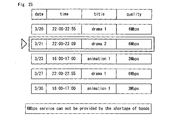
- the video server 2 which has received the response of service-providing being possible, presents an alternative 61 to the television 6, as shown in Fig. 5.
- the video server 2 starts a transmission of standard-quality video data.
- the alternative 61 is displayed on the television 6 as GUI.
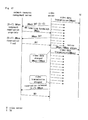
- Fig. 6 shows an illustrative communication procedure according to Embodiment 1 of the present invention.
- the communication procedure is for between the network resource management server 1, the video server 2, and the television 6.
- the television 6 first performs a sending request of the high-quality video data that requires the bandwidth of 6Mbps, which is specified in the video data list 60 to the video server 2.
- the video server 2 which has received the sending request, confirms whether or not the bandwidth of 6Mbps can be reserved between the video server 2 and the television 6 to the network resource management server 1.
- the network resource management server 1 judges whether or not the concerned bandwidth can be reserved.
- the network resource management server 1 since the bandwidth of 6Mbps is not reservable, the network resource management server 1 notifies and transmits the information that the remaining bandwidth in the link 500 is 5Mbps to the video server 2.
- the video server 2 which has received the notice, confirms whether or not the bandwidth of 3Mbps can be reserved between the video server 2 and the television 6 to the network resource management server 1, so that the video server 2 can try to provide the standard-quality video data, which requires the bandwidth of 3Mbps.
- the network resource management server 1 judges whether or not the concerned bandwidth can be reserved.
- the network resource management server 1 Since the bandwidth of 3Mbps is reservable as a result of the judgment, the network resource management server 1 makes a tentative reservation while the network resource management server 1 notifies that the bandwidth of 3Mbps is reservable to the video server 2.
- the video server 2 which has received the notice, is not able to transmit high-quality video data by 6 Mbps, but is able to transmit the alternative 61 that is operable to transmit standard-quality video data by 3Mbps to the television 6.
- the television 6 With a direction of a user approving the alternative 61, the television 6 notifies the video server 2 that it is sufficient to transmit the standard-quality video data.
- the video server 2 which has received the notice, reserves the bandwidth of 3Mbps between the video server 2 and the television 6 to the network resource management server 1.
- the network resource management server 1 fixes the reservation (it is an actual reservation), and notifies the video server 2 that the reservation is fixed.
- the video server 2 which has received the notice, transmits the standard-quality video data by 3Mbps to television 6.
- the video server 2 When the video server 2 completes the transmission of video data, the video server 2 notifies the network resource management server 1 that the reservation of the bandwidth of 3Mbps between the video server 2 and the television 6 is released.
- the network resource management server 1 After the network resource management server 1, which has received the notice, the network resource management server 1 releases the reservation, and notifies the video server 2 that the concerned reservation has been released.
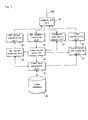
- Fig. 7 is a block diagram of the video server 2 in Fig. 1.
- the part, which is as same as Fig. 1, is coded in the same manner.
- the video server 2 comprises a network I/O unit 20, a GUI screen transmitting unit 21, a GUI screen creating unit 22, a GUI command receiving unit 23, a video server controller 24, a video data management unit 25, a video database 26, a bandwidth reservation control unit 27, a video transmitting unit 28, and a transmitting rate changing unit 29.
- the video server controller 24 controls each composition shown in Fig. 7.
- the video database 26 stores various video data.
- the video data management unit 25 follows an instruction of the video server controller 24, acquires the information of the video program concerned as reproducible (service-providing is possible) video data based on the information stored in the video database 26, and outputs the information on the video program to the GUI screen creating unit 22.
- the video data management unit 25 follows the instruction of the video server controller 24, acquires video data from the video database 26, and outputs the video data to the transmitting rate changing unit 29 or the video transmitting unit 28.
- the GUI screen creating unit 22 follows an instruction of the video server controller 24, and then creates the video data list as GUI, and command (reproduction, stop, etc.) GUI based on the information of a video program inputted from the video data management unit 25.
- the GUI screen transmitting unit 21 follows the instruction of the video server controller 24, transmits the GUI screen information that the GUI screen creating unit 22 created to the television 6 or the PC 7 connected to a home network 100 via the network I/O unit 20.
- the GUI command receiving unit 23 receives a command (for example, sending request of video data) transmitted from the television 6 or the PC 7 connected to the home network 100 via the network I/O unit 20, and gives the information a to the video server controller 24.
- a command for example, sending request of video data
- the bandwidth reservation control unit 27 follows the instruction of he video server controller 24, and reserves a necessary bandwidth in order to transmit video data
- the transmitting rate changing unit 29 follows the instruction of the video server controller 24, and changes a transmission rate.
- the video transmitting unit 28 follows an instruction of the video server controller 24, and then transmits video data via the network I/O unit 20.
- Fig. 8 is a block diagram of a network resource management server shown in Fig. 1.
- the part, which is as same as Fig. 1, is coded in the same manner.
- the network resource management server 1 comprises a network I/O unit 10, a request receiving unit 11, a communication path finding unit 12, a result notifying unit 13, a bandwidth acquisition/calculation unit 14, a reservation management unit 15, and a communication path/reservation information database 16.
- the communication path/reservation information database 16 stores a relevant table to the use state of the bandwidth of the communication path in the home network 100 and the communication path.
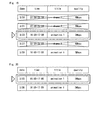
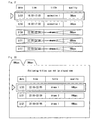
- Fig. 9 is an exemplified table stored in a communication path/reservation information database shown in Fig. 8.
- Fig. 9 illustrates the table in case the use state of the bandwidth in the home network 100 is in the situation shown in Fig. 3.
- the request receiving unit 11 receives a request (demand) of a bandwidth reservation, a bandwidth reservation release, or a bandwidth reservation change etc. from the video server 2 connected to the home network 100 via the network I/O unit 10.
- the communication path finding unit 12 finds a path performing a bandwidth reservation, referring to the communication path/reservation information database 16 based on the information from the request receiving unit 11.
- the bandwidth acquisition/calculation unit 14 acquires the information of a residual bandwidth in the path found by the communication path finding unit 12 from the communication path/reservation information database 16.
- the bandwidth acquisition/calculation unit 14 calculates the residual bandwidth of the communication path in the home network 100.
- the reservation management unit 15 performs processing of a tentative reservation, the reservation release, the reservation change, and the actual reservation of a bandwidth. Specifically, the reservation management unit 15 updates the table of the residual bandwidth, the communication path/reservation information database 16 based on the information of the residual bandwidth calculated by the bandwidth acquisition/calculation unit 14.
- the result notifying unit 13 notifies the video server 2 of the information regarding the judgment result of reservation availability and the residual bandwidth in the path performing a bandwidth reservation via the network I/O unit 10.
- the result notifying unit 13 receives a result of processing by the reservation management unit 15, and notifies the video server 2 of the result via the network I/O unit 10.
- the television 6 performs service-providing request to the video server 2.
- the GUI command receiving unit 23 of Fig. 7 receives the concerned request via the network I/O unit 20.
- the GUI command receiving unit 23 notifies the video server controller 24 of the request from the television 6.
- the video server controller 24 Upon receiving the notice, the video server controller 24 gives an instruction of acquiring information of a video program related to reproducible video data to the data management unit 25.
- the video data management unit 25 After receiving the instruction, the video data management unit 25 refers to the video database, acquires information of the video program, and transfers the information to the GUI screen creating unit 22.
- the GUI screen creating unit 22 creates the video data list 60 as GUI based on the information from the video data management unit 25.
- the GUI screen transmitting unit 21 transmits the video data list 60 that the GUI screen creating unit 22 created to the television 6 via the network I/O unit 20.
- the video data list 60 as GUI is displayed on the television 6. It is supposed that a user operates GUI displayed on the television 6, and requests transmission of high-quality video data, which requires the bandwidth of 6Mbps.
- the GUI command receiving unit 23 receives the request via the network I/O unit 20, and gives the information to the video server controller 24.
- the video server controller 24 Based on the information, the video server controller 24 gives an instruction of reserving the bandwidth of 6Mbps between the video server 2 and the television 6 to the bandwidth reservation control unit 27.
- the bandwidth reservation control unit 27 receives the instruction, and tries to reserve the bandwidth of 6Mbps to the network resource management server 1 via the network I/O unit 20.
- the request receiving unit 11 of Fig. 8 receives the concerned reservation from the video server 2 via the network I/O unit 10, and gives the information that the concerned reservation is regarding the path between the video server 2 and the television 6.
- the communication path finding unit 12 which received the information, finds the path between the video server 2 and the television 6 referring to the communication path/reservation information database 16.
- the communication path finding unit 12 indicates that the path between the video server 2 and the television 6 is composed of the video server 2, the link 400, the hub 4, the link 300, the router 3, the link 500, the hub 5, the link 600, and the television 6.
- the bandwidth acquisition/calculation unit 14 refers to the communication path/reservation information database 16, and acquires the information of the residual bandwidth for the path that the communication path finding unit 12 has found.
- the result notifying unit 13 of a result notifies the video server 2 via the network I/O unit 10 that the residual bandwidths of the link 500 is 5Mbps, and that the transmission of the video data of 6Mbps is impossible.
- the GUI command receiving unit 23 which has received the notice via the network I/O unit 20 of Fig. 7, gives the contents of the concerned notice to the video server controller 24.
- the video server controller 24 which has received the notice gives an instruction to the bandwidth reservation control unit 27 so that tentative reservation of the bandwidth of 3Mbps may be carried out between the video server 2 and the television 6.
- the bandwidth reservation control unit 27 which has received the instruction tries the tentative reservation of the bandwidth of 3Mbps to the network resource management server 1 via the network I/O unit 20.
- the request receiving unit 11 of Fig. 8 gives information that the concerned tentative reservation is regarding the path between the video server 2 and the television 6, to the communication path finding unit 12 in response to the concerned tentative reservation from the video server 2 via the network I/O unit 10.
- the communication path finding unit 12 which has received the information finds the path between the video server 2 and the television 6 with reference to the communication path/reservation information database 16.
- the bandwidth acquisition/calculation unit 14 acquires information on the residual bandwidth of a path which the communication path finding unit 12 found with reference to the communication path/reservation information database 16. Since in the link 500 the bandwidth of 6Mbps is already used, the information that the residual bandwidth of the link 500 is 5Mbps is acquired.
- the reservation management department 15 updates the communication path/reservation information database 16, and performs the tentative reservation of the bandwidth of 3Mbps in the path between the video server 2 and the television 6.
- the result notifying unit 13 notifies the video server 2 via the network I/O unit 10 that the tentative reservation of the bandwidth of 3Mbps is carried out.
- the GUI command receiving unit 23 which has received the notice via the network I/O unit 20 of Fig. 7 notifies the video server controller 24 that the tentative reservation of the bandwidth of 3Mbps has been completed.
- the video server controller 24 gives an instruction to the GUI screen creating unit 22 so that the alternatives 61 as GUI may be created.
- the GUI screen creating unit 22 which has received an instruction creates the alternatives 61.
- the GUI screen transmitting unit 21 transmits the alternatives 61 to the television 6 via the network I/O unit 20.
- the alternatives 61 are displayed on the television 6.
- the television 6 which has received the instruction of a user who approved the alternatives 61 notifies the video server 2 that the transmission with 3Mbps of the video data of standard image quality is sufficient.
- the GUI command receiving unit 23 which has received the notice via the network I/O unit 20 of Fig. 7 notifies the video server controller 24 that the alternatives 61 is approved.
- the video server controller 24 gives an instruction to the bandwidth reservation control unit 27 so that the actual reservation of the bandwidth of 3Mbps may be made.
- the bandwidth reservation control unit 27 which has received the instruction performs the actual reservation of the bandwidth of 3Mbps to the network resource management server 1 via the network I/O unit 20.
- the request receiving unit 11 of Fig. 8 receives the notice of the concerned reservation from the video server 2 and notifies the reservation management department 15 of release of the reservation via the network I/O unit 10.
- the reservation management department 15 which has received the notice determines reservation of the bandwidth of 3Mbps between the video server 2 and the television 6.
- the reservation management department 15 notifies the result notifying unit 13 that the reservation has been determined.
- the result notifying unit 13 which receives the notice notifies the video server 2 via the network I/O unit 10 that the bandwidth of 3Mbps has been reserved.
- the GUI command receiving unit 23 which has received the notice notifies the video server controller 24 via the network I/O unit 20 of Fig. 7 that the reservation of the bandwidth of 3Mbps has been determined.
- the video server controller 24 gives an instruction to the transmitting rate changing unit 29 to change a transmission rate from 6Mbps to 3Mbps.
- the transmitting rate changing unit 29 receives the instruction and gives re-encoding to the video data acquired from the video database 26 so that the video data can be transmitted at the transmission rate of 3Mbps.
- the video transmitting unit 28 transmits the re-encoded video data to the television 6 via the network I/O unit 10 at the transmission rate of 3Mbps.
- the video server controller 24 gives an instruction to the bandwidth reservation control unit 27 to release the reservation of the bandwidth.
- the bandwidth reservation control unit 27 which has received the instruction requests the release of the reservation to the network resource management server 1 via the network I/O unit 20.
- the request receiving unit 11 of Fig. 8 receives the concerned request from the video server 2 and notifies the reservation management department 15 of Fig.8 via the network I/O unit 10.
- the reservation management department 15 which has received the notice updates a table of the communication path/reservation information database 16, and releases the reservation of the bandwidth of 3Mbps between the video server 2 and the television 6.
- the reservation management department 15 notifies the result notifying unit 13 that the reservation has been released.
- the result notifying unit 13 which has received the notice notifies the video server 2 via the network I/O unit 10 that the reservation of the bandwidth of 3Mbps has been released.
- the video service 2 when a service providing with the requested quality is impossible, the video service 2 provides lowered quality of service without providing an alternatives to a service receiving apparatus (for example, the television 6) that is connected to the home network system 100.
- a service receiving apparatus for example, the television 6
- the provided quality can be displayed somewhere on a screen.
- the quality of 6Mbps is required and service is provided with the quality of 3Mbps, "3Mbps" may be displayed.
- Fig. 10 is a figure illustrating in the first modification of the communication procedure between the network resource management server 1, the video server 2, and the television 6.
- the television 6 performs the sending request (sending request) of the high-quality video data which needs the bandwidth of 6Mbps specified in the video data list 60 to the video server 2.
- the video server 2 confirms whether the bandwidth of 6Mbps can be reserved between the video server 2 and the television 6 to the network resource management server 1.
- the network resource management server 1 judges the reservation availability of the concerned bandwidth.
- the network resource management server 1 Since the bandwidth of 6Mbps is not reservable as a result of the judging, the network resource management server 1 transmits information that remaining bandwidths in the link 500 are 5Mbps while notifying that the bandwidth of 6 Mbps is not reserved to the video server 2.
- the video server 2 confirms whether the bandwidth of 3Mbps can be reserved between the video server 2 and the television 6 to the network resource management server 1 for trying to provide the standard-quality video data which needs the bandwidth of 3Mbps.
- the network resource management server 1 judges the reservation availability of the concerned bandwidth.
- the network resource management server 1 determines the reservation while notifying that the bandwidth of 3Mbps is reservable to the video server 2.
- the video server 2 notifies the television 6 that transmission of the high-quality video data in 6Mbps is impossible but the transmission of the standard-quality video data in 3Mbps is possible.
- the video server 2 transmits the standard-quality video data in 3Mbps to the television 6.
- the video server 2 notifies that the reservation of the bandwidth of 3Mbps between the video server 2 and the television 6 is released, when the transmission of the video data has completed.
- the network resource management server 1 releases the concerned reservation, and notifies the release of the reservation to the video server 2.
- the GUI command receiving unit 23 has received the notice that the residual bandwidths of the link 500 is 5Mbps, and that cannot transmit video data of 6Mbps, via the network I/O unit 20 of Fig. 7 from the network resource management server 1, gives contents of the concerned notice to the video server controller 24.
- the video server controller 24 gives an instruction to the bandwidth reservation control unit 27, so that the bandwidth of 3Mbps should be reserved between the video server 2 and the television 6.
- the bandwidth reservation control unit 27 which has received the instruction tries to reserves the bandwidth of 3Mbps to the network resource management server 1 via the network I/O unit 20.
- the communication path finding unit 12 which has received the information derives the path between the video server 2 and the television 6 with reference to the communication path/reservation information database 16.
- the bandwidth acquisition/calculation unit 14 acquires information on a residual bandwidth of the path which the communication path finding unit 12 derived with reference to the communication path/reservation information database 16.
- the residual bandwidth of the link 500 acquires information on which the residual bandwidth is 5Mbps.
- the reservation management department 15 updates the communication path/reservation information database 16, and reserves the bandwidth of 3Mbps in the path between the video server 2 and the television 6.
- the result notifying unit 13 notifies that the bandwidth of 3Mbps is reserved to the video server 2 via the network I/O unit 10.
- the GUI command receiving unit 23 notifies that the reservation of the bandwidth of 3Mbps has been completed to the video server controller 24 via the network I/O unit 10.
- the video server controller 24 gives an instruction to the transmitting rate changing unit 29 to change a transmission rate from 6Mbps to 3Mbps.
- the transmitting rate changing unit 29 gives re-encoding to the video data acquired from the video database 26 so that the video data can be transmitted at the transmission rate of 3Mbps.
- the video transmitting unit 28 After the video transmitting unit 28 notifies that the standard-quality video data is transmitted to the television 6, the video transmitting unit 28 transmits the re-encoded video data to television 6 at the transmission rate of 3Mbps via the network I/O unit 10.
- the home network system 100 in the second modification comprises both the function of the home network system 100 of Embodiment 1, and the function of the home network system 100 of the first modification of Embodiment 1.
- a user can change and use both the function (in the case that alternatives is shown when a service quality which a user demands cannot be provided, the function to provide the service which is made lowered by the alternatives when there is the approval of a user) of the home network system 100 of Embodiment 1, and the function (function to provide the service which is made lowered without showing the alternatives when the service quality which a user demands cannot be provided) of the home network system 100 of the first modification of Embodiment 1.
- the video server 2 of Fig. 1 is an example of service-providing apparatus that provides services for service-receiving apparatus, and it is the composition of the home network 100, is not limited to the video server 2.
- the point is as same as Embodiment 2 and its modification, and Embodiment 3 mentioned later.
- the video data list is mentioned as the example as a list of services that is prepared for providing from the video server 2.
- Fig. 1 although the television 6 and the PC 7 are mentioned as an example of the service-receiving apparatus that receives service-providing, service-receiving apparatus is not limited to this.
- the point is as same as Embodiment 2 and its modification, and Embodiment 3 mentioned later.
- the number of service-receiving apparatuses in the home network 100 of Fig. 1 may be singular or plural.
- the point is as same as Embodiment 2 and its modification, and Embodiment 3 mentioned later.
- the links from 200 to 700 of the home network 100 of Fig. 1 may be wireless, a cable, or a combination of these.
- the point is as same as Embodiment 2 and its modification, and Embodiment 3 mentioned later.
- the network resource management server 1 and the service-providing apparatus, such as video server 2 may be formed as one.
- the point is as same as Embodiment 2 and its modification, and Embodiment 3 mentioned later.
- composition of the home network 100 of Fig. 1 is not limited to the case above, but the home network 100 needs to be composed of the network resource management server 1, the service-providing apparatus, and a service receiver.
- the point is as same as Embodiment 2 and its modification, and Embodiment 3 mentioned later.
- a step of quality can be chosen based on a state of the use situation of bandwidth by preparing service of three or more steps of quality.
- the point is as same as Embodiment 2 and its modification, and Embodiment 3 mentioned later.
- the home network 100 is considered as network prepared at home in the above example, it is not limited to this.
- the point is as same as Embodiment 2 and its modification, and Embodiment 3 mentioned later.
- the first modification, and the second modification when a network resource (for example, bandwidth) required for the service the user requests is not reserved, lowered quality service is provided.
- a network resource for example, bandwidth
- Embodiment 1 Even though the quality of service is lower than the quality the user requests, at least he/she can receive service-providing when he/she wants. Therefore, users' dissatisfaction can be reduced comparing to the case where they do not receive anything.
- Embodiment 2 the situation, where the available remaining bandwidths are not used at all, is avoided as much as possible; therefore, the effective use of a bandwidth is available.
- composition of a home network system according to Embodiment 2 of the present invention is the same as that of the home network system 100, as shown in Fig. 1 according to Embodiment 1.
- the home network system 100 shown in Fig. 1 is regarded as a home network system according to Embodiment 2.
- a video server according to Embodiment 2 has the same composition as the video server shown in Fig. 7. Therefore, the video server shown in Fig. 7 is regarded as a video server according to Embodiment 2.
- a network resource management server according to Embodiment 2 has the same composition as the network resource management server shown in Fig. 8. Therefore, the network resource management server shown in Fig. 8 is regarded as a network resource management server according to Embodiment 2.
- Embodiment 2 is now explained, referring to a concrete example. A bandwidth will be discussed as one of exemplified items of network resources. Moreover, the examples shown in Fig. 2 through Fig. 5 will be discussed.
- Fig. 2 it is assumed that the television 6 requests the video server 2 to send a high quality video data that needs a bandwidth of 6Mbps. It is further assumed that a PC 7 is already using a bandwidth of 6Mbps in a link 500 when the request is made, as shown in Fig. 3.
- the video server 2 cannot provide the high quality video data that the television 6 requires. Therefore, as shown in Fig. 5, the video server 2 shows the television 6 alternatives 61.
- the television 6 After issuing a notice of approval for the alternative 61, the television 6 receives a video data of standard image quality at 3Mbps, provided by the alternatives 61.
- a communication procedure so far is the same as the communication procedure according to Embodiment 1, as shown in Fig. 6.
- a subsequent communication procedure will be explained in the following.
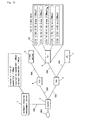
- Fig. 11 shows an illustrative communication procedure between the network resource management server 1, the video server 2, and the television 6, according to Embodiment 2 of the present invention.
- the video server 2 is transmitting the video data of the standard image quality at 3Mbps to the television 6, which issued a notice of approval for the alternative 61.
- the video server 2 While the video server 2 is, based on the alternatives 61, transmitting the video data of standard image quality by 3Mbps, the video server 2 requests periodically the network resource management server 1 to check whether another bandwidth of 3Mbps can be reserved between the video server 1 and the television 6. This is because securing a bandwidth of 6Mbps in total enables to transmit a video data of high image quality.
- the network resource management server 1 judges whether a reservation of the bandwidth of 6Mbps is possible.
- the network resource management server 1 When another bandwidth of 3Mbps cannot be reserved anymore as a result of the judgment, the network resource management server 1 notifies the judgment result to the video server 2.
- the network resource management server 1 reserves tentatively another bandwidth of 3Mbps between the video server 2 and the television 6, and notifies the video server 2 of the tentative reservation of another bandwidth of 3Mbps.
- the video server 2 Upon receiving the tentative reservation, the video server 2 informs the television 6 that a transmission of the high quality video data at 6Mbps becomes available.
- the television 6 requests the video server 2 to change the transmission to the high quality video data.
- the video server 2 Upon receiving the request, the video server 2 asks the network resource management server 1 to make a reservation for another bandwidth of 3Mbps between the video server 2 and the television 6.
- the network resource management server 1 ascertains the tentative reservation and makes a formal reservation, and notifies the fact to the video server 2.
- the video server 2 after receiving this notice, transmits a high quality video data at 6Mbps to the television 6.
- the video server 2 After the completion of the transmission of the high quality video data, the video server 2 notifies the network resource management server 1 that the reservation of a bandwidth of 6Mbps in total between the video server 2 and the television 6 is canceled.
- the network resource management server 1 After receiving the cancellation notice, the network resource management server 1 cancels the concerned reservation, and notifies the cancellation to the video server 2.
- a video transmitting unit 28 of Fig.7 transmits, based on the alternatives 61, a video data of standard image quality at 3Mbps to the television 6, which issued a notice that the alternatives 61 are approved.
- a video server controller 24 While transmitting the video data of standard image quality at 3Mbps based on the alternatives 61, a video server controller 24 directs periodically a bandwidth reservation control unit 27 to reserve another bandwidth of 3Mbps between the video server 2 and the television 6.
- the bandwidth reservation control unit 27 asks periodically the network resource management server 1 to make a reservation of the bandwidth of 3Mbps between the video server 2 and the television 6, while the video server 2 is transmitting the video data of standard image quality at 3Mbps based on the alternatives 61.
- a request receiving section 11 of Fig. 8 after receiving the concerned reservation via a the network I/O unit 10, gives to a communication path finding unit 12 an information that the concerned reservation relates to a path between the video server 2 and the television 6.
- the communication path finding unit 12 Upon receiving the information, the communication path finding unit 12 finds a path between the video server 2 and the television 6 with reference to a communication path/reservation information database 16.
- the communication path finding unit 12 finds a path between the video server 2 and the television 6, passing through the video server 2, a link 400, a hub 4, a link 300, a router 3, a link 500, a hub 5, a link 600, and to the television 6.
- the bandwidth acquisition/calculation unit 14 acquires information on the residual bandwidth of the path which the communication path finding unit 12 found, with reference to a communication path/reservation information database 16.
- a result notifying unit 13 When it is found that a bandwidth of 3Mbps cannot be reserved, after receiving the information on the residual bandwidth of the path that the bandwidth acquisition/calculation unit 14 acquired, a result notifying unit 13 notifies the video server 2 through a network I/O unit 10 that a bandwidth of 3Mbps cannot be reserved.
- the reservation management unit 15 When it is found that a bandwidth of 3Mbps can be reserved, after receiving the information on the residual bandwidth of the path that the bandwidth acquisition/calculation unit 14 acquired, the reservation management unit 15 updates the communication path/reservation information database 16. The reservation management unit 15 also makes a tentative reservation of the bandwidth of 3Mbps along the path between the video server 2 and the television 6.
- the result notifying unit 13 informs the video server 2, through the network I/O unit 10, of the fact that the tentative reservation of the bandwidth of 3Mbps is made.
- a GUI command receiving unit 23 After receiving the tentative reservation notice through a network I/O unit 20 of Fig. 7, a GUI command receiving unit 23 gives the contents of the tentative reservation notice to a video server controller 24.
- the video server controller 24 directs a GUI screen creating unit 22 to create a GUI screen information that includes a notice that a transmission of the high quality video data at 6Mbps becomes possible.
- the GUI screen creating unit 22 creates a GUI screen information.
- a GUI screen transmitting unit 21 transmits the GUI screen information to the television 6 through the network I/O unit 20.
- this GUI screen information is displayed on the television 6.
- a user operates GUI on the screen of the television 6 and demands change to a high quality video data.
- the television 6 requests the video server 2 to transmit the high quality video data at 6Mbps.
- the GUI command receiving unit 23 receives this notice through the network I/O unit 20 of Fig. 7.
- the GUI command receiving unit 23 notifies a video server controller 24 of the fact that a change to high quality.
- the video server controller 24 directs a bandwidth reservation control unit 27 to make a formal reservation of a 3Mbps bandwidth.
- the bandwidth reservation control unit 27 makes the formal reservation of the 3Mbps bandwidth to the network resource management server 1 through the network I/O unit 20.
- a request receiving section 11 of Fig. 8 receives the notice of the formal reservation through the network I/O unit 10, and notifies the fact to a reservation management unit 15.
- the reservation management unit 15 Upon receiving the notice, the reservation management unit 15 updates the table of a communication path/reservation information database 16 and ascertains the reservation of a 3Mbps bandwidth between the video server 2 and the television 6.
- the reservation management unit 15 notifies the result notifying unit 13 that the reservation is formally ascertained.
- the result notifying unit 13 notifies the video server 2 through the network I/O unit 10 that a bandwidth of 3Mbps has been reserved.
- the GUI command receiving unit 23 receives the above notice through the network I/O unit 20, and notifies the video server controller 24 that the reservation is formally ascertained for a bandwidth of 3Mbps.
- the video server controller 24 directs the video data management unit 25 to acquire a high quality video data from the video database 26 and send it to a video transmitting unit 28.
- the video transmitting unit 28 transmits the high quality video data to the television 6 through the network I/O unit 10 at the transmission rate of 6Mbps.
- the video server controller 24 directs the bandwidth reservation control unit 27 to cancel the reservation of the bandwidth.
- the bandwidth reservation control unit 27 Upon receiving the direction, the bandwidth reservation control unit 27 requests a release of the reservation to the network resource management server 1, through the network I/O unit 20.
- the request receiving section 11 of Fig. 8 notifies the concerned request to the reservation management unit 15.
- the reservation management unit 15 updates the table of the communication path/reservation information database 16, and cancels the reservation for the bandwidth of 6Mbps between the video server 2 and the television 6.
- the reservation management unit 15 notifies the result notifying unit 13 that the reservation has been canceled.
- the result notifying unit 13 Upon receiving the notice, the result notifying unit 13 notifies the video server 2 through the network I/O unit 10 that the reservation of the bandwidth of 6Mbps has been canceled.
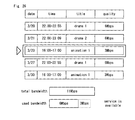
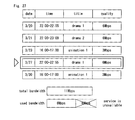
- the video server 2 when a service of high quality becomes available while a service of standard quality is provided, the video server 2 provides a service receiver (for example, the television 6) with the service of high quality, switching from the service of standard quality without notifying the change of the quality.
- a service receiver for example, the television 6
- the video server 2 cannot provide the high quality video data that the television 6 requires.
- the video server 2 indicates the television 6 alternatives 61.
- Fig. 12 shows an illustrative communication procedure according to the first modification for Embodiment 2 of the present invention.
- the video server 2 is, based on the alternatives 61, transmitting a video data of standard image quality at 3Mbps to the television 6 that has issued the notice of approval for the alternatives 61.
- the video server 2 transmits the video data of standard image quality at 3Mbps based on the alternatives 61, the video server 2 asks periodically the network resource management server 1 whether another bandwidth of 3Mbps can be reserved between the video server 2 and the television 6. This is because securing a bandwidth of 6Mbps in total enables to transmit a video data of high image quality.
- the network resource management server 1 judges if the concerned bandwidth is possible to reserve.
- the network resource management server 1 When a bandwidth of 3Mbps is found unavailable as a result of the judgment, the network resource management server 1 notifies the unavailability to the video server 2.
- the network resource management server 1 decides a reservation of the bandwidth of 3Mbps between the video server 2 and the television 6, and informs the video server 2 of the decided reservation.
- the video server 2 Upon receiving the reservation notice, the video server 2 sends a notice to the television 6 that the video server 2 transmits the high quality video data at 6Mbps. Then, the video server 2 transmits the high quality video data at 6Mbps to the television 6.
- the video server 2 When the transmission of the video data is completed, the video server 2 issues a notice that the bandwidth reservation of 6Mbps in total between the video server 2 and the television 6 may be canceled.
- the network resource management server 1 Upon receiving the notice, the network resource management server 1 cancels the concerned reservation and notifies the video server 2 of the cancellation.
- the video transmitting unit 28 of Fig. 7 transmits a video data of standard image quality at 3Mbps, based on the alternatives 61, to the television 6 that has issued the approval notice of the alternatives 61.
- a video server controller 24 While transmitting the video data of standard image quality at 3Mbps based on the alternatives 61, a video server controller 24 directs periodically a bandwidth reservation control unit 27 to reserve another bandwidth of 3Mbps between the video server 2 and the television 6.
- the bandwidth reservation control unit 27 asks periodically the network resource management server 1 to make a reservation of the bandwidth of 3Mbps between the video server 2 and the television 6, while the video server 2 is transmitting the video data of standard image quality at 3Mbps based on the alternatives 61.
- a request receiving section 11 of Fig. 8 after receiving the concerned reservation via a the network I/O unit 10, gives to a communication path finding unit 12 an information that the concerned reservation relates to a path between the video server 2 and the television 6.
- the communication path finding unit 12 Upon receiving the information, the communication path finding unit 12 finds a path between the video server 2 and the television 6 with reference to a communication path/reservation information database 16.
- the bandwidth acquisition/calculation unit 14 acquires information on the residual bandwidth of the path which the communication path finding unit 12 found, with reference to a communication path/reservation information database 16.
- a result notifying unit 13 When it is found that a bandwidth of 3Mbps cannot be reserved, after receiving the information on the residual bandwidth of the path that the bandwidth acquisition/calculation unit 14 acquired, a result notifying unit 13 notifies the video server 2 through a network I/O unit 10 that a bandwidth of 3Mbps cannot be reserved.
- the reservation management unit 15 When it is found that a bandwidth of 3Mbps can be reserved, after receiving the information on the residual bandwidth of the path that the bandwidth acquisition/calculation unit 14 acquired, the reservation management unit 15 updates the communication path/reservation information database 16. The reservation management unit 15 also makes a tentative reservation of the bandwidth of 3Mbps along the path between the video server 2 and the television 6.
- the reservation management unit 15 notifies the result notifying unit 13 that the reservation is formally ascertained.
- the result notifying unit 13 notifies the video server 2 through the network I/O unit 10 that a bandwidth of 3Mbps has been reserved.
- the GUI command receiving unit 23 receives the above notice through the network I/O unit 20, and notifies the video server controller 24 that the reservation is formally ascertained for a bandwidth of 3Mbps.
- the video server controller 24 directs the video data management unit 25 to acquire a high quality video data from the video database 26 and send it to a video transmitting unit 28.
- the video transmitting unit 28 transmits the high quality video data to the television 6 through the network I/O unit 10 at the transmission rate of 6Mbps.
- a home network system 100 according to the second modification possesses both of the function of the home network system 100 according to Embodiment 2 and the function of the home network system 100 according to the first modification of Embodiment 2.
- a user can use, by switching, either of the function of the home network system 100 according to Embodiment 2 and the function of the home network system 100 according to the first modification of Embodiment 2.
- the function of the home network system 100 according to Embodiment 2 includes a function that when a service of high quality becomes available while a service of standard quality is provided, the service of high quality is provided, with the user's approval after the availability notice of the service of high quality.
- the function of the home network system 100 according to the first modification of Embodiment 2 includes a function that when a service of high quality becomes available while a service of standard quality is provided, the service of high quality is provided, without the availability notice of the service of high quality.
- the first modification and the second modification when a network resource (for example, bandwidth) required for providing a service demanded by a user cannot be reserved, a service of lower quality than the demanded service is provided.
- a network resource for example, bandwidth
- a user can receive a service at least when the user wants to receive a service, although the quality of the service is lower than the quality which the user demands. As compared with the case where a service is not provided at all, user's dissatisfaction can be released.
- the first modification and the second modification when a network resource (for example, bandwidth) required for providing a service of higher quality than the currently provided service, a service of higher quality t is provided.
- a network resource for example, bandwidth
- the procedure of Figs. 11 or 12 can be performed not only after the procedure of the completion of video data transmission shown in Fig. 6, but also after the procedure of the completion of video data transmission shown in Fig. 10.
- composition of a home network system according to Embodiment 3 of the present invention is the same as that of the home network system 100, as shown in Fig. 1 according to Embodiment 1.
- the home network system 100 shown in Fig. 1 is regarded as a home network system according to Embodiment 3.
- a network resource management server according to Embodiment 3 has the same composition as the network resource management server shown in Fig. 8. Therefore, the network resource management server shown in Fig. 8 is regarded as a network resource management server according to Embodiment 3.
- an availability situation of a network resource for example, bandwidth
- a network resource for example, bandwidth
- Embodiment 3 is explained, referring to a concrete example.
- a bandwidth is mentioned as an example of a network resource.
- Fig. 13 shows a state where traffic is not flowing in the home network system 100 shown in Fig. 1.
- the same sign is attached for the same unit as in Fig. 1.
- the video server 2 communicates with the network resource management server 1 periodically, and checks periodically a use state of the bandwidth in the path between the video server 2 and the television 6.
- the video server 2 can transmit any of the stored video data to the television 6
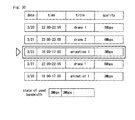
- the video server 2 creates a video data list 62 and transmits it to the television 6. With the video data list 62, a user can choose all video programs in the television 6.
- the user of the television 6 can see all the videos which are stored in the video server 2.
- Fig. 14 shows the state a PC 7 of the home network system 100 of Fig. 1 receives video data from a network 800.
- the same sign is attached for the same unit as in Fig. 1.
- the video server 2 communicates with the network resource management server 1 periodically, and checks periodically a use state of the bandwidth in the path between the video server 2 and the television 6.
- the PC 7 receives video data at 6Mbps from the network 800.
- the network resource management server 1 grasps that the remaining bandwidth of the link 500 which connect a router 3 and a hub 5 is 5Mbps in this case.
- the video server 2 communicates with the network resource management server 1 periodically and checks periodically a use state of the bandwidth in the path between the video server 2 and the television 6, the video server 2 can know that the remaining bandwidth of the link 500 is 5Mbps.
- the video server 2 cannot provide, to the television 6, a video data which needs a bandwidth of 6Mbps.
- the video server 2 creates the video data list 63, and transmits it to the television 6 so that a user of the television 6 cannot choose the video program which needs a bandwidth of 6Mbps.
- a mask is covered over the display of the video program which needs a bandwidth of 6Mbps.
- a black mask is covered over the display of the video program which cannot be chosen.
- the video program which needs a bandwidth of 6Mbps may not be displayed.
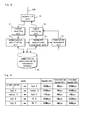
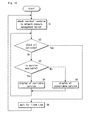
- Fig. 15 is a flow chart of the video server 2 according to Embodiment 3.
- the video server 2 asks the network resource management server 1 about the use state of the present bandwidth in the home network system 100 (Step S1, residual resource check).
- the video server 2 judges whether all video programs to be provided (all services that are ready to provide) are able to be provided at present (Step S2, Step S3).
- the video server 2 enables, in a video data list, selection of the video program for which a service provision is presently possible (Step S4, a display of available service).
- the video server 2 covers a mask over the display of the video program in the video data list, for which a service provision is presently impossible (Step S5, a display of unavailable service).
- Step S2 When the video server 2 judges whether all video programs to be provided are able to be provided at present (Step S2), the video server 2 waits for a fixed period of time (Step S6).
- the video server 2 asks the network resource management server 1 about a present use state of the bandwidth in the home network system 100 (Step S1), and performs processing in Steps S2 through S5.
- the video server 2 repeats processing of Step S1 to the step 5 every fixed period of time.
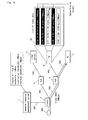
- Fig. 16 is a block diagram of the video server 2 according to Embodiment 3.
- the same sign is attached for the same unit as Fig. 7 and explanation is omitted suitably.
- the video server 2 comprises a network I/O unit 20, a GUI screen transmitting unit 21, a GUI creating unit 22, a GUI command receiving unit 23, a video server controller 24, a video data management unit 25, a video database 26, a bandwidth checking unit 30, and a video transmitting unit 28.
- the network resource management server 1 updates the communication path/reservation information database 16 of Fig. 8. That is, the table of Fig. 9 is updated.
- the network resource management server 1 grasps the present use state of the bandwidth in the home network system 100.
- the bandwidth checking unit 30 of Fig. 16 asks the network resource management server 1 periodically about a use state of the bandwidth in the home network system 100.
- the bandwidth checking unit 30 gives information of a use state of the checked bandwidth to the video data management unit 25.
- the video data management unit 25 acquires the information on the video program of reproducible video data (available service), based on the information stored in the video database 26.
- the video data management unit 25 judges whether the concerned video program is available, and outputs the judgment result together with the information on the concerned video program to the GUI creating unit 22.
- the video data management unit 25 acquires the information on all reproducible video programs, and performs the above-mentioned judgment for every acquired video program.
- the GUI creating unit 22 creates a video data list as GUI, based on the judgment result and the information on a video program which the video data management unit 25 outputted according to directions of the video server controller 24.
- the GUI creating unit 22 indicates a display in which a currently available video program is set to be selected by a user, and in which a currently unavailable video program is set to be prevented for a user from choosing it by masking it,.
- the video server controller 24 directs the GUI screen transmitting unit 21 to transmit the GUI screen information of the present video data list, which the GUI creating unit 22 created, to the television 6 or the PC 7 which has requested the service provision.
- the GUI screen transmitting unit 21 transmits the GUI screen information of the current video data list through the network I/O unit 20.
- the video data list 62 is displayed on the television 6.
- the video data list 63 is displayed on the television 6.
- the GUI command receiving unit 23 When a user chooses a video program to which the mask is not covered and when the GUI command receiving unit 23 receives, from the television 6 or the PC 7, the request for providing the concerned video program, the GUI command receiving unit 23 gives the information to the video server controller 24.
- the video server controller 24 directs the video data management unit 25 to acquire of the concerned video program, and transmit the video data to the transmitting unit 28.
- the video transmitting unit 28 transmits the video data, which the video data management unit 25 acquired through the network I/O unit 20, to the television 6 or the PC 7 which has requested the service provision.
- the video data of the video program can be definitely transmitted.
- the display which a user can distinguish a video program of which transmission of video data is possible, and a video program of which transmission of video data is not possible is realized for a video data list, the display is also usable as well as masking the list as described above.
- a notation method in the video data list of available services is not limited to what is shown in Figs. 13 or 14.
- the service which cannot be provided is prevented for a user from choosing in the list of the available service.
- a display which can simply distinguish an available service from an unavailable service can also be placed in the list of available services.
- a list of services which can be provided by making the quality lower within the limits of a residual bandwidth may also be displayed on a service receiver such as the television 6.
- Only one of the two kinds of indications may attach these affirmative displays and negative displays, or both indications may be attached.
- the quality of a title was displayed using the character, as shown in Fig. 24.
- the quality of a title may be designed so as to be intuitively perceived.
- the preview column is prepared instead of the quality column.
- the thumbnail of 6Mbps is displayed on the left-hand side of the preview column, and the thumbnail of 3Mbps is displayed on right-hand side.
- image data is displayed in reduced size by making it fit to a thumbnail of 6Mbps.
- the reduced image is displayed after performing processing that degrades image quality to that for a thumbnail of 3Mbps
- the processing which degrades image quality is arbitrary. It is also possible to cover a video with a mosaic, for example, as shown in Fig. 24.
- the quality of the provided service is lower than the quality of the service that a user demands, a service can be provided at least when a use wants to receive the service, a user's dissatisfaction can be lessened as compared with the case a service is not possible to be provided at all.
- the quality of the provided service is lower than the quality of the service that a user demands, a service can be provided at least when a use wants to receive the service, a user's dissatisfaction can be lessened as compared with the case a service is not possible to be provided at all.
- the quality of the provided service is lower than the quality of the service that a user demands, a service can be provided at least when a use wants to receive the service, a user's dissatisfaction can be lessened as compared with the case a service is not possible to be provided at all.
Landscapes
- Engineering & Computer Science (AREA)
- Signal Processing (AREA)
- Computer Networks & Wireless Communication (AREA)
- Multimedia (AREA)
- Computer Security & Cryptography (AREA)
- Databases & Information Systems (AREA)
- Data Exchanges In Wide-Area Networks (AREA)
- Telephonic Communication Services (AREA)
Abstract
Description
Fig. 3 shows a state where a
Fig. 4 shows a state where a television can not receive a service of quality that the television has requested.
Fig. 5 shows a state where a television can not receive a service of quality that the
Claims (12)
- A service-providing method using a service-providing unit operable to provide a requested service comprising:providing a service having lower quality than quality of the requested service, when a network resource required for the requested service is not reservable.
- A service-providing method using a service-providing unit operable to provide a requested service comprising:checking whether or not a network resource required for the requested service is reservable to generate a first result;checking whether or not a network resource required for a service of lower quality than the quality of the requested service is reservable to generate a second result, when the first result shows that the network resource required for the requested service is not reservable;notifying that the service of lower quality is reservable to request a response, when the second result shows that the service of lower quality is reservable; andproviding the service of lower quality, when the response shows that the service of lower quality is requested.
- A service-providing method using a service-providing unit operable to provide a requested service comprising:checking whether or not a network resource required for the requested service is reservable to generate a first result;checking whether or not a network resource required for a service of lower quality than the quality of the requested service is reservable to generate a second result, when the first result shows that the network resource required for the requested service is reservable; andproviding the service of lower quality, when the second result shows that the service of lower quality is requested.
- A service-providing method using a service-providing unit operable to provide a requested service comprising first steps and second steps, the first steps comprising:wherein the first steps and the second steps are able to be switched over.checking whether or not a network resource required for the requested service is reservable to generate a first result;checking whether or not a network resource required for a service of lower quality than the quality of the requested service is reservable to generate a second result, when the first result shows that the network resource required for the requested service is not reservable;notifying that the service of lower quality is reservable to request a response, when the second result shows that the service of lower quality is reservable; andproviding the service of lower quality, when the response shows that the service of lower quality is requested,the second steps comprising:checking whether or not the network resource required for the requested service is reservable to generate a third result;checking whether or not the network resource required for the service of lower quality than the quality of the requested service is reservable to generate a fourth result, when the third result shows that the network resource required for the requested service is not reservable; andproviding the service of lower quality, when the fourth result shows that the service of lower quality is requested,
- The service-providing method as defined in claim 1, further comprising:providing a service having higher quality than quality of a current service, when a network resource required for a service of higher quality than the quality of the current service is reservable.
- The service-providing method as defined in claim 1, further comprising:checking whether or not a network resource required for a service of higher quality than quality of a current service is reservable to generate a third result;notifying that the service of higher quality is reservable to request an additional response, when the third result shows that the service of higher quality is reservable; andproviding the service of higher quality, when the additional response shows that the service of higher quality is requested.
- The service-providing method as defined in claim 1, further comprising:checking whether or not a network resource required for a service of higher quality than the quality of a current service is reservable to generate a third result; andproviding the service of higher quality, when the third result shows that the service of higher quality is reservable.
- A service-providing method using a service-providing unit operable to provide a requested service comprising first steps and second steps,
the first steps comprising:wherein the first steps and the second steps are able to be switched over.checking whether or not a network resource required for the requested service is reservable to generate a first result;checking whether or not a network resource required for a service of lower quality than the quality of the requested service is reservable to generate a second result, when the first result shows that the network resource required for the requested service is not reservable;notifying that the service of lower quality is reservable to request a response, when the second result shows that the service of lower quality is reservable;providing the service of lower quality, when the response shows that the service of lower quality is requested;checking whether or not a network resource required for a service of higher quality than quality of a current service is reservable to generate a third result;notifying that the service of higher quality is reservable to request an additional response, when the third result shows that the service of higher quality is reservable; andproviding the service of higher quality, when the additional response shows that the service of higher quality is requested,the second steps comprising:checking whether or not the network resource required for the requested service is reservable to generate a third result;checking whether or not the network resource required for the service of lower quality than the quality of the requested service is reservable to generate a fourth result, when the third result shows that the network resource required for the requested service is not reservable;providing the service of lower quality, when the fourth result shows that the service of lower quality is requested;checking whether or not a network resource required for a service of higher quality than the quality of a current service is reservable to generate a third result; andproviding the service of higher quality, when the third result shows that the service of higher quality is reservable, - A service-providing method using a service-providing unit operable to provide a requested service comprising:checking an availability of a network resource to generate a first result;judging whether or not the requested service is able to provide, based on the first result, to generate a second result; andpreventing from requesting a service that is not able to provide, based on the second result.
- A service-providing method using a service-providing unit operable to provide a service chosen from a list of available services comprising:checking an availability of a network resource to generate a first result;judging whether or not the requested service is able to provide, based on the first result, to generate a second result; andrecording the list an item that is able to distinguish between an available service and an unavailable service, based on the second result.
- The service-providing method as defined in claim 10, further comprising:preventing from selecting an unavailable service on the list.
- The service-providing method as defined in claim 1, wherein the network resource is a bandwidth.
Applications Claiming Priority (2)
| Application Number | Priority Date | Filing Date | Title |
|---|---|---|---|
| JP2002265703 | 2002-09-11 | ||
| JP2002265703 | 2002-09-11 |
Publications (2)
| Publication Number | Publication Date |
|---|---|
| EP1398936A2 true EP1398936A2 (en) | 2004-03-17 |
| EP1398936A3 EP1398936A3 (en) | 2004-04-14 |
Family
ID=31884780
Family Applications (1)
| Application Number | Title | Priority Date | Filing Date |
|---|---|---|---|
| EP03019602A Withdrawn EP1398936A3 (en) | 2002-09-11 | 2003-09-04 | Service providing method |
Country Status (5)
| Country | Link |
|---|---|
| US (1) | US20040128386A1 (en) |
| EP (1) | EP1398936A3 (en) |
| KR (1) | KR20040023547A (en) |
| CN (1) | CN1490733A (en) |
| TW (1) | TW200405187A (en) |
Families Citing this family (24)
| Publication number | Priority date | Publication date | Assignee | Title |
|---|---|---|---|---|
| GB0408990D0 (en) * | 2004-04-22 | 2004-05-26 | Nokia Corp | Charging in communication networks |
| US7487269B2 (en) * | 2004-11-18 | 2009-02-03 | International Business Machines Corporation | Apparatus, system, and method of connection grouping for multipath lock facility connection paths |
| JP2009017233A (en) * | 2007-07-04 | 2009-01-22 | Sony Corp | Video signal processing apparatus, video signal processing method, and video signal processing program |
| US20090147723A1 (en) * | 2007-12-07 | 2009-06-11 | Hong Kong Applied Science and Technology Research Institute Company Limited | Method and Device for Data Routing and Bandwidth Reservation in Small Scale Distributed Networks |
| EP2117180B1 (en) * | 2008-05-07 | 2013-10-23 | Oticon A/S | A short range, uni-directional wireless link |
| US9015335B1 (en) * | 2009-06-17 | 2015-04-21 | Amazon Technologies, Inc. | Server side stream switching |
| US20110022692A1 (en) * | 2009-07-24 | 2011-01-27 | Jeyhan Karaoguz | Method and system for determining and controlling user experience in a network |
| US8918820B2 (en) * | 2010-05-27 | 2014-12-23 | Istreamplanet Co. | Video workflow automation platform |
| US8589992B2 (en) * | 2010-05-27 | 2013-11-19 | Istreamplanet Co. | Video workflow automation platform for publishing a video feed in multiple formats |
| US9313528B2 (en) * | 2012-01-11 | 2016-04-12 | Sony Corporation | Filtering live streaming contents and services |
| US9332051B2 (en) | 2012-10-11 | 2016-05-03 | Verizon Patent And Licensing Inc. | Media manifest file generation for adaptive streaming cost management |
| US9112939B2 (en) | 2013-02-12 | 2015-08-18 | Brightcove, Inc. | Cloud-based video delivery |
| US10321383B2 (en) | 2013-05-10 | 2019-06-11 | Cloudstreet Oy | Managing wireless transmission capacity |
| FI127364B (en) | 2013-05-10 | 2018-04-30 | Cloudstreet Oy | Management of wireless data transmission capacity |
| US9912707B2 (en) | 2014-07-31 | 2018-03-06 | Istreamplanet Co. | Method and system for ensuring reliability of unicast video streaming at a video streaming platform |
| US9826011B2 (en) | 2014-07-31 | 2017-11-21 | Istreamplanet Co. | Method and system for coordinating stream processing at a video streaming platform |
| US9417921B2 (en) | 2014-07-31 | 2016-08-16 | Istreamplanet Co. | Method and system for a graph based video streaming platform |
| CN104580019B (en) * | 2014-12-26 | 2018-06-12 | 小米科技有限责任公司 | Network service provider method and device |
| US9407944B1 (en) | 2015-05-08 | 2016-08-02 | Istreamplanet Co. | Resource allocation optimization for cloud-based video processing |
| US9344751B1 (en) | 2015-05-08 | 2016-05-17 | Istreamplanet Co. | Coordination of fault-tolerant video stream processing in cloud-based video streaming system |
| US9686576B2 (en) | 2015-05-08 | 2017-06-20 | Istreamplanet Co. | Coordination of video stream timing in cloud-based video streaming system |
| US10164853B2 (en) | 2015-05-29 | 2018-12-25 | Istreamplanet Co., Llc | Real-time anomaly mitigation in a cloud-based video streaming system |
| US10412453B2 (en) * | 2015-10-13 | 2019-09-10 | Futurewei Technologies, Inc. | Probability weighted DASH based video streaming over an information-centric network |
| EP3457234B1 (en) * | 2017-09-19 | 2023-07-12 | ABB Schweiz AG | Method for providing information in the form of computer code to a process module with the assistance of a computer |
Family Cites Families (4)
| Publication number | Priority date | Publication date | Assignee | Title |
|---|---|---|---|---|
| US6154778A (en) * | 1998-05-19 | 2000-11-28 | Hewlett-Packard Company | Utility-based multi-category quality-of-service negotiation in distributed systems |
| US7421489B2 (en) * | 2000-12-29 | 2008-09-02 | Nortel Network Limited | Network protocols for distributing functions within a network |
| WO2002071191A2 (en) * | 2001-03-02 | 2002-09-12 | Kasenna, Inc. | Metadata enabled push-pull model for efficient low-latency video-content distribution over a network |
| US7526788B2 (en) * | 2001-06-29 | 2009-04-28 | Scientific-Atlanta, Inc. | Graphic user interface alternate download options for unavailable PRM content |
-
2003
- 2003-08-18 TW TW092122598A patent/TW200405187A/en unknown
- 2003-09-04 EP EP03019602A patent/EP1398936A3/en not_active Withdrawn
- 2003-09-08 KR KR1020030062551A patent/KR20040023547A/en not_active Withdrawn
- 2003-09-10 US US10/658,543 patent/US20040128386A1/en not_active Abandoned
- 2003-09-10 CN CNA031584551A patent/CN1490733A/en active Pending
Also Published As
| Publication number | Publication date |
|---|---|
| CN1490733A (en) | 2004-04-21 |
| EP1398936A3 (en) | 2004-04-14 |
| US20040128386A1 (en) | 2004-07-01 |
| TW200405187A (en) | 2004-04-01 |
| KR20040023547A (en) | 2004-03-18 |
Similar Documents
| Publication | Publication Date | Title |
|---|---|---|
| EP1398936A2 (en) | Service providing method | |
| KR101255529B1 (en) | Resource admission control for customer triggered and network triggered reservation requests | |
| US9515838B2 (en) | Bandwidth adaptive communication event scheduling | |
| US6738361B1 (en) | Method, apparatus and computer program for IP traffic prioritization in IP networks | |
| DE69806617T2 (en) | MULTIMEDIA DECODING DEVICE FOR BIDIRECTIONAL PRIORITY TRANSMISSION IN A BROADCASTING SYSTEM | |
| US8185640B2 (en) | Graphical user interface (GUI) for administering a voice over internet protocol (VOIP) network implementing media aggregation | |
| US8832305B2 (en) | System and method for delivery of secondary data files | |
| RU2491751C2 (en) | Method of controlling temporary access in digital video network | |
| JP2004007592A (en) | Distributed tuner assignment and method of settling conflict | |
| US20050174951A1 (en) | Method for adhoc buffer | |
| DE69806624T2 (en) | METHOD FOR SETTING PRIORITIES FOR DATA IN BIDIRECTIONAL BROADCASTING | |
| US20080075116A1 (en) | Communication system bandwidth reservation management | |
| US8340100B2 (en) | Method and apparatus for controlling quality of service in universal plug and play network | |
| US7003606B2 (en) | Electronic device, method for using electronic device, and electronic device system for reserving bus usage time on a bus to conduct communications between electronic devices | |
| WO2007086704A1 (en) | Method and system for the efficient provision of download-requested contents by non-realtime transmission through capable bandwidth of digital multimedia broadcasting network | |
| US20090010156A1 (en) | Method for Changing Service Quality of a Content Adaptively | |
| KR100912985B1 (en) | A method for transmitting an audio-video program proposed by a user, a terminal and a server for the method | |
| US8102767B2 (en) | Systems and methods for dynamically allocating network bandwidth | |
| CN101102320B (en) | Method for capturing reserved resource | |
| JP2004129244A (en) | Service provision method | |
| US7872970B2 (en) | Method for selecting a determinator of priority to access a network | |
| JP4490347B2 (en) | Network device and data transmission method using the same | |
| JP2023069319A (en) | Information processing method, information processing device, information processing system and program | |
| JP2003258889A (en) | Method of reserving bandwidth and time for information transmission in bandwidth guaranteed communication service, communication system and program therefor | |
| JP2008244565A (en) | System of recording reservation of broadcast program |
Legal Events
| Date | Code | Title | Description |
|---|---|---|---|
| PUAI | Public reference made under article 153(3) epc to a published international application that has entered the european phase |
Free format text: ORIGINAL CODE: 0009012 |
|
| PUAL | Search report despatched |
Free format text: ORIGINAL CODE: 0009013 |
|
| AK | Designated contracting states |
Kind code of ref document: A2 Designated state(s): AT BE BG CH CY CZ DE DK EE ES FI FR GB GR HU IE IT LI LU MC NL PT RO SE SI SK TR |
|
| AX | Request for extension of the european patent |
Extension state: AL LT LV MK |
|
| AK | Designated contracting states |
Kind code of ref document: A3 Designated state(s): AT BE BG CH CY CZ DE DK EE ES FI FR GB GR HU IE IT LI LU MC NL PT RO SE SI SK TR |
|
| AX | Request for extension of the european patent |
Extension state: AL LT LV MK |
|
| 17P | Request for examination filed |
Effective date: 20040811 |
|
| AKX | Designation fees paid |
Designated state(s): DE FR GB |
|
| 17Q | First examination report despatched |
Effective date: 20041203 |
|
| STAA | Information on the status of an ep patent application or granted ep patent |
Free format text: STATUS: THE APPLICATION IS DEEMED TO BE WITHDRAWN |
|
| 18D | Application deemed to be withdrawn |
Effective date: 20050414 |