EP1398773A2 - Content delivery method and system for same - Google Patents
Content delivery method and system for same Download PDFInfo
- Publication number
- EP1398773A2 EP1398773A2 EP03251723A EP03251723A EP1398773A2 EP 1398773 A2 EP1398773 A2 EP 1398773A2 EP 03251723 A EP03251723 A EP 03251723A EP 03251723 A EP03251723 A EP 03251723A EP 1398773 A2 EP1398773 A2 EP 1398773A2
- Authority
- EP
- European Patent Office
- Prior art keywords
- information
- content
- ram
- rom
- recording medium
- Prior art date
- Legal status (The legal status is an assumption and is not a legal conclusion. Google has not performed a legal analysis and makes no representation as to the accuracy of the status listed.)
- Withdrawn
Links
Images






Classifications
-
- G—PHYSICS
- G06—COMPUTING OR CALCULATING; COUNTING
- G06Q—INFORMATION AND COMMUNICATION TECHNOLOGY [ICT] SPECIALLY ADAPTED FOR ADMINISTRATIVE, COMMERCIAL, FINANCIAL, MANAGERIAL OR SUPERVISORY PURPOSES; SYSTEMS OR METHODS SPECIALLY ADAPTED FOR ADMINISTRATIVE, COMMERCIAL, FINANCIAL, MANAGERIAL OR SUPERVISORY PURPOSES, NOT OTHERWISE PROVIDED FOR
- G06Q30/00—Commerce
- G06Q30/06—Buying, selling or leasing transactions
-
- G—PHYSICS
- G06—COMPUTING OR CALCULATING; COUNTING
- G06Q—INFORMATION AND COMMUNICATION TECHNOLOGY [ICT] SPECIALLY ADAPTED FOR ADMINISTRATIVE, COMMERCIAL, FINANCIAL, MANAGERIAL OR SUPERVISORY PURPOSES; SYSTEMS OR METHODS SPECIALLY ADAPTED FOR ADMINISTRATIVE, COMMERCIAL, FINANCIAL, MANAGERIAL OR SUPERVISORY PURPOSES, NOT OTHERWISE PROVIDED FOR
- G06Q30/00—Commerce
- G06Q30/02—Marketing; Price estimation or determination; Fundraising
-
- G—PHYSICS
- G06—COMPUTING OR CALCULATING; COUNTING
- G06Q—INFORMATION AND COMMUNICATION TECHNOLOGY [ICT] SPECIALLY ADAPTED FOR ADMINISTRATIVE, COMMERCIAL, FINANCIAL, MANAGERIAL OR SUPERVISORY PURPOSES; SYSTEMS OR METHODS SPECIALLY ADAPTED FOR ADMINISTRATIVE, COMMERCIAL, FINANCIAL, MANAGERIAL OR SUPERVISORY PURPOSES, NOT OTHERWISE PROVIDED FOR
- G06Q30/00—Commerce
- G06Q30/02—Marketing; Price estimation or determination; Fundraising
- G06Q30/0241—Advertisements
-
- G—PHYSICS
- G11—INFORMATION STORAGE
- G11B—INFORMATION STORAGE BASED ON RELATIVE MOVEMENT BETWEEN RECORD CARRIER AND TRANSDUCER
- G11B7/00—Recording or reproducing by optical means, e.g. recording using a thermal beam of optical radiation by modifying optical properties or the physical structure, reproducing using an optical beam at lower power by sensing optical properties; Record carriers therefor
- G11B7/007—Arrangement of the information on the record carrier, e.g. form of tracks, actual track shape, e.g. wobbled, or cross-section, e.g. v-shaped; Sequential information structures, e.g. sectoring or header formats within a track
- G11B7/0079—Zoned data area, e.g. having different data structures or formats for the user data within data layer, Zone Constant Linear Velocity [ZCLV], Zone Constant Angular Velocity [ZCAV], carriers with RAM and ROM areas
Definitions
- This invention relates to a content delivery method and system for the delivery of music, video, game, computer software, and other content with ancillary information attached, and in particular to a content delivery method and system which uses storage media to perform delivery of such content and information.
- CDs compact disks
- CD-ROMs compact disks
- DVDs DVDs
- CD-R CD-Rewritable
- a RAM (random access memory) area is provided as the storage medium, and at the time of distribution, an advertisement ID is written to the RAM area for distribution to users.
- Japanese Laid-open Patent No. 10-105452 Japanese Laid-open Patent No. 2001-101836, Japanese Laid-open Patent No. 2001-135023, and Japanese Laid-open Patent No. 2002-32685
- systems are disclosed in which an advertising information pointer is written to the recording medium separately from the content, the recording medium is distributed to users, and users read the pointer and obtain advertising information from an advertising information provider over the Internet or via a digital broadcast, which is then displayed on the user's computer terminal.
- Japanese Laid-open Patent No. 2002-24570 a system is disclosed in which advertising information is attached to an electronic newspaper, or a similar content-containing distributable medium, and advertising information is displayed through user operation.
- embodiments of this invention may provide a content delivery method and system for the output of recent or the latest information of interest to a user, such as advertisements, while reproducing content without any special operation by the user to display advertisements.
- FIG. 1 may depict a content delivery method and system to reproduce content, while also performing output of recent or the latest advertisements using recording media, without having to connect to the Internet or other external systems.
- FIG. 1 may depict a content delivery method and system to reproduce content and perform output of recent or the latest advertisements using recording media, to facilitate the ready widespread adoption of content delivery, utilizing advertising revenue.
- a content delivery method of this invention includes a step of writing information to a RAM portion of a recording medium and delivering the recording medium with content, the content being recorded in a ROM portion of the recording medium, to a user, and a step of simultaneously reproducing the content and the information of the recording medium using a reproduction device which employs a single pickup mechanism to simultaneously reproduce the data in the ROM portion and the RAM portion of the recording medium.
- a content delivery system includes a writing device which writes information to the RAM portion of recording media when delivering recording media, with content written to the ROM portion to a user, and a reproduction device which uses a single pickup mechanism to reproduce information in the RAM portion and content in the ROM portion of the recording media when reproducing content on the recording media.
- the reproduction device would thus simultaneously reproduce the content and the information on the recording media.
- a further aspect of the invention relates to a storage medium suitable for use in the above method and system.
- the information in the RAM portion includes advertising information.
- recording media should be used in which content information is recorded as physically stable ROM information, and advertising information is recorded in RAM, so that it is possible to deliver content with advertisements which have not exceeded an advertising expiration date. And, because media which enable simultaneous reproduction from both ROM and RAM, along with a drive for these media, are utilized, when content is reproduced, advertisements will also be reproduced, so that the user can view the advertisements without being conscious of an effort to obtain or view the advertisements. Consequently, by thus being able to include advertising revenue in delivery costs, the same content can be provided more inexpensively and in a more stable manner, without detracting from the revenue of the content business.
- the above recording media include a ROM portion which records the content as depressions and protrusions, or other physical changes of an optically transparent or reflective substrate, and a RAM portion formed of a rewritable recording layer on the ROM portion, either directly or separated by other layers.
- the RAM portion of the recording media be magnetooptical recording media
- the reproduction device be a magnetooptical media drive which uses light to reproduce data from the ROM portion and the RAM portion of the magnetooptical recording media.
- Cash rebates for example, based on such advertisements can thus be provided to a user who has selected content with the advertisements attached or included.
- the writing step also includes a step of writing the advertising information to the RAM portion such that the advertising information is reproduced in synchronization with streaming information.
- streaming information would be the content of the ROM portion as output according to elapsed time.
- advertisements can be presented within a desired timing during streaming reproduction, in order to increase the effect of the advertisements on the user or viewer.
- the position for writing of advertising information to RAM can be associated with the position for writing of the content to the ROM portion.
- EFM-modulated content be stored in the ROM portion, and that the information in the RAM portion be recorded by frequency modulation.
- a single optical pickup mechanism can be used to easily differentiate and/or separate the ROM and RAM information.
- content which includes voice information or image information be recorded as ROM information and, moreover, that ancillary data such as voice advertisements or image advertisements be recorded as RAM information, and that the information of the ROM portion and the RAM portion be output simultaneously by an audio or image output device connected to the reproduction device.
- content with advertisements including ordinary voice data or image data can be more easily delivered.
- the reproduction step includes a step in which the ROM information is output at n times the output speed of the RAM information (where n is a number greater than 1) and that, when the ROM information is output at n times the RAM information output speed, the RAM information continues to be output at the same speed as before (at 1 times the RAM information output speed).
- advertisements can even be effectively viewed during a 2 times speed dubbing operation, for example.
- Embodiments of the present invention preferably also include that the writing step further includes a step of updating the RAM information when the content is rented to the user for a limited time period.
- a further embodiment of the present invention preferably further includes a step of returning the recording medium to an authorized rental agent, advertiser, content provider, or the like, after information recording to the above RAM potion is performed by the user utilizing a recording/reproduction device for the recording medium.
- ancillary information such as advertisements in a rewritable form (e.g. RAM)
- ancillary information such as advertisements in a rewritable form (e.g. RAM)
- the advertisements, etc. may be added at a separate stage following production of the basic media, and may be added individually or in batches so as to be useful to different groups of users. That is, different copies or batches of media having the same stable content may be provided with respectively different rewritable content.
- mass-production of the basic media bearing the stable content may be performed at an earlier stage and/or with a larger production run.
- content display shelves 10, a content rental counter 12, and advertisement downloading machines 14 are provided in a rental store 1.
- the content delivery media 3 include a ROM portion that physically cannot be rewritten, and a RAM portion that can be rewritten, by the content delivery business or by the user. The ROM portion and RAM portion of the media can be read simultaneously.
- processing is performed to rent (hire out) a content delivery media unit 3 selected by the user from the content display shelves 10.
- An advertisement downloading machine 14 records advertisements onto the RAM portion of a content delivery media unit 3 which has been processed for renting according to selection by the user, and then the media unit is returned to the user.
- the content delivery server 2 is connected to the advertisement downloading machines 14 and to the content rental counter 12, and transmits various advertising data to the advertisement downloading machines 14.
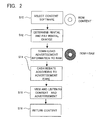
- (S 12) The user performs a renting procedure at the rental counter 12. That is, the rental period is determined, and a corresponding rental fee is paid.
- advertisement information is recorded by the advertisement downloading machine 14, described below using Fig. 3, in the RAM portion of the content delivery media unit 3 for which the procedure has been completed, and the user receives the cash rebate according to an advertising fee.
- the content delivery business obtains advertising information from an advertising client, and transmits the information from the content delivery server 2 to the advertisement downloading machines 14.
- the advertisement downloading machines 14 write information to the RAM portion of the content delivery medium 3, which is sold or rented to the user. Advertising revenue is used for cash rebates to users, and supplements content purchasing fees or rental fees paid by users.
- questionnaire information from the user relating to advertisements can also be recorded in the RAM portion.
- the number of times the user has reproduced (played back) ROM information, the number of times RAM information has been reproduced, and other information can be recorded in the RAM portion, and a cash rebate amount can be set according to the number of reproduction times.
- the user can respond to advertising information in the RAM portion to directly contact the advertiser and receive a cash rebate.
- a rental procedure is performed at the rental counter using a system similar to normal procedures for renting CD music, or similar, content.
- users can proceed to the advertisement downloading machines, and download preferred advertisements following the instructions of the downloading machine.
- users can execute searches for bargain fares, time-limited sales campaigns, regional help-wanted information or similar, and download the necessary advertisements. Because the downloading of advertising information is left to the user's discretion, in the course of their duties, rental store employees normally need only to contact repair technicians in the event of mechanical trouble with necessary equipment. Depending on circumstances, the advertisement downloading machines can be managed by an advertisement management company, which only pays the rental store a fee for use of store space.
- questionnaire information can be entered into the downloading machine.
- the configuration of the advertisement downloading machine 14 is explained using Fig. 3.
- the advertisement downloading machine 14 includes a user-operated terminal, which in turn includes a media drive 20, a CPU 21, a memory 22, a card reader/writer 23, an operating panel 24, and an interface 25.
- the media drive 20 performs reading from and writing to the above ROM-RAM media 3, and preferably includes an MO drive, as explained below, because a magnetooptical (MO) disc is preferably used as the ROM-RAM media 3. Because point cards (loyalty cards) are generally used at the rental store for cash rebates, the card reader/writer 23 is provided which performs point card reading and writing.
- the operating panel 24 is provided to enable the user to select the above-mentioned advertising information, to request the return of the media, to instruct reading of questionnaire information, and similar functions.
- the memory 22 includes, for example, a hard disk drive which can store large amounts of advertising information, cash rebate values for the advertising information, advertisement periods, and similar.
- the interface circuit 25 controls the interface with the content delivery server 2, receives advertising information and advertisement fees, and sends questionnaire information.
- the CPU 21 performs various types of control in the advertisement downloading machine.
- Processing of the content delivery server 2 can be broadly divided into four types: processing to manage content delivery fees; processing to manage advertising information; rental processing; and returns processing.
- Processing to manage advertising information further includes processing to obtain advertising information from the advertising client, processing to confirm advertisement periods, processing to confirm advertisement areas, processing to confirm cash rebate amounts, and processing to write and delete advertising information.
- Rental processing further includes processing to confirm user identity at the content lending counter 12, processing to confirm the rental period, and processing to charge rental fees.
- Returns processing further includes processing to confirm the user identity, processing to confirm questionnaire information, processing to determine the number of ROM reproductions, processing to determine the number of RAM reproductions, and cash rebate processing.
- Processing to manage content delivery fees further includes content usage fee processing, advertisement fee total processing, rental fee total processing, and incidental fees, based on the results of the above three processing types.
- the content delivery business performs advertising information management and management of cash rebates for renting fees, in addition to the tasks of renting media to users and receiving returns. Furthermore, the delivery system of the present invention performs writing, updates, and deletion of advertising information according to the time period and the area of residency of users receiving delivery, so that advertising or other information can be provided in a timely fashion and in accordance with user needs.
- a magneto-optical disk has a disk shape, and is provided with a lead-in region (not numbered) at the innermost circumference, a lead-out region (not numbered) at the outermost circumference, and a user area (not numbered) in between.
- the lead-in region and lead-out region are ROM area regions in which phase pits (not numbered) are formed as depressions and protrusions in the disk with a polycarbonate substrate, and in which disk specifications and other information is recorded. By reading this information, the conditions of recording and reproduction can be controlled.
- a user area in which a magnetooptical recording film is preferably deposited by splittering equipment, is provided between the lead-in and the lead-out regions.
- the user can freely record and reproduce information in the user area.
- a magnetooptical disk 3 providing both ROM and RAM functions to the user area is generally as shown in Fig. 6, in which, on top of a transparent (polycarbonate) substrate 4A, a first dielectric layer 4B, preferably using as material silicon nitride, tantalum oxide or similar, a magnetooptical recording layer 4C preferably including an amorphous alloy of a rare earth and a transition metal, such as TbFeCo, a second dielectric layer 4D, preferably formed from the same material as the first dielectric layer 4B, a reflective layer 4E preferably of AlTi, Au or another metal, and a protective coating layer 4F preferably using an ultraviolet light-hardening resin, are formed.
- a transparent (polycarbonate) substrate 4A a first dielectric layer 4B, preferably using as material silicon nitride, tantalum oxide or similar, a magnetooptical recording layer 4C preferably including an amorphous alloy of a rare earth and a transition metal, such as T
- ROM functions are provided by phase pits that form protrusions and depressions in the disk 3, and RAM functions are provided by the magnetooptical recording layer 4C.
- laser light is used to heat the magnetooptical recording layer 4C, assisting a magnetization inversion, the direction of magnetization is inverted according to a signal magnetic field, and magnetooptical signals are recorded.
- RAM information recording is possible.
- the modulation factor of the phase pits be set to less than 35%.
- the plane of polarization of the laser light can be changed by the polar Kerr effect according to the direction of magnetization in the recording layer 4C.
- the presence or absence of a signal is judged by the strength of the polarization components of the reflected light.
- RAM information can be read.
- reflected light is modulated by the phase pits made up of ROM data, so that ROM information can be read simultaneously with RAM information.
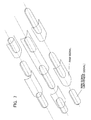
- phase pits which are preferably depressions and protrusions formed in the flat substrate
- RAM information is recorded as MO signals in the magnetooptical recording layer above the rows of phase pits.
- both ROM and RAM data can be reproduced simultaneously.
- magnetooptical recordings employing a magnetic field modulation method writing to RAM and reading from ROM can also be performed simultaneously.
- content is recorded in the ROM portion (phase pits) of the media, and advertising information is recorded in the RAM portion (magnetooptical recording layer) 4C.
- the motor 18 rotates the optical information recording media (MO disk).
- MO disk optical information recording media
- the MO disk 3 is a removable medium, and is inserted from an insertion opening (not shown) in the drive.
- the optical pickup 5 has a magnetic head 35 and an optical head 7, both positioned so as to sandwich the optical information recording medium 3.
- the optical pickup 5 is preferably moved by a ball-screw feed mechanism or other track actuator 6, and can access an arbitrary position in the radial direction of the optical information recording medium 3.
- An LD driver 31 that drives the laser diode LD of the optical head 7, and a magnetic head driver 34 which drives the magnetic head 35 of the optical pickup 5, are also provided.
- the access servo controller 15-2 executes servo control of the track actuator 6, the motor 18, and the focus actuator 19 of the optical head 7 based on output from the optical head 7.
- the controller 15-1 operates the LD driver 31, magnetic head driver 34 and access servo controller 15-2 to perform information recording and reproduction.
- Dispersed light from the laser diode LD is rendered into a parallel beam by the collimator lens 40 and, after passing through a polarizing beam splitter 41, is condensed substantially to a diffraction limit on the optical information recording medium 3 by an objective lens 46.
- a portion of the light incident on the polarizing beam splitter 41 is reflected by the beam splitter 41, and is condensed on an APC (auto-power control) detector 43 by a condensing lens 42.
- APC auto-power control
- Light reflected by the optical information recording medium 3 again passes through the objective lens 46 and is again incident on the beam splitter 41.
- a portion of the light which is again incident on the beam splitter 41 returns to the side of the laser diode LD.
- the remainder of the light is reflected by the beam splitter 41 and is then incident on a polarizing beam splitter 56.
- a portion of the light incident on the polarizing beam splitter 56 passes through a two-beam Wollaston prism 44 and condensing lens 45 to be condensed on a two-segment detector 47.
- the other portion of the light incident on the polarizing beam splitter 56 passes through a condensing lens 51 and cylindrical lens 52 and is condensed on a four-segment detector 53 for servo detection.
- a TES generation circuit 55 using the push-pull method performs tracking error signal (TES) detection from the output of the four-segment detector 53.
- TES ((A+B)-(C+D))/(A+B+C+D)
- the focusing error signal (FES) and tracking error signal (TES) obtained from these calculations are input to the main controller 15 (in Fig. 8, the access servo controller 15-2) as position error signals in the focusing direction and the tracking direction.
- the access servo controller 15-2 and controller 15-1 are shown as an integrated main controller 15.
- the polarity characteristics of reflected laser light which change according to the direction of magnetization due to magnetooptical recording in the optical information recording medium 3, are converted into an optical intensity. That is, polarization detection is used to separate the single beam into two beams with orthogonal polarization directions in a two-beam Wollaston prism 44. After passing through a condensing lens 45, the two beams are incident on a two-segment photodetector 47, and each is then preferably photoelectrically converted.
- reflected light of the semiconductor laser diode LD incident on the APC photodetector 43 is photoelectrically converted, and passes through the amplifier 61 to be input as the second ROM signal (ROM2).
- the first ROM signal (ROM1) which is the output of the summing amplifier 59
- the RAM signal (RAM) which is the output of the differential amplifier 60
- the focusing error signal (FES) from the FES generation circuit 54 and the tracking error signal (TES) from the TES generation circuit 55, are input to the main controller 15.
- data for recording and readout data are exchanged between the main controller 15 and the data source 66 via the interface circuit 68.
- the main controller 15 generates command signals for the LD driver 31 corresponding to each mode.
- RAM magnetooptical
- data from the data source 66 is input to the main controller 15 via an interface 68.
- the main controller supplies this input data to the magnetic head driver 34.
- the magnetic head driver 34 drives the magnetic head 35 to modulate the magnetic field according to the recording data.
- the input data is sent to the LD driver 31, to perform optical modulation driving of the laser diode LD.
- the main controller 15 (in Fig. 8, the servo controller 15-2) drives a focusing actuator 19 to control a focusing spot of the light beam according to the detected focusing error signal FES.
- the main controller 15 (again, in Fig. 8, the servo controller 15-2) also drives a tracking actuator 6 to control seeking and tracking of the light beam according to the detected tracking error signal TES.
- the G+H (ROM1) signal of the detector 47, or the I (ROM2) signal of the detector 43 is used in laser power adjustment.
- ROM detection is preferably not performed during optical modulation recording.
- ROM and RAM disks may typically be laminated together, with information detected optically from the sides of the respective opposing faces; or, information may be detected from the same side, with the position in the depth direction changed; or, the ROM region and RAM region may be separated in two dimensions.
- the recording and reproduction device 4 shown in Figs. 8 and 9 has a configuration preferably including an optical pickup which reads ROM and RAM information, and a magnetic head which records RAM information. According to this configuration, RAM signals can be detected while reproducing ROM signals.
- ROM1 signals can be detected from ROM2 signals.
- the optical pickup mechanism can access an arbitrary radial position of the recording medium by means of a seek mechanism using a ball-screw feed mechanism. Hence, random access of content recorded in the ROM portion, and of advertising information recorded in the RAM portion, is possible.
- a recording and reproduction device 4 Using such a recording and reproduction device 4, the user can, while at home, listen to or dub the music content in the ROM portion of the content delivery media unit 3.
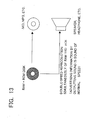
- Figs. 11 to 13 show examples of use of a content delivery media unit 3 by a user.
- the recording and reproduction device 4 can be connected to a television set 8 or audio equipment 9, and can reproduce video information and voice information.
- ROM information and RAM information can be reproduced simultaneously, so that, for example, advertising information can be displayed as subtitles superimposed on video information from ROM.
- questionnaire or other information from the user can be recorded in the RAM portion using a microphone, or other voice input equipment 92.
- RAM information can be used to display advertising information as text, for example, on a liquid crystal display 90 used as a control panel, or similar, of the audio equipment 9.
- Fig. 12 shows a relation between music content of the ROM portion and RAM portion content. As indicated in Fig. 12, advertisements 1, 2, etc., are recorded in the RAM portion corresponding to each of the songs in the ROM section. According to this configuration, when the first song in the ROM portion is reproduced, the user also sees the advertisement 1 reproduced.
- n times speed output (where n is greater than 1)
- a user who is idle during normal replication can still view advertising information.
- dubbing is performed using, for example, double-speed operation.
- the music content portion is recorded in ROM, so that lending and returns are possible in exactly the same manner as for normal CD music media or the like, and that cash rebates can be offered through advertisements in the RAM portion. Furthermore, even if information in the RAM portion is erroneously erased, the music content in ROM can still be protected.
- ROM and RAM signals are reproduced simultaneously, but an advertisement output time is provided in the ROM in advance, and during this time, advertisements recorded in RAM information can be output.
- advertisements can also be output prior to the beginning of content output, or after the beginning of output.
- advertisements can also be output.
- Regions not used for advertisements can also be used as regions to record disk management information or user questionnaire information.
- ROM information is generally recorded as EFM (eight-to-fourteen modulation) or other digital signals, as shown in Fig. 14.
- RAM information can be recorded as EFM signals, NRZI signals, or RLL 1-7 signals.
- FM frequency modulation
- a content delivery method and system delivers media with content stored in ROM while the latest advertising information is added. Moreover, advertisements can be viewed or heard easily during reproduction. Recording media are used in which content information is in physically stable ROM, while advertising information is recorded in RAM, enabling the delivery of content with advertisements for which the advertisement period has not elapsed. In addition, by reproducing content using media enabling simultaneous ROM and RAM reproduction, as well as a drive for such media, advertisements can be automatically reproduced. Consequently, users can view or hear advertisements without being conscious of an effort to obtain the advertisements. In this way the advertisements stored on a medium can be changed each time a user hires the medium from a hire shop, for example. This prevents the advertisements from becoming outdated. Thus, the advertisements accompanying a DVD containing a film, for example, are not limited to those recorded at the time of release of the DVD.
- recording media are employed in which content information is recorded in physical stable ROM and advertising information is recorded in RAM, it is possible to deliver content together with advertisements for which the advertisement period has not elapsed. And because media supporting simultaneous reproduction from ROM and RAM are used together with a drive for the media, advertisements can be reproduced together with content reproduction, so that the user can view or hear advertisements without being conscious of additional effort to obtain the advertisements. Consequently, advertising revenue can be included in delivery fees, and therefore the same content can be provided reliably and at a lower cost, yet without necessarily detracting from the revenue of the content rental business.
- content may be recorded in physical pits by means of a stamping machine, so that advertising information can be rewritten with no effect on the content data.
- the above embodiments have been explained with reference to advertising information, this is not the only kind of information capable of being associated with the content.
- the information stored in RAM may be news about the musical artist, tour dates or the like having a limited duration of interest.
- the ancillary information may include user instructions, patches or bug fixes.
- the media as a whole may be tailored to the user (e.g. in terms of language) without any need to vary the ROM content.
- the invention provides a technique for delivery data to a user in which some of the data is recorded in a permanent form for user access at any future time, and other data is recorded in a rewritable form for temporary access and possible future replacement, deletion or updating.
Landscapes
- Business, Economics & Management (AREA)
- Engineering & Computer Science (AREA)
- Accounting & Taxation (AREA)
- Finance (AREA)
- Development Economics (AREA)
- Strategic Management (AREA)
- Theoretical Computer Science (AREA)
- General Business, Economics & Management (AREA)
- Physics & Mathematics (AREA)
- General Physics & Mathematics (AREA)
- Marketing (AREA)
- Economics (AREA)
- Entrepreneurship & Innovation (AREA)
- Game Theory and Decision Science (AREA)
- Software Systems (AREA)
- Signal Processing For Digital Recording And Reproducing (AREA)
- Television Signal Processing For Recording (AREA)
- Two-Way Televisions, Distribution Of Moving Picture Or The Like (AREA)
- Management, Administration, Business Operations System, And Electronic Commerce (AREA)
Abstract
Description
Claims (21)
- A content delivery method, comprising the steps of:writing information to a RAM portion of a recording medium (3) prior to or at the time of delivering said recording medium with content recorded in a ROM portion to a user; andsimultaneously reproducing said content in said ROM portion and said information in said RAM portion by a reproduction device (4) that uses a single pickup mechanism to simultaneously reproduce said content and said information of said recording medium.
- The content delivery method according to claim 1, wherein said recording medium (3) comprises said ROM portion having said content formed by physical changes of an optically transparent or reflective substrate, and said RAM portion comprises a rewritable recording layer formed on top of or below said ROM portion.
- The content delivery method according to claim 1 or 2, wherein said RAM portion of said recording medium comprises a magneto-optical recording medium, and said reproduction device comprises a magneto-optical media drive which employs light for reproduction of data in said ROM portion and said RAM portion of said magneto-optical recording medium.
- The content delivery method according to any of claims 1 to 3 wherein said step of writing information to said RAM portion includes writing advertising information, and further comprising a step of providing cash rebates to said user corresponding to writing of said advertising information by a writing device.
- The content delivery method according to any of claims 1 to 4, wherein said writing step comprises a step of writing said information to said RAM portion such that said information is reproduced in synchronization with streaming data of said content of said ROM portion that is output according to a passage of time.
- The content delivery method according to any of claims 1 to 5, wherein said ROM portion stores EFM-modulated content, and said information in said RAM portion is recorded using frequency modulation.
- The content delivery method according to any of claims 1 to 6,
wherein said writing step comprises a step of writing at least one audio advertisement or image advertisement as said RAM information of said recording medium, and recording said content including at least audio information or image information as said ROM information, and
wherein said reproducing step comprises a step of simultaneously outputting said information of said ROM portion and of said RAM portion from said reproduction device to an audio or image output device connected to said reproduction device (4). - The content delivery method according to any of claims 1 to 7, wherein said reproduction step comprises a step of outputting said ROM information at n times (where n is greater than 1) an output speed of said RAM information.
- The content delivery method according to any of claims 1 to 8, wherein said writing step comprises a step of updating said RAM information when said recording medium is rented to said user for a limited time period.
- The content delivery method according to claim 9, further comprising a step of returning said recording medium to the deliverer after writing information of said user on said RAM portion of said recording medium.
- A content delivery system, comprising:wherein said reproduction device simultaneously reproduces said content and said information of said recording medium by using said single pickup mechanism.a writing device (14) for writing information to a RAM portion of a recording medium when delivering said recording medium with content recorded in a ROM portion to a user; anda reproduction device (4) having a single pickup mechanism for reproducing said content of said ROM portion and said information of said RAM portion of said recording medium (3),
- The content delivery system according to claim 11, wherein said recording medium (3) comprises a ROM portion having said content formed by physical changes to an optically transparent substrate, and a RAM portion having a rewritable recording layer formed on top of said ROM portion.
- The content delivery system according to claim 11 or 12, wherein said RAM portion of said recording medium (3) comprises a magneto-optical recording medium, and said reproduction device (4) comprises a magneto-optical media drive which employs light for reproduction of data in said ROM portion and said RAM portion of said magneto-optical recording medium.
- The content delivery system according to any of claims 11 to 13, wherein said information of said RAM portion is advertising information, and further comprising a mechanism for providing cash rebates to said user corresponding to said writing of said advertising information by said writing device.
- The content delivery system according to any of claims 11 to 14, wherein said writing device (14) writes said information to said RAM portion such that said information is reproduced in synchronization with streaming data of said content of said ROM portion that is output according to a passage of time.
- The content delivery system according to any of claims 11 to 15, wherein said ROM portion stores EFM-modulated content, and said information of said RAM portion is recorded using frequency modulation.
- The content delivery system according to any of claims 11 to 16,
further comprising an audio or image output device (9, 8) connected to said reproduction device (4) and for simultaneously outputting said information of said ROM portion and said RAM portion,
wherein said content of said recording medium (3) includes at least audio information or image information as said ROM information and at least one of audio advertisements and image advertisements as said RAM information. - The content delivery system according to any of claims 11 to 17, wherein said reproduction device (4) outputs said ROM information at n times speed (where n is greater than 1) of an output speed of said RAM information.
- The content delivery system according to any of claims 11 to 18, wherein, when said recording medium (3) is rented to said user for a limited time period, said writing device updates said RAM information.
- The content delivery system according to claim 19, wherein said reproduction device (4) for said recording medium (3) has a function to record information to said RAM portion, and said recording medium recorded by said reproduction device is returned to a rental source.
- A storage medium comprising: a substrate; a ROM portion for storing data formed by physical changes of an optically markable layer, and a RAM portion comprising a rewritable recording layer formed on the same side of the substrate as the optically markable layer.
Applications Claiming Priority (2)
| Application Number | Priority Date | Filing Date | Title |
|---|---|---|---|
| JP2002255151 | 2002-08-30 | ||
| JP2002255151A JP2004094618A (en) | 2002-08-30 | 2002-08-30 | Content distribution method and system |
Publications (2)
| Publication Number | Publication Date |
|---|---|
| EP1398773A2 true EP1398773A2 (en) | 2004-03-17 |
| EP1398773A3 EP1398773A3 (en) | 2005-10-26 |
Family
ID=31884702
Family Applications (1)
| Application Number | Title | Priority Date | Filing Date |
|---|---|---|---|
| EP03251723A Withdrawn EP1398773A3 (en) | 2002-08-30 | 2003-03-19 | Content delivery method and system for same |
Country Status (5)
| Country | Link |
|---|---|
| US (1) | US20040044570A1 (en) |
| EP (1) | EP1398773A3 (en) |
| JP (1) | JP2004094618A (en) |
| KR (1) | KR20040019853A (en) |
| CN (1) | CN1479239A (en) |
Cited By (1)
| Publication number | Priority date | Publication date | Assignee | Title |
|---|---|---|---|---|
| WO2008124809A1 (en) * | 2007-04-10 | 2008-10-16 | Fox Entertainment Group | Time dependent replacement of stored broadcast content |
Families Citing this family (9)
| Publication number | Priority date | Publication date | Assignee | Title |
|---|---|---|---|---|
| US20060018246A1 (en) * | 2004-07-21 | 2006-01-26 | Kato Douglas H | Integrated content and advertising compact disc |
| US8035482B2 (en) * | 2004-09-07 | 2011-10-11 | Eastman Kodak Company | System for updating a content bearing medium |
| US20080181585A1 (en) * | 2007-01-26 | 2008-07-31 | Disney Enterprises, Inc. | System and Method for Allocating Excess Capacity on a Storage Medium |
| WO2008124548A1 (en) | 2007-04-04 | 2008-10-16 | Visible World Inc. | Systems and methods for modifying commercials |
| US9087331B2 (en) * | 2007-08-29 | 2015-07-21 | Tveyes Inc. | Contextual advertising for video and audio media |
| WO2011040414A1 (en) * | 2009-09-30 | 2011-04-07 | シャープ株式会社 | Information recording medium, reproduction method and recording method using information recording medium, information recording/reproduction device, and 3d conversion unit and information recording device |
| CN102577408B (en) | 2009-09-30 | 2015-04-15 | 夏普株式会社 | Reproduction method using information recording medium, information recording/reproduction device, and 3d conversion unit and information recording device |
| US20110140844A1 (en) * | 2009-12-15 | 2011-06-16 | Mcguire Kenneth Stephen | Packaged product having a reactive label and a method of its use |
| JP2017059154A (en) * | 2015-09-18 | 2017-03-23 | ヤフー株式会社 | Information output device, information output system, information output method and information output program |
Family Cites Families (8)
| Publication number | Priority date | Publication date | Assignee | Title |
|---|---|---|---|---|
| US5166913A (en) * | 1988-01-27 | 1992-11-24 | Nec Corporation | Optical disk device for record and reproduction of additional information besides reproducing of basic information |
| JP2760812B2 (en) * | 1988-09-28 | 1998-06-04 | 株式会社日立製作所 | Optical reproducing apparatus and optical reproducing method |
| WO1994027234A1 (en) * | 1993-05-10 | 1994-11-24 | Taligent, Inc. | Multimedia synchronization system |
| DE4341223B4 (en) * | 1993-12-03 | 2010-11-18 | Deutsche Thomson-Brandt Gmbh | ROM-RAM disk |
| EP0814419A2 (en) * | 1996-06-19 | 1997-12-29 | Knowledge Information Research Institute | Method of and device for executing a software and medium for distribution |
| US6757906B1 (en) * | 1999-03-30 | 2004-06-29 | Tivo, Inc. | Television viewer interface system |
| JP2001135023A (en) * | 1999-11-02 | 2001-05-18 | Matsushita Electric Ind Co Ltd | DVD lending system and method |
| JP2001229546A (en) * | 2000-02-14 | 2001-08-24 | Sony Corp | Optical recording medium and master for producing optical recording medium |
-
2002
- 2002-08-30 JP JP2002255151A patent/JP2004094618A/en active Pending
-
2003
- 2003-02-25 US US10/374,556 patent/US20040044570A1/en not_active Abandoned
- 2003-03-19 EP EP03251723A patent/EP1398773A3/en not_active Withdrawn
- 2003-03-20 CN CNA031208134A patent/CN1479239A/en active Pending
- 2003-03-25 KR KR1020030018408A patent/KR20040019853A/en not_active Ceased
Cited By (1)
| Publication number | Priority date | Publication date | Assignee | Title |
|---|---|---|---|---|
| WO2008124809A1 (en) * | 2007-04-10 | 2008-10-16 | Fox Entertainment Group | Time dependent replacement of stored broadcast content |
Also Published As
| Publication number | Publication date |
|---|---|
| CN1479239A (en) | 2004-03-03 |
| KR20040019853A (en) | 2004-03-06 |
| JP2004094618A (en) | 2004-03-25 |
| US20040044570A1 (en) | 2004-03-04 |
| EP1398773A3 (en) | 2005-10-26 |
Similar Documents
| Publication | Publication Date | Title |
|---|---|---|
| JP4360276B2 (en) | Optical disc having wireless IC tag and optical disc reproducing apparatus | |
| EP1030301A1 (en) | Recording/reproducing apparatus, data reproducing method, and data recording / reproducing method | |
| EP1398773A2 (en) | Content delivery method and system for same | |
| WO2002017170A1 (en) | Communication system, communication apparatus, communication method, record medium, and program | |
| KR100694725B1 (en) | Data recording medium and data recording device | |
| KR20060046334A (en) | Content recording medium, method of acquiring reproduction permission information, method of reproducing content and apparatus for reproducing content | |
| JP2008071482A (en) | Content playback device | |
| KR101053947B1 (en) | Data recording apparatus, data recording method, data reproduction method and data transmission apparatus | |
| WO2004023481A1 (en) | Rom-ram medium and storage device thereof | |
| JP3815010B2 (en) | Rental time limit management device, playback device | |
| JP2003123268A (en) | Recording medium, information recorder, information reproducing device and information rental system | |
| JPH09231682A (en) | Information recording / reproducing apparatus and information recording method | |
| JPH11213550A (en) | Reproduction limiting device for recording media and reproduction limiting method for recording media | |
| JPH0482039A (en) | Optical disk provided with copy guard function and optical disk device and optical disk system using this disk | |
| US20040002997A1 (en) | Method of bundling player software and music | |
| JP3290020B2 (en) | Optical disk recording device | |
| US8089840B2 (en) | Reproduction system | |
| JP2000149443A (en) | Information recording medium and information recording and reproducing device | |
| JP2002367221A (en) | Recording medium and method of selling contents | |
| JP2001006179A (en) | Content recording medium, content recording device, and program recording medium | |
| JP4885230B2 (en) | Playback system | |
| JP3379703B2 (en) | Information recording medium recording and reproducing apparatus and information recording medium recording and reproducing method | |
| JP4001174B2 (en) | Information recording medium recording / reproducing apparatus | |
| JP3625208B2 (en) | Information recording medium recording / reproducing apparatus and information recording medium recording / reproducing method | |
| JP3627732B2 (en) | Information recording medium recording / reproducing apparatus and information recording medium recording / reproducing method |
Legal Events
| Date | Code | Title | Description |
|---|---|---|---|
| PUAI | Public reference made under article 153(3) epc to a published international application that has entered the european phase |
Free format text: ORIGINAL CODE: 0009012 |
|
| AK | Designated contracting states |
Kind code of ref document: A2 Designated state(s): AT BE BG CH CY CZ DE DK EE ES FI FR GB GR HU IE IT LI LU MC NL PT RO SE SI SK TR |
|
| AX | Request for extension of the european patent |
Extension state: AL LT LV MK |
|
| PUAL | Search report despatched |
Free format text: ORIGINAL CODE: 0009013 |
|
| AK | Designated contracting states |
Kind code of ref document: A3 Designated state(s): AT BE BG CH CY CZ DE DK EE ES FI FR GB GR HU IE IT LI LU MC NL PT RO SE SI SK TR |
|
| AX | Request for extension of the european patent |
Extension state: AL LT LV MK |
|
| RIC1 | Information provided on ipc code assigned before grant |
Ipc: 7G 11B 7/24 B Ipc: 7G 06F 17/60 B Ipc: 7G 11B 7/007 A |
|
| 17P | Request for examination filed |
Effective date: 20060116 |
|
| AKX | Designation fees paid |
Designated state(s): DE FR GB |
|
| 17Q | First examination report despatched |
Effective date: 20060228 |
|
| STAA | Information on the status of an ep patent application or granted ep patent |
Free format text: STATUS: THE APPLICATION IS DEEMED TO BE WITHDRAWN |
|
| 18D | Application deemed to be withdrawn |
Effective date: 20081023 |