EP1398404A1 - Cylindrical knitting fabric bound with depth formed and method of knitting it - Google Patents
Cylindrical knitting fabric bound with depth formed and method of knitting it Download PDFInfo
- Publication number
- EP1398404A1 EP1398404A1 EP02722882A EP02722882A EP1398404A1 EP 1398404 A1 EP1398404 A1 EP 1398404A1 EP 02722882 A EP02722882 A EP 02722882A EP 02722882 A EP02722882 A EP 02722882A EP 1398404 A1 EP1398404 A1 EP 1398404A1
- Authority
- EP
- European Patent Office
- Prior art keywords
- stitches
- knitted fabric
- knitting
- knitted
- tubular
- Prior art date
- Legal status (The legal status is an assumption and is not a legal conclusion. Google has not performed a legal analysis and makes no representation as to the accuracy of the status listed.)
- Granted
Links
- 239000004744 fabric Substances 0.000 title claims abstract description 136
- 238000009940 knitting Methods 0.000 title claims abstract description 64
- 238000000034 method Methods 0.000 title claims description 28
- 230000008878 coupling Effects 0.000 description 2
- 238000010168 coupling process Methods 0.000 description 2
- 238000005859 coupling reaction Methods 0.000 description 2
Images



Classifications
-
- D—TEXTILES; PAPER
- D04—BRAIDING; LACE-MAKING; KNITTING; TRIMMINGS; NON-WOVEN FABRICS
- D04B—KNITTING
- D04B1/00—Weft knitting processes for the production of fabrics or articles not dependent on the use of particular machines; Fabrics or articles defined by such processes
- D04B1/22—Weft knitting processes for the production of fabrics or articles not dependent on the use of particular machines; Fabrics or articles defined by such processes specially adapted for knitting goods of particular configuration
-
- D—TEXTILES; PAPER
- D10—INDEXING SCHEME ASSOCIATED WITH SUBLASSES OF SECTION D, RELATING TO TEXTILES
- D10B—INDEXING SCHEME ASSOCIATED WITH SUBLASSES OF SECTION D, RELATING TO TEXTILES
- D10B2403/00—Details of fabric structure established in the fabric forming process
- D10B2403/03—Shape features
- D10B2403/033—Three dimensional fabric, e.g. forming or comprising cavities in or protrusions from the basic planar configuration, or deviations from the cylindrical shape as generally imposed by the fabric forming process
- D10B2403/0332—Three dimensional fabric, e.g. forming or comprising cavities in or protrusions from the basic planar configuration, or deviations from the cylindrical shape as generally imposed by the fabric forming process with gussets folding into three dimensional shape, e.g. seat covers
Definitions
- the present invention relates to a tubular knitted fabric in which front and back knitted fabrics are continuously joined to each other at both the ends thereof by a flat knitting machine and in which a depth is formed and joined between the front and back knitted fabrics at the terminal end of the knitted fabric and to a method of knitting the tubular knitted fabric.
- a knitted fabric in which one end of a tubular knitted fabric is joined as shown in FIG. 8 is knitted, the knitted fabric is formed as a tubular knitted fabric whose front and back knitted fabrics are continuously joined to each other at both the ends thereof, the stitches of the final courses of the front and back knitted fabrics, which are held to needle beds that confront in back and forth, at the terminal ends thereof are laid on any one of the needle beds so as to form new stitches thereat, and the new stitches are bound off from one end to the other thereof, thereby the tubular knitted fabric whose one end is joined can be knitted.
- An object of the present invention is to provide a tubular knitted fabric in which a depth is formed and joined thereto on the side thereof where knitting is ended and a method of knitting the tubular knitted fabric.
- a tubular knitted fabric of the present invention having a depth formed thereto and joined that is knitted by a flat knitting machine having at least a pair of front and back needle beds each slidably accommodating knitting needles is characterized in that the stitches of front and back knitted fabrics are overlapped with each other and bound off in the regions located on both the outermost right and left sides in a knitting width at the terminal end of the tubular knitted fabric in which the front and back knitted fabrics are continuous to each other as well as the stitches of the adjacent regions in the front and back knitted fabrics, in which the stitches of the front and back knitted fabrics are overlapped with each other and bound off between the regions, are overlapped with each other and bound off.
- a method of knitting a tubular knitted fabric of the present invention by closing the terminal end of a knitted fabric knitted as the tubular knitted fabric in which a front knitted fabric is continuous to a back knitted fabric at both the ends thereof by a flat knitting machine having at least a pair of front and back needle beds each slidably accommodating knitting needles is characterized by comprising a step of dividing the loops of the final course of a tubular knitted fabric held to front and back needle beds into a plurality of regions, overlapping the stitches of front and back knitted fabric that confront in front and back in the regions located on the right and left outmost sides of the divided regions with each other and binding off the overlapped stitches, and a step of overlapping the stitches of the adjacent regions in the front and back knitted fabrics in the opening region located between the regions on the outermost right and left sides, which are bound off at the above step, each other and binding off the overlapped stitches.
- the step of overlapping the stitches of the front and back knitted fabrics with each other and binding off the overlapped stitches comprises a step of repeating knitting for transferring the stitches of the front knitted fabric nearest to the side end thereof from a front needle bed to a back needle bed at one end of the tubular knitted fabric in the knitting width thereof and transferring the stitches of the back knitted fabric nearest to the side end thereof from the back needle bed to the front needle bed at the other end of the tubular knitted fabric so that the respective regions to be joined of the knitted fabrics are shifted to the positions of the front and back needle beds at which the respective regions confront each other, thereafter overlapping the stitches held to the knitting needles of the needle beds that confront each other in front and back, and binding off the overlapped stitches.
- a knitted portion is formed by flechage knitting by reversing a yarn feed direction in mid course of the knitted region of the tubular knitted fabric and using the knitting needles of a part of the knitted region subsequent to knitting of a tubular shape, and the loops of the final courses of the flechage-knitted portion are coupled with each other.
- a knitting machine used in the present invention is a flat knitting machine having at least a pair of front and back needle beds each accommodating knitting needles such that they can slidingly advance and retract with the front and back needle beds are needle plated so as to relatively move right and left.
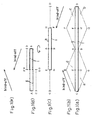
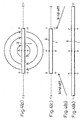
- FIGS. 1(a) to 1(e) and FIGS. 3(a) to 3(b) show an example when a tubular cover 2 having a bottom 1 is formed as an example of a tubular knitted fabric having a depth formed thereto and joined as shown in FIG. 5, and FIG. 1(a) shows the terminal end portion of the tubular knitted fabric shown in FIG. 5.
- reference numeral I (thick line portion) and reference numeral II show knitted fabric portions held to the knitting needles of the front needle bed or to the knitting needles of the back needle bed, respectively.
- front and back knitted fabrics I and II are coupled with each other at both right and left end portions C and D, and isosceles-triangular knitted fabrics a, b, c, and d are formed to the front and back knitted fabrics I and II to form a bottom as shown in FIG. 3(a).
- the knitted fabrics a and b are formed of isosceles-triangle by a flechage knitting using knitted fabrics C - B and B - D held to the knitting needles of the front needle bed as bases
- the knitted fabrics d and c are formed of isosceles-triangles by a flechage knitting using knitted fabrics C - A and A - D held to the knitting needles of the back needle bed as bases, respectively.
- the number of stitches h1 to the apexes E, F, G, H of these isosceles-triangles are one half the number of stitches between confronting sides of a rectangle shown in FIG. 5, that is, they are same as the number of stitches to the center to a tube.
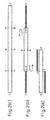
- the knitted fabrics held to the knitting needles of the front and back needle beds are shifted from a state shown in FIG. 1(c) to a state shown in FIG. 1(d) and FIG. 2(c).
- This shift is executed by, for example, sequentially shifting the stitches of the front needle bed to the back needle bed from the right end thereof at the right end of the tubular knitted fabric while moving the back needle bed left, and, in parallel with the above shift, by sequentially shifting the stitches of the back needle bed to the front needle bed from the left end thereof at the left end of the tubular knitted fabric while moving the back needle bed left.
- Reference numeral 5 in FIG. 6 denotes a window formed on a side wall portion of the tubular cover 2.
- a method of coupling the oblique surface portions with each other as shown in FIG. 4(a) to 4(d) is such that steps executed in FIGS. 4(a) to 4(c) are the same as the step executed in FIG. 1(d) of the above embodiment, and, in a step executed in FIG. 4(d), the adjacent stitches of the stitches of the oblique surface portions (AE and AF, and BG and BH) held to the knitting needles of the front and back needle beds are coupled with each other by the method proposed by the applicant previously and disclosed in W001/88243.
- the stitches between B and H of the front knitted fabric are transferred from a state shown in FIG. 4(c) to the empty needles on the back needle bed as well as the stitches between E and A of the back knitted fabric are transferred to the empty knitting needles on the front needle bed.
- stitches are newly formed by sequentially overlapping the stitches, which have been shifted onto the back needle bed, of the knitted fabric BH with the stitches at the right end between B and G of the above knitted fabric on the front needle bed from the stitches of the knitted fabric BH at the left end thereof while moving the back needle bed as well as loops are newly formed by overlapping the loops between A and E of the back knitted fabric with the stitches at the left end between A and F of the back knitted fabric on the back needle bed from the loop at the right end between A and E of the back knitted fabric.
- the BG and BH portions of the front knitted fabric and the AE and AF portions of the back knitted fabric are bound off such that the stitches near to points A and B are overlapped with each other and the stitches far from the points A and B are overlapped with each other.
- yarn cut due to the wear of yarns can be prevented because stitch transfer of the same loop need not be repeatedly executed between the front and back needle beds to execute the binding-off.
- the binding-off method is by no means limited to the method disclosed in WO01/88243, and any method may be employed as long as it can join the BG and BH portions of the front knitted fabric to each other and the AE and AF portions of the back knitted fabric to each other such that the stitches near to each other and the stitches far from each other are overlapped with each other, respectively with respect to the points A and B.
- a bottle 4 such as a wine bottle or the like is inserted into the tubular cover 2 formed as described above from an article charging port 3 formed of a knitting start portion as shown in FIG. 6, the bottle 4 is accommodated in the tubular cover 1 while fitted to the bottom 1 thereof to which the depth is formed.
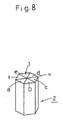
- This example employs a hexagonal bottom 1 as shown by ⁇ in FIG. 8 in place of the bottom 1 in the above example.
- each three front and back isosceles-triangular knitted fabrics a, b, c, d, e, f having apexes G, B, H, E, A, F are formed to front and back knitted fabrics I and II coupled with each other at both ends C and D by flechage knitting in a state shown in FIG. 7(a).
- the number of stitches h1 to the apexes G, B, H, E, A, F is the same as the number of stitches to the center of a tube in the state ⁇ in FIG. 8.
- the knitted fabrics I and II held to the knitting needles of the front and back needle beds are shifted from a state shown in FIG. 7(c) to a state shown in FIG. 7(d) by sequentially shifting the stitches of the front needle bed to the back needle bed from the right end thereof at the right end of a tubular knitted fabric while moving the back needle bed left, and, in parallel with the above shift, by sequentially shifting the stitches of the back needle bed to the front needle bed from the left end thereof at the left end of the tubular knitted fabric as described in the above example 1.
- the knitted fabrics shifted to the state of FIG. 7(d) are in a state as if they are turned.
- the stitches of the front needle bed are sequentially transferred to the back needle bed from the end thereof while moving the back needle bed so that the knitted fabrics are shifted to the state shown in FIG. 7(g), and then the oblique surface portions (JA and JH, and KH and KA) are overlapped with each other and bound off from the outside stitches to the inside stitches thereof as shown in FIG. 7(h) by the same binding-off method as that described above.
- a tubular cover 2 having a hexagonal bottom 1 as shown by ⁇ of FIG. 8 is formed.
- the stitches of the front knitted fabric and the stitches of the back knitted fabric in the adjacent regions in the region located between the region in which the stitches of the front and back knitted fabrics are overlapped with each other and bound off thereby the terminal end portion of the tubular knitted fabric can be joined through the depth formed thereto.
- the present invention is not limited to form the triangular portions by the flechage knitting described above. Although it is possible to form the bottom portion flat by forming the triangular portions, the object for providing the depth can be achieved without forming the triangular portions.
- a joined portion can be made inconspicuous because the knitted fabrics are attracted to each other at the joined portion.
- the knitted portion in the terminal end portion of the tubular knitted fabric is formed of the isosceles-triangles, it is also possible to form the terminal end portion of scalene triangles, and the tubular knitted fabric according to the present invention is not limited to accommodate an article, and it is needless to say that it can be embodied to form a knit product such as a hat.
- a tubular knitted fabric which has front and back knitted fabrics continuous to each other at both the ends thereof, is knitted by a flat knitting machine having at least a pair of front and back needle beds each slidably accommodating knitting needles
- the stitches of the front and back knitted fabrics are overlapped with each other and bound off at both the right and left ends thereof in a width direction in the terminal end portion of the tubular knitted fabric as well as the stitches of the front knitted fabric and the stitches of the back knitted fabric in the adjacent regions in the region located between the region in which the stitches of the front and back knitted fabrics are overlapped with each other and bound off, thereby the tubular knitted fabric having the depth formed thereto can be formed.
Landscapes
- Engineering & Computer Science (AREA)
- Textile Engineering (AREA)
- Knitting Machines (AREA)
- Knitting Of Fabric (AREA)
Abstract
Description
Claims (4)
- A tubular knitted fabric having a depth formed thereto and joined that is knitted by a flat knitting machine having at least a pair of front and back needle beds each slidably accommodating knitting needles, characterized in that the stitches of front and back knitted fabrics are overlapped with each other and bound off in the regions located on both the outermost right and left sides in a knitting width at the terminal end of the tubular knitted fabric in which the front and back knitted fabrics are continuous to each other as well as the stitches of the adjacent regions in the front and back knitted fabrics, in which the stitches of the front and back knitted fabrics are overlapped with each other and bound off between the regions, are overlapped with each other and bound off.
- A method of knitting a tubular knitted fabric by closing the terminal end of a knitted fabric knitted as the tubular knitted fabric in which a front knitted fabric is continuous to a back knitted fabric at both the ends thereof by a flat knitting machine having at least a pair of front and back needle beds each slidably accommodating knitting needles, characterized by comprising:a step of dividing the loops of the final course of a tubular knitted fabric held to front and back needle beds into a plurality of regions, overlapping the stitches of front and back knitted fabric that confront in front and back in the regions located on the right and left outmost sides of the divided regions with each other and binding off the overlapped stitches; anda step of overlapping the stitches of the adjacent regions in the front and back knitted fabrics, in which the stitches of the front and back knitted fabrics are overlapped with each other and bound off between the regions.
- A method of knitting a tubular knitted fabric according to claim 2, characterized in that the second step according to claim 2, which overlaps the stitches of the front and back knitted fabrics with each other and binds off the overlapped stitches, comprises a step repeating knitting for transferring the stitches of the front knitted fabric nearest to the side end thereof from a front needle bed to a back needle bed at one end of the tubular knitted fabric in the knitting width thereof and transferring the stitches of the back knitted fabric nearest to the side end thereof from the back needle bed to the front needle bed at the other end of the tubular knitted fabric so that the respective regions to be joined of the knitted fabrics are shifted to the positions of the front and back needle beds at which the respective regions confront each other, thereafter overlapping the stitches held to the knitting needles of the needle beds that confront each other in front and back, and binding off the overlapped stitches.
- A method of knitting a tubular knitted fabric according to claim 2, characterized in that a knitted portion is formed by flechage knitting by reversing a yarn feed direction in mid course of the knitted region of the tubular knitted fabric and using the knitting needles of a part of the knitted region subsequent to knitting of a tubular shape, and the loops of the final courses of the flechage-knitted portion are coupled with each other.
Applications Claiming Priority (3)
| Application Number | Priority Date | Filing Date | Title |
|---|---|---|---|
| JP2001157985 | 2001-05-25 | ||
| JP2001157985 | 2001-05-25 | ||
| PCT/JP2002/004298 WO2002097179A1 (en) | 2001-05-25 | 2002-04-26 | Cylindrical knitting fabric bound with depth formed and method of knitting it |
Publications (3)
| Publication Number | Publication Date |
|---|---|
| EP1398404A1 true EP1398404A1 (en) | 2004-03-17 |
| EP1398404A4 EP1398404A4 (en) | 2004-08-18 |
| EP1398404B1 EP1398404B1 (en) | 2011-08-31 |
Family
ID=19001765
Family Applications (1)
| Application Number | Title | Priority Date | Filing Date |
|---|---|---|---|
| EP02722882A Expired - Lifetime EP1398404B1 (en) | 2001-05-25 | 2002-04-26 | Cylindrical knitting fabric bound with depth formed and method of knitting it |
Country Status (6)
| Country | Link |
|---|---|
| US (1) | US6840064B2 (en) |
| EP (1) | EP1398404B1 (en) |
| JP (1) | JP3983733B2 (en) |
| KR (1) | KR100867141B1 (en) |
| CN (1) | CN1296543C (en) |
| WO (1) | WO2002097179A1 (en) |
Cited By (1)
| Publication number | Priority date | Publication date | Assignee | Title |
|---|---|---|---|---|
| EP2149629A4 (en) * | 2007-05-18 | 2011-10-19 | Shima Seiki Mfg | THREE-DIMENSIONAL KNITTING METHOD, AND THREE-DIMENSIONAL ARTICLE KNITTED BY THE METHOD |
Families Citing this family (2)
| Publication number | Priority date | Publication date | Assignee | Title |
|---|---|---|---|---|
| US9863070B2 (en) | 2014-12-08 | 2018-01-09 | Federal-Mogul Powertrain Llc | Tubular protective sleeve with curl resistant knit ends and method of construction thereof |
| CN113604951B (en) * | 2021-09-07 | 2022-10-25 | 江南大学 | Weaving process of a fully formed cube box-shaped fabric |
Family Cites Families (17)
| Publication number | Priority date | Publication date | Assignee | Title |
|---|---|---|---|---|
| GB962358A (en) | 1961-11-29 | 1964-07-01 | Louis Hochman | Improvements relating to tubular knitted articles |
| JPS55112346A (en) * | 1979-02-16 | 1980-08-29 | Yoshiko Yoshida | Endless continuous knitting method by hand knitting machine |
| JPS60194154A (en) * | 1984-03-07 | 1985-10-02 | 株式会社島精機製作所 | Knitting of tublar plain stitch fabric by traverse knitting fabric |
| JPS6120667A (en) | 1984-07-06 | 1986-01-29 | Hitachi Ltd | Welding torch speed control method |
| JPH06100831B2 (en) | 1989-08-17 | 1994-12-12 | 三田工業株式会社 | Electrophotographic photoreceptor |
| JPH07111021B2 (en) * | 1990-05-02 | 1995-11-29 | 株式会社島精機製作所 | How to fold folds |
| JPH0770886A (en) | 1993-08-31 | 1995-03-14 | Shima Seiki Mfg Ltd | Knitting of steric knit fabric having corner part |
| JP3075656B2 (en) * | 1993-09-07 | 2000-08-14 | 東京瓦斯株式会社 | Gas meter |
| GB9422650D0 (en) * | 1994-11-10 | 1995-01-04 | Gen Motors Corp | A knitting method |
| GB2297562B (en) * | 1995-02-01 | 1998-07-01 | Gen Motors Corp | Knitting method |
| KR100392480B1 (en) * | 1995-04-10 | 2003-11-28 | 가부시키가이샤 시마세이키 세이사쿠쇼 | A method of binding off using a transverse knife and a method of binding- |
| EP0781880B1 (en) * | 1995-12-28 | 2001-12-05 | Shima Seiki Manufacturing, Ltd. | Binding-off method, bound knitted fabric, and CAD apparatus therefor |
| DE19717415A1 (en) * | 1997-04-25 | 1998-10-29 | Stoll & Co H | Process for the production of spatial, single or multi-surface knitted pieces on a flat knitting machine |
| DE19833392A1 (en) * | 1998-07-24 | 2000-01-27 | Stoll & Co H | Process for making a knitted fabric |
| EP1130146A4 (en) | 1998-11-10 | 2004-09-08 | Shima Seiki Mfg | METHOD FOR KNITTING A THREE-DIMENSIONAL KNIT |
| TW491918B (en) * | 2000-05-17 | 2002-06-21 | Shima Seiki Mfg | Method of joining knitted fabrics and joined knitted fabric |
| JP6120667B2 (en) * | 2013-05-02 | 2017-04-26 | キヤノン株式会社 | Image processing apparatus, imaging apparatus, image processing method, program, and recording medium |
-
2002
- 2002-04-26 EP EP02722882A patent/EP1398404B1/en not_active Expired - Lifetime
- 2002-04-26 KR KR1020037014218A patent/KR100867141B1/en not_active Expired - Fee Related
- 2002-04-26 JP JP2003500335A patent/JP3983733B2/en not_active Expired - Fee Related
- 2002-04-26 WO PCT/JP2002/004298 patent/WO2002097179A1/en not_active Ceased
- 2002-04-26 US US10/477,949 patent/US6840064B2/en not_active Expired - Fee Related
- 2002-04-26 CN CNB028106024A patent/CN1296543C/en not_active Expired - Fee Related
Cited By (1)
| Publication number | Priority date | Publication date | Assignee | Title |
|---|---|---|---|---|
| EP2149629A4 (en) * | 2007-05-18 | 2011-10-19 | Shima Seiki Mfg | THREE-DIMENSIONAL KNITTING METHOD, AND THREE-DIMENSIONAL ARTICLE KNITTED BY THE METHOD |
Also Published As
| Publication number | Publication date |
|---|---|
| WO2002097179A1 (en) | 2002-12-05 |
| JP3983733B2 (en) | 2007-09-26 |
| CN1527894A (en) | 2004-09-08 |
| EP1398404B1 (en) | 2011-08-31 |
| KR100867141B1 (en) | 2008-11-06 |
| CN1296543C (en) | 2007-01-24 |
| EP1398404A4 (en) | 2004-08-18 |
| US20040154344A1 (en) | 2004-08-12 |
| US6840064B2 (en) | 2005-01-11 |
| KR20040002933A (en) | 2004-01-07 |
| JPWO2002097179A1 (en) | 2004-09-16 |
Similar Documents
| Publication | Publication Date | Title |
|---|---|---|
| RU2091524C1 (en) | Hose-shaped knitted article | |
| EP0839940B1 (en) | A method of knitting tubular fabric having 2 x 1 rib stitch | |
| EP1375718A1 (en) | Knitted fabric having opening portion and knitting method therefor | |
| US6668593B2 (en) | Knit wear neck part knitting method and knit wear | |
| US20040083766A1 (en) | Method of knitting fabric | |
| US7316132B2 (en) | Knitting method for wide rib texture by plating | |
| EP0881314B1 (en) | A method for holding a stitch loop | |
| US6581417B2 (en) | Knit wear knitting method | |
| EP1306476B1 (en) | Welt-seaming method and welt-seamed knitted fabric, and cad device for welt-seaming | |
| US5174134A (en) | Knitting method of thick fabric less in elasticity | |
| EP2530196B1 (en) | Knitting method of knitted fabric with hole and knitted fabric | |
| US6655175B1 (en) | Method for joining knitted fabrics and joined knitted fabrics | |
| EP1130146A1 (en) | Method of knitting 3-d shape knit fabric | |
| JPWO2001057299A1 (en) | Knitwear knitting method | |
| EP1482080A1 (en) | Method of knitting tubular knitted fabric | |
| CN102995267B (en) | Method of joining knitted fabric and knitted fabric | |
| US6840064B2 (en) | Cylindrical knitting fabric sound with depth formed and method of knitting it | |
| US6021650A (en) | Method of knitting tubular fabrics | |
| EP0940491B1 (en) | A widening method | |
| EP1471175B1 (en) | Neck forming method | |
| EP2392708B1 (en) | Method for knitting knitwear with collar having v-neck point and knitted fabric | |
| CN113493954B (en) | Method for knitting tubular knitted fabric |
Legal Events
| Date | Code | Title | Description |
|---|---|---|---|
| PUAI | Public reference made under article 153(3) epc to a published international application that has entered the european phase |
Free format text: ORIGINAL CODE: 0009012 |
|
| 17P | Request for examination filed |
Effective date: 20031126 |
|
| AK | Designated contracting states |
Kind code of ref document: A1 Designated state(s): AT BE CH CY DE DK ES FI FR GB GR IE IT LI LU MC NL PT SE TR |
|
| AX | Request for extension of the european patent |
Extension state: AL LT LV MK RO SI |
|
| A4 | Supplementary search report drawn up and despatched |
Effective date: 20040702 |
|
| RIC1 | Information provided on ipc code assigned before grant |
Ipc: 7D 04B 1/22 A |
|
| 17Q | First examination report despatched |
Effective date: 20091124 |
|
| GRAP | Despatch of communication of intention to grant a patent |
Free format text: ORIGINAL CODE: EPIDOSNIGR1 |
|
| RBV | Designated contracting states (corrected) |
Designated state(s): DE ES FR GB IT |
|
| GRAS | Grant fee paid |
Free format text: ORIGINAL CODE: EPIDOSNIGR3 |
|
| GRAA | (expected) grant |
Free format text: ORIGINAL CODE: 0009210 |
|
| AK | Designated contracting states |
Kind code of ref document: B1 Designated state(s): DE ES FR GB IT |
|
| REG | Reference to a national code |
Ref country code: GB Ref legal event code: FG4D |
|
| REG | Reference to a national code |
Ref country code: DE Ref legal event code: R096 Ref document number: 60240945 Country of ref document: DE Effective date: 20111110 |
|
| PLBE | No opposition filed within time limit |
Free format text: ORIGINAL CODE: 0009261 |
|
| STAA | Information on the status of an ep patent application or granted ep patent |
Free format text: STATUS: NO OPPOSITION FILED WITHIN TIME LIMIT |
|
| 26N | No opposition filed |
Effective date: 20120601 |
|
| REG | Reference to a national code |
Ref country code: DE Ref legal event code: R097 Ref document number: 60240945 Country of ref document: DE Effective date: 20120601 |
|
| GBPC | Gb: european patent ceased through non-payment of renewal fee |
Effective date: 20120426 |
|
| REG | Reference to a national code |
Ref country code: FR Ref legal event code: ST Effective date: 20121228 |
|
| PG25 | Lapsed in a contracting state [announced via postgrant information from national office to epo] |
Ref country code: GB Free format text: LAPSE BECAUSE OF NON-PAYMENT OF DUE FEES Effective date: 20120426 |
|
| PG25 | Lapsed in a contracting state [announced via postgrant information from national office to epo] |
Ref country code: FR Free format text: LAPSE BECAUSE OF NON-PAYMENT OF DUE FEES Effective date: 20120430 |
|
| PG25 | Lapsed in a contracting state [announced via postgrant information from national office to epo] |
Ref country code: ES Free format text: LAPSE BECAUSE OF FAILURE TO SUBMIT A TRANSLATION OF THE DESCRIPTION OR TO PAY THE FEE WITHIN THE PRESCRIBED TIME-LIMIT Effective date: 20111211 |
|
| PGFP | Annual fee paid to national office [announced via postgrant information from national office to epo] |
Ref country code: DE Payment date: 20140430 Year of fee payment: 13 Ref country code: IT Payment date: 20140423 Year of fee payment: 13 |
|
| REG | Reference to a national code |
Ref country code: DE Ref legal event code: R119 Ref document number: 60240945 Country of ref document: DE |
|
| PG25 | Lapsed in a contracting state [announced via postgrant information from national office to epo] |
Ref country code: DE Free format text: LAPSE BECAUSE OF NON-PAYMENT OF DUE FEES Effective date: 20151103 Ref country code: IT Free format text: LAPSE BECAUSE OF NON-PAYMENT OF DUE FEES Effective date: 20150426 |