EP1396966A1 - Dynamic bandwidth allocation for variable bit rate streaming data - Google Patents
Dynamic bandwidth allocation for variable bit rate streaming data Download PDFInfo
- Publication number
- EP1396966A1 EP1396966A1 EP02020010A EP02020010A EP1396966A1 EP 1396966 A1 EP1396966 A1 EP 1396966A1 EP 02020010 A EP02020010 A EP 02020010A EP 02020010 A EP02020010 A EP 02020010A EP 1396966 A1 EP1396966 A1 EP 1396966A1
- Authority
- EP
- European Patent Office
- Prior art keywords
- bandwidth
- amount
- central controller
- connection
- network
- Prior art date
- Legal status (The legal status is an assumption and is not a legal conclusion. Google has not performed a legal analysis and makes no representation as to the accuracy of the status listed.)
- Granted
Links
- 238000000034 method Methods 0.000 claims abstract description 45
- 230000003139 buffering effect Effects 0.000 claims description 6
- 238000012544 monitoring process Methods 0.000 claims description 4
- 230000005540 biological transmission Effects 0.000 claims description 2
- 101100059544 Arabidopsis thaliana CDC5 gene Proteins 0.000 description 4
- 101100244969 Arabidopsis thaliana PRL1 gene Proteins 0.000 description 4
- 102100039558 Galectin-3 Human genes 0.000 description 4
- 101100454448 Homo sapiens LGALS3 gene Proteins 0.000 description 4
- 101150115300 MAC1 gene Proteins 0.000 description 4
- 101150051246 MAC2 gene Proteins 0.000 description 4
- 230000003190 augmentative effect Effects 0.000 description 2
- 238000010586 diagram Methods 0.000 description 1
- 208000016344 lissencephaly with cerebellar hypoplasia Diseases 0.000 description 1
- 238000002826 magnetic-activated cell sorting Methods 0.000 description 1
Images



Classifications
-
- H—ELECTRICITY
- H04—ELECTRIC COMMUNICATION TECHNIQUE
- H04W—WIRELESS COMMUNICATION NETWORKS
- H04W28/00—Network traffic management; Network resource management
- H04W28/16—Central resource management; Negotiation of resources or communication parameters, e.g. negotiating bandwidth or QoS [Quality of Service]
- H04W28/18—Negotiating wireless communication parameters
- H04W28/20—Negotiating bandwidth
-
- H—ELECTRICITY
- H04—ELECTRIC COMMUNICATION TECHNIQUE
- H04W—WIRELESS COMMUNICATION NETWORKS
- H04W28/00—Network traffic management; Network resource management
- H04W28/02—Traffic management, e.g. flow control or congestion control
- H04W28/06—Optimizing the usage of the radio link, e.g. header compression, information sizing, discarding information
-
- H—ELECTRICITY
- H04—ELECTRIC COMMUNICATION TECHNIQUE
- H04W—WIRELESS COMMUNICATION NETWORKS
- H04W28/00—Network traffic management; Network resource management
- H04W28/16—Central resource management; Negotiation of resources or communication parameters, e.g. negotiating bandwidth or QoS [Quality of Service]
- H04W28/26—Resource reservation
-
- H—ELECTRICITY
- H04—ELECTRIC COMMUNICATION TECHNIQUE
- H04W—WIRELESS COMMUNICATION NETWORKS
- H04W72/00—Local resource management
- H04W72/04—Wireless resource allocation
-
- H—ELECTRICITY
- H04—ELECTRIC COMMUNICATION TECHNIQUE
- H04W—WIRELESS COMMUNICATION NETWORKS
- H04W72/00—Local resource management
- H04W72/50—Allocation or scheduling criteria for wireless resources
- H04W72/54—Allocation or scheduling criteria for wireless resources based on quality criteria
- H04W72/543—Allocation or scheduling criteria for wireless resources based on quality criteria based on requested quality, e.g. QoS
-
- H—ELECTRICITY
- H04—ELECTRIC COMMUNICATION TECHNIQUE
- H04W—WIRELESS COMMUNICATION NETWORKS
- H04W84/00—Network topologies
- H04W84/02—Hierarchically pre-organised networks, e.g. paging networks, cellular networks, WLAN [Wireless Local Area Network] or WLL [Wireless Local Loop]
- H04W84/10—Small scale networks; Flat hierarchical networks
- H04W84/12—WLAN [Wireless Local Area Networks]
-
- H—ELECTRICITY
- H04—ELECTRIC COMMUNICATION TECHNIQUE
- H04W—WIRELESS COMMUNICATION NETWORKS
- H04W84/00—Network topologies
- H04W84/18—Self-organising networks, e.g. ad-hoc networks or sensor networks
Definitions
- the invention relates to a method to allocate bandwidth, which is intended for a central controller of a network, to a method to reserve bandwidth for a connection of a network, which is intended for a requesting terminal or a central controller of said network, to a central controller of a network, and to a requesting terminal of a network.
- Fig. 6 shows a diagram to illustrate the bandwidth allocation of an example network according to prior art.
- the example network has three QoS connections. Each connection has a fixed reserved amount of bandwidth.
- the first connection has a first fixed reserved amount of bandwidth 2A
- the second connection has a second fixed reserved amount of bandwidth 3A
- the third connection has a third fixed reserved amount of bandwidth 4A.
- the corresponding owner of the connection reserves the maximum required bandwidth.
- the owner of a connection is a device and/or application to which the connection belongs to. According to the HIPERLAN/2 standard a device may be a wireless terminal or the central controller of the network.
- a QoS connection can use its fixed reserved amount of bandwidth independent of the actual traffic, i.e. independent of its actual needed bandwidth.
- the difference between maximum and minimum required amount of bandwidth remains blocked even if only the minimum bandwidth is needed at a certain moment. Therefore, bandwidth may be temporarily wasted and devices/applications requesting resources may fail due to an alleged lack of bandwidth even though the needed bandwidth may be actually available.
- the object underlying the invention is to provide an improved method and means to allocate bandwidth enabling the use of bandwidth that cannot be used in prior art networks supporting QoS connections, wherein the quality of service of Q O S connections is not affected.
- the invention provides a method to allocate bandwidth according to claim 1 and to reserve bandwidth according to claim 4.
- the invention provides a central controller as defined in claim 7 and a requesting terminal as defined in claim 10. Further features and preferred embodiments are respectively defined in respective subclaims.
- the method to allocate bandwidth comprises the following steps, allocating a predetermined amount of bandwidth to a certain connection requiring a certain quality of service, wherein an owner of said certain connection is a requesting terminal which is a terminal of said network or said central controller, freeing a certain amount of the allocated predetermined amount of bandwidth, said certain amount being the difference of said predetermined amount of bandwidth and a needed amount of bandwidth indicated by said owner, and in case said owner requests a re-allocation of at least parts of the freed bandwidth, immediately (i.e. as soon as possible e.g. in a next transmitting frame) re-allocating as much of the freed bandwidth, so that said indicated amount of bandwidth is available to said owner.
- the invention provides a method to reserve bandwidth for a connection of a network, which second method is intended for a requesting terminal or a central controller of said network, wherein the requesting terminal and/or the central controller comprises a transmit queue for buffering sending data, and the requesting terminal is a terminal of a network with said central controller, comprises the following steps, reserving a predetermined amount of bandwidth for providing a certain quality of service for said connection, determining the filling status of the transmit queue which indicates how much sending data is in the transmit queue, determining a needed amount of bandwidth which is needed in a predetermined future, in particular in a predetermined future transmission frame, the needed amount of bandwidth depending on the filling status of the transmit queue and not exceeding said predetermined amount of bandwidth, and indicating said needed amount of bandwidth to said central controller.
- Both methods i.e. the method to allocate bandwidth and the method to reserve bandwidth, assure that less bandwidth may be wasted, if a connection that reserved a certain amount of bandwidth to guarentee a certain quality of service (QoS), i.e. a QoS connection, does not need all of the reserved certain amount of bandwidth.
- QoS quality of service
- a key feature thereby is that the QoS connection may immediately (i.e. as soon as possible) receive all or parts of the certain amount of bandwidth as soon as requested, so that the certain quality of service is always secured.
- bandwidth Preferably, within the method to allocate bandwidth, some or all of said certain amount of bandwidth is allocated to a connection without quality of service requirements, the connection being a connection of the network.
- said requesting terminal might be operated according to the second method.
- QoS connections are only granted taking into account the original allocations, but no dynamic reduced reservations.
- said central controller is advantageously operated according to the method to allocate bandwidth.
- said network is preferably an ad hoc network, in particular operated according to the ETSI HIPERLAN/2 standard.
- the central controller of a network comprises a bandwidth allocation means that allocates a predetermined amount of bandwidth to a connection with a certain quality of service requirement, the owner of said connection being said central controller or a requesting terminal, a bandwidth freeing means that receives a request signal sent out by said owner indicating a needed amount of bandwidth and that frees - in particular in the case that said certain amount of bandwidth neither exceeds said predetermined amount nor said needed amount of bandwidth - a certain amount of bandwidth which is the difference of said predetermined amount of bandwidth and said needed amount of bandwidth, and a bandwidth re-allocation means that - in particular in the case that said certain amount of bandwidth neither exceeds said predetermined amount nor said needed amount of bandwidth - immediately re-allocates as much of said certain amount of bandwidth, so that said indicated amount of bandwidth according to said request signal is available to said owner.
- the central controller comprises a transmit queue for buffering sending data, and a monitoring means, that monitors the filling status of said transmit queue and indicates said needed amount of bandwidth, which depends on the filling status, to said bandwidth freeing means and/or bandwidth re-allocations means.
- said network is preferably an ad hoc network, in particular operated according to the ETSI HIPERLAN/2 standard.
- a requesting terminal of a network having a connection with other terminals of the network or with a central controller of the network, the connection requiring a certain quality of service and therefore a predetermined amount of bandwidth comprises a transmit queue for buffering sending data, a monitoring means, that monitors the filling status of said transmit queue and sends out a request signal to said central controller indicating a needed amount of bandwidth, which depends on the filling status.
- Said network is preferably an ad hoc network, in particular operated according to the ETSI HIPERLAN/2 standard.
- Fig. 6 shows the allocation of the total available bandwidth 1 of an exemplary network with three QoS connections.
- the same total available bandwidth 1 of the same exemplary network is allocated to the same three connections.
- the bandwidth is allocated according to the invention.
- Each QoS connection has a fixed reserved amount of bandwidth as according to the prior art, i.e. the first connection has the first fixed reserved amount of bandwidth 2A, the second connection has the second fixed reserved amount of bandwidth 3A, and the third connection has the third fixed reserved amount of bandwidth 4A. Further, there is a remaining amount of bandwidth 5 of the total available bandwidth 1 that can be used by other connections. In Fig. 5, the three connections are currently not using all of the fixed reserved amounts of bandwidth.
- the first connection is currently only using a first used amount of bandwidth 2B
- the second connection is currently only using a second used amount of bandwidth 3B
- the third connection is currently only using a third used amount of bandwidth 4B. Therefore, according to the invention, amounts up to the unused amounts of bandwidth are temporarily freed, i.e. a first temporarily freed amount of bandwidth 2BF, a second temporarily freed amount of bandwidth 3BF, and a third temporarily freed amount of bandwidth 4BF are temporarily freed.
- These temporarily freed amounts of bandwidth can now be used by other connections. Further, these freed amounts of bandwidth can vary in size depending on the actual used amount of bandwidth of a connection, as indicated by two way arrows in Fig. 5.
- the first temporarily freed amount of bandwidth 2BF may vary depending on the used amount of bandwidth 2B of the first connection
- the second temporarily freed amount of bandwidth 3BF may vary depending on the used amount bandwidth 3B of the second connection
- the third temporarily freed amount of bandwidth 4BF may vary depending on the used amount of bandwidth 4B of the third connection. It is a key feature of the invention that the temporarily freed amounts of bandwidth can be re-allocated immediately to the respective connection, if the connection requires all or parts of the temporarily freed amount of bandwidth. This means, the quality of service of a QoS connection is not affected, while at the same time, more bandwidth for other connections becomes available. It should be noted that preferably the temporarily freed amounts of bandwidth are allocated to non QoS connections.
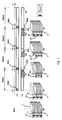
- Fig. 1 shows the scenario of an uplink, i.e. data is transmitted from a mobile terminal MT to a central controller CC within a network, which is operated according to the HIPERLAN/2 standard.
- an uplink queue 6 of the mobile terminal MT has a first filling status F1.
- the uplink queue 6 is filled with twelve data packages 7.
- One data package 7 corresponds to the amount of data that can be transmitted in four long channels (LCH).
- LCH long channels
- the number of reserved long channels is proportional to the needed amount of bandwidth.
- the mobile terminal MT has a fixed reserved amount of bandwidth equivalent to the number of fixed reserved long channels and the fixed reserved amount of bandwidth is allocated through the method of fixed capacity allocation (FCA).
- FCA fixed capacity allocation
- the mobile terminal MT determines the needed number of channels, which corresponds to a certain needed amount of bandwidth, depending on the filling status of the uplink queue 6 and a current sendable amount of data.
- the current sendable amount of data is equal to the number of data packages 7 that can be transmitted in the subsequent three MAC frames, given the current number of reserved long channels, i.e. a lookahead of three MAC frames is used.
- the lookahead can be any positive integer value.
- the current number of reserved long channels is the number of long channels currently allocated to the mobile terminal MT by the central controller CC and may change from a minimum value of one up to the number of fixed reserved long channels.
- the current number of reserved long channels determines the amount of data that can be transmitted within one MAC frame.
- the mobile terminal MT sends a Resource Request (RR) to the central controller CC of the network, indicating the actual needed amount of bandwidth which in term corresponds to an actual needed number of channels. In this case the current number of reserved channels of the connection is reduced to the actual needed number of channels. This is done by the central controller CC and indicated to the mobile terminal MT by a Resource Grant (RG) sent in the subsequent MAC frame.
- RR Resource Request
- RG Resource Grant
- the mobile terminal MT also sends a Resource Request (RR) to the central controller CC of the network, indicating the actual needed amount of bandwidth which in term corresponds to an actual needed number of channels.
- RR Resource Request
- the central controller CC indicates the actual needed amount of bandwidth which in term corresponds to an actual needed number of channels.
- RG Resource Grant
- Resource grants are sent by the central controller in the frame control channel FCH.
- Resource requests are sent in short channels SCH which are allocated in parallel to an FCA setup. Normally, resource requests or RRs are not used, if the connection is setup through the method of FCA.
- the maximum sendable amount of data is determined.
- the maximum sendable amount of data is three times the amount of data that can be sent in the sixteen reserved long channels.
- the central controller CC therefore sends a first resource grant RG1 to the mobile terminal MT indicating that the first current number of reserved long channels A1 is sixteen, which is equal to the number of fixed reserved long channels. In other words, the current needed amount of bandwidth is equal to the fixed reserved amount of bandwidth.
- a second filling status F2 of the uplink queue 6 indicates an amount of data below the first current sendable amount of data SE1, e.g. because some data has been sent in a not shown MAC frame preceding the first MAC frame MAC1. In other words, less data arrived than were sent out in the time of an unshown previous MAC frame. Therefore, the mobile terminal MT sends a first resource request RR1 in a SCH within the first MAC frame MAC1 to the central controller CC indicating the actual needed amount of bandwidth which corresponds to an actual needed number of channels. This actual needed number of channels may range between one and the number of fixed reserved long channels. This actually is the number of data packages (2 LCHs), and not an entire arbitrary number of channels. The first resource request RR1 remains valid until a new resource request is sent.
- the central controller CC in response to the first resource request RR1, the central controller CC sends a second resource grant RG2 to the mobile terminal MT indicating a second current number of reserved long channels A2.
- the second current number of reserved long channels A2 is twelve, i.e. the value is now lower than for the last current number of reserved long channels A1. Therefore, in subsequent MAC frames, three data packages 7 can be transmitted within one MAC frame. Since there are now less channels reserved for the connection, there are freed mobile terminal channels FR2 available for the use by other connections within the second MAC frame MAC2.
- a third filling status F3 indicates an amount of data slightly below the second current sendable amount of data SE2.
- the amount of data corresponding to the third filling status F3 can be transmitted exactly within the next three MAC frames. Therefore, within the second MAC frame MAC2, no resource request is sent to the central controller CC and the current number of reserved channels remains unchanged for a subsequent third MAC frame MAC3. This means, in the third MAC frame MAC3, there are also freed mobile terminal channels FR2 available for the use by other connections.
- a third resource grant RG3 indicates the same current number of reserved channels as the second resource grant RG2 since the bandwidth need has not changed.
- a fourth filling status F4 indicates an amount of data that is larger than the second current sendable amount of data SE2, i.e. the amount of data in the buffer cannot be sent in the next three MAC frames, given the second current number of reserved long channels A2. Therefore, within the third MAC frame MAC3, a second resource request RR2 is sent from the mobile terminal MT to the central controller CC in a SCH indicating the actual needed amount of bandwidth which corresponds to an actual needed number of channels. Again, this second resource request RR2 remains valid until a new resource request may be sent.
- the central controller CC in response to the second resource request RR2, the central controller CC sends a fourth resource grant RG4 to the mobile terminal MT indicating a third current number of reserved long channels A3.
- the third current number of reserved long channels A3 is sixteen, which is equal to the first current number of reserved long channels A1. Therefore, in subsequent MAC frames, four data packages 7 can be transmitted within one MAC frame, i.e. the allocated bandwidth is augmented for the connection.
- a fifth filling status F5 indicates an amount of data that is equal to the first current sendable amount of data SE 1. Therefore, within the fourth MAC frame MAC4, no resource request is sent from the mobile terminal MT to the central controller CC.
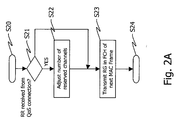
- Fig. 2A shows a flowchart illustrating the method for bandwidth allocation in the case of an uplink, which method is executed by the central controller of a HIPERLAN/2 network. The illustrated method is executed for each connection once per MAC frame.
- a central controller uplink initial state S20 the central controller waits until it receives a resource request RR from an FCA connection. If, in a first control step S21, the central controller receives a resource request RR, a subsequent step S22 is performed. In this step, the central controller determines and adjusts the current number of reserved long channels for the connection that sent the resource request RR. Then, in a first transmitting step S23, the central controller CC sends out a resource grant for the connection in the next MAC frame indicating the determined current number of reserved long channels.
- the control goes directly to the first transmitting step S23, i.e. if no resource request is received for a certain connection, the current number of reserved long channels is not changed and the resource grant RG sent out in the first transmitting step S23 indicates the value that was sent in the last MAC frame. Then the first final central controller state S24 is reached.
- Fig. 2B shows a flowchart illustrating the method for bandwidth allocation in the case of an uplink, which method is executed by a mobile terminal of a HIPERLAN/2 network.
- the mobile terminal initial state 525 the mobile terminal waits until the beginning of a MAC frame.
- the filling status indicates an amount of data that is below the current sendable amount of data
- the actual needed number of channels will be less than in the current MAC frame.
- the data is sent out within the next MAC frame in the current number of reserved long channels and a new resource request RR is sent in the SCH of the MAC frame.
- This new resource request RR indicates the determined actual needed number of channels. From the second transmitting step 529, a mobile terminal final state S31 is reached.
- a third control step S27 is performed. If, in this step, the filling status of the uplink queue 6 indicates an amount of data that is above the current sendable amount and below the maximum sendable amount of data, the calculation step S28 is reached. Since the filling status indicates an amount of data that is above the current sendable amount of data, the actual needed number of channels will be more than in the current MAC frame. It may not exceed the number of fixed reserved long channels.
- the data is sent out within the next MAC frame in the current number of reserved long channels and a new resource request RR is sent in the SCH of the MAC frame. This new resource request RR indicates the determined actual needed number of channels. From the second transmitting step S29, again the mobile terminal final state S31 is reached.
- a setting step S32 is performed.
- the actual needed number of channels is set to the number of fixed reserved channels. This set value is transmitted together with the next new resource request RR.
- the second transmitting step S29 is reached, i.e. the data is transmitted in the current number of reserved long channels within the current MAC frame and the new resource request RR is sent in the SCH of the MAC frame.
- the resource request RR indicates the number of fixed reserved channels.
- the mobile terminal final state S31 is reached.
- Fig. 3 shows the scenario for a downlink, i.e. data is transmitted from the central controller CC to a mobile terminal MT by a connection within a network run according to the HIPERLAN/2 standard.
- a downlink queue 8 of the central controller CC has a sixth filling status F6.
- the downlink queue 8 is filled with twelve data packages 7.
- 4x4 ( 16) fixed reserved long channels (LCH) reserved for the central controller CC.
- the number of reserved long channels is proportional to the needed amount of bandwidth.
- the central controller CC has a fixed reserved amount of bandwidth equivalent to the number of fixed reserved long channels.
- the fixed reserved amount of bandwidth is allocated through the method of fixed capacity allocation (FCA).
- FCA fixed capacity allocation
- the central controller CC determines the needed number of channels, which corresponds to a certain needed amount of bandwidth, depending on the filling status of the dowlink queue 8 and the current sendable amount of data.
- the current sendable amount of data is equal to the number of data packages 7 that can be transmitted in the subsequent three MAC frames, given the current number of reserved long channels, i.e. again a lookahead of three MAC frames is used.
- the lookahead can be any positive integer value.
- the current number of reserved long channels is the number of long channels currently allocated to the connection of the central controller CC and may change from a minimum value of one up to the number of fixed reserved long channels for the connection.
- the central controller CC determines the actual needed number of channels for the connection. Since the central controller CC allocates the current number of reserved long channels itself, it sets the current number of reserved long channels to the actual needed number of channels and indicates this number to the mobile terminals with a resource grant RG sent in the current MAC frame. In this case, the current number of reserved long channels will be less than the number of reserved long channels within the last MAC frame.
- the central controller CC determines the actual needed number of channels for the connection. Since the central controller CC allocates the current number of reserved long channels itself, it sets the current number of reserved long channels to the actual needed number of channels and indicates this number to the mobile terminals with a resource grant RG sent in the current MAC frame. In this case, the current number of reserved long channels will be greater than the number of reserved long channels within the last MAC frame. It may not exceed the number of fixed reserved long channels.
- the amount of data in the downlink queue 8 corresponding to a sixth filling status F6 is equal to a third current sendable amount of data SE3.
- the central controller CC therefore sends a fifth resource grant RG5 to the mobile terminal MT indicating that a fourth current number of reserved long channels A4 is sixteen, which is equal to the number of fixed reserved long channels.
- a seventh filling status F7 indicates an amount of data below the fourth current sendable amount of data SE4.
- the central controller CC sets the current number of reserved long channels from the fourth current number of reserved long channels A4 to a fifth current number of reserved long channels A5, which is lower.
- the central controller CC indicates this fifth current number of reserved long channels A5 to the mobile terminal with a sixth resource grant RG6 sent in the sixth MAC frame MAC6. Since channels have been freed by this procedure, there are freed central controller channels FR3 that can temporarily be used by other connections.
- the amount of data in the downlink queue 8 corresponding to an eighth filling status F8 is lower than a fourth current sendable amount of data SE4.
- the amount of data in the downlink queue 8 can be sent within the next three subsequent MAC frames and is therefore in the range of the lookahead. Therefore, the current number of reserved long channels needs not to be changed.
- the central controller CC sends a seventh resource grant RG7 to the mobile terminal indicating the same current number of reserved long channels as indicated by the sixth resource grant RG6. Since the current number of reserved channels has not been changed, there remain the freed central controller channels FR3 for the use by other connections.
- a ninth filling status F9 indicates an amount of data which is above the fourth sendable amount of data SE4. Therefore, the central controller CC augments the current number of reserved channels, such that the third current sendable amount SE3 is regained for the connection. This means, that a sixth current number of reserved long channels A6 is now reserved for the connection. This number is indicated to the mobile terminal via an eighth resource grant RG8 in the eighth MAC frame MAC8.
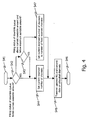
- Fig. 4 shows a flowchart illustrating the method for bandwidth allocation in the case of a downlink, which method is executed by the central controller of a HIPERLAN/2 network. The illustrated method is executed for each connection of the central controller with mobile terminals once per MAC frame.
- a second setting step S44 is reached.
- the central controller determines the actual needed number of channels and sets the current number of reserved long channels to this number. In this case, the current number of reserved long channels will be less than for the last MAC frame.
- a fourth transmitting step S45 is reached, where a resource grant RG indicating the current number of reserved long channels is sent to the mobile terminal MT having the connection with the central controller CC. Then a second final central controller state S46 is reached.
- a fifth control step S43 is reached.
- a third setting step S47 is reached.
- the central controller sets the current reserved number of channels to the number of fixed reserved channels. In other words, the fixed reserved amount of bandwidth allocated through the method of FCA is allocated to the connection.
- the fourth transmitting step S45 is reached, where a resource grant RG is sent to the mobile terminal indicating the current number of reserved long channels which is in this case equal to the number of fixed reserved channels. Further, in the fourth transmitting step S45, data is transmitted in the current number of reserved long channels. Then, the second final central controller state S46 is reached.
- the second setting step S44 is reached, where the current reserved number of channels is set to the actual needed number of channels. Then, the fourth transmitting step S45 is performed, where a resource grant RG is sent to the mobile terminal indicating the current number of reserved long channels for the connection. Further, in the fourth transmitting step S45, the data is transmitted in the current number of reserved channels. Then, the second final central controller state S46 is reached.
- a connection of a network requiring a certain quality of service i.e. a QoS connection
- QoS quality of service
- a QoS connection For a connection of a network requiring a certain quality of service (QoS), i.e. a QoS connection, generally a fixed amount of bandwidth is allocated. In prior art networks this fixed amount of bandwidth cannot be used by other connections. Therefore, in case the QoS connection does not require all of the allocated fixed amount of bandwidth, bandwidth may be wasted.
- the present invention provides a method that enables the use of bandwidth, that is currently not used by a QoS connection. This currently unused bandwidth is temporarily freed, such that other connections may use this freed bandwidth. In case all or parts of the freed bandwidth is needed again by the connection, the bandwidth is re-allocated to the connection immediately.
Landscapes
- Engineering & Computer Science (AREA)
- Quality & Reliability (AREA)
- Computer Networks & Wireless Communication (AREA)
- Signal Processing (AREA)
- Mobile Radio Communication Systems (AREA)
- Small-Scale Networks (AREA)
- Data Exchanges In Wide-Area Networks (AREA)
Abstract
Description
- Fig. 1
- shows the scenario for bandwidth allocation for the case of an uplink;
- Fig. 2A
- shows a flowchart illustrating the method for bandwidth allocation in the case of an uplink, which method is executed by the central controller of a HIPERLAN/2 network;
- Fig. 2B
- shows a flowchart illustrating the method for bandwidth allocation in the case of an uplink, which method is executed by a mobile terminal of a HIPERLAN/2 network;
- Fig. 3
- shows the scenario for bandwidth allocation for the case of a downlink;
- Fig. 4
- shows a flowchart illustrating the method for bandwidth allocation in the case of a downlink, which method is executed by the central controller of a HIPERLAN/2 network;
- Fig. 5
- shows an example of bandwidth allocation of a network with QoS connections, wherein the bandwidth is allocated according to the invention; and
- Fig. 6
- shows an example of bandwidth allocation of a network with QoS connections, wherein the bandwidth is allocated according to prior art.
Claims (11)
- A method to allocate bandwidth, which method is intended for a central controller of a network, comprising the following steps
allocating a predetermined amount of bandwidth to a certain connection requiring a certain quality of service, wherein an owner of said certain connection is a requesting terminal which is a terminal of said network or said central controller,
characterized by
freeing a certain amount of the allocated predetermined amount of bandwidth, said certain amount being the difference of said predetermined amount of bandwidth and a needed amount of bandwidth indicated by said owner, and
in case said owner requests a re-allocation of at least parts of the freed bandwidth, immediately re-allocating as much of the freed bandwidth, so that said indicated amount of bandwidth is available to said owner. - The method according to claim 1,
characterized by
allocating some or all of said certain amount of bandwidth to a connection without quality of service requirements, the connection being a connection of the network. - The method according to claim 1 or 2,
characterized in that
said requesting terminal is operated according to anyone of claims 4 to 6. - A method to reserve bandwidth for a connection of a network, which method is intended for a requesting terminal or a central controller of said network, wherein
the requesting terminal and/or the central controller comprises a transmit queue for buffering sending data, and
the requesting terminal is a terminal of a network with said central controller,
comprising the following steps,
reserving a predetermined amount of bandwidth for providing a certain quality of service for said connection
characterized by
determining the filling status of the transmit queue which indicates how much sending data is in the transmit queue,
determining a needed amount of bandwidth which is needed in a predetermined future, in particular in a predetermined future transmission frame, the needed amount of bandwidth depending on the filling status of the transmit queue and not exceeding said predetermined amount of bandwidth, and
indicating said needed amount of bandwidth to said central controller. - The method according to claim 4,
characterized in that
said central controller is operated according to anyone of claims 1 to 3. - The method according to anyone of the preceding claims,
characterized in that
said network is an ad hoc network, in particular operated according to the ETSI HIPERLAN/2 standard. - A central controller of a network comprising
a bandwidth allocation means that allocates a predetermined amount of bandwidth to a connection with a certain quality of service requirement,
the owner of said connection being said central controller or a requesting terminal,
characterized by
a bandwidth freeing means that receives a request signal sent out by said owner indicating a needed amount of bandwidth and that - in particular in the case that said certain amount of bandwidth neither exceeds said predetermined amount nor said needed amount of bandwidth - frees a certain amount of bandwidth which is the difference of said predetermined amount of bandwidth and said needed amount of bandwidth, and
a bandwidth re-allocation means that - in particular in the case that said certain amount of bandwidth neither exceeds said predetermined amount nor said needed amount of bandwidth - immediately re-allocates as much of said certain amount of bandwidth, so that said indicated amount of bandwidth according to said request signal is available to said owner. - The central controller according to claim 7,
characterized by
a transmit queue for buffering sending data, and
a monitoring means, that monitors the filling status of said transmit queue and indicates said needed amount of bandwidth, which depends on the filling status, to said bandwidth freeing means and/or bandwidth re-allocations means. - The central controller according to claim 7 or 8,
characterized in that
said network is an ad hoc network, in particular operated according to the ETSI HIPERLAN/2 standard. - A requesting terminal of a network having a connection with other terminals of the network or with a central controller of the network,
the connection requiring a certain quality of service and therefore a predetermined amount of bandwidth, comprising
a transmit queue for buffering sending data,
characterized by
a monitoring means, that monitors the filling status of said transmit queue and sends out a request signal to said central controller indicating a needed amount of bandwidth, which depends on the filling status. - The central controller according to claim 10,
characterized in that
said network is an ad hoc network, in particular operated according to the ETSI HIPERLAN/2 standard.
Priority Applications (4)
| Application Number | Priority Date | Filing Date | Title |
|---|---|---|---|
| DE60210958T DE60210958T2 (en) | 2002-09-05 | 2002-09-05 | Dynamic Bandwidth Assignment for Variable Bit Rate Data Streams |
| EP02020010A EP1396966B1 (en) | 2002-09-05 | 2002-09-05 | Dynamic bandwidth allocation for variable bit rate streaming data |
| US10/656,625 US20040057461A1 (en) | 2002-09-05 | 2003-09-04 | Dynamic bandwidth allocation for variable bit rate streaming data |
| JP2003314830A JP2004104791A (en) | 2002-09-05 | 2003-09-05 | Dynamic bandwidth allocation to variable bit rate streaming data |
Applications Claiming Priority (1)
| Application Number | Priority Date | Filing Date | Title |
|---|---|---|---|
| EP02020010A EP1396966B1 (en) | 2002-09-05 | 2002-09-05 | Dynamic bandwidth allocation for variable bit rate streaming data |
Publications (2)
| Publication Number | Publication Date |
|---|---|
| EP1396966A1 true EP1396966A1 (en) | 2004-03-10 |
| EP1396966B1 EP1396966B1 (en) | 2006-04-26 |
Family
ID=31502735
Family Applications (1)
| Application Number | Title | Priority Date | Filing Date |
|---|---|---|---|
| EP02020010A Expired - Lifetime EP1396966B1 (en) | 2002-09-05 | 2002-09-05 | Dynamic bandwidth allocation for variable bit rate streaming data |
Country Status (4)
| Country | Link |
|---|---|
| US (1) | US20040057461A1 (en) |
| EP (1) | EP1396966B1 (en) |
| JP (1) | JP2004104791A (en) |
| DE (1) | DE60210958T2 (en) |
Cited By (2)
| Publication number | Priority date | Publication date | Assignee | Title |
|---|---|---|---|---|
| EP2186359A4 (en) * | 2007-08-27 | 2013-05-01 | Ericsson Telefon Ab L M | A method and a network control node for bandwidth and access control in f emto cells of a wireless systems |
| CN107431598A (en) * | 2015-03-17 | 2017-12-01 | 高通股份有限公司 | Load knows channel status reference signal transmission |
Families Citing this family (13)
| Publication number | Priority date | Publication date | Assignee | Title |
|---|---|---|---|---|
| US6804256B2 (en) * | 2001-07-24 | 2004-10-12 | Glory Telecommunications Co., Ltd. | Automatic bandwidth adjustment in a passive optical network |
| US7512089B2 (en) * | 2003-11-21 | 2009-03-31 | Samsung Electronics Co., Ltd. | MAC layer protocol for a wireless DSL network |
| CN1798446B (en) | 2004-12-29 | 2010-09-29 | 北京三星通信技术研究有限公司 | Method to transmit short signaling in Mac-ePDU |
| CN100455042C (en) * | 2005-07-18 | 2009-01-21 | 华为技术有限公司 | A reverse channel establishment method |
| JP4708201B2 (en) * | 2006-02-02 | 2011-06-22 | 富士通テレコムネットワークス株式会社 | VDSL transmission system and VDSL transmission method |
| US20070189298A1 (en) * | 2006-02-15 | 2007-08-16 | Hong Kong Applied Science And Technology Research Institute Co., Ltd | Distributed wireless network with dynamic bandwidth allocation |
| JP4676937B2 (en) * | 2006-09-04 | 2011-04-27 | エヌ・ティ・ティ・コミュニケーションズ株式会社 | Fault recovery system, fault recovery method, fault recovery program |
| JP5007294B2 (en) * | 2008-12-22 | 2012-08-22 | 株式会社エヌ・ティ・ティ・ドコモ | Wireless base station |
| JP5417886B2 (en) * | 2009-02-24 | 2014-02-19 | 富士通株式会社 | COMMUNICATION DEVICE, COMMUNICATION INTERFACE MODULE, AND COMMUNICATION METHOD |
| US8237721B2 (en) * | 2009-04-22 | 2012-08-07 | Dell Products, Lp | Information handling system and method for using main link data channels |
| US9088527B2 (en) * | 2011-02-08 | 2015-07-21 | Avaya Inc. | Method and system for communication session bandwidth control based on actual bandwidth usage |
| US12192546B2 (en) | 2019-04-25 | 2025-01-07 | Comcast Cable Communications, Llc | Dynamic content delivery |
| CN113453235B (en) * | 2021-06-09 | 2022-11-22 | 中国联合网络通信集团有限公司 | Method and device for allocating wireless resources |
Citations (4)
| Publication number | Priority date | Publication date | Assignee | Title |
|---|---|---|---|---|
| EP0713347A2 (en) * | 1994-11-17 | 1996-05-22 | AT&T Corp. | Method and apparatus enabling STM and packet mode access on a broadband communications network |
| GB2320162A (en) * | 1996-12-06 | 1998-06-10 | Int Mobile Satellite Org | Communication system with demand based bandwidth allocation |
| US6081536A (en) * | 1997-06-20 | 2000-06-27 | Tantivy Communications, Inc. | Dynamic bandwidth allocation to transmit a wireless protocol across a code division multiple access (CDMA) radio link |
| US20010021197A1 (en) * | 1998-06-01 | 2001-09-13 | Tantivy Communications, Inc. | Dynamic bandwidth allocation for multiple access communication using session queues |
Family Cites Families (15)
| Publication number | Priority date | Publication date | Assignee | Title |
|---|---|---|---|---|
| US6388999B1 (en) * | 1997-12-17 | 2002-05-14 | Tantivy Communications, Inc. | Dynamic bandwidth allocation for multiple access communications using buffer urgency factor |
| US6408005B1 (en) * | 1997-09-05 | 2002-06-18 | Nec Usa, Inc. | Dynamic rate control scheduler for ATM networks |
| US6567415B1 (en) * | 1999-03-20 | 2003-05-20 | Lucent Technologies Inc. | Packet scheduling in a communication network with statistical multiplexing of service classes |
| US6735633B1 (en) * | 1999-06-01 | 2004-05-11 | Fast Forward Networks | System for bandwidth allocation in a computer network |
| US7130807B1 (en) * | 1999-11-22 | 2006-10-31 | Accenture Llp | Technology sharing during demand and supply planning in a network-based supply chain environment |
| US6980511B1 (en) * | 2000-07-26 | 2005-12-27 | Santera Systems Inc. | Method of active dynamic resource assignment in a telecommunications network |
| US7095754B2 (en) * | 2000-11-03 | 2006-08-22 | At&T Corp. | Tiered contention multiple access (TCMA): a method for priority-based shared channel access |
| US7130283B2 (en) * | 2001-03-19 | 2006-10-31 | Northrop Grumman Corporation | Variable bandwidth satellite communication techniques |
| US7245635B2 (en) * | 2001-06-01 | 2007-07-17 | Fujitsu Limited | System and method for resizing the physical link bandwidth based on utilization thereof |
| US6854013B2 (en) * | 2001-06-25 | 2005-02-08 | Nortel Networks Limited | Method and apparatus for optimizing network service |
| US7257632B2 (en) * | 2001-07-30 | 2007-08-14 | Fujitsu Limited | Method and apparatus for a bandwidth broker in a packet network |
| US7177273B2 (en) * | 2002-04-26 | 2007-02-13 | Lucent Technologies Inc. | Communication system with a shared medium |
| US7764617B2 (en) * | 2002-04-29 | 2010-07-27 | Harris Corporation | Mobile ad-hoc network and methods for performing functions therein based upon weighted quality of service metrics |
| US7352761B2 (en) * | 2002-06-04 | 2008-04-01 | Lucent Technologies Inc. | Distributing unused allocated bandwidth using a borrow vector |
| US7359322B2 (en) * | 2002-08-12 | 2008-04-15 | Telcordia Technologies, Inc. | Dynamic bandwidth reallocation |
-
2002
- 2002-09-05 EP EP02020010A patent/EP1396966B1/en not_active Expired - Lifetime
- 2002-09-05 DE DE60210958T patent/DE60210958T2/en not_active Expired - Lifetime
-
2003
- 2003-09-04 US US10/656,625 patent/US20040057461A1/en not_active Abandoned
- 2003-09-05 JP JP2003314830A patent/JP2004104791A/en not_active Withdrawn
Patent Citations (4)
| Publication number | Priority date | Publication date | Assignee | Title |
|---|---|---|---|---|
| EP0713347A2 (en) * | 1994-11-17 | 1996-05-22 | AT&T Corp. | Method and apparatus enabling STM and packet mode access on a broadband communications network |
| GB2320162A (en) * | 1996-12-06 | 1998-06-10 | Int Mobile Satellite Org | Communication system with demand based bandwidth allocation |
| US6081536A (en) * | 1997-06-20 | 2000-06-27 | Tantivy Communications, Inc. | Dynamic bandwidth allocation to transmit a wireless protocol across a code division multiple access (CDMA) radio link |
| US20010021197A1 (en) * | 1998-06-01 | 2001-09-13 | Tantivy Communications, Inc. | Dynamic bandwidth allocation for multiple access communication using session queues |
Cited By (3)
| Publication number | Priority date | Publication date | Assignee | Title |
|---|---|---|---|---|
| EP2186359A4 (en) * | 2007-08-27 | 2013-05-01 | Ericsson Telefon Ab L M | A method and a network control node for bandwidth and access control in f emto cells of a wireless systems |
| CN107431598A (en) * | 2015-03-17 | 2017-12-01 | 高通股份有限公司 | Load knows channel status reference signal transmission |
| CN107431598B (en) * | 2015-03-17 | 2020-10-02 | 高通股份有限公司 | Load-Aware Channel State Reference Signal Transmission |
Also Published As
| Publication number | Publication date |
|---|---|
| DE60210958T2 (en) | 2006-12-21 |
| DE60210958D1 (en) | 2006-06-01 |
| US20040057461A1 (en) | 2004-03-25 |
| EP1396966B1 (en) | 2006-04-26 |
| JP2004104791A (en) | 2004-04-02 |
Similar Documents
| Publication | Publication Date | Title |
|---|---|---|
| JP4319699B2 (en) | Method and apparatus for improving the performance of a packet communication system | |
| USRE43593E1 (en) | Base station, radio resource control equipment, mobile station, communication system, and communication method | |
| JP4025777B2 (en) | Channel time allocation method in wireless personal area network | |
| US20040158644A1 (en) | Method and apparatus for distributed admission control | |
| EP1396966B1 (en) | Dynamic bandwidth allocation for variable bit rate streaming data | |
| EP1947897B1 (en) | Wireless base station apparatus capable of effectively using wireless resources according to sorts of data | |
| US20040156367A1 (en) | Hierarchically distributed scheduling apparatus and method | |
| CN101015174A (en) | Multiple access communication over diverse access technologies | |
| KR20040052480A (en) | Method for ensuring medium access in a wireless network | |
| JP2002330166A (en) | Communication device and communication control method | |
| US20240284241A1 (en) | Data burst volume indication for tsc | |
| US20020052956A1 (en) | Method for allocating resources | |
| EP2997762B1 (en) | Method and system for providing deterministic quality of service for communication devices | |
| US7155533B2 (en) | Procedure and controller for a packet-oriented data network for the transmission of data in variable time slots | |
| KR20020027226A (en) | Communication system and resource assigning method therefor | |
| JP4633713B2 (en) | Data transmission method and system in communication system | |
| US11343718B2 (en) | Real time adaption of a latency critical application in a wireless network | |
| US20100098106A1 (en) | Method and apparatus for allocating wireless resource and wireless network system | |
| WO2000001186A1 (en) | A method and apparatus for allocating channels in a mobile telecommunications system supporting both packet and circuit switched traffic | |
| CN102132602B (en) | Method of allocating channel time for variable bit rate (VBR) service, apparatus for processing data and method thereof | |
| WO2002003622A1 (en) | Prioritization of subscribers in a switching center of a telecommunication system | |
| EP2852237A1 (en) | A Method of Allocating Bandwidth in a GPRS and EDGE System | |
| EP1774727B1 (en) | Method and apparatus for resource allocation | |
| JPH06261124A (en) | Bandwidth reservation control method | |
| KR20080013750A (en) | How to Provide Control Packets for Congestion in Wireless Sensor Networks |
Legal Events
| Date | Code | Title | Description |
|---|---|---|---|
| PUAI | Public reference made under article 153(3) epc to a published international application that has entered the european phase |
Free format text: ORIGINAL CODE: 0009012 |
|
| AK | Designated contracting states |
Kind code of ref document: A1 Designated state(s): AT BE BG CH CY CZ DE DK EE ES FI FR GB GR IE IT LI LU MC NL PT SE SK TR |
|
| AX | Request for extension of the european patent |
Extension state: AL LT LV MK RO SI |
|
| 17P | Request for examination filed |
Effective date: 20040816 |
|
| 17Q | First examination report despatched |
Effective date: 20040910 |
|
| AKX | Designation fees paid |
Designated state(s): DE FR GB |
|
| RAP1 | Party data changed (applicant data changed or rights of an application transferred) |
Owner name: SONY DEUTSCHLAND GMBH |
|
| GRAP | Despatch of communication of intention to grant a patent |
Free format text: ORIGINAL CODE: EPIDOSNIGR1 |
|
| GRAS | Grant fee paid |
Free format text: ORIGINAL CODE: EPIDOSNIGR3 |
|
| GRAA | (expected) grant |
Free format text: ORIGINAL CODE: 0009210 |
|
| RIN1 | Information on inventor provided before grant (corrected) |
Inventor name: STADELMEIER, LOTHAR,SONY DEUTSCHLAND GMBH Inventor name: SPALINK, GERD,SONY DEUTSCHLAND GMBH Inventor name: DAWIDOWSKY, FRANK,SONY DEUTSCHLAND GMBH Inventor name: HOEFFLINGER, JENS,SONY DEUTSCHLAND GMBH |
|
| AK | Designated contracting states |
Kind code of ref document: B1 Designated state(s): DE FR GB |
|
| REG | Reference to a national code |
Ref country code: GB Ref legal event code: FG4D |
|
| REF | Corresponds to: |
Ref document number: 60210958 Country of ref document: DE Date of ref document: 20060601 Kind code of ref document: P |
|
| ET | Fr: translation filed | ||
| PLBE | No opposition filed within time limit |
Free format text: ORIGINAL CODE: 0009261 |
|
| STAA | Information on the status of an ep patent application or granted ep patent |
Free format text: STATUS: NO OPPOSITION FILED WITHIN TIME LIMIT |
|
| 26N | No opposition filed |
Effective date: 20070129 |
|
| PGFP | Annual fee paid to national office [announced via postgrant information from national office to epo] |
Ref country code: FR Payment date: 20121010 Year of fee payment: 11 |
|
| REG | Reference to a national code |
Ref country code: FR Ref legal event code: ST Effective date: 20140530 |
|
| PG25 | Lapsed in a contracting state [announced via postgrant information from national office to epo] |
Ref country code: FR Free format text: LAPSE BECAUSE OF NON-PAYMENT OF DUE FEES Effective date: 20130930 |
|
| PGFP | Annual fee paid to national office [announced via postgrant information from national office to epo] |
Ref country code: GB Payment date: 20140919 Year of fee payment: 13 |
|
| REG | Reference to a national code |
Ref country code: DE Ref legal event code: R082 Ref document number: 60210958 Country of ref document: DE Representative=s name: MUELLER HOFFMANN & PARTNER PATENTANWAELTE MBB, DE Ref country code: DE Ref legal event code: R081 Ref document number: 60210958 Country of ref document: DE Owner name: SONY DEUTSCHLAND GMBH, DE Free format text: FORMER OWNER: SONY DEUTSCHLAND GMBH, 50829 KOELN, DE |
|
| REG | Reference to a national code |
Ref country code: DE Ref legal event code: R084 Ref document number: 60210958 Country of ref document: DE |
|
| GBPC | Gb: european patent ceased through non-payment of renewal fee |
Effective date: 20150905 |
|
| PG25 | Lapsed in a contracting state [announced via postgrant information from national office to epo] |
Ref country code: GB Free format text: LAPSE BECAUSE OF NON-PAYMENT OF DUE FEES Effective date: 20150905 |
|
| PGFP | Annual fee paid to national office [announced via postgrant information from national office to epo] |
Ref country code: DE Payment date: 20200925 Year of fee payment: 19 |
|
| REG | Reference to a national code |
Ref country code: DE Ref legal event code: R119 Ref document number: 60210958 Country of ref document: DE |
|
| PG25 | Lapsed in a contracting state [announced via postgrant information from national office to epo] |
Ref country code: DE Free format text: LAPSE BECAUSE OF NON-PAYMENT OF DUE FEES Effective date: 20220401 |