EP1396537A1 - Treatment of elevated plasma homocysteine - Google Patents
Treatment of elevated plasma homocysteine Download PDFInfo
- Publication number
- EP1396537A1 EP1396537A1 EP02292177A EP02292177A EP1396537A1 EP 1396537 A1 EP1396537 A1 EP 1396537A1 EP 02292177 A EP02292177 A EP 02292177A EP 02292177 A EP02292177 A EP 02292177A EP 1396537 A1 EP1396537 A1 EP 1396537A1
- Authority
- EP
- European Patent Office
- Prior art keywords
- seq
- cbs
- human
- truncated
- amino acids
- Prior art date
- Legal status (The legal status is an assumption and is not a legal conclusion. Google has not performed a legal analysis and makes no representation as to the accuracy of the status listed.)
- Withdrawn
Links
- FFFHZYDWPBMWHY-VKHMYHEASA-N L-homocysteine Chemical compound OC(=O)[C@@H](N)CCS FFFHZYDWPBMWHY-VKHMYHEASA-N 0.000 title claims abstract description 17
- 108010073644 Cystathionine beta-synthase Proteins 0.000 claims abstract description 27
- 102100034976 Cystathionine beta-synthase Human genes 0.000 claims abstract description 26
- 238000000034 method Methods 0.000 claims abstract description 17
- 239000012634 fragment Substances 0.000 claims abstract description 14
- 150000003278 haem Chemical class 0.000 claims abstract description 10
- MEFKEPWMEQBLKI-AIRLBKTGSA-N S-adenosyl-L-methioninate Chemical compound O[C@@H]1[C@H](O)[C@@H](C[S+](CC[C@H](N)C([O-])=O)C)O[C@H]1N1C2=NC=NC(N)=C2N=C1 MEFKEPWMEQBLKI-AIRLBKTGSA-N 0.000 claims abstract description 9
- 229960001570 ademetionine Drugs 0.000 claims abstract description 9
- 150000001413 amino acids Chemical class 0.000 claims abstract description 9
- 241001465754 Metazoa Species 0.000 claims abstract description 8
- 230000004913 activation Effects 0.000 claims abstract description 5
- 108090000623 proteins and genes Proteins 0.000 claims description 29
- 102000004169 proteins and genes Human genes 0.000 claims description 28
- 239000013598 vector Substances 0.000 claims description 16
- 241000588724 Escherichia coli Species 0.000 claims description 7
- 239000000203 mixture Substances 0.000 claims description 6
- 229930182817 methionine Natural products 0.000 claims description 3
- 125000001360 methionine group Chemical group N[C@@H](CCSC)C(=O)* 0.000 claims description 3
- 239000003937 drug carrier Substances 0.000 claims 1
- 108090000790 Enzymes Proteins 0.000 description 18
- 102000004190 Enzymes Human genes 0.000 description 18
- 210000004027 cell Anatomy 0.000 description 9
- 101000946497 Homo sapiens Cystathionine beta-synthase Proteins 0.000 description 6
- 201000010099 disease Diseases 0.000 description 6
- 208000037265 diseases, disorders, signs and symptoms Diseases 0.000 description 6
- 230000000694 effects Effects 0.000 description 5
- 238000004519 manufacturing process Methods 0.000 description 5
- 108020004414 DNA Proteins 0.000 description 4
- 241000282412 Homo Species 0.000 description 4
- 238000012217 deletion Methods 0.000 description 4
- 230000037430 deletion Effects 0.000 description 4
- 239000013612 plasmid Substances 0.000 description 4
- LXNHXLLTXMVWPM-UHFFFAOYSA-N pyridoxine Chemical compound CC1=NC=C(CO)C(CO)=C1O LXNHXLLTXMVWPM-UHFFFAOYSA-N 0.000 description 4
- YPWSLBHSMIKTPR-UHFFFAOYSA-N Cystathionine Natural products OC(=O)C(N)CCSSCC(N)C(O)=O YPWSLBHSMIKTPR-UHFFFAOYSA-N 0.000 description 3
- ILRYLPWNYFXEMH-UHFFFAOYSA-N D-cystathionine Natural products OC(=O)C(N)CCSCC(N)C(O)=O ILRYLPWNYFXEMH-UHFFFAOYSA-N 0.000 description 3
- LFQSCWFLJHTTHZ-UHFFFAOYSA-N Ethanol Chemical compound CCO LFQSCWFLJHTTHZ-UHFFFAOYSA-N 0.000 description 3
- PEDCQBHIVMGVHV-UHFFFAOYSA-N Glycerine Chemical compound OCC(O)CO PEDCQBHIVMGVHV-UHFFFAOYSA-N 0.000 description 3
- 206010020365 Homocystinuria Diseases 0.000 description 3
- ILRYLPWNYFXEMH-WHFBIAKZSA-N L-cystathionine Chemical compound [O-]C(=O)[C@@H]([NH3+])CCSC[C@H]([NH3+])C([O-])=O ILRYLPWNYFXEMH-WHFBIAKZSA-N 0.000 description 3
- 108091028043 Nucleic acid sequence Proteins 0.000 description 3
- 230000001580 bacterial effect Effects 0.000 description 3
- 210000003527 eukaryotic cell Anatomy 0.000 description 3
- 238000000338 in vitro Methods 0.000 description 3
- 150000007523 nucleic acids Chemical class 0.000 description 3
- 208000033892 Hyperhomocysteinemia Diseases 0.000 description 2
- 241000124008 Mammalia Species 0.000 description 2
- MTCFGRXMJLQNBG-UHFFFAOYSA-N Serine Natural products OCC(N)C(O)=O MTCFGRXMJLQNBG-UHFFFAOYSA-N 0.000 description 2
- 125000000539 amino acid group Chemical group 0.000 description 2
- 239000002299 complementary DNA Substances 0.000 description 2
- 230000002939 deleterious effect Effects 0.000 description 2
- 239000003085 diluting agent Substances 0.000 description 2
- 239000013604 expression vector Substances 0.000 description 2
- OVBPIULPVIDEAO-LBPRGKRZSA-N folic acid Chemical compound C=1N=C2NC(N)=NC(=O)C2=NC=1CNC1=CC=C(C(=O)N[C@@H](CCC(O)=O)C(O)=O)C=C1 OVBPIULPVIDEAO-LBPRGKRZSA-N 0.000 description 2
- 210000004962 mammalian cell Anatomy 0.000 description 2
- 230000035772 mutation Effects 0.000 description 2
- 108020004707 nucleic acids Proteins 0.000 description 2
- 102000039446 nucleic acids Human genes 0.000 description 2
- 239000008194 pharmaceutical composition Substances 0.000 description 2
- 229920001184 polypeptide Polymers 0.000 description 2
- 238000002360 preparation method Methods 0.000 description 2
- 102000004196 processed proteins & peptides Human genes 0.000 description 2
- 108090000765 processed proteins & peptides Proteins 0.000 description 2
- NGVDGCNFYWLIFO-UHFFFAOYSA-N pyridoxal 5'-phosphate Chemical compound CC1=NC=C(COP(O)(O)=O)C(C=O)=C1O NGVDGCNFYWLIFO-UHFFFAOYSA-N 0.000 description 2
- 235000007682 pyridoxal 5'-phosphate Nutrition 0.000 description 2
- 239000011589 pyridoxal 5'-phosphate Substances 0.000 description 2
- RADKZDMFGJYCBB-UHFFFAOYSA-N pyridoxal hydrochloride Natural products CC1=NC=C(CO)C(C=O)=C1O RADKZDMFGJYCBB-UHFFFAOYSA-N 0.000 description 2
- 208000024891 symptom Diseases 0.000 description 2
- 230000001225 therapeutic effect Effects 0.000 description 2
- 238000013519 translation Methods 0.000 description 2
- 208000019553 vascular disease Diseases 0.000 description 2
- 239000011726 vitamin B6 Substances 0.000 description 2
- 235000019158 vitamin B6 Nutrition 0.000 description 2
- 229940011671 vitamin b6 Drugs 0.000 description 2
- MTCFGRXMJLQNBG-REOHCLBHSA-N (2S)-2-Amino-3-hydroxypropansäure Chemical compound OC[C@H](N)C(O)=O MTCFGRXMJLQNBG-REOHCLBHSA-N 0.000 description 1
- 200000000007 Arterial disease Diseases 0.000 description 1
- 241000193830 Bacillus <bacterium> Species 0.000 description 1
- 125000001433 C-terminal amino-acid group Chemical group 0.000 description 1
- 101150026579 CBS gene Proteins 0.000 description 1
- 241000282552 Chlorocebus aethiops Species 0.000 description 1
- 101100007328 Cocos nucifera COS-1 gene Proteins 0.000 description 1
- 108091026890 Coding region Proteins 0.000 description 1
- 102000053602 DNA Human genes 0.000 description 1
- 241000588722 Escherichia Species 0.000 description 1
- WQZGKKKJIJFFOK-GASJEMHNSA-N Glucose Natural products OC[C@H]1OC(O)[C@H](O)[C@@H](O)[C@@H]1O WQZGKKKJIJFFOK-GASJEMHNSA-N 0.000 description 1
- 102000008015 Hemeproteins Human genes 0.000 description 1
- 108010089792 Hemeproteins Proteins 0.000 description 1
- 208000028782 Hereditary disease Diseases 0.000 description 1
- 241000238631 Hexapoda Species 0.000 description 1
- 101100438639 Homo sapiens CBS gene Proteins 0.000 description 1
- 102000003839 Human Proteins Human genes 0.000 description 1
- 108090000144 Human Proteins Proteins 0.000 description 1
- 241000186660 Lactobacillus Species 0.000 description 1
- 208000024556 Mendelian disease Diseases 0.000 description 1
- OVBPIULPVIDEAO-UHFFFAOYSA-N N-Pteroyl-L-glutaminsaeure Natural products C=1N=C2NC(N)=NC(=O)C2=NC=1CNC1=CC=C(C(=O)NC(CCC(O)=O)C(O)=O)C=C1 OVBPIULPVIDEAO-UHFFFAOYSA-N 0.000 description 1
- XDMCWZFLLGVIID-SXPRBRBTSA-N O-(3-O-D-galactosyl-N-acetyl-beta-D-galactosaminyl)-L-serine Chemical compound CC(=O)N[C@H]1[C@H](OC[C@H]([NH3+])C([O-])=O)O[C@H](CO)[C@H](O)[C@@H]1OC1[C@H](O)[C@@H](O)[C@@H](O)[C@@H](CO)O1 XDMCWZFLLGVIID-SXPRBRBTSA-N 0.000 description 1
- 108091005804 Peptidases Proteins 0.000 description 1
- 208000032991 Profound mental retardation Diseases 0.000 description 1
- 239000004365 Protease Substances 0.000 description 1
- 241000589516 Pseudomonas Species 0.000 description 1
- 108020004511 Recombinant DNA Proteins 0.000 description 1
- 102100037486 Reverse transcriptase/ribonuclease H Human genes 0.000 description 1
- 240000004808 Saccharomyces cerevisiae Species 0.000 description 1
- 241000607142 Salmonella Species 0.000 description 1
- 108020004682 Single-Stranded DNA Proteins 0.000 description 1
- FAPWRFPIFSIZLT-UHFFFAOYSA-M Sodium chloride Chemical compound [Na+].[Cl-] FAPWRFPIFSIZLT-UHFFFAOYSA-M 0.000 description 1
- 241000187747 Streptomyces Species 0.000 description 1
- 239000002671 adjuvant Substances 0.000 description 1
- 238000003556 assay Methods 0.000 description 1
- WQZGKKKJIJFFOK-VFUOTHLCSA-N beta-D-glucose Chemical compound OC[C@H]1O[C@@H](O)[C@H](O)[C@@H](O)[C@@H]1O WQZGKKKJIJFFOK-VFUOTHLCSA-N 0.000 description 1
- 210000004899 c-terminal region Anatomy 0.000 description 1
- 210000000748 cardiovascular system Anatomy 0.000 description 1
- 230000033077 cellular process Effects 0.000 description 1
- 210000003169 central nervous system Anatomy 0.000 description 1
- 208000026106 cerebrovascular disease Diseases 0.000 description 1
- 238000003776 cleavage reaction Methods 0.000 description 1
- 150000001875 compounds Chemical class 0.000 description 1
- 230000008878 coupling Effects 0.000 description 1
- 238000010168 coupling process Methods 0.000 description 1
- 238000005859 coupling reaction Methods 0.000 description 1
- 238000002425 crystallisation Methods 0.000 description 1
- 230000003247 decreasing effect Effects 0.000 description 1
- 230000001419 dependent effect Effects 0.000 description 1
- 238000011161 development Methods 0.000 description 1
- 239000008121 dextrose Substances 0.000 description 1
- 238000003745 diagnosis Methods 0.000 description 1
- 239000000539 dimer Substances 0.000 description 1
- 239000002552 dosage form Substances 0.000 description 1
- -1 e.g. Substances 0.000 description 1
- 230000002526 effect on cardiovascular system Effects 0.000 description 1
- 238000005516 engineering process Methods 0.000 description 1
- 235000019152 folic acid Nutrition 0.000 description 1
- 239000011724 folic acid Substances 0.000 description 1
- 229960000304 folic acid Drugs 0.000 description 1
- 238000009472 formulation Methods 0.000 description 1
- 238000003205 genotyping method Methods 0.000 description 1
- 230000036433 growing body Effects 0.000 description 1
- 239000001963 growth medium Substances 0.000 description 1
- 210000005260 human cell Anatomy 0.000 description 1
- 230000003225 hyperhomocysteinemia Effects 0.000 description 1
- 238000001727 in vivo Methods 0.000 description 1
- 230000001939 inductive effect Effects 0.000 description 1
- 238000002347 injection Methods 0.000 description 1
- 239000007924 injection Substances 0.000 description 1
- 238000010253 intravenous injection Methods 0.000 description 1
- 229940039696 lactobacillus Drugs 0.000 description 1
- 239000003550 marker Substances 0.000 description 1
- 230000002503 metabolic effect Effects 0.000 description 1
- 239000006179 pH buffering agent Substances 0.000 description 1
- 230000002028 premature Effects 0.000 description 1
- 230000002265 prevention Effects 0.000 description 1
- 210000001236 prokaryotic cell Anatomy 0.000 description 1
- 238000000746 purification Methods 0.000 description 1
- 238000003259 recombinant expression Methods 0.000 description 1
- 230000010076 replication Effects 0.000 description 1
- 230000001177 retroviral effect Effects 0.000 description 1
- 230000007017 scission Effects 0.000 description 1
- 231100001055 skeletal defect Toxicity 0.000 description 1
- 239000011780 sodium chloride Substances 0.000 description 1
- 238000010561 standard procedure Methods 0.000 description 1
- 239000000126 substance Substances 0.000 description 1
- 238000012360 testing method Methods 0.000 description 1
- 230000003612 virological effect Effects 0.000 description 1
- 239000011782 vitamin Substances 0.000 description 1
- 229930003231 vitamin Natural products 0.000 description 1
- 235000013343 vitamin Nutrition 0.000 description 1
- 229940088594 vitamin Drugs 0.000 description 1
- XLYOFNOQVPJJNP-UHFFFAOYSA-N water Substances O XLYOFNOQVPJJNP-UHFFFAOYSA-N 0.000 description 1
Classifications
-
- C—CHEMISTRY; METALLURGY
- C12—BIOCHEMISTRY; BEER; SPIRITS; WINE; VINEGAR; MICROBIOLOGY; ENZYMOLOGY; MUTATION OR GENETIC ENGINEERING
- C12N—MICROORGANISMS OR ENZYMES; COMPOSITIONS THEREOF; PROPAGATING, PRESERVING, OR MAINTAINING MICROORGANISMS; MUTATION OR GENETIC ENGINEERING; CULTURE MEDIA
- C12N9/00—Enzymes; Proenzymes; Compositions thereof; Processes for preparing, activating, inhibiting, separating or purifying enzymes
- C12N9/88—Lyases (4.)
-
- A—HUMAN NECESSITIES
- A61—MEDICAL OR VETERINARY SCIENCE; HYGIENE
- A61P—SPECIFIC THERAPEUTIC ACTIVITY OF CHEMICAL COMPOUNDS OR MEDICINAL PREPARATIONS
- A61P3/00—Drugs for disorders of the metabolism
Definitions
- the present invention relates to methods of treatment of elevated levels of plasma homocysteine in mammals, particularly humans.
- Elevated plasma homocysteine is a risk factor for a number of serious human diseases, particularly those of the cardiovascular and central nervous systems, but also of several other systems.
- vitamins such as vitamin B6 or folic acid
- folic acid can lower plasma homocysteine in a significant number of patients, but not in all.
- an enzyme is known which is capable of decreasing plasma homocysteine by coupling it to serine, thus creating cystathionine. Cystathionine is more easily metabolised and excreted from the body than homocysteine.
- cystathionine beta-synthase This enzyme, called cystathionine beta-synthase, has been cloned, as described in US Patent 5,523,225 "DNA sequence encoding human cystathionine beta-synthase", and recombinant versions have since been produced in the bacterium Escherichia coli.
- cystathionine beta-synthase A modified version of human cystathionine beta-synthase has been described in "Structure of human cystathionine beta-synthase: a unique pyridoxal 5'-phosphate-dependent heme protein" by M. Meier, M. Janosik, V. Kery, J.P. Kraus and P. Burkhard in EMBO Journal (2001) Volume 20, pages 3910-3916.
- This version of cystathionine beta-synthase comprises amino acid residues 1-413, that is with a truncation of the C-terminal amino acids 414-551 was made to facilitate crystallisation of the "active core" of the enzyme.
- the citation also describes amino acid residues 40-413 as an "active core" of the enzyme which forms dimers, as opposed to the tetramers observed with the native enzyme.
- the present invention provides a method of treatment of elevated plasma homocysteine in a human or animal subject which method comprises administering to the subject an effective amount of a truncated cystathionine beta-synthase (CBS).
- CBS cystathionine beta-synthase
- said truncated CBS can be characterised by the following properties:
- the truncated CBS may be represented by amino acids 40-413 of SEQ ID NO:2, or a fragment thereof retaining at least amino acids 73-401 of SEQ ID NO:2.
- the present invention further provides a CBS as defined above for use in a method of treatment of elevated plasma homocysteine in a human or animal subject.
- the treatment of the invention is useful for prevention of the deleterious effects of elevated plasma homocysteine.
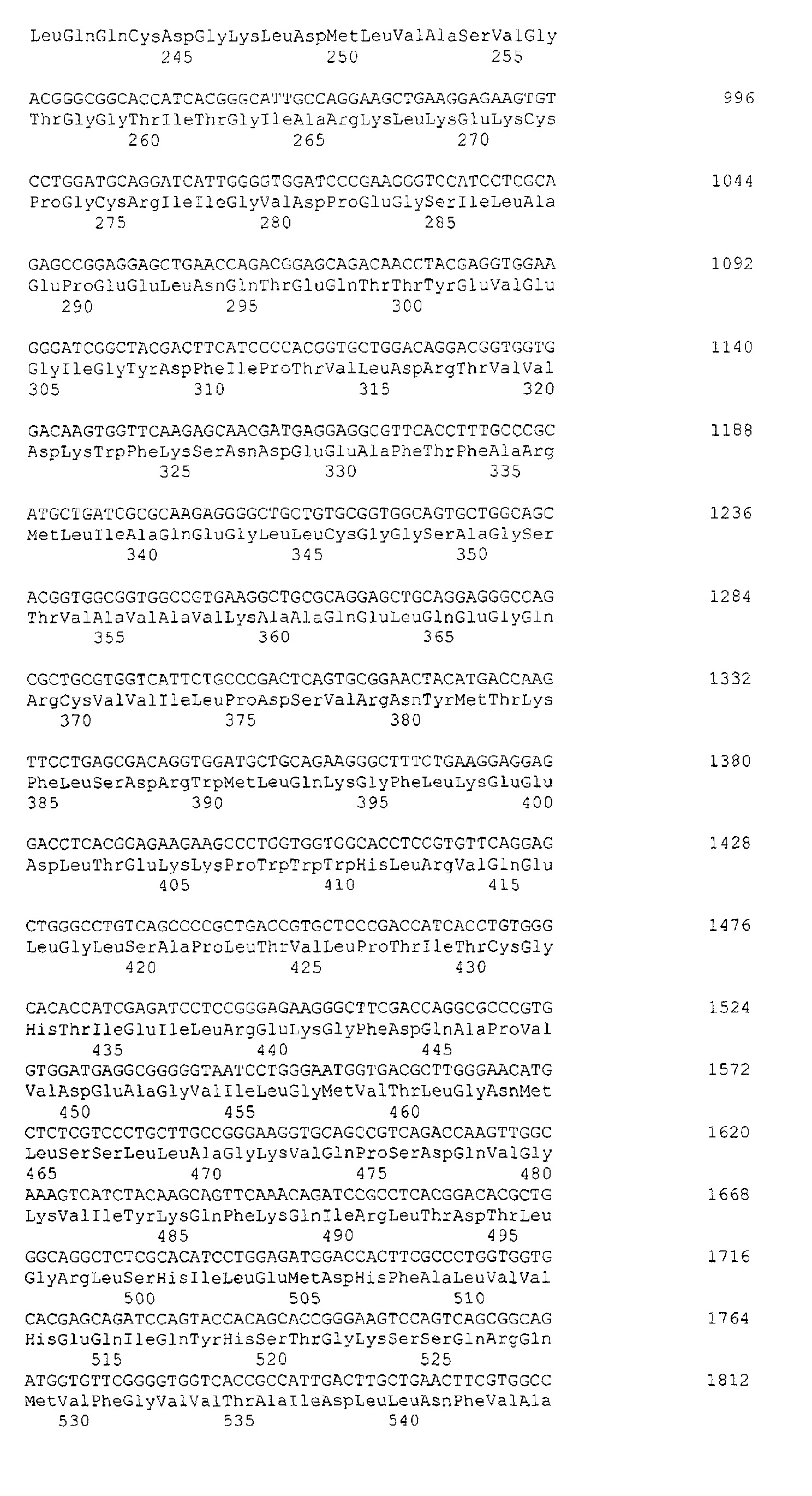
- SEQ ID NOs:1 and 2 shows the full length human CBS cDNA and sequence and translation thereof.
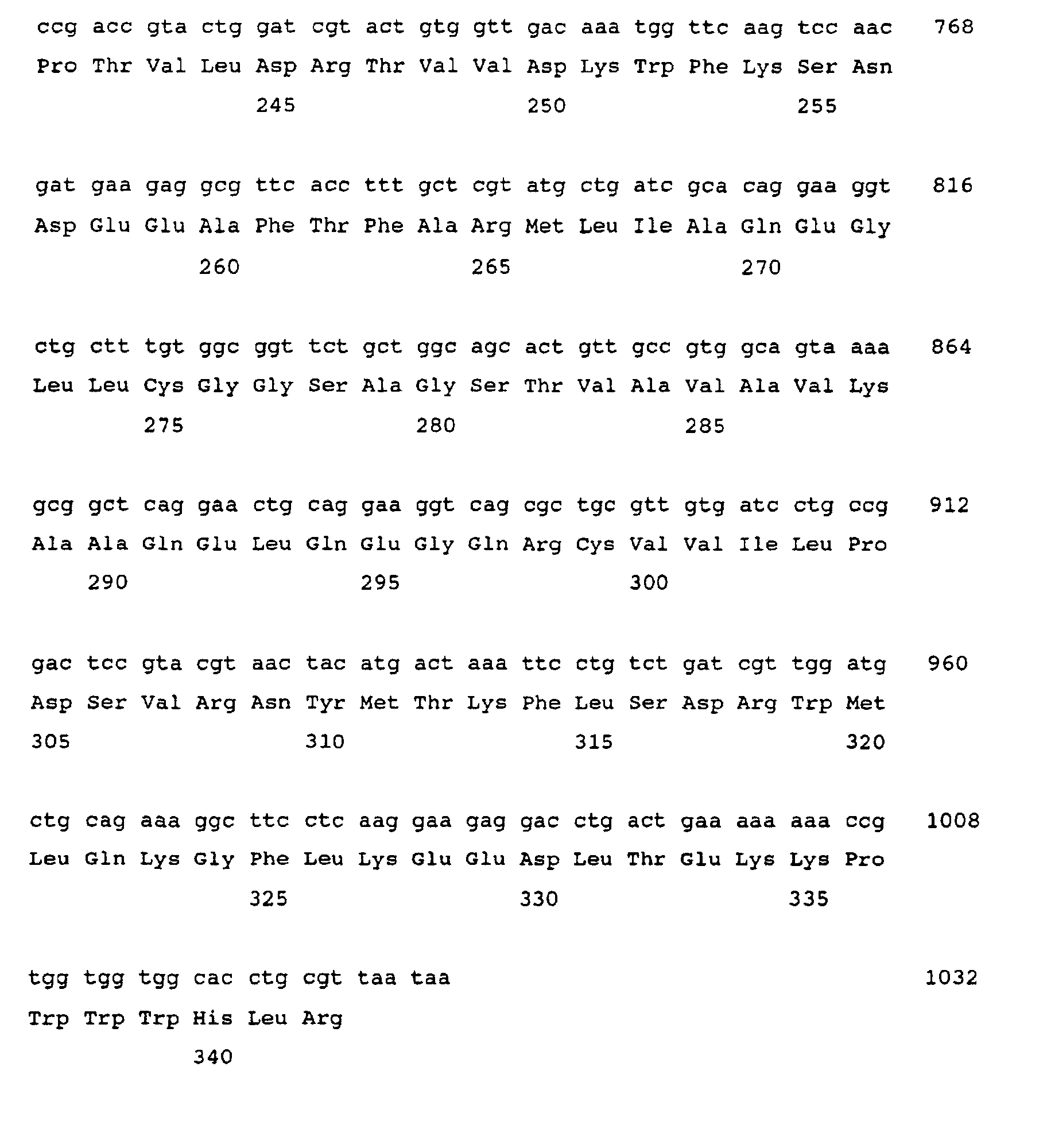
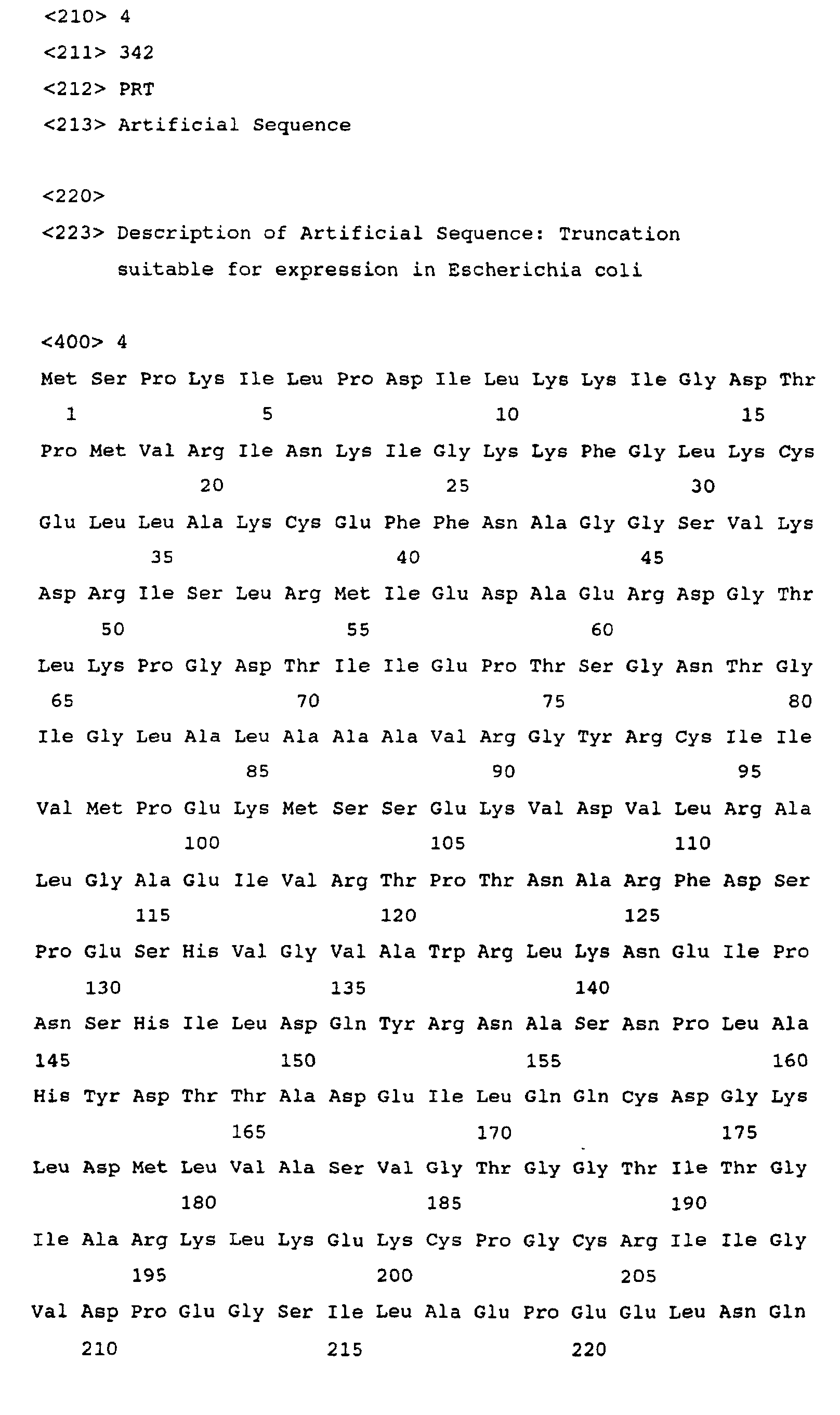
- SEQ ID NOs:3 and 4 shows the DNA sequence and translation thereof of a preferred truncation of invention suitable for expression in Escherichia coli.
- Native CBS whether produced recombinantly or isolated from a natural source, has significant disadvantages for the treatment of homocysteinemia. These disadvantages are: firstly, the manufacture of the enzyme is difficult because the enzyme has haem as a co-factor, secondly the full-length enzyme has a strong tendency to aggregate and thirdly the enzyme is activated by the co-factor S-adenosyl methionine. Thus the efficacious production of the enzyme in a form that will be active in human plasma is prevented by the requirement for these two co-factors and the strong tendency to aggregate.
- the engineered versions of the human enzyme provided have the advantage of not requiring either of these co-factors and have a significantly reduced tendency to aggregate but which are nevertheless active in human plasma, and are easier to manufacture than the native enzyme.
- the engineered versions of the enzyme are smaller in size than the native enzyme because of two deletions.
- An N-terminal deletion which is of approximately seventy amino acids deletes the haem binding domain of the protein, without abolishing the enzyme's activity.
- a second deletion from the C-terminus of at least one hundred and thirty residues deletes the S-adenosyl methionine binding domain without abolishing the activity of the enzyme whether the haem binding domain is present or absent.
- the preferred versions of the enzyme for administration to humans have deletions at both the N-terminus and at the C-terminus.
- elevated plasma homocysteine it is meant a level of this compound in the plasma of a subject which leads to one or more symptoms of homocystinuria (Mudd et al., The Metabolic Basis of Inherited Disease, 6th Ed. McGraw-Hill, New York, pp. 693-734 (1989)).
- Untreated patients develop a number of phenotypic traits which include skeletal abnormalities, dislocated optic lenses, mild to profound mental retardation, and vascular disorders (Mudd et al., ibid ). Some patients respond to vitamin B6 administration while others are unresponsive to this therapeutic intervention (Mudd et al., ibi d; and, Lipson et al., J. Clin.
- Diagnosis may be by the clinical and biochemical criteria discussed above, or may be by genotyping of the CBS genes of the subject to identify mutations.
- the wild type cDNA sequence is provided herein as SEQ ID NO:1.
- Reference to an "animal" subject includes in particular mammals which may be used experimentally as models of homocystinuria. For example, knock-out animals may be developed for the provision of clinical testing. However, the use of the present invention in the treatment of a human subject is preferred.
- truncated cystathionine beta-synthase any form of this protein which is shorter than the wild type human protein or its animal, particularly mammalian, homologues, and preferably which has the properties (i) to (iii) as further defined above.
- the protein comprises both an N-terminal and C-terminal truncation.
- the protein may consist of residues 40-413 of SEQ ID NO:2 or a fragment thereof.
- the fragment desirably includes at least residues 73-401.
- One such fragment, corresponding to 73-413 of SEQ ID NO:2, is illustrated as SEQ ID NO:4 (residues 2 to 342 of SEQ ID NO:4), which additionally includes a N-terminal methionine for the purposes of recombinant expression.
- the proteins of the invention may be in substantially isolated form.
- the proteins may of course be formulated with diluents or adjuvants and still for practical purposes be isolated.
- the proteins may be glycosylated, either naturally or by systems of heterologous eukaryotic cells, or they may be (for example if produced by expression in a prokaryotic cell) unglycosylated.
- Protiens may be phosphorylated and/or acetylated.
- a protein of the invention may also be in a substantially purified form, in which case it will generally comprise the protein in a preparation in which more than 90%, e.g. 95%, 98% or 99% of the protein in the preparation is a protein of the invention.
- lacking haem as a co-factor it is meant that the protein is active in vitro in human plasma without the need for addition of haem co-factor.
- being active in human plasma it is meant that the protein is capable of producing cystathionine from serine and homocysteine in the presence of pyridoxal 5' phosphate. This may be ascertained in a sample of human plasma in vitro or in vivo . Assays for CBS activity are well known to those skilled in the art and can be found in Kraus, Methods Enzymol 143:388-394 (1987)], and in US patent 5,656,425.
- treatment refers to any administration of a polypeptide intended to alleviate the severity of a disease being treated, to provide relief from the symptoms of the disease or to prevent or slow down the development of the disease in an individual with a disease condition or at risk of developing the disease condition.
- Proteins for use in accordance with the invention may be formulated as a pharmaceutical composition
- a pharmaceutical composition comprising diluents such as water, saline, dextrose, glycerol, ethanol and the like.
- Compositions may be formulated for injection, for example for intravenous injection.
- the composition to be administered may also auxiliary substances such as pH buffering agents and the like.
- Actual methods of preparing such dosage forms are known, or will be apparent, to those skilled in this art; for example, see Remington's Pharmaceutical Sciences, Mack Publishing Company, Easton, Pennsylvania, 19th Edition, 1995.
- Suitable doses of polypeptides will ultimately be at the discretion of the physician taking account of the nature of the condition to be treated and the condition of the patient.
- Proteins for use in accordance with the invention may be made using recombinant DNA technology in accordance with routine procedures known in the art.
- a nucleic acid vector generally DNA or RNA, which encodes a truncated CBS protein for use in the invention may be provided which contains coding sequence for CBS operably linked to a promoter suitable for expression of the protein in a desired host cell.
- the vectors may be provided with an origin of replication and optionally a regulator of the promoter.
- the vectors may contain one or more selectable marker genes.
- selectable marker genes There are a wide variety of prokaryotic and eukaryotic expression vectors known as such in the art, and the present invention may utilise any vector according to the individual preferences of those of skill in the art.
- the vectors encoding the novel proteins of the invention form a further aspect of the present invention.
- the vector is a prokaryotic vector, particularly an E. coli vector which carries SEQ ID NO:3 or a part thereof. This sequence has been adapted from the wild-type CBS-encoding sequence for improved expression in E. coli.
- prokaryotic host cells can be used in the method of the present invention. These hosts may include strains of Escherichia, Pseudomonas, Bacillus, Lactobacillus, Thermophilus, Salmonella, Enterobacteriacae or Streptomyces.
- Prokaryotic vectors includes vectors bacterial plasmids, e.g., plasmids derived from E. coli including ColEI, pCR1, pBR322, pMB9 and their derivatives, wider host range plasmids, e.g., RP4; phage DNAs, e.g., the numerous derivatives of phage A, e.g., NM989, and other DNA phages, e.g., M13 and filamentous single stranded DNA phages.
- bacterial plasmids e.g., plasmids derived from E. coli including ColEI, pCR1, pBR322, pMB9 and their derivatives, wider host range plasmids, e.g., RP4; phage DNAs, e.g., the numerous derivatives of phage A, e.g., NM989, and other DNA phages, e.g
- the promoter may be an inducible promoter. Suitable promoters include the T7 promoter, the tac promoter, the trp promoter, the lambda promoters P L or P R and others well known to those skilled in the art.
- eukaryotic host cells may also be used, including for example yeast, insect and mammalian cells.
- Mammalian cells include CHO and mouse cells, African green monkey cells, such as COS-1, and human cells.
- eukaryotic vectors suitable for expression of proteins are known. These vectors may be designed to be chromosomally incorporated into a eukaryotic cell genome or to be maintained extrachromosomally, or to be maintained only transiently in eukaryotic cells.
- the nucleic acid may be operably linked to a suitable promoter, such as a strong viral promoter including a CMV promoter, and SV40 T-antigen promoter or a retroviral LTR.
- host cells carrying a vector of the invention may be cultured under conditions suitable for expression of the protein, and the protein recovered from the cells or from the culture medium.
- Host cells comprising a novel vector of the invention, and their use, form a further aspect of the present invention.
- a nucleic acid sequence (SEQ ID NO:3) which encodes an engineered version of human cystathionine beta-synthase (SEQ ID NO:4) was prepared, and cloned in a bacterial expression vector.
- the resulting plasmid is used to produce by standard methods a novel protein, which forms a further aspect of the present invention, in significant quantities and which has cystathionine beta-synthase activity, but no requirement for either haem or S-adenosyl methionine as co-factors, or cleavage by a protease to release the desired protein fragment.
- the protein when produced in E. coli, may be recovered from the cells by standard purification methods. When recovered, some or all of the protein recovered may lack the N-terminal methionine due to its removal by bacterial cellular processes.
- This engineered version of human cystathionine beta-synthase can prepared as a novel pharmaceutical composition and may be administered in a variety of formulations to humans to treat or prevent the effects of raised plasma homocysteine.
Landscapes
- Health & Medical Sciences (AREA)
- Chemical & Material Sciences (AREA)
- Life Sciences & Earth Sciences (AREA)
- Organic Chemistry (AREA)
- Engineering & Computer Science (AREA)
- Bioinformatics & Cheminformatics (AREA)
- Zoology (AREA)
- Wood Science & Technology (AREA)
- Genetics & Genomics (AREA)
- General Health & Medical Sciences (AREA)
- Medicinal Chemistry (AREA)
- Chemical Kinetics & Catalysis (AREA)
- Biotechnology (AREA)
- Nuclear Medicine, Radiotherapy & Molecular Imaging (AREA)
- Animal Behavior & Ethology (AREA)
- General Chemical & Material Sciences (AREA)
- Public Health (AREA)
- Veterinary Medicine (AREA)
- Molecular Biology (AREA)
- Biomedical Technology (AREA)
- Pharmacology & Pharmacy (AREA)
- Obesity (AREA)
- Microbiology (AREA)
- Hematology (AREA)
- Diabetes (AREA)
- Biochemistry (AREA)
- General Engineering & Computer Science (AREA)
- Enzymes And Modification Thereof (AREA)
- Medicines That Contain Protein Lipid Enzymes And Other Medicines (AREA)
Abstract
The present invention provides method of treatment of elevated
plasma homocysteine in a human or animal subject which method
comprises administering to the subject an effective amount of a
truncated cystathionine beta-synthase (CBS). The fragment may
be one which lacks haem as a co-factor, does not require S-adenosyl
methionine for activation while being active in human
plasma. Such fragments include amino acids 40-413 of SEQ ID
NO:2 and a novel fragment thereof being amino acids 73-414 of
SEQ ID NO:2.
Description
- The present invention relates to methods of treatment of elevated levels of plasma homocysteine in mammals, particularly humans.
- Elevated plasma homocysteine is a risk factor for a number of serious human diseases, particularly those of the cardiovascular and central nervous systems, but also of several other systems.
- The administration of vitamins such as vitamin B6 or folic acid can lower plasma homocysteine in a significant number of patients, but not in all. In humans, an enzyme is known which is capable of decreasing plasma homocysteine by coupling it to serine, thus creating cystathionine. Cystathionine is more easily metabolised and excreted from the body than homocysteine.
- This enzyme, called cystathionine beta-synthase, has been cloned, as described in US Patent 5,523,225 "DNA sequence encoding human cystathionine beta-synthase", and recombinant versions have since been produced in the bacterium Escherichia coli. The same patent proposes the use of the enzyme as a method of reducing plasma homocysteine.
- A modified version of human cystathionine beta-synthase has been described in "Structure of human cystathionine beta-synthase: a unique pyridoxal 5'-phosphate-dependent heme protein" by M. Meier, M. Janosik, V. Kery, J.P. Kraus and P. Burkhard in EMBO Journal (2001) Volume 20, pages 3910-3916. This version of cystathionine beta-synthase comprises amino acid residues 1-413, that is with a truncation of the C-terminal amino acids 414-551 was made to facilitate crystallisation of the "active core" of the enzyme. The citation also describes amino acid residues 40-413 as an "active core" of the enzyme which forms dimers, as opposed to the tetramers observed with the native enzyme.
- The present invention provides a method of treatment of elevated plasma homocysteine in a human or animal subject which method comprises administering to the subject an effective amount of a truncated cystathionine beta-synthase (CBS).
- In one aspect, said truncated CBS can be characterised by the following properties:
- i) lacking haem as a co-factor;
- ii) not requiring S-adenosyl methionine for activation; and
- iii) being active in human plasma.
-
- Alternatively, the truncated CBS may be represented by amino acids 40-413 of SEQ ID NO:2, or a fragment thereof retaining at least amino acids 73-401 of SEQ ID NO:2.
- The present invention further provides a CBS as defined above for use in a method of treatment of elevated plasma homocysteine in a human or animal subject.
- The treatment of the invention is useful for prevention of the deleterious effects of elevated plasma homocysteine.
- Deleterious effects of elevated plasma homocysteine are found particularly in human subjects with a mutation in their CBS gene.
- SEQ ID NOs:1 and 2 shows the full length human CBS cDNA and sequence and translation thereof.
- SEQ ID NOs:3 and 4 shows the DNA sequence and translation thereof of a preferred truncation of invention suitable for expression in Escherichia coli.
- Native CBS, whether produced recombinantly or isolated from a natural source, has significant disadvantages for the treatment of homocysteinemia. These disadvantages are: firstly, the manufacture of the enzyme is difficult because the enzyme has haem as a co-factor, secondly the full-length enzyme has a strong tendency to aggregate and thirdly the enzyme is activated by the co-factor S-adenosyl methionine. Thus the efficacious production of the enzyme in a form that will be active in human plasma is prevented by the requirement for these two co-factors and the strong tendency to aggregate.
- In the present invention, the engineered versions of the human enzyme provided have the advantage of not requiring either of these co-factors and have a significantly reduced tendency to aggregate but which are nevertheless active in human plasma, and are easier to manufacture than the native enzyme.
- The engineered versions of the enzyme are smaller in size than the native enzyme because of two deletions. An N-terminal deletion which is of approximately seventy amino acids deletes the haem binding domain of the protein, without abolishing the enzyme's activity. A second deletion from the C-terminus of at least one hundred and thirty residues deletes the S-adenosyl methionine binding domain without abolishing the activity of the enzyme whether the haem binding domain is present or absent. Thus the preferred versions of the enzyme for administration to humans have deletions at both the N-terminus and at the C-terminus. The advantages for manufacture or for use as a human therapeutic of the truncated versions of human cystathionine beta-synthase have not been suggested in the art.
- By "elevated plasma homocysteine" it is meant a level of this compound in the plasma of a subject which leads to one or more symptoms of homocystinuria (Mudd et al., The Metabolic Basis of Inherited Disease, 6th Ed. McGraw-Hill, New York, pp. 693-734 (1989)). Untreated patients develop a number of phenotypic traits which include skeletal abnormalities, dislocated optic lenses, mild to profound mental retardation, and vascular disorders (Mudd et al., ibid). Some patients respond to vitamin B6 administration while others are unresponsive to this therapeutic intervention (Mudd et al., ibid; and, Lipson et al., J. Clin. Invest., 66, 188-193 (1980)). A growing body of evidence now suggests that vascular disorders found in one-third of the patients with premature arterial disease or cerebrovascular disease are the result of mild hyperhomocysteinemia some of which may be due to heterozygous CBS deficiency (Boers et al., N. Engl. J. Med., 313, 709715 (1985); and, Clarke et al., N. Engl. J. Med., 324, 1149-1155 (1991)).
- Diagnosis may be by the clinical and biochemical criteria discussed above, or may be by genotyping of the CBS genes of the subject to identify mutations. The wild type cDNA sequence is provided herein as SEQ ID NO:1.
- Reference to an "animal" subject includes in particular mammals which may be used experimentally as models of homocystinuria. For example, knock-out animals may be developed for the provision of clinical testing. However, the use of the present invention in the treatment of a human subject is preferred.
- By "truncated cystathionine beta-synthase" it is meant any form of this protein which is shorter than the wild type human protein or its animal, particularly mammalian, homologues, and preferably which has the properties (i) to (iii) as further defined above.
- Preferably, the protein comprises both an N-terminal and C-terminal truncation. For example, the protein may consist of residues 40-413 of SEQ ID NO:2 or a fragment thereof. The fragment desirably includes at least residues 73-401. One such fragment, corresponding to 73-413 of SEQ ID NO:2, is illustrated as SEQ ID NO:4 (residues 2 to 342 of SEQ ID NO:4), which additionally includes a N-terminal methionine for the purposes of recombinant expression. Fragments of CBS consisting of residues 73-413 of SEQ ID NO:2, or fragments thereof including at least residues 73-401 of SEQ ID NO:2, form a further aspect of the invention, as do compositions comprising these fragments.
- The proteins of the invention may be in substantially isolated form. The proteins may of course be formulated with diluents or adjuvants and still for practical purposes be isolated. The proteins may be glycosylated, either naturally or by systems of heterologous eukaryotic cells, or they may be (for example if produced by expression in a prokaryotic cell) unglycosylated. Protiens may be phosphorylated and/or acetylated.
- A protein of the invention may also be in a substantially purified form, in which case it will generally comprise the protein in a preparation in which more than 90%, e.g. 95%, 98% or 99% of the protein in the preparation is a protein of the invention.
- By "lacking haem as a co-factor" it is meant that the protein is active in vitro in human plasma without the need for addition of haem co-factor.
- By "not requiring S-adenosyl methionine for activation" it is meant that the protein is active in vitro in human plasma without the need for addition of S-adenosyl methionine.
- By "being active in human plasma" it is meant that the protein is capable of producing cystathionine from serine and homocysteine in the presence of pyridoxal 5' phosphate. This may be ascertained in a sample of human plasma in vitro or in vivo. Assays for CBS activity are well known to those skilled in the art and can be found in Kraus, Methods Enzymol 143:388-394 (1987)], and in US patent 5,656,425.
- By "treatment" it will be understood that this refers to any administration of a polypeptide intended to alleviate the severity of a disease being treated, to provide relief from the symptoms of the disease or to prevent or slow down the development of the disease in an individual with a disease condition or at risk of developing the disease condition.
- Proteins for use in accordance with the invention may be formulated as a pharmaceutical composition comprising diluents such as water, saline, dextrose, glycerol, ethanol and the like. Compositions may be formulated for injection, for example for intravenous injection. The composition to be administered may also auxiliary substances such as pH buffering agents and the like. Actual methods of preparing such dosage forms are known, or will be apparent, to those skilled in this art; for example, see Remington's Pharmaceutical Sciences, Mack Publishing Company, Easton, Pennsylvania, 19th Edition, 1995.
- Suitable doses of polypeptides will ultimately be at the discretion of the physician taking account of the nature of the condition to be treated and the condition of the patient.
- Proteins for use in accordance with the invention may be made using recombinant DNA technology in accordance with routine procedures known in the art. In general, a nucleic acid vector, generally DNA or RNA, which encodes a truncated CBS protein for use in the invention may be provided which contains coding sequence for CBS operably linked to a promoter suitable for expression of the protein in a desired host cell.
- The vectors may be provided with an origin of replication and optionally a regulator of the promoter. The vectors may contain one or more selectable marker genes. There are a wide variety of prokaryotic and eukaryotic expression vectors known as such in the art, and the present invention may utilise any vector according to the individual preferences of those of skill in the art.
- The vectors encoding the novel proteins of the invention form a further aspect of the present invention. In one aspect, the vector is a prokaryotic vector, particularly an E. coli vector which carries SEQ ID NO:3 or a part thereof. This sequence has been adapted from the wild-type CBS-encoding sequence for improved expression in E. coli.
- A wide variety of prokaryotic host cells can be used in the method of the present invention. These hosts may include strains of Escherichia, Pseudomonas, Bacillus, Lactobacillus, Thermophilus, Salmonella, Enterobacteriacae or Streptomyces.
- Prokaryotic vectors includes vectors bacterial plasmids, e.g., plasmids derived from E. coli including ColEI, pCR1, pBR322, pMB9 and their derivatives, wider host range plasmids, e.g., RP4; phage DNAs, e.g., the numerous derivatives of phage A, e.g., NM989, and other DNA phages, e.g., M13 and filamentous single stranded DNA phages.
- The promoter may be an inducible promoter. Suitable promoters include the T7 promoter, the tac promoter, the trp promoter, the lambda promoters PL or PR and others well known to those skilled in the art.
- A wide variety of eukaryotic host cells may also be used, including for example yeast, insect and mammalian cells. Mammalian cells include CHO and mouse cells, African green monkey cells, such as COS-1, and human cells.
- Many eukaryotic vectors suitable for expression of proteins are known. These vectors may be designed to be chromosomally incorporated into a eukaryotic cell genome or to be maintained extrachromosomally, or to be maintained only transiently in eukaryotic cells. The nucleic acid may be operably linked to a suitable promoter, such as a strong viral promoter including a CMV promoter, and SV40 T-antigen promoter or a retroviral LTR.
- To obtain a product of the invention, host cells carrying a vector of the invention may be cultured under conditions suitable for expression of the protein, and the protein recovered from the cells or from the culture medium.
- Host cells comprising a novel vector of the invention, and their use, form a further aspect of the present invention.
- A nucleic acid sequence (SEQ ID NO:3) which encodes an engineered version of human cystathionine beta-synthase (SEQ ID NO:4) was prepared, and cloned in a bacterial expression vector. The resulting plasmid is used to produce by standard methods a novel protein, which forms a further aspect of the present invention, in significant quantities and which has cystathionine beta-synthase activity, but no requirement for either haem or S-adenosyl methionine as co-factors, or cleavage by a protease to release the desired protein fragment. The protein, when produced in E. coli, may be recovered from the cells by standard purification methods. When recovered, some or all of the protein recovered may lack the N-terminal methionine due to its removal by bacterial cellular processes.
- This engineered version of human cystathionine beta-synthase can prepared as a novel pharmaceutical composition and may be administered in a variety of formulations to humans to treat or prevent the effects of raised plasma homocysteine.




Claims (10)
- A truncated cystathionine beta-synthase (CBS) for use in a method of treatment of elevated plasma homocysteine in a human or animal subject.
- A truncated CBS for use according to claim 1 wherein said truncated CBS is characterised by the following properties:i) lacking haem as a co-factor;ii) not requiring S-adenosyl methionine for activation; andiii) being active in human plasma.
- A truncated CBS for use according to claim 1 wherein the truncated CBS is represented by amino acids 40-413 of SEQ ID NO:2 or a fragment thereof retaining at least amino acids 73-401 of SEQ ID NO:2.
- A protein consisting of SEQ ID NO:4, or a fragment thereof comprising residues 2 to 330 of SEQ ID NO:4.
- A composition comprising the protein of claim 4, optionally lacking its N-terminal methionine, together with a pharmaceutically acceptable carrier.
- A recombinant vector comprising the sequence of SEQ ID NO:3 operably linked to a promoter.
- The vector of claim 6 wherein said promoter is functional in an E. coli host cell.
- A method of treatment of elevated plasma homocysteine in a human or animal subject which method comprises administering to the subject an effective amount of a truncated cystathionine beta-synthase (CBS).
- The method of claim 2 wherein said truncated CBS is characterised by the following properties:i) lacking haem as a co-factor;ii) not requiring S-adenosyl methionine for activation; andiii) being active in human plasma.
- The method of claim 8 wherein the truncated CBS is represented by amino acids 40-413 of SEQ ID NO:2 or a fragment thereof retaining at least amino acids 73-401 of SEQ ID NO:2.
Priority Applications (1)
| Application Number | Priority Date | Filing Date | Title |
|---|---|---|---|
| EP02292177A EP1396537A1 (en) | 2002-09-04 | 2002-09-04 | Treatment of elevated plasma homocysteine |
Applications Claiming Priority (1)
| Application Number | Priority Date | Filing Date | Title |
|---|---|---|---|
| EP02292177A EP1396537A1 (en) | 2002-09-04 | 2002-09-04 | Treatment of elevated plasma homocysteine |
Publications (1)
| Publication Number | Publication Date |
|---|---|
| EP1396537A1 true EP1396537A1 (en) | 2004-03-10 |
Family
ID=31502834
Family Applications (1)
| Application Number | Title | Priority Date | Filing Date |
|---|---|---|---|
| EP02292177A Withdrawn EP1396537A1 (en) | 2002-09-04 | 2002-09-04 | Treatment of elevated plasma homocysteine |
Country Status (1)
| Country | Link |
|---|---|
| EP (1) | EP1396537A1 (en) |
Cited By (7)
| Publication number | Priority date | Publication date | Assignee | Title |
|---|---|---|---|---|
| US8007787B2 (en) | 2002-06-17 | 2011-08-30 | The Regents of the Universit of Colorado | Human cystathionine β-synthase variants and methods of production thereof |
| WO2013148580A1 (en) * | 2012-03-26 | 2013-10-03 | The Regents Of The University Of Colorado | Purification of cystathionine beta-synthase |
| WO2014120770A1 (en) * | 2013-01-29 | 2014-08-07 | The Regents Of University Of Colorado | Cystathionine beta-synthase enzyme for treatment of homocystinuria |
| US9675678B2 (en) | 2013-01-29 | 2017-06-13 | The Regents Of The University Of Colorado, A Body Corporate | Compositions and methods for treatment of homocystinuria |
| CN108472277A (en) * | 2015-11-09 | 2018-08-31 | 科罗拉多州立大学董事会法人团体 | Compositions and methods for treating homocystinuria |
| US11324811B2 (en) | 2017-04-17 | 2022-05-10 | The Regents Of The University Of Colorado, A Body Corporate | Optimization of enzyme replacement therapy for treatment of homocystinuria |
| US12364765B2 (en) | 2019-06-26 | 2025-07-22 | The Regents Of The University Of Colorado, A Body Corporate | Pegylated cystathionine beta synthase for enzyme therapy for treatment of homocystinuria |
Citations (1)
| Publication number | Priority date | Publication date | Assignee | Title |
|---|---|---|---|---|
| WO1995007714A1 (en) * | 1993-09-13 | 1995-03-23 | Regents Of The University Of Colorado | DNA SEQUENCE ENCODING HUMAN CYSTATHIONINE β-SYNTHASE |
-
2002
- 2002-09-04 EP EP02292177A patent/EP1396537A1/en not_active Withdrawn
Patent Citations (1)
| Publication number | Priority date | Publication date | Assignee | Title |
|---|---|---|---|---|
| WO1995007714A1 (en) * | 1993-09-13 | 1995-03-23 | Regents Of The University Of Colorado | DNA SEQUENCE ENCODING HUMAN CYSTATHIONINE β-SYNTHASE |
Non-Patent Citations (5)
| Title |
|---|
| BRUNO STEFANO ET AL: "Functional properties of the active core of human cystathionine beta-synthase crystals.", JOURNAL OF BIOLOGICAL CHEMISTRY, vol. 276, no. 1, 5 January 2001 (2001-01-05), pages 16 - 19, XP002227780, ISSN: 0021-9258 * |
| OLIVERIUSOVA J ET AL: "Domain analysis of cystathionine beta-synthase: Definition of the minimal region required for catalysis in the absence of heme.", JOURNAL OF INHERITED METABOLIC DISEASE, vol. 24, no. Supplement 1, July 2001 (2001-07-01), pages 49, XP008012560, ISSN: 0141-8955 * |
| OLIVERIUSOVÁ J. ET AL.: "Deletion mutagenesis of human cystathionine beta-synthase. Impact on activity, oligomeric status, and S-adenosylmethionine regulation", JOURNAL OF BIOCHEMICAL CHEMISTRY, vol. 50, 13 December 2002 (2002-12-13), pages 48386 - 48394, XP002227779 * |
| OLIVERIUSOVA J: "Domain analysis of cystathionine beta-synthase: Definition of the minimal region required for catalysis in the absence of heme.", 39TH ANNUAL SYMPOSIUM OF THE SOCIETY FOR THE STUDY OF INBORN ERRORS OF METABOLISM, 4 September 2001 (2001-09-04) - 7 September 2001 (2001-09-07), Prague, Czech Republic * |
| TAOKA SHINICHI ET AL: "Assignment of enzymatic functions to specific regions of the PLP-dependent heme protein cystathionine beta-synthase.", BIOCHEMISTRY, vol. 38, no. 40, 5 October 1999 (1999-10-05), pages 13155 - 13161, XP001109586, ISSN: 0006-2960 * |
Cited By (36)
| Publication number | Priority date | Publication date | Assignee | Title |
|---|---|---|---|---|
| US8398989B2 (en) | 2002-06-17 | 2013-03-19 | The Regents Of The University Of Colorado | Human cystathionine β-synthase variants and methods of production thereof |
| US8007787B2 (en) | 2002-06-17 | 2011-08-30 | The Regents of the Universit of Colorado | Human cystathionine β-synthase variants and methods of production thereof |
| US9011844B2 (en) | 2002-06-17 | 2015-04-21 | The Regents Of The University Of Colorado, A Body Corporate | Human cystathionine β-synthase variants and methods of production thereof |
| US9631188B2 (en) | 2002-06-17 | 2017-04-25 | The Regents Of The University Of Colorado, A Body Corporate | Human cystathionine β-synthase variants and methods of production thereof |
| US9284546B2 (en) | 2002-06-17 | 2016-03-15 | The Regents Of The University Of Colorado, A Body Corporate | Human cystathionine beta-synthase variants and methods of production thereof |
| US9447406B2 (en) | 2011-08-30 | 2016-09-20 | The Regents Of The University Of Colorado, A Body Corporate | Chemically modified cystathionine beta-synthase enzyme for treatment of homocystinuria |
| US10046036B2 (en) | 2011-08-30 | 2018-08-14 | The Regents Of The University Of Colorado, A Body Corporate | Chemically modified cystathionine β-synthase enzyme for treatment of homocystinuria |
| US9034318B2 (en) | 2011-08-30 | 2015-05-19 | The Regents Of The University Of Colorado, A Body Corporate | Chemically modified cystathionine beta-synthase enzyme for treatment of homocystinuria |
| EP3569706A1 (en) * | 2012-03-26 | 2019-11-20 | The Regents of the University of Colorado, a body corporate | Purification of cystathionine beta-synthase |
| US10160962B2 (en) | 2012-03-26 | 2018-12-25 | The Regents Of The University Of Colorado, A Body Corporate | Purification of cystathionine beta-synthase |
| US9243239B2 (en) | 2012-03-26 | 2016-01-26 | The Regents Of The University Of Colorado, A Body Corporate | Purification of cystathionine beta-synthase |
| US10941392B2 (en) | 2012-03-26 | 2021-03-09 | The Regents Of The University Of Colorado, A Body Corporate | Purification of cystathionine beta-synthase |
| EP3263701A1 (en) * | 2012-03-26 | 2018-01-03 | The Regents of the University of Colorado | Purification of cystathionine beta-synthase |
| WO2013148580A1 (en) * | 2012-03-26 | 2013-10-03 | The Regents Of The University Of Colorado | Purification of cystathionine beta-synthase |
| US10653755B2 (en) | 2013-01-29 | 2020-05-19 | The Regents Of The University Of Colorado, A Body Corporate | Compositions and methods for treatment of homocystinuria |
| US9675678B2 (en) | 2013-01-29 | 2017-06-13 | The Regents Of The University Of Colorado, A Body Corporate | Compositions and methods for treatment of homocystinuria |
| US10265387B2 (en) | 2013-01-29 | 2019-04-23 | The Regents Of The University Of Colorado, A Body Corporate | Compositions and methods for treatment of homocystinuria |
| AU2022263598B2 (en) * | 2013-01-29 | 2025-06-05 | The Regents Of The University Of Colorado, A Body Corporate | Cystathionine Beta-Synthase Enzyme For Treatment Of Homocystinuria |
| WO2014120770A1 (en) * | 2013-01-29 | 2014-08-07 | The Regents Of University Of Colorado | Cystathionine beta-synthase enzyme for treatment of homocystinuria |
| AU2014212471B2 (en) * | 2013-01-29 | 2019-11-28 | The Regents Of The University Of Colorado, A Body Corporate | Cystathionine beta-synthase enzyme for treatment of homocystinuria |
| US10624959B2 (en) | 2013-01-29 | 2020-04-21 | The Regents Of The University Of Colorado, A Body Corporate | Chemically modified cystathionine beta-synthase enzyme for treatment of homocystinuria |
| CN105452457A (en) * | 2013-01-29 | 2016-03-30 | 科罗拉多州大学评议会 | Cystathionine beta-synthase for the treatment of homocystinuria |
| US10729753B2 (en) | 2013-01-29 | 2020-08-04 | The Regents Of The University Of Colorado, A Body Corporate | Compositions and methods for treatment of homocystinuria |
| AU2020200719B2 (en) * | 2013-01-29 | 2022-08-18 | The Regents Of The University Of Colorado, A Body Corporate | Cystathionine Beta-Synthase Enzyme For Treatment Of Homocystinuria |
| US11400143B2 (en) | 2013-01-29 | 2022-08-02 | The Regents Of The University Of Colorado | Compositions and methods for treatment of homocystinuria |
| CN108472277A (en) * | 2015-11-09 | 2018-08-31 | 科罗拉多州立大学董事会法人团体 | Compositions and methods for treating homocystinuria |
| EP3998067A1 (en) * | 2015-11-09 | 2022-05-18 | The Regents of the University of Colorado, a body corporate | Compositions and methods for treatment of homocystinuria |
| US11077175B2 (en) | 2015-11-09 | 2021-08-03 | The Regents Of The University Of Colorado, A Body Corporate | Compositions and methods for treatment of homocystinuria |
| EP4487914A3 (en) * | 2015-11-09 | 2025-03-26 | The Regents of the University of Colorado, A Body Corporate | Compositions and methods for treatment of homocystinuria |
| US11771745B2 (en) | 2015-11-09 | 2023-10-03 | The Regents Of The University Of Colorado | Compositions and methods for treatment of homocystinuria |
| EP3373922A4 (en) * | 2015-11-09 | 2019-05-15 | The Regents of The University of Colorado, A Body Corporate | COMPOSITIONS AND METHODS FOR THE TREATMENT OF HOMOCYSTINURIA |
| US12194082B2 (en) | 2015-11-09 | 2025-01-14 | The Regents Of The University Of Colorado, A Body Corporate | Compositions and methods for treatment of homocystinuria |
| AU2022287540B2 (en) * | 2015-11-09 | 2025-02-27 | The Regents Of The University Of Colorado, A Body Corporate | Compositions and methods for treatment of homocystinuria |
| US11324811B2 (en) | 2017-04-17 | 2022-05-10 | The Regents Of The University Of Colorado, A Body Corporate | Optimization of enzyme replacement therapy for treatment of homocystinuria |
| US12042529B2 (en) | 2017-04-17 | 2024-07-23 | The Regents Of The University Of Colorado, A Body Corporate | Optimization of enzyme replacement therapy for treatment of homocystinuria |
| US12364765B2 (en) | 2019-06-26 | 2025-07-22 | The Regents Of The University Of Colorado, A Body Corporate | Pegylated cystathionine beta synthase for enzyme therapy for treatment of homocystinuria |
Similar Documents
| Publication | Publication Date | Title |
|---|---|---|
| EP0725079A1 (en) | Anti-obesity proteins | |
| PT1813624E (en) | Methods and compositions for the prevention and treatment of anemia | |
| JPH093098A (en) | Recombinant obesity (ob) protein | |
| JPH11508895A (en) | How to treat diabetes | |
| JPH05255392A (en) | AC-B Proinsulin, Processes for Making and Using It, and Intermediates for Insulin Production | |
| JPH06502987A (en) | O-glycosylated IFN-alpha | |
| AU758123B2 (en) | Atrial natriuretic factor mutants and ischemic stroke | |
| CN112574982A (en) | Cystathionine beta-synthase for the treatment of homocystinuria | |
| CN1193350A (en) | Antigen non-specific glycosylation inhibiting factor derivatives | |
| BRPI0608769A2 (en) | erythropoietin variants | |
| TWI788323B (en) | Apoc-ii mimetic peptides | |
| WO2003074547A2 (en) | Biologically active complex comprising alpha-lcatalbumin or a variant thereof, and a cofactor | |
| US20050209178A1 (en) | Methods and compositions for the treatment of obesity | |
| KR19980064258A (en) | Anti-obesity protein | |
| CA2483330C (en) | Multimeric ligands with enhanced stability | |
| US20070073040A1 (en) | Anti-obesity polypeptides | |
| US20040176567A1 (en) | Modified calcitonin | |
| JPH11508134A (en) | Obesity protein intermediates and their preparation and use | |
| JP3598322B2 (en) | Human mutant manganese superoxide dismutase | |
| JPH1156378A (en) | Mutant human growth hormone and its use | |
| US5759816A (en) | Expression vectors containing λPL promoter and T1 T2 rRNA termination sequence plasmids containing the vectors hosts containing the plasmids and related methods | |
| US5952213A (en) | Src-family kinase and methods of use thereof | |
| JP2000516455A (en) | Methods for controlling beta-dimer formation in hemoglobin | |
| CN1387568A (en) | Modified ciliary neurotrophic factor, method of making and methods of use thereof | |
| JP2001507228A (en) | Anti-obesity protein |
Legal Events
| Date | Code | Title | Description |
|---|---|---|---|
| PUAI | Public reference made under article 153(3) epc to a published international application that has entered the european phase |
Free format text: ORIGINAL CODE: 0009012 |
|
| AK | Designated contracting states |
Kind code of ref document: A1 Designated state(s): AT BE BG CH CY CZ DE DK EE ES FI FR GB GR IE IT LI LU MC NL PT SE SK TR |
|
| AX | Request for extension of the european patent |
Extension state: AL LT LV MK RO SI |
|
| STAA | Information on the status of an ep patent application or granted ep patent |
Free format text: STATUS: THE APPLICATION IS DEEMED TO BE WITHDRAWN |
|
| 18D | Application deemed to be withdrawn |
Effective date: 20040106 |