EP1395029A1 - USE CHARGE CALCULATION SYSTEM, METHOD, PROGRAM, AND COMPUTER−READABLE RECORDING MEDIUM - Google Patents
USE CHARGE CALCULATION SYSTEM, METHOD, PROGRAM, AND COMPUTER−READABLE RECORDING MEDIUM Download PDFInfo
- Publication number
- EP1395029A1 EP1395029A1 EP02769603A EP02769603A EP1395029A1 EP 1395029 A1 EP1395029 A1 EP 1395029A1 EP 02769603 A EP02769603 A EP 02769603A EP 02769603 A EP02769603 A EP 02769603A EP 1395029 A1 EP1395029 A1 EP 1395029A1
- Authority
- EP
- European Patent Office
- Prior art keywords
- charge
- base station
- traffic
- information
- mobile terminal
- Prior art date
- Legal status (The legal status is an assumption and is not a legal conclusion. Google has not performed a legal analysis and makes no representation as to the accuracy of the status listed.)
- Ceased
Links
Images




Classifications
-
- H—ELECTRICITY
- H04—ELECTRIC COMMUNICATION TECHNIQUE
- H04M—TELEPHONIC COMMUNICATION
- H04M15/00—Arrangements for metering, time-control or time indication ; Metering, charging or billing arrangements for voice wireline or wireless communications, e.g. VoIP
- H04M15/81—Dynamic pricing, e.g. change of tariff during call
-
- H—ELECTRICITY
- H04—ELECTRIC COMMUNICATION TECHNIQUE
- H04M—TELEPHONIC COMMUNICATION
- H04M15/00—Arrangements for metering, time-control or time indication ; Metering, charging or billing arrangements for voice wireline or wireless communications, e.g. VoIP
-
- H—ELECTRICITY
- H04—ELECTRIC COMMUNICATION TECHNIQUE
- H04M—TELEPHONIC COMMUNICATION
- H04M15/00—Arrangements for metering, time-control or time indication ; Metering, charging or billing arrangements for voice wireline or wireless communications, e.g. VoIP
- H04M15/43—Billing software details
-
- H—ELECTRICITY
- H04—ELECTRIC COMMUNICATION TECHNIQUE
- H04M—TELEPHONIC COMMUNICATION
- H04M2215/00—Metering arrangements; Time controlling arrangements; Time indicating arrangements
- H04M2215/01—Details of billing arrangements
- H04M2215/0112—Dynamic pricing, e.g. change of tariff during call
-
- H—ELECTRICITY
- H04—ELECTRIC COMMUNICATION TECHNIQUE
- H04M—TELEPHONIC COMMUNICATION
- H04M2215/00—Metering arrangements; Time controlling arrangements; Time indicating arrangements
- H04M2215/32—Involving wireless systems
Definitions
- the present invention relates to a charge calculating system, a charge calculating method, a charge calculating program, and a computer-readable recording medium for calculating a charge for use of a mobile terminal.
- the mobile terminals such as cellular phones and PHS (Personal Handyphone System) terminals permit calls or data communications by transmission of information via base stations.
- Each base station covers a certain area and exchanges information through the media of radio waves with a plurality of mobile terminals located in that area.
- the base stations and mobile terminals implement multiple access by dividing radio waves in some method and the number of mobile terminals capable of simultaneously transmitting or receiving information to or from a base station as a result of such multiple access, is referred to as the number of channels of the base station.
- a charge is calculated by multiplying a message degree determined according to a call duration, by a unit rate prescribed according to a time zone, a call distance, etc. in use of each mobile terminal.
- the number of channels of each base station is determined with some margin in order to minimize trouble in calls and others of the mobile terminals, but the mobile terminals can be congested at a specific site because of an extra event or the like. In such cases, the number of mobile terminals trying to make calls and others can be greater than the set number of channels. Under those circumstances, the mobile terminals cannot make calls or data communications easily via the base station.
- a conceivable way of avoiding this situation is to provide a greater margin in the number of channels of the base station.
- many channels will be excess during periods without any extra event or the like, so that facility resources may be wasted.
- the number of channels will be short on the occasion of an extra event or the like, which might put a load on the mobile terminal users because of incapability of use of the mobile terminals.
- the users cannot use the mobile terminals in spite of payment of the basic charge or the like, so that they feel dissatisfied.
- the mobile telecommunications carriers have taken no action to prevent the situation, for the users.
- An object of the present invention is, therefore, to provide a charge calculating system, a charge calculating method, a charge calculating program, and a computer-readable recording medium for enabling charge setting for use of a mobile terminal according to traffic between the mobile terminal and a base station.
- a charge calculating system comprises charge determination information storage means for storing charge determination information for calculating a charge for use in transmission/reception of information at a mobile terminal, corresponding to traffic of a base station communicating with the mobile terminal; traffic measurement means for measuring the traffic of the base station; applied charge selection means for selecting charge determination information to be applied to the mobile terminal performing transmission/reception of information through the base station, from the charge determination information stored in the charge determination information storage means, on the basis of the traffic measured; and charge calculation means for calculating a charge for use of the mobile terminal performing the transmission/reception of information through the base station, on the basis of the charge determination information selected.
- the charge determination information is selected from those stored in the charge determination information storage means, on the basis of the traffic of the base station measured by the traffic measurement means, and thus the charge for use according to the actual traffic of the base station can be calculated using the selected charge determination information.
- the charge calculating system of the present invention may be configured so that the traffic measurement means measures the traffic of the base station on a periodic basis.
- the actual traffic of the base station is measured on a periodic basis, so that the charge determination information can be selected on a periodic basis. Therefore, the charge for use according to the actual traffic of the base station can be calculated using the charge determination information selected on a periodic basis.
- the charge calculating system of the present invention may be configured to further comprise information notification means for notifying the mobile terminal performing the transmission/reception of information through the base station, of the charge determination information selected by the applied charge selection means.
- the mobile terminal can be notified of the charge determination information selected by the applied charge selection means, so that the charge determination information can be used, for example, as reference information when the user using the mobile terminal determines whether to use the mobile terminal or not.
- the charge calculating system of the present invention may be configured to further comprise information notification means for notifying the mobile terminal performing the transmission/reception of information through the base station, of the traffic of the base station measured by the traffic measurement means.
- the mobile terminal can be notified of the traffic of the base station measured by the traffic measurement means, so that the traffic can be used, for example, as reference information when the user using the mobile terminal determines whether to use the mobile terminal or not.
- a charge calculating method comprises a first step of letting traffic measurement means measure traffic of a base station communicating with a mobile terminal; a second step of letting applied charge selection means select charge determination information to be applied to the mobile terminal performing transmission/reception of information through the base station, on the basis of the traffic measured by the traffic measurement means, from charge determination information for calculating a charge for use in the transmission/reception of information at the mobile terminal, which charge determination information storage means stores corresponding to traffic of the base station; and a third step of letting charge calculation means calculate a charge for use of the mobile terminal performing the transmission/reception of information through the base station, on the basis of the charge determination information selected by the applied charge selection means.
- the charge determination information is selected from those stored in the charge determination information storage means, on the basis of the traffic of the base station measured by the traffic measurement means, so that the charge for use according to the actual traffic of the base station can be calculated using the selected charge determination information.
- the charge calculating method of the present invention may be configured so that at the first step the traffic measurement means measures the traffic of the base station on a periodic basis.
- the actual traffic of the base station is measured on a periodic basis, so that the charge determination information can be selected on a periodic basis. Therefore, the charge for use according to the actual traffic of the base station can be calculated using the charge determination information selected on a periodic basis.
- the charge calculating method of the present invention may be configured to further comprise a fourth step of letting information notification means notify the mobile terminal performing the transmission/reception of information through the base station, of the charge determination information selected by the applied charge selection means.
- the mobile terminal can be notified of the charge determination information selected by the applied charge selection means, so that the charge determination information can be used, for example, as reference information when the user using the mobile terminal determines whether to use the mobile terminal or not.
- the charge calculating method of the present invention may be configured to further comprise a fourth step of letting information notification means notify the mobile terminal performing the transmission/reception of information through the base station, of the traffic of the base station measured by the traffic measurement means.
- the mobile terminal can be notified of the traffic of the base station measured by the traffic measurement means, so that the traffic can be used, for example, as reference information when the user using the mobile terminal determines whether to use the mobile terminal or not.
- a charge calculating program is configured to make a computer function as: charge determination information storage means for storing charge determination information for calculating a charge for use in transmission/reception of information at a mobile terminal, corresponding to traffic of a base station communicating with the mobile terminal; traffic measurement means for measuring the traffic of the base station; applied charge selection means for selecting charge determination information to be applied to the mobile terminal performing transmission/reception of information through the base station, from the charge determination information stored in the charge determination information storage means, on the basis of the traffic measured; and charge calculation means for calculating a charge for use of the mobile terminal performing the transmission/reception of information through the base station, on the basis of the charge determination information selected.
- the charge determination information is selected from those stored in the charge determination information storage means, on the basis of the traffic of the base station measured by the traffic measurement means, so that the charge for use according to the actual traffic of the base station can be calculated using the selected charge determination information.
- the computer is made to execute the charge calculating program of the present invention so that the traffic measurement means measures the traffic of the base station on a periodic basis.
- the actual traffic of the base station is measured on a periodic basis, so that the charge determination information can be selected on a periodic basis. Therefore, the charge for use according to the actual traffic of the base station can be calculated using the charge determination information selected on a periodic basis.
- the computer is made to execute the charge calculating program of the present invention so as to function further as information notification means for notifying the mobile terminal performing the transmission/reception of information through the base station, of the charge determination information selected by the applied charge selection means.
- the mobile terminal can be notified of the charge determination information selected by the applied charge selection means, so that the charge determination information can be used, for example, as reference information when the user using the mobile terminal determines whether to use the mobile terminal or not.
- the computer is made to execute the charge calculating program of the present invention so as to function further as information notification means for notifying the mobile terminal performing the transmission/reception of information through the base station, of the traffic of the base station measured by the traffic measurement means.
- the mobile terminal can be notified of the traffic of the base station measured by the traffic measurement means, so that the traffic can be used, for example, as reference information when the user using the mobile terminal determines whether to use the mobile terminal or not.
- a computer-readable recording medium is a recording medium in which the charge calculating program configured in either of the above configurations is recorded.
- the charge determination information is selected from those stored in the charge determination information storage means, on the basis of the traffic of the base station measured by the traffic measurement means, so that the charge for use according to the actual traffic of the base station can be calculated using the selected charge determination information.
- mobile telephones are used as mobile terminals, but PHS terminals may also be used.
- PDC Personal Digital Cellular
- TDMA Time Division Multiple Access
- the mobile telephones may be digital mobile telephones of other systems, e.g., the CDMA (Code Division Multiple Access) system, or analog mobile telephones.
- Fig. 1 is a diagram showing a configuration of the communication system 1.
- the communication system 1 is comprised of base station 30 and base station 31, switching center 20, and charge calculating system 10.
- Mobile telephones 40 to 42 are located in a cell 30a covered by the base station 30, while a mobile telephone 43 is located in a cell 31a covered by the base station 31.
- the base station 30 and the base station 31 can receive radio waves from the mobile telephones 41 to 43 located in the cell 30a and the cell 31a, respectively, as communicable areas of their own, and can transmit radio waves to the mobile telephones.
- Each of the cells 30a and 31a is one of those covering the service area in a so-called small zone configuration.
- the base stations 30 and 31 are positioned at the centers of the cells 30a and 31a and their respective antennas have no directivity. It is, however, possible to employ a configuration wherein antennas with directivities are used to cover their respective zones obtained by further dividing each of the cells 30a and 31a.
- the base station 30 and base station 31, and the mobile telephones 41 to 43 operate through multiple access based on the TDMA system, in which an available frequency band is divided and signals are transmitted by time division multiplexing of three channels or six channels in the divided band.
- This system permits the base station 30 and the base station 31 to secure a number of channels, but in the present embodiment, let us suppose for convenience of description that three channels are allocated to the base station 30 and six channels to the base station 31.
- the base station 30 and the base station 31 are connected to the switching center 20. While the switching center 20 is connected to the base station 30 and the base station 31, it is also configured to be communicable with another switching center (not shown) or with a fixed telephone network. The switching center 20 is also connected to a location registration database (not shown) to register location information on the mobile phones 40 to 43 in the cell 30a and the cell 31a covered by the base station 30 and the base station 31 under connection to the switching center 20.
- the charge calculating system 10 is constructed physically as a computer system (e.g., a workstation or a personal computer) equipped with a CPU (central processing unit), a memory, input devices such as a mouse and a keyboard, a display device such as a display, a storage device such as a hard disk, and so on, and is configured so as to be able to perform transmission/reception of information to or from the switching center 20.
- a computer system e.g., a workstation or a personal computer
- CPU central processing unit
- memory e.g., a central processing unit
- input devices such as a mouse and a keyboard
- a display device such as a display
- storage device such as a hard disk, and so on
- the charge calculating system 10 is equipped with the following functional components: a traffic measurement section 101 (traffic measurement means) consisting of a used channel measurement division 101a and a traffic calculation division 101b; an applied charge selection section 102 (applied charge selection means); an information notification section 103 (first information notification means and second information notification means); a charge calculation section 104 (charge calculation means); a number-of-channels storage section 105; a charge determination information storage section 106 (charge determination information storage means); an applied charge storage section 107; and an output section 108.
- a traffic measurement section 101 traffic measurement means
- an applied charge selection section 102 applying charge selection means
- an information notification section 103 first information notification means and second information notification means
- a charge calculation section 104 charge calculation means
- a number-of-channels storage section 105 storage section 105
- a charge determination information storage section 106 charge determination information storage means
- an applied charge storage section 107 and an output section 108.
- the number-of-channels storage section 105 is a portion for storing the numbers of channels at the respective base stations 30 and 31 connected to the switching center 20.
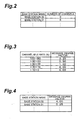
- Fig. 2 is a diagram showing an example of data stored in the number-of-channels storage section 105.
- the number-of-channels storage section 105 stores the correspondence between each base station name and the number of channels, e.g., the number of channels: 3 to the base station 30 and the number of channels: 6 to the base station 31.
- the used channel measurement division 101a is a portion for performing transmission/reception of information to or from the switching center 20 to measure the number of used channels at the base station 30 and the base station 31 under connection to the switching center 20.
- the used channel measurement division 101a measures the number of used channels on a periodic basis, and methods of the periodic measurement include a method of performing the measurement at predetermined time intervals, a method of performing the measurement every time the number of used channels at the base station 30 and the base station 31 exceeds a threshold, and so on. Referring to Fig. 1, the used channel measurement division 101a performs the measurement so that the number of used channels at the base station 30 is 3 and the number of used channels at the base station 31 is 1.
- the used channel measurement division 101a feeds the numbers of used channels thus measured, to the traffic calculation division 101b.
- the traffic calculation division 101b is a portion for receiving the numbers of used channels from the used channel measurement division 101a and calculating a channel idle rate as information indicating the traffic of each of the base station 30 and the base station 31.
- the traffic calculation division 101b subtracts the numbers of used channels from the numbers of channels of the base station 30 and the base station 31 stored at the number-of-channels storage section 105. Then the traffic calculation division 101b divides the results of the subtraction by the respective numbers of allocated channels to yield the channel idle rates of the base station 30 and the base station 31.
- the channel idle rate of the base station 30 is 0%, and that of the base station 31 83%.
- the traffic calculation division 101b feeds the channel idle rates thus calculated, to the applied charge selection section 102.
- the charge determination information storage section 106 is a portion for storing message degree factors as charge determination information, corresponding to channel idle rates.
- a message degree is a coefficient calculated according to a call duration and a call distance of a mobile phone and multiplied by a unit charge to obtain a call charge
- a message degree factor is a coefficient by which the message degree is multiplied to increase or decrease the call charge.
- Fig. 3 is a diagram showing an example of data stored in the charge determination information storage section 106.
- the charge determination information storage section 106 stores the correspondence between channel idle rates and message degree factors, e.g., the message degree factor: 0.25 to the channel idle rates of 100% to 80%, the message degree factor: 0.50 to the channel idle rates of 80% exclusive to 50%, and so on.
- the storage section may be configured to store correspondence between channel idle rates and message degrees.
- the applied charge selection section 102 is a portion for selecting a message degree factor as charge determination information applied to each mobile phone 40 to 43 performing the transmission/reception of information through the base station 30 and the base station 31, using the channel idle rates of the base station 30 and the base station 31 from the traffic calculation division 101b.
- the applied charge selection section 102 selects the message degree factor of 4.00 on the basis of the channel idle rate of 0% at the base station 30 and also selects the message degree factor of 0.25 on the basis of the channel idle rate of 83% at the base station 31.
- the applied charge selection section 102 feeds the selected message degree factors to the applied charge storage section 107.
- the applied charge selection section 102 also feeds the channel idle rates from the traffic calculation division 101b and the selected message degree factors to the information notification section 103.
- the applied charge storage section 107 is a portion for receiving the message degree factors of the base station 30 and the base station 31 selected by the applied charge selection section 102 and storing the message degree factors of the respective base stations 30 and 31.
- Fig. 4 is a diagram showing an example of data stored in the applied charge storage section 107.
- the applied charge storage section 107 stores the correspondence between each base station name and message degree factor, e.g., the message degree factor: 4.00 to the base station 30, the message degree factor: 0.25 to the base station 31, and so on.
- the information notification section 103 is a portion for feeding such information as the channel idle rates of the base station 30 and the base station 31 calculated by the traffic calculation division 101b and the message degree factors selected by the applied charge selection section 102, via the switching center 20 and via the base station 30 and the base station 31 to the mobile phones 40 to 43.
- the information notification section 103 receives the information of the channel idle rates and the message degree factors from the applied charge selection section 102, it feeds the received information to the mobile phones 40 to 43 in response to a request therefrom, or it feeds the information when the mobile phones 40 to 43 perform transmission/reception of information through the base station 30 and the base station 31, e.g., on the occasion of making a call.
- FIG. 5(c) are diagrams showing respective examples in which the information sent from the information notification section 103 to the mobile phones 40 to 43 is displayed on the display unit of the mobile phones 40 to 43.
- the display unit provides an indication of "current call rate: 0.25 ⁇ normal rate,” as shown in Fig. 5(a).
- the display unit provides an indication of "current channel idle rate: 20%,” as shown in Fig. 5(b).
- the display unit When the information notification section 103 also sends a message degree factor of an adjacent cell in addition to a message degree factor of a currently communicating cell, the display unit provides an indication of "current call rate: 2.00 ⁇ normal rate here; 0.25 ⁇ normal rate at Town A," as shown in Fig. 5(c).
- the charge calculation section 104 is a portion for calculating charges for use of the mobile phones 40 to 43 performing the transmission/reception of information through the base station 30 and the base station 31 under connection to the switching center 20.
- the charge calculation section 104 measures or calculates such information as a call date, a call start time, a call start base station, a call end time, a normal message degree, and a reduced degree for each of the mobile phones 40 to 43.
- Fig. 6 is a diagram showing an example of information measured or calculated by the charge calculation section 104.
- the charge calculation section 104 measures the information of the call date, call start time, call start base station, and call end time of each mobile phone 40 to 43 through the transmission/reception of information to or from the switching center 20.
- the charge calculation section 104 calculates a normal message degree from the call start time and the call end time and from the call distance and also calculates a reduced degree with reference to the information stored in the applied charge storage section 107, on the basis of the call start base station measured. A charge for use of each mobile phone 40 to 43 is calculated based on the reduced degree.
- the charges for use of the mobile phones 40 to 43 may be calculated by the charge calculation section 104, or they may be calculated by a device other than the charge calculating system 10 while converted degrees are stored separately.
- the charges calculated by the charge calculation section 104 are fed to the output section 108.
- the output section 108 outputs the charges to a predetermined computer system to enable collection of the charges.
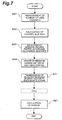
- Fig. 7 is a chart showing the processing flow of the charge calculating system 10.
- the used channel measurement division 101a measures the numbers of used channels at the base station 30 and the base station 31 (step S01).
- the traffic calculation division 101b calculates the channel idle rates of the base station 30 and the base station 31 on the basis of the numbers of used channels measured at step S01 and the numbers of channels of the base station 30 and the base station 31 stored in the number-of-channels storage section 105 (step S02).
- the applied charge selection section 102 selects the message degree factors to be applied to the mobile phones performing the transmission/reception of information through the base station 30 and the base station 31, on the basis of the channel idle rates calculated at step S02 and the message degree factors stored in the charge determination information storage section 106 (step S03).
- the applied charge selection section 102 stores the selected message degree factors in the applied charge storage section 107 to update the message degree factors of the base station 30 and the base station 31 (step S04).
- the charge calculating system 10 performs the processing from step S01 to step S04 on a periodic basis to adequately update the information stored in the applied charge storage section 107.
- Methods of performing the periodic processing include a method of looping the processing flow of step S01 to step S04 at predetermined time intervals, a method of looping the processing flow of step S01 to step S04 whenever the number of used channels measured by the used channel measurement section 101a exceeds a threshold, and so on.
- the information notification section 103 notifies the mobile phones 40 to 43 located in the cell 30a and the cell 31a, of the message degree factors selected at step S03 (step S11).
- the notification timing can be selected from an occasion of receiving a request from each mobile phone 40 to 43, an occasion of the applied charge selection section 102 selecting new charge determination information, and so on.
- Another embodiment can be a method of notifying each mobile phone of the latest charge determination information upon a start of a call at the mobile phone 40 to 43.
- the charge calculation section 104 calculates message degrees according to calls of the respective mobile phones and calculates charges for use by multiplying the calculated message degrees by message degree factors (step S21).
- the output section 108 outputs the calculated charges to the predetermined computer system to enable collection of the charges.
- a charge calculating program 82 for making a computer function as the charge calculating system 10 as an embodiment of the present invention and a computer-readable recording medium 8 in which it is recorded.
- Fig. 8 is a block diagram showing a configuration of the recording medium 8 in which the charge calculating program 82 is recorded.
- the recording medium 8 can be, for example, a magnetic disk, an optical disk, a CD-ROM, a memory incorporated in a computer, or the like.
- the recording medium 8, as shown in Fig. 8, is provided with a program area 81 for recording of the program, and a data area 83 for recording of data.
- Stored in the data area 83 are a number-of-channels database 831 similar to the number-of-channels storage section 105 described with Figs. 1 and 2, a charge determination information database 832 similar to the charge determination information storage section 106 described with Figs. 1 and 3, and an applied charge database 833 similar to the applied charge storage section 107 described with Figs. 1 and 4.
- the charge calculating program 82 is recorded in the program area 81.
- the charge calculating program 82 consists of a main module 821 for controlling the processing; a used channel measurement module 822 for measuring the number of used channels; a traffic calculation module 823 for calculating a channel idle rate on the basis of the number of used channels measured and the number of channels stored; an applied charge selection module 824 for selecting a message degree factor on the basis of the channel idle rate calculated and the message degree factors stored; an information notification module 825 for notifying each mobile phone 40 to 43 of the message degree factor or the channel idle rate; a charge calculation module 826 for calculating a charge for use on the basis of the message degree factor stored; and an output module 827.
- the functions implemented by the respective operations of the used channel measurement module 822, traffic calculation module 823, applied charge selection module 824, information notification module 825, charge calculation module 826, and output module 827 are similar to those of the respective used channel measurement division 101a, traffic calculation division 101b, applied charge selection section 102, information notification section 103, charge calculation section 104, and output section 108 of the aforementioned charge calculating system 10.
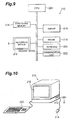
- Fig. 9 is a block diagram showing a system configuration of a computer (e.g., a server system) for executing the charge calculating program 82 recorded in the recording medium 8, and Fig. 10 a perspective view of the computer for executing the charge calculating program 82 recorded in the recording medium 8.
- the computer 210 as shown in Figs. 9 and 10, is provided with a reading device 212, a scratchpad memory (RAM) 214, a display 216 as a display means, a mouse 218 and a keyboard 220 as input means, a communication unit 222 as a communication means, and a CPU 224 for controlling execution of the fright information providing program 202 and others.
- the recording medium 8 is set in the reading device 212, the information recorded in the recording medium 8 becomes accessible from the reading device 212 and the computer 210 can execute the charge calculating program 82 recorded in the program area 81 of the recording medium 8.
- the recording device 212 can be a flexible disk drive unit, a CD-ROM drive unit, a magnetic tape drive unit, or the like selected according to the recording medium 8.
- the used channel measurement division 101a measures the numbers of channels used at the base station 30 and the base station 31 and the traffic calculation division 101b calculates the channel idle rates on the basis of the numbers of channels stored in the number-of-channels storage section 105 and the numbers of used channels thus measured, whereby the channel idle rates can be measured as information indicating the traffic.
- the applied charge selection section 102 selects the message degree factors as the charge determination information stored in the charge determination information storage section 106, on the basis of the channel idle rates as the information indicating the traffic of the base station 30 and base station 31 measured by the traffic measurement section 101, and thus the charge calculation section 104 can calculate the charges according to the channel idle rates of the base station 30 and the base station 31, using the selected message degree factors.
- the applied charge selection section 102 can select the message degree factors on a periodic basis, and the charge calculation section 104 can calculate the charges according to the actual channel idle rates of the base station 30 and the base station 31, using the message degree factors selected on a periodic basis.
- the information notification section 103 notifies the mobile phones 40 to 43 of the message degree factors selected by the applied charge selection section 102 or the channel idle rates calculated by the traffic calculation division 101b, the information can be used, for example, as reference information when the users using the mobile terminals determine whether to use the mobile terminal or not.
- the charge determination information is selected from those stored in the charge determination information storage means, on the basis of the traffic of the base station measured by the traffic measurement means, and thus the charge for use according to the actual traffic of the base station can be calculated using the selected charge determination information.
- the traffic measurement means when configured to measure the traffic of the base station on a periodic basis, the actual traffic of the base station is measured on a periodic basis and the charge determination information can thus be selected on a periodic basis, whereby the charge for use according to the actual traffic of the base station can be calculated using the charge determination information selected on a periodic basis.
- the mobile terminal when the system is configured to further comprise information notification means for notifying the mobile terminal performing the transmission/reception of information through the base station, of the charge determination information selected by the applied charge selection means, the mobile terminal can be notified of the charge determination information selected by the applied charge selection means, and the charge determination information can be used, for example, as reference information when the user using the mobile terminal determines whether to use the mobile terminal or not.
- the system when configured to further comprise information notification means for notifying the mobile terminal performing the transmission/reception of information through the base station, of the traffic of the base station measured by the traffic measurement means, the mobile terminal can be notified of the traffic of the base station measured by the traffic measurement means, and the traffic can be used, for example, as reference information when the user using the mobile terminal determines whether to use the mobile terminal or not.
Landscapes
- Engineering & Computer Science (AREA)
- Computer Networks & Wireless Communication (AREA)
- Signal Processing (AREA)
- Mobile Radio Communication Systems (AREA)
- Meter Arrangements (AREA)
Abstract
Description
Claims (13)
- A charge calculating system comprising:charge determination information storage means for storing charge determination information for calculating a charge for use in transmission/reception of information at a mobile terminal, corresponding to traffic of a base station communicating with the mobile terminal;traffic measurement means for measuring the traffic of the base station;applied charge selection means for selecting charge determination information to be applied to the mobile terminal performing transmission/reception of information through the base station, from the charge determination information stored in the charge determination information storage means, on the basis of the traffic measured; andcharge calculation means for calculating a charge for use of the mobile terminal performing the transmission/reception of information through the base station, on the basis of the charge determination information selected.
- The charge calculating system according to Claim 1, wherein said traffic measurement means measures the traffic of said base station on a periodic basis.
- The charge calculating system according to Claim 1, further comprising first information notification means for notifying the mobile terminal performing the transmission/reception of information through the base station, of the charge determination information selected by said applied charge selection means.
- The charge calculating system according to Claim 1, further comprising second information notification means for notifying the mobile terminal performing the transmission/reception of information through said base station, of the traffic of the base station measured by said traffic measurement means.
- A charge calculating method comprising:a first step of letting traffic measurement means measure traffic of a base station communicating with a mobile terminal;a second step of letting applied charge selection means select charge determination information to be applied to the mobile terminal performing transmission/reception of information through said base station, on the basis of the traffic measured by said traffic measurement means, from charge determination information for calculating a charge for use in the transmission/reception of information at the mobile terminal, which charge determination information storage means stores corresponding to traffic of the base station; anda third step of letting charge calculation means calculate a charge for use of the mobile terminal performing the transmission/reception of information through the base station, on the basis of the charge determination information selected by the applied charge selection means.
- The charge calculating method according to Claim 5, wherein at said first step said traffic measurement means measures the traffic of the base station on a periodic basis.
- The charge calculating method according to Claim 5, further comprising a fourth step of letting first information notification means notify the mobile terminal performing the transmission/reception of information through the base station, of the charge determination information selected by said applied charge selection means.
- The charge calculating method according to Claim 5, further comprising a fourth step of letting second information notification means notify the mobile terminal performing the transmission/reception of information through the base station, of the traffic of said base station measured by said traffic measurement means.
- A charge calculating program for making a computer function as:charge determination information storage means for storing charge determination information for calculating a charge for use in transmission/reception of information at a mobile terminal, corresponding to traffic of a base station communicating with the mobile terminal;traffic measurement means for measuring the traffic of the base station;applied charge selection means for selecting charge determination information to be applied to the mobile terminal performing transmission/reception of information through the base station, from the charge determination information stored in the charge determination information storage means, on the basis of the traffic measured; andcharge calculation means for calculating a charge for use of the mobile terminal performing the transmission/reception of information through the base station, on the basis of the charge determination information selected.
- The charge calculating program according to Claim 9, wherein said traffic measurement means measures the traffic of said base station on a periodic basis.
- The charge calculating program according to Claim 9, wherein the computer is made to function further as first information notification means for notifying the mobile terminal performing the transmission/reception of information through the base station, of the charge determination information selected by said applied charge selection means.
- The charge calculating program according to Claim 9, wherein the computer is made to function further as first information notification means for notifying the mobile terminal performing the transmission/reception of information through said base station, of the traffic of the base station measured by said traffic measurement means.
- A computer-readable recording medium in which the charge calculating program as set forth in one of Claims 9 to 12 is recorded.
Applications Claiming Priority (3)
| Application Number | Priority Date | Filing Date | Title |
|---|---|---|---|
| JP2001145241 | 2001-05-15 | ||
| JP2001145241A JP4188576B2 (en) | 2001-05-15 | 2001-05-15 | Usage fee calculation system, usage fee calculation method, usage fee calculation program, and computer-readable recording medium |
| PCT/JP2002/004690 WO2002093897A1 (en) | 2001-05-15 | 2002-05-15 | Use charge calculation system, method, program, and computer-readable recording medium |
Publications (2)
| Publication Number | Publication Date |
|---|---|
| EP1395029A1 true EP1395029A1 (en) | 2004-03-03 |
| EP1395029A4 EP1395029A4 (en) | 2005-07-13 |
Family
ID=18991088
Family Applications (1)
| Application Number | Title | Priority Date | Filing Date |
|---|---|---|---|
| EP02769603A Ceased EP1395029A4 (en) | 2001-05-15 | 2002-05-15 | SYSTEM, METHOD, PROGRAM, AND COMPUTER-READABLE RECORDING MEDIUM FOR LOAD CALCULATION |
Country Status (6)
| Country | Link |
|---|---|
| US (1) | US20040012769A1 (en) |
| EP (1) | EP1395029A4 (en) |
| JP (1) | JP4188576B2 (en) |
| KR (1) | KR20030020931A (en) |
| CN (1) | CN1462541A (en) |
| WO (1) | WO2002093897A1 (en) |
Cited By (3)
| Publication number | Priority date | Publication date | Assignee | Title |
|---|---|---|---|---|
| WO2005009053A3 (en) * | 2003-07-17 | 2005-03-31 | Nokia Corp | Event based charging for mobile applications |
| EP1926261A3 (en) * | 2006-11-27 | 2008-06-18 | Vodafone Holding GmbH | Method and system for optimising the efficiency of a communications network |
| CN101001397B (en) * | 2007-01-22 | 2011-04-13 | 华为技术有限公司 | Method and device for reducing load of intelligent network system |
Families Citing this family (6)
| Publication number | Priority date | Publication date | Assignee | Title |
|---|---|---|---|---|
| KR100970893B1 (en) * | 2003-09-19 | 2010-07-16 | 엘지전자 주식회사 | Method of processing billing selection information of a mobile communication system |
| KR100998748B1 (en) | 2005-12-10 | 2010-12-07 | 한국전자통신연구원 | How to calculate billing in Wibro system |
| WO2008072867A1 (en) * | 2006-12-11 | 2008-06-19 | Hae Sung Jung | Method for informing call time and charge information, and terminal using the same |
| US20100138501A1 (en) * | 2008-12-03 | 2010-06-03 | Microsoft Corporation | End-to-end validation in a push environment |
| US8532275B2 (en) | 2010-03-23 | 2013-09-10 | Intelepeer, Inc. | Cloud-based virtual tandem |
| JP7003595B2 (en) * | 2017-11-21 | 2022-01-20 | トヨタ自動車株式会社 | Rent rate setting device, rental rate setting method and rental rate setting system |
Family Cites Families (14)
| Publication number | Priority date | Publication date | Assignee | Title |
|---|---|---|---|---|
| JPH02276396A (en) * | 1989-04-18 | 1990-11-13 | Nec Corp | Charging index display system |
| JPH03242076A (en) * | 1990-02-20 | 1991-10-29 | Nec Corp | Telephone traffic distributing method |
| US5303297A (en) * | 1991-07-25 | 1994-04-12 | Motorola, Inc. | Dynamic pricing method and apparatus for communication systems |
| JPH05344236A (en) * | 1992-06-05 | 1993-12-24 | Matsushita Electric Ind Co Ltd | Call charging method for mobile communication system |
| GB9223586D0 (en) * | 1992-11-11 | 1992-12-23 | Vodafone Ltd | Radio telecommunication systems and methods |
| US5488655A (en) * | 1994-07-06 | 1996-01-30 | U S West Technologies, Inc. | Method and system for controlling traffic in PSTN links through the use of variable price incentives |
| US5794140A (en) * | 1995-10-24 | 1998-08-11 | Telefonaktiebolaget L M Ericcson (Publ) | Method and apparatus for offering subscribers access to unused communications capacity in a cellular communications system |
| US5812526A (en) * | 1995-12-21 | 1998-09-22 | Industrial Technology Research Institute | Traffic control mechanism in ATM communications network |
| DE69728136T2 (en) * | 1996-03-29 | 2005-02-17 | British Telecommunications P.L.C. | FEE SYSTEMS FOR COMMUNICATION SERVICES |
| EP0849923B1 (en) * | 1996-12-18 | 2003-11-12 | TELEFONAKTIEBOLAGET L M ERICSSON (publ) | Method and system for providing information services to telecommunications subscribers during low traffic periods |
| US5970403A (en) * | 1997-03-04 | 1999-10-19 | Ericsson Inc. | Load based charging within a mobile telecommunications network |
| US5978455A (en) * | 1997-05-23 | 1999-11-02 | Mci Communications Corporation | Method and system for determining optimal call periods in accordance with caller and callee parameters |
| US6690929B1 (en) * | 1998-08-03 | 2004-02-10 | Lucent Technologies Inc. | Dynamic quality-of-service and pricing in communication system |
| JP3322241B2 (en) * | 1999-05-24 | 2002-09-09 | 日本電気株式会社 | Mobile communication charging system and mobile communication charging method |
-
2001
- 2001-05-15 JP JP2001145241A patent/JP4188576B2/en not_active Expired - Fee Related
-
2002
- 2002-05-15 KR KR10-2003-7000557A patent/KR20030020931A/en not_active Ceased
- 2002-05-15 WO PCT/JP2002/004690 patent/WO2002093897A1/en not_active Ceased
- 2002-05-15 EP EP02769603A patent/EP1395029A4/en not_active Ceased
- 2002-05-15 CN CN02801659A patent/CN1462541A/en active Pending
- 2002-05-15 US US10/332,899 patent/US20040012769A1/en not_active Abandoned
Cited By (3)
| Publication number | Priority date | Publication date | Assignee | Title |
|---|---|---|---|---|
| WO2005009053A3 (en) * | 2003-07-17 | 2005-03-31 | Nokia Corp | Event based charging for mobile applications |
| EP1926261A3 (en) * | 2006-11-27 | 2008-06-18 | Vodafone Holding GmbH | Method and system for optimising the efficiency of a communications network |
| CN101001397B (en) * | 2007-01-22 | 2011-04-13 | 华为技术有限公司 | Method and device for reducing load of intelligent network system |
Also Published As
| Publication number | Publication date |
|---|---|
| WO2002093897A1 (en) | 2002-11-21 |
| JP2002344664A (en) | 2002-11-29 |
| KR20030020931A (en) | 2003-03-10 |
| CN1462541A (en) | 2003-12-17 |
| EP1395029A4 (en) | 2005-07-13 |
| JP4188576B2 (en) | 2008-11-26 |
| US20040012769A1 (en) | 2004-01-22 |
Similar Documents
| Publication | Publication Date | Title |
|---|---|---|
| US7089020B2 (en) | Method and apparatus for location marking | |
| US6201957B1 (en) | System and method for implementing flexible calling plans | |
| EP1285550B1 (en) | Wireless communications terminals and methods including multiple entry phonebook for multiple transceivers | |
| CA2291553C (en) | Mobile communication system for home-zone service and method thereof | |
| EP0777399B1 (en) | Portable telephone with current location display and network thereof | |
| JP2586347B2 (en) | Mobile radio telephone system | |
| US7171233B2 (en) | Method and device for selecting between telecommunication networks | |
| WO2000045614A1 (en) | Selecting a network in a cellular communications system | |
| US20040012769A1 (en) | Use charge calculation system, method, program, and computer-readable recording medium | |
| JP2000278735A (en) | Mobile radio equipment | |
| JP2002315057A (en) | Mobile communication network system, charging method and system for mobile device applied to the system, and mobile device | |
| KR20010009994A (en) | Location informing service method in wireless telecommunication terminal | |
| KR100269135B1 (en) | Geographical information service apparatus and method | |
| JP2004140684A (en) | Wireless communication terminal | |
| KR20010050746A (en) | A method of selecting a calling number for a mobile station from multiple calling numbers | |
| KR20060027875A (en) | Mobile communication terminal with wireless identification function and control method | |
| JP3254649B2 (en) | Wireless communication control method for mobile communication | |
| US20050250514A1 (en) | Mode Control Method of Mobile Wireless Communication Device | |
| EP2160003A1 (en) | Communication system, communication control device, communication method, communication control method and program | |
| KR20040056492A (en) | Position tracking method in a mobile phone using both cell number and radio wave characteristic information | |
| JPH02276396A (en) | Charging index display system | |
| JPH0738943A (en) | Mobile communication zone switching control method | |
| KR20010001195A (en) | Method for distinguishing trunk signal using delay device from base station signal | |
| KR20000003123A (en) | Mobile telephone having cell number and channel situation data automatic transmission function | |
| EP1569479B1 (en) | Method and apparatus for location marking |
Legal Events
| Date | Code | Title | Description |
|---|---|---|---|
| PUAI | Public reference made under article 153(3) epc to a published international application that has entered the european phase |
Free format text: ORIGINAL CODE: 0009012 |
|
| 17P | Request for examination filed |
Effective date: 20030115 |
|
| AK | Designated contracting states |
Kind code of ref document: A1 Designated state(s): AT BE CH CY DE DK ES FI FR GB GR IE IT LI LU MC NL PT SE TR |
|
| RBV | Designated contracting states (corrected) |
Designated state(s): DE FI FR GB IT SE |
|
| A4 | Supplementary search report drawn up and despatched |
Effective date: 20050527 |
|
| 17Q | First examination report despatched |
Effective date: 20081030 |
|
| REG | Reference to a national code |
Ref country code: DE Ref legal event code: R003 |
|
| STAA | Information on the status of an ep patent application or granted ep patent |
Free format text: STATUS: THE APPLICATION HAS BEEN REFUSED |
|
| 18R | Application refused |
Effective date: 20110609 |