EP1395006A1 - Method and apparatus for data distribution through a network - Google Patents
Method and apparatus for data distribution through a network Download PDFInfo
- Publication number
- EP1395006A1 EP1395006A1 EP02354123A EP02354123A EP1395006A1 EP 1395006 A1 EP1395006 A1 EP 1395006A1 EP 02354123 A EP02354123 A EP 02354123A EP 02354123 A EP02354123 A EP 02354123A EP 1395006 A1 EP1395006 A1 EP 1395006A1
- Authority
- EP
- European Patent Office
- Prior art keywords
- recipients
- sublist
- list
- electronic
- package
- Prior art date
- Legal status (The legal status is an assumption and is not a legal conclusion. Google has not performed a legal analysis and makes no representation as to the accuracy of the status listed.)
- Granted
Links
- 238000000034 method Methods 0.000 title claims abstract description 59
- 230000005540 biological transmission Effects 0.000 claims description 13
- 238000012545 processing Methods 0.000 claims description 13
- 238000004891 communication Methods 0.000 claims description 12
- 238000004590 computer program Methods 0.000 claims description 6
- 238000012546 transfer Methods 0.000 claims description 4
- 230000010076 replication Effects 0.000 description 7
- 230000006870 function Effects 0.000 description 3
- 239000012141 concentrate Substances 0.000 description 1
- 230000003247 decreasing effect Effects 0.000 description 1
- 238000011161 development Methods 0.000 description 1
- 238000010586 diagram Methods 0.000 description 1
- 238000009792 diffusion process Methods 0.000 description 1
- 230000009365 direct transmission Effects 0.000 description 1
- 238000004880 explosion Methods 0.000 description 1
- 239000000284 extract Substances 0.000 description 1
- 238000009434 installation Methods 0.000 description 1
- 238000012804 iterative process Methods 0.000 description 1
- 230000008520 organization Effects 0.000 description 1
- 238000012552 review Methods 0.000 description 1
- 238000012360 testing method Methods 0.000 description 1
- 210000000707 wrist Anatomy 0.000 description 1
Images


Classifications
-
- H—ELECTRICITY
- H04—ELECTRIC COMMUNICATION TECHNIQUE
- H04L—TRANSMISSION OF DIGITAL INFORMATION, e.g. TELEGRAPHIC COMMUNICATION
- H04L12/00—Data switching networks
- H04L12/02—Details
- H04L12/16—Arrangements for providing special services to substations
- H04L12/18—Arrangements for providing special services to substations for broadcast or conference, e.g. multicast
- H04L12/1854—Arrangements for providing special services to substations for broadcast or conference, e.g. multicast with non-centralised forwarding system, e.g. chaincast
-
- H—ELECTRICITY
- H04—ELECTRIC COMMUNICATION TECHNIQUE
- H04L—TRANSMISSION OF DIGITAL INFORMATION, e.g. TELEGRAPHIC COMMUNICATION
- H04L51/00—User-to-user messaging in packet-switching networks, transmitted according to store-and-forward or real-time protocols, e.g. e-mail
- H04L51/48—Message addressing, e.g. address format or anonymous messages, aliases
Definitions
- Computer 31 - including a distribution control agent 25 with one emitter (E) element and one receiver (R) element - is assumed to transmit an electronic message to a set of recipients including recipient 32, 33, 34 and 35 shown in the figure 3.
- Recipients 32, 33, 34 and 35 are generally conventional computers such as illustrated in figure 2, but could also be more specific network devices allowing Internet access, such as mobile telephones, communicating wrist watches or similar appliaces, for instance. It is assumed that any device can communicate via any other device through the network, which is generally the case when each device is configured as a network node provided with an Internet Protocol (IP) address.
- IP Internet Protocol
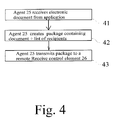
- Figure 4 more particularly shows the processing steps which are involved for achieving distribution of the messages. This process is launched by publishing server 31, for instance.
- Step 51 is then followed by a step 52 where agent 25 reads the container comprising the package and extracts the list of recipients therein included. If necessary, Agent 25 then removes itself from the list of recipients (not shown).
- the first subpackage is then forwarded to the transmit control element 27 for further propagation through the network to the recipient which was identified in step 54.
- This transmission is particularly illustrated in figure 3 by arrow 36 showing the propagation of the first subpackage from node 31 (the publishing node) and node 32.
- the HTTP protocol is used for this transmission to facilitate the transmission through firewalls.
- this transmission can be achieved via the File Transfer Protocol or any other suitable protocol.
Landscapes
- Engineering & Computer Science (AREA)
- Computer Networks & Wireless Communication (AREA)
- Signal Processing (AREA)
- Information Transfer Between Computers (AREA)
- Mobile Radio Communication Systems (AREA)
- Two-Way Televisions, Distribution Of Moving Picture Or The Like (AREA)
- Small-Scale Networks (AREA)
Abstract
Description
- The invention relates to data communication and more particularly to a process for disseminating or distributing data through a network.
- The constant progress of the telecommunication systems, particularly with the explosion of the Internet and intranet networks, has resulted in the development of an era of information. With a single personal computer, it is possible to get a connection to the Internet network, and have direct access to a wide range of information, services and electronic documentation. More and more publishers provide on-line electronic documentation, books, reviews and all sorts of electronic media files to customers connected to the network.
- As the size of the Internet or a private intranet network increases, the need for distributed replication of an electronic file increases also. This capability is essential in a wide variety of situations. For instance, this is required when deploying large execution sets on all the machines of a cluster is planned and also the numerous situations of replication of web data from a Web server to Web caches. When a new version of an operating system or other program is made available there is an enormous need for quick replication of the software on a large number of different machines, which needs to be achieved without excessive stress on the web server and the telecommunication network.
- Generally speaking, the transmission of a given file and its replication at different locations within a network is normally performed in a master/slave mode, that is to say in a manner which concentrates the burden of the file copy on one central distribution point. In most situations, when the size of the electronic file to be transmitted is significant, and when there are a large number of recipients, this results in stress on both the master device - e.g. a web server - and also on the network. As an illustration, should one file of 500 Kbytes be provided to a number of 1000 recipients by one web server, the replication of the 1000 files will entail a traffic of 500 Mbytes for that server and for the communication path.
- A technique known as IP multicast can in some circumstances be used to improve the situation but this, however, is not available on the public Internet network, because currently most routers do not support the Internet Group Management Protocol (IGMP).
- The use of a proxy can in some circumstances relieve both the publisher of the electronic file and the network. As is well known, a proxy device functions to avoid direct connection from one machine - generally within an Intranet network - to another machine being outside the Intranet network. The communication between the first and the second machine is achieved via the proxy which receives and forward all the requests on behalf of the former to the latter.
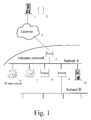
- Figure 1 illustrates the topology of a Intranet network which comprises a set of network devices - e.g. a
router 9 allowing communication between a first subnetwork A and a second subnetwork B comprised within the Intranet, but also thecomputers printer 8 and anintranet server 10. All the network devices of the Intranet communicate with theInternet network 3 via aproxy element 5 allowing interface between the boundary of the Intranet and the Internet. It can therefore be seen that when a proxy is arranged within an Intranet network of a private organization for instance, all the requests from the machines of that Intranet network are first forwarded to the proxy, which accesses the remote machines and returns the results to the original requestor. Typically proxies are linked with other functionality, in particular the caching of web pages to reduce traffic so that one electronic file requested by a great number of machines belonging to one Intranet network is directly available without requiring multiple download operations from the publisher of the electronic files. Therefore, if one device -e.g. computer 6 requests one electronic file from anexternal web server 1, the latter can be cached withinProxy 5 for later diffusion within the Intranet. - This invention is directed to a process for distributing through a network an electronic message associated with a list of recipients, said process comprising the iterated application of the steps of:
- a) extracting from said list a first sublist and a second sublist of recipients;
- b) identifying a recipient within said first sublist which can be addressed via said network, and
- c) transmitting said electronic message and said first sublist to said identified recipient for onward distribution; and
- d) applying said steps (a) to (d) to said second sublist of recipients.
-
- The process can also comprise receiving the message and a list of recipients for onward distribution. The above described process can thus be carried out in a plurality of nodes of the network upon receipt at each node of the message and an associated first sublist generated in another of the nodes until the message has been transmitted to all recipients on the list.
- This process permits the burden of the transmission of the electronic document to be shared between different recipients, each of which reapplies the same process and reiterates using the original list of recipients until the electronic file or document is completely processed and transmitted to every recipient. Preferably, the two sublists are arranged to have a similar size and together comprising all the recipients listed in the list of recipients.
- In at least preferred embodiments, said message and the list of recipients are contained in a package, the step of transmitting the electronic message to the identified recipient comprising generating a new package comprising the electronic message and the first list. The package can be an XML document for instance, and can comprise information defining the size and the date of creation of said electronic message.
- In one embodiment, the transmission of the electronic package comprising the sublist is achieved via an HTTP channel, thus allowing easy transmission through the proxy of the Intranet networks.
- In one embodiment, the process is executed by an agent which is embodied by a computer program having its own installation procedure. Alternatively, the agent can be a specific component of an operating system allowing effective publishing functionality.
- The invention provides a computer program product which permits distribution or flooding of the information throughout a telecommunication network, such as an Internet/intranet network for instance.
- An embodiment of the invention will now be described, by way of example only, with reference to the accompanying drawings, wherein:
- Figure 1 illustrates a network including a a proxy system.
- Figure 2a and 2b respectively illustrate a computer system for performing a distribution
process and a
distribution control agent 25. - Figure 3 illustrates the topology of five computers providing the distribution of an electronic file.
- Figure 4 illustrates the process executed by a publisher.
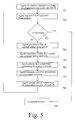
- Figure 5 illustrates the process executed by a control agent of a network device.
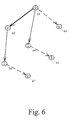
- Figure 6 illustrates the execution of the process on a topology of eight devices.
-
- With reference to figure 2 there is shown a block diagram of a system which permits distribution of electronic files. The system is illustrated as residing within a
computer system 20 which may be a personal computer or any conventional suitably arranged computer system. The system is arranged to use existing electronic circuitry to perform the functions which will be described hereinafter. - The
computer 20 is illustrated as including amemory device 21 which may be a random access memory (RAM), Read-Only-Memory (ROM), a conventional mass storage, such as a hard disk drive or the like. Thememory device 21 is conventionally capable of storing any type of data, but is is particularly used in the present situation for achieving local replication of electronic files or electronic messages as will be explained hereinafter with details. In the following the term electronic messages will be used for simplicity to refer to the data that is to be disseminated within the network in whatever form and which may be received and stored within thememory device 21. In typical applications this data may be for instance be files such as word processed or other documents, program files or media files (mp3, asx, pdf) files in accordance with known standard formats, but the application of the techniques described is not limited to any particular type of file, message or data. For instance, the process would be particularly useful for distributing media files such as electronic newspapers which need to be disseminated very rapidly. The mass storage may usefully be arranged to include a specific storage area (not shown) which is reserved for receiving the electronic files received and stored in accordance with the process which will be described with reference to figures 4 and 5. - The
computer 20 is further illustrated as includingprocessing circuitry 22 which generally governs the flow of software instructions and data within the computer system. In figure 2, theprocessing circuitry 22 is particularly arranged to provide read/write access to thememory device 21.Computer 20 further includes conventional input/output devices 23. -
Computer 20 further comprisescommunication circuitry 24. Thecommunication circuitry 24 may be, for instance, a modem allowing thecomputer 20 to communicate via a telecommunication network, such as anInternet network 3. It should be understood, however, that the type of communication circuitry with whichcomputer 20 communicates with the Internet network - for instance to access aweb server 1 with a database 2 - is not important. In the case of an Internet connection, a TCP/IP communication layer is provided for supporting the communication layers which are involved in the communication steps of the process described herein. In most cases, the access to the Internet network is achieved via the World Wide Web via the well-known Hyper Text Transfer Protocol (HTTP). While HTTP is very useful, particularly because it is well adapted to the use of firewalls, any other kind of protocol allowing communication via the network can equally be used. - In addition to the conventional software components which are used for controlling the
processing circuitry 22, and which generally includes the operating system and a set of application software, thecomputer 20 is provided with adistribution control agent 25 which consists of a set of processing instructions stored within thememory 21 and which are used for controlling the sequence of operations which will be described below. - In this embodiment, the
distribution control agent 25 is a specific software component provided with and embedded within the operating system installed within the machine. However, it will be understood that the functions described may be adapted to other configurations, such as in the form of a separately installed application program. - In this embodiment,
distribution control agent 25 comprises two distinctive components: anemitter element 27 associated with areceiver element 26, as shown in figure 2b. Theemitter element 27 is arranged to communicate with correspondingreceiver elements 26 of other computers which are accessible via the network. - With respect to figures 3 and 4 there will now be described the process for distributing a message. Computer 31 - including a
distribution control agent 25 with one emitter (E) element and one receiver (R) element - is assumed to transmit an electronic message to a set ofrecipients including recipient Recipients - Figure 4 more particularly shows the processing steps which are involved for achieving distribution of the messages. This process is launched by publishing
server 31, for instance. - In a
step 41,distribution control agent 25 receives an electronic message to be distributed, the latter being accompanied by a list of recipients (e.g. nodes 32-35 of figure 3). As mentioned above, the electronic message can be received from an application program running within the computer. - Upon reception of the message accompanied by the list of recipients,
Agent 25 creates in astep 42 an electronic package containing the message to be distributed and the above mentioned list of recipients. In the case of a TCP/IP network, the recipients are defined by the IP addresses or by the email addresses. Preferably, the electronic package which is created atstep 41 is an XML file which complies with the standard eXtended Mark-up Language structure and which is associated with a Document Type Definition (DTD) file. The XML file preferably comprises additional information such as the date of creation of the electronic file. - In a
step 43,Agent 25 forwards the XML package to its receivecontrol element 26 for further processing. - The processing which follows after
step 43 is the general distribution processing which is depicted in figure 5 and which will now be described in detail. - The process is launched when the receive
control element 26 ofagent 25 receives in astep 51 an XML package which is to be processed. -
Step 51 is then followed by astep 52 whereagent 25 reads the container comprising the package and extracts the list of recipients therein included. If necessary,Agent 25 then removes itself from the list of recipients (not shown). - In a
step 53, theagent 25 performs a test to determine whether the list of recipients is empty, in which case, the process proceeds to astep 59 which is the completion of the process. - However, in the general case, the list of recipients is not empty, and the process proceeds to a
step 54 whereagent 25 computes from the list of remaining recipients received in step 51 a set of two distinctive sublists: a first and a second sublist. First and second sublists share no common element and their joining permits the original list of recipients which was included within the original package to be regenerated. In one embodiment, the two sublists are arranged to have substantially the same size. More particularly, in the preferred embodiment, the first list has a number of elements which is set to be equal to the integer which is immediately superior to half the number of recipients of the original list. With respect to the scheme of figure 3, it can be seen thatsublist 1 can includenodes sublist 2 includesnodes - In a
step 55,agent 25 determines via transmitcontrol element 27 one particular recipient within the first sublist which can receive a notification via the network, forinstance node 32 ofsublist 1. Different methods and means can be arranged for achieving the above determination. Preferably,agent 25 issues a PING command to determine whether any particular recipient is available on the network. - When the above determination completes, the
agent 25 generates in a step 56 a first subpackage comprising the original electronic document to distribute, accompanied with the first sublist within an XML file which is formatted in a similar fashion to the original electronic package which was created instep 41 of figure 4. In the example of figure 3, it can be seen that first sublist includesnodes - In a
step 57, the first subpackage is then forwarded to the transmitcontrol element 27 for further propagation through the network to the recipient which was identified instep 54. This transmission is particularly illustrated in figure 3 byarrow 36 showing the propagation of the first subpackage from node 31 (the publishing node) andnode 32. Preferably, the HTTP protocol is used for this transmission to facilitate the transmission through firewalls. Alternatively, this transmission can be achieved via the File Transfer Protocol or any other suitable protocol. Once the recipient receives the first subpackage, the latter will correspondingly initiate the general distribution process of figure 5. - In a
step 58,agent 25 generates a second subpackage comprising the original electronic document or message, accompanied by the second sublist, which is formatted within a XML file and forwarded to the receivecontrol element 26 of the same node and same agent. In the example drawn in figure 3, it can be seen that the second package has a secondsublist including nodes - The process then proceeds back to step 51 for the purpose of processing this new electronic package in accordance with the sequence of steps 51-58 which were described above. This permits a new pair of sublists to be computed, respectively a
sublist containing node 35 and a secondsublist containing node 33 permitting later transmission of the electronic file.Node 31 will therefore successively transmit the electronic document to node 35 (arrow 38) and then to node 33 (arrow 39).Node 34 will directly receive the electronic file from a direct transmission (arrow 37) fromnode 32. - It should be noted that the process of figure 5 which was described in detail above, is executed in each agent of the different machines which are involved in the distribution process and which receive the package. Therefore, the process is successively executed in the different recipients until the full distribution of the original document or file is achieved. Further, it can be seen that the number of replications of the original electronic documents is shared between the different recipients (
ie nodes - More particularly, it can be seen that the number of successive downloads which is to be managed and handled by the publishing server is decreased in a ratio of log2 with respect to the number of machines which are to receive the original message. This can be seen with more clarity in figure 6 illustrating the process for 7 nodes. Assuming that the original list of recipients includes
nodes step 54 of figure 5 comprisesnodes node 62, the originatingnode 61 only has to process a second subpackage comprising a second sublist which is reduced to containnodes - At the next loop, when
node 61 receives the second subpackage, a new iterative process is executed, what results in the computation of a new set of two subpackages, respectively containing nodes 64-65 andnodes 63, and the transmission of the former for further processing tonode 64. It can then be seen thatnode 61 no longer has to transmit the electronic file tonode 65 becausenode 65 receives the message via from the processing of the above mentioned subpackage bynode 64. - While the invention was particularly described with reference with a computer, it should be clear that the process may be adapted to any device which can communicate with the network, and which can receive an electronic message. Such devices may include mobile telephones and more generally any device which can be fitted with a distribution control agent, such as
agent 25, for the purpose of executing the steps of process illustrated in figure 4 and 5.
Claims (20)
- Process for distributing through a network an electronic message associated with a list of recipients, said process comprising the iterated application of the steps of:a) extracting (54) from said list a first sublist and a second sublist of recipients;b) identifying (55) a recipient within said first sublist which can be addressed via said network, andc) transmitting said electronic message and said first sublist to said identified recipient for onward distribution; andd) applying said steps (a) to (d) to said second sublist of recipients.
- Process as claimed in claim 1 comprising receiving the message and a list of recipients for onward distribution.
- Process according to claim 1 or claim 2 wherein said message and the list of recipients are contained in a package, the step of transmitting the electronic message to the identified recipient comprising generating a new package comprising the electronic message and the first list.
- Process as claimed in claim 3 wherein the package is an XML document.
- Process according to claim 4 wherein said electronic package comprises information defining the size and the date of creation of said electronic message.
- Process according to any preceding claim wherein the computation of said first and second sublist results in the generation of sublists of similar size.
- Process as claimed in any preceding claim wherein the first and second sublists together comprise all the recipients listed in the list of recipients from which they are extracted in step (a).
- Process according to any preceding claim wherein said transmission of the electronic message is performed via a Hyper-Text Transfer Protocol link.
- Process as claimed in any preceding claim wherein the iterated steps (a) to (d) are carried out in a single node of the network.
- Process for distributing an electronic message associated with a list of recipients through a network comprising carrying out a process as claimed in any preceding claim in a plurality of nodes of the network upon receipt at each node of the message and an associated first sublist generated in another of the nodes until the message has been transmitted to all recipients on the list.
- Process for distributing an electronic package received from a telecommunication network, said package comprising an electronic message accompanied by a list of recipients, said process comprising:- a) extracting (52) said list of recipients;- b) determining (53) whether said list of recipients includes at least two items and, if so;- c) generating (54) a first and a second sublist of recipients extracted from said list;- d) identifying (55) one particular recipient from said second list which is reachable via said telecommunication network;- d) generating (56) a first subpackage comprising said electronic document or file with said first sublist;- e) transmitting (57) said first subpackage to said identified particular recipient;applying steps b-f to said second sublist.
- Process according to claim 11 wherein said package is an XML document comprising said electronic document or file and a list of recipients for said transmission, said XML document comprising information defining the size and the date of creation of said electronic document or file.
- Process according to claim 11 wherein the size of the first sublist is fixed to be equal to the integer which is immediately superior than half the number of items of the list of recipients.
- Process according to claim 11 wherein the computation of said first and second sublist results in the generation of sublists of similar size.
- Process according to claim 11 wherein said transmission of said first subpackage is performed via a Hyper-Text Transfer Protocol link.
- Publishing agent in the form of a computer program having program code elements for carrying out the process defined in any of claims 1 to 10.
- Computer program product comprising program code elements for distribution or flooding of an electronic file or document through a telecommunication network, and arranged to execute the steps of:generating (41) a package comprising said electronic document or file accompanied by a list of recipients;transmitting (43) said package to a first recipient; said first recipient extracting said list of recipients and computing a first sublist and a second sublist of recipients;generating (54) a first subpackage comprising said electronic file or document with said first sublist and transmitting said first subpackage to a second recipient which is identified from said first sublist;generating (58) a second subpackage comprising said electronic file or document with said second sublist and processing again said second package by said first recipient.
- Computer program product comprising program code elements for allowing distribution or flooding of one electronic file or document contained within a package including a list of recipients through a telecommunication network, and arranged to execute the steps of:receiving (51) said package comprising said electronic document or file accompanied with a list of recipients;extracting from said package and said list of recipients a first sublist and a second sublist of recipients;generating (54) a first subpackage comprising said electronic file or document with said first sublist and transmitting said first subpackage to a second recipient which is identified from said first sublist as being reachable;generating (58) a second subpackage comprising said electronic file or document with said second sublist and processing again said second package by said first recipient.
- Computer program product in accordance with claim 16 embedded as a component of an operating system.
- A data communications network wherein at least a subset of nodes comprise program code elements for carrying out a process as claimed in any of claims 1 to 10.
Priority Applications (4)
| Application Number | Priority Date | Filing Date | Title |
|---|---|---|---|
| EP02354123A EP1395006B1 (en) | 2002-08-29 | 2002-08-29 | Method and apparatus for data distribution through a network |
| AT02354123T ATE354905T1 (en) | 2002-08-29 | 2002-08-29 | METHOD AND DEVICE FOR DISTRIBUTING DATA IN A NETWORK |
| DE60218304T DE60218304D1 (en) | 2002-08-29 | 2002-08-29 | Method and device for data distribution in a network |
| US10/647,470 US20050192813A1 (en) | 2002-08-29 | 2003-08-26 | Process for data distribution through a network |
Applications Claiming Priority (1)
| Application Number | Priority Date | Filing Date | Title |
|---|---|---|---|
| EP02354123A EP1395006B1 (en) | 2002-08-29 | 2002-08-29 | Method and apparatus for data distribution through a network |
Publications (2)
| Publication Number | Publication Date |
|---|---|
| EP1395006A1 true EP1395006A1 (en) | 2004-03-03 |
| EP1395006B1 EP1395006B1 (en) | 2007-02-21 |
Family
ID=31197980
Family Applications (1)
| Application Number | Title | Priority Date | Filing Date |
|---|---|---|---|
| EP02354123A Expired - Lifetime EP1395006B1 (en) | 2002-08-29 | 2002-08-29 | Method and apparatus for data distribution through a network |
Country Status (4)
| Country | Link |
|---|---|
| US (1) | US20050192813A1 (en) |
| EP (1) | EP1395006B1 (en) |
| AT (1) | ATE354905T1 (en) |
| DE (1) | DE60218304D1 (en) |
Families Citing this family (20)
| Publication number | Priority date | Publication date | Assignee | Title |
|---|---|---|---|---|
| US7464330B2 (en) | 2003-12-09 | 2008-12-09 | Microsoft Corporation | Context-free document portions with alternate formats |
| US7617447B1 (en) | 2003-12-09 | 2009-11-10 | Microsoft Corporation | Context free document portions |
| US7418652B2 (en) * | 2004-04-30 | 2008-08-26 | Microsoft Corporation | Method and apparatus for interleaving parts of a document |
| US7549118B2 (en) | 2004-04-30 | 2009-06-16 | Microsoft Corporation | Methods and systems for defining documents with selectable and/or sequenceable parts |
| US7487448B2 (en) * | 2004-04-30 | 2009-02-03 | Microsoft Corporation | Document mark up methods and systems |
| US7383500B2 (en) | 2004-04-30 | 2008-06-03 | Microsoft Corporation | Methods and systems for building packages that contain pre-paginated documents |
| US8661332B2 (en) | 2004-04-30 | 2014-02-25 | Microsoft Corporation | Method and apparatus for document processing |
| US7512878B2 (en) | 2004-04-30 | 2009-03-31 | Microsoft Corporation | Modular document format |
| US7617450B2 (en) | 2004-09-30 | 2009-11-10 | Microsoft Corporation | Method, system, and computer-readable medium for creating, inserting, and reusing document parts in an electronic document |
| US7620889B2 (en) | 2004-12-20 | 2009-11-17 | Microsoft Corporation | Method and system for linking data ranges of a computer-generated document with associated extensible markup language elements |
| US7617444B2 (en) | 2004-12-20 | 2009-11-10 | Microsoft Corporation | File formats, methods, and computer program products for representing workbooks |
| US7614000B2 (en) | 2004-12-20 | 2009-11-03 | Microsoft Corporation | File formats, methods, and computer program products for representing presentations |
| US7617451B2 (en) * | 2004-12-20 | 2009-11-10 | Microsoft Corporation | Structuring data for word processing documents |
| US7617229B2 (en) | 2004-12-20 | 2009-11-10 | Microsoft Corporation | Management and use of data in a computer-generated document |
| US7752632B2 (en) | 2004-12-21 | 2010-07-06 | Microsoft Corporation | Method and system for exposing nested data in a computer-generated document in a transparent manner |
| US7770180B2 (en) | 2004-12-21 | 2010-08-03 | Microsoft Corporation | Exposing embedded data in a computer-generated document |
| US20090240761A1 (en) * | 2008-03-20 | 2009-09-24 | Nelson Nahum | Sending voluminous data over the internet |
| EP2555129B1 (en) * | 2011-08-03 | 2019-02-06 | Amadeus S.A.S. | Method and system to maintain strong consistency of distributed replicated contents in a client/server system |
| US9268929B2 (en) * | 2013-03-15 | 2016-02-23 | Intelmate Llc | Dossier packaging |
| CN117201483B (en) * | 2023-09-22 | 2024-08-27 | 北京百度网讯科技有限公司 | File transmission method, device, electronic equipment and storage medium |
Citations (1)
| Publication number | Priority date | Publication date | Assignee | Title |
|---|---|---|---|---|
| US5850396A (en) * | 1996-06-24 | 1998-12-15 | Gateway 2000, Inc. | Multicast message distribution in a polynomial expansion manner |
Family Cites Families (4)
| Publication number | Priority date | Publication date | Assignee | Title |
|---|---|---|---|---|
| US6216132B1 (en) * | 1997-11-20 | 2001-04-10 | International Business Machines Corporation | Method and system for matching consumers to events |
| US6874143B1 (en) * | 2000-06-21 | 2005-03-29 | Microsoft Corporation | Architectures for and methods of providing network-based software extensions |
| US7051070B2 (en) * | 2000-12-18 | 2006-05-23 | Timothy Tuttle | Asynchronous messaging using a node specialization architecture in the dynamic routing network |
| US7054276B2 (en) * | 2001-02-07 | 2006-05-30 | International Business Machines Corporation | System and method for a multicast network messaging service |
-
2002
- 2002-08-29 EP EP02354123A patent/EP1395006B1/en not_active Expired - Lifetime
- 2002-08-29 AT AT02354123T patent/ATE354905T1/en not_active IP Right Cessation
- 2002-08-29 DE DE60218304T patent/DE60218304D1/en not_active Expired - Lifetime
-
2003
- 2003-08-26 US US10/647,470 patent/US20050192813A1/en not_active Abandoned
Patent Citations (1)
| Publication number | Priority date | Publication date | Assignee | Title |
|---|---|---|---|---|
| US5850396A (en) * | 1996-06-24 | 1998-12-15 | Gateway 2000, Inc. | Multicast message distribution in a polynomial expansion manner |
Also Published As
| Publication number | Publication date |
|---|---|
| US20050192813A1 (en) | 2005-09-01 |
| ATE354905T1 (en) | 2007-03-15 |
| DE60218304D1 (en) | 2007-04-05 |
| EP1395006B1 (en) | 2007-02-21 |
Similar Documents
| Publication | Publication Date | Title |
|---|---|---|
| EP1395006B1 (en) | Method and apparatus for data distribution through a network | |
| US12003567B2 (en) | System providing faster and more efficient data communication | |
| US7676812B2 (en) | Large scale event notification system | |
| CN108319468B (en) | Grayscale publishing method, device, system and electronic device | |
| US6912591B2 (en) | System and method for patch enabled data transmissions | |
| US8566423B2 (en) | Scalable publish/subscribe messaging systems and methods | |
| US9110884B2 (en) | Message publishing and subscribing method and apparatus | |
| EP2638681B1 (en) | Methods for reducing latency in network connections and systems thereof | |
| EP2638683B1 (en) | Methods for reducing latency in network connections using automatic redirects and systems thereof | |
| EP1247188B1 (en) | Converting messages between point-to-point and subject-based addressing | |
| US20030187931A1 (en) | Facilitating resource access using prioritized multicast responses to a discovery request | |
| JP4504609B2 (en) | High performance client server communication system | |
| US7099873B2 (en) | Content transcoding in a content distribution network | |
| CN101208926A (en) | Multicast download using path information | |
| CN103416027A (en) | Cache optimization method, cache and cache optimization system | |
| US8307112B2 (en) | Mediated information flow | |
| EP1160691A2 (en) | Distribution system for structured information | |
| CN115955510A (en) | Content distribution network static resource deployment method, device, equipment and medium |
Legal Events
| Date | Code | Title | Description |
|---|---|---|---|
| PUAI | Public reference made under article 153(3) epc to a published international application that has entered the european phase |
Free format text: ORIGINAL CODE: 0009012 |
|
| AK | Designated contracting states |
Kind code of ref document: A1 Designated state(s): AT BE BG CH CY CZ DE DK EE ES FI FR GB GR IE IT LI LU MC NL PT SE SK TR |
|
| AX | Request for extension of the european patent |
Extension state: AL LT LV MK RO SI |
|
| 17P | Request for examination filed |
Effective date: 20040902 |
|
| AKX | Designation fees paid |
Designated state(s): AT BE BG CH CY CZ DE DK EE ES FI FR GB GR IE IT LI LU MC NL PT SE SK TR |
|
| 17Q | First examination report despatched |
Effective date: 20050107 |
|
| GRAP | Despatch of communication of intention to grant a patent |
Free format text: ORIGINAL CODE: EPIDOSNIGR1 |
|
| GRAS | Grant fee paid |
Free format text: ORIGINAL CODE: EPIDOSNIGR3 |
|
| GRAA | (expected) grant |
Free format text: ORIGINAL CODE: 0009210 |
|
| AK | Designated contracting states |
Kind code of ref document: B1 Designated state(s): AT BE BG CH CY CZ DE DK EE ES FI FR GB GR IE IT LI LU MC NL PT SE SK TR |
|
| PG25 | Lapsed in a contracting state [announced via postgrant information from national office to epo] |
Ref country code: AT Free format text: LAPSE BECAUSE OF FAILURE TO SUBMIT A TRANSLATION OF THE DESCRIPTION OR TO PAY THE FEE WITHIN THE PRESCRIBED TIME-LIMIT Effective date: 20070221 Ref country code: BE Free format text: LAPSE BECAUSE OF FAILURE TO SUBMIT A TRANSLATION OF THE DESCRIPTION OR TO PAY THE FEE WITHIN THE PRESCRIBED TIME-LIMIT Effective date: 20070221 Ref country code: LI Free format text: LAPSE BECAUSE OF FAILURE TO SUBMIT A TRANSLATION OF THE DESCRIPTION OR TO PAY THE FEE WITHIN THE PRESCRIBED TIME-LIMIT Effective date: 20070221 Ref country code: DK Free format text: LAPSE BECAUSE OF FAILURE TO SUBMIT A TRANSLATION OF THE DESCRIPTION OR TO PAY THE FEE WITHIN THE PRESCRIBED TIME-LIMIT Effective date: 20070221 Ref country code: CH Free format text: LAPSE BECAUSE OF FAILURE TO SUBMIT A TRANSLATION OF THE DESCRIPTION OR TO PAY THE FEE WITHIN THE PRESCRIBED TIME-LIMIT Effective date: 20070221 Ref country code: NL Free format text: LAPSE BECAUSE OF FAILURE TO SUBMIT A TRANSLATION OF THE DESCRIPTION OR TO PAY THE FEE WITHIN THE PRESCRIBED TIME-LIMIT Effective date: 20070221 Ref country code: FI Free format text: LAPSE BECAUSE OF FAILURE TO SUBMIT A TRANSLATION OF THE DESCRIPTION OR TO PAY THE FEE WITHIN THE PRESCRIBED TIME-LIMIT Effective date: 20070221 |
|
| REG | Reference to a national code |
Ref country code: GB Ref legal event code: FG4D |
|
| REG | Reference to a national code |
Ref country code: CH Ref legal event code: EP |
|
| REF | Corresponds to: |
Ref document number: 60218304 Country of ref document: DE Date of ref document: 20070405 Kind code of ref document: P |
|
| REG | Reference to a national code |
Ref country code: IE Ref legal event code: FG4D |
|
| PG25 | Lapsed in a contracting state [announced via postgrant information from national office to epo] |
Ref country code: SE Free format text: LAPSE BECAUSE OF FAILURE TO SUBMIT A TRANSLATION OF THE DESCRIPTION OR TO PAY THE FEE WITHIN THE PRESCRIBED TIME-LIMIT Effective date: 20070521 |
|
| PG25 | Lapsed in a contracting state [announced via postgrant information from national office to epo] |
Ref country code: BG Free format text: LAPSE BECAUSE OF THE APPLICANT RENOUNCES Effective date: 20070522 |
|
| PG25 | Lapsed in a contracting state [announced via postgrant information from national office to epo] |
Ref country code: ES Free format text: LAPSE BECAUSE OF FAILURE TO SUBMIT A TRANSLATION OF THE DESCRIPTION OR TO PAY THE FEE WITHIN THE PRESCRIBED TIME-LIMIT Effective date: 20070601 |
|
| PG25 | Lapsed in a contracting state [announced via postgrant information from national office to epo] |
Ref country code: PT Free format text: LAPSE BECAUSE OF FAILURE TO SUBMIT A TRANSLATION OF THE DESCRIPTION OR TO PAY THE FEE WITHIN THE PRESCRIBED TIME-LIMIT Effective date: 20070723 |
|
| NLV1 | Nl: lapsed or annulled due to failure to fulfill the requirements of art. 29p and 29m of the patents act | ||
| REG | Reference to a national code |
Ref country code: CH Ref legal event code: PL |
|
| EN | Fr: translation not filed | ||
| PG25 | Lapsed in a contracting state [announced via postgrant information from national office to epo] |
Ref country code: SK Free format text: LAPSE BECAUSE OF FAILURE TO SUBMIT A TRANSLATION OF THE DESCRIPTION OR TO PAY THE FEE WITHIN THE PRESCRIBED TIME-LIMIT Effective date: 20070221 |
|
| PLBE | No opposition filed within time limit |
Free format text: ORIGINAL CODE: 0009261 |
|
| STAA | Information on the status of an ep patent application or granted ep patent |
Free format text: STATUS: NO OPPOSITION FILED WITHIN TIME LIMIT |
|
| PG25 | Lapsed in a contracting state [announced via postgrant information from national office to epo] |
Ref country code: CZ Free format text: LAPSE BECAUSE OF FAILURE TO SUBMIT A TRANSLATION OF THE DESCRIPTION OR TO PAY THE FEE WITHIN THE PRESCRIBED TIME-LIMIT Effective date: 20070221 |
|
| 26N | No opposition filed |
Effective date: 20071122 |
|
| PG25 | Lapsed in a contracting state [announced via postgrant information from national office to epo] |
Ref country code: DE Free format text: LAPSE BECAUSE OF FAILURE TO SUBMIT A TRANSLATION OF THE DESCRIPTION OR TO PAY THE FEE WITHIN THE PRESCRIBED TIME-LIMIT Effective date: 20070522 |
|
| GBPC | Gb: european patent ceased through non-payment of renewal fee |
Effective date: 20070829 |
|
| PG25 | Lapsed in a contracting state [announced via postgrant information from national office to epo] |
Ref country code: MC Free format text: LAPSE BECAUSE OF NON-PAYMENT OF DUE FEES Effective date: 20070831 Ref country code: FR Free format text: LAPSE BECAUSE OF FAILURE TO SUBMIT A TRANSLATION OF THE DESCRIPTION OR TO PAY THE FEE WITHIN THE PRESCRIBED TIME-LIMIT Effective date: 20071012 Ref country code: GR Free format text: LAPSE BECAUSE OF FAILURE TO SUBMIT A TRANSLATION OF THE DESCRIPTION OR TO PAY THE FEE WITHIN THE PRESCRIBED TIME-LIMIT Effective date: 20070522 Ref country code: IT Free format text: LAPSE BECAUSE OF FAILURE TO SUBMIT A TRANSLATION OF THE DESCRIPTION OR TO PAY THE FEE WITHIN THE PRESCRIBED TIME-LIMIT Effective date: 20070221 |
|
| PG25 | Lapsed in a contracting state [announced via postgrant information from national office to epo] |
Ref country code: IE Free format text: LAPSE BECAUSE OF NON-PAYMENT OF DUE FEES Effective date: 20070829 |
|
| PG25 | Lapsed in a contracting state [announced via postgrant information from national office to epo] |
Ref country code: GB Free format text: LAPSE BECAUSE OF NON-PAYMENT OF DUE FEES Effective date: 20070829 Ref country code: FR Free format text: LAPSE BECAUSE OF FAILURE TO SUBMIT A TRANSLATION OF THE DESCRIPTION OR TO PAY THE FEE WITHIN THE PRESCRIBED TIME-LIMIT Effective date: 20070221 |
|
| PG25 | Lapsed in a contracting state [announced via postgrant information from national office to epo] |
Ref country code: EE Free format text: LAPSE BECAUSE OF FAILURE TO SUBMIT A TRANSLATION OF THE DESCRIPTION OR TO PAY THE FEE WITHIN THE PRESCRIBED TIME-LIMIT Effective date: 20070221 |
|
| PG25 | Lapsed in a contracting state [announced via postgrant information from national office to epo] |
Ref country code: CY Free format text: LAPSE BECAUSE OF FAILURE TO SUBMIT A TRANSLATION OF THE DESCRIPTION OR TO PAY THE FEE WITHIN THE PRESCRIBED TIME-LIMIT Effective date: 20070221 |
|
| PG25 | Lapsed in a contracting state [announced via postgrant information from national office to epo] |
Ref country code: LU Free format text: LAPSE BECAUSE OF NON-PAYMENT OF DUE FEES Effective date: 20070829 |
|
| PG25 | Lapsed in a contracting state [announced via postgrant information from national office to epo] |
Ref country code: TR Free format text: LAPSE BECAUSE OF FAILURE TO SUBMIT A TRANSLATION OF THE DESCRIPTION OR TO PAY THE FEE WITHIN THE PRESCRIBED TIME-LIMIT Effective date: 20070221 |