EP1394988A2 - System and method for informing whether a user is in wireless lan service - Google Patents
System and method for informing whether a user is in wireless lan service Download PDFInfo
- Publication number
- EP1394988A2 EP1394988A2 EP03018747A EP03018747A EP1394988A2 EP 1394988 A2 EP1394988 A2 EP 1394988A2 EP 03018747 A EP03018747 A EP 03018747A EP 03018747 A EP03018747 A EP 03018747A EP 1394988 A2 EP1394988 A2 EP 1394988A2
- Authority
- EP
- European Patent Office
- Prior art keywords
- user
- hot spot
- dealer
- data
- identification data
- Prior art date
- Legal status (The legal status is an assumption and is not a legal conclusion. Google has not performed a legal analysis and makes no representation as to the accuracy of the status listed.)
- Withdrawn
Links
Images


Classifications
-
- H—ELECTRICITY
- H04—ELECTRIC COMMUNICATION TECHNIQUE
- H04L—TRANSMISSION OF DIGITAL INFORMATION, e.g. TELEGRAPHIC COMMUNICATION
- H04L63/00—Network architectures or network communication protocols for network security
- H04L63/08—Network architectures or network communication protocols for network security for authentication of entities
-
- H—ELECTRICITY
- H04—ELECTRIC COMMUNICATION TECHNIQUE
- H04B—TRANSMISSION
- H04B7/00—Radio transmission systems, i.e. using radiation field
- H04B7/24—Radio transmission systems, i.e. using radiation field for communication between two or more posts
- H04B7/26—Radio transmission systems, i.e. using radiation field for communication between two or more posts at least one of which is mobile
-
- H—ELECTRICITY
- H04—ELECTRIC COMMUNICATION TECHNIQUE
- H04W—WIRELESS COMMUNICATION NETWORKS
- H04W12/00—Security arrangements; Authentication; Protecting privacy or anonymity
- H04W12/06—Authentication
-
- H—ELECTRICITY
- H04—ELECTRIC COMMUNICATION TECHNIQUE
- H04W—WIRELESS COMMUNICATION NETWORKS
- H04W48/00—Access restriction; Network selection; Access point selection
- H04W48/18—Selecting a network or a communication service
-
- H—ELECTRICITY
- H04—ELECTRIC COMMUNICATION TECHNIQUE
- H04W—WIRELESS COMMUNICATION NETWORKS
- H04W84/00—Network topologies
- H04W84/02—Hierarchically pre-organised networks, e.g. paging networks, cellular networks, WLAN [Wireless Local Area Network] or WLL [Wireless Local Loop]
- H04W84/10—Small scale networks; Flat hierarchical networks
- H04W84/12—WLAN [Wireless Local Area Networks]
-
- H—ELECTRICITY
- H04—ELECTRIC COMMUNICATION TECHNIQUE
- H04W—WIRELESS COMMUNICATION NETWORKS
- H04W12/00—Security arrangements; Authentication; Protecting privacy or anonymity
- H04W12/60—Context-dependent security
- H04W12/69—Identity-dependent
- H04W12/73—Access point logical identity
-
- H—ELECTRICITY
- H04—ELECTRIC COMMUNICATION TECHNIQUE
- H04W—WIRELESS COMMUNICATION NETWORKS
- H04W12/00—Security arrangements; Authentication; Protecting privacy or anonymity
- H04W12/60—Context-dependent security
- H04W12/69—Identity-dependent
- H04W12/79—Radio fingerprint
Definitions
- the present invention relates to techniques of notification in (public) wireless LAN service area and, more particularly, to a device or system for and a method of providing, when providing a display as to whether the user is in the service area of a hot spot service, a clear display as to whether the pertinent service area belongs to a hot spot dealer, which the user has subscribed to, or to a dealer in roaming contract relation to the hot spot dealer.
- wireless LAN access points in airport lobbies, shops, restaurants and also many places where many people come to, provide high speed wireless data communication services.
- the users can make use of the service for WWW (world wide web) browser or transmission and reception of electronic mails by using personal computers with wireless LAN (local area network) cards mounted thereon or PDA (personal digital assistants) .
- WWW world wide web
- PDA personal digital assistants
- the user can receive the service by making a contract with the pertinent hot spot service dealer. While the hot spot service is raised in various places by various dealers, the area which is covered by a wireless LAN access point is as large as a hundred and several ten meters outdoors and several ten meters indoors. 2.4 GHz having a strong directivity is used. In IEEE 802.11b, a new modification system is added to a conventional transmission system using a 2.4 GHz band to permit communication utmost at 11 Mbps. An enormous property burden on a dealer to cover main regions over the country of Japan. It is thus thought that a hot spot dealer intends to expand its covered area by concluding a roaming contract with a different dealer. In this case, it is thought that the user intending to obtain service in the area of a dealer in roaming contrast relation to the hot spot dealer subscribed by the user, has to pay an extra communication fee.
- the user can have a rough intelligence about whether the user is now in the service area, with a map of the service area notified by the hot spot dealer and software in a wireless LAN product to show electric field intensity relevant thereto.
- the software provides the electric field intensity of a wireless LAN channel, via which ESS (Extended Service Set) ID designated by the user is transmitted.
- ESS Extended Service Set
- An authentication procedure is executed between AP and STA through open system authentication in which ID is exchanged in two steps between AP and STA, and/or a common key authentication is executed in which ID is ciphered and exchanged in four steps.
- group setting is made in the name of "ESS ID" or the like.
- ESS ID is given for identifying the hot spot dealer
- the user can not check whether the user is in the service area of a hot spot dealer in roaming contract relation to the own subscribed hot spot dealer, but can check only whether the user is in the service area of the own hot spot dealer.
- the hot spot dealer in the roaming contract relation uses the same ESS ID, the user cannot distinguish whether the user is in the area of the own subscribed dealer or in the area of the roaming contract relation dealer.
- JP-A- 10-145833 discloses a system, which provides for a mobile terminal a step of detecting a roaming call at the time of call transmission and reception, a step of checking, with reference to a roaming control table, as to whether a wireless base station of the dealer, which is subscribed to by the mobile terminal, is in the overlap area, and a step of making a hand-over request when the pertinent wireless base station is found, thus permitting communication via the dealer's wireless base station as much as possible even in the case that roaming call is allowed.
- JP-A-11-004482 discloses a mobile telephone set, which provides for a call transmission process comprising a step of retrieving for a base station, which permits call transmission in the status of the base station of each service company, a step of measuring the electric intensity of the base station permitting the call transmission and a step of selecting the best base station, and has a function of transmitting a call with ID of a good wave status service company without any designation by the user but automatically.
- a further hot spot identification teaching is disclosed in JP-A-2001-508245.
- An object of the present invention is to provide a method of and a system for providing a display as to whether the user is in the service area of a hot spot service.
- mere display of the electric field intensity of a carrier of wireless LAN shows not onlywhether the user is in the service area but also whether the displayed electric field intensity is that of the user's own subscribed hot spot dealer or that of the dealer in roaming contract relation to the own hot spot dealer.
- a system for informing that the user is in or not in wireless LAN service area comprising at least: a preset data storing means for storing identification data of a hot spot dealer, to which the user is subscribed, and identification data of a hot spot dealer in roaming contract relation to the user's own subscribed hot spot dealer; a wireless communication means; a display means; and a means functioning: when providing a display as to whether the user is in the service area of a hot spot service, to obtain the electric field intensity of a channel as a subject of survey and identification data of a dealer and check whether the obtained identification data is identical with identification data of the user's own subscribed hot spot dealer, which is stored in the preset data storing means; when the obtained identification data is identical with the identification data of the user's own subscribed hot spot dealer, to output data for display on the display means such that the user can decide that the obtained electric field intensity is that of the user's own subscribed hot spot dealer; and when the obtained identification data
- the display means includes a light-emitting means; and a control means for causing the light-emitting means to emit informing light in different colors in the case when the user is in the service area of the user's own subscribed hot spot dealer and the case when the user is in the service area of the dealer in roaming contract relation to the own hot spot dealer.
- a system for informing that the user is in or not in a wireless LAN service area comprising a means for collecting data link layer level protocol data, obtaining congestion degree in service area and outputting the obtained congestion degree to display means.
- the system further comprises a means for collecting data link layer level protocol data, obtaining the congestion degree in the service area and outputting the obtained congestion degree to the display means.
- the display means includes a light-emitting means; and a means functioning to control the display of the congestion degree by controlling the flickering period of the light-emitting means based on the congestion degree.
- the display means includes a light-emitting means; and a means functioning to have the light-emitting means to emit light in different colors in the case of displaying that the user is in the service areas of the user's own contracted hot spot dealer and in the case of displaying that the user is in the service area of a hot spot dealer in roaming contract relation to the own hot spot dealer; and to display the congestion degree by controlling the flickering cycle of the light-emitting means according to the congestion degree.
- Wireless LAN ESS (extended service set) ID is used as identification data of the hot spot dealer.
- the system further comprises an agent authentication means set by the user's own subscribed hot spot dealer and a hot spot dealer in roaming contract relation to the own hot spot dealer; and in which: at the user side terminal data concerning the authentication means of the user' s own subscribed hot spot dealer and a hot spot dealer in roaming contract relation to the own hot spot dealer and data necessary for these authentications are preliminarily stored in the memory means; the agent authentication means carries out authentication by using the data preset by the user; and when the agent authentication means has carried out authentication successfully, data indicative of that the pertinent service area is that of the successfully authenticated hot spot dealer is outputted to the display means for display.
- the system further comprises a means for deciding, when a check is made as to whether the obtained identification data is identical with the identification data of the user' s own subscribed hot spot dealer as stored in the preset data storing means, that the obtained identification data and the identification data stored in the preset data storing means are identical when the two data are not perfectly identical but partly identical.
- a station system connected for communication with a wireless LAN access point, which comprises the system for informing that the user is in or not in a wireless LAN service area according to the above.
- a method of informing that the user is in or not in a wireless LAN service area in which: identification data of the user's own subscribed hot spot dealer and identification data of a hot spot dealer in roaming contract relation to the own hot spot dealer are stored in a preset data storing means; and which comprises: a step executed by a wireless communication means to obtain the electric field intensity of a channel as a subject of survey and identification data of a dealer and check whether the obtained identification data is the identification data of the user's own subscribed hot spot dealer as stored in preset data storing means; a step of displaying, when the obtained identification data is identical with the user's own subscribed hot spot dealer, that the obtained electric field intensity is that of the user's own subscribed hot spot dealer on a display means such that the user can understand the displayed content at a glance; a step of making a check, when the obtained identification data fails to be identical with the identification data of the user's own subscribed hot spot dealer, as to whether the obtained
- the light-emitting means in the display means is controlled to emit informing light in different colors in the case of displaying that the user is in the service area of the user's own subscribed hot spot dealer and in the case of displaying that the user is in the service area of a hot spot dealer in roaming contract relation to the own hot spot dealer.
- a system for informing that the user is in or not in a wireless LAN service area which comprises a step of collecting data link layer protocol data, obtaining the congestion degree of the service area and outputting the obtained congestion degree to the display means.
- the system comprises a step of collecting data link layer level protocol data, obtaining the congestion degree of the service area and outputting the obtained congestion degree to the display means.
- the system comprises a step of displaying the congestion degree by controlling the flickering cycle of the light-emitting means in the display means according to the congestion degree.
- the system comprises a step of collecting data link layer level protocol data, obtaining the congestion degree of the service area and displaying the congestion degree by controlling the flickering cycle of the light-emitting means based on the congestion degree,
- Wireless LAN ESS Extended Service Set
- ID is used as the identification data of the hot spot dealer.
- a method of informing that the user is in or not in a wireless LAN service area in which: data concerning authentication means of the user's own subscribed hot spot dealer and a hot spot dealer in roaming contract relation to the own hot spot dealer and data necessary for these authentications are preliminarily stored in a storing means; and which comprises: a step executed by the agent authentication means for authentication by using data preset by the user; and displaying, when the agent authentication means has carried out successful authentication, that the service area is of the successfully authenticated hot spot dealer.
- the wireless LAN service is a public wireless LAN service.
- a preset data storing means 108 which stores identification data of the user's own subscribed hot spot dealer and also identification data of dealers in roaming contract relation to the own hot spot dealer, and a means is also provided, in which the electric field intensity of a channel as a subject of survey and dealer's identification data are obtained from a wireless communication means 107, a check is made as to whether the obtained identification data is identical with identification data of the user's own subscribed hot spot dealer, as stored in the preset data storing means 108, and when the obtained identification data is identical with the identification data of the user' s own subscribed hot spot dealer, display data showing that the obtained electric field intensity is that of the user's own subscribed hot spot dealer is displayed on a display means 105 such as to be understood at a glance by the user, while when the obtained identification data is not identical with the user's own subscribed hot spot dealer but is identical with the identification data of the roaming contract relation dealer, display data showing that the obtained electric field intensity is the electric field intensity of the
- display as to whether the user is in the service area of the hot spot service is made such that it is clearly understood by the user that the service area is that of the user's own subscribed hot spot dealer or that of a hot spot dealer in roaming contract relation to the own hot spot dealer.
- the display means 105 has a plurality of LEDs (light-emitting diodes) or the like, and is controlled such that it informs the case of the service area of the own hot spot dealer and the case of the service area of a hot spot dealer in roaming contract relation to the own hot spot dealer by emitting light in different colors.
- LEDs light-emitting diodes
- the congestion degree is displayed by changing the cycle of flickering of the light-emitting means according to the congestion degree.
- the display means may be controlled such that its light emitting means emits light in different colors in the case of the service area of the own hot spot dealer and the case of the service area of the roaming contract relation dealer, and also that for the congestion degree display the light emitting means provides variable flickering frequency according to the congestion degree.
- wireless LAN ESS ID is used as identification data of the hot spot dealer.
- authentication means concerning the user's own contracted hot spot dealer and a hot spot dealer in roaming contract relation to the own hot spot dealer and also data necessary for the authentication are preset in a storing means, the authentication means does authentication by using data preset by the user, and in case when authentication is successful, a display showing that the service area is that of a hot spot dealer which is successful in authentication is made on the display means.
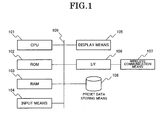
- Fig. 1 is a view showing the arrangement of the embodiment of the present invention.
- the embodiment of the system comprises a CPU (central processing unit) 101, a ROM (read-only memory) 102, a RAM (random access memory 103, an input means 104, a display means 105, an I/F (interface) 106, a wireless communicating means 107, a preset data storing means 108 and a bus 109.
- the CPU 101 executes software stored in the ROM 102 and RAM 103.
- the ROM 102 software executed in the CPU 101 is stored.
- the RAM 103 is a memory capable of reading and writing data, and it stores software executed in the CPU 101 and also data or the like to be transiently stored in the execution of the software.
- the input means 104 is constituted by a keyboard or the like and used for the input of preset data by the user.
- the display means 105 has a display or a LED (light-emitting diode) for showing electric field data to the user.
- the I/F 106 is an interface provided between the wireless communication means 107 such as PCMCIA and the bus 109.
- the wireless communication means 107 is provided for communication with wireless LAN access points (APs) such as wireless LAN cards, and it includes an antenna, an RF transmitting/receiving unit, a baseband/modem LSI, a DSP (digital signal processor) CPU, etc.
- the preset data storing means 108 is a hard disc device or like storing device, and stores ESS ID or the like issued as hot spot dealer preset by the user. Data exchanged among the means 101 to 108 are transferred via the bus 109.
- Figs. 2 and 3 are flow charts for describing the operation routine in this embodiment.
- each hot spot dealer it is made possible to identify APs installed by the dealer by using ESS ID stored in a transmission beacon.
- the user preliminarily inputs ESS ID of the hot spot dealers in the roaming contract relation to the preset data storing means 108 by using the input means 104. It is assumed that a timing of displaying the electric field intensity on the display means 105 is reached. The timing depends on the actual fitting of component means.
- the CPU 101 causes display of the electric field intensity obtained at the same time on the display 105 (step 205). At this time, the display is made such that the user understands at a glance that the obtained electric field intensity is that of the user's own subscribed hot spot dealer.
- the CPU 101 checks whether the present channel under the survey is the last one of the survey channels (step 206). If the present survey channel is not the last one, the CPU 101 adds "1" to the present channel value "ch", and then goes back to the step 203 to again obtain the electric field intensity of the desired survey channel ch and the ESS ID from the wireless communication means 107. If it is found in the step 206 that the present survey channel is the last channel, the CPU 101 goes to the routine shown in Fig. 3.
- the CPU 101 initializes the survey channel value "ch” (step 302). Then, the CPU 101 obtains the electric field intensity of the survey channel ch and the ESS ID from the wireless communication means 107 (step 303) . Then the CPU 101 checks whether the obtained ESS ID is identical with "ess id" (step 304).
- the CPU 101 causes display of the electric field intensity obtained at the same time on the displaymeans 105 (step 305). At this time, the display is made such that the user understands at a glance that the obtained electric field intensity is that of the hot spot dealer in roaming contract with the user's own subscribed hot spot dealer.
- the CPU 101 checks whether the present channel under survey is the last survey channel (step 306).
- the CPU 101 adds "1" to the survey channel value "ch”, and goes back to the step 303 to again obtain the electric field intensity of the desired survey channel ch and the ESS ID from the wireless communication means 107.
- the CPU 101 checks whether ESS ID of any roaming contract relation hot spot dealer remaining without being surveyed is present (step 308).
- the CPU 101 sets the non-surveyed ESS ID to "ess id", and goes back to the step 302 to start the routine afresh.
- the CPU 101 causes display on the display means 105 that no electric field intensity has been detected (step 309).
- ESS ID is used as a method of hot spot dealer identification, this method is by no means limitative.
- the display means 105 may be the display of a personal computer or a PDA constituting a wireless LAN station, or a LED mounted on a wireless LAN card.
- a light emission method is possible as to emit green light in the case of detecting the electric field intensity of the user's own subscribed hot spot dealer and emit orange light in the case of detecting the roaming contract relation dealer.
- fitting as software on a personal computer and also fitting as firm ware to be executed on a wireless LAN card may be made.
- display on the display means 105 is made as to whether the user is in the area covered by the user's own subtracted hot spot dealer or by the dealer in roaming contract relation to the own dealer.
- congestion degree i.e., predicted thorough value
- the basic arrangement of the second embodiment of the present invention is the same as that of the first embodiment shown in Fig. 1, and is therefore not described.
- the congestion degree is obtainable by collecting data link layer level protocol data. Specifically, in IEEE 802.11 protocol, for instance, data transmission is started after confirming with carrier sense function that no other terminal is transmitting any data (CSMA/CA, i.e., Carrier Sense Multiple Access with Collision Avoidance). The congestion degree is measured by Utilizing this carrier sense function and periodically making the carrier sense.
- CSMA/CA Carrier Sense Multiple Access with Collision Avoidance
- the congestion degree is measured by measuring the reliability of reception of ACK frame, which is transmitted from the access point (AP) when the terminal transmits data.
- the congestion degree is transmitted by measuring the frequency of reception of CTS (Clear To Send) frame, which is transmitted from the AP as a response to RTS (request to send) frame transmitted when a different terminal requests to transmit data.
- the user can have intelligence of the throughput of communication on the site without actually starting the communication. Because the user can obtain the intelligence of the throughput, he or she can make such a selection as moving to a non-congested area without starting communication.
- a method of display on the display means 105 it is possible to cause display on the display of a personal computer or a PDA or by using an LED on a personal computer, a PDA or a wireless LAN card.
- a method may be adopted as to have the LED "on” at all times in the non-congestion case and emit flickering light in the congestion case.
- Another method which may be adopted, is to vary the flickering cycle according to the congestion degree.
- the congestion degree on the display means 105 it may be displayed together whether the user is in the covered area as described before in connection with the first embodiment.
- the ESS ID of the user's own subscribed dealer and the ESS ID of the dealer in roaming contract relation to the own dealer are inputted by the user himself or herself by using the input means 104, and are stored in the preset data storing means 108.
- the ESS ID data are not inputted by the user himself or herself, but are inputted via floppy (registered trademark) disc, communication cable such as RS-232C or an internet.
- the obtained ESS ID is perfectly identical with the ESS ID of the user's own subscribed dealer or the ESS ID of the dealer in roaming contract relation to the own dealer.
- comparison of the first in letters may be made for the identity check in lieu of the step 204 in Fig. 2 and the step 304 in Fig. 3, in which perfect ESS ID identity check is made.
- this embodiment is the same as the first embodiment.
- a fifth embodiment of the present invention is applicable to a system arrangement, which is incapable of using any ESS ID as a dealer identification method but is capable of making a decision as to whether the user is in the covered area of the own subscribed dealer when and only when wireless LAN network access authentication is successful.
- an agent authentication means is provided in addition to the constitution element of the first embodiment.
- authentication check is made in lieu of comparing the obtained ESS ID and designated "ess id" in the step 204 in Fig. 2 and the step 304 in Fig. 3.
- the authentication means is preset independently by each dealer, and the user presets an authentication means informed from the user's own subscribed hot spot dealer and data necessary for the authentication.
- the authentication means executes authentication by using data preset by the user and provides data as to whether the authentication has been successful.
- the user can discriminate at a sacrifice whether he or she is in the area covered by the own subscribed hot sot dealer or in the area covered by the dealer in roaming contract relation to the own hot spot dealer.
- Communication in the roaming contract dealer area leads to addition of an extra fee to the communication fee, and the user makes communication while bearing this fact in mind.
- the user thus can make various selections such as moving to nearby area covered by the user's own subscribed dealer if this is the case or reducing the communication time compared to the normal time by taking the communication fee into considerations.
Landscapes
- Engineering & Computer Science (AREA)
- Computer Networks & Wireless Communication (AREA)
- Signal Processing (AREA)
- Computer Security & Cryptography (AREA)
- Computer Hardware Design (AREA)
- Computing Systems (AREA)
- General Engineering & Computer Science (AREA)
- Mobile Radio Communication Systems (AREA)
- Small-Scale Networks (AREA)
Abstract
Description
Claims (19)
- A system for informing that the user is in or not in wireless LAN service area comprising at least:a preset data storing means for storing identification data of a hot spot dealer, to which the user is subscribed, and identification data of a hot spot dealer in roaming contract relation to the user's own subscribed hot spot dealer;a wireless communication means;a display means; anda means functioning:when providing a display as to whether the user is in the service area of a hot spot service, to obtain the electric field intensity of a channel as a subject of survey and identification data of a dealer and check whether the obtained identification data is identical with identification data of the user's own subscribed hot spot dealer, which is stored in the preset data storing means;when the obtained identification data is identical with the identification data of the user's own subscribed hot spot dealer, to output data for display on the display means such that the user can decide that the obtained electric field intensity is that of the user's own subscribed hot spot dealer; andwhen the obtained identification data is identical with the identification data of the roaming contract relation dealer, to output data for display on the display means such that the user can decide that the obtained electric field intensity is that of the roaming contract relation dealer.
- The system for informing that the user is in or not in a wireless LAN service area according to claim 1, wherein the display means includes:a light-emitting means; anda control means for causing the light-emitting means to emit informing light in different colors in the case when the user is in the service area of the user's own subscribed hot spot dealer and the case when the user is in the service area of the dealer in roaming contract relation to the own hot spot dealer.
- A system for informing that the user is in or not in a wireless LAN service area, comprising a means for collecting data link layer level protocol data, obtaining congestion degree in service area and outputting the obtained congestion degree to display means.
- The system according to claim 1 or 2, which further comprises a means for collecting data link layer level protocol data, obtaining the congestion degree in the service area and outputting the obtained congestion degree to the display means.
- The system for informing that the user is in or not in a wireless LAN service area, wherein the display means includes:a light-emitting means; anda means functioning to control the display of the congestion degree by controlling the flickering period of the light-emitting means based on the congestion degree.
- The system for informing that the user is in or not in a wireless LAN service area according to claim 4, wherein the display means includes:a light-emitting means; anda means functioning:to have the light-emittingmeans to emit light indifferent colors in the case of displaying that the user is in the service areas of the user's own contracted hot spot dealer and in the case of displaying that the user is in the service area of a hot spot dealer in roaming contract relation to the own hot spot dealer; andto display the congestion degree by controlling the flickering cycle of the light-emitting means according to the congestion degree.
- The system according to any one of claims 1 to 6, wherein wireless LAN ESS (extended service set) ID is used as identification data of the hot spot dealer.
- The system according to any one of claims 1 to 7, which further comprises an agent authentication means set by the user's own subscribed hot spot dealer and a hot spot dealer in roaming contract relation to the own hot spot dealer; and
in which:at the user side terminal data concerning the authentication means of the user's own subscribed hot spot dealer and a hot spot dealer in roaming contract relation to the own hot spot dealer and data necessary for these authentications are preliminarily stored in the memory means;the agent authentication means carries out authentication by using the data preset by the user; andwhen the agent authentication means has carried out authentication successfully, data indicative of that the pertinent service area is that of the successfully authenticated hot spot dealer is outputted to the display means for display. - The system according to any one of claims 1 to 8, which further comprises a means for deciding, when a check is made as to whether the obtained identification data is identical with the identification data of the user's own subscribed hot spot dealer as stored in the preset data storing means, that the obtained identification data and the identification data stored in the preset data storing means are identical when the two data are not perfectly identical but partly identical.
- A station system connected for communication with a wireless LAN access point, which comprises the system for informing that the user is in or not in a wireless LAN service area according to one of claims 1 to 9.
- A method of informing that the user is in or not in a wireless LAN service area, in which:identification data of the user's own subscribed hot spot dealer and identification data of a hot spot dealer in roaming contract relation to the own hot spot dealer are stored in a preset data storing means; andwhich comprises:a step executedby awireless communication means to obtain the electric field intensity of a channel as a subject of survey and identification data of a dealer and checkwhether the obtained identification data is the identification data of the user's own subscribed hot spot dealer as stored in preset data storing means;a step of displaying, when the obtained identification data is identical with the user's own subscribed hot spot dealer, that the obtained electric field intensity is that of the user's own subscribed hot spot dealer on a display means such that the user can understand the displayed content at a glance;a step of making a check, when the obtained identification data fails to be identical with the identification data of the user's own subscribed hot spot dealer, as to whether the obtained data is identical with the identification data of the roaming contract relation dealer; anda step of displaying, when the obtained identification data is identical with the identification data of the roaming contract relation dealer, that the obtained electric field intensity is that of the roaming contract relation dealer such that the user can understand the displayed content at a glance.
- The method for informing that the user is in or not in a wireless LAN service area according to claim 11, wherein the light-emitting means in the display means is controlled to emit informing light in different colors in the case of displaying that the user is in the service area of the user's own subscribed hot spot dealer and in the case of displaying that the user is in the service area of a hot spot dealer in roaming contract relation to the own hot spot dealer.
- A method for informing that the user is in or not in a wireless LAN service area, which comprises a step of collecting data link layer protocol data, obtaining the congestion degree of the service area and outputting the obtained congestion degree to the display means.
- The method according to claim 11 or 12, which comprises a step of collecting data link layer level protocol data, obtaining the congestion degree of the service area and outputting the obtained congestion degree to the display means.
- The method according to claim 13, which comprises a step of displaying the congestion degree by controlling the flickering cycle of the light-emitting means in the display means according to the congestion degree.
- The method for informing that the user is in or not in a wireless LAN service area according to claim 12, which comprises a step of collecting data link layer level protocol data, obtaining the congestion degree of the service area and displaying the congestion degree by controlling the flickering cycle of the light-emitting means based on the congestion degree.
- The method according to any one of claims 11 to 16, wherein wireless LAN ESS (Extended Service Set) ID is used as the identification data of the hot spot dealer.
- A method of informing that the user is in or not in a wireless LAN service area, in which:data concerning authentication means of the user's own subscribed hot spot dealer and a hot spot dealer in roaming contract relation to the own hot spot dealer and data necessary for these authentications are preliminarily stored in a storing means; andwhich comprises:a step executed by the agent authentication means for authentication by using data preset by the user; anddisplaying, when the agent authentication means has carried out successful authentication, that the service area is of the successfully authenticated hot spot dealer.
- The system or method according to anyone of claims 1 to 18, wherein the wireless LAN service is a public wireless LAN service.
Applications Claiming Priority (2)
| Application Number | Priority Date | Filing Date | Title |
|---|---|---|---|
| JP2002246893A JP3988585B2 (en) | 2002-08-27 | 2002-08-27 | Public wireless LAN service area notification apparatus and method |
| JP2002246893 | 2002-08-27 |
Publications (2)
| Publication Number | Publication Date |
|---|---|
| EP1394988A2 true EP1394988A2 (en) | 2004-03-03 |
| EP1394988A3 EP1394988A3 (en) | 2004-04-14 |
Family
ID=31492542
Family Applications (1)
| Application Number | Title | Priority Date | Filing Date |
|---|---|---|---|
| EP03018747A Withdrawn EP1394988A3 (en) | 2002-08-27 | 2003-08-26 | System and method for informing whether a user is in wireless lan service |
Country Status (5)
| Country | Link |
|---|---|
| US (1) | US7957353B2 (en) |
| EP (1) | EP1394988A3 (en) |
| JP (1) | JP3988585B2 (en) |
| KR (1) | KR100953901B1 (en) |
| CN (2) | CN1279723C (en) |
Cited By (7)
| Publication number | Priority date | Publication date | Assignee | Title |
|---|---|---|---|---|
| WO2006121265A1 (en) * | 2005-05-06 | 2006-11-16 | Samsung Electronics Co., Ltd. | Apparatus and method for displaying availability of wireless lan |
| EP1890504A1 (en) * | 2006-08-18 | 2008-02-20 | Samsung Electronics Co., Ltd. | Apparatus and Method of Providing Packet Service Status Using Access Class Barred List in Mobile Communication System |
| WO2008061350A1 (en) * | 2006-11-21 | 2008-05-29 | Research In Motion Limited | Wireless local area network hotspot registration |
| US8588769B2 (en) | 2006-07-05 | 2013-11-19 | Fujitsu Limited | Wireless connection device and wireless communication device |
| US8719431B2 (en) | 2006-10-26 | 2014-05-06 | Blackberry Limited | Transient WLAN connection profiles |
| EP2890213A4 (en) * | 2012-09-28 | 2015-10-21 | Zte Corp | METHOD AND DISPLAY DEVICE FOR MOBILE TERMINAL |
| US9179399B2 (en) | 2008-05-12 | 2015-11-03 | Blackberry Limited | Methods and apparatus for use in facilitating access to a communication service via a WLAN hotspot |
Families Citing this family (30)
| Publication number | Priority date | Publication date | Assignee | Title |
|---|---|---|---|---|
| JP3988585B2 (en) * | 2002-08-27 | 2007-10-10 | 日本電気株式会社 | Public wireless LAN service area notification apparatus and method |
| KR100597738B1 (en) | 2004-05-27 | 2006-07-07 | 삼성전자주식회사 | Electronic device and control method |
| CN100341348C (en) * | 2004-09-28 | 2007-10-03 | 华为技术有限公司 | Method for displaying current network operator information |
| JP2006238270A (en) * | 2005-02-28 | 2006-09-07 | Toshiba Corp | Information processing device |
| US20060291412A1 (en) | 2005-06-24 | 2006-12-28 | Naqvi Shamim A | Associated device discovery in IMS networks |
| US7724753B2 (en) | 2005-06-24 | 2010-05-25 | Aylus Networks, Inc. | Digital home networks having a control point located on a wide area network |
| US7672297B2 (en) * | 2005-06-24 | 2010-03-02 | Aylus Networks, Inc. | Mediation system and method for hybrid network including an IMS network |
| US20060291487A1 (en) * | 2005-06-24 | 2006-12-28 | Aylus Networks, Inc. | IMS networks with AVS sessions with multiple access networks |
| US7561535B2 (en) * | 2005-06-24 | 2009-07-14 | Aylus Networks, Inc. | System and method for providing dynamic call models for users as function of the user environment in an IMS network |
| US7864936B2 (en) * | 2005-06-24 | 2011-01-04 | Aylus Networks, Inc. | Method of avoiding or minimizing cost of stateful connections between application servers and S-CSCF nodes in an IMS network with multiple domains |
| US7792528B2 (en) | 2005-06-24 | 2010-09-07 | Aylus Networks, Inc. | Method and system for provisioning IMS networks with virtual service organizations having distinct service logic |
| JP2007094903A (en) * | 2005-09-29 | 2007-04-12 | Fujitsu Ltd | Information processing terminal device, authentication method, and authentication program |
| JP2007194816A (en) * | 2006-01-18 | 2007-08-02 | Youxun Sci & Technol Co Ltd | Reconnaissance method for wireless network signal |
| US9026117B2 (en) | 2006-05-16 | 2015-05-05 | Aylus Networks, Inc. | Systems and methods for real-time cellular-to-internet video transfer |
| US8432899B2 (en) * | 2007-02-22 | 2013-04-30 | Aylus Networks, Inc. | Systems and methods for enabling IP signaling in wireless networks |
| US8611334B2 (en) * | 2006-05-16 | 2013-12-17 | Aylus Networks, Inc. | Systems and methods for presenting multimedia objects in conjunction with voice calls from a circuit-switched network |
| US8730945B2 (en) * | 2006-05-16 | 2014-05-20 | Aylus Networks, Inc. | Systems and methods for using a recipient handset as a remote screen |
| KR101206294B1 (en) | 2006-06-27 | 2012-11-29 | 에스케이플래닛 주식회사 | Rfid system, system and method for recognizing wireless internet service zone by using the rfid system |
| US20080019334A1 (en) * | 2006-07-24 | 2008-01-24 | Stewart Lane Adams | Minimization of In-Band Noise in a WLAN Network |
| US8189507B2 (en) * | 2006-08-14 | 2012-05-29 | Carl Fitzsimmons | Input/output end point control for integrated telecommunications-network systems (VoIP) |
| JP4308860B2 (en) * | 2007-02-20 | 2009-08-05 | 株式会社エヌ・ティ・ティ・ドコモ | Mobile communication terminal and website browsing method |
| US7856226B2 (en) * | 2007-04-17 | 2010-12-21 | Aylus Networks, Inc. | Systems and methods for IMS user sessions with dynamic service selection |
| US20080317010A1 (en) * | 2007-06-22 | 2008-12-25 | Aylus Networks, Inc. | System and method for signaling optimization in ims services by using a service delivery platform |
| JP5163944B2 (en) * | 2008-03-17 | 2013-03-13 | 株式会社国際電気通信基礎技術研究所 | Wireless device and method of measuring congestion in the same |
| JP5319456B2 (en) * | 2009-08-20 | 2013-10-16 | キヤノン株式会社 | COMMUNICATION SYSTEM, ITS CONTROL METHOD, BASE STATION DEVICE, AND PROGRAM |
| CN102026155A (en) * | 2009-09-09 | 2011-04-20 | 宏碁股份有限公司 | Method for displaying name of telecommunication business |
| JP5673150B2 (en) * | 2011-01-31 | 2015-02-18 | ソニー株式会社 | Information processing method, information processing apparatus, and communication system |
| JP6583269B2 (en) * | 2014-06-25 | 2019-10-02 | 日本電気株式会社 | Wireless communication apparatus, wireless communication method, and computer program |
| US20160165449A1 (en) * | 2014-12-03 | 2016-06-09 | Intel Corporation | Notification of unauthorized wireless network devices |
| US11096092B2 (en) * | 2018-09-07 | 2021-08-17 | Vmware, Inc. | Service aware coverage degradation detection and root cause identification |
Family Cites Families (31)
| Publication number | Priority date | Publication date | Assignee | Title |
|---|---|---|---|---|
| JP3056869B2 (en) | 1992-03-04 | 2000-06-26 | 株式会社東芝 | Mobile radio communication device |
| JPH0818479A (en) | 1994-07-04 | 1996-01-19 | Casio Comput Co Ltd | Transceiver |
| US5537395A (en) | 1995-04-13 | 1996-07-16 | Northern Telecom Limited | Method and apparatus for setting a channel congestion message in a wireless multiple access packet data system |
| JP3909106B2 (en) | 1996-11-14 | 2007-04-25 | 富士通株式会社 | Roaming call control system |
| DE69633201T2 (en) | 1996-11-18 | 2005-08-18 | Nokia Corp. | TRAFFIC MONITORING IN A MOBILE COMMUNICATION NETWORK |
| US5950130A (en) | 1997-03-18 | 1999-09-07 | Sbc Technology Resources, Inc. | Mobile station with intelligent roaming and over-the-air programming features |
| US6201962B1 (en) | 1997-05-14 | 2001-03-13 | Telxon Corporation | Seamless roaming among multiple networks including seamless transitioning between multiple devices |
| JPH114482A (en) | 1997-06-13 | 1999-01-06 | Nippon Denki Ido Tsushin Kk | Mobile telephone set |
| US6463534B1 (en) * | 1999-03-26 | 2002-10-08 | Motorola, Inc. | Secure wireless electronic-commerce system with wireless network domain |
| JP3296342B2 (en) * | 1999-09-21 | 2002-06-24 | 日本電気株式会社 | Communication terminal |
| GB2362293A (en) | 2000-05-11 | 2001-11-14 | Nokia Mobile Phones Ltd | Display of service provider identity during download |
| JP3585422B2 (en) | 2000-06-01 | 2004-11-04 | シャープ株式会社 | Access point device and authentication processing method thereof |
| AU5112800A (en) | 2000-06-12 | 2001-12-24 | Janglak Choi | Visual notification device for a portable phone |
| US7487112B2 (en) * | 2000-06-29 | 2009-02-03 | Barnes Jr Melvin L | System, method, and computer program product for providing location based services and mobile e-commerce |
| GB2364464A (en) | 2000-06-30 | 2002-01-23 | Nokia Mobile Phones Ltd | Mobile phone activates different coloured lights depending on caller |
| JP2002064868A (en) | 2000-08-21 | 2002-02-28 | Matsushita Electric Ind Co Ltd | Spot service wireless information terminal |
| JP2002152830A (en) * | 2000-11-10 | 2002-05-24 | Fujitsu Ltd | Mobile terminal and server for multimedia communication performing dynamic negotiation |
| KR100366487B1 (en) * | 2000-11-16 | 2003-01-09 | 주식회사 케이티프리텔 | A roaming service system for gsm service subscribers in a cdma service area, a location registration method, and a receiing/sending method |
| TWM249366U (en) | 2001-01-02 | 2004-11-01 | Z Com Inc | Radio signal detection device of wireless local area network |
| JP2002232573A (en) | 2001-01-31 | 2002-08-16 | Nec Corp | Mobile communication terminal, mobile communication system and service providing device |
| SE0100351D0 (en) * | 2001-02-06 | 2001-02-06 | Sergio Luciani | Traffic monitoring system and method |
| US6842460B1 (en) * | 2001-06-27 | 2005-01-11 | Nokia Corporation | Ad hoc network discovery menu |
| JP3775278B2 (en) * | 2001-10-25 | 2006-05-17 | 日本電気株式会社 | Network service information providing system, network service information providing apparatus, method and terminal |
| US20030152075A1 (en) * | 2002-02-14 | 2003-08-14 | Hawthorne Austin J. | Virtual local area network identifier translation in a packet-based network |
| US7474616B2 (en) * | 2002-02-19 | 2009-01-06 | Intel Corporation | Congestion indication for flow control |
| US20030212567A1 (en) * | 2002-05-07 | 2003-11-13 | Hitachi Ltd. | Witness information service with image capturing and sharing |
| KR100429527B1 (en) * | 2002-05-13 | 2004-05-03 | 삼성전자주식회사 | Method for controlling of mobile ip |
| US8611919B2 (en) * | 2002-05-23 | 2013-12-17 | Wounder Gmbh., Llc | System, method, and computer program product for providing location based services and mobile e-commerce |
| KR20040000213A (en) * | 2002-06-24 | 2004-01-03 | 주식회사 케이티 | Internet Conneting Method with User's Terminal Using Connetion Network as heterogeneous |
| JP3988585B2 (en) * | 2002-08-27 | 2007-10-10 | 日本電気株式会社 | Public wireless LAN service area notification apparatus and method |
| US7573827B2 (en) * | 2003-05-06 | 2009-08-11 | Hewlett-Packard Development Company, L.P. | Method and apparatus for detecting network congestion |
-
2002
- 2002-08-27 JP JP2002246893A patent/JP3988585B2/en not_active Expired - Fee Related
-
2003
- 2003-08-21 US US10/644,857 patent/US7957353B2/en not_active Expired - Fee Related
- 2003-08-26 EP EP03018747A patent/EP1394988A3/en not_active Withdrawn
- 2003-08-26 KR KR1020030059196A patent/KR100953901B1/en not_active Expired - Fee Related
- 2003-08-27 CN CNB031559727A patent/CN1279723C/en not_active Expired - Fee Related
- 2003-08-27 CN CNB200510135978XA patent/CN100461729C/en not_active Expired - Fee Related
Cited By (13)
| Publication number | Priority date | Publication date | Assignee | Title |
|---|---|---|---|---|
| WO2006121265A1 (en) * | 2005-05-06 | 2006-11-16 | Samsung Electronics Co., Ltd. | Apparatus and method for displaying availability of wireless lan |
| US8315232B2 (en) | 2005-05-06 | 2012-11-20 | Samsung Electronics Co., Ltd. | Apparatus and method for displaying availability of wireless LAN |
| US8588769B2 (en) | 2006-07-05 | 2013-11-19 | Fujitsu Limited | Wireless connection device and wireless communication device |
| EP1890504A1 (en) * | 2006-08-18 | 2008-02-20 | Samsung Electronics Co., Ltd. | Apparatus and Method of Providing Packet Service Status Using Access Class Barred List in Mobile Communication System |
| US8719431B2 (en) | 2006-10-26 | 2014-05-06 | Blackberry Limited | Transient WLAN connection profiles |
| US8595365B2 (en) | 2006-11-21 | 2013-11-26 | Research In Motion Limited | Handling virtual private network connections over a wireless local area network |
| WO2008061350A1 (en) * | 2006-11-21 | 2008-05-29 | Research In Motion Limited | Wireless local area network hotspot registration |
| US8874764B2 (en) | 2006-11-21 | 2014-10-28 | Blackberry Limited | Saving a connection profile when unable to connect to a wireless local area network |
| US9179399B2 (en) | 2008-05-12 | 2015-11-03 | Blackberry Limited | Methods and apparatus for use in facilitating access to a communication service via a WLAN hotspot |
| US9888437B2 (en) | 2008-05-12 | 2018-02-06 | Blackberry Limited | Methods and apparatus for use in facilitating access to a communication service via a WLAN hotspot |
| US10477468B2 (en) | 2008-05-12 | 2019-11-12 | Blackberry Limited | Methods and apparatus for use in facilitating access to a communication service via a WLAN hotspot |
| EP2890213A4 (en) * | 2012-09-28 | 2015-10-21 | Zte Corp | METHOD AND DISPLAY DEVICE FOR MOBILE TERMINAL |
| US9706033B2 (en) | 2012-09-28 | 2017-07-11 | Zte Corporation | Display method and device for mobile terminal |
Also Published As
| Publication number | Publication date |
|---|---|
| EP1394988A3 (en) | 2004-04-14 |
| CN1489401A (en) | 2004-04-14 |
| CN1801762A (en) | 2006-07-12 |
| KR100953901B1 (en) | 2010-04-22 |
| CN100461729C (en) | 2009-02-11 |
| US7957353B2 (en) | 2011-06-07 |
| CN1279723C (en) | 2006-10-11 |
| JP2004088424A (en) | 2004-03-18 |
| JP3988585B2 (en) | 2007-10-10 |
| US20040043766A1 (en) | 2004-03-04 |
| KR20040018987A (en) | 2004-03-04 |
Similar Documents
| Publication | Publication Date | Title |
|---|---|---|
| US7957353B2 (en) | System and method for informing that user is in or not in wireless LAN service | |
| EP1398914A2 (en) | Advertising and controlling the advertisement of wireless hot spots | |
| US8477645B2 (en) | System and methods of automatically connecting a mobile communication device to a network using a communications resource database | |
| US9386508B2 (en) | Information providing system, information providing apparatus and information providing method | |
| US7551930B2 (en) | Location-based services for mobile stations using short range wireless technology | |
| US7253747B2 (en) | Parking lot management system using wireless LAN system | |
| US8510452B2 (en) | Wireless network selection apparatus | |
| CN101080902B (en) | Wireless network connection selection based on predefined profiles | |
| US20130231088A1 (en) | System and method for social profiling using wireless communication devices | |
| US20140204925A1 (en) | Information providing system, information providing apparatus, and information providing method | |
| US20070047480A1 (en) | Wireless terminal, management apparatus and wireless LAN control method | |
| WO2007039941A1 (en) | Mobile communication device | |
| WO2003075489A1 (en) | Multi-service radio communication system | |
| JP2004235976A (en) | Terminal device, program and center device | |
| KR101341990B1 (en) | Apparatus and method for selecting of access point | |
| EP2667581A1 (en) | System for distributing local information | |
| KR101421563B1 (en) | Apparatus and method for accessing access point | |
| EP1720290A1 (en) | Unauthorized wireless station detecting system, apparatus used therein, and method therefor | |
| JP3742057B2 (en) | Analysis technology of radio wave condition in wireless information communication | |
| CN103546511A (en) | Method for realizing establishment of distributed network for multiple WIFI (wireless fidelity) equipment through WIFI, software program and server | |
| US20140211645A1 (en) | Wireless terminal, information providing method, and information providing system | |
| US20050032516A1 (en) | Method and apparatus for detecting the presence of a wireless network | |
| JP2007228630A (en) | Notification device and method in public wireless lan service area | |
| JP2007524287A (en) | Using access points for automatic determination of available resources | |
| JP2019106610A (en) | Wireless lan slave unit, wireless lan slave unit communication control method, and wireless lan slave unit communication control program |
Legal Events
| Date | Code | Title | Description |
|---|---|---|---|
| PUAI | Public reference made under article 153(3) epc to a published international application that has entered the european phase |
Free format text: ORIGINAL CODE: 0009012 |
|
| PUAL | Search report despatched |
Free format text: ORIGINAL CODE: 0009013 |
|
| AK | Designated contracting states |
Kind code of ref document: A2 Designated state(s): AT BE BG CH CY CZ DE DK EE ES FI FR GB GR HU IE IT LI LU MC NL PT RO SE SI SK TR |
|
| AX | Request for extension of the european patent |
Extension state: AL LT LV MK |
|
| RIC1 | Information provided on ipc code assigned before grant |
Ipc: 7H 04Q 7/38 B Ipc: 7H 04L 12/28 A |
|
| AK | Designated contracting states |
Kind code of ref document: A3 Designated state(s): AT BE BG CH CY CZ DE DK EE ES FI FR GB GR HU IE IT LI LU MC NL PT RO SE SI SK TR |
|
| AX | Request for extension of the european patent |
Extension state: AL LT LV MK |
|
| 17P | Request for examination filed |
Effective date: 20040304 |
|
| 17Q | First examination report despatched |
Effective date: 20040517 |
|
| AKX | Designation fees paid |
Designated state(s): DE FR GB NL |
|
| 17Q | First examination report despatched |
Effective date: 20040517 |
|
| STAA | Information on the status of an ep patent application or granted ep patent |
Free format text: STATUS: THE APPLICATION IS DEEMED TO BE WITHDRAWN |
|
| 18D | Application deemed to be withdrawn |
Effective date: 20071219 |