EP1394740A2 - Image processing dependent on an image capturing device characteristic - Google Patents
Image processing dependent on an image capturing device characteristic Download PDFInfo
- Publication number
- EP1394740A2 EP1394740A2 EP03255298A EP03255298A EP1394740A2 EP 1394740 A2 EP1394740 A2 EP 1394740A2 EP 03255298 A EP03255298 A EP 03255298A EP 03255298 A EP03255298 A EP 03255298A EP 1394740 A2 EP1394740 A2 EP 1394740A2
- Authority
- EP
- European Patent Office
- Prior art keywords
- image
- data
- referred
- scene
- capturing
- Prior art date
- Legal status (The legal status is an assumption and is not a legal conclusion. Google has not performed a legal analysis and makes no representation as to the accuracy of the status listed.)
- Withdrawn
Links
Images





Classifications
-
- H—ELECTRICITY
- H04—ELECTRIC COMMUNICATION TECHNIQUE
- H04N—PICTORIAL COMMUNICATION, e.g. TELEVISION
- H04N1/00—Scanning, transmission or reproduction of documents or the like, e.g. facsimile transmission; Details thereof
- H04N1/32—Circuits or arrangements for control or supervision between transmitter and receiver or between image input and image output device, e.g. between a still-image camera and its memory or between a still-image camera and a printer device
- H04N1/32101—Display, printing, storage or transmission of additional information, e.g. ID code, date and time or title
- H04N1/32128—Display, printing, storage or transmission of additional information, e.g. ID code, date and time or title attached to the image data, e.g. file header, transmitted message header, information on the same page or in the same computer file as the image
-
- H—ELECTRICITY
- H04—ELECTRIC COMMUNICATION TECHNIQUE
- H04N—PICTORIAL COMMUNICATION, e.g. TELEVISION
- H04N1/00—Scanning, transmission or reproduction of documents or the like, e.g. facsimile transmission; Details thereof
- H04N1/32—Circuits or arrangements for control or supervision between transmitter and receiver or between image input and image output device, e.g. between a still-image camera and its memory or between a still-image camera and a printer device
- H04N1/32358—Circuits or arrangements for control or supervision between transmitter and receiver or between image input and image output device, e.g. between a still-image camera and its memory or between a still-image camera and a printer device using picture signal storage, e.g. at transmitter
- H04N1/32459—Circuits or arrangements for control or supervision between transmitter and receiver or between image input and image output device, e.g. between a still-image camera and its memory or between a still-image camera and a printer device using picture signal storage, e.g. at transmitter for changing the arrangement of the stored data
- H04N1/32475—Changing the format of the data, e.g. parallel to serial or vice versa
-
- H—ELECTRICITY
- H04—ELECTRIC COMMUNICATION TECHNIQUE
- H04N—PICTORIAL COMMUNICATION, e.g. TELEVISION
- H04N5/00—Details of television systems
- H04N5/76—Television signal recording
- H04N5/765—Interface circuits between an apparatus for recording and another apparatus
- H04N5/77—Interface circuits between an apparatus for recording and another apparatus between a recording apparatus and a television camera
- H04N5/772—Interface circuits between an apparatus for recording and another apparatus between a recording apparatus and a television camera the recording apparatus and the television camera being placed in the same enclosure
-
- H—ELECTRICITY
- H04—ELECTRIC COMMUNICATION TECHNIQUE
- H04N—PICTORIAL COMMUNICATION, e.g. TELEVISION
- H04N2201/00—Indexing scheme relating to scanning, transmission or reproduction of documents or the like, and to details thereof
- H04N2201/32—Circuits or arrangements for control or supervision between transmitter and receiver or between image input and image output device, e.g. between a still-image camera and its memory or between a still-image camera and a printer device
- H04N2201/3201—Display, printing, storage or transmission of additional information, e.g. ID code, date and time or title
- H04N2201/3225—Display, printing, storage or transmission of additional information, e.g. ID code, date and time or title of data relating to an image, a page or a document
- H04N2201/3252—Image capture parameters, e.g. resolution, illumination conditions, orientation of the image capture device
-
- H—ELECTRICITY
- H04—ELECTRIC COMMUNICATION TECHNIQUE
- H04N—PICTORIAL COMMUNICATION, e.g. TELEVISION
- H04N2201/00—Indexing scheme relating to scanning, transmission or reproduction of documents or the like, and to details thereof
- H04N2201/32—Circuits or arrangements for control or supervision between transmitter and receiver or between image input and image output device, e.g. between a still-image camera and its memory or between a still-image camera and a printer device
- H04N2201/3201—Display, printing, storage or transmission of additional information, e.g. ID code, date and time or title
- H04N2201/3274—Storage or retrieval of prestored additional information
- H04N2201/3277—The additional information being stored in the same storage device as the image data
-
- H—ELECTRICITY
- H04—ELECTRIC COMMUNICATION TECHNIQUE
- H04N—PICTORIAL COMMUNICATION, e.g. TELEVISION
- H04N2201/00—Indexing scheme relating to scanning, transmission or reproduction of documents or the like, and to details thereof
- H04N2201/32—Circuits or arrangements for control or supervision between transmitter and receiver or between image input and image output device, e.g. between a still-image camera and its memory or between a still-image camera and a printer device
- H04N2201/3285—Circuits or arrangements for control or supervision between transmitter and receiver or between image input and image output device, e.g. between a still-image camera and its memory or between a still-image camera and a printer device using picture signal storage, e.g. at transmitter
- H04N2201/3287—Storage of at least one complete document page or image frame
Definitions
- the present invention relates to an image-capturing apparatus such as a digital camera, an image processing apparatus wherein optimization processing is applied to the digital image data obtained by this image-capturing apparatus to form an output-referred image on the outputting medium, and an image recording apparatus.
- the digital image data captured by an image-capturing apparatus is distributed through such a memory device as a CD-R (Compact Disk Recordable), floppy disk (registered trade name) and memory card or the Internet, and is displayed on such a display monitor as a CRT (Cathode Ray Tube), liquid crystal display and plasma display or a small-sized liquid crystal monitor display device of a cellular phone, or is printed out as a hard copy image using such an output device as a digital printer, inkjet printer and thermal printer.
- a memory device as a CD-R (Compact Disk Recordable), floppy disk (registered trade name) and memory card or the Internet
- a display monitor as a CRT (Cathode Ray Tube)
- liquid crystal display and plasma display or a small-sized liquid crystal monitor display device of a cellular phone
- an output device as a digital printer, inkjet printer and thermal printer.
- a digital camera is equipped with an image-capturing device (CCD type image-capturing device, hereinafter referred to simply as "CCD") having a photoelectric conversion function with color sensitivity provided by a combination of a CCD (charge coupled device), a charge transfer device and a mosaic color filter.
- CCD charge coupled device
- the digital image data output from the digital camera is obtained after the electric original signal gained by conversion via the CCD has been corrected by the photoelectric conversion function of the image capturing device, and processing of file conversion and compression into the predetermined data format standardized to permit reading and display by image editing software.
- Correction by the photoelectric conversion function of the image capturing device includes, for example, gradation correction, spectral sensitivity, crosstalk correction, dark current noise control, sharpening, white balance adjustment and color saturation adjustment.
- the above-mentioned standardized data format widely known includes Baseline Tiff Rev. 6.0 RGB Full Color Image adopted as a non-compressed file of the Exif (Exchangeable Image File Format) file and compressed data file format conforming to the JPEG format.
- the tag information for display in the standard color space (hereinafter referred to as "monitor profile") of the display monitor conforming to the sRGB signal, and accompanying information indicating the device dependent information such as the number of pixels, pixel arrangement and number of bits per pixel as meta-data as in the case of Exif format, and if only such a data format is adopted, then the tag information can be analyzed by the image edit software (e.g. Photoshop by Abode for displaying the above-mentioned digital image data on the digital display monitor, conversion of the monitor profile into the sRGB can be prompted, and modification can be processed automatically.
- the image edit software e.g. Photoshop by Abode for displaying the above-mentioned digital image data on the digital display monitor, conversion of the monitor profile into the sRGB can be prompted, and modification can be processed automatically.
- the above-mentioned accompanying information includes; information directly related to the camera type (device type) such as a camera name and code number, information on photographing conditions such as exposure time, shutter speed, f-stop number (F number), ISO sensitivity, brightness value, subject distance range, light source, on/off status of a stroboscopic lamp, subject area, white balance, zoom scaling factor, subject configuration, photographing scene type, the amount of reflected light of the stroboscopic lamp source and color saturation for photographing, and tags (codes) for indicating the information related to a subject.
- the image edit software and output device have a function of reading the above-mentioned accompanying information and making the quality of hardware image more suitable.
- the image displayed on such a display device as a CRT display monitor and the hard copy image printed by various printing devices have different color reproduction areas depending on the configuration of the phosphor or color material to be used.
- the color reproduction area of the CRT display monitor corresponding to the sRGB standard space has a wide bright green and blue area. It contains the area that cannot be reproduced by the hard copy formed by a silver halide photographic printer, inkjet printer and conventional printer.
- the cyan area of the conventional printing or inkjet printing and the yellow area of the silver halide photographic printing contain the area that cannot be reproduced by the CRT display monitor corresponding to the sRGB standard color space.
- the color space (including the sRGB) optimized on the basis of display and printing by a specific device is accompanied by restrictions in the color gamut where recording is possible. So when recording the information picked up by a photographing device, it is necessary to make adjustment of mapping by compressing the information into the color gamut where recording is allowed.
- the simplest way is provided by clipping where the color chromaticity point outside the color gamut where recording is possible is mapped onto the boundary of the nearest color gamut. This causes the gradation outside the color gamut to be collapsed, and the image will give a sense of incompatibility to the viewer. To avoid this problem, non-liner compression method is generally used.
- the image displayed on such a display device as a CRT display monitor, the hard copied image printed by various types of printing devices, or color space (including sRGB) optimized on the basis of display and printing by these devices are restricted to the conditions where the area of brightness that allows recording and reproduction is of the order of about 100 to 1.
- the scene of the subject to be photographed has a wide area of brightness, and it often happens that the order of several thousands to 1 is reached outdoors. (See “Handbook on Science of Color, New Version, 2nd Print” by Japan Society for Science of Colors, Publishing Society of the University of Tokyo, P. 926, for example).
- compression is also necessary for brightness.
- adequate conditions must be set for each image in conformity to the dynamic range of the scene to be photographed, and the range of brightness for the main subject in the scene to be photographed.
- mapping must be carried out again based on the differences between the sRGB standard color space and the area for color reproduction of the printing device.
- the information on gradation in the area compressed at a time of recording is lost. So the smoothness of gradation is deteriorated as compared to the case where the information captured by the photographing device is mapped directly in the area for color reproduction of the printing device.
- the art of storing the process of image editing as a backup data and returning it to the state prior to editing whenever required has long been known.
- the Official Gazette of Japanese Application Patent Laid-Open Publication No. Hei 07-57074 discloses a backup device wherein, when the digital image is subjected to local modification by image processing, the image data on the difference between the digital image data before image processing and that after image processing is saved as backup data.
- the Official Gazette of Japanese Application Patent Laid-Open Publication No. 2001-94778 discloses a method for recovering the digital image data before editing, by saving the image data on the difference between the digital image data before image processing and that after image processing.
- the problems introduced above are caused by the procedure where the information on the wide color gamut and brightness area gained by a photographing device is recorded after having being compressed into the output-referred image data in the state optimized by assuming an image to be viewed.
- the information on the wide color gamut and brightness area gained by a photographing device is recorded as scene-referred image data that is not compressed, then inadvertent loss of information can be prevented.
- the standard color space suited to record such scene-referred image data is proposed, for example, by RIMM RGB (Reference Input Medium Metric RGB) and ERIMM RGB (Extended Reference Input Medium Metric RGB). (See the Journal of Imaging Science and Technology, Vol. 45 p p. 418 to 426 (2001)).
- the data expressed in the standard color space like the one described above is not suitable for being displayed directly on the display monitor and viewed.
- a digital camera has a built-in display monitor or is connected to it in order for the user to check the angle of view before photographing or to check the photographed image after photographing.
- photographed data is recorded as output referred image data like the sRGB, it can be displayed directly on the display monitor, without the data being converted.
- the photographed data is recorded as scene-referred image data, the data must be subjected to the processing of re-conversion into the output-referred image data in order to display that data.
- Such double processing of conversion inside the camera increases the processing load and power consumption, and causes the continuous shooting capability to be reduced, and imposes restrictions on the number of sheets to be shot in the battery mode.
- the Official Gazette of Japanese Application Patent Laid-Open Publication No. Hei 11-261933 discloses an image processing apparatus characterized by two modes; a mode of recording in the form of an image signal displayed on the display means and a mode of recording in the form of captured image signal.
- the form of image signal in the latter case is generally called RAW data.
- development software special-purpose application software
- Such digital image data can be converted into output-referred image data of the above-mentioned Exif file or the like for display or printing (called “electronic development” or simply “development”). Since the RAW data retains all information at a time of photographing, it permits output-referred image data to be remade.
- an object of the present invention to provide an image-capturing apparatus for recording in a general-purpose manner without information on captured image being lost, an image processing apparatus using the same and an image recording apparatus.
- the abovementioned object of the present invention can be attained by image-capturing apparatus, image-processing apparatus, image-recording apparatus and image-processing methods described as follow.
- the following data is input; (1) scene-referred raw data dependent on the image-capturing characteristics of an image-capturing apparatus, (2) reproduction-auxiliary data based on which image-capturing characteristic compensation processing is applied to the scene-referred raw data so as to generate the scene-referred image data standardized in respect to the scene-referred raw data, and (3) image-capturing data representing photographing conditions at a time of photographing.
- Image-capturing characteristic compensation processing is applied to the inputted scene-referred raw data, based on the reproduction-auxiliary data for application of image-capturing characteristic compensation processing, whereby standardized scene-referred image data is produced.
- Output-referred image data is generated by the step wherein image processing for optimization of scene-referred image formed on the outputting medium is applied to the generated scene-referred image data, wherein contents of image processing are determined on the basis of the above-mentioned image-capturing data.
- the generated output-referred image data is used to form the output-referred image on the outputting medium.
- this feature provides the services of yielding the optimized output-referred image data and prints without captured image information being lost, in the same manner as the services using the conventional Digital Minilab.
- the image recording apparatus of the present invention can be equipped with a film scanner for inputting the frame image information of the photosensitive material recorded by an analog camera including a color film, color reversal film, black-and-white negative and black-and-white reversal film, or a flat head scanner for inputting the image information reproduced on color paper as silver halide photographic paper, in addition to the mechanism of applying image processing of the present invention to the digital image data obtained by the image-capturing apparatus of the present invention.
- a film scanner for inputting the frame image information of the photosensitive material recorded by an analog camera including a color film, color reversal film, black-and-white negative and black-and-white reversal film, or a flat head scanner for inputting the image information reproduced on color paper as silver halide photographic paper, in addition to the mechanism of applying image processing of the present invention to the digital image data obtained by the image-capturing apparatus of the present invention.
- It can be equipped with means for reading digital image data obtained by a digital camera other than the image-capturing apparatus of the present invention and stored in the known portable "medium” including a compact flash (registered trademark), memory stick, smart media, multi-media card, floppy (registered trademark) disk, photomagnetic storage medium (MO) or CD-R.
- processing means for forming an output-referred image on a display device such as a CRT, liquid crystal display and plasma display, and a storage medium of any known type including silver halide photographic paper, inkjet paper and thermal printing paper, by obtaining digital image data from a remote place through communications means such as the Internet.
- Fig. 1 is a block diagram representing the functional configuration of an image-capturing apparatus 21 of the present invention.
- the image-capturing apparatus 21 comprises a lens 1, aperture 2, CCD 3, analog processing circuit 4, analog-to-digital converter 5, temporary memory 6, image processing section 7, header information processing section 8, Memory device 9, CCD drive circuit 10, control section 11, mage-capturing characteristic compensation information processing section 13, operation section 14, display section 15, stroboscopic drive circuit 16, stroboscope 17, focal distance adjusting circuit 18, automatic focus drive circuit 19, motor 20, etc.
- the optical system of the image-capturing apparatus 21 comprises a lens 1, aperture 2 and CCD (solid image-capturing device) 3.
- the lens 1 adjusts the focus to form the optical image of a subject.
- the aperture 2 adjusts the amount of light of the ray bundle having passed through the lens 1.
- the CCD3 provides photoelectric conversion in such a way that the light of the subject whose image has been formed on the light receiving surface by means of the lens 1 is converted into electric signals (image-capturing signals) in the amount conforming to the amount of incoming light for each sensor.
- the CCD3 controls the timing pulse produced from the CC D drive circuit 10, whereby image-capturing signals are sequentially output to the analog processing circuit 4.
- the analog processing circuit 4 In response to image-capturing signals inputted from the CCD3, the analog processing circuit 4 carries out processing of amplification of the R, G and B signals and noise reduction. Processing by this analog processing circuit 4 is turned on or off in response to the operation signal from the operation section 14 via the control section 11.
- the analog-to-digital converter 5 converts into the digital image data the image-capturing signal inputted from the analog processing circuit 4.
- the temporary memory 6 consists of a buffer memory or. the like, and temporarily stores the digital image data outputted from the analog-to-digital converter 5.
- the image processing section 7 performs processing of image size change, trimming, aspect conversion in addition to processing of the digital image data gradation correction used for display in the display section 15, spectral sensitivity stroke correction, dark current noise control, sharpening, white balance adjustment and color saturation adjustment. Processing by the image processing section 7 is turned on or off in response to the operation signal from the operation section 14 via the control section 11.
- the header information processing section 8 process the digital image data stored in the temporary memory 6 in such a way that image-capturing characteristic compensation data d1 generated by the image-capturing characteristic compensation information processing section 13 is written as header information.
- the memory device 9 is composed of nonvolatile semiconductor memory and others, and comprises such a recording media as memory card for recording the digital image data gained by photographing and a readable memory retaining the control program of the image-capturing apparatus 21.
- the CCD drive circuit 10 issues timing pulses based on the control signal produced from the control section 11 and performs drive control of the CCD3.
- the control section 11 is composed of the CPU (Central Processing Unit), and reads the control program of the image-capturing apparatus 21 stored in the memory device 9. In conformity to the program having been read out, it controls the image-capturing apparatus 21 as a whole. To put it more specifically, the control section 11 controls the automatic focus drive circuit 19 that controls the motor 20 for adjusting the focal distance and focus of lens 1 in response to the operation signal from the operation section 14, focal distance adjusting circuit 18, CCD drive circuit 10, analog processing circuit 4, temporary memory 6, image processing section 7, operation section 14, display section 15, stroboscopic drive circuit 16 and image-capturing characteristic compensation information processing section 13, whereby photographing is carried out.
- the control section 11 controls the automatic focus drive circuit 19 that controls the motor 20 for adjusting the focal distance and focus of lens 1 in response to the operation signal from the operation section 14, focal distance adjusting circuit 18, CCD drive circuit 10, analog processing circuit 4, temporary memory 6, image processing section 7, operation section 14, display section 15, stroboscopic drive circuit 16 and image-capturing characteristic compensation information processing section 13, whereby photographing is carried out.
- the control section 11 When the output of the scene-referred raw data has been specified by the operation section 14, the control section 11 performs processing of scene-referred raw data storage to be described later. Processing of signal amplification and noise reduction by the analog processing circuit 4 and processing by the image processing section 7 are omitted, and image-capturing characteristic compensation data d1 as header information is written into the recording medium of the memory device 9. At the same time, the photographed digital image data is recorded as scene-referred raw data d2.
- the control section 11 has the functions of scene-referred raw data generating means and recording control means described in the Claims of the present invention.
- the image-capturing characteristic compensation information processing section 13 in response to the operation signal coming from the operation section 14, generates the image-capturing characteristic compensation data d1 as the information required to convert the scene-referred raw data d2 into the scene-referred image data d4 of standardized color space such as RIMM RGB and ERIMM RGB, and outputs it to the header information processing section 8.
- the image-capturing characteristic compensation data d1 corresponds to the "reproduction-auxiliary data based on which image-capturing characteristic compensation processing is applied so as to generate the standardized scene-referred image data" described in the Claims of the present invention.
- the image-capturing characteristic compensation information processing section 13 has a function of a reproduction-auxiliary data generating section described in Claims of the present invention.
- the operation section 14 is provided with function buttons such as a release button, power ON/OFF button and zoom button, and cursor keys (not illustrated).
- the operation signals corresponding to buttons and keys are output to the control section 11 as input signals.
- the operation section 14 has a function button for specifying the output of the scene-referred raw data.
- the display section 15 displays digital image data and the information for the user of the image-capturing apparatus 21 to verify the settings and conditions for photographing.
- the stroboscopic drive circuit 16 drives and controls the stroboscope 17 to make it emit light when the brightness of the subject is low.
- the stroboscope 17 boosts battery voltage to a predetermined level and stores it in the capacitor as electrical charge. It is driven by the stroboscopic drive circuit 16, thereby allowing an X-ray tube to emit light by electrical charge stored in the capacitor. Thus, supplementary light is applied to the subject.
- the focal distance adjusting circuit 18 moves the lens 1 to control the motor 20 for adjusting the focal distance.
- the automatic focus drive circuit 19 moves the lens 1 to control the motor 20 for adjusting the focus.
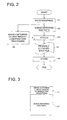
- Step S1 When the release button of the operation section 14 has been pressed, the control section 11 controls various sections to carry out photographing (Step S1).
- the image-capturing signal obtained from the CCD3 is converted into the digital image data by the analog-to-digital converter 5, and scene-referred raw data d2 is generated (Step S2).
- the image-capturing characteristic compensation information processing section 13 Under the control of the control section 11, the image-capturing characteristic compensation information processing section 13 generates the data required to apply image-capturing characteristic compensation processing to the generated scene-referred raw data d2, namely image-capturing characteristic compensation data d1 (Step S3).
- the header information processing section 8 records and attaches the image-capturing characteristic compensation data d1 as tag information to the file header of the scene-referred raw data d2 under the control of the control section 11 (Step S4), whereby a properly attached data file is created (Step S5).
- This properly attached data file is recorded and stored in the recording medium of the memory device 9 removably arranged on the image-capturing apparatus 21 (Step S6).
- Fig. 3 is a diagram representing the configuration of the digital image data recorded on the recording medium of a memory device 9 in step S6.
- the photographed digital image data is recorded as scene-referred raw data d2 and image-capturing characteristic compensation data d1 is recorded in this header area.
- This recording medium is taken out of the image-capturing apparatus 21 and is mounted on an external apparatus such as image processing apparatus and image recording apparatus, whereby the scene-referred raw data d2 and image-capturing characteristic compensation data d1 can be output to these external apparatuses.
- the image-capturing apparatus 21 shown in Fig. 1 makes it possible to output:
- Fig. 4 is a block diagram representing the functional configuration of an image-capturing apparatus 22.
- the image-capturing information data processing section 12 generates an image-capturing information data d3.
- the image-capturing information data d3 includes:
- Fig. 5 is a flowchart representing the scene-referred raw data storage processing B to be carried out under the control of the control section 11 when the output based on the scene-referred raw data of the photographed digital image data is set by the operation section 14 in the image-capturing apparatus 22 of Fig. 4 and the release switch is depressed.
- Step S11 When the release button of the operation section 14 is depressed, the control section 11 control various sections to start photographing (Step S11).
- the image-capturing signal obtained from the CCD3 is converted into the digital image data by the analog-to-digital converter 5 and the scene-referred raw data d2 is generated (Step S12).
- Image-capturing characteristic compensation data d1 is generated by the image-capturing characteristic compensation information processing section 13
- image-capturing information data d3 is generated by the image-capturing information data processing section 12 (Step S14).
- image-capturing characteristic compensation data d1 and image-capturing information data d3 After scene-referred raw data d2, image-capturing characteristic compensation data d1 and image-capturing information data d3 have been generated, image-capturing characteristic compensation data d1 and image-capturing information data d3 are recorded and attached as tag information to the header file of the scene-referred raw data d2 (Step S15), whereby a properly attached data file is created (Step S16). This properly attached data file is recorded and stored in the recording medium of the memory device 9 removably arranged on the image-capturing apparatus 22 (Step S17).
- Fig. 6 is a diagram representing the data configuration of the digital image data recorded on the recording medium of a storage device 9 in step S17.
- the photographed digital image data is recorded as scene-referred raw data d2, and image-capturing characteristic compensation data d1 and image-capturing information data d3 are recorded in the header area.
- scene-referred raw data d2, image-capturing characteristic compensation data d1 and image-capturing information data d3 can be output to these external devices.
- the image-capturing apparatus 22 of Fig. 4 is capable of outputting the data that allows generation of the output-referred image data in response to a particular photographed condition in the external output apparatus.
- the input section 101 has a recording medium mounting section (not illustrated). When the recording medium for recording the file (see Figs. 3 and 6) of the data photographed by the image-capturing apparatuses 21 and 22 is installed on this mounting section, the input section 101 reads the recorded data file, and outputs it to the header information analysis section 102.
- the present embodiment will be described on the assumption that the input section 101 reads data from the mounted recording media. It is also possible to arrange such a configuration that the data communications cable and wired or wireless communications means are provided, and data is input via such communications means.
- the input section 101 has a function of the image processing apparatus input means described in Claims of the present invention.
- the header information analysis section 102 analyzes the data inputted from the input section 101, and divides it into scene-referred raw data d2, image-capturing characteristic compensation data d1 attached thereto and image-capturing information data d3. Then it outputs image-capturing characteristic compensation data d1 to the apparatus characteristic compensation information processing section 103a, and scene-referred raw data d2 to the image-capturing information data processing section 106.
- the image-capturing characteristic compensation information processing section 113 has a processing condition table 103b, a scene-referred image data generating section 104 and a temporary storage memory 105.
- the image-capturing characteristic compensation information processing section 113 has a function of the scene-referred image data generating section of the present invention.
- the apparatus characteristic compensation information processing section 103a determines the conditions for generating the scene-referred image data d4 by reference to the processing condition table 103b.
- the processing condition table 103b associates processing conditions for generating scene-referred image data d4 for each characteristic of the image-capturing apparatus and stores them in the memory.
- the scene-referred image data generating section 104 applies image-capturing characteristic compensation processing to scene-referred raw data d2 inputted from the header information analysis section 102, based on the generating conditions determined by the apparatus characteristic compensation information processing section 103a. It generates the standardized scene-referred image data d4 independent of the image-capturing characteristic, and outputs it to the temporary storage memory 105.
- image-capturing characteristic compensation processing comprises at least the processing of mapping the signal intensity of the signal of each color channel based on the spectral sensitivity inherent to the image-capturing device of the image-capturing apparatus having generated the scene-referred raw data d2, into the standardized color space such as RIMM RGB and ERIMM RGB.
- the temporary storage memory 105 temporarily stores the scene-referred image data d4 generated by the scene-referred image data generating section 104.
- the optimization processing section 114 comprises an output-referred image data generating section 107, temporary storage memory 108 and setting input section 109.
- the optimization processing section 114 has a function of the scene-referred image data generating section of the image processing apparatus in Claims of the present invention.
- the image-capturing information data processing section 106 determines the conditions for generating the output-referred image data d5 in conformity to photographing conditions, based on the image-capturing information data d3 inputted from the header information analysis section 102.
- the setting input section 109 When operation information on the types of memory device 110 for outputting the digital image data generated by the image processing apparatus 115, output device 111 and display device 112 has been inputted, the setting input section 109 outputs this operation information to the memory device 110.
- the output-referred image data generating section 107 reads the scene-referred image data d4 from the temporary storage memory 105, and applies optimization processing for getting the optimum image on the output destination, based on the conditions for generating the output-referred image data d5 determined by the image-capturing information data processing section 106 and the operation information on the types of memory device 110 having been inputted from the setting input section 109, output device 111 and display device 112. Then the output-referred image data generating section 107 generates the output-referred image data d5 and outputs it to the temporary storage memory 108 together with operation information.
- Optimization processing includes, for example, compression to the color gamut of the output destination, compression of gradation from 16 to 8 bits, reduction in the number of output pixels and processing of the output device and display device to conform to output characteristics (LUT). Further, image processing such as noise control, sharpening, color balance adjustment, color saturation adjustment and dodging are also included.
- the temporary storage memory 108 outputs the output-referred image data d5 inputted from the output-referred image data generating section 107 under the control of the control section 116, to any one of the memory device 110, output device 111 and display device 112 according to the operation information from the setting input section 109.
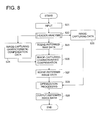
- Fig. 8 is a flowchart representing image data generation processing to be carried out by interconnection among various parts of the image processing apparatus 115. The following describes the operation of image processing apparatus 115 with reference to drawings:
- the processing condition table 103b is referenced by the apparatus characteristic compensation information processing section 103a to determine the processing conditions for generating scene-referred image data d4.
- Scene-referred raw data d2 is subjected to image-capturing characteristic compensation information processing through the scene-referred image data generating section 104 based on these conditions (Step S26).
- scene-referred image data d4 is generated and is outputted to the optimization processing section 114 (Step S27).
- processing conditions for generating output-referred image data d5 in conformity to photographing conditions are determined by the image-capturing information data processing section 106, based on the image-capturing information data d3.
- the scene-referred image data d4 entered from the image-capturing characteristic compensation information processing section 113 is subjected to optimization processing in conformity to the output destination through the output-referred image data generating section 107, based on the processing conditions determined by the output-referred image data generating section 107 and image-capturing information data processing section 106, and the operation information inputted from the setting input section 109 (Step S28).
- output-referred image data d5 is generated and is outputted by the setting input section 109 (Step S29).
- the setting input section 109 is provided with a function of setting the output of scene-referred image data d4.
- the optimization processing by the optimization processing section 114 is omitted, and the scene-referred image data d4 generated by the image-capturing characteristic compensation information processing section 113, with image-capturing characteristic compensation data d1 and image-capturing information data d3 attached to its header area, is formed into a data file, which is then'outputted to the memory device 110.
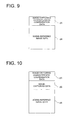
- Fig. 9 is a diagram representing output data configuration for generating scene-referred image data d4 and outputting it to the memory device 110 when a file having data configuration of Fig. 3 has been inputted from the input section 101.
- Fig. 10 is a diagram representing output data configuration for generating scene-referred image data d4 and outputting it to the memory device 110 when a file having data configuration of Fig. 6 has been inputted from the input section 101.
- the scene-referred image data d4 and image-capturing characteristic compensation data d1 (and image-capturing information data d3) can be outputted to the external apparatus, which is allowed to carry out optimization processing in conformity to its own apparatus conditions.
- scene-referred image data d4 is generated from the scene-referred raw data d2 outputted from the image-capturing apparatuses 21 and 22 by the image processing apparatus 115.
- Optimized output-referred image data d5 can be created without the image-capturing information being lost, so that it is outputted onto such a display device as CRT, liquid crystal display and plasma display, and a storage medium of any known type such as paper for generation of hardcopy images including silver halide photographic paper, inkjet paper and thermal printing paper.
- Fig. 11 is an external perspective view representing an image recording apparatus 201 of the present invention.
- the image recording apparatus 201 in the present embodiment provides an example of the image recording apparatus equipped with a CRT display monitor as a display device and an output device using silver halide photographic paper as an output media.
- a magazine loading section 203 is installed on the left side surface of the main unit 202.
- An exposure processing section 204 for causing the silver halide photographic paper as an output medium to be exposed to light, and a print creating section 205 for creating a print by developing and drying the exposed silver halide photographic paper are installed inside the main unit 202.
- the created print is ejected onto the tray 206 mounted on the right side of the main unit 202.
- a control section 207 is provided on the upward position of the exposure processing section 204 inside the main unit 202.
- a CRT 208 is arranged on the top of the main unit 202. It has the function of display means for displaying on the screen the image of the image information to be printed.
- a film scanner 209 as a transparent document reader is mounted on the left of the CRT 208, and a reflected document input apparatus 210 is arranged on the right.
- One of the documents read from the film scanner 209 and reflected document input apparatus 210 is a photosensitive material.
- the photographic material includes a color negative, color reversal film, black-and-white negative, black-and-white reversal film.
- Frame image information captured by an analog camera is recorded on the photographic material.
- the film scanner of the film scanner 209 converts this recorded frame image information into digital image data and creates frame image data.
- the photographic material is color paper as silver halide photographic paper, it can be converted into frame image data by the flat head scanner of the reflected document input apparatus 210.
- An image reader 214 is mounted where the control section 207 of the main unit 202 is located.
- the image reader 214 is provided with a PC card adaptor 214a and a floppy (registered trademark) disk adaptor 214b to ensure that a PC card 213a and floppy disk 213b can be inserted into position.
- the PC card 213a has a memory where multiple items of frame image data obtained by photographing with a digital camera are stored.
- the floppy disk 213b stores multiple items of frame image data obtained by photographing with a digital camera.
- An operation section 211 is arranged forwardly of the CRT 208.
- This operation section 211 is equipped with an information input section 212, which consists of a touch panel and others.
- the recording medium storing the frame image data of the present invention other than the above-mentioned data includes a multimedia card, memory stock, MD data and CD-ROM.
- the operation section 211, CRT 208, film scanner 209, reflected document input apparatus 210 and image reader 214 is mounted integrally on the main unit 202. Any one of them can be installed as a separate unit.
- An image write section 215 is mounted where the control section 207 of the main unit 202 is located.
- the image write section 215 is equipped with a floppy disk adaptor 215a, MO adaptor 215b, and optical disk adaptor 215c so that an FD 216a, MO 216b and optical disk 216c can be inserted into position, and Image information can be written on the image recording medium.
- control section 207 has means for communication (not illustrated). It receives image data representing the captured image and print instruction directly from another computer in the facilities or a remote computer through the Internet, and is capable of functioning as a so-called network image output apparatus.
- Fig. 12 is a diagram representing the internal configuration of the image recording apparatus 201.
- the control section 207 of the image recording apparatus 201 comprises a CPU (Central Processing Unit) and memory section.
- the CPU reads the various types of control programs stored in the memory section and centrally controls the components constituting the image recording apparatus 201 in conformity to the control program.
- the control section 207 has an image processing section 270. Image processing is applied to:
- the operation section 211 is provided with an information input section 212.
- the information input section 212 comprises a touch panel, and the signal of depressing the information input section 212 is outputted to the control section 207 as an input signal. It is also possible to arrange such a configuration that the operation section 211 is equipped with a keyboard or mouse.
- the film scanner 209 reads the frame image data from the developed negative film N gained by an analog camera. From the reflected document input apparatus 210, the film scanner 209 reads the frame image data from the print P subjected to the processing of development with the frame image printed on the color paper as silver halide photographic paper.
- the image reader 214 has a function of reading the frame image data of the PC card 213a and floppy disk 213b photographed and stored by the digital camera. Namely, the image reader 214 is equipped with a PC card adaptor and floppy disk adaptor as image transfer sections 230. It reads the frame image data recorded on the PC card 213a and floppy disk 213b mounted on the floppy disk adaptor 214b, and transfers it to the control section 207.
- the data storage section 271 memorizes image information and its corresponding order information (information on the number of prints to be created from the image of a particular frame) and stores them sequentially.
- the template memory section 272 memorizes the sample image data (data showing the background image and illustrated image) corresponding to the types of information on sample identification D1, D2 and D3, and memorizes at least one of the data items on the template for setting the composite area with the sample image data.
- the control section 207 performs merging between the frame image information and the selected template.
- the types of information on sample identification D1, D2 and D3 have been specified by the operation by the operator (based on the instruction of a client)
- the sample image data is selected in conformity to the specified types of information on sample identification D1, D2 and D3.
- Merging of the selected sample image data, image data ordered by a client and/or character data is carried out and, as a result, a print in conformity to the sample image data desired by the client is created. Merging by this template is performed by the widely known chromakey technique.
- Sample identification information is not restricted to three types of information on sample identification D1, D2 and D3. More than three types or less than three types can be used.
- the types of information on sample identification D1, D2 and D3 for specifying the print sample are arranged to be inputted from the operation section 211. Since the types of information on sample identification D1, D2 and D3 are recorded on the sample or order sheet, they can be read by the reading section such as an OCR. Alternatively, they can be inputted by the operator through a keyboard.
- sample image data is recorded in response to sample identification information D1 for specifying the print sample, and the sample identification information D1 for specifying the print sample is inputted. Based on the inputted sample identification information D1, sample image data is selected, and the selected sample image data and image data and/or character data based on the order are merged to create a print according to the specified sample.
- This procedure allows a user to directly check full-sized samples of various dimensions before placing an order. This permits wide-ranging user requirements to be satisfied.
- the first sample identification information D2 for specifying the first sample, and first sample image data are memorized; alternatively, the second sample identification information D3 for specifying the second sample, and second sample image data are memorized.
- the sample image data selected on the basis of the specified first and second sample identification information D2 and D3, and ordered image data and/or character data are merged with each other, and a print is created according to the specified sample. This procedure allows a greater variety of images to be created, and permits wide-ranging user requirements to be satisfied.
- the photographic material is exposed and an image is formed thereon in conformity to the output image data generated by image processing of image data by the image processing section 270.
- This photographic material is sent to the print creating section 205.
- the print creating section 205 develops ad dries the exposed photographic material to create prints P1, P2 and P3.
- Print P1 is available in a service size, high-vision size or panorama size.
- Print P2 is an A4-sized print
- print P3 is a business card-sized print (2 in. x 3 in.).
- Print sizes are not restricted to P1, P2 and P3. Other sized prints can also be used.
- the monitor 208 comprises a CRT, LCD and others. It displays the image information inputted from the control section 207.
- the image write section 215 is provided with a floppy disk adaptor 215a, MO adaptor 215b, and optical disk adaptor 215c as an image transfer section 231 so that the FD 216a, MO 216b and optical disk 216c can be inserted. This allows the image data to be written on the image recording medium.
- the image processing apparatus 270 uses the communications means (input) 240 (illustrated in Fig. 13), the image processing apparatus 270 receives image data representing the captured image and printing and other work instruction directly from another computer in the facilities or from a remote computer through Internet, and is cable of performing image processing and printing in the remote control mode.
- the image processing apparatus 270 is capable of sending the image data representing the photographed image after image processing of the present invention has been applied, and accompanying order information, to another computer in the facilities or a remote computer through Internet.
- the image recording apparatus 201 comprises:
- Fig. 13 is a block diagram representing the functional configuration of an image processing apparatus 270 of the present invention.
- the image data inputted from the film scanner 209 is subjected to calibration inherent to the film scanner, negative/positive reversal of a negative document, removal of dust and scratch, gray balance adjustment, contrast adjustment, removal of granular noise an enhancement of sharpness in the film scan data processing section 702, and is sent to the image adjustment processing section 701.
- the film size, negative/positive type, information on the major subject recorded optically or magnetically on the film and information on photographing conditions are outputted to the image adjustment processing apparatus 701.
- the image data inputted from the reflected document input apparatus 210 is subjected to calibration inherent to a reflected document input apparatus negative/positive reversal of a negative document, removal of dust and scratch, gray balance adjustment, contrast adjustment, removal of granular noise an enhancement of sharpness in the film scan data processing section 702 in the reflected document scanned data processing section 703, and the result is outputted to the image adjustment processing section 701.
- the image data inputted from the image transfer section 230 and communications section (input) is subjected to decompression of the compressed symbols or conversion of the color data representation method, as required, according to the form of the data in the image data form deciphering processing section 704. It is converted into the data format suitable for numerical computation inside the image processing section 270 and is outputted to the image adjustment processing apparatus 701.
- the image data form deciphering processing section 704 determines whether or not the image data of the format according to the image-capturing apparatuses 21 and 22 has been inputted from the image transfer section 230 and communications means (input) 240, and outputs the inputted image data to the header information analysis section 302.
- the header information analysis section 302 analyzes the image-capturing characteristic compensation data d1 and image-capturing information data d3 from the inputted image data.
- the image transfer section 230 and communications means (input) 240 have the function as an input section for the image recording apparatus described in the Claims of the present invention.
- Designation of the size of output image is inputted from the operation section 211. Further, if there is designation of the size of the output image sent to the communications means (input) 240 or the output image embedded in the header/tag information of the image data obtained through the image transfer section 230, the image data form deciphering processing section 704 detects the information and sends it to the image adjustment processing apparatus 701.
- the image-capturing characteristic compensation data d1 analyzed by the header information analysis section 302 is outputted to the apparatus characteristic compensation processing 303a.
- the image processing conditions are determined in conformity to the processing condition table 303b.
- the determined image processing conditions are applied to the image data in the scene-referred image data generating section 304, and scene-referred image data d4 is generated.
- the scene-referred image data generating section 304 has a function as the scene-referred image data generating section of the image recording apparatus described in the Claims of the present invention.
- the image-capturing information data d3 analyzed by the header information analysis section 302 is outputted to the image-capturing data processing section 306, and the image processing conditions for generation of output-referred image data d5 is determined.
- image adjustment processing apparatus 701 transfers to the output-referred image data generating section 307 the image processing conditions for creating the output-referred image data d5 applied to the device and outputting medium at the output destination.
- the output-referred image data generating section 307 According to the image processing conditions created by the image-capturing data processing section 306 and image processing conditions sent from the image adjustment processing apparatus 701, the output-referred image data generating section 307 generates output-referred image data d5 from scene-referred image data d4.
- the output-referred image data generating section 307 has the function of the output-referred image data generating section described in the Claims of the present invention.
- the image adjustment processing apparatus 701 calls a predetermined image data (template) from the template memory section 272 when template processing is required. Image data is sent to the template processing section 705. It is merged with the template, and the image data subsequent to template processing is again received. In response to the instruction from the operation section 211 and control section 207, the image adjustment processing apparatus 701 applies image processing to the image data received from the film scanner 209, image transfer section 230, communications means (input) 240 and template processing section 705, in such a way that the image will provide a favorable impression when viewed on the outputting medium according to the method to be described later.
- template image data received from the film scanner 209, image transfer section 230, communications means (input) 240 and template processing section 705, in such a way that the image will provide a favorable impression when viewed on the outputting medium according to the method to be described later.
- the image adjustment processing apparatus 701 has the function of the image forming section of the image recording apparatus described in the Claims of the present invention.
- the CRT inherent processing section 706 applies processing of changing the number of pixels or color matching to the image data received from the image adjustment processing apparatus 701, as required. Then the image data for display merged with the information requiring control information, etc. is sent to the CRT 208.
- the printer inherent processing section (1) 707 provides processing of printer inherent calibration, color matching and change in the number of pixels, as required, and sends image data to the exposure processing section.
- a printer inherent processing section (2) 708 is provided for each printer to be connected, so that adequate printer inherent calibration, color matching, change in the number of pixels and other processing can be carried out.
- the image data form creation processing section 709 converts the image data received from the image adjustment processing apparatus 701, into various types of general-purpose image format represented by JPEG, TIFF and Exif as required. Then the image data is sent to the image transfer section 231 and communications means (input) 241.
- the image data created by the output-referred image data generating section 307 assumes processing by the CRT inherent processing section 706, printer inherent processing section (1) 707, printer inherent processing section (2) 708 and image data form creation processing section 709.
- the image data form creation processing section 709 attaches to this image data the status file identifying the optimized image data for CRT, exposure output section, external printer, communications means (output) and others, based on output-referred image data d5, and sends the resultant image data separately to the image transfer section.
- the division of the header information analysis section 302, apparatus characteristic compensation processing 303a, image-capturing data processing section 306, scene-referred image data generating section 304 and output-referred image data generating section 307 is assumed to assist understanding of the functions of the image processing section 270 of the present invention. They need not necessarily be realized as physically independent devices. For example, they can be realized in the form of a division of the type of software processing in a single CPU. [Operation of image processing section 270]
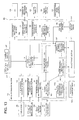
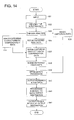
- Fig. 14 is a flowchart representing image data formation processing to be carried out by interconnection among various parts of the image recording apparatus 201. Referring to drawings, the following describes the operations of each portion of the image processing section 270:
- Step S31 Data is inputted from the image transfer section 230 or communications means (input) 240 to the image processing section 270 (Step S31).
- Step S32 the image data form deciphering processing section 704 has identified this inputted data as the digital image data file by the above-mentioned image-capturing apparatus 21 or 22 (Step S32)
- the contents of the inputted digital image data file are analyzed by the header information analysis section 302 (Step S33), and the file is divvied into those for scene-referred raw data d2 (Step S34), image-capturing characteristic compensation data d1 (Step S35) and image-capturing information data d3 (Step S36).
- the image-capturing characteristic compensation data d1 is outputted to the apparatus characteristic compensation processing 303a, and processing conditions for generating scene-referred image data d4 are determined by the apparatus characteristic compensation processing 303a referencing the processing condition table 303b.
- the scene-referred raw data d2 is outputted to the scene-referred image data generating section 304, and image-capturing characteristic compensation processing is carried out according to the processing conditions determined by the apparatus characteristic compensation processing 303a (Step S37).
- scene-referred image data d4 is generated and is outputted to the output-referred image data generating section 307 (Step S38).
- the image-capturing information data d3 is outputted to the image-capturing data processing section 306, and processing conditions for generating the output-referred image data d5 in response to photographing conditions are determined by the image-capturing data processing section 306 on the basis of the image-capturing information data d3. Further, image processing conditions for generating the output-referred image data d5 suited to the outputting device and outputting medium are determined by the image adjustment processing apparatus 701, based on the instructions from the operation section 211 and control section 207.
- Optimization processing is applied to the scene-referred image data d4 having been inputted from the scene-referred image data generating section 304 by the output-referred image data generating section 307 in conformity to the processing conditions determined by the image-capturing data processing section 306 and those determinedly the image adjustment processing apparatus 701 (Step S39).
- Output-referred image data d5 is generated and is outputted to any one of the CRT inherent processing section 706, printer inherent processing section (1) 707, printer inherent processing section (2) 708 and image data form creation processing section 709 in conformity to the output destination (Step S40).
- output-referred image data d5 is subjected to processing inherent to the output destination (Step S41), and is outputted from the output destination specified by the operation section 211 (Step S42).
- the image recording apparatus 201 of the present invention allows the scene-referred raw data d2 outputted by the image-capturing apparatus 21 or 22 to generate the optimized output-referred image data d5, without the captured image information being lost, thereby ensuring quick formation of an output-referred image on such a display device as CRT, liquid crystal display and plasma display or on such an outputting medium as paper for hard copy image generation including silver halide photographic paper, inkjet paper and thermal printing paper.
- the image-capturing apparatus of the present invention makes it possible to output:
- the image processing apparatus of the present invention allows the scene-referred image data to be generated from the scene-referred raw data outputted from the image-capturing apparatus, and creates the optimized output-referred image data, without the image-capturing information being lost, so that it is outputted to the onto such a display device as CRT, liquid crystal display and plasma display, and a storage medium of any known type such as paper for generation of hardcopy images including silver halide photographic paper, inkjet paper and thermal printing paper.
- the image recording apparatus of the present invention allows the scene-referred image data to be generated from the scene-referred raw data outputted from the image-capturing apparatus, and ensures ensuring quick formation of an output-referred image on such a display device as CRT, liquid crystal display and plasma display or on such an outputting medium as paper for hard copy image generation including silver halide photographic paper, inkjet paper and thermal printing paper, wherein the optimized output-referred image data is retained, without the captured image information being lost.
- the present inventors tried silver halide printing from the image data obtained from the digital image data according to the present invention. Contrary to their expectations, this test ended in a considerable reduction of skipping on the highlighted side or collapse on the shadow side, thereby demonstrating a substantial improvement in the image quality of the silver halide printing.
Landscapes
- Engineering & Computer Science (AREA)
- Multimedia (AREA)
- Signal Processing (AREA)
- General Engineering & Computer Science (AREA)
- Television Signal Processing For Recording (AREA)
- Studio Devices (AREA)
- Facsimile Image Signal Circuits (AREA)
- Processing Of Color Television Signals (AREA)
Abstract
Description
information directly related to the camera type (device type) such as a camera name and code number,
information on photographing conditions such as exposure time, shutter speed, f-stop number (F number), ISO sensitivity, brightness value, subject distance range, light source, on/off status of a stroboscopic lamp, subject area, white balance, zoom scaling factor, subject configuration, photographing scene type, the amount of reflected light of the stroboscopic lamp source and color saturation for photographing, and tags (codes) for indicating the information related to a subject. The image edit software and output device have a function of reading the above-mentioned accompanying information and making the quality of hardware image more suitable.
- "Subject configuration" information allows color saturation enhancement processing to be partially carried out, and permits dodging to be carried out for the scene containing an extensive dynamic range.
- "Photographing scene type" allows special adjustment of color balance to be made by reducing the degree of white balance adjustment is loosened, in photographing of a night view, for example.
whereby a properly attached data file is created (Step S16). This properly attached data file is recorded and stored in the recording medium of the memory device 9 removably arranged on the image-capturing apparatus 22 (Step S17).
Claims (15)
- An apparatus for capturing an image, comprising:a scene-referred raw data generating section to generate scene-referred raw data, which directly represent said image while depending on image-capturing characteristics of said apparatus;a reproduction-auxiliary data generating section to generate reproduction-auxiliary data, based on which an image-capturing characteristic compensation processing is to be applied to said scene-referred raw data generated by said scene-referred raw data generating section, so as to generate scene-referred image data in a standardized format from said scene-referred raw data; anda storage controlling section to attach said reproduction-auxiliary data to said scene-referred raw data in order to store both of them into a storage medium.
- The apparatus of claim 1, further comprising:wherein said storage controlling section attaches both said reproduction-auxiliary data and said image-capturing data to said scene-referred raw data in order to store all of them into said storage medium.an image-capturing data generating section to generate image-capturing data, which represent image-capturing conditions established at a time of capturing said image;
- An apparatus for processing data, comprising:a receiving section to receive scene-referred raw data, which directly represent an image captured by an image-capturing apparatus while depending on image-capturing characteristics of said image-capturing apparatus, and to receive reproduction-auxiliary data in respect to said scene-referred raw data; anda scene-referred image data generating section to generate scene-referred image data from said scene-referred raw data received by said receiving section, based on said reproduction-auxiliary data received by said receiving section, by applying an image-capturing characteristic compensation processing to said scene-referred raw data.
- The apparatus of claim 3,
wherein said scene-referred image data are generated in a standardized format from said scene-referred raw data. - The apparatus of claim 3,
wherein said receiving section also receives image-capturing data, which represent image-capturing conditions established at a time of capturing said image. - The apparatus of claim 4, further comprising:an output-referred image data generating section to generate output-referred image data, based on which a reproduced image is formed on an outputting medium, by applying an image-processing for optimizing said reproduced image to said scene-referred image data generated by said scene-referred image data generating section.
- The apparatus of claim 5, further comprising:wherein contents of said image-processing are determined on the basis of said image-capturing data received by said receiving section.an output-referred image data generating section to generate output-referred image data, based on which a reproduced image is formed on an outputting medium, by applying an image-processing for optimizing said reproduced image to said scene-referred image data generated by said scene-referred image data generating section;
- An apparatus for outputting a reproduced image onto an outputting medium, comprising:a receiving section to receive scene-referred raw data, which directly represent an image captured by an image-capturing apparatus while depending on image-capturing characteristics of said image-capturing apparatus, and to receive reproduction-auxiliary data in respect to said scene-referred raw data;a scene-referred image data generating section to generate scene-referred image data from said scene-referred raw data received by said receiving section, based on said reproduction-auxiliary data received by said receiving section, by applying an image-capturing characteristic compensation processing to said scene-referred raw data;an output-referred image data generating section to generate output-referred image data, based on which a reproduced image is formed on an outputting medium, by applying an image-processing for optimizing said reproduced image to said scene-referred image data generated by said scene-referred image data generating section; andan image-forming section to form said reproduced image on said outputting medium, based on said output-referred image data.
- The apparatus of claim 8,
wherein said receiving section also receives image-capturing data, which represent image-capturing conditions established at a time of capturing said image; and
wherein contents of said image-processing are determined on the basis of said image-capturing data received by said receiving section. - A method for processing data, comprising the steps of:receiving scene-referred raw data, which directly represent an image captured by an image-capturing apparatus while depending on image-capturing characteristics of said image-capturing apparatus, and reproduction-auxiliary data in respect to said scene-referred raw data; andapplying an image-capturing characteristic compensation processing to said scene-referred raw data, based on said reproduction-auxiliary data received in said receiving step, in order to generate scene-referred image data from said scene-referred raw data.
- The method of claim 10,
wherein said scene-referred image data are generated in a standardized format from said scene-referred raw data. - The method of claim 11,
wherein said reproduction-auxiliary data serve as image-capturing characteristic compensation data, which are employed for converting said scene-referred raw data into said scene-referred image data in a standardized color space. - The method of claim 11,
wherein, in said receiving step, image-capturing data, which represent image-capturing conditions established at a time of capturing said image, are also received. - The method of claim 11, further comprising the step of:generating output-referred image data, based on which a reproduced image is formed on an outputting medium, by applying an image-processing for optimizing said reproduced image to said scene-referred image data generated in said applying step.
- The method of claim 13, further comprising the step of:wherein contents of said image-processing are determined on the basis of said image-capturing data received in said receiving step.generating output-referred image data, based on which a reproduced image is formed on an outputting medium, by applying an image-processing for optimizing said reproduced image to said scene-referred image data generated in said applying step;
Applications Claiming Priority (2)
| Application Number | Priority Date | Filing Date | Title |
|---|---|---|---|
| JP2002256034A JP2004096500A (en) | 2002-08-30 | 2002-08-30 | Imaging device, image processing device, and image recording device |
| JP2002256034 | 2002-08-30 |
Publications (2)
| Publication Number | Publication Date |
|---|---|
| EP1394740A2 true EP1394740A2 (en) | 2004-03-03 |
| EP1394740A3 EP1394740A3 (en) | 2005-05-11 |
Family
ID=31492688
Family Applications (1)
| Application Number | Title | Priority Date | Filing Date |
|---|---|---|---|
| EP20030255298 Withdrawn EP1394740A3 (en) | 2002-08-30 | 2003-08-27 | Image processing dependent on an image capturing device characteristic |
Country Status (3)
| Country | Link |
|---|---|
| US (1) | US20040041926A1 (en) |
| EP (1) | EP1394740A3 (en) |
| JP (1) | JP2004096500A (en) |
Cited By (4)
| Publication number | Priority date | Publication date | Assignee | Title |
|---|---|---|---|---|
| DE102004058250A1 (en) * | 2004-12-03 | 2006-06-08 | Valeo Schalter Und Sensoren Gmbh | File format for the organization of data and control unit |
| EP1679660A1 (en) * | 2005-01-11 | 2006-07-12 | Nikon Corporation | History adding device for generating history-added image file, electronic camera, and image processing program for processing history-added image file |
| EP1809020A2 (en) * | 2006-01-12 | 2007-07-18 | Canon Kabushiki Kaisha | Image processing apparatus, image processing method, and program |
| EP1809019A2 (en) * | 2006-01-12 | 2007-07-18 | Canon Kabushiki Kaisha | Image capturing apparatus, control method thereof, and program |
Families Citing this family (14)
| Publication number | Priority date | Publication date | Assignee | Title |
|---|---|---|---|---|
| JP4298253B2 (en) * | 2002-10-01 | 2009-07-15 | キヤノン株式会社 | Image processing method and apparatus, and imaging apparatus |
| US7471423B2 (en) | 2003-09-26 | 2008-12-30 | Seiko Epson Corporation | Image processing system and image processing method |
| GB0323284D0 (en) * | 2003-10-04 | 2003-11-05 | Koninkl Philips Electronics Nv | Method and apparatus for processing image data |
| JP2005303802A (en) * | 2004-04-14 | 2005-10-27 | Olympus Corp | Imaging apparatus and image processing program |
| JP4468734B2 (en) * | 2004-04-27 | 2010-05-26 | オリンパス株式会社 | Video signal processing apparatus and video signal processing program |
| JP2006115475A (en) | 2004-09-15 | 2006-04-27 | Seiko Epson Corp | Image processing apparatus, image processing method, and image processing program |
| JP2006203566A (en) * | 2005-01-20 | 2006-08-03 | Konica Minolta Photo Imaging Inc | Imaging apparatus, image processing apparatus, and image processing method |
| JP2006203573A (en) * | 2005-01-20 | 2006-08-03 | Konica Minolta Photo Imaging Inc | Imaging apparatus, image processing apparatus, and image recording apparatus |
| KR100713530B1 (en) * | 2006-04-25 | 2007-05-02 | 삼성전자주식회사 | Image processing apparatus and method for preventing image quality deterioration during image bit format conversion |
| JP4951540B2 (en) * | 2008-01-23 | 2012-06-13 | ペンタックスリコーイメージング株式会社 | Dust detection device and digital camera |
| DE102009053280A1 (en) * | 2009-11-13 | 2011-05-19 | Arnold & Richter Cine Technik Gmbh & Co. Betriebs Kg | Digital camera and method for monitoring a signal processing device |
| US8655889B2 (en) * | 2010-12-10 | 2014-02-18 | Microsoft Corporation | Autonomous mobile blogging |
| CN111083357B (en) * | 2019-12-05 | 2021-11-09 | 河北汉光重工有限责任公司 | Image missing capturing and supplementing method based on target detection system |
| CN114584752B (en) * | 2020-11-30 | 2024-02-02 | 华为技术有限公司 | Image color restoration methods and related equipment |
Family Cites Families (8)
| Publication number | Priority date | Publication date | Assignee | Title |
|---|---|---|---|---|
| US6288743B1 (en) * | 1997-10-20 | 2001-09-11 | Eastman Kodak Company | Electronic camera for processing image segments |
| US6642956B1 (en) * | 1998-05-29 | 2003-11-04 | Agilent Technologies, Inc. | Digital image processor for a digital camera |
| EP0991019B1 (en) * | 1998-09-28 | 2014-01-08 | Intellectual Ventures Fund 83 LLC | Method of applying manipulations to a color digital image |
| JP4366768B2 (en) * | 1999-07-21 | 2009-11-18 | 株式会社ニコン | Digital camera and computer-readable recording medium |
| US6954228B1 (en) * | 1999-07-23 | 2005-10-11 | Intel Corporation | Image processing methods and apparatus |
| US6611273B2 (en) * | 2000-02-25 | 2003-08-26 | Microsoft Corporation | Method and data arrangement for encapsulating signed over-ranged color image data to accommodate in-range file formats |
| JP4126640B2 (en) * | 2000-03-08 | 2008-07-30 | 富士フイルム株式会社 | Electronic camera |
| JP2003046758A (en) * | 2001-07-31 | 2003-02-14 | Canon Inc | Imaging apparatus, information processing apparatus, image processing apparatus and method, and image processing system |
-
2002
- 2002-08-30 JP JP2002256034A patent/JP2004096500A/en active Pending
-
2003
- 2003-08-22 US US10/646,491 patent/US20040041926A1/en not_active Abandoned
- 2003-08-27 EP EP20030255298 patent/EP1394740A3/en not_active Withdrawn
Cited By (6)
| Publication number | Priority date | Publication date | Assignee | Title |
|---|---|---|---|---|
| DE102004058250A1 (en) * | 2004-12-03 | 2006-06-08 | Valeo Schalter Und Sensoren Gmbh | File format for the organization of data and control unit |
| EP1679660A1 (en) * | 2005-01-11 | 2006-07-12 | Nikon Corporation | History adding device for generating history-added image file, electronic camera, and image processing program for processing history-added image file |
| US7620259B2 (en) | 2005-01-11 | 2009-11-17 | Nikon Corporation | History adding device for generating history-added image file, electronic camera, and image processing program for processing history-added image file |
| EP1809020A2 (en) * | 2006-01-12 | 2007-07-18 | Canon Kabushiki Kaisha | Image processing apparatus, image processing method, and program |
| EP1809019A2 (en) * | 2006-01-12 | 2007-07-18 | Canon Kabushiki Kaisha | Image capturing apparatus, control method thereof, and program |
| US8711241B2 (en) | 2006-01-12 | 2014-04-29 | Canon Kabushiki Kaisha | Image capturing apparatus, control method thereof, and program |
Also Published As
| Publication number | Publication date |
|---|---|
| US20040041926A1 (en) | 2004-03-04 |
| JP2004096500A (en) | 2004-03-25 |
| EP1394740A3 (en) | 2005-05-11 |
Similar Documents
| Publication | Publication Date | Title |
|---|---|---|
| US7312824B2 (en) | Image-capturing apparatus, image processing apparatus and image recording apparatus | |
| US20040095478A1 (en) | Image-capturing apparatus, image-processing apparatus, image-recording apparatus, image-processing method, program of the same and recording medium of the program | |
| US20040247175A1 (en) | Image processing method, image capturing apparatus, image processing apparatus and image recording apparatus | |
| US7825962B2 (en) | Image generation with integrating control data | |
| US20050185837A1 (en) | Image-processing method, image-processing apparatus and image-recording apparatus | |
| US20040041926A1 (en) | Image-capturing apparatus, imager processing apparatus and image recording apparatus | |
| US20040041920A1 (en) | Image forming method, image processing apparatus, and image recording apparatus | |
| JP2003244467A (en) | Image processing method, image processing device, and image recording device | |
| US7324702B2 (en) | Image processing method, image processing apparatus, image recording apparatus, program, and recording medium | |
| JPWO2005079056A1 (en) | Image processing apparatus, photographing apparatus, image processing system, image processing method and program | |
| US20040036899A1 (en) | Image forming method, image processing apparatus, print producing apparatus and memory medium | |
| US20050128539A1 (en) | Image processing method, image processing apparatus and image recording apparatus | |
| EP0991019A2 (en) | Method of applying manipulations to a color digital image | |
| US20040042025A1 (en) | Image processing method, image processing apparatus, image recording apparatus, program and recording medium | |
| US20040036892A1 (en) | Image processing method, image processing apparatus, image recording apparatus and recording medium | |
| US20030161608A1 (en) | Image reproducing apparatus and image reproducing method | |
| US7609425B2 (en) | Image data processing apparatus, method, storage medium and program | |
| JP2004328530A (en) | Imaging device, image processing device, and image recording device | |
| US20040057617A1 (en) | Image data supply method, recording apparatus and program | |
| JP2006203566A (en) | Imaging apparatus, image processing apparatus, and image processing method | |
| JP2004328534A (en) | Image forming method, image processing apparatus and image recording apparatus | |
| JP4292873B2 (en) | Image processing method, image processing apparatus, and image recording apparatus | |
| JP2003134457A (en) | Electronic camera | |
| JP2005202749A (en) | Image processing method, image processing apparatus, and image recording apparatus | |
| JP2003264711A (en) | Image processing method, image processor and image recorder |
Legal Events
| Date | Code | Title | Description |
|---|---|---|---|
| PUAI | Public reference made under article 153(3) epc to a published international application that has entered the european phase |
Free format text: ORIGINAL CODE: 0009012 |
|
| AK | Designated contracting states |
Kind code of ref document: A2 Designated state(s): AT BE BG CH CY CZ DE DK EE ES FI FR GB GR HU IE IT LI LU MC NL PT RO SE SI SK TR |
|
| AX | Request for extension of the european patent |
Extension state: AL LT LV MK |
|
| RIN1 | Information on inventor provided before grant (corrected) |
Inventor name: IKEDA, CHIZUKO, C/O KONICA CORPORATION Inventor name: ITO, TSUKASA, C/O KONICA CORPORATION Inventor name: TAKANO, HIROAKI, C/O KONICA CORPORATION |
|
| PUAL | Search report despatched |
Free format text: ORIGINAL CODE: 0009013 |
|
| AK | Designated contracting states |
Kind code of ref document: A3 Designated state(s): AT BE BG CH CY CZ DE DK EE ES FI FR GB GR HU IE IT LI LU MC NL PT RO SE SI SK TR |
|
| AX | Request for extension of the european patent |
Extension state: AL LT LV MK |
|
| 17P | Request for examination filed |
Effective date: 20051021 |
|
| AKX | Designation fees paid |
Designated state(s): BE DE FR GB |
|
| STAA | Information on the status of an ep patent application or granted ep patent |
Free format text: STATUS: THE APPLICATION IS DEEMED TO BE WITHDRAWN |
|
| 18D | Application deemed to be withdrawn |
Effective date: 20071220 |