EP1394218B1 - Non-azo disperse dye mixtures - Google Patents
Non-azo disperse dye mixtures Download PDFInfo
- Publication number
- EP1394218B1 EP1394218B1 EP03016770A EP03016770A EP1394218B1 EP 1394218 B1 EP1394218 B1 EP 1394218B1 EP 03016770 A EP03016770 A EP 03016770A EP 03016770 A EP03016770 A EP 03016770A EP 1394218 B1 EP1394218 B1 EP 1394218B1
- Authority
- EP
- European Patent Office
- Prior art keywords
- dye
- polyester
- formula
- mixture according
- dye mixture
- Prior art date
- Legal status (The legal status is an assumption and is not a legal conclusion. Google has not performed a legal analysis and makes no representation as to the accuracy of the status listed.)
- Expired - Lifetime
Links
- 0 *c(cc1)ccc1Oc(cc(c(C(c1c2cccc1)=O)c1C2=O)O)c1N Chemical compound *c(cc1)ccc1Oc(cc(c(C(c1c2cccc1)=O)c1C2=O)O)c1N 0.000 description 1
Classifications
-
- C—CHEMISTRY; METALLURGY
- C09—DYES; PAINTS; POLISHES; NATURAL RESINS; ADHESIVES; COMPOSITIONS NOT OTHERWISE PROVIDED FOR; APPLICATIONS OF MATERIALS NOT OTHERWISE PROVIDED FOR
- C09B—ORGANIC DYES OR CLOSELY-RELATED COMPOUNDS FOR PRODUCING DYES, e.g. PIGMENTS; MORDANTS; LAKES
- C09B67/00—Influencing the physical, e.g. the dyeing or printing properties of dyestuffs without chemical reactions, e.g. by treating with solvents grinding or grinding assistants, coating of pigments or dyes; Process features in the making of dyestuff preparations; Dyestuff preparations of a special physical nature, e.g. tablets, films
- C09B67/0033—Blends of pigments; Mixtured crystals; Solid solutions
-
- C—CHEMISTRY; METALLURGY
- C09—DYES; PAINTS; POLISHES; NATURAL RESINS; ADHESIVES; COMPOSITIONS NOT OTHERWISE PROVIDED FOR; APPLICATIONS OF MATERIALS NOT OTHERWISE PROVIDED FOR
- C09B—ORGANIC DYES OR CLOSELY-RELATED COMPOUNDS FOR PRODUCING DYES, e.g. PIGMENTS; MORDANTS; LAKES
- C09B57/00—Other synthetic dyes of known constitution
-
- D—TEXTILES; PAPER
- D06—TREATMENT OF TEXTILES OR THE LIKE; LAUNDERING; FLEXIBLE MATERIALS NOT OTHERWISE PROVIDED FOR
- D06P—DYEING OR PRINTING TEXTILES; DYEING LEATHER, FURS OR SOLID MACROMOLECULAR SUBSTANCES IN ANY FORM
- D06P1/00—General processes of dyeing or printing textiles, or general processes of dyeing leather, furs, or solid macromolecular substances in any form, classified according to the dyes, pigments, or auxiliary substances employed
- D06P1/16—General processes of dyeing or printing textiles, or general processes of dyeing leather, furs, or solid macromolecular substances in any form, classified according to the dyes, pigments, or auxiliary substances employed using dispersed, e.g. acetate, dyestuffs
-
- D—TEXTILES; PAPER
- D06—TREATMENT OF TEXTILES OR THE LIKE; LAUNDERING; FLEXIBLE MATERIALS NOT OTHERWISE PROVIDED FOR
- D06P—DYEING OR PRINTING TEXTILES; DYEING LEATHER, FURS OR SOLID MACROMOLECULAR SUBSTANCES IN ANY FORM
- D06P1/00—General processes of dyeing or printing textiles, or general processes of dyeing leather, furs, or solid macromolecular substances in any form, classified according to the dyes, pigments, or auxiliary substances employed
- D06P1/16—General processes of dyeing or printing textiles, or general processes of dyeing leather, furs, or solid macromolecular substances in any form, classified according to the dyes, pigments, or auxiliary substances employed using dispersed, e.g. acetate, dyestuffs
- D06P1/20—Anthraquinone dyes
-
- D—TEXTILES; PAPER
- D06—TREATMENT OF TEXTILES OR THE LIKE; LAUNDERING; FLEXIBLE MATERIALS NOT OTHERWISE PROVIDED FOR
- D06P—DYEING OR PRINTING TEXTILES; DYEING LEATHER, FURS OR SOLID MACROMOLECULAR SUBSTANCES IN ANY FORM
- D06P3/00—Special processes of dyeing or printing textiles, or dyeing leather, furs, or solid macromolecular substances in any form, classified according to the material treated
- D06P3/34—Material containing ester groups
- D06P3/52—Polyesters
- D06P3/54—Polyesters using dispersed dyestuffs
-
- Y—GENERAL TAGGING OF NEW TECHNOLOGICAL DEVELOPMENTS; GENERAL TAGGING OF CROSS-SECTIONAL TECHNOLOGIES SPANNING OVER SEVERAL SECTIONS OF THE IPC; TECHNICAL SUBJECTS COVERED BY FORMER USPC CROSS-REFERENCE ART COLLECTIONS [XRACs] AND DIGESTS
- Y10—TECHNICAL SUBJECTS COVERED BY FORMER USPC
- Y10S—TECHNICAL SUBJECTS COVERED BY FORMER USPC CROSS-REFERENCE ART COLLECTIONS [XRACs] AND DIGESTS
- Y10S8/00—Bleaching and dyeing; fluid treatment and chemical modification of textiles and fibers
- Y10S8/92—Synthetic fiber dyeing
- Y10S8/922—Polyester fiber
Definitions
- This invention relates to mixtures of disperse non-azo dyes.
- the present invention provides dye mixtures of disperse dyes which provide dyeings of very good wet and light fastness properties on polyester or its blends with other fibres.
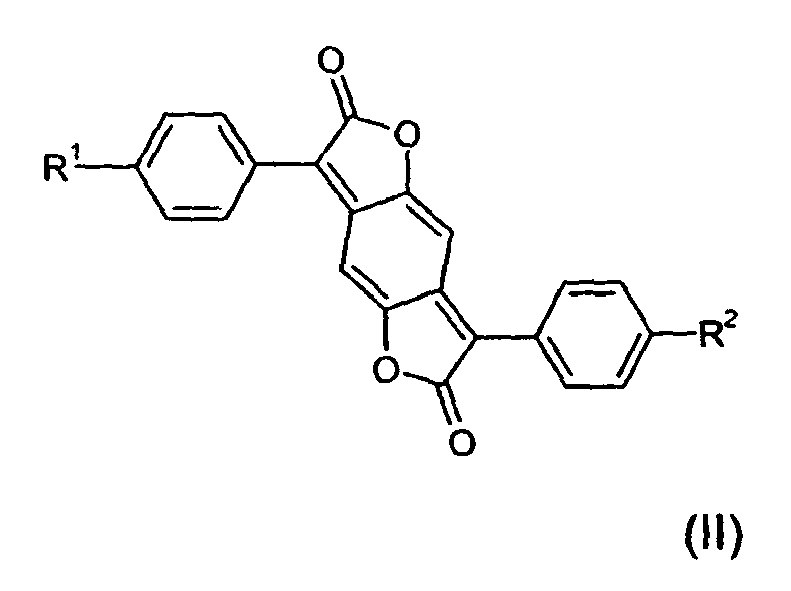
- the invention accordingly provides dye mixtures comprising one dye of the herein below indicated and defined formula (I) and one or more, such as two or three, preferably 1 or 2, dyes of the herein below indicated and defined general formula (II) wherein R 1 and R 2 are independently hydrogen, alkoxy [OR 3 ] or substituted alkoxy [O(CH 2 ) n R 4 ], in which
- Alkyl R may be straight-chain or branched and is in particular C 1 -C 4 -, such as methyl, ethyl n-propyl, isopropyol, n-butyl, isobutyl, sec-butyl or tert-butyl. Methyl and ethyl are preferred. The same logic applies to (C 1 -C 4 )-alkoxy groups.
- Alkenyl R is in particular C 2 -C 4 - such as ethenyl, propenyl, butenyl.
- Specific structures which would be of interest covered by the general formula (II) include for example: Formula R 1 R 2 (II-1) H (II-2) (II-3) ditto H (II-4) ditto (II-5) ditto (II-6) ditto (II-7) ditto (II-8) ditto (II-9) ditto (II-10) ditto (II-11) ditto (II-12) (II-13) (II-14)
- a preferred embodiment of the invention is a mixture comprising dyestuff according to formula (I) and at least one of the following dyestuffs of the formula (II-1), (II-9), (II-10) or (II-11), or a mixture comprising dyestuff (I) and one or more dyestuffs of the formula (II-2), (II-12), (II-13), (II-14), or a mixture comprising dyestuff (I) and one or more dyestuffs of the formula (II-3), (II-4), (II-5), (II-6), (II-7), (II-8).
- the dye of the general formula (I) is present in the mixtures in an amount of from 5 to 95 % by weight, preferably of from 75 to 90 % by weight, and the dye, respectively dyes of the general formula (II) are present in the mixtures in an amount of from 95 to 5 % by weight, preferably of from 10 to 25 % by weight.
- the dyes according to the general formula (I) are known from WO-9521958, the dyes of the general formula (II) are partially known from WO 9704031.
- Mixtures embodying the invention can be prepared, for example, by mixing the dye components in the required amounts. Suitable mixing methods include
- the dyes are dissolved in a hot solvent, for example, by placing the dyes in a suitable solvent and heating up to the reflux temperature of the solvent until the dyes are dissolved, thereafter filtering to provide a solution, and then allowing the solution to cool and crystals to form.
- suitable solvents for this process are organic solvents such as aromatic hydrocarbons, chlorinated hydrocarbons, aliphatic hydrocarbons, alicyclic hydrocarbons, alcohols, amides, sulphoxides, esters, ketones and ethers.
- organic solvents are toluene, ethyl cellosolve, acetone, chlorobenzene, pyridine, dimethyl formamide, dimethylsulphoxide, ethyl acetate, benzene, tetrahydrofuran and cyclohexane.
- Co-crystallisation is generally unsuitable for mixtures containing more than two components.
- Each dye is spray dried separately and then mixed in the required ratio by a dry blending process.
- Mixtures embodying the invention provide especially useful disperse dyes valuable for colouring synthetic textile materials such as polyester, microfibre polyester and fibre blends thereof such as polyester-cellulose, polyester-wool, polyester-polyurethane or polyester-nylon, by exhaust dyeing, padding or printing, and may be formed into dispersions for this purpose. They may also be used in, for example, ink jet printing of textiles and non-textiles, dye diffusion, thermal transfer printing and in the colouration of plastics.
- a particular aspect of the invention provides a composition
- a composition comprising a mixture of dye (I) and (II), and additionally, at least one further ingredient conventionally used in colouring applications such as a dispersing agent and optionally a surfactant or wetting agent.
- the composition typically comprises from 1 % to 65%, preferably 10 to 60%, more preferably 20 to 55%, of the total dye mixture in a solid medium.
- dispersing agent examples include lignosulphonates, naphthalene sulphonic acid/formaldehyde condensates and phenol/cresol/sulphanilic acid/formaldehyde condensates
- typical examples of wetting agent are alkyl aryl ethoxylates which may be sulphonated or phosphated and typical example of other ingredients which may be present are inorganic salts, de-foamers such as mineral oil or nonanol, organic liquids and buffers.
- Dispersing agents may be present at from 10% to 200% on the weight of the dye mixtures.
- Wetting agents may be used at from 0% to 20% on the weight of the dye mixtures.
- compositions may be prepared by bead milling the dye mixture with glass beads or sand in an aqueous medium.
- the compositions may have further additions of dispersing agents, fillers and other surfactants and may be dried, by a technique such as spray drying, to give a solid composition comprising from 5% to 65% of dyestuff.
- the invention provides a process for colouring a synthetic textile material or fibre blend thereof which comprises applying to the synthetic textile material or fibre blend a mixture comprising a dye of the formula (I) and at least one dye of the formula (II).
- the synthetic textile material may be selected from aromatic polyester, especially polyethylene terephthalate, polyamide, especially polyhexamethylene adipamide, secondary cellulose acetate, cellulose triacetate, and natural textile materials, especially cellulosic materials and wool, or blends of polyester and polyurethane, or polyester and nylon.
- An especially preferred textile material is an aromatic polyester or fibre blend thereof with fibres of any of the above mentioned textile materials.
- Especially preferred fibre blends include those of polyester-cellulose, such as polyester-cotton, and polyester-wool.
- the textile materials or blends thereof may be in the form of filaments, loose fibres, yarn or woven or knitted fabrics.
- mixtures of dyes of formulae (I) and (II) may be applied to the synthetic textile materials or fibre blends by processes which are conventionally employed in applying disperse dyes to such materials and fibre blends.
- Suitable process conditions may be selected from the following
- the dye mixture is applied as a dispersion comprising from 0.001 % to 20%, preferably from 0.005 to 16%, of the dye mixture in an aqueous medium.
- the dye mixtures may be applied to synthetic textile materials and fibre blends by ink-jet printing, the substrates optionally having been pre-treated to aid printing.
- the application medium may comprise water and a water-soluble organic solvent, preferably in a weight ratio of 1:99 to 99:1, more preferably 1:95 to 50:50 and especially in the range 10:90 to 40:60.
- the water-soluble organic solvent preferably comprises a C1-4-alkanol, especially methanol or ethanol, a ketone, especially acetone or methyl ethyl ketone, 2-pyrrolidone or N-methylpyrrolidone, a glycol, especially ethylene glycol, propylene glycol, trimethylene glycol, butane-2,3-diol, thiodiglycol or diethylene glycol, a glycol ether, especially ethylene glycol monomethyl ether, propylene glycol monomethyl ether or diethylene glycol monomethyl ether, urea, a sulphone, especially bis-(2-hydroxyethyl) sulphone or mixtures thereof.
- a C1-4-alkanol especially methanol or ethanol, a ketone, especially acetone or methyl ethyl ketone, 2-pyrrolidone or N-methylpyrrolidone
- a glycol especially ethylene glycol, propylene glycol, trimethylene
- the dye mixtures may also be applied to textile materials using supercritical carbon dioxide, in which case the dye formulating agents may optionally be omitted.
- a mixture of 27.77 parts of dye (I) and 4.53 parts of dyestuffs according to formula (ll-1) was prepared by mixing the two dyes together and milling them as a 40% aqueous slurry with 20 parts of a high temperature stable dispersing agent until the dye particle size (mean diameter) was in the range 0.1 - 5 microns.
- This dispersion was standardised to a solid brand containing 32.3% of the mixture and 67.7% dispersing agent, by the addition of 47.7 parts of a temperature stable dispersing agent and drying to either a grain or powder form in a spray dryer.
- a dyebath for the exhaust dyeing of polyester in piece form was prepared by adding 1.8 ml of an aqueous dispersion of the solid brand (1g dye in 100 ml water at 40-50° C) to 57 ml of deionised water and 1.2 ml of buffer solution. To this dyebath was added a 5g piece of polyester and the whole was held for 45 minutes at 130° C in a high temperature dyeing machine. After rinsing with water and a reduction clearing treatment, the material was dyed a bright red shade with excellent wet and light fastness. An interesting feature of the mixture is its good leveling/migration performance during the dyeing process.
- a mixture of 31.19 parts of dye (I) and 12 parts of dyestuff (ll-1) was prepared by mixing the two dyes together and milling them as a 40% aqueous slurry with 25 parts of a high temperature stable dispersing agent until the dye particle size (mean diameter) was in the range 0.1 - 5 microns.
- This dispersion was standardised to a solid brand containing 43.19% of the mixture and 56.81% dispersing agent, by the addition of 31.81 parts of a temperature stable dispersing agent and drying to either a grain or powder form in a spray dryer.
- a dyebath for the exhaust dyeing of polyester in piece form was prepared by adding 1.2 mls of an aqueous dispersion of the solid brand (1g dye in 100 ml water at 40-50° C) to 57.5 ml of de-ionised water and 1.2 ml of buffer solution. To this dyebath was added a 5g piece of polyester and the whole was held for 45 minutes at 130° C in a high temperature dyeing machine. After rinsing with water and a reduction clearing treatment, the material was dyed a bright red shade with excellent wet and light fastness. An interesting feature of the mixture is its good leveling/migration performance during the dyeing process.
- a mixture of 25.81 parts of dye (I), 1.52 parts of dye of formula (II-1), 4.91 parts of dye of formula (II-2) and 2.32 parts of dye of formula (II-3) was prepared by mixing the four dyes together and milling them as a 40% aqueous slurry with 20 parts of a high temperature stable dispersing agent until the dye particle size (mean diameter) was in the range 0.1 - 5 microns.
- This dispersion was standardised to a solid brand containing 34.64% of the mixture and 65.36% dispersing agent, by the addition of 45.36 parts of a temperature stable dispersing agent and drying to either a grain or powder form in a spray dryer.
- This product is especially suitable for the exhaust dyeing of polyester(including microfibre and weight reduced polyester), polyester/cellulose polyester/elastane and polyester/wool blends and can also be used for continuous dyeing and direct printing.
- a dyebath for the exhaust dyeing of polyester in piece form was prepared by adding 1.5 ml of an aqueous dispersion of the solid brand (1g dye in 100 ml water at 40-50° C) to 57.3 ml of deionised water and 1.2 ml of buffer solution. To this dyebath was added a 5g piece of polyester and the whole was held for 45 minutes at 130° C in a high temperature dyeing machine.
- the material After rinsing with water and a reduction clearing treatment, the material was dyed a bright bluish red shade with excellent wet and light fastness.
- An interesting feature of the mixture is its good leveling/migration performance during the dyeing process.
Landscapes
- Chemical & Material Sciences (AREA)
- Dispersion Chemistry (AREA)
- Engineering & Computer Science (AREA)
- Textile Engineering (AREA)
- Organic Chemistry (AREA)
- Chemical Kinetics & Catalysis (AREA)
- Coloring (AREA)
Description
- This invention relates to mixtures of disperse non-azo dyes.
- Mixed disperse dyes and their use for dyeing polyester and its blends with other fibres such as cellulose, elastane, nylon and wool by normal exhaust dyeing, continuous dyeing and direct printing techniques are already known for example from the documents EP1188799 A1, and WO0022048. However, they have certain application defects, such as for example relatively poor leveling/migration properties, an overly large dependence of the colour yield on varying dyeing parameters in the dyeing process or an insufficient colour build-up on polyester (good colour build-up results from the ability of a dye to provide a proportionally stronger dyeing when used in higher concentrations in the dye bath), or unsatisfactory fastness properties.
- However there is a need for disperse dyes which provide dyeings of improved fastness properties, i.e. wash and light fastness properties of dyed polyester or its blends with other fibres such as cellulose, elastane, nylon and wool.
- The present invention, then, provides dye mixtures of disperse dyes which provide dyeings of very good wet and light fastness properties on polyester or its blends with other fibres.
- The invention accordingly provides dye mixtures comprising one dye of the herein below indicated and defined formula (I)


R1 and R2 are independently
hydrogen, alkoxy [OR3] or substituted alkoxy [O(CH2)nR4],
in which - n
- can be 1 to 6
- R3
- is alkyl or alkenyl each of which can be optionally substituted by a substituted saturated or unsaturated 5-, 6-, or 7- membered heterocyclic or homocyclic residue;
- R4
- is a group of the formula (1) or (2)

- R5
- is hydrogen for n more than 1, alkyl for n more than 1, alkenyl, aryl, alkoxyalkyl, aryloxyalkyl, carbonylalkyl, carbonylalkenyl, carbonylaryl, carbonylalkoxyalkyl or carbonylaryloxyalkyl;
- R6
- is alkoxy, alkenyloxy, aryloxy, arylalkoxy, aryloxyalkoxy, alkenyloxyalkyloxy or alkoxyalkoxy.
- Alkyl R may be straight-chain or branched and is in particular C1-C4-, such as methyl, ethyl n-propyl, isopropyol, n-butyl, isobutyl, sec-butyl or tert-butyl. Methyl and ethyl are preferred. The same logic applies to (C1-C4)-alkoxy groups. Alkenyl R is in particular C2-C4- such as ethenyl, propenyl, butenyl.
- Specific structures which would be of interest covered by the general formula (II) include for example:
Formula R 1 R 2 (II-1) H 
(II-2) 

(II-3) ditto H (II-4) 
ditto (II-5) 
ditto (II-6) 
ditto (II-7) 
ditto (II-8) 
ditto (II-9) 
ditto (II-10) 
ditto (II-11) 
ditto (II-12) 

(II-13) 

(II-14) 

- A preferred embodiment of the invention is a mixture comprising dyestuff according to formula (I) and at least one of the following dyestuffs of the formula (II-1), (II-9), (II-10) or (II-11), or a mixture comprising dyestuff (I) and one or more dyestuffs of the formula (II-2), (II-12), (II-13), (II-14), or a mixture comprising dyestuff (I) and one or more dyestuffs of the formula (II-3), (II-4), (II-5), (II-6), (II-7), (II-8).
- The dye of the general formula (I) is present in the mixtures in an amount of from 5 to 95 % by weight, preferably of from 75 to 90 % by weight, and the dye, respectively dyes of the general formula (II) are present in the mixtures in an amount of from 95 to 5 % by weight, preferably of from 10 to 25 % by weight.
- The dyes according to the general formula (I) are known from WO-9521958, the dyes of the general formula (II) are partially known from WO 9704031.
- Mixtures embodying the invention can be prepared, for example, by mixing the dye components in the required amounts. Suitable mixing methods include
- Typically, the dyes are dissolved in a hot solvent, for example, by placing the dyes in a suitable solvent and heating up to the reflux temperature of the solvent until the dyes are dissolved, thereafter filtering to provide a solution, and then allowing the solution to cool and crystals to form. The resultant mixture may then undergo further processing, such as milling and spray drying. Examples of suitable solvents for this process are organic solvents such as aromatic hydrocarbons, chlorinated hydrocarbons, aliphatic hydrocarbons, alicyclic hydrocarbons, alcohols, amides, sulphoxides, esters, ketones and ethers. Specific examples of organic solvents are toluene, ethyl cellosolve, acetone, chlorobenzene, pyridine, dimethyl formamide, dimethylsulphoxide, ethyl acetate, benzene, tetrahydrofuran and cyclohexane.
Co-crystallisation is generally unsuitable for mixtures containing more than two components. -
- (a) The dyes are mixed and then milled together to give an intimate blend which is then spray dried to give a solid mixture; or
- (b) each dye is milled separately and then mixed in the required ratio before spray drying.
- Each dye is spray dried separately and then mixed in the required ratio by a dry blending process.
- Mixtures embodying the invention provide especially useful disperse dyes valuable for colouring synthetic textile materials such as polyester, microfibre polyester and fibre blends thereof such as polyester-cellulose, polyester-wool, polyester-polyurethane or polyester-nylon, by exhaust dyeing, padding or printing, and may be formed into dispersions for this purpose. They may also be used in, for example, ink jet printing of textiles and non-textiles, dye diffusion, thermal transfer printing and in the colouration of plastics.
- A particular aspect of the invention provides a composition comprising a mixture of dye (I) and (II), and additionally, at least one further ingredient conventionally used in colouring applications such as a dispersing agent and optionally a surfactant or wetting agent. The composition typically comprises from 1 % to 65%, preferably 10 to 60%, more preferably 20 to 55%, of the total dye mixture in a solid medium.
- Typical examples of dispersing agent are lignosulphonates, naphthalene sulphonic acid/formaldehyde condensates and phenol/cresol/sulphanilic acid/formaldehyde condensates, typical examples of wetting agent are alkyl aryl ethoxylates which may be sulphonated or phosphated and typical example of other ingredients which may be present are inorganic salts, de-foamers such as mineral oil or nonanol, organic liquids and buffers. Dispersing agents may be present at from 10% to 200% on the weight of the dye mixtures. Wetting agents may be used at from 0% to 20% on the weight of the dye mixtures.
- The compositions may be prepared by bead milling the dye mixture with glass beads or sand in an aqueous medium. The compositions may have further additions of dispersing agents, fillers and other surfactants and may be dried, by a technique such as spray drying, to give a solid composition comprising from 5% to 65% of dyestuff.
- According to another aspect, the invention provides a process for colouring a synthetic textile material or fibre blend thereof which comprises applying to the synthetic textile material or fibre blend a mixture comprising a dye of the formula (I) and at least one dye of the formula (II).
- The synthetic textile material may be selected from aromatic polyester, especially polyethylene terephthalate, polyamide, especially polyhexamethylene adipamide, secondary cellulose acetate, cellulose triacetate, and natural textile materials, especially cellulosic materials and wool, or blends of polyester and polyurethane, or polyester and nylon. An especially preferred textile material is an aromatic polyester or fibre blend thereof with fibres of any of the above mentioned textile materials. Especially preferred fibre blends include those of polyester-cellulose, such as polyester-cotton, and polyester-wool. The textile materials or blends thereof may be in the form of filaments, loose fibres, yarn or woven or knitted fabrics.
- The mixtures of dyes of formulae (I) and (II) may be applied to the synthetic textile materials or fibre blends by processes which are conventionally employed in applying disperse dyes to such materials and fibre blends.
- Suitable process conditions may be selected from the following
- (i) exhaust dyeing at a pH of from 4 to 6.5, at a temperature of from 125°C to 140°C for from 10 to 120 minutes and under a pressure of from 1 to 2 bar, a sequestrant optionally being added;
- (ii) continuous dyeing at a pH of from 4 to 6.5, at a temperature of from 190°C to 225°C for from 15 seconds to 5 minutes, a migration inhibitor optionally being added;
- (iii) direct printing at a pH of from 4 to 6.5, at a temperature of from 160°C to 185°C for from 4 to 15 minutes for high temperature steaming, or at a temperature of from 190°C to 225°C for from 15 seconds to 5 minutes for bake fixation with dry heat or at a temperature of from 120°C to 140°C and 1 to 2 bar for from 10 to 45 minutes for pressure steaming, wetting agents and thickeners (such as alginates) of from 5 to 100% by weight of the dye optionally being added;
- (iv) discharge printing (by padding the dye on to the textile material, drying and overprinting) at a pH of from 4 to 6.5, migration inhibitors and thickeners optionally being added;
- (v) carrier dyeing at a pH of from 4 to 6.5, at a temperature of from 95°C to 100°C using a carrier such as methylnaphthalene, diphenylamine or 2-phenylphenol, sequestrants optionally being added; and
- (vi) atmospheric dyeing of acetate, triacetate and nylon at a pH of from 4 to 6.5, at a temperature of 85°C for acetate or at a temperature of 90°C for triacetate and nylon for from 15 to 90 minutes, sequestrants optionally being added.
- In all the above processes, the dye mixture is applied as a dispersion comprising from 0.001 % to 20%, preferably from 0.005 to 16%, of the dye mixture in an aqueous medium.
- In addition to the above-mentioned application processes, the dye mixtures may be applied to synthetic textile materials and fibre blends by ink-jet printing, the substrates optionally having been pre-treated to aid printing. For ink-jet applications, the application medium may comprise water and a water-soluble organic solvent, preferably in a weight ratio of 1:99 to 99:1, more preferably 1:95 to 50:50 and especially in the range 10:90 to 40:60. The water-soluble organic solvent preferably comprises a C1-4-alkanol, especially methanol or ethanol, a ketone, especially acetone or methyl ethyl ketone, 2-pyrrolidone or N-methylpyrrolidone, a glycol, especially ethylene glycol, propylene glycol, trimethylene glycol, butane-2,3-diol, thiodiglycol or diethylene glycol, a glycol ether, especially ethylene glycol monomethyl ether, propylene glycol monomethyl ether or diethylene glycol monomethyl ether, urea, a sulphone, especially bis-(2-hydroxyethyl) sulphone or mixtures thereof.
- The dye mixtures may also be applied to textile materials using supercritical carbon dioxide, in which case the dye formulating agents may optionally be omitted.
- Embodiments of the present invention will now be described in more detail with reference to the following Examples, in which parts are by weight unless otherwise stated.
- A mixture of 27.77 parts of dye (I) and 4.53 parts of dyestuffs according to formula (ll-1) was prepared by mixing the two dyes together and milling them as a 40% aqueous slurry with 20 parts of a high temperature stable dispersing agent until the dye particle size (mean diameter) was in the range 0.1 - 5 microns.
- This dispersion was standardised to a solid brand containing 32.3% of the mixture and 67.7% dispersing agent, by the addition of 47.7 parts of a temperature stable dispersing agent and drying to either a grain or powder form in a spray dryer.
- A dyebath for the exhaust dyeing of polyester in piece form was prepared by adding 1.8 ml of an aqueous dispersion of the solid brand (1g dye in 100 ml water at 40-50° C) to 57 ml of deionised water and 1.2 ml of buffer solution. To this dyebath was added a 5g piece of polyester and the whole was held for 45 minutes at 130° C in a high temperature dyeing machine. After rinsing with water and a reduction clearing treatment, the material was dyed a bright red shade with excellent wet and light fastness. An interesting feature of the mixture is its good leveling/migration performance during the dyeing process.
- A mixture of 31.19 parts of dye (I) and 12 parts of dyestuff (ll-1) was prepared by mixing the two dyes together and milling them as a 40% aqueous slurry with 25 parts of a high temperature stable dispersing agent until the dye particle size (mean diameter) was in the range 0.1 - 5 microns.
- This dispersion was standardised to a solid brand containing 43.19% of the mixture and 56.81% dispersing agent, by the addition of 31.81 parts of a temperature stable dispersing agent and drying to either a grain or powder form in a spray dryer.
- A dyebath for the exhaust dyeing of polyester in piece form was prepared by adding 1.2 mls of an aqueous dispersion of the solid brand (1g dye in 100 ml water at 40-50° C) to 57.5 ml of de-ionised water and 1.2 ml of buffer solution. To this dyebath was added a 5g piece of polyester and the whole was held for 45 minutes at 130° C in a high temperature dyeing machine. After rinsing with water and a reduction clearing treatment, the material was dyed a bright red shade with excellent wet and light fastness. An interesting feature of the mixture is its good leveling/migration performance during the dyeing process.
- Further dye mixtures based on dye (I) and a dyestuff corresponding to general formula (II) were applied to polyester under the exhaust dyeing conditions described in Examples 1 and 2. Again after the normal clearing treatments, the dyeings obtained were bright red in shade and gave excellent wet and light fastness. All the mixtures evaluated exhibited good leveling/migration performance during the dyeing process.
Example % Dye I % Structure (II-1) % Structure (II-9) 96 Structure (II-10) % Structure (II-11) 3 89 - 11 - - 4 87 13 - - - 5 85 15 - - - 6 83 - - 17 7 81.5 - - - 18.5 8 80 - 20 - - 9 78.5 - - 21.5 - 10 76.5 - - - 23.5 11 75 - 25 - - 12 73 27 - - - 13 71 29 - - - - A mixture of 25.81 parts of dye (I), 1.52 parts of dye of formula (II-1), 4.91 parts of dye of formula (II-2) and 2.32 parts of dye of formula (II-3) was prepared by mixing the four dyes together and milling them as a 40% aqueous slurry with 20 parts of a high temperature stable dispersing agent until the dye particle size (mean diameter) was in the range 0.1 - 5 microns.
- This dispersion was standardised to a solid brand containing 34.64% of the mixture and 65.36% dispersing agent, by the addition of 45.36 parts of a temperature stable dispersing agent and drying to either a grain or powder form in a spray dryer. This product is especially suitable for the exhaust dyeing of polyester(including microfibre and weight reduced polyester), polyester/cellulose polyester/elastane and polyester/wool blends and can also be used for continuous dyeing and direct printing.
- A dyebath for the exhaust dyeing of polyester in piece form was prepared by adding 1.5 ml of an aqueous dispersion of the solid brand (1g dye in 100 ml water at 40-50° C) to 57.3 ml of deionised water and 1.2 ml of buffer solution. To this dyebath was added a 5g piece of polyester and the whole was held for 45 minutes at 130° C in a high temperature dyeing machine.
- After rinsing with water and a reduction clearing treatment, the material was dyed a bright bluish red shade with excellent wet and light fastness. An interesting feature of the mixture is its good leveling/migration performance during the dyeing process.
- Further examples which illustrate the invention are given in the following table:
Example 15 16 17 18 19 20 21 22 23 24 % dye (I) 65 67 70 72 74 76 78 80 82 83 % dye (II-1) 5.5 - - - 5 4.5 - - - - % dye (II-2) 20 - - - 14.5 13.5 - - - - % dye (II-3) 9.5 - - - 6.5 6 - - - - % dye (II-4) - 9 - - - - - - 5.5 - % dye (II-5) - - 8.5 - - - - - - 5 % dye (II-6) - - - 9 - - - - - - % dye (II-7) - - - - - - 7.5 - - - % dye (II-8) - - - - - - - 6.5 - - % dye (II-9) - 5 - - - - - 2.5 2 - % dye (II-10) - - 4.5 - - - 3 - - 2 % dye (II-11) - - - 4 - - - - - - % dye (II-12) - 19 - - - - - 11 10.5 - % dye (II-13) - - 17 - - - 11.5 - - 10 % dye (II-14) - - - 15 - - - - - -
Claims (9)
- Dye mixture comprising at least one dye of the herein below indicated and defined formula (I)

R1 and R2 are independently
hydrogen, alkoxy [OR3] or substituted alkoxy [O(CH2)nR4], in whichn can be 1 to 6R3 is alkyl or alkenyl each of which can be optionally substituted by a saturated or unsaturated 5-, 6-, or 7-membered heterocyclic or homocyclic residue;R4 is a group of the formula (1) or (2)wherein R5 is hydrogen for n more than 1, alkyl for n more than 1, alkenyl, aryl, alkoxyalkyl, aryloxyalkyl, carbonylalkyl, carbonylalkenyl, carbonylaryl, carbonylalkoxyalkyl or carbonylaryloxyalkyl;R6 is alkoxy, alkenyloxy, aryloxy, arylalkoxy, aryloxyalkoxy, alkenyloxyalkyloxy or alkoxyalkoxy.
 - Dye mixture according to claim 1 comprising a dye of the formula (I) and a dye of the formula (II) in which R2 denotes a substituted alkoxy
[O(CH2)nR4],
in whichn can be 1 to 6whereinR4 is a group of the formula (1) or (2) R5 is hydrogen for n more than 1, alkyl for n more than 1, alkenyl, aryl, alkoxyalkyl, aryloxyalkyl, carbonylalkyl, carbonylalkenyl, carbonylaryl, carbonylalkoxyalkyl or carbonylaryloxyalkyl;R6 is alkoxy, alkenyloxy, aryloxy, arylalkoxy, aryloxyalkoxy, alkenyloxyalkyloxy or alkoxyalkoxy.
 - Dye mixture according to claim 2 in which R4 is a group of the formula (2) wherein R6 is , aryloxyalkoxy, alkenyloxyalkyloxy or alkoxyalkoxy.
- A dye mixture according to any preceeding claim wherein the ratio by weight of dye (I) : dye (II) is from 5 to 95 : 95 to 5.
- A dye mixture according to any preceeding claim wherein the ratio by weight of dye (I) : dye (II) is from 75 to 90 : 25 to 10.
- Process for the preparation of a dye mixture according to one or more of claims 1 to 5 comprising mixing the dye components in the required amounts.
- A composition comprising a dye mixture according to one or more of claims 1 to 5 and at least one dispersing agent, surfactant or wetting agent.
- A process for colouring a synthetic textile material or fibre blend thereof, which comprises applying thereto a dye mixture according to one or more of claims 1 to 5.
- A process according to claim 8, wherein the synthetic material or fibre blend thereof is a polyester or polyester-cellulose or polyester-wool, or polyester-polyurethane, or polyester-nylon blend.
Applications Claiming Priority (2)
| Application Number | Priority Date | Filing Date | Title |
|---|---|---|---|
| GBGB0217487.8A GB0217487D0 (en) | 2002-07-29 | 2002-07-29 | Non-azo disperse dye mixtures |
| GB0217487 | 2002-07-29 |
Publications (2)
| Publication Number | Publication Date |
|---|---|
| EP1394218A1 EP1394218A1 (en) | 2004-03-03 |
| EP1394218B1 true EP1394218B1 (en) | 2006-09-27 |
Family
ID=9941262
Family Applications (1)
| Application Number | Title | Priority Date | Filing Date |
|---|---|---|---|
| EP03016770A Expired - Lifetime EP1394218B1 (en) | 2002-07-29 | 2003-07-23 | Non-azo disperse dye mixtures |
Country Status (12)
| Country | Link |
|---|---|
| US (1) | US7118604B2 (en) |
| EP (1) | EP1394218B1 (en) |
| JP (1) | JP2004137461A (en) |
| KR (1) | KR100997852B1 (en) |
| CN (1) | CN100381504C (en) |
| BR (1) | BR0302533A (en) |
| CA (1) | CA2436033C (en) |
| DE (1) | DE60308613T2 (en) |
| ES (1) | ES2271438T3 (en) |
| GB (1) | GB0217487D0 (en) |
| MX (1) | MXPA03006721A (en) |
| TW (1) | TWI315329B (en) |
Families Citing this family (9)
| Publication number | Priority date | Publication date | Assignee | Title |
|---|---|---|---|---|
| GB0422403D0 (en) * | 2004-10-08 | 2004-11-10 | Dystar Textilfarben Gmbh & Co | Disperse dye mixtures |
| GB0625624D0 (en) * | 2006-12-21 | 2007-01-31 | Dystar Textilfarben Gmbh & Co | Disperse dye mixtures |
| CA2787442C (en) * | 2010-01-26 | 2017-01-03 | Id Lab Inc. | Complementary and adjustable protective system |
| CN101899229B (en) * | 2010-06-29 | 2013-01-16 | 浙江龙盛染料化工有限公司 | Disperse red dye composition |
| CN101974251A (en) * | 2010-07-30 | 2011-02-16 | 江苏亚邦染料股份有限公司 | Disperse red dye with high washing fastness |
| CN102277012B (en) * | 2011-04-29 | 2014-10-29 | 浙江闰土股份有限公司 | Disperse purplish-red dye composition |
| CN103613953B (en) * | 2013-11-08 | 2017-02-22 | 浙江长征化工有限公司 | Disperse blue dye composition, disperse dye, and preparation method and application of disperse dye |
| CN104233856B (en) * | 2014-08-20 | 2016-04-06 | 张家港市大新毛纺有限公司 | The dye composite of a kind of wool and polyester blended fabric |
| CN108884632B (en) * | 2016-02-18 | 2022-02-22 | 戴库纺织系统有限公司 | Method for dyeing substrates comprising elastomeric fibres and non-elastomeric fibres and dyed substrates comprising these fibres |
Family Cites Families (12)
| Publication number | Priority date | Publication date | Assignee | Title |
|---|---|---|---|---|
| GB9126351D0 (en) * | 1990-12-21 | 1992-02-12 | Ici Plc | Mixed crystal dyes |
| GB9126352D0 (en) * | 1991-12-11 | 1992-02-12 | Ici Plc | Polycyclic dyes |
| JP3139191B2 (en) * | 1992-11-12 | 2001-02-26 | 住友化学工業株式会社 | Benzodifuranone-based compound-containing composition and method for coloring hydrophobic material using the same |
| JP3170917B2 (en) * | 1992-12-22 | 2001-05-28 | 住友化学工業株式会社 | Benzodifuranone-containing composition and method for coloring hydrophobic material using the same |
| JPH0711587A (en) * | 1993-06-22 | 1995-01-13 | Sumitomo Chem Co Ltd | Dyeing method for textile materials using benzodifuranone compounds |
| JPH0734386A (en) * | 1993-07-22 | 1995-02-03 | Sumitomo Chem Co Ltd | Dyeing method for a mixture of hydrophobic fiber and cellulose fiber |
| GB9402607D0 (en) * | 1994-02-10 | 1994-04-06 | Zeneca Ltd | Process |
| JP3527781B2 (en) * | 1994-09-30 | 2004-05-17 | ダイスタージャパン株式会社 | Disperse dye mixture |
| GB9514524D0 (en) | 1995-07-15 | 1995-09-13 | Zeneca Ltd | Dye mixtures |
| GB9822336D0 (en) * | 1998-10-13 | 1998-12-09 | Basf Ag | Disperse dye mixtures |
| GB0022697D0 (en) | 2000-09-15 | 2000-11-01 | Basf Ag | Azo disperse dye mixtures |
| GB0024440D0 (en) * | 2000-10-05 | 2000-11-22 | Basf Ag | Polycyclic dyes |
-
2002
- 2002-07-29 GB GBGB0217487.8A patent/GB0217487D0/en not_active Ceased
-
2003
- 2003-07-23 DE DE60308613T patent/DE60308613T2/en not_active Expired - Lifetime
- 2003-07-23 ES ES03016770T patent/ES2271438T3/en not_active Expired - Lifetime
- 2003-07-23 EP EP03016770A patent/EP1394218B1/en not_active Expired - Lifetime
- 2003-07-24 US US10/627,827 patent/US7118604B2/en not_active Expired - Lifetime
- 2003-07-25 TW TW092120416A patent/TWI315329B/en not_active IP Right Cessation
- 2003-07-28 CA CA2436033A patent/CA2436033C/en not_active Expired - Fee Related
- 2003-07-28 BR BR0302533-0A patent/BR0302533A/en not_active IP Right Cessation
- 2003-07-28 JP JP2003202625A patent/JP2004137461A/en active Pending
- 2003-07-28 MX MXPA03006721A patent/MXPA03006721A/en active IP Right Grant
- 2003-07-29 CN CNB031331440A patent/CN100381504C/en not_active Expired - Fee Related
- 2003-07-29 KR KR1020030052361A patent/KR100997852B1/en not_active Expired - Fee Related
Also Published As
| Publication number | Publication date |
|---|---|
| EP1394218A1 (en) | 2004-03-03 |
| BR0302533A (en) | 2004-08-24 |
| CN100381504C (en) | 2008-04-16 |
| DE60308613D1 (en) | 2006-11-09 |
| MXPA03006721A (en) | 2004-02-09 |
| HK1060587A1 (en) | 2004-08-13 |
| GB0217487D0 (en) | 2002-09-04 |
| CN1483765A (en) | 2004-03-24 |
| DE60308613T2 (en) | 2007-08-23 |
| KR100997852B1 (en) | 2010-12-01 |
| KR20040012521A (en) | 2004-02-11 |
| CA2436033C (en) | 2010-11-16 |
| US20040019983A1 (en) | 2004-02-05 |
| US7118604B2 (en) | 2006-10-10 |
| TWI315329B (en) | 2009-10-01 |
| CA2436033A1 (en) | 2004-01-29 |
| TW200403304A (en) | 2004-03-01 |
| JP2004137461A (en) | 2004-05-13 |
| ES2271438T3 (en) | 2007-04-16 |
Similar Documents
| Publication | Publication Date | Title |
|---|---|---|
| US7101408B2 (en) | Disperse dye mixtures | |
| EP2097490A1 (en) | Disperse dyes mixtures | |
| US6682573B2 (en) | Azo disperse dye mixtures | |
| EP0548715B1 (en) | Disperse dye mixtures | |
| EP0840765B1 (en) | Dye mixtures | |
| US7118604B2 (en) | Non azo disperse dye mixtures | |
| EP3387072B1 (en) | High wet fast brilliant blue disperse dye mixtures | |
| EP1799774B1 (en) | Disperse dye mixtures | |
| EP1121393B1 (en) | Disperse dye mixtures | |
| EP1668079B1 (en) | Adsorbable organic halogen (aox)-free navy and black disperse dyes | |
| US6562082B1 (en) | Disperse dye mixture | |
| JP2007515509A (en) | Disperse dye mixture | |
| HK1060587B (en) | Non-azo disperse dye mixtures | |
| HK1068364B (en) | Method disperse dye mixtures | |
| US20080189882A1 (en) | Hot-Light Resistant Blue Dispersion Dyes | |
| MXPA00010142A (en) | Disperse dye mixture |
Legal Events
| Date | Code | Title | Description |
|---|---|---|---|
| PUAI | Public reference made under article 153(3) epc to a published international application that has entered the european phase |
Free format text: ORIGINAL CODE: 0009012 |
|
| AK | Designated contracting states |
Kind code of ref document: A1 Designated state(s): AT BE BG CH CY CZ DE DK EE ES FI FR GB GR HU IE IT LI LU MC NL PT RO SE SI SK TR |
|
| AX | Request for extension of the european patent |
Extension state: AL LT LV MK |
|
| 17P | Request for examination filed |
Effective date: 20040903 |
|
| AKX | Designation fees paid |
Designated state(s): CH DE ES FR IT LI |
|
| 17Q | First examination report despatched |
Effective date: 20050624 |
|
| GRAP | Despatch of communication of intention to grant a patent |
Free format text: ORIGINAL CODE: EPIDOSNIGR1 |
|
| RIN1 | Information on inventor provided before grant (corrected) |
Inventor name: CUNNINGHAM, ALAN Inventor name: LEAVER, ALAN THOMAS Inventor name: BRIERLEY, DAVID Inventor name: HALL, NIGEL |
|
| GRAS | Grant fee paid |
Free format text: ORIGINAL CODE: EPIDOSNIGR3 |
|
| GRAA | (expected) grant |
Free format text: ORIGINAL CODE: 0009210 |
|
| AK | Designated contracting states |
Kind code of ref document: B1 Designated state(s): CH DE ES FR IT LI |
|
| PG25 | Lapsed in a contracting state [announced via postgrant information from national office to epo] |
Ref country code: IT Free format text: LAPSE BECAUSE OF FAILURE TO SUBMIT A TRANSLATION OF THE DESCRIPTION OR TO PAY THE FEE WITHIN THE PRESCRIBED TIME-LIMIT;WARNING: LAPSES OF ITALIAN PATENTS WITH EFFECTIVE DATE BEFORE 2007 MAY HAVE OCCURRED AT ANY TIME BEFORE 2007. THE CORRECT EFFECTIVE DATE MAY BE DIFFERENT FROM THE ONE RECORDED. Effective date: 20060927 |
|
| REG | Reference to a national code |
Ref country code: CH Ref legal event code: EP |
|
| REF | Corresponds to: |
Ref document number: 60308613 Country of ref document: DE Date of ref document: 20061109 Kind code of ref document: P |
|
| REG | Reference to a national code |
Ref country code: CH Ref legal event code: NV Representative=s name: PATENTANWAELTE SCHAAD, BALASS, MENZL & PARTNER AG |
|
| REG | Reference to a national code |
Ref country code: ES Ref legal event code: FG2A Ref document number: 2271438 Country of ref document: ES Kind code of ref document: T3 |
|
| ET | Fr: translation filed | ||
| PLBE | No opposition filed within time limit |
Free format text: ORIGINAL CODE: 0009261 |
|
| STAA | Information on the status of an ep patent application or granted ep patent |
Free format text: STATUS: NO OPPOSITION FILED WITHIN TIME LIMIT |
|
| 26N | No opposition filed |
Effective date: 20070628 |
|
| REG | Reference to a national code |
Ref country code: FR Ref legal event code: TP |
|
| PGFP | Annual fee paid to national office [announced via postgrant information from national office to epo] |
Ref country code: CH Payment date: 20110712 Year of fee payment: 9 Ref country code: FR Payment date: 20110727 Year of fee payment: 9 |
|
| PGFP | Annual fee paid to national office [announced via postgrant information from national office to epo] |
Ref country code: ES Payment date: 20110817 Year of fee payment: 9 |
|
| REG | Reference to a national code |
Ref country code: DE Ref legal event code: R081 Ref document number: 60308613 Country of ref document: DE Owner name: DYSTAR COLOURS DISTRIBUTION GMBH, DE Free format text: FORMER OWNER: DYSTAR COLOURS DEUTSCHLAND GMBH, 65929 FRANKFURT, DE Effective date: 20111216 |
|
| REG | Reference to a national code |
Ref country code: CH Ref legal event code: PL |
|
| REG | Reference to a national code |
Ref country code: FR Ref legal event code: ST Effective date: 20130329 |
|
| PG25 | Lapsed in a contracting state [announced via postgrant information from national office to epo] |
Ref country code: CH Free format text: LAPSE BECAUSE OF NON-PAYMENT OF DUE FEES Effective date: 20120731 Ref country code: FR Free format text: LAPSE BECAUSE OF NON-PAYMENT OF DUE FEES Effective date: 20120731 Ref country code: LI Free format text: LAPSE BECAUSE OF NON-PAYMENT OF DUE FEES Effective date: 20120731 |
|
| REG | Reference to a national code |
Ref country code: DE Ref legal event code: R081 Ref document number: 60308613 Country of ref document: DE Owner name: DYSTAR COLOURS DISTRIBUTION GMBH, DE Free format text: FORMER OWNER: DYSTAR COLOURS DISTRIBUTION GMBH, 65929 FRANKFURT, DE Effective date: 20130709 |
|
| REG | Reference to a national code |
Ref country code: ES Ref legal event code: FD2A Effective date: 20131023 |
|
| PG25 | Lapsed in a contracting state [announced via postgrant information from national office to epo] |
Ref country code: ES Free format text: LAPSE BECAUSE OF NON-PAYMENT OF DUE FEES Effective date: 20120724 |
|
| PGFP | Annual fee paid to national office [announced via postgrant information from national office to epo] |
Ref country code: DE Payment date: 20200731 Year of fee payment: 18 |
|
| PGFP | Annual fee paid to national office [announced via postgrant information from national office to epo] |
Ref country code: IT Payment date: 20200721 Year of fee payment: 18 |
|
| REG | Reference to a national code |
Ref country code: DE Ref legal event code: R119 Ref document number: 60308613 Country of ref document: DE |
|
| PG25 | Lapsed in a contracting state [announced via postgrant information from national office to epo] |
Ref country code: DE Free format text: LAPSE BECAUSE OF NON-PAYMENT OF DUE FEES Effective date: 20220201 |
|
| PG25 | Lapsed in a contracting state [announced via postgrant information from national office to epo] |
Ref country code: IT Free format text: LAPSE BECAUSE OF NON-PAYMENT OF DUE FEES Effective date: 20210723 |