EP1394075A2 - Packages for biological substrates and methods of packaging such substrates - Google Patents
Packages for biological substrates and methods of packaging such substrates Download PDFInfo
- Publication number
- EP1394075A2 EP1394075A2 EP03077555A EP03077555A EP1394075A2 EP 1394075 A2 EP1394075 A2 EP 1394075A2 EP 03077555 A EP03077555 A EP 03077555A EP 03077555 A EP03077555 A EP 03077555A EP 1394075 A2 EP1394075 A2 EP 1394075A2
- Authority
- EP
- European Patent Office
- Prior art keywords
- slides
- container
- stored
- invention according
- background fluorescence
- Prior art date
- Legal status (The legal status is an assumption and is not a legal conclusion. Google has not performed a legal analysis and makes no representation as to the accuracy of the status listed.)
- Withdrawn
Links
Images


Classifications
-
- B—PERFORMING OPERATIONS; TRANSPORTING
- B65—CONVEYING; PACKING; STORING; HANDLING THIN OR FILAMENTARY MATERIAL
- B65D—CONTAINERS FOR STORAGE OR TRANSPORT OF ARTICLES OR MATERIALS, e.g. BAGS, BARRELS, BOTTLES, BOXES, CANS, CARTONS, CRATES, DRUMS, JARS, TANKS, HOPPERS, FORWARDING CONTAINERS; ACCESSORIES, CLOSURES, OR FITTINGS THEREFOR; PACKAGING ELEMENTS; PACKAGES
- B65D25/00—Details of other kinds or types of rigid or semi-rigid containers
- B65D25/14—Linings or internal coatings
-
- B—PERFORMING OPERATIONS; TRANSPORTING
- B01—PHYSICAL OR CHEMICAL PROCESSES OR APPARATUS IN GENERAL
- B01L—CHEMICAL OR PHYSICAL LABORATORY APPARATUS FOR GENERAL USE
- B01L9/00—Supporting devices; Holding devices
- B01L9/52—Supports specially adapted for flat sample carriers, e.g. for plates, slides, chips
-
- B—PERFORMING OPERATIONS; TRANSPORTING
- B65—CONVEYING; PACKING; STORING; HANDLING THIN OR FILAMENTARY MATERIAL
- B65D—CONTAINERS FOR STORAGE OR TRANSPORT OF ARTICLES OR MATERIALS, e.g. BAGS, BARRELS, BOTTLES, BOXES, CANS, CARTONS, CRATES, DRUMS, JARS, TANKS, HOPPERS, FORWARDING CONTAINERS; ACCESSORIES, CLOSURES, OR FITTINGS THEREFOR; PACKAGING ELEMENTS; PACKAGES
- B65D25/00—Details of other kinds or types of rigid or semi-rigid containers
- B65D25/02—Internal fittings
- B65D25/10—Devices to locate articles in containers
-
- B—PERFORMING OPERATIONS; TRANSPORTING
- B65—CONVEYING; PACKING; STORING; HANDLING THIN OR FILAMENTARY MATERIAL
- B65D—CONTAINERS FOR STORAGE OR TRANSPORT OF ARTICLES OR MATERIALS, e.g. BAGS, BARRELS, BOTTLES, BOXES, CANS, CARTONS, CRATES, DRUMS, JARS, TANKS, HOPPERS, FORWARDING CONTAINERS; ACCESSORIES, CLOSURES, OR FITTINGS THEREFOR; PACKAGING ELEMENTS; PACKAGES
- B65D25/00—Details of other kinds or types of rigid or semi-rigid containers
- B65D25/02—Internal fittings
- B65D25/10—Devices to locate articles in containers
- B65D25/107—Grooves, ribs, or the like, situated on opposed walls and between which the articles are located
-
- B—PERFORMING OPERATIONS; TRANSPORTING
- B65—CONVEYING; PACKING; STORING; HANDLING THIN OR FILAMENTARY MATERIAL
- B65D—CONTAINERS FOR STORAGE OR TRANSPORT OF ARTICLES OR MATERIALS, e.g. BAGS, BARRELS, BOTTLES, BOXES, CANS, CARTONS, CRATES, DRUMS, JARS, TANKS, HOPPERS, FORWARDING CONTAINERS; ACCESSORIES, CLOSURES, OR FITTINGS THEREFOR; PACKAGING ELEMENTS; PACKAGES
- B65D85/00—Containers, packaging elements or packages, specially adapted for particular articles or materials
- B65D85/30—Containers, packaging elements or packages, specially adapted for particular articles or materials for articles particularly sensitive to damage by shock or pressure
- B65D85/48—Containers, packaging elements or packages, specially adapted for particular articles or materials for articles particularly sensitive to damage by shock or pressure for glass sheets
-
- B—PERFORMING OPERATIONS; TRANSPORTING
- B01—PHYSICAL OR CHEMICAL PROCESSES OR APPARATUS IN GENERAL
- B01L—CHEMICAL OR PHYSICAL LABORATORY APPARATUS FOR GENERAL USE
- B01L2300/00—Additional constructional details
- B01L2300/08—Geometry, shape and general structure
- B01L2300/0809—Geometry, shape and general structure rectangular shaped
- B01L2300/0819—Microarrays; Biochips
-
- B—PERFORMING OPERATIONS; TRANSPORTING
- B01—PHYSICAL OR CHEMICAL PROCESSES OR APPARATUS IN GENERAL
- B01L—CHEMICAL OR PHYSICAL LABORATORY APPARATUS FOR GENERAL USE
- B01L2300/00—Additional constructional details
- B01L2300/08—Geometry, shape and general structure
- B01L2300/0809—Geometry, shape and general structure rectangular shaped
- B01L2300/0822—Slides
-
- B—PERFORMING OPERATIONS; TRANSPORTING
- B01—PHYSICAL OR CHEMICAL PROCESSES OR APPARATUS IN GENERAL
- B01L—CHEMICAL OR PHYSICAL LABORATORY APPARATUS FOR GENERAL USE
- B01L2300/00—Additional constructional details
- B01L2300/12—Specific details about materials
-
- G—PHYSICS
- G01—MEASURING; TESTING
- G01N—INVESTIGATING OR ANALYSING MATERIALS BY DETERMINING THEIR CHEMICAL OR PHYSICAL PROPERTIES
- G01N35/00—Automatic analysis not limited to methods or materials provided for in any single one of groups G01N1/00 - G01N33/00; Handling materials therefor
- G01N35/00029—Automatic analysis not limited to methods or materials provided for in any single one of groups G01N1/00 - G01N33/00; Handling materials therefor provided with flat sample substrates, e.g. slides
- G01N2035/00089—Magazines
-
- G—PHYSICS
- G01—MEASURING; TESTING
- G01N—INVESTIGATING OR ANALYSING MATERIALS BY DETERMINING THEIR CHEMICAL OR PHYSICAL PROPERTIES
- G01N35/00—Automatic analysis not limited to methods or materials provided for in any single one of groups G01N1/00 - G01N33/00; Handling materials therefor
- G01N35/00029—Automatic analysis not limited to methods or materials provided for in any single one of groups G01N1/00 - G01N33/00; Handling materials therefor provided with flat sample substrates, e.g. slides
- G01N2035/00099—Characterised by type of test elements
- G01N2035/00158—Elements containing microarrays, i.e. "biochip"
Definitions
- This invention relates to containers for packaging a plurality of substrates used in biological experiments. More particularly, the present invention relates to a substrate container that does not degrade the surface of the substrates.
- bioassays involve the binding or attachment of biomolecules, such as nucleic acids or proteins, on substrates.
- microarrays are arrays of very small sample biomolecules, such as DNA or protein target material attached or bound as small spots on a solid substrate, typically a glass slide similar to a microscope slide.
- the attached or bound spots in the array are exposed to complementary genetic or protein probe samples derived from entities that have been tagged with fluorescent dyes.
- the probe material binds selectively to target spots where complementary bonding sites occur from a process called hybridization.
- Dissimilar probe molecules will not bind to the target molecules and will be washed away in a subsequent rinsing process.
- This technique is used to measure a variety of biological characteristics including gene expression, genotype and gene sequence.
- microarrays are imaged or scanned in an apparatus that illuminates the probe biomolecules with light which excites the fluors in the probe DNA causing the fluors to fluoresce.
- the brightness of each specimen or spot in the microarray is a function of the fluor density in that specimen or spot.
- the fluor density is, in turn, a function of the binding affinity of the probe molecule to the target molecule for each spot.
- the surface chemistry and the surface morphology of the microarray substrate are important factors, which impact the quality of data derived from assays using microarray readings.
- the surfaces of both organic and inorganic substrates are typically modified by the deposition of a coating or a polymeric monolayer film to improve immobilization or attachment of biomolecules, promote adhesion and lubrication, modify the electrical and optical properties of the substrate surface, and create electroactive films suitable for various optical and electronic sensors and devices.
- Substrates with poor quality surface chemistry often result in low DNA binding efficiency, poor spot morphology, and unacceptably high residual background signal that can be nonuniform.
- microarray substrates are susceptible to damage and degradation of the surface chemistry.
- conventional materials are inadequate to prevent such degradation of the surface chemistry.
- Conventional containers used to store microarray substrates are made typically from so-called commodity resins, such as high-density poly-ethylene, polypropylene, poly-styrene, acrylonitrile butadiene styrene (ABS).
- ABS acrylonitrile butadiene styrene
- the present invention provides packages or containers that do not degrade the ability of biomolecules to bind or attach to the surface of substrates such as slides and methods for using such containers.
- Coatings on glass substrates that are required for the printing of microarrays are very active and susceptible to contamination caused by outgassing of materials.
- typical, so-called "off-the-shelf' slide packaging contaminates the substrate coating over time resulting in poor microarray quality. This problem is not limited only to just specific products, but can be found as well in most likewise polymer or plastic packaging products.
- coated substrates can be stored in stable, non-outgassing materials, such as glass or metal, these materials are not suitable due to breakage of either the slide or the container during shipping and handling.
- the packages or containers and methods do not degrade the ability to detect the attachment of biomolecules to the substrates stored and/or shipped within the containers. Contamination from packaging materials can result in high and/or variable background fluorescence, changing spot diameter of printed biological material across a slide or from slide to slide, and spot merging and poor biological material retention on the coated surface.
- Figure 1 shows an example of a container 10 for shipping and/or storing substrates used for immobilizing biomolecules.
- the container 10 defines an enclosure 12 for storing a plurality of substrates, which are typically glass slides (not shown), therein.
- the enclosure 12 includes a plurality of slots 14 or other suitable means for storing slides in a spaced relationship.
- the container 10 may further include a lid 16 or other means for closing the container 10 to keep the slides in an environment free from dirt and dust during shipping and storage.
- the package should also be designed in a manner that prevents generation of dust during loading of the substrate in the container.
- the container 10 includes five slots 14 for storing slides within the enclosure 12.
- the present invention is not limited to a container with any particular number of slots.
- the container shown in Figure 1 is rectangular, the invention is not limited to any particular container shape.
- the various embodiments of the present invention are useful for storing and shipping a wide variety of substrates used for attaching or binding biological material thereto.
- One particular example of an application for which the containers of the present invention can be used is for the shipping and storage of microarray substrates, including, but not limited to, substrates having a coating or monolayer to promote attachment of biomolecules and substrates having an array of biomolecules deposited on a surface of the substrates.
- Microarrays are typically printed on substrates in the form of glass slides including a monolayer or coating on a surface of the slides to promote binding or attachment of biomolecules.
- Other suitable substrate materials include, but are not limited to, quartz, silica, metals, semiconductor materials, polymeric and ceramic materials.
- Biomolecules include, but are not limited to, ribonucleic acids (RNA), deoxyribonucleic acids (DNA), synthetic oligonucleotides, antibodies, proteins, peptides, lectins, modified polysaccharides, synthetic composite macromolecules, functionalized nanostructures, synthetic polymers, modified/blocked nucleotides/nucleosides, modified/blocked amino acids, fluorophores, chromophores, ligands, chelates, and haptens.
- RNA ribonucleic acids
- DNA deoxyribonucleic acids
- synthetic oligonucleotides antibodies
- proteins proteins
- peptides lectins
- modified polysaccharides synthetic composite macromolecules
- functionalized nanostructures synthetic polymers
- modified/blocked nucleotides/nucleosides modified/blocked amino acids
- fluorophores fluorophores
- chromophores chromophores
- ligands lig
- the coatings or monolayers on the surface of the substrates or slides promote attachment and binding of biomolecules to the surfaces of the slides.
- suitable coatings and monolayers and methods for applying these coatings and monolayers are known in the art.
- suitable coatings and monolayers include, but are not limited to, compounds with an amine functionality, such as silane compounds.
- a particular example of a coating or monolayer used for biological assay preparation is gamma amino propyl silane (GAPS), which may be deposited by a variety of known methods, including spin coating, spray coating, and dip coating.
- GAPS gamma amino propyl silane
- Other suitable coatings include, but are not limited to silsesquioxanes such as aminoalkyl silsesquioxanes, and polylysines,
- the packaging containers used for shipping and storing substrates can contribute to the degradation of the slide surface having a coating or monolayer. Degradation of the surface in turn degrades the ability of biomolecules to attach to the surface of the slide. Degrading the ability of biomolecules to attach to the surface of the slide means that the biomolecules in solution will be deposited with varying spot sizes on the slide surface and will also result in variability among different manufacturing lots which are stored or shipped in containers that contribute to surface degradation.
- Degradation of the surface may also include an unacceptably large increase in the background fluorescence of a slide when measured in a fluorescence scanner. High background signals interfere with the measurement of binding activity.
- Many of the containers for storing and shipping substrates presently used in the immobilization of biomolecules are made from commonly available commodity resins. These resins include, but are not limited to certain polypropylene, polystyrene and acrylo-nitrile-butadienestyrene (ABS).
- ABS acrylo-nitrile-butadienestyrene
- One embodiment of the invention relates to a biological slide package comprising a container that provides an enclosure for a plurality of slides which have a surface with a chemical coating or monolayer adapted to attach a biomolecule thereto.
- the container is adapted to hold the plurality of slides during shipping and storage of the package.
- the container is made from a material that does not degrade the ability of biomolecules to attach to the slide surface during shipping or storage of the slides for at least four weeks, and in certain embodiments, longer periods of time, such as, for example up to 6 months or longer.
- the container material does not alter the ability to read the attachment of biomolecules using fluorescence methods by significantly increasing the background fluorescence on the surface of the slides during storage or shipping of the substrates in the container.
- Suitable materials for the manufacture of the container include polymeric materials such as cyclic olefinic copolymers, polycarbonates, certain styrene compounds that do not contribute to slide surface degradation, polymethacrylates and certain acrylonitrile butadiene styrene (ABS) compounds that do not contribute to slide surface degradation.
- polymeric materials such as cyclic olefinic copolymers, polycarbonates, certain styrene compounds that do not contribute to slide surface degradation, polymethacrylates and certain acrylonitrile butadiene styrene (ABS) compounds that do not contribute to slide surface degradation.
- ABS acrylonitrile butadiene styrene
- a package for storing slides which includes a container surrounding a plurality of slides which have a surface with a chemical coating or monolayer adapted to attach a biomolecule thereto.
- the slides exhibit an increase in background fluorescence of less than about 300 RFU or 400% compared to slides coated and measured on the same day after being stored in the container for at least four weeks as measured in a fluorescence microarray scanner at a photomultiplier tube setting of about 750 volts and at a wavelength between about 525 nm and 535 nm.
- the slides exhibit changes in background fluorescence after storage in the container for at least four weeks of less than about 250 RFU or 333%, 200 RFU or 267%, 150 RFU or 200%, 125 RFU or 167%, 100 RFU or 133% and 50 RFU or 66% compared to slides coated and measured on the same day as measured in a fluorescence microarray scanner at a photomultiplier tube setting of about 750 volts and at a wavelength between about 525 nm and 535 nm.
- the slides exhibit changes in background fluorescence of the slides after storage in the container for at least three months of less than about 300 RFU or 400%, 250 RFU or 333%, 200 RFU or 267%, 150 RFU or 200%, 125 RFU or 167%, 100 RFU or 133% and 75 RFU or 100% compared to slides coated and measured on the same day as measured in a fluorescence microarray scanner at a photomultiplier tube setting of about 750 volts and at a wavelength between about 525 nm and 535 nm.
- the slides exhibit a change in background fluorescence after storage in the container for about 2 weeks of less than about 300 RFU or 400%, 200 RFU or 267%, 150 RFU or 200%, 125 RFU or 167%, 100 RFU or 133%, 50 RFU or 66% and 25 RFU or 33% compared to slides coated and measured on the same day as measured by a fluorescence microarray scanner at a photomultiplier tube setting of about 750 volts and at a wavelength between about 525 nm and 535 nm.
- kits which have a coating or monolayer on a surface thereof and adapted for the attachment of biomolecules to the surface comprising placing a plurality of the slides in a container that does not degrade the ability of biomolecules to attach or bind to the surfaces of the slides when the slides are stored in the container for at least four weeks.
- the slides do not exhibit an unacceptably large change in water contact angle or increase in background fluorescence after storage in the containers for up to 6 months.
- applicants have discovered that by selecting materials having low outgassing characteristics, shipping and storing packages and containers can be manufactured that will provide for extended shelf life of the slides having a coating or monolayer thereon without unacceptable change in the aqueous contact angle or increase in background fluorescence.
- Polymeric or plastic materials are preferred for the manufacture of containers because they are inexpensive and easy to produce by techniques such as blow molding and injection molding. Polymeric materials are also softer than glass substrates and do not chip the comers of the substrates causing particulate matter to collect on the slide surface.
- containers made from inorganic materials such as metal, glass and ceramics will not contribute to the degradation of slides stored therein, such materials are not practical alternatives because they are too expensive to use in the manufacture of shipping containers.
- One characteristic of one group of presently preferred polymeric materials for manufacturing packages according to certain embodiments of the invention include materials that have a low molecular weight distribution.
- Examples of materials that can be used in accordance with certain embodiments of the invention include, but are not limited to, cyclic olefin copolymer materials such as the TOPAS® made by Ticona of Summit, NJ, acrylic materials such as polymethylmethacyrlates (e.g., Plexiglass V825 available from ATOFINA Chemicals), styrene such as DOW STYRON 695 and Hunstman Styrene 101-300, and clear ABS such as Polylac PA-717C from Chi Mei Industries Co. Ltd.
- cyclic olefin copolymer materials such as the TOPAS® made by Ticona of Summit, NJ
- acrylic materials such as polymethylmethacyrlates (e.g., Plexiglass V825 available from ATOFINA Chemicals)
- styrene such as DOW STYRON 695 and Hunstman Styrene 101-300
- clear ABS such as Polylac PA-717C from Chi Mei Industries Co. Ltd.
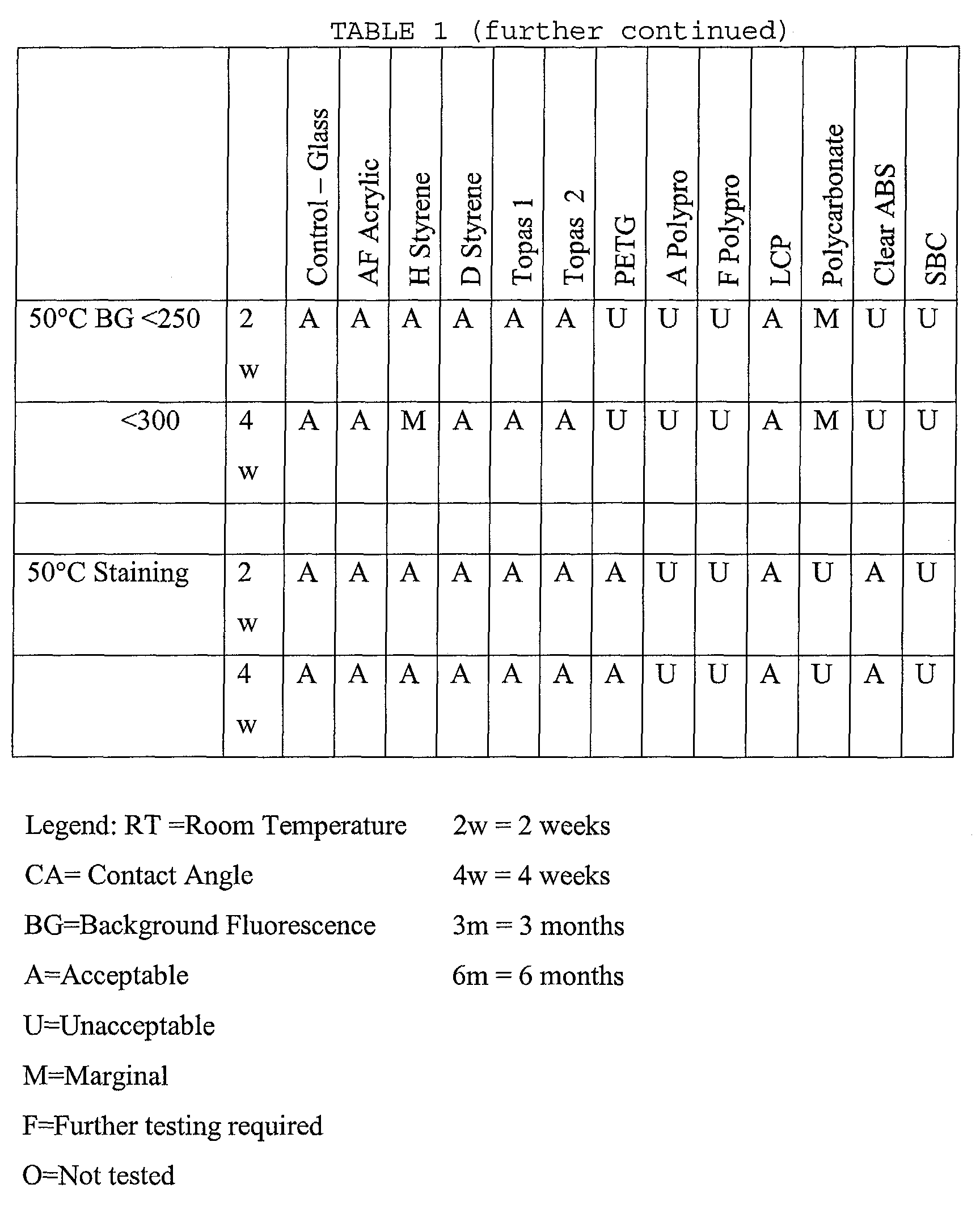
- Corning GAPSTM glass slides were obtained and slides were placed in close proximity to 1" X 3" X 1 mm injection molded slides of various polymeric resins shown in the table and figures in a sealed glass container. All glassware was thoroughly cleaned with oxygen plasma prior to testing and the containers were sealed with Parafilm® made by American National Can in Menasha, Wisconsin, and stored at either room temperature or 50° C. The materials tested included a variety of polymeric materials and controls, which were sealed glass staining dishes.
- the glass slides were removed and measured for change in water contact angle using deionized water using a standard laboratory goniometer. Slides were also measured for a change in background fluorescence using an Axon Instruments GenePixTM 4000A Microarray Scanner with a photomultiplier tube setting of 750 volts and at wavelengths of about 532 nm and 635 nm. Measurements were made on the glass slides the day they were coated with the GAPSTM coating and prior to being placed in proximity to the plastic slides, and these measurements are represented as "0" or "Day of Coat” in the Figures.
- Gold stain tests were also performed on the slides by placing slides in Colloidal Gold Total Protein stain (Blotting Grade manufactured by Bio-Rad Laboratories in Hercules, CA) overnight and then rinsing with water and drying with nitrogen. The stain attaches to an amine surface. Acceptable slides were those that exhibited an evenly stained surface. The results for all tests are summarized in Table I below.
- the AF Acrylic material tested was Plexiglass V825 available from ATOFINA Chemicals
- the H Styrene tested was product number 101-300 available from Huntsman Corporation
- the D Styrene tested was DOW STYRON 695
- the Topas 1 tested was TOPAS® grade 8007 S04 made by Ticona of Summit, NJ
- the Topas 2 tested was TOPAS® grade 8007 D61 made by Ticona of Summit, NJ
- the PETG tested was EASTAR® copolyester MN058 made by Eastman Chemical
- the A polypro tested was Achieve 1615 polypropylene available from ExxonMobil®
- the F polypro tested was Fina EOD 0017
- the LCP tested was Vectra® LCP liquid crystal copolymer available from Ticona
- the polycarbonate tested was Bayer Makrolon 2508-available from Bay
- Figure 2 is a graph showing the background fluorescence of glass slides stored with various materials for periods of 2 weeks, 4 weeks and 3 months. Initial background fluorescence readings were about 75 RFU for all samples. Acceptable materials produced a change in background fluorescence that was less than about 75 to 80 RFU for each of the time intervals measured compared to the control. The background fluorescence data is discussed further below with respect to Figure 8.
- Figure 3 is a graph of water contact angle versus time for slides stored at room temperature for 2 week, 4 weeks and 3 months.
- Each of the samples tested were either acceptable or marginally acceptable, except for the F polypro sample and the SBC compound.
- the AF acrylic material was the only material to produce results that were consistently lower than the control, indicating that this sample should be retested.
- Figure 7 shows the change in water contact angle of slides stored at room temperature with each of the materials. Acceptable samples exhibited a change in contact angle of no more than 12 degrees greater than the change in water contact angle of slides stored in a sealed glass container (the control) at room temperature for up to 3 months.
- the change in water contact angle on slides stored with the materials was no greater than 8 degrees greater than control slides stored in for up to 3 months at room temperature.
- the slides exhibited a change in contact angle of no more than 4 degrees greater than the change in contact angle of control slides stored at room temperature for 3 months.
- Figure 4 is graph of background fluorescence versus time for samples held at 50° C for 2 weeks and 4 weeks. All samples were acceptable or marginally acceptable, except for the polyethylene Terephthalate, Glycol modified (PETG), A polypro, F polypro, clear ABS and SBC compound.
- Figure 5 is a graph of water contact angle on the glass slides for samples held at 50° C for 2 weeks and 4 weeks. All samples were acceptable or marginally acceptable except for A polypro, F Polypro, and the SBC compound.
- Figure 7 shows the change in contact angle over time for slides stored with various material samples at 50° C compared to a control, which were slides stored in a glass container.
- Acceptable materials caused the slides to exhibit a change in water contact angle of no more than about 10 degrees greater than the control after storage with the samples for up to 4 weeks.
- the change in water contact angle of slides stored with these materials for up to 4 weeks at 50° C was no more than about 5 degrees greater than the control.
- Figure 8 is a graph of test material background fluorescence (RFU) versus control slide background fluorescence for samples stored six months.
- the control was slides stored in a glass container.
- the data was generated in different scanners at the same operating conditions.
- the inventors evaluated the change in background fluorescence due to different packaging materials over time for both room temperature and 50° C storage conditions.
- results are adequate to separate the effects of the different materials on the coated slides.
- absolute RFU values at a given voltage setting will differ, sometimes greatly, from one scanner to another. Applicants observed that results may differ considerably even between two scanners of the same model operating under essentially the same conditions.
- PMT settings of 550, 650, 750, and 850 were used for two different scanners.
- increasing the PMT setting of the scanner increases the background fluorescence of the slides measured.
- PMT photomultiplier tube
Landscapes
- Engineering & Computer Science (AREA)
- Mechanical Engineering (AREA)
- Health & Medical Sciences (AREA)
- Clinical Laboratory Science (AREA)
- Chemical & Material Sciences (AREA)
- Chemical Kinetics & Catalysis (AREA)
- Apparatus Associated With Microorganisms And Enzymes (AREA)
- Investigating, Analyzing Materials By Fluorescence Or Luminescence (AREA)
- Packages (AREA)
Abstract
Description


Claims (11)
- A package for biological substrates comprising:a container with an enclosure for holding a plurality of slides within;said substrates having a surface with a chemical coating or layer adapted to attach a biomolecule thereto;charactertized in that the enclosure being made from a material that does not degrade said coating or an ability of said biomolecules to attach to the slide surface either during shipping or storage of the slides for at least four weeks.
- A method of packaging slides that have a coating or layer adapted for the attachment of biomolecules on a surface thereof, the method comprises: providing a container having an enclosure for holding a plurality of said slides, characterized in that said container does not degrade the ability of biomolecules to attach or bind to the surfaces of the slides when the slides are stored in the container for at least four weeks; placing a plurality of said slides in said container.
- The invention according to either claim 1 or claim 2, wherein said material of the container comprises a polymeric material.
- The invention according to claim 3, wherein said material of the container is includes any one of the following: cyclic olefinic copolymers, polycarbonates, styrene, polymethacrylates and ABS.
- The invention according any one of the preceding claims, wherein said slides exhibit an acceptable relative increase in background fluorescence after storage in the container for six months.
- The invention according to claim 4, wherein a linear relationship between a) the increase in background fluorescence, measured as a function of increasing photomultiplier tube (PMT) setting of slides stored for six months in a container made from said material, and b) the increase in background fluorescence measured at increasing photomultiplier tube settings of slides stored for six months in a glass container is defined by the equation, y = mx + b, where y is the background fluorescence value in RFUs of a slide stored with the material, x is the background fluorescence value of a slide stored in a glass container, m is the slope of the linear relationship, and b is the value of y when x = 0, and the value of m is less than or equal to 3.
- The invention according to claim 5, wherein the value of m is less than or equal to 2.5.
- The invention according to claim 1 or claim 2, wherein the slides exhibit a relative change in water contact angle of less than or equal to about 12 degrees greater than a change in water angle of slides stored in a sealed glass container after storage in said sealed glass containers at room temperature for up to 3 months.
- The invention according to claim 7, wherein the slides exhibit a change in water contact angle of no more than 8 degrees greater than the change in water angle of slides stored in a sealed glass container after storage in the sealed glass containers at room temperature for up to 3 months.
- The invention according to any one of the preceding claims, wherein the slides are adapted for printing of microarrays of biomolecules.
- The invention according to any one of the preceding claims, wherein the coating or layer includes gamma amino propyl-silane.
Applications Claiming Priority (2)
| Application Number | Priority Date | Filing Date | Title |
|---|---|---|---|
| US40378902P | 2002-08-15 | 2002-08-15 | |
| US403789P | 2002-08-15 |
Publications (2)
| Publication Number | Publication Date |
|---|---|
| EP1394075A2 true EP1394075A2 (en) | 2004-03-03 |
| EP1394075A3 EP1394075A3 (en) | 2006-03-08 |
Family
ID=31495992
Family Applications (1)
| Application Number | Title | Priority Date | Filing Date |
|---|---|---|---|
| EP03077555A Withdrawn EP1394075A3 (en) | 2002-08-15 | 2003-08-14 | Packages for biological substrates and methods of packaging such substrates |
Country Status (2)
| Country | Link |
|---|---|
| US (1) | US7191901B2 (en) |
| EP (1) | EP1394075A3 (en) |
Families Citing this family (9)
| Publication number | Priority date | Publication date | Assignee | Title |
|---|---|---|---|---|
| WO2004003552A1 (en) * | 2002-06-28 | 2004-01-08 | Canon Kabushiki Kaisha | Method for producing probe carrier, apparatus for producing the same and method for quality assurance therefor |
| DE10251650B4 (en) * | 2002-10-30 | 2005-05-04 | Schott Ag | Containers for storing and transporting delicate platelike articles and use of such |
| US7198768B2 (en) * | 2004-06-16 | 2007-04-03 | Corning Incorporated | Anti-degradation mechanisms for protecting aminated surfaces |
| CA2580922C (en) * | 2004-09-23 | 2013-06-04 | Tripath Imaging, Inc. | Polycationic polymer coatings for immobilizing biological samples |
| US7562776B1 (en) | 2005-09-27 | 2009-07-21 | Melynda Bautista Ludwig | Slide holder for staining specimens disposed on microscope slides |
| WO2009018324A1 (en) * | 2007-07-31 | 2009-02-05 | Genoptix, Inc. | Microscope slide container |
| US20110127269A1 (en) | 2008-05-15 | 2011-06-02 | Michael Bucholtz | Vial with non-round seal |
| EP2237051A1 (en) * | 2009-03-31 | 2010-10-06 | Centro de Investigación Cooperativa En Biomateriales ( CIC biomaGUNE) | Liquid-tight container for storing and transporting AFM probes |
| FR3008908B1 (en) * | 2013-07-25 | 2017-09-15 | Eric Chapotat | CONTAINER FOR CLEANING AN IMMERSE OBJECT IN A FLUID COMPRISING FERROMAGNETIC COMPONENTS |
Family Cites Families (18)
| Publication number | Priority date | Publication date | Assignee | Title |
|---|---|---|---|---|
| US3532604A (en) * | 1967-10-03 | 1970-10-06 | Alfred Bloch | Biological package |
| US3621994A (en) * | 1969-11-25 | 1971-11-23 | Metropolitan Pathology Lab Inc | Laboratory specimen mailer |
| US4635791A (en) * | 1983-01-31 | 1987-01-13 | Bio-Innovations | Container package for staining biological specimens |
| EP0128583B1 (en) | 1983-06-14 | 1988-12-14 | Robert Bosch Gmbh | Four-wheel drive vehicle |
| US4589551A (en) * | 1984-07-31 | 1986-05-20 | Maclean-Fogg Company | Container for handling, transportation and storage of microscope slides |
| US5080225A (en) * | 1989-11-20 | 1992-01-14 | Russo Laurence M | Universal diagnostic sample packaging tray and pouch |
| US5098618A (en) * | 1990-03-14 | 1992-03-24 | Joseph Zelez | Surface modification of plastic substrates |
| US5090568A (en) * | 1991-03-11 | 1992-02-25 | Medscand (U.S.A.), Inc. | Glass slide mailer |
| US5620097A (en) | 1994-12-30 | 1997-04-15 | Ortho Pharmaceutical Corporation | Protective packaging system |
| US6171780B1 (en) * | 1997-06-02 | 2001-01-09 | Aurora Biosciences Corporation | Low fluorescence assay platforms and related methods for drug discovery |
| US6361745B1 (en) * | 1999-09-08 | 2002-03-26 | Packard Instrument Company, Inc. | Microarray storage device for use in an automated microarray handling system |
| US6348965B1 (en) * | 1999-09-24 | 2002-02-19 | Henry Palladino | Solid state fluorescence and absorption spectroscopy |
| JP2001298076A (en) * | 2000-04-12 | 2001-10-26 | Sony Corp | Substrate transport container |
| WO2001096193A2 (en) * | 2000-06-12 | 2001-12-20 | Incyte Genomics, Inc. | Microscope slide container |
| US6787312B2 (en) * | 2001-08-09 | 2004-09-07 | Corning Incorporated | Treatment of substrates for immobilizing biomolecules |
| US6984485B2 (en) * | 2002-04-23 | 2006-01-10 | Beckman Coulter, Inc. | Polymer-coated substrates for immobilization of biomolecules and cells |
| US20040086874A1 (en) * | 2002-10-31 | 2004-05-06 | Parker Russell A. | Devices and methods for holding a biopolymeric array |
| US20040096914A1 (en) * | 2002-11-20 | 2004-05-20 | Ye Fang | Substrates with stable surface chemistry for biological membrane arrays and methods for fabricating thereof |
-
2003
- 2003-03-27 US US10/400,205 patent/US7191901B2/en not_active Expired - Lifetime
- 2003-08-14 EP EP03077555A patent/EP1394075A3/en not_active Withdrawn
Also Published As
| Publication number | Publication date |
|---|---|
| EP1394075A3 (en) | 2006-03-08 |
| US7191901B2 (en) | 2007-03-20 |
| US20040031712A1 (en) | 2004-02-19 |
Similar Documents
| Publication | Publication Date | Title |
|---|---|---|
| US9428800B2 (en) | Thermal cycling apparatus and method | |
| US7220573B2 (en) | Array assay devices and methods of using the same | |
| CN101371139B (en) | Supports for assaying analytes and methods of making and using thereof | |
| AU2008208342B2 (en) | Analysis chip and analysis method | |
| US20110003699A1 (en) | Thermal Cycler for Microfluidic Array Assays | |
| US20060078463A1 (en) | Array assay devices and methods of using the same | |
| JP2005535909A (en) | Substrates for material separation, reaction, and microscopic analysis | |
| US7191901B2 (en) | Substrate container that does not degrade substrate surface | |
| CN1555294A (en) | Thermally Conductive Microtiter Plates | |
| CN102356319B (en) | Analysis chip, analysis method and method for stirring solution | |
| US20030235521A1 (en) | Array assay devices and methods of using the same | |
| US9005549B2 (en) | High throughput polymer-based microarray slide | |
| US20060263795A1 (en) | Method and apparatus for facilitating the creation and analysis of microarrays | |
| CA2245013C (en) | Analytical measurement method and its use | |
| WO2002064829A2 (en) | Biochemical method and apparatus for detecting genetic characteristics | |
| Sobek et al. | Quality considerations and selection of surface chemistry for glass-based DNA, peptide, antibody, carbohydrate, and small molecule microarrays | |
| JP2003247990A (en) | Inspection substrate for biochemical inspection and micro substrate used for it | |
| RU2424322C2 (en) | Diagnostic test and set for detecting biomolecules | |
| US20050074780A1 (en) | Device for analyzing slides | |
| Dietrich et al. | Chapter The Role of Substrates in Microarray Experimentation and How to Choose the Correct Coating for Microarraying | |
| JP2015179069A (en) | Biochip | |
| HK1074881B (en) | Arrays of microparticles and methods of preparation thereof | |
| HK1074881A1 (en) | Arrays of microparticles and methods of preparation thereof | |
| WO2006090165A1 (en) | Detection of analytes in samples |
Legal Events
| Date | Code | Title | Description |
|---|---|---|---|
| PUAI | Public reference made under article 153(3) epc to a published international application that has entered the european phase |
Free format text: ORIGINAL CODE: 0009012 |
|
| AK | Designated contracting states |
Kind code of ref document: A2 Designated state(s): AT BE BG CH CY CZ DE DK EE ES FI FR GB GR HU IE IT LI LU MC NL PT RO SE SI SK TR |
|
| AX | Request for extension of the european patent |
Extension state: AL LT LV MK |
|
| PUAL | Search report despatched |
Free format text: ORIGINAL CODE: 0009013 |
|
| AK | Designated contracting states |
Kind code of ref document: A3 Designated state(s): AT BE BG CH CY CZ DE DK EE ES FI FR GB GR HU IE IT LI LU MC NL PT RO SE SI SK TR |
|
| AX | Request for extension of the european patent |
Extension state: AL LT LV MK |
|
| RIC1 | Information provided on ipc code assigned before grant |
Ipc: G02B 21/34 20060101ALI20060118BHEP Ipc: B01L 9/00 20060101ALI20060118BHEP Ipc: B65D 85/48 20060101AFI20031205BHEP |
|
| 17P | Request for examination filed |
Effective date: 20060612 |
|
| AKX | Designation fees paid |
Designated state(s): CH DE FR GB LI NL |
|
| 17Q | First examination report despatched |
Effective date: 20061124 |
|
| GRAP | Despatch of communication of intention to grant a patent |
Free format text: ORIGINAL CODE: EPIDOSNIGR1 |
|
| STAA | Information on the status of an ep patent application or granted ep patent |
Free format text: STATUS: THE APPLICATION IS DEEMED TO BE WITHDRAWN |
|
| 18D | Application deemed to be withdrawn |
Effective date: 20100504 |