EP1392117B1 - Herbicidal mixture comprising a benzoyl derivative, a fertilizer containing nitrogen and an adjuvant - Google Patents
Herbicidal mixture comprising a benzoyl derivative, a fertilizer containing nitrogen and an adjuvant Download PDFInfo
- Publication number
- EP1392117B1 EP1392117B1 EP02742935A EP02742935A EP1392117B1 EP 1392117 B1 EP1392117 B1 EP 1392117B1 EP 02742935 A EP02742935 A EP 02742935A EP 02742935 A EP02742935 A EP 02742935A EP 1392117 B1 EP1392117 B1 EP 1392117B1
- Authority
- EP
- European Patent Office
- Prior art keywords
- alkyl
- dione
- chloro
- cyclohexane
- hydrogen
- Prior art date
- Legal status (The legal status is an assumption and is not a legal conclusion. Google has not performed a legal analysis and makes no representation as to the accuracy of the status listed.)
- Expired - Lifetime
Links
- 0 CC1=NOC(*)(C*)C1 Chemical compound CC1=NOC(*)(C*)C1 0.000 description 2
Classifications
-
- A—HUMAN NECESSITIES
- A01—AGRICULTURE; FORESTRY; ANIMAL HUSBANDRY; HUNTING; TRAPPING; FISHING
- A01N—PRESERVATION OF BODIES OF HUMANS OR ANIMALS OR PLANTS OR PARTS THEREOF; BIOCIDES, e.g. AS DISINFECTANTS, AS PESTICIDES OR AS HERBICIDES; PEST REPELLANTS OR ATTRACTANTS; PLANT GROWTH REGULATORS
- A01N41/00—Biocides, pest repellants or attractants, or plant growth regulators containing organic compounds containing a sulfur atom bound to a hetero atom
- A01N41/02—Biocides, pest repellants or attractants, or plant growth regulators containing organic compounds containing a sulfur atom bound to a hetero atom containing a sulfur-to-oxygen double bond
- A01N41/10—Sulfones; Sulfoxides
-
- A—HUMAN NECESSITIES
- A01—AGRICULTURE; FORESTRY; ANIMAL HUSBANDRY; HUNTING; TRAPPING; FISHING
- A01N—PRESERVATION OF BODIES OF HUMANS OR ANIMALS OR PLANTS OR PARTS THEREOF; BIOCIDES, e.g. AS DISINFECTANTS, AS PESTICIDES OR AS HERBICIDES; PEST REPELLANTS OR ATTRACTANTS; PLANT GROWTH REGULATORS
- A01N43/00—Biocides, pest repellants or attractants, or plant growth regulators containing heterocyclic compounds
- A01N43/72—Biocides, pest repellants or attractants, or plant growth regulators containing heterocyclic compounds having rings with nitrogen atoms and oxygen or sulfur atoms as ring hetero atoms
- A01N43/80—Biocides, pest repellants or attractants, or plant growth regulators containing heterocyclic compounds having rings with nitrogen atoms and oxygen or sulfur atoms as ring hetero atoms five-membered rings with one nitrogen atom and either one oxygen atom or one sulfur atom in positions 1,2
-
- C—CHEMISTRY; METALLURGY
- C05—FERTILISERS; MANUFACTURE THEREOF
- C05G—MIXTURES OF FERTILISERS COVERED INDIVIDUALLY BY DIFFERENT SUBCLASSES OF CLASS C05; MIXTURES OF ONE OR MORE FERTILISERS WITH MATERIALS NOT HAVING A SPECIFIC FERTILISING ACTIVITY, e.g. PESTICIDES, SOIL-CONDITIONERS, WETTING AGENTS; FERTILISERS CHARACTERISED BY THEIR FORM
- C05G3/00—Mixtures of one or more fertilisers with additives not having a specially fertilising activity
- C05G3/60—Biocides or preservatives, e.g. disinfectants, pesticides or herbicides; Pest repellants or attractants
Definitions
- the invention relates to the technical field of herbicides, in particular to herbicidal compositions comprising certain benzoylcyclohexanediones in combination with nitrogen fertilizers and adjuvants, which are useful for the selective control of weeds and weed grasses in important plant crops.
- the invention also comprises a method of controlling undesirable vegetation in the presence of a crop, particularly a corn crop, by applying to the locus of the crop or undesired vegetation a herbicidal composition comprising a herbicidally effective amount of the benzoyl derivative, a fertilizer containing nitrogen and one or more adjuvants, optionally in mixture with additional herbicides or safeners.
- Nitrogen is well known in the art as a fertilizer and is described in Farm Chemicals Handbook, 1988 Edition on pages B48 and B49.
- Commercially available nitrogen containing fertilizers include anhydrous ammonia, ammonium nitrate, ammonium sulfate, urea, nitrogen solutions (which include urea ammonium nitrate), potassium nitrate, and combinations thereof.
- adjuvant includes surfactants, such as wetting agents, emulsifiers, dispersing agents and/or organic solvents, mineral and vegetable oils and combinations thereof.
- Adjuvants especially those which are suitable for agrochemical use, are for example known from Foy, C. L., Adjuvants for agrichemicals, CRC Press Inc., Boca Raton, Florida, USA.
- the present invention provides a method of controlling the growth of weeds at a locus which comprises applying to said locus a herbicidally effective amount of:
- agriculturally acceptable salts salts the cations of which are known and accepted in the art for the formation of salts for agricultural or horticultural use.
- the salts are water-soluble.
- Suitable salts with bases include alkali metal (eg. sodium and potassium), alkaline earth metal (eg. calcium and magnesium), ammonium and amine (eg. diethanolamine, triethanolamine, octylamine, morpholine and dioctylmethylamine) salts.
- metal complexes compounds wherein R 4 represents hydrogen (or a tautomer thereof) in which one or more of the oxygen atoms of the 2-benzoyl derivatives of formula (I) act as chelating agents to a metal cation.
- examples of such cations include zinc, manganese, cupric, cuprous, ferric, ferrous, titanium and aluminium.
- Fertilizers containing nitrogen are commonly classified as either nitrate or ammonium types.
- Commercially available ammonium types include anhydrous ammonia, aqueous ammonia, ammonium nitrate, ammonium sulfate, fluid nitrogen fertilizers and urea.
- the nitrate type fertilizers include ammonium nitrate, nitrogen solutions, calcium nitrate and sodium nitrate.
- the preferred fertilizers containing nitrogen are nitrogen solutions.
- the most preferred fertilizers containing nitrogen are urea ammonium nitrate (UAN) wherein the % N is from about 28% to about 33%; ammonium sulfate; urea; glycine, or mixtures thereof.
- UAN solution and other nitrogen solutions can be prepared by processes known in the art.
- the amount of fertilizer containing nitrogen used in the mixtures is generally from about 50-3000g/ha, preferably from about 50-1500g/ha, and more preferably from about 150-300g/ha.
- the preferred adjuvants are surfactants or organic liquids, the latter containing, if necessary, suitable emulsifiers to facilitate homogenous distribution of the liquid in the spray tank.
- surfactant types include nonionic, anionic, cationic and amphoteric surfactants.
- anionic surfactants include:
- cationic surfactants include:
- nonionic surfactants examples include:
- amphoteric surfactants examples include:
- organic liquids examples are:
- Examples of preferred surfactants in the present invention include the following:
- inert adjuvants can also be incorporated into the compositions of this invention to provide a more satisfactory formulation.
- inert adjuvants include spreaders, emulsifiers, dispersing agents, foaming adjuvants, foam suppressants, penetrants and correctives.
- herbicide is used herein to denote a compound which controls or modifies the growth of plants.
- plants is used to include all postemergent vegetation, ranging from seedlings to established vegetation.
- fertilizer containing nitrogen is used herein to denote a primary nutrient that is required by all plants in considerable quantities for plant growth.
- the method of the present invention allows the grower to apply the fertilizer containing nitrogen, the adjuvant and the herbicide together in a single operation, which has the advantage of time and labour savings.
- Preferred compounds of the invention are of formula (Ia): wherein:
- the benzoyl derivatives of formula (I) may be prepared by known methods, for example as described in WO 00/21924 and WO 01/07422.
- the mixtures according to the invention have an excellent herbicidal activity against a broad spectrum of economically important mono- and dicotyledonous harmful plants.
- the active substances also act efficiently on perennial weeds which produce shoots from rhizomes, root stocks or other perennial organs and are difficult to control.
- Typical monocotyledonous and dicotyledonous weed flora which can be controlled by the compounds according to the invention include the following:
- Harmful plants occurring under the specific cultivation conditions of rice such as, for example, Echinochloa, Sagittaria, Alisma, Eleocharis, Scirpus and Cyperus, are also outstandingly well controlled by the mixtures of the invention.
- mixtures according to the invention have an excellent herbicidal activity against mono- and dicotyledonous weeds, crop plants of economically important crops such as, for example, wheat, barley, rye, rice, maize, sugar beet, cotton and soybeans, are damaged only to an insignificant extent or not at all.
- crop plants of economically important crops such as, for example, wheat, barley, rye, rice, maize, sugar beet, cotton and soybeans.
- the present mixtures are very suitable for the selective control of undesired vegetation in crops of agriculturally useful plants or in crops of ornamental plants.
- the mixtures of the invention can also be employed for the control of harmful plants in crops of known genetically modified plants or genetically modified plants yet to be developed.
- the transgenic plants are distinguished by particularly advantageous properties, for example by resistances to certain pesticides, especially certain herbicides, resistances to plant diseases or pathogens of plant diseases such as certain insects or microorganisms such as fungi, bacteria or viruses.
- the mixtures according to the invention are preferably used in economically important transgenic crops of useful and ornamental plants, e.g. of cereals such as wheat, barley, rye, oats, millet, rice, cassava and corn or alternatively crops of sugar beet, cotton, soybeans, oilseed rape, potatoes, tomatoes, peas and other types of vegetables.
- cereals such as wheat, barley, rye, oats, millet, rice, cassava and corn or alternatively crops of sugar beet, cotton, soybeans, oilseed rape, potatoes, tomatoes, peas and other types of vegetables.
- the mixtures of the invention can preferably be employed as herbicides in useful plant crops which are resistant or have been made genetically resistant to the phytotoxic effects of the herbicides.
- the invention therefore also relates to the use of the above mixtures according to the invention as herbicides for controlling harmful plants in transgenic crop plants.
- compositions which comprise:
- the compounds of the formula (I) can be formulated in various ways, depending on what biological and/or chemicophysical parameters are prespecified.
- suitable formulation possibilities are: wettable powders (WP), water-soluble powders (SP), water-soluble concentrates, emulsifiable concentrates (EC), emulsions (EW), such as oil-in-water and water-in-oil emulsions, sprayable solutions, suspension concentrates (SC), dispersions on an oil or water basis, oil-miscible solutions, capsule suspensions (CS), dusting agents (DP), dressing agents, granules for broadcasting and soil application, granules (GR) in the form of microgranules, spray granules, coated granules and adsorption granules, water-dispersible granules (WG), water-soluble granules (SG), ULV formulations, microcapsules and waxes.
- WP wettable powders
- SP water-soluble
- combinations with other pesticidally active substances such as, for example, insecticides, acaricides, herbicides, fungicides, and also with safeners, fertilizers and/or growth regulators can also be prepared, e.g. in the form of a finished formulation or as a tank mix.
- Wettable powders are preparations which are uniformly dispersible in water and which, beside the active compound, also contain surfactants of ionic and/or nonionic type (wetting agents, dispersants), e.g. polyoxyethylated alkylphenols, polyoxethylated fatty alcohols, polyoxethylated fatty amines, fatty alcohol polyglycol ether sulfates, alkanesulfonates, alkylbenzenesulfonates, sodium lignosulfonates, sodium 2,2'-dinaphthylmethane-6,6'-disulfonates, sodium dibutylnaphthalenesulfonates or alternatively sodium oleoylmethyltaurates in addition to a diluent or inert substance.
- the herbicidal active substances are finely ground, for example, in customary equipment such as hammer mills, blowing mills and air
- Emulsifiable concentrates are prepared by dissolving the active substance in an organic solvent, e.g. butanol, cyclohexanone, dimethylformamide, xylene or alternatively relatively high-boiling aromatics or hydrocarbons or mixtures of the organic solvents with addition of one or more surfactants of ionic and/or nonionic type (emulsifiers).
- organic solvent e.g. butanol, cyclohexanone, dimethylformamide, xylene or alternatively relatively high-boiling aromatics or hydrocarbons or mixtures of the organic solvents with addition of one or more surfactants of ionic and/or nonionic type (emulsifiers).
- alkylarylsulfonic acid calcium salts such as Ca dodecylbenzenesulfonate or nonionic emulsifiers
- fatty acid polyglycol esters alkylaryl polyglycol ethers, fatty alcohol polyglycol ethers, propylene oxide-ethylene oxide condensation products, alkyl polyethers, sorbitan esters such as, for example, sorbitan fatty acid esters or polyoxyethylene sorbitan esters such as, for example, polyoxyethylene sorbitan fatty acid esters.
- Dusting agents are obtained by grinding the active substance with finely divided solid substances, e.g. talc, natural clays, such as kaolin, bentonite and pyrophyllite, or diatomaceous earth.
- finely divided solid substances e.g. talc, natural clays, such as kaolin, bentonite and pyrophyllite, or diatomaceous earth.
- Suspension concentrates can be water- or oil-based. They can be prepared, for example, by wet grinding by means of commercially available bead mills and, if appropriate, addition of surfactants, such as have already been mentioned, for example, above in the case of the other formulation types.
- Emulsions e.g. oil-in-water emulsions (EW)
- EW oil-in-water emulsions
- Granules can either be prepared by spraying the active substance onto adsorptive, granulated inert material or by applying active substance concentrates to the surface of carriers such as sand, kaolinites or of granulated inert material by means of binders, e.g. polyvinyl alcohol, sodium polyacrylates or alternatively mineral oils.
- binders e.g. polyvinyl alcohol, sodium polyacrylates or alternatively mineral oils.
- Suitable active substances can also be granulated in the manner customary for the preparation of fertilizer granules - if desired as a mixture with fertilizers.
- water-dispersible granules are prepared by the customary processes such as spray-drying, fluidized bed granulation, disk granulation, mixing using high-speed mixers and extrusion without solid inert material.
- the agrochemical preparations contain 0.1 to 99% by weight, in particular 0.1 to 95% by weight, of active substance of the formula (I).
- the active substance concentration is, for example, approximately 10 to 90% by weight, the remainder to 100% by weight consists of customary formulation constituents. In the case of emulsifiable concentrates, the active substance concentration can be approximately 1 to 90, preferably 5 to 80, % by weight.
- Formulations in the form of dusts contain 1 to 30% by weight of active substance, preferably usually 5 to 20% by weight of active substance, sprayable solutions contain approximately 0.002 to 2%, preferably 0.01-0.2%, by weight of active substance.
- the active substance content depends partly on whether the active compound is liquid or solid and which granulation auxiliaries, fillers etc. are used. In the case of water-dispersible granules, the content of active substance is, for example, between 1 and 95% by weight, preferably between 10 and 80% by weight.
- the active substance formulations mentioned optionally contain the binders, wetting agents, dispersants, emulsifiers, penetrants, preservatives, antifreeze agents and solvents, fillers, carriers and colorants, antifoams, evaporation inhibitors and the pH and viscosity regulators which are customary in each case.
- Components which can be employed for the active substances according to the invention in mixed formulations or in a tank mix are, for example, known active substances, such as are described, for example, in Weed Research 26, 441-445 (1986) or "The Pesticide Manual", 11th edition, The British Crop Protection Council and the Royal Soc. of Chemistry, 1997 and references cited there.
- the formulations present in commercially available form are diluted, if appropriate, in a customary manner, e.g. by means of water in the case of wettable powders, emulsifiable concentrates, dispersions and water-dispersible granules. Preparations in the form of dusts, soil or broadcasting granules and sprayable solutions are customarily not diluted further with other inert substances before use.
- the application rate of the compounds of the formula (I) necessary varies with the external conditions such as, inter alia, temperature, humidity and the type of herbicide used. It can vary within wide limits, e.g. between 0.001 and 10.0 kg/ha or more of active substance, but is preferably between 0.005 and 5 kg/ha, and more preferably between 0.01 and 1 kg/ha.
- pre-mix formulations of the above ingredients (a), (b) and (c) provide an improved level of weed control and crop selectivity compared to tank mixtures, and accordingly the pre-mix formulations form a preferred aspect of the present invention.
- the herbicidal compounds characterized by "WP20” have been used as a wettable powder comprising 20% active ingredient, 20% Wessalon SV, 10% surfactant, 30% Texapon K12, 5% Calogon T, 0.2% Fluowet PP, 14.8% Kaolin W.
- the wettable powders have been made by processes known to one skilled in the art.
- Seeds of various crop and weed species were planted in a sandy-loamy soil and placed in a climate chamber in a greenhouse under good growth conditions. Four weeks after sowing, the plants were sprayed with a tank mixture containing the formulated test compound at a spray rate of 300l/ha of spray solution. The plants were visually assessed fourteen days after application, and the percentage control of the plants is shown in Tables 1 and 2. The results show that the weed control for compounds B1 and B2 formulated with Hasten (soybean oil based adjuvant) is further improved by the addition of ammonium sulfate.
- Seeds of the various weed species and rice crop varieties were planted in a sandy-loamy soil in a greenhouse under good growth conditions. Three weeks after sowing, the plants were sprayed with a tank mixture containing the formulated test compound at a spray rate of 600l/ha of spray solution. The plants were visually assessed three weeks after application, and the percentage control of the plants is shown in Table 3. The results show that the weed control for compound B2 formulated with surfactants alone or with ammonium sulfate alone is dramatically improved by the addition of ammonium sulfate or a surfactant respectively whereas the damage in rice species is very low.
- Seeds of the various weed species and rice were planted in a sandy-loamy soil in a greenhouse under good growth conditions. Three weeks after sowing the tank mixture containing the formulated test compound was applied to the plants submerged in the paddy water. The plants were visually assessed three weeks after application, and the percentage control of the plants is shown in Table 4 in comparison with untreated controls. The results show that the weed control for compound B2 formulated with ethylated soya oil is improved by the addition of ammonium sulfate. No rice damage was observed.
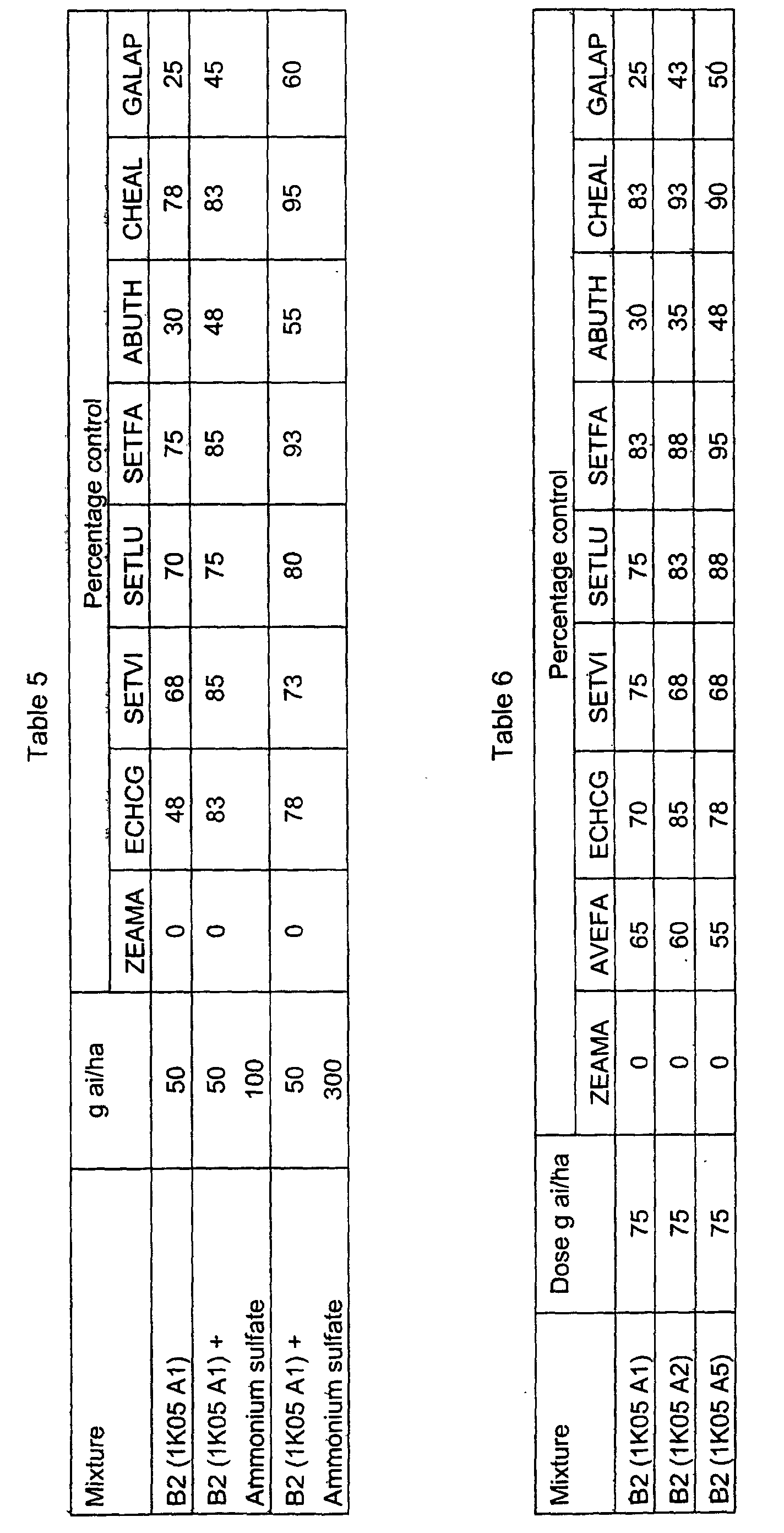
- Tables 5, 6 and 7 show that the weed control for compound B2 formulated as a non aqueous suspension concentrate was improved by the addition of ammonium sulfate. No maize damage was observed.
- Table 7 illustrates the results using two different surfactants.
- Example 9 Using the method of Example 1 in an outdoor pot trial the following results shown in table 9 were obtained.
- the results show that the weed control for compound B2 formulated as oil dispersion 1K05 A1 is improved by the addition of ammonium sulfate, and in addition that there is an optimum amount of ammonium sulfate for efficacy enhancement.
- Ammonium sulfate in the range of 100g/ha to 300g/ha gave the best weed control.
- Table 10 shows that the weed control is improved by the addition of nitrogen fertilizer. The results also show the effects of varying the amount of nitrogen fertilizer, and that the weed control was greater using 300g/ha compared with 3000g/ha of ammonium sulfate.
- Example 1 The method of Example 1 was repeated but employing varying amounts of surfactant.
- Table 11 show that there is an optimum amount of surfactant for the best weed control.
- 100g/ha to 1000g/ha of ActirobB, and 100g/ha to 300g/ha of GenapolX090 gave the best weed control, whilst higher amounts were less effective.
- Example 12 Using the method of Example 1 in an outdoor plot trial there were obtained the following results shown in Table 12. The results show that the weed control for compound B2 used as a pre-mix formulation as an oil dispersion 1K03 A1 is higher than that of the tank mixture of the wettable powder plus 2l/ha of the surfactant ActirobB plus 3kg/ha of ammonium sulphate.
- Mixture Dose g ai/ha Percentage control ZEAMA SETVI SETLU B2 (WP20) 50 0 48 35 B2 (WP20) + ActirobB + Ammonium sulfate 50 2000 3000 5 93 78 B2 (1K03 A1) 50 0 100 83
Landscapes
- Life Sciences & Earth Sciences (AREA)
- Pest Control & Pesticides (AREA)
- Plant Pathology (AREA)
- General Health & Medical Sciences (AREA)
- Agronomy & Crop Science (AREA)
- Health & Medical Sciences (AREA)
- Engineering & Computer Science (AREA)
- Dentistry (AREA)
- Wood Science & Technology (AREA)
- Zoology (AREA)
- Environmental Sciences (AREA)
- Organic Chemistry (AREA)
- Chemical & Material Sciences (AREA)
- Agricultural Chemicals And Associated Chemicals (AREA)
- Fertilizers (AREA)
Abstract
Description
- The invention relates to the technical field of herbicides, in particular to herbicidal compositions comprising certain benzoylcyclohexanediones in combination with nitrogen fertilizers and adjuvants, which are useful for the selective control of weeds and weed grasses in important plant crops. The invention also comprises a method of controlling undesirable vegetation in the presence of a crop, particularly a corn crop, by applying to the locus of the crop or undesired vegetation a herbicidal composition comprising a herbicidally effective amount of the benzoyl derivative, a fertilizer containing nitrogen and one or more adjuvants, optionally in mixture with additional herbicides or safeners.
- There are many patent applications which describe benzoylcyclohexanedione herbicides. Certain benzoylcyclohexanedione compounds disclosed in WO 00/21924 and in WO 0107422 form a particularly useful class of such compounds. WO 9963823 discloses herbicidal mixtures containing a 3-heterocyclyl substituted benzoyl derivative of a pyrazole with an adjuvant and a fertilizer. WO 0053014 discloses herbicidal mixtures containing a 3-heterocyclyl substituted benzoyl derivative of a pyrazole with an adjuvant. WO 9219107 discloses herbicidal mixtures of certain 2-benzoyl-cyclohexane-1,3-dione derivatives with a nitrogen containing fertilizer and an adjuvant.
- The use of the benzoylcyclohexanediones known from these patents is, however, frequently associated with disadvantages in practice. For example the herbicidal activity of the known compounds is not always adequate, or if the herbicidal activity is adequate undesired damage to the useful plants is observed.
- Nitrogen is well known in the art as a fertilizer and is described in Farm Chemicals Handbook, 1988 Edition on pages B48 and B49. Commercially available nitrogen containing fertilizers include anhydrous ammonia, ammonium nitrate, ammonium sulfate, urea, nitrogen solutions (which include urea ammonium nitrate), potassium nitrate, and combinations thereof.
- The term adjuvant includes surfactants, such as wetting agents, emulsifiers, dispersing agents and/or organic solvents, mineral and vegetable oils and combinations thereof. Adjuvants, especially those which are suitable for agrochemical use, are for example known from Foy, C. L., Adjuvants for agrichemicals, CRC Press Inc., Boca Raton, Florida, USA.
- The applicants have found that the herbicidal performance of these compounds may be markedly improved using a combination of certain benzoylcyclohexanedione compounds, together with a fertilizer containing nitrogen and one or more adjuvants.
- The present invention provides a method of controlling the growth of weeds at a locus which comprises applying to said locus a herbicidally effective amount of:
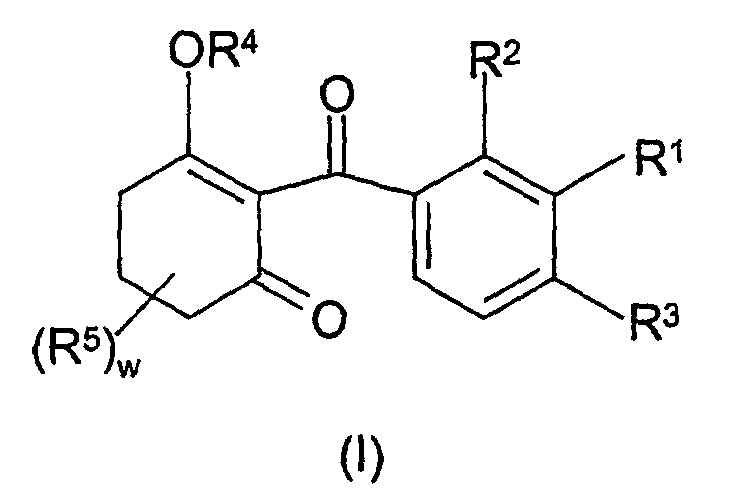
- (a) a benzoyl derivative of formula (I):
wherein:

- R1
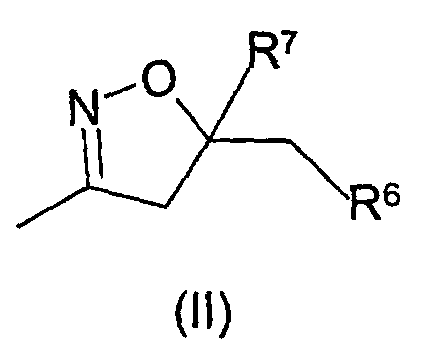
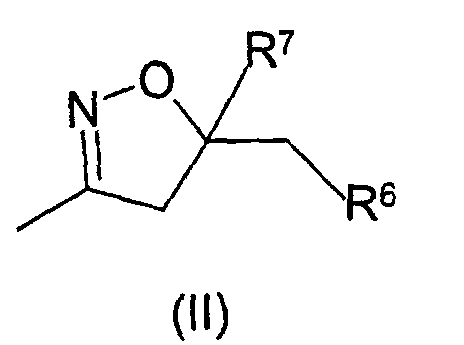
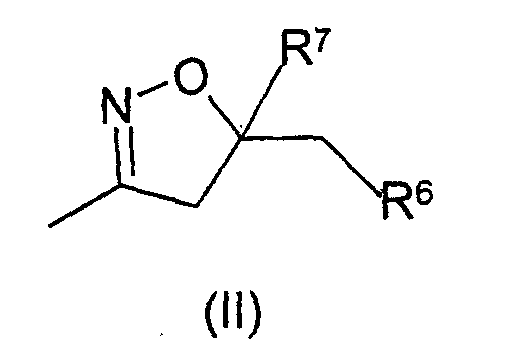
- is a formula (II):

- or R1
- is -CH2O(haloalkyl), -CH2O(alkyl), -CH2O(cycloalkyl), -CH2OCH2(cycloalkyl), -CH2O(CH2)2O(CH2)2Oalkyl, -CH2S(haloalkyl), -CH2OCH2R8 or -OCH2(cycloalkyl);
- R2 and R3
- independently of one another are hydrogen, halogen, cyano, nitro, -S(O)nalkyl, -S(O)nhaloalkyl, alkyl, haloalkyl, alkoxy or haloalkoxy;
- R4
- is hydrogen, -SO2alkyl, -COphenyl or -SO2phenyl (the phenyl groups of which are optionally substituted by alkyl, haloalkyl, alkoxy, haloalkoxy, halogen, cyano or nitro);
- R5
- is hydrogen or alkyl;
- R6
- is cyano, CONH2, NHSO2alkyl, NHSO2haloalkyl, OR9, CO2alkyl, -S(O)nalkyl or -S(O)nhaloalkyl;
- R7
- is hydrogen or alkyl;
- R8
- is a 2-tetrahydrofuranyl, 3-tetrahydrofuranyl or 2-tetrahydropyranyl ring;
- R9
- is hydrogen, alkyl, haloalkyl, alkenyl, haloalkenyl, alkynyl, cycloalkyl, cycloalkylalkyl or cycloalkenyl;
- w
- is 1 or 2; and
- n
- is 0,1 or 2;
- (b) a fertilizer containing nitrogen; and
- (c) one or more adjuvants.
-
- Compounds of formula (I) in which R4 is hydrogen may exist in a number keto or enolic tautomeric forms. Furthermore in certain cases the above substituents may contribute to optical isomerism and/or stereoisomerism. All such forms and mixtures are embraced by the present invention.
- In the description unless otherwise specified the following terms are generally defined thus:-
- 'alkyl' means a straight- or branched- chain alkyl group having one to six carbon atoms;
- 'haloalkyl' means a straight- or branched- chain alkyl group having one to six carbon atoms, substituted by one or more halogens;
- 'alkoxy' means a straight- or branched- chain alkoxy group having one to six carbon atoms;
- 'haloalkoxy' means a straight- or branched- chain alkoxy group having one to six carbon atoms, substituted by one or more halogens;
- 'alkenyl' means a straight- or branched- chain alkenyl group having two to six carbon atoms;
- 'haloalkenyl' means a straight- or branched- chain alkenyl group having two to six carbon atoms, substituted by one or more halogens;
- 'alkynyl' means a straight- or branched- chain alkynyl group having three to six carbon atoms;
- 'haloalkynyl' means a straight- or branched- chain alkynyl group having three to six carbon atoms, substituted by one or more halogens;
- 'cycloalkyl' means a three to six membered saturated carbocyclic ring;
- 'cycloalkenyl' means a five or six membered mono unsaturated carbocyclic ring; 'halogen' means a fluorine, chlorine, bromine or iodine atom.
-
- By the term "agriculturally acceptable salts" is meant salts the cations of which are known and accepted in the art for the formation of salts for agricultural or horticultural use. Preferably the salts are water-soluble. Suitable salts with bases include alkali metal (eg. sodium and potassium), alkaline earth metal (eg. calcium and magnesium), ammonium and amine (eg. diethanolamine, triethanolamine, octylamine, morpholine and dioctylmethylamine) salts.
- By the term "metal complexes" is meant compounds wherein R4 represents hydrogen (or a tautomer thereof) in which one or more of the oxygen atoms of the 2-benzoyl derivatives of formula (I) act as chelating agents to a metal cation. Examples of such cations include zinc, manganese, cupric, cuprous, ferric, ferrous, titanium and aluminium.
- Fertilizers containing nitrogen are commonly classified as either nitrate or ammonium types. Commercially available ammonium types include anhydrous ammonia, aqueous ammonia, ammonium nitrate, ammonium sulfate, fluid nitrogen fertilizers and urea. The nitrate type fertilizers include ammonium nitrate, nitrogen solutions, calcium nitrate and sodium nitrate. The preferred fertilizers containing nitrogen are nitrogen solutions. The most preferred fertilizers containing nitrogen are urea ammonium nitrate (UAN) wherein the % N is from about 28% to about 33%; ammonium sulfate; urea; glycine, or mixtures thereof. The UAN solution and other nitrogen solutions can be prepared by processes known in the art.
- The amount of fertilizer containing nitrogen used in the mixtures is generally from about 50-3000g/ha, preferably from about 50-1500g/ha, and more preferably from about 150-300g/ha.
- The present applicants have unexpectedly found that there is an optimal amount of fertilizer containing nitrogen present in the mixtures which provides the most effective weed control performance.
- The preferred adjuvants are surfactants or organic liquids, the latter containing, if necessary, suitable emulsifiers to facilitate homogenous distribution of the liquid in the spray tank.
Surfactant types include nonionic, anionic, cationic and amphoteric surfactants. Examples of anionic surfactants include: - a) carboxylic acid salts, for example sodium and potassium salts of coconut oil fatty acids;
- b) sulfonic acid salts, for example linear or branched chain alkyl benzene sulfonates, sodium, calcium and ammonium lignosulfonates, petroleum sulfonates, paraffin sulfonates and alkyl naphthalene sulfonates;
- c) sulfuric acid ester salts, for example sulfated linear primary alcohols; and
- d) phosphonic acid polyphosphonic acid esters, for example sodium alkyl phosphate; and
- e) esters of phosphoric acid or sulfuric acid with ethoxylated-di- and tristyrylphenols,as free acid or salt.
-
- Examples of cationic surfactants include:
- a) long chain amines;
- b) quaternary ammonium salts, for example cetyltrimethyl ammonium bromide and N-alkyl trimethyl ammonium chloride; and
- c) polyoxyethylenated long chain amines.
-
- Examples of nonionic surfactants include:
- a) polyoxyethylenated alkyl phenols;
- b) polyoxyethylenated saturated and unsaturated fatty alcohols;
- c) polyoxyethylenated polyoxypropylene glycols;
- d) glyceryl and polyglyceryl esters of natural fatty acids;
- e) ethoxylated sorbitan ester for instance Atplus 309 F;
- f) alkanolamines;
- g) tertiary acetylenic glycols;
- h) polyoxyethylenated silicones;
- i) N-alkyl pyrrolidones;
- j) alkyl polyglycosides;
- k) ethoxylated arylalkylphenols;
- l) ethoxylated alkylphenols;
- m) ethoxylated hydroxy-fatty acids, such as for example castor oil derivatives;
- n) block-copolymers of ethyleneoxide and propyleneoxide; and
- o) condensation products of EO-PO blockcopolymers and ethylendiamine.
-
- Examples of amphoteric surfactants include:
- a) beta-N-alkylaminopropionic acids;
- b) N-alkyl-beta-iminodipropionic acids;
- c) imidazoline carboxylates;
- d) N-alkylbetaines;
- e) amino oxides;
- f) sulfobetaines or sultaines; and
- g) phosphatides.
-
- These surfactants and others are described in Drew Myers, Surfactants Science and Technology, (New York: VCH Publishers, Inc., 1988), Chapter 2 and Milton J. Rosen, Surfactants and Interfacial Phenomena, 2nd Edition, (New York: John Wiley and Sons, Inc., 1989), Chapter 1.
- Examples of organic liquids are:
- 1. Nonpolar solvents such as:
- a) aromatic hydrocarbons, i.e.derivatives of benzene, for example toluene, xylene, mesitylene, diisopropylbenzene, indane and derivatives of naphthalene such as 1-methylnaphthalene, 2-methylnaphthalene;
- b) aliphatic hydrocarbons, for example pentane, hexane, octane, cyclohexane and aliphatic and isoparaffinic mineral oils (Exol D, Isopor of EXXon);
- c) mixtures of aromatic and aliphatic hydrocarbons (Solvesso);
- d) halogenated aliphatic hydrocarbons such as methylene chloride; and
- e) halogenated aromatic hydrocarbons such as chlorobenzene or dichlorobenzene;
- 2. polar lipophilic liquids:
- a) vegetable or animal-oils fatty acid glycerol esters or fatty acid glycol esters, for example corn seed oil, cotton seed oil, linseed oil, soya oil, coconut oil, palm oil, thistle oil and castor oil;
- b) esters of saturated and unsaturated fatty acids (monocarboxylic acid monoesters), such as (C1-C7) alkanecarboxylic acid-(C1-C6)alkylester, saturated and unsaturated (C8-C22) fatty acid-(C1-C6) alkylesters such as alkyl esters of caprylic acid, capric acid, lauric acid, palmitic acid, stearic acid, oleic acid, linoleic acid, linolenic acid and derivatives of vegetable and animal oils such as alkylated rape seed oil;
- c) esters of aromatic carboxylic acids such as phthalic acid- (C1-C12) alkylester, especially phthalic acid-(C4-C8)alkylester;
- d) esters of other organic acids for example [(C1-C18alkyl]-phosphonic acid-di-[(C1-C12)alkyl)- and/or - cycloalkyl]-ester, preferably a [(C4-C16alkyl]-phosphonic acid-di-(C1-C12)alkyl)-ester, in particular octanephosphonic acid-bis-(2-ethylhexyl)-ester (HOE S 4326,Clariant);
- 3. mixtures of solvents from classes 1) and/or 2) above.
-
- Examples of preferred surfactants in the present invention include the following:
- polyoxyethylene sorbitan monolaurates; alkylaryl-polyoxyethylenes; paraffin based petroleum oil; polyoxyethylated polyol fatty acids and polyol fatty esters; crop oil concentrate; and silicone based additives.
-
- In addition to the above surfactants, other inert adjuvants can also be incorporated into the compositions of this invention to provide a more satisfactory formulation. Such inert adjuvants include spreaders, emulsifiers, dispersing agents, foaming adjuvants, foam suppressants, penetrants and correctives.
- The term herbicide is used herein to denote a compound which controls or modifies the growth of plants. The term plants is used to include all postemergent vegetation, ranging from seedlings to established vegetation.
- The term fertilizer containing nitrogen is used herein to denote a primary nutrient that is required by all plants in considerable quantities for plant growth. The method of the present invention allows the grower to apply the fertilizer containing nitrogen, the adjuvant and the herbicide together in a single operation, which has the advantage of time and labour savings.
- It has in addition unexpectedly been found that there is an optimal amount of surfactant present in the mixtures of the invention which provides the most effective weed control.
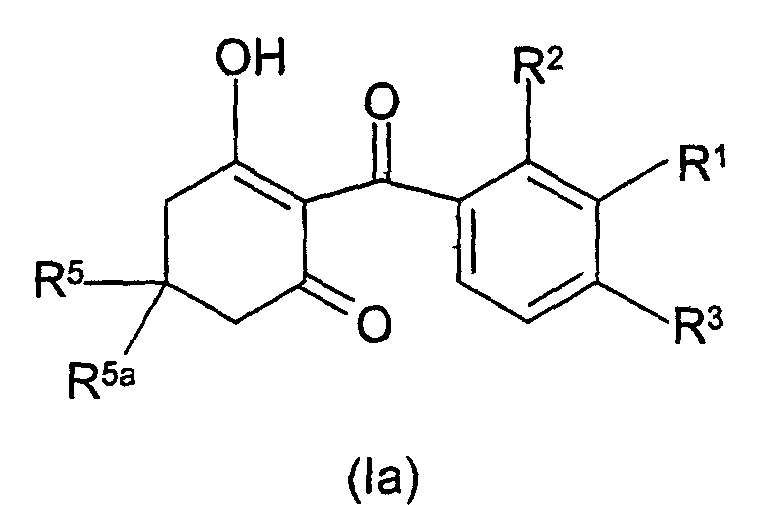
- Preferred compounds of the invention are of formula (Ia):wherein:

- R1 is a
- formula (II):
- or R1
- is -CH2O-(halo-C1-C4-alkyl), -CH2O-(C1-C4-alkyl), -CH2O(CH2)2O(CH2)2O- C1-C4-alkyl, -CH2OCH2R8 or -OCH2-(C3-C6-cycloalkyl);
- R2
- is methyl, -S(O)nmethyl, -S(O)nethyl or halogen;
- R3
- is trifluoromethyl, -S(O)nmethyl, -S(O)nethyl or halogen;
- R5 and R5a
- are each hydrogen, methyl or ethyl;
- R6
- is cyano or OR9;
- R7
- is hydrogen or C1-C4-alkyl;
- R8
- is a 2-tetrahydrofuranyl or 3-tetrahydrofuranyl ring; and
- R9
- is C1-C4-alkyl.
- More preferred compounds of the invention are of formula (Ia) wherein:
- R1
- is a formula (II):
- or R1
- is -CH2O-(halo-C1-C4-alkyl) (wherein haloalkyl is preferably ethyl substituted by from one to five fluorine atoms), -CH2O-(C1-C4-alkyl), -CH2O(CH2)2O(CH2)2Omethyl, -CH2OCH2R8 or -OCH2(cyclopropyl);
- R2
- is halogen or methyl;
- R3
- is -S(O)nmethyl or -S(O)nethyl;
- R5 and R5a
- are each hydrogen or methyl;
- R6
- is cyano or OR9;
- R7
- is hydrogen or methyl;
- R8
- is a 2-tetrahydrofuranyl ring; and
- R9
- is methyl or ethyl.
- The most preferred compounds of formula (I) are:
- 2-[2-chloro-3-(5-cyanomethylisoxazolin-3-yl)-4-ethylsulfonylbenzoyl]cyclohexane-1,3-dione;
- 2-[2-chloro-3-(2,2,2-trifluoroethoxymethyl)-4-methylsulfonylbenzoyl]cyclohexane-1,3-dione;
- 2-{2-chloro-4-methylsulfonyl-3-[tetrahydrofuran-2-yl]methoxymethyl]benzoyl}cyclohexane-1,3-dione;
- 2-[2-chloro-3-(5-ethoxymethylisoxazolin-3-yl)-4-ethylsulfonylbenzoyl]cyclohexane-1,3-dione;
- 2-[2-chloro-3-(2,2-difluoroethoxymethyl)-4-ethylsulfonylbenzoyl]cyclohexane-1,3-dione;
- 2-[2-chloro-3-(methoxyethoxyethoxymethyl)-4-methylsulfonylbenzoyl]cyclohexane-1,3-dione;
- 2-[2-chloro-3-(5-methoxymethyl-5-methylisoxazolin-3-yl)-4-methylsulfonylbenzoyl]-cyclohexane-1,3-dione;
- 2-[2-chloro-4-ethylsulfonyl-3-(5-methoxymethyl-5-methylisoxazolin-3-yl)benzoyl]-cyclohexane-1,3-dione;
- 2-[2-chloro-3-(5-ethoxymethyl-5-methylisoxazolin-3-yl)-4-methylsulfonylbenzoyl]-cyclohexane-1,3-dione;
- 2-[2-chloro-4-ethylsulfonyl-3-(5-methoxymethylisoxazolin-3-yl)benzoyl]cyclohexane-1,3-dione;
- 2-[2-chloro-3-cyclopropylmethoxy-4-methylsulfonylbenzoyl]-5,5-dimethylcyclohexane-1,3-dione;
- 2-[2-chloro-3-cyclopropylmethoxy-4-methylsulfonylbenzoyl]cyclohexane-1,3-dione; and
- 2-[2-chloro-3-(1,1,2,2,2-pentafluoroethoxymethyl)-4-methylsulfonylbenzoyl]cyclohexane-1,3-dione.
-
- The benzoyl derivatives of formula (I) may be prepared by known methods, for example as described in WO 00/21924 and WO 01/07422.
- The mixtures according to the invention have an excellent herbicidal activity against a broad spectrum of economically important mono- and dicotyledonous harmful plants. The active substances also act efficiently on perennial weeds which produce shoots from rhizomes, root stocks or other perennial organs and are difficult to control.
- Typical monocotyledonous and dicotyledonous weed flora which can be controlled by the compounds according to the invention include the following:
- monocotyledonous weed species, for example, Avena, Lolium, Alopecurus, Phalaris, Echinochloa, Digitaria, Setaria and Cyperus species from the annual group and, amongst the perennial species, Agropyron, Cynodon, Imperata and Sorghum and also perennial Cyperus species, and
- dicotyledonous weed species, for example, Galium, Viola, Veronica, Lamium, Stellaria, Amaranthus, Sinapis, Ipomoea, Matricaria, Abutilon and Sida amongst the annuals and Convolvulus, Cirsium, Rumex and Artemisia in the case of the perennial weeds.
-
- Harmful plants occurring under the specific cultivation conditions of rice, such as, for example, Echinochloa, Sagittaria, Alisma, Eleocharis, Scirpus and Cyperus, are also outstandingly well controlled by the mixtures of the invention.
- Although the mixtures according to the invention have an excellent herbicidal activity against mono- and dicotyledonous weeds, crop plants of economically important crops such as, for example, wheat, barley, rye, rice, maize, sugar beet, cotton and soybeans, are damaged only to an insignificant extent or not at all. For these reasons, the present mixtures are very suitable for the selective control of undesired vegetation in crops of agriculturally useful plants or in crops of ornamental plants.
- On account of their herbicidal properties, the mixtures of the invention can also be employed for the control of harmful plants in crops of known genetically modified plants or genetically modified plants yet to be developed. As a rule, the transgenic plants are distinguished by particularly advantageous properties, for example by resistances to certain pesticides, especially certain herbicides, resistances to plant diseases or pathogens of plant diseases such as certain insects or microorganisms such as fungi, bacteria or viruses.
- The mixtures according to the invention are preferably used in economically important transgenic crops of useful and ornamental plants, e.g. of cereals such as wheat, barley, rye, oats, millet, rice, cassava and corn or alternatively crops of sugar beet, cotton, soybeans, oilseed rape, potatoes, tomatoes, peas and other types of vegetables.
- The mixtures of the invention can preferably be employed as herbicides in useful plant crops which are resistant or have been made genetically resistant to the phytotoxic effects of the herbicides.
- The invention therefore also relates to the use of the above mixtures according to the invention as herbicides for controlling harmful plants in transgenic crop plants.
- According to a further feature of the present invention, there are provided compositions which comprise:
- (a) a herbicidally effective amount of a benzoyl derivative of formula (I) or an agriculturally acceptable salt or metal complex thereof;
- (b) a fertilizer containing nitrogen; and
- (c) one or more adjuvants; in association with a herbicidally acceptable diluent or carrier and/or surface active agent.
-
- The compounds of the formula (I) can be formulated in various ways, depending on what biological and/or chemicophysical parameters are prespecified. Examples of suitable formulation possibilities are: wettable powders (WP), water-soluble powders (SP), water-soluble concentrates, emulsifiable concentrates (EC), emulsions (EW), such as oil-in-water and water-in-oil emulsions, sprayable solutions, suspension concentrates (SC), dispersions on an oil or water basis, oil-miscible solutions, capsule suspensions (CS), dusting agents (DP), dressing agents, granules for broadcasting and soil application, granules (GR) in the form of microgranules, spray granules, coated granules and adsorption granules, water-dispersible granules (WG), water-soluble granules (SG), ULV formulations, microcapsules and waxes.
- These individual formulation types are known in principle and are described, for example, in: Winnacker-Küchler, "Chemische Technologie" [Chemical Technology], Volume 7, C. Hauser Verlag Munich, 4th Edition 1986, Wade van Valkenburg, "Pesticide Formulations", Marcel Dekker, N.Y., 1973; K. Martens, "Spray Drying" Handbook, 3rd Ed. 1979, G. Goodwin Ltd. London.
- The necessary formulation auxiliaries such as inert materials, surfactants, solvents and other additives are also known and are described, for example, in: Watkins, "Handbook of Insecticide Dust Diluents and Carriers", 2nd Ed., Darland Books, Caldwell N.J., H.v. Olphen, "Introduction to Clay Colloid Chemistry"; 2nd Ed., J. Wiley & Sons, N.Y.; C. Marsden, "Solvents Guide"; 2nd Ed., Interscience, N.Y. 1963; McCutcheon's "Detergents and Emulsifiers Annual", MC Publ. Corp., Ridgewood N.J.; Sisley and Wood, "Encyclopedia of Surface Active Agents", Chem. Publ. Co. Inc., N.Y. 1964; Schönfeldt, "Grenzflächenaktive Äthylenoxidaddukte" [Surface-Active Ethylene Oxide Adducts], Wiss. Verlagsgesell., Stuttgart 1976; Winnacker-Küchler, "Chemische Technologie" [Chemical Technology], Volume 7, C. Hauser Verlag Munich, 4th Edition 1986.
- On the basis of these formulations, combinations with other pesticidally active substances such as, for example, insecticides, acaricides, herbicides, fungicides, and also with safeners, fertilizers and/or growth regulators can also be prepared, e.g. in the form of a finished formulation or as a tank mix.
- Wettable powders are preparations which are uniformly dispersible in water and which, beside the active compound, also contain surfactants of ionic and/or nonionic type (wetting agents, dispersants), e.g. polyoxyethylated alkylphenols, polyoxethylated fatty alcohols, polyoxethylated fatty amines, fatty alcohol polyglycol ether sulfates, alkanesulfonates, alkylbenzenesulfonates, sodium lignosulfonates, sodium 2,2'-dinaphthylmethane-6,6'-disulfonates, sodium dibutylnaphthalenesulfonates or alternatively sodium oleoylmethyltaurates in addition to a diluent or inert substance. For preparation of the wettable powders, the herbicidal active substances are finely ground, for example, in customary equipment such as hammer mills, blowing mills and air-jet mills and simultaneously or subsequently mixed with the formulation auxiliaries.
- Emulsifiable concentrates are prepared by dissolving the active substance in an organic solvent, e.g. butanol, cyclohexanone, dimethylformamide, xylene or alternatively relatively high-boiling aromatics or hydrocarbons or mixtures of the organic solvents with addition of one or more surfactants of ionic and/or nonionic type (emulsifiers). Examples of emulsifiers which can be used are: alkylarylsulfonic acid calcium salts such as Ca dodecylbenzenesulfonate or nonionic emulsifiers such as fatty acid polyglycol esters, alkylaryl polyglycol ethers, fatty alcohol polyglycol ethers, propylene oxide-ethylene oxide condensation products, alkyl polyethers, sorbitan esters such as, for example, sorbitan fatty acid esters or polyoxyethylene sorbitan esters such as, for example, polyoxyethylene sorbitan fatty acid esters.
- Dusting agents are obtained by grinding the active substance with finely divided solid substances, e.g. talc, natural clays, such as kaolin, bentonite and pyrophyllite, or diatomaceous earth.
- Suspension concentrates can be water- or oil-based. They can be prepared, for example, by wet grinding by means of commercially available bead mills and, if appropriate, addition of surfactants, such as have already been mentioned, for example, above in the case of the other formulation types.
- Emulsions, e.g. oil-in-water emulsions (EW), can be prepared, for example, by means of stirrers, colloid mills and/or static mixers using aqueous organic solvents and, if appropriate, surfactants, such as have already been mentioned.
- Granules can either be prepared by spraying the active substance onto adsorptive, granulated inert material or by applying active substance concentrates to the surface of carriers such as sand, kaolinites or of granulated inert material by means of binders, e.g. polyvinyl alcohol, sodium polyacrylates or alternatively mineral oils.
- Suitable active substances can also be granulated in the manner customary for the preparation of fertilizer granules - if desired as a mixture with fertilizers.
- As a rule, water-dispersible granules are prepared by the customary processes such as spray-drying, fluidized bed granulation, disk granulation, mixing using high-speed mixers and extrusion without solid inert material.
- For the preparation of disk, fluidized bed, extruder and spray granules, see, for example, processes in "Spray-Drying Handbook" 3rd ed. 1979, G. Goodwin Ltd., London; J.E. Browning, "Agglomeration", Chemical and Engineering 1967, pages 147 ff; "Perry's Chemical Engineer's Handbook", 5th Ed., McGraw-Hill, New York 1973, pp. 8-57.
- For further details on the formulation of plant protection agents see, for example, G.C. Klingman, "Weed Control as a Science", John Wiley and Sons, Inc., New York, 1961, pages 81-96 and J.D. Freyer, S.A. Evans, "Weed Control Handbook", 5th Ed., Blackwell Scientific Publications, Oxford, 1968, pages 101-103.
- As a rule, the agrochemical preparations contain 0.1 to 99% by weight, in particular 0.1 to 95% by weight, of active substance of the formula (I).
- In wettable powders, the active substance concentration is, for example, approximately 10 to 90% by weight, the remainder to 100% by weight consists of customary formulation constituents. In the case of emulsifiable concentrates, the active substance concentration can be approximately 1 to 90, preferably 5 to 80, % by weight. Formulations in the form of dusts contain 1 to 30% by weight of active substance, preferably usually 5 to 20% by weight of active substance, sprayable solutions contain approximately 0.002 to 2%, preferably 0.01-0.2%, by weight of active substance. In the case of water-dispersible granules, the active substance content depends partly on whether the active compound is liquid or solid and which granulation auxiliaries, fillers etc. are used. In the case of water-dispersible granules, the content of active substance is, for example, between 1 and 95% by weight, preferably between 10 and 80% by weight.
- In addition, the active substance formulations mentioned optionally contain the binders, wetting agents, dispersants, emulsifiers, penetrants, preservatives, antifreeze agents and solvents, fillers, carriers and colorants, antifoams, evaporation inhibitors and the pH and viscosity regulators which are customary in each case.
- Components which can be employed for the active substances according to the invention in mixed formulations or in a tank mix are, for example, known active substances, such as are described, for example, in Weed Research 26, 441-445 (1986) or "The Pesticide Manual", 11th edition, The British Crop Protection Council and the Royal Soc. of Chemistry, 1997 and references cited there.
- For use, the formulations present in commercially available form are diluted, if appropriate, in a customary manner, e.g. by means of water in the case of wettable powders, emulsifiable concentrates, dispersions and water-dispersible granules. Preparations in the form of dusts, soil or broadcasting granules and sprayable solutions are customarily not diluted further with other inert substances before use.
- The application rate of the compounds of the formula (I) necessary varies with the external conditions such as, inter alia, temperature, humidity and the type of herbicide used. It can vary within wide limits, e.g. between 0.001 and 10.0 kg/ha or more of active substance, but is preferably between 0.005 and 5 kg/ha, and more preferably between 0.01 and 1 kg/ha.
- According to a further feature of the present invention there is provided a product comprising:
- (a) a herbicidally effective amount of a benzoyl derivative of formula (I) or an agriculturally acceptable salt or metal complex thereof;
- (b) a fertilizer containing nitrogen; and
- (c) one or more adjuvants; in association with a herbicidally acceptable diluent or carrier and/or surface active agent; as a combined preparation for separate, simultaneous or sequential use in the control of weeds at a locus.
-
- It has unexpectedly been found that pre-mix formulations of the above ingredients (a), (b) and (c) provide an improved level of weed control and crop selectivity compared to tank mixtures, and accordingly the pre-mix formulations form a preferred aspect of the present invention.
- The following non-limiting examples illustrate the method of the invention. The compounds of formula (I) used in the Examples are given the following codes:
- B1 = 2-[2-chloro-3-(2,2,2-trifluoroethoxymethyl)-4-methylsulfonylbenzoyl]cyclohexane-1,3-dione;
- B2 = 2-[2-chloro-3-(5-cyanomethylisoxazolin-3-yl)-4-ethylsulfonylbenzoyl]cyclohexane-1,3-dione;
- B3 = 2-(2-chloro-4-methylsulfonyl-3-[tetrahydrofuran-2-yl]methoxymethyl]benzoyl}cyclohexane-1,3-dione;
- B4 = 2-[2-chloro-3-(methoxyethoxyethoxymethyl)-4-methylsulfonylbenzoyl]cyclohexane-1,3-dione; and
- B5 = 2-[2-chloro-3-(1,1,2,2,2-pentafluoroethoxymethyl)-4-methylsulfonylbenzoyl]cyclohexane-1,3-dione.
-
- The following codes are used for the various crop and weed species:
- HORVS = Barley; ORYSP = Transplanted Paddy Rice; ORYSW = Seeded Paddy Rice; ZEAMA = Maize; ABUTH = Abutilon theophrasti; AMARE = Amaranthus retroflexus; AVEFA = Avena fatua; CHEAL = Chenopodium album; CYPIR = Cyperus iria; CYPES = Cyperus esculentus; ECHCG = Echinochloa crus-galli; GALAP = Galium aparine; MATCH = Matricaria chamomilla; POLCO = Polygonum convolvulus; SETFA = Setaria faberii; SETLU = Setaria lutescens; SETVI = Setaria viridis; STEME = Stellaria media; and VIOTR = Viola tricolor.
-
- In the following examples the herbicidal compounds characterized by "WP20" have been used as a wettable powder comprising 20% active ingredient, 20% Wessalon SV, 10% surfactant, 30% Texapon K12, 5% Calogon T, 0.2% Fluowet PP, 14.8% Kaolin W. The wettable powders have been made by processes known to one skilled in the art.
- Other symbols used as abbreviations of formulation types are described at the end of table 12.
- Seeds of various crop and weed species were planted in a sandy-loamy soil and placed in a climate chamber in a greenhouse under good growth conditions. Four weeks after sowing, the plants were sprayed with a tank mixture containing the formulated test compound at a spray rate of 300l/ha of spray solution. The plants were visually assessed fourteen days after application, and the percentage control of the plants is shown in Tables 1 and 2. The results show that the weed control for compounds B1 and B2 formulated with Hasten (soybean oil based adjuvant) is further improved by the addition of ammonium sulfate.
Mixture Dose g a.i./ha Percentage control SETLU ABUTH MATCH POLCO VIOTR B1 (WP20) 75 58 85 43 43 65 B1 (WP20)
+ Hasten75
175078 90 43 83 70 B1 (WP20)
+ Hasten
+ Ammonium sulfate75
1750
300075 95 58 88 70 Mixture Dose g a.i./ha Percentage control ABUTH AMARE CHEAL VIOTR B2 (WP20) 75 40 68 60 55 B2 (WP20)
+ Hasten75
175075 83 95 65 B2 (WP20)
+ Hasten
+ Ammonium sulfate75
1750
300090 85 98 70 - Seeds of the various weed species and rice crop varieties were planted in a sandy-loamy soil in a greenhouse under good growth conditions. Three weeks after sowing, the plants were sprayed with a tank mixture containing the formulated test compound at a spray rate of 600l/ha of spray solution. The plants were visually assessed three weeks after application, and the percentage control of the plants is shown in Table 3. The results show that the weed control for compound B2 formulated with surfactants alone or with ammonium sulfate alone is dramatically improved by the addition of ammonium sulfate or a surfactant respectively whereas the damage in rice species is very low.
Mixture Dose g a.i./ha Percentage control Rice Variety Weed species Senia Cypress ECHCG CYPES B2 (WP20) 50 0 0 0 15 B2 (WP20)
+ Ammonium sulfate50 8 3 40 20 B2 (WP20)
+ Hasten
+ Ammonium sulfate50
500
3003 5 91 35 - Seeds of the various weed species and rice were planted in a sandy-loamy soil in a greenhouse under good growth conditions. Three weeks after sowing the tank mixture containing the formulated test compound was applied to the plants submerged in the paddy water. The plants were visually assessed three weeks after application, and the percentage control of the plants is shown in Table 4 in comparison with untreated controls. The results show that the weed control for compound B2 formulated with ethylated soya oil is improved by the addition of ammonium sulfate. No rice damage was observed.
Mixture Dose g ai/ha Percentage control ORYSP CYPES B2 (WP20) 12.5 0 45 B2 (WP20)
+ Hasten12.5
5000 40 B2 (WP20)
+ Hasten
+ Ammonium sulfate12.5
500
3000 75 - Using the method of Example 1 but in an outdoor pot trial in the field there were obtained the following results shown in Tables 5, 6 and 7. The results of Tables 5 and 6 show that the weed control for compound B2 formulated as a non aqueous suspension concentrate was improved by the addition of ammonium sulfate. No maize damage was observed. Table 7 illustrates the results using two different surfactants.

- Using the method of Example 1 the following results shown in Table 8 were obtained, which show that the weed control for compound B2 formulated as water based liquid formulations is improved by the addition of urea or glycine.
Mixture Doseg a.i./ha Percentage control HORVS ZEAMA STEME AMARE CYPIR B2 (00 SL05 A1) 100 13 0 28 80 33 B2 (00 SL05 A5) 100 0 0 63 90 48 B2 (00 SL05 A6) 100 0 0 68 89 45 - Using the method of Example 1 in an outdoor pot trial the following results shown in table 9 were obtained. The results show that the weed control for compound B2 formulated as oil dispersion 1K05 A1 is improved by the addition of ammonium sulfate, and in addition that there is an optimum amount of ammonium sulfate for efficacy enhancement. Ammonium sulfate in the range of 100g/ha to 300g/ha gave the best weed control.
Mixture Dose g ai/ha Percentage control ZEAMA ECHCG LOLMU SETVI ABUTH GALAP B2, 1K05A1 50 0 60 10 68 30 25 B2, 1K05A1 + (NH4)2SO4 50
1000 48 13 85 48 45 B2, 1K05A1 + (NH4)2SO4 50
1500 75 13 80 43 50 Mixture Percentage control ZEAMA ECHCG LOLMU SETVI ABUTH GALAP B2, 1K05A1 + (NH4)2SO4 50
3000 83 18 73 55 63 B2, 1K05A1 + (NH4)2SO4 50
10000 78 15 73 50 60 B2, 1K05A1 + (NH4)2SO4 50
30000 60 13 68 45 45 - Example 7 Weed control postemergence in greenhouse trials
- Using the method of Example 1 but with other compounds of formula (I), Table 10 shows that the weed control is improved by the addition of nitrogen fertilizer. The results also show the effects of varying the amount of nitrogen fertilizer, and that the weed control was greater using 300g/ha compared with 3000g/ha of ammonium sulfate.
Mixture Dose g ai/ha Percentage control SINAL PHBPU AVEFA B4 (WP20)+2I ActirobB 50 20 20 0 B4 (WP20)+2I ActirobB + Ammonium sulfate 50
30065 70 20 B4 (WP20)+21 ActirobB + Ammonium sulfate 50
300060 55 0 B5 (WP20)+2I ActirobB 50 60 75 30 B5 (WP20)+2I ActirobB + Ammonium sulfate 50
30070 80 35 B5 (WP20)+2I ActirobB + Ammonium sulfate 50
300060 45 30 - The method of Example 1 was repeated but employing varying amounts of surfactant. The results in Table 11 show that there is an optimum amount of surfactant for the best weed control. Thus 100g/ha to 1000g/ha of ActirobB, and 100g/ha to 300g/ha of GenapolX090 gave the best weed control, whilst higher amounts were less effective.
Mixture Dose g ai/ha Percentage control ALOMY ECHCG AMARE CHEAL B2 as WP20 100 30 40 35 58 B2 as WP20
+ ActirobB100
10085 92 60 60 B2 as WP20
+ ActirobB100
100088 99 66 68 B2 as WP20
+ ActirobB100
200075 80 58 55 B2 as WP20
+ Genapol X090100
10090 88 60 70 B2 as WP20
+ Genapol X090100
30088 97 68 75 B2 as WP20
+ Genapol X090100
100085 88 58 70 - Using the method of Example 1 in an outdoor plot trial there were obtained the following results shown in Table 12. The results show that the weed control for compound B2 used as a pre-mix formulation as an oil dispersion 1K03 A1 is higher than that of the tank mixture of the wettable powder plus 2l/ha of the surfactant ActirobB plus 3kg/ha of ammonium sulphate.
Mixture Dose g ai/ha Percentage control ZEAMA SETVI SETLU B2 (WP20) 50 0 48 35 B2 (WP20)
+ ActirobB
+ Ammonium sulfate50
2000
30005 93 78 B2 (1K03 A1) 50 0 100 83 -
- Hasten = soybean oil based adjuvant
- Atplus 309F = a nonionic surfactant containing coupling agents
- Inex = adjuvant
- Genapol X150 = a nonionic surfactant based on ethoxylated isotridecanol polyglycol ether
- Genapol X090 = a nonionic surfactant based on ethoxylated isotridecanol polyglycol ether
- Emulsogen EL400 = a nonionic surfactant based on castor oil
- ActirobB = rapeseed oil based adjuvant
- RME = methylated rapeseed oil
-
- Formulations Used in the above Tables:
- 1K05 A1 = a non-aqueous suspension concentrate containing a.i. (50g/l), solvent (RME, 760g/l) and Atplus 309F (120g/l)
- 1K05 A2 = a non-aqueous suspension concentrate containing a.i. (50g/l), solvent (RME, 677g/l), Atplus 309F (120g/l) and ammonium sulfate (100g/l)
- 1K05 A5 = a non-aqueous suspension concentrate containing a.i..(50g/l), solvent (RME, 625g/l), Atplus 309F (120g/l) and ammonium sulfate (150g/l)
- 1K03 A1 = a non-aqueous suspension concentrate containing a.i. (33g/l), solvent (RME, 644g/l), Atplus 309F (120g/l) and ammonium sulfate (150g/l)
- 1K03 A2 = a non-aqueous suspension concentrate containing a.i. (33g/l), solvent (RME, 647g/l), Emulsogen EL400 (120g/l) and ammonium sulfate (150g/l).
- SL05 A1 = a water based liquid formulation containing a.i. (50g/l) and Genapol X-150 (200g/l)
- SL05 A5 = a water based liquid formulation containing a.i. (50g/l), Genapol X-150 (200g/l) and urea (5%)
- SL05 A6 = a water based liquid formulation containing a.i. (50g/l), Genapol X-150 (200g/l), urea (5%) and glycine (5%).
-


Claims (10)
- A method of controlling the growth of weeds at a locus which comprises applying to said locus a herbicidally effective amount of:(a) a benzoyl derivative of formula (I):wherein:
- R1
- is a formula (II):
- or R1
- is -CH2O(haloalkyl), -CH2O(alkyl), -CH2O(cycloalkyl), -CH2OCH2(cycloalkyl), -CH2O(CH2)2O(CH2)2Oalkyl, -CH2S(haloalkyl), -CH2OCH2R8 or -OCH2(cycloalkyl);
- R2 and R3
- independently of one another are hydrogen, halogen, cyano, nitro, -S(O)nalkyl, -S(O)nhaloalkyl, alkyl, haloalkyl, alkoxy or haloalkoxy;
- R4
- is hydrogen, -SO2alkyl, -COphenyl or -SO2phenyl (the phenyl groups of which are optionally substituted by alkyl, haloalkyl, alkoxy, haloalkoxy, halogen, cyano or nitro);
- R5
- is hydrogen or alkyl;
- R6
- is cyano, CONH2, NHSO2alkyl, NHSO2haloalkyl, OR9, CO2alkyl, -S(O)nalkyl or -S(O)nhaloalkyl;
- R7
- is hydrogen or alkyl;
- R8
- is a 2-tetrahydrofuranyl, 3-tetrahydrofuranyl or 2-tetrahydropyranyl ring;
- R9
- is hydrogen, alkyl, haloalkyl, alkenyl, haloalkenyl, alkynyl, cycloalkyl,cycloalkylalkyl or cycloalkenyl;
- w
- is 1 or 2; and
- n
- is 0,1 or 2;
(b) a fertilizer containing nitrogen; and(c) one or more adjuvants. - A method according to claim 1 in which the benzoyl derivative is of formula (Ia):wherein:
- R1
- is a formula (II):
- or R1
- is -CH2O-(halo-C1-C4-alkyl), -CH2O-(C1-C4-alkyl), -CH2O(CH2)2O(CH2)2O- C1-C4-alkyl, -CH2OCH2R8 or -OCH2-(C3-C6-cycloalkyl);
- R2
- is methyl, -S(O)nmethyl, -S(O)nethyl or halogen;
- R3
- is trifluoromethyl, -S(O)nmethyl, -S(O)nethyl or halogen;
- R5 and R5a
- are each hydrogen, methyl or ethyl;
- R6
- is cyano or OR9;
- R7
- is hydrogen or C1-C4-alkyl;
- R8
- is a 2-tetrahydrofuranyl or 3-tetrahydrofuranyl ring; and
- R9
- is C1-C4-alkyl.
- A method according to claim 2 in which the benzoyl derivative is of formula (Ia) wherein:
- R1
- is a formula (II):
- or R1
- is -CH2O-(halo-C1-C4-alkyl), -CH2O-(C1-C4-alkyl), -CH2O(CH2)2O(CH2)2Omethyl, -CH2OCH2R8 or -OCH2(cyclopropyl);
- R2
- is halogen or methyl;
- R3
- is -S(O)nmethyl or -S(O)nethyl;
- R5 and R5a
- are each hydrogen or methyl;
- R6
- is cyano or OR9;
- R7
- is hydrogen or methyl;
- R8
- is a 2-tetrahydrofuranyl ring; and
- R9
- is methyl or ethyl.
- A method according to claim 1, 2 or 3 in which the benzoyl derivative is:2-[2-chloro-3-(5-cyanomethylisoxazolin-3-yl)-4-ethylsulfonylbenzoyl]cyclohexane-1,3-dione;2-[2-chloro-3-(2,2,2-trifluoroethoxymethyl)-4-methylsulfonylbenzoyl]cyclohexane-1,3-dione;2-{2-chloro-4-methylsulfonyl-3-[tetrahydrofuran-2-yl]methoxymethyl]benzoyl}cyclohexane-1,3-dione;2-[2-chloro-3-(5-ethoxymethylisoxazolin-3-yl)-4-ethylsulfonylbenzoyl]cyclohexane-1,3-dione;2-[2-chloro-3-(2,2-difluoroethoxymethyl)-4-ethylsulfonylbenzoyl]cyclohexane-1,3-dione;2-[2-chloro-3-(methoxyethoxyethoxymethyl)-4-methylsulfonylbenzoyl]cyclohexane-1,3-dione;2-[2-chloro-3-(5-methoxymethyl-5-methylisoxazolin-3-yl)-4-methylsulfonylbenzoyl)-cyclohexane-1,3-dione;2-[2-chloro-4-ethylsulfonyl-3-(5-methoxymethyl-5-methylisoxazolin-3-yl)benzoyl]-cyclohexane-1,3-dione;2-[2-chloro-3-(5-ethoxymethyl-5-methylisoxazolin-3-yl)-4-methylsulfonylbenzoyl]-cyclohexane-1,3-dione;2-[2-chloro-4-ethylsulfonyl-3-(5-methoxymethylisoxazolin-3-yl)benzoyl]cyclohexane-1,3-dione;2-[2-chloro-3-cyclopropylmethoxy-4-methylsulfonylbenzoyl]-5,5-dimethylcyclohexane-1,3-dione;2-[2-chloro-3-cyclopropylmethoxy-4-methylsulfonylbenzoyl]cyclohexane-1,3-dione; and2-[2-chloro-3-(1,1,2,2,2-pentafluoroethoxymethyl)-4-methylsulfonylbenzoyl]cyclohexane-1,3-dione.
- A method according to any one of the preceding claims in which the adjuvant is a surfactant or organic liquid.
- A method according to any one of the preceding claim 5 in which the adjuvant is a surfactant selected from polyoxyethylene sobitan monolaurates; alkylarylpolyoxyethylenes; paraffin based petroleum oil; polyoxyethylated polyol fatty acids and polyol fatty esters; crop oil concentrate; and silicone based additives.
- A method according to any one of the preceding claims in which the fertilizer is a nitrogen solution.
- A method according to any one of the preceding claims in which the fertilizer is urea ammonium nitrate (UAN) wherein the % N is from 28% to 33%; ammonium sulfate, urea or mixtures thereof.
- A composition comprising:(a) a herbicidally effective amount of a benzoyl derivative of formula (I) as defined in any one of claims 1 to 4 or an agriculturally acceptable salt or metal complex thereof;(b) a fertilizer containing nitrogen as defined in claim 1, 7 or 8; and(c) one or more adjuvants; in association with a herbicidally acceptable diluent or carrier and/or surface active agent as defined in claim 1, 5 or 6.
- A product comprising:(a) a herbicidally effective amount of a benzoyl derivative of formula (I) as defined in any one of claims 1 to 4 or an agriculturally acceptable salt or metal complex thereof;(b) a fertilizer containing nitrogen as defined in claim 1, 7 or 8; and(c) one or more adjuvants; in association with a herbicidally acceptable diluent or carrier and/or surface active agent as defined in claim 1, 5 or 6; as a combined preparation for separate, simultaneous or sequential use in the control of weeds at a locus.
Priority Applications (2)
| Application Number | Priority Date | Filing Date | Title |
|---|---|---|---|
| EP02742935A EP1392117B1 (en) | 2001-05-16 | 2002-05-03 | Herbicidal mixture comprising a benzoyl derivative, a fertilizer containing nitrogen and an adjuvant |
| DK02742935T DK1392117T3 (en) | 2001-05-16 | 2002-05-03 | Herbicide mixture containing a benzoyl derivative, a nitrogenous fertilizer and an excipient |
Applications Claiming Priority (4)
| Application Number | Priority Date | Filing Date | Title |
|---|---|---|---|
| EP01111821 | 2001-05-16 | ||
| EP01111821 | 2001-05-16 | ||
| PCT/EP2002/004864 WO2002091831A1 (en) | 2001-05-16 | 2002-05-03 | Herbicidal mixture comprising a benzoyl derivative, a fertilizer containing nitrogen and an adjuvant |
| EP02742935A EP1392117B1 (en) | 2001-05-16 | 2002-05-03 | Herbicidal mixture comprising a benzoyl derivative, a fertilizer containing nitrogen and an adjuvant |
Publications (2)
| Publication Number | Publication Date |
|---|---|
| EP1392117A1 EP1392117A1 (en) | 2004-03-03 |
| EP1392117B1 true EP1392117B1 (en) | 2005-06-29 |
Family
ID=8177444
Family Applications (1)
| Application Number | Title | Priority Date | Filing Date |
|---|---|---|---|
| EP02742935A Expired - Lifetime EP1392117B1 (en) | 2001-05-16 | 2002-05-03 | Herbicidal mixture comprising a benzoyl derivative, a fertilizer containing nitrogen and an adjuvant |
Country Status (24)
| Country | Link |
|---|---|
| US (1) | US6852674B2 (en) |
| EP (1) | EP1392117B1 (en) |
| JP (1) | JP2004527572A (en) |
| KR (1) | KR100869428B1 (en) |
| CN (1) | CN1265707C (en) |
| AR (1) | AR033740A1 (en) |
| AT (1) | ATE298505T1 (en) |
| BG (1) | BG66174B1 (en) |
| BR (1) | BR0209811B1 (en) |
| CA (1) | CA2447506C (en) |
| CZ (1) | CZ300109B6 (en) |
| DE (1) | DE60204875T2 (en) |
| DK (1) | DK1392117T3 (en) |
| ES (1) | ES2242037T3 (en) |
| HU (1) | HU229036B1 (en) |
| IL (2) | IL158813A0 (en) |
| MX (1) | MXPA03010454A (en) |
| MY (1) | MY124854A (en) |
| PL (1) | PL206808B1 (en) |
| PT (1) | PT1392117E (en) |
| RU (1) | RU2311028C2 (en) |
| TW (1) | TWI253324B (en) |
| WO (1) | WO2002091831A1 (en) |
| ZA (1) | ZA200308309B (en) |
Cited By (3)
| Publication number | Priority date | Publication date | Assignee | Title |
|---|---|---|---|---|
| EP2193712A1 (en) | 2008-12-05 | 2010-06-09 | Bayer CropScience AG | Dispersions containing Hydroxyphenylpyruvate-Dioxygenase inhibitors |
| EP3888461A1 (en) | 2020-04-03 | 2021-10-06 | Bayer AG | Non-aqueous dispersions comprising inhibitors of hydroxyphenylpyruvate-dioxygenase and citric acid |
| WO2023083897A1 (en) | 2021-11-11 | 2023-05-19 | Bayer Aktiengesellschaft | Surfactant combination for aqueous agrochemical (crop protection) suspension formulations with high salt content and low-concentration of sulfonylurea herbicide |
Families Citing this family (12)
| Publication number | Priority date | Publication date | Assignee | Title |
|---|---|---|---|---|
| DE102005031789A1 (en) | 2005-07-07 | 2007-01-18 | Bayer Cropscience Gmbh | Crop-compatible herbicidal compositions containing herbicides safeners |
| US8642508B2 (en) | 2005-12-06 | 2014-02-04 | Bayer Cropscience Lp | Complex for use in stabilizing herbicidal compositions and methods for synthesizing and using |
| PT1993359E (en) * | 2006-03-06 | 2015-07-09 | Syngenta Participations Ag | Stabilized pesticidal granules |
| GB0708588D0 (en) * | 2007-05-03 | 2007-06-13 | Syngenta Participations Ag | Herbicidal formulation |
| EP2045236A1 (en) * | 2007-08-24 | 2009-04-08 | Bayer CropScience Aktiengesellschaft | Thermodynamically stable crystal modification of 2-({2-chloro-4-(methylsulphonyl)-3-[(2,2,2-trifluoroethoxy)methyl]phenyl}carbonyl)cyclohexan-1,3-dione |
| WO2009041913A1 (en) * | 2007-09-26 | 2009-04-02 | Thorsson Limited | Colloidal fertilizer and related methods |
| IT1393222B1 (en) | 2009-03-03 | 2012-04-11 | Lamberti Spa | ADIUVANT WATER COMPOSITIONS FOR HERBICIDES |
| TWI503076B (en) * | 2010-08-17 | 2015-10-11 | Croda Inc | Agrochemical adjuvants and formulations |
| ITVA20110040A1 (en) | 2011-12-23 | 2013-06-24 | Lamberti Spa | AQUEOUS CONCENTRATES OF ADIUVANTS WITH BEST PROPERTIES OF SPRAY DISPERSION |
| RU2596031C2 (en) * | 2014-11-19 | 2016-08-27 | Татьяна Ивановна Игуменова | Herbicide based on fullerene adducts |
| CA2992119C (en) | 2015-07-14 | 2023-08-29 | Rhodia Operations | Agricultural adjuvant compositions of oil/surfactant/salt emulsions and methods for use |
| WO2024133245A1 (en) | 2022-12-22 | 2024-06-27 | Bayer Aktiengesellschaft | Surfactant combination for aqueous agrochemical (crop protection) suspension formulations of an hppd herbicide combined with high concentration of an active ingredient present as a salt |
Family Cites Families (11)
| Publication number | Priority date | Publication date | Assignee | Title |
|---|---|---|---|---|
| GB9108199D0 (en) * | 1991-04-17 | 1991-06-05 | Rhone Poulenc Agriculture | New compositions of matter |
| ES2108121T3 (en) * | 1991-05-01 | 1997-12-16 | Zeneca Ltd | HERBICIDE COMPOSITIONS BASED ON SUBSTITUTED CYCLOHEXANODIONAS AND NITROGEN FERTILIZERS AND METHOD. |
| DE59603223D1 (en) * | 1995-02-24 | 1999-11-04 | Basf Ag | HERBICIDE BENZOYL DERIVATIVES |
| US5658855A (en) * | 1996-09-26 | 1997-08-19 | North Dakota State University | Adjuvants for herbicidal compositions |
| EP1001938A1 (en) * | 1997-08-07 | 2000-05-24 | Basf Aktiengesellschaft | 2-benzoyl-cyclohexane-1,3-dione as herbicides |
| WO1999007688A1 (en) * | 1997-08-07 | 1999-02-18 | Basf Aktiengesellschaft | 2-benzoyl-cyclohexane-1,3-diones |
| US6479437B1 (en) * | 1998-06-09 | 2002-11-12 | Basf Aktiengesellschaft | Herbicidal mixture containing a 3-heterocyclyl-substituted benzoyl derivative |
| DE19846792A1 (en) * | 1998-10-10 | 2000-04-13 | Hoechst Schering Agrevo Gmbh | New benzoyl-cycloalkanone and benzoyl-cycloalkanedione derivatives useful as herbicides, especially for selective weed control in crops, and plant growth regulators |
| AU772265B2 (en) * | 1999-03-05 | 2004-04-22 | Basf Aktiengesellschaft | Herbicidal mixture containing a 3-heterocyclyl-substituted benzoyl derivative and an adjuvant |
| DE19935218A1 (en) * | 1999-07-27 | 2001-02-01 | Aventis Cropscience Gmbh | Isoxazolyl-substituted benzoylcyclohexanediones, process for their preparation and their use as herbicides and plant growth regulators |
| ATE268116T1 (en) * | 2000-09-08 | 2004-06-15 | Syngenta Participations Ag | MESOTRION FORMULATIONS |
-
2002
- 2002-05-03 MX MXPA03010454A patent/MXPA03010454A/en active IP Right Grant
- 2002-05-03 EP EP02742935A patent/EP1392117B1/en not_active Expired - Lifetime
- 2002-05-03 PL PL366697A patent/PL206808B1/en unknown
- 2002-05-03 CZ CZ20033095A patent/CZ300109B6/en not_active IP Right Cessation
- 2002-05-03 PT PT02742935T patent/PT1392117E/en unknown
- 2002-05-03 BR BRPI0209811-3A patent/BR0209811B1/en active IP Right Grant
- 2002-05-03 RU RU2003136276/04A patent/RU2311028C2/en active
- 2002-05-03 WO PCT/EP2002/004864 patent/WO2002091831A1/en not_active Ceased
- 2002-05-03 CA CA2447506A patent/CA2447506C/en not_active Expired - Lifetime
- 2002-05-03 AT AT02742935T patent/ATE298505T1/en active
- 2002-05-03 HU HU0304075A patent/HU229036B1/en unknown
- 2002-05-03 KR KR1020037014814A patent/KR100869428B1/en not_active Expired - Lifetime
- 2002-05-03 JP JP2002588758A patent/JP2004527572A/en active Pending
- 2002-05-03 ES ES02742935T patent/ES2242037T3/en not_active Expired - Lifetime
- 2002-05-03 IL IL15881302A patent/IL158813A0/en active IP Right Grant
- 2002-05-03 CN CNB028099869A patent/CN1265707C/en not_active Expired - Lifetime
- 2002-05-03 DE DE60204875T patent/DE60204875T2/en not_active Expired - Lifetime
- 2002-05-03 DK DK02742935T patent/DK1392117T3/en active
- 2002-05-08 TW TW091109616A patent/TWI253324B/en not_active IP Right Cessation
- 2002-05-14 AR ARP020101761A patent/AR033740A1/en active IP Right Grant
- 2002-05-14 US US10/146,538 patent/US6852674B2/en not_active Expired - Lifetime
- 2002-05-15 MY MYPI20021755A patent/MY124854A/en unknown
-
2003
- 2003-10-24 ZA ZA200308309A patent/ZA200308309B/en unknown
- 2003-11-10 IL IL158813A patent/IL158813A/en unknown
- 2003-11-11 BG BG108345A patent/BG66174B1/en unknown
Cited By (5)
| Publication number | Priority date | Publication date | Assignee | Title |
|---|---|---|---|---|
| EP2193712A1 (en) | 2008-12-05 | 2010-06-09 | Bayer CropScience AG | Dispersions containing Hydroxyphenylpyruvate-Dioxygenase inhibitors |
| WO2010063423A2 (en) | 2008-12-05 | 2010-06-10 | Bayer Cropscience Ag | Dispersions comprising inhibitors of the hydroxyphenylpyruvate-dioxygenase |
| EP3888461A1 (en) | 2020-04-03 | 2021-10-06 | Bayer AG | Non-aqueous dispersions comprising inhibitors of hydroxyphenylpyruvate-dioxygenase and citric acid |
| WO2021198408A1 (en) | 2020-04-03 | 2021-10-07 | Bayer Aktiengesellschaft | Non-aqueous dispersions comprising inhibitors of hydroxyphenylpyruvate-dioxygenase and citric acid |
| WO2023083897A1 (en) | 2021-11-11 | 2023-05-19 | Bayer Aktiengesellschaft | Surfactant combination for aqueous agrochemical (crop protection) suspension formulations with high salt content and low-concentration of sulfonylurea herbicide |
Also Published As
Similar Documents
| Publication | Publication Date | Title |
|---|---|---|
| DK2170052T3 (en) | Synergistic CULTURE PLANT SETTLEMENT RIGHT COMBINATION CONTAINING HERBICIDES FROM THE GROUP OF benzoyl cyclohexanediones FOR USE IN RISKULTURER | |
| EP1392117B1 (en) | Herbicidal mixture comprising a benzoyl derivative, a fertilizer containing nitrogen and an adjuvant | |
| CA2670708C (en) | Synergistically active herbicidal agents that are compatible with cultivated plants and contain the herbicides pyrasulfotole and aminopyralid | |
| CA2614214C (en) | Synergistic cultigen-compatible herbicidal agents containing herbicides from the group encompassing benzoylcyclohexanediones | |
| PL211233B1 (en) | Herbicide, method of controlling harmful plants, use of the herbicide and method of producing the herbicide | |
| US20080146446A1 (en) | Synergistic, crop plant-compatible herbicidal compositions comprising herbicides from the group of the benzoylpyrazoles | |
| US5928997A (en) | Synergistic herbicidal agents comprising phenoxysulfonylure a herbicides | |
| CA2467976C (en) | Synergistic herbicidal compositions comprising herbicides from the group of the benzoylpyrazoles | |
| US20030032559A1 (en) | Herbicidal composition comprising benzoylpyrazoles and safener | |
| JP4707934B2 (en) | Synergistic herbicides containing benzoylcyclohexanedione for use in rice crops | |
| PL208370B1 (en) | Herbicidal composition | |
| AU2002342225B2 (en) | Herbicidal mixture comprising a benzoyl derivative, a fertilizer containing nitrogen and an adjuvant | |
| IE913674A1 (en) | Synergistic herbicidal compositions | |
| AU2002342225A1 (en) | Herbicidal mixture comprising a benzoyl derivative, a fertilizer containing nitrogen and an adjuvant | |
| HU201224B (en) | Herbicidal compositions with synergetic effect and process for inhibiting growth of wheeds |
Legal Events
| Date | Code | Title | Description |
|---|---|---|---|
| PUAI | Public reference made under article 153(3) epc to a published international application that has entered the european phase |
Free format text: ORIGINAL CODE: 0009012 |
|
| 17P | Request for examination filed |
Effective date: 20031216 |
|
| AK | Designated contracting states |
Kind code of ref document: A1 Designated state(s): AT BE CH CY DE DK ES FI FR GB GR IE IT LI LU MC NL PT SE TR |
|
| AX | Request for extension of the european patent |
Extension state: AL LT LV MK RO SI |
|
| RIN1 | Information on inventor provided before grant (corrected) |
Inventor name: AULER, THOMAS Inventor name: BICKERS, UDO Inventor name: HACKER, ERWIN Inventor name: SIXL, FRANK |
|
| 17Q | First examination report despatched |
Effective date: 20040323 |
|
| GRAP | Despatch of communication of intention to grant a patent |
Free format text: ORIGINAL CODE: EPIDOSNIGR1 |
|
| GRAS | Grant fee paid |
Free format text: ORIGINAL CODE: EPIDOSNIGR3 |
|
| GRAA | (expected) grant |
Free format text: ORIGINAL CODE: 0009210 |
|
| AK | Designated contracting states |
Kind code of ref document: B1 Designated state(s): AT BE CH CY DE DK ES FI FR GB GR IE IT LI LU MC NL PT SE TR |
|
| AX | Request for extension of the european patent |
Extension state: RO |
|
| PG25 | Lapsed in a contracting state [announced via postgrant information from national office to epo] |
Ref country code: FI Free format text: LAPSE BECAUSE OF FAILURE TO SUBMIT A TRANSLATION OF THE DESCRIPTION OR TO PAY THE FEE WITHIN THE PRESCRIBED TIME-LIMIT Effective date: 20050629 |
|
| REG | Reference to a national code |
Ref country code: GB Ref legal event code: FG4D |
|
| REG | Reference to a national code |
Ref country code: CH Ref legal event code: EP |
|
| REF | Corresponds to: |
Ref document number: 60204875 Country of ref document: DE Date of ref document: 20050804 Kind code of ref document: P |
|
| REG | Reference to a national code |
Ref country code: IE Ref legal event code: FG4D |
|
| REG | Reference to a national code |
Ref country code: SE Ref legal event code: TRGR |
|
| REG | Reference to a national code |
Ref country code: PT Ref legal event code: SC4A Effective date: 20050727 |
|
| REG | Reference to a national code |
Ref country code: DK Ref legal event code: T3 |
|
| REG | Reference to a national code |
Ref country code: ES Ref legal event code: FG2A Ref document number: 2242037 Country of ref document: ES Kind code of ref document: T3 |
|
| REG | Reference to a national code |
Ref country code: GR Ref legal event code: EP Ref document number: 20050402937 Country of ref document: GR |
|
| ET | Fr: translation filed | ||
| PG25 | Lapsed in a contracting state [announced via postgrant information from national office to epo] |
Ref country code: IE Free format text: LAPSE BECAUSE OF NON-PAYMENT OF DUE FEES Effective date: 20060503 |
|
| PLBE | No opposition filed within time limit |
Free format text: ORIGINAL CODE: 0009261 |
|
| STAA | Information on the status of an ep patent application or granted ep patent |
Free format text: STATUS: NO OPPOSITION FILED WITHIN TIME LIMIT |
|
| PG25 | Lapsed in a contracting state [announced via postgrant information from national office to epo] |
Ref country code: MC Free format text: LAPSE BECAUSE OF NON-PAYMENT OF DUE FEES Effective date: 20060531 |
|
| 26N | No opposition filed |
Effective date: 20060330 |
|
| REG | Reference to a national code |
Ref country code: IE Ref legal event code: MM4A |
|
| REG | Reference to a national code |
Ref country code: GB Ref legal event code: 732E |
|
| REG | Reference to a national code |
Ref country code: CH Ref legal event code: PUE Owner name: BAYER CROPSCIENCE AG Free format text: BAYER CROPSCIENCE GMBH#BRUENINGSTRASSE 50#65929 FRANKFURT/MAIN (DE) -TRANSFER TO- BAYER CROPSCIENCE AG#ALFRED-NOBEL-STRASSE 50#40789 MONHEIM (DE) |
|
| NLS | Nl: assignments of ep-patents |
Owner name: BAYER CROPSCIENCE AG Effective date: 20071213 |
|
| REG | Reference to a national code |
Ref country code: PT Ref legal event code: PC4A Owner name: BAYER CROPSCIENCE AG, DE Effective date: 20080327 |
|
| PG25 | Lapsed in a contracting state [announced via postgrant information from national office to epo] |
Ref country code: LU Free format text: LAPSE BECAUSE OF NON-PAYMENT OF DUE FEES Effective date: 20060503 |
|
| PG25 | Lapsed in a contracting state [announced via postgrant information from national office to epo] |
Ref country code: CY Free format text: LAPSE BECAUSE OF FAILURE TO SUBMIT A TRANSLATION OF THE DESCRIPTION OR TO PAY THE FEE WITHIN THE PRESCRIBED TIME-LIMIT Effective date: 20050629 |
|
| REG | Reference to a national code |
Ref country code: FR Ref legal event code: TP |
|
| REG | Reference to a national code |
Ref country code: DE Ref legal event code: R081 Ref document number: 60204875 Country of ref document: DE Owner name: BAYER INTELLECTUAL PROPERTY GMBH, DE Free format text: FORMER OWNER: BAYER CROPSCIENCE AG, 40789 MONHEIM, DE Effective date: 20141023 Ref country code: DE Ref legal event code: R081 Ref document number: 60204875 Country of ref document: DE Owner name: BAYER CROPSCIENCE AKTIENGESELLSCHAFT, DE Free format text: FORMER OWNER: BAYER CROPSCIENCE AG, 40789 MONHEIM, DE Effective date: 20141023 |
|
| REG | Reference to a national code |
Ref country code: ES Ref legal event code: PC2A Owner name: BAYER INTELLECTUAL PROPERTY GMBH Effective date: 20150312 |
|
| REG | Reference to a national code |
Ref country code: PT Ref legal event code: PC4A Owner name: BAYER INTELLECTUAL PROPERTY GMBH, DE Effective date: 20150305 |
|
| REG | Reference to a national code |
Ref country code: FR Ref legal event code: PLFP Year of fee payment: 14 |
|
| REG | Reference to a national code |
Ref country code: NL Ref legal event code: SD Effective date: 20150513 |
|
| REG | Reference to a national code |
Ref country code: CH Ref legal event code: PUE Owner name: BAYER INTELLECTUAL PROPERTY GMBH, DE Free format text: FORMER OWNER: BAYER CROPSCIENCE AG, DE |
|
| REG | Reference to a national code |
Ref country code: FR Ref legal event code: TP Owner name: BAYER INTELLECTUAL PROPERTY GMBH, DE Effective date: 20151117 |
|
| REG | Reference to a national code |
Ref country code: GB Ref legal event code: 732E Free format text: REGISTERED BETWEEN 20160107 AND 20160113 |
|
| REG | Reference to a national code |
Ref country code: FR Ref legal event code: PLFP Year of fee payment: 15 |
|
| REG | Reference to a national code |
Ref country code: FR Ref legal event code: PLFP Year of fee payment: 16 |
|
| REG | Reference to a national code |
Ref country code: FR Ref legal event code: PLFP Year of fee payment: 17 |
|
| REG | Reference to a national code |
Ref country code: DE Ref legal event code: R081 Ref document number: 60204875 Country of ref document: DE Owner name: BAYER CROPSCIENCE AKTIENGESELLSCHAFT, DE Free format text: FORMER OWNER: BAYER INTELLECTUAL PROPERTY GMBH, 40789 MONHEIM, DE |
|
| PGFP | Annual fee paid to national office [announced via postgrant information from national office to epo] |
Ref country code: DE Payment date: 20210420 Year of fee payment: 20 Ref country code: FR Payment date: 20210426 Year of fee payment: 20 Ref country code: GR Payment date: 20210505 Year of fee payment: 20 Ref country code: IT Payment date: 20210428 Year of fee payment: 20 Ref country code: PT Payment date: 20210503 Year of fee payment: 20 |
|
| PGFP | Annual fee paid to national office [announced via postgrant information from national office to epo] |
Ref country code: SE Payment date: 20210511 Year of fee payment: 20 Ref country code: TR Payment date: 20210428 Year of fee payment: 20 Ref country code: AT Payment date: 20210426 Year of fee payment: 20 Ref country code: BE Payment date: 20210426 Year of fee payment: 20 Ref country code: ES Payment date: 20210609 Year of fee payment: 20 Ref country code: CH Payment date: 20210519 Year of fee payment: 20 Ref country code: DK Payment date: 20210511 Year of fee payment: 20 Ref country code: GB Payment date: 20210421 Year of fee payment: 20 |
|
| PGFP | Annual fee paid to national office [announced via postgrant information from national office to epo] |
Ref country code: NL Payment date: 20210426 Year of fee payment: 20 |
|
| REG | Reference to a national code |
Ref country code: DE Ref legal event code: R071 Ref document number: 60204875 Country of ref document: DE |
|
| REG | Reference to a national code |
Ref country code: NL Ref legal event code: MK Effective date: 20220502 |
|
| REG | Reference to a national code |
Ref country code: DK Ref legal event code: EUP Expiry date: 20220503 |
|
| REG | Reference to a national code |
Ref country code: CH Ref legal event code: PL |
|
| REG | Reference to a national code |
Ref country code: BE Ref legal event code: MK Effective date: 20220503 |
|
| REG | Reference to a national code |
Ref country code: GB Ref legal event code: PE20 Expiry date: 20220502 |
|
| REG | Reference to a national code |
Ref country code: AT Ref legal event code: MK07 Ref document number: 298505 Country of ref document: AT Kind code of ref document: T Effective date: 20220503 |
|
| REG | Reference to a national code |
Ref country code: ES Ref legal event code: FD2A Effective date: 20220706 |
|
| PG25 | Lapsed in a contracting state [announced via postgrant information from national office to epo] |
Ref country code: PT Free format text: LAPSE BECAUSE OF EXPIRATION OF PROTECTION Effective date: 20220511 Ref country code: GB Free format text: LAPSE BECAUSE OF EXPIRATION OF PROTECTION Effective date: 20220502 Ref country code: ES Free format text: LAPSE BECAUSE OF EXPIRATION OF PROTECTION Effective date: 20220504 |
|
| P01 | Opt-out of the competence of the unified patent court (upc) registered |
Effective date: 20230507 |