EP1392017A1 - A MIMO radio telecommunication system using multilevel-coded modulation operative by iterative determination of soft estimates, and a corresponding method - Google Patents
A MIMO radio telecommunication system using multilevel-coded modulation operative by iterative determination of soft estimates, and a corresponding method Download PDFInfo
- Publication number
- EP1392017A1 EP1392017A1 EP02255820A EP02255820A EP1392017A1 EP 1392017 A1 EP1392017 A1 EP 1392017A1 EP 02255820 A EP02255820 A EP 02255820A EP 02255820 A EP02255820 A EP 02255820A EP 1392017 A1 EP1392017 A1 EP 1392017A1
- Authority
- EP
- European Patent Office
- Prior art keywords
- soft
- bits
- operative
- processor
- soft estimates
- Prior art date
- Legal status (The legal status is an assumption and is not a legal conclusion. Google has not performed a legal analysis and makes no representation as to the accuracy of the status listed.)
- Granted
Links
Images




Classifications
-
- H—ELECTRICITY
- H04—ELECTRIC COMMUNICATION TECHNIQUE
- H04L—TRANSMISSION OF DIGITAL INFORMATION, e.g. TELEGRAPHIC COMMUNICATION
- H04L1/00—Arrangements for detecting or preventing errors in the information received
- H04L1/004—Arrangements for detecting or preventing errors in the information received by using forward error control
- H04L1/0045—Arrangements at the receiver end
- H04L1/0047—Decoding adapted to other signal detection operation
- H04L1/005—Iterative decoding, including iteration between signal detection and decoding operation
-
- H—ELECTRICITY
- H03—ELECTRONIC CIRCUITRY
- H03M—CODING; DECODING; CODE CONVERSION IN GENERAL
- H03M13/00—Coding, decoding or code conversion, for error detection or error correction; Coding theory basic assumptions; Coding bounds; Error probability evaluation methods; Channel models; Simulation or testing of codes
- H03M13/25—Error detection or forward error correction by signal space coding, i.e. adding redundancy in the signal constellation, e.g. Trellis Coded Modulation [TCM]
-
- H—ELECTRICITY
- H03—ELECTRONIC CIRCUITRY
- H03M—CODING; DECODING; CODE CONVERSION IN GENERAL
- H03M13/00—Coding, decoding or code conversion, for error detection or error correction; Coding theory basic assumptions; Coding bounds; Error probability evaluation methods; Channel models; Simulation or testing of codes
- H03M13/29—Coding, decoding or code conversion, for error detection or error correction; Coding theory basic assumptions; Coding bounds; Error probability evaluation methods; Channel models; Simulation or testing of codes combining two or more codes or code structures, e.g. product codes, generalised product codes, concatenated codes, inner and outer codes
-
- H—ELECTRICITY
- H03—ELECTRONIC CIRCUITRY
- H03M—CODING; DECODING; CODE CONVERSION IN GENERAL
- H03M13/00—Coding, decoding or code conversion, for error detection or error correction; Coding theory basic assumptions; Coding bounds; Error probability evaluation methods; Channel models; Simulation or testing of codes
- H03M13/29—Coding, decoding or code conversion, for error detection or error correction; Coding theory basic assumptions; Coding bounds; Error probability evaluation methods; Channel models; Simulation or testing of codes combining two or more codes or code structures, e.g. product codes, generalised product codes, concatenated codes, inner and outer codes
- H03M13/2948—Iterative decoding
-
- H—ELECTRICITY
- H03—ELECTRONIC CIRCUITRY
- H03M—CODING; DECODING; CODE CONVERSION IN GENERAL
- H03M13/00—Coding, decoding or code conversion, for error detection or error correction; Coding theory basic assumptions; Coding bounds; Error probability evaluation methods; Channel models; Simulation or testing of codes
- H03M13/29—Coding, decoding or code conversion, for error detection or error correction; Coding theory basic assumptions; Coding bounds; Error probability evaluation methods; Channel models; Simulation or testing of codes combining two or more codes or code structures, e.g. product codes, generalised product codes, concatenated codes, inner and outer codes
- H03M13/2957—Turbo codes and decoding
-
- H—ELECTRICITY
- H03—ELECTRONIC CIRCUITRY
- H03M—CODING; DECODING; CODE CONVERSION IN GENERAL
- H03M13/00—Coding, decoding or code conversion, for error detection or error correction; Coding theory basic assumptions; Coding bounds; Error probability evaluation methods; Channel models; Simulation or testing of codes
- H03M13/31—Coding, decoding or code conversion, for error detection or error correction; Coding theory basic assumptions; Coding bounds; Error probability evaluation methods; Channel models; Simulation or testing of codes combining coding for error detection or correction and efficient use of the spectrum
-
- H—ELECTRICITY
- H03—ELECTRONIC CIRCUITRY
- H03M—CODING; DECODING; CODE CONVERSION IN GENERAL
- H03M13/00—Coding, decoding or code conversion, for error detection or error correction; Coding theory basic assumptions; Coding bounds; Error probability evaluation methods; Channel models; Simulation or testing of codes
- H03M13/37—Decoding methods or techniques, not specific to the particular type of coding provided for in groups H03M13/03 - H03M13/35
- H03M13/3746—Decoding methods or techniques, not specific to the particular type of coding provided for in groups H03M13/03 - H03M13/35 with iterative decoding
-
- H—ELECTRICITY
- H03—ELECTRONIC CIRCUITRY
- H03M—CODING; DECODING; CODE CONVERSION IN GENERAL
- H03M13/00—Coding, decoding or code conversion, for error detection or error correction; Coding theory basic assumptions; Coding bounds; Error probability evaluation methods; Channel models; Simulation or testing of codes
- H03M13/63—Joint error correction and other techniques
-
- H—ELECTRICITY
- H04—ELECTRIC COMMUNICATION TECHNIQUE
- H04L—TRANSMISSION OF DIGITAL INFORMATION, e.g. TELEGRAPHIC COMMUNICATION
- H04L1/00—Arrangements for detecting or preventing errors in the information received
- H04L1/004—Arrangements for detecting or preventing errors in the information received by using forward error control
- H04L1/0056—Systems characterized by the type of code used
- H04L1/0059—Convolutional codes
-
- H—ELECTRICITY
- H04—ELECTRIC COMMUNICATION TECHNIQUE
- H04L—TRANSMISSION OF DIGITAL INFORMATION, e.g. TELEGRAPHIC COMMUNICATION
- H04L1/00—Arrangements for detecting or preventing errors in the information received
- H04L1/004—Arrangements for detecting or preventing errors in the information received by using forward error control
- H04L1/0056—Systems characterized by the type of code used
- H04L1/0071—Use of interleaving
-
- H—ELECTRICITY
- H04—ELECTRIC COMMUNICATION TECHNIQUE
- H04L—TRANSMISSION OF DIGITAL INFORMATION, e.g. TELEGRAPHIC COMMUNICATION
- H04L25/00—Baseband systems
- H04L25/02—Details ; arrangements for supplying electrical power along data transmission lines
- H04L25/06—DC level restoring means; Bias distortion correction ; Decision circuits providing symbol by symbol detection
- H04L25/067—DC level restoring means; Bias distortion correction ; Decision circuits providing symbol by symbol detection providing soft decisions, i.e. decisions together with an estimate of reliability
-
- H—ELECTRICITY
- H04—ELECTRIC COMMUNICATION TECHNIQUE
- H04L—TRANSMISSION OF DIGITAL INFORMATION, e.g. TELEGRAPHIC COMMUNICATION
- H04L27/00—Modulated-carrier systems
- H04L27/32—Carrier systems characterised by combinations of two or more of the types covered by groups H04L27/02, H04L27/10, H04L27/18 or H04L27/26
- H04L27/34—Amplitude- and phase-modulated carrier systems, e.g. quadrature-amplitude modulated carrier systems
- H04L27/38—Demodulator circuits; Receiver circuits
-
- H—ELECTRICITY
- H04—ELECTRIC COMMUNICATION TECHNIQUE
- H04L—TRANSMISSION OF DIGITAL INFORMATION, e.g. TELEGRAPHIC COMMUNICATION
- H04L1/00—Arrangements for detecting or preventing errors in the information received
- H04L2001/0098—Unequal error protection
Definitions
- the present invention relates to a radio telecommunications system operative to communicate digital data symbols by iterative determination of soft estimates.
- the present invention also relates to a method of sending digital data symbols.
- MIMO Turbo-encoded multiple-input multiple-output
- HSDPA high-speed downlink packet access
- UMTS high-speed downlink packet access
- the concept here is to increase the achievable data rates for a particular user through a combination of code re-use across transmit antennas and higher-order modulation schemes.
- the code re-use inevitably results in high levels of interference at the mobile receiver, even under non-dispersive channel conditions.
- a posteriori probability (APP)detector see for example Benedetto,S.:Divsalar.D.;Montorsi,G.;Pollara,F.,"A Soft Input Soft-Output APP Module for Iterative Decoding of Concentrated Codes ", IEEE Communications Letters, Volume 1,Issue 1,pp.22 -24,January 1997) followed by turbo decoding have been proposed, see for example 3GPP TSG RAN WG1,"Further link level results for HSDPA using multiple antennas ", TSGR1#17(00)1386, November 2000,Stockholm,Sweden.
- APP a posteriori probability
- the APP detector operates by computing soft-outputs for the transmitted bits which most closely match the received signal in an Euclidian sense.
- the computational complexity of the APP detector is an exponential function of the total number of bits transmitted during a symbol epoch, which is equal to the product of the number of transmit antennas and the number of bits per symbol. Consequently, the complexity of the APP detector can become prohibitive for increasing numbers of transmit antennas and (perhaps more importantly)modulation orders. This inflexibility of the optimal APP detector has resulted in renewed interest in the use of suboptimal but less complex MIMO detectors.
- Successive interference cancellation (SIC) schemes have been considered for many years in the context of multi-user detection for the CDMA uplink (see for example Verdu S., “Multiuser Detection ",Cambridge University Press,1998; Claussen,H.;Mulgrew,B;Karimi,H.R., "Performance Optimization of SuccessiveCancellation Detectors ",World Wireless Congress,pp.797-802, May 2002,San Francisco,U.S.A; and Guinand,P.S.;Kerr,R.W.;Moher,M., "Serial Interference Cancellation for Highly Correlated Users ", IEEE Pacific Rim Conference on Communications,Computers and Signal Processing,pp.133-136,August 1999,Victoria,Canada.
- SIC Successive interference cancellation
- the original Bell Labs Layered Space Time BLAST detector (as described in Foschini G.J.,"Layered Space-Time Architecture for Wireless Communication in a Fading Environment when using Multielement Antennas ", Bell Labs Technical Journal,pp.41-59,Autumn 1996) is essentially a SIC architecture incorporating ordering and detection based on the minimum mean-squared error (MMSE)criterion.
- MMSE minimum mean-squared error
- the present invention provides a radio telecommunications system operative to communicate digital data symbols with higher than quadrature phase shift keying (QPSK) modulation, the system comprising a transmitter and a receiver, the transmitter comprising a modulator and means to split and encode the data into a first block of more significant bits of symbols and a second block of less significant bits of the symbols for modulating by the modulator, the receiver being operative to receive digital data bits by iterative determination of soft estimates of bits followed by a hard decision as to what bit was intended, the receiver comprising a first processor operative to provide first soft estimates of bits of the received signal, a second processor operative to decode the first soft estimates and to provide second soft estimates of the bits, a first combiner operative to provide adapted first soft estimates to the second processor, the adapted first soft estimates of each bit being dependent upon the respective first soft estimate and a respective previous first soft estimate, a second combiner operative to provide third soft estimates back to the first processor for subsequent further decoding, the third soft estimates of each bit being dependent upon the respective
- Preferred embodiments of the present invention provide a layered encoding scheme, whereby bits which are given equivalent protection by the modulation scheme are encoded together in one block. In this way the well-protected bits can be detected and their interference cancelled independently of the less-protected bits.
- Exploiting the layered encoding scheme in the receiver improves the BER at the output of the MF-SIC detector and allows successful initialisation of the iterative detection/decoding process.
- This allows the use of an iterative MF-SIC receiver to deal with higher order modulation schemes (16-QAM, 64-QAM, ...) and offers superior performance over the known solution (namely an equalized APP/spherical APP receiver), but at significantly lower computational complexity.
- the integrated circuit chip upon which the detector and decoder circuit is implemented can be smaller.
- the resulting bit-based detection makes optimal detection ordering possible for higher-order modulation schemes.
- Preferred embodiments of the present invention incorporate layered encoding of bit groups, depending on the level of protection provided by the modulation scheme so as to allow the use of iterative MF-SIC receivers with 16- and 64-QAM modulation.
- all receivers based on successive cancellation like the original BLAST detector, can be improved by the proposed scheme.
- an iterative MF-SIC receiver was extended to take advantage of a layered encoding scheme. This allows highly scalable receiver architectures that can offer superior performance in comparison to known equalized APP/spherical APP receivers, at significantly lower complexity. (for example transmission diversity using 12 transmitting and 12 receiving antennas with 64-QAM modulation).
- Preferred embodiments provide a bit-based successive interference cancellation (SIC) scheme incorporating simple matched filters (MF) as the basic detection unit is considered as a receiver for a convolutionally-encoded MIMO link.
- the MF-SIC detector performs iterations with a convolutional decoder in conjunction with a soft-output combining technique.
- Convolutional coding is used, since it provides better convergence than turbo coding in iterative schemes.
- the combining acts to suppress instabilities caused by erroneously detected and cancelled bits.
- the resulting receiver architecture is highly scalable in terms of dealing with growing numbers of transmit antennas and high-order modulation schemes.
- the means comprises a first convolutional encoder operative to produce blocks of the more significant bits, a second convolutional encoder operative to produce blocks of less significant bits, and respective interleavers each operative to interleave the blocks from the associated encoder into a respective data stream for modulating.
- the transmitter further comprises a spreader for spreading by the application of spreading codes.
- the soft estimates of multiple data streams which are multiplexed into one stream at the output of the first processor are provided to the first combiner so as to provide the adapted first soft estimates which are deinterleaved by a deinterleaver before being passed to the second processor, and the third soft estimates provided by the second combiner are interleaved by an interleaver before being passed back to the first processor.
- the first processor is a successive interference cancellation SIC multiple input multiple output MIMO detector and the second processor is a convolutional decoder, the soft estimates being log likelihood ratios.
- the SIC MIMO detector includes matched filters for detection.
- the modulation scheme is 16 Quadrature amplitude modulation, the first two bits of a symbol being provide by the first convolutional encoder (a), and the last two bits of a symbol being provided by the second convolutional encoder (b).
- the modulation scheme is 64 Quadrature amplitude modulation, the first two bits of a symbol being provide by the first convolutional encoder (a), and the last two bits of a symbol being provided by convolutional encoder (b), the intermediate two bits being provided by a third convolutional encoder.
- a plurality of detection iterations each involving the first processor, second processor and the combiners are performed whereupon a hard decision is made as to what bit(s) was/were intended.
- the more significant bits are detected in the received signal in a first series of iterations, their estimated contribution to the received signal being subtracted to provide a modified received signal from which the less significant bits are detected by a second series of iterations.
- the estimated contribution of the less significant bits to the received signal is subtracted to provide a further modified received signal from which the more significant bits are detected by a third series of iterations.
- the estimated contribution to the received signal of the more significant bits detected in the further modified received signal in the third series of iterations is subtracted to provide a yet further modified received signal from which the less significant bits are detected by a fourth series of iterations.
- the present invention also provides a radio telecommunications transmitter operative to send digital data symbols with higher than quadrature phase shift keying (QPSK) modulation, the transmitter comprising a modulator and means to split and encode the data into a first block of more significant bits of symbols and a second block of less significant bits of the symbols for modulating by the modulator.
- the means comprising a first convolutional encoder operative to produce a block of the more significant bits, a second convolutional encoder operative to produce a block of less significant bits, and respective interleavers each operative to interleave the blocks from the associated encoder into a data stream for modulating.
- the transmitter further comprises a spreader for spreading the data stream by the application of spreading codes.
- the present invention also provides a method of communicating digital data symbols with higher than quadrature phase shift keying (QPSK) modulation, in a radio telecommunications system comprising a transmitter and a receiver, the method comprising the steps of at the transmitter splitting and encoding the data into a first block of more significant bits and a second block of less significant bits for modulating by a modulator, at the receiver receiving digital data bits by iterative determination of soft estimates of symbols or bits followed by a hard decision as to what bit was intended, by a first processor providing first soft estimates of bits of the received signal, a second processor decoding the first soft estimates and providing second soft estimates of the bits.
- QPSK quadrature phase shift keying
- a first combiner providing adapted first soft estimates to the second processor, the adapted first soft estimates of each bit being dependent upon the respective first soft estimate and a respective previous first soft estimate
- a second combiner providing third soft estimates back to the first processor for subsequent further decoding, the third soft estimates of each bit being dependent upon the respective second soft estimate and a respective previous second soft estimate
- the system consists of a transmitter 1 and a receiver 2, as shown in Figure 1.
- An example based on 16 QAM is described.
- the modulated bits are not equally protected, as shown in Figure 3 (a) which is described in more detail later. It will be seen in Figure 3(a) that the average distances between the respective third and fourth bits of a symbol is half the average distances between respective first and second bits of symbols. It can thus be considered that the third and fourth bits are lower energy than the first and second bits, and therefore are less protected against errors. This fact can be used to introduce a layered encoding scheme, whereby bits which are given equivalent protection by the modulation scheme are encoded together in one block.
- the received, 16 QAM (or 64 QAM) modulated signal can be treated as the sum of separately encoded QPSK data-streams which can be detected with an iterative MF-SIC receiver.
- the transmitted signal (Tx data) is split into blocks of equal length which are separately encoded using a convolutional code by respective convolutional encoders a,b.
- the output bits of encoder a are the higher energy bits (i.e. first and second bits of a 16 QAM symbol) whilst the output of the encoder b are the lower energy bits (i.e. third and fourth bits of the symbol).
- the streams are interleaved by respective interleaver c,c' and subsequently, modulated by 16QAM modulator d and spread by spreader e with the same spreading code and transmitted from transmitting antennas TX. Therefore, only the propagation environment, which is assumed to exhibit significant multipath (so-called rich scattering) is exploited to achieve the signal separation at the receiver.
- the transmitted bits are detected with a successive cancellation MIMO SIC detector 3 as shown in Figures 1 and 2, based on matched filter (MF) detection as explained in more detail below.
- MF matched filter
- the order metric is of crucial importance for the performance of successive cancellation detectors.
- ordering dependent on the least mean-squared error (LMSE) for symbol-based detection ordering dependent on the instantaneous error probabilities (as indicated by the magnitude values of the log-likelihood ratios (mentioned below)) within each symbol period, for bit-based detection.
- LMSE least mean-squared error
- instantaneous error probabilities as indicated by the magnitude values of the log-likelihood ratios (mentioned below)
- Soft estimates are then generated and output by the SIC MIMO detector 3 as follows. After the detection of the whole interleaved sequence, all received data streams (soft outputs) are multiplexed to one data stream which is output 11.
- the output from the SIC MIMO detector 3 is provided to a soft output combiner 11' (described in more detail below).
- the output from the soft output combiner 11' is then provided to deinterleaver 12 for deinterleaving and then decoding by convolutional decoder 13.
- deinterleaver 12 for deinterleaving and then decoding by convolutional decoder 13.
- the process of successive cancellation, deinterleaving and decoding represents the first iteration 14 of the iterative detector.
- the subsequent iterations are based on the convolutional decoder 13 output of the whole transmitted sequence to improve the performance of the detector. Therefore, the decoder 13 output of all transmitted bits 15 is interleaved again 16, and fed back to the successive cancellation detector 3. Now, the interleaved decoder output is used for the order calculation and cancellation at the detector 3. This improves the quality of the detector soft-outputs in each iteration, because the reliability of the decoder output is much higher than the initial estimates from the matched filter within the SIC MIMO detector 3.
- soft output combining in soft output combiner 17 is necessary to stabilize the decoder outputs.
- the soft outputs are log-likelihood ratios (LLR). Log-likelihood ratios (LLRs) are, of course, the logarithmic ratio of the probability that a bit is correct to the probability that it is not.
- the layered encoded signal is received and processed.
- a typical detection process in the receiver 2 for 16QAM is as follows, and operates as shown in Figure 3.
- Figure 3 illustrates this process of bit-cancellation from a 16-QAM modulated symbol.
- the first and second bits of each symbol are the most reliable bits and are encoded as one block.
- the remaining (i.e third and fourth) bits of each symbol are encoded separately as a lower reliability bit stream.
- the detection process is as follows:
- the received signal consists of contributions of all the bits of each symbol transmitted from all transmission (Tx) antennas with all spreading codes.
- the estimates of each received bit includes interference from other bits because the spreading codes are in practice never orthogonal (due to multipath propagation and code reuse). By cancelling the contributions from the bits transmitted with higher energy first, the interference (which is the sum of the contributions for the remaining bits) is reduced, and therefore the remaining bits can be detected more reliably.
- a contribution is, of course, the energy with which a bit is expected to be received assuming it has been correctly determined.
- each new LLR value L b,i of bit b consists of a weighted sum of the current and the previous LLR value.
- Example proportions are 85:15 current to previous, or 70:30 current to previous.
- the combining weight factors have a significant influence on the stability and the speed of convergence of the iterative receiver 2. Using this combining process, reliability information already gained for a certain transmitted bit is not lost in the next iteration.
- y n k,i is the detector output at time t where k is which of the spreading codes is used, n denotes which transmitting antenna is used, i indicates either the real or imaginary part of the constellation.
- Figures 1 illustrates the transmission scheme for the MIMO system under investigation.
- user data is convolutional-encoded and interleaved.
- the coded data stream is de-multiplexed into N T sub-streams, corresponding transmit antennas (Tx).
- Each sub-stream (X 1 ,X 2 ,X 3 ,X 4 ) is then modulated on to NK 4-QAM orthogonal spreading codes prior to transmission.
- Each transmitted spread stream then occupies N symbol intervals.
- the same set of K codes are re-used across all transmit antennas. Therefore, the MIMO propagation environment, which is assumed to exhibit significant multipath, plays a major role in achieving signal separation at the receiver.
- the transmitted signals are received by N R receive antennas after propagation through dispersive radio channels with impulse response lengths of W chips.
- the received signal vector can then be modelled as follows: where
- signal vector r is fed into a successive interference cancellation detector 3 incorporating matched filter detection (MF-SIC).
- MF-SIC matched filter detection
- the received signal of Eq. (4) observed over the t th symbol interval may be written as where x k n ( t ) is a transmitted symbol at the t th symbol interval and a k n ( t ) is its code-channel signature at the receiver.
- the output of the MF-SIC detector 3 is then de-interleaved by deinterleaver 12 and applied to a convolutional decoder 13. This represents the first iteration of the receiver.
- Soft outputs from the decoder are then re-interleaved by interleaver 16 and applied to the MF-SIC detector 3 for further iterations.
- the MF-SIC 3 operates at a symbol level.
- the process is then repeated for the next most reliable symbol. If the decision on the selected symbol is correct, then its interference towards other symbols can be completely suppressed. However, a wrong decision doubles the level of interference caused by the erroneously detected symbol. Consequently, the reliability criterion used for the ordering of symbols is of critical importance in any form of successive cancellation.
- the decoder output is fed into the soft output combiner 17 and an interleaver 16 prior to re-application to the MF-SIC detector 3 for subsequent iterations.
- the MF-SIC detector 3 has access to reliability information at a bit level, in the form of log-likelihood ratios, ⁇ ( b k,l n ( t )), generated by the soft-output combiner 17 in the previous iteration.
- ⁇ ( b k,l n ( t )) generated by the soft-output combiner 17 in the previous iteration.
- ordering can be performed at a bit level (rather than symbol level) based on the LLR values.
- (or minimum estimation error probability) can be selected as most reliable.
- LLR values Since bit estimates corresponding to a particular symbol can have different reliabilities, the use of LLR values represents an optimum ordering policy.
- the process is again repeated for the next most reliable bit.
- the soft-outputs, y i , corresponding to a complete code-block are again multiplexed into a single stream for de-interleaving and decoding (MAP algorithm).
- MAP algorithm de-interleaving and decoding
- a dispersive (multipath) channel with 3 equal power taps (i.e filter coefficients, in a tapped delay model) which are chip-spaced is also considered.
- Flat fading is, of course, where propagation does not involve multipath. It is assumed that the mobile speed is 3km/h and the receiver has perfect knowledge of the average channel conditions during each transmitted data block.
- a 8-state rate 1/3 turbo encoder is considered in accordance with the HSDPA specifications, resulting in a block size with up to 5114 information bits. A total of 6 iterations of the turbo decoder are performed in the known APP receiver.
- Figure 4 to 7 show the bit error rate BER and frame error rate FER performance for a flat fading channel and a dispersive (3 equal power taps, chip-spaced) channel of the iterative receiver 2 including MF-SIC detector 3 in comparison to the known APP based receiver, for 16-QAM and for 64-QAM.
- the known APP receiver uses turbo-coding according to the UMTS standard with 6 decoder iterations and a block size based on 1024 information bits -> 3072 coded bits (+tail).
- the preferred receiver 2 offers superior performance in bit error rate and frame error rate for equivalent bit energy/noise energy ratios.
- Figures 6 and 7 show the approach also works at 64 QAM where the known APP detection approach becomes of extreme computational complexity.
- Figure 8 shows the achievable system throughput in a 5MHz band with a chip rate of 3.84 MHz, 4 transmitting and 4 receiving antennas, and flat fading.
- the throughput is based on the frame-error rate simulation results for the receiver 2 including iterative MF-SIC detector 3 .
- the result show that the error floor of the flat fading curves in Figures 5 and 7 do not have a significant influence on the obtainable system throughput rate (which is inversely related to the frame error rate).
- the proposed MF-SIC receiver was compared with the known APP-based receiver considered for an equivalent turbo-encoded MIMO link (described in 3GPP TSG RAN WG1,"Link Level Results for HSDPA using Multiple Antennas in Correlated and Measured Channels ",TSG1#19(01)0302. February 2001, Las Vegas. U.S.A) and is shown to achieve superior performance at a much lower complexity.
- the performance loss due to the use of a sub-optimal detector is regained via iterations with the decoder, enabled by the preferred soft-output combining techniquein combination with the layered encoding scheme.
- the proposed layered coding scheme makes low complexity iterative receivers based on a simple matched filter possible for higher than 4QPSK modulations, e.g. 16 QAM and 64QAM modulations.
Landscapes
- Engineering & Computer Science (AREA)
- Physics & Mathematics (AREA)
- Probability & Statistics with Applications (AREA)
- Theoretical Computer Science (AREA)
- Computer Networks & Wireless Communication (AREA)
- Signal Processing (AREA)
- Power Engineering (AREA)
- Error Detection And Correction (AREA)
- Radio Transmission System (AREA)
Abstract
Description
- The present invention relates to a radio telecommunications system operative to communicate digital data symbols by iterative determination of soft estimates. The present invention also relates to a method of sending digital data symbols.
- Turbo-encoded multiple-input multiple-output (MIMO)systems have recently been proposed for the support of high-speed downlink packet access (HSDPA)in UMTS, see for example 3GPP TSG RAN WG1,"PARC with APP Decoding for HSDPA ",TSG-R1(02)0549, April 2002,Paris,France.The concept here is to increase the achievable data rates for a particular user through a combination of code re-use across transmit antennas and higher-order modulation schemes. The code re-use inevitably results in high levels of interference at the mobile receiver, even under non-dispersive channel conditions. In order to tackle such high interference levels, receivers based on the optimal a posteriori probability (APP)detector (see for example Benedetto,S.:Divsalar.D.;Montorsi,G.;Pollara,F.,"A Soft Input Soft-Output APP Module for Iterative Decoding of Concentrated Codes ", IEEE Communications Letters,
Volume 1,Issue 1,pp.22 -24,January 1997) followed by turbo decoding have been proposed, see for example 3GPP TSG RAN WG1,"Further link level results for HSDPA using multiple antennas ", TSGR1#17(00)1386, November 2000,Stockholm,Sweden. or 3GPP TSG RAN WG1,"Link Level Results for HSDPA using Multiple Antennas in Correlated and Measured Channels ",TSG1#19(01)0302. February 2001, Las Vegas, U.S.A. To cope with dispersive channels and in order to avoid sequence estimation, it is necessary to use an APP detector preceded by a matrix channel equaliser. - Essentially, the APP detector operates by computing soft-outputs for the transmitted bits which most closely match the received signal in an Euclidian sense. The computational complexity of the APP detector is an exponential function of the total number of bits transmitted during a symbol epoch, which is equal to the product of the number of transmit antennas and the number of bits per symbol. Consequently, the complexity of the APP detector can become prohibitive for increasing numbers of transmit antennas and (perhaps more importantly)modulation orders. This inflexibility of the optimal APP detector has resulted in renewed interest in the use of suboptimal but less complex MIMO detectors.
- Successive interference cancellation (SIC) schemes have been considered for many years in the context of multi-user detection for the CDMA uplink (see for example Verdu S., "Multiuser Detection ",Cambridge University Press,1998; Claussen,H.;Mulgrew,B;Karimi,H.R., "Performance Optimization of SuccessiveCancellation Detectors ",World Wireless Congress,pp.797-802,May 2002,San Francisco,U.S.A; and Guinand,P.S.;Kerr,R.W.;Moher,M., "Serial Interference Cancellation for Highly Correlated Users ", IEEE Pacific Rim Conference on Communications,Computers and Signal Processing,pp.133-136,August 1999,Victoria,Canada. These schemes combat interference by successively detecting and cancelling the influence of data streams from the received signal. The more reliable data streams are detected and cancelled first. In the context of MIMO receivers, the original Bell Labs Layered Space Time BLAST detector (as described in Foschini G.J.,"Layered Space-Time Architecture for Wireless Communication in a Fading Environment when using Multielement Antennas ", Bell Labs Technical Journal,pp.41-59,Autumn 1996) is essentially a SIC architecture incorporating ordering and detection based on the minimum mean-squared error (MMSE)criterion. Furthermore, significant performance improvements have been demonstrated through iterations between the BLAST detector and a convolutional decoder, as described in Li,X., Huang,H., Foschini.G.J., Valenzuela,R.A.,"Effects of Iterative Detection and Decoding on the Performance of BLAST ",GLOBECOM '00.
Volume 2,pp.1061-1066, November 2000,San Francisco,U.S.A. - The present invention provides a radio telecommunications system operative to communicate digital data symbols with higher than quadrature phase shift keying (QPSK) modulation, the system comprising a transmitter and a receiver,
the transmitter comprising a modulator and means to split and encode the data into a first block of more significant bits of symbols and a second block of less significant bits of the symbols for modulating by the modulator,
the receiver being operative to receive digital data bits by iterative determination of soft estimates of bits followed by a hard decision as to what bit was intended, the receiver comprising
a first processor operative to provide first soft estimates of bits of the received signal,
a second processor operative to decode the first soft estimates and to provide second soft estimates of the bits,
a first combiner operative to provide adapted first soft estimates to the second processor, the adapted first soft estimates of each bit being dependent upon the respective first soft estimate and a respective previous first soft estimate,
a second combiner operative to provide third soft estimates back to the first processor for subsequent further decoding, the third soft estimates of each bit being dependent upon the respective second soft estimate and a respective previous second soft estimate. - Preferred embodiments of the present invention provide a layered encoding scheme, whereby bits which are given equivalent protection by the modulation scheme are encoded together in one block. In this way the well-protected bits can be detected and their interference cancelled independently of the less-protected bits.
- Exploiting the layered encoding scheme in the receiver improves the BER at the output of the MF-SIC detector and allows successful initialisation of the iterative detection/decoding process. This allows the use of an iterative MF-SIC receiver to deal with higher order modulation schemes (16-QAM, 64-QAM, ...) and offers superior performance over the known solution (namely an equalized APP/spherical APP receiver), but at significantly lower computational complexity. In consequence, the integrated circuit chip upon which the detector and decoder circuit is implemented can be smaller.
- The resulting bit-based detection makes optimal detection ordering possible for higher-order modulation schemes.
- Preferred embodiments of the present invention incorporate layered encoding of bit groups, depending on the level of protection provided by the modulation scheme so as to allow the use of iterative MF-SIC receivers with 16- and 64-QAM modulation. In fact, all receivers based on successive cancellation, like the original BLAST detector, can be improved by the proposed scheme. In the preferred embodiments, an iterative MF-SIC receiver was extended to take advantage of a layered encoding scheme. This allows highly scalable receiver architectures that can offer superior performance in comparison to known equalized APP/spherical APP receivers, at significantly lower complexity. (for example transmission diversity using 12 transmitting and 12 receiving antennas with 64-QAM modulation).
- Preferred embodiments provide a bit-based successive interference cancellation (SIC) scheme incorporating simple matched filters (MF) as the basic detection unit is considered as a receiver for a convolutionally-encoded MIMO link. The MF-SIC detector performs iterations with a convolutional decoder in conjunction with a soft-output combining technique. Convolutional coding is used, since it provides better convergence than turbo coding in iterative schemes.The combining acts to suppress instabilities caused by erroneously detected and cancelled bits. The resulting receiver architecture is highly scalable in terms of dealing with growing numbers of transmit antennas and high-order modulation schemes.
- Preferably the means comprises a first convolutional encoder operative to produce blocks of the more significant bits, a second convolutional encoder operative to produce blocks of less significant bits, and respective interleavers each operative to interleave the blocks from the associated encoder into a respective data stream for modulating. Preferably, the transmitter further comprises a spreader for spreading by the application of spreading codes.
- Preferably, in use, at the receiver the soft estimates of multiple data streams which are multiplexed into one stream at the output of the first processor, and are provided to the first combiner so as to provide the adapted first soft estimates which are deinterleaved by a deinterleaver before being passed to the second processor, and the third soft estimates provided by the second combiner are interleaved by an interleaver before being passed back to the first processor.
- Preferably the first processor is a successive interference cancellation SIC multiple input multiple output MIMO detector and the second processor is a convolutional decoder, the soft estimates being log likelihood ratios.
- Preferably the SIC MIMO detector includes matched filters for detection.
- Preferably the modulation scheme is 16 Quadrature amplitude modulation, the first two bits of a symbol being provide by the first convolutional encoder (a), and the last two bits of a symbol being provided by the second convolutional encoder (b).
- Alternatively preferably the modulation scheme is 64 Quadrature amplitude modulation, the first two bits of a symbol being provide by the first convolutional encoder (a), and the last two bits of a symbol being provided by convolutional encoder (b), the intermediate two bits being provided by a third convolutional encoder.
- Preferably, in use, at the receiver a plurality of detection iterations each involving the first processor, second processor and the combiners are performed whereupon a hard decision is made as to what bit(s) was/were intended.
- Preferably the more significant bits are detected in the received signal in a first series of iterations, their estimated contribution to the received signal being subtracted to provide a modified received signal from which the less significant bits are detected by a second series of iterations.
- Furthermore preferably the estimated contribution of the less significant bits to the received signal is subtracted to provide a further modified received signal from which the more significant bits are detected by a third series of iterations.
- Furthermore preferably the estimated contribution to the received signal of the more significant bits detected in the further modified received signal in the third series of iterations is subtracted to provide a yet further modified received signal from which the less significant bits are detected by a fourth series of iterations.
- The present invention also provides a radio telecommunications transmitter operative to send digital data symbols with higher than quadrature phase shift keying (QPSK) modulation, the transmitter comprising a modulator and means to split and encode the data into a first block of more significant bits of symbols and a second block of less significant bits of the symbols for modulating by the modulator. the means comprising a first convolutional encoder operative to produce a block of the more significant bits, a second convolutional encoder operative to produce a block of less significant bits, and respective interleavers each operative to interleave the blocks from the associated encoder into a data stream for modulating. Preferably, the transmitter further comprises a spreader for spreading the data stream by the application of spreading codes.
- The present invention also provides a method of communicating digital data symbols with higher than quadrature phase shift keying (QPSK) modulation, in a radio telecommunications system comprising a transmitter and a receiver, the method comprising the steps of
at the transmitter splitting and encoding the data into a first block of more significant bits and a second block of less significant bits for modulating by a modulator,
at the receiver receiving digital data bits by iterative determination of soft estimates of symbols or bits followed by a hard decision as to what bit was intended, by
a first processor providing first soft estimates of bits of the received signal,
a second processor decoding the first soft estimates and providing second soft estimates of the bits.
a first combiner providing adapted first soft estimates to the second processor, the adapted first soft estimates of each bit being dependent upon the respective first soft estimate and a respective previous first soft estimate,
a second combiner providing third soft estimates back to the first processor for subsequent further decoding, the third soft estimates of each bit being dependent upon the respective second soft estimate and a respective previous second soft estimate, - Preferred embodiments of the present invention will now be described by way of example and with reference to the drawings, in which:
- Figure 1 is a diagrammatic illustration of a telecommunications transmitter and receiver including a transmitter and receiver according to the present invention in a first embodiment including an SIC MIMO detector,
- Figure 2 is a diagrammatic illustration of operation of the receiver shown in Figure 1 (and shows an overview of successive interference cancellation for a first iteration),
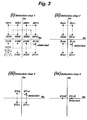
- Figure 3 is a diagram showing the preferred detection process for 16 Quadrature Amplitude Modulation (16QAM), in particular the cancellation of single bits from a 16QAM constellation, this occurs in stages starting with (i) and go through to (iv) as shown.
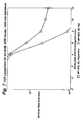
- Figure 4 is a graph of expected Bit error rates against bit energy/noise energy for the preferred detector as compared to a known APP detector, with 16QAM and four transmitting and four receiving antennas,
- Figure 5 is a graph of expected Frame error rates against bit energy/noise energy for the preferred detector as compared to a known APP detector, with 16QAM and four transmitting and four receiving antennas,
- Figure 6 is a graph of expected Bit error rates against bit energy/noise energy for the preferred detector as compared to a known APP detector, with 64QAM and four transmitting and four receiving antennas,
- Figure 7 is a graph of expected Frame error rates against bit energy/noise energy for the preferred detector as compared to a known APP detector, with 64QAM and four transmitting and four receiving antennas, and
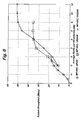
- Figure 8 is a graph of system throughput rate against bit energy/noise energy for the preferred detector.
-
- The system consists of a
transmitter 1 and areceiver 2, as shown in Figure 1. An example based on 16 QAM is described. - At the
transmitter 1, in higher order modulation schemes such as 16-QAM or 64-QAM, the modulated bits are not equally protected, as shown in Figure 3 (a) which is described in more detail later. It will be seen in Figure 3(a) that the average distances between the respective third and fourth bits of a symbol is half the average distances between respective first and second bits of symbols. It can thus be considered that the third and fourth bits are lower energy than the first and second bits, and therefore are less protected against errors. This fact can be used to introduce a layered encoding scheme, whereby bits which are given equivalent protection by the modulation scheme are encoded together in one block. This allows us to first detect and decode the bit blocks which are well-protected by the modulation scheme, and subsequently subtract their contribution from the received signal in order to reduce the interference for the remaining less-protected bit blocks. In this way, the received, 16 QAM (or 64 QAM) modulated signal can be treated as the sum of separately encoded QPSK data-streams which can be detected with an iterative MF-SIC receiver. - Accordingly, as regards the
transmitter 1 shown in Figure 1, a layered transmission scheme is provided. The transmitted signal (Tx data) is split into blocks of equal length which are separately encoded using a convolutional code by respective convolutional encoders a,b. The output bits of encoder a are the higher energy bits (i.e. first and second bits of a 16 QAM symbol) whilst the output of the encoder b are the lower energy bits (i.e. third and fourth bits of the symbol). - The streams are interleaved by respective interleaver c,c' and subsequently, modulated by 16QAM modulator d and spread by spreader e with the same spreading code and transmitted from transmitting antennas TX. Therefore, only the propagation environment, which is assumed to exhibit significant multipath (so-called rich scattering) is exploited to achieve the signal separation at the receiver.
- At the
receiver 2, the transmitted bits are detected with a successive cancellationMIMO SIC detector 3 as shown in Figures 1 and 2, based on matched filter (MF) detection as explained in more detail below. - As shown in Figure 2, the received signal r, which contains all received signal vectors rk (k=1...nR ) from the nR receiver antennas RX, is fed into the
SIC MIMO detector 3 which detects all transmitted symbols x1...xnT and determines the most reliable data estimate according to the particular order metric used (as described in more detail below). Ideally, the data with lowest error probability is selected (reference numeral 4). The next step is to make a hard decision (step 5) on the symbol or bit of the selected data, and to reconstruct itsinterference 6 by, for each antenna, calculating what received signal would have produced a 1 or -1 decision exactly (without error). Finally, the interference is subtracted (step 7) from all received signals rk . - When the decision on the selected symbol or bit was correct, its multiple access interference is cancelled completely, however a wrong decision doubles the interference of the detected symbol or bit. Therefore, the order metric is of crucial importance for the performance of successive cancellation detectors. In the first iteration, either of two order metrics for detection and cancellation of the received data streams are applied: ordering dependent on the least mean-squared error (LMSE) for symbol-based detection, and the ordering dependent on the instantaneous error probabilities (as indicated by the magnitude values of the log-likelihood ratios (mentioned below)) within each symbol period, for bit-based detection. This detection and cancellation process is continued in repeated cycles (
steps 8,9) until all data streams are detected. - Soft estimates are then generated and output by the
SIC MIMO detector 3 as follows. After the detection of the whole interleaved sequence, all received data streams (soft outputs) are multiplexed to one data stream which is output 11. The output from theSIC MIMO detector 3 is provided to a soft output combiner 11' (described in more detail below). The output from the soft output combiner 11' is then provided todeinterleaver 12 for deinterleaving and then decoding byconvolutional decoder 13. The process of successive cancellation, deinterleaving and decoding represents thefirst iteration 14 of the iterative detector. - The subsequent iterations are based on the
convolutional decoder 13 output of the whole transmitted sequence to improve the performance of the detector. Therefore, thedecoder 13 output of all transmittedbits 15 is interleaved again 16, and fed back to thesuccessive cancellation detector 3. Now, the interleaved decoder output is used for the order calculation and cancellation at thedetector 3. This improves the quality of the detector soft-outputs in each iteration, because the reliability of the decoder output is much higher than the initial estimates from the matched filter within theSIC MIMO detector 3. In each following iteration, soft output combining insoft output combiner 17 is necessary to stabilize the decoder outputs. In this example, the soft outputs are log-likelihood ratios (LLR). Log-likelihood ratios (LLRs) are, of course, the logarithmic ratio of the probability that a bit is correct to the probability that it is not. - The layered encoded signal is received and processed. A typical detection process in the
receiver 2 for 16QAM is as follows, and operates as shown in Figure 3. Figure 3 illustrates this process of bit-cancellation from a 16-QAM modulated symbol. In this case the first and second bits of each symbol are the most reliable bits and are encoded as one block. The remaining (i.e third and fourth) bits of each symbol are encoded separately as a lower reliability bit stream. - The detection process is as follows:
- 1. Detect higher reliability bit stream (first and second bits of 16QAM) for 4 iterations.
- 2. Calculate the contribution of the higher reliability bit stream to the received signal and cancel that contribution from the received signal so as to reduce 16QAM to 4-QAM (this corresponds to Figure 3(i) to 3(iii)),
- 3. Detect the lower reliability bit stream (third and fourth bits of 16QAM) for 4 iterations.
- 4. Calculate the contribution of the lower reliability bit stream from the originally received signal to reduce interference in step 5 (this corresponds to Figure 3(iii) and 3(iv),
- 5. Detect the higher reliability bit stream (bits 1&2 of 16QAM) for 2 further iterations.
- 6. Update and cancel the contribution of the higher reliability bit stream from originally received signal so as to reduce 16QAM to 4-QAM (Figure 3(i) to 3(iii)),
- 7. Detect low reliability bit stream (bit 3&4 of 16QAM) for 2 further iterations (Figure 3 (iii) and 3(iv)).
-
- The received signal consists of contributions of all the bits of each symbol transmitted from all transmission (Tx) antennas with all spreading codes. The estimates of each received bit includes interference from other bits because the spreading codes are in practice never orthogonal (due to multipath propagation and code reuse). By cancelling the contributions from the bits transmitted with higher energy first, the interference (which is the sum of the contributions for the remaining bits) is reduced, and therefore the remaining bits can be detected more reliably.
- A contribution is, of course, the energy with which a bit is expected to be received assuming it has been correctly determined.
- In the proposed iterative receiver, mutual information is exchanged between the MF-SIC detector 3and the
convolutional decoder 13. Therefore, at each iteration, soft estimates (in the form of LLR values)at the output of the decoder are fed back to the detector for purposes of interference cancellation. The LLR values are also used to determine the order of detection of bits in the successive interference cancellation (MF-SIC)detector 3. Consequently, new and hopefully more reliable soft-output values are made available at the output of thedecoder 13 after each iteration. However, in some cases, the interference cancellation process can lead to poorer soft-outputs for certain bits. This can result in error propagation and therefore unstable bit-error rate performance in subsequent iterations. - Such instabilities can be avoided by combining in the
soft output combiner 17 shown in Figure 1, the soft-output values computed in the current iteration with those computed in the previous iteration(s). For that, each new LLR value L b,i of bit b consists of a weighted sum of the current and the previous LLR value. Example proportions are 85:15 current to previous, or 70:30 current to previous. The combining weight factors have a significant influence on the stability and the speed of convergence of theiterative receiver 2. Using this combining process, reliability information already gained for a certain transmitted bit is not lost in the next iteration. - While soft-output combining could have been performed either at the output of the
detector 3 or that of thedecoder 13, simulations indicate that the combination of both (i.e soft output combiners 11',17) is most effective. - If q indicates the iteration reached, then then the above-described soft-output combining may be described mathematically as
- Figures 1 illustrates the transmission scheme for the MIMO system under investigation. At the
transmitter 1, user data is convolutional-encoded and interleaved. The coded data stream is de-multiplexed into N T sub-streams, corresponding transmit antennas (Tx). Each sub-stream (X1,X2,X3,X4) is then modulated on to NK 4-QAM orthogonal spreading codes prior to transmission. Each transmitted spread stream then occupies N symbol intervals. Also note that the same set of K codes are re-used across all transmit antennas. Therefore, the MIMO propagation environment, which is assumed to exhibit significant multipath, plays a major role in achieving signal separation at the receiver. The transmitted signals are received by N R receive antennas after propagation through dispersive radio channels with impulse response lengths of W chips. The received signal vector can then be modelled as follows: where
where
- m r ∈ C( QN + W -1)×1
- and is the signal at Rx antenna m.
- m v ∈ C( QN + W -1)×1
- and is the noise + inter-cell interference at Rx antenna m.
- x k n ∈ C N ×1
- and is the symbols sequence [xk n (1) ... xk n (N)]T at Tx antenna n spread via k th spreading code.
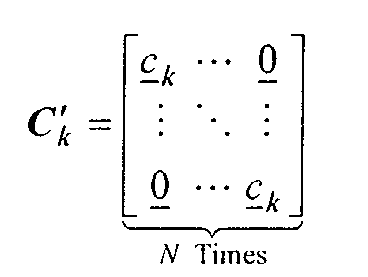
- C k ' ∈ C QN×K
- and is a the spreading matrix for k th spreading code c k ∈C Q× 1.
- At the
receiver 2 of Figure 1, signal vector r is fed into a successiveinterference cancellation detector 3 incorporating matched filter detection (MF-SIC). The received signal of Eq. (4) observed over the t th symbol interval may be written aswhere xk n (t) is a transmitted symbol at the t th symbol interval and a k n (t) is its code-channel signature at the receiver. The output of the MF-
SIC detector 3 is then de-interleaved bydeinterleaver 12 and applied to aconvolutional decoder 13. This represents the first iteration of the receiver. Soft outputs from the decoder are then re-interleaved byinterleaver 16 and applied to the MF-SIC detector 3 for further iterations. - In the first iteration, the MF-
SIC 3 operates at a symbol level. The first step is to determine, at each symbol epoch, t, the most reliable symbol according to a reliability criterion. Ideally, the symbol with the lowest error probability is selected. Lacking such information, the symbol xk n (t) k=1...K n=1...NT with the highest signature energy, | a k n (t)|2 (or least mean-square estimation error), is selected. The next step is to estimate the selected symbol (soft-output derived via matched filter detection). make a hard decision on the estimate, reconstruct and cancel its contribution from the received signal:
- The process is then repeated for the next most reliable symbol. If the decision on the selected symbol is correct, then its interference towards other symbols can be completely suppressed. However, a wrong decision doubles the level of interference caused by the erroneously detected symbol. Consequently, the reliability criterion used for the ordering of symbols is of critical importance in any form of successive cancellation.
- After the MF-SIC detection of a complete code-block by
detector 3 , the corresponding log-likelihood ratios in the form of soft-outputs, yk ,0 n (t)=Re[yk n (t)] and yk ,l n (t) =Im[yk n (t)], are multiplexed into a single stream for de-interleaving bydeinterleaver 12 and convolutional decoding (max-log MAP algorithm) byconvolutional decoder 13. The decoder output is fed into thesoft output combiner 17 and aninterleaver 16 prior to re-application to the MF-SIC detector 3 for subsequent iterations. - In the second and each subsequent iteration of the receiver, the MF-
SIC detector 3 has access to reliability information at a bit level, in the form of log-likelihood ratios, Λ(bk,l n (t)), generated by the soft-output combiner 17 in the previous iteration. As a result, at each symbol interval, t, ordering can be performed at a bit level (rather than symbol level) based on the LLR values. In other words, the bit bk,l n (t) with the largest LLR value Λ(bk,i n (t))| (or minimum estimation error probability), can be selected as most reliable. Since bit estimates corresponding to a particular symbol can have different reliabilities, the use of LLR values represents an optimum ordering policy. The cancellation process at the t th symbol interval is based on the more reliable hard bit estimates derived from the LLR values:
- The performance of the known APP-based receiver for a Turbo-encoded MIMO link as proposed in 3GPP TSG RAN WG1,"Link Level Results for HSDPA using Multiple Antennas in Correlated and Measured Channels ",TSG-1#19(01)0302.February 2001, Las Vegas, U.S.A is considered as reference for comparison with that of the proposed MF-SIC based
receiver 2 for an equivalent convolutionally-encoded MIMO link. - For both the prior art approach and the preferred approach, a system with N T=N R =4 i.e 4 transmitting antennas and 4 receiving antennas (operating with so-called transmission diversity), spreading factor Q =16 and number of codes used K =16, is considered, as similar to the HSDPA specifications,. In addition to a flat Rayleigh fading channel, a dispersive (multipath) channel with 3 equal power taps (i.e filter coefficients, in a tapped delay model) which are chip-spaced is also considered. Flat fading is, of course, where propagation does not involve multipath. It is assumed that the mobile speed is 3km/h and the receiver has perfect knowledge of the average channel conditions during each transmitted data block. For the known APP detector with turbo-encoded MIMO link, a 8-
state rate 1/3 turbo encoder is considered in accordance with the HSDPA specifications, resulting in a block size with up to 5114 information bits. A total of 6 iterations of the turbo decoder are performed in the known APP receiver. On the other hand, for the convolutionally-encoded MIMO link (i.e in the preferred approach),rate 1/3, 64-state convolutional encoders (as shown in Figure 1) are considered to allow a comprehensive comparison in terms of performance and complexity. 64 state means, of course, the number of states in the code.Rate 1/3 eans that the coded message is three times as long as the information payload. A total of 6 iterations between the MF-SIC detector 3and theconvolutional decoder 13 are performed. Soft-output combiners 11',17 with the coefficients α=0.9 after detection and β=0.75 after decoding were used. - Figure 4 to 7 show the bit error rate BER and frame error rate FER performance for a flat fading channel and a dispersive (3 equal power taps, chip-spaced) channel of the
iterative receiver 2 including MF-SIC detector 3 in comparison to the known APP based receiver, for 16-QAM and for 64-QAM. The known APP receiver uses turbo-coding according to the UMTS standard with 6 decoder iterations and a block size based on 1024 information bits -> 3072 coded bits (+tail). - As shown in Figures 4 and 5, the preferred receiver 2 (with 16 QAM) offers superior performance in bit error rate and frame error rate for equivalent bit energy/noise energy ratios. Figures 6 and 7 show the approach also works at 64 QAM where the known APP detection approach becomes of extreme computational complexity.
- Figure 8 shows the achievable system throughput in a 5MHz band with a chip rate of 3.84 MHz, 4 transmitting and 4 receiving antennas, and flat fading. The throughput is based on the frame-error rate simulation results for the
receiver 2 including iterative MF-SIC detector 3 . The result show that the error floor of the flat fading curves in Figures 5 and 7 do not have a significant influence on the obtainable system throughput rate (which is inversely related to the frame error rate). - The proposed MF-SIC receiver was compared with the known APP-based receiver considered for an equivalent turbo-encoded MIMO link (described in 3GPP TSG RAN WG1,"Link Level Results for HSDPA using Multiple Antennas in Correlated and Measured Channels ",TSG1#19(01)0302. February 2001, Las Vegas. U.S.A) and is shown to achieve superior performance at a much lower complexity. The performance loss due to the use of a sub-optimal detector is regained via iterations with the decoder, enabled by the preferred soft-output combining techniquein combination with the layered encoding scheme.
- To summarise, it has been shown that the proposed layered coding scheme makes low complexity iterative receivers based on a simple matched filter possible for higher than 4QPSK modulations, e.g. 16 QAM and 64QAM modulations.
(∈ denotes, of course, takes the elements of.)
Claims (10)
- A radio telecommunications system operative to communicate digital data symbols with higher than quadrature phase shift keying (QPSK) modulation, the system comprising a transmitter (1) and a receiver(2),
the transmitter (1) comprising a modulator (d) and means (a,b,c,c') to split and encode the data into a first block of more significant bits of symbols and a second block of less significant bits of the symbols for modulating by the modulator (d),
the receiver (2) being operative to receive digital data bits by iterative determination of soft estimates of bits followed by a hard decision as to what bit was intended, the receiver (2) comprising
a first processor (3) operative to provide first soft estimates of bits of the received signal,
a second processor (13) operative to decode the first soft estimates and to provide second soft estimates of the bits.
a first combiner (11') operative to provide adapted first soft estimates to the second processor (13), the adapted first soft estimates of each bit being dependent upon the respective first soft estimate and a respective previous first soft estimate,
a second combiner (17) operative to provide third soft estimates back to the first processor for subsequent further decoding, the third soft estimates of each bit being dependent upon the respective second soft estimate and a respective previous second soft estimate. - A system according to claim 1, in which the means (a,b,c,c') comprises a first convolutional encoder (a) operative to produce blocks of the more significant bits, a second convolutional encoder (b) operative to produce blocks of less significant bits, and respective interleavers (c,c') each operative to interleave the blocks from the associated encoder into a respective data stream for modulating.
- A system according to claim 1 or claim 2, in which , in use, at the receiver (2) the soft estimates of multiple data streams which are multiplexed into one stream at the output of the first processor (3), and are provided to the first combiner (11') so as to provide the adapted first soft estimates which are deinterleaved by a deinterleaver (12) before being passed to the second processor (13), and the third soft estimates provided by the second combiner (17) are interleaved by an interleaver (16) before being passed back to the first processor (3).
- A system according to any preceding claim, in which the first processor (3) is a successive interference cancellation SIC multiple input multiple output MIMO detector and the second processor is a convolutional decoder, the soft estimates being log likelihood ratios.
- A system according to claim 4, in which the SIC MIMO detector includes matched filters for detection.
- A system according to any preceding claim, in which the modulation scheme is 16 Quadrature amplitude modulation, the first two bits of a symbol being provide by the first convolutional encoder (a), and the last two bits of a symbol being provided by the second convolutional encoder (b).
- A system according to any preceding claim, in which, in use, at the receiver (2) a plurality of detection iterations each involving the first processor, second processor and the combiners are performed whereupon a hard decision (5) is made as to what bit(s) was/were intended.
- A system according to claim 7, in which the more significant bits are detected in the received signal in a first series of iterations, their estimated contribution to the received signal being subtracted to provide a modified received signal from which the less significant bits are detected by a second series of iterations.
- A radio telecommunications transmitter operative to send digital data symbols with higher than quadrature phase shift keying (QPSK) modulation, the transmitter (1) comprising a modulator (d) and means (a,b,c,c) to split and encode the data into a first block of more significant bits of symbols and a second block of less significant bits of the symbols for modulating by the modulator (d), the means (a,b,c,c') comprising a first convolutional encoder (a) operative to produce blocks of the more significant bits, a second convolutional encoder (b) operative to produce blocks of less significant bits, and interleavers (c,c') each operative to interleave the blocks from the associated encoder into a respective data stream for modulating.
- A method of communicating digital data symbols with higher than quadrature phase shift keying (QPSK) modulation, in a radio telecommunications system comprising a transmitter (1) and a receiver(2), the method comprising the steps of:at the transmitter splitting and encoding the data into a first block of more significant bits and a second block of less significant bits for modulating by a modulator (d),at the receiver (2) receiving digital data bits by iterative determination of soft estimates of symbols or bits followed by a hard decision as to what bit was intended, bya first processor (3) providing first soft estimates of bits of the received signal,a second processor (13) decoding the first soft estimates and providing second soft estimates of the bits,a first combiner (11') providing adapted first soft estimates to the second processor (13), the adapted first soft estimates of each bit being dependent upon the respective first soft estimate and a respective previous first soft estimate,a second combiner (17) providing third soft estimates back to the first processor for subsequent further decoding, the third soft estimates of each bit being dependent upon the respective second soft estimate and a respective previous second soft estimate.
Priority Applications (3)
| Application Number | Priority Date | Filing Date | Title |
|---|---|---|---|
| EP02255820A EP1392017B1 (en) | 2002-08-21 | 2002-08-21 | A MIMO radio telecommunication system using multilevel-coded modulation operative by iterative determination of soft estimates, and a corresponding method |
| DE60215153T DE60215153T2 (en) | 2002-08-21 | 2002-08-21 | Wireless MIMO telecommunication system with multilevel-coded modulation using iterative determination of soft estimates and corresponding method |
| US10/643,182 US7248647B2 (en) | 2002-08-21 | 2003-08-18 | Radio telecommunications system operative by interactive determination of soft estimates, and a corresponding method |
Applications Claiming Priority (1)
| Application Number | Priority Date | Filing Date | Title |
|---|---|---|---|
| EP02255820A EP1392017B1 (en) | 2002-08-21 | 2002-08-21 | A MIMO radio telecommunication system using multilevel-coded modulation operative by iterative determination of soft estimates, and a corresponding method |
Publications (2)
| Publication Number | Publication Date |
|---|---|
| EP1392017A1 true EP1392017A1 (en) | 2004-02-25 |
| EP1392017B1 EP1392017B1 (en) | 2006-10-04 |
Family
ID=30775881
Family Applications (1)
| Application Number | Title | Priority Date | Filing Date |
|---|---|---|---|
| EP02255820A Expired - Lifetime EP1392017B1 (en) | 2002-08-21 | 2002-08-21 | A MIMO radio telecommunication system using multilevel-coded modulation operative by iterative determination of soft estimates, and a corresponding method |
Country Status (3)
| Country | Link |
|---|---|
| US (1) | US7248647B2 (en) |
| EP (1) | EP1392017B1 (en) |
| DE (1) | DE60215153T2 (en) |
Cited By (7)
| Publication number | Priority date | Publication date | Assignee | Title |
|---|---|---|---|---|
| JP2007535835A (en) * | 2004-03-05 | 2007-12-06 | テレフオンアクチーボラゲット エル エム エリクソン(パブル) | Continuous interference cancellation in general purpose RAKE receiver architecture |
| US7400692B2 (en) | 2004-01-14 | 2008-07-15 | Interdigital Technology Corporation | Telescoping window based equalization |
| US7436901B2 (en) | 2005-04-19 | 2008-10-14 | Telefonaktiebolaget Lm Ericsson (Publ) | Selection of channel coding and multidimensional interleaving schemes for improved performance |
| US7437135B2 (en) | 2003-10-30 | 2008-10-14 | Interdigital Technology Corporation | Joint channel equalizer interference canceller advanced receiver |
| US7904088B2 (en) | 2003-08-26 | 2011-03-08 | Vlora Rexhepi | Identifying network resources for packet-switched services |
| CN108847722A (en) * | 2018-06-27 | 2018-11-20 | 广东工业大学 | A kind of multiple antennas energy transmission equipment, method and apparatus |
| US20230139174A1 (en) * | 2021-11-01 | 2023-05-04 | Qualcomm Incorporated | Frequency first per layer code block mapping |
Families Citing this family (26)
| Publication number | Priority date | Publication date | Assignee | Title |
|---|---|---|---|---|
| US7952511B1 (en) | 1999-04-07 | 2011-05-31 | Geer James L | Method and apparatus for the detection of objects using electromagnetic wave attenuation patterns |
| EP1337082B1 (en) * | 2002-02-14 | 2005-10-26 | Lucent Technologies Inc. | Receiver and method for multi-input multi-output iterative detection using feedback of soft estimates |
| EP1392017B1 (en) * | 2002-08-21 | 2006-10-04 | Lucent Technologies Inc. | A MIMO radio telecommunication system using multilevel-coded modulation operative by iterative determination of soft estimates, and a corresponding method |
| KR100575982B1 (en) * | 2003-11-05 | 2006-05-02 | 삼성전자주식회사 | Apparatus and Method for Eliminating Interference Signals in Orthogonal Frequency Division Multiplexing System Using Multiple Antennas |
| US7813453B2 (en) * | 2004-01-21 | 2010-10-12 | Qualcomm Incorporated | Data detection for a hierarchical coded data transmission |
| US7570619B2 (en) * | 2004-02-13 | 2009-08-04 | Broadcom Corporation | Long training sequence method and device for wireless communications |
| WO2005086500A1 (en) * | 2004-02-27 | 2005-09-15 | Nokia Corporation | Constrained optimization based mimo lmmse-sic receiver for cdma downlink |
| CN100349387C (en) * | 2004-04-13 | 2007-11-14 | 上海贝尔阿尔卡特股份有限公司 | Detecting method and device for vertical-bell laboratory layered space-time code |
| US20050281361A1 (en) * | 2004-06-16 | 2005-12-22 | Broadcom Corporation | Interference cancellation of STBC with multiple streams in OFDM for wlan |
| KR100926020B1 (en) * | 2005-01-11 | 2009-11-11 | 퀄컴 인코포레이티드 | Method and apparatus for decoding data in a layered modulation system |
| US7660368B2 (en) * | 2005-01-11 | 2010-02-09 | Qualcomm Incorporated | Bit log likelihood ratio evaluation |
| US20060198454A1 (en) * | 2005-03-02 | 2006-09-07 | Qualcomm Incorporated | Adaptive channel estimation thresholds in a layered modulation system |
| KR100922958B1 (en) | 2005-03-14 | 2009-10-22 | 삼성전자주식회사 | User Allocation Device and Method in Multi-Antenna Mobile Communication System Supporting Multi-User Diversity |
| JP4065283B2 (en) | 2005-07-06 | 2008-03-19 | 松下電器産業株式会社 | Sending method |
| JP4887758B2 (en) * | 2005-11-28 | 2012-02-29 | 富士通株式会社 | Wireless receiver |
| KR100889302B1 (en) * | 2005-12-14 | 2009-03-18 | 삼성전자주식회사 | Apparatus and method for partial repetition detection and decoding in multi-antenna system |
| KR101260835B1 (en) * | 2006-02-28 | 2013-05-06 | 삼성전자주식회사 | Apparatus and method for transceiving a signal in a multi antenna system |
| KR100922938B1 (en) * | 2006-03-09 | 2009-10-22 | 삼성전자주식회사 | Method and apparatus for receiving data in communication system |
| US8270549B2 (en) * | 2008-07-31 | 2012-09-18 | Fujitsu Semiconductor Limited | Method and system for implementing a multiple-input multiple-output (MIMO) decoder scheme |
| KR20100016726A (en) * | 2008-08-05 | 2010-02-16 | 삼성전자주식회사 | Apparatus and method for layer cancelling for spatial multiplexing in multiple input multiple output system |
| US8315342B2 (en) * | 2008-10-16 | 2012-11-20 | Telefonaktiebolaget Lm Ericsson (Publ) | Method and apparatus for simplified expected symbol value computation and interference cancellation in communication signal processing |
| GB201006104D0 (en) * | 2010-04-13 | 2010-05-26 | Icera Inc | Decoding a signal |
| US8634332B2 (en) * | 2010-04-29 | 2014-01-21 | Qualcomm Incorporated | Using joint decoding engine in a wireless device |
| US20130156139A1 (en) * | 2011-12-15 | 2013-06-20 | Samsung Electronics Co., Ltd. | Wireless communication system with interference filtering and method of operation thereof |
| US9602240B1 (en) * | 2015-09-11 | 2017-03-21 | Signalchip Innovations Private Limited | Method and system for symbol level interference cancellation at a receiver for multiuser detection |
| US10986154B2 (en) * | 2016-05-16 | 2021-04-20 | Glide Talk Ltd. | System and method for interleaved media communication and conversion |
Citations (2)
| Publication number | Priority date | Publication date | Assignee | Title |
|---|---|---|---|---|
| WO2001069873A2 (en) * | 2000-03-16 | 2001-09-20 | Qualcomm Incorporated | Method and apparatus for combined soft-decision based interference cancellation and decoding |
| WO2002041594A1 (en) * | 2000-11-17 | 2002-05-23 | Robert Bosch Gmbh | Method for coded modulation taking account of the error sensitivity of the user data and encrypting said data after coding |
Family Cites Families (6)
| Publication number | Priority date | Publication date | Assignee | Title |
|---|---|---|---|---|
| CA2145566C (en) * | 1994-04-29 | 1999-12-28 | Nambirajan Seshadri | Methods of and devices for enhancing communications that use spread spectrum technology |
| US20030147471A1 (en) * | 1998-10-05 | 2003-08-07 | Simon Marvin K. | Cross correlated trellis coded quatrature modulation transmitter and system |
| EP1329025A1 (en) * | 2000-09-05 | 2003-07-23 | Broadcom Corporation | Quasi error free (qef) communication using turbo codes |
| US6735258B1 (en) * | 2000-09-29 | 2004-05-11 | Arraycomm, Inc. | Moderate rate phase shift keying codec |
| KR100911424B1 (en) * | 2001-11-29 | 2009-08-11 | 콸콤 인코포레이티드 | Method and apparatus for determining log-likelihood ratio through precoding |
| EP1392017B1 (en) * | 2002-08-21 | 2006-10-04 | Lucent Technologies Inc. | A MIMO radio telecommunication system using multilevel-coded modulation operative by iterative determination of soft estimates, and a corresponding method |
-
2002
- 2002-08-21 EP EP02255820A patent/EP1392017B1/en not_active Expired - Lifetime
- 2002-08-21 DE DE60215153T patent/DE60215153T2/en not_active Expired - Lifetime
-
2003
- 2003-08-18 US US10/643,182 patent/US7248647B2/en not_active Expired - Fee Related
Patent Citations (2)
| Publication number | Priority date | Publication date | Assignee | Title |
|---|---|---|---|---|
| WO2001069873A2 (en) * | 2000-03-16 | 2001-09-20 | Qualcomm Incorporated | Method and apparatus for combined soft-decision based interference cancellation and decoding |
| WO2002041594A1 (en) * | 2000-11-17 | 2002-05-23 | Robert Bosch Gmbh | Method for coded modulation taking account of the error sensitivity of the user data and encrypting said data after coding |
Non-Patent Citations (3)
| Title |
|---|
| ISAKA M ET AL: "ON THE ITERATIVE DECODING OF MULTILEVEL CODES", IEEE JOURNAL ON SELECTED AREAS IN COMMUNICATIONS, IEEE INC. NEW YORK, US, vol. 19, no. 5, May 2001 (2001-05-01), pages 935 - 943, XP001101013, ISSN: 0733-8716 * |
| LI X ET AL: "EFFECTS OF ITERATIVE DETECTION AND DECODING ON THE PERFORMANCE OF BLAST", GLOBECOM'00. 2000 IEEE GLOBAL TELECOMMUNICATIONS CONFERENCE. SAN FRANCISCO, CA, NOV. 27 - DEC. 1, 2000, IEEE GLOBAL TELECOMMUNICATIONS CONFERENCE, NEW YORK, NY: IEEE, US, vol. 2 OF 4, 27 November 2000 (2000-11-27), pages 1061 - 1066, XP001017247, ISBN: 0-7803-6452-X * |
| TONELLO A M: "Space-time bit-interleaved coded modulation over frequency selective fading channels with iterative decoding", GLOBECOM'00. 2000 IEEE GLOBAL TELECOMMUNICATIONS CONFERENCE. SAN FRANCICO, CA, NOV. 27 - DEC. 1, 2000, IEEE GLOBAL TELECOMMUNICATIONS CONFERENCE, NEW YORK, NY: IEEE, US, vol. 3 OF 3, 27 November 2000 (2000-11-27), pages 1616 - 1620, XP002180266, ISBN: 0-7803-6452-X * |
Cited By (9)
| Publication number | Priority date | Publication date | Assignee | Title |
|---|---|---|---|---|
| US7904088B2 (en) | 2003-08-26 | 2011-03-08 | Vlora Rexhepi | Identifying network resources for packet-switched services |
| US7437135B2 (en) | 2003-10-30 | 2008-10-14 | Interdigital Technology Corporation | Joint channel equalizer interference canceller advanced receiver |
| US7400692B2 (en) | 2004-01-14 | 2008-07-15 | Interdigital Technology Corporation | Telescoping window based equalization |
| JP2007535835A (en) * | 2004-03-05 | 2007-12-06 | テレフオンアクチーボラゲット エル エム エリクソン(パブル) | Continuous interference cancellation in general purpose RAKE receiver architecture |
| US7436901B2 (en) | 2005-04-19 | 2008-10-14 | Telefonaktiebolaget Lm Ericsson (Publ) | Selection of channel coding and multidimensional interleaving schemes for improved performance |
| CN108847722A (en) * | 2018-06-27 | 2018-11-20 | 广东工业大学 | A kind of multiple antennas energy transmission equipment, method and apparatus |
| CN108847722B (en) * | 2018-06-27 | 2021-08-13 | 广东工业大学 | A multi-antenna energy transmission device, method and apparatus |
| US20230139174A1 (en) * | 2021-11-01 | 2023-05-04 | Qualcomm Incorporated | Frequency first per layer code block mapping |
| US12052201B2 (en) * | 2021-11-01 | 2024-07-30 | Qualcomm Incorporated | Frequency first per layer code block mapping |
Also Published As
| Publication number | Publication date |
|---|---|
| EP1392017B1 (en) | 2006-10-04 |
| US7248647B2 (en) | 2007-07-24 |
| DE60215153T2 (en) | 2007-10-25 |
| DE60215153D1 (en) | 2006-11-16 |
| US20040038653A1 (en) | 2004-02-26 |
Similar Documents
| Publication | Publication Date | Title |
|---|---|---|
| EP1392017B1 (en) | A MIMO radio telecommunication system using multilevel-coded modulation operative by iterative determination of soft estimates, and a corresponding method | |
| EP1337082B1 (en) | Receiver and method for multi-input multi-output iterative detection using feedback of soft estimates | |
| Lee et al. | Space-time bit-interleaved coded modulation for OFDM systems | |
| US7573805B2 (en) | Data transmission and reception method and apparatus | |
| US7724832B2 (en) | MIMO decoding | |
| US20030012315A1 (en) | System and method for multistage error correction coding wirelessly transmitted information in a multiple antennae communication system | |
| JP2006520547A (en) | Improved communication apparatus and method | |
| CN100571419C (en) | Code modulation and demodulation system and signal transmitting and receiving method thereof | |
| KR100690873B1 (en) | Decoding Device and Method of MIO System | |
| Ait-Idir et al. | Turbo packet combining strategies for the MIMO-ISI ARQ channel | |
| Tonello | Array processing for simplified turbo decoding of interleaved space-time codes | |
| Kuhn et al. | A new scalable decoder for linear space-time block codes with intersymbol interference | |
| Ait-Idir et al. | Joint hybrid ARQ and iterative space-time equalization for coded transmission over the MIMO-ISI channel | |
| Wang et al. | Reliability based reduced-complexity MMSE soft interference cancellation MIMO turbo receiver | |
| Wiesel et al. | Turbo linear dispersion space time coding for MIMO HSDPA systems | |
| Claussen et al. | A low complexity iterative receiver based on successive cancellation for MIMO | |
| Zarikoff | Investigation of an iterative groupwise soft input/output multiuser detection algorithm | |
| da Silva et al. | Iterative frequency-domain receivers for STBC schemes | |
| Jeong et al. | An iterative receiver for layered space-time MIMO DS-CDMA uplink using turbo trellis-coded modulation | |
| Mysore et al. | Combined turbo coding and turbo equalization in a wireless system with antenna diversity | |
| Nakajima et al. | Iterative adaptive soft parallel interference canceller for turbo coded MIMO multiplexing | |
| Sharma et al. | Iterative channel estimation and decoding for the multipath channels with RAKE reception | |
| Claussen et al. | High-performance MIMO receivers based on multi-stage partial parallel interference cancellation | |
| Nickel et al. | Turbo equalization for single antenna cochannel interference cancellation in single carrier transmission systems | |
| Kadage et al. | Performance study of turbo decoding and multiuser system performance comparison with various diversities in LTE+ system environment |
Legal Events
| Date | Code | Title | Description |
|---|---|---|---|
| PUAI | Public reference made under article 153(3) epc to a published international application that has entered the european phase |
Free format text: ORIGINAL CODE: 0009012 |
|
| AK | Designated contracting states |
Kind code of ref document: A1 Designated state(s): AT BE BG CH CY CZ DE DK EE ES FI FR GB GR IE IT LI LU MC NL PT SE SK TR |
|
| AX | Request for extension of the european patent |
Extension state: AL LT LV MK RO SI |
|
| 17P | Request for examination filed |
Effective date: 20040813 |
|
| 17Q | First examination report despatched |
Effective date: 20040930 |
|
| AKX | Designation fees paid |
Designated state(s): DE FR GB |
|
| GRAP | Despatch of communication of intention to grant a patent |
Free format text: ORIGINAL CODE: EPIDOSNIGR1 |
|
| GRAS | Grant fee paid |
Free format text: ORIGINAL CODE: EPIDOSNIGR3 |
|
| GRAA | (expected) grant |
Free format text: ORIGINAL CODE: 0009210 |
|
| AK | Designated contracting states |
Kind code of ref document: B1 Designated state(s): DE FR GB |
|
| REG | Reference to a national code |
Ref country code: GB Ref legal event code: FG4D |
|
| REF | Corresponds to: |
Ref document number: 60215153 Country of ref document: DE Date of ref document: 20061116 Kind code of ref document: P |
|
| ET | Fr: translation filed | ||
| PLBE | No opposition filed within time limit |
Free format text: ORIGINAL CODE: 0009261 |
|
| STAA | Information on the status of an ep patent application or granted ep patent |
Free format text: STATUS: NO OPPOSITION FILED WITHIN TIME LIMIT |
|
| 26N | No opposition filed |
Effective date: 20070705 |
|
| REG | Reference to a national code |
Ref country code: GB Ref legal event code: 732E Free format text: REGISTERED BETWEEN 20131121 AND 20131127 |
|
| REG | Reference to a national code |
Ref country code: FR Ref legal event code: CD Owner name: ALCATEL-LUCENT USA INC. Effective date: 20131122 |
|
| REG | Reference to a national code |
Ref country code: FR Ref legal event code: GC Effective date: 20140410 |
|
| PGFP | Annual fee paid to national office [announced via postgrant information from national office to epo] |
Ref country code: DE Payment date: 20140821 Year of fee payment: 13 |
|
| REG | Reference to a national code |
Ref country code: FR Ref legal event code: RG Effective date: 20141015 |
|
| PGFP | Annual fee paid to national office [announced via postgrant information from national office to epo] |
Ref country code: GB Payment date: 20140820 Year of fee payment: 13 Ref country code: FR Payment date: 20140821 Year of fee payment: 13 |
|
| REG | Reference to a national code |
Ref country code: DE Ref legal event code: R119 Ref document number: 60215153 Country of ref document: DE |
|
| GBPC | Gb: european patent ceased through non-payment of renewal fee |
Effective date: 20150821 |
|
| REG | Reference to a national code |
Ref country code: FR Ref legal event code: ST Effective date: 20160429 |
|
| PG25 | Lapsed in a contracting state [announced via postgrant information from national office to epo] |
Ref country code: DE Free format text: LAPSE BECAUSE OF NON-PAYMENT OF DUE FEES Effective date: 20160301 Ref country code: GB Free format text: LAPSE BECAUSE OF NON-PAYMENT OF DUE FEES Effective date: 20150821 |
|
| PG25 | Lapsed in a contracting state [announced via postgrant information from national office to epo] |
Ref country code: FR Free format text: LAPSE BECAUSE OF NON-PAYMENT OF DUE FEES Effective date: 20150831 |