EP1391467A1 - Polymerisation catalyst - Google Patents
Polymerisation catalyst Download PDFInfo
- Publication number
- EP1391467A1 EP1391467A1 EP02358016A EP02358016A EP1391467A1 EP 1391467 A1 EP1391467 A1 EP 1391467A1 EP 02358016 A EP02358016 A EP 02358016A EP 02358016 A EP02358016 A EP 02358016A EP 1391467 A1 EP1391467 A1 EP 1391467A1
- Authority
- EP
- European Patent Office
- Prior art keywords
- polymerisation
- preparation
- cyclopentadienyl
- metallocene
- olefins
- Prior art date
- Legal status (The legal status is an assumption and is not a legal conclusion. Google has not performed a legal analysis and makes no representation as to the accuracy of the status listed.)
- Withdrawn
Links
- 239000003054 catalyst Substances 0.000 title abstract description 12
- 238000000034 method Methods 0.000 claims abstract description 18
- 239000012968 metallocene catalyst Substances 0.000 claims abstract description 15
- 238000002360 preparation method Methods 0.000 claims abstract description 13
- 125000000058 cyclopentadienyl group Chemical group C1(=CC=CC1)* 0.000 claims abstract description 10
- 150000004756 silanes Chemical class 0.000 claims abstract description 9
- ZSWFCLXCOIISFI-UHFFFAOYSA-N endo-cyclopentadiene Natural products C1C=CC=C1 ZSWFCLXCOIISFI-UHFFFAOYSA-N 0.000 claims abstract description 7
- -1 IVA metal compound Chemical class 0.000 claims abstract description 5
- 238000009833 condensation Methods 0.000 claims abstract description 5
- 230000005494 condensation Effects 0.000 claims abstract description 5
- 230000005595 deprotonation Effects 0.000 claims abstract description 5
- 238000010537 deprotonation reaction Methods 0.000 claims abstract description 5
- 230000003301 hydrolyzing effect Effects 0.000 claims abstract description 5
- XUIMIQQOPSSXEZ-UHFFFAOYSA-N Silicon Chemical compound [Si] XUIMIQQOPSSXEZ-UHFFFAOYSA-N 0.000 claims abstract description 4
- 229910052710 silicon Inorganic materials 0.000 claims abstract description 4
- 239000010703 silicon Substances 0.000 claims abstract description 4
- 239000012190 activator Substances 0.000 abstract description 8
- 150000001336 alkenes Chemical class 0.000 abstract description 8
- VYPSYNLAJGMNEJ-UHFFFAOYSA-N Silicium dioxide Chemical compound O=[Si]=O VYPSYNLAJGMNEJ-UHFFFAOYSA-N 0.000 description 16
- 239000000499 gel Substances 0.000 description 11
- 239000000377 silicon dioxide Substances 0.000 description 8
- LFQSCWFLJHTTHZ-UHFFFAOYSA-N Ethanol Chemical compound CCO LFQSCWFLJHTTHZ-UHFFFAOYSA-N 0.000 description 5
- VGGSQFUCUMXWEO-UHFFFAOYSA-N Ethene Chemical compound C=C VGGSQFUCUMXWEO-UHFFFAOYSA-N 0.000 description 5
- 239000005977 Ethylene Substances 0.000 description 5
- MZRVEZGGRBJDDB-UHFFFAOYSA-N N-Butyllithium Chemical compound [Li]CCCC MZRVEZGGRBJDDB-UHFFFAOYSA-N 0.000 description 5
- BOTDANWDWHJENH-UHFFFAOYSA-N Tetraethyl orthosilicate Chemical compound CCO[Si](OCC)(OCC)OCC BOTDANWDWHJENH-UHFFFAOYSA-N 0.000 description 5
- WYURNTSHIVDZCO-UHFFFAOYSA-N Tetrahydrofuran Chemical compound C1CCOC1 WYURNTSHIVDZCO-UHFFFAOYSA-N 0.000 description 5
- 239000000203 mixture Substances 0.000 description 5
- 229920000642 polymer Polymers 0.000 description 5
- QGZKDVFQNNGYKY-UHFFFAOYSA-N Ammonia Chemical compound N QGZKDVFQNNGYKY-UHFFFAOYSA-N 0.000 description 4
- OFBQJSOFQDEBGM-UHFFFAOYSA-N Pentane Chemical compound CCCCC OFBQJSOFQDEBGM-UHFFFAOYSA-N 0.000 description 4
- 150000001875 compounds Chemical class 0.000 description 4
- CPOFMOWDMVWCLF-UHFFFAOYSA-N methyl(oxo)alumane Chemical compound C[Al]=O CPOFMOWDMVWCLF-UHFFFAOYSA-N 0.000 description 4
- YXFVVABEGXRONW-UHFFFAOYSA-N Toluene Chemical compound CC1=CC=CC=C1 YXFVVABEGXRONW-UHFFFAOYSA-N 0.000 description 3
- GANFORNHHDKLIK-UHFFFAOYSA-N dichloro-bis(1h-inden-1-yl)silane Chemical class C1=CC2=CC=CC=C2C1[Si](Cl)(Cl)C1C2=CC=CC=C2C=C1 GANFORNHHDKLIK-UHFFFAOYSA-N 0.000 description 3
- 229910052751 metal Inorganic materials 0.000 description 3
- 239000002184 metal Substances 0.000 description 3
- 239000007787 solid Substances 0.000 description 3
- VXNZUUAINFGPBY-UHFFFAOYSA-N 1-Butene Chemical compound CCC=C VXNZUUAINFGPBY-UHFFFAOYSA-N 0.000 description 2
- LIKMAJRDDDTEIG-UHFFFAOYSA-N 1-hexene Chemical compound CCCCC=C LIKMAJRDDDTEIG-UHFFFAOYSA-N 0.000 description 2
- TWRXJAOTZQYOKJ-UHFFFAOYSA-L Magnesium chloride Chemical compound [Mg+2].[Cl-].[Cl-] TWRXJAOTZQYOKJ-UHFFFAOYSA-L 0.000 description 2
- QCWXUUIWCKQGHC-UHFFFAOYSA-N Zirconium Chemical compound [Zr] QCWXUUIWCKQGHC-UHFFFAOYSA-N 0.000 description 2
- 229910021529 ammonia Inorganic materials 0.000 description 2
- 125000004429 atom Chemical group 0.000 description 2
- 150000001639 boron compounds Chemical class 0.000 description 2
- 150000001642 boronic acid derivatives Chemical class 0.000 description 2
- LIKFHECYJZWXFJ-UHFFFAOYSA-N dimethyldichlorosilane Chemical class C[Si](C)(Cl)Cl LIKFHECYJZWXFJ-UHFFFAOYSA-N 0.000 description 2
- 230000000694 effects Effects 0.000 description 2
- 235000019441 ethanol Nutrition 0.000 description 2
- 239000007789 gas Substances 0.000 description 2
- 230000007062 hydrolysis Effects 0.000 description 2
- 238000006460 hydrolysis reaction Methods 0.000 description 2
- 125000003454 indenyl group Chemical group C1(C=CC2=CC=CC=C12)* 0.000 description 2
- 125000002524 organometallic group Chemical group 0.000 description 2
- 230000003647 oxidation Effects 0.000 description 2
- 238000007254 oxidation reaction Methods 0.000 description 2
- 239000002002 slurry Substances 0.000 description 2
- 239000000243 solution Substances 0.000 description 2
- 239000000725 suspension Substances 0.000 description 2
- YLQBMQCUIZJEEH-UHFFFAOYSA-N tetrahydrofuran Natural products C=1C=COC=1 YLQBMQCUIZJEEH-UHFFFAOYSA-N 0.000 description 2
- 229910052726 zirconium Inorganic materials 0.000 description 2
- DUNKXUFBGCUVQW-UHFFFAOYSA-J zirconium tetrachloride Chemical compound Cl[Zr](Cl)(Cl)Cl DUNKXUFBGCUVQW-UHFFFAOYSA-J 0.000 description 2
- 239000004711 α-olefin Substances 0.000 description 2
- YBYIRNPNPLQARY-UHFFFAOYSA-N 1H-indene Natural products C1=CC=C2CC=CC2=C1 YBYIRNPNPLQARY-UHFFFAOYSA-N 0.000 description 1
- BTBUEUYNUDRHOZ-UHFFFAOYSA-N Borate Chemical compound [O-]B([O-])[O-] BTBUEUYNUDRHOZ-UHFFFAOYSA-N 0.000 description 1
- 239000005046 Chlorosilane Substances 0.000 description 1
- BPQQTUXANYXVAA-UHFFFAOYSA-N Orthosilicate Chemical compound [O-][Si]([O-])([O-])[O-] BPQQTUXANYXVAA-UHFFFAOYSA-N 0.000 description 1
- 239000004698 Polyethylene Substances 0.000 description 1
- 229910000831 Steel Inorganic materials 0.000 description 1
- RTAQQCXQSZGOHL-UHFFFAOYSA-N Titanium Chemical compound [Ti] RTAQQCXQSZGOHL-UHFFFAOYSA-N 0.000 description 1
- 229910007928 ZrCl2 Inorganic materials 0.000 description 1
- 239000002253 acid Substances 0.000 description 1
- 230000002378 acidificating effect Effects 0.000 description 1
- 150000004703 alkoxides Chemical class 0.000 description 1
- 150000003863 ammonium salts Chemical class 0.000 description 1
- 238000004458 analytical method Methods 0.000 description 1
- 230000015572 biosynthetic process Effects 0.000 description 1
- UORVGPXVDQYIDP-UHFFFAOYSA-N borane Chemical class B UORVGPXVDQYIDP-UHFFFAOYSA-N 0.000 description 1
- 229910000085 borane Inorganic materials 0.000 description 1
- 125000004432 carbon atom Chemical group C* 0.000 description 1
- 239000000969 carrier Substances 0.000 description 1
- 238000006243 chemical reaction Methods 0.000 description 1
- 239000003795 chemical substances by application Substances 0.000 description 1
- KOPOQZFJUQMUML-UHFFFAOYSA-N chlorosilane Chemical class Cl[SiH3] KOPOQZFJUQMUML-UHFFFAOYSA-N 0.000 description 1
- 238000006482 condensation reaction Methods 0.000 description 1
- 229920001577 copolymer Polymers 0.000 description 1
- PYUCGUXITNDMME-UHFFFAOYSA-N dichloro-di(cyclopenta-2,4-dien-1-yl)silane Chemical class C1=CC=CC1[Si](Cl)(Cl)C1C=CC=C1 PYUCGUXITNDMME-UHFFFAOYSA-N 0.000 description 1
- NYSUJMDGNQIYJF-UHFFFAOYSA-N diethoxy-bis(1h-inden-1-yl)silane Chemical compound C1=CC2=CC=CC=C2C1[Si](OCC)(OCC)C1C2=CC=CC=C2C=C1 NYSUJMDGNQIYJF-UHFFFAOYSA-N 0.000 description 1
- 238000000921 elemental analysis Methods 0.000 description 1
- CWAFVXWRGIEBPL-UHFFFAOYSA-N ethoxysilane Chemical class CCO[SiH3] CWAFVXWRGIEBPL-UHFFFAOYSA-N 0.000 description 1
- 238000001879 gelation Methods 0.000 description 1
- VBJZVLUMGGDVMO-UHFFFAOYSA-N hafnium atom Chemical compound [Hf] VBJZVLUMGGDVMO-UHFFFAOYSA-N 0.000 description 1
- 229920001519 homopolymer Polymers 0.000 description 1
- 239000003999 initiator Substances 0.000 description 1
- 229910052500 inorganic mineral Inorganic materials 0.000 description 1
- 229910052809 inorganic oxide Inorganic materials 0.000 description 1
- 239000003446 ligand Substances 0.000 description 1
- 229910001629 magnesium chloride Inorganic materials 0.000 description 1
- 238000004519 manufacturing process Methods 0.000 description 1
- 239000011707 mineral Substances 0.000 description 1
- 229920000573 polyethylene Polymers 0.000 description 1
- 229920000098 polyolefin Polymers 0.000 description 1
- 239000000843 powder Substances 0.000 description 1
- 239000002243 precursor Substances 0.000 description 1
- 239000011541 reaction mixture Substances 0.000 description 1
- 238000010992 reflux Methods 0.000 description 1
- FDNAPBUWERUEDA-UHFFFAOYSA-N silicon tetrachloride Chemical class Cl[Si](Cl)(Cl)Cl FDNAPBUWERUEDA-UHFFFAOYSA-N 0.000 description 1
- 238000003980 solgel method Methods 0.000 description 1
- 239000002904 solvent Substances 0.000 description 1
- 239000010959 steel Substances 0.000 description 1
- 238000003756 stirring Methods 0.000 description 1
- 239000000126 substance Substances 0.000 description 1
- 238000003786 synthesis reaction Methods 0.000 description 1
- 229910052719 titanium Inorganic materials 0.000 description 1
- 239000010936 titanium Substances 0.000 description 1
- XJDNKRIXUMDJCW-UHFFFAOYSA-J titanium tetrachloride Chemical compound Cl[Ti](Cl)(Cl)Cl XJDNKRIXUMDJCW-UHFFFAOYSA-J 0.000 description 1
- IMFACGCPASFAPR-UHFFFAOYSA-O tributylazanium Chemical compound CCCC[NH+](CCCC)CCCC IMFACGCPASFAPR-UHFFFAOYSA-O 0.000 description 1
- OBAJXDYVZBHCGT-UHFFFAOYSA-N tris(pentafluorophenyl)borane Chemical compound FC1=C(F)C(F)=C(F)C(F)=C1B(C=1C(=C(F)C(F)=C(F)C=1F)F)C1=C(F)C(F)=C(F)C(F)=C1F OBAJXDYVZBHCGT-UHFFFAOYSA-N 0.000 description 1
- XLYOFNOQVPJJNP-UHFFFAOYSA-N water Substances O XLYOFNOQVPJJNP-UHFFFAOYSA-N 0.000 description 1
Images

Classifications
-
- C—CHEMISTRY; METALLURGY
- C07—ORGANIC CHEMISTRY
- C07F—ACYCLIC, CARBOCYCLIC OR HETEROCYCLIC COMPOUNDS CONTAINING ELEMENTS OTHER THAN CARBON, HYDROGEN, HALOGEN, OXYGEN, NITROGEN, SULFUR, SELENIUM OR TELLURIUM
- C07F17/00—Metallocenes
-
- C—CHEMISTRY; METALLURGY
- C08—ORGANIC MACROMOLECULAR COMPOUNDS; THEIR PREPARATION OR CHEMICAL WORKING-UP; COMPOSITIONS BASED THEREON
- C08F—MACROMOLECULAR COMPOUNDS OBTAINED BY REACTIONS ONLY INVOLVING CARBON-TO-CARBON UNSATURATED BONDS
- C08F110/00—Homopolymers of unsaturated aliphatic hydrocarbons having only one carbon-to-carbon double bond
- C08F110/02—Ethene
-
- C—CHEMISTRY; METALLURGY
- C07—ORGANIC CHEMISTRY
- C07B—GENERAL METHODS OF ORGANIC CHEMISTRY; APPARATUS THEREFOR
- C07B2200/00—Indexing scheme relating to specific properties of organic compounds
- C07B2200/11—Compounds covalently bound to a solid support
-
- C—CHEMISTRY; METALLURGY
- C08—ORGANIC MACROMOLECULAR COMPOUNDS; THEIR PREPARATION OR CHEMICAL WORKING-UP; COMPOSITIONS BASED THEREON
- C08F—MACROMOLECULAR COMPOUNDS OBTAINED BY REACTIONS ONLY INVOLVING CARBON-TO-CARBON UNSATURATED BONDS
- C08F4/00—Polymerisation catalysts
- C08F4/42—Metals; Metal hydrides; Metallo-organic compounds; Use thereof as catalyst precursors
- C08F4/44—Metals; Metal hydrides; Metallo-organic compounds; Use thereof as catalyst precursors selected from light metals, zinc, cadmium, mercury, copper, silver, gold, boron, gallium, indium, thallium, rare earths or actinides
- C08F4/60—Metals; Metal hydrides; Metallo-organic compounds; Use thereof as catalyst precursors selected from light metals, zinc, cadmium, mercury, copper, silver, gold, boron, gallium, indium, thallium, rare earths or actinides together with refractory metals, iron group metals, platinum group metals, manganese, rhenium technetium or compounds thereof
- C08F4/62—Refractory metals or compounds thereof
- C08F4/64—Titanium, zirconium, hafnium or compounds thereof
- C08F4/659—Component covered by group C08F4/64 containing a transition metal-carbon bond
- C08F4/65904—Component covered by group C08F4/64 containing a transition metal-carbon bond in combination with another component of C08F4/64
-
- C—CHEMISTRY; METALLURGY
- C08—ORGANIC MACROMOLECULAR COMPOUNDS; THEIR PREPARATION OR CHEMICAL WORKING-UP; COMPOSITIONS BASED THEREON
- C08F—MACROMOLECULAR COMPOUNDS OBTAINED BY REACTIONS ONLY INVOLVING CARBON-TO-CARBON UNSATURATED BONDS
- C08F4/00—Polymerisation catalysts
- C08F4/42—Metals; Metal hydrides; Metallo-organic compounds; Use thereof as catalyst precursors
- C08F4/44—Metals; Metal hydrides; Metallo-organic compounds; Use thereof as catalyst precursors selected from light metals, zinc, cadmium, mercury, copper, silver, gold, boron, gallium, indium, thallium, rare earths or actinides
- C08F4/60—Metals; Metal hydrides; Metallo-organic compounds; Use thereof as catalyst precursors selected from light metals, zinc, cadmium, mercury, copper, silver, gold, boron, gallium, indium, thallium, rare earths or actinides together with refractory metals, iron group metals, platinum group metals, manganese, rhenium technetium or compounds thereof
- C08F4/62—Refractory metals or compounds thereof
- C08F4/64—Titanium, zirconium, hafnium or compounds thereof
- C08F4/659—Component covered by group C08F4/64 containing a transition metal-carbon bond
- C08F4/65912—Component covered by group C08F4/64 containing a transition metal-carbon bond in combination with an organoaluminium compound
-
- C—CHEMISTRY; METALLURGY
- C08—ORGANIC MACROMOLECULAR COMPOUNDS; THEIR PREPARATION OR CHEMICAL WORKING-UP; COMPOSITIONS BASED THEREON
- C08F—MACROMOLECULAR COMPOUNDS OBTAINED BY REACTIONS ONLY INVOLVING CARBON-TO-CARBON UNSATURATED BONDS
- C08F4/00—Polymerisation catalysts
- C08F4/42—Metals; Metal hydrides; Metallo-organic compounds; Use thereof as catalyst precursors
- C08F4/44—Metals; Metal hydrides; Metallo-organic compounds; Use thereof as catalyst precursors selected from light metals, zinc, cadmium, mercury, copper, silver, gold, boron, gallium, indium, thallium, rare earths or actinides
- C08F4/60—Metals; Metal hydrides; Metallo-organic compounds; Use thereof as catalyst precursors selected from light metals, zinc, cadmium, mercury, copper, silver, gold, boron, gallium, indium, thallium, rare earths or actinides together with refractory metals, iron group metals, platinum group metals, manganese, rhenium technetium or compounds thereof
- C08F4/62—Refractory metals or compounds thereof
- C08F4/64—Titanium, zirconium, hafnium or compounds thereof
- C08F4/659—Component covered by group C08F4/64 containing a transition metal-carbon bond
- C08F4/6592—Component covered by group C08F4/64 containing a transition metal-carbon bond containing at least one cyclopentadienyl ring, condensed or not, e.g. an indenyl or a fluorenyl ring
- C08F4/65922—Component covered by group C08F4/64 containing a transition metal-carbon bond containing at least one cyclopentadienyl ring, condensed or not, e.g. an indenyl or a fluorenyl ring containing at least two cyclopentadienyl rings, fused or not
- C08F4/65925—Component covered by group C08F4/64 containing a transition metal-carbon bond containing at least one cyclopentadienyl ring, condensed or not, e.g. an indenyl or a fluorenyl ring containing at least two cyclopentadienyl rings, fused or not two cyclopentadienyl rings being mutually non-bridged
-
- C—CHEMISTRY; METALLURGY
- C08—ORGANIC MACROMOLECULAR COMPOUNDS; THEIR PREPARATION OR CHEMICAL WORKING-UP; COMPOSITIONS BASED THEREON
- C08F—MACROMOLECULAR COMPOUNDS OBTAINED BY REACTIONS ONLY INVOLVING CARBON-TO-CARBON UNSATURATED BONDS
- C08F4/00—Polymerisation catalysts
- C08F4/42—Metals; Metal hydrides; Metallo-organic compounds; Use thereof as catalyst precursors
- C08F4/44—Metals; Metal hydrides; Metallo-organic compounds; Use thereof as catalyst precursors selected from light metals, zinc, cadmium, mercury, copper, silver, gold, boron, gallium, indium, thallium, rare earths or actinides
- C08F4/60—Metals; Metal hydrides; Metallo-organic compounds; Use thereof as catalyst precursors selected from light metals, zinc, cadmium, mercury, copper, silver, gold, boron, gallium, indium, thallium, rare earths or actinides together with refractory metals, iron group metals, platinum group metals, manganese, rhenium technetium or compounds thereof
- C08F4/62—Refractory metals or compounds thereof
- C08F4/64—Titanium, zirconium, hafnium or compounds thereof
- C08F4/659—Component covered by group C08F4/64 containing a transition metal-carbon bond
- C08F4/6592—Component covered by group C08F4/64 containing a transition metal-carbon bond containing at least one cyclopentadienyl ring, condensed or not, e.g. an indenyl or a fluorenyl ring
- C08F4/65922—Component covered by group C08F4/64 containing a transition metal-carbon bond containing at least one cyclopentadienyl ring, condensed or not, e.g. an indenyl or a fluorenyl ring containing at least two cyclopentadienyl rings, fused or not
- C08F4/65927—Component covered by group C08F4/64 containing a transition metal-carbon bond containing at least one cyclopentadienyl ring, condensed or not, e.g. an indenyl or a fluorenyl ring containing at least two cyclopentadienyl rings, fused or not two cyclopentadienyl rings being mutually bridged
Definitions
- the present invention relates to the preparation of polymerisation catalysts, and in particular to the preparation of silica containing metallocene catalyst components for use in the polymerisation of olefins.
- Metallocene catalysts offer the advantage of generally a higher activity than traditional Ziegler catalysts and are usually described as catalysts which are single site in nature.
- activators are aluminoxanes, in particular methyl aluminoxane or compounds based on boron compounds. Examples of the latter are borates such as trialkyl-substituted ammonium tetraphenyl- or tetrafluorophenylborates. Catalyst systems incorporating such borate activators are described in EP 561479, EP 418044 and EP 551277.
- the above metallocene complexes may be used for the polymerisation of olefins in solution, slurry or gas phase.
- the metallocene complex and/or the activator are suitably supported.
- Typical supports include inorganic oxides eg. silica or polymeric supports may alternatively be used.
- Supported metallocene catalysts may be prepared by use of sol-gel techniques.
- Silicate gels are typically prepared by hydrolyzing monomeric tetrafunctional alkoxide precursors utilizing a mineral acid or base as a catalyst. For example the hydrolysis and condensation of tetraethoxysilane in a sol-gel process catalysed by ammonia results in a sol-gel powder which may be used as an organometallic catalyst support.
- silica supports for metallocenes prepared by the gelation of a stable colloidal phase of silica using MgCl 2 as initiator.
- Polymer Bulletin 46, 175 - 182 (2001) describes the synthesis of metallocene catalysts supported on silica type sol-gel carriers.
- the silica gels were prepared in a wet sol-gel procedure by hydrolysis and condensation of tetraethoxysilane in a mixture of water, ethyl alcohol and ammonia.
- Polymer 42, 2001 pgs 4517 - 4525 describes the preparation of supported metallocenes by use of xerogels based on the hydroylsis and condensation reactions between tetraethoxysilane and bis(indenyl)diethoxysilane. In all the above preparations the resultant supported catalysts were employed in the polymerisation of ethylene.
- sol-gel techniques which utilise a non-hydrolytic procedure may be successfully used in the preparation of silica containing metallocene catalyst components for the polymerisation of olefins.
- the (cyclopentadienyl) dihalogenated silane is typically a dichlorinated compound.
- the preferred silanes are those having one or two cyclopentadienyl ligands however bis(cyclopentadienyl) compounds for example bis(cyclopentadienyl)dichlorosilanes or bis(indenyl)dichlorosilanes are most preferred.
- the preferred alkoxysilanes are ethoxysilanes for example tetraethoxysilane.
- the preferred halogenated silanes are chlorosilanes for example tetrachlorosilanes or dimethyldichlorosilanes.
- the deprotonation step may be carried out by use of well known deprotonation agents for example n-butyllithium.
- the Group IVA metal compound may typically contain zirconium, titanium or hafnium metal and is preferably a halogented compound.
- Preferred compounds are zirconium tetrachloride or titanium tetrachloride.
- the silicon containing metallocene catalyst component prepared according to the process of the present invention may typically have the following structure:
- the metallocene catalyst component may be used for the polymerisation of olefins in the presence of any suitable activator component well known for use with metallocene catalysts.
- Preferred activator components are aluminoxanes for example methyl aluminoxane (MAO).
- MAO methyl aluminoxane
- activator components include boron compounds for example boranes such as tris(pentafluorophenyl) borane or borates such as tributyl ammonium tetrephenylborate.
- the metallocene components of the present invention may be used for the polymerisation of olefins in either the solution, slurry or gas phase.
- the metallocene components are most suitable for operation in the gas phase.
- Gas phase processes for the polymerisation of olefins especially for the homopolymerisation and the copolymerisation of ethylene and ⁇ -olefins for example 1-butene, 1-hexene, 4-methyl-1-pente are well known in the art.
- Particularly preferred gas phase processes are those operating in a fluidised bed. Examples of such processes are described in EP 89691 and EP 699213 the latter being a particularly preferred process for use with the supported catalysts of the present invention.
- Particularly preferred polymerisation processes are those comprising the polymerisation of ethylene or the copolymerisation of ethylene and ⁇ -olefins having from 3 to 10 carbon atoms.
- zirconium tetrachloride (0,18 mmol) and bis(indenyl)dichlorosilane* (1.01 mmol) were introduced into a Schlenk tube.
- the tube was connected to a vacuum/N 2 line and dimethyldichlorosilane (4.51 mmol) and tetraethoxysilane (2.83 mmol) were successively added via syringes.
- the mixture was stirred for 5 minutes and transferred via a syringe to another tube which was then sealed under vacuum.
- the sealed tube was introduced in a steel envelope and held in an oven at 110 - 115°C.
Landscapes
- Chemical & Material Sciences (AREA)
- Organic Chemistry (AREA)
- Health & Medical Sciences (AREA)
- Chemical Kinetics & Catalysis (AREA)
- Medicinal Chemistry (AREA)
- Polymers & Plastics (AREA)
- Transition And Organic Metals Composition Catalysts For Addition Polymerization (AREA)
Abstract
A process for the preparation of a silicon containing metallocene catalyst
component comprises the steps of
The novel method allows for the preparation of metallocen catalyst which may
suitably be used with activators for the polymerisation of olefins, in particular for such
processes carried out in the gas phase.
Description
- The present invention relates to the preparation of polymerisation catalysts, and in particular to the preparation of silica containing metallocene catalyst components for use in the polymerisation of olefins.
- In recent years there have been many advances in the production of polyolefin homopolymers and copolymers due to the introduction of metallocene catalysts. Metallocene catalysts offer the advantage of generally a higher activity than traditional Ziegler catalysts and are usually described as catalysts which are single site in nature.
- There have been developed several different families of metallocene complexes. In earlier years catalysts based on bis (cyclopentadienyl) metal complexes were developed, examples of which may be found in EP 129368 or EP 206794. More recently complexes having a single or mono cyclopentadienyl ring have been developed. Such complexes have been referred to as 'constrained geometry' complexes and examples of these complexes may be found in EP 416815 or EP 420436. In both of these complexes the metal atom eg. zirconium is in the highest oxidation state.
- Other complexes however have been developed in which the metal atom may be in a reduced oxidation state. Examples of both the bis (cyclopentadienyl) and mono (cyclopentadienyl) complexes have been described in WO 96/04290 and WO 95/00526 respectively.
- The above metallocene complexes are utilised for polymerisation in the presence of a cocatalyst or activator. Typically activators are aluminoxanes, in particular methyl aluminoxane or compounds based on boron compounds. Examples of the latter are borates such as trialkyl-substituted ammonium tetraphenyl- or tetrafluorophenylborates. Catalyst systems incorporating such borate activators are described in EP 561479, EP 418044 and EP 551277.
- The above metallocene complexes may be used for the polymerisation of olefins in solution, slurry or gas phase. When used in the gas phase the metallocene complex and/or the activator are suitably supported. Typical supports include inorganic oxides eg. silica or polymeric supports may alternatively be used.
- Examples of the preparation of supported metallocene catalysts for the polymerisation of olefins may be found in WO 94/26793, WO 95/07939, WO 96/00245, WO 96/04318, WO 97/02297 and EP 642536.
- Supported metallocene catalysts may be prepared by use of sol-gel techniques.
- Silicate gels are typically prepared by hydrolyzing monomeric tetrafunctional alkoxide precursors utilizing a mineral acid or base as a catalyst. For example the hydrolysis and condensation of tetraethoxysilane in a sol-gel process catalysed by ammonia results in a sol-gel powder which may be used as an organometallic catalyst support.
- In J. Applied Polymer Science Vol. 78, 2318 - 2326 (2000) there is described silica supports for metallocenes prepared by the gelation of a stable colloidal phase of silica using MgCl2 as initiator. Polymer Bulletin 46, 175 - 182 (2001) describes the synthesis of metallocene catalysts supported on silica type sol-gel carriers. The silica gels were prepared in a wet sol-gel procedure by hydrolysis and condensation of tetraethoxysilane in a mixture of water, ethyl alcohol and ammonia. Polymer 42, 2001 pgs 4517 - 4525 describes the preparation of supported metallocenes by use of xerogels based on the hydroylsis and condensation reactions between tetraethoxysilane and bis(indenyl)diethoxysilane. In all the above preparations the resultant supported catalysts were employed in the polymerisation of ethylene.
- We have now surprisingly found that sol-gel techniques which utilise a non-hydrolytic procedure may be successfully used in the preparation of silica containing metallocene catalyst components for the polymerisation of olefins.
- Thus according to the present invention there is provided a process for the preparation of a silicon containing metallocene catalyst component, said process comprising the steps of
- (a) non-hydrolytic sol-gel condensation of a (cyclopentadienyl)
- (b) dihalogenated silane with an halogenated silane and an alkoxysilane,
- (c) deprotonation, and
- (d) addition of a Group IVA metal compound.
-
- The (cyclopentadienyl) dihalogenated silane is typically a dichlorinated compound.
- The preferred silanes are those having one or two cyclopentadienyl ligands however bis(cyclopentadienyl) compounds for example bis(cyclopentadienyl)dichlorosilanes or bis(indenyl)dichlorosilanes are most preferred.
- The preferred alkoxysilanes are ethoxysilanes for example tetraethoxysilane.
- The preferred halogenated silanes are chlorosilanes for example tetrachlorosilanes or dimethyldichlorosilanes.
- The deprotonation step may be carried out by use of well known deprotonation agents for example n-butyllithium.
- The Group IVA metal compound may typically contain zirconium, titanium or hafnium metal and is preferably a halogented compound. Preferred compounds are zirconium tetrachloride or titanium tetrachloride.
- The process according to the present invention may be illustrated with reference to Figure 1 which shows the reaction scheme for the preparation of the preferred supported catalyst components based on bis(indenyl) dichlorosilane.
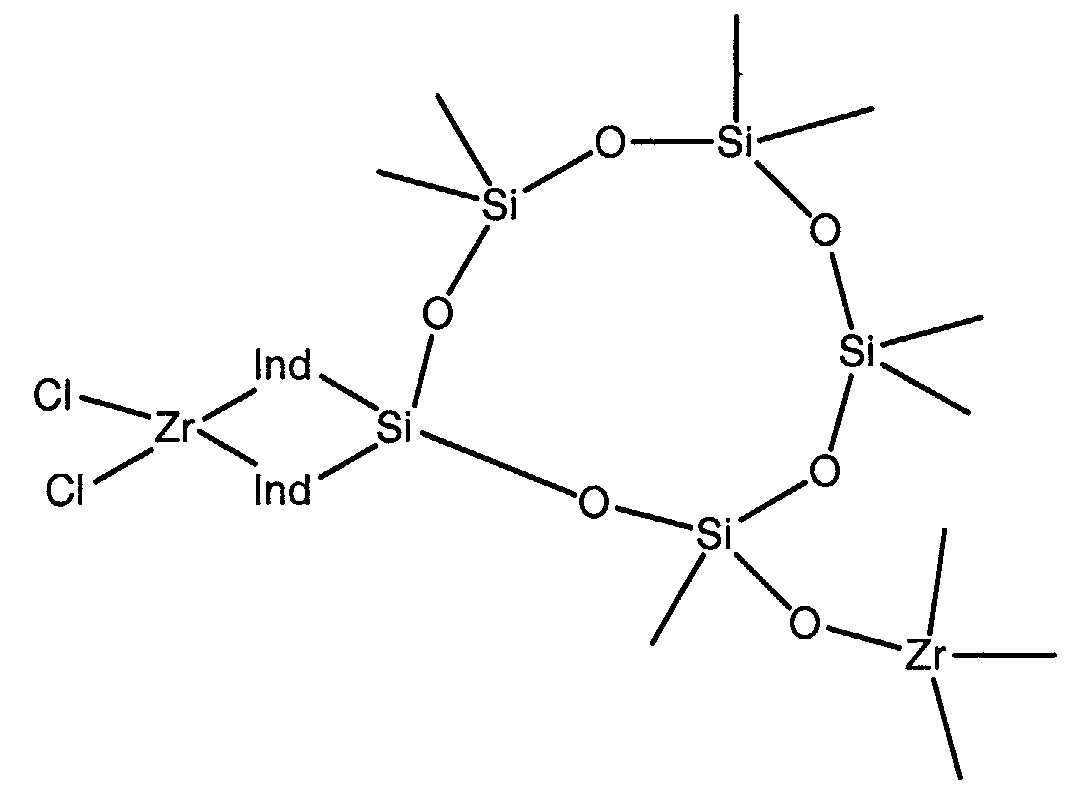
- The silicon containing metallocene catalyst component prepared according to the process of the present invention may typically have the following structure:
- The metallocene catalyst component may be used for the polymerisation of olefins in the presence of any suitable activator component well known for use with metallocene catalysts.
- Preferred activator components are aluminoxanes for example methyl aluminoxane (MAO).
- Other activator components include boron compounds for example boranes such as tris(pentafluorophenyl) borane or borates such as tributyl ammonium tetrephenylborate.
- The metallocene components of the present invention may be used for the polymerisation of olefins in either the solution, slurry or gas phase.
- The metallocene components are most suitable for operation in the gas phase. Gas phase processes for the polymerisation of olefins , especially for the homopolymerisation and the copolymerisation of ethylene and α-olefins for example 1-butene, 1-hexene, 4-methyl-1-pente are well known in the art. Particularly preferred gas phase processes are those operating in a fluidised bed. Examples of such processes are described in EP 89691 and EP 699213 the latter being a particularly preferred process for use with the supported catalysts of the present invention.
- Particularly preferred polymerisation processes are those comprising the polymerisation of ethylene or the copolymerisation of ethylene and α-olefins having from 3 to 10 carbon atoms.
- The present invention will be further described by reference to the following examples:
- In a glove box , zirconium tetrachloride (0,18 mmol) and bis(indenyl)dichlorosilane* (1.01 mmol) were introduced into a Schlenk tube. The tube was connected to a vacuum/N2 line and dimethyldichlorosilane (4.51 mmol) and tetraethoxysilane (2.83 mmol) were successively added via syringes. The mixture was stirred for 5 minutes and transferred via a syringe to another tube which was then sealed under vacuum. The sealed tube was introduced in a steel envelope and held in an oven at 110 - 115°C. After 8 days the tube was opened in a glove box under N2 and the resultant gel dried under vacuum at room temperature for 6 hrs. The chemical composition of the gel was as follows:
Elemental Analysis C H Cl Si Zr O 31.96 5.34 2.36 30.75 1.4 28.19 - The analysis indicated that the indenyl groups are bound to the network of silica. NB. * prepared according to Organometallics 1993, 12, 4607-4612.
- 1.94 mmol of n-butyl lithium was added dropwise at room temperature to 163 mg. of the gel, prepared in example 1, in suspension of pentane (nBuLi/Indenyl = 5.5). The reaction mixture was kept under reflux for 7 hrs. The solvent was removed under vacuum and the solid washed with 3 aliquots of 8 ml. pentane and then dried under vacuum at room temperature for 1 hr.
- To the suspension of the resulting solid in 10 ml tetrahydofuran, 177 mmol ZrCl4.2THF in tetrahydrofuran were added dropwise at room temperature. The mixture was then stirred for 1 hr. The resultant solid was then filtered washed with 2 aliquots of 10 ml. tetrahydrofuran and dried under vacuum.
- In a Schlenk tube were introduced 6.8 mg. of the metallocene catalyst component, prepared in example 2, (6.3 mmol Ind2ZrCl2), 50 ml toluene and 4.2 ml of methyl aluminoxane (Al/Zr = 1000). After stirring for 10 min. the system was degassed. The mixture was held at 60°C and a continuous flow of ethylene (pressure = 1 bar) was maintained. After 1 hr. the polymerisation was terminated by adding acidic ethanol. The precipitated polymer was filtered and dried under vacuum for 8 hr. at room temperature. 1.01 g. of polyethylene was obtained corresponding to an activity of 1.75 kgPE/(gZr.h..bar).
- The polymer was characterised as having Mn = 44800, Mw = 124100 and MWD = 2.8.
Claims (1)
- A process for the preparation of a silicon containing metallocene catalyst component, said process comprising the steps of(a) non-hydrolytic sol-gel condensation of a (cyclopentadienyl) dihalogenated silane with an halogenated silane and an alkoxysilane,(b) deprotonation, and(c) addition of a Group IVA metal compound.
Priority Applications (5)
| Application Number | Priority Date | Filing Date | Title |
|---|---|---|---|
| EP02358016A EP1391467A1 (en) | 2002-08-20 | 2002-08-20 | Polymerisation catalyst |
| EP03792474A EP1546214A1 (en) | 2002-08-20 | 2003-08-14 | Silica-supported polymerisation catalyst |
| US10/524,435 US7452947B2 (en) | 2002-08-20 | 2003-08-14 | Silica-supported polymerization catalyst |
| PCT/GB2003/003570 WO2004018523A1 (en) | 2002-08-20 | 2003-08-14 | Silica-supported polymerisation catalyst |
| AU2003259325A AU2003259325A1 (en) | 2002-08-20 | 2003-08-14 | Silica-supported polymerisation catalyst |
Applications Claiming Priority (1)
| Application Number | Priority Date | Filing Date | Title |
|---|---|---|---|
| EP02358016A EP1391467A1 (en) | 2002-08-20 | 2002-08-20 | Polymerisation catalyst |
Publications (1)
| Publication Number | Publication Date |
|---|---|
| EP1391467A1 true EP1391467A1 (en) | 2004-02-25 |
Family
ID=30775897
Family Applications (1)
| Application Number | Title | Priority Date | Filing Date |
|---|---|---|---|
| EP02358016A Withdrawn EP1391467A1 (en) | 2002-08-20 | 2002-08-20 | Polymerisation catalyst |
Country Status (1)
| Country | Link |
|---|---|
| EP (1) | EP1391467A1 (en) |
-
2002
- 2002-08-20 EP EP02358016A patent/EP1391467A1/en not_active Withdrawn
Non-Patent Citations (1)
| Title |
|---|
| JOAO H.Z. DOS SANTOS ET AL: "Indenyl-silica xerogels: new materials for supporting metallocene catalysts", APPLIED CATALYSIS A: GENERAL, vol. 220, October 2001 (2001-10-01), pages 287 - 302, XP002238649 * |
Similar Documents
| Publication | Publication Date | Title |
|---|---|---|
| JP4951351B2 (en) | Activating support for metallocene catalysts | |
| RU2241717C2 (en) | Catalytic systems and their applying in process of polymerization | |
| EP0640090B2 (en) | Process for preparation of monocyclopentadienyl metal complex compounds and method of use | |
| JP3093795B2 (en) | Supported catalyst for (co) polymerization of 1-olefins | |
| EP1517930B1 (en) | Polymerization catalyst activators, method of preparing and their use in polymerization processes | |
| KR20000005029A (en) | Polymerization method of aryl containing metal complex and olefine | |
| JPH10508630A (en) | Catalyst for bimodal molecular weight distribution ethylene polymers and copolymers | |
| HUT73199A (en) | Polymer bound ligands, process for production thereof, polymer bound metallocenes, catalyst systems and polymerization process | |
| CN1328580A (en) | Bridged Metallocenes for Olefin Copolymerization | |
| EP0757992A1 (en) | Heterogenous metallocene catalysts and use thereof in olefin polymerization process | |
| JP2816766B2 (en) | Modified monocyclopentadienyl transition metal / alumoxane catalyst system for olefin polymerization | |
| JP3547710B2 (en) | Metallocene compounds and olefin polymerization using the same | |
| HUT73051A (en) | Catalyst compositions useful for olefin polymerization, and process for production thereof and use thereof | |
| EP1373282A2 (en) | Bimetallic catalysts for olefin polymerization | |
| WO2009012022A1 (en) | Preparation of supported silyl-capped silica silica-bound anion activators and associated catalysts | |
| US20030054952A1 (en) | Component of catalyst for polymerizing olefin, catalyst for polymerizing olefin and process for polymerizing olefin | |
| US6177526B1 (en) | Supported catalyst system, process for its preparation and its use for the polymerization of olefins | |
| JPH09194523A (en) | Supported metallocene catalyst for alpha-olefin (co) polymerization | |
| US7452947B2 (en) | Silica-supported polymerization catalyst | |
| JPH11228613A (en) | Solid catalytic component for olefin polymerization | |
| JP2004530653A (en) | Non-metallocenes, their preparation and use in the polymerization of olefins | |
| US6194343B1 (en) | Bridged “tethered” metallocenes | |
| US6278009B1 (en) | Heterogeneous catalyst components for olefins polymerization, preparation process and use thereof | |
| US7060767B2 (en) | Supported metallocene catalytic component and method for obtaining same | |
| KR101751583B1 (en) | Catalyst for olefin polymerization and olefin polymerization method using the same |
Legal Events
| Date | Code | Title | Description |
|---|---|---|---|
| PUAI | Public reference made under article 153(3) epc to a published international application that has entered the european phase |
Free format text: ORIGINAL CODE: 0009012 |
|
| AK | Designated contracting states |
Kind code of ref document: A1 Designated state(s): AT BE BG CH CY CZ DE DK EE ES FI FR GB GR IE IT LI LU MC NL PT SE SK TR |
|
| AX | Request for extension of the european patent |
Extension state: AL LT LV MK RO SI |
|
| STAA | Information on the status of an ep patent application or granted ep patent |
Free format text: STATUS: THE APPLICATION IS DEEMED TO BE WITHDRAWN |
|
| 18D | Application deemed to be withdrawn |
Effective date: 20031230 |