EP1391462A1 - Crohn's disease antibody-binding peptide and method of examining crohn's disease - Google Patents
Crohn's disease antibody-binding peptide and method of examining crohn's disease Download PDFInfo
- Publication number
- EP1391462A1 EP1391462A1 EP02722733A EP02722733A EP1391462A1 EP 1391462 A1 EP1391462 A1 EP 1391462A1 EP 02722733 A EP02722733 A EP 02722733A EP 02722733 A EP02722733 A EP 02722733A EP 1391462 A1 EP1391462 A1 EP 1391462A1
- Authority
- EP
- European Patent Office
- Prior art keywords
- peptide
- amino acid
- crohn
- disease
- acid sequence
- Prior art date
- Legal status (The legal status is an assumption and is not a legal conclusion. Google has not performed a legal analysis and makes no representation as to the accuracy of the status listed.)
- Withdrawn
Links
- 108090000765 processed proteins & peptides Proteins 0.000 title claims abstract description 744
- 208000011231 Crohn disease Diseases 0.000 title claims abstract description 408
- 230000027455 binding Effects 0.000 title claims abstract description 156
- 238000000034 method Methods 0.000 title claims abstract description 153
- 125000003275 alpha amino acid group Chemical group 0.000 claims abstract description 285
- 241000282414 Homo sapiens Species 0.000 claims abstract description 110
- 235000007164 Oryza sativa Nutrition 0.000 claims abstract description 103
- 235000009566 rice Nutrition 0.000 claims abstract description 103
- 239000013566 allergen Substances 0.000 claims abstract description 102
- 150000001413 amino acids Chemical class 0.000 claims abstract description 59
- 239000003153 chemical reaction reagent Substances 0.000 claims abstract description 49
- 238000007792 addition Methods 0.000 claims abstract description 38
- 108091006112 ATPases Proteins 0.000 claims abstract description 30
- 102000057290 Adenosine Triphosphatases Human genes 0.000 claims abstract description 30
- 239000012472 biological sample Substances 0.000 claims abstract description 30
- 238000012217 deletion Methods 0.000 claims abstract description 30
- 230000037430 deletion Effects 0.000 claims abstract description 30
- 238000006467 substitution reaction Methods 0.000 claims abstract description 30
- 108010089610 Nuclear Proteins Proteins 0.000 claims abstract description 24
- 102000007999 Nuclear Proteins Human genes 0.000 claims abstract description 24
- 102100028435 Zinc finger protein 300 Human genes 0.000 claims abstract description 19
- 101710146843 Zinc finger protein 300 Proteins 0.000 claims abstract description 19
- 239000004480 active ingredient Substances 0.000 claims abstract description 13
- 102000004196 processed proteins & peptides Human genes 0.000 claims description 162
- 241000209094 Oryza Species 0.000 claims description 102
- 239000000427 antigen Substances 0.000 claims description 90
- 102000036639 antigens Human genes 0.000 claims description 88
- 108091007433 antigens Proteins 0.000 claims description 88
- 108090000623 proteins and genes Proteins 0.000 claims description 87
- 238000006243 chemical reaction Methods 0.000 claims description 82
- 102000004169 proteins and genes Human genes 0.000 claims description 71
- 239000000126 substance Substances 0.000 claims description 54
- 230000000890 antigenic effect Effects 0.000 claims description 45
- 239000000523 sample Substances 0.000 claims description 31
- 238000002372 labelling Methods 0.000 claims description 30
- 102000004190 Enzymes Human genes 0.000 claims description 29
- 108090000790 Enzymes Proteins 0.000 claims description 29
- 229940088598 enzyme Drugs 0.000 claims description 29
- 125000000539 amino acid group Chemical group 0.000 claims description 23
- 239000002243 precursor Substances 0.000 claims description 18
- 239000007790 solid phase Substances 0.000 claims description 18
- 101100193637 Oryza sativa subsp. japonica RAG2 gene Proteins 0.000 claims description 17
- 239000003392 amylase inhibitor Substances 0.000 claims description 15
- 239000002753 trypsin inhibitor Substances 0.000 claims description 14
- 239000003085 diluting agent Substances 0.000 claims description 13
- 239000000758 substrate Substances 0.000 claims description 12
- 101001061851 Homo sapiens V(D)J recombination-activating protein 2 Proteins 0.000 claims description 9
- 102100029591 V(D)J recombination-activating protein 2 Human genes 0.000 claims description 9
- 102000004139 alpha-Amylases Human genes 0.000 claims description 6
- 108090000637 alpha-Amylases Proteins 0.000 claims description 6
- 229940024171 alpha-amylase Drugs 0.000 claims description 6
- 239000012089 stop solution Substances 0.000 claims description 6
- 238000004519 manufacturing process Methods 0.000 claims description 3
- 240000007594 Oryza sativa Species 0.000 abstract 1
- 102000023732 binding proteins Human genes 0.000 abstract 1
- 108091008324 binding proteins Proteins 0.000 abstract 1
- 210000002966 serum Anatomy 0.000 description 150
- 235000001014 amino acid Nutrition 0.000 description 79
- 229940024606 amino acid Drugs 0.000 description 79
- 235000018102 proteins Nutrition 0.000 description 65
- 230000009257 reactivity Effects 0.000 description 57
- 238000002965 ELISA Methods 0.000 description 40
- 229920001184 polypeptide Polymers 0.000 description 36
- 206010009900 Colitis ulcerative Diseases 0.000 description 35
- 201000006704 Ulcerative Colitis Diseases 0.000 description 35
- OGMARHJAPWBNFA-UHFFFAOYSA-N vancomycin cdp-1 Chemical compound O1C(C(=C2)Cl)=CC=C2C(O)C(C(NC(C2=CC(O)=CC(O)=C2C=2C(O)=CC=C3C=2)C(O)=O)=O)NC(=O)C3NC(=O)C2NC(=O)CC(C(O)=O)NC(=O)C(NC(=O)C(CC(C)C)NC)C(O)C(C=C3Cl)=CC=C3OC3=CC2=CC1=C3OC1OC(CO)C(O)C(O)C1OC1CC(C)(N)C(O)C(C)O1 OGMARHJAPWBNFA-UHFFFAOYSA-N 0.000 description 25
- 102100024219 T-cell surface glycoprotein CD1a Human genes 0.000 description 23
- 239000000243 solution Substances 0.000 description 23
- 238000010586 diagram Methods 0.000 description 22
- 102100036011 T-cell surface glycoprotein CD4 Human genes 0.000 description 21
- 102000017420 CD3 protein, epsilon/gamma/delta subunit Human genes 0.000 description 20
- 238000001514 detection method Methods 0.000 description 19
- -1 hexaphosphoramide Chemical compound 0.000 description 16
- 239000011324 bead Substances 0.000 description 13
- 239000000412 dendrimer Substances 0.000 description 13
- 229920000736 dendritic polymer Polymers 0.000 description 13
- 239000002683 reaction inhibitor Substances 0.000 description 13
- 238000012360 testing method Methods 0.000 description 13
- 235000014680 Saccharomyces cerevisiae Nutrition 0.000 description 12
- 102100025237 T-cell surface antigen CD2 Human genes 0.000 description 12
- 238000003018 immunoassay Methods 0.000 description 12
- 241001408449 Asca Species 0.000 description 11
- 240000004808 Saccharomyces cerevisiae Species 0.000 description 11
- 238000003745 diagnosis Methods 0.000 description 11
- 108020004414 DNA Proteins 0.000 description 10
- 230000004048 modification Effects 0.000 description 10
- 238000012986 modification Methods 0.000 description 10
- 239000011347 resin Substances 0.000 description 10
- 229920005989 resin Polymers 0.000 description 10
- 239000005018 casein Substances 0.000 description 9
- BECPQYXYKAMYBN-UHFFFAOYSA-N casein, tech. Chemical compound NCCCCC(C(O)=O)N=C(O)C(CC(O)=O)N=C(O)C(CCC(O)=N)N=C(O)C(CC(C)C)N=C(O)C(CCC(O)=O)N=C(O)C(CC(O)=O)N=C(O)C(CCC(O)=O)N=C(O)C(C(C)O)N=C(O)C(CCC(O)=N)N=C(O)C(CCC(O)=N)N=C(O)C(CCC(O)=N)N=C(O)C(CCC(O)=O)N=C(O)C(CCC(O)=O)N=C(O)C(COP(O)(O)=O)N=C(O)C(CCC(O)=N)N=C(O)C(N)CC1=CC=CC=C1 BECPQYXYKAMYBN-UHFFFAOYSA-N 0.000 description 9
- 235000021240 caseins Nutrition 0.000 description 9
- 230000003100 immobilizing effect Effects 0.000 description 9
- 230000005764 inhibitory process Effects 0.000 description 9
- 238000010647 peptide synthesis reaction Methods 0.000 description 9
- 239000000047 product Substances 0.000 description 9
- 108091003079 Bovine Serum Albumin Proteins 0.000 description 8
- 229940098773 bovine serum albumin Drugs 0.000 description 8
- 238000002474 experimental method Methods 0.000 description 8
- 239000012634 fragment Substances 0.000 description 8
- 230000002401 inhibitory effect Effects 0.000 description 8
- 239000003550 marker Substances 0.000 description 8
- 239000000203 mixture Substances 0.000 description 8
- 238000010517 secondary reaction Methods 0.000 description 8
- 239000004382 Amylase Substances 0.000 description 7
- 102000013142 Amylases Human genes 0.000 description 7
- 108010065511 Amylases Proteins 0.000 description 7
- 208000007107 Stomach Ulcer Diseases 0.000 description 7
- 235000019418 amylase Nutrition 0.000 description 7
- 208000000718 duodenal ulcer Diseases 0.000 description 7
- 201000005917 gastric ulcer Diseases 0.000 description 7
- 239000002609 medium Substances 0.000 description 7
- 238000002823 phage display Methods 0.000 description 7
- 125000002924 primary amino group Chemical group [H]N([H])* 0.000 description 7
- 238000012216 screening Methods 0.000 description 7
- 241000588724 Escherichia coli Species 0.000 description 6
- 108010001336 Horseradish Peroxidase Proteins 0.000 description 6
- ZMXDDKWLCZADIW-UHFFFAOYSA-N N,N-Dimethylformamide Chemical compound CN(C)C=O ZMXDDKWLCZADIW-UHFFFAOYSA-N 0.000 description 6
- FAPWRFPIFSIZLT-UHFFFAOYSA-M Sodium chloride Chemical compound [Na+].[Cl-] FAPWRFPIFSIZLT-UHFFFAOYSA-M 0.000 description 6
- 235000004279 alanine Nutrition 0.000 description 6
- 239000000872 buffer Substances 0.000 description 6
- 238000005516 engineering process Methods 0.000 description 6
- 239000002904 solvent Substances 0.000 description 6
- 230000002378 acidificating effect Effects 0.000 description 5
- 229960000723 ampicillin Drugs 0.000 description 5
- AVKUERGKIZMTKX-NJBDSQKTSA-N ampicillin Chemical compound C1([C@@H](N)C(=O)N[C@H]2[C@H]3SC([C@@H](N3C2=O)C(O)=O)(C)C)=CC=CC=C1 AVKUERGKIZMTKX-NJBDSQKTSA-N 0.000 description 5
- 230000001188 anti-phage Effects 0.000 description 5
- 238000003556 assay Methods 0.000 description 5
- 210000004027 cell Anatomy 0.000 description 5
- 239000000463 material Substances 0.000 description 5
- 108040007629 peroxidase activity proteins Proteins 0.000 description 5
- 102000013415 peroxidase activity proteins Human genes 0.000 description 5
- 238000002360 preparation method Methods 0.000 description 5
- 125000006239 protecting group Chemical group 0.000 description 5
- 241000894007 species Species 0.000 description 5
- 238000003786 synthesis reaction Methods 0.000 description 5
- 238000005406 washing Methods 0.000 description 5
- IAZDPXIOMUYVGZ-UHFFFAOYSA-N Dimethylsulphoxide Chemical compound CS(C)=O IAZDPXIOMUYVGZ-UHFFFAOYSA-N 0.000 description 4
- QNAYBMKLOCPYGJ-REOHCLBHSA-N L-alanine Chemical compound C[C@H](N)C(O)=O QNAYBMKLOCPYGJ-REOHCLBHSA-N 0.000 description 4
- 241000187482 Mycobacterium avium subsp. paratuberculosis Species 0.000 description 4
- 108091028043 Nucleic acid sequence Proteins 0.000 description 4
- QAOWNCQODCNURD-UHFFFAOYSA-N Sulfuric acid Chemical compound OS(O)(=O)=O QAOWNCQODCNURD-UHFFFAOYSA-N 0.000 description 4
- WYURNTSHIVDZCO-UHFFFAOYSA-N Tetrahydrofuran Chemical compound C1CCOC1 WYURNTSHIVDZCO-UHFFFAOYSA-N 0.000 description 4
- 210000004369 blood Anatomy 0.000 description 4
- 239000008280 blood Substances 0.000 description 4
- 239000007853 buffer solution Substances 0.000 description 4
- 210000000234 capsid Anatomy 0.000 description 4
- 208000037265 diseases, disorders, signs and symptoms Diseases 0.000 description 4
- MHMNJMPURVTYEJ-UHFFFAOYSA-N fluorescein-5-isothiocyanate Chemical compound O1C(=O)C2=CC(N=C=S)=CC=C2C21C1=CC=C(O)C=C1OC1=CC(O)=CC=C21 MHMNJMPURVTYEJ-UHFFFAOYSA-N 0.000 description 4
- 125000000524 functional group Chemical group 0.000 description 4
- 230000014509 gene expression Effects 0.000 description 4
- 230000002757 inflammatory effect Effects 0.000 description 4
- 239000011159 matrix material Substances 0.000 description 4
- 230000003278 mimic effect Effects 0.000 description 4
- 238000012163 sequencing technique Methods 0.000 description 4
- QTBSBXVTEAMEQO-UHFFFAOYSA-N Acetic acid Chemical compound CC(O)=O QTBSBXVTEAMEQO-UHFFFAOYSA-N 0.000 description 3
- 102000002260 Alkaline Phosphatase Human genes 0.000 description 3
- 108020004774 Alkaline Phosphatase Proteins 0.000 description 3
- 229940122816 Amylase inhibitor Drugs 0.000 description 3
- 241000283707 Capra Species 0.000 description 3
- 108010038061 Chymotrypsinogen Proteins 0.000 description 3
- XEKOWRVHYACXOJ-UHFFFAOYSA-N Ethyl acetate Chemical compound CCOC(C)=O XEKOWRVHYACXOJ-UHFFFAOYSA-N 0.000 description 3
- 239000006142 Luria-Bertani Agar Substances 0.000 description 3
- 102000015636 Oligopeptides Human genes 0.000 description 3
- 108010038807 Oligopeptides Proteins 0.000 description 3
- 102000009097 Phosphorylases Human genes 0.000 description 3
- 108010073135 Phosphorylases Proteins 0.000 description 3
- 229920001213 Polysorbate 20 Polymers 0.000 description 3
- 102100025244 T-cell surface glycoprotein CD5 Human genes 0.000 description 3
- 239000007983 Tris buffer Substances 0.000 description 3
- 239000013504 Triton X-100 Substances 0.000 description 3
- 229920004890 Triton X-100 Polymers 0.000 description 3
- 101710162629 Trypsin inhibitor Proteins 0.000 description 3
- 239000002253 acid Substances 0.000 description 3
- 238000004458 analytical method Methods 0.000 description 3
- 238000009833 condensation Methods 0.000 description 3
- 230000005494 condensation Effects 0.000 description 3
- 229920001577 copolymer Polymers 0.000 description 3
- 238000005859 coupling reaction Methods 0.000 description 3
- 238000011161 development Methods 0.000 description 3
- 230000006870 function Effects 0.000 description 3
- 239000011521 glass Substances 0.000 description 3
- 108020004445 glyceraldehyde-3-phosphate dehydrogenase Proteins 0.000 description 3
- 102000006602 glyceraldehyde-3-phosphate dehydrogenase Human genes 0.000 description 3
- 239000003456 ion exchange resin Substances 0.000 description 3
- 229920003303 ion-exchange polymer Polymers 0.000 description 3
- 108010029942 microperoxidase Proteins 0.000 description 3
- 108091005601 modified peptides Proteins 0.000 description 3
- 108091005573 modified proteins Proteins 0.000 description 3
- 102000035118 modified proteins Human genes 0.000 description 3
- 230000035772 mutation Effects 0.000 description 3
- 210000003463 organelle Anatomy 0.000 description 3
- 239000000256 polyoxyethylene sorbitan monolaurate Substances 0.000 description 3
- 235000010486 polyoxyethylene sorbitan monolaurate Nutrition 0.000 description 3
- 239000011541 reaction mixture Substances 0.000 description 3
- 238000011160 research Methods 0.000 description 3
- 238000007790 scraping Methods 0.000 description 3
- 239000011780 sodium chloride Substances 0.000 description 3
- 230000009870 specific binding Effects 0.000 description 3
- LENZDBCJOHFCAS-UHFFFAOYSA-N tris Chemical compound OCC(N)(CO)CO LENZDBCJOHFCAS-UHFFFAOYSA-N 0.000 description 3
- MTCFGRXMJLQNBG-REOHCLBHSA-N (2S)-2-Amino-3-hydroxypropansäure Chemical compound OC[C@H](N)C(O)=O MTCFGRXMJLQNBG-REOHCLBHSA-N 0.000 description 2
- NWUYHJFMYQTDRP-UHFFFAOYSA-N 1,2-bis(ethenyl)benzene;1-ethenyl-2-ethylbenzene;styrene Chemical compound C=CC1=CC=CC=C1.CCC1=CC=CC=C1C=C.C=CC1=CC=CC=C1C=C NWUYHJFMYQTDRP-UHFFFAOYSA-N 0.000 description 2
- OBYNJKLOYWCXEP-UHFFFAOYSA-N 2-[3-(dimethylamino)-6-dimethylazaniumylidenexanthen-9-yl]-4-isothiocyanatobenzoate Chemical compound C=12C=CC(=[N+](C)C)C=C2OC2=CC(N(C)C)=CC=C2C=1C1=CC(N=C=S)=CC=C1C([O-])=O OBYNJKLOYWCXEP-UHFFFAOYSA-N 0.000 description 2
- YLKRUSPZOTYMAT-YFKPBYRVSA-N 6-hydroxy-L-dopa Chemical compound OC(=O)[C@@H](N)CC1=CC(O)=C(O)C=C1O YLKRUSPZOTYMAT-YFKPBYRVSA-N 0.000 description 2
- 102100027790 ATP synthase subunit e, mitochondrial Human genes 0.000 description 2
- 101710181154 ATP synthase subunit e, mitochondrial Proteins 0.000 description 2
- 101710172128 Alpha-amylase/trypsin inhibitor Proteins 0.000 description 2
- 241000894006 Bacteria Species 0.000 description 2
- 241000196324 Embryophyta Species 0.000 description 2
- 241000724791 Filamentous phage Species 0.000 description 2
- WQZGKKKJIJFFOK-GASJEMHNSA-N Glucose Natural products OC[C@H]1OC(O)[C@H](O)[C@@H](O)[C@@H]1O WQZGKKKJIJFFOK-GASJEMHNSA-N 0.000 description 2
- DHMQDGOQFOQNFH-UHFFFAOYSA-N Glycine Chemical compound NCC(O)=O DHMQDGOQFOQNFH-UHFFFAOYSA-N 0.000 description 2
- VEXZGXHMUGYJMC-UHFFFAOYSA-N Hydrochloric acid Chemical compound Cl VEXZGXHMUGYJMC-UHFFFAOYSA-N 0.000 description 2
- CPELXLSAUQHCOX-UHFFFAOYSA-N Hydrogen bromide Chemical compound Br CPELXLSAUQHCOX-UHFFFAOYSA-N 0.000 description 2
- 206010020751 Hypersensitivity Diseases 0.000 description 2
- KDXKERNSBIXSRK-UHFFFAOYSA-N Lysine Natural products NCCCCC(N)C(O)=O KDXKERNSBIXSRK-UHFFFAOYSA-N 0.000 description 2
- CSNNHWWHGAXBCP-UHFFFAOYSA-L Magnesium sulfate Chemical compound [Mg+2].[O-][S+2]([O-])([O-])[O-] CSNNHWWHGAXBCP-UHFFFAOYSA-L 0.000 description 2
- 241001465754 Metazoa Species 0.000 description 2
- AFVFQIVMOAPDHO-UHFFFAOYSA-N Methanesulfonic acid Chemical compound CS(O)(=O)=O AFVFQIVMOAPDHO-UHFFFAOYSA-N 0.000 description 2
- 101000694110 Nicotiana tabacum Lignin-forming anionic peroxidase Proteins 0.000 description 2
- 101710193132 Pre-hexon-linking protein VIII Proteins 0.000 description 2
- MTCFGRXMJLQNBG-UHFFFAOYSA-N Serine Natural products OCC(N)C(O)=O MTCFGRXMJLQNBG-UHFFFAOYSA-N 0.000 description 2
- PXIPVTKHYLBLMZ-UHFFFAOYSA-N Sodium azide Chemical compound [Na+].[N-]=[N+]=[N-] PXIPVTKHYLBLMZ-UHFFFAOYSA-N 0.000 description 2
- DTQVDTLACAAQTR-UHFFFAOYSA-N Trifluoroacetic acid Chemical compound OC(=O)C(F)(F)F DTQVDTLACAAQTR-UHFFFAOYSA-N 0.000 description 2
- 229940122618 Trypsin inhibitor Drugs 0.000 description 2
- XSQUKJJJFZCRTK-UHFFFAOYSA-N Urea Chemical compound NC(N)=O XSQUKJJJFZCRTK-UHFFFAOYSA-N 0.000 description 2
- 101710100790 V-type ATP synthase subunit E Proteins 0.000 description 2
- 101710117865 V-type proton ATPase subunit E Proteins 0.000 description 2
- 238000002835 absorbance Methods 0.000 description 2
- 125000003295 alanine group Chemical group N[C@@H](C)C(=O)* 0.000 description 2
- 208000026935 allergic disease Diseases 0.000 description 2
- 230000007815 allergy Effects 0.000 description 2
- 229940009098 aspartate Drugs 0.000 description 2
- 238000003149 assay kit Methods 0.000 description 2
- 230000008901 benefit Effects 0.000 description 2
- 125000001584 benzyloxycarbonyl group Chemical group C(=O)(OCC1=CC=CC=C1)* 0.000 description 2
- 230000015572 biosynthetic process Effects 0.000 description 2
- 230000000903 blocking effect Effects 0.000 description 2
- 239000003795 chemical substances by application Substances 0.000 description 2
- 230000000052 comparative effect Effects 0.000 description 2
- 238000006482 condensation reaction Methods 0.000 description 2
- 238000007796 conventional method Methods 0.000 description 2
- 230000008878 coupling Effects 0.000 description 2
- 238000010168 coupling process Methods 0.000 description 2
- 239000003431 cross linking reagent Substances 0.000 description 2
- 238000010511 deprotection reaction Methods 0.000 description 2
- 235000005911 diet Nutrition 0.000 description 2
- 230000000378 dietary effect Effects 0.000 description 2
- 238000010790 dilution Methods 0.000 description 2
- 239000012895 dilution Substances 0.000 description 2
- 201000010099 disease Diseases 0.000 description 2
- 208000035475 disorder Diseases 0.000 description 2
- 230000000694 effects Effects 0.000 description 2
- 238000011156 evaluation Methods 0.000 description 2
- 239000012530 fluid Substances 0.000 description 2
- 238000010353 genetic engineering Methods 0.000 description 2
- 239000008103 glucose Substances 0.000 description 2
- 230000036541 health Effects 0.000 description 2
- IXCSERBJSXMMFS-UHFFFAOYSA-N hydrogen chloride Substances Cl.Cl IXCSERBJSXMMFS-UHFFFAOYSA-N 0.000 description 2
- 229910000041 hydrogen chloride Inorganic materials 0.000 description 2
- 125000002887 hydroxy group Chemical group [H]O* 0.000 description 2
- 238000000338 in vitro Methods 0.000 description 2
- 238000011835 investigation Methods 0.000 description 2
- BPHPUYQFMNQIOC-NXRLNHOXSA-N isopropyl beta-D-thiogalactopyranoside Chemical compound CC(C)S[C@@H]1O[C@H](CO)[C@H](O)[C@H](O)[C@H]1O BPHPUYQFMNQIOC-NXRLNHOXSA-N 0.000 description 2
- 229930027917 kanamycin Natural products 0.000 description 2
- 229960000318 kanamycin Drugs 0.000 description 2
- SBUJHOSQTJFQJX-NOAMYHISSA-N kanamycin Chemical compound O[C@@H]1[C@@H](O)[C@H](O)[C@@H](CN)O[C@@H]1O[C@H]1[C@H](O)[C@@H](O[C@@H]2[C@@H]([C@@H](N)[C@H](O)[C@@H](CO)O2)O)[C@H](N)C[C@@H]1N SBUJHOSQTJFQJX-NOAMYHISSA-N 0.000 description 2
- 229930182823 kanamycin A Natural products 0.000 description 2
- 239000004816 latex Substances 0.000 description 2
- 229920000126 latex Polymers 0.000 description 2
- 239000007788 liquid Substances 0.000 description 2
- 238000005259 measurement Methods 0.000 description 2
- 229910052751 metal Inorganic materials 0.000 description 2
- 239000002184 metal Substances 0.000 description 2
- BDAGIHXWWSANSR-UHFFFAOYSA-N methanoic acid Natural products OC=O BDAGIHXWWSANSR-UHFFFAOYSA-N 0.000 description 2
- 210000004897 n-terminal region Anatomy 0.000 description 2
- 229910052757 nitrogen Inorganic materials 0.000 description 2
- 125000004433 nitrogen atom Chemical group N* 0.000 description 2
- 108020004707 nucleic acids Proteins 0.000 description 2
- 102000039446 nucleic acids Human genes 0.000 description 2
- 150000007523 nucleic acids Chemical class 0.000 description 2
- 239000002245 particle Substances 0.000 description 2
- UYWQUFXKFGHYNT-UHFFFAOYSA-N phenylmethyl ester of formic acid Natural products O=COCC1=CC=CC=C1 UYWQUFXKFGHYNT-UHFFFAOYSA-N 0.000 description 2
- 239000008363 phosphate buffer Substances 0.000 description 2
- 238000011084 recovery Methods 0.000 description 2
- 230000000717 retained effect Effects 0.000 description 2
- YVSWPCCVTYEEHG-UHFFFAOYSA-N rhodamine B 5-isothiocyanate Chemical compound [Cl-].C=12C=CC(=[N+](CC)CC)C=C2OC2=CC(N(CC)CC)=CC=C2C=1C1=CC=C(N=C=S)C=C1C(O)=O YVSWPCCVTYEEHG-UHFFFAOYSA-N 0.000 description 2
- 210000003296 saliva Anatomy 0.000 description 2
- 210000000582 semen Anatomy 0.000 description 2
- 230000035945 sensitivity Effects 0.000 description 2
- 125000006850 spacer group Chemical group 0.000 description 2
- 210000004243 sweat Anatomy 0.000 description 2
- 125000000999 tert-butyl group Chemical group [H]C([H])([H])C(*)(C([H])([H])[H])C([H])([H])[H] 0.000 description 2
- YLQBMQCUIZJEEH-UHFFFAOYSA-N tetrahydrofuran Natural products C=1C=COC=1 YLQBMQCUIZJEEH-UHFFFAOYSA-N 0.000 description 2
- 210000002700 urine Anatomy 0.000 description 2
- LUEWUZLMQUOBSB-FSKGGBMCSA-N (2s,3s,4s,5s,6r)-2-[(2r,3s,4r,5r,6s)-6-[(2r,3s,4r,5s,6s)-4,5-dihydroxy-2-(hydroxymethyl)-6-[(2r,4r,5s,6r)-4,5,6-trihydroxy-2-(hydroxymethyl)oxan-3-yl]oxyoxan-3-yl]oxy-4,5-dihydroxy-2-(hydroxymethyl)oxan-3-yl]oxy-6-(hydroxymethyl)oxane-3,4,5-triol Chemical compound O[C@H]1[C@@H](O)[C@H](O)[C@@H](CO)O[C@H]1O[C@@H]1[C@@H](CO)O[C@@H](O[C@@H]2[C@H](O[C@@H](OC3[C@H](O[C@@H](O)[C@@H](O)[C@H]3O)CO)[C@@H](O)[C@H]2O)CO)[C@H](O)[C@H]1O LUEWUZLMQUOBSB-FSKGGBMCSA-N 0.000 description 1
- 125000003088 (fluoren-9-ylmethoxy)carbonyl group Chemical group 0.000 description 1
- RYHBNJHYFVUHQT-UHFFFAOYSA-N 1,4-Dioxane Chemical compound C1COCCO1 RYHBNJHYFVUHQT-UHFFFAOYSA-N 0.000 description 1
- ASOKPJOREAFHNY-UHFFFAOYSA-N 1-Hydroxybenzotriazole Chemical compound C1=CC=C2N(O)N=NC2=C1 ASOKPJOREAFHNY-UHFFFAOYSA-N 0.000 description 1
- QKNYBSVHEMOAJP-UHFFFAOYSA-N 2-amino-2-(hydroxymethyl)propane-1,3-diol;hydron;chloride Chemical compound Cl.OCC(N)(CO)CO QKNYBSVHEMOAJP-UHFFFAOYSA-N 0.000 description 1
- UAIUNKRWKOVEES-UHFFFAOYSA-N 3,3',5,5'-tetramethylbenzidine Chemical compound CC1=C(N)C(C)=CC(C=2C=C(C)C(N)=C(C)C=2)=C1 UAIUNKRWKOVEES-UHFFFAOYSA-N 0.000 description 1
- ATAFDSCDEDHMOK-UHFFFAOYSA-N 3,3-diaminopropanoic acid Chemical compound NC(N)CC(O)=O ATAFDSCDEDHMOK-UHFFFAOYSA-N 0.000 description 1
- PCDWFBFHIIKIPM-UHFFFAOYSA-N 3-ethyl-2h-1,3-benzothiazole-2-sulfonic acid Chemical compound C1=CC=C2N(CC)C(S(O)(=O)=O)SC2=C1 PCDWFBFHIIKIPM-UHFFFAOYSA-N 0.000 description 1
- OWSRLHPWDZOHCR-UHFFFAOYSA-N 4,4-diaminobutanoic acid Chemical compound NC(N)CCC(O)=O OWSRLHPWDZOHCR-UHFFFAOYSA-N 0.000 description 1
- OSWFIVFLDKOXQC-UHFFFAOYSA-N 4-(3-methoxyphenyl)aniline Chemical compound COC1=CC=CC(C=2C=CC(N)=CC=2)=C1 OSWFIVFLDKOXQC-UHFFFAOYSA-N 0.000 description 1
- XZKIHKMTEMTJQX-UHFFFAOYSA-N 4-Nitrophenyl Phosphate Chemical compound OP(O)(=O)OC1=CC=C([N+]([O-])=O)C=C1 XZKIHKMTEMTJQX-UHFFFAOYSA-N 0.000 description 1
- QGZKDVFQNNGYKY-UHFFFAOYSA-N Ammonia Chemical compound N QGZKDVFQNNGYKY-UHFFFAOYSA-N 0.000 description 1
- 241000238421 Arthropoda Species 0.000 description 1
- 244000186140 Asperula odorata Species 0.000 description 1
- 208000023275 Autoimmune disease Diseases 0.000 description 1
- BTBUEUYNUDRHOZ-UHFFFAOYSA-N Borate Chemical compound [O-]B([O-])[O-] BTBUEUYNUDRHOZ-UHFFFAOYSA-N 0.000 description 1
- 101710132601 Capsid protein Proteins 0.000 description 1
- 229920002134 Carboxymethyl cellulose Polymers 0.000 description 1
- 108010001857 Cell Surface Receptors Proteins 0.000 description 1
- 108010058432 Chaperonin 60 Proteins 0.000 description 1
- 102000006303 Chaperonin 60 Human genes 0.000 description 1
- ZNVCTCKBDKTIHP-UHFFFAOYSA-N Cl.Cl.Cl.NC(CO)(CO)CO.NC(CO)(CO)CO.NC(CO)(CO)CO Chemical compound Cl.Cl.Cl.NC(CO)(CO)CO.NC(CO)(CO)CO.NC(CO)(CO)CO ZNVCTCKBDKTIHP-UHFFFAOYSA-N 0.000 description 1
- 101710094648 Coat protein Proteins 0.000 description 1
- 241000195493 Cryptophyta Species 0.000 description 1
- FBPFZTCFMRRESA-FSIIMWSLSA-N D-Glucitol Natural products OC[C@H](O)[C@H](O)[C@@H](O)[C@H](O)CO FBPFZTCFMRRESA-FSIIMWSLSA-N 0.000 description 1
- 238000007400 DNA extraction Methods 0.000 description 1
- 238000001712 DNA sequencing Methods 0.000 description 1
- 229920002307 Dextran Polymers 0.000 description 1
- 241001524679 Escherichia virus M13 Species 0.000 description 1
- KRHYYFGTRYWZRS-UHFFFAOYSA-N Fluorane Chemical compound F KRHYYFGTRYWZRS-UHFFFAOYSA-N 0.000 description 1
- 241000233866 Fungi Species 0.000 description 1
- 230000005526 G1 to G0 transition Effects 0.000 description 1
- 235000008526 Galium odoratum Nutrition 0.000 description 1
- 229920002581 Glucomannan Polymers 0.000 description 1
- SXRSQZLOMIGNAQ-UHFFFAOYSA-N Glutaraldehyde Chemical compound O=CCCCC=O SXRSQZLOMIGNAQ-UHFFFAOYSA-N 0.000 description 1
- 239000004471 Glycine Substances 0.000 description 1
- 102100021181 Golgi phosphoprotein 3 Human genes 0.000 description 1
- 241000055890 Gorceixia Species 0.000 description 1
- 101000883686 Homo sapiens 60 kDa heat shock protein, mitochondrial Proteins 0.000 description 1
- UFHFLCQGNIYNRP-UHFFFAOYSA-N Hydrogen Chemical compound [H][H] UFHFLCQGNIYNRP-UHFFFAOYSA-N 0.000 description 1
- DGAQECJNVWCQMB-PUAWFVPOSA-M Ilexoside XXIX Chemical compound C[C@@H]1CC[C@@]2(CC[C@@]3(C(=CC[C@H]4[C@]3(CC[C@@H]5[C@@]4(CC[C@@H](C5(C)C)OS(=O)(=O)[O-])C)C)[C@@H]2[C@]1(C)O)C)C(=O)O[C@H]6[C@@H]([C@H]([C@@H]([C@H](O6)CO)O)O)O.[Na+] DGAQECJNVWCQMB-PUAWFVPOSA-M 0.000 description 1
- 208000022559 Inflammatory bowel disease Diseases 0.000 description 1
- AHLPHDHHMVZTML-BYPYZUCNSA-N L-Ornithine Chemical compound NCCC[C@H](N)C(O)=O AHLPHDHHMVZTML-BYPYZUCNSA-N 0.000 description 1
- CKLJMWTZIZZHCS-REOHCLBHSA-N L-aspartic acid Chemical compound OC(=O)[C@@H](N)CC(O)=O CKLJMWTZIZZHCS-REOHCLBHSA-N 0.000 description 1
- 239000004472 Lysine Substances 0.000 description 1
- 101710125418 Major capsid protein Proteins 0.000 description 1
- 201000005505 Measles Diseases 0.000 description 1
- 241000186359 Mycobacterium Species 0.000 description 1
- NQTADLQHYWFPDB-UHFFFAOYSA-N N-Hydroxysuccinimide Chemical compound ON1C(=O)CCC1=O NQTADLQHYWFPDB-UHFFFAOYSA-N 0.000 description 1
- 101710141454 Nucleoprotein Proteins 0.000 description 1
- 239000004677 Nylon Substances 0.000 description 1
- AHLPHDHHMVZTML-UHFFFAOYSA-N Orn-delta-NH2 Natural products NCCCC(N)C(O)=O AHLPHDHHMVZTML-UHFFFAOYSA-N 0.000 description 1
- UTJLXEIPEHZYQJ-UHFFFAOYSA-N Ornithine Natural products OC(=O)C(C)CCCN UTJLXEIPEHZYQJ-UHFFFAOYSA-N 0.000 description 1
- 102000001746 Pancreatic alpha-Amylases Human genes 0.000 description 1
- 108010029785 Pancreatic alpha-Amylases Proteins 0.000 description 1
- 208000026681 Paratuberculosis Diseases 0.000 description 1
- 239000002202 Polyethylene glycol Substances 0.000 description 1
- 239000004793 Polystyrene Substances 0.000 description 1
- 101710083689 Probable capsid protein Proteins 0.000 description 1
- 239000012506 Sephacryl® Substances 0.000 description 1
- 229920005654 Sephadex Polymers 0.000 description 1
- 239000012507 Sephadex™ Substances 0.000 description 1
- 229920002684 Sepharose Polymers 0.000 description 1
- 241000282898 Sus scrofa Species 0.000 description 1
- 101000693006 Sus scrofa Pancreatic alpha-amylase Proteins 0.000 description 1
- 238000006058 Ugi-reaction Methods 0.000 description 1
- SORGEQQSQGNZFI-UHFFFAOYSA-N [azido(phenoxy)phosphoryl]oxybenzene Chemical compound C=1C=CC=CC=1OP(=O)(N=[N+]=[N-])OC1=CC=CC=C1 SORGEQQSQGNZFI-UHFFFAOYSA-N 0.000 description 1
- 230000002159 abnormal effect Effects 0.000 description 1
- 239000008351 acetate buffer Substances 0.000 description 1
- 125000002777 acetyl group Chemical group [H]C([H])([H])C(*)=O 0.000 description 1
- 150000008065 acid anhydrides Chemical class 0.000 description 1
- 239000003929 acidic solution Substances 0.000 description 1
- 150000007513 acids Chemical class 0.000 description 1
- 125000005076 adamantyloxycarbonyl group Chemical group C12(CC3CC(CC(C1)C3)C2)OC(=O)* 0.000 description 1
- 239000000654 additive Substances 0.000 description 1
- 230000000996 additive effect Effects 0.000 description 1
- 230000002411 adverse Effects 0.000 description 1
- 238000001042 affinity chromatography Methods 0.000 description 1
- 239000012670 alkaline solution Substances 0.000 description 1
- 125000005907 alkyl ester group Chemical group 0.000 description 1
- 230000029936 alkylation Effects 0.000 description 1
- 238000005804 alkylation reaction Methods 0.000 description 1
- 150000001408 amides Chemical class 0.000 description 1
- 201000001038 autosomal recessive chronic granulomatous disease cytochrome b-positive type II Diseases 0.000 description 1
- OHDRQQURAXLVGJ-HLVWOLMTSA-N azane;(2e)-3-ethyl-2-[(e)-(3-ethyl-6-sulfo-1,3-benzothiazol-2-ylidene)hydrazinylidene]-1,3-benzothiazole-6-sulfonic acid Chemical compound [NH4+].[NH4+].S/1C2=CC(S([O-])(=O)=O)=CC=C2N(CC)C\1=N/N=C1/SC2=CC(S([O-])(=O)=O)=CC=C2N1CC OHDRQQURAXLVGJ-HLVWOLMTSA-N 0.000 description 1
- 150000001540 azides Chemical class 0.000 description 1
- 125000001797 benzyl group Chemical group [H]C1=C([H])C([H])=C(C([H])=C1[H])C([H])([H])* 0.000 description 1
- 230000008827 biological function Effects 0.000 description 1
- 210000004899 c-terminal region Anatomy 0.000 description 1
- 239000004202 carbamide Substances 0.000 description 1
- 150000001718 carbodiimides Chemical class 0.000 description 1
- 150000004649 carbonic acid derivatives Chemical class 0.000 description 1
- 125000003178 carboxy group Chemical group [H]OC(*)=O 0.000 description 1
- 239000001768 carboxy methyl cellulose Substances 0.000 description 1
- 235000010948 carboxy methyl cellulose Nutrition 0.000 description 1
- 239000008112 carboxymethyl-cellulose Substances 0.000 description 1
- 230000015556 catabolic process Effects 0.000 description 1
- 238000010531 catalytic reduction reaction Methods 0.000 description 1
- 210000000170 cell membrane Anatomy 0.000 description 1
- 239000001913 cellulose Substances 0.000 description 1
- 229920002678 cellulose Polymers 0.000 description 1
- 238000012412 chemical coupling Methods 0.000 description 1
- 239000007795 chemical reaction product Substances 0.000 description 1
- AOGYCOYQMAVAFD-UHFFFAOYSA-N chlorocarbonic acid Chemical compound OC(Cl)=O AOGYCOYQMAVAFD-UHFFFAOYSA-N 0.000 description 1
- 125000004218 chloromethyl group Chemical group [H]C([H])(Cl)* 0.000 description 1
- 238000004587 chromatography analysis Methods 0.000 description 1
- 239000007979 citrate buffer Substances 0.000 description 1
- 239000002131 composite material Substances 0.000 description 1
- ATDGTVJJHBUTRL-UHFFFAOYSA-N cyanogen bromide Chemical compound BrC#N ATDGTVJJHBUTRL-UHFFFAOYSA-N 0.000 description 1
- 238000000354 decomposition reaction Methods 0.000 description 1
- 238000006731 degradation reaction Methods 0.000 description 1
- 125000000664 diazo group Chemical group [N-]=[N+]=[*] 0.000 description 1
- 230000029087 digestion Effects 0.000 description 1
- MKRTXPORKIRPDG-UHFFFAOYSA-N diphenylphosphoryl azide Chemical compound C=1C=CC=CC=1P(=O)(N=[N+]=[N-])C1=CC=CC=C1 MKRTXPORKIRPDG-UHFFFAOYSA-N 0.000 description 1
- 238000009826 distribution Methods 0.000 description 1
- 238000009509 drug development Methods 0.000 description 1
- 239000012149 elution buffer Substances 0.000 description 1
- 238000006911 enzymatic reaction Methods 0.000 description 1
- 230000032050 esterification Effects 0.000 description 1
- 238000005886 esterification reaction Methods 0.000 description 1
- 150000002148 esters Chemical class 0.000 description 1
- 125000004494 ethyl ester group Chemical group 0.000 description 1
- LYCAIKOWRPUZTN-UHFFFAOYSA-N ethylene glycol Substances OCCO LYCAIKOWRPUZTN-UHFFFAOYSA-N 0.000 description 1
- 238000000605 extraction Methods 0.000 description 1
- 235000013305 food Nutrition 0.000 description 1
- 235000019253 formic acid Nutrition 0.000 description 1
- 238000005227 gel permeation chromatography Methods 0.000 description 1
- 238000007429 general method Methods 0.000 description 1
- 229940046240 glucomannan Drugs 0.000 description 1
- 150000004676 glycans Chemical class 0.000 description 1
- 210000002288 golgi apparatus Anatomy 0.000 description 1
- 125000002795 guanidino group Chemical group C(N)(=N)N* 0.000 description 1
- RRAMGCGOFNQTLD-UHFFFAOYSA-N hexamethylene diisocyanate Chemical compound O=C=NCCCCCCN=C=O RRAMGCGOFNQTLD-UHFFFAOYSA-N 0.000 description 1
- 238000004128 high performance liquid chromatography Methods 0.000 description 1
- 102000001370 human heat-shock protein 65 Human genes 0.000 description 1
- 108010080088 human heat-shock protein 65 Proteins 0.000 description 1
- 229910000042 hydrogen bromide Inorganic materials 0.000 description 1
- 229910000040 hydrogen fluoride Inorganic materials 0.000 description 1
- 230000001900 immune effect Effects 0.000 description 1
- 230000008105 immune reaction Effects 0.000 description 1
- 238000001727 in vivo Methods 0.000 description 1
- 238000011534 incubation Methods 0.000 description 1
- 208000015181 infectious disease Diseases 0.000 description 1
- 239000004615 ingredient Substances 0.000 description 1
- 230000000968 intestinal effect Effects 0.000 description 1
- 150000002500 ions Chemical class 0.000 description 1
- 239000012948 isocyanate Substances 0.000 description 1
- 150000002513 isocyanates Chemical class 0.000 description 1
- 230000003902 lesion Effects 0.000 description 1
- 239000003446 ligand Substances 0.000 description 1
- 239000007791 liquid phase Substances 0.000 description 1
- 210000003712 lysosome Anatomy 0.000 description 1
- 230000001868 lysosomic effect Effects 0.000 description 1
- 229920002521 macromolecule Polymers 0.000 description 1
- 229910052943 magnesium sulfate Inorganic materials 0.000 description 1
- 235000019341 magnesium sulphate Nutrition 0.000 description 1
- FPYJFEHAWHCUMM-UHFFFAOYSA-N maleic anhydride Chemical class O=C1OC(=O)C=C1 FPYJFEHAWHCUMM-UHFFFAOYSA-N 0.000 description 1
- 239000012528 membrane Substances 0.000 description 1
- 102000006240 membrane receptors Human genes 0.000 description 1
- 229940098779 methanesulfonic acid Drugs 0.000 description 1
- 150000004702 methyl esters Chemical class 0.000 description 1
- 244000000010 microbial pathogen Species 0.000 description 1
- 238000002703 mutagenesis Methods 0.000 description 1
- 231100000350 mutagenesis Toxicity 0.000 description 1
- ZUSSTQCWRDLYJA-UHFFFAOYSA-N n-hydroxy-5-norbornene-2,3-dicarboximide Chemical compound C1=CC2CC1C1C2C(=O)N(O)C1=O ZUSSTQCWRDLYJA-UHFFFAOYSA-N 0.000 description 1
- 239000002858 neurotransmitter agent Substances 0.000 description 1
- 239000002547 new drug Substances 0.000 description 1
- 229920001778 nylon Polymers 0.000 description 1
- 229960003104 ornithine Drugs 0.000 description 1
- 239000000123 paper Substances 0.000 description 1
- 238000004810 partition chromatography Methods 0.000 description 1
- 230000001575 pathological effect Effects 0.000 description 1
- 239000013610 patient sample Substances 0.000 description 1
- 239000008188 pellet Substances 0.000 description 1
- 125000000951 phenoxy group Chemical group [H]C1=C([H])C([H])=C(O*)C([H])=C1[H] 0.000 description 1
- 150000008300 phosphoramidites Chemical class 0.000 description 1
- 239000013612 plasmid Substances 0.000 description 1
- 239000004033 plastic Substances 0.000 description 1
- 229920003023 plastic Polymers 0.000 description 1
- 239000002985 plastic film Substances 0.000 description 1
- 229920006255 plastic film Polymers 0.000 description 1
- 229920002401 polyacrylamide Polymers 0.000 description 1
- 229920001223 polyethylene glycol Polymers 0.000 description 1
- 229920000642 polymer Polymers 0.000 description 1
- 229920001282 polysaccharide Polymers 0.000 description 1
- 239000005017 polysaccharide Substances 0.000 description 1
- 229920002223 polystyrene Polymers 0.000 description 1
- 229920005990 polystyrene resin Polymers 0.000 description 1
- 239000005373 porous glass Substances 0.000 description 1
- 230000004481 post-translational protein modification Effects 0.000 description 1
- 238000001556 precipitation Methods 0.000 description 1
- 230000008569 process Effects 0.000 description 1
- 238000000746 purification Methods 0.000 description 1
- 238000003127 radioimmunoassay Methods 0.000 description 1
- 239000002994 raw material Substances 0.000 description 1
- 230000004044 response Effects 0.000 description 1
- 150000003839 salts Chemical class 0.000 description 1
- 210000004739 secretory vesicle Anatomy 0.000 description 1
- 238000000926 separation method Methods 0.000 description 1
- 238000002741 site-directed mutagenesis Methods 0.000 description 1
- 229910052708 sodium Inorganic materials 0.000 description 1
- 239000011734 sodium Substances 0.000 description 1
- 238000010532 solid phase synthesis reaction Methods 0.000 description 1
- 239000000600 sorbitol Substances 0.000 description 1
- 238000001179 sorption measurement Methods 0.000 description 1
- 238000011895 specific detection Methods 0.000 description 1
- 238000003756 stirring Methods 0.000 description 1
- 208000024891 symptom Diseases 0.000 description 1
- 210000002504 synaptic vesicle Anatomy 0.000 description 1
- DTMHTVJOHYTUHE-UHFFFAOYSA-N thiocyanogen Chemical compound N#CSSC#N DTMHTVJOHYTUHE-UHFFFAOYSA-N 0.000 description 1
- 125000002088 tosyl group Chemical group [H]C1=C([H])C(=C([H])C([H])=C1C([H])([H])[H])S(*)(=O)=O 0.000 description 1
- 238000011282 treatment Methods 0.000 description 1
- 150000005691 triesters Chemical class 0.000 description 1
- 210000003934 vacuole Anatomy 0.000 description 1
Images


Classifications
-
- C—CHEMISTRY; METALLURGY
- C07—ORGANIC CHEMISTRY
- C07K—PEPTIDES
- C07K7/00—Peptides having 5 to 20 amino acids in a fully defined sequence; Derivatives thereof
- C07K7/04—Linear peptides containing only normal peptide links
- C07K7/06—Linear peptides containing only normal peptide links having 5 to 11 amino acids
-
- G—PHYSICS
- G01—MEASURING; TESTING
- G01N—INVESTIGATING OR ANALYSING MATERIALS BY DETERMINING THEIR CHEMICAL OR PHYSICAL PROPERTIES
- G01N33/00—Investigating or analysing materials by specific methods not covered by groups G01N1/00 - G01N31/00
- G01N33/48—Biological material, e.g. blood, urine; Haemocytometers
- G01N33/50—Chemical analysis of biological material, e.g. blood, urine; Testing involving biospecific ligand binding methods; Immunological testing
- G01N33/53—Immunoassay; Biospecific binding assay; Materials therefor
- G01N33/564—Immunoassay; Biospecific binding assay; Materials therefor for pre-existing immune complex or autoimmune disease, i.e. systemic lupus erythematosus, rheumatoid arthritis, multiple sclerosis, rheumatoid factors or complement components C1-C9
-
- C—CHEMISTRY; METALLURGY
- C07—ORGANIC CHEMISTRY
- C07K—PEPTIDES
- C07K14/00—Peptides having more than 20 amino acids; Gastrins; Somatostatins; Melanotropins; Derivatives thereof
- C07K14/415—Peptides having more than 20 amino acids; Gastrins; Somatostatins; Melanotropins; Derivatives thereof from plants
-
- C—CHEMISTRY; METALLURGY
- C07—ORGANIC CHEMISTRY
- C07K—PEPTIDES
- C07K14/00—Peptides having more than 20 amino acids; Gastrins; Somatostatins; Melanotropins; Derivatives thereof
- C07K14/435—Peptides having more than 20 amino acids; Gastrins; Somatostatins; Melanotropins; Derivatives thereof from animals; from humans
- C07K14/46—Peptides having more than 20 amino acids; Gastrins; Somatostatins; Melanotropins; Derivatives thereof from animals; from humans from vertebrates
- C07K14/47—Peptides having more than 20 amino acids; Gastrins; Somatostatins; Melanotropins; Derivatives thereof from animals; from humans from vertebrates from mammals
- C07K14/4701—Peptides having more than 20 amino acids; Gastrins; Somatostatins; Melanotropins; Derivatives thereof from animals; from humans from vertebrates from mammals not used
- C07K14/4713—Autoimmune diseases, e.g. Insulin-dependent diabetes mellitus, multiple sclerosis, rheumathoid arthritis, systemic lupus erythematosus; Autoantigens
Definitions
- the present invention relates to examination reagents useful for the diagnosis of Crohn's disease and to active ingredients thereof.
- the invention relates to a method of examining Crohn's disease which can be conveniently carried out using a biological sample, e.g. blood, as the examination sample.
- Crohn's disease is acknowledged to be a local inflammatory lesion arising from an abnormal immunologic response.
- the diagnosis of Crohn's disease has so far been made comprehensively based on clinical symptoms, roentgenography, endoscopic or pathological examination, and so on.
- these methods not only require experience and skill in judgment but also annoy the patient physically and mentally. For this reason, there has been a standing demand for a method by which Crohn's disease may be conveniently and accurately diagnosed.
- rice allergen proteins have been isolated as main antigens for IgE in patients with rice allergy and, based on DNA and amino acid sequences, these are known to be alpha-amylase/trypsin inhibitors (Izumi, H. et al., FEBS Lett. 1992 May, 18:302(3), 213-6; Nakamura, R. et al.: Biosci. Biotechnol. Biochem., 1996 Aug, 60(8), 1215-21). Although the relationship of this disease with dietary antigens, e.g. baker's yeast and swine amylase, as self-antigens specific to Crohn's disease has been pointed out as mentioned above, there is no report available as of this day about the relationship to said rice allergen proteins.
- dietary antigens e.g. baker's yeast and swine amylase
- vacuolar H + transport ATPase is a H + pump which is present in the organelle belonging to the central vacuolar system and regulates the internal milieu of the organelle to the acidic side and it is known that the acidic pH established thereby is closely linked to many vital phenomena inclusive of the dynamic process of the membrane, such as the concentration of neurotransmitters and ions and the decomposition of proteins (Seikagaku (Biochemistry), 65, 6, 1993 June, 413-436). However, its detailed functions in vivo remain to be fully elucidated.
- the inventors of the present invention found that certain peptides have the property to specifically recognize and bind certain antibodies which are specifically present in patients with Crohn's disease and confirmed that by using these peptides each independently or in a combination of two or more species it is possible to simply and accurately detect Crohn's disease in the subject examined.
- the inventors found in the course of the above research that in patients with Crohn's disease an antibody recognizing a vacuolar H + -transport ATPase (particularly its subunit E), a rice allergen protein, or a human nuclear protein (Homo sapiens kruppel-like zinc finger protein 300; ZNF300) is specifically present. The inventors were convinced that these proteins are acting as specific self-antigens in Crohn's disease and that Crohn's disease could be accurately diagnosed by detecting the presence/absence of such antibodies in subjects.
- the present invention has been developed on the basis of the above findings.
- the present invention further includes the following inventions:
- CD-binding peptide The "Crohn's disease antibody-binding peptide (hereinafter referred to briefly as CD-binding peptide)" to which the present invention is directed is a peptide which binds specifically to Crohn's disease antibody, i.e. Crohn's disease-specific antibodies which are specifically found in patients with Crohn's disease.
- the peptide of the invention encompasses not only the above-mentioned peptide consisting of the amino acid sequence represented by any of SEQ ID NOS:1 to 4 but also a peptide having modified amino acid sequence derived from the amino acid sequence referred to just above by substitution, deletion or addition of one or several amino acids and capable of binding to Crohn's disease antibodies.
- these peptides are sometimes referred to as "equivalents" of the peptide consisting of the amino acid sequence represented by any of SEQ ID NOS:1 to 4.
- the extent and position, for instance, of said "substitution, deletion or addition” are not particularly restricted insofar as the peptide so modified has the property that, just like the peptide having a amino acid sequences represented by any of SEQ ID NOS:1 to 4 (CD1 peptide, CD2 peptide, CD3 peptide, CD4 peptide), it is capable of binding specifically to Crohn's disease antibody, that is to say it is the equivalent of the unmodified peptide.
- Modification (mutation) of an amino acid sequence may occur through mutation or post-translational modification, for instance, but can be artificially induced as well.
- mutagenesis of amino acid sequences
- genetic engineering techniques such as site-directed mutagenesis [Methods in Enzymology, 154, 350, 367-382 (1987); Methods in Enzymology, 100, 468 (1983); Nucleic Acids Res., 12, 9441 (1984); Seminar on Experiments in Biochemistry 1, "Methods for Gene Research-II", edited by Japanese Biochemical Society, p.105 (1986), etc.] or chemical synthesis such as the phosphoric triester method or the phosphoramidite method [J. Am. Chem. Soc., 89, 4801 (1967); J. Am. Chem. Soc., 91, 3350 (1969); Science, 150, 178 (1968); Tetrahedron Lett., 22, 1859 (1981); Tetrahedron Lett., 24, 245 (1983)] can be mentioned).
- the present invention encompasses all the modified peptides capable of binding specifically to Crohn's disease antibodies regardless of the means or modes of modification or mutation involved.
- the equivalent referred to above can be acquired by screening techniques using display phage libraries (phage display libraries), preferably random peptide display phage libraries.
- the screening techniques utilizing such phage display libraries are known as the phage display method and constitute a known technology which has heretofore been used for the purpose of identifying ligands binding specifically to various cell surface receptors or epitopes recognizing various antibodies.
- the methods of Scott and Smith can be used as references (Scott, J. M. and Smith, G. P., Science, 249, 386-390 (1990); Smith, G. P. and Scott, J. K., Methods in Enzymology, 217, 228-257 (1993)).
- CD1 peptide SEQ ID NO:1
- CD2 peptide SEQ ID NO:2
- CD3 peptide SEQ ID NO:3
- CD4 peptide SEQ ID NO:4
- a random peptide display phage library is constructed by inserting a random DNA sequence into a phargemid vector in such a manner that a peptide having a random amino acid sequence corresponding to said DNA sequence may be expressed on the surface of the phage capsid.
- This phage library is reacted with the Crohn's disease patient serum antibody (IgG) immobilized on the solid-phase surface, such as a microplate, through an anti-human IgG antibody in advance, and the phage binding specifically to said Crohn's disease patient serum antibody is recovered (biopanning).
- IgG Crohn's disease patient serum antibody
- a DNA sequence coding for a modified amino acid sequence derived from the peptide such as CD1 peptide, CD2 peptide, CD3 peptide or CD4 peptide, of which said equivalent is to be acquired, by deletion, substitution or addition of at least one amino acid can be selected.
- the Crohn's disease patient serum antibody (IgG) to be immobilized on, for example, a microplate is not particularly restricted provided that it has at least an antigen-binding capacity.
- it may be the serum obtained from a patient with Crohn's disease as it is or a purified antibody obtained by purifying the serum with protein A or a purified antibody obtained by precipitation with magnesium sulfate solution.
- the above substance capable of inhibiting the binding of Crohn's disease antibody to the phage is not particularly restricted but acidic or alkaline solutions, high-concentration salts, urea, and thiocyanogen can be mentioned as examples.
- the phage acquired by the above procedure is used to infect Escherichia coli , followed by cultivation in large scale, separation and purification to obtain the phage expressing the peptide capable of binding specifically to Crohn's disease antibody.
- the phage thus obtained is immobilized on a support (solid phase) through an anti-phage antibody and submitted to a screening for a phage capable of binding specifically to Crohn's disease antibody.
- this screening is performed by a procedure which comprises reacting the phage obtained by the above procedure with the anti-phage antibody immobilized on an arbitrary support to immobilize it, causing a Crohn's disease patient serum and, as control serum, a healthy volunteer serum or a serum from a patient with an ulcerative colitis, a gastric ulcer or a duodenal ulcer to react with the immobilized phage, and selecting a phage reacting specifically to the Crohn's disease patient serum according to reactivity. From the selected phage, the DNA is isolated by extraction and sequenced, and based on the base sequence, the amino acid sequence is determined.
- the peptide which the selected phage expresses namely the equivalent (CD-binding peptide) of CD1 peptide, CD2 peptide, CD3 peptide or CD4 peptide which is capable of binding specifically to Crohn's disease antibody can be identified and acquired.
- the sequencing of the DNA extracted and isolated by the above procedure can be easily carried out by any of the known techniques in the art, for example the dideoxy method [Proc. Natl. Acad. Sci. USA., 74, 5463-5467 (1977)] or Maxam-Gilbert method [Method in Enzymology, 65, 499 (1980)].
- Such sequencing can be easily carried out by using a commercial sequencing kit, too.
- CD1 peptide As examples of the equivalent of CD1 peptide (SEQ ID NO:1) which can be obtained by the above procedure, there can be mentioned the peptides indicated in Table 1, namely CDP-1a peptide (SEQ ID NO:5), CDP-1 peptide (SEQ ID NO:6), CD5 peptide (SEQ ID NO:7), CDP-5a peptide (SEQ ID NO:8), CDP-5 peptide (SEQ ID NO:9), VATE-201c peptide (SEQ ID NO:10), VATE-201 peptide (SEQ ID NO:11), CD1s peptide (SEQ ID NO:12), and CDP-1s peptide (SEQ ID NO:13).
- CDP-1a peptide SEQ ID NO:5
- CDP-5a peptide SEQ ID NO:8
- CDP-5 peptide SEQ ID NO:9
- VATE-201c peptide SEQ ID NO:10
- VATE-201 peptide SEQ ID NO:11
- CD2 peptide includes the peptides listed in Table 2, namely CDP-2 peptide (SEQ ID NO:15), CD2s peptide (SEQ ID NO:16), CDP-2s peptide (SEQ ID NO:17), CD2s1 peptide (SEQ ID NO:18), and CDP-2s1 peptide (SEQ ID NO:19).
- CD3 peptide includes the peptides listed in Table 3, namely CDP-3 peptide (SEQ ID NO:20), CDP3 peptide (SEQ ID NO:21), CDP3-1 peptide (SEQ ID NO:22), CDP3-2 peptide (SEQ ID NO:23), CDP3-3 peptide (SEQ ID NO:24), CDP3-4 peptide (SEQ ID NO:25), CDP3-5 peptide (SEQ ID NO:26), CDP3-6 peptide (SEQ ID NO:27), CDP3-8 peptide (SEQ ID NO:28), CDP3-12 peptide (SEQ ID NO:29), CDP3-14 peptide (SEQ ID NO:30), and Z300 peptide (SEQ ID NO:31).
- CDP-3 peptide SEQ ID NO:20
- CDP3 peptide SEQ ID NO:21
- CDP3-1 peptide SEQ ID NO:22
- CDP3-2 peptide SEQ ID NO:23
- CD4 peptide includes the peptides listed in Table 4, namely CDP-4 peptide (SEQ ID NO:33), CDP4 peptide (SEQ ID NO:34), CDP4-1 peptide (SEQ ID NO:35), CDP4-2 peptide (SEQ ID NO:36), CDP4-3 peptide (SEQ ID NO:37), CDP4-4 peptide (SEQ ID NO:38), CDP4-10 peptide (SEQ ID NO:39), CDP4-13 peptide (SEQ ID NO:40), CDP4-14 peptide (SEQ ID NO:41), and TO3965 peptide (SEQ ID NO:42).
- CDP-4 peptide SEQ ID NO:33
- CDP4 peptide SEQ ID NO:34
- CDP4-1 peptide SEQ ID NO:35
- CDP4-2 peptide SEQ ID NO:36
- CDP4-3 peptide SEQ ID NO:37
- CDP4-4 peptide SEQ ID NO:38
- dimethylformamide (DMF), dimethyl sulfoxide (DMSO), hexaphosphoramide, dioxane, tetrahydrofuran (THF), and ethyl acetate, inclusive of mixtures thereof, can be used.
- DMF dimethylformamide
- DMSO dimethyl sulfoxide
- THF tetrahydrofuran
- ethyl acetate inclusive of mixtures thereof
- any of the carboxyl groups of amino acids or peptides that should not take part in the reactions may be protected in advance, generally by esterification in the form of a lower alkyl ester, e.g. methyl ester, ethyl ester, tert-butyl ester or the like, or an aralkyl ester, e.g. benzyl ester, p-methoxybenzyl ester, p-nitrobenzyl ester or the like.
- a lower alkyl ester e.g. methyl ester, ethyl ester, tert-butyl ester or the like
- an aralkyl ester e.g. benzyl ester, p-methoxybenzyl ester, p-nitrobenzyl ester or the like.
- the amino acid having a functional group in the side chain may be protected with an acetyl, benzyl, benzyloxycarbonyl, tert-butyl or other group but need not necessarily be protected in advance.
- the guanidino group of Arg for instance, may be protected with a suitable protective group such as nitro, tosyl, 2-methoxybenzenesulfonyl, methylene-2-sulfonyl, benzyloxycarbonyl, isobornyloxycarbonyl, or adamantyloxycarbonyl.
- the CD-binding peptide of the invention includes not only the various peptides mentioned hereinbefore but also oligopeptides and polypeptides containing the amino acid sequence of any of said peptides as part thereof and capable of binding specifically to Crohn's disease antibody.
- polypeptides at least comprising the amino acid sequence represented by SEQ ID NO:1, SEQ ID NO:2, SEQ ID NO:3, SEQ ID NO:4, SEQ ID NO:7, SEQ ID NO:10, SEQ ID NO:12, SEQ ID NO:16, SEQ ID NO:18, SEQ ID NO:31, and SEQ ID NO:42 can be mentioned. Also included are polypeptides partially comprising modified amino acid sequence derived from the amino acid sequence of any of the above-mentioned SEQ ID NOS. by substitution, deletion or addition of one or several amino acids and capable of binding specifically to Crohn's disease antibody.
- the number of amino acids is not particularly restricted provided that the peptide consists of not less than 4 amino acids. Though this is not critical, the number of amino acids may generally range from 4 to 700. Moreover, when a branched multiple antigenic peptide having a plurality of amino acid sequences of said CD-binding peptides as branched chains within each molecule is to be prepared as described hereinafter, the number of amino acids constituting a branched chain is preferably within the range of, for example, 9 to 14.
- polypeptides at least comprising the amino acid sequence LIAQQM of the amino acid sequence represented by SEQ ID NO:10 can be mentioned as examples.
- the amino acid sequence represented by SEQ ID NO:10 is the amino acid sequence of VATE-201c peptide which is the equivalent of CD1 peptide, and as polypeptides at least comprising said amino acid sequence (LIAQQM), VATE-201 peptide consisting of the amino acid sequence represented by SEQ ID NO:11, vacuolar H + transport ATPase (hereinafter referred to sometimes as V-ATPase) and its subunit E can be mentioned.
- the amino acid sequence of subunit E of V-ATPase is shown under SEQ ID NO:14.
- V-ATPase is a H + pump functioning to keep acidic the internal environment of the organelle (Golgi apparatus, lysosome, secretory granules, synaptic vesicles, yeast vacuoles, etc.) belonging to the central vacuolar system of eucaryotic cells. It is known that this V-ATPase consists of 9 subunits, namely subunits A, B, C, D and E, 115 kDa subunit, 39 kDa subunit, 20 kDa subunit, and 16 kDa subunit. The primary structure of each of these subunits is already known and the structure of V-ATPase consisting of these subunits has also been presumed (Seikagaku (Biochemistry), 65, 6, pp. 413-436, June 1993).
- the CD-binding peptide of the invention includes not only a polypeptide (protein) having the full-length sequence of V-ATPase consisting of said subunits but also fragments of V-ATPase (inclusive of the respective subunits and fragments of each subunit) insofar as such fragments are capable of binding specifically to Crohn's disease antibody.
- the CD-binding peptide of the invention includes complexes of human vacuolar H + transport ATPase subunit E with at least one subunit selected from among other subunits, namely subunit A, subunit B, subunit C, subunit D, 115 kDa subunit, 39 kDa subunit, 20 kDa subunit, and 16 kDa subunit.
- the fragment of V-ATPase referred to above includes said subunit E (33 kDa polypeptide, the number of amino acids: 226), polypeptides containing the subunit E domain (inclusive of complexes of subunit E with other subunits), 7 to 226-residue polypeptides containing the 202-208 amino acid region of the amino acid sequence of said subunit E, and 14 to 226-residue polypeptides containing the 199-212 amino acid region of the amino acid sequence of subunit E. Furthermore, said V-ATPase and its fragments (e.g.
- complexes of subunit E with other subunits, subunit E or portions thereof may have been modified by substitution, deletion and addition of one or several amino acids from the respective amino acid sequences insofar as these are still capable of binding specifically to Crohn's disease antibodies.
- modified proteins can be invariably defined as the equivalent of V-ATPase or its fragment (e.g. subunit E).
- polypeptides at least comprising the amino acid sequence represented by SEQ ID NO:51 may also be mentioned by way of example.
- the amino acid sequence represented by SEQ ID NO:51 corresponds also to the amino acid sequence of Z300 peptide (SEQ ID NO:31) which is the equivalent of CD3 peptide.
- SEQ ID NO:31 the amino acid sequence of Z300 peptide
- HZF300 Homo sapiens kruppel-like zinc finger protein 300
- the amino acid sequence of the HZF300 is shown under SEQ ID NO:32.
- the CD-binding peptide of the invention may be such that the amino acid sequence of HZF300, represented by SEQ ID NO:32, has been modified by substitution, deletion or addition of one or several amino acids.
- modified peptide includes 7 to 604-residue polypeptides containing the 129-135 amino acid region of the amino acid sequence of HZF300 and 14 to 604-residue polypeptides containing the 126-139 amino acid region of the amino acid sequence of HZF300.
- These modification products can be invariably defined as the equivalent of HZF300.
- CD-binding polypeptides polypeptides at least comprising the amino acid sequence of L(V)GGIYXE(D)L (X represents an arbitrary amino acid residue) can be mentioned.
- CD4 peptide and all equivalents thereof, represented by SEQ ID NOS:4 and 33 to 42, are included.
- Rice seed allergen RA14 which belongs to the gene family of a rice allergen protein (alpha-amylase/trypsin inhibitor) can also be mentioned.
- the amino acid sequence of Rice seed allergen RA14 is shown under SEQ ID NO:46.
- the CD-binding peptide of the invention includes modified peptides derived from the amino acid sequence of Rice seed allergen RA14 (SEQ ID NO:46) by substitution, deletion or addition of one or several amino acids.
- modification products 8 to 165-residue polypeptides containing the 101-108 amino acid region of the amino acid sequence of Rice seed allergen RA14 (SEQ ID NO:46) and 13 to 165-residue polypeptides containing the 99-111 amino acid region of the amino acid sequence of Rice seed allergen RA14 can be mentioned.
- These modification products can be invariably defined as the equivalent of Rice seed allergen RA14.
- the CD-binding peptide of the invention includes polypeptides at least comprising modified amino acid sequences derived from the amino acid sequence of SEQ ID NO:42 by substitution, deletion or addition of one or several amino acids, provided that these are capable of binding specifically to Crohn's disease antibodies.
- polypeptides there can be mentioned Rice allergen (SEQ ID NO:43), Rice seed allergen RA5 (SEQ ID NO:44), Rice allergen RA5B precursor (SEQ ID NO:45), Rice allergen RA14B precursor (SEQ ID NO:47), and Rice seed allergen RAG2 (SEQ ID NO:48), all of which, like Rice seed allergen RA14, belong to the gene family of alpha-amylase/trypsin inhibitors.
- rice allergen proteins may also have been modified by substitution, deletion or addition of one or several amino acids provided that the modified proteins are still capable of binding specifically to Crohn's disease antibody.
- proteins at least comprising the amino acid sequence of L(V)GGIYREL (SEQ ID NOS:49 or 50) locating in the 95-110 amino acid region of the respective rice allergen proteins can be mentioned.
- 8 to 157-residue polypeptides containing the 99-106 amino acid region of the amino acid sequence of Rice allergen 8 to 157-residue polypeptides containing the 99-106 amino acid region of the amino acid sequence of Rice seed allergen RA5, 8 to 160-residue polypeptides containing the 102-109 amino acid region of the amino acid sequence of Rice allergen RA5B precursor, 8 to 166-residue polypeptides containing the 102-109 amino acid region of the amino acid sequence of Rice allergen RA14B precursor, and 8 to 166-residue polypeptides containing the 102-109 amino acid region of Rice seed allergen RAG2 can be mentioned.
- These modified proteins can be defined as the equivalents of Rice allergen, Rice seed allergen RA5, Rice allergen RA5B precursor, Rice allergen RA14B precursor, and Rice seed allergen RAG2, respectively.
- V-ATPase, its subunit E (SEQ ID NO:14), and equivalents thereof belong to said equivalent of CD1 peptide
- HZF300 (SEQ ID NO:32) and its equivalent belong to said equivalent of CD3 peptide
- various rice allergen proteins constituting the gene family of alpha-amylase/trypsin inhibitor (SEQ ID NOS:43 to 48) and equivalents thereof belong to said equivalent of CD4 peptide, thus being invariably subsumed in the concept of CD-binding peptide according to the present invention.
- the CD-binding peptide of the invention may assume the form of a multiple antigen peptide (also referred to as a MAP peptide or a branched multiple antigenic peptide).
- This MAP peptide is characterized in that the amino acid sequences of peptides represented by SEQ ID NOS:1 to 4 (CD1 peptide to CD4 peptide) or equivalents thereof are attached to a main chain as side chains (branched chains) in a plural number in the manner of branches.
- the number of branched chains having the amino acid sequences of such CD-binding peptides is not particularly restricted but is preferably equal to 2 to 16, more preferably equal to 4 to 16, still more preferably equal to 8.
- the dendrimer is generally acknowledged to be a spheroidal or otherwise-configured molecule having a dendritic (tree-like) to stellate three-dimensional structure. This molecule is also characterized by its plurality of branches having functional groups (repeating units).
- CD-binding peptide having a dendrimer structure is a polypeptide comprising a nitrogen atom as the origin or nucleus, plurality of repeating units (branches) of the -CH 2 CH 2 CONHCH 2 CH 2 -structure being attached to this nucleus, and amino acid sequences of aforementioned CD-binding peptides being attached to the outermost ends of the said respective branches.
- branched multiple antigenic peptide is a polypeptide comprising an amino acid, such as Lys, Arg, Glu or Asp, as said origin or nucleus, the similar amino acid as mentioned above as the repeating unit (branch) directly attached to the said origin, and the amino acid sequence of a CD-binding peptide being attached to the terminus of each repeating unit (branch) as described above.
- an amino acid such as Lys, Arg, Glu or Asp
- the above dendrimer having a nitrogen atom as the origin or nucleus can be produced in the conventional manner. Moreover, its components (dendrimer materials) are also available commercially (Polysciences, Inc., 400 Vally Road, Warrington, PA, 18976 U.S.A.). The other kind of dendrimer having an amino acid as the origin or nucleus can be produced typically in accordance with the above-mentioned technology for peptide synthesis. Moreover, it can be produced by utilizing a commercial dendrimer material such as Fmoc8-Lys4-Lys2-Lys- ⁇ Ala-Alko resin (product of Watanabe Chemical Industry).
- said dendrimer material can be produced in the following manner.
- a protected a,?-diamino acid as protected with the same or different two amino-protective groups in advance is condensed to a resin for solid-phase peptide synthesis with or without use of a spacer, the amino-protective groups are then removed.
- Such condensation of the protected a,?-diamino acids and deprotection reactions are repeated.
- the resins which are in routine use for peptide synthesis can be invariably employed.
- a polystyrene resin, polyacrylamide resin or poly(styrene-co-ethylene glycol) resin having a chloromethyl, 4-(hydroxymethyl)phenoxy, or 4-((a-2',4'-dimethoxyphenyl)-9-fluorenylmethoxycarbonylaminomethyl)phenoxy group as the terminal group can be mentioned.
- the spacer may for example be one or several amino acids.
- the a,?-diamino acid mentioned above includes lysine, ornithine, 1,4-diaminobutyric acid, and 1,3-diaminopropionic acid, among others.
- the peptide in the desired MAP form (branched multiple antigen peptide) according to the invention can be acquired.
- This coupling reaction can be carried out by the technology for peptide synthesis described hereinbefore.
- the MAP-form peptide (branched multiple antigenic peptide) of the invention can be purified by the routine procedure, such as chromatography using a suitable resin such as Sephacryl S-300 (product of Pharmacia) or other resin, as stationary phase.
- a suitable resin such as Sephacryl S-300 (product of Pharmacia) or other resin, as stationary phase.
- the present invention provides a Crohn's disease examination reagent comprising said CD-binding peptide or said branched multiple antigenic peptide containing the amino acid sequences thereof as an active ingredient.
- the Crohn's disease examination reagent of the invention comprises, as an active ingredient, at least one CD-binding peptide selected from the group consisting of (i) said CD1 peptide and its equivalent, (ii) said CD2 peptide and its equivalent, (iii) said CD3 peptide and its equivalent, and (iv) said CD4 peptide and its equivalent, or a branched multiple antigenic peptide containing plural amino acid sequences of at least one kind of CD-binding peptide selected from (i) said CD1 peptide or equivalent, (ii) said CD2 peptide or equivalent, (iii) said CD3 peptide or equivalent, and (iv) said CD4 peptide or equivalent, the same or different, per molecule in a branching manner.
- CD-binding peptide selected from the group consisting of (i) said CD1 peptide and its equivalent, (ii) said CD2 peptide and its equivalent, (iii) said CD3 peptide and its equivalent,
- CD1 peptide includes complexes of subunit E of human vacuolar H + transport ATPase (V-ATPase) with at least one unit selected from the group consisting of the other subunits of the V-ATPase, namely subunit A, subunit B, subunit C, subunit D, 115kDa subunit, 39 kDa subunit, 20 kDa subunit, and 16 kDa subunit.
- V-ATPase transport ATPase
- the CD-binding peptide or branched multiple antigenic peptide used as the active ingredient plays the role of an antigen which binds to the Crohn's disease antibody present in a biological sample from a subject to thereby capture or label the antibody through the utilization of its specific binding affinity for Crohn's disease antibody.
- either one species or optionally two or more species of said CD-binding peptide can be used.
- two or more species of said peptide in combination.
- the mode of such combination is not particularly restricted but the preferred mode of combination is the mode of using 2 or more, preferably 3 or more, more preferably 4 or more dissimilar peptides selected from among at least 2, preferably 3, more preferably 4 of the following groups (i) to (iv), viz. (i) CD1 peptide or its equivalent (e.g.
- CDP-4 peptide CDP4 peptide, CDP4-1 peptide, CDP4-2 peptide, CDP4-3 peptide, CDP4-4 peptide, CDP4-10 peptide, CDP4-13 peptide, CDP4-14 peptide, TO3965 peptide, Rice allergen, Rice seed allergen RA5, Rice allergen RA5B precursor, Rice seed allergen RA14, Rice allergen RA14B precursor, Rice seed allergen RAG2, or equivalents thereof).
- the Crohn's disease examination reagent of the invention is a composition containing two or more kinds of CD-binding peptides as above
- the formulating ratio of such CD-binding peptides is not particularly restricted.
- such CD-binding peptides may be formulated in equal proportions or, in the case where the composition contains a CD-binding peptide with weak reactivity (binding affinity) to Crohn's disease antibody, in such a manner that the proportion of the less reactive peptide will be relatively increased.
- CD1 peptide, CD2 peptide, (iii) CD3 peptide, and (iv) CD4 peptide belonging to said CD-binding peptide groups (i), (ii), (iii), and (iv), respectively, are used as active ingredients, for instance, these peptides may be used in a ratio of 1:2:2:1.
- the mode of combination of the amino acid sequences of CD-binding peptides to be used for said branches is not particularly restricted, either, but the preferred is the mode of using the amino acid sequences of 2 or more, preferably 3 or more, more preferably 4 or more kinds of CD-binding peptides selected from among at least 2, preferably 3, more preferably 4 of the above-mentioned groups (i) to (iv).
- the Crohn's disease examination reagent of the invention as an antigen capable of binding Crohn's disease antibody specifically, can be used for capturing or labeling of Crohn's disease antibody. Therefore, unless this object is departed from, the examination reagent of the invention may consist solely in one or more kinds of CD-binding peptides or a branched multiple antigenic peptide or may contain other additional ingredients. Moreover, for the purpose of labeling Crohn's disease antibodies, such CD-binding peptides or branched multiple antigen peptides are preferably labeled with a suitable labeling substance.
- the labeling substance which can be used for this purpose is not particularly restricted but the labeling substances in broad use in the art can be liberally selected and used.
- radioisotopes such as 3 H and 14 C
- enzymes such as alkaline phosphatase, peroxidase (POX), microperoxidase, chymotrypsinogen, procarboxypeptidase, glyceraldehyde-3-phosphate dehydrogenase, amylase, phosphorylase, D-nase and P-nase
- fluorescent substances such as fluorescein isothiocyanate (FITC) and tetramethylrhodamine isothiocyanate (RITC), etc.
- dye sols metal sols, latex particles, and others.
- the CD-binding peptide or branched multiple antigen peptide according to the invention includes such labeled peptides as well.
- the present invention in another aspect, provides an examination kit which can be effectively utilized in the examination (diagnosis) of Crohn's disease.
- the Crohn's disease examination kit according to the invention may be one containing said examination reagent as a capturing (trapping) agent for Crohn's disease antibody or as a labeling substance for Crohn's disease antibody, insofar as it is contained to bind Crohn's disease antibody.
- said examination reagent is to be utilized as a capturing agent for Crohn's disease antibodies
- the reagent can be used in the form immobilized on an arbitrary support (solid phase).
- it is to be utilized as a labeling substance for Crohn's disease antibodies it is advisable to use the CD-binding peptide or multiple antigen peptide labeled with a suitable labeling substance as described above.
- the other components to be used in combination with said examination reagent in the examination kit of the invention can be judiciously chosen in the routine matter according to the immunoassay technique and detection means for use in the examination of Crohn's disease.
- a secondary antibody for example, an anti-human IgG antibody
- This anti-human IgG antibody may be labeled with said labeling substance or immobilized on an arbitrary support (solid phase) in advance.
- the examination kit may further include a substrate corresponding to the labeling substance or a detection reagent for detecting the reaction between the labeling substance and its substrate and even, for convenience in performing a determination, a suitable sample diluent, a secondary antibody diluent (e. g. an anti-human IgG antibody diluent), a standard antibody, a buffer, a washing solution, an enzyme substrate solution, and a reaction stop solution, among others.
- the examination kit may be supplemented with a labeling substance or a support (solid phase).
- the Crohn's disease examination kit is a set of reagents for the diagnosis of Crohn's disease which contains an examination reagent comprising said CD-binding peptide or said branched multiple antigenic peptide (optionally immobilized or/and labeled) as an active ingredient in combination with at least one component selected from among an anti-human IgG antibody which may optionally be immobilized or labeled, a substrate for the labeling substance, an antibody diluent, a standard antibody, a buffer solution, a washing solution, a solvent for the substrate, a reaction stop solution, a support (solid phase), and a labeling substance.
- the preferred labeling substance is an enzyme.
- the Crohn's disease examination kit is a set of reagents for the diagnosis of Crohn's disease which contains a detection reagent comprising said CD-binding peptide or said branched multiple antigenic peptide (optionally immobilized or/and labeled) as an active ingredient in combination with at least one component selected from the group consisting of an anti-human IgG antibody which may optionally be immobilized or enzyme-labeled, a substrate for the enzyme, an antibody diluent, a standard antibody, a buffer solution, a washing solution, a solvent for the enzyme substrate, an enzymatic reaction stop solution, a support (solid phase), and an enzyme as a labeling substance.
- a detection reagent comprising said CD-binding peptide or said branched multiple antigenic peptide (optionally immobilized or/and labeled) as an active ingredient in combination with at least one component selected from the group consisting of an anti-human IgG antibody which may optionally be immobilized or enzyme-labele
- the present invention further provides a Crohn's disease examination method.
- This examination method comprises using a biological sample from a subject as the examination sample and detecting Crohn's disease in the subject. More particularly, the Crohn's disease examination method according to the invention comprises detecting Crohn's disease using the presence/absence of a specific antibody occurring specifically in a biological sample from a patient with Crohn's disease as a marker.
- the examination sample includes various biological samples, such as the blood (serum, plasma), urine, sweat, saliva, seminal fluid, spinal fluid, and other samples from a subject (a human being), preferably a serum sample.
- biological samples such as the blood (serum, plasma), urine, sweat, saliva, seminal fluid, spinal fluid, and other samples from a subject (a human being), preferably a serum sample.
- a protocol comprising a step of detecting the antibody recognizing human vacuolar H + transport ATPase (V-ATPase) in a biological sample from a subject can be mentioned.
- the object antibody to be detected is preferably an antibody recognizing subunit E of V-ATPase, more preferably an antibody recognizing the 199-212 amino acid region of subunit E of V-ATPase.
- the protocol comprises collecting a biological sample, preferably a serum sample, from a subject suspected to have Crohn's disease, causing the biological sample to react with an antigen capable of binding said antibody recognizing V-ATPase, and detecting the complex formed by an antigen-antibody reaction.
- the antigen capable of binding to the antibody recognizing V-ATPase is not particularly restricted provided that it specifically binds to the antibody recognizing V-ATPase.
- it is an antigen having the property to specifically bind to the antibody recognizing subunit E of V-ATPase and more preferably it is an antigen having the property to specifically bind the antibody recognizing the 199-212 amino acid region of subunit E of V-ATPase.
- a peptide consisting of the amino acid sequence of LIAQQM and its equivalent can be mentioned.
- This equivalent includes peptides consisting of modified amino acid sequences derived from the above amino sequence (LIAQQM) by deletion, substitution or addition of one or several amino acids and capable of binding specifically to an antibody recognizing subunit E of V-ATPase.
- peptides consisting of the amino acid sequences represented by SEQ ID NO:1 and NOS:5 to 15 (CD1 peptide, CDP-1a peptide, CDP-1 peptide, CD5 peptide, CDP-5a peptide, CDP-5 peptide, VATE-201c peptide, VATE-201 peptide, CD1s peptide, CDP-1s peptide, V-ATPase, and subunit E of V-ATPase).
- this is not an exclusive list but other 6 to 226-residue peptides, preferably 6 to 14-residue peptides, which comprise the above amino acid sequence (LIAQQM), for instance, can also be used.
- the antigen substance capable of binding to an antibody recognizing V-ATPase the complex of subunit E of V-ATPase with at least one subunit selected from subunit A, subunit B, subunit C, subunit D, 115kDa subunit, 39 kDa subunit, 20 kDa subunit, and 16 kDa subunit of the V-ATPase can also be used.
- a branched multiple antigenic peptide containing the peptide comprising the above amino acid sequence (LIAQQM) or its equivalent in a plurality of units, which may be the same or different, within each molecule can also be used.
- Example 6 Furthermore, as indicated in Example 6 to be presented hereinafter, an antibody recognizing a human nuclear protein (Homo sapiens kruppel-like zinc finger protein 300 (HZF300)) exists specifically in patients with Crohn's disease.
- HZF300 Homo sapiens kruppel-like zinc finger protein 300
- the Crohn's disease examination method of the invention includes an examination protocol which comprises a step of using a biological sample from a subject as the examination sample and detecting an antibody recognizing the human nuclear protein (HZF300) therein.
- the subject antibody to be detected is preferably an antibody recognizing the 126-138 amino acid region of HZF300.
- Detection of said antibody can be performed by the hitherto-known immunoassay technique utilizing an antigen-antibody reaction. More particularly, the procedure comprises collecting a biological sample, preferably a serum sample, from a subject suspected to have Crohn's disease, causing the biological sample to react with an antigen substance capable of binding to said antibody recognizing the human nuclear protein (HZF300), and detecting the complex formed by an antigen-antibody reaction.
- a biological sample preferably a serum sample
- HZF300 human nuclear protein
- the above antigen substance having a binding affinity for an antibody recognizing said human nuclear protein (HZF300) is not particularly restricted provided that it is specifically bound to the antibody recognizing HZF300.
- the antigen has the property to specifically bind to an antibody recognizing the 126-138 amino acid region of the human nuclear protein (HZF300).
- the peptide consisting of the amino acid sequence represented by SEQ ID NO:51 and its equivalent can be mentioned.
- the equivalent mentioned above includes any peptide or protein consisting of an amino acid sequence derived from the above sequence of SEQ ID NO:51 by addition of one or several amino acids and capable of binding specifically to an antibody recognizing the human nuclear protein (HZF300).
- peptides are those consisting of the amino acid sequences represented by SEQ ID NO:3 and NOS:20 to 32 (CD3 peptide, CDP-3 peptide, CDP3-1 peptide, CDP3-2 peptide, CDP3-3 peptide, CDP3-4 peptide, CDP3-5 peptide, CDP3-6 peptide, CDP3-8 peptide, CDP3-12 peptide, CDP3-14 peptide, Z300 peptide, and human nuclear protein (HZF300)).
- SEQ ID NO:3 and NOS:20 to 32 CD3 peptide, CDP-3 peptide, CDP3-1 peptide, CDP3-2 peptide, CDP3-3 peptide, CDP3-4 peptide, CDP3-5 peptide, CDP3-6 peptide, CDP3-8 peptide, CDP3-12 peptide, CDP3-14 peptide, Z300 peptide, and human nuclear protein (HZF300)
- this is not an exclusive list but other 7 to
- a branched multiple antigenic peptide containing the peptide consisting of the amino acid sequence of SEQ ID NO:51 or its equivalent in a plurality of units, which may be the same or different, within each molecule can also be used.
- Example 7 an antibody recognizing a rice allergen protein exists specifically in patients with Crohn's disease.
- the procedure comprises collecting a biological sample, preferably a serum sample, from a subject suspected to have Crohn's disease, causing the biological sample to react with an antigen substance capable of binding to said antibody recognizing the said rice allergen protein, and detecting the complex formed by an antigen-antibody reaction.
- a biological sample preferably a serum sample
- the procedure comprises collecting a biological sample, preferably a serum sample, from a subject suspected to have Crohn's disease, causing the biological sample to react with an antigen substance capable of binding to said antibody recognizing the said rice allergen protein, and detecting the complex formed by an antigen-antibody reaction.
- the antigen substance which binds to an antibody recognizing said rice allergen protein is not particularly restricted provided that it is specifically bound to an antibody recognizing a protein belonging to the gene family of said rice allergen protein (a-amylase/trypsin inhibitor).
- the preferred antigen substance is one having the property to specifically bind antibodies recognizing at least the amino acid sequence of L(or V)GGIYREL (SEQ ID NOS:49 or 50) in the 95-110 amino acid region of various rice allergen proteins.
- the peptide consisting of the amino acid sequence of L(V)GGIYXD(E)L (X represents an arbitrary amino acid residue) or its equivalent can be mentioned.
- the equivalent mentioned just above includes peptides consisting of amino acid sequences derived from the above-mentioned sequence of L(V)GGIYXD(E)L (X represents an arbitrary amino acid residue) by addition of one or several amino acids and capable of binding specifically to an antibody recognizing the rice allergen protein.
- peptides consisting of the amino acid sequences represented by SEQ ID NOS:4 and 33 to 48 (CD4 peptide, CDP-4 peptide, CDP4-1 peptide, CDP4-2 peptide, CDP4-3 peptide, CDP4-4 peptide, CDP4-10 peptide, CDP4-13 peptide, CDP4-14 peptide, TO3965 peptide, Rice allergen, Rice seed allergen RA5, Rice allergen RA5B precursor, Rice seed allergen RA14, Rice allergen RA14B precursor, and Rice seed allergen RAG2).
- the method of detecting the antigen-antibody complex resulting from the reaction between such an antigen substance and the antibody specifically existing in a Crohn's disease patient is not particularly restricted but the routine techniques can be liberally adopted. More particularly, an immunoassay technique utilizing any of said various CD-binding peptides and branched multiple antigenic peptides comprising the said peptides as the antigen substance can be mentioned as one preferred example. Taking the solid-phase sandwich assay technique using a human serum as the examination sample as an example, the object antibody can be assayed by the following procedure, for instance.
- solid-phase peptide for use as the antigen substance is immobilized (the resulting artifact is hereinafter referred to briefly as "solid-phase peptide") and a biological sample (e.g. a serum sample) as the examination sample is added.
- a biological sample e.g. a serum sample
- an antigen-antibody reaction takes place between the solid-phase peptide and the Crohn's disease patient-specific antibody in the examination sample, so that the object antibody in the examination sample is bound to the solid-phase peptide.
- the presence/absence of the bound antibody and its amount (antibody titer) are detected with a human antibody (IgG) detection reagent.
- IgG human antibody
- the object antibody specific to a Crohn's disease patient in the examination sample can also be detected and, at the same time, its amount (antibody titer) determined by immobilizing said human antibody (IgG) detection reagent in advance, then adding the examination sample (biological sample) thereto so as to capture the object antibody occurring in the biological sample, and adding said antigen substance to let it be bound to the object antibody. Furthermore, by adding a specific antibody against the antigen substance bound to the object antibody as above to cause the specific antibody to be bound to the antigen substance, the antibody specific to the Crohn's disease patient can be detected and its titer determined by utilizing this antibody as a marker. Selection and modification of various means used in such assay techniques are well known to those skilled in the art and any of such techniques can be invariably employed in the practice of the invention (cf. Handbook of Clinical Examination Methods, Kanehara Shuppan, 1995, for instance).
- the human antibody (IgG) detection reagent for detecting Crohn's disease antibodies is not particularly restricted but various reagents in routine use can be utilized.
- anti-human IgG antibodies specifically binding to human IgG can be used with advantage.
- such antibodies can be purchased from commercial sources, these can be prepared by the conventional method.
- the object antibody is to be detected using such a human antibody (IgG) detection reagent as a marker
- this human antibody (IgG) detection reagent has been labeled.
- the labeling substance for such labeling includes radioisotopes such as 3 H, 14 C, etc.; enzymes such as alkaline phosphatase, peroxidase (POX), etc.; fluorescent substances such as fluorescein isothiocyanate (FITC), tetramethylrhodamine isothiocyanate (RITC), etc.; and 1N-(2,2,6,6-tetramethyl-1-oxyl-4-piperidyl)-5N-(aspartate)-2,4-dinitrobenzene (TOPA), dye sols, metal sols, latex particles, and so forth.
- radioisotopes such as 3 H, 14 C, etc.
- enzymes such as alkaline phosphatase, peroxidase (POX), etc.
- fluorescent substances such as
- the immunoassay techniques using detection reagents labeled with such labeling substances are known as radioimmunoassay, enzyme immunoassay, fluoroimmunoassay, spin immunoassay, flow-through immunoassay, and immunochromatoassay, respectively.
- the enzyme immunoassay technique using an enzyme as the labeling substance is preferably used.
- the enzyme which can be used for this labeling with an enzyme includes, in addition to the enzymes mentioned above, such enzymes as microperoxidase, chymotrypsinogen, procarboxypeptidase, glyceraldehyde-3-phosphate dehydrogenase, amylase, phosphorylase, D-nase, and P-nase, among others.
- the labeling with such a labeling substance can be carried out in the per se known manner (Iwasaki, T. et al.: Monoclonal Antibody, Kodansha Scientific, 1984; Ishikawa, E. et al.: Enzyme Immunoassay, 2nd edition, Igaku Shoin, 1982; etc.).
- the object antibody is to be detected and assayed by using an antigen substance (said CD-binding peptide or said branched multiple antigenic peptide containing amino acid sequences thereof) as a marker
- an antigen substance said CD-binding peptide or said branched multiple antigenic peptide containing amino acid sequences thereof
- the labeled peptide as the antigen substance.
- the labeling of such an antigen substance can also be carried out in the routine manner using a suitable labeling substance just as for the labeling of anti-human IgG antibodies.
- the antigen substance or the anti-human IgG antibody may be immobilized on a support (solid phase) in advance and used for capturing the object antibody.
- the support is not particularly restricted provided that it is an insoluble inert matrix and, as such matrix, the materials in common use can be liberally selected and used. Thus, sticks, beads, microplates, test tubes, etc.
- any of the common solvents that will not adversely affect the reaction can be utilized. More particularly, buffer solutions from pH about 5 to pH about 9, such as citrate buffer, phosphate buffer, Tris-HCl buffer, acetate buffer, etc., can be mentioned by way of illustration.
- the immune reaction conditions are not particularly restricted but the conditions in common use for assay systems of this kind can be adopted.
- the reaction can be conducted at a temperature below 45°C, preferably at a temperature of about 4-40°C, for about 1-40 hours.
- Determination of the antigen-antibody complex formed by said antigen-antibody reaction can be carried out in the conventional manner depending on the kind of lableing substance used.
- the object can be accomplished by measuring the activity of the enzyme.
- Measurement of enzyme activity can be carried out in the known manner according to the kind of enzyme used. For example, when a peroxidase is used as the enzyme, ABTS [2,2'-azinobis(3-ethylbenzothiazolinesulfonic acid)] is used as the substrate or when alkaline phosphatase is used, p-nitrophenyl phosphate is used as the substrate, and after incubation, the degree of degradation of the substrate is measured with a spectrometer, for instance [e.g. Ishikawa, E. et al.: Enzyme Immunoassay 2nd, Igaku Shorin, 1982]. When a radioisotope or a fluorescent substance is used as the label, too, measurements can be carried out by the respective known techniques.
- a phage display library (1.0 x 10E8 clones) was constructed by the method reported by Franco et al. (Franco Felici. et al., J. Mol. Biol., 222, 301-310 (1991)) with some modification.
- serum antibody serum antibody was used.
- the antibody (IgG) in the serum was immobilized on magnetic beads in the following manner.
- To magnetic beads Dynabeads M-450, Tosyl-activated
- an anti-human IgG(Fc)-specific antibody Biodesign
- the magnetic beads were washed with (D)-PBS (Dulbecco's phosphate buffer) containing 0.1% of bovine serum albumin (BSA) and subjected to blocking with 0.1% BSA-containing 0.2 M Tris(2-amino-2-hydroxymethyl-1,3-propanediol) (Tris-HCl) and, then, 0.1% BSA-containing (D)-PBS to prepare anti-human IgG(Fc)-specific antibody-carrying magnetic beads.
- D Dulbecco's phosphate buffer
- BSA bovine serum albumin
- an about 1 x 10 11 phage library (a library such that a sequence of random 9 amino acids is displayed in the pVIII region of M13 phage) was added and the reaction was carried out at 4°C overnight. Then, the unbound phage was added to the magnetic beads supporting the Crohn's disease patient serum IgG and the reaction was carried out at 4°C overnight. After the reaction, the beads were washed with 0.1% BSA-containing (D)-PBS and, thereafter, the phage bound to the beads was eluted with an elution buffer (1 mg/ml BSA-containing 0.1 M HCl adjusted to pH 2.2 with glycine).
- an elution buffer (1 mg/ml BSA-containing 0.1 M HCl adjusted to pH 2.2 with glycine).
- the eluted phage was neutralized with 1M Tris and the neutralized phage was caused to infect Escherichia coli JM109.
- the infected cells were inoculated onto LB agar medium containing 150 ⁇ g/ml ampicillin and 1% glucose and cultured at 37°C overnight. After culture, the grown E. coli cells on the medium were thoroughly collected by scraping, infected with a helper phage (M13KO7), and, after addition of IPTG (isopropyl- ⁇ -D(-)-thiogalactopyranoside) and kanamycin, shake culture was carried out at 37°C overnight.
- IPTG isopropyl- ⁇ -D(-)-thiogalactopyranoside
- the culture broth was centrifuged to remove insolubles, a solution of sodium chloride containing polyethylene glycol was added, and after several stirrings, the broth was recentrifuged and the pellet was recovered and dissolved in 0.02% sodium azide-containing (D)-PBS to give a concentrated phage solution.
- the phage solution obtained by the third biopanning was used to infect Escherichia coli JM109 and the infected cells were inoculated onto LB agar medium containing 150 ⁇ g/ml ampicillin and 1% glucose and cultured at 37°C overnight.
- the haploid colonies of E. coli were recovered by scraping and shake-cultured in LB liquid medium containing 150 ⁇ g/ml ampicillin at 37°C for 3 hours. After infection with a helper phage (M13KO7) and addition of IPTG and kanamycin, shake culture was carried out at 37°C overnight.
- phage ELISA was carried out with the same healthy volunteer serum pool and Crohn's disease patient serum pool as used in the above biopanning (cf. (i)).
- an anti-phage antibody (Pharmacia) was immobilized on a 96-well microtiter plate in the first place. Specifically, this immobilization was carried out by adding an anti-phage antibody (Pharmacia) solution prepared in a 1 ⁇ g/ml concentration with (D)-PBS, to the plate, 100 ⁇ l per well. The plate was left sitting at 4°C overnight and then washed, and after addition of 300 ⁇ l of blocking solution ((D)-PBS containing 1% BSA and 5% sorbitol), further left sitting at 4°C overnight.
- an anti-phage antibody Pharmacia
- the primary reaction was carried out as follows. Thus, 10 ⁇ l of the phage solution in (ii) was added to 90 ⁇ l of phage ELISA buffer ((D)-PBS containing 1% BSA, 0.05% Tween 20 and 10% normal goat serum), the mixture was added to each well coated with said anti-phage antibody, and the reaction was conducted at 37°C for 1 hour. After completion of the primary reaction, the plate was washed 4 times and the secondary reaction was carried out. The secondary reaction was performed by adding the mixture containing 1 ⁇ l of serum (healthy volunteer serum or Crohn's disease patient serum) and 100 ⁇ l of phage ELISA buffer, to each well, and allowing the reaction to proceed at 37°C for 1 hour.
- phage ELISA buffer ((D)-PBS containing 1% BSA, 0.05% Tween 20 and 10% normal goat serum)
- the plate was washed 4 times and the tertiary reaction was carried out.
- the tertiary reaction was conducted by adding HRP (horseradish peroxidase)-labeled anti-human IgG (Fc)-specific antibody, diluted 40,000-fold in phage ELISA buffer (20 ng/ml) in advance, to the plate, 100 ⁇ l per well, and allowing the reaction to proceed at 37°C for one hour. After completion of the tertiary reaction, the plate was washed and a color development reaction was carried out.
- the color development was conducted by adding TMB (3,3',5,5'-tetramethylbenzidine) solution to the plate, allowing the reaction to proceed at room temperature for 10 minutes, and stopping the reaction with a stopper (1N sulfuric acid).
- the plate after reaction stopping was measured for absorbance (OD 450 nm) with a plate reader to evaluate the reactivity with the serum antibody.
- phage clones not reacting to the healthy volunteer serum antibody but reacting exclusively to the Crohn's disease patient serum antibody were selected. Then, for each of the selected phage clones, ELISA was carried out with 20 Crohn's disease patient serum samples, 20 ulcerative colitis patient serum samples and 20 healthy volunteer serum samples, and based on the reactivities, 5 clones showing high specificity to Crohn's disease patient serum (CD-1, CD-2, CD-3, CD-4, CD-5) were selected. For the 5 clones thus selected, the reactivity (ELISA) with the respective serum samples (Crohn's disease patient serum, ulcerative colitis patient serum, and healthy volunteer serum) was evaluated. The results are shown in Fig. 1.
- the amino acid sequences of the above 5 clones selected by phage ELISA were determined.
- DNA was extracted from the selected phage clones. More particularly, Escherichia coli JM109 was used to infect each clone and inoculated on ampicillin-containing LB agar medium and cultured overnight. The colonies formed on the medium were collected by scraping and shake-cultured in 2 ml of ampicillin-containing LB liquid medium overnight and the plasmid DNA was extracted using Qiaprep DNA extraction kit (Qiagen).
- Determination of the base sequence of phage DNA was carried out by the dideoxy method (Proc. Natl. Acad. Sci., USA, 74, 5463-5467 (1977)) using Amersham's Cycle Sequencing Kit (Amersham Pharmacia Biotech, Code; 2438) in accordance with the kit manual.
- the DNA sequencing was carried out using Pharmacia's DNA sequencer (ALF DNA Sequencer).
- AEGEL and either ADPA or GDPA at the N-terminal region and C-terminal region, respectively, of each peptide are derived from the corresponding terminal amino acid sequences of the random peptide of the phage vector.
- CDP-1 AEGELGLLAQQMDYADPA (SEQ ID NO:6)
- CDP-2 AEGELYRWLPPSSAGDPA (SEQ ID NO:15)
- CDP-3 AEGELRQSDGQYQMGDPA (SEQ ID NO:20)
- CDP-4 AEGELGGIYQDLVSGDPA (SEQ ID NO:33)
- each branched multiple antigenic peptide has 8 amino acid sequences of the CD-binding peptide per molecule in a dendritic pattern (Fig. 2).
- each MAP peptide (the MAP peptides of CDP-1, CDP-2, CDP-3, and CDP-4; see Fig. 2) obtained in Example 1 as the antigen peptide
- the reactivity to each serum sample was evaluated by ELISA.
- each MAP peptide was immobilized on a 96-well microtiter plate.
- this immobilization was carried out in accordance with the protocol which comprises dissolving each MAP peptide in bicarbonate buffer (50 mM, pH 9.6) at a concentration of 1 ⁇ g/ml to prepare a MAP solution, adding the solution to the antigen plate, 100 ⁇ l per well, then leaving the plate sitting at 4°C overnight, washing it, adding 300 ⁇ l of casein solution ((D)-PBS containing 0.1% casein and 1% Triton X-100), and leaving the plate sitting again at 4°C overnight.
- bicarbonate buffer 50 mM, pH 9.6
- casein solution ((D)-PBS containing 0.1% casein and 1% Triton X-100)
- the MAP peptides prepared in Example 1 were mixed to prepare a mixed MAP peptide and by using this mixed MAP peptide as the antigen, the reactivity to various serum samples (Crohn's disease patient sera, ulcerative colitis patient sera, duodenal ulcer patient sera, gastric ulcer patient sera and healthy volunteer sera) was investigated by ELISA.
- the antigen plate used for detection was provided by immobilizing a mixture, which is prepared by mixed 1.5 ⁇ g/ml each of CDP-1 MAP peptide and CDP-4 MAP peptide and 3 ⁇ g/ml each of CDP-2 MAP peptide and CDP-3 MAP peptide in equal parts, on a 96-well microtiter plate in the same manner as in the preparation of the MAP plate described in (1).
- Example 2 Just as in (2), using a mixture of the MAP peptides prepared in Example 1 (the MAP peptides of CDP-1, CDP-2, CDP-3 and CDP-4) as the antigen, the reactivity to various serum samples (Crohn's disease patient sera, ulcerative colitis patient sera and healthy volunteer sera) was investigated by ELISA.
- baker's yeast Sacharomyces cerevisiae
- Gastroenterology 1999, 116, pp. 1001-1003, Am. J. Gastroenterol., 2001, 96, pp.
- the mixed MAP plate used as an antigen plate was prepared as follows.
- the MAP peptide of CDP-1 and the MAP peptide of CDP-4 were prepared each in a concentration of 1.5 ⁇ g/ml and the MAP peptide of CDP-2 and the MAP peptide of CDP-3 were prepared each in a concentration of 3 ⁇ g/ml and these are mixed in equal parts and immobilized on a 96-well microtiter plate in the same manner as the preparation of the MAP plate in (1).
- MAP peptides obtained (the MAP peptides of CDP-1 to CDP-4), their homology in amino acid sequence to the proteins reportedly related to Crohn's disease [CDX (measles related antigen)(Gut. 2000 Feb;46(2):163-9), porcine pancreatic alpha-amylase (Annual Report of the Research Committee of Inflammatory Bowel Disease, Japan: The Ministry of Health and Welfare of Japan, 1999:98-100), M. paratuberculosis HSP65 (horseradish peroxidase 65)(Clin. Diagn. Lab. Immunol. 1995, Nov;2(6):657-64), human HSP60 [Digestion, 1997;58(5):469-75], M.
- CDX measles related antigen
- porcine pancreatic alpha-amylase Annual Report of the Research Committee of Inflammatory Bowel Disease, Japan: The Ministry of Health and Welfare of Japan, 1999:98-100
- paratuberculosis p36 (Curr. Microbiol., 1999 Aug;39(2):115-9)] was analyzed by means of DNASIS software (Hitachi Ltd.). The results are shown in Fig. 6. It will be apparent from the results that a weak homology but no high homology was noted with each protein.
- CD1 peptide, CD3 peptide, and CD4 peptide are concerned, their homology was found not only to proteins from yeast or mycobacterium, whose association with Crohn's disease has heretofore been reported, but also to proteins from a wide range of living species such as bacteria, animals, plants, etc., inclusive of pathogenic microorganism and foods (e.g. Zea myze) of which the relation to Crohn's disease has not heretofore been recognized.
- CD-1 peptide having the amino acid sequences of CD-1 and CD-5 clones (CDP-1 peptide (SEQ ID NO:6) and CDP-5 peptide (SEQ ID NO:9)) were considered to recognize the same antibody.
- CDP-1 peptide and CDP-5 peptide have homology in amino acid sequence to the peptide (VATE-201 peptide, SEQ ID NO:11) located in the 199-212 amino acid region of subunit E of human vacuolar H + transport ATPase (V-ATPase) (Fig. 8).
- CDP-1a AEGELGLLAQQMDYADP (SEQ ID NO:5)
- CDP-5a AEGELRLVGQQVMQGDP (SEQ ID NO:8)
- VATE-201 RLDLIAQQMMPEVR (SEQ ID NO:11)
- VATE-201 a test for inhibition of the antigen-antibody reaction between CDP-1a peptide and Crohn's disease antibody was carried out using VATE-201 peptide.
- serum antibody samples Crohn's disease antibody samples
- the Crohn's disease patient serum No. 8, No. 9 and No. 14 which showed strong reactivity to the respective MAP peptides (CDP-1a peptide, CDP-5a peptide, VATE-201 peptide) were used.
- the MAP plate prepared by immobilizing CDP-1a MAP peptide was used as the antigen plate (see Example 2(1)).
- 1 ⁇ L of each serum sample was added to 100 ⁇ L of a casein solution ((D)-PBS containing 0.1% casein and 1% Triton X-100) containing the MAP peptide of VATE-201 (reaction inhibitor) at a concentration of 100 ⁇ g/ml and the reaction was carried out at 37°C for one hour.
- the whole amount of the reaction mixture thus obtained was added to the above MAP plate and ELISA was performed in the same manner as in Example 2(1).
- ELISA was carried out in otherwise the same manner. The results are shown in Fig. 11.
- Examples 4 and 5 indicated that all the VATE-201 peptide, CDP-1a peptide and CDP-5a peptide recognize the antibody specifically present in the sera of patients with Crohn's disease. Moreover, from the similarity to VATE-201 peptide in amino acid sequence and from the commonality to VATE-201 peptide in the reactivity to serum antibodies, it is suspected that the CD1 peptide and its equivalent, inclusive of CDP-1a peptide and CDP-5a peptide, simulate or mimic subunit E of human vacuolar H + transport ATPase (V-ATPase).
- V-ATPase subunit E of human vacuolar H + transport ATPase
- CD1 peptide and its equivalent were found to simulate or mimic subunit E of human vacuolar H + transport ATPase (V-ATPase).
- V-ATPase vacuolar H + transport ATPase
- CDP3 peptides As modification products of CDP3 peptide, 14 kinds of peptides were prepared by substituting alanine for one amino acid residue each in the amino acid sequence of CDP3 peptide (SEQ ID NO:21)(Table 9). As to CDP3-1, of which the first amino acid is alanine, serine was substituted for the alanine. Then, using these 15 kinds of peptides, MAP peptides having 8 peptides per molecule were prepared in accordance with the procedure described in Example 1(3) (one amino acid-substituted MAP peptides).
- the test was performed by 3 reaction steps.
- the Crohn's disease patient serum was diluted 100-fold with a sample diluent containing the one amino acid-substituted MAP peptide in a concentration of 100 ⁇ g/mL (0.1 M Tris-buffer containing 0.5 M sodium chloride, 1.5% casein, 2% normal goat serum and 0.2% Tween 20) and reacted at 25°C for one hour.
- 100 ⁇ L/well of the primary reaction mixture was added to the plate and reacted at 25°C for one hour, after which the plate was washed 3 times.
- HZF300 human nuclear protein
- CDP3 peptide the peptide (Z300 peptide) having the amino acid sequence of the 126-138 amino acid region of HZF300 was prepared in the form of a MAP peptide and the MAP antigen ELISA was carried out using 20 Crohn's disease patient serum samples, 20 ulcerative colitis patient serum samples, and 20 healthy volunteer serum samples.
- each human serum was diluted 101-fold with the sample diluent (described hereinbefore) and 100 ⁇ L/well of the solution was added to the MAP plate prepared by immobilizing the said MAP peptide. Then, the procedure of the secondary reaction and subsequent operation described in Example 6(2) was followed to investigate the reactivity of the MAP peptide to various kinds of serum antibodies. The results are shown in Fig. 13. It was found that Crohn's disease patient serum No. 2, No. 7 and No. 8 showing strong reactivity to CDP3 peptide showed similar reactivity to Z300 peptide. On the other hand, Z300 peptide did not show definite reactions with ulcerative colitis patient sera and healthy volunteer sera.
- the MAP plate prepared by immobilizing the MAP peptide of CDP3 on a plate was used.
- 100 ⁇ L of the sample diluent containing 100 ⁇ g/ml of Z300 MAP peptide (reaction inhibitor) was added 1 ⁇ L of the serum sample and the reaction was carried out at 25°C for one hour.
- the whole amount of this reaction mixture was added to the plate and ELISA was performed in the same manner as in Example 6(2).
- ELISA was similarly performed using the MAP peptide of CDP3, in lieu of the MAP peptide of Z300, as said reaction inhibitor. The results are shown in Fig. 14.
- results of the above example indicate that antibodies to human nuclear protein (Homo sapiens kruppel-like zinc finger protein 300) are present specifically in patients with Crohn's disease.
- This finding implies that by using an antibody recognizing human nuclear protein (Zinc finger protein 300) as a marker, Crohn's disease can be diagnosed.
- CDP4 peptides As modification products of CDP4 peptide, 14 kinds of peptides were prepared by substituting alanine for one amino acid residue each in the amino acid sequence of CDP4 peptide (SEQ ID NO:33)(Table 10). As to CDP4-1, the first amino acid of which is alanine, serine was substituted for the alanine. Then, using these 15 kinds of peptides, MAP peptides having 8 peptides per molecule were prepared in accordance with the procedure described in Example 1(3) (one amino acid-substituted MAP peptides).
- the inhibitory activity against the reaction between each of Crohn's disease patient serum samples No. 3, No. 6, No. 15, No. 17 and No. 20 and CDP4 peptide was not more than 30%, respectively.
- the inhibitory activity against the reaction between each of Crohn's disease patient serum samples No. 6, No. 15, No. 17 and No. 20 and CDP4 peptide was not more than 30%, respectively.
- the inhibitory activity of MAP peptide of CDP4-5 or CDP4-11 against the reaction between Crohn's disease patient serum No. 6 or No.15 and CDP4 peptide, respectively, was not more than 30%.
- a-amylase/trypsin inhibitors having high mutual homology in amino acid sequence were invariably found to have the amino acid sequence L(or V)GGIYXD(or E)L (SEQ ID NOS:49 or 50) which was considered to be important to the reaction with Crohn's disease antibody (recognition of the antibody). It is to be understood that L and V are alike in that both are aliphatic amino acids and D and E are alike in that both are acidic amino acids.
- TO3965 peptide To confirm the reactivity of TO3965 peptide to Crohn's disease antibody, a test for inhibition of the antigen-antibody reaction between CDP4 peptide and Crohn's disease antibody was performed using TO3965 peptide as a reaction inhibitor as in Example 6(5). As serum antibody samples, Crohn's disease patient serum Nos.: 3, 6, 15, 17 and 20 showing strong reactivity to CDP4 peptide were used. The results are shown in Fig. 18.
- results of the above example indicate that antibodies to rice allergen proteins (a-amylase/trypsin inhibitors) are specifically present in patients with Crohn's disease. Therefore, Crohn's disease in individuals can be diagnosed by using an antibody recognizing the gene family of rice allergen protein (a-amylase/trypsin inhibitor) as a marker.
- peptides specifically binding to antibodies present specifically in patients with Crohn's disease are useful as examination reagents for Crohn's disease, and by using these peptides and examination reagents comprising them, Crohn's disease can be accurately diagnosed.
- the present invention provides a novel finding that antibodies recognizing human vacuolar H + transport ATPase, particularly subunit E of human vacuolar H + transport ATPase, antibodies recognizing the human nuclear protein (Homo sapiens kruppel-like zinc finger protein 300), and antibodies recognizing the gene family of rice allergen proteins (a-amylase/trypsin inhibitors) are specifically present in the bodies of patients with Crohn's disease.
- the invention provides an examination method for Crohn's disease which comprises using at least one kind of antibody among said antibodies as a marker and detecting the presence/absence of the antibody in a biological sample from a subject.
- Crohn's disease can be expediently and accurately diagnosed by using a biological sample (such as serum) as the examination sample.
Landscapes
- Health & Medical Sciences (AREA)
- Chemical & Material Sciences (AREA)
- Life Sciences & Earth Sciences (AREA)
- Immunology (AREA)
- Organic Chemistry (AREA)
- Molecular Biology (AREA)
- Hematology (AREA)
- Medicinal Chemistry (AREA)
- General Health & Medical Sciences (AREA)
- Biochemistry (AREA)
- Engineering & Computer Science (AREA)
- Genetics & Genomics (AREA)
- Biophysics (AREA)
- Proteomics, Peptides & Aminoacids (AREA)
- Rheumatology (AREA)
- Urology & Nephrology (AREA)
- Gastroenterology & Hepatology (AREA)
- Rehabilitation Therapy (AREA)
- Biomedical Technology (AREA)
- Food Science & Technology (AREA)
- Cell Biology (AREA)
- Microbiology (AREA)
- Biotechnology (AREA)
- Botany (AREA)
- Physics & Mathematics (AREA)
- Analytical Chemistry (AREA)
- General Physics & Mathematics (AREA)
- Pathology (AREA)
- Diabetes (AREA)
- Toxicology (AREA)
- Zoology (AREA)
- Peptides Or Proteins (AREA)
Abstract
The invention provides that examination reagents
useful in diagnosing Crohn's disease and a method of
conveniently and accurately detecting the occurrence of
Crohn's disease. The examination reagents contain as the
active ingredient a Crohn's disease antibody-binding
protein as defined in the following (a) or (b): (a) a
peptide consisting of an amino acid sequence selected from
among the amino acid sequences represented by SEQ ID NOS:1
to 4; and (b) a peptide consisting of an amino acid
sequence derived from the above-mentioned amino acid
sequence (a) by substitution, deletion or addition of one
to several amino acids and being capable of binding to the
Crohn's disease antibody. The examination method can be
carried out by detecting the presence/absence of an
antibody recognizing human vacuolar H+-transport ATPase, a
human nuclear protein (Homo sapiens kruppel-like zinc
finger protein 300) or rice allergen in a biological sample
of a subject.
Description
The present invention relates to examination reagents
useful for the diagnosis of Crohn's disease and to active
ingredients thereof. In addition, the invention relates to
a method of examining Crohn's disease which can be
conveniently carried out using a biological sample, e.g.
blood, as the examination sample.
Crohn's disease is acknowledged to be a local
inflammatory lesion arising from an abnormal immunologic
response. The diagnosis of Crohn's disease has so far been
made comprehensively based on clinical symptoms,
roentgenography, endoscopic or pathological examination,
and so on. However, these methods not only require
experience and skill in judgment but also annoy the patient
physically and mentally. For this reason, there has been a
standing demand for a method by which Crohn's disease may
be conveniently and accurately diagnosed.
While the etiology of Crohn's disease remains yet to
be elucidated, its relationship to dietary antigens has
been pointed out. In fact, it is reported that certain
antibodies such as anti-baker's yeast antibody and anti-swine
amylase antibody are specifically increased in the
sera of patients with Crohn's disease. Based on these
findings, methods for diagnosis of Crohn's disease have
recently been proposed which involve detecting those
antibodies which are specifically present in patients with
Crohn's disease, for example anti-baker's yeast antibody
(Matsumoto, T. et al.: "Significance of determining serum
anti-Saccharomyces cerevisiae antibody in inflammatory
enteral disease", 1998 Report of Refractory Inflammatory
Enteral Disorder Investigation & Study Group; Main J. et
al., BMJ, 1988 Oct 29, 297 (6656) 1105-6; Barnes RM. et al.,
Int. Arch. Allergy Appl. Immunol. 1990, 92(1):9-15; Giaffer
MH. et al., Gut. 1992 Aug, 33(8), 1071-5; Sendid B. et al.,
Clin. Diagn. Lab. Immunol. 1996 Mar, 3(2), 219-26; Quinton
JF. et al., Gut. 1998 Jun, 42(6) 788-91), anti-swine
amylase antibody (Tozawa, T. et al.: "Anti-swine amylase
antibody in the blood of patients with Crohn's disease-studies
by ELISA", 1998 Report of Refractory Inflammatory
Enteral Disorder Investigation & Study Group; Japanese
published un-examination application H11-190734), anti-M.
paratuberculosis-derived protein antibody (Suenaga, K. et
al., Dig. Dis. Sci., 1999, Jun, 44(6), 1202-7;
Kreuzpaintner, G. et al., Gut. 1995 Sep, 37(3), 361-6;
Oudkerk Pool M. et al., J. Clin. Pathol., 1995 Apr, 48(4),
346-50), or anti-neutrophile antibody (Targan, S. et al.,
Gastroenterology, 96, A505, 1989), or anti-small intestinal
antibody (Bagchi, S. et al.: Clin. Exp. Immuno., 55, 44-48,
1984).
Meanwhile, rice allergen proteins have been isolated
as main antigens for IgE in patients with rice allergy and,
based on DNA and amino acid sequences, these are known to
be alpha-amylase/trypsin inhibitors (Izumi, H. et al., FEBS
Lett. 1992 May, 18:302(3), 213-6; Nakamura, R. et al.:
Biosci. Biotechnol. Biochem., 1996 Aug, 60(8), 1215-21).
Although the relationship of this disease with dietary
antigens, e.g. baker's yeast and swine amylase, as self-antigens
specific to Crohn's disease has been pointed out
as mentioned above, there is no report available as of this
day about the relationship to said rice allergen proteins.
Moreover, vacuolar H+ transport ATPase is a H+ pump
which is present in the organelle belonging to the central
vacuolar system and regulates the internal milieu of the
organelle to the acidic side and it is known that the
acidic pH established thereby is closely linked to many
vital phenomena inclusive of the dynamic process of the
membrane, such as the concentration of neurotransmitters
and ions and the decomposition of proteins (Seikagaku
(Biochemistry), 65, 6, 1993 June, 413-436). However, its
detailed functions in vivo remain to be fully elucidated.
Furthermore, the human nuclear protein (Homo sapiens
kruppel-like zinc finger protein 300 (ZNF300)) is a protein
having a zinc-finger domain and, therefore, is suspected to
be involved in the control of gene expression within the
nucleus but its functions remain unknown. There is no
report about this human nuclear protein; all that is known
is that its amino acid sequence and the corresponding base
sequence have been registered on databases (Gou D.-MET et
al., Submitted (28-JUN-2001) to the EMBL/GenBank/DDBJ
databases).
These proteins are expected to find application in
new drug development and health care as their biological
functions are more than more elucidated, but there is no
report suggestive of the functions as yet, nor is there a
report pointing to the possible relationship of any of such
proteins to Crohn's disease.
The present invention has for its object to provide
examination reagents useful for specific detection Crohn's
disease and active ingredients for such reagents. The
invention has for its further object to provide an
examination method for diagnosing Crohn's disease which can
be performed on a biological sample from the subject.
In the course of the intensive research for
accomplishing the above objects, the inventors of the
present invention found that certain peptides have the
property to specifically recognize and bind certain
antibodies which are specifically present in patients with
Crohn's disease and confirmed that by using these peptides
each independently or in a combination of two or more
species it is possible to simply and accurately detect
Crohn's disease in the subject examined. In addition, the
inventors found in the course of the above research that in
patients with Crohn's disease an antibody recognizing a
vacuolar H+-transport ATPase (particularly its subunit E),
a rice allergen protein, or a human nuclear protein (Homo
sapiens kruppel-like zinc finger protein 300; ZNF300) is
specifically present. The inventors were convinced that
these proteins are acting as specific self-antigens in
Crohn's disease and that Crohn's disease could be
accurately diagnosed by detecting the presence/absence of
such antibodies in subjects.
The present invention has been developed on the basis
of the above findings.
The first aspect of the present invention is
concerned with the following Crohn's disease antibody-binding
peptides (1) to (9) which can be effectively
utilized in the examination of Crohn's disease:
in a plurality of units, which may be the same or different, as branched chain sequences within each molecule.
The third aspect of the present invention is
concerned with examination methods for Crohn's disease as
set forth below in paragraphs (A) to (C):
and detecting a complex formed by the antigen-antibody reaction between the said antigen and the antibody recognizing human vacuolar H+-transport ATPase.
and detecting a complex formed by the antigen-antibody reaction between the said antigen and the antibody recognizing the human nuclear protein (Homo sapiens kruppel-like zinc finger protein 300).
and detecting a complex formed by the antigen-antibody reaction between the said antigen and the antibody recognizing the rice allergen protein.
The present invention further includes the following
inventions:
The representation of amino acids, peptides, base
sequences, nucleic acids, etc. by abbreviations in this
specification complies with the rules of IUPAC and IUB,
"Guidelines for drafting of specifications etc. containing
base sequences or amino acid sequences" (edited by the
Patent Office of Japan), and the nomenclature in routine
use in this field of art. It should also be understood
that the "peptide" in the present invention includes an
oligopeptide consisting of not more than 10 amino acids and
a polypeptide consisting of more than 10 amino acids.
The "Crohn's disease antibody" is a Crohn's disease-specific
antibody which is specifically produced in the
body which has contacted Crohn's disease. In the context
of the invention, this term broadly means the antibody
characteristic of patients with Crohn's disease which is
specifically found in such patients regardless of the kind
of causative antigen and whether recognized or not. More
particularly, it means the antibody which is specifically
found in patients with Crohn's disease at least in contrast
with healthy subjects, patients with ulcerative colitis,
patients with any other autoimmune disease, patients with
duodenal ulcer, and patients with gastric ulcer.
Incidentally, this Crohn's disease antibody is usually
contained in various biological samples from patients with
Crohn's disease, such as blood (serum, plasma), urine,
sweat, saliva, seminal fluid, and spinal fluid.
The "Crohn's disease antibody-binding peptide
(hereinafter referred to briefly as CD-binding peptide)" to
which the present invention is directed is a peptide which
binds specifically to Crohn's disease antibody, i.e.
Crohn's disease-specific antibodies which are specifically
found in patients with Crohn's disease.
The CD-binding peptide according to the invention
specifically includes but is not limited to a peptide
consisting of the amino acid sequence represented by any of
SEQ ID NOS:1 to 4 (SEQ ID NO:1 = CD1 peptide, SEQ ID NO:2 =
CD2 peptide, SEQ ID NO:3 = CD3 peptide, SEQ ID NO:4 = CD4
peptide). These are invariably characterized by their
specific binding affinity for Crohn's disease antibody.
Furthermore, the peptide of the invention encompasses
not only the above-mentioned peptide consisting of the
amino acid sequence represented by any of SEQ ID NOS:1 to 4
but also a peptide having modified amino acid sequence
derived from the amino acid sequence referred to just above
by substitution, deletion or addition of one or several
amino acids and capable of binding to Crohn's disease
antibodies. In the context of the invention, these
peptides are sometimes referred to as "equivalents" of the
peptide consisting of the amino acid sequence represented
by any of SEQ ID NOS:1 to 4.
In this connection, the extent and position, for
instance, of said "substitution, deletion or addition" are
not particularly restricted insofar as the peptide so
modified has the property that, just like the peptide
having a amino acid sequences represented by any of SEQ ID
NOS:1 to 4 (CD1 peptide, CD2 peptide, CD3 peptide, CD4
peptide), it is capable of binding specifically to Crohn's
disease antibody, that is to say it is the equivalent of
the unmodified peptide. Modification (mutation) of an
amino acid sequence may occur through mutation or post-translational
modification, for instance, but can be
artificially induced as well. Incidentally, the technology
for modification (mutagenesis) of amino acid sequences is
well known to those skilled in the art (for example,
genetic engineering techniques such as site-directed
mutagenesis [Methods in Enzymology, 154, 350, 367-382
(1987); Methods in Enzymology, 100, 468 (1983); Nucleic
Acids Res., 12, 9441 (1984); Seminar on Experiments in
Biochemistry 1, "Methods for Gene Research-II", edited by
Japanese Biochemical Society, p.105 (1986), etc.] or
chemical synthesis such as the phosphoric triester method
or the phosphoramidite method [J. Am. Chem. Soc., 89, 4801
(1967); J. Am. Chem. Soc., 91, 3350 (1969); Science, 150,
178 (1968); Tetrahedron Lett., 22, 1859 (1981); Tetrahedron
Lett., 24, 245 (1983)] can be mentioned).
The present invention encompasses all the modified
peptides capable of binding specifically to Crohn's disease
antibodies regardless of the means or modes of modification
or mutation involved.
The equivalent referred to above can be acquired by
screening techniques using display phage libraries (phage
display libraries), preferably random peptide display phage
libraries. The screening techniques utilizing such phage
display libraries are known as the phage display method and
constitute a known technology which has heretofore been
used for the purpose of identifying ligands binding
specifically to various cell surface receptors or epitopes
recognizing various antibodies. Regarding methods for
constructing such phage display libraries and in vitro
screening protocols, the methods of Scott and Smith can be
used as references (Scott, J. M. and Smith, G. P., Science,
249, 386-390 (1990); Smith, G. P. and Scott, J. K., Methods
in Enzymology, 217, 228-257 (1993)).
The random peptide display phages in said libraries
can be utilized for the in vitro expression of a large
number of peptides (oligopeptides or polypeptides) as
subjects of screening for sorting out and identifying
peptides capable of biding specifically to Crohn's disease
antibodies. Moreover, the phage library to be used may be
any known phage library that is routinely used in this
method and, to mention a preferred example, it may be a
random peptide display phage (filamentous phage)
constructed by inserting a random DNA into the phage coat
protein pIII gene so as to permit expression of a peptide
having a random 15-residue amino acid sequence on the
surface of the phage capsid. (Japanese published un-examined
patent application No.H10(1998)-237098, Japanese
published un-examined patent application No.H10(1998)-237099,
Ishikawa, F. & Taki, T.: Saibou Kougaku (Cell
Engineering), 16 (2), 1821-1828 (1997), Japanese published
un-examined patent application No.2000-253900).
For acquiring the equivalent of any of said CD1
peptide (SEQ ID NO:1), CD2 peptide (SEQ ID NO:2), CD3
peptide (SEQ ID NO:3), and CD4 peptide (SEQ ID NO:4) by the
above screening method, the following specific procedures
can be mentioned.
First, a random peptide display phage library is
constructed by inserting a random DNA sequence into a
phargemid vector in such a manner that a peptide having a
random amino acid sequence corresponding to said DNA
sequence may be expressed on the surface of the phage
capsid. This phage library is reacted with the Crohn's
disease patient serum antibody (IgG) immobilized on the
solid-phase surface, such as a microplate, through an anti-human
IgG antibody in advance, and the phage binding
specifically to said Crohn's disease patient serum antibody
is recovered (biopanning). As the random DNA sequence to
be inserted into said phagemid vector, a DNA sequence
coding for a modified amino acid sequence derived from the
peptide such as CD1 peptide, CD2 peptide, CD3 peptide or
CD4 peptide, of which said equivalent is to be acquired, by
deletion, substitution or addition of at least one amino
acid can be selected.
In this connection, the Crohn's disease patient serum
antibody (IgG) to be immobilized on, for example, a
microplate is not particularly restricted provided that it
has at least an antigen-binding capacity. Thus, it may be
the serum obtained from a patient with Crohn's disease as
it is or a purified antibody obtained by purifying the
serum with protein A or a purified antibody obtained by
precipitation with magnesium sulfate solution.
Recovery of the phage bound specifically to Crohn's
disease antibody can be achieved by permitting a substance
capable of inhibiting the binding of Crohn's disease
antibody to the phage to act upon said immobilized antibody.
Thus, as said substance is added, the phage bound
specifically to the Crohn's disease antibody immobilized on
the microplate through antihuman IgG antibody is released
or eluted for recovery. By repeating such biopanning a few
times, preferably in 2 or 3 rounds, the phage capable of
expressing the peptide specifically binding to Crohn's
disease antibody can be selected and enriched.
The above substance capable of inhibiting the binding
of Crohn's disease antibody to the phage is not
particularly restricted but acidic or alkaline solutions,
high-concentration salts, urea, and thiocyanogen can be
mentioned as examples.
Then, the phage acquired by the above procedure is
used to infect Escherichia coli, followed by cultivation in
large scale, separation and purification to obtain the
phage expressing the peptide capable of binding
specifically to Crohn's disease antibody. The phage thus
obtained is immobilized on a support (solid phase) through
an anti-phage antibody and submitted to a screening for a
phage capable of binding specifically to Crohn's disease
antibody. Specifically this screening is performed by a
procedure which comprises reacting the phage obtained by
the above procedure with the anti-phage antibody
immobilized on an arbitrary support to immobilize it,
causing a Crohn's disease patient serum and, as control
serum, a healthy volunteer serum or a serum from a patient
with an ulcerative colitis, a gastric ulcer or a duodenal
ulcer to react with the immobilized phage, and selecting a
phage reacting specifically to the Crohn's disease patient
serum according to reactivity. From the selected phage,
the DNA is isolated by extraction and sequenced, and based
on the base sequence, the amino acid sequence is determined.
In this manner, the peptide which the selected phage
expresses, namely the equivalent (CD-binding peptide) of
CD1 peptide, CD2 peptide, CD3 peptide or CD4 peptide which
is capable of binding specifically to Crohn's disease
antibody can be identified and acquired.
In this connection, the sequencing of the DNA
extracted and isolated by the above procedure can be easily
carried out by any of the known techniques in the art, for
example the dideoxy method [Proc. Natl. Acad. Sci. USA., 74,
5463-5467 (1977)] or Maxam-Gilbert method [Method in
Enzymology, 65, 499 (1980)]. Such sequencing can be easily
carried out by using a commercial sequencing kit, too.
As examples of the equivalent of CD1 peptide (SEQ ID
NO:1) which can be obtained by the above procedure, there
can be mentioned the peptides indicated in Table 1, namely
CDP-1a peptide (SEQ ID NO:5), CDP-1 peptide (SEQ ID NO:6),
CD5 peptide (SEQ ID NO:7), CDP-5a peptide (SEQ ID NO:8),
CDP-5 peptide (SEQ ID NO:9), VATE-201c peptide (SEQ ID
NO:10), VATE-201 peptide (SEQ ID NO:11), CD1s peptide (SEQ
ID NO:12), and CDP-1s peptide (SEQ ID NO:13). Referring to
each of these peptides listed in Table 1, the part in
common with the amino acid sequence of CD1 peptide is boxed
and the resembling amino acid residue is underscored (The
same applies to Tables 2 to 4 below).

The equivalent of CD2 peptide (SEQ NO:2) includes the
peptides listed in Table 2, namely CDP-2 peptide (SEQ ID
NO:15), CD2s peptide (SEQ ID NO:16), CDP-2s peptide (SEQ ID
NO:17), CD2s1 peptide (SEQ ID NO:18), and CDP-2s1 peptide
(SEQ ID NO:19).
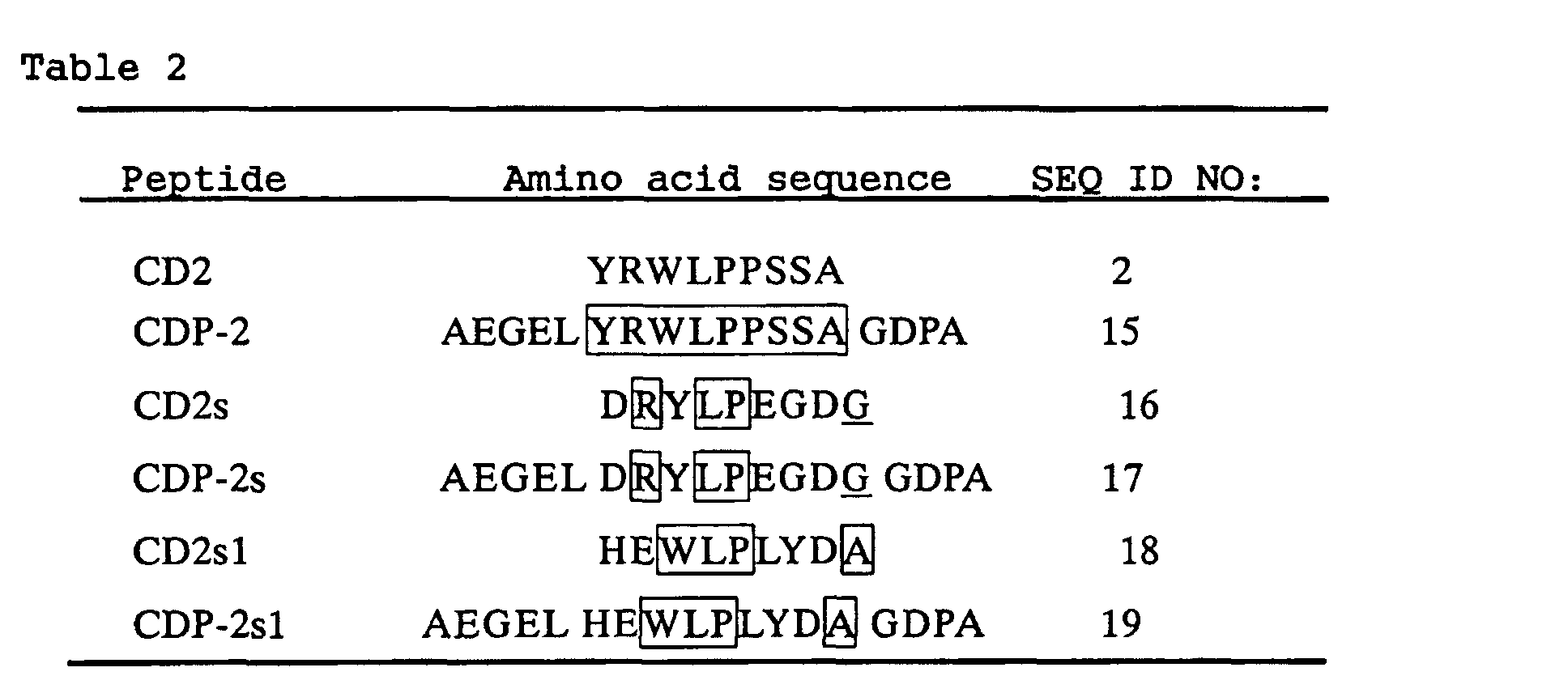
Furthermore, the equivalent of CD3 peptide (SEQ ID
NO:3) includes the peptides listed in Table 3, namely CDP-3
peptide (SEQ ID NO:20), CDP3 peptide (SEQ ID NO:21), CDP3-1
peptide (SEQ ID NO:22), CDP3-2 peptide (SEQ ID NO:23),
CDP3-3 peptide (SEQ ID NO:24), CDP3-4 peptide (SEQ ID
NO:25), CDP3-5 peptide (SEQ ID NO:26), CDP3-6 peptide (SEQ
ID NO:27), CDP3-8 peptide (SEQ ID NO:28), CDP3-12 peptide
(SEQ ID NO:29), CDP3-14 peptide (SEQ ID NO:30), and Z300
peptide (SEQ ID NO:31).

Furthermore, the equivalent of CD4 peptide (SEQ ID
NO:4) includes the peptides listed in Table 4, namely CDP-4
peptide (SEQ ID NO:33), CDP4 peptide (SEQ ID NO:34), CDP4-1
peptide (SEQ ID NO:35), CDP4-2 peptide (SEQ ID NO:36),
CDP4-3 peptide (SEQ ID NO:37), CDP4-4 peptide (SEQ ID
NO:38), CDP4-10 peptide (SEQ ID NO:39), CDP4-13 peptide
(SEQ ID NO:40), CDP4-14 peptide (SEQ ID NO:41), and TO3965
peptide (SEQ ID NO:42).
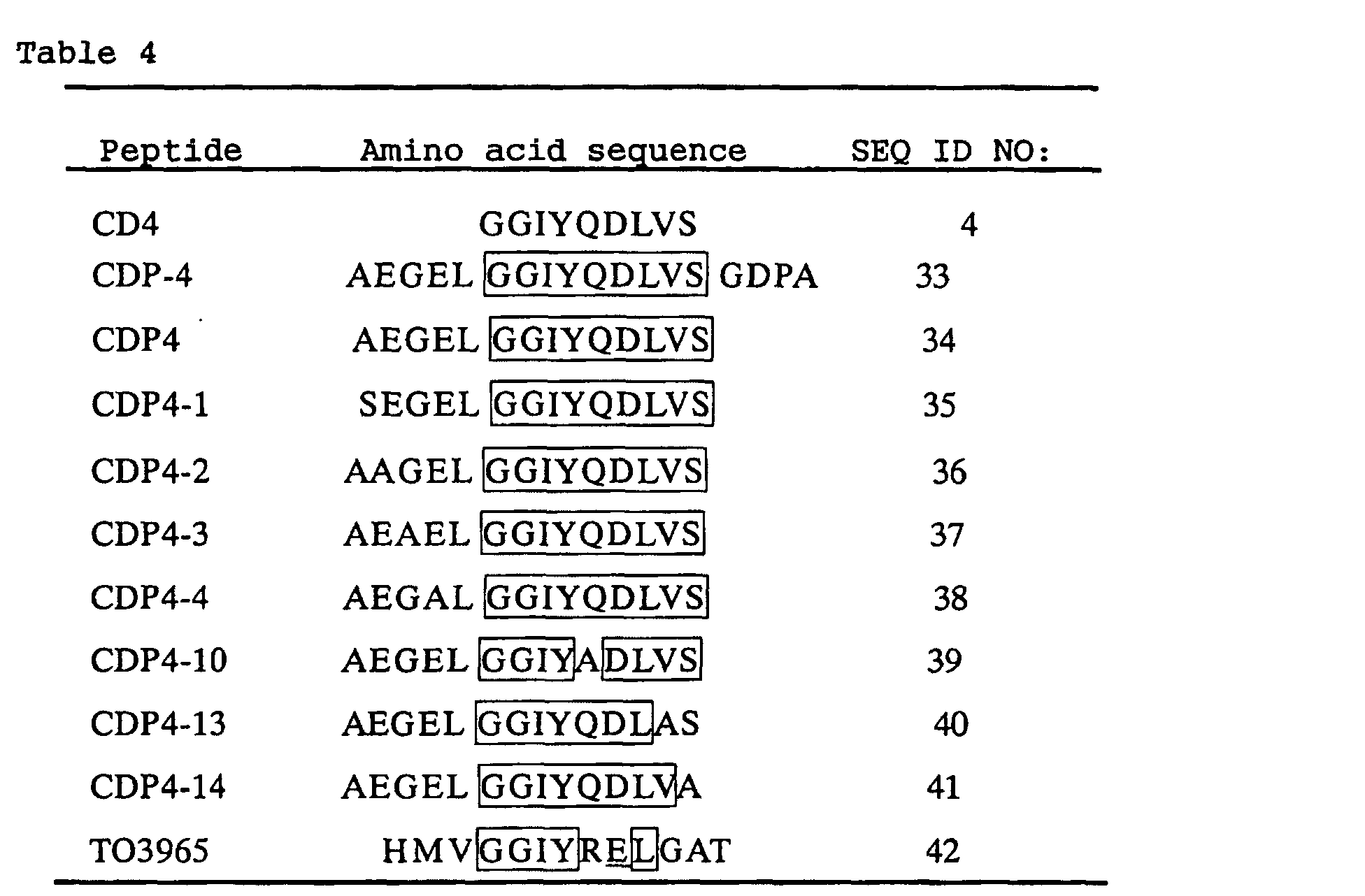
These CD-binding peptides can be produced by the
general method of chemical synthesis based on information
on the respective amino acid sequences. The method
includes ordinary liquid-phase and solid-phase techniques
for peptide synthesis. This method of chemical synthesis
specifically includes the stepwise elongation method in
which the respective amino acids are serially condensed
together one by one, and the fragment condensation method
in which fragments consisting of several such amino acids
are synthesized in advance and serially coupled, based on
the amino acid sequence information provided by the
invention. Synthesis of the peptides according to the
invention can be carried out by whichever of the above
methods.
The condensation reactions in the above method of
peptide synthesis may also be carried out by various known
methods. Specifically, the azide method, mixed acid
anhydride method, DCC method, active ester method, redox
method, DPPA (diphenylphosphoryl azide) method, DCC +
additive (1-hydroxybenzotriazole, N-hydroxysuccinimide, N-hydroxy-5-norbornene-2,3-dicarboximide)
method, and
Woodward's method can be mentioned by way of example. The
solvent which can be utilized in these methods may also be
selected judiciously from among the well-known common
solvents for use in peptide condensation reactions. To
mention a few examples, dimethylformamide (DMF), dimethyl
sulfoxide (DMSO), hexaphosphoramide, dioxane,
tetrahydrofuran (THF), and ethyl acetate, inclusive of
mixtures thereof, can be used.
In conducting the above reactions for peptide
synthesis, any of the carboxyl groups of amino acids or
peptides that should not take part in the reactions may be
protected in advance, generally by esterification in the
form of a lower alkyl ester, e.g. methyl ester, ethyl ester,
tert-butyl ester or the like, or an aralkyl ester, e.g.
benzyl ester, p-methoxybenzyl ester, p-nitrobenzyl ester or
the like. The amino acid having a functional group in the
side chain, for example the hydroxyl group of Tyr, may be
protected with an acetyl, benzyl, benzyloxycarbonyl, tert-butyl
or other group but need not necessarily be protected
in advance. Furthermore, the guanidino group of Arg, for
instance, may be protected with a suitable protective group
such as nitro, tosyl, 2-methoxybenzenesulfonyl, methylene-2-sulfonyl,
benzyloxycarbonyl, isobornyloxycarbonyl, or
adamantyloxycarbonyl. Deprotection reactions for removing
such protective groups from protected amino acids, peptides,
or end-product peptides of the invention can also be
carried out by the conventional methods, for example the
catalytic reduction method or the method using any of such
reagents as liquid ammonia/sodium, hydrogen fluoride,
hydrogen bromide, hydrogen chloride, trifluoroacetic acid,
acetic acid, formic acid, and methanesulfonic acid.
The CD-binding peptides of the invention, thus
obtained, can be purified in the conventional manner as
needed, namely in accordance with the procedures in routine
use in the art of peptide chemistry, such as ion exchange
resin treatment, partition chromatography, gel
chromatography, affinity chromatography, high performance
liquid chromatography (HPLC), and countercurrent
distribution.
The CD-binding peptide of the invention includes not
only the various peptides mentioned hereinbefore but also
oligopeptides and polypeptides containing the amino acid
sequence of any of said peptides as part thereof and
capable of binding specifically to Crohn's disease antibody.
As such polypeptides, the polypeptides at least
comprising the amino acid sequence represented by SEQ ID
NO:1, SEQ ID NO:2, SEQ ID NO:3, SEQ ID NO:4, SEQ ID NO:7,
SEQ ID NO:10, SEQ ID NO:12, SEQ ID NO:16, SEQ ID NO:18, SEQ
ID NO:31, and SEQ ID NO:42 can be mentioned. Also included
are polypeptides partially comprising modified amino acid
sequence derived from the amino acid sequence of any of the
above-mentioned SEQ ID NOS. by substitution, deletion or
addition of one or several amino acids and capable of
binding specifically to Crohn's disease antibody.
It is generally considered that the minimum number of
amino acids that is necessary for an antibody to recognize
an antigen in an antigen-antibody reaction is 4. Therefore,
from antigenicity points of view, the number of amino acids
is not particularly restricted provided that the peptide
consists of not less than 4 amino acids. Though this is
not critical, the number of amino acids may generally range
from 4 to 700. Moreover, when a branched multiple
antigenic peptide having a plurality of amino acid
sequences of said CD-binding peptides as branched chains
within each molecule is to be prepared as described
hereinafter, the number of amino acids constituting a
branched chain is preferably within the range of, for
example, 9 to 14.
More particularly, polypeptides at least comprising
the amino acid sequence LIAQQM of the amino acid sequence
represented by SEQ ID NO:10 can be mentioned as examples.
The amino acid sequence represented by SEQ ID NO:10 is the
amino acid sequence of VATE-201c peptide which is the
equivalent of CD1 peptide, and as polypeptides at least
comprising said amino acid sequence (LIAQQM), VATE-201
peptide consisting of the amino acid sequence represented
by SEQ ID NO:11, vacuolar H+ transport ATPase (hereinafter
referred to sometimes as V-ATPase) and its subunit E can be
mentioned. The amino acid sequence of subunit E of V-ATPase
is shown under SEQ ID NO:14.
V-ATPase is a H+ pump functioning to keep acidic the
internal environment of the organelle (Golgi apparatus,
lysosome, secretory granules, synaptic vesicles, yeast
vacuoles, etc.) belonging to the central vacuolar system of
eucaryotic cells. It is known that this V-ATPase consists
of 9 subunits, namely subunits A, B, C, D and E, 115 kDa
subunit, 39 kDa subunit, 20 kDa subunit, and 16 kDa subunit.
The primary structure of each of these subunits is already
known and the structure of V-ATPase consisting of these
subunits has also been presumed (Seikagaku (Biochemistry),
65, 6, pp. 413-436, June 1993).
The CD-binding peptide of the invention includes not
only a polypeptide (protein) having the full-length
sequence of V-ATPase consisting of said subunits but also
fragments of V-ATPase (inclusive of the respective subunits
and fragments of each subunit) insofar as such fragments
are capable of binding specifically to Crohn's disease
antibody. Moreover, the CD-binding peptide of the
invention includes complexes of human vacuolar H+ transport
ATPase subunit E with at least one subunit selected from
among other subunits, namely subunit A, subunit B, subunit
C, subunit D, 115 kDa subunit, 39 kDa subunit, 20 kDa
subunit, and 16 kDa subunit.
The fragment of V-ATPase referred to above includes
said subunit E (33 kDa polypeptide, the number of amino
acids: 226), polypeptides containing the subunit E domain
(inclusive of complexes of subunit E with other subunits),
7 to 226-residue polypeptides containing the 202-208 amino
acid region of the amino acid sequence of said subunit E,
and 14 to 226-residue polypeptides containing the 199-212
amino acid region of the amino acid sequence of subunit E.
Furthermore, said V-ATPase and its fragments (e.g.
complexes of subunit E with other subunits, subunit E or
portions thereof) may have been modified by substitution,
deletion and addition of one or several amino acids from
the respective amino acid sequences insofar as these are
still capable of binding specifically to Crohn's disease
antibodies. These modified proteins can be invariably
defined as the equivalent of V-ATPase or its fragment (e.g.
subunit E).
Furthermore, as CD-binding polypeptides, polypeptides
at least comprising the amino acid sequence represented by
SEQ ID NO:51 may also be mentioned by way of example. The
amino acid sequence represented by SEQ ID NO:51 corresponds
also to the amino acid sequence of Z300 peptide (SEQ ID
NO:31) which is the equivalent of CD3 peptide. As a
polypeptide at least comprising this amino acid sequence,
Homo sapiens kruppel-like zinc finger protein 300
(hereinafter referred to sometimes as HZF300) can be
mentioned. The amino acid sequence of the HZF300 is shown
under SEQ ID NO:32. Insofar as the specific binding
affinity for Crohn's disease antibody is retained, the CD-binding
peptide of the invention may be such that the amino
acid sequence of HZF300, represented by SEQ ID NO:32, has
been modified by substitution, deletion or addition of one
or several amino acids. Such modified peptide includes 7
to 604-residue polypeptides containing the 129-135 amino
acid region of the amino acid sequence of HZF300 and 14 to
604-residue polypeptides containing the 126-139 amino acid
region of the amino acid sequence of HZF300. These
modification products can be invariably defined as the
equivalent of HZF300.
Furthermore, as CD-binding polypeptides, polypeptides
at least comprising the amino acid sequence of
L(V)GGIYXE(D)L (X represents an arbitrary amino acid
residue) can be mentioned. As such polypeptides at least
comprising the above amino acid sequence, CD4 peptide and
all equivalents thereof, represented by SEQ ID NOS:4 and 33
to 42, are included. In addition, as a polypeptide at
least comprising the above amino acid sequence, Rice seed
allergen RA14 which belongs to the gene family of a rice
allergen protein (alpha-amylase/trypsin inhibitor) can also
be mentioned. The amino acid sequence of Rice seed
allergen RA14 is shown under SEQ ID NO:46.
Insofar as the capability of binding specifically to
Crohn's disease antibodies is retained, the CD-binding
peptide of the invention includes modified peptides derived
from the amino acid sequence of Rice seed allergen RA14
(SEQ ID NO:46) by substitution, deletion or addition of one
or several amino acids. As such modification products, 8
to 165-residue polypeptides containing the 101-108 amino
acid region of the amino acid sequence of Rice seed
allergen RA14 (SEQ ID NO:46) and 13 to 165-residue
polypeptides containing the 99-111 amino acid region of the
amino acid sequence of Rice seed allergen RA14 can be
mentioned. These modification products can be invariably
defined as the equivalent of Rice seed allergen RA14.
Furthermore, the CD-binding peptide of the invention
includes polypeptides at least comprising modified amino
acid sequences derived from the amino acid sequence of SEQ
ID NO:42 by substitution, deletion or addition of one or
several amino acids, provided that these are capable of
binding specifically to Crohn's disease antibodies. As
such polypeptides, there can be mentioned Rice allergen
(SEQ ID NO:43), Rice seed allergen RA5 (SEQ ID NO:44), Rice
allergen RA5B precursor (SEQ ID NO:45), Rice allergen RA14B
precursor (SEQ ID NO:47), and Rice seed allergen RAG2 (SEQ
ID NO:48), all of which, like Rice seed allergen RA14,
belong to the gene family of alpha-amylase/trypsin
inhibitors. These rice allergen proteins may also have
been modified by substitution, deletion or addition of one
or several amino acids provided that the modified proteins
are still capable of binding specifically to Crohn's
disease antibody. As such equivalents of rice allergen
proteins, proteins at least comprising the amino acid
sequence of L(V)GGIYREL (SEQ ID NOS:49 or 50) locating in
the 95-110 amino acid region of the respective rice
allergen proteins can be mentioned. More particularly, 8
to 157-residue polypeptides containing the 99-106 amino
acid region of the amino acid sequence of Rice allergen, 8
to 157-residue polypeptides containing the 99-106 amino
acid region of the amino acid sequence of Rice seed
allergen RA5, 8 to 160-residue polypeptides containing the
102-109 amino acid region of the amino acid sequence of
Rice allergen RA5B precursor, 8 to 166-residue polypeptides
containing the 102-109 amino acid region of the amino acid
sequence of Rice allergen RA14B precursor, and 8 to 166-residue
polypeptides containing the 102-109 amino acid
region of Rice seed allergen RAG2 can be mentioned. These
modified proteins can be defined as the equivalents of Rice
allergen, Rice seed allergen RA5, Rice allergen RA5B
precursor, Rice allergen RA14B precursor, and Rice seed
allergen RAG2, respectively.
Thus, V-ATPase, its subunit E (SEQ ID NO:14), and
equivalents thereof belong to said equivalent of CD1
peptide; HZF300 (SEQ ID NO:32) and its equivalent belong to
said equivalent of CD3 peptide; and various rice allergen
proteins constituting the gene family of alpha-amylase/trypsin
inhibitor (SEQ ID NOS:43 to 48) and
equivalents thereof belong to said equivalent of CD4
peptide, thus being invariably subsumed in the concept of
CD-binding peptide according to the present invention.
Furthermore, the CD-binding peptide of the invention
may assume the form of a multiple antigen peptide (also
referred to as a MAP peptide or a branched multiple
antigenic peptide). This MAP peptide is characterized in
that the amino acid sequences of peptides represented by
SEQ ID NOS:1 to 4 (CD1 peptide to CD4 peptide) or
equivalents thereof are attached to a main chain as side
chains (branched chains) in a plural number in the manner
of branches. The number of branched chains having the
amino acid sequences of such CD-binding peptides is not
particularly restricted but is preferably equal to 2 to 16,
more preferably equal to 4 to 16, still more preferably
equal to 8.
One preferred example of the CD-binding peptide in
this MAP form according to the invention (branched multiple
antigenic peptide) is a peptide having a basal molecule
(skeleton) of the dendrimer structure.
The dendrimer is generally acknowledged to be a
spheroidal or otherwise-configured molecule having a
dendritic (tree-like) to stellate three-dimensional
structure. This molecule is also characterized by its
plurality of branches having functional groups (repeating
units). (cf. Japanese published un-examined patent
application No.S60-500295; Japanese published un-examined
patent application No.S63-99233; Japanese published un-examined
patent application No.H03-263431; USP 4507466; USP
4568737; Polymer Journal, 17, p. 117 (1985); Angewandte
Chem. Int. Engl., 29, 138-175 (1990); Macromolecules, 25, p.
3247 (1992), etc.).
The dendrimer which can be utilized in the invention
is not particularly restricted provided that it has a
nuclear structure serving as an origin, an inner layer
(generations) consisting of repeating units (branches)
attached to said nucleus serving as the origin, and an
outer surface comprising functional groups existing as
attached to the respective branches. The size, shape,
reactivity, etc. of said dendrimer can be controlled by
judicious choice of the nucleus or origin, the number of
generations, and the repeating unit to be used for each
generation and these variables are not particularly
restricted, either. Production of a dendrimer of
appropriate size can be carried out in the conventional
manner to be described hereinafter and dendrimers having
different sizes can be easily obtained by increasing the
number of generations to be utilized (e.g. USP 4694064).
One example of the CD-binding peptide having a
dendrimer structure (branched multiple antigenic peptide)
according to the invention is a polypeptide comprising a
nitrogen atom as the origin or nucleus, plurality of
repeating units (branches) of the -CH2CH2CONHCH2CH2-structure
being attached to this nucleus, and amino acid
sequences of aforementioned CD-binding peptides being
attached to the outermost ends of the said respective
branches. Another example of the branched multiple
antigenic peptide is a polypeptide comprising an amino acid,
such as Lys, Arg, Glu or Asp, as said origin or nucleus,
the similar amino acid as mentioned above as the repeating
unit (branch) directly attached to the said origin, and the
amino acid sequence of a CD-binding peptide being attached
to the terminus of each repeating unit (branch) as
described above.
The above dendrimer having a nitrogen atom as the
origin or nucleus can be produced in the conventional
manner. Moreover, its components (dendrimer materials) are
also available commercially (Polysciences, Inc., 400 Vally
Road, Warrington, PA, 18976 U.S.A.). The other kind of
dendrimer having an amino acid as the origin or nucleus can
be produced typically in accordance with the above-mentioned
technology for peptide synthesis. Moreover, it
can be produced by utilizing a commercial dendrimer
material such as Fmoc8-Lys4-Lys2-Lys-βAla-Alko resin
(product of Watanabe Chemical Industry).
More particularly, said dendrimer material can be
produced in the following manner. Thus, a protected a,?-diamino
acid as protected with the same or different two
amino-protective groups in advance is condensed to a resin
for solid-phase peptide synthesis with or without use of a
spacer, the amino-protective groups are then removed. Such
condensation of the protected a,?-diamino acids and
deprotection reactions are repeated.
As the resin for solid-phase peptide synthesis, the
resins which are in routine use for peptide synthesis can
be invariably employed. For example, a polystyrene resin,
polyacrylamide resin or poly(styrene-co-ethylene glycol)
resin having a chloromethyl, 4-(hydroxymethyl)phenoxy, or
4-((a-2',4'-dimethoxyphenyl)-9-fluorenylmethoxycarbonylaminomethyl)phenoxy
group as the
terminal group can be mentioned. The spacer may for
example be one or several amino acids. The a,?-diamino
acid mentioned above includes lysine, ornithine, 1,4-diaminobutyric
acid, and 1,3-diaminopropionic acid, among
others.
The protective group referred to above includes Boc,
Fmoc, and Z groups, among others. The functional group
includes amino, carboxyl and hydroxyl groups, among others.
The reaction for removal of protective groups can be
conducted in accordance with the above-mentioned technology
for peptide synthesis. The number of branches is 2n as the
condensation of the repeating unit and removal of the
protective groups are carried out in n repeats. The
preferred number of branches may be within the range of 2
to 16.
By coupling the amino acid sequence of a CD-binding
peptide to the terminus of each branch of the dendrimer
material thus obtained, the peptide in the desired MAP form
(branched multiple antigen peptide) according to the
invention can be acquired. This coupling reaction can be
carried out by the technology for peptide synthesis
described hereinbefore.
The MAP-form peptide (branched multiple antigenic
peptide) of the invention can be purified by the routine
procedure, such as chromatography using a suitable resin
such as Sephacryl S-300 (product of Pharmacia) or other
resin, as stationary phase.
Referring, further, to the branched multiple
antigenic peptide of the invention, the amino acid
sequences constituting the terminal structures of the
respective branches need not be uniform but may reflect an
arbitrary combination of the amino acid sequences of
dissimilar CD-binding peptides. An example is the
combination of the amino acid sequences of two or more
dissimilar peptides, i.e. at least 2, preferably 3 or more
dissimilar peptides, more preferably 4 or more dissimilar
peptides selected from at least 2, preferably 3, more
preferably 4 of the following four groups: (i) CD1 peptide
and its equivalent, (ii) CD2 peptide and its equivalent,
(iii) CD3 peptide and its equivalent, and (iv) CD4 peptide
and its equivalent. With use of such a composite branched
multiple antigenic peptide, Crohn's disease in an
individual subjent can be more accurately detected.
The CD-binding peptide of the invention has the
property to selectively recognize and bind to Crohn's
disease-specific antibody (the antibody characteristically
detected in patients with Crohn's disease). Therefore, the
CD-binding peptide and the branched multiple antigenic
peptide comprising the amino acid sequences thereof
according to the invention can be used successfully in
detecting Crohn's disease, that is to say the examination
and diagnosis of Crohn's disease.
The present invention provides a Crohn's disease
examination reagent comprising said CD-binding peptide or
said branched multiple antigenic peptide containing the
amino acid sequences thereof as an active ingredient.
More particularly, the Crohn's disease examination
reagent of the invention comprises, as an active ingredient,
at least one CD-binding peptide selected from the group
consisting of (i) said CD1 peptide and its equivalent, (ii)
said CD2 peptide and its equivalent, (iii) said CD3 peptide
and its equivalent, and (iv) said CD4 peptide and its
equivalent, or a branched multiple antigenic peptide
containing plural amino acid sequences of at least one kind
of CD-binding peptide selected from (i) said CD1 peptide or
equivalent, (ii) said CD2 peptide or equivalent, (iii) said
CD3 peptide or equivalent, and (iv) said CD4 peptide or
equivalent, the same or different, per molecule in a
branching manner.
The above-mentioned equivalent of CD1 peptide
includes complexes of subunit E of human vacuolar H+
transport ATPase (V-ATPase) with at least one unit selected
from the group consisting of the other subunits of the V-ATPase,
namely subunit A, subunit B, subunit C, subunit D,
115kDa subunit, 39 kDa subunit, 20 kDa subunit, and 16 kDa
subunit.
The CD-binding peptide or branched multiple antigenic
peptide used as the active ingredient plays the role of an
antigen which binds to the Crohn's disease antibody present
in a biological sample from a subject to thereby capture or
label the antibody through the utilization of its specific
binding affinity for Crohn's disease antibody.
As the active ingredient of a Crohn's disease
examination reagent, either one species or optionally two
or more species of said CD-binding peptide can be used.
For improved accuracy (reliability of examination), it is
preferable to use two or more species of said peptide in
combination. The mode of such combination is not
particularly restricted but the preferred mode of
combination is the mode of using 2 or more, preferably 3 or
more, more preferably 4 or more dissimilar peptides
selected from among at least 2, preferably 3, more
preferably 4 of the following groups (i) to (iv), viz. (i)
CD1 peptide or its equivalent (e.g. CDP-1a peptide, CDP-1
peptide, CD5 peptide, CDP-5a peptide, CDP-5 peptide, VATE-201c
peptide, VATE-201 peptide, CD1s peptide, CDP-1s
peptide, V-ATPase, subunit E, and equivalent thereof), (ii)
CD2 peptide or its equivalent (e.g. CDP-2 peptide, CD2s
peptide, CDP-2s peptide, CD2s1 peptide, CDP-2s1 peptide,
and equivalent thereof), (iii) CD3 peptide or its
equivalent (e.g. CDP-3 peptide, CDP3 peptide, CDP3-1
peptide, CDP3-2 peptide, CDP3-3 peptide, CDP3-4 peptide,
CDP3-5 peptide, CDP3-6 peptide, CDP3-8 peptide, CDP3-12
peptide, CDP3-14 peptide, Z300 peptide, human nuclear
peptide (HZF300) or its equivalent, and (iv) CD4 peptide or
its equivalent (e.g. CDP-4 peptide, CDP4 peptide, CDP4-1
peptide, CDP4-2 peptide, CDP4-3 peptide, CDP4-4 peptide,
CDP4-10 peptide, CDP4-13 peptide, CDP4-14 peptide, TO3965
peptide, Rice allergen, Rice seed allergen RA5, Rice
allergen RA5B precursor, Rice seed allergen RA14, Rice
allergen RA14B precursor, Rice seed allergen RAG2, or
equivalents thereof).
Referring to the case where the Crohn's disease
examination reagent of the invention is a composition
containing two or more kinds of CD-binding peptides as
above, the formulating ratio of such CD-binding peptides is
not particularly restricted. For example, such CD-binding
peptides may be formulated in equal proportions or, in the
case where the composition contains a CD-binding peptide
with weak reactivity (binding affinity) to Crohn's disease
antibody, in such a manner that the proportion of the less
reactive peptide will be relatively increased. In the case
where, though not restrictive, said (i) CD1 peptide, (ii)
CD2 peptide, (iii) CD3 peptide, and (iv) CD4 peptide
belonging to said CD-binding peptide groups (i), (ii),
(iii), and (iv), respectively, are used as active
ingredients, for instance, these peptides may be used in a
ratio of 1:2:2:1.
In the case where the branched multiple antigenic
peptide described above is used as the active ingredient of
the Crohn's disease examination reagent, this multiple
antigenic peptide may be such that the amino acid sequences
of its branches are uniform, i.e. the amino acid sequences
of one and the same CD-binding peptide, or varying, i.e.
the amino acid sequences of two or more kinds of CD-binding
peptides. In the latter case, the mode of combination of
the amino acid sequences of CD-binding peptides to be used
for said branches is not particularly restricted, either,
but the preferred is the mode of using the amino acid
sequences of 2 or more, preferably 3 or more, more
preferably 4 or more kinds of CD-binding peptides selected
from among at least 2, preferably 3, more preferably 4 of
the above-mentioned groups (i) to (iv).
The Crohn's disease examination reagent of the
invention, as an antigen capable of binding Crohn's disease
antibody specifically, can be used for capturing or
labeling of Crohn's disease antibody. Therefore, unless
this object is departed from, the examination reagent of
the invention may consist solely in one or more kinds of
CD-binding peptides or a branched multiple antigenic
peptide or may contain other additional ingredients.
Moreover, for the purpose of labeling Crohn's disease
antibodies, such CD-binding peptides or branched multiple
antigen peptides are preferably labeled with a suitable
labeling substance. The labeling substance which can be
used for this purpose is not particularly restricted but
the labeling substances in broad use in the art can be
liberally selected and used. Among such substances are
radioisotopes such as 3H and 14C; enzymes such as alkaline
phosphatase, peroxidase (POX), microperoxidase,
chymotrypsinogen, procarboxypeptidase, glyceraldehyde-3-phosphate
dehydrogenase, amylase, phosphorylase, D-nase and
P-nase; fluorescent substances such as fluorescein
isothiocyanate (FITC) and tetramethylrhodamine
isothiocyanate (RITC), etc.; and 1N-(2,2,6,6-tetramethyl-1-oxyl-4-piperidyl)-5N-(aspartate)-2,4-dinitrobenzene
(TOPA),
dye sols, metal sols, latex particles, and others. It
should be understood that the CD-binding peptide or
branched multiple antigen peptide according to the
invention includes such labeled peptides as well.
Generally, to perform a Crohn's disease examination
using a biological sample from a subject as the examination
sample, it is convenient to use an examination kit
containing said examination reagent comprising said CD-binding
peptide or multiple antigenic peptide. Accordingly,
the present invention, in another aspect, provides an
examination kit which can be effectively utilized in the
examination (diagnosis) of Crohn's disease.
The Crohn's disease examination kit according to the
invention may be one containing said examination reagent as
a capturing (trapping) agent for Crohn's disease antibody
or as a labeling substance for Crohn's disease antibody,
insofar as it is contained to bind Crohn's disease antibody.
In the case where said examination reagent is to be
utilized as a capturing agent for Crohn's disease
antibodies, the reagent can be used in the form immobilized
on an arbitrary support (solid phase). When it is to be
utilized as a labeling substance for Crohn's disease
antibodies, it is advisable to use the CD-binding peptide
or multiple antigen peptide labeled with a suitable
labeling substance as described above.
The other components to be used in combination with
said examination reagent in the examination kit of the
invention can be judiciously chosen in the routine matter
according to the immunoassay technique and detection means
for use in the examination of Crohn's disease. Preferably,
as an additional component other than said examination
reagent comprising said CD-binding peptide or multiple
antigenic peptide, a secondary antibody (for example, an
anti-human IgG antibody) for detecting human IgG may be
included. This anti-human IgG antibody may be labeled with
said labeling substance or immobilized on an arbitrary
support (solid phase) in advance.
Furthermore, the examination kit may further include
a substrate corresponding to the labeling substance or a
detection reagent for detecting the reaction between the
labeling substance and its substrate and even, for
convenience in performing a determination, a suitable
sample diluent, a secondary antibody diluent (e. g. an
anti-human IgG antibody diluent), a standard antibody, a
buffer, a washing solution, an enzyme substrate solution,
and a reaction stop solution, among others. Furthermore,
in the case where the examination reagent or the anti-human
IgG antibody is an unlabeled one or an un-immobilized one,
the examination kit may be supplemented with a labeling
substance or a support (solid phase).
Thus, the Crohn's disease examination kit according
to the invention is a set of reagents for the diagnosis of
Crohn's disease which contains an examination reagent
comprising said CD-binding peptide or said branched
multiple antigenic peptide (optionally immobilized or/and
labeled) as an active ingredient in combination with at
least one component selected from among an anti-human IgG
antibody which may optionally be immobilized or labeled, a
substrate for the labeling substance, an antibody diluent,
a standard antibody, a buffer solution, a washing solution,
a solvent for the substrate, a reaction stop solution, a
support (solid phase), and a labeling substance. From
convenience, safety, and sensitivity points of view, the
preferred labeling substance is an enzyme. From this point
of view, the Crohn's disease examination kit according to
the invention is a set of reagents for the diagnosis of
Crohn's disease which contains a detection reagent
comprising said CD-binding peptide or said branched
multiple antigenic peptide (optionally immobilized or/and
labeled) as an active ingredient in combination with at
least one component selected from the group consisting of
an anti-human IgG antibody which may optionally be
immobilized or enzyme-labeled, a substrate for the enzyme,
an antibody diluent, a standard antibody, a buffer solution,
a washing solution, a solvent for the enzyme substrate, an
enzymatic reaction stop solution, a support (solid phase),
and an enzyme as a labeling substance. As the enzyme for
use in said labeling with an enzyme, not only the above-mentioned
enzymes but also such other enzymes as
microperoxidase, chymotrypsinogen, procarboxypeptidase,
glyceraldehyde-3-phosphate dehydrogenase, amylase,
phosphorylase, D-nase, and P-nase can be mentioned by way
of illustration.
The present invention further provides a Crohn's
disease examination method. This examination method
comprises using a biological sample from a subject as the
examination sample and detecting Crohn's disease in the
subject. More particularly, the Crohn's disease
examination method according to the invention comprises
detecting Crohn's disease using the presence/absence of a
specific antibody occurring specifically in a biological
sample from a patient with Crohn's disease as a marker.
The examination sample includes various biological
samples, such as the blood (serum, plasma), urine, sweat,
saliva, seminal fluid, spinal fluid, and other samples from
a subject (a human being), preferably a serum sample.
As the Crohn's disease examination method, the
following three examination protocols (3-1) to (3-3) can be
mentioned.
Therefore, as the Crohn's disease examination method
of the invention, a protocol comprising a step of detecting
the antibody recognizing human vacuolar H+ transport ATPase
(V-ATPase) in a biological sample from a subject can be
mentioned. The object antibody to be detected is
preferably an antibody recognizing subunit E of V-ATPase,
more preferably an antibody recognizing the 199-212 amino
acid region of subunit E of V-ATPase.
Detection of such antibodies can be performed by the
hitherto-known immunoassay technique utilizing an antigen-antibody
reaction. More particularly, the protocol
comprises collecting a biological sample, preferably a
serum sample, from a subject suspected to have Crohn's
disease, causing the biological sample to react with an
antigen capable of binding said antibody recognizing V-ATPase,
and detecting the complex formed by an antigen-antibody
reaction.
The antigen capable of binding to the antibody
recognizing V-ATPase, mentioned just above, is not
particularly restricted provided that it specifically binds
to the antibody recognizing V-ATPase. Preferably, it is an
antigen having the property to specifically bind to the
antibody recognizing subunit E of V-ATPase and more
preferably it is an antigen having the property to
specifically bind the antibody recognizing the 199-212
amino acid region of subunit E of V-ATPase. As an antigen
having the above property, a peptide consisting of the
amino acid sequence of LIAQQM and its equivalent can be
mentioned. This equivalent includes peptides consisting of
modified amino acid sequences derived from the above amino
sequence (LIAQQM) by deletion, substitution or addition of
one or several amino acids and capable of binding
specifically to an antibody recognizing subunit E of V-ATPase.
Among such peptides are peptides consisting of the
amino acid sequences represented by SEQ ID NO:1 and NOS:5
to 15 (CD1 peptide, CDP-1a peptide, CDP-1 peptide, CD5
peptide, CDP-5a peptide, CDP-5 peptide, VATE-201c peptide,
VATE-201 peptide, CD1s peptide, CDP-1s peptide, V-ATPase,
and subunit E of V-ATPase). However, this is not an
exclusive list but other 6 to 226-residue peptides,
preferably 6 to 14-residue peptides, which comprise the
above amino acid sequence (LIAQQM), for instance, can also
be used.
As the antigen substance capable of binding to an
antibody recognizing V-ATPase, the complex of subunit E of
V-ATPase with at least one subunit selected from subunit A,
subunit B, subunit C, subunit D, 115kDa subunit, 39 kDa
subunit, 20 kDa subunit, and 16 kDa subunit of the V-ATPase
can also be used. In addition, as the antigen substance
capable of binding to an antibody recognizing V-ATPase, a
branched multiple antigenic peptide containing the peptide
comprising the above amino acid sequence (LIAQQM) or its
equivalent in a plurality of units, which may be the same
or different, within each molecule can also be used.
Accordingly, the Crohn's disease examination method
of the invention includes an examination protocol which
comprises a step of using a biological sample from a
subject as the examination sample and detecting an antibody
recognizing the human nuclear protein (HZF300) therein.
The subject antibody to be detected is preferably an
antibody recognizing the 126-138 amino acid region of
HZF300.
Detection of said antibody can be performed by the
hitherto-known immunoassay technique utilizing an antigen-antibody
reaction. More particularly, the procedure
comprises collecting a biological sample, preferably a
serum sample, from a subject suspected to have Crohn's
disease, causing the biological sample to react with an
antigen substance capable of binding to said antibody
recognizing the human nuclear protein (HZF300), and
detecting the complex formed by an antigen-antibody
reaction.
The above antigen substance having a binding affinity
for an antibody recognizing said human nuclear protein
(HZF300) is not particularly restricted provided that it is
specifically bound to the antibody recognizing HZF300.
Preferably the antigen has the property to specifically
bind to an antibody recognizing the 126-138 amino acid
region of the human nuclear protein (HZF300). As antigens
having the above property, the peptide consisting of the
amino acid sequence represented by SEQ ID NO:51 and its
equivalent can be mentioned. The equivalent mentioned
above includes any peptide or protein consisting of an
amino acid sequence derived from the above sequence of SEQ
ID NO:51 by addition of one or several amino acids and
capable of binding specifically to an antibody recognizing
the human nuclear protein (HZF300). Among such peptides
are those consisting of the amino acid sequences
represented by SEQ ID NO:3 and NOS:20 to 32 (CD3 peptide,
CDP-3 peptide, CDP3-1 peptide, CDP3-2 peptide, CDP3-3
peptide, CDP3-4 peptide, CDP3-5 peptide, CDP3-6 peptide,
CDP3-8 peptide, CDP3-12 peptide, CDP3-14 peptide, Z300
peptide, and human nuclear protein (HZF300)). However,
this is not an exclusive list but other 7 to 604-residue
polypeptides partially comprising the amino acid sequence
of SEQ ID NO:51, for instance, can also be used.
Furthermore, as the antigen substance binding to an
antibody recognizing the human nuclear protein (HZF300), a
branched multiple antigenic peptide containing the peptide
consisting of the amino acid sequence of SEQ ID NO:51 or
its equivalent in a plurality of units, which may be the
same or different, within each molecule can also be used.
Accordingly, the Crohn's disease examination method
of the invention includes an examination protocol
comprising a step of using a biological sample from a
subject as the examination sample and detecting the
antibody recognizing the rice allergen protein therein. In
this connection, said rice allergen protein includes those
proteins belonging to the gene family of a-amylase/trypsin
inhibitors, specifically Rice allergen (158aa), Rice seed
allergen RA5 (157aa), Rice allergen RA5B precursor (160aa),
Rice seed allergen RA14 (165aa), Rice allergen RA14B
precursor (166aa), and Rice seed allergen RAG2 (166aa),
among others. The subject antibody to be detected is
preferably an antibody which recognizes at least the amino
acid sequence of L(or V)GGIYREL in the 95-110 amino acid
region of such various rice allergen proteins.
Detection of such antibodies can be performed by the
hitherto-known immunoassay technique utilizing an antigen-antibody
reaction. More particularly, the procedure
comprises collecting a biological sample, preferably a
serum sample, from a subject suspected to have Crohn's
disease, causing the biological sample to react with an
antigen substance capable of binding to said antibody
recognizing the said rice allergen protein, and detecting
the complex formed by an antigen-antibody reaction.
The antigen substance which binds to an antibody
recognizing said rice allergen protein is not particularly
restricted provided that it is specifically bound to an
antibody recognizing a protein belonging to the gene family
of said rice allergen protein (a-amylase/trypsin inhibitor).
The preferred antigen substance is one having the property
to specifically bind antibodies recognizing at least the
amino acid sequence of L(or V)GGIYREL (SEQ ID NOS:49 or 50)
in the 95-110 amino acid region of various rice allergen
proteins.
As specific examples of the antigen substance having
the above property, the peptide consisting of the amino
acid sequence of L(V)GGIYXD(E)L (X represents an arbitrary
amino acid residue) or its equivalent can be mentioned.
The equivalent mentioned just above includes peptides
consisting of amino acid sequences derived from the above-mentioned
sequence of L(V)GGIYXD(E)L (X represents an
arbitrary amino acid residue) by addition of one or several
amino acids and capable of binding specifically to an
antibody recognizing the rice allergen protein. Among such
peptides are peptides consisting of the amino acid
sequences represented by SEQ ID NOS:4 and 33 to 48 (CD4
peptide, CDP-4 peptide, CDP4-1 peptide, CDP4-2 peptide,
CDP4-3 peptide, CDP4-4 peptide, CDP4-10 peptide, CDP4-13
peptide, CDP4-14 peptide, TO3965 peptide, Rice allergen,
Rice seed allergen RA5, Rice allergen RA5B precursor, Rice
seed allergen RA14, Rice allergen RA14B precursor, and Rice
seed allergen RAG2). However, this is not an exclusive
list but other 8 to 166-residue polypeptides, preferably 8
to 14-residue polypeptides, which comprise the amino acid
sequence of L(V)GGIYXD(E)L (X represents an arbitrary amino
acid residue) can also be used.
Furthermore, as the antigen substance binding to an
antibody which recognizes the rice allergen protein, a
branched multiple antigenic peptide containing the peptide
consisting of the above amino acid sequence of
L(V)GGIYXD(E)L (X represents an arbitrary amino acid
residue) or its equivalent in a plurality of units, which
may be of the same or different, within each molecule can
also be used.
The method of detecting the antigen-antibody complex
resulting from the reaction between such an antigen
substance and the antibody specifically existing in a
Crohn's disease patient is not particularly restricted but
the routine techniques can be liberally adopted. More
particularly, an immunoassay technique utilizing any of
said various CD-binding peptides and branched multiple
antigenic peptides comprising the said peptides as the
antigen substance can be mentioned as one preferred example.
Taking the solid-phase sandwich assay technique using a
human serum as the examination sample as an example, the
object antibody can be assayed by the following procedure,
for instance.
First, the above-mentioned peptide for use as the
antigen substance is immobilized (the resulting artifact is
hereinafter referred to briefly as "solid-phase peptide")
and a biological sample (e.g. a serum sample) as the
examination sample is added. Thereupon, an antigen-antibody
reaction takes place between the solid-phase
peptide and the Crohn's disease patient-specific antibody
in the examination sample, so that the object antibody in
the examination sample is bound to the solid-phase peptide.
Then, the presence/absence of the bound antibody and its
amount (antibody titer) are detected with a human antibody
(IgG) detection reagent. In this manner, the object
antibody in the examination sample, that is a biological
sample (e.g. serum) from a subject, can be detected and
quantitated.
In connection with the above technique, the object
antibody specific to a Crohn's disease patient in the
examination sample can also be detected and, at the same
time, its amount (antibody titer) determined by
immobilizing said human antibody (IgG) detection reagent in
advance, then adding the examination sample (biological
sample) thereto so as to capture the object antibody
occurring in the biological sample, and adding said antigen
substance to let it be bound to the object antibody.
Furthermore, by adding a specific antibody against the
antigen substance bound to the object antibody as above to
cause the specific antibody to be bound to the antigen
substance, the antibody specific to the Crohn's disease
patient can be detected and its titer determined by
utilizing this antibody as a marker. Selection and
modification of various means used in such assay techniques
are well known to those skilled in the art and any of such
techniques can be invariably employed in the practice of
the invention (cf. Handbook of Clinical Examination Methods,
Kanehara Shuppan, 1995, for instance).
The human antibody (IgG) detection reagent for
detecting Crohn's disease antibodies is not particularly
restricted but various reagents in routine use can be
utilized. For example, anti-human IgG antibodies
specifically binding to human IgG can be used with
advantage. Although such antibodies can be purchased from
commercial sources, these can be prepared by the
conventional method.
In the case where the object antibody is to be
detected using such a human antibody (IgG) detection
reagent as a marker, preferably this human antibody (IgG)
detection reagent has been labeled. The labeling substance
for such labeling includes radioisotopes such as 3H, 14C,
etc.; enzymes such as alkaline phosphatase, peroxidase
(POX), etc.; fluorescent substances such as fluorescein
isothiocyanate (FITC), tetramethylrhodamine isothiocyanate
(RITC), etc.; and 1N-(2,2,6,6-tetramethyl-1-oxyl-4-piperidyl)-5N-(aspartate)-2,4-dinitrobenzene
(TOPA), dye
sols, metal sols, latex particles, and so forth. The
immunoassay techniques using detection reagents labeled
with such labeling substances are known as radioimmunoassay,
enzyme immunoassay, fluoroimmunoassay, spin immunoassay,
flow-through immunoassay, and immunochromatoassay,
respectively.
In the present invention, from convenience, safety,
sensitivity and other points of view, the enzyme
immunoassay technique using an enzyme as the labeling
substance is preferably used. The enzyme which can be used
for this labeling with an enzyme includes, in addition to
the enzymes mentioned above, such enzymes as
microperoxidase, chymotrypsinogen, procarboxypeptidase,
glyceraldehyde-3-phosphate dehydrogenase, amylase,
phosphorylase, D-nase, and P-nase, among others. The
labeling with such a labeling substance can be carried out
in the per se known manner (Iwasaki, T. et al.: Monoclonal
Antibody, Kodansha Scientific, 1984; Ishikawa, E. et al.:
Enzyme Immunoassay, 2nd edition, Igaku Shoin, 1982; etc.).
In the case where the object antibody is to be
detected and assayed by using an antigen substance (said
CD-binding peptide or said branched multiple antigenic
peptide containing amino acid sequences thereof) as a
marker, it is preferable to use the labeled peptide as the
antigen substance. The labeling of such an antigen
substance can also be carried out in the routine manner
using a suitable labeling substance just as for the
labeling of anti-human IgG antibodies.
When the solid-phase method is adopted in the above
assay protocol, the antigen substance or the anti-human IgG
antibody may be immobilized on a support (solid phase) in
advance and used for capturing the object antibody. The
support is not particularly restricted provided that it is
an insoluble inert matrix and, as such matrix, the
materials in common use can be liberally selected and used.
Thus, sticks, beads, microplates, test tubes, etc. of
various raw materials such as glass, cellulose powder,
Sephadex, Sepharose, polystyrene, filter paper,
carboxymethylcellulose, ion exchange resins, dextran,
plastic film, plastic tubing, nylon, glass beads, silk,
polyamine-methyl vinyl ether-maleic acid copolymer, amino
acid copolymers, ethylene-maleic acid copolymer, etc. can
be liberally selected and used.
The method of immobilizing the antigen or the anti-human
IgG antibody on a solid phase is not particularly
restricted, either, but whichever of physical coupling and
chemical coupling can be utilized. More particularly,
there can be mentioned covalent binding methods, such as
diazo method, peptide method (acid amide derivative method,
carboxyl-chloride resin method, carbodiimide resin method,
maleic anhydride derivative method, isocyanate derivative
method, cyanogen bromide-activated polysaccharide method,
cellulose carbonate derivative method, method using a
condensing reagent, etc.), alkylation method, support
binding method using a crosslinking agent (glutaraldehyde
or hexamethylene isocyanate, for instance, is used as the
crosslinking agent), support binding method using Ugi
reaction and other methods using chemical reactions; the
ionic binding method using an ion exchange resin or the
like as the matrix, and the physical adsorption method
using a porous glass matrix such as glass beads.
As the solvent for use in the above assay system, any
of the common solvents that will not adversely affect the
reaction can be utilized. More particularly, buffer
solutions from pH about 5 to pH about 9, such as citrate
buffer, phosphate buffer, Tris-HCl buffer, acetate buffer,
etc., can be mentioned by way of illustration.
The immune reaction conditions (conditions of said
antigen-antibody reaction) are not particularly restricted
but the conditions in common use for assay systems of this
kind can be adopted. Generally speaking, the reaction can
be conducted at a temperature below 45°C, preferably at a
temperature of about 4-40°C, for about 1-40 hours.
Determination of the antigen-antibody complex formed
by said antigen-antibody reaction can be carried out in the
conventional manner depending on the kind of lableing
substance used.
In the case where an enzyme is used as a labeling
substance, for instance, the object can be accomplished by
measuring the activity of the enzyme. Measurement of
enzyme activity can be carried out in the known manner
according to the kind of enzyme used. For example, when a
peroxidase is used as the enzyme, ABTS [2,2'-azinobis(3-ethylbenzothiazolinesulfonic
acid)] is used as the
substrate or when alkaline phosphatase is used, p-nitrophenyl
phosphate is used as the substrate, and after
incubation, the degree of degradation of the substrate is
measured with a spectrometer, for instance [e.g. Ishikawa,
E. et al.: Enzyme Immunoassay 2nd, Igaku Shorin, 1982].
When a radioisotope or a fluorescent substance is used as
the label, too, measurements can be carried out by the
respective known techniques.
The following examples illustrate the present
invention in further detail without defining the scope of
the invention.
A phage display library (1.0 x 10E8 clones) was
constructed by the method reported by Franco et al. (Franco
Felici. et al., J. Mol. Biol., 222, 301-310 (1991)) with
some modification. More particularly, this phage display
library is a filamentous phage with a DNA containing a
sequence of NNK (N is any of A, C, G and T, and K is G or
T) in 9 repeats having been inserted by genetic engineering
and, in addition, a DNA coding for a peptide consisting of
9 random amino acid residues having been inserted into the
N-terminal region of the main capsid (coat) protein pVIII
gene so that the peptide having an amino acid sequence of 9
random residues may be expressed on the surface of the
phage capsid.
As the antibody, serum antibody was used. As to the
serum, 20 serum samples from patients with Crohn's disease,
and, as control sera, 20 serum samples from ulcerative
colitis patients and 20 serum samples from healthy
volunteers were used.
The antibody (IgG) in the serum was immobilized on
magnetic beads in the following manner. To magnetic beads
(Dynabeads M-450, Tosyl-activated) was added an anti-human
IgG(Fc)-specific antibody (Biodesign), prepared in a
concentration of 200 pg/ml with 0.1 M borate buffer, and
the reaction was carried out at 4°C overnight. After the
reaction, the magnetic beads were washed with (D)-PBS
(Dulbecco's phosphate buffer) containing 0.1% of bovine
serum albumin (BSA) and subjected to blocking with 0.1%
BSA-containing 0.2 M Tris(2-amino-2-hydroxymethyl-1,3-propanediol)
(Tris-HCl) and, then, 0.1% BSA-containing (D)-PBS
to prepare anti-human IgG(Fc)-specific antibody-carrying
magnetic beads.
Then, to the anti-human IgG(Fc)-specific antibody-carrying
magnetic beads, serum samples for 3 cases randomly
selected from 20 Crohn's disease patients (CDG1 and CDG2)
and serum samples for 5 cases randomly selected from 20
healthy volunteers were respectively added and the reaction
was carried out overnight to prepare magnetic beads on the
surface of which the corresponding serum IgG (healthy
subject serum IgG or Crohn's disease patient serum IgG) had
been immobilized via the anti-human IgG(Fc)-specific
antibody.
To the magnetic beads supporting the healthy
volunteer serum IgG, an about 1 x 10¹¹ phage library (a
library such that a sequence of random 9 amino acids is
displayed in the pVIII region of M13 phage) was added and
the reaction was carried out at 4°C overnight. Then, the
unbound phage was added to the magnetic beads supporting
the Crohn's disease patient serum IgG and the reaction was
carried out at 4°C overnight. After the reaction, the
beads were washed with 0.1% BSA-containing (D)-PBS and,
thereafter, the phage bound to the beads was eluted with an
elution buffer (1 mg/ml BSA-containing 0.1 M HCl adjusted
to pH 2.2 with glycine). The eluted phage was neutralized
with 1M Tris and the neutralized phage was caused to infect
Escherichia coli JM109. The infected cells were inoculated
onto LB agar medium containing 150 µg/ml ampicillin and 1%
glucose and cultured at 37°C overnight. After culture, the
grown E. coli cells on the medium were thoroughly collected
by scraping, infected with a helper phage (M13KO7), and,
after addition of IPTG (isopropyl-β-D(-)-thiogalactopyranoside)
and kanamycin, shake culture was
carried out at 37°C overnight. The culture broth was
centrifuged to remove insolubles, a solution of sodium
chloride containing polyethylene glycol was added, and
after several stirrings, the broth was recentrifuged and
the pellet was recovered and dissolved in 0.02% sodium
azide-containing (D)-PBS to give a concentrated phage
solution.
Using the phage solution thus obtained, the above
biopanning was repeated twice. The phage solution obtained
by the third biopanning was used to infect Escherichia coli
JM109 and the infected cells were inoculated onto LB agar
medium containing 150 µg/ml ampicillin and 1% glucose and
cultured at 37°C overnight. The haploid colonies of E.
coli were recovered by scraping and shake-cultured in LB
liquid medium containing 150 µg/ml ampicillin at 37°C for 3
hours. After infection with a helper phage (M13KO7) and
addition of IPTG and kanamycin, shake culture was carried
out at 37°C overnight.
In this manner, a monoclonal CD-binding peptide
display phage was obtained.
Using the monoclonal CD-binding peptide display phage
obtained as above, phage ELISA was carried out with the
same healthy volunteer serum pool and Crohn's disease
patient serum pool as used in the above biopanning (cf.
(i)).
In the ELISA, an anti-phage antibody (Pharmacia) was
immobilized on a 96-well microtiter plate in the first
place. Specifically, this immobilization was carried out
by adding an anti-phage antibody (Pharmacia) solution
prepared in a 1 µg/ml concentration with (D)-PBS, to the
plate, 100 µl per well. The plate was left sitting at 4°C
overnight and then washed, and after addition of 300 µl of
blocking solution ((D)-PBS containing 1% BSA and 5%
sorbitol), further left sitting at 4°C overnight.
The primary reaction was carried out as follows.
Thus, 10 µl of the phage solution in (ii) was added to 90
µl of phage ELISA buffer ((D)-PBS containing 1% BSA, 0.05%
Tween 20 and 10% normal goat serum), the mixture was added
to each well coated with said anti-phage antibody, and the
reaction was conducted at 37°C for 1 hour. After
completion of the primary reaction, the plate was washed 4
times and the secondary reaction was carried out. The
secondary reaction was performed by adding the mixture
containing 1 µl of serum (healthy volunteer serum or
Crohn's disease patient serum) and 100 µl of phage ELISA
buffer, to each well, and allowing the reaction to proceed
at 37°C for 1 hour. After completion of the secondary
reaction, the plate was washed 4 times and the tertiary
reaction was carried out. The tertiary reaction was
conducted by adding HRP (horseradish peroxidase)-labeled
anti-human IgG (Fc)-specific antibody, diluted 40,000-fold
in phage ELISA buffer (20 ng/ml) in advance, to the plate,
100 µl per well, and allowing the reaction to proceed at
37°C for one hour. After completion of the tertiary
reaction, the plate was washed and a color development
reaction was carried out. The color development was
conducted by adding TMB (3,3',5,5'-tetramethylbenzidine)
solution to the plate, allowing the reaction to proceed at
room temperature for 10 minutes, and stopping the reaction
with a stopper (1N sulfuric acid). The plate after
reaction stopping was measured for absorbance (OD 450 nm)
with a plate reader to evaluate the reactivity with the
serum antibody.
Based on the results, phage clones not reacting to
the healthy volunteer serum antibody but reacting
exclusively to the Crohn's disease patient serum antibody
were selected. Then, for each of the selected phage clones,
ELISA was carried out with 20 Crohn's disease patient serum
samples, 20 ulcerative colitis patient serum samples and 20
healthy volunteer serum samples, and based on the
reactivities, 5 clones showing high specificity to Crohn's
disease patient serum (CD-1, CD-2, CD-3, CD-4, CD-5) were
selected. For the 5 clones thus selected, the reactivity
(ELISA) with the respective serum samples (Crohn's disease
patient serum, ulcerative colitis patient serum, and
healthy volunteer serum) was evaluated. The results are
shown in Fig. 1.
The amino acid sequences of the above 5 clones
selected by phage ELISA (CD-1, CD-2, CD-3, CD-4, CD-5) were
determined. First, DNA was extracted from the selected
phage clones. More particularly, Escherichia coli JM109
was used to infect each clone and inoculated on ampicillin-containing
LB agar medium and cultured overnight. The
colonies formed on the medium were collected by scraping
and shake-cultured in 2 ml of ampicillin-containing LB
liquid medium overnight and the plasmid DNA was extracted
using Qiaprep DNA extraction kit (Qiagen).
Determination of the base sequence of phage DNA was
carried out by the dideoxy method (Proc. Natl. Acad. Sci.,
USA, 74, 5463-5467 (1977)) using Amersham's Cycle
Sequencing Kit (Amersham Pharmacia Biotech, Code; 2438) in
accordance with the kit manual. The DNA sequencing was
carried out using Pharmacia's DNA sequencer (ALF DNA
Sequencer).
The amino acid sequences of respective clones (CD-1,
CD-2, CD-3, CD-4, CD-5) as deduced from the base sequences
found are shown in the one-letter expression format in
Table 5.

In the above table, AEGEL and either ADPA or GDPA at
the N-terminal region and C-terminal region, respectively,
of each peptide are derived from the corresponding terminal
amino acid sequences of the random peptide of the phage
vector.
Using the said a 18-residue peptide containing amino
acid sequence derived from the phage vector, for each of
the CD-1, CD-2, CD-3, and CD-4 clones excepting CD-5 clone,
was synthesized in the form of a branched multiple
antigenic peptide (MAP peptide) and used in the following
experiment. Thus, using the commercial Fmoc8-Lys4-Lys-2-βAla-Alko
(product of Watanabe Chemical Industry), peptides
having the under-mentioned amino acid sequences were
synthesized by means of ATC-357 peptide synthesizer
(manufactured by Advanced ChemTech).
CDP-1: AEGELGLLAQQMDYADPA (SEQ ID NO:6)
CDP-2: AEGELYRWLPPSSAGDPA (SEQ ID NO:15)
CDP-3: AEGELRQSDGQYQMGDPA (SEQ ID NO:20)
CDP-4: AEGELGGIYQDLVSGDPA (SEQ ID NO:33)
CDP-1: AEGELGLLAQQMDYADPA (SEQ ID NO:6)
CDP-2: AEGELYRWLPPSSAGDPA (SEQ ID NO:15)
CDP-3: AEGELRQSDGQYQMGDPA (SEQ ID NO:20)
CDP-4: AEGELGGIYQDLVSGDPA (SEQ ID NO:33)
As synthesized by this method of synthesis, each
branched multiple antigenic peptide (MAP peptide) has 8
amino acid sequences of the CD-binding peptide per molecule
in a dendritic pattern (Fig. 2).
Using each MAP peptide (the MAP peptides of CDP-1,
CDP-2, CDP-3, and CDP-4; see Fig. 2) obtained in Example 1
as the antigen peptide, the reactivity to each serum sample
(Crohn's disease patient serum, ulcerative colitis patient
serum, and healthy volunteer serum) was evaluated by ELISA.
In the first place, each MAP peptide was immobilized
on a 96-well microtiter plate. Thus, this immobilization
was carried out in accordance with the protocol which
comprises dissolving each MAP peptide in bicarbonate buffer
(50 mM, pH 9.6) at a concentration of 1 µg/ml to prepare a
MAP solution, adding the solution to the antigen plate, 100
µl per well, then leaving the plate sitting at 4°C
overnight, washing it, adding 300 µl of casein solution
((D)-PBS containing 0.1% casein and 1% Triton X-100), and
leaving the plate sitting again at 4°C overnight.
| MAP peptide | Positive rate | positive rate | |
| Crohn's disease patients | Ulcerative colitis patients | Healthy volunteers | |
| CDP-1 | 31.3% (30/96) | 0% (0/20) | 4.2% (2/48) |
| CDP-2 | 27.1% (26/96) | 5% (1/20) | 2.1% (1/48) |
| CDP-3 | 51.0% (49/96) | 0% (0/20) | 0 % (0/48) |
| CDP-4 | 31.3% (30/96) | 5% (1/20) | 4.2% (2/48) |
It will be apparent from Table 6 that, when the mean
OD value + 5SD for 48 healthy volunteer serum samples was
taken as the cut-off value, the positive rates for 96
Crohn's disease patient serum samples were found to be as
follows: CDP-1 peptide 31.3%, CDP-2 peptide 27.1%, CDP-3
peptide 51.0%, and CDP-4 peptide 31.3%. The positive rates
for healthy volunteer sera and ulcerative colitis patient
sera were not over 5% with all the peptides. These results
suggested that the respective peptides (CDP-1 peptide, CDP-2
peptide, CDP-3 peptide and CDP-4 peptide) are
specifically bound to the antibody specifically present in
patients with Crohn's disease (Crohn's disease antibody)
and that by taking advantage of this reaction, Crohn's
disease can be accurately diagnosed.
The MAP peptides prepared in Example 1 (the MAP
peptides of CDP-1, CDP-2, CDP-3, and CDP-4) were mixed to
prepare a mixed MAP peptide and by using this mixed MAP
peptide as the antigen, the reactivity to various serum
samples (Crohn's disease patient sera, ulcerative colitis
patient sera, duodenal ulcer patient sera, gastric ulcer
patient sera and healthy volunteer sera) was investigated
by ELISA.
The antigen plate used for detection was provided by
immobilizing a mixture, which is prepared by mixed 1.5
µg/ml each of CDP-1 MAP peptide and CDP-4 MAP peptide and 3
µg/ml each of CDP-2 MAP peptide and CDP-3 MAP peptide in
equal parts, on a 96-well microtiter plate in the same
manner as in the preparation of the MAP plate described in
(1).
| Cut-off value | |||
| Healthy volunteer mean + 5SD | Healthy volunteer mean + 3SD | ||
| Positive rate | Crohn's disease patients | 61.3%(337/550) | 67.1%(369/550) |
| positive rate | Ulcerative colitis patients | 5.0% (1/20) | 5.0% (1/20) |
| Healthy volunteers | 0.8% (1/120) | 1.7% (2/120) | |
| | 0% (0/25) | 0% (0/25) | |
| | 0% (0/15) | 0% (0/15) |
It will be apparent from Fig. 4 and Table 7 that when
the mean unit value + 3SD for 120 healthy volunteer serum
samples was taken as the cut-off value, the positive rate
for Crohn's disease patient sera was 67.1% (369/550) and
the positive rates were 5% (1/20) for ulcerative colitis
patient sera, 1.7% (2/120) for healthy volunteer sera, and
0% (0/25 or 0/15) for duodenal ulcer patient sera or
gastric ulcer patient sera.
Comparison of the above results with the results
obtained in (1) suggested that compared with the exclusive
use of each Crohn's disease-binding peptide (CDP-1 peptide,
CDP-2 peptide, CDP-3 peptide, or CDP-4 peptide), the
combined use of these peptides leads to an improved
specificity to the Crohn's disease-specific antibody, thus
enabling a more accurate diagnosis of Crohn's disease.
(3) Comparison of a mixed MAP peptide with baker's yeast
as the antigen in ELISA
Just as in (2), using a mixture of the MAP peptides
prepared in Example 1 (the MAP peptides of CDP-1, CDP-2,
CDP-3 and CDP-4) as the antigen, the reactivity to various
serum samples (Crohn's disease patient sera, ulcerative
colitis patient sera and healthy volunteer sera) was
investigated by ELISA. At the same time, using baker's
yeast (Saccharomyces cerevisiae)(Gut. 1998, 42, pp. 788-791,
Gastroenterology, 1999, 116, pp. 1001-1003, Am. J.
Gastroenterol., 2001, 96, pp. 730-734), whose relationship
to Crohn's disease had been pointed out, too, the
reactivity to the above serum samples was investigated to
evaluate the relative usefulness of the two antigens in the
diagnosis of Crohn's disease. The mixed MAP plate used as
an antigen plate was prepared as follows. Thus, the MAP
peptide of CDP-1 and the MAP peptide of CDP-4 were prepared
each in a concentration of 1.5 µg/ml and the MAP peptide of
CDP-2 and the MAP peptide of CDP-3 were prepared each in a
concentration of 3 µg/ml and these are mixed in equal parts
and immobilized on a 96-well microtiter plate in the same
manner as the preparation of the MAP plate in (1). The
reactivity of baker's yeast was determined with the
commercial Anti-Saccharomyces cerevisiae antibody detection
kits (ASCA IgG detection kit and ASCA IgA detection kit;
antigen used: glucomannan of S. cerevisiae cell membrane,
product of Medizyme).
| Antigen | Positive rate | positive rate | |
| Crohn's disease patients | Ulcerative colitis patients | Healthy volunteers | |
| Mixed MAP | 66.7%(64/96) | 5.0%(1/20) | 2.1%(1/48) |
| ASCA IgG | 30.2%(29/96) | 10.0%(2/20) | 10.4%(5/48) |
| ASCA IgA | 13.5%(13/96) | 5.0%(1/20) | 0%(0/48) |
These results suggested that as compared with the use
of baker's yeast which is acknowledged to be an antigen
recognizing Crohn's disease antibody, the use of various
MAP peptides in the form of mixed MAP peptide enables the
more specific recognition of Crohn's disease antibody and
more accurate diagnosis of Crohn's disease.
For the MAP peptides obtained (the MAP peptides of
CDP-1 to CDP-4), their homology in amino acid sequence to
the proteins reportedly related to Crohn's disease [CDX
(measles related antigen)(Gut. 2000 Feb;46(2):163-9),
porcine pancreatic alpha-amylase (Annual Report of the
Research Committee of Inflammatory Bowel Disease, Japan:
The Ministry of Health and Welfare of Japan, 1999:98-100),
M. paratuberculosis HSP65 (horseradish peroxidase 65)(Clin.
Diagn. Lab. Immunol. 1995, Nov;2(6):657-64), human HSP60
[Digestion, 1997;58(5):469-75], M. paratuberculosis p36
(Curr. Microbiol., 1999 Aug;39(2):115-9)] was analyzed by
means of DNASIS software (Hitachi Ltd.). The results are
shown in Fig. 6. It will be apparent from the results that
a weak homology but no high homology was noted with each
protein.
Then, for the amino acid sequences of the MAP
peptides, a database search was performed for proteins
having amino acid sequence homologous to the Crohn's
disease antibody-binding peptides using FASTA Program
(Genome Net Site used). The search was made in such a
manner that only high-homology proteins with Z-scores not
less than 130 should be sampled. The results are shown in
Fig. 7. It will be apparent from Fig. 7 that as far as CD1
peptide, CD3 peptide, and CD4 peptide are concerned, their
homology was found not only to proteins from yeast or
mycobacterium, whose association with Crohn's disease has
heretofore been reported, but also to proteins from a wide
range of living species such as bacteria, animals, plants,
etc., inclusive of pathogenic microorganism and foods (e.g.
Zea myze) of which the relation to Crohn's disease has not
heretofore been recognized.
In view of the reactivity to various sera as
determined by phage ELISA (Fig. 1) and the similarity in
amino acid sequence (Table 2) as found in Example 1, the
peptides having the amino acid sequences of CD-1 and CD-5
clones (CDP-1 peptide (SEQ ID NO:6) and CDP-5 peptide (SEQ
ID NO:9)) were considered to recognize the same antibody.
Moreover, the CDP-1 peptide and CDP-5 peptide have homology
in amino acid sequence to the peptide (VATE-201 peptide,
SEQ ID NO:11) located in the 199-212 amino acid region of
subunit E of human vacuolar H+ transport ATPase (V-ATPase)
(Fig. 8).
Therefore, the following peptides (CDP-1a peptide,
CDP-5a peptide, VATE-201 peptide) were respectively
synthesized in the MAP form (multiple antigenic peptides)
by the same procedure as described in Example 1(3) (Fig. 9),
and in accordance with the protocol of Example 2(1), the
reactivity of each MAP peptide to various serum samples
(Crohn's disease patient sera, ulcerative colitis patient
sera and healthy volunteer sera) was investigated by ELISA.
CDP-1a: AEGELGLLAQQMDYADP (SEQ ID NO:5)
CDP-5a: AEGELRLVGQQVMQGDP (SEQ ID NO:8)
VATE-201: RLDLIAQQMMPEVR (SEQ ID NO:11)
CDP-1a: AEGELGLLAQQMDYADP (SEQ ID NO:5)
CDP-5a: AEGELRLVGQQVMQGDP (SEQ ID NO:8)
VATE-201: RLDLIAQQMMPEVR (SEQ ID NO:11)
As test sera, 20 Crohn's disease patient serum
samples were used and, as control sera, 20 ulcerative
colitis serum samples and 20 healthy volunteer serum
samples were used. The results are presented in Fig. 10.
It will be seen in Fig. 10 that CDP-1a peptide, CDP-5a
peptide and VATE-201 peptide showed ELISA reactivities
mutually alike.
To confirm the reactivity of VATE-201 obtained in
Example 4, a test for inhibition of the antigen-antibody
reaction between CDP-1a peptide and Crohn's disease
antibody was carried out using VATE-201 peptide. As serum
antibody samples (Crohn's disease antibody samples), the
Crohn's disease patient serum No. 8, No. 9 and No. 14 (cf.
Fig. 11) which showed strong reactivity to the respective
MAP peptides (CDP-1a peptide, CDP-5a peptide, VATE-201
peptide) were used.
More particularly, the MAP plate prepared by
immobilizing CDP-1a MAP peptide was used as the antigen
plate (see Example 2(1)). On the other hand, 1 µL of each
serum sample was added to 100 µL of a casein solution ((D)-PBS
containing 0.1% casein and 1% Triton X-100) containing
the MAP peptide of VATE-201 (reaction inhibitor) at a
concentration of 100 µg/ml and the reaction was carried out
at 37°C for one hour. The whole amount of the reaction
mixture thus obtained was added to the above MAP plate and
ELISA was performed in the same manner as in Example 2(1).
As a comparative experiment, using the MAP peptide of CDP-1a
in lieu of the MAP peptide of VATE-201 as said reaction
inhibitor, ELISA was carried out in otherwise the same
manner. The results are shown in Fig. 11.
As indicated at B in Fig. 11, addition of the MAP
peptide of VATE-201 to the reaction systems invariably
inhibited the reactivity of Crohn's disease serum samples
(No. 8, No. 9, No. 14) with the MAP plate immobilizing CDP-1a
MAP peptide. Similar results were also obtained in a
similar experiment using the MAP peptide of CDP-5a in lieu
of the above MAP peptide of CDP-1a, as said reaction
inhibitor (Data not shown).
Thus, the results of Examples 4 and 5 indicated that
all the VATE-201 peptide, CDP-1a peptide and CDP-5a peptide
recognize the antibody specifically present in the sera of
patients with Crohn's disease. Moreover, from the
similarity to VATE-201 peptide in amino acid sequence and
from the commonality to VATE-201 peptide in the reactivity
to serum antibodies, it is suspected that the CD1 peptide
and its equivalent, inclusive of CDP-1a peptide and CDP-5a
peptide, simulate or mimic subunit E of human vacuolar H+
transport ATPase (V-ATPase).
Thus, the results of the above examples indicate that
antibodies to human vacuolar H+ transport ATPase subunit E
are specifically present in patients with Crohn's disease.
This finding, in turn, suggests that by using the antibody
recognizing human vacuolar H+ transport ATPase, particularly
its subunit E, as a marker, Crohn's disease can be
diagnosed in each individual.
Based on the results of Example 5, CD1 peptide and
its equivalent were found to simulate or mimic subunit E of
human vacuolar H+ transport ATPase (V-ATPase). In this
example, a search was made for proteins simulated or
mimicked by CD3 peptide and its equivalent as well and the
reactivity of the proteins to Crohn's disease antibodies
was evaluated.
As modification products of CDP3 peptide, 14 kinds of
peptides were prepared by substituting alanine for one
amino acid residue each in the amino acid sequence of CDP3
peptide (SEQ ID NO:21)(Table 9). As to CDP3-1, of which
the first amino acid is alanine, serine was substituted for
the alanine. Then, using these 15 kinds of peptides, MAP
peptides having 8 peptides per molecule were prepared in
accordance with the procedure described in Example 1(3)
(one amino acid-substituted MAP peptides).
Referring to the amino acid sequence of CDP peptide,
in order to determine the sequence necessary for the
specific reactivity to Crohn's disease antibody, the
following reaction inhibition test was performed using each
of the one amino acid-substituted MAP peptides prepared as
above as the reaction inhibitor. As the serum antibody
samples for this reaction, the Crohn's patient serum No. 2,
No. 7 and No. 8 which showed strong reactivity with CDP-3
peptide in Example 2 were used (Fig. 3).
More particularly, using the MAP plate prepared by
immobilizing the MAP peptide of CDP3 (see Example 2(1)) as
the antigen plate, the test was performed by 3 reaction
steps. In the primary reaction, the Crohn's disease
patient serum was diluted 100-fold with a sample diluent
containing the one amino acid-substituted MAP peptide in a
concentration of 100 µg/mL (0.1 M Tris-buffer containing
0.5 M sodium chloride, 1.5% casein, 2% normal goat serum
and 0.2% Tween 20) and reacted at 25°C for one hour. In
the secondary reaction, 100 µL/well of the primary reaction
mixture was added to the plate and reacted at 25°C for one
hour, after which the plate was washed 3 times. In the
tertiary reaction, 100 µL/well of HRP-labeled anti-human
IgG (Fc)-specific antibody diluted 5,000-fold in an enzyme-labeled
antibody diluent (Tris buffer containing 0.14 M
sodium chloride, 0.5% BAS, 5% normal goat serum and 0.05%
Tween 20) was added to the plate, and reacted at 25°C for 1
hour, followed by 3 rounds of washing. Detection was
performed as in Example 2(1) to measure the reaction-inhibiting
activity of the one amino acid-substituted MAP
peptide. The results are shown in Table 9

Thus, when Crohn's disease patient serum No. 2 was
used as the test serum and the MAP peptides of CDP3-7,
CDP3-9, CDP3-10, CDP3-11 and CDP3-13 were respectively used
as the reaction inhibitor, the inhibitory activity against
the reaction between Crohn's disease patient serum and CDP3
peptide was found to be not greater than 50%. When Crohn's
disease patient serum No. 7 or No. 8 was used as the test
serum and the MAP peptides of CDP3-7, CDP3-9 and CDP3-11
were respectively used as said reaction inhibitor, the
inhibitory activity against the reaction between Crohn's
disease patient serum and CDP3 peptide was found to be not
greater than 50%. Therefore, in the amino acid sequence of
CDP3, the sequence necessary for the reaction with Crohn's
disease antibody (recognition of antibody) was considered
to be QXDGQXQ (X may be the same or different and
represents an arbitrary amino acid residue) (SEQ ID NO:51).
Based on the above finding, a protein database
homology analysis was carried out using the amino acid
sequence (QXDGQXQ (X is the same or different and
represents an arbitrary amino acid residue)), which is
considered to be important to recognition of Crohn's
disease antibody. As a result, it was confirmed that the
above amino acid sequence has homology to the 129-135 amino
acid region of human nuclear protein (Homo sapiens kruppel-like
zinc finger protein 300 (HZF300))(Fig. 12).
Therefore, in order to confirm that human nuclear
protein (HZF300) is a protein simulated or mimicked by CDP3
peptide, the peptide (Z300 peptide) having the amino acid
sequence of the 126-138 amino acid region of HZF300 was
prepared in the form of a MAP peptide and the MAP antigen
ELISA was carried out using 20 Crohn's disease patient
serum samples, 20 ulcerative colitis patient serum samples,
and 20 healthy volunteer serum samples.
First, each human serum was diluted 101-fold with the
sample diluent (described hereinbefore) and 100 µL/well of
the solution was added to the MAP plate prepared by
immobilizing the said MAP peptide. Then, the procedure of
the secondary reaction and subsequent operation described
in Example 6(2) was followed to investigate the reactivity
of the MAP peptide to various kinds of serum antibodies.
The results are shown in Fig. 13. It was found that
Crohn's disease patient serum No. 2, No. 7 and No. 8
showing strong reactivity to CDP3 peptide showed similar
reactivity to Z300 peptide. On the other hand, Z300
peptide did not show definite reactions with ulcerative
colitis patient sera and healthy volunteer sera.
To verify the reactivity of Z300 peptide to Crohn's
disease antibodies, a test for inhibition of the antigen-antibody
reaction between CDP3 peptide and Crohn's disease
antibody was performed using Z300 peptide. As serum
antibody samples, Crohn's disease patient serum No. 2, No.
7, and No. 8 showing strong reactivity to CDP3 peptide were
used.
More particularly, the MAP plate prepared by
immobilizing the MAP peptide of CDP3 on a plate (Example
2(1)) was used. To 100 µL of the sample diluent containing
100 µg/ml of Z300 MAP peptide (reaction inhibitor) was
added 1 µL of the serum sample and the reaction was carried
out at 25°C for one hour. The whole amount of this
reaction mixture was added to the plate and ELISA was
performed in the same manner as in Example 6(2). As a
comparative experiment, ELISA was similarly performed using
the MAP peptide of CDP3, in lieu of the MAP peptide of Z300,
as said reaction inhibitor. The results are shown in Fig.
14.
As can be seen from Fig. 14 B, addition of the MAP
peptide of Z300 to the reaction system inhibited the
reactivity of all Crohn's disease patient sera (No. 2, No.
7, No.8) to the CDP3 MAP plate.
The above results indicated that both Z300 peptide
and CDP3 peptide recognize the antibodies specifically
present in the sera of patients with Crohn's disease.
Moreover, from the similarity to Z300 peptide in amino acid
sequence and from the commonality to Z300 peptide in the
reactivity to serum antibody, it was considered that CD3
peptide and its equivalent according to the invention
simulate or mimic human nuclear protein (Homo sapiens
kruppel-like zinc finger protein 300).
Thus, the results of the above example indicate that
antibodies to human nuclear protein (Homo sapiens kruppel-like
zinc finger protein 300) are present specifically in
patients with Crohn's disease. This finding, in turn,
implies that by using an antibody recognizing human nuclear
protein (Zinc finger protein 300) as a marker, Crohn's
disease can be diagnosed.
Then, a search was made for proteins simulated or
mimicked by CD4 peptide and its equivalent and the
reactivity thereof to Crohn's disease antibodies was
evaluated.
As modification products of CDP4 peptide, 14 kinds of
peptides were prepared by substituting alanine for one
amino acid residue each in the amino acid sequence of CDP4
peptide (SEQ ID NO:33)(Table 10). As to CDP4-1, the first
amino acid of which is alanine, serine was substituted for
the alanine. Then, using these 15 kinds of peptides, MAP
peptides having 8 peptides per molecule were prepared in
accordance with the procedure described in Example 1(3)
(one amino acid-substituted MAP peptides).
Referring to the amino acid sequence of CDP4 peptide,
in order to determine the sequence necessary for the
specific reactivity to Crohn's disease antibody, the
reaction inhibition test was performed as in Example 6(2)
by using each of the one amino acid-substituted MAP
peptides prepared as above as the reaction inhibitor. As
the serum antibody samples for this reaction, the Crohn's
patient serum No. 3, No. 6, No. 15, No. 17 and No. 20 which
showed strong reactivity to CDP-4 peptide in Example 2 were
used (Fig. 3). The results are shown in Table 10.
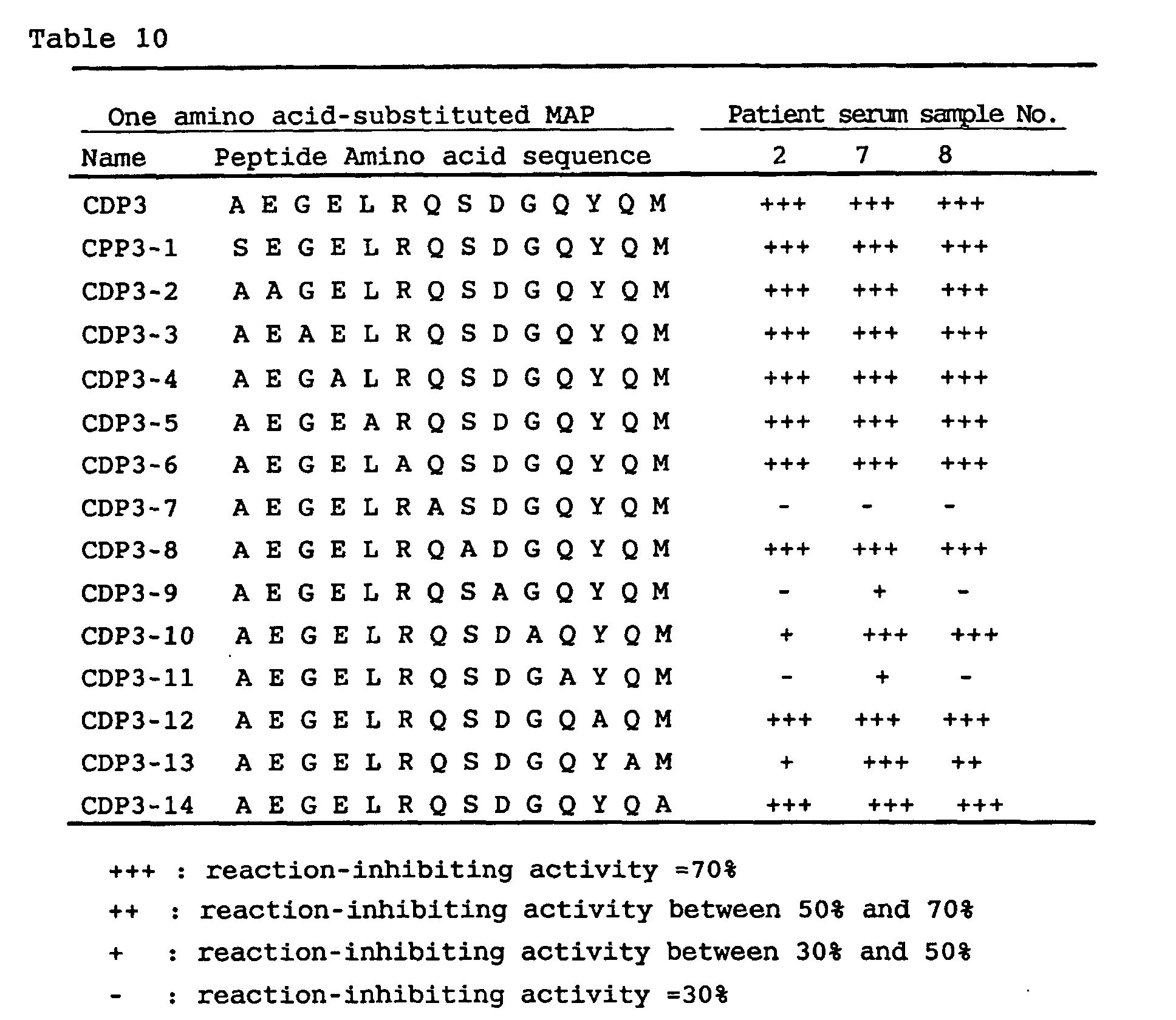
When the MAP peptides of CDP4-7, CDP4-8, CDP4-9 and
CDP4-12 were respectively used as the reaction inhibitor,
the inhibitory activity against the reaction between each
of Crohn's disease patient serum samples No. 3, No. 6, No.
15, No. 17 and No. 20 and CDP4 peptide was not more than
30%, respectively. When the MAP peptide of CDP4-6 was used
as the reaction inhibitor, the inhibitory activity against
the reaction between each of Crohn's disease patient serum
samples No. 6, No. 15, No. 17 and No. 20 and CDP4 peptide
was not more than 30%, respectively. Furthermore, when the
MAP peptides of CDP4-5 and CDP4-11 were respectively used
as the reaction inhibitor, the inhibitory activity of MAP
peptide of CDP4-5 or CDP4-11 against the reaction between
Crohn's disease patient serum No. 6 or No.15 and CDP4
peptide, respectively, was not more than 30%.
The above results led to the conclusion that, in the
amino acid sequence of CDP4 peptide, the sequence necessary
for the reaction with Crohn's disease antibody (recognition
of the antibody) was LGGIYXDL (X represents an arbitrary
amino acid residue)(SEQ ID NO:49).
Based on the above finding, a protein database
homology analysis was performed using the amino acid
sequence (LGGIYXDL (X represents an arbitrary amino acid
residue)) which was considered to be important to the
recognition of Crohn's disease antibodies. As a result, a
homology to rice allergen proteins was confirmed (Fig. 15).
It can be seen in Fig. 15 that rice allergen proteins are
a-amylase/trypsin inhibitors constituting a gene family.
These a-amylase/trypsin inhibitors having high mutual
homology in amino acid sequence were invariably found to
have the amino acid sequence L(or V)GGIYXD(or E)L (SEQ ID
NOS:49 or 50) which was considered to be important to the
reaction with Crohn's disease antibody (recognition of the
antibody). It is to be understood that L and V are alike
in that both are aliphatic amino acids and D and E are
alike in that both are acidic amino acids.
At this junction, in order to endorse the assumption
that rice allergen proteins are proteins simulated or
mimicked by CDP4 peptide, a peptide (TO3965 peptide) having
an amino acid sequence corresponding to the 99-111 amino
acid region of Rice seed allergen RA14 (Fig. 16) was
prepared in the form of a MAP peptide and the MAP antigen-ELISA
was performed using 20 Crohn's disease patient serum
samples, 20 ulcerative colitis patient serum samples, and
20 healthy volunteer serum samples.
Except that a MAP antigen plate prepared by
immobilizing the MAP peptide of TO3965 on the plate was
used as the antigen plate, the MAP antigen-ELISA was
carried out in otherwise the same manner as in Example 6(4).
The results are shown in Fig. 17. Thus, Crohn's disease
patient serum Nos.: 3, 6, 15, 17 and 20 showing strong
reactivity to CDP4 peptide showed similar reactivity to
TO3965 peptide as well. On the other hand, TO3965 peptide,
like CDP4 peptide, did not show definite reactions with
ulcerative colitis patient sera and healthy volunteer sera.
To confirm the reactivity of TO3965 peptide to
Crohn's disease antibody, a test for inhibition of the
antigen-antibody reaction between CDP4 peptide and Crohn's
disease antibody was performed using TO3965 peptide as a
reaction inhibitor as in Example 6(5). As serum antibody
samples, Crohn's disease patient serum Nos.: 3, 6, 15, 17
and 20 showing strong reactivity to CDP4 peptide were used.
The results are shown in Fig. 18.
It will be apparent from Fig. 18 that addition of the
MAP peptide of TO3965 to the reaction system resulted in
inhibition everything of the reactivity of Crohn's disease
patient serum samples (Nos.: 3, 6, 15, 17 and 20) to the
CDP4 MAP plate.
The above results indicated that both TO3965 peptide
and CDP4 peptide recognize the antibodies which are
specifically present in the sera of patients with Crohn's
disease. Moreover, the similarity to TO3965 peptide in
amino acid sequence and the commonality to TO3965 peptide
in the reactivity to serum antibody suggested that CD4
peptide and its equivalent according to the invention
simulate or mimic rice allergen proteins (a-amylase/trypsin
inhibitor gene family).
Thus, the results of the above example indicate that
antibodies to rice allergen proteins (a-amylase/trypsin
inhibitors) are specifically present in patients with
Crohn's disease. Therefore, Crohn's disease in individuals
can be diagnosed by using an antibody recognizing the gene
family of rice allergen protein (a-amylase/trypsin
inhibitor) as a marker.
In accordance with the present invention there can be
provided peptides specifically binding to antibodies
present specifically in patients with Crohn's disease. As
such, the peptides of the invention are useful as
examination reagents for Crohn's disease, and by using
these peptides and examination reagents comprising them,
Crohn's disease can be accurately diagnosed.
Furthermore, the present invention provides a novel
finding that antibodies recognizing human vacuolar H+
transport ATPase, particularly subunit E of human vacuolar
H+ transport ATPase, antibodies recognizing the human
nuclear protein (Homo sapiens kruppel-like zinc finger
protein 300), and antibodies recognizing the gene family of
rice allergen proteins (a-amylase/trypsin inhibitors) are
specifically present in the bodies of patients with Crohn's
disease. And based on this finding, the invention provides
an examination method for Crohn's disease which comprises
using at least one kind of antibody among said antibodies
as a marker and detecting the presence/absence of the
antibody in a biological sample from a subject. In
accordance with the method, Crohn's disease can be
expediently and accurately diagnosed by using a biological
sample (such as serum) as the examination sample.

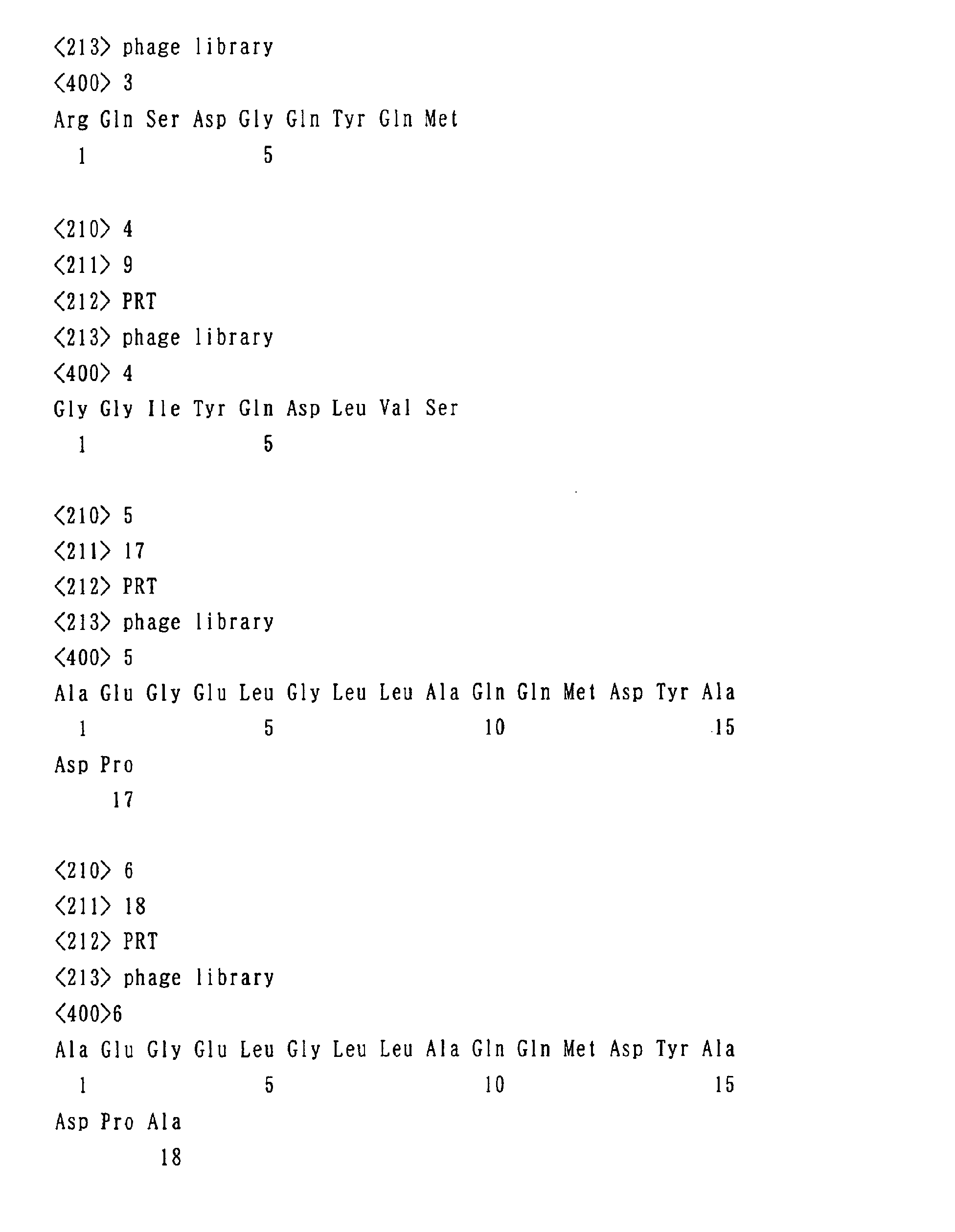
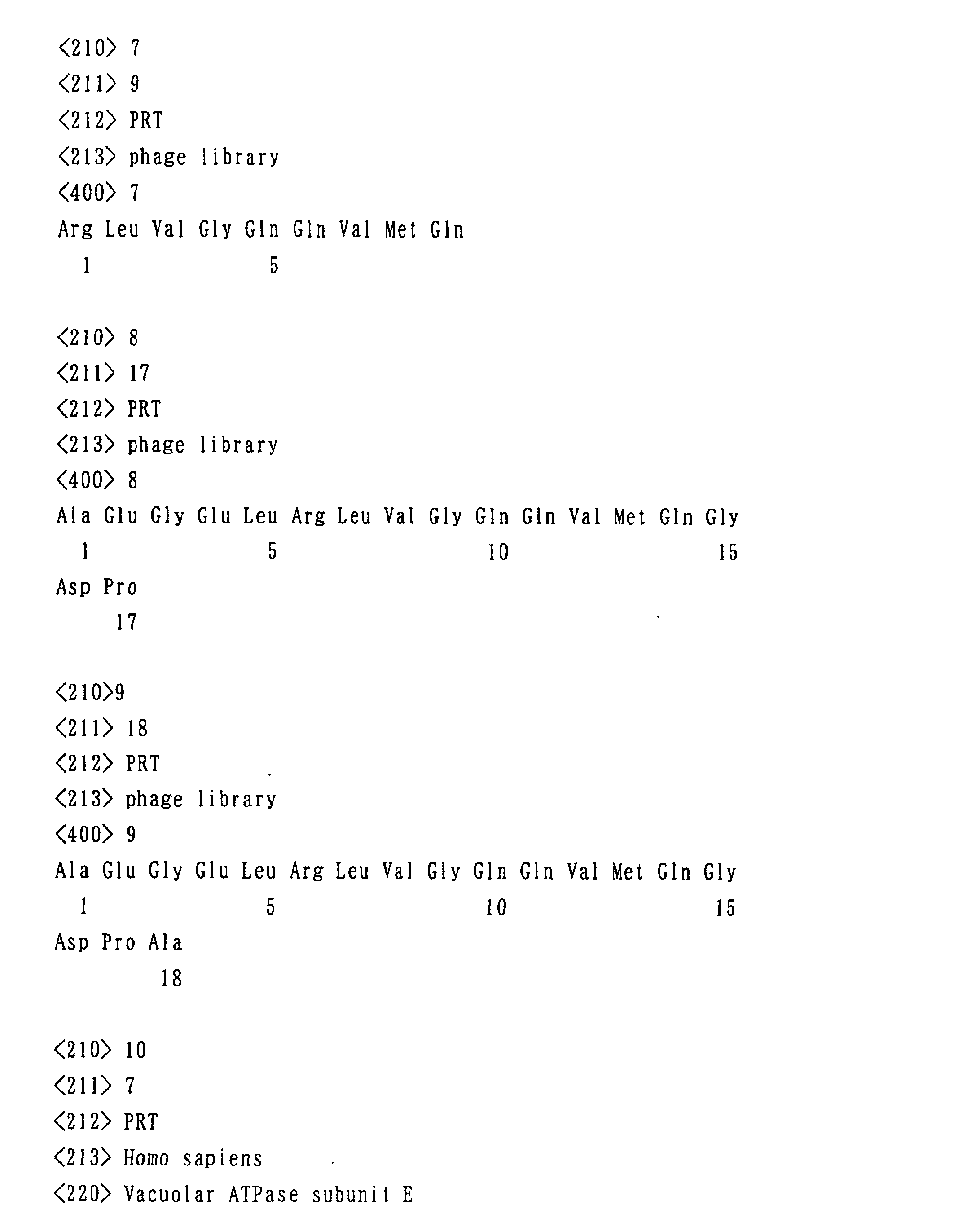
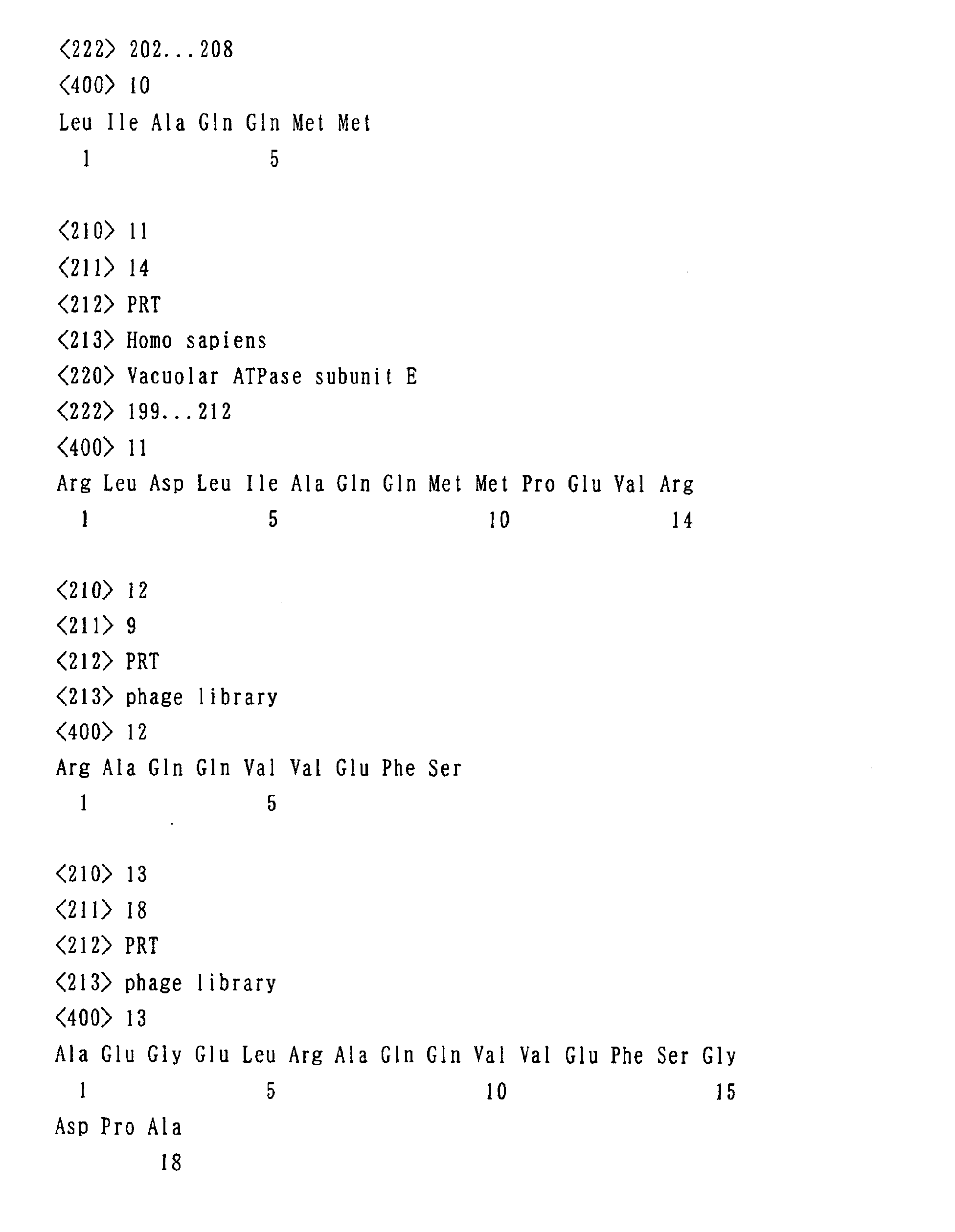


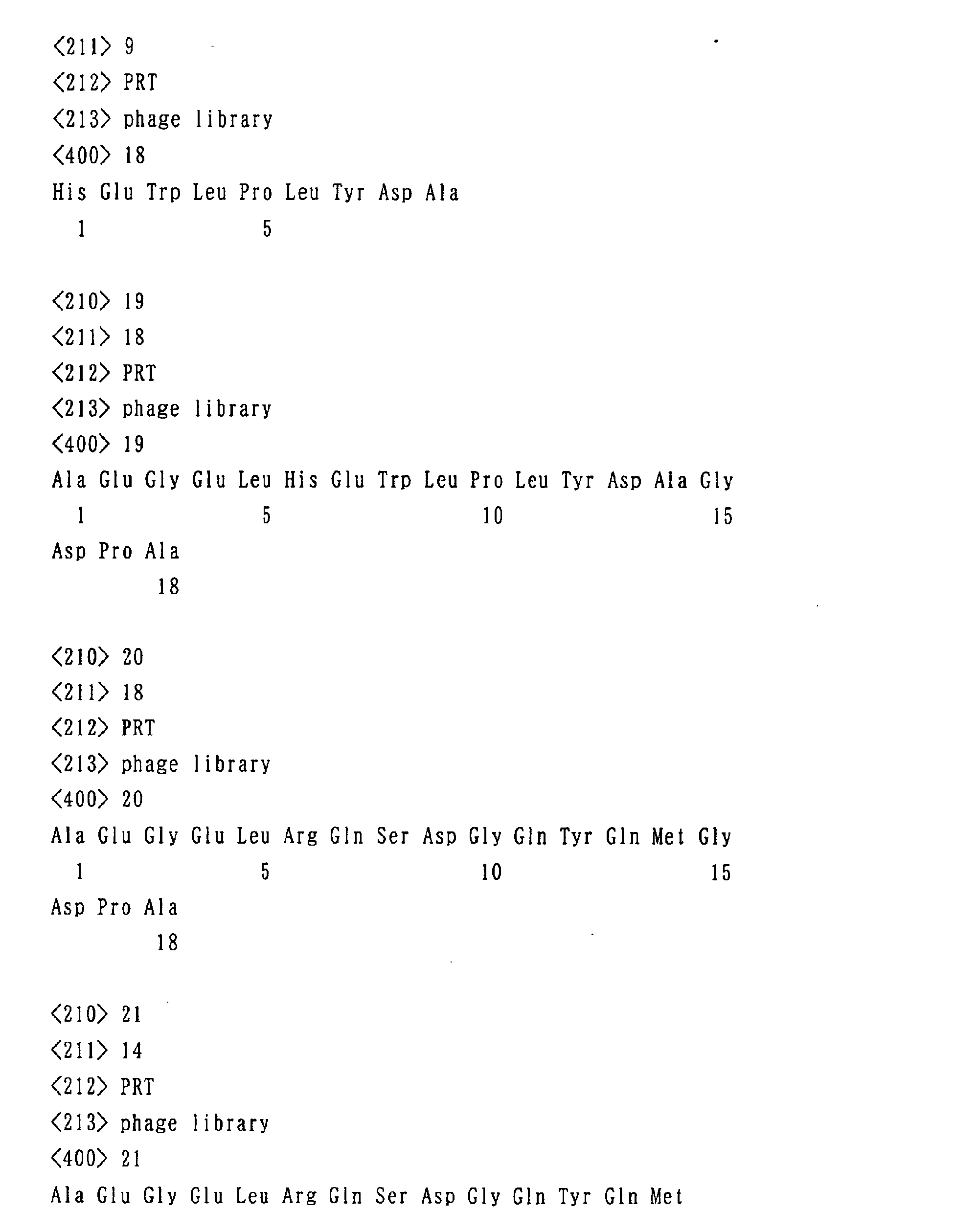


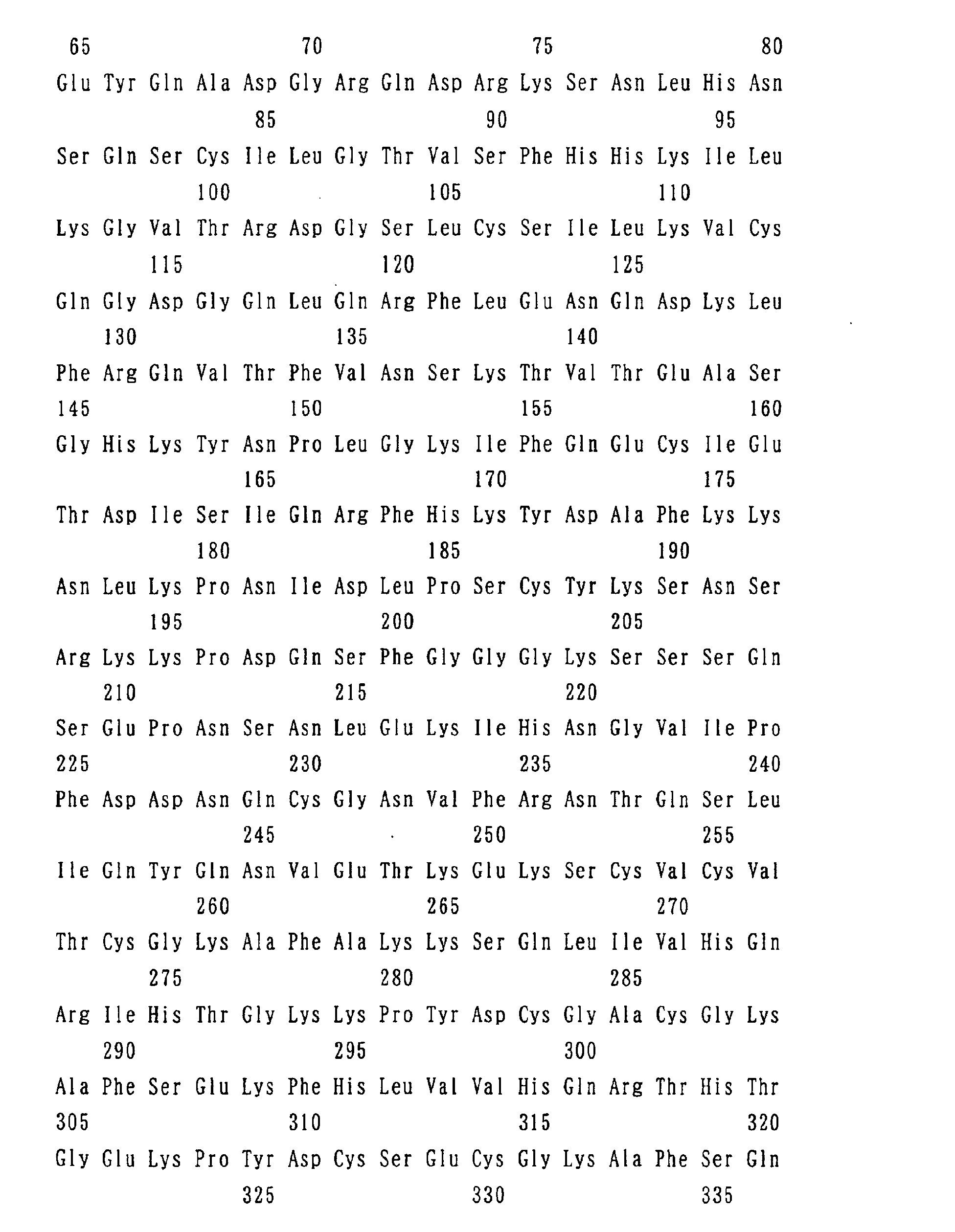


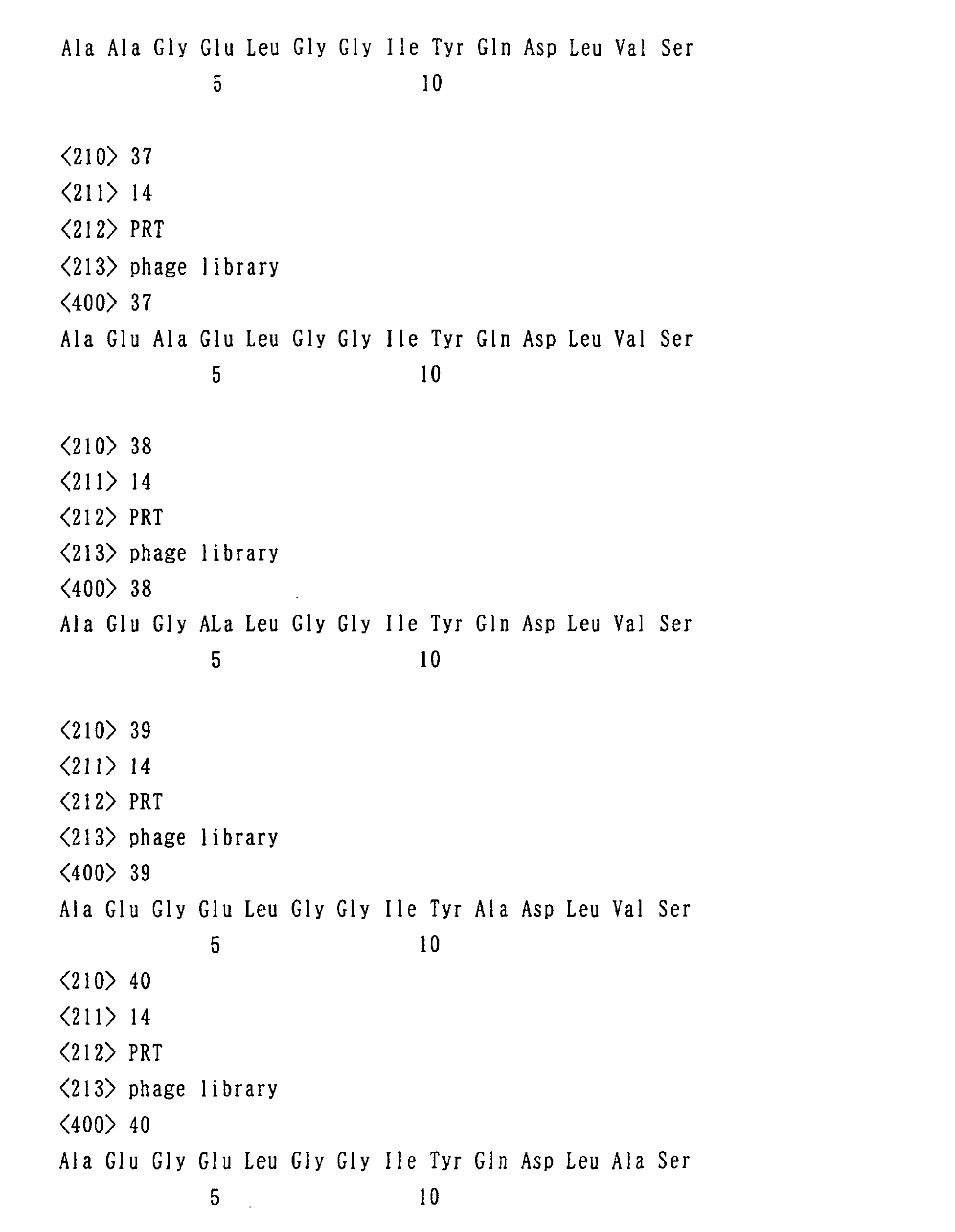


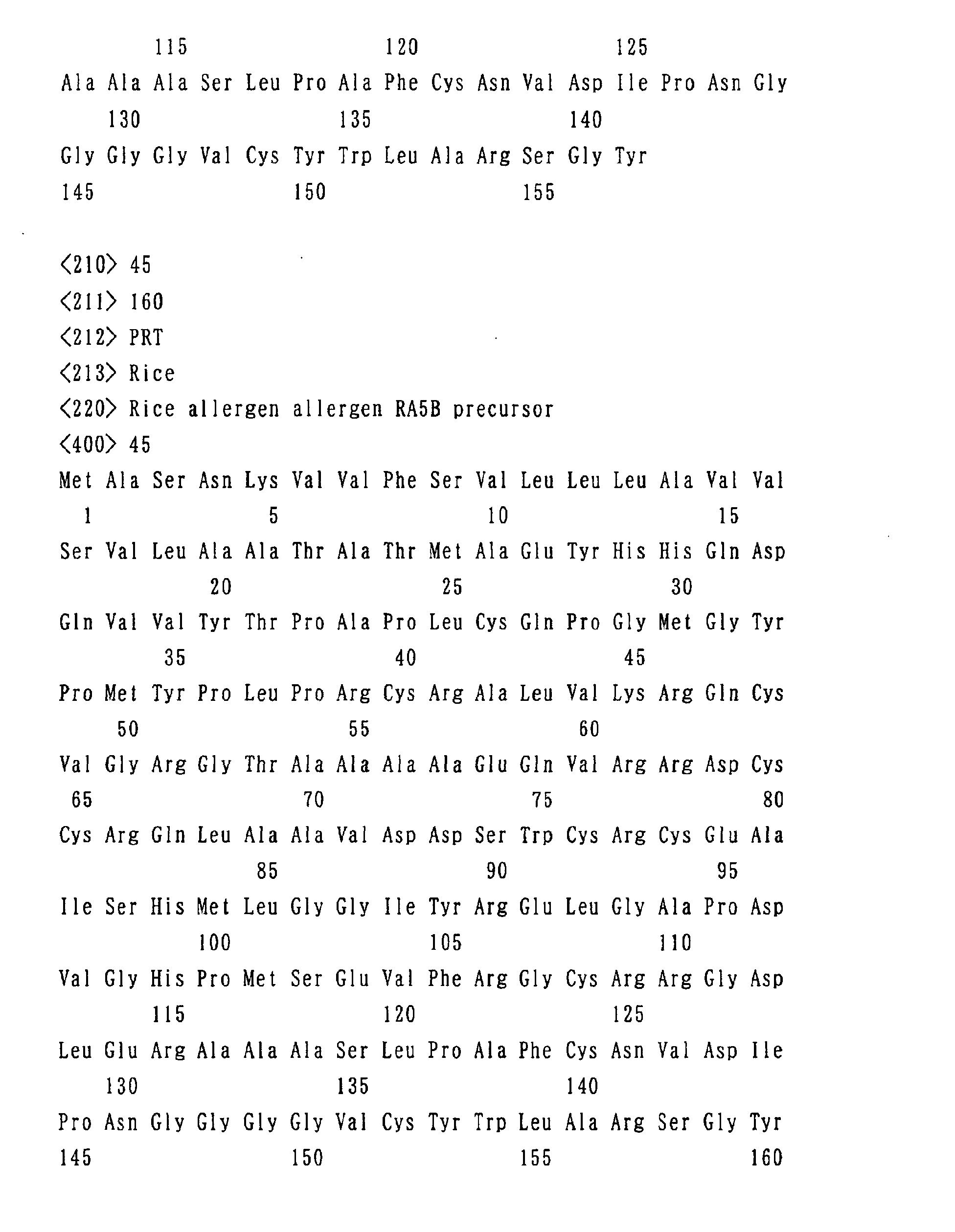


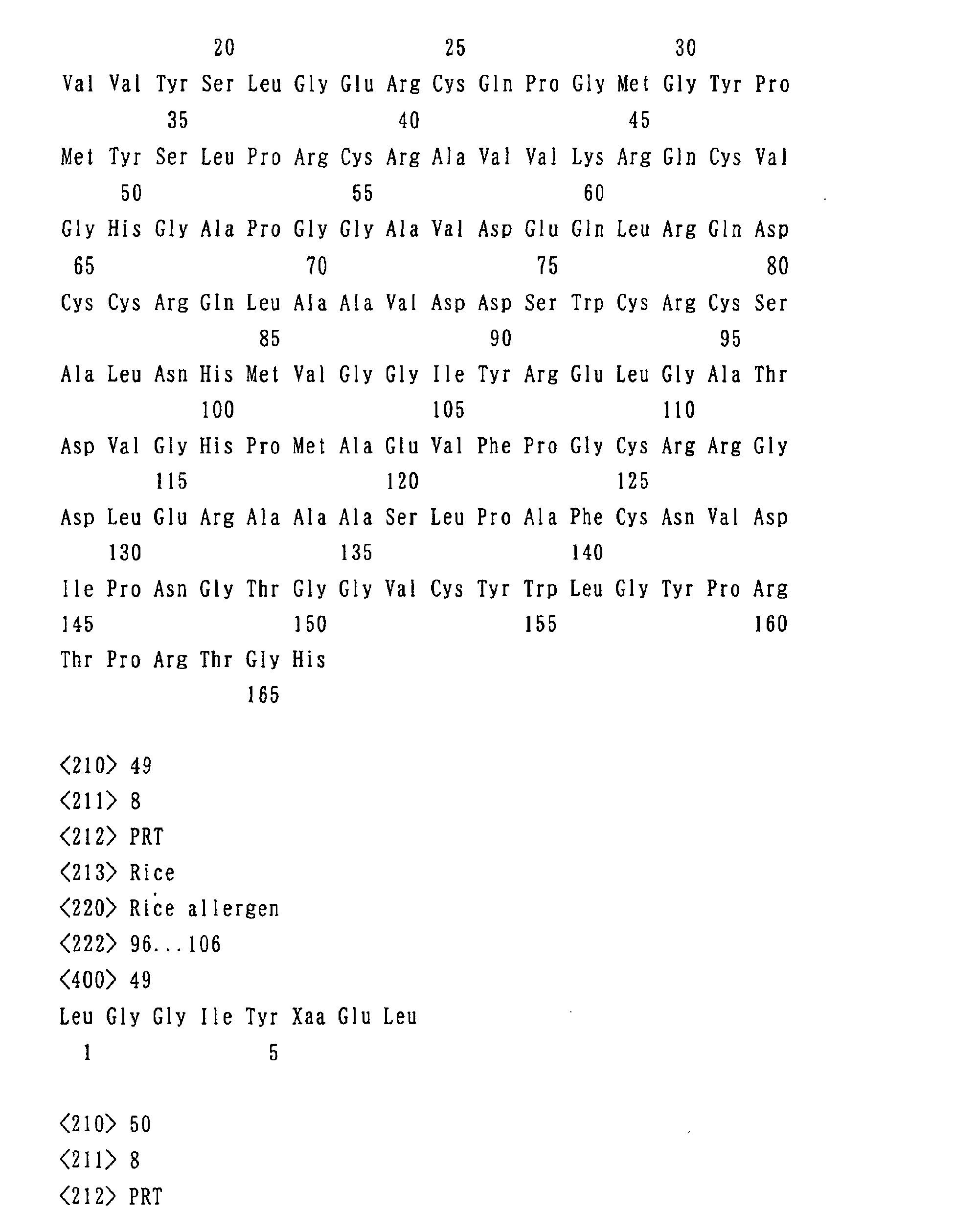
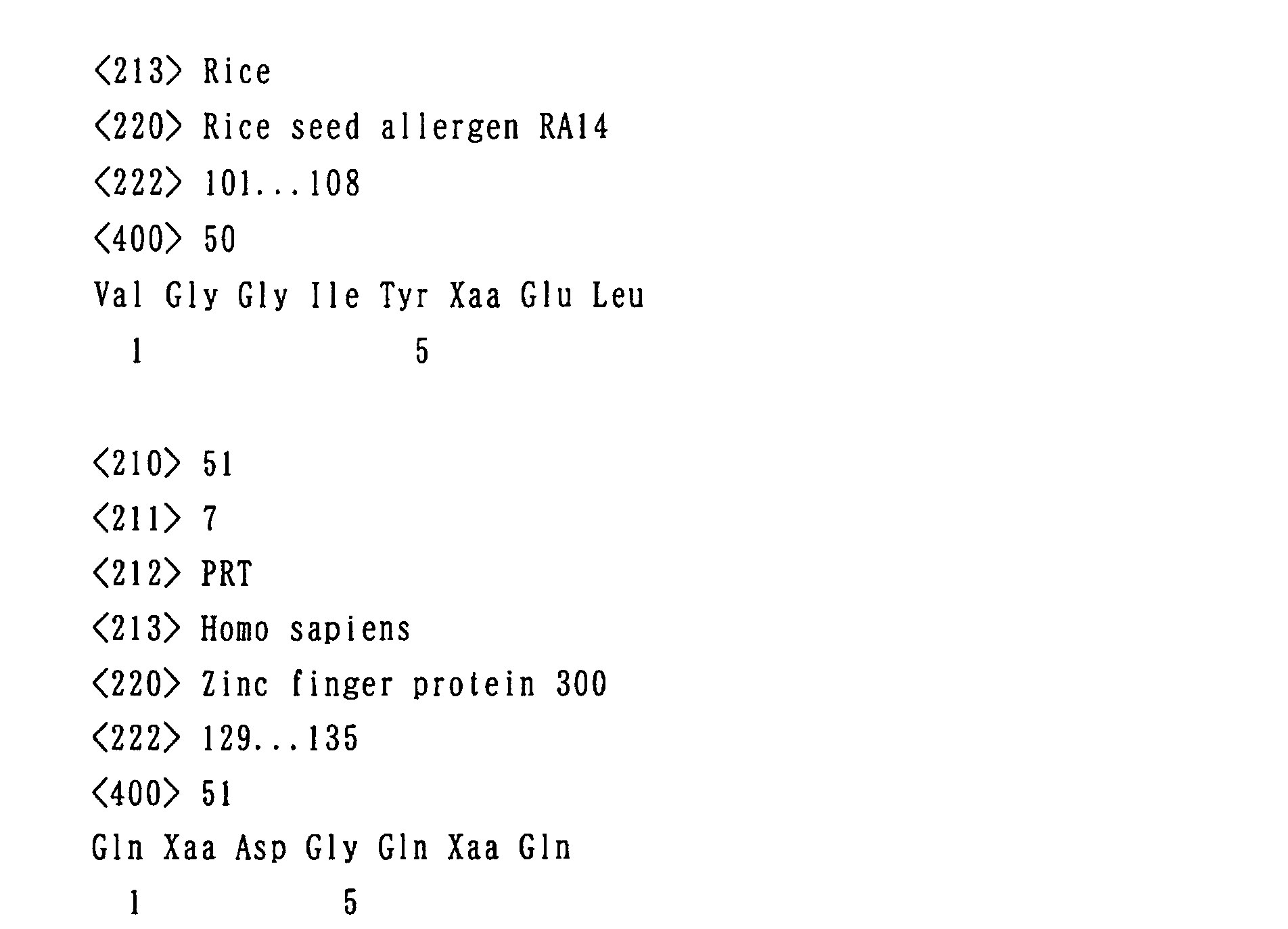
Claims (38)
- A Crohn's disease antibody-binding peptide (a) or (b):(a) a peptide consisting of an amino acid sequence selected from among the amino acid sequences represented by SEQ ID NOS:1 to 4(b) a peptide consisting of a modified amino acid sequence derived from the above-mentioned amino acid sequence (a) by substitution, deletion or addition of one or several amino acids and capable of binding to Crohn's disease antibody.
- The Crohn's disease antibody-binding peptide according to Claim 1, wherein the peptide (b) is a peptide partially comprising an amino acid sequence represented by any of SEQ ID NOS: 1 to 4 and SEQ ID NO:7.
- The Crohn's disease antibody-binding peptide according to Claim 1, wherein the peptide consisting of a modified amino acid sequence derived from the amino acid sequence of SEQ ID NO:1 by substitution, deletion, or addition of one or several amino acids and capable of binding to Crohn's disease antibody is one consisting of an amino acid sequence represented by any of SEQ ID NOS:5 to 14.
- The Crohn's disease antibody-binding peptide according to Claim 1, wherein the peptide consisting of a modified amino acid sequence derived from the amino acid sequence of SEQ ID NO:1 by substitution, deletion, or addition of one or several amino acids and capable of binding to Crohn's disease antibody is a 6 to 226-residue peptide at least comprising LIAQQM of the amino acid sequence represented by SEQ ID NO:10.
- The Crohn's disease antibody-binding peptide according to Claim 1, wherein the peptide consisting of a modified amino acid sequence derived from the amino acid sequence of SEQ ID NO:2 by substitution, deletion, or addition of one or several amino acids and capable of binding to Crohn's disease antibody is one consisting of an amino acid sequence represented by any of SEQ ID NOS:15 to 19.
- The Crohn's disease antibody-binding peptide according to Claim 1, wherein the peptide consisting of a modified amino acid sequence derived from the amino acid sequence of SEQ ID NO:3 by substitution, deletion, or addition of one or several amino acids and capable of binding to Crohn's disease antibody is one consisting of an amino acid sequence represented by any of SEQ ID NOS:20 to 32.
- The Crohn's disease antibody-binding peptide according to Claim 1, wherein the peptide consisting of a modified amino acid sequence derived from the amino acid sequence of SEQ ID NO:3 by substitution, deletion, or addition of one or several amino acids and capable of binding to Crohn's disease antibody is a 7 to 604-residue peptide at least comprising the amino acid sequence represented by SEQ ID NO:51.
- The Crohn's disease antibody-binding peptide according to Claim 1, wherein the peptide consisting of a modified amino acid sequence derived from the amino acid sequence of SEQ ID NO:4 by substitution, deletion, or addition of one or several amino acids and capable of binding to Crohn's disease antibody is one consisting of an amino acid sequence represented by any of SEQ ID NOS:33 to 48.
- The Crohn's disease antibody-binding peptide according to Claim 1, wherein the peptide consisting of a modified amino acid sequence derived from the amino acid sequence of SEQ ID NO:4 by substitution, deletion, or addition of one or several amino acids and capable of binding to Crohn's disease antibody is an 8 to 165-residue peptide at least comprising the amino acid sequence of L(V)GGIYXD(E)L (X represents an arbitrary amino acid residue).
- A branched multiple antigenic peptide containing the amino acid sequence of the following:(a) a peptide consisting of an amino acid sequence selected from among the amino acid sequences represented by SEQ ID NOS:1 to 4 or(b) a peptide consisting of a modified amino acid sequence derived from the above-mentioned amino acid sequence (a) by substitution, deletion or addition of one or several amino acids and capable of binding to Crohn's disease antibody
in a plurality of units, which may be the same or different, as branched chain sequences within each molecule. - The branched multiple antigenic peptide according to Claim 10, which comprises as the branched chain sequences the amino acid sequences of two or more dissimilar Crohn's disease antibody-binding peptides selected from at least two of the following groups: (i) a peptide consisting of the amino acid sequence represented by SEQ ID NO:1 and its equivalent, (ii) a peptide consisting of the amino acid sequence represented by SEQ ID NO:2 and its equivalent, (iii) a peptide consisting of the amino acid sequence represented by SEQ ID NO:3 and its equivalent, and (iv) a peptide consisting of the amino acid sequence represented by SEQ ID NO:4 and its equivalent.
- An examination reagent for Crohn's disease which comprises as an active ingredient at least one member selected from the Crohn's disease antibody-binding peptide claimed in Claim 1; the branched multiple antigenic peptide claimed in Claim 10; and the complex of subunit E of human vacuolar H+-transport ATPase with at least one of the other subunits selected from subunit A, subunit B, subunit C, subunit D, 115 kDa subunit, 39 kDa subunit, 20 kDa subunit, and 16 kDa subunit.
- The examination reagent for Crohn's disease according to Claim 12, wherein said Crohn's disease antibody-binding peptide comprises two or more dissimilar Crohn's disease antibody-binding peptides selected from at least two of the following groups: (i) a peptide consisting of the amino acid sequence represented by SEQ ID NO:1 and its equivalent, (ii) a peptide consisting of the amino acid sequence represented by SEQ ID NO:2 and its equivalent, (iii) a peptide consisting of the amino acid sequence represented by SEQ ID NO:3 and its equivalent, and (iv) a peptide consisting of the amino acid sequence represented by SEQ ID NO:4 and its equivalent, and said branched multiple antigenic peptide is the peptide claimed in Claim 11.
- An examination kit for Crohn's disease which comprises the examination reagent claimed in Claim 12 as the antigenic substance for binding Crohn's disease antibody.
- The examination kit according to Claim 14, comprising an anti-human IgG antibody and the examination reagent claimed in Claim 12, optionally together with at least one member selected from a sample diluent, a labeling substance, a support (solid phase), a diluent for anti-human IgG antibody, an enzyme substrate, and a reaction stop solution.
- An examination method for Crohn's disease which comprises a step of detecting the presence of an antibody recognizing human vacuolar H+-transport ATPase in a biological sample from a subject.
- The examination method for Crohn's disease according to Claim 16, wherein said antibody is an antibody which recognizes subunit E of human vacuolar H+-transport ATPase.
- An examination method for Crohn's disease according to Claim 16, wherein said antibody is an antibody which recognizes the complex of subunit E of human vacuolar H+-transport ATPase with at least one of the other subunits selected from subunit A, subunit B, subunit C, subunit D, 115 kDa subunit, 39 kDa subunit, 20 kDa subunit, and 16 kDa subunit.
- The examination method for Crohn's disease according to Claim 16, wherein said antibody is an antibody which recognizes the 199-212 amino acid region of subunit E of human vacuolar H+-transport ATPase.
- The examination method for Crohn's disease according to Claim 16, comprising a step of using as an antigen, any of a peptide consisting of the amino acid sequence of LIAQQM or its equivalent, and a branched multiple antigenic peptide containing the amino acid sequence of said peptide or equivalent in a plurality of units, which may be the same or different, as branched chain sequences within each molecule,
and detecting a complex formed by the antigen-antibody reaction between the said antigen and the antibody recognizing human vacuolar H+-transport ATPase. - The examination method for Crohn's disease according to Claim 20, wherein the peptide consisting of the amino acid sequence of LIAQQM or its equivalent is a 6 to 227-residue peptide comprising the amino acid sequence of LIAQQM.
- The examination method for Crohn's disease according to Claim 20, wherein said equivalent of a peptide consisting of the amino acid sequence of LIAQQM is a peptide consisting of an amino acid sequence represented by any of SEQ ID NO:1 and NOS:5 to 14.
- The examination method for Crohn's disease according to Claim 16, comprising a step of using as an antigen, a complex of subunit E of human vacuolar H+-transport ATPase with at least one of the other subunits selected from subunit A, subunit B, subunit C, subunit D, 115 kDa subunit, 39 kDa subunit, 20 kDa subunit, and 16 kDa subunit,
and detecting a complex formed by the antigen-antibody reaction between the said antigen and the antibody recognizing human vacuolar H+-transport ATPase. - An examination method for Crohn's disease which comprises a step of detecting the presence of an antibody recognizing a human nuclear protein (Homo sapiens kruppel-like zinc finger protein 300) in a biological sample from a subject.
- The examination method for Crohn's disease according to Claim 24, wherein said antibody is an antibody which recognizes the 126-138 amino acid region of the human nuclear protein (Homo sapiens kruppel-like zinc finger protein 300).
- The examination method for Crohn's disease according to Claim 24, comprising a step of using as an antigen, any of the peptide consisting of an amino acid represented by SEQ ID NO:51 or its equivalent, and a branched multiple antigenic peptide containing the amino acid sequence of said peptide or equivalent in a plurality of units, which may be the same or different, as branched chain sequences within each molecule,
and detecting a complex formed by the antigen-antibody reaction between the said antigen and the antibody recognizing the human nuclear protein (Homo sapiens kruppel-like zinc finger protein 300). - The examination method for Crohn's disease according to Claim 26, wherein the peptide consisting of an amino acid sequence represented by SEQ ID NO:51 or its equivalent is a 7 to 604-residue peptide comprising the amino acid sequence represented by SEQ ID NO:51.
- The examination method for Crohn's disease according to Claim 26, wherein said equivalent of the peptide consisting of an amino acid sequence represented by SEQ ID NO:51 is a peptide consisting of an amino acid sequence represented by any of SEQ ID NOS:3 and 21 to 32.
- An examination method for Crohn's disease which comprises a step of detecting the presence of an antibody recognizing a rice allergen protein in a biological sample from a subject.
- The examination method for Crohn's disease according to Claim 29, wherein said rice allergen protein belongs to the gene family of alpha-amylase/trypsin inhibitors.
- The examination method for Crohn's disease according to Claim 29, wherein said rice allergen protein is at least one member selected from Rice allergen, Rice seed allergen RA5, Rice allergen RA5B precursor, Rice seed allergen RA14, Rice allergen RA14B precursor, and Rice seed allergen RAG2.
- The examination method for Crohn's disease according to Claim 29, wherein said antibody recognizing the rice allergen protein is an antibody which recognizes the 99-111 amino acid region of Rice seed allergen RA14.
- The examination method for Crohn's disease according to Claim 29, wherein said antibody recognizing the rice allergen protein is an antibody recognizing an amino acid region comprising the amino acid sequence L(V)GGIYREL of the gene family of alpha-amylase/trypsin inhibitors.
- The examination method for Crohn's disease according to Claim 29, comprising a step of using as an antigen, any of a peptide consisting of the amino acid sequence of L(V)GGIYXD(E)L (X represents an arbitrary amino acid residue which may be the same or different) or its equivalent, and a branched multiple antigenic peptide having the amino acid sequence of said peptide or equivalent in the plurality of units, which may be the same or different, as branched chain sequences within each molecule,
and detecting a complex formed by the antigen-antibody reaction between the said antigen and the antibody recognizing the rice allergen protein. - The examination method for Crohn's disease according to Claim 34, wherein the peptide consisting of the amino acid sequence L(V)GGIYXD(E)L (X represents an arbitrary amino acid residue which may be the same or different) or its equivalent is an 8 to 166-residue peptide comprising the amino acid sequence: L(V)GGIYXD(E)L (X represents an arbitrary amino acid residue which may be the same or different).
- The examination method for Crohn's disease according to Claim 34, wherein said equivalent of the peptide consisting of the amino acid sequence of L(V)GGIYXD(E)L (X represents an arbitrary amino acid residue which may be the same or different) is a peptide consisting of an amino acid sequence represented by any of SEQ ID NOS:4 and 33 to 48.
- Use of the peptide claimed in any of Claims 1 to 11 as the antigen to be reacted with Crohn's disease antibody in an examination for Crohn's disease.
- Use of the peptide claimed in any of Claims 1 to 11 for the manufacture of examination reagents for Crohn's disease.
Applications Claiming Priority (5)
| Application Number | Priority Date | Filing Date | Title |
|---|---|---|---|
| JP2001126121 | 2001-04-24 | ||
| JP2001126121 | 2001-04-24 | ||
| JP2002047384 | 2002-02-25 | ||
| JP2002047384 | 2002-02-25 | ||
| PCT/JP2002/004061 WO2002088175A1 (en) | 2001-04-24 | 2002-04-24 | Crohn's disease antibody-binding peptide and method of examining crohn's disease |
Publications (2)
| Publication Number | Publication Date |
|---|---|
| EP1391462A1 true EP1391462A1 (en) | 2004-02-25 |
| EP1391462A4 EP1391462A4 (en) | 2004-09-15 |
Family
ID=26614095
Family Applications (1)
| Application Number | Title | Priority Date | Filing Date |
|---|---|---|---|
| EP02722733A Withdrawn EP1391462A4 (en) | 2001-04-24 | 2002-04-24 | Crohn's disease antibody-binding peptide and method of examining crohn's disease |
Country Status (9)
| Country | Link |
|---|---|
| US (1) | US20040175763A1 (en) |
| EP (1) | EP1391462A4 (en) |
| JP (1) | JPWO2002088175A1 (en) |
| KR (1) | KR20040015128A (en) |
| CN (1) | CN1505637A (en) |
| AU (1) | AU2002253564A2 (en) |
| CA (1) | CA2445309A1 (en) |
| MX (1) | MXPA03009778A (en) |
| WO (1) | WO2002088175A1 (en) |
Cited By (2)
| Publication number | Priority date | Publication date | Assignee | Title |
|---|---|---|---|---|
| EP1890152A1 (en) * | 2006-08-14 | 2008-02-20 | Charite Universitätsmedizin-Berlin | Determination of renin/prorenin receptor activity |
| US7985831B2 (en) | 2004-08-05 | 2011-07-26 | Toagosei Co., Ltd. | Crohn's disease antibody epitope peptide and reagent for testing Crohn's disease |
Families Citing this family (5)
| Publication number | Priority date | Publication date | Assignee | Title |
|---|---|---|---|---|
| JP4577083B2 (en) * | 2005-04-28 | 2010-11-10 | 味の素株式会社 | How to diagnose Crohn's disease |
| CN1869692A (en) * | 2005-05-23 | 2006-11-29 | 武汉大学 | Three-function nano-ball |
| CN102341705B (en) * | 2009-03-05 | 2015-08-19 | 味之素株式会社 | Crohn's disease diagnostic reagent |
| EP3523657B1 (en) * | 2016-10-04 | 2023-06-21 | F. Hoffmann-La Roche AG | System and method for identification of a synthetic classifier |
| CN110256541A (en) * | 2019-05-15 | 2019-09-20 | 山西瑞豪生物科技有限公司 | Polypeptide and its application of engler's disease serum antibody are cloned in a kind of detection |
Family Cites Families (7)
| Publication number | Priority date | Publication date | Assignee | Title |
|---|---|---|---|---|
| JPH11190734A (en) * | 1997-12-26 | 1999-07-13 | Wakamoto Pharmaceut Co Ltd | Test method and test kit for Crohn's disease |
| WO1999061909A2 (en) * | 1998-05-26 | 1999-12-02 | The Government Of The United States Of America, As Represented By The Secretary, Department Of Health And Human Services | Methods and compositions for the detection of human herpesvirus |
| JP2002543825A (en) * | 1999-05-14 | 2002-12-24 | アーバー ビータ コーポレイション | Hematopoietic intracellular molecular interactions |
| WO2001055321A2 (en) * | 2000-01-31 | 2001-08-02 | Human Genome Sciences, Inc. | Nucleic acids, proteins, and antibodies |
| JP2004520803A (en) * | 2000-04-21 | 2004-07-15 | コリクサ コーポレイション | Compositions and methods for the treatment and diagnosis of acne vulgaris |
| US6727226B2 (en) * | 2000-07-21 | 2004-04-27 | University Of Utah Research Foundation | Mu-conopeptides |
| EP1379879A2 (en) * | 2000-12-08 | 2004-01-14 | Oxford GlycoSciences (UK) Limited | Diagnosis and treatment of alzheimer's disease |
-
2002
- 2002-04-24 US US10/475,647 patent/US20040175763A1/en not_active Abandoned
- 2002-04-24 KR KR10-2003-7013899A patent/KR20040015128A/en not_active Ceased
- 2002-04-24 MX MXPA03009778A patent/MXPA03009778A/en unknown
- 2002-04-24 JP JP2002585473A patent/JPWO2002088175A1/en active Pending
- 2002-04-24 CN CNA028088166A patent/CN1505637A/en active Pending
- 2002-04-24 AU AU2002253564A patent/AU2002253564A2/en not_active Abandoned
- 2002-04-24 EP EP02722733A patent/EP1391462A4/en not_active Withdrawn
- 2002-04-24 CA CA002445309A patent/CA2445309A1/en not_active Abandoned
- 2002-04-24 WO PCT/JP2002/004061 patent/WO2002088175A1/en not_active Ceased
Cited By (3)
| Publication number | Priority date | Publication date | Assignee | Title |
|---|---|---|---|---|
| US7985831B2 (en) | 2004-08-05 | 2011-07-26 | Toagosei Co., Ltd. | Crohn's disease antibody epitope peptide and reagent for testing Crohn's disease |
| EP1890152A1 (en) * | 2006-08-14 | 2008-02-20 | Charite Universitätsmedizin-Berlin | Determination of renin/prorenin receptor activity |
| WO2008019735A1 (en) * | 2006-08-14 | 2008-02-21 | Charite - Universitätsmedizin Berlin | Determination of renin/prorenin receptor activity |
Also Published As
| Publication number | Publication date |
|---|---|
| MXPA03009778A (en) | 2004-05-27 |
| WO2002088175A1 (en) | 2002-11-07 |
| CN1505637A (en) | 2004-06-16 |
| JPWO2002088175A1 (en) | 2004-08-19 |
| AU2002253564A2 (en) | 2002-11-11 |
| KR20040015128A (en) | 2004-02-18 |
| US20040175763A1 (en) | 2004-09-09 |
| CA2445309A1 (en) | 2002-11-07 |
| EP1391462A4 (en) | 2004-09-15 |
Similar Documents
| Publication | Publication Date | Title |
|---|---|---|
| JP4234207B2 (en) | Diagnosis method of allergic bronchopulmonary aspergillosis | |
| JP2001513753A (en) | Methods for detecting peptides derived from antigens recognized by autoantibodies from patients with rheumatoid arthritis, antibodies directed to the peptides, bound antigens and autoimmune antibodies | |
| CN107290539A (en) | Peptide composition and its application for detecting Serum of Patients With Autoimmune Diseases blood serum designated object | |
| CN113248590B (en) | NT-proBNP protein antigenic determinant polypeptide and application thereof | |
| US9012405B2 (en) | Citrullinated fibrin-filaggrin chimeric polypeptide capable of detecting the antibodies generated in rheumatoid arthritis | |
| WO1998002744A1 (en) | Diagnostic drugs for autoimmune diseases | |
| JPH0347133A (en) | Antigen of langerhans island cell obtained by molecular cloning | |
| US20040175763A1 (en) | Crohn's disease antibody-binding peptide and method of examining crohn's disease | |
| JPH11316227A (en) | Diagnostic medicine and drug for autoimmune hepatitis | |
| CN108948153A (en) | A kind of citrulling modified peptides antigen combination and its application | |
| JP2000512123A (en) | Nephropathy-related immunoglobulin G and antibodies therefor | |
| CN115015545B (en) | Highly sensitive liver disease detection kit based on chitinase 3-like protein 1 | |
| KR101159626B1 (en) | Crohn's disease antibody epitope peptide and reagent for testing crohn's disease | |
| CN108948173A (en) | A kind of citrulling modified peptides and its application | |
| CN100572391C (en) | Beta-fodrin antigen epitope polypeptide and screening method thereof and application | |
| WO2002010755A2 (en) | Organ transplant rejection and associated conditions | |
| AU2001275713A1 (en) | Organ transplant rejection and associated conditions | |
| JP4726364B2 (en) | Method for measuring simple Helps virus antibody | |
| JP2006071409A (en) | Sjogren's syndrome diagnostic kit | |
| CN116987194B (en) | Anti-idiotype nano antibody of mimic epitope peptide of human ST2 antigen and application thereof | |
| CN113831401B (en) | SLE epitope polypeptide and application thereof in SLE diagnosis | |
| CN113817025B (en) | SLE epitope polypeptides in the identification of SLE and other autoimmune diseases | |
| CN114316042A (en) | cTnI protein antigenic determinant polypeptide and application thereof | |
| CN120757639A (en) | A p-Tau217 single molecule detection kit and its detection antibody | |
| JPH02299A (en) | Antibody and antigen |
Legal Events
| Date | Code | Title | Description |
|---|---|---|---|
| PUAI | Public reference made under article 153(3) epc to a published international application that has entered the european phase |
Free format text: ORIGINAL CODE: 0009012 |
|
| 17P | Request for examination filed |
Effective date: 20031113 |
|
| AK | Designated contracting states |
Kind code of ref document: A1 Designated state(s): AT BE CH CY DE DK ES FI FR GB GR IE IT LI LU MC NL PT SE TR |
|
| A4 | Supplementary search report drawn up and despatched |
Effective date: 20040729 |
|
| STAA | Information on the status of an ep patent application or granted ep patent |
Free format text: STATUS: THE APPLICATION HAS BEEN WITHDRAWN |
|
| 18W | Application withdrawn |
Effective date: 20050601 |