EP1391199A1 - Carboxylic acid derivatives and drugs containing the same as the active ingredient - Google Patents
Carboxylic acid derivatives and drugs containing the same as the active ingredient Download PDFInfo
- Publication number
- EP1391199A1 EP1391199A1 EP02769553A EP02769553A EP1391199A1 EP 1391199 A1 EP1391199 A1 EP 1391199A1 EP 02769553 A EP02769553 A EP 02769553A EP 02769553 A EP02769553 A EP 02769553A EP 1391199 A1 EP1391199 A1 EP 1391199A1
- Authority
- EP
- European Patent Office
- Prior art keywords
- phenyl
- phenylpentyloxy
- propanoylamino
- benzoic acid
- alkyl
- Prior art date
- Legal status (The legal status is an assumption and is not a legal conclusion. Google has not performed a legal analysis and makes no representation as to the accuracy of the status listed.)
- Granted
Links
- 0 C[C+]N(C)*(C)(C)* Chemical compound C[C+]N(C)*(C)(C)* 0.000 description 8
- QZGAZVDFVCOPGF-UHFFFAOYSA-N CC(Cc(cc1)ccc1OCCCCCc1ccccc1)C(Nc(cc1C(O)=O)ccc1Cl)=O Chemical compound CC(Cc(cc1)ccc1OCCCCCc1ccccc1)C(Nc(cc1C(O)=O)ccc1Cl)=O QZGAZVDFVCOPGF-UHFFFAOYSA-N 0.000 description 1
- BKPIUYRETWKSEL-UHFFFAOYSA-N CC([IH](C)=C(C)I)=N Chemical compound CC([IH](C)=C(C)I)=N BKPIUYRETWKSEL-UHFFFAOYSA-N 0.000 description 1
- CKXHATYPEHYBFE-UHFFFAOYSA-N COC(c(cc(cc1)NC(CCc(cc2)ccc2OCCCCCC2=CCCC=C2)=O)c1OC)=O Chemical compound COC(c(cc(cc1)NC(CCc(cc2)ccc2OCCCCCC2=CCCC=C2)=O)c1OC)=O CKXHATYPEHYBFE-UHFFFAOYSA-N 0.000 description 1
- LNRFFFSNEZVDJH-UHFFFAOYSA-N COC(c(ccc(NC(CCc(cc1)ccc1OCCCCc1ccccc1)=O)c1)c1C(OC)=O)=O Chemical compound COC(c(ccc(NC(CCc(cc1)ccc1OCCCCc1ccccc1)=O)c1)c1C(OC)=O)=O LNRFFFSNEZVDJH-UHFFFAOYSA-N 0.000 description 1
- MODZGWMWQAYWJG-UHFFFAOYSA-N COC(c1cc(NC(CCc(c(F)c2)ccc2OCCCCCc2ccccc2)=O)ccc1Cl)=O Chemical compound COC(c1cc(NC(CCc(c(F)c2)ccc2OCCCCCc2ccccc2)=O)ccc1Cl)=O MODZGWMWQAYWJG-UHFFFAOYSA-N 0.000 description 1
- JOADWIMATGUHJF-UHFFFAOYSA-N COc(cc(CCC(Nc(cc1)cc(C(O)=O)c1Cl)=O)cc1)c1OCCCCCc1ccccc1 Chemical compound COc(cc(CCC(Nc(cc1)cc(C(O)=O)c1Cl)=O)cc1)c1OCCCCCc1ccccc1 JOADWIMATGUHJF-UHFFFAOYSA-N 0.000 description 1
- MRXJREVRCDWALO-UHFFFAOYSA-N Cc1cc(OCCCCCc2ccccc2)ccc1CCC(Nc1ccc(C(O)=O)c(C(O)=O)c1)=O Chemical compound Cc1cc(OCCCCCc2ccccc2)ccc1CCC(Nc1ccc(C(O)=O)c(C(O)=O)c1)=O MRXJREVRCDWALO-UHFFFAOYSA-N 0.000 description 1
- HROJVKMBCKKPCP-UHFFFAOYSA-N Nc(ccc(C(NCCc(cc1)ccc1OCCCCCc1ccccc1)=O)c1)c1C(O)=O Chemical compound Nc(ccc(C(NCCc(cc1)ccc1OCCCCCc1ccccc1)=O)c1)c1C(O)=O HROJVKMBCKKPCP-UHFFFAOYSA-N 0.000 description 1
- VQGQWANJKBEEFD-UHFFFAOYSA-N OC(C(C(N1CCCC1)=CC1)=CC1NC(CCc(cc1)ccc1OCCCCCc1ccccc1)=O)=O Chemical compound OC(C(C(N1CCCC1)=CC1)=CC1NC(CCc(cc1)ccc1OCCCCCc1ccccc1)=O)=O VQGQWANJKBEEFD-UHFFFAOYSA-N 0.000 description 1
- VTYFKOJQGMVQIW-UHFFFAOYSA-N OC(c(cc(cc1)NC(CCc(cc2)ccc2OCCCCCc2ccccc2)=O)c1F)=O Chemical compound OC(c(cc(cc1)NC(CCc(cc2)ccc2OCCCCCc2ccccc2)=O)c1F)=O VTYFKOJQGMVQIW-UHFFFAOYSA-N 0.000 description 1
- WSNUZGVJPLZPMH-UHFFFAOYSA-N OC(c1cc(C(O)=O)cc(NC(CCc(cc2)ccc2OCCCCCc2ccccc2)=O)c1)=O Chemical compound OC(c1cc(C(O)=O)cc(NC(CCc(cc2)ccc2OCCCCCc2ccccc2)=O)c1)=O WSNUZGVJPLZPMH-UHFFFAOYSA-N 0.000 description 1
- WCVIHWWMIBCPMD-UHFFFAOYSA-N OC(c1cc(NC(CCc(cc2)ccc2OCCCCCc2ccncc2)=O)ccc1Cl)=O Chemical compound OC(c1cc(NC(CCc(cc2)ccc2OCCCCCc2ccncc2)=O)ccc1Cl)=O WCVIHWWMIBCPMD-UHFFFAOYSA-N 0.000 description 1
- VTCFHGDWYIVIQM-UHFFFAOYSA-N OC(c1cccc(C(NCCc(cc2)ccc2OCCCCCc2ccccc2)=O)n1)=O Chemical compound OC(c1cccc(C(NCCc(cc2)ccc2OCCCCCc2ccccc2)=O)n1)=O VTCFHGDWYIVIQM-UHFFFAOYSA-N 0.000 description 1
Classifications
-
- C—CHEMISTRY; METALLURGY
- C07—ORGANIC CHEMISTRY
- C07D—HETEROCYCLIC COMPOUNDS
- C07D213/00—Heterocyclic compounds containing six-membered rings, not condensed with other rings, with one nitrogen atom as the only ring hetero atom and three or more double bonds between ring members or between ring members and non-ring members
- C07D213/02—Heterocyclic compounds containing six-membered rings, not condensed with other rings, with one nitrogen atom as the only ring hetero atom and three or more double bonds between ring members or between ring members and non-ring members having three double bonds between ring members or between ring members and non-ring members
- C07D213/04—Heterocyclic compounds containing six-membered rings, not condensed with other rings, with one nitrogen atom as the only ring hetero atom and three or more double bonds between ring members or between ring members and non-ring members having three double bonds between ring members or between ring members and non-ring members having no bond between the ring nitrogen atom and a non-ring member or having only hydrogen or carbon atoms directly attached to the ring nitrogen atom
- C07D213/24—Heterocyclic compounds containing six-membered rings, not condensed with other rings, with one nitrogen atom as the only ring hetero atom and three or more double bonds between ring members or between ring members and non-ring members having three double bonds between ring members or between ring members and non-ring members having no bond between the ring nitrogen atom and a non-ring member or having only hydrogen or carbon atoms directly attached to the ring nitrogen atom with substituted hydrocarbon radicals attached to ring carbon atoms
- C07D213/28—Radicals substituted by singly-bound oxygen or sulphur atoms
- C07D213/30—Oxygen atoms
-
- A—HUMAN NECESSITIES
- A61—MEDICAL OR VETERINARY SCIENCE; HYGIENE
- A61K—PREPARATIONS FOR MEDICAL, DENTAL OR TOILETRY PURPOSES
- A61K31/00—Medicinal preparations containing organic active ingredients
- A61K31/16—Amides, e.g. hydroxamic acids
- A61K31/165—Amides, e.g. hydroxamic acids having aromatic rings, e.g. colchicine, atenolol, progabide
- A61K31/166—Amides, e.g. hydroxamic acids having aromatic rings, e.g. colchicine, atenolol, progabide having the carbon of a carboxamide group directly attached to the aromatic ring, e.g. procainamide, procarbazine, metoclopramide, labetalol
-
- A—HUMAN NECESSITIES
- A61—MEDICAL OR VETERINARY SCIENCE; HYGIENE
- A61K—PREPARATIONS FOR MEDICAL, DENTAL OR TOILETRY PURPOSES
- A61K31/00—Medicinal preparations containing organic active ingredients
- A61K31/16—Amides, e.g. hydroxamic acids
- A61K31/165—Amides, e.g. hydroxamic acids having aromatic rings, e.g. colchicine, atenolol, progabide
- A61K31/167—Amides, e.g. hydroxamic acids having aromatic rings, e.g. colchicine, atenolol, progabide having the nitrogen of a carboxamide group directly attached to the aromatic ring, e.g. lidocaine, paracetamol
-
- A—HUMAN NECESSITIES
- A61—MEDICAL OR VETERINARY SCIENCE; HYGIENE
- A61K—PREPARATIONS FOR MEDICAL, DENTAL OR TOILETRY PURPOSES
- A61K31/00—Medicinal preparations containing organic active ingredients
- A61K31/185—Acids; Anhydrides, halides or salts thereof, e.g. sulfur acids, imidic, hydrazonic or hydroximic acids
- A61K31/19—Carboxylic acids, e.g. valproic acid
- A61K31/192—Carboxylic acids, e.g. valproic acid having aromatic groups, e.g. sulindac, 2-aryl-propionic acids, ethacrynic acid
-
- A—HUMAN NECESSITIES
- A61—MEDICAL OR VETERINARY SCIENCE; HYGIENE
- A61K—PREPARATIONS FOR MEDICAL, DENTAL OR TOILETRY PURPOSES
- A61K31/00—Medicinal preparations containing organic active ingredients
- A61K31/185—Acids; Anhydrides, halides or salts thereof, e.g. sulfur acids, imidic, hydrazonic or hydroximic acids
- A61K31/19—Carboxylic acids, e.g. valproic acid
- A61K31/194—Carboxylic acids, e.g. valproic acid having two or more carboxyl groups, e.g. succinic, maleic or phthalic acid
-
- A—HUMAN NECESSITIES
- A61—MEDICAL OR VETERINARY SCIENCE; HYGIENE
- A61K—PREPARATIONS FOR MEDICAL, DENTAL OR TOILETRY PURPOSES
- A61K31/00—Medicinal preparations containing organic active ingredients
- A61K31/185—Acids; Anhydrides, halides or salts thereof, e.g. sulfur acids, imidic, hydrazonic or hydroximic acids
- A61K31/19—Carboxylic acids, e.g. valproic acid
- A61K31/195—Carboxylic acids, e.g. valproic acid having an amino group
- A61K31/196—Carboxylic acids, e.g. valproic acid having an amino group the amino group being directly attached to a ring, e.g. anthranilic acid, mefenamic acid, diclofenac, chlorambucil
-
- A—HUMAN NECESSITIES
- A61—MEDICAL OR VETERINARY SCIENCE; HYGIENE
- A61K—PREPARATIONS FOR MEDICAL, DENTAL OR TOILETRY PURPOSES
- A61K31/00—Medicinal preparations containing organic active ingredients
- A61K31/21—Esters, e.g. nitroglycerine, selenocyanates
- A61K31/215—Esters, e.g. nitroglycerine, selenocyanates of carboxylic acids
- A61K31/216—Esters, e.g. nitroglycerine, selenocyanates of carboxylic acids of acids having aromatic rings, e.g. benactizyne, clofibrate
-
- A—HUMAN NECESSITIES
- A61—MEDICAL OR VETERINARY SCIENCE; HYGIENE
- A61K—PREPARATIONS FOR MEDICAL, DENTAL OR TOILETRY PURPOSES
- A61K31/00—Medicinal preparations containing organic active ingredients
- A61K31/33—Heterocyclic compounds
- A61K31/335—Heterocyclic compounds having oxygen as the only ring hetero atom, e.g. fungichromin
- A61K31/34—Heterocyclic compounds having oxygen as the only ring hetero atom, e.g. fungichromin having five-membered rings with one oxygen as the only ring hetero atom, e.g. isosorbide
- A61K31/343—Heterocyclic compounds having oxygen as the only ring hetero atom, e.g. fungichromin having five-membered rings with one oxygen as the only ring hetero atom, e.g. isosorbide condensed with a carbocyclic ring, e.g. coumaran, bufuralol, befunolol, clobenfurol, amiodarone
-
- A—HUMAN NECESSITIES
- A61—MEDICAL OR VETERINARY SCIENCE; HYGIENE
- A61K—PREPARATIONS FOR MEDICAL, DENTAL OR TOILETRY PURPOSES
- A61K31/00—Medicinal preparations containing organic active ingredients
- A61K31/33—Heterocyclic compounds
- A61K31/38—Heterocyclic compounds having sulfur as a ring hetero atom
- A61K31/381—Heterocyclic compounds having sulfur as a ring hetero atom having five-membered rings
-
- A—HUMAN NECESSITIES
- A61—MEDICAL OR VETERINARY SCIENCE; HYGIENE
- A61K—PREPARATIONS FOR MEDICAL, DENTAL OR TOILETRY PURPOSES
- A61K31/00—Medicinal preparations containing organic active ingredients
- A61K31/33—Heterocyclic compounds
- A61K31/395—Heterocyclic compounds having nitrogen as a ring hetero atom, e.g. guanethidine or rifamycins
- A61K31/40—Heterocyclic compounds having nitrogen as a ring hetero atom, e.g. guanethidine or rifamycins having five-membered rings with one nitrogen as the only ring hetero atom, e.g. sulpiride, succinimide, tolmetin, buflomedil
- A61K31/402—1-aryl substituted, e.g. piretanide
-
- A—HUMAN NECESSITIES
- A61—MEDICAL OR VETERINARY SCIENCE; HYGIENE
- A61K—PREPARATIONS FOR MEDICAL, DENTAL OR TOILETRY PURPOSES
- A61K31/00—Medicinal preparations containing organic active ingredients
- A61K31/33—Heterocyclic compounds
- A61K31/395—Heterocyclic compounds having nitrogen as a ring hetero atom, e.g. guanethidine or rifamycins
- A61K31/41—Heterocyclic compounds having nitrogen as a ring hetero atom, e.g. guanethidine or rifamycins having five-membered rings with two or more ring hetero atoms, at least one of which being nitrogen, e.g. tetrazole
- A61K31/4164—1,3-Diazoles
- A61K31/4184—1,3-Diazoles condensed with carbocyclic rings, e.g. benzimidazoles
-
- A—HUMAN NECESSITIES
- A61—MEDICAL OR VETERINARY SCIENCE; HYGIENE
- A61K—PREPARATIONS FOR MEDICAL, DENTAL OR TOILETRY PURPOSES
- A61K31/00—Medicinal preparations containing organic active ingredients
- A61K31/33—Heterocyclic compounds
- A61K31/395—Heterocyclic compounds having nitrogen as a ring hetero atom, e.g. guanethidine or rifamycins
- A61K31/435—Heterocyclic compounds having nitrogen as a ring hetero atom, e.g. guanethidine or rifamycins having six-membered rings with one nitrogen as the only ring hetero atom
- A61K31/44—Non condensed pyridines; Hydrogenated derivatives thereof
-
- A—HUMAN NECESSITIES
- A61—MEDICAL OR VETERINARY SCIENCE; HYGIENE
- A61K—PREPARATIONS FOR MEDICAL, DENTAL OR TOILETRY PURPOSES
- A61K31/00—Medicinal preparations containing organic active ingredients
- A61K31/33—Heterocyclic compounds
- A61K31/395—Heterocyclic compounds having nitrogen as a ring hetero atom, e.g. guanethidine or rifamycins
- A61K31/435—Heterocyclic compounds having nitrogen as a ring hetero atom, e.g. guanethidine or rifamycins having six-membered rings with one nitrogen as the only ring hetero atom
- A61K31/44—Non condensed pyridines; Hydrogenated derivatives thereof
- A61K31/4402—Non condensed pyridines; Hydrogenated derivatives thereof only substituted in position 2, e.g. pheniramine, bisacodyl
-
- A—HUMAN NECESSITIES
- A61—MEDICAL OR VETERINARY SCIENCE; HYGIENE
- A61K—PREPARATIONS FOR MEDICAL, DENTAL OR TOILETRY PURPOSES
- A61K31/00—Medicinal preparations containing organic active ingredients
- A61K31/33—Heterocyclic compounds
- A61K31/395—Heterocyclic compounds having nitrogen as a ring hetero atom, e.g. guanethidine or rifamycins
- A61K31/435—Heterocyclic compounds having nitrogen as a ring hetero atom, e.g. guanethidine or rifamycins having six-membered rings with one nitrogen as the only ring hetero atom
- A61K31/44—Non condensed pyridines; Hydrogenated derivatives thereof
- A61K31/4409—Non condensed pyridines; Hydrogenated derivatives thereof only substituted in position 4, e.g. isoniazid, iproniazid
-
- A—HUMAN NECESSITIES
- A61—MEDICAL OR VETERINARY SCIENCE; HYGIENE
- A61K—PREPARATIONS FOR MEDICAL, DENTAL OR TOILETRY PURPOSES
- A61K31/00—Medicinal preparations containing organic active ingredients
- A61K31/33—Heterocyclic compounds
- A61K31/395—Heterocyclic compounds having nitrogen as a ring hetero atom, e.g. guanethidine or rifamycins
- A61K31/535—Heterocyclic compounds having nitrogen as a ring hetero atom, e.g. guanethidine or rifamycins having six-membered rings with at least one nitrogen and one oxygen as the ring hetero atoms, e.g. 1,2-oxazines
- A61K31/5375—1,4-Oxazines, e.g. morpholine
-
- A—HUMAN NECESSITIES
- A61—MEDICAL OR VETERINARY SCIENCE; HYGIENE
- A61P—SPECIFIC THERAPEUTIC ACTIVITY OF CHEMICAL COMPOUNDS OR MEDICINAL PREPARATIONS
- A61P1/00—Drugs for disorders of the alimentary tract or the digestive system
-
- A—HUMAN NECESSITIES
- A61—MEDICAL OR VETERINARY SCIENCE; HYGIENE
- A61P—SPECIFIC THERAPEUTIC ACTIVITY OF CHEMICAL COMPOUNDS OR MEDICINAL PREPARATIONS
- A61P1/00—Drugs for disorders of the alimentary tract or the digestive system
- A61P1/04—Drugs for disorders of the alimentary tract or the digestive system for ulcers, gastritis or reflux esophagitis, e.g. antacids, inhibitors of acid secretion, mucosal protectants
-
- A—HUMAN NECESSITIES
- A61—MEDICAL OR VETERINARY SCIENCE; HYGIENE
- A61P—SPECIFIC THERAPEUTIC ACTIVITY OF CHEMICAL COMPOUNDS OR MEDICINAL PREPARATIONS
- A61P1/00—Drugs for disorders of the alimentary tract or the digestive system
- A61P1/16—Drugs for disorders of the alimentary tract or the digestive system for liver or gallbladder disorders, e.g. hepatoprotective agents, cholagogues, litholytics
-
- A—HUMAN NECESSITIES
- A61—MEDICAL OR VETERINARY SCIENCE; HYGIENE
- A61P—SPECIFIC THERAPEUTIC ACTIVITY OF CHEMICAL COMPOUNDS OR MEDICINAL PREPARATIONS
- A61P11/00—Drugs for disorders of the respiratory system
-
- A—HUMAN NECESSITIES
- A61—MEDICAL OR VETERINARY SCIENCE; HYGIENE
- A61P—SPECIFIC THERAPEUTIC ACTIVITY OF CHEMICAL COMPOUNDS OR MEDICINAL PREPARATIONS
- A61P13/00—Drugs for disorders of the urinary system
- A61P13/12—Drugs for disorders of the urinary system of the kidneys
-
- A—HUMAN NECESSITIES
- A61—MEDICAL OR VETERINARY SCIENCE; HYGIENE
- A61P—SPECIFIC THERAPEUTIC ACTIVITY OF CHEMICAL COMPOUNDS OR MEDICINAL PREPARATIONS
- A61P17/00—Drugs for dermatological disorders
-
- A—HUMAN NECESSITIES
- A61—MEDICAL OR VETERINARY SCIENCE; HYGIENE
- A61P—SPECIFIC THERAPEUTIC ACTIVITY OF CHEMICAL COMPOUNDS OR MEDICINAL PREPARATIONS
- A61P17/00—Drugs for dermatological disorders
- A61P17/02—Drugs for dermatological disorders for treating wounds, ulcers, burns, scars, keloids, or the like
-
- A—HUMAN NECESSITIES
- A61—MEDICAL OR VETERINARY SCIENCE; HYGIENE
- A61P—SPECIFIC THERAPEUTIC ACTIVITY OF CHEMICAL COMPOUNDS OR MEDICINAL PREPARATIONS
- A61P19/00—Drugs for skeletal disorders
-
- A—HUMAN NECESSITIES
- A61—MEDICAL OR VETERINARY SCIENCE; HYGIENE
- A61P—SPECIFIC THERAPEUTIC ACTIVITY OF CHEMICAL COMPOUNDS OR MEDICINAL PREPARATIONS
- A61P19/00—Drugs for skeletal disorders
- A61P19/08—Drugs for skeletal disorders for bone diseases, e.g. rachitism, Paget's disease
-
- A—HUMAN NECESSITIES
- A61—MEDICAL OR VETERINARY SCIENCE; HYGIENE
- A61P—SPECIFIC THERAPEUTIC ACTIVITY OF CHEMICAL COMPOUNDS OR MEDICINAL PREPARATIONS
- A61P19/00—Drugs for skeletal disorders
- A61P19/08—Drugs for skeletal disorders for bone diseases, e.g. rachitism, Paget's disease
- A61P19/10—Drugs for skeletal disorders for bone diseases, e.g. rachitism, Paget's disease for osteoporosis
-
- A—HUMAN NECESSITIES
- A61—MEDICAL OR VETERINARY SCIENCE; HYGIENE
- A61P—SPECIFIC THERAPEUTIC ACTIVITY OF CHEMICAL COMPOUNDS OR MEDICINAL PREPARATIONS
- A61P27/00—Drugs for disorders of the senses
- A61P27/02—Ophthalmic agents
-
- A—HUMAN NECESSITIES
- A61—MEDICAL OR VETERINARY SCIENCE; HYGIENE
- A61P—SPECIFIC THERAPEUTIC ACTIVITY OF CHEMICAL COMPOUNDS OR MEDICINAL PREPARATIONS
- A61P29/00—Non-central analgesic, antipyretic or antiinflammatory agents, e.g. antirheumatic agents; Non-steroidal antiinflammatory drugs [NSAID]
-
- A—HUMAN NECESSITIES
- A61—MEDICAL OR VETERINARY SCIENCE; HYGIENE
- A61P—SPECIFIC THERAPEUTIC ACTIVITY OF CHEMICAL COMPOUNDS OR MEDICINAL PREPARATIONS
- A61P3/00—Drugs for disorders of the metabolism
- A61P3/08—Drugs for disorders of the metabolism for glucose homeostasis
- A61P3/10—Drugs for disorders of the metabolism for glucose homeostasis for hyperglycaemia, e.g. antidiabetics
-
- A—HUMAN NECESSITIES
- A61—MEDICAL OR VETERINARY SCIENCE; HYGIENE
- A61P—SPECIFIC THERAPEUTIC ACTIVITY OF CHEMICAL COMPOUNDS OR MEDICINAL PREPARATIONS
- A61P31/00—Antiinfectives, i.e. antibiotics, antiseptics, chemotherapeutics
- A61P31/04—Antibacterial agents
-
- A—HUMAN NECESSITIES
- A61—MEDICAL OR VETERINARY SCIENCE; HYGIENE
- A61P—SPECIFIC THERAPEUTIC ACTIVITY OF CHEMICAL COMPOUNDS OR MEDICINAL PREPARATIONS
- A61P43/00—Drugs for specific purposes, not provided for in groups A61P1/00-A61P41/00
-
- A—HUMAN NECESSITIES
- A61—MEDICAL OR VETERINARY SCIENCE; HYGIENE
- A61P—SPECIFIC THERAPEUTIC ACTIVITY OF CHEMICAL COMPOUNDS OR MEDICINAL PREPARATIONS
- A61P7/00—Drugs for disorders of the blood or the extracellular fluid
- A61P7/02—Antithrombotic agents; Anticoagulants; Platelet aggregation inhibitors
-
- A—HUMAN NECESSITIES
- A61—MEDICAL OR VETERINARY SCIENCE; HYGIENE
- A61P—SPECIFIC THERAPEUTIC ACTIVITY OF CHEMICAL COMPOUNDS OR MEDICINAL PREPARATIONS
- A61P7/00—Drugs for disorders of the blood or the extracellular fluid
- A61P7/10—Antioedematous agents; Diuretics
-
- A—HUMAN NECESSITIES
- A61—MEDICAL OR VETERINARY SCIENCE; HYGIENE
- A61P—SPECIFIC THERAPEUTIC ACTIVITY OF CHEMICAL COMPOUNDS OR MEDICINAL PREPARATIONS
- A61P9/00—Drugs for disorders of the cardiovascular system
-
- A—HUMAN NECESSITIES
- A61—MEDICAL OR VETERINARY SCIENCE; HYGIENE
- A61P—SPECIFIC THERAPEUTIC ACTIVITY OF CHEMICAL COMPOUNDS OR MEDICINAL PREPARATIONS
- A61P9/00—Drugs for disorders of the cardiovascular system
- A61P9/04—Inotropic agents, i.e. stimulants of cardiac contraction; Drugs for heart failure
-
- A—HUMAN NECESSITIES
- A61—MEDICAL OR VETERINARY SCIENCE; HYGIENE
- A61P—SPECIFIC THERAPEUTIC ACTIVITY OF CHEMICAL COMPOUNDS OR MEDICINAL PREPARATIONS
- A61P9/00—Drugs for disorders of the cardiovascular system
- A61P9/10—Drugs for disorders of the cardiovascular system for treating ischaemic or atherosclerotic diseases, e.g. antianginal drugs, coronary vasodilators, drugs for myocardial infarction, retinopathy, cerebrovascula insufficiency, renal arteriosclerosis
-
- A—HUMAN NECESSITIES
- A61—MEDICAL OR VETERINARY SCIENCE; HYGIENE
- A61P—SPECIFIC THERAPEUTIC ACTIVITY OF CHEMICAL COMPOUNDS OR MEDICINAL PREPARATIONS
- A61P9/00—Drugs for disorders of the cardiovascular system
- A61P9/14—Vasoprotectives; Antihaemorrhoidals; Drugs for varicose therapy; Capillary stabilisers
-
- C—CHEMISTRY; METALLURGY
- C07—ORGANIC CHEMISTRY
- C07C—ACYCLIC OR CARBOCYCLIC COMPOUNDS
- C07C229/00—Compounds containing amino and carboxyl groups bound to the same carbon skeleton
- C07C229/02—Compounds containing amino and carboxyl groups bound to the same carbon skeleton having amino and carboxyl groups bound to acyclic carbon atoms of the same carbon skeleton
- C07C229/04—Compounds containing amino and carboxyl groups bound to the same carbon skeleton having amino and carboxyl groups bound to acyclic carbon atoms of the same carbon skeleton the carbon skeleton being acyclic and saturated
- C07C229/06—Compounds containing amino and carboxyl groups bound to the same carbon skeleton having amino and carboxyl groups bound to acyclic carbon atoms of the same carbon skeleton the carbon skeleton being acyclic and saturated having only one amino and one carboxyl group bound to the carbon skeleton
- C07C229/10—Compounds containing amino and carboxyl groups bound to the same carbon skeleton having amino and carboxyl groups bound to acyclic carbon atoms of the same carbon skeleton the carbon skeleton being acyclic and saturated having only one amino and one carboxyl group bound to the carbon skeleton the nitrogen atom of the amino group being further bound to acyclic carbon atoms or to carbon atoms of rings other than six-membered aromatic rings
- C07C229/14—Compounds containing amino and carboxyl groups bound to the same carbon skeleton having amino and carboxyl groups bound to acyclic carbon atoms of the same carbon skeleton the carbon skeleton being acyclic and saturated having only one amino and one carboxyl group bound to the carbon skeleton the nitrogen atom of the amino group being further bound to acyclic carbon atoms or to carbon atoms of rings other than six-membered aromatic rings to carbon atoms of carbon skeletons containing rings
-
- C—CHEMISTRY; METALLURGY
- C07—ORGANIC CHEMISTRY
- C07C—ACYCLIC OR CARBOCYCLIC COMPOUNDS
- C07C229/00—Compounds containing amino and carboxyl groups bound to the same carbon skeleton
- C07C229/52—Compounds containing amino and carboxyl groups bound to the same carbon skeleton having amino and carboxyl groups bound to carbon atoms of six-membered aromatic rings of the same carbon skeleton
- C07C229/54—Compounds containing amino and carboxyl groups bound to the same carbon skeleton having amino and carboxyl groups bound to carbon atoms of six-membered aromatic rings of the same carbon skeleton with amino and carboxyl groups bound to carbon atoms of the same non-condensed six-membered aromatic ring
- C07C229/60—Compounds containing amino and carboxyl groups bound to the same carbon skeleton having amino and carboxyl groups bound to carbon atoms of six-membered aromatic rings of the same carbon skeleton with amino and carboxyl groups bound to carbon atoms of the same non-condensed six-membered aromatic ring with amino and carboxyl groups bound in meta- or para- positions
-
- C—CHEMISTRY; METALLURGY
- C07—ORGANIC CHEMISTRY
- C07C—ACYCLIC OR CARBOCYCLIC COMPOUNDS
- C07C229/00—Compounds containing amino and carboxyl groups bound to the same carbon skeleton
- C07C229/52—Compounds containing amino and carboxyl groups bound to the same carbon skeleton having amino and carboxyl groups bound to carbon atoms of six-membered aromatic rings of the same carbon skeleton
- C07C229/54—Compounds containing amino and carboxyl groups bound to the same carbon skeleton having amino and carboxyl groups bound to carbon atoms of six-membered aromatic rings of the same carbon skeleton with amino and carboxyl groups bound to carbon atoms of the same non-condensed six-membered aromatic ring
- C07C229/62—Compounds containing amino and carboxyl groups bound to the same carbon skeleton having amino and carboxyl groups bound to carbon atoms of six-membered aromatic rings of the same carbon skeleton with amino and carboxyl groups bound to carbon atoms of the same non-condensed six-membered aromatic ring with amino groups and at least two carboxyl groups bound to carbon atoms of the same six-membered aromatic ring
-
- C—CHEMISTRY; METALLURGY
- C07—ORGANIC CHEMISTRY
- C07C—ACYCLIC OR CARBOCYCLIC COMPOUNDS
- C07C233/00—Carboxylic acid amides
- C07C233/01—Carboxylic acid amides having carbon atoms of carboxamide groups bound to hydrogen atoms or to acyclic carbon atoms
- C07C233/16—Carboxylic acid amides having carbon atoms of carboxamide groups bound to hydrogen atoms or to acyclic carbon atoms having the nitrogen atom of at least one of the carboxamide groups bound to a carbon atom of a hydrocarbon radical substituted by singly-bound oxygen atoms
- C07C233/17—Carboxylic acid amides having carbon atoms of carboxamide groups bound to hydrogen atoms or to acyclic carbon atoms having the nitrogen atom of at least one of the carboxamide groups bound to a carbon atom of a hydrocarbon radical substituted by singly-bound oxygen atoms with the substituted hydrocarbon radical bound to the nitrogen atom of the carboxamide group by an acyclic carbon atom
-
- C—CHEMISTRY; METALLURGY
- C07—ORGANIC CHEMISTRY
- C07C—ACYCLIC OR CARBOCYCLIC COMPOUNDS
- C07C233/00—Carboxylic acid amides
- C07C233/01—Carboxylic acid amides having carbon atoms of carboxamide groups bound to hydrogen atoms or to acyclic carbon atoms
- C07C233/45—Carboxylic acid amides having carbon atoms of carboxamide groups bound to hydrogen atoms or to acyclic carbon atoms having the nitrogen atom of at least one of the carboxamide groups bound to a carbon atom of a hydrocarbon radical substituted by carboxyl groups
- C07C233/46—Carboxylic acid amides having carbon atoms of carboxamide groups bound to hydrogen atoms or to acyclic carbon atoms having the nitrogen atom of at least one of the carboxamide groups bound to a carbon atom of a hydrocarbon radical substituted by carboxyl groups with the substituted hydrocarbon radical bound to the nitrogen atom of the carboxamide group by an acyclic carbon atom
- C07C233/51—Carboxylic acid amides having carbon atoms of carboxamide groups bound to hydrogen atoms or to acyclic carbon atoms having the nitrogen atom of at least one of the carboxamide groups bound to a carbon atom of a hydrocarbon radical substituted by carboxyl groups with the substituted hydrocarbon radical bound to the nitrogen atom of the carboxamide group by an acyclic carbon atom having the carbon atom of the carboxamide group bound to an acyclic carbon atom of a carbon skeleton containing six-membered aromatic rings
-
- C—CHEMISTRY; METALLURGY
- C07—ORGANIC CHEMISTRY
- C07C—ACYCLIC OR CARBOCYCLIC COMPOUNDS
- C07C233/00—Carboxylic acid amides
- C07C233/64—Carboxylic acid amides having carbon atoms of carboxamide groups bound to carbon atoms of six-membered aromatic rings
- C07C233/67—Carboxylic acid amides having carbon atoms of carboxamide groups bound to carbon atoms of six-membered aromatic rings having the nitrogen atom of at least one of the carboxamide groups bound to a carbon atom of a hydrocarbon radical substituted by singly-bound oxygen atoms
- C07C233/68—Carboxylic acid amides having carbon atoms of carboxamide groups bound to carbon atoms of six-membered aromatic rings having the nitrogen atom of at least one of the carboxamide groups bound to a carbon atom of a hydrocarbon radical substituted by singly-bound oxygen atoms with the substituted hydrocarbon radical bound to the nitrogen atom of the carboxamide group by an acyclic carbon atom
- C07C233/73—Carboxylic acid amides having carbon atoms of carboxamide groups bound to carbon atoms of six-membered aromatic rings having the nitrogen atom of at least one of the carboxamide groups bound to a carbon atom of a hydrocarbon radical substituted by singly-bound oxygen atoms with the substituted hydrocarbon radical bound to the nitrogen atom of the carboxamide group by an acyclic carbon atom of a carbon skeleton containing six-membered aromatic rings
-
- C—CHEMISTRY; METALLURGY
- C07—ORGANIC CHEMISTRY
- C07C—ACYCLIC OR CARBOCYCLIC COMPOUNDS
- C07C235/00—Carboxylic acid amides, the carbon skeleton of the acid part being further substituted by oxygen atoms
- C07C235/02—Carboxylic acid amides, the carbon skeleton of the acid part being further substituted by oxygen atoms having carbon atoms of carboxamide groups bound to acyclic carbon atoms and singly-bound oxygen atoms bound to the same carbon skeleton
- C07C235/32—Carboxylic acid amides, the carbon skeleton of the acid part being further substituted by oxygen atoms having carbon atoms of carboxamide groups bound to acyclic carbon atoms and singly-bound oxygen atoms bound to the same carbon skeleton the carbon skeleton containing six-membered aromatic rings
- C07C235/34—Carboxylic acid amides, the carbon skeleton of the acid part being further substituted by oxygen atoms having carbon atoms of carboxamide groups bound to acyclic carbon atoms and singly-bound oxygen atoms bound to the same carbon skeleton the carbon skeleton containing six-membered aromatic rings having the nitrogen atoms of the carboxamide groups bound to hydrogen atoms or to acyclic carbon atoms
-
- C—CHEMISTRY; METALLURGY
- C07—ORGANIC CHEMISTRY
- C07C—ACYCLIC OR CARBOCYCLIC COMPOUNDS
- C07C235/00—Carboxylic acid amides, the carbon skeleton of the acid part being further substituted by oxygen atoms
- C07C235/02—Carboxylic acid amides, the carbon skeleton of the acid part being further substituted by oxygen atoms having carbon atoms of carboxamide groups bound to acyclic carbon atoms and singly-bound oxygen atoms bound to the same carbon skeleton
- C07C235/32—Carboxylic acid amides, the carbon skeleton of the acid part being further substituted by oxygen atoms having carbon atoms of carboxamide groups bound to acyclic carbon atoms and singly-bound oxygen atoms bound to the same carbon skeleton the carbon skeleton containing six-membered aromatic rings
- C07C235/38—Carboxylic acid amides, the carbon skeleton of the acid part being further substituted by oxygen atoms having carbon atoms of carboxamide groups bound to acyclic carbon atoms and singly-bound oxygen atoms bound to the same carbon skeleton the carbon skeleton containing six-membered aromatic rings having the nitrogen atom of at least one of the carboxamide groups bound to a carbon atom of a six-membered aromatic ring
-
- C—CHEMISTRY; METALLURGY
- C07—ORGANIC CHEMISTRY
- C07C—ACYCLIC OR CARBOCYCLIC COMPOUNDS
- C07C235/00—Carboxylic acid amides, the carbon skeleton of the acid part being further substituted by oxygen atoms
- C07C235/42—Carboxylic acid amides, the carbon skeleton of the acid part being further substituted by oxygen atoms having carbon atoms of carboxamide groups bound to carbon atoms of six-membered aromatic rings and singly-bound oxygen atoms bound to the same carbon skeleton
- C07C235/66—Carboxylic acid amides, the carbon skeleton of the acid part being further substituted by oxygen atoms having carbon atoms of carboxamide groups bound to carbon atoms of six-membered aromatic rings and singly-bound oxygen atoms bound to the same carbon skeleton with carbon atoms of carboxamide groups bound to carbon atoms of six-membered aromatic rings being part of condensed ring systems and singly-bound oxygen atoms, bound to the same carbon skeleton
-
- C—CHEMISTRY; METALLURGY
- C07—ORGANIC CHEMISTRY
- C07C—ACYCLIC OR CARBOCYCLIC COMPOUNDS
- C07C237/00—Carboxylic acid amides, the carbon skeleton of the acid part being further substituted by amino groups
- C07C237/02—Carboxylic acid amides, the carbon skeleton of the acid part being further substituted by amino groups having the carbon atoms of the carboxamide groups bound to acyclic carbon atoms of the carbon skeleton
- C07C237/20—Carboxylic acid amides, the carbon skeleton of the acid part being further substituted by amino groups having the carbon atoms of the carboxamide groups bound to acyclic carbon atoms of the carbon skeleton the carbon skeleton containing six-membered aromatic rings
-
- C—CHEMISTRY; METALLURGY
- C07—ORGANIC CHEMISTRY
- C07C—ACYCLIC OR CARBOCYCLIC COMPOUNDS
- C07C237/00—Carboxylic acid amides, the carbon skeleton of the acid part being further substituted by amino groups
- C07C237/28—Carboxylic acid amides, the carbon skeleton of the acid part being further substituted by amino groups having the carbon atom of at least one of the carboxamide groups bound to a carbon atom of a non-condensed six-membered aromatic ring of the carbon skeleton
- C07C237/30—Carboxylic acid amides, the carbon skeleton of the acid part being further substituted by amino groups having the carbon atom of at least one of the carboxamide groups bound to a carbon atom of a non-condensed six-membered aromatic ring of the carbon skeleton having the nitrogen atom of the carboxamide group bound to hydrogen atoms or to acyclic carbon atoms
-
- C—CHEMISTRY; METALLURGY
- C07—ORGANIC CHEMISTRY
- C07C—ACYCLIC OR CARBOCYCLIC COMPOUNDS
- C07C237/00—Carboxylic acid amides, the carbon skeleton of the acid part being further substituted by amino groups
- C07C237/28—Carboxylic acid amides, the carbon skeleton of the acid part being further substituted by amino groups having the carbon atom of at least one of the carboxamide groups bound to a carbon atom of a non-condensed six-membered aromatic ring of the carbon skeleton
- C07C237/32—Carboxylic acid amides, the carbon skeleton of the acid part being further substituted by amino groups having the carbon atom of at least one of the carboxamide groups bound to a carbon atom of a non-condensed six-membered aromatic ring of the carbon skeleton having the nitrogen atom of the carboxamide group bound to an acyclic carbon atom of a hydrocarbon radical substituted by oxygen atoms
-
- C—CHEMISTRY; METALLURGY
- C07—ORGANIC CHEMISTRY
- C07C—ACYCLIC OR CARBOCYCLIC COMPOUNDS
- C07C237/00—Carboxylic acid amides, the carbon skeleton of the acid part being further substituted by amino groups
- C07C237/28—Carboxylic acid amides, the carbon skeleton of the acid part being further substituted by amino groups having the carbon atom of at least one of the carboxamide groups bound to a carbon atom of a non-condensed six-membered aromatic ring of the carbon skeleton
- C07C237/42—Carboxylic acid amides, the carbon skeleton of the acid part being further substituted by amino groups having the carbon atom of at least one of the carboxamide groups bound to a carbon atom of a non-condensed six-membered aromatic ring of the carbon skeleton having nitrogen atoms of amino groups bound to the carbon skeleton of the acid part, further acylated
-
- C—CHEMISTRY; METALLURGY
- C07—ORGANIC CHEMISTRY
- C07C—ACYCLIC OR CARBOCYCLIC COMPOUNDS
- C07C311/00—Amides of sulfonic acids, i.e. compounds having singly-bound oxygen atoms of sulfo groups replaced by nitrogen atoms, not being part of nitro or nitroso groups
- C07C311/15—Sulfonamides having sulfur atoms of sulfonamide groups bound to carbon atoms of six-membered aromatic rings
- C07C311/16—Sulfonamides having sulfur atoms of sulfonamide groups bound to carbon atoms of six-membered aromatic rings having the nitrogen atom of at least one of the sulfonamide groups bound to hydrogen atoms or to an acyclic carbon atom
- C07C311/17—Sulfonamides having sulfur atoms of sulfonamide groups bound to carbon atoms of six-membered aromatic rings having the nitrogen atom of at least one of the sulfonamide groups bound to hydrogen atoms or to an acyclic carbon atom to an acyclic carbon atom of a hydrocarbon radical substituted by singly-bound oxygen atoms
-
- C—CHEMISTRY; METALLURGY
- C07—ORGANIC CHEMISTRY
- C07C—ACYCLIC OR CARBOCYCLIC COMPOUNDS
- C07C323/00—Thiols, sulfides, hydropolysulfides or polysulfides substituted by halogen, oxygen or nitrogen atoms, or by sulfur atoms not being part of thio groups
- C07C323/50—Thiols, sulfides, hydropolysulfides or polysulfides substituted by halogen, oxygen or nitrogen atoms, or by sulfur atoms not being part of thio groups containing thio groups and carboxyl groups bound to the same carbon skeleton
- C07C323/62—Thiols, sulfides, hydropolysulfides or polysulfides substituted by halogen, oxygen or nitrogen atoms, or by sulfur atoms not being part of thio groups containing thio groups and carboxyl groups bound to the same carbon skeleton having the sulfur atom of at least one of the thio groups bound to a carbon atom of a six-membered aromatic ring of the carbon skeleton
-
- C—CHEMISTRY; METALLURGY
- C07—ORGANIC CHEMISTRY
- C07C—ACYCLIC OR CARBOCYCLIC COMPOUNDS
- C07C323/00—Thiols, sulfides, hydropolysulfides or polysulfides substituted by halogen, oxygen or nitrogen atoms, or by sulfur atoms not being part of thio groups
- C07C323/50—Thiols, sulfides, hydropolysulfides or polysulfides substituted by halogen, oxygen or nitrogen atoms, or by sulfur atoms not being part of thio groups containing thio groups and carboxyl groups bound to the same carbon skeleton
- C07C323/62—Thiols, sulfides, hydropolysulfides or polysulfides substituted by halogen, oxygen or nitrogen atoms, or by sulfur atoms not being part of thio groups containing thio groups and carboxyl groups bound to the same carbon skeleton having the sulfur atom of at least one of the thio groups bound to a carbon atom of a six-membered aromatic ring of the carbon skeleton
- C07C323/63—Thiols, sulfides, hydropolysulfides or polysulfides substituted by halogen, oxygen or nitrogen atoms, or by sulfur atoms not being part of thio groups containing thio groups and carboxyl groups bound to the same carbon skeleton having the sulfur atom of at least one of the thio groups bound to a carbon atom of a six-membered aromatic ring of the carbon skeleton the carbon skeleton being further substituted by nitrogen atoms, not being part of nitro or nitroso groups
-
- C—CHEMISTRY; METALLURGY
- C07—ORGANIC CHEMISTRY
- C07C—ACYCLIC OR CARBOCYCLIC COMPOUNDS
- C07C59/00—Compounds having carboxyl groups bound to acyclic carbon atoms and containing any of the groups OH, O—metal, —CHO, keto, ether, groups, groups, or groups
- C07C59/40—Unsaturated compounds
- C07C59/58—Unsaturated compounds containing ether groups, groups, groups, or groups
- C07C59/64—Unsaturated compounds containing ether groups, groups, groups, or groups containing six-membered aromatic rings
- C07C59/66—Unsaturated compounds containing ether groups, groups, groups, or groups containing six-membered aromatic rings the non-carboxylic part of the ether containing six-membered aromatic rings
- C07C59/68—Unsaturated compounds containing ether groups, groups, groups, or groups containing six-membered aromatic rings the non-carboxylic part of the ether containing six-membered aromatic rings the oxygen atom of the ether group being bound to a non-condensed six-membered aromatic ring
-
- C—CHEMISTRY; METALLURGY
- C07—ORGANIC CHEMISTRY
- C07D—HETEROCYCLIC COMPOUNDS
- C07D213/00—Heterocyclic compounds containing six-membered rings, not condensed with other rings, with one nitrogen atom as the only ring hetero atom and three or more double bonds between ring members or between ring members and non-ring members
- C07D213/02—Heterocyclic compounds containing six-membered rings, not condensed with other rings, with one nitrogen atom as the only ring hetero atom and three or more double bonds between ring members or between ring members and non-ring members having three double bonds between ring members or between ring members and non-ring members
- C07D213/04—Heterocyclic compounds containing six-membered rings, not condensed with other rings, with one nitrogen atom as the only ring hetero atom and three or more double bonds between ring members or between ring members and non-ring members having three double bonds between ring members or between ring members and non-ring members having no bond between the ring nitrogen atom and a non-ring member or having only hydrogen or carbon atoms directly attached to the ring nitrogen atom
- C07D213/24—Heterocyclic compounds containing six-membered rings, not condensed with other rings, with one nitrogen atom as the only ring hetero atom and three or more double bonds between ring members or between ring members and non-ring members having three double bonds between ring members or between ring members and non-ring members having no bond between the ring nitrogen atom and a non-ring member or having only hydrogen or carbon atoms directly attached to the ring nitrogen atom with substituted hydrocarbon radicals attached to ring carbon atoms
- C07D213/36—Radicals substituted by singly-bound nitrogen atoms
- C07D213/40—Acylated substituent nitrogen atom
-
- C—CHEMISTRY; METALLURGY
- C07—ORGANIC CHEMISTRY
- C07D—HETEROCYCLIC COMPOUNDS
- C07D213/00—Heterocyclic compounds containing six-membered rings, not condensed with other rings, with one nitrogen atom as the only ring hetero atom and three or more double bonds between ring members or between ring members and non-ring members
- C07D213/02—Heterocyclic compounds containing six-membered rings, not condensed with other rings, with one nitrogen atom as the only ring hetero atom and three or more double bonds between ring members or between ring members and non-ring members having three double bonds between ring members or between ring members and non-ring members
- C07D213/04—Heterocyclic compounds containing six-membered rings, not condensed with other rings, with one nitrogen atom as the only ring hetero atom and three or more double bonds between ring members or between ring members and non-ring members having three double bonds between ring members or between ring members and non-ring members having no bond between the ring nitrogen atom and a non-ring member or having only hydrogen or carbon atoms directly attached to the ring nitrogen atom
- C07D213/60—Heterocyclic compounds containing six-membered rings, not condensed with other rings, with one nitrogen atom as the only ring hetero atom and three or more double bonds between ring members or between ring members and non-ring members having three double bonds between ring members or between ring members and non-ring members having no bond between the ring nitrogen atom and a non-ring member or having only hydrogen or carbon atoms directly attached to the ring nitrogen atom with hetero atoms or with carbon atoms having three bonds to hetero atoms with at the most one bond to halogen, e.g. ester or nitrile radicals, directly attached to ring carbon atoms
- C07D213/78—Carbon atoms having three bonds to hetero atoms, with at the most one bond to halogen, e.g. ester or nitrile radicals
- C07D213/79—Acids; Esters
-
- C—CHEMISTRY; METALLURGY
- C07—ORGANIC CHEMISTRY
- C07D—HETEROCYCLIC COMPOUNDS
- C07D213/00—Heterocyclic compounds containing six-membered rings, not condensed with other rings, with one nitrogen atom as the only ring hetero atom and three or more double bonds between ring members or between ring members and non-ring members
- C07D213/02—Heterocyclic compounds containing six-membered rings, not condensed with other rings, with one nitrogen atom as the only ring hetero atom and three or more double bonds between ring members or between ring members and non-ring members having three double bonds between ring members or between ring members and non-ring members
- C07D213/04—Heterocyclic compounds containing six-membered rings, not condensed with other rings, with one nitrogen atom as the only ring hetero atom and three or more double bonds between ring members or between ring members and non-ring members having three double bonds between ring members or between ring members and non-ring members having no bond between the ring nitrogen atom and a non-ring member or having only hydrogen or carbon atoms directly attached to the ring nitrogen atom
- C07D213/60—Heterocyclic compounds containing six-membered rings, not condensed with other rings, with one nitrogen atom as the only ring hetero atom and three or more double bonds between ring members or between ring members and non-ring members having three double bonds between ring members or between ring members and non-ring members having no bond between the ring nitrogen atom and a non-ring member or having only hydrogen or carbon atoms directly attached to the ring nitrogen atom with hetero atoms or with carbon atoms having three bonds to hetero atoms with at the most one bond to halogen, e.g. ester or nitrile radicals, directly attached to ring carbon atoms
- C07D213/78—Carbon atoms having three bonds to hetero atoms, with at the most one bond to halogen, e.g. ester or nitrile radicals
- C07D213/79—Acids; Esters
- C07D213/80—Acids; Esters in position 3
-
- C—CHEMISTRY; METALLURGY
- C07—ORGANIC CHEMISTRY
- C07D—HETEROCYCLIC COMPOUNDS
- C07D213/00—Heterocyclic compounds containing six-membered rings, not condensed with other rings, with one nitrogen atom as the only ring hetero atom and three or more double bonds between ring members or between ring members and non-ring members
- C07D213/02—Heterocyclic compounds containing six-membered rings, not condensed with other rings, with one nitrogen atom as the only ring hetero atom and three or more double bonds between ring members or between ring members and non-ring members having three double bonds between ring members or between ring members and non-ring members
- C07D213/04—Heterocyclic compounds containing six-membered rings, not condensed with other rings, with one nitrogen atom as the only ring hetero atom and three or more double bonds between ring members or between ring members and non-ring members having three double bonds between ring members or between ring members and non-ring members having no bond between the ring nitrogen atom and a non-ring member or having only hydrogen or carbon atoms directly attached to the ring nitrogen atom
- C07D213/60—Heterocyclic compounds containing six-membered rings, not condensed with other rings, with one nitrogen atom as the only ring hetero atom and three or more double bonds between ring members or between ring members and non-ring members having three double bonds between ring members or between ring members and non-ring members having no bond between the ring nitrogen atom and a non-ring member or having only hydrogen or carbon atoms directly attached to the ring nitrogen atom with hetero atoms or with carbon atoms having three bonds to hetero atoms with at the most one bond to halogen, e.g. ester or nitrile radicals, directly attached to ring carbon atoms
- C07D213/78—Carbon atoms having three bonds to hetero atoms, with at the most one bond to halogen, e.g. ester or nitrile radicals
- C07D213/81—Amides; Imides
- C07D213/82—Amides; Imides in position 3
-
- C—CHEMISTRY; METALLURGY
- C07—ORGANIC CHEMISTRY
- C07D—HETEROCYCLIC COMPOUNDS
- C07D235/00—Heterocyclic compounds containing 1,3-diazole or hydrogenated 1,3-diazole rings, condensed with other rings
- C07D235/02—Heterocyclic compounds containing 1,3-diazole or hydrogenated 1,3-diazole rings, condensed with other rings condensed with carbocyclic rings or ring systems
- C07D235/04—Benzimidazoles; Hydrogenated benzimidazoles
- C07D235/06—Benzimidazoles; Hydrogenated benzimidazoles with only hydrogen atoms, hydrocarbon or substituted hydrocarbon radicals, directly attached in position 2
- C07D235/12—Radicals substituted by oxygen atoms
-
- C—CHEMISTRY; METALLURGY
- C07—ORGANIC CHEMISTRY
- C07D—HETEROCYCLIC COMPOUNDS
- C07D295/00—Heterocyclic compounds containing polymethylene-imine rings with at least five ring members, 3-azabicyclo [3.2.2] nonane, piperazine, morpholine or thiomorpholine rings, having only hydrogen atoms directly attached to the ring carbon atoms
- C07D295/04—Heterocyclic compounds containing polymethylene-imine rings with at least five ring members, 3-azabicyclo [3.2.2] nonane, piperazine, morpholine or thiomorpholine rings, having only hydrogen atoms directly attached to the ring carbon atoms with substituted hydrocarbon radicals attached to ring nitrogen atoms
- C07D295/14—Heterocyclic compounds containing polymethylene-imine rings with at least five ring members, 3-azabicyclo [3.2.2] nonane, piperazine, morpholine or thiomorpholine rings, having only hydrogen atoms directly attached to the ring carbon atoms with substituted hydrocarbon radicals attached to ring nitrogen atoms substituted by carbon atoms having three bonds to hetero atoms with at the most one bond to halogen, e.g. ester or nitrile radicals
- C07D295/155—Heterocyclic compounds containing polymethylene-imine rings with at least five ring members, 3-azabicyclo [3.2.2] nonane, piperazine, morpholine or thiomorpholine rings, having only hydrogen atoms directly attached to the ring carbon atoms with substituted hydrocarbon radicals attached to ring nitrogen atoms substituted by carbon atoms having three bonds to hetero atoms with at the most one bond to halogen, e.g. ester or nitrile radicals with the ring nitrogen atoms and the carbon atoms with three bonds to hetero atoms separated by carbocyclic rings or by carbon chains interrupted by carbocyclic rings
-
- C—CHEMISTRY; METALLURGY
- C07—ORGANIC CHEMISTRY
- C07D—HETEROCYCLIC COMPOUNDS
- C07D307/00—Heterocyclic compounds containing five-membered rings having one oxygen atom as the only ring hetero atom
- C07D307/02—Heterocyclic compounds containing five-membered rings having one oxygen atom as the only ring hetero atom not condensed with other rings
- C07D307/34—Heterocyclic compounds containing five-membered rings having one oxygen atom as the only ring hetero atom not condensed with other rings having two or three double bonds between ring members or between ring members and non-ring members
- C07D307/56—Heterocyclic compounds containing five-membered rings having one oxygen atom as the only ring hetero atom not condensed with other rings having two or three double bonds between ring members or between ring members and non-ring members with hetero atoms or with carbon atoms having three bonds to hetero atoms with at the most one bond to halogen, e.g. ester or nitrile radicals, directly attached to ring carbon atoms
- C07D307/60—Two oxygen atoms, e.g. succinic anhydride
-
- C—CHEMISTRY; METALLURGY
- C07—ORGANIC CHEMISTRY
- C07D—HETEROCYCLIC COMPOUNDS
- C07D333/00—Heterocyclic compounds containing five-membered rings having one sulfur atom as the only ring hetero atom
- C07D333/02—Heterocyclic compounds containing five-membered rings having one sulfur atom as the only ring hetero atom not condensed with other rings
- C07D333/04—Heterocyclic compounds containing five-membered rings having one sulfur atom as the only ring hetero atom not condensed with other rings not substituted on the ring sulphur atom
- C07D333/06—Heterocyclic compounds containing five-membered rings having one sulfur atom as the only ring hetero atom not condensed with other rings not substituted on the ring sulphur atom with only hydrogen atoms, hydrocarbon or substituted hydrocarbon radicals, directly attached to the ring carbon atoms
- C07D333/14—Radicals substituted by singly bound hetero atoms other than halogen
- C07D333/16—Radicals substituted by singly bound hetero atoms other than halogen by oxygen atoms
Definitions
- the present invention relates to carboxylic acid derivatives and pharmaceutical compositions comprising the same as an active ingredient. More specifically, the present invention relates to (1) carboxylic acid derivatives represented by formula (I) prodrugs thereof, non-toxic salts thereof, (2) the process for preparation thereof, and (3) EDG-1 agonist comprising carboxylic acid derivatives represented by above formula (I), prodrugs thereof and non-toxic salts thereof as an active ingredient.
- S1P sphingosine 1-phosphate
- EDG Endothelial differentiation gene
- EDG-2, 4 and 7 which are LPA receptors are 7-transmembrane G protein-coupled receptor (GPCR) and are called EDG receptor family.
- GPCR 7-transmembrane G protein-coupled receptor
- S1P receptors to which S1P binds deliver signals into cells via G-protein-coupled receptors.
- Gs, Gi, Gq are known as G-proteins to which S1P receptor can couple, and it is considered that the receptor is responsible for an increase of cell proliferation, an induction of cell chemotaxis, adversely, a decrease of cell proliferation, or an inhibition of cell chemotaxis.
- systems via ERK signal which active p42MAPK/ERK2 operate in the lower of G-protein it has been known that S1P receptors deliver various signals.
- S1P Inhibition of migration of smooth muscle cell or cancer cell, regulation of blood pressure, platelet aggregation and so on are known as pharmacological action of S1P. Recently, it is revealed that S1P plays an important role for angiogenesis. It was reported by Menq-Jer Lee et al. that S1P induced cell survival, formation of adherens junctions, morphogenesis of microvascular in HUBEC (Cell 99, 301-312 (1999)). Moreover, they reported that, in vitro and in vivo, S1P has a synergetic effect with fibroblast growth factor (FGF) or vascular endothelial growth factor (VEGF) for angiosenesis. It was revealed by OK-Hee Lee et al.
- FGF fibroblast growth factor
- VEGF vascular endothelial growth factor
- EDG-1 knock-out mice were prepared (Yujing Liu et al, J. Clin. Inves.2000) and it is indicated that S1P induced angiogenesis is the action via EDG-1 because abnormal angiogenesis lead to embryonic lethality of the mice. Therefore, it is suggested that EDG-1 agonist is used as a treating agent for disease caused by anangioplasia.
- peripheral arterial disease such as arteriosclerosis obliterans, thromboangiitis obliterans, Buerger's disease or diabetic neuropathy, varicosity such as hemorrhoid, anal fissure or fistula ani, dissecting aneurysm of the aorta, sepsis, angiitis, nephritis or pneumonia, moreover, for prevention and/or treatment of various edematous state caused by ischemia of various organ or increase of the blood permeability, for example, myocardial infarction, stroke, angina, DIC (Disseminated intravascular coagulation), pleuritis, congestive heart failure or multiple organ failure.
- peripheral arterial disease such as arteriosclerosis obliterans, thromboangiitis obliterans, Buerger's disease or diabetic neuropathy, varicosity such as hemorrhoid, anal fissure or fistula ani, dissecting an
- angiogenesis closely relates to osteogenesis, it is used a treating agent for abnormal bone metabolism, for example, osteoprosis.
- EDG-1 may inhibit chemotaxis of vascular smooth muscle in knock-out mouse
- EDG-1 agonist is used as an agent for prevention and/or treatment for arterial sclerosis.
- it is used as an agent for prevention and/or treatment for bedsore, burn, chronic ulcerative colitis or Crohn's disease. It is used as prognostic or preoperative activator of blood vessel in various organ transplant, for example, heart transplantation, renal transplantation, dermal graft or liver transplantation.
- S1P is effective for bleomycin induced lung fibrosis in mice (ref. WO01/03739), it is used as an agent for prevention and/or treatment for pulmonary fibrosis, interstitial pneumonia, chronic hepatitis, liver cirrhosis, chronic renal failure or glomerular sclerosis.
- EDG-1 agonist is used as an agent for prevention and/or treatment for peripheral arterial disease such as arteriosclerosis obliterans, thromboangiitis obliterans, Buerger's disease or diabetic neuropathy, sepsis, angiitis, nephritis, pneumonia, stroke, myocardial infarction, edematous state, atherosclerosis, varicosity such as hemorrhoid, anal fissure or fistula ani, dissecting aneurysm of the aorta, angina, DIC, pleuritis, congestive heart failure, multiple organ failure, bedsore, burn, chronic ulcerative colitis, Crohn's disease, heart transplantation, renal transplantation, dermal graft, liver transplantation, osteoporosis, pulmonary fibrosis, interstitial pneumonia, chronic hepatitis, liver cirrhosis, chronic renal failure, or glomerular sclerosis.
- peripheral arterial disease such as arterios
- R Y is a group represented by formula (wherein R 1Y is hydrogen, C1-8 alkyl, C1-8 alkoxy, halogen or trifluoromethyl; IY is an integer from 1 to 5; A Y is 4-10 membered carbocyclic ring or cyclic hetero ring; Y Y is a group represented by formula -O-AlK-O-, -AIK-O-, or -AIK- (wherein AIK is C1-8 alkylene.); B Y is 4-10 membered mono-carbocyclic ring or mono-cyclic hetero ring; R 2Y is hydrogene, C1-4 alkyl,C1-4 alkoxy, halogen, trifluoromethyl or C2-5 alkanoyl; mY is an integer from 1 to 4.); Z Y is a bond, C1-6 alkylene or C2-6 alkeny
- the carboxylic acid derivatives represented by formula (I), the prodrugs thereof and the non-toxic salts are new compounds which have never prepared before.
- the present invention relates to
- C1-8 alkyl means methyl, ethyl, propyl, butyl, pentyl, hexyl, heptyl, octyl or isomeric groups thereof.
- C1-8 alkoxy means methoxy, ethoxy, propoxy, butoxy, pentyloxy, hexyloxy, heptyloxy, octyloxy or isomeric groups thereof.
- C1-4 alkylene means methylene, ethylene, trimethylene, tetramethylene or isomeric groups thereof.
- halogen is chlorine, bromine, fluorine or iodine.
- C5-7 mono-carbocyclic ring means C5-7 mono-carbocyclic aryl or partially saturated one. It is, for example, cyclopentane, cyclohexane, cycloheptane, cyclopentene, cyclohexene, cycloheptene, cyclopentadiene, cyclohexadiene, cycloheptadiene or benzene etc.
- 5-7 membered mono-cyclic hetero ring containing 1-2 nitrogen atom(s), one oxygen atom and/or one sulfur atom means 5-7 membered mono-cyclic hetero aryl containing 1-2 nitrogen atom(s), one oxygen atom and/or one sulfur atom or partially saturated one.
- pyrrole imidazole, pyrazole, pyridine, pyrazine, pyrimidine, pyridazine, azepine, diazepine, furan, pyran, oxepine, thiophene, thiain (thiopyran), thiepine, oxazole, isoxazole, thiazole, isothiazole, furazan, oxadiazole, oxazine, oxadiazine, oxazepine, oxadiazepine, thiadiazole, thiazine, thiadiazine, thiazepine, thiadiazepine, pyrroline, pyrrolidine, imidazoline, imidazolidine, pyrazoline, pyrazolidine, dihydropyridine, tetrahydropyridine, piperidine, dihydropyrazine, tetrahydropyra
- 5-7membered mono-cyclic hetero ring containing 1-2 nitrogen atoms, one oxygen atom and/or one sulfur atom formed together with nitrogen atom to which they are attached means 5-7 membered mono-cyclic hetero aryl containing 1-2 nitrogen atom(s), one oxygen atom and/or one sulfur atom, fully or partially saturated one.
- pyrrole imidazole, pyrazole, pyrroline, pyrrolidine, imidazoline, imidazolidine, pyrazoline, pyrazolidine, dihydropyridine, tetrahydropyridine, piperidine, dihydropyrazine, tetrahydropyrazine, piperazine, dihydropyrimidine, tetrahydropyrimidine, perhydropyrimidine, dihydropyridazine, tetrahydropyridazine, perhydropyridazine, dihydroazepine, tetrahydroazepine, perhydroazepine, dihydrodiazepine, tetrahydrodiazepine, perhydrodiazepine, tetrahydrooxazole, tetrahydroisoxazole, tetrahydrothiazole, tetrahydroisothiazole, dihydrooxadiazol
- alkyl, alkoxy and alkylene groups include straight or branched ones.
- isomers on double bond, ring, fused ring (E-, Z-, cis-, trans-isomer), isomers generated from asymmetric carbon atom(s) (R-, S-, ⁇ -, ⁇ -isomer, enantiomer, diastereomer), optically active isomer (D-, L-, d-, I-isomer), polar compounds generated by chromatographic separation (more polar compound, less polar compound), equilibrium compounds, mixtures thereof at voluntary ratios and racemic mixtures are also included in the present invention.
- the compounds represented by formula (I) may be converted into the corresponding salts by conventional means.
- non-toxic salts include, for example, salts of alkali metals, salts of alkaline earth metals, ammonium salts, salts of amines or acid addition salts etc.
- Non-toxic salts or water-soluble salts are preferred.
- Suitable salts include: salts of alkali metals (e.g. potassium, sodium), salts of alkaline earth metals (e.g. calcium, magnesium), ammonium salts, salts of pharmaceutically acceptable organic amines (e.g. tetramethylammonium, triethylamine, methylamine, dimethylamine, cyclopentylamine, benzylamine, phenethylamine, piperidine, monoethanolamine, diethanolamine, tris(hydroxymethyl)amine, lysine, arginine, N-methyl-D-glucamine ).
- alkali metals e.g. potassium, sodium
- salts of alkaline earth metals e.g. calcium, magnesium
- ammonium salts salts of pharmaceutically acceptable organic amines (e.g. tetramethylammonium, triethylamine, methylamine, dimethylamine, cyclopentylamine,
- acid addition salts non-toxic and water-soluble salts are preferred.
- Suitable acid addition salts include: salts of inorganic acids e.g. hydrochloride, hydrobromide, hydroiodide, sulfate, phosphate, nitrate; salts of organic acids e.g. acetate, lactate, tartrate, benzoate, citrate, methanesulfonate, ethanesulfonate, benzenesulfonate, toluenesulfonate, isethionate, glucuronate, gluconate.
- inorganic acids e.g. hydrochloride, hydrobromide, hydroiodide, sulfate, phosphate, nitrate
- salts of organic acids e.g. acetate, lactate, tartrate, benzoate, citrate, methanesulfonate, ethanesulfonate, benzenesulfonate, tol
- Non-toxic and water-soluble solvates are preferred.
- Suitable solvates include, for example, solvates such as solvent of water or alcohol (for example, ethanol etc.).
- prodrugs in the present invention compounds which may improve bioavailability and biomembrane permeability are preferable. Since the compounds of the present invention represented by formula (I) have carboxyl, prodrugs include compounds which are cleaved or oxidized in body to be converted into compounds having carboxyl.
- the compounds which are cleaved in body to be converted into compounds having carboxyl include carboxylate ester derivatives or carboxylic amide derivatives.
- the compounds which oxidized in body to be converted into compounds having carboxyl include alcohol derivatives.
- the prodrugs of the compounds of the present invention represented by formula (I) include the compounds represented by formula (IA) (wherein R 24 is C1-8 alkyl or C1-8 alkyl substituted by 1-2 of hydroxyl or amino, and the other symbol have the same meanings as defined hereinbefore.), the compounds represented by formula (IB) (wherein R 25 and R 26 are, each independently, hydroxy, C1-8 alkyl or C1-8 alkyl substituted by 1-2 of hydroxyl or amino, and the other symbol have the same meanings as defined hereinbefore.), the compounds represented by formula (IC) (wherein all symbol have the same meanings as defined hereinbefore.), the compounds represented by formula (ID) (wherein t is 0 or an integer of 1-3, and the other symbol have the same meanings as defined hereinbefore.), concretely.
- formula (IA) wherein R 24 is C1-8 alkyl or C1-8 alkyl substituted by 1-2 of hydroxyl or amino, and the other symbol have the same meanings as
- C1-8 alkyl or C1-8 alkoxy is preferable as R 1 and especially methyl or methoxy.
- C5-7 mono-carbocyclic ring or 5-7 membered mono-cyclic hetero ring containing 1-2 nitrogen atom(s), one oxygen atom and/or one sulfur atom is preferable as ring A and especially benzene or thiophene.
- -O-, -S- or -NR 6 - is preferable as E and especially -O-.
- C1-8 alkyl, C1-8 alkoxy or halogen is preferable as R 2 and especially methyl, methoxy or fluorine.
- -CONR 7 -, -NR 7 CO-, -NR 7 SO 2 -, -CH 2 NR 7 - or -NR 7 CH 2 - is preferable as G and especially -CONR 7 -, -NR 7 CO-, -CH 2 NR 7 - or -NR 7 CH 2 -.
- R 7 hydrogen or C1-8 alkyl is preferable as R 7 and especially hydrogen.
- carbon atom or nitrogen atom is preferable as J 1 , J 2 , J 3 and J 4 , and especially compounds wherein J 1 , J 2 , J 3 and J 4 are carbon atom or wherein J 1 is nitrogen atom and J 2 , J 3 and J 4 are carbon atom are preferable.
- halogen or -COOR 11 is preferable as R 5 and especially chlorine or -COOH. Moreover, R 5 which binds J 4 is preferable.
- compounds of the present invention represented by formula (I) preferably compounds are the carboxylic acid derivatives represented by formula (I-1) (wherein R 2 , r, R 5 and s have the same meanings as defined hereinbefore.), formula (I-2) (wherein R 2 , r, R 5 and s have the same meanings as defined hereinbefore.), formula (I-3) (wherein R 2 , r, R 5 and s have the same meanings as defined hereinbefore.), formula (I-4) (wherein R 2 , r, R 5 and s have the same meanings as defined hereinbefore.), formula (I-5) (wherein R 2 , r and R 7 have the same meanings as defined hereinbefore.), formula (I-6) (wherein R 2 , r and R 7 have the same meanings as defined hereinbefore.), or formula (I-7) (wherein R 2 , r and R 7 have the same meanings as defined hereinbefore.), the prodrugs thereof or the non-toxic salts thereof
- the specific compounds in the present invention include the compounds in table 1-7, the example compounds, the prodrugs or the non-toxic salts.
- the compounds where any R 5 in Q are not -NH 2 i.e., the compounds of formula (I-a) (wherein Q a has the same meaning as Q. With the proviso that, any R 5 in Q are not -NH 2 .
- the other symbols have the same meanings as defined hereinbefore.) may be prepared by the hydrolysis of the compounds of formula (IA-a) (wherein all symbols have the same meanings as defined hereinbefore.).
- the hydrolysis is well known. It is, for example, the hydrolysis in an alkaline condition or an acidic condition.
- the hydrolysis in an alkaline condition may be carried out, for example, in an organic solvent (methanol, tetrahydrofuran or dioxane etc.) with hydroxide of alkaline metal (sodium hydroxide, potassium hydroxide or lithium hydroxide etc.), hydroxide of alkaline earth metal (barium hydroxide or calcium hydroxide etc.), carbonate (sodium carbonate or potassium carbonate etc.), or an aqueous solution thereof or a mixture thereof at 0-40°C.
- organic solvent methanol, tetrahydrofuran or dioxane etc.
- the hydrolysis in an acidic condition may be carried out, for example, in an organic solvent (dichloromethane, chloroform, dioxane, ethyl acetate or anisole etc.), organic acid (acetic acid, trifluoroacetic acid or methanesulfonic acid etc.) or inorganic acid (hydrochloric acid or sulfuric acid etc.), or a mixture thereof (hydrogen bromide/acetic acid etc.) at 0-100°C.
- organic solvent dichloromethane, chloroform, dioxane, ethyl acetate or anisole etc.
- organic acid acetic acid, trifluoroacetic acid or methanesulfonic acid etc.
- inorganic acid hydroochloric acid or sulfuric acid etc.
- a mixture thereof hydrogen bromide/acetic acid etc.
- the compounds where at least one of R 5 in Q is -NH 2 i.e., the compounds of formula (I-b) (wherein Q b has the same meaning as Q.
- Q b has the same meaning as Q.
- the compounds of formula (I-a-1) may be prepared by the reduction of the compounds where at least one of R 5 in Q is -NO 2 among the compounds prepared by the above method i.e., the compounds of formula (I-a-1) (wherein Q a-1 has the same meaning as Q.
- the compounds of formula (I-a-1) wherein Q a-1 has the same meaning as Q.
- at least one of R 5 in Q is -NO 2 .
- the other symbols have the same meanings as defined hereinbefore.).
- the reduction of nitro group is well known. It is, for example, the reduction by hydrogenolysis or using organic metal.
- the removal of a protecting group by hydrogenolysis may be carried out, for example, inert solvent [ether (tetrahydrofuran, dioxane, dimethoxyethane or diethylether etc.), alcohol (methanol or ethanol etc.), benzene (benzene or toluene etc.), ketone (acetone or methylethylketone etc.), nitrile (acetonitrileetc.), amide (dimethylformamide etc.), water, ethyl acetate, acetic acid or a mixture thereof etc.) in the presence of a hydrogenation catalyst (palladium on carbon, palladium black, palladium, palladium hydroxide,platinum oxide, nickel, Raney nickel, ruthenium chloride etc.) in the presence or absence of inorganic acid (hydrochloric acid, sulfuric acid, hypochlorous acid, boric acid, tetrafluoroboric acid etc.) or organic acid (acetic acid, p-
- the reduction using organic metal may be carried out, for example, in solvent which can be mixed in water (ethanol, methanol etc.) in the presence or absence of aqueous solution of hydrochloric acid, using organic metal (zinc, iron, tin, tinchloride, iron chloride etc.) at 50-150°C.
- solvent which can be mixed in water (ethanol, methanol etc.) in the presence or absence of aqueous solution of hydrochloric acid, using organic metal (zinc, iron, tin, tinchloride, iron chloride etc.) at 50-150°C.
- the dehydration is well known. For example, it may be carried out in organic solvent (toluene or benzene etc.) in presence or absence of dehydrating agent (phosphorus pentoxide , phosphorus oxychloride or acetic anhydride etc.) at 50-150°C.
- organic solvent toluene or benzene etc.
- dehydrating agent phosphorus pentoxide , phosphorus oxychloride or acetic anhydride etc.
- the compounds represented by formula (II), (III), (IV), (V), (V-1), (V-2), (VI), (VII), (VIII), (IX), (X), (XI), (XII), (XIII), (XIV), (XV) and (XVI) which are used as the starting materials may be prepared by known methods or put on sale. For example, the materials may be prepared by the methods described on the specification.
- the obtained products may be purified by conventional techniques.
- the purification may be carried out by distillation at atmospheric or reduced pressure, by high performance liquid chromatography with silica gel or magnesium silicate, by thin layer chromatography, by ion-exchange resin, by scavenger resin, by column chromatography, by washing or by recrystallization.
- the purification may be done each reaction or after several reactions.
- the compound of the present invention has an agonistic action for EDG-1.
- the agonistic action was confirmed by, for example, screening described hereinafter in laboratory.
- EDG-1 expression cells were cultured with Ham's F12 (GIBCO BRL, No.11765-047) medium containing 10%FBS, Penicillin/Streptomycin and Blasticidin (5 ⁇ g/mL).
- F12 Ham's F12
- Penicillin/Streptomycin Penicillin/Streptomycin
- Blasticidin 5 ⁇ g/mL.
- Fura2-AM Diojindo, No.348-05831
- the cells were incubated by 5 ⁇ M Fura2-AM solution (Ham's F12 medium containing 10% FBS, 20mM HEPES pH7.4, 2.5mM Probenecid (Sigma, catalog No.P-8761)) at 37°C for 60 min.
- the cells were washed once by Hanks solution containing 20mM HEPES pH7.4, 2.5mM Probenecid and soaked in the Hanks solution until assay.
- the plate was set on the fluorescence drug screening system (Hamamatsu photonics FDSS-2000). After measurement of the background signal for 30 minutes, the solution of the assay compound was added. The test compounds were added at the final concentration range of between 0.1 nM and 10 ⁇ M as the final dimethyl sulfoxide (DMSO) concentration made to 1/1000 of the original solution. Fura2-Ca 2+ fluorescence excited at 340nm and 380nm was measured every 3 seconds at emission wavelength 500nm. Intracellular Ca 2+ concentration was assessed with fluorescent ratio of excitation wavelength 340nm and 380nm.
- DMSO dimethyl sulfoxide
- Agonistic activity was calculated as below, that is, the control value (A) was obtained by measuring the response of 100 nM S1P(BIOMOL:M9076) after adding DMSO to the well for the test compounds, and (A) was compared with the value (B) which is the difference of fluorescent ratio obtained by measuring response between the pre and post of test compounds added.
- the compound of the present invention has an agonistic action for EDG-1.
- the compound of the present invention has low toxicity so that use of it as a pharmaceutical can be considered as safe enough.
- the compounds represented by formula (I), the prodrugs thereof or the non-toxic salts thereof are useful in preventing and /or treating peripheral arterial disease such as arteriosclerosis obliterans, thromboangiitis obliterans, Buerger's disease or diabetic neuropathy, sepsis, angiitis, nephritis, pneumonia, stroke, myocardial infarction, edematous state, atherosclerosis, varicosity such as hemorrhoid, anal fissure or fistula ani, dissecting aneurysm of the aorta, angina, DIC, pleuritis, congestive heart failure, multiple organ failure, bedsore, burn, chronic ulcerative colitis, Crohn's disease, heart transplantation, renal transplantation, dermal graft, liver transplantation, osteoporosis, pulmonary fibrosis, interstitial pneumonia, chronic hepatitis, liver cirrhosis
- peripheral arterial disease such as arterio
- the compounds of the present invention represented by formula (I) may be administered in combination with other drugs for the purpose of 1) complement and/or enhancement of preventing and/or treating effect, 2) improvement of dynamics and absorption of the compound, and lowering of dose, and/or 3) alleviation of side effect of the compound.
- the compounds of the present invention represented by formula (I) may be administered in combination with other drugs as a composition in one drug product comprising these components, or may be administered separately. When they are administered independently, they may be administered simultaneously or with time lag. Administering with time lag includes the method of administering the compounds of the present invention represented by formula (I) before other drugs and vice versa; they may be administered in the same route or not.
- EDG-1 agonist such as arteriosclerosis obliterans, thromboangiitis obliterans, Buerger's disease, diabetic neuropathy, congestive heart failure, multiple organ failure, bedsore, burn or chronic ulcerative colitis etc., gene therapy inducing vascularization, cell therapy or drug therapy etc. are given.
- EDG-1 agonist may be used with these methods.
- the method that gene such as VEGF or HGF etc. is supplemented via an intramuscular injection is effective and EDG-1 agonist may be used with this method.
- Cell therapy is the method that vascular endothelial precursor cell is given.
- bone marrow mononuclear cell which is isolated from self-bone marrow and concentrated, is supplemented via an intramuscular injection is effective and EDG-1 agonist may be used with this method, too.
- the other drugs which have vascularization action are used and EDG-1 agonist has an effect by combination with following drugs.
- protein therapeutic product VEGF, HGF, FGF, HIF- ⁇ or PDGF etc. are given.
- low molecular weight therapeutic product alprostadil, alcloxa, tretinoin tocoferil or MCI-154 etc. are give.
- the non-toxic salts thereof or the hydrates thereof are used for the above-described purpose, it is usually administered systemically or topically via an oral or parenteral route.
- the doses to be administered are determined depending upon, for example, age, body weight, symptom, the desired therapeutic effect, the route of administration, and the duration of the treatment.
- the doses per person are generally from 1 mg to 1000 mg, by oral administration, up to several times per day, and from 1 mg to 100 mg, by parenteral administration (preferably intravenous administration), up to several times per day, or continuous administration from 1 to 24 hours per day from vein.
- the doses to be used depend upon various conditions. Therefore, there are cases in which doses lower than or greater than the ranges specified above may be used.
- the compounds of the present invention represented by formula (I) may be administered in the composition of, for example, solid compositions, liquid compositions or other compositions each for oral administration, or injections, liniments or suppositories, each for parenteral administration.
- Solid compositions for oral administration include compressed tablets, pills, capsules, powders, and granules.
- Capsules include hard capsules and soft capsules.
- one or more of the active substance(s) may be admixed with at least one inert diluent such as lactose, mannitol, glucose, hydroxypropyl cellulose, microcrystalline cellulose, starch, polyvinylpyrrolidone or magnesium aluminometasilicate.
- the compositions may comprise, in accordance with the conventional process, additives other than the inert diluent, for example, lubricants such as magnesium stearate, disintegrants such as cellulose calcium glycolate, stabilizer such as lactose, and solubilizing agent such as glutamic acid or aspartic acid.
- Tablets or pills may be coated with a film of a gastric soluble or enteric substance such as sucrose, gelatin, hydroxypropyl cellulose or hydroxypropyl methylcellulose phthalate, or with two or more layers, if necessary.
- a gastric soluble or enteric substance such as sucrose, gelatin, hydroxypropyl cellulose or hydroxypropyl methylcellulose phthalate, or with two or more layers, if necessary.
- capsules made of a substance which can be absorbed in the body, for example, gelatin are included.
- Liquid compositions for oral administration include pharmaceutically acceptable emulsions, solutions, syrups and elixirs.
- Such liquid compositions comprise one or more of the active substance(s) and an ordinarily employed inert diluent(s) (for example, purified water or ethanol) dissolving the substance(s) therein.
- the compositions may comprise, in addition to the inert diluent, an adjuvant such as humectants or suspending agents, sweetening agents, flavoring agents, aromatic agents and antiseptics.
- compositions for oral administration include sprays which comprise one or more active substance(s) and are formulated in a manner known per se in the art.
- the compositions may comprise, in addition to an inert diluent, a stabilizer such as sodium bisulfite and an isotonization buffer such as sodium chloride, sodium citrate or citric acid.
- a stabilizer such as sodium bisulfite
- an isotonization buffer such as sodium chloride, sodium citrate or citric acid.
- injections for parenteral administration include sterile aqueous and/or non-aqueous solutions, suspensions and emulsions.
- the aqueous solutions or suspensions include, for example, distilled water for injection and saline.
- the non-aqueous solutions or suspensions include propylene glycol, polyethylene glycol, vegetable oils such as olive oil, alcohol such as ethanol and Polysorbate 80 (trade mark).
- sterile aqueous and non-aqueous solutions, suspensions, and emulsions may be used in combination.
- compositions may additionally comprise adjuvants such as antisaptic, humectant, emulsfier, dispersant, stabilizer (such as lactose) and solubilizing agent (such as glutamic acid and aspartic acid). They are sterilized by filtration through a bacteria retaining filter, the addition of a sterilizer, or irradiation. Also, a sterile solid composition is prepared and then, for example, a freeze-dried product may be dissolved in sterilized or sterile distilled water for injection or another sterile solvent before use.
- adjuvants such as antisaptic, humectant, emulsfier, dispersant, stabilizer (such as lactose) and solubilizing agent (such as glutamic acid and aspartic acid).
- solubilizing agent such as glutamic acid and aspartic acid
- compositions for parenteral administration include liquids for external use, ointments, endermic liniments, suppositories for intrarectal administration and pessaries for vaginal administration which comprise one or more of the active substance(s) and may be prepared by methods known per se.
- the solvents in parenthesis show the eluting and developing solvents and the ratios of the solvents used are by volume.
- the solvents in parenthesis in NMR show the solvents used for measurement.
- Example 2 To a solution of the compound prepared in Example 1 (190 mg) in methanol (1 mL) and tetrahydrofuran (1.5 mL) was added 2N aqueous sodium hydroxide solution (0.5 mL). The reaction mixture was stirred at room temperature for 4 hours. To the reaction mixture was added 1N hydrochloric acid. The precipitate was filtered, washed with water and dried to give the compound of the present invention (173 mg) having the following physical data.
- Example 8 By the same procedure as described in Example 7 ⁇ Example 8 using methyl 3-aminobenzoate instead of methyl 2-chloro-5-aminobenzoate and 3-[4-(6-phenylhexyl)phenyl]propanoic acid instead of 3-[2-methoxy-4-(5-phenylpentyloxy)phenyl]propanoic acid, the compound of the present invention having the following physical data were obtained.
- Example 4(6) To a solution of the compound prepared in Example 4(6) (306 mg) in methanol (5 mL) was added 5% palladium on carbon (63 mg). The reaction mixture was stirred for 8 hours under an atmosphere of hydrogen. Tetrahydrofuran was added to the reaction mixture, which was filtered through CELITE (brand name) and the filtrate was concentrated. The residue was recrystallized from methanol-water (5 : 1), filtered and dried to give the compound of the present invention (208 mg) having the following physical data.
- Example 28 By the same procedure as described in Example 27 ⁇ Example 28 using the corresponding carboxylic acid derivatives respectively instead of 3-[4-(6-phenylhexyl)phenyl]propanoic acid and the amine derivatives respectively instead of glycine methyl ester hydrochloride, the following compounds of the present invention were obtained.
- the following components were admixed in a conventional method, punched out to give 100 tablets each containing 50 mg of active ingredient.
- the resulting solution was sterilized by a conventional method and 5 ml portions thereof were filled in amples, respectively, and freeze-dried by a conventional method to obtain 100 amples of injection containing each 20 mg of the active ingredient.
Landscapes
- Chemical & Material Sciences (AREA)
- Organic Chemistry (AREA)
- Health & Medical Sciences (AREA)
- Veterinary Medicine (AREA)
- Public Health (AREA)
- General Health & Medical Sciences (AREA)
- Animal Behavior & Ethology (AREA)
- Life Sciences & Earth Sciences (AREA)
- Medicinal Chemistry (AREA)
- Pharmacology & Pharmacy (AREA)
- Epidemiology (AREA)
- Bioinformatics & Cheminformatics (AREA)
- Engineering & Computer Science (AREA)
- General Chemical & Material Sciences (AREA)
- Chemical Kinetics & Catalysis (AREA)
- Nuclear Medicine, Radiotherapy & Molecular Imaging (AREA)
- Physical Education & Sports Medicine (AREA)
- Cardiology (AREA)
- Diabetes (AREA)
- Heart & Thoracic Surgery (AREA)
- Rheumatology (AREA)
- Orthopedic Medicine & Surgery (AREA)
- Pain & Pain Management (AREA)
- Hematology (AREA)
- Emergency Medicine (AREA)
- Vascular Medicine (AREA)
- Dermatology (AREA)
- Urology & Nephrology (AREA)
- Hospice & Palliative Care (AREA)
- Obesity (AREA)
- Ophthalmology & Optometry (AREA)
- Communicable Diseases (AREA)
- Gastroenterology & Hepatology (AREA)
- Pulmonology (AREA)
- Endocrinology (AREA)
- Oncology (AREA)
- Acyclic And Carbocyclic Compounds In Medicinal Compositions (AREA)
- Pharmaceuticals Containing Other Organic And Inorganic Compounds (AREA)
- Organic Low-Molecular-Weight Compounds And Preparation Thereof (AREA)
- Heterocyclic Carbon Compounds Containing A Hetero Ring Having Nitrogen And Oxygen As The Only Ring Hetero Atoms (AREA)
Abstract
Description
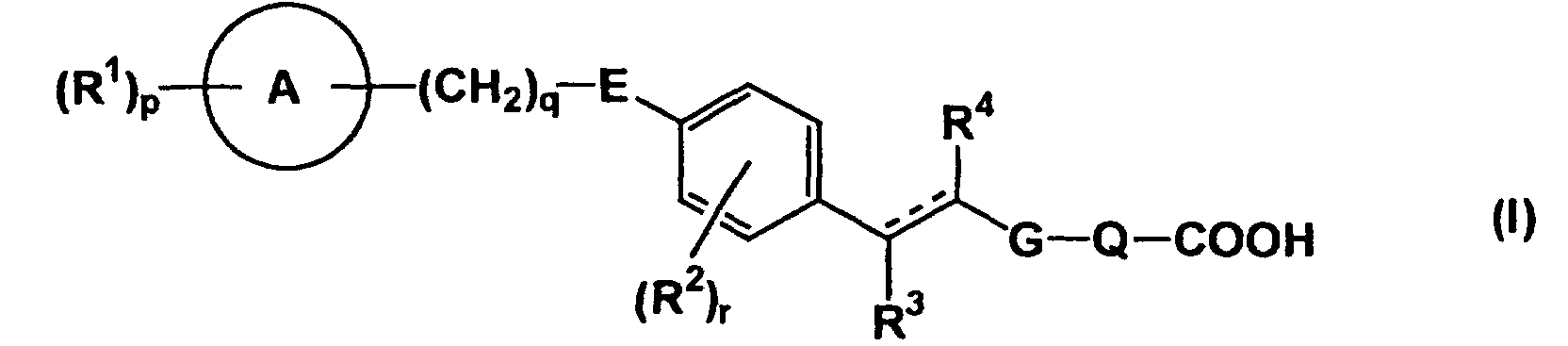

PX and QX are independently oxygen, sulfur or a bond;
XX is oxygen, sulfur or -CONH-;
TX is ethylene, oxygen, sulfur or a bond;
YX is -COOH, -NHSO2R3X or -CONHSO2R3X;
wherein R2X is hydrogen, halogen, trifluoromethyl, trifluoromethoxy, nitro, cyano or alkyl or alkoxy;
ZX is -COOH, COR4X, -CO(CH2)pXCO2H, -O(CH2)pXCO2H, -S(CH2)pXCO2H, NO2, -CONHWXCO2H or -NHWXCO2H;
wherein R2X has the above mentioned meaning;
R3X is trifluoromethyl, alkyl or optionally substituted phenyl;
R4X is WXCO2H or alkyl;
pX is an integer from 0 to 5;
WX is phenylene, alkylene having up to 8 carbon atoms which is optionally substituted by alkyl or cycloalkyl each having up to 6 carbon atoms or -CO(CH2)qX- or -(CH2)qX-;
wherein qX is an integer from 0 to 5;
mX is an integer from 0 to 6;
nX is an integer from 0 to 4.]
and salts thereof are used as inhibitor of luekotriene.
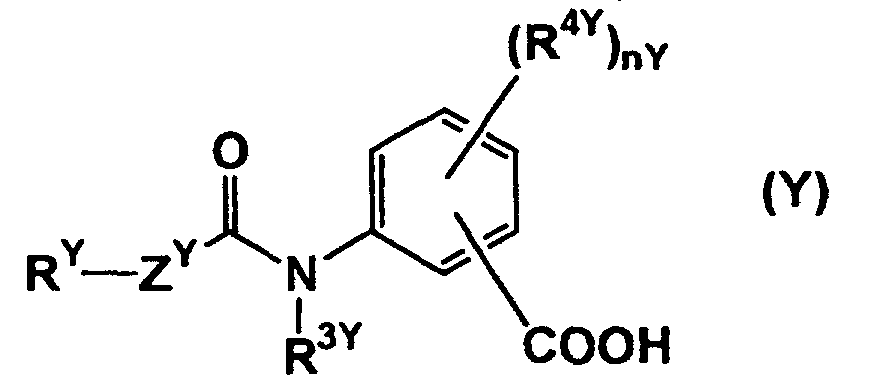

IY is an integer from 1 to 5;
AY is 4-10 membered carbocyclic ring or cyclic hetero ring;
YY is a group represented by formula
-O-AlK-O-,
-AIK-O-, or
-AIK-
(wherein AIK is C1-8 alkylene.);
BY is 4-10 membered mono-carbocyclic ring or mono-cyclic hetero ring;
R2Y is hydrogene, C1-4 alkyl,C1-4 alkoxy, halogen, trifluoromethyl or C2-5 alkanoyl;
mY is an integer from 1 to 4.);
ZY is a bond, C1-6 alkylene or C2-6 alkenylene;
R3Y is hydrogen, C1-4 alkyl, phenyl or C1-4 alkyl substituted by phenyl;
R4Y is hydrogen, C1-4 alkyl, C1-4 alkoxy, halogen, trifluoromethyl, hydroxy or nitro;
nY is an integer from 1 to 4.]
and non-toxic salts thereof are used as reverse transcriptase inhibitor.

R1 is C1-8 alkyl, C1-8 alkoxy, halogen atom, nitro or trifluoromethyl,
ring A is C5-7 mono-carbocyclic ring or 5-7membered mono-cyclic hetero ring containing 1-2 nitrogen atoms, one oxygen atom and/or one sulfur atom,
E is -CH2-, -O-, -S- or -NR6- (wherein R6is hydrogen or C1-8 alkyl.),
R2 is C1-8 alkyl, C1-8 alkoxy, halogen atom, nitro or trifluoromethyl,
R3 is hydrogen or C1-8 alkyl,
R4 is hydrogen or C1-8 alkyl,
R2 and R4 taken together form -CH2-CH2- or -CH=CH-,
G is -CONR7-, -NR7CO-, -SO2NR7-, -NR7SO2-, -CH2NR7- or -NR7CH2- (wherein R7 is hydrogen, C1-8 alkyl, Cyc1 or C1-8 alkyl substituted by Cyc1, Cyc1 is C5-7 mono-carbocyclic ring or 5-7membered mono-cyclic hetero ring containing 1-2 nitrogen atoms, one oxygen atom and/or one sulfur atom.),
Q is C1-4 alkylene or

R5 is
R12 and R13, R14 and R15, R16and R17 together with nitrogen atom to which they are attached, form 5-7membered mono-cyclic hetero ring containing 1-2 nitrogen atoms, one oxygen atom and/or one sulfur atom (the hetero ring may be optionally substituted by C1-8 alkyl, hydroxy or aimno.)
R19 and R21 are each independently C1-8 alkyl, Cyc2 or C1-8 alkyl substituted by Cyc2,
R22 is hydroxy, C1-8 alkyl, Cyc2 or C1-8 alkyl substituted by Cyc2,
Cyc2 is C5-7 mono-carbocyclic ring or 5-7membered mono-cyclic hetero ring containing 1-2 nitrogen atoms, one oxygen atom and/or one sulfur atom.),
wherein, when Q is
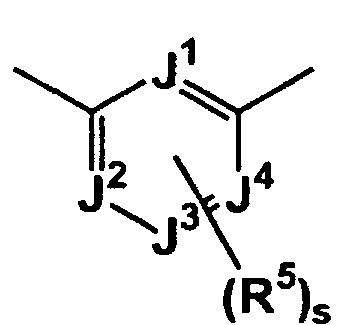
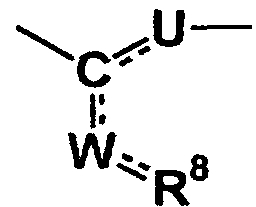
W is carbon atom or nitrogen atom,
R8 and R5, which bonds J2, taken together form bond, carbon atom or nitrogen atom.),
p is 0 or an integer of 1-5,
q is an integer of 4-6,
r is 0 or an integer of 1-4,
s is 0 or an integer of 1-4,
---- is single bond or double bond,
prodrugs thereof or non-toxic salts.


the compounds represented by formula (IB)

the compounds represented by formula (IC)

the compounds represented by formula (ID)


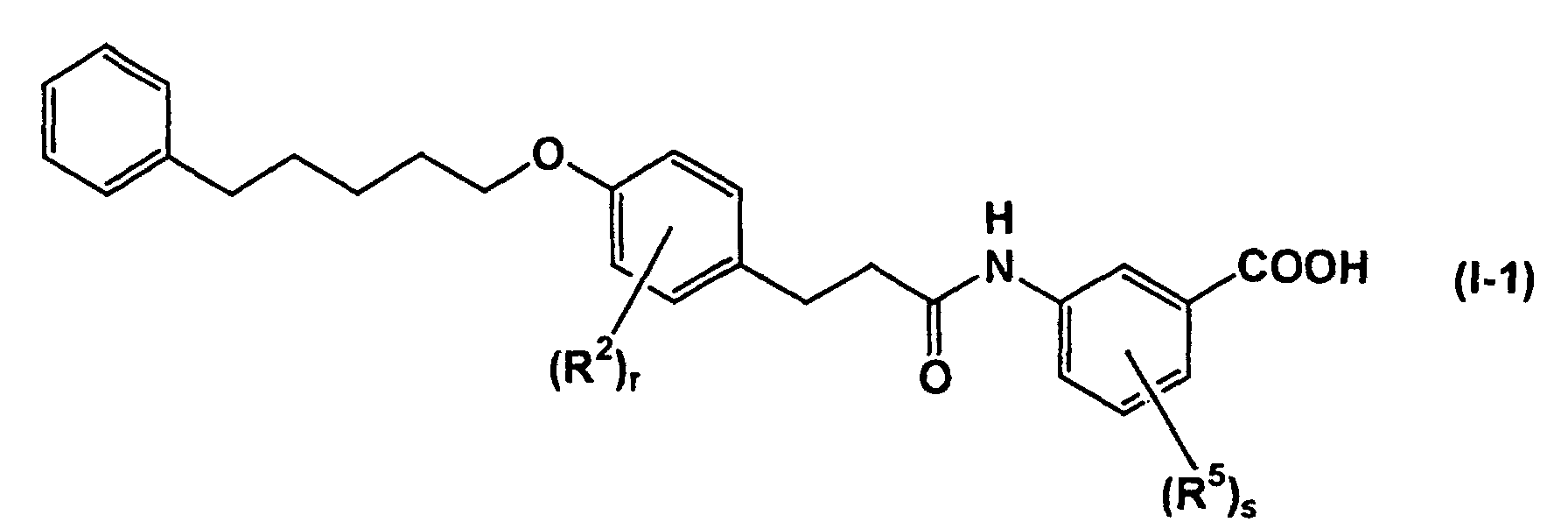

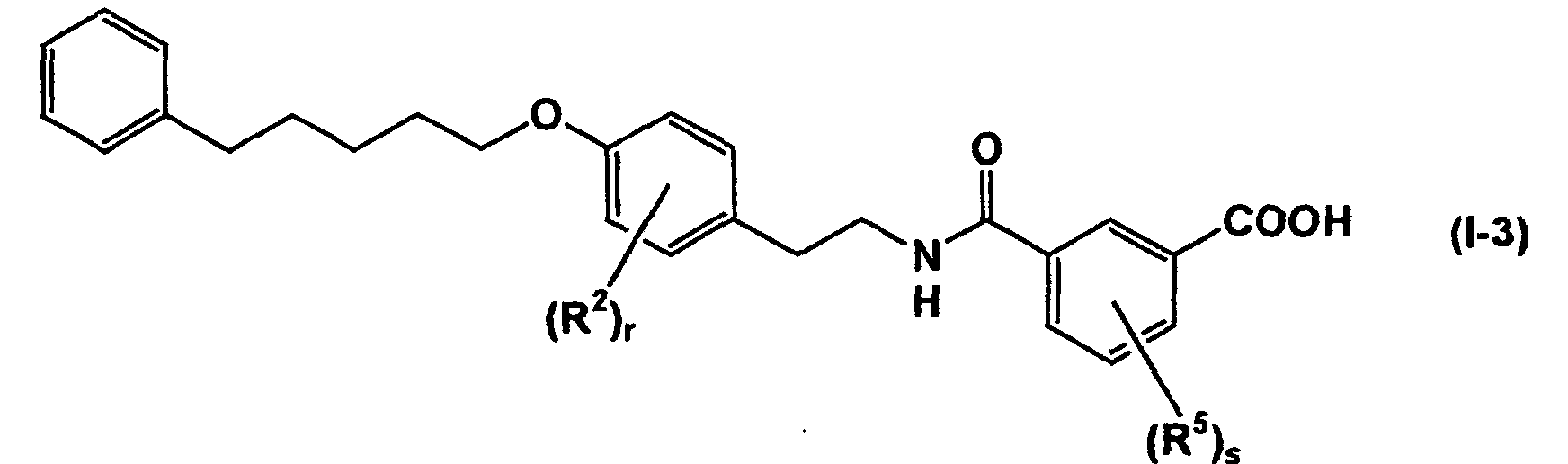
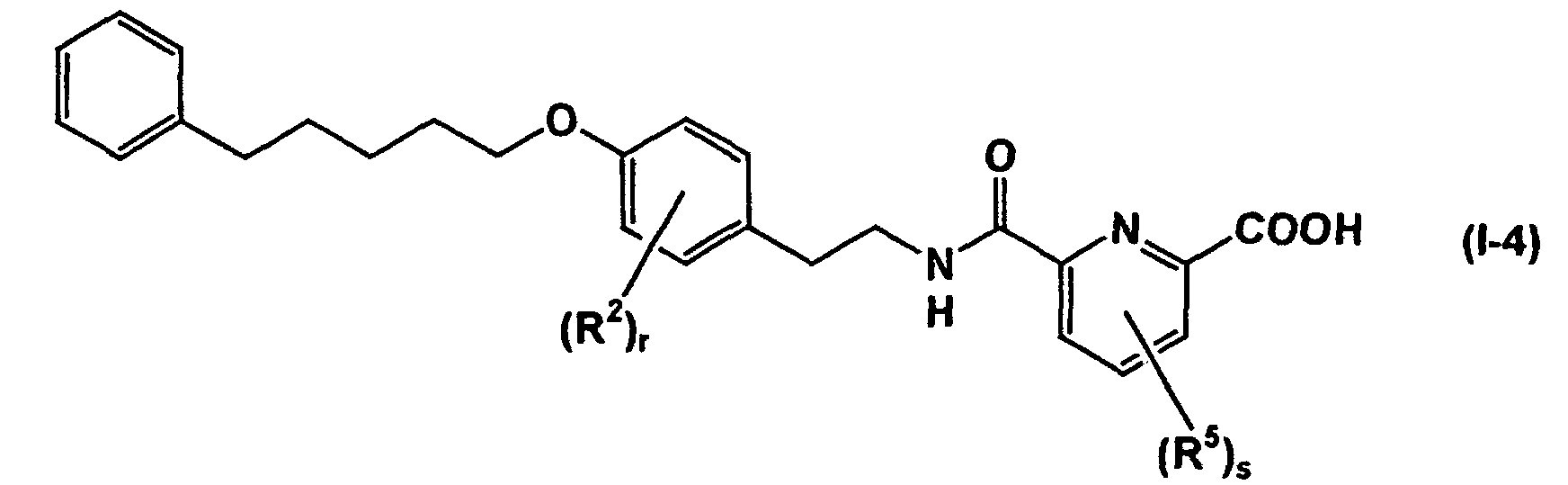
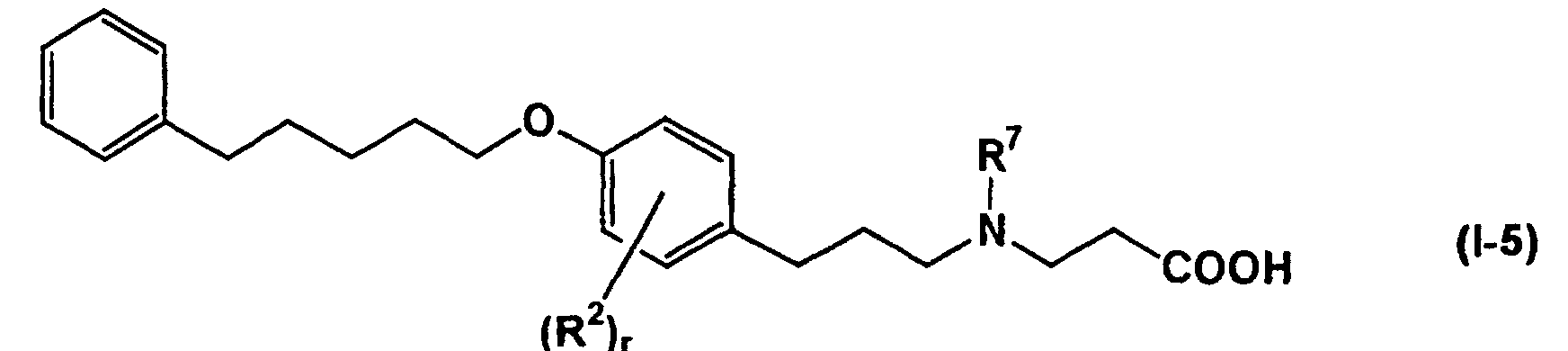


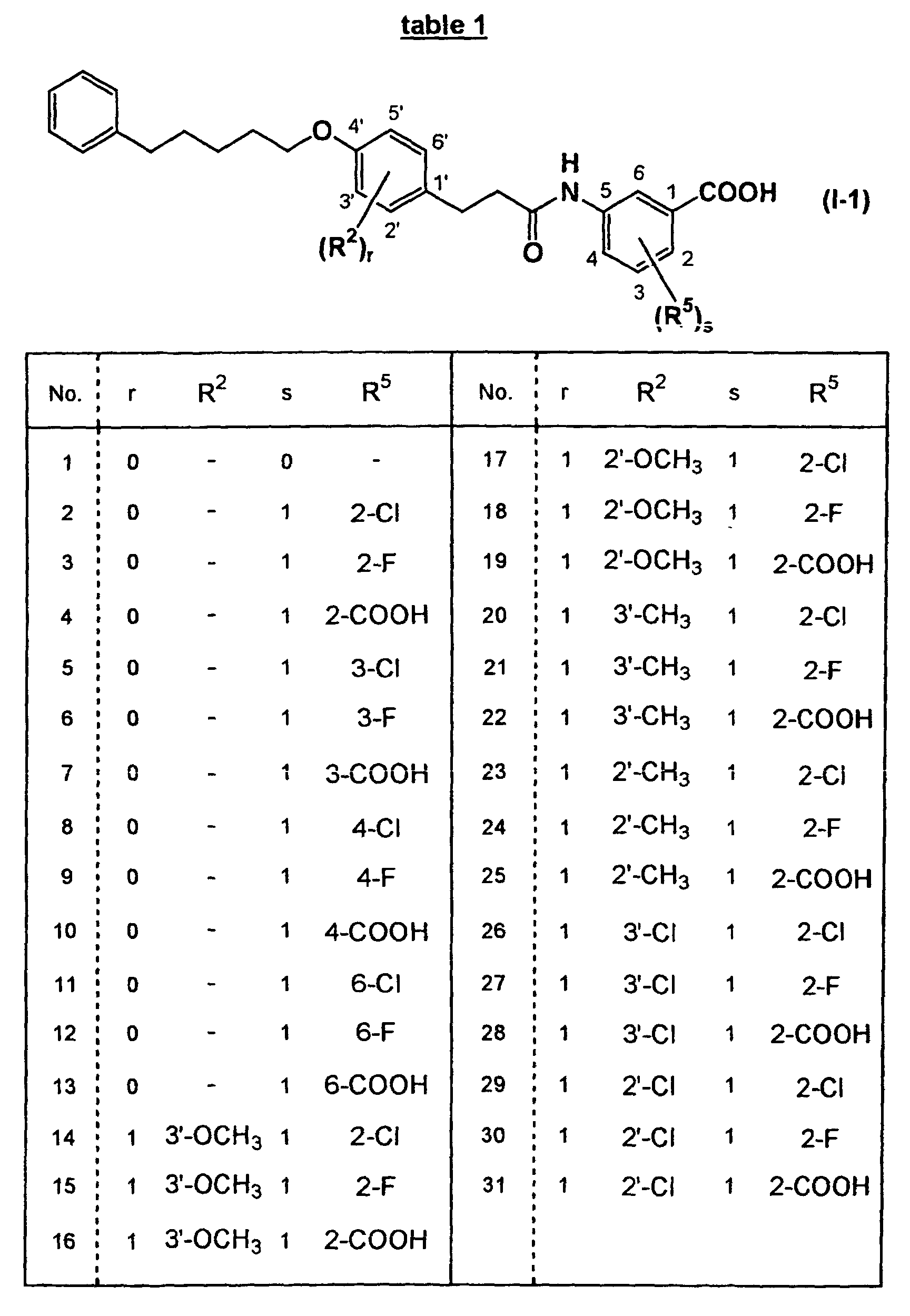
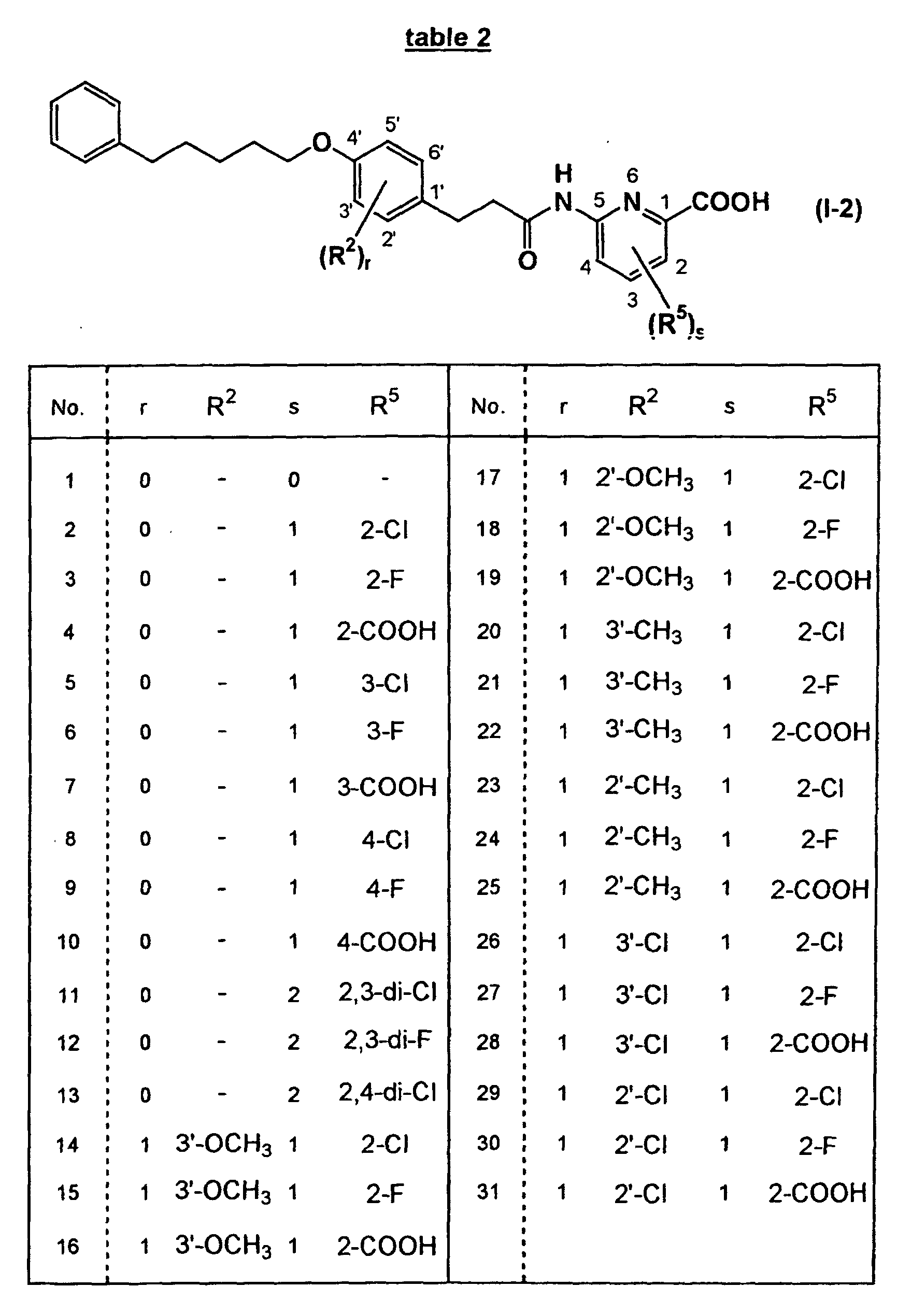
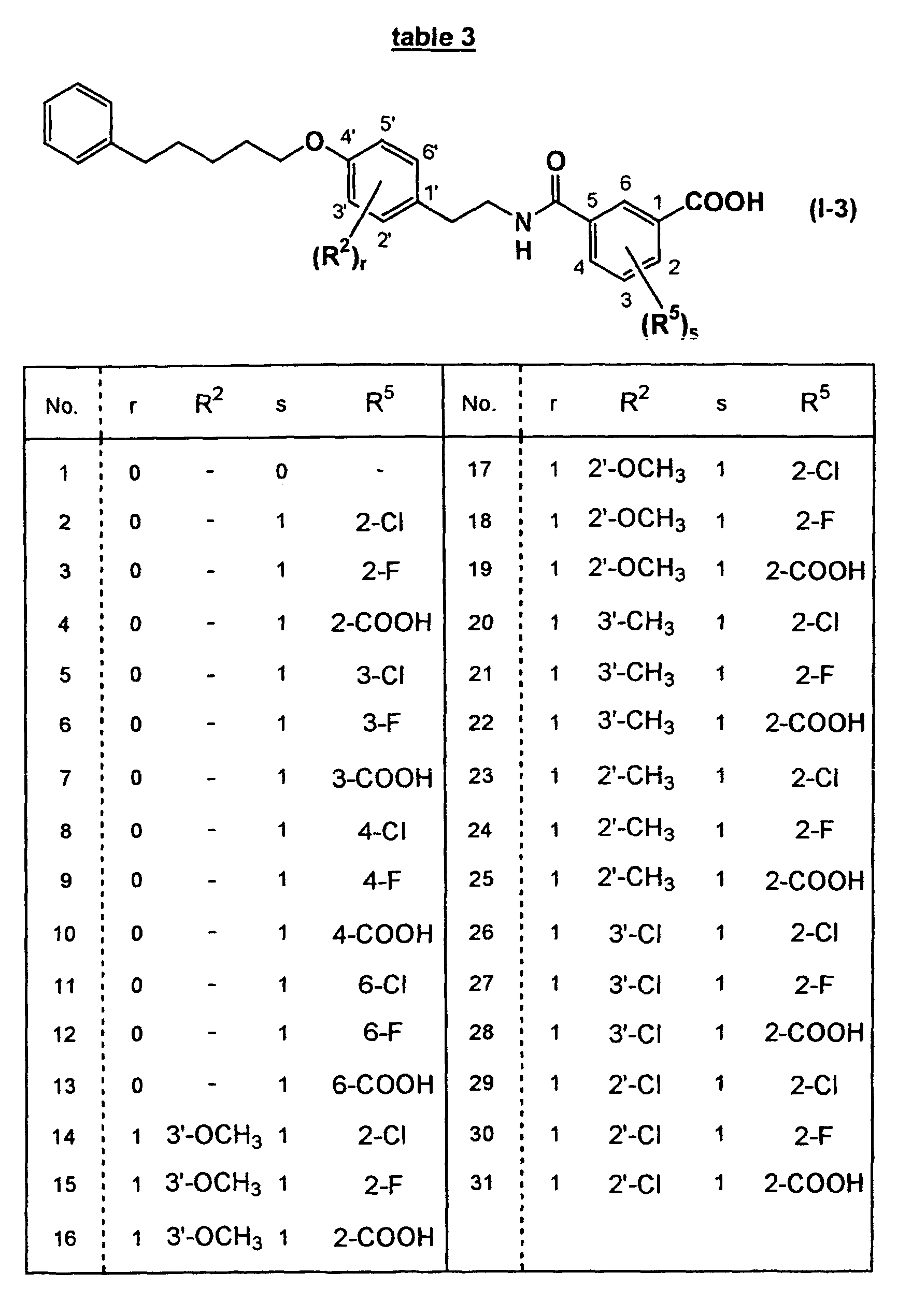
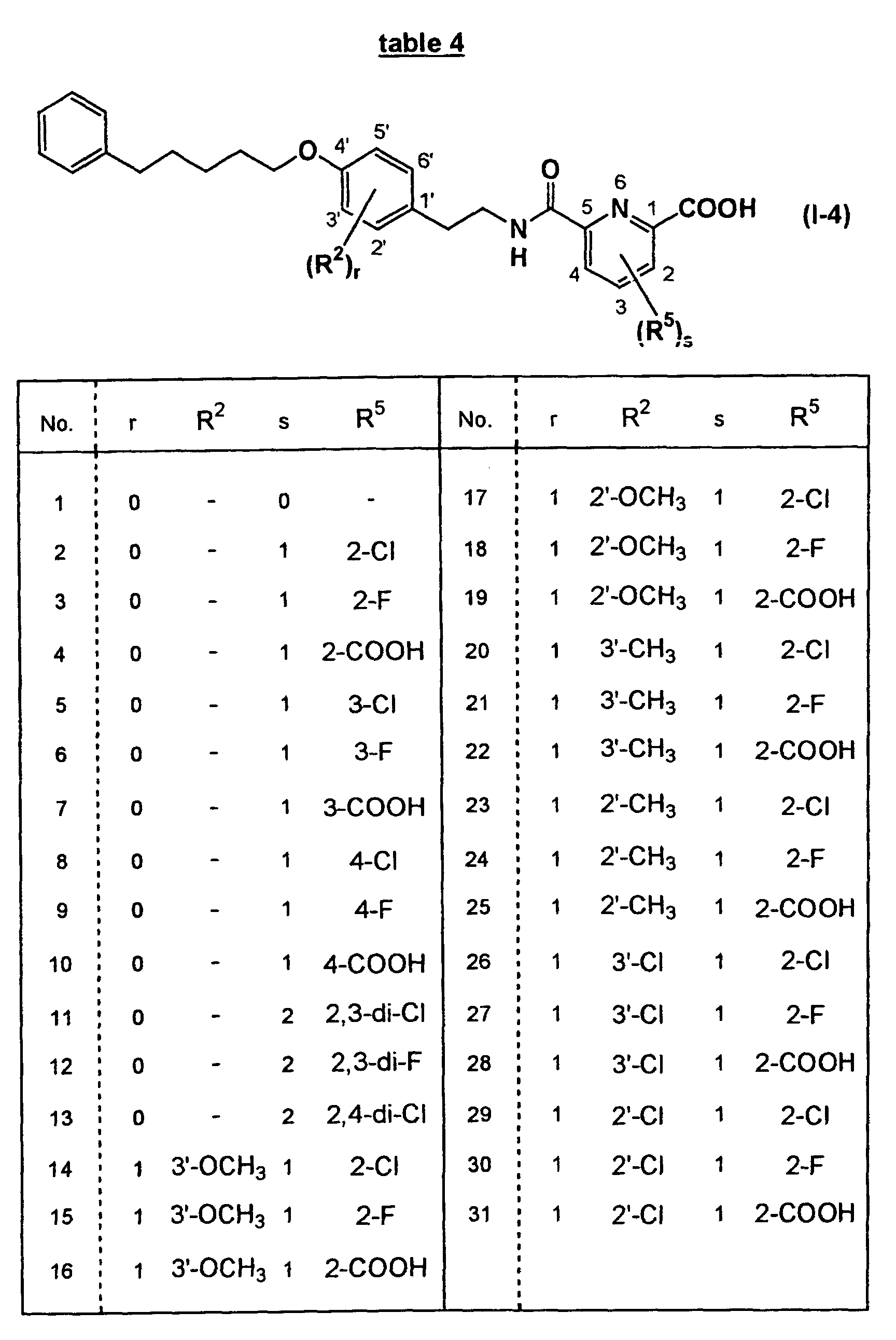
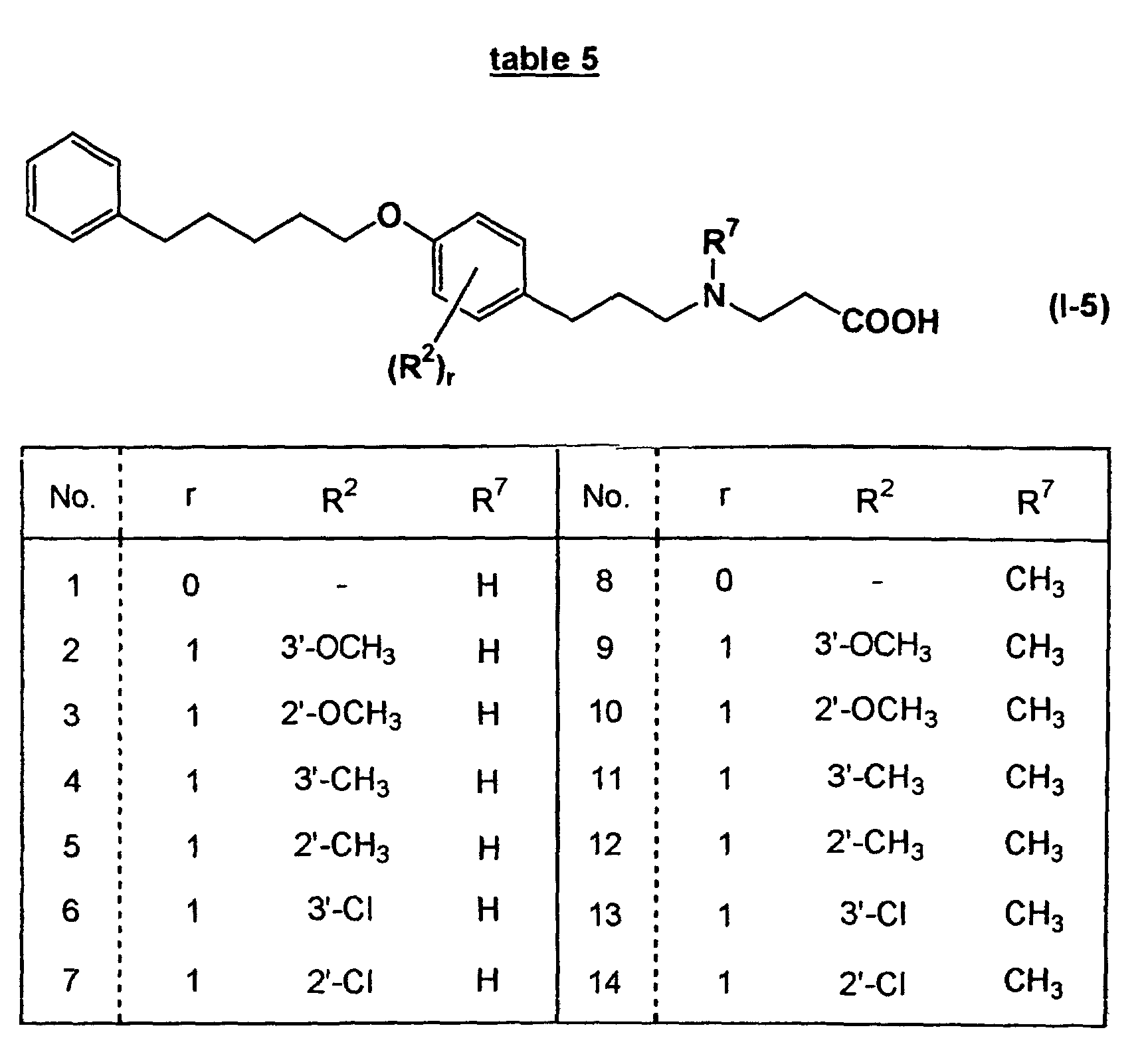


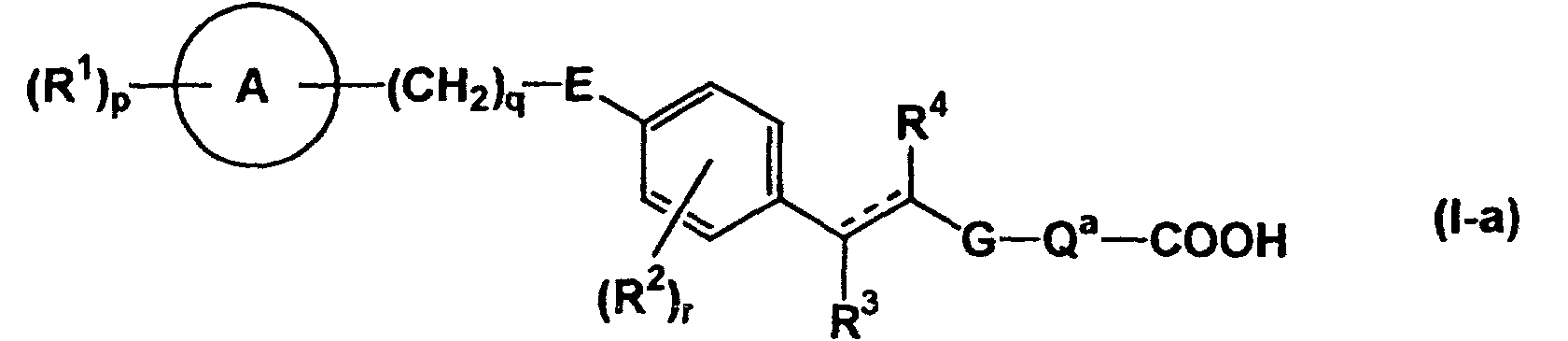
may be prepared by the hydrolysis of the compounds of formula (IA-a)



- (1) The method via an acyl halide may be carried out, for example, by reacting carboxylic acid with an acyl halide (e.g. oxalyl chloride or thionyl chloride etc.) in an organic solvent (e.g. chloroform, methylene chloride, diethyl ether or tetrahydrofuran) or without a solvent at -20°C to reflux temperature. And then the obtained acyl halide derivative may be reacted with amine in an inert organic solvent (e.g. chloroform, methylene chloride, diethyl ether or tetrahydrofuran) at 0-40°C. As an alternative, the obtained acyl halide derivative may be reacted in an organic solvent (dioxane, tetrahydrofuran) using an alkaline aqueous solution (e.g. sodium bicarbonate, sodium hydroxide) at 0-40°C.
- (2) The method via a mixed acid anhydride may be carried out, for example, by reacting carboxylic acid with an acyl halide (e.g. pivaloyl chloride, tosyl chloride or mesyl chloride) or an acid derivative (ethyl chloroformate or isobutyl chloroformate) in an organic solvent (e.g. chloroform, methylene chloride, diethyl ether, tetrahydrofuran) or without a solvent, in the presence of tertiary amine (e.g. pyridine, triethylamine, dimethylaniline or dimethylaminopyridine) at 0-40°C. And then the obtained mixed acid anhydride derivative may be reacted with amine in an organic solvent (e.g. chloroform, methylene chloride, diethyl ether or tetrahydrofuran), at 0-40°C.
- (3) The method using a condensing agent may be carried out, for example, by reacting carboxylic acid with amine in an organic solvent (e.g. chloroform, methylene chloride, dimethylformamide, diethyl ether or tetrahydrofuran) or without a solvent, in the presence or absence of tertiary amine (e.g. pyridine, triethylamine, dimethylaniline or dimethylaminopyridine), using a condensing agent (e.g. 1, 3-dicyclohexyl carbodiimide (DCC), 1-ethyl-3-[3-(dimethylamino)propyl] carbodiimide (EDC), 1, 1'-carbodiimidazole (CDI), 2-chloro-1-methylpyridinium iodide, or 1-propanephosphonic acid cyclic anhydride), in the presence or absence of 1-hydroxybenzotiazole (HOBt), at 0-40°C.

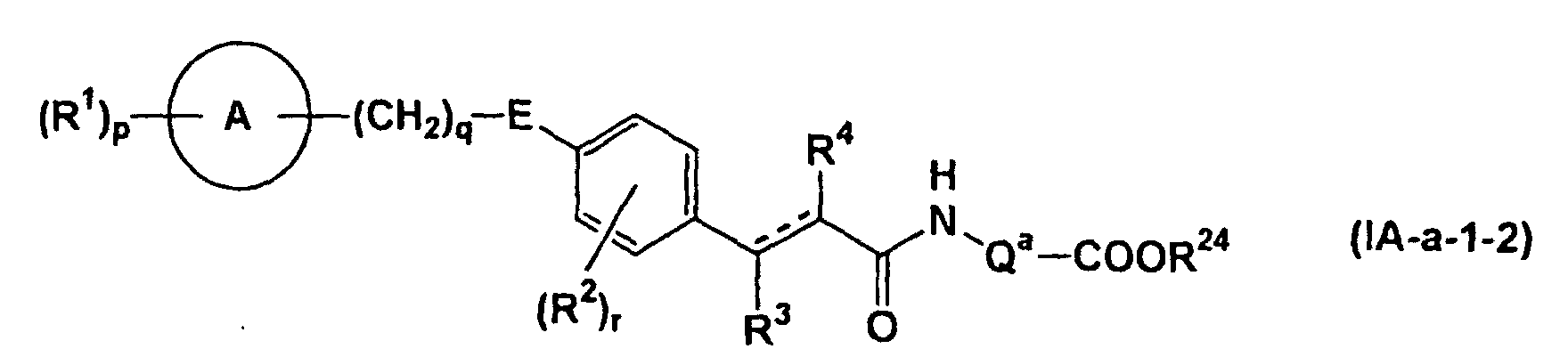
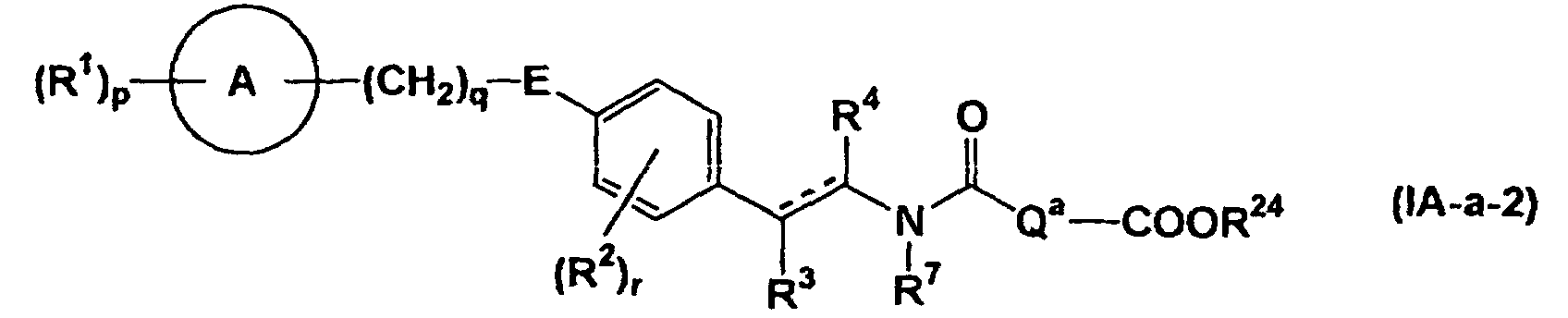

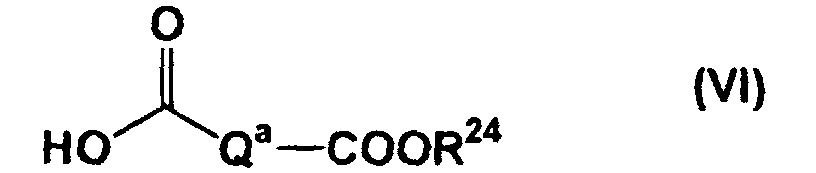
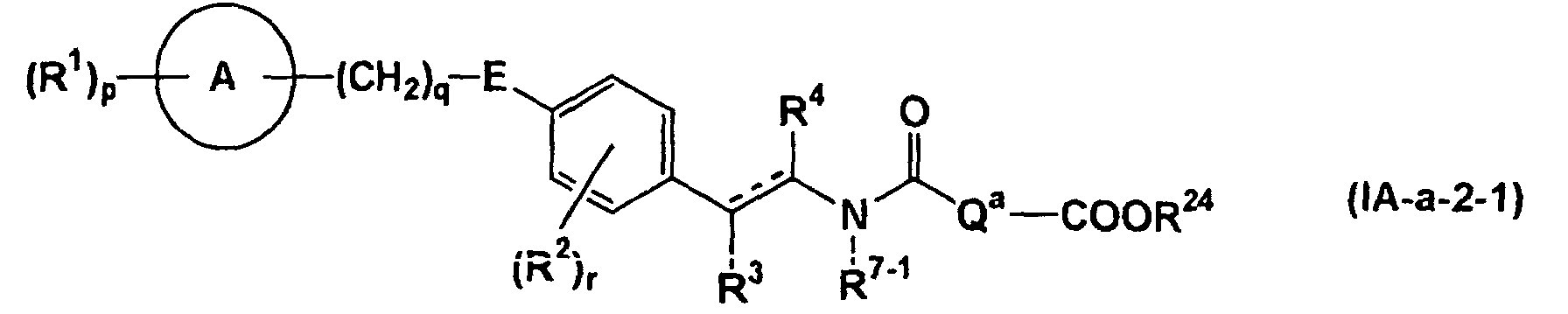


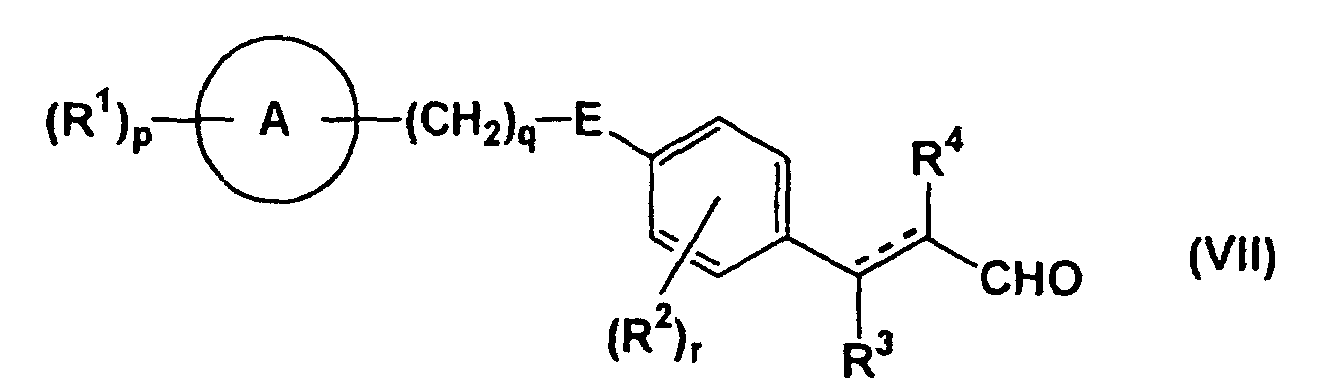



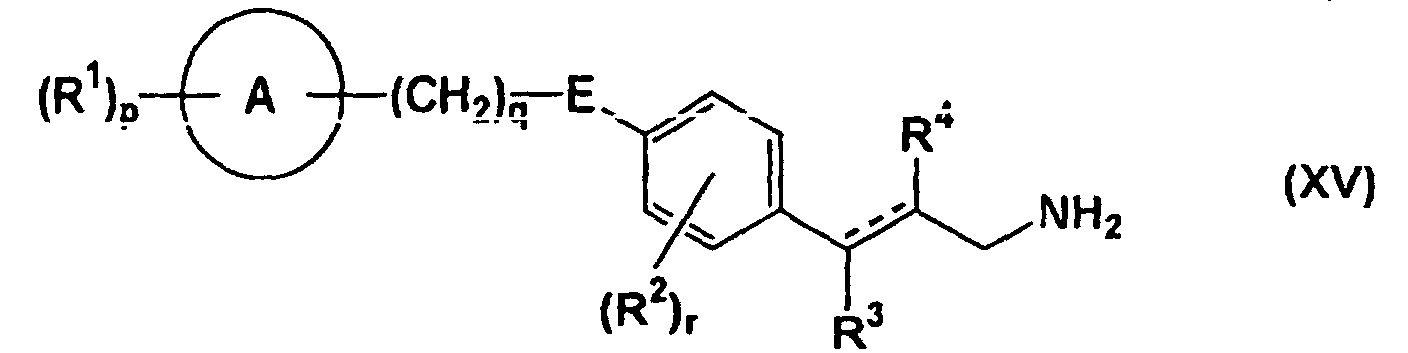


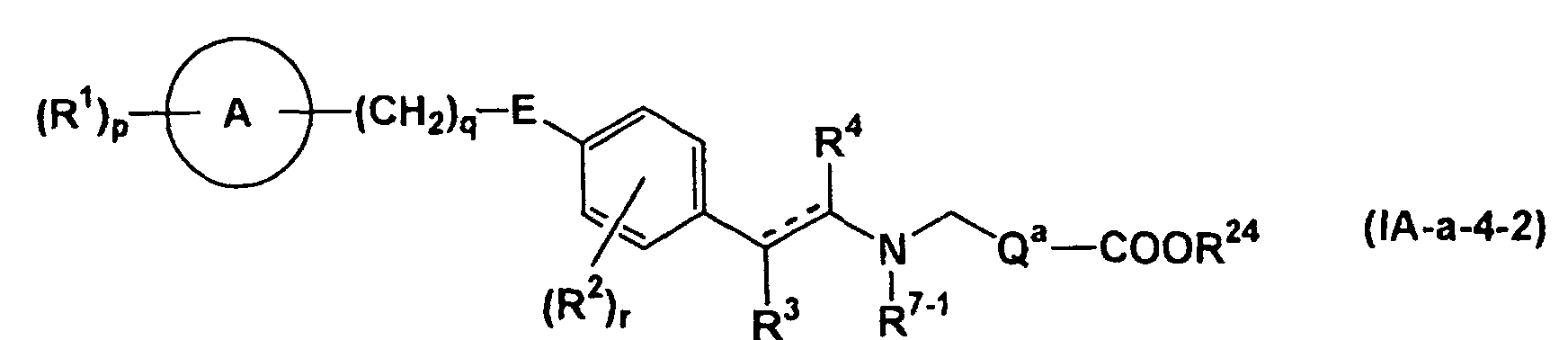


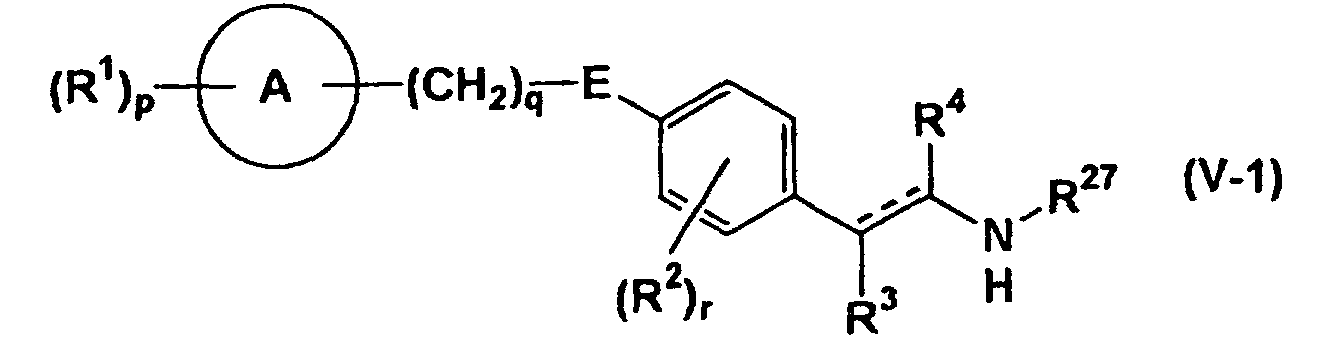
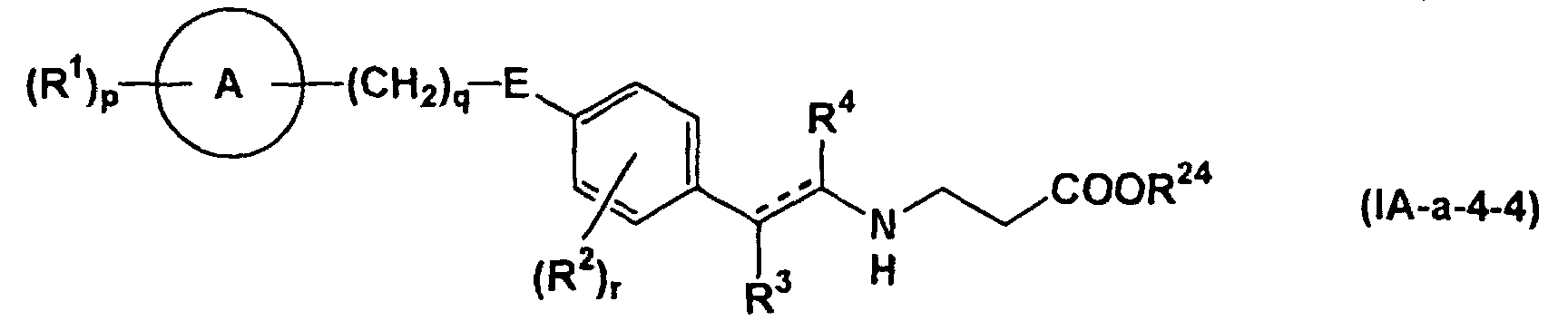


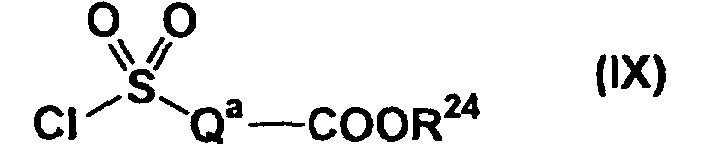

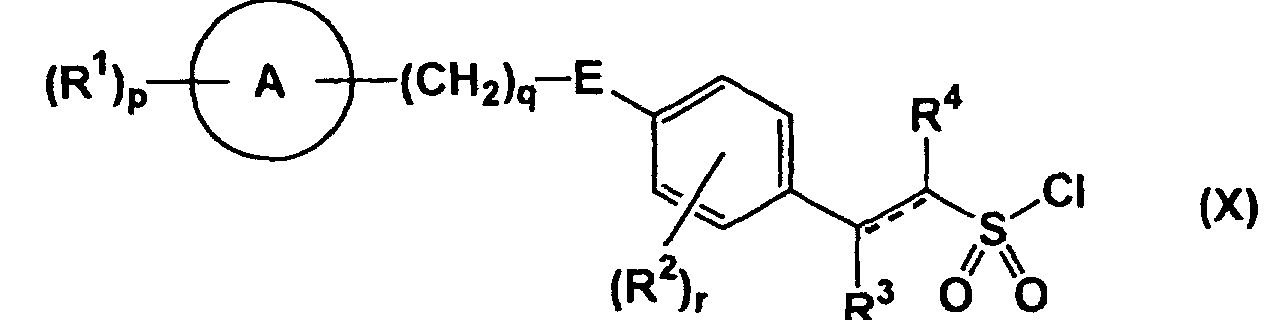

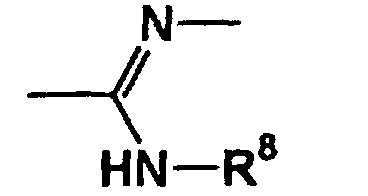
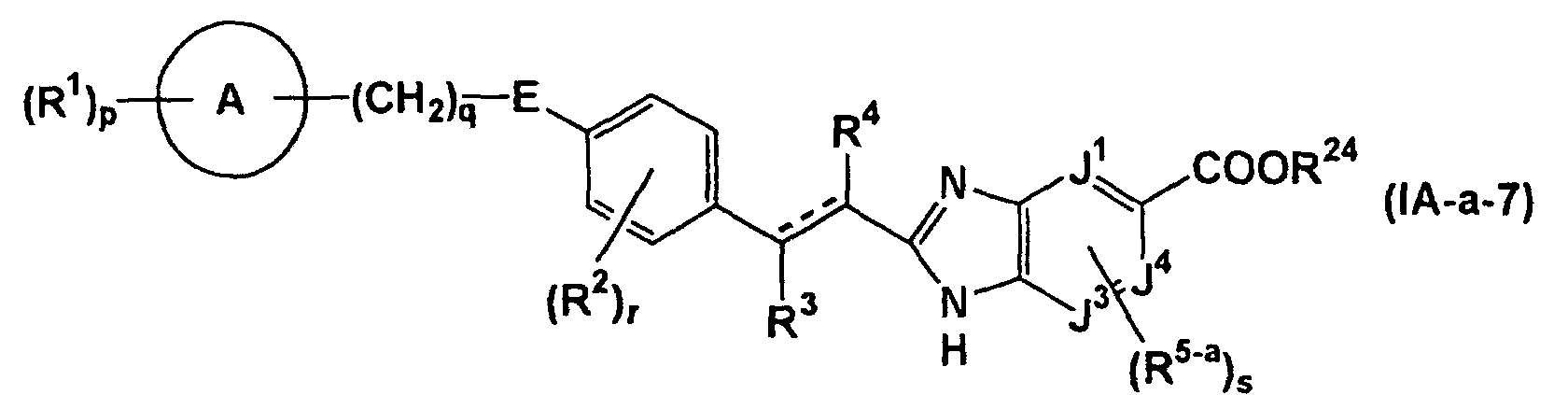

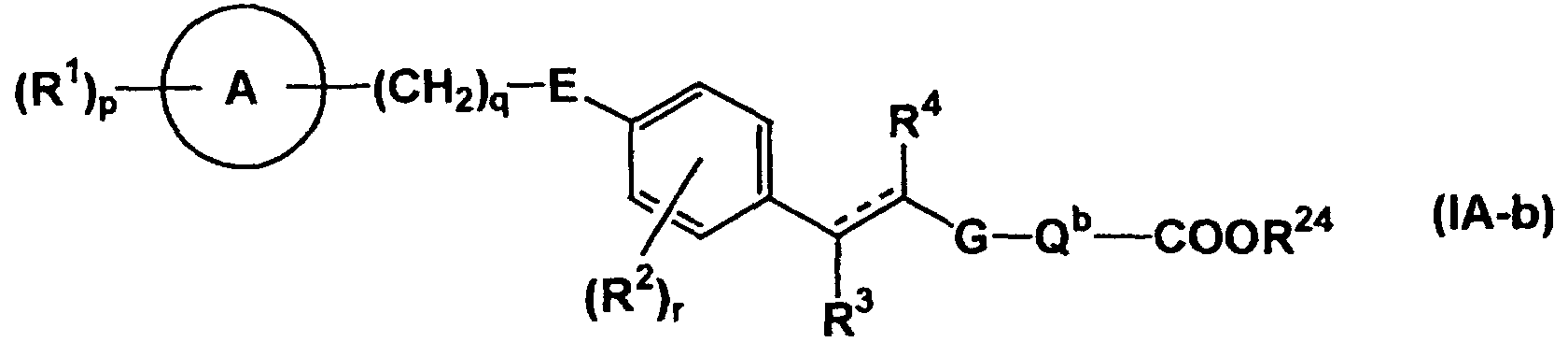
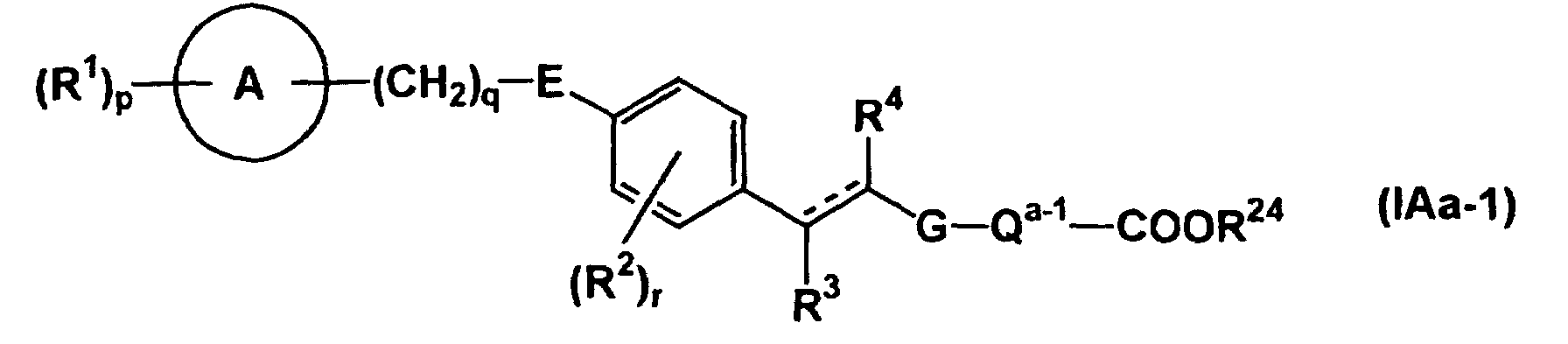


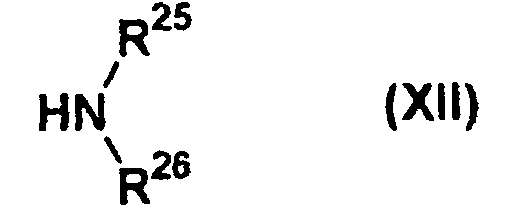
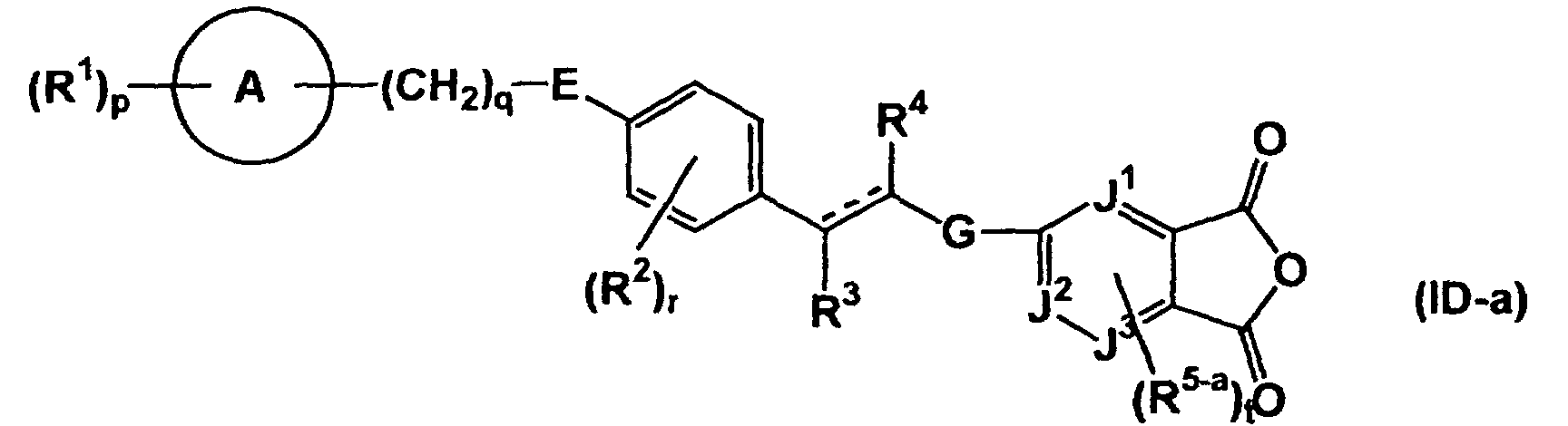
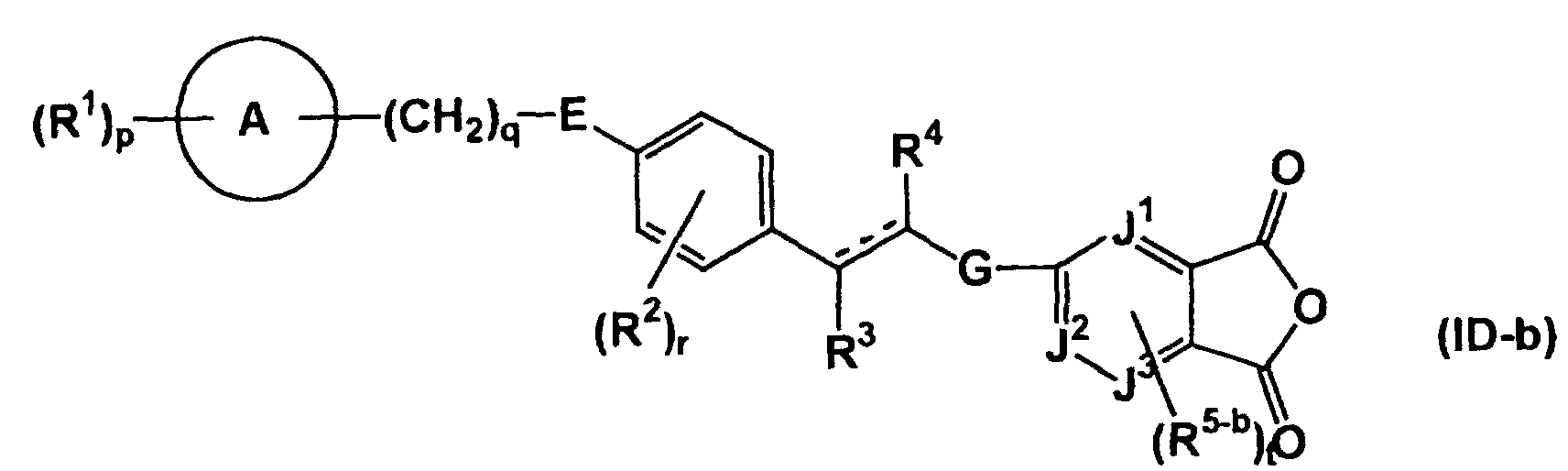


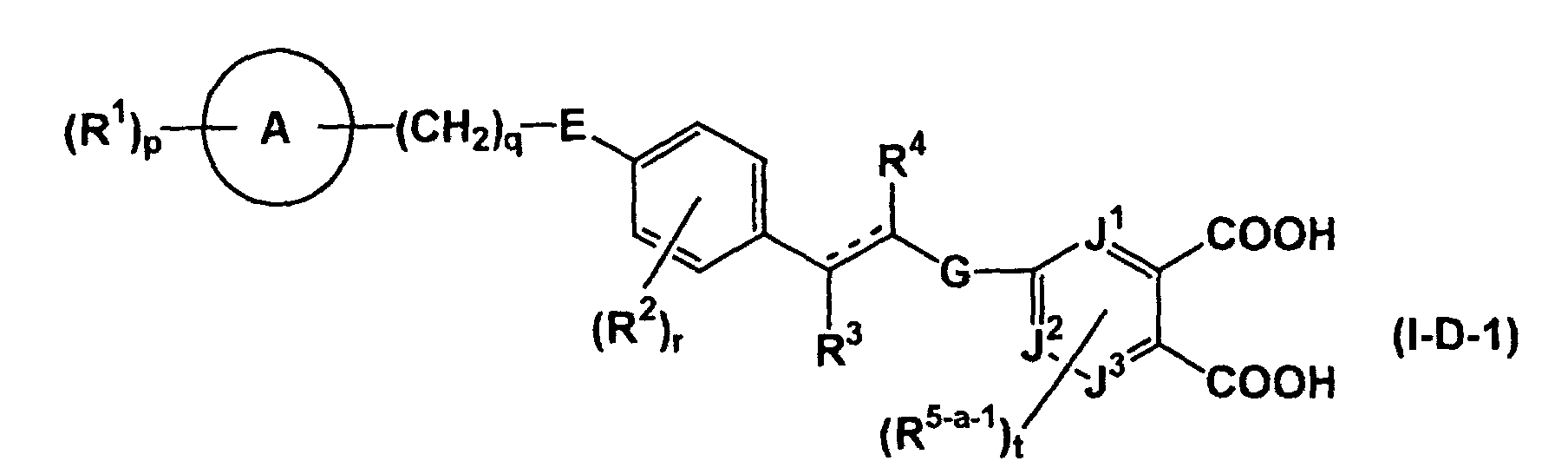
| Compound No. | EC50(nM) |
| Example 2(1) | 9.0 |
| Example 2(3) | 1.4 |
| Example 9(6) | 7.3 |
| Example 16 | 8.3 |
| Example 16(3) | 4.5 |
| Example 19 | 1.5 |
| Example 28 | 25 |
| Example 32 | 30 |

TLC : Rf 0.46(hexane : ethyl acetate = 9 : 1);
NMR (CDCl3) : δ7.32-7.06 (m, 7H), 6.84-6.77 (m, 2H), 3.92 (t, J = 6.6 Hz, 2H), 3.66 (s, 3H), 2.89 (t, J = 7.6 Hz, 2H), 2.68-2.55 (m, 4H), 1.87-1.41 (m, 6H).
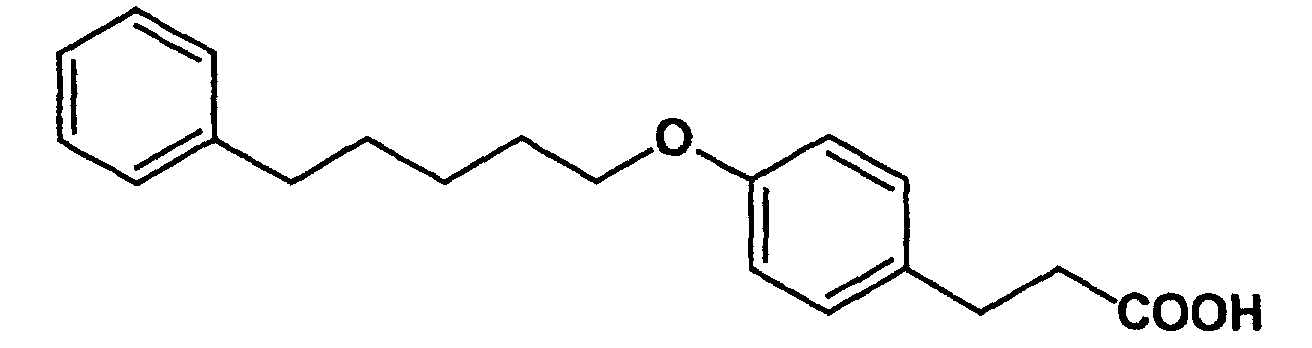
TLC : Rf 0.40(chloroform : methanol = 9 : 1);
NMR (CDCl3) : δ7.31-7.09 (m, 7H), 6.85-6.78 (m, 2H), 3.92 (t, J = 6.6 Hz, 2H), 2.90 (t, J = 7.6 Hz, 2H), 2.64 (t, J = 7.6 Hz, 4H), 1.87-1.42 (m, 6H).
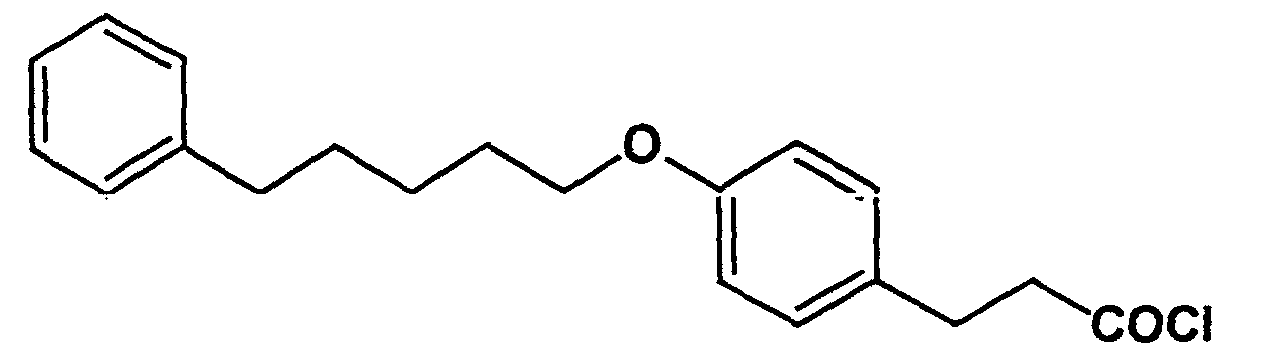

TLC : Rf 0.48(hexane : ethyl acetate = 1 : 1);
NMR (CDCl3) : δ7.73-7.67 (m, 2H), 7.31-7.11 (m, 7H), 6.99-6.80 (m, 4H), 3.95-3.87 (m, 8H), 2.98 (t, J = 7.5 Hz, 2H), 2.68-2.56 (m, 4H), 1.87-1.45 (m, 6H).

NMR (DMSO-d6) : δ10.20 (s, 1H), 8.12 (d, J = 2.7 Hz, 1H), 7.73 (dd, J = 2.7, 8.7 Hz, 1H), 7.48 (d, J = 8.7 HZ, 1H), 7.30-7.15 (m, 5H), 7.12 (d, J = 8.4 Hz, 2H), 6.81 (d, J = 8.4 Hz, 2H), 3.90 (t, J = 6.6 Hz, 2H), 3.86 (s, 3H), 2.84 (t, J = 7.5 Hz, 2H), 2.59 (t, J = 7.5 Hz, 4H), 1.80-1.55 (m, 4H), 1.50-1.40 (m, 2H).
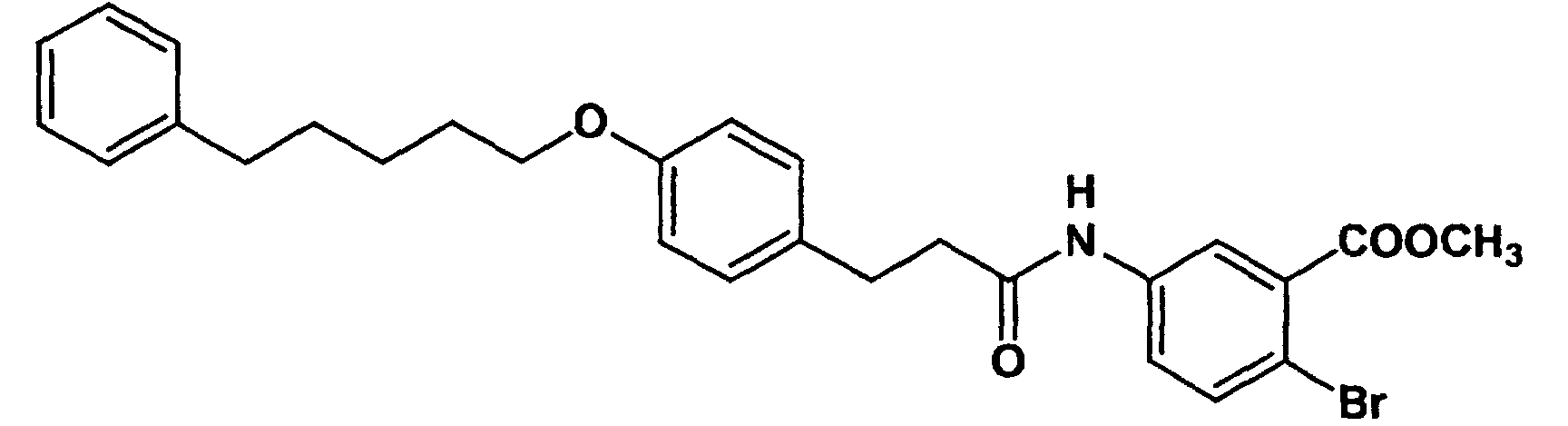
NMR (CDCl3) : δ7.84 (d, , J = 2.2 Hz, 1H), 7.56 (d, J = 8.4 Hz, 1H), 7.50 (dd, J = 8.4, 2.2 Hz, 1H), 7.32-7.10 (m, 8H), 6.85-6.78 (m, 2H), 3.92 (t, J = 6.6 Hz, 2H), 3.91 (s, 3H), 2.98 (t, J = 7.2 Hz, 2H), 2.68-2.58 (m, 4H), 1.87-1.41 (m, 6H).
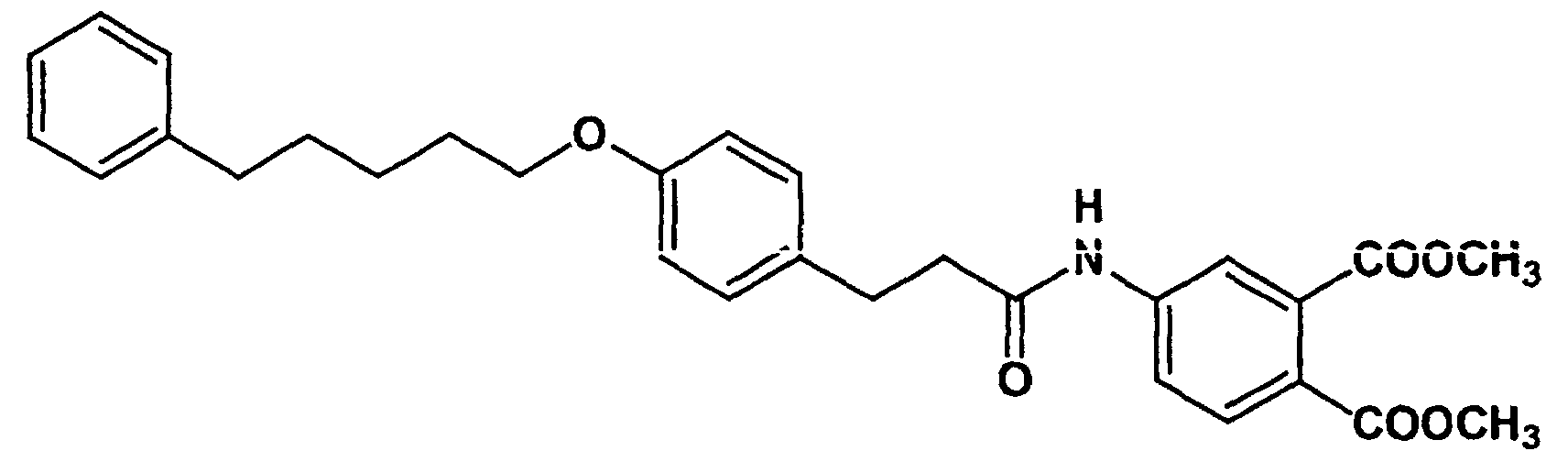
NMR (CDCl3) : δ7.77-7.64 (m, 3H), 7.52 (s, 1H), 7.32-7.08 (m, 7H), 6.84-6.77 (m, 2H), 3.94-3.86 (m, 8H), 2.97 (t, J = 7.2 Hz, 2H), 2.63 (t, J = 7.2 Hz, 4H), 1.87-1.41 (m, 6H).
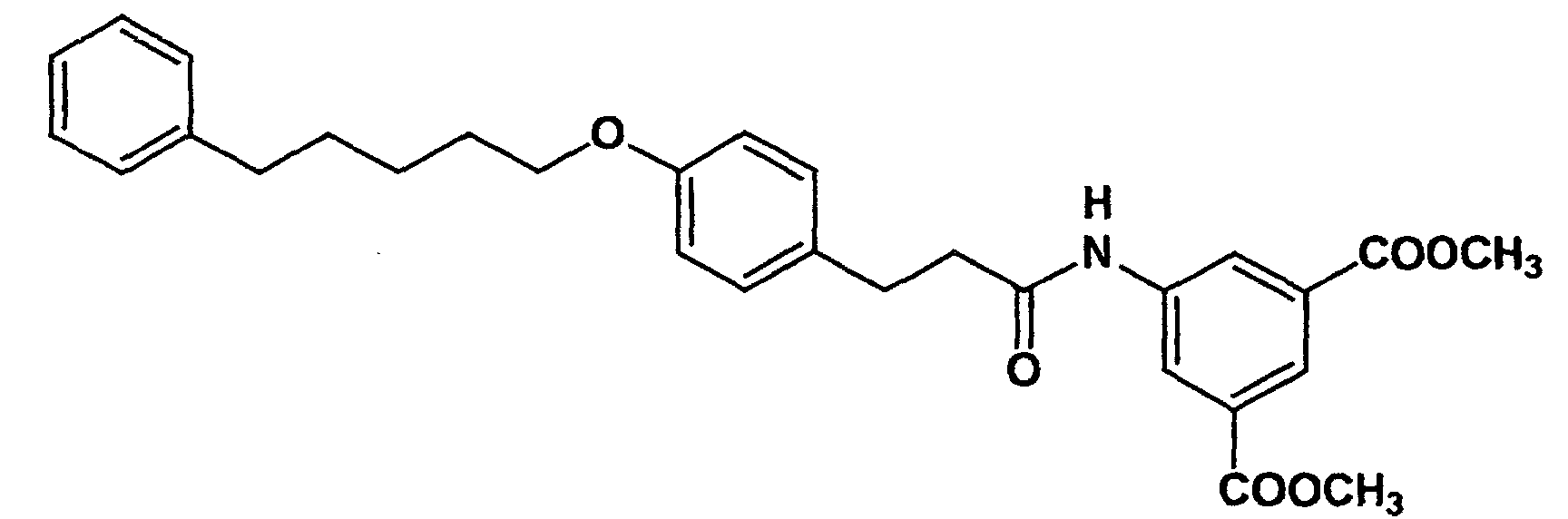
NMR (CDCl3) : δ8.40 (t, J = 1.5 Hz, 1H), 8.31 (d, J = 1.5 Hz, 1H), 7.36 (s, 1H), 7.31-7.25 (m, 2H), 7.20-7.11 (m, 5H), 6.84-6.79 (m, 2H), 3.94-3.90 (m, 8H), 3.00 (t, J = 7.5 Hz, 2H), 2.69-2.61 (m, 4H), 1.85-1.66 (m, 4H), 1.55-1.44 (m, 2H).

NMR (CDCl3) : δ7.95 (d, J = 2.4 Hz, 1H), 7.70 (dd, J = 2.4, 8.7 Hz, 1H), 7.30-7.10 (m, 9H), 6.82 (d, J = 8.4 Hz, 2H), 3.92 (t, J = 6.6 Hz, 2H), 3.89 (s, 3H), 2.99 (t, J = 7.5 Hz, 2H), 2.66-2.59 (m, 4H), 2.44 (s, 3H), 1.85-1.60 (m, 4H), 1.60-1.40 (m, 2H).

TLC : Rf 0.37(chloroform : methanol = 9 : 1);
NMR (DMSO-d6) : δ12.75-12.40 (br, 1H), 9.84 (s, 1H), 7.86 (d, J = 2.6 Hz, 1H), 7.66 (dd, J = 9.0, 2.6 Hz, 1H), 7.28-7.01 (m, 8H), 6.79 (d, J = 8.6 Hz, 2H), 3.88 (t, J = 6.4 Hz, 2H), 3.75 (s, 3H), 2.81 (t, J = 7.4 Hz, 2H), 2.56 (t, J = 7.6 Hz, 4H), 1.76-1.31 (m, 6H).
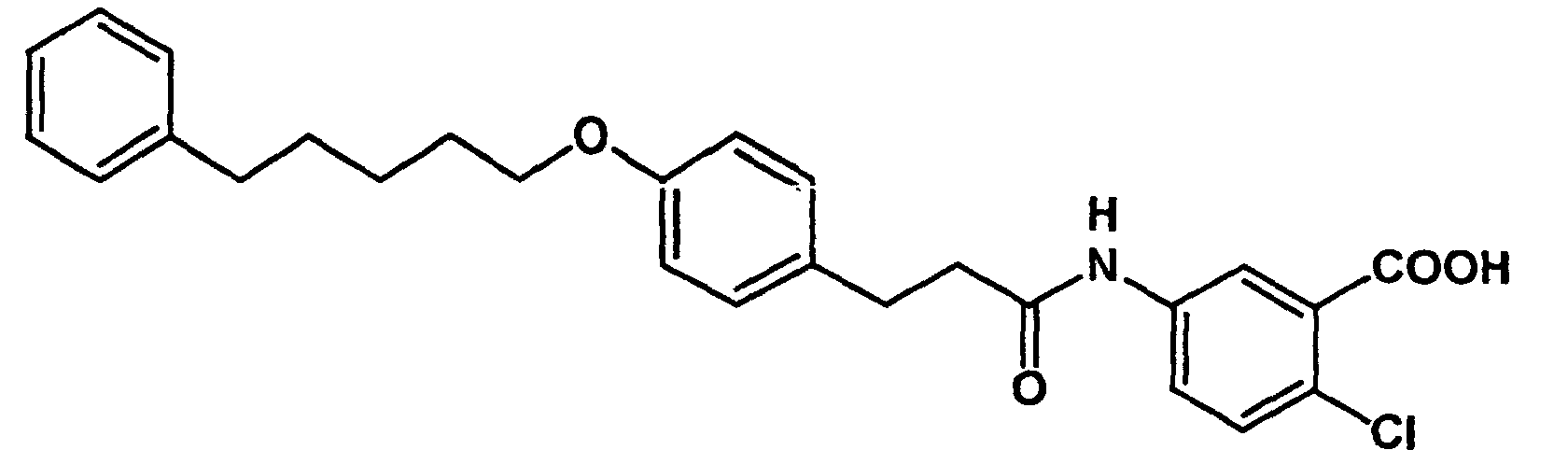
NMR (DMSO-d6) : δ13.35 (s, 1H), 10.15 (s, 1H), 8.07 (d, J = 2.7 Hz, 1H), 7.71 (dd, J = 2.7, 8.7 Hz, 1H), 7.44 (d, J = 8.7 Hz, 1H), 7.30-7.15 (m, 5H), 7.13 (d, J = 8.4 Hz, 2H), 6.80 (d, J = 8.4 Hz, 2H), 3.90 (t, J = 6.6 Hz, 2H), 2.84 (t, J = 7.5 Hz, 2H), 2.59 (t, J = 7.5 Hz, 4H), 1.80-1.55 (m, 4H), 1.50-1.35 (m, 2H).
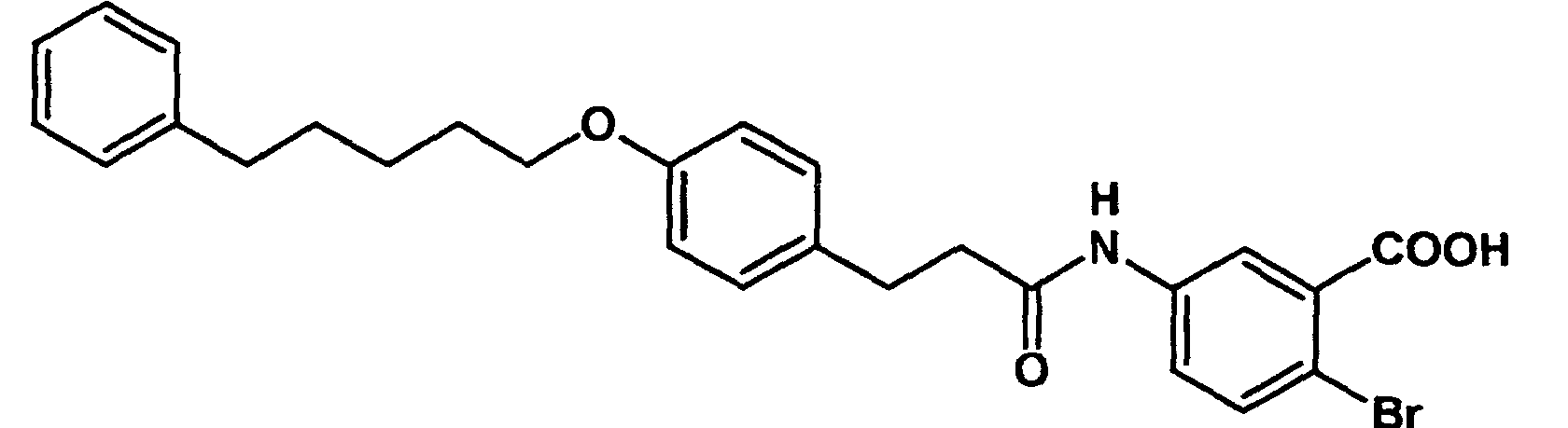
NMR (DMSO-d6) : δ10.13 (s, 1H), 8.02 (d, J = 1.5 Hz, 1H), 7.63-7.57 (m, 2H), 7.27-7.09 (m, 7H), 6.79 (d, J = 8.4 Hz, 2H), 3.87 (t, J = 6.6 Hz, 2H), 2.81 (t, J = 7.5 Hz, 2H), 2.56 (t, J = 7.5 Hz, 4H), 1.74-1.54 (m, 4H), 1.44-1.34 (m, 2H).
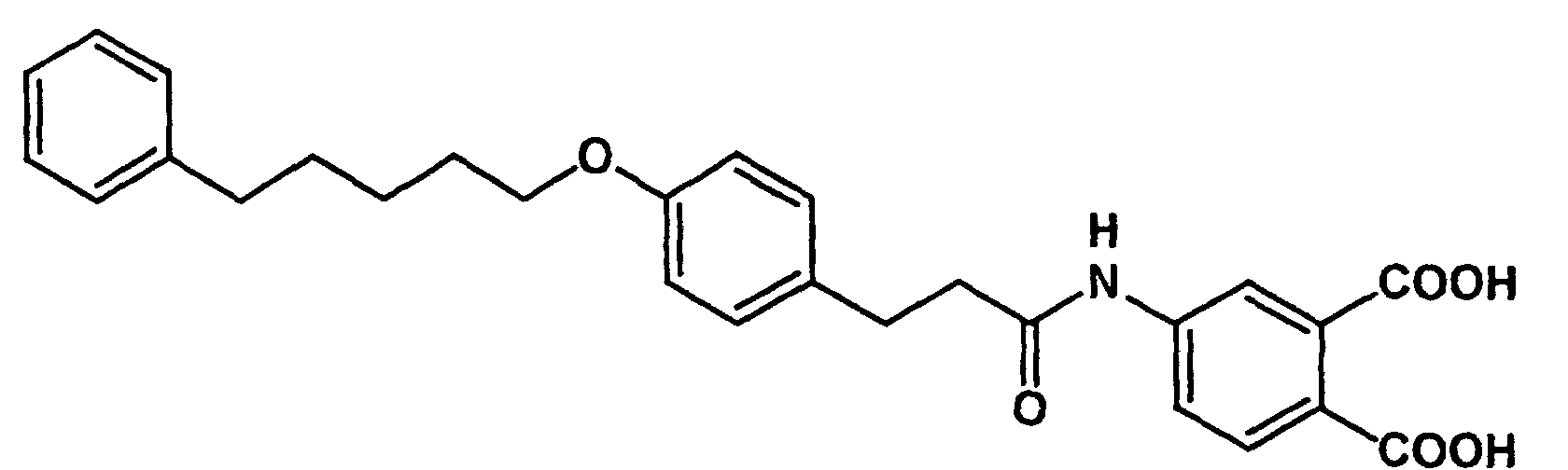
NMR (DMSO-d6): δ10.23 (s, 1H), 7.83 (s, 1H), 7.72-7.65 (m, 2H), 7.27-7.07 (m, 7H), 6.79 (d, J = 8.4 Hz, 2H), 3.88 (t, J = 6.6 Hz, 2H), 2.82 (t, J = 7.5 Hz, 2H), 2.62-2.54 (m, 4H), 1.73-1.54 (m, 4H), 1.44-1.34 (m, 2H).
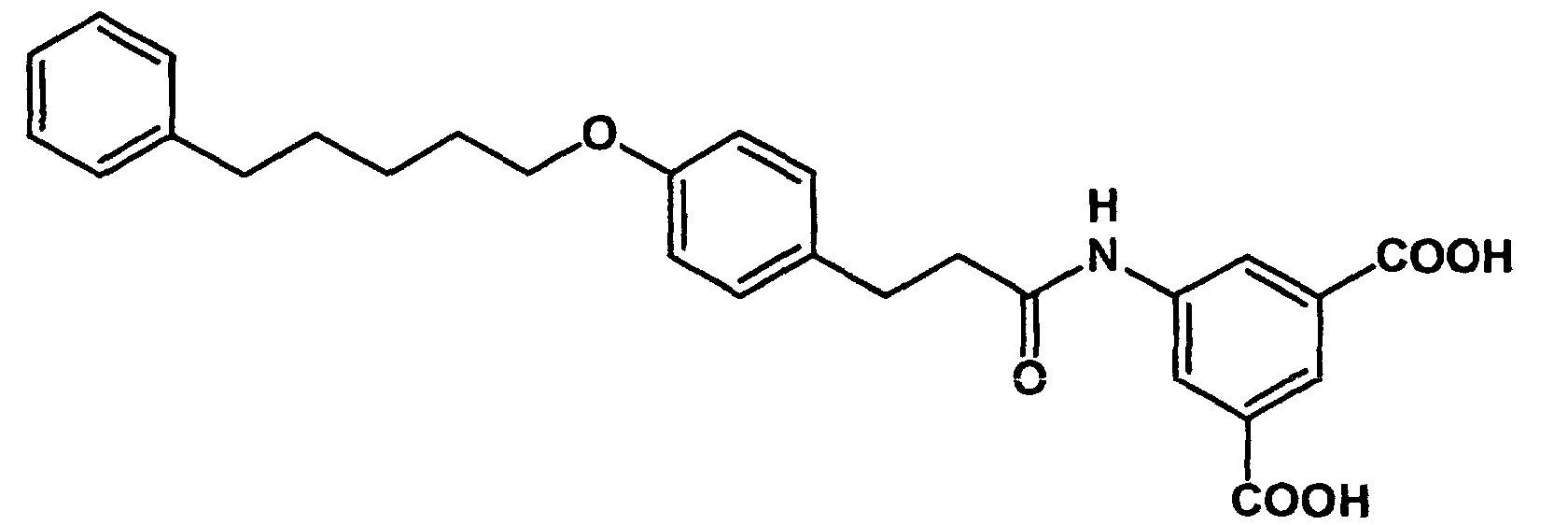
NMR (DMSO-d6) : δ10.24 (s, 1H), 8.40 (d, J = 1.5 Hz, 2H), 8.12 (t, J = 1.5 Hz, 1H), 7.27-7.11 (m, 7H), 6.82-6.77 (m, 2H), 3.87 (t, J = 6.6 Hz, 2H), 2.83 (t, J = 7.5 Hz, 2H), 2.62-2.53 (m, 4H), 1.73-1.54 (m, 4H), 1.43-1.33 (m, 2H).
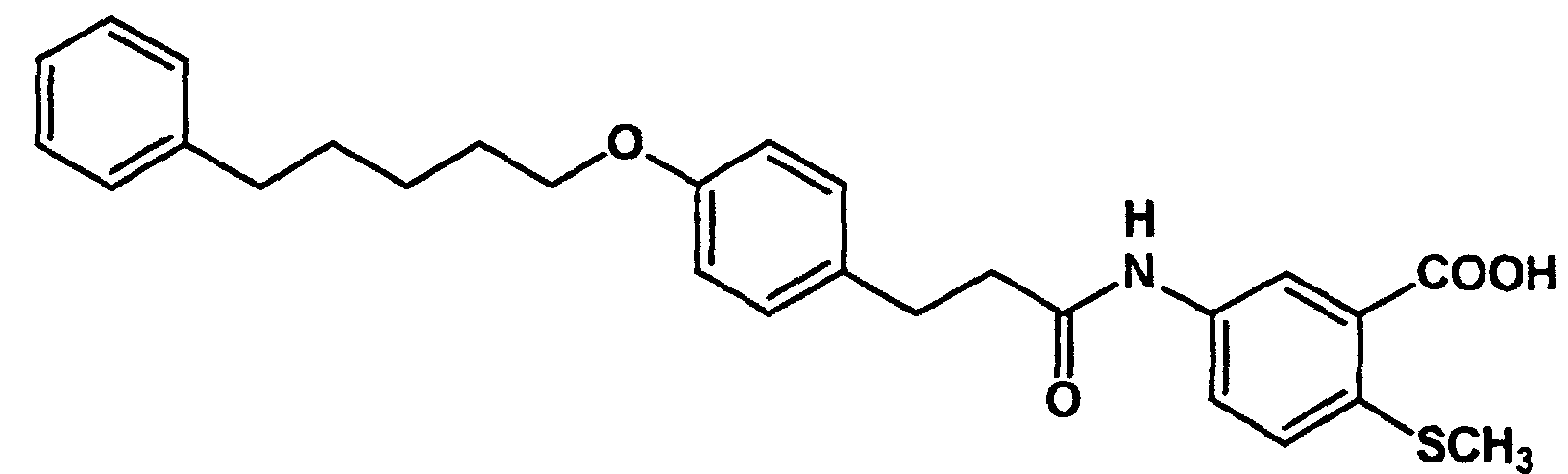
NMR (DMSO-d6) : δ13.00 (s, 1H), 9.99 (s, 1H), 8.17 (d, J = 2.4 Hz, 1H), 7.77 (dd, J = 2.4, 8.4 Hz, 1H), 7.27 (d, J = 8.4 Hz, 1H), 7.30-7.15 (m, 5H), 7.12 (d, J = 8.7 Hz, 2H), 6.81 (d, J = 8.7 Hz, 2H), 3.90 (t, J = 6.6 Hz, 2H), 2.83 (t, J = 7.5 Hz, 2H), 2.60-2.40 (m, 4H), 2.37 (s, 3H), 1.80-1.60 (m, 4H), 1.50-1.40 (m, 2H).
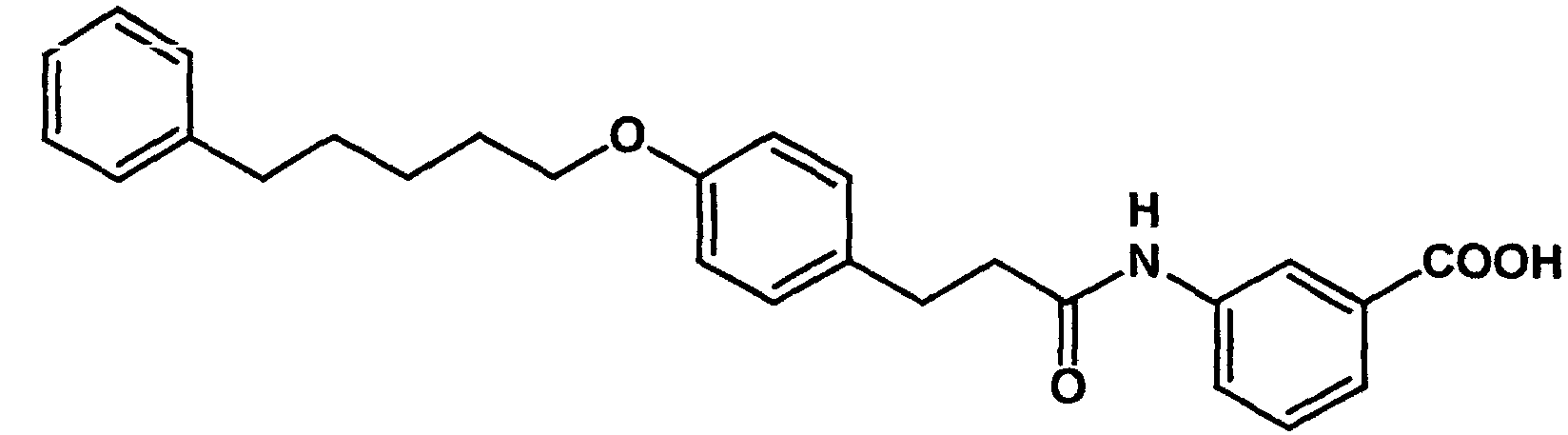
TLC : Rf 0.38(chloroform : methanol = 9 : 1);
NMR (DMSO-d6) : δ13.04-12.80 (br, 1H), 10.05 (s, 1H), 8.19 (s, 1H), 7.79 (d, J = 7.8 Hz, 1H), 7.58 (d, J = 7.8 Hz, 1H), 7.38 (t, J = 7.8 Hz, 1H), 7.28-7.10 (m, 7H), 6.79 (d, J = 8.4 Hz, 2H), 3.88 (t, J = 6.6 Hz, 2H), 2.82 (t, J = 7.6 Hz, 2H), 2.56 (t, J = 7.6 Hz, 4H), 1.76-1.30 (m, 6H).
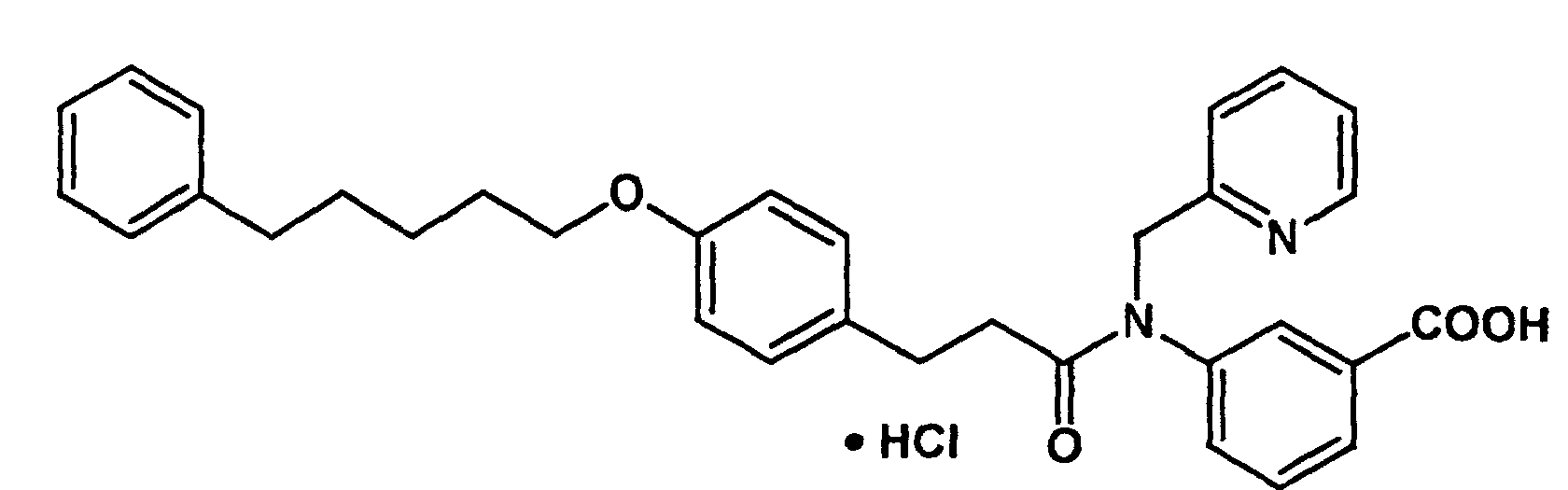
NMR (DMSO-d6) : δ8.66 (d, J = 5.2 Hz, 1H), 8.26-8.12 (br, 1H), 7.88-7.82 (m, 2H), 7.68-7.45 (m, 4H), 7.28-7.09 (m, 5H), 6.93 (d, J = 8.8 Hz, 2H), 6.73 (d, J = 8.8 Hz, 2H), 5.10 (s, 2H), 3.86 (t, J = 6.4 Hz, 2H), 2.78-2.67 (m, 2H), 2.56 (t, J = 7.6 Hz, 2H), 2.43-2.26 (br, 2H), 1.75-1.30 (m, 6H).

NMR (DMSO-d6) : δ10.24 (s, 1H), 8.03-7.99 (m, 2H), 7.53 (t, J = 1.8 Hz, 1H), 7.27-7.10 (m, 7H), 6.79 (d, J = 8.4 Hz, 2H), 3.87 (t, J = 6.6 Hz, 2H), 2.82 (t, J = 7.8 Hz, 2H), 2.61-2.54 (m, 4H), 1.73-1.54 (m, 4H), 1.44-1.34 (m, 2H).

NMR (DMSO-d6) : δ10.10 (s, 1H), 8.18 (d, J = 2.4 Hz, 1H), 7.87 (dd, J = 8.7, 2.4 Hz, 1H), 7.62 (d, J = 8.7 Hz, 1H), 7.27-7.10 (m, 7H), 6.82-6.77 (m, 2H), 3.88 (t, J = 6.6 Hz, 2H), 3.78-3.75 (m, 4H), 3.02-2.99 (m, 4H), 2.82 (t, J = 7.5 Hz, 2H), 2.56 (t, J = 7.5 Hz, 4H), 1.76-1.54 (m, 4H), 1.44-1.34 (m, 2H).
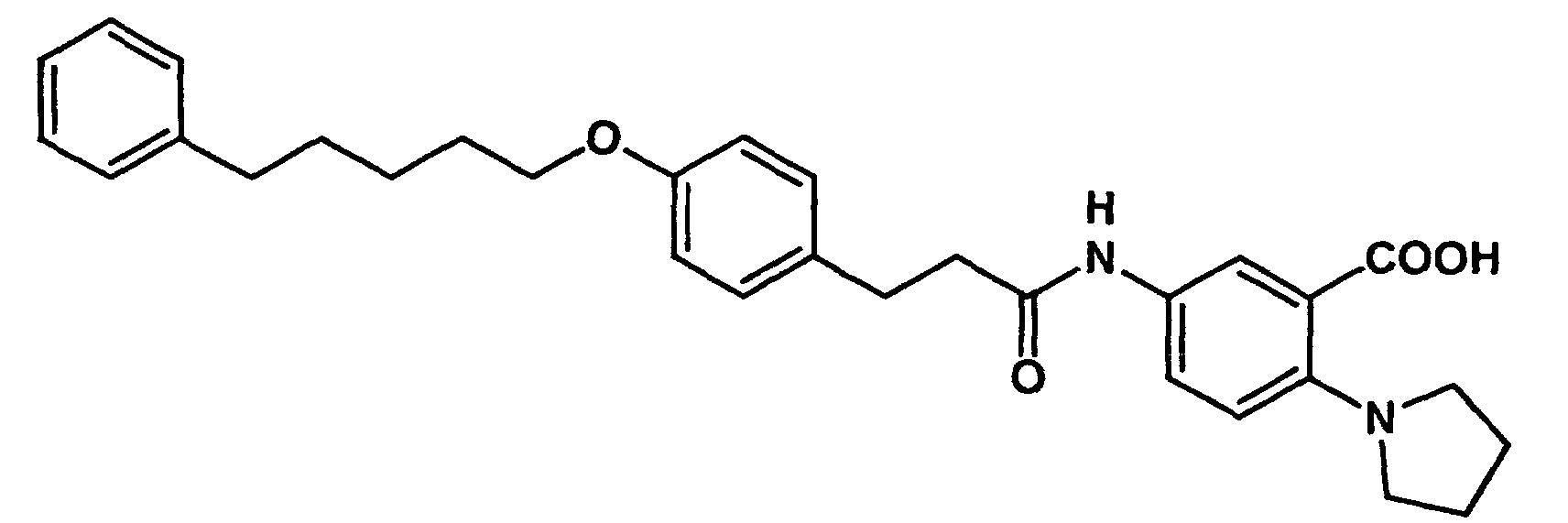
NMR (DMSO-d6) : δ9.86 (s, 1H), 7.92 (d, J = 2.4 Hz, 1H), 7.66 (dd, J = 9.0, 2.4 Hz, 1H), 7.27-7.09 (m, 8H), 6.79 (d, J = 9.0 Hz, 2H), 3.88 (t, J = 6.6 Hz, 2H), 3.15 (t, J = 6.6 Hz, 4H), 2.81 (t, J = 7.5 Hz, 2H), 2.59-2.52 (m, 4H), 1.92 (t, J = 6.6 Hz, 4H), 1.74-1.54 (m, 4H), 1.44-1.34 (m, 2H).

NMR (DMSO-d6) : δ10.76 (s, 1H), 8.28 (d, J = 8.4 Hz, 1H), 7.94-7.88 (m, 1H), 7.71 (dd, J = 7.5 Hz, 0.9 Hz, 1H), 7.27-7.10 (m, 7H), 6.81-6.77 (m, 2H), 3.88 (t, J = 6.6 Hz, 2H), 2.81 (t, J = 8.1 Hz, 2H) 2.66 (t, J = 8.1 Hz, 2H), 2.56 (t, J = 7.5 Hz, 2H), 1.73-1.54 (m, 4H), 1.44-1.34 (m, 2H)..

NMR (DMSO-d6) : δ10.67 (s, 1H), 8.56 (s, 1H), 8.43 (dd, J = 5.1 Hz, 0.6 Hz, 1H), 7.47 (dd, J = 5.1 Hz, 1.5 Hz, 1H), 7.27-7.09 (m, 7H), 6.82-6.77 (m, 2H), 3.88 (t, J = 6.6 Hz, 2H), 2.81 (t, J = 7.2 Hz, 2H) 2.66 (t, J = 7.2 Hz, 2H), 2.56 (t, J = 8.4 Hz, 2H), 1.73-1.54 (m, 4H), 1.44-1.34 (m, 2H).

TLC : Rf 0.35(chloroform : methanol = 9 : 1);
NMR (DMSO-d6) : δ13.30-13.05 (br, 1H), 9.58 (s, 1H), 8.26 (d, J = 2.0 Hz, 1H), 7.68 (dd, J = 8.4, 2.0 Hz, 1H), 7.57 (d, J = 8.4 Hz, 1H), 7.29-7.12 (m, 7H), 6.80 (d, J = 8.4 Hz, 2H), 3.89 (t, J = 6.4 Hz, 2H), 2.84 (t, J = 6.6 Hz, 2H), 2.70-2.53 (m, 4H), 1.76-1.31 (m, 6H).

NMR (DMSO-d6) : δ12.74-12.52 (br, 1H), 9.16 (s, 1H), 8.55 (d, J = 2.0 Hz, 1H), 7.66 (dd, J = 8.6, 2.0 Hz, 1H), 7.28-7.06 (m, 8H), 6.80 (d, J = 8.6 Hz, 2H), 3.92-3.86 (m, 5H), 2.81 (t, J = 7.0 Hz, 2H), 2.69-2.53 (m, 4H), 1.77-1.31 (m, 6H).

NMR (DMSO-d6) : δ9.82 (s, 1H), 8.06 (d, J = 2.6 Hz, 1H), 7.62 (dd, J = 8.8, 2.6 Hz, 1H), 7.28-7.08 (m, 7H), 6.87 (d, J = 8.8 Hz, 1H), 6.79 (d, J = 8.6 Hz, 2H), 3.89 (t, J = 6.4 Hz, 2H), 2.81 (t, J = 7.4 Hz, 2H), 2.60-2.51 (m, 4H), 1.76-1.31 (m, 6H).

NMR (DMSO-d6) : δ12.96-12.56 (br, 1H), 9.93 (s, 1H), 8.04 (d, J = 2.2 Hz, 1H), 7.64 (dd, J = 8.2, 2.2 Hz, 1H), 7.28-7.09 (m, 8H), 6.79 (d, J = 8.6 Hz, 2H), 3.88 (t, J = 6.4 Hz, 2H), 2.81 (t, J = 7.4 Hz, 2H), 2.60-2.53 (m, 4H), 2.42 (s, 3H), 1.76-1.30 (m, 6H).
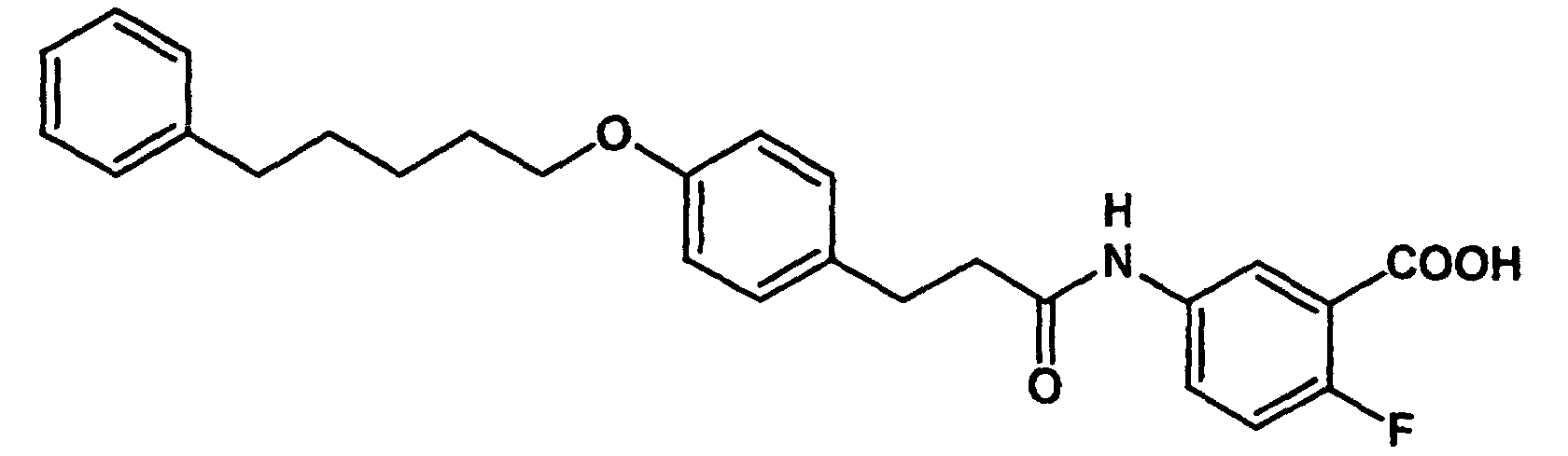
NMR (DMSO-d6): δ13.38-13.08 (br, 1H), 10.05 (s, 1H), 8.10 (dd, J = 6.8, 2.8 Hz, 1H), 7.80-7.72 (m, 1H), 7.28-7.09 (m, 8H), 6.79 (d, J = 8.6 Hz, 2H), 3.88 (t, J = 6.4 Hz, 2H), 2.82 (t, J = 7.1 Hz, 2H), 2.60-2.53 (m, 4H), 1.76-1.31 (m, 6H).

NMR (DMSO-d6) : δ13.64-13.18 (br, 1H), 9.55 (s, 1H), 7.74 (dd, J = 7.8, 1.8 Hz, 1H), 7.49 (dd, J = 7.8, 1.8 Hz, 1H), 7.35 (t, J = 7.8 Hz, 1H), 7.29-7.10 (m, 7H), 6.80 (d, J = 8.6 Hz, 2H), 3.89 (t, J = 6.4 Hz, 2H), 2.83 (t, J = 6.9 Hz, 2H), 2.68-2.53 (m, 4H), 1.77-1.32 (m, 6H).

NMR (DMSO-d6): δ10.54 (s, 1H), 8.01 (d, J = 8.7 Hz, 1H), 7.96 (d, J = 2.4 Hz, 1H), 7.81 (dd, J = 8.7, 2.4 Hz, 1H), 7.27-7.10 (m, 7H), 6.82-6.77 (m, 2H), 3.87 (t, J = 6.6 Hz, 2H), 2.83 (t, J = 7.5 Hz, 2H), 2.63 (t, J = 7.5 Hz, 2H), 2.56 (t, J = 7.5 Hz, 2H), 1.73-1.54 (m, 4H), 1.44-1.33 (m, 2H).

NMR (DMSO-d6) : δ10.30 (s, 1H), 8.31 (d, J = 2.7 Hz, 1H), 8.00 (dd, J = 2.7, 8.7 Hz, 1H), 7.73 (d, J = 8.7 Hz, 1H), 7.30-7.15 (m, 5H), 7.14 (d, J = 8.4 Hz, 2H), 6.82 (d, J = 8.4 Hz, 2H), 3.90 (t, J = 6.9 Hz, 2H), 3.36 (t, J = 6.6 Hz, 2H), 3.34 (t, J = 6.6 Hz, 2H), 2,90-2.80 (m, 2H), 2.60 (q, J = 7.5 Hz, 4H), 1.80-1.55 (m, 4H), 1.50-1.35 (m, 2H), 0.92 (t, J = 7.5 Hz, 6H).
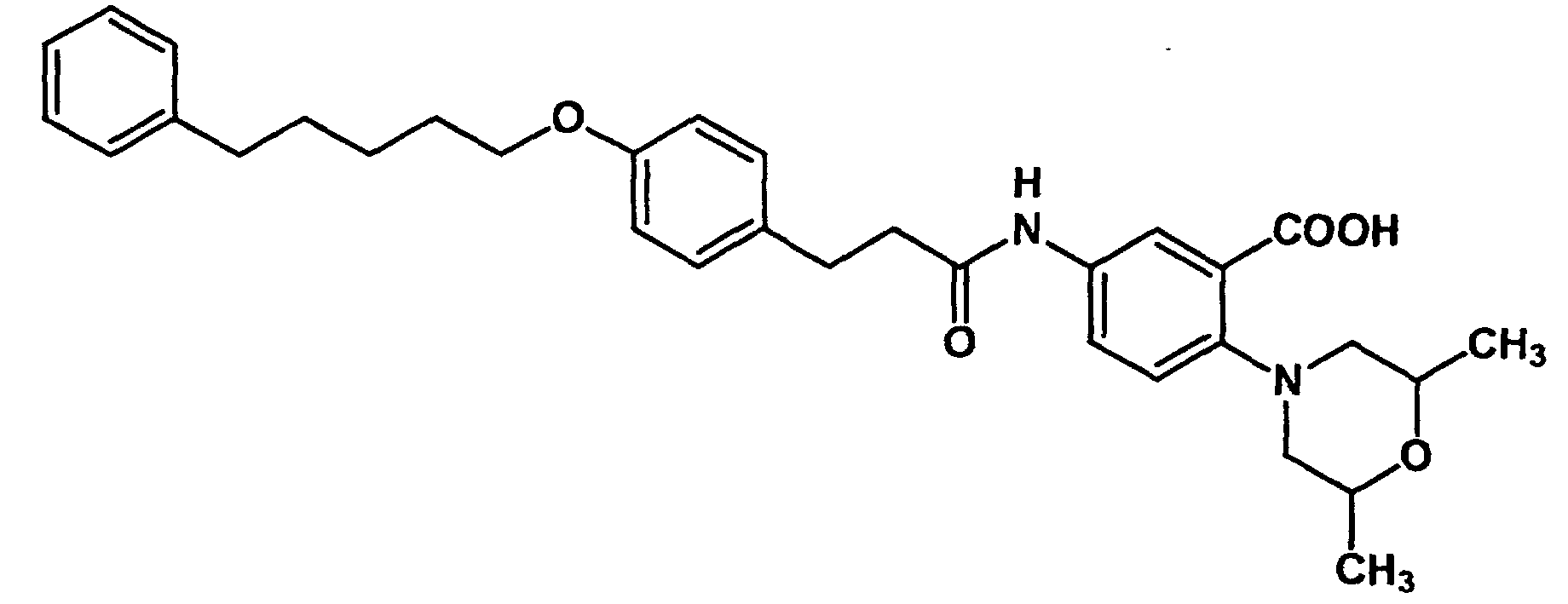
NMR (DMSO-d6) : δ10.11 (s, 1H), 8.18 (d, J = 2.7 Hz, 1H), 7.87 (dd, J = 8.7, 2.7 Hz, 1H), 7.60 (d, J = 8.7 Hz, 1H), 7.27-7.10 (m, 7H), 6.82-6.77 (m, 2H), 3.88 (t, J = 6.6 Hz, 2H), 3.77-3.68 (m, 2H), 2.95 (d, J = 10.8 Hz, 2H), 2.82 (t, J = 7.5 Hz, 2H), 2.66 (t, J = 10.8 Hz, 2H), 2.56 (t, J = 7.5 Hz, 4H), 1.73-1.54 (m, 4H), 1.44-1.34 (m, 2H), 1.12 (d, J = 6.0 Hz, 6H).
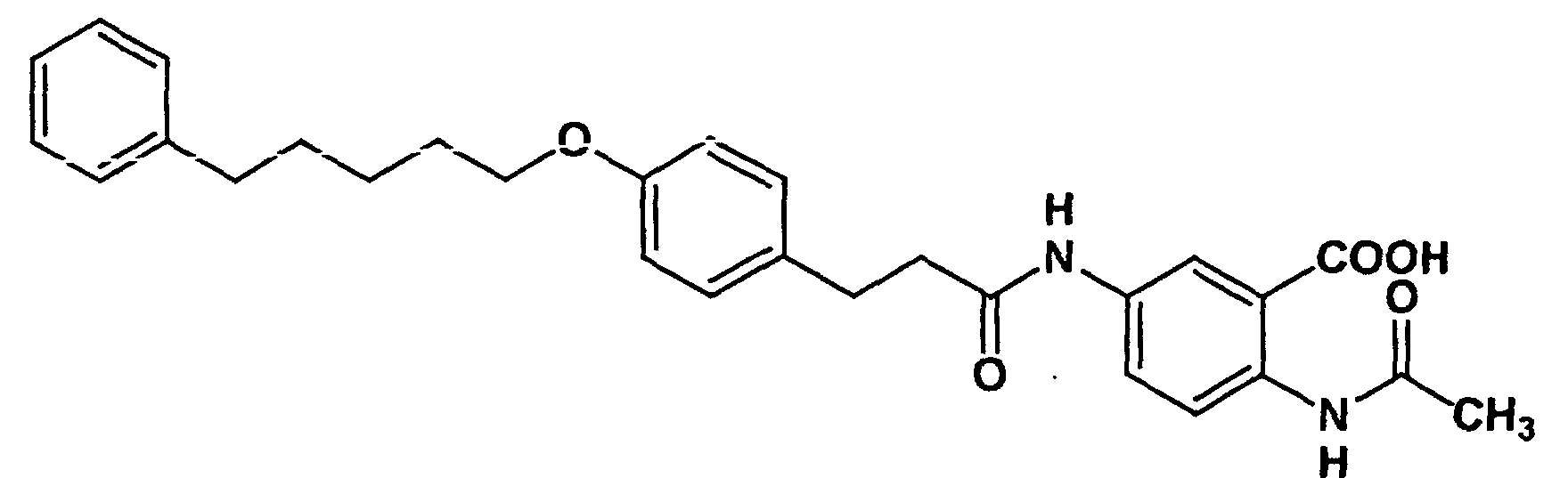
NMR (DMSO-d6) : δ10.86 (s, 1H), 9.96 (s, 1H), 8.31 (d, J = 9.0 Hz, 1H), 8.24 (d, J = 2.7 Hz, 1H), 7.69 (dd, J = 9.0, 2.7 Hz, 1H), 7.27-7.09 (m, 7H), 6.79 (d, J = 8.4 Hz, 2H), 3.88 (t, J = 6.6 Hz, 2H), 2.81 (t, J = 7.5 Hz, 2H), 2.59-2.49 (m, 4H), 2.08 (s, 3H), 1.73-1.54 (m, 4H), 1.44-1.34 (m, 2H).
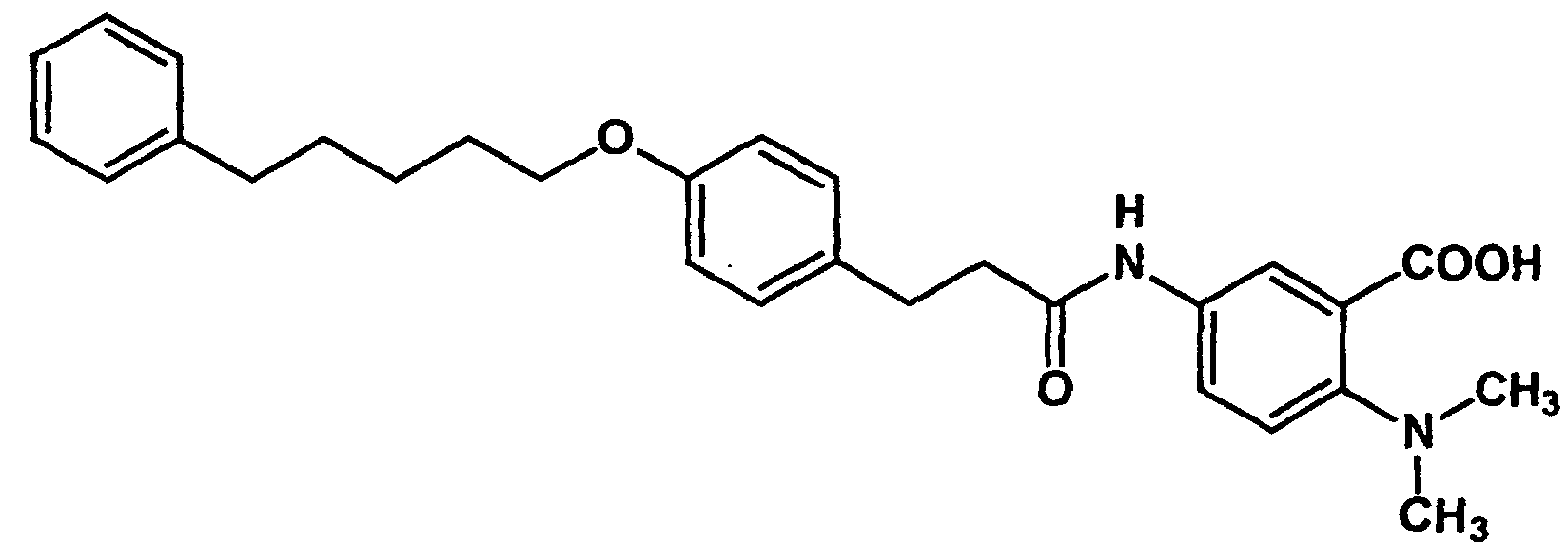
NMR (DMSO-d6): δ10.33 (s, 1H), 8.25 (d, J = 2.7 Hz, 1H), 7.94 (dd, J = 9.0, 2.7 Hz, 1H), 7.81 (d, J = 9.0 Hz, 1H), 7.27-7.10 (m, 7H), 6.81-6.77 (m, 2H), 3.87 (t, J = 6.6 Hz, 2H), 2.96 (s, 6H), 2.82 (t, J = 7.8 Hz, 2H), 2.61-2.53 (m, 4H), 1.73-1.54 (m, 4H), 1.43-1.33 (m, 2H).
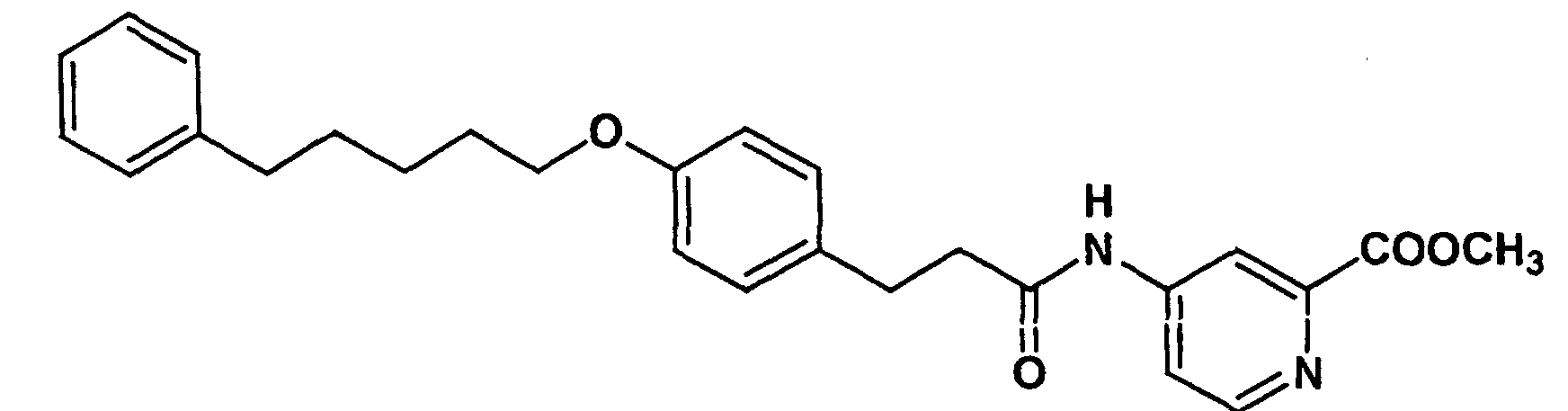

TLC : Rf 0.11(chloroform : methanol = 9 : 1);
NMR (DMSO-d6) : δ10.51 (s, 1H), 8.49 (d, J = 5.4 Hz, 1H), 8.23 (d, J = 2.1 Hz, 1H), 7.76 (dd, J = 5.4 Hz, 2.1 Hz, 1H), 7.27-7.10 (m, 7H), 6.79 (d, J = 8.4 Hz, 2H), 3.87 (t, J = 6.6 Hz, 2H), 2.83 (t, J = 7.5 Hz, 2H) 2.63 (t, J = 7.5 Hz, 2H), 2.56 (t, J = 7.5 Hz, 2H), 1.73-1.54 (m, 4H), 1.44-1.33 (m, 2H).
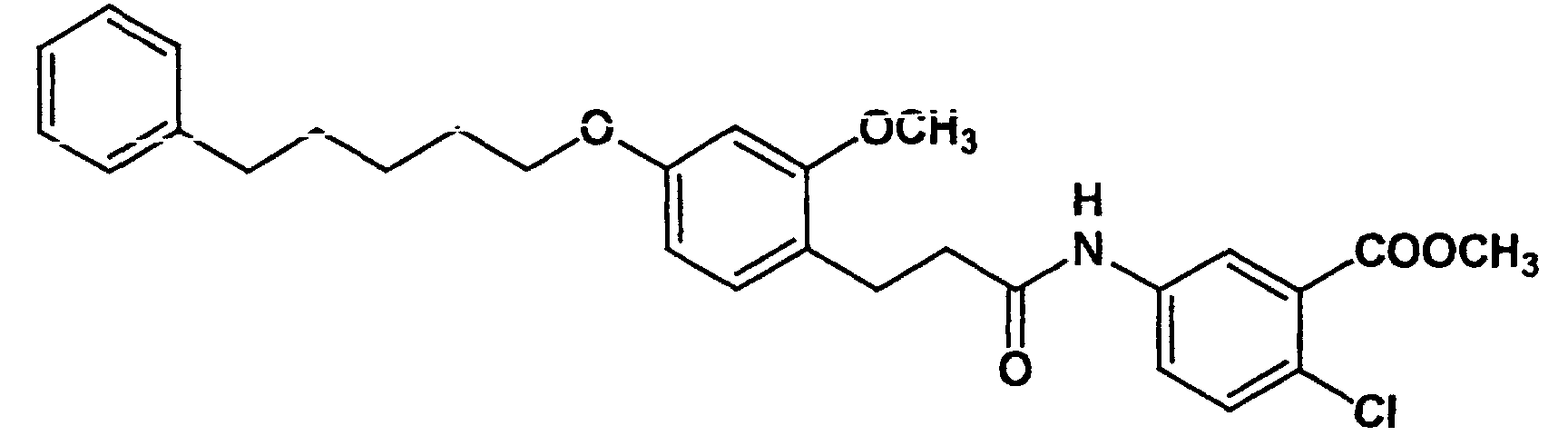
TLC : Rf 0.54(hexane : ethyl acetate = 2 : 1);
NMR (CDCl3): δ7.84 (d, J = 2.4 Hz, 1H), 7.64 (dd, J = 2.4, 8.7 Hz, 1H), 7.36 (d, J = 8.7 Hz, 1H), 7.30-7.15 (m, 5H), 7.05 (d, J = 8.4 Hz, 1H), 6.45 (d, J = 2.4 Hz, 1 H), 6.39 (dd, J = 2.4, 8.4 Hz, 1H), 3.93 (t, J = 6.6 Hz, 2H), 3.91 (s, 3H), 3.81 (s, 3H), 2.95 (t, J = 7.2 Hz, 2H), 2.64 (t, J = 7.5 Hz, 2H), 2.62 (t, J = 7.5 Hz, 2H), 1.85-1.45 (m, 6H).
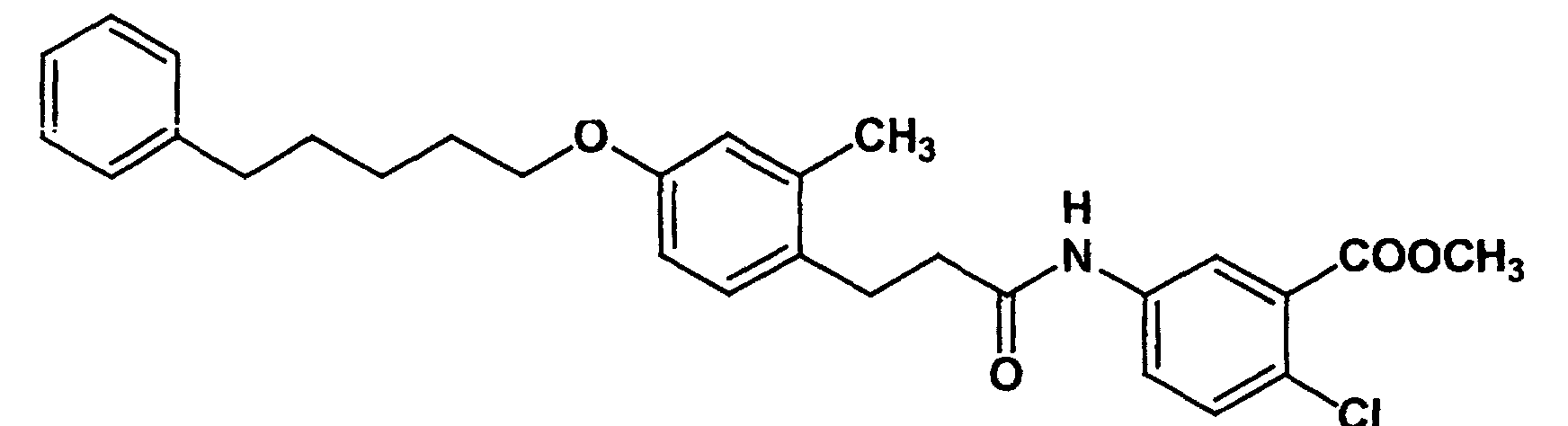
NMR (CDCl3) : δ7.85 (m, 1H), 7.65-7.15 (m, 8H), 7.05-7.00 (m, 1H), 6.75-6.60 (m, 2H), 3.90 (s, 3H), 3.95-3.85 (m, 2H), 3.00-2.90 (m, 2H), 2.70-2.50 (m, 4H), 2.28 (s, 3H), 1.85-1.60 (m, 4H), 1.60-1.50 (m, 2H).

NMR (CDCl3): δ7.87 (d, J = 2.7 Hz, 1H), 7.64 (dd, J = 2.7, 8.7 Hz, 1H), 7.37 (d, J = 8.7 Hz, 1H), 7.30-7.10 (m, 6H), 6.65-6.55 (m, 2H), 3.92 (s, 3H), 3.90 (t, J = 6.6 Hz, 2H), 3.05-2.95 (m, 2H), 2.66-2.60 (m, 4H), 1.90-1.50 (m, 6H).
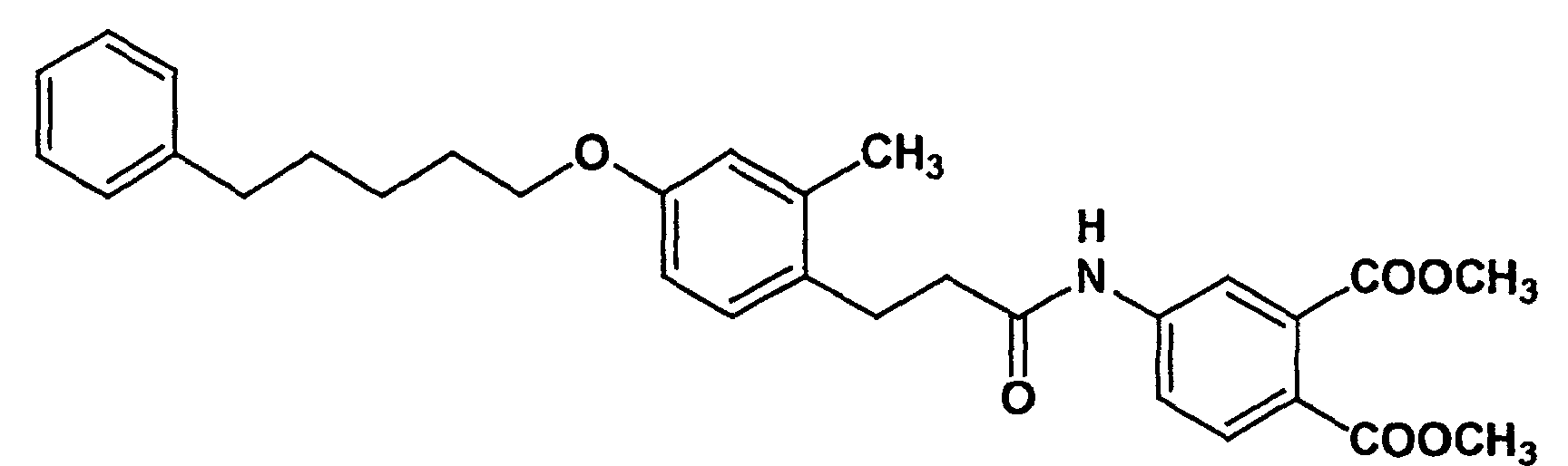
NMR (CDCl3) : δ7.77-7.66 (m, 3H), 7.31-7.15 (m, 6H), 7.04 (d, J = 8.4 Hz, 1H), 6.71 (d, J = 2.7 Hz, 1H), 6.66 (dd, J = 8.4, 2.7 Hz, 1H), 3.93-3.87 (m, 8H), 2.98 (t, J = 7.5 Hz, 2H), 2.64 (t, J = 7.5 Hz, 2H), 2.60 (t, J = 7.5 Hz, 2H), 2.29 (s, 3H), 1.84-1.64 (m, 4H), 1.55-1.45 (m, 2H).
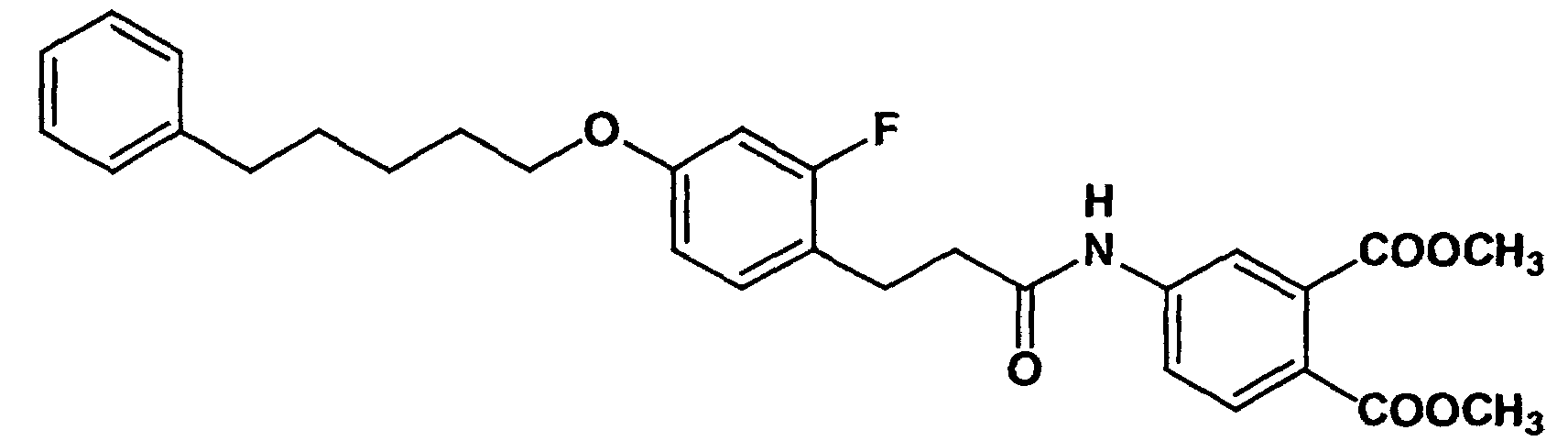
NMR (CDCl3) : δ7.78-7.69 (m, 3H), 7.35 (s, 1H), 7.30-7.08 (m, 6H), 6.61-6.56 (m, 2H), 3.92-3.87 (m, 8H), 2.99 (t, J = 7.5 Hz, 2H), 2.67-2.61 (m, 4H), 1.84-1.64 (m, 4H), 1.54-1.44 (m, 2H).

NMR (CDCl3) : δ7.77-7.66 (m, 3H), 7.39 (bs, 1H), 7.31-7.15 (m, 5H), 7.04 (d, J = 8.1 Hz, 1H), 6.44 (d, J = 2.4 Hz, 1H), 6.39 (dd, J = 8.1, 2.4 Hz, 1H), 3.92 (t, J = 6.6 Hz, 2H), 3.89 (s, 3H), 3.87 (s, 3H), 3.79 (s, 3H), 2.95 (t, J = 7.5 Hz, 2H), 2.67-2.61 (m, 4H), 1.85-1.65 (m, 4H), 1.56-1.45 (m, 2H).
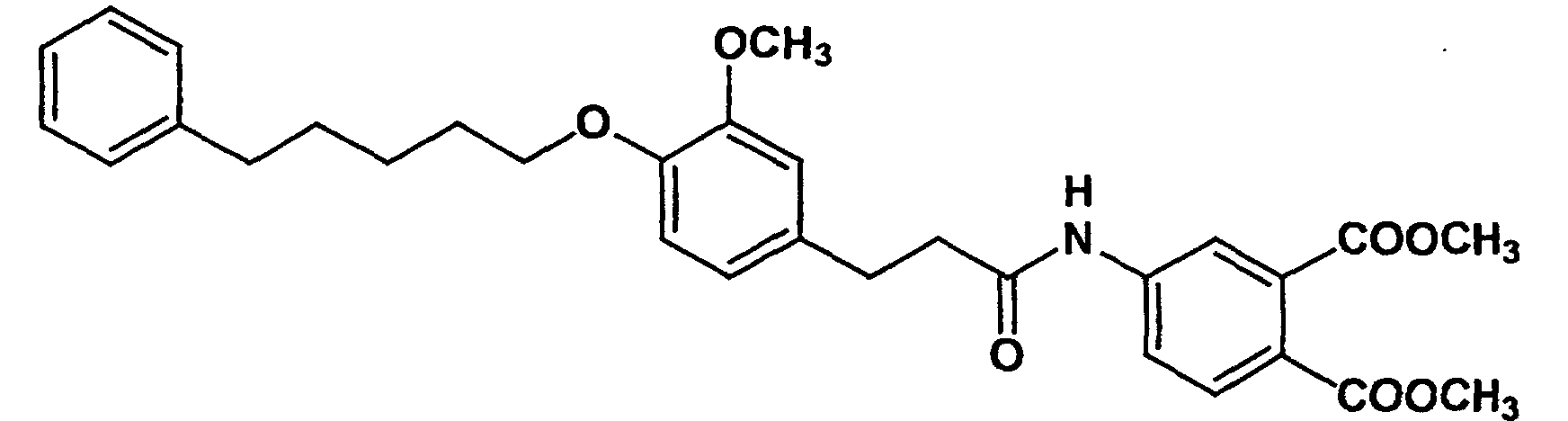
NMR (CDCl3) : δ7.76-7.64 (m, 3H), 7.41 (s, 1H), 7.30-7.15 (m, 5H), 6.80-6.71 (m, 3H), 3.97 (t, J = 6.6 Hz, 2H), 3.89 (s, 3H), 3.87 (s, 3H), 3.80 (s, 3H), 2.98 (t, J = 7.5 Hz, 2H), 2.67-2.60 (m, 4H), 1.90-1.80 (m, 2H), 1.74-1.63 (m, 2H), 1.54-1.44 (m, 2H).

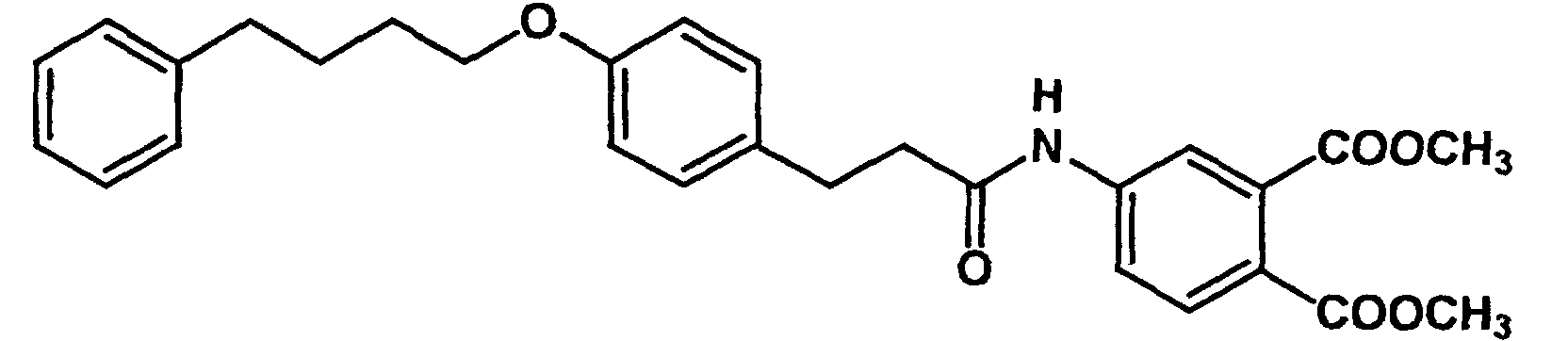
NMR (CDCl3) : δ7.76-7.64 (m, 3H), 7.33-7.09 (m, 8H), 6.84-6.79 (m, 2H), 3.96-3.92 (m, 2H), 3.88 (s, 3H), 3.87 (s, 3H), 2.98 (t, J = 7.5 Hz, 2H), 2.70-2.61 (m, 4H), 1.82-1.78 (m, 4H).
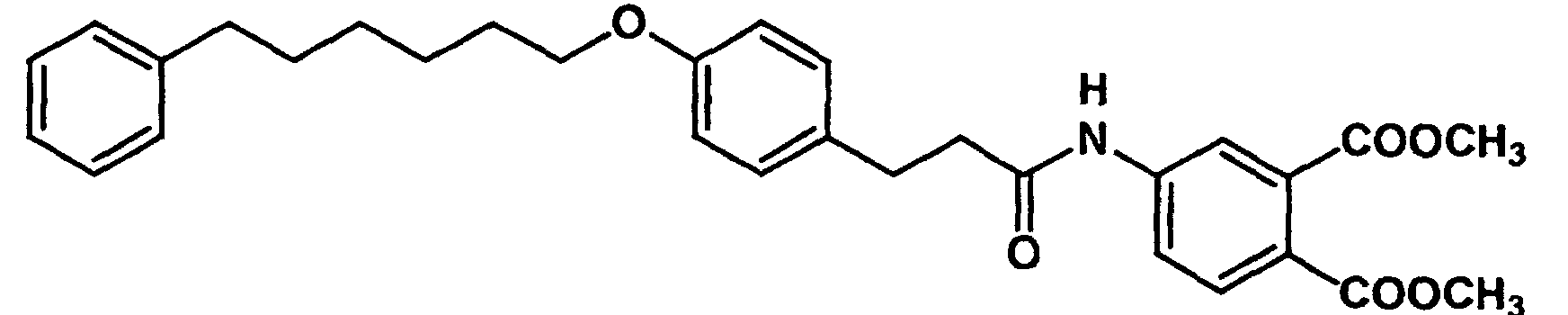
NMR (CDCl3) : δ7.77-7.64 (m, 3H), 7.31-7.09 (m, 8H), 6.84-6.79 (m, 2H), 3.93-3.87 (m, 8H), 2.98 (t, J = 7.5 Hz, 2H), 2.66-2.59 (m, 4H), 1.81-1.61 (m, 4H), 1.53-1.34 (m, 4H).

NMR (CDCl3) : δ7.86 (d, J = 2.7 Hz, 1H), 7.61 (dd, J = 2.7, 8.7 Hz, 1H), 7.37 (d, J = 8.7 Hz, 1H), 7.30-7.05 (m, 9H), 3.92 (s, 3H), 3.01 (t, J = 7.5 Hz, 2H), 2.88 (t, J = 7.5 Hz, 2H), 2.64 (t, J = 7.5 Hz, 2H), 2 .59 (t, J = 7.5 Hz, 2H), 1.70-1.40 (m, 6H).

NMR (CDCl3) : δ7.84 (d, J = 2.7 Hz, 1H), 7.58 (dd, J = 8.7, 2.7 Hz, 1H), 7.36 (d, J = 8.7 Hz, 1H), 7.31-7.16 (m, 5H), 7.04-7.00 (m, 3H), 6.57-6.52 (m, 2H), 3.91 (s, 3H), 3.08 (t, J = 6.9 Hz, 2H), 2.93 (t, J = 7.5 Hz, 2H), 2.65-2.58 (m, 4H), 1.72-1.39 (m, 6H).

TLC : Rf 0.35(chloroform : methanol = 9 : 1);
NMR (DMSO-d6) : δ13.25 (s, 1H), 10.11 (s, 1H), 8.07 (d, J = 2.4 Hz, 1H), 7.71 (dd, J = 2.7, 8.7 HZ, 1H), 7.44 (d, J = 8.7 HZ, 1H), 7.30-7.10 (m, 5H), 7.01 (d, J = 8.4 Hz, 1H), 6.49 (d, J = 2.4 Hz, 1H), 6.40 (dd, J = 2.4, 8.4 Hz, 1H), 3.91 (t, J = 6.3 Hz, 2H), 3.76 (s, 3H), 2.85-2.70 (m, 2H), 2.65-2.50 (m, 4H), 1.80-1.60 (m, 4H), 1.50-1.40 (m, 2H).

NMR (DMSO-d6) : δ13.35 (s, 1H), 10.15 (s, 1H), 8.08 (d, J = 2.7 Hz, 1H), 7.72 (dd, J = 2.7, 8.7 Hz, 1H), 7.45 (d, J = 8.7 Hz, 1H), 7.30-7.10 (m, 5H), 7.04 (d, J = 8.4 Hz, 1H), 6.71 (d, J = 2.7 Hz, 1H), 6.65 (dd, J = 2.7, 8.4 Hz, 1H), 3.89 (t, J = 6.6 Hz, 2H), 2.82 (t, J = 7.8 Hz, 2H), 2.60-2.50 (m, 4H), 2.26 (s, 3H), 1.80-1.60 (m, 4H), 1.50-1.40 (m, 2H).
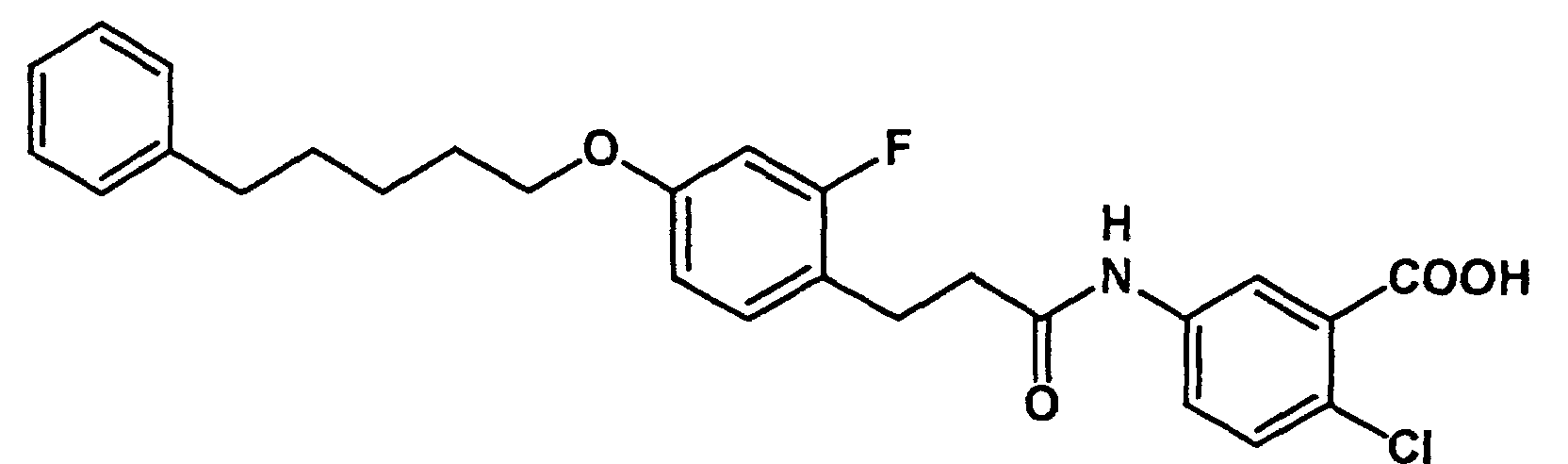
NMR (DMSO-d6) : δ13.35 (s, 1H), 10.17 (s, 1H), 8.06 (d, J = 2.7 Hz, 1H), 7.70 (dd, J = 2.7, 8.7 Hz, 1H), 7.44 (d, J = 8.7 Hz, 1H), 7.30-7.10 (m, 6H), 6.73 (dd, J = 2.7, 12.6 Hz, 1H), 6.67 (dd, J = 2.1, 8.4 Hz, 1H), 3.92 (t, J = 6.3 Hz, 2H), 2.85 (t, J = 7.2 Hz, 2H), 2.59 (t, J = 7.5 Hz, 4H), 1.80-1.60 (m, 4H), 1.55-1.40 (m, 2H).

NMR (DMSO-d6) : δ10.23 (s, 1H), 7.84-7.83 (m, 1H), 7.72-7.66 (m, 2H), 7.27-7.11 (m, 5H), 7.02 (d, J = 8.1 Hz, 1H), 6.69 (d, J = 2.4 Hz, 1H), 6.63 (dd, J = 8.1, 2.4 Hz, 1H), 3.86 (t, J = 6.6 Hz, 2H), 2.80 (t, J = 7.5 Hz, 2H), 2.59-2.52 (m, 4H), 2.24 (s, 3H), 1.73-1.54 (m, 4H), 1.43-1.33 (m, 2H).
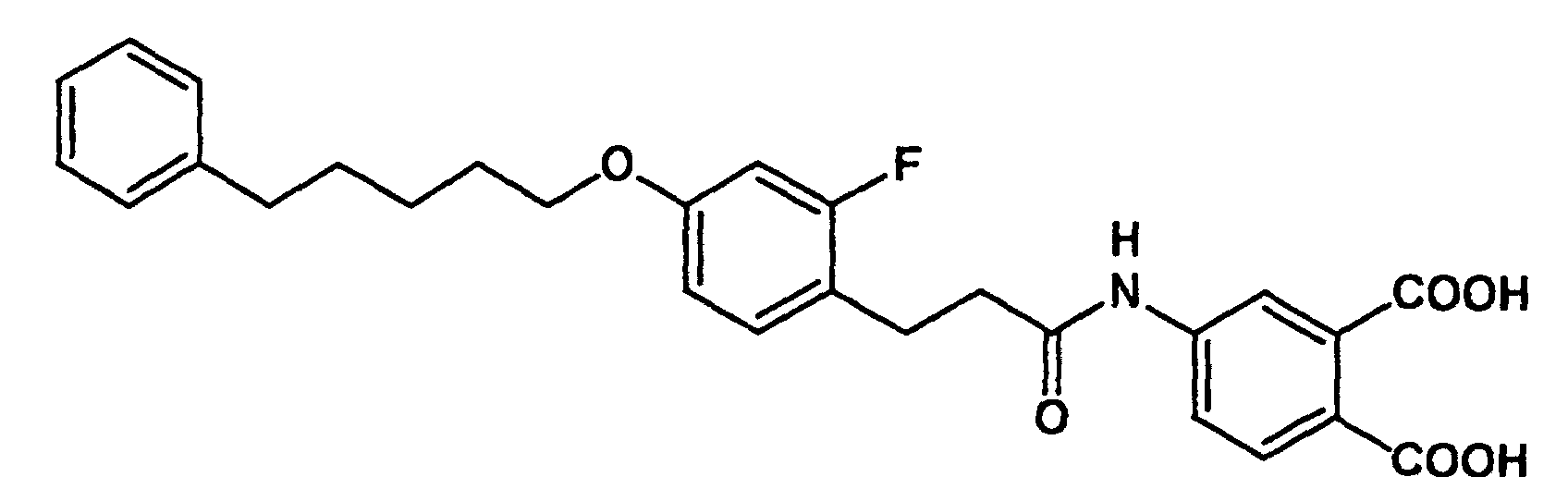
NMR (DMSO-d6) : δ10.25 (s, 1H), 7.82 (s, 1H), 7.67 (s, 2H), 7.27-7.11 (m, 6H), 6.75-6.64 (m, 2H), 3.90 (t, J = 6.6 Hz, 2H), 2.83 (t, J = 7.5 Hz, 2H), 2.62-2.54 (m, 4H), 1.73-1.54 (m, 4H), 1.43-1.33 (m, 2H).

NMR (DMSO-d6) : δ10.19 (s, 1H), 7.83 (d, J = 1.2 Hz, 1H), 7.72-7.65 (m, 2H), 7.28-7.11 (m, 5H), 7.00 (d, J = 8.4 Hz, 1H), 6.47 (d, J = 2.1 Hz, 1H), 6.38 (dd, J = 8.4, 2.1 Hz, 1H), 3.89 (t, J = 6.3 Hz, 2H), 3.74 (s, 3H), 2.77 (t, J = 7.5 Hz, 2H), 2.59-2.49 (m, 4H), 1.74-1.55 (m, 4H), 1.45-1.34 (m, 2H).

NMR (DMSO-d6) : δ10.24 (s, 1H), 7.83 (s, 1H), 7.72-7.66 (m, 2H), 7.27-7.11 (m, 5H), 6.80 (d, J = 7.8 Hz, 2H), 6.69 (dd, J = 8.1, 1.8 Hz, 1H), 3.85 (t, J = 6.6 Hz, 2H), 3.68 (s, 3H), 2.83 (t, J = 7.5 Hz, 2H), 2.63-2.54 (m, 4H), 1.73-1.54 (m, 4H), 1.44-1.34 (m, 2H).
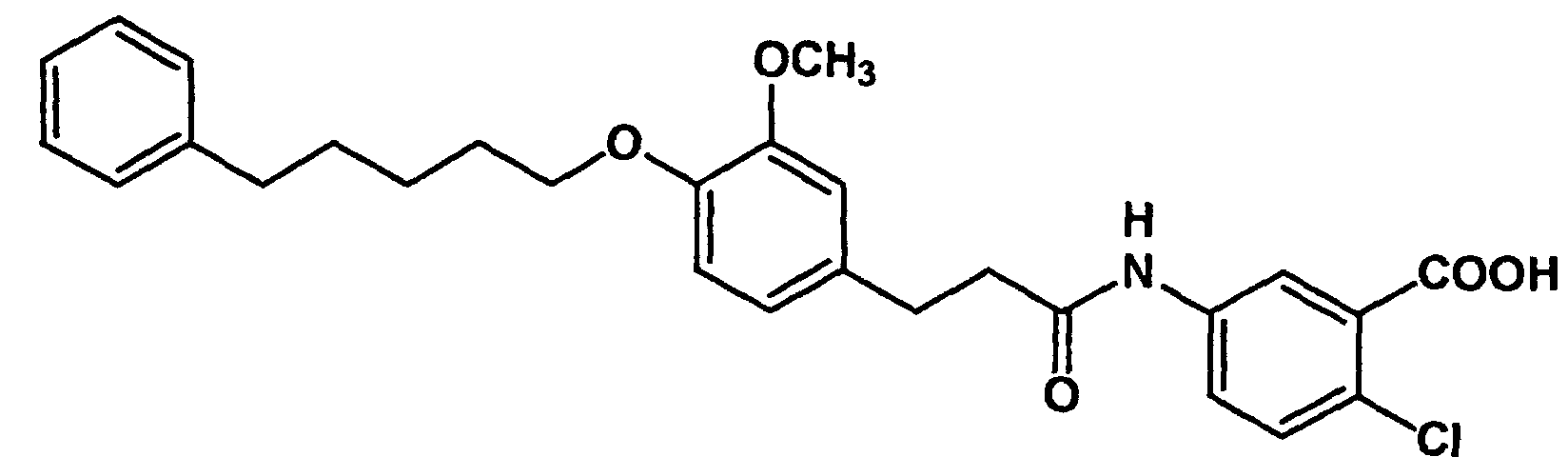
NMR (DMSO-d6) : δ10.16 (s, 1H), 8.08 (d, J = 2.7 Hz, 1H), 7.72 (dd, J = 2.7, 8.7 Hz, 1H), 7.45 (d, J = 8.7 Hz, 1H), 7.30-7.15 (m, 5H), 6.83 (d, J = 2.1 Hz, 1H), 6.82 (d, J = 8.1 Hz, 1H), 6.71 (dd, J = 2.1, 8.1 Hz, 1H), 3.88 (t, J = 6.3 Hz, 2H), 3.71 (s, 3H), 2.90-2.80 (m, 2H), 2.65-2.55 (m, 4H), 1.80-1.55 (m, 4H), 1.50-1.40 (m, 2H).
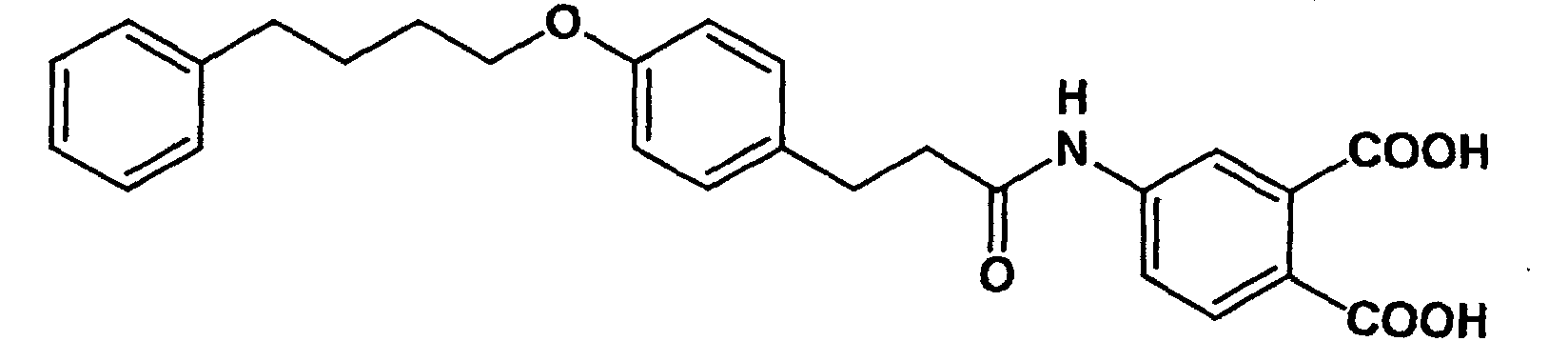
NMR (DMSO-d6): δ10.23 (s, 1H), 7.83 (s, 1H), 7.71-7.65 (m, 2H), 7.28-7.10 (m, 7H), 6.80 (d, J = 8.7 Hz, 2H), 3.91 (t, J = 6.0 Hz, 2H), 2.82 (t, J = 7.5 Hz, 2H), 2.62-2.57 (m, 4H), 1.72-1.63 (m, 4H).

NMR (DMSO-d6) : δ10.23 (s, 1H), 7.84 (s, 1H), 7.72-7.66 (m, 2H), 7.26-7.10 (m, 7H), 6.79 (d, J = 8.4 Hz, 2H), 3.87 (t, J = 6.6 Hz, 2H), 2.82 (t, J = 7.5 Hz, 2H), 2.62-2.52 (m, 4H), 1.69-1.51 (m, 4H), 1.45-1.25 (m, 4H).
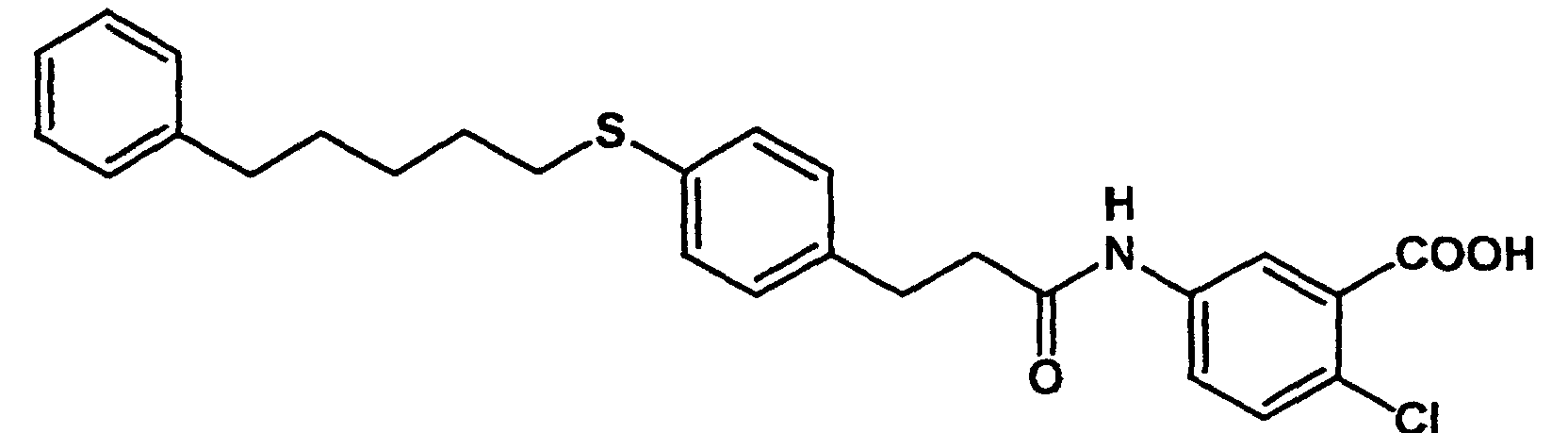
NMR (DMSO-d6): δ13.35 (s, 1H), 10.16 (s, 1H), 8.07 (d, J = 2.7 Hz, 1H), 7.70 (dd, J = 2.7, 8.7 Hz, 1H), 7.44 (d, J = 8.7 Hz, 1H), 7.30-7.15 (m, 9H), 2.90 (t, J = 7.5 Hz, 2H), 2.87 (t, J = 7.5 Hz, 2H), 2.61 (t, J = 7.5 Hz, 2H), 2.54 (t, J = 6.9 Hz, 2H), 1.65-1.50 (m, 4H), 1.45-1.35 (m, 2H).
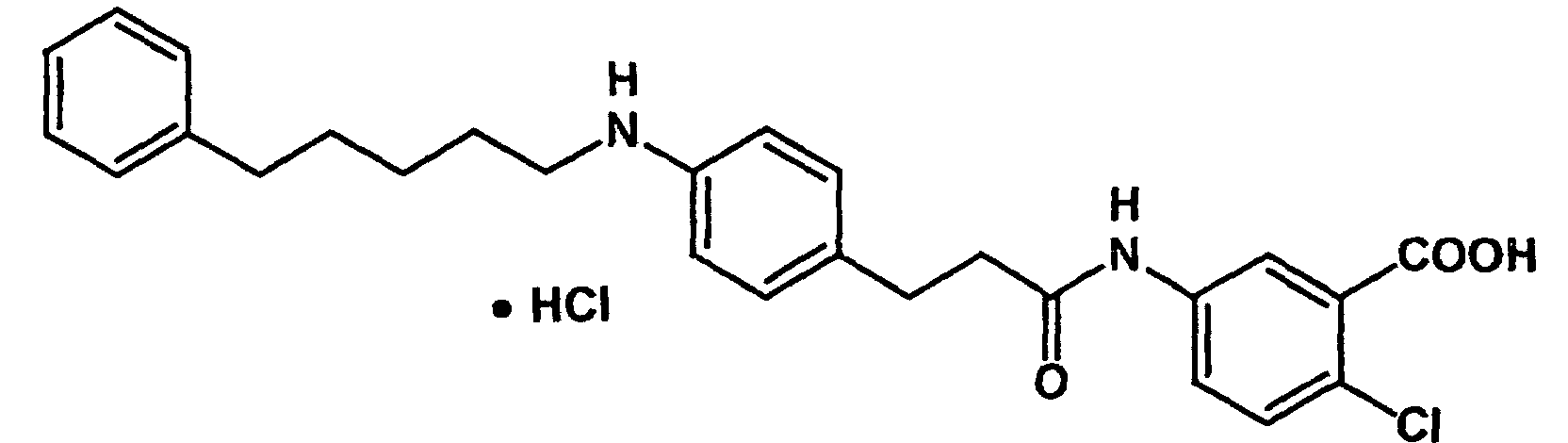
NMR (DMSO-d6): δ10.30 (s, 1H), 8.06 (d, J = 2.7 Hz, 1H), 7.70 (dd, J = 8.7, 2.7 Hz, 1H), 7.42 (d, J = 8.7 Hz, 1H), 7.33-7.11 (m, 9H), 3.17 (t, J = 8.1 Hz, 2H), 2.91 (t, J = 7.5 Hz, 2H), 2.64 (t, J = 7.5 Hz, 2H), 2.53 (t, J = 7.5 Hz, 2H), 1.67-1.50 (m, 4H), 1.36-1.26 (m, 2H).
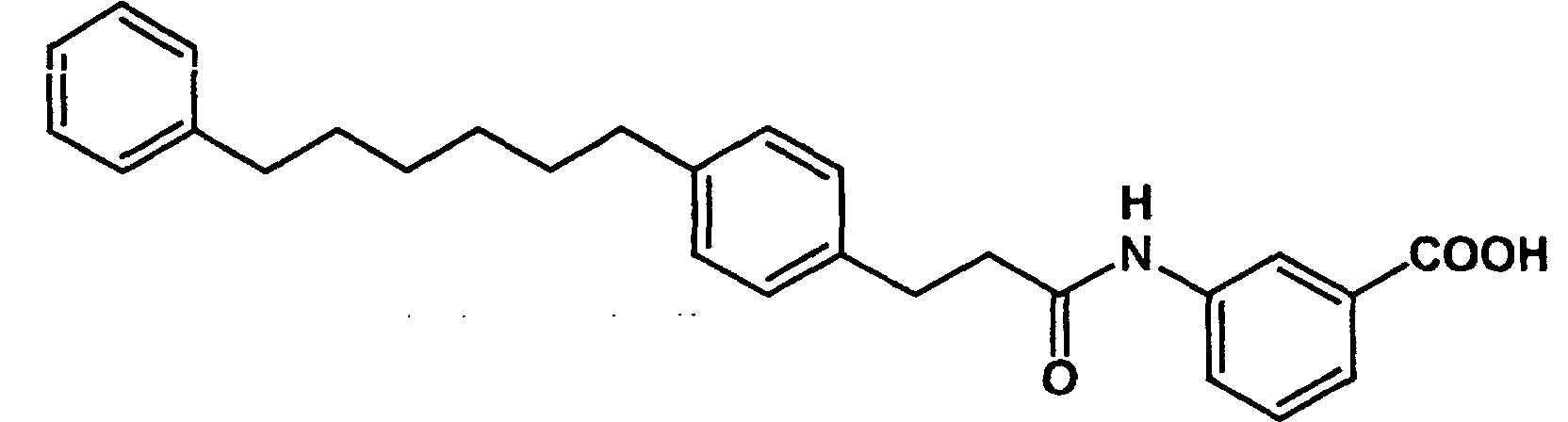
TLC : Rf 0.37(chloroform : methanol = 9 : 1);
NMR (DMSO-d6) : δ13.05-12.72 (br, 1H), 10.06 (s, 1H), 8.20-8.19 (m, 1H), 7.81-7.76 (m, 1H), 7.61-7.55 (m, 1H), 7.38 (t, J = 7.8 Hz, 1H), 7.28-7.03 (m, 9H), 2.86 (t, J = 7.4 Hz, 2H), 2.63-2.45 (m, 6H), 1.60-1.40 (br, 4H), 1.33-1.20 (br, 4H).

NMR (DMSO-d6) : δ12.90 (s, 1H), 10.05 (s, 1H), 8.19 (t, J = 1.6 Hz, 1H), 7.81-7.76 (m, 1H), 7.60-7.55 (m, 1H), 7.38 (t, J = 7.9 Hz, 1H), 7.12 (d, J = 8.6 Hz, 2H), 6.80 (d, J = 8.6 Hz, 2H), 3.87 (t, J = 6.4 Hz, 2H), 2.82 (t, J = 7.6 Hz, 2H), 2.57 (t, J = 7.6 Hz, 2H), 1.74-1.50 (br, 7H), 1.40-1.02 (m, 10H), 0.89-0.73 (m, 2H).
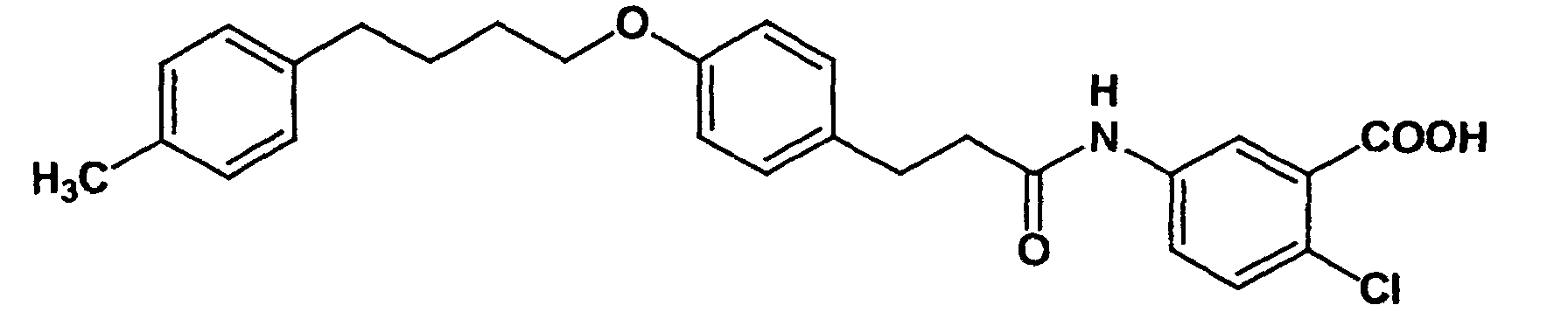
NMR (DMSO-d6) : δ13.30 (s, 1H), 10.15 (s, 1H), 8.07 (d, J = 2.7 Hz, 1H), 7.71 (dd, J = 2.7, 8.7 Hz, 1H), 7.43 (d, J = 8.7 Hz, 1H), 7.13 (d, J =8.4 Hz, 2H), 7.07 (s, 4H), 6.81 (d, J =8.4 Hz, 2H), 3.91 (m, 2H), 2.83 (t, J = 7.5 Hz, 2H), 2.65-2.55 (m, 4H), 2.25 (s, 3H), 1.68 (m, 4H).
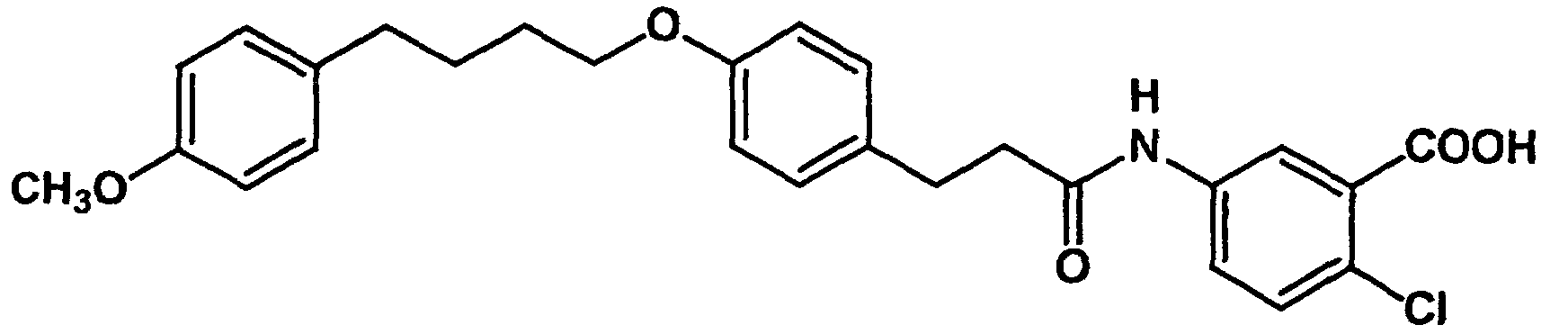
NMR (DMSO-d6): δ13.35 (s, 1H), 10.14 (s, 1H), 8.07 (d, J = 2.7 Hz, 1H), 7.71 (dd, J = 2.7, 8.7 Hz, 1H), 7.44 (d, J = 8.7 Hz, 1H), 7.15-7.05 (m, 4H), 6.85-6.80 (m, 4H), 3.92 (t, J = 6.0 Hz, 2H), 3.71 (s, 3H), 2.84 (t, J = 7.5 Hz, 2H), 2.65-2.50 (m, 4H), 1.70-1.65 (m, 4H).

NMR (DMSO-d6): δ10.24 (s, 1H), 7.84 (d, J = 2.7 Hz, 1H), 7.75-7.65 (m, 2H), 7.13 (d, J = 9.0 Hz, 2H), 7.11 (d, J = 8.7 Hz, 2H), 6.83 (d, J = 9.0 Hz, 2H), 6.82 (d, J = 8.7 Hz, 2H), 3.92 (t, J = 6.0 Hz, 2H), 3.71 (s, 3H), 2.84 (t, J = 7.5 Hz, 2H), 2.61 (t, J = 7.8 Hz, 2H), 2.60-2.50 (m, 2H), 1.70-1.65 (m, 4H).

NMR (DMSO-d6) : δ10.15 (s, 1H), 8.44-8.41 (m, 2H), 8.05 (d, J = 2.7 Hz, 1H), 7.69 (dd, J = 8.7, 2.7 Hz, 1H), 7.43 (d, J = 8.7 Hz, 1H), 7.24-7.22 (m, 2H), 7.13-7.07 (m, 2H), 6.81-6.77 (m, 2H), 3.88 (t, J = 6.6 Hz, 2H), 2.81 (t, J = 7.5 Hz, 2H), 2.62-2.54 (m, 4H), 1.74-1.57 (m, 4H), 1.44-1.33 (m, 2H).
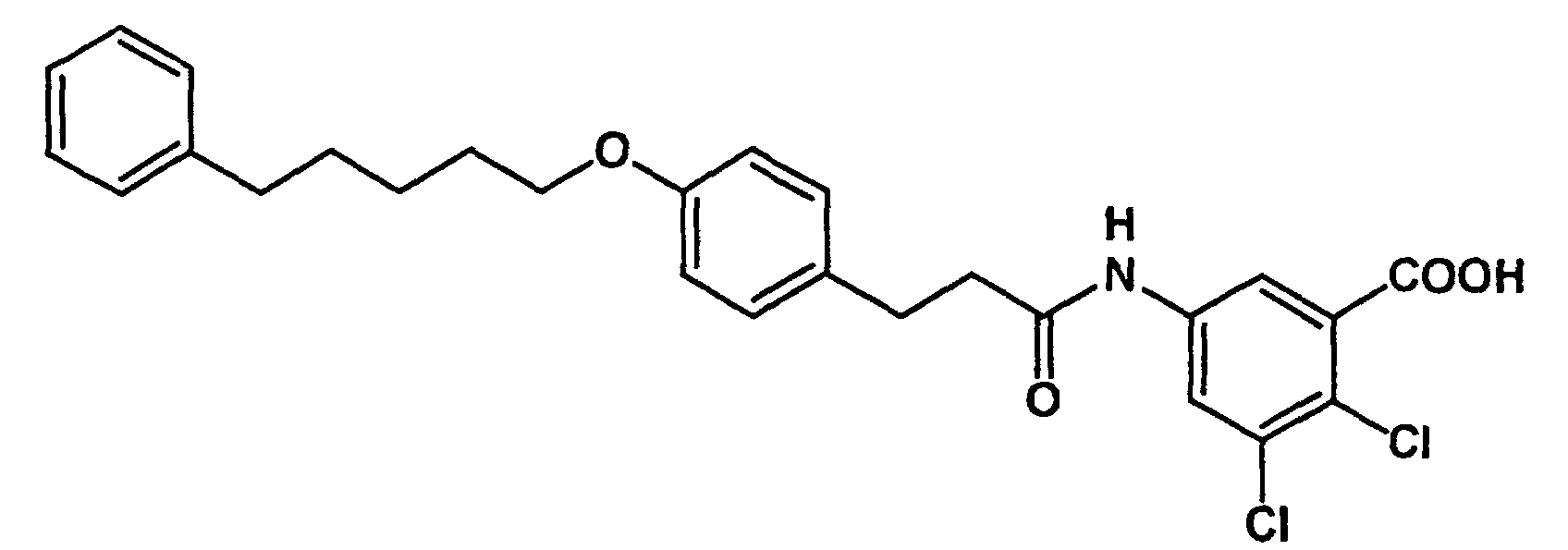
NMR (DMSO-d6) : δ13.86-13.50 (br, 1H), 10.28 (s, 1H), 8.04 (d, J = 2.7 Hz, 1H), 7.85 (d, J = 2.7 Hz, 1H), 7.27-7.09 (m, 7H), 6.79 (d, J = 8.7 Hz, 2H), 3.88 (t, J = 6.6 Hz, 2H), 2.81 (t, J = 7.5 Hz, 2H), 2.60-2.54 (m, 4H), 1.73-1.54 (m, 4H), 1.44-1.38 (m, 2H).
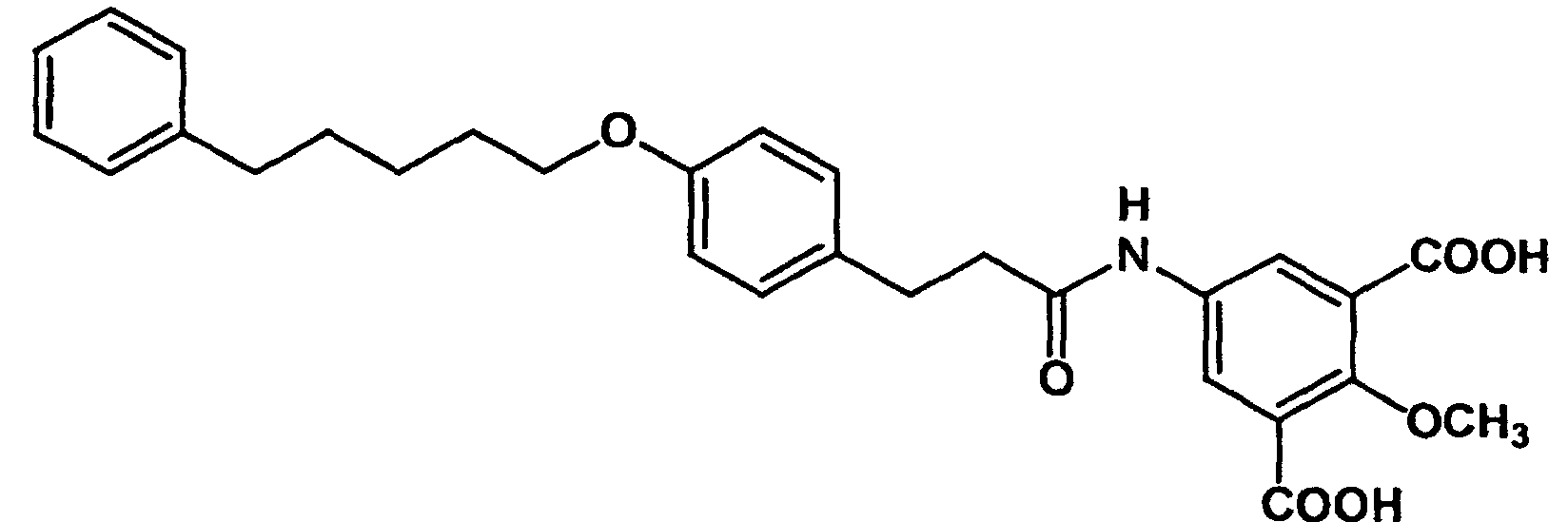
NMR (DMSO-d6) : δ13.15-12.90 (br, 2H), 10.08 (s, 1H), 8.04 (s, 2H), 7.27-7.09 (m, 7H), 6.79 (d, J = 8.7 Hz, 2H), 3.88 (t, J = 6.6 Hz, 2H), 3.74 (s, 3H), 2.81 (t, J = 7.5 Hz, 2H), 2.59-2.52 (m, 4H), 1.73-1.54 (m, 4H), 1.44-1.34 (m, 2H).
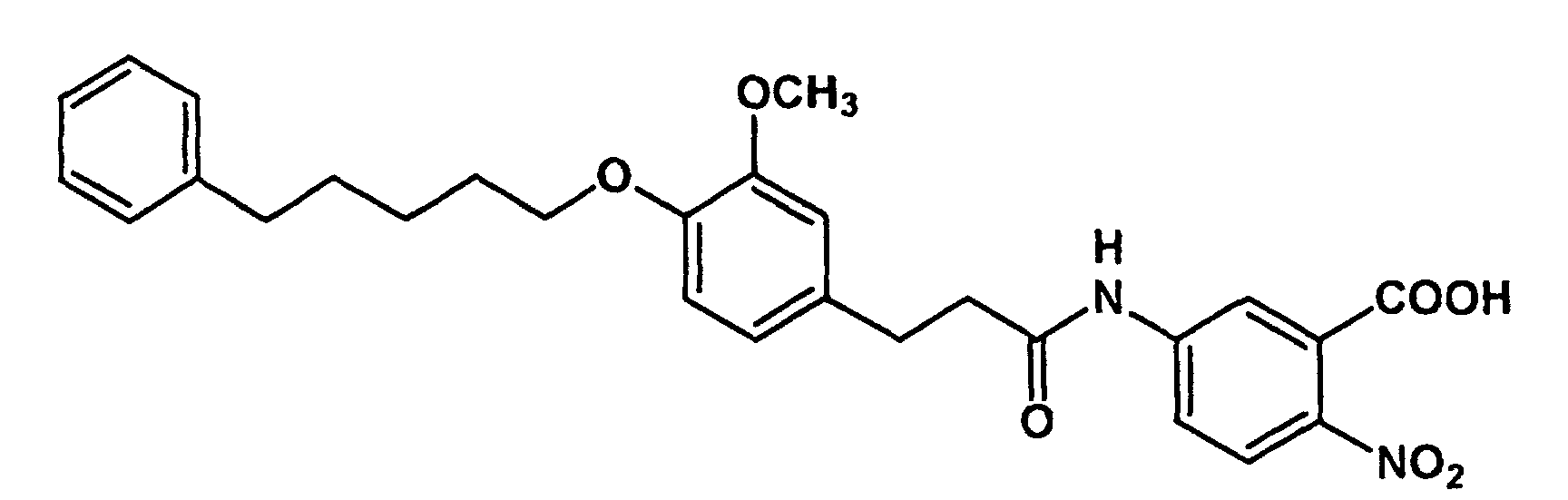
NMR (DMSO-d6) : δ10.56 (s, 1H), 8.03 (d, J = 8.7 Hz, 1H), 7.99 (d, J = 2.4 Hz, 1H), 7.83 (dd, J = 2.4, 8.7 Hz, 1H), 7.30-7.10 (m, 5H), 6.84 (d, J = 1.8 Hz, 1H), 6.83 (d, J = 8. 1 Hz, 1H), 6.71 (dd, J = 1.8, 8.1 Hz, 1H), 3.88 (t, J = 6.6 Hz, 2H), 3.71 (s, 3H), 2.95-2.80 (m, 2H), 2.80-2.50 (m, 4H), 1.80-1.60 (m, 4H), 1.50-1.40 (m, 2H).
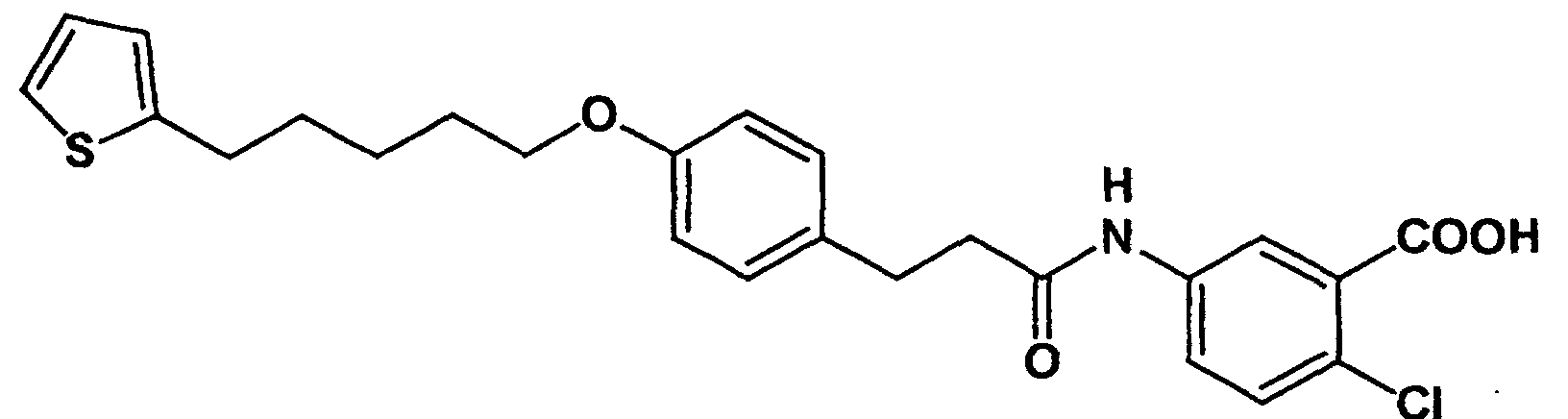
TLC : Rf 0.53(chloroform : methanol : acetic acid = 90 : 10: 1);
NMR (DMSO-d6): δ13.43-13.26 (br, 1H), 10.13 (s, 1H), 8.05 (d, J = 2.4 Hz, 1H), 7.69 (dd, J = 8.7, 3.0 Hz, 1H), 7.43 (d, J = 8.7 Hz, 1H), 7.27 (dd, J = 5.1, 1.5 Hz, 1H), 7.11 (d, J = 8.4 Hz, 2H), 6.90 (dd, J = 5.1, 3.3 Hz, 1H), 6.82-6.78 (m, 3H), 3.88 (t, J = 6.6 Hz, 2H), 2.84-2.76 (m, 4H), 2.56 (t, J = 7.5 Hz, 2H) 1.74-1.59 (m, 4H), 1.47-1.37 (m, 2H).
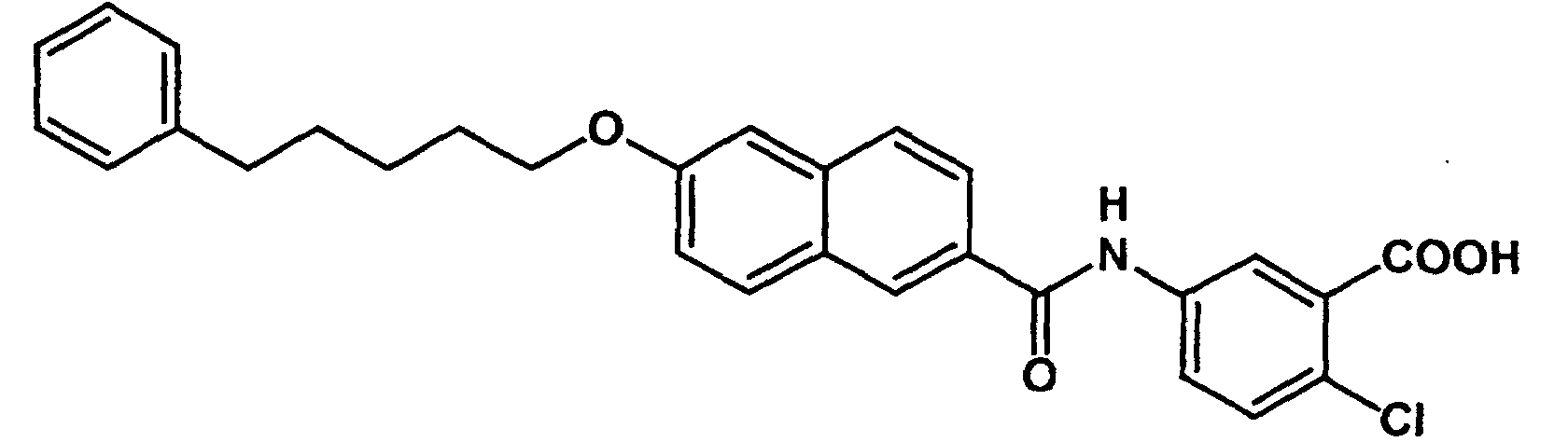
NMR (DMSO-d6): δ10.49 (s, 1H), 8.52 (s, 1H), 8.13-7.83 (m, 5H), 7.40-7.11 (m, 8H), 4.09 (t, J = 6.4 Hz, 2H), 2.60 (t, J = 7.2 Hz, 2H), 1.88-1.42 (m, 6H).
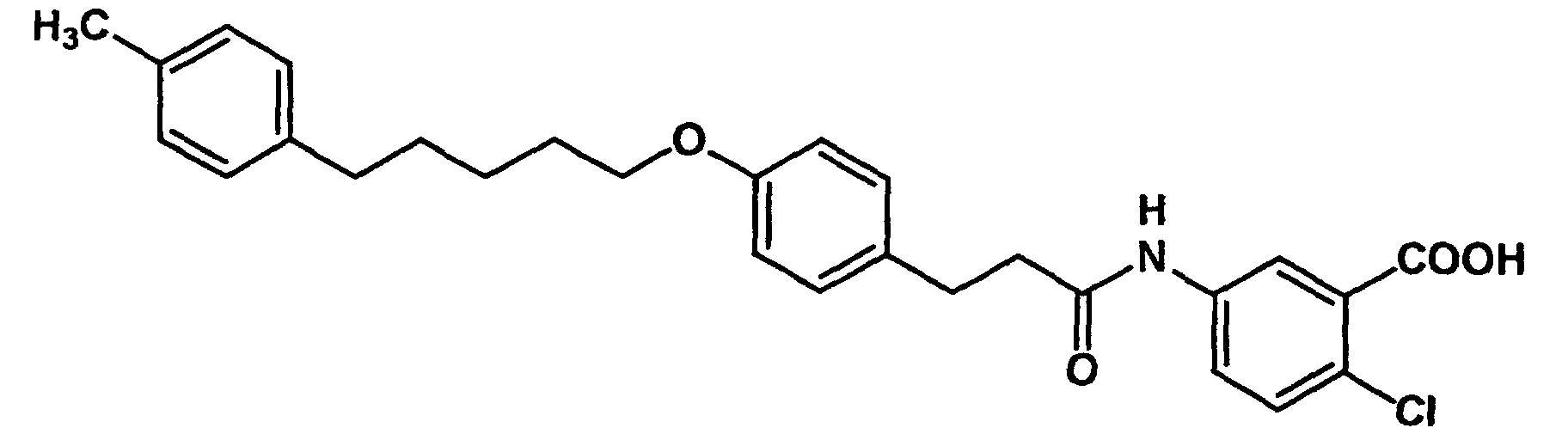
NMR (DMSO-d6) : δ13.36 (brs, 1H), 10.14 (s, 1H), 8.07 (d, J = 2.7 Hz, 1H), 7.70 (dd, J = 2.7, 8.7 Hz, 1H), 7.43 (d, J = 8.7 Hz, 1H), 7.12 (d, J = 8.4 Hz, 2H), 7.06 (s, 4H), 6.81 (d, J = 8.4 Hz, 2H), 3.89 (t, J = 6.6 Hz, 2H), 2.83 (t, J = 7.5 Hz, 2H), 2.60-2.40 (m, 4H), 2.25 (s, 3H), 1.80-1.55 (m, 4H), 1.50-1.35 (m, 2H).

NMR (DMSO-d6) : δ13.36 (s, 1H), 10.08 (s, 1H), 8.06 (d, J = 2.4 Hz, 1H), 7.70 (dd, J = 2.4, 8.7 Hz, 1H), 7.44 (d, J = 8.7 Hz, 1H), 7.30-7.15 (m, 5H), 7.09 (d, J = 8.7 Hz, 2H), 6.70 (d, J = 8.7 Hz, 2H), 3.89 (t, J = 6.3 Hz, 2H), 2.88 (dd. J = 7.5, 12.9 Hz, 1H), 2.75-2.65 (m, 1H), 2.58 (t, J = 7.5 Hz, 2H), 2.55-2.50 (m, 1H), 1.75-1.55 (m, 4H), 1.45-1.35 (m, 2H), 1.07 (d, J = 6.9 Hz, 3H).

NMR (DMSO-d6) : δ13.30 (s, 1H), 10.15 (s, 1H), 8.07 (d, J = 2.7 Hz, 1H), 7.71 (dd, J = 2.7, 8.7 Hz, 1H), 7.43 (d, J = 8.7 Hz, 1H), 7.30-7.15 (m, 5H), 7.13 (d, J = 8.7 Hz, 2H), 6.82 (d, J = 8.7 Hz, 2H), 3.93 (m, 2H), 2.84 (t, J = 7.5 Hz, 2H), 2.65-2.55 (m, 4H), 1.80-1.70 (m, 4H).
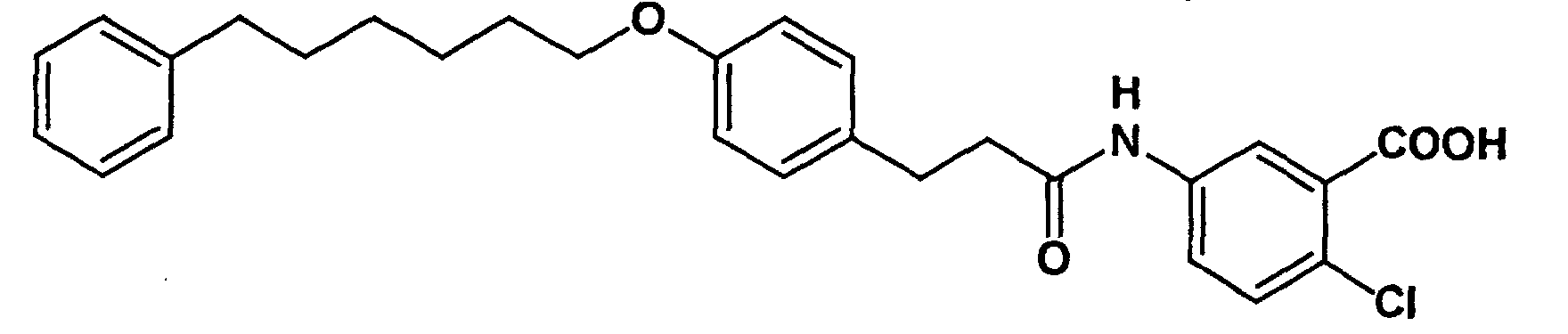
NMR (DMSO-d6) : δ10.30 (s, 1H), 10.12 (s, 1H), 8.05 (d, J = 2.7 Hz, 1H), 7.69 (dd, J = 2.7, 8.7 Hz, 1H), 7.42 (d, J = 8.7 Hz, 1H), 7.30-7.14 (m, 5H), 7.11 (d, J = 8.4 Hz, 2H), 6.79 (d, J = 8.4 Hz, 2H), 3.87 (t, J = 6.6 Hz, 2H), 2.82 (t, J = 6.9 Hz, 2H), 2.60-2.45 (m, 4H), 1.70-1.50 (m, 4H), 1.50-1.20 (m, 4H).
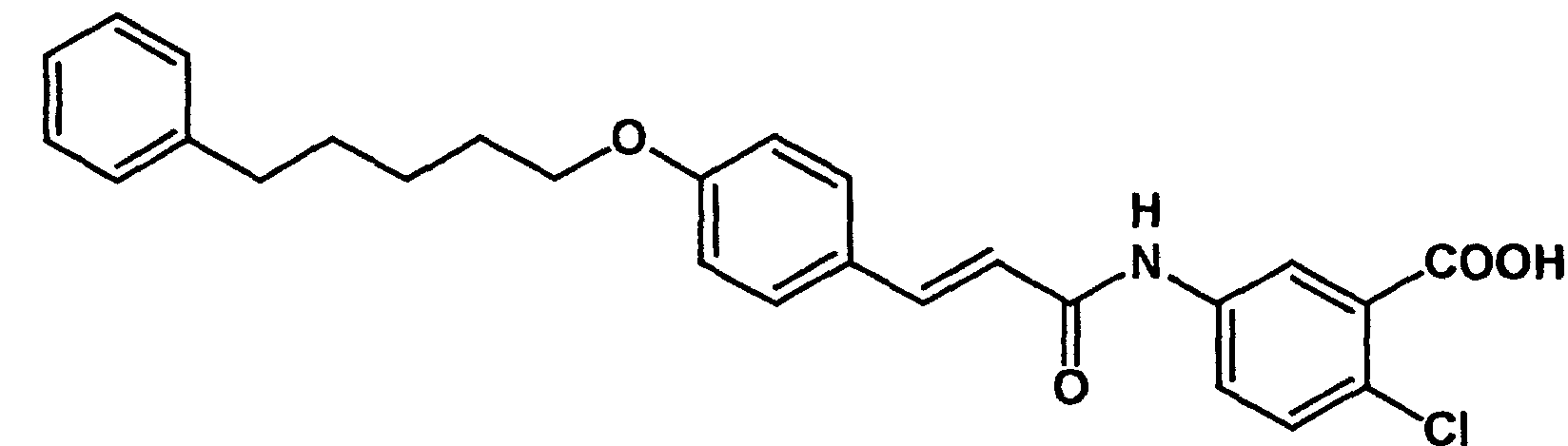
NMR (DMSO-d6): δ13.52-13.21 (br, 1H), 10.37 (s, 1H), 8.15 (d, J = 2.7 Hz, 1H), 7.82 (dd, J = 8.7, 2.7 Hz, 1H), 7.56-7.46 (m, 4H), 7.28-7.12 (m, 5H), 6.96 (d, J = 8.7 Hz, 2H), 6.61 (d, J = 15.9 Hz, 1H), 3.99 (t, J = 6.6 Hz, 2H), 2.58 (t, J = 7.5 Hz, 2H) 1.78-1.56 (m, 4H), 1.45-1.33 (m, 2H).

TLC : Rf 0.30(chloroform : methanol = 9 : 1);
NMR (DMSO-d6) : δ9.55 (s, 1H), 8.80-8.10 (br, 2H), 7.88 (d, J = 2.7 Hz, 1H), 7.40 (dd, J = 9.0, 2.7 Hz, 1H), 7.27-7.09 (m, 7H), 6.79 (d, J = 8.7, 2H), 6.65 (d, J = 9.0 Hz, 1H), 3.88 (t, J = 6.6 Hz, 2H), 2.79 (t, J = 7.5 Hz, 2H), 2.56 (t, J = 7.5 Hz, 2H), 2.49-2.44 (m, 2H), 1.74-1.54 (m, 4H), 1.44-1.34 (m, 2H).
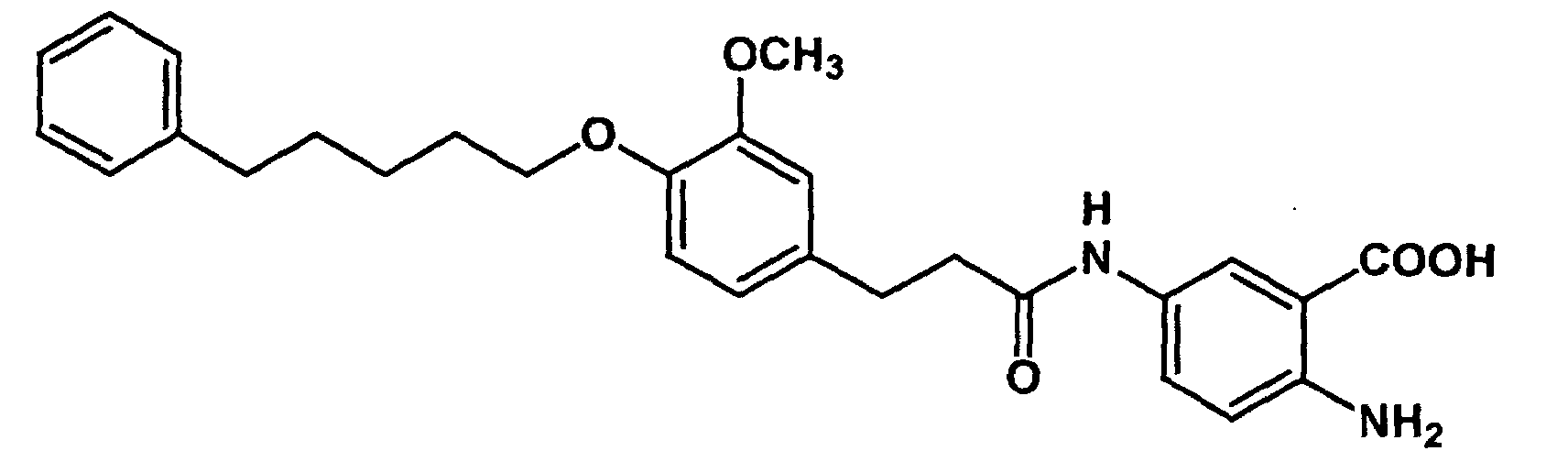
TLC : Rf 0.59(chloroform : methanol = 4 : 1);
NMR (DMSO-d6) : δ9.57 (s, 1H), 8.45 (brs, 2H), 7.90 (d, J = 2.7 Hz, 1H), 7.42 (dd, J = 2.7, 8.7 Hz, 1H), 7.30-7.12 (m, 5H), 6,85-6.80 (m, 2H), 6.75-6.65 (m, 2H), 3.88 (t, J = 6.3 Hz, 2H), 3.71 (s, 3H), 2.81 (t, J = 7.8 Hz, 2H), 2.59 (t, J = 7.8 Hz, 2H), 2.52-2.45 (m, 2H), 1.80-1.60 (m, 4H), 1.50-1.40 (m, 2H).
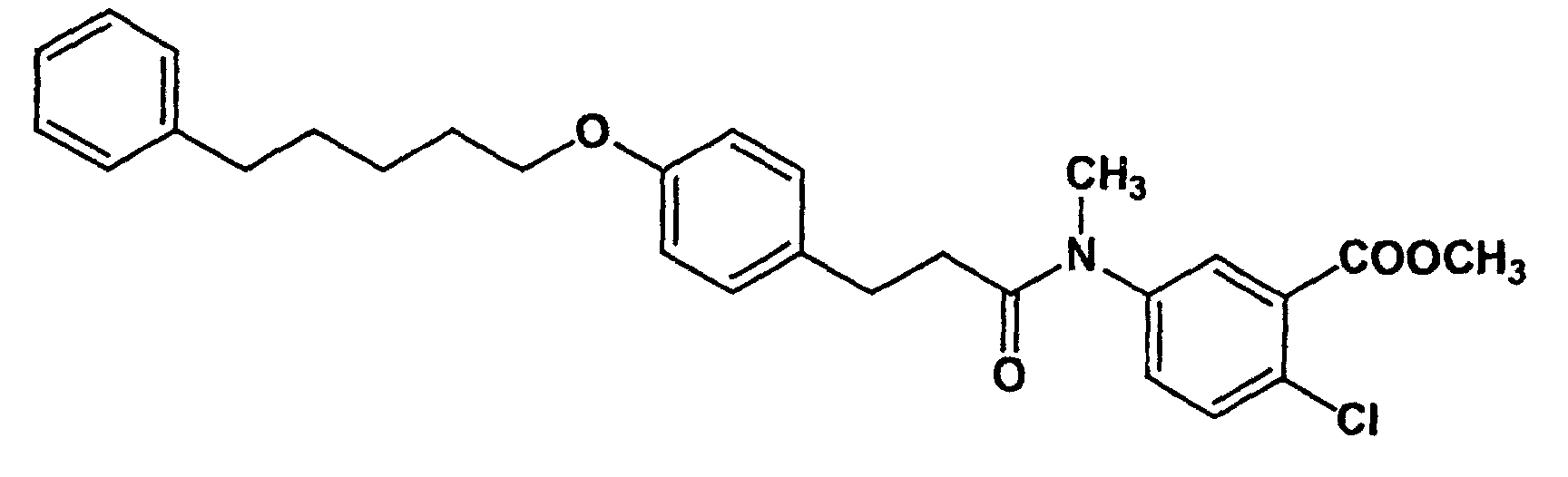

TLC : Rf 0.44(chloroform : methanol = 17 : 3);
NMR (DMSO-d6) : δ13.50 (s, 1H), 7.62 (d, J = 2.7 Hz, 1H), 7.56 (d, J = 8.4 Hz, 1H), 7.39 (dd, J = 2.7, 8.4 Hz, 1H), 7.30-7.12 (m, 5H), 6.98 (brs, 2H), 6.76 (d, J = 8.4 Hz, 2H), 3.89 (t, J = 6.3 Hz, 2H), 3.16 (s, 3H), 2.76-2.65 (m, 2H), 2.59 (t, J = 7.5 Hz, 2H), 2.50-2.20 (m, 2H), 1.80-1.54 (m, 4H), 1.48-1.35 (m, 2H).

TLC : Rf 0.58(chloroform : methanol = 9 : 1);
NMR (DMSO-d6) : δ7.83 (s, 1H), 7.67 (d, J = 3.0 Hz, 1H), 7.61-7.55 (m, 2H), 7.35 (d, J = 8.7 Hz, 1H), 7.27-7.09 (m, 8H), 6.82-6.77 (m, 2H), 3.88 (t, J = 6.6 Hz, 2H), 2.81 (t, J = 7.5 Hz, 2H) 2.56 (t, J = 7.5 Hz, 4H), 1.74-1.55 (m, 4H), 1.44-1.34 (m, 2H).

NMR (DMSO-d6) : δ10.03 (s, 1H), 8.00 (s, 1H), 7.94-7.84 (br, 1H), 7.74 (d, J = 8.8 Hz, 1H), 7.49 (d, J = 7.6 Hz, 1H), 7.36-7.10 (m, 9H), 6.79 (d, J = 8.6 Hz, 2H), 3.88 (t, J = 6.4 Hz, 2H), 2.82 (t, J = 7.6 Hz, 2H), 2.56 (t, J = 7.6 Hz, 4H), 1.76-1.30 (m, 6H).
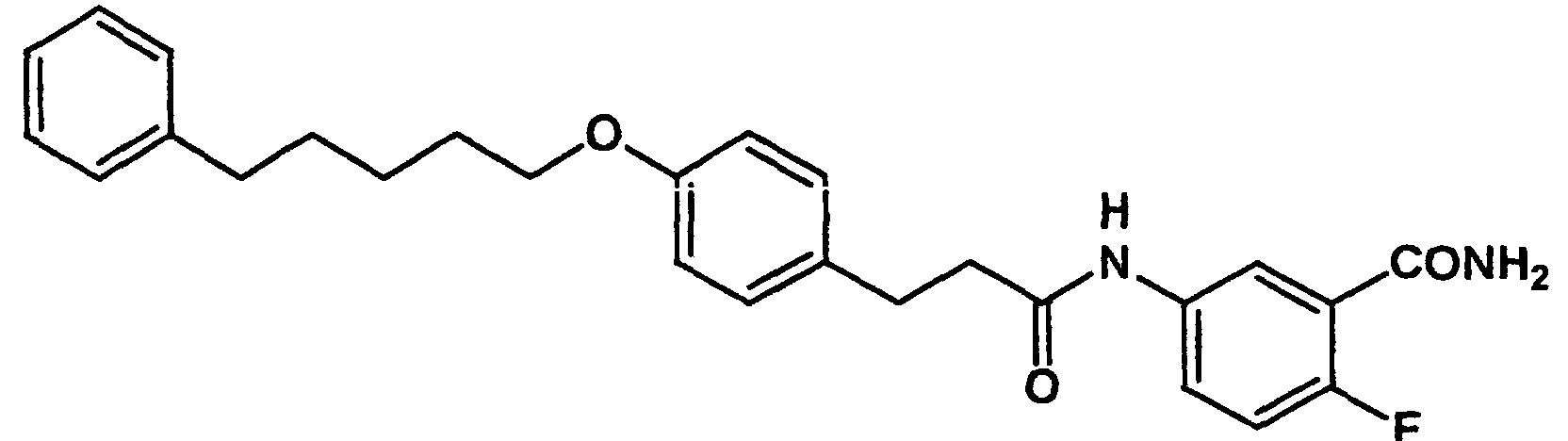
NMR (DMSO-d6) : δ10.02 (s, 1H), 7.84 (dd, J = 6.6, 2.7 Hz, 1H), 7.71-7.66 (m, 1H), 7.62 (bs, 2H), 7.27-7.10 (m, 8H), 6.82-6.77 (m, 2H), 3.88 (t, J = 6.6 Hz, 2H), 2.81 (t, J = 7.5 Hz, 2H) 2.59-2.52 (m, 4H), 1.74-1.54 (m, 4H), 1.44-1.34 (m, 2H).
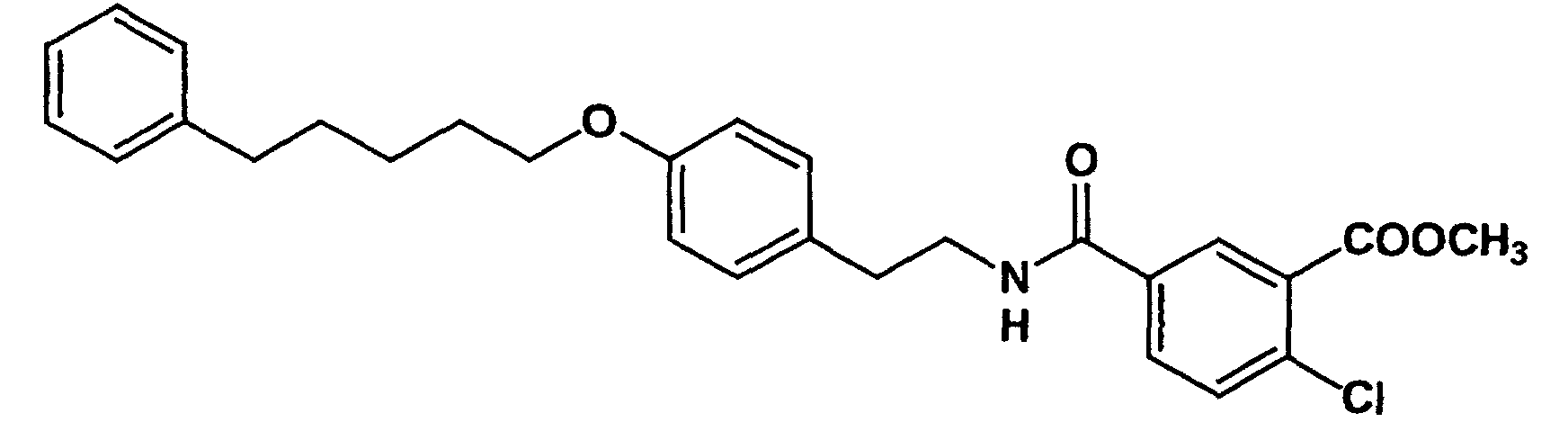
TLC : Rf 0.31 (hexane : ethyl acetate = 2 : 1);
NMR (CDCl3) : δ8.13 (d, J=2.2Hz, 1H), 7.78 (dd, J=8.4, 2.2Hz, 1H), 7.50 (d, J=8.4Hz, 1H), 7.33-7.09 (m, 7H), 6.88-6.81 (m, 2H), 6.21-6.08 (br, 1H), 3.96-3.90 (m, 5H), 3.72-3.62 (m, 2H), 2.87 (t, J=6.8Hz, 2H), 2.64 (t, J=7.2Hz, 2H), 1.88-1.42 (m, 6H).
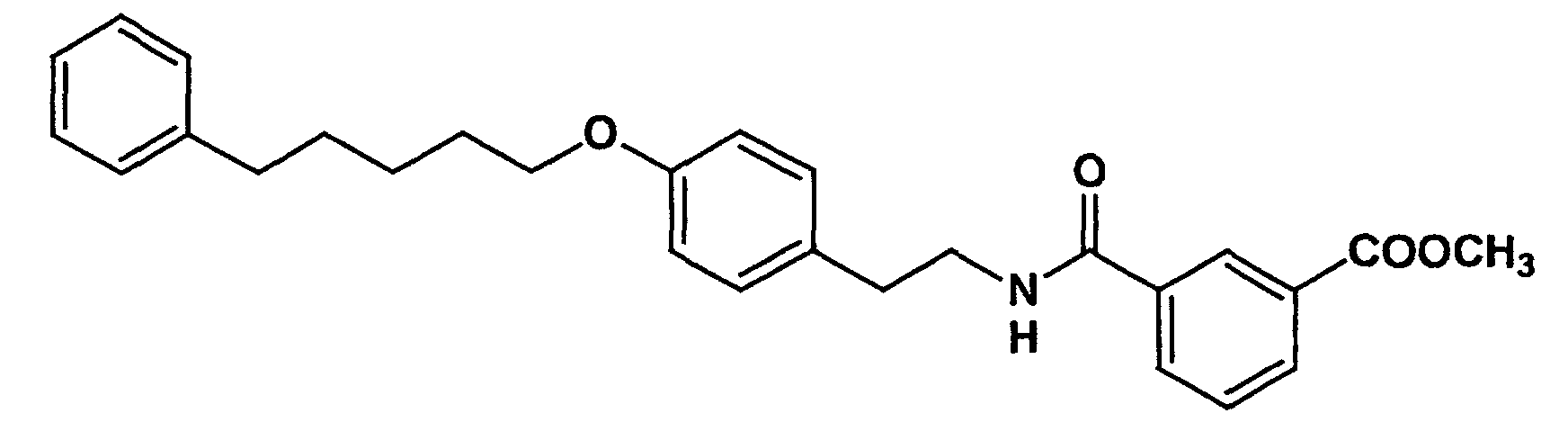

NMR (CDCl3) : δ8.23 (dd, J=6.8, 2.4Hz, 1H), 7.99-7.91 (m, 1H), 7.32-7.10 (m, 8H), 6.85 (d, J=8.6Hz, 2H), 6.24-6.08 (br, 1H), 3.97-3.90 (m, 5H), 3.73-3.63 (m, 2H), 2.87 (t, J=7.0Hz, 2H), 2.64 (t, J=7.6Hz, 2H), 1.88-1.42 (m, 6H).
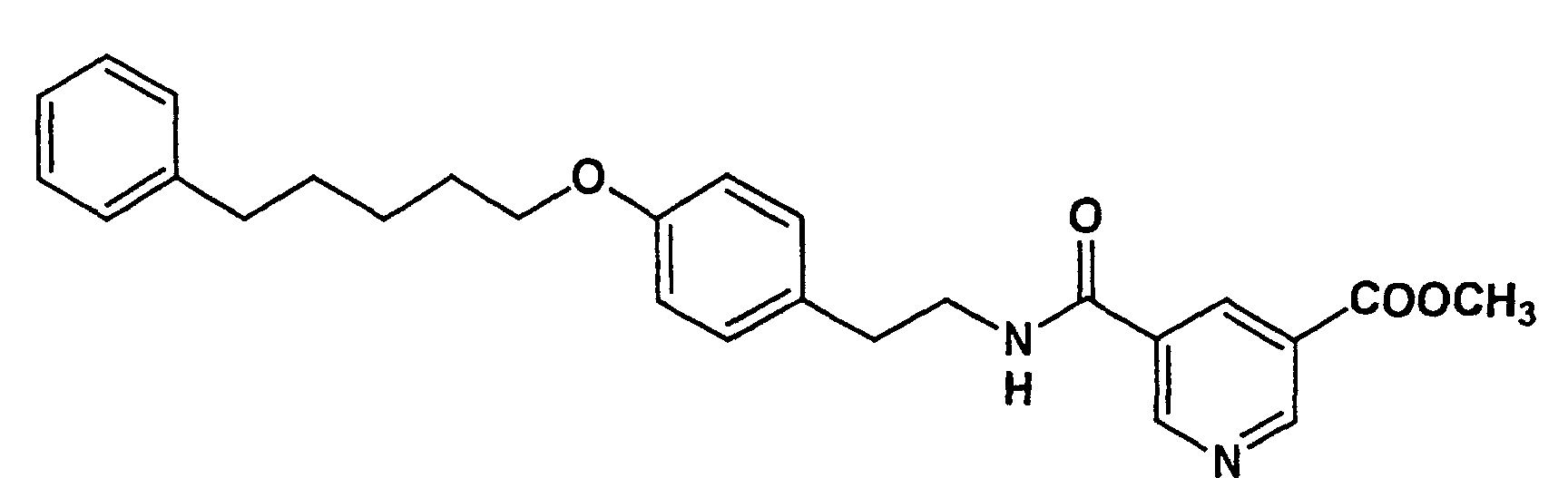
NMR (CDCl3) : δ9.29 (d, J=2.2Hz, 1H), 9.07 (d, J=2.2Hz, 1H), 8.58 (t, J=2.2Hz, 1H), 7.32-7.10 (m, 7H), 6.88-6.81 (m, 2H), 6.32-6.16 (br, 1H), 3.97-3.90 (m, 5H), 3.76-3.67 (m, 2H), 2.89 (t, J=7.0Hz, 2H), 2.64 (t, J=7.4Hz, 2H), 1.88-1.46 (m, 6H).
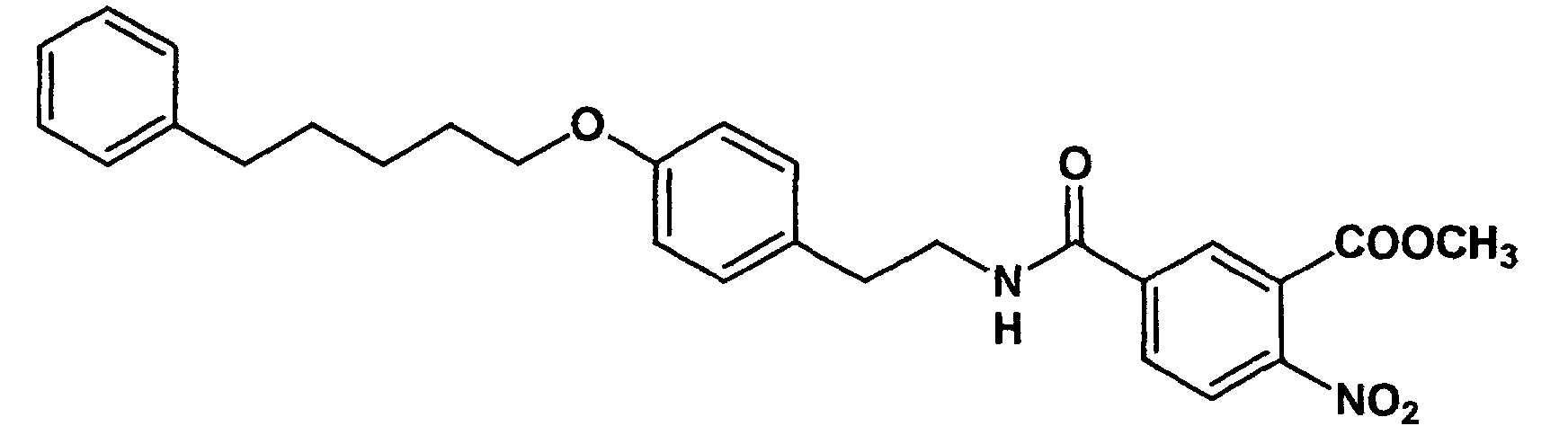
NMR (CDCl3) : δ8.03-7.89 (m, 3H), 7.31-7.10 (m, 7H), 6.88-6.83 (m, 2H), 6.23-6.14 (br, 1H), 3.96-3.91 (m, 5H), 3.73-3.67 (m, 2H), 2.88 (t, J=6.9Hz, 2H), 2.64 (t, J=7.8Hz, 2H), 1.86-1.65 (m, 4H), 1.56-1.45 (m, 2H).
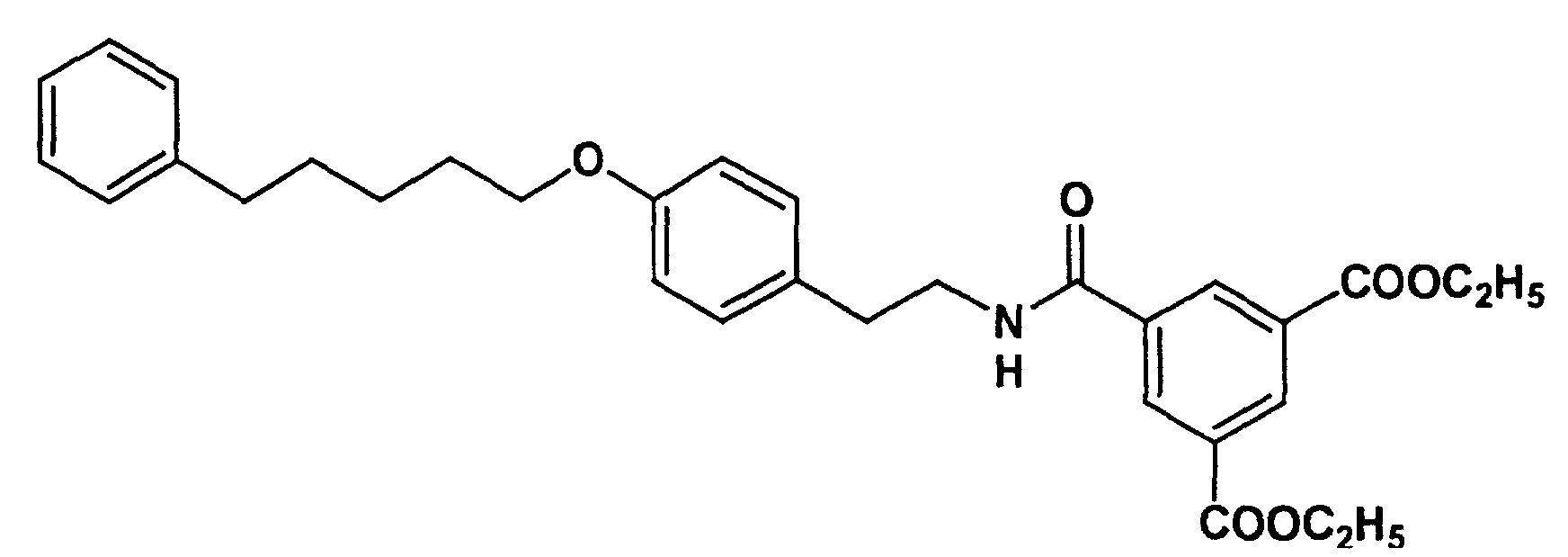
NMR (CDCl3) : δ8.78 (t, J = 1.8 Hz, 1H), 8.54 (d, J = 1.8 Hz, 2H), 7.30-7.15 (m, 5H), 7.14 (d, J = 8.4 Hz, 2H), 6.8 (d, J = 8.4 Hz, 2H), 6.35-6.30 (m, 1H), 4.42 (q, J = 7.2 Hz, 4H), 3.94 (t, J = 6.3 Hz, 2H), 3.70 (q, J = 6.3 Hz, 2H), 2.90 (t, J = 6.9 Hz, 2H), 2.64 (t, J = 7.5 Hz, 2H), 1.85-1.45 (m, 6H), 1.42 (t, J = 7.2 Hz, 6H).
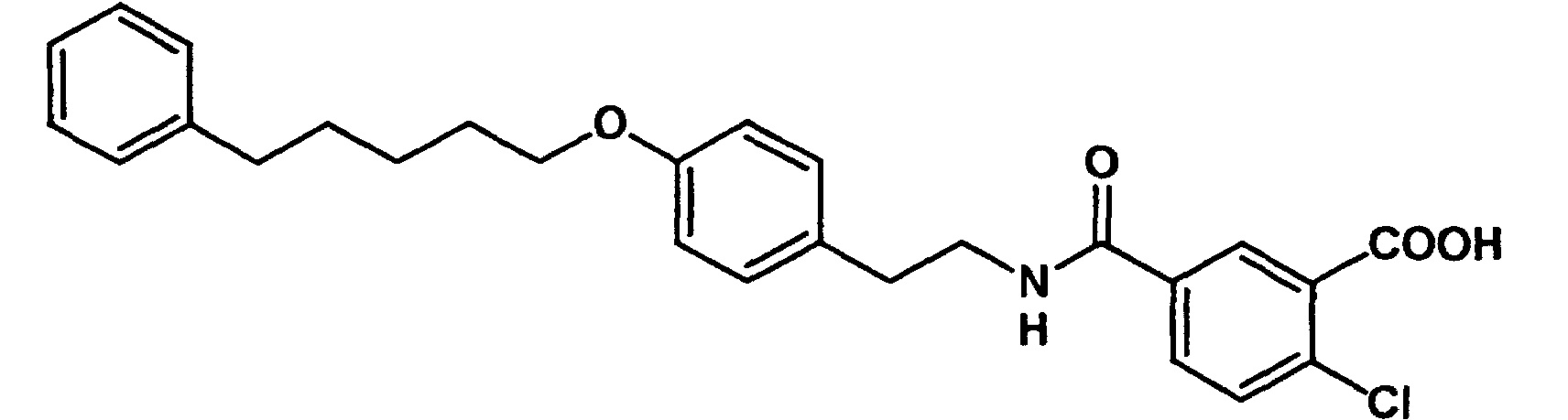
TLC : Rf 0.52(chloroform : methanol : acetic acid = 90 : 10 : 1);
NMR (DMSO-d6): δ8.73 (t, J = 4.8 Hz, 1H), 8.22 (d, J = 2.2 Hz, 1H), 7.92 (dd, J = 8.4, 2.2 Hz, 1H), 7.63 (d, J = 8.4 Hz, 1H), 7.28-7.08 (m, 7H), 6.80 (d, J = 8.6 Hz, 2H), 3.88 (t, J = 6.4 Hz, 2H), 3.47-3.67 (m, 2H), 2.74 (t, J = 7.2 Hz, 2H), 2.56 (t, J = 7.6 Hz, 2H), 1.76-1.32 (m, 6H).

NMR (DMSO-d6) : δ8.80-8.70 (m, 1H), 8.44-8.39 (m, 1H), 8.50 (dt, J = 7.6, 1.8 Hz, 2H), 7.59 (t, J = 7.8Hz, 1H), 7.32-7.10 (m, 5H), 7.13 (d, J = 8.0 Hz, 2H), 6.83 (d, J = 8.0 Hz, 2H),3.91 (t, J = 6.4 Hz, 2H), 3.60-3.40 (m, 2H), 2.90-2.70 (m, 2H), 2.59 (t, J = 7.5 Hz, 2H), 2.80-1.40 (m, 6H).

NMR (DMSO-d6) : δ8.71 (t, J = 5.4 Hz, 1H), 8.34 (dd, J = 7.2, 2.2 Hz, 1H), 8.08-8.01 (m, 1H), 7.38 (dd, J = 10.4, 8.6 Hz, 1H), 7.28-7.08 (m, 7H), 6.80 (d, J = 8.4 Hz, 2H), 3.88 (t, J = 6.4 Hz, 2H), 3.46-3.37 (m, 2H), 2.74 (t, J = 7.4 Hz, 2H), 2.57 (t, J = 7.4 Hz, 2H), 1.76-1.32 (m, 6H).
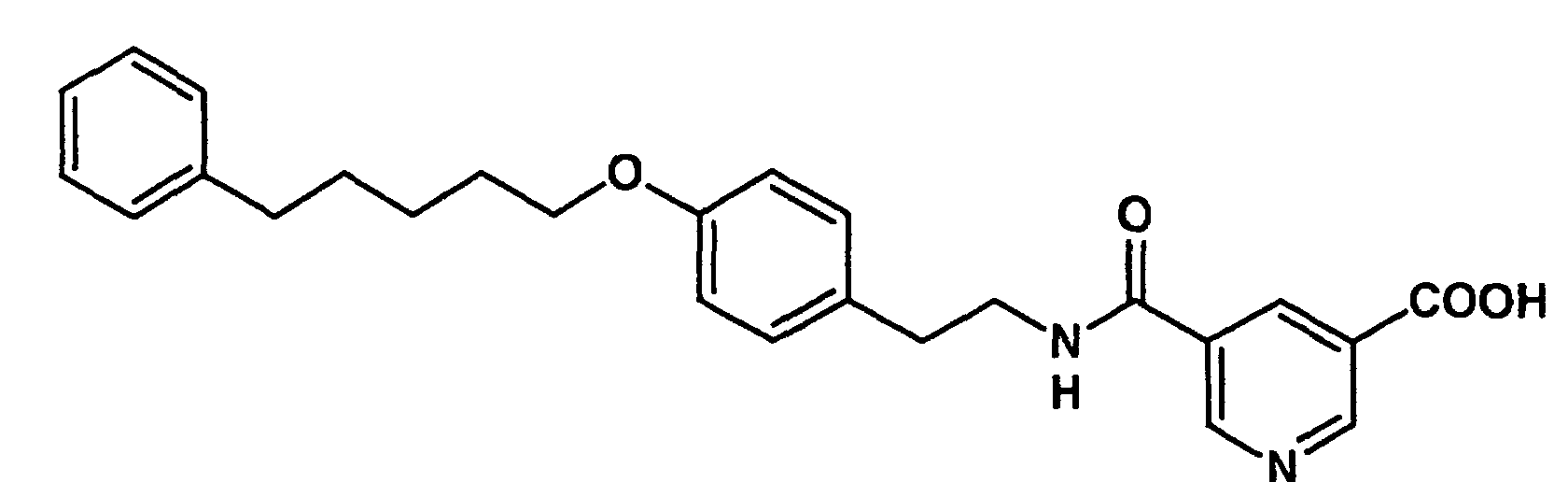
NMR (DMSO-d6) : δ9.14-9.13 (m, 2H), 8.95-8.84 (br, 1H), 8.62 (t, J = 2.0 Hz, 1 H), 7.28-7.10 (m, 7H), 6.81 (d, J = 8.6 Hz, 2H), 3.89 (t, J = 6.4 Hz, 2H), 3.50-3.41 (m, 2H), 2.77 (t, J = 7.4 Hz, 2H), 2.57 (t, J = 7.4 Hz, 2H), 1.77-1.32 (m, 6H).
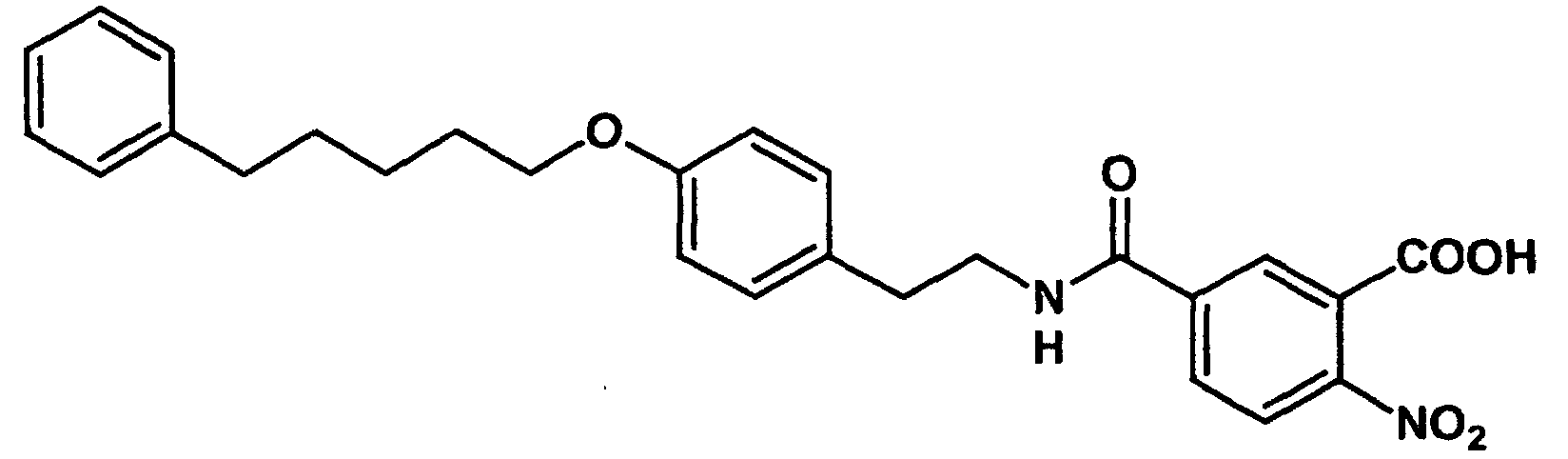
NMR (DMSO-d6) : δ8.91 (t, J = 5.4 Hz, 1H), 8.24 (d, J = 1.8 Hz, 1H), 8.14 (dd, J = 8.4, 1.8 Hz, 1H), 8.04 (d, J = 8.4 Hz, 1H), 7.27-7.09 (m, 7H), 6.83-6.78 (m, 2H), 3.88 (t, J = 6.6 Hz, 2H), 3.48-3.41 (m, 2H), 2.76 (t, J = 7.5 Hz, 2H), 2.57 (t, J = 7.5 Hz, 2H), 1.74-1.55 (m, 4H), 1.44-1.34 (m, 2H).

NMR (DMSO-d6) : δ13.45 (s, 2H), 8.94 (t, J = 5.4 Hz, 1H), 8.62 (d, J = 1.5 Hz, 2H), 8.57 (t, J = 1.5 Hz, 1H), 7.30-7.15 (m, 5H), 7.13 (d, J = 8.7 Hz, 2H), 6.83 (d, J = 8.7 Hz, 2H), 3.91 (t, J = 6.3 Hz, 2H), 3.50-3 .40 (m, 2H), 2.79 (t, J = 7.8 Hz, 2H), 2.59 (t, J = 7.8 Hz, 2H), 1.80-1.55 (m, 4H), 1.50-1.35 (m, 2H).

TLC : Rf 0.30(chloroform : methanol : acetic acid = 90 : 10 : 1);
NMR (DMSO-d6) : δ13.22-12.92 (br, 1H), 9.23 (t, J = 6.0 Hz, 1H), 8.27-8.14 (m, 3H), 7.28-7.11 (m, 7H), 6.81 (d, J = 8.4 Hz, 2H), 3.89 (t, J = 6.4 Hz, 2H), 3.56-3.46 (m, 2H), 2.79 (t, J = 7.2 Hz, 2H), 2.57 (t, J = 7.2 Hz, 2H), 1.77-1.31 (m, 6H).

NMR (DMSO-d6) : δ8.57 (t, J = 5.1 Hz, 1H), 7.92 (dd, J = 8.4, 2.1 Hz, 1H), 7.82 (d, J = 2.1 Hz, 1H), 7.59 (d, J = 8.4 Hz, 1H), 7.27-7.12 (m, 7H), 6.82 (d, J = 8.7 Hz, 2H), 3.90 (t, J = 6.6 Hz, 2H), 3.44-3.37 (m, 2H), 2.74 (t, J = 7.5 Hz, 2H), 2.57 (t, J = 7.5 Hz, 2H), 1.75-1.55 (m, 4H), 1.45-1.35 (m, 2H).
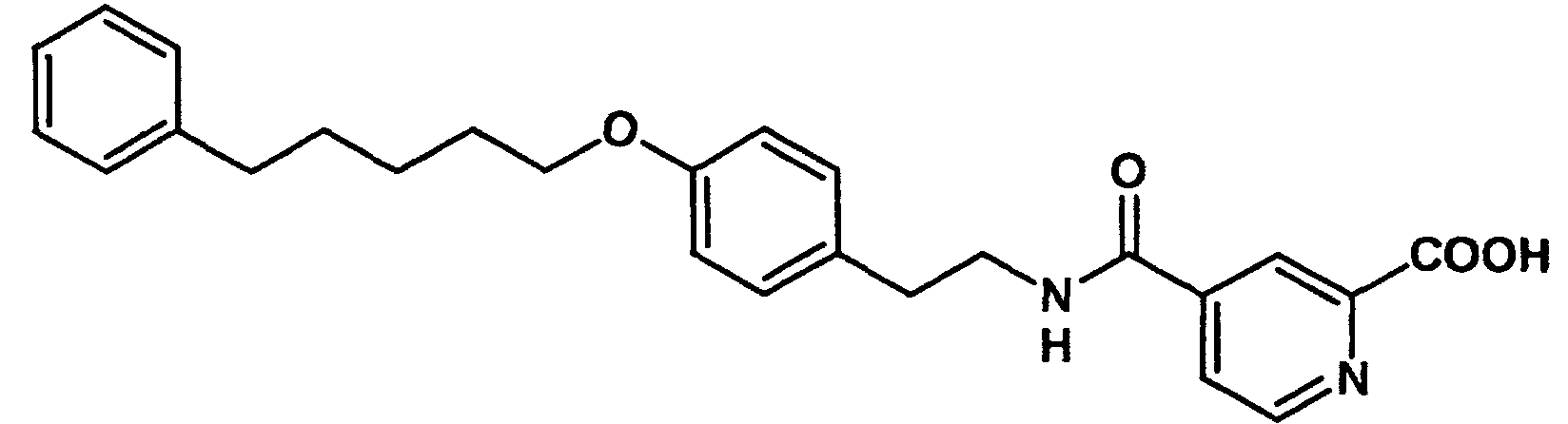
NMR (DMSO-d6) : δ8.99 (t, J = 5.4 Hz, 1H), 8.81 (d, J = 4.8 Hz, 1H), 8.38 (s, 1H), 7.92 (dd, J = 4.8 Hz, 1.8 Hz, 1H), 7.27-7.10 (m, 7H), 6.81 (d, J = 8.4 Hz, 2H), 3.88 (t, J = 6.6 Hz, 2H), 3.48-3.41 (m, 2H) 2.76 (t, J = 7.8 Hz, 2H), 2.56 (t, J = 7.8 Hz, 2H), 1.74-1.54 (m, 4H), 1.44-1.34 (m, 2H).
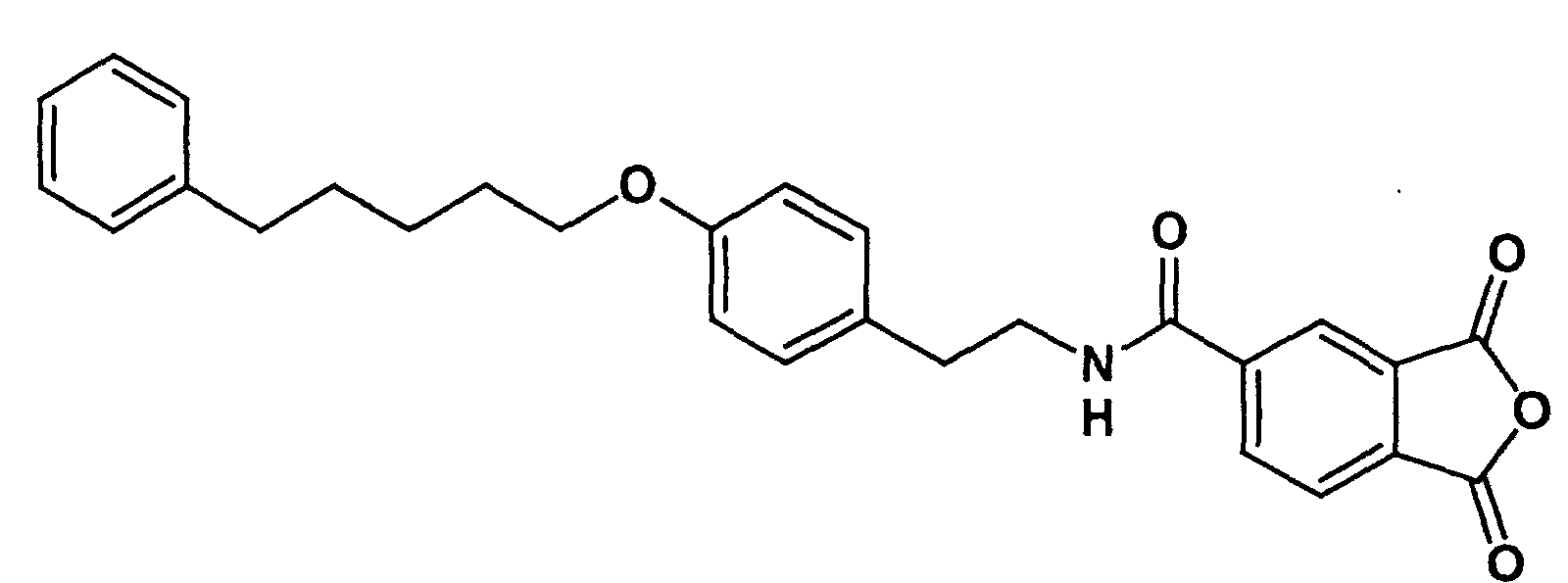
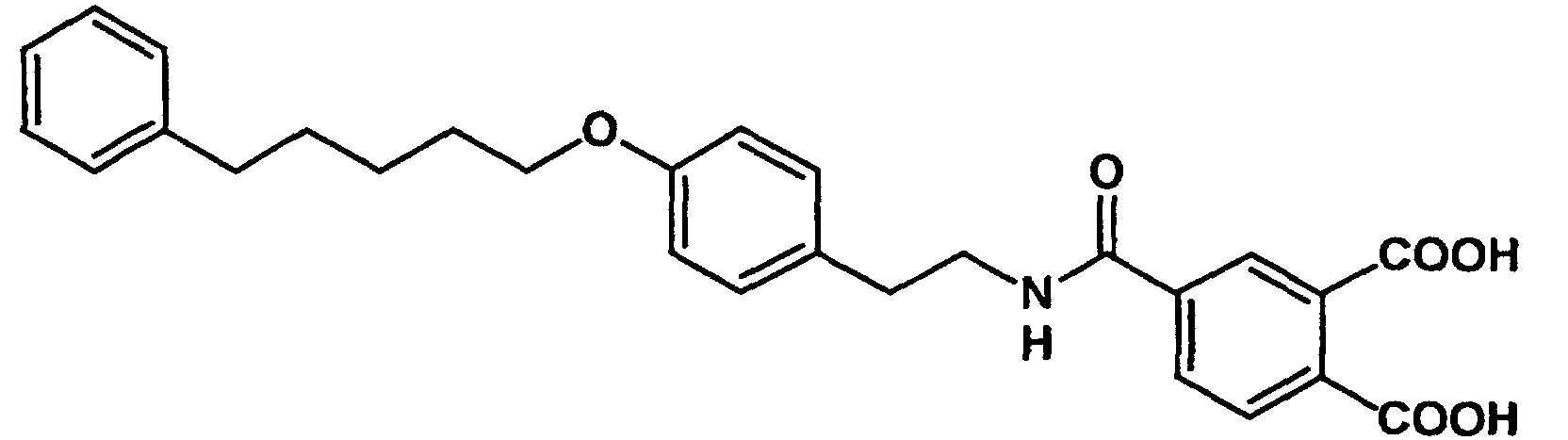
TLC : Rf 0.30(chloroform : methanol : acetic acid = 9 : 1 : 1);
NMR (DMSO-d6) : δ8.77 (t, J = 6.0 Hz, 1H), 8.11 (d, J = 1.8 Hz, 1H), 7.98 (dd, J = 8.1, 1.8 Hz, 1H), 7.71 (d, J = 8.1 Hz, 1H), 7.27-7.09 (m, 7H), 6.83-6.78 (m, 2H), 3.88 (t, J = 6.6 Hz, 2H), 3.46-3.39 (m, 2H), 2.75 (t, J = 7.5 Hz, 2H), 2.57 (t, J = 7.5 Hz, 2H), 1.74-1.55 (m, 4H), 1.44-1.34 (m, 2H).
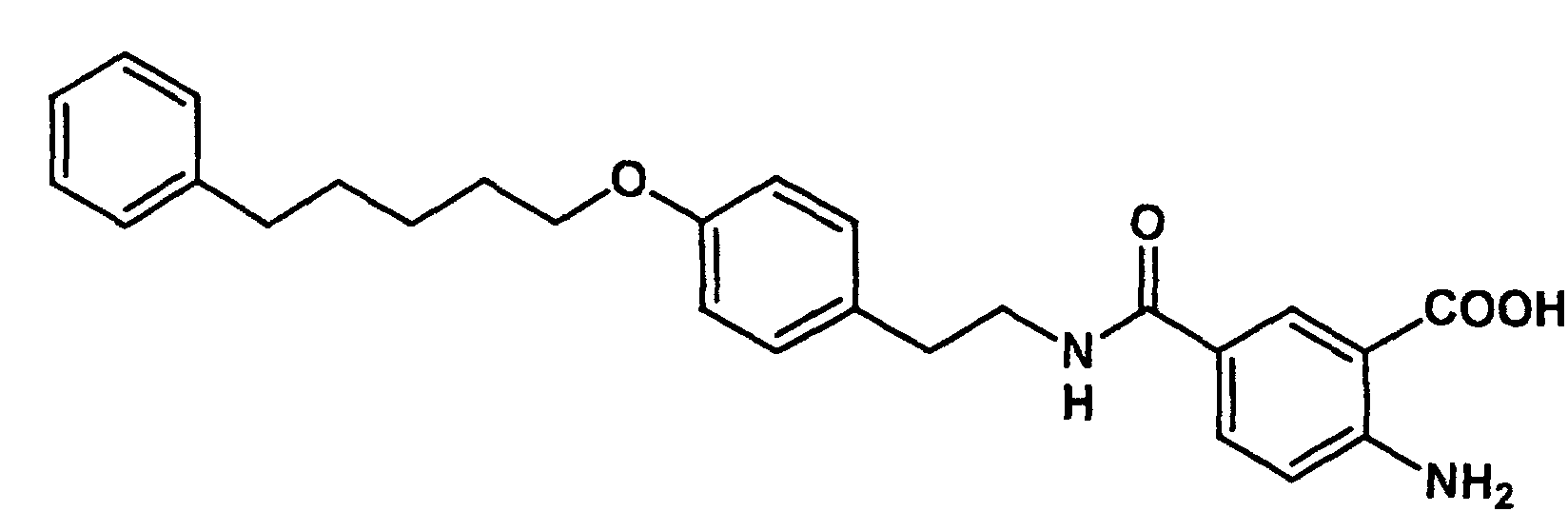
TLC : Rf 0.48(chloroform : methanol = 9 : 1);
NMR (DMSO-d6) : δ8.26-8.22 (m, 2H), 7.69 (dd, J = 8.7, 2.1 Hz, 1H), 7.27-7.08 (m, 7H), 6.80 (d, J = 8.4 Hz, 2H), 6.72 (d, J = 8.7 Hz, 1H), 3.88 (t, J = 6.6 Hz, 2H), 3.39-3.32 (m, 2H), 2.71 (t, J = 7.5 Hz, 2H), 2.57 (t, J = 7.5 Hz, 2H), 1.74-1.55 (m, 4H), 1.44-1.34 (m, 2H).

TLC : Rf 0.27(hexane : ethyl acetate = 3 : 1);
NMR (CDCl3) : δ7.73 (d, J = 8.4 Hz, 1H), 7.30-7.06 (m, 7H), 6.84-6.81 (m, 2H), 6.55-6.50 (m, 2H), 4.14 (t, J = 5.4 Hz, 1H), 3.93 (t, J = 6.6 Hz, 2H), 3.90 (s, 3H), 3.83 (s, 3H), 3.20-3.13 (m, 2H), 2.68-2.62 (m, 4H), 1.96-1.64 (m, 6H), 1.54-1.45 (m, 2H).

TLC : Rf 0.45(chloroform : methanol : acetic acid = 9 : 1 : 1);
NMR (DMSO-d6): δ12.70-12.10 (br, 2H), 7.57 (d, J = 8.7 Hz, 1H), 7.28-7.06 (m, 7H), 6.82-6.78 (m, 2H), 6.55-6.52 (m, 3H), 3.89 (t, J = 6.6 Hz, 2H), 3.06-2.98 (br, 2H), 2.57 (t, J = 7.5 Hz, 4H), 1.82-1.55 (m, 6H), 1.45-1.34 (m, 2H).
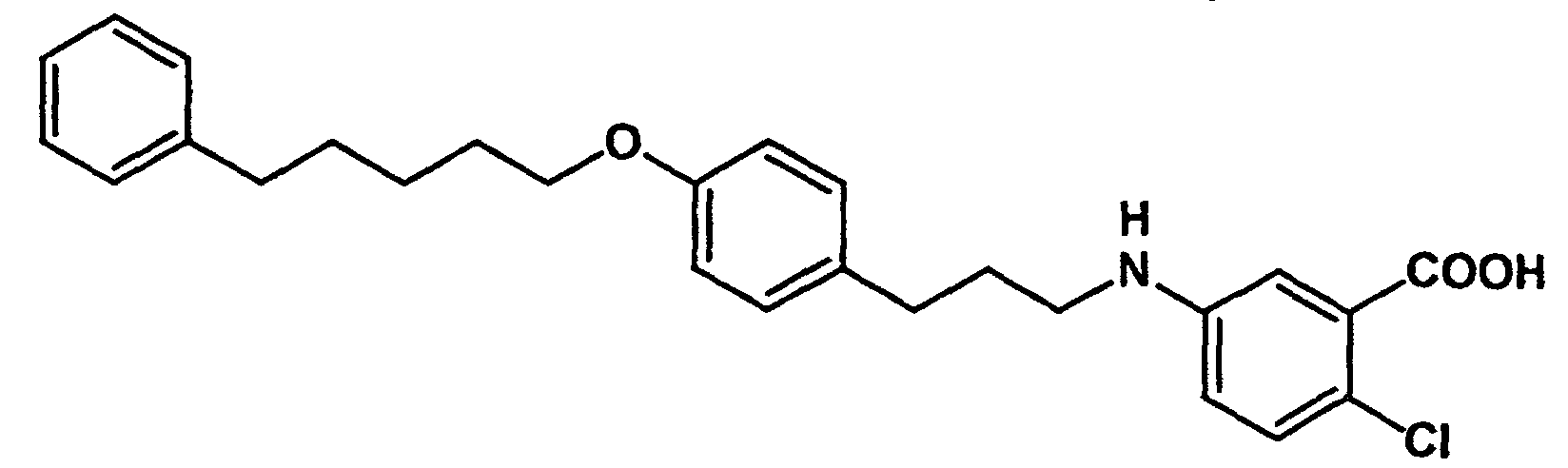
TLC : Rf 0.26(chloroform : methanol = 9 : 1 );
NMR (DMSO-d6) : δ7.27-7.04 (m, 8H), 6.83-6.78 (m, 3H), 6.53 (dd, J = 8.7, 3.0 Hz, 1H), 6.00-5.75 (br, 1H), 3.88 (t, J = 6.6 Hz, 2H), 2.93 (t, J = 7.2 Hz, 2H), 2.57 (t, J = 7.5 Hz, 4H), 1.81-1.55 (m, 6H), 1.44-1.34 (m, 2H).
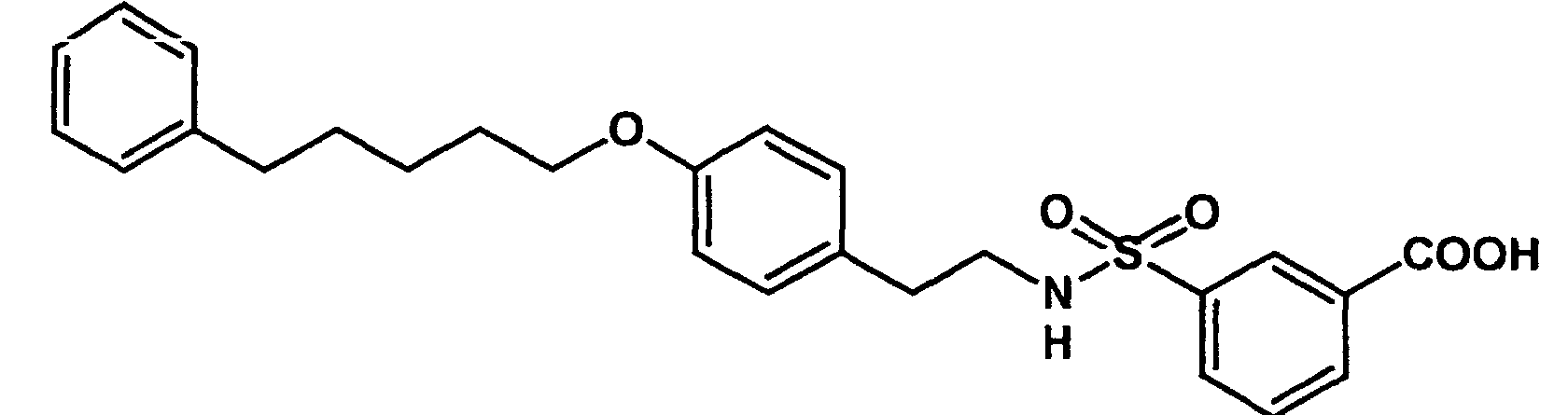
TLC : Rf 0.51(chloroform : methanol = 9 : 1);
NMR (DMSO-d6) : δ13.45 (s, 1H), 8.30 (t, J= 1.8 Hz, 1H), 8.17-8.13 (m, 1H), 8.00-7.95 (m, 1H), 7.83 (t, J = 5.7 Hz, 1H), 7.70 (t, J = 7.8 Hz, 1H), 7.30-7.12 (m, 5H), 7.02 (d, J = 8.4 Hz, 2H), 6.76 (d, J = 8.4 Hz, 2H), 3.89 (t, J = 6.3 Hz, 2H), 3.00-2.90 (m, 2H), 2.59 (t, J = 7.5 Hz, 4H), 1.80-1.75 (m, 4H), 1.70-1.35 (m, 2H).
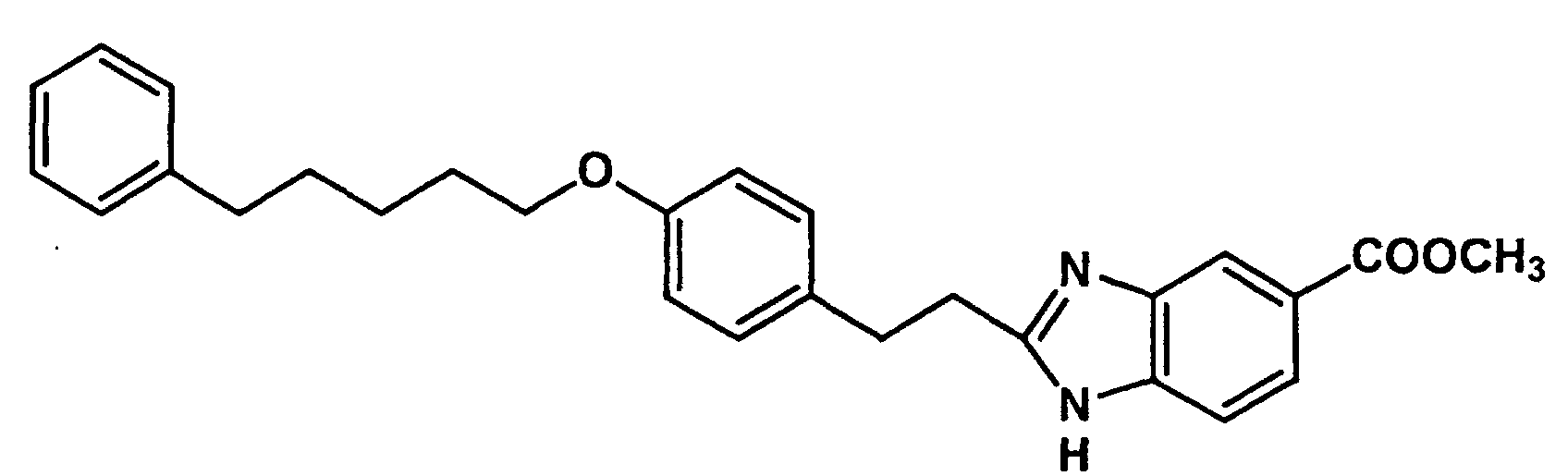
NMR (CDCl3) : δ8.24 (m, 1H), 7.95 (dd, J = 1.6, 8.6 Hz, 1H), 7.53 (d, J = 8.6 Hz, 1H), 7.30-7.15 (m, 5H), 7.09 (d, J = 8.6 Hz, 2H), 6.80 (d, J = 8.6 Hz, 2H), 3.93 (s, 3H), 3.92 (t, J = 6.6 Hz, 2H), 3.30-3.10 (m, 4H), 2.65 (t, J = 7.6 Hz, 2H), 1.90-1.59 (m, 6H).
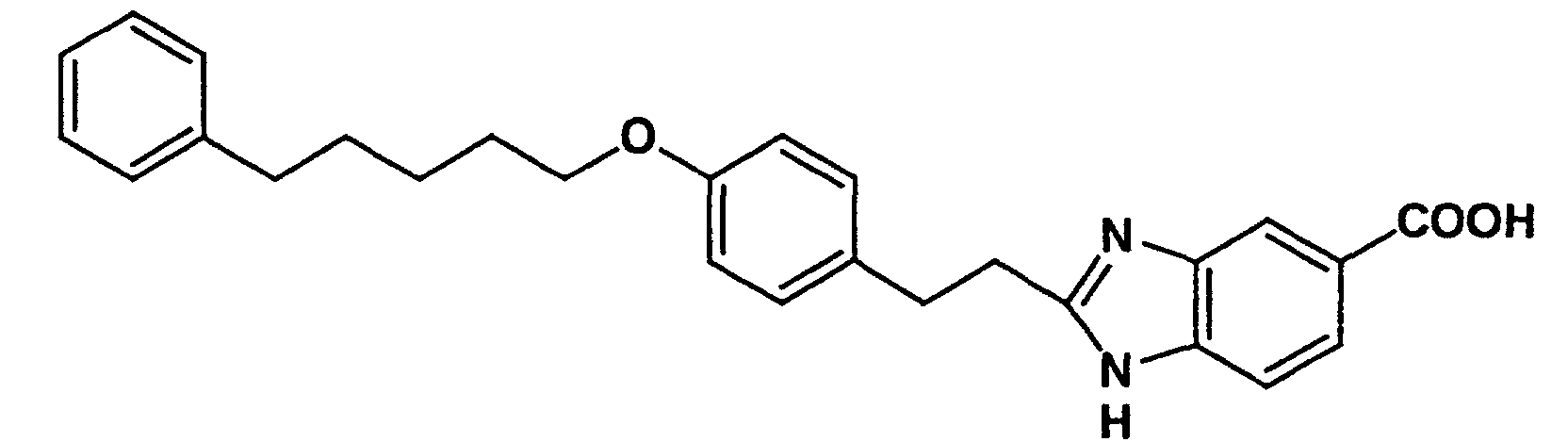
TLC : Rf 0.49(chloroform : methanol = 8 : 1);
NMR (DMSO-d6) : δ8.22 (s, 1H), 8.00 (d, J = 9.0 Hz, 1H), 7.78 (d, J = 9.0 Hz, 1H), 7.30-7.10 (m, 7H), 6.82 (d, J = 7.8 Hz, 2H), 3.89 (t, J = 6.6 Hz, 2H), 3,35-3.30 (m, 2H), 3.15-3.05 (m, 2H), 2.65-2.55 (m, 2H), 1.80-1.55 (m, 4H), 1.50-1.35 (m, 2H).

TLC : Rf 0.62(hexane : ethyl acetate = 2 : 1);
NMR (DMSO-d6): 10.00 (s, 1H), 7.73 (d, J = 2.7 Hz, 1H), 7.59 (dd, J = 2.7, 9.0 Hz, 1H), 7.30-7.15 (m, 6H), 7.13 (d, J = 8.7 Hz, 2H), 6.80 (d, J = 8.7 Hz, 2H), 5.40 (t, J = 5.7 Hz, 1H), 4.51 (d, J = 5.7 Hz, 2H), 3.89 (t, J = 6.6 Hz, 2H), 2.83 (t, J = 6.6 Hz, 2H), 2.65-2.50 (m, 4H), 1.80-1.55 (m, 4H), 1.50-1.30 (m, 2H).
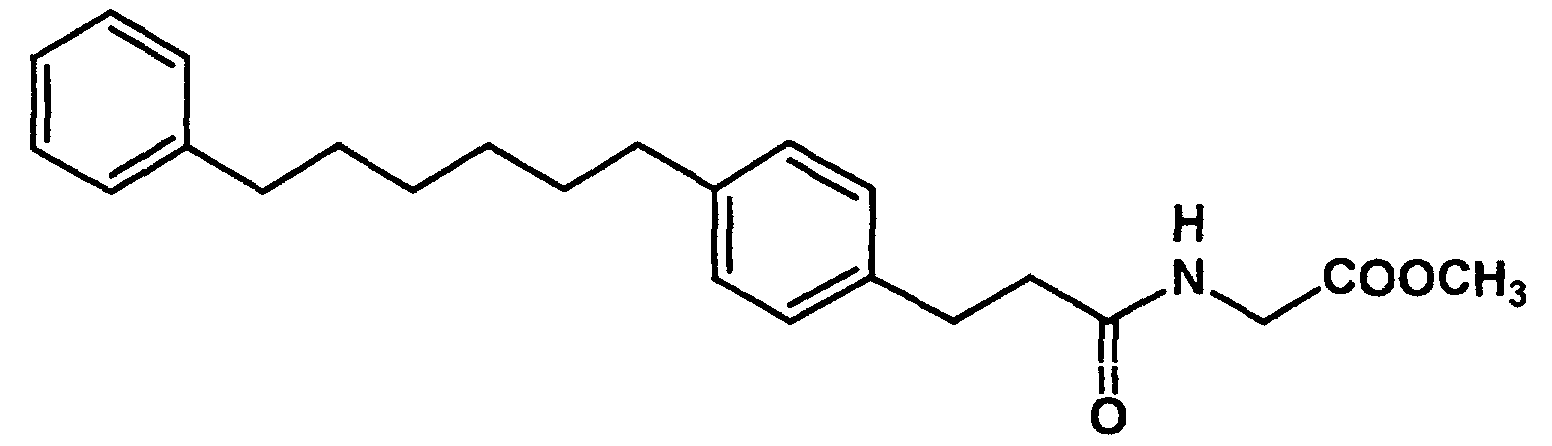
TLC : Rf 0.33(hexane : ethyl acetate = 1 : 1);
NMR (CDCl3) : δ7.31-7.05 (m, 9H), 5.95-5.84 (br, 1H), 4.03 (d, J = 5.2 Hz, 2H), 3.75 (s, 3H), 2.98-2.90 (m, 2H), 2.63-2.50 (m, 6H), 1.69-1.59 (br, 4H), 1.44-1.26 (m, 4H).
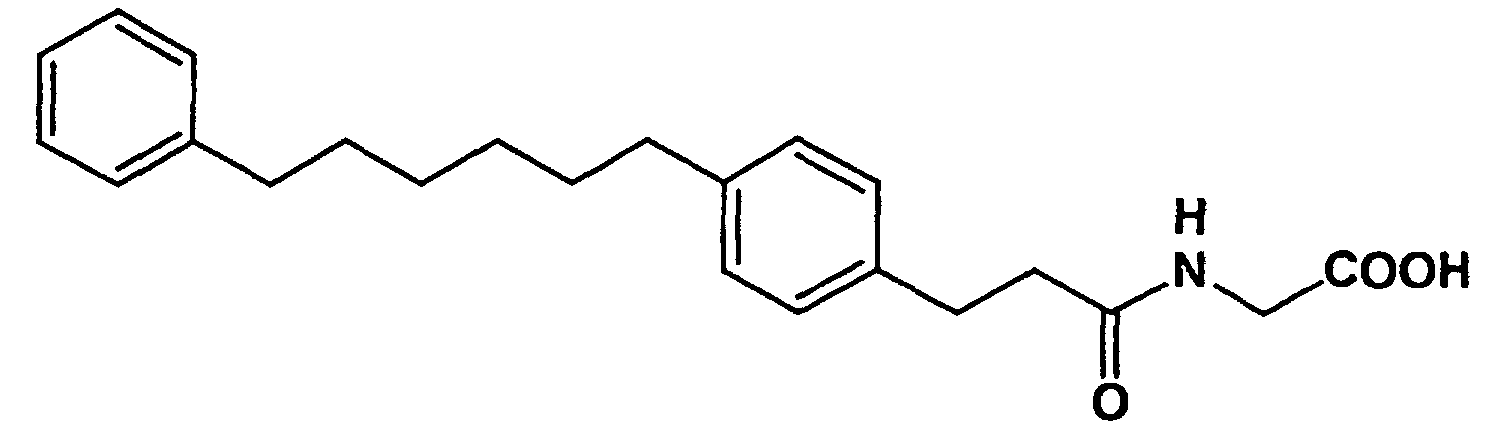
TLC : Rf 0.10(chloroform : methanol = 9 : 1);
NMR (CDCl3) : δ7.31-7.05 (m, 9H), 6.17-6.07 (br, 1H), 4.03 (d, J = 5.0 Hz, 2H), 2.93 (t, J = 7.8 Hz, 2H), 2.62-2.51 (m, 6H), 1.70-1.49 (br, 4H) 1.44-1.26 (m, 4H).

NMR (CDCl3) : δ7.31-7.07 (m, 9H), 6.02 (t, J = 5.8 Hz, 1H), 3.52-3.43 (m, 2H), 2.91 (t, J = 7.8 Hz, 2H), 2.62-2.41 (m, 8H), 1.68-1.51 (m, 4H) 1.38-1.26 (m, 4H).
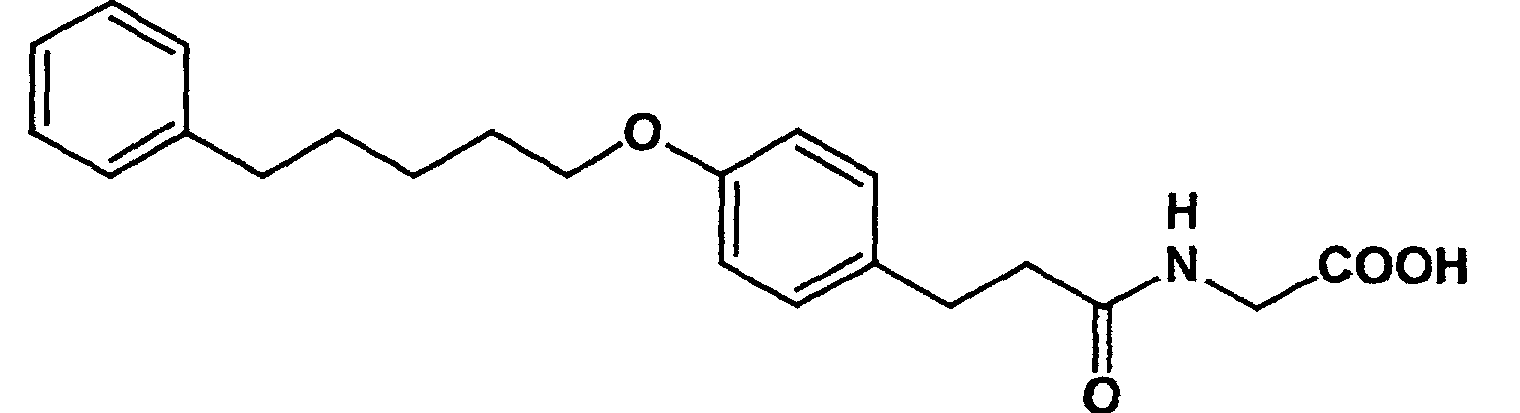
NMR (CDCl3) : δ7.32-7.05 (m, 7H), 6.83-6.76 (m, 2H), 6.14 (t, J = 5.4 Hz, 1H), 4.02 (d, J = 5.4 Hz, 2H), 3.91 (t, J = 6.6 Hz, 2H), 2.90 (t, J = 7.6 Hz, 2H), 2.67-2.49 (m, 4H), 1.86-1.40 (m, 6H).
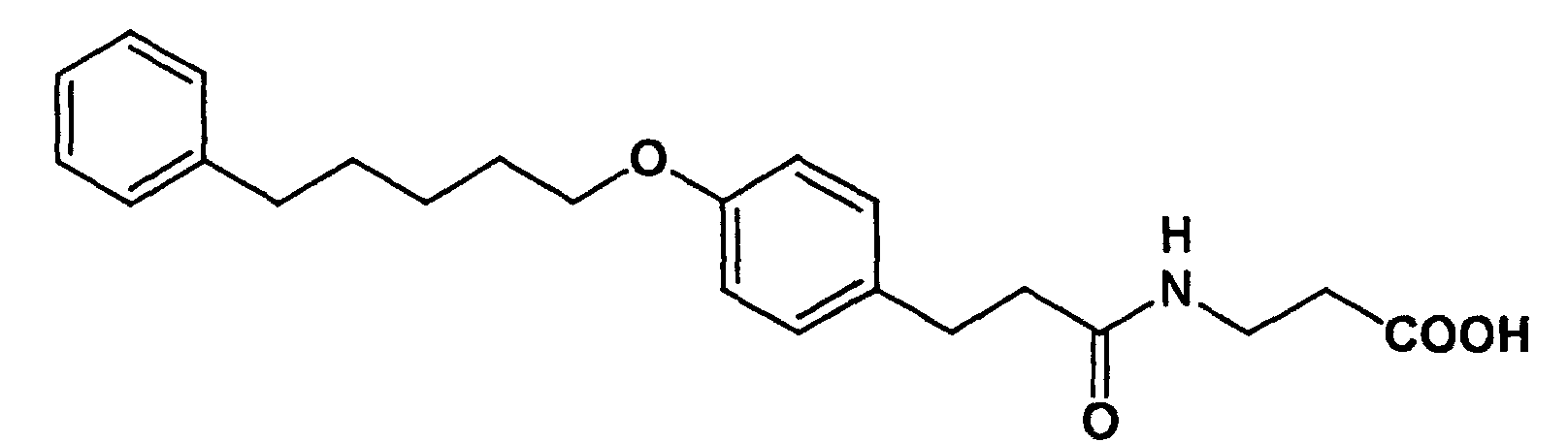
NMR (CDCl3) : δ7.32-7.03 (m, 7H), 6.82-6.75 (m, 2H), 6.03 (t, J = 5.8 Hz, 1H), 3.91 (t, J = 6.6 Hz, 2H), 3.51-3.42 (m, 2H), 2.88 (t, J = 7.6 Hz, 2H), 2.64 (t, J = 7.6 Hz, 2H), 2.54-2.39 (m, 4H), 1.86-1.40 (m, 6H).
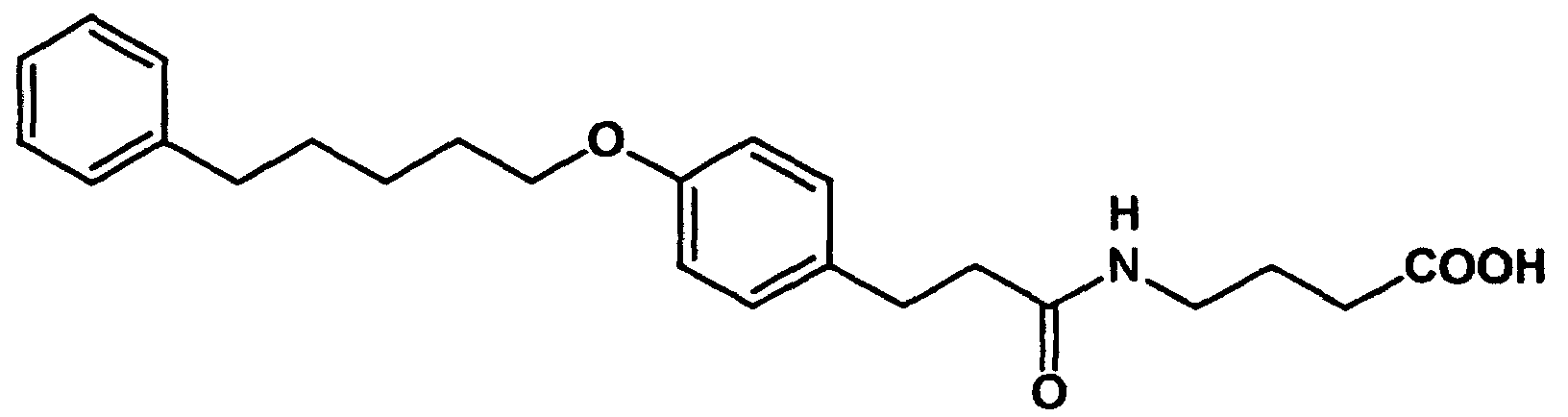
NMR (CDCl3) : δ7.32-7.05 (m, 7H), 6.83-6.76 (m, 2H), 5.66 (t, J = 5.2 Hz, 1H), 3.91 (t, J = 6.6 Hz, 2H), 3.31-3.22 (m, 2H), 2.88 (t, J = 7.6 Hz, 2H), 2.64 (t, J = 7.6 Hz, 2H), 2.43 (t, J = 7.6 Hz, 2H), 2.29 (t, J = 7.0 Hz, 2H), 1.86-1.41 (m, 8H).

NMR (CDCl3) : δ7.30-6.98 (m, 9H), 5.66 (t, J = 5.2 Hz, 1H) 3.31-3.22 (m, 2H), 2.91 (t, J = 7.6 Hz, 2H), 2.62-2.42 (m, 6H), 2.28 (t, J = 7.0 Hz, 2H), 1.81-1.51 (m, 6H), 1.42-1.26 (m, 4H).

NMR (CDCl3) : δ7.31-7.10 (m, 7H), 6.81 (d, J = 8.8 Hz, 2H), 4.14-3.89 (m, 4H), 3.02-2.87 (m, 5H), 2.69-2.49 (m, 4H), 1.87-1.42 (m, 6H).

NMR (DMSO-d6) : δ8.75-8.64 (m, 1H), 8.41-8.33 and 8.13-8.05 (m, 1H), 7.83-7.77 and 7.61-7.55 (m, 2H), 7.29-7.01 (m, 7H), 6.80-6.72 (m, 2H), 4.87 and 4.80 (m, 2H), 4.35 and 4.02 (m, 2H), 3.91-3.83 (m, 2H), 2.74-2.53 (m, 6H), 1.77-1.23 (m, 6H).
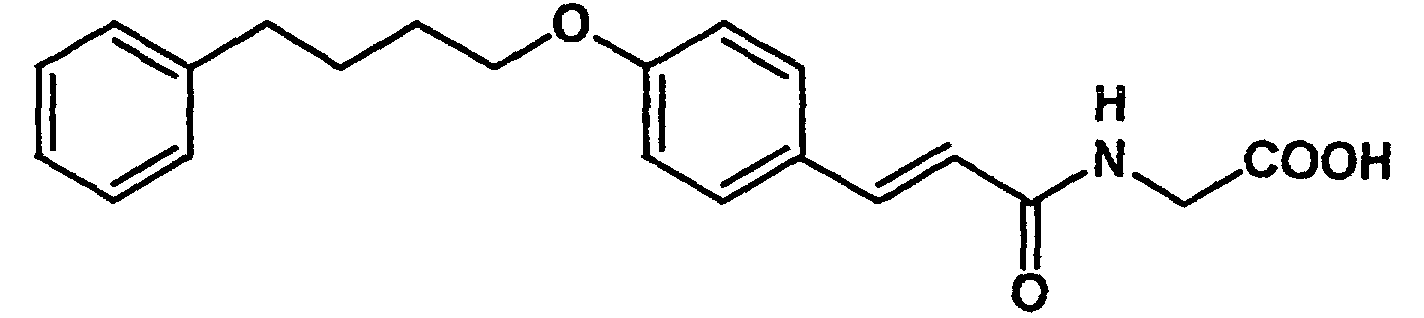
NMR (DMSO-d6) : δ8.30 (t, J = 5.7 Hz, 1H), 7.50 (d, J = 8.8 Hz, 2H), 7.38 (d, J = 15.6 Hz, 1H), 7.35-7.14 (m, 5H), 6.96 (d, J = 8.8 Hz, 2H), 6.56 (d, J = 15.6 Hz, 1H), 4.05-4.00 (m, 2H), 3.87 (d, J = 5.7 Hz, 2H), 2.70-2.60 (m, 2H), 1.80-1.60 (m, 4H).
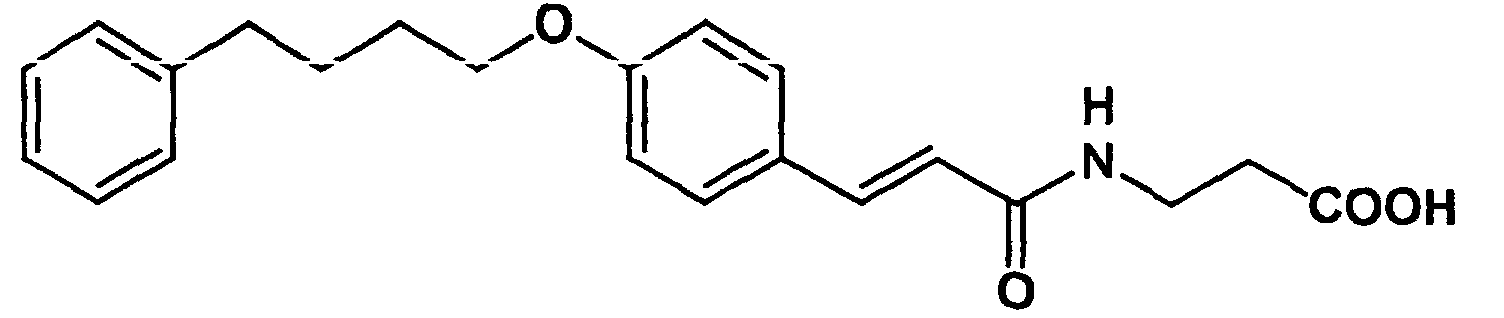
NMR (CDCl3) : δ7.57 (d, J = 15.2 Hz, 1H), 7.41 (d, J = 8.6 Hz, 2H), 7.35-7.10 (m, 5H), 6.85 (d, J = 8.6 Hz, 2H), 6.24 (d, J = 15.2 Hz, 1H), 6.35-6.20 (m, 1H), 4.00-3.90 (m, 2H), 3.70-3.60 (m, 2H), 2.80-2.60 (m, 4H), 1.90-1.70 (m, 4H).
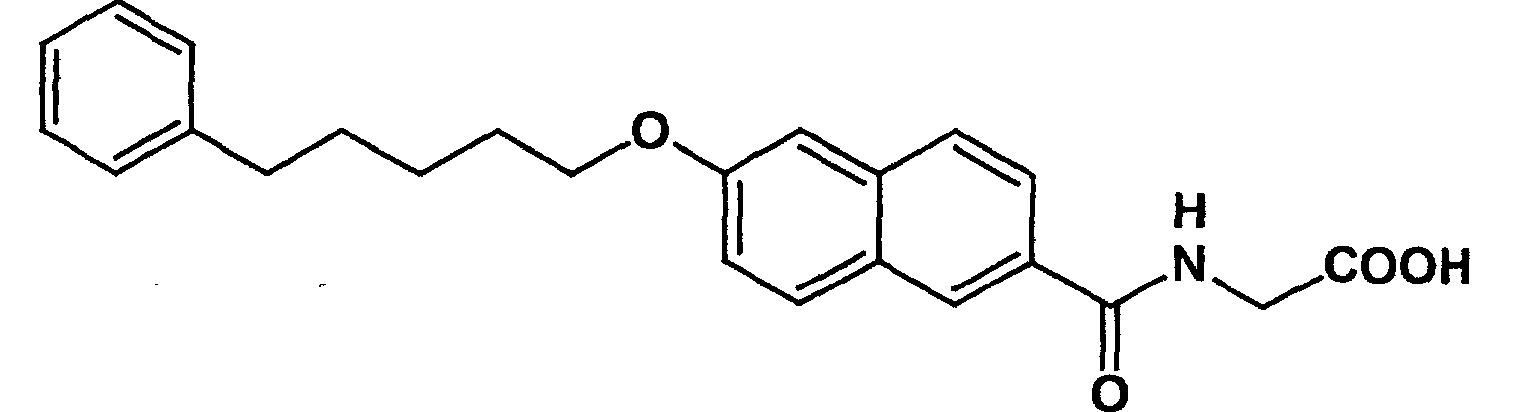
NMR (DMSO-d6) : δ12.58 (s, 1H), 8.90 (t, J = 5.7 Hz, 1H), 8.40 (s, 1H), 7.92 (d, J = 8.7 Hz, 1H), 7.90 (dd, J = 1.8, 8.7 Hz, 1H), 7.85 (d, J = 8.7 Hz, 1H), 7.36 (d, J = 2.4 Hz, 1H), 7.30-7.15 (s, 6H), 4.11 (t, J = 6 .6 Hz, 2H), 3.96 (d, J = 5.7 Hz, 2H), 2.62 (t, J = 7.8 Hz, 2H), 1.90-1.75 (m, 2H), 1.75-1.55 (m, 2H), 1.55-1.45 (m, 2H).
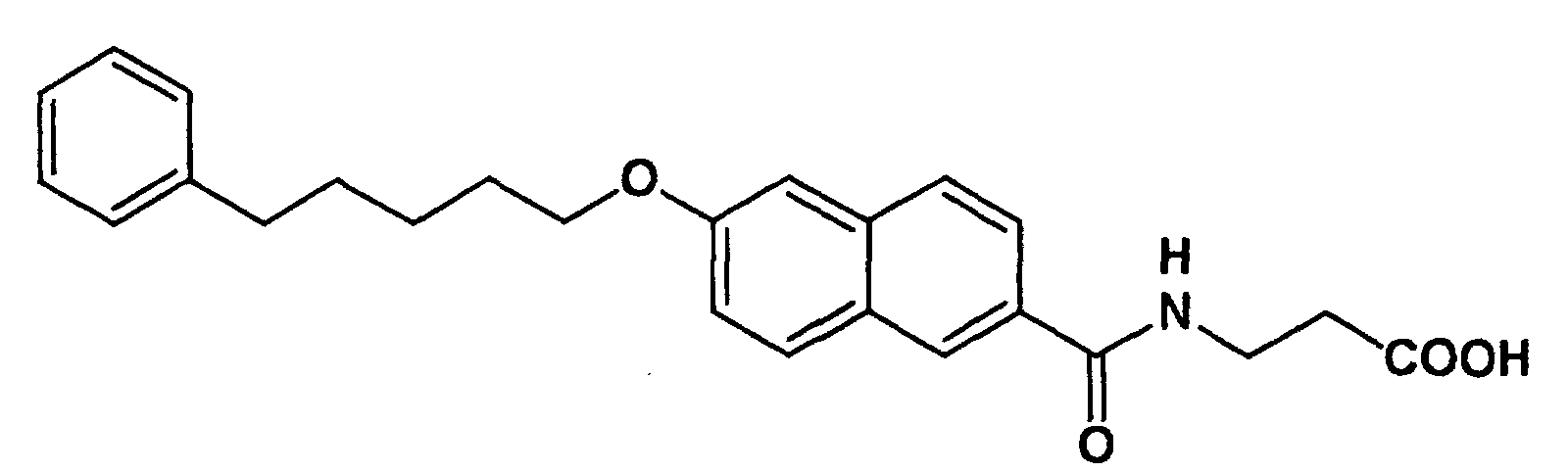
NMR (DMSO-d6) : δ12.22 (s, 1H), 8.59 (t, J = 5.4 Hz, 1H), 8.34 (s, 1H), 7.90-7.80 (m, 3H), 7.35 (d, J = 2.4 Hz, 1 H), 7.30-7.10 (m, 6H), 4.10 (t, J = 6.6 Hz, 2H), 3.50 (q, J = 5.4 Hz, 2H), 2.62 (t, J = 7.2 Hz, 2H), 2.55 (t, J = 7.2 Hz, 2H), 1.90-1.75 (m, 2H), 1.75-1.60 (m, 2H), 1.55-1.40 (m, 2H).

NMR (CDCl3) : δ7.09 (d, J = 8.6 Hz, 2H), 6.81 (d, J = 8.6 Hz, 2H), 6:11 (t, J = 5.0 Hz, 1H), 4.04 (d, J = 5.0 Hz, 2H), 3.91 (t, J = 6.4 Hz, 2H), 2.91 (t, J = 7.6 Hz, 2H), 2.54 (t, J = 7.6 Hz, 2H), 1.83-1.67 (m, 7H), 1.48-1.09 (m, 10H), 0.93-0.78 (m, 2H).

TLC : Rf 0.41 (hexane : ethyl acetate = 1 : 1);
NMR (CDCl3) : δ7.32-7.07 (m, 8H), 6.86-6.79 (m, 2H), 4.17 (q, J = 7.2 Hz, 2H), 3.93 (t, J = 6.6 Hz, 2H), 3.56-3.46 (m, 2H), 3.27 (s, 2H), 2.78 (t, J = 7.2 Hz, 2H), 2.64 (t, J = 7.2 Hz, 2H), 1.88-1.42 (m, 6H), 1.23 (t, J = 7.2 Hz, 3H).

TLC : Rf 0.13(chloroform : methanol = 9 : 1);
NMR (CDCl3) : δ7.32-7.05 (m, 7H), 6.83 (d, J = 8.6 Hz, 2H), 6.47-6.35 (br, 1H), 3.93 (t, J = 6.4 Hz, 2H), 3.60-3.50 (m, 2H), 3.24 (s, 2H), 2.78 (t, J = 7.0 Hz, 2H), 2.64 (t, J = 7.5 Hz, 2H), 1.88-1.42 (m, 6H).
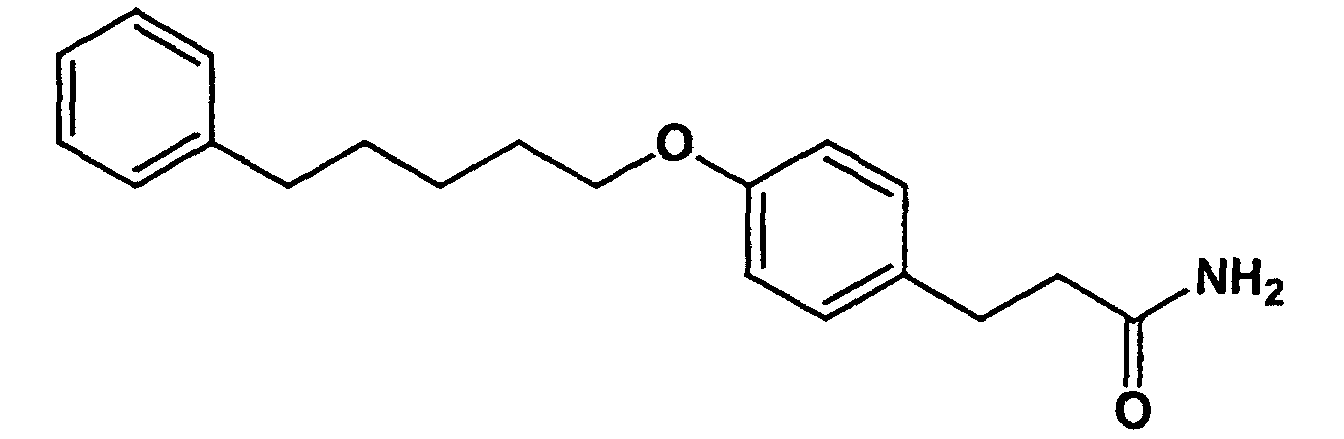
TLC : Rf 0.50(chloroform : methanol : acetic acid = 100 : 10 : 1);
NMR (CDCl3) : δ7.30-7.24 (m, 2H), 7.20-7.16 (m, 3H), 7.12 (m, 2H), 6.82 (m, 2H), 5.27 (brs, 2H), 3.92 (t, J = 6.6 Hz, 2H), 2.91 (t, J = 7.5 Hz, 2H), 2.64 (t, J = 7.5 Hz, 2H), 2.50 (t, J = 7.5 Hz, 2H), 1.80 (m, 2H), 1.69 (m, 2H), 1.50 (m, 2H).

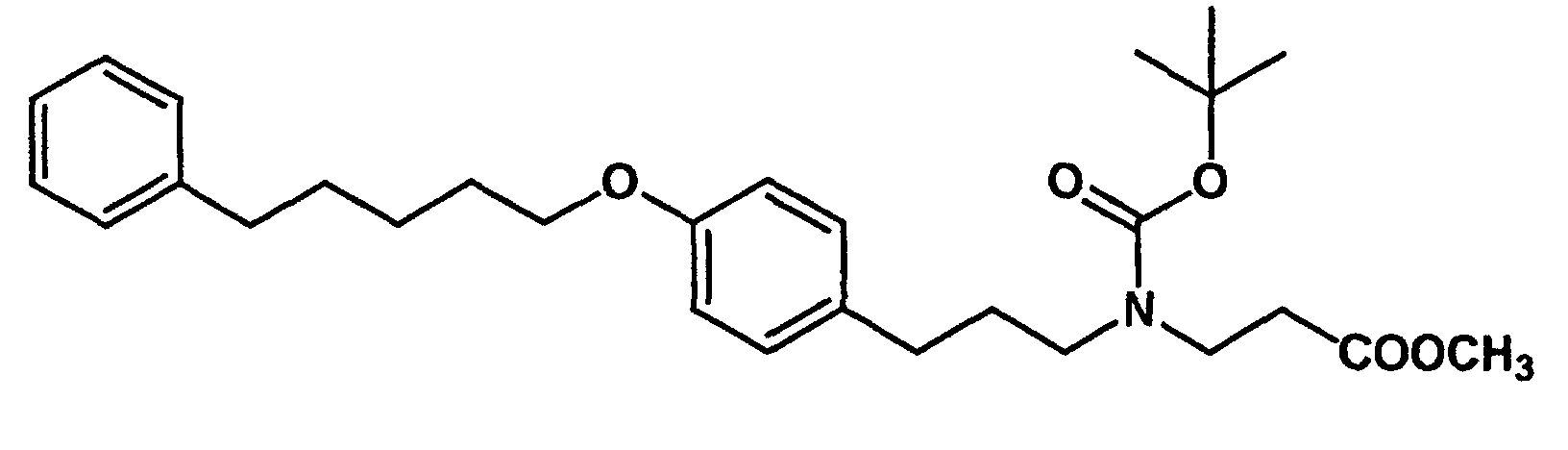
TLC : Rf 0.44(hexane : ethyl acetate = 3 : 1);
NMR (CDCl3) : δ7.30-7.24 (m, 2H), 7.20-7.14 (m, 3H), 7.07 (m, 2H), 6.80 (m, 2H), 3.92 (t, J = 6.6 Hz, 2H), 3.66 (s, 3H), 3.46 (br, 2H), 3.21 (br, 2H), 2.64 (t, J = 7.5 Hz, 2H), 2.60-2.48 (m, 4H), 1.86-1.68 (m, 6H), 1.54-1.44 (m, 11H).

TLC : Rf 0.40(butanol : acetic acid : water = 8 : 1 : 1);
NMR (DMSO-d6) : δ8.70 (brs, 2H), 7.30-7.08 (m, 7H), 6.83 (d, J = 8.7 Hz, 2H), 3.90 (t, J = 6.6 Hz, 2H), 3.07 (t, J = 7.5 Hz, 2H), 2.86 (m, 2H), 2.66-2.52 (m, 6H), 1.90-1.58 (m, 6H), 1.40 (m, 2H).

TLC : Rf 0.36(hexane : ethyl acetate = 3 : 1).
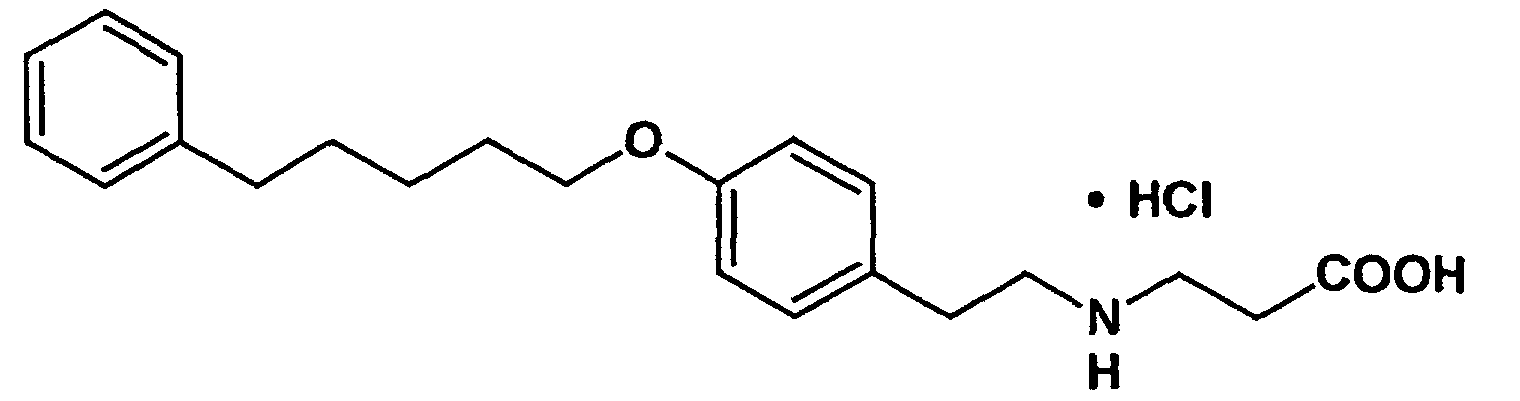
TLC : Rf 0.40(butanol : acetic acid : water = 8 : 1 : 1);
NMR (DMSO-d6) : δ8.80 (brs, 2H), 7.30-7.12 (m, 7H), 6.86 (d, J = 8.4 Hz, 2H), 3.91 (t, J = 6.6 Hz, 2H), 3.14-3.06 (m, 4H),2.84 (m, 2H), 2.67 (t, J = 7.2 Hz, 2H), 2.58 (t, J = 7.5 Hz, 2H), 1.76-1.56 (m, 4H), 1.42 (m, 2H).
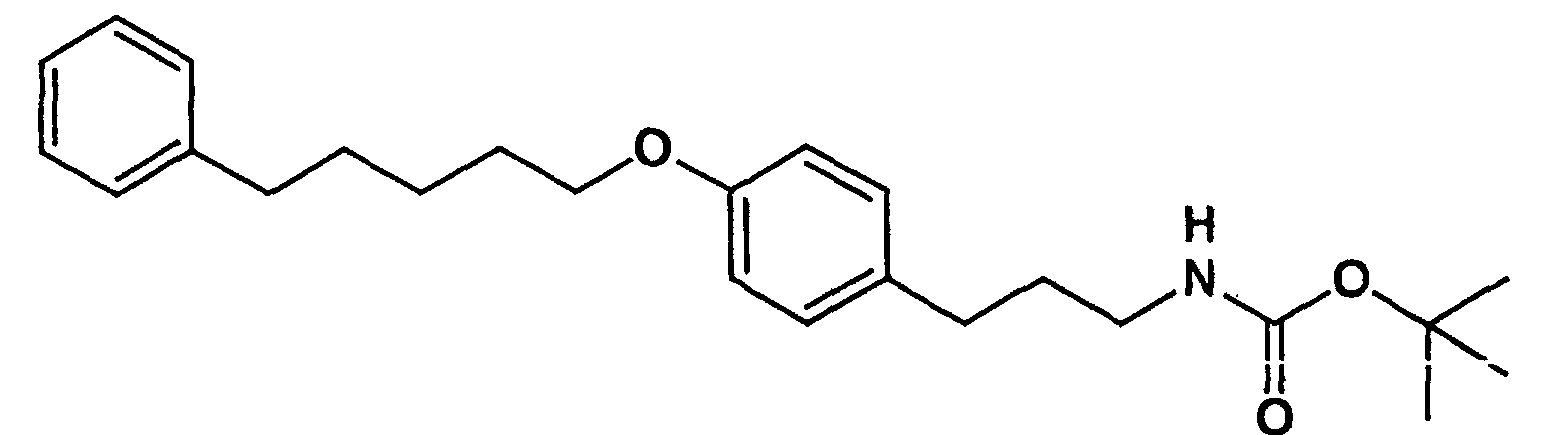
TLC : Rf 0.52(hexane : ethyl acetate = 3 : 1);
NMR (CDCl3) : δ7.30-7.24 (m, 2H), 7.20-7.14 (m, 3H), 7.07 (m, 2H), 6.80 (m, 2H), 4.50 (br, 1H), 3.92 (t, J = 6.6 Hz, 2H), 3.13 (m, 2H), 2.64 (t, J = 7.5 Hz, 2H), 2.57 (t, J = 7.5 Hz, 2H), 1.85-1.64 (m, 6H), 1.54-1.44 (m, 11H).
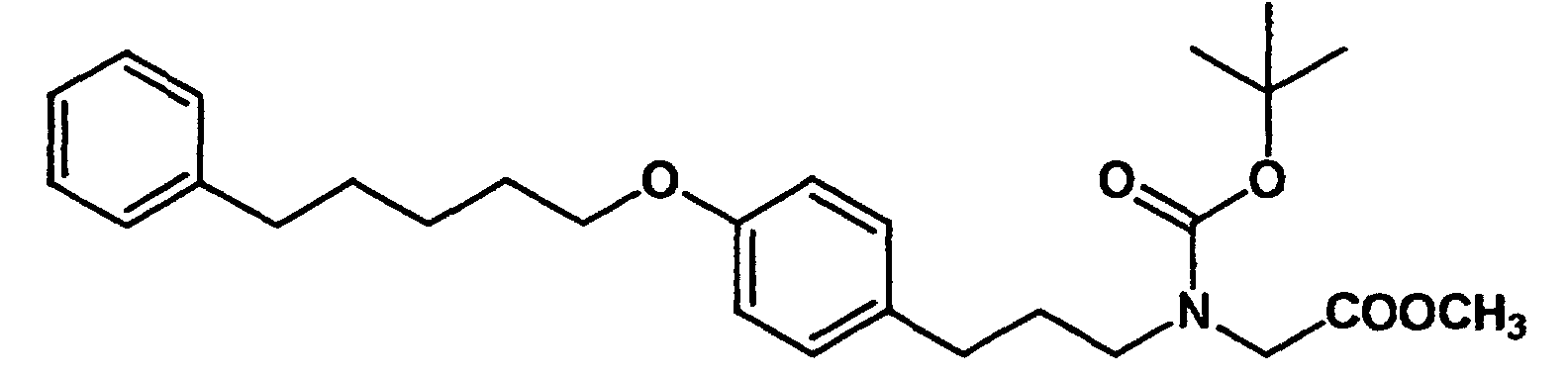
TLC : Rf 0.46(hexane : ethyl acetate = 3 : 1).
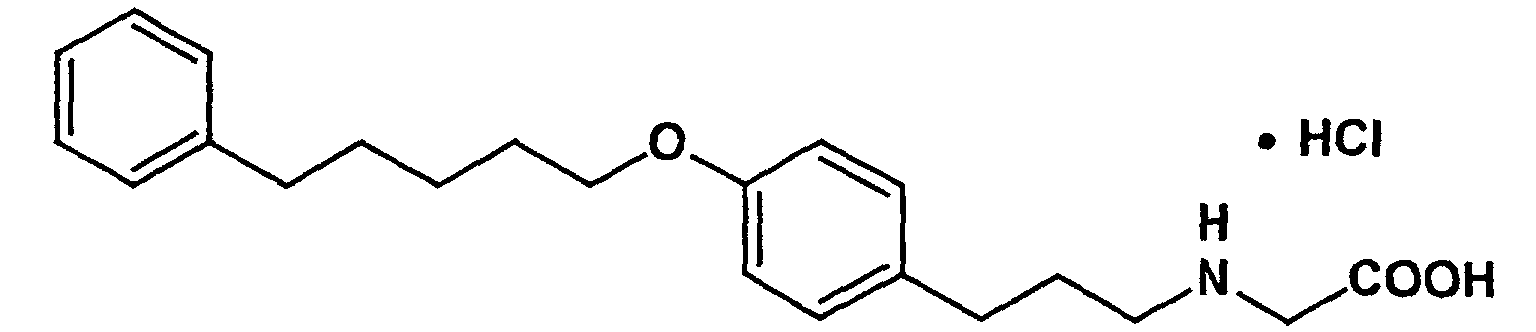
TLC : Rf 0.40(butanol : acetic acid : water = 8 : 1 : 1);
NMR (DMSO-d6) : δ9.00 (brs, 2H), 7.84 (brs, 1H), 7.30-7.06 (m, 7H), 6.82 (d, J = 8.7 Hz, 2H), 3.90 (t, J = 6.6 Hz, 2H), 3.82 (s, 2H), 2.87 (m, 2H), 2.62-2.50 (m, 4H), 1.92-1.56 (m, 6H), 1.42 (m, 2H).

TLC : Rf 0.33(hexane : ethyl acetate = 2 : 1).

TLC : Rf 0.63(hexane : ethyl acetate = 2 : 1);
NMR (CDCl3) : δ9.81 (t, J = 1.5 Hz, 1H), 7.32-7.06 (m, 7H), 6.81 (m, 2H), 3.92 (t, J = 6.6 Hz, 2H), 2.90 (m, 2H), 2.80-2.60 (m, 4H), 1.84-1.42 (m, 6H).
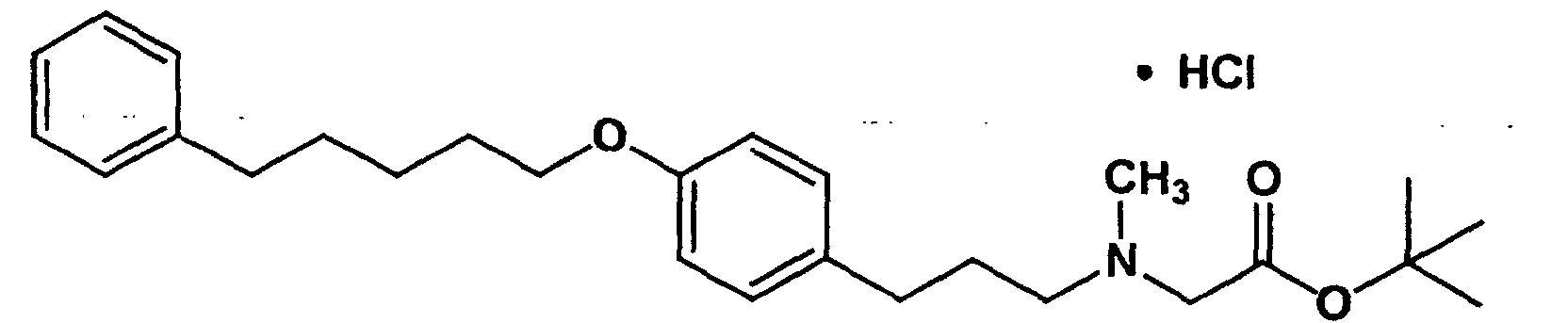
TLC : Rf 0.36(hexane : ethyl acetate = 2 : 1);
NMR (DMSO-d6) : δ10.14 (brs, 1H), 7.28-7.08 (m, 7H), 6.83 (m, 2H), 4.06 (brs, 2H), 3.90 (t, J = 6.6 Hz, 2H), 3.05 (br, 2H), 2.78 (brs, 3H), 2.60-2.52 (m, 4H), 1.94 (m, 2H), 1.76-1.64 (m, 4H), 1.48-1.38 (m, 11H).

TLC : Rf 0.28(butanol : acetic acid : water = 8 : 1 : 1);
NMR (DMSO-d6) : δ7.30-7.09 (m, 7H), 6.83 (d, J = 8.7 Hz, 2H), 4.06 (s, 2H), 3.90 (t, J = 6.6 Hz, 2H), 3.09 (m, 2H), 2.80 (s, 3H), 2.62-2.50 (m, 4H), 1.92 (m, 2H), 1.78-1.56 (m, 4H), 1.42 (m, 2H).
- 2-chloro-5-[3-(4-(5-phenylpentyloxy)phenyl)propanoylamino]benzoic acid 5.0g
- calcium carboxymethylcellulose (disintegrant) 0.2g
- magnesium stearate (lubricant) 0.1g
- microcrystalline cellulose 4.7g
- 2-chloro-5-[3-(4-(5-phenylpentyloxy)phenyl)propanoylamino]benzoic acid 2.0 g
- Mannitol 20 g
- Distilled water 500 ml
Claims (14)
- An EDG-1 agonist which comprises, as an active ingredient, a carboxylic acid derivative represented by formula (I)wherein
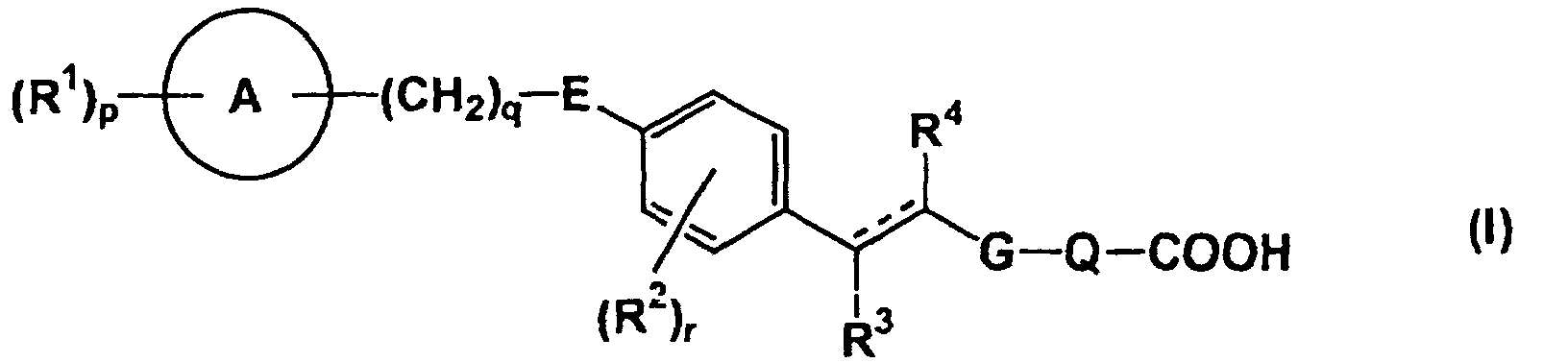
R1 is C1-8 alkyl, C1-8 alkoxy, halogen atom, nitro or trifluoromethyl,
ring A is C5-7 mono-carbocyclic ring or 5-7membered mono-cyclic hetero ring containing 1-2 nitrogen atoms, one oxygen atom and/or one sulfur atom,
E is -CH2-, -O-, -S- or -NR6- (wherein R6is hydrogen or C1-8 alkyl.),
R2 is C1-8 alkyl, C1-8 alkoxy, halogen atom, nitro or trifluoromethyl,
R3 is hydrogen or C1-8 alkyl,
R4 is hydrogen or C1-8 alkyl,
R2 and R4 taken together form -CH2-CH2- or -CH=CH-,
G is -CONR7-, -NR7CO-, -SO2NR7-, -NR7SO2-, -CH2NR7- or -NR7CH2- (wherein R7 is hydrogen, C1-8 alkyl, Cyc1 or C1-8 alkyl substituted by Cyc1, Cyc1 is C5-7 mono-carbocyclic ring or 5-7membered mono-cyclic hetero ring containing 1-2 nitrogen atoms, one oxygen atom and/or one sulfur atom.),
Q is C1-4 alkylene orJ1, J2, J3 and J4 are each independently carbon atom or nitrogen atom (with the proviso that the number of nitrogen is less than two.),
R5 is(wherein R9-R18, R20 and R23 are each independently hydrogen, C1-8 alkyl, Cyc2 or C1-8 alkyl substituted by Cyc2,(1) C1-8 alkyl,(2) halogen atom,(3) nitro,(4) cyano,(5) trifluoromethyl,(6) trifluoromethoxy,(7) phenyl,(8) tetrazolyl,(9) -OR9,(10) -SR10,(11) -COOR11,(12) -NR12R13,(13) -CONR14R15,(14) -SO2NR16R17,(15) -NR18COR19,(16) -NR20SO2R21,(17) -SO2R22 or(18) -OP(O)(OR23)2,
R12 and R13, R14 and R15, R16 and R17 together with nitrogen atom to which they are attached, form 5-7membered mono-cyclic hetero ring containing 1-2 nitrogen atoms, one oxygen atom and/or one sulfur atom (the hetero ring may be optionally substituted by C1-8 alkyl, hydroxy or aimno.)
R19 and R21 are each independently C1-8 alkyl, Cyc2 or C1-8 alkyl substituted by Cyc2,
R22 is hydroxy, C1-8 alkyl, Cyc2 or C1-8 alkyl substituted by Cyc2, Cyc2 is C5-7 mono-carbocyclic ring or 5-7membered mono-cyclic hetero ring containing 1-2 nitrogen atoms, one oxygen atom and/or one sulfur atom.),
wherein, when Q isand J2 is carbon atom substituted by R5, G may be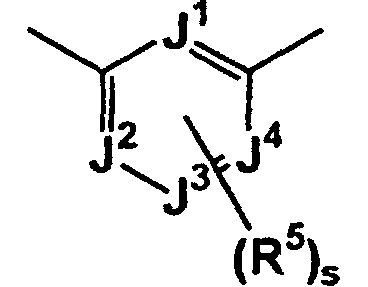 (wherein U is oxygen atom, nitrogen atom or sulfur atom,
W is carbon atom or nitrogen atom,
R8 and R5, which bonds J2, taken together form bond, carbon atom or nitrogen atom.),
p is 0 or an integer of 1-5,
q is an integer of 4-6,
r is 0 or an integer of 1-4,
s is 0 or an integer of 1-4,
---- is single bond or double bond,
a prodrug thereof or a non-toxic salt thereof. - The EDG-1 agonist according to claim 1, wherein the prodrug is a compound represented by formula (IA)wherein R24 is (1) C1-8 alkyl or (2) C1-8 alkyl substituted by 1-2 of hydroxy or amino, and other symbols represent the same meanings as claim 1.

- The EDG-1 agonist according to claim 1, wherein the prodrug is a compound represented by formula (IB)wherein R25 and R26 are each independently (1) hydrogen, (2) C1-8 alkyl or (3) C1-8 alkyl substituted by 1-2 of hydroxy or amino, and other symbols represent the same meanings as claim 1.

- The EDG-1 agonist according to claim 1, wherein the prodrug is a compound represented by formula (IC)wherein all symbols represent the same meanings as claim 1.

- The EDG-1 agonist according to claim 1, wherein the prodrug is a compound represented by formula (ID)wherein t is 0 or an integer of 1-3, and other symbols represent the same meanings as claim 1.

- A carboxylic acid derivative represented by formula (I)wherein

R1 is C1-8 alkyl, C1-8 alkoxy, halogen atom, nitro or trifluoromethyl, ring A is C5-7 mono-carbocyclic ring or 5-7membered mono-cyclic hetero ring containing 1-2 nitrogen atoms, one oxygen atom and/or one sulfur atom,
E is -CH2-, -O-, -S- or -NR6- (wherein R6is hydrogen or C1-8 alkyl.),
R2 is C1-8 alkyl, C1-8 alkoxy, halogen atom, nitro or trifluoromethyl,
R3 is hydrogen or C1-8 alkyl,
R4 is hydrogen or C1-8 alkyl,
R2 and R4 taken together form -CH2-CH2- or -CH=CH-,
G is -CONR7-, -NR7CO-, -SO2NR7-, -NR7SO2-, -CH2NR7- or -NR7CH2- (wherein R7 is hydrogen, C1-8 alkyl, Cyc1 or C1-8 alkyl substituted by Cyc1, Cyc1 is C5-7 mono-carbocyclic ring or 5-7membered mono-cyclic hetero ring containing 1-2 nitrogen atoms, one oxygen atom and/or one sulfur atom.),
Q is C1-4 alkylene orJ1, J2, J3 and J4 are each independently carbon atom or nitrogen atom (with the proviso that the number of nitrogen is less than two.),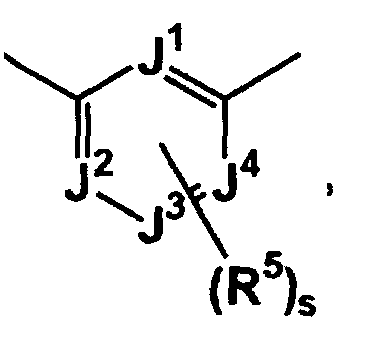
R5 is(wherein R9-R18, R20 and R23 are each independently hydrogen, C1-8 alkyl, Cyc2 or C1-8 alkyl substituted by Cyc2,(1) C1-8 alkyl,(2) halogen atom,(3) nitro,(4) cyano,(5) trifluoromethyl,(6) trifluoromethoxy,(7) phenyl,(8) tetrazolyl,(9) -OR9,(10) -SR10,(11) -COOR11,(12) -NR12R13,(13) -CONR14R15,(14) -SO2NR16R17,(15) -NR18COR19,(16) -NR20SO2R21,(17) -SO2R22 or(18) -OP(O)(OR23)2,
R12 and R13, R14 and R15, R16 and R17 together with nitrogen atom to which they are attached, form 5-7membered mono-cyclic hetero ring containing 1-2 nitrogen atoms, one oxygen atom and/or one sulfur atom (the hetero ring may be optionally substituted by C1-8 alkyl, hydroxy or aimno.)
R19 and R21 are each independently C1-8 alkyl, Cyc2 or C1-8 alkyl substituted by Cyc2,
R22 is hydroxy, C1-8 alkyl, Cyc2 or C1-8 alkyl substituted by Cyc2, Cyc2 is C5-7 mono-carbocyclic ring or 5-7membered mono-cyclic hetero ring containing 1-2 nitrogen atoms, one oxygen atom and/or one sulfur atom.),
wherein, when Q isand J2 is carbon atom substituted by R5, G may be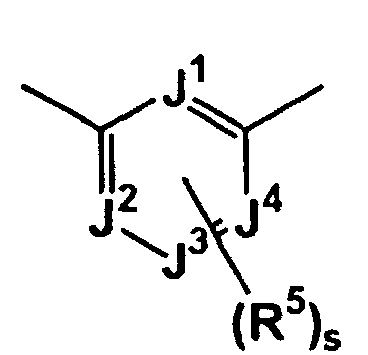 (wherein U is oxygen atom, nitrogen atom or sulfur atom,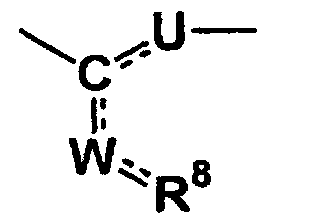
W is carbon atom or nitrogen atom,
R8 and R5, which bonds J2, taken together form bond, carbon atom or nitrogen atom.),
p is 0 or an integer of 1-5,
q is an integer of 4-6,
r is 0 or an integer of 1-4,
s is 0 or an integer of 1-4,
---- is single bond or double bond,
a prodrug thereof or a non-toxic salt thereof. - A prodrug of the compound represented by formula (I) according to claim 6 which is a compound represented by formula (IA)wherein R24 is (1) C1-8 alkyl or (2) C1-8 alkyl substituted by 1-2 of hydroxy or amino, and other symbols represent the same meanings as claim 6.

- A prodrug of the compound represented by formula (I) according to claim 6 which is a compound represented by formula (IB)wherein R25 and R26 are each independently (1) hydrogen, (2) C1-8 alkyl or (3) C1-8 alkyl substituted by 1-2 of hydroxy or amino, and other symbols represent the same meanings as claim 6.
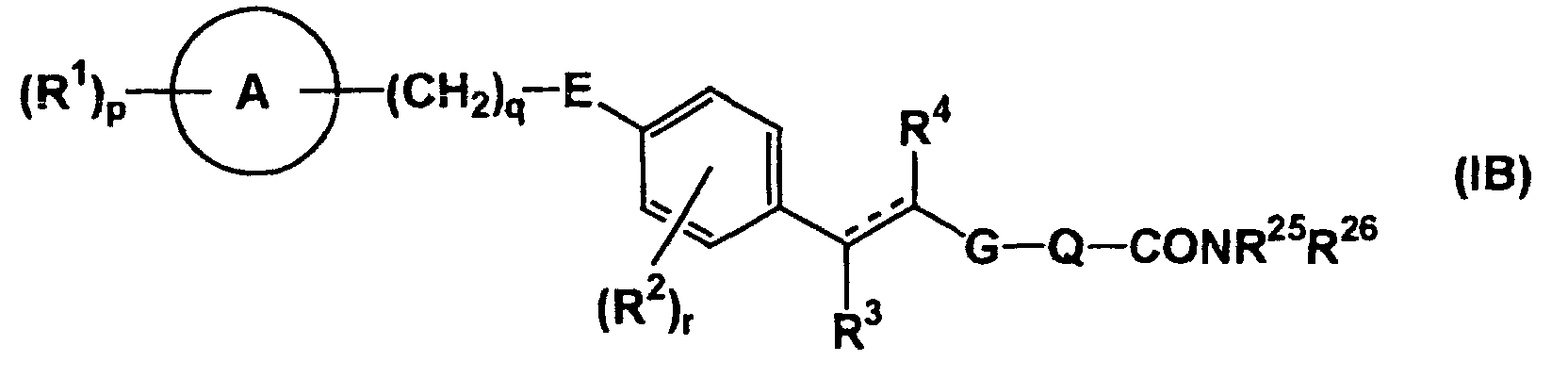
- A prodrug of the compound represented by formula (I) according to claim 6 which is a compound represented bv formula (IC)wherein all symbols represent the same meanings as claim 6.
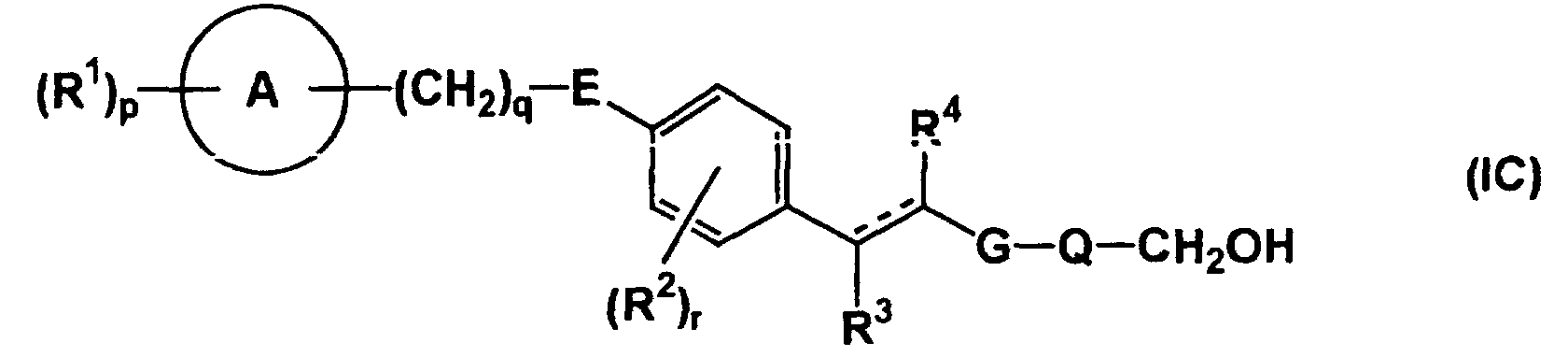
- A prodrug of the compound represented by formula (I) according to claim 6 which is a compound represented by formula (ID)wherein t is 0 or an integer of 1-3, and other symbols represent the same meanings as claim 6.
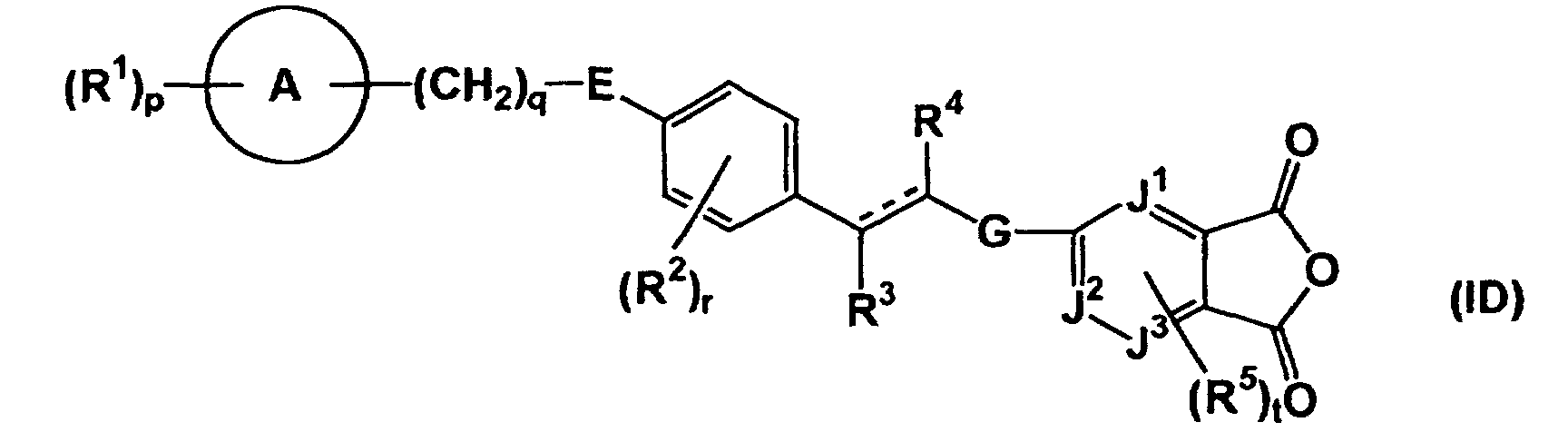
- The compound according to claim 6 wherein Q is C1-4 alkyl.
- The compound according to claim 6 wherein Q is
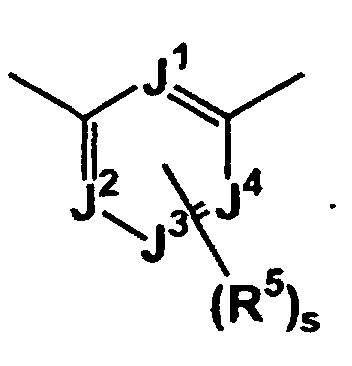
- The compound according to claim 11 which is(1) 2-[3-(4-(6-phenylhexyl)phenyl)propanoylamino]acetic acid,(2) 3-[3-(4-(6-phenylhexyl)phenyl)propanoylamino]propanoic acid,(3) 2-[3-(4-(5-phenylpentyloxy)phenyl)propanoylamino]acetic acid,(4) 3-[3-(4-(5-phenylpentyloxy)phenyl)propanoylamino]propanoic acid,(5) 4-[3-(4-(5-phenylpentyloxy)phenyl)propanoylamino]butanoic acid,(6) 4-[3-(4-(6-phenylhexyl)phenyl)propanoylamino]butanoic acid,(7) 2-[N-methyl-3-(4-(5-phenylpentyloxy)phenyl)propanoylamino]acetic acid,(8) 2-[N-(pyridin-2-yl)methyl-3-(4-(5-phenylpentyloxy)phenyl)propanoylamino]acetic acid,(9) 2-[3-(4-(4-phenylbutoxy)phenyl)-2-propenoylamino]acetic acid,(10) 3-[3-(4-(4-phenylbutoxy)phenyl)-2-propenoylamino]propanoic acid,(11) 2-[(6-(5-phenylpentyloxy)naphthalen-2-yl)carbonylamino]acetic acid,(12) 3-[(6-(5-phenylpentyloxy)naphthalen-2-yl)carbonylamino]propanoic acid,(13) 2-[3-(4-(5-cyclohexylpentyloxy)phenyl)propanoylamino]acetic acid,(14) 2-[N-[2-(4-(5-phenylpentyloxy)phenyl)ethyl]carbamoyl]acetic acid,(15) 3-[3-(4-(5-phenylpentyloxy)phenyl)propylamino]propanoic acid,(16) 3-[2-(4-(5-phenylpentyloxy)phenyl)ethylamino]propanoic acid,(17) 2-[N-(t-butoxycarbonyl)-3-(4-(5-phenylpentyloxy)phenyl)propylamino]acetic acid or(18) 2-[N-methyl-3-(4-(5-phenylpentyloxy)phenyl)propylamino]acetic acid, a prodrug thereof or a non-toxic salt thereof.
- The compound according to claim 12 which isa prodrug thereof or a non-toxic salt thereof.(1) 2-methoxy-5-[3-(4-(5-phenylpentyloxy)phenyl)propanoylamino]benzoic acid,(2) 2-chloro-5-[3-(4-(5-phenylpentyloxy)phenyl)propanoylamino]benzoic acid,(3) 2-bromo-5-[3-(4-(5-phenylpentyloxy)phenyl)propanoylamino]benzoic acid,(4) 2-carboxy-5-[3-(4-(5-phenylpentyloxy)phenyl)propanoylamino]benzoic acid,(5) 3-carboxy-5-[3-(4-(5-phenylpentyloxy)phenyl)propanoylamino]benzoic acid,(6) 2-methylthio-5-[3-(4-(5-phenylpentyloxy)phenyl)propanoylamino]benzoic acid,(7) 3-[3-(4-(5-phenylpentyloxy)phenyl)propanoylamino]benzoic acid,(8) 3-[N-(pyridin-2-yl)methyl-3-(4-(5-phenylpentyloxy)phenyl)propanoylamino]benzoic acid,(9) 3-chloro-5-[3-(4-(5-phenylpentyloxy)phenyl)propanoylamino]benzoic acid,(10) 2-(morpholin-4-yl)-5-[3-(4-(5-phenylpentyloxy)phenyl)propanoylamino]benzoic acid,(11) 2-(pyrrolidin-1-yl)-5-[3-(4-(5-phenylpentyloxy)phenyl)propanoylamino]benzoic acid,(12) 6-[3-(4-(5-phenylpentyloxy)phenyl)propanoylamino]pyridin-2-carboxylic acid,(13) 2-[3-(4-(5-phenylpentyloxy)phenyl)propanoylamino]pyridin-4-carboxylic acid,(14) 4-chloro-3-[3-(4-(5-phenylpentyloxy)phenyl)propanoylamino]benzoic acid,(15) 4-methoxy-3-[3-(4-(5-phenylpentyloxy)phenyl)propanoylamino]benzoic acid,(16) 2-hydroxy-5-[3-(4-(5-phenylpentyloxy)phenyl)propanoylamino]benzoic acid,(17) 2-methyl-5-[3-(4-(5-phenylpentyloxy)phenyl)propanoylamino]benzoic acid,(18) 2-fluoro-5-[3-(4-(5-phenylpentyloxy)phenyl)propanoylamino]benzoic acid,(19) 2-chloro-3-[3-(4-(5-phenylpentyloxy)phenyl)propanoylamino]benzoic acid,(20) 2-nitro-5-[3-(4-(5-phenylpentyloxy)phenyl)propanoylamino]benzoic acid,(21) 2-(N,N-diethylamino)-5-[3-(4-(5-phenylpentyloxy)phenyl)propanoylamino]benzoic acid,(22) 2-(2,6-dimethylmorpholin-4-yl)-5-[3-(4-(5-phenylpentyloxy)phenyl)propanoylamino]benzoic acid,(23) 2-(N-acetylamino)-5-[3-(4-(5-phenylpentyloxy)phenyl)propanoylamino]benzoic acid,(24) 2-(N,N-dimethylamino)-5-[3-(4-(5-phenylpentyloxy)phenyl)propanoylamino]benzoic acid,(25) 4-[3-(4-(5-phenylpentyloxy)phenyl)propanoylamino]pyridin-2-carboxylic acid,(26) 2-chloro-5-[3-(2-methoxy-4-(5-phenylpentyloxy)phenyl)propanoylamino]benzoic acid,(27) 2-chloro-5-[3-(2-methyl-4-(5-phenylpentyloxy)phenyl)propanoylamino]benzoic acid,(28) methyl 2-chloro-5-[3-(2-fluoro-4-(5-phenylpentyloxy)phenyl)propanoylamino]benzoic acid,(29) 2-carboxy-5-[3-(2-methyl-4-(5-phenylpentyloxy)phenyl)propanoylamino]benzoic acid,(30) 2-carboxy-5-[3-(2-fluoro-4-(5-phenylpentyloxy)phenyl)propanoylamino]benzoic acid,(31) 2-carboxy-5-[3-(2-methoxy-4-(5-phenylpentyloxy)phenyl)propanoylamino]benzoic acid,(32) 2-carboxy-5-[3-(3-methoxy-4-(5-phenylpentyloxy)phenyl)propanoylamino]benzoic acid,(33) 2-chloro-5-[3-(3-methoxy-4-(5-phenylpentyloxy)phenyl)propanoylamino]benzoic acid,(34) 2-carboxy-5-[3-(4-(4-phenylbutyloxy)phenyl)propanoylamino]benzoic acid,(35) 2-carboxy-5-[3-(4-(6-phenylhexyloxy)phenyl)propanoylamino]benzoic acid,(36) 2-chloro-5-[3-(4-(5-phenylpentylthio)phenyl)propanoylamino]benzoic acid,(37) 2-chloro-5-[3-(4-(5-phenylpentylamino)phenyl)propanoylamino]benzoic acid,(38) 3-[3-(4-(6-phenylhexyl)phenyl)propanoylamino]benzoic acid,(39) 3-[3-(4-(5-cyclohexylpentyloxy)phenyl)propanoylamino]benzoic acid,(40) 2-chloro-5-[3-(4-(4-(4-methylphenyl)butyloxy)phenyl)propanoylamino]benzoic acid,(41) 2-chloro-5-[3-(4-(4-(4-methoxyphenyl)butyloxy)phenyl)propanoylamino]benzoic acid,(42) 2-carboxy-5-[3-(4-(4-(4-methoxyphenyl)butyloxy)phenyl)propanoylamino]benzoic acid,(43) 2-chloro-5-[3-(2-methoxy-4-(5-(pyridin-4-yl)pentyloxy)phenyl)propanoylamino]benzoic acid,(44) 2,3-dichloro-5-[3-(4-(5-phenylpentyloxy)phenyl)propanoylamino]benzoic acid,(45) 2-methoxy-3-carboxy-5-[3-(4-(5-phenylpentyloxy)phenyl)propanoylamino]benzoic acid,(46) 2-nitro-5-[3-(3-methoxy-4-(5-phenylpentyloxy)phenyl)propanoylamino]benzoic acid,(47) 2-chloro-3-[3-(4-(5-(thiophen-2-yl)pentyloxy)phenyl)propanoylamino]benzoic acid,(48) 2-chloro-5-[(6-(5-phenylpentyloxy)naphthalen-2-yl)carbonylamino]benzoic acid,(49) 2-chloro-5-[3-(4-(5-(4-methylphenyl)pentyloxy)phenyl)propanoylamino]benzoic acid,(50) 2-chloro-5-[2-methyl-3-(4-(5-phenylpentyloxy)phenyl)propanoylamino]benzoic acid,(51) 2-chloro-5-[3-(4-(4-phenylbutyloxy)phenyl)propanoylamino]benzoic acid,(52) 2-chloro-5-[3-(4-(6-phenylhexyloxy)phenyl)propanoylamino]benzoic acid,(53) 2-chloro-5-[3-(4-(5-phenylpentyloxy)phenyl)-(2E)-propenoylamino]benzoic acid,(54) 2-amino-5-[3-(4-(5-phenylpentyloxy)phenyl)propanoylamino]benzoic acid,(55) 2-amino-5-[3-(3-methoxy-4-(5-phenylpentyloxy)phenyl)propanoylamino]benzoic acid,(56) 2-chloro-5-[N-methyl-3-(4-(5-phenylpentyloxy)phenyl)propanoylamino]benzoic acid,(57) 2-chloro-5-[2-(4-(5-phenylpentyloxy)phenyl)ethylaminocarbonyl]benzoic acid,(58) 3-[2-(4-(5-phenylpentyloxy)phenyl)ethylaminocarbonyl]benzoic acid,(59) 2-fluoro-5-[2-(4-(5-phenylpentyloxy)phenyl)ethylaminocarbonyl]benzoic acid,(60) 5-[2-(4-(5-phenylpentyloxy)phenyl)ethylaminocarbonyl]pyridin-3-carboxylic acid,(61) 2-nitro-5-[2-(4-(5-phenylpentyloxy)phenyl)ethylaminocarbonyl]benzoic acid,(62) 3-carboxy-5-[2-(4-(5-phenylpentyloxy)phenyl)ethylaminocarbonyl]benzoic acid,(63) 6-[2-(4-(5-phenylpentyloxy)phenyl)ethylaminocarbonyl]pyridin-2-carboxylic acid,(64) 4-chloro-3-[2-(4-(5-phenylpentyloxy)phenyl)ethylaminocarbonyl]benzoic acid,(65) 4-[2-(4-(5-phenylpentyloxy)phenyl)ethylaminocarbonyl]pyridin-2-carboxylic acid,(66) 2-carboxy-5-[2-(4-(5-phenylpentyloxy)phenyl)ethylaminocarbonyl]benzoic acid,(67) 2-amino-5-[2-(4-(5-phenylpentyloxy)phenyl)ethylaminocarbonyl]benzoic acid,(68) 2-carboxy-5-[3-(4-(5-phenylpentyloxy)phenyl)propylamino]benzoic acid,(69) 2-chloro-5-[3-(4-(5-phenylpentyloxy)phenyl)propylamino]benzoic acid,(70) 3-[2-(4-(5-phenylpentyloxy)phenyl)ethylaminosulfonyl]benzoic acid or(71 ) 2-[2-(4-(5-phenylpentyloxy)phenyl)ethyl]benzoimidazol-5-carboxylic acid,
Applications Claiming Priority (3)
| Application Number | Priority Date | Filing Date | Title |
|---|---|---|---|
| JP2001140458 | 2001-05-10 | ||
| JP2001140458 | 2001-05-10 | ||
| PCT/JP2002/004520 WO2002092068A1 (en) | 2001-05-10 | 2002-05-09 | Carboxylic acid derivatives and drugs containing the same as the active ingredient |
Publications (3)
| Publication Number | Publication Date |
|---|---|
| EP1391199A1 true EP1391199A1 (en) | 2004-02-25 |
| EP1391199A4 EP1391199A4 (en) | 2004-12-01 |
| EP1391199B1 EP1391199B1 (en) | 2008-12-10 |
Family
ID=18987062
Family Applications (1)
| Application Number | Title | Priority Date | Filing Date |
|---|---|---|---|
| EP02769553A Expired - Lifetime EP1391199B1 (en) | 2001-05-10 | 2002-05-09 | Carboxylic acid derivatives and drugs containing the same as the active ingredient |
Country Status (9)
| Country | Link |
|---|---|
| US (2) | US7179817B2 (en) |
| EP (1) | EP1391199B1 (en) |
| JP (1) | JP4378597B2 (en) |
| KR (1) | KR20030096354A (en) |
| AT (1) | ATE416762T1 (en) |
| CA (1) | CA2446593A1 (en) |
| DE (1) | DE60230262D1 (en) |
| ES (1) | ES2316613T3 (en) |
| WO (1) | WO2002092068A1 (en) |
Cited By (7)
| Publication number | Priority date | Publication date | Assignee | Title |
|---|---|---|---|---|
| WO2006064757A1 (en) | 2004-12-13 | 2006-06-22 | Ono Pharmaceutical Co., Ltd. | Aminocarboxylic acid derivative and medicinal use thereof |
| WO2010091981A3 (en) * | 2009-02-13 | 2010-10-28 | Nestec S.A. | Products comprising n-phenylpropenoyl amino acid amides and uses thereof |
| US7939519B2 (en) | 2003-05-19 | 2011-05-10 | Novartis Ag | Immunosuppresant compounds and compositions |
| RU2433121C2 (en) * | 2004-12-13 | 2011-11-10 | Оно Фармасьютикал Ко., Лтд. | Derivative of aminocarbon acid and application of said substances for medical purposes |
| RU2468009C2 (en) * | 2007-08-01 | 2012-11-27 | Тайсо Фармасьютикал Ко., Лтд. | Inhibitor of s1p1 binding |
| US8791159B2 (en) | 2003-08-29 | 2014-07-29 | Ono Pharmaceutical Co., Ltd. | Compound capable of binding S1P receptor and pharmaceutical use thereof |
| WO2019067530A1 (en) * | 2017-09-26 | 2019-04-04 | The Broad Institute, Inc. | Compositions and methods for treating inflammatory bowel disease |
Families Citing this family (52)
| Publication number | Priority date | Publication date | Assignee | Title |
|---|---|---|---|---|
| US7179817B2 (en) * | 2001-05-10 | 2007-02-20 | Ono Pharmaceutical Co., Ltd. | Carboxylic acid derivatives and drugs containing the same as the active ingredient |
| AU2003202994B2 (en) | 2002-01-18 | 2007-11-22 | Merck Sharp & Dohme Corp. | N-(benzyl)aminoalkylcarboxylates, phosphinates, phosphonates and tetrazoles as Edg receptor agonists |
| EP1533294A4 (en) | 2002-05-28 | 2007-07-04 | Ono Pharmaceutical Co | Beta-alanine derivative and use thereof |
| GB2389580A (en) * | 2002-06-12 | 2003-12-17 | Bayer Ag | 2-Naphthamide PGI2 antagonists |
| GB2389582A (en) * | 2002-06-13 | 2003-12-17 | Bayer Ag | Pharmaceutically active carboxamides |
| EP1550461A1 (en) * | 2002-06-26 | 2005-07-06 | Ono Pharmaceutical Co., Ltd. | Remedy for chronic disease |
| US7241790B2 (en) * | 2002-07-30 | 2007-07-10 | University Of Virginia Patent Foundation | Compounds active in spinigosine 1-phosphate signaling |
| AU2003264430B2 (en) | 2002-09-19 | 2009-03-19 | Kyorin Pharmaceutical Co., Ltd. | Amino alcohol derivative, addition salt thereof, and immunosuppressant |
| TW200408393A (en) * | 2002-10-03 | 2004-06-01 | Ono Pharmaceutical Co | Antagonist of lysophosphatidine acid receptor |
| US7351719B2 (en) | 2002-10-31 | 2008-04-01 | Boehringer Ingelheim Pharma Gmbh & Co. Kg | Amide compounds having MCH-antagonistic activity and medicaments comprising these compounds |
| DK1602660T3 (en) | 2003-02-18 | 2011-05-23 | Kyorin Seiyaku Kk | Aminophosphonic acid derivatives, addition salts thereof, and S1P receptor modulators |
| AU2004251146A1 (en) * | 2003-05-19 | 2005-01-06 | Irm, Llc | Immunosuppressant compounds and compositions |
| WO2004113330A1 (en) * | 2003-05-19 | 2004-12-29 | Irm Llc | Immunosuppressant compounds and compositions |
| US7825109B2 (en) | 2003-08-29 | 2010-11-02 | Ono Pharmaceutical Co., Ltd. | Compound capable of binding S1P receptor and pharmaceutical use thereof |
| RU2390519C2 (en) * | 2003-08-29 | 2010-05-27 | Оно Фармасьютикал Ко., Лтд. | Compound capable of bonding with s1p receptor and pharmaceutical application thereof |
| MXPA06003019A (en) * | 2003-10-28 | 2006-06-23 | Reddys Lab Ltd Dr | Novel compounds and their use in medicine: process for their preparation and pharmaceutical compositions containing them. |
| WO2005041899A2 (en) | 2003-11-03 | 2005-05-12 | University Of Virginia Patent Foundation | Orally available sphingosine 1-phosphate receptor agonists and antagonists |
| JP5105578B2 (en) * | 2003-11-05 | 2012-12-26 | サーコード バイオサイエンス インコーポレイテッド | Cell adhesion modulator |
| AU2004299456B2 (en) * | 2003-12-17 | 2010-10-07 | Merck Sharp & Dohme Corp. | (3,4-disubstituted)propanoic carboxylates as S1P (Edg) receptor agonists |
| US7592373B2 (en) | 2003-12-23 | 2009-09-22 | Boehringer Ingelheim International Gmbh | Amide compounds with MCH antagonistic activity and medicaments comprising these compounds |
| DE10360745A1 (en) * | 2003-12-23 | 2005-07-28 | Boehringer Ingelheim Pharma Gmbh & Co. Kg | New amide compounds having MCH antagonist activity and medicaments containing these compounds |
| US7524862B2 (en) | 2004-04-14 | 2009-04-28 | Boehringer Ingelheim International Gmbh | Alkyne compounds with MCH antagonistic activity and medicaments comprising these compounds |
| DE102004017934A1 (en) | 2004-04-14 | 2005-11-03 | Boehringer Ingelheim Pharma Gmbh & Co. Kg | New alkyne compounds having MCH antagonist activity and medicaments containing these compounds |
| JP5315611B2 (en) * | 2004-06-23 | 2013-10-16 | 小野薬品工業株式会社 | Compound having S1P receptor binding ability and use thereof |
| ATE502630T1 (en) | 2004-07-16 | 2011-04-15 | Kyorin Seiyaku Kk | METHOD FOR EFFECTIVE USE OF A MEDICATION AND METHOD FOR PREVENTING SIDE EFFECTS |
| AU2005292984B2 (en) * | 2004-10-12 | 2011-01-20 | Kyorin Pharmaceutical Co., Ltd. | Process for producing 2-amino-2-[2-[4-(3-benzyloxyphenylthio)-2-chlorophenyl]ethyl]-1,3-propanediol hydrochloride or hydrate thereof and intermediate for the same |
| JP2008522977A (en) * | 2004-12-06 | 2008-07-03 | ユニバーシティ オブ バージニア パテント ファンデーション | Sphingosine = 1-phosphate arylamide analog |
| MX2007009848A (en) | 2005-02-14 | 2008-03-10 | Univ Virginia | Sphingosine 1- phos phate agonists comprising cycloalkanes and 5 -membered heterocycles substituted by amino and phenyl groups. |
| AR055424A1 (en) * | 2005-09-12 | 2007-08-22 | Wyeth Corp | FORMULATION OF SUSTAINED RELEASE AND USES OF THE SAME |
| RU2421214C2 (en) * | 2005-10-07 | 2011-06-20 | Киорин Фармасьютикал Ко., Лтд. | Therapeutic agent for treating hepatitis, and method of treating hepatitis |
| MX2008009579A (en) * | 2006-01-27 | 2008-09-25 | Univ Virginia | Method for treatment of neuropathic pain. |
| ES2458615T3 (en) | 2006-02-03 | 2014-05-06 | Taisho Pharmaceutical Co., Ltd. | Triazole derivative |
| TWI389683B (en) * | 2006-02-06 | 2013-03-21 | Kyorin Seiyaku Kk | A therapeutic agent for an inflammatory bowel disease or an inflammatory bowel disease treatment using a 2-amino-1,3-propanediol derivative as an active ingredient |
| JP5218737B2 (en) | 2006-02-06 | 2013-06-26 | 大正製薬株式会社 | Sphingosine-1-phosphate binding inhibitor |
| AU2007212193A1 (en) * | 2006-02-09 | 2007-08-16 | University Of Virginia Patent Foundation | Bicyclic sphingosine 1-phosphate analogs |
| JP5140593B2 (en) * | 2006-08-08 | 2013-02-06 | 杏林製薬株式会社 | Amino alcohol derivatives and immunosuppressants containing them as active ingredients |
| US8232319B2 (en) | 2006-08-08 | 2012-07-31 | Kyorin Pharmaceutical Co., Ltd. | Amino phosphate derivative and S1P receptor modulator having same as an active ingredient |
| AU2007323618A1 (en) * | 2006-11-21 | 2008-05-29 | University Of Virginia Patent Foundation | Tetralin analogs having sphingosine 1-phosphate agonist activity |
| EP2099741A2 (en) | 2006-11-21 | 2009-09-16 | University Of Virginia Patent Foundation | Hydrindane analogs having sphingosine 1-phosphate receptor agonist activity |
| WO2008064337A2 (en) * | 2006-11-21 | 2008-05-29 | University Of Virginia Patent Foundation | Benzocycloheptyl analogs having sphingosine 1-phosphate receptor activity |
| TW200946105A (en) | 2008-02-07 | 2009-11-16 | Kyorin Seiyaku Kk | Therapeutic agent or preventive agent for inflammatory bowel disease containing amino alcohol derivative as active ingredient |
| HRP20161133T1 (en) | 2008-07-23 | 2016-12-02 | Arena Pharmaceuticals, Inc. | DERIVATIVES OF SUBSTITUTED 1,2,3,4-TETRAHYDROCYCLOPENT [b] INDOL-3-IL-ACETIC ACIDS USED IN THE TREATMENT OF AUTOIMMUNE AND INFLAMMATORY DISORDERS |
| CN105816453B (en) | 2008-08-27 | 2021-03-05 | 艾尼纳制药公司 | Substituted tricyclic acid derivatives as S1P1 receptor agonists for the treatment of autoimmune and inflammatory disorders |
| CA2786994C (en) | 2010-01-27 | 2018-01-16 | Arena Pharmaceuticals, Inc. | Processes for the preparation of (r)-2-(7-(4-cyclopentyl-3-(trifluoromethyl)benzyloxy)-1,2,3,4-tetrahydrocyclopenta[b]indol-3-yl)acetic acid and salts thereof |
| CN105503882B (en) | 2010-03-03 | 2019-07-05 | 艾尼纳制药公司 | The method for preparing S1P1 receptor modulators and its crystal form |
| AU2016205361C1 (en) | 2015-01-06 | 2021-04-08 | Arena Pharmaceuticals, Inc. | Methods of treating conditions related to the S1P1 receptor |
| PL3310760T3 (en) | 2015-06-22 | 2023-03-06 | Arena Pharmaceuticals, Inc. | Crystalline l-arginine salt of (r)-2-(7-(4-cyclopentyl-3-(trifluoromethyl)benzyloxy)-1,2,3,4-tetrahydrocyclo-penta[b]indol-3-yl)acetic acid for use in s1p1 receptor-associated disorders |
| KR20190116416A (en) | 2017-02-16 | 2019-10-14 | 아레나 파마슈티칼스, 인크. | Compounds and Methods for Treating Primary Bile Cholangitis |
| JP2020507610A (en) | 2017-02-16 | 2020-03-12 | アリーナ ファーマシューティカルズ, インコーポレイテッド | Compounds and methods for the treatment of inflammatory bowel disease with parenteral symptoms |
| AU2019280822A1 (en) | 2018-06-06 | 2021-01-07 | Arena Pharmaceuticals, Inc. | Methods of treating conditions related to the S1P1 receptor |
| EP3847158A1 (en) | 2018-09-06 | 2021-07-14 | Arena Pharmaceuticals, Inc. | Compounds useful in the treatment of autoimmune and inflammatory disorders |
| EP4561586A1 (en) * | 2022-07-28 | 2025-06-04 | The Board of Regents of the University of Oklahoma | Agonists of peroxisome proliferator-activated receptor alpha (ppara) and methods of use |
Family Cites Families (3)
| Publication number | Priority date | Publication date | Assignee | Title |
|---|---|---|---|---|
| JPH02218654A (en) | 1988-10-12 | 1990-08-31 | Ono Pharmaceut Co Ltd | Benzoic acid derivative, production thereof and drug containing the same |
| GB9523946D0 (en) * | 1995-11-23 | 1996-01-24 | Bayer Ag | Leukotriene antagonistic benzoic acid derivatives |
| US7179817B2 (en) * | 2001-05-10 | 2007-02-20 | Ono Pharmaceutical Co., Ltd. | Carboxylic acid derivatives and drugs containing the same as the active ingredient |
-
2002
- 2002-05-09 US US10/477,106 patent/US7179817B2/en not_active Expired - Fee Related
- 2002-05-09 ES ES02769553T patent/ES2316613T3/en not_active Expired - Lifetime
- 2002-05-09 AT AT02769553T patent/ATE416762T1/en not_active IP Right Cessation
- 2002-05-09 JP JP2002588985A patent/JP4378597B2/en not_active Expired - Fee Related
- 2002-05-09 EP EP02769553A patent/EP1391199B1/en not_active Expired - Lifetime
- 2002-05-09 WO PCT/JP2002/004520 patent/WO2002092068A1/en not_active Ceased
- 2002-05-09 DE DE60230262T patent/DE60230262D1/en not_active Expired - Lifetime
- 2002-05-09 KR KR10-2003-7014416A patent/KR20030096354A/en not_active Withdrawn
- 2002-05-09 CA CA002446593A patent/CA2446593A1/en not_active Abandoned
-
2006
- 2006-12-15 US US11/639,255 patent/US20070088027A1/en not_active Abandoned
Non-Patent Citations (2)
| Title |
|---|
| No further relevant documents disclosed * |
| See also references of WO02092068A1 * |
Cited By (12)
| Publication number | Priority date | Publication date | Assignee | Title |
|---|---|---|---|---|
| US7939519B2 (en) | 2003-05-19 | 2011-05-10 | Novartis Ag | Immunosuppresant compounds and compositions |
| US8791159B2 (en) | 2003-08-29 | 2014-07-29 | Ono Pharmaceutical Co., Ltd. | Compound capable of binding S1P receptor and pharmaceutical use thereof |
| WO2006064757A1 (en) | 2004-12-13 | 2006-06-22 | Ono Pharmaceutical Co., Ltd. | Aminocarboxylic acid derivative and medicinal use thereof |
| EP1826197A4 (en) * | 2004-12-13 | 2009-12-30 | Ono Pharmaceutical Co | Aminocarboxylic acid derivative and medicinal use thereof |
| RU2433121C2 (en) * | 2004-12-13 | 2011-11-10 | Оно Фармасьютикал Ко., Лтд. | Derivative of aminocarbon acid and application of said substances for medical purposes |
| EP2371811A3 (en) * | 2004-12-13 | 2011-11-30 | Ono Pharmaceutical Co., Ltd. | Azetidinecarboxylic acid derivative and medicinal use thereof |
| EP2592066A1 (en) * | 2004-12-13 | 2013-05-15 | Ono Pharmaceutical Co., Ltd. | Aminocarboxylic acid derivative and medical use thereof |
| US8575134B2 (en) | 2004-12-13 | 2013-11-05 | Ono Pharmaceutical Co., Ltd. | Aminocarboxylic acid derivative and medicinal use thereof |
| RU2468009C2 (en) * | 2007-08-01 | 2012-11-27 | Тайсо Фармасьютикал Ко., Лтд. | Inhibitor of s1p1 binding |
| WO2010091981A3 (en) * | 2009-02-13 | 2010-10-28 | Nestec S.A. | Products comprising n-phenylpropenoyl amino acid amides and uses thereof |
| WO2019067530A1 (en) * | 2017-09-26 | 2019-04-04 | The Broad Institute, Inc. | Compositions and methods for treating inflammatory bowel disease |
| US11382908B2 (en) | 2017-09-26 | 2022-07-12 | The Broad Institute, Inc. | Compositions and methods for treating inflammatory bowel disease |
Also Published As
| Publication number | Publication date |
|---|---|
| EP1391199B1 (en) | 2008-12-10 |
| JPWO2002092068A1 (en) | 2004-08-26 |
| DE60230262D1 (en) | 2009-01-22 |
| US20040224941A1 (en) | 2004-11-11 |
| JP4378597B2 (en) | 2009-12-09 |
| EP1391199A4 (en) | 2004-12-01 |
| KR20030096354A (en) | 2003-12-24 |
| ES2316613T3 (en) | 2009-04-16 |
| ATE416762T1 (en) | 2008-12-15 |
| WO2002092068A1 (en) | 2002-11-21 |
| CA2446593A1 (en) | 2002-11-21 |
| US7179817B2 (en) | 2007-02-20 |
| US20070088027A1 (en) | 2007-04-19 |
Similar Documents
| Publication | Publication Date | Title |
|---|---|---|
| EP1391199B1 (en) | Carboxylic acid derivatives and drugs containing the same as the active ingredient | |
| EP2371811B1 (en) | Azetidinecarboxylic acid derivative and medicinal use thereof | |
| US6316503B1 (en) | LXR modulators | |
| JP4529119B2 (en) | Carboxylic acid derivative compound and drug containing the compound as an active ingredient | |
| JP5928915B2 (en) | Compound having S1P receptor binding ability and pharmaceutical use thereof | |
| US6835752B2 (en) | Carboxylic acid derivatives, processes for the preparation thereof and pharmaceutical agents comprising the same as active ingredient | |
| WO2006001463A1 (en) | Compound having s1p receptor binding potency and use thereof | |
| US7449599B2 (en) | Phenyl carboxamide compounds useful as beta-secretase inhibitors for the treatment of alzheimer's disease | |
| CA2419722A1 (en) | Benzoic acid derivatives and drugs containing the same as the active ingredient | |
| US6710205B2 (en) | Benzoic acid derivatives, processes for producing the same and drugs containing the same as the active ingredient | |
| KR20050106421A (en) | Carboxylic acid compounds | |
| CA2429267C (en) | Cyclohexyl(alkyl)-propanolamines, preparation method and pharmaceutical compositions containing same | |
| AU7528098A (en) | New nitromethyl ketones, process for preparing them and compositions containing them | |
| JPWO2002055525A1 (en) | Retinoid active substance | |
| BR112021001853A2 (en) | benzene derivative | |
| JP2010111628A (en) | Actinonin analog | |
| JP2000273076A (en) | Retinoid agonist | |
| JPWO1999041231A1 (en) | Drugs containing amidino derivatives and their derivatives as active ingredients |
Legal Events
| Date | Code | Title | Description |
|---|---|---|---|
| PUAI | Public reference made under article 153(3) epc to a published international application that has entered the european phase |
Free format text: ORIGINAL CODE: 0009012 |
|
| 17P | Request for examination filed |
Effective date: 20031119 |
|
| AK | Designated contracting states |
Kind code of ref document: A1 Designated state(s): AT BE CH CY DE DK ES FI FR GB GR IE IT LI LU MC NL PT SE TR |
|
| AX | Request for extension of the european patent |
Extension state: AL LT LV MK RO SI |
|
| A4 | Supplementary search report drawn up and despatched |
Effective date: 20041018 |
|
| 17Q | First examination report despatched |
Effective date: 20060405 |
|
| GRAP | Despatch of communication of intention to grant a patent |
Free format text: ORIGINAL CODE: EPIDOSNIGR1 |
|
| GRAS | Grant fee paid |
Free format text: ORIGINAL CODE: EPIDOSNIGR3 |
|
| GRAA | (expected) grant |
Free format text: ORIGINAL CODE: 0009210 |
|
| AK | Designated contracting states |
Kind code of ref document: B1 Designated state(s): AT BE CH CY DE DK ES FI FR GB GR IE IT LI LU MC NL PT SE TR |
|
| REG | Reference to a national code |
Ref country code: GB Ref legal event code: FG4D |
|
| REG | Reference to a national code |
Ref country code: CH Ref legal event code: EP |
|
| REG | Reference to a national code |
Ref country code: IE Ref legal event code: FG4D |
|
| REF | Corresponds to: |
Ref document number: 60230262 Country of ref document: DE Date of ref document: 20090122 Kind code of ref document: P |
|
| REG | Reference to a national code |
Ref country code: ES Ref legal event code: FG2A Ref document number: 2316613 Country of ref document: ES Kind code of ref document: T3 |
|
| PG25 | Lapsed in a contracting state [announced via postgrant information from national office to epo] |
Ref country code: FI Free format text: LAPSE BECAUSE OF FAILURE TO SUBMIT A TRANSLATION OF THE DESCRIPTION OR TO PAY THE FEE WITHIN THE PRESCRIBED TIME-LIMIT Effective date: 20081210 Ref country code: NL Free format text: LAPSE BECAUSE OF FAILURE TO SUBMIT A TRANSLATION OF THE DESCRIPTION OR TO PAY THE FEE WITHIN THE PRESCRIBED TIME-LIMIT Effective date: 20081210 |
|
| NLV1 | Nl: lapsed or annulled due to failure to fulfill the requirements of art. 29p and 29m of the patents act | ||
| PG25 | Lapsed in a contracting state [announced via postgrant information from national office to epo] |
Ref country code: BE Free format text: LAPSE BECAUSE OF FAILURE TO SUBMIT A TRANSLATION OF THE DESCRIPTION OR TO PAY THE FEE WITHIN THE PRESCRIBED TIME-LIMIT Effective date: 20081210 |
|
| PG25 | Lapsed in a contracting state [announced via postgrant information from national office to epo] |
Ref country code: SE Free format text: LAPSE BECAUSE OF FAILURE TO SUBMIT A TRANSLATION OF THE DESCRIPTION OR TO PAY THE FEE WITHIN THE PRESCRIBED TIME-LIMIT Effective date: 20090310 Ref country code: PT Free format text: LAPSE BECAUSE OF FAILURE TO SUBMIT A TRANSLATION OF THE DESCRIPTION OR TO PAY THE FEE WITHIN THE PRESCRIBED TIME-LIMIT Effective date: 20090511 Ref country code: AT Free format text: LAPSE BECAUSE OF FAILURE TO SUBMIT A TRANSLATION OF THE DESCRIPTION OR TO PAY THE FEE WITHIN THE PRESCRIBED TIME-LIMIT Effective date: 20081210 |
|
| PLBE | No opposition filed within time limit |
Free format text: ORIGINAL CODE: 0009261 |
|
| STAA | Information on the status of an ep patent application or granted ep patent |
Free format text: STATUS: NO OPPOSITION FILED WITHIN TIME LIMIT |
|
| PG25 | Lapsed in a contracting state [announced via postgrant information from national office to epo] |
Ref country code: DK Free format text: LAPSE BECAUSE OF FAILURE TO SUBMIT A TRANSLATION OF THE DESCRIPTION OR TO PAY THE FEE WITHIN THE PRESCRIBED TIME-LIMIT Effective date: 20081210 |
|
| 26N | No opposition filed |
Effective date: 20090911 |
|
| PG25 | Lapsed in a contracting state [announced via postgrant information from national office to epo] |
Ref country code: MC Free format text: LAPSE BECAUSE OF NON-PAYMENT OF DUE FEES Effective date: 20090531 |
|
| REG | Reference to a national code |
Ref country code: CH Ref legal event code: PL |
|
| PG25 | Lapsed in a contracting state [announced via postgrant information from national office to epo] |
Ref country code: CH Free format text: LAPSE BECAUSE OF NON-PAYMENT OF DUE FEES Effective date: 20090531 Ref country code: LI Free format text: LAPSE BECAUSE OF NON-PAYMENT OF DUE FEES Effective date: 20090531 |
|
| REG | Reference to a national code |
Ref country code: IE Ref legal event code: MM4A |
|
| PG25 | Lapsed in a contracting state [announced via postgrant information from national office to epo] |
Ref country code: IE Free format text: LAPSE BECAUSE OF NON-PAYMENT OF DUE FEES Effective date: 20090509 |
|
| PG25 | Lapsed in a contracting state [announced via postgrant information from national office to epo] |
Ref country code: GR Free format text: LAPSE BECAUSE OF FAILURE TO SUBMIT A TRANSLATION OF THE DESCRIPTION OR TO PAY THE FEE WITHIN THE PRESCRIBED TIME-LIMIT Effective date: 20090311 |
|
| PG25 | Lapsed in a contracting state [announced via postgrant information from national office to epo] |
Ref country code: LU Free format text: LAPSE BECAUSE OF NON-PAYMENT OF DUE FEES Effective date: 20090509 |
|
| PG25 | Lapsed in a contracting state [announced via postgrant information from national office to epo] |
Ref country code: TR Free format text: LAPSE BECAUSE OF FAILURE TO SUBMIT A TRANSLATION OF THE DESCRIPTION OR TO PAY THE FEE WITHIN THE PRESCRIBED TIME-LIMIT Effective date: 20081210 |
|
| PG25 | Lapsed in a contracting state [announced via postgrant information from national office to epo] |
Ref country code: CY Free format text: LAPSE BECAUSE OF FAILURE TO SUBMIT A TRANSLATION OF THE DESCRIPTION OR TO PAY THE FEE WITHIN THE PRESCRIBED TIME-LIMIT Effective date: 20081210 |
|
| REG | Reference to a national code |
Ref country code: FR Ref legal event code: PLFP Year of fee payment: 14 |
|
| PGFP | Annual fee paid to national office [announced via postgrant information from national office to epo] |
Ref country code: GB Payment date: 20150506 Year of fee payment: 14 Ref country code: ES Payment date: 20150413 Year of fee payment: 14 Ref country code: DE Payment date: 20150506 Year of fee payment: 14 |
|
| PGFP | Annual fee paid to national office [announced via postgrant information from national office to epo] |
Ref country code: FR Payment date: 20150508 Year of fee payment: 14 Ref country code: IT Payment date: 20150515 Year of fee payment: 14 |
|
| REG | Reference to a national code |
Ref country code: DE Ref legal event code: R119 Ref document number: 60230262 Country of ref document: DE |
|
| GBPC | Gb: european patent ceased through non-payment of renewal fee |
Effective date: 20160509 |
|
| PG25 | Lapsed in a contracting state [announced via postgrant information from national office to epo] |
Ref country code: IT Free format text: LAPSE BECAUSE OF NON-PAYMENT OF DUE FEES Effective date: 20160509 |
|
| REG | Reference to a national code |
Ref country code: FR Ref legal event code: ST Effective date: 20170131 |
|
| PG25 | Lapsed in a contracting state [announced via postgrant information from national office to epo] |
Ref country code: DE Free format text: LAPSE BECAUSE OF NON-PAYMENT OF DUE FEES Effective date: 20161201 Ref country code: FR Free format text: LAPSE BECAUSE OF NON-PAYMENT OF DUE FEES Effective date: 20160531 |
|
| PG25 | Lapsed in a contracting state [announced via postgrant information from national office to epo] |
Ref country code: GB Free format text: LAPSE BECAUSE OF NON-PAYMENT OF DUE FEES Effective date: 20160509 |
|
| PG25 | Lapsed in a contracting state [announced via postgrant information from national office to epo] |
Ref country code: ES Free format text: LAPSE BECAUSE OF NON-PAYMENT OF DUE FEES Effective date: 20160510 |
|
| REG | Reference to a national code |
Ref country code: ES Ref legal event code: FD2A Effective date: 20181204 |