EP1389844A1 - Apparatus and method for increasing channel capacity of a mobile communication system using HPSK - Google Patents
Apparatus and method for increasing channel capacity of a mobile communication system using HPSK Download PDFInfo
- Publication number
- EP1389844A1 EP1389844A1 EP20030016637 EP03016637A EP1389844A1 EP 1389844 A1 EP1389844 A1 EP 1389844A1 EP 20030016637 EP20030016637 EP 20030016637 EP 03016637 A EP03016637 A EP 03016637A EP 1389844 A1 EP1389844 A1 EP 1389844A1
- Authority
- EP
- European Patent Office
- Prior art keywords
- walsh
- sequences
- walsh code
- codes
- rotator
- Prior art date
- Legal status (The legal status is an assumption and is not a legal conclusion. Google has not performed a legal analysis and makes no representation as to the accuracy of the status listed.)
- Granted
Links
- 238000010295 mobile communication Methods 0.000 title claims abstract description 35
- 238000000034 method Methods 0.000 title claims abstract description 33
- 239000000203 mixture Substances 0.000 claims description 3
- 230000010363 phase shift Effects 0.000 abstract description 6
- 230000007704 transition Effects 0.000 description 25
- 230000008859 change Effects 0.000 description 7
- 238000004891 communication Methods 0.000 description 3
- 230000003247 decreasing effect Effects 0.000 description 3
- 230000007480 spreading Effects 0.000 description 3
- 238000012986 modification Methods 0.000 description 2
- 230000004048 modification Effects 0.000 description 2
- 230000005540 biological transmission Effects 0.000 description 1
- 238000001816 cooling Methods 0.000 description 1
- 238000001514 detection method Methods 0.000 description 1
- 230000008569 process Effects 0.000 description 1
Images



Classifications
-
- H—ELECTRICITY
- H04—ELECTRIC COMMUNICATION TECHNIQUE
- H04B—TRANSMISSION
- H04B1/00—Details of transmission systems, not covered by a single one of groups H04B3/00 - H04B13/00; Details of transmission systems not characterised by the medium used for transmission
- H04B1/69—Spread spectrum techniques
- H04B1/707—Spread spectrum techniques using direct sequence modulation
-
- H—ELECTRICITY
- H04—ELECTRIC COMMUNICATION TECHNIQUE
- H04J—MULTIPLEX COMMUNICATION
- H04J13/00—Code division multiplex systems
- H04J13/0007—Code type
- H04J13/004—Orthogonal
- H04J13/0048—Walsh
-
- H—ELECTRICITY
- H04—ELECTRIC COMMUNICATION TECHNIQUE
- H04L—TRANSMISSION OF DIGITAL INFORMATION, e.g. TELEGRAPHIC COMMUNICATION
- H04L27/00—Modulated-carrier systems
- H04L27/18—Phase-modulated carrier systems, i.e. using phase-shift keying
-
- H—ELECTRICITY
- H04—ELECTRIC COMMUNICATION TECHNIQUE
- H04L—TRANSMISSION OF DIGITAL INFORMATION, e.g. TELEGRAPHIC COMMUNICATION
- H04L27/00—Modulated-carrier systems
- H04L27/18—Phase-modulated carrier systems, i.e. using phase-shift keying
- H04L27/20—Modulator circuits; Transmitter circuits
- H04L27/2032—Modulator circuits; Transmitter circuits for discrete phase modulation, e.g. in which the phase of the carrier is modulated in a nominally instantaneous manner
- H04L27/2053—Modulator circuits; Transmitter circuits for discrete phase modulation, e.g. in which the phase of the carrier is modulated in a nominally instantaneous manner using more than one carrier, e.g. carriers with different phases
-
- H—ELECTRICITY
- H04—ELECTRIC COMMUNICATION TECHNIQUE
- H04L—TRANSMISSION OF DIGITAL INFORMATION, e.g. TELEGRAPHIC COMMUNICATION
- H04L27/00—Modulated-carrier systems
- H04L27/18—Phase-modulated carrier systems, i.e. using phase-shift keying
- H04L27/20—Modulator circuits; Transmitter circuits
- H04L27/2032—Modulator circuits; Transmitter circuits for discrete phase modulation, e.g. in which the phase of the carrier is modulated in a nominally instantaneous manner
- H04L27/2053—Modulator circuits; Transmitter circuits for discrete phase modulation, e.g. in which the phase of the carrier is modulated in a nominally instantaneous manner using more than one carrier, e.g. carriers with different phases
- H04L27/206—Modulator circuits; Transmitter circuits for discrete phase modulation, e.g. in which the phase of the carrier is modulated in a nominally instantaneous manner using more than one carrier, e.g. carriers with different phases using a pair of orthogonal carriers, e.g. quadrature carriers
- H04L27/2067—Modulator circuits; Transmitter circuits for discrete phase modulation, e.g. in which the phase of the carrier is modulated in a nominally instantaneous manner using more than one carrier, e.g. carriers with different phases using a pair of orthogonal carriers, e.g. quadrature carriers with more than two phase states
- H04L27/2078—Modulator circuits; Transmitter circuits for discrete phase modulation, e.g. in which the phase of the carrier is modulated in a nominally instantaneous manner using more than one carrier, e.g. carriers with different phases using a pair of orthogonal carriers, e.g. quadrature carriers with more than two phase states in which the phase change per symbol period is constrained
-
- H—ELECTRICITY
- H04—ELECTRIC COMMUNICATION TECHNIQUE
- H04B—TRANSMISSION
- H04B2201/00—Indexing scheme relating to details of transmission systems not covered by a single group of H04B3/00 - H04B13/00
- H04B2201/69—Orthogonal indexing scheme relating to spread spectrum techniques in general
- H04B2201/707—Orthogonal indexing scheme relating to spread spectrum techniques in general relating to direct sequence modulation
- H04B2201/70706—Orthogonal indexing scheme relating to spread spectrum techniques in general relating to direct sequence modulation with means for reducing the peak-to-average power ratio
Definitions
- the present invention relates to an apparatus and method for increasing channel capacity of a mobile communication system. More particularly, the present invention relates to an apparatus and method using a hybrid phase shift keying (HPSK) modulation system.
- HPSK phase shift keying
- a code division multiple access is a method for detecting an original signal sent after spreading/modulating the signal using a specific code, and demodulating the spread/modulated signal by using an identical code as the code used in a sending side.
- a pseudo noise code composed of random numbers or a walsh code can be used as the specific code.
- the walsh code is a kind of orthogonal code having almost no mutual relationship among codes, and since a communication channel is allotted to each unit, identical frequency resources can be allotted to many channels. That is, the channels of the walsh code can be easily classified by orthogonality, and the code can be applied to a phase shift keying (PSK), such as a quadrature PSK (QPSK) or a hybrid PSK (HPSK).
- PSK phase shift keying
- QPSK quadrature PSK
- HPSK hybrid PSK
- Figure 1 shows a general walsh code is composed of a plurality of sets. As shown in Figure 1, the walsh code of a first set is composed of "1", and the walsh code of a second set is composed of two walsh codes of ⁇ 1, 1 ⁇ of W 0 and ⁇ 1, -1 ⁇ of W 1 .
- the walsh code of a fourth set includes four walsh codes composed of ⁇ 1, 1, 1,1 ⁇ of W 0 , ⁇ 1, -1, 1, -1 ⁇ of W 1 , ⁇ 1, 1, -1, -1 ⁇ of W 2 and ⁇ 1, -1, -1, 1 ⁇ of W 3
- the walsh code of an eighth set includes eight walsh codes composed of ⁇ 1, 1, 1, 1, 1, 1, 1 ⁇ of W 0 , ⁇ 1, -1, 1, -1, 1, - 1 ⁇ of W 1 , ⁇ 1, 1, -1, -1, 1, 1, 1, -1, -1 ⁇ of W 2 , ⁇ 1, -1, -1, 1, 1, 1, -1, -1, 1 ⁇ of W 3 , ⁇ 1, 1, 1, 1, 1, -1, -1, - 1, -1 ⁇ of W 4 , ⁇ 1, -1, 1, -1, -1, 1, -1, 1 ⁇ of W 5 , ⁇ 1, 1,-1, -1, -1,1,1 ⁇ of W
- Figures 2A, 2B and 2C are views illustrating a transition status of the QPSK and HPSK spread signals.
- Figure 2A is a view showing a phase transition status of the QPSK spread signal
- Figure 2B is a view showing a phase transition status of the HPSK spread signal
- Figure 2C is a view showing the size change of signals generated in each phase transition.
- a peak power value increases at a 0° phase transition and phase changes by 180° phase transition are frequently generated.
- a peak power value by the 0° phase transition is relatively lower than in the QPSK spread and phase changes by 180° phase transition are less frequently generated.
- FIG. 3 is a view showing an apparatus for increasing channel capacity of a mobile communication system in accordance with the conventional art.
- the apparatus is a device for spreading a reverse walsh code in a 3 rd generation (3G) system which uses the HPSK.
- the 3G system is a mobile communication system for providing communication services of a motion picture level, such as wideband-CDMA (W-CDMA) or CDMA-2000.
- W-CDMA wideband-CDMA
- CDMA-2000 Code Division Multiple Access-2000
- the apparatus includes first and second walsh code units 11 and 12 for generating a plurality walsh codes, a first adder 21 for adding a specific walsh code inputted from the first walsh code unit 11 and a signal inputted through a reverse pilot channel (R-pilot CH.) or a dedicated physical data channel (DPDCH), and a second adder 22 for adding a signal of another data channel and a signal inputted from the first walsh code unit 11.
- R-pilot CH. reverse pilot channel
- DPDCH dedicated physical data channel
- the apparatus also includes first and second gain units 31 and 32 for outputting output signals of the first and second adder 21 and 22 by respectively gain-amplifying, a first sum unit 41 for summing the output signals of the first and second gain units 31 and 32 and outputting the result, a third adder 23 for adding a specific walsh code inputted from the second walsh code unit 12 and a signal inputted through a reverse fundamental channel (R-FCH) or a dedicated physical control channel (DPCCH), a fourth adder 24 for adding a signal of another channel and a signal inputted from the second walsh code unit 12, third and fourth gain units 33 and 34 for outputting output signals of the third and fourth adder 23 and 24 by respectively gain-amplifying, a second sum unit 42 for summing the output signals of the third and fourth gain units 33 and 34.
- R-FCH reverse fundamental channel
- DPCCH dedicated physical control channel
- a fourth adder 24 for adding a signal of another channel and a signal inputted from the second walsh
- the apparatus also includes a walsh rotator 50 for outputting a complex scrambling signal for CDMA modulation, a first multiplier 61 for multiplying an I-complex scrambling signal Is outputted from the walsh rotator 50 and an output signal of the first sum unit 41, a second multiplier 62 for multiplying an I-complex scrambling signal Is outputted from the walsh rotator 50 and an output signal of the second sum unit 42, a third multiplier 63 for multiplying a Q-complex scrambling signal Qs and an output signal of the second sum unit 42, a fourth multiplier 64 for multiplying a Q-complex scrambling signal Qs outputted form the walsh rotator 50 and an output signal of the first sum unit 41, a third sum unit 43 for summing signals outputted from the first and third multipliers 61 and 63 and outputting the result as an I-signal, and a fourth sum unit 44 for summing signals outputted from the second and fourth multipliers
- the dedicated physical data channel and the dedicated physical control channel are used in the W-CDMA, and the dedicated data channel transmits voice or data and the dedicated control channel transmits control information.
- the reverse pilot channel and the reverse fundamental channel are used in the CDMA-2000, the mobile communication terminal transmits the reverse pilot channel for allowing performance of synchronization detection of a base station, and the reverse fundamental channel transmits respective voice and high-speed data.
- the operation of the conventional apparatus for increasing channel capacity of a mobile communication system will be briefly described as follows.
- the information inputted through the respective channels is spread in the first to fourth adders 21 to 24 by the walsh code outputted from the first and second walsh code units 11 and 12 or an orthogonal variable spreading function (OVSF).
- OVSF orthogonal variable spreading function
- the signals After performing complex scrambling of combining the signals outputted through the first and second sum units 41 and 42 with the complex scrambling signal outputted from the walsh rotator 50, the signals are outputted as the I-signal and the Q-signal and then filtered.
- Figure 4 is a view illustrating general concept of the complex scrambling.
- the complex scrambling is performed by operating a vector multiple of a complex data signal (I chip +jQ chip ) and a complex scrambling signal (I s +jQ s ), and it can be formed as Formula 1.
- the Achip and e j ⁇ chip are a size and an angle of the I chip +jQ chip signal
- the A s and e j ⁇ s are a size and an angle of the I s +jQ s signal. Therefore, the size of the I+jQ signal corresponds to the multiplied value of the size of the complex data signal and the complex scrambling signal, and the angle of the I+jQ signal corresponds to a sum of the angles of the complex data signal and the complex scrambling signal.
- the complex scrambling can convert a 0° phase transition generated when two consecutive identical data are inputted into 90° phase transition.
- Figure 5 is a view showing an embodiment of the conventional complex scrambling of the apparatus for increasing channel capacity in the mobile communication system.
- the HPSK using the eighth set walsh code will be descried with reference to Figure 4.
- the complex scrambling is performed by using walsh codes of an even number sequence when consecutive data have identical values.
- the efficiency of the power amplifier is decreased.
- the apparatus for increasing channel capacity of the conventional mobile communication system which uses the HPSK communication method can not use all walsh codes, but an even sequence walsh code or an odd number sequence walsh code must be restrictively used. Therefore, since the conventional apparatus for increasing channel capacity in the mobile communication system must use a specific walsh code by controlling the number of the walsh code which can be used to send data by using a traffic channel, the transmission rate and capacity is decreased.
- An object of the invention is to solve at least the above problems and/or disadvantages and to provide at least the advantages described hereinafter.
- Another embodiment of the present invention solves at least the above problems and/or disadvantages.
- Another embodiment of the present invention provides an apparatus for increasing channel capacity of a mobile communication system and a method therefor, capable of increasing channel capacity by removing limitations selection of the walsh code generated in a mobile communication system using a hybrid phase shift keying (HPSK).
- Another embodiment provides an apparatus for increasing channel capacity of a mobile communication system which checks a sequence of the walsh codes respectively inputted to a plurality of channels and selects a set of a repeated complex function outputted from a walsh rotator according to the sequence of the walsh code.
- the apparatus for increasing channel capacity of the mobile communication system in accordance with another embodiment of the present invention includes a walsh code control unit for checking sequences of walsh codes respectively outputted from a first walsh code unit and a second walsh code unit.
- the apparatus also includes a walsh rotator for generating a plurality of repeated complex functions and outputting them and a rotator control unit for selecting the repeated complex functions outputted from the walsh rotator according to the sequence of the walsh codes outputted from the first walsh code unit and the second walsh code unit.
- the apparatus for increasing channel capacity of the mobile communication system in accordance with another embodiment of the present invention checks sequences of walsh codes.
- the apparatus includes a walsh code control unit for checking sequences of walsh codes respectively outputted from a first walsh code unit and a second walsh code unit, a first adder and a second adder for respectively operating adding of walsh codes outputted from the first walsh code unit and the second walsh code unit and data inputted through a first channel path and a second channel path, a walsh rotator for outputting a plurality of repeated complex functions, a first multiplier and a fourth multiplier for multiplying a repeated complex function of the walsh rotator and a complex data signal of the first adder, a second multiplier and a third multiplier for multiplying a repeated complex function of the walsh rotator and a complex data signal of the second adder, a first sum unit for outputting an I signal by summing output
- Another embodiment provides a method for increasing channel capacity of the mobile communication system.
- This method includes the steps of checking sequences of walsh codes which are respectively inputted to a plurality of channels and performing complex scrambling by selectively outputting a set of a repeated complex function according to the sequence of the walsh code.
- the method for increasing channel capacity of the mobile communication system outputs a repeated complex function set.
- This method includes the steps of checking sequences of walsh codes outputted from first and second walsh code units, determining whether the sequences of the walsh codes are all even or odd number sequences, determining whether the sequences of the walsh codes are different as a composition of even and odd number sequences and selectively outputting the repeated complex function set according to the determination result.
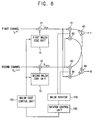
- Figure 6 is a view showing a structure of an apparatus for increasing channel capacity in a mobile communication system in accordance with one embodiment of the present invention.
- the apparatus includes a walsh code control unit 100 for checking sequences of walsh codes respectively outputted from a first walsh code unit 11 and a second walsh code unit 12, a walsh rotator 110 for generating a plurality of repeated complex functions and outputting them to first to fourth multipliers 61 to 64 and a rotator control unit 120 for checking the walsh code outputted to the first walsh code unit 11 and the second walsh code unit 12 through the walsh code control unit 100 and selecting the corresponding repeated complex function.
- the walsh code outputted from the first and second code units 11 and 12 is operated with data inputted through the I and Q channel paths in the first and second adders 21 and 22 and then is outputted.
- the rotator control unit 120 outputs a first set repeated complex function when the walsh code outputted from respective first and second walsh code units 11 and 12 are all identical as even number codes or odd number codes and when the walsh code outputted from respective first and second walsh code units 11 and 12 are different as even and odd number codes, the rotator control unit 120 outputs a second set repeated complex function.
- the repeated complex function corresponds to a complex scrambling signal.
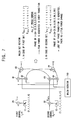
- Figure 7 is a view showing an embodiment of the apparatus for increasing channel capacity in the mobile communication system in accordance with the present invention.
- the operation of the complex scrambling by using an eighth set walsh code and 2 sets of repeated complex functions will be described as follows.
- I chip ⁇ 1 1 1 1 1 1 1 1 ⁇
- Q chip ⁇ -1 1 -1 1 -1 1 -1 1 ⁇ outputted through the first and second adders are outputted as a final modulation signal having a phase of 0°.
- the data of the final modulation signal have all 0° phases, overshoot is generated in the peak power of every transition.
- the complex data signal outputted through the first adder and second adder is outputted as a final modulation signal having a phase of ⁇ 0°, 90°, 0°, 90°, 0°, 90°, 0°, 90° ⁇ through a complex scrambling process. Since a phase transition of 90° is generated among respective data, power changes hardly occur. That is, when the walsh codes outputted from the first and second walsh code units 11 and 12 are a composition of the even number and odd number codes, it is desirable that the complex scrambling signals outputted from the walsh rotator 110 form a second set repeated complex function.
- Figure 8 is a flow chart showing a method for increasing channel capacity in the mobile communication system in accordance with another embodiment of the present invention.
- the method includes the steps of checking an output status of the walsh code of the first and second walsh code units 11 and 12 built in respective channels with the walsh code control unit and transmitting the status to the rotator control unit 120, determining whether the set numbers outputted to the first walsh code unit 11 and the second walsh code unit 12 are even or odd numbers, outputting a control signal for selecting a repeated complex function in the rotator control unit 120 according to the determination result and performing complex scrambling by outputting the repeated complex function corresponding to the control signal to the first to fourth multipliers 61 to 64 and operating the function with the complex scrambling data inputted through each channel.
- the walsh code control unit 100 checks the sequence of the walsh codes outputted from the first and second walsh code units 11 and 12 and then informs the rotator control unit 120 (S11) of the sequence of the walsh code or the order.
- the rotator control unit 120 determines whether the set number of the walsh code outputted from the first and second code units 11 and 12 all use even number walsh codes (S12), and when the walsh codes are not even number codes, then again determines whether the walsh codes respectively outputted from the first and second code units 11 and 12 are even number walsh codes (S13).
- the rotator control unit 120 controls the walsh rotator 110 to output the first set repeated complex function (S14).
- the rotator control unit 120 controls the walsh rotator 110 to output the second set repeated complex function (S15).
- the walsh codes outputted from the first and second walsh code units 11 and 12 are summed with data inputted through the first and second channels in the first and second adders 21 and 22, and then are outputted respectively through I and Q paths.
- the data outputted through the I and Q paths are called complex scrambling data.
- the first to fourth multipliers 61 to 64 performs complex scrambling by using the first and second set repeated complex functions outputted from the walsh rotator 110 and the complex scrambling data (S16).
- the HPSK method can minimize a phase change of 0° and a phase change of 180° when compared with the QPSK method, and deliver an average level of the output power.
- the walsh codes are limited, the channel capacity of the mobile communication system is limited. That is, when the walsh codes generated in the first and second channels are even number sequences and the walsh codes generated in the first and second channels are odd number sequences, the phase change of 0° is generated increasing the peak power.
- the apparatus for increasing channel capacity in the mobile communication system and the method therefor in accordance with one embodiment of the present invention can perform complex scrambling by selectively outputting the first or second set repeated complex functions according to the sequence of the walsh codes outputted from the first and second walsh code units, allows all walsh codes to be utilized and increases the reverse channel capacity. Also, the apparatus for increasing channel capacity in the mobile communication system and the method therefor in accordance with one embodiment of the present invention can reduce output power changes since the peak power is uniform by uniform phase change and increase efficiency of the output power amplifier, and at the same time, can be implemented by using an output amplifier with a low output.
Landscapes
- Engineering & Computer Science (AREA)
- Computer Networks & Wireless Communication (AREA)
- Signal Processing (AREA)
- Mobile Radio Communication Systems (AREA)
- Digital Transmission Methods That Use Modulated Carrier Waves (AREA)
Abstract
Description
- The present invention relates to an apparatus and method for increasing channel capacity of a mobile communication system. More particularly, the present invention relates to an apparatus and method using a hybrid phase shift keying (HPSK) modulation system.
- A code division multiple access (CDMA) is a method for detecting an original signal sent after spreading/modulating the signal using a specific code, and demodulating the spread/modulated signal by using an identical code as the code used in a sending side. A pseudo noise code composed of random numbers or a walsh code can be used as the specific code.
- The walsh code is a kind of orthogonal code having almost no mutual relationship among codes, and since a communication channel is allotted to each unit, identical frequency resources can be allotted to many channels. That is, the channels of the walsh code can be easily classified by orthogonality, and the code can be applied to a phase shift keying (PSK), such as a quadrature PSK (QPSK) or a hybrid PSK (HPSK).
- Figure 1 shows a general walsh code is composed of a plurality of sets. As shown in Figure 1, the walsh code of a first set is composed of "1", and the walsh code of a second set is composed of two walsh codes of {1, 1} of W0 and {1, -1} of W1. In addition, the walsh code of a fourth set includes four walsh codes composed of {1, 1, 1,1} of W0, {1, -1, 1, -1} of W1, {1, 1, -1, -1} of W2 and {1, -1, -1, 1} of W3, and the walsh code of an eighth set includes eight walsh codes composed of {1, 1, 1, 1, 1, 1, 1, 1} of W0, {1, -1, 1, -1, 1, -1, 1, - 1} of W1, {1, 1, -1, -1, 1, 1, -1, -1} of W2, {1, -1, -1, 1, 1, -1, -1, 1} of W3, {1, 1, 1, 1, -1, -1, - 1, -1} of W4, {1, -1, 1, -1, -1, 1, -1, 1} of W5, {1, 1,-1, -1, -1,-1,1,1} of W6 and {1, -1, -1, 1, -1, 1, 1, -1} of W7. That is, the walsh codes can be increased as 2n sets according to necessity of a user.
- Figures 2A, 2B and 2C are views illustrating a transition status of the QPSK and HPSK spread signals. Figure 2A is a view showing a phase transition status of the QPSK spread signal, Figure 2B is a view showing a phase transition status of the HPSK spread signal and Figure 2C is a view showing the size change of signals generated in each phase transition.
- As shown in Figures 2A and 2B, in the QPSK spread, a peak power value increases at a 0° phase transition and phase changes by 180° phase transition are frequently generated. In the HPSK spread, a peak power value by the 0° phase transition is relatively lower than in the QPSK spread and phase changes by 180° phase transition are less frequently generated.
- As shown in Figure 2C, in the 0° phase transition, overshoot is generated at the peak power and the peak power value is increased, and in the 180° phase transition, a severe change of the power is generated. When the peak power is high, a power amplifier with a high output power must be designed, and since heat is generated in the system in proportion to the high output power, a cooling device is needed, thus increasing the size. Since frequency of generation of the 0° or 180° phase transition can be reduced by using the HPSK spread rather than using the QPSK spread, design of the amplifier can be eased by having smaller overshoot of the power generated 0° phase transition or smaller change of the power generated in case of the 180° phase transition.
- Figure 3 is a view showing an apparatus for increasing channel capacity of a mobile communication system in accordance with the conventional art. The apparatus is a device for spreading a reverse walsh code in a 3rd generation (3G) system which uses the HPSK. The 3G system is a mobile communication system for providing communication services of a motion picture level, such as wideband-CDMA (W-CDMA) or CDMA-2000.
- As shown in Figure 3, the apparatus includes first and second
walsh code units first adder 21 for adding a specific walsh code inputted from the firstwalsh code unit 11 and a signal inputted through a reverse pilot channel (R-pilot CH.) or a dedicated physical data channel (DPDCH), and asecond adder 22 for adding a signal of another data channel and a signal inputted from the firstwalsh code unit 11. The apparatus also includes first andsecond gain units second adder first sum unit 41 for summing the output signals of the first andsecond gain units third adder 23 for adding a specific walsh code inputted from the secondwalsh code unit 12 and a signal inputted through a reverse fundamental channel (R-FCH) or a dedicated physical control channel (DPCCH), afourth adder 24 for adding a signal of another channel and a signal inputted from the secondwalsh code unit 12, third andfourth gain units fourth adder second sum unit 42 for summing the output signals of the third andfourth gain units walsh rotator 50 for outputting a complex scrambling signal for CDMA modulation, afirst multiplier 61 for multiplying an I-complex scrambling signal Is outputted from thewalsh rotator 50 and an output signal of thefirst sum unit 41, asecond multiplier 62 for multiplying an I-complex scrambling signal Is outputted from thewalsh rotator 50 and an output signal of thesecond sum unit 42, a third multiplier 63 for multiplying a Q-complex scrambling signal Qs and an output signal of thesecond sum unit 42, afourth multiplier 64 for multiplying a Q-complex scrambling signal Qs outputted form thewalsh rotator 50 and an output signal of thefirst sum unit 41, athird sum unit 43 for summing signals outputted from the first andthird multipliers fourth sum unit 44 for summing signals outputted from the second andfourth multipliers - The dedicated physical data channel and the dedicated physical control channel are used in the W-CDMA, and the dedicated data channel transmits voice or data and the dedicated control channel transmits control information. Also, the reverse pilot channel and the reverse fundamental channel are used in the CDMA-2000, the mobile communication terminal transmits the reverse pilot channel for allowing performance of synchronization detection of a base station, and the reverse fundamental channel transmits respective voice and high-speed data.
- The operation of the conventional apparatus for increasing channel capacity of a mobile communication system will be briefly described as follows. The information inputted through the respective channels is spread in the first to
fourth adders 21 to 24 by the walsh code outputted from the first and secondwalsh code units fourth adders 21 to 24, a predetermined gain is obtained in the first tofourth gain units 31 to 34 then summed in the first andsecond sum units second sum units walsh rotator 50, the signals are outputted as the I-signal and the Q-signal and then filtered. - Figure 4 is a view illustrating general concept of the complex scrambling. The complex scrambling is performed by operating a vector multiple of a complex data signal (Ichip+jQchip) and a complex scrambling signal (Is+jQs), and it can be formed as
Formula 1.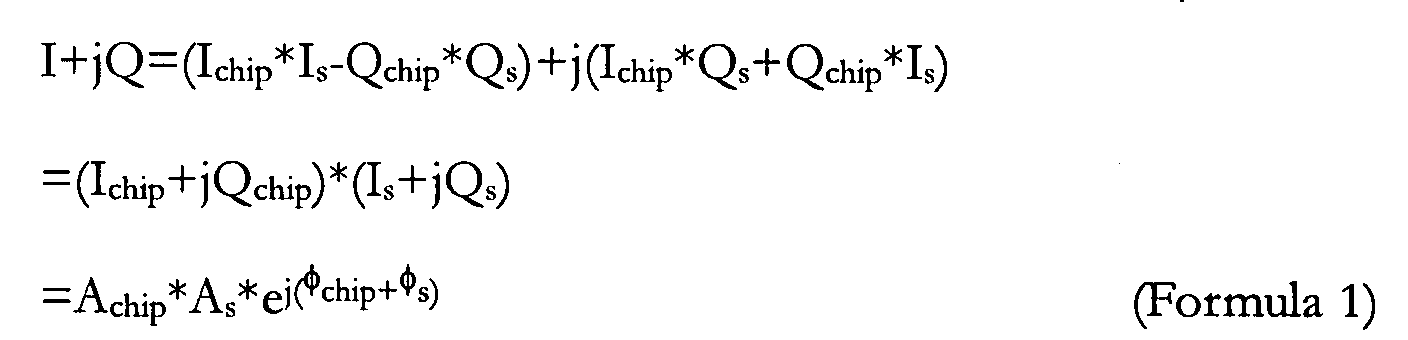
- The Achip and ejchip are a size and an angle of the Ichip+jQchip signal, and the As and ejs are a size and an angle of the Is+jQs signal. Therefore, the size of the I+jQ signal corresponds to the multiplied value of the size of the complex data signal and the complex scrambling signal, and the angle of the I+jQ signal corresponds to a sum of the angles of the complex data signal and the complex scrambling signal.
- With reference to Figure 4, when {1, -1} is inputted for the respective I-complex data signal and the Q-complex data signal, and {1, 1} and {1, -1} are inputted for the I-complex scrambling signal and the Q-complex scrambling signal, will be described as follows. Since the complex data signals are respectively {1, 1}, Ichip+jQchip coordinates values of {1, 1} are repeatedly generated, and the complex scrambling signals are displayed being divided into having respectively {1, 1} and {1, -1} values for the Is+jQs coordinates. When the complex data signal {1, 1} and the complex scrambling signal {1, 1} are multiplied, 45° of the complex data signal and 45° of the complex scrambling signal are added, thereby obtaining a signal having a phase of 90°, and when the complex data signal {1, 1} and the complex scrambling signal {1, -1} are multiplied, 45° of the complex data signal and -45° of the complex scrambling signal are added, thereby obtaining a signal having a phase of 0°. Therefore, the complex scrambling can convert a 0° phase transition generated when two consecutive identical data are inputted into 90° phase transition.
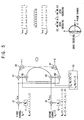
- Figure 5 is a view showing an embodiment of the conventional complex scrambling of the apparatus for increasing channel capacity in the mobile communication system. The HPSK using the eighth set walsh code will be descried with reference to Figure 4.
- The eighth set walsh code is a code which is used to spread an actual data (ID + jQD ), When ID = 1 and QD = -1 are inputted, a W0 code is used for an I channel path, a phase of a final modulation signal (I + jQ) is changed according to which walsh code is used for a Q channel path
- When the complex scrambling is performed by using Wn = W 1 in the Q channel path, all data of the final modulation signal obtain a phase of 0°, and accordingly, overshoot is generated in peak power at every data transition. However, when the complex scrambling is performed by using Wn = W 2 in the Q channel path, the data of the final modulation signal has a phase of {0, -90, 90, 0, 0, -90, 90, 0}, and therefore, two times of zero crossing by 180° phase transition and one time of 0° phase transition are generated for data transition. That is, data transition using a walsh code of an even number sequence in Wx can minimize 0° and 180° phase transitions than using a walsh code of an odd number sequence. Therefore, in the HPSK, the complex scrambling is performed by using walsh codes of an even number sequence when consecutive data have identical values. As shown in the above, in the apparatus for increasing channel capacity of the conventional mobile communication system, since an I/Q data has a high peak power when performing 0° or 180° phase transition, the efficiency of the power amplifier is decreased.
- To solve the above problem, the apparatus for increasing channel capacity of the conventional mobile communication system which uses the HPSK communication method can not use all walsh codes, but an even sequence walsh code or an odd number sequence walsh code must be restrictively used. Therefore, since the conventional apparatus for increasing channel capacity in the mobile communication system must use a specific walsh code by controlling the number of the walsh code which can be used to send data by using a traffic channel, the transmission rate and capacity is decreased.
- The above references are incorporated by reference herein where appropriate for appropriate teachings of additional or alternative details, features and/or technical background
- An object of the invention is to solve at least the above problems and/or disadvantages and to provide at least the advantages described hereinafter.
- One embodiment of the present invention solves at least the above problems and/or disadvantages. Another embodiment of the present invention provides an apparatus for increasing channel capacity of a mobile communication system and a method therefor, capable of increasing channel capacity by removing limitations selection of the walsh code generated in a mobile communication system using a hybrid phase shift keying (HPSK). Another embodiment provides an apparatus for increasing channel capacity of a mobile communication system which checks a sequence of the walsh codes respectively inputted to a plurality of channels and selects a set of a repeated complex function outputted from a walsh rotator according to the sequence of the walsh code.
- The apparatus for increasing channel capacity of the mobile communication system in accordance with another embodiment of the present invention includes a walsh code control unit for checking sequences of walsh codes respectively outputted from a first walsh code unit and a second walsh code unit. The apparatus also includes a walsh rotator for generating a plurality of repeated complex functions and outputting them and a rotator control unit for selecting the repeated complex functions outputted from the walsh rotator according to the sequence of the walsh codes outputted from the first walsh code unit and the second walsh code unit.
- The apparatus for increasing channel capacity of the mobile communication system in accordance with another embodiment of the present invention checks sequences of walsh codes. The apparatus includes a walsh code control unit for checking sequences of walsh codes respectively outputted from a first walsh code unit and a second walsh code unit, a first adder and a second adder for respectively operating adding of walsh codes outputted from the first walsh code unit and the second walsh code unit and data inputted through a first channel path and a second channel path, a walsh rotator for outputting a plurality of repeated complex functions, a first multiplier and a fourth multiplier for multiplying a repeated complex function of the walsh rotator and a complex data signal of the first adder, a second multiplier and a third multiplier for multiplying a repeated complex function of the walsh rotator and a complex data signal of the second adder, a first sum unit for outputting an I signal by summing output signals of the first and second multipliers, a second sum unit for outputting a Q signal by summing output signals of the third and fourth multipliers and a rotator control unit for selecting the repeated complex functions outputted from the walsh rotator according to the sequence of the walsh codes outputted from the first walsh code unit and the second walsh code unit.
- Another embodiment provides a method for increasing channel capacity of the mobile communication system. This method includes the steps of checking sequences of walsh codes which are respectively inputted to a plurality of channels and performing complex scrambling by selectively outputting a set of a repeated complex function according to the sequence of the walsh code.
- The method for increasing channel capacity of the mobile communication system according to another embodiment outputs a repeated complex function set. This method includes the steps of checking sequences of walsh codes outputted from first and second walsh code units, determining whether the sequences of the walsh codes are all even or odd number sequences, determining whether the sequences of the walsh codes are different as a composition of even and odd number sequences and selectively outputting the repeated complex function set according to the determination result.
- Additional advantages and features of the invention will be set forth in part in the description which follows and in part will become apparent to those having ordinary skill in the art upon examination of the following or may be learned from practice of the invention. The advantages of the invention may be realized and attained as particularly pointed out in the appended claims.
- The invention will be described in detail with reference to the following drawings in which like reference numerals refer to like elements wherein:
- Figure 1 is a view showing a structure of a general walsh code;
- Figures 2A, 2B and 2C are views comparing transition status of quadrature phase shift keying(QPSK) and hybrid phase shift keying(HPSK),
- Figure 3 is a view showing an apparatus for increasing channel capacity in the mobile communication system in accordance with the conventional art;
- Figure 4 is a view showing a concept of general complex scrambling,
- Figure 5 is a view showing an embodiment of complex scrambling of the apparatus for increasing channel capacity in the mobile communication system in accordance with the conventional art;
- Figure 6 is a view showing an apparatus for increasing channel capacity in a mobile communication system in accordance with one embodiment of the present invention;
- Figure 7 is a view showing an embodiment of the apparatus for increasing channel capacity in the mobile communication system; and
- Figure 8 is a flow chart showing a method for increasing channel capacity in the mobile communication system in accordance with one embodiment of the present invention.
-
- Figure 6 is a view showing a structure of an apparatus for increasing channel capacity in a mobile communication system in accordance with one embodiment of the present invention. As shown in Figure 6, the apparatus includes a walsh
code control unit 100 for checking sequences of walsh codes respectively outputted from a firstwalsh code unit 11 and a secondwalsh code unit 12, awalsh rotator 110 for generating a plurality of repeated complex functions and outputting them to first tofourth multipliers 61 to 64 and arotator control unit 120 for checking the walsh code outputted to the firstwalsh code unit 11 and the secondwalsh code unit 12 through the walshcode control unit 100 and selecting the corresponding repeated complex function. - The walsh code outputted from the first and
second code units second adders rotator control unit 120 outputs a first set repeated complex function when the walsh code outputted from respective first and secondwalsh code units walsh code units rotator control unit 120 outputs a second set repeated complex function. The first set repeated complex function is Is {1, 1}, Qs= {1, - 1} and the second set repeated complex function is Is={1, 1}, Qs={1, 1}. The repeated complex function corresponds to a complex scrambling signal. - Figure 7 is a view showing an embodiment of the apparatus for increasing channel capacity in the mobile communication system in accordance with the present invention. The operation of the complex scrambling by using an eighth set walsh code and 2 sets of repeated complex functions will be described as follows.
- ID = 1 and QD = -1 are inputted through the I channel path and Q channel path corresponding to first and second channels and a W 0 code is inputted to the I channel path and at the same time, a W 1 code is inputted to the Q channel path. When the complex scrambling signal outputted from the
walsh rotator 110 forms the first set repeated complex function, Ichip = {1 1 1 1 1 1 1 1} and Qchip = { -1 1 -1 1 -1 1 -1 1} outputted through the first and second adders are outputted as a final modulation signal having a phase of 0°. When the data of the final modulation signal have all 0° phases, overshoot is generated in the peak power of every transition. - When the complex scrambling signal outputted from the
walsh rotator 110 forms a second set repeated complex function, the complex data signal outputted through the first adder and second adder is outputted as a final modulation signal having a phase of {0°, 90°, 0°, 90°, 0°, 90°, 0°, 90°} through a complex scrambling process. Since a phase transition of 90° is generated among respective data, power changes hardly occur. That is, when the walsh codes outputted from the first and secondwalsh code units walsh rotator 110 form a second set repeated complex function. - Figure 8 is a flow chart showing a method for increasing channel capacity in the mobile communication system in accordance with another embodiment of the present invention. The method includes the steps of checking an output status of the walsh code of the first and second
walsh code units rotator control unit 120, determining whether the set numbers outputted to the firstwalsh code unit 11 and the secondwalsh code unit 12 are even or odd numbers, outputting a control signal for selecting a repeated complex function in therotator control unit 120 according to the determination result and performing complex scrambling by outputting the repeated complex function corresponding to the control signal to the first tofourth multipliers 61 to 64 and operating the function with the complex scrambling data inputted through each channel. - When the walsh codes outputted from the first and second
walsh code units rotator control unit 120 outputs a control signal ordering outputting of the first set repeated complex function Is={1,1}, Qs= {1, -1 }. However, when the walsh codes outputted from the first and secondwalsh code units rotator control unit 120 outputs a control signal ordering outputting of the second set repeated complex function of Is={1,1}, Qs={1, 1}. - The method for increasing channel capacity in the mobile communication system in accordance with another embodiment of the present invention will be described with reference to Figure 8. The walsh
code control unit 100 checks the sequence of the walsh codes outputted from the first and secondwalsh code units rotator control unit 120 determines whether the set number of the walsh code outputted from the first andsecond code units second code units - When the set number of the walsh codes respectively outputted from the first and
second code units rotator control unit 120 controls thewalsh rotator 110 to output the first set repeated complex function (S14). However, when the set numbers of the walsh codes respectively outputted from the first and secondwalsh code units rotator control unit 120 controls thewalsh rotator 110 to output the second set repeated complex function (S15). - The walsh codes outputted from the first and second
walsh code units second adders - The first to
fourth multipliers 61 to 64 performs complex scrambling by using the first and second set repeated complex functions outputted from thewalsh rotator 110 and the complex scrambling data (S16). Generally, the HPSK method can minimize a phase change of 0° and a phase change of 180° when compared with the QPSK method, and deliver an average level of the output power. However, since the walsh codes are limited, the channel capacity of the mobile communication system is limited. That is, when the walsh codes generated in the first and second channels are even number sequences and the walsh codes generated in the first and second channels are odd number sequences, the phase change of 0° is generated increasing the peak power. When the walsh codes generated in the first and second channels are identical as odd or even number codes, the 0° and 180° phase changes are reduced decreasing the peak power. Therefore, the method of performing complex scrambling by applying respectively different repeated complex functions based on whether the walsh codes generated in the first and second channels are identical as odd or even number codes or the walsh codes are different as even and odd number codes. - The apparatus for increasing channel capacity in the mobile communication system and the method therefor in accordance with one embodiment of the present invention can perform complex scrambling by selectively outputting the first or second set repeated complex functions according to the sequence of the walsh codes outputted from the first and second walsh code units, allows all walsh codes to be utilized and increases the reverse channel capacity. Also, the apparatus for increasing channel capacity in the mobile communication system and the method therefor in accordance with one embodiment of the present invention can reduce output power changes since the peak power is uniform by uniform phase change and increase efficiency of the output power amplifier, and at the same time, can be implemented by using an output amplifier with a low output.
- As the present invention may be embodied in several forms without departing from the spirit or essential characteristics thereof, it should also be understood that the above-described embodiments are not limited by any of the details of the foregoing description, unless otherwise specified, but rather should be construed broadly within its spirit and scope as defined in the appended claims, and therefore all changes and modifications that fall within the metes and bounds of the claims, or equivalence of such metes and bounds are therefore intended to be embraced by the appended claims.
- The foregoing embodiments and advantages are merely exemplary and are not to be construed as limiting the present invention. The present teaching can be readily applied to other types of apparatuses. The description of the present invention is intended to be illustrative, and not to limit the scope of the claims. Many alternatives, modifications, and variations will be apparent to those skilled in the art. In the claims, means-plus-function clauses are intended to cover the structures described herein as performing the recited function and not only structural equivalents but also equivalent structures.
Claims (21)
- An apparatus for increasing channel capacity of a mobile communication system, comprising:a control device to check a sequence of the walsh codes from a plurality of channels and to select a set of complex functions outputted from a walsh rotator based on the sequence of the walsh codes.
- The apparatus of claim 1, wherein the sequence of the walsh codes includes one of identical sequences are all identical as even or odd numbers and different sequences.
- The apparatus of claim 1, wherein the sequence of the walsh codes comprises one of all even numbers, all odd numbers, and a combination of even and odd numbers.
- An apparatus for increasing channel capacity of a mobile communication system, comprising:a walsh code control unit to check sequences of walsh codes respectively outputted from a first walsh code unit and a second walsh code unit;a walsh rotator to generate and output a plurality of repeated complex functions; anda rotator control unit to select the repeated complex functions output from the walsh rotator based on the sequences of the walsh codes outputted from the first walsh code unit and the second walsh code unit.
- The apparatus of claim 4, wherein the walsh code control unit is connected to the rotator control unit and transmits a status of the walsh code that is output from the first and second walsh code units.
- The apparatus of claim 4, wherein the walsh code control unit outputs a first repeated complex function to the walsh rotator when the walsh codes output from the first walsh code unit and the second walsh code unit are one of all even number and all odd number sequences, and outputs a second repeated complex function to the walsh rotator when the walsh codes output from the first walsh code unit are one of even number and odd number sequences and the second walsh code unit are one of odd number and even number sequences respectively.
- The apparatus of claim 6, wherein the first repeated complex function is ls={1, 1}, Qs={1, -1}.
- The apparatus of claim 6, wherein the second repeated complex function is ls={1, 1}, Qs={1, 1}.
- An apparatus for increasing channel capacity of a mobile communication system, comprising:a walsh code control unit to check sequences of walsh codes respectively output from a first walsh code unit and a second walsh code unit;a first adder and a second adder to respectively add the walsh codes output from the first walsh code unit and the second walsh code unit and data input through a first channel path and a second channel path;a walsh rotator to output a plurality of repeated complex functions;a first multiplier and a fourth multiplier to multiply of one of the repeated complex functions of the walsh rotator and a complex data signal of the first adder;a second multiplier and a third multiplier to multiply one of the repeated complex functions of the walsh rotator and a complex data signal of the second adder;a first sum unit to output an I signal by summing output signals of the first and second multipliers;a second sum unit to output a Q signal by summing output signals of the third and fourth multipliers; anda rotator control unit to select one of the plurality of repeated complex functions output from the walsh rotator based the sequences of the walsh codes output from the first walsh code unit and the second walsh code unit.
- The apparatus of claim 9, wherein the rotor control unit outputs a repeated complex function of ls={1, 1}, Qs={1, -1} when the sequences of the walsh codes respectively output from the first and second walsh code units are all one of even number and odd number sequences.
- The apparatus of claim 9, wherein the rotor control unit outputs a repeated complex function of ls={1, 1}, Qs={1, 1} when the sequences of the walsh codes respectively output from the first and second walsh code units are different even number and odd number sequences.
- A method for increasing channel capacity of a mobile communication system, comprising:checking sequences of walsh codes of a plurality of channels; andperforming complex scrambling by selectively outputting a set of a repeated complex function according to the sequences of the walsh code.
- The method of claim 12, wherein checking the sequences of the walsh code comprises:determining whether the sequences of the walsh codes are all one of even and odd number sequences; anddetermining whether the sequences of the walsh codes are different even and odd number sequences.
- The method of claim 13, wherein when the sequences of the walsh codes are all one of even and odd number sequences, complex scrambling is performed by using a first repeated complex function.
- The method of claim 14, wherein the first repeated complex function is Is={1, 1}, Qs={1, -1}.
- The method of claim 13, wherein when the sequences of the walsh codes are different even and odd number sequences, complex scrambling is performed by using a second repeated complex function.
- The method of claim 16, wherein the second repeated complex function is Is={1, 1}, Qs={1, 1}.
- A method for increasing channel capacity of a mobile communication system, comprising:checking sequences of walsh codes output from first and second walsh code units;determining whether the sequences of the walsh codes are all one of even and odd number sequences;determining whether the sequences of the walsh codes are different compositions of even and odd number sequences; andselectively outputting a repeated complex function set according to the determination result.
- The method of claim 18, wherein selectively outputting comprises:outputting a first repeated complex function when the sequences of the walsh codes are all one of even and odd number sequences; andoutputting a second repeated complex function when the sequences of the walsh codes are different even and odd number sequences.
- The method of claim 19, wherein the first repeated complex function is Is={1, 1}, Qs={1,-1}.
- The method of claim 19, wherein the second repeated complex function is Is={1, 1}, Qs={1, 1}.
Applications Claiming Priority (2)
| Application Number | Priority Date | Filing Date | Title |
|---|---|---|---|
| KR10-2002-0048420A KR100452512B1 (en) | 2002-08-16 | 2002-08-16 | A spreading device and a method of walsh code for improving channel capacity |
| KR2002048420 | 2002-08-16 |
Publications (2)
| Publication Number | Publication Date |
|---|---|
| EP1389844A1 true EP1389844A1 (en) | 2004-02-18 |
| EP1389844B1 EP1389844B1 (en) | 2007-10-10 |
Family
ID=30768219
Family Applications (1)
| Application Number | Title | Priority Date | Filing Date |
|---|---|---|---|
| EP20030016637 Expired - Lifetime EP1389844B1 (en) | 2002-08-16 | 2003-07-30 | Apparatus and method for increasing channel capacity of a mobile communication system using HPSK |
Country Status (7)
| Country | Link |
|---|---|
| US (1) | US7369486B2 (en) |
| EP (1) | EP1389844B1 (en) |
| JP (1) | JP3824598B2 (en) |
| KR (1) | KR100452512B1 (en) |
| CN (1) | CN100505602C (en) |
| AT (1) | ATE375642T1 (en) |
| DE (1) | DE60316753T2 (en) |
Cited By (3)
| Publication number | Priority date | Publication date | Assignee | Title |
|---|---|---|---|---|
| GB2430844A (en) * | 2005-10-03 | 2007-04-04 | Motorola Inc | Air interface technique for E-UTRA transmissions |
| WO2008062163A3 (en) * | 2006-11-24 | 2008-11-06 | Imp Innovations Ltd | Improved methods and apparatus for transmitting and receiving data |
| US7519105B2 (en) | 2004-06-16 | 2009-04-14 | Mitsubishi Denki Kabushiki Kaisha | Channel code assignment according to gain factor |
Families Citing this family (9)
| Publication number | Priority date | Publication date | Assignee | Title |
|---|---|---|---|---|
| WO2007037008A1 (en) * | 2005-09-29 | 2007-04-05 | Fujitsu Limited | Transmitting/receiving apparatus and transmitting/receiving method |
| US8422532B2 (en) * | 2007-09-25 | 2013-04-16 | Panasonic Corporation | Radio communication device and response signal spreading method |
| CA2703864C (en) | 2007-10-29 | 2021-03-16 | Panasonic Corporation | Radio communication device and constellation control method |
| CN103560852B (en) * | 2007-10-29 | 2016-01-20 | 松下电器(美国)知识产权公司 | Base station apparatus and wireless communications method |
| KR101781847B1 (en) * | 2009-09-07 | 2017-09-26 | 엘지전자 주식회사 | Apparatus and method for transmitting and receiving reference signal in wireless communication system |
| WO2016069010A1 (en) | 2014-10-31 | 2016-05-06 | Hewlett Packard Enterprise Development Lp | Adaptive cooling assembly |
| CN106161299B (en) * | 2015-03-24 | 2019-02-15 | 中兴通讯股份有限公司 | A data transmission method and device |
| CN109600329A (en) * | 2018-11-01 | 2019-04-09 | 重庆邮电大学 | The efficient chaotic communication system of multi-system based on Walsh code |
| US12362983B2 (en) * | 2023-02-15 | 2025-07-15 | Qualcomm Incorporated | Zero-crossing-avoidance encoding for quadrature amplitude modulation |
Citations (1)
| Publication number | Priority date | Publication date | Assignee | Title |
|---|---|---|---|---|
| EP0924870A2 (en) * | 1997-12-15 | 1999-06-23 | Lucent Technologies Inc. | Reducing peak to average ratio of transmit signal by intentional phase rotating among composed signals |
Family Cites Families (10)
| Publication number | Priority date | Publication date | Assignee | Title |
|---|---|---|---|---|
| US5926500A (en) * | 1996-05-28 | 1999-07-20 | Qualcomm Incorporated | Reduced peak-to-average transmit power high data rate CDMA wireless communication system |
| US5991262A (en) * | 1997-03-31 | 1999-11-23 | Motorola, Inc. | Method and apparatus for reducing peak-to-average power ratio of a composite carrier signal |
| US6310869B1 (en) * | 1998-08-31 | 2001-10-30 | Qualcomm Incorporated | Method and apparatus for reducing amplitude variations and interference in communication signals, such as in wireless communication signals employing inserted pilot symbols |
| US6721349B1 (en) * | 1999-01-28 | 2004-04-13 | Qualcomm Incorporated | Method and apparatus for reducing peak-to-average ratio in a CDMA communication system |
| US6549564B1 (en) | 1999-04-08 | 2003-04-15 | Telefonaktiebolaget Lm Ericsson (Publ) | Random access in a mobile telecommunications system |
| US6515978B1 (en) * | 1999-04-19 | 2003-02-04 | Lucent Technologies Inc. | Methods and apparatus for downlink diversity in CDMA using Walsh codes |
| US7123579B1 (en) * | 1999-08-04 | 2006-10-17 | Lg Electronics Inc. | Method of transmitting non-orthogonal physical channels in the communications system |
| KR20010100244A (en) * | 2000-03-25 | 2001-11-14 | 서평원 | Apparatus for transmitting and receiving in communication system |
| JP2002033716A (en) | 2000-07-18 | 2002-01-31 | Sony Corp | CDMA spreading method and CDMA terminal device |
| KR100705925B1 (en) | 2000-11-28 | 2007-04-11 | 엘지전자 주식회사 | Lars code division multiple access spreading method |
-
2002
- 2002-08-16 KR KR10-2002-0048420A patent/KR100452512B1/en not_active Expired - Fee Related
-
2003
- 2003-04-30 JP JP2003126085A patent/JP3824598B2/en not_active Expired - Fee Related
- 2003-07-30 DE DE2003616753 patent/DE60316753T2/en not_active Expired - Lifetime
- 2003-07-30 EP EP20030016637 patent/EP1389844B1/en not_active Expired - Lifetime
- 2003-07-30 AT AT03016637T patent/ATE375642T1/en not_active IP Right Cessation
- 2003-07-31 US US10/630,721 patent/US7369486B2/en not_active Expired - Fee Related
- 2003-08-15 CN CNB031543251A patent/CN100505602C/en not_active Expired - Fee Related
Patent Citations (1)
| Publication number | Priority date | Publication date | Assignee | Title |
|---|---|---|---|---|
| EP0924870A2 (en) * | 1997-12-15 | 1999-06-23 | Lucent Technologies Inc. | Reducing peak to average ratio of transmit signal by intentional phase rotating among composed signals |
Non-Patent Citations (2)
| Title |
|---|
| IGLESIAS-XAMANI, MARTA: "Hybrid Phase shift Keying Proposed for 3G Systems", WIRELESS SYSTEMS DESIGN, January 2000 (2000-01-01), pages 24 - 32, XP002259597, Retrieved from the Internet <URL:http://www.wsdmag.com/Globals/PlanetEE/Content/394.pdf> [retrieved on 20031028] * |
| YAMAZATO T ET AL: "Performance evaluation of modified HPSK for wideband CDMA", IEEE 6TH INT. SYMP. ON SS TECH. & APPLI., vol. 2, 6 September 2000 (2000-09-06), pages 751 - 755, XP010516680 * |
Cited By (4)
| Publication number | Priority date | Publication date | Assignee | Title |
|---|---|---|---|---|
| US7519105B2 (en) | 2004-06-16 | 2009-04-14 | Mitsubishi Denki Kabushiki Kaisha | Channel code assignment according to gain factor |
| GB2430844A (en) * | 2005-10-03 | 2007-04-04 | Motorola Inc | Air interface technique for E-UTRA transmissions |
| GB2430844B (en) * | 2005-10-03 | 2008-01-02 | Motorola Inc | A transmitter, cellular communication system and method of transmitting therefor |
| WO2008062163A3 (en) * | 2006-11-24 | 2008-11-06 | Imp Innovations Ltd | Improved methods and apparatus for transmitting and receiving data |
Also Published As
| Publication number | Publication date |
|---|---|
| DE60316753D1 (en) | 2007-11-22 |
| US20040032838A1 (en) | 2004-02-19 |
| DE60316753T2 (en) | 2008-07-17 |
| KR100452512B1 (en) | 2004-10-13 |
| KR20040016167A (en) | 2004-02-21 |
| ATE375642T1 (en) | 2007-10-15 |
| JP2004080734A (en) | 2004-03-11 |
| CN1487688A (en) | 2004-04-07 |
| EP1389844B1 (en) | 2007-10-10 |
| US7369486B2 (en) | 2008-05-06 |
| CN100505602C (en) | 2009-06-24 |
| JP3824598B2 (en) | 2006-09-20 |
Similar Documents
| Publication | Publication Date | Title |
|---|---|---|
| KR100689562B1 (en) | 4-phase spreading code in code division multiple access communication | |
| RU2197778C2 (en) | Method and device for reducing mobile-station peak-to-mean transmission power ratio | |
| US8121173B2 (en) | Apparatus and method for modulating data message by employing orthogonal variable spreading factor (OVSF) codes in mobile communicating system | |
| EP0997011B1 (en) | Device and method for reducing the peak-to-average power ratio of a mobile station's transmit power | |
| EP1048138B1 (en) | Device and method for generating spreading code and spreading channel signals using spreading code in cdma communication system | |
| US6324171B1 (en) | Multicarrier CDMA base station system and multi-code wave forming method therof | |
| JPH11186989A (en) | Orthogonal complex spreading method and apparatus for multiple channels | |
| US7369486B2 (en) | Apparatus and method for increasing channel capacity of a mobile communication system | |
| EP1158689B1 (en) | Spread-spectrum communication device | |
| EP1131909B1 (en) | Channel spreading device and method for cdma communication system | |
| US6707788B1 (en) | Channel spreading device and method in CDMA communication system | |
| JP2974004B1 (en) | CDMA receiver and CDMA communication system | |
| EP2187532A1 (en) | Reduced peak to average amplitude multichannel link | |
| KR100346218B1 (en) | Channel spreading device and method for cdma communication system | |
| Zepernick et al. | Performance of polyphase spreading sequences with optimized cross-correlation properties [CDMA systems] | |
| KR100346188B1 (en) | Device and method for generating spreading code and spreading channel signals using spreading code in cdma communication system | |
| JP2003188768A (en) | Receiver and receiving method using CDMA system | |
| HK1144339A (en) | Reduced peak to average amplitude multichannel link | |
| HK1099139B (en) | Reduced peak-to-average amplitude multichannel |
Legal Events
| Date | Code | Title | Description |
|---|---|---|---|
| PUAI | Public reference made under article 153(3) epc to a published international application that has entered the european phase |
Free format text: ORIGINAL CODE: 0009012 |
|
| 17P | Request for examination filed |
Effective date: 20030730 |
|
| AK | Designated contracting states |
Kind code of ref document: A1 Designated state(s): AT BE BG CH CY CZ DE DK EE ES FI FR GB GR HU IE IT LI LU MC NL PT RO SE SI SK TR |
|
| AX | Request for extension of the european patent |
Extension state: AL LT LV MK |
|
| AKX | Designation fees paid |
Designated state(s): AT BE BG CH CY CZ DE DK EE ES FI FR GB GR HU IE IT LI LU MC NL PT RO SE SI SK TR |
|
| 17Q | First examination report despatched |
Effective date: 20041119 |
|
| GRAP | Despatch of communication of intention to grant a patent |
Free format text: ORIGINAL CODE: EPIDOSNIGR1 |
|
| GRAS | Grant fee paid |
Free format text: ORIGINAL CODE: EPIDOSNIGR3 |
|
| GRAA | (expected) grant |
Free format text: ORIGINAL CODE: 0009210 |
|
| AK | Designated contracting states |
Kind code of ref document: B1 Designated state(s): AT BE BG CH CY CZ DE DK EE ES FI FR GB GR HU IE IT LI LU MC NL PT RO SE SI SK TR |
|
| REG | Reference to a national code |
Ref country code: GB Ref legal event code: FG4D |
|
| REG | Reference to a national code |
Ref country code: CH Ref legal event code: EP |
|
| REG | Reference to a national code |
Ref country code: IE Ref legal event code: FG4D |
|
| REF | Corresponds to: |
Ref document number: 60316753 Country of ref document: DE Date of ref document: 20071122 Kind code of ref document: P |
|
| RIN2 | Information on inventor provided after grant (corrected) |
Inventor name: MIN, KYUNG-HO,DUGYEONMAEUL HYUNDAIBYEOKSAN |
|
| NLV1 | Nl: lapsed or annulled due to failure to fulfill the requirements of art. 29p and 29m of the patents act | ||
| PG25 | Lapsed in a contracting state [announced via postgrant information from national office to epo] |
Ref country code: ES Free format text: LAPSE BECAUSE OF FAILURE TO SUBMIT A TRANSLATION OF THE DESCRIPTION OR TO PAY THE FEE WITHIN THE PRESCRIBED TIME-LIMIT Effective date: 20080121 Ref country code: CH Free format text: LAPSE BECAUSE OF FAILURE TO SUBMIT A TRANSLATION OF THE DESCRIPTION OR TO PAY THE FEE WITHIN THE PRESCRIBED TIME-LIMIT Effective date: 20071010 Ref country code: SE Free format text: LAPSE BECAUSE OF FAILURE TO SUBMIT A TRANSLATION OF THE DESCRIPTION OR TO PAY THE FEE WITHIN THE PRESCRIBED TIME-LIMIT Effective date: 20080110 Ref country code: NL Free format text: LAPSE BECAUSE OF FAILURE TO SUBMIT A TRANSLATION OF THE DESCRIPTION OR TO PAY THE FEE WITHIN THE PRESCRIBED TIME-LIMIT Effective date: 20071010 Ref country code: LI Free format text: LAPSE BECAUSE OF FAILURE TO SUBMIT A TRANSLATION OF THE DESCRIPTION OR TO PAY THE FEE WITHIN THE PRESCRIBED TIME-LIMIT Effective date: 20071010 |
|
| REG | Reference to a national code |
Ref country code: CH Ref legal event code: PL |
|
| PG25 | Lapsed in a contracting state [announced via postgrant information from national office to epo] |
Ref country code: BG Free format text: LAPSE BECAUSE OF FAILURE TO SUBMIT A TRANSLATION OF THE DESCRIPTION OR TO PAY THE FEE WITHIN THE PRESCRIBED TIME-LIMIT Effective date: 20080110 Ref country code: PT Free format text: LAPSE BECAUSE OF FAILURE TO SUBMIT A TRANSLATION OF THE DESCRIPTION OR TO PAY THE FEE WITHIN THE PRESCRIBED TIME-LIMIT Effective date: 20080310 |
|
| PG25 | Lapsed in a contracting state [announced via postgrant information from national office to epo] |
Ref country code: AT Free format text: LAPSE BECAUSE OF FAILURE TO SUBMIT A TRANSLATION OF THE DESCRIPTION OR TO PAY THE FEE WITHIN THE PRESCRIBED TIME-LIMIT Effective date: 20071010 |
|
| ET | Fr: translation filed | ||
| PG25 | Lapsed in a contracting state [announced via postgrant information from national office to epo] |
Ref country code: DK Free format text: LAPSE BECAUSE OF FAILURE TO SUBMIT A TRANSLATION OF THE DESCRIPTION OR TO PAY THE FEE WITHIN THE PRESCRIBED TIME-LIMIT Effective date: 20071010 Ref country code: CZ Free format text: LAPSE BECAUSE OF FAILURE TO SUBMIT A TRANSLATION OF THE DESCRIPTION OR TO PAY THE FEE WITHIN THE PRESCRIBED TIME-LIMIT Effective date: 20071010 |
|
| PLBE | No opposition filed within time limit |
Free format text: ORIGINAL CODE: 0009261 |
|
| STAA | Information on the status of an ep patent application or granted ep patent |
Free format text: STATUS: NO OPPOSITION FILED WITHIN TIME LIMIT |
|
| PG25 | Lapsed in a contracting state [announced via postgrant information from national office to epo] |
Ref country code: BE Free format text: LAPSE BECAUSE OF FAILURE TO SUBMIT A TRANSLATION OF THE DESCRIPTION OR TO PAY THE FEE WITHIN THE PRESCRIBED TIME-LIMIT Effective date: 20071010 Ref country code: SK Free format text: LAPSE BECAUSE OF FAILURE TO SUBMIT A TRANSLATION OF THE DESCRIPTION OR TO PAY THE FEE WITHIN THE PRESCRIBED TIME-LIMIT Effective date: 20071010 Ref country code: RO Free format text: LAPSE BECAUSE OF FAILURE TO SUBMIT A TRANSLATION OF THE DESCRIPTION OR TO PAY THE FEE WITHIN THE PRESCRIBED TIME-LIMIT Effective date: 20071010 |
|
| 26N | No opposition filed |
Effective date: 20080711 |
|
| PG25 | Lapsed in a contracting state [announced via postgrant information from national office to epo] |
Ref country code: GR Free format text: LAPSE BECAUSE OF FAILURE TO SUBMIT A TRANSLATION OF THE DESCRIPTION OR TO PAY THE FEE WITHIN THE PRESCRIBED TIME-LIMIT Effective date: 20080111 |
|
| PG25 | Lapsed in a contracting state [announced via postgrant information from national office to epo] |
Ref country code: FI Free format text: LAPSE BECAUSE OF FAILURE TO SUBMIT A TRANSLATION OF THE DESCRIPTION OR TO PAY THE FEE WITHIN THE PRESCRIBED TIME-LIMIT Effective date: 20071010 |
|
| PG25 | Lapsed in a contracting state [announced via postgrant information from national office to epo] |
Ref country code: MC Free format text: LAPSE BECAUSE OF NON-PAYMENT OF DUE FEES Effective date: 20080731 |
|
| PG25 | Lapsed in a contracting state [announced via postgrant information from national office to epo] |
Ref country code: EE Free format text: LAPSE BECAUSE OF FAILURE TO SUBMIT A TRANSLATION OF THE DESCRIPTION OR TO PAY THE FEE WITHIN THE PRESCRIBED TIME-LIMIT Effective date: 20071010 |
|
| PG25 | Lapsed in a contracting state [announced via postgrant information from national office to epo] |
Ref country code: SI Free format text: LAPSE BECAUSE OF FAILURE TO SUBMIT A TRANSLATION OF THE DESCRIPTION OR TO PAY THE FEE WITHIN THE PRESCRIBED TIME-LIMIT Effective date: 20071010 |
|
| PG25 | Lapsed in a contracting state [announced via postgrant information from national office to epo] |
Ref country code: CY Free format text: LAPSE BECAUSE OF FAILURE TO SUBMIT A TRANSLATION OF THE DESCRIPTION OR TO PAY THE FEE WITHIN THE PRESCRIBED TIME-LIMIT Effective date: 20071010 Ref country code: IE Free format text: LAPSE BECAUSE OF NON-PAYMENT OF DUE FEES Effective date: 20080730 |
|
| PG25 | Lapsed in a contracting state [announced via postgrant information from national office to epo] |
Ref country code: LU Free format text: LAPSE BECAUSE OF NON-PAYMENT OF DUE FEES Effective date: 20080730 Ref country code: HU Free format text: LAPSE BECAUSE OF FAILURE TO SUBMIT A TRANSLATION OF THE DESCRIPTION OR TO PAY THE FEE WITHIN THE PRESCRIBED TIME-LIMIT Effective date: 20080411 |
|
| PG25 | Lapsed in a contracting state [announced via postgrant information from national office to epo] |
Ref country code: TR Free format text: LAPSE BECAUSE OF FAILURE TO SUBMIT A TRANSLATION OF THE DESCRIPTION OR TO PAY THE FEE WITHIN THE PRESCRIBED TIME-LIMIT Effective date: 20071010 |
|
| REG | Reference to a national code |
Ref country code: DE Ref legal event code: R082 Ref document number: 60316753 Country of ref document: DE Representative=s name: GRUENECKER, KINKELDEY, STOCKMAIR & SCHWANHAEUS, DE |
|
| REG | Reference to a national code |
Ref country code: DE Ref legal event code: R082 Ref document number: 60316753 Country of ref document: DE Representative=s name: GRUENECKER PATENT- UND RECHTSANWAELTE PARTG MB, DE Effective date: 20141120 Ref country code: DE Ref legal event code: R081 Ref document number: 60316753 Country of ref document: DE Owner name: OPTIS CELLULAR TECHNOLOGY, LLC (N. D. GES. D. , US Free format text: FORMER OWNER: LG ELECTRONICS INC., SEOUL, KR Effective date: 20141120 Ref country code: DE Ref legal event code: R082 Ref document number: 60316753 Country of ref document: DE Representative=s name: GRUENECKER, KINKELDEY, STOCKMAIR & SCHWANHAEUS, DE Effective date: 20141120 |
|
| REG | Reference to a national code |
Ref country code: GB Ref legal event code: 732E Free format text: REGISTERED BETWEEN 20150521 AND 20150527 |
|
| REG | Reference to a national code |
Ref country code: FR Ref legal event code: PLFP Year of fee payment: 13 |
|
| REG | Reference to a national code |
Ref country code: FR Ref legal event code: CA Effective date: 20151216 Ref country code: FR Ref legal event code: TP Owner name: OPTIS CELLULAR TECHNOLOGY, LLC, US Effective date: 20151216 |
|
| REG | Reference to a national code |
Ref country code: FR Ref legal event code: PLFP Year of fee payment: 14 |
|
| PGFP | Annual fee paid to national office [announced via postgrant information from national office to epo] |
Ref country code: GB Payment date: 20160627 Year of fee payment: 14 |
|
| PGFP | Annual fee paid to national office [announced via postgrant information from national office to epo] |
Ref country code: FR Payment date: 20160622 Year of fee payment: 14 |
|
| PGFP | Annual fee paid to national office [announced via postgrant information from national office to epo] |
Ref country code: DE Payment date: 20160622 Year of fee payment: 14 Ref country code: IT Payment date: 20160627 Year of fee payment: 14 |
|
| REG | Reference to a national code |
Ref country code: DE Ref legal event code: R119 Ref document number: 60316753 Country of ref document: DE |
|
| GBPC | Gb: european patent ceased through non-payment of renewal fee |
Effective date: 20170730 |
|
| REG | Reference to a national code |
Ref country code: FR Ref legal event code: ST Effective date: 20180330 |
|
| PG25 | Lapsed in a contracting state [announced via postgrant information from national office to epo] |
Ref country code: GB Free format text: LAPSE BECAUSE OF NON-PAYMENT OF DUE FEES Effective date: 20170730 Ref country code: DE Free format text: LAPSE BECAUSE OF NON-PAYMENT OF DUE FEES Effective date: 20180201 |
|
| PG25 | Lapsed in a contracting state [announced via postgrant information from national office to epo] |
Ref country code: FR Free format text: LAPSE BECAUSE OF NON-PAYMENT OF DUE FEES Effective date: 20170731 |
|
| PG25 | Lapsed in a contracting state [announced via postgrant information from national office to epo] |
Ref country code: IT Free format text: LAPSE BECAUSE OF NON-PAYMENT OF DUE FEES Effective date: 20170730 |