EP1389616A1 - Novel benzylpiperidine compound - Google Patents
Novel benzylpiperidine compound Download PDFInfo
- Publication number
- EP1389616A1 EP1389616A1 EP02722878A EP02722878A EP1389616A1 EP 1389616 A1 EP1389616 A1 EP 1389616A1 EP 02722878 A EP02722878 A EP 02722878A EP 02722878 A EP02722878 A EP 02722878A EP 1389616 A1 EP1389616 A1 EP 1389616A1
- Authority
- EP
- European Patent Office
- Prior art keywords
- dichlorobenzyl
- piperidin
- ylthio
- thiazol
- acetamide
- Prior art date
- Legal status (The legal status is an assumption and is not a legal conclusion. Google has not performed a legal analysis and makes no representation as to the accuracy of the status listed.)
- Granted
Links
- 0 CN(*)*C****CC(NC1CCN(*)CC1)=O Chemical compound CN(*)*C****CC(NC1CCN(*)CC1)=O 0.000 description 10
- UURCRFFXVLFGQB-UHFFFAOYSA-N CC(C)(C)OC(NC(Cc1ccccc1)C(Nc1cccc(-c2c[s]c(SCC(NC3CCN(Cc(cc4Cl)ccc4Cl)CC3)=O)n2)c1)=O)=O Chemical compound CC(C)(C)OC(NC(Cc1ccccc1)C(Nc1cccc(-c2c[s]c(SCC(NC3CCN(Cc(cc4Cl)ccc4Cl)CC3)=O)n2)c1)=O)=O UURCRFFXVLFGQB-UHFFFAOYSA-N 0.000 description 1
- UYVLQYSRTWHVIR-UHFFFAOYSA-N CC(C)(C)OC(NCC(Nc1cccc(-c2c[s]c(SCC(NC3CCN(Cc(cc4)cc(Cl)c4Cl)CC3)=O)n2)c1)=O)=O Chemical compound CC(C)(C)OC(NCC(Nc1cccc(-c2c[s]c(SCC(NC3CCN(Cc(cc4)cc(Cl)c4Cl)CC3)=O)n2)c1)=O)=O UYVLQYSRTWHVIR-UHFFFAOYSA-N 0.000 description 1
- RDWHLTXTAUBZQZ-UHFFFAOYSA-N CC(Nc(cc1)ccc1-c1c[s]c(SCC(NC2CCN(Cc(cc3)cc(Cl)c3Cl)CC2)=O)n1)=O Chemical compound CC(Nc(cc1)ccc1-c1c[s]c(SCC(NC2CCN(Cc(cc3)cc(Cl)c3Cl)CC2)=O)n1)=O RDWHLTXTAUBZQZ-UHFFFAOYSA-N 0.000 description 1
- OZOFWVIWRJKEJW-UHFFFAOYSA-N CC(c(cc1)ccc1-c1c[s]c(SCC(NC2CCN(Cc(cc3)cc(Cl)c3Cl)CC2)=O)n1)=O Chemical compound CC(c(cc1)ccc1-c1c[s]c(SCC(NC2CCN(Cc(cc3)cc(Cl)c3Cl)CC2)=O)n1)=O OZOFWVIWRJKEJW-UHFFFAOYSA-N 0.000 description 1
- LBUTXLIHTZAUFU-SANMLTNESA-O CN(CCC1)[C@@H]1C(Nc1cccc(-c2c[s]c(SCC(NC3CCN(Cc(cc4)cc(Cl)c4[ClH+])CC3)=O)n2)c1)=O Chemical compound CN(CCC1)[C@@H]1C(Nc1cccc(-c2c[s]c(SCC(NC3CCN(Cc(cc4)cc(Cl)c4[ClH+])CC3)=O)n2)c1)=O LBUTXLIHTZAUFU-SANMLTNESA-O 0.000 description 1
- UPUPNHZJZGLLKC-UHFFFAOYSA-N Cc(ccc(CN(CC1)CCC1NC(CCCOc(cc1)ccc1-c1c[s]c(/N=C\N)n1)=O)c1)c1Cl Chemical compound Cc(ccc(CN(CC1)CCC1NC(CCCOc(cc1)ccc1-c1c[s]c(/N=C\N)n1)=O)c1)c1Cl UPUPNHZJZGLLKC-UHFFFAOYSA-N 0.000 description 1
- HQPJQMMYNRQANJ-UHFFFAOYSA-N Cc1c(-c(cc2)ccc2OCCCC(NC2CCN(Cc(cc3C)cc(Cl)c3Cl)CC2)=O)nc(N)[s]1 Chemical compound Cc1c(-c(cc2)ccc2OCCCC(NC2CCN(Cc(cc3C)cc(Cl)c3Cl)CC2)=O)nc(N)[s]1 HQPJQMMYNRQANJ-UHFFFAOYSA-N 0.000 description 1
- MPRJBSABTCKITB-UHFFFAOYSA-N Cc1ccc(CN(CC2)CCC2NC(CSc2nc(-c(cc3N=O)ccc3Cl)c[s]2)=O)cc1Cl Chemical compound Cc1ccc(CN(CC2)CCC2NC(CSc2nc(-c(cc3N=O)ccc3Cl)c[s]2)=O)cc1Cl MPRJBSABTCKITB-UHFFFAOYSA-N 0.000 description 1
- VNJVSUPFOPSEOM-UHFFFAOYSA-N NC(Nc1nc(-c(cc2)ccc2S(CCCC(NC2CCN(Cc(cc3Cl)ccc3Cl)CC2)=O)(=O)=O)c[s]1)=N Chemical compound NC(Nc1nc(-c(cc2)ccc2S(CCCC(NC2CCN(Cc(cc3Cl)ccc3Cl)CC2)=O)(=O)=O)c[s]1)=N VNJVSUPFOPSEOM-UHFFFAOYSA-N 0.000 description 1
- XCGCOFXYIISFMA-QFIPXVFZSA-N N[C@@H](CC(O)=O)C(Nc1cc(-c2c[s]c(SCC(NC3CCN(Cc(cc4)cc(Cl)c4Cl)CC3)=O)n2)ccc1)=O Chemical compound N[C@@H](CC(O)=O)C(Nc1cc(-c2c[s]c(SCC(NC3CCN(Cc(cc4)cc(Cl)c4Cl)CC3)=O)n2)ccc1)=O XCGCOFXYIISFMA-QFIPXVFZSA-N 0.000 description 1
- WDBKTEZAIWGHTJ-UHFFFAOYSA-O Nc1cc(-c([o]2)[nH+]nc2SCC(NC2CCN(Cc(cc3Cl)ccc3Cl)CC2)=O)ccc1 Chemical compound Nc1cc(-c([o]2)[nH+]nc2SCC(NC2CCN(Cc(cc3Cl)ccc3Cl)CC2)=O)ccc1 WDBKTEZAIWGHTJ-UHFFFAOYSA-O 0.000 description 1
- ZADUCMXWACUZQY-UHFFFAOYSA-N Nc1nc(-c(cc2)ccc2-c2c[s]c(SCC(NC3CCN(Cc(cc4Cl)ccc4Cl)CC3)=O)n2)c[s]1 Chemical compound Nc1nc(-c(cc2)ccc2-c2c[s]c(SCC(NC3CCN(Cc(cc4Cl)ccc4Cl)CC3)=O)n2)c[s]1 ZADUCMXWACUZQY-UHFFFAOYSA-N 0.000 description 1
- IWPCHLVCMAZWKV-UHFFFAOYSA-N Nc1nnc(-c(cc2)ccc2OCCCC(NC2CCN(Cc(cc3)cc(Cl)c3Cl)CC2)=O)[o]1 Chemical compound Nc1nnc(-c(cc2)ccc2OCCCC(NC2CCN(Cc(cc3)cc(Cl)c3Cl)CC2)=O)[o]1 IWPCHLVCMAZWKV-UHFFFAOYSA-N 0.000 description 1
- KFDQQMFQXXXVLQ-UHFFFAOYSA-N O=C(CCCOc(cc1)ccc1-c1c[s]c(N2Cc3ccccc3CC2)n1)NC1CCN(Cc(cc2Cl)ccc2Cl)CC1 Chemical compound O=C(CCCOc(cc1)ccc1-c1c[s]c(N2Cc3ccccc3CC2)n1)NC1CCN(Cc(cc2Cl)ccc2Cl)CC1 KFDQQMFQXXXVLQ-UHFFFAOYSA-N 0.000 description 1
- FKNCWYQKLSGNBU-UHFFFAOYSA-O O=C(CCCSc1nc(C(CC2)=CC=C2NS2=[O]C2)c[sH+]1)NC1CCN(Cc(cc2)cc(Cl)c2Cl)CC1 Chemical compound O=C(CCCSc1nc(C(CC2)=CC=C2NS2=[O]C2)c[sH+]1)NC1CCN(Cc(cc2)cc(Cl)c2Cl)CC1 FKNCWYQKLSGNBU-UHFFFAOYSA-O 0.000 description 1
- BWLIOAXMWYJRHP-UHFFFAOYSA-N O=C(CSc1nc(-c2cc(NC(c3ccccc3)=O)ccc2)c[s]1)NC1CCN(Cc(cc2Cl)ccc2Cl)CC1 Chemical compound O=C(CSc1nc(-c2cc(NC(c3ccccc3)=O)ccc2)c[s]1)NC1CCN(Cc(cc2Cl)ccc2Cl)CC1 BWLIOAXMWYJRHP-UHFFFAOYSA-N 0.000 description 1
- ZBHBZVSRDJWDOO-UHFFFAOYSA-N O=C(CSc1nc(-c2cccc(NC(c(cccn3)c3Cl)=O)c2)c[s]1)NC1CCN(Cc(cc2Cl)ccc2Cl)CC1 Chemical compound O=C(CSc1nc(-c2cccc(NC(c(cccn3)c3Cl)=O)c2)c[s]1)NC1CCN(Cc(cc2Cl)ccc2Cl)CC1 ZBHBZVSRDJWDOO-UHFFFAOYSA-N 0.000 description 1
- FVCCAGNKCUUBOR-UHFFFAOYSA-N O=C(CSc1nc(-c2cccc(NC(c3c[nH]cn3)=O)c2)c[s]1)NC1CCN(Cc(cc2Cl)ccc2Cl)CC1 Chemical compound O=C(CSc1nc(-c2cccc(NC(c3c[nH]cn3)=O)c2)c[s]1)NC1CCN(Cc(cc2Cl)ccc2Cl)CC1 FVCCAGNKCUUBOR-UHFFFAOYSA-N 0.000 description 1
Images

Classifications
-
- C—CHEMISTRY; METALLURGY
- C07—ORGANIC CHEMISTRY
- C07D—HETEROCYCLIC COMPOUNDS
- C07D401/00—Heterocyclic compounds containing two or more hetero rings, having nitrogen atoms as the only ring hetero atoms, at least one ring being a six-membered ring with only one nitrogen atom
- C07D401/02—Heterocyclic compounds containing two or more hetero rings, having nitrogen atoms as the only ring hetero atoms, at least one ring being a six-membered ring with only one nitrogen atom containing two hetero rings
- C07D401/12—Heterocyclic compounds containing two or more hetero rings, having nitrogen atoms as the only ring hetero atoms, at least one ring being a six-membered ring with only one nitrogen atom containing two hetero rings linked by a chain containing hetero atoms as chain links
-
- A—HUMAN NECESSITIES
- A61—MEDICAL OR VETERINARY SCIENCE; HYGIENE
- A61K—PREPARATIONS FOR MEDICAL, DENTAL OR TOILETRY PURPOSES
- A61K31/00—Medicinal preparations containing organic active ingredients
- A61K31/33—Heterocyclic compounds
- A61K31/395—Heterocyclic compounds having nitrogen as a ring hetero atom, e.g. guanethidine or rifamycins
- A61K31/435—Heterocyclic compounds having nitrogen as a ring hetero atom, e.g. guanethidine or rifamycins having six-membered rings with one nitrogen as the only ring hetero atom
- A61K31/44—Non condensed pyridines; Hydrogenated derivatives thereof
- A61K31/445—Non condensed piperidines, e.g. piperocaine
- A61K31/4523—Non condensed piperidines, e.g. piperocaine containing further heterocyclic ring systems
- A61K31/454—Non condensed piperidines, e.g. piperocaine containing further heterocyclic ring systems containing a five-membered ring with nitrogen as a ring hetero atom, e.g. pimozide, domperidone
-
- A—HUMAN NECESSITIES
- A61—MEDICAL OR VETERINARY SCIENCE; HYGIENE
- A61K—PREPARATIONS FOR MEDICAL, DENTAL OR TOILETRY PURPOSES
- A61K31/00—Medicinal preparations containing organic active ingredients
- A61K31/33—Heterocyclic compounds
- A61K31/395—Heterocyclic compounds having nitrogen as a ring hetero atom, e.g. guanethidine or rifamycins
- A61K31/435—Heterocyclic compounds having nitrogen as a ring hetero atom, e.g. guanethidine or rifamycins having six-membered rings with one nitrogen as the only ring hetero atom
- A61K31/44—Non condensed pyridines; Hydrogenated derivatives thereof
- A61K31/445—Non condensed piperidines, e.g. piperocaine
- A61K31/4523—Non condensed piperidines, e.g. piperocaine containing further heterocyclic ring systems
- A61K31/4545—Non condensed piperidines, e.g. piperocaine containing further heterocyclic ring systems containing a six-membered ring with nitrogen as a ring hetero atom, e.g. pipamperone, anabasine
-
- A—HUMAN NECESSITIES
- A61—MEDICAL OR VETERINARY SCIENCE; HYGIENE
- A61K—PREPARATIONS FOR MEDICAL, DENTAL OR TOILETRY PURPOSES
- A61K31/00—Medicinal preparations containing organic active ingredients
- A61K31/33—Heterocyclic compounds
- A61K31/395—Heterocyclic compounds having nitrogen as a ring hetero atom, e.g. guanethidine or rifamycins
- A61K31/435—Heterocyclic compounds having nitrogen as a ring hetero atom, e.g. guanethidine or rifamycins having six-membered rings with one nitrogen as the only ring hetero atom
- A61K31/47—Quinolines; Isoquinolines
- A61K31/472—Non-condensed isoquinolines, e.g. papaverine
- A61K31/4725—Non-condensed isoquinolines, e.g. papaverine containing further heterocyclic rings
-
- A—HUMAN NECESSITIES
- A61—MEDICAL OR VETERINARY SCIENCE; HYGIENE
- A61K—PREPARATIONS FOR MEDICAL, DENTAL OR TOILETRY PURPOSES
- A61K31/00—Medicinal preparations containing organic active ingredients
- A61K31/33—Heterocyclic compounds
- A61K31/395—Heterocyclic compounds having nitrogen as a ring hetero atom, e.g. guanethidine or rifamycins
- A61K31/495—Heterocyclic compounds having nitrogen as a ring hetero atom, e.g. guanethidine or rifamycins having six-membered rings with two or more nitrogen atoms as the only ring heteroatoms, e.g. piperazine or tetrazines
- A61K31/496—Non-condensed piperazines containing further heterocyclic rings, e.g. rifampin, thiothixene or sparfloxacin
-
- A—HUMAN NECESSITIES
- A61—MEDICAL OR VETERINARY SCIENCE; HYGIENE
- A61K—PREPARATIONS FOR MEDICAL, DENTAL OR TOILETRY PURPOSES
- A61K31/00—Medicinal preparations containing organic active ingredients
- A61K31/33—Heterocyclic compounds
- A61K31/395—Heterocyclic compounds having nitrogen as a ring hetero atom, e.g. guanethidine or rifamycins
- A61K31/495—Heterocyclic compounds having nitrogen as a ring hetero atom, e.g. guanethidine or rifamycins having six-membered rings with two or more nitrogen atoms as the only ring heteroatoms, e.g. piperazine or tetrazines
- A61K31/50—Pyridazines; Hydrogenated pyridazines
- A61K31/501—Pyridazines; Hydrogenated pyridazines not condensed and containing further heterocyclic rings
-
- A—HUMAN NECESSITIES
- A61—MEDICAL OR VETERINARY SCIENCE; HYGIENE
- A61K—PREPARATIONS FOR MEDICAL, DENTAL OR TOILETRY PURPOSES
- A61K31/00—Medicinal preparations containing organic active ingredients
- A61K31/33—Heterocyclic compounds
- A61K31/395—Heterocyclic compounds having nitrogen as a ring hetero atom, e.g. guanethidine or rifamycins
- A61K31/535—Heterocyclic compounds having nitrogen as a ring hetero atom, e.g. guanethidine or rifamycins having six-membered rings with at least one nitrogen and one oxygen as the ring hetero atoms, e.g. 1,2-oxazines
- A61K31/5375—1,4-Oxazines, e.g. morpholine
- A61K31/5377—1,4-Oxazines, e.g. morpholine not condensed and containing further heterocyclic rings, e.g. timolol
-
- A—HUMAN NECESSITIES
- A61—MEDICAL OR VETERINARY SCIENCE; HYGIENE
- A61K—PREPARATIONS FOR MEDICAL, DENTAL OR TOILETRY PURPOSES
- A61K31/00—Medicinal preparations containing organic active ingredients
- A61K31/33—Heterocyclic compounds
- A61K31/395—Heterocyclic compounds having nitrogen as a ring hetero atom, e.g. guanethidine or rifamycins
- A61K31/55—Heterocyclic compounds having nitrogen as a ring hetero atom, e.g. guanethidine or rifamycins having seven-membered rings, e.g. azelastine, pentylenetetrazole
-
- A—HUMAN NECESSITIES
- A61—MEDICAL OR VETERINARY SCIENCE; HYGIENE
- A61P—SPECIFIC THERAPEUTIC ACTIVITY OF CHEMICAL COMPOUNDS OR MEDICINAL PREPARATIONS
- A61P1/00—Drugs for disorders of the alimentary tract or the digestive system
- A61P1/04—Drugs for disorders of the alimentary tract or the digestive system for ulcers, gastritis or reflux esophagitis, e.g. antacids, inhibitors of acid secretion, mucosal protectants
-
- A—HUMAN NECESSITIES
- A61—MEDICAL OR VETERINARY SCIENCE; HYGIENE
- A61P—SPECIFIC THERAPEUTIC ACTIVITY OF CHEMICAL COMPOUNDS OR MEDICINAL PREPARATIONS
- A61P11/00—Drugs for disorders of the respiratory system
- A61P11/06—Antiasthmatics
-
- A—HUMAN NECESSITIES
- A61—MEDICAL OR VETERINARY SCIENCE; HYGIENE
- A61P—SPECIFIC THERAPEUTIC ACTIVITY OF CHEMICAL COMPOUNDS OR MEDICINAL PREPARATIONS
- A61P17/00—Drugs for dermatological disorders
-
- A—HUMAN NECESSITIES
- A61—MEDICAL OR VETERINARY SCIENCE; HYGIENE
- A61P—SPECIFIC THERAPEUTIC ACTIVITY OF CHEMICAL COMPOUNDS OR MEDICINAL PREPARATIONS
- A61P19/00—Drugs for skeletal disorders
- A61P19/02—Drugs for skeletal disorders for joint disorders, e.g. arthritis, arthrosis
-
- A—HUMAN NECESSITIES
- A61—MEDICAL OR VETERINARY SCIENCE; HYGIENE
- A61P—SPECIFIC THERAPEUTIC ACTIVITY OF CHEMICAL COMPOUNDS OR MEDICINAL PREPARATIONS
- A61P19/00—Drugs for skeletal disorders
- A61P19/08—Drugs for skeletal disorders for bone diseases, e.g. rachitism, Paget's disease
-
- A—HUMAN NECESSITIES
- A61—MEDICAL OR VETERINARY SCIENCE; HYGIENE
- A61P—SPECIFIC THERAPEUTIC ACTIVITY OF CHEMICAL COMPOUNDS OR MEDICINAL PREPARATIONS
- A61P27/00—Drugs for disorders of the senses
- A61P27/02—Ophthalmic agents
-
- A—HUMAN NECESSITIES
- A61—MEDICAL OR VETERINARY SCIENCE; HYGIENE
- A61P—SPECIFIC THERAPEUTIC ACTIVITY OF CHEMICAL COMPOUNDS OR MEDICINAL PREPARATIONS
- A61P27/00—Drugs for disorders of the senses
- A61P27/02—Ophthalmic agents
- A61P27/14—Decongestants or antiallergics
-
- A—HUMAN NECESSITIES
- A61—MEDICAL OR VETERINARY SCIENCE; HYGIENE
- A61P—SPECIFIC THERAPEUTIC ACTIVITY OF CHEMICAL COMPOUNDS OR MEDICINAL PREPARATIONS
- A61P27/00—Drugs for disorders of the senses
- A61P27/16—Otologicals
-
- A—HUMAN NECESSITIES
- A61—MEDICAL OR VETERINARY SCIENCE; HYGIENE
- A61P—SPECIFIC THERAPEUTIC ACTIVITY OF CHEMICAL COMPOUNDS OR MEDICINAL PREPARATIONS
- A61P29/00—Non-central analgesic, antipyretic or antiinflammatory agents, e.g. antirheumatic agents; Non-steroidal antiinflammatory drugs [NSAID]
-
- A—HUMAN NECESSITIES
- A61—MEDICAL OR VETERINARY SCIENCE; HYGIENE
- A61P—SPECIFIC THERAPEUTIC ACTIVITY OF CHEMICAL COMPOUNDS OR MEDICINAL PREPARATIONS
- A61P37/00—Drugs for immunological or allergic disorders
-
- A—HUMAN NECESSITIES
- A61—MEDICAL OR VETERINARY SCIENCE; HYGIENE
- A61P—SPECIFIC THERAPEUTIC ACTIVITY OF CHEMICAL COMPOUNDS OR MEDICINAL PREPARATIONS
- A61P37/00—Drugs for immunological or allergic disorders
- A61P37/08—Antiallergic agents
-
- A—HUMAN NECESSITIES
- A61—MEDICAL OR VETERINARY SCIENCE; HYGIENE
- A61P—SPECIFIC THERAPEUTIC ACTIVITY OF CHEMICAL COMPOUNDS OR MEDICINAL PREPARATIONS
- A61P9/00—Drugs for disorders of the cardiovascular system
- A61P9/10—Drugs for disorders of the cardiovascular system for treating ischaemic or atherosclerotic diseases, e.g. antianginal drugs, coronary vasodilators, drugs for myocardial infarction, retinopathy, cerebrovascula insufficiency, renal arteriosclerosis
-
- C—CHEMISTRY; METALLURGY
- C07—ORGANIC CHEMISTRY
- C07D—HETEROCYCLIC COMPOUNDS
- C07D413/00—Heterocyclic compounds containing two or more hetero rings, at least one ring having nitrogen and oxygen atoms as the only ring hetero atoms
- C07D413/02—Heterocyclic compounds containing two or more hetero rings, at least one ring having nitrogen and oxygen atoms as the only ring hetero atoms containing two hetero rings
- C07D413/12—Heterocyclic compounds containing two or more hetero rings, at least one ring having nitrogen and oxygen atoms as the only ring hetero atoms containing two hetero rings linked by a chain containing hetero atoms as chain links
-
- C—CHEMISTRY; METALLURGY
- C07—ORGANIC CHEMISTRY
- C07D—HETEROCYCLIC COMPOUNDS
- C07D417/00—Heterocyclic compounds containing two or more hetero rings, at least one ring having nitrogen and sulfur atoms as the only ring hetero atoms, not provided for by group C07D415/00
- C07D417/02—Heterocyclic compounds containing two or more hetero rings, at least one ring having nitrogen and sulfur atoms as the only ring hetero atoms, not provided for by group C07D415/00 containing two hetero rings
- C07D417/12—Heterocyclic compounds containing two or more hetero rings, at least one ring having nitrogen and sulfur atoms as the only ring hetero atoms, not provided for by group C07D415/00 containing two hetero rings linked by a chain containing hetero atoms as chain links
-
- C—CHEMISTRY; METALLURGY
- C07—ORGANIC CHEMISTRY
- C07D—HETEROCYCLIC COMPOUNDS
- C07D417/00—Heterocyclic compounds containing two or more hetero rings, at least one ring having nitrogen and sulfur atoms as the only ring hetero atoms, not provided for by group C07D415/00
- C07D417/14—Heterocyclic compounds containing two or more hetero rings, at least one ring having nitrogen and sulfur atoms as the only ring hetero atoms, not provided for by group C07D415/00 containing three or more hetero rings
-
- C—CHEMISTRY; METALLURGY
- C07—ORGANIC CHEMISTRY
- C07D—HETEROCYCLIC COMPOUNDS
- C07D491/00—Heterocyclic compounds containing in the condensed ring system both one or more rings having oxygen atoms as the only ring hetero atoms and one or more rings having nitrogen atoms as the only ring hetero atoms, not provided for by groups C07D451/00 - C07D459/00, C07D463/00, C07D477/00 or C07D489/00
- C07D491/02—Heterocyclic compounds containing in the condensed ring system both one or more rings having oxygen atoms as the only ring hetero atoms and one or more rings having nitrogen atoms as the only ring hetero atoms, not provided for by groups C07D451/00 - C07D459/00, C07D463/00, C07D477/00 or C07D489/00 in which the condensed system contains two hetero rings
- C07D491/10—Spiro-condensed systems
Definitions
- the present invention relates to a novel benzylpiperidine compound having affinity for a chemokine receptor, which is useful as a therapeutic and/or prophylactic drug of atherosclerosis, rheumatoid arthritis, osteoarthritis, psoriasis, asthma, allergic rhinitis, allergic conjunctivitis, allergic myelitis, atopic dermatitis, food allergy, ulcerative colitis, multiple sclerosis, chronic obstructive respiratory disease, myocarditis, rejection in organ transplantation, human immunodeficiency syndrome and the like, wherein cells having a chemokine receptor play a key role in the onset, progress and maintenance of the disease state.
- chemotactic factors such as decomposition products of a complement (e.g., C3a and C5a), metabolites of arachidonic acid (e.g., leukotriene B 4 and the like), platelet-activating factors, formylated peptides derived from bacteria, and the like. These are secondary products that mainly accompany tissue injury.
- cytokines produced by a new gene expression, which are responsible for induction and activation of specific leukocytes, i.e., chemokines, were proved to exist by interleukin (IL)-8 (CXCL8) purified and genetically cloned by Matsushima et al. in 1987 (e.g., Proc. Natl. Acad. Sci. USA, vol. 84, pp. 9223-9237 (1987), and J. Exp. Med., vol. 167, pp. 1883-1893 (1988).
- IL interleukin-8
- chemokines have been identified and classified into four subgroups based on the characteristics of their amino acid sequences (e.g., immunity, vol. 12, pp. 121-127 (2000)). Namely, C chemokine, CC chemokine, CXC chemokine and CX 3 C chemokine.
- XCL1 belonging to C chemokine has a chemotactic activity for T and NK cells.
- CC chemokine has a chemotactic activity for monocytes other than neutrophile, lymphocytes, Langerhans cells, dendritic cells, eosinophile, mast cells and basocytes.
- CXC chemokine mainly acts on neutrophiles, as represented by CXCL8, and CX 3 C chemokine mainly acts on the migration of NK cells.
- chemokines exert their actions when bound with a G protein-coupled receptor (chemokine receptor), and 18 kinds of chemokine receptors have been identified to date (e.g., Cell Technology, vol. 17, pp. 1072-1029, 1998 and Immunity, vol. 12, pp. 121-127, 2000).
- a substance that prevents binding between chemokine and receptor thereof inhibits selective migration and activation of leukocytes, and is considered to be useful as a pharmaceutical product for the prophylaxis or treatment of acute and chronic inflammatory diseases including allergic diseases, and futher, human immunodeficiency syndrome and the like.
- a compound having affinity for a chemokine receptor is expected to be useful as a pharmaceutical product for the prophylaxis or treatment of immune and inflammatory diseases.
- the present invention aims to provide a pharmaceutical product having affinity for a chemokine receptor and used for treatment or prophylaxis of immune and inflammatory diseases.
- a compound having efficacy in such disease models and the like is expected to suppresse selective migration and activation of leukocytes and be a pharmaceutical product for the treatment or prophylaxis of acute and chronic inflammatory diseases inclusive of allergic diseases, and further, human immunodeficiency syndrome and the like.
- the present inventors have conducted intensive studies in an attempt to find a non-peptide compound having chemokine receptor antagonism and found that a novel benzylpiperidine compound of the formula (1) wherein W (W is aryl, heteroaryl or thiazoline) has Y 2 (basic substituent or amino group that formed amide with various acids etc.), an optical isomer thereof and a pharmaceutically acceptable salt thereof have high affinity for chemokine receptors and inhibit binding between chemokine and receptors thereof. Furthermore, the compound of the formula (1) showed efficacy in a model of allergic disease and the like by oral administration after pharmacokinetical improvements.
- the compound of the present invention suppresses selective migration and activation of leukocytes and can be a pharmaceutical product for the treatment or prophylaxis of acute and chronic inflammatory diseases inclusive of allergic diseases, and further human immunodeficiency syndrome and the like, which resulted in the completion of the present invention.
- the present invention relates to the compounds of the following (1) to (23), salts thereof, and the like.
- Fig. 1 is a graph showing the effect of the compound of the present invention on a mouse antigen-induced biphasic ear edema model (delayed response).
- substituteduent necessary for heteroaryl construction is meant a substituent necessary for constructing heteroaryl by addition, in most cases, by acid or base catalyst, light, heat and the like, or by a condensation reaction accompanying elimination of water, alcohol, acid, hydrogen halide and the like.
- any of the combination of bromoacetyl and thiamide for construction of thiazole, any of the combination of hydrazide and carboxylic acid for construction of 1,3,4-oxadiazole, any of the combination of acetyloxime and carboxylic acid ester for construction of 1,2,4-oxadiazole, any of the combination of oxime and carboxylic acid for construction of isoxazole, any of the combination of S-methylthiamide and hydrazide for construction of 1,2,4-triazole, and the like can be mentioned.
- the substituent of the "optionally having substituents” means halogen (fluorine, chlorine, bromine, iodine etc.), haloalkyl having 1 to 6 carbon atoms (trifluoromethyl etc.), alkyl having 1 to 6 carbon atoms (methyl, ethyl, propyl, isopropyl, butyl, isobutyl, tert-butyl etc.), alkoxy having 1 to 8 carbon atoms (methoxy, ethoxy, propoxy, isopropoxy, butoxy, isobutoxy, tert-butoxy, pentyloxy, hexyloxy, heptyloxy, octyloxy etc.), aryl having 6 to 10 carbon atoms (phenyl, naphthyl etc.), hydroxy, mercapto, carboxy, nitro, amino or alkylamino having 1 to 8 carbon atoms (methylamino, ethylamino, dimethylamino
- the number of the above-mentioned substituent is not particularly limited.
- an “oxidizable nitrogen atom” may be oxidized by a method known to those of ordinary skill in the art of the organic synthesis.
- the "oxidizable nitrogen atom” is not particularly limited, and, for example, a nitrogen atom in the piperidyl group of the formula (1): a nitrogen atom in the heteroaryl for Z, A and W in the formula (1), a nitrogen atom contained in the group for Y 1 in the formula (1), and a nitrogen atom in the hetero ring and cyclic amino contained in the group for Y 2 in the formula (1) and a nitrogen atom in the nitrogen-containing group contained in the group for Y 2 in the formula (1) to be definined in the following, and the like can be mentioned.
- the halogen means fluorine, chlorine, bromine, iodine and the like
- the alkoxy means alkoxy having 1 to 8 carbon atoms, such as methoxy, ethoxy, propoxy, isopropoxy, butoxy, isobutoxy, tert-butoxy, pentyloxy, hexyloxy, heptyloxy, octyloxy and the like
- the alkyl means alkyl having 1 to 18 carbon atoms, such as methyl, ethyl, propyl, isopropyl, butyl, isobutyl, tert-butyl, pentyl, hexyl, heptyl, octyl, decyl, hexadecyl, octadecyl and the like.
- R 1 and R 2 chlorine, fluorine and nitro, which are the same or different, can be preferably mentioned.
- n is an integer of 1 to 5, preferably an integer of 1 to 4.
- the cycloalkyl for Z means cycloalkyl having 3 to 8 carbon atoms, such as cyclopropyl, cyclobutyl, cyclopentyl, cyclohexyl, cycloheptyl, cyclooctyl and the like.
- the aryl for Z, A or W means aryl having 6 to 10 carbon atoms, such as phenyl, naphthyl, or indanyl or tetrahydronaphthyl wherein the cycloalkyl and a benzene ring are condensed, and the like.
- the heteroaryl means a 5- or 6-membered aromatic heterocycle containing 1 or 2 kinds of 1 to 3 hetero atoms selected from nitrogen atom, sulfur atom and oxygen atom, such as furyl, thienyl, pyrrolyl, thiazolyl, pyrazolyl, oxazolyl, isoxazolyl, imidazolyl, 1,2,4-oxadiazolyl, 1,3,4-oxadiazolyl, 1,2,3-triazolyl, 1,2,4-triazolyl, 1,2,4-thiadiazolyl, 1,3,4-thiadiazolyl, pyridyl, pyrimidinyl and the like.
- the nitrogen atom that may be contained in the aromatic heterocycle may be N-oxidized.
- the heteroaryl means an aromatic heterocycle wherein the 5- or 6-membered aromatic heterocycle containing 1 or 2 kinds of 1 or 2 hetero atoms selected from nitrogen atom, sulfur atom and oxygen atom is condensed with a benzene ring, such as indolyl, benzo[b]furyl, benzo[b]thienyl, benzimidazolyl, benzoxazolyl, benzisoxazolyl, benzothiazolyl, benzisothiazolyl, quinolyl and the like.
- the nitrogen atom that may be contained in the aromatic heterocycle condensed with the benzene ring may be N-oxidized.
- thiazoline for W for example, thiazoline such as 4-thiazoline and the like can be mentioned, and 4-thiazolin-4-yl is particularly preferable.
- the alkylene chain having 1 to 4 carbon atoms for Y 1 means methylene, ethylene, trimethylene, tetramethylene and the like, and when substituted by 1 or more alkyl, it shows branched alkylene chain (methylmethylene, dimethylmethylene, 1-methylethylene, 2-methylethylene, 1,1-dimethylethylene, 2,2-dimethylethylene, ethylmethylene, diethylmethylene, 1-ethylethylene, 2-ethylethylene, 1-methyltrimethylene, 1,1-dimethyltrimethylene, 2-methyltrimethylene, 2,2-dimethyltrimethylene, 3-methyltrimethylene, 3,3-dimethyltrimethylene, 1-ethyltrimethylene, 2-ethyltrimethylene, 3-ethyltrimethylene etc.).
- alkylene chain for Y 1 methylene and ethylene are preferable.
- Q means -NH-, -NR 3 - (wherein R 3 is alkyl), oxygen atom, sulfur atom, SO or SO 2 .
- alkyl having 1 to 6 carbon atoms can be mentioned, wherein the alkyl means the same as alkyl for R 1 and R 2 .
- n is an integer of 0 to 4, which is preferably 0 or 1.
- the alkylamino for Y 2 means alkylamino having 1 to 6 carbon atoms, such as methylamino, dimethylamino, ethylamino, diethylamino, propylamino, dipropylamino, cyclopropylamino, cyclobutylamino and the like.
- the arylamino means arylamino having 6 to 12 carbon atoms, such as phenylamino, diphenylamino and the like.
- the arylalkylamino means, for example, arylalkylamino having 7 to 11 carbon atoms, such as benzylamino, phenethylamino and the like. It encompasses heteroarylalkylamino having 2 to 10 carbon atoms, such as pyridylmethylamino, imidazolylmethylamino and the like.
- the acylamino means acylamino having 1 to 20 carbon atoms, such as alkylcarbonylamino having 1 to 6 carbon atoms (e.g., acetylamino, trifluoromethylcarbonylamino, propanoylamino, butyroylamino, isobutyroylcarbonylamino and the like), cycloalkylcarbonylamino having 4 to 8 carbon atoms (e.g., cyclopropylcarbonylamino, cyclohexylcarbonylamino and the like), alkenylcarbonylamino having 3 to 8 carbon atoms (e.g., acryloyl, crotonoyl and the like), alkynylcarbonylamino having 3 to 8 carbon atoms (e.g., propyoyl and the like), arylcarbonylamino having 7 to 11 carbon atoms (e.g., benzoylamino and the like), heteroary
- alkylcarbonylamino, cycloalkylcarbonylamino, arylcarbonylamino, heteroarylcarbonylamino and nitrogen-containing cycloalkylcarbonylamino may have 1 to 4 substituents.
- aminoalkylcarbonylamino and amino protected groups thereof may have 1 or 2 substituents.
- amino-protecting group for the above-mentioned “aminoalkylcarbonylamino and amino protected groups thereof", “nitrogen-containing cycloalkylcarbonylamino and amino protected groups thereof”, general amino-protecting groups can be mentioned, which are free of any particularly limitation, and tert-butoxycarbonyl is particularly preferable.
- the acylaminoalkyl means acylaminoalkyl having 2 to 12 carbon atoms, such as the above-mentioned acylamino groups having methyl or ethyl group attached thereto. Examples thereof include pyridylcarbonylaminomethyl, imidazolylcarbonylaminomethyl and the like.
- the alkoxycarbonylamino means alkoxycarbonylamino having 2 to 10 carbon atoms, such as methoxycarbonylamino, ethoxycarbonylamino, phenyloxycarbonylamino, benzyloxycarbonylamino and the like.
- the carboxymethylamino means HOOCCH 2 NH-, including that wherein the carboxyl group is protected by an ester (e.g., ethyl ester etc.).
- the alkyl for R 4 , R 5 or R 6 means alkyl having 1 to 6 carbon atoms, which is similar to alkyl for R 1 or R 2 .
- the sulfonylamino means a group having a sulfonamide bond (-SO 2 NH-), and includes, for example, alkylsulfonylamino having 1 to 6 carbon atoms such as methanesulfonylamino, ethanesulfonylamino and the like, cycloalkylsulfonylamino having 3 to 9 carbon atoms such as cyclopropylsulfonylamino, cyclohexylsulfonylamino and the like, arylsulfonylamino having 6 to 10 carbon atoms such as phenylsulfonylamino and the like, heteroarylsulfonylamino such as pyridylsulfonylamino, imidazolylsulfonylamino, pyrrolylsulfonylamino and the like, aminoalkylsulfonylamino having
- alkylsulfonylamino, cycloalkylsulfonylamino, arylsulfonylamino, heteroarylsulfonylamino and nitrogen-containing cycloalkylsulfonylamino may have 1 to 4 substituents.
- the aminoalkylsulfonylamino and amino protected groups thereof may have 1 or 2 substituents.
- substituents include alkyl group; aryl group, side chain of amino acid such as aspartic acid, lysin, tryptophan and the like, and side chain of abnormal amino acid such as cyclohexylglycine, homophenylalanine and the like.
- amino protected group of the "aminoalkylsulfonylamino and amino protected groups thereof", and the “nitrogen-containing cycloalkylsulfonylamino and amino protected groups thereof” means that the amino group is protected by a conventional amino-protecting group (e.g., tert-butoxycarbonyl etc.) by a method known to those of ordinary skill in the art of the organic synthesis.
- a conventional amino-protecting group e.g., tert-butoxycarbonyl etc.
- the alkyl for R 7 or R 8 is alkyl having 1 to 6 carbon atoms and means the same as alkyl for R 1 or R 2 .
- the aryl for R 7 or R 8 means aryl having 6 to 10 carbon atoms such as phenyl and the like, and encompasses heteroaryl such as pyridyl, imidazolyl and the like.
- the arylalkyl for R 7 or R 8 means arylalkyl having 7 to 13 carbon atoms such as benzyl and the like, and encompasses heteroarylalkyl having 2 to 10 carbon atoms such as pyridylmethyl, pyridylethyl, imidazolylmethyl and the like.
- the aminoalkyl is, for example, aminoalkyl having 1 to 8 carbon atoms, such as aminomethyl, 1-aminoethyl, 2-aminoethyl, 3-aminopropyl, 4-aminobutyl and the like.
- the amino may be protected by a conventional amino-protecting group (e.g., tert-butoxycarbonyl etc.).
- the arylaminoalkyl means arylaminoalkyl having 7 to 13 carbon atoms, such as phenylaminomethyl and the like, and encompasses heteroarylaminoalkyl having 2 to 10 carbon atoms such as pyridylaminomethyl and the like.
- the arylalkylaminoalkyl means arylalkylaminoalkyl having 8 to 14 carbon atoms, such as benzylaminomethyl and the like and encompasses heteroarylalkylaminoalkyl having 3 to 11 carbon atoms, such as pyridylmethylaminomethyl and the like.
- the alkylaminoalkyl means alkylaminoalkyl having 2 to 14 carbon atoms, such as methylaminomethyl, dimethylaminomethyl, 2-(methylamino)ethyl, 2-(dimethylamino)ethyl and the like.
- the alkoxyamidino means alkoxyamidino having 2 to 10 carbon atoms, such as methoxyamidino, phenoxyamidino and the like.
- the aminoalkylamino means a group represented by H 2 N-(CH 2 ) t -NH- (wherein t is an integer of 2 to 6) wherein the amine terminal may be protected by a conventional amino-protecting group (e.g., tert-butoxycarbonyl etc.), and wherein the alkyl moiety may have, as a substituent, for example, alkyl group having 1 to 6 carbon atoms (e.g., methyl, ethyl, propyl etc.), hydroxyalkyl group having 1 to 6 carbon atoms (e.g., hydroxymethyl etc.), alkoxyalkyl having 2 to 8 carbon atoms (e.g.; methoxymethyl, ethoxymethyl, isopropoxymethyl etc.) and the like.
- alkyl group having 1 to 6 carbon atoms e.g., methyl, ethyl, propyl etc.
- hydroxyalkyl group having 1 to 6 carbon atoms e.g
- the alkyl group may form a ring together with the terminal amino group.
- an amino-protecting group such as tert-butoxycarbonyl and the like
- the alkoxyalkyl group may form a ring together with the terminal amino group.
- an amino-protecting group such as tert-butoxycarbonyl and the like, and the like can be mentioned.
- terminal amino group may be taken together with the alkyl moiety to form a ring.
- an amino-protecting group such as tert-butoxycarbonyl and the like, and the like can be mentioned.
- the nitrogen atoms of the above-mentioned rings may be N-oxidized by a a method known to those of ordinary skill in the art of the organic synthesis.
- heterocycles has 3 to 7 carbon atoms and 1 to 3 nitrogen atoms can be mentioned, such as pyrrolidine, piperidine and the like, and it may further contain 1 or 2 oxygen atoms.
- a heterocycle containing an oxygen atom for example, oxazolidine and the like can be mentioned.
- the nitrogen atom in the heterocycle may be N-oxidized and/or may be protected with an amino-protecting group such as tert-butoxycarbonyl and the like.
- aminoalkylamino having a ring for example, pyrrolidin-2-ylmethylamino, piperidin-4-ylamino, 2,2-dimethyloxazolidin-4-ylmethylamino and the like can be mentioned, and the nitrogen atom in the ring may be protected with an amino-protecting group such as tert-butoxycarbonyl and the like.
- the cyclic amino for Y 2 is a cyclic amino containing 1 to 3 nitrogen atoms and 3 to 7 carbon atoms, such as pyrrolizinyl, piperidinyl, piperazinyl, morpholinyl, homopiperidinyl and the like.
- cyclic amines may have the same or different substituents such as amino, acylamino, hydroxy, alkoxy, alkyl, acyl (e.g., acetyl, trifluoroacetyl, propanoyl, butyroyl, isobutyroyl, cycloheptylcarbonyl, benzoyl, phenylacetyl etc.), aryl (e.g., phenyl, naphthyl etc.), arylalkyl (e.g., benzyl, phenethyl, phenylpropyl, naphthylmethyl etc.) and the like, wherein, as the acylamino, the acylamino for Y 2 can be mentioned, and as the alkoxy and alkyl, those similar to the alkoxy and alkyl for R 1 can be mentioned.
- acylamino the acylamino for Y 2 can be mentioned
- alkoxy and alkyl
- the nitrogen atom in the cyclic amino may be protected with a conventional amino-protecting group (e.g., tert-butoxycarbonyl etc.) and/or may be N-oxidized.
- the cyclic amino may be condensed with a benzene ring, and as a cyclic amino condensed with a benzene ring, for example, 1,2,3,4-tetrahydroisoquinolinyl and the like can be mentioned.
- the nitrogen atom in the cyclic amino condensed with a benzene ring may be protected with a conventional amino-protecting group (e.g., tert-butoxycarbonyl etc.) and/or may be N-oxidized.
- the hydroxys may be crosslinked with alkylene (e.g., ethylene etc.) to form a spiro ring such as
- This spiro ring may further be N-oxidized.
- the hydrazino, guanidino, amidino, aminomethyleneamino and imino for Y 2 may have alkyl or phenyl on the substitutable nitrogen atom.
- alkyl those similar to the alkyl for R 1 can be mentioned, and when plural alkyls are present, two of them are bonded with each other, and may form a 5 or 6-membered ring together with hydrazino, guanidine or amidino they attached to.
- R 16 means alkyl having 1 to 8 carbon atoms, and the alkyl means those similar to the alkyl for R 1 and R 2 .
- n is an integer of 1 to 5, with preference given to an integer of 1 to 4.
- a particularly preferable compound is a compound selected from [4-(3-aminophenyl)thiazol-2-ylthio]-N-[1-(3,4-dichlorobenzyl)piperidin-4-yl]acetamide, N-[1-(3,4-dichlorobenzyl)-1-oxopiperidin-4-yl]- ⁇ 4-[3-(N 2 -hydroxyamidino)phenyl]thiazol-2-ylthio ⁇ acetamide, N-[1-(3,4-dichlorobenzyl)piperidin-4-yl]- ⁇ 4-[4-(N 2 -hydroxyamidino)phenyl]thiazol-2-ylthio ⁇ acetamide, ⁇ 4-[3-(L-alanylamino)phenyl]thiazol-2-ylthio ⁇ -N-[1-(3,4-dichlorobenzyl)piperidin-4-yl
- the compound of the formula (1) and a pharmaceutically acceptable salt thereof may present in the form of a hydrate or a solvate, and these hydrates and solvates are also encompassed in the present invention.
- the compound of the formula (1) has asymmetric atoms, at least two kinds of optical isomers are present. These optical isomers and racemate thereof are encompassed in the present invention.
- the compound of the present invention which is represented by the formula (1), can be synthesized by the following methods (1)-(12) and a method analogous thereto. These methods may be used in combination.
- a compound of the formula (2): wherein each symbol is as defined above, or an acid addition salt thereof (hydrochloride, hydrobromide, sulfate, oxalate etc.) is reacted with a compound of the formula (3): wherein each symbol is as defined above, or an acid addition salt thereof (hydrochloride, hydrobromide, sulfate, oxalate etc.) in a suitable solvent that does not inhibit the reaction, such as tetrahydrofuran (hereinafter abbreviated as THF), dichloromethane, N,N-dimethylformamide (hereinafter abbreviated as DMF) or an optionally mixed solvent of these etc., in the presence of tertiary amine such as triethylamine, diisopropylethylamine and the like, using a condensing agent (e.g., dicyclohexylcarbodiimide (hereinafter abbreviated as DCC), N-(3-dimethylamin
- this reaction is carried out in a suitable solvent that does not inhibit the reaction (THF, dichloromethane, chloroform, benzene or an optionally mixed solvent of these etc.) in the presence of tertiary amine such as triethylamine and the like or pyridine and the like, under ice-cooling or at room temperature for 1-24 hr.
- a suitable solvent that does not inhibit the reaction THF, dichloromethane, chloroform, benzene or an optionally mixed solvent of these etc.
- tertiary amine such as triethylamine and the like or pyridine and the like
- a compound of the formula (2): wherein each symbol is as defined above, or an acid addition salt thereof (hydrochloride, hydrobromide, sulfate, oxalate etc.) is reacted with a compound of the formula (4): wherein G 1 is a protecting group (e.g., tert-butoxycarbonyl (Boc), benzyloxycarbonyl(Cbz)), or an acid addition salt thereof (hydrochloride, hydrobromide, sulfate, oxalate etc.) in a suitable solvent that does not inhibit the reaction (THF, dichloromethane, DMF or an optionally mixed solvent of these etc.), in the presence of tertiary amine such as triethylamine, diisopropylethylamine and the like, a condensing agent (the same condensing agent as described in Method (1), under ice-cooling or at room temperature for 1-24 hr to give a compound of the formula (5): wherein each
- this compound is reacted in an inert solvent such as acetonitrile, THF, 1,4-dioxane, ethyl acetate and the like using hydrogen chloride or an acid such as trifluoroacetic acid (hereinafter abbreviated as TFA) and the like generally at -30°C to 60°C for 10 min to 24 hr for deprotection, and when the protecting group is Cbz, for example, it is subjected to a catalytic reduction with hydrogen in an inert solvent such as methanol, ethanol, ethyl acetate and the like in the presence of a catalyst such as palladium carbon and the like, or reacted using an acid such as hydrobromic acid-acetic acid and the like generally at -30°C to 60°C for 10 min to 24 hr for deprotection to give a compound of the formula (6): wherein each symbol is as defined above.
- TFA trifluoroacetic acid
- This compound is reacted with a compound of the formula (7): wherein G 2 is a leaving group such as chlorine, bromine, iodine, methanesulfonyloxy, p-toluenesulfonyloxy, trifluoromethanesulfonyloxy and the like, and R 1 and R 2 are as defined above, in a suitable solvent that does not inhibit the reaction (THF, dichloromethane, DMF or an optionally mixed solvent of these etc.), in the presence of a base such as triethylamine, pyridine, DMAP, potassium carbonate, sodium hydrogen carbonate, sodium hydroxide and the like, under ice-cooling or at room temperature for 1 to 24 hr to give a compound of the formula (1): wherein each symbol is as defined above.
- G 2 is a leaving group such as chlorine, bromine, iodine, methanesulfonyloxy, p-toluenesulfonyloxy, triflu
- a compound of the formula (1) wherein X is an oxygen atom or a sulfur atom can be also synthesized by the following method.
- a compound of the formula (9) wherein X is an oxygen atom or a sulfur atom, and other symbols are as defined above, or an acid addition salt thereof (hydrochloride, hydrobromide, sulfate, oxalate etc.) is reacted with a compound of the formula (10): wherein G 3 is a leaving group such as chlorine, bromine, iodine, methanesulfonyloxy, p-toluenesulfonyloxy, trifluoromethanesulfonyloxy and the like and n, R 1 and R 2 are as defined above, or an acid addition salt thereof (hydrochloride, hydrobromide, sulfate, oxalate etc.) in a suitable solvent that does not inhibit the reaction (dichloromethane, chloroform, dichloroethane, diethyl ether, water or an optionally mixed solvent of these etc., in the presence of a base such as triethylamine, pyr
- a compound of the formula (1) wherein Z is heteroaryl and X is a bond can be also synthesized by the following method.
- a compound of the formula (11): wherein L 1 is a substituent necessary for heteroaryl construction, and other symbols are as defined above, or an acid addition salt thereof (hydrochloride, hydrobromide, sulfate, oxalate etc.) is reacted with a compound of the formula (12): wherein L 2 is a substituent necessary for heteroaryl construction, and other symbols are as defined above, or an acid addition salt thereof (hydrochloride, hydrobromide, sulfate, oxalate etc.) to give a compound of the formula (1): wherein Z is heteroaryl, X is a bond, and other symbols are as defined above.
- a compound of the formula (1) wherein A is heteroaryl can be also synthesized by the following method.
- a compound of the formula (13): wherein L 3 is a substituent necessary for heteroaryl construction, and other symbols are as defined above, or an acid addition salt thereof (hydrochloride, hydrobromide, sulfate, oxalate etc.) is reacted with a compound of the formula (14): wherein L 4 is a substituent necessary for heteroaryl construction, and other symbols are as defined above, or an acid addition salt thereof (hydrochloride, hydrobromide, sulfate, oxalate etc.) to give a compound of the formula (1): wherein A is heteroaryl and other symbols are as defined above.
- a compound of the formula (1) wherein Y 1 is -Q-(CH 2 ) m - [wherein Q is -NH-, -NR 3 - (wherein R 3 is alkyl), an oxygen atom or a sulfur atom, and m is an integer of 0 to 4] can be also synthesized by the following method.
- a compound of the formula (1) wherein Y 1 is -(CH 2 ) m -Q- [wherein Q is -NH-, -NR 3 - (wherein R 3 is alkyl), an oxygen atom or a sulfur atom, and m is an integer of 0 to 4] can be also synthesized by the following method.
- a compound of the formula (1) wherein W is heteroaryl can be also synthesized by the following method.
- a compound of the formula (19): wherein L 7 is a substituent necessary for heteroaryl construction, and other symbols are as defined above, or an acid addition salt thereof (hydrochloride, hydrobromide, sulfate, oxalate etc.) is reacted with a compound of the formula (20): wherein L 8 is a substituent necessary for heteroaryl construction, and other symbols are as defined above, or an acid addition salt thereof (hydrochloride, hydrobromide, sulfate, oxalate etc.) to give a compound of the formula (1): wherein W is heteroaryl, and other symbols are as defined above.
- amine compounds can be synthesized by the following methods using a compound of the formula (21): wherein R 9 is hydrogen atom, haloalkyl, alkyl or aryl and the symbols are as defined above.
- a compound of the formula (21) or an acid addition salt thereof (hydrochloride, hydrobromide, sulfate, oxalate etc.) is reacted with a guanidinating agent such as S-methylthiourea, 1-(N,N'-di tert-butoxycarbonylamidino)pyrazole and the like in a suitable solvent that does not inhibit the reaction (dichloromethane, chloroform, dichloroethane, diethyl ether, THF, DMF or an optionally mixed solvent of these etc.).
- a guanidinating agent such as S-methylthiourea, 1-(N,N'-di tert-butoxycarbonylamidino)pyrazole and the like
- a suitable solvent that does not inhibit the reaction diichloromethane, chloroform, dichloroethane, diethyl ether, THF, DMF or an optionally mixed solvent of these etc.
- the protecting group is a Boc group
- the compound is reacted in an inert solvent such as acetonitrile, THF, 1,4-dioxane, ethyl acetate and the like using an acid such as hydrogen chloride or TFA and the like generally at 0°C to 150°C for 10 min to 24 hr for deprotection to give a compound of the formula (1) : wherein Y 2 is guanidine and other substituents are as defined above.
- a compound of the formula (21) or an acid addition salt thereof (hydrochloride, hydrobromide, sulfate, oxalate etc.) is reacted with sodium nitrite in an acidic solution of hydrochloric acid, acetic acid and the like generally at -30°C to 100°C for 10 min to 24 hr for nitrosation, and then reduced with a metal reagent such as zinc and the like in an acidic solution of hydrochloric acid, acetic acid or the like at 0°C to 100°C to give a compound of the formula (1): wherein Y 2 is hydrazino and other symbols are as defined above.
- the hydrazino compound can be also synthesized by a Rasching reaction using chloramine, and the like.
- a compound of the formula (21) or an acid addition salt thereof (hydrochloride, hydrobromide, sulfate, oxalate etc.) is reacted with N,N-dimethylformamide diethylacetal in a suitable solvent that does not inhibit the reaction (methanol, ethanol, dichloromethane, chloroform, THF, DMF or an optionally mixed solvent of these etc.) generally at 0°C to 100°C for 10 min to 24 hr to give a compound of the formula (1) : wherein Y 2 is aminomethyleneamino, and other symbols are as defined above.
- a compound wherein Y 2 is iminomethylamino can be derived.
- That amine may be a mono-substituted amine, and when said mono-substituted amine is, for example, hydroxyamine, a compound wherein Y 2 is hydroxyiminomethylamino or a salt thereof can be obtained.
- amine derivatives can be synthesized by the following methods using a compound of the formula (21): wherein R 9 is hydrogen atom, haloalkyl, alkyl or aryl and the symbols are as defined above.
- a compound of the formula (21) or an acid addition salt thereof is reacted with an aldehyde compound such as R 10 -CHO wherein R 10 is alkyl, and the like, in the presence of sodium borohydride, sodium cyanoborohydride, sodium triacetoxyborohydride and the like, in inert solvent such as methanol, ethanol, dichloromethane, THF, acetonitrile, 1,4-dioxane and the like, using, where necessary, an acidic catalyst such as acetic acid, p-toluenesulfonic acid, boron trifluoride-diethyl ether complex and the like generally at 0°C to 100°C for 10 min to 10 hr to give a compound of the formula (1) : wherein Y 2 is alkylamino, and other symbols are as defined above.
- a compound of the formula (21) or a salt thereof wherein R 9 is a hydrogen atom is reacted with aminoalkylaldehyde or aminoalkylketone to give a compound wherein Y 2 is aminoalkylamino or a salt thereof.
- a compound of the formula (21) or an acid addition salt thereof is reacted with a carboxylic acid compound such as R 11 -COOH (wherein R 11 is alkyl, cycloalkyl, alkenyl, alkynyl, aryl, heteroaryl, aminoalkyl or a protected form thereof, nitrogen-containing cycloalkyl or a protected form thereof) and the like, optionally using a condensing agent used in Method (1), in an inert solvent such as acetonitrile, THF, dichloromethane, chloroform, DMF and the like generally at a temperature of -30°C to 80°C, preferably -10°C to 25°C, to give a compound of the formula (1): wherein Y 2 is acylamino, and other symbols are as defined above.
- a carboxylic acid compound such as R 11 -COOH (wherein R 11 is alkyl, cycloalkyl, alkenyl, alkynyl, aryl, hetero
- the reaction may also be carried out in a suitable solvent that does not inhibit the reaction (THF, dichloromethane, chloroform, benzene or an optionally mixed solvent of these etc.), in the presence of a tertiary amine such as triethylamine and the like or pyridine and the like, under ice-cooling or at room temperature for 1 to 24 hr to give a compound of the formula (1): wherein Y 2 is acylamino, and other symbols are as defined above.
- a suitable solvent that does not inhibit the reaction THF, dichloromethane, chloroform, benzene or an optionally mixed solvent of these etc.
- a tertiary amine such as triethylamine and the like or pyridine and the like
- a compound of the formula (21) or an acid addition salt thereof is reacted with an isocyanate compound such as R 12 -NCO wherein R 12 is alkyl, and the like in a suitable solvent that does not inhibit the reaction (THF, dichloromethane, chloroform, benzene, diethyl ether, pyridine or an optionally mixed solvent of these etc.) at -10°C to 100°C for 1 to 24 hr to give a compound of the formula (1) : wherein Y 2 is -NR 4 CONR 5 R 6 , and other symbols are as defined above.
- a compound of the formula (21) or an acid addition salt thereof is reacted with a sulfonylchloride compound such as R 13 -SO 2 Cl wherein R 13 is alkyl, cycloalkyl, aryl, heteroaryl, aminoalkyl or a protected form thereof , nitrogen-containing cycloalkyl or a protected form thereof, and the like, in a suitable solvent that does not inhibit the reaction (THF, dichloromethane, chloroform, benzene, diethyl ether or an optionally mixed solvent of these etc.) at -10°C to 100°C for 1-24 hr to give a compound of the formula (1): wherein Y 2 is sulfonylamino (sulfonamide), and other symbols are as defined above.
- the compound (23-a) and (23-b) obtained by the above-mentioned method can be also synthesized by the following methods.
- These compounds are each react with an aqueous solution of sodium hydroxide, potassium hydroxide, potassium carbonate and the like, in a mixed solution of methanol, ethanol, THF and the like, at room temperature or under reflux for 1 to 24 hr to give a carboxylic acid compound.
- a pharmaceutically acceptable salt of a compound of the formula (1) acid addition salts with inorganic acids or organic acids can be mentioned.
- inorganic acids hydroochloric acid, hydrobromic acid, sulfuric acid, phosphoric acid, nitric acid etc.
- organic acids acetic acid, propionic acid, succinic acid, glycolic acid, lactic acid, malic acid, tartaric acid, citric acid, maleic acid, fumaric acid, methanesulfonic acid, benzenesulfonic acid, p-toluenesulfonic acid, camphersulfonic acid, ascorbic acid etc.
- a salt can be obtained.
- hydrates and solvates (ethanolate etc.) of a compound of the formula (1) are also encompassed in the present invention.
- a compound of the present invention thus obtained can be isolated or purified by a conventional method such as recrystallization, column chromatography and the like.
- the obtained product is a racemate, for example, it can be resolved into a desired optically active form by fractional recrystallization from salts with an optically active acid, or by passing through a column packed with an optically active carrier.
- the respective diastereomer can be separated by a means such as fractional crystallization, column chromatography and the like. They can be also obtained by the use of an optically active starting compound and the like.
- a stereoisomers can be isolated by recrystallization, column chromatography and the like.
- a benzylpiperidine compound of the present invention an optical isomer thereof or a pharmaceutically acceptable salt thereof is used as a pharmaceutical agent
- it can be orally or parenterally administered in the form of a pharmaceutical composition or a preparation (tablet, pill, capsule, granule, powder, syrup, emulsion, elixir, suspension, solution, injection, infusion, suppository etc.) obtained by mixing a compound of the present invention with a pharmaceutically acceptable carrier (excipient, binder, disintegrant, corrigent, flavor, emulsifier, diluent, dissolution aids etc.).
- a pharmaceutically acceptable carrier excipient, binder, disintegrant, corrigent, flavor, emulsifier, diluent, dissolution aids etc.
- a pharmaceutical composition can be formulated into a preparation according to a conventional method.
- parentaral is meant subcutaneous injection, intravenous injection, intramuscular injection, intraperitoneal injection, infusion and the like.
- a solid administration dosage form for oral administration can be exemplified by those mentioned above, such as powder, granule, tablet, pill, capsule and the like.
- the active ingredient compound can be mixed with at least one additive, such as sucrose, lactose, cellulose sugar, mannitol, multitol, dextran, starches, agar, arginates, chitins, chitosans, pectines, gum tragacanths, acasias, gelatins, collagens, casein, albumin, synthetic or semi-synthetic polymers or glycerols.
- Such product in such dosage form may contain a further additive (inert diluent, lubricants such as magnesium stearate and the like, preservatives such as parabens, sorbins and the like, antioxidants such as ascorbic acid, ⁇ -tocopherol, cysteine and the like, disintegrant, binder, thickener, buffer, sweetener, flavor, perfume etc.).
- lubricants such as magnesium stearate and the like
- preservatives such as parabens, sorbins and the like
- antioxidants such as ascorbic acid, ⁇ -tocopherol, cysteine and the like
- disintegrant binder, thickener, buffer, sweetener, flavor, perfume etc.
- tablets and pills may be produced with an enteric coating.
- a pharmaceutically acceptable emulsion, syrup, elixir, suspension, solution and the like can be mentioned, which may contain an inert diluent generally used in the art, such as water.
- a preparation for injection (sterile aqueous suspension and oil suspension for injection, etc.) can be prepared using a suitable dispersing agent or wetting agent and a suspending agent according to a method known in the art.
- the sterile preparation for injection may be a sterile injectable solution or suspension using a diluent or solvent such as water and the like.
- a diluent or solvent such as water and the like.
- water, Ringer solution, isotonic saline and the like can be mentioned.
- sterile involatile oil can be generally used as a solvent or suspending solvent.
- any involatile oil and fatty acid can be used, which is exemplified by natural, synthetic or semi-synthetic fatty oil or fatty acid, natural, synthetic or semi-synthetic monoglycerides, diglycerides and triglycerides.
- the suppository for rectal administration can be produced by mixing the drug and suitable non-irritative aids, such as cocoa butter and polyethylene glycols, which are solid at normal temperature and liquid at a temperature in the rectum and melt in the rectum to release the drug, and the like.
- suitable non-irritative aids such as cocoa butter and polyethylene glycols, which are solid at normal temperature and liquid at a temperature in the rectum and melt in the rectum to release the drug, and the like.
- the dose is determined taking into consideration of age, body weight, general health conditions, sex, diet, administration time, administration method, clearance rate, combination of drugs, the severity of the symptoms of patients then under treatment, and other factors.
- the compound of the present invention is low toxic and can be used safely. While the daily dose varies. depending on the condition and body weight of the patients, the kind of the compound, administration route and the like, it is, for example, 0.01-1000 mg/kg body weight/day, preferably 0.05-500 mg/kg body weight/day, for oral administration in one to several portions a day.
- the compound is subcutaneously, intravenously, intramuscularly or intrarectally administered preferably at about 0.01-50 mg/kg body weight/day, preferably 0.01-20 mg/kg body weight/day.
- the 1 H-NMR spectra of the compounds were each measured at 300 MHz.
- the chemical shifts of 1 H-NMR was measured using tetramethylsilane (TMS) as the internal standard and expressed as relative delta ( ⁇ ) value in parts per million (ppm).
- TMS tetramethylsilane
- ⁇ relative delta
- ppm parts per million
- obvious multiplicity is shown using s (singlet), d (doublet), t (triplet), q (quartet), m (multiplet), dd (doublet of doublets), brs (broad singlet) and the like in hertz (Hz).
- Column chromatography was performed using silica gel manufactured by Fuji Silysia Chemical Ltd.
- the product (5.0 g) from Starting Material Synthetic Example 7 was dissolved in acetic acid (100 mL), and pyridinium tribromide (4.2 g) was added to the solution. The solution was stirred at 60°C for 1 hr. The reaction solution was poured into 2 mol/L aqueous sodium hydroxide solution (500 mL), and extracted with ethyl acetate. The extract was washed with saturated brine and dried, and the solvent was evaporated under reduced pressure. The obtained residue was dissolved in acetonitrile (45 mL), and sodium thiocyanate (580 mg) was added to the solution. The mixture was stirred for 30 min, and the solvent was evaporated under reduced pressure.
- N-[1-(3,4-Dichlorobenzyl)piperidin-4-yl]-[4-carboxythiazol-2-ylthio]acetamide hydrochloride (4.97 g) was suspended in 1,4-dioxane (50 mL), and N-methylrnorpholine (2.42 mL) and isobutyl chloroformate (1.44 mL) were added to the suspension under ice-cooling. The mixture was stirred at room temperature for 30 min. The reaction mixture was filtered, and a solution (20 mL) of diazomethane in ether was added to the filtrate under ice-cooling. The mixture was stirred at room temperature for 2 hrs.
- Example 5 The product (106 mg) of Example 5 was dissolved in dichloromethane (80 mL), and triethylamine (30 ⁇ L) and acetyl chloride (15 ⁇ L) were added to the solution. The mixture was stirred at room temperature for 12 hrs. The reaction mixture was diluted with chloroform, washed with 0.1 mol/L sodium hydroxide and then saturated brine, and dried. The solvent was evaporated under reduced pressure, and the obtained residue was dissolved in ethanol (10 mL). 1 mol/L Hydrogen chloride diethyl ether solution (2 mL) was added, which was followed by filtration to give the title compound (62 mg) as a white amorphous solid.
- Example 21 The product (920 mg) of Example 21 and N,N-dimethylformamide diethyl acetal (530 mg) were refluxed in methanol (30 mL) for 2 hrs, and the solvent was evaporated under reduced pressure. Diisopropyl ether was added to the residue to crystallize to give the title compound (740 mg) as a white solid.
- Example 6 The product (400 mg) of Example 6 was dissolved in dichloromethane (100 mL), and triethylamine (132 ⁇ L) and benzoyl chloride (110 ⁇ L) were added to the solution. The mixture was stirred at room temperature for 2 hrs, and triethylamine (132 ⁇ L) and benzoyl chloride (110 ⁇ L) were added again. The mixture was stirred at room temperature for 2 hrs. The reaction mixture was diluted with chloroform and washed with 0.1 mol/L sodium hydroxide and then saturated brine, and dired.
- Example 6 The product (400 mg) of Example 6 was dissolved in pyridine (25 mL), and ethyl isocyanate (75 ⁇ L) was added to the solution. The mixture was stirred overnight at 100°C, and the solvent was evaporated. 1 mol/L Sodium hydroxide (100 mL) was added to the residue, and the mixture was extracted with chloroform. The chloroform layer was washed with saturated brine and dried. The solvent was evaporated under reduced pressure, and the residue was recrystallized from ethyl acetate and diethyl ether to give the title compound (242 mg) as brown crystals.
- Example 6 The product (400 mg) of Example 6 was dissolved in methylene chloride (100 mL), and triethylamine (132 ⁇ L) and methyl chloroformate (73 ⁇ L) were added to the solution. The mixture was stirred at 60°C for 2 hrs. Triethylamine (132 ⁇ L) and methyl chloroformate (73 ⁇ L) were added again, and the mixture was stirred overnight at 60°C. The reaction mixture was washed with sodium hydroxide and saturated brine, and dried, and the solvent was evaporated under reduced pressure.
- Example 5 A free base of the title compound was obtained from the product (150 mg) of Example 5 and methanesulfonyl chloride by a method similar to Example 45. This residue was dissolved in chloroform (25 mL) and methanol (25 mL), and a 1 mol/L hydrogen chloride diethyl ether solution (5 mL) was added to the solution. The solvent was evaporated to give the title compound (84 mg) as a brown amorphous solid.
- Example 35 2-tert-butoxycarbonyl-(S)-1,2,3,4-tetrahydroisoquinoline-3-carboxylic-acid (277 mg) and 1-hydroxybenzotriazole monohydrate (153 mg) were dissolved in methylene chloride (60 mL), and 1-ethyl-3-(3'-dimethylaminopropyl)carbodiimide hydrochloride (192 mg) was added to the solution. The mixture was stirred overnight. The reaction mixture was washed with water and saturated brine, and dried.
- Example 35 To a solution of the product (0.3 g) of Example 35 and triethylamine (0.16 g) in dichloromethane (30 mL) was added pivaloyl chloride (0.07 g), and the mixture was stirred for 1 hr. The reaction mixture was treated in the same manner as in Example 54 to give the title compound (262 mg) as a pale-yellow amorphous solid.
- Example 35 The compound obtained from the product (0.51 g) of Example 35 and N-tert-butoxycarbonyl-L-3-pyridylalanine (0.53 g) by a method similar to Example 54 was treated in the same manner as in Example 59 to give the title compound (0.19 g) as a white amorphous solid.
- Example 35 The title compound (0.38 g) was obtained as a white amorphous solid from the product (0.51 g) of Example 35 and N-(tert-butoxycarbonyl)-(S)-phenylglycine (0.50 g) by a method similar to Example 54.
- Example 35 The title compound (0.43 g) was obtained as a white amorphous solid from the product (0.51 g) of Example 35 and N-(tert-butoxycarbonyl)-3-hydroxy-L-proline (0.46 g) by a method similar to Example 54.
- Example 35 The product (500 mg) of Example 35 was dissolved in methylene chloride (50 mL), and dimethylaminopyridine (180 mg) was added to the solution. Then, acetic anhydride (100 ⁇ L) was added, and the mixture was stirred for 1 hr. The reaction mixture was washed with water, saturated aqueous sodium hydrogen carbonate solution and saturated brine.
- Example 35 The title compound (780 mg) was obtained as a white powder from the product (500 mg) of Example 35 and N-(tert-butoxycarbonyl)-O-(tert-butyl)-L-tyrosine (635 mg) by a method similar to Example 54.
- the title compound (750 mg) was obtained as a white powder from the product (500 mg) of Example 35 and N'-acetyl-N-(tert-butoxycarbonyl)-L-lysin (570 mg) by a method similar to Example 54.
- Example 35 The residue obtained from the product (500 mg) of Example 35 and imidazole-4-carboxylic acid (135 mg) by a method similar to Example 54 was purified by HPLC (Develosil C30-UG-5, 0.05% aqueous TFA:acetonitrile 2:8-0:10) to give the title compound (180 mg) as a white amorphous solid.
- Example 35 The product (254 mg) of Example 35 and furfural (41 ⁇ L) were suspended in dichloromethane (5 mL), and acetic acid (29 ⁇ L) and sodium triacetoxyborohydride (212 mg) were added to the suspension. The mixture was stirred at room temperature for 3 hrs. Saturated aqueous sodium hydrogen carbonate was added, and the mixture was extracted with chloroform. The extract was washed with saturated brine and dried, and the solvent was evaporated. The obtained residue was recrystallized from a mixed solvent of ethyl acetate and diisopropyl ether to give the title compound (260 mg) as a yellow powder.
- a free base of the title compound was obtained from the product (508 mg) of Example 35 and 2-pyridinecarbaldehyde (48 ⁇ L) by a method similar to Example 145.
- the obtained residue was dissolved in ethyl acetate, and a 4 mol/L hydrogen chloride - ethyl acetate solution was added to the solution.
- the resulting crystals were collected by filtration to give the title compound (306 mg) as a slight yellow powder.
- Example 159 The product (515 mg) of Example 159 was suspended in a mixed solvent of methanol (2 mL), tetrahydrofuran (2 mL) and a 1 mol/L aqueous sodium hydroxide solution (2 mL), and the suspension was stirred at room temperature for 2.5 hrs. The reaction mixture was neutralized by adding conc. hydrochloric acid, and saturated brine was added. The mixture was extracted with a mixed solvent of chloroform-methanol. The extract was dried, and the solvent was evaporated. Ethyl acetate was added to crystallize to give the title compound (456 mg) as a pink powder.
- Example 154 The product (238 mg) of Example 154 was dissolved in ethyl acetate (1 mL), and a 4 mol/L hydrogen chloride-ethyl acetate solution (0.55 mL) was added to the solution under ice-cooling. The mixture was stirred at room temperature for 20 hrs, and the resulting solids were collected by filtration to give the title compound (201 mg) as a white powder.
- 1 H-NMR (DMSO-d 6 ) ⁇ 1.76-1.97 (4H, m) , 2.91-3.09 (4H, m) , 3.12-3.49 (4H, m) , 3.69-3.
Landscapes
- Health & Medical Sciences (AREA)
- Chemical & Material Sciences (AREA)
- Organic Chemistry (AREA)
- Public Health (AREA)
- Medicinal Chemistry (AREA)
- Pharmacology & Pharmacy (AREA)
- Life Sciences & Earth Sciences (AREA)
- Animal Behavior & Ethology (AREA)
- General Health & Medical Sciences (AREA)
- Veterinary Medicine (AREA)
- Epidemiology (AREA)
- Chemical Kinetics & Catalysis (AREA)
- General Chemical & Material Sciences (AREA)
- Nuclear Medicine, Radiotherapy & Molecular Imaging (AREA)
- Bioinformatics & Cheminformatics (AREA)
- Engineering & Computer Science (AREA)
- Pulmonology (AREA)
- Rheumatology (AREA)
- Physical Education & Sports Medicine (AREA)
- Immunology (AREA)
- Orthopedic Medicine & Surgery (AREA)
- Ophthalmology & Optometry (AREA)
- Pain & Pain Management (AREA)
- Heart & Thoracic Surgery (AREA)
- Cardiology (AREA)
- Dermatology (AREA)
- Urology & Nephrology (AREA)
- Vascular Medicine (AREA)
- Pharmaceuticals Containing Other Organic And Inorganic Compounds (AREA)
- Plural Heterocyclic Compounds (AREA)
- Nitrogen Condensed Heterocyclic Rings (AREA)
Abstract
Description

- R1 and R2
- are the same or different and each is hydrogen, halogen, cyano, nitro, amino, hydroxy, alkoxy or alkyl,
- n
- is an integer of 1 to 5,
- X
- is a bond, an oxygen atom, a sulfur atom, SO or SO2,
- Z
- is a bond, aryl, heteroaryl or cycloalkyl,
- Y1
- is a bond, an alkylene chain having 1 to 4 carbon atoms, -CO-, -Q-(CH2)m- or -(CH2)m-Q- [wherein Q is - NH-, -NR3- (wherein R3 is alkyl), an oxygen atom, a sulfur atom, SO or SO2, m is an integer of 0 to 4],
- A
- is aryl or heteroaryl,
- W
- is aryl, heteroaryl or thiazoline,
- Y2
- is amino, alkylamino, arylamino, arylalkylamino, acylamino, acylaminoalkyl, alkoxycarbonylamino, carboxymethylamino, aminoalkylamino, -NR4 CONR5 R6 (R4, R5 and R6 may be the same or different and each is hydrogen or alkyl), sulfonylamino, -CONR7 R8 (R7 and R8 may be the same or different and each is hydrogen, alkyl, aryl or arylalkyl, provided that they do not show hydrogen at the same time), aminoalkyl, alkylaminoalkyl, arylaminoalkyl, arylalkylaminoalkyl, cyclic amino, hydrazino, guanidino, amidino, hydroxyamidino, alkoxyamidino, aminomethyleneamino, iminomethylamino, imino or -SR16 (R16 is alkyl),
Y2 is amino, alkylamino, arylamino, arylalkylamino, acylamino, alkoxycarbonylamino, -NR4CONR5R6 (R4, R5 and R6 may be the same or different and each is hydrogen or alkyl), sulfonylamino, aminoalkyl, alkylaminoalkyl, cyclic amino, hydrazino, guanidino, amidino, hydroxyamidino, alkoxyamidino, aminomethyleneamino, iminomethylamino or imino,
an optical isomer thereof or a pharmaceutically acceptable salt thereof.
R1 and R2 are the same or different and each is hydrogen, halogen, nitro, cyano or alkyl,
n is an integer of 1 to 4,
Z is a bond or heteroaryl, and
Y1 is a bond, an alkylene chain having 1 or 2 carbon atoms, -Q-(CH2)m- or -(CH2)m-Q- [wherein Q is -NH-, -NR3- (wherein R3 is alkyl), an oxygen atom, a sulfur atom, SO or SO2, and m is an integer of 0 or 1],
an optical isomer thereof or a pharmaceutically acceptable salt thereof.
R1 and R2 are the same or different and each is halogen or nitro,
n is an integer of 1 to 4,
Z is a bond or heteroaryl,
Y1 is a bond, and
Y2 is amino, alkylamino, arylalkylamino, acylamino, alkoxycarbonylamino, sulfonylamino, cyclic amino, hydrazino, guanidino, amidino, hydroxyamidino, alkoxyamidino, iminomethylamino or imino,
an optical isomer thereof or a pharmaceutically acceptable salt thereof.
R1 and R2 are the same or different and each is halogen,
n is an integer of 1 to 4,
X is a bond, an oxygen atom or a sulfur atom,
Z and Y1 are each a bond, and
Y2 is amino, alkylamino, arylalkylamino, acylamino, alkoxycarbonylamino, sulfonylamino, cyclic amino, hydrazino, guanidino, amidino, hydroxyamidino, alkoxyamidino or imino, an optical isomer thereof or a pharmaceutically acceptable salt thereof.
[4-(3-aminophenyl)thiazol-2-ylthio]-N-[1-(3,4-dichlorobenzyl)piperidin-4-yl]acetamide,
N-[1-(3,4-dichlorobenzyl)-1-oxopiperidin-4-yl]-{4-[3-(N2-hydroxyamidino)phenyl]thiazol-2-ylthio}acetamide,
N-[1-(3,4-dichlorobenzyl)piperidin-4-yl]-{4-[4-(N2-hydroxyamidino)phenyl]thiazol-2-ylthio}acetamide,
{4-[3-(L-alanylamino)phenyl]thiazol-2-ylthio}-N-[1-(3,4-dichlorobenzyl)piperidin-4-yl]acetamide,
N-[1-(3,4-dichlorobenzyl)piperidin-4-yl]-{4-[3-(4-imidazolecarboxamide)phenyl]thiazol-2-ylthio}acetamide,
N-[1-(3,4-dichlorobenzyl)piperidin-4-yl]-{4-[3-(imidazol-2-yl-methylamino)phenyl]thiazol-2-ylthio}acetamide,
N-[1-(3,4-dichlorobenzyl)piperidin-4-yl]-{4-[3-(imidazol-4-yl-methylamino)phenyl]thiazol-2-ylthio}acetamide,
N-[1-(3,4-dichlorobenzyl)piperidin-4-yl]-4-[4-(2-guanidinothiazol-4-yl)-3-methylphenyloxy]butylamide,
[4-(3-aminophenyl)thiazol-2-ylthio]-N-[1-(3,4-dichlorobenzyl)-1-oxopiperidin-4-yl]acetamide,
N-[1-(3,4-dichlorobenzyl)piperidin-4-yl]-{4-[3-(N2-hydroxyamidino)phenyl]thiazol-2-ylthio}acetamide,
N-[1-(3,4-dichlorobenzyl)-1-oxopiperidin-4-yl]-{4-[4-(N2-hydroxyamidino)phenyl]thiazol-2-ylthio}acetamide,
N-[1-(3,4-dichlorobenzyl)piperidin-4-yl]-{4-[3-(imidazol-4-ylacetamide)phenyl]thiazol-2-ylthio}acetamide,
N-[1-(3,4-dichlorobenzyl)piperidin-4-yl]-{4-[3-(2-pyridylmethylamino)phenyl]thiazol-2-ylthio}acetamide,
N-[1-(3,4-dichlorobenzyl)piperidin-4-yl]-[5-(2-guanidinothiazol-4-yl)-4-methylthiazol-2-ylthio]acetamide,
N-[1-(3,4-dichlorobenzyl)piperidin-4-yl]-{4-[3-(pyridin-3-ylcarboxamide)phenyl]thiazol-2-ylthio}acetamide, and
N-[1-(3,4-dichlorobenzyl)piperidin-4-yl]-{4-[3-(pyrrol-2-ylcarboxamide)phenyl]thiazol-2-ylthio}acetamide,
or a pharmaceutically acceptable salt thereof.
Y2 is amino, alkylamino, arylamino, arylalkylamino, acylamino, acylaminoalkyl, alkoxycarbonylamino, -NR4 CONR5 R6 (R4, R5 and R6 may be the same or different and each is hydrogen or alkyl), sulfonylamino, -CONR7 R8 (R7 and R8 may be the same or different and each is hydrogen, alkyl, aryl or arylalkyl, provided that they do not show hydrogen at the same time), aminoalkyl, alkylaminoalkyl, arylaminoalkyl, arylalkylaminoalkyl, cyclic amino, hydrazino, guanidino, amidino, hydroxyamidino, alkoxyamidino, aminomethyleneamino or imino,
an optical isomer thereof or a pharmaceutically acceptable salt thereof.
Y2 is amino, alkylamino, arylamino, acylamino, alkoxycarbonylamino, -NR4CONR5R6 (R4, R5 and R6 may be the same or different and each is hydrogen or alkyl), sulfonylamino, aminoalkyl, alkylaminoalkyl, cyclic amino, hydrazino, guanidino, amidino, aminomethyleneamino or imino, an optical isomer thereof or a pharmaceutically acceptable salt thereof.
R1 and R2 are the same or different and each is hydrogen, halogen, nitro, cyano or alkyl,
n is an integer of 1 to 4,
Z is a bond or heteroaryl, and
Y1 is a bond, an alkylene chain having 1 or 2 carbon atoms, -Q-(CH2)m- or -(CH2)m-Q- [wherein Q is -NH-, -NR3- (wherein R3 is alkyl), an oxygen atom, a sulfur atom, SO or SO2, and m is an integer of from 0 or 1],
an optical isomer thereof or a pharmaceutically acceptable salt thereof.
R1 and R2 are the same or different and each is halogen or nitro,
n is an integer of 1 to 4,
Z is a bond or heteroaryl,
Y1 is a bond, and
Y2 is amino, alkylamino, arylalkylamino, acylamino, alkoxycarbonylamino, sulfonylamino, cyclic amino, hydrazino, guanidino, amidino, hydroxyamidino, alkoxyamidino or imino,
an optical isomer thereof or a pharmaceutically acceptable salt thereof.
R1 and R2 are the same or different and each is halogen,
n is an integer of 1 to 4,
X is a bond, an oxygen atom or a sulfur atom,
Z and Y1 are each a bond, and
Y2 is amino, alkylamino, acylamino, alkoxycarbonylamino, sulfonylamino, cyclic amino, hydrazino, guanidino, amidino, hydroxyamidino, alkoxyamidino or imino,
an optical isomer thereof or a pharmaceutically acceptable salt thereof.
Y2 is amino, alkylamino, arylamino, acylamino, alkoxycarbonylamino, -NR4CONR5R6 (R4, R5 and R6 may be the same or different and each is hydrogen or alkyl), sulfonylamino, aminoalkyl, alkylaminoalkyl, cyclic amino, hydrazino, guanidino, amidino, aminomethyleneamino or imino,
an optical isomer thereof or a pharmaceutically acceptable salt thereof.
R1 and R2 are the same or different and each is hydrogen, halogen, nitro, cyano or alkyl,
n is an integer of 1 to 4,
Z is a bond or heteroaryl, and
Y1 is a bond, an alkylene chain having 1 or 2 carbon atoms, -Q-(CH2)m- or -(CH2)m-Q- [wherein Q is -NH-, -NR3- (wherein R3 is alkyl), an oxygen atom, a sulfur atom, SO or SO2, and m is an integer of from 0 or 1],
an optical isomer thereof or a pharmaceutically acceptable salt thereof.
R1 and R2 are the same or different and each is halogen or nitro,
n is an integer of 1 to 4,
Z is a bond or heteroaryl,
Y1 is a bond, and
Y2 is amino, alkylamino, acylamino, alkoxycarbonylamino, cyclic amino, hydrazino, guanidino, amidino or imino,
an optical isomer thereof or a pharmaceutically acceptable salt thereof.
R1 and R2 are the same or different and each is halogen,
n is an integer of 1 to 4,
X is a bond, an oxygen atom or a sulfur atom,
Z and Y1 are each a bond, and
Y2 is amino, alkylamino, acylamino, alkoxycarbonylamino, cyclic amino, hydrazino, guanidino, amidino or imino, an optical isomer thereof or a pharmaceutically acceptable salt thereof.
N-[1-(3,4-dichlorobenzyl)piperidin-4-yl]-5-[4-(2-guanidinothiazol-4-yl)phenyl]valeramide, N-[1-(3,4-dichlorobenzyl)piperidin-4-yl]-4-[4-(2-guanidinothiazol-4-yl)phenyloxy]butylamide,
N-[1-(3,4-dichlorobenzyl)piperidin-4-yl]-4-[4-(2-guanidinothiazol-4-yl)phenylthio]butylamide, [4-(4-aminophenyl)thiazol-2-ylthio]-N-[1-(3,4-dichlorobenzyl)piperidin-4-yl]acetamide and [4-(4-acetylaminophenyl)thiazol-2-ylthio]-N-[1-(3,4-dichlorobenzyl)piperidin-4-yl]acetamide,
or a pharmaceutically acceptable salt thereof.


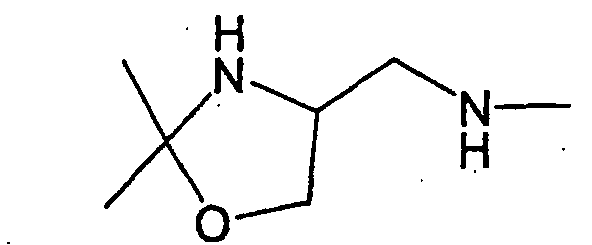

benzoyl, phenylacetyl etc.), aryl (e.g., phenyl, naphthyl etc.), arylalkyl (e.g., benzyl, phenethyl, phenylpropyl, naphthylmethyl etc.) and the like, wherein, as the acylamino, the acylamino for Y2 can be mentioned, and as the alkoxy and alkyl, those similar to the alkoxy and alkyl for R1 can be mentioned. The nitrogen atom in the cyclic amino may be protected with a conventional amino-protecting group (e.g., tert-butoxycarbonyl etc.) and/or may be N-oxidized. The cyclic amino may be condensed with a benzene ring, and as a cyclic amino condensed with a benzene ring, for example, 1,2,3,4-tetrahydroisoquinolinyl and the like can be mentioned. The nitrogen atom in the cyclic amino condensed with a benzene ring may be protected with a conventional amino-protecting group (e.g., tert-butoxycarbonyl etc.) and/or may be N-oxidized. When a carbon atom in the cyclic amino has two hydroxy substituents, the hydroxys may be crosslinked with alkylene (e.g., ethylene etc.) to form a spiro ring such as
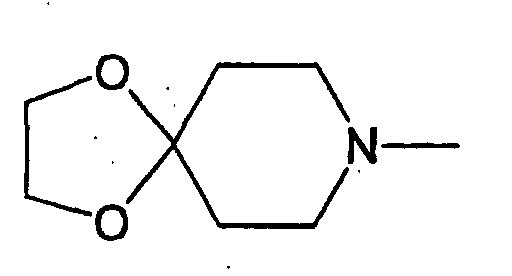

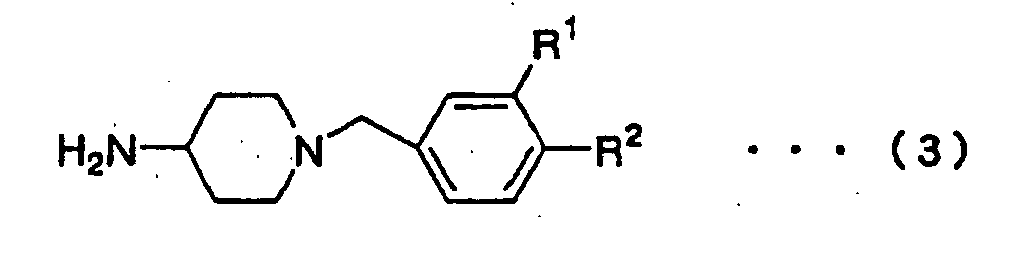



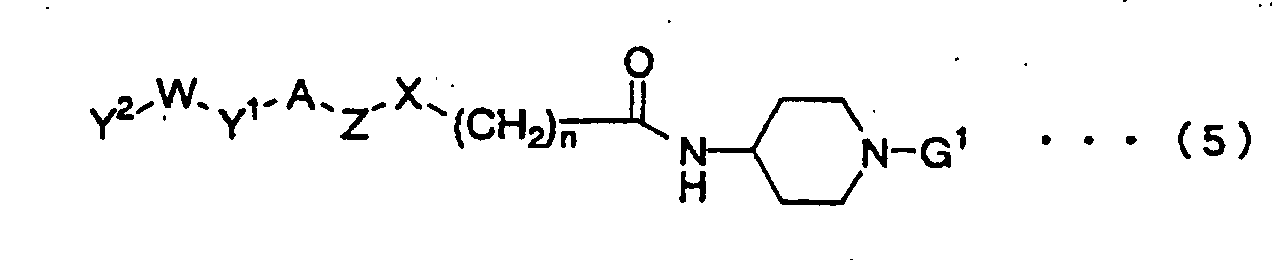

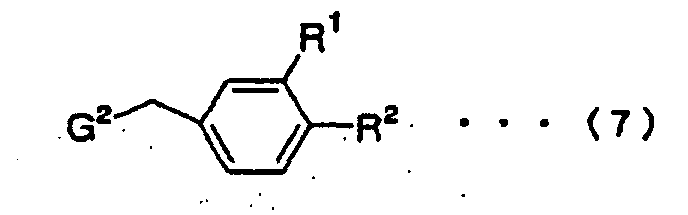
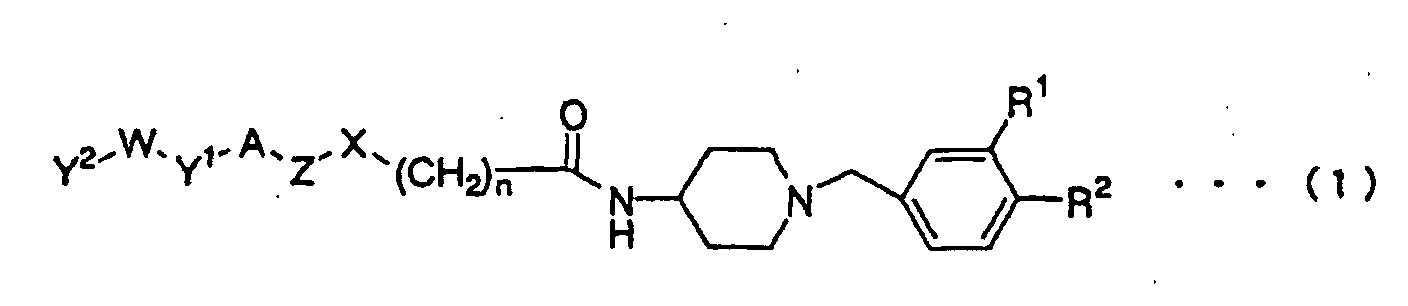



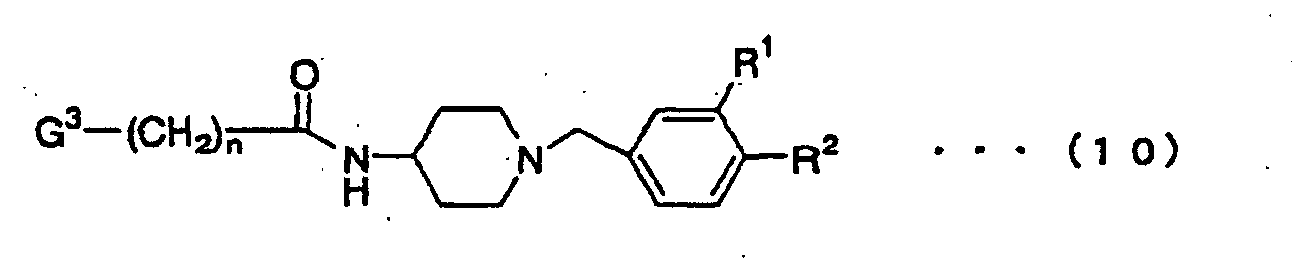
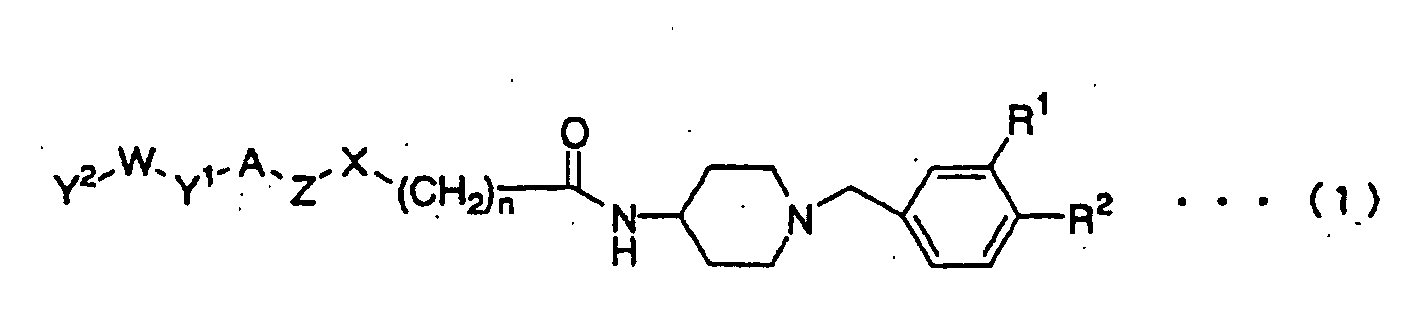

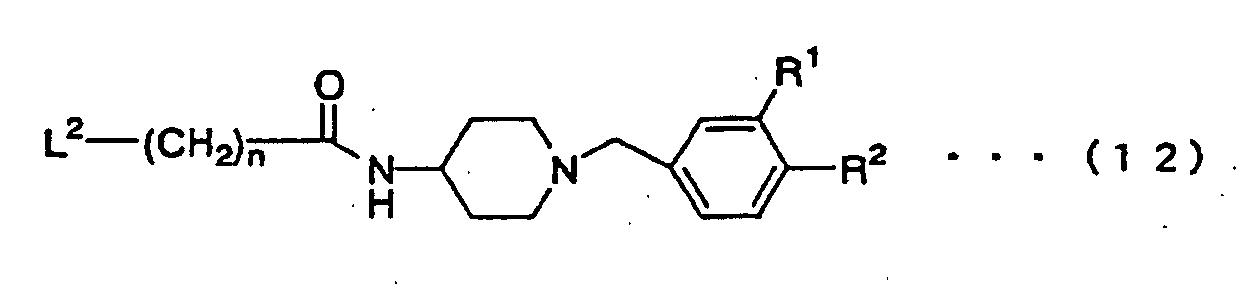

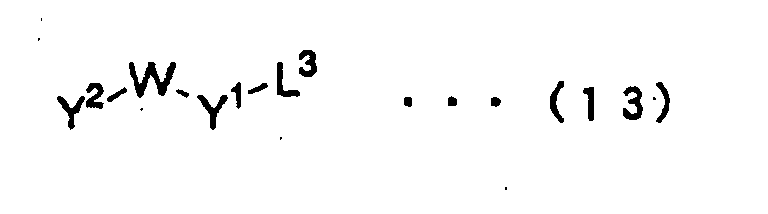


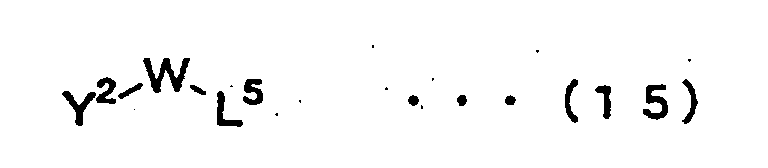




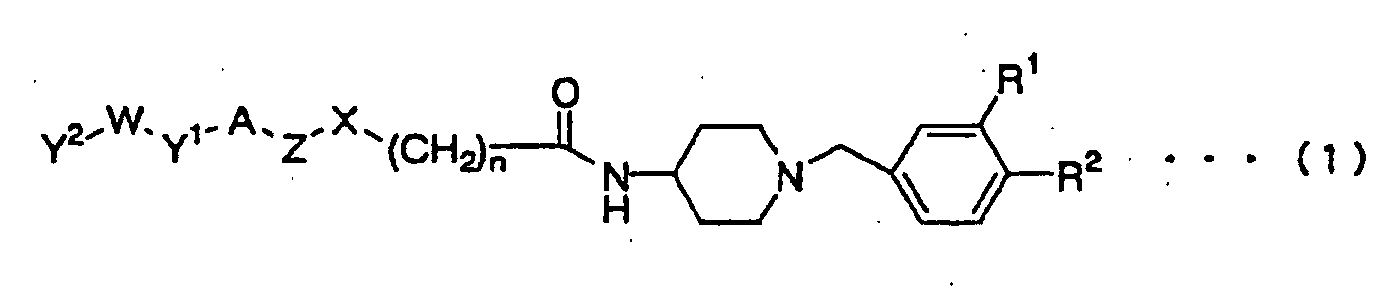


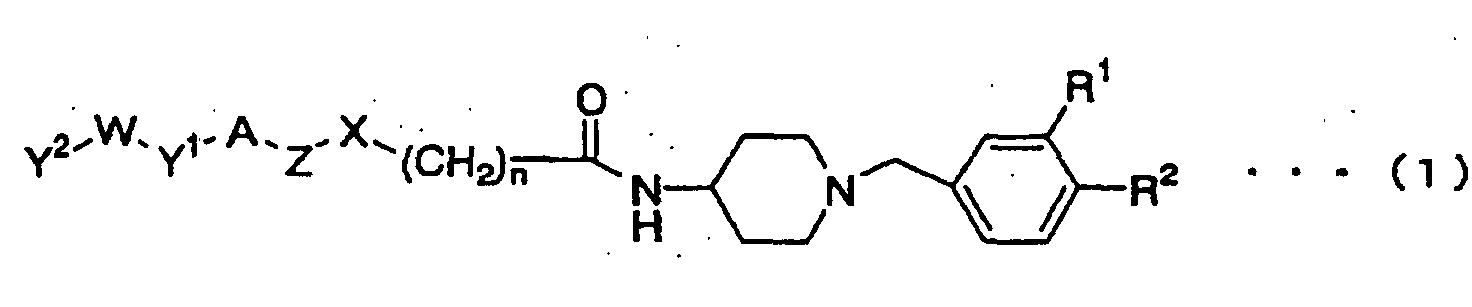
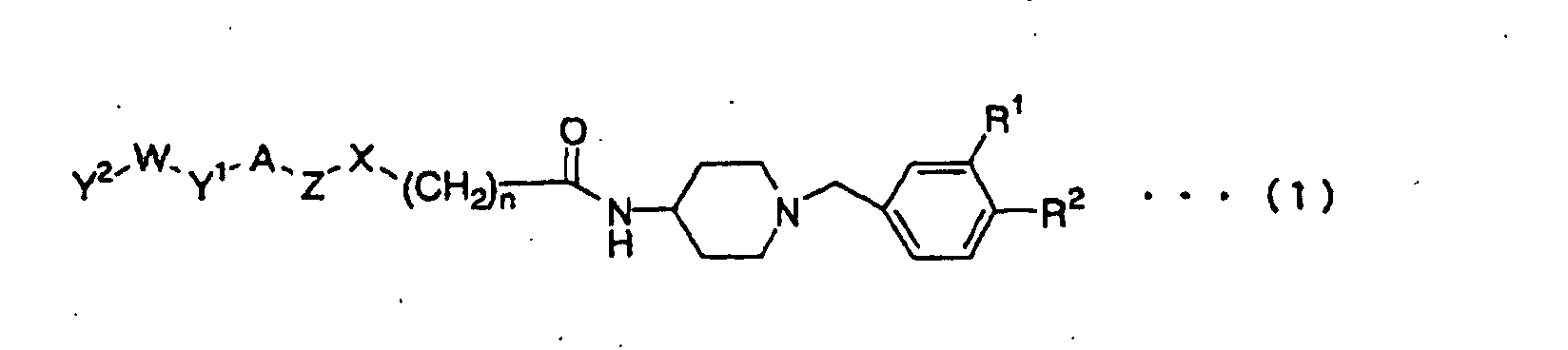

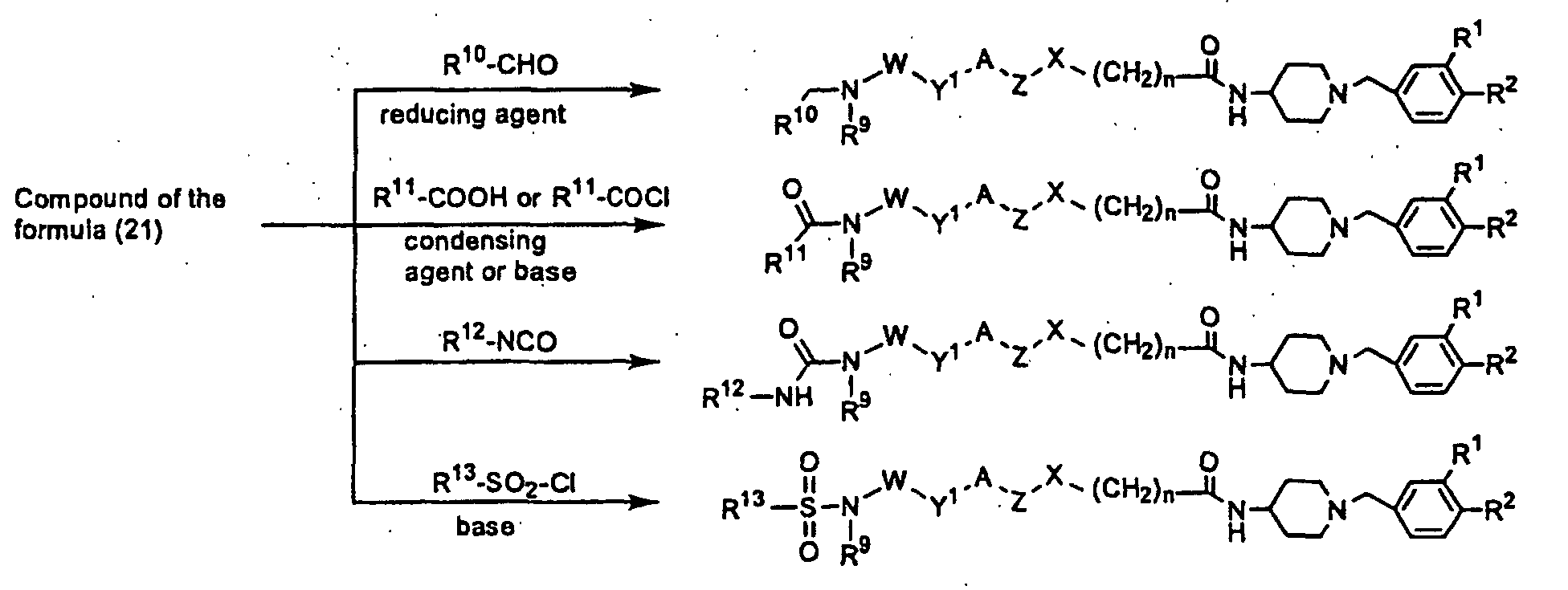


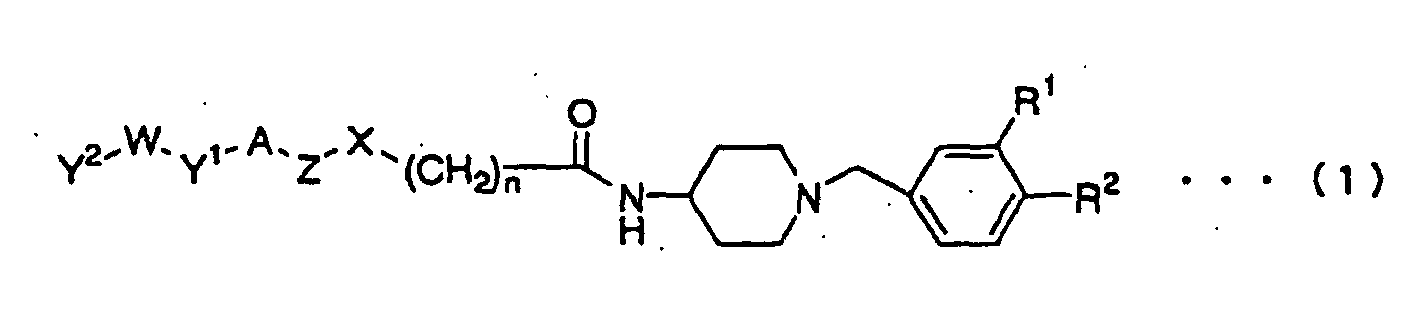

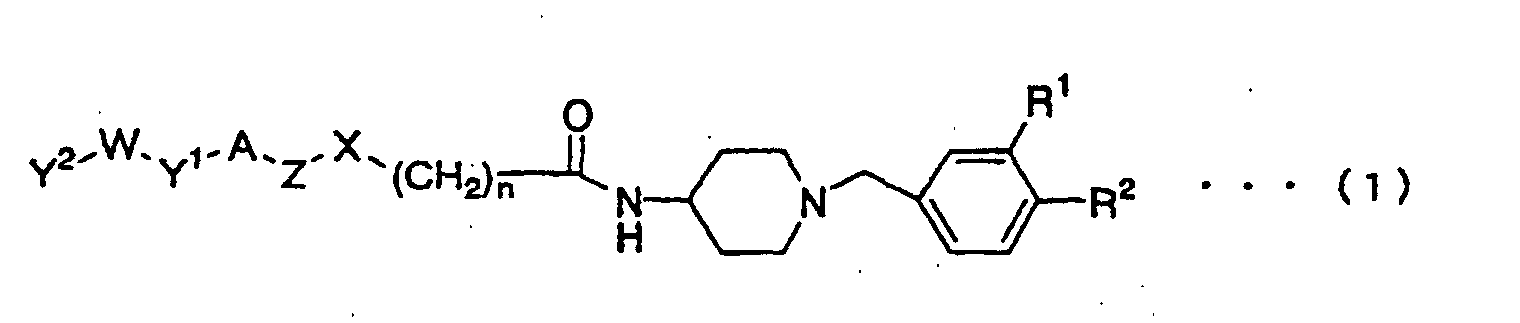








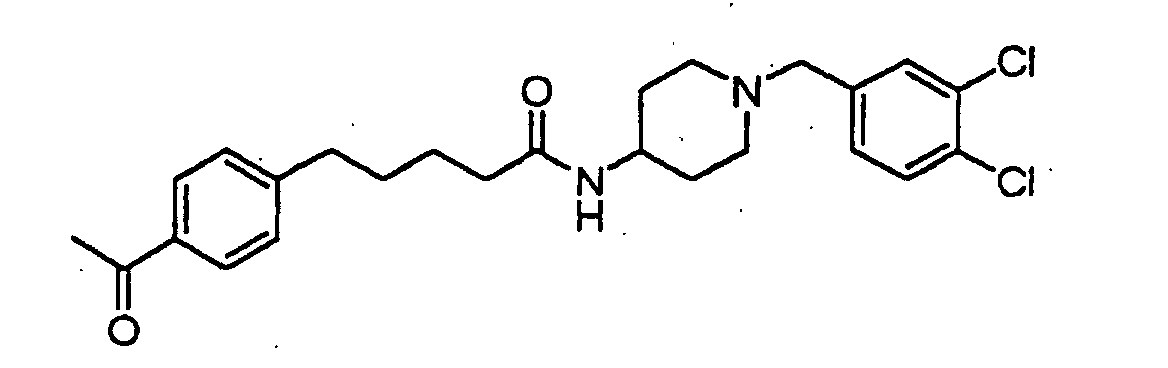
1H-NMR(CDCl3)δ 1.34-1.47 (2H, m), 1.64-1.69 (4H, m), 1.88-1.91 (2H, m), 2.06-2.17 (4H, m), 2.58 (3H, s), 2.66-2.79 (4H, m), 3.42 (2H, s), 3.75-3.85 (1H, m), 5.24 (1H, d, J=8.1 Hz) , 7.13 (1H, dd, J=8.1, 1.8 Hz), 7.25 (2H, d, J=8.4 Hz), 7.37 (1H, d, J=8.1 Hz), 7.42 (1H, d, J=1.8 Hz), 7.88 (2H, d, J=8.4 Hz)
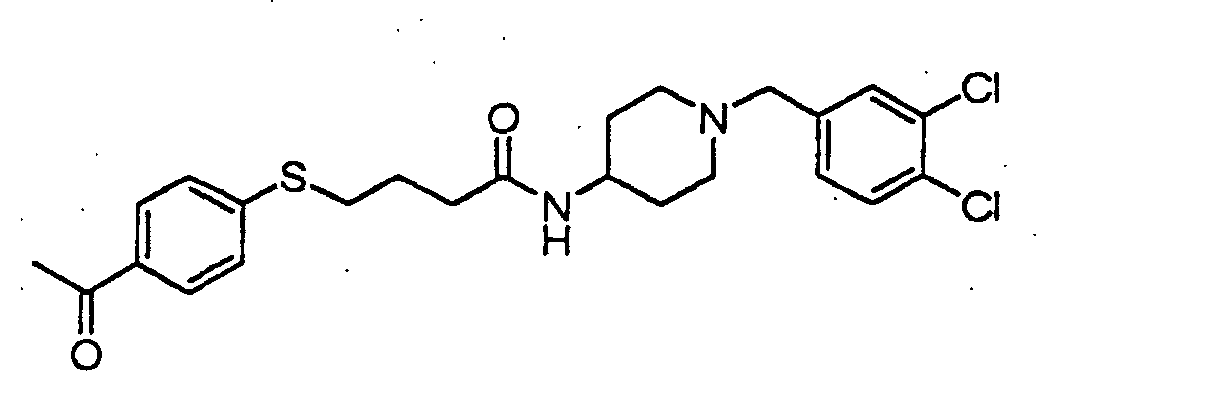
1H-NMR(CDCl3) δ 1.35-1.48 (2H, m), 1.88-1.92 (2H, m), 2.02-2.16 (4H, m), 2.32 (2H, t, J=7.1 Hz), 2.57 (3H, s), 2.74-2.78 (2H, m), 3.06 (2H, t, J=7.1 Hz), 3.42 (2H, s), 3.75-3.85 (1H, m), 5.31 (1H, d, J=7.8 Hz), 7.13 (1H, dd, J=8.1, 1.8 Hz), 7.33 (2H, d, J=8.4 Hz), 7.37 (1H, d, J=8.1 Hz), 7.42 (1H, d, J=1.8 Hz), 7.86 (2H, d, J=8.4 Hz)
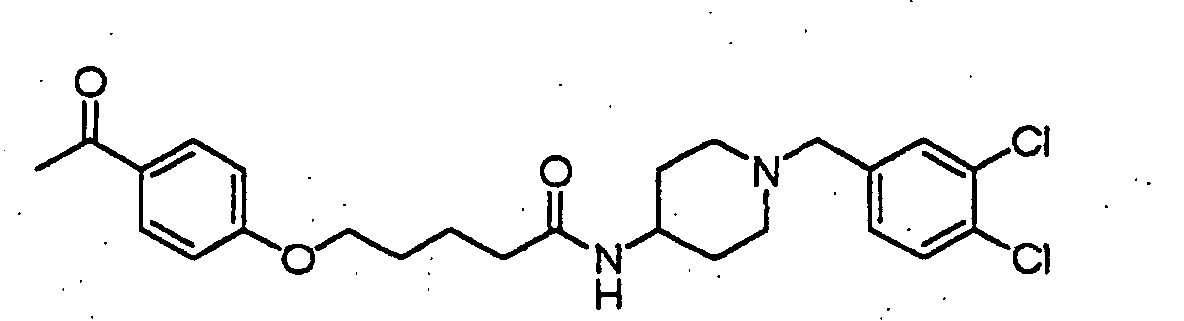
1H-NMR(CDCl3) δ 1.36-1.49 (2H, m), 1.82-1.93 (6H, m), 2.07-2.16 (2H, m), 2.24 (2H, t, J=6.9 Hz), 2.55 (3H, s), 2.74-2.79 (2H, m), 3.42 (2H, s), 3.75-3.85 (1H, m), 4.04 (2H, t, J=6.0 Hz), 5.31 (1H, d, J=8.1 Hz), 6.91 (2H, d, J=6.9 Hz), 7.13 (1H, dd, J=8.1, 2.1 Hz), 7.37 (1H, d, J=8.1 Hz), 7.43 (1H, d, J=2.1 Hz), 7.92 (2H, d, J=6.9 Hz)

1H-NMR(CDCl3)δ 1.38-1. 49 (2H, m), 1.86-1.91 (2H, m), 2.02-2.14 (4H, m), 2.37 (2H, t, J=6.9 Hz), 2.67 (3H, s), 2.77-2.79 (2H, m), 3.21 (2H, t, J=7.2 Hz), 3.42 (2H, s), 3.75-3.85 (1H, m) , 5.45 (1H, d, J=7.8 Hz), 7.14 (1H, dd, J=8.1, 1.8 Hz), 7.38 (1H, d, J=8.1 Hz), 7.42 (1H, d, J=1.8 Hz), 8.01 (2H, d, J=8.4 Hz), 8.13 (2.H, d, J=8.4 Hz)

1H-NMR (CDCl3) δ 1.36-1.49 (2H, m), 1.88-1.92 (2H, m), 2.05-2.23 (4H, m), 2.37 (2H, t, J=7.2 Hz), 2.74-2.78 (2H, m), 3.73 (2H, t, J=6.9 Hz), 3.42 (2H, s), 3.74-3.87 (1H, m), 5.36 (1H, d, J=8.1 Hz), 7.13 (1H, dd, J=8.1, 2.1 Hz), 7.37 (1H, d, J=8.4 Hz), 7.42 (1H, d, J=2.1 Hz) , 7.56 (1H, s), 8.03 (2H, d, J=8.8 Hz), 8.27 (2H, d, J=8.8 Hz)

1H-NMR(CDCl3) δ 1.33-1.42 (2H, m), 1.79-1.88 (2H, m), 2.04-2.13 (2H, m), 2.58-2.63 (2H, m), 3.35 (2H, s), 3.77-3.86 (1H, m), 3.94 (2H, s), 6.95 (1H, d, J=7.4 Hz), 7.08 (1H, d, J=8.1 Hz), 7.33-7.36 (2H, m), 7.63 (1H, s), 8.02 (2H, d, J=8.9 Hz), 8.30 (2H, d, J=8.9 Hz)


1H-NMR(DMSO-d6) δ 1.30-1.49 (2H, m), 1.63-1.81 (2H, m), 2.02 (2H, t, J=9.0 Hz), 2.51 (3H, s), 2.55 (2H, t, J=6.1 Hz), 2.64-2.80 (2H, m), 3.45 (2H, s), 3.49-3.66 (1H, m), 4.26 (2H, t, J=6.1 Hz), 7.01 (2H, d, J=8.9 Hz), 7.29 (1H, dd, J=6.4, 1.7 Hz), 7.54 (1H, d, J=1.7 Hz), 7.58 (1H, d, J=6.4 Hz), 7.91 (2H, d, J=8.9 Hz), 7.93 (1H, brs)


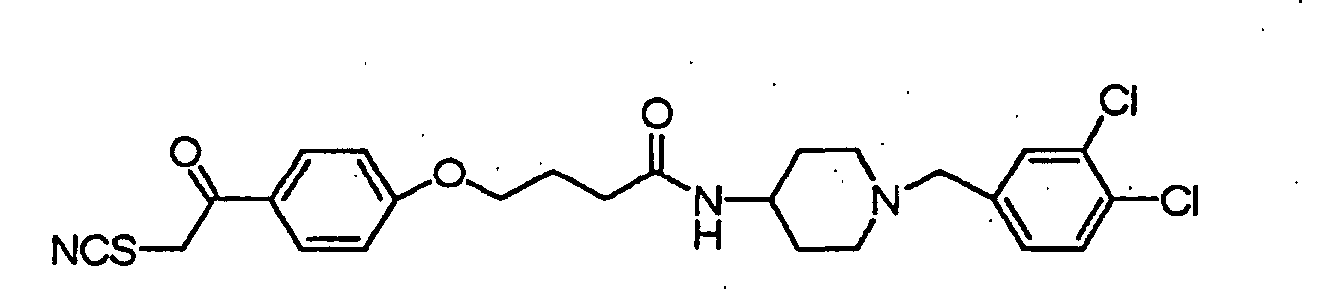
ESI-MS(m/z)520

1H-NMR(CDCl3)δ 1.36-1.48 (2H, m), 1.87-1.92 (2H, m), 2.08-2.18 (4H, m), 2.36 (2H, t, J=7.1 Hz), 2.59 (3H, d, J=5.1 Hz), 2.74-2.79 (2H, m), 3.42 (2H, s), 3.76-3.86 (1H, m), 4.06 (2H, t, J=6.0 Hz), 5.34 (1H, brd, J=7.5 Hz), 6.60 (1H, dd, J=13.2, 2.4 Hz), 6.73 (1H, dd, J=8.8, 2.4 Hz), 7.14 (1H, dd, J=8.1, 1.8 Hz), 7.37 (1H, d, J=8.1 Hz), 7.42 (1H, d, J=1.8 Hz), 7.87 (1H, t, J=8.8 Hz)

1H-NMR(CDCl3) δ 1.43-1.49 (2H, m), 1.86-1.92 (2H, m), 2.01-2.17 (4H, m), 2.36 (2H, t, J=7.1 Hz), 2.65 (3H, s), 2.75-2.80 (2H, m), 2.80-2.90 (1H, m), 2.93-3.02 (1H, m), 3.43 (2H, s), 3.76-3.86 (1H, m), 5.62 (1H, brd, J=7.8 Hz), 7.14 (1H, dd, J=8.1, 1.8 Hz), 7.38 (1H, d, J=8.1 Hz), 7.43 (1H, d, J=1.8 Hz), 7.71 (2H, d, J=8.4 Hz), 8.10 (1H, d, J=8.4 Hz)
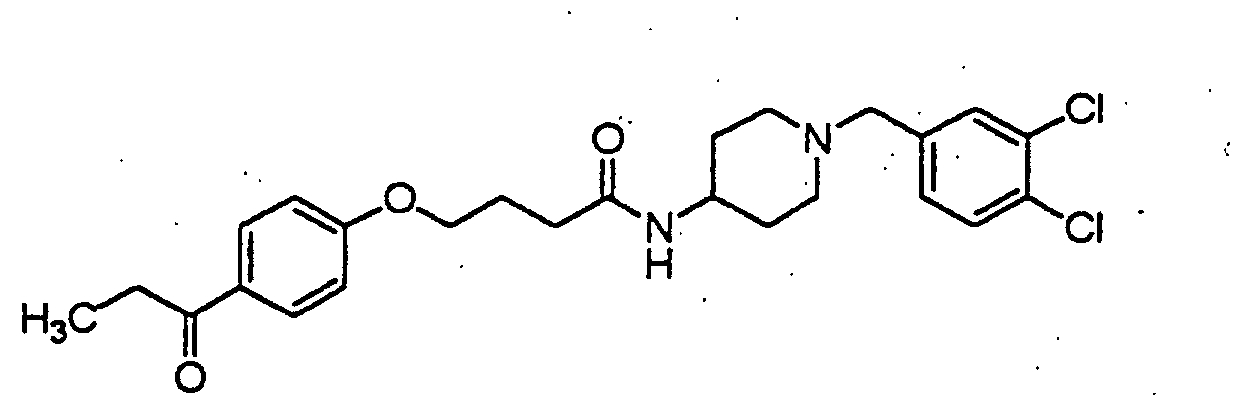
1H-NMR(CDCl3)δ 1.21 (3H, t, J=7.3 Hz), 1.42-1.47 (2H, m), 1.88-1.92 (2H, m), 2.10-2.19 (4H, m), 2.37 (2H, t, J=7.2 Hz) , 2.76-2.79 (2H, m) , 2.95 (2H, q, J=7.3 Hz), 3.44 (2H, s), 3.80-3.84 (1H, m) , 4.07 (2H, t, J=5.9 Hz) , 5.36 (1H, brd, J=8.1 Hz), 6.92 (2H, d, J=8.7 Hz), 7.15 (1H, brd, J=7.2 Hz) , 7.38 (1H, d, J=8.1 Hz), 7.43 (1H, d, J=1.8 Hz), 7.94 (2H, d, J=8.7 Hz)
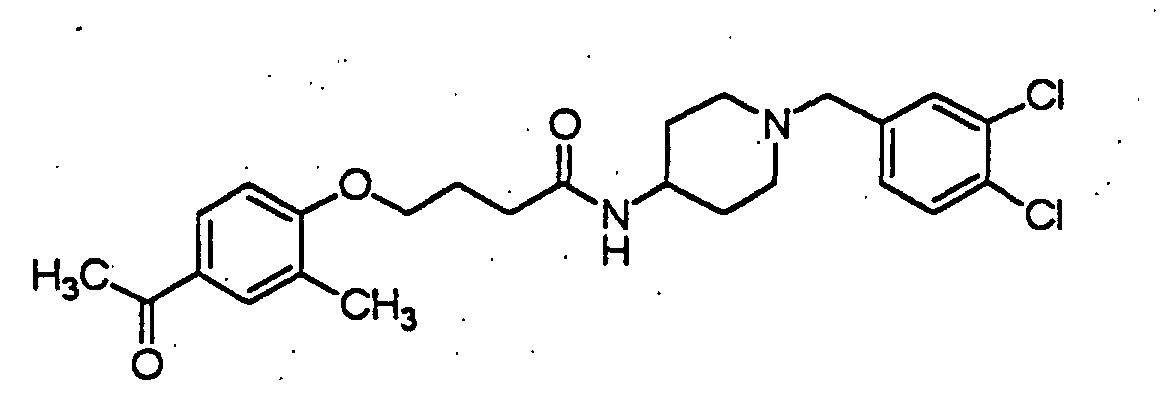
1H-NMR (CDCl3) δ 1.38-1.46 (2H, m), 1.87-1.91 (2H, m), 2.07-2.22 (4H, m), 2.25 (3H, s), 2.39 (2H, t, J=7.2 Hz), 2.55 (3H, s), 2.73-2.77 (2H, m), 3.41 (2H, s), 3.76-3.86 (1H, m), 4.08 (2H, t, J=6.0 Hz), 5.32 (1H, brd, J=7.8 Hz), 6.83 (1H, d, J=8.7 Hz), 7.13 (1H, dd, J=8.1, 1.8 Hz), 7.37 (1H, d, J=8.1 Hz), 7.42 (1H, d, J=1.8 Hz), 7.80-7.81 (2H, m)

1H-NMR(CDCl3) δ 1.39-1.48 (2H, m), 1.88-1.91 (2H, m), 2.09-2.17 (4H, m), 2.36 (2H, t, J=7.2 Hz), 2.54 (3H, s), 2.56 (3H, s), 2.74-2.78 (2H, m), 3.42 (2H, s), 3.76-3.86 (1H, m), 4.05 (2H, t, J=6.0 Hz), 5.35 (1H, brd, J=8.1 Hz), 6.73-6.76 (2H, m), 7.14 (1H, dd, J=8.1, 1.8 Hz), 7.37 (1H, d, J=8.1 Hz), 7.42 (1H, d, J=1.8 Hz), 7.74 (1H, d, J=9.6 Hz)
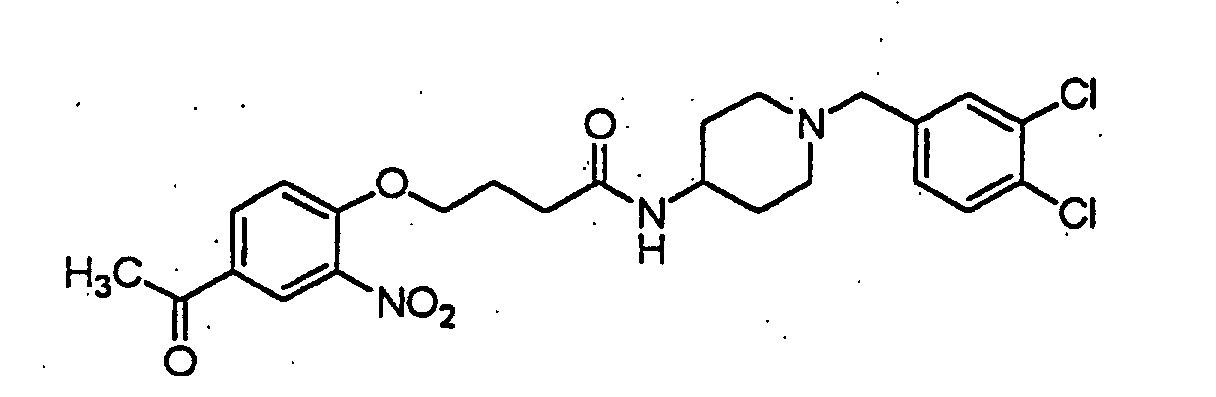
1H-NMR(CDCl3) δ 1.35-1.44 (2H, m), 1.80-1.85 (2H, m), 2.05-2.13 (2H, m), 2.19 (2H, quint, J=6.3 Hz), 2.43 (2H, t, J=6.9 Hz), 2.61 (3H, s), 2.68-2.72 (2H, m), 3.39 (2H, s), 3.76-3.81 (1H, m), 4.25 (2H, t, J=5.9 Hz), 5.66 (1H, brd, J=8.1 Hz), 7.12 (1H, dd, J=8.4, 2.1 Hz), 7.15 (1H, d, J=8.7 Hz), 7.36 (1H, d, J=8.4 Hz), 7.39 (1H, d, J=2.1 Hz), 8.15 (1H, dd, J=8.7, 2.4 Hz), 8.43 (1H, d, J=2.4 Hz)

1H-NMR(DMSO-d6) δ 1.26-1.48 (2H, m), 1.60-1.77 (2H, m), 2.03 (2H, t, J=11.7 Hz), 2.69 (2H, d, J=11.7 Hz), 3.44 (2H, s), 3.46 (2H, s), 3.50-3.63, (1H, m), 6.98-7.08 (1H, m), 7.17 (1H, dd, J=3.6, 1.2 Hz), 7.28 (1H, dd, J=8.1, 1.8 Hz), 7.50-7.66 (3H, m), 7.82-7.98 (1H, m)
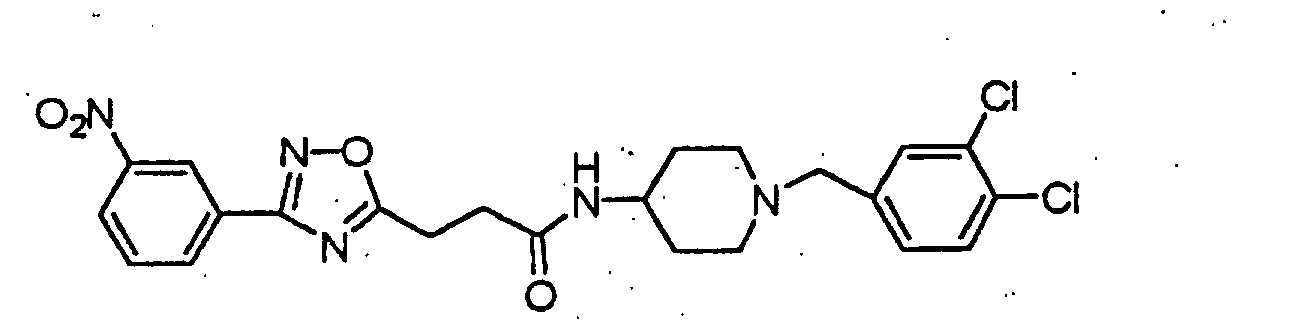
1H-NMR(DMSO-d6) δ 1.28-1.51 (2H, m), 1.62-1.80 (2H, m), 2.01 (2H, t, J=11.1 Hz), 2.64-2.81 (4H, m), 3.22 (2H, t, J=7.2 Hz), 3.43 (2H, s), 3.45-3.64 (1H, m), 7.27 (1H, dd, J=8.4, 1.8 Hz), 7.51 (1H, d, J=1.8 Hz), 7.57 (1H, d, J=8.1 Hz), 7.88 (1H, d, J=8.1 Hz), 7.96-8.05 (1H, m), 8.39-8.50 (2H, m), 8. 68 (1H, d, J=1.8 Hz)
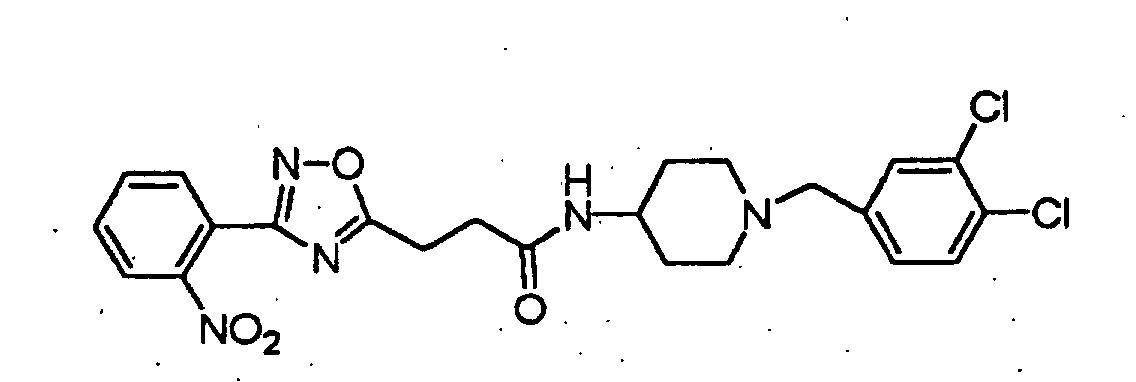
1H-NMR(DMSO-d6)δ 1.26-1.50 (2H, m), 1.65-1.80 (2H, m), 2.00 (2H, t, J=11.2 Hz), 2.68-2.80 (4H, m), 3.19 (2H, t, J=7.2 Hz) 3.44 (2H, s), 3.45-3.62 (1H, m), 7.28 (1H, dd, J=8.2, 1.8 Hz) 7.52 (1H, d, J=1.8 Hz), 7.57 (1H, d, J=8.2 Hz), 7.80-8.00 (3H m), 8.06-8.16 (1H, m), 8.32 (1H, s)

1H-NMR(CDCl3)δ 1.30-1.44 (2H, m), 1.80-1.94 (2H, m), 2.02-2.15 (2H, m), 2.56-2.68 (2H, m), 3.32 (2H, s), 3.74-3.86 (1H, m), 3.91 (2H, s), 7.01-7.10 (2H, m), 7.31-7.36 (2H, m), 7.50 (1H, s), 7.55 (1H, d, J=7.8 Hz), 7.62-7.67 (1H, m), 8.05.-8.10- (1H, m), 8.15 (1H, s)
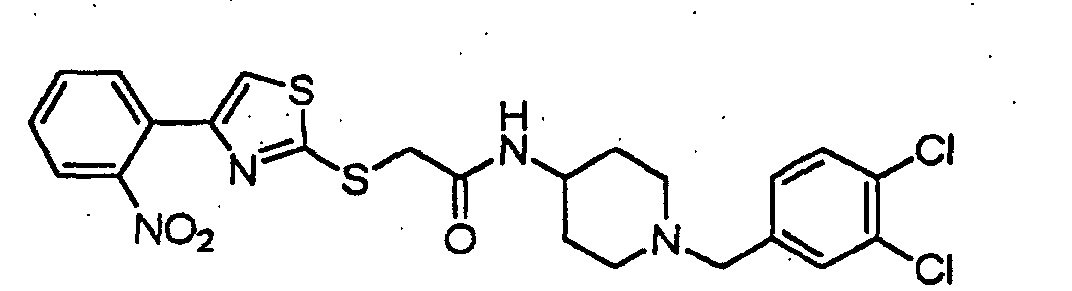
1H-NMR(CDCl3)δ 1.35-1.49 (2H, m), 1.75-1.85 (2H, m), 2.02-2.19 (2H, m), 2.59-2.70 (2H, m), 3.39 (2H, s), 3.69-3.83 (3H, m), 6.80-6.86 (1H, m), 7.03-7.11 (1H, m), 7.24-7.43 (3H, m), 7.49-7.70 (3H, m), 7.73-7.77 (1H, m)
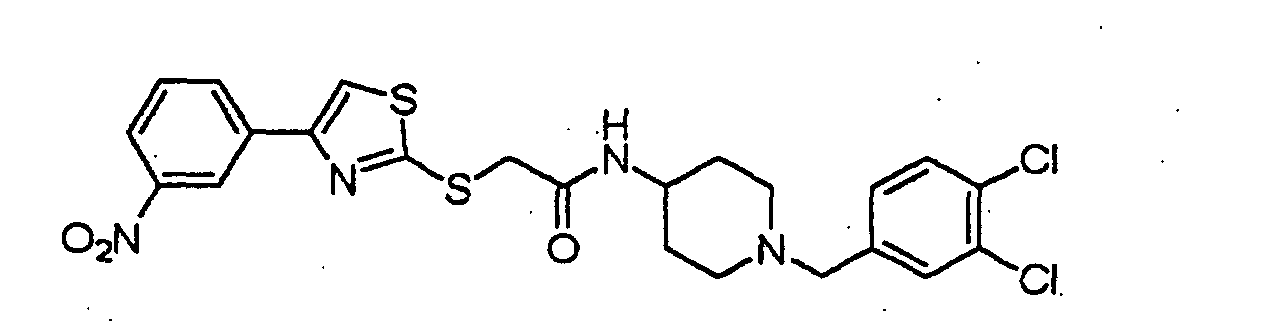
1H-NMR(CDCl3)δ 1.35-1.44 (2H, m), 1.70-1.92 (2H, m), 2.08-2.20 (2H, m), 2.60-2.71 (2H, m), 3.36 (2H, s), 3.77-3.99 (1H, m) , 3.93 (2H, s), 7.00-7.10 (2H, m), 7.20-7.26 (2H, m), 7.58 (1H, s), 7.59-7.66 (1H, m), 8.16-8.24 (2H, m), 8.68 (1H, s)

1H-NMR (DMSO-d6) δ 1.33-1.45 (2H, m), 1.65-1.71 (2H, m), 1. 97-2.07 (2H, m), 2.64-2.73 (2H, m), 3.42 (2H, s), 3.50-3.61 (1H, m), 4.02 (2H, s), 7.24-7.30 (1H, m), 7.51-7.60 (2H, m), 7.85 (1H, d, J=8.4 Hz), 8.21-8.27 (2H, m), 8.31 (1H, s), 8.56-8.58 (1H, m)

1H-NMR(DMSO-d6)δ 1.32-1.48 (2H, m), 1.67-1.74 (2H, m), 1.98-2.08 (2H, m), 2.47-2.52 (3H, m), 2.62-2.72 (2H, m), 3.42 (2H, s), 3.48-3.61 (1H, m), 4.00 (2H, s), 7.25-7.30 (1H, m), 7.50-7.61 (3H, m), 8.14-8.27 (3H, m), 8.46-8.48 (1H, m)
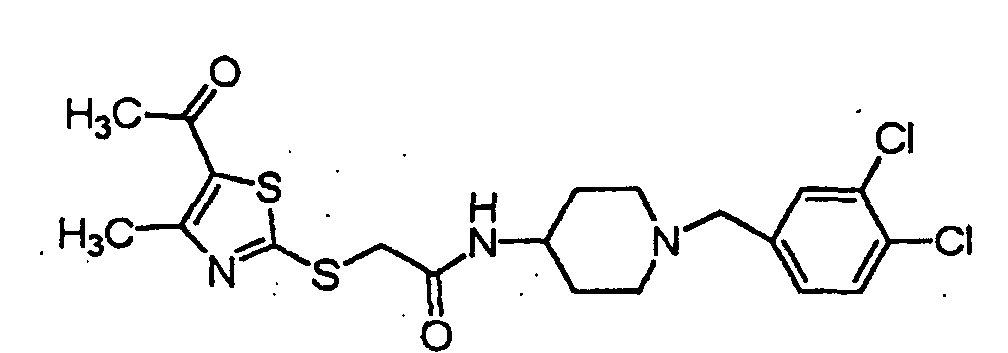
1H-NMR (CDCl3) δ 1.36-1.46 (2H, m), 1.86-1.92 (2H, m), 2.08-2.16 (2H, m), 2.50 (3H, s), 2.66-2.72 (2H, m), 2.70 (3H, s), 3.40 (2H, s), 3.72-3.80 (1H, m), 3.82 (2H, s), 7.12 (1H, dd, J=8.1, 1.8 Hz) 7.20 (1H, d, J=7.5 Hz), 7.37 (1H, d, J=8.1 Hz), 7.41 (1H, d, J=1.8 Hz)
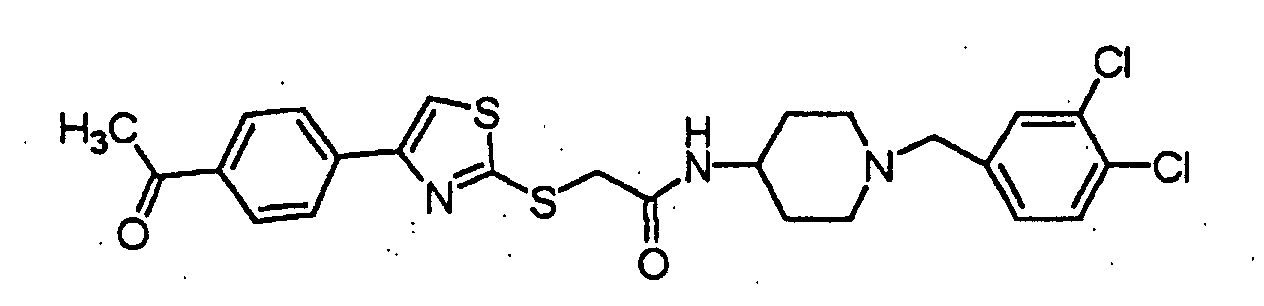
1H-NMR(CDCl3) δ 1.31-1.43 (2H, m), 1.80-1.86 (2H, m), 2.04-2.15 (2H, m), 2.52-2.56 (2H, m), 2.64 (3H, s), 3.29 (2H, s), 3.78-3.84 (1H, m), 3.92 (2H, s), 7.04 (1H, dd, J=8.4, 1.8 Hz), 7.17 (1H, d, J=8.1 Hz), 7.31 (1H, d, J=8.1 Hz), 7.33 (1H, d, J=8.4 Hz), 7.56 (1H, s), 7.95 (2H, d, J=8.4 Hz), 8.03 (2H, d, J=8.4 Hz)

1H-NMR(CDCl3) δ 1.32-1.43 (2H, m) , 1.80-1.85 (2H, m), 2.02-2.11 (2H, m), 2.51-2.54 (2H, m), 2.67 (3H, s), 3.28 (2H, s), 3.77-3.84 (1H, m), 3.92 (2H, s), 7.04 (1H, dd, J=8.1, 1.8 Hz), 7.19 (1H, brd, J=8.1 Hz), 7.31 (1H, d, J=1.8 Hz), 7.33 (1H, d, J=8.1 Hz) , 7.53 (1H, s) , 7.56 (1H, t, J=7.8 Hz), 7.95 (1H, dt, J=7.8, 1.5 Hz), 8.08 (1H, dt, J=7.8, 1.5 Hz), 8.44 (1H, t, J=1.5 Hz)

1H-NMR (CDCl3) δ 1.39-1.50 (2H, m), 1.89-1.93 (2H, m), 2.08-2.18 (4H, m), 2.33 (2H, t, J=7.2 Hz), 2.48 (3H, s), 2.68 (3H, s), 2.75-2.79 (2H, m), 3.29 (2H, t, J=6.9 Hz), 3.42 (2H, s), 3.78-3.83 (1H, m), 5.40 (1H, brd, J=8.1 Hz), 7.13 (1H, dd, J=8.1, 1.8 Hz), 7.37 (1H, d, J=8.1 Hz), 7.42 (1H, d, J=1.8 Hz)

1H-NMR(CDCl3) δ 1.28-1.40 (2H, m), 1.64 (3H, d, J=7.3 Hz), 1.78-1.89 (2H, m), 2.03-2.10 (2H, m), 2.54-2.58 (2H, m), 3.30 (2H, s), 3.75-3.83 (1H, m), 4.42 (1H, q, J=7.3 Hz), 7.03-7.06 (2H, m), 7.32-7.34 (2H, m), 7.59 (1H, s), 7.64 (1H, t, J=8.0 Hz), 8.17-8.24 (2H, m), 8.70 (1H, t, J=2.0 Hz)
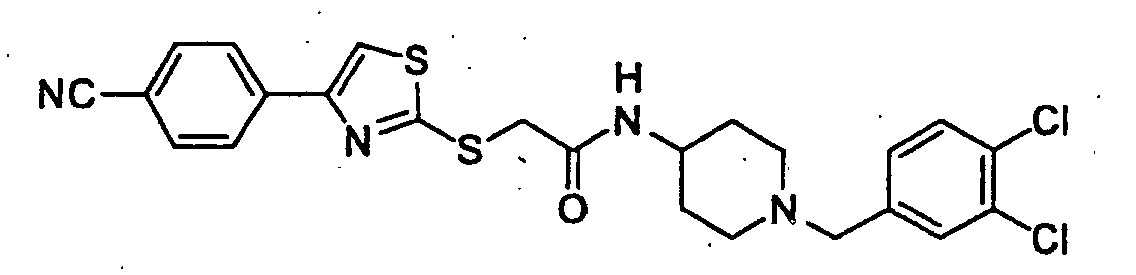
1H-NMR(CDCl3) δ 1.44-1.60 (2H, m), 1.84-1.92 (2H, m), 2.18-2.30 (2H, m), 2.75-2.86 (2H, m), 3.49 (2H, s), 3.80-3.90 (1H, m), 3.93 (2H, s), 7.06-7.13 (2H, m), 7.28-7.38 (2H, m), 7.54 (1H, s), 7.65-7.72 (2H, m), 7.90-7.97 (2H, m)
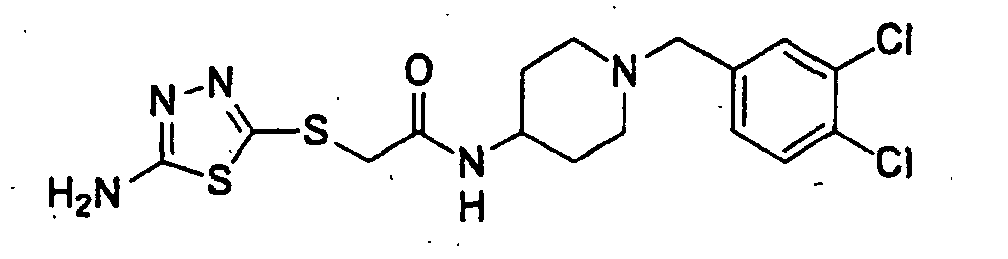
1H-NMR (DMSO-d6)δ 1.31-1.48 (2H, m), 1.67-1.74 (2H, m), 1.98-2.10 (2H, m), 2.64-2.76 (2H, m), 3.45 (2H, s), 3.45-3.60 (1H, m), 3.72 (2H, s), 7.22-7.31 (3H, m), 7.53-7.59 (2H, m), 8.06 (1H, d, J=7.5 Hz)

1H-NMR(DMSO-d6) δ 1.55-1.68 (2H, m), 2.05-2.21 (2H, m), 2.70-2.85 (2H, m), 3.22-3.40 (2H, m), 3.57-3.80 (1H, m), 4.03 (2H, s), 4.26 (2H, s), 7.51-7.59 (1H, m), 7.61-7.66 (1H, m), 7.86-7.96 (3H, m), 8.11-8.19 (1H, m), 8.30 (1H, s), 8.42-8.50 (1H, m)

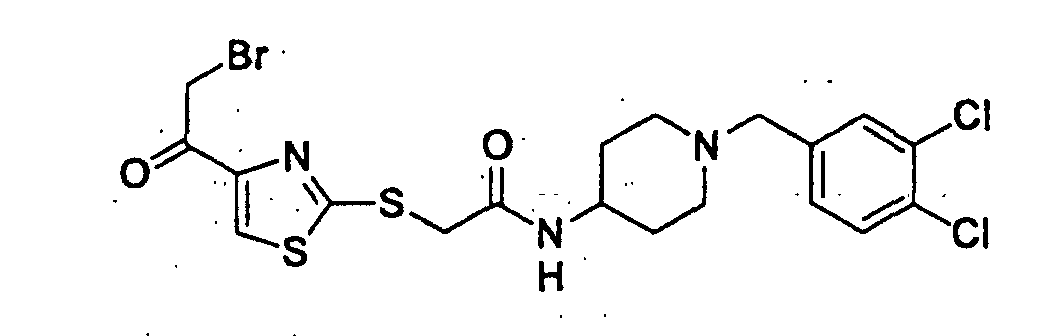
ESI-MS(m/z):536

1H-NMR(DMSO-d6)δ 3.2-3.5 (3H, m), 6.81-6.85 (1H, m), 7.03-7.06 (1H, m), 7.13-7.14 (1H, m), 7.22-7.28 (1H, m)
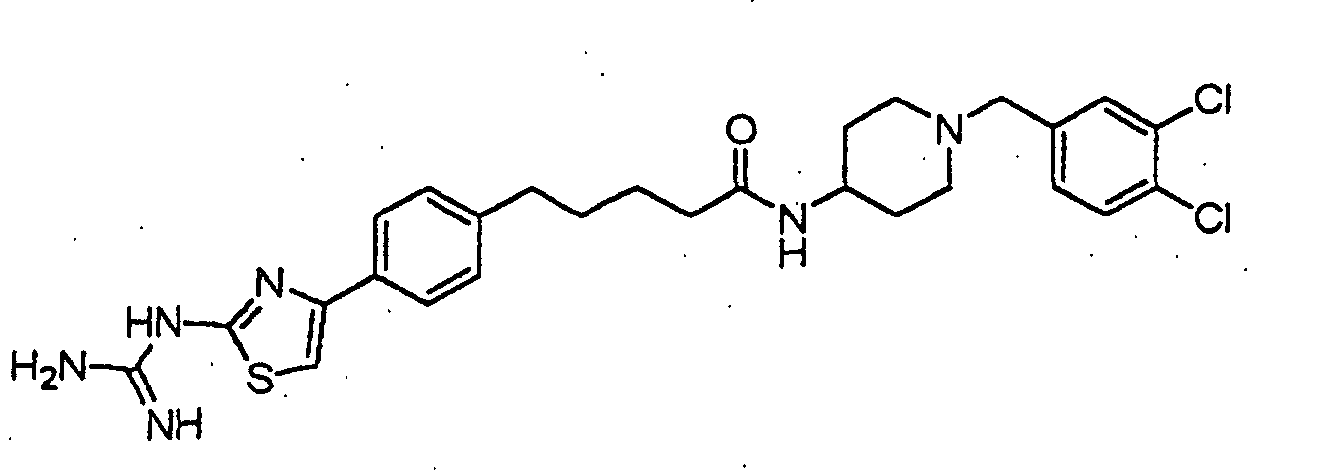
1H-NMR (DMSO-d6)δ 1.31-1.42 (2H, m), 1.51-1.53 (4H, m), 1.67-1.70 (2H, m), 2.03-2.09 (4H, m), 2.55-2.57 (2H, m), 2.70-2.73 (2H, m), 3.39-3.45 (3H, m), 6.80-7.03 (2H, m), 7.09 (1H, s), 7.18 (2H, d, J=8.1 Hz), 7.29 (1H, d, J=8.2 Hz), 7.54 (1H, s), 7.58 (1H, d, J=8.2 Hz), 7.69-7.71 (1H, m), 7.72 (2H, d, J=8.1 Hz)
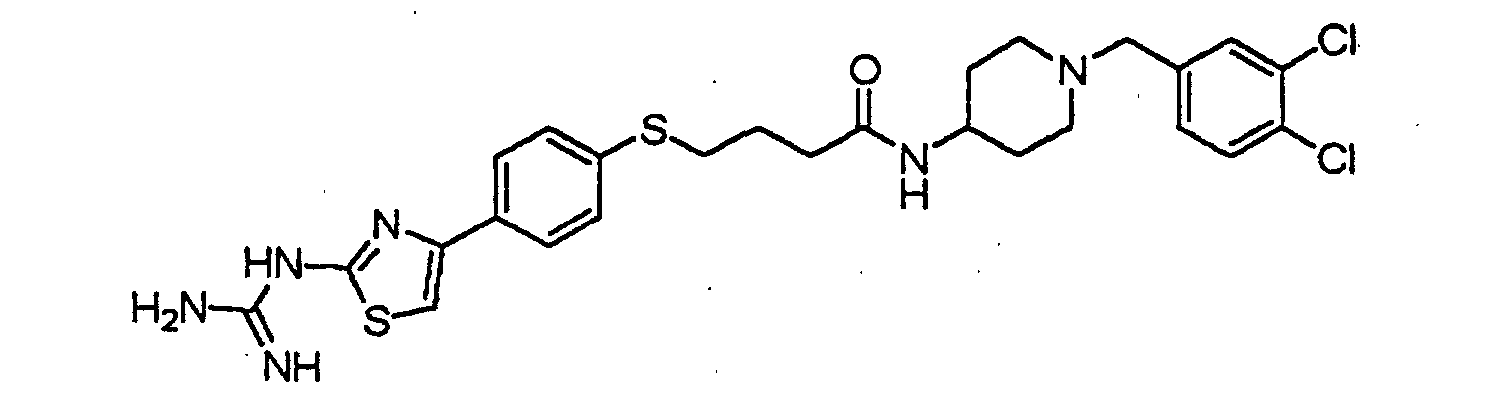
1H-NMR(DMSO-d6)δ 1.35-1.41 (2H, m), 1.67-1.71 (2H, m), 1.78 (2H, quint, J=7.3 Hz), 1.98-2.05 (2H, m), 2.20 (2H, t, J=7.2 Hz), 2.69-2.73 (2H, m), 2.95 (2H, t, J=7.2 Hz), 3.44 (2H, s), 3.49-3.55 (1H, m), 6.89-6.93 (2H, m), 7.14 (1H, s), 7.28 (1H, dd, J=8.4, 1.8 Hz) , 7.31 (2H, d, J=8.4 Hz), 7.53 (1H, d, J=1.8 Hz), 7.57 (1H, d, J=8.4 Hz), 7.76 (2H, d, J=8.4 Hz), 7.76-7.77 (1H, m)

1H-NMR (DMSO-d6)δ 1.31-1.40, (2H, m), 1.54-1.80 (6H, m), 1.93-2.13 (4H, m), 2.65-2.78 (2H, m), 3.39-3.51 (3H, m), 3.96-3.99 (2H, m), 6.92 (2H, d, J=8.7 Hz), 7.00 (1H, s) , 7.28-7.31 (1H, m), 7.54-7.60 (2H, m), 7.74 (2H, d, J=8.7 Hz), 7.89-7.93 (1H, m)
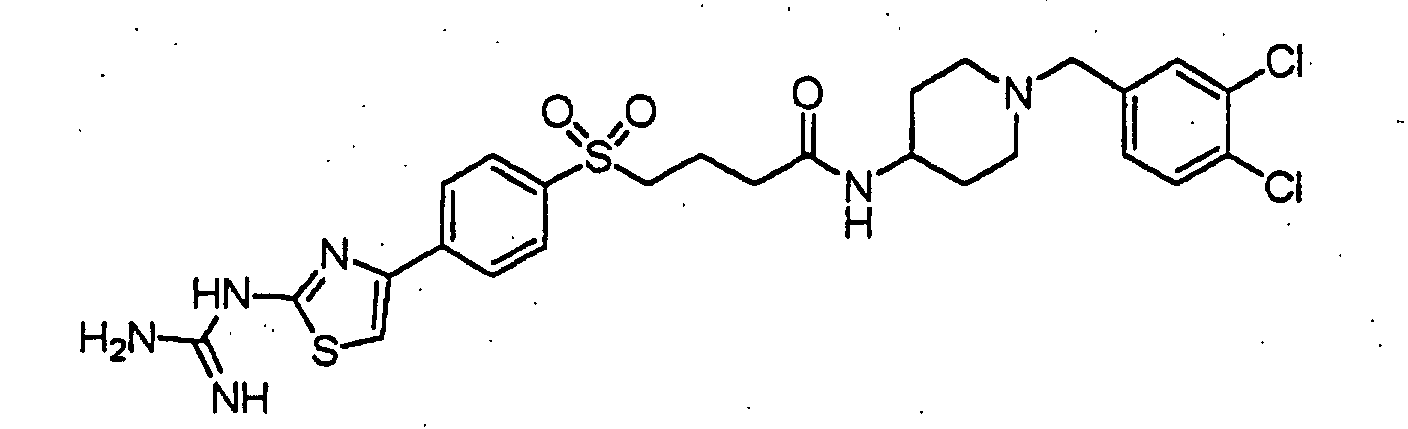
1H-NMR (DMSO-d6) δ 1.28-1.38 (2H, m), 1.64-1.78 (4H, m), 1.95-2.03 (2H, m), 2.15 (2H, t, J=7.4 Hz), 2.54-2.71 (2H, m), 3.27-3.31 (2H, m), 3.40-3.48 (3H, m), 6.80-7.10 (3H, brs), 7.28 (1H, dd, J=8.3, 1.5 Hz), 7.48 (1H, s), 7.52 (1H, d, J=1.5 Hz), 7.57 (1H, d, J=8.3 Hz), 7.75 (1H, d, J=7.8 Hz), 7.85 (2H, d, J=8.4 Hz), 8.10 (2H, d, J=8.4 Hz)
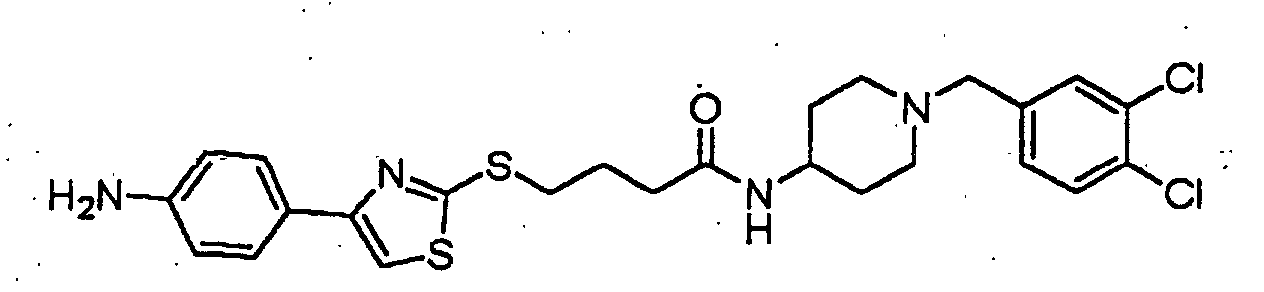
1H-NMR (DMSO-d6) δ 1.63-1.69 (2H, m) , 1.88-1.99 (4H, m), 2.24 (2H, t, J=7.2 Hz), 2.95-3.01 (2H, m), 3.21-3.26 (4H, m), 3.72-3.78 (1H, m), 4.24-4.26 (2H, brs) , 5.31-5.46 (2H, brs) , 6.59 (2H, d, J=8.7 Hz), 7.53-7.60 (4H, m), 7.75 (1H, d, J=8.1 Hz), 7.89 (1H, brs), 8.05 (1H, d, J=6.0 Hz), 10.23 (1H, brs)

1H-NMR(DMSO-d6)δ 1.35-1.46 (2H, m) , 1.70-1.73 (2H, m), 2.01-2.04 (2H, m), 2.66-2.70 (2H, m), 3.43 (2H, s) , 3.53-3.58 (1H, m), 3.97 (2H, s), 5.31 (2H, brs), 6.58 (2H, d, J=8.7 Hz), 7.28 (1H, dd, J=8.3, 1.8 Hz), 7.52 (1H, d, J=1.8 Hz), 7.55-7.62 (4H, m), 8.20 (1H, d, J=7.5 Hz)
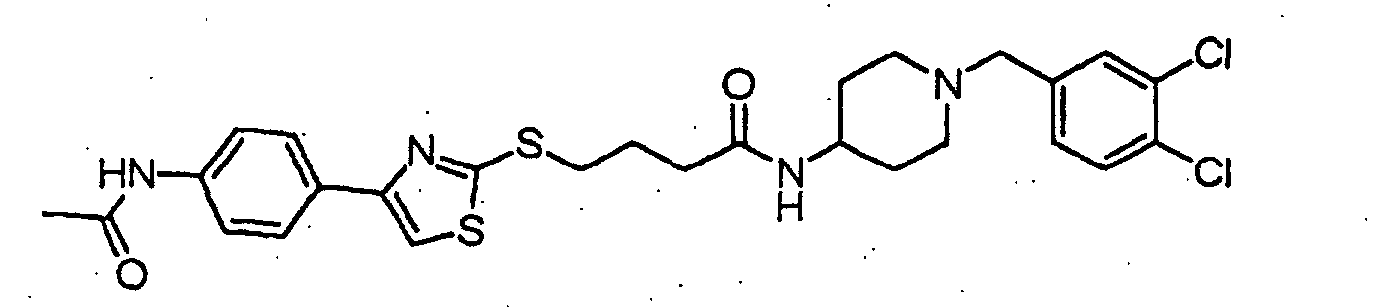
1H-NMR (DMSO-d6) δ 1.66-1.73 (2H, m), 1.90-2.01 (4H, m), 2.06 (3H, s), 2.25 (2H, t, J=7.4 Hz), 2.55-2.98 (2H, m), 3.24-3.29 (4H, m), 3.70-3.80 (1H, m), 4.26 (2H, d, J=5.1 Hz), 7.54-7.58 (1H, m), 7.65 (2H, d, J=8.4 Hz), 7.75 (1H, d, J=8.4 Hz), 7.84 (2H, d, J=8.7 Hz), 7.89-7.90 (2H, m), 8.06-8.09 (1H, m), 10.09 (1H, brs), 10.40 (1H, brs)
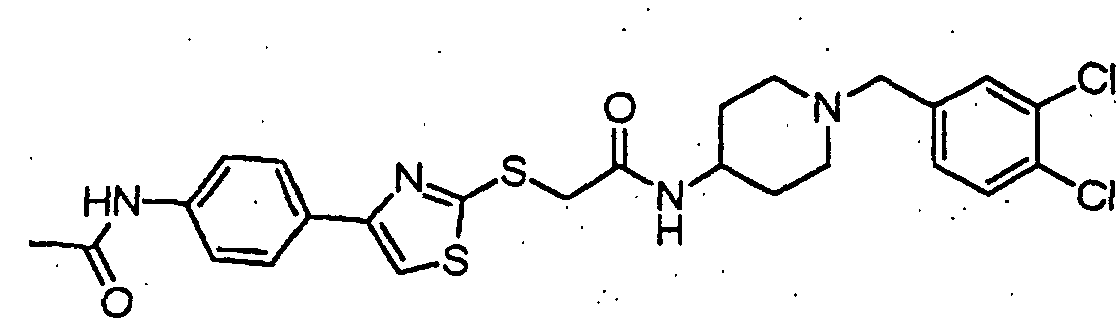
1H-NMR (DMSO-d6) δ 1.70-1.82 (2H, m), 1.90-1.95 (2H, m), 2.06 (3H, s), 2.73-3.06 (2H, m), 3.32-3.36 (2H, m), 4.02 (2H, s), 4.26 (2H, d, J=4.8 Hz), 7.56 (1H, d, J=8.3 Hz), 7.64 (2H, d, J=8.7 Hz), 7.75 (1H, d, J=8.3 Hz), 7.85 (2H, d, J=8.7 Hz), 7.88-7.90 (2H, m), 8.52 (1H, d, J=6.6 Hz), 10.08 (1H, brs), 10.45 (1H, brs)

melting point: 258°C

1H-NMR (DMSO-d6)δ 1.30-1.51 (2H, m), 1.62-1.82 (2H, m), 1.92-2.15 (2H, m), 2.48-2.64 (2H, m), 2.66-2.82 (2H, m), 3.46 (2H, s), 3.48-3.65 (1H, m), 4.18 (2H, t, J=6.3 Hz), 6.64-7.09 (3H, brs), 6.91 (2H, d, J=8.7 Hz), 6.94 (1H, s), 7.29 (1H, dd, J=8.1, 1.8 Hz), 7.54 (1H, d, J=1.8 Hz), 7.58 (1H, d, J=8.1 Hz), 7.73 (2H, d, J=8.7 Hz), 7.85-8.00 (1H, brs)


1H-NMR(DMSO-d6)δ 1.30-1.49 (2H, m), 1.62-1.78 (2H, m), 1.89-2.12 (4H, m), 2.18-2.32 (2H, m), 2.64-2.80 (2H, m), 3.44 (2H, s), 3.48-3.65 (1H, m), 3.97 (2H, t, J=6.3 Hz), 6.82 (1H, s), 6.91 (2H, d, J=8.8 Hz), 6.95-7.09 (1H, brs), 7.27 (1H, dd, J=6.4, 1.9 Hz), 7.52 (1H, d, J=1.9 Hz) , 7.56 (1H, d, J=6.4 Hz), 7.71 (2H, d, J=8.8 Hz), 7.78-7.88 (1H, brs)

1H-NMR (DMSO-d6) δ 1.28-1.50 (2H, m), 1.61-1.81 (2H, m) , 1. 89-2.31 (6H, m), 2.16 (3H, s), 2.60-2.89 (2H, m), 3.36 (2H, s), 3.47-3.68 (1H, m), 3.99 (2H, t, J=6.3 Hz), 6.96 (2H, d, J=8.7 Hz), 7.30 (1H, d, J=7.5 Hz), 7.41 (1H, s), 7.51-7.65 (2H, m), 7.70 (2H, d, J=8.7 Hz), 7.87-7.99 (1H, brs)
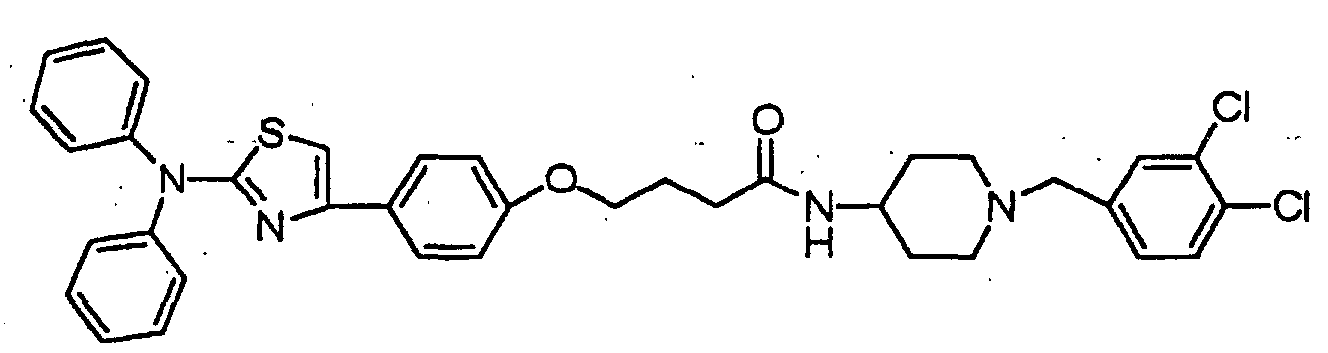
1H-NMR(DMSO-d6)δ 1.28-1.74 (2H, m), 1.61-1.78 (2H, m), 1.88-2.15 (4H, m), 2.18-2.30 (2H, m), 2.63-2.80 (2H, m), 3.44 (2H, s), 3.48-3.63 (1H, m), 3.97 (2H, t, J=6.3 Hz), 6.81 (2H, d, J=8.7 Hz), 7.22 (1H, s), 7.25-7.61 (13H, m), 7.73 (2H, d, J=8.7 Hz), 7.75-7.88 (1H, brs)

1H-NMR(DMSO-d6) δ 1.27-1.48 (2H, m), 1.64-1.79 (2H, m), 1. 80-2.10 (4H, m), 2.13-2.31 (2H, m), 2.63-2.81 (2H, m), 3.44 (2H, s), 3.48-3.64 (1H, m), 3.89 (2H, t, J=6.3 Hz), 6.31 (1H, s), 6.76 (2H, d, J=8.7 Hz), 6.81 (2H, d, J=7.5 Hz), 6.98-7.13 (3H, m), 7.21-7.41 (8H, m), 7.48-7.64 (2H, m)
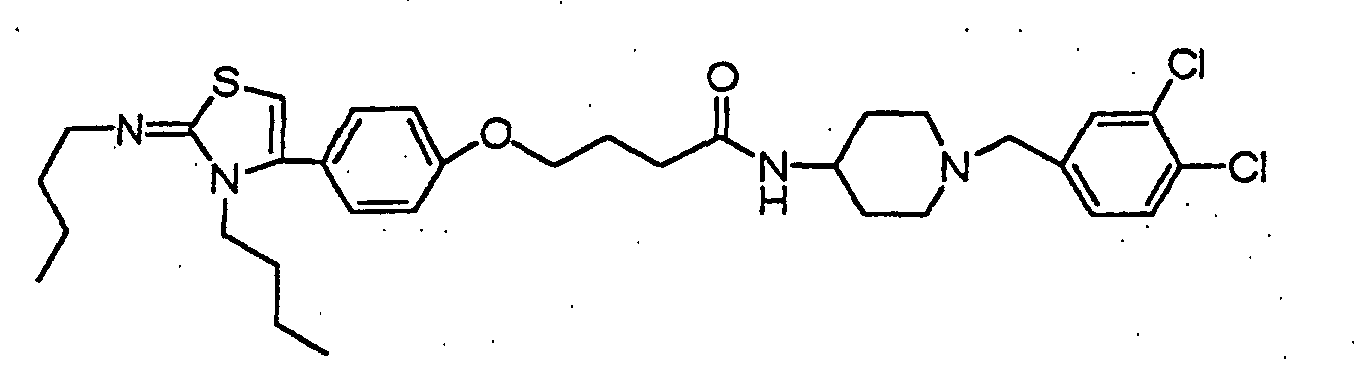
1H-NMR (DMSO-d6) δ 0.68 (3H, t, J=7.5 Hz), 0.91 (3H, t, J=7.5 Hz), 0.99-1.09 (2H, m) , 1.28-1.49 (8H, m) , 1.51-1.78 (4H, m), 1.87-2.10 (4H, m), 2.15-2.29 (2H, m), 2.61-2.80 (2H, m), 2.98 (2H, t, J=6.6 Hz), 3.44 (2H, s) , 3.47-3.60 (1H, m) , 3.60 (2H, t, J=6.3 Hz), 3.99 (2H, t, J=6.3 Hz), 5.97 (1H, s), 7.00 (2H, d, J=8.7 Hz), 7.27 (1H, dd, J=8.1, 2.1 Hz), 7.31 (2H, d, J=8.7 Hz), 7.53 (1H, d, J=2.1 Hz), 7.57 (1H, d, J=8.1 Hz), 7.72-7.85 (1H, brs)
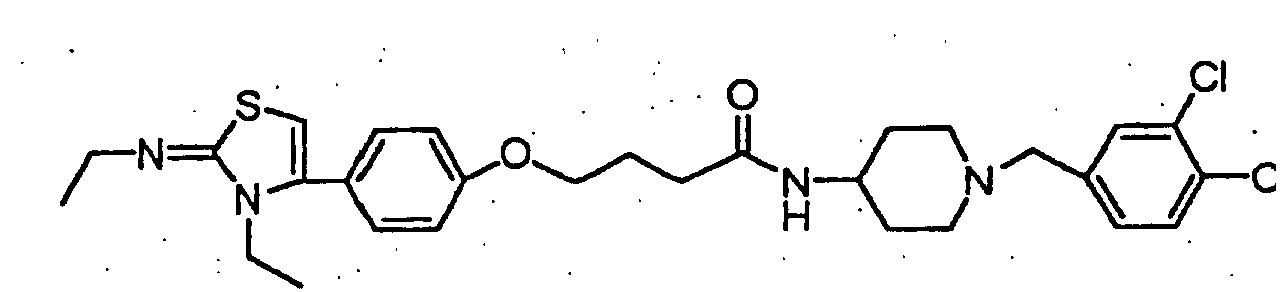
1H-NMR (DMSO-d6)δ 0.98 (3H, t, J=6.9 Hz), 1.20 (3H, t, J=7.2 Hz), 1.28-1.50 (2H, m), 1.63-1.79 (2H, m), 1.86-2.10 (4H, m), 2.23 (2H, t, J=7.2 Hz), 2.66-2.80 (2H, m), 2.02 (2H, q, J=7.2 Hz), 3.44 (2H, s), 3.50-3.68 (1H, m), 3.60 (2H, q, J=6.9 Hz), 4.00 (2H, t, J=6.3 Hz), 5.98 (1H, s), 7.00 (2H, d, J=9.0 Hz), 7.27 (1H, dd, J=8.1, 1.8 Hz), 7.32 (2H, d, J=9.0 Hz), 7.53 (1H, d, J=1.8 Hz), 7.57 (1H, d, J=8.1 Hz), 7.74-7.82 (1H, brs)

1H-NMR(DMSO-d6)δ 1.30-1.51 (2H, m), 1.62-1.80 (2H, m), 1.87-2.12 (4H, m), 2.20-2.33 (2H, m), 2.13-2.30 (2H, m), 2.90 (3H, s), 3.10 (3H, s), 3.44 (2H, s), 3.49-3.63 (1H, m), 4.01 (2H, t, J=6.3 Hz), 6.05 (1H, s), 7.01 (2H, d, J=8.7 Hz), 7.28 (1H, dd, J=8.2, 1.8 Hz), 7.35 (2H, d, J=8.7 Hz), 7.52 (1H, d, J=1.8 Hz), 7.55 (1H, d, J=8.2 Hz), 7.73-7.87 (1H, brs)

1H-NMR (DMSO-d6) δ 0.98-1.23 (2H, m), 1.20-1.60 (4H, m), 1.66-1.91 (7H, m), 1.92-2. 08 (4H, m), 2.38-2.68 (1H, m), 2.65-2.81 (2H, m), 3.45 (2H, s), 3.50-3.67 (1H, m), 6.68-7.12 (3H, brs), 7.06 (1H, s), 7.22 (2H, d, J=8.4 Hz), 7.29 (1H, dd, J=8.1, 1.8 Hz), 7.53 (1H, d, J=1.8 Hz), 7.58 (1H, d, J=8.1 Hz), 7.71 (2H, d, J=8.4 Hz), 7.64-7.83 (1H, brs)
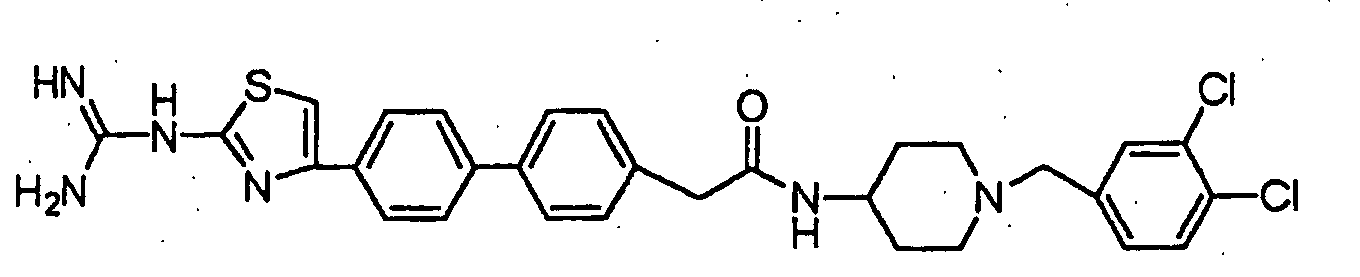
1H-NMR (DMSO-d6) δ 1.61-1.89 (2H, m) , 1.90-2.08 (2H, m), 2.88-3.17 (2H, m), 3.45 (2H, s), 3.71-3.90.(1H, m), 4.21-4.46 (2H, m), 7.36 (2H, d, J=7.8 Hz), 7.57 (1H, d, J=8.4 Hz), 7.65 (2H, d, J=8.1 Hz), 7.68-7.88 (3H, m), 7.91 (1H, s), 8.03 (2H, d, J=8.4 Hz), 8.24 (3H, m), 8.32-8.46 (1H, brs), 10.01-10.43 (1H, brs)

1H-NMR (DMSO-d6) δ 1.30-1.49 (2H, m), 1.62-1.81 (2H, m), 1.98-2.18 (4H, m), 2.18-2.34 (2H, m), 2.67-2.80 (2H, m), 3.45 (2H, s), 3.52-3.68 (1H, m), 4.02 (2H, t, J=6.3 Hz), 7.05 (2H, d, J=7.1 Hz), 7.13 (1H, s), 7.28 (1H, dd, J=8.2, 1.8 Hz), 7.53 (1H, d, J=1.8 Hz), 7.57 (1H, d, J=8.2 Hz), 7.71 (2H, d, J=7.1 Hz), 7.75-7.86 (1H, brs)

1H-NMR (DMSO-d6)δ 1.28-1.51 (2H, m), 1.62-1.81 (2H, m), 1.90-2.12 (4H, m), 2.23 (2H, t, J=6.4 Hz), 2.64-2.80 (2H, m), 3.02 (3H, s), 3.17 (3H, s), 3.44 (2H, s), 3.50-3.65 (1H, m), 4.03 (2H, t, J=6.3 Hz), 7.01 (2H, d, J=8.7 Hz), 7.28 (1H, dd, J=8.1, 1.5 Hz), 7.52 (1H, d, J=1.5 Hz), 7.57 (1H, d, J=8.1 Hz), 7.71-7.92 (1H, brs), 7.83 (2H, d, J=8.7 Hz), 8.50 (1H, s)
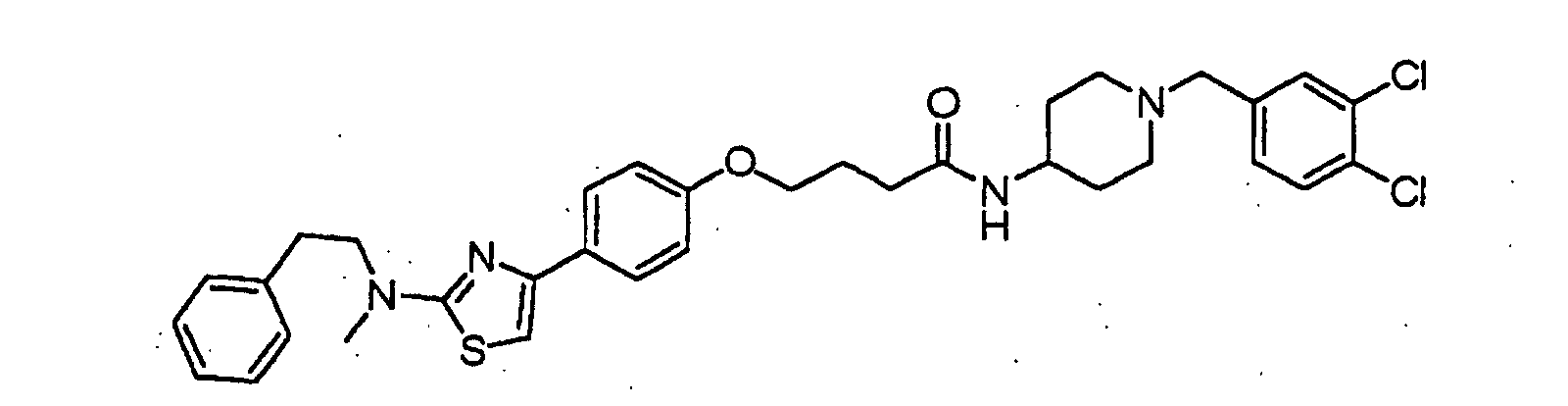
ESI-MS(m/z):637

ESI-MS(m/z) : 635
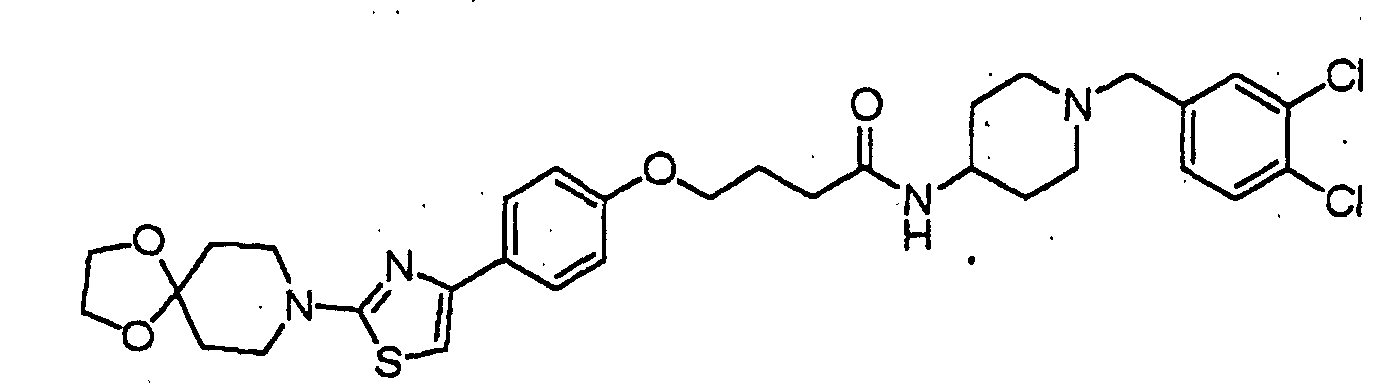
ESI-MS (m/z) :645


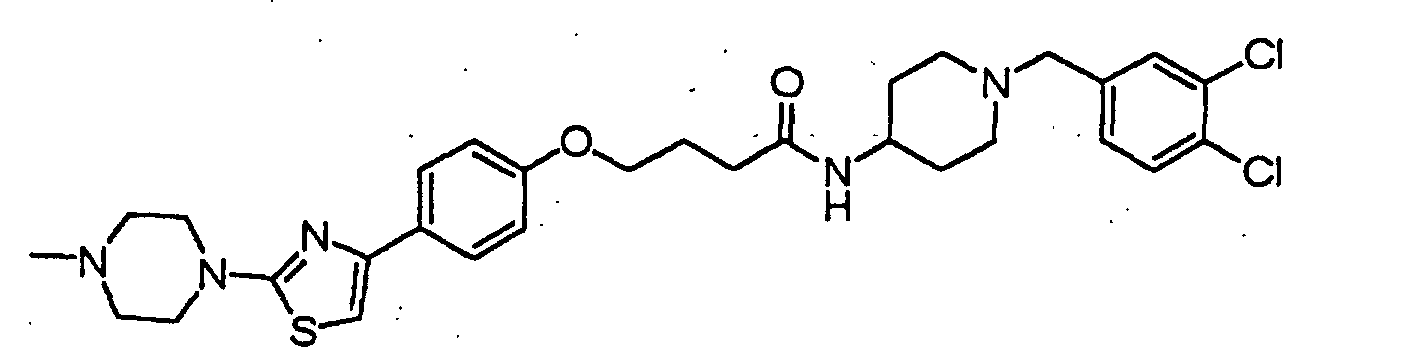

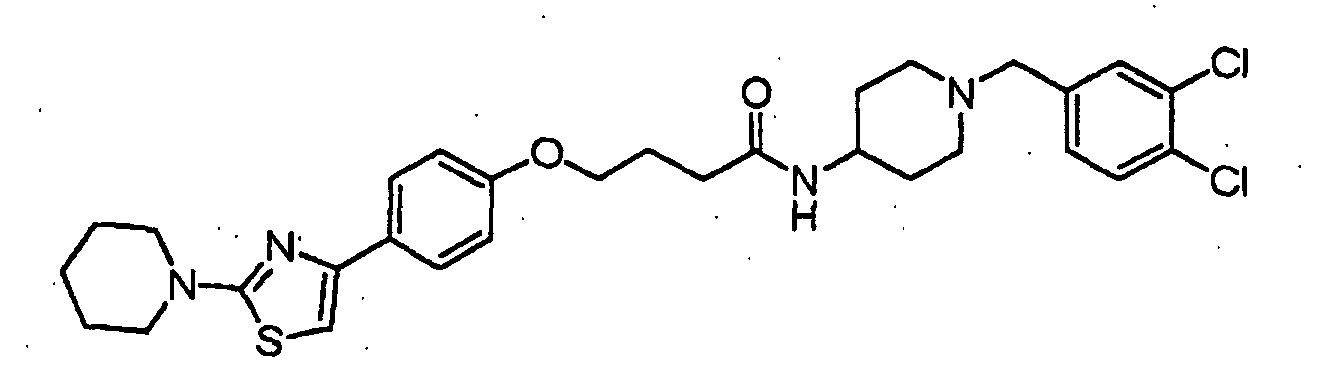
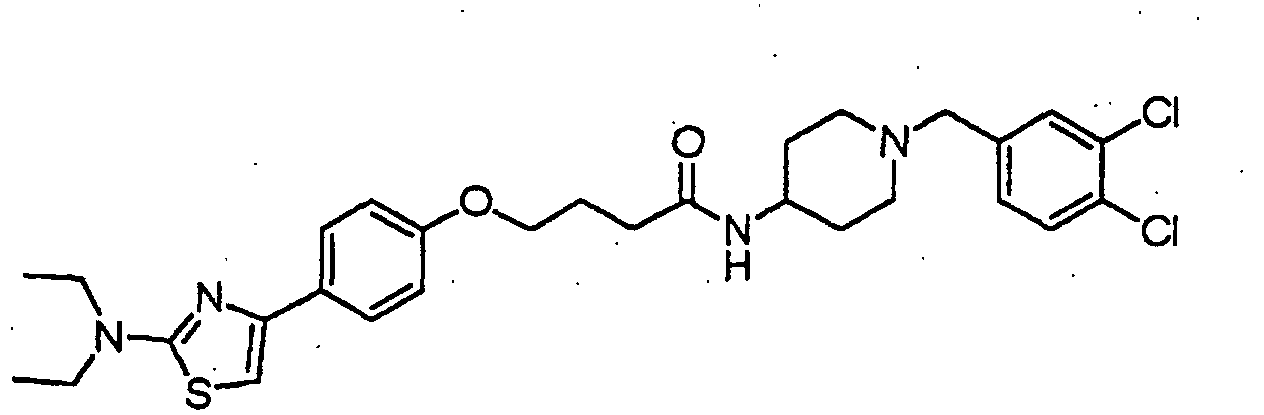


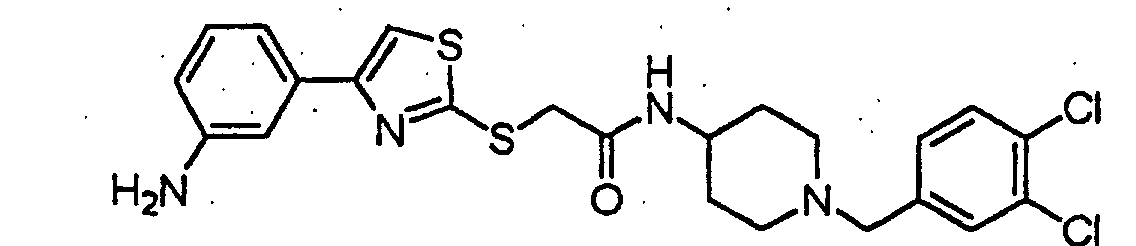
1H-NMR(CDCl3) δ 1.37-1.52 (2H, m), 1.82-1.88 (2H, m), 2.05-2.15 (2H, m), 2.51-2.62 (2H, m), 3.28 (2H, s), 3.78-3.84 (1H, m), 3.85 (2H, s), 6.67-6.72 (1H, m), 7.03-7.08 (1H, m), 7.17-7.24 (3H, m), 7.31-7.37 (3H, m), 7.67-7.72 (1H, m)

1H-NMR (DMSO-d6) δ 1.65-1.75 (2H, m), 1.87-1.95 (4H, m), 2.23 (2H, t, J=7.2 Hz), 2.95-3.03 (2H, m), 3.31-3.35 (2H, m), 3.68-3.80 (1H, m), 4.01 (2H, t, J=6.3 Hz), 4.26 (1H, d, J=4.5 Hz), 6.83-6.94 (2H, m), 7.57 (1H, dd, J=8.1, 1.8 Hz), 7.75 (1H, d, J=8.1 Hz), 7.75-7.85 (1H, m), 7.92 (1H d, J=1.8 Hz), 8.06 (1H, d, J=7.5 Hz), 10.52 (1H, brs)

1H-NMR (DMSO-d6)δ 1.32-1.42 (2H, m), 1.68-1.72 (2H, m), 1.88-2.06 (4H, m), 2.23 (2H, t, J=7.4 Hz), 2.69-2.73 (2H, m), 3.45 (2H, s), 3.50-3.59 (1H, m), 4.00 (2H, t, J=6.3 Hz), 6.79-6.92 (6H, m), 7.28 (1H, dd, J=8.1, 1.8 Hz), 7.53 (1H, d, J=1.8 Hz), 7.57 (1H, d, J=8.1 Hz), 7.78 (1H, d, J=7.5 Hz), 7.87 (1H, t, J=9.2 Hz)
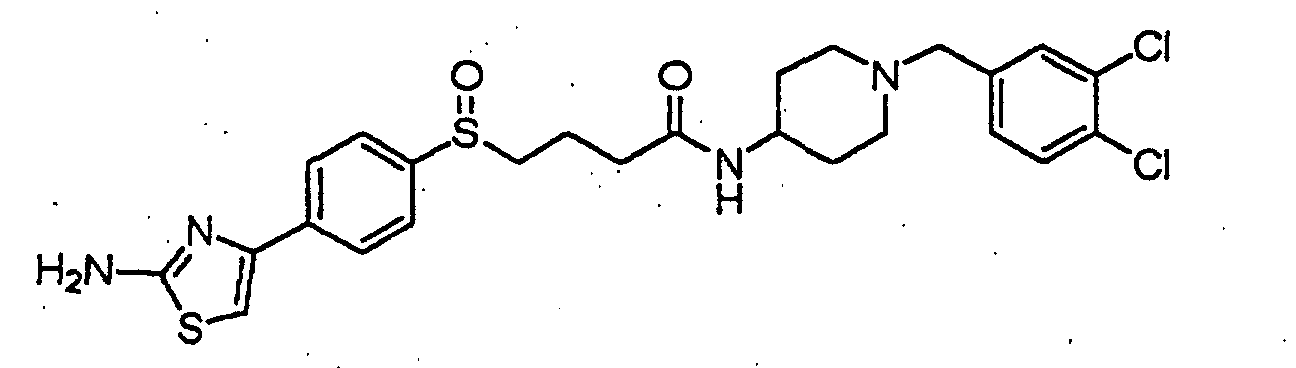
1H-NMR (DMSO-d6) δ 1.30-1.39 (2H, m), 1.64-1.68 (3H, m), 1.79-1.85 (1H, m), 1.96-2.03 (2H, m), 2.16 (2H, t, J=7.4 Hz), 2.67-2.71 (2H, m), 2.74-2.80 (1H, m), 2.89-2.94 (1H, m), 3.39-3.50 (1H, m), 3.43 (2H, s), 7.13 (2H, s), 7.19 (1H, s), 7.28 (1H, dd, J=8.2, 1.8 Hz), 7.52 (1H, d, J=1.7 Hz), 7.57 (1H, d, J=8.2 Hz), 7.62 (2H, d, J=8.4 Hz), 7.76 (1H, d, J=7.7 Hz), 7.98 (2H, d, J=8.4 Hz)

1H-NMR (DMSO-d6)δ 1.31-1.43 (2H, m), 1.68-1.71 (2H, m), 1.90-2.05 (4H, m), 2.23 (2H, t, J=7.4 Hz), 2.28 (3H, s), 2.69-2.72 (2H, m), 3.44 (2H, s), 3.51-3.56 (1H, m), 3.96 (2H, t, J=6.3 Hz), 6.71 (2H, s), 6.92 (2H, d, J=8.7 Hz), 7.28 (1H, dd, J=8.1, 1.8 Hz), 7.47 (2H, d, J=8.7 Hz), 7.53 (1H, d, J=1.8 Hz), 7.57 (1H, d, J=8.1 Hz), 7.78 (1H, d, J=7.8 Hz)
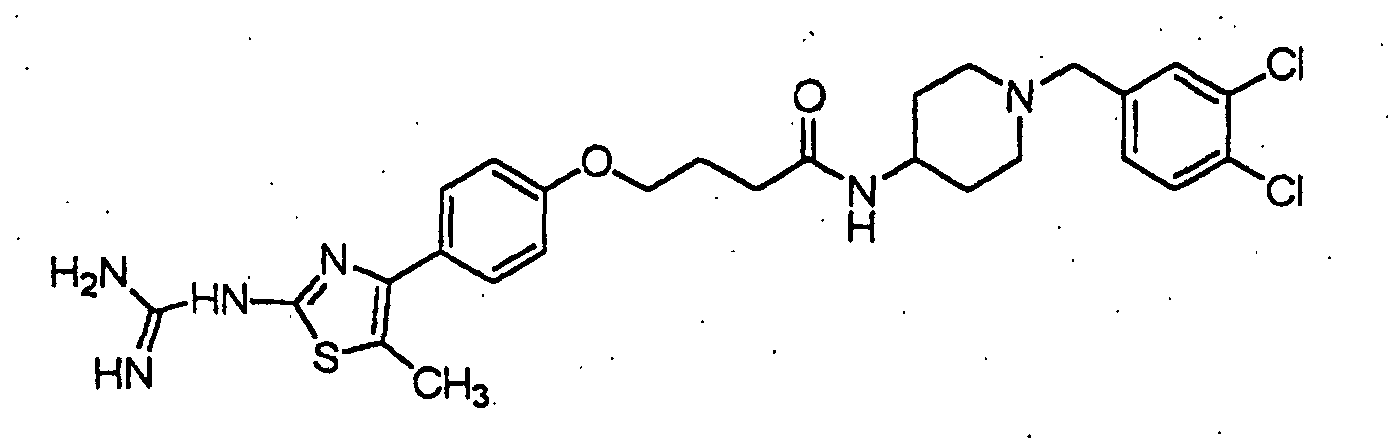
1H-NMR (DMSO-d6) δ 1.32-1.42 (2H, m), 1.68-1.72 (2H, m), 1.88-2.06 (4H, m), 2.23 (2H, t, J=7.4 Hz), 2.31 (3H, s), 2.70-2.73 (2H, m), 3.45 (2H, s), 3.49-3.57 (1H, m), 3.98 (2H, t, J=6.3 Hz), 6.82 (3H, brs), 6.95 (2H, d, J=8.7 Hz), 7.29 (1H, dd, J=8.1, 1.8 Hz), 7.49 (2H, d, J=8.7 Hz), 7.53 (1H, d, J=1.8 Hz), 7.58 (1H, d, J=8.1 Hz), 7.78 (1H, d, J=7.8 Hz)
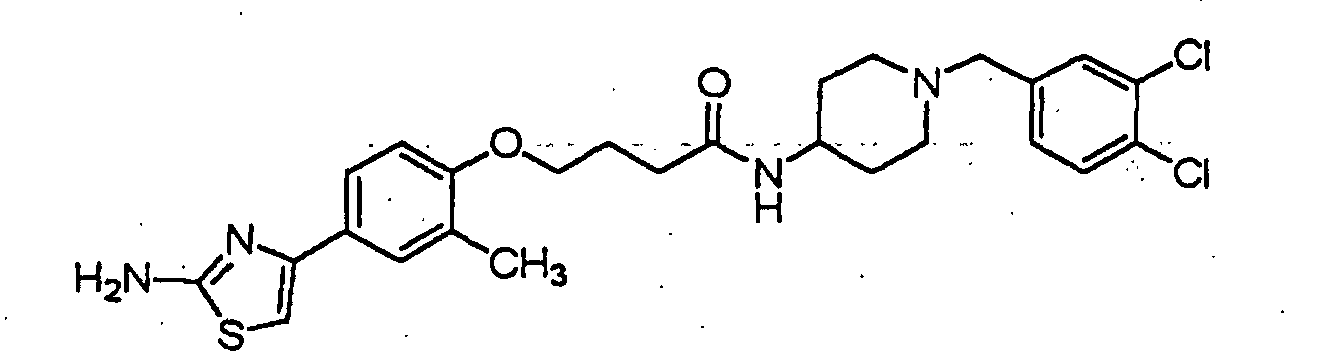
1H-NMR (DMSO-d6)δ 1.32-1.42 (2H, m), 1.68-1.71 (2H, m), 1.89-2.05 (4H, m), 2.17 (3H, s), 2.25 (2H, t, J=7.5 Hz), 2.68-2.72 (2H, m), 3.44 (2H, s), 3.50-3.57 (1H, m), 3.96 (2H, t, J=6.2 Hz), 6.78 (1H, s), 6.87 (1H, d, J=8.1 Hz), 6.97 (2H, s), 7.28 (1H, dd, J=8.4, 1.8 Hz) , 7.52-7.59 (4H, m) , 7.77 (1H, d, J=7.5 Hz)
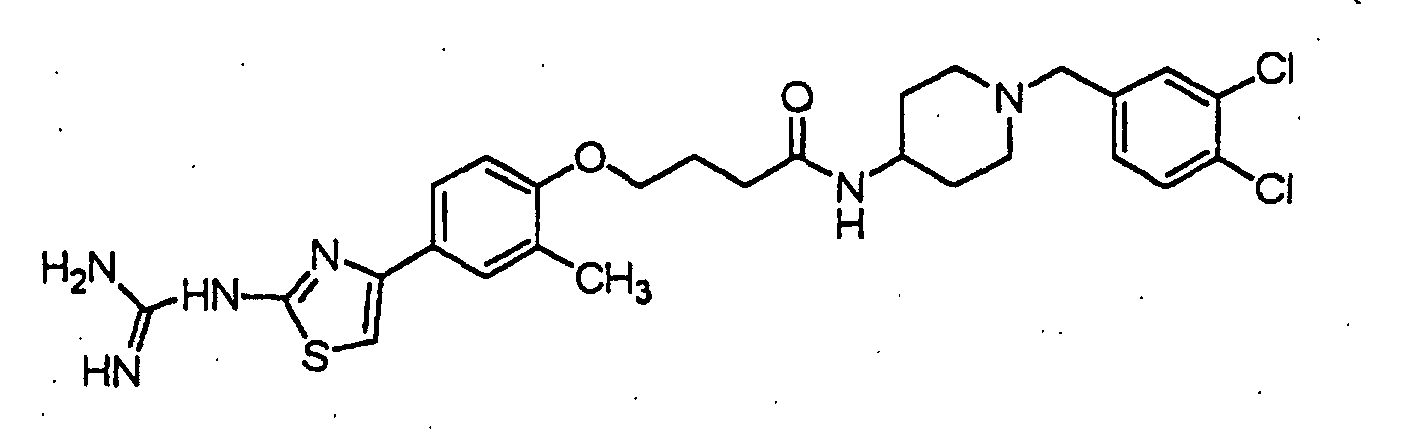
1H-NMR(DMSO-d6) δ 1.31-1.43 (2H, m), 1.68-1.71 (2H, m), 1.91-2.05 (4H, m), 2.20 (3H, s), 2.26 (2H, t, J=7.4 Hz), 2.68-2.72 (2H, m), 3.44 (2H, s), 3.52-3.56 (1H, m), 3.97 (2H, t, J=6.3 Hz), 6.87 (3H, brs), 6.89 (1H, d, J=9.0 Hz), 6.94 (1H, s), 7.28 (1H, dd, J=8.1, 1.8 Hz), 7.52-7.60 (4H, m), 7.77 (1H, d, J=7.5 Hz)
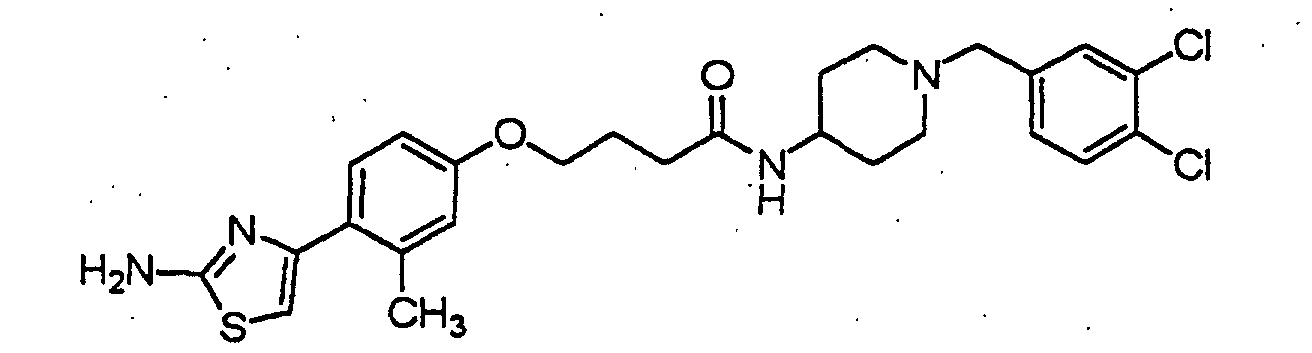
1H-NMR(DMSO-d6) δ 1.32-1.41 (2H, m), 1.68-1.71 (2H, m), 1.89-2.05 (4H, m), 2.22 (2H, t, J=7.4 Hz), 2.38 (3H, s), 2.69-2.73 (2H, m), 3.44 (2H, s), 3.50-3.57 (1H, m) , 3.95 (2H, t, J=6.3 Hz), 6.47 (1H, s), 6.72-6.77 (2H, m) , 6.92 (2H, s) , 7.28 (1H, dd, J=8.4, 1.8 Hz), 7.46 (1H, d, J=8.4 Hz), 7.53 (1H, d, J=1.8 Hz), 7.58 (1H, d, J=8.4 Hz), 7.77 (1H, d, J=7.5 Hz)
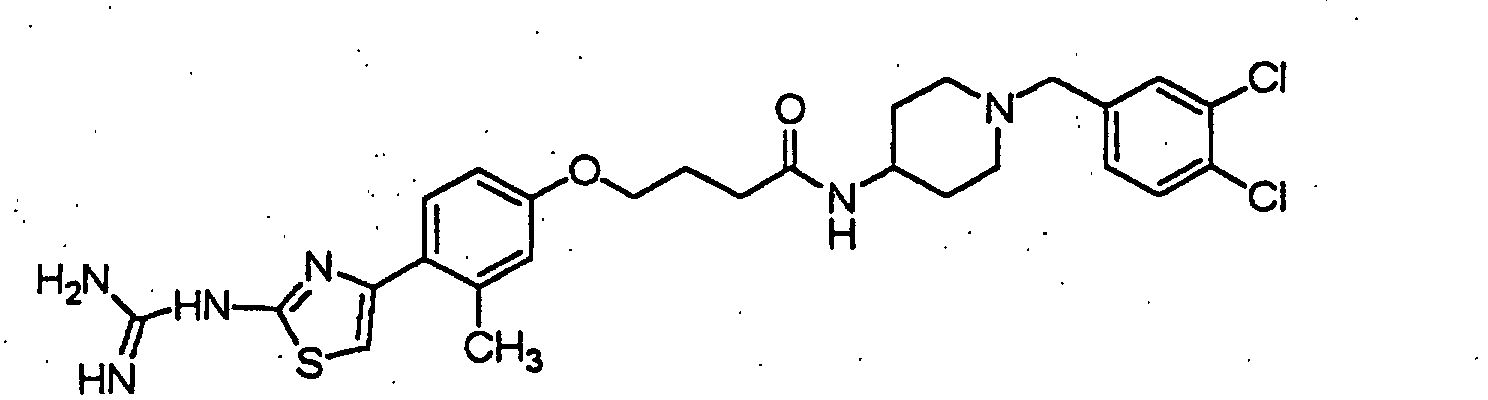
1H-NMR(DMSO-d6) δ 1.32-1.43 (2H, m), 1.69-1.72 (2H, m), 1.87-2.07 (4H, m), 2.22 (2H, t, J=7.2 Hz), 2.37 (3H, s), 2.70-2.74 (2H, m), 3.46 (2H, s), 3.52-3.56 (1H, m), 3.96 (2H, t, J=6.3 Hz), 6.65 (1H, s), 6.74-6.78 (2H, m) , 6.79 (3H, brs), 7.29 (1H, dd, J=8.1, 1.8 Hz), 7.43 (1H, d, J=8.4 Hz), 7.53 (1H, d, J=1.8 Hz), 7.58 (1H, d, J=8.1 Hz), 7.77 (1H, d, J=7.5 Hz)

1H-NMR(CDCl3) δ 1.33-1.46 (2H, m) , 1.81-1.86 (2H, m), 2.06-2.14 (2H, m), 2.50-2.54 (2H, m), 3.29 (2H, s), 3.79-3.87 (1H, m), 3.90 (2H, s), 7.06 (1H, dd, J=8.1, 1.8 Hz), 7.32 (2H, d, J=8.1 Hz), 7.38-7.41 (2H, m), 7.75-7.59 (3H, m), 7.76 (2H, d, J=8.7 Hz), 7.87-7.92 (5H, m)
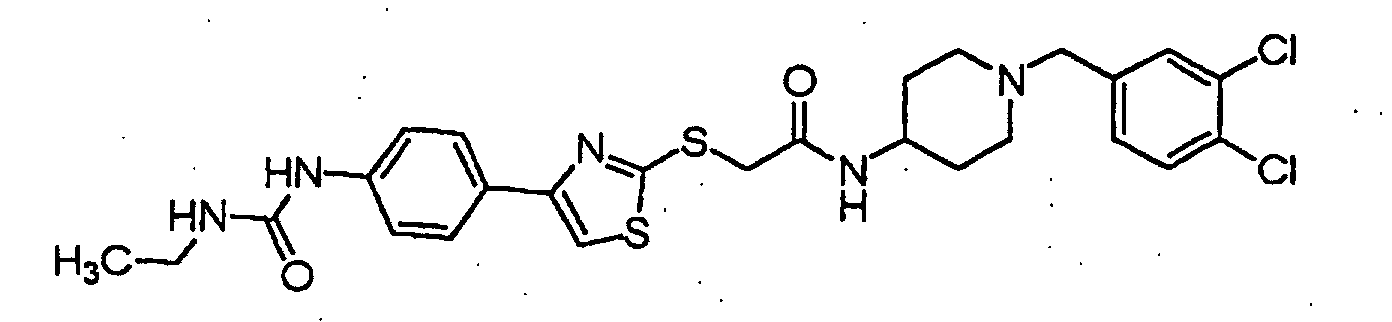
1H-NMR (DMSO-d6)δ 1.06 (3H, t, J=7.2 Hz), 1.36-1.46 (2H, m), 1.70-1.73 (2H, m), 2.00-2.07 (2H, m), 2.65-2.69 (2H, m), 3.07-3.16 (2H, m), 3.43 (2H, s), 3.53-3.58 (1H, m), 3.99 (2H, s), 6.13 (1H, t, J=5.6 Hz), 7.28 (1H, dd, J=8.4, 1.8 Hz), 7.45 (1H, d, J=8.7 Hz), 7.52 (1H, d, J=1.8 Hz), 7.58 (1H, d, J=8.4 Hz), 7.79 (2H, d, J=8.7 Hz), 7.80 (1H, s), 8.22 (1H, d, J=7.5 Hz)

1H-NMR(DMSO-d6) δ 1.39-1.45 (2H, m), 1.69-1.73 (2H, m), 1.99-2.06 (2H, m), 2.65-2.69 (2H, m), 3.43 (2H, s), 3.54-3.58 (1H, m), 3.68 (3H, s), 3.99 (2H, s), 7.28 (1H, d, J=7.8 Hz), 7.50-7.59 (4H, m), 7.84-7.87 (3H, m), 8.22 (1H, d, J=7.5 Hz), 9.77 (1H, s)

1H-NMR(DMSO-d6)δ 1.05 (3H, t, J=7.2 Hz), 1.33-1.40 (2H, m), 1.67-1.71 (2H, m), 1.93-2.04 (4H, m), 2.23 (2H, t, J=7.2 Hz), 2.68-2.72 (2H, m), 3.09-3.13 (2H, m), 3.25 (2H, t, J=7.2 Hz), 3.44 (2H, s), 3.51-3.56 (1H, m), 6.13 (1H, t, J=5.6 Hz), 7.28 (1H, dd, J=8.1, 1.8 Hz), 7.45 (2H, d, J=8.7 Hz), 7.53 (1H, d, J=1.8 Hz), 7.57 (1H, d, J=8.1 Hz), 7.76-7.83 (4H, m), 8.55 (1H, s)

1H-NMR(DMSO-d6) δ 1.68-1.76 (2H, m) , 1.89-2.01 (4H, m) , 2.25 (2H, t, J=7.2 Hz), 2.96-3.00 (2H, m), 3.03 (3H, s), 3.24-3.34 (4H, m), 3.72-3.78 (1H, m), 4.26 (2H, d, J=5.1 Hz), 7.27 (2H, d, J=8.7 Hz), 7.57 (1H, dd, J=8.4, 1.8 Hz), 7.75 (1H, d, J=8.4 Hz), 7.88 (2H, d, J=8.7 Hz), 7.92-7.94 (2H, m), 8.09 (1H, d, J=7.2 Hz), 9.91 (1H, s), 10.55 (1H, brs)
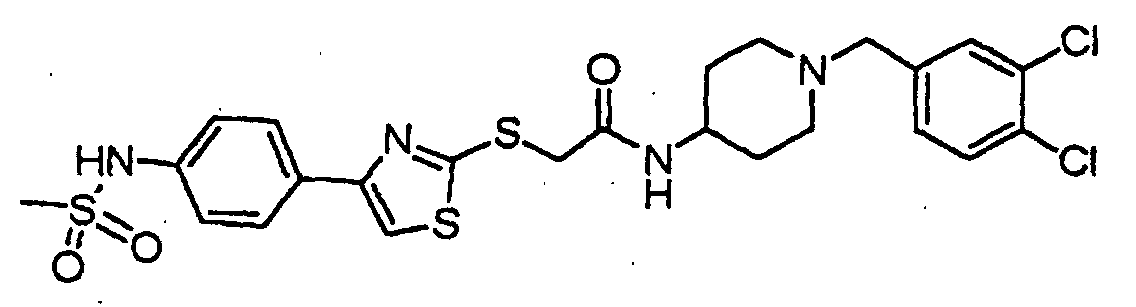
1H-NMR (DMSO-d6)δ 1.79-1.94 (4H, m), 2.98-3.02 (2H, m), 3.30-3.35 (2H, m), 3.75-3.82 (1H, m), 4.01 (2H, s), 4.26 (2H, d, J=5.1 Hz), 7.26 (2H, d, J=8.7 Hz), 7.59 (1H, dd, J=8.1, 1.8 Hz), 7.74 (1H, d, J=8.1 Hz), 7.88 (2H, d, J=8.7 Hz), 7.92-7.94 (2H, m), 8.55 (1H, d, J=7.2 Hz), 9.89 (1H, s), 10.83 (1H, brs)

1H-NMR(DMSO-d6)δ 1.31-1.43 (2H, m), 1.68-1.71 (2H, m), 1.92-2.04 (4H, m), 2.23 (2H, t, J=7.3 Hz), 2.68-2.72 (2H, m) , 3.44 (2H, s), 3.48-3.56 (1H, m), 4.17 (2H, t, J=6.2 Hz), 7.10 (1H, s), 7.14 (2H, s), 7.28 (1H, dd, J=8.2, 1.9 Hz), 7.36 (1H, d, J=8.8 Hz), 7.53 (1H, d, J=1.9 Hz), 7.57 (1H, d, J=8.2 Hz), 7.77 (1H, d, J=7.6 Hz), 8.04 (1H, dd, J=8.8, 2.2 Hz), 8.26 (1H, d, J=2.2 Hz)

1H-NMR (DMSO-d6)δ 1.72-1.79 (2H, m), 1.93-1.97 (2H, m), 2.96-3.04 (2H, m), 3.78-3.84 (1H, m), 4.02 (2H, s), 4.26 (1H, d, J=4.5 Hz), 7.42-7.65 (6H, m), 7.74-7.76 (2H, m), 7.90-8.01 (4H, m) , 8.34 (1H, s) , 8. 53 (1H, d, J=7.2 Hz), 10.36 (1H, s), 10.42 (1H, brs)
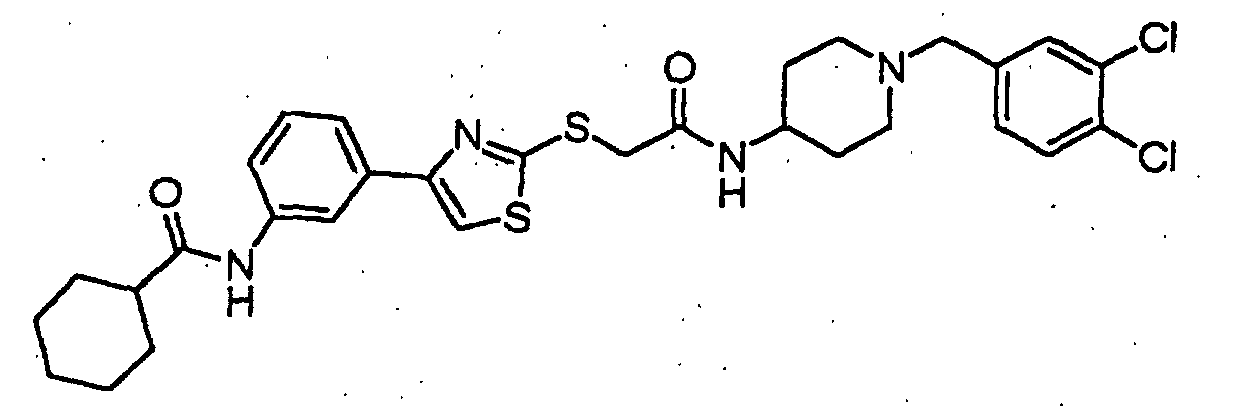
1H-NMR(DMSO-d6) δ 1.19-1.43 (7H, m), 1.67-1.82 (7H, m), 1.99-2.05 (2H, m), 2.31-2.35 (1H, m), 2.65-2.68 (2H, m), 3.42 (2H, s), 3.55-3.59 (1H, m), 3.99 (2H, s), 7.26-7.36 (2H, m), 7.52-7.62 (4H, m), 7.91 (1H, s), 8.16-8.21 (2H, m), 9.89 (1H, s)
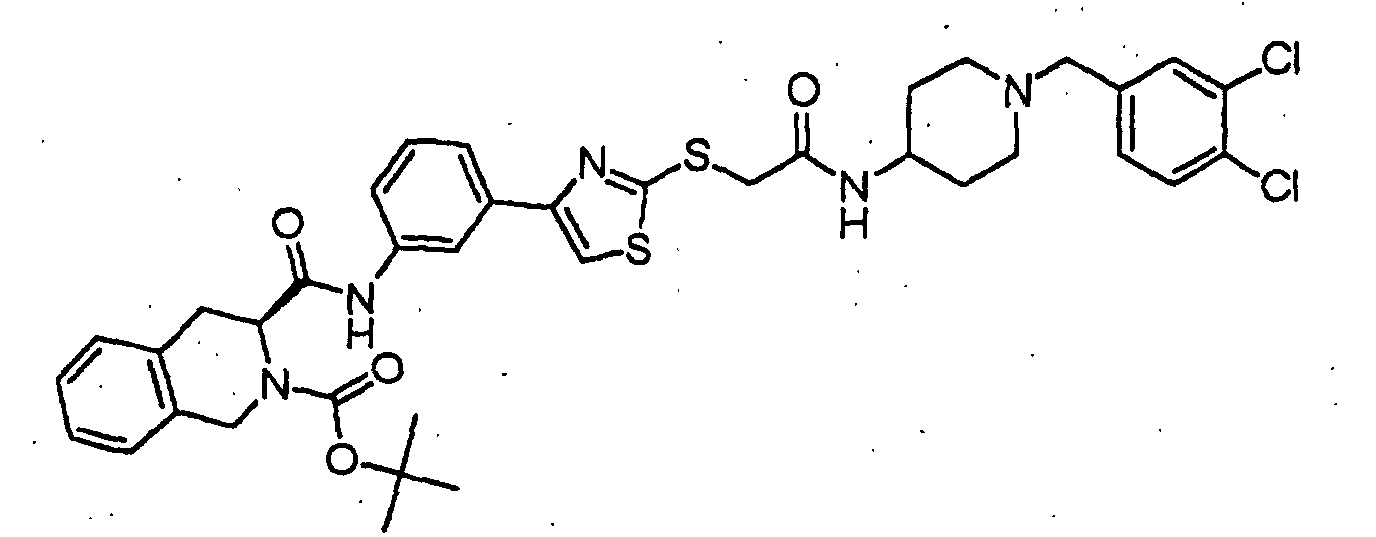
1H-NMR (CDCl3) δ 1.31-1.41 (2H, m), 1. 64 (9H, s), 1.75-1.79 (2H, m), 2.03-2.10 (2H, m), 2.43-2.47 (2H, m), 3.14-3.33 (2H, m), 3.24 (2H, s), 3.77-3.82 (1H, m), 3.89 (2H, s), 4.66 (2H, s), 7.01 (1H, dd, J=8.4, 2.1 Hz), 7.18-7.36 (9H, m), 7.40 (1H, s), 7.59 (1H, d, J=8.7 Hz)

1H-NMR(CDCl3) δ 1.37-1.42 (2H, m), 1.47 (9H, s), 1.77-1.80 (2H, m), 1.85-1.91 (2H, m), 2.05-2.11 (2H, m), 2.39-2.46 (4H, m), 3.24-3.28 (4H, m), 3.78-3.82 (1H, m), 3.90 (2H, s), 4.88 (1H, brs), 7.03 (1H, dd, J=8.4, 1.8 Hz), 7.31-7.44 (5H, m), 7.56-7.61 (2H, m), 8.32 (1H, brs), 9.09 (1H, brs)

1H-NMR (CDCl3) δ 0.95 (3H, t, J=7.4 Hz), 1.37-1.46 (2H, m), 1.46 (9H, s), 1.59-1.63 (1H, m), 1.78-1.82 (1H, m), 1.89-1.93 (1H, m), 2.04-2.08 (2H, m), 2.52-2.56 (2H, m), 3.23 (1H, d, J=13.2 Hz), 3.33 (1H, d, J=13.2 Hz), 3.81-3.85 (1H, m), 3.87 (1H, d, J=15.0 Hz), 3.95 (1H, d, J=15.0 Hz), 4.18-4.23 (1H, m), 5.38-5.41 (1H, brs), 7.05 (1H, dd, J=8.4, 1.8 Hz), 7.32-7.39 (5H, m), 7.42 (1H, s), 7.58 (1H, d, J=6.6 Hz) , 8.25 (1H, s), 8.47 (1H, brs)

1H-NMR(CDCl3) δ 1.40-1.43 (2H, m), 1.49 (9H, s), 1.77-1.81 (2H, m), 2.03-2.10 (2H, m), 2.53-2.55 (2H, m), 2.66 (2H, t, J=5.9 Hz), 3.30 (2H, s) , 3.49 (2H, q, J=6.1 Hz), 3.79-3.82 (1H, m), 3.91 (2H, s), 5.52 (1H, brs), 7.05 (1H, d, J=8.1 Hz), 7.32-7.46 (6H, m), 7.58 (1H, d, J=7.5 Hz), 8.03 (1H, brs), 8.31 (1H, brs)
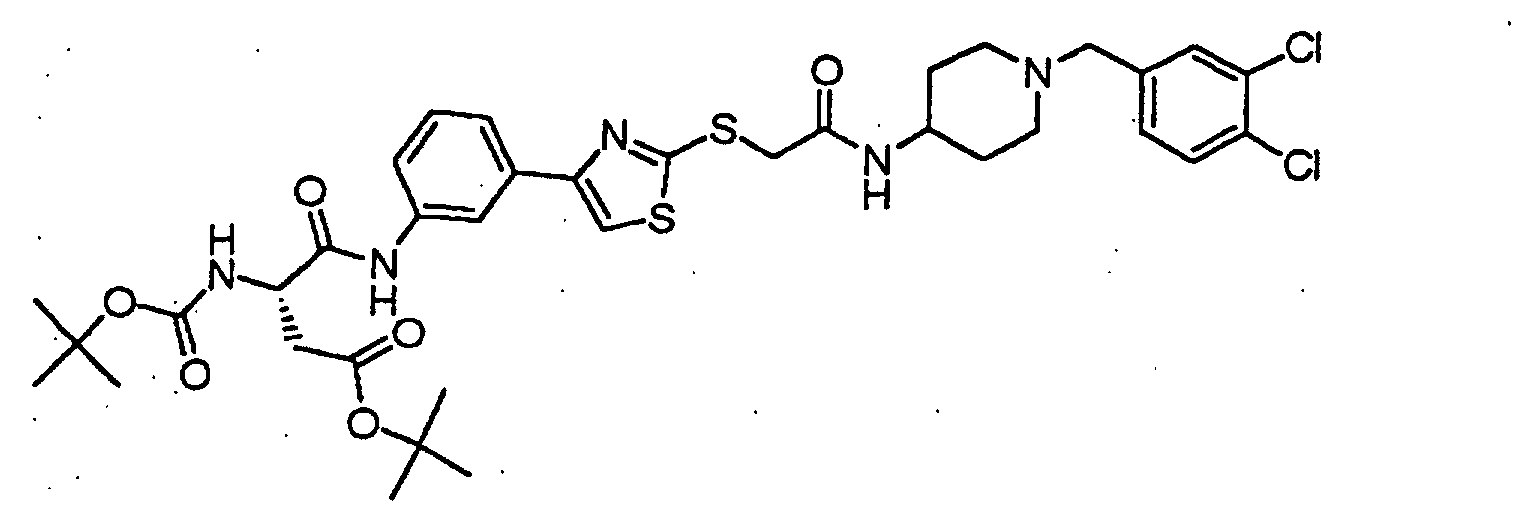
1H-NMR(CDCl3)δ 1.39-1.41 (2H, m), 1.46 (9H, s) , 1.48 (9H, s) , 1.79-1.84 (2H, m), 2.06-2.13 (2H, m), 2.51-2.55 (2H, m), 2.71 (1H, dd, J=16.8, 6.6 Hz), 2.90 (1H, dd, J=16.8, 4.5 Hz), 3.29 (1H, d, J=13.2 Hz), 3.30 (1H, d, J=13.2 Hz), 3.80-3.90 (1H, m), 3.90 (2H, s), 4.61-4.65 (1H, m), 5.98 (1H, brs), 7.05 (1H, dd, J=8.1, 1.8 Hz), 7.32-7.43 (6H, m), 7.61-7.63 (1H, m), 8.18 (1H, s), 8.80 (1H, s)
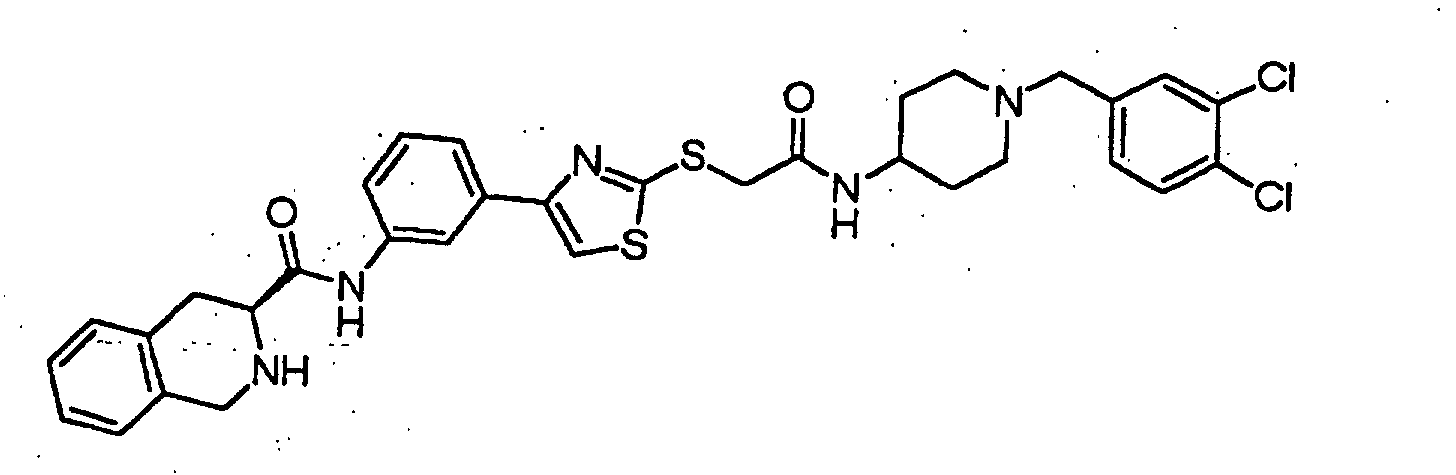
1H-NMR (CDCl3)δ 1.36-1.44 (2H, m), 1.78-1.83 (2H, m), 2.03-2.10 (2H, m), 2.47-2.50 (2H, m), 2.93 (1H, dd, J=16. 5, 10.5 Hz), 3.24 (2H, s), 3.36 (1H, dd, J=16.5, 5.4 Hz), 3.68-3.73 (1H, m) , 3.79-3.83 (1H, m), 3.92 (2H, s), 4.04 (1H, d, J=16.2 Hz), 4.06 (1H, d, J=16.2 Hz) , 7.02 (1H, dd, J=8.1, 1.8 Hz), 7.09-7.10 (1H, m), 7.20-7.22 (3H, m), 7.28-7.30 (2H, m), 7.35-7.39 (1H, m), 7.41 (1H, t, J=8.1 Hz), 7.46 (1H, s), 7.55-7.56 (1H, m), 7.61-7.64 (1H, m), 8.27 (1H, t, J=1.8 Hz), 9.50 (1H, s)
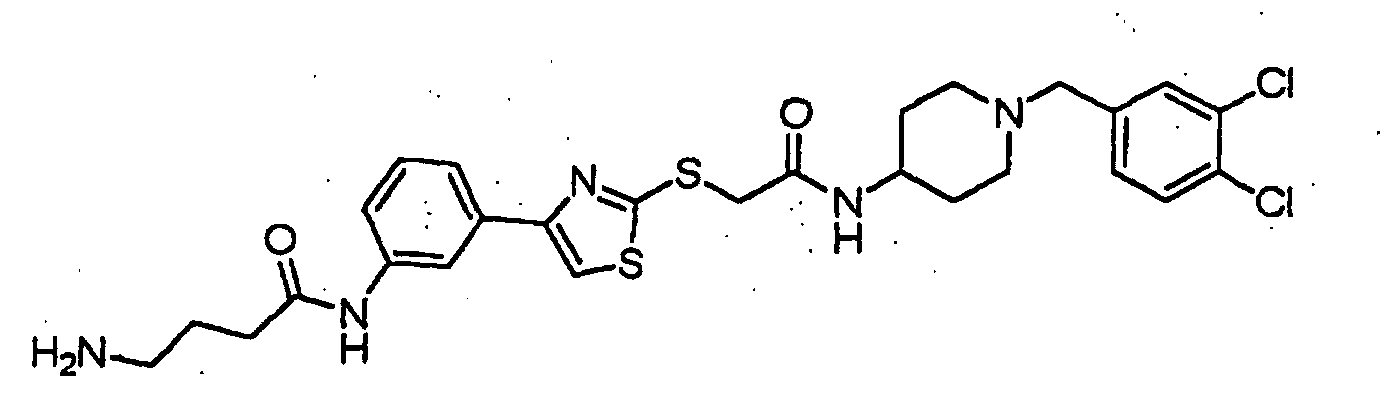
1H-NMR (CDCl3)δ 1.36-1.39 (2H, m), 1.72-1.76 (2H, m), 1.90-1.93 (1H, m), 1.99-2.03 (2H, m), 2.45-2.47 (2H, m), 2.88-2.91 (2H, m), 3.24 (2H, s), 3.74-3.78 (1H, m), 3.89 (2H, s), 7.01 (1H, d, J=8.1 Hz), 7.29-7.38 (5H, m), 7.47-7.55 (2H, m), 8.15 (1H, brs), 9.37 (1H, brs)
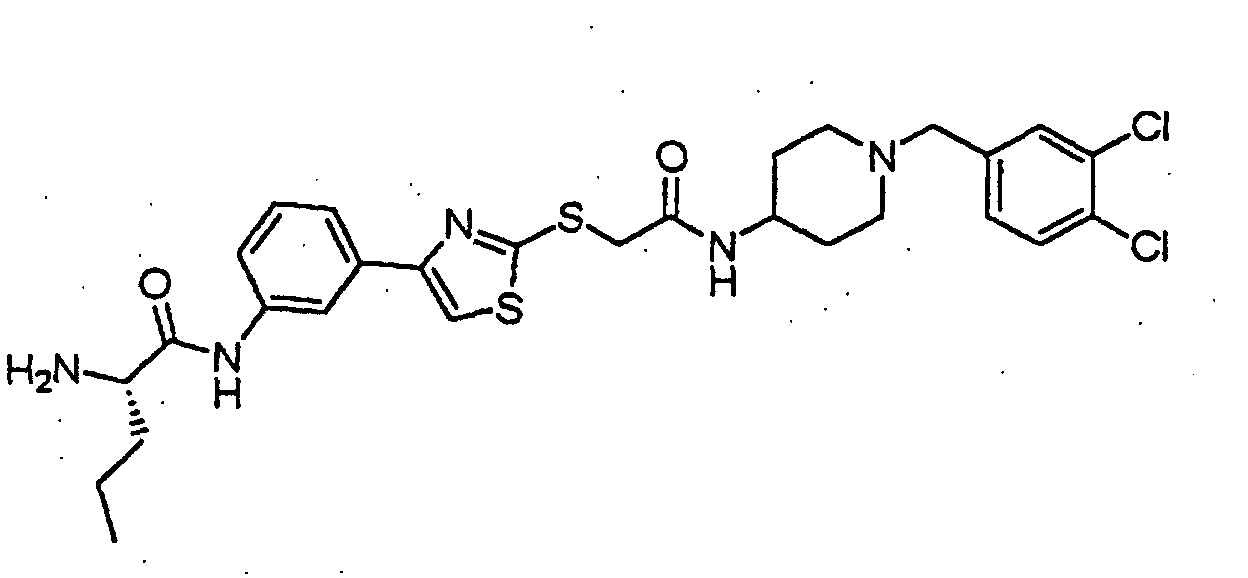
1H-NMR(CDCl3 )δ 0.97 (3H, t, J=7.4 Hz), 1.37-1.58 (5H, m), 1.78-1.83 (2H, m), 1.89-1.96 (1H, m), 2.05-2.11 (2H, m), 2.46-2.48 (2H, m), 3.25 (2H, s), 3.49-3.53 (1H, m), 3.78-3.82 (1H, m), 3.91 (2H, s), 7.04 (1H, dd, J=8.1, 1.8 Hz), 7.31-7.34 (1H, m), 7.37-7.43 (1H, m), 7.46 (1H, s), 7.54-7.57 (1H, m), 7.59-7.63 (1H, m), 8.26 (1H, t, J=1.8 Hz), 9.66 (1H, s)
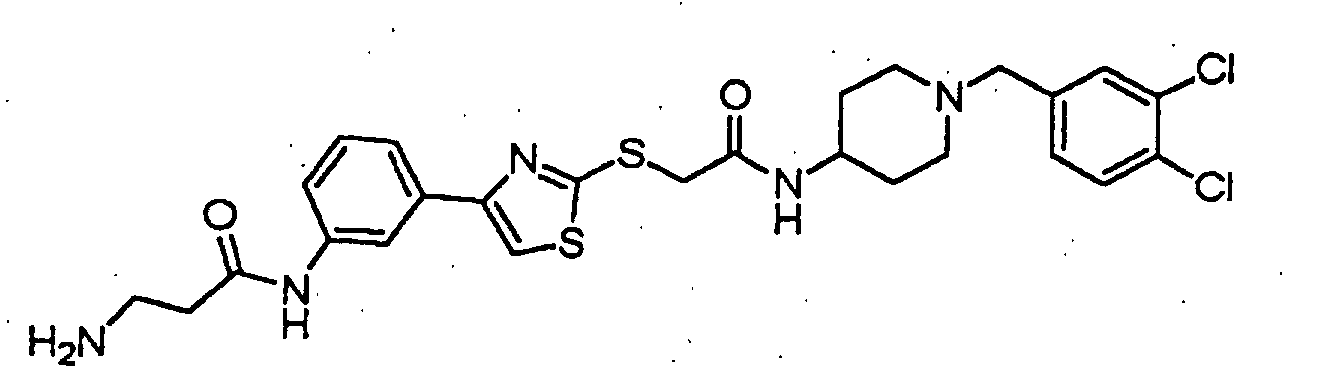
1H-NMR(CDCl3) δ 1.33-1.45 (2H, m), 1.79-1.83 (2H, m), 2.04-2.12 (2H, m), 2.47-2.51 (4H, m), 3.14 (2H, t, J=5.7 Hz), 3.26 (2H, s), 3.79-3.83 (1H, m), 3.90 (2H, s), 7.04 (1H, dd, J=8.1, 1.8 Hz), 7.32-7.40 (4H, m), 7.44 (1H, s), 7.51 (1H, d, J=8.7 Hz), 7.58 (1H, d, J=7.8 Hz), 8.18 (1H, s), 10.36 (1H, s)

1H-NMR (CDCl3)δ 1.65-1.69 (2H, m), 1.92-1.96 (2H, m), 2.86 (1H, dd, J=17.4, 7.8 Hz), 2.96-3.04 (2H, m), 3.29-3.39 (4H, m), 3.78-3.82 (1H, m), 4.02 (2H, s), 4.25 (2H, s), 7.40-7.50 (2H, m), 7.63-7.79 (3H, m), 7.97 (1H, s), 8.11 (1H, s), 8.44-8.50 (2H, m), 10.60 (1H, s)

1H-NMR(DMSO-d6)δ 1.28-1.48 (2H, m), 1.62-1.79 (2H, m), 1.89-2.11 (4H, m), 2.23 (2H, t, J=7.5 Hz), 2.60 (2H, d, J=11.7 Hz), 2.93 (3H, s), 3.13 (3H, s), 3.44 (2H, s), 3.50-3.67 (1H, m), 3.97 (2H, t, J=6.3 Hz), 6.93 (2H, d, J=8.7 Hz), 7.24 (1H, s), 7.28 (1H, dd, J=8.1, 1.8 Hz), 7.52 (1H, d, J=1.8 Hz), 7.57 (1H, d, J=8.1 Hz), 7.72-7.87 (1H, m), 7.79 (2H, d, J=8.7 Hz), 8.34 (1H, s)
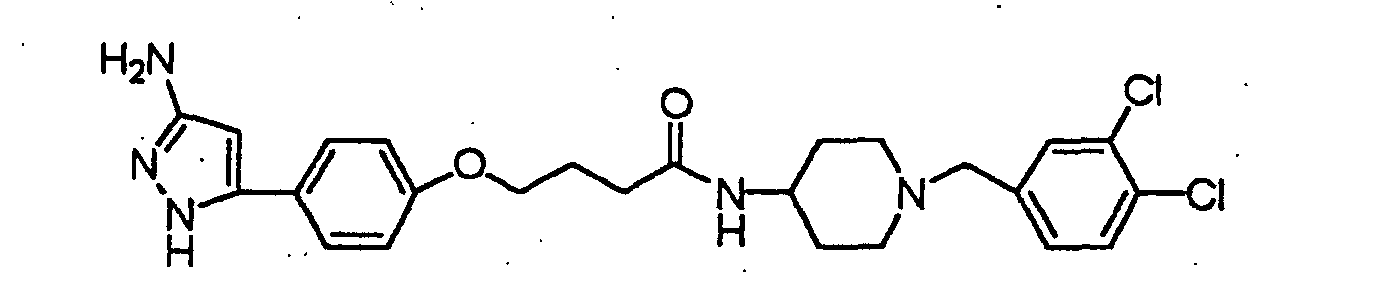
1H-NMR(DMSO-d6 )δ 1.31-1.50 (2H, m), 1.66-1.80 (2H, m), 1.89-2.10 (4H, m), 2.22 (2H, t, J=7.4 Hz), 2.61-2.80 (2H, m), 3.44 (2H, s), 3.50-3.62 (1H, m), 3.96 (2H, t, J=6.0 Hz), 4.40-4.64 (1H, m), 6.80-7.03 (2H, m), 7.28 (1H, dd, J=8.1, 1.8 Hz), 7.51-7.68 (4H, m), 7.77 (1H, d, J=7.8 Hz)

1H-NMR(DMSO-d6)δ 1.39-1.46 (2H, m), 1.69-1.72 (2H, m), 2.01-2.08 (2H, m), 2.45 (3H, s), 2.66-2.70 (2H, m), 3.44 (2H, s), 3.51-3.57 (1H, m), 3.89 (2H, s), 6.67 (1H, s), 7.19 (2H, s), 7.28 (1H, dd, J=8.2, 1.8 Hz), 7.53 (1H, d, J=1.8 Hz), 7.58 (1H, d, J=8.2 Hz), 8.15 (1H, d, J=7. 5 Hz)
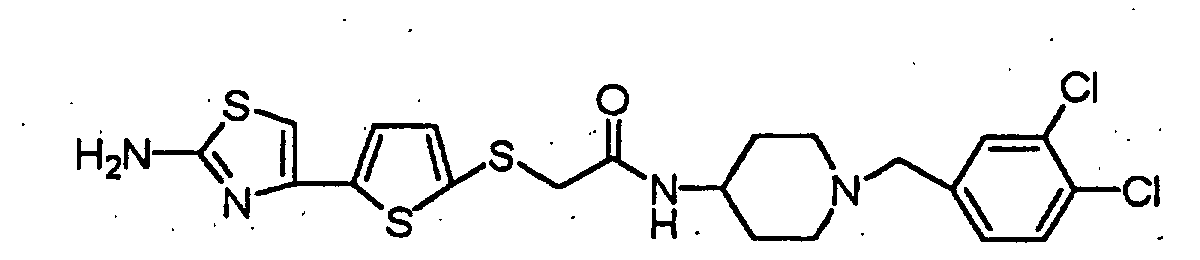
1H-NMR(DMSO-d6) δ 1.30-1.49 (2H, m), 1.61-1.80 (2H, m), 1.96-2.12 (2H, m), 2.60-2.78 (2H, m), 3.43 (2H, s), 3.47 (2H, s), 3.54-3.66 (1H, m), 6.88 (1H, s), 7.09 (1H, d, J=3.7 Hz), 7.20 (2H, m), 7.23-7.31 (1H, m), 7.27 (1H, d, J=3.7 Hz), 7.47-7.60 (2H, m), 7.88-7.98 (1H, m)

1H-NMR (DMSO-d6) δ 1.30-1.64 (11H, m), 1.64-1.81 (2H, m), 1.95-2.12 (2H, m), 2.62-2.78 (2H, m), 3.43 (2H, s), 3.50-3.69 (1H, m), 3.73 (2H, d, J=6.3 Hz), 3.99 (2H, s), 7.06 (1H, t, J=6.3 Hz), 7.27 (1H, dd, J=8.1, 2.1 Hz), 7.36 (1H, t, J=8.1 Hz), 7.48-7.69 (4H, m), 7.93 (1H, s), 8.11 (1H, s), 8.15-8.27 (1H, m), 10.02 (1H, s)

1H-NMR (CDCl3) δ 1.45-1.53 (14H, m), 1.75-1.88 (2H, m), 2.01-2.15 (2H, m), 2.47-2.65 (2H, m), 3.30 (2H, dd, J=1.2, 6.7 Hz), 3.76-3.85 (1H, m), 3.82-3.97 (2H, m), 4.30-4.40 (1H, m), 5.45 (1H, brs), 7.06 (1H, d, J=8.1 Hz), 7.28-7.45 (6H, m), 7.57 (1H, d, J=7.3 Hz), 8.24 (1H, s), 8.71 (1H, s)

1H-NMR(DMSO-d6)δ 1.25 (9H, s), 1.34-1.56 (2H, m), 1.64-1.82 (2H, m), 1.98-2.17 (2H, m), 2.62-2.83 (2H, m), 3.42 (2H, s), 3.53-3.72 (1H, m), 4.01 (2H, s), 7.26 (1H, dd, J=8.1, 1.8 Hz), 7.35 (1H, t, J=7. 8 Hz), 7.48-7.67 (3H, m), 7.69-7.77 (1H, m), 7.93 (1H, s), 8.15-8.32 (2H, m), 9.32 (1H, s)
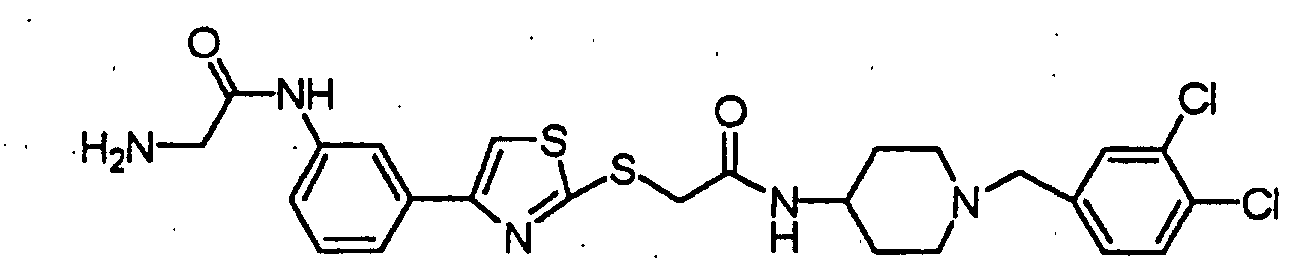
1H-NMR(DMSO-d6) δ 1.35-1.53 (2H, m), 1.63-1.81 (2H, m), 1.92-2.10 (2H, m), 2.60-2.79 (2H, m), 3.34 (2H, s), 3.42 (2H, s), 3.52-3.70 (1H, m), 4.01 (2H, s), 7.26 (1H, dd, J=8.1, 1.8 Hz), 7.37 (1H, t, J=7.8 Hz), 7.47-7.68 (3H, m), 7.72 (1H, d, J=8.1 Hz), 7.95 (1H, s), 8.15 (1H, s), 8.21-8.35 (1H, m)

1H-NMR(CDCl3) δ 1.31-1.44 (2H, m), 1.45 (3H, d, J=7.2 Hz), 1.77-1.83 (2H, m), 2.02-2.12 (2H, m), 2.43-2.58 (2H, m), 3.25 (2H, s), 3.59-3.68 (1H, m), 3.75-3.91 (1H, m), 3.91 (2H, s), 7.03 (1H, dd, J=1.8, 8.1 Hz), 7.38-7.50 (5H, m) , 7.52-7.64 (2H, m), 8.26 (1H, s), 9.64 (1H, brs)

1H-NMR (DMSO-d6) δ 1.37-1.44 (2H, m), 1.69-1.73 (2H, m), 2.00-2.07 (2H, m), 2.15 (3H, s), 2.54 (3H, s), 2.67-2.71 (2H, m), 3.44 (2H, s), 3.51-3.57 (1H, m), 3.93 (2H, s), 7.26-7.30 (2H, m), 7.52 (1H, d, J=1.8 Hz), 7.57 (1H, d, J=8.2 Hz), 8.16 (1H, d, J=7.6 Hz)
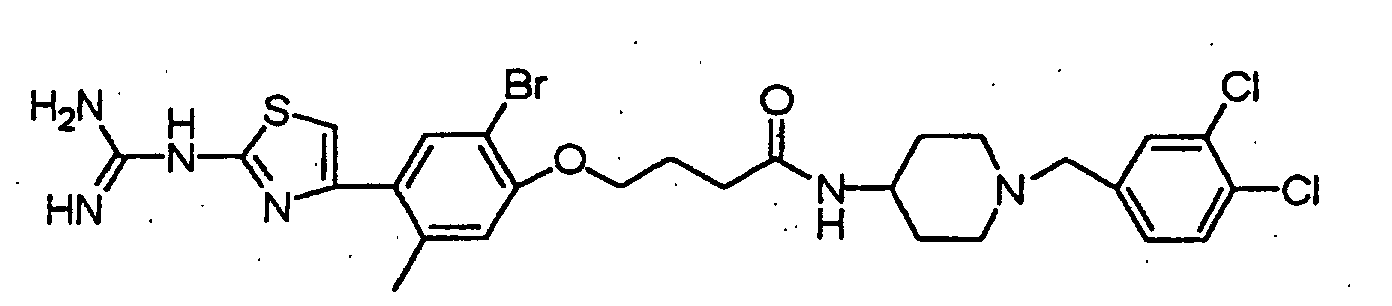
1H-NMR (DMSO-d6) δ 1.31-1.50 (2H, m), 1.64-1.78 (2H, m), 1.89-2.15 (4H, m), 2.20-2.87 (2H, m), 2.38 (3H, s), 2.67-2.80 (2H, m) , 3.48 (2H, s), 3.58-3.72 (1H, m) , 4.06 (2H, t, J=6.2 Hz), 6.62 (4H, s), 6.80 (1H, s) , 6.84-7.20 (3H, m) , 7.00 (1H, s) , 7.29 (1H, dd, J=8.4, 1.8 Hz), 7.52-7.62 (2H, m), 7.66 (1H, s), 7.71-7.88 (1H, m)

1H-NMR(DMSO-d6) δ 1.37-1.44 (2H, m), 1.70-1.73 (2H, m), 2.01-2.09 (2H, m), 2.47 (3H, s), 2.67-2.71 (2H, m), 3.45 (2H, s), 3.54-3.57 (1H, m), 3.91 (2H, s), 6.84 (1H, s), 6.89 (4H, brs) , 7.29 (1H, dd, J=8.1, 1.8 Hz), 7.53 (1H, d, J=1.8 Hz), 7.58 (1H, d, J=8.1 Hz), 8.18 (1H, d, J=7.5 Hz)

1H-NMR(DMSO-d6)δ 1.40-1.60 (2H, m), 1.70-1.87 (2H, m), 1.89-2.06 (2H, m), 2.14 (3H, s), 2.20-2.38 (4H, m), 2.75-2.94 (2H m), 3.03 (3H, s) , 3.14 (3H, s), 3.51-3.73 (3H, m) , 4.01 (2H, t, J=6.3 Hz), 6.61 (6H, s), 6.73 (1H, s), 6.82-7.00 (2H, m) , 7.21 (1H, d, J=8.4 Hz), 7.34 (1H, dd, J=8.3, 1.6 Hz), 7.60 (1H, dd, J=5.0, 3.4 Hz), 7.85-7.98 (1H, m)

1H-NMR (DMSO-d6) δ 1.20-1.49 (11H, m), 1.67-1.80 (2H, m), 1.92-2.11 (2H, m), 2.55-2.72 (2H, m), 2.72-2.90 (1H, m), 2.91-3.09 (1H, m), 3.42 (2H, s), 3.50-3.65 (1H, m), 3.58 (2H, s), 4.25-4.42 (1H, m), 7.05-7.41 (8H, m), 7.48-7.71 (4H, m), 7.95 (1H, s), 8.10 (1H, s), 8.15-8.28 (1H, m), 10.16 (1H, s)
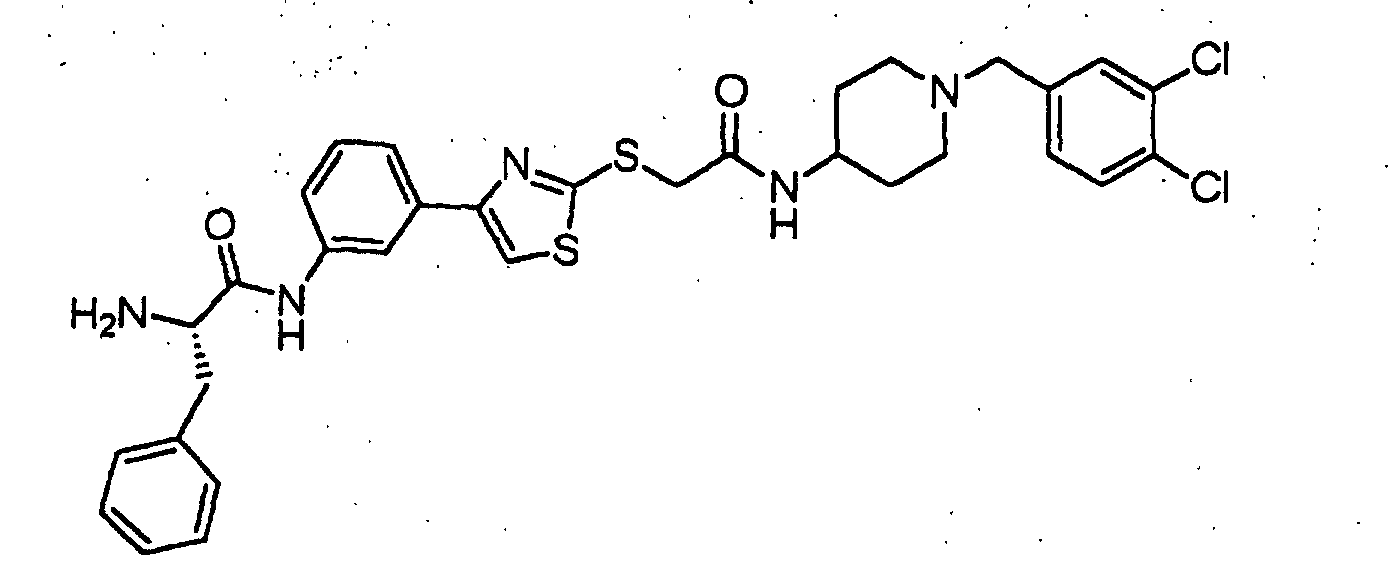
1H-NMR(DMSO-d6)δ 1.34-1.56 (2H, m), 1.62-1.83 (2H, m) , 1.95-2.15 (2H, m), 2.60-2.81-(3H, m), 3.00-3.10 (1H, m), 3.42 (2H, s), 3.50-3.71 (2H, m), 4.00 (2H, s), 7.08-7.44 (7H, m), 7.48-7.75 (4H, m) , 7.95 (1H, s) , 8.12 (1H, s), 8.21-8.30 (1H, m) , 9.60-10.38 (1H, m)

1H-NMR(DMSO-d6) δ 1.10-1.54 (17H, m), 1.70-1.80 (2H, m), 1.92-2.11 (2H, m), 2.61-2.78 (2H, m), 3.43 (2H, s), 3.50-3.68 (1H, m), 3.99 (2H, s), 6.83-7.07 (1H, m), 7.22-7.40 (2H, m), 7.48-7.74 (3H, m), 7.90 (1H, s), 8.11-8.30 (2H, m), 9.52 (1H, s)
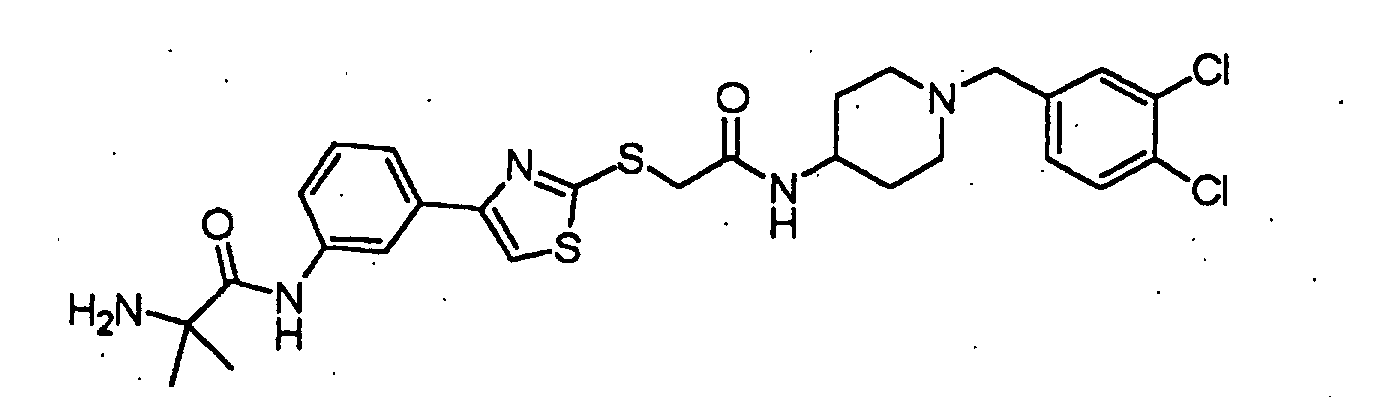
1H-NMR(DMSO-d6) δ 1.32 (6H, s), 1.38-1.59 (2H, m), 1.68-1.85 (2H, m), 1.91-2.13 (2H, m), 2.62-2.80 (2H, m), 3.41 (2H, s), 3.50-3.69 (1H, m), 4.02 (2H, s), 7.25 (1H, dd, J=8.2, 1.7 Hz), 7.37 (1H, t, J=8.0 Hz), 7.50 (1H, d, J=1.7 Hz), 7.56 (1H, d, J=8.2 Hz), 7.63 (1H, d, J=7.8 Hz), 7.76 (1H, dd, J=8.0, 0.7 Hz), 7.97 (1H, s), 8.19 (1H, s), 8.21-8.30 (1H, m)
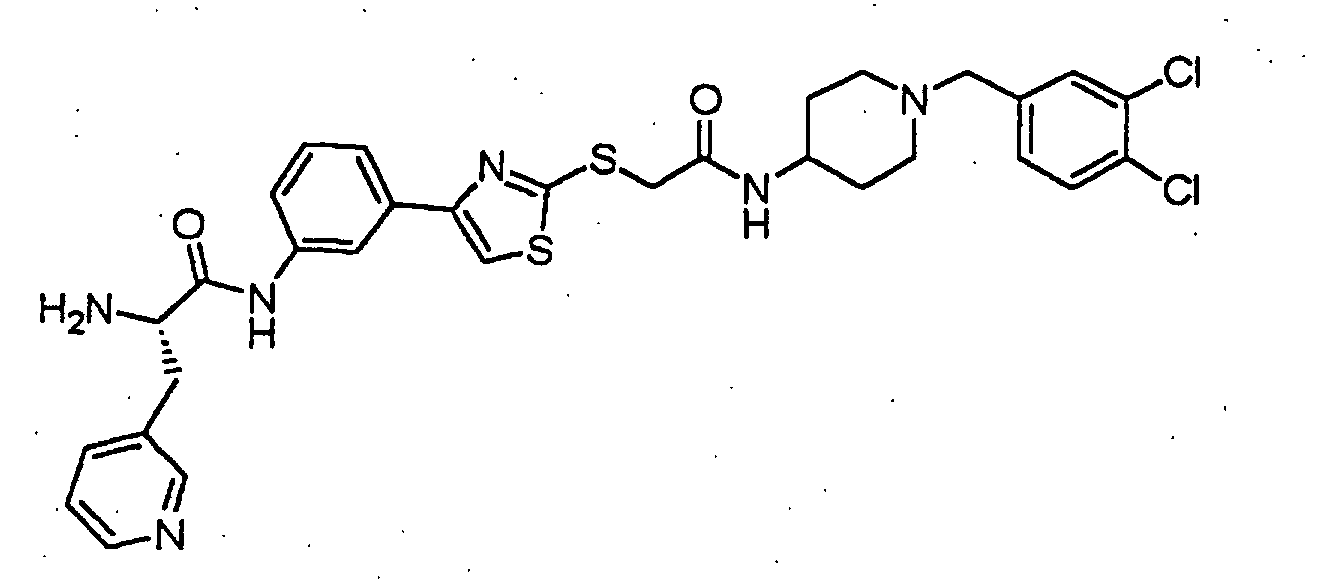
1H-NMR (DMSO-d6)δ 1.34-1.65 (2H, m), 1.66-1.80 (2H, m), 1.95-2.12 (2H, m), 2.62-2.75 (2H, m), 2.80-2.96 (2H, m), 3.00-3.23 (1H, m), 3.42 (2H, s), 3.54-3.72 (1H, m), 3.85-4.00 (1H, m), 4.03 (2H, s), 7.07-7.20 (1H, m), 7.22-7.44 (3H, m), 7.45-7.72 (4H, m) , 7.77 (1H, d, J=7.9 Hz), 7.96 (1H, d, J=7.6 Hz), 8.11 (1H, d, J=7.9 Hz), 8.20-8.30 (1H, m), 8.88-9.13 (2H, m)

1H-NMR (DMSO-d6) δ 1.20-1.50 (9H, m) , 1.64-1.80 (2H, m), 1.95-2.11 (2H, m), 2.61-2.79 (2H, m), 3.42 (2H, s), 3.50-3.68 (1H, m), 3.98 (1H, s), 5.30-5.45 (1H, m), 7.23-7.40 (5H, m), 7.49-7.70 (6H, m), 7.94 (1H, s), 8.10 (1H, s), 8.20-8.28 (1H, m), 10.35 (1H, s)

1H-NMR(DMSO-d6)δ 1.35-1.58 (2H, m), 1.67-1.86 (2H, m), 1.92-2.12 (2H, m), 2.62-2.81 (2H, m), 3.41 (2H, s), 3.50-3.70 (1H, m), 4.01 (2H, s), 4.58 (1H, s), 7.19-7.44 (5H, m), 7.45-7.78 (6H, m), 7.94 (1H, s), 8.17 (1H, s), 8.20-8.31 (1H, m), 9.75-10.60 (1H, m)

1H-NMR(DMSO-d6) δ 1.32-1.51 (2H, m), 1.65-1.90 (6H, m), 1.97-2.28 (3H, m), 2.36 (3H, s), 2.68-2.78 (2H, m), 2.90-3.18 (3H, m), 3.44-3.50 (2H, m), 3.51-3.70 (1H, m), 3.98 (2H, d, J=6.3 Hz), 5.05-5.20 (1H, m), 6.43-6.74 (1H, m), 7.04-7.19 (1H, m), 7.22-7.41 (2H, m), 7.48-7.86 (3H, m), 8.13-8.30 (2H, m), 9.74 (1H, s)

1H-NMR (DMSO-d6)δ 1.23-1.60 (11H, m), 1.70-1.87 (4H, m), 1.90-2.21 (4H, m), 2.64-2.80 (2H, m), 2.98-3.12 (4H, m), 3.46 (2H, s), 3.50-3.66 (1H, m), 3.98 (2H, s), 4.30-4.44 (1H, m), 5.08 (1H, d, J=3.0 Hz), 7.25-7.43 (2H, m), 7.50-7.75 (4H, m), 7.92 (1H, s), 8.11-8.30 (2H, m), 10.14 (1H, s)
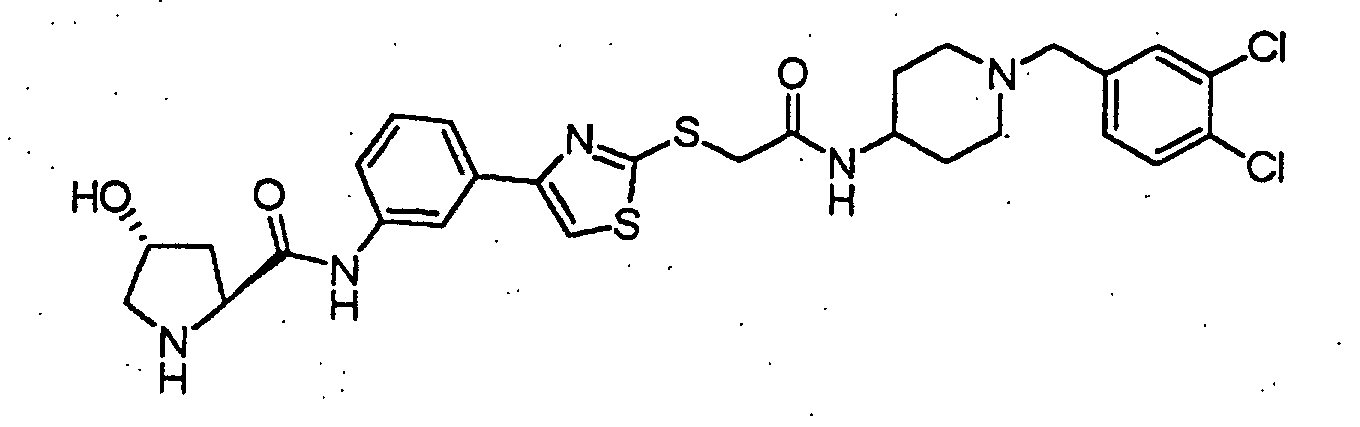
1H-NMR(DMSO-d6)δ 1.31-1.64 (2H, m), 1.60-1.91 (4H, m), 1.93-2.17 (4H, m), 2.61-2.80 (2H, m), 3.42 (2H, s), 3.51-3.75 (1H, m), 3.89-4.10 (1H, m), 4.12 (2H, s), 4.27 (1H, s), 4.65-5.10 (1H, m), 7.26 (1H, dd, J=8.4, 1.8 Hz), 7.37 (1H, t, J=7.8 Hz), 7.50 (1H, d, J=1.5 Hz), 7.56 (1H, d, J=8.4 Hz), 7.63 (1H, d, J=8.1 Hz), 7.74 (1H, d, J=7.8 Hz), 7.97 (1H, s), 8.15 (1H, s), 8.34-8.35 (1H, m), 10.14 (1H, s)

1H-NMR (CDCl3) δ 1.33-1.49 (2H, m) , 1.77-1.84 (2H, m), 2.02-2.12 (2H, m), 2.20 (3H, s), 2.49-2.56 (2H, m), 3.28 (2H, s), 3.77-3.86 (1H, m), 3.90 (2H, s), 7.05 (1H, dd, J=1.8, 8.4 Hz), 7.30-7.42 (4H, m), 7.43 (1H, s), 7.49-7.52 (2H, m), 7.58 (1H, d, J=7.8 Hz), 8.10 (1H, s)

1H-NMR (CDCl3) δ 1.30-1.43 (2H, m), 1.75-1.83 (2H, m), 2.03-2.13 (2H, m), 2.48-2.58 (2H, m), 3.28 (2H, s), 3.74-3.84 (1H, m), 6.87-6.93 (1H, m), 7.06 (1H, dd, J=1.8, 8.4 Hz), 7.13-7.19 (1H, m), 7.32 (1H, s), 7.34-7.36 (2H, m), 7.41-7.45 (1H, m)

1H-NMR(DMSO-d6)δ 1.33-1.49 (2H, m), 1.69-1.77 (2H, m), 1.98-2.07 (2H, m), 2.64-2.70 (2H, m), 3.42 (2H, s), 3.50-3.63 (1H, m) , 3.99 (2H, s), 7.27 (1H, dd, J=1.8, 8.1 Hz), 7.43 (1H, t, J=8.1 Hz), 7.51 (1H, d, J=1.8 Hz), 7.55 (1H, s), 7.57-7.60 (2H, m), 7.67-7.73 (2H, m), 7.97 (1H, s), 8.09 (1H, dd, J=1.8, 7.5 Hz), 8.20 (1H, d, J=7.5 Hz), 8.26 (1H, s), 8. 54 (1H, dd, J=1.8, 8.1 Hz), 10.73 (1H, s)
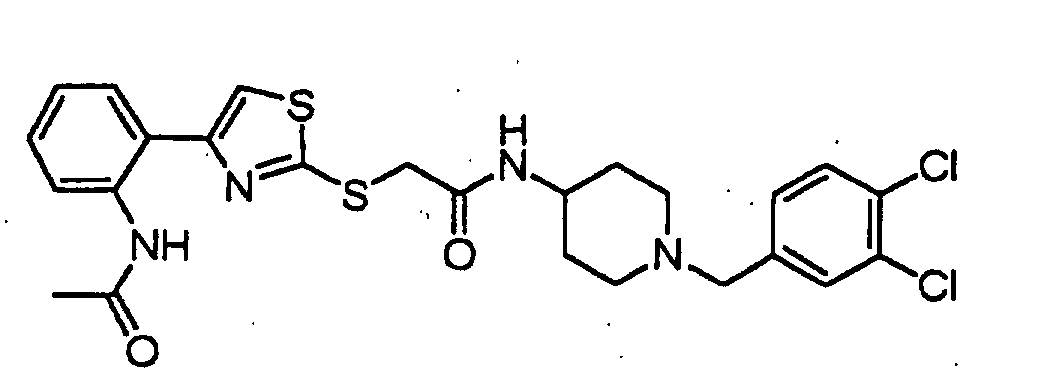
1H-MMR (CDCl3)δ 1.30-1.43 (2H, m), 1.54-1.69 (5H, m), 1.76-1.87 (2H, m), 2.02-2.14 (2H, m), 2.52-2.66 (2H, m), 3.32 (2H, s), 3.71-3.84 (1H, m), 3.88 (2H, s), 6.47-6.58 (1H, m), 7.04-7.13 (2H, m), 7.3-7.46 (4H, m), 7.53 (1H, d, J=7.5 Hz), 8.03-8.45 (1H, m), 10.26 (1H, brs)
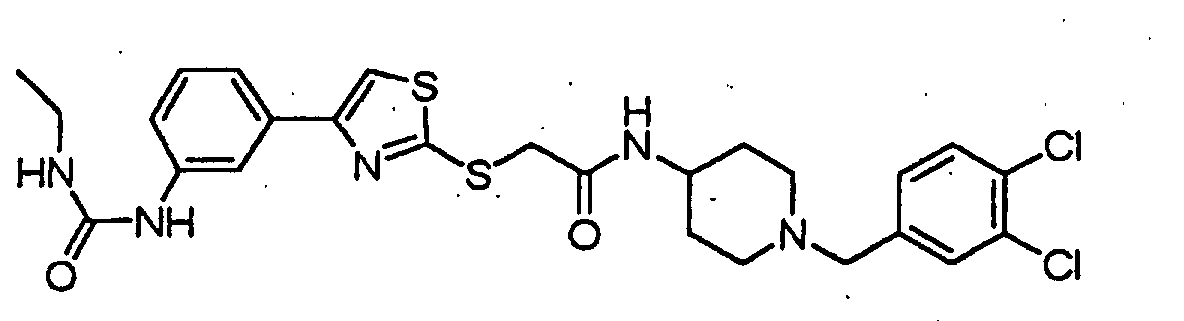
1H-NMR (DMSO-d6)

1H-NMR (CDCl3) δ 1.26 (3H, t, J=7.5 Hz), 1.36-1.48 (2H, m), 1.73-1.84 (2H, m), 2.43 (2H, q, J=7.5 Hz), 2.50-2.58 (2H, m), 3.30 (2H, s), 3.76-3.86 (1H, m), 3.90 (2H, s), 7.06 (1H, dd, J=1.6, 8.1 Hz), 7.31-7.44 (4H, m), 7.43 (1H, s), 7.49-7.59 (3H, m), 8.16 (1H, s)

1H-NMR(CDCl3)δ 0.82-0.90 (2H, m), 1.08-1.12 (2H, m), 1.34-1.48 (2H, m), 1.50-1.65 (1H, m), 1.74-1.86 (2H, m), 2.04-2.15 (2H, m), 3.28 (2H, s), 3.77-3.88 (1H, m), 3.90 (2H, s), 7.05 (1H, dd, J=1.8, 8.1 Hz), 7.30-7.51 (6H, m), 7.57 (1H, d, J=7.5 Hz), 7.68 (1H, s), 8.17 (1H, s)

1H-NMR(CDCl3) δ 1.26 (3H, s), 1.28 (3H, s), 1.35-1.44 (2H, m), 1.76-1.85 (2H, m), 2.03-2.11 (2H, m), 2.45-2.58 (2H, m), 3.27 (2H, s), 3.76-3.86 (1H, m), 3.91 (2H, s), 7.04 (1H, dd, J=1.8, 8.1 Hz), 7.30-7.50 (7H, m), 7.59,(1H, d, J=7.8 Hz), 8.21 (1H, s)
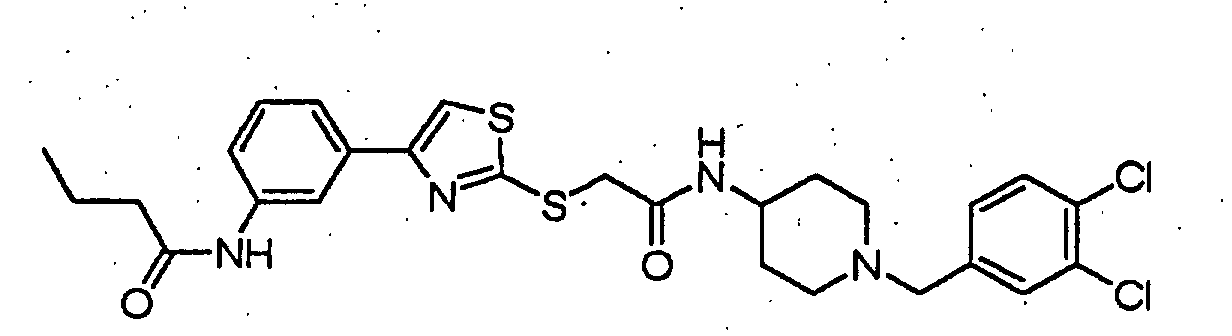
1H-NMR(CDCl3)δ 1.01 (3H, t, J=7.4 Hz) , 1.32-1.45 (2H, m) , 1.73-1.84 (4H, m), 2.02-2.12 (2H, m), 2.36 (2H, t, J=7.4 Hz), 2.47-2.52 (2H, m), 3.27 (2H, s), 3.73-3.89 (1H, m), 3.90 (2H, s), 7.04 (1H, dd, J=1.6, 8.3 Hz) , 7.22-7.52 (7H, m) , 7.58 (1H, d, J=7.4 Hz), 8.16 (1H, s)
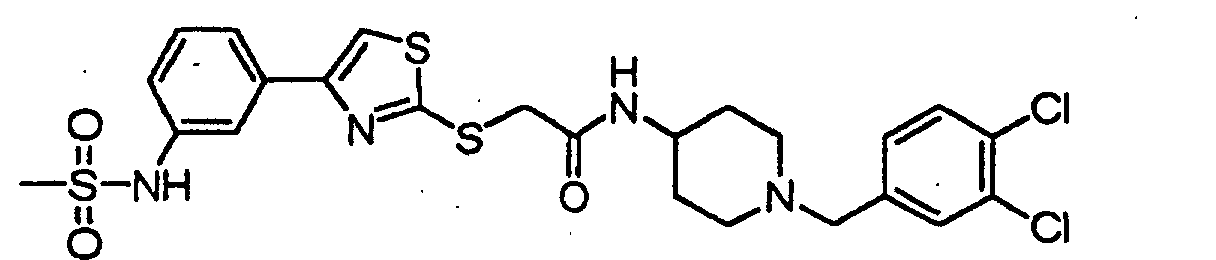
1H-NMR(DMSO-d6)δ 1.70-1.92 (4H, m) , 2.08 (3H, m), 2.94-3.05 (2H, m) , 3.31-3.36 (2H, m) , 3.76-3.82 (1H, m), 4.09 (2H, s), 4.26 (2H, d, J=4.8 Hz), 7.21 (1H, d, J=7.8 Hz), 7.40 (1H, t, J=7.8 Hz), 7.57 (1H, d, J=7.8 Hz), 7.66 (1H, d, J=7.8 Hz), 7.73-7.76 (2H, m), 7.91 (1H, s), 7.97 (1H, s), 8.53 (1H, d, J=7.5 Hz), 9.80 (1H, s), 10.58 (1H, brs)
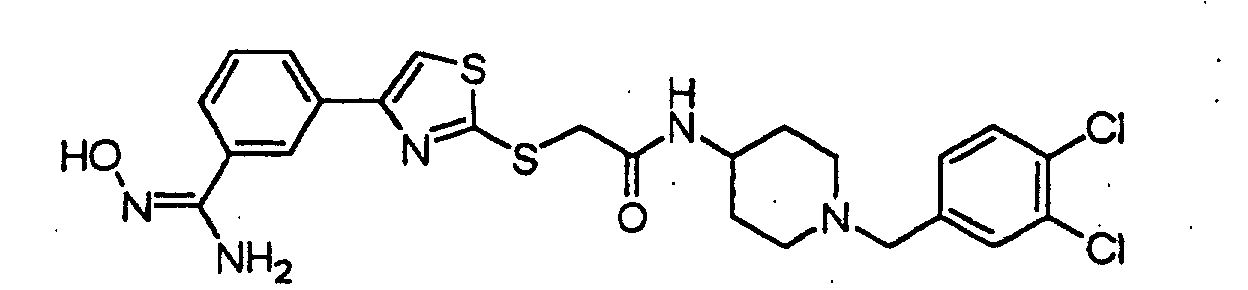
1H-NMR(CDCl3) δ 1.86-1.93 (2H, m), 2.08-2.35 (4H, m), 2.96-3.03 (2H, m), 3.49 (2H, s), 3.74 (2H, s), 3.84-3.97 (1H, m), 4.85 (2H, brs), 7.19 (1H, dd, J=1.8, 8.2 Hz), 7.38-7.50 (5H, m), 7.62-7.67 (1H, m), 7.74 (1H, d, J=8.2 Hz), 8.50 (1H, s)

1H-NMR(CDCl3)δ 1.36-1.53 (5H, m) , 1. 53 (9H, s) , 1.75-1.88 (2H, m), 2.02-2.11 (2H, m), 2.43-2.54 (2H, m), 2.88 (3H, s), 3.25 (2H, s), 3.74-3.85 (1H, m), 3.90 (2H, s), 4.86 (1H, brs), 7.03 (1H, dd, J=1.5, 8.1 Hz) , 7.29-7.45 (6H, m) , 7.53 (1H, d, J=7.3 Hz), 8.13 (1H, s), 8.82 (1H, brs)
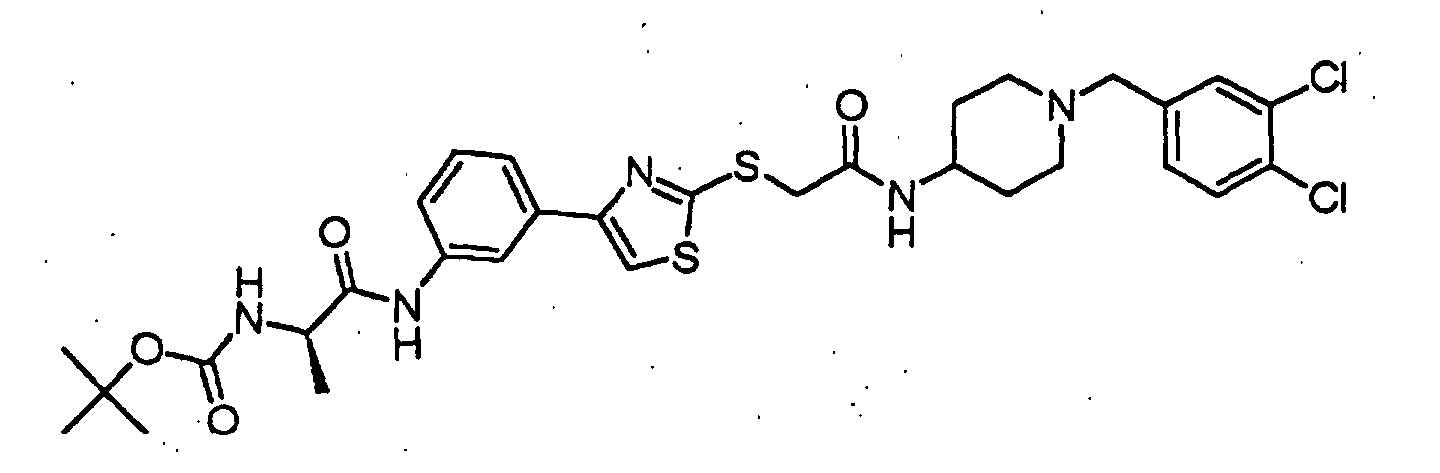
1H-NMR (CDCl3) δ 1.45-1.53 (14H, m), 1.75-1.88 (2H, m), 2.01-2.15 (2H, m), 2.47-2.65 (2H, m), 3.30 (2H, dd, J=1.2, 6.7 Hz), 3.76-3.85 (1H, m), 3.82-3.97 (2H, m), 4.30-4.40 (1H, m), 5.45 (1H, brs), 7.06 (1H, d, J=8.1 Hz), 7.28-7.45 (6H, m), 7.57 (1H, d, J=7.3 Hz), 8.24 (1H, s), 8.71 (1H, s)

1H-NMR(CDCl3) δ 1.22 (3H, d, J=6.1 Hz), 1.34-1.50 (11H, m), 1.75-1.84 (2H, m), 2.03-2.20 (2H, m), 2.44-2.58 (2H, m), 3.28 (2H, s), 3.73-3.85 (1H, m), 3.88 (2H, s), 4.20-4.28 (2H, m), 4.45-4.52 (1H, m), 4.59-4.73 (2H, m), 5.63-5.67 (1H, m), 7.00-7.07 (1H, m), 7.27-7.40 (11H, m), 7.59-7.64 (1H, m), 8.06 (1H, s), 8.64 (1H, brs)
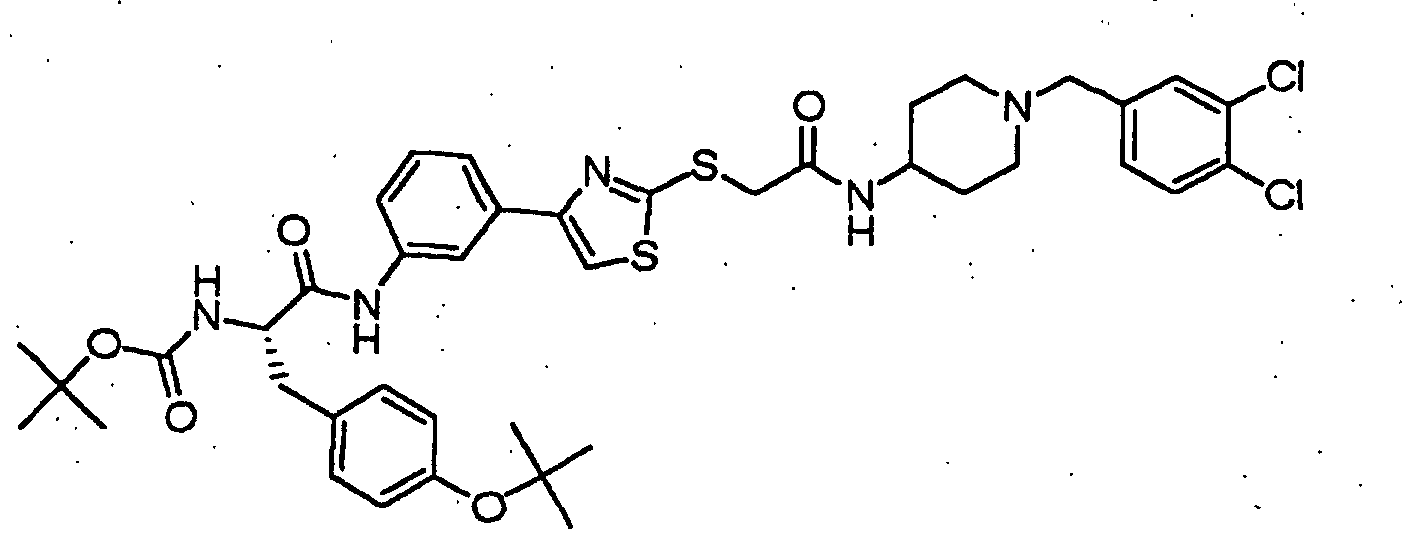
1H-NMR(CDCl3)δ 1.31 (9H, s), 1.42 (9H, s), 1.75-1.87 (2H, m), 2.02-2.12 (2H, m), 2.47-2.61 (2H, m), 3.10 (2H, d, J=7.1 Hz), 3.27 (1H, d, J=13.5 Hz), 3.29 (1H, d, J=13.5 Hz), 3.75-3.87 (1H, m), 3.90 (2H, s), 4.45 (1H, d, J=6.1 Hz), 5.36 (1H, brs), 6.93 (2H, d, J=8.3 Hz), 7.04 (1H, dd, J=1.7, 8.1 Hz), 7.15 (2H, d, J=8.3 Hz), 7.27-7.38 (5H, m), 7.43 (1H, s), 7.56-7.62 (1H, m), 8.00 (2H, s)
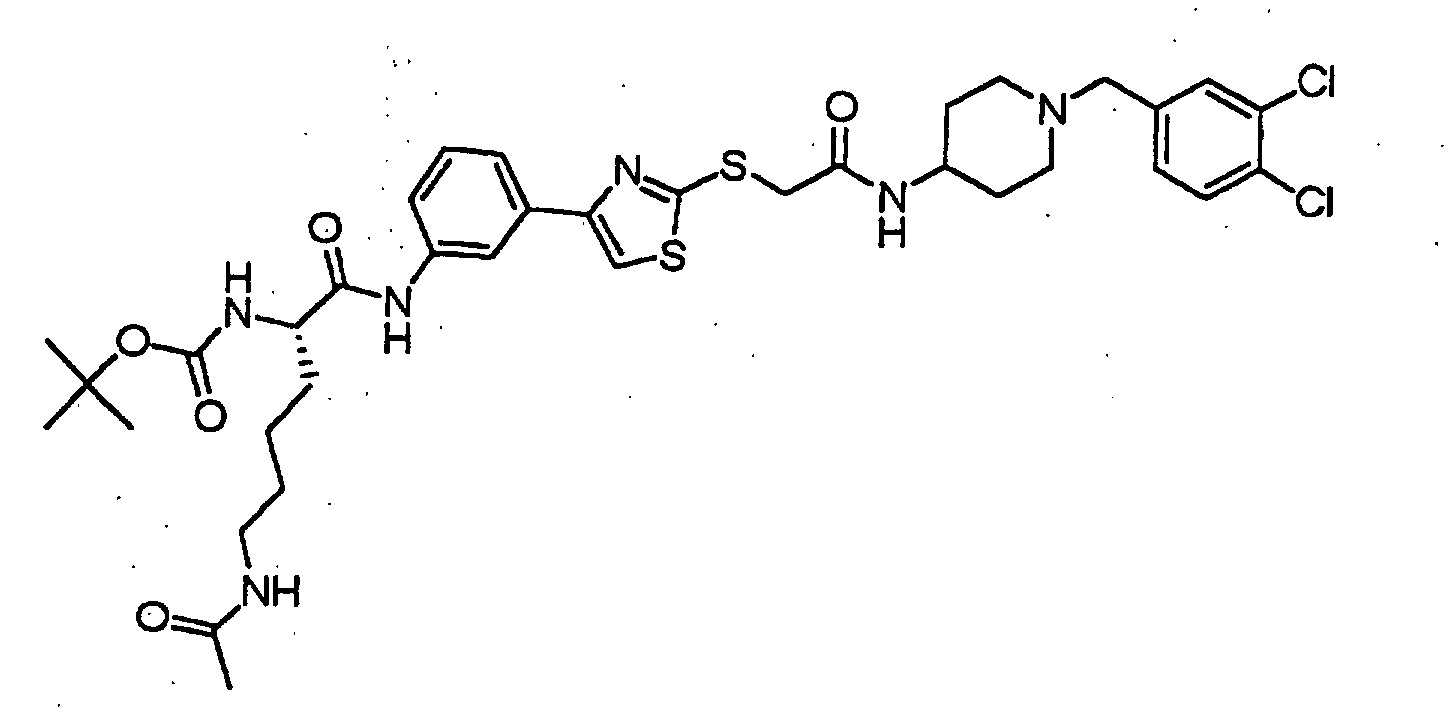
1H-NMR(CDCl3) δ 1.38-1.60 (15H, m), 1.65-1.86 (2H, m), 1.91-2.01 (4H, m), 2.02-2.14 (2H, m), 2.50-2.63 (2H, m), 3.88 (1H, d, J=15.1 Hz), 3.92 (1H, d, J=15.1 Hz), 4.21-4.32 (1H, m), 5.48-5.60 (1H, m), 5.69-5.78 (1H, m), 7.03-7.09 (1H, m), 7.33-7.46 (5H, m), 7.51-7.60 (2H, m), 8.22 (1H, s), 8.91 (1H, brs)
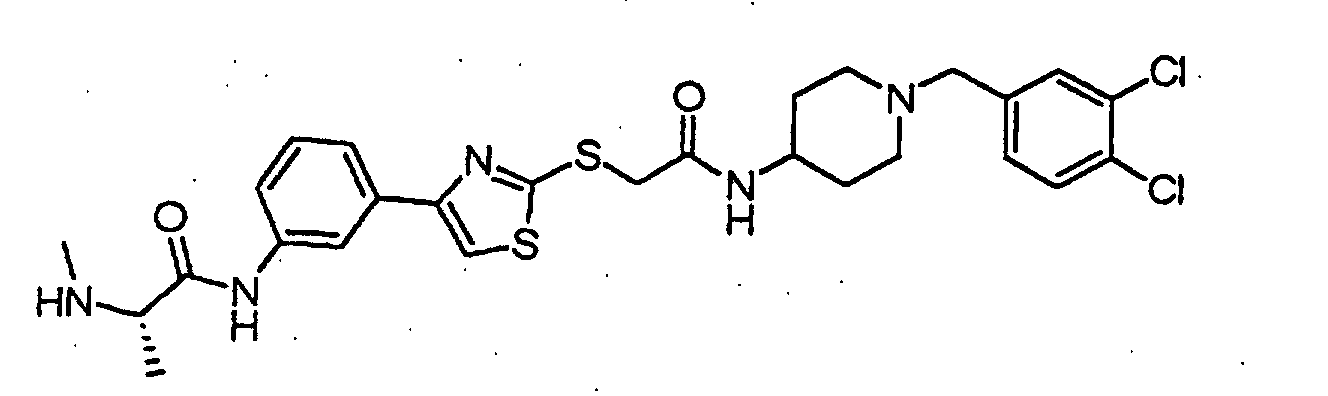
1H-NMR(CDCl3) δ 1.32-1.49 (5H, m), 1.77-1.83 (2H, m), 2.02-2.11 (2H, m), 2.42-2.59 (5H, m), 3.18 (1H, q, J=6.9 Hz), 3.25 (2H, s), 3.76-2.87 (1H, m), 3.91 (2H, s), 7.02-7.06 (1H, m) , 7.29-7.44 (4H, m), 7.46 (1H, s), 7.52-7.64 (2H, m), 8.27 (1H, s), 9.44 (1H, s)
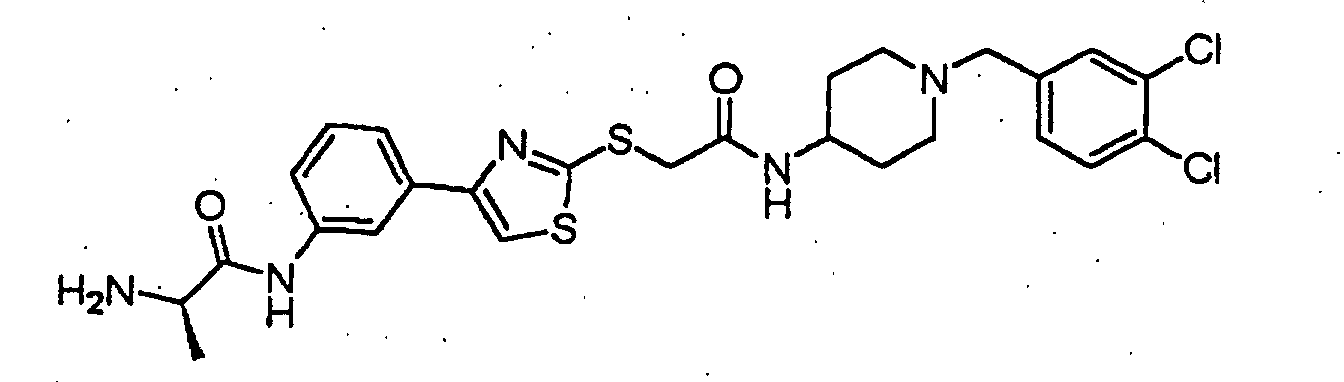
1H-NMR(CDCl3)

1H-NMR(CDCl3)δ 1.31 (3H, d, J=6.3 Hz), 1.36-1.47 (2H, m), 1.76-1.84 (2H, m), 2.01-2.11 (2H, m), 2.43-2.60 (2H, m), 3.23 (2H, s), 3.28-3.36 (1H, m), 3.78-3. 85 (1H, m), 3.90 (2H, s) , 4.32-4.40 (1H, m), 4.42-4.64 (2H, m), 7.00-7.04 (1H, m), 7.26-7.43 (10H, m), 7.54-7.66 (2H, m), 8.19 (1H, s), 9.82 (1H, s)
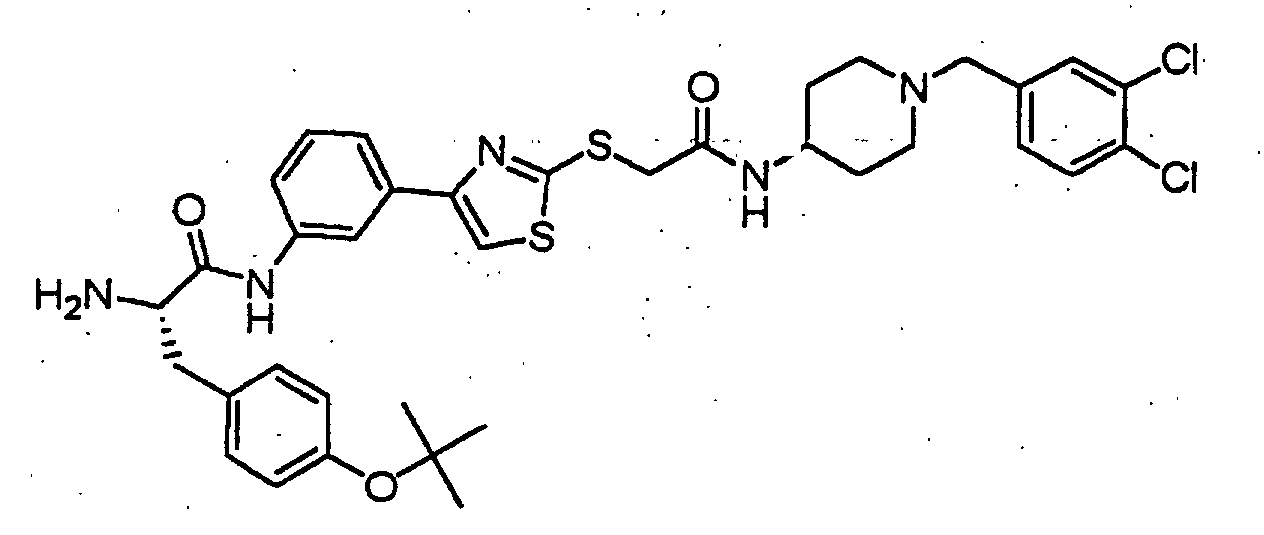
1H-NMR (CDCl3) δ 1.28-1.44 (2H, m), 1.52-1.86 (11H, m), 2.02-2.14 (2H, m), 2.50-2.63 (2H, m), 2.88-2.99 (1H, m), 3.05-3.14 (1H, m), 3.28 (2H, dd, J=13.4, 15.5 Hz), 3.69-3.84 (2H, m), 3.94 (2H, dd, J=15.5, 19.9 Hz), 6.74 (2H, d, J=8.4 Hz), 7.01-7.08 (3H, m) , 7.27-7.33 (3H, m) , 7.39 (1H, d, J=7.9 Hz), 7.42 (1H, s), 7.52-7.57 (1H, m) , 7.66-7.71 (1H, m) , 7.92 (1H, s) , 9.20 (1H, s)

1H-NMR(CDCl3)δ 1.33-1.73 (7H, m), 1.76-1.87 (2H, m), 1.90-2.01 (4H, m), 2.03-2.14 (2H, m), 2.43-2.56 (2H, m), 3.22-3.34 (4H, m), 3.47-3.54 (1H, m), 3.73-3.87 (1H, m), 3.91 (2H, s), 5.64 (1H, brs), 7.04 (1H, dd, J=1.8, 8.1 Hz), 7.30-7.47 (5H, m), 7.55-7.64 (2H, m), 8.22 (1H, s), 9.67 (1H, s)

1H-NMR(CDCl3) δ 0.87 (3H, t, J=7.3 Hz), 1.32-1.50 (4H, m), 1.76-1.89 (4H, m), 2.00-2.11 (2H, m), 2.55-2.64 (2H, m), 3.12 (2H, t, J=7.8 Hz), 3.33 (2H, s), 3.28-3.70 (1H, m), 3.89 (2H, s), 7.07 (1H, d, J=8.1 Hz), 7.28-7.45 (6H, m), 7.60 (1H, d, J=7.5 Hz), 7.79 (1H, s)

1H-NMR(CDCl3)δ 1.32-1.44 (2H, m), 1.77-1.83 (2H, m), 1.98-2.05 (2H, m), 2.54-2.59 (2H, m), 3.32 (2H, s), 3.71-3.85 (1H, m), 3.79 (2H, s), 7.05 (1H, d, J=8.1 Hz), 7.22-7.36 (5H, m), 7.49-7. 69 (5H, m), 7.76-7.90 (4H, m), 8.41 (1H, s)
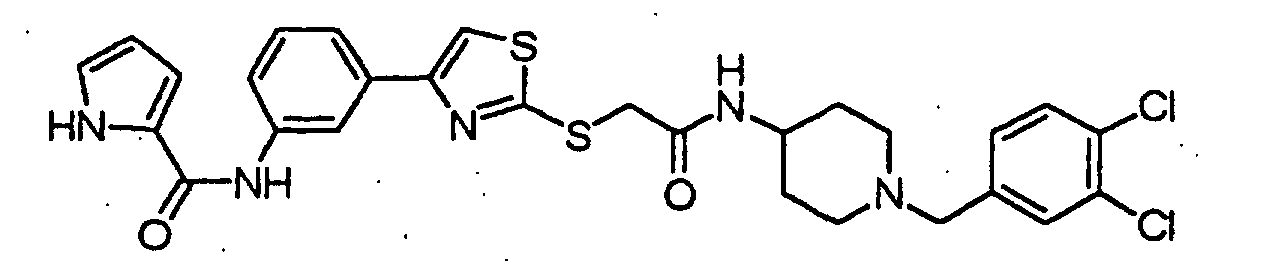
1H-NMR(DMSO-d6)δ 1.35-1.70 (2H, m), 1.70-1.73 (2H, m), 1.99-2.06 (2H, m), 2.64-2.68 (2H, m), 3.41 (2H, s), 3.55-3.60 (1H, m), 3.99 (2H, s), 6.16-6.18 (1H, m), 6.96-6.98 (1H, m), 7.09-7.12 (1H, m), 7.24-7.27 (1H, m), 7.38 (1H, t, J=7.9 Hz), 7.51 (1H, d, J=1.8 Hz), 7.54-7.62 (2H, m), 7.81-7.84 (1H, m), 7.94 (1H, s), 8.20-8.23 (2H, m) , 9.83 (1H, s), 11.66 (1H, brs)

1H-NMR(CDCl3)δ 1.35-1.47 (2H, m) , 1.80-1.84 (2H, m), 2.00-2.10 (2H, m), 2.48-2.52 (2H, m), 3.24 (2H, s), 3.77-3.86 (1H, m), 3.92 (2H, s), 6.99 (1H, dd, J=1.8, 8.2 Hz), 7.07 (1H, m), 7.16-7.21 (1H, m) , 7.25-7.35 (2H, m), 7.43-7.48 (3H, m), 7.60-7.71 (3H, m), 8.09 (1H, s), 8.27 (1H, brs), 9.32 (1H, s)

1H-NMR(CDCl3)δ 1.28-1.47 (2H, m), 1.78-1.83 (2H, m), 2.00-2.07 (2H, m), 2.45-2.49 (2H, m), 3.22 (2H, s), 3.75-3.85 (1H, m), 3.92 (2H, s), 6.99 (1H, dd, J=1.8, 8.1 Hz), 7.29 (1H, s), 7.38-7.49 (3H, m), 7.57-7.68 (3H, m) , 7.73 (1H, s), 8.32 (1H, s) , 9.21 (1H, s), 11.08 (1H, brs)

1H-NMR (CDCl3)

ESI-MS(m/z):754
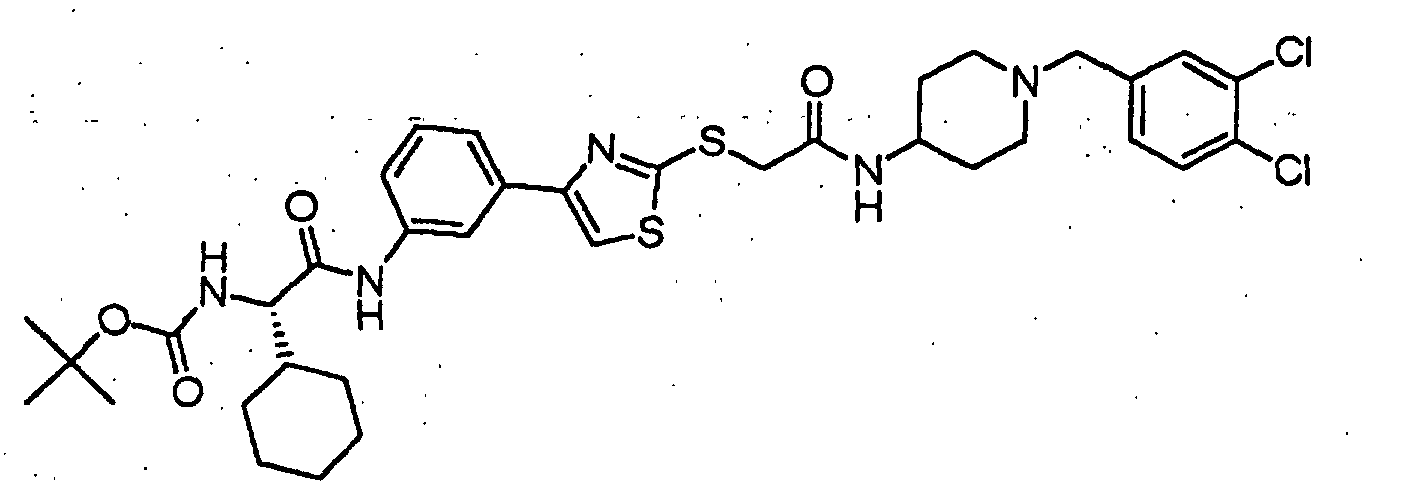
ESI-MS(m/z) : 746

ESI-MS(m/z):768
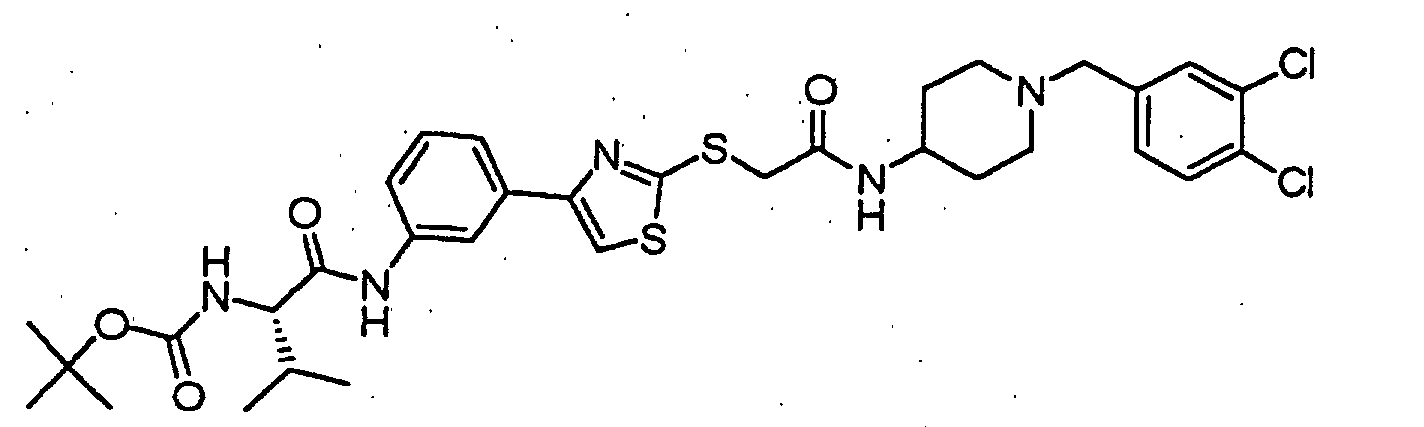
ESI-MS(m/z):706
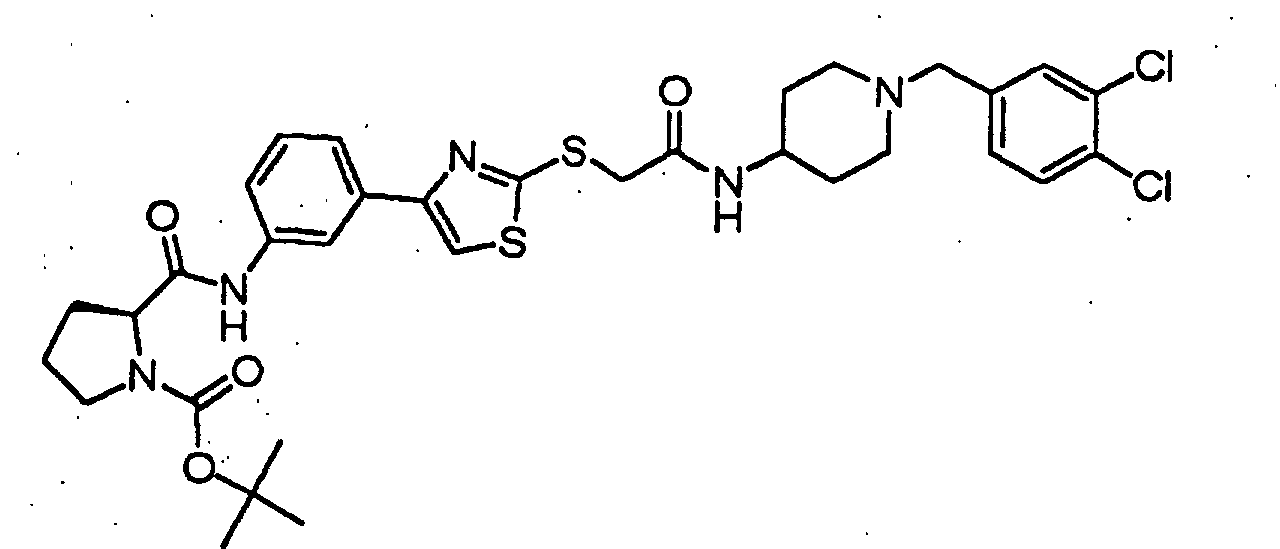
ESI-MS(m/z) : 704

ESI-MS (m/z) : 704
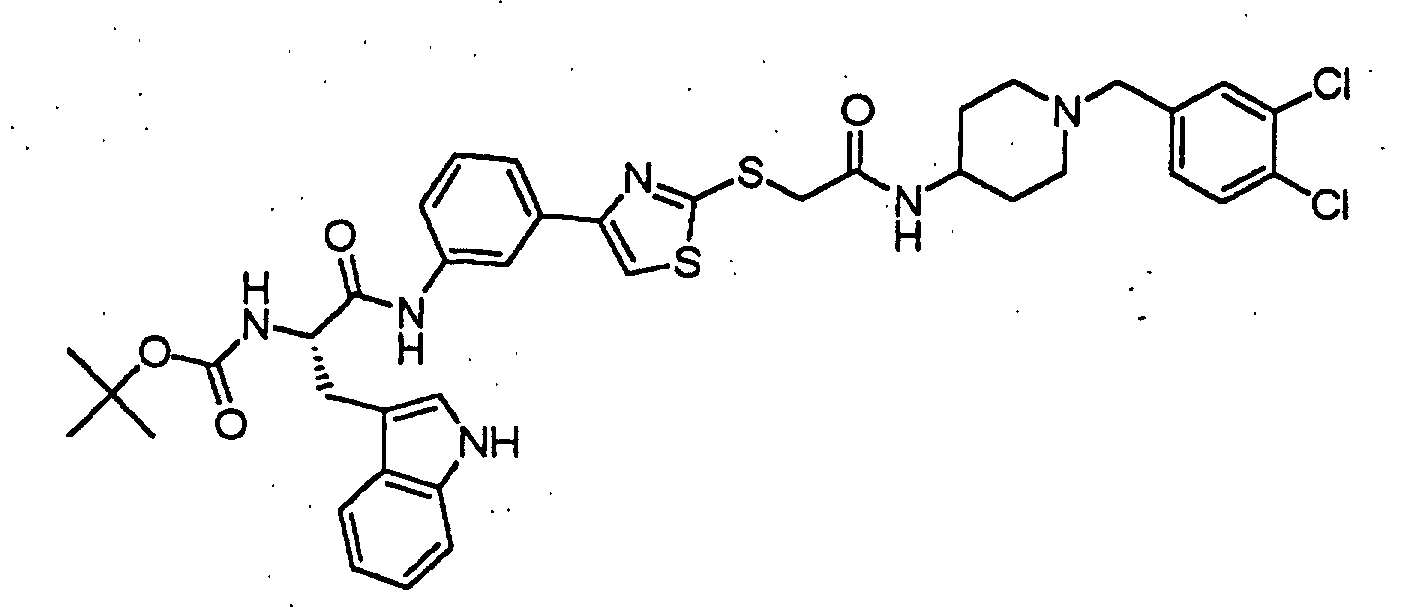
ESI-MS(m/z):793
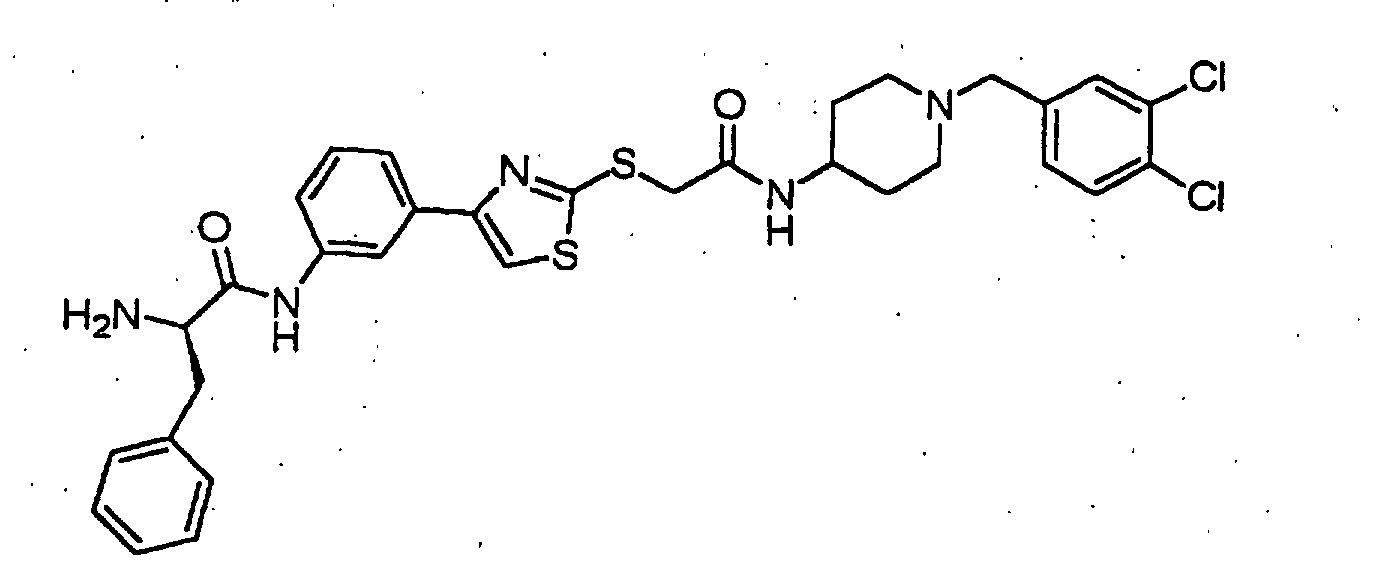
ESI-MS(m/z):654

ESI-MS (m/z) : 646
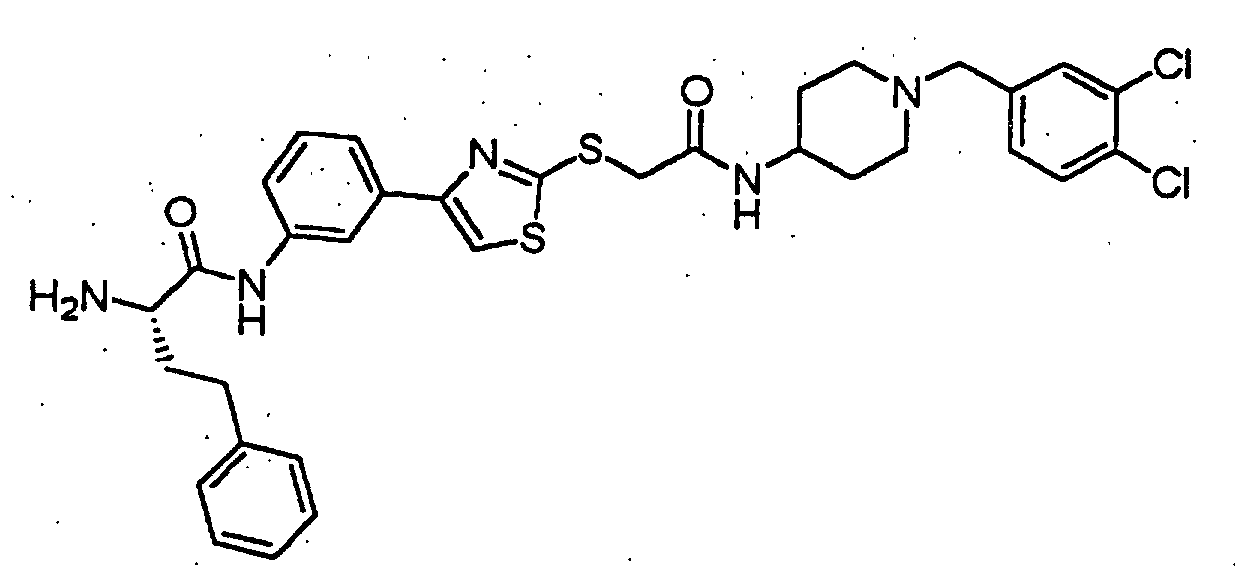
ESI-MS(m/z):668

ESI-MS (m/z) : 606

ESI-MS (m/z) : 604

ESI-MS(m/z):604
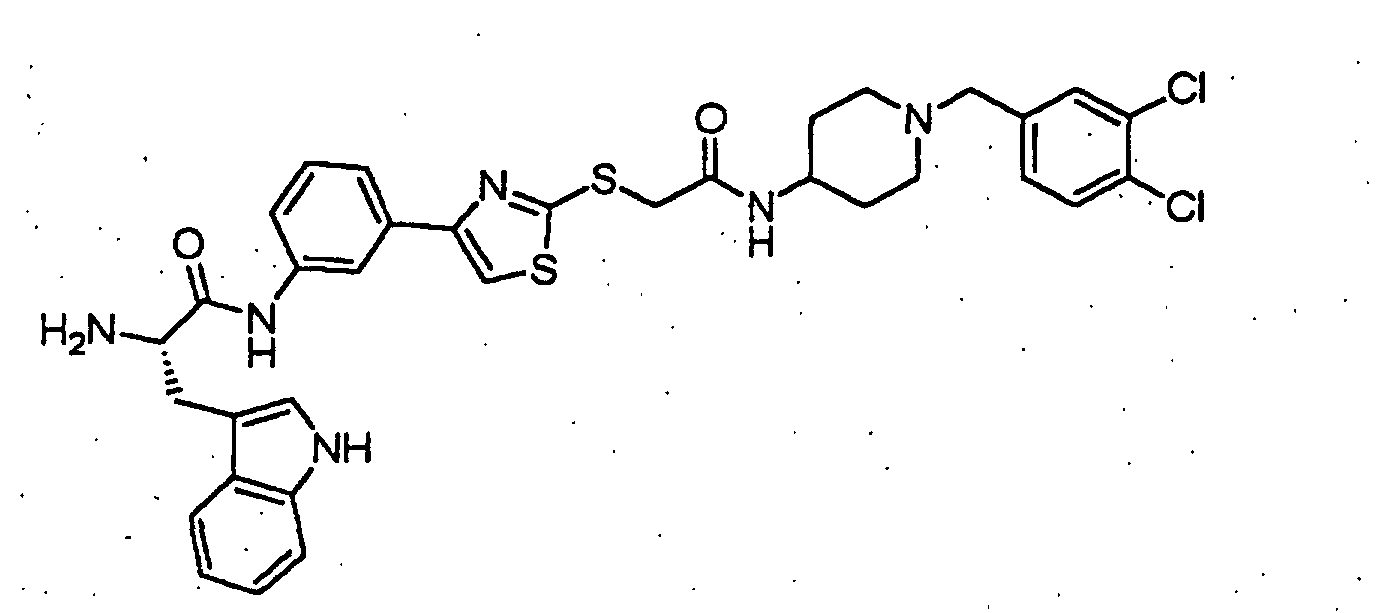
ESI-MS(m/z):693
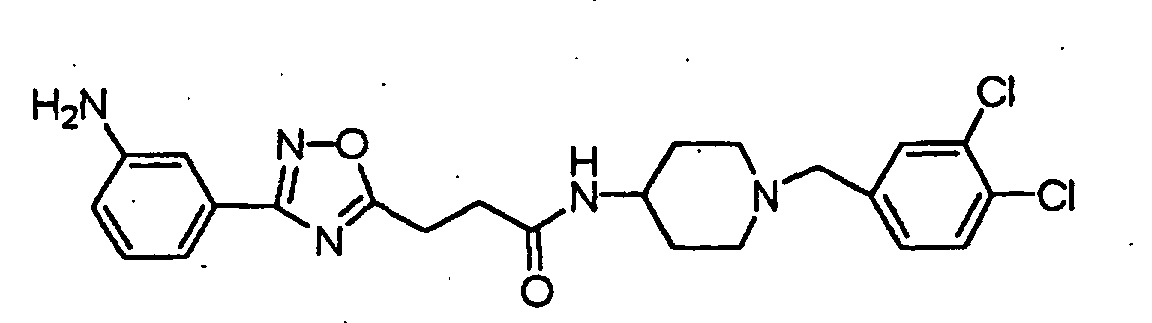
1H-NMR(DMSO-d6) δ 1.31-1.50 (2H, m), 1.62-1.76 (2H, m), 1.91-2.11 (2H, m), 2.60-2.82 (4H, m), 3.14 (2H, t, J=7.2 Hz), 3.43 (2H, s), 3.48-3.67 (1H, m), 5.39 (2H, s), 6.67-6.78 (1H, m), 7.05-7.27 (3H, m), 7.28 (1H, dd, J=8.1, 1.8 Hz), 7.50-7.67 (2H, m), 7.89-8.00 (1H, m)

1H-NMR (DMSO-d6) δ 1.15-1.36 (2H, m), 1.42-1.65 (2H, m), 1.71-1.98 (2H, m), 2.17-2.65 (6H, m) , 3.26 (2H, s), 3.32-3.61 (1H, m), 6.80-6.92 (1H, m), 7.05-7.20 (2H, m), 7.21-7.32 (1H, m), 7.33-7.49 (3H, m), 7.51-7.80 (3H, m)
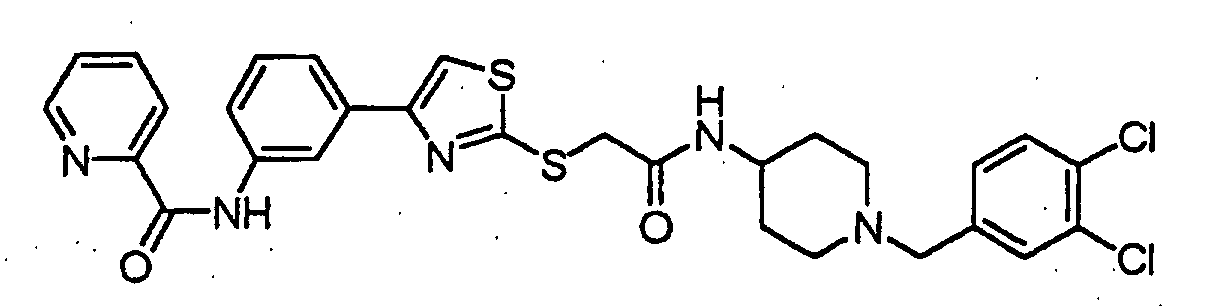
1H-NMR(CDCl3)δ 1.35-1.48. (2H, m), 1.78-1.86-(2H, m), 2.02-2.11 (2H, m), 2.41-2.53 (2H, m), 3.22 (2H, s), 3.77-3.87 (2H, m), 3.93 (2H, s) , 6.99 (1H, dd, J=1.8, 8.2 Hz), 7.28 (2H, s), 7.42-7.53 (4H, m), 7.65 (1H, d, J=7.7 Hz), 7.74-7.79 (1H, m), 7.93 (1H, dt, J=1.8, 7.7 Hz), 8.31 (1H, d, J=7.7 Hz), 8.40 (1H, t, J=1.8 Hz), 8.60-8.64 (1H, m), 10.15 (1H, s)

1H-NMR(CDCl3) δ 1.37-1.51 (2H, m), 1.74-1.86 (2H, m), 2.03-2.13 (2H, m), 2.50-2.63 (2H, m), 3.30 (2H, s), 3.74-3.87 (1H, m), 3.90 (2H, s), 7.01-7.06 (1H, m), 7.30-7.37 (3H, m), 7.42-7.49 (3H, m), 7.62-7.74 (2H, m), 8.20-8.28 (2H, m), 8.36 (1H, brs), 8.76-8.81 (1H, m), 9.14 (1H, d, J=1.8 Hz)
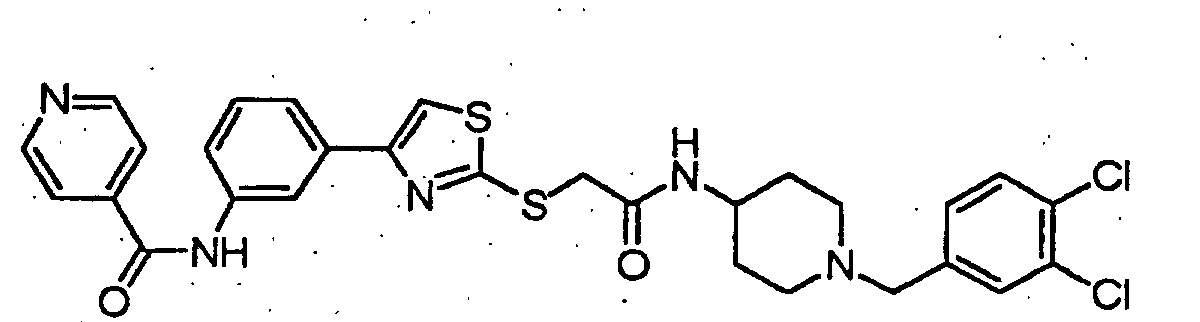
1H-NMR(CDCl3) δ 1.38-1.50 (2H, m), 1.79-1.88 (2H, m), 2.02-2.11 (2H, m), 2.48-2.59 (2H, m), 3.28 (2H, s), 3.73-3.86 (1H, m), 3.91 (2H, s), 7.01-7.07 (1H, m), 7.30-7.35 (3H, m), 7.46 (1H, t, J=7.8 Hz), 7.47 (1H, s), 7.64 (1H, d, J=7.8 Hz), 7.69-7.78 (3H, m), 8.23 (1H, s), 8.39 (1H, brs), 8.87-8.86 (2H, m)
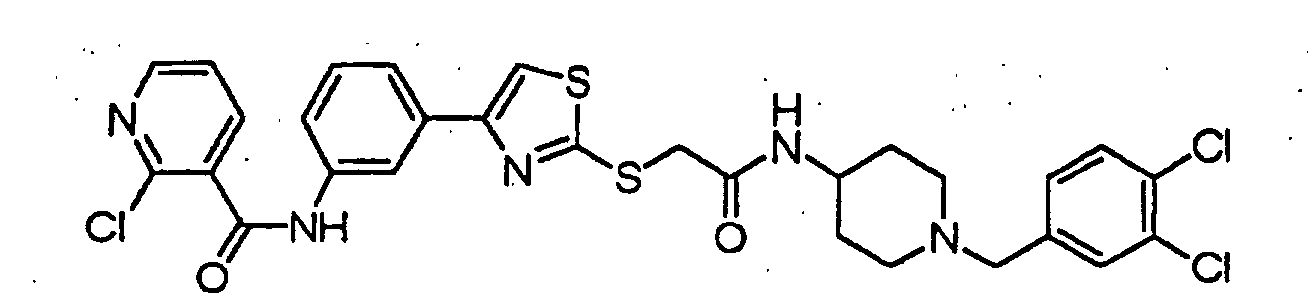
1H-NMR(DMSO-d6)δ 1.35-1.47 (2H, m), 1.67-1.76 (2H, m), 1.97-2.08 (2H, m), 2.60-2.69 (2H, m), 3.40 (2H, s), 3.51-3.62 (1H, m), 4.01 (2H, s), 7.23 (1H, dd, J=1.8, 8.1 Hz), 7.40-7.48 (2H, m), 7.55 (1H, d, J=8.1 Hz), 7.71 (1H, d, J=8.1 Hz), 7.90-7.95 (1H, m), 7.97 (1H, s), 8.23 (1H, d, J=7.8 Hz), 8.44 (1H, s), 8.82 (1H, t, J=1.8 Hz), 8.94 (1H, d, J=2.1 Hz), 9.32 (1H, d, J=1.5 Hz), 10.77 (1H, s)
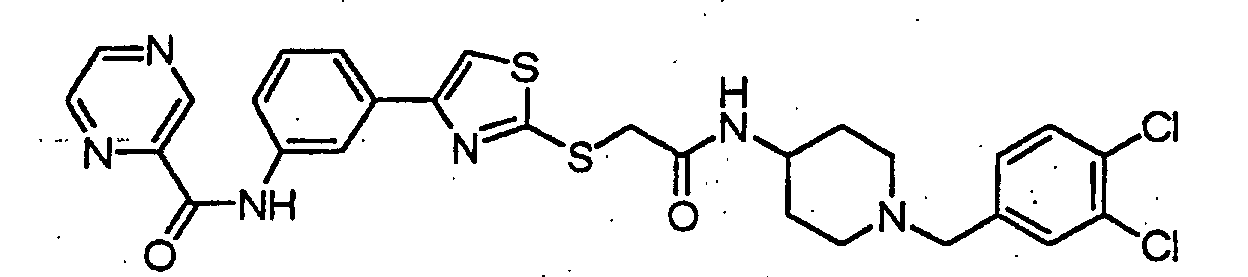
1H-NMR(DMSO-d6)δ 1.32-1.46 (2H, m), 1.67-1.77 (2H, m), 1.98-2.07 (2H, m), 2.64-2.70 (2H, m), 3.42 (2H, s), 3.50-3.63 (1H, m), 3.99 (2H, s), 7.27 (1H, dd, J=1.8, 8.1 Hz), 7.43 (1H, t, J=8.1 Hz), 7.51 (1H, d, J=1.8 Hz), 7.55 (1H, s), 7.57-7.60 (2H, m), 7.67-7.73 (2H, m), 7.97 (1H, s), 8.09 (1H, dd, J=1.8, 7. 5 Hz), 8.20 (1H, d, J=7.5 Hz), 8.26 (1H, s), 8.54 (1H, dd, J=1.8, 8.1 Hz), 10.73 (1H, s)

1H-NMR (DMSO-d6)δ 1.35-1.47 (2H, m), 1.66-1.76 (2H, m), 1.98-2.07 (5H, m), 2.64-2.70 (2H, m), 3.42 (2H, s), 3.50-3.61 (1H, m), 3.96 (2H, s), 4.89 (2H, brs), 6.95 (1H, d, J=7.8 Hz), 7.03 (2H, dd, J=1.6, 7.5 Hz), 7.18 (1H, d, J=1.6 Hz), 7.27 (1H, dd, J=1.8, 8.1 Hz), 7.51 (1H, d, J=1.8 Hz), 7.57 (1H, d, J=8.1 Hz), 7.72 (1H, s), 8.20 (1H, d, J=7.5 Hz)
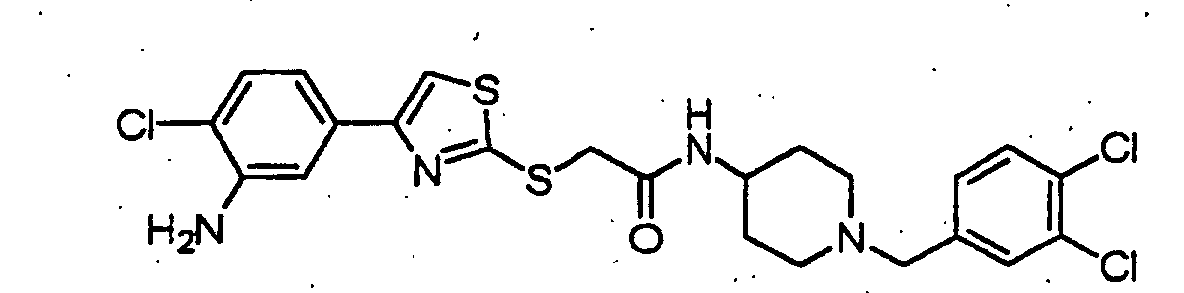
1H-NMR(DMSO-d6)δ 1.34-1.46 (2H, m) , 1.67-1.75 (2H, m) , 1.98-2.08 (2H, m), 2.63-2.72 (2H, m), 3.42 (2H, s), 3.48-3.59 (1H, m), 3.97 (2H, s), 5.42 (2H, s), 7.09 (1H, dd, J=2.0, 8.2 Hz), 7.21-7.32 (2H, m), 7.39 (1H, d, J=2.0 Hz), 7.51-7.60 (2H, m), 7.85 (1H, s), 8.19-8.23 (1H, m)

1H-NMR(DMSO-d6) δ 1.32-1.53 (11H, m), 1.53 (3H, d, J=7.2 Hz), 1.75-1.80,(2H, m), 1.96-2.15 (2H, m), 2.63-2.81 (2H, m), 3.45 (2H, s), 3.50-3.67 (1H, m), 4.02 (2H, s), 4.91-5.08 (1H, m), 7.27 (1H, d, J=8.4 Hz), 7.51-7.72 (3H, m), 7.75-7.89 (1H, m), 7.97 (1H, d, J=7.8 Hz), 8.15 (1H, d, J=7.5 Hz), 8.20 (1H, s), 8.25-8.82 (1H, m), 8.52 (1H, s)
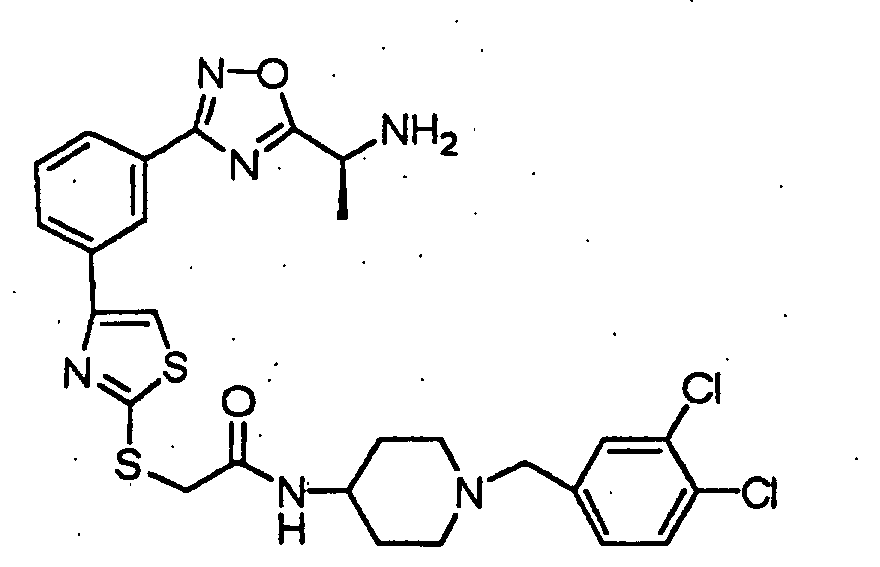
1H-NMR (DMSO-d6)δ 1.31-1.57 (2H, m), 1.53 (3H, d, J=6.9 Hz) , 1.68-1.81 (2H, m), 2.00-2.13 (2H, m), 2.62-2.80 (2H, m), 3.46 (2H, s), 3.50-3.65 (1H, m), 4.02 (2H, s), 4.40 (1H, q, J=6.9 Hz), 6.62 (2H, s), 7.28 (1H, dd, J=8.4, 1.8 Hz), 7.48-7.71 (3H, m), 7.99 (1H, d, J=7.8 Hz), 8.15 (1H, d, J=7.8 Hz), 8.20 (1H, s), 8.24-8.32 (1H, m), 8.55 (1H, s)
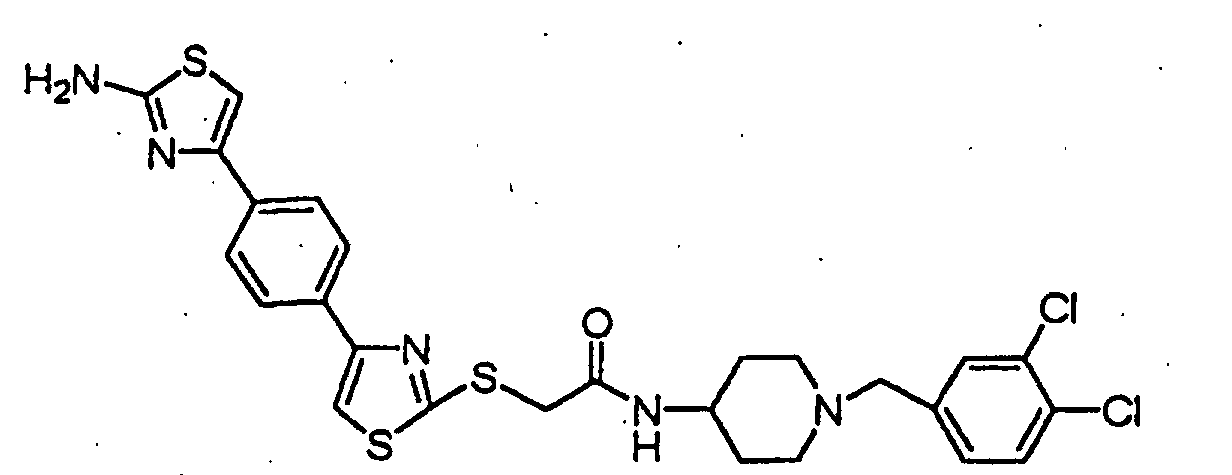
1H-NMR(DMSO-d6)δ 1.38-1.47 (2H, m), 1.70-1.74 (2H, m), 2.00-2.07 (2H, m) , 2.66-2.69 (2H, m) , 3.42 (2H, s) , 3.54-3.58 (1H, m), 4.02 (2H, s), 7.09 (3H, m), 7.28 (1H, d, J=8.1 Hz), 7.51 (1H, s) , 7.55 (1H, d, J=8.1 Hz) , 7.85 (2H, d, J=8.7 Hz) , 7.94 (2H, d, J=8.7 Hz), 8.02 (1H, s), 8.25 (1H, d, J=6.9 Hz)
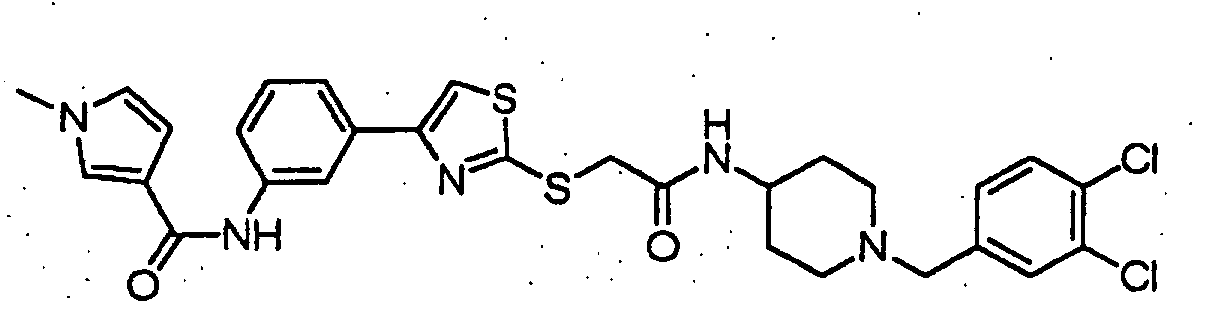
1H-NMR (DMSO-d6) δ 1.34-1.48 (2H, m), 1.67-1.76 (2H, m), 1.97-2.06 (2H, m), 2.62-2.70 (2H, m), 3.41 (2H, s), 3.49-3.63 (1H, m), 3.88 (3H, s), 3.99 (2H, s), 6.07-6.11 (1H, m), 6.99-7.03 (1H, m), 7.05-7.09 (1H, m), 7.26 (1H, dd, J=8.2, 1.9 Hz), 7.36 (1H, t, J=8.2 Hz), 7.50 (1H, d, J=1.9 Hz), 7.56 (1H, d, J=8.2 Hz), 7.57-7.63 (1H, m), 7.70-7.76 (1H, m), 7.93 (1H, s), 8.18-8.25 (2H, m), 9.82 (1H, s)
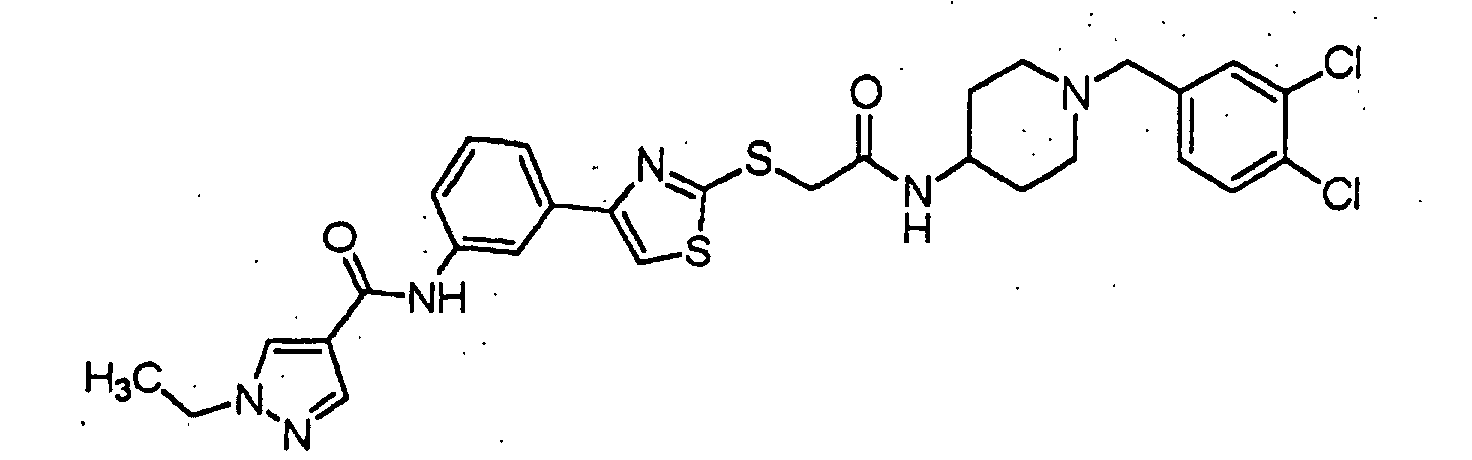
1H-NMR (DMSO-d6) δ 1.37-1.53 (2H, m), 1.44 (3H, t, J=7.3 Hz), 1.74-1.77 (2H, m), 1.99-2.06 (2H, m), 2.66-2.70 (2H, m), 3.47 (2H, s), 3.57-3.66 (1H, m), 4.05 (2H, s), 4.22 (2H, q, J=7.3 Hz), 7.25 (1H, dd, J=8.2, 1.7 Hz), 7.42 (1H, t, J=7.9 Hz), 7.49 (1H, d, J=1.7 Hz), 7.54 (1H, d, J=8.2 Hz), 7.65-7.67 (1H, m), 7.84-7.87 (1H, m), 7.97 (1H, s), 8.12 (1H, s), 8.25-8.27 (2H, m), 8.43 (1H, s), 9.96 (1H, s)
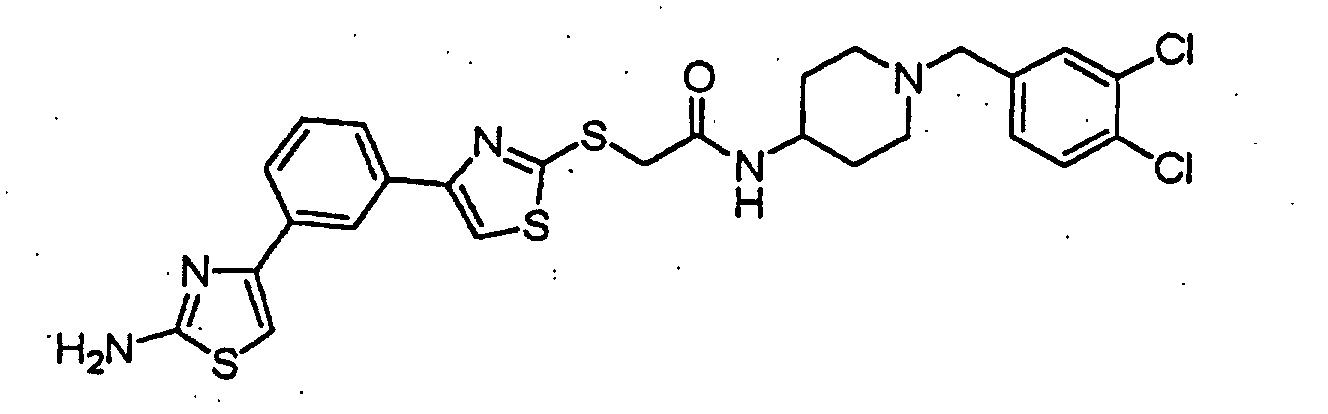
1H-NMR (DMSO-d6) δ 1.42-1.53 (2H, m), 1.76-1.79 (2H, m), 2.05-2.12 (2H, m) , 2. 70-2.74 (2H, m) , 3.48 (2H, s), 3.59-3.65 (1H, m), 4.07 (2H, s), 7.18 (3H, s), 7.33 (1H, dd, J=8.2, 1.8 Hz), 7.49 (1H, t, J=7. 7 Hz), 7.57 (1H, d, J=1.8 Hz), 7.63 (1H, d, J=8.2 Hz), 7.84 (1H, d, J=7.9 Hz), 7.88 (1H, d, J=7.8 Hz), 8.09 (1H, s), 8.30 (1H, d, J=7.5 Hz) , 8.41 (1H, s)

1H-NMR(DMSO-d6)δ 1.38-1.46 (2H, m), 1.70-1.75 (2H, m), 1.95-2.15 (2H, m), 2.71-2.75 (2H, m), 3.47 (2H, brs), 3.58-3.62 (1H, m), 3.99 (2H, s), 7.08-7.11 (3H, m), 7. 30 (1H, d, J=7.5 Hz), 7.47 (1H, t, J=7.8 Hz), 7.56-7.62 (2H, m), 7.72-7.75 (1H, m), 7.83-7.86 (1H, m), 8.24 (1H, brd), 8.29 (1H, t, J=1.5 Hz)
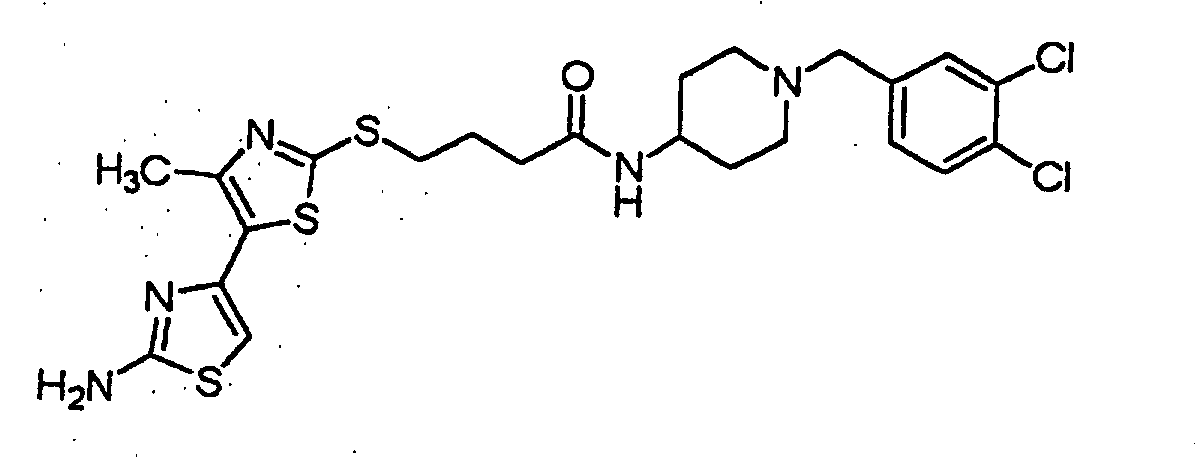
1H-NMR(DMSO-d6)δ 1.33-1.43 (2H, m), 1.68-1.71 (2H, m), 1.88-2.05 (4H, m), 2.20 (2H, t, J=7.4 Hz), 2.46 (3H, s), 2.69-2.73 (2H, m), 3.15 (2H, t, J=7.2 Hz), 3.44 (2H, s), 3.50-3.54 (1H, m), 6.67 (1H, s), 7.20 (2H, s), 7.28 (1H, dd, J=8.1, 1.8 Hz), 7.53 (1H, d, J=1.8 Hz), 7.57 (1H, d, J=8.1 Hz), 7.79 (1H, d, J=7.5 Hz)

1H-NMR(DMSO-d6) δ 1.30-1.46 (2H, m), 1.62-1.78 (2H, m), 1.91-2.08 (2H, m), 2.57-2.70 (2H, m), 3.40 (2H, s), 3.51-3.55 (1H, m), 3.96 (2H, s), 4.27 (1H, d, J=5.7 Hz), 6.14 (1H, m), 6.29-6.35 (2H, m), 6.60-6.02 (1H, m), 7.09-7.11 (2H, m), 7.20-7.26 (2H, m), 7.49-7.56 (3H, m), 7.83 (1H, s), 8.18 (1H, d, J=6.9 Hz)

1H-NMR(DMSO-d6)δ 1.74-1.99 (4H, m) , 2.89-3.10 (2H, m) , 3.04-3.38 (2H, m), 3.77-3.81 (1H, m), 3.99 (2H, s), 4.26 (2H, s), 4.78 (2H, s) , 6.58-6.62 (1H, m), 7.15-7.24 (3H, m) , 7.62-7.66 (1H, m), 7.70-7.74 (1H, m), 7.84-8.00 (5H, m), 8.42-8.46 (1H, m) , 8. 60 (1H, d, J=7.2 Hz), 8.78-8.82 (1H, m) , 11.30. (1H, brs)
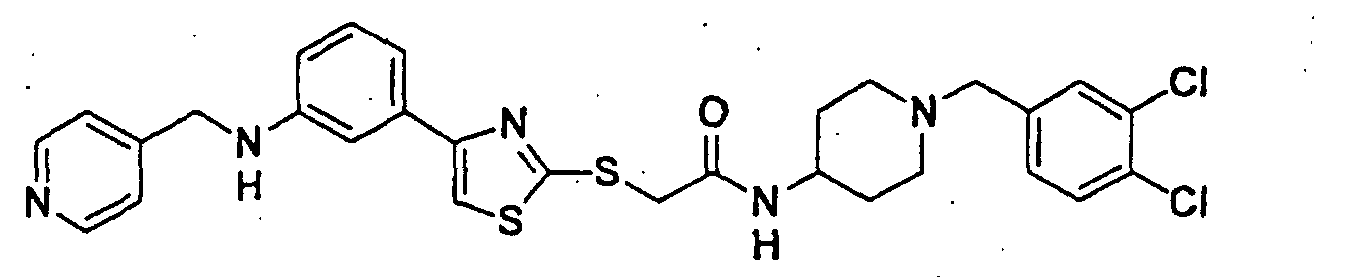
1H-NMR (DMSO-d6) δ 1.77-1.96 (4H, m), 2.83-3.04 (2H, m), 3.05-3.33 (2H, m), 3.73-3.77 (1H, m), 3.96 (2H, s), 4.23 (2H, s), 4.67 (2H, s), 6.46-6.50 (1H, m), 7.09-7.16 (3H, m), 7.61 (1H, d, J=8.4 Hz), 7.71 (1H, d, J=8.4 Hz), 7.81-8.85 (1H, m), 7.94-8.02 (3H, m), 8.31 (1H, s), 8.60 (1H, d, J=7.2 Hz) , 8.83 (2H, d, J=6.3 Hz), 11.38 (1H, brs)
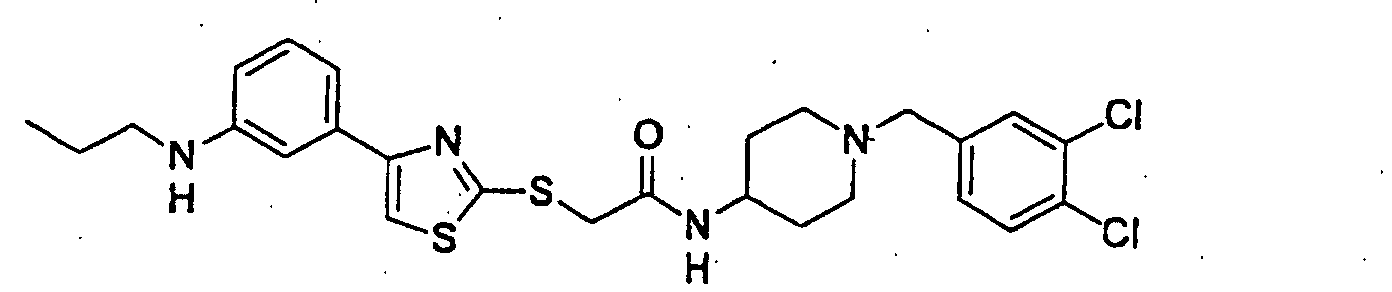
1H-NMR (DMSO-d6) δ 0.95 (3H, t, J=7.5 Hz), 1.66 (2H, q, J=7.5 Hz), 1.78-1.96 (4H, m), 2.90-3.07 (2H, m), 3.15-3.34 (5H, m), 4.01 (2H, s), 4 . 25 (2H, s), 7.05-7.19 (1H, m), 7.34-7.43 (1H, m), 7.59-7.62 (2H, m), 7.72-7.75 (2H, m), 7.96 (1H, d, J=1.8 Hz), 8.01 (1H, s), 8.59 (1H, d, J=7.2 Hz), 11.00 (1H, brs)
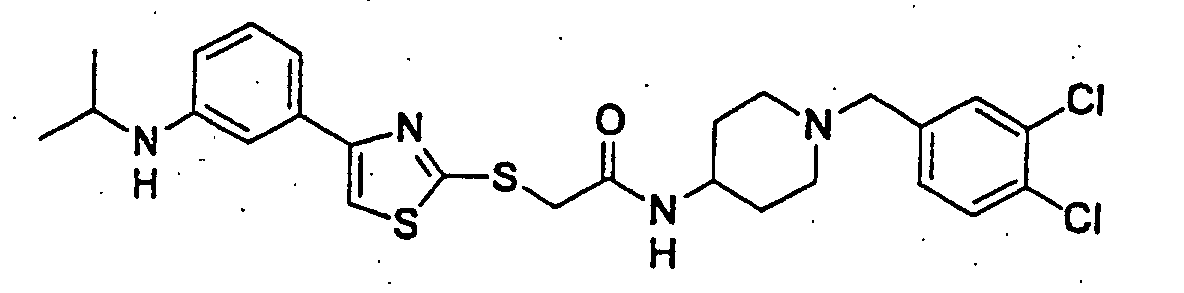
1H-MMR(DMSO-d6)δ 1.29 (6H, d, J=6.3 Hz), 1.78-1.92 (4H, m), 2.90-3.06 (2H, m) , 3.28-3.32 (2H, m) , 3.68-3.85 (2H, m), 4.03 (2H, s) , 4.25 (2H, s) , 7.50-7.74 (4H, m) , 7.98-8.16 (4H, m), 8.66 (1H, d, J=7.5 Hz), 11.17 (1H, brs)

1H-NMR(DMSO-d6)δ 0.80 (3H, t, J=7.5 Hz), 0.98-1.48 (10H, m), 1.56-2.03 (6H, m), 2.84-3.04 (2H, m), 3.05-3.34 (3H, m), 3.64-3.82, (1H, m), 4.00 (2H, s), 4.23 (2H, s), 7.31-8.08 (8H, m), 8.64 (1H, d, J=7.2 Hz) , 8.01 (1H, s) , 8.59 (1H, d, J=7.2 Hz), 11.50 (1H, brs)

1H-NMR (DMSO-d6)δ 1.76-2.18 (4H, m), 2.91-3.20 (2H, m), 3.22-3.38 (2H, m), 3.69-3.88 (1H, m), 4.02 (2H, s), 4.27 (2H, s), 4.46 (2H, s), 6.72-6.77 (1H, m), 7.15-7.42 (3H, m), 7.56-7.77 (3H, m), 7.91-8.03 (2H, m), 8.68 (1H, d, J=7.2 Hz), 9.07 (1H, s), 11.31-11.58 (1H, brs), 14.38-14.62 (1H, brs), 14.70-15.04 (1H, brs)
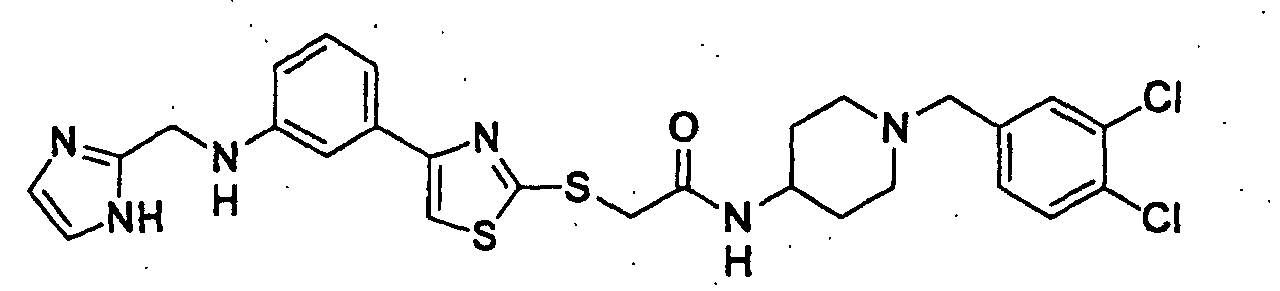
1H-NMR(DMSO-d6)δ 1.76-2.13 (4H, m), 2.88-3.20 (2H, m), 3.21-3.38 (2H, m), 3.68-3.87 (1H, m), 4.01 (2H, s), 4.26 (2H, s), 4.72 (2H, s), 6.57-6.70 (1H, m), 7.09=7.33 (3H, m), 7.50-7.78 (4H, m), 8.00 (2H, s), 8.64 (1H, d, J=7.2 Hz), 11.22-11.52 (1H, brs), 13.18-13.45 (2H, brs)

1H-NMR(DMSO-d6)δ 1.78-2.10 (4H, m), 2.90-3.38 (4H, m), 3.69-3.88 (1H, m), 4.01 (2H, s), 4.26 (2H, s), 4.46 (2H, s), 6.39 (1H, s) , 6.92-7.00 (1H, m), 7.22-7.38 (1H, m) , 7.47 (1H, d, J=7.3 Hz), 7.55-7.69 (2H, m), 7.70-7.80 (2H, m), 7.94-8.03 (2H, m), 8.60 (1H, d, J=7.2 Hz), 11.01-11.35 (1H, brs)

ESI-MS(m/z):650

ESI-MS (m/z) : 664
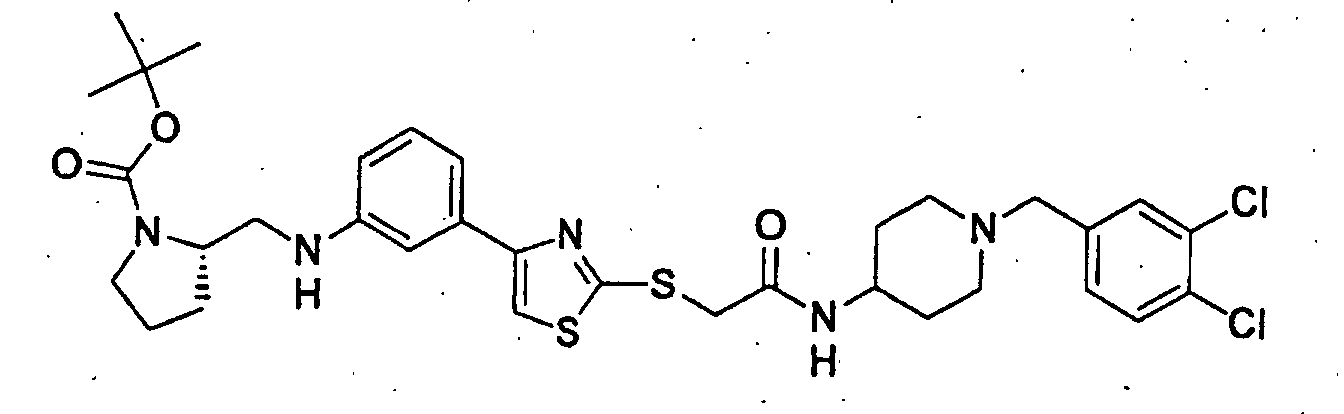
ESI-MS(m/z):690
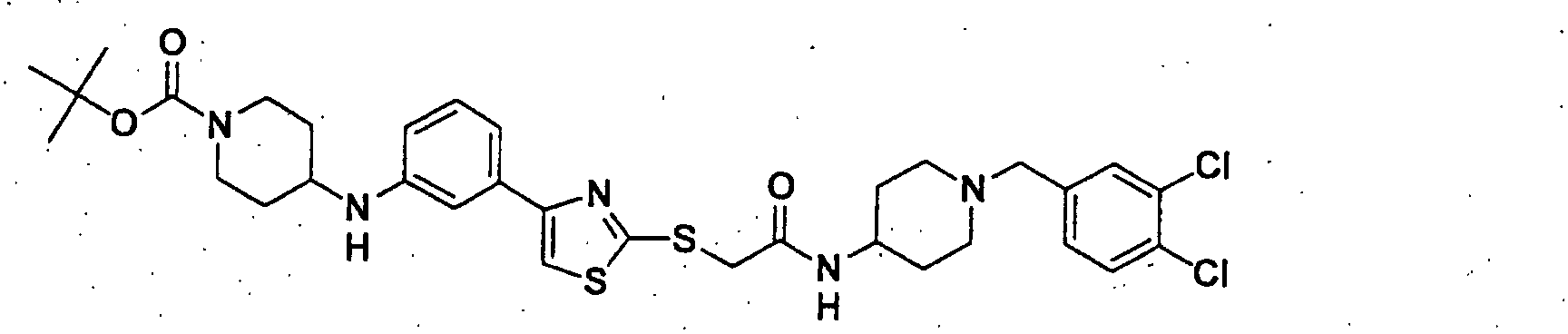
ESI-MS(m/z):690

1H-NMR (DMSO-d6) δ 1.41 (6H, s) , 1.46 (9H, s) , 1.50-1.53 (2H, m), 1.63-1.78 (2H, m), 1.93-2.09 (2H, m), 2.58-2.71 (2H, m), 2.88-3.04 (1H, m), 3.41 (2H, s), 3.46-3.62 (1H, m), 3.78-4.07 (6H, m), 6.04-6.13 (1H, m), 6.59-6.69 (1H, m), 7.02-7.16 (2H, m), 7.20-7.32 (2H, m), 7.50-7.58 (2H, m), 7.81-7.90 (1H, m), 8.09-8.21 (1H, m)

1H-NMR(DMSO-d6)δ 1.20 (3H, t, J=6.9 Hz), 1.36-1.46 (2H, m), 1.70-1.73 (2H, m), 2.00-2.07 (2H, m), 2.65-2.69 (2H, m), 3.42 (2H, s), 3.50-3.64 (1H, m), 3.94 (2H, d, J=6.3 Hz), 3.98 (2H, s), 6.03 (1H, t, J=6.3 Hz), 6.53-6.56 (1H, m), 7.10-7.15 (3H, m), 7.26-7.29 (1H, m), 7.51-7.58 (2H, m), 7.86 (1H, s), 8.20 (1H, d, J=7.5 Hz)
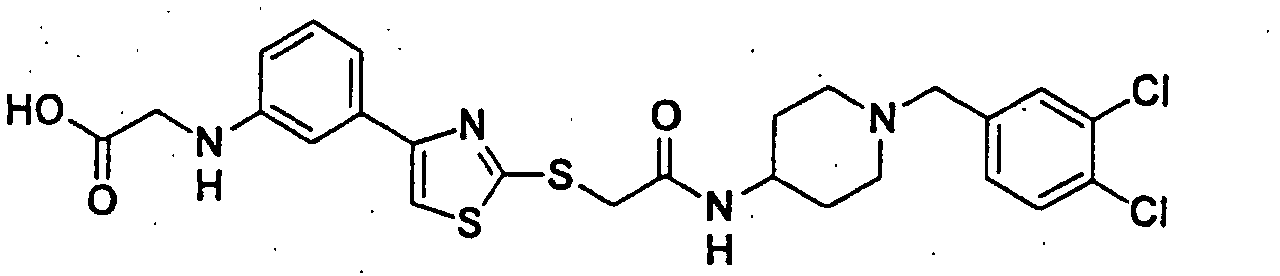
1H-NMR(DMSO-d6) δ 1.49-1.67 (2H, m), 1.73-1.89 (2H, m), 2.32-2.51 (2H, m), 2.80-2.99 (2H, m), 3.56-3.81 (1H, m), 3.86 (2H, s), 3.99 (2H, s), 6.50-6.60 (1H, m), 7.08-7.21 (3H, m), 7.39 (1H, d, J=7.8 Hz), 7.62 (1H, s), 7.66 (2H, d, J=7.8 Hz), 7.86 (1H, s), 8.31 (1H, d, J=7.5 Hz)

1H-NMR (DMSO-d6 ) δ 1.76-1.97 (4H, m) , 2.91-3.09 (4H, m) , 3.12-3.49 (4H, m) , 3.69-3. 88 (1H, m) , 4.01 (2H, s) , 4.26 (2H, d, J=4.5 Hz), 6.64-6.76 (1H, m), 7.15-7.40 (3H, m), 7.56-7.68 (1H, m), 7.71-7.75 (1H, m), 7.90-8.09 (2H, m), 8.13-8.28 (3H, brs), 8.62 (1H, d, J=7.5 Hz), 11.09-11.38 (1H, brs)

1H-NMR(DMSO-d6) δ 1.28 (3H, d, J=6.3 Hz), 1.78-1.96 (4H, m), 2.90-3.09.(2H, m), 3.11-3.48 (5H, m), 3.70-3.85 (1H, m), 4.02 (2H, s), 4.26 (2H, d, J=3.9 Hz), 6.61-6.70 (1H, m), 7.09-7.36 (3H, m), 7.55-7.66 (1H, m), 7.71-7.75 (1H, m), 7.93-7.99 (2H, m), 8.14-8.27 (3H, brs), 8.63 (1H, d, J=7.5 Hz), 11.09-11.39 (1H, brs)

1H-NMR (DMSO-d6)δ 1.64-2.18 (8H, m) , 2.91-3.58 (8H, m) , 3.64-3.90 (2H, m), 4.02 (2H, s), 4.27 (2H, d, J=4.8 Hz), 6.67-6.75 (1H, m), 7.12-7.38 (3H, m), 7.53-7.68 (1H, m), 7.69-7.77 (1H, m), 7.92-8.00 (2H, m) , 8.61 (1H, d, J=7.5 Hz) , 9.13-9.31 (1H, brs), 9.54-9.71 (1H, brs), 11.17-11.39 (1H, brs)

1H-NMR(DMSO-d6)δ 1.50-2.18 (8H, m), 2.81-3.40 (8H, m), 3.69-3.86 (2H, m), 4.02 (2H, s), 4.26 (2H, d, J=4.5 Hz), 6.96-7.12 (1H, m), 7.28-7.42 (1H, m), 7.45-7.79 (4H, m), 7.89-8.00 (2H, m), 8.68 (1H, d, J=7.5 Hz), 8.86-9.06 (1H, brs), 9.10-9.29 (1H, brs), 11.10-11.35 (1H, brs)

1H-NMR(DMSO-d6) δ 1.73-2.12 (4H, m), 2.89-3.09 (2H, m), 3.11-3.45 (5H, m), 3.58-3.89 (3H, m), 4.01 (2H, s), 4.26 (2H, d, J=4.8 Hz), 6.61-6.71 (1H, m), 7.10-7.39 (3H, m), 7.55-7.68 (1H, m), 7.70-7.77 (1H, m), 7.93-8.01 (2H, m), 8.09-8.31 (3H, brs), 8.62 (1H, d, J=7.2 Hz), 11.08-11.37 (1H, brs)

1H-NMR (DMSO-d6) δ 1.30-1.43 (2H, m), 1.62-1.72 (2H, m), 1.91-2.02 (2H, m), 2.56-2.64 (2H, m), 3.32-3.60 (3H, m), 3.95 (2H, s), 6.50-6.56 (1H, m), 7.18-7.22 (1H, m), 7.31 (1H, t, J=7.8 Hz), 7.44 (1H, s), 7.48-7.52 (1H, m), 7.62 (1H, d, J=7.8 Hz), 7.69 (1H, d, J=7.8 Hz), 7.69-7.79 (1H, m), 7.99 (1H, s), 8.10 (1H, s), 8.15-8.19 (1H, m), 8.40-8.44 (1H, m), 12.25 (1H, s)
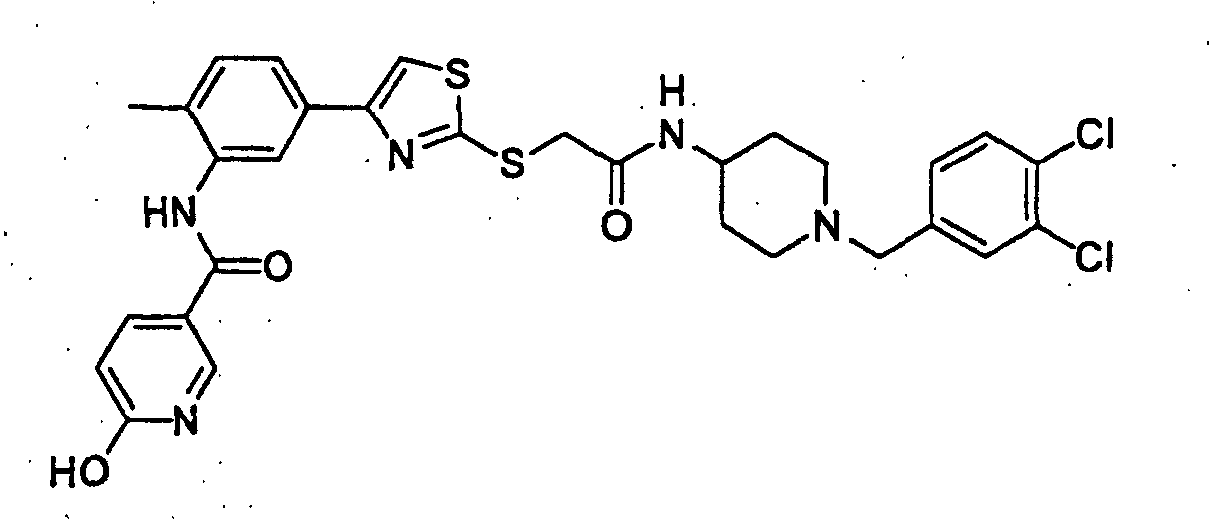
1H-NMR(DMSO-d6)δ 1.31-1.50 (2H, m), 1.67-1.74 (2H, m), 1.95-2.06 (2H, m) , 2.22 (3H, s) , 2.62-2.70 (2H, m), 3.41 (2H, s), 3.48-3.63 (1H, m), 3.98 (2H, s), 6.38-6.43 (1H, m), 7.24-7.34 (2H, m) , 7.51 (1H, s), 7.54-7.59 (1H, m), 7.72-7.76 (1H, m) , 7.82 (1H, s), 7.95-7.99 (1H, m), 8.16-8.23 (2H, m), 9.74 (1H, s), 12.08 (1H, brs)

1H-NMR (DMSO-d6)δ 1.37-1.48 (2H, m), 1.67-1.74 (2H, m), 1.97-2.07 (2H, m), 2.35 (3H, s), 2.61-2.68 (2H, m), 3.41 (2H, s), 3.46-3.64 (1H, m), 3.98 (2H, s), 6.55-6.61 (1H, m), 7.23-7.32 (2H, m), 7.50 (1H, s), 7.54-7.61 (2H, m), 7.82-7.86 (1H, m), 7.89 (1H, s), 8.18-8.22 (1H, m), 8.45-8.50 (1H, m), 8.83 (1H, s), 12.26 (1H, s)

1H-NMR(DMSO-d6)δ 1.36-1.49 (2H, m), 1.68-1.75 (2H, m), 1.98-2.09 (2H, m), 2.63-2.71 (2H, m), 3.42 (2H, s), 3.51-3.67 (1H, m), 4.00 (2H, s), 6.16-6.20 (1H, m), 6.97-6.99 (1H, m), 7.00-7.10 (1H, m), 7.24-7.30 (1H, m), 7.49-7.58 (2H, m), 7.82 (2H, d, J=9.0 Hz), 7.88-7.94 (3H, m) , 8.24 (1H, d, J=7.5 Hz), 9. 85 (1H, s), 11.68 (1H, brs)

1H-NMR (DMSO-d6) δ 1.36-1.48 (2H, m), 1.68-1.75 (2H, m), 1.98-2.09 (2H, m), 2.63-2.71 (2H, m), 3.42 (2H, s), 3.50-3.62 (1H, m), 4.00 (2H, s), 7.28 (1H, d, J=8.4 Hz), 7.51 (1H, s), 7.56 (1H, d, J=8.4 Hz), 7.80-8.02 (7H, m), 8.24 (1H, d, J=7.2 Hz), 9.93 (1H, s), 12.67 (1H, brs)
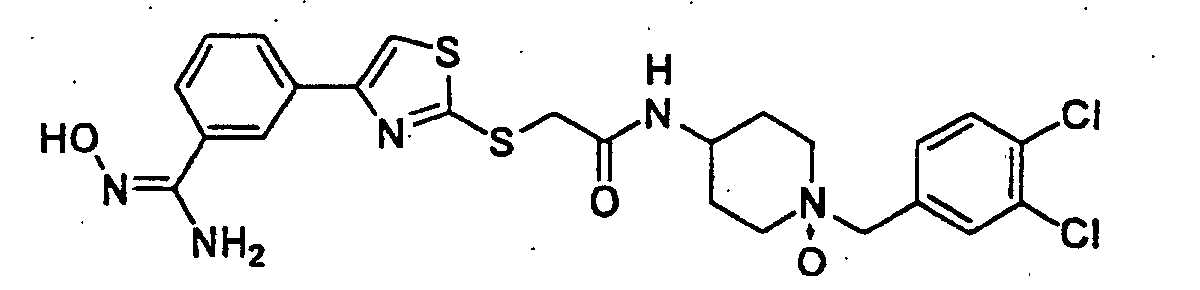
1H-NMR (DMSO-d6)δ 1.62-1.68 (2H, m), 2.51-2.65 (2H, m), 2.90-2.95 (2H, m), 3.30-3.39 (2H, m), 3.60-3.71 (1H, m), 3.98 (2H, s), 4.33 (2H, s), 5.65 (2H, s), 7.37-7.44 (1H, m), 7.51-7.59 (2H, m), 7.65-7.69 (1H, m), 7.78-7.88 (2H, m), 7.98 (1H, s), 8.27 (1H, s), 8.39-8.43 (1H, m), 12.09 (1H, s)

1H-NMR(DMSO-d6) δ 1.36-1.50 (2H, m), 1.68-1.78 (2H, m), 2.00-2.11 (2H, m), 2.63-2.71 (2H, m), 3.42 (2H, s), 3.50-3.61 (1H, m), 4.01 (2H, s), 5.84 (2H, s), 7.27 (1H, dd, J=1.9, 8.2 Hz), 7.51 (1H, d, J=1.9 Hz), 7.57 (1H, d, J=8.2 Hz), 7.74 (2H, d, J=8.5 Hz), 7.94 (2H, d, J=8.5 Hz), 8.05 (1H, s), 8.21 (1H, d, J=7.4 Hz), 9.67 (1H, s)

1H-NMR (DMSO-d6) δ 1.35-1.50 (2H, m), 1.67-1.75 (2H, m), 1.96-2.08 (2H, m), 2.63-2.72 (2H, m), 2.91 (3H, brs), 3.00 (3H, brs), 3.42 (2H, s), 3.49-3.61 (1H, m), 4.00 (2H, s), 6.85-6.90 (1H, m), 7.21-7.29 (2H, m), 7.45-7.61 (4H, m), 7.77 (1H, s), 7.97 (1H, s), 8.24 (1H, d, J=7.2 Hz)

1H-NMR(DMSO-d6) δ 1.36-1.50 (2H, m), 1.63-1.77 (2H, m), 1.96-2.10 (2H, m), 2.60-2.71 (2H, m), 3.41 (2H, s), 3.49-3.63 (1H, m), 4.01 (2H, s), 7.09-7.33 (3H, m), 7.40-7.62 (4H, m), 7.72 (1H, s), 7.96 (1H, s), 8.16-8.22 (1H, m), 8.53-8.65 (1H, m), 9.89 (1H, s)

1H-NMR (DMSO-d6)δ 1.55-1.63 (2H, m), 2.05-2.24 (2H, m), 2.73-2.86 (2H, m), 3.25-3.40 (2H, m), 3.59-3.75 (1H, m), 4.02 (2H, s), 4.28 (2H, s), 5.86 (2H, brs), 7.53 (1H, dd, J=1.3, 8.2), 7.63 (1H, d, J=8.2), 7.73 (2H, d, J=8.3), 7.88 (1H, d, J=1.3), 7.93 (2H, d, J=8.3), 7.93 (2H, d, J=8.3), 8.06 (1H, s), 8.51 (1H, d, J=7.4), 9.87 (1H, s)

1H-NMR (DMSO-d6) δ 1.32-1.50 (2H, m), 1.65-1.89 (2H, m), 1.94-2.09 (2H, m), 2.62-2.73 (2H, m), 2.92 (3H, s), 3.01 (3H, s), 3.42 (2H, s), 3.48-3.83 (1H, m), 3.99 (2H, s), 6.90-7.00 (2H, m), 7.23-7.32 (1H, m), 7.50-7.60 (2H, m), 7.70-7.90 (4H, m), 8.20-8.28 (1H, m)

1H-NMR (DMSO-d6) δ 1.64-2.02 (4H, m), 2.92-3.14 (2H, m), 3.20-3.35 (2H, m), 3.68-3.83 (1H, m), 4.00 (2H, s), 4.25 (2H, s), 7.17-7.27 (2H, m), 7.49-7.61 (2H, m), 7.70-7.82 (4H, m), 7.86-7.91 (1H, m), 8.44-8.53 (1H, m), 8.63-8.77 (1H, m), 9.93 (1H, s)
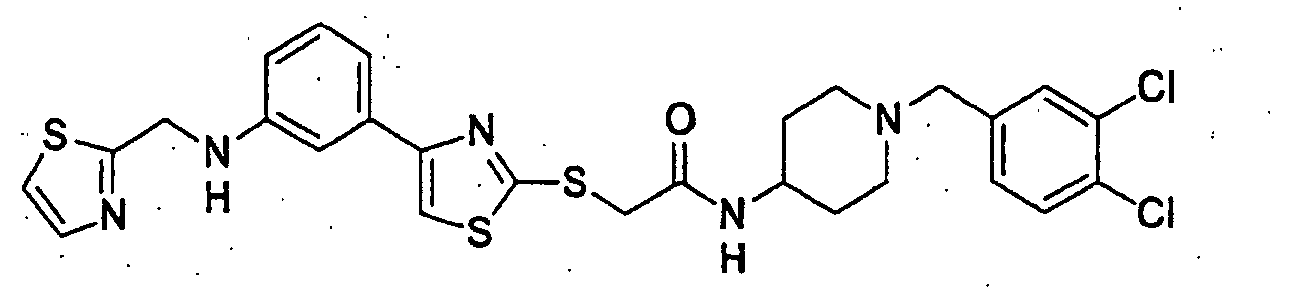
1H-NMR(DMSO-d6)δ 1.71-2.12 (4H, m), 2.87-3.08 (2H, m), 3.10-3.37 (2H, m), 3.66-3.88 (1H, m), 4.00 (2H, s), 4.25 (2H, s), 4.69 (2H, s), 6.60 (1H, d, J=6.9 Hz), 7.12-7.35 (3H, m), 7.57-7.86 (5H, m), 7.89-8.01 (1H, m), 8.62 (1H, d, J=7.2 Hz), 11.30 (1H, brs)
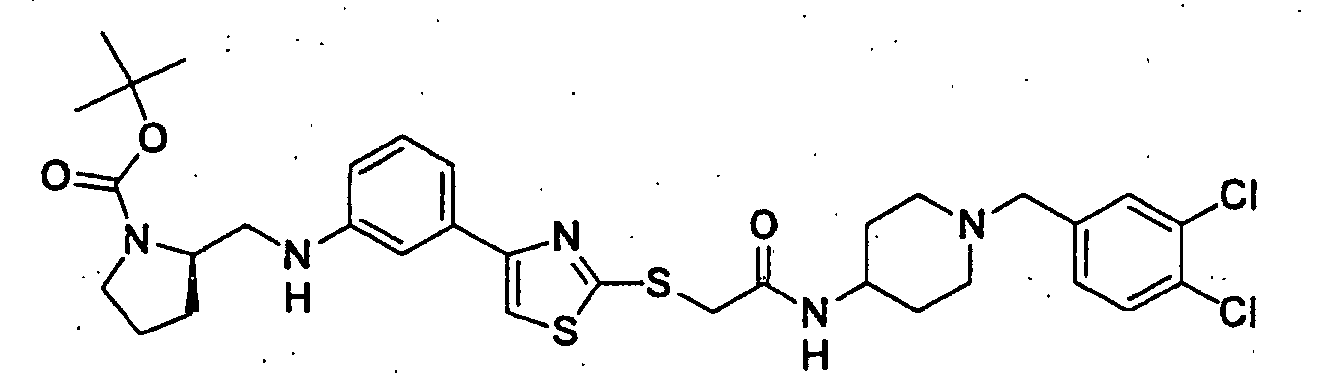
ESI-MS (m/z) : 690

1H-NMR(DMSO-d6) δ 1.41 (6H, s), 1.46 (9H, s), 1.50-1.53 (2H, m), 1.63-1.78 (2H, m), 1.93-2.09 (2H, m), 2.58-2.71 (2H, m), 2.88-3.04 (1H, m), 3.41 (2H, s), 3.46-3.62 (1H, m), 3.78-4.07 (6H, m), 6.04-6.13 (1H, m), 6.59-6.69 (1H, m), 7.02-7.16 (2H, m), 7.20-7.32 (2H, m), 7.50-7.58 (2H, m), 7.81-7.90 (1H, m), 8.09-8.21 (1H, m)

1H-NMR(DMSO-d6) δ 1.64-2.18 (8H, m), 2.91-3.58 (8H, m), 3.64-3.90 (2H, m), 4.02 (2H, s), 4.27 (2H, d, J=4.8 Hz), 6.67-6.75 (1H, m), 7.12-7.38 (3H, m), 7.53-7.68 (1H, m), 7.69-7.77 (1H, m), 7.92-8.00 (2H, m), 8.61 (1H, d, J=7.5 Hz), 9.13-9.31 (1H, brs), 9.54-9.71 (1H, brs), 11.17-11.39 (1H, brs)
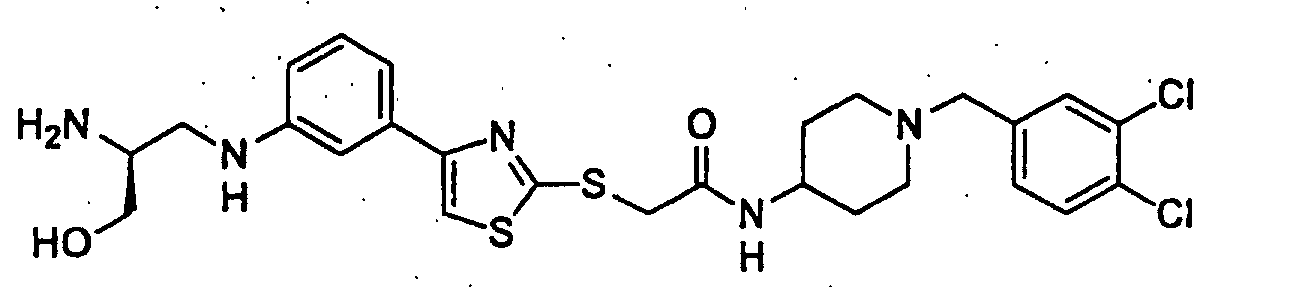
1H-NMR(DMSO-d6)δ 1.73-2.12 (4H, m), 2.89-3.09 (2H, m), 3.11-3.45 (5H, m), 3.58-3.89 (3H, m), 4.01 (2H, s), 4.26 (2H, d, J=4.8 Hz), 6.61-6.71 (1H, m), 7.10-7.39 (3H, m), 7.55-7.68 (1H, m) , 7.70-7.77 (1H, m), 7.93-8.01 (2H, m), 8.09-8.31 (3H, brs), 8.62 (1H, d, J=7.2 Hz), 11.08-11.37 (1H, brs)
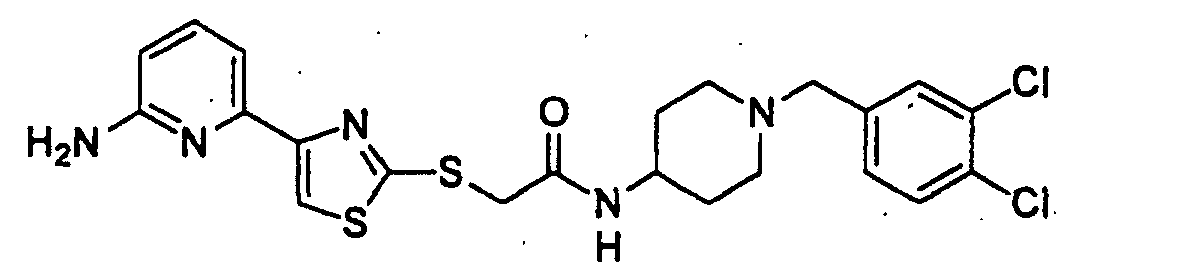
1H-NMR(DMSO-d6)δ 1.72-2.05 (4H, m), 2.87-3.08 (2H, m), 3.20-3.36 (2H, m), 3.68-3.81 (1H, m), 3.97 (2H, s), 4.24 (2H, s), 6.90-7.00 (1H, m), 7.45 (1H, d, J=7.4 Hz), 7.59-7.60 (1H, m), 7.73 (1H, d, J=8.2 Hz), 7.83-8.00 (2H, m), 8.39-8.58 (3H, brs), 8.67 (1H, s), 8.80 (1H, d, J=7.2 Hz), 10.90 (1H, brs)

1H-NMR(DMSO-d6)δ 1.32-1.48 (2H, m), 1.63-1.79 (2H, m), 1.92-2.08 (2H, m), 2.60-2.73 (2H, m), 3.43 (2H, s), 3.45-3.61 (1H, m), 3.95 (2H, s), 6.94 (1H, s), 7.09 (2H, brs), 7.22-7.30 (1H, m), 7.44-7.59 (3H, m), 8.17 (1H, d, J=7.2 Hz)
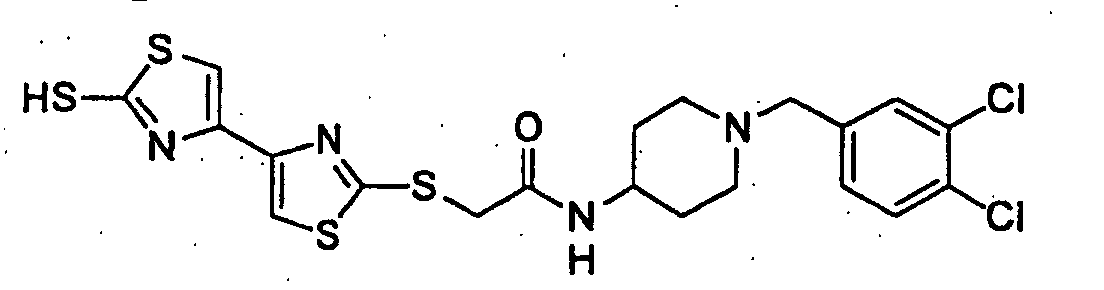
1H-NMR (DMSO-d6) δ 1.43-1.69 (2H, m), 1.71-1.93 (2H, m), 2.84-3.06 (2H, m), 3.17-3.44 (2H, m), 3.52-3.88 (3H, m), 4.01 (2H, s), 7.33 (1H, s), 7.35-7.43 (1H, m), 7.56-7.77 (2H, m), 8.08 (1H, s), 8.35 (1H, d, J=6.3 Hz)

1H-NMR(DMSO-d6) δ 1.44-1.69 (2H, m), 1.76-1.94 (2H, m), 2.50-2.90 (2H, m), 2.91-3.18 (2H, m), 3.58-3.77 (1H, m,), 4.01 (2H, s), 4.04 (2H, s), 7.25 (1H, s), 7.26-7.48 (5H, m), 7.58-7.78 (2H, m), 7.95 (1H, s), 8.38 (1H, d, J=6.3 Hz), 10.35 (1H, brs)

1H-NMR (DMSO-d6) δ 1.38-1.49 (2H, m), 1.63-1.78 (2H, m), 1.93-2.10 (2H, m), 2.60-2.75 (2H, m), 3.42 (2H, s), 3.51-3.65 (7H, m), 4.01 (2H, s), 4.77-5.02 (1H, brs), 7.27 (1H, dd, J=1.9, 8.3 Hz), 7.34 (1H, t, J=7.9 Hz), 7.51-7.64 (3H, m), 7.72-7.79 (1H, m), 7.95 (1H, s), 8.19 (1H, s), 8.25 (1H, d, J=7.5 Hz)
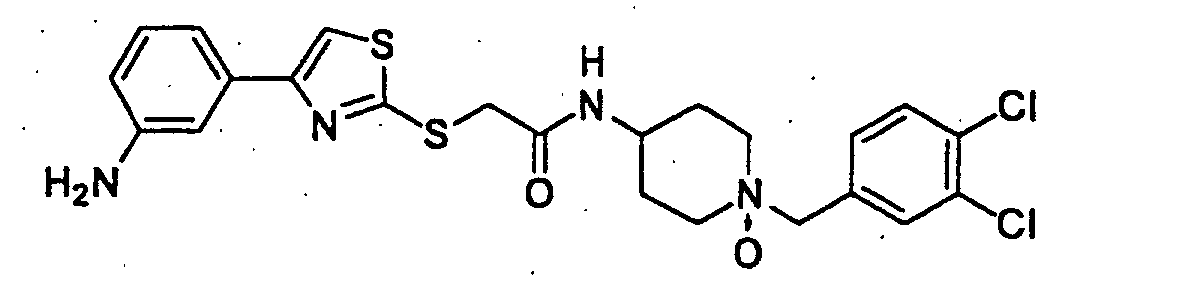
1H-NMR (DMSO-d6) δ 1.54-1.69. (2H, m), 2.07-2.22 (2H, m), 2.76-2.83 (2H, m), 3.23-3.40 (2H, m), 3.56-3.75 (1H, m), 3.94 (2H, s), 4.27 (2H, s), 5.18 (2H, brs), 6.50-6.58 (1H, m), 6.99-7.09 (2H, m), 7.14 (1H, s), 7.49-7.56 (1H, m), 7.59-7.67 (1H, m), 7.78 (1H, s), 7.87 (1H, s), 8.37-8.44 (1H, m)

ESI-MS(m/z):492(M+1)
1H-NMR(DMSO-d6) δ 1.90-2.00 (2H, m) , 2.45-2.55 (2H, m) , 2.90-3.00 (2H, m), 3.20-3.30 (2H, m), 3.70-3.80 (1H, m), 4.07 (2H, s), 4.25 (2H, s), 7.10-7.15 (1H, m), 7.40-7.50 (2H, m), 7.50-7.55 (1H, m), 7.55-7.63 (1H, m), 7.71-7.75 (1H, m), 7.97 (1H, s), 8.60-8.63 (1H, m), 11.1-11.2 (4H, m)
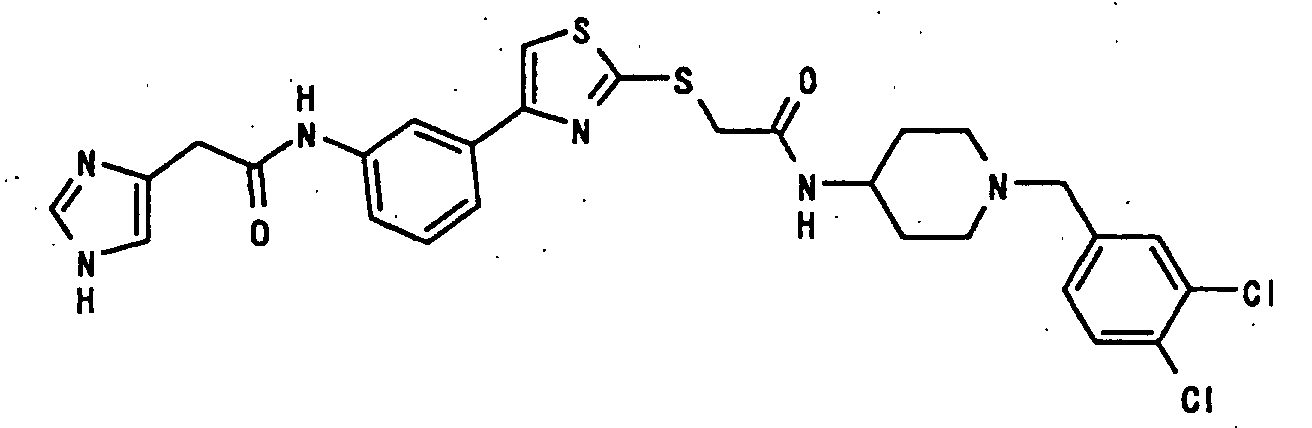
1H-NMR(DMSO-d6) δ 1.36-1.47 (2H, m), 1.70-1.73 (2H, m), 2.00-2.06 (2H, m), 2.66-2.69 (2H, m), 3.43 (2H, s), 3.55-3.59 (1H, m), 3.59 (2H, s), 3.99 (2H, s), 6.93 (1H, brs), 7.26-7.38 (2H, m), 7.52-7.64 (5H, m), 7.93 (1H, s), 8.13-8.23 (2H, m), 10.19 (1H, brs)

1H-NMR(DMSO-d6) δ 1.40-1.46 (2H, m), 1.70-1.74 (2H, m), 1.99-2.06 (2H, m), 2.66-2.69 (2H, m), 3.42 (2H, s), 3.50-3.58 (1H, m), 3.37 (2H, s), 3.99 (2H, s), 7.28-7.39 (3H, m), 7.51-7.63 (4H, m), 7.72-7.78 (1H, m), 7.94 (1H, s), 8.14-8.32 (2H, m), 8.46-8.55 (2H, m), 10.37 (1H, s)

1H-NMR (DMSO-d6)δ 1.40-1.47 (2H, m), 1.71-1.74 (2H, m), 2.00-2.06 (2H, m), 2.66-2.71 (4H, m), 2.92-2.95 (2H, m), 3.41 (2H, s), 3.51-3.61 (1H, m), 4.00 (2H, s), 7.25-7.37 (4H, m), 7.51-7.67 (4H, m), 7.93 (1H, s), 8.10-8.23 (2H, m), 8.40-8.50 (2H, m), 10.04 (1H, m)
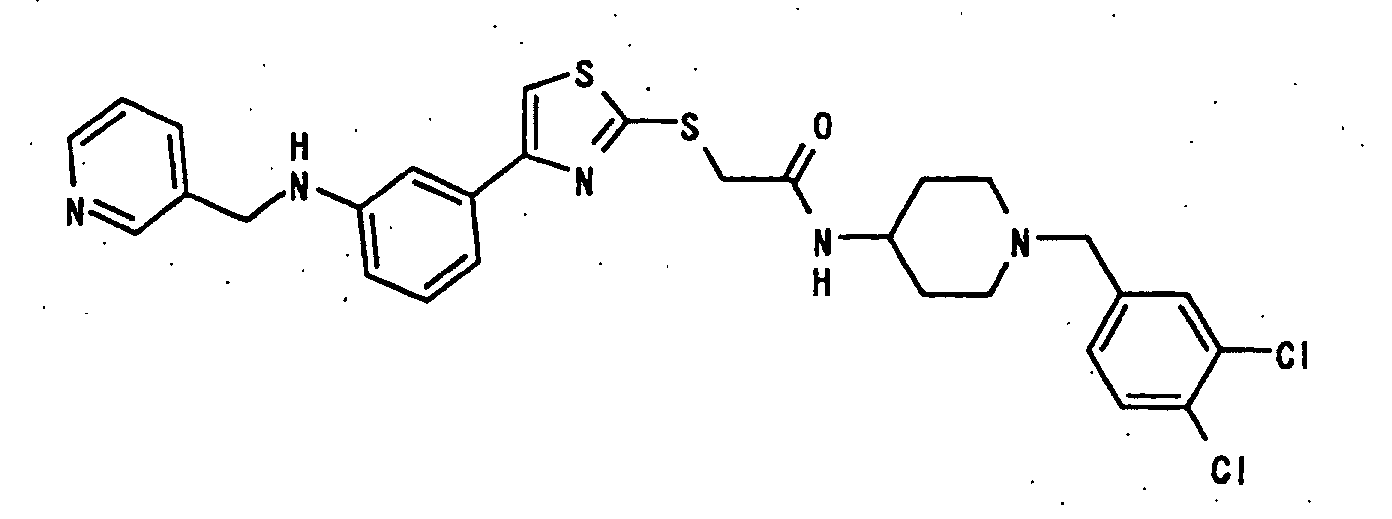
1H-NMR (DMSO-d6) δ 1.39-1.47 (2H, m), 1.70-1.73 (2H, m), 1.99-2.06 (2H, m), 2.65-2.69 (2H, m), 3.40 (2H, s), 3.50-3.60 (1H, m), 3.98 (2H, s), 4.35 (2H, d, J=6.0 Hz), 6.37 (1H, t, J=6.0 Hz), 6.57-6.58 (1H, m), 7.0-7.36 (5H, m), 7.51-7.58 (2H, m), 7.76-7.79 (1H, m), 7.84 (1H, s), 8.22-8.63 (3H, m)

1H-NMR (DMSO-d6)δ 1.42-1.48 (2H, m), 1.71-1.75 (2H, m), 2.02-2.09 (2H, m), 2.67-2.71 (2H, m), 3.41 (2H, s), 3.50-3.60 (1H, m), 4.01 (2H, s), 7.25-7.85 (6H, m), 7.99 (1H, s), 8.22-8.30 (2H, m), 8.81 (1H, d, J=2.1 Hz), 9.21-9.28 (2H, m), 10.71 (1H, s)
[4-(2-aminopyridin-5-yl)thiazol-2-ylthio]-N-[1-(3,4-dichlorobenzyl)piperidin-4-yl]acetamide:


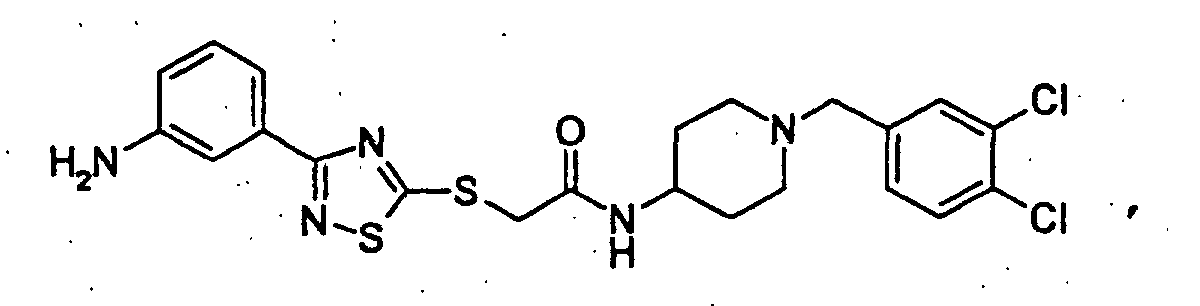
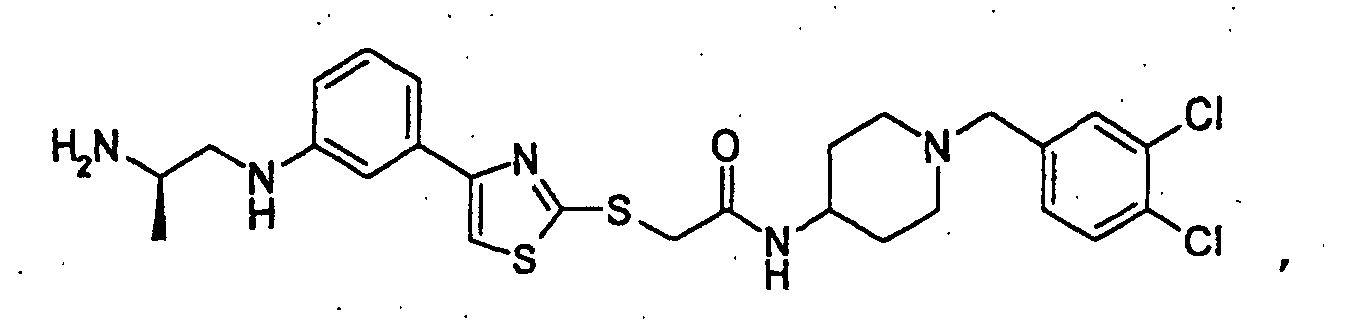
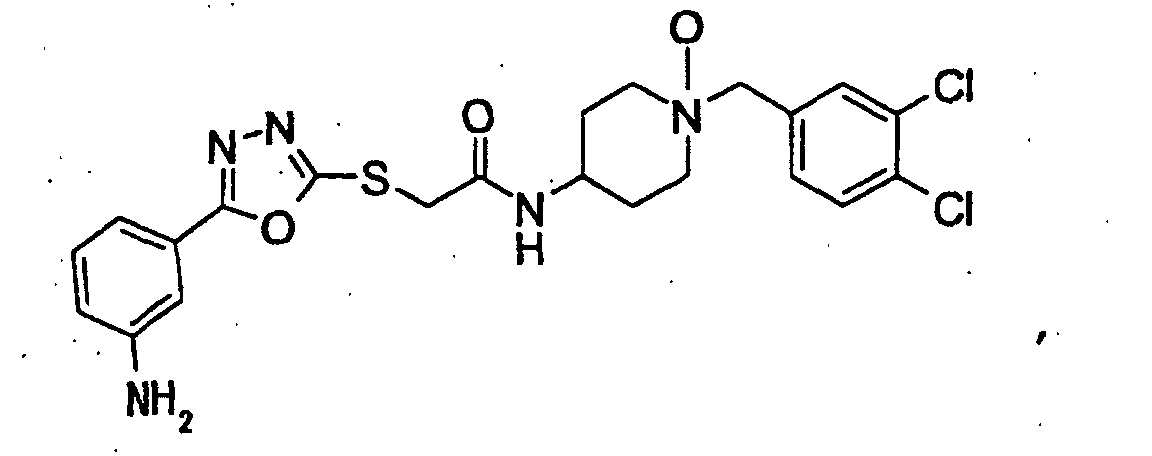

[2-(3-aminophenyl)1,3,4-thiadiazol-5-ylthio]-N-[1-(3,4-dichlorobenzyl)-1-oxopiperidin-4-yl]acetamide:
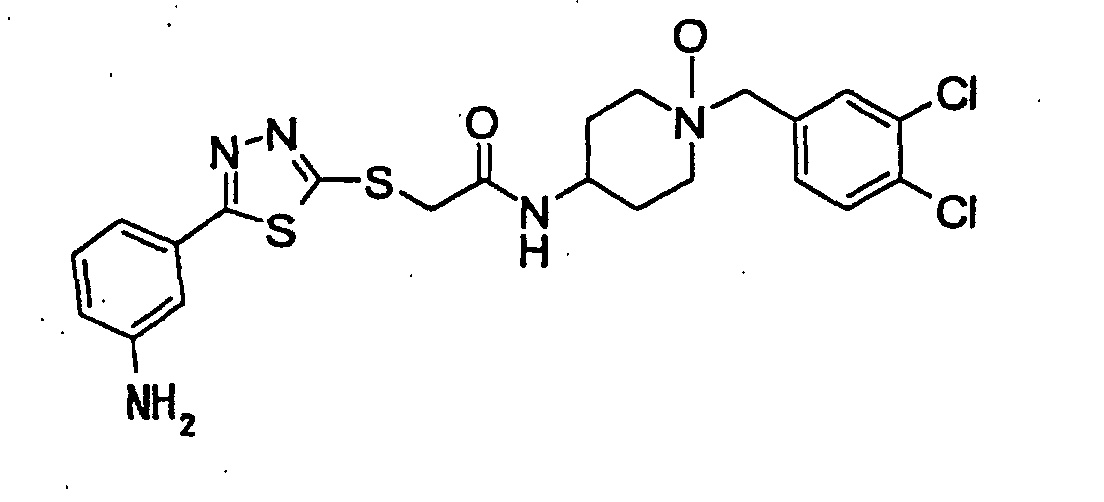
| Compound | IC50 (nmol/L) |
| Example 1 | 6 |
| 2 | 4 |
| 6 | 11 |
| 9 | 4 |
| 18 | 41 |
| Compound | IC50 (nmol/L) |
| Example 9 | 6 |
| Compound | Cmax (ng/mL) |
| Compound of Example 35 | 3122.7 |
Claims (23)
- An optionally N-oxidized benzylpiperidine compound represented by the formula (1):wherein

- R1 and R2
- are the same or different and each is hydrogen, halogen, cyano, nitro, amino, hydroxy, alkoxy or alkyl,
- n
- is an integer of 1 to 5,
- X
- is a bond, an oxygen atom, a sulfur atom, SO or SO2,
- Z
- is a bond, aryl, heteroaryl or cycloalkyl,
- Y1
- is a bond, an alkylene chain having 1 to 4 carbon atoms, -CO-, -Q-(CH2)m- or -(CH2)m-Q- [wherein Q is -NH-, -NR3- (wherein R3 is alkyl), an oxygen atom, a sulfur atom, SO or SO2, m is an integer of 0 to 4],
- A
- is aryl or heteroaryl,
- W
- is aryl, heteroaryl or thiazoline,
- Y2
- is amino, alkylamino, arylamino, arylalkylamino, acylamino, acylaminoalkyl, alkoxycarbonylamino, carboxymethylamino, aminoalkylamino, -NR4CONR5R6 (R4, R5 and R6 may be the same or different and each is hydrogen or alkyl), sulfonylamino, -CONR7R8 (R7 and R8 may be the same or different and each is hydrogen, alkyl, aryl or arylalkyl, provided that they do not show hydrogen at the same time), aminoalkyl, alkylaminoalkyl, arylaminoalkyl, arylalkylaminoalkyl, cyclic amino, hydrazino, guanidino, amidino, hydroxyamidino, alkoxyamidino, aminomethyleneamino, iminomethylamino, imino or -SR16 (R16 is alkyl), provided that the above-mentioned aryl, heteroaryl, cycloalkyl, alkylene chain, alkylamino, arylamino, arylalkylamino, acylamino, acylaminoalkyl, alkoxycarbonylamino, carboxymethylamino, aminoalkylamino, sulfonylamino, -CONR7R8, aminoalkyl, alkylaminoalkyl, arylaminoalkyl, arylalkylaminoalkyl, cyclic amino, hydrazino, guanidino, amidino, aminomethyleneamino, iminomethylamino and imino optionally have substituents, and nitrogen atom in amide, carbamate or sulfonamide contained in the above-mentioned acylamino, acylaminoalkyl, alkoxycarbonylamino and sulfonylamino may be substituted by alkyl, an optical isomer thereof or a pharmaceutically acceptable salt thereof.
- The benzylpiperidine compound of claim 1, wherein, in the formula (1),
Y2 is amino, alkylamino, arylamino, arylalkylamino, acylamino, alkoxycarbonylamino, -NR4CONR5R6 (R4, R5 and R6 may be the same or different and each is hydrogen or alkyl), sulfonylamino, aminoalkyl, alkylaminoalkyl, cyclic amino, hydrazino, guanidino, amidino, hydroxyamidino, alkoxyamidino, aminomethyleneamino, iminomethylamino or imino,
an optical isomer thereof or a pharmaceutically acceptable salt thereof. - The benzylpiperidine compound of claim 1, wherein, in the formula (1),
R1 and R2 are the same or different and each is hydrogen, halogen, nitro, cyano or alkyl,
n is an integer of 1 to 4,
Z is a bond or heteroaryl, and
Y1 is a bond, an alkylene chain having 1 or 2 carbon atoms, -Q- (CH2)m- or -(CH2)m-Q- [wherein Q is -NH-, -NR3- (wherein R3 is alkyl), an oxygen atom, a sulfur atom, SO or SO2, and m is an integer of 0 or 1],
an optical isomer thereof or a pharmaceutically acceptable salt thereof. - The benzylpiperidine compound of claim 1, wherein, in the formula (1),
R1 and R2 are the same or different and each is halogen or nitro,
n is an integer of 1 to 4,
Z is a bond or heteroaryl,
Y1 is a bond, and
Y2 is amino, alkylamino, arylalkylamino, acylamino, alkoxycarbonylamino, sulfonylamino, cyclic amino, hydrazino, guanidino, amidino, hydroxyamidino, alkoxyamidino, iminomethylamino or imino,
an optical isomer thereof or a pharmaceutically acceptable salt thereof. - The benzylpiperidine compound of claim 1, wherein, in the formula (1),
R1 and R2 are the same or different and each is halogen,
n is an integer of 1 to 4,
X is a bond, an oxygen atom or a sulfur atom,
Z and Y1 are each a bond, and
Y2 is amino, alkylamino, arylalkylamino, acylamino, alkoxycarbonylamino, sulfonylamino, cyclic amino, hydrazino, guanidino, amidino, hydroxyamidino, alkoxyamidino or imino,
an optical isomer thereof or a pharmaceutically acceptable salt thereof. - The benzylpiperidine compound of any of claims 1 to 5, which is selected from
[4-(3-aminophenyl)thiazol-2-ylthio]-N-[1-(3,4-dichlorobenzyl)piperidin-4-yl]acetamide,
N-[1-(3,4-dichlorobenzyl)-1-oxopiperidin-4-yl]-{4-[3-(N2-hydroxyamidino)phenyl]thiazol-2-ylthio}acetamide,
N-[1-(3,4-dichlorobenzyl)piperidin-4-yl]-{4-[4-(N2-hydroxyamidino)phenyl]thiazol-2-ylthio}acetamide,
{4-[3-(L-alanylamino)phenyl]thiazol-2-ylthio}-N-[1-(3,4-dichlorobenzyl)piperidin-4-yl]acetamide,
N-[1-(3,4-dichlorobenzyl)piperidin-4-yl]-{4-[3-(4-imidazolecarboxamide)phenyl]thiazol-2-ylthio}acetamide,
N-[1-(3,4-dichlorobenzyl)piperidin-4-yl]-{4-[3-(imidazol-2-yl-methylamino)phenyl]thiazol-2-ylthio}acetamide,
N-[1-(3,4-dichlorobenzyl)piperidin-4-yl]-{4-[3-(imidazol-4-yl-methylamino)phenyl]thiazol-2-ylthio}acetamide,
N-[1-(3,4-dichlorobenzyl)piperidin-4-yl]-4-[4-(2-guanidinothiazol-4-yl)-3-methylphenyloxy]butylamide,
[4-(3-aminophenyl)thiazol-2-ylthio]-N-[1-(3,4-dichlorobenzyl)-1-oxopiperidin-4-yl]acetamide,
N-[1-(3,4-dichlorobenzyl)piperidin-4-yl]-{4-[3-(N2-hydroxyamidino)phenyl]thiazol-2-ylthio}acetamide,
N-[1-(3,4-dichlorobenzyl)-1-oxopiperidin-4-yl]-{4-[4-(N2-hydroxyamidino)phenyl]thiazol-2-ylthio}acetamide,
N-[1-(3,4-dichlorobenzyl)piperidin-4-yl]-{4-[3-(imidazol-4-ylacetamide)phenyl]thiazol-2-ylthio}acetamide,
N-[1-(3,4-dichlorobenzyl)piperidin-4-yl]-{4-[3-(2-pyridylmethylamino)phenyl]thiazol-2-ylthio}acetamide,
N-[1-(3,4-dichlorobenzyl)piperidin-4-yl]-[5-(2-guanidinothiazol-4-yl)-4-methylthiazol-2-ylthio]acetamide,
N-[1-(3,4-dichlorobenzyl)piperidin-4-yl]-{4-[3-(pyridin-3-ylcarboxamide)phenyl]thiazol-2-ylthio}acetamide, and
N-[1-(3,4-dichlorobenzyl)piperidin-4-yl]-{4-[3-(pyrrol-2-ylcarboxamide)phenyl]thiazol-2-ylthio}acetamide,
or a pharmaceutically acceptable salt thereof. - A pharmaceutical composition comprising a benzylpiperidine compound of any of claims 1 to 6, an optical isomer thereof or a pharmaceutically acceptable salt thereof, and a pharmaceutically acceptable carrier.
- The pharmaceutical composition of claim 7, which is an agent for the prophylaxis or treatment of rheumatoid arthritis, asthma, allergic rhinitis, allergic conjunctivitis, allergic myelitis, atopic dermatitis or ulcerative colitis.
- The benzylpiperidine compound of claim 1, which is not N-oxidized, wherein, in the formula (1),
Y2 is amino, alkylamino, arylamino, arylalkylamino, acylamino, acylaminoalkyl, alkoxycarbonylamino, -NR4 CONR5 R6 (R4, R5 and
R6 may be the same or different and each is hydrogen or alkyl), sulfonylamino, -CONR7R8 (R7 and R8 may be the same or different and each is hydrogen, alkyl, aryl or arylalkyl, provided that they do not show hydrogen at the same time), aminoalkyl, alkylaminoalkyl, arylaminoalkyl, arylalkylaminoalkyl, cyclic amino, hydrazino, guanidino, amidino, hydroxyamidino, alkoxyamidino, aminomethyleneamino or imino,
an optical isomer thereof or a pharmaceutically acceptable salt thereof. - The benzylpiperidine compound of claim 9, wherein, in the formula (1),
Y2 is amino, alkylamino, arylamino, acylamino, alkoxycarbonylamino, -NR4CONR5 R6 (R4, R5 and R6 may be the same or different and each is hydrogen or alkyl), sulfonylamino, aminoalkyl, alkylaminoalkyl, cyclic amino, hydrazino, guanidino, amidino, aminomethyleneamino or imino,
an optical isomer thereof or a pharmaceutically acceptable salt thereof. - The benzylpiperidine compound of claim 9, wherein, in the formula (1),
R1 and R2 are the same or different and each is hydrogen, halogen, nitro, cyano or alkyl,
n is an integer of 1 to 4,
Z is a bond or heteroaryl, and
Y1 is a bond, an alkylene chain having 1 or 2 carbon atoms, -Q-(CH2)m- or -(CH2)m-Q- [wherein Q is -NH-, -NR3- (wherein R3 is alkyl), an oxygen atom, a sulfur atom, SO or SO2, and m is an integer of from 0 or 1],
an optical isomer thereof or a pharmaceutically acceptable salt thereof. - The benzylpiperidine compound of claim 9, wherein, in the formula (1),
R1 and R2 are the same or different and each is halogen or nitro,
n is an integer of 1 to 4,
Z is a bond or heteroaryl,
Y1 is a bond, and
Y2 is amino, alkylamino, arylalkylamino, acylamino, alkoxycarbonylamino, sulfonylamino, cyclic amino, hydrazino, guanidino, amidino, hydroxyamidino, alkoxyamidino or imino,
an optical isomer thereof or a pharmaceutically acceptable salt thereof. - The benzylpiperidine compound of claim 9, wherein, in the formula (1),
R1 and R2 are the same or different and each is halogen,
n is an integer of 1 to 4,
X is a bond, an oxygen atom or a sulfur atom,
Z and Y1 are each a bond, and
Y2 is amino, alkylamino, acylamino, alkoxycarbonylamino, sulfonylamino, cyclic amino, hydrazino, guanidino, amidino, hydroxyamidino, alkoxyamidino or imino,
an optical isomer thereof or a pharmaceutically acceptable salt thereof. - The benzylpiperidine compound of any of claims 9 to 13, which is selected from N-[1-(3,4-dichlorobenzyl)piperidin-4-yl]-5-[4-(2-guanidinothiazol-4-yl)phenyl]valeramide, N-[1-(3,4-dichlorobenzyl)piperidin-4-yl]-4-[4-(2-guanidinothiazol-4-yl)phenyloxy]butylamide, N-[1-(3,4-dichlorobenzyl)piperidin-4-yl]-4-[4-(2-guanidinothiazol-4-yl)phenylthio]butylamide, [4-(4-aminophenyl)thiazol-2-ylthio]-N-[1-(3,4-dichlorobenzyl)piperidin-4-yl]acetamide, [4-(4-acetylaminophenyl)thiazol-2-ylthio]-N-[1-(3,4-dichlorobenzyl)piperidin-4-yl]acetamide, 4-[4-(2-aminothiazol-4-yl)-3-methylphenyloxy]-N-[1-(3,4-dichlorobenzyl)piperidin-4-yl]butylamide, N-[1-(3,4-dichlorobenzyl)piperidin-4-yl]-4-(4-(2-guanidinothiazol-4-yl)-3-methylphenyloxy]butylamide, [4-(3-aminophenyl)thiazol-2-ylthio]-N-[1-(3,4-dichlorobenzyl)piperidin-4-yljacetamide, N-[1-(3,4-dichlorobenzyl)piperidin-4-yl]-{4-[3-(4-imidazolecarboxamide)phenyl]thiazol-2-ylthio)acetamide, N-[1-(3,4-dichlorobenzyl)piperidin-4-yl]-{4-[3-(pyrrol-2-ylcarboxamide)phenyl]thiazol-2-ylthio}acetamide, N-[1-(3,4-dichlorobenzyl)piperidin-4-yl]-{4-[3-(pyridin-2-ylcarboxamide)phenyl]thiazol-2-ylthio}acetamide, N-[1-(3,4-dichlorobenzyl)piperidin-4-yl]-{4-[3-(pyridin-3-ylcarboxamide)phenyl]thiazol-2-ylthio}acetamide, {4-[3-(L-prolylamino)phenyl]thiazol-2-ylthio}-N-[1-(3,4-dichlorobenzyl)piperidin-4-yl]acetamide, [4-(2-aminopyridin-5-yl)thiazol-2-ylthiol-N-[1-(3,4-dichlorobenzyl)piperidin-4-yl]acetamide and [4-(2-aminopyridin-4-yl)thiazol-2-ylthio)-N-[1-(3,4-dichlorobenzyl)piperidin-4-yl]acetamide, or a pharmaceutically acceptable salt thereof.
- A pharmaceutical composition comprising a benzylpiperidine compound of any of claims 9 to 14, an optical isomer thereof or a pharmaceutically acceptable salt thereof, and a pharmaceutically acceptable carrier.
- The pharmaceutical composition of claim 15, which is an agent for the prophylaxis or treatment of rheumatoid arthritis, asthma, allergic rhinitis, allergic conjunctivitis, allergic myelitis, atopic dermatitis or ulcerative colitis.
- The benzylpiperidine compound of claim 1, which is not N-oxidized, wherein, in the formula (1),
Y2 is amino, alkylamino, arylamino, acylamino, alkoxycarbonylamino, -NR4CONR5R6 (R4, R5 and R6 may be the same or different and each is hydrogen or alkyl), sulfonylamino, aminoalkyl, alkylaminoalkyl, cyclic amino, hydrazino, guanidino, amidino, aminomethyleneamino or imino,
an optical isomer thereof or a pharmaceutically acceptable salt thereof. - The benzylpiperidine compound of claim 17, wherein, in the formula (1),
R1 and R2 are the same or different and each is hydrogen, halogen, nitro, cyano or alkyl,
n is an integer of 1 to 4,
Z is a bond or heteroaryl, and
Y1 is a bond, an alkylene chain having 1 or 2 carbon atoms, -Q-(CH2)m- or -(CH2)m-Q- [wherein Q is -NH-, -NR3- (wherein R3 is alkyl) , an oxygen atom, a sulfur atom, SO or SO2, and m is an integer of from 0 or 1],
an optical isomer thereof or a pharmaceutically acceptable salt thereof. - The benzylpiperidine compound of claim 17, wherein, in the formula (1),
R1 and R2 are the same or different and each is halogen or nitro,
n is an integer of 1 to 4,
Z is a bond or heteroaryl,
Y1 is a bond, and
Y2 is amino, alkylamino, acylamino, alkoxycarbonylamino, cyclic amino, hydrazino, guanidino, amidino or imino,
an optical isomer thereof or a pharmaceutically acceptable salt thereof. - The benzylpiperidine compound of claim 17, wherein, in the formula (1),
R1 and R2 are the same or different and each is halogen,
n is an integer of 1 to 4,
X is a bond, an oxygen atom or a sulfur atom,
Z and Y1 are each a bond, and
Y2 is amino, alkylamino, acylamino, alkoxycarbonylamino, cyclic amino, hydrazino, guanidino, amidino or imino,
an optical isomer thereof or a pharmaceutically acceptable salt thereof. - The benzylpiperidine compound of any of claims 17 to 20, which is selected from N-[1-(3,4-dichlorobenzyl)piperidin-4-yl]-5-[4-(2-guanidinothiazol-4-yl)phenyl]valeramide, N-[1-(3,4-dichlorobenzyl)piperidin-4-yl]-4-[4-(2-guanidinothiazol-4-yl)phenyloxy)butylamide, N-[1-(3,4-dichlorobenzyl)piperidin-4-yl]-4-[4-(2-guanidinothiazol-4-yl)phenylthio]butylamide, [4-(4-aminophenyl)thiazol-2-ylthio]-N-[1-(3,4-dichlorobenzyl)piperidin-4-yl]acetamide and [4-(4-acetylaminophenyl)thiazol-2-ylthio]-N-[1-(3,4-dichlorobenzyl)piperidin-4-yl]acetamide,
or a pharmaceutically acceptable salt thereof. - A pharmaceutical composition comprising a benzylpiperidine compound of any of claims 17 to 21, an optical isomer thereof or a pharmaceutically acceptable salt thereof, and a pharmaceutically acceptable carrier.
- The pharmaceutical composition of claim 22, which is an agent for the prophylaxis or treatment of rheumatoid arthritis, asthma, allergic rhinitis, allergic conjunctivitis, allergic myelitis, atopic dermatitis or ulcerative colitis.
Applications Claiming Priority (5)
| Application Number | Priority Date | Filing Date | Title |
|---|---|---|---|
| JP2001132853 | 2001-04-27 | ||
| JP2001132853 | 2001-04-27 | ||
| JP2001277139 | 2001-09-12 | ||
| JP2001277139 | 2001-09-12 | ||
| PCT/JP2002/004291 WO2002088111A1 (en) | 2001-04-27 | 2002-04-26 | Novel benzylpiperidine compound |
Publications (3)
| Publication Number | Publication Date |
|---|---|
| EP1389616A1 true EP1389616A1 (en) | 2004-02-18 |
| EP1389616A4 EP1389616A4 (en) | 2004-10-06 |
| EP1389616B1 EP1389616B1 (en) | 2011-07-27 |
Family
ID=26614496
Family Applications (1)
| Application Number | Title | Priority Date | Filing Date |
|---|---|---|---|
| EP02722878A Expired - Lifetime EP1389616B1 (en) | 2001-04-27 | 2002-04-26 | 3,4-Dihalobenzylpiperidine derivatives and their medical use |
Country Status (8)
| Country | Link |
|---|---|
| US (1) | US7115635B2 (en) |
| EP (1) | EP1389616B1 (en) |
| JP (1) | JP4261914B2 (en) |
| KR (1) | KR20040015191A (en) |
| CN (1) | CN100384838C (en) |
| AT (1) | ATE517884T1 (en) |
| CA (1) | CA2445348A1 (en) |
| WO (1) | WO2002088111A1 (en) |
Cited By (18)
| Publication number | Priority date | Publication date | Assignee | Title |
|---|---|---|---|---|
| WO2005090330A1 (en) * | 2004-03-22 | 2005-09-29 | Astrazeneca Ab | N-piperidine derivates as ccr3 modulators |
| WO2005118579A3 (en) * | 2004-06-04 | 2006-01-26 | Astrazeneca Ab | Thiazole derivatives as chemokine receptor antagonists |
| WO2007053082A1 (en) * | 2005-11-02 | 2007-05-10 | Astrazeneca Ab | Novel 1 -benzyl-4-piperidinamines that are useful in the treatment of copd and asthma |
| WO2006041888A3 (en) * | 2004-10-06 | 2007-09-07 | Amgen Inc | Substituted aryl or heteroarylsulfonylbutanamides for use as anti-inflammatory agents |
| WO2007102768A1 (en) * | 2006-03-07 | 2007-09-13 | Astrazeneca Ab | Piperidine derivatives, their process for preparation, their use as therapeutic agents and pharmaceutical compositions containing them . |
| WO2007102767A1 (en) * | 2006-03-07 | 2007-09-13 | Astrazeneca Ab | Piperidine derivatives, their process for preparation, their use as therapeutic agents and pharmaceutical compositions containing them |
| WO2007102769A3 (en) * | 2006-03-07 | 2008-08-28 | Astrazeneca Ab | Piperidine derivatives, their process for preparation, their use as therapeutic agents and pharmaceutical compositions containing them |
| US7482363B2 (en) | 2002-03-19 | 2009-01-27 | Astrazeneca Ab | Piperidine derivatives useful as modulators of chemokine receptor activity |
| US7495013B2 (en) | 2003-04-01 | 2009-02-24 | Astrazeneca Ab | Chemical compounds |
| US7528156B2 (en) | 2000-06-20 | 2009-05-05 | Astrazeneca Ab | Compounds |
| US7935700B2 (en) | 2004-09-08 | 2011-05-03 | Mitsubishi Tanabe Pharma Corporation | Morpholine compound |
| US8148405B2 (en) | 2005-08-02 | 2012-04-03 | Astrazeneca Ab | Salt I |
| US8314127B2 (en) | 2005-07-21 | 2012-11-20 | Astrazeneca Ab | Piperidine derivatives |
| RU2470927C2 (en) * | 2007-04-27 | 2012-12-27 | Дайити Санкио Компани,Лимитед | Derivatives with nitrogen-containing six-member aromatic ring and pharmaceutical products containing said derivatives |
| US8835451B2 (en) | 2006-03-31 | 2014-09-16 | Novartis Ag | Compounds |
| WO2014121055A3 (en) * | 2013-02-04 | 2014-10-02 | Janssen Pharmaceutica Nv | Flap modulators |
| US9073876B2 (en) | 2013-02-04 | 2015-07-07 | Janssen Pharmaceutica Nv | Flap modulators |
| WO2021040519A1 (en) * | 2019-08-26 | 2021-03-04 | Stichting Vumc | Inhibition of mycobacterial type vii secretion |
Families Citing this family (13)
| Publication number | Priority date | Publication date | Assignee | Title |
|---|---|---|---|---|
| PL375552A1 (en) | 2002-05-22 | 2005-11-28 | Amgen Inc. | Vanilloid receptor ligands and their medical applications |
| EP2270006A1 (en) | 2002-08-08 | 2011-01-05 | Amgen, Inc | Pyridazine derivatives useful as vanilloid receptor ligands |
| MY139645A (en) | 2004-02-11 | 2009-10-30 | Amgen Inc | Vanilloid receptor ligands and their use in treatments |
| JP2007522233A (en) | 2004-02-11 | 2007-08-09 | アムジエン・インコーポレーテツド | Vanilloid receptor ligands and their use in therapy |
| JP2005232062A (en) * | 2004-02-18 | 2005-09-02 | Mitsubishi Pharma Corp | Treatment and / or prevention drug for bronchitis, rhinitis, conjunctivitis and / or skin diseases |
| WO2006089311A1 (en) | 2005-02-15 | 2006-08-24 | Amgen Inc. | Vanilloid receptor ligands and their use in treatments |
| WO2009045761A1 (en) * | 2007-09-28 | 2009-04-09 | Absolute Science, Inc. | Compounds and methods for treating zinc matrix metalloprotease dependent diseases |
| US20110190285A1 (en) * | 2008-09-19 | 2011-08-04 | Absolute Science, Inc. | Methods of treating a botulinum toxin related condition in a subject |
| US9499533B2 (en) | 2012-03-27 | 2016-11-22 | Shionogi & Co., Ltd. | Aromatic 5-membered heterocyclic derivative having TRPV4-Inhibiting activity |
| US9872919B2 (en) * | 2012-09-19 | 2018-01-23 | The Research Foundation For The State University Of New York | Prodrugs for selective anticancer therapy |
| CN108727363B (en) * | 2017-04-19 | 2020-06-19 | 劲方医药科技(上海)有限公司 | A novel cyclin-dependent kinase CDK9 inhibitor |
| CN118892484B (en) * | 2023-05-04 | 2026-02-13 | 中国医学科学院药物研究所 | Application of 4-amino-1-benzylpiperidine in the preparation of drugs for the prevention and/or treatment of acute lung injury |
| US11905264B1 (en) | 2023-10-13 | 2024-02-20 | King Faisal University | N′-(2-(5-(4-chlorophenyl)-1,3,4-oxadiazol-2-ylthio)acetoxy)-4-nitrobenzimidamide as an antimicrobial compound |
Family Cites Families (14)
| Publication number | Priority date | Publication date | Assignee | Title |
|---|---|---|---|---|
| TW270927B (en) * | 1992-10-16 | 1996-02-21 | Otsuka Pharma Co Ltd | |
| AU1208397A (en) | 1995-12-28 | 1997-07-28 | Takeda Chemical Industries Ltd. | Diphenylmethane derivatives as mip-1alpha/rantes receptor antagonists |
| US6281212B1 (en) | 1996-07-12 | 2001-08-28 | Millennium Pharmaceuticals, Inc. | Chemokine receptor antagonists and methods of use therefor |
| WO1998004554A1 (en) | 1996-07-29 | 1998-02-05 | Banyu Pharmaceutical Co., Ltd. | Chemokine receptor antagonists |
| WO1998025617A1 (en) | 1996-12-13 | 1998-06-18 | Merck & Co., Inc. | Substituted aryl piperazines as modulators of chemokine receptor activity |
| PL192083B1 (en) | 1997-11-18 | 2006-08-31 | Dupont Pharmaceuticals Res Lab | Derivatives of cyclic amines and their application as drugs |
| CA2329821A1 (en) | 1998-04-27 | 1999-11-04 | Dashyant Dhanak | Ccr-3 receptor antagonists |
| CA2329777A1 (en) | 1998-04-27 | 1999-11-04 | Dashyant Dhanak | Ccr-3 receptor antagonists |
| KR20010081034A (en) | 1998-11-20 | 2001-08-25 | 프리돌린 클라우스너, 롤란드 비. 보레르 | Piperidine ccr-3 receptor antagonists |
| CN1149214C (en) | 1998-12-04 | 2004-05-12 | 东丽株式会社 | Triazolo derivatives and chemokine inhibitors containing them as effective components |
| WO2000053600A1 (en) * | 1999-03-11 | 2000-09-14 | Banyu Pharmaceutical Co., Ltd. | Novel piperidine derivatives |
| EE200100502A (en) | 1999-03-26 | 2002-12-16 | Astrazeneca Ab | Compounds |
| SE9902987D0 (en) * | 1999-08-24 | 1999-08-24 | Astra Pharma Prod | Novel compounds |
| GB0104050D0 (en) | 2001-02-19 | 2001-04-04 | Astrazeneca Ab | Chemical compounds |
-
2002
- 2002-04-26 US US10/476,149 patent/US7115635B2/en not_active Expired - Lifetime
- 2002-04-26 JP JP2002585411A patent/JP4261914B2/en not_active Expired - Fee Related
- 2002-04-26 WO PCT/JP2002/004291 patent/WO2002088111A1/en not_active Ceased
- 2002-04-26 CN CNB028089758A patent/CN100384838C/en not_active Expired - Fee Related
- 2002-04-26 EP EP02722878A patent/EP1389616B1/en not_active Expired - Lifetime
- 2002-04-26 KR KR10-2003-7014094A patent/KR20040015191A/en not_active Withdrawn
- 2002-04-26 CA CA002445348A patent/CA2445348A1/en not_active Abandoned
- 2002-04-26 AT AT02722878T patent/ATE517884T1/en not_active IP Right Cessation
Cited By (25)
| Publication number | Priority date | Publication date | Assignee | Title |
|---|---|---|---|---|
| US7528156B2 (en) | 2000-06-20 | 2009-05-05 | Astrazeneca Ab | Compounds |
| US7482363B2 (en) | 2002-03-19 | 2009-01-27 | Astrazeneca Ab | Piperidine derivatives useful as modulators of chemokine receptor activity |
| US7495013B2 (en) | 2003-04-01 | 2009-02-24 | Astrazeneca Ab | Chemical compounds |
| WO2005090330A1 (en) * | 2004-03-22 | 2005-09-29 | Astrazeneca Ab | N-piperidine derivates as ccr3 modulators |
| WO2005118579A3 (en) * | 2004-06-04 | 2006-01-26 | Astrazeneca Ab | Thiazole derivatives as chemokine receptor antagonists |
| US7935700B2 (en) | 2004-09-08 | 2011-05-03 | Mitsubishi Tanabe Pharma Corporation | Morpholine compound |
| WO2006041888A3 (en) * | 2004-10-06 | 2007-09-07 | Amgen Inc | Substituted aryl or heteroarylsulfonylbutanamides for use as anti-inflammatory agents |
| US8314127B2 (en) | 2005-07-21 | 2012-11-20 | Astrazeneca Ab | Piperidine derivatives |
| US8148405B2 (en) | 2005-08-02 | 2012-04-03 | Astrazeneca Ab | Salt I |
| WO2007053082A1 (en) * | 2005-11-02 | 2007-05-10 | Astrazeneca Ab | Novel 1 -benzyl-4-piperidinamines that are useful in the treatment of copd and asthma |
| WO2007102769A3 (en) * | 2006-03-07 | 2008-08-28 | Astrazeneca Ab | Piperidine derivatives, their process for preparation, their use as therapeutic agents and pharmaceutical compositions containing them |
| WO2007102768A1 (en) * | 2006-03-07 | 2007-09-13 | Astrazeneca Ab | Piperidine derivatives, their process for preparation, their use as therapeutic agents and pharmaceutical compositions containing them . |
| WO2007102767A1 (en) * | 2006-03-07 | 2007-09-13 | Astrazeneca Ab | Piperidine derivatives, their process for preparation, their use as therapeutic agents and pharmaceutical compositions containing them |
| US8912208B2 (en) | 2006-03-31 | 2014-12-16 | Novartis Ag | (4-{4-[5-(benzooxazol-2-ylamino)-pyridin-2-yl]-phenyl}-cyclohexyl)-acetic acid useful for treating or preventing conditions or disorders associated with DGAT1 activity |
| US8835451B2 (en) | 2006-03-31 | 2014-09-16 | Novartis Ag | Compounds |
| RU2470927C2 (en) * | 2007-04-27 | 2012-12-27 | Дайити Санкио Компани,Лимитед | Derivatives with nitrogen-containing six-member aromatic ring and pharmaceutical products containing said derivatives |
| US9073876B2 (en) | 2013-02-04 | 2015-07-07 | Janssen Pharmaceutica Nv | Flap modulators |
| WO2014121055A3 (en) * | 2013-02-04 | 2014-10-02 | Janssen Pharmaceutica Nv | Flap modulators |
| US9079866B2 (en) | 2013-02-04 | 2015-07-14 | Janssen Pharmaceutica Nv | Flap modulators |
| US9732093B2 (en) | 2013-02-04 | 2017-08-15 | Janssen Pharmaceutica Nv | FLAP modulators |
| US9745328B2 (en) | 2013-02-04 | 2017-08-29 | Janssen Pharmaceutica Nv | Flap modulators |
| US9884878B2 (en) | 2013-02-04 | 2018-02-06 | Janssen Pharmaceutica Nv | FLAP modulators |
| US9926333B2 (en) | 2013-02-04 | 2018-03-27 | Janssen Pharmaceutica Nv | Flap modulators |
| US10047101B2 (en) | 2013-02-04 | 2018-08-14 | Janssen Pharmaceautica NV | Flap modulators |
| WO2021040519A1 (en) * | 2019-08-26 | 2021-03-04 | Stichting Vumc | Inhibition of mycobacterial type vii secretion |
Also Published As
| Publication number | Publication date |
|---|---|
| CN100384838C (en) | 2008-04-30 |
| CA2445348A1 (en) | 2002-11-07 |
| WO2002088111A1 (en) | 2002-11-07 |
| KR20040015191A (en) | 2004-02-18 |
| EP1389616B1 (en) | 2011-07-27 |
| US7115635B2 (en) | 2006-10-03 |
| EP1389616A4 (en) | 2004-10-06 |
| CN1505626A (en) | 2004-06-16 |
| JPWO2002088111A1 (en) | 2004-08-19 |
| US20040158071A1 (en) | 2004-08-12 |
| JP4261914B2 (en) | 2009-05-13 |
| ATE517884T1 (en) | 2011-08-15 |
Similar Documents
| Publication | Publication Date | Title |
|---|---|---|
| JP4261914B2 (en) | New benzylpiperidine compounds | |
| AU2016299484B2 (en) | 1,3,4-oxadiazole sulfonamide derivative compounds as histone deacetylase 6 inhibitor, and the pharmaceutical composition comprising the same | |
| EP1536797B1 (en) | 1-amido-4-phenyl-4-benzyloxymethyl-piperidine derivatives and related comounds as neurokinin-1 (nk-1) antagonsists for the treatment of emesis, depression, anxiety and cough | |
| WO2004037817A1 (en) | N-oxide compounds | |
| CZ20031195A3 (en) | Morpholinoacetamide derivatives | |
| TWI313266B (en) | Thiazoline derivatives and pharmaceutical composition containing the same | |
| JP2005529114A (en) | Heterocyclic inhibitors of potassium channel function | |
| CZ18194A3 (en) | Five-membered heterocycles, processes of their preparations and medicaments in which they are comprised | |
| SK109399A3 (en) | 3-piperidyl-4-oxoquinazoline derivatives and medicincal compositions containing the same | |
| EP0661266A1 (en) | Substituted cyclic amine compounds as 5HT2 antagonists | |
| SA516380427B1 (en) | 2-Acylaminothiazole derivative or salt thereof | |
| AU714701B2 (en) | Novel thiophene derivative and pharmaceutical composition thereof | |
| EP1801108B9 (en) | Morpholine compounds for the treatment of inflammations | |
| EP1363902B1 (en) | Chemical compounds | |
| US5728835A (en) | Substituted cyclic amine compound, production process thereof and pharmaceutical composition for circulatory organ use containing the same | |
| JPWO1994002472A1 (en) | Thiazoline Derivatives | |
| ES2366114T3 (en) | DERIVATIVES OF 3,4-DIHALOBENCILPIPERIDINE AND ITS MEDICAL USE. | |
| US5478945A (en) | Thiazoline derivatives | |
| CA2750967C (en) | Sulfamoyl-phenyl-ureido benzamidine-derivatives as antimalarial agents | |
| NZ614321B2 (en) | Glycine transporter-inhibiting substances | |
| HK1072006B (en) | 1-amido-4-phenyl-4-benzyloxymethyl-piperidine derivatives and related comounds as neurokinin-1 (nk-1) antagonsists for the treatment of emesis, depression, anxiety and cough |
Legal Events
| Date | Code | Title | Description |
|---|---|---|---|
| PUAI | Public reference made under article 153(3) epc to a published international application that has entered the european phase |
Free format text: ORIGINAL CODE: 0009012 |
|
| 17P | Request for examination filed |
Effective date: 20031107 |
|
| AK | Designated contracting states |
Kind code of ref document: A1 Designated state(s): AT BE CH CY DE DK ES FI FR GB GR IE IT LI LU MC NL PT SE TR |
|
| AX | Request for extension of the european patent |
Extension state: AL LT LV MK RO SI |
|
| A4 | Supplementary search report drawn up and despatched |
Effective date: 20040819 |
|
| RIC1 | Information provided on ipc code assigned before grant |
Ipc: 7A 61K 31/496 B Ipc: 7A 61K 31/5377 B Ipc: 7A 61K 31/4545 B Ipc: 7C 07D 417/14 B Ipc: 7A 61K 31/501 B Ipc: 7C 07D 491/113 B Ipc: 7C 07D 401/12 A Ipc: 7A 61P 9/10 B Ipc: 7C 07D 413/12 B Ipc: 7C 07D 417/12 B Ipc: 7A 61K 31/454 B Ipc: 7A 61K 31/4725 B |
|
| 17Q | First examination report despatched |
Effective date: 20071017 |
|
| RAP1 | Party data changed (applicant data changed or rights of an application transferred) |
Owner name: MITSUBISHI TANABE PHARMA CORPORATION |
|
| GRAP | Despatch of communication of intention to grant a patent |
Free format text: ORIGINAL CODE: EPIDOSNIGR1 |
|
| RTI1 | Title (correction) |
Free format text: 3,4-DIHALOBENZYLPIPERIDINE DERIVATIVES AND THEIR MEDICAL USE |
|
| RIN1 | Information on inventor provided before grant (corrected) |
Inventor name: HIGASHI, HIDEMITSU Inventor name: KUROITA, TAKANOBU Inventor name: TAKEDA, SHUUZOU Inventor name: KIUCHI, MASATOSHI, Inventor name: TOMOZANE, HIDEO Inventor name: KUWAHARA, SHIGEKI Inventor name: TANAKA, YOSHIHITO |
|
| GRAS | Grant fee paid |
Free format text: ORIGINAL CODE: EPIDOSNIGR3 |
|
| RAP1 | Party data changed (applicant data changed or rights of an application transferred) |
Owner name: MITSUBISHI TANABE PHARMA CORPORATION |
|
| RIN1 | Information on inventor provided before grant (corrected) |
Inventor name: TOMOZANE, HIDEO Inventor name: KUWAHARA, SHIGEKI Inventor name: TANAKA, YOSHIHITO Inventor name: TAKEDA, SHUUZOU Inventor name: KIUCHI, MASATOSHI, Inventor name: HIGASHI, HIDEMITSU Inventor name: KUROITA, TAKANOBU |
|
| RAP1 | Party data changed (applicant data changed or rights of an application transferred) |
Owner name: MITSUBISHI TANABE PHARMA CORPORATION |
|
| RIN1 | Information on inventor provided before grant (corrected) |
Inventor name: KUWAHARA, SHIGEKI Inventor name: HIGASHI, HIDEMITSU Inventor name: TANAKA, YOSHIHITO Inventor name: TOMOZANE, HIDEO Inventor name: KUROITA, TAKANOBU Inventor name: KIUCHI, MASATOSHI, Inventor name: TAKEDA, SHUUZOU |
|
| GRAA | (expected) grant |
Free format text: ORIGINAL CODE: 0009210 |
|
| AK | Designated contracting states |
Kind code of ref document: B1 Designated state(s): AT BE CH CY DE DK ES FI FR GB GR IE IT LI LU MC NL PT SE TR |
|
| REG | Reference to a national code |
Ref country code: GB Ref legal event code: FG4D |
|
| REG | Reference to a national code |
Ref country code: CH Ref legal event code: EP |
|
| REG | Reference to a national code |
Ref country code: DE Ref legal event code: R096 Ref document number: 60240615 Country of ref document: DE Effective date: 20110922 |
|
| REG | Reference to a national code |
Ref country code: ES Ref legal event code: FG2A Ref document number: 2366114 Country of ref document: ES Kind code of ref document: T3 Effective date: 20111017 |
|
| REG | Reference to a national code |
Ref country code: NL Ref legal event code: VDEP Effective date: 20110727 |
|
| REG | Reference to a national code |
Ref country code: AT Ref legal event code: MK05 Ref document number: 517884 Country of ref document: AT Kind code of ref document: T Effective date: 20110727 |
|
| PG25 | Lapsed in a contracting state [announced via postgrant information from national office to epo] |
Ref country code: PT Free format text: LAPSE BECAUSE OF FAILURE TO SUBMIT A TRANSLATION OF THE DESCRIPTION OR TO PAY THE FEE WITHIN THE PRESCRIBED TIME-LIMIT Effective date: 20111128 Ref country code: NL Free format text: LAPSE BECAUSE OF FAILURE TO SUBMIT A TRANSLATION OF THE DESCRIPTION OR TO PAY THE FEE WITHIN THE PRESCRIBED TIME-LIMIT Effective date: 20110727 Ref country code: BE Free format text: LAPSE BECAUSE OF FAILURE TO SUBMIT A TRANSLATION OF THE DESCRIPTION OR TO PAY THE FEE WITHIN THE PRESCRIBED TIME-LIMIT Effective date: 20110727 Ref country code: SE Free format text: LAPSE BECAUSE OF FAILURE TO SUBMIT A TRANSLATION OF THE DESCRIPTION OR TO PAY THE FEE WITHIN THE PRESCRIBED TIME-LIMIT Effective date: 20110727 Ref country code: FI Free format text: LAPSE BECAUSE OF FAILURE TO SUBMIT A TRANSLATION OF THE DESCRIPTION OR TO PAY THE FEE WITHIN THE PRESCRIBED TIME-LIMIT Effective date: 20110727 |
|
| PG25 | Lapsed in a contracting state [announced via postgrant information from national office to epo] |
Ref country code: AT Free format text: LAPSE BECAUSE OF FAILURE TO SUBMIT A TRANSLATION OF THE DESCRIPTION OR TO PAY THE FEE WITHIN THE PRESCRIBED TIME-LIMIT Effective date: 20110727 Ref country code: CY Free format text: LAPSE BECAUSE OF FAILURE TO SUBMIT A TRANSLATION OF THE DESCRIPTION OR TO PAY THE FEE WITHIN THE PRESCRIBED TIME-LIMIT Effective date: 20110727 Ref country code: GR Free format text: LAPSE BECAUSE OF FAILURE TO SUBMIT A TRANSLATION OF THE DESCRIPTION OR TO PAY THE FEE WITHIN THE PRESCRIBED TIME-LIMIT Effective date: 20111028 |
|
| PLBE | No opposition filed within time limit |
Free format text: ORIGINAL CODE: 0009261 |
|
| STAA | Information on the status of an ep patent application or granted ep patent |
Free format text: STATUS: NO OPPOSITION FILED WITHIN TIME LIMIT |
|
| PG25 | Lapsed in a contracting state [announced via postgrant information from national office to epo] |
Ref country code: DK Free format text: LAPSE BECAUSE OF FAILURE TO SUBMIT A TRANSLATION OF THE DESCRIPTION OR TO PAY THE FEE WITHIN THE PRESCRIBED TIME-LIMIT Effective date: 20110727 |
|
| 26N | No opposition filed |
Effective date: 20120502 |
|
| REG | Reference to a national code |
Ref country code: DE Ref legal event code: R097 Ref document number: 60240615 Country of ref document: DE Effective date: 20120502 |
|
| PG25 | Lapsed in a contracting state [announced via postgrant information from national office to epo] |
Ref country code: MC Free format text: LAPSE BECAUSE OF NON-PAYMENT OF DUE FEES Effective date: 20120430 |
|
| REG | Reference to a national code |
Ref country code: CH Ref legal event code: PL |
|
| PG25 | Lapsed in a contracting state [announced via postgrant information from national office to epo] |
Ref country code: IE Free format text: LAPSE BECAUSE OF NON-PAYMENT OF DUE FEES Effective date: 20120426 Ref country code: LI Free format text: LAPSE BECAUSE OF NON-PAYMENT OF DUE FEES Effective date: 20120430 Ref country code: CH Free format text: LAPSE BECAUSE OF NON-PAYMENT OF DUE FEES Effective date: 20120430 |
|
| PG25 | Lapsed in a contracting state [announced via postgrant information from national office to epo] |
Ref country code: TR Free format text: LAPSE BECAUSE OF FAILURE TO SUBMIT A TRANSLATION OF THE DESCRIPTION OR TO PAY THE FEE WITHIN THE PRESCRIBED TIME-LIMIT Effective date: 20110727 |
|
| PG25 | Lapsed in a contracting state [announced via postgrant information from national office to epo] |
Ref country code: LU Free format text: LAPSE BECAUSE OF NON-PAYMENT OF DUE FEES Effective date: 20120426 |
|
| REG | Reference to a national code |
Ref country code: FR Ref legal event code: PLFP Year of fee payment: 15 |
|
| REG | Reference to a national code |
Ref country code: FR Ref legal event code: PLFP Year of fee payment: 16 |
|
| REG | Reference to a national code |
Ref country code: FR Ref legal event code: PLFP Year of fee payment: 17 |
|
| PGFP | Annual fee paid to national office [announced via postgrant information from national office to epo] |
Ref country code: FR Payment date: 20200312 Year of fee payment: 19 |
|
| PGFP | Annual fee paid to national office [announced via postgrant information from national office to epo] |
Ref country code: ES Payment date: 20200504 Year of fee payment: 19 Ref country code: DE Payment date: 20200415 Year of fee payment: 19 |
|
| PGFP | Annual fee paid to national office [announced via postgrant information from national office to epo] |
Ref country code: GB Payment date: 20200416 Year of fee payment: 19 Ref country code: IT Payment date: 20200312 Year of fee payment: 19 |
|
| REG | Reference to a national code |
Ref country code: DE Ref legal event code: R119 Ref document number: 60240615 Country of ref document: DE |
|
| GBPC | Gb: european patent ceased through non-payment of renewal fee |
Effective date: 20210426 |
|
| PG25 | Lapsed in a contracting state [announced via postgrant information from national office to epo] |
Ref country code: DE Free format text: LAPSE BECAUSE OF NON-PAYMENT OF DUE FEES Effective date: 20211103 Ref country code: FR Free format text: LAPSE BECAUSE OF NON-PAYMENT OF DUE FEES Effective date: 20210430 Ref country code: GB Free format text: LAPSE BECAUSE OF NON-PAYMENT OF DUE FEES Effective date: 20210426 |
|
| REG | Reference to a national code |
Ref country code: ES Ref legal event code: FD2A Effective date: 20220706 |
|
| PG25 | Lapsed in a contracting state [announced via postgrant information from national office to epo] |
Ref country code: ES Free format text: LAPSE BECAUSE OF NON-PAYMENT OF DUE FEES Effective date: 20210427 |
|
| PG25 | Lapsed in a contracting state [announced via postgrant information from national office to epo] |
Ref country code: IT Free format text: LAPSE BECAUSE OF NON-PAYMENT OF DUE FEES Effective date: 20200426 |
|
| PG25 | Lapsed in a contracting state [announced via postgrant information from national office to epo] |
Ref country code: IT Free format text: LAPSE BECAUSE OF NON-PAYMENT OF DUE FEES Effective date: 20210426 |