EP1389611A1 - 20-hydroxyeicosatetraenoic acid production inhibitors - Google Patents
20-hydroxyeicosatetraenoic acid production inhibitors Download PDFInfo
- Publication number
- EP1389611A1 EP1389611A1 EP02722849A EP02722849A EP1389611A1 EP 1389611 A1 EP1389611 A1 EP 1389611A1 EP 02722849 A EP02722849 A EP 02722849A EP 02722849 A EP02722849 A EP 02722849A EP 1389611 A1 EP1389611 A1 EP 1389611A1
- Authority
- EP
- European Patent Office
- Prior art keywords
- group
- substituted
- piperazin
- alkoxy
- alkyl
- Prior art date
- Legal status (The legal status is an assumption and is not a legal conclusion. Google has not performed a legal analysis and makes no representation as to the accuracy of the status listed.)
- Granted
Links
- 0 Cc(*(C)c(*)c(*)c1*)c1[N+]([O-])=O Chemical compound Cc(*(C)c(*)c(*)c1*)c1[N+]([O-])=O 0.000 description 1
Classifications
-
- C—CHEMISTRY; METALLURGY
- C07—ORGANIC CHEMISTRY
- C07D—HETEROCYCLIC COMPOUNDS
- C07D213/00—Heterocyclic compounds containing six-membered rings, not condensed with other rings, with one nitrogen atom as the only ring hetero atom and three or more double bonds between ring members or between ring members and non-ring members
- C07D213/02—Heterocyclic compounds containing six-membered rings, not condensed with other rings, with one nitrogen atom as the only ring hetero atom and three or more double bonds between ring members or between ring members and non-ring members having three double bonds between ring members or between ring members and non-ring members
- C07D213/04—Heterocyclic compounds containing six-membered rings, not condensed with other rings, with one nitrogen atom as the only ring hetero atom and three or more double bonds between ring members or between ring members and non-ring members having three double bonds between ring members or between ring members and non-ring members having no bond between the ring nitrogen atom and a non-ring member or having only hydrogen or carbon atoms directly attached to the ring nitrogen atom
- C07D213/60—Heterocyclic compounds containing six-membered rings, not condensed with other rings, with one nitrogen atom as the only ring hetero atom and three or more double bonds between ring members or between ring members and non-ring members having three double bonds between ring members or between ring members and non-ring members having no bond between the ring nitrogen atom and a non-ring member or having only hydrogen or carbon atoms directly attached to the ring nitrogen atom with hetero atoms or with carbon atoms having three bonds to hetero atoms with at the most one bond to halogen, e.g. ester or nitrile radicals, directly attached to ring carbon atoms
- C07D213/72—Nitrogen atoms
- C07D213/75—Amino or imino radicals, acylated by carboxylic or carbonic acids, or by sulfur or nitrogen analogues thereof, e.g. carbamates
-
- A—HUMAN NECESSITIES
- A61—MEDICAL OR VETERINARY SCIENCE; HYGIENE
- A61K—PREPARATIONS FOR MEDICAL, DENTAL OR TOILETRY PURPOSES
- A61K31/00—Medicinal preparations containing organic active ingredients
- A61K31/13—Amines
- A61K31/135—Amines having aromatic rings, e.g. ketamine, nortriptyline
- A61K31/136—Amines having aromatic rings, e.g. ketamine, nortriptyline having the amino group directly attached to the aromatic ring, e.g. benzeneamine
-
- A—HUMAN NECESSITIES
- A61—MEDICAL OR VETERINARY SCIENCE; HYGIENE
- A61K—PREPARATIONS FOR MEDICAL, DENTAL OR TOILETRY PURPOSES
- A61K31/00—Medicinal preparations containing organic active ingredients
- A61K31/33—Heterocyclic compounds
- A61K31/395—Heterocyclic compounds having nitrogen as a ring hetero atom, e.g. guanethidine or rifamycins
- A61K31/40—Heterocyclic compounds having nitrogen as a ring hetero atom, e.g. guanethidine or rifamycins having five-membered rings with one nitrogen as the only ring hetero atom, e.g. sulpiride, succinimide, tolmetin, buflomedil
- A61K31/402—1-aryl substituted, e.g. piretanide
-
- A—HUMAN NECESSITIES
- A61—MEDICAL OR VETERINARY SCIENCE; HYGIENE
- A61K—PREPARATIONS FOR MEDICAL, DENTAL OR TOILETRY PURPOSES
- A61K31/00—Medicinal preparations containing organic active ingredients
- A61K31/33—Heterocyclic compounds
- A61K31/395—Heterocyclic compounds having nitrogen as a ring hetero atom, e.g. guanethidine or rifamycins
- A61K31/435—Heterocyclic compounds having nitrogen as a ring hetero atom, e.g. guanethidine or rifamycins having six-membered rings with one nitrogen as the only ring hetero atom
- A61K31/44—Non condensed pyridines; Hydrogenated derivatives thereof
- A61K31/4418—Non condensed pyridines; Hydrogenated derivatives thereof having a carbocyclic group directly attached to the heterocyclic ring, e.g. cyproheptadine
-
- A—HUMAN NECESSITIES
- A61—MEDICAL OR VETERINARY SCIENCE; HYGIENE
- A61K—PREPARATIONS FOR MEDICAL, DENTAL OR TOILETRY PURPOSES
- A61K31/00—Medicinal preparations containing organic active ingredients
- A61K31/33—Heterocyclic compounds
- A61K31/395—Heterocyclic compounds having nitrogen as a ring hetero atom, e.g. guanethidine or rifamycins
- A61K31/435—Heterocyclic compounds having nitrogen as a ring hetero atom, e.g. guanethidine or rifamycins having six-membered rings with one nitrogen as the only ring hetero atom
- A61K31/44—Non condensed pyridines; Hydrogenated derivatives thereof
- A61K31/445—Non condensed piperidines, e.g. piperocaine
- A61K31/451—Non condensed piperidines, e.g. piperocaine having a carbocyclic group directly attached to the heterocyclic ring, e.g. glutethimide, meperidine, loperamide, phencyclidine, piminodine
-
- A—HUMAN NECESSITIES
- A61—MEDICAL OR VETERINARY SCIENCE; HYGIENE
- A61K—PREPARATIONS FOR MEDICAL, DENTAL OR TOILETRY PURPOSES
- A61K31/00—Medicinal preparations containing organic active ingredients
- A61K31/33—Heterocyclic compounds
- A61K31/395—Heterocyclic compounds having nitrogen as a ring hetero atom, e.g. guanethidine or rifamycins
- A61K31/435—Heterocyclic compounds having nitrogen as a ring hetero atom, e.g. guanethidine or rifamycins having six-membered rings with one nitrogen as the only ring hetero atom
- A61K31/44—Non condensed pyridines; Hydrogenated derivatives thereof
- A61K31/445—Non condensed piperidines, e.g. piperocaine
- A61K31/4523—Non condensed piperidines, e.g. piperocaine containing further heterocyclic ring systems
- A61K31/4525—Non condensed piperidines, e.g. piperocaine containing further heterocyclic ring systems containing a five-membered ring with oxygen as a ring hetero atom
-
- A—HUMAN NECESSITIES
- A61—MEDICAL OR VETERINARY SCIENCE; HYGIENE
- A61K—PREPARATIONS FOR MEDICAL, DENTAL OR TOILETRY PURPOSES
- A61K31/00—Medicinal preparations containing organic active ingredients
- A61K31/33—Heterocyclic compounds
- A61K31/395—Heterocyclic compounds having nitrogen as a ring hetero atom, e.g. guanethidine or rifamycins
- A61K31/435—Heterocyclic compounds having nitrogen as a ring hetero atom, e.g. guanethidine or rifamycins having six-membered rings with one nitrogen as the only ring hetero atom
- A61K31/47—Quinolines; Isoquinolines
-
- A—HUMAN NECESSITIES
- A61—MEDICAL OR VETERINARY SCIENCE; HYGIENE
- A61K—PREPARATIONS FOR MEDICAL, DENTAL OR TOILETRY PURPOSES
- A61K31/00—Medicinal preparations containing organic active ingredients
- A61K31/33—Heterocyclic compounds
- A61K31/395—Heterocyclic compounds having nitrogen as a ring hetero atom, e.g. guanethidine or rifamycins
- A61K31/495—Heterocyclic compounds having nitrogen as a ring hetero atom, e.g. guanethidine or rifamycins having six-membered rings with two or more nitrogen atoms as the only ring heteroatoms, e.g. piperazine or tetrazines
-
- A—HUMAN NECESSITIES
- A61—MEDICAL OR VETERINARY SCIENCE; HYGIENE
- A61K—PREPARATIONS FOR MEDICAL, DENTAL OR TOILETRY PURPOSES
- A61K31/00—Medicinal preparations containing organic active ingredients
- A61K31/33—Heterocyclic compounds
- A61K31/395—Heterocyclic compounds having nitrogen as a ring hetero atom, e.g. guanethidine or rifamycins
- A61K31/495—Heterocyclic compounds having nitrogen as a ring hetero atom, e.g. guanethidine or rifamycins having six-membered rings with two or more nitrogen atoms as the only ring heteroatoms, e.g. piperazine or tetrazines
- A61K31/496—Non-condensed piperazines containing further heterocyclic rings, e.g. rifampin, thiothixene or sparfloxacin
-
- A—HUMAN NECESSITIES
- A61—MEDICAL OR VETERINARY SCIENCE; HYGIENE
- A61K—PREPARATIONS FOR MEDICAL, DENTAL OR TOILETRY PURPOSES
- A61K31/00—Medicinal preparations containing organic active ingredients
- A61K31/33—Heterocyclic compounds
- A61K31/395—Heterocyclic compounds having nitrogen as a ring hetero atom, e.g. guanethidine or rifamycins
- A61K31/535—Heterocyclic compounds having nitrogen as a ring hetero atom, e.g. guanethidine or rifamycins having six-membered rings with at least one nitrogen and one oxygen as the ring hetero atoms, e.g. 1,2-oxazines
- A61K31/5375—1,4-Oxazines, e.g. morpholine
-
- A—HUMAN NECESSITIES
- A61—MEDICAL OR VETERINARY SCIENCE; HYGIENE
- A61K—PREPARATIONS FOR MEDICAL, DENTAL OR TOILETRY PURPOSES
- A61K31/00—Medicinal preparations containing organic active ingredients
- A61K31/33—Heterocyclic compounds
- A61K31/395—Heterocyclic compounds having nitrogen as a ring hetero atom, e.g. guanethidine or rifamycins
- A61K31/54—Heterocyclic compounds having nitrogen as a ring hetero atom, e.g. guanethidine or rifamycins having six-membered rings with at least one nitrogen and one sulfur as the ring hetero atoms, e.g. sulthiame
-
- A—HUMAN NECESSITIES
- A61—MEDICAL OR VETERINARY SCIENCE; HYGIENE
- A61K—PREPARATIONS FOR MEDICAL, DENTAL OR TOILETRY PURPOSES
- A61K31/00—Medicinal preparations containing organic active ingredients
- A61K31/33—Heterocyclic compounds
- A61K31/395—Heterocyclic compounds having nitrogen as a ring hetero atom, e.g. guanethidine or rifamycins
- A61K31/55—Heterocyclic compounds having nitrogen as a ring hetero atom, e.g. guanethidine or rifamycins having seven-membered rings, e.g. azelastine, pentylenetetrazole
-
- A—HUMAN NECESSITIES
- A61—MEDICAL OR VETERINARY SCIENCE; HYGIENE
- A61P—SPECIFIC THERAPEUTIC ACTIVITY OF CHEMICAL COMPOUNDS OR MEDICINAL PREPARATIONS
- A61P13/00—Drugs for disorders of the urinary system
- A61P13/12—Drugs for disorders of the urinary system of the kidneys
-
- A—HUMAN NECESSITIES
- A61—MEDICAL OR VETERINARY SCIENCE; HYGIENE
- A61P—SPECIFIC THERAPEUTIC ACTIVITY OF CHEMICAL COMPOUNDS OR MEDICINAL PREPARATIONS
- A61P3/00—Drugs for disorders of the metabolism
- A61P3/08—Drugs for disorders of the metabolism for glucose homeostasis
- A61P3/10—Drugs for disorders of the metabolism for glucose homeostasis for hyperglycaemia, e.g. antidiabetics
-
- A—HUMAN NECESSITIES
- A61—MEDICAL OR VETERINARY SCIENCE; HYGIENE
- A61P—SPECIFIC THERAPEUTIC ACTIVITY OF CHEMICAL COMPOUNDS OR MEDICINAL PREPARATIONS
- A61P43/00—Drugs for specific purposes, not provided for in groups A61P1/00-A61P41/00
-
- A—HUMAN NECESSITIES
- A61—MEDICAL OR VETERINARY SCIENCE; HYGIENE
- A61P—SPECIFIC THERAPEUTIC ACTIVITY OF CHEMICAL COMPOUNDS OR MEDICINAL PREPARATIONS
- A61P9/00—Drugs for disorders of the cardiovascular system
-
- A—HUMAN NECESSITIES
- A61—MEDICAL OR VETERINARY SCIENCE; HYGIENE
- A61P—SPECIFIC THERAPEUTIC ACTIVITY OF CHEMICAL COMPOUNDS OR MEDICINAL PREPARATIONS
- A61P9/00—Drugs for disorders of the cardiovascular system
- A61P9/10—Drugs for disorders of the cardiovascular system for treating ischaemic or atherosclerotic diseases, e.g. antianginal drugs, coronary vasodilators, drugs for myocardial infarction, retinopathy, cerebrovascula insufficiency, renal arteriosclerosis
-
- C—CHEMISTRY; METALLURGY
- C07—ORGANIC CHEMISTRY
- C07C—ACYCLIC OR CARBOCYCLIC COMPOUNDS
- C07C259/00—Compounds containing carboxyl groups, an oxygen atom of a carboxyl group being replaced by a nitrogen atom, this nitrogen atom being further bound to an oxygen atom and not being part of nitro or nitroso groups
- C07C259/12—Compounds containing carboxyl groups, an oxygen atom of a carboxyl group being replaced by a nitrogen atom, this nitrogen atom being further bound to an oxygen atom and not being part of nitro or nitroso groups with replacement of the other oxygen atom of the carboxyl group by nitrogen atoms, e.g. N-hydroxyamidines
- C07C259/14—Compounds containing carboxyl groups, an oxygen atom of a carboxyl group being replaced by a nitrogen atom, this nitrogen atom being further bound to an oxygen atom and not being part of nitro or nitroso groups with replacement of the other oxygen atom of the carboxyl group by nitrogen atoms, e.g. N-hydroxyamidines having carbon atoms of hydroxamidine groups bound to hydrogen atoms or to acyclic carbon atoms
-
- C—CHEMISTRY; METALLURGY
- C07—ORGANIC CHEMISTRY
- C07D—HETEROCYCLIC COMPOUNDS
- C07D207/00—Heterocyclic compounds containing five-membered rings not condensed with other rings, with one nitrogen atom as the only ring hetero atom
- C07D207/02—Heterocyclic compounds containing five-membered rings not condensed with other rings, with one nitrogen atom as the only ring hetero atom with only hydrogen or carbon atoms directly attached to the ring nitrogen atom
- C07D207/18—Heterocyclic compounds containing five-membered rings not condensed with other rings, with one nitrogen atom as the only ring hetero atom with only hydrogen or carbon atoms directly attached to the ring nitrogen atom having one double bond between ring members or between a ring member and a non-ring member
- C07D207/20—Heterocyclic compounds containing five-membered rings not condensed with other rings, with one nitrogen atom as the only ring hetero atom with only hydrogen or carbon atoms directly attached to the ring nitrogen atom having one double bond between ring members or between a ring member and a non-ring member with only hydrogen atoms, hydrocarbon or substituted hydrocarbon radicals, directly attached to ring carbon atoms
-
- C—CHEMISTRY; METALLURGY
- C07—ORGANIC CHEMISTRY
- C07D—HETEROCYCLIC COMPOUNDS
- C07D211/00—Heterocyclic compounds containing hydrogenated pyridine rings, not condensed with other rings
- C07D211/04—Heterocyclic compounds containing hydrogenated pyridine rings, not condensed with other rings with only hydrogen or carbon atoms directly attached to the ring nitrogen atom
- C07D211/06—Heterocyclic compounds containing hydrogenated pyridine rings, not condensed with other rings with only hydrogen or carbon atoms directly attached to the ring nitrogen atom having no double bonds between ring members or between ring members and non-ring members
- C07D211/08—Heterocyclic compounds containing hydrogenated pyridine rings, not condensed with other rings with only hydrogen or carbon atoms directly attached to the ring nitrogen atom having no double bonds between ring members or between ring members and non-ring members with hydrocarbon or substituted hydrocarbon radicals directly attached to ring carbon atoms
- C07D211/18—Heterocyclic compounds containing hydrogenated pyridine rings, not condensed with other rings with only hydrogen or carbon atoms directly attached to the ring nitrogen atom having no double bonds between ring members or between ring members and non-ring members with hydrocarbon or substituted hydrocarbon radicals directly attached to ring carbon atoms with substituted hydrocarbon radicals attached to ring carbon atoms
- C07D211/20—Heterocyclic compounds containing hydrogenated pyridine rings, not condensed with other rings with only hydrogen or carbon atoms directly attached to the ring nitrogen atom having no double bonds between ring members or between ring members and non-ring members with hydrocarbon or substituted hydrocarbon radicals directly attached to ring carbon atoms with substituted hydrocarbon radicals attached to ring carbon atoms with hydrocarbon radicals, substituted by singly bound oxygen or sulphur atoms
- C07D211/22—Heterocyclic compounds containing hydrogenated pyridine rings, not condensed with other rings with only hydrogen or carbon atoms directly attached to the ring nitrogen atom having no double bonds between ring members or between ring members and non-ring members with hydrocarbon or substituted hydrocarbon radicals directly attached to ring carbon atoms with substituted hydrocarbon radicals attached to ring carbon atoms with hydrocarbon radicals, substituted by singly bound oxygen or sulphur atoms by oxygen atoms
-
- C—CHEMISTRY; METALLURGY
- C07—ORGANIC CHEMISTRY
- C07D—HETEROCYCLIC COMPOUNDS
- C07D211/00—Heterocyclic compounds containing hydrogenated pyridine rings, not condensed with other rings
- C07D211/04—Heterocyclic compounds containing hydrogenated pyridine rings, not condensed with other rings with only hydrogen or carbon atoms directly attached to the ring nitrogen atom
- C07D211/06—Heterocyclic compounds containing hydrogenated pyridine rings, not condensed with other rings with only hydrogen or carbon atoms directly attached to the ring nitrogen atom having no double bonds between ring members or between ring members and non-ring members
- C07D211/36—Heterocyclic compounds containing hydrogenated pyridine rings, not condensed with other rings with only hydrogen or carbon atoms directly attached to the ring nitrogen atom having no double bonds between ring members or between ring members and non-ring members with hetero atoms or with carbon atoms having three bonds to hetero atoms with at the most one bond to halogen, e.g. ester or nitrile radicals, directly attached to ring carbon atoms
- C07D211/40—Oxygen atoms
- C07D211/44—Oxygen atoms attached in position 4
- C07D211/46—Oxygen atoms attached in position 4 having a hydrogen atom as the second substituent in position 4
-
- C—CHEMISTRY; METALLURGY
- C07—ORGANIC CHEMISTRY
- C07D—HETEROCYCLIC COMPOUNDS
- C07D211/00—Heterocyclic compounds containing hydrogenated pyridine rings, not condensed with other rings
- C07D211/04—Heterocyclic compounds containing hydrogenated pyridine rings, not condensed with other rings with only hydrogen or carbon atoms directly attached to the ring nitrogen atom
- C07D211/06—Heterocyclic compounds containing hydrogenated pyridine rings, not condensed with other rings with only hydrogen or carbon atoms directly attached to the ring nitrogen atom having no double bonds between ring members or between ring members and non-ring members
- C07D211/36—Heterocyclic compounds containing hydrogenated pyridine rings, not condensed with other rings with only hydrogen or carbon atoms directly attached to the ring nitrogen atom having no double bonds between ring members or between ring members and non-ring members with hetero atoms or with carbon atoms having three bonds to hetero atoms with at the most one bond to halogen, e.g. ester or nitrile radicals, directly attached to ring carbon atoms
- C07D211/60—Carbon atoms having three bonds to hetero atoms with at the most one bond to halogen, e.g. ester or nitrile radicals
-
- C—CHEMISTRY; METALLURGY
- C07—ORGANIC CHEMISTRY
- C07D—HETEROCYCLIC COMPOUNDS
- C07D211/00—Heterocyclic compounds containing hydrogenated pyridine rings, not condensed with other rings
- C07D211/04—Heterocyclic compounds containing hydrogenated pyridine rings, not condensed with other rings with only hydrogen or carbon atoms directly attached to the ring nitrogen atom
- C07D211/06—Heterocyclic compounds containing hydrogenated pyridine rings, not condensed with other rings with only hydrogen or carbon atoms directly attached to the ring nitrogen atom having no double bonds between ring members or between ring members and non-ring members
- C07D211/36—Heterocyclic compounds containing hydrogenated pyridine rings, not condensed with other rings with only hydrogen or carbon atoms directly attached to the ring nitrogen atom having no double bonds between ring members or between ring members and non-ring members with hetero atoms or with carbon atoms having three bonds to hetero atoms with at the most one bond to halogen, e.g. ester or nitrile radicals, directly attached to ring carbon atoms
- C07D211/60—Carbon atoms having three bonds to hetero atoms with at the most one bond to halogen, e.g. ester or nitrile radicals
- C07D211/62—Carbon atoms having three bonds to hetero atoms with at the most one bond to halogen, e.g. ester or nitrile radicals attached in position 4
-
- C—CHEMISTRY; METALLURGY
- C07—ORGANIC CHEMISTRY
- C07D—HETEROCYCLIC COMPOUNDS
- C07D211/00—Heterocyclic compounds containing hydrogenated pyridine rings, not condensed with other rings
- C07D211/04—Heterocyclic compounds containing hydrogenated pyridine rings, not condensed with other rings with only hydrogen or carbon atoms directly attached to the ring nitrogen atom
- C07D211/68—Heterocyclic compounds containing hydrogenated pyridine rings, not condensed with other rings with only hydrogen or carbon atoms directly attached to the ring nitrogen atom having one double bond between ring members or between a ring member and a non-ring member
- C07D211/70—Heterocyclic compounds containing hydrogenated pyridine rings, not condensed with other rings with only hydrogen or carbon atoms directly attached to the ring nitrogen atom having one double bond between ring members or between a ring member and a non-ring member with only hydrogen atoms, hydrocarbon or substituted hydrocarbon radicals, directly attached to ring carbon atoms
-
- C—CHEMISTRY; METALLURGY
- C07—ORGANIC CHEMISTRY
- C07D—HETEROCYCLIC COMPOUNDS
- C07D213/00—Heterocyclic compounds containing six-membered rings, not condensed with other rings, with one nitrogen atom as the only ring hetero atom and three or more double bonds between ring members or between ring members and non-ring members
- C07D213/02—Heterocyclic compounds containing six-membered rings, not condensed with other rings, with one nitrogen atom as the only ring hetero atom and three or more double bonds between ring members or between ring members and non-ring members having three double bonds between ring members or between ring members and non-ring members
- C07D213/04—Heterocyclic compounds containing six-membered rings, not condensed with other rings, with one nitrogen atom as the only ring hetero atom and three or more double bonds between ring members or between ring members and non-ring members having three double bonds between ring members or between ring members and non-ring members having no bond between the ring nitrogen atom and a non-ring member or having only hydrogen or carbon atoms directly attached to the ring nitrogen atom
- C07D213/60—Heterocyclic compounds containing six-membered rings, not condensed with other rings, with one nitrogen atom as the only ring hetero atom and three or more double bonds between ring members or between ring members and non-ring members having three double bonds between ring members or between ring members and non-ring members having no bond between the ring nitrogen atom and a non-ring member or having only hydrogen or carbon atoms directly attached to the ring nitrogen atom with hetero atoms or with carbon atoms having three bonds to hetero atoms with at the most one bond to halogen, e.g. ester or nitrile radicals, directly attached to ring carbon atoms
- C07D213/72—Nitrogen atoms
- C07D213/74—Amino or imino radicals substituted by hydrocarbon or substituted hydrocarbon radicals
-
- C—CHEMISTRY; METALLURGY
- C07—ORGANIC CHEMISTRY
- C07D—HETEROCYCLIC COMPOUNDS
- C07D217/00—Heterocyclic compounds containing isoquinoline or hydrogenated isoquinoline ring systems
- C07D217/02—Heterocyclic compounds containing isoquinoline or hydrogenated isoquinoline ring systems with only hydrogen atoms or radicals containing only carbon and hydrogen atoms, directly attached to carbon atoms of the nitrogen-containing ring; Alkylene-bis-isoquinolines
- C07D217/04—Heterocyclic compounds containing isoquinoline or hydrogenated isoquinoline ring systems with only hydrogen atoms or radicals containing only carbon and hydrogen atoms, directly attached to carbon atoms of the nitrogen-containing ring; Alkylene-bis-isoquinolines with hydrocarbon or substituted hydrocarbon radicals attached to the ring nitrogen atom
-
- C—CHEMISTRY; METALLURGY
- C07—ORGANIC CHEMISTRY
- C07D—HETEROCYCLIC COMPOUNDS
- C07D295/00—Heterocyclic compounds containing polymethylene-imine rings with at least five ring members, 3-azabicyclo [3.2.2] nonane, piperazine, morpholine or thiomorpholine rings, having only hydrogen atoms directly attached to the ring carbon atoms
- C07D295/04—Heterocyclic compounds containing polymethylene-imine rings with at least five ring members, 3-azabicyclo [3.2.2] nonane, piperazine, morpholine or thiomorpholine rings, having only hydrogen atoms directly attached to the ring carbon atoms with substituted hydrocarbon radicals attached to ring nitrogen atoms
- C07D295/12—Heterocyclic compounds containing polymethylene-imine rings with at least five ring members, 3-azabicyclo [3.2.2] nonane, piperazine, morpholine or thiomorpholine rings, having only hydrogen atoms directly attached to the ring carbon atoms with substituted hydrocarbon radicals attached to ring nitrogen atoms substituted by singly or doubly bound nitrogen atoms
- C07D295/125—Heterocyclic compounds containing polymethylene-imine rings with at least five ring members, 3-azabicyclo [3.2.2] nonane, piperazine, morpholine or thiomorpholine rings, having only hydrogen atoms directly attached to the ring carbon atoms with substituted hydrocarbon radicals attached to ring nitrogen atoms substituted by singly or doubly bound nitrogen atoms with the ring nitrogen atoms and the substituent nitrogen atoms attached to the same carbon chain, which is not interrupted by carbocyclic rings
- C07D295/13—Heterocyclic compounds containing polymethylene-imine rings with at least five ring members, 3-azabicyclo [3.2.2] nonane, piperazine, morpholine or thiomorpholine rings, having only hydrogen atoms directly attached to the ring carbon atoms with substituted hydrocarbon radicals attached to ring nitrogen atoms substituted by singly or doubly bound nitrogen atoms with the ring nitrogen atoms and the substituent nitrogen atoms attached to the same carbon chain, which is not interrupted by carbocyclic rings to an acyclic saturated chain
-
- C—CHEMISTRY; METALLURGY
- C07—ORGANIC CHEMISTRY
- C07D—HETEROCYCLIC COMPOUNDS
- C07D295/00—Heterocyclic compounds containing polymethylene-imine rings with at least five ring members, 3-azabicyclo [3.2.2] nonane, piperazine, morpholine or thiomorpholine rings, having only hydrogen atoms directly attached to the ring carbon atoms
- C07D295/04—Heterocyclic compounds containing polymethylene-imine rings with at least five ring members, 3-azabicyclo [3.2.2] nonane, piperazine, morpholine or thiomorpholine rings, having only hydrogen atoms directly attached to the ring carbon atoms with substituted hydrocarbon radicals attached to ring nitrogen atoms
- C07D295/12—Heterocyclic compounds containing polymethylene-imine rings with at least five ring members, 3-azabicyclo [3.2.2] nonane, piperazine, morpholine or thiomorpholine rings, having only hydrogen atoms directly attached to the ring carbon atoms with substituted hydrocarbon radicals attached to ring nitrogen atoms substituted by singly or doubly bound nitrogen atoms
- C07D295/135—Heterocyclic compounds containing polymethylene-imine rings with at least five ring members, 3-azabicyclo [3.2.2] nonane, piperazine, morpholine or thiomorpholine rings, having only hydrogen atoms directly attached to the ring carbon atoms with substituted hydrocarbon radicals attached to ring nitrogen atoms substituted by singly or doubly bound nitrogen atoms with the ring nitrogen atoms and the substituent nitrogen atoms separated by carbocyclic rings or by carbon chains interrupted by carbocyclic rings
-
- C—CHEMISTRY; METALLURGY
- C07—ORGANIC CHEMISTRY
- C07D—HETEROCYCLIC COMPOUNDS
- C07D295/00—Heterocyclic compounds containing polymethylene-imine rings with at least five ring members, 3-azabicyclo [3.2.2] nonane, piperazine, morpholine or thiomorpholine rings, having only hydrogen atoms directly attached to the ring carbon atoms
- C07D295/04—Heterocyclic compounds containing polymethylene-imine rings with at least five ring members, 3-azabicyclo [3.2.2] nonane, piperazine, morpholine or thiomorpholine rings, having only hydrogen atoms directly attached to the ring carbon atoms with substituted hydrocarbon radicals attached to ring nitrogen atoms
- C07D295/14—Heterocyclic compounds containing polymethylene-imine rings with at least five ring members, 3-azabicyclo [3.2.2] nonane, piperazine, morpholine or thiomorpholine rings, having only hydrogen atoms directly attached to the ring carbon atoms with substituted hydrocarbon radicals attached to ring nitrogen atoms substituted by carbon atoms having three bonds to hetero atoms with at the most one bond to halogen, e.g. ester or nitrile radicals
- C07D295/145—Heterocyclic compounds containing polymethylene-imine rings with at least five ring members, 3-azabicyclo [3.2.2] nonane, piperazine, morpholine or thiomorpholine rings, having only hydrogen atoms directly attached to the ring carbon atoms with substituted hydrocarbon radicals attached to ring nitrogen atoms substituted by carbon atoms having three bonds to hetero atoms with at the most one bond to halogen, e.g. ester or nitrile radicals with the ring nitrogen atoms and the carbon atoms with three bonds to hetero atoms attached to the same carbon chain, which is not interrupted by carbocyclic rings
- C07D295/15—Heterocyclic compounds containing polymethylene-imine rings with at least five ring members, 3-azabicyclo [3.2.2] nonane, piperazine, morpholine or thiomorpholine rings, having only hydrogen atoms directly attached to the ring carbon atoms with substituted hydrocarbon radicals attached to ring nitrogen atoms substituted by carbon atoms having three bonds to hetero atoms with at the most one bond to halogen, e.g. ester or nitrile radicals with the ring nitrogen atoms and the carbon atoms with three bonds to hetero atoms attached to the same carbon chain, which is not interrupted by carbocyclic rings to an acyclic saturated chain
-
- C—CHEMISTRY; METALLURGY
- C07—ORGANIC CHEMISTRY
- C07D—HETEROCYCLIC COMPOUNDS
- C07D401/00—Heterocyclic compounds containing two or more hetero rings, having nitrogen atoms as the only ring hetero atoms, at least one ring being a six-membered ring with only one nitrogen atom
- C07D401/02—Heterocyclic compounds containing two or more hetero rings, having nitrogen atoms as the only ring hetero atoms, at least one ring being a six-membered ring with only one nitrogen atom containing two hetero rings
- C07D401/04—Heterocyclic compounds containing two or more hetero rings, having nitrogen atoms as the only ring hetero atoms, at least one ring being a six-membered ring with only one nitrogen atom containing two hetero rings directly linked by a ring-member-to-ring-member bond
-
- C—CHEMISTRY; METALLURGY
- C07—ORGANIC CHEMISTRY
- C07D—HETEROCYCLIC COMPOUNDS
- C07D491/00—Heterocyclic compounds containing in the condensed ring system both one or more rings having oxygen atoms as the only ring hetero atoms and one or more rings having nitrogen atoms as the only ring hetero atoms, not provided for by groups C07D451/00 - C07D459/00, C07D463/00, C07D477/00 or C07D489/00
- C07D491/02—Heterocyclic compounds containing in the condensed ring system both one or more rings having oxygen atoms as the only ring hetero atoms and one or more rings having nitrogen atoms as the only ring hetero atoms, not provided for by groups C07D451/00 - C07D459/00, C07D463/00, C07D477/00 or C07D489/00 in which the condensed system contains two hetero rings
- C07D491/10—Spiro-condensed systems
Definitions
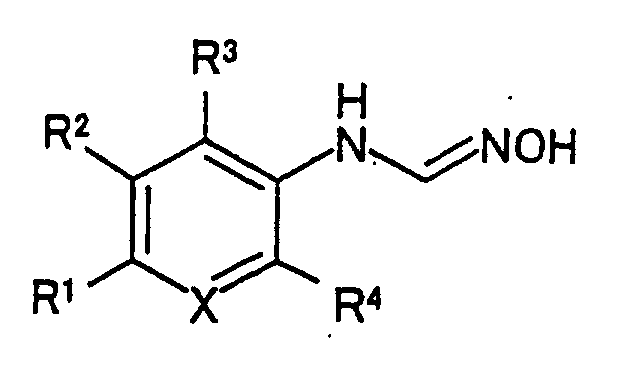
- the present invention relates to hydroxyformamidinobenzene or hydroxyamidinopyridine derivatives which inhibit the production of 20-hydroxyeicosatetraenoic acid (20-HETE) from arachidonic acid.
- An object of the present invention is to provide a drug which inhibits the production of 20-HETE which participates in the contraction or dilation of microvessels, the induction of cell proliferation, etc. in main organs such as kidney and cerebrovascular vessels.
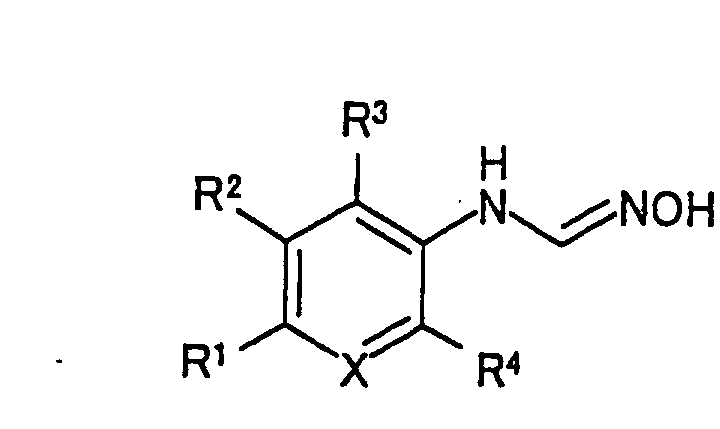
- the present invention relates to a hydroxyformamidine compound represented by the following formula or a pharmaceutically acceptable salt thereof.
- R 1 represents a substituted morpholino group, a substituted piperidino group, a piperazin-1-yl group, a substituted piperazin-1-yl group, a thiomorpholin-1-yl group, a perhydroazepin-1-yl group, a perhydroazocin-1-yl group, a tetrahydropyridin-1-yl group, a pyrrolin-1-yl group, a 1,4-dioxa-8-azaspiro[4,5]decan-8-yl group, a decahydroquinolin-1-yl group, a mono- or di-(C 1-4 alkoxy-C 1-6 alkyl)amino group, or a mono or di-(C 1-6 hydroxyalkyl)amino group;
- X represents a nitrogen atom or a group represented
- the substituted morpholino group means a morpholino group which is substituted with 1 to 3 C 1-4 alkyl group (s) and its examples are 2-methylmorpholino group, 2-ethylmorpholino group, 3-methylmorpholino group, 2,6-dimethylmorpholino group and 2,3,5-trimethylmorpholino group where 2,6-dimethylmorpholino group is more preferred.
- the substitutedpiperidino group means a piperidino group which is substituted with a C 1-4 alkyl group, a piperidino group which is substituted with a C 1-4 alkoxy group, a piperidino group which is substituted with a hydroxyl group, a piperidino group which is substituted with a C 2-5 alkoxycarbonyl group, a piperidino group which is substituted with a mono- or di-C 2-7 alkylaminocarbonyl group, a piperidino group which is substituted with a C 1-4 alkoxy-C 1-6 alkyl group, a piperidino group which is substituted with a C 1-6 hydroxyalkyl group and a piperidino group which is substituted with a mono- or di-C 1-4 alkylamino-C 1-6 alkyl group and its examples are 2-methylpiperidino group, 3-methylpiperidino group, 4-methylpiperidino group, 4-ethylpiperidino
- the substituted piperazin-1-yl group means a piperazin-1-yl group, a piperazin-1-yl group which is substituted with a C 1-4 alkyl group, a piperazin-1-yl group which is substitutedwith a cycloalkyl group having 4 to 8 ringmembers, a piperazin-1-yl group which is substituted with a C 1-4 alkoxy-C 1-4 alkyl group, a piperazin-1-yl group which is substituted with a C 1-6 hydroxyalkyl group, a piperazin-1-yl group which is substituted with a mono- or di-C 1-4 alkylamino-C 1-6 alkyl group, a piperazin-1-yl group which is substituted with a pyrrolidin-1-yl-C 1-6 alkyl group, a piperazin-1-yl group which is substituted with a morpholinocarbonyl-C 1-6 alkyl group, a piperazin-1-
- C x-y means that a group thereafter has x to y carbon atoms.
- the halogen atom is fluorine atom, chlorine atom, bromine atom or iodine atom.
- the C 1-4 and C 1-6 alkyl groups mean a linear or branched alkyl group having 1-4 and 1-6 carbon atom(s), respectively and examples of the C 1-4 alkyl group are methyl group, ethyl group, propyl group, isopropyl group, butyl group, isobutyl group and tert-butyl group where methyl group is more preferred.
- Example of the C 1-6 alkyl group are methyl group, ethyl group, propyl group, isopropyl group, butyl group, isobutyl group, tert-butyl group, pentyl group, isopentyl group, hexyl group and isohexyl group where methyl group and ethyl group are more preferred.
- the C 1-4 alkoxy group means a linear or branched alkoxy group having 1 to 4 carbon (s) and its examples aremethoxy group, ethoxy group, propoxy group, isopropoxy group, butoxy group and tert-butoxy group.
- the C 2-5 alkoxycarbonyl group means a substituent in a compounded form of a linear or branched alkoxy group having 1 to 4 carbon(s) with carbonyl group and its examples are methoxycarbonyl group, ethoxycarbonyl group, propoxycarbonyl group, isopropoxycarbonyl group and butoxycarbonyl group.
- the mono- or di-C 2-7 alkylaminocarbonyl group means a substituent in a compounded form of an amino group, which is substituted with one or two linear or branched alkyl group (s) having 1 to 6 carbon(s), with carbonyl group and its examples are methylaminocarbonyl group, ethylaminocarbonyl group, dimethylaminocarbonyl group, diethylaminocarbonyl group and diisobutylaminocarbonyl group where diethylaminocarbonyl group is more preferred.
- the C 1-4 alkoxy-C 1-4 alkyl group means a substituent in a compounded form of a linear or branched alkoxy group having 1 to 4 carbon (s) with a linear or branched alkyl group having 1 to 4 carbon(s) and its examples are methoxymethyl group, ethoxymethyl group, methoxyethyl group, ethoxyethyl group, propoxyethyl group, isopropoxyethyl group, butoxyethyl group and tert-butoxyethyl group.
- the C 1-6 hydroxyalkyl group means a linear or branched alkyl group having 1 to 6 carbon (s) substituted with hydroxyl group and its examples are hydroxymethyl group, 1-hydroxyethyl group, 2-hydroxyethyl group, 3-hydroxypropyl group and 5-hydroxypentyl group where the more preferred one is 2-hydroxyethyl group.
- the mono- or di-C 1-4 alkylamino-C 1-6 alkyl group means a substituent in a compounded form of an amino group, which is substituted with one or two linear or branched alkyl group (s) having 1 to 4 carbon (s) , with a linear or branched alkyl group having 1 to 6 carbon (s) and its examples are methylaminomethyl group, 1-methylaminoethyl group, 2-methylaminoethyl group, 3-methylaminopropyl group, 4-dimethylaminobutyl group, dimethylaminomethyl group, 1-dimethylaminoethyl group, 2-dimethylaminoethyl group and 3-dimethylaminopropyl group where 2-dimethylaminoethyl group is more preferred.
- the cycloalkyl group having 4 to 8 ring members means cyclobutyl group, cyclopentyl group, cyclohexyl group, cycloheptyl group and cyclooctyl group where cyclohexyl group is more preferred.
- the pyrrolidin-1-yl-C 1-6 alkyl group means a linear or branched alkyl group having 1 to 6 carbon(s) substituted with a pyrrolidin-1-yl group and its examples are pyrrolidin-1-yl-methyl group, 2-(pyrrolidin-1-yl)ethyl group, 3-(pyrrolidin-1-yl)propyl group and 5-(pyrrolidin-1-yl)pentyl group where 2-(pyrrolidin-1-yl)ethyl group is more preferred.
- the morpholinocarbonyl-C 1-6 alkyl group is a linear or branched alkyl group having 1 to 6 carbon(s) substituted with a morpholinocarbonyl group and its examples are morpholinocarbonylmethyl group, 2-morpholinocarbonylethyl group, 3-morpholinocarbonylpropyl group and 5-morpholinocarbonylpentyl group where morpholinocarbonylmethyl group is more preferred.
- the pharmaceutically acceptable salt is a salt with alkaline metal, alkaline earth metal, ammonium, alkylammonium, etc. and a salt with mineral acid or organic acid. Its examples are sodium salt, potassium salt, calcium salt, ammonium salt, aluminum salt, triethylammonium salt, acetate, propionate, butyrate, formate, trifluoroacetate, maleate, tartrate, citrate, stearate, succinate, ethylsuccinate, lactobionate, gluconate, glucoheptonate, benzoate, methanesulfonate, ethanesulfonate, 2-hydroxyethanesulfonate, benzenesulfonate, p -toluenesulfonate, laurylsulfate, malate, aspartate, glutamate, adipate, a salt with cysteine, a salt with N-acetylcysteine, hydrochloride, hydro
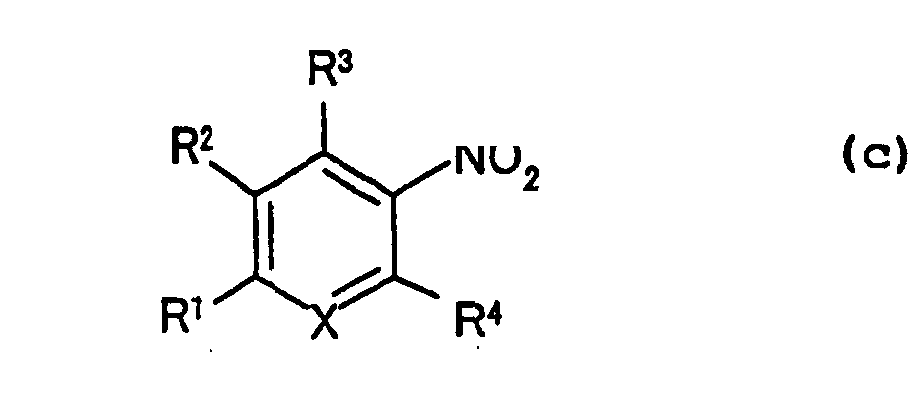
- the compound of the present invention can, for example, be synthesized by the method shown below. That is, a compound represented by the following formula (a): (wherein Y is a halogen atom, and R 2 , R 3 , R 4 and X have the same meanings as mentioned above) is made to react with a compound represented by the following formula (b): R 1 H (wherein R 1 has the same meaning as mentioned above) in the presence or absence of a suitable solvent to give a compound represented by the following formula (c). (wherein R 1 , R 2 , R 3 , R 4 and X have the same meanings as mentioned above.)
- a nitro group of the compound (c) is reduced using a reducing agent (such as palladium-activated carbon hydrogen in an atmosphere, palladium-activated carbon/hydrazine hydrate, palladium-activated carbon/ammonium formate, stannous (II) chloride monohydrate, iron/ammonium chloride and Raney nickel/hydrazine hydrate) in a suitable solvent (such as methanol, ethanol, propanol, tetrahydrofuran, dioxane, toluene, methylene chloride, chloroform, acetonitrile and ethyl acetate) to manufacture an aniline derivative (d).
- a reducing agent such as palladium-activated carbon hydrogen in an atmosphere, palladium-activated carbon/hydrazine hydrate, palladium-activated carbon/ammonium formate, stannous (II) chloride monohydrate, iron/ammonium chloride and Raney nickel/hydrazine hydrate
- the compound (d) is made to react with dimethylformamide dimethylacetal in a suitable solvent (such as methanol, ethanol, propanol, tetrahydrofuran, dioxane, toluene, methylene chloride, chloroform, acetonitrile and ethyl acetate) at from a room temperature to 150°C, preferably 70°C to 100°C for 2 to 72 hours.
- a suitable solvent such as methanol, ethanol, propanol, tetrahydrofuran, dioxane, toluene, methylene chloride, chloroform, acetonitrile and ethyl acetate
- An intermediate which is prepared hereinabove is treated with hydroxylamine hydrochloride in a suitable solvent (such as methanol, ethanol, propanol, tetrahydrofuran, dioxane, toluene, methylene chloride, chloroform, acetonitrile and ethyl acetate) to manufacture the compound of the present invention represented by the formula (1).
- a suitable solvent such as methanol, ethanol, propanol, tetrahydrofuran, dioxane, toluene, methylene chloride, chloroform, acetonitrile and ethyl acetate
- the compound of the formula (d) is made to react with an orthoformate such as trimethyl orthoformate or triethyl orthoformate in the presence or absence of a catalytic amount of an organic acid such as acetic acid, amineral acid such as hydrochloric acid or a salt of amine with mineral acid such as pyridine hydrochloride to give an intermediate.
- the reaction temperature is from a room temperature to 150°C, preferably 70°C to 100°C and the reaction time is 2 to 72 hours.
- the medicine of the present invention contains the compound represented by the formula (1) as such or a pharmaceutically acceptable salt thereof as an effective ingredient.
- the medicine as such is useful particularly as a therapeutic agent for renal diseases, cerebrovascular diseases or circulatory diseases.
- the inhibitor for the production of 20-HETE according to the present invention contains the compound represented by the formula (1) or a pharmaceutically acceptable salt thereof as an effective ingredient and it effectively inhibits the production of 20-HETE.
- the dosage of the medicine, the treating agent for renal diseases, cerebrovascular diseases and circulatory diseases, and the inhibitor for the production of 20-HETE according to the present invention is preferably 1 to 2,000 mg per day as the compound represented by the formula (1) or a pharmaceutically acceptable salt thereof in the case of treatment of adults and it can be administered once or by dividing into several time daily.
- the dosage can be appropriately increased or decreased depending upon the use and age, body weight, symptom, etc. of the patient.
- the medicine, the treating agent for renal diseases, cerebrovascular diseases and circulatory diseases, and the inhibitor for the production of 20-HETE according to the present invention can be administered either orally or parenterally.
- the dosage forms thereof are tablets, capsules, granules, diluted powder, powder, troches, ointments, creams, emulsions, suspensions, suppositories, injections, etc. and all of them can be manufactured by the ordinary preparation method (for example, according to the methods stipulatedby the 12th Revision of the Japanese Pharmacopoeia). Those dosage forms can be appropriately selected depending upon symptom, age and object of therapy of the patient.
- reaction mixture was cooled down to room temperature, tetrahydrofuran (0.4 ml) was added thereto and insoluble matters were filtered off using Celite, followed by washing with ethyl acetate (0.4 ml) for four times.
- Thefiltrate was concentrated under a reduced pressure and methanol (0.4 ml) and dimethylformamide dimethylacetal (0.095 g, 0.8 mmol) were added thereto, followed by stirring at 70°C for 64 hours.
- the reaction mixture was cooled down to room temperature and concentrated under a reduced pressure and methanol (0.4 ml) and hydroxylamine hydrochloride (0. 033 g, 0.48 mmol) were added thereto, followed by stirring at room temperature for 6 hours.
- the reaction mixture was concentrated under a reduced pressure and a saturated aqueous solution of sodium hydrogen carbonate (0.4 ml) was added thereto, followed by extracting with ethyl acetate.
- reaction mixture was cooled down to room temperature and concentrated under a reduced pressure, and methanol (20 ml) and hydroxylamine hydrochloride (1.05 g, 15.2 mol) were added thereto, followed by stirring at room temperature for 4 hours.
- the reaction mixture was concentrated under a reduced pressure and a saturated aqueous solution of sodium hydrogen carbonate (10 ml) was added thereto, followed by extracting with ethyl acetate.
- Test Example [Inhibitory Action to 20-HETE-Producing Enzyme derived from Human Renal Microsome]
- a solution of the test compound adjusted to 1 ⁇ M using DMSO was added to a 50 mM of 3-morpholinopropanesulfonic acid buffer (MOPS) (pH 7.4) containing 5 mM of magnesium chloride and 1 mM of sodium ethylenediaminetetraacetate (EDTA), then human renal microsome fraction (Human Cell Culture Center, Anatomic Gift Foundation), [5,6,8,9,11,12,15]tritium-arachidonic acid and NADPH were added thereto as an enzymatic source, a substrate and a coenzyme, respectively and reaction was carried out at 37°C for 1.5 hours.
- Formic acid was added to the reaction solution to stop the reaction and then acetonitrile was added thereto (final concentration: 50%).
- Amount of 20-HETE produced thereby was measured using a high performance liquid chromatography equipped with a radioactive substance detector having an ODS column (Biosil C18; manufactured by Biorad).
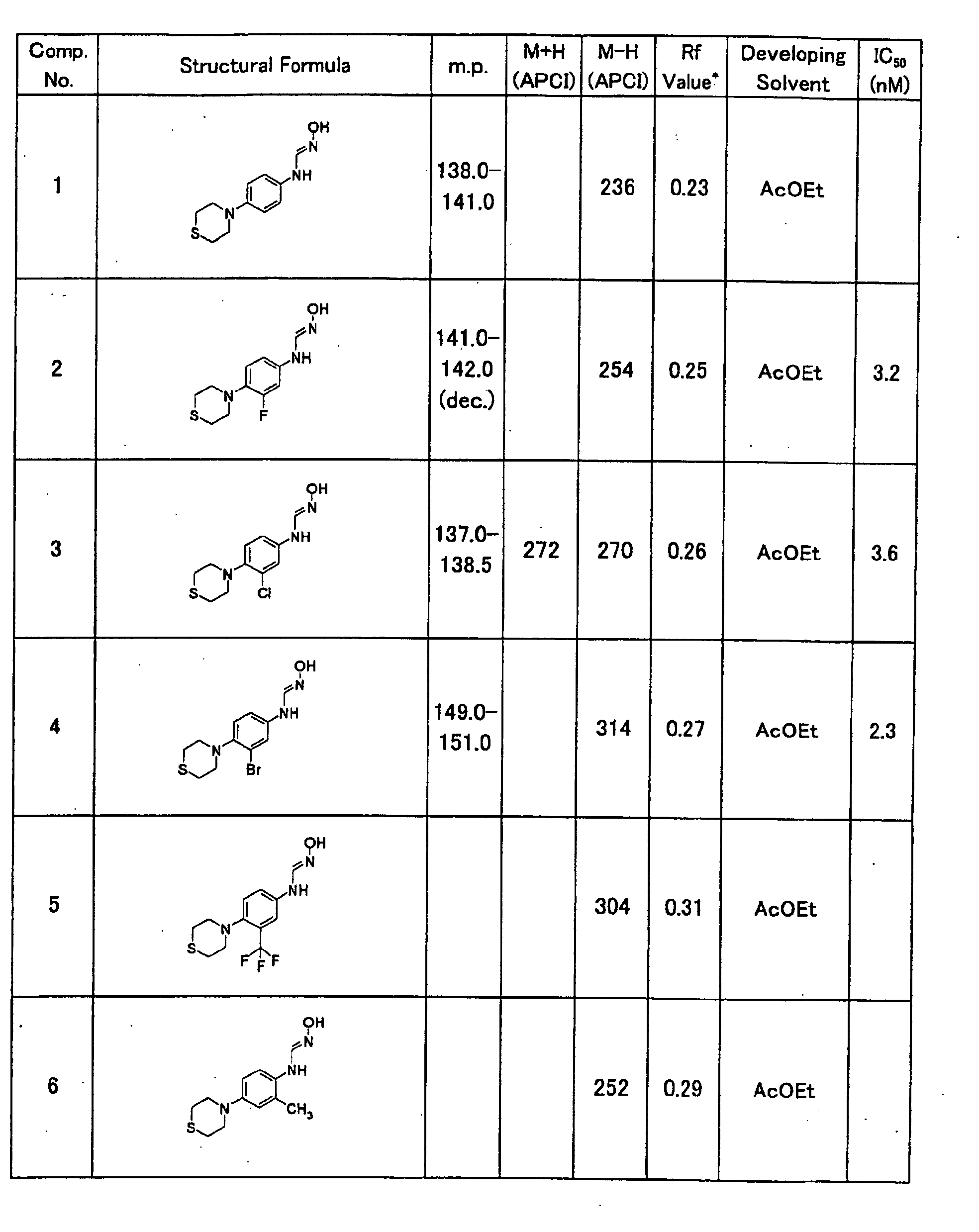
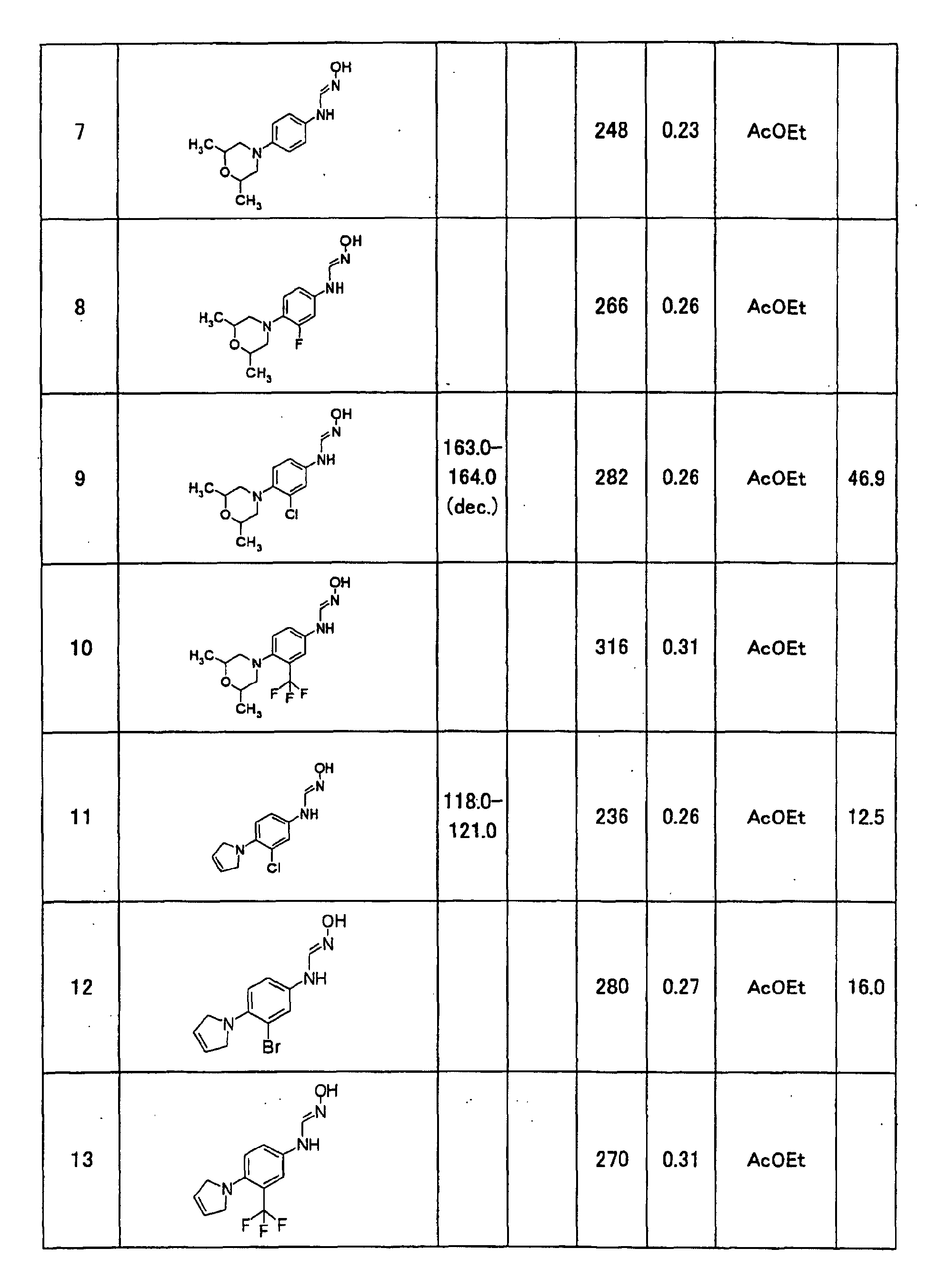
- Amount of 20-HETE produced when no compound was added was defined as 100% and the concentration of the compound when production of 20-HETE was inhibited to an extent of 50% upon addition of a compound (IC 50 value) was calculated. The results are also shown in the above table.
- the compound represented by the formula (1) or a pharmaceutically acceptable salt thereof is useful as an inhibitor for the production of 20-HETE. It is also useful as a medicine, particularly as an agent for the treatment of renal diseases, cerebrovascular diseases and circulatory diseases.
Landscapes
- Chemical & Material Sciences (AREA)
- Organic Chemistry (AREA)
- Health & Medical Sciences (AREA)
- Medicinal Chemistry (AREA)
- Veterinary Medicine (AREA)
- Public Health (AREA)
- General Health & Medical Sciences (AREA)
- Animal Behavior & Ethology (AREA)
- Life Sciences & Earth Sciences (AREA)
- Pharmacology & Pharmacy (AREA)
- Epidemiology (AREA)
- Engineering & Computer Science (AREA)
- Bioinformatics & Cheminformatics (AREA)
- Nuclear Medicine, Radiotherapy & Molecular Imaging (AREA)
- General Chemical & Material Sciences (AREA)
- Chemical Kinetics & Catalysis (AREA)
- Diabetes (AREA)
- Heart & Thoracic Surgery (AREA)
- Cardiology (AREA)
- Urology & Nephrology (AREA)
- Obesity (AREA)
- Hematology (AREA)
- Emergency Medicine (AREA)
- Vascular Medicine (AREA)
- Endocrinology (AREA)
- Pharmaceuticals Containing Other Organic And Inorganic Compounds (AREA)
- Plural Heterocyclic Compounds (AREA)
- Acyclic And Carbocyclic Compounds In Medicinal Compositions (AREA)
- Hydrogenated Pyridines (AREA)
- Pyridine Compounds (AREA)
- Pyrrole Compounds (AREA)
- Nitrogen Condensed Heterocyclic Rings (AREA)
- Organic Low-Molecular-Weight Compounds And Preparation Thereof (AREA)
- Heterocyclic Carbon Compounds Containing A Hetero Ring Having Nitrogen And Oxygen As The Only Ring Hetero Atoms (AREA)
- Quinoline Compounds (AREA)
Abstract
Description



Melting point: 137.0 to 138.5°C.
Melting point: 172.0 to 174.0°C.
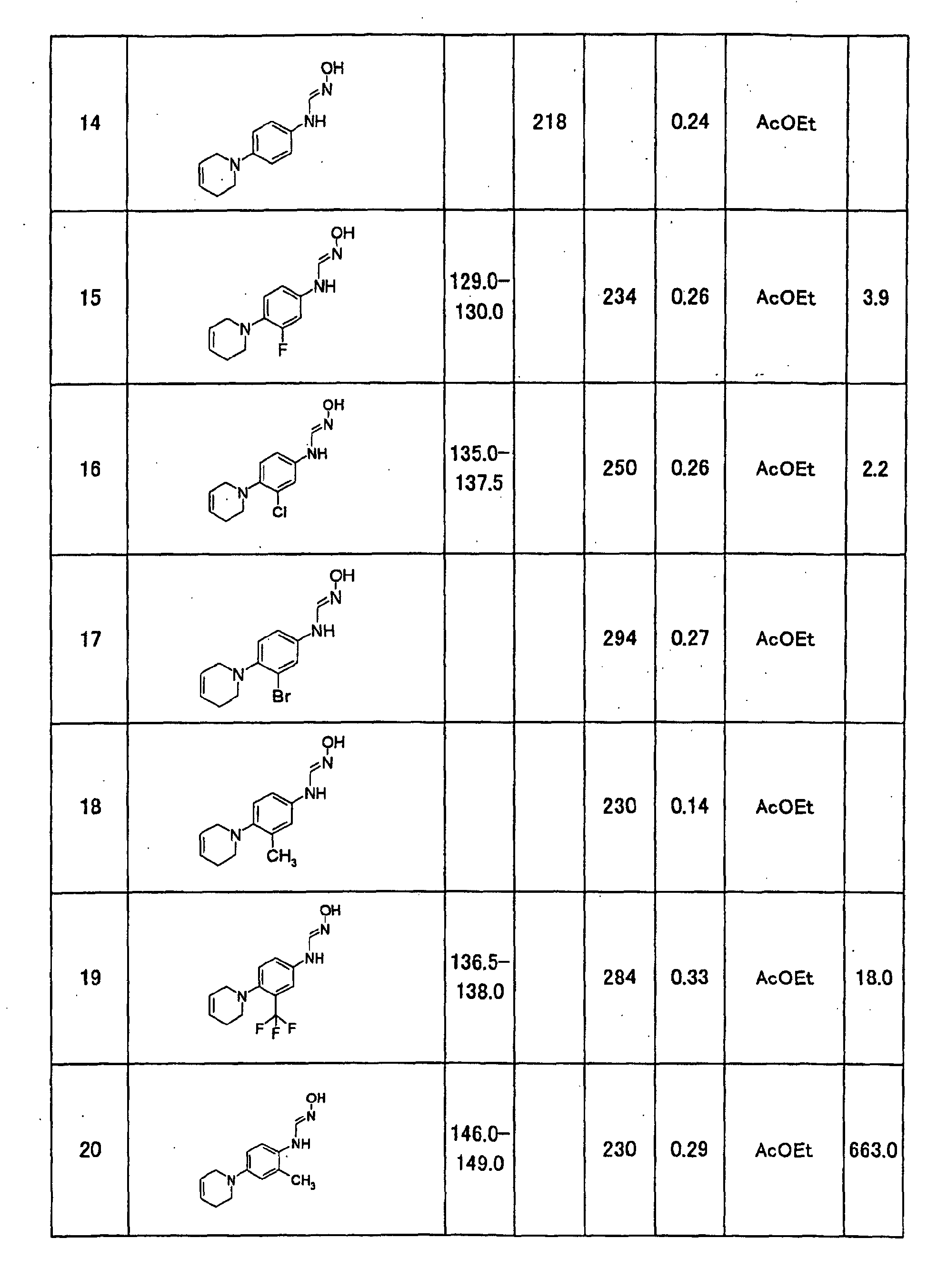
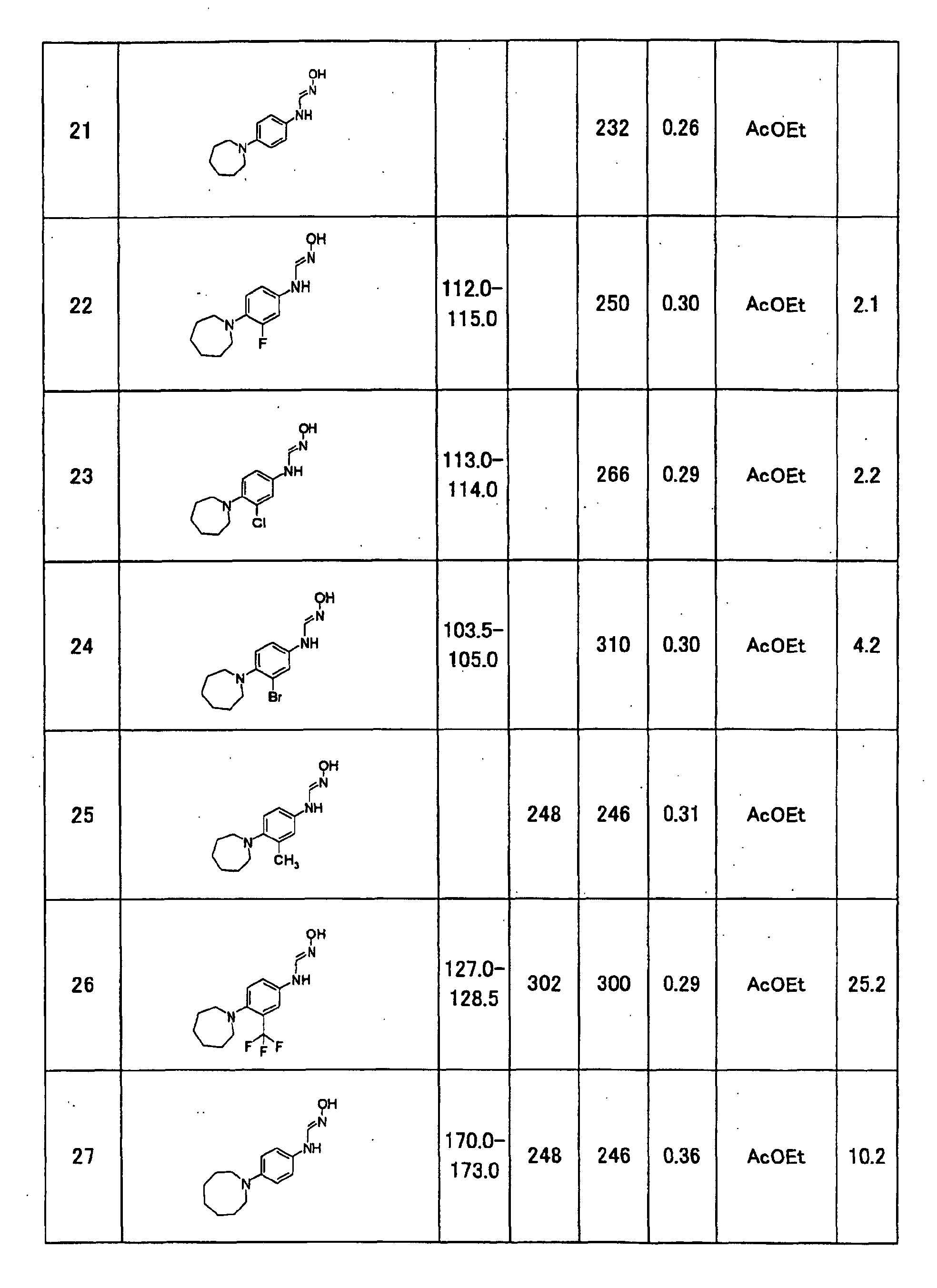


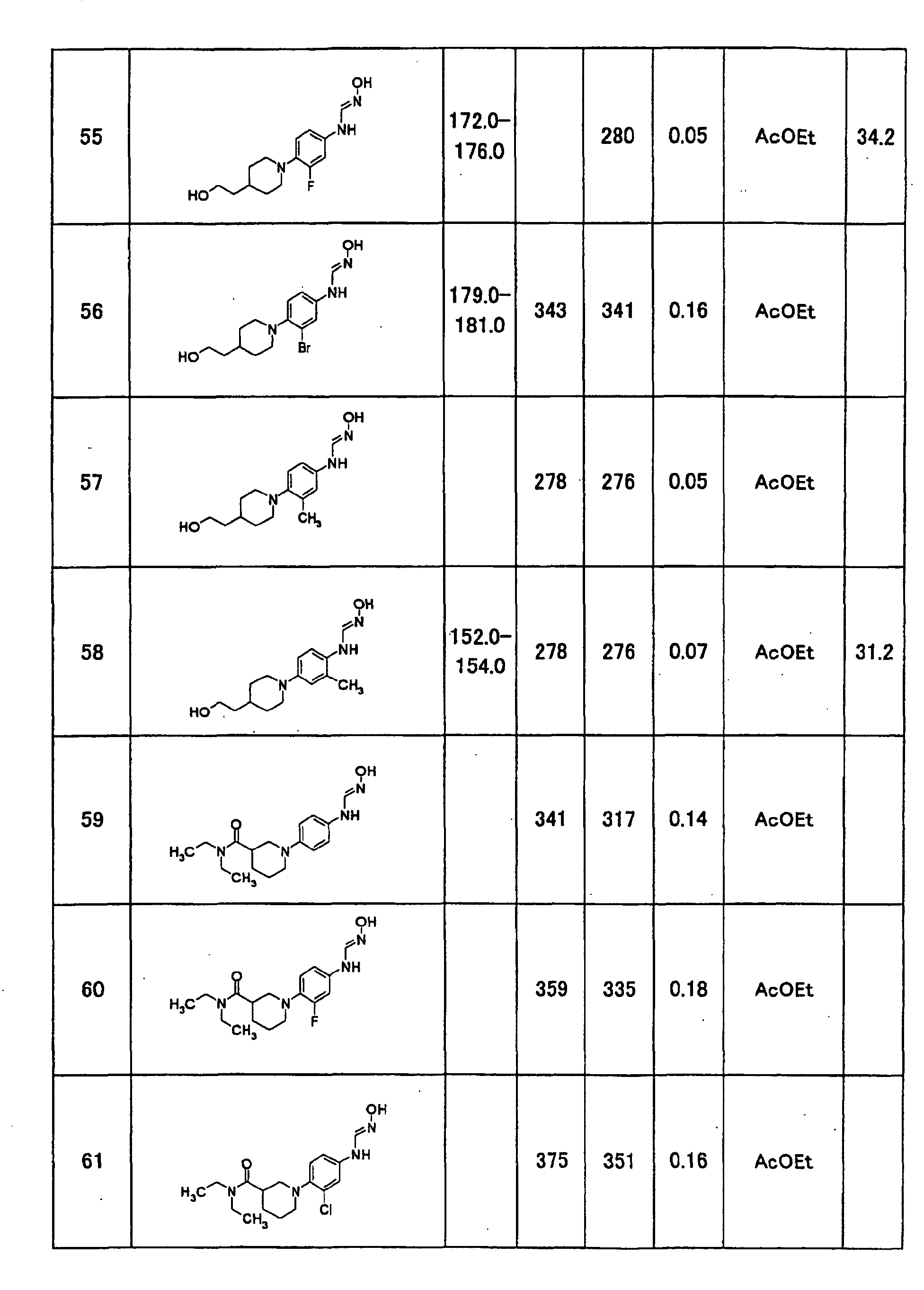


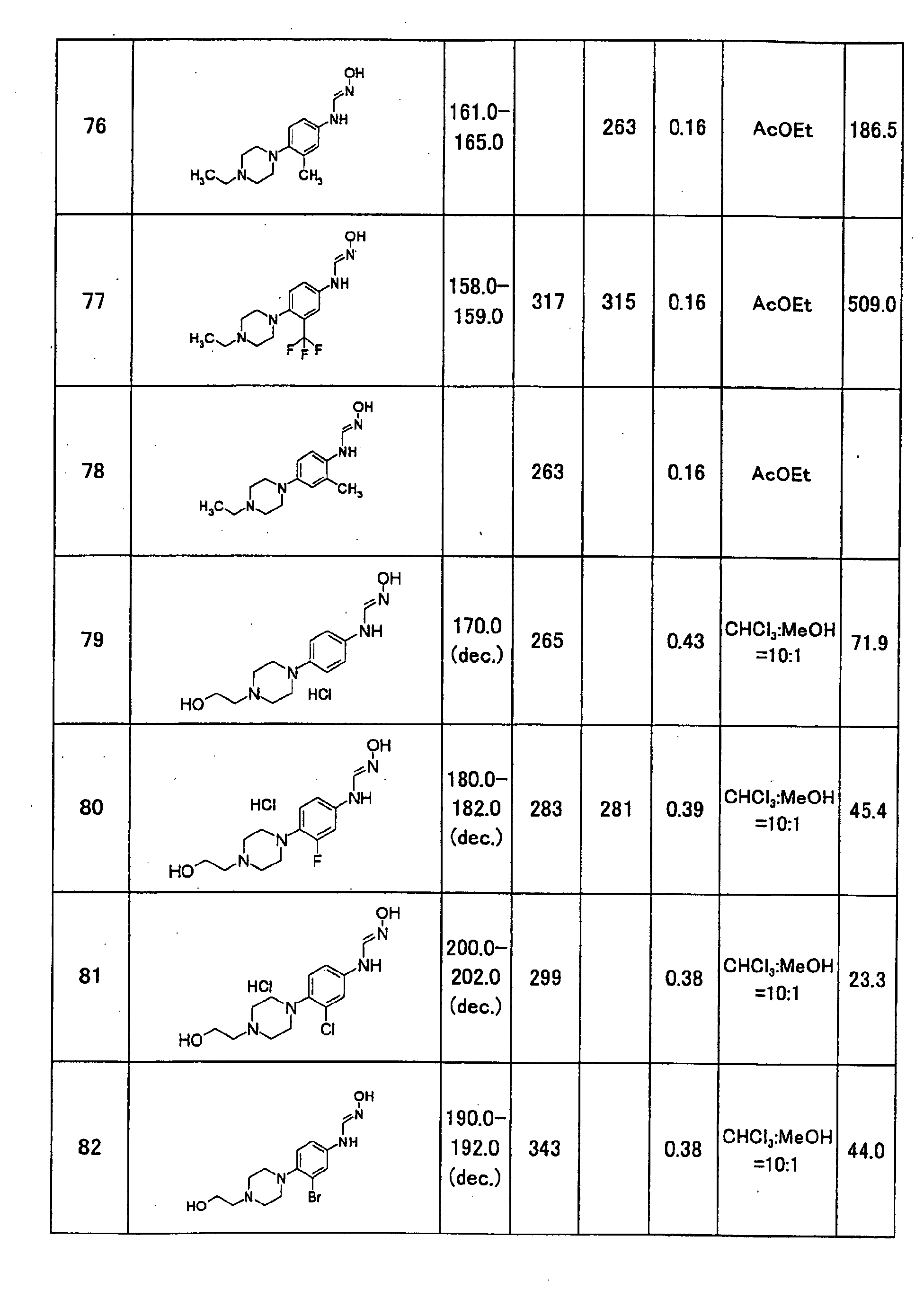
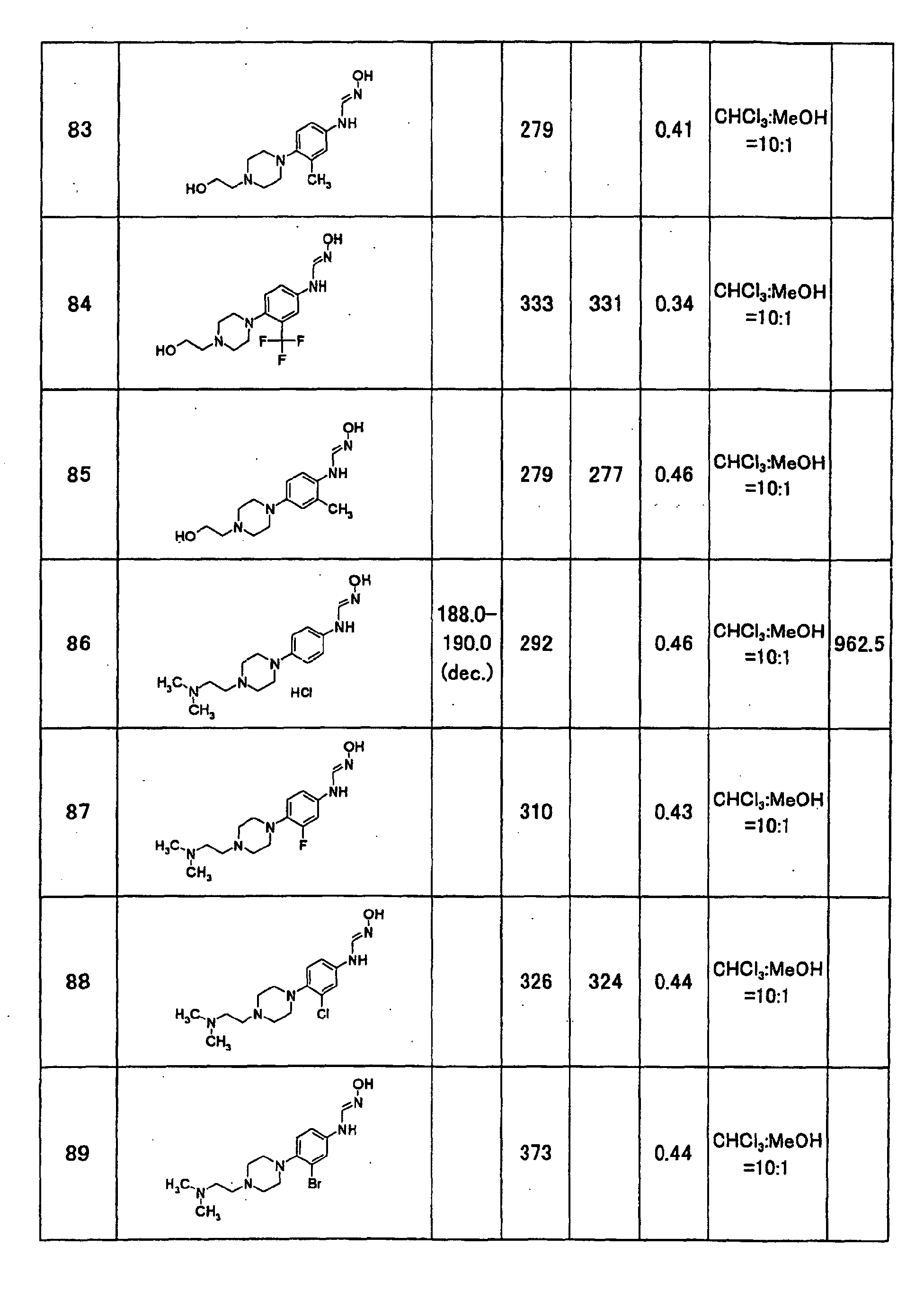


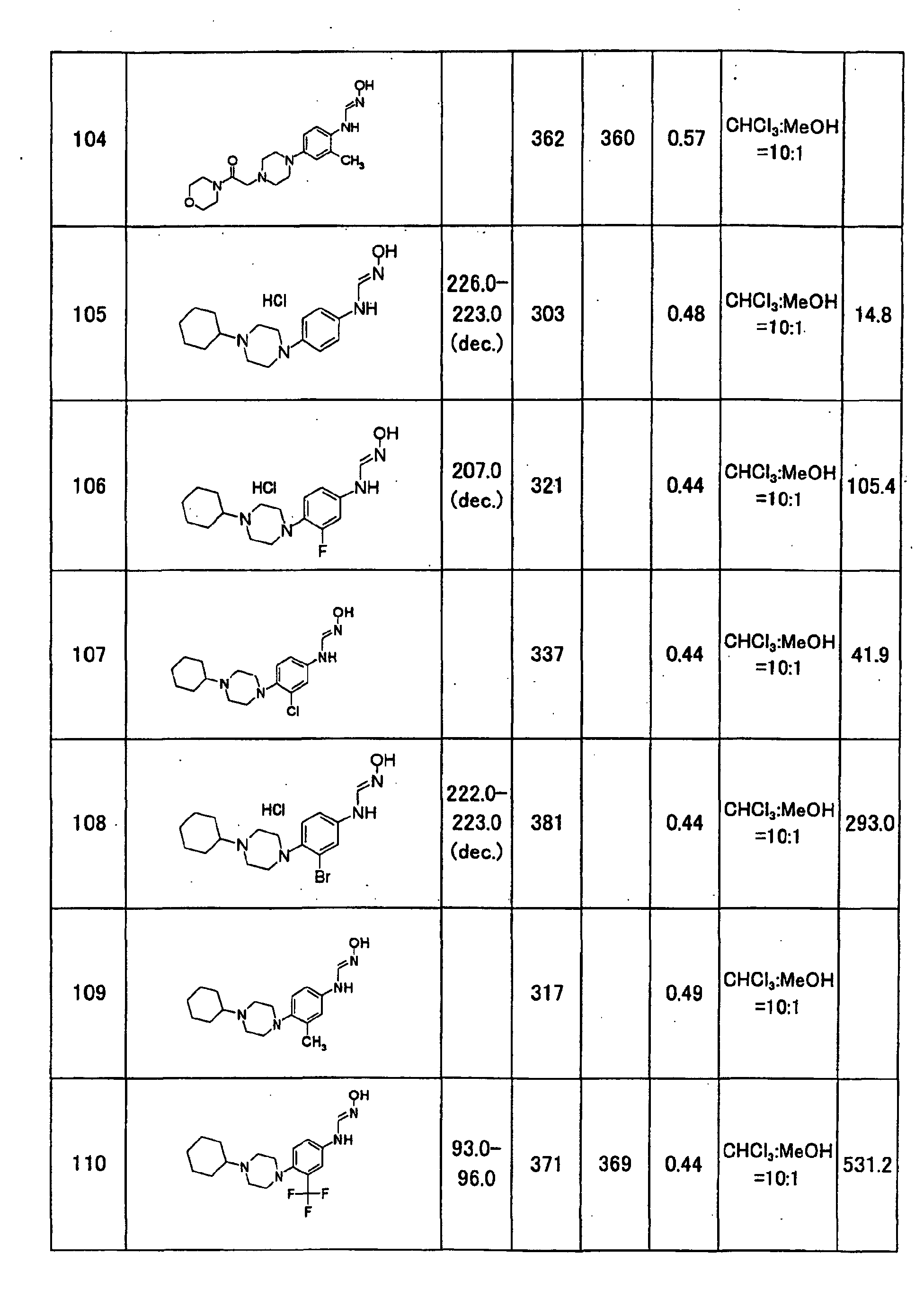
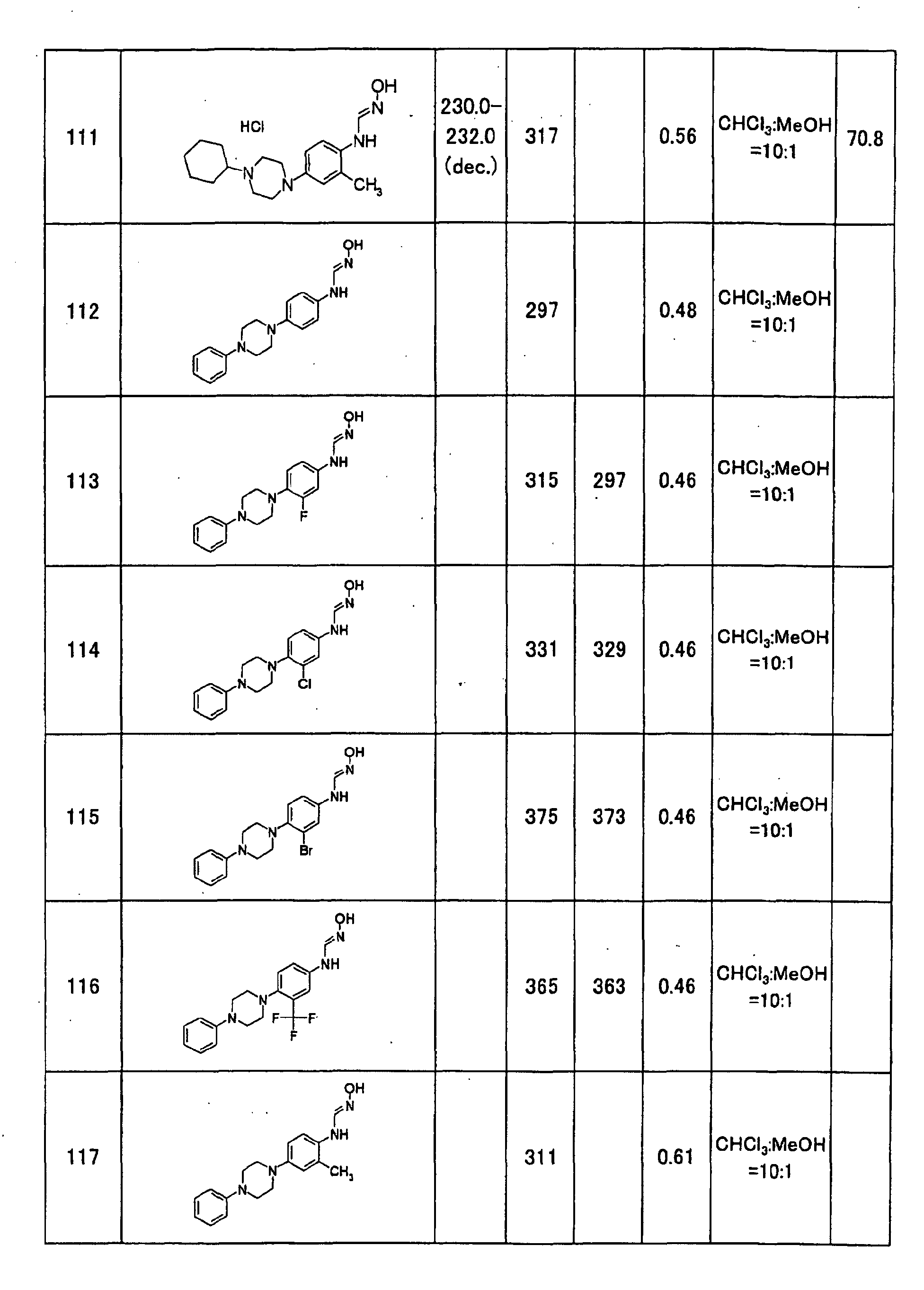
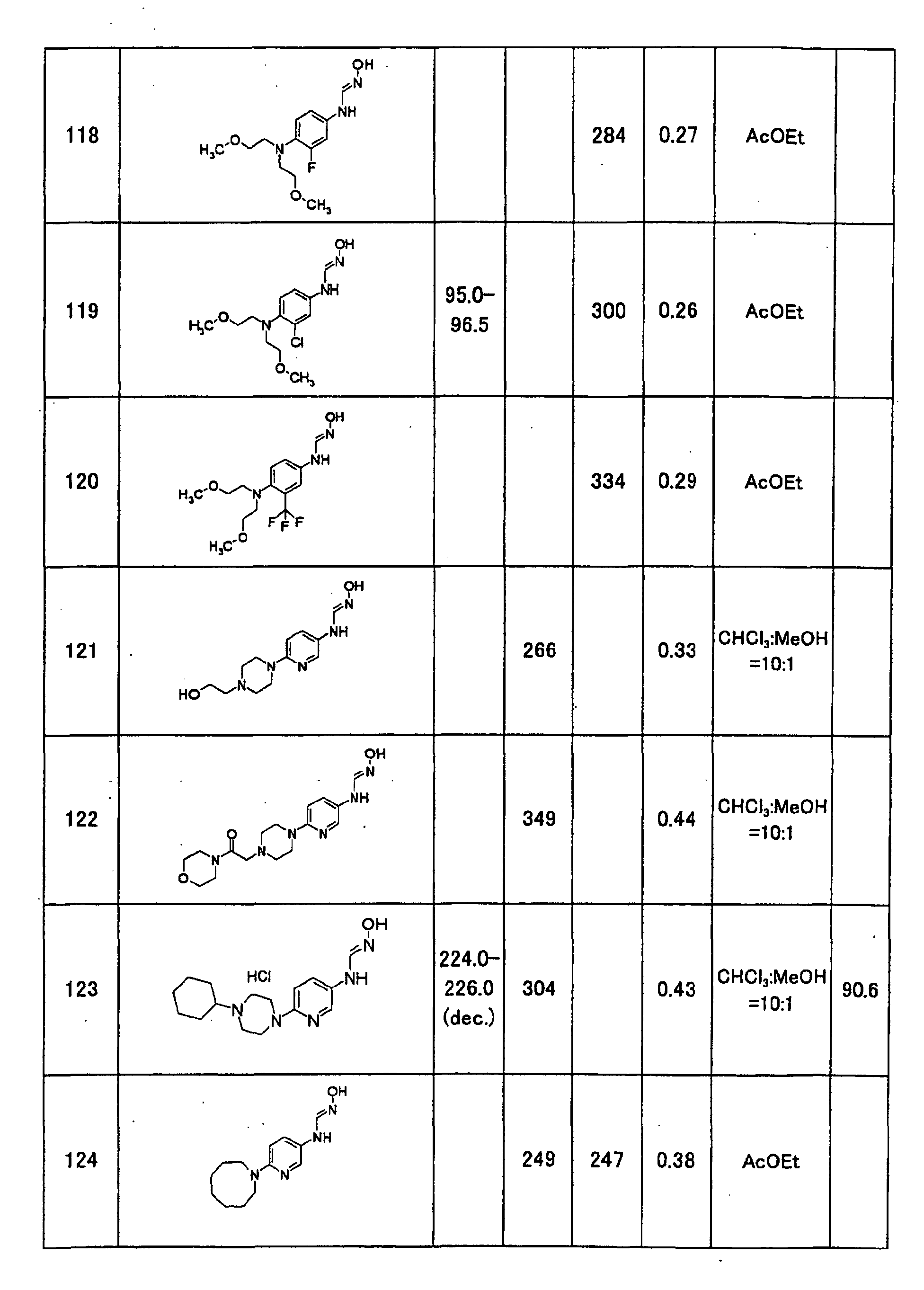


Claims (3)
- A hydroxyformamidine compound represented by the following formula or a pharmaceutically acceptable salt thereof:wherein R1 represents a substituted morpholino group, a substituted piperidino group, a piperazin-1-yl group, a substituted piperazin-1-yl group, a thiomorpholin-1-yl group, a perhydroazepin-1-yl group, a perhydroazocin-1-yl group, a tetrahydropyridin-1-yl group, a pyrrolin-1-yl group, a 1,4-dioxa-8-azaspiro[4,5]decan-8-yl group, a decahydroquinolin-1-yl group, a mono- or di-(C1-4 alkoxy-C1-6 alkyl)amino group, or a mono or di-(C1-6 hydroxyalkyl)amino group; X is a nitrogen atom or a group represented by CR5; and R2 to R5 are the same or different and each represents a hydrogen atom, a C1-4 alkyl group, a C1-4 alkoxy group, a trifluoromethyl group or a halogen atom.
- An inhibitor for production of 20-hydroxyeicosatetraenoic acid which comprises the hydroxyformamidine compound described in claim 1 or a pharmaceutically acceptable salt thereof as an effective ingredient.
- The inhibitor for production of 20-hydroxyeicosatetraenoic acid according to claim 2 which is an agent for the treatment of renal diseases, cerebrovascular diseases and circulatory diseases.
Applications Claiming Priority (3)
| Application Number | Priority Date | Filing Date | Title |
|---|---|---|---|
| JP2001129794 | 2001-04-26 | ||
| JP2001129794 | 2001-04-26 | ||
| PCT/JP2002/004252 WO2002088071A1 (en) | 2001-04-26 | 2002-04-26 | 20-hydroxyeicosatetraenoic acid production inhibitors |
Publications (3)
| Publication Number | Publication Date |
|---|---|
| EP1389611A1 true EP1389611A1 (en) | 2004-02-18 |
| EP1389611A4 EP1389611A4 (en) | 2006-06-07 |
| EP1389611B1 EP1389611B1 (en) | 2012-06-27 |
Family
ID=18978272
Family Applications (1)
| Application Number | Title | Priority Date | Filing Date |
|---|---|---|---|
| EP02722849A Expired - Lifetime EP1389611B1 (en) | 2001-04-26 | 2002-04-26 | 20-hydroxyeicosatetraenoic acid production inhibitors |
Country Status (8)
| Country | Link |
|---|---|
| US (1) | US7214714B2 (en) |
| EP (1) | EP1389611B1 (en) |
| JP (1) | JP4120401B2 (en) |
| KR (1) | KR100819322B1 (en) |
| CN (1) | CN1272313C (en) |
| AU (1) | AU2002253633B2 (en) |
| CA (1) | CA2445329C (en) |
| WO (1) | WO2002088071A1 (en) |
Cited By (1)
| Publication number | Priority date | Publication date | Assignee | Title |
|---|---|---|---|---|
| WO2008034011A2 (en) | 2006-09-13 | 2008-03-20 | Mcw Research Foundation, Inc. | Methods of modulating cell proliferation and cyst formation in polycystic kidney and liver diseases |
Families Citing this family (2)
| Publication number | Priority date | Publication date | Assignee | Title |
|---|---|---|---|---|
| ES2280379T3 (en) * | 2000-06-15 | 2007-09-16 | Taisho Pharmaceutical Co., Ltd | DERIVATIVES OF HYDROXIFORMAMIDINE AND MEDICINES CONTAINING IT. |
| US6818662B2 (en) * | 2002-05-28 | 2004-11-16 | Taisho Pharmaceutical Co., Ltd. | Pharmaceutical composition |
Family Cites Families (7)
| Publication number | Priority date | Publication date | Assignee | Title |
|---|---|---|---|---|
| AU3022984A (en) | 1983-07-15 | 1985-01-17 | Nippon Soda Co., Ltd. | Formamidoxime derivatives |
| DE4204686A1 (en) * | 1992-02-17 | 1993-08-19 | Gruenenthal Gmbh | IMIDAZOLYLPHENOL DERIVATIVES, MEDICAMENTS CONTAINING THEREOF, AND A METHOD OF PREPARING THESE COMPOUNDS AND MEDICAMENTS |
| US6395781B1 (en) * | 1998-02-26 | 2002-05-28 | Mcw Research Foundation | 20-HETE antagonists and agonists |
| DK1226819T3 (en) * | 1999-11-01 | 2006-05-22 | Taisho Pharmaceutical Co Ltd | Inhibitor for 20-HETE-producing enzyme |
| JP2001354658A (en) | 2000-06-15 | 2001-12-25 | Taisho Pharmaceut Co Ltd | Hydroxyformamidine compounds and salts thereof and medicaments containing them |
| ES2280379T3 (en) | 2000-06-15 | 2007-09-16 | Taisho Pharmaceutical Co., Ltd | DERIVATIVES OF HYDROXIFORMAMIDINE AND MEDICINES CONTAINING IT. |
| JP2001354656A (en) | 2000-06-15 | 2001-12-25 | Taisho Pharmaceut Co Ltd | Hydroxyformamidine compounds and salts thereof and medicaments containing them |
-
2002
- 2002-04-26 CA CA2445329A patent/CA2445329C/en not_active Expired - Fee Related
- 2002-04-26 EP EP02722849A patent/EP1389611B1/en not_active Expired - Lifetime
- 2002-04-26 KR KR1020037013921A patent/KR100819322B1/en not_active Expired - Fee Related
- 2002-04-26 JP JP2002585375A patent/JP4120401B2/en not_active Expired - Fee Related
- 2002-04-26 WO PCT/JP2002/004252 patent/WO2002088071A1/en not_active Ceased
- 2002-04-26 CN CNB028089855A patent/CN1272313C/en not_active Expired - Fee Related
- 2002-04-26 AU AU2002253633A patent/AU2002253633B2/en not_active Ceased
- 2002-04-26 US US10/475,869 patent/US7214714B2/en not_active Expired - Fee Related
Cited By (4)
| Publication number | Priority date | Publication date | Assignee | Title |
|---|---|---|---|---|
| WO2008034011A2 (en) | 2006-09-13 | 2008-03-20 | Mcw Research Foundation, Inc. | Methods of modulating cell proliferation and cyst formation in polycystic kidney and liver diseases |
| WO2008034011A3 (en) * | 2006-09-13 | 2008-05-29 | Mcw Res Found Inc | Methods of modulating cell proliferation and cyst formation in polycystic kidney and liver diseases |
| US8846764B2 (en) | 2006-09-13 | 2014-09-30 | The Medical College Of Wisconsin, Inc. | Methods of modulating cell proliferation and cyst formation in polycystic kidney and liver diseases |
| US9511072B2 (en) | 2006-09-13 | 2016-12-06 | The Medical College Of Wisconsin, Inc. | Methods of modulating cell proliferation and cyst formation in polycystic kidney and liver diseases |
Also Published As
| Publication number | Publication date |
|---|---|
| US7214714B2 (en) | 2007-05-08 |
| EP1389611A4 (en) | 2006-06-07 |
| CA2445329A1 (en) | 2002-11-07 |
| EP1389611B1 (en) | 2012-06-27 |
| AU2002253633B2 (en) | 2007-01-18 |
| CN1633413A (en) | 2005-06-29 |
| JP4120401B2 (en) | 2008-07-16 |
| HK1075885A1 (en) | 2005-12-30 |
| KR20040015135A (en) | 2004-02-18 |
| US20040121997A1 (en) | 2004-06-24 |
| KR100819322B1 (en) | 2008-04-02 |
| WO2002088071A1 (en) | 2002-11-07 |
| JPWO2002088071A1 (en) | 2004-08-12 |
| CA2445329C (en) | 2010-02-16 |
| CN1272313C (en) | 2006-08-30 |
Similar Documents
| Publication | Publication Date | Title |
|---|---|---|
| CN113717156B (en) | EGFR inhibitor, its preparation method and use | |
| EP3129023B1 (en) | Potent soluble epoxide hydrolase inhibitors | |
| CN107001283B (en) | FLT3 receptor antagonists | |
| US7745646B2 (en) | Bicyclic heteroaryl inhibitors of PDE4 | |
| JP3274865B2 (en) | Piperazine derivatives as 5-HT receptor antagonists | |
| Levin et al. | Anthranilate sulfonamide hydroxamate TACE inhibitors. Part 2: SAR of the acetylenic P1′ group | |
| EP2364975B1 (en) | Novel amide derivative and use thereof as medicine | |
| RU2005113153A (en) | NEW PYRIMIDINAMIDE DERIVATIVES AND THEIR APPLICATION | |
| US20230028658A1 (en) | Expanded dosage regimens for integrin inhibitors | |
| US20130045975A1 (en) | Bicyclic heteroaryl inhibitors of pde4 | |
| WO2015112847A1 (en) | Arylpyridinone itk inhibitors for treating inflammation and cancer | |
| JP2020531574A (en) | Compounds, their pharmaceutical compositions and their uses and applications | |
| JP2007505888A (en) | Substituted triazole derivatives as oxytocin antagonists | |
| CZ140696A3 (en) | Hiv protease inhibitor precursors and pharmaceutical compositions containing thereof | |
| CA3214066A1 (en) | 1,3-substituted cyclobutyl derivatives and uses thereof | |
| AU2010293429B2 (en) | 8-oxodihydropurine derivative | |
| US20230293539A1 (en) | Mll1-wdr5 protein-protein interaction inhibitor compounds and uses thereof | |
| KR100735781B1 (en) | Isoquinoline Compounds and Medicinal Use Thereof | |
| US7214714B2 (en) | 20-hydroxyeicosatetraenoic acid production inhibitors | |
| JPWO2019044868A1 (en) | Pyrimidine derivative | |
| CN121335897A (en) | 1,3-thiazole and 1,2,4-thiadiazole are CD38 inhibitors used to treat CNS conditions. | |
| WO2001032164A1 (en) | Inhibitor for 20-hete-yielding enzyme | |
| JP2003506442A (en) | Novel tryptase inhibitor | |
| EP1291343A1 (en) | Hydroxyformamidine derivatives and medicines containing the same | |
| JP2004143099A (en) | 20-hydroxyeicosatetraenoic acid production inhibitor |
Legal Events
| Date | Code | Title | Description |
|---|---|---|---|
| PUAI | Public reference made under article 153(3) epc to a published international application that has entered the european phase |
Free format text: ORIGINAL CODE: 0009012 |
|
| 17P | Request for examination filed |
Effective date: 20031024 |
|
| AK | Designated contracting states |
Kind code of ref document: A1 Designated state(s): AT BE CH CY DE DK ES FI FR GB GR IE IT LI LU MC NL PT SE TR |
|
| AX | Request for extension of the european patent |
Extension state: AL LT LV MK RO SI |
|
| A4 | Supplementary search report drawn up and despatched |
Effective date: 20060508 |
|
| 17Q | First examination report despatched |
Effective date: 20070322 |
|
| REG | Reference to a national code |
Ref country code: DE Ref legal event code: R079 Ref document number: 60243218 Country of ref document: DE Free format text: PREVIOUS MAIN CLASS: C07C0259140000 Ipc: A61K0031441800 |
|
| GRAJ | Information related to disapproval of communication of intention to grant by the applicant or resumption of examination proceedings by the epo deleted |
Free format text: ORIGINAL CODE: EPIDOSDIGR1 |
|
| GRAP | Despatch of communication of intention to grant a patent |
Free format text: ORIGINAL CODE: EPIDOSNIGR1 |
|
| RIC1 | Information provided on ipc code assigned before grant |
Ipc: A61K 31/47 20060101ALI20111227BHEP Ipc: A61K 31/496 20060101ALI20111227BHEP Ipc: C07D 213/74 20060101ALI20111227BHEP Ipc: C07D 215/06 20060101ALI20111227BHEP Ipc: A61K 31/5375 20060101ALI20111227BHEP Ipc: C07D 241/04 20060101ALI20111227BHEP Ipc: C07D 295/15 20060101ALI20111227BHEP Ipc: A61K 31/4418 20060101AFI20111227BHEP Ipc: A61K 31/55 20060101ALI20111227BHEP Ipc: A61P 3/10 20060101ALI20111227BHEP Ipc: C07C 259/14 20060101ALI20111227BHEP Ipc: C07D 211/70 20060101ALI20111227BHEP Ipc: C07D 265/30 20060101ALI20111227BHEP Ipc: C07D 401/04 20060101ALI20111227BHEP Ipc: C07D 491/113 20060101ALI20111227BHEP Ipc: C07D 207/20 20060101ALI20111227BHEP Ipc: A61K 31/4525 20060101ALI20111227BHEP Ipc: C07D 217/04 20060101ALI20111227BHEP Ipc: C07D 213/75 20060101ALI20111227BHEP Ipc: C07D 491/10 20060101ALI20111227BHEP |
|
| GRAS | Grant fee paid |
Free format text: ORIGINAL CODE: EPIDOSNIGR3 |
|
| GRAA | (expected) grant |
Free format text: ORIGINAL CODE: 0009210 |
|
| AK | Designated contracting states |
Kind code of ref document: B1 Designated state(s): AT BE CH CY DE DK ES FI FR GB GR IE IT LI LU MC NL PT SE TR |
|
| REG | Reference to a national code |
Ref country code: GB Ref legal event code: FG4D |
|
| RIN1 | Information on inventor provided before grant (corrected) |
Inventor name: MIYATA, NORIYUKI Inventor name: AMADA, HIDEAKI Inventor name: ISHII, TAKAAKI Inventor name: MATSUNAGA, YUKO Inventor name: SATO, MASAKAZU |
|
| REG | Reference to a national code |
Ref country code: CH Ref legal event code: EP |
|
| REG | Reference to a national code |
Ref country code: AT Ref legal event code: REF Ref document number: 563761 Country of ref document: AT Kind code of ref document: T Effective date: 20120715 |
|
| REG | Reference to a national code |
Ref country code: IE Ref legal event code: FG4D |
|
| REG | Reference to a national code |
Ref country code: DE Ref legal event code: R096 Ref document number: 60243218 Country of ref document: DE Effective date: 20120823 |
|
| PG25 | Lapsed in a contracting state [announced via postgrant information from national office to epo] |
Ref country code: FI Free format text: LAPSE BECAUSE OF FAILURE TO SUBMIT A TRANSLATION OF THE DESCRIPTION OR TO PAY THE FEE WITHIN THE PRESCRIBED TIME-LIMIT Effective date: 20120627 Ref country code: SE Free format text: LAPSE BECAUSE OF FAILURE TO SUBMIT A TRANSLATION OF THE DESCRIPTION OR TO PAY THE FEE WITHIN THE PRESCRIBED TIME-LIMIT Effective date: 20120627 |
|
| REG | Reference to a national code |
Ref country code: NL Ref legal event code: VDEP Effective date: 20120627 |
|
| REG | Reference to a national code |
Ref country code: AT Ref legal event code: MK05 Ref document number: 563761 Country of ref document: AT Kind code of ref document: T Effective date: 20120627 |
|
| PG25 | Lapsed in a contracting state [announced via postgrant information from national office to epo] |
Ref country code: GR Free format text: LAPSE BECAUSE OF FAILURE TO SUBMIT A TRANSLATION OF THE DESCRIPTION OR TO PAY THE FEE WITHIN THE PRESCRIBED TIME-LIMIT Effective date: 20120928 |
|
| PG25 | Lapsed in a contracting state [announced via postgrant information from national office to epo] |
Ref country code: AT Free format text: LAPSE BECAUSE OF FAILURE TO SUBMIT A TRANSLATION OF THE DESCRIPTION OR TO PAY THE FEE WITHIN THE PRESCRIBED TIME-LIMIT Effective date: 20120627 Ref country code: BE Free format text: LAPSE BECAUSE OF FAILURE TO SUBMIT A TRANSLATION OF THE DESCRIPTION OR TO PAY THE FEE WITHIN THE PRESCRIBED TIME-LIMIT Effective date: 20120627 Ref country code: CY Free format text: LAPSE BECAUSE OF FAILURE TO SUBMIT A TRANSLATION OF THE DESCRIPTION OR TO PAY THE FEE WITHIN THE PRESCRIBED TIME-LIMIT Effective date: 20120627 |
|
| PG25 | Lapsed in a contracting state [announced via postgrant information from national office to epo] |
Ref country code: PT Free format text: LAPSE BECAUSE OF FAILURE TO SUBMIT A TRANSLATION OF THE DESCRIPTION OR TO PAY THE FEE WITHIN THE PRESCRIBED TIME-LIMIT Effective date: 20121029 Ref country code: IT Free format text: LAPSE BECAUSE OF FAILURE TO SUBMIT A TRANSLATION OF THE DESCRIPTION OR TO PAY THE FEE WITHIN THE PRESCRIBED TIME-LIMIT Effective date: 20120627 |
|
| PG25 | Lapsed in a contracting state [announced via postgrant information from national office to epo] |
Ref country code: NL Free format text: LAPSE BECAUSE OF FAILURE TO SUBMIT A TRANSLATION OF THE DESCRIPTION OR TO PAY THE FEE WITHIN THE PRESCRIBED TIME-LIMIT Effective date: 20120627 |
|
| PG25 | Lapsed in a contracting state [announced via postgrant information from national office to epo] |
Ref country code: DK Free format text: LAPSE BECAUSE OF FAILURE TO SUBMIT A TRANSLATION OF THE DESCRIPTION OR TO PAY THE FEE WITHIN THE PRESCRIBED TIME-LIMIT Effective date: 20120627 Ref country code: ES Free format text: LAPSE BECAUSE OF FAILURE TO SUBMIT A TRANSLATION OF THE DESCRIPTION OR TO PAY THE FEE WITHIN THE PRESCRIBED TIME-LIMIT Effective date: 20121008 |
|
| PLBE | No opposition filed within time limit |
Free format text: ORIGINAL CODE: 0009261 |
|
| STAA | Information on the status of an ep patent application or granted ep patent |
Free format text: STATUS: NO OPPOSITION FILED WITHIN TIME LIMIT |
|
| 26N | No opposition filed |
Effective date: 20130328 |
|
| REG | Reference to a national code |
Ref country code: DE Ref legal event code: R097 Ref document number: 60243218 Country of ref document: DE Effective date: 20130328 |
|
| PG25 | Lapsed in a contracting state [announced via postgrant information from national office to epo] |
Ref country code: MC Free format text: LAPSE BECAUSE OF FAILURE TO SUBMIT A TRANSLATION OF THE DESCRIPTION OR TO PAY THE FEE WITHIN THE PRESCRIBED TIME-LIMIT Effective date: 20120627 |
|
| REG | Reference to a national code |
Ref country code: CH Ref legal event code: PL |
|
| PG25 | Lapsed in a contracting state [announced via postgrant information from national office to epo] |
Ref country code: LI Free format text: LAPSE BECAUSE OF NON-PAYMENT OF DUE FEES Effective date: 20130430 Ref country code: CH Free format text: LAPSE BECAUSE OF NON-PAYMENT OF DUE FEES Effective date: 20130430 |
|
| PG25 | Lapsed in a contracting state [announced via postgrant information from national office to epo] |
Ref country code: IE Free format text: LAPSE BECAUSE OF NON-PAYMENT OF DUE FEES Effective date: 20130426 |
|
| PGFP | Annual fee paid to national office [announced via postgrant information from national office to epo] |
Ref country code: GB Payment date: 20140423 Year of fee payment: 13 |
|
| PGFP | Annual fee paid to national office [announced via postgrant information from national office to epo] |
Ref country code: FR Payment date: 20140409 Year of fee payment: 13 Ref country code: DE Payment date: 20140430 Year of fee payment: 13 |
|
| PG25 | Lapsed in a contracting state [announced via postgrant information from national office to epo] |
Ref country code: TR Free format text: LAPSE BECAUSE OF FAILURE TO SUBMIT A TRANSLATION OF THE DESCRIPTION OR TO PAY THE FEE WITHIN THE PRESCRIBED TIME-LIMIT Effective date: 20120627 |
|
| PG25 | Lapsed in a contracting state [announced via postgrant information from national office to epo] |
Ref country code: LU Free format text: LAPSE BECAUSE OF NON-PAYMENT OF DUE FEES Effective date: 20130426 |
|
| REG | Reference to a national code |
Ref country code: DE Ref legal event code: R119 Ref document number: 60243218 Country of ref document: DE |
|
| GBPC | Gb: european patent ceased through non-payment of renewal fee |
Effective date: 20150426 |
|
| PG25 | Lapsed in a contracting state [announced via postgrant information from national office to epo] |
Ref country code: DE Free format text: LAPSE BECAUSE OF NON-PAYMENT OF DUE FEES Effective date: 20151103 Ref country code: GB Free format text: LAPSE BECAUSE OF NON-PAYMENT OF DUE FEES Effective date: 20150426 |
|
| REG | Reference to a national code |
Ref country code: FR Ref legal event code: ST Effective date: 20151231 |
|
| PG25 | Lapsed in a contracting state [announced via postgrant information from national office to epo] |
Ref country code: FR Free format text: LAPSE BECAUSE OF NON-PAYMENT OF DUE FEES Effective date: 20150430 |