EP1387303A2 - Image classification method and image feature space displaying method - Google Patents
Image classification method and image feature space displaying method Download PDFInfo
- Publication number
- EP1387303A2 EP1387303A2 EP03254811A EP03254811A EP1387303A2 EP 1387303 A2 EP1387303 A2 EP 1387303A2 EP 03254811 A EP03254811 A EP 03254811A EP 03254811 A EP03254811 A EP 03254811A EP 1387303 A2 EP1387303 A2 EP 1387303A2
- Authority
- EP
- European Patent Office
- Prior art keywords
- image
- feature
- sub
- representative
- images
- Prior art date
- Legal status (The legal status is an assumption and is not a legal conclusion. Google has not performed a legal analysis and makes no representation as to the accuracy of the status listed.)
- Withdrawn
Links
Images




Classifications
-
- G—PHYSICS
- G06—COMPUTING OR CALCULATING; COUNTING
- G06F—ELECTRIC DIGITAL DATA PROCESSING
- G06F16/00—Information retrieval; Database structures therefor; File system structures therefor
- G06F16/50—Information retrieval; Database structures therefor; File system structures therefor of still image data
- G06F16/53—Querying
- G06F16/532—Query formulation, e.g. graphical querying
Definitions
- This invention relates to a classification method for searching vast amounts of images, an image feature space displaying method, a program for efficiently and precisely displaying feature space for vast amounts of images with a computer, and a recording medium for storing the program.
- the technology shown in "Visible Interface of Feature Space for Similar Image Search" (Institute of Electronics, Information and Communication Engineers, Technology Research Report Volume No.98, Issue No.204) is an example of a known related art.
- the technology concerns a similar image search system which effectively shows a user the relation between images resulting from a search.
- a characteristic space is calculated by analyzing image features based on the search results as a principal component analysis, and distribution of the search results can be displayed when the user selects two axes from the characteristic space to thereby display size-reduced images scattered on a visible space formed with the two axes.
- the technology is a method of mapping on a two dimensional display space by reducing the dimensions from the plural dimensioned space of features according to the principal component analysis.
- the images are disposed as they are in a two dimensional space.
- images are disposed as they are in a three dimensional space, and a virtual three dimensional space is displayed in a two dimensional screen.
- the invention provides a classification method for classifying an image in an image database which includes the steps of: a) extracting a query image from a plurality of images in an image database, b) searching, according to a predetermined similarity level, for a representative image resembling the query image in a representative image classification database in which groups of images are represented by respective representative images, c) registering the query image as a new representative image in the representative image classification database when no resembling representative image is found as a result of the search according to the predetermined similarity level, and d) adding the query image into a group represented by the resembling representative image found as a result of the search according to the predetermined similarity level.
- classes can be efficiently generated with use of an existing image database.
- the images in the image database may be obtainable by referring to the respective representative images in accordance with the predetermined similarity level.
- images included in classes can be efficiently extracted with use of an existing image data base.
- the classification method of the present invention further includes a step of forming the groups into a hierarchical structure, wherein the forming step further includes the steps of: a) extracting a further query image from the representative images in the representative image classification database, b) searching, according to a further predetermined similarity level, for a further representative image resembling the further query image in a further representative image classification database in which groups of images are represented by respective further representative images, c) registering the further query image as a new further representative image in the further representative image classification database when no resembling further representative image is found as a result of the search according to a further predetermined similarity level, and d) adding the further query image into a group represented by the resembling further representative image found as a result of the search according to the predetermined similarity level.
- the forming step further includes the steps of: a) extracting a further query image from the representative images in the representative image classification database, b) searching, according to a further predetermined similarity level, for
- the hierarchical structure may be formed as layers of a directory of a file system for managing the images in the image database.
- hierarchical classes can be easily managed with use of layers of a directory of an existing file.
- an image feature space display method of the present invention includes the steps of: a) determining k representative points (k being an integer which is more than 1) in a feature space in response to a distance between points in the feature space and representative points representative of a plurality of feature spaces surrounding the feature space, b) obtaining k sub-feature spaces by evenly allocating the points in the feature space into k representative points, c) dividing a display space into sub-display regions of k segments, the display space being divided in a manner so that the sub-feature spaces correspond to the sub-display regions, d) repeating the steps a) through c) until the sub-feature spaces and the sub-display regions are divided into minimum units, respectively, and e) arranging each image included in a minimum unit of a sub-feature space to a corresponding one of the minimum units of the sub-display regions.
- a display space of an image feature can be generated with high speed and high precision.
- an image feature space display method of the present invention includes the steps of: a) dividing a feature space into three sub-feature spaces, the three sub-feature spaces being composed of two sub-feature spaces disposed within a prescribed radius with respect to reference points in the feature space, and another sub-feature space other than the two sub-feature spaces, b) dividing a display space into sub-display regions of three segments, the display space being divided in a same manner as the feature space so that the sub-feature spaces correspond to the sub-display regions, c) repeating the steps a) and b) until the sub-feature spaces and the sub-display regions are divided into minimum units, respectively, and d) arranging each image included in a minimum unit of a sub-feature space to a corresponding one of the minimum units of the sub-display regions.
- a single dimension display space can be generated with high precision.
- the reference points may be selected from points disposed nearest to representative points included in the two sub-feature spaces.
- a single dimension display space can be generated with high precision.
- the display space may be two dimensional, wherein the feature space and the display space are divided into four sub-feature spaces and four sub-display regions in a grid manner, respectively, wherein the representative points are disposed proximally with respect to two feature spaces which are arranged adjacent to each other and tangent to the sub-feature spaces, and thus disposed distally with respect to two other feature spaces which are arranged adjacent to each other but not tangent to the sub-feature spaces.
- a two dimensional display space can be generated with high precision.
- the display space may be three dimensional, wherein the feature space and the display space are divided into eight sub-feature spaces and eight display regions in a grid manner, respectively, wherein the representative points are disposed proximally with respect to three feature spaces which are arranged adjacent to each other and tangent to the sub-feature spaces, and thus disposed distally with respect to three other feature spaces which are arranged adjacent to each other but not tangent to the sub-feature spaces.
- a three dimensional display space can be generated with high precision.
- the points in the feature space represent images in a representative image classification database which may be subject to the steps of: a) extracting a query image from a plurality of images in an image database, b) searching, according to a predetermined similarity level, for a representative image resembling the query image in the representative image classification database in which groups of images are represented by respective representative images, c) registering the query image as a new representative image in the representative image classification database when no resembling representative image is found as a result of the search according to the predetermined similarity level, and d) adding the query image into a group represented by the resembling representative image found as a result of the search according to the predetermined similarity level.
- a representative image classification database which may be subject to the steps of: a) extracting a query image from a plurality of images in an image database, b) searching, according to a predetermined similarity level, for a representative image resembling the query image in the representative image classification database in which groups of images
- the image feature space display method of the present invention may further include a step of forming the groups into a hierarchical structure, wherein the forming step further includes the steps of: a) extracting a further query image from the representative images in the representative image'classification database, b) searching, according to a further predetermined similarity level, for a further representative image resembling the further query image in a further representative image classification database in which groups of images are represented by respective further representative images, c) registering the further query image as a new further representative image in the further representative image classification database when no resembling further representative image is found as a result of the search according to the further predetermined similarity level, and d) adding the further query image into a group represented by the resembling further representative image found as a result of the search according to the further predetermined similarity level.
- the forming step further includes the steps of: a) extracting a further query image from the representative images in the representative image'classification database, b) searching, according to a
- a program written to be executed with a computer includes the steps of: a) determining k representative points (k being an integer which is more than 1) in a feature space in response to a distance between points in the feature space and representative points representative of a plurality of feature spaces surrounding the feature space, b) obtaining k sub-feature spaces by evenly allocating the points in the feature space into k representative points, c) dividing a display space into sub-display regions of k segments, the display space being divided in a manner so that the sub-feature spaces correspond to the sub-display regions, d) repeating the steps a) through c) until the sub-feature spaces and the sub-display regions are divided into minimum units, respectively, and e) arranging each image included in a minimum unit of a sub-feature space to a corresponding one of the minimum units of the sub-display regions.
- the display space may be two dimensional, wherein the feature space and the display space are divided into four sub-feature spaces and four sub-display regions in a grid manner, respectively, wherein the representative points are disposed proximally with respect to two feature spaces which are arranged adjacent to each other and tangent to the sub-feature spaces, and thus disposed distally with respect to two other feature spaces which are arranged adjacent to each other but not tangent to the sub-feature spaces.
- the display space may be three dimensional, wherein the feature space and the display space are divided into eight sub-feature spaces and eight display regions in a grid manner, respectively, wherein the representative points are disposed proximally with respect to three feature spaces which are arranged adjacent to each other and tangent to the sub-feature spaces, and thus disposed distally with respect to three other feature spaces which are arranged adjacent to each other but not tangent to the sub-feature spaces.
- the points in the feature space may represent images in a representative image classification database which are subject to the steps of: a) extracting a query image from a plurality of images in an image database, b) searching, according to a predetermined similarity level, for a representative image resembling the query image in the representative image classification database in which groups of images are represented by respective representative images, c) registering the query image as a new representative image in the representative image classification database when no resembling representative image is found as a result of the search according to the predetermined similarity level, and d) adding the query image into a group represented by the resembling representative image found as a result of the search according to the predetermined similarity level.
- the program written to be executed with a computer according to the present invention may further include a step of forming the groups into a hierarchical structure, wherein the forming step further includes the steps of: a) extracting a further query image from the representative images in the representative image classification database, b) searching, according to a further predetermined similarity level, for a further representative image resembling the further query image in a further representative image classification database in which groups of images are represented by respective further representative images, c) registering the further query image as a new further representative image in the further representative image classification database when no resembling further representative image is found as a result of the search according to the further predetermined similarity level, and d) adding the further query image into a group represented by the resembling further representative image found as a result of the search according to the further predetermined similarity level.
- a program written to be executed with a computer includes the steps of: a) dividing a feature space into three sub-feature spaces, the three sub-feature spaces being composed of two sub-feature spaces disposed within a prescribed radius with respect to two reference points in the feature space, and another sub-feature space other than the two sub-feature spaces, b) dividing a display space into sub-display regions of three segments, the display space being divided in a same manner as the feature space so that the sub-feature spaces correspond to the sub-display regions, c) repeating the steps a) and b) until the sub-feature spaces and the sub-display regions are divided into minimum units, respectively, and d) arranging each image included in a minimum unit of a sub-feature space to a corresponding one of the minimum units of the sub-display regions.
- the reference points may be selected from points disposed nearest to representative points included in the two sub-feature spaces.
- a recording medium having a program written thereto for processing with a computer includes the steps of: a) determining k representative points (k being an integer which is more than 1) in a feature space in response to a distance between points in the feature space and representative points representative of a plurality of feature spaces surrounding the feature space, b) obtaining k sub-feature spaces by evenly allocating the points in the feature space into k representative points, c) dividing a display space into sub-display regions of k segments, the display space being divided in a manner so that the sub-feature spaces correspond to the sub-display regions, d) repeating the steps a) through c) until the sub-feature spaces and the sub-display regions are divided into minimum units, respectively, and e) arranging each image included in a minimum unit of a sub-feature space to a corresponding one of the minimum units of the sub-display regions.
- the display space may be two dimensional, wherein the feature space and the display space are divided into four sub-feature spaces and four sub-display regions in a grid manner, respectively, wherein the representative points are disposed proximally with respect to two feature spaces which are arranged adjacent to each other and tangent to the sub-feature spaces, and thus disposed distally with respect to two other feature spaces which are arranged adjacent to each other but not tangent to the sub-feature spaces.
- the display space may be three dimensional, wherein the feature space and the display space are divided into eight sub-feature spaces and eight display regions in a grid-like manner, respectively, wherein the representative points are disposed proximally with respect to three feature spaces which are arranged adjacent to each other and tangent to the sub-feature spaces, and thus disposed distally with respect to three other feature spaces which are arranged adjacent to each other but not tangent to the sub-feature spaces.
- the points in the feature space may represent images in a representative image classification database which are subject to the steps of: a) extracting a query image from a plurality of images in an image database, b) searching, according to a predetermined similarity level, for a representative image resembling the query image in the representative image classification database in which groups of images are represented by respective representative images, c) registering the query image as a new representative image in the representative image classification database when no resembling representative image is found as a result of the search according to the predetermined similarity level, and d) adding the query image into a group represented by the resembling representative image found as a result of the search according to the predetermined similarity level.
- the recording medium having a program written thereto for processing with a computer according to the present invention may further include a step of forming the groups into a hierarchical structure, wherein the forming step further includes the steps of: a) extracting a further query image from the representative images in the representative image classification database, b) searching, according to a further predetermined similarity level, for a further representative image resembling the further query image in a further representative image classification database in which groups of images are represented by respective further representative images, c) registering the further query image as a new further representative image in the further representative image classification database when no resembling further representative image is found as a result of the search according to the further predetermined similarity level, and d) adding the further query image into a group represented by the resembling further representative image found as a result of the search according to the further predetermined similarity level.
- a recording medium having a program written thereto for processing with a computer includes the steps of: a) dividing a feature space into three sub-feature spaces, the three sub-feature spaces being composed of two sub-feature spaces disposed within a prescribed radius with respect to two reference points in the feature space,.
- the reference points may be selected from points disposed nearest to representative points included in the two sub-feature spaces.
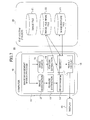
- Fig.1 is a block diagram showing a structure of an image display apparatus 100 according to an embodiment of the present invention.
- the image display apparatus 100 basically comprises a CPU 101, a ROM 102, a RAM 103, a keyboard 104, a mouse 105, a monitor 106, a peripheral I/F (interface) 107, a network I/F (Interface) 108, and an image display unit 110, wherein the image display unit 110 includes an image display portion 111 and an image application 112.
- the CPU 101 manages control of the entire image display apparatus 100 and the components thereof.
- a program executed by the CPU 101 is stored in the ROM 102.
- the CPU executes the program stored in the ROM 102 while using the RAM 103 as a work area.
- the RAM 103 stores the dynamic data which is to be used by the CPU 101 during execution of the program.
- the keyboard 104 and the mouse 105 serve as input apparatuses.
- the monitor 106 displays information which is to be processed by the CPU 101, or information which the CPU 101 has processed.
- the peripheral I/F 107 serves as an I/F (interface) relative to a peripheral device such as a digital camera 120 or a scanner, and the network I/F 108 serves as an interface for connection with a network 130.
- Fig.2 is a block diagram showing processes executed with the image display apparatus 100.
- image DB 250 An image database (hereinafter referred to as "image DB”) 250 is used in the process of feature extraction, and a class database (hereinafter referred to as “class DB”) 260 is used in the process of classification. It is to be noted that image information from the digital camera 120 is input to the image application 112 via the peripheral I/F 107, and is then output to the monitor 106 after being applied with the aforementioned processes executed in the image display portion 111.
- Various features such as a histogram feature, an edge feature, or a texture feature, may serve as image features.
- the present invention may be applied to any of the said features. Needless to say, features other than those extracted from data of an image may also be applied.
- a feature extraction process with respect to a typical histogram feature shall be described. Images may be obtained through various methods (e.g. images input through digital cameras, scanners for example, or images downloaded from the WEB), and the input method of the present invention is not to be limited.
- a suitable color space e.g. Lab, Luv, HSV
- the space is then divided into plural regions, and consideration is then made of which region of the color space corresponds to each pixel in the image.
- normalization is performed, so that the data of the normalized number of pixels for each region serves as the histogram feature.
- the feature of this histogram shall be a point in the feature space of the histogram.
- a sum of the difference between the numbers of pixels of two features in respective regions or a Euclidean distance are generally used as the distance between two features in a feature space of a histogram (the distance indicating the similarity of images where similarity increases more toward 0). Thereby, the distance between the features can be obtained.
- Typical features such as shape or texture may also be used. Accordingly, one image shall correspond to one feature. Therefore, indicating the relation between features in a feature space means that the relation between images shall also be indicated.
- An image viewer generates image coordinates for generating views of images registered in a designated image DB 250. If the designated image DB 250 is designated as the class DB 260, a class viewer may be generated. Taking similarity between images (distance between features) into consideration, similar images are basically arranged having close coordinates. The two methods described below are forms for displaying such images (arrangement algorithm). One is a three segment dividing method, and the other is a four segment (grid) dividing method.
- the three segment dividing method is a method of recurrently dividing a region into three segments. This method is suited for arrangement in a single dimension. That is, the method is effective in a case of designating a feature to each display coordinate axis.
- the four segment (grid) dividing method is a method of dividing on a grid basis, which the method is highly precise despite the fact that the method can only display two dimensionally. The methods will be described in detail below.
- This method is effective for aligning images in a single dimension.
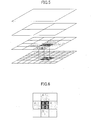
- the method may also be applied two dimensionally or three dimensionally by recurrently dividing the display region by using a dimension axis of a display region other than that of the previously divided display region; nevertheless, the reference points shall have no significance due to the changes of the dimension axes. Therefore, precision shall become lower compared to that of a single dimension given that the reference points cannot be used. Aligning the images one dimensionally with this method in a manner shown in Fig.4 enables easy application to typical applications since the images are aligned as a typical image listing display, and enables images to be browsed efficiently since the images are aligned according to similarity.
- Fig.5 is a view of a portion of the third and fourth layers in Fig.5 when observed from above.
- grids A through D are taken into consideration in a case where a center region thereof is divided into four segments.
- the below given formula may be an evaluation function when obtaining a representative point of region 1 (the upper left region of the center region in Fig.6).
- E1(p) D(A,p)+D(B,p)+(1-D(C,p))+(1-D(D,p))
- D() is a distance function (function indicating the distance between image features), and A through D are representative points (images) for grids A through D.
- the representative points for regions 2 through 4 are obtained in a manner similar to that for region 1. Once the representative points are determined, all of the points (images) included in the center region may be allocated in evenly according to the distance relative to the representative points.
- the images are allocated to all of the grids of a certain layer, the images, in the same aforementioned method of using the grids of an upper level layer, are further allocated to each grid of a lower level layer having further subdivided grids. The process is repeated until the number of images allocated to each grid is no more than 1. After the number of images allocated to each grid is no more than 1, the process is finished.
- the classification method may be achieved on a similar image search system.
- the similar image search system may be structured for example in a manner described below.
- One example of a similar image search system shall be described hereinafter.
- Fig.7 is a block diagram showing a system structure of the similar image search system 60.
- the system 60 includes a computer 10, a file system 20 inside a memory device, and a display 30.
- An image management search program 11 is stored in the computer 10 to thereby allow an image management search to be conducted according to the program.
- An image registration routine 12 and an image search routine 15 are included in the image management search program 11.
- a first feature extraction process 13 and a registration process 14 are conducted in the image registration routine 12.
- a second feature extraction process 16, a search process 17, and a result display process 18 are conducted in the image search routine 15.
- the process result of the result display process 18 is output to the display 30, and is then displayed by the display 30.
- the file system 20 includes three files which are an image file 21, an image file name file 22, and an image feature file 23.
- the search process is performed as follows.
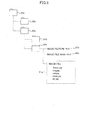
- the folder structure of Fig.8 shows an example of a case where the folders of the file system 20 of the computer have a hierarchical structure of three layers including folders 20a (first layer), 20b and 20c (second layer), 20d and 20e (third layer), and where vast amounts of images are included in a particular folder 20e of the third layer.
- an image feature file 23a and an image file name file 22a may be disposed in a folder at which the image is located or another folder corresponding to a folder at which the image is located.
- the image feature extracted in the first feature extraction process 13 may use the feature employed, for example, in Japanese laid-open publication No.2000-187731. Further, a typical color histogram, for example, may be used in the aforementioned image search.
- each pixel forming a provided image is designated to one of the regions in a prescribed divided color space according to the color of the pixel, and a color histogram of the image is then generated according to the number of pixels included in each of the regions, and thereby, the feature of the image described by the color histogram serves as the feature subject for extraction.
- the color space is a color space conforming to human color recognition, and is divided into regions with values conforming to human color recognition.
- the data of such features can be described as vector data (multi-dimensional data).
- the image features and the image file names are made to correspond to each other in pairs, and are registered in the image feature file 23 and the image file name file 22, respectively.
- a feature index file may also be provided for achieving a high speed search.
- an R-tree which is a typical multi-dimensional spatial index may be employed as the index file.
- a feature from a prescribed image is extracted in the second feature extraction process 16 in the same manner as that of the feature extraction in the afore described image registration process (first feature extraction process 13).
- the extracted image feature is subject to a one by one similarity comparison with the image features in the image feature file 23.
- a typical distance formula such as a Euclid distance may be used since the similarity is described as the distance inside the feature vector space.
- the weight for each of the features may be designated by the user.
- the image features are sorted in an order starting from the one having the shortest distance relative to the image feature of the query image (close similarity). Images having closest similarity are presented in a number predetermined by the user, and are represented as the results of the image search.
- Fig.10 is a front view of a screen of the display 30.
- the similar image search screen 31 has a control indication area 31a and a search result indication area 31b, in which the control indication area 31a is disposed on an upper side thereof, and the' search result indication area 31b is disposed on a lower side thereof.
- a search subject image (subject image) 32 is displayed on the top portion of the control indication area 31a, and a slider bar 33 for designating weight parameter of "entire color”, “color distribution”, “outline” and “pattern”, respectively, is displayed on a right side thereof.
- a designation input portion 34 of a search folder is disposed below the search subject image 32, and an indication number input portion 35 for inputting a maximum indication number for the search is disposed below the slider bar 33 (slide input portion).
- the search folder is C ⁇ TEMP ⁇ DATA, and the maximum indication number is 20. Designation of an image folder or designation for searching a lower level folder may be executed with the designation input portion 34. After input and designation are completed, a search based on the aforementioned settings shall commence upon selecting a search beginning key 50 disposed below the indication number input portion 35.
- Similar images found from the search are indicated in the search result indication area 31b.
- 20 images are indicated since the maximum indication number is set to 20. The user may then select a desired image from the images.
- an image in a folder may be edited or an image file may be added to a folder. Therefore, the user may designate a folder and execute an image registration check so as to check whether the image file 21 in the designated folder is registered in the image file name file 22, and also to re-register the image file 21 according to circumstance. The process is described below.
- image features are previously extracted from images of each folder, and the image feature and the image file name are registered as pairs corresponding to each other in the image feature file 23 and the image file name file 22, so that images can be searched in each folder by using the image feature when conducting the search. Furthermore, even in a case where the user has changed the image file 21 relative to an already registered folder, the image feature can be updated. Furthermore, in accordance with the designation from the designation input portion 34, all folders which are of lower levels than the folder designated during the search may also be subject to search.
- representative images for respective classes are registered in the class DB.
- a representative image of a class employed as a query image may be used for searching from the image database.
- This process is based on a basic clustering method referred to as a NN (nearest neighbor) method.
- NN nearest neighbor
- the number of classes can be reduced by further classifying the class DB into hierarchical classes in such a case where the classes have increased to a considerable number.
- the image DB 250 and the class DB 260 are databases managed by the image search system. 1 ⁇ and 2 ⁇ have the exact same structures as those of 3 ⁇ and 4 ⁇ . As mentioned above, since the class DB 260, in terms of data, may also serve as one of the image DB (databases) 250, the representative images in class DB 260 may be further classified. A data structure for such a case is given below. ⁇ Image DB directory (image DB name directory) (1 ⁇ ) ⁇ image DB (2 ⁇ ) ⁇ first DB directory (class DB name) directory (3 ⁇ ) ⁇ first class DB (4 ⁇ ) ⁇ second class DB directory (class DB name) directory (5 ⁇ ) ⁇ second class DB (6 ⁇ )
- class DB databases
- class levels can be recurrently formed with any number of levels by using the levels of the directory. Since class levels are expressed with use of the directory of the file system, the present system has an advantage of not having to manage the class levels.
- Views for a large size image database can be generated efficiently by generating views in combination with the aforementioned class.
- views may be generated by using the aforementioned view generating method with respect to the images registered in the image DB 250, the user may have difficulty in looking at the views in a case where there are vast amounts of images.
- the class DB 260 may instead be used in forming views since only the images which represent the classes, that is, only the images which represent the entire set of images are registered in the class DB.
- a second level of classes may be formed beforehand so that views for a second level of the class DB 260 may be formed.
- the structures of the levels may be expressed with the levels of an existing file system directory, and each class is composed of independent databases of the same form. Therefore, management of the class levels is not required, and processing may be conducted in a manner similar to that of the image DB 250, the first class DB, and the second class DB.
- this embodiment describes an example of using a feature extracted from an image, it is to be noted that this invention may be applied to any feature (e.g. feature extracted from a document).
- a classification method and an image feature displaying method can be provided so as to efficiently and precisely display the feature spaces for a vast amount of images.
- a program and a recording medium storing the program therein can be provided so as to efficiently and precisely display the feature spaces for a vast amount of images on a computer.
Landscapes
- Engineering & Computer Science (AREA)
- Physics & Mathematics (AREA)
- Theoretical Computer Science (AREA)
- Mathematical Physics (AREA)
- Data Mining & Analysis (AREA)
- Databases & Information Systems (AREA)
- General Engineering & Computer Science (AREA)
- General Physics & Mathematics (AREA)
- Information Retrieval, Db Structures And Fs Structures Therefor (AREA)
- Processing Or Creating Images (AREA)
- Image Analysis (AREA)
Abstract
Description
- a) Define an image positioned nearest to the reference point A (reference point B) as image A (image B).
- b) Define an image positioned farthest from the image A (image B) as image B (image A).
- c) Among the set of images, define the images which are positioned within a radius R from the image A (image B) as a set of images A (set of images B), define the set of images which are positioned within a radius R from the image B (image A) as a set of images B (set of images A), and define the remaining images as a set of images C.
- a) Define an image positioned nearest to the reference point A as image A.
- b) Define an image positioned nearest to the reference point B as image B.
- c) Among the set of images, define the images which are positioned within a radius R from the image A as a set of images A, define the images which are positioned within a radius R from the image B as a set of images B, and define the remaining images as a set of images C.
·image DB directory (image DB name directory) (1 ○)
· image DB (2 ○)
· (first) class DB directory (class DB name) directory (3 ○)
·(second) class DB (4 ○)
· Image DB directory (image DB name directory) (1 ○)
·image DB (2 ○)
· first DB directory (class DB name) directory (3 ○)
· first class DB (4 ○)
·second class DB directory
(class DB name) directory (5 ○)
·second class DB (6 ○)
·image DB directory (image DB name directory) (1 ○)
·image DB (2 ○)
·A class DB directory (class DB name) directory (3 ○)
· A class DB (4 ○)
·B class DB directory (class DB name) directory (5 ○)
· B class DB (6 ○)
Claims (12)
- A method of classifying an image, comprising the steps of:extracting a query image from a plurality of images in an image database;searching, according to a predetermined similarity level, for a representative image resembling the query image in a representative image classification database in which groups of images are represented by respective representative images;registering the query image as a new representative image in the representative image classification database when no resembling representative image is found as a result of the search according to the predetermined similarity level; andadding the query image into a group represented by the resembling representative image found as a result of the search according to the predetermined similarity level.
- The method as claimed in claim 1, wherein the images in the image database are obtainable by referring to the respective representative images in accordance with the predetermined similarity level.
- The method as claimed in claim 1 or 2, further comprising a step of forming the groups into a hierarchical structure, wherein the forming step further includes the steps of:extracting a further query image from the representative images in the representative image classification database;searching, according to a further predetermined similarity level, for a further representative image resembling the further query image in a further representative image classification database in which groups of images are represented by respective further representative images;registering the further image query as a new further representative image in the further representative image classification database when no resembling further representative image is found as a result of the search according to the further predetermined similarity level; andadding the further query image into a group represented by the resembling further representative image found as a result of the search according to the further predetermined similarity level.
- The classification method as claim in claim 3, wherein the hierarchical structure is formed as layers of a directory of a file system for managing the images in the image database.
- An image feature space display method comprising the steps of:determining k representative points (k being an integer which is more than 1) in a feature space in response to a distance between points in the feature space and representative points representative of a plurality of feature spaces surrounding the feature space;obtaining k sub-feature spaces by evenly allocating the points in the feature space into k representative points;dividing a display space into sub-display regions of k segments, the display space being divided in a manner so that the sub-feature spaces correspond to the sub-display regions;repeating the steps of determining, obtaining and dividing until the sub-feature spaces and the sub-display regions are divided into minimum units, respectively; andarranging each image included in a minimum unit of a sub-feature space to a corresponding one of the minimum units of the sub-display regions.
- The image feature space display method as claimed in claim 5, wherein the display space is two dimensional, wherein the feature space and the display space are divided into four sub-feature spaces and four sub-display regions in a grid manner, respectively, wherein the representative points are disposed proximally with respect to two feature spaces which are arranged adjacent to each other and tangent to the sub-feature spaces, and this disposed distally with respect to two other feature spaces which are arranged adjacent to each other but not tangent to the sub-feature spaces.
- The image feature space display method as claimed in claim 5, wherein the display space is three dimensional, wherein the feature space and the display space are divided into eight sub-feature spaces and eight display regions in a grid manner, respectively, wherein the representative points are disposed proximally with respect to three feature spaces which are arranged adjacent to each other and tangent to the sub-feature spaces, and thus disposed distally with respect to three other feature spaces which are arranged adjacent to each other but not tangent to the sub-feature spaces.
- The image feature space display method as claimed in claims 5, 6 or 7, wherein the points in the feature space represent images in a representative image classification database which are classified by the method of any one of claims 1 to 4.
- An image feature display method comprising the steps of:dividing a feature space into three sub-feature spaces, the three sub-feature spaces being composed of two sub-feature spaces disposed within a prescribed radius with respect to two reference points in the feature space, and another sub-feature space other than the two sub-feature spaces;dividing a display space into sub-display regions of three segments, the display space being divided in a same manner as the feature space so that the sub-feature spaces correspond to the sub-display regions;repeating the steps of dividing a feature space and dividing a display space until the sub-feature spaces and the sub-display regions are divided into minimum units, respectively; andarranging each image included in a minimum unit of a sub-feature space to a corresponding one of the minimum units of the sub-display regions.
- The image feature space display method as claimed in claim 9, wherein the reference points are selected from points disposed nearest to representative points included in the two sub-feature spaces.
- A computer program comprising program code means that, when executed on a computer system, instructs the computer system to perform the method of any one of the preceding claims.
- A computer-readable storage medium having recorded thereon a computer program according to claim 11.
Applications Claiming Priority (2)
| Application Number | Priority Date | Filing Date | Title |
|---|---|---|---|
| JP2002223944 | 2002-07-31 | ||
| JP2002223944A JP2004062804A (en) | 2002-07-31 | 2002-07-31 | Image classification method, image feature space display method, program, and recording medium |
Publications (2)
| Publication Number | Publication Date |
|---|---|
| EP1387303A2 true EP1387303A2 (en) | 2004-02-04 |
| EP1387303A3 EP1387303A3 (en) | 2005-09-07 |
Family
ID=30112968
Family Applications (1)
| Application Number | Title | Priority Date | Filing Date |
|---|---|---|---|
| EP03254811A Withdrawn EP1387303A3 (en) | 2002-07-31 | 2003-07-31 | Image classification method and image feature space displaying method |
Country Status (3)
| Country | Link |
|---|---|
| US (1) | US20040024758A1 (en) |
| EP (1) | EP1387303A3 (en) |
| JP (1) | JP2004062804A (en) |
Families Citing this family (38)
| Publication number | Priority date | Publication date | Assignee | Title |
|---|---|---|---|---|
| US7676739B2 (en) * | 2003-11-26 | 2010-03-09 | International Business Machines Corporation | Methods and apparatus for knowledge base assisted annotation |
| US7920716B2 (en) * | 2003-12-25 | 2011-04-05 | Fujitsu Limited | Vehicle search system and vehicle search method |
| JP2005274928A (en) * | 2004-03-24 | 2005-10-06 | Wella Ag | Color simulation system for hair coloring |
| US7840571B2 (en) * | 2004-04-29 | 2010-11-23 | Hewlett-Packard Development Company, L.P. | System and method for information management using handwritten identifiers |
| US7561157B2 (en) * | 2004-10-06 | 2009-07-14 | Apple Inc. | Compare mode for variable number of images |
| US8456488B2 (en) * | 2004-10-06 | 2013-06-04 | Apple Inc. | Displaying digital images using groups, stacks, and version sets |
| US7804508B2 (en) * | 2004-10-06 | 2010-09-28 | Apple Inc. | Viewing digital images on a display using a virtual loupe |
| US7705858B2 (en) * | 2004-10-06 | 2010-04-27 | Apple Inc. | Techniques for displaying digital images on a display |
| US7557818B1 (en) | 2004-10-06 | 2009-07-07 | Apple Inc. | Viewing digital images using a floating controller |
| US8295682B1 (en) | 2005-07-13 | 2012-10-23 | Apple Inc. | Selecting previously-selected segments of a signal |
| JP4721829B2 (en) * | 2005-08-31 | 2011-07-13 | トヨタ自動車株式会社 | Image retrieval method and apparatus |
| US10324899B2 (en) * | 2005-11-07 | 2019-06-18 | Nokia Technologies Oy | Methods for characterizing content item groups |
| US7765491B1 (en) | 2005-11-16 | 2010-07-27 | Apple Inc. | User interface widget for selecting a point or range |
| US20070226321A1 (en) * | 2006-03-23 | 2007-09-27 | R R Donnelley & Sons Company | Image based document access and related systems, methods, and devices |
| JP2007257465A (en) * | 2006-03-24 | 2007-10-04 | Fujifilm Corp | Image display apparatus and method, and program |
| US8243999B2 (en) * | 2006-05-03 | 2012-08-14 | Ut-Battelle, Llc | Method and system for the diagnosis of disease using retinal image content and an archive of diagnosed human patient data |
| US7961938B1 (en) * | 2006-06-30 | 2011-06-14 | Adobe Systems Incorporated | Finding and structuring images based on a color search |
| US7889212B2 (en) * | 2006-09-07 | 2011-02-15 | Apple Inc. | Magnifying visual information using a center-based loupe |
| JP4240330B2 (en) * | 2006-10-24 | 2009-03-18 | ソニー株式会社 | Database creation method, database creation program, database creation device, and video content recording device |
| JP4934843B2 (en) | 2006-11-29 | 2012-05-23 | 株式会社リコー | Information processing apparatus, image registration method, and program |
| US7576755B2 (en) | 2007-02-13 | 2009-08-18 | Microsoft Corporation | Picture collage systems and methods |
| JP4375442B2 (en) * | 2007-06-04 | 2009-12-02 | ソニー株式会社 | Image management apparatus, image management method, and image management program |
| US8775953B2 (en) * | 2007-12-05 | 2014-07-08 | Apple Inc. | Collage display of image projects |
| CN101903883B (en) | 2007-12-20 | 2017-02-15 | 皇家飞利浦电子股份有限公司 | Method and device for case-based decision support |
| US8190623B2 (en) * | 2008-06-05 | 2012-05-29 | Enpulz, L.L.C. | Image search engine using image analysis and categorization |
| US8218838B2 (en) * | 2008-11-03 | 2012-07-10 | Ut-Battelle, Llc | Method and system for assigning a confidence metric for automated determination of optic disc location |
| US20100131499A1 (en) * | 2008-11-24 | 2010-05-27 | Van Leuken Reinier H | Clustering Image Search Results Through Folding |
| US8112428B2 (en) * | 2008-11-24 | 2012-02-07 | Yahoo! Inc. | Clustering image search results through voting: reciprocal election |
| US8352465B1 (en) | 2009-09-03 | 2013-01-08 | Google Inc. | Grouping of image search results |
| US8868569B2 (en) * | 2010-02-24 | 2014-10-21 | Yahoo! Inc. | Methods for detecting and removing duplicates in video search results |
| US8724910B1 (en) | 2010-08-31 | 2014-05-13 | Google Inc. | Selection of representative images |
| US20150170333A1 (en) * | 2011-08-31 | 2015-06-18 | Google Inc. | Grouping And Presenting Images |
| JP5660067B2 (en) * | 2012-03-21 | 2015-01-28 | カシオ計算機株式会社 | Image search system, image search device, image search method, and program |
| US9336302B1 (en) | 2012-07-20 | 2016-05-10 | Zuci Realty Llc | Insight and algorithmic clustering for automated synthesis |
| CN104133917B (en) * | 2014-08-15 | 2018-08-10 | 百度在线网络技术(北京)有限公司 | The classification storage method and device of photo |
| US9911173B2 (en) | 2014-12-30 | 2018-03-06 | Xiaomi Inc. | Method and device for displaying images |
| CN104598534B (en) * | 2014-12-30 | 2018-04-06 | 小米科技有限责任公司 | Picture method for folding and device |
| US11205103B2 (en) | 2016-12-09 | 2021-12-21 | The Research Foundation for the State University | Semisupervised autoencoder for sentiment analysis |
Family Cites Families (8)
| Publication number | Priority date | Publication date | Assignee | Title |
|---|---|---|---|---|
| US145603A (en) * | 1873-12-16 | Improvement in processes of amalgamating gold and silver | ||
| JPS63263590A (en) * | 1987-04-21 | 1988-10-31 | Fujitsu Ltd | Character recognizing system |
| JP3694149B2 (en) * | 1997-07-07 | 2005-09-14 | 株式会社リコー | Image search apparatus, image search key text generation method, program for causing a computer to function as the apparatus, and computer-readable recording medium on which a program for causing the computer to execute the method is recorded |
| US6240424B1 (en) * | 1998-04-22 | 2001-05-29 | Nbc Usa, Inc. | Method and system for similarity-based image classification |
| US6748398B2 (en) * | 2001-03-30 | 2004-06-08 | Microsoft Corporation | Relevance maximizing, iteration minimizing, relevance-feedback, content-based image retrieval (CBIR) |
| US7154535B2 (en) * | 2001-07-13 | 2006-12-26 | Matsushita Electric Industrial Co., Ltd. | Digital camera capable of directly accessing images recorded on another digital camera |
| US6832006B2 (en) * | 2001-07-23 | 2004-12-14 | Eastman Kodak Company | System and method for controlling image compression based on image emphasis |
| WO2003083765A1 (en) * | 2002-03-28 | 2003-10-09 | Color Savvy Systems Limited | Method for segmenting an image |
-
2002
- 2002-07-31 JP JP2002223944A patent/JP2004062804A/en active Pending
-
2003
- 2003-07-16 US US10/619,497 patent/US20040024758A1/en not_active Abandoned
- 2003-07-31 EP EP03254811A patent/EP1387303A3/en not_active Withdrawn
Also Published As
| Publication number | Publication date |
|---|---|
| EP1387303A3 (en) | 2005-09-07 |
| JP2004062804A (en) | 2004-02-26 |
| US20040024758A1 (en) | 2004-02-05 |
Similar Documents
| Publication | Publication Date | Title |
|---|---|---|
| EP1387303A2 (en) | Image classification method and image feature space displaying method | |
| JP2776295B2 (en) | Image index generation method and image index generation device | |
| JP5229744B2 (en) | Image classification device and image classification program | |
| JP3747589B2 (en) | Image feature amount comparison device and recording medium storing image feature amount comparison program | |
| EP0130050B1 (en) | Data management apparatus | |
| JP4340367B2 (en) | Image classification apparatus and computer-readable recording medium storing a program for causing a computer to function as the apparatus | |
| US7508998B2 (en) | Image search apparatus, image search method, program, and storage medium | |
| US6584223B1 (en) | Image search apparatus and method | |
| JP4579404B2 (en) | Image processing method and apparatus | |
| EP1227430B1 (en) | System and method for determining image similarity | |
| US6711287B1 (en) | Image-feature extraction method and computer-readable record medium with a program for making a computer execute steps of the method recorded therein | |
| JP5665125B2 (en) | Image processing method and image processing system | |
| JP2004361987A (en) | Image retrieval system, image classification system, image retrieval program, image classification program, and image retrieval method and image classification method | |
| KR20050004044A (en) | Method and device for measuring visual similarity | |
| JP4173246B2 (en) | Similar image display method and recording medium storing similar image display processing program | |
| US20080219563A1 (en) | Configuration of a plurality of images for multi-dimensional display | |
| JP4674257B2 (en) | Image classification apparatus and computer-readable recording medium storing a program for causing a computer to function as the apparatus | |
| JP3952592B2 (en) | Image search apparatus and method | |
| JP5515417B2 (en) | Image processing method and apparatus, and computer program therefor | |
| JP4148642B2 (en) | Similar image search device and computer-readable recording medium | |
| JP2005208740A (en) | Partial image search device and partial image search program | |
| JP3199009B2 (en) | Image storage / management apparatus and image index generation method | |
| JP2011043954A (en) | Image processor, image processing method, and image processing program | |
| JP2006060796A (en) | Video search apparatus, method and program, and recording medium recording program | |
| JP2004192121A (en) | Image search device, image classification method, image search method, and program |
Legal Events
| Date | Code | Title | Description |
|---|---|---|---|
| PUAI | Public reference made under article 153(3) epc to a published international application that has entered the european phase |
Free format text: ORIGINAL CODE: 0009012 |
|
| 17P | Request for examination filed |
Effective date: 20030731 |
|
| AK | Designated contracting states |
Kind code of ref document: A2 Designated state(s): AT BE BG CH CY CZ DE DK EE ES FI FR GB GR HU IE IT LI LU MC NL PT RO SE SI SK TR |
|
| AX | Request for extension of the european patent |
Extension state: AL LT LV MK |
|
| PUAL | Search report despatched |
Free format text: ORIGINAL CODE: 0009013 |
|
| RIC1 | Information provided on ipc code assigned before grant |
Ipc: 7G 06K 9/62 B Ipc: 7G 06F 17/30 A |
|
| AK | Designated contracting states |
Kind code of ref document: A3 Designated state(s): AT BE BG CH CY CZ DE DK EE ES FI FR GB GR HU IE IT LI LU MC NL PT RO SE SI SK TR |
|
| AX | Request for extension of the european patent |
Extension state: AL LT LV MK |
|
| AKX | Designation fees paid |
Designated state(s): DE ES FR GB IT NL |
|
| 17Q | First examination report despatched |
Effective date: 20061128 |
|
| STAA | Information on the status of an ep patent application or granted ep patent |
Free format text: STATUS: THE APPLICATION HAS BEEN WITHDRAWN |
|
| 18W | Application withdrawn |
Effective date: 20090525 |