EP1386886A1 - Nanoparticle having an inorganic core - Google Patents
Nanoparticle having an inorganic core Download PDFInfo
- Publication number
- EP1386886A1 EP1386886A1 EP03254786A EP03254786A EP1386886A1 EP 1386886 A1 EP1386886 A1 EP 1386886A1 EP 03254786 A EP03254786 A EP 03254786A EP 03254786 A EP03254786 A EP 03254786A EP 1386886 A1 EP1386886 A1 EP 1386886A1
- Authority
- EP
- European Patent Office
- Prior art keywords
- nanoparticle
- oxidation state
- inorganic core
- inorganic
- nanoparticles
- Prior art date
- Legal status (The legal status is an assumption and is not a legal conclusion. Google has not performed a legal analysis and makes no representation as to the accuracy of the status listed.)
- Withdrawn
Links
- 239000002105 nanoparticle Substances 0.000 title claims abstract description 130
- XEEYBQQBJWHFJM-UHFFFAOYSA-N Iron Chemical compound [Fe] XEEYBQQBJWHFJM-UHFFFAOYSA-N 0.000 claims abstract description 50
- 230000003647 oxidation Effects 0.000 claims abstract description 46
- 238000007254 oxidation reaction Methods 0.000 claims abstract description 46
- 239000011248 coating agent Substances 0.000 claims abstract description 41
- 238000000576 coating method Methods 0.000 claims abstract description 41
- 229910052596 spinel Inorganic materials 0.000 claims abstract description 35
- 239000011029 spinel Substances 0.000 claims abstract description 35
- 229910000859 α-Fe Inorganic materials 0.000 claims abstract description 35
- 239000000463 material Substances 0.000 claims abstract description 29
- 229910052742 iron Inorganic materials 0.000 claims abstract description 25
- 239000013078 crystal Substances 0.000 claims abstract description 18
- 229910052751 metal Inorganic materials 0.000 claims abstract description 17
- 239000002184 metal Substances 0.000 claims abstract description 17
- 230000000087 stabilizing effect Effects 0.000 claims description 17
- 229910010272 inorganic material Inorganic materials 0.000 claims description 7
- 239000011147 inorganic material Substances 0.000 claims description 7
- 239000002178 crystalline material Substances 0.000 claims description 4
- 239000002182 crystalline inorganic material Substances 0.000 abstract description 2
- 239000004094 surface-active agent Substances 0.000 description 44
- -1 but not limited to Inorganic materials 0.000 description 35
- 239000000010 aprotic solvent Substances 0.000 description 26
- 239000007800 oxidant agent Substances 0.000 description 25
- 230000001590 oxidative effect Effects 0.000 description 24
- LFQSCWFLJHTTHZ-UHFFFAOYSA-N Ethanol Chemical compound CCO LFQSCWFLJHTTHZ-UHFFFAOYSA-N 0.000 description 21
- 239000011541 reaction mixture Substances 0.000 description 21
- 238000000034 method Methods 0.000 description 15
- 150000002902 organometallic compounds Chemical class 0.000 description 15
- PXHVJJICTQNCMI-UHFFFAOYSA-N Nickel Chemical compound [Ni] PXHVJJICTQNCMI-UHFFFAOYSA-N 0.000 description 14
- 230000000977 initiatory effect Effects 0.000 description 14
- 238000004132 cross linking Methods 0.000 description 12
- 229940087654 iron carbonyl Drugs 0.000 description 12
- 150000002576 ketones Chemical class 0.000 description 12
- 150000001412 amines Chemical class 0.000 description 11
- 239000003446 ligand Substances 0.000 description 11
- 239000000203 mixture Substances 0.000 description 11
- 150000003573 thiols Chemical class 0.000 description 11
- 229910017052 cobalt Inorganic materials 0.000 description 10
- 239000010941 cobalt Substances 0.000 description 10
- SZVJSHCCFOBDDC-UHFFFAOYSA-N ferrosoferric oxide Chemical compound O=[Fe]O[Fe]O[Fe]=O SZVJSHCCFOBDDC-UHFFFAOYSA-N 0.000 description 10
- 239000002159 nanocrystal Substances 0.000 description 10
- 239000003960 organic solvent Substances 0.000 description 9
- 238000010992 reflux Methods 0.000 description 9
- 238000003756 stirring Methods 0.000 description 9
- 229910052723 transition metal Inorganic materials 0.000 description 9
- CSCPPACGZOOCGX-UHFFFAOYSA-N Acetone Chemical compound CC(C)=O CSCPPACGZOOCGX-UHFFFAOYSA-N 0.000 description 8
- UQSXHKLRYXJYBZ-UHFFFAOYSA-N Iron oxide Chemical compound [Fe]=O UQSXHKLRYXJYBZ-UHFFFAOYSA-N 0.000 description 8
- 150000001350 alkyl halides Chemical class 0.000 description 8
- XLYOFNOQVPJJNP-UHFFFAOYSA-M hydroxide Chemical compound [OH-] XLYOFNOQVPJJNP-UHFFFAOYSA-M 0.000 description 8
- 239000000843 powder Substances 0.000 description 8
- 150000003624 transition metals Chemical class 0.000 description 8
- VYZAMTAEIAYCRO-UHFFFAOYSA-N Chromium Chemical compound [Cr] VYZAMTAEIAYCRO-UHFFFAOYSA-N 0.000 description 7
- 229910017147 Fe(CO)5 Inorganic materials 0.000 description 7
- 229910052688 Gadolinium Inorganic materials 0.000 description 7
- KFZMGEQAYNKOFK-UHFFFAOYSA-N Isopropanol Chemical compound CC(C)O KFZMGEQAYNKOFK-UHFFFAOYSA-N 0.000 description 7
- ZOKXTWBITQBERF-UHFFFAOYSA-N Molybdenum Chemical compound [Mo] ZOKXTWBITQBERF-UHFFFAOYSA-N 0.000 description 7
- HCHKCACWOHOZIP-UHFFFAOYSA-N Zinc Chemical compound [Zn] HCHKCACWOHOZIP-UHFFFAOYSA-N 0.000 description 7
- 239000012298 atmosphere Substances 0.000 description 7
- 150000007942 carboxylates Chemical class 0.000 description 7
- 229910052804 chromium Inorganic materials 0.000 description 7
- 239000011651 chromium Substances 0.000 description 7
- GUTLYIVDDKVIGB-UHFFFAOYSA-N cobalt atom Chemical compound [Co] GUTLYIVDDKVIGB-UHFFFAOYSA-N 0.000 description 7
- UIWYJDYFSGRHKR-UHFFFAOYSA-N gadolinium atom Chemical compound [Gd] UIWYJDYFSGRHKR-UHFFFAOYSA-N 0.000 description 7
- WPBNNNQJVZRUHP-UHFFFAOYSA-L manganese(2+);methyl n-[[2-(methoxycarbonylcarbamothioylamino)phenyl]carbamothioyl]carbamate;n-[2-(sulfidocarbothioylamino)ethyl]carbamodithioate Chemical compound [Mn+2].[S-]C(=S)NCCNC([S-])=S.COC(=O)NC(=S)NC1=CC=CC=C1NC(=S)NC(=O)OC WPBNNNQJVZRUHP-UHFFFAOYSA-L 0.000 description 7
- 229910052750 molybdenum Inorganic materials 0.000 description 7
- 239000011733 molybdenum Substances 0.000 description 7
- 229910052759 nickel Inorganic materials 0.000 description 7
- 229910052720 vanadium Inorganic materials 0.000 description 7
- GPPXJZIENCGNKB-UHFFFAOYSA-N vanadium Chemical compound [V]#[V] GPPXJZIENCGNKB-UHFFFAOYSA-N 0.000 description 7
- 229910052727 yttrium Inorganic materials 0.000 description 7
- VWQVUPCCIRVNHF-UHFFFAOYSA-N yttrium atom Chemical compound [Y] VWQVUPCCIRVNHF-UHFFFAOYSA-N 0.000 description 7
- 229910052725 zinc Inorganic materials 0.000 description 7
- 239000011701 zinc Substances 0.000 description 7
- OKKJLVBELUTLKV-UHFFFAOYSA-N Methanol Chemical compound OC OKKJLVBELUTLKV-UHFFFAOYSA-N 0.000 description 6
- 238000002056 X-ray absorption spectroscopy Methods 0.000 description 6
- 238000006243 chemical reaction Methods 0.000 description 6
- POULHZVOKOAJMA-UHFFFAOYSA-N dodecanoic acid Chemical compound CCCCCCCCCCCC(O)=O POULHZVOKOAJMA-UHFFFAOYSA-N 0.000 description 6
- DCAYPVUWAIABOU-UHFFFAOYSA-N hexadecane Chemical compound CCCCCCCCCCCCCCCC DCAYPVUWAIABOU-UHFFFAOYSA-N 0.000 description 6
- 150000002978 peroxides Chemical class 0.000 description 6
- 239000002244 precipitate Substances 0.000 description 6
- ZUHZGEOKBKGPSW-UHFFFAOYSA-N tetraglyme Chemical compound COCCOCCOCCOCCOC ZUHZGEOKBKGPSW-UHFFFAOYSA-N 0.000 description 6
- 229910002518 CoFe2O4 Inorganic materials 0.000 description 5
- RYGMFSIKBFXOCR-UHFFFAOYSA-N Copper Chemical compound [Cu] RYGMFSIKBFXOCR-UHFFFAOYSA-N 0.000 description 5
- 229910017163 MnFe2O4 Inorganic materials 0.000 description 5
- RTAQQCXQSZGOHL-UHFFFAOYSA-N Titanium Chemical compound [Ti] RTAQQCXQSZGOHL-UHFFFAOYSA-N 0.000 description 5
- 150000001502 aryl halides Chemical class 0.000 description 5
- 229910052793 cadmium Inorganic materials 0.000 description 5
- BDOSMKKIYDKNTQ-UHFFFAOYSA-N cadmium atom Chemical compound [Cd] BDOSMKKIYDKNTQ-UHFFFAOYSA-N 0.000 description 5
- 229910052802 copper Inorganic materials 0.000 description 5
- 239000010949 copper Substances 0.000 description 5
- 238000010438 heat treatment Methods 0.000 description 5
- 238000001556 precipitation Methods 0.000 description 5
- 229910052719 titanium Inorganic materials 0.000 description 5
- 239000010936 titanium Substances 0.000 description 5
- UYPYRKYUKCHHIB-UHFFFAOYSA-N trimethylamine N-oxide Chemical group C[N+](C)(C)[O-] UYPYRKYUKCHHIB-UHFFFAOYSA-N 0.000 description 5
- NKJOXAZJBOMXID-UHFFFAOYSA-N 1,1'-Oxybisoctane Chemical compound CCCCCCCCOCCCCCCCC NKJOXAZJBOMXID-UHFFFAOYSA-N 0.000 description 4
- XFXPMWWXUTWYJX-UHFFFAOYSA-N Cyanide Chemical compound N#[C-] XFXPMWWXUTWYJX-UHFFFAOYSA-N 0.000 description 4
- AVXURJPOCDRRFD-UHFFFAOYSA-N Hydroxylamine Chemical class ON AVXURJPOCDRRFD-UHFFFAOYSA-N 0.000 description 4
- GQPLMRYTRLFLPF-UHFFFAOYSA-N Nitrous Oxide Chemical compound [O-][N+]#N GQPLMRYTRLFLPF-UHFFFAOYSA-N 0.000 description 4
- ISWSIDIOOBJBQZ-UHFFFAOYSA-N Phenol Chemical compound OC1=CC=CC=C1 ISWSIDIOOBJBQZ-UHFFFAOYSA-N 0.000 description 4
- 238000002441 X-ray diffraction Methods 0.000 description 4
- 238000005054 agglomeration Methods 0.000 description 4
- 230000002776 aggregation Effects 0.000 description 4
- 150000001298 alcohols Chemical class 0.000 description 4
- 150000001299 aldehydes Chemical class 0.000 description 4
- 150000001336 alkenes Chemical class 0.000 description 4
- 150000001345 alkine derivatives Chemical class 0.000 description 4
- 230000005540 biological transmission Effects 0.000 description 4
- 150000001735 carboxylic acids Chemical class 0.000 description 4
- 150000003950 cyclic amides Chemical class 0.000 description 4
- 150000004292 cyclic ethers Chemical class 0.000 description 4
- 150000002118 epoxides Chemical class 0.000 description 4
- 125000005283 haloketone group Chemical group 0.000 description 4
- 238000003384 imaging method Methods 0.000 description 4
- 239000011261 inert gas Substances 0.000 description 4
- 229940031182 nanoparticles iron oxide Drugs 0.000 description 4
- 239000002245 particle Substances 0.000 description 4
- 238000004098 selected area electron diffraction Methods 0.000 description 4
- 238000006467 substitution reaction Methods 0.000 description 4
- 125000002813 thiocarbonyl group Chemical group *C(*)=S 0.000 description 4
- 125000000391 vinyl group Chemical group [H]C([*])=C([H])[H] 0.000 description 4
- 229920002554 vinyl polymer Polymers 0.000 description 4
- 229910006297 γ-Fe2O3 Inorganic materials 0.000 description 4
- 206010001488 Aggression Diseases 0.000 description 3
- 239000005639 Lauric acid Substances 0.000 description 3
- 238000003917 TEM image Methods 0.000 description 3
- YXFVVABEGXRONW-UHFFFAOYSA-N Toluene Chemical compound CC1=CC=CC=C1 YXFVVABEGXRONW-UHFFFAOYSA-N 0.000 description 3
- 239000002253 acid Substances 0.000 description 3
- 229920006397 acrylic thermoplastic Polymers 0.000 description 3
- 230000015572 biosynthetic process Effects 0.000 description 3
- 125000002915 carbonyl group Chemical group [*:2]C([*:1])=O 0.000 description 3
- QRXDDLFGCDQOTA-UHFFFAOYSA-N cobalt(2+) iron(2+) oxygen(2-) Chemical compound [O-2].[Fe+2].[Co+2].[O-2] QRXDDLFGCDQOTA-UHFFFAOYSA-N 0.000 description 3
- 125000000058 cyclopentadienyl group Chemical group C1(=CC=CC1)* 0.000 description 3
- 238000010586 diagram Methods 0.000 description 3
- QFEOTYVTTQCYAZ-UHFFFAOYSA-N dimanganese decacarbonyl Chemical compound [Mn].[Mn].[O+]#[C-].[O+]#[C-].[O+]#[C-].[O+]#[C-].[O+]#[C-].[O+]#[C-].[O+]#[C-].[O+]#[C-].[O+]#[C-].[O+]#[C-] QFEOTYVTTQCYAZ-UHFFFAOYSA-N 0.000 description 3
- KPUWHANPEXNPJT-UHFFFAOYSA-N disiloxane Chemical class [SiH3]O[SiH3] KPUWHANPEXNPJT-UHFFFAOYSA-N 0.000 description 3
- 238000000921 elemental analysis Methods 0.000 description 3
- 230000002209 hydrophobic effect Effects 0.000 description 3
- CUSDLVIPMHDAFT-UHFFFAOYSA-N iron(3+);manganese(2+);oxygen(2-) Chemical compound [O-2].[O-2].[O-2].[O-2].[Mn+2].[Fe+3].[Fe+3] CUSDLVIPMHDAFT-UHFFFAOYSA-N 0.000 description 3
- XTAZYLNFDRKIHJ-UHFFFAOYSA-N n,n-dioctyloctan-1-amine Chemical compound CCCCCCCCN(CCCCCCCC)CCCCCCCC XTAZYLNFDRKIHJ-UHFFFAOYSA-N 0.000 description 3
- 238000003921 particle size analysis Methods 0.000 description 3
- 125000002097 pentamethylcyclopentadienyl group Chemical group 0.000 description 3
- ACVYVLVWPXVTIT-UHFFFAOYSA-M phosphinate Chemical compound [O-][PH2]=O ACVYVLVWPXVTIT-UHFFFAOYSA-M 0.000 description 3
- UEZVMMHDMIWARA-UHFFFAOYSA-M phosphonate Chemical compound [O-]P(=O)=O UEZVMMHDMIWARA-UHFFFAOYSA-M 0.000 description 3
- 229920003229 poly(methyl methacrylate) Polymers 0.000 description 3
- BDHFUVZGWQCTTF-UHFFFAOYSA-M sulfonate Chemical compound [O-]S(=O)=O BDHFUVZGWQCTTF-UHFFFAOYSA-M 0.000 description 3
- ISXSCDLOGDJUNJ-UHFFFAOYSA-N tert-butyl prop-2-enoate Chemical compound CC(C)(C)OC(=O)C=C ISXSCDLOGDJUNJ-UHFFFAOYSA-N 0.000 description 3
- 238000004627 transmission electron microscopy Methods 0.000 description 3
- FRPZMMHWLSIFAZ-UHFFFAOYSA-N 10-undecenoic acid Chemical compound OC(=O)CCCCCCCCC=C FRPZMMHWLSIFAZ-UHFFFAOYSA-N 0.000 description 2
- MYMOFIZGZYHOMD-UHFFFAOYSA-N Dioxygen Chemical compound O=O MYMOFIZGZYHOMD-UHFFFAOYSA-N 0.000 description 2
- 238000009835 boiling Methods 0.000 description 2
- 125000004432 carbon atom Chemical group C* 0.000 description 2
- FQMNUIZEFUVPNU-UHFFFAOYSA-N cobalt iron Chemical compound [Fe].[Co].[Co] FQMNUIZEFUVPNU-UHFFFAOYSA-N 0.000 description 2
- 229910001882 dioxygen Inorganic materials 0.000 description 2
- DALUDRGQOYMVLD-UHFFFAOYSA-N iron manganese Chemical compound [Mn].[Fe] DALUDRGQOYMVLD-UHFFFAOYSA-N 0.000 description 2
- 150000002739 metals Chemical class 0.000 description 2
- 125000002496 methyl group Chemical group [H]C([H])([H])* 0.000 description 2
- 239000001272 nitrous oxide Substances 0.000 description 2
- 125000002524 organometallic group Chemical group 0.000 description 2
- 150000004965 peroxy acids Chemical class 0.000 description 2
- 230000001376 precipitating effect Effects 0.000 description 2
- 239000002243 precursor Substances 0.000 description 2
- 239000004215 Carbon black (E152) Substances 0.000 description 1
- 229910000708 MFe2O4 Inorganic materials 0.000 description 1
- 229910016660 Mn2(CO)10 Inorganic materials 0.000 description 1
- KHAVLLBUVKBTBG-UHFFFAOYSA-N caproleic acid Natural products OC(=O)CCCCCCCC=C KHAVLLBUVKBTBG-UHFFFAOYSA-N 0.000 description 1
- BXCQGSQPWPGFIV-UHFFFAOYSA-N carbon monoxide;cobalt;cobalt(2+);methanone Chemical compound [Co].[Co+2].O=[CH-].O=[CH-].[O+]#[C-].[O+]#[C-].[O+]#[C-].[O+]#[C-].[O+]#[C-].[O+]#[C-] BXCQGSQPWPGFIV-UHFFFAOYSA-N 0.000 description 1
- 150000001768 cations Chemical class 0.000 description 1
- 239000000470 constituent Substances 0.000 description 1
- 239000002872 contrast media Substances 0.000 description 1
- 238000010908 decantation Methods 0.000 description 1
- 230000001419 dependent effect Effects 0.000 description 1
- 239000003814 drug Substances 0.000 description 1
- 238000012377 drug delivery Methods 0.000 description 1
- 229930195733 hydrocarbon Natural products 0.000 description 1
- 150000002430 hydrocarbons Chemical class 0.000 description 1
- 230000003993 interaction Effects 0.000 description 1
- 239000002122 magnetic nanoparticle Substances 0.000 description 1
- 238000002595 magnetic resonance imaging Methods 0.000 description 1
- 229910044991 metal oxide Inorganic materials 0.000 description 1
- 150000004706 metal oxides Chemical class 0.000 description 1
- TVMXDCGIABBOFY-UHFFFAOYSA-N octane Chemical compound CCCCCCCC TVMXDCGIABBOFY-UHFFFAOYSA-N 0.000 description 1
- 238000006116 polymerization reaction Methods 0.000 description 1
- 238000000926 separation method Methods 0.000 description 1
- 239000002904 solvent Substances 0.000 description 1
- 150000007944 thiolates Chemical class 0.000 description 1
- 229960002703 undecylenic acid Drugs 0.000 description 1
Images


Classifications
-
- C—CHEMISTRY; METALLURGY
- C01—INORGANIC CHEMISTRY
- C01G—COMPOUNDS CONTAINING METALS NOT COVERED BY SUBCLASSES C01D OR C01F
- C01G49/00—Compounds of iron
- C01G49/0018—Mixed oxides or hydroxides
-
- B—PERFORMING OPERATIONS; TRANSPORTING
- B82—NANOTECHNOLOGY
- B82Y—SPECIFIC USES OR APPLICATIONS OF NANOSTRUCTURES; MEASUREMENT OR ANALYSIS OF NANOSTRUCTURES; MANUFACTURE OR TREATMENT OF NANOSTRUCTURES
- B82Y25/00—Nanomagnetism, e.g. magnetoimpedance, anisotropic magnetoresistance, giant magnetoresistance or tunneling magnetoresistance
-
- B—PERFORMING OPERATIONS; TRANSPORTING
- B82—NANOTECHNOLOGY
- B82Y—SPECIFIC USES OR APPLICATIONS OF NANOSTRUCTURES; MEASUREMENT OR ANALYSIS OF NANOSTRUCTURES; MANUFACTURE OR TREATMENT OF NANOSTRUCTURES
- B82Y30/00—Nanotechnology for materials or surface science, e.g. nanocomposites
-
- C—CHEMISTRY; METALLURGY
- C01—INORGANIC CHEMISTRY
- C01G—COMPOUNDS CONTAINING METALS NOT COVERED BY SUBCLASSES C01D OR C01F
- C01G49/00—Compounds of iron
- C01G49/0018—Mixed oxides or hydroxides
- C01G49/0072—Mixed oxides or hydroxides containing manganese
-
- C—CHEMISTRY; METALLURGY
- C01—INORGANIC CHEMISTRY
- C01G—COMPOUNDS CONTAINING METALS NOT COVERED BY SUBCLASSES C01D OR C01F
- C01G49/00—Compounds of iron
- C01G49/02—Oxides; Hydroxides
- C01G49/06—Ferric oxide [Fe2O3]
-
- C—CHEMISTRY; METALLURGY
- C01—INORGANIC CHEMISTRY
- C01G—COMPOUNDS CONTAINING METALS NOT COVERED BY SUBCLASSES C01D OR C01F
- C01G49/00—Compounds of iron
- C01G49/02—Oxides; Hydroxides
- C01G49/08—Ferroso-ferric oxide [Fe3O4]
-
- C—CHEMISTRY; METALLURGY
- C01—INORGANIC CHEMISTRY
- C01G—COMPOUNDS CONTAINING METALS NOT COVERED BY SUBCLASSES C01D OR C01F
- C01G51/00—Compounds of cobalt
-
- C—CHEMISTRY; METALLURGY
- C09—DYES; PAINTS; POLISHES; NATURAL RESINS; ADHESIVES; COMPOSITIONS NOT OTHERWISE PROVIDED FOR; APPLICATIONS OF MATERIALS NOT OTHERWISE PROVIDED FOR
- C09C—TREATMENT OF INORGANIC MATERIALS, OTHER THAN FIBROUS FILLERS, TO ENHANCE THEIR PIGMENTING OR FILLING PROPERTIES ; PREPARATION OF CARBON BLACK ; PREPARATION OF INORGANIC MATERIALS WHICH ARE NO SINGLE CHEMICAL COMPOUNDS AND WHICH ARE MAINLY USED AS PIGMENTS OR FILLERS
- C09C1/00—Treatment of specific inorganic materials other than fibrous fillers; Preparation of carbon black
- C09C1/22—Compounds of iron
-
- C—CHEMISTRY; METALLURGY
- C09—DYES; PAINTS; POLISHES; NATURAL RESINS; ADHESIVES; COMPOSITIONS NOT OTHERWISE PROVIDED FOR; APPLICATIONS OF MATERIALS NOT OTHERWISE PROVIDED FOR
- C09C—TREATMENT OF INORGANIC MATERIALS, OTHER THAN FIBROUS FILLERS, TO ENHANCE THEIR PIGMENTING OR FILLING PROPERTIES ; PREPARATION OF CARBON BLACK ; PREPARATION OF INORGANIC MATERIALS WHICH ARE NO SINGLE CHEMICAL COMPOUNDS AND WHICH ARE MAINLY USED AS PIGMENTS OR FILLERS
- C09C1/00—Treatment of specific inorganic materials other than fibrous fillers; Preparation of carbon black
- C09C1/22—Compounds of iron
- C09C1/24—Oxides of iron
-
- C—CHEMISTRY; METALLURGY
- C09—DYES; PAINTS; POLISHES; NATURAL RESINS; ADHESIVES; COMPOSITIONS NOT OTHERWISE PROVIDED FOR; APPLICATIONS OF MATERIALS NOT OTHERWISE PROVIDED FOR
- C09C—TREATMENT OF INORGANIC MATERIALS, OTHER THAN FIBROUS FILLERS, TO ENHANCE THEIR PIGMENTING OR FILLING PROPERTIES ; PREPARATION OF CARBON BLACK ; PREPARATION OF INORGANIC MATERIALS WHICH ARE NO SINGLE CHEMICAL COMPOUNDS AND WHICH ARE MAINLY USED AS PIGMENTS OR FILLERS
- C09C3/00—Treatment in general of inorganic materials, other than fibrous fillers, to enhance their pigmenting or filling properties
- C09C3/08—Treatment with low-molecular-weight non-polymer organic compounds
-
- H—ELECTRICITY
- H01—ELECTRIC ELEMENTS
- H01F—MAGNETS; INDUCTANCES; TRANSFORMERS; SELECTION OF MATERIALS FOR THEIR MAGNETIC PROPERTIES
- H01F1/00—Magnets or magnetic bodies characterised by the magnetic materials therefor; Selection of materials for their magnetic properties
- H01F1/0036—Magnets or magnetic bodies characterised by the magnetic materials therefor; Selection of materials for their magnetic properties showing low dimensional magnetism, i.e. spin rearrangements due to a restriction of dimensions, e.g. showing giant magnetoresistivity
- H01F1/0045—Zero dimensional, e.g. nanoparticles, soft nanoparticles for medical/biological use
- H01F1/0054—Coated nanoparticles, e.g. nanoparticles coated with organic surfactant
-
- H—ELECTRICITY
- H01—ELECTRIC ELEMENTS
- H01F—MAGNETS; INDUCTANCES; TRANSFORMERS; SELECTION OF MATERIALS FOR THEIR MAGNETIC PROPERTIES
- H01F1/00—Magnets or magnetic bodies characterised by the magnetic materials therefor; Selection of materials for their magnetic properties
- H01F1/01—Magnets or magnetic bodies characterised by the magnetic materials therefor; Selection of materials for their magnetic properties of inorganic materials
- H01F1/03—Magnets or magnetic bodies characterised by the magnetic materials therefor; Selection of materials for their magnetic properties of inorganic materials characterised by their coercivity
- H01F1/12—Magnets or magnetic bodies characterised by the magnetic materials therefor; Selection of materials for their magnetic properties of inorganic materials characterised by their coercivity of soft-magnetic materials
- H01F1/14—Magnets or magnetic bodies characterised by the magnetic materials therefor; Selection of materials for their magnetic properties of inorganic materials characterised by their coercivity of soft-magnetic materials metals or alloys
- H01F1/20—Magnets or magnetic bodies characterised by the magnetic materials therefor; Selection of materials for their magnetic properties of inorganic materials characterised by their coercivity of soft-magnetic materials metals or alloys in the form of particles, e.g. powder
- H01F1/22—Magnets or magnetic bodies characterised by the magnetic materials therefor; Selection of materials for their magnetic properties of inorganic materials characterised by their coercivity of soft-magnetic materials metals or alloys in the form of particles, e.g. powder pressed, sintered, or bound together
- H01F1/24—Magnets or magnetic bodies characterised by the magnetic materials therefor; Selection of materials for their magnetic properties of inorganic materials characterised by their coercivity of soft-magnetic materials metals or alloys in the form of particles, e.g. powder pressed, sintered, or bound together the particles being insulated
- H01F1/26—Magnets or magnetic bodies characterised by the magnetic materials therefor; Selection of materials for their magnetic properties of inorganic materials characterised by their coercivity of soft-magnetic materials metals or alloys in the form of particles, e.g. powder pressed, sintered, or bound together the particles being insulated by macromolecular organic substances
-
- H—ELECTRICITY
- H01—ELECTRIC ELEMENTS
- H01F—MAGNETS; INDUCTANCES; TRANSFORMERS; SELECTION OF MATERIALS FOR THEIR MAGNETIC PROPERTIES
- H01F1/00—Magnets or magnetic bodies characterised by the magnetic materials therefor; Selection of materials for their magnetic properties
- H01F1/01—Magnets or magnetic bodies characterised by the magnetic materials therefor; Selection of materials for their magnetic properties of inorganic materials
- H01F1/03—Magnets or magnetic bodies characterised by the magnetic materials therefor; Selection of materials for their magnetic properties of inorganic materials characterised by their coercivity
- H01F1/12—Magnets or magnetic bodies characterised by the magnetic materials therefor; Selection of materials for their magnetic properties of inorganic materials characterised by their coercivity of soft-magnetic materials
- H01F1/34—Magnets or magnetic bodies characterised by the magnetic materials therefor; Selection of materials for their magnetic properties of inorganic materials characterised by their coercivity of soft-magnetic materials non-metallic substances, e.g. ferrites
- H01F1/36—Magnets or magnetic bodies characterised by the magnetic materials therefor; Selection of materials for their magnetic properties of inorganic materials characterised by their coercivity of soft-magnetic materials non-metallic substances, e.g. ferrites in the form of particles
-
- C—CHEMISTRY; METALLURGY
- C01—INORGANIC CHEMISTRY
- C01P—INDEXING SCHEME RELATING TO STRUCTURAL AND PHYSICAL ASPECTS OF SOLID INORGANIC COMPOUNDS
- C01P2002/00—Crystal-structural characteristics
- C01P2002/30—Three-dimensional structures
- C01P2002/32—Three-dimensional structures spinel-type (AB2O4)
-
- C—CHEMISTRY; METALLURGY
- C01—INORGANIC CHEMISTRY
- C01P—INDEXING SCHEME RELATING TO STRUCTURAL AND PHYSICAL ASPECTS OF SOLID INORGANIC COMPOUNDS
- C01P2002/00—Crystal-structural characteristics
- C01P2002/70—Crystal-structural characteristics defined by measured X-ray, neutron or electron diffraction data
- C01P2002/72—Crystal-structural characteristics defined by measured X-ray, neutron or electron diffraction data by d-values or two theta-values, e.g. as X-ray diagram
-
- C—CHEMISTRY; METALLURGY
- C01—INORGANIC CHEMISTRY
- C01P—INDEXING SCHEME RELATING TO STRUCTURAL AND PHYSICAL ASPECTS OF SOLID INORGANIC COMPOUNDS
- C01P2004/00—Particle morphology
- C01P2004/01—Particle morphology depicted by an image
- C01P2004/04—Particle morphology depicted by an image obtained by TEM, STEM, STM or AFM
-
- C—CHEMISTRY; METALLURGY
- C01—INORGANIC CHEMISTRY
- C01P—INDEXING SCHEME RELATING TO STRUCTURAL AND PHYSICAL ASPECTS OF SOLID INORGANIC COMPOUNDS
- C01P2004/00—Particle morphology
- C01P2004/30—Particle morphology extending in three dimensions
- C01P2004/32—Spheres
-
- C—CHEMISTRY; METALLURGY
- C01—INORGANIC CHEMISTRY
- C01P—INDEXING SCHEME RELATING TO STRUCTURAL AND PHYSICAL ASPECTS OF SOLID INORGANIC COMPOUNDS
- C01P2004/00—Particle morphology
- C01P2004/51—Particles with a specific particle size distribution
- C01P2004/52—Particles with a specific particle size distribution highly monodisperse size distribution
-
- C—CHEMISTRY; METALLURGY
- C01—INORGANIC CHEMISTRY
- C01P—INDEXING SCHEME RELATING TO STRUCTURAL AND PHYSICAL ASPECTS OF SOLID INORGANIC COMPOUNDS
- C01P2004/00—Particle morphology
- C01P2004/60—Particles characterised by their size
- C01P2004/64—Nanometer sized, i.e. from 1-100 nanometer
-
- C—CHEMISTRY; METALLURGY
- C01—INORGANIC CHEMISTRY
- C01P—INDEXING SCHEME RELATING TO STRUCTURAL AND PHYSICAL ASPECTS OF SOLID INORGANIC COMPOUNDS
- C01P2004/00—Particle morphology
- C01P2004/80—Particles consisting of a mixture of two or more inorganic phases
- C01P2004/82—Particles consisting of a mixture of two or more inorganic phases two phases having the same anion, e.g. both oxidic phases
- C01P2004/84—Particles consisting of a mixture of two or more inorganic phases two phases having the same anion, e.g. both oxidic phases one phase coated with the other
-
- C—CHEMISTRY; METALLURGY
- C01—INORGANIC CHEMISTRY
- C01P—INDEXING SCHEME RELATING TO STRUCTURAL AND PHYSICAL ASPECTS OF SOLID INORGANIC COMPOUNDS
- C01P2006/00—Physical properties of inorganic compounds
- C01P2006/60—Optical properties, e.g. expressed in CIELAB-values
-
- Y—GENERAL TAGGING OF NEW TECHNOLOGICAL DEVELOPMENTS; GENERAL TAGGING OF CROSS-SECTIONAL TECHNOLOGIES SPANNING OVER SEVERAL SECTIONS OF THE IPC; TECHNICAL SUBJECTS COVERED BY FORMER USPC CROSS-REFERENCE ART COLLECTIONS [XRACs] AND DIGESTS
- Y10—TECHNICAL SUBJECTS COVERED BY FORMER USPC
- Y10T—TECHNICAL SUBJECTS COVERED BY FORMER US CLASSIFICATION
- Y10T428/00—Stock material or miscellaneous articles
- Y10T428/29—Coated or structually defined flake, particle, cell, strand, strand portion, rod, filament, macroscopic fiber or mass thereof
- Y10T428/2982—Particulate matter [e.g., sphere, flake, etc.]
- Y10T428/2984—Microcapsule with fluid core [includes liposome]
- Y10T428/2985—Solid-walled microcapsule from synthetic polymer
- Y10T428/2987—Addition polymer from unsaturated monomers only
-
- Y—GENERAL TAGGING OF NEW TECHNOLOGICAL DEVELOPMENTS; GENERAL TAGGING OF CROSS-SECTIONAL TECHNOLOGIES SPANNING OVER SEVERAL SECTIONS OF THE IPC; TECHNICAL SUBJECTS COVERED BY FORMER USPC CROSS-REFERENCE ART COLLECTIONS [XRACs] AND DIGESTS
- Y10—TECHNICAL SUBJECTS COVERED BY FORMER USPC
- Y10T—TECHNICAL SUBJECTS COVERED BY FORMER US CLASSIFICATION
- Y10T428/00—Stock material or miscellaneous articles
- Y10T428/29—Coated or structually defined flake, particle, cell, strand, strand portion, rod, filament, macroscopic fiber or mass thereof
- Y10T428/2982—Particulate matter [e.g., sphere, flake, etc.]
- Y10T428/2991—Coated
- Y10T428/2993—Silicic or refractory material containing [e.g., tungsten oxide, glass, cement, etc.]
- Y10T428/2995—Silane, siloxane or silicone coating
-
- Y—GENERAL TAGGING OF NEW TECHNOLOGICAL DEVELOPMENTS; GENERAL TAGGING OF CROSS-SECTIONAL TECHNOLOGIES SPANNING OVER SEVERAL SECTIONS OF THE IPC; TECHNICAL SUBJECTS COVERED BY FORMER USPC CROSS-REFERENCE ART COLLECTIONS [XRACs] AND DIGESTS
- Y10—TECHNICAL SUBJECTS COVERED BY FORMER USPC
- Y10T—TECHNICAL SUBJECTS COVERED BY FORMER US CLASSIFICATION
- Y10T428/00—Stock material or miscellaneous articles
- Y10T428/29—Coated or structually defined flake, particle, cell, strand, strand portion, rod, filament, macroscopic fiber or mass thereof
- Y10T428/2982—Particulate matter [e.g., sphere, flake, etc.]
- Y10T428/2991—Coated
- Y10T428/2998—Coated including synthetic resin or polymer
Definitions
- the invention relates to a nanoparticle having a core of inorganic material having a coating disposed on the core. More particularly, the invention relates to a nanoparticle having a crystalline mixed spinel ferrite core and a polymerizable outer coating disposed on the crystalline mixed spinel ferrite core.
- Magnetic nanoparticles may be used in magnetic recording, drug delivery, biomolecular separation, and as sensors.
- Superparamagnetic nanoparticles may, for example, be incorporated into magnetic resonance imaging (MRI) contrast agents, where they serve as signal-generating core nuclei.
- MRI magnetic resonance imaging
- the nanoparticles obtained by the current methods also have a low level of crystallinity. Moreover, the nanoparticles tend to agglomerate, due to strong interparticle interactions. When such agglomeration occurs, the efficacy of the nanoparticles in a given application is lost. Therefore, what is needed is a nanoparticle having a crystalline inorganic core. What is also needed is that is a nanoparticle that is resistant to agglomeration.
- the present invention meets these and other needs by providing a nanoparticle comprising a core and a polymerizable outer coating.
- the core comprises an inorganic material such as, for example, a superparamagnetic material, which is substantially crystalline.
- one aspect of the invention is to provide a nanoparticle.
- the nanoparticle comprises an inorganic core, wherein the inorganic core is substantially crystalline and has a diameter in a range from about 1 nm to about 1000 nm; and at least one outer coating substantially covering the inorganic core, the at least one outer coating comprising an ionizable stabilizing material having at least one functionalized group.
- a second aspect is to provide an inorganic nanoparticle.
- the inorganic nanoparticle has a diameter in the range from 1 to 1000 nm and comprises a single crystal of at least one spinel ferrite, wherein the at least one spinel ferrite comprises iron in a first oxidation state and a transition metal in a second oxidation state, wherein the second oxidation state is different from the first oxidation state.
- a third aspect of the invention is to provide a nanoparticle.
- the nanoparticle comprises: an inorganic core, the inorganic core having a diameter in the range from 1 to 1000 nm and comprising a single crystal of at least one spinel ferrite, wherein the at least one spinel ferrite comprises iron in a first oxidation state and a transition metal in a second oxidation state, wherein said second oxidation state is different from said first oxidation state; and at least one outer coating substantially covering said inorganic core, said at least one outer coating comprising an ionizable stabilizing material having at least one functionalized group.
- a fourth aspect of the invention is to provide a plurality of nanoparticles, wherein each of the plurality of nanoparticles comprises an inorganic core, wherein said inorganic core comprises a first inorganic material and is substantially crystalline and has a diameter in a range from about 1 nm to about 1000 nm; and at least one outer coating substantially covering the inorganic core, the at least one outer coating comprising at least one ionizable stabilizing material having at least one functionalized group, wherein the plurality of nanoparticles is substantially monodisperse.
- Nanoparticle 10 comprises an inorganic core 12 and outer coating 14.
- Inorganic core 12 comprises substantially crystalline inorganic material and has a diameter in a range from about 1 nm to about 1000 nm. in this context, "substantially crystalline” is understood to mean that inorganic core 12 comprises at least 50 volume percent and, preferably, at least 75 volume percent, crystalline material. Most preferably, inorganic core 12 is a single crystal. In one embodiment, inorganic core 12 has a diameter in a range from about 1 nm to about 100 nm. In yet another embodiment, inorganic core 12 has a diameter in a range from about 1 nm to about 10 nm.
- Inorganic core 12 may comprise a variety of inorganic materials, including, but not limited to, transition metals in elemental form, metal oxides, and superparamagnetic materials that are known in the art.
- an inorganic core 12 comprising superparamagnetic material may include one of elemental iron, a spinel ferrite (Fe 3 O 4 ), or at least one mixed spinel ferrite having the general formula MFe 2 O 4 , where M is a metal having an oxidation state other than exhibited by the predominant form that of iron, which is 3+.
- Non-limiting examples of M include iron (where a portion of the iron present iron is Fe 2+ ; i.e., iron having a 2+ oxidation state), copper, titanium, manganese, cobalt, nickel, chromium, gadolinium, zinc, yttrium, molybdenum, and vanadium.
- inorganic core 12 is spherical and has a diameter in a range from about 1 nm to about 1000 nm. Inorganic core 12 may, in one embodiment, be in shape.
- Outer coating 14 is disposed on an outer surface of inorganic core 12 such that outer coating 14 substantially covers and encloses inorganic core 12.
- Outer coating 14 serves to stabilize inorganic core 12; i.e., outer coating 14 prevents contact inorganic 12 from contacting an adjacent inorganic core, thereby preventing a plurality of such nanoparticles from agglomerating.
- outer coating 14 is sufficiently thick to stabilize inorganic core 12 and prevent such contact.
- outer core 14 has thickness in a range from about 1 nm to about 50 nm and, more preferably in a range from about 1.5 nm to about 3 nm.
- outer coating 14 may eventually undergo at least one polymerization reaction to provide a more permanent polymerized "shell" for inorganic core 12.
- the material - or materials - comprising outer coating 14 may later be replaced by other materials that are tailored for a particular application, such as, but not limited to, diagnostic applications.
- Inorganic core 12 comprises the crystalline mixed iron oxide ( ⁇ -Fe 2 O 3 ) 1-y (Fe 3 O 4 )y.
- Outer coating 14 comprises an ionizable stabilizing material 15 having at least one functionalized group or a plurality of such ionizable stabilizing materials.
- the ionizable stabilizing material in one embodiment, may comprise a siloxane.
- the ionizable stabilizing material 15 comprises at least one ionizable head portion 16 that couples to the surface of inorganic core 12 and at least one tail portion 18, which includes the at least one functionalized group.
- the at least one ionizable head portion comprises at least one of an alcohol, a thiol (including thiolates), an amine, an organic carboxylate, an organic sulfonate, an organic phosphonate, and an organic phosphinate.
- the at least one tail portion 18 is coupled to the at least one ionizable head portion 16 and extends therefrom in a direction opposite the surface of inorganic core 12.
- the at least one tail portion 18 may, in one embodiment, include an internal portion 17 and a terminal portion 19.
- the at least one functionalized group may be located in either the terminal portion 19 or internal portion 17 of the at least one tail portion. In a preferred embodiment of the invention, the at least one functionalized group is located in terminal portion 19.
- Tail portion 18 comprises a hydrocarbon and is hydrophobic.
- the at least one functionalized group may comprise, but is not limited to, a polymerizable functionalized group, an initiating functionalized group, and a cross-linking functionalized group.
- the polymerizable functionalized group may comprise at least one of an alkene, an alkyne, a vinyl (including acrylics and styrenics), an epoxide, an azeridine, a cyclic ether, a cyclic ester, and a cyclic amide.
- the initiating functionalized group may comprise at least one of a thermal or photoinitiator, such as, but not limited to, an azo compound, a hydroxide, a peroxide, an alkyl halide, an aryl halide, a halo ketone, a halo ester, a halo amide, a nitroxide, a thiocarbonyl, a thiol, an organo-cobalt compound, a ketone, and an amine.
- a thermal or photoinitiator such as, but not limited to, an azo compound, a hydroxide, a peroxide, an alkyl halide, an aryl halide, a halo ketone, a halo ester, a halo amide, a nitroxide, a thiocarbonyl, a thiol, an organo-cobalt compound, a ketone, and an amine.
- the cross-linking functionalized group may comprise one of a thiol, an aldehyde, a ketone, a hydroxide, an isocyanide, an alkyl halide, an aryl halide, a carboxylate, a carboxylic acid, a phenol, and an amine.
- Nanoparticle 10 is formed by a non-aqueous synthetic route for the formation of monodisperse crystalline nanoparticles.
- Organometallic precursor materials such as, but not limited to, transition metal carbonyl compounds, are thermally decomposed in a solvent and in the presence of a surfactant and an oxidant.
- the organometallic precursors are provided in an appropriate stoichiometric ratio to a nonpolar aprotic solvent containing the surfactant and the oxidant.
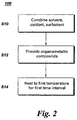
- step S10 comprises combining a nonpolar aprotic organic solvent, an oxidant, and a first surfactant.
- the nonpolar aprotic solvent is thermally stable at the temperatures at which the plurality of nanoparticles are formed.
- the nonpolar aprotic solvent has a boiling point in the range from about 275°C to about 340°C.
- Suitable nonpolar aprotic solvents include, but are not limited to, dioctyl ether, hexadecane, trioctylamine, tetraethylene glycol dimethyl ether (also known as "tetraglyme”), and combinations thereof.
- the oxidant comprises at least one of an organo-tertiary amine oxide, a peroxide, an alkylhydroperoxide, a peroxyacid, molecular oxygen, nitrous oxide, and combinations thereof.
- the oxidant comprises an organo-tertiary amine oxide having at least one methyl group.
- One non-limiting example of such an oxidant is trimethyl amine oxide.
- the first surfactant comprises at least one of a polymerizable functionalized group, an initiating functionalized group, and a cross-linking functionalized group.
- An amount of the first surfactant is provided to the nonpolar aprotic organic solvent to produce a first concentration of the first surfactant in the nonpolar aprotic solvent.
- the polymerizable functionalized group may comprise at least one of an alkene, an alkyne, a vinyl (including acrylics and styrenics), an epoxide, an azeridine, a cyclic ether, a cyclic ester, and a cyclic amide.
- the initiating functionalized group may comprise at least one of a thermal or photoinitiator, such as, but not limited to, an azo compound, a hydroxide, a peroxide, an alkyl halide, an aryl halide, a halo ketone, a halo ester, a halo amide, a nitroxide, a thiocarbonyl, a thiol, an organo-cobalt compound, a ketone, and an amine.
- a thermal or photoinitiator such as, but not limited to, an azo compound, a hydroxide, a peroxide, an alkyl halide, an aryl halide, a halo ketone, a halo ester, a halo amide, a nitroxide, a thiocarbonyl, a thiol, an organo-cobalt compound, a ketone, and an amine.
- the cross-linking functionalized group may be one of a thiol, an aldehyde, a ketone, a hydroxide, an isocyanide, an alkyl halide, a carboxylate, a carboxylic acid, a phenol, an amine, and combinations thereof.
- At least one organometallic compound is provided to the combined nonpolar aprotic organic solvent, oxidant, and first surfactant.
- the at least one organometallic compound comprises at least one metal and at least one ligand.
- the metal may comprise a transition metal, such as, but not limited to, iron, nickel, copper, titanium, cadmium, cobalt, chromium, manganese, vanadium, yttrium, zinc, and molybdenum, or other metals, such as gadolinium.
- the at least one ligand may comprise at least one of carbonyl group, a cyclo octadienyl group, an organophosphine group, a nitrosyl group, a cyclo pentadienyl group, a pentamethyl cyclo pentadienyl group, a ⁇ -acid ligand, a nitroxy group, and combinations thereof.
- the at least one organometallic compound include iron carbonyl (Fe(CO) 5 ), cobalt carbonyl (Co(CO) 8 ), and manganese carbonyl (Mn 2 (CO) 10 ).
- an amount of the at least one organometallic compound is provided to the aprotic solvent such that a ratio of the concentration of the at least one organometallic compound to the concentration of the oxidant has a value in a range from about 1 to about 10.
- S12 may include a step in which a first organometallic compound is provided to the combined nonpolar aprotic organic solvent, oxidant, and first surfactant.
- the combined first organometallic compound, nonpolar aprotic organic solvent, oxidant, and first surfactant are then preheated under an inert gas atmosphere to a temperature for a time interval.
- the preheating serves to remove the ligands from the metal cation in the first organometallic compound.
- the combined first organometallic compound, nonpolar aprotic organic solvent, oxidant, and first surfactant are preheated to a temperature in a range from about 90°C to about 140°C for a time interval ranging from about 15 minutes to about 90 minutes.
- step S14 the combined nonpolar aprotic solvent, oxidant, first surfactant, and the at least one organometallic compound are heated to under an inert gas atmosphere to a first temperature and maintained at the first temperature for a first time interval.
- the at least one organometallic compound reacts with the oxidant in, the presence of the first surfactant and the nonpolar aprotic solvent to form a plurality of nanoparticles, wherein each nanoparticle 10 comprises a nanocrystalline inorganic core 12 and at least one outer coating 14 comprising the first surfactant, which is disposed on an outer surface of the inorganic core 12 and substantially covers and encloses the nanocrystalline inorganic core 12.
- the first temperature to which the combined in S14 nonpolar aprotic solvent, oxidant, first surfactant, and the at least one organometallic compound are heated is dependent upon the relative thermal stability of the at least one organometallic compound that is provided to the aprotic solvent.
- the first temperature is in a range from about 30°C to about 400°C. In one embodiment, the first temperature is in a range from about 275°C to about 400°C and, preferably, in a range from about 275°C to about 310°C.
- the length of the first time interval may be from about 30 minutes to about 2 hours, depending on the particular organometallic compounds and oxidants that are provided to the aprotic solvent.
- method 100 may further comprise the step of precipitating the plurality of nanoparticles from the nonpolar aprotic solvent.
- Precipitation of the plurality of nanoparticles may be accomplished by adding at least one of an alcohol or a ketone to the nonpolar aprotic solvent.
- Alcohols such as, but not limited to, methanol and ethanol may be used.
- Alcohols having at least three carbon atoms, such as isopropanol, are preferred, as their use tends to produce the smallest degree of agglomeration of the plurality of nanparticles.
- Ketones such as, but not limited to, acetone may be used in conjunction with - or separate from - an alcohol in the precipitation step.
- method 100 may also further include a step in which a second surfactant either partially of completely replaces - or is exchanged for - the first surfactant in outer coating 14.
- the second surfactant is added to the nonpolar aprotic solvent such that the second surfactant is present in a second concentration, the second concentration being greater than a first concentration of the first surfactant in the nonpolar aprotic solvent.
- the second surfactant comprises at least one of a polymerizable functionalized group, an initiating functionalized group, and a cross-linking functionalized group and is different from the first surfactant.
- Suitable polymerizable functionalized groups, initiating functionalized groups, and cross-linking functionalized groups for the second surfactant are the same as those groups that are suitable for the first surfactant; and have been previously described herein.
- the differences in the first concentration and second concentration are sufficient to drive the substitution of the second surfactant for the first surfactant in outer coating 14 of each of the plurality of nanoparticles.
- the substitution of the second surfactant for the first surfactant may further include heating the nonpolar aprotic solvent containing the plurality of nanoparticles to a second temperature for a second time interval.
- the second temperature is in a range from about 25°C to about 80°C and the second time interval is about one hour.
- method 100 may include substitution of the second surfactant for the first surfactant in the outer coating 14 of each of the plurality of nanoparticles, followed by precipitation of the plurality of nanoparticles.
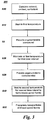
- flow chart for a method 200 of forming a plurality of monodisperse crystalline nanoparticles 10, wherein each of the plurality of monodisperse nanoparticles comprises a crystalline mixed spinel ferrite core and an outer coating 14 disposed on an outer surface of the crystalline mixed spinel ferrite core is shown in Figure 3.
- the crystalline mixed spinel ferrite core comprises iron in a first oxidation state and a transition metal in a second oxidation state, wherein the second oxidation state is different from the first oxidation state.
- step S20 of method 200 an oxidant and a first surfactant are combined a nonpolar aprotic organic solvent.
- the nonpolar aprotic organic solvent has a boiling point in a range from about 275°C to about 340°C.
- Suitable nonpolar aprotic solvents include, but are not limited to, dioctyl ether, hexadecane, trioctylamine, trioctylamine, tetraethylene glycol dimethyl ether (also known as "tetraglyme”), and combinations thereof.
- the oxidant comprises at least one of an organo-tertiary amine oxide, a peroxide, an alkylhydroperoxide, a peroxyacid, molecular oxygen, nitrous oxide, and combinations thereof.
- the oxidant comprises an organo-tertiary amine oxide having at least one methyl group.
- One non-limiting example of such an oxidant is trimethyl amine oxide.
- the first surfactant comprises at least one of a polymerizable functionalized group, an initiating functionalized group, and a cross-linking functionalized group. An amount of the first surfactant is provided to the nonpolar aprotic organic solvent to produce a first concentration of the first surfactant in the nonpolar aprotic solvent. Suitable polymerizable functionalized groups, initiating functionalized groups, and cross-linking functionalized groups for the first surfactant are the same as those that have been previously described herein.
- Step S22 comprises heating the combined nonpolar aprotic solvent, oxidant, and first surfactant under an inert gas atmosphere to a first temperature.
- the first temperature is in a range from about 90°C to about 140°C.
- An organo-iron compound is then provided to the combined nonpolar aprotic solvent, oxidant, and first surfactant at the first temperature (step S24).
- the organo-iron compound, together with the combined nonpolar aprotic solvent, oxidant, and first surfactant is maintained at the first temperature for a first time interval under an inert gas atmosphere (step S26).
- the ligands are removed form the organo-iron compound in the presence of the oxidant; the first time interval must therefore be of sufficient duration to accomplish the removal.
- the first time interval may be from about 15 minutes to about 90 minutes.
- the organo-iron compound comprises iron and at least one ligand.
- the at least one ligand comprises at least one of a carbonyl group, a cyclo octadienyl group, an organophosphine group, a nitrosyl group, a cyclo pentadienyl group, a pentamethyl cyclo pentadienyl group, a ⁇ -acid ligand, a nitroxy group, and combinations thereof.
- the organo-iron compound is iron carbonyl (Fe(CO) 5 ).
- At least one organo-transition metal compound is added to and combined with the organo-iron compound and the combined nonpolar aprotic solvent, oxidant, and first surfactant together at the first temperature (step S26).
- the at least one organo-transition metal compound comprises a transition metal and at least one ligand.
- the transition metal is one of iron, nickel, copper, titanium, cobalt, chromium, manganese, vanadium, yttrium, zinc, and molybdenum
- the at least one ligand comprises at least one of a carbonyl group, a cyclo octadienyl group, an organophosphine group, a nitrosyl group, a cyclo pentadienyl group, a pentamethyl cyclo pentadienyl group, an-acid ligand, a nitroxy group, and combinations thereof.
- Analogous organo-metallic compounds of selected metals, such as gadolinium maybe substituted for organo-transition metal compounds.
- Non-limiting examples of the at least one organo-transition metal compound include cobalt carbonyl (Co(CO) 8 ) and manganese carbonyl (Mn 2 (CO) 10 ).
- step S30 the at least one organo-transition metal compound, organo-iron compound, nonpolar aprotic solvent, oxidant, and first surfactant, now combined together, are heated to a second temperature and maintained at the second temperature for a second time interval.
- the organo-iron compound reacts with the at least one organo-transition metal compound at the second temperature to form a plurality of monodisperse nanoparticles, wherein each of the plurality of monodisperse nanoparticles comprises a crystalline mixed spinel ferrite core and an outer coating comprising the first surfactant, disposed on an outer surface of the crystalline mixed spinel ferrite core.
- Iron carbonyl may react with cobalt carbonyl (Co(CO) 8 ) in step S28 to form nanoparticles comprising the crystalline cobalt iron spinel ferrite CoFe 2 O 4 .
- iron carbonyl may react with manganese carbonyl (Mn 2 (CO) 10 ) in step S28 to form nanoparticles comprising the crystalline manganese iron spinel ferrite MnFe 2 O 4 .
- the at least one organo-transition metal compound comprises iron carbonyl
- nanoparticles comprising the crystalline mixed ⁇ -iron oxide/ferrite ( ⁇ -Fe 2 O 3 ) 1-y (Fe 3 O 4 ) y are formed.
- the second temperature is in a range from about 285°C to about 400°C. in a second embodiment, the second temperature is in a range from about 275°C to about 310°C. In one embodiment, the second time interval may range from about 30 minutes to about two hours.
- the plurality of nanoparticles are precipitated from the nonpolar aprotic solvent in step S32 by adding at least one of an alcohol or a ketone to the nonpolar aprotic solvent.
- Alcohols such as, but not limited to, methanol and ethanol may be used. Alcohols having at least three carbon atoms, such as isopropanol, are preferred, as their use tends to produce the smallest degree of agglomeration.
- Ketones such as, but not limited to, acetone may be used in conjunction with - or separate from - an alcohol in the precipitation step.
- Method 200 may also further include a step in which a second surfactant replaces - or is exchanged for - the first surfactant in outer coating 3, as previously described herein.
- method 200 may further comprise the step of precipitating the plurality of nanoparticles from the nonpolar aprotic solvent, as previously described herein.
- method 200 may further comprise substitution of the second surfactant for the first surfactant in the outer coating 3 of each of the plurality of nanoparticles, followed by precipitation of the plurality of nanoparticles.
- the plurality of nanoparticles produced by methods 100 and 200 are monodisperse; i.e., the nanoparticles are substantially identical in size and shape.
- cobalt iron spinel ferrite (CoFe 2 O 4 ) nanoparticles produced using the methods described herein exhibit about a 10% variation in diameter (5 nm ⁇ 0.5nm).
- manganese iron spinel ferrite MnFe 2 O 4 nanoparticles produced using the methods described herein exhibit about a 10% variation in diameter (10.6 nm ⁇ 0.16 nm).
- Crystal structure, composition, and particle size analysis of the powder were obtained by transmission electron microscopy (TEM) imaging, energy dispersive x-ray (EDX) elemental analysis, x-ray absorption spectroscopy (XAS), and selected area electron diffraction / x-ray diffraction (SAED-XRD) pattern crystal symmetry pattern indexing.
- the powder obtained was found to comprise monodisperse spinel-structured cobalt iron oxide (CoFe 2 O 4 ) nanocrystals, each having a particle size of about 5 nm.
- Crystal structure, composition, and particle size analysis of the powder were obtained by transmission electron microscopy (TEM) imaging, energy dispersive x-ray (EDX) elemental analysis, x-ray absorption spectroscopy (XAS), and selected area electron diffraction / x-ray diffraction (SAED-XRD) crystal symmetry pattern indexing.
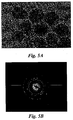
- the powder obtained was found to comprise monodisperse spinel-structured manganese iron oxide (MnFe 2 O 4 ) nanocrystals, each having a particle size of about 10.6 nm ⁇ 1.68 nm.
- Figures 5a and 5b include a TEM image of the MnFe 2 O 4 nanocrystals and an SAED-XRD diffraction pattern showing the cubic spinel crystal structure of the MnFe 2 O 4 nanocrystals, respectively.
- Crystal structure, composition, and particle size analysis of the powder were obtained by transmission electron microscopy (TEM) imaging, energy dispersive x-ray (EDX) elemental analysis, x-ray absorption spectroscopy (XAS), and selected area electron diffraction / x-ray diffraction (SAED-XRD) crystal symmetry pattern indexing.
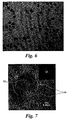
- the powder obtained was found to comprise monodisperse mixed ⁇ -iron oxide/ferrite ( ⁇ -Fe 2 O 3 ) 1-y (Fe 3 O 4 ) y nanocrystals, each having a particle size of about 5 nm ⁇ 0.5 nm.
- a TEM image of the ( ⁇ -Fe 2 O 3 ) 1-y (Fe 3 O 4 ) y nanocrystals that were obtained are shown in Figure 6.
Landscapes
- Chemical & Material Sciences (AREA)
- Organic Chemistry (AREA)
- Engineering & Computer Science (AREA)
- Inorganic Chemistry (AREA)
- Nanotechnology (AREA)
- Power Engineering (AREA)
- Crystallography & Structural Chemistry (AREA)
- Dispersion Chemistry (AREA)
- Physics & Mathematics (AREA)
- Health & Medical Sciences (AREA)
- General Physics & Mathematics (AREA)
- General Health & Medical Sciences (AREA)
- Spectroscopy & Molecular Physics (AREA)
- Biomedical Technology (AREA)
- Composite Materials (AREA)
- Condensed Matter Physics & Semiconductors (AREA)
- Molecular Biology (AREA)
- Materials Engineering (AREA)
- Life Sciences & Earth Sciences (AREA)
- Compounds Of Iron (AREA)
- Inorganic Compounds Of Heavy Metals (AREA)
- Magnetic Record Carriers (AREA)
- Hard Magnetic Materials (AREA)
Abstract
A nanoparticle (10) comprising an inorganic core (12) and a polymerizable
outer coating (14). The inorganic core (12) comprises a substantially
crystalline inorganic material such as a superparamagnetic material. In one
embodiment, the inorganic core (12) comprises a single crystal mixed spinel
ferrite comprising iron in a first oxidation state and at least one metal in a
second oxidation state, wherein the second oxidation state is different from
the first oxidation state.
Description
- The invention relates to a nanoparticle having a core of inorganic material having a coating disposed on the core. More particularly, the invention relates to a nanoparticle having a crystalline mixed spinel ferrite core and a polymerizable outer coating disposed on the crystalline mixed spinel ferrite core.
- Nanotechnology, relating particularly to the formation of a plurality of nanoparticles, has found application in a number of fields, such as diagnostic medicine, molecular imaging, and electronics. Magnetic nanoparticles may be used in magnetic recording, drug delivery, biomolecular separation, and as sensors. Superparamagnetic nanoparticles may, for example, be incorporated into magnetic resonance imaging (MRI) contrast agents, where they serve as signal-generating core nuclei.
- The nanoparticles obtained by the current methods also have a low level of crystallinity. Moreover, the nanoparticles tend to agglomerate, due to strong interparticle interactions. When such agglomeration occurs, the efficacy of the nanoparticles in a given application is lost. Therefore, what is needed is a nanoparticle having a crystalline inorganic core. What is also needed is that is a nanoparticle that is resistant to agglomeration.
- The present invention meets these and other needs by providing a nanoparticle comprising a core and a polymerizable outer coating. The core comprises an inorganic material such as, for example, a superparamagnetic material, which is substantially crystalline.
- Accordingly, one aspect of the invention is to provide a nanoparticle. The nanoparticle comprises an inorganic core, wherein the inorganic core is substantially crystalline and has a diameter in a range from about 1 nm to about 1000 nm; and at least one outer coating substantially covering the inorganic core, the at least one outer coating comprising an ionizable stabilizing material having at least one functionalized group.
- A second aspect is to provide an inorganic nanoparticle. The inorganic nanoparticle has a diameter in the range from 1 to 1000 nm and comprises a single crystal of at least one spinel ferrite, wherein the at least one spinel ferrite comprises iron in a first oxidation state and a transition metal in a second oxidation state, wherein the second oxidation state is different from the first oxidation state.
- A third aspect of the invention is to provide a nanoparticle. The nanoparticle comprises: an inorganic core, the inorganic core having a diameter in the range from 1 to 1000 nm and comprising a single crystal of at least one spinel ferrite, wherein the at least one spinel ferrite comprises iron in a first oxidation state and a transition metal in a second oxidation state, wherein said second oxidation state is different from said first oxidation state; and at least one outer coating substantially covering said inorganic core, said at least one outer coating comprising an ionizable stabilizing material having at least one functionalized group.
- A fourth aspect of the invention is to provide a plurality of nanoparticles, wherein each of the plurality of nanoparticles comprises an inorganic core, wherein said inorganic core comprises a first inorganic material and is substantially crystalline and has a diameter in a range from about 1 nm to about 1000 nm; and at least one outer coating substantially covering the inorganic core, the at least one outer coating comprising at least one ionizable stabilizing material having at least one functionalized group, wherein the plurality of nanoparticles is substantially monodisperse.
- These and other aspects, advantages, and salient features of the present invention will become apparent from the following detailed description, with reference to the accompanying drawings, in which:
- FIGURE 1 is a schematic representation of a cross-sectional view of a nanoparticle of the present invention;
- FIGURE 2 is a flow diagram showing a method of forming a plurality of nanoparticles;
- FIGURE 3 is a flow diagram showing a method of forming a plurality of nanoparticles having a crystalline mixed spinel ferrite core;
- FIGURE 4a is a transmission electron microscopic image of cobalt iron oxide nanoparticles of the present invention;
- FIGURE 4b is an x-ray diffraction pattern of cobalt iron oxide nanoparticles of the present invention;
- FIGURE 5a is a transmission electron microscopic image of manganese iron oxide nanoparticles of the present invention;
- FIGURE 5b is a selected area electron diffraction pattern of manganese iron oxide nanoparticles of the present invention;
- FIGURE 6 is a transmission electron microscopic image of spinel-structured mixed iron oxide nanocrystals of the present invention; and
- FIGURE 7 is a high resolution transmission electron microscopic image of spinel-structured mixed iron oxide nanocrystals having an outer coating.
-
- In the following description, like reference characters designate like or corresponding parts throughout the several views shown in the figures. It is also understood that terms such as "top", "bottom", "outward", "inward", and the like are words of convenience and are not to be construed as limiting terms.
- Referring to the drawings in general and to Figure 1 in particular, it will be understood that the illustrations are for the purpose of describing a preferred embodiment of the invention and are not intended to limit the invention thereto. Referring to the drawings in general and to Figure 1 in particular, it will be understood that the illustrations are for the purpose of describing a preferred embodiment of the invention and are not intended to limit the invention thereto.
- A schematic representation of a cross-sectional view of a nanoparticle of the present invention is shown in Figure 1.
Nanoparticle 10 comprises aninorganic core 12 andouter coating 14.Inorganic core 12 comprises substantially crystalline inorganic material and has a diameter in a range from about 1 nm to about 1000 nm. in this context, "substantially crystalline" is understood to mean thatinorganic core 12 comprises at least 50 volume percent and, preferably, at least 75 volume percent, crystalline material. Most preferably,inorganic core 12 is a single crystal. In one embodiment,inorganic core 12 has a diameter in a range from about 1 nm to about 100 nm. In yet another embodiment,inorganic core 12 has a diameter in a range from about 1 nm to about 10 nm. -
Inorganic core 12 may comprise a variety of inorganic materials, including, but not limited to, transition metals in elemental form, metal oxides, and superparamagnetic materials that are known in the art. For example, aninorganic core 12 comprising superparamagnetic material may include one of elemental iron, a spinel ferrite (Fe3O4), or at least one mixed spinel ferrite having the general formula MFe2O4, where M is a metal having an oxidation state other than exhibited by the predominant form that of iron, which is 3+. Non-limiting examples of M include iron (where a portion of the iron present iron is Fe2+; i.e., iron having a 2+ oxidation state), copper, titanium, manganese, cobalt, nickel, chromium, gadolinium, zinc, yttrium, molybdenum, and vanadium. - In one particular embodiment,
inorganic core 12 is spherical and has a diameter in a range from about 1 nm to about 1000 nm.Inorganic core 12 may, in one embodiment, be in shape. -
Outer coating 14 is disposed on an outer surface ofinorganic core 12 such thatouter coating 14 substantially covers and enclosesinorganic core 12.Outer coating 14 serves to stabilizeinorganic core 12; i.e.,outer coating 14 prevents contact inorganic 12 from contacting an adjacent inorganic core, thereby preventing a plurality of such nanoparticles from agglomerating. Thus,outer coating 14 is sufficiently thick to stabilizeinorganic core 12 and prevent such contact. In one embodiment,outer core 14 has thickness in a range from about 1 nm to about 50 nm and, more preferably in a range from about 1.5 nm to about 3 nm. - The constituents of
outer coating 14 may eventually undergo at least one polymerization reaction to provide a more permanent polymerized "shell" forinorganic core 12. Alternatively, the material - or materials - comprisingouter coating 14 may later be replaced by other materials that are tailored for a particular application, such as, but not limited to, diagnostic applications. - An example of
nanoparticle 10 is shown in Figure 7.Inorganic core 12 comprises the crystalline mixed iron oxide (γ-Fe2O3)1-y(Fe3O4)y.Outer coating 14, comprising 10-undecenate, is bound toinorganic core 12. -
Outer coating 14 comprises an ionizable stabilizingmaterial 15 having at least one functionalized group or a plurality of such ionizable stabilizing materials. The ionizable stabilizing material, in one embodiment, may comprise a siloxane. In another embodiment, the ionizable stabilizingmaterial 15 comprises at least oneionizable head portion 16 that couples to the surface ofinorganic core 12 and at least onetail portion 18, which includes the at least one functionalized group. The at least one ionizable head portion comprises at least one of an alcohol, a thiol (including thiolates), an amine, an organic carboxylate, an organic sulfonate, an organic phosphonate, and an organic phosphinate. - The at least one
tail portion 18 is coupled to the at least oneionizable head portion 16 and extends therefrom in a direction opposite the surface ofinorganic core 12. the at least onetail portion 18 may, in one embodiment, include aninternal portion 17 and aterminal portion 19. The at least one functionalized group may be located in either theterminal portion 19 orinternal portion 17 of the at least one tail portion. In a preferred embodiment of the invention, the at least one functionalized group is located interminal portion 19.Tail portion 18 comprises a hydrocarbon and is hydrophobic. - The at least one functionalized group may comprise, but is not limited to, a polymerizable functionalized group, an initiating functionalized group, and a cross-linking functionalized group. The polymerizable functionalized group may comprise at least one of an alkene, an alkyne, a vinyl (including acrylics and styrenics), an epoxide, an azeridine, a cyclic ether, a cyclic ester, and a cyclic amide. The initiating functionalized group may comprise at least one of a thermal or photoinitiator, such as, but not limited to, an azo compound, a hydroxide, a peroxide, an alkyl halide, an aryl halide, a halo ketone, a halo ester, a halo amide, a nitroxide, a thiocarbonyl, a thiol, an organo-cobalt compound, a ketone, and an amine. The cross-linking functionalized group may comprise one of a thiol, an aldehyde, a ketone, a hydroxide, an isocyanide, an alkyl halide, an aryl halide, a carboxylate, a carboxylic acid, a phenol, and an amine.
-
Nanoparticle 10 is formed by a non-aqueous synthetic route for the formation of monodisperse crystalline nanoparticles. Organometallic precursor materials, such as, but not limited to, transition metal carbonyl compounds, are thermally decomposed in a solvent and in the presence of a surfactant and an oxidant. The organometallic precursors are provided in an appropriate stoichiometric ratio to a nonpolar aprotic solvent containing the surfactant and the oxidant. - A flow diagram for a
method 100 of forming a plurality ofcrystalline nanoparticles 10 is shown in Figure 2. Referring to Figure 2, step S10 comprises combining a nonpolar aprotic organic solvent, an oxidant, and a first surfactant. The nonpolar aprotic solvent is thermally stable at the temperatures at which the plurality of nanoparticles are formed. In one embodiment, the nonpolar aprotic solvent has a boiling point in the range from about 275°C to about 340°C. Suitable nonpolar aprotic solvents include, but are not limited to, dioctyl ether, hexadecane, trioctylamine, tetraethylene glycol dimethyl ether (also known as "tetraglyme"), and combinations thereof. The oxidant comprises at least one of an organo-tertiary amine oxide, a peroxide, an alkylhydroperoxide, a peroxyacid, molecular oxygen, nitrous oxide, and combinations thereof. In one embodiment, the oxidant comprises an organo-tertiary amine oxide having at least one methyl group. One non-limiting example of such an oxidant is trimethyl amine oxide. - The first surfactant comprises at least one of a polymerizable functionalized group, an initiating functionalized group, and a cross-linking functionalized group. An amount of the first surfactant is provided to the nonpolar aprotic organic solvent to produce a first concentration of the first surfactant in the nonpolar aprotic solvent. The polymerizable functionalized group may comprise at least one of an alkene, an alkyne, a vinyl (including acrylics and styrenics), an epoxide, an azeridine, a cyclic ether, a cyclic ester, and a cyclic amide. The initiating functionalized group may comprise at least one of a thermal or photoinitiator, such as, but not limited to, an azo compound, a hydroxide, a peroxide, an alkyl halide, an aryl halide, a halo ketone, a halo ester, a halo amide, a nitroxide, a thiocarbonyl, a thiol, an organo-cobalt compound, a ketone, and an amine. The cross-linking functionalized group may be one of a thiol, an aldehyde, a ketone, a hydroxide, an isocyanide, an alkyl halide, a carboxylate, a carboxylic acid, a phenol, an amine, and combinations thereof.
- In step S12, at least one organometallic compound is provided to the combined nonpolar aprotic organic solvent, oxidant, and first surfactant. The at least one organometallic compound comprises at least one metal and at least one ligand. The metal may comprise a transition metal, such as, but not limited to, iron, nickel, copper, titanium, cadmium, cobalt, chromium, manganese, vanadium, yttrium, zinc, and molybdenum, or other metals, such as gadolinium. The at least one ligand may comprise at least one of carbonyl group, a cyclo octadienyl group, an organophosphine group, a nitrosyl group, a cyclo pentadienyl group, a pentamethyl cyclo pentadienyl group, a π-acid ligand, a nitroxy group, and combinations thereof. Non-limiting examples of the at least one organometallic compound include iron carbonyl (Fe(CO)5), cobalt carbonyl (Co(CO)8), and manganese carbonyl (Mn2(CO)10). In one embodiment, an amount of the at least one organometallic compound is provided to the aprotic solvent such that a ratio of the concentration of the at least one organometallic compound to the concentration of the oxidant has a value in a range from about 1 to about 10.
- In one embodiment, S12 may include a step in which a first organometallic compound is provided to the combined nonpolar aprotic organic solvent, oxidant, and first surfactant. The combined first organometallic compound, nonpolar aprotic organic solvent, oxidant, and first surfactant are then preheated under an inert gas atmosphere to a temperature for a time interval. The preheating serves to remove the ligands from the metal cation in the first organometallic compound. In one embodiment, the combined first organometallic compound, nonpolar aprotic organic solvent, oxidant, and first surfactant are preheated to a temperature in a range from about 90°C to about 140°C for a time interval ranging from about 15 minutes to about 90 minutes.
- In step S14, the combined nonpolar aprotic solvent, oxidant, first surfactant, and the at least one organometallic compound are heated to under an inert gas atmosphere to a first temperature and maintained at the first temperature for a first time interval. At this point, the at least one organometallic compound reacts with the oxidant in, the presence of the first surfactant and the nonpolar aprotic solvent to form a plurality of nanoparticles, wherein each
nanoparticle 10 comprises a nanocrystallineinorganic core 12 and at least oneouter coating 14 comprising the first surfactant, which is disposed on an outer surface of theinorganic core 12 and substantially covers and encloses the nanocrystallineinorganic core 12. - The first temperature to which the combined in S14 nonpolar aprotic solvent, oxidant, first surfactant, and the at least one organometallic compound are heated is dependent upon the relative thermal stability of the at least one organometallic compound that is provided to the aprotic solvent. The first temperature is in a range from about 30°C to about 400°C. In one embodiment, the first temperature is in a range from about 275°C to about 400°C and, preferably, in a range from about 275°C to about 310°C. The length of the first time interval may be from about 30 minutes to about 2 hours, depending on the particular organometallic compounds and oxidants that are provided to the aprotic solvent.
- In one embodiment,
method 100 may further comprise the step of precipitating the plurality of nanoparticles from the nonpolar aprotic solvent. Precipitation of the plurality of nanoparticles may be accomplished by adding at least one of an alcohol or a ketone to the nonpolar aprotic solvent. Alcohols such as, but not limited to, methanol and ethanol may be used. Alcohols having at least three carbon atoms, such as isopropanol, are preferred, as their use tends to produce the smallest degree of agglomeration of the plurality of nanparticles. Ketones such as, but not limited to, acetone may be used in conjunction with - or separate from - an alcohol in the precipitation step. - In another embodiment,
method 100 may also further include a step in which a second surfactant either partially of completely replaces - or is exchanged for - the first surfactant inouter coating 14. Following the formation of the plurality of nanoparticles, the second surfactant is added to the nonpolar aprotic solvent such that the second surfactant is present in a second concentration, the second concentration being greater than a first concentration of the first surfactant in the nonpolar aprotic solvent. The second surfactant comprises at least one of a polymerizable functionalized group, an initiating functionalized group, and a cross-linking functionalized group and is different from the first surfactant. Suitable polymerizable functionalized groups, initiating functionalized groups, and cross-linking functionalized groups for the second surfactant are the same as those groups that are suitable for the first surfactant; and have been previously described herein. - In some instances, the differences in the first concentration and second concentration are sufficient to drive the substitution of the second surfactant for the first surfactant in
outer coating 14 of each of the plurality of nanoparticles. In one embodiment, the substitution of the second surfactant for the first surfactant may further include heating the nonpolar aprotic solvent containing the plurality of nanoparticles to a second temperature for a second time interval. Preferably, the second temperature is in a range from about 25°C to about 80°C and the second time interval is about one hour. - It is understood that
method 100 may include substitution of the second surfactant for the first surfactant in theouter coating 14 of each of the plurality of nanoparticles, followed by precipitation of the plurality of nanoparticles. - In one particular embodiment, flow chart for a
method 200 of forming a plurality of monodispersecrystalline nanoparticles 10, wherein each of the plurality of monodisperse nanoparticles comprises a crystalline mixed spinel ferrite core and anouter coating 14 disposed on an outer surface of the crystalline mixed spinel ferrite core is shown in Figure 3. The crystalline mixed spinel ferrite core comprises iron in a first oxidation state and a transition metal in a second oxidation state, wherein the second oxidation state is different from the first oxidation state. - In step S20 of
method 200, an oxidant and a first surfactant are combined a nonpolar aprotic organic solvent. In one embodiment, the nonpolar aprotic organic solvent has a boiling point in a range from about 275°C to about 340°C. Suitable nonpolar aprotic solvents include, but are not limited to, dioctyl ether, hexadecane, trioctylamine, trioctylamine, tetraethylene glycol dimethyl ether (also known as "tetraglyme"), and combinations thereof. The oxidant comprises at least one of an organo-tertiary amine oxide, a peroxide, an alkylhydroperoxide, a peroxyacid, molecular oxygen, nitrous oxide, and combinations thereof. In one embodiment, the oxidant comprises an organo-tertiary amine oxide having at least one methyl group. One non-limiting example of such an oxidant is trimethyl amine oxide. The first surfactant comprises at least one of a polymerizable functionalized group, an initiating functionalized group, and a cross-linking functionalized group. An amount of the first surfactant is provided to the nonpolar aprotic organic solvent to produce a first concentration of the first surfactant in the nonpolar aprotic solvent. Suitable polymerizable functionalized groups, initiating functionalized groups, and cross-linking functionalized groups for the first surfactant are the same as those that have been previously described herein. - Step S22 comprises heating the combined nonpolar aprotic solvent, oxidant, and first surfactant under an inert gas atmosphere to a first temperature. In one embodiment, the first temperature is in a range from about 90°C to about 140°C. An organo-iron compound is then provided to the combined nonpolar aprotic solvent, oxidant, and first surfactant at the first temperature (step S24). The organo-iron compound, together with the combined nonpolar aprotic solvent, oxidant, and first surfactant, is maintained at the first temperature for a first time interval under an inert gas atmosphere (step S26). In step S26, the ligands are removed form the organo-iron compound in the presence of the oxidant; the first time interval must therefore be of sufficient duration to accomplish the removal. In one embodiment, the first time interval may be from about 15 minutes to about 90 minutes.
- The organo-iron compound comprises iron and at least one ligand. In one embodiment, the at least one ligand comprises at least one of a carbonyl group, a cyclo octadienyl group, an organophosphine group, a nitrosyl group, a cyclo pentadienyl group, a pentamethyl cyclo pentadienyl group, a π-acid ligand, a nitroxy group, and combinations thereof. One non-limiting example of the organo-iron compound is iron carbonyl (Fe(CO)5).
- Following the expiration of the first time interval, at least one organo-transition metal compound is added to and combined with the organo-iron compound and the combined nonpolar aprotic solvent, oxidant, and first surfactant together at the first temperature (step S26). The at least one organo-transition metal compound comprises a transition metal and at least one ligand. In one embodiment, the transition metal is one of iron, nickel, copper, titanium, cobalt, chromium, manganese, vanadium, yttrium, zinc, and molybdenum, and the at least one ligand comprises at least one of a carbonyl group, a cyclo octadienyl group, an organophosphine group, a nitrosyl group, a cyclo pentadienyl group, a pentamethyl cyclo pentadienyl group, an-acid ligand, a nitroxy group, and combinations thereof. Analogous organo-metallic compounds of selected metals, such as gadolinium, maybe substituted for organo-transition metal compounds. Non-limiting examples of the at least one organo-transition metal compound include cobalt carbonyl (Co(CO)8) and manganese carbonyl (Mn2(CO)10).
- In step S30, the at least one organo-transition metal compound, organo-iron compound, nonpolar aprotic solvent, oxidant, and first surfactant, now combined together, are heated to a second temperature and maintained at the second temperature for a second time interval. The organo-iron compound reacts with the at least one organo-transition metal compound at the second temperature to form a plurality of monodisperse nanoparticles, wherein each of the plurality of monodisperse nanoparticles comprises a crystalline mixed spinel ferrite core and an outer coating comprising the first surfactant, disposed on an outer surface of the crystalline mixed spinel ferrite core. Iron carbonyl (Fe(CO)5), for example, may react with cobalt carbonyl (Co(CO)8) in step S28 to form nanoparticles comprising the crystalline cobalt iron spinel ferrite CoFe2O4. Alternatively, iron carbonyl may react with manganese carbonyl (Mn2(CO)10) in step S28 to form nanoparticles comprising the crystalline manganese iron spinel ferrite MnFe2O4. Where the at least one organo-transition metal compound comprises iron carbonyl, nanoparticles comprising the crystalline mixed γ-iron oxide/ferrite (γ-Fe2O3)1-y (Fe3O4) y are formed.
- In one embodiment, the second temperature is in a range from about 285°C to about 400°C. in a second embodiment, the second temperature is in a range from about 275°C to about 310°C. In one embodiment, the second time interval may range from about 30 minutes to about two hours.
- The plurality of nanoparticles are precipitated from the nonpolar aprotic solvent in step S32 by adding at least one of an alcohol or a ketone to the nonpolar aprotic solvent. Alcohols such as, but not limited to, methanol and ethanol may be used. Alcohols having at least three carbon atoms, such as isopropanol, are preferred, as their use tends to produce the smallest degree of agglomeration. Ketones such as, but not limited to, acetone may be used in conjunction with - or separate from - an alcohol in the precipitation step.
-
Method 200 may also further include a step in which a second surfactant replaces - or is exchanged for - the first surfactant in outer coating 3, as previously described herein. Alternatively,method 200 may further comprise the step of precipitating the plurality of nanoparticles from the nonpolar aprotic solvent, as previously described herein. Finally,method 200 may further comprise substitution of the second surfactant for the first surfactant in the outer coating 3 of each of the plurality of nanoparticles, followed by precipitation of the plurality of nanoparticles. - The plurality of nanoparticles produced by
methods - The following examples serve to illustrate the features and advantages of the present invention.
- A mixture of trimethylamine-N-oxide (7.59 millimoles (mmol)), lauric acid (4.54 mmol), and 10 ml deoxygenated hexadecane, each individually dehydrated, were added under an inert atmosphere in a glove box to a 50 ml 2-neck Schlenk flask. The flask was attached to a Schlenk vacuum, and a column-reflux condenser assembly was attached under a blanket of N2. The mixture was homogenized with vigorous stirring and heating to about 100°C.
- About 1.01 millimoles (mmol) iron carbonyl (Fe(CO)5) were then added to the slowly stirred reaction solution, which was at a temperature in a range from about 100°C to about 105°C, resulting in instantaneous and aggressive reaction. Iron carbonyl addition was complete and the intense reaction subsided in less than a minute. The reaction mixture was then heated to a temperature in a range from about 120°C to about 130 °C under N2 and maintained at temperature for 1 hour with vigorous stirring.
- About 0.25 mmol of cobalt carbonyl (CO2(CO)8) was then added to the reaction mixture, turning the solution royal purple in color. The temperature of the reaction mixture was rapidly increased to about 300°C to allow the reaction mixture to reflux. After 1 hour of refluxing and stirring at about 300°C, the color of the reaction mixture appeared to turn black. The reaction mixture was then cooled to room temperature, and an excess of amount of ethanol was added to the reaction mixture, yielding a black precipitate. The precipitate was separated by centrifuging and collected. The collected black powder was then washed with an ethanol/acetone mixture and dried. Crystal structure, composition, and particle size analysis of the powder were obtained by transmission electron microscopy (TEM) imaging, energy dispersive x-ray (EDX) elemental analysis, x-ray absorption spectroscopy (XAS), and selected area electron diffraction / x-ray diffraction (SAED-XRD) pattern crystal symmetry pattern indexing. The powder obtained was found to comprise monodisperse spinel-structured cobalt iron oxide (CoFe2O4) nanocrystals, each having a particle size of about 5 nm. A TEM image of the CoFe2O4 nanocrystals that were obtained is shown in Figure 4a, and the SAED-XRD diffraction pattern, showing the cubic spinel crystal structure of the CoFe2O4 nanocrystals, is pictured in Figure 4b.
- A mixture of trimethylamine-N-oxide (7.60 mmol), lauric acid (4.56 mmol), and 7 ml of deoxygenated dioctyl ether, each individually dehydrated, were added under an inert atmosphere in a glove box to a 50 ml 2-neck Schlenk flask. The flask was attached to a Schlenk vacuum line, and a column-reflux condenser assembly was attached under a blanket of N2. The mixture was homogenized with vigorous stirring and heating to about 100 °C.
- About 1.52 mmol of iron carbonyl (Fe(CO)5) were then added to the slowly stirred reaction solution, which was at a temperature in a range from about 100°C to about 105°C, resulting in instantaneous and aggressive reaction. Iron carbonyl addition was complete and the intense reaction subsided in less than a minute. The reaction mixture was then heated to a temperature in a range from about 120°C to about. 130 °C under N2 and maintained at temperature for 1 hour with vigorous stirring.
- About 0.38 mmol of Manganese carbonyl Mn2(CO)10 was then added to the reaction mixture. The temperature of the reaction mixture was rapidly increased to about 300°C to allow the reaction mixture to reflux. After 1 hour of refluxing and stirring at about 300°C, the color of the reaction mixture turned black. The reaction mixture was then cooled to room temperature, and an excess of amount of ethanol was added to the reaction mixture, yielding a black precipitate. The precipitate was separated by centrifuging and collected. The collected black powder was then washed with an ethanol/acetone mixture and dried. Crystal structure, composition, and particle size analysis of the powder were obtained by transmission electron microscopy (TEM) imaging, energy dispersive x-ray (EDX) elemental analysis, x-ray absorption spectroscopy (XAS), and selected area electron diffraction / x-ray diffraction (SAED-XRD) crystal symmetry pattern indexing. The powder obtained was found to comprise monodisperse spinel-structured manganese iron oxide (MnFe2O4) nanocrystals, each having a particle size of about 10.6 nm ± 1.68 nm. Figures 5a and 5b include a TEM image of the MnFe2O4 nanocrystals and an SAED-XRD diffraction pattern showing the cubic spinel crystal structure of the MnFe2O4 nanocrystals, respectively.
- A mixture of trimethylamine-N-oxide (7.60 mmol), 10-undecenoic acid or lauric acid (4.56 mmol), and 7 ml of deoxygenated dioctyl ether, each individually dehydrated and deoxygenated, were added under an inert atmosphere to a 50 ml 2-neck Schlenk flask. The flask was attached to a Schlenk vacuum-line, and a column-reflux condenser assembly was attached under a blanket of N2. The mixture was homogenized with vigorous stirring and heating to about 100 °C.
- About 1.52 mmol of iron carbonyl (Fe(CO)5) were then added to the slowly stirred reaction solution, which was at a temperature in a range from about 100°C to about 105°C, resulting in instantaneous and aggressive reaction. Iron carbonyl addition was completed in less than a minute and the intense reaction subsided. The reaction mixture was then heated to a temperature in a range from about 120°C to about 130 °C under N2 and maintained at temperature for 1 hour with vigorous stirring.
- About 0.76 mmol of iron carbonyl (Fe(CO)5) was then added to the reaction mixture. The temperature of the reaction mixture was rapidly increased to about 300°C to allow the reaction mixture to reflux. After 1 hour of refluxing and stirring at about 300°C, the color of the reaction mixture turned black. The reaction mixture was then cooled to room temperature, and an equal volume amount of isopropyl alcohol was added to the reaction mixture, yielding a black precipitate. The precipitate was separated by centrifuging and collected by magnetic decantation. Particles were readily dispersed in toluene and octane, forming homogeneous solutions. Crystal structure, composition, and particle size analysis of the powder were obtained by transmission electron microscopy (TEM) imaging, energy dispersive x-ray (EDX) elemental analysis, x-ray absorption spectroscopy (XAS), and selected area electron diffraction / x-ray diffraction (SAED-XRD) crystal symmetry pattern indexing. The powder obtained was found to comprise monodisperse mixed γ-iron oxide/ferrite (γ-Fe2O3)1-y(Fe3O4)y nanocrystals, each having a particle size of about 5 nm ± 0.5 nm. A TEM image of the (γ-Fe2O3)1-y(Fe3O4)y nanocrystals that were obtained are shown in Figure 6.
- For completeness, various aspects of the invention are set out in the following numbered clauses:
- 1. A
nanoparticle 10 comprising: - a) an
inorganic core 12, wherein saidinorganic core 12 comprises a first inorganic material and is substantially crystalline and has a diameter in a range from about 1 nm to about 1000 nm; and - b) at least one
outer coating 14 substantially covering saidinorganic core 12, said at least oneouter coating 14 comprising at least oneionizable stabilizing material 15 having at least one functionalized group. - 2. The
nanoparticle 10 according to Clause 1, wherein at least about 50% of saidinorganic core 12 comprises crystalline material. - 3. The
nanoparticle 10 according toClause 2, wherein at least about 75% of saidinorganic core 12 comprises crystalline material. - 4. The
nanoparticle 10 according to Clause 3, wherein saidinorganic core 12 is a single crystal. - 5. The
nanoparticle 10 according to Clause 1, wherein saidinorganic core 12 comprises a superparamagnetic material. - 6. The
nanoparticle 10 according to Clause 1, wherein saidinorganic core 12 comprises at least one spinel ferrite, wherein said at least one spinel ferrite comprises iron in a first oxidation state and at least one metal in a second oxidation state, wherein said second oxidation state is different from said first oxidation state. - 7. The
nanoparticle 10 according to Clause 6, wherein said at least one metal comprises at least one of iron, manganese, copper, titanium, cadmium, cobalt, nickel, chromium, gadolinium, yttrium, zinc, molybdenum, and vanadium. - 8. The
nanoparticle 10 according to Clause 1, wherein saidinorganic core 12 has a spherical shape. - 9. The
nanoparticle 10 according to Clause 1, wherein saidinorganic core 12 has a diameter in a range from about 1 nm to about 100 nm. - 10. The
nanoparticle 10 according to Clause 9, wherein saidinorganic core 12 has a diameter in a range from about 1 nm to about 10 nm. - 11. The
nanoparticle 10 according to Clause 1, wherein saidouter coating 14 has a thickness that is sufficient to stabilize saidnanoparticle 10. - 12. The
nanoparticle 10 according toClause 12, wherein said thickness is in a range from about 1 nm to about 50 nm. - 13. The
nanoparticle 10 according toClause 12, wherein said thickness is in a range from about 1.5 nm to about 3 nm. - 14. The
nanoparticle 10 according to Clause 1, wherein said ionizable stabilizingmaterial 15 comprises siloxane. - 15. The
nanoparticle 10 according to Clause 1, wherein said ionizable stabilizingmaterial 15 comprises at least oneionizable head portion 16 coupled to a surface of saidcore 12 and at least onetail portion 18 coupled to said at least oneionizable head portion 16 extending from said at least oneionizable head portion 16 opposite said surface, and wherein said at least one functionalized group is located in saidtail portion 18. - 16. The
nanoparticle 10 according toClause 15, wherein said at least one functionalized group is located in one of aninternal portion 17 and aterminal portion 19 of said at least onetail portion 18. - 17. The
nanoparticle 10 according toClause 16, wherein said at least one functionalized group is located in saidterminal portion 19. - 18. The
nanoparticle 10 according toClause 16, wherein saidterminal portion 19 is hydrophobic. - 19. The
nanoparticle 10 according toClause 15, wherein said at least one functionalized group is one of a polymerizable functionalized group, an initiating functionalized group, and a cross-linking functionalized group. - 20. The
nanoparticle 10 according toClause 19, wherein said polymerizable functionalized group comprises at least one of an alkene, an alkyne, a vinyl, an epoxide, an azeridine, a cyclic ether, a cyclic ester, and a cyclic amide. - 21. The
nanoparticle 10 according toClause 19, wherein said initiating functionalized group comprises at least one of a thermal and a photoinitiator. - 22. The
nanoparticle 10 according toClause 19, wherein said initiating functionalized group comprises at least one of an azo compound, a hydroxide, a peroxide, an alkyl halide, an aryl halide, a halo ketone, a halo ester, a halo amide, a nitroxide, a thiocarbonyl, a thiol, an organo-cobalt compound, a ketone, and an amine. - 23. The
nanoparticle 10 according toClause 19, wherein said cross-linking functionalized group comprises at least one of a thiol, an aldehyde, a ketone, a hydroxide, an isocyanide, an alkyl halide, a carboxylate, a carboxylic acid, a phenol, an amine, and combinations thereof. - 24. The
nanoparticle 10 according toClause 15, wherein saidionizable head portion 16 comprises at least one of an alcohol, an alcohol, a thiol, an amine, an organic carboxylate, an organic sulfonate, an organic phosphonate, and an organic phosphinate. - 25. The
nanoparticle 10 according to Clause 1, wherein saidinorganic core 12 comprises iron in elemental form. - 26. An
inorganic nanoparticle 10, saidinorganic nanoparticle 10 having a diameter in the range from 1 to 1000 nm and comprising a single crystal of at least one spinel ferrite, wherein said at least one spinel ferrite comprises iron in a first oxidation state and at least one metal in a second oxidation state,
wherein said second oxidation state is different from said first oxidation state. - 27. The
inorganic nanoparticle 10 according toClause 26, wherein saidinorganic nanoparticle 10 has a spherical shape. - 28. The
inorganic nanoparticle 10 according to Clause 27, wherein saidinorganic nanoparticle 10 has a diameter in a range from about 1 nm to about 100 nm. - 29. The
inorganic nanoparticle 10 according to Clause 28, wherein saidinorganic nanoparticle 10 has a diameter in a range from about 1 nm to about 10 nm. - 30. The
inorganic nanoparticle 10 according toClause 26, wherein said at least one metal comprises at least one of manganese, copper, titanium, cadmium, cobalt, nickel, chromium, gadolinium, yttrium, zinc, molybdenum, and vanadium. - 31. A
nanoparticle 10 comprising: - a) an
inorganic core 12, saidinorganic core 12 having a diameter in the range from 1 to 1000 nm and comprising a single crystal of at least one spinel ferrite, wherein said at least one spinel ferrite comprises iron in a first oxidation state and at least one metal in a second oxidation state, wherein said second oxidation state is different from said first oxidation state; and - b) at least one
outer coating 14 substantially covering saidinorganic core 12, said at least oneouter coating 14 comprising anionizable stabilizing material 15 having at least one functionalized group. - 32. The
nanoparticle 10 according to Clause 31, wherein saidinorganic core 12 comprises a superparamagnetic material. - 33. The
nanoparticle 10 according toClause 32, wherein said at least one transition metal comprises at least one of iron, manganese, cobalt, cadmium, nickel, chromium, gadolinium, yttrium, zinc, molybdenum, and vanadium. - 34. The
nanoparticle 10 according toClause 32, wherein saidinorganic core 12 has a spherical shape. - 35. The
nanoparticle 10 according to Clause 34, wherein saidinorganic core 12 has a diameter in a range from about 1 nm to about 100 nm. - 36. The
nanoparticle 10 according to Clause 35, wherein saidinorganic core 12 has a diameter in a range from about 1 nm to about 10 nm. - 37. The
nanoparticle 10 according toClause 32, wherein saidouter coating 14 has a thickness that is sufficient to stabilize saidnanoparticle 10. - 38. The
nanoparticle 10 according to Clause 37, wherein said thickness is in a range from about 1 nm to about 50 nm. - 39. The
nanoparticle 10 according toClause 32, wherein said ionizable stabilizingmaterial 15 comprises siloxane. - 40. The
nanoparticle 10 according toClause 32, wherein said ionizable stabilizingmaterial 15 comprises at least oneionizable head portion 16 coupled to a surface of saidcore 12 and at least onetail portion 18 coupled to said at least oneionizable head portion 16 extending from said at least oneionizable head portion 16 opposite said surface, and wherein said at least one functionalized group is located in saidtail portion 18. - 41. The
nanoparticle 10 according toClause 40, wherein said at least one functionalized group is located in one of aninternal portion 17 and aterminal portion 19 of said at least onetail portion 18. - 42. The
nanoparticle 10 according to Clause 41, wherein said at least one functionalized group is located in saidterminal portion 19. - 43. The
nanoparticle 10 according to Clause 42, wherein saidterminal portion 19 is hydrophobic. - 44. The
nanoparticle 10 according to Clause 42, wherein said at least one functionalized group is one of a polymerizable functionalized group, an initiating functionalized group, and a cross-linking functionalized group. - 45. The
nanoparticle 10 according to Clause 44, wherein said polymerizable functionalized group comprises at least one of an alkene, an alkyne, a vinyl (including acrylics and styrenics), an epoxide, an azeridine, a cyclic ether, a cyclic ester, and a cyclic amide. - 46. The
nanoparticle 10 according to Clause 44, wherein said initiating functionalized group comprises at least one of a thermal and a photoinitiator. - 47. The
nanoparticle 10 according to Clause 44, wherein said initiating functionalized group comprises at least one of an azo compound, a hydroxide, a peroxide, an alkyl halide, an aryl halide, a halo ketone, a halo ester, a halo amide, a nitroxide, a thiocarbonyl, a thiol, an organo-cobalt compound, a ketone, and an amine. - 48. The
nanoparticle 10 according to Clause 44, wherein said cross-linking functionalized group comprises one of a thiol, an aldehyde, a ketone, a hydroxide, an isocyanide, an alkyl halide, a carboxylate, a carboxylic acid, a phenol, an amine, and combinations thereof. 40, wherein said ionizable - 49. The
nanoparticle 10 according toClause 40, wherein saidionizable head portion 16 comprises at least one of an alcohol, an alcohol, a thiol, an amine, an organic carboxylate, an organic sulfonate, an organic phosphonate, and an organic phosphinate. - 50. A plurality of
nanoparticles 10, wherein each of said plurality ofnanoparticles 10 comprises: - a) an
inorganic core 12, wherein saidinorganic core 12 comprises a first inorganic material and is substantially crystalline and has a diameter in a range from about 1 nm to about 1000 nm; and - b) at least one
outer coating 14 substantially covering saidinorganic core 12, said at least oneouter coating 14 comprising at least oneionizable stabilizing material 15 having at least one functionalized group,
wherein said plurality of - 51. The plurality of
nanoparticles 10 according toClause 50, wherein saidinorganic core 12 comprises a superparamagnetic material. - 52. The plurality of
nanoparticles 10 according toClause 50, wherein saidinorganic core 12 comprises at least one spinel ferrite, wherein said at least one spinel ferrite comprises iron in a first oxidation state and at least one metal in a second oxidation state, wherein said second oxidation state is different from said first oxidation state. - 53. The plurality of
nanoparticles 10 according to Clause 52, wherein said at least one metal comprises at least one of iron, cadmium, manganese, cobalt, nickel, chromium, gadolinium, yttrium, zinc, molybdenum, and vanadium. -
Claims (10)
- A nanoparticle (10) comprising:a) an inorganic core (12), wherein said inorganic core (12) comprises a first inorganic material and is substantially crystalline and has a diameter in a range from about 1 nm to about 1000 nm; andb) at least one outer coating (14) substantially covering said inorganic core (12), said at least one outer coating (14) comprising at least one ionizable stabilizing material (15) having at least one functionalized group.
- The nanoparticle (10) according to Claim 1, wherein at least about 50% of said inorganic core (12) comprises crystalline material.
- The nanoparticle (10) according to Claim 2, wherein said inorganic core (12) is a single crystal.
- The nanoparticle (10) according to Claim 1, wherein said inorganic core (12) comprises a superparamagnetic material.
- The nanoparticle (10) according to Claim 1, wherein said inorganic core (12) comprises at least one spinel ferrite, wherein said at least one spinel ferrite comprises iron in a first oxidation state and at least one metal in a second oxidation state, wherein said second oxidation state is different from said first oxidation state.
- The nanoparticle (10) according to Claim 1, wherein said ionizable stabilizing material (15) comprises at least one ionizable head portion (16) coupled to a surface of said core (12) and at least one tail portion (18) coupled to said at least one ionizable head portion (16) extending from said at least one ionizable head portion (16) opposite said surface, and wherein said at least one functionalized group is located in said tail portion (18).
- The nanoparticle (10) according to Claim 1, wherein said inorganic core (12) comprises iron in elemental form.
- An inorganic nanoparticle (10), said inorganic nanoparticle (10) having a diameter in the range from 1 to 1000 nm and comprising a single crystal of at least one spinel ferrite, wherein said at least one spinel ferrite comprises iron in a first oxidation state and at least one metal in a second oxidation state, wherein said second oxidation state is different from said first oxidation state.
- A nanoparticle (10) comprising:a) an inorganic core (12), said inorganic core (12) having a diameter in the range from 1 to 1000 nm and comprising a single crystal of at least one spinel ferrite, wherein said at least one spinel ferrite comprises iron in a first oxidation state and at least one metal in a second oxidation state, wherein said second oxidation state is different from said first oxidation state; andb) at least one outer coating (14) substantially covering said inorganic core (12), said at least one outer coating (14) comprising an ionizable stabilizing material (15) having at least one functionalized group.
- A plurality of nanoparticles (10), wherein each of said plurality of nanoparticles (10) is in accordance with any one of claims 1 to 6, and
wherein said plurality of nanoparticles (10) is substantially monodisperse.
Applications Claiming Priority (2)
| Application Number | Priority Date | Filing Date | Title |
|---|---|---|---|
| US208946 | 2002-07-31 | ||
| US10/208,946 US6797380B2 (en) | 2002-07-31 | 2002-07-31 | Nanoparticle having an inorganic core |
Publications (1)
| Publication Number | Publication Date |
|---|---|
| EP1386886A1 true EP1386886A1 (en) | 2004-02-04 |
Family
ID=27804774
Family Applications (1)
| Application Number | Title | Priority Date | Filing Date |
|---|---|---|---|
| EP03254786A Withdrawn EP1386886A1 (en) | 2002-07-31 | 2003-07-31 | Nanoparticle having an inorganic core |
Country Status (5)
| Country | Link |
|---|---|
| US (1) | US6797380B2 (en) |
| EP (1) | EP1386886A1 (en) |
| JP (1) | JP4713067B2 (en) |
| CN (1) | CN100402468C (en) |
| NO (1) | NO20033409D0 (en) |
Cited By (2)
| Publication number | Priority date | Publication date | Assignee | Title |
|---|---|---|---|---|
| WO2006095002A1 (en) * | 2005-03-11 | 2006-09-14 | Institut Català D'investigació Química | Method for the one-pot preparation of stable nano-sized particles under mild conditions |
| US20100254908A1 (en) * | 2007-07-26 | 2010-10-07 | Tokyo Institute Of Technology | Process for production of surface-coated inorganic particles |
Families Citing this family (24)
| Publication number | Priority date | Publication date | Assignee | Title |
|---|---|---|---|---|
| US7338711B1 (en) * | 2002-08-12 | 2008-03-04 | Quantum Logic Devices, Inc. | Enhanced nanocomposite combustion accelerant and methods for making the same |
| US7504082B2 (en) * | 2003-07-31 | 2009-03-17 | Industrial Technology Research Institute | Magnetic nanoparticles comprising Gadolinium and method of fabrication |
| US20050260137A1 (en) * | 2004-05-18 | 2005-11-24 | General Electric Company | Contrast agents for magnetic resonance imaging |
| CA2923748C (en) * | 2005-03-21 | 2017-06-20 | The Regents Of The University Of California | Functionalized magnetic nanoparticles and methods of use thereof |
| EP1933941A2 (en) | 2005-08-25 | 2008-06-25 | Philip R. Houle | Treatment systems for delivery of sensitizer solutions |
| US20070140974A1 (en) * | 2005-12-15 | 2007-06-21 | General Electric Company | Targeted nanoparticles for magnetic resonance imaging |
| WO2007108980A1 (en) * | 2006-03-13 | 2007-09-27 | Ndsu Research Foundation | Superparamagnetic cobalt iron oxygen nanoparticles |
| US20080057001A1 (en) * | 2006-05-25 | 2008-03-06 | Xiao-Dong Sun | Contrast agents for imaging |
| US7625637B2 (en) * | 2006-05-31 | 2009-12-01 | Cabot Corporation | Production of metal nanoparticles from precursors having low reduction potentials |
| KR100853086B1 (en) * | 2007-04-25 | 2008-08-19 | 삼성전자주식회사 | Nanocrystal-Metal Oxide Composites and Method of Manufacturing the Same |
| CN101306389B (en) * | 2007-05-16 | 2010-12-22 | 中国石油化工股份有限公司 | Laminar compound carrier containing spinel |
| US20090226376A1 (en) * | 2008-03-05 | 2009-09-10 | General Electric Company | Novel Mixed Ligand Core/Shell Iron Oxide Nanoparticles for Inflammation Imaging |
| US8246932B2 (en) * | 2008-03-28 | 2012-08-21 | General Electric Company | Non-radioactive traceable metal isotope-enriched nanoparticles and method of their use for determining biodistribution |
| US9011913B2 (en) * | 2008-04-04 | 2015-04-21 | The Regents Of The University Of California | Use of functionalized magnetic nanoparticles in cancer detection and treatment |
| US8445021B2 (en) * | 2008-04-04 | 2013-05-21 | The Regents Of The University Of California | Functionalized magnetic nanoparticles and methods of use thereof |
| US20090280063A1 (en) * | 2008-05-09 | 2009-11-12 | General Electric Company | Novel pei-peg graft copolymer coating of iron oxide nanoparticles for inflammation imaging |
| JP5753784B2 (en) | 2008-10-10 | 2015-07-22 | ダラ・バイオサイエンシズ,インコーポレイテッド | Method for treating or preventing pain using spicamycin derivatives |
| EP2495781B1 (en) * | 2009-10-27 | 2018-12-05 | Dai Nippon Printing Co., Ltd. | Nanoparticle containing transition metal compound, ink for hole injection/transport layer, device having hole injection/transport layer, and method for producing same |
| US9205155B2 (en) | 2009-10-30 | 2015-12-08 | General Electric Company | Treating water insoluble nanoparticles with hydrophilic alpha-hydroxyphosphonic acid conjugates, the so modified nanoparticles and their use as contrast agents |
| WO2013090601A2 (en) | 2011-12-16 | 2013-06-20 | Massachusetts Institute Of Technology | Compact nanoparticles for biological applications |
| JP5988092B2 (en) * | 2012-07-24 | 2016-09-07 | 国立研究開発法人産業技術総合研究所 | Visible light responsive semiconductor photoelectrode manufacturing method, visible light responsive semiconductor photoelectrode, and water splitting reaction apparatus using the electrode. |
| KR101686339B1 (en) * | 2015-07-21 | 2016-12-13 | 건양대학교산학협력단 | Manufacturing method of magnetic nanoparticle using thermal decomposition process |
| US10629339B2 (en) * | 2015-10-19 | 2020-04-21 | National Guard Health Affairs | Acid-stabilized iron-based metal oxide colloidal nanoparticles, and methods thereof |
| JP7068703B2 (en) * | 2016-06-07 | 2022-05-17 | パウダーテック株式会社 | Ferrite particles, resin compositions and electromagnetic wave shielding materials |
Citations (6)
| Publication number | Priority date | Publication date | Assignee | Title |
|---|---|---|---|---|
| US3592185A (en) * | 1967-04-18 | 1971-07-13 | Yeda Res & Dev | Ferromagnetic contrast media and method of use |
| US4976883A (en) * | 1988-03-11 | 1990-12-11 | Nok Corporation | Process for preparing a magnetic fluid |
| US5147573A (en) * | 1990-11-26 | 1992-09-15 | Omni Quest Corporation | Superparamagnetic liquid colloids |
| DE19624426A1 (en) * | 1996-06-19 | 1998-01-02 | Christian Bergemann | Magnetic particle for transport of diagnostic or therapeutic agent |
| DE19923625A1 (en) * | 1999-05-22 | 2000-11-23 | Henkel Kgaa | Production of redispersible metal (hydr)oxide nanoparticles, especially magnetic metal oxide for ferrofluid, involves precipitation from aqueous metal salt solution with base in presence of polymeric carboxylic acid |
| WO2003057175A2 (en) * | 2002-01-02 | 2003-07-17 | Visen Medical, Inc. | Amine functionalized superparamagnetic nanoparticles for the synthesis of bioconjugates and uses therefor |
Family Cites Families (12)
| Publication number | Priority date | Publication date | Assignee | Title |
|---|---|---|---|---|
| JPS534078B2 (en) * | 1974-12-18 | 1978-02-14 | ||
| JPS5317118B2 (en) * | 1975-03-27 | 1978-06-06 | ||
| JPS5889802A (en) * | 1981-11-24 | 1983-05-28 | Matsumoto Yushi Seiyaku Kk | Manufacture of magnetic fluid |
| JP2698379B2 (en) * | 1988-06-14 | 1998-01-19 | 勝人 中塚 | Magnetic fluid and colored magnetic fluid |
| JPH079843B2 (en) * | 1990-02-20 | 1995-02-01 | 日本精工株式会社 | Magnetic fluid composition and method for producing the same |
| JPH0491196A (en) * | 1990-08-06 | 1992-03-24 | Nippon Seiko Kk | magnetic fluid composition |
| US5660772A (en) * | 1993-09-27 | 1997-08-26 | Alfred University | Process for making ultra-fine barium hexaferrite particles |
| US5660774A (en) * | 1993-09-27 | 1997-08-26 | Alfred University | Process for making a sintered body from ultra-fine superconductive particles |
| US5660773A (en) * | 1993-09-27 | 1997-08-26 | Alfred University | Process for making ultra-fine yttrium-iron-garnet particles |
| JPH0927414A (en) * | 1995-07-07 | 1997-01-28 | Nok Corp | Magnetic fluid |
| EP0981570B1 (en) * | 1997-05-23 | 2002-10-16 | Bayer Ag | Organosilane oligomers |
| WO2002028912A2 (en) * | 2000-10-06 | 2002-04-11 | Carnegie Mellon University | Preparation of nanocomposite structures by controlled polymerization |
-
2002
- 2002-07-31 US US10/208,946 patent/US6797380B2/en not_active Expired - Fee Related
-
2003
- 2003-07-30 NO NO20033409A patent/NO20033409D0/en not_active Application Discontinuation
- 2003-07-30 JP JP2003282298A patent/JP4713067B2/en not_active Expired - Lifetime
- 2003-07-31 EP EP03254786A patent/EP1386886A1/en not_active Withdrawn
- 2003-07-31 CN CNB031522262A patent/CN100402468C/en not_active Expired - Fee Related
Patent Citations (6)
| Publication number | Priority date | Publication date | Assignee | Title |
|---|---|---|---|---|
| US3592185A (en) * | 1967-04-18 | 1971-07-13 | Yeda Res & Dev | Ferromagnetic contrast media and method of use |
| US4976883A (en) * | 1988-03-11 | 1990-12-11 | Nok Corporation | Process for preparing a magnetic fluid |
| US5147573A (en) * | 1990-11-26 | 1992-09-15 | Omni Quest Corporation | Superparamagnetic liquid colloids |
| DE19624426A1 (en) * | 1996-06-19 | 1998-01-02 | Christian Bergemann | Magnetic particle for transport of diagnostic or therapeutic agent |
| DE19923625A1 (en) * | 1999-05-22 | 2000-11-23 | Henkel Kgaa | Production of redispersible metal (hydr)oxide nanoparticles, especially magnetic metal oxide for ferrofluid, involves precipitation from aqueous metal salt solution with base in presence of polymeric carboxylic acid |
| WO2003057175A2 (en) * | 2002-01-02 | 2003-07-17 | Visen Medical, Inc. | Amine functionalized superparamagnetic nanoparticles for the synthesis of bioconjugates and uses therefor |
Cited By (3)
| Publication number | Priority date | Publication date | Assignee | Title |
|---|---|---|---|---|
| WO2006095002A1 (en) * | 2005-03-11 | 2006-09-14 | Institut Català D'investigació Química | Method for the one-pot preparation of stable nano-sized particles under mild conditions |
| US20100254908A1 (en) * | 2007-07-26 | 2010-10-07 | Tokyo Institute Of Technology | Process for production of surface-coated inorganic particles |
| US8852555B2 (en) * | 2007-07-26 | 2014-10-07 | Tokyo Institute Of Technology | Process for production of surface-coated inorganic particles |
Also Published As
| Publication number | Publication date |
|---|---|
| US20040023030A1 (en) | 2004-02-05 |
| US6797380B2 (en) | 2004-09-28 |
| JP2004075530A (en) | 2004-03-11 |
| CN100402468C (en) | 2008-07-16 |
| JP4713067B2 (en) | 2011-06-29 |
| CN1475459A (en) | 2004-02-18 |
| NO20033409D0 (en) | 2003-07-30 |
Similar Documents
| Publication | Publication Date | Title |
|---|---|---|
| US6797380B2 (en) | Nanoparticle having an inorganic core | |
| JP3989868B2 (en) | Synthesis of magnetite nanoparticles and method for forming iron-based nanomaterials | |
| EP1394223A1 (en) | Method of making crystalline nanoparticles | |
| US8066969B2 (en) | Preparation method of magnetic and metal oxide nanoparticles | |
| US7029514B1 (en) | Core-shell magnetic nanoparticles and nanocomposite materials formed therefrom | |
| Thimmaiah et al. | A solvothermal route to capped nanoparticles of γ-Fe2O3 and CoFe2O4 | |
| KR100487905B1 (en) | Shape anisotropic iron oxide nano-particles and synthetic method thereof | |
| US9330821B2 (en) | Magnetic nanoparticles | |
| Manigandan et al. | Manganese sesquioxide to trimanganese tetroxide hierarchical hollow nanostructures: effect of gadolinium on structural, thermal, optical and magnetic properties | |
| Coşkun et al. | The effect of SiO2 shell thickness on the magnetic properties of ZnFe2O4 nanoparticles | |
| KR20060051411A (en) | Hydrophilic metal oxide nano powder with uniform particle size and its manufacturing method | |
| Knecht et al. | Magnetic properties of dendrimer-encapsulated iron nanoparticles containing an average of 55 and 147 atoms | |
| Salih et al. | Facile synthesis of monodisperse maghemite and ferrite nanocrystals from metal powder and octanoic acid | |
| Oliveira et al. | Ionic liquids as recycling solvents for the synthesis of magnetic nanoparticles | |
| US20090108229A1 (en) | Magnetite powder and methods of making same | |
| Russo et al. | Ultrafine magnetite nanopowder: Synthesis, characterization, and preliminary use as filler of polymethylmethacrylate nanocomposites | |
| Abdulwahab et al. | The synthesis of a monodisperse quaternary ferrite (FeCoCrO 4) from the hot injection thermolysis of the single source precursor [CrCoFeO (O 2 C t Bu) 6 (HO 2 C t Bu) 3] | |
| Wang et al. | FeCO3 as a novel precursor for controllable synthesis of monodisperse iron oxide nanoparticles via solution thermal decomposition | |
| JP2743028B2 (en) | Iron oxide superparamagnetic fine particle powder and method for producing the same |
Legal Events
| Date | Code | Title | Description |
|---|---|---|---|
| PUAI | Public reference made under article 153(3) epc to a published international application that has entered the european phase |
Free format text: ORIGINAL CODE: 0009012 |
|
| AK | Designated contracting states |
Kind code of ref document: A1 Designated state(s): AT BE BG CH CY CZ DE DK EE ES FI FR GB GR HU IE IT LI LU MC NL PT RO SE SI SK TR |
|
| AX | Request for extension of the european patent |
Extension state: AL LT LV MK |
|
| 17P | Request for examination filed |
Effective date: 20040804 |
|
| 17Q | First examination report despatched |
Effective date: 20040909 |
|
| AKX | Designation fees paid |
Designated state(s): DE FR GB IT |
|
| STAA | Information on the status of an ep patent application or granted ep patent |
Free format text: STATUS: THE APPLICATION IS DEEMED TO BE WITHDRAWN |
|
| 18D | Application deemed to be withdrawn |
Effective date: 20151030 |