EP1385892B1 - Fluoroalkyl polymers containing cationic segments and composition for imparting stain release properties to a substrate. - Google Patents
Fluoroalkyl polymers containing cationic segments and composition for imparting stain release properties to a substrate. Download PDFInfo
- Publication number
- EP1385892B1 EP1385892B1 EP02717524A EP02717524A EP1385892B1 EP 1385892 B1 EP1385892 B1 EP 1385892B1 EP 02717524 A EP02717524 A EP 02717524A EP 02717524 A EP02717524 A EP 02717524A EP 1385892 B1 EP1385892 B1 EP 1385892B1
- Authority
- EP
- European Patent Office
- Prior art keywords
- monomer
- percent
- weight
- present
- formula
- Prior art date
- Legal status (The legal status is an assumption and is not a legal conclusion. Google has not performed a legal analysis and makes no representation as to the accuracy of the status listed.)
- Expired - Lifetime
Links
- 0 CC1*CCC1 Chemical compound CC1*CCC1 0.000 description 7
Classifications
-
- C—CHEMISTRY; METALLURGY
- C08—ORGANIC MACROMOLECULAR COMPOUNDS; THEIR PREPARATION OR CHEMICAL WORKING-UP; COMPOSITIONS BASED THEREON
- C08F—MACROMOLECULAR COMPOUNDS OBTAINED BY REACTIONS ONLY INVOLVING CARBON-TO-CARBON UNSATURATED BONDS
- C08F220/00—Copolymers of compounds having one or more unsaturated aliphatic radicals, each having only one carbon-to-carbon double bond, and only one being terminated by only one carboxyl radical or a salt, anhydride ester, amide, imide or nitrile thereof
- C08F220/02—Monocarboxylic acids having less than ten carbon atoms; Derivatives thereof
- C08F220/10—Esters
- C08F220/22—Esters containing halogen
- C08F220/24—Esters containing halogen containing perhaloalkyl radicals
-
- C—CHEMISTRY; METALLURGY
- C08—ORGANIC MACROMOLECULAR COMPOUNDS; THEIR PREPARATION OR CHEMICAL WORKING-UP; COMPOSITIONS BASED THEREON
- C08F—MACROMOLECULAR COMPOUNDS OBTAINED BY REACTIONS ONLY INVOLVING CARBON-TO-CARBON UNSATURATED BONDS
- C08F220/00—Copolymers of compounds having one or more unsaturated aliphatic radicals, each having only one carbon-to-carbon double bond, and only one being terminated by only one carboxyl radical or a salt, anhydride ester, amide, imide or nitrile thereof
- C08F220/02—Monocarboxylic acids having less than ten carbon atoms; Derivatives thereof
- C08F220/10—Esters
- C08F220/26—Esters containing oxygen in addition to the carboxy oxygen
-
- C—CHEMISTRY; METALLURGY
- C08—ORGANIC MACROMOLECULAR COMPOUNDS; THEIR PREPARATION OR CHEMICAL WORKING-UP; COMPOSITIONS BASED THEREON
- C08F—MACROMOLECULAR COMPOUNDS OBTAINED BY REACTIONS ONLY INVOLVING CARBON-TO-CARBON UNSATURATED BONDS
- C08F220/00—Copolymers of compounds having one or more unsaturated aliphatic radicals, each having only one carbon-to-carbon double bond, and only one being terminated by only one carboxyl radical or a salt, anhydride ester, amide, imide or nitrile thereof
- C08F220/02—Monocarboxylic acids having less than ten carbon atoms; Derivatives thereof
- C08F220/10—Esters
- C08F220/38—Esters containing sulfur
- C08F220/387—Esters containing sulfur and containing nitrogen and oxygen
-
- D—TEXTILES; PAPER
- D06—TREATMENT OF TEXTILES OR THE LIKE; LAUNDERING; FLEXIBLE MATERIALS NOT OTHERWISE PROVIDED FOR
- D06M—TREATMENT, NOT PROVIDED FOR ELSEWHERE IN CLASS D06, OF FIBRES, THREADS, YARNS, FABRICS, FEATHERS OR FIBROUS GOODS MADE FROM SUCH MATERIALS
- D06M15/00—Treating fibres, threads, yarns, fabrics, or fibrous goods made from such materials, with macromolecular compounds; Such treatment combined with mechanical treatment
- D06M15/19—Treating fibres, threads, yarns, fabrics, or fibrous goods made from such materials, with macromolecular compounds; Such treatment combined with mechanical treatment with synthetic macromolecular compounds
- D06M15/21—Macromolecular compounds obtained by reactions only involving carbon-to-carbon unsaturated bonds
- D06M15/263—Macromolecular compounds obtained by reactions only involving carbon-to-carbon unsaturated bonds of unsaturated carboxylic acids; Salts or esters thereof
- D06M15/277—Macromolecular compounds obtained by reactions only involving carbon-to-carbon unsaturated bonds of unsaturated carboxylic acids; Salts or esters thereof containing fluorine
-
- C—CHEMISTRY; METALLURGY
- C08—ORGANIC MACROMOLECULAR COMPOUNDS; THEIR PREPARATION OR CHEMICAL WORKING-UP; COMPOSITIONS BASED THEREON
- C08F—MACROMOLECULAR COMPOUNDS OBTAINED BY REACTIONS ONLY INVOLVING CARBON-TO-CARBON UNSATURATED BONDS
- C08F220/00—Copolymers of compounds having one or more unsaturated aliphatic radicals, each having only one carbon-to-carbon double bond, and only one being terminated by only one carboxyl radical or a salt, anhydride ester, amide, imide or nitrile thereof
- C08F220/02—Monocarboxylic acids having less than ten carbon atoms; Derivatives thereof
- C08F220/10—Esters
- C08F220/26—Esters containing oxygen in addition to the carboxy oxygen
- C08F220/28—Esters containing oxygen in addition to the carboxy oxygen containing no aromatic rings in the alcohol moiety
- C08F220/285—Esters containing oxygen in addition to the carboxy oxygen containing no aromatic rings in the alcohol moiety and containing a polyether chain in the alcohol moiety
- C08F220/286—Esters containing oxygen in addition to the carboxy oxygen containing no aromatic rings in the alcohol moiety and containing a polyether chain in the alcohol moiety and containing polyethylene oxide in the alcohol moiety, e.g. methoxy polyethylene glycol (meth)acrylate
Definitions
- This invention relates to fluorochemical polymers for use in providing stain release properties to a substrate material.
- this invention relates to fluorochemical polymers that contain pendant fluoroaliphatic and cationogenic groups.
- This invention also relates to fluorochemical polymers with improved stain release durability when applied to a substrate material.
- This invention further relates to a composition for imparting stain release properties to a substrate.
- Fabrics can be treated to reduce their oleophilicity and facilitate stain release during laundering.
- treatments include fluorochemical-based polymers containing both fluorinated oleophobic and non-fluorinated hydrophilic fractions.
- Fluorochemicals include substances containing portions which are fluorocarbon in nature and portions which are organic hydrocarbon in nature. Such fluorochemicals are common and have various industrial uses including reducing the surface tension of liquids, reducing evaporation and flammability of volatile organic liquids, and improving the leveling of organic polymer coatings.
- organofluorine compounds as surface-active agents and surface-treating agents is due in large part to the extremely low free-surface energy of a C 6 -C 12 fluorocarbon group, according to H.C. Fielding, "Organofluorine Compounds and Their Applications” R.E. Banks, Ed., Society of Chemical Industry at p. 214 (1979 ).
- the present invention relates to fluorochemical polymers for use in providing stain release properties to a substrate material.
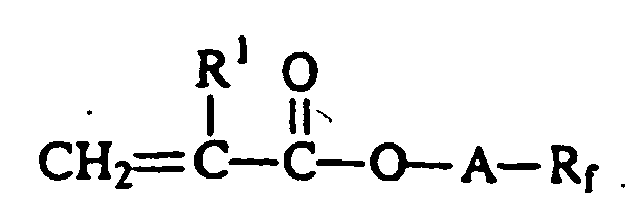
- the polymer includes, i) a perfluoroaliphatic monomer of the formula where R f is a perfluorinated group, preferably a C 1 -C 20 perfluorinated group, A is a divalent linking group, for example -C z H 2z -(OC m H 2m ) n -, or a group, z is 1 to 12, m is 1 to 6, n is 1 to 1.2, R 1 is H or CH 3 -, and R 2 is H, CH 3 - or C 2 H 5 -; ii) a hydrophilic monomer of the formula where B is -(CH 2 CH 2 O) p -, R 3 is H or CH 3 , p is 1 to 25, R 4 is C 1 -C 12 alkyl, aryl, aralkyl or alkaryl; iii) a cationogenic mono
- Y is a cationogenic group
- X - is an anion
- R 5 is H or CH 3 -
- R 11 is H or CH 3 -
- monomer (i) is present in the amount of 20 to 70 percent by weight, monomer (ii) is present in the amount of 25 to 60 percent by weight, monomer (iii) is present in the amount of 1 to 20 percent by weight, and monomer (iv) is present in the amount of 1 to 10 percent by weight.
- Another embodiment of the present invention includes polymers described above where monomer (i) is present in the amount of 45 to 70 percent by weight, monomer (ii) is present in the amount of 25 to 50 percent by weight, monomer (iii) is present in the amount of 1 to 10 percent by weight, and monomer (iv) is present in the amount of 1 to 8 percent by weight.
- a further embodiment of the present invention includes polymers described above where monomer (i) is present in the amount of 50 to 65 percent by weight, monomer (ii) is present in the amount of 35 to 40 percent by weight, monomer (iii) is present in the amount of 1 to 5 percent by weight, and monomer (iv) is present in the amount of 1 to 5 percent by weight.
- compositions for imparting oil, water and stain repellency and stain-release properties to a substrate comprising an aqueous, substantially organic solvent free, solution or dispersion of the polymers described above.
- the polymers of the present invention may be applied to substrates, such as textiles, to provide stain resistance, stain release and or oil-repellency without the use of other common textile additives such as permanent press resins, and the like.
- substrates such as textiles
- additives may be added where desired.
- Such additives may be admixed with the polymers of the invention and applied to the substtrate, or may be applied separately.
- An additional advantage of the present invention is that aqueous solutions of the polymers described herein maintain a water-like viscosity characteristic which allows the materials to be conveniently handled and transferred even at wt solids at or above 15%. This allows for more efficient conveyance of polymer solutions, since a higher percent solids aqueous formulation necessarily requires the transportation of less water.
- the present invention is believed to be applicable to fluorochemical polymers for use in providing stain-resistant and/or stain-release properties to a substrate material.
- the present invention is directed to fluorochemical polymers that contain pendant fluoroaliphatic and cationogenic groups. While the present invention is not so limited, an appreciation of various aspects of the invention will be gained through a discussion of the examples provided below.
- alkyl refers to straight or branched hydrocarbon radicals, such as methyl, ethyl, propyl, butyl, octyl, isopropyl, tert-butyl, sec-pentyl, and the like.
- Alkyl groups can either be unsubstituted or substituted with one or more substituents, e.g., halogen, alkoxy, aryl, arylalkyl, aralkoxy and the like.
- Alkyl groups include, for example, 1 to 12 carbon atoms, 1 to 8 carbon atoms, or 1 to 6 carbon atoms.
- alkenyl refers to straight or branched unsaturated hydrocarbon radicals having one or more double bonds, such as ethylene, propylene, butylene, 1, 3-pentadiene, 1, 4-pentadiene, and the like.
- Alkenyl groups can either be unsubstituted or substituted with one or more substituents, e.g., haloalkyl, halogen, alkoxy, aryl, arylalkyl, aralkoxy and the like.
- Alkenyl groups include, for example, 2 to 12 carbon atoms, or 2 to 9 carbon atoms.
- alkylene refers to a divalent straight or branched saturated hydrocarbon radical such as, for example, -CH 2 -, -CH 2 CH 2 -, -CH 2 CH 2 CH 2 -, -CH 2 CH 2 CH(CH 3 )CH 2 -, -CH 2 CH(CH 2 CH 3 )CH 2 CH(CH 3 )CH 2 -, and the like.
- Alkylene groups include, for example. 1 to 20, 1 to 12, or 1 to 4 carbon atoms.
- halo refers to fluoride, chloride, bromide, and iodide radicals.
- haloalkyl refers to an alkyl group substituted with a halo radical as defined above.
- hydroxyalkyl refers to an alkyl group as defined above substituted with a hydroxyl moiety.
- aryl refers to monovalent unsaturated aromatic carbocyclic radicals having a single ring, such as phenyl, or multiple condensed rings, such as naphthyl or anthryl, which can be optionally substituted by substituents such as halogen, alkyl, arylalkyl, alkoxy, aralkoxy, and the like.
- alkoxy refers to -O-alkyl with alkyl as defined above.
- Alkoxy groups include, for example, methoxy, ethoxy, propoxy, isopropoxy, and the like.
- aralkyl refers to an aryl radical defined as above substituted with an alkyl radical as defined above (e.g. aryl-alkyl-).
- Aralkyl groups include, for example, phenethyl, benzyl, and naphthethyl.
- alkaryl refers to an alkyl radical defined as above bonded to an aryl radical as defined above (e.g. alkyl-aryl-).
- aralkylene refers to an aryl radical defined as above substituted with an alkylene radical as defined above, thus producing a divalent moiety (e.g. -aryl-alkyl-).
- Aralkylene groups include, for example, phenethyl, benzyl, and naphthethyl.
- alkaryl refers to an alkyl radical defined as above bonded to an aryl radical as defined above thus producing a divalent moiety (e.g. -alkyl-aryl-).
- weight percent refers to the percent by mass of an individual component in a total system.
- weight percent of an individual monomer in a polymer is the mass of the individual monomer divided by the mass of the total polymer multipled by 100.
- R f is a perfluorinated aromatic or aliphatic group containing at least one carbon atom.
- the radical contains a plurality of carbon atoms in a skeletal chain, such chain may be linear, branched, acyclic, cyclic, saturated or unsaturated.
- the skeletal chain of carbon atoms can be interrupted by heteroatoms, such as divalent oxygen or trivalent nitrogen atoms each of which is bonded only to carbon atoms, or hexavalent sulfur atoms each of which may be bonded to carbon, fluorine, or oxygen atoms, but preferably where such heteroatoms are present, such skeletal chain does not contain more than one said heteromoiety for every two carbon atoms.
- the total number of carbon atoms in R f can vary and be, for example, 1 to 20, preferably 1 to 8, and more preferably 1 to 4.
- R f is or contains a cyclic structure, such structure preferably has 5 or 6 ring members, one or two of which can be said heteroatoms, e.g., oxygen and/or nitrogen.
- two or more R f groups occur in a single formula, they can be the same or different and may be linked together to form a cyclic structure.
- Cationogenic refers to nonionic substituents capable of forming cations.
- Cationogenic groups include pyridinium ion, phosphonium ion, sulfonium ion, radicals of quaternary ammonium salts or cation generating amines, which include alkyl-substituted amines, amine oxides and oxygen-free amines such as, for example, -NH 2 .
- substantially organic solvent free refers to a solution containing less that 30% of an organic solvent.
- substrate refers to any structural surface to which a solution may be applied such as, for example, textiles, paper, wood, leather, natural or synthetic fibers, and films.
- the present invention provides for polymeric fluorochemical polymers that include perfluoroaliphatic, hydrophilic, cationogenic, and N-hydroxyalkylacrylamide and/or diacrylate monomers.
- the polymers Preferably comprise N-hydroxyalkylacrylamide or diacrylate monomers.
- Perfluorinated monomers useful in the present invention are esters of the formula I
- R f designates a perfluoroaliphatic group.
- the polymeric fluorochemical polymers of the invention contain a plurality of pendent R f groups (e.g. from 4 to 10) and contain from 5 percent to 80 percent fluorine by weight, based on the total weight of the polymer, the loci of the fluorine being essentially in the R f groups.
- polymeric fluorochemical polymers of the invention can include, for example, from 10 percent to 70 percent, 20 percent to 65 percent, or 30 percent to 60 percent fluorine by weight, based on the total weight of the polymer, the loci of the fluorine being essentially in the R f groups.
- Each R f is a stable, inert, non-polar, preferably saturated, monovalent moiety which is both oleophobic and hydrophobic.
- R f contains, for example, at least 1 carbon atom.
- R f can include, for example from 1 to 20 carbon atoms, 1 to 12 carbon atoms, 1 to 8 carbon atoms, 3 to 8 carbon atoms, or 3 to 6 carbon atoms.
- the terminal portion of the R f group contains a fully fluorinated terminal group such as, for example, CF 3 CF 2 CF 2 -, (CF 3 ) 2 CF-, or the like.
- R f is a C 3 -C 4 perfluoroalkyl moiety such as a C 4 perfluoroalky moiety.
- A is a moiety that links the R f groups to the acrylate group of a perfluoroaliphatic monomer.
- A includes, for example, from 1 to 20 carbon atoms and can optionally include caternary oxygen, nitrogen, sulfur, or silicon-containing groups or a combination thereof.
- a groups includes, for example, a covalent bond, straight, branched or cyclic alkylene groups, arylene, alkarylene, aralkylene, oxy, oxo, thio, sulfonyl, sulfonyloxy, amino, imino, sulfonamido, carboxamido, carbonyloxy, urethanylene, urylene groups, and combinations thereof such as sulfonamidoalkylene groups.
- A includes, for example, a C 1 -C 20 alkylene, -C z H 2z -(OC m H 2m ) n -, or a group, each z is independently 1 to 20, m is 1 to 6, and n is 1 to 12.
- A includes a C 2 -C 6 alkylene or group where z is 1 to 6.
- A includes a C 2 -C 4 alkylene group, for example -CH 2 CH 2 -, or a group where z is 2. R 4 i 3 -.
- R 2 includes, for example, hydrogen or C 1 -C 12 alkyl. In an additional example, R 2 includes hydrogen or C 1 -C 4 alkyl. In a further example, R 2 includes hydrogen, CH 3 - or CH 3 CH 2 -.
- Hydrophilic monomers useful in the present invention are acrylate esters of the formula II
- R 4 is C 1 -C 12 alkyl, aryl, aralkyl, or alkaryl. In an additional example, R 4 is C 1 -C 8 alkyl.
- R 4 is C 1 alkyl.
- B is a moiety that links R 4 to the acrylate group.
- B is -(CH 2 CH 2 O) p -, where p is 1 to 25.
- B is -(CH 2 CH 2 O) p -, where p is 10 to 20.
- B is -(CH 2 CH 2 O) p -, where p is 17.
- R 3 is hydrogen or CH 3 -.
- Cationogenic monomers useful in the present invention are acrylate esters of the formula III
- L designates a cationogenic group.
- the polymeric fluorochemical polymers of the invention contain a plurality of pendent cationogenic groups (e.g. from 4 to 10). Each cationogenic group preferably contains at least 3 carbon atoms, more preferably 3 to 20 carbon atoms, and most preferably 4 to 8 carbon atoms. Additionally, each cationogenic group optionally contains oxygen, nitrogen, or sulfur groups or a combination thereof.
- L includes dialkylaminoalkyl moieties, in either the free base or amine salt form, as well as quaternary ammonium and amine oxide moieties.
- L is -(C q H 2q )-Y, and salts thereof, including an onium moiety of the Formula V q is 1 to 8;
- Y is a cationogenic group, such as, for example, the pyridinium ion, phosphonium ion, sulfonium ion, or N(R 8 ) 3 where each R 8 is independently H, or C 1 -C 4 alkyl, or where any two of R 8 combine to from an alkylene moiety having 4 to 5 chain carbon atoms, or any two of R 8 are -CH 2 CH 2 - and combine with an oxygen atom to form the moiety -CH 2 CH 2 -O-CH 2 CH 2 -.
- X - is a water-solubilizing anion and includes alkyl sulfate ions such as, for example, CH 3 OSO 3 - , and the halide ions such as, for example, Cl - , Br - , F - , and I - .
- alkyl sulfate ions such as, for example, CH 3 OSO 3 -
- halide ions such as, for example, Cl - , Br - , F - , and I - .
- Additional examples of quaternary ammonium moieties of the Formula V include those where q is 1 to 4 and each R 8 is independently C 1 -C 4 alkyl. Further examples of quaternary ammonium moieties of the Formula V include those where q is 2 and each R 8 is independently C 1 alkyl.
- L is a dialkylaminoalkyl moiety of the Formula IV where q is 1 to 8, and R 6 and R 7 are independently C 1 -C 12 alkyl or C 1 -C 12 hydroxyalkyl. Additional examples of dialkylaminoalkyl moieties of the Formula IV include those where q is 1 to 4 and R 6 and R 7 are independently C 1 -C 4 alkyl. Further examples of dialkylaminoalkyl moieties of the Formula IV include those where q is 2 and R 6 and R 7 are each C 1 alkyl.
- L is an amine oxide moiety of the Formula VI where q is 1 to 8, and R 9 and R 10 are independently C 1 -C 12 alkyl or C 1 -C 12 hydroxyalkyl. Additional examples of amine oxide moieties of the Formula VI include those where q is 1 to 4 and R 9 and R 10 are independently C 1 -C 4 alkyl. Further examples of amine oxide moieties of the Formula VI include those where q is 2 and R 9 and R 10 are each CH 3 .
- R 5 is hydrogen or methyl.
- N-Hydroxyalkylacrylamide monomers useful in the present invention are monomers of the formula VII where z is 1 to 12, and R 11 is hydrogen or methyl. In an additional example, z is 1 to 6.
- N-hydroxyalkylacrylamides monomers examples include the following:
- Diacrylate monomers useful in the present invention include, for example, monomers of the formula VIII where R 12 includes H or CH 3 -, and R 13 includes -(CH 2 CH 2 O) p -, where p is 1 to 25. In an additional example, R 12 is H and p is 1 to 20. In a further example, p is 5 to 15.
- diacrylate monomers examples include the following:
- the fluorochemical polymers of the present invention can be prepared by the polymerization of compounds of the Formula I, II, III, VII and optionally VIII in the presence of a free-radical initiator using solvent polymerization techniques known to those of skill in the art.
- the fluorochemical polymers of the present invention can be prepared in any solvent suitable for organic free-radical reactions.
- the reactants can be present in the solvent at any suitable concentration, e.g., from about 5 percent to about 90 percent by weight based on the total weight of the reaction mixture.
- suitable solvents include aliphatic and alicyclic hydrocarbons (e.g., hexane, heptane, cyclohexane), aromatic solvents (e.g., benzene, toluene, xylene), ethers (e.g., diethylether, glyme, diglyme, diisopropyl ether), esters (e.g., ethyl acetate, butyl acetate), alcohols (e.g., ethanol, isopropyl alcohol), ketones (e.g., acetone, methyl ethyl ketone, methyl isobutyl ketone), sulfoxides (e.g., dimethyl sulfoxide), amides (e.g., N,N-dimethylformamide, N,N-dimethylacetamide), halogenated solvents such as methylchloroform, FREON TM 113, trichloro
- Free-radical catalysts include any of the conventional compounds such as, for example, organic azo compounds, organic peroxides (e.g., diacyl peroxides, peroxyesters, and dialkyl peroxides) that provide initiating radicals upon homolysis.
- organic azo compounds organic peroxides (e.g., diacyl peroxides, peroxyesters, and dialkyl peroxides) that provide initiating radicals upon homolysis.
- Free-radical catalysts include persulfates, azo compounds such as azo bis(isobutyronitrile) and azo-2-cyanovaleric acid and the like, hydroperoxides such as cumene, t-butyl and t-amyl hydroperoxide, dialkyl peroxides such as di-t-butyl and dicumyl peroxide, peroxyesters such as t-butyl perbenzoate and di-t-butylperoxy phthalate, diacylperoxides such as benzoyl peroxide and lauroyl peroxide.
- a suitable amount of free-radical catalyst depends on the particular catalyst and other reactants being used. About 0.1 percent to about 5 percent, preferably about 0.1 percent to about 0.8 percent, and most preferably about 0.2 percent to 0.5 percent by weight of a catalyst can be used, based on the total weight of all other reactants in the reaction.
- the fluorochemical polymers of the present invention can alternatively be prepared in the presence of a free-radical initiator and a chain transfer catalyst using solvent polymerization techniques known to those of skill in the art. Either functionalized or non-functionalized chain-transfer agents can be used.
- Functionalized chain-transfer agents are those that contain a group capable of terminating a radical chain reaction (e.g., a sulfhydryl) yet include further functional groups capable of reacting with nucleophiles, electrophiles, or capable of undergoing displacement reactions.
- the nature of the functional groups on both the chain transfer agent and the monomers are chosen so that they are reactive toward one another. Examples of mutually reactive pairs include an acyl group (such as a carboxylic acid, acyl halide or ester) reacting with an alcohol or amine, an alcohol or an amine reacting with a "leaving group” such as a halide or tosylate, and an isocyanate reacting with an alcohol or amine.
- acyl group such as a carboxylic acid, acyl halide or ester
- Suitable functional groups for inclusion in the chain-transfer agent include hydroxy, amino, halo, epoxy, haloformyl, aziridinyl, acid groups and salts thereof, which react with an electrophile or nucleophile, or are capable of further transformation into such groups.
- Examples of such functionalized chain transfer agents include 2-mercaptoethanol, mercaptoacetic acid, 2-mercaptobenzimidazole, 2-mercaptobenzoic acid, and 2-mercaptobenzothiazole.
- Non-functionalized chain-transfer agents are those that contain a group capable of terminating a radical chain reaction (e.g., a sulfhydryl) but no further functional groups capable of reacting with nucleophiles, electrophiles, or capable of undergoing displacement reactions.
- examples of such non-functionalized chain transfer agents include mono, di, and polythiols such as ethanethiol, propanethiol, butanethiol, hexanethiol, n-octylthiol, t-dodecylthiol, 2-mercaptoethyl ether, and 2-mercaptoimidazole.
- a chain transfer agent may be present in an amount sufficient to control the number of polymerized monomer units in the oligomer.
- Conventional chain transfer agents useful in the synthesis of the compounds of the present invention include, for example, dodecylmercaptan and isooctyl thioglycolate in amounts of 0.1 percent to 5 percent, 0.1 percent to 2 percent, or 0.2 percent to 0.5 percent by weight, based on the total weight of all other reactants in the reaction.
- Weight ratios of the monomers of the polymeric fluorochemical compounds of the present invention include those from 20 to 70 percent by weight of a perfluoroaliphatic monomer of the Formula I, from 25 to 60 percent by weight of a hydrophilic monomer of the Formula II, from 1 to 20 percent by weight of a cationogenic monomer of the formula III, 1 to 10 percent by weight of a hydroxyalkylamide monomer of the formula VII, and optionally 0.001 to 5 percent by weight of a diacrylate monomer of the formula VIII.
- weight ratios of the monomers of the polymeric fluorochemical polymers of the present invention are from 45 to 70 percent by weight of a perfluoroaliphatic monomer of the Formula I, from 25 to 50 percent by weight of a hydrophilic monomer of the Formula II, from 1 to 10 percent by weight of a cationogenic monomer of the formula III, and from 1 to 8 percent by weight of a hydroxyalkylamide monomer of the formula VII.
- weight ratios of the monomers of the polymeric fluorochemical polymers of the present invention are 50 to 65 percent by weight of a perfluoroaliphatic monomer of the Formula I, 35 to 40 percent by weight of a hydrophilic monomer of the Formula II, 1 to 5 percent by weight of a cationogenic monomer of the formula III, and 1 to 5 percent by weight of a hydroxyalkylamide monomer of the formula VII.
- FC-248 - can be prepared by the general procedure described in U.S. Pat. No. 5,574,791 .
- C4-FC-248 - can be prepared by the general procedure described in U.S. Pat. No. 5,574,791 by substituting MeFBSEA for MeFOSEA.
- MeFBSEA N-methylperfluorobutanesulfonamido ethylmethacrylate
- CW-750-A poly(ethylene oxide) monomethyl acrylate
- Table 1 lists the initial stain release and oil resistance, and also stain release data after five launderings.
- the comparative example (Table 1, Nos. C1 and C2) show that an equivalent weight substitution of perfluorooctane sulfonamide ethylacrylate (Table 1, No. C1) with perfluorobutane sulfonamide ethylacrylate (Table 1, No. C2) exhibited poorer initial oil resistance, poorer initial stain release and also poorer stain release after 5 launderings.
- Addition of CW-400 Diacrylate (Table 1, No. 2; see Reference Example 7) improves the initial stain release ratings of treated fabric over the comparative fabric sample with no CW-400 Diacrylate (Table 1, No. 1).
- Addition of CW-400 Diacrylate (Table 1, No. 2; see Reference Example 7) also maintains or improves the five laundering stain release ratings of treated fabric over the comparative fabric sample with no CW-400 Diacrylate (Table 1, No. 1).
- MeFBSEA/CW-750A/DMAEMA 60/35/5) 6 6 6 0 4 28 6 6 6 0 3 22 2 MeFBSEA/CW-750A/DMAEMA/NMA (60/35/2.5/2.5) 6.5 7 5.5 0 30 34 6.5 6.5 5 0 30 29 3 MeFBSEA/CW-750A/DMAEMA/NMA (60/35/1.0/4.0) 7 6.5 6 0 30 38 7 8 6.5 0 30 40 4 MeFBSEA/CW-750A/DMAEMA (54/44/2) 6 6.5 4.5 0 2 20 6 6.5 4.5 0 2 21 5 MeFBSEA/CW-750A/DMAEMA/NMA (52/44/2/2) 6.5 7 6 0 30 25 6.5 6.5 6 0 16 18 6 AC600/CW-
- Tables 2A and 2B list the initial stain release, initial oil resistance, initial absorption data and also stain release, oil resistance absorption times and % Fluorine (%F) retained on the fabric after five, ten and twenty launderings.
- the fabric samples treated with compositions containing NMA (Table 2A, Nos. 2, 3, 5 and 7) resulted in higher oil resistance ratings and improved stain release ratings than the comparative samples which contained no NMA (Table 2A, No.1, 4, and 6).
- the fabric samples treated with compositions containing NMA Table 2B, Nos. 2, 3, 5 and 7) resulted in longer absorption times and stain release ratings than the comparative sample that contained no NMA (Table 2B, No.1, 4 and 6).
- compositions containing NMA (Tables 2A and 2B, No. 2, 3, 5 and 7) generally exhibit higher % F retained values than comparative compositions containing no NMA (Tables 2A and 2B, No. 1, 4 and 6).
- Table 3 No. MeFBSEA/CW-750A/DMAEMA/NMA % Solids Viscosity 1 65/35/0/0 15 Honey-like 2 65/33/0/2 21 Honey-like 3 50/50/0/0 25 Water-like 4 60/35/2.5/2.5 15 Water-like 5 64/34/2/0 25 Water-like Qualitative viscosity observations listed in Table 3 show that formulations at solids ⁇ 15%, with high MeFBSEA (> 60 %) requires DMAEMA to achieve water-like viscosity which allows for economical conveyance and convenient transfer of aqueous polymer solutions in manufacturing operations.
- a 65% polyester, 35% cotton twill fabric was dipped into a bath of the diluted polymer and immediately sent through a nip.
- the concentration of the bath is adjusted to produce a fabric that when dry had a fluorochemical solids coating at 0.4% or 1.0% of the fabric total weight.
- the bath also contained either a glyoxal-type resin, Permafresh TM ULF (Omnova Solutions, Inc.), and a citric acid activated magnesium chloride catalyst, Catalyst 531 TM (Omnova Solutions, Inc.) or a pre-catalyzed resin, Permafresh TM EFC (Omnova Solutions, Inc.), a nonionic surfactant, Pat-Wet LF-55 (Yorkshire Pat-Chem Inc.), at 0.1% to 0.3% on the weight of the bath, and either a silicone emulsion, Siltouch SRS TM (Yorkshire Pat-Chem Inc.), at 2% on the weight of the bath, or a polyolefin emulsion, Pat-Soft PHD (Yorkshire Pat-Chem Inc.), at 2% on the weight of the bath.
- the fabric was dried and cured for 10 minutes at 150C. A number of performance tests were run on the fabric.
- This test measures the resistance of the treated fabric to oil-based insults.
- a drop of one standard surface tension fluid (of a series of 8, with decreasing surface tensions) is dropped on a treated fabric. If after thirty seconds there is no wetting, the next highest standard number fluid (next lowest surface tension) is tested. When the lowest number fluid soaks into the fabric, the next lower number is the rating. For example, the fabric will receive a three rating, if the number four fluid wets the fabric.
- 3M Protective Material Division's "Oil Repellency Test I" method Document # 98-0212-0719-0).
- Oil Repellency Test was run on treated fabric that had subsequently been washed in 5, 10, or 20, consecutive launderings, followed by tumble drying, as described in the 3M Protective Materials Division "Laboratory Laundering Procedures" for home laundering simulation (Document # 98-0212-0703-4).
- This test evaluates the release of forced-in oil-based stains from the treated fabric surface during simulated home laundering.
- Five drops of mineral oil, Stain K (Kaydol, Witco Chemical Co.) are dropped onto the fabric surface in a single puddle, a separate puddle of 5 drops of corn oil, Stain E, are dropped onto the fabric and another puddle of five drops of motor oil mixed with standard dirt, Stain C, are dropped onto the fabric.
- the puddles are covered with glassine paper, and weighted with a five-pound weight each for 60 seconds. The weights and glassine paper are removed from the fabric.
- the fabric sample is hung for 15-60 minutes, and then washed and dried.
- Samples are evaluated against a rating board, and assigned a number from 1 to 8.
- An 8 represents total removal of the stain, where 1 is a very dark stain.
- a more detailed description of the test is written in the 3M Protective Material Division's "Stain Release Test I" method (Document # 98-0212-0725-7).
- the Stain Release Test was run on treated fabric that had subsequently been washed in 5, 10, or 20, consecutive launderings, followed by tumble drying, as described in the 3M Protective Material Division's "Laboratory Laundering Procedures" (Document# 98-0212-0703-4).
- This test is designed to determine the amount of fluorine present on a substrate using combustion techniques.
Landscapes
- Chemical & Material Sciences (AREA)
- Chemical Kinetics & Catalysis (AREA)
- Health & Medical Sciences (AREA)
- Medicinal Chemistry (AREA)
- Polymers & Plastics (AREA)
- Organic Chemistry (AREA)
- Engineering & Computer Science (AREA)
- Textile Engineering (AREA)
- Addition Polymer Or Copolymer, Post-Treatments, Or Chemical Modifications (AREA)
- Organic Low-Molecular-Weight Compounds And Preparation Thereof (AREA)
- Treatments For Attaching Organic Compounds To Fibrous Goods (AREA)
- Compositions Of Macromolecular Compounds (AREA)
- Macromonomer-Based Addition Polymer (AREA)
- Moulds For Moulding Plastics Or The Like (AREA)
- Polysaccharides And Polysaccharide Derivatives (AREA)
Abstract
Description
- This invention relates to fluorochemical polymers for use in providing stain release properties to a substrate material. In another aspect, this invention relates to fluorochemical polymers that contain pendant fluoroaliphatic and cationogenic groups. This invention also relates to fluorochemical polymers with improved stain release durability when applied to a substrate material. This invention further relates to a composition for imparting stain release properties to a substrate.
- The treatment or modification of fabrics to improve their properties is routine practice in the textile industry. Fabrics can be treated to reduce their oleophilicity and facilitate stain release during laundering. Such treatments include fluorochemical-based polymers containing both fluorinated oleophobic and non-fluorinated hydrophilic fractions.
- Fluorochemicals include substances containing portions which are fluorocarbon in nature and portions which are organic hydrocarbon in nature. Such fluorochemicals are common and have various industrial uses including reducing the surface tension of liquids, reducing evaporation and flammability of volatile organic liquids, and improving the leveling of organic polymer coatings.
- The utility of organofluorine compounds as surface-active agents and surface-treating agents is due in large part to the extremely low free-surface energy of a C6-C12 fluorocarbon group, according to H.C. Fielding, "Organofluorine Compounds and Their Applications" R.E. Banks, Ed., Society of Chemical Industry at p. 214 (1979).
- Generally, the present invention relates to fluorochemical polymers for use in providing stain release properties to a substrate material. The polymer includes, i) a perfluoroaliphatic monomer of the formula


q is 1 to 8, Y is a cationogenic group, X- is an anion, R5 is H or CH3-;
iv) a N-hydroxyalkylacrylamide monomer of the formula
v) a diacrylate monomer of the formula
- In the polymer described above, monomer (i) is present in the amount of 20 to 70 percent by weight, monomer (ii) is present in the amount of 25 to 60 percent by weight, monomer (iii) is present in the amount of 1 to 20 percent by weight, and monomer (iv) is present in the amount of 1 to 10 percent by weight.
- Another embodiment of the present invention includes polymers described above where monomer (i) is present in the amount of 45 to 70 percent by weight, monomer (ii) is present in the amount of 25 to 50 percent by weight, monomer (iii) is present in the amount of 1 to 10 percent by weight, and monomer (iv) is present in the amount of 1 to 8 percent by weight.
- A further embodiment of the present invention includes polymers described above where monomer (i) is present in the amount of 50 to 65 percent by weight, monomer (ii) is present in the amount of 35 to 40 percent by weight, monomer (iii) is present in the amount of 1 to 5 percent by weight, and monomer (iv) is present in the amount of 1 to 5 percent by weight.
- Yet another embodiment, of the present invention includes a composition for imparting oil, water and stain repellency and stain-release properties to a substrate comprising an aqueous, substantially organic solvent free, solution or dispersion of the polymers described above.
- Advantageously, the polymers of the present invention may be applied to substrates, such as textiles, to provide stain resistance, stain release and or oil-repellency without the use of other common textile additives such as permanent press resins, and the like. However, such additives may be added where desired. Such additives may be admixed with the polymers of the invention and applied to the substtrate, or may be applied separately.
- An additional advantage of the present invention is that aqueous solutions of the polymers described herein maintain a water-like viscosity characteristic which allows the materials to be conveniently handled and transferred even at wt solids at or above 15%. This allows for more efficient conveyance of polymer solutions, since a higher percent solids aqueous formulation necessarily requires the transportation of less water.
- The above summary of the present invention is not intended to describe each disclosed embodiment or every implementation of the present invention. As used herein, the term polymer shall be inclusive of oligomers. The detailed description which follows more particularly exemplifies these embodiments.
- The present invention is believed to be applicable to fluorochemical polymers for use in providing stain-resistant and/or stain-release properties to a substrate material. In particular, the present invention is directed to fluorochemical polymers that contain pendant fluoroaliphatic and cationogenic groups. While the present invention is not so limited, an appreciation of various aspects of the invention will be gained through a discussion of the examples provided below.
- It is to be understood that the recitation of numerical ranges by endpoints includes all numbers and fractions subsumed within that range (e.g. 1 to 5 includes 1, 1.5, 2, 2.75, 3,-3.80, 4, and 5).
- It is to be understood that all numbers and fractions thereof are presumed to be modified by the term "about."
- It is to be understood that "a" as used herein includes both the singular and plural.
- The general definitions used herein have the following meanings within the scope of the present invention.
- The term "alkyl" refers to straight or branched hydrocarbon radicals, such as methyl, ethyl, propyl, butyl, octyl, isopropyl, tert-butyl, sec-pentyl, and the like. Alkyl groups can either be unsubstituted or substituted with one or more substituents, e.g., halogen, alkoxy, aryl, arylalkyl, aralkoxy and the like. Alkyl groups include, for example, 1 to 12 carbon atoms, 1 to 8 carbon atoms, or 1 to 6 carbon atoms.
- The term "alkenyl" refers to straight or branched unsaturated hydrocarbon radicals having one or more double bonds, such as ethylene, propylene, butylene, 1, 3-pentadiene, 1, 4-pentadiene, and the like. Alkenyl groups can either be unsubstituted or substituted with one or more substituents, e.g., haloalkyl, halogen, alkoxy, aryl, arylalkyl, aralkoxy and the like. Alkenyl groups include, for example, 2 to 12 carbon atoms, or 2 to 9 carbon atoms.
- The term "alkylene" refers to a divalent straight or branched saturated hydrocarbon radical such as, for example, -CH2-, -CH2CH2-, -CH2CH2CH2-, -CH2CH2CH(CH3)CH2-, -CH2CH(CH2CH3)CH2CH(CH3)CH2-, and the like. Alkylene groups include, for example. 1 to 20, 1 to 12, or 1 to 4 carbon atoms.
- The term "halo" refers to fluoride, chloride, bromide, and iodide radicals.
- The term "haloalkyl" refers to an alkyl group substituted with a halo radical as defined above.
- The term "hydroxyalkyl" refers to an alkyl group as defined above substituted with a hydroxyl moiety.
- The term "aryl" refers to monovalent unsaturated aromatic carbocyclic radicals having a single ring, such as phenyl, or multiple condensed rings, such as naphthyl or anthryl, which can be optionally substituted by substituents such as halogen, alkyl, arylalkyl, alkoxy, aralkoxy, and the like.
- The term "alkoxy" refers to -O-alkyl with alkyl as defined above. Alkoxy groups include, for example, methoxy, ethoxy, propoxy, isopropoxy, and the like.
- The term "aralkyl" refers to an aryl radical defined as above substituted with an alkyl radical as defined above (e.g. aryl-alkyl-). Aralkyl groups include, for example, phenethyl, benzyl, and naphthethyl.
- The term "alkaryl" refers to an alkyl radical defined as above bonded to an aryl radical as defined above (e.g. alkyl-aryl-).
- The term "aralkylene" refers to an aryl radical defined as above substituted with an alkylene radical as defined above, thus producing a divalent moiety (e.g. -aryl-alkyl-). Aralkylene groups include, for example, phenethyl, benzyl, and naphthethyl.
- The term "alkaryl" refers to an alkyl radical defined as above bonded to an aryl radical as defined above thus producing a divalent moiety (e.g. -alkyl-aryl-).
- The term "weight percent" refers to the percent by mass of an individual component in a total system. For example, the weight percent of an individual monomer in a polymer is the mass of the individual monomer divided by the mass of the total polymer multipled by 100.
- Rf is a perfluorinated aromatic or aliphatic group containing at least one carbon atom. Where the radical contains a plurality of carbon atoms in a skeletal chain, such chain may be linear, branched, acyclic, cyclic, saturated or unsaturated. The skeletal chain of carbon atoms can be interrupted by heteroatoms, such as divalent oxygen or trivalent nitrogen atoms each of which is bonded only to carbon atoms, or hexavalent sulfur atoms each of which may be bonded to carbon, fluorine, or oxygen atoms, but preferably where such heteroatoms are present, such skeletal chain does not contain more than one said heteromoiety for every two carbon atoms.
- The total number of carbon atoms in Rf can vary and be, for example, 1 to 20, preferably 1 to 8, and more preferably 1 to 4. Where Rf is or contains a cyclic structure, such structure preferably has 5 or 6 ring members, one or two of which can be said heteroatoms, e.g., oxygen and/or nitrogen. Where two or more Rf groups occur in a single formula, they can be the same or different and may be linked together to form a cyclic structure.
- The term "cationogenic" refers to nonionic substituents capable of forming cations. Cationogenic groups include pyridinium ion, phosphonium ion, sulfonium ion, radicals of quaternary ammonium salts or cation generating amines, which include alkyl-substituted amines, amine oxides and oxygen-free amines such as, for example, -NH2.
- The term "substantially organic solvent free" refers to a solution containing less that 30% of an organic solvent.
- The term "substrate" refers to any structural surface to which a solution may be applied such as, for example, textiles, paper, wood, leather, natural or synthetic fibers, and films.
- The present invention provides for polymeric fluorochemical polymers that include perfluoroaliphatic, hydrophilic, cationogenic, and N-hydroxyalkylacrylamide and/or diacrylate monomers. Preferably the polymers comprise N-hydroxyalkylacrylamide or diacrylate monomers.
- Perfluorinated monomers useful in the present invention are esters of the formula I

- With reference to Formula I, Rf designates a perfluoroaliphatic group. The polymeric fluorochemical polymers of the invention contain a plurality of pendent Rf groups (e.g. from 4 to 10) and contain from 5 percent to 80 percent fluorine by weight, based on the total weight of the polymer, the loci of the fluorine being essentially in the Rf groups. Additionally, polymeric fluorochemical polymers of the invention can include, for example, from 10 percent to 70 percent, 20 percent to 65 percent, or 30 percent to 60 percent fluorine by weight, based on the total weight of the polymer, the loci of the fluorine being essentially in the Rf groups. Each Rf is a stable, inert, non-polar, preferably saturated, monovalent moiety which is both oleophobic and hydrophobic. Rf contains, for example, at least 1 carbon atom. Rf can include, for example from 1 to 20 carbon atoms, 1 to 12 carbon atoms, 1 to 8 carbon atoms, 3 to 8 carbon atoms, or 3 to 6 carbon atoms. Additionally, the terminal portion of the Rf group contains a fully fluorinated terminal group such as, for example, CF3CF2CF2-, (CF3)2CF-, or the like. For example, Rf is a C3-C4 perfluoroalkyl moiety such as a C4 perfluoroalky moiety.
- With reference to Formula I, "A" is a moiety that links the Rf groups to the acrylate group of a perfluoroaliphatic monomer. "A" includes, for example, from 1 to 20 carbon atoms and can optionally include caternary oxygen, nitrogen, sulfur, or silicon-containing groups or a combination thereof. Examples of A groups includes, for example, a covalent bond, straight, branched or cyclic alkylene groups, arylene, alkarylene, aralkylene, oxy, oxo, thio, sulfonyl, sulfonyloxy, amino, imino, sulfonamido, carboxamido, carbonyloxy, urethanylene, urylene groups, and combinations thereof such as sulfonamidoalkylene groups. "A" includes, for example, a C1-C20 alkylene, -CzH2z-(OCmH2m)n-,


- With reference to Formula I, R2 includes, for example, hydrogen or C1-C12 alkyl. In an additional example, R2 includes hydrogen or C1-C4 alkyl. In a further example, R2 includes hydrogen, CH3- or CH3CH2-.
- Examples of perfluoroaliphatic monomers include the following:
TELOMER-A -(FLUOWET™-AC-812) (CH2=CHC(O)OCH2CH2(CF2)nCF3, where n is a value ranging from 3 to 20 and averaging 8); - (FLUOWET™-AC-600) (C6F13C2H4OC(O)CH=CH2) - C2F5C6F10CH2OC(O)CH=CH2; - C7F15CH2OC(O)CH=CH2; - C7F15CON(CH3)C2H4OC(O)CH=CH2; MeFOSEA - C8F17SO2N(CH3)C2H4OC(O)CH=CH2; EtFOSEA - C8F17SO2N(C2H5)C2H4OC(O)CH=CH2; Me FHSEA - C6F13SO2N(CH3)C2H4OC(O)CH=CH2; MeFBSEMA - C4F9SO2N(CH3)C2H4OC(O)C(CH3)=CH2; MeFBSEA - C4F9SO2N(CH3)CH2CH2OC(O)CH=CH2; and MeFOSEMA - C8F17SO2N(CH3)C2H4OC(O)C(CH3)=CH2. - Hydrophilic monomers useful in the present invention are acrylate esters of the formula II

- With reference to Formula II, R4 is C1-C12 alkyl, aryl, aralkyl, or alkaryl. In an additional example, R4 is C1-C8 alkyl.
- In a further example, R4 is C1 alkyl.
- With reference to Formula II, B is a moiety that links R4 to the acrylate group. B is -(CH2CH2O)p-, where p is 1 to 25. In an additional example, B is -(CH2CH2O)p-, where p is 10 to 20. In a further example, B is -(CH2CH2O)p-, where p is 17.
- With reference to Formula II, R3 is hydrogen or CH3-.
- Examples of hydrophilic monomers include the following:
CW-750A -CH3O(CH2CH2O)nC(O)CH=CH2; where navg = 16 CW-450A -CH3O(CH2CH2O)nC(O)CH=CH2; where navg = 9 - Cationogenic monomers useful in the present invention are acrylate esters of the formula III

- With reference to Formula III, L designates a cationogenic group. The polymeric fluorochemical polymers of the invention contain a plurality of pendent cationogenic groups (e.g. from 4 to 10). Each cationogenic group preferably contains at least 3 carbon atoms, more preferably 3 to 20 carbon atoms, and most preferably 4 to 8 carbon atoms. Additionally, each cationogenic group optionally contains oxygen, nitrogen, or sulfur groups or a combination thereof. L includes dialkylaminoalkyl moieties, in either the free base or amine salt form, as well as quaternary ammonium and amine oxide moieties.
- L is -(CqH2q)-Y, and salts thereof, including an onium moiety of the Formula V

- In one example, L is a dialkylaminoalkyl moiety of the Formula IV

- In a further example, L is an amine oxide moiety of the Formula VI

- With reference to Formula III, R5 is hydrogen or methyl.
- Examples of cationogenic monomers include the following:
DMAEMA - (CH3)2NC2H4OC(O)C(CH3)=CH2; DEAEMA - (CH3CH2)2NC2H4OC(O)C(CH3)=CH2; DMAEA - (CH3)2NC2H4OC(O)CH=CH2; DEAEA - (CH3CH2)2NC2H4OC(O)CH=CH2; - Cl- (CH3)3 +NC2H4OC(O)C(CH3)=CH2; - Cl-(CH3)3 +NC2H4OC(O)CH=CH2; - CH3SO3O- (CH3)3 +NC2H4OC(O)C(CH3)=CH2; - CH3SO3O- (CH3)3 +NC2H4OC(O)CH=CH2; - Cl- H(CH3CH2)2 +N C2H4OC(O)C(CH3)=CH2; - Cl-H(CH3CH2)2 +N C2H4OC(O)CH=CH2; - I- CH3(CH3CH2)2 +N C2H4OC(O)C(CH3)=CH2; 
- O ← N(CH3)2C2H4OC(O)C(CH3)=CH2. - N-Hydroxyalkylacrylamide monomers useful in the present invention are monomers of the formula VII

- Examples of N-hydroxyalkylacrylamides monomers include the following:
- - HOCH2HNC(O)CH=CH2.
- Diacrylate monomers useful in the present invention include, for example, monomers of the formula VIII

- Examples of diacrylate monomers include the following:
- CW-400-Diacrylate - CH2=CHC(O)O(C2H4O)nC(O)CH=CH2; where navg = 9.
- The fluorochemical polymers of the present invention can be prepared by the polymerization of compounds of the Formula I, II, III, VII and optionally VIII in the presence of a free-radical initiator using solvent polymerization techniques known to those of skill in the art.
- The fluorochemical polymers of the present invention can be prepared in any solvent suitable for organic free-radical reactions. The reactants can be present in the solvent at any suitable concentration, e.g., from about 5 percent to about 90 percent by weight based on the total weight of the reaction mixture. Examples of suitable solvents include aliphatic and alicyclic hydrocarbons (e.g., hexane, heptane, cyclohexane), aromatic solvents (e.g., benzene, toluene, xylene), ethers (e.g., diethylether, glyme, diglyme, diisopropyl ether), esters (e.g., ethyl acetate, butyl acetate), alcohols (e.g., ethanol, isopropyl alcohol), ketones (e.g., acetone, methyl ethyl ketone, methyl isobutyl ketone), sulfoxides (e.g., dimethyl sulfoxide), amides (e.g., N,N-dimethylformamide, N,N-dimethylacetamide), halogenated solvents such as methylchloroform, FREON™113, trichloroethylene, α,α,α-trifluorotoluene, fluorinated ethers such as C4F9OCH3 and the like, and mixtures thereof.
- Additionally, any conventional free-radical catalyst which is soluble in the solvent system can be used. Free-radical catalysts include any of the conventional compounds such as, for example, organic azo compounds, organic peroxides (e.g., diacyl peroxides, peroxyesters, and dialkyl peroxides) that provide initiating radicals upon homolysis. Free-radical catalysts include persulfates, azo compounds such as azo bis(isobutyronitrile) and azo-2-cyanovaleric acid and the like, hydroperoxides such as cumene, t-butyl and t-amyl hydroperoxide, dialkyl peroxides such as di-t-butyl and dicumyl peroxide, peroxyesters such as t-butyl perbenzoate and di-t-butylperoxy phthalate, diacylperoxides such as benzoyl peroxide and lauroyl peroxide. A suitable amount of free-radical catalyst depends on the particular catalyst and other reactants being used. About 0.1 percent to about 5 percent, preferably about 0.1 percent to about 0.8 percent, and most preferably about 0.2 percent to 0.5 percent by weight of a catalyst can be used, based on the total weight of all other reactants in the reaction.
- The fluorochemical polymers of the present invention can alternatively be prepared in the presence of a free-radical initiator and a chain transfer catalyst using solvent polymerization techniques known to those of skill in the art. Either functionalized or non-functionalized chain-transfer agents can be used.
- Functionalized chain-transfer agents are those that contain a group capable of terminating a radical chain reaction (e.g., a sulfhydryl) yet include further functional groups capable of reacting with nucleophiles, electrophiles, or capable of undergoing displacement reactions. The nature of the functional groups on both the chain transfer agent and the monomers are chosen so that they are reactive toward one another. Examples of mutually reactive pairs include an acyl group (such as a carboxylic acid, acyl halide or ester) reacting with an alcohol or amine, an alcohol or an amine reacting with a "leaving group" such as a halide or tosylate, and an isocyanate reacting with an alcohol or amine. Suitable functional groups for inclusion in the chain-transfer agent include hydroxy, amino, halo, epoxy, haloformyl, aziridinyl, acid groups and salts thereof, which react with an electrophile or nucleophile, or are capable of further transformation into such groups. Examples of such functionalized chain transfer agents include 2-mercaptoethanol, mercaptoacetic acid, 2-mercaptobenzimidazole, 2-mercaptobenzoic acid, and 2-mercaptobenzothiazole.
- Non-functionalized chain-transfer agents are those that contain a group capable of terminating a radical chain reaction (e.g., a sulfhydryl) but no further functional groups capable of reacting with nucleophiles, electrophiles, or capable of undergoing displacement reactions. Examples of such non-functionalized chain transfer agents include mono, di, and polythiols such as ethanethiol, propanethiol, butanethiol, hexanethiol, n-octylthiol, t-dodecylthiol, 2-mercaptoethyl ether, and 2-mercaptoimidazole.
- Whether functionalized or not, a chain transfer agent may be present in an amount sufficient to control the number of polymerized monomer units in the oligomer. Conventional chain transfer agents useful in the synthesis of the compounds of the present invention include, for example, dodecylmercaptan and isooctyl thioglycolate in amounts of 0.1 percent to 5 percent, 0.1 percent to 2 percent, or 0.2 percent to 0.5 percent by weight, based on the total weight of all other reactants in the reaction.
- Weight ratios of the monomers of the polymeric fluorochemical compounds of the present invention, based on the total weight of the polymer include those from 20 to 70 percent by weight of a perfluoroaliphatic monomer of the Formula I, from 25 to 60 percent by weight of a hydrophilic monomer of the Formula II, from 1 to 20 percent by weight of a cationogenic monomer of the formula III, 1 to 10 percent by weight of a hydroxyalkylamide monomer of the formula VII, and optionally 0.001 to 5 percent by weight of a diacrylate monomer of the formula VIII.
- In one example, weight ratios of the monomers of the polymeric fluorochemical polymers of the present invention, based on the total weight of the polymer are from 45 to 70 percent by weight of a perfluoroaliphatic monomer of the Formula I, from 25 to 50 percent by weight of a hydrophilic monomer of the Formula II, from 1 to 10 percent by weight of a cationogenic monomer of the formula III, and from 1 to 8 percent by weight of a hydroxyalkylamide monomer of the formula VII.
- In an additional example, weight ratios of the monomers of the polymeric fluorochemical polymers of the present invention, based on the total weight of the polymer are 50 to 65 percent by weight of a perfluoroaliphatic monomer of the Formula I, 35 to 40 percent by weight of a hydrophilic monomer of the Formula II, 1 to 5 percent by weight of a cationogenic monomer of the formula III, and 1 to 5 percent by weight of a hydroxyalkylamide monomer of the formula VII.
- TELOMER-A- FLUOWET™ AC-812 fluoroacrylate monomer, (CH2=CHC(O)OCH2CH2(CF2)nCF3, where n is a value ranging from 3 to 20 and averaging 8, available from Clariant GmbH, Frankfurt, Germany).
- (FLUOWET™-AC-600) (C6F13C2H4OC(O)CH=CH2) available from Clariant GmbH, Frankfurt, Germany
- MeFOSEA - C8F17SO2N(CH3)C2H4OC(O)CH=CH2, can be prepared using the general procedure described in
U.S. Pat. No. 2,803,615 . - EtFOSEA - C8F17SO2N(C2H5)C2H4OC(O)CH=CH2, can be prepared using the general procedure described in
U.S. Pat. No. 2,803,615 . - MeFBSEMA - C4F9SO2N(CH3)C2H4OC(O)C(CH3)=CH2, can be prepared using the general procedure described in
U.S. Pat, No. 2,803,615 . - MeFBSEA - C4F9SO2N(CH3)CH2CH2OC(O)CH=CH2, can be prepared using the general procedure described in
U.S. Pat. No. 2,803,615 . - MeFOSEMA - C8F17SO2N(CH3)C2H4OC(O)C(CH3)=CH2, can be prepared by the general procedure described in
U.S. Pat. No. 2,803,615 . - FC-248 - can be prepared by the general procedure described in
U.S. Pat. No. 5,574,791 . - C4-FC-248 - can be prepared by the general procedure described in
U.S. Pat. No. 5,574,791 by substituting MeFBSEA for MeFOSEA. - CW-750-A - CH3O(CH2CH2O)17C(O)CH=CH2,, can be prepared using the procedure described in Example 17 of
U.S. Pat. No. 3,728,151 . -
DMAEMA - (CH3)2NC2H4OC(O)C(CH3)=CH2; DEAEMA - (CH3CH2)2NC2H4OC(O)C(CH3)=CH2; DMAEA - (CH3)2NC2H4OC(O)CH=CH2; DEAEA - (CH3CH2)2NC2H4OC(O)CH=CH2; - Cl- (CH3)3 +NC2H4OC(O)C(CH3)=CH2; - Cl- (CH3)3 +NC2H4OC(O)CH=CH2; - CH3SO3O- (CH3)3 +NC2H4OC(O)C(CH)=CH2; - CH3SO3O (CH3)3 +NC2H4OC(O)CH=CH2; - Cl-H(CH3CH2)2 +N C2H4C(O)C(CH3)=CH2; - Cl-H(CH3CH2)2 +N C2H4OC(O)CH=CH2; - I- CH3(CH3CH2)2 +N C2H4OC(O)C(CH3)=CH2; 
- O ← N(CH3)2C2H4OC(O)C(CH3)=CH2; and - (CH3)2N(CH2)3N(H)C(O)CH=CH2. - - HOCH2(H)NC(O)CH=CH2.
- CW-400- Diacrylate - CH2=C(H)C(O)O(C2H4O)nC(O)C(H)=CH2; where navg =9.
- A 250 mL glass bottle was charged with N-methylperfluorobutanesulfonamido ethylmethacrylate (MeFBSEA, 60.0 g; 0.15 mole; available from 3M, St Paul, MN), poly(ethylene oxide) monomethyl acrylate (CW-750-A; 35.0 g; 0.042 mole; available from 3M, St. Paul, MN), dimethylaminoethyl methacrylate (DMAEMA; 2.50g; 0.016 mole; available from Aldrich, Milwaukee, WI), N-hydroxymethylacrylamide (NMA; 5.20g of 48% aqueous solution; 0.025 mole; available from Aldrich, Milwaukee, WI) and ethyl acetate (120 g; available from Aldrich, Milwaukee, WI). This mixture was shaken for approximately 1 - 2 minutes allowing the monomers to be dissolved in the ethyl acetate. Nitrogen was bubbled through the resulting solution for approximately 5 minutes upon which azo bis(isobutyronitrile) (AIBN;1.0 g; 0.006 mole; available from Aldrich, Milwaukee, WI), was added and nitrogen bubbled through the solution for an additional 1 minute. The bottle containing the solution was then capped and allowed to rotate in the Launder-Ometer™, available from Atlas Electric Devices Co., Chicago, IL, at 70°C for 12-15 h. Upon removal from the Launder-Ometer™ the solution was stirred and a mixture of acetic acid (0.95 g) and 200 mL warm water was added. The ethyl acetate was evaporated from the solution using a Rotavapor™ Model EL-131 (available from Buchi, Switzerland). The ensuing latex product obtained had an appearance from milky white to translucent.
- The procedure in Example 1 was followed with the exception that the weights of the following materials were substituted:
- MeFBSEA, 52.0 g; 0.13 mole; available from 3M, St Paul, MN),
- CW-750-A; 44.0 g; 0.052 mole
- DMAEMA; 2.00 g; 0.013 mole
- NMA; 4.17 g of 48% aqueous solution; 0.020 mole.
- Acetic Acid; 0.76 g
- The procedure in Example 1 was followed with the exceptions that the following material substitutions were made:
- AC-600 (60.0 g, 0.14 mole; available from Clariant GmbH, Frankfurt, Germany) in place of MeFBSEA and that the weights of the following materials were substituted:
- CW-750-A; 35.0 g; 0.042 mole
- DMAEMA; 2.50 g; 0.016 mole
- NMA; 5.20g of 48% aqueous solution; 0.025 mole.
- The procedure in Example 1 was followed with the exception that the weights of the following materials were substituted:
- MeFBSEA, 54.0 g; 0.13 mole
- CW-750-A; 44.0 g; 0.052 mole
- DMAEMA; 2.00 g; 0.013 mole
- Acetic Acid; 0.76 g;
- To a 1 L round bottom flask fitted with a heating mantle, Dean-Stark trap (filled with toluene, available from Aldrich, Milwaukee, WI to the arm), a condenser, a mixer and thermometer was added poly(ethylene oxide) monomethyl ether (CARBOWAX 750™, 228.53 g) available from Union Carbide, Danbury CT, and CARBOWAX™ 400 (4.66 g) available from Union Carbide, Danbury, CT. Heat was slowly applied to melt the CARBOWAX mixture and a solution of phenothiazine (0.1181 g; 6 x 10⁻⁴) available from Aldrich, Milwaukee, WI, in approximately 115.0 g of toluene, is added to the melt. The resulting mixture was further heated and upon addition of a suspension of p-toluenesulfonic acid (9.52 g; 0.05 mole) available from Aldrich, Milwaukee, WI, and acrylic acid (27.45 g, 0.38 mole) available from Aldrich, Milwaukee, WI, in approximately 115.0 g of toluene, the content of the round bottom flask turned brown. The ensuing mixture is heated at reflux temperature (approximately 120°C) for six hours. During this reflux time, about 6 mL of water were collected in the Dean-Stark trap. Upon cooling the reaction mixture to 65°C calcium hydroxide (9.52 g, moles) was slowly added to the stirred mixture and the mixture was allowed to stir for 15 minutes after the addition. This mixture was then filtered, resulting in a translucent, brown filtrate to which was added phenothiazine (.07 g, 3.5 x 10⁻⁴ mole). The filtrate was put onto a Rotavapor™ with a heating bath set at 90°C to evaporate toluene (typically 170 - 230 g) from the mixture. The resulting material is a mixture of
- CW-750-A:

and - CW-400 diacrylate:

- The procedure in Example 5 was followed with the exception that the following material substitutions were made:
- CW-2000™ (available from Union Carbide, Danbury CT) in place of CW-750 and CW-400.
- The procedure in Example 1 was followed with the exception that the following material substitution was made:
- CW-750-A + CW-400 diacrylate (45.0 g, 0.022 mole; 98/2 mixture see example 5) in place of CW-750A
- MeFBSEA, 52.5 g; 0.13 mole
- DMAEMA; 2.50 g; 0.016 mole
- The procedure in Example 1 was followed with the exception that the following material substitutions were made:
- CW-2000A (45.0 g, 0.022 mole; see Example 6) in place of CW-750A the weights of the following materials were substituted:
- MeFBSEA, 52.0 g; 0.13 mole
- DMAEMA; 2.50 g; 0.016 mole
- The procedure in Example 1 was followed with the exception that the following material substitutions were made:
- CW-450-A (45.0 g, 0.084 mole; available from Aldrich, Milwaukee, WI) in place of CW-750-A
- MeFBSEA, 52.0 g; 0.13 mole
- DMAEMA; 2.50 g; 0.016 mole
- and NMA was eliminated from the composition.
- Table 1 lists the initial stain release and oil resistance, and also stain release data after five launderings. The comparative example (Table 1, Nos. C1 and C2) show that an equivalent weight substitution of perfluorooctane sulfonamide ethylacrylate (Table 1, No. C1) with perfluorobutane sulfonamide ethylacrylate (Table 1, No. C2) exhibited poorer initial oil resistance, poorer initial stain release and also poorer stain release after 5 launderings. Addition of CW-400 Diacrylate (Table 1, No. 2; see Reference Example 7) improves the initial stain release ratings of treated fabric over the comparative fabric sample with no CW-400 Diacrylate (Table 1, No. 1). Addition of CW-400 Diacrylate (Table 1, No. 2; see Reference Example 7) also maintains or improves the five laundering stain release ratings of treated fabric over the comparative fabric sample with no CW-400 Diacrylate (Table 1, No. 1).
- Of samples treated with polymers containing different molecular weight poly(ethylene oxide) chains (Table 1 Nos. 3, 4 and 5), the CW-750A containing sample (Table 1 No. 4; see Reference Example 4) exhibited the best stain release data after five launderings, and best initial oil resistance (O/R).
Table 2A No. Composition (Wt % Ratios) Initial 5 Launderings K E C O/R Absorption time (sec) K E C O/R Absorption time (sec) %F Retained 1 MeFBSEA/CW-750A/DMAEMA (60/35/5) 7.5 7 6.5 5 >30 6.5 6.5 5 0 7 32 2 MeFBSEA/CW-750A/DMAEMA/NMA (60/35/2.5/2.5) 7.5 7 7 5 >30 7.5 7.5 6.5 1 >30 42 3 MeFBSEA/CW-750A/DMAEMA/NMA (60/35/1.0/4.0) 7.5 7.5 7 5 >30 7.5 8 7 1 >30 62 4 MeFHSEA/CW-750A/DMAEMA (54/44/2) 7 8 6.5 5 30 6.5 7 4.5 0 11 20 5 MeFBSEA/CW-750A/DMAEMA/NMA (52/44/2/2) 8 8 7 4 >30 7.5 7 6.5 1 >30 32 6 AC600/CW-750A/DMAEMA (60/35/5) 7 7.5 6.5 4 16 6 6.5 6 0 6 25 7 AC600/CW-750A/DMAEMA/NMA (60/35/2.5/2.5) 7 7.5 6.5 4 >30 6.5 6.5 6 1 >30 49 Table 2B No. Composition (Wt % Ratios) 10 Launderings 20 Launderings K E C O/R Absorption time (sec) %F Retained K E C O/R Absorption time (sec) % F Retained 1 MeFBSEA/CW-750A/DMAEMA (60/35/5) 6 6 6 0 4 28 6 6 6 0 3 22 2 MeFBSEA/CW-750A/DMAEMA/NMA (60/35/2.5/2.5) 6.5 7 5.5 0 30 34 6.5 6.5 5 0 30 29 3 MeFBSEA/CW-750A/DMAEMA/NMA (60/35/1.0/4.0) 7 6.5 6 0 30 38 7 8 6.5 0 30 40 4 MeFBSEA/CW-750A/DMAEMA (54/44/2) 6 6.5 4.5 0 2 20 6 6.5 4.5 0 2 21 5 MeFBSEA/CW-750A/DMAEMA/NMA (52/44/2/2) 6.5 7 6 0 30 25 6.5 6.5 6 0 16 18 6 AC600/CW-750A/DMAEMA (60/35/5) 6 6.5 6 0 7 22 6 6.5 5.5 0 7 22 7 AC600/CW-750A/DMAEMA/NMA (60/35/2.5/2.5) 6.5 6.5 6.5 0 29 35 6.5 7 5.5 0 14 35 - Tables 2A and 2B list the initial stain release, initial oil resistance, initial absorption data and also stain release, oil resistance absorption times and % Fluorine (%F) retained on the fabric after five, ten and twenty launderings. After 5 launderings, the fabric samples treated with compositions containing NMA (Table 2A, Nos. 2, 3, 5 and 7) resulted in higher oil resistance ratings and improved stain release ratings than the comparative samples which contained no NMA (Table 2A, No.1, 4, and 6). After 20 launderings, the fabric samples treated with compositions containing NMA (Table 2B, Nos. 2, 3, 5 and 7) resulted in longer absorption times and stain release ratings than the comparative sample that contained no NMA (Table 2B, No.1, 4 and 6). Compositions containing NMA (Tables 2A and 2B, No. 2, 3, 5 and 7) generally exhibit higher % F retained values than comparative compositions containing no NMA (Tables 2A and 2B, No. 1, 4 and 6).
Table 3 No. MeFBSEA/CW-750A/DMAEMA/NMA % Solids Viscosity 1 65/35/0/0 15 Honey-like 2 65/33/0/2 21 Honey-like 3 50/50/0/0 25 Water-like 4 60/35/2.5/2.5 15 Water-like 5 64/34/2/0 25 Water-like - A 65% polyester, 35% cotton twill fabric was dipped into a bath of the diluted polymer and immediately sent through a nip. The concentration of the bath is adjusted to produce a fabric that when dry had a fluorochemical solids coating at 0.4% or 1.0% of the fabric total weight. The bath also contained either a glyoxal-type resin, Permafresh™ ULF (Omnova Solutions, Inc.), and a citric acid activated magnesium chloride catalyst, Catalyst 531™ (Omnova Solutions, Inc.) or a pre-catalyzed resin, Permafresh™ EFC (Omnova Solutions, Inc.), a nonionic surfactant, Pat-Wet LF-55 (Yorkshire Pat-Chem Inc.), at 0.1% to 0.3% on the weight of the bath, and either a silicone emulsion, Siltouch SRS™ (Yorkshire Pat-Chem Inc.), at 2% on the weight of the bath, or a polyolefin emulsion, Pat-Soft PHD (Yorkshire Pat-Chem Inc.), at 2% on the weight of the bath. The fabric was dried and cured for 10 minutes at 150C. A number of performance tests were run on the fabric.
- This test measures the resistance of the treated fabric to oil-based insults. A drop of one standard surface tension fluid (of a series of 8, with decreasing surface tensions) is dropped on a treated fabric. If after thirty seconds there is no wetting, the next highest standard number fluid (next lowest surface tension) is tested. When the lowest number fluid soaks into the fabric, the next lower number is the rating. For example, the fabric will receive a three rating, if the number four fluid wets the fabric. A more detailed description of the test is written in the 3M Protective Material Division's "Oil Repellency Test I" method (Document # 98-0212-0719-0).
- The Oil Repellency Test was run on treated fabric that had subsequently been washed in 5, 10, or 20, consecutive launderings, followed by tumble drying, as described in the 3M Protective Materials Division "Laboratory Laundering Procedures" for home laundering simulation (Document # 98-0212-0703-4).
- This test evaluates the release of forced-in oil-based stains from the treated fabric surface during simulated home laundering. Five drops of mineral oil, Stain K (Kaydol, Witco Chemical Co.) are dropped onto the fabric surface in a single puddle, a separate puddle of 5 drops of corn oil, Stain E, are dropped onto the fabric and another puddle of five drops of motor oil mixed with standard dirt, Stain C, are dropped onto the fabric. The puddles are covered with glassine paper, and weighted with a five-pound weight each for 60 seconds. The weights and glassine paper are removed from the fabric. The fabric sample is hung for 15-60 minutes, and then washed and dried. Samples are evaluated against a rating board, and assigned a number from 1 to 8. An 8 represents total removal of the stain, where 1 is a very dark stain. A more detailed description of the test is written in the 3M Protective Material Division's "Stain Release Test I" method (Document # 98-0212-0725-7).
- The Stain Release Test was run on treated fabric that had subsequently been washed in 5, 10, or 20, consecutive launderings, followed by tumble drying, as described in the 3M Protective Material Division's "Laboratory Laundering Procedures" (Document# 98-0212-0703-4).
- This test provides a rough index of fabric absorbency. A drop of water is placed on the fabric surface, and the amount of time it takes for that drop to absorb into the fabric leaving a matte, wet surface, is recorded. A more detailed description of the test is written in the 3M Protective Material Division's "Fabric Absorbency Test" method. This value of "absorbency time" is also referred to as the "wicking time."(Document# 98-0212-0710-9).
- This test is designed to determine the amount of fluorine present on a substrate using combustion techniques.
- Ignition Basket Assembly: Two 18 gauge platinum wires are inserted through a # 9 rubber stopper allowing ¼ inch of each wire to protrude on one side of the stopper, to facilitate attachment of the power supply, and six inches of each wire to protrude on the other side of the rubber stopper. The six inch lengths are attached to opposite ends of a 45 mesh platinum sample cylinder (length = 1 inch; circumference = 1 ½ inches).
- Procedure: Weigh 0.10 to 0.12 grams of fabric substrate and place the sample into the sample cylinder of the ignition basket assembly. Pipet 15 mL of deionized water into a clean, dry 1 L polycarbonate flask. Purge the flask for 30 seconds with oxygen and immediately place the platinum electrode assembly into the flask, securing the stopper. Invert the flask and place it at a slight angle into a ring supported by a ring stand. Be sure that the sample does not get wet.
- Attach the wires from the 10,000 volt power supply to the platinum electrodes. Turn the Variac™ on and turn the dial clockwise until the sample ignites. When the sample is completely burned, turn the Variac™ dial back to zero and detach the wires from the electrode. Remove the flask from the ring stand and shake for two minutes, making sure that the platinum cylinder is completely rinsed. Let the flask stand for 30 minutes, shaking occasionally.
- Pipet 5 mL of the solution recovered from the combustion flask and 5 mL of total ionic strength adjustor buffer (TISB IV) buffer solution (84 mL concentrated HCl, 242 g tris(hydroxymethyl) amino methane, 230 g sodium tartrate, diluted to 1 liter with deionized water) into a clean 50 mL plastic beaker. Place the electrodes in the beaker (Model #94-09 Fluoride ion Electrode and Model #90-01 Single Junction Reference Electrode; available from Orion research Inc, Boston, MA), turn on stirrer and record the microgram reading after the instrument stabilizes. Rinse and dry electrodes and calculate the ppm concentration of fluoride ion (F-) from the microgram reading as follows:

- A more detailed description of the test is written in the 3M Protective Material Division's "Fluorine Analysis Combustion Test" method (Document #98-0212-0723-2; May 1999).
- The present invention should not be considered limited to the particular examples described above, but rather should be understood to cover all aspects of the invention as fairly set out in the attached claims. Various modifications, equivalent processes, as well as numerous structures to which the present invention may be applicable will be readily apparent to those of skill in the art to which the present invention is directed upon review of the instant specification.
| No. | Composition (Wt % Ratios) | Initial Stain Release | 5 Launderings Stain Release | |||||
| K | E | C | O/R | K | E | C | ||
| C1 | FC-248 | 7 | 7 | 6 | 5 | 7 | 7 | 6 |
| C2 | C4-FC-248 | 7 | 6.5 | 4 | 2 | 4 | 4 | 4 |
| 1 | MeFBSEA/CW-750A/DMAEMA (52.5/45/2.5) | 6.5 | 7 | 6 | 2 | 6.5 | 6.5 | 5.5 |
| 2 | MeFBSEA/CW-750-A+CW-400Diacrylate/DMAE MA (52/45.5/2.5) | 7 | 7.5 | 6.5 | 2 | 6.5 | 7 | 6.5 |
| 3 | MeFBSEA/CW-2000A/DMAEMA (52.5,45.2.5) | 6.5 | 6.5 | 5 | 0 | 5.5 | 5.5 | 4 |
| 4 | MeFBSEA/CW-750A/DMAEMA (54/44/2) | 6 | 6 | 6.5 | 2 | 7 | 7 | 6.5 |
| 5 | MeFBSEA/CW-450A/DMAEMA (54/44/2) | 6 | 6 | 6.5 | 0 | 6.5 | 6.5 | 6 |
Claims (16)
- A polymer comprisingi) from 20 to 70 percent by weight of a monomer of the formula
Rf is a perfluorinated group,
R1 is H or CH3-, and
A is a divalent linking group,ii) from 25 to 60 percent by weight of a monomer of the formula
B is -(CH2CH2O)p-,
R3 is H or CH3-,
p is 1 to 25, and
R4 is C1-C12 alkyl, aryl, aralkyl, or alkaryl;iii) from 1 to 20 percent by weight of a monomer of the formula
R5 is H or CH3-;
L is -(CqH2q)-Y, and salts thereof, and
Y is a cationogenic moiety, q is 1 to 8; andiv) 1 to 10 percent by weight of a monomer of the formula
z is 1 to 12, and
R11 is H or CH3-. - A polymer according to claim 1 wherein monomer (i) is

Rf is a C3-C8 perfluorinated group,
A is C2-C6 alkylene or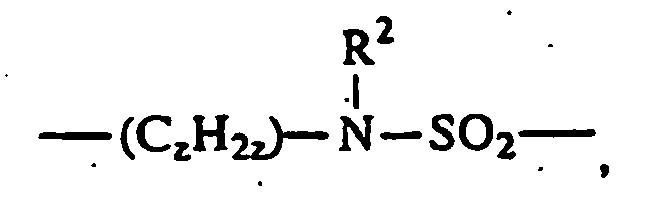
R2 is CH3. - A polymer according to claim 2 wherein monomer (i) is

Rf is a C3-C6 perfluorinated group,
A is C2-C4 alkylene or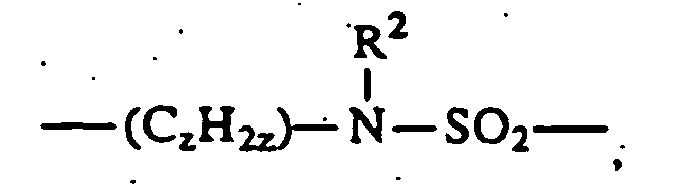
R1 is H, and
R2 is CH3. - A polymer according to any of claims 1 to 3 wherein monomer (ii) is

B is -(CH2CH2O)p-,
R3 is H,
p is 10 to 20, and
R4 is C1-C12 alkyl. - A polymer according to claim 4 wherein monomer (ii) is

B is -(CH2CH2O)p-,
R3 is H,
p is 17, and
R4 is CH3. - A polymer according to any of claims 1 to 5, wherein monomer (iii) is

L is
R5 is H or CH3, and
R6 and R7 are independently C1-C12 alkyl. - A polymer according to claim 6 wherein monomer (iii) is

L is
R5 is CH3, and
R6 and R7 are CH3. - A polymer according to any of claims 1 to 7 wherein monomer (iv) is

z is 1 to 6, and
R11 is H. - A polymer according to claim 8 wherein monomer (iv) is

z is 1, and
R11 is H. - A polymer according to any of claims 1 to 9 wherein monomer (i) is present in the amount of 45 to 70 percent by weight, monomer (ii) is present in the amount of 25 to 50 percent by weight, monomer (iii) is present in the amount of 1 to 10 percent by weight, and monomer (iv) is present in the amount of 1 to 8 percent by weight.
- A polymer according to claim 10 wherein monomer (i) is present in the amount of 50 to 65 percent by weight, monomer (ii) is present in the amount of 35 to 40 percent by weight, monomer (iii) is present in the amount of 1 to 5 percent by weight, and monomer (iv) is present in the amount of 1 to 5 percent by weight.
- A polymer according to any of claims 1 to 11 further comprisingv) 0.001 to 5 percent by weight of a monomer of the formula

R12 is H or CH3-,
R13 is -(CH2CH2O)p-, and
p is 1 to 25. - A polymer according to claim 12 wherein monomer (v) is

R12 is H,
R13 is -(CH2CH2O)p-, and
p is 1 to 20. - A polymer according to claim 13 wherein monomer (v) is

R12 is H,
R13 is -(CH2CH2O)p-, and
p is 5-15. - A composition for imparting stain release properties to a substrate comprising an aqueous, substantially organic solvent free, solution or dispersion of at least one polymer according to any of claims 1 to 14.
- The composition of claim 15 further comprising a permanent press resin.
Priority Applications (1)
| Application Number | Priority Date | Filing Date | Title |
|---|---|---|---|
| EP04023396A EP1516885A3 (en) | 2001-05-08 | 2002-03-01 | Novel fluoroalkyl polymers containing a cationogenic segment |
Applications Claiming Priority (3)
| Application Number | Priority Date | Filing Date | Title |
|---|---|---|---|
| US850699 | 2001-05-08 | ||
| US09/850,699 US6482911B1 (en) | 2001-05-08 | 2001-05-08 | Fluoroalkyl polymers containing a cationogenic segment |
| PCT/US2002/006360 WO2002090402A2 (en) | 2001-05-08 | 2002-03-01 | Novel fluoroalkyl polymers containing cationic segment |
Related Child Applications (1)
| Application Number | Title | Priority Date | Filing Date |
|---|---|---|---|
| EP04023396A Division EP1516885A3 (en) | 2001-05-08 | 2002-03-01 | Novel fluoroalkyl polymers containing a cationogenic segment |
Publications (2)
| Publication Number | Publication Date |
|---|---|
| EP1385892A2 EP1385892A2 (en) | 2004-02-04 |
| EP1385892B1 true EP1385892B1 (en) | 2008-07-02 |
Family
ID=25308879
Family Applications (2)
| Application Number | Title | Priority Date | Filing Date |
|---|---|---|---|
| EP02717524A Expired - Lifetime EP1385892B1 (en) | 2001-05-08 | 2002-03-01 | Fluoroalkyl polymers containing cationic segments and composition for imparting stain release properties to a substrate. |
| EP04023396A Withdrawn EP1516885A3 (en) | 2001-05-08 | 2002-03-01 | Novel fluoroalkyl polymers containing a cationogenic segment |
Family Applications After (1)
| Application Number | Title | Priority Date | Filing Date |
|---|---|---|---|
| EP04023396A Withdrawn EP1516885A3 (en) | 2001-05-08 | 2002-03-01 | Novel fluoroalkyl polymers containing a cationogenic segment |
Country Status (10)
| Country | Link |
|---|---|
| US (1) | US6482911B1 (en) |
| EP (2) | EP1385892B1 (en) |
| JP (1) | JP2004526042A (en) |
| CN (1) | CN1277855C (en) |
| AT (1) | ATE399801T1 (en) |
| AU (1) | AU2002248519A1 (en) |
| CA (1) | CA2445479A1 (en) |
| DE (1) | DE60227360D1 (en) |
| TW (1) | TWI252237B (en) |
| WO (1) | WO2002090402A2 (en) |
Families Citing this family (17)
| Publication number | Priority date | Publication date | Assignee | Title |
|---|---|---|---|---|
| CA2447132C (en) | 2001-05-14 | 2008-10-07 | Omnova Solutions Inc. | Polymeric surfactants derived from cyclic monomers having pendant fluorinated carbon groups |
| US6673125B2 (en) * | 2002-02-08 | 2004-01-06 | Milliken & Company | Chemically modified nonwoven articles and method for producing the same |
| US7199197B2 (en) * | 2003-12-31 | 2007-04-03 | 3M Innovative Properties Company | Water- and oil-repellent fluoroacrylates |
| CA2561890A1 (en) * | 2004-04-05 | 2005-10-20 | Daikin Industries, Ltd. | Stain remover containing fluoropolymer |
| US20060003154A1 (en) * | 2004-06-30 | 2006-01-05 | Snowden Hue S | Extruded thermoplastic articles with enhanced surface segregation of internal melt additive |
| US7285595B2 (en) * | 2004-06-30 | 2007-10-23 | Kimberly-Clark Worldwide, Inc. | Synergistic fluorochemical treatment blend |
| US20060142530A1 (en) * | 2004-12-28 | 2006-06-29 | Moore George G | Water- and oil-repellent fluorourethanes and fluoroureas |
| US7253241B2 (en) | 2004-12-28 | 2007-08-07 | 3M Innovative Properties Company | Fluorochemical containing low adhesion backsize |
| US7411020B2 (en) * | 2004-12-28 | 2008-08-12 | 3M Innovative Properties Company | Water-based release coating containing fluorochemical |
| US7345123B2 (en) * | 2004-12-28 | 2008-03-18 | 3M Innovative Properties Company | Fluoroacrylate-multifunctional acrylate copolymer compositions |
| US7291688B2 (en) * | 2004-12-28 | 2007-11-06 | 3M Innovative Properties Company | Fluoroacrylate-mercaptofunctional copolymers |
| US7494511B2 (en) * | 2006-05-08 | 2009-02-24 | E.I. Du Pont De Nemours And Company | Hydrophilic stain release agents |
| CN101595142B (en) | 2007-02-02 | 2014-06-25 | 大金工业株式会社 | Fluorine-containing copolymer having excellent washing resistance and soil release agent |
| CN102159602B (en) * | 2008-07-18 | 2016-03-23 | 3M创新有限公司 | Cationic fluorinated polymer composition and the method with its process hydrocarbon containing formation |
| WO2010110339A1 (en) * | 2009-03-25 | 2010-09-30 | ダイキン工業株式会社 | Surfactant comprising fluorine-containing polymer |
| BR112015011484A2 (en) | 2012-11-19 | 2017-07-11 | 3M Innovative Properties Co | method for bringing hydrocarbon carrier formations into contact with fluorinated ion polymers |
| MX2016008041A (en) | 2013-12-20 | 2017-03-03 | Saudi Basic Ind Corp | Catalyst system for polymerisation of an olefin. |
Family Cites Families (47)
| Publication number | Priority date | Publication date | Assignee | Title |
|---|---|---|---|---|
| US2803615A (en) | 1956-01-23 | 1957-08-20 | Minnesota Mining & Mfg | Fluorocarbon acrylate and methacrylate esters and polymers |
| US3458348A (en) * | 1966-05-31 | 1969-07-29 | Minnesota Mining & Mfg | Transparent coated optical element |
| GB1215861A (en) | 1967-02-09 | 1970-12-16 | Minnesota Mining & Mfg | Cleanable stain-resistant fabrics or fibers and polymers therefor |
| GB1263708A (en) | 1968-10-28 | 1972-02-16 | Ici Ltd | Improved polyamides |
| US3810874A (en) | 1969-03-10 | 1974-05-14 | Minnesota Mining & Mfg | Polymers prepared from poly(perfluoro-alkylene oxide) compounds |
| US3646085A (en) | 1970-09-24 | 1972-02-29 | Du Pont | Perfluoroalkyletheramidoalkyltrialkoxysilanes |
| US3816167A (en) | 1971-10-20 | 1974-06-11 | Minnesota Mining & Mfg | Stain-releasing textiles of synthetic fibers and process for treating textiles of synthetic fibers |
| JPS5235033B2 (en) | 1972-11-24 | 1977-09-07 | ||
| DE2406781A1 (en) | 1974-02-13 | 1975-08-28 | Hoechst Ag | Textile dressing emulsion giving better soil release - contg fluoro-acrylic ester fluoroolefine copolymer, prepd with fluorinated bunte salt |
| US3944527A (en) | 1974-07-11 | 1976-03-16 | Minnesota Mining And Manufacturing Company | Fluoroaliphatic copolymers |
| US3950588A (en) | 1974-11-01 | 1976-04-13 | Minnesota Mining And Manufacturing Company | Coating of silanol-reactive surfaces with di-silyl poly(perfluorooxyalkylenes) |
| FR2328070A1 (en) | 1975-10-17 | 1977-05-13 | Ugine Kuhlmann | ANTI-STAIN PRODUCTS ALLOWING THE EASY REMOVAL OF SOIL IN WASHING |
| US4127711A (en) | 1977-03-31 | 1978-11-28 | E. I. Du Pont De Nemours And Company | Fluorine-containing terpolymers |
| JPS5933315A (en) | 1982-08-20 | 1984-02-23 | Asahi Glass Co Ltd | Production of antisoiling finish |
| JPS60152585A (en) | 1984-01-23 | 1985-08-10 | Nippon Mektron Ltd | Water-and oil-repellant |
| US4624889A (en) | 1984-08-17 | 1986-11-25 | Minnesota Mining And Manufacturing Company | Launderable textile sizing having stain resistance and soil release |
| US4564561A (en) | 1985-03-27 | 1986-01-14 | E. I. Du Pont De Nemours And Company | Fluorine-containing polymer compositions and their preparation |
| US4795793A (en) | 1986-12-05 | 1989-01-03 | Daikin Industries Ltd. | Fluorine-containing copolymer and oil and water repellent composition containing the same |
| IT1213441B (en) | 1986-12-30 | 1989-12-20 | Ausimont Spa | POLYURETHANE AND FLUORINATED WATER DISPERSIONS AND THEIR USE FOR TEXTILE COATINGS. |
| JP2508760B2 (en) | 1987-10-20 | 1996-06-19 | 旭硝子株式会社 | Water and oil repellent with dirt removability |
| AU632869B2 (en) | 1989-12-14 | 1993-01-14 | Minnesota Mining And Manufacturing Company | Fluorocarbon-based coating compositions and articles derived therefrom |
| US5509939A (en) | 1989-12-29 | 1996-04-23 | E. I. Du Pont De Nemours And Company | Soil-release process |
| US5411766A (en) | 1989-12-29 | 1995-05-02 | E. I. Du Pont De Nemours And Company | Substrates treated with polyfluoro nitrogen containing organic compounds |
| US5410073A (en) | 1989-12-29 | 1995-04-25 | E. I. Du Pont De Nemours And Company | Manufacture of polyfluoro nitrogen containing organic compounds |
| JP2787242B2 (en) | 1990-01-25 | 1998-08-13 | 日本メクトロン株式会社 | Emulsion type flame retardant water / oil repellent |
| US5276175A (en) | 1991-04-02 | 1994-01-04 | Minnesota Mining And Manufacturing Company | Isocyanate derivatives comprising flourochemical oligomers |
| US5459188A (en) | 1991-04-11 | 1995-10-17 | Peach State Labs, Inc. | Soil resistant fibers |
| US5350795A (en) | 1991-07-10 | 1994-09-27 | Minnesota Mining And Manufacturing Company | Aqueous oil and water repellent compositions which cure at ambient temperature |
| US5324803A (en) * | 1991-10-14 | 1994-06-28 | Nof Corporation | Polymer comprising fluoroalkl group, a method of preparation thereof, a surface active agent, a surface treatment agent and a coating composition |
| JP3220284B2 (en) | 1993-06-08 | 2001-10-22 | 株式会社シミズ | Electrodeposition method for forming composite coatings |
| US5574791A (en) | 1994-06-15 | 1996-11-12 | Akg Acoustics, Incorporated | Combined de-esser and high-frequency enhancer using single pair of level detectors |
| US5659618A (en) | 1995-09-29 | 1997-08-19 | Vlsi Technology, Inc. | Multi-size cryptographic key system |
| US5847134A (en) | 1996-01-11 | 1998-12-08 | E. I. Du Pont De Nemours And Company | Fluorocarbon-containing isocyanate derivatives and soil-resist agents |
| JP3820614B2 (en) | 1996-02-09 | 2006-09-13 | 住友化学株式会社 | Method for forming silane compound film |
| BR9709001A (en) | 1996-05-17 | 1999-08-03 | Minnesota Mining & Mfg | Fluorochemical Polyurethane Compound Process for its preparation composition comprising a fluorochemical polyurethane compound and use of a compound |
| US6156860A (en) * | 1997-02-18 | 2000-12-05 | Dainippon Ink And Chemicals, Inc. | Surface active agent containing fluorine and coating compositions using the same |
| US5789513A (en) | 1997-02-26 | 1998-08-04 | E. I. Du Pont De Nemours And Company | Polyfluorourethane additives for curable coating compositions |
| CA2287494C (en) | 1997-05-05 | 2011-11-01 | John C. Clark | Treatment of fibrous substrates to impart repellency, stain resistance, and soil resistance |
| JP2001525010A (en) | 1997-05-14 | 2001-12-04 | ミネソタ・マイニング・アンド・マニュファクチャリング・カンパニー | Fluorochemical composition comprising a polymer derived from a fluorochemical urethane (meth) acrylate monomer to impart stain release properties to a support |
| US5851674A (en) | 1997-07-30 | 1998-12-22 | Minnesota Mining And Manufacturing Company | Antisoiling coatings for antireflective surfaces and methods of preparation |
| JP3820694B2 (en) | 1997-08-06 | 2006-09-13 | ダイキン工業株式会社 | New copolymer and antifouling agent |
| US6277485B1 (en) | 1998-01-27 | 2001-08-21 | 3M Innovative Properties Company | Antisoiling coatings for antireflective surfaces and methods of preparation |
| JP4733798B2 (en) | 1998-01-31 | 2011-07-27 | 凸版印刷株式会社 | Antifouling agent, method for forming antifouling layer, optical member, antireflection optical member, optical functional member, and display device |
| JPH11310685A (en) | 1998-04-28 | 1999-11-09 | Asahi Glass Co Ltd | Water-dispersed water / oil repellent composition and method for producing the same |
| FR2785904B1 (en) | 1998-11-13 | 2000-12-15 | Atochem Elf Sa | FLUORINATED POLYMERS BY MINIEMULSION POLYMERIZATION |
| JP2000220093A (en) * | 1998-11-24 | 2000-08-08 | Asahi Glass Co Ltd | Paper processing composition and processed paper |
| WO2001038435A1 (en) * | 1999-11-24 | 2001-05-31 | 3M Innovative Properties Company | Fluoropolymer compositions containing organo-onium and blocked silylether compounds |
-
2001
- 2001-05-08 US US09/850,699 patent/US6482911B1/en not_active Expired - Fee Related
-
2002
- 2002-03-01 EP EP02717524A patent/EP1385892B1/en not_active Expired - Lifetime
- 2002-03-01 DE DE60227360T patent/DE60227360D1/en not_active Expired - Lifetime
- 2002-03-01 JP JP2002587478A patent/JP2004526042A/en active Pending
- 2002-03-01 AU AU2002248519A patent/AU2002248519A1/en not_active Abandoned
- 2002-03-01 AT AT02717524T patent/ATE399801T1/en not_active IP Right Cessation
- 2002-03-01 CA CA002445479A patent/CA2445479A1/en not_active Abandoned
- 2002-03-01 EP EP04023396A patent/EP1516885A3/en not_active Withdrawn
- 2002-03-01 WO PCT/US2002/006360 patent/WO2002090402A2/en not_active Ceased
- 2002-03-01 CN CNB028095677A patent/CN1277855C/en not_active Expired - Fee Related
- 2002-03-19 TW TW091105207A patent/TWI252237B/en not_active IP Right Cessation
Also Published As
| Publication number | Publication date |
|---|---|
| CN1277855C (en) | 2006-10-04 |
| DE60227360D1 (en) | 2008-08-14 |
| EP1516885A3 (en) | 2006-04-26 |
| TWI252237B (en) | 2006-04-01 |
| US6482911B1 (en) | 2002-11-19 |
| CA2445479A1 (en) | 2002-11-14 |
| JP2004526042A (en) | 2004-08-26 |
| CN1524095A (en) | 2004-08-25 |
| ATE399801T1 (en) | 2008-07-15 |
| AU2002248519A1 (en) | 2002-11-18 |
| WO2002090402A3 (en) | 2003-01-09 |
| WO2002090402A2 (en) | 2002-11-14 |
| EP1516885A2 (en) | 2005-03-23 |
| EP1385892A2 (en) | 2004-02-04 |
Similar Documents
| Publication | Publication Date | Title |
|---|---|---|
| US6482911B1 (en) | Fluoroalkyl polymers containing a cationogenic segment | |
| KR100214321B1 (en) | Composition for providing oil and water repellency | |
| EP1093479B1 (en) | Polymeric compositions for soil release on fabrics | |
| ES2223951T3 (en) | METHOD TO TREAT FIBROSIAN SUBSTRATES WITH RENTED FLUORCHEMICAL OLIGOMERS, AND FIBROSED SUBSTRATES AS TREATED. | |
| CA1271892A (en) | Oil- and water-repellent copolymers | |
| EP0294648B1 (en) | Novel copolymer and water- and oil-repellent comprising the same | |
| US4564561A (en) | Fluorine-containing polymer compositions and their preparation | |
| JPH06505523A (en) | Urea-aldehyde condensates and melamine derivatives comprising fluorochemical oligomers | |
| JP2010500449A (en) | Poly (meth) acrylamides and poly (meth) acrylates containing fluorinated amides | |
| JP2010500449A5 (en) | ||
| US6197426B1 (en) | Fluorochemical copolymer and fluorochemical copolymer compositions useful for imparting repellency properties to a substrate | |
| EP0930351B1 (en) | Fluorochemical copolymer and fluorochemical copolymer compositions for imparting repellency properties to a substrate | |
| AU2010315636A1 (en) | Fluoropolymer emulsions | |
| JPH03103411A (en) | Novel copolymer | |
| JPS6247466B2 (en) | ||
| EP1940906A2 (en) | Triazole-containing fluorinated polymers | |
| EP1162218A1 (en) | Aqueous dispersions of urethane-acrylic copolymers and their use as finishing agents | |
| MXPA00011524A (en) | Polymeric compositions for soil release on fabrics |
Legal Events
| Date | Code | Title | Description |
|---|---|---|---|
| PUAI | Public reference made under article 153(3) epc to a published international application that has entered the european phase |
Free format text: ORIGINAL CODE: 0009012 |
|
| AK | Designated contracting states |
Kind code of ref document: A2 Designated state(s): AT BE CH CY DE DK ES FI FR GB GR IE IT LI LU MC NL PT SE TR |
|
| AX | Request for extension of the european patent |
Extension state: AL LT LV MK RO SI |
|
| 17P | Request for examination filed |
Effective date: 20031113 |
|
| 17Q | First examination report despatched |
Effective date: 20040518 |
|
| RTI1 | Title (correction) |
Free format text: NOVEL FLUOROALKYL POLYMERS CONTAINING CATIONIC SEGMENTS AND COMPOSITION FOR IMPARTING STAIN RELEASE PROPERTIES TO A SUBSTRATE. |
|
| RTI1 | Title (correction) |
Free format text: FLUOROALKYL POLYMERS CONTAINING CATIONIC SEGMENTS AND COMPOSITION FOR IMPARTING STAIN RELEASE PROPERTIES TO A SUBSTRATE. |
|
| RTI1 | Title (correction) |
Free format text: NOVEL FLUOROALKYL POLYMERS CONTAINING CATIONIC SEGMENTS AND COMPOSITION FOR IMPARTING STAIN RELEASE PROPERTIES TO A SUBSTRATE. |
|
| GRAJ | Information related to disapproval of communication of intention to grant by the applicant or resumption of examination proceedings by the epo deleted |
Free format text: ORIGINAL CODE: EPIDOSDIGR1 |
|
| GRAP | Despatch of communication of intention to grant a patent |
Free format text: ORIGINAL CODE: EPIDOSNIGR1 |
|
| GRAP | Despatch of communication of intention to grant a patent |
Free format text: ORIGINAL CODE: EPIDOSNIGR1 |
|
| RTI1 | Title (correction) |
Free format text: FLUOROALKYL POLYMERS CONTAINING CATIONIC SEGMENTS AND COMPOSITION FOR IMPARTING STAIN RELEASE PROPERTIES TO A SUBSTRATE. |
|
| RTI1 | Title (correction) |
Free format text: NOVEL FLUOROALKYL POLYMERS CONTAINING CATIONIC SEGMENTS AND COMPOSITION FOR IMPARTING STAIN RELEASE PROPERTIES TO A SUBSTRATE. |
|
| RTI1 | Title (correction) |
Free format text: FLUOROALKYL POLYMERS CONTAINING CATIONIC SEGMENTS AND COMPOSITION FOR IMPARTING STAIN RELEASE PROPERTIES TO A SUBSTRATE. |
|
| GRAS | Grant fee paid |
Free format text: ORIGINAL CODE: EPIDOSNIGR3 |
|
| GRAA | (expected) grant |
Free format text: ORIGINAL CODE: 0009210 |
|
| AK | Designated contracting states |
Kind code of ref document: B1 Designated state(s): AT BE CH CY DE DK ES FI FR GB GR IE IT LI LU MC NL PT SE TR |
|
| REG | Reference to a national code |
Ref country code: GB Ref legal event code: FG4D |
|
| REG | Reference to a national code |
Ref country code: CH Ref legal event code: EP |
|
| REF | Corresponds to: |
Ref document number: 60227360 Country of ref document: DE Date of ref document: 20080814 Kind code of ref document: P |
|
| REG | Reference to a national code |
Ref country code: IE Ref legal event code: FG4D |
|
| PG25 | Lapsed in a contracting state [announced via postgrant information from national office to epo] |
Ref country code: NL Free format text: LAPSE BECAUSE OF FAILURE TO SUBMIT A TRANSLATION OF THE DESCRIPTION OR TO PAY THE FEE WITHIN THE PRESCRIBED TIME-LIMIT Effective date: 20080702 |
|
| NLV1 | Nl: lapsed or annulled due to failure to fulfill the requirements of art. 29p and 29m of the patents act | ||
| PG25 | Lapsed in a contracting state [announced via postgrant information from national office to epo] |
Ref country code: PT Free format text: LAPSE BECAUSE OF FAILURE TO SUBMIT A TRANSLATION OF THE DESCRIPTION OR TO PAY THE FEE WITHIN THE PRESCRIBED TIME-LIMIT Effective date: 20081202 Ref country code: ES Free format text: LAPSE BECAUSE OF FAILURE TO SUBMIT A TRANSLATION OF THE DESCRIPTION OR TO PAY THE FEE WITHIN THE PRESCRIBED TIME-LIMIT Effective date: 20081013 |
|
| PG25 | Lapsed in a contracting state [announced via postgrant information from national office to epo] |
Ref country code: FI Free format text: LAPSE BECAUSE OF FAILURE TO SUBMIT A TRANSLATION OF THE DESCRIPTION OR TO PAY THE FEE WITHIN THE PRESCRIBED TIME-LIMIT Effective date: 20080702 Ref country code: AT Free format text: LAPSE BECAUSE OF FAILURE TO SUBMIT A TRANSLATION OF THE DESCRIPTION OR TO PAY THE FEE WITHIN THE PRESCRIBED TIME-LIMIT Effective date: 20080702 |
|
| PG25 | Lapsed in a contracting state [announced via postgrant information from national office to epo] |
Ref country code: DK Free format text: LAPSE BECAUSE OF FAILURE TO SUBMIT A TRANSLATION OF THE DESCRIPTION OR TO PAY THE FEE WITHIN THE PRESCRIBED TIME-LIMIT Effective date: 20080702 |
|
| PLBE | No opposition filed within time limit |
Free format text: ORIGINAL CODE: 0009261 |
|
| STAA | Information on the status of an ep patent application or granted ep patent |
Free format text: STATUS: NO OPPOSITION FILED WITHIN TIME LIMIT |
|
| 26N | No opposition filed |
Effective date: 20090403 |
|
| PG25 | Lapsed in a contracting state [announced via postgrant information from national office to epo] |
Ref country code: MC Free format text: LAPSE BECAUSE OF NON-PAYMENT OF DUE FEES Effective date: 20090331 |
|
| REG | Reference to a national code |
Ref country code: CH Ref legal event code: PL |
|
| REG | Reference to a national code |
Ref country code: FR Ref legal event code: ST Effective date: 20091130 |
|
| PG25 | Lapsed in a contracting state [announced via postgrant information from national office to epo] |
Ref country code: LI Free format text: LAPSE BECAUSE OF NON-PAYMENT OF DUE FEES Effective date: 20090331 Ref country code: IE Free format text: LAPSE BECAUSE OF NON-PAYMENT OF DUE FEES Effective date: 20090301 Ref country code: SE Free format text: LAPSE BECAUSE OF FAILURE TO SUBMIT A TRANSLATION OF THE DESCRIPTION OR TO PAY THE FEE WITHIN THE PRESCRIBED TIME-LIMIT Effective date: 20081002 Ref country code: CH Free format text: LAPSE BECAUSE OF NON-PAYMENT OF DUE FEES Effective date: 20090331 |
|
| PG25 | Lapsed in a contracting state [announced via postgrant information from national office to epo] |
Ref country code: FR Free format text: LAPSE BECAUSE OF NON-PAYMENT OF DUE FEES Effective date: 20091123 |
|
| PGFP | Annual fee paid to national office [announced via postgrant information from national office to epo] |
Ref country code: DE Payment date: 20100329 Year of fee payment: 9 |
|
| PG25 | Lapsed in a contracting state [announced via postgrant information from national office to epo] |
Ref country code: GR Free format text: LAPSE BECAUSE OF FAILURE TO SUBMIT A TRANSLATION OF THE DESCRIPTION OR TO PAY THE FEE WITHIN THE PRESCRIBED TIME-LIMIT Effective date: 20081003 |
|
| PG25 | Lapsed in a contracting state [announced via postgrant information from national office to epo] |
Ref country code: LU Free format text: LAPSE BECAUSE OF NON-PAYMENT OF DUE FEES Effective date: 20090301 |
|
| PGFP | Annual fee paid to national office [announced via postgrant information from national office to epo] |
Ref country code: IT Payment date: 20110315 Year of fee payment: 10 |
|
| PGFP | Annual fee paid to national office [announced via postgrant information from national office to epo] |
Ref country code: BE Payment date: 20110311 Year of fee payment: 10 Ref country code: GB Payment date: 20110223 Year of fee payment: 10 |
|
| PG25 | Lapsed in a contracting state [announced via postgrant information from national office to epo] |
Ref country code: TR Free format text: LAPSE BECAUSE OF FAILURE TO SUBMIT A TRANSLATION OF THE DESCRIPTION OR TO PAY THE FEE WITHIN THE PRESCRIBED TIME-LIMIT Effective date: 20080702 |
|
| PG25 | Lapsed in a contracting state [announced via postgrant information from national office to epo] |
Ref country code: CY Free format text: LAPSE BECAUSE OF FAILURE TO SUBMIT A TRANSLATION OF THE DESCRIPTION OR TO PAY THE FEE WITHIN THE PRESCRIBED TIME-LIMIT Effective date: 20080702 |
|
| PG25 | Lapsed in a contracting state [announced via postgrant information from national office to epo] |
Ref country code: DE Free format text: LAPSE BECAUSE OF NON-PAYMENT OF DUE FEES Effective date: 20111001 |
|
| REG | Reference to a national code |
Ref country code: DE Ref legal event code: R119 Ref document number: 60227360 Country of ref document: DE Effective date: 20111001 |
|
| BERE | Be: lapsed |
Owner name: 3M INNOVATIVE PROPERTIES CY Effective date: 20120331 |
|
| GBPC | Gb: european patent ceased through non-payment of renewal fee |
Effective date: 20120301 |
|
| PG25 | Lapsed in a contracting state [announced via postgrant information from national office to epo] |
Ref country code: BE Free format text: LAPSE BECAUSE OF NON-PAYMENT OF DUE FEES Effective date: 20120331 Ref country code: GB Free format text: LAPSE BECAUSE OF NON-PAYMENT OF DUE FEES Effective date: 20120301 |
|
| PG25 | Lapsed in a contracting state [announced via postgrant information from national office to epo] |
Ref country code: IT Free format text: LAPSE BECAUSE OF NON-PAYMENT OF DUE FEES Effective date: 20120301 |