EP1385110A2 - Method and system for managing long running transactions - Google Patents
Method and system for managing long running transactions Download PDFInfo
- Publication number
- EP1385110A2 EP1385110A2 EP03016430A EP03016430A EP1385110A2 EP 1385110 A2 EP1385110 A2 EP 1385110A2 EP 03016430 A EP03016430 A EP 03016430A EP 03016430 A EP03016430 A EP 03016430A EP 1385110 A2 EP1385110 A2 EP 1385110A2
- Authority
- EP
- European Patent Office
- Prior art keywords
- activity
- entity
- business
- transaction
- activities
- Prior art date
- Legal status (The legal status is an assumption and is not a legal conclusion. Google has not performed a legal analysis and makes no representation as to the accuracy of the status listed.)
- Ceased
Links
Images







Classifications
-
- G—PHYSICS
- G06—COMPUTING OR CALCULATING; COUNTING
- G06F—ELECTRIC DIGITAL DATA PROCESSING
- G06F9/00—Arrangements for program control, e.g. control units
- G06F9/06—Arrangements for program control, e.g. control units using stored programs, i.e. using an internal store of processing equipment to receive or retain programs
- G06F9/46—Multiprogramming arrangements
- G06F9/465—Distributed object oriented systems
-
- G—PHYSICS
- G06—COMPUTING OR CALCULATING; COUNTING
- G06F—ELECTRIC DIGITAL DATA PROCESSING
- G06F9/00—Arrangements for program control, e.g. control units
- G06F9/06—Arrangements for program control, e.g. control units using stored programs, i.e. using an internal store of processing equipment to receive or retain programs
- G06F9/46—Multiprogramming arrangements
- G06F9/466—Transaction processing
-
- G—PHYSICS
- G06—COMPUTING OR CALCULATING; COUNTING
- G06Q—INFORMATION AND COMMUNICATION TECHNOLOGY [ICT] SPECIALLY ADAPTED FOR ADMINISTRATIVE, COMMERCIAL, FINANCIAL, MANAGERIAL OR SUPERVISORY PURPOSES; SYSTEMS OR METHODS SPECIALLY ADAPTED FOR ADMINISTRATIVE, COMMERCIAL, FINANCIAL, MANAGERIAL OR SUPERVISORY PURPOSES, NOT OTHERWISE PROVIDED FOR
- G06Q10/00—Administration; Management
- G06Q10/06—Resources, workflows, human or project management; Enterprise or organisation planning; Enterprise or organisation modelling
-
- G—PHYSICS
- G06—COMPUTING OR CALCULATING; COUNTING
- G06Q—INFORMATION AND COMMUNICATION TECHNOLOGY [ICT] SPECIALLY ADAPTED FOR ADMINISTRATIVE, COMMERCIAL, FINANCIAL, MANAGERIAL OR SUPERVISORY PURPOSES; SYSTEMS OR METHODS SPECIALLY ADAPTED FOR ADMINISTRATIVE, COMMERCIAL, FINANCIAL, MANAGERIAL OR SUPERVISORY PURPOSES, NOT OTHERWISE PROVIDED FOR
- G06Q10/00—Administration; Management
- G06Q10/06—Resources, workflows, human or project management; Enterprise or organisation planning; Enterprise or organisation modelling
- G06Q10/063—Operations research, analysis or management
Definitions
- the present invention relates to computerized transaction management. More specifically the present invention relates to a method and system that manages long-running computerized transactions.
- ACID brings together the concepts of "Atomic”, “Consistent”, “Isolated”, and “Durable”.
- a system that totally implements an ACID transaction model allows the programmer to essentially ignore multi-user issues.
- the ACID behaviors of the system ensure that the code will always execute as though it was the only user in the system.
- ACID behavior makes the task of creating business logic simpler, it comes at a scalability cost.
- the main benefit of ACID makes the system single user. For example, strict ACID semantics. require that any piece of data which is even referenced by business logic must be made single user for the duration of the processing (Repeatable Read Isolation).
- SQL Servers have supported a unit of work (database transactions) which implements ACID semantics for many years. Embodiments of the present invention do not attempt to document a new design for SQL Server transactions. However, business applications have needs for units of work which are much longer than physical database transactions would support. Thus, there is a need to build an infrastructure to support logical units of works which are capable of spanning multiple physical database transactions.
- one or more business activities can include business operations that span more than one physical database.
- Business activities are related to a logical transaction such that transaction management is effected for transactions that span multiple physical databases.
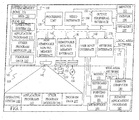
- Fig. 1 illustrates an example of a suitable computing system environment 100 on which the invention may be implemented.
- the computing system environment 100 is only one example of a suitable computing environment and is not intended to suggest any limitation as to the scope of use or functionality of the invention. Neither should the computing environment 100 be interpreted as having any dependency or requirement relating to any one or combination of components illustrated in the exemplary operating environment 100.
- the invention is operational with numerous other general purpose or special purpose computing system environments or configurations.
- Examples of well-known computing systems, environments, and/or configurations that may be suitable for use with the invention include, but are not limited to, personal computers, server computers, hand-held or laptop devices, multiprocessor systems, microprocessor-based systems, set top boxes, programmable consumer electronics, network PCs, minicomputers, mainframe computers, telephony systems, distributed computing environments that include any of the above systems or devices, and the like.
- the invention may be described in the general context of computer-executable instructions, such as program modules, being executed by a computer.
- program modules include routines, programs, objects, components, data structures, etc. that perform particular tasks or implement particular abstract data types.
- the invention may also be practiced in distributed computing environments where tasks are performed by remote processing devices that are linked through a communications network.
- program modules may be located in both local and remote computer storage media including memory storage devices.
- an exemplary system for implementing the invention includes a general-purpose computing device in the form of a computer 110.
- Components of computer 110 may include, but are not limited to, a central processing unit 120, a system memory 130, and a system bus 121 that couples various system components including the system memory to the processing unit 120.
- the system bus 121 may be any of several types of bus structures including a memory bus or memory controller, a peripheral bus, and a local bus using any of a variety of bus architectures.
- bus architectures include Industry Standard Architecture (ISA) bus, Micro Channel Architecture (MCA) bus, Enhanced ISA (EISA) bus, Video Electronics Standards Association (VESA) local bus, and Peripheral Component Interconnect (PCI) bus also known as Mezzanine bus.
- Computer 110 typically includes a variety of computer readable media.
- Computer readable media can be any available media that can be accessed by computer 110 and includes both volatile and nonvolatile media, removable and non-removable media.
- Computer readable media may comprise computer storage media and communication media.
- Computer storage media includes both volatile and nonvolatile, removable and non-removable media implemented in any method or technology for storage of information such as computer readable instructions, data structures, program modules or other data.
- Computer storage media includes, but is not limited to, RAM, ROM, EEPROM, flash memory or other memory technology, CD-ROM, digital versatile disks (DVD) or other optical disk storage, magnetic cassettes, magnetic tape, magnetic disk storage or other magnetic storage devices, or any other medium which can be used to store the desired information and which can be accessed by computer 110.
- Communication media typically embodies computer readable instructions, data structures, program modules or other data in a modulated data signal such as a carrier wave or other transport mechanism and includes any information delivery media.
- modulated data signal means a signal that has one or more of its characteristics set or changed in such a manner as to encode information in the signal.
- communication media includes wired media such as a wired network or direct-wired connection, and wireless media such as acoustic, RF, infrared and other wireless media. Combinations of any of the above should also be included within the scope of computer readable media.
- the system memory 130 includes computer storage media in the form of volatile and/or nonvolatile memory such as read only memory (ROM) 131 and random access memory (RAM) 132.
- ROM read only memory
- RAM random access memory
- RAM. 132 typically contains data and/or program modules that are immediately accessible to and/or presently being operated on by processing unit 120.
- FIG. 1 illustrates operating system 134, application programs 135, other program modules 136, and program data 137.
- the computer 110 may also include other removable/non-removable volatile/nonvolatile computer storage media.
- FIG. 1 illustrates a hard disk drive 141 that reads from or writes to non-removable, nonvolatile magnetic media, a magnetic disk drive 151 that reads from or writes to a removable, nonvolatile magnetic disk 152, and an optical disk drive 155 that reads from or writes to a removable, nonvolatile optical disk 156 such as a CD ROM or other optical media.
- removable/non-removable, volatile/nonvolatile computer storage media that can be used in the exemplary operating environment include, but are not limited to, magnetic tape cassettes, flash memory cards, digital versatile disks, digital video tape, solid state RAM, solid state ROM, and the like.
- the hard disk drive 141 is typically connected to the system bus 121 through a non-removable memory interface such as interface 140, and magnetic disk drive 151 and optical disk drive 155 are typically connected to the system bus 121 by a removable memory interface, such as interface 150.
- hard disk drive 141 is illustrated as storing operating system 144, application programs 145, other program modules 146, and program data 147. Note that these components can either be the same as or different from operating system 134, application programs 135, other program modules 136, and program data 137. Operating system 144, application programs 145, other program modules 146, and program data 147 are given different numbers here to illustrate that, at a minimum, they are different copies.
- a user may enter commands and information into the computer 110 through input devices such as a keyboard 162, a microphone 163, and a pointing device 161, such as a mouse, trackball or touch pad.
- Other input devices may include a joystick, game pad, satellite dish, scanner, or the like.
- a monitor 191 or other type of display device is also connected to the system bus 121 via an interface, such as a video interface 190.
- computers may also include other peripheral output devices such as speakers 197 and printer 196, which may be connected through an output peripheral interface 190.
- the computer 110 may operate in a networked environment using logical connections to one or more remote computers, such as a remote computer 180.
- the remote computer 180 may be a personal computer, a hand-held device, a server, a router, a network PC, a peer device or other common network node, and typically includes many or all of the elements described above relative to the computer 110.
- the logical connections depicted in FIG. 1 include a local area network (LAN) 171 and a wide area network (WAN) 173, but may also include other networks.
- LAN local area network
- WAN wide area network
- Such networking environments are commonplace in offices, enterprise-wide computer networks, intranets and the Internet.
- the computer 110 When used in a LAN networking environment, the computer 110 is connected to the LAN 171 through a network interface or adapter 170. When used in a WAN networking environment, the computer 110 typically includes a modem 172 or other means for establishing communications over the WAN 173, such as the Internet.
- the modem 172 which may be internal or external, may be connected to the system bus 121 via the user input interface 160, or other appropriate mechanism.
- program modules depicted relative to the computer 110, or portions thereof may be stored in the remote memory storage device.
- FIG. 1 illustrates remote application programs 185 as residing on remote computer 180. It will be appreciated that the network connections shown are exemplary and other means of establishing a communications link between the computers may be used.
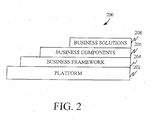
- FIG. 2 is a block diagram of a higher level environment in which the present invention may reside.
- Environment 200 shows a tools and server platform 202, a business framework 204 in which the present invention resides, business components 206 and a business solution 208.
- Tools and server platform 202 illustratively provides a platform for services which allow applications to communicate and share data over a wide area network.
- the platform 202 can, for example, include tools and server systems to enable this functionality.
- Business components 206 illustratively include the functionality for business applications which are packaged together based on a developers interaction with business framework 204.
- Business components 206 for example, can range from general ledger and financial applications to sales force automation services and customer relation management applications. By writing business components 206 using framework 204, these components are extensible and can be utilized to serve the needs of multiple users, depending on what level of functionality and complexity is desired.
- Each business solution 208 includes one or more applications.
- the applications are groups of business components presented through a user interface and individually deployed.
- Business framework 204 is used by developers of business components 206.
- the business framework enables business applications in a productive, reliable and consistent fashion.
- FIG. 3 illustrates a number of the principle subsystems of business framework 204.
- FIG. 3 illustrates framework 210 supporting an application layer 212 that includes a plurality of business components 214, 216 and 218.
- the business components include a financial application, a project application, and a distribution application.
- Framework 210 is also illustrated residing on platform 202.
- Framework 210 itself, includes a set of business class libraries 220, a tools subsystem 222 and a business application framework 224.
- Tools subsystem 222 illustratively include a plurality of design subsystems for designing components, processes, reports and end user interfaces.
- Tools subsystem 222 also illustratively includes test services which can be used to test designed components as well as an application packager which is used to package the components into an application or solution.
- Business class libraries 220 include common entities 226, patterns 228 and data types 230.
- Business class libraries 220 thus provides a number of common entities 226 that contain the core properties of interest to most business applications. Applications built on framework 210 can extend these entities with scenario-specific properties and behavior, through customization (which is described below).
- long running logical transactions can be constructed using combinations of short lived database transactions and compensating business logic (aka compensating transactions).
- entity consumers want the ability to specify any arbitrary logical unit of work.
- the unit of work can simply wrap one update on a single entity property, or it could encompass an entire posting process.
- the consumer could dictate the boundaries as follows: Enterprise.BeginUnitOfWork(); // Do anything the consumer wants... // Create entities, Update entities, Delete entities // Rollback the unit of work at any time // Don't worry about multi-user contention issues // Hold the unit of work open forever.... Enterprise.FinishUnitOfWork();
- aspects of the present invention provide a compromise to this tension between entity authors and entity consumers.
- a standard is defined for logical units of work in the programming model. Entity authors must implement this level of transactional support, and entity consumers can rely on a certain level of support.
- Physical Transaction - A transaction which holds database locks for the duration of the transaction.
- a physical transaction may hold read and write locks (full ACID semantics), or only write locks (relaxed ACID semantics, ala "read committed”). Either way, a physical transaction enforces full isolation semantics on updated data by holding locks.
- Logical Transaction - A transaction which does not hold database locks for the duration of the transaction. Specifically, this is a transaction model which relaxes isolation on updated data, while still maintaining the other properties of acid (the ACD parts).
- a logical transaction model is built on top of a physical transaction foundation.
- Transaction Manager Transaction managers control the "lifecycle" of a transaction.
- Commercially available SQL Servers generally contain a simple transaction manager which can manage physical transactions on that a server (ala BEGIN TRAN, COMMIT TRAN).
- One transaction manager which can coordinate physical transactions across multiple servers is available from Microsoft Corporation of Redmond, Washington under the trade designation: Distributed Transaction Coordinator (DTC).
- DTC Distributed Transaction Coordinator
- CTM Compensating Transaction Manager
- CTM Traditional Transaction Managers (like SQL Server or DTC) manage physical transactions. Long-running transactions need to span multiple physical transactions.
- BTO BizTalk Orchestration
- Dynamic Processes also referred to herein as workflow, are asynchronous and require user involvement during the process execution (e.g. for approvals).
- the dynamic process flow editor can be made available to end-users and generally no "coding" is required to reconfigure the process.
- Dynamic processes will generally be used for long-lived transactions (where holding a single physical transaction for the duration is not feasible). Accordingly, dynamic processes require compensation. Finally dynamic processes employ compensation and generally need to publish intermediate progress information.
- Static Processes are generally synchronous. In some cases, static processes may have a delayed start, and run asynchronous to the caller. But once started, the static process runs to completion. It does not have a mechanism to pause or dehydrate itself for periods of inactivity. Static processes are typically found in "Batch Processing" scenarios such as year end close, post transactions, and revalue multi-currency transactions. Static processes typically require very high performance and generally do not require user intervention. Static processes require very little user reconfiguration. Such processes may expose "knobs" or other controls to tweak behavior. Static processes can throw events for extensibility if suitable code is written. However, in some cases batch processing still needs to span multiple database transactions.
- Dynamic processes can use BizTalk Orchestration for logical transactions, in some instances.
- static processes will generally cannot use BTO.
- BTO is not an optimal choice for writing static processes.
- static processes do not need BTO's intrinsic capability to reconfigure without writing code.
- Further BTO has performance that may be insufficient for the very high performance needs of enterprise batch processing.
- Embodiments of the present invention generally achieve this by employing three new elements within the context of a business application development suite. These element include: Business Activities; Static Processes; and A Saga Manager.
- a Business Entity is intuitive to the business developer and can be considered a "Smart" business document in that it supports rich validation and defaulting behaviors.
- a limitation of Business Entities is that the consumer's code is coupled to the entity object model and in some cases performance can be poor.
- Business Entities generally require a whole entity to be pulled back in order to modify one property. Finally Business Entity modifications cannot be "undone" in a general manner after they are persisted because there is generally no compensation.
- Business Activity can be used to expose specific operations on business data.
- consumer code is not coupled to the entity object model for example: AllocateItem (ItemSku, ItemSite, Qty, UofM);
- Business Activities can achieve very high performance and can wrap stored procedure calls or EP set operations.
- Business Activities can also support a prescriptive compensation interface.
- Business Activities bring some new and useful tools to the business application developer's toolbox. Processes by their very nature exist to provide a framework for executing a set of process steps. Activities provide the implementation for a process' steps which need to perform operations on business data.
- Static processes support many of the concepts from "Mini-batch” set forth in a book by Gray entitled. Transaction Processing Fundamentals. Gray uses the term Mini-batch to describe a general approach to long-running batch processes. Further, a more specific form of mini-batch implementation is introduced as the Saga transaction processing model.
- the Saga transaction processing model was first published by Garcia-Molina and Salem in 1987. The algorithm is discussed in some detail in Gray's Transaction Processing Fundamentals book.
- a saga is a chained set of flat transactions with a defined compensation model.
- the compensation model is defined to be the inverse of the original execution path: A 1 , A 2 , A 3 , ... A n-1 , A n
- Saga The standard saga definition (presented above) is an ordered saga. That is, compensation is guaranteed to be executed in exactly the same order (but reversed) as the original execution sequence. Further, in case of failure the saga returns to the starting point.
- Checkpointed-Saga (Mini-Batch)-Checkpointed-Sagas (also called “Mini-Batches” by Gray) are extremely important in batch processing.
- Year end close is an archival process which can move or delete hundreds of gigabytes of data.
- the strict Saga model says that a transaction failure rolls back the entire unit of work by executing the compensating transactions from N-1 all the way back to 1. This would be a poor choice for a very large batch process like year-end close.
- batch processing operations are executed at night or over a weekend. The batch process typically runs for hours and must complete within the prescribed timeframe.
- Checkpointed-Saga processes must be able to support a checkpoint model.
- a checkpoint indicates a successful completion of a sub-unit of work. Once a checkpoint is executed, the compensation chain is truncated and a future failure will not rollback the completed sub-unit of work.
- Activities provide a compensation interface to "undo" committed changes to the database. However, the question remains: “Who is going to call the compensation interface”? What is needed is a transaction manager capable of managing atomic work which spans multiple physical transactions.
- Every transactional system needs a transaction manager which controls the lifecycle of the business logic processing from beginning to end.
- the transaction manager insures that the results of the processing are atomic, consistent, isolated, and durable.
- a given transaction manager will typically allow the strict ACID model to be relaxed in favor of higher concurrency.
- a transaction manager must always be in control of business logic updates.
- commercially available SQL Servers contain a transaction manager.
- Such transaction managers work well as long as all the business logic processing can run as part of a single physical database transaction.
- These transaction managers do includes various knobs and controls which allow reduced levels of isolation, especially on- the read side. These controls are helpful, and in fact, some products may run totally at the "Read Committed” reduced isolation level. However, as helpful as these reduced isolation levels are, locks must still be held on written records until the transaction commits.
- BizTalk Orchestration provides one possible choice for transaction management duties for long-running processing.
- the stereotypical examples of a long-running process is a workflow.
- BizTalk Orchestration is designed to provide the foundations for a workflow system. If workflow is really being implemented, then orchestration is an excellent choice.
- BTO only provides a compensating transaction manager.
- the business application must still provide the business logic for BTO to call. This business logic must implement an interface which exposes compensation business logic. This is exactly what a "Business Activity" as disclosed herein supplies.
- the Biztalk orchestration transaction manager requires all participants of the workflow to implement COM+ transactions. COM+ transactions sit on top of DTC, and DTC sits on top of SQL Server's basic protocol. As soon as DTC is invoked, a two-phase commit is running. This is generates a serious performance impact, as there are now a minimum of two logs (usually more), and many cross-process calls to implement the two-phase protocol. Performance tests show that using DTC is three to eight times slower than using base SQL Server "BEGIN TRAN"-type operations.
- COM+ adds the overhead of making each object "context bound". Basically, COM+ needs the ability to intercept all method calls on the transactional object to start and commit transactions (at the method level) as required. This adds further overhead.
- BTO Workflow baggage is another concern with using BTO as a transaction manager. While BTO is a powerful, flexible environment, such power comes with overhead. There are many cases where business logic runs for too long to live inside a single database transaction, but certainly does not fall into the traditional workflow stereotype.
- each sales order is assigned an ID.
- This ID is human-readable, and follows a template (e.g. SALESXXXXX).
- This first order is "SALES00001”, the next is “SALES00002”, etc....
- SALESXXXXXX This first order is "SALES00001”
- SALES00002 the next is "SALES00002”
- SALES00002 the allocation of these identifiers is surprisingly difficult in a performant fashion.
- the only feasible way to handle the allocation of these identifiers is to create them in a sub transaction, and handle the filling of holes via a compensation model (in Gray's terms, this is relaxing the monotone requirement, but compensation keeps the algorithm readable and dense).
- the example requires a transaction manager capable of spanning multiple physical database transactions, but it is not a candidate for workflow ⁇ BTO.
- the action of allocating an order ID does not require any type of "reconfigurable workflow"; the action of allocating an order ID should not require the developer to create an XLANG schedule; nor should the action of allocating an order ID should not require an entire COM+ transaction. All that is really required is a very lightweight transaction manager.
- the overhead of COM+ transactions is neither needed nor desired. In many cases, two-phase commit overhead of DTC is also not needed or desired. Most cases will only be using a single SQL Server.
- the lightweight transaction manager can simply store its transaction context in the same database as the business logic uses, thus "piggybacking" on the single log.
- the compensating transaction manager will be surfaced through the BusinessEntity class. Static processes will be preferably written in the C# programming language, inheriting from BusinessEntity and calling BusinessActivities.
- the compensating transaction manager inside the entity handles the physical transaction management, along with logging and clearing the necessary log records.
- Activities are not executed "stand alone”; rather they are always a step in an overall saga.
- the saga forms a logical grouping of activities, so that multiple executed activities can be confirmed or aborted in a transactionally correct fashion. Even if the consumer only wants to execute a single activity, they still wrap the activity execution in a saga. This is important, as a single activity executed by the consumer might internally call many other activities in a nested fashion. So while the consumer only thinks they are executing a single activity, they are actually executing multiple activities which need to be confirmed or aborted in an atomic fashion. That coordination is provided using the saga.
- activity consumers there are essentially three types of activity consumers: dynamic processes 300 (aka workflow); Static processes 302, and Entities 304.
- dynamic processes 300 aka workflow
- Static processes 302, and Entities 304 At first, the inclusion of entities 304 in the list may appear odd. However, entities 304 do needy to be able to call activities. Activities are always a "step in a process", so somehow an entity needs to be able to have some aspects of process.
- Each activity consumer 300, 302, and 304 can begin a saga as illustrated at 306; execute activities as illustrated at 308; and complete a saga as illustrated at 310. Further, activities can also execute additional nested activities as illustrated at 312. Finally, the completion of a saga can be done by confirming the saga 314 or by aborting the saga 316.
- Providing entities with at least some aspects of processes is accomplished by giving each entity a built-in "lifecycle process".
- Each entity graph starts a built-in process when it is instantiated, and completes the process when it is saved or deleted.
- Entities and their associated virtual collections provide their consumers with a simple and consistent logical programming model illustrated in Fig. 5: the consumer 340 instantiates 342 an entity graph (via the entity's virtual collection) on the server; the consumer 340 interacts 344 with the entity graph on the consumer's client; and the consumer 340 saves- or discards (persists) 346 the entity graph on the server (via the entity's virtual collection).
- an emissary-based approach naturally enforces a disconnected model.
- the read from the virtual collection returns an emissary (the entity).
- the consumer interacts with the (disconnected) emissary.
- the consumer pass the emissary back to the fiefdom via the Save() method on the virtual collection. Any and all changes to the emissary flow back to the fiefdom for persistence.
- the persistence is a fundamentally atomic operation, as the entire entity flows to the server in one shot.
- the entire entity graph is persisted in one physical database transaction, as indicated by rectangle 380 in Fig. 6. Physical transactions can only exist on the server. Thus, a transaction rectangle such as rectangle 380 should never cross over to the client side.
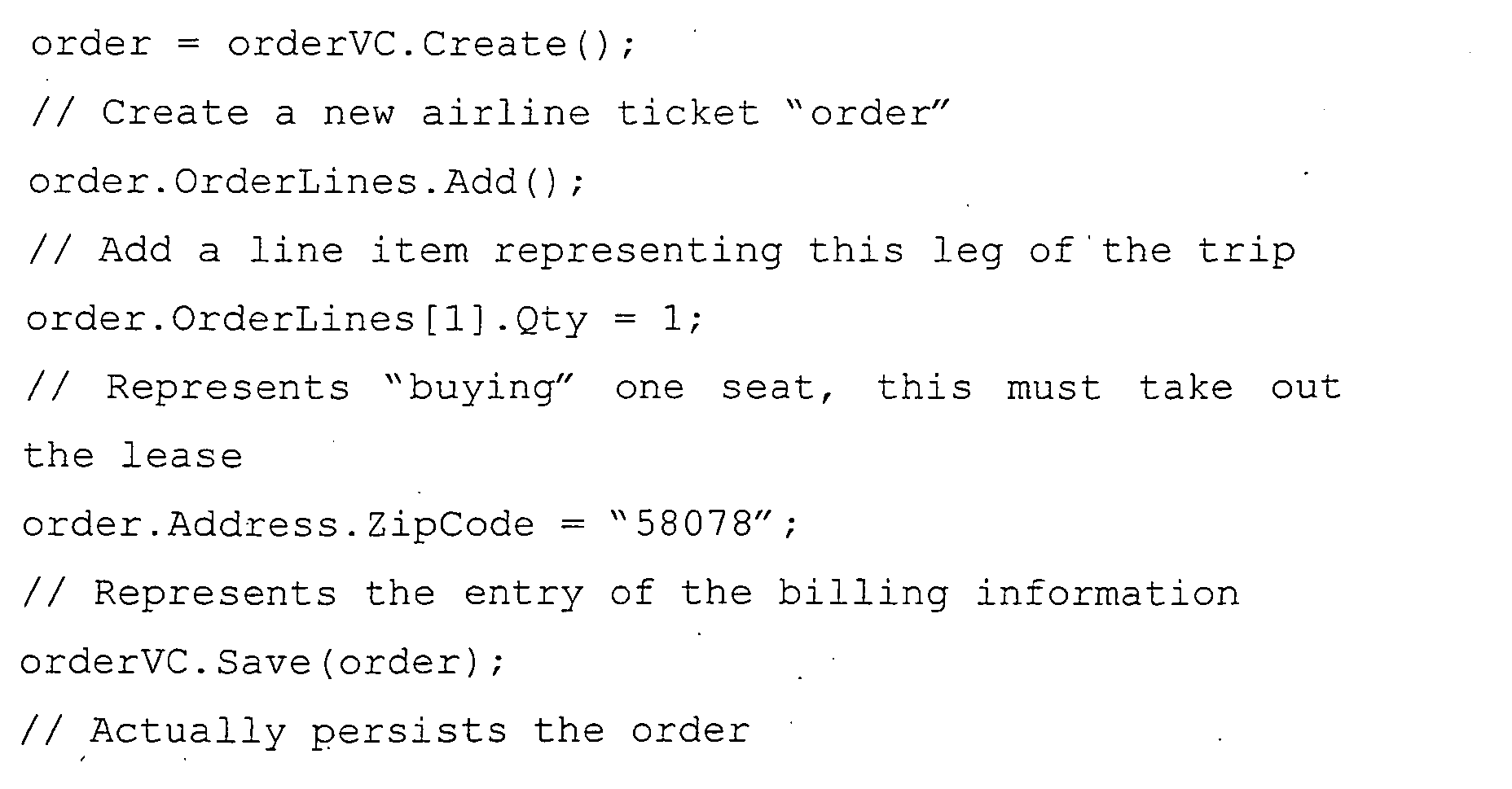
- One example of a use case is the airline ticket lease scenario.
- This scenario is "connected" because some of the consumer's interactions with the entity make calls to the server.
- the reservation of the seat will cause a round trip to the server.
- the reservation will update the database, and commit its results so that other reservation agents won't steal the reserved seat.
- the all the activity lease operations are preferably totally transparent to both the entity consumer and the entity author.
- the entity just inherits from BusinessEntity, and then calls a seat lease activity which inherits from the BusinessActivity class. All the infrastructure associated with logging the leases and cleaning them up is automatic.
- this scenario can be illustrated in the following exemplary entity consumer code: (simplified)
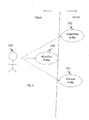
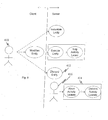
- Fig 7 illustrates a use case showing a "well-behaved" entity consumer.
- the entity consumer 400 is well-behaved, because they call the Abort() method 402 on the virtual collection (added as part of this design). This allows the compensating transaction manager to immediately free any leases which the entity had reserved.
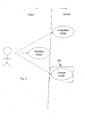
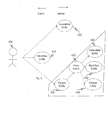
- Fig. 8 illustrates a use case showing an "ill-behaved" entity consumer 410 which just discards 412 the entity without calling Abort 414.
- stale leases are detected using a timestamp approach.
- the "Cleanup Agent” 416 periodically scans the lease log table looking for very old leases to clean up and calls abort 414 upon such leases when detected.
- the cleanup agent 416 algorithm is left a solution framework "pluggable policy".
- the three classic choices preferably are: Heuristic Commit, Heuristic Abort, and Operator Intervention.
- Entities are agile. In the typical usage pattern they leave the fiefdom and act as emissaries to consumers. When outside the fiefdom the entity may be fully disconnected, or the entity may implement a more connected model by calling activities which take out leases. However, at some point the entity needs to re-enter the fiefdom for useful work to happen. The entity can take as many leases as it wants when outside the fiefdom. However, those leases will all expire unless the entity successfully re-enters the fiefdom and is persisted.
- Fiefdoms are typically distrustful of requests from the outside world. Fiefdoms will typically want to execute server-side business logic to validate the incoming emissary (the entity).
- server-side entity business logic is: Entity -> Entity. It demonstrates a rule of the logical transaction model: Persisting entities always use "requires" semantics. The first entity starts a physical transaction because one does not exist. However, the second entity enlists in the first entity's transaction, rather than starting anew. That is the definition of "Requires".
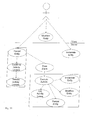
- Fig. 9 illustrates a use case where entity consumer 430 instantiates an entity 432; modifies the entity 434; and persists the entity 436. However, when the entity is persisted, it fires an event 438 that instantiates another entity 440; modifies the entity 442, and persists the entity 444.
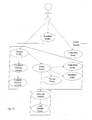
- Fig. 10 illustrates a use case showing how activities executed during the server-side persistence of an entity compose together. This is basically the same case as when a connected entity interacts with an activity from the client. Note that this use case demonstrates the key transactional characteristics of Activities. Activities do not enlist in the entity's transaction. Activities will only enlist in another activity's transaction. (The execute activity started a new physical transaction, even though the entity was already being persisted). This is a highly desirable advantage. For example, consider a sales order. When a sales order enters the fiefdom, it must perform many activities. For example, each line item on the sales order must be allocated from inventory.
- the server-side business logic execution infrastructure will call a BeforeInsert or BeforeUpdate event on each line item, depending on if the line item is new or previously existed but was modified.
- the BeforeXX event on the sales order line will call an "AllocateInventory" activity for each line.
- Entities always compose in the current transaction, if more than one is running.
- the following two use cases demonstrate the two possible outcomes.
- the entity is persisted during activity execution, so the activity's transaction is current.
- the second example shown in Fig. 12 is a case where code running in an event handler sequentially updates an entity, and then later calls an activity.
- the entity is enlisted into the main entity's transaction. (But the activity is not, as activities are "RequiresNew").
- How activities compose is an important design consideration.
- An important design point how nested activities get aborted and confirmed.
- the aborting and confirming of activities is preferably internally controlled by writing log records.
- a log record allows the system to "remember” to abort or confirm an activity. This is important as it impacts the programming model.
- Figs. 13 and 14 illustrate use cases contrasting a design choice of using discrete logs, or using a parent log only. At first, both of these designs may appear reasonable. The differences between the two approaches manifests itself in how Abort() and Confirm() are handled.
- Choice #1 (Fig. 13) issues a separate log record for each activity.
- Choice #2 (Fig. 14) only issues a log record for the "parent" activity.
- aspects of the present invention preferably employ Choice #1, or discrete logs for a couple of reasons.
- the diagram for choice #2 shows the second activity getting executed in its own transaction, without writing a log record. This is undesirable. For example, if the power were to go out right after activity #2 commits its changes to the database, but before activity #1 finishes the system would "forget" that activity #2 ran, and would not run its abort or confirm methods.
- Dynamic processes implement an overall process made of many steps. Each step can be one of three things: (1) A TaskItem (User approval); (2) Another dynamic process; or (3) A piece of business logic. Activities are the implementation mechanism for workflow to execute a "business logic step". Note that it is anticipated that workflow will typically execute a single activity at a time. However, as discussed earlier, a single "root” activity may internally execute many other activities in a nested fashion. All of these activities need to be confirmed or aborted in a consistent fashion. With this in mind, workflow will always work through the saga manager. For each activity step, workflow will: Call SagaManager.Begin() to begin a saga; Execute Activities via the ActivityFactory (usually just a single activity); and Call SagaManager.Confirm() to complete the saga.
- Static processes and Entities have a great deal of similarities. Both need saga functionality.
- the airline ticket case described above is an example where an Entity needs to take leases on seats.
- This is a case where the saga is driven by an entity, and the entity is located outside the server.
- Examples for batch processing scenarios have also been provided. These scenarios are driven by what have been called a static process. The static process in these cases runs server-side.
- the first set of requirements is directed to activity state transitions.
- the existence of log records, and operations on those log records is considered an internal implementation issue which exists only to support the state transition requirements documented here.
- These requirements apply to anyone who executes activities via the saga manager: Entities or Workflow.
- ID Commit Requirement TRAN.010.010 Commit An activity must have a saga context to execute TRAN.010.020 Commit Only activities in the "new" state can be executed.
- TRAN.010.030 Commit An activity which throws an exception during execution remains in the new state and may be re-executed. Any data modifications during execution are rolled back. This is guaranteed to be atomic.
- TRAN.010.040 Commit Executing an activity with no exceptions will cause the activity's data modifications to be committed, and the activity enters the "tentative" state. This is guaranteed to be transactionally atomic TRAN.010.060 Commit. An activity is not required to implement any specific combination of execute, abort, and confirm methods.
- TRAN.010.065 Commit If a method is no implemented by an activity, it is assumed successful for state transition purposes.
- TRAN.010.070 Commit All activities that reach the tentative state are guaranteed to have either their confirm or abort method called.
- TRAN.010.080 Commit The confirming state will confirm activities in the same order they originally executed.
- TRAN.010.090 Commit If any confirming activity throws an exception, then all activities return to the tentative state, and the initiating save or delete operation is rolled back. This is guaranteed to be a transactionally atomic operation.
- TARN.010.100 Commit If no confirming activity throws an exception, then all activities enter the confirmed state, and the initiating save or delete operation is committed. This is guaranteed to be a transactionally atomic operation.
- TRAN.010.110 Commit The confirmed state is final. Once entering that state the activity is complete.
- TRAN.010.120 Commit The aborting state will abort activities in the reverse order they originally executed.
- TRAN.010.125 Commit Aborting an activity with no exceptions will cause the activity's data modifications to be committed, and the activity enters the aborted state. This is guaranteed to be transactionally atomic TRAN.010.130 Commit If any aborting activity throws an exception, then all activities return to the executed state, and any data updates during the abort methods is rolled back. This is guaranteed to be an atomic operation. TRAN.010.140 Commit The aborted state is final. Once entering that state the activity is complete.
- TRAN.020.010 Commit Before events will be fired via the EventBroker for each of the execute, abort, and confirm methods.
- TRAN.020.020 Commit The Before events will allow the event subscriber to cancel the execution of the corresponding execute, abort, or confirm method on the activity. If there are multiple subscribers to the event, a request from one subscriber to cancel is sufficient to cancel the method execution. Implementation: Pass a "Cancel" parameter by reference. It will be initialized to false. If any subscriber wishes to cancel, they set the cancel variable to true. Note that some events may allow any later subscriber to set cancel back to false. That behavior will be allowed. TRAN.
- TRAN.020.050 Commit Before and After events will pass the activity as an event parameter.
- the logical transaction context can be extracted from the activity by the event subscriber. The event subscriber can then participate in the saga.
- TRAN.020.060 Commit Canceling execution of the execute, confirm or abort method does not impact the state transition of the activity.
- TRAN.020.070 Commit An event subscriber throwing an exception will be treated as if the activity itself threw the exception. Before or After events may throw exceptions.
- Each entity graph will have a built-in "lifecycle process" which enables the entity graph to call activities.
- the following requirements document the rules for how this lifecycle process works.
- Req. ID Commit Requirement Saga Creation
- TRAN.030.010 Commit A writable entity shall always be assigned to a saga context on instantiation.
- TRAN.030.020 Commit Calling Create() or singleton Find() on the virtual collection returns a root entity which is always assigned to a new, unique saga context.
- TRAN.030.030 Commit Calling a Find() method which returns a collection returns a collection of root entities which are each assigned to separate saga contexts.
- TRAN.030.040 Commit An entire entity graph is always assigned to the same saga context.
- TRAN.030.050 Commit A read-only entity is never assigned a saga context. Ramification: Read-only entities cannot call activities, unless they take a saga context as a parameter from their consumer. TRAN.030.060 Commit A saga context is unique to a given entity graph. E.G. Two entity graphs never share a saga context. Saga Completion TRAN.040.010 Commit A call to the abort method on the entity graph's virtual collection will trigger all tentative activities to enter the aborting state.
- TRAN.040.020 Commit A successful save or delete of an entity graph will cause activities in the tentative state to enter the confirming state.
- TRAN.040.030 Commit An unsuccessful save or delete attempt on an entity graph will cause activities to remain in the tentative state.
- TRAN.040.040 Commit Any exceptions thrown during the confirming state cause all activities to return to the tentative state, and the entity virtual collection operation which triggered the confirmation (save or delete) is rolled back.
- TRAN.040.050 No Commit The application framework shall provide a "cleanup agent" to handle transitioning activities associated with discarded entities from the tentative state to the aborted state.
- Logical transaction contexts are unique to an entity graph. However, higher level scenarios like static processes will find it useful to be able to track and group activity operations across multiple entity graphs. Thus, the concept of "Logical Transaction Groups" is introduced. Logical transaction groups allow activity operations which span multiple logical transaction contexts to be grouped. The logical transaction context contains a Guid which represents the "group" that this entity graph belongs to. Requirements for Logical Transaction Groups are as follows. Req. ID Commit Requirement TRAN.050.010 No Commit A writable entity shall always be assigned to a logical group ID on instantiation. TRAN.050.020 No Commit If a logical transaction context (from another entity) is in effect, the logical group ID is used from that context.
- a server-side entity is instantiating a second entity. Or a level of indirection might be in play.
- An entity might have called an activity which is now instantiating an entity.
- the original entity passes its logical transaction context to the activity.
- the activity basically "impersonates" the entity.
- TRAN.050.030 No Commit If no logical transaction context is in effect during entity graph instantiation, then a new group ID is generated.
- TRAN.050.040 No Commit Logical group IDs are guaranteed to be unique (Guid)
- TRAN.050.050 No Commit The logical group ID is flowed with the logical transaction context.
- TRAN.050.060 No Commit The SagaTransactionMangerLogVC can return a collection of activities in the tentative state for a specified logical group ID TRAN.050.070 No Commit The Saga Manger can perform other operations on groups like aborting or confirming all activities in the tentative state for a specified group
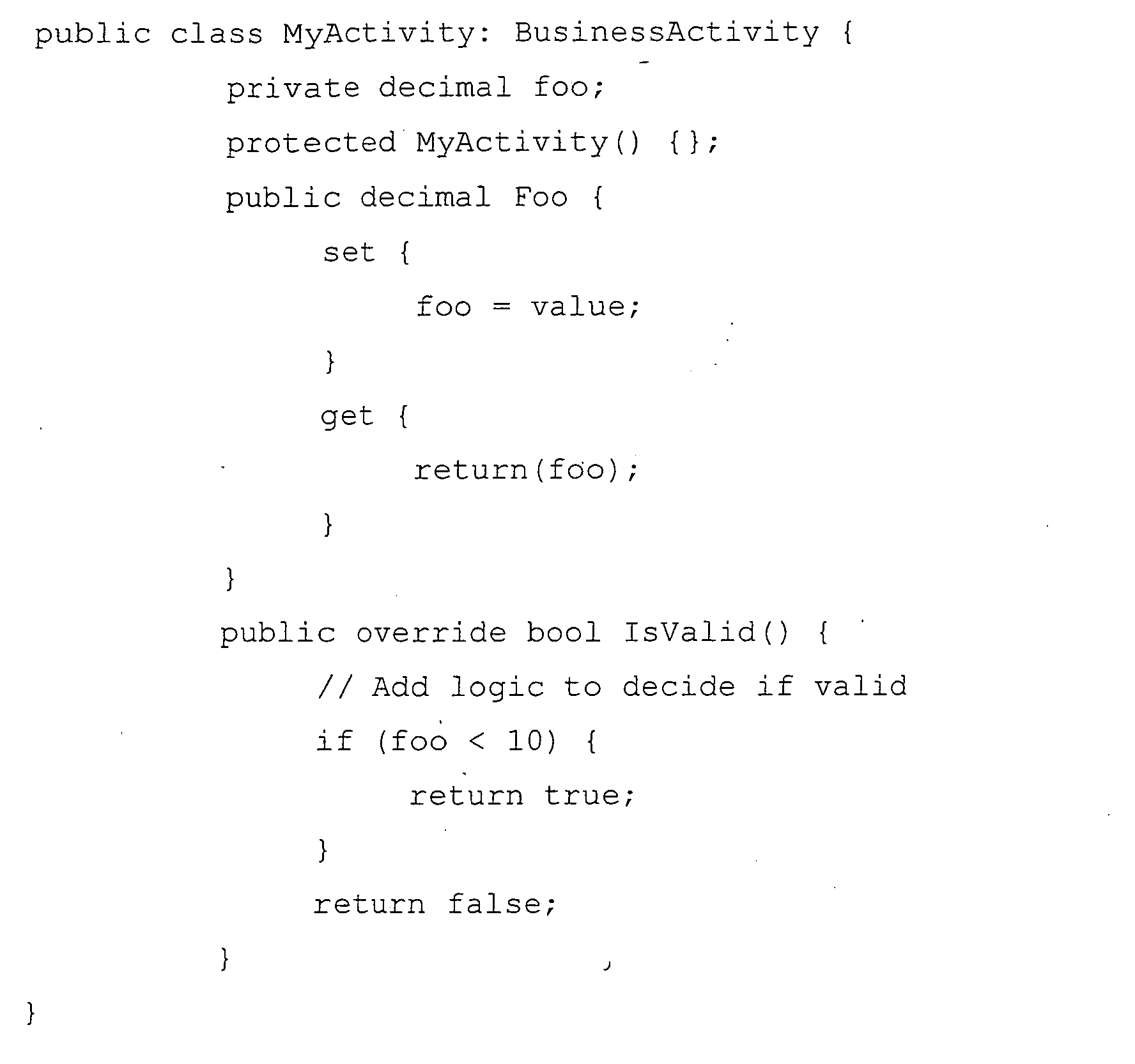
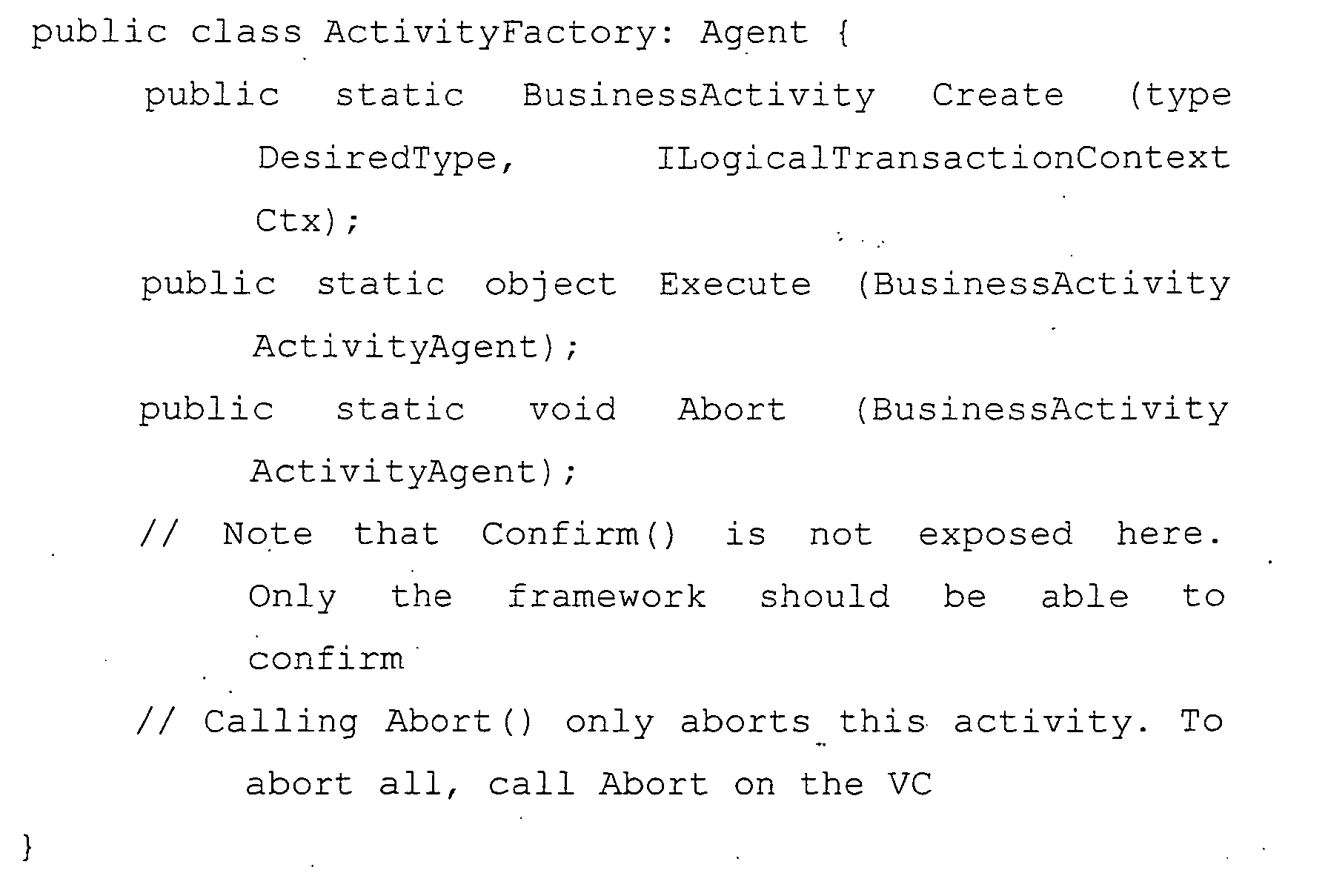
- One important object of embodiments of the present invention is to provide a prescriptive architecture where application developers who focus on the business domain be assisted in their technical decisions. With this in mind, this complex transactional problem is exposed via the framework in a rational programming model. This is accomplished with the following programming model: Activity Service Class: using Microsoft.Business Framework.Activity; public class MyActivityService:
- the activity author may perform just about any operation they want: Entity CRUD (Create, Read, Update, Delete), Entity SetOps, or call a Stored Proc. Return values are passed back via the "object" return value of the Execute() method.
- the "needsConfirm” and “needsAbort” parameters are a performance optimization which enables the suppression of log records. If the activity indicates that it does not need confirm or abort notification, the saga manager does not need to write a log record for this activity. Note, however, that is log record is still written if there is a subscriber to the confirm or abort methods for this activity.
- this programming model is a synchronous model (request-response).
- a Message Service Broker can be used to introduce a message-based asynchronous model for interacting with Activities from Entities.
- Asynchronous models intrinsically add complexity to the programming model by necessitating a callback driven model-.
- An Entity author can decide on a case by case basis to use synchronous or asynchronous.
- the alternative would be to silently queue up the seat lease request and execute it later. That would not be as advantageous, as the main ticket reservation would have likely been completed by that time and the customer long-gone.
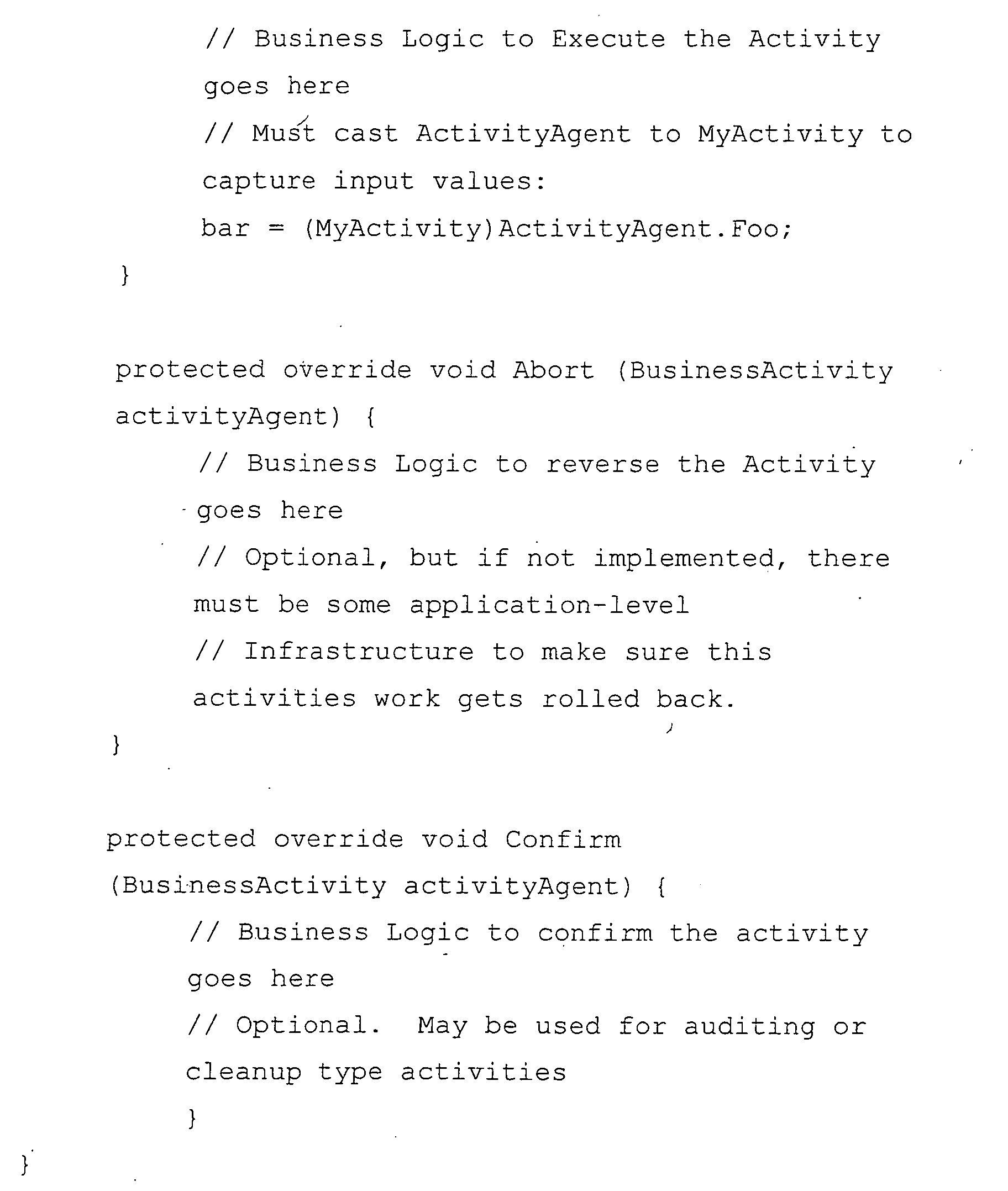
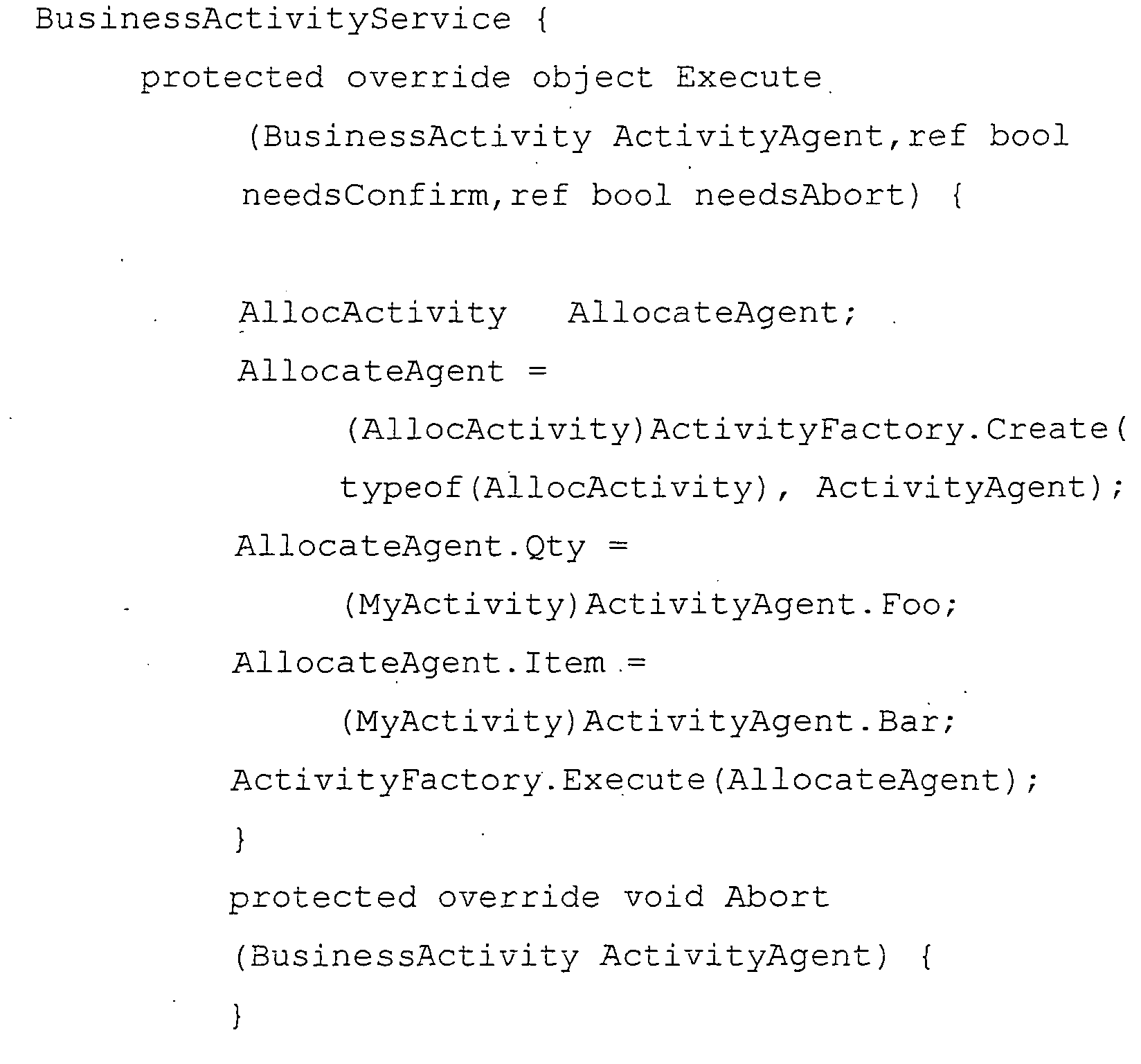
- Activities can also be chained, meaning that activities can call other activities.
- An example is set forth below.
- Activity Consumer (Activity calling Activity) public class MyActivityService:
- a logical transaction context is supplied to enlist the activity into.
- this logical transaction context comes from an entity.
- that activity can pass the context on to other activities.
- Embodiments of the present invention preferably use -three interrelated subsystems to implement long-running transaction management using business activities. These subsystems include, the BusinessActivity Subsystem, the SagaManager Subsystem, and the ActivityManagement Subsystem.
- the BusinessActivity Subsystem is illustrated in Fig. 16.
- Business activities are always associated with an entity graph.
- the activity is associated with an entity graph by passing a logical transaction context into the ActivityFactory.Create() method.
- This logical transaction context may be supplied by an entity or an activity, as both implement the ILogicalTransaction interface.
- the business activity preferably implements a Agent ⁇ Service pattern.
- the ActivityFactory preferably implements factory semantics. It is called “Factory” rather than “VirtualCollection”, because it only creates (singleton) activities and has no “find” or “save” semantics.
- BusinessEntity is included on the model in Fig. 16 to indicate that the entity is the holder of the logical transaction context.
- the SagaManager subsystem illustrated diagrammatically in Fig. 17 and is responsible for linking activities to entities. Activities executed within the context of an entity graph form a saga.
- the creation of a new entity graph begins a saga.
- the EntityBroker class will invoke the SagaManager.Begin() method to create a logical transaction context. The saving or deleting of an entity graph completes a saga.
- the EntityBroker class will call SagaManager.Commit () to complete a saga.
- the aborting of an entity graph aborts a saga.
- the EntityBroker class will call SagaManager.Abort () to abort a saga.
- the logical transaction context manages physical transactions. Business activities may sometimes need to span more than a single database transaction. Thus, maintenance of a pool of connections with a proper lifecycle is required.
- the logical transaction context fulfills this need.
- the ActivityManagement Subsystem is illustrated in Fig. 18.
- the ActivityManagement subsystem manages the execution of activities. While the actual business logic code for the activity is part of the BusinessActivityService class, the execute method generally cannot be simply run and completed. Entity-based Sagas require special "setups" before and after an activity is executed. This ensures that the proper transactional context is established, and also allows for any special logging needs.
- the BusinessActivityService class actually delegates to the ActivitySubTransaction to execute an activity. In some cases, this allows a COM+ "Requires" transactional context to be setup.
- the SagaSubTransaction class sets up the proper transactional context (may be SQL Server connection based or COM+ "RequiresNew").
- the SagaSubTransaction class also writes log records to ensure that the proper commit and abort methods are called as the activity changes state.
Landscapes
- Engineering & Computer Science (AREA)
- Business, Economics & Management (AREA)
- Theoretical Computer Science (AREA)
- Human Resources & Organizations (AREA)
- Entrepreneurship & Innovation (AREA)
- Physics & Mathematics (AREA)
- Strategic Management (AREA)
- Software Systems (AREA)
- Economics (AREA)
- General Physics & Mathematics (AREA)
- Game Theory and Decision Science (AREA)
- Educational Administration (AREA)
- Development Economics (AREA)
- General Engineering & Computer Science (AREA)
- Marketing (AREA)
- Operations Research (AREA)
- Quality & Reliability (AREA)
- Tourism & Hospitality (AREA)
- General Business, Economics & Management (AREA)
- Information Retrieval, Db Structures And Fs Structures Therefor (AREA)
Abstract
Description
Enterprise.BeginUnitOfWork();
// Do anything the consumer wants...
// Create entities, Update entities, Delete entities
// Rollback the unit of work at any time
// Don't worry about multi-user contention issues
// Hold the unit of work open forever....
Enterprise.FinishUnitOfWork();
Physical Transaction - A transaction which holds database locks for the duration of the transaction. A physical transaction may hold read and write locks (full ACID semantics), or only write locks (relaxed ACID semantics, ala "read committed"). Either way, a physical transaction enforces full isolation semantics on updated data by holding locks.
Logical Transaction - A transaction which does not hold database locks for the duration of the transaction. Specifically, this is a transaction model which relaxes isolation on updated data, while still maintaining the other properties of acid (the ACD parts).
Transaction Manager - Transaction managers control the "lifecycle" of a transaction. Commercially available SQL Servers generally contain a simple transaction manager which can manage physical transactions on that a server (ala BEGIN TRAN, COMMIT TRAN). One transaction manager which can coordinate physical transactions across multiple servers is available from Microsoft Corporation of Redmond, Washington under the trade designation: Distributed Transaction Coordinator (DTC).
Compensating Transaction Manager (CTM) - Traditional Transaction Managers (like SQL Server or DTC) manage physical transactions. Long-running transactions need to span multiple physical transactions. When multiple physical transactions are involved, a simple transaction manager may not suffice. As used herein, this patent document refers to this type of transaction manager as a "compensating transaction manager". One commercially available product, available from Microsoft, is known as BizTalk Orchestration (BTO) and contains a compensating transaction manager which can manage logical transactions.
Order.OrderLines [1].Qty = 3.
A Business Entity is intuitive to the business developer and can be considered a "Smart" business document in that it supports rich validation and defaulting behaviors. A limitation of Business Entities is that the consumer's code is coupled to the entity object model and in some cases performance can be poor. Moreover, Business Entities generally require a whole entity to be pulled back in order to modify one property. Finally Business Entity modifications cannot be "undone" in a general manner after they are persisted because there is generally no compensation.
AllocateItem (ItemSku, ItemSite, Qty, UofM);
Business Activities can achieve very high performance and can wrap stored procedure calls or EP set operations. Business Activities can also support a prescriptive compensation interface.
A1, A2, A3, ... An-1, An | -An-1, ... -A3, -A2, -A1
The vast majority of batch processing in business applications fits within the bounds of the mini-batch model. The term "bounds" is carefully chosen, as there are several sub-types of processing which fit in the overall model. The static process class disclosed herein will support the following sub-types:
Saga - The standard saga definition (presented above) is an ordered saga. That is, compensation is guaranteed to be executed in exactly the same order (but reversed) as the original execution sequence. Further, in case of failure the saga returns to the starting point.
order = orderVC.FindByID("TIMORDER");
order.Address.ZipCode = "58078";
order.OrderLines[1].Qty += 2;
orderVC. Save (order);
In this example, both changes (Zip code and Item Qty) are durably committed in an atomic fashion, thus keeping the database consistent. It is also important to support the "discard" case of the rules:
order = orderVC.FindByID("TIMORDER");
order.Address.ZipCode = "58078";
order. OrderLines [1]. Qty += 2;
order = null;
In this example, neither change must be persisted to the database.
Entities always compose in any running physical transaction ("Requires" semantics); and
Activities never compose with other transactions ("RequiresNew" semantics).


Call SagaManager.Begin() to begin a saga;
Execute Activities via the ActivityFactory (usually just a single activity); and
Call SagaManager.Confirm() to complete the saga.
| Req. ID | Commit | Requirement |
| TRAN.010.010 | Commit | An activity must have a saga context to execute |
| TRAN.010.020 | Commit | Only activities in the "new" state can be executed. |
| TRAN.010.030 | Commit | An activity which throws an exception during execution remains in the new state and may be re-executed. Any data modifications during execution are rolled back. This is guaranteed to be atomic. |
| TRAN.010.040 | Commit | Executing an activity with no exceptions will cause the activity's data modifications to be committed, and the activity enters the "tentative" state. This is guaranteed to be transactionally atomic |
| TRAN.010.060 | Commit. | An activity is not required to implement any specific combination of execute, abort, and confirm methods. |
| TRAN.010.065 | Commit | If a method is no implemented by an activity, it is assumed successful for state transition purposes. |
| TRAN.010.070 | Commit | All activities that reach the tentative state are guaranteed to have either their confirm or abort method called. |
| TRAN.010.080 | Commit | The confirming state will confirm activities in the same order they originally executed. |
| TRAN.010.090 | Commit | If any confirming activity throws an exception, then all activities return to the tentative state, and the initiating save or delete operation is rolled back. This is guaranteed to be a transactionally atomic operation. |
| TARN.010.100 | Commit | If no confirming activity throws an exception, then all activities enter the confirmed state, and the initiating save or delete operation is committed. This is guaranteed to be a transactionally atomic operation. |
| TRAN.010.110 | Commit | The confirmed state is final. Once entering that state the activity is complete. |
| TRAN.010.120 | Commit | The aborting state will abort activities in the reverse order they originally executed. |
| TRAN.010.125 | Commit | Aborting an activity with no exceptions will cause the activity's data modifications to be committed, and the activity enters the aborted state. This is guaranteed to be transactionally atomic |
| TRAN.010.130 | Commit | If any aborting activity throws an exception, then all activities return to the executed state, and any data updates during the abort methods is rolled back. This is guaranteed to be an atomic operation. |
| TRAN.010.140 | Commit | The aborted state is final. Once entering that state the activity is complete. |
| TRAN.020.010 | Commit | Before events will be fired via the EventBroker for each of the execute, abort, and confirm methods. |
| TRAN.020.020 | Commit | The Before events will allow the event subscriber to cancel the execution of the corresponding execute, abort, or confirm method on the activity. If there are multiple subscribers to the event, a request from one subscriber to cancel is sufficient to cancel the method execution. Implementation: Pass a "Cancel" parameter by reference. It will be initialized to false. If any subscriber wishes to cancel, they set the cancel variable to true. Note that some events may allow any later subscriber to set cancel back to false. That behavior will be allowed. |
| TRAN. 020.030 | Commit | After events will be fired via the EventBroker for each of the execute, abort, and confirm methods, if and only if: 1. The execute, abort, or confirm method did not throw an exception. 2. No Before subscribers threw an exception This follows the philosophy of requirement TRAN.040.080. Run the after event, even if one of the Before subscribers cancelled the base method. The logic is that the Before subscriber cancelled the base method because they wanted to replace its functionality. Still throw After events to all subscribers, even if someone did replace the base method. |
| TRAN.020.040 | Commit | Before and After events will be fired for each method regardless of whether the activity actually implemented the method. Implementation: The actual decision to fire events for the abort and confirm methods will be determined at execute time. As a performance optimization, do not write a log record if the underlying activity does not implement abort or confirm, and there are no subscribers to the abort or confirm methods. This will typically deliver proper behavior. However, it is possible that an activity executed with no subscribers, in which case do not write a log record. |
| TRAN.020.050 | Commit | Before and After events will pass the activity as an event parameter. The logical transaction context can be extracted from the activity by the event subscriber. The event subscriber can then participate in the saga. |
| TRAN.020.060 | Commit | Canceling execution of the execute, confirm or abort method does not impact the state transition of the activity. |
| TRAN.020.070 | Commit | An event subscriber throwing an exception will be treated as if the activity itself threw the exception. Before or After events may throw exceptions. |
| Req. ID | Commit | Requirement |
| Saga Creation | ||
| TRAN.030.010 | Commit | A writable entity shall always be assigned to a saga context on instantiation. |
| TRAN.030.020 | Commit | Calling Create() or singleton Find() on the virtual collection returns a root entity which is always assigned to a new, unique saga context. |
| TRAN.030.030 | Commit | Calling a Find() method which returns a collection returns a collection of root entities which are each assigned to separate saga contexts. |
| TRAN.030.040 | Commit | An entire entity graph is always assigned to the same saga context. (Root entity + dependents) Note this includes: 1. Both singleton and collection compositions 2. Both eager and lazy-loaded dependents. |
| TRAN.030.050 | Commit | A read-only entity is never assigned a saga context. Ramification: Read-only entities cannot call activities, unless they take a saga context as a parameter from their consumer. |
| TRAN.030.060 | Commit | A saga context is unique to a given entity graph. E.G. Two entity graphs never share a saga context. |
| Saga Completion | ||
| TRAN.040.010 | Commit | A call to the abort method on the entity graph's virtual collection will trigger all tentative activities to enter the aborting state. |
| TRAN.040.020 | Commit | A successful save or delete of an entity graph will cause activities in the tentative state to enter the confirming state. |
| TRAN.040.030 | Commit | An unsuccessful save or delete attempt on an entity graph will cause activities to remain in the tentative state. |
| TRAN.040.040 | Commit | Any exceptions thrown during the confirming state cause all activities to return to the tentative state, and the entity virtual collection operation which triggered the confirmation (save or delete) is rolled back. |
| TRAN.040.050 | No Commit | The application framework shall provide a "cleanup agent" to handle transitioning activities associated with discarded entities from the tentative state to the aborted state. |
| Req. ID | Commit | Requirement |
| TRAN.050.010 | No Commit | A writable entity shall always be assigned to a logical group ID on instantiation. |
| TRAN.050.020 | No Commit | If a logical transaction context (from another entity) is in effect, the logical group ID is used from that context. Example: A server-side entity is instantiating a second entity. Or a level of indirection might be in play. An entity might have called an activity which is now instantiating an entity. The original entity passes its logical transaction context to the activity. The activity basically "impersonates" the entity. |
| TRAN.050.030 | No Commit | If no logical transaction context is in effect during entity graph instantiation, then a new group ID is generated. |
| TRAN.050.040 | No Commit | Logical group IDs are guaranteed to be unique (Guid) |
| TRAN.050.050 | No Commit | The logical group ID is flowed with the logical transaction context. |
| TRAN.050.060 | No Commit | The SagaTransactionMangerLogVC can return a collection of activities in the tentative state for a specified logical group ID |
| TRAN.050.070 | No Commit | The Saga Manger can perform other operations on groups like aborting or confirming all activities in the tentative state for a specified group |
| Req. ID | Commit | Requirement |
| TRAN.060.010 | Commit, | The execute method on an activity shall return an object |
| TRAN.060.020 | Commit- | The execution of an activity shall respect the Agent "IsValid" method |

using Microsoft.Business Framework.Activity;
public class MyActivityService:



Activity Consumer (Activity calling Activity) :
public class MyActivityService:

Claims (10)
- A method of generating a computer implemented business process, comprising:passing a logical transaction context to an activity factory to instantiate a business activity with the logical transaction context; andexecuting at least one event associated with the business activity within the logical transaction context.
- The method of claim 1, and further comprising passing the logical transaction context to the activity factory to generate an additional business activity having the logical transaction context.
- The method of claim 2, wherein the first and second business activities for an activity chain.
- The method of claim 1, wherein the logical transaction context spans multiple physical transactions.
- The method of claim 1, wherein executing the at least one event associated with the business activity occurs on a server.
- The method of claim 1, wherein the business activity also takes an activity instance identifier.
- The method of claim 1, wherein the business activity is instantiated by an entity.
- The method of claim 1, wherein the business activity is instantiated by a static process.
- The method of claim 1, wherein the business activity is instantiated by a dynamic process.
- A data structure for managing multiple physical transactions as a logical transaction, the data structure including:wherein the data structure is passable to an activity factory to generate business activities.a first identifier relative to a logical group identification;a second identifier relative to a logical transaction identification; and
Applications Claiming Priority (4)
| Application Number | Priority Date | Filing Date | Title |
|---|---|---|---|
| US39723302P | 2002-07-19 | 2002-07-19 | |
| US397233P | 2002-07-19 | ||
| US10/623,208 US20050261914A1 (en) | 2002-07-19 | 2003-07-18 | Method and system for managing long running transactions |
| US623208 | 2003-07-18 |
Publications (2)
| Publication Number | Publication Date |
|---|---|
| EP1385110A2 true EP1385110A2 (en) | 2004-01-28 |
| EP1385110A3 EP1385110A3 (en) | 2006-10-25 |
Family
ID=30003360
Family Applications (1)
| Application Number | Title | Priority Date | Filing Date |
|---|---|---|---|
| EP03016430A Ceased EP1385110A3 (en) | 2002-07-19 | 2003-07-21 | Method and system for managing long running transactions |
Country Status (3)
| Country | Link |
|---|---|
| US (1) | US20050261914A1 (en) |
| EP (1) | EP1385110A3 (en) |
| JP (2) | JP2004164594A (en) |
Families Citing this family (15)
| Publication number | Priority date | Publication date | Assignee | Title |
|---|---|---|---|---|
| US8689185B1 (en) * | 2004-01-27 | 2014-04-01 | United Services Automobile Association (Usaa) | System and method for processing electronic data |
| US7805324B2 (en) * | 2004-10-01 | 2010-09-28 | Microsoft Corporation | Unified model for authoring and executing flow-based and constraint-based workflows |
| US20090158242A1 (en) * | 2007-12-18 | 2009-06-18 | Kabira Technologies, Inc., | Library of services to guarantee transaction processing application is fully transactional |
| US9268532B2 (en) | 2009-02-25 | 2016-02-23 | International Business Machines Corporation | Constructing a service oriented architecture shared service |
| US20100257010A1 (en) * | 2009-04-07 | 2010-10-07 | International Business Machines Corporation | Managing a service oriented architecture lifecycle |
| US8667329B2 (en) * | 2009-09-25 | 2014-03-04 | Ab Initio Technology Llc | Processing transactions in graph-based applications |
| US8732143B2 (en) * | 2010-08-27 | 2014-05-20 | Microsoft Corporation | Reducing locking during database transactions |
| US8311993B2 (en) | 2010-09-10 | 2012-11-13 | International Business Machines Corporation | Controlling and recovering long-lived transactions |
| US10163510B1 (en) * | 2013-08-09 | 2018-12-25 | Ellis Robinson Giles | System and method for atomic persistence in storage class memory |
| US9465832B1 (en) | 2016-02-04 | 2016-10-11 | International Business Machines Corporation | Efficiently committing large transactions in a graph database |
| US10534636B2 (en) * | 2017-03-13 | 2020-01-14 | Oracle Financial Services Software Limited | Interface and runtime environment for process definition and process execution tracking |
| US11290350B2 (en) * | 2019-01-15 | 2022-03-29 | Red Hat, Inc. | Distributed saga execution and coordination |
| CN111277639B (en) * | 2020-01-16 | 2022-08-09 | 中国建设银行股份有限公司 | Method and device for maintaining data consistency |
| US11757735B2 (en) * | 2020-09-28 | 2023-09-12 | Jpmorgan Chase Bank, N.A. | Method and system for facilitating an audit of event-based business processes |
| CN115600977B (en) * | 2022-10-14 | 2025-10-31 | 北京百度网讯科技有限公司 | Workflow arrangement system and method |
Family Cites Families (13)
| Publication number | Priority date | Publication date | Assignee | Title |
|---|---|---|---|---|
| US4627019A (en) * | 1982-07-08 | 1986-12-02 | At&T Bell Laboratories | Database management system for controlling concurrent access to a database |
| US5893117A (en) * | 1990-08-17 | 1999-04-06 | Texas Instruments Incorporated | Time-stamped database transaction and version management system |
| US5666524A (en) * | 1994-08-31 | 1997-09-09 | Price Waterhouse Llp | Parallel processing system for traversing a transactional database |
| US5799157A (en) * | 1994-12-13 | 1998-08-25 | Elcom Systems, Inc. | System and method for creating interactive electronic systems to present information and execute transactions |
| CN1312549C (en) * | 1995-02-13 | 2007-04-25 | 英特特拉斯特技术公司 | Systems and methods for secure transaction management and electronic rights protection |
| DE69719269T2 (en) * | 1996-08-01 | 2003-10-30 | International Business Machines Corp., Armonk | Ensuring indivisibility for a collection of transactional work steps in a workflow management system |
| US6035402A (en) * | 1996-12-20 | 2000-03-07 | Gte Cybertrust Solutions Incorporated | Virtual certificate authority |
| US5920863A (en) * | 1997-05-31 | 1999-07-06 | International Business Machines Corporation | System and method for supporting transactions for a thin client lacking a persistent store in a distributed object-oriented environment |
| US6061708A (en) * | 1997-05-31 | 2000-05-09 | International Business Machines Corporation | System and method for supporting mixed-phase transactions in an object-oriented environment |
| US6052672A (en) * | 1997-08-01 | 2000-04-18 | Financial Systems Technology Pty Ltd. | Data processing system for complex pricing and transactional analysis |
| GB2336006A (en) * | 1998-03-31 | 1999-10-06 | Ibm | Client/server computing with client selectable location of transaction objects |
| US7020697B1 (en) * | 1999-10-01 | 2006-03-28 | Accenture Llp | Architectures for netcentric computing systems |
| US7103597B2 (en) * | 2002-10-03 | 2006-09-05 | Mcgoveran David O | Adaptive transaction manager for complex transactions and business process |
-
2003
- 2003-07-18 US US10/623,208 patent/US20050261914A1/en not_active Abandoned
- 2003-07-21 EP EP03016430A patent/EP1385110A3/en not_active Ceased
- 2003-07-22 JP JP2003277911A patent/JP2004164594A/en active Pending
-
2010
- 2010-07-02 JP JP2010152438A patent/JP2011003200A/en not_active Withdrawn
Also Published As
| Publication number | Publication date |
|---|---|
| JP2004164594A (en) | 2004-06-10 |
| US20050261914A1 (en) | 2005-11-24 |
| JP2011003200A (en) | 2011-01-06 |
| EP1385110A3 (en) | 2006-10-25 |
Similar Documents
| Publication | Publication Date | Title |
|---|---|---|
| US6078982A (en) | Pre-locking scheme for allowing consistent and concurrent workflow process execution in a workflow management system | |
| US6052684A (en) | System and method for performing consistent workflow process execution in a workflow management system | |
| CN100594498C (en) | Mass data real time processing structure and real time need-based processing platform used for the structure | |
| Cichocki et al. | Workflow and process automation: concepts and technology | |
| EP0788631B1 (en) | Distributed work flow management | |
| US6009405A (en) | Ensuring atomicity for a collection of transactional work items in a workflow management system | |
| JP2011003200A (en) | Method and system for managing long running transaction | |
| US6275863B1 (en) | System and method for programming and executing long running transactions | |
| US20030195789A1 (en) | Method for incorporating human-based activities in business process models | |
| US7640249B2 (en) | System and method for transactional session management | |
| US9311144B1 (en) | Processing virtual transactions of a workflow in atomic manner in a workflow management computer system | |
| Halliday et al. | Flexible workflow management in the OPENflow system | |
| WO1997048045A1 (en) | Activity based long-lived transaction system | |
| Mohan | Tutorial: Advanced transaction models-survey and critique | |
| Fetai et al. | Cost-based data consistency in a data-as-a-service cloud environment | |
| Alonso et al. | Processes in electronic commerce | |
| Houston et al. | The CORBA Activity Service Framework for supporting extended transactions | |
| Cobb | The impact of object technology on commercial transaction processing | |
| Houston et al. | The corba activity service framework for supporting extended transactions | |
| Eder et al. | Workflow Management and Databases | |
| Frank et al. | Architecture for mobile control functions in supplier deliveries for distributed integrated ERP modules | |
| Jiang et al. | CovaTM: a transaction model for cooperative applications | |
| Portilla et al. | A survey for analyzing transactional behavior in service based applications | |
| Gunthor | The dependency manager: A base service for transactional workflow management | |
| Dąbrowski et al. | Object-Oriented Declarative Workflow Management System |
Legal Events
| Date | Code | Title | Description |
|---|---|---|---|
| PUAI | Public reference made under article 153(3) epc to a published international application that has entered the european phase |
Free format text: ORIGINAL CODE: 0009012 |
|
| AK | Designated contracting states |
Kind code of ref document: A2 Designated state(s): AT BE BG CH CY CZ DE DK EE ES FI FR GB GR HU IE IT LI LU MC NL PT RO SE SI SK TR |
|
| AX | Request for extension of the european patent |
Extension state: AL LT LV MK |
|
| PUAL | Search report despatched |
Free format text: ORIGINAL CODE: 0009013 |
|
| AK | Designated contracting states |
Kind code of ref document: A3 Designated state(s): AT BE BG CH CY CZ DE DK EE ES FI FR GB GR HU IE IT LI LU MC NL PT RO SE SI SK TR |
|
| AX | Request for extension of the european patent |
Extension state: AL LT LV MK |
|
| 17P | Request for examination filed |
Effective date: 20070316 |
|
| 17Q | First examination report despatched |
Effective date: 20070510 |
|
| AKX | Designation fees paid |
Designated state(s): AT BE BG CH CY CZ DE DK EE ES FI FR GB GR HU IE IT LI LU MC NL PT RO SE SI SK TR |
|
| STAA | Information on the status of an ep patent application or granted ep patent |
Free format text: STATUS: THE APPLICATION HAS BEEN REFUSED |
|
| 18R | Application refused |
Effective date: 20080910 |