EP1385108A1 - Method, computer program and apparatus for batch scheduling - Google Patents
Method, computer program and apparatus for batch scheduling Download PDFInfo
- Publication number
- EP1385108A1 EP1385108A1 EP02405629A EP02405629A EP1385108A1 EP 1385108 A1 EP1385108 A1 EP 1385108A1 EP 02405629 A EP02405629 A EP 02405629A EP 02405629 A EP02405629 A EP 02405629A EP 1385108 A1 EP1385108 A1 EP 1385108A1
- Authority
- EP
- European Patent Office
- Prior art keywords
- grade
- time
- production unit
- product
- production
- Prior art date
- Legal status (The legal status is an assumption and is not a legal conclusion. Google has not performed a legal analysis and makes no representation as to the accuracy of the status listed.)
- Ceased
Links
Images
Classifications
-
- G—PHYSICS
- G06—COMPUTING OR CALCULATING; COUNTING
- G06Q—INFORMATION AND COMMUNICATION TECHNOLOGY [ICT] SPECIALLY ADAPTED FOR ADMINISTRATIVE, COMMERCIAL, FINANCIAL, MANAGERIAL OR SUPERVISORY PURPOSES; SYSTEMS OR METHODS SPECIALLY ADAPTED FOR ADMINISTRATIVE, COMMERCIAL, FINANCIAL, MANAGERIAL OR SUPERVISORY PURPOSES, NOT OTHERWISE PROVIDED FOR
- G06Q10/00—Administration; Management
- G06Q10/06—Resources, workflows, human or project management; Enterprise or organisation planning; Enterprise or organisation modelling
Definitions
- the invention relates to the field of process scheduling and control. It relates to a method, computer program and apparatus for batch scheduling as described in the preamble of claims 1, 14 and 15, respectively.
- Cement producers are driven to produce different grades of cement at the lowest possible cost within continuously changing economical, environmental and technological restraints.
- the cement process is complex and requires high-level control to achieve long periods of stability and good performance. There are obvious benefits if the process is achieved in the most economic way.
- the overall economic optimisation of the kiln process, the optimisation of the raw mix preparation process, the management of alternative fuels and the scheduling of the raw meal and/or cement mills need to be considered.
- the present application addresses this last area of cement mills scheduling: Cement producers must plan the use of several cement mills in such a way that tight process constraints regarding time, quality and quantity of several different cement types are satisfied. In typical cement plants, 30 to 40 cement mills are available and their work must be scheduled almost minute wise.
- US 5,148,370 shows an expert system and method for batch production scheduling and planning.
- a set of generic heuristic rules is combined with a description of a number of tasks to be achieved by a plant.
- An inference engine processes this information, and a heuristically optimal solution is generated.
- generating the set of rules according to the type of process at hand involves a large engineering effort and knowledge about expert systems.
- the rules must be construed in a manner to ensure an optimal result, but it is not obvious how mixed optimality criteria are to be handled and whether optimality can be ensured at all.
- each production unit is capable of producing a predetermined quantity of a product having at least one characteristic grade that is controllable by a manner of operating the production unit
- a batch schedule to be determined comprises a specification of of what grade product is to be produced on which production unit at which time of a predetermined first period of time
- the method comprises a scheduling step of minimising an objective function subject to hard constraints, where said objective function is computed as a function of the batch schedule and comprises a cost of energy used by the production units during the first period of time, and where said hard constraints are expressed as equalities and inequalities in terms of the batch schedule and comprise
- the method according to the invention ensures that at least a locally optimal schedule is found. Finding a better schedule is a question of computing time and not of problem expression, schedules nearer to the true optimum are readily found if sufficient computing power is available. Optimality criteria representing different aspects of the scheduling problem are easily traded off against one another by changing corresponding weights in the objective function.
- the hard constraints comprise an expression stating that a production unit can be used for only one product grade at a time. This nevertheless must be taken into account by the optimisation.
- the hard constraints comprise an expression stating that a production unit cannot be used at all, or that its production volume is limited. This allows to take a production unit out of operation for a given period of time or to limit lifetime consumption of the unit.
- the hard constraints comprise an expression stating that, if a production unit is committed to produce the product of a given grade, then a minimal quantity of said grade must be produced by said production unit. This implicitly limits a number of times that the production unit has to be switched to another grade, which is to be avoided.
- the objective function comprises a term that penalises changes in product grade produced in the same production unit. This also limits the number of grade switches, but in a more explicit manner.
- the objective function comprises a term that penalises a use of energy per time unit that exceeds a given limit. This allows to take into account contracts with energy providers, especially providers of electrical energy, which contracts specify a maximum amount of power or energy to be delivered, and penalties or excessive prices whenever such a maximum is exceeded.
- the first period of time is split into a sequence of second periods of time
- the method comprises a first scheduling step that schedules production over the first period of time and determines, for each of the second periods of time and for each production unit, a set of quantities of product of a given grade that is to be produced, and a second scheduling step that schedules production by one production unit for one of the second periods of time, where the second scheduling step is executed repeatedly for each of the second periods of time and for each of the production units.
- the first scheduling step comprises minimising an objective function subject to hard constraints, where said objective function comprises
- the second scheduling step that schedules production by one production unit for one of the second periods of time comprises the step of
- the term that penalises changes in product grade produced in the same production unit comprises, for each production unit, the number of different product grades produced by said production unit over the first period of time and, for each production unit and each of the second periods of time, the number of different product grades produced by said production unit.
- the production units are cement mills and/or mills for producing raw meal
- the controllable characteristic grade is one of grade of cement or type of raw meal.
- a human-readable description of the optimal batch schedule is generated and used by an operator to control the mills.
- the cement mills are operated and controlled according to the optimal batch schedule in an automatic mode via plant control system.
- model predictive control techniques are applied for ensuring that actual operation of the cement mills corresponds to the scheduled operation. This allows to compensate for unexpected events and non-ideal operation of the mills.
- the computer program for batch scheduling according to the invention is loadable into an internal memory of a digital computer, and comprises computer program code means to make, when said computer program code means is loaded in the computer, the computer execute the method according to the invention.
- a computer program product comprises a computer readable medium, having the computer program code means recorded thereon.
- the apparatus for batch scheduling comprises a data processor, a memory coupled to the processor and computer program code means stored in said memory, where said computer program code means, when executed by the processor, causes the method according to the invention to be executed.
- the invention finds an optimal batch schedule or simply an optimal scheduling over a certain time horizon
- the invention is explained in terms of the scheduling of cement mills, while minimizing the costs of the purchase of electricity, minimizing the production of low grade cement and fulfilling a set of hard constraints.
- the scheduling of the cement mills production is separated into a scheduling task over a first period of time that comprises a number of shorter second periods of time, and into several scheduling tasks over said second periods of time.
- the first period of time is one week, and the second periods of time are one day each.
- the corresponding scheduling tasks shall henceforth be called "weekly” and "daily" scheduling.
- the invention applies to arbitrary longer periods of time consisting of shorter ones.
- the first period of time may also be two weeks, one month etc, and the second period of time may lie in the range of hours or weeks, depending on the properties of the processes being scheduled.
- the goal of the weekly scheduling is to determine the exact quantity of each cement grade that has to be produced, during every day of the week, on each cement mill.
- the daily scheduling instead, has to decide how to commit the production hour by hour, in order to produce the exact amount of cement defined by the weekly scheduling.
- the notation represents the total amount of grade i produced during the week in the plant.
- the hard constraints represent physical limitations that may not be violated.
- Soft constraints are introduced in order to improve scheduling solutions without making the scheduling problem unsolvable due to too narrow constraints.
- Soft constraints are modelled by associating to the violation of each constraint a slack variable.
- the slack variable is continuous or boolean, according to the type of the constraint, and is minimised in the cost function.
- f ( x ) f energycost ( x ) + f day ( x ) + f week ( x ) + f MWh ( x )
- the total number of variables is 23 nG + 16 G + 8 n + 14.
- the optimization variables are 524, out of which 254 continuous and 270 boolean.
- the matrix A includes all the inequalities (3, 4, 9, 10, 13, 16, 18, 20) representing the constraints, as well as A eq includes the set of equations (1, 6, 11, 14, 17, 19).
- optimisation techniques such as simulated annealing or genetic algorithms are applied.
- the table 1 summarizes data needed to run the algorithm.
- the third column contains the values used for an example, with schedule results shown in Figure 1.
- the daily scheduling is then run, for each day, G times iteratively. At every iteration, the scheduling of one mill only is determined, largely independent from the other mills. For this reason, the index j , defining the mills, will be neglected in the following description of the daily scheduling algorithm. Splitting the problem advantageously reduces the computational complexity of the optimization problem and therefore the time to get a useful solution.
- f ( x ) f energycost ( x ) + f switch ( x ) + f MW ( x )
- step 1 program execution is started and a description of the scheduling problem is read from a computer storage device and/or acquired from user input.
- step 2 the weekly scheduling over the first period of time is performed.
- step 3 the "daily" scheduling problem (i.e. over the second period of time) is initialised for the first "day” and the first production unit or cement mill.
- step 4 the daily scheduling problem is solved and the total amount of power consumption committed so far for that day is computed.
- step 5 it is checked whether the "daily" scheduling has been performed for all days and all mills.
- the optimal schedule is transferred to a plant control system and used to automatically control the production units or cement mills.
- the inventive method is executed repeatedly each "day", using updated information on orders and sales, energy prices, etc, and operation of the plant is performed according to a correspondingly updated optimal schedule.
- the above methodology produces an open loop type of optimal schedule, which relies on prediction of mills and silos technical characteristics, their state at the time of use (silos content level, mills current availability, etc.), and on forecasts of product prices and orders to be satisfied in the next future.
- these conditions and forecasts are not exact: unplanned events like failures of some components, or simply a change in the product shipping are very frequent, so that in a real application the schedule computed could become not optimal after a certain time.
- model based optimal control to reject process disturbances, in our case, to reject deviations from the optimal silos levels introduced, for instance, by the shipping activities (i.e. difference between real deliveries and forecasted ones) or by mismatches between the mill productivity rates assumed during scheduling and the real ones.
- a closed loop controller is applied, based on Model Predictive Control techniques, which tracks the reference schedule computed previously.
- the observed variables are the levels in the silos, while the control variables are the switching commands to the mills.
- the cost functional of the controller appear, with different weighting factors, deviations from the reference trajectories for the silo levels and the mills status (on/off on which product), respectively.
- J : C silos ⁇ y ( t ) - y ref ( t ) ⁇ + C mills ⁇ u ( t ) - u ref ( t ) ⁇
- the controller compares the current values with the reference. If differences are detected, it minimizes such deviations according to the weights chosen over certain time horizon. Furthermore, to better represent the physics of the system, the following constraints to be fulfilled by the solution of the MPC are preferrably considered:
- this predictive control algorithm works online, passing its decisions directly to the plant and mill control system, without operator intervention.
- the Model Predictive Control requires a model of the system in order to make a prediction of the system behavior in the steps following the current time. Due to the hybrid features of the plant, such a model has been derived in the Mixed Logic Dynamic (MLD) framework, described in Control of systems integrating logic, dynamics, and constraints-Bemporad A. and M. Morari- Automatica, Special issue on hybrid systems, Vol. 35, n.3, p.407-427). A detailed description of the steps needed to combine MPC and MLD can be found in Controllo di impianti cogenerativi mediante isti ibridi - Letizia, University of Pavia, Master Thesis, March 2001.
- MLD Mixed Logic Dynamic
Landscapes
- Engineering & Computer Science (AREA)
- Business, Economics & Management (AREA)
- Human Resources & Organizations (AREA)
- Strategic Management (AREA)
- Economics (AREA)
- Entrepreneurship & Innovation (AREA)
- Educational Administration (AREA)
- Game Theory and Decision Science (AREA)
- Development Economics (AREA)
- Marketing (AREA)
- Operations Research (AREA)
- Quality & Reliability (AREA)
- Tourism & Hospitality (AREA)
- Physics & Mathematics (AREA)
- General Business, Economics & Management (AREA)
- General Physics & Mathematics (AREA)
- Theoretical Computer Science (AREA)
- Management, Administration, Business Operations System, And Electronic Commerce (AREA)
Abstract
minimising an objective function subject to hard constraints, where said objective function is computed as a function of the batch schedule and comprises a cost of energy used by the production units during the first period of time,
and where said hard constraints are expressed as equalities and inequalities in terms of the batch schedule and comprise
- a specification of quantities of the product of a given grade to be produced,
- a set of maximum and minimum storage capacities for each product grade,
and returning, as result of the minimisation, an optimal batch schedule corresponding to the optimised value of the objective function.
Description
- The invention relates to the field of process scheduling and control. It relates to a method, computer program and apparatus for batch scheduling as described in the preamble of
claims 1, 14 and 15, respectively. - Cement producers are driven to produce different grades of cement at the lowest possible cost within continuously changing economical, environmental and technological restraints. The cement process is complex and requires high-level control to achieve long periods of stability and good performance. There are obvious benefits if the process is achieved in the most economic way. In order to reach this goal, the overall economic optimisation of the kiln process, the optimisation of the raw mix preparation process, the management of alternative fuels and the scheduling of the raw meal and/or cement mills need to be considered. The present application addresses this last area of cement mills scheduling: Cement producers must plan the use of several cement mills in such a way that tight process constraints regarding time, quality and quantity of several different cement types are satisfied. In typical cement plants, 30 to 40 cement mills are available and their work must be scheduled almost minute wise. At the same time, there is a strong pressure to reduce the energy costs implied by these operations, a goal that is very difficult to achieve in today's liberalized electricity markets with large variations in electricity prices over time. Determining these schedules is usually done manually, based on operator experience and in a very conservative way.
- US 5,148,370 shows an expert system and method for batch production scheduling and planning. A set of generic heuristic rules is combined with a description of a number of tasks to be achieved by a plant. An inference engine processes this information, and a heuristically optimal solution is generated. However, generating the set of rules according to the type of process at hand involves a large engineering effort and knowledge about expert systems. The rules must be construed in a manner to ensure an optimal result, but it is not obvious how mixed optimality criteria are to be handled and whether optimality can be ensured at all.
- It is therefore an object of the invention to create a method, computer program and apparatus for batch scheduling of the type mentioned initially, which allows to state the problem formulation and optimality criteria in a simpler and more effective way.
- These objects are achieved by a method, computer program and apparatus for batch scheduling according to the
claims 1, 14 and 15. - In the inventive method for batch scheduling for a plurality of production units, each production unit is capable of producing a predetermined quantity of a product having at least one characteristic grade that is controllable by a manner of operating the production unit, and a batch schedule to be determined comprises a specification of of what grade product is to be produced on which production unit at which time of a predetermined first period of time, and the method comprises a scheduling step of minimising an objective function subject to hard constraints, where said objective function is computed as a function of the batch schedule and comprises a cost of energy used by the production units during the first period of time, and where said hard constraints are expressed as equalities and inequalities in terms of the batch schedule and comprise
- a specification of quantities of the product of a given grade to be produced,
- a set of maximum and minimum storage capacities for each product grade, and where minimising the objective function is achieved by repeatedly varying the batch schedule subject to the hard constraints and computing the value of the objective function until an optimised value of the objective function is obtained, and returning, as result of the minimisation, an optimal batch schedule corresponding to the optimised value of the objective function.
- The method according to the invention ensures that at least a locally optimal schedule is found. Finding a better schedule is a question of computing time and not of problem expression, schedules nearer to the true optimum are readily found if sufficient computing power is available. Optimality criteria representing different aspects of the scheduling problem are easily traded off against one another by changing corresponding weights in the objective function.
- In a preferred variant of the invention, the hard constraints comprise an expression stating that a production unit can be used for only one product grade at a time. This nevertheless must be taken into account by the optimisation. In another preferred variant of the invention, the hard constraints comprise an expression stating that a production unit cannot be used at all, or that its production volume is limited. This allows to take a production unit out of operation for a given period of time or to limit lifetime consumption of the unit.
- In a preferred variant of the invention, the hard constraints comprise an expression stating that, if a production unit is committed to produce the product of a given grade, then a minimal quantity of said grade must be produced by said production unit. This implicitly limits a number of times that the production unit has to be switched to another grade, which is to be avoided.
- In a preferred variant of the invention, the objective function comprises a term that penalises changes in product grade produced in the same production unit. This also limits the number of grade switches, but in a more explicit manner.
- In a preferred variant of the invention, the objective function comprises a term that penalises a use of energy per time unit that exceeds a given limit. This allows to take into account contracts with energy providers, especially providers of electrical energy, which contracts specify a maximum amount of power or energy to be delivered, and penalties or excessive prices whenever such a maximum is exceeded.
- In a preferred variant of the invention, the first period of time is split into a sequence of second periods of time, and the method comprises a first scheduling step that schedules production over the first period of time and determines, for each of the second periods of time and for each production unit, a set of quantities of product of a given grade that is to be produced, and a second scheduling step that schedules production by one production unit for one of the second periods of time, where the second scheduling step is executed repeatedly for each of the second periods of time and for each of the production units. This separation of the optimisation problem into two steps reduces computational complexity and therefore the computational effort to reach a useful solution.
- In a preferred variant of the invention, the first scheduling step comprises minimising an objective function subject to hard constraints, where said objective function comprises
- a cost of energy used by the production units, a term that penalises changes in product grade produced in the same production unit, and
- a term that penalises a use of energy per time unit that exceeds a given limit, and where said hard constraints comprise,
- for each of the second periods of time, a set of quantities of the product to be produced having a given grade,
- a set of maximum and minimum storage capacities for each product grade,
- an expression limiting, for each production unit and for each of the second periods of time, the time that the production unit may be in operation, and
- an expression stating that, for each of the second periods of time, when a production unit is committed to produce the product of a given grade, then a minimal quantity of said grade must be produced by said production unit.
- In a preferred variant of the invention, the second scheduling step that schedules production by one production unit for one of the second periods of time comprises the step of
- minimising an objective function subject to hard constraints, where said objective function comprises a cost of energy used by the production unit, a term that penalises changes in product grade produced in the production unit, and a term that penalises a use of energy per time unit that exceeds a given limit,
- for the production unit, a set of quantities of the product having a given grade, to be produced, and
- an expression stating that only one grade can be produced at the same time.
- In a preferred variant of the invention, the term that penalises changes in product grade produced in the same production unit comprises, for each production unit, the number of different product grades produced by said production unit over the first period of time and, for each production unit and each of the second periods of time, the number of different product grades produced by said production unit.
- In a preferred variant of the invention, the production units are cement mills and/or mills for producing raw meal, and the controllable characteristic grade is one of grade of cement or type of raw meal. A human-readable description of the optimal batch schedule is generated and used by an operator to control the mills. In a preferred embodiment of the invention, the cement mills are operated and controlled according to the optimal batch schedule in an automatic mode via plant control system.
- In a preferred variant of the invention, model predictive control techniques are applied for ensuring that actual operation of the cement mills corresponds to the scheduled operation. This allows to compensate for unexpected events and non-ideal operation of the mills.
- The computer program for batch scheduling according to the invention is loadable into an internal memory of a digital computer, and comprises computer program code means to make, when said computer program code means is loaded in the computer, the computer execute the method according to the invention. In a preferred embodiment of the invention, a computer program product comprises a computer readable medium, having the computer program code means recorded thereon.
- The apparatus for batch scheduling according to the invention comprises a data processor, a memory coupled to the processor and computer program code means stored in said memory, where said computer program code means, when executed by the processor, causes the method according to the invention to be executed.
- Further preferred embodiments are evident from the dependent patent claims.
- The subject matter of the invention will be explained in more detail in the following text with reference to preferred exemplary embodiments, which are illustrated in the attached drawings, in which:
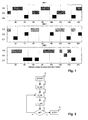
- Figure 1 schematically shows a schedule for producing different grades of cement on four cement mills during one week, as determined according to the invention; and
- Figure 2 shows a flow diagram for a computer program according to a preferred embodiment of the invention.
-
- The reference symbols used in the drawings, and their meanings, are listed in summary form in the list of reference symbols. In principle, identical parts are provided with the same reference symbols in the figures.
- The invention finds an optimal batch schedule or simply an optimal scheduling over a certain time horizon The invention is explained in terms of the scheduling of cement mills, while minimizing the costs of the purchase of electricity, minimizing the production of low grade cement and fulfilling a set of hard constraints. However, it is obvious for one versed in the art how to apply the inventive principles to other processes having similar classes of constraints and cost functions. In a preferred variant of the invention, the scheduling of the cement mills production is separated into a scheduling task over a first period of time that comprises a number of shorter second periods of time, and into several scheduling tasks over said second periods of time. Typically, the first period of time is one week, and the second periods of time are one day each. The corresponding scheduling tasks shall henceforth be called "weekly" and "daily" scheduling. However, it should be understood that the invention applies to arbitrary longer periods of time consisting of shorter ones. E.g. the first period of time may also be two weeks, one month etc, and the second period of time may lie in the range of hours or weeks, depending on the properties of the processes being scheduled.
- The goal of the weekly scheduling is to determine the exact quantity of each cement grade that has to be produced, during every day of the week, on each cement mill. The daily scheduling, instead, has to decide how to commit the production hour by hour, in order to produce the exact amount of cement defined by the weekly scheduling.
- The result of applying both algorithms in combination will be an optimal solution, according to predefined optimization criteria, and will fulfill constraints describing the physics of the problem.
- Consider having n different cement grades that can be produced over G production units or cement mills during one week. The output of the weekly scheduling, represented by values of manipulated variables cw,i,j , defines a quantity in tons of cement of grade i (i = 1,..., n) that is produced by mill j (j = 1,..., G) on day w (w = 1,...,7).
- The notation:represents the total amount of grade i produced during the week in the plant.

- In the statement of the optimization problem (system 22) the following constraints, representing the physics of the problem, are represented as equalities and inequalities included in the matrix Aeq and A.
- Fulfillment of daily salesTo run the optimization, the algorithm has to be provided with a forecast
of the daily sales for every grade produced by the plant.All the sales (i.e. shipments of finished product) are considered to occur at
the same moment, at end of the day. After the working in the mills, the
cement of different grades is stored in corresponding storage units or silos
having a limited storage capacity. The forecast of the sales determines a
minimum amount of cement that has to be available, in the silos, at the
end of the day.Let s_capacity(w, i) [ton] be the quantity of grade i present in its silo at the
beginning of day w, just after the sales of the previous day have taken place.
The level of the silos at the beginning of the optimization, s_capacity (1,i),
is a given data, while the evolution of the level during the week is a function
of the production and the sales:
The fulfilment of the daily sales is then guaranteed by the inequality:

- Silos capacityIn order to increase the flexibility of the plant management, a plant operator
can put bounds on the level of the silos at the beginning of the day. It is
possible, for example, to decide the exact amount of cement one wishes to
have in the silos, on a given day, by setting for that day the lower bound
equal to the upper one. Having bounds too tight, or equal to zero or to the
maximum capacity of the silos, can be dangerous in case of any change in
the production or in sales. In the case, for example, when one silo is empty,
it will not be possible to fulfill any demand for the product that is higher
than the initial forecast. For this reason, the inequality (2), assuring the
fulfillment of the sales, is preferrably modified into:
- Mills availabilityFor every mill the operator can set a daily maximum number of hours of operation,
hours (w, j) [h]. It is possible, for example, to forbid the production
of mill
j on a certain dayw by setting hours(w ,j ) = 0. The availability constraint is then described by:where α i,j [ ton / h] are given constants representing the production rate of grade i on mill j.
It is possible to forbid, for example, the production of gradei on the millj , simply by setting αi ,j = 0 - Minimum daily productionIn cement mills operations it is not recommended to switch frequently between
the working of two different grades, due to the production of undesired
"low grade cement".The algorithm allows to define, for each grade, a minimum daily amount
of cement di [ton], that has to be produced if the mill is committed to the
production of such a grade.A first set of boolean variables,
δ 1 / w,i,j, defined as:δ 2 / w,i,j is set to one when the daily production of grade i is higher than d(i):where m, M are lower and upper bounds on f(x). Therefore, in this particular case, the boolean variables δ1 and δ2, can be represented in the general expression (22) by including the inequalities (9) and (10):


- The hard constraints represent physical limitations that may not be violated. Soft constraints are introduced in order to improve scheduling solutions without making the scheduling problem unsolvable due to too narrow constraints. Soft constraints are modelled by associating to the violation of each constraint a slack variable. The slack variable is continuous or boolean, according to the type of the constraint, and is minimised in the cost function.
- Number of processes per dayAs described in section on weekly hard constraints and minimum daily
production, in order to reduce the amount of low grade cement it is recommended
to have the smallest number of different processes a day on the
same mill.Such a goal could be achieved by increasing the minimum daily production,
d(i) in expression (5). Nevertheless a high value of d(i) considerably reduces
the freedom of the solution and might generate an infeasibility. For this
reason the issue is modelled as a soft constraint.The number of processes executed on mill j the day w is given by the
variables day_processes(w, j), defined as:
Let MPD be the desired maximum number of processes per day (normally MPD = 2):

- Number of processes per weekAnother issue in the cement mill scheduling is to specialize, as much as
possible, the operation of the mills. This is equivalent to reduce the number
of grades produced by each mill during one week.One possibility is to forbid the production of grade
i on millj by setting to zero the corresponding production rate αi ,j but as described in the section on weekly soft constraints and the number of processes per day, the risk is to make the problem unsolvable.To translate the condition as a soft constraint, four new type of variables have to be introduced.The number of days a week that mill j is committed to the production of grade i is given by:The boolean variables δ pw / i,jare set to one only if process i is executed during the entire week on mill j: The total number of process committed over the week to each mill is stored by the integer variables week_processes(j):
 Let MPW be the desired maximum number of processes a week (by default MPW = ceil( n / G)). The formulation as a soft constraint (inequalities 18) is obtained by introducing slack variables ε wp / j and minimizing them in the cost function.
- Electrical power installedOften, in the contracts of the supplying of electricity, an expected maximum
use of power [MW] by the overall plant is agreed on between the electricity
supplier and the cement plant manager. This maximum amount is usually
called "installed power", althought the power that may actually be delivered
and consumed is larger. If the consumption exceeds such a threshold the
cement plant manager has to pay penalties.The algorithm allows to take that into account in term of a soft constraints.
The optimization, when possible, will schedule the production so that the
limit will never be exceeded.Such a possibility to manage the power consumed can lead to reconsider
the contract and decrease the power installed with a gain with respect to
the electricity fares.The power installed is normally not constant, but changes during the day.
Let Eng_MW(t)[MW] (t = 1,..., DS) be the values of power installed
during one day, divided into DS intervals.The issue to avoid the overcoming of the limit, on every interval, cannot be
solved by the weekly algorithm since its sampling time is one day; that will
be solved in the daily scheduling section, as shown below.The energy [MWh] consumed daily by the mills is given by:
where Ei,j [ kWh / t] is the energy consumed by mill j when producing one ton of grade i.The maximum energy that can be used in a day, without paying any penalty is given by the integral, in time, of the power installed during the day.
 The task of the weekly algorithm is then to schedule the production so that, when possible, the consumption of the mills will be less than the daily maximum energy installed:
- The cost function can be divided into four different parts:
- Energy cost: The optimization will try to commit the production at the
days when the mean of the electricity price, pw [ $ / kWh] is lower.
That term is the only one whose dimension is a cost, as it is the product
between kWh / t · t · $ / kWh.

- Processes per day:

- Processes per week:

- Power installed:
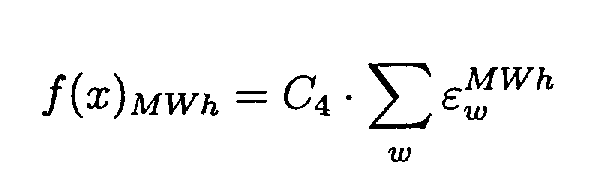
- The value of the coefficients Ci (i = 1,.., 4) reflects the importance associated to each issue. Any change of the coefficients, dramatically influences the output of the algorithm.
- Since, besides f(x) energycost , the other components of the cost function have no dimension, it is difficult to correctly weight the coefficients. Such operation, in most of the cases, has to be done with the end user.
- The result of the Mill scheduling is a constrained optimization problem, formulated as a mixed integer linear program:

- The vector of the optimization variables x is given by:

- The total number of variables is 23nG + 16G + 8n + 14. In the example described section on weekly output, the optimization variables are 524, out of which 254 continuous and 270 boolean.
- The matrix A includes all the inequalities (3, 4, 9, 10, 13, 16, 18, 20) representing the constraints, as well as Aeq includes the set of equations (1, 6, 11, 14, 17, 19).
- The weekly scheduling of five grades on three mills, using the commercially available mixed integer linear and quadratic optimisation program Cplex7.1, has last 25" on a
Pentium 3 933MHz. In other preferred embodiments of the invention, optimisation techniques such as simulated annealing or genetic algorithms are applied. The term "optimal solution" as used throughout this application denotes not necessarily a theroetical global optimum, but rather a solution better than all other solutions found after a given time or computational effort or after a termination criterion of the respective optimisation algorithm is satisfied. - The table 1 summarizes data needed to run the algorithm.
- The third column contains the values used for an example, with schedule results shown in Figure 1.
- Once the solution of the weekly scheduling has been achieved, the daily scheduling is then run, for each day, G times iteratively. At every iteration, the scheduling of one mill only is determined, largely independent from the other mills. For this reason, the index j, defining the mills, will be neglected in the following description of the daily scheduling algorithm. Splitting the problem advantageously reduces the computational complexity of the optimization problem and therefore the time to get a useful solution.
Parameters for Cement Mill scheduling optimization algorithm Magnitude Notation and dimension Values for the example Number of mills G 4 Number of processes n 6 Production rate α i,j [ ton / h] ∈[40; 50] Minimum daily production di [ton] 400 Availability hours w,j , [h] ∈ [20; 24] Daily sales sales w,i [ton] ∈ [350; 400] Silos starting capacities s_capacity (w,i)[ton] 400 Silos lower bound s_lower_bound(w, i) [ton] ∈ [200; 800] Silos upper bound s_lower_bound(w, i) [ton] ∈ [2500; 3000] Max processes per day M PD 2 Max processes per week M PW 3 Electricity price pw [ $ / kWh ] ∈ [0.5;1] Power installed Eng_MW(t)[MW] ∈ [2.6; 2.7] -
- Set points fulfillmentThe quantity of cement to be produced every day by the current mill is
stored in the variables cw,i , computed in the weekly scheduling. The task of
the daily scheduling is to decide how to commit the production on the DS
intervals in which the day is divided. In order to obtain a better optimum
with respect to the number of switches between grades , the optimization
horizon of the daily scheduling is preferrably set to one week, but any
shorter period, up to one single day, is allowed.The number of variables of the algorithm is proportional to DS, for that
reason, it is not recommended to use higher values than the default one
(DS = 24), corresponding to a sampling time of 1 hour.The number of intervals that grade i has to be produced on day w is given
by:
where dt = 24/DS is the length of an interval in hours. Since Qw,i has to be rounded to an integer, the production scheduled by the daily scheduling will not be exactly equal to the one computed by the weekly scheduling However, the average error is zero. The total number of intervals a day a mill has to be working, is given by:
 where mill_n is the number of grades actually produced by the current mill, normally less than n.There shall be associated with any interval of the week (int = 1,..., DS · 7) a set of mill_n boolean variables δint,i , that are set to one if and only if grade i is produced at time int.Finally, forcing for every day of the week, the sum of the corresponding δint,i to be equal to the pre-computed number of intervals Qw,i (equation 23), assures the fulfillment of the set point constraint:
 w = 1,...,7; i = 1, ...,mill_n
- PhysicalOn any mill only one grade can be produced at a time.Such a physical constraint is modelled by forcing, for every interval
int , the sum of the δ i,int to be lower than or equal than one.int = 1, ..., DS · 7
-
- SwitchingDue to the production of undesired low grade cement and to the high time
constants of the process, one of the main issues of the cement mill scheduling
is to reduce as much as possible any change in the operations.The logical variables δ s / i,int, defined as follow:
detects any change in the production.Expression (26), whose truth table is equivalent to (δ i,int ⊕δ i,int+1) δ s / i,int, is modelled as a constraint by the inequalities:
- Electrical power installedAs described in the section on daily scheduling, due to the independency of
the mills operations, the daily scheduling can be split and solved iteratively
mill, by mill. The only case where that assumption is not fulfilled is for the
Power installed issue, where the sum of the consumptions of all the mills
has to be considered.In order not to lose the computational advantages gained by fragmenting
the problem, the following solution is used:Let the variable int_cons j (int) [MW] represent the trend of the consumption
of the current mill at every interval of the week:
The power available for the first mill under consideration (j = 1) is equal to the total power installed, eng_MW(int) (see section on Weekly soft constraints and electrical power installed!), while the power available for the following mills (mill_MWj ) will be the difference between the installed one and the sum of the consumptions of the previous mills:
 j = 2, .., GOf course the most critical scenario will always be for the last mill, whose amount of power available is the the lowest.Again, a "watch dog" boolean variable (expression 29, inequalities 30) is defined, which is responsible to detect the fulfillment of the soft constraint, and that will be minimized in the optimization.

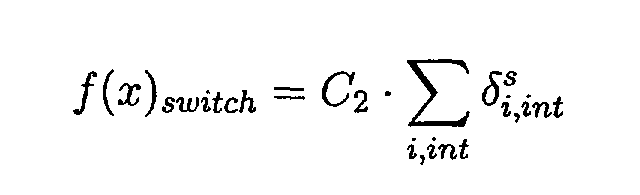
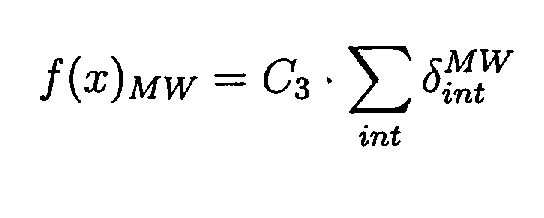
- The cost function can be divided into three different parts:
- Energy cost: The optimization will try to commit the production at those
intervals when the electricity price, pint [ $ / kWh] is lower.
That term is the only one whose dimension is a cost, as it is the product
between $ / kWh · t / h · kWh / t · h·.

- Switching:
- Power installed:
- The constraints of the daily scheduling are represented by the inequalities (25, 27, 30) and the equations (24, 28).
- The daily scheduling of six cement grades on three mills, using Cplex7.1, has last 45" on a
Pentium 3 933MHz. - A flow diagram of a computer program implementing the inventive method is given in Figure 2. In
step 1, program execution is started and a description of the scheduling problem is read from a computer storage device and/or acquired from user input. Instep 2, the weekly scheduling over the first period of time is performed. Instep 3, the "daily" scheduling problem (i.e. over the second period of time) is initialised for the first "day" and the first production unit or cement mill. Instep 4, the daily scheduling problem is solved and the total amount of power consumption committed so far for that day is computed. Instep 5, it is checked whether the "daily" scheduling has been performed for all days and all mills. If yes, then execution stops and the schedule is output to an operator atstep 6, otherwise, execution continues withstep 3 for the next day and/or mill not considered so far. In another preferred embodiment of the invention, the optimal schedule is transferred to a plant control system and used to automatically control the production units or cement mills. Preferably, the inventive method is executed repeatedly each "day", using updated information on orders and sales, energy prices, etc, and operation of the plant is performed according to a correspondingly updated optimal schedule. - Instead of splitting the optimisation task into the two distinct steps of "weekly" and "daily" optimisation, it is in principle possible to combine the objective functions and constraints and find an overall optimal solution. However, the computational complexity and cost are much higher for such a procedure.
- In the previous sections on weekly and daily scheduling, techniques to derive the schedule of cement mills operations have been described. The main output for the operator responsible to run the mills is the sequence of switches of the mills, for instance in the form of Gantt charts.
- The above methodology produces an open loop type of optimal schedule, which relies on prediction of mills and silos technical characteristics, their state at the time of use (silos content level, mills current availability, etc.), and on forecasts of product prices and orders to be satisfied in the next future. However, in practice, these conditions and forecasts are not exact: unplanned events like failures of some components, or simply a change in the product shipping are very frequent, so that in a real application the schedule computed could become not optimal after a certain time. In order to cope with that situation there are two main possibilities:
Either recompute the schedule very often, repeating all the steps as above, which can be costly and cumbersome, or apply advanced control techniques to compensate for these errors and return the system to a state according to the optimal reference schedule. In other words, use model based optimal control to reject process disturbances, in our case, to reject deviations from the optimal silos levels introduced, for instance, by the shipping activities (i.e. difference between real deliveries and forecasted ones) or by mismatches between the mill productivity rates assumed during scheduling and the real ones. In order to respond optimally way to these disturbances, a closed loop controller is applied, based on Model Predictive Control techniques, which tracks the reference schedule computed previously. - The observed variables are the levels in the silos, while the control variables are the switching commands to the mills. In the cost functional of the controller appear, with different weighting factors, deviations from the reference trajectories for the silo levels and the mills status (on/off on which product), respectively.
- At every time sample (normally every hour), the controller compares the current values with the reference. If differences are detected, it minimizes such deviations according to the weights chosen over certain time horizon. Furthermore, to better represent the physics of the system, the following constraints to be fulfilled by the solution of the MPC are preferrably considered:
- Silo lower and upper bounds.
- Banned product. It is possible to forbid the operation of some cement grades on some mills.
- Conveyor belts. In plants with many mills, there are usually constraints in the conveyor belt system for transporting the cement from the mills to the silos. For example, there might be 3 mills but just 2 independent conveyor belts. This means that just two grades of cement can be produced at the same time. Usually, multiple mills can discharge the same grade to the same conveyor belt at the same time.
- Consecutive production. It is possible to constrain the system to maintain the operation on one mill unchanged for a minimum interval of time. This constraint avoids an excessive switching of the mills.
- Planned shutdowns. Prohibits the operations of certain mills over defined intervals.
- Startup times.
- In a preferred embodiment of the invention, this predictive control algorithm works online, passing its decisions directly to the plant and mill control system, without operator intervention.
- The Model Predictive Control requires a model of the system in order to make a prediction of the system behavior in the steps following the current time. Due to the hybrid features of the plant, such a model has been derived in the Mixed Logic Dynamic (MLD) framework, described in Control of systems integrating logic, dynamics, and constraints-Bemporad A. and M. Morari- Automatica, Special issue on hybrid systems, Vol. 35, n.3, p.407-427). A detailed description of the steps needed to combine MPC and MLD can be found in Controllo di impianti cogenerativi mediante sistemi ibridi - Letizia, University of Pavia, Master Thesis, March 2001.
-
- G1...G6
- Grades one ... six of cement produced
- 1
- START, begin program execution
- 2
- w_opt, weekly scheduling
- 3
- d_init, initialise daily scheduling
- 4
- d_opt, daily scheduling
- 5
- all?, check if all daily schedules are generated
- 6
- STOP, generate output and stop program execution
Claims (15)
- A method for batch scheduling for a plurality of production units, characterised in that each production unit is capable of producing a predetermined quantity of a product having at least one characteristic grade that is controllable by a manner of operating the production unit, and that a batch schedule to be determined comprises a specification of what grade product is to be produced on which production unit at which time of a predetermined first period of time, and that the method comprises a scheduling step of
minimising an objective function subject to hard constraints, where said objective function is computed as a function of the batch schedule and comprises a cost of energy used by the production units during the first period of time,
and where said hard constraints are expressed as equalities and inequalities in terms of the batch schedule and comprisea specification of quantities of the product of a given grade to be produced,a set of maximum and minimum storage capacities for each product grade, and where minimising the objective function is achieved by repeatedly varying the batch schedule subject to the hard constraints and computing the value of the objective function until an optimised value of the objective function is obtained,
and returning, as result of the minimisation, an optimal batch schedule corresponding to the optimised value of the objective function. - Method according to claim 1, where the hard constraints comprise an expression stating that a production unit can be used for only one product grade at a time, or that a production unit cannot be used at all.
- Method according to claim 1 or 2, where the hard constraints comprise an expression stating that, if a production unit is committed to produce the product of a given grade, then a minimal quantity of said grade must be produced by said production unit.
- Method according to one of the preceding claims, where the objective function comprises a term that penalises changes in product grade produced in the same production unit.
- Method according to one of the preceding claims, where the objective function comprises a term that penalises a use of energy per time unit that exceeds a given limit.
- Method according to claim 1, where the first period of time is split into a sequence of second periods of time, and the method comprises
a first scheduling step that schedules production over the first period of time and determines, for each of the second periods of time and for each production unit, a set of quantities of product of a given grade that is to be produced, and
a second scheduling step that schedules production by one production unit for one of the second periods of time, where the second scheduling step is executed repeatedly for each of the second periods of time and for each of the production units. - Method according to claim 6, where the first scheduling step comprises
minimising an objective function subject to hard constraints, where said objective function comprisesa cost of energy used by the production units, a term that penalises changes in product grade produced in the same production unit, anda term that penalises a use of energy per time unit that exceeds a given limit, and where said hard constraints comprise,for each of the second periods of time, a set of quantities of the product to be produced having a given grade,a set of maximum and minimum storage capacities for each product grade,an expression limiting, for each production unit and for each of the second periods of time, the time that the production unit may be in operation, andan expression stating that, for each of the second periods of time, when a production unit is committed to produce the product of a given grade, then a minimal quantity of said grade must be produced by said production unit. - Method according to claim 6, where the second scheduling step that schedules production by one production unit for one of the second periods of time comprises the step ofand where said hard constraints comprise,minimising an objective function subject to hard constraints, where said objective function comprises a cost of energy used by the production unit, a term that penalises changes in product grade produced in the production unit, and a term that penalises a use of energy per time unit that exceeds a given limit,for the production unit, a set of quantities of the product having a given grade, to be produced, andan expression stating that only one grade can be produced at the same time.
- Method according to claim 7, where the term that penalises changes in product grade produced in the same production unit comprises, for each production unit, the number of different product grades produced by said production unit over the first period of time and, for each production unit and each of the second periods of time, the number of different product grades produced by said production unit.
- Method according to one of the preceding claims, where the production units are cement mills or mills for producing raw meal, and the controllable characteristic grade is one of grade of cement or grade of raw meal.
- Method according to claim 10, comprising the step of generating a human-readable description of the optimal batch schedule.
- Method according to claim 10, comprising the step of controlling the cement mill operation according to the optimal batch schedule.
- Method according to claim 12, where model predictive control techniques are applied for ensuring that actual operation of the cement mills corresponds to the scheduled operation.
- Computer program for batch scheduling for a plurality of production units which is loadable and executable on a data processing unit and which computer program, when being executed, performs the steps according to one of claims 1 to 13.
- Apparatus for batch scheduling for a plurality of production units, comprising a data processor, a memory coupled to the processor and computer program code means stored in said memory, where said computer program code means, when executed by the processor, performs the steps according to one of claims 1 to 13.
Priority Applications (1)
| Application Number | Priority Date | Filing Date | Title |
|---|---|---|---|
| EP02405629A EP1385108A1 (en) | 2002-07-19 | 2002-07-19 | Method, computer program and apparatus for batch scheduling |
Applications Claiming Priority (1)
| Application Number | Priority Date | Filing Date | Title |
|---|---|---|---|
| EP02405629A EP1385108A1 (en) | 2002-07-19 | 2002-07-19 | Method, computer program and apparatus for batch scheduling |
Publications (1)
| Publication Number | Publication Date |
|---|---|
| EP1385108A1 true EP1385108A1 (en) | 2004-01-28 |
Family
ID=29797356
Family Applications (1)
| Application Number | Title | Priority Date | Filing Date |
|---|---|---|---|
| EP02405629A Ceased EP1385108A1 (en) | 2002-07-19 | 2002-07-19 | Method, computer program and apparatus for batch scheduling |
Country Status (1)
| Country | Link |
|---|---|
| EP (1) | EP1385108A1 (en) |
Cited By (2)
| Publication number | Priority date | Publication date | Assignee | Title |
|---|---|---|---|---|
| CN112181619A (en) * | 2020-09-23 | 2021-01-05 | 中国建设银行股份有限公司 | Scheduling method, device, equipment and medium for batch service |
| CN115545246A (en) * | 2021-06-28 | 2022-12-30 | 上海交通大学 | Multi-vehicle batch flexible production line scheduling method |
-
2002
- 2002-07-19 EP EP02405629A patent/EP1385108A1/en not_active Ceased
Non-Patent Citations (1)
| Title |
|---|
| No Search * |
Cited By (2)
| Publication number | Priority date | Publication date | Assignee | Title |
|---|---|---|---|---|
| CN112181619A (en) * | 2020-09-23 | 2021-01-05 | 中国建设银行股份有限公司 | Scheduling method, device, equipment and medium for batch service |
| CN115545246A (en) * | 2021-06-28 | 2022-12-30 | 上海交通大学 | Multi-vehicle batch flexible production line scheduling method |
Similar Documents
| Publication | Publication Date | Title |
|---|---|---|
| US5971585A (en) | Best can do matching of assets with demand in microelectronics manufacturing | |
| US8290607B2 (en) | Planning method and system for optimizing stock and production plan in batch process industry | |
| Wu et al. | Hierarchical approach for production planning and scheduling under uncertainty | |
| US20090319070A1 (en) | System and method for discrete supply chain control and optimization using model predictive control | |
| Gordon et al. | Scheduling with due date assignment under special conditions on job processing | |
| US20080172280A1 (en) | Manufacturing schedule optimization | |
| Méndez et al. | An MILP-based approach to the short-term scheduling of make-and-pack continuous production plants | |
| US7103436B2 (en) | Method for optimizing foundry capacity | |
| Huskova et al. | Speeding up past stock movement simulation in sporadic demand inventory control | |
| EP1385108A1 (en) | Method, computer program and apparatus for batch scheduling | |
| Allen et al. | Practical production scheduling with capacity constraints an | |
| EP1793333A1 (en) | Automatic cost generator for use with an automated supply chain optimizer | |
| US7103435B2 (en) | System and method of control factor management | |
| Simeonov et al. | Simulation scheduling in food industry application | |
| EP1843232A1 (en) | Production scheduling system | |
| Bardhan et al. | An Iterative Scheme for Hierarchical Production Planning in Semiconductor Wafer Fabrication | |
| EP3937095B1 (en) | Determining contractual output data in response to a contractual request | |
| Fanchao et al. | Symbiotic simulation control in supply chain of lubricant additive industry | |
| Engell | Uncertainty, decomposition and feedback in batch production scheduling | |
| Kovács | A novel approach to aggregate scheduling in project-oriented manufacturing | |
| Krueger et al. | Plant-wide master production scheduling in the automotive industry under component blockings: an MILP-approach and a simulation study | |
| Mor | Maximizing the weighted number of Just-In-Time jobs in a proportionate flow shop with job rejection | |
| Hennet | A feedback control approach to multistage production planning based on input-output analysis | |
| EP3739397A1 (en) | Method and system for producing a polymer product within a high-frequency production plant | |
| Belhadi et al. | An Integrated Scheduling and Vehicle Routing Model for Food Processing Industries: A Case Study in an Ice Cream Processing Factory |
Legal Events
| Date | Code | Title | Description |
|---|---|---|---|
| PUAI | Public reference made under article 153(3) epc to a published international application that has entered the european phase |
Free format text: ORIGINAL CODE: 0009012 |
|
| AK | Designated contracting states |
Kind code of ref document: A1 Designated state(s): AT BE BG CH CY CZ DE DK EE ES FI FR GB GR IE IT LI LU MC NL PT SE SK TR |
|
| AX | Request for extension of the european patent |
Extension state: AL LT LV MK RO SI |
|
| 17P | Request for examination filed |
Effective date: 20040716 |
|
| AKX | Designation fees paid |
Designated state(s): AT BE BG CH CY CZ DE DK EE ES FI FR GB GR IE IT LI LU MC NL PT SE SK TR |
|
| APBK | Appeal reference recorded |
Free format text: ORIGINAL CODE: EPIDOSNREFNE |
|
| APBN | Date of receipt of notice of appeal recorded |
Free format text: ORIGINAL CODE: EPIDOSNNOA2E |
|
| APBR | Date of receipt of statement of grounds of appeal recorded |
Free format text: ORIGINAL CODE: EPIDOSNNOA3E |
|
| APAF | Appeal reference modified |
Free format text: ORIGINAL CODE: EPIDOSCREFNE |
|
| RAP1 | Party data changed (applicant data changed or rights of an application transferred) |
Owner name: ABB SCHWEIZ AG |
|
| APBT | Appeal procedure closed |
Free format text: ORIGINAL CODE: EPIDOSNNOA9E |
|
| STAA | Information on the status of an ep patent application or granted ep patent |
Free format text: STATUS: THE APPLICATION HAS BEEN REFUSED |
|
| 18R | Application refused |
Effective date: 20210216 |